November 30, 2006
Two of my favorite literary awards are:
1. The Bulwer Lytton fiction contest (award given to what could be a worst opening sentence in a novel - sometimes hypothetical novel - the award is named for the man who began his book with "It was a dark and stormy night.")
2006's winning sentence is, for example:
Detective Bart Lasiter was in his office studying the light from his one small window falling on his super burrito when the door swung open to reveal a woman whose body said you've had your last burrito for a while, whose face said angels did exist, and whose eyes said she could make you dig your own grave and lick the shovel clean.
I mean, you know. This is genius.
Some other winning sentences:
Through the gathering gloom of a late-October afternoon, along the greasy, cracked paving-stones slick from the sputum of the sky, Stanley Ruddlethorp wearily trudged up the hill from the cemetery where his wife, sister, brother, and three children were all buried, and forced open the door of his decaying house, blissfully unaware of the catastrophe that was soon to devastate his life.
Aren't these great? Another winner:
A small assortment of astonishingly loud brass instruments raced each other lustily to the respective ends of their distinct musical choices as the gates flew open to release a torrent of tawny fur comprised of angry yapping bullets that nipped at Desdemona's ankles, causing her to reflect once again (as blood filled her sneakers and she fought her way through the panicking crowd) that the annual Running of the Pomeranians in Liechtenstein was a stupid idea.
I can't get enough of this stuff.
This one, the winner for 1985, is, I believe my favorite:
The countdown had stalled at T minus 69 seconds when Desiree, the first female ape to go up in space, winked at me slyly and pouted her thick, rubbery lips unmistakably--the first of many such advances during what would prove to be the longest, and most memorable, space voyage of my career.
Here is the "lyttony" of prize winners. Each sentence is deliciously awful, spectacularly bad ... I also love how some of the prize winners have shown up at the awards ceremonies, full of good and self-deprecating humor about their own badness (kind of like Halle Berry going to accept a Razzie for Cat woman - and being all hysterical and good-natured about it).
So there's THAT. LOVE that prize.
2. My second favorite literary award is the award for Bad Sex in Fiction. Here's a list of past winners.
(More here.)
Unlike the Bulwer Lytton award, which rarely features writers anyone has ever heard of - we get some heavy hitters in this award. Updike, Tom Wolfe, etc. No one is spared. Obviously it's difficult to write a sex scene well. This award celebrates those who not only do not write sex scenes well - but who tip over into spectacular badness. You gotta go read some of the entries on that website. I refuse to put them on my site because, frankly, I'm sick of sexually inappropriate Google searches ... Ha!! But seriously, some of the sentences ... You CRINGE when you read them they are so bad.
One of my favorite things about this award is also the good humor with which (most) authors treat their nominations. People show up for the raucous awards ceremony, they admit their own badness, they laugh at themselves ... so much fun. Sean Thomas who won in 2000 accepted his award, saying sincerely, "It's an enormous honor and I'm gratified." Ha!! (Also, with a bit of scanning you'll be able to find his winning sentence on that site. It's just soooo funny. Soooo bad.)
There are some authors who have been nominated 3, 4 times. Ha!! There must be a strange sense of pride in that.
So. Iain Hollingshead is this year's winner. Here is a very funny essay by him - about his whole experience. I just love his honesty and humor about himself:
My own extract, in comparison, felt rather tame. But it was very badly written indeed. So bad, it seems, that the judges had little difficulty in declaring me, dear reader, the recipient of the 2006 Literary Review Bad Sex in Fiction Award.
HA!
Woah.
You know, I tore my way through Dino - and didn't write that much about it here - even though it was just a GREAT reading experience.
Must rectify that, and do some posts on the book ... (you know, in all my free time.)
The Proust questionnaire
Any Vanity Fair reader will be familiar with the Proust questionnaire that always graces the back page of the mag. A celebrity, or famous figure - is sent the questions - and he or she responds. They're always fun to read - because the questions are specific, some of them are rather odd - and when people answer in a spontaneous way, really interesting things can come up.
I am thinking about all of this because of Dame's post about it. (Very interesting reading. Her blog, in general, is very good. Scroll around - I really like her stuff.) I decided to answer the questions for myself - not over-thinking it - and also, like she says in her post:
The principle is to answer each question without explanation and in whatever manner suits you - as your manner of response can tell as much about you as the answer itself. I think it makes an interesting exercize in self-examination. The more difficult task is this - to answer as honestly as possible with one’s self, not trying to adapt one’s answers to impress a potential reader.
There's the rub. Giving myself that task made it a bit more difficult. I tried to just blank my brain, get into a really private subconscious mood, and answer as spontaneously as I could.
Also, yes. To answer without explanation.
It took some time. I could feel when I was trying to "come up" with an answer, and that was not what I wanted. So I would put it down for a bit, go on with my life, do other things ... and then come back to it. Clearing out the cobwebs.
What is your idea of perfect happiness?
cooking in the kitchen, husband reading in the other room, sometimes talking to each other, sometimes not, maybe music playing low, glass of wine on the counter ... casual sense of shared space ... no stress ... ease ... togetherness ... not being alone
What is your greatest fear?
being alone and old and poor.
What historical figure do you most identify with?
I identify with Emily Dickinson. I identify with Anne Morrow Lindbergh.
Which living person do you most admire?
Madeleine L'Engle
What is the trait you most deplore in yourself?
Cowardice. Negativity.
What trait do you most deplore in others?
Holier-than-thou prudery and judgment of others. Also gleeful cruelty to animals I find unforgivable.
What is your greatest extravagance?
Books.
Flynn.
On what occasion do you lie?
If I'm having a shitty day, and the nice smiley Pakistani guy behind the counter at my deli says, "How are you today?" (as he does EVERY day, bless him) when I come in to get my coffee - I always say, "Good! How are you?"
What do you most dislike about your appearance?
my profile
What is your favorite journey?
those moments when you are coming out of an isolated tough period in your life, when you have withdrawn from the world, maybe you're healing from a heartbreak or whatever, and you force yourself to go to a party, or a family gathering, or a concert - whatever it is - something that you cannot control, an event that is outside of your mind, a social occasion - and instead of having to grin and bear it, and fake like you're having a good time - you actually have the BEST time in your life, you forget your misery, and you find yourself laughing so hard you start to cry, or dancing like a whirling dervish, or deep in animated conversation ... however it manifests itself .... It's like a miracle. Suddenly you look around and realize: I am REALLY howling with laughter. I am REALLY talking and listening. And because you have been alone with your morbid thoughts for so long ... it feels so vivid, so much like oxygen ... a night like that is life affirming. You walk away a different person. You are on the way to healing.
What do you consider the most overrated virtue?
patience
Which living person do you most despise?
I despise Pat Buchanan. I despise Fred Phelps. I despise John Derbyshire. Oh, and also David Miskeeeevegee. Won't spell his name correctly. Do not want his evil minions coming after me.
Which words or phrases do you most overuse?
marvelous
What is your greatest regret?
April 30, 1994. I regret what I DIDN'T say, not what I did.
What or who is the greatest love of your life?
IS the greatest love? My family. Also Cary Grant, and books, and movies.
But he WAS my greatest love. (So far?????)
When and where were you happiest?
long summer nights, age 7 or 8, sandy toes, wet bathing suit, lining up outside Newport Creamery, the take-out window - to get ice cream on the way home from the beach: chocolate in a cup, with chocolate jimmies ... home, the cool dewy grass, fireflies, sleepy limbs, corn on the cob, sound of crickets, salt water making the skin feel taut and fresh ...
Which talent would you most like to have?
figure skating
What is your current state of mind?
alert
If you could change one thing about yourself, what would it be?
how personally I take things, how much I internalize rejection, how willing I am to believe the worst about myself
If you could change one thing about your family, what would it be?
make it a wee bit bigger by having a baby of my own
If you were to die and come back as a person or thing, what would it be?
person
If you could choose what or who to come back as, what would it be?
dolphin
What do your consider your greatest achievement?
friendships
What is your most treasured possession?
well ... I don't have the Barrister bookcase yet that my parents have given me for my birthday ... but that already is my most treasured possession.

What do you regard as the lowest depth of misery?
having health problems when you have no insurance and no money
What is your most marked characteristic?
pale skin, big freckles
What is the quality you most like in a man?
humor
strength
likes women
What is the quality you most admire in a woman?
good listener
down to earth
not judgmental towards other women
What do you most value in your friends?
continuity
Who are your favourite writers?
Shakespeare
Madeleine L'Engle
Annie Proulx
James Joyce
Who is your favourite hero of fiction?
Harriet the spy
Charlotte the spider
Who are your heroes in real life?
firemen
What are your favourite names?
Moira
Zachary
What is it that you most dislike?
coconut
How would you like to die?
just not alone. someone be there with me.
What is your motto?
Make voyages. Attempt them. That's all there is. -- Tennessee Williams, "Camino Real"
Happy birthday, Jonathan Swift!

Jonathan Swift was born on this day, in 1667. Here's a ton of biographical information if you are interested.
Primarily known for Gulliver's Travels and A Modest Proposal he was also a poet of pretty uncommon gifts. I LOVE his poetry. He's also one of the most quotable of all writers. This man had acid running in his veins, acid of contempt for his fellow human beings. Ha!
But you think that it is time for me to have done with the world, and so I would if I could get into a better before I was called into the best, and not die here in a rage, like a poisoned rat in a hole.
His hatred and contempt have echoed across the centuries and given us the primary examples of satire that all writers should study. I am sorry that satire is so tepid these days. I find most of it way too coy, and ... obvious. They WISH that what they were doing was satire of the highest order - but what they are really doing is just bitching and whining in a tiny airless corner. Swift was merciless. Swift's command of language was impeccable. His observations were ruthless. He cannot be touched.
Swift said, in regards to satire:
Satire is a sort of glass, wherein beholders do generally discover everybody's face but their own.
hahahaha So true!
Swift embraced hate. It's hard to describe any other way - and yet he did not embrace corruption. Most people who fill their souls with hate (and I can think of many examples in our present-day political discourse as I am sure you can as well) completely corrupt their humanity. Their hatred for everyone else (and their inability to look in a mirror - or, no, it's not just inability - it is blatant and conscious REFUSAL to look in a mirror) leaves them with no humanity. Swift does not seem to have had that problem. He was just alert, that's all. He just saw the things going on around him, and wrote it all down. He pulled no punches.
I never wonder to see men wicked, but I often wonder to see them not ashamed.
Come on now. Truth. There is such truth in Swift.
And also:
Politics, as the word is commonly understood, are nothing but corruptions.
He called things as he saw them:
We have just enough religion to make us hate, but not enough to make us love one another.
Obviously such blunt truth was highly unwelcome in many circles - and still is today. Oh, how much the pious haters despise those who call them on their phoniness!! Again: it all comes back to this: Can you look in the mirror? Can you face yourself? Can you entertain the possibility that that which you hate is also inside of you? Oh ho ho no. Many people don't even know what the HELL you are talking about when you talk like that!
But then there is also this:
It is in men as in soils where sometimes there is a vein of gold which the owner knows not.
The belief in the good in people. Not universally - oh, no. Swift was perfectly willing to see some people as just plain assholes with no redeeming qualities - and I'm pretty much with him on that. But occasionally - where you least expect it - a "vein of gold".
Many professional haters (and don't get me wrong - I think Jonathan Swift was a first-class straight-A hater - he said it about himself!) have ZERO senses of humor. Oh, they think they do, and I see them chortling on political talk shows, throwing zingers at their opponents - and yet - there's no wit. No humor. None.
But Swift? He used humor. He used it like a whip, yes, but also - well - there's something like this statement which makes me laugh out loud every time I read it:
There were many times my pants were so thin I could sit on a dime and tell if it was heads or tails.
Self-knowledge - a willingness to include himself in his own merciless searchlight:
Where I am not understood, it shall be concluded that something very useful and profound is couched underneath.
And his POEMS. Let me post a couple of them. They're marvelous. Funny, biting, mean ... and yet sometimes so heartfelt (the ones to Stella - the woman he loved all his life - comes to mind) that they bring tears to my eyes.
You don't want to skim these. Read. Read them.
A Satirical Elegy: On the Death of a Late Famous General
His Grace! impossible! what dead!
Of old age, too, and in his bed!
And could that Mighty Warrior fall?
And so inglorious, after all!
Well, since he's gone, no matter how,
The last loud trump must wake him now:
And, trust me, as the noise grows stronger,
He'd wish to sleep a little longer.
And could he be indeed so old
As by the news-papers we're told?
Threescore, I think, is pretty high;
'Twas time in conscience he should die.
This world he cumber'd long enough;
He burnt his candle to the snuff;
And that's the reason, some folks think,
He left behind so great a stink.
Behold his funeral appears,
Nor widow's sighs, nor orphan's tears,
Wont at such times each heart to pierce,
Attend the progress of his hearse.
But what of that, his friends may say,
He had those honours in his day.
True to his profit and his pride,
He made them weep before he dy'd.
Come hither, all ye empty things,
Ye bubbles rais'd by breath of Kings;
Who float upon the tide of state,
Come hither, and behold your fate.
Let pride be taught by this rebuke,
How very mean a thing's a Duke;
From all his ill-got honours flung,
Turn'd to that dirt from whence he sprung.
I love the line: "How very mean a thing's a Duke". It just says it all.
And here is my favorite of the "Stella poems":
Stella's Birthday March 13, 1727
This day, whate'er the Fates decree,
Shall still be kept with joy by me:
This day then let us not be told,
That you are sick, and I grown old;
Nor think on our approaching ills,
And talk of spectacles and pills.
To-morrow will be time enough
To hear such mortifying stuff.
Yet, since from reason may be brought
A better and more pleasing thought,
Which can, in spite of all decays,
Support a few remaining days:
From not the gravest of divines
Accept for once some serious lines.
Although we now can form no more
Long schemes of life, as heretofore;
Yet you, while time is running fast,
Can look with joy on what is past.
Were future happiness and pain
A mere contrivance of the brain,
As atheists argue, to entice
And fit their proselytes for vice;
(The only comfort they propose,
To have companions in their woes;)
Grant this the case; yet sure 'tis hard
That virtue, styl'd its own reward,
And by all sages understood
To be the chief of human good,
Should, acting, die, nor leave behind
Some lasting pleasure in the mind;
Which by remembrance will assuage
Grief, sickness, poverty, and age;
And strongly shoot a radiant dart
To shine through life's declining part.
Say, Stella, feel you no content,
Reflecting on a life well spent?
Your skilful hand employ'd to save
Despairing wretches from the grave;
And then supporting with your store
Those whom you dragg'd from death before?
So Providence on mortals waits,
Preserving what it first creates.
Your gen'rous boldness to defend
An innocent and absent friend;
That courage which can make you just
To merit humbled in the dust;
The detestation you express
For vice in all its glitt'ring dress;
That patience under torturing pain,
Where stubborn stoics would complain:
Must these like empty shadows pass,
Or forms reflected from a glass?
Or mere chimæras in the mind,
That fly, and leave no marks behind?
Does not the body thrive and grow
By food of twenty years ago?
And, had it not been still supplied,
It must a thousand times have died.
Then who with reason can maintain
That no effects of food remain?
And is not virtue in mankind
The nutriment that feeds the mind;
Upheld by each good action past,
And still continued by the last?
Then, who with reason can pretend
That all effects of virtue end?
Believe me, Stella, when you show
That true contempt for things below,
Nor prize your life for other ends,
Than merely to oblige your friends;
Your former actions claim their part,
And join to fortify your heart.
For Virtue, in her daily race,
Like Janus, bears a double face;
Looks back with joy where she has gone
And therefore goes with courage on:
She at your sickly couch will wait,
And guide you to a better state.
O then, whatever Heav'n intends,
Take pity on your pitying friends!
Nor let your ills affect your mind,
To fancy they can be unkind.
Me, surely me, you ought to spare,
Who gladly would your suff'rings share;
Or give my scrap of life to you,
And think it far beneath your due;
You, to whose care so oft I owe
That I'm alive to tell you so.
"Does not the body thrive and grow By food of twenty years ago?" God ... that just kills me. Yes, Swift ... yes, it does.
And this one - hee hee:
Oysters
Charming oysters I cry:
My masters, come buy,
So plump and so fresh,
So sweet is their flesh,
No Colchester oyster
Is sweeter and moister:
Your stomach they settle,
And rouse up your mettle:
They'll make you a dad
Of a lass or a lad;
And madam your wife
They'll please to the life;
Be she barren, be she old,
Be she slut, or be she scold,
Eat my oysters, and lie near her,
She'll be fruitful, never fear her.
Ha!
Michael Schmidt's book Lives of the Poets has a chapter devoted to Jonathan Swift, John Gay, and Alexander Pope - it's called "Three Friends". Schmidt's book is a must-read for poetry lovers - he's not a critic first of all. He's an editor and a book publisher. He's a FAN of poetry - and he writes like a fan writes - not like a critic - and yet his knowledge is encyclopedic. I LOVE the book.
Here is some of what he has to say about Jonathan Swift:
His vexed relations with women, especially "Stella" and "Vanessa", and his disgust with physical functions, have given much latitude to Freudian interpretations. Disgust informs much of the prose and verse, but so does a real interest in common people, their language, actions and concerns. The verse opens on this area of his genius, and on his darker musings. It possesses the satiric virtues of the prose with an additional element: the "I" speaks, speaks as itself, with an uncompromised acerbity that few poets have masterd. When he died in 1745, Ireland and England were in his debt. The topicality that limits the appeal of some of his prose is itself the appeal of the verse: it catches inflections and remembers small actions now lost -- the voices of gardeners, street vendors, laborers ... the tone of a cryptic man of conscience speaking of his world, his bitter, life, his wary loves.
Jonathan Swift described style, in writing, as "proper words in proper places". I think he pretty much mastered that - in his prose, certainly, but also in his poems. There isn't an extra word there - there is no FAT in his language - he has pared everything down to its essentials. The verses come to us as though they were born complete - and perfect.
More from Schmidt - and this, I believe, is a brilliant point:
In the more ambitious pieces Swift challenges the reader ... There is a unique irony at work, not normative, like Dryden's, but radical: thematic rather than stylistic. This is why his poems, even the most topical, retain force today. "I take it to be part of the honesty of poets," he wrote, "that they cannot write well except they think the subject deserves it." The subjects he chose he approached as if for the first time, as if we stepped from the chill, clear world of reason into a world of men.
More (I see his point here about Swift not being quotable, not really - most of the quotes I excerpted above were from his prose works - His poems are pretty much complete as they are - and need to be read straight through - they are difficult to excerpt. They depend on momentum and continuity):
Swift is hard to recommend as a poet because he is hard to quote out of context. There are few purple passages, detachable maxims; the poetry is drawn evenly through the poem in ways that out-of-context quotation violates. The epitaphs, the spoofs, the eclogues, the anecdotes spoken by various voices, the ironic love poems, the first-person poems, will not be broken up into tags like the rich couplet bric-a-brac of Pope. In Swift we come upon a writer who might have preferred to be called versifier rather than poet. There is a difference in kind in his work from that of his predecessors; and he is not "polite" enough to have beguiled his contemporaries into imitation. He stands alone, he doesn't sing, he never ingratiates himself. He speaks, and he understands how the world wags.
And on that note, I will close this ginormous post - but I will let William Butler Yeats have the last word on Jonathan Swift, an absolutely goosebump-inducing writer:
Swift's Epitaph
Swift has sailed into his rest;
Savage indignation there
Cannot lacerate his breast.
Imitate him if you dare,
World-besotted traveller; he
Served human liberty.
Yup. Imitate him if you dare.
The Books: At the Altar: 'A Dinner of Herbs' (L.M. Montgomery)
 At the Altar - 'A Dinner of Herbs' - by L.M. Montgomery
Speaking of maiden aunts! 'A Dinner of Herbs' is about a maiden aunt - who has elements of many other Lucy Maud heroines - Valancy from Blue Castle, Pat (stupid Pat) in her later years in Mistress Pat, and also Margaret in Tangled Web who ends up adopting a little boy and buying her own house - just to get away from being a maiden aunt in her bossy sister's house.
Robin Lyle is a maiden aunt. She lives with her brother, his bossy wife - and their clattering chattering family of loud bossy horrible children. Robin is put-upon, bossed within an inch of her life, and has no privacy. She is just expected to be grateful that she has a roof over her head. However, naturally, Robin is a PERSON and has secret desires of her own. For example, she's in love with Michael Stanislaws - the next-door neighbor - a guy who lives alone (well, he has 2 cats who follow him everywhere) - and has never married. They are good friends ... in a kind of aloof way. Typical Lucy Maud: they never say just what they mean until the very last second. Michael is a very PROUD person - he's poor, and I believe he's lame? The story was written in 1928 - a post World War I story - so I believe he fought in the war and came home changed from it. He's bitter. But Robin really likes him.
Anyhoo ... at the time the story opens, Robin has been proposed to by Irving Keyes - a pompous asswipe - but she feels she must say yes because ... she's a maiden aunt ... what other choice does she have? Oh - and she has also been informed by her horrible sister-in-law that she will now have to share a room with Gladys, her teenage niece. They need the room - they no longer can give Robin her own room. This is the main reason that she actually considers marrying the odious Irving Keyes - so she won't have to endure yet another chipping away of her privacy.
There's something I really like about the writing in this story. I can see why she used most of this stuff in later novels - it's good. The dialogue is good, the characters clear ... good writing.
Excerpt from At the Altar - 'A Dinner of Herbs' - by L.M. Montgomery
Robin went to her room - the only spot on earth she had ever been able to call her own. And, as always when she went into it, the peace and dignity and beauty of it seemed to envelop her like a charm. She was in a different world - a world where George and Myra could not quarrel or the hired girl be impertinent to her; and the everlasting noise and racket of the household died away at its threshold like the spent wave of a troubled sea. For years all that had supported her through the drudgery of days spent waiting on a querulous invalid was the certainty of finding herself alone in her dear room at night where dreams gae some mysterious strength for another day.
The north window looked down on leagues of ripped sea and distant, misty, fairy-like coasts. Between it and the sand-dunes was only a dwindling grove of ragged old spruces.
The west window looked out on Owl's Roost, with its orchard and garden, where First and Second Peter prowled darkly, and Michael himself played the violin at hours when all decent people should be in bed. Sometimes, too, he ate his slender meals in the orchard, under an enormous apple tree, never dreaming that Robin Lyle was watching him from her window, and wishing shamelessly that she might play "Thou" to his crust of bread and jug of milk. Nor was the book of verse wanting. Michael read as he ate, propping his book up against the jug.
And now all this would be taken from her. She knew exactly what rooming with Gladys and her shrieking chums would mean. No more dreaming; no more shadowy hours of listening to Michael's stormy music in the orchard; no more early dawns watching the silent mysterious ships drift by the dunes to the harbour; never again alone with the night.
No, she could not endure it. Even sleek, prosperous Irving Keyes would be better than that.
"Life isn't fair," said Robin drearily, as if there was any use in saying it.
She went to the glass and looked at herself. She looked at her straight, black, bobbed hair, dark blue eyes and white, heart-shaped face; at her wide mouth quirked up at the corners so that she always seemed to be laughing even when very sad. And she thought of Blanche Foster's red-gold hair and flashing black eyes and brilliant complexion. Blanche Foster, who had always made Robin feel old and dowdy and silly. It was amazing that Irving Keyes didn't prefer her, but since he didnt ...
Robin shivered a little and sat down by the west window in the moonlight. The window was open, and the faint, cold, sweet perfumes of night drifted in - blent with the whiff of Michael Stanislaw's pipe, neither faint nor sweet, but very alluring. Once, when she was eighteen, she had had a fleeting fancy for Irving Keyes - and he knew it. Even yet he was attractive - until he spoke. But his funny vulgar stories and his great haw-haws! And his love for practical jokes! He still thought it a joke to stick o ut his foot and trip somebody up. And he still thought it wit to call eggs cackleberries.
Irving Keyes had been heard to boast that he had got everything he wanted in life. And now he wanted Robin Lyle. Robin thought he would get that too, despite his roars of laughter and the jigarees on his house.
What else was there for her? Arnold Clive? No! She shivered again. Austere, religious Arnold with the face of a fanatic: high, narrow brow, deep-set intolerant eyes, merciless mouth - quite out of the question! And, after all, she liked Irving very well.
She looked over at Owl's Roost. What a nice, gentle little old house it was; a nice lazy old house - a house that had folded its hands and said "I will rest." It had none of the Lyle efficiency and up-to-dateness about it, with a sly little eyebrow window above the porch roof and the magic of trees around it. She loved the trees around Owl's Roost. There were no trees around George's house. Myra thought shade unsanitary.
Michael was smoking his pipe at the fence with an orchard full of mysterious moonlit delights behind him. Robin wished she could go down and talk with him. She had sometimes talked with him over the fence. Not often, and yet she felt curiously well acquainted with him. They had laughed together the first time they had talked, and when two peoplel have laughed - really laughed - together they are good friends for life.
Though Michael did not laugh much. If anything, he was bitter. But there was something stimulating and pungent about his bitterness - like choke-cherries. They puckered your mouth horribly, but still you hankered for them.
"I wonder what he is thinking of," thought Robin.
She knew she only thought it. Yet a voice drifted up to her from the orchard.
"I'm thinking how very silvery that dark cloud must be on the moon side," said the voice. "Come down here and help me watch it leaving the moon. It's as good as an eclipse."
Robin flew downstairs, out of the side door and along the brick walk, worn by many feet. Michael was hanging over the fence. First Peter sat hunched up beside him, and Second Peter smoothed about his shoulder. First Peter always let Robin stroke him, but Second Peter swore at her. Second Peter was not to be hoodwinked.
Robin stood beside Michael on the other side of the fence, where the moonlight would lie white as snow on the flagged walk when the cloud passed. She had never been through the fence. There was no gate between the Lyle yard and the old orchard, lying fragrant and velvety under the enchantment of night.
They stood there together in a wonderful silence until the cloud had passed.
" 'He who has seen the full moon break forth from behind a dark cloud at night, has been present like an archangel at the creation of light and of the world,' " quoted Michael, whacking his pipe on the fence and putting it in his pocket. "Wasn't it worth watching, Miss Lyle?"
If there was one thing she hated more than another, it was having Michael call her "Miss Lyle". She hated it so much that she answered "Yes", stiffly and unenthusiastically.
"It's impossible to avoid the conclusion that something is bothering you," said Michael. "Tell First Peter about it and I'll listen in."
A perfectly crazy impulse mastered Robin. She would tell him. She had to tell soembody.
"I can't make up my mind which of two men to marry," she said bluntly.
Michael was silent for an appreciable space. All the soundsaudible were First Peter purring and a dog taking the countryside into his confidence two farms away. His silence got on Robin's nerves.
"That wasn't quite true," she said crossly. "There are two - but there's only one I could really consider possible. And the trouble is I don't want to marry him - or anyone," she added hastily, telling a second tarradiddle.
"Then why marry him?" said Michael. "Why marry at all if you don't want to, in this day of woman's emancipation?"
"The trouble is - I'm not emancipated," sighed Robin, wishing that First Peter would stop purring. It was outrageous that a cat should be so blatantly happy. Though why shouldn't he be happy? Couldn't he sit on Michael's shoulder and snuggle his nose against Michael's face? Wasn't he doing it now, darn him? Yet she was still talking on. "I'm twenty years behind the times. I'm thirty-three and I'm not trained to do anything. I've no special gift. I can't sew or teach or pound a typewriter. All I can do, or want to do, is keep house. And I must marry - or room witih Gladys."
"Do you think Irving Keyes would be a more agreeable room-mate?" said Michael sarcastically - though she had not said anything about Irving Keyes.
"Well, he won't plaster my dressing table with powder - or raise Cain when he can't find his hairpins - or yell to Baal if he has chilblains - or look in the mirror the same time I do - purposely," said Robin defiantly.
"I think I see what you're up against," said Michael, beginning to fill his pipe again.
"You don't - not fully - a man couldn't," snapped Robin. "Gladys will talk me to death about her beaus. Gladys thinks there's no fun in having a beau unless you can tell everybody about him and what he said and what he did. She'll laugh at my funny old pictures with big sleeves and hats high on the head. She'll come in and wake me up in the wee sma's. She'll insist on having the most awful silver pig with a blue velvet pincushion on his back on my table. She'll bring her rampageous school chums in and chitter-chatter for hours. And everything will be either wonderful or priceless. I'll never be alone any more," concluded Robin pathetically.
"That gets me," said Michael. "And the alternative is Irving Keyes. A handsome fellow with gobs of money. Why don't you like him?"
"I do. But I don't feel like marrying him, for several reasons."
"For instance ..."
"He likes bread thick, and I like it thin," said Robin flippantly. She felt she had been absurd in telling Michael as much as she had.
"Every proper man likes bread thick. I've no sympathy with you there."
"Our taste in jokes is entirely different."
"Ah, that's serious," said Michael, not sounding serious.
"And ..." Robin looked at another cloud that was creeping over the moon. "I - I want someone else."
"Oh!" Second Peter snarled, as if he had been pushed aside with a foot.
"He's the only man in the world for me," said Robin, looking straight at Michael.
"That's a large order out of approximately five hundred million men," said Michael drily.
He began to smoke insolently. The cloud was over the moon, and the world was dark. Robin felt cold and old and silly and empty.
"I must go in," she said.
"Wait a sec." Michael was rummaging in his pocket. "Here's something for your rose-jar."
He handed her over a paper bag full of dried rose-leaves.
"All I can give any woman now - withered rose leaves," he said lightly. "Irving's a good fellow. Perhaps you can teach him to laugh in the right place. I'd have a try."
November 29, 2006
Being understood
I love this piece. I'll write more about it later - I've been thinking about it quite a bit - just wanted to link to it in the meantime.
Stoppard's "Coast of Utopia"
I'm going to have to go see this. You know, there are some things that just have to be done. A 9-hour play about Russia spanning an entire century written by Tom Stoppard? Seriously, in my world, in MY crowd, this is not something you miss. Don't be a jackass, you gotta go see it.
Interesting profile of Stoppard, by Daphne Murkin. Stoppard fans, you won't want to miss it. It's juicy - lots of good stuff. He's an odd duck, just as he should be.
I liked this quote:
Stoppard appears to have had the habits of a squire rather than those of a subversive. According to his long-time agent, Kenneth Ewing, his client was always inclined to luxury. “When I first met Tom,” Ewing is quoted in Tynan’s profile, “he had just given up his regular work as a journalist in Bristol, and he was broke. But I noticed that even then he always traveled by taxi, never by bus. It was as if he knew that his time would come.”
I also found it very interesting that Stoppard appears to answer questions in quips, epigrams, anecdotes - and the profile there makes the point that some of these "quips" have been recycled by him, in interview after interview, for years.
I begin to understand, even before I try to draw him out, why everything I have read about Stoppard seems to recycle the same anecdotes and quips. (He tells me, for instance, that he writes poetry, but “only for domestic consumption,” a line that I appreciate a bit less after I come across it in an interview he gave more than a decade earlier.) The critic Clive James has called Stoppard a “dream interview, talking in eerily quotable sentences.” But it strikes me that it is precisely the acrobatically clever quality of those sentences that keeps real scrutiny at bay.
Makes a lot of sense. It's a facade. An airy facade of cleverness which has the added purpose of leaving a lot of space around him, space that is necessary for him to work. Interesting.
Also, this is beautiful:
When I asked him why he chose [theatre] as his medium — and why he stuck with it — he responded via e-mail: “The standing of the theater in 1960 did have a lot to do with it. But it’s not just that. I like the smell of it, and the immediacy. Also the danger: getting it wrong in public. Also the thrill when you get it right in public.”
Coast of Utopia is a big risk. And I love it, I love him for being that kind of playwright. He raises the bar. I'll be there. So much theatre plays it safe nowadays. With ticket prices being what they are, and the public more interested in seeing Mary Poppins than serious theatre. But there MUST be a place for serious theatre, or challenging theatre, or even plays that have sad endings!! ... and there always will be those who push the boundaries of the artform (sometimes they generate enormous hits, like Tony Kushner with Angels in America - and sometimes they are flops) ... but it's the atmosphere of RISK that appeals to me. I felt it sitting in the audience at Grey Gardens as well. That entire project was a risk. And it's not perfect. But Christine Ebersole? She is transcendent. Her performance is triumphant - a personal triumph for her, to be sure ... but more than that, it is unutterably RIGHT for the material. Things came together - material and actress - in a way I've rarely seen before in live theatre. Her performance aches with pathos, humor, grief, courage ... Never seen anything like it. But it's certainly not an EASY show, it's not a happy ending kinda show ... but again, there IS a place for that kind of story ... because if I know that I hunger for it, then there are obviously others who do as well.
So bring it on, Stoppard ... bring on the 9 hours ... I love you.
Also - I've never seen Billy Crudup onstage and I've heard he is phenomenal - I'm still bummed I missed his Elephant Man. Ben Brantley says Crudup is "unmatchable in conveying the discomforts of self-consciousness." Absolutely. I can so see that.
Here's the review of Part 1 of the trilogy ... eventually they will all run together. (Amazingly, Richard Easton, after collapsing onstage due to cardiac arrhythmia during previews - causing Ethan Hawke to stop his performance and shout out into the audience: "Is there a doctor in the house?" - is back up and running. Got a great review too. Amazing.)
Brantley writes in his review:
“Utopia” portrays people who, determined to pursue a life of the mind, keep discovering that life has a disruptive mind of its own.
Can't wait.
When legends gather ...
Charlton Heston, Marilyn Monroe, and Rock Hudson.
You know, even from that angle (which is disastrous for 99.99999% of the population - especially the female population) Marilyn looks ravishing.
Which reminds me - I finished the third book on my From the Stacks challenge: The Making of the Misfits ... Need to write up a post on it. It was a quick read - a reporter's first-hand journal about being on the "set" in Reno for The Misfits, one of the more notoriously difficult shoots in cinematic history. This is the story of that shoot - from the ground up, no retrospect ... it's all in present-tense: "Today we moved out to the dry lake for the wild horses scene ..." etc.
I loved it. I'll write up a post about it later.
Happy birthday to Louisa May Alcott

"November is the most disagreeable month in the whole year," said Meg, standing at the window one dull afternoon, looking out at the frostbitten garden."That's the reason I was born in it," observed Jo pensively, quite unconscious of the blot on her nose.
Louisa May Alcott was born on this day, in 1832. (I just LOVE that picture of her above. The dress!!)
Truth be told, I have only read Little Women. But that, frankly, was enough for me. To me, it is a perfect book - a book I go back to again and again and again - always seeing something new in it, always finding new levels. The characters seem to grow up with me. When I first read it, when I was 10 years old, I was ALL ABOUT JO. And my love affair with Jo continues to this day. She is one of my favorite female characters ever written (it's a tie between Jo March and Harriet the Spy). Jo LIVES. No one can convince me that she is just a fictional character. Nope. You cannot do it.
But as I have grown up, and as I have continuously gone back to the book - the other sisters have come to the foreground - I see myself in all of them. Parts of me are like Amy, parts of me are like Meg, and I would like to think that parts of me are like Beth. But honestly: Jo is the one. Jo is the one I most relate to. She's the artist. The tomboy. The independent wild spirit. The one who is afraid to make the wrong choice. The one who sticks to her guns.
I still am not really reconciled to the fact that she and Laurie did not end up together - HOWEVER, I can see Jo's point. They were like brother and sister. But ... but ... but ... couldn't that have segued into a love thing? The intimacy they have together, the comfort?
When I was a kid, I HATED the professor. With his stupid German accent, and his goofy poetry as he wooed Jo. I resented the fact that he wasn't Laurie. I loved Laurie.
Now I know that Louisa May Alcott was forced by her publishers to marry Jo off. She wanted her to stay single. And if you really think about it, THAT would be much more logical - it makes much more sense that Jo, even with all her passion, and her ability to understand men (in a way that Meg, the one with all the love affairs, doesn't) - would choose to spend her life alone. She would marry her writing. In that day and age, those were the choices. It was the choice Louisa May Alcott herself made. She could not submit to the demands of wifehood and motherhood - it would infringe on her writing. She knew it, even when she was 15 years old, and wrote in her journal: "I will do something by and by. Don’t care what, teach, sew, act, write, anything to help the family; and I’ll be rich and famous and happy before I die, see if I won’t!"

Alcott grew up in Concord, one of 4 girls, and part of what we would now call an activist family. They were abolitinists. Social reformers. Her mother was a social worker. Her father was an educational philosopher, and had a belief in communal living (Louisa May Alcott wrote some funny pieces about these experiments of her father's, and having to submit to them as a young girl.) Her father (Amos Bronson Alcott - also born on this day) was buddies with Emerson, and part of the Transcendentalist movement. At the time, her father's views on teaching were very controversial: He actually believed that students should enjoy learning. Heaven forbid! He thought that students should be actively involved in their own education, and not just sit back and be passive little drones. Her father thought it was very important to have a beautiful classroom - not just desks and a chalkboard. He poured his heart (and finances) into a school - which ran for a couple of years - but then went under, putting the family at financial risk. Louisa May Alcott eventually, many years later, would be pretty much the sole supporter of her parents. She made a ton of money DURING her lifetime, which is quite rare. Her parents just weren't the money-making types - obviously. As a young teenager Louisa May Alcott had a passionate girlish love of Emerson - a crush, if you will. His intellect, his library that she was allowed to use, whatever ... She adored him.
In 1862, Alcott (as always, determined to make a living - and to contribute financially to her family) traveled to Washington DC as a Civil War nurse. By this point, Alcott had already started getting stuff published - poems, short stories in the Gothic melodramatic vein ... She actually preferred Gothic melodramas to the kinds of books that later would make her name. (She despised Little Women and found the writing of it extremely tedious.) Her experience as a nurse in the Civil War prompted her to publish a book called Hospital Sketches. At that point, her publisher asked her if she would write a book "for girls". Never one to back off from a challenge, Louisa May Alcott sat down and wrote Little Women in two months. She had grown up with 3 sisters - and she put her entire childhood and life into that book, even as she hated doing it, and didn't think the book would amount to much.
Little Women was published in 1868 and was an immediate rip-roaring success. The publisher, within only a couple of weeks of its publication, begged Alcott to get to work on a sequel. So Alcott did. Another smash success. Louisa May Alcott had become a star.
Every book she wrote after that was eagerly awaited for by a breathless loving public. Success had, indeed, come - her childish ambitions to be 'rich and famous' came to fruition tenfold ... but 'happy'? Was she happy?
She never married. She ended up taking care of her sister May's daughter - after May died from complications in childbirth. Being a surrogate mother to this young girl was one of the most fulfilling experiences of Alcott's life. She kept writing, kept publishing ... although she began to get more and more ill from mercury poisoning she had received years earlier during the Civil War (she had, like many other Civil War nurses, contracted typhoid fever - and at the time, the proscribed cure was something called "calomel" - a drug laden with mercury).
Near the end of her life, Alcott became active in the suffragette movement. Her father (an extraordinary man in his own right) had always been a feminist himself:

His passion was to see that his four daughters were educated, well-rounded, and part of the intellectual community helived in. (Some heavy-hitters there - Emerson, Thoreau, etc.) Louisa's father kept detailed diaries during the raising of his 4 girls, chronicling everything about each one of them. His whole thing was early education - the importance of the first couple of years - and again, you don't ever get the sense that he thought this was only good for BOYS. On the contrary. Here's a snippet of a letter Louisa's father wrote to Elizabeth Cady Stanton in 1869, which gives you some idea of who this man was:
Woman is helping herself to secure her place in a better spirit and manner than any we [men] can suggest or devise, it becomes us to take, rather than proffer Consels, readily waiting to learn her wishes and aims, as she has so long, and so patiently deferred to us.
In 1879, Louisa May Alcott was the first woman to register to vote in Concord - for the school committee election. Pretty awesome, huh?
Her beloved father passed away on March 4, 1888. Louisa May Alcott died two days later.
An extraordinary woman.
She didn't care for the book that made her name ... and probably wished that her legacy was different ... but that's okay. It is not for the artist to decide what the audience will react to, what the reader will respond to. She created something with Little Women that transcends the ages, that pierces through the centuries. It is a classic book. And perhaps it's fitting, in a way, that she wrote it for hire, pretty much - it was not her idea, and yet - look at what she was able to create. Look at what she was able to bring out!!
Those 4 girls are immortal.
When I was 16 years old, one of the assignments we had in our Drama class was to do a one-person show - maybe 15, 20 minutes long - based on either a real person from history, or a fictional character - and we had to come into the class as that character, and do a monologue - based on our research - and then take questions from the class - in character. I still remember my core group of friends and their projects: Beth came in as Mae West. She was incredible. She had on a blowsy blonde wig, and wore a tight sparkley dress - and I still remember the shock when Beth started telling us all about birth control options - because Mae West was an early champion of birth control for women. It was awesome. Beth was fearless. Betsy did Paddington Bear (and I still remember how one of the questions for Betsy was: "Why don't you eat some of your marmalade?" and Betsy - who despises marmalade - had to dip her hand into the jar, take out a big scoop of it, and eat it - pretending she liked it. Now that's dedication to the acting craft!). Michele did Marilyn Monroe. Unbelievable. Michele was an amazing actress, a natural. She got the sadness beneath the blonde glamour of Marilyn.
And I did Louisa May Alcott.
One of my first forays into the one-person show format ... I did hours and hours and hours of research for a mere 20 minute piece - because I had no idea what questions people would ask, and I had to be ready for anything!
It was great, because I had known nothing about her before that. I had just read Little Women and we had also visited her house in Concord on a family trip (a great thing to do if you are in the area). Orchard House:

Once I learned all this stuff about her, my admiration for her grew. I loved that our birthdays were almost the same. She was a Sagittarius too.

Little Women. I don't know if I would call it a great book - but I would say that it is something much better than "great": it is beloved. Little Women is a beloved book. And that is a rare and precious thing.
Happy birthday, Louisa May!

The Books: At the Altar: 'Aunt Philippa and the Men' (L.M. Montgomery)
At the Altar - 'Aunt Philippa and the Men' - by L.M. Montgomery
At the Altar is another one of the collections put together by Rea Wilmhurst in the 90s of Lucy Maud's work - her short stories, published throughout her life ... but never before compiled. Rea Wilmhurst put different stories together thematically - and all of these have to do with (obviously) getting married.
"Aunt Philippa and the Men" is a very funny story - a Lucy Maud romance with that tone of COMEDY that I love so much - none of that sentimental stuff. She's more interested in the absurdity. "Aunt Philippa" was published in Redbook in 1915 ... and Aunt Philippa is a clear rehearsal for Miss Cornelia in Anne's House of Dreams (which came out in 1917). They are very nearly the same character. The man-hating thing, the Methodist-hating thing, and also the good heart, the no-nonsense heart.
Ursula Goodwin is her niece and she has come to stay with Aunt Philippa for the summer. Ursula is in a bit of a crisis. She's in love with someone - and her father does not approve of the match because of some age-old feud with the guy's family. At least that's what I think it is. She has been forbidden to marry him. Meanwhile, she has quarreled with him as well ... so she thinks the whole thing might be off anyway ... but her parents are terrified that she will make up with this person whom they do NOT want her to marry ... so they ship her off to PEI and Aunt Philippa for the summer. Philippa picks her up at the ferry in her buggy and as they drive home, Philippa chats and rants and raves about the things that bug her. She gossips about the neighbor and the new minister ("I am of the opinion that he smokes"). She says that there are no good Methodists. Ursula protests: "My stepmother is a Methodist!" Philippa replies, "I would believe anything of a stepmother." You know, it's pure Lucy Maud comedy. Great stuff. So the summer goes by - and Ursula settles in to the slow PEI life ... but she misses Mark (her guy) and wonders what will happen with them. Oh, and Philippa has NO sympathy for romantic problems of any kind because she hates men and thinks they are all despicable and are not worth ONE DROP of your tears. So Ursula can't really confide in Philippa. She suffers in silence. But then - one day - Mark shows up at Aunt Philippa's door. His firm is going to send him to South Africa in a month. He will be gone indefinitely. Will Ursula marry him? Now?? Ursula hesitates ... she hates the thought of a quickie wedding like this ... it feels like running away ... and suddenly Aunt Philippa, the man-hater, swoops in and takes care of everything. Surprising everybody. There WILL be a wedding, and she will have it at her house ... and everything will be fine.
I'll post an excerpt from the wedding itself just because Philippa's one comment after they become man and wife is so hilarious. Just great stuff.
Excerpt from At the Altar - 'Aunt Philippa and the Men' - by L.M. Montgomery
For the next three weeks she was a blissfully excited, busy woman. I was allowed to choose the material and fashion of my wedding suit and hat myself, but almost everything else was settled by Aunt Philippa. I didn't mind; it was a relief to be rid of all responsibility; I did protest when she declared her intention of having a big wedding and asking all the cousins and semi-cousins on the island, but Aunt Philippa swept by objections lightly aside.
"I'm bound to have one good wedding in this house," she said. "Not likely I'll ever have another chance."
She found time amid all the baking and concocting to warn me frequently not to take it too much to heart if Mark failed to come after all.
"I know a man who jilted a girl on her wedding day. That's the men for you. It's best to be prepared."
But Mark did come, getting there the evening before our wedding day. And then a severe blow fell on Aunt Philippa. Word came from the manse that Mr. Bentwell had been suddenly summoned to Nova Scotia to his mother's deathbed; he had started that night.
"That's the men for you," said Aunt Philippa bitterly. "Never can depend on one of them, not even on a minister. What's to be done down?"
"Get another minister," said Mark easily.
"Where'll you get him?" demanded Aunt Philippa. "The minister at Cliftonville is away on his vacation, and Mercer is vacant, and that leaves none nearer than town. It won't do to depend on a town minister being able to come. No, there's no help for it. You'll have to have that Methodist man."
Aunt Philippa's tone was tragic. Plainly she thought the ceremony would scarcely be legal if that Methodist man married us. But neither Mark nor I cared. We were too happy to be disturbed by any such trifles.
The young Methodist minister married us the next day in the presence of many beaming guests. Aunt Philippa, splendid in black silk and point-lace collar, neither of which lost a whit of dignity or lustre by being made ten years before, was composure itself while the ceremony was going on. But no sooner had the minister pronounced us man and wife than she spoke up.
"Now that's over I want someone to go right out and put out the fire on the kitchen roof. It's been on fire for the last ten minutes."
Minister and bridegroom headed the emergency brigade, and Aunt Philippa pumped the water for them. In a short time the fire was out, all was safe, and we were receiving our deferred congratulations.
November 28, 2006
New addiction
This blog: e-closure.
People email in their stories of horrible breakups. They email in their entire break-up correspondences. I can't stop reading it.
Here's a good story to start with.
Watch it degenerate. Well, it doesn't start at a very high level but it plummets downhill fast. The wording is classic. The hatred is palpable.
There are gems like this:
I can't kiss your stuffed animals goodnight anymore. I don't like apple picking. I don't like bike rides. I enjoy farting in bed.
We move on (in the same email) to this:
I'm sorry, but I would rather eat my own leg than continue being your boyfriend.
Follow the trainwreck. And those two only dated for 5 months!!
I'm addicted.
Maiden aunts, singledom, feminism ...
Anne has a really interesting post up - with a great conversation going on in the comments. (Her comments section should be given an award, by the way - I've always felt that way. I went on a huge tangent about comments sections in general ... decided to put it below the fold.)
And Anne, I know that Mr. Darcy will be mine some day. I realize this makes me a cliche, but I seriously cannot help it!
The comments section over at Anne's blog feels like a conversation - rather than a display of clashing opinions. Anne has a great core group .. and the discussion is always intelligent, and interesting. She also doesn't have commenters who appear to want to FIX her. Like - she can write about things that interest her, or confuse her, or stuff she is pondering - without people racing in telling her how she should feel, or what side she should come down on. Does that make sense? At least it doesn't SEEM like people are hovering over on the sidelines, waiting to jump on her, or catch her in a hypocrisy, or stand BACK from the conversation ... people are IN the conversation, know what I mean? They all seem like they're friends. Not all cagey and opinionated. (I love the comments section at this blog too. Chatty, fun, everyone interested in the same thing, helpful, observant ... I always read all the comments over there.)
I was just reading another blog this morning, one of my favorites, and blogger in question posted something racy - but hey, she's a racy blogger - and the BROU HAHA that ensued in the comments, and the rude emails she got - the "advice" and the "I'll pray for you"s ... It was unbelievable. Especially because it's not like the sex-talk is out of the ordinary - that's the main thing she writes about. So naturally she has attracted a core group of people who are not freaked out or judgmental, and who like talking about sex in an open way. Like attracts like - and her comments section isn't usually freaky and judge-y, with people standing back from it, wagging their finger, or judging her or whatever ... I think she recently got some new readers whose delicate little Victorian heads exploded when they read her recent post ... but that's THEIR problem. Read her archives, you'll see what she's about. If you're not into that stuff, if you have a kneejerk "That's wrong" response to topics like that - then don't read. That whole thing on her blog this morning (and she handled it like the steel magnolia that she is!!) was just a reminder of the value of a really good core group of people, who are into what you're into, and like hanging out in the same way. I think the blogger (whoever the blogger is) is responsible for some of that. Not totally - because jagoffs are always going to show up and ruin the vibe in a comments section, or judge you without even knowing you, or COMPLETELY miss the point. But still: a blogger who creates a comments section where intelligent people can hang out and "talk" about stuff? That is definitely credit to the blogger. There are blogs I love - written by bloggers who I think are amazing - where I refuse to read the comments - due to the moronic low level of conversation there, the poo-flinging, the nastiness, whatever. There are blogs that are mainly photo blogs where the comments section is just as entertaining and you don't want to miss what people have to say. There are essay blogs where people usually just chime in with "Awesome!" "Another great essay!" Whatever. It runs the gamut. So a conversation with like-minded people is ONE kind of comments section - and that's the kind of thing that I enjoy. It doesn't have to do with agreeing with one another, or echo chambers, or any of that. It has to do with the TYPE of conversation that goes on. The TONE. Anne PONDERS things on her blog. There's no pressing need to come up with an answer ... that's not the point. Her commenters appear to just ponder things with her ... I love that.)
Anyway - I've been thinking about her post, and what it means to me personally, all day.
Poetry!!
I got this from So Many Books - (which is one of my new favorite blogs): Fun! I grew up in a poetry-loving family - which i think is kind of a requirement if you're Irish - so this was really fun to answer:
1. The first poem I remember reading/hearing/reacting to was
Probably A.A. Milne ... the books When We Were Very Young and Now We Are Six were constants in my childhood. We read those books RAGGED. Some of it still comes back from memory.
For example:
They're changing guard at Buckingham Palace -
Christopher Robin went down with Alice.
And this one ... Oh my God ... I don't know it totally by heart now but there was a time in my life when I knew the entire thing by heart. I still loved to have it read to me ... but this was one of my favorites in that whole collection:
James James
Morrison Morrison
Weatherby George Dupree
Took great
Care of his Mother,
Though he was only three.
James James Said to his Mother,
"Mother," he said, said he;
"You must never go down
to the end of the town,
if you don't go down with me."
James James
Morrison's Mother
Put on a golden gown.
James James Morrison's Mother
Drove to the end of the town.
James James Morrison's Mother
Said to herself, said she:
"I can get right down
to the end of the town
and be back in time for tea."
King John
Put up a notice,
"LOST or STOLEN or STRAYED!
JAMES JAMES MORRISON'S MOTHER
SEEMS TO HAVE BEEN MISLAID.
LAST SEEN
WANDERING VAGUELY:
QUITE OF HER OWN ACCORD,
SHE TRIED TO GET DOWN
TO THE END OF THE TOWN -
FORTY SHILLINGS REWARD!"
James James
Morrison Morrison
(Commonly known as Jim)
Told his
Other relations
Not to go blaming him.
James James
Said to his Mother,
"Mother," he said, said he:
"You must never go down to the end of the town
without consulting me."
James James
Morrison's mother
Hasn't been heard of since.
King John said he was sorry,
So did the Queen and Prince.
King John
(Somebody told me)
Said to a man he knew:
If people go down to the end of the town, well,
what can anyone do?"
(Now then, very softly)
J.J.
M.M.
W.G.Du P.
Took great
C/0 his M*****
Though he was only 3.
J.J. said to his M*****
"M*****," he said, said he:
"You-must-never-go-down-to-the-end-of-the-town-
if-you-don't-go-down-with-ME!"
(I LOVED the stage directions part ... I LOVED that we had to whisper that part. Magical poem.)
Let's see. What other ones. Well, the Golden Book of Poetry was also huge in the O'Malley family - I can still remember huddling up next to my dad as he read the one about Annie ... in his gruff voice. We had some perennial favorites, ones we went to again and again ... and I can still remember those amazing illustrations that we would just pore over, greedily. My mother still has the copy of that book - I really should get it myself. Classic poems.
We loved "Owl and the Pussycat" MADLY - and this was one of the ones we knew off by heart.
I only can do the first verse now (I just checked it online - the other 2 verses didn't come right back - but here's the first verse - emblazoned in my brain forever:)
The Owl and the Pussy-cat went to sea
In a beautiful pea green boat,
They took some honey, and plenty of money,
Wrapped up in a five pound note.
The Owl looked up to the stars above,
And sang to a small guitar,
"Oh lovely Pussy! Oh Pussy my love,
What a beautiful Pussy you are,
You are,
You are!
What a beautiful Pussy you are!"
Another one we adored from that anthology was "Raggedy Man" ... and we LOVED "Little Orphan Annie" as well - this one I recall being read to us with threatenings of tickling torture at the end of each verse. I also can remember the illustration to this particular poem as well as if it were sitting in front of me right now. Scary stuff in this poem!! For example:
Once there was a little girl who always laughed and grinned
and made fun of everyone, of all her blood and kin,
and once when there was company and old folks was there,
she mocked them and she shocked them and said, she didn't care.
And just as she turned on her heels and to go and run and hide,
there was two great big black things a standing by her side.
They snatched her through the ceiling fore she knew what shes about,
and the goblins will get ya if ya don't watch out!!
Golden Book of Poetry. A total staple to childhood reading. I believe that that was where we first heard "Midnight Ride of Paul Revere" as well. Great collection - really fun.
And Mum and Dad: there was one about a candy tree??? Do you remember that? I can't remember the name of it ... but it was a long poem about candy in a tree ... bah ... if you can remember it, please let me know. I'd love to read that one again.
2. I was forced to memorize (name of poem) in school and........
Hm. I know I was forced to memorize a poem or 2 in the course of my education but I cannot, for the life of me, remember what it was. I know I took a class in Shakespeare's sonnets in college and we had to memorize those left and right. That was one of my favorite classes EVER. Love those sonnets. I read them outloud to myself if I am particularly stressed out and jittery.
3. I read/don't read poetry because....
I read a lot of poetry - and usually outloud - just cause I enjoy it. There's a lot of crap poetry out there, so I'm not indiscriminate about it ... you'd have to pay me to go to a poetry slam, for example, unless it was, you know, REAL poets and not just people who think speaking in some kind of rhythmic way is poetry ... No. I got me some standards. Sorry. Count me in with Camille Paglia (whose book Break Blow Burn is essential reading for poetry lovers. I love her anyway - but I just LOVE this book in particular.) I am also open to trying new poets. If someone tells me to read a poem, and I respect the person telling me ... then I will definitely check that poet out. I have been introduced to some amazing writers (James Dickey, for example, Wendell Berry) that way.
I find poetry relaxing. I find it intellectually stimulating - I like to read stuff that is not necessarily EASY, I like stuff which requires me to meet it halfway. Otherwise I get bored. I love TS Eliot. I love Wallace Stevens. I love Emily Dickinson. And also: I like poetry because sometimes, like a good song lyric, it can cut so directly into the heart of the matter - that I can honestly say that I have been subtly ALTERED in my outlook of things after reading a certain poem. There are poems that I have literally hung onto during bad times in my life - almost like the Hail Mary - something to be said every day, I don't want to say ritual - more like a meditation. I couldn't say that about a NOVEL, although there are many books that I love, and that have deeply impacted me, or changed me. But a poem can be a life preserver. Mary Oliver's "Blackwater Woods" has been a life preserver for me. It has given me strength when I needed it. It has helped me clear out the cobwebs or chaos in my head, when I've had trouble with letting something go. From the first moment I have read it it has been a deep source of ... strength, self-reflection, power, intuition, inspiration ... what have you ... Life preserver. Auden's "The More Loving One" has been another life preserver - I've written about my whole clinging to that poem after Sept. 11 ... and how that and the Hail Mary were never far from my mind, in those first weeks of terror. I turn to poetry for contemplation and, at times, solace. I also just flat out enjoy it. I like language, and I like people who are into language.
4. A poem I'm likely to think about when asked about a favorite poem is .......
"The More Loving One" is usually the one that immediately pops into my head.
But I usually have to completely discount Shakespeare's sonnets in order to answer this question. Because otherwise he just would take over, as he has a tendency to do, at least in my world.
Other favorite poems:
Yeats' "Sailing to Byzantium" and "Second Coming". Also "Among School Children". I would argue that those are 3 of the best poems ever written.
William Blake's "Marriage of Heaven and Hell" is scary good. Like Chaucer good. Every line is so profound that it's a bit overwhelming to read it all at once. But the guy was a genius. Keep up with him if you can.
And you know, I adore Christopher Smart ... something about him makes me want to cry ... Check out his life story. You'll see why. Here's a post I wrote about him and I include in that post the poem addressed to his cat Joffrey - and there's just something divine about it. And I don't mean "divine" as a silly adjective ... I mean it in the true sense of the word. I LOVE that poem.
John Milton's "On His Blindness" is almost too painful for me to read with any regularity - but again, I think I can call that one a life preserver. At least it has been. One of the most profound things I have ever read. Helps me to hold on. Just hold on. They also serve who only stand and waite.
5. I write/don't write poetry, but...
I don't write poetry. There are no "buts".
6. My experience with reading poetry differs from my experience with reading other types of literature.....
Oops. I think I covered that up there. There's a way that a good poet uses language and the tools of his craft - metaphor, simile, repetition - that is very specific to poetry. I find a good poem to be almost perfect in its expression of whatever it is: heartache, sunset, a flock of geese, a tulip - whatEVER. The poem can slow down ... a poem can linger on one thing ... and some writers do that in novels, but it is very tricky to get away with it ... because you have other things like plot and character to deal with. But a poem can pierce into the entirety of life through the mere glimpse of a silvery puddle or wintry branches against a white sky ... The stuff I love starts with the specific and then goes huge and universal (Mary Oliver just kills me in that way) ... but it's in the details, the tiny miniscule details. There are certain poets who actually teach me how to SEE. How to LOOK. How to go deep, always. THAT'S why I love poetry.
7. I find poetry.....
enriching. Fun. I mainly like to read it out loud. I don't even need an audience. I just like to pick up my Seamus Heaney, open it up, and read.
8. The last time I heard poetry....
Live? I may be blanking on this - I don't go out to see poets all that much - but I do remember going with my friend Kate to hear Nuala Ní Dhomhnaill read, here in New York. She writes in Gaelic - and her work needs to be translated into English (she never does the translating - she says she just can't hear poetry in English) - and so she came to the Ireland House at NYU and read. She read in Gaelic AND in English - it was a great night, with cherry blossoms falling through the air outside the window. That was ages ago, though.
9. I think poetry is like.... (free associating here - and I must add to the question: GOOD poetry - because so much of poetry - like everything else - is terrible - and I pretty much stick to the great ones, because bad poetry is, well, so unbelievably unbearable - worse than a bad book, a bad song, a bad anything ... Gimme the great ones, mkay? SO. GOOD poetry is like:)
-- a dreamscape
-- a brilliant insight from a good friend
-- a clear cold bell ringing
-- a tall glass of water
-- an "A-ha!" moment
-- kaleidoscope
-- a widening lens on a camera
-- a mirror
(And I don't usually tag people - but I'm gonna tag Annika here. NO PRESSURE, Annika. I still would just love to hear your answers.)
You know you are an irredeemable geek when ...
... you squeal with sincere delight when you open a package from a second-hand bookseller - to see that you have finally received the book you ordered: Stalin and the Kirov Murder, by Robert Conquest.
I squeal with delight over the Kirov murder.
Repeatedly.
Not the fact that it happened ... but the fact that I can never read enough about this one particular event. And here's a whole book about that one thing.
Squeeeee!
More of my ramblings about Kirov here (that was in response to beginning Conquest's book The Great Terror).
And ... here.
I've already been flipping through it. I can't start it just yet ... there are a couple books ahead of it on "the list" - but I am itching to just tear through it.
St. Paul's White Christmas!
Well, a couple things:
My dear cousin Kerry O'Malley is on the main page of Playbill at this very moment. She is now in St. Paul, about to open in White Christmas at the Ordway Center (here's the promo about it). Irving Berlin's White Christmas was done last year in Boston - Kerry starred in it then as well - and although I didn't get to see it, I heard TONS about it from my family - my father loved it - and Kerry said it was about the most fun she had ever had doing a show.
So now she's off in Minnesota ... and I kind of wish I could get out there to see it.
I know I have readers in Minnesota - so if you want a great night at the theatre for the whole family, fun, happy, feel-good - definitely go see White Christmas!
And clap the loudest for Kerry, won't you??
Ticket information here.
My birthday celebration
I got into my new flannel pajamas, put on my new fur-lined slippers, had a bit of chicken parmasan, a glass of wine (in my new blue-glass wineglasses - thanks Jean!) ... sat in bed with my laptop next to me ... and watched The Magdalene Sisters - one of the more wrenching movies I have seen in a long while. Jesusmaryandjoseph. Happy birthday indeed. Eileen Walsh's performance is a tour de force. (She's the one on the right here.) It's the kind of acting that I not only love but HUNGER to see. She is outrageously good, without having that whole American "watch me gun for an oscar" crap. If you look at her IMDB page, there's not a lot there. Amazing. Baffling. That was just flat out some of the best acting I have ever seen. The last shot of the film is hers ... and she's not one of the main 3 girls ... poor poor Crispina ... God. What an interesting character. Marvelous work. Riveting. She's so so so so good. Everyone's good. Geraldine McEwan as Sister Bridget, the head bitch of the Magdalene Laundry, is terrifying. But in that very specific way where she's a real character, a real person ... not just a caricature of a scary nun. She seems truly dangerous. Oh, and there's not one primary color in the palette of this film. Not ONE. It's all greys and dull greens and browns. It becomes relentless. You start to ache for some bright yellow, some indigo, some crimson.

I kinda couldn't sleep though after seeing it. I lay in bed thinking about Eileen Walsh, her acting, and also about the character she played. It was haunting. Haunting.
If you haven't seen the movie, I highly recommend it. If I could do it over again - would I watch it on my birthday? Uhm, no.
November 27, 2006
Thanksgiving snapshots ... part 2
-- Friday dawned clear and beautiful. I was up before the kids got up - which surprised me. Mum, Dad and I hung out in the cozy kitchen for a while, having coffee and talking. Surrounded by random copies of The Sewanee Review, of course. Then slowly everyone else got up. Grace and Henry appearing, well-rested, sleepy-headed, a bit cuddly, but ready to go NUTS once they really woke up. They are so cute!! Grace immediately went to start banging on the piano but Betsy said, "No, honey, it's too early for the piano." hahaha The dawn's early light ... and banging "chords" from the living room.
-- Nice morning. Breakfast. Hanging out. Lazy day. Nothing to do but just ... hang around.
-- I was reading a FASCINATING book called Snapping ... could NOT put it down. It is a book that Emily must read as soon as possible. I finished it over this past weekend. So I sat there, as Grace and Henry played with Fisher Price toys all around me, and read about Jonestown. Awesome.
-- Later in the day - we went shopping. Me, Mum, Jean and Siobhan. We converged on Marshall's. I got a ton of stuff, after a wee meltdown ("nothing fits! I don't want to go shopping! I hate my body!") ... Jean talked me down ... and I ended up getting a boatload of really cool clothes that I feel happy about. It was my birthday present. (Well, my birthday's today, but you know ... we had the whole birthday thing this past weekend). I got the coziest slippers ever known to man. Fur-lined. I mean ... heavenly. If I could wear them 24/7 I would. I have them on now. I could not be happier.
-- Plans were made to meet up at the beach later and get a bit of exercise with Hudson.
-- Came home and read more of Snapping. Moved on from Jonestown to read about David Koresh as well as Loonytunes Moonies. AWESOME.
-- Siobhan and I drove down to the beach to meet up with Jean, Pat and Hudson. It was about 5 pm when we got there. The sun had gone down, so darkness was falling pretty quickly - but there was still a wash of sunset glowing in the west, blurring up into the black ... You could see the "towers" black and stark against the glow ... and the string of orange lamplights lit up, along the sea wall. The tide was low. The waves were crashing - but they were breaking pretty far out ... one after the other after the other. The foam was dim, bluish in the twilight ... and the water picked up all the stray gleams of colors - so everything looked psychedelic. The sand itself was dark, but then the water rushing across it would gleam like a blue mirror, flecked with orange, smudged with silver. It's one of my favorite times of day to be at the beach. Siobhan and I pulled up beside jean's car - and there they were, down at the shore - Jean, Pat, and Hudson. I said to Siobhan, "This is one of those moments when I wish I lived in Rhode Island." Hey, let's meet at the beach! So we walked down to the Dunes Club and back ... night was really falling by the time we returned, sunset dying out. Hudson chased sticks, and also disappeared into the night to inspect seaweed, or whatever it was he was doing. But then, vroom, he would catch up to us, and fly by us, a blur of ecstatic black. There were a couple of other folks out with dogs - so there were many congresses of the animal world, up and down the beach. Nothing like the salty smell of the ocean, the sound of those pounding waves. It does more for my spirit than pretty much any other healing medicine ever could.
-- We made plans to meet up at The Mist later that night. You know ... to see John Cafferty and the Beaver Brown Band. Or, to Rhode Islanders: "JC and the Triple B". Uhm ... Eddie and the Cruisers anyone? well, they are still going strong and have a regular gig at The Mist which, in general, draws massive loyal crowds. I've never been to a "Triple B" show so even though the whole thing makes me feel unbelievably old - I just HAD to go check it out. They're our local boys!
-- When Siobhan and I arrived, the joint was jumpin'. JC hadn't gone on yet - but the opening band was going strong, they were a cover band - and people were dancing like crazy, jitterbugging. In the rickety shack above the waves. Oh, and the white seagulls (or are they terns?) were in attendance, bobbing on the black-green surging waves outside. What the hell? I love them.
-- The JC crowd was already showing up. Rhode Islanders will know what I'm talking about. This is all just local color, local humor ... hard to explain to an outsider. Jean was out on the deck of the bar and this girl came out there with her - obviously a JC fan. She had long straight hair, she was rather fat, and she was wearing a gold puffy vest. She stood on the deck staring out at the dark ocean, the bobbing seagulls, the crashing waves ... transfixed ... Jean was doing her own thing, maybe talking with Pat, whatever, but Gold Vest was having her own private experience. Suddenly, she shouted, to herself, "I LOVE THIS SHIT." Shouting at the ocean. By herself. In the Rhode Island accent. With the puffy gold vest. "I LOVE THIS SHIT." We loved Gold Vest. We kept an eye out for her all night.
-- Oh - and I just fell in love with this big huge goombah in his backwards baseball cap - who had no neck - and a blonde petite girlfriend with a tan that seemed burned onto her skin ... but the cover band was playing "Signed Sealed Delivered" and suddenly I happened to glance at him - he was standing with his back to me - his huge back - the back of a linebacker - and he was hugging his girlfriend from behind, and they were watching the band, and he was just jamming out, in his own small way, to "Signed Sealed Delivered". He was jiggling his butt back and forth, bopping his head up and down ... It was adorable. We couldn't stop appreciating him. We appreciated him from afar all night.
-- By the end of the night, and by the end of my 2 vodka gimlets, I had made plans to go to Burning Man with Sean in a huge Winnebago. Hahahaha "We have to go!" "We must!" "Burning Man! Burning Man!" 'See you at Burning Man!" Guys ... is this a REAL plan or just vodka-fueled enthusiasm?
-- And then .... JOHN CAFFERTY!
-- You know, people make fun and all that, but here's the deal, and here's what I saw: I saw someone who has not gone bitter and pissed because his moment of fame did not pan out to a lifetime of fame. According to the folks in Rhode Island, he IS a star. And he IS. And not only that: but there he is, playing the songs that everyone knew once upon a time - way back in the 80s when they suddenly were national, rather than local ... and he has probably played them thousands, and thousands, of times. And to me it felt like the first time. He had that same enthusiasm. He's not pissed that people remember. (A lot of one-hit wonders ARE pissed if you remember their one-hit ... because all it means to them is that they didn't have TWO hits. Now I get that ... I get that it's freakin' tough to not have your dreams pan out ... I get that on almost a cellular level, because I've lived it ... ) But to see someone who LOVES that people remember ... and who plays those songs with as much gusto and as much enthusiasm as when he played them in the 80s ... You know, I just really loved him for that. I loved him for being okay with being loved. The crowd goes NUTS for the Triple B ... and I was telling Beth and Michele about it the next night and they both were saying, "Oh my God, we all HAVE to go the next time you're in town." This is our high school years. There he is. The same band. All together. John Cafferty would come out into the crowd with his guitar - and people would jostle him, crowd around him ... give him a stool so he could then step up onto one of the tables in the middle of the crowd. Jean and I, watching, were just laughing and clapping and loving him. He's an entertainer. He's a local staple. He made it big for about 2 seconds. And people remember and still come out in droves to see him. And he loves that. I had a couple of moments when I teared up. Because I am a geek of the highest order. But I've also been an emotional basket-case for about 3 weeks now. Just let's go way up, shall we? And then let's go way back down again, shall we? Seeing John Cafferty stand up on that table, in the middle of a sea of pulsing throbbing arms in the air, people shouting up at him, people who know all his lyrics, who remember him when ... gave me a little lump in the ol' gizzard, I'll tell ya.
-- But we also sang along at the tops of our lungs. Pat was openly laughing at us. And Sean was openly scornful. I think he didn't want to go to Burning Man with me after seeing me go nuts over John Cafferty. Hahaha
-- It was a BLAST. TRIPLE B!!!
Livin in the C-I-T-Y! Livin' in the city!
Or ...
On the dark side, oh yeah
On the dark side, oh yeah
On the dark side, oh yeah
-- When I got home, Alex called me ... I've missed her ... and I stood out in the driveway ... and we had a great talk. I've missed hearing her voice. I was probably shouting. And the neighborhood is dark and quiet at about 7 pm ... so to the neighbors ... my apologies for shouting into my cell phone at circa 1:30 am.
There is nothing I could possibly say ...
... that would be sufficient warning for what you will see when you open this link.
The Books: Along the Shore - 'Young Si' (L.M. Montgomery)
 Along the Shore - 'Young Si' - by L.M. Montgomery
So this is the last story I will excerpt from this collection and then I'll move on to yet another one of Lucy Maud's books. Young Si is a simple little story that just works. No fireworks, no clunky plot ... no florid language!! A young woman named Agnes (who, from Lucy Maud's description - with her orange hair and violet eyes and creamy skin - is quite a looker) has gone to spend the summer at a boarding house near the sea. She is staying with a kindly family - who welcome her. There is a young daughter, Agnes - who is about 16 - who has a kind of girl-crush on Ethel and wants to show her around. Ethel is polite, sweet ... and yet there is something sad about the look in her eyes. We don't hear the story about why she is sad until halfway into the story. The first half of the story is from Agnes' eyes, basically. Ethel arrives at the house. The Bentley family take her in ... and start to tell her a bit about the town, and the characters who live there, etc. - and a man named Young Si comes up. Everyone seems fascinated by this person. Young Si suddenly appeared in their fishing village at some point last year - from out of nowhere - he stays by himself in a little fishing shack and works out on a boat. He quickly has gained the respect of all the fishermen for his brawn, his skill, and his cooperative nature - and yet there's something aloof about him. If you ask him where he is from, or anything about his past, he clams up. And yet Mr. Bentley (the man Ethel is staying with) can't hold back his admiration for this person's character.
On that first day - Agnes takes Ethel down to the beach to see the sights, to see the fishermen coming in with their catches. It is during this first walk - that Ethel comes face to face with this Young Si ... and ... well ... let's just say he is NOT who he says he is.
Excerpt from Along the Shore - 'Young Si' - by L.M. Montgomery
When she came out they started off, and presently found themselves walking down a grassy deep-rutted lane that ran through mown hay fields, green with their rich aftergrowth, and sheets of pale ripening oats and golden-green wheat, until it lost itself in the rolling sand hills at the foot of the slope.
Beyond the sand hills stretched the shining expanse of the ocean, of the faint, bleached blue of hot August seas, and reaching out into a horizon laced with long trails of pinkish cloud. Numberless fishing boats dotted the shimmering reaches.
"That furthest-off boat is Young Si's," said Agnes. "He always goes to that particular spot."
"Is he really all your father says?" asked Miss Lennox curiously.
"Indeed he is. He isn't any more like the rest of the shore men than you are. He's queer, of course. I don't believe he's happy. It seems to me he's worrying over something, but I'm sure it is nothing wrong. Here we are," she added, as they passed the sand hills and came out on the long, level beach.
To their left the shore curved around in a semi-circle of dazlling whiteness; at their right stood a small grey fish-house.
"That's Young Si's place," said Agnes. "He lives there night and day. Wouldn't it make anyone melancholy? No wonder he's mysterious. I'm going to get his spyglass. He told me I might always use it."
She pushed open the door and entered, followed by Ethel. The interior was rough but clean. It was a small room, lighted by one tiny window looking out on the water. In one corner a rough ladder led up to the loft above. The bare lathed walls were hung with fishing jackets, nets, mackerel lines and other shore appurtenances. A little stove bore a kettle and a frying pan. A low board table was strewn with dishes and the cold remnants of a hasty repast; benches were placed along the walls. A fat, bewhiskered kitten, looking as if it were cut out of black velvet, was dozing on the window sill.
"This is Young Si's cat," explained Agnes, patting the creature, which purred joyously and opened its sleepy green eyes. "It's the only thing he cares for, I believe. Witch! Witch! How are you, Witch? Well, here's the spyglass. Let's go and have a look. Si's catching mackerel," announced Agnes a few minutes later, after she had scrutinized each boat in turn, "and he won't be in for an hour yet. If you like, we have time for a walk up the shore."
The sun slipped lower and lower in the creamy sky, leaving a trail of sparkles that ran across the water and lost itself in the west. Sea gulls soared and dipped, and tiny "sand peeps" flitted along the beach. Just as the red rim of the sun dipped in the purpling sea, the boats began to come in.
"Most of them will go around to the Point," explained Agnes, with a contemptuous sweep of her hand towards a long headland running out before them. "They belong there and they're a rough crowd. You don't catch Young Si associating with the Pointeres. There, he's getting up sail. We'll just have time to get back before he comes in."
They hurried back across the dampening sand as the sun disapeared, leaving a fiery spot behind him. The shore was no longer quiet and deserted. The little spot where the fishing house stood had suddenly started into life. Roughly clad boys were running hither and thither, carrying fish or water. The boats were hauled up on the skids. A couple of shaggy old tars, who had strolled over from the Point to hear about Young Si's catch, were smoking their pipes at the corner of his shanty. A mellow afterlight was shining over sea and shore. The whole scene delighted Ethel's artist eyes.
Agnes nudged her companion.
"There! If you want to see Young Si," she whispered, pointing to the skids, where a busy figure was discernible in a large boat, "that's him, with his back to us, in the cream-colored boat. He's counting out mackerel. If you go over to that platform behind him, you'll get a good look when he turns around. I'm going to coax a mackerel out of that stingy old Snuffy, if I can."
She tripped off, and Ethel walked slowly over to the boats. The men stared at her in open-mouthed admiration as she passed them and walked out on the platform behind Young Si. There was no one near the two. The others were all assembled around Snuffy' boat. Young Si was throwing out the mackerel with marvelous rapidity, but at the sound of a footstep behind him he turned and straightened up his tall form. They stood face to face.
"Miles!"
"Ethel!"
Young Si staggered back against the mast, letting two silvery bloaters slip through his hands overboard. His handsome sunburned face was very white.
Ethel Lennox turned abruptly and silently and walked swiftly across the sand. Agnes felt her arm touched and turned to see Ethel standing, pale and erect, beside her.
"Let us go home, " said the latter unsteadily. "It is very damp here - I feel chilled."
"Oh, dear!" exclaimed Agnes penitently. "I ought to have told you to bring a shawl. It is always damp on the shore after sunset. Here, Snuffy, give me my mackerel. Thank you. I'm ready now, Miss Lennox."
They reached the lane before Agnes remembered to ask the question Ethel dreaded.
"Oh, did you see Young Si? And what do you think of him?"
Ethel turned her face away and answered with studied carelessness. "He seems to be quite a superior fishermen so far as I could see in the dim light. It was very dusky there, you know. Let us walk a little faster. My shoes are quite wet."
When they reached home, Miss Lennox excused herself on the plea of weariness and went straight to her room.
November 26, 2006
Thanksgiving snapshots ... part 1
-- Rain. Torrential rain. For the entire day. No let-up. Not one iota. Rain, rain, rain. And wind battering against the house from the north. Siobhan's friend was the lead-off dude in the Macy's Day parade - he's a stilt-walker - and he was going to be the FIRST ONE in the procession - and I thought about him, occasionally, over the morning ... staggering down 5th Avenue on stilts in gale-force winds with the rain pouring down. What the hell??? Would he carry an umbrella? Apparently, he text messaged Siobhan later in the day saying something like: "Nothing like a 2-mile walk on stilts with Julie Andrews riding your ass."
-- Took the car to drive down to Jean and Pat's house to get the dog ... I was fearful that maybe they would be late coming over - hang out - not get home for a couple hours - and I just was nervous about Hudson. So ... after the huge feast - I blithely charge off into the torrential rain to go get the dog. Once I was on the road, I realized how bad it truly was. My car was being buffeted about by the wind. The rain came swooping across the road in long billowing sheets, undulating. The entire town was deserted. There was a massive flood by Old Mountain Field. I had to drive on the other side of the road to avoid it. Visibility was NIL. I tried to keep my wits about me. I arrived at the house - with their cute little pumpkin lights up - a leftover from the Halloween bash - there was a knocked-over plant on the porch from the gale force winds - and I could literally hear the HOWL of the ocean at the end of the street. Insane. I ran to the porch through the rain - getting soaked in 1.5 seconds ... and could see Hudson's disconsolate black head through the window. He was lying on the coach, staring morosely out the window. Ha. When he saw me, he began to have a nervous breakdown. His excitement was palpable - almost painful. He leapt at me, whining, moaning, writhing. He had been in AGONY for the THREE HOURS he had been left alone. I could not find his leash. I was worried I would lose him in the monsoon. But I took that risk. Opened the door. Hudson went bounding off into the dark. I raced to the car, opening up the back seat for him, and shouted into the void: "HUDSON!' He came racing back - and leapt into the car. And then began the drive home. Through the floods. Hudson lay in the back, silent, morose again. He had no idea what was going on in his life. He just succumbed to the chaos.
-- Did I mention the rain? It was insane weather - and it lasted for only 24 hours. The next day dawned sunny and beautiful. The rain was not just a drizzle, or your ordinary downpour. It was a battering ram of water that lasted for hours. So bizarre. Happy Thanskgiving!
-- Tom and Betsy joined us for dinner - with their two kids - Grace and Henry. Grace and Henry are my first cousins - and they are 6 and 2. I love having first cousins who are less than 3 feet tall. It reminds me of just how Irish we really are. Grace and Henry are awesome. I love them both. Neither of them pronounce their "r"s so it gives them odd unplaceable foreign accents. Henry talks in his own babble - with vaguely discernible words - Betsy translates for us - and sometimes he will just stand, stare at you seriously, and say, with total purpose and meaning: "Ah-ka-kee-ka-no-key-cah." Uhm ... come again? And Betsy will flatly say, "He's telling you he loves Thomas the train engine." Of course he is. Henry has boingy-boing curls like Shirley Temple, and his body language of twists and tumbles and leaps and writhings make it seem as though he is working on an audition for Cirque de Soleil. He and Grace play really well together. Grace has the jack-o-lantern smile of a 6 year old - and is just an awesome kid. At one point, the grown-ups were in the kitchen and Grace and Henry were playing in the living room. Suddenly we hear Grace begin to cry. It's the serious crying - the crying of "Ow, that hurt." A moment later, Henry appeared in the kitchen doorway, face worried, cheeks red, and announced, in this "I just want to help!" tone: "Gwace cwying!" Sadly for him, though, he was holding out his fist as he made the announcement - and you could see a huge HUNK of Grace's hair in his hand. Like: dude, you are so busted!! I wonder why Gwace is cwying???
-- That morning we had all gone over to Jean and Pat's for a pre-Thanksgiving-dinner brunch. It was so nice!! Cozy and warm in the house ... crazy rain outside. (Did I mention the rain?) Dad had sent over a rawhide bone for Hudson - who immediately took it over to his corner and did not emerge for over an hour due to the hard work of tearing that thing to shreds. Jean made spicy Bloody Marys. We had this amazing French Toast thing - made famous by my aunt Geddy - and potatoes - and bacon ... coffee ... Oh, and someone had brought cookies with little tiny Reeses' peanut butter cups on top of them - maybe sugar-glued on? I have no idea. But someone made the comment that the plate of cookies - with the little brown cups on top - looked like a bunch of buried dead Pilgrims. Like they had been buried standing up and only their little Pilgrim hats stuck out of the earth. We were howling. "This would be the Thanksgiving dinner we would have if the Indians had won." A celebration of the massacred pilgrims. Guffaws every time we looked at that plate. Amy brought quiche. There were blueberry muffins. The whole thing was INSANE. We played music - I got to hear all about Pat and Jean's huge Halloween party which apparently was a raging success. Jean dressed as Princess Leia and at one point got so into dancing to Prince that the entire world dropped away. She was embarrassed to think about it later but in the moment it couldn't be helped. I just want a picture of Princess Leia zoning out to Little Red Corvette.
-- Siobhan and I then made our way back through the RAIN RAIN RAIN to Mum and Dad's. Betsy and Tom and Grace and Henry had arrived ... so Siobhan and I were in recovery-mode from the huge brunch - but we still had a couple of hours until dinner. Lots of family visiting. Henry came towards me in the kitchen when I walked in, holding out his arms, and hugged my legs. So cute!! And Grace looked very nice in her purple sweater, with her jack o'lantern smile.
-- My parents bought 30 copies of The Sewanee Review They are everywhere.
-- Oh! And Pat wrote an article about Siobhan's show in New York for the local paper - and it came out on Thanksgiving day. There was a picture of her - a nice big write-up - and also a little lead-in on the front page. So cool!
-- Thanksgiving dinner was massive. And yummy. It was already getting dark outside, the rain pounding on the windows, but inside was cozy, family, lots of kid behavior (Grace banging on the piano, etc.), and lots of grown-up talk. A perfect day. Jean and Pat came over after their dinner - and Hudson, who had recovered from the strange chaos of being air-lifted out of his home, experienced huge ecstasy at the sight of his owners. He had been enduring the "love" of Grace and Henry for about an hour: the two of them were rolling Fisher Price trucks over his paws, trying to poke him in the eyeballs, following him around relentlessly and screaming joyously at the experienced of being with the dog (his eyes were silent and long-suffering during this whole time), patting him hard on the head (but affectionately), and trying to pull his tail (and being stopped every time by this or that grown-up). When Jean and Pat showed up, Hudson ran at them in a feverish frenzy. "HELP! SAVE ME! WHAT IS GOING ON? WHERE IS THE RAWHIDE? WHY DID THAT GIRL OVER THERE COME AND ABDUCT ME IN THE NIGHT? WHERE HAVE YOU BEEN??"
-- After Jean and Pat left, the Grace and Henry frenzy reached such a pitch that they were like the cartoon of the Tasmanian Devil. Their limbs were blurry, their legs flying this way and that, their faces a frenetic flash as they raced by. They were just having such a good time chasing each other up and down the hallway, and running around the circle of the house, screaming like absolute maniacs. Flashbacks to my own childhood.
-- It was a good day. What Thanksgiving should be. We missed Bren and Cash, most definitely ... but still, it was good to be together.
Today in History: November 26, 1942
Casablanca premiered at the Hollywood Theatre in New York City. It was not expected to be a long-lasting mythical evocation of the quintessential American ideals we all aspire to, from generation to generation. It was just supposed to be another one of the pro-war propaganda movies the studios were churning out at that time. It went on to win the Academy Award the next year - but again, lots of films win Academy Awards and don't go on to achieve legendary status.
The legend around the film began growing in the late 50s, a couple of years after Bogart's death. The stories about the Casablanca showings at the Brattle Theatre in Cambridge Massachusetts are now famous ... and make me wish for a time machine.
Aljean Harmetz, author of The Making of Casablanca, explains:
Humphrey Bogart died in 1957. The cult of Casablanca was born three months later. If Cyrus Harvey, Jr., was not the father of the phenomenon, he was certainly the midwife. In 1953, Harvey and Bryant Haliday had turned the Brattle Theatre across from, Harvard University into an art cinema. Harvey, who had spent much of his Fulbright scholarship year in Paris watching movies at Henri Langlois's Cinemathique Francaise, programmed the Brattle with European classics and the early films of Fellini, Antonini, Truffaut, and Ingmar Bergman, for whom Harvey and Halliday became the American distributors."At some point, we thought that we ought to bring in some of the American films that hadn't been shown that much," says Harvey. "And my partner and I both thought that the Bogarts were vastly underrated. I think Casablanca was the first one we played. It was my favorite. I thought that Bogart was probably the best American actor who ever lived. And the picture caught on very rapidly. The first time we played it, there was a wonderful reaction. Then the second, third, fourth and fifth times it took off. The audience began to chant the lines. It was more than just going to the movies. It was sort of partaking in a ritual."
Casablanca played at the Brattle for the first time on April 21, 1957. It was so successful with Harvard students that it was held over for a second week. Then the Bogart festivals began, with six or eight of his mopvies playing each semester during final-examination weeks. The festivals would culminate with Casablanca. It was at Harvard that the relevance of Casablanca to a generation that had no relationship to World War II became apparent.
So. Happy birthday to a film that has done so much to shape how we think about ourselves. It has meant different things to different generations - and that's the definition of a good piece of art. If you watch a lot of the other WWII movies made at that time - they seem dated, overblown, propagandistic, and overly simplistic. Not this one. Not this one.
I have a feeling (just a hunch) that if Ilse had not gotten on that plane with Victor - if she had stayed with Rick ... the movie would not be remembered today. It might be still watched, on late-night movie channels, but it would not have taken on that mythical quality. It is the vision of self-sacrifice that taps into our deepest held beliefs and hopes. It is who we hope and aspire to be. It is a noble outlook ... and yet, at the center of the film, is the Rick character, who says he is not good at being noble. If you make a big deal out of your own nobility, then you are just a jackass who thinks way too highly of yourself. But if you quietly, and with no fanfare, do the right thing - abdicate your own wants for a greater cause, practice the art of letting go ... then you truly deserve to be called noble.
Below are a bazillion quotes from various sources about the making of this film. And also what it means to us now.
If you're a fan of this movie - enjoy!!

Assorted quotes:
Billy Wilder says, "This is the most wonderful claptrap that was ever put on the screen ... Claptrap that you can't get out of your mind. The set was crummy. By God, I've seen Mr. Greenstreet sit in that same wicker chair in fifty pictures before and after, and I knew the parrots that were there. But it worked. It worked absolutely divinely. No matter how sophisticated you are and it's on television and you've seen it 500 times, you turn it on."
Sociologist Todd Gitlin writes:
Casablanca dramatizes archetypes. The main one is the imperative to move from disengagement and cynicism to commitment. The question is why Casablanca does this more effectively than other films. Several other Bogart films of the same period -- Passage to Marseilles, To Have and Have Not, Key Largo -- enact exactly the same conversation. But the Rick character does not simply go from disengagement to engagement but from bitter and truculent denial of his past to a recovery and reignotion of the past. And that is very moving, particularly because it is also associated with Oedipal drama. But there is also a third myth narrative, a story about coming to terms with the past. Rick had this wonderful romance; he also had his passionate commitment. It seems gone forever. But you can get it back. That is a very powerful mythic story, because everybody has lost something, and the past it, by definition, something people have lost. This film enables people to feel that they have redeemed the past and recovered it, and yet without nostalgia. Rick doesn't want to be back in Paris. And the plot is brilliantly constructed so that these three myths are not three separate tales, but one story with three myths rushing down the same channel.
Aljean Harmetz, author of The Making of Casablanca writes:
I was in elementary school during World War II; I did my part in the war by rolling tinfoil and rubber bands into balls and bringing them to the Warners Beverly Theatre on Saturday mornings. World War II had receded with all its certainties and moral imperatives, leaving muddy flats behind. The world is a cornucopia of grays. I believed the romantic interpretation of Casablanca then -- love lost for the good of the world -- and believe it now. But it is the very ambiguity of Casablanca that keeps it current. Part of what draws moviegoers to the movie again and again is their uncertainty about what the movie is saying at the end ...Casablanca's potent blend of romance and idealism -- a little corny and mixed with music and the good clean ache of sacrifice and chased down with a double slug of melodrama -- is available at the corner video store, but Casablanca couldn't be made today. There is too much talk and not enough action. There are too many characters too densely packed, and the plot spins in a hard-to-catch-your-balance circular way instead of walking a straight line. There is no Humphrey Bogart to allow the audience a permissible romance without feeling sappy. And the studio would insist that all the ambiguity be written out in the second draft.
From The Making of Casablanca:
"Bogart had competence," says Billy Wilder. "You felt that, if that big theatre where you were watching Casablanca caught on fire, Bogart could save you. Gable had that same competence and, nowadays, Mr. Clint Eastwood." But Gable is too heroic for a disillusioned world. Three decades after his death, Bogart still seems modern. "He wore no rose-colored glasses," wrote Mary Astor. "There was something about it all that made him contemptuous and bitter. He related to people as though they had no clothes on -- and no skin, for that matter."
From The Making of Casablanca:
Of the seventy-five actors and actresses who had bit parts and larger roles in Casablanca, almost all were immigrants of one kind or another. Of the fourteen who were given screen credit, only Humphrey Bogart, Dooley Wilson, and Joy Page were born in America. Some had come for private reasons. Ingrid Bergman, who would lodge comfortably in half a dozen countries and half a dozen languages, once said that she was a flyttfagel, one of Sweden's migratory birds. Some, including Sydney Greenstreet and Claude Rains, wanted richer careers. But at least two dozen were refugees from the stain that was spreading across Europe. There were a dozen Germans and Austrians, nearly as many French, the Hungarians SZ Sakall and Peter Lorre, and a handful of Italians."If you think of Casablanca and think of all those small roles being played by Hollywood actors faking the accents, the picture wouldn't have had anything like the color and tone it had," says Pauline Kael.
Dan Seymour remembers looking up during the singing of the Marseillaise and discovering that half of his fellow actors were crying. "I suddenly realized that they were all real refugees," says Seymour.
From The Making of Casablanca:
Bogart and Rains admired each other, and that admiration comes through their scenes together. What seems to be a genuine friendship between Rick and Renault takes the sting out of the ending of Casablanca. "My father loved Humphrey Bogart," says Jessica Rains. "He told me so." The cockney who turned himself into a gentleman was unexpectedly compatible with the gentle-born son of a doctor and a famous illustrator who turned himself into a rowdy. "Professional" is the word the people they worked with pin, like a badge, to both men. "Bogart never missed a cue," says script supervisor Meta Carpenter. "He was completely professional." Rains, says assistant director Lee Katz, "was very professional altogether." To the Warner hairdressers, said Jean Burt, Bogart and Bette Davis were "the real pros. They were on time; they knew their lines; they knew their craft."
From The Making of Casablanca:
[During shooting] Bogart was snappish and moody. Love scenes were uncharted waters for him. "I've always gotten out of my scrapes in front of the camera with a handy little black automatic," he told a journalist who visited the Casablanca set during production. "It's a lead pipe cinch. But this. Well, this leaves me a bit baffled." The interview is typically frothy and insubstantial as Bogart plays with the idea of becoming a sophisticated lover or a caveman lover. But, even as he jokes about it, his uneasiness is obvious. "I'm not up on this love stuff and don't know just what to do."According to a memoir by Bogart's friend Bathaniel Benchley, before Casablanca began shooting, a mutal friend, Mel Baker, advised Bogart to stand still and make Bergman come to him in the love scenees. Bogart appears to have taken the advice, but his reticence may have been as much innate as calculated. Nearly a dozen years after Casablanca, Bogart told a biographer that love scenes still embarrassed him. "I have a personal phobia maybe because I don't do it very well," he said.
"What the women liked about Bogey, I think," said Bette Davis, "was that when he did love scenes he held back -- like many men do -- and they understood that." Miscast as an Irish horse trainer in Dark Victory, Bogart had tried to make love to Davis, who played his rich employer. Said Davis, "Up until Betty Bacall I think Bogey was really embarrassed doing love scenes, and that came over as a certain reticence. With her he let go, and it was great. She matched his insolence."
However distant Bogart and Bergman may have been from each other in real life, and however uneasy Bogart may have been with Bergman in his arms, their love scenes have the poignancy and passion that Hollywood calls chemistry. "I honestly can't explain it," says Pauline Kael, "but Bogart had that particular chemistry with ladylike women. He had it with Katherine Hepburn in The African Queen and he so conspicuously had it with Lauren Bacall -- who pretended to be a tough girl but really wasn't -- in To Have and Have Not. But he didn't have it with floozy-type girls."
Critic Stanley Kauffmann explains the match between Bogart and Bergman as the resonance of a relationship between brash America and cultured Europe. "She was like a rose," he says. "You could almost smell the fragrance of her in the picture, and you could feel his whiskers when you looked at the screen. It was intangible."
From The Making of Casablanca:
Of the stars, Bergman had the more difficult job. Bogart had only to play a man in love. Foreshadowing without giving away too much, Bergman had to let the audience know that love wasn't enough.ILSA. And I hate this war so much. Oh, it's a crazy world. Anything can happen. If you shouldn't get away, I mean, if something should happen to keep us apart. Wherever they put you and wherever I'll be, I want you to know that I -- Kiss me! Kiss me as though it were the last time.
And Bergman had to hold the audience even when she was saying dialogue that was so richly romantic that it was almost a parody, including, "Was that cannon fire? Or was it my heart pounding?"
Her voice and her face could make almost anything believable. In 1947, several top sound men agreed that Bergman had the sexiest voice of any actress. "The middle register of her voice is rich and vibrant, which gives it a wonderfully disturbing quality," said Francis Scheid. "It's sexy in a refined, high-minded way." "The face is quite amazing," says Pauline Kael. "I think she had a physical awkwardness on the stage and in her early films, but I think somehow that the beauty of her face obviated it. Even in Casablanca, her physical movements are not very expressive. But you didn't really care."
From The Making of Casablanca:
Casablanca started on Stage 12A with the flashback to Rick and Ilsa's romance in Paris. It was an accident that Bogart was required to make love to Bergman almost before he was introduced to her. Originally, production was to start in Rick's Cafe on Stage 8, but the intricate clockwork that matched actors, scripts, stages, and sets had been thrown off because Irving Rapper was two weeks behind schedule on Now, Voyager. Claude Rains didn't finish his role as the wise psychiatrist in Now, Voyager until June 3. Paul Henreid was not free until June 25. So the [Michael] Curtiz movie began with the scene in the Montmartre cafe. The first day, a lovestruck Richard Blaine -- "His manner is wry but not the bitter wryness we have seen in Casablanca" say the stage directions -- pours champagne for himself, Ilsa, and Sam while the Germans march toward Paris and Sam plays, "As Time Goes By".According to Geraldine Fitzgerald, Bogart and Bergman had lunch together a week or ten days before Casablanca started production. "I had lunch with them," she says. "And the whole subject at lunch was how they could get out of the movie. They thought the dialogue was ridiculous and the situations were unbelievable. And Ingrid was terribly upset because she said she had to portray the most beautiful woman in Europe, and no one would ever believe that. It was curious how upset she was by it. 'I look like a milkmaid,' she said.
From The Making of Casablanca:
"I remember," says film critic Pauline Kael, "my friends and I talked about when are the executives going to discover this guy [Humphrey Bogart]. It was early in his career, when he appeared in horror movies and all sorts of stuff that Warners threw at him. We liked him years before he got the leading roles. he was small, but he knew how to use every part of himself. By the late thirties, he was quite in charge of everything in his performance. He had a tension, like a coiled spring. You didn't want to take your eyes off him."In The Maltese Falcon, as Dashiell Hammett's detective Sam Spade, Bogart carried to the right side of the law the wary watchfulness, the cynicism, and the ambiguities that had infused his deadliest killers. "I think it was his very best performance," says Kael, who was twenty years old in 1941 when she saw the movie for the first time. "Because you got a sense of the ambivalances in th eman, and he used all the tensions marvelously physically. I don't think he could have been as good as he was in Casablanca if he hadn't done the Falcon first, because he really discovered his powers in the Falcon. he created more tension in his scenes than he ever had before. And I think afterwards he drew on the qualities he had discovered in himself in the Falcon. So I think it was [John] Huston who brfought those things out. And [Michael] Curtiz benefited from them."...
The arc of Bogart's career at Warner Brothers can be seen in how and when he chose to fight Warner -- and with what success. Bogart was suspended for refusing to play the part of the outlaw Cole Younger in Bad Men of Missouri ... His suspension ended in June 1941, when George Raft, whose career decisions at Warners were unerringly wrong, refused The Maltese Falcon because "it is not an important picture." And what would have happened if Raft had agreed to play Sam Spade? The odds are high that Bogart would have made a breakthrough in some other movie. The disillusionment, stoicism, and weary aloofness that he brought to the screen fit the heroes of a new kind of movie melodrama, film noir, too well to have gone unnoticed ...
Warner Brothers could overuse and misuse its actors. It could dump Van Johnson and Susan Peters in 1942 and let MGM build their careers. But the studio would not have remained in business if it had missed the obvious. The Maltese Falcon had been immensely profitable, and George Raft was becoming more difficult with every role he was offered. In January 1942, Bogart demanded $3,000 a week and the right to do ten guest radio appearances a year. He was given a new contract, starting at $2,750 a week. After six years at Warners, Bogart finally had a star's contract. Warner Brothers was stuck with him for seven years, and the studio began to look for a role that would turn him into a romantic lead.
On February 14, [Hal] Wallis sent a memo to Steve Trilling: "Will you please figure on Humphrey Bogart and Ann Sheridan for Casablanca, which is scheduled to start the latter part of April." Six weeks later, Jack Warner wrote Wallis that George Raft was lobbying him for the role. Wallis held firm and Casablanca had the first of its three stars.
From The Making of Casablanca:
Much of the major work on the Casablanca screenplay was done between April 6, when Howard Koch was assigned to the movie, and June 1, when a revised final script was mimeographed ...Each subsequent script for Casablanca became leaner and sharper, more economical, the scenes rearranged for greater dramatic effect and the speeches polished and clipped. Within the confines of a studio that both Koch and Julie Epstein describe as 'a family", Koch rewrote the Epsteins to give the movie more weight and significance, and the Epsteins then rewrote Koch to erase his most ponderous symbols and to lighten his earnestness.
This kind of survival-of-the-fittest script is unlikely to happen today, when writers, director, and studio executives come insecurely and suspiciously together to make a single movie, the original writer is rarely brought back after his work is rewritten, and screen credit means that someone gets extra money from television and videocassette sales...
At the beginning of May, the Epsteins finished the second section of the script of Casablanca, while Howard Koch turned in his revision of the Epsteins' first act. Earlier, in nineteen pages of suggestions of "Suggestions for Revised Story", Koch had warned:
There is also a danger that Rick's sacrifice in the end will seem theatrical and phony unless, early in the story, we suggest the side of his nature that makes his final decision in character. It would be interesting to have Renault penetrate the mystery in his first scene with Rick when he guesses that the cynical American is underneath, a sentimentalist. Rick laughs at the idea, then Renault produces his record -- "ran guns to Ethiopia", "fought for the Loyalists in the Spanish War." Rick says he got well paid on both occasions. Renault replies that the winning side would have paid him better. Strange that he always happens to be on the side of the underdog. Rick dismisses the implication, but throughout the picture we see evidences of his humanity, which he does his best to cover up.Koch's script of May 11 also deepened Rick's character and underlined the political tensions in subtle ways. For example, Koch makes the man Rick bars from his gambling room -- who was an English cad in the play -- into a representative of the Deutschebank. When the owner of the Blue Parrot offers to buy Rick's Cafe, Koch has added dialogue in which the character played by Sidney Greenstreet also offers to buy Sam, and Rick says, "I don't buy or sell human beings." (In their rewrite of Koch's script, the Epsteins would build on Koch's line by having Greenstreet respond, "That's too bad. That's Casablanca's leading commodity.") If Koch layered the politics rather heavily -- in his version, Victor Laszlo forces Renault to toast liberte, egalite, fraternite -- the Epsteins would remove those speeches in the script of June 1. With delicate balance, Koch managed to hold down the gags while the Epsteins managed to cut out the preaching.
From The Making of Casablanca:
In the Epsteins' first script, Lois is still Lois and Renault's womanizing still has an unpleasant edge. However, the groundwork has been laid for the relationship between Rick and Renault, which may lie as close to the emotional heart of the film as the relationship between Rick and Ilsa. The Epsteins have created a bantering between equals, an admiration at the edges of the frame.RENAULT. I have often speculated on why you do not return to America. Did you abscond with the church funds? Did you run off with the President's wife? I should like to think you killed a man. It is the romantic in me.
RICK. It was a combination of all three.
RENAULT. And what in Heaven's name brought you to Casablanca?
RICK. My health. I came to Casablanca for the waters.
RENAULT. Waters? What waters? We are in the desert.
RICK. I was misinformed.
Says Epstein today: "My brother and I tried very hard to come up with a reason why Rick couldn't return to America. But nothing seemed right. We finally decided not to give a reason at all."
From The Making of Casablanca:
The sixty-six pages of script, labeled Part I TEMP., were mimeographed on April 2. The Epsteins had written the first third of the movie, the section preceding the flashback to Rick and Ilsa's Paris romance. Ilsa and her Resistance-hero husband had come to Casablanca, and at the end of the Epsteins' script, Rick was sprawled drunkenly in his empty cafe, waiting for her to return."That first part was very close to the play," Epstein says. "It was with the second half that we had trouble."
Those sixty-six pages mirror the final movie. The Epsteins even begin with a spinning globe, an animated map, and a description of the refugee trail that leads to Casablanca. Everybody Comes to Rick's took place inside Rick's Cafe, and Rick was the first character to be introduced. The Epsteins start by creating the feel of Casablanca: A man whose papers have expired is short by the police; a pickpocket warns his victims that vultures are everywhere; refugees look up longingly as an airplane brings the Gestapo captain (a few scripts later he was promoted to major) Strasser to Casablanca and lands beyond a neon sign that reads RICK'S. Inside the cafe, a dozen desperate refugees try to buy or sell their way to freedom. Rick is not introduced until page 15, when a hand writes "Okay -- Rick" on the back of a check and the camera pulls back to a medium shot of Humphrey Bogart. And the plot is driven by an invention of the Epsteins: the Letters of Transit were being carried by two German couriers who have been murdererd.
Of the four major characters in Everybody Comes to Rick's, only the noble Victor Laszlo remains essentially the same in the movie. Rick, who in the play is a self-pitying married lawyer who has cheated on his wife, takes on Bogart's persona of wary, hooded toughness. Says Jules Epstein: "Once we knew that Bogart was going to play the role, we felt he was so right for it that we didn't have to do anything special. Except we tried to make him as cynical as possible."
From The Making of Casablanca:
However, there was no mistaking the fact that Casablanca, with its snappy dialogue, eccentric characters, witty cynicism, wary anti-hero and liberal political message was definitely a Warner movie. Casablanca is a less raw and angry melodrama than the studio might have made a few years earlier, but it has the same distrust of authority and suspicion of human nature. America's entry into the war was already softening movies by requiring them to throb with patriotism, but the milieu of Casablanca is still corrupt, and the little people still don't get a fair shake.
From The Making of Casablanca:
Bogart's response to the success of Casablanca was more typically sardonic. He enjoyed telling his fourth wife, Lauren Bacall, how Charles Enfield, the studio's head of publicity, had had the amazing revelation that the actor had sex appeal. Says Bacall, "Bogie would say, 'Of course, I did nothing in Casablanca that I hadn't done in twenty movies before that, and suddenly they discover I'm sexy. Any time that Ingrid Bergman looks at a man, he has sex appeal.'"
From The Making of Casablanca:
Warner Brothers was the most frugal of the studios, and little was wasted there in 1942. World War II gave the studio's president, Harry Warner, an excuse to pick up nails dropped by careless carpenters. But he had obsessively picked up nails before the war made iron scarce. Casablanca moved onto the French Street created for The Desert Song the day after that film moved off. A few signs and two live parrots turned the French Morocco of heroic freedom fighter El Khobar into the French Morocco of heroic freedom fighter Victor Laszlo. And half a dozen bit players with foreign accents got a full week's work by straddling the two films. More than half of the movies Warners made in 1942 dealt in one way or another with the war, a bonanza for actors who had fled from Berlin or Vienna. Casablanca was filled with those Jewish refugees, many of them playing Nazis.
Film critic Stanley Kauffmann wrote:
"Bogart absolutely encapsulates permissible romance. In this disillusioned, disenchanted world here was a romantic hero we could accept. I think that that disenchantment began with World War I and the emergence of what could be called the Hemingway -- the undeluded -- generation. And I think that that revulsion with the romances and the lies of the nineteenth century and the twentieth century has persisted. There have been plenty of representatives of the lovely bucolic strain of American life on the screen. Bogart was someone urban -- in a sense more jagged and abrasive than Cagney -- who you felt was suffering. Cagney was triumphant. Bogart was tough, but he had sensitivity. Certainly the epitome he stood for was in Casablanca. I was misinformed. That's the twentieth century."
Roger Ebert - who provides the commentary to the DVD (and I highly suggest you check it out, if you haven't already - it's marvelous commentary, true goosebump material from someone who has STUDIED and also LOVED this movie since it first came out) - wrote the following article about Casablanca for his "Great Movies" series:
If we identify strongly with the characters in some movies, then it is no mystery that ``Casablanca'' is one of the most popular films ever made. It is about a man and a woman who are in love, and who sacrifice love for a higher purpose. This is immensely appealing; the viewer is not only able to imagine winning the love of Humphrey Bogart or Ingrid Bergman, but unselfishly renouncing it, as a contribution to the great cause of defeating the Nazis.No one making ``Casablanca'' thought they were making a great movie. It was simply another Warner Bros. release. It was an ``A list'' picture, to be sure (Bogart, Bergman and Paul Henreid were stars, and no better cast of supporting actors could have been assembled on the Warners lot than Peter Lorre, Sidney Greenstreet, Claude Rains and Dooley Wilson). But it was made on a tight budget and released with small expectations. Everyone involved in the film had been, and would be, in dozens of other films made under similar circumstances, and the greatness of ``Casablanca'' was largely the result of happy chance.
The screenplay was adapted from a play of no great consequence; memoirs tell of scraps of dialogue jotted down and rushed over to the set. What must have helped is that the characters were firmly established in the minds of the writers, and they were characters so close to the screen personas of the actors that it was hard to write dialogue in the wrong tone.
Humphrey Bogart played strong heroic leads in his career, but he was usually better as the disappointed, wounded, resentful hero. Remember him in ``The Treasure of the Sierra Madre,'' convinced the others were plotting to steal his gold. In ``Casablanca,'' he plays Rick Blaine, the hard-drinking American running a nightclub in Casablanca when Morocco was a crossroads for spies, traitors, Nazis and the French Resistance.
The opening scenes dance with comedy; the dialogue combines the cynical with the weary; wisecracks with epigrams. We see that Rick moves easily in a corrupt world. ``What is your nationality?'' the German Strasser asks him, and he replies, ``I'm a drunkard.'' His personal code: ``I stick my neck out for nobody.''
Then ``of all the gin joints in all the towns in all the world, she walks into mine.'' It is Ilsa Lund (Bergman), the woman Rick loved years earlier in Paris. Under the shadow of the German occupation, he arranged their escape, and believes she abandoned him--left him waiting in the rain at a train station with their tickets to freedom. Now she is with Victor Laszlo (Henreid), a legendary hero of the French Resistance.
All this is handled with great economy in a handful of shots that still, after many viewings, have the power to move me emotionally as few scenes ever have. The bar's piano player, Sam (Wilson), a friend of theirs in Paris, is startled to see her. She asks him to play the song that she and Rick made their own, ``As Time Goes By.'' He is reluctant, but he does, and Rick comes striding angrily out of the back room (``I thought I told you never to play that song!''). Then he sees Ilsa, a dramatic musical chord marks their closeups, and the scene plays out in resentment, regret and the memory of a love that was real. (This scene is not as strong on a first viewing as on subsequent viewings, because the first time you see the movie you don't yet know the story of Rick and Ilsa in Paris; indeed, the more you see it the more the whole film gains resonance.)
The plot, a trifle to hang the emotions on, involves letters of passage that will allow two people to leave Casablanca for Portugal and freedom. Rick obtained the letters from the wheedling little black-marketeer Ugarte (Peter Lorre). The sudden reappearance of Ilsa reopens all of his old wounds, and breaks his carefully cultivated veneer of neutrality and indifference. When he hears her story, he realizes she has always loved him. But now she is with Laszlo. Rick wants to use the letters to escape with Ilsa, but then, in a sustained sequence that combines suspense, romance and comedy as they have rarely been brought together on the screen, he contrives a situation in which Ilsa and Laszlo escape together, while he and his friend the police chief (Claude Rains) get away with murder. (``Round up the usual suspects.'')
What is intriguing is that none of the major characters is bad. Some are cynical, some lie, some kill, but all are redeemed. If you think it was easy for Rick to renounce his love for Ilsa--to place a higher value on Laszlo's fight against Nazism--remember Forster's famous comment, ``If I were forced to choose between my country and my friend, I hope I would be brave enough to choose my friend.''
From a modern perspective, the film reveals interesting assumptions. Ilsa Lund's role is basically that of a lover and helpmate to a great man; the movie's real question is, which great man should she be sleeping with? There is actually no reason why Laszlo cannot get on the plane alone, leaving Ilsa in Casablanca with Rick, and indeed that is one of the endings that was briefly considered. But that would be all wrong; the ``happy'' ending would be tarnished by self-interest, while the ending we have allows Rick to be larger, to approach nobility (``it doesn't take much to see that the problems of three little people don't amount to a hill of beans in this crazy world''). And it allows us, vicariously experiencing all of these things in the theater, to warm in the glow of his heroism.
In her closeups during this scene, Bergman's face reflects confusing emotions. And well she might have been confused, since neither she nor anyone else on the film knew for sure until the final day who would get on the plane. Bergman played the whole movie without knowing how it would end, and this had the subtle effect of making all of her scenes more emotionally convincing; she could not tilt in the direction she knew the wind was blowing.
Stylistically, the film is not so much brilliant as absolutely sound, rock-solid in its use of Hollywood studio craftsmanship. The director, Michael Curtiz, and the writers (Julius J. Epstein, Philip G. Epstein and Howard Koch) all won Oscars. One of their key contributions was to show us that Rick, Ilsa and the others lived in a complex time and place. The richness of the supporting characters (Greenstreet as the corrupt club owner, Lorre as the sniveling cheat, Rains as the subtly homosexual police chief and minor characters like the young girl who will do anything to help her husband) set the moral stage for the decisions of the major characters. When this plot was remade in 1990 as ``Havana,'' Hollywood practices required all the big scenes to feature the big stars (Robert Redford and Lena Olin) and the film suffered as a result; out of context, they were more lovers than heroes.
Seeing the film over and over again, year after year, I find it never grows over-familiar. It plays like a favorite musical album; the more I know it, the more I like it. The black-and-white cinematography has not aged as color would. The dialogue is so spare and cynical it has not grown old-fashioned. Much of the emotional effect of ``Casablanca'' is achieved by indirection; as we leave the theater, we are absolutely convinced that the only thing keeping the world from going crazy is that the problems of three little people do after all amount to more than a hill of beans.
November 22, 2006
Personal Ads for self-deprecating British intellectuals
Okay, so I have written before about my undying love for the personal ads in the London Review of Books. They are addictive . More addictive than "missed connections" on Craig's List (and woah. Those are like crack.) But the personals in LRB are true comedy. First of all, these people are literate - just because of where they're placing their ad - so they all can write. You can just feel the humor in their language. But it's LITERATE humor. Anyone who's tried to plow through people writing "funny" ads on Match.com and elsewhere - trying to show they have a witty sense of humor - will immediately know what I'm talking about. Also - these people in the LRB personals seem to compete with one another as to who can be the MOST self-deprecating, and self-loathing. These ads are even funnier than the whole Brutally Honest Personals feature at Esquire - which is also hysterical reading. (You know. Like this ad). I mean, come on. But all of them are hilarious. (Actually - we all wrote our own "brutally honest personals" on this blog some time back. Much hilarity ensued.)
But back to LRB: I laugh out loud almost every time I go see what's going on there. Nothing like the humor of the self-deprecating Brits. Think about the language of the personal ads in America ... how earnest they can be, how braggadocious ("I'm good-looking, great body, I own 10 jet-skis, and I adore good wine") ... You know, that kind of self-promotional language ... and then compare to an ad like this:
Young, charming, thoughtful, attractive, sporty, zesty, intelligent. None of these are me, but if you’d like to spend an afternoon or more considering alternative adjectives to be applied to 53-year old cantankerous dipshit, write now to box no 2202
I CANNOT GET ENOUGH of this crap.
Here's another one:
A friend once bought me a pair of novelty underpants that had a caption on the front reading ‘In case of fire break glass’. I didn’t understand what it meant until they did actually catch fire in the tumble dryer because they were acrylic and I had the setting on too high. The door melted shut and sure enough I had to break the glass to put the fire out. Replacement dryers are very expensive. As such I would like to meet a nice woman who won’t set fire to my underpants. Stupid, stupid man, 51. Box no. 2206
I adore these people.
Uhm:
Must enjoy computer battleships, segregated bathrooms and respect my mother by wearing clothes just like hers (cavalry twill, mainly.)
You know, visiting the personals section of the LRB is a weekly pitstop. It always makes me laugh.
So imagine my happiness to read that David Rose, head of advertising for LRB, has compiled his favorites into a book: They Call Me Naughty Lola: Personal Ads from the London Review of Books .
I must own this book. It will be one of those books in my collection which I can dip into on blue days, pick up at any point and read to get a good laugh.
Here's an article in the NY Times about the book . One excerpt from the article:
The magazine’s lonely hearts have described themselves over the years as shallow, flatulent, obsessive, incontinent, hypertensive, hostile, older than 100, paranoid, pasty, plaid-festooned, sinister-looking, advantage-taking, amphetamine-fueled, and as residents of mental institutions.They have announced that they are suffering from liver disease, from drug addiction, from asthma, from compulsive gambling, from unclassified skin complaints and from reduced sperm counts. They have insulted prospective partners. As one ad starts, “I’ve divorced better men than you.”
HAHAHAHA I just can't get enough of this stuff.
Like there is an entire STORY behind this personal:
A woman in the current issue, for instance, specifies that she is looking for a man “who doesn’t name his genitals after German chancellors” (not even, the ad says, “Prince Chlodwig zu Hohenlohe-Schillingfürst, however admirable the independence he gave to secretaries of state may have been.”)
I can't stop laughing.
These personal ads have "resulted in at least two children and four marriages. (One already ended in divorce.)"
Genius.
John Adams' book collection
Amazing article. I need to get up to Boston to see this collection. I MUST. I love that John Adams would argue with the authors of the books in the margins. Ha. What a mind he had. What a questioning querulous argumentative mind.
Isaac Newton

-- William Blake's "Isaac Newton", 1795
So I finished my second book on the "From the Stacks" challenge list. (I'm not going in order, by the way - I'll read the books in any order I please!)
But I just finished Isaac Newton - by James Gleick. Funny - one of the reader reviews on that Amazon page says, "I found myself reading this book as I walked to the busstop - it was that good." I experienced the same thing. I couldn't put it down. I read it everywhere. On the bus, waiting in line, sitting in the movie theatre waiting for the previews to start ... I had it with me at all times over this past week. I enjoyed it so much that I slowed down my reading pace for the last 20 pages because I didn't want the book to end.
This book doesn't really dwell on Newton's personal life (uhm, what personal life??) - it briefly mentions his mental collapse near the end of his life, that people are still arguing about - it mentions his problems with maintaining celibacy and the diary entries he wrote about his dreams of "woemen", etc. But it's mainly a scientific biography - It focuses on Newton the scientist - and the surrounding Scientific Revolution that was going on at that time. There are long descriptions of his arguments with other scientists - Leibniz, primarly, but also Robert Hooke. I found it so interesting how Newton pretty much hid in plain sight. There he was, a semi-public figure, sitting on all of this information, on the calculus ... and there are excerpts from letters from scientists - begging him to divulge, publish, let us in, stop being so secretive.
One of the things I really enjoyed about this book (and what I enjoy about biographies, in general) - is the amount of first-hand textual information that is included. We get his letters, his papers, how HE described things (oh, and the endnotes are indispensable - just wonderful - they aren't just a list of Ibid Ibid ibid ... Gleick elaborates on his points in the text in the endnotes, we get fuller quotes from Newton's letters, to give context - we get diary entries from Samuel Pepys - etc. The endnotes are fantastic - almost like other additional chapters).
A couple things I found enormously fascinating:
-- Newton's thing with crimson. This blew me away. Gleick doesn't dwell on it like other more Freudian biographers do - but still - it's a fact that cannot be denied. Richard deVillamil wrote in 1931 (he had analyzed the inventory of Newton's house at the time of Newton's death): "crimson mohairs nearly everywhere. Newton's own bed was a "crimson mohair bed," witih "crimson Harrateen' bed-curtains" ... "crimson mohair hangings" ... a "crimson sattee." In fact, there is no other colour referred to in the "Inventary" but crimson. This living in what I may call an "atmosphere of crimson" is probably one of the reasons why Newton became rather irritable toward the end of his life." That's just such a vivid image. An entirely red room. Fascinating!!
-- the descriptions of Newton's long solitary years of standing in his room - not sitting - calculating, experimenting, scribbling
-- the whole alchemy thing. I just have this image of Newton hovering over these boiling smelting pots ... It's just extraordinary to me.
-- his heretical ruminations on scripture - documents that were kept secret for centuries
-- also the sense (described very well in the book) of how much was not known at that time ... and how Newton changed everything ...
-- how he perceived the natural world
-- and just ... HOW he did what he did
I loved the stories about the first scientific journal - published by the Royal Society - and how scientists from all over Europe would send in accounts of their experiments. Measuring the tides in a certain town in Norway. Whatever. This thirst for knowledge. An explosion of interest and energy ... but so much still not known, the pieces of the puzzle not put together ... but you can totally get the sense of the time, and it was thrilling to read. It's so validating - the human mind - the curious inquisitive courageous human mind.
Oh, too funny. I sat at a bar earlier this week - I was going to a movie across the street and had an hour to kill. I sat at the bar and read this book and had a drink. The bartender was a big rough guy with a pockmarked face and a long ponytail. He noticed what I was reading. Didn't mention it - but just started listing names at me in a thick Bronx accent: "Copernicus. Kepler. Galileo. Einstein. Newton. You know. These guys are like the smartest guys who have ever lived. Right? Want another beer?" I just wanted to hug him. Hearing "Copernicus. Kepler. Galileo" in a dark Irish pub. Hysterical.
I don't have a science background, obviously, but I love biographies of scientists - and have many on my shelves. They're one of my pet obsessions - and it's important to find the right TYPE of biography ... If this stuff can be explained in language that I can understand, where even if I don't get the math, I get the IMPORTANCE of the vision, then that's the kind of book I want. Thankfully, there seems to be a glut of those types of biographies being published right now. I have many of them, and they're always great reads.
Here's an excerpt from Isaac Newton. The prose is open, clear, and goose-bumpy. The whole book was goosebumpy.
No one understands the mental faculty we call mathematical intuition; much less, genius. People's brains do not differ much, from one to the next, but numerical facility seems rarer, more special, than other talents. It has a threshold quality. In no other intellectual realmdoes the genius find so much common ground with the idiot savant. A mind turning inward from the world can see numbers as lustrous creatures; can find order in them, and magic; can know numbers as if personally. A mathematician, too, is a polyglot. A powerful source of creativity is a facility in translating, seeing how the same thing can be said in seemingly different ways. If one formulation doesn't work, try another.Newton's patience was limitless. Truth, he said much later, was "the offspring of silence and meditation."
And he said: "I keep the subject constantly before me and wait 'till the first dawnings open slowly, by little and little, into a full and clear light."
Marvelous. I love that: "I keep the subject constantly before me."
Another excerpt:
When he observed the world it was as if he had an extra sense organ for peering into the frame or skeleton or wheels hidden beneath the surface of things. He sensed the understructure. His sight was enhanced, that is, by the geometry and calculus he had internalized. He made associations between seemingly disparate physical phenomena and across vast differences in scale. When he saw a tennis ball veer across the court at Cambridge, he also glimpsed invisible eddies in the air and linked them to eddies he had watched as a child in the rock-filled stream at Woolsthorpe. When one day he observed an air-pump at Christ's College, creating a near vacuum in a jar of glass, he also saw what could not be seen, an invisible negative: that the reflection on the inside of the glass did not appear to change in any way. No one's eyes are that sharp. Lonely and dissocial as his worlld was, it was not altogether uninhabited; he communed night and day with forms, forces, and spirits, some real and some imagined.
The painting above is by William Blake (any Blake fans will have recognized it immediately). Blake despised Isaac Newton (of course he did - if you know anything about Blake, you would expect nothing less) ... and Newton comes up constantly in his poems. The book ends with a chapter about the centuries after Newton's death - how he was interpreted - how the message traveled - those who loved him, those who hated him, those who resented his "mechanical" view of the universe, those who embraced it.
I always loved this quote from Albert Einstein in 1919:
"Let no one suppose that the mighty work of Newton can really be superseded by this or any other theory. His great and lucid ideas will retain their unique significance for all time as the foundations of our whole modern conceptual structure in the sphere of natural philosophy."
(Echoes of the bartender's wisdom).
Speaking of the scientists who begged Newton to give up the goods - to share what he had been working on ... He seemed to be the gatekeeper of the greatest secret of all ... Here's a letter to Newton from mathematician John Wallis:
You say, you dare not yet publish it. And why not yet? Or, if not now, when then? You adde, lest I create you some trouble. What trouble now, more then at another time? ... Mean while, you loose the Reputation of it, and we the Benefit.
This is only one example of these letters - Gleick quotes many of them in his text, and they are amazing to read.
Great excerpt from the book about the publishing of the Principia:
Of the Principia itself, fewer than a thousand copies had been printed. These were almost impossible to find on the Continent, but anonymous reviews appeared in three young journals in the spring and summer of 1688, and the book's reputation spread. When the Marquis de l'Hopital wondered why no one knew what shape let an object pass through a fluid with the least resistance, the Scottish mathematician John Arbuthnot told him that this, too, was answered in Newton's masterwork: "He cried out with admiration Good god what a fund of knowledge there is in that book? ... Does he eat & drink & sleep? Is he like other men?"
Uhm, no. He is not like other men.
Excerpt about Newton's activity during "the plague year":
Newton returned home. He built bookshelves and made a small study for himself. He opened the nearly blank thousand-page commonplace book he had inherited from his stepfather and named it his Waste Book. He began filling it with reading notes. These mutated seamlessly into original research. He set himself problems; considered them obsessively; calculated answers, and asked new questions. He pushed past the frontier of knowledge (though he did not know this). The plague year was his transfiguration. Solitary and almost incommunicado, he became the world's paramount mathematician.Most of the numerical truths and methods that people had discovered, they had forgotten and rediscovered, again and again, in cultures far removed from one another. Mathematics was evergreen. One scion of Homo sapiens could still comprehend virtually all that the species knew collectively. Only recently had this form of knowledge begun to build upon itself. Greek mathematics had almost vanished; for centuries, only Islamic mathematicians had kept it alive, meanwhile inventing abstract methods of problem solving called algebra. Now Europe became a special case: a region where people were using books and mail and a single language, Latin, to span tribal divisions across hundreds of miles; and where they were, self-consciously, receiving communications from a culture that had flourished and then disintegrated more than a thousand years before. The idea of knowledge as cumulative - a ladder, or a tower of stones, rising higher and higher - existed only as one possibility among many. For several hundred years, scholars of scholarship had considered that they might be like dwarves seeing farther by standing on the shoulders of giants, but they tended to believe more in rediscovery than in progress. Even now, when for the first time Western mathematics surpassed what had been known in Greece, many philosophers presumed they were merely uncovering ancient secrets, found in sunnier times and then lost or hidden.
Newton, during the plague year, broke past the barrier of what was known, forging ahead:
Descartes opened the cage doors, freeing new bestiaries of curves, far more varied than the elegant conic sections studied by the Greeks. Newton immediately began expanding the possibilities, adding dimensions, generalizing, mapping one plane to another with new coordinates. He taught himself to find real and complex roots of equations and to factor expressions of many terms - polynomials. When the infinite number of points in a curve correspond to the infinite solutions of its equation, then all the solutions can be seen at once, as a unity. Then equations have not just solutions but other properties: maxima and minima, tangents and areas. These were visualized, and they were named.
It's a wonderful book and I didn't want it to end. I highly recommend it to anyone who's interested in Newton, or the history of science in general.
And I'll let Wordsworth have the last word.
Newton with his prism and silent face,
The marble index of a mind for ever
Voyaging through strange seas of Thought, alone.
The Books: "Along the Shore - 'The Waking of Helen'" (L.M. Montgomery)
Along the Shore - 'The Waking of Helen' - by L.M. Montgomery
Okay, so after the TERRIBLE story from yesterday - now we come to 'The Waking of Helen' which is one of my favorites of this collection - and it's interesting, in and of itself, because it is one of the only stories of hers I can think of - that has a truly tragic ending. Tragedy (or at least long-lasting tragedy) was never Lucy Maud's bag ... but this story is sad. And you know what? Lucy Maud is amazing here. It's completely believable. It actually reminds me of a short story by, oh, Doris Lessing. It has that kind of bleak outlook ... and it ends with a suicide. A woman who gladly embraces death. It is her only option and she throws herself at it with open arms. But this story has no melodrama to it. You know how some of her stories are ONLY the plot? They're my least favorites of her stories ... but when she focuses on the CHARACTER - she's at her best. And that's what's going on in this story. It's about this Helen girl. She's quite different from any of her other heroines - I can't think of anyone analogous in any of Lucy Maud's other stories or novels. Helen stands alone. She is a sulky sullen unattractive misfit. And yet - with Lucy Maud's insight and compassion - we see what it is like for her, who she is, what is going on inside of this misfit ... and we know ... we just know that she is not going to make it.
The story is this:
A man named Robert Reeves has gone to spend the summer at a place like the Bay of Fundy (uhm - Siobhan??) - a place "noted for its tides". Reeves is a painter. He has heard about the beauty of light and shadow on this large bay and wants to spend the summer painting them. He boards with a local farmer and his wife - the Frasers. They are quiet rough people. No soft edges. They have a niece who lives with them, her parents are dead - Helen. She's probably 20 years old. She's unattractive, not at all verbal - never speaks ... and sits at the table, staring down at her plate. The girl has no future, really ... she lives in this isolated area, her uncle and aunt are gruff and unloving towards her ... and she's no beauty. But she knows the bay inside and out - so she accompanies Reeves on one of his jaunts. Reeves also wants to do a painting of her - standing on the shore. He just needs her as a figure in the painting ... he will pay for her time ... she says yes. She tells him stories of people getting trapped in some of the coves - and drowning - because they can't get out, and the tides are extreme ... they rise 20 feet at times ... So she warns him about certain areas, and when the tides come in and out ...
Reeves is kind to Helen, not realizing how dangerous this will be. He's kind to her not because he's interested in her romantically. He's kind to her because he is a kind man. And he likes her stories about the shore - and he actually finds her to be kind of an interesting person once she gets away from her uncle and aunt. But oh no ... what happens when a girl like this "wakes up", like the title says? She "wakes up" ... and falls in love with him ... (none of this is said - she never declares herself - but Reeves eventually intuits that she has become too attached to him ... just from one look she gives him, a look where her face is full and lit-up with emotion and love for him.) Reeves is horrified. He realizes he has been playing with fire. The girl has woken up ... and now he must crush her. So he tries to be gentle and kind ... and casually mentions his fiance in conversation ... "I'm looking forward to getting back to the city ... my fiance misses me ..." or whatever. Helen doesn't freak. She sits beside him, silently, listening. (The point of view of this story is mainly from Reeves' side ... although the narrator is rather omniscent - but we are never inside Helen's head). Anyway, Helen listens, quiet, nothing happens. And Reeves is relieved. He thinks maybe he mistook the look he saw on her face. Maybe she wasn't in love with him. He can now leave with a clear conscience. And on the day he leaves, Helen goes off for a walk on the shore, walks into one of the coves - one of the dangerous coves she had warned him about - and sits down, and waits for the tide. Waits for the tide to come in, and rise. The last image in the story is chilling: as the water starts to lap at Helen's skirt, higher by the minute ... Helen smiles.
That's the end of the story.
It's wonderful work - I think Lucy Maud is at her best here. And this story stands alone in all of her work. It has a different feel, it really does. And yet it doesn't seem artificial, or like Lucy Maud is "experimenting" in a form and doesn't really know her way around. It feels quite natural.
Here's an excerpt from the beginning of the story:
Excerpt from Along the Shore - 'The Waking of Helen' - by L.M. Montgomery
Reeves told Helen of his plan himself, meeting her in the evening as she was bringing the cows home from the low shore pastures beyond the marsh. He was surprised at the sudden illumination of her face. It almost transfigured her from a plain sulky-looking girl into a beautiful woman.
But the glow passed quickly. She assented to his plan quietly, almost lifelessly. He walked home with her behind the cows and talked of the sunset and the mysterious beauty of the bay and the purple splendour of the distant coasts. She listened in silence. Only once, when he spoke of the distant murmur of the open sea, she lifted her head and looked at him.
"What does it say to you?" she asked.
"It speaks of eternity. And to you?"
"It calls me," she answered simply, "and then I want to go out and meet it - and it hurts me too. I can't tell how or why. Sometimes it makes me feel as if I were asleep and wanted to wake and didn't know how."
She turned and looked out over the bay. A dying gleam of sunset broke through a cloud and fell across her hair. For a moment she seemed the spirit of the shore personified - all its mystery, all its uncertainty, all its elusive charm.
She has possibilities, thought Reeves.
Next day he began his picture. At first he had thought of painting her as the incarnation of a sea spirit, but decided that her moods were too fitful. So he began to sketch her as "Waiting" - a woman looking out across the bay with a world of hopeless longing in her eyes. The subject suited her well, and the picture grew apace.
When he was tired of work he made her walk around the shore with him, or row up the head of the bay in her own boat. He tried to draw her out, at first with indifferent success. She seemed to be frightened of him. He talked to her of many things - the far outer world whose echoes never reached her, foreign lands where he had traveled, famous men and women whom he had met, music, art, and books. When he spoke of books he touched the right chord. One of those transfiguring flashes he delighted to evoke now passed over her plain face.
"That is what I've always wanted," she said hungrily, "and I never get them. Aunt hates to see me reading. She says it is a waste of time. And I love it so. I read every scrap of paper I can get hold of, but I hardly ever see a book."
The next day Reeves took his Tennyson to the shore and began to read the Idylls of the King to her.
"It is beautiful," was her sole verbal comment, but her rapt eyes said everything.
After that he never went out with her without a book - now one of the poets, now some prose classic. He was surprised by her quick appreciation of and sympathy with the finest passages. Gradually, too, she forgot her shyness and began to talk. She knew nothing of his world, but her own world she knew and knew well. She was a mine of traditional history about the bay. She knew the rocky coast by heart, and every old legend that clung to it. They drifted into making excursions along the shore and explored its wildest retreats. The girl had an artist's eye for scenery and colour effect.
"You should have been an artist," Reeves told her one day when she had pointed out to him the exquisite loveliness of a shaft of light falling through a cleft in the rocks across a dark-green pool at their base.
"I would rather be a writer," she said slowly, "if I could only write something like those books you have read to me. What a glorious destiny it must be to have something to say that the whole world is listening for, and to be able to say it in words that will live forever! It must be the noblest human lot."
"Yet some of those men and women were neither good nor noble," said Reeves gently, "and many of them were unhappy."
Helen dismissed the subject as abruptly as she always did when the conversation touched too nearly on the sensitive edge of her soul dreams.
"Do you know where I am taking you today?" she said.
"No - where?"
"To what the people here call the Kelpy's Cave. I hate to go there. I believe there is something uncanny about it, but I think you will like to see it. It is a dark little cave in the curve of a small cove, and on each side the headlands of rock run far out. At low tide we can walk right around, but when the tide comes in it fills the Kelpy's Cave. If you were there and let the tide come past the points, you would be drowned unless you could swim, for the rocks are so steep and high it is impossible to climb them."
Reeves was interested.
"Was anyone ever caught by the tide?"
"Yes," returned Helen, with a shudder. "Once, long ago, before I was born, a girl went around the shore to the cave and fell asleep there - and the tide came in and she was drowned. She was young and very pretty, and was to have been married the next week. I've been afraid of the place ever since."
The treacherous cave proved to be a picturesque and innocent-looking spot, with the beach of glittering sand before it and the high gloomy walls of rock on either hand.
"I must come here some day and sketch it," said Reeves enthusiastically, "and you must be the Kelpy, Helen, and sit in the cave with your hair wrapped about you and seaweed clinging to it."
"Do you think a kelpy would look like that?" said the girl dreamily. "I don't. I think it is a wild, wicked little sea imp, malicious and mocking and cruel, and it sits here and watches for victims."
"Well, never mind your sea kelpies," Reeves said, fishing out his Longfellow. "They are a tricky folk, if all tales be true, and it is supposed to be a very rash thing to talk about them in their own haunts. I want to read you 'The Building of the Ship.' You will like it, I'm sure."
When the tide turned they went home.
"We haven't seen the kelpy after all," said Reeves.
"I think I shall see him some day," said Helen gravely. "I think he is waiting for me there in that gloomy cave of his, and some time or other he will get me."
Reeves smiled at the gloomy fancy, and Helen smiled back at him with one of her sudden radiances. The tide was creeping swiftly up over the white sands. The sun was low and the bay was swimming in a pale blue glory. They parted at Clam Point, Helen to go for the cows and Reeves to wander on up the shore. He thought of Helen at first, and the wonderful change that had come over her of late; then he began to think of another face - a marvellously lovely one with blue eyes as tender as the waters before him. Then Helen was forgotten.
November 21, 2006
Festive!
A wave of impressions:
Morning was sort of stressful, but then the stress was released - which left me open and clear to just soak up the environment (you know how that happens sometimes?? Stress can give you tunnel vision - where you are aware of nothing except your own STRESS - but then when it releases- it's like the sun seems brighter, the wind crisper, your coffee tastes better, etc. etc.)
I walked cross town. It's our first really unambiguously cold day. Which thrills me to no end. I ENDURE summer. I come alive in the cold. So I'm wearing my cozy sweater with the hood, and my velvety skirt, and my big down coat, and everything is chilly and cozy and that makes me so happy. Only I'm writing this in retrospect. This morning, during my walk cross town, I was just stressed, so although I noticed the coldness of the air, I did not get any pleasure from it. I didn't have time to get a coffee. This also added to the stress.
But - on the flipside - once you cross over the east-west boundary in Manhattan - you can just feel how the landscape changes. Or maybe it's just the feeling in the air, I don't know. I'm a west side girl. Not really for any particular REASON - it's just that my friends are all on the west side, most of the crap I do in the city is on the west side, and I have no reason to go over there. When I go to the east side, I go to the East Village. Which is not only different from the east side proper ... but an alternate universe altogether. The east side I went to today is the east side of midtown. Where the buildings get enormous - blocks of granite - towering arched windows - the shopping gets high-priced and intimidating - but the buildings! I just love the buildings on that side of town. Midtown WEST side is gritty, industrial, and relatively ... ugly ... except for the massive gorgeousness that is the post office (however, the entire building is now hidden beneath a burqa for the foreseeable future - due to construction ... so I am deprived the sheer breathtaking display whenever I walk by there. I never EVER get sick of looking at that building.)

So hurrying across 34th - with the wind whipping around me - I liked the differences of the buildings - the massive stones, the more somber quality of some of it, there's less foot traffic, and everything is much more grandiose.
I went to my appt. at the radiologist and was so stressed by the time I got there that I stutteringly said the words "vaginal" and "pelvic" in a flustered question to the SECURITY GUARD who had only asked me, "Which doctor are you looking for?" Not "Tell me, in detail, which procedure you are having ..." Sigh. I took the elevator up, feeling vaguely out of control, and embarrassed that I had said those words to a man who did not need to hear them at 9 am. Or at any time of the day for that matter. But I got confused and flustered.
I'm a healthy girl. I always have been. I am not like some of my friends - who have either been in and out of the hospital - for this or that reason ... and being sick is ALWAYS stressful. Nobody likes being sick. But I felt just ... Oh whatever. I was stressed out, intimidated, and scared.
But Rose Marie - who was the doc there - whom I had never met - is now my new best friend. I love her. She was just so great with me.
And I left there with all of the flustered stress GONE (thanks, Rose Marie!) - and walked back over to the west side. And this time I was fully conscious - even more conscious - because of the adrenaline rush the stress had given me ... when it dissipates, all senses open up ... I was alive to the beauty of New York City and the beauty of this particular season in New York like I haven't been in a while.
First of all: the wind. The flags whipping overhead. The glimmering shop windows. The gorgeous shoes on display. The massive Banana Republic I passed. I drooled over the sweaters on the headless models in the window. They all looked beautiful to me - cozy, and lovely, and feminine, and that I would love to wear. I felt like all of the outfits would look good on me. (This NEVER happens ... so I am mentioning it because it is indicative of the free-floating joy that coursed through my veins once I left that dern medical center.) I saw a pair of galoshes that I want to get (I know I'm a year behind the trend - but they still seem to be on display, and there was a store with some adorable ones that I passed this morning). I strolled into the wind - and everyone around me had on winter coats, and hats, and I looked up at one point, as I approached 6th Avenue - and there - gleaming - gleaming in white and gold - was the Empire State Building. I love being in that area - a block or 2 away - and looking UP. Especially if you are near the base of it. You get a vertigo. The whole sky seems to tilt, the building appears ready to tip over onto you. It's such a classic building. Not as sleek and modern as other buildings - but that's part of why I love it so. It is part of my everyday life. I see it in all its moods at the end of my street at home. I see it take on different colors at night ... every color with a meaning ... and on late late nights, I see it hovering there, dark, lights out ... signifying that it is time for bed!!
As I got nearer to that intersection - I could feel the tourist activity starting to burgeon. Even a block over to the east, you're not gonna get the tourists - because you're out of the hub. On the next corner west - you have Macy's - then there's Victoria's Secret there - and Daffy's - and the Manhattan Mall - it is shopping madness. At all times ... but it definitely ratchets up a level at this time of year. For the most part, I find the throngs not just annoying - but vaguely ... stressful. I know it's crazy to live where I live and have a problem with crowds, but I do. There are plenty of places in New York where you can go, and find a quiet spot, and not have a gazillion people all around you ... but that particular intersection is NOT one of them. Never is. But on this morning - feeling as I did - reveling in the cold air - the snap of the flags (oh, and I stopped at Dunkin Donuts, and had my hot coffee cup in my hands ... eager to take a sip) ... I loved the bustle of the crowd. I loved seeing the tourists - stopping to crane their necks up at the Empire State Building (I was doing the same thing!) - or taking out their cameras to snap a shot of Macy's ... everyone wearing earmuffs, or Uggs, or mittens ... Winter is in the air. Winter is nearly here. I could not be happier.
And normally I am annoyed by the early-ness of Christmas decorations ... but this morning, I reveled in it. EsPECIally at Macy's. I'm also not very big on window-dressing appreciation - although we are now coming into the season where it becomes almost a spectator sport in New York!! 5th Avenue? Seriously - it transforms itself into a veritable fairyland - every shop window more fantastical and gorgeous than the next. But again - I stroll by such things with blind eyes more often than not.
But this morning I found myself totally drawn to the shimmering beauty in the Macy's windows. Just for fun, I walked all the way around the building - so I wouldn't miss a window. The displays of party dresses took up about 6 windows - and these dresses were so beautiful, so exquisite, that I nearly wept. There was one in particular - a black dress, spaghetti straps ... and the skirt, though, had an underskirt of a deep midnightblue - and over it was a sheer black skirt ... I can't describe it very well, but it was a stunning dress. I stopped to stare at it. Longingly. Then there was the lit-up gold-dress window ... The black dresses were all together, the red dresses were all together ... and the gold dresses, on these mannequins who were truly high-fashion mannequins - they were running, bending, leaning over, reaching up ... Stunning. Shimmering gold dresses, blinding me. The mannequins wearing the black dresses were all brunettes, or black-haired ... and the mannequins wearing the gold dresses were blonde. Something about the entire set up of the party dress windows just pleased me ... pleased my eye so much. They were symmetrical, graceful, and also had a theatrical quality to them. They shimmered with life somehow. There were crowds of people wearing mufflers and winter hats taking photos.
I also adored the windows (and they are the smaller windows around Macy's - almost like little cubbyholes in the wall of the building where you can peek into the little niche within, and see the display) - and in each cubbyhole were displays of shoes (yum) and bags (like tiny little works of art) - and they were displayed as though they were ornaments on a Christmas tree. So there were also these huge glimmering Christmas-tree balls, WAY out-sized - way bigger than basketballs - but gleaming red and blue and green - mirrors - distorting the reflecting faces peeking in - but nestled in among the fir branches, and the gleaming mirrored balls - were these gorgeous brocade looking shoes, or velvet shoes - also little teeny evening bags, silken, or velvet - with delicate little clasps ... I'm probably making it sound really prosaic, but something about the cold air, and the wind, and the happy crowds, and the jostle ... and looking forward to getting someplace warm, and having my coffee ... all of that blended together to make the Macy's windows almost come to life before my eyes. Beautiful!! Just so beautiful!
There were the Salvation Army people - ringing their bells - wearing their uniforms that do not change from year to year ... setting up shop by each door going into Macy's.
It's not Christmas without the Salvation Army brigade.
And so.
Suddenly I felt very festive. There was a release. I felt happy and I felt like my city was beautiful and in a good mood. It was revealing its secrets to me (it doesn't always, you know) ... and I felt happy to be let in on it.
I'm going to go visit those Macy's windows more often. They made me really happy to look at.
What it's like ...
... when there's no box for you.
I agree with Mitchell who said this in the comments over there ... I love her writing - always have - but this is one of my favorite pieces of hers I've read.
I still need to write about our Liza exploits. That's one of the things I think I have left percolating for way too long.
The Books: "Along the Shore - 'A Strayed Allegiance'" (L.M. Montgomery)
Along the Shore - 'A Strayed Allegiance' - by L.M. Montgomery
Okay - this story is HYSTERICAL - but not intentionally so. As a matter of fact - you know the "Averil" story that Anne wrote in Anne of Avonlea? This is like that. The language is like that. It was written in 1897 - a good 11 years before Anne came out - so perhaps she was still working on her craft? Or maybe she is just OBVIOUSLY writing for money here - writing a story to fit the needs of a certain magazine. But the language of this florid torrid romance is hilarious - and absolutely unrecognizable as Lucy Maud's prose. This is one of the reasons why it's interesting. There are a couple more stories like this - usually written early on - in the late 1800s - where it's almost baffling to think that this is the same writer who thought up the whole dyeing hair green episode, or getting Diana drunk episode, or any of the other episodes which eventually made Lucy Maud famous.
A Strayed Allegiance - I mean, even look at the title. Isn't it just soooo serious and melodramatic? I love it. Everybody in this story is an asshole. I guess Marian is KIND of not an asshole ... because she ends up having SOME commonsense and releasing Esterbrook Elliott (yes, his name is ESTERBROOK ELLIOTT - ha!!! Maud, come on!) from his engagement to her - so that he would be free to ruin his life and pursue Magdalen Crawford, the gorgeous and yet poor fishing girl with whom he is obsessed - like a man about to be driven out of his mind. (And uhm, yes, her name is MAGDALEN Crawford.) I mean, there's just so much that is funny about all of this - and it's a very enjoyable read, merely because the whole time you're thinking: "Okay, Maud, you're gonna have to eventually give this up ... and write what YOU want to write ..."
So Esterbrook Elliott is a total asshole, who uses words like "bequeath" and says stuff like, "My time, as you well know, is completely at your disposal." Like - nobody talks like a normal person in this story. It's all heightened and flowery. Marian and Esterbrook are engaged. Marian is a gentle kindly charitable woman who spends her days helping out the poor families who live in the fishing shacks by the beach. She brings them food, blankets, helps them with medical issues. In short, a freakin' saint. You know, just setting the stage for MAGDALEN to enter. The whore with the glowing deep eyes!!
And one day Esterbrook accompanies his beloved Marian on one of her charitable visits. There's a sick kid or something. And there - in the corner of the fishing shack - is the most beautiful woman Esterbrook Elliott has ever seen. Not only that, but the way Lucy Maud describes her -she's the most beautiful woman the world has ever known. She's like a freak supermodel. And yet she is sullen, imperious, etc. Esterbrook immediately practically wets his pants at the sight of her. It's love at first sight. (Although I have my doubts on that score. I think it's more like lust - and after these two knock boots - they will have NOTHING to talk about - and Esterbrook will have ruined his life for a hot piece of fish-wife ass.)
Marian, because she's a freaking saint, and doesn't understand anything about REAL life ... does not notice the blithering idiot her fiance has become. They leave and walk home - and he is distracted - lost in thought (blah blah. Get a grip on yourself, Esterbrook Elliott. Also, get a new name. Thanks.)
And then .... after he drops Marian off ... he cannot help himself ... he goes back to find Magdalen ...
Their first encounter is the excerpt below. I mean, just listen to the prose!!
Go, Lucy Maud with your florid torrid self!
Excerpt from Along the Shore - 'A Strayed Allegiance' - by L.M. Montgomery
But the desire to see Magdalen Crawford once more and to look into the depths of her eyes was stronger than all else, and overpowered every throb of duty and resistance.
He saw nothing of her when he reached the Cove. He could think of no excuse for calling at the Barrett cottage, so he rode slowly past the hamlet and along the shore.
The sun, red as a smouldering ember, was half buried in the silken violet rim of the sea; the west was a vast lake of saffron and rose and ethereal green, through which floated the curved shallop of a thin new moon, slowly deepening from lusterless white, through gleaming silver, into burnished gold, and attended by one solitary, pearl-white star. The vast concave of sky above was of violet, infinite and flawless. Far out dusky amethystine islets clustered like gems on the shining breast of the bay. The little pools of water along the low shores glowed like mirrors of polished jacinth. The small, pine-fringed headlands ran out into the water, cutting its lustrous blue expanse like purple wedges.
As Esterbrook turned one of them he saw Magdalen standing out on the point of the next, a short distance away. Her back was towards him, and her splendid figure was outlined darkly against the vivid sky.
Esterbrook sprang from his horse and left the animal standing by itself while he walked swiftly out to her. His heart throbbed suffocatingly. He was conscious of no direct purpose save merely to see her.
She turned when he reached her with a slight start of surprise. His footsteps had made no sound on the tide-rippled sand.
For a few moments they faced each other so, eyes burning into eyes with mute soul-probing and questioning. The sun had disappeared, leaving a stain of fiery red to mark his grave; the weird, radiant light was startlingly vivid and clear. Little crisp puffs and flakes of foam scurried over the point like elfin things. The fresh wind, blowing up the ba, tossed the lustrous rings of hair about Magdalen's pale face; all the routed shadows of the hour had found refuge in her eyes.
Not a trace of colour appeared in her face under Esterbrook Elliott's burning ggaze. But when he said, "Magdalen!" a single, hot scorch of crimson flamed up into her cheeks protestingly. She lifted her hand with a splendid gesture, but no word passed her lips.
"Magdalen, have you nothing to say to me?" he asked, coming closer to her with an imploring passion in his face never seen by Marian Lesley's eyes. He reached out his hand, but she stepped back from his touch.
"What should I have to say to you?"
"Say that you are glad to see me."
"I am not glad to see you. You have no right to come here. But I knew you would come."
"You knew it? How?"
"Your eyes told me so today. I am not blind - I can see further than those dull fisher folks. Yes, I knew you wopuld come. That is why I came here tonight - so that you would find me alone and I could tell you that you were not to come again."
"Why must you tell me that, Magdalen?"
"Because, as I have told you, you have no right to come."
"But if I will not obey you? If I will come in defiance of your prohibition?"
She turned her steady luminous eyes on his pale, set face.
"You would stamp yourself as a madman, then," she said coldly. "I know that you are Miss Lesley's promised husband. Therefore, you are either false to her or insulting to me. In either case the companionship of Magdalen Crawford is not what you must seek. Go!"
She turned away from him with an imperious gesture of dismissal. Esterbrook Elliott stepped forward and caught one firm, white wrist.
"I shall not obey you," he said in a low intense tone; his fine eyes burned into hers. "You may send me away, but I will come back, again and yet again until you have learned to welcome me. Why should you meet me like an enemy? Why can we not be friends?"
The girl faced him once more.
"Because," she said proudly, "I am not your equal. There can be no friendship between us. There ought not to be. Magdalen Crawford - the fisherman's niece - is no companion for you. You will be foolish, as well as disloyal, if you ever try to see me again. Go back to the beautiful, high-bred woman you love and forgget me. Perhaps you think I am talking strangely. Perhaps you think me bold and unwomanly to speak so plainly to you, a stranger. But there are some circumstances in life when plain-speaking is best. I do not want to see you again. Now, go back to your own world."
Esterbrook Elliott slowly turned from her and walked in silence back to the shore. In the shadows of the point he stopped to look back at her, standing out like some inspired prophetess against the fiery background of the sunset sky and silver-blue water. The sky overhead was thick-sown with stars; the night breeze was blowing up from its lair in distant, echoing sea caves. On his right the lights of the Cove twinkled out through the dusk.
"I feel like a coward and a traitor," he said slowly. "Good God, what is this madness that has come over me? Is this my boasted strength of manhood?"
A moment later the hoof beats of his horse died away up the shore.
Magdalen Crawford lingered on the point until the last dull red faded out into the violet gloom of the June sea dusk, than which nothing can be rarer or divine, and listened to the moan and murmur of the sea far out over the bay with sorrowful eyes and sternly set lips.
November 20, 2006
Challenge for those so inclined
Please take a look at all of the words below - and work them into some kind of paragraph that makes sense. It could be a narrative. An epic poem. A screenplay. But please somehow work them all in.
cemetery
restaurant
pastime
twilight
evensong
bullshit
Turkmenistan
nonsense
epistolary
spheres
panties
TWP (as in: Township)
Glendalough
Narragansett Beach
Alexander Hamilton
Orion
Mr. Darcy
James Joyce
Milky Way
Mac Cosmetics
music
theatre
family
books
beach
peace
Versailles
medieval
bimonthly
entropy
sneer
mud
gloomy
enervating
mahjong
elixir
halleluia
blueberry
calculus
Scone
pleather
hat-tip
"Meh."
panties
(I got the inspiration here - so take a look if you want to just LAUGH and be in AWE of other people's creativity).
Words meme
Here's a fun meme that I got at Semi-colon.
Words that always look misspelled to me:
cemetery
restaurant
pastime
Words I enjoy saying:
twilight, elixir, evensong, bullshit, Turkmenistan, nonsense, epistolary, spheres
Words I enjoy hearing:
"God, you're pretty."
"Forecast: 5 straight days of rain."
Abbreviations I dislike:
Number one pet peeve in this arena: TWP for township. What the HELL is that? TWP??? Gimme a break. It literally makes me ANGRY when I see it on highway signs.
I'm also not wacky about "lb" to be honest with you.
Proper nouns I enjoy:
Glendalough
Narragansett Beach
Alexander Hamilton
Orion
Mr. Darcy
James Joyce
Milky Way
Mac Cosmetics
Words I associate with happiness:
music, theatre, family, books, beach, peace
Words I always misspell:
"embarrass". I had to spell-check that. I just never get it right, it is not in my head, the way most other words are.
Other than that, I'm a terrific speller, but I always get stuck on that one.
Oh, and "recommend" sometimes gives me pause as well. Two c's? One m?
Words I enjoy spelling correctly, every time:
Versailles
The whole it's/its thing. I NEVER get that wrong. EVER. And if I do? It's a typo. You'll have to take my word for that. There are other grammar rules I'm not so confident of, in terms of mastery (uhm ... I/me ...) but that one I have down cold.
medieval
Words that, though I love their meaning, I’m too embarrassed to say out loud:
I actually don't really have this. I'm not embarrassed by much - at least not when it comes to language. If I love a word's meaning - then I'm sayin' it. Critics and fragile egos be damned.
I guess, though, that I am embarrassed (*spell-check*) every time I am forced to use the word "plether". It makes my skin crawl. Thankfully, it doesn't come up that often.
Words I can never remember the meaning of no matter how many times I look them up:
bimonthly
entropy
Words that sound like what they mean:
sneer
mud
gloomy
Words that sound like something other than what they mean:
enervating
What are some of your favorite words?
mahjong
elixir
halleluia
blueberry
calculus
Your least favorite?
Scone
Plether
hat-tip (you'll never find the words "hat-tip" on my blog. I just cannot. STAND. IT.)
Oh - and I don't like "Meh" either - but that's just blog-speak. (More blog-speak terms I cannot stand: Well, first of all: "blogosphere". Ew. I have hated that from Day One. Can't stand "money quote" either. Ick. I can't stand any of it.)
How much I despise blog-speak should be another post altogether ... so I'll let it go for now.
Mary Poppins and WB Yeats
What the hell is the connection between the 2??
I didn't even know there WAS one until I read this absolutely wonderful article in The NY Times this morning.
I am in love with that entire article - its insights, its comparison with the BOOKS of May Poppins and the movie/Broadway show ... but I also love how the article is written. Edward Rothstein ... Wonderful writer.
I wasn't aware that Travers' first ambition was to be a poet - and that Yeats was her ultimate idol ... Love it.
"I am very, very happy, this is amazing."
I am just so choked up right now. It's all just so amazing. Amazing amazing.
Ingrid Bergman ...
... is the focus of this week's Monday Glamour Series.
I liked this part:
The 125,000 he got for her services in Casablanca translated to 35,000 for Bergman, plus a show she had little interest in making. The one she wanted was For Whom The Bell Tolls, itself the very definition of prestige filmmaking in literary-conscious Hollywood. Her campaign for that lead was relentless, as was Selznick’s, but Paramount was stubbornly committed to its own Vera Zorina. As an actress, she was a great ballet dancer, as star Gary Cooper and director Sam Wood discovered after a few unproductive weeks on location. Now Paramount was ready to do business with Selznick for Bergman (well, after all, Vera, for every winner, there’s got to be a loser). When Ingrid got the call on a Casablanca soundstage, she let out a whoop. Had she but known history’s ultimate verdict on these two. For Whom The Bell Tolls would sink beneath the weight of its tedium and over-length, while Casablanca would follow Bergman like grim death as the (perhaps only) one everybody asked about. Her love/hate relationship with Casablanca points up the irony of lives spent on celluloid. You do fifty, or even a hundred, and in the end, they all remember you for a single one. For Janet Leigh, it was Psycho. For Ingrid Bergman, Casablanca. Both must have grown sick of those broken records.
Bergman thought Casablanca was ridiculous - and Bogey did, too - and for the first week or so of shooting, the two of them would sit and commiserate about how miserable they were, and how chaotic it was (no script ending, etc.) - they thought they were in a dud. Bergman also said that nobody in their right mind would ever believe that she was supposed to be the most beautiful woman in the world. "I'm a milkmaid. I'm a big girl. I'm not what they say I am."
And then it's funny to see her in For Whom the Bell Tolls - which is a ridiculous film, especially if you've read the book - like: if you only watched the movie, you would think the entire Spanish Civil War was about blowing up one bridge. You also would have no idea WHY the bridge had to be blown up. Or what the hell was going on. They took all the politics out of it - and basically had Greek and Italian and, uhm, Swedish actors - playing Spanish peasants who ... for some reason .... wanted to blow up a bridge. Heh heh. Ridiculous. But still: EXTREMELY enjoyable because of the love story. The performances are all excellent - and I think Cooper and Bergman do have great chemistry.
Another funny story: Bergman and Cooper had an affair during the shooting of that film. Bergman has since said that it impacted her performance - that she was WAY too happy to be believable - her happiness offscreen bled into her acting - and she's playing a peasant girl who had been raped repeatedly and lost her entire family - and there she is mooning about Gary Cooper, literally GLOWING at him with happiness. (She sure does glow, doesn't she??) But anyway - Bergman and Cooper were both notorious for having affairs with their leading men/ladies ... and Bergman fell WILDLY in love with Cooper. But it only lasted for the duration of the shoot. Cooper said later, "Nobody has ever been as much in love with me as Ingrid Bergman was. But a week after we wrapped the movie, I couldn't even get her on the phone." hahaha
Bergman did NOT have an affair with Bogey, though - who, although he was a womanizer - was always monogamous with whatever wife he was with. The two of them were just partners in crime, trying to survive this horrible movie they were in together.
And it turned out to be Casablanca. I love that. You just never ever know. And you're not MEANT to know. Just do your work, show up, do the best you can ... and time will be the one that will decide, history will tell, the audience will choose ... it's not for you to know.
And I agree that she was denounced from the floor of the Senate not for her immorality - after all: where was the outrage about, oh, Mary Astor? Or Jean Harlow? Or Clara Bow? Or any of the other shenanigan-ridden stars? It was that they felt BETRAYED. Betrayed by her PERSONALLY. Ingrid Bergman was supposed to be wholesome. They believed in the fantasy. They counted on the fantasy and then felt totally betrayed by what they saw as her treacherous immorality. Well, that's THEIR problem for having believed in the fantasy created by her ACTING PARTS. Ridiculous.
Cary Grant was the only friend who stuck by her in those many years when she was exiled. He called her on occasion, just to see how she was doing ... and spoke out about her when asked. "She's a lovely woman, and I consider her a good friend." Full stop. End of story.
Good man. A class act.
And Bergman got her revenge. She's one of the immortals now. Nobody remembers the mental midgets who ran her out of town on a rail ... but everybody remembers Ingrid Bergman.
So go read the post. It's only Part 1 ... so check back for Part 2!
The Books: "Along the Shore - 'The Unhappiness of Miss Farquhar'" (L.M. Montgomery)
Along the Shore - 'The Unhappiness of Miss Farquhar' - by L.M. Montgomery
The moral of this story is: If you stop thinking about yourself so much, and start to do things for other people, then maybe you'll be much happier! Kind of simple - but I like the story. Frances Farquhar (Maud: what the hell kind of name is that) is a gorgeous girl, she lives in the city, she has a big family with kind of an illustrious name, and she has just been jilted. Her fiance dumped her, flat. And she, being gorgeous and rich, has no coping skills for rejection ... so she just plummets into the abyss of despair. Her brother tries to tell her, "He was horrible! A cad! A bounder!" She will hear none of it. Frances very very quickly becomes in love with her own grief. She finally goes to visit her aunt, in a quiet seaside town - an aunt she always felt was sympathetic, and also would just leave her alone. Frances basically wants to go somewhere where she can cry all day, and cry all night - and not have anybody get in her way. She doesn't want to be cheered up. She wants to wallow in the greatest tragedy ever known to man: SHE was rejected.
So this is what she does. She lies in bed at her aunt's and cries for 2 straight weeks.
Until finally her aunt intervenes. But she does so gently, and subversively - telling her that the minister's sister, Corona Sherwood (Corona, Maud??? What the hell?) is recovering from some long illness and aunt had promised to take her for a drive but she can't now - and would Frances mind going over and taking her out for a drive??
So - through meeting Corona - who is not at all what Frances pictured - she's a vibrant young pretty woman, like herself - and they immediately click ... so through Corona, Frances ends up getting involved with the community - through all the good works that the minister's family does. She befriends a sick little boy. She helps people. Blah blah. And by the end of the summer - she can't even remember why she was so damn sad about that popinjay who blew her off. Oh - and she falls in love with the minister. Here's the scene of their first encounter:
Excerpt from Along the Shore - 'The Unhappiness of Miss Farquhar' - by L.M. Montgomery
When morning came Frances went home. It was raining, and the sea was hidden in mist. As she walked along the wet road, Elliott Sherwood came splashing along in a little two-wheeled gig and picked her up. He wore a raincoat and a small cap, and did not look at all like a minister - or, at least, like Frances's conception of one.
Not that she knew much about ministers. Her own minister at home - that is to say, the minister of the fashionable uptown church which she attended - was a portly, dignified old man with silvery hair and gold-rimmed glasses, who preached scholarly, cultured sermons and was as far removed from Frances's personal life as a star in the Milky Way.
But a minister who wore rubber coats and little caps and drove about in a two-wheeled gig, very much mud-bespattered, and who talked about the shore people as if they were household intimates of his, was absolutely new to Frances.
She could not help seeing, however, that the crisp brown hair under the edges of the unclerical-looking cap curled around a remarkably well-shaped forehead, beneath which flashed out a pair of very fine dark-grey eyes; he had likewise a good mouth, which was resolute and looked as if it might be stubborn on occasion; and, although he was not exactly handsome, Frances decided that she liked his face.
He tucked the wet, slippery rubber apron of his conveyance about her and then proceeded to ask questions. Jacky Hart's case had to be reported on, and then Mr. Sherwood took out a notebook and looked over its entries intently.
"Do you want any more work of that sort to do?" he asked her abruptly.
Frances felt faintly amused. He talked to her as he might have done to Corona, and seemed utterly oblivious of the fact that her profile was classic and her eyes delicious. His indifference piqued Frances a little in spite of her murdered heart. Well, if there was anything she could do she might as well do it, she told him briefly, and he, with equal brevity, gave her directions for finding some old lady who lived on the Elm Creek road and to whom Corona had read tracts.
"Tracts are a mild dissipation of Aunt Clorinda's," he said. "She fairly revels in them. She is half blind and has missed Corona very much."
There were other matters also - a dozen or so of factory girls who needed to be looked after and a family of ragged children to be clothed. Frances, in some dismay, found herself pledged to help in all directions, and then ways and means had to be discussed. The long, wet road, sprinkled with houses, from whose windows people were peering to see "what girl the minister was driving," seemed very short. Frances did not know it, but Elliott Sherwood drove a full mile out of his way that morning to take her home, and risked being late for a very important appointment - from which it may be inferred that he was not quite so blind to the beautiful as he had seemed.
Frances went through the rain that afternoon and read tracts to Aunt Clorinda. She was so dreadfully tired that night that she forgot to cry, and slept well and soundly.
November 19, 2006
The Master and Margarita

The Master and Margarita, by Mikhail Bulgakov.
This was my first book on the "From the Stacks" challenge. I have been meaning to read this book for over a year now. John gave it to me - bless him. He has always been encouraging towards my "Stalin's Terror" obsession. I, of course, had heard of Master and Margarita - and Mikhail Bulgakov - just in terms of his playwriting - but I had never read the novel, and actually knew almost ZERO about it. That was part of the fun of reading this book, for me. It came with almost no preconceptions. The only preconceptions I had had to do with my knowledge of what it was like for writers and artists and - uhm - THE INDIVIDUAL - in Soviet Russia at that time (early 1930s). John told me a little bit about Bulgakov's story (amazing - makes you want to cry, seriously) - and he also gave me another novel which I read promptly called Children of the Arbat - and it has to be experienced to be believed. My own words would pale in comparison to what it is like to read that magnificent book. It deserves a post in and of itself - or a week of excerpts - but I have to say this: To any history buffs I have out there (and I know I have many) - this novel is indispensable to understanding the early Soviet terror, and the thinking behind it. It takes place in the years before the murder of Kirov - which were horrifying years in and of themselves - but the murder of Kirov was the launching pad for something even worse.
As the great Robert Conquest writes:
This killing [the murder of Kirov] has every right to be called the crime of the century. Over the next four years, hundreds of Soviet citizens, including the most prominent political leaders of the Revolution, were shot for direct responsibility for the assassination, and literally millions of others went to their deaths for complicity in one or another part of the vast conspiracy which allegedly lay behind it. Kirov's death, in fact, was the keystone of the entire edifice of terror and suffering by which Stalin secured his grip on the Soviet peoples.
The more that period of history is studied, the more that Conquest's statement cannot be denied. Kirov. Kirov is the key. Children of the Arbat has Kirov as a character - as well as Stalin (John made me read it - ha! - because he said to me, the Stalin freak, that this was, all in all, the best portrayal of the man's thought processes that he knew of. This is no joke. The mystery of Stalin cannot be contained in or explained by factual documents - because he left almost no trace. But what made him tick? If you're as fascinated by this question as I am, then you will not want to miss Children of the Arbat.) The inexorable moving towards the killing of Kirov is the movement of the novel - yet it is also the story of a group of young people who live in the Arbat section of Moscow, a bohemian area, full of artists, students - and what happened to all of these different characters during this crucial time in Soviet history.)
Mikhail Bulgakov comes into the story of The Children of the Arbat peripherally because he had written a play which Stalin had actually approved of. But Bulgakov was no believer. He was an artist and quite disgusted by the Soviet system. (Read more about his extraordinary life here.) As the 1920s moved along, and life became more and more unbearable for him - he finally wrote what was to be a famous letter to Stalin - saying that if the new Russia could not use his talents as a writer, and if satire was no longer welcome in his country - then could he please emigrate? Would Stalin allow him to leave?? Unbelievable, right? Satire, as we all know (and as we certainly experience in our culture now, with its stifling political correctness - from the left AND the right) suffers under any kind of repression - and yet it also flourishes only when it has something to satirize. Times of great power struggles bring about the best satire - but if a culture becomes too entranced with the LITERAL - then satire is not welcome, and even feared. It seems like the satirist is chuckling at things that the majority find sacred. (Well, fuck the majority, is what I say.) Satire is a response to the absurdity of authority. Satire is a way of letting the air out a bit. Taking those in power down a peg. They deserve it. Don't get too big for your britches, mkay? Those who flatter themselves that they are truly important make it their business to try to repress a talented satirist. And when humor itself becomes suspect - when there is seen to be a correct way to not just speak, but THINK (and this is where we're getting to in this culture - Powers that be, anti-art powers from all sides, are trying to regulate how we are even allowed to THINK) - then the satirist becomes even MORE threatening (and yet - to those who give a crap about freedom of speech - and freedom of thought - even more necessary). Bulgakov, as a biting critic of the totalitarian structures being erected all around him, found it more and more difficult to get work. (There are some great sections in Master and Margarita where he satirizes how easy the unionized "correct" Soviet writers had it - but only by basically selling their souls to the regime. They were pampered, with weekend dachas, perks, all that ... Bulgakov is ruthless towards these "writers".)
Stalin, amazingly, did save Bulgakov's ass - but only because of that one play Stalin had seen that he liked. Or who knows what his motives were - but he wrote a letter to Bulgakov, telling him that no he could not leave - but he would make sure that Bulgakov worked at the Moscow Art Theatre. This period of Bulgakov's life did not really work out that well, despite Stalin's patronage. Bulgakov could not write anything that would get by the censors. His sensibility - romantic, biting, intelligent, funny - was far too much for the bastions of Soviet realism. So, essentially, he could get nothing published. His life was ruined. He only lived until 1940.
But he had begun a novel about the devil coming to Moscow. The premise should put a chill down your spine. If only because of its piercing genius. An entire culture - a very religious culture - declares that it is now an atheist culture. No more God. As we know, this was not as easy as it sounded - but that was the declaration. So Bulgakov, using that as his launching pad, decided to fantasize about how the Soviet Union would react if the devil showed up in their midst. How, if they were atheists, would they interpret him? How would they make sense of the devil without God? The thing that brings tears to my eyes is that Bulgakov knew that this novel could never ever be published. It was a direct criticism of the entire system. No way would it ever get by anybody. But he wrote it anyway. And - here's the most amazing part (besides the book itself, I mean): he wrote an early draft of the book in the early 1930s. It soon became clear, as 1932, 1933, 1934 - those dreadful years - crawled by - with millions dying - that it was dangerous to even have the manuscript around. So he burned it, page by page.
And then - when it became clear that he would never get any work anyway - that his career was over - and also that he was dying (he died in 1940) - he rewrote the entire thing from memory.
I can't even imagine.
I just can't even imagine.
The courage of this man. The saving power of his art. I mean, it didn't save him, and it didn't save the millions killed by Stalin ... but it was a voice. A voice. A voice that did survive the terror - and can speak to us now. It's redemptive. How, in dark moments, dark moments of the human soul, something can be expressed which may be uttered too soon - which may not see the light of day for 80 years more - but the fact that it exists at all is reason for hope. Anne Frank's diary is the most obvious example but there are countless other stories. Books hidden away. People persecuted for pursuing their art. And yet pursuing it anyway. Pursuiing it in secret. Hiding meanings wihtin meanings in their texts. It cannot be killed. That kind of expression cannot be killed. Even though those in power have a vested interest in killing it. In creating an environment where such things can't flourish. And yet - they do. They do ANYway.
There's a line in the book which has since become famous, a catch-phrase in Russia to this day: "Manuscripts don't burn." There are multiple levels of meaning to this statement. First of all: they obviously DO burn, since Bulgakov burned one himself. And the Master, the hero of the book, also burned a manuscript - the book he had been writing about Pontius Pilate - only the book had not burned up completely - because Margarita, his lover and greatest believer, saved the pages from the flames. And yet, on that deeper level, the human level - there is the meaning: that no, even if a manuscript is burned, it has NOT burned. It existed. The statements therein, with all their belief in humanity, in SANITY, existed. Bulgakov might not have written such a book in easier times. The price he paid, obviously, is way too high. Nobody should be completely deprived of their livelihood. But by reconstructing his manuscript - there is proof that no. Manuscripts do not burn. He died leaving the book nearly finished. Some of it is reconstructed from his notes, and there are certain errors which have not been corrected (a dude was thrown out the window, and yet later - he is seen running down the stairs - stuff like that, stuff that Bulgakov would obviously have corrected if he hadn't died).
In terms of the scope of this one particular book, let me quote from the Afterword of my copy (indispensable reading - this book is written in a kind of code. You probably could enjoy it without any background in Soviet history - but you wouldn't really get it. You wouldn't really get how important and just how subversive this book really is. The Afterword, and all of the notes in the back of the text - were my guide. They were HUGELY helpful.) But here is a bit from the Afterword, about Bulgakov in terms of a literary continuum - not just in Russia - but in the trend at that time:
Like the writers literary history has come to label modernists, Bulgakov is writing in the post-Einsteinean universe, and in many ways he fits the general profile of Anglo-American modernism. Because he is usually discussed as a Soviet writer, albeit an aberrant one, he is rarely placed in this context. Like the modernists, Bulgakov was inclined to parody the forms of the earlier masters, and in this novel he certainly uses myth to impose order of sort - only then to explode the myth itself. Like T.S. Eliot, Bulgakov had no desire to subvert traditional humanism - to the contrary, he longed to reestablish it in a country where it was held in contempt. But his art actually reveals the typical concerns of modernism, so it is not surprising that irony and ambiguity of motivation are central to The Master and Margarita. To some degree these approaches are present in earlier Russian writers, especially Dostoevsky and Gogol, but Bulgakov adds truly modern anxiety: the knowledge that there is no stable society against which to rebel, there is only entropy, visible everywhere.
And there is also a meta kind of thing going on here. Throughout the entire book, we get to read the chapters of the Master's book on Pontius Pilate. These are extraordinary pieces of ventriloquism here - truly amazing - and at first it seems like they come out of nowhere (the 2nd chapter launches us, suddenly, into Pontius Pilate's inner monologue) - and it feels like the story itself is being left behind, the story started in Chapter 1 - but once you keep reading, and you keep reading the Pontius Pilate stories interspersed with the main narrative - you realize how intertwined the stories are, how they mirror one another. It also becomes proof of the startling statement (startling in terms of the year this book was written): "Manuscripts don't burn." So Master may have tried to burn his book. And yet here we are reading it.
The book is a fantasy. People fly out of windows. There is a massive ball, headed by Satan, with a guest-list of famous murderers and poisoners throughout history. Cars fly.
I found a good reader-review on Amazon which I'll quote here in full - it says it quite well:
Bulgakov was one of the first generation of Soviet writers who flourished in the 20s, during the short lived Soviet Experimental movement, and then suffered horribly after the stregnthening of Stalin's regime. Bugakov was primarily a man of the Theater, and something of a theatrical quality hangs on to this book. The chapters have an almost tableaux style construction. When the Stalinist purges began, Bulgakov was began work on Master and Margarita, pretty much to please himself. He knew that he would never live to see it published.The novel itself is nearly impossible to describe. It consists of three separate plots. On the surface is the visit to Moscow, of the Devil in the guise of a professor named Woland, and his henchmen, two grotesque disfigured men, a naked woman and a cat who plays chess among other things. The group proceeds to essentially terrorize the city's intellectual community, mostly by exposing each character's inner hypocracy. The satire of communist society in this section is quite biting, and uproariously funny. Embedded in this story is a "novel within a novel" ...the story of Pontius Pilate and his encounter with the itinerant spiritual man, Yeshua. Finally, there is the story of the separated lovers, the Master and Margarita, who interweave between the other two stories. They live in the present day Moscow, but the Master ostensibly wrote the manuscript which told the story of Pontius Pilate.
This rich and complicated stew of a book works on so many different levels. At it's most obvious, it is a scathing attack on communism and the cultural elite's complicity with the evils of the system. It is also rather pitiless in it's exposure of the greed, corruption and mendacity of human nature. But Bulgakov is not a conventional moralist. The Devil as Woland is an evil figure...sometimes a terrifying figure, and yet he ends up as the instrument of the redemption of both the Master and Margarita. There is a deep spiritual viewpoint at work here...Early in the novel, Yeshua tells Pilate that, "all men are good", to Pilate's incredulity. In the context of the novel, Yeshua seems hopelessly naive, but by the end of the novel, you wonder if this may actually not be the author's central point. Even the devil is capable of some good here.
This book contains a whole world. Characters change in dizzying fasion and events go by with lightening speed. And yet, by the last pages there is a haunting beauty, an almost incandescent light that shines over the prose. Some of these final images stay etched in my brain even now, several weeks after finishing.
I highly recommend that anyone read this book. It may be one of the greatest novels of the 20th century. It certainly is the greatest Russian novel of the last 100 years!
Speaking of the devil (and it is true that he is not the conventional evil stereotype - he's a mischief-maker, kind of like a Poltergeist for the entire nation):
You can't even count how many times the word "devil" is used. "The devil knows why!" "The devil knows where he is going." And yet the word "Christ" is only used once. It is startlingly obvious. In the Pontius Pilate chapters - we do meet the prisoner who is going to be crucified that day - but he seems more like a baffled and kindly regular man (albeit with strange powers of perception - he intuits that Pontius Pilate suffers from migraines - and that he loves his dog - a dog that is not even present during the interrogation.) But Bulgakov never calls him "Christ". He is referred to as "Ha-Notsri", or "the prisoner" or "Yeshua". Pilate senses something about this prisoner. Not that he is a prophet. Not that he is the son of God. But ... that there is something wrong about executing him ... something dreadfully wrong. His migraine is described so vividly that I almost felt it banging in my own temples as I read it. Pontius interviews Ha-Notsri, and battles with the piercing sunlight, battles with these random thoughts of immortality that come from out of nowhere, seemingly ... his own thoughts confuse him. Pilate thinks he is going mad. He just has a feeling that he should not execute this man. He is tormented.
But then we come back to Moscow. And we follow around a cast of characters - who all have encounters with this odd gentleman who appears from literally out of nowhere in Moscow, during one day in an unspecified year. The footnotes are indispensable because you are clued into certain things that explain some of the satire. Certain buildings, what the puns would be in Russian, what the fire really means, what Bulgakov was getting at here or there. It reminded me a bit of reading Ulysses. The book has a very Joycean feel to me. First of all, it just emanates personal exorcism. It really does. I don't know who Bulgakov was - but I do know that he put his heart and soul into this book. It's just THAT kind of prose. Powerful. Personal. And fearless. It also has a meandering feel of reality - in the same way that Joyce said that if Dublin ever burned to the ground, he would like to believe that it could be built back up again, by using the road-maps in his books. Bulgakov creates Moscow to that degree of specificity. And apparently - just like on Bloomsday when people wander around Dublin, following the path of Leopold Bloom ... an entire Bulgakov tour-of-Moscow industry now exists. Bulgakov was not a literalist (obviously) - he could not afford to be - and much of Moscow he did not describe literally. He was more interested in the REAL truth of a landscape, which often does not sync up with what is really there. Literal truth did not interest him. People who are only interested in literal truth are despots in training. Either political despots, or social despots. I've had a couple of those who read this blog (although they usually don't last long) - and I'm sure you all can think of people like that in your own life. They're the ones who never get the joke, they're the ones who can't not nitpick, who can't go with the flow, they're the ones who think "playing devil's advocate" is the HEIGHT of intelligence... We all know people like this. Now, nothing against facts. Please, don't misunderstand. Facts are all well and good - but I have always maintained (because I live it) that there is another kind of truth. A deeper kind of truth that has nothing to do with being literal. Is the Moscow that Bulgakov describes LITERALLY Moscow? No. Even though some of the building numbers are the same - and any Russian who lived at that time would immediatley recognize most of this - it is Bulgakov's Moscow. It is the Moscow of a fantastical moment in time - when the devil suddenly shows up. We are not in reality. We are not in an A equals B world, and we rarely are when we're talking about great art. Is it effective as art? If it is - then I believe that it is BETTER than what is literally true.
Another quote from the afterword of my copy of the book:
In an early draft of The Master and Margarita Bulgakov planned to have a major scholarly character write a work about the "secularization of ethics". This was an essential concern of Bulgakov's generation, including those who were committed Marxists. Bulgakov's much-loved stepfather was an atheist, who demonstrated that such beliefs were not incompatible with the highest ethics. To Bulgakov's mind, however, the Soviet era seemed to abound in disturbing examples of what happens when ethics are divorced from the religious impulse and attached to the vagaries of political expediency. Pilate, as he struggles with his conscience and his fear, solidly based in what he knows awaits him if he allows a man who talked against the emperor to go free, in this way seemed quite contemporary. Bulgakov's entire novel is in a sense a polemic with the dominant force of his time, the belief in enlightened rationalism which in his country ended in a totalitarian structure.
What happens when an enlightened rationalist comes face to face with the devil?
This is Bulgakov's story.
It also helps to have some background in the Bible - and also it really helps to have some familiarity with Goethe's Faust - since the parallels are everywhere. The footnotes, again, help lead you through the coded language. It's incredible, an incredible read. Sometimes laugh-out-loud funny, other times truly terrifying, sometimes very very sad - the scenes in the mental hospital are very sad - because you realize that the only sane people in the entire book are locked up in the mental institution ... and slowly but surely, they have the sanity knocked out of them. It's like Catch 22. What does it mean to be sane in an utterly insane world? How can you even call yourself sane if you submit the INSANE rules of society? What is being sane? If everything is crazy?
Read the opening of the first chapter. Without ever saying what he is actually doing - Bulgakov creates such a sense of menace, and quiet, and trepidation. No, not just trepidation. Dread. Once you know what Bulgakov is criticizing, all you can see in these opening paragraphs, is an overpowering sense of dread.
One hot spring evening, just as the sun was going down, two men appeared at Patriarch's Ponds. One of them - fortyish, wearing a gray summer suit - was short, dark-haired, bald on top, paunchy, and held his proper fedora in his hand; black horn-rimmed glasses of supernatural proportions adorned his well-shaven face. The other one - a broad-shouldered, reddish-haired, shaggy young man with a checked cap cocked on the back of his head - was wearing a cowboy shirt, crumpled white trousers, and black sneakers.The first man was none other than Mikhail Alexandrovich Berlioz, editor of a literary magazine and chairman of the board of one of Moscow's largest literary associations, known by its acronym, MASSOLIT, and his young companion was the poet Ivan Nikolayevich Ponyryov, who wrote under the pen name Bezdomny.
After readhing the shade of the newly budding linden trees, the writers made a beeline for the colorfully painted refreshment stand bearing the sign: BEER AND COLD DRINKS.
And here it is wroth noting the first strange thing about that terrible May evening. Absolutely no one was to be seen, not only by the refreshment stand, but all along the tree-lined path that ran parallel to Malaya Bronnaya Street. At a time when no one, it seemed, had the strength to breathe, when the sun had left Moscow scorched to a crisp and was collapsing in a dry haze somewhere behind the Sadovoye Ring, no one came out to walk under the lindens, or to sit down on a bench, and the path was deserted.
"Give me some Narzan water," said Berlioz.
"There isn't any," replied the woman at the refreshment stand, taking umbrage for some reason.
"Got any beer?" inquired Bezdomny in a hoarse voice.
"The beer will be delivered later," the woman answered.
"So what have you got?" asked Berlioz.
"Apricot juice, only it's warm," said the woman.
"Wel, give us that then!..."
The apricot juice generated an abundance of yellow foam, and the air started smelling like a barbershop. The writers drank it down and immediately began iccuping, paid their money, and went over and sat down on a bench facing the pond, with their backs to Bronnaya Street.
Here the second strange thing happened, which affected Berlioz alone. He suddenly stopped hiccuping, his heart pounded and stopped beating for a second, then started up again, but with a blunt needle lodged inside it. Besides that, Berlioz was seized with a groundless fear so intense that he wanted to run away from Patriarch's Pond that very minute without looking back.
Berlioz looked around miserably, not knowing what had frightened him. He turned pale, wiped his forehead with a handkerchief, and thought, "What's wrong with me? This has never happened before ... my heart's playing tricks on me ... I'm overtired. Maybe it's time to throw everything to the devil and go off to Kislovdsk ..."
And then the hot air congealed in front of him, and out of it materialized a transparent man of most bizarre appearance. A small head with a jockey cap, a skimpy little checked jacket that was made out of air ... The man was seven feet tall, but very narrow in the shoulders, incredibly thin, and his face, please note, had a jarring look about it.
Berlioz's life was so arranged that he was unaccustomed to unusual happenings. He turned even paler, opened his eyes wide, and in a state of confusion thought, "This can't be! ..."
But, alas, it was, and the tall transparent man swayed from left to right in front of him, without touching the ground.
At this point Berlioz was so overcome with terror that he shut his eyes. And when he opened them, he saw that it was all over, the mirage had evaporated, the man in checks had vanished, and the blunt needle had dislodged itself from his heart.
"What the devil!" exclaimed the editor. "You know, Ivan, I think I almost had a sunstroke just then! Maybe even something like a hallucination." He tried to smile, but alarm still flickered in his eyes and his hands were shaking. Gradually, however, he calmed down, fanned himself with his handkerchief, managed a fairly cheerful "Well then ..." and returned to the conversation that had been interrupted by the apricot juice.
The devil has appeared in Moscow.
Read the book and see what happens next.
It takes my breath away on multiple levels.
The courage of the pen. The brilliance of the satire. The ruthlessness of Bulgakov's eye. The humor that he still was able to see in this insanity. And the hopelessness of the author himself, knowing this would never see the light of day during his lifetime ...
The Master and Margarita was not published until 1966 - almost 30 years after Bulgakov's death - and then, in highly censored form. It was still too hot to touch. And I would say, in many ways, it still is. It is a rebuke to authoritarian attitudes everywhere, anytime, wherever they crop up.
The book is now considered the greatest Russian novel of the 20th century, and it sure isn't hard to see why.
A grey and chilly Saturday
As I walked from 8th Street over to Jimmy's - I passed by the big rotating sculpture on Lafayette (which was gone for a while, but now it's back). The streets were packed with people, and everyone was bundled up even though it wasn't THAT cold. That is one of my favorite areas of town even though it's always a madhouse - because when you look down to your right as you cross that street - you can see the Public, and Joe's Pub, and the Stella Adler studio - and there are flags, and the buildings are massive, with red stone - huge blocks of red stone - and enormous arched windows - and there's something almost SOVIET about that particular view. The flags billowing just say PUBLIC or JOE'S PUB and have the plays of the season listed ... but there's something about that particular vista that is my favorite one in the whole city. Even though it looks rather Soviet, as I said, it also has this feel of creativity. It's a great block. And as I crossed that street - I could hear the sound of three fiddlers - who were standing over by the rotating sculpture, fiddling away, bluegrass music with a strangely Celtic feel. And there were people all around, people wearing scarves, and puffy coats - and even though it was 2:30 pm, 3 o'clock - the sky had a lowered heavy feel to it. No rain, just heavy, and still. The fiddlers and the Soviet block just added to the richness of the atmosphere. I don't think I could live in that area - way too much foot traffic - but I wish it was more in my everyday path.
Jimmy's was packed. Warm, kind of humid. After the chill of the outdoors. Jimmy's is under the street, so you feel like you're going into a secret hideaway, a speakeasy, a hobbit hole. Down there - the walls are whitewashed - and yet the light is dim. Huge wooden kegs hover above, lining the ceiling. The doorways have these strange arches to them - and the place has a meandering shape to it, so you feel like you're in a Renaissance-era tavern. And you're below the street. If you sit at the bar - you can look out the window and see people's feet walking by above.
In honor of New Orleans, they were serving jumbalaya and gumbo in little plastic bowls. Dee-lish. I had a couple pints of dark frothy beer, and chowed on spicy jumbalaya, waiting for my sisters to show. Jean and Pat arrived first - I saw them through the window clattering down the cast-iron steps. It was so good to see them both! We huddled up in a corner of the bar, talking, eating, drinking. The noise was quite loud. Jimmy himself came over to us to chat. We applauded him for getting Mike Viola. We applauded him because we knew how much this meant to Siobhan. We were beside ourselves. Siobhan sees Mike Viola play once a week at his regular gig - it's a ritual for her - but Jean and Pat and I have never seen him play. So we were PSYCHED.
Siobhan arrived, lugging her guitar and keyboard behind her. She looked fantastic, her hair long and blonde-ish - and her outfit was vaguely Janet Jackson circa 1991. Gorgeous.
But you know. The main thing was: she was opening for Mike Viola! A surreal experience, indeed. How do you "play it cool"? You don't. How do you be "over" getting to introduce your idol - and sharing the stage with him? You don't.
So Siobhan went off to set up. Jean, Pat and I hung out and eventually went and grabbed seats in the back room. Nate then joined us. It was great. Siobhan's peeps. So for a while it was just us in there ... oh, and also the owner's daughter who is, uhm, 4 years old? They were projecting a cartoon onto the blackboard which is at the back of the stage - and she sat in the back - wearing her pink tights - playing with her dolls, and making a little carousel turn and turn. jabbering away to her mother, and being completely at home in that environment. Every time I see that little girl she is in a costume of some kind. She has her face painted like a cat. She has on a tutu. She has on a pointy princess cone hat. I love it. She lives her life in costume. Chattering away. So that was the background for us.
We ended up having a great talk about books we loved as kids. It was so fun. Nate actually remembers Jennifer, Hecate, Macbeth, William McKinley, and me - or whatever it was called. The OTHER book written by the great EL Konigsburg. It had been one of my favorites so it was so GREAT that he remembered it too!!! Nate told me that he re-read Where the Red Fern Grows - one of those books we all had to read in 7th grade - must have been in the curriculum at the time - and that he thought it stunk the second time around. "The language is all: 'Oh GEE, maw and paw' and shit and it's just horrible." We talked about going back and re-reading them - and seeing which books stand up as literature - and which books just, uhm, don't. You know, the ones that are obviously just "for kids" and once you outgrow them you can't see the merit in them at all. But then there are the books that are just good books PERIOD. Jean and I mentioned Tiger Eyes as an example of a book that is just a good book PERIOD. But it was a really fun conversation.
Eventually more and more people arrived. Jean and I saw Mike Viola arrive. We recognized him immediately. He was with a woman who was obviously his wife and he had his daughter with him who is ... 3? Maybe younger than that. The show was early in the day, hence the presence of children. So the two kids sat in the back, jabbering away ... The funniest moment was when Viola finally took the stage - and he stood up there, tuning his guitar for about 2 seconds - and his daughter shouted out, clapping her hands, "YAYYYYYYYYYY". It was so hysterical. He was just tuning his guitar. But she was very validating of this process for him. At one point - he started messing around with Siobhan's keyboard which she had left up on the stage - he was trying to get a certain sound to come out - He kept trying different chords - said to all of us, "I dont feel awkward right now ... do any of you feel awkward?" Ha. But anyway, his daughter just got kinda freaked out by the fact that he was at the KEYBOARD and not playing the GUITAR. It totally stressed her out. She became very quickly inconsolable. hahahaha And what I loved was that Viola heard her begin to weep like an Italian widow - and he quickly gave up the keyboard, picked up the guitar, and launched into a happy song just for her. "I know it has minor chords, baby, but it is a happy song!" We just were all very taken with the daughter - and his communications with her in the back of the room. She was adorable - totally involved in the show. Filled with grief at his experimentation with the keyboard. Filled with pride and joy at the sight of him tuning his guitar. Hysterical.
Siobhan played about 5 or 6 songs - she was wonderful - we were all so proud and psyched. Mike Viola clapping and cheering for Siobhan - being so cool and supportive - Siobhan doing such a great job - it was a really really good afternoon.
And it was doubly thrilling to get to see Mike Viola play - and play some of the songs I've been listening to almost non-stop over the last couple months. He opened with "Hang on Mike" (sniff, sniff) - which we all knew - so that was awesome, so fun to see him in person. He's very likeable. Seemed very cool, funny, sweet - and was sweet with our sister, so that's all that really matters.
The Books: "Along the Shore - 'A Sandshore Wooing'" (L.M. Montgomery)
Along the Shore - 'A Sandshore Wooing' - by L.M. Montgomery
This story is adorable. I love it. It has that Lucy Maud sense of the absurd - even in the middle of a love story - that I find so attractive. I guess it's how I see life. I'm not really a romantic person. I mean, I have been in love and all that, but the whole ROMANCE thing is not really my bag. My sense of humor gets in the way. This is why books by, uhm, Nicholas Sparks, for example, do nothing for me. The folks in them seem to lack a sense of humor ... and they're too unabashedly romantic. Even in the middle of my greatest love affair which shot through the sky of my life like a freakin' COMET ... I was never romantic like that. I am blunt. Detached. Snarky. I don't know - there's something in Lucy Maud's humor that really appeals to me. This story, especially - and in its own simple way it is my favorite in this particular collection.
It's written in diary-form - Marguerite Forrester, a young woman, living in a repressed way with her extremely strict aunt - keeps a journal about their summer vacation on the sandshore. Marguerite's parents died when she was a baby, so her aunt has brought her up and keeps her on the tightest leash imaginable. The whole story is about Marguerite trying to conduct this romance without her aunt knowing ... her aunt, too, despises men and thinks that they all are after only one thing and must be avoided at all costs. Marguerite is a good girl, she is not a rebel ... but in this case, she feels she must sneak around behind her aunt's back.
The way it happens is: Marguerite sits on the sandshore with her aunt, bored out of her mind. She picks up a pair of binoculars that they have - for bird-watching or whatever - and stares up and down the beach thru the binocs for sometime. Eventually - she sees a man - on a jetty of rocks at the edge of the beach. And he is looking directly at her, waving. She is horrified. She is busted! She puts the binocs down, terrified that her aunt will notice. A couple more days go by like this - with Marguerite looking around the beach with the binocs - and the man is always in the same place (and of course, he is young and handsome) - and he waits for her to rest the binoc-gaze on him - and he will wave, and smile. Marguerite's aunt would have a fit if she knew her niece was having secret "meetings" with a man like this. Marguerite writes in her journal with terror. And yet she starts to look forward to seeing him. Eventually - the man spells something out to her in the deaf-mute alphabet. It's a gamble - maybe she won't know sign language? But strangely enough - Marguerite does know the alphabet. Her roommate at boarding school had taught it to her - so that they could communicate their secrets to one another without the other girls finding out what they were talking about.
So Marguerite begins this "long-distance" communication with this strange man (whom she ends up knowing: he is the brother of her beloved roommate at school - and she had heard many stories about how great he was) - and they talk back and forth in deaf-mute - all behind the dozing aunt's back. If Marguerite is discovered "flirting" with a strange man - she will be in the deepest shit of her life!
But why this story is adorable - and so funny - is that ... this courtship is carried on via ALPHABET - so try to imagine saying, "I'm really attracted to you" but you have to spell it out. That would take too much time. So they end up boiling down their feelings into blunt short statements which won't take too much time to sign. It's kind of like the early 20th century version of IM or text messaging.
So here's their first "conversation".
Excerpt from Along the Shore - 'A Sandshore Wooing' - by L.M. Montgomery
July Twelfth
Something has happened at last. Today I went to the shore as usual, fully resolved not even to glance in the forbidden direction. But in the end I had to take a peep, and saw him on the rocks wiht his glass levelled at me. When he saw that I was looking he laid down the glass, held up his hands, and began to spell out something in the deaf-mute alphabet. Now, I know that same alphabet. Connie taught it to me last year, so that we might hold communication across the schoolroom. I gave one frantic glance at Aunt Martha's rigid back, and then watched him while he deftly spelled: "I am Francis Shelmardine. Are you not Miss Forrester, my sister's friend?"
Francis Shelmardine! Now I knew whom he resembled. And have I not heard endless dissertations from Connie on this wonderful brother of hers, Francis the clever, the handsome, the charming, until he has become the only hero of dreams I have ever had? It was too wonderful. I could only stare dazedly back through my glass.
"May we know each other?" he went on. "May I come over and introduce myself? Right hand, yes, left, no."
I gasped! Suppose he were to come? What would happen? I waved my left hand sorrowfully. He looked quite crestfallen and disappointed as he spelled out: "Why not? Would your friends disapprove?"
I signalled: "Yes."
"Are you displeased at my boldness?" was his next question.
Where had all Aunt Martha's precepts flown to then? I blush to record that I lifted my left hand shyly and had just time to catch his pleased expression when Aunt Martha came up and said it was time to go home. So I picked myself meekly up, shook the sand from my dress, and followed my good aunt dutifully home.
July Thirteenth
When we went to the shore this morning I had to wait in spasms of remorse and anxiety until Aunt got tired of reading and set off along the shore with Mrs. Saxby. Then I reached for my glass.
Mr. Shelmardine and I had quite a conversation. Under the circumstances there could be no useless circumlocution in our exchange of ideas. It was religiously "boiled down," and ran something like this:
"You are not displeased with me?"
"No - but I should be."
"Why?"
"It is wrong to deceive Aunt."
"I am quite respectable."
"That is not the question."
"Cannot her prejudices be overcome?"
"Absolutely no."
"Mrs. Allardyce, who is staying at the hotel, knows her well. Shall I bring her over to vouch for my character?"
"It would not do a bit of good."
"Then it is hoepless."
"Yes."
"Would you object to knowing me on your own account?"
"No."
"Do you ever come to the shore alone?"
"No. Aunt would not permit me."
"Must she know?"
"Yes. I would not come wihtout her permission."
"You will not refuse to chat with me thus now and then?"
"I don't know. Perhaps not."
I had to go home then. As we went Mrs. Saxby complimented me on my good colour. Aunt Martha looked her disapproval. If I were really ill Aunt would spend her last cent in my behalf, but she would be just as well pleased to see me properly pale and subdued at all times, and not looking as if I were too well contented in this vale of tears.
November 18, 2006
Siobhan O'Malley and Mike Viola!
So today my sister is opening for, oh, you know, HER MUSICAL IDOL - Mike Viola. It's a benefit for New Orleans that is lasting all day. He's the headliner, and Siobhan's the opener.
It is MORE than a little bit exciting.
We are all descending upon the venue today a-thrill with pride (because we all love Mike Viola, too, and the O'Malleys have always been big Candy Butchers fans). Big moment! A big moment for Siobhan - it's so cool.
The only sadness is that Brendan and Melody cannot be here too ... but since they are otherwise engaged, it is forgiven. But we'll miss you guys!
Mike Viola is an incredible songwriter - if you're not familiar with the Candy Butchers, or with his own solo stuff - then all I can say is: check him out. He's marvelous.
So today Siobhan is opening for him. She will get to introduce him. I mean .... WHAT????
November 17, 2006
Anne Morrow Lindbergh
(Speaking of fascists?? No, no, come on now.)
I'm feeling a yearning to pick up her journals again. I never get tired of them. Ever. They've gotten me through some rought spots. Hm. Rough spot now, Sheila? I ain't saying. I just know that I always put down those journals feeling like a richer person, spiritually, intellectually.
There's just something about her way with words ... Her journals are extraordinary.
And this.
Not sure what it is ... but I just fall into photographs like this one.

The creepy Mitfords
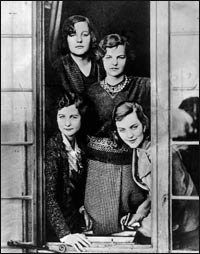
I've always been a bit fascinated by the semi-creepy Mitford family (that is, if I'm guessing right, Nancy, Unity, Decca and Diana. The only one I am not sure about is the one whose head is the highest. That is either Unity or Pamela). Two more of the sisters are not in that photo - and brother Tom is out having gay sex somewhere. And then denying it, and sleeping around with 50 women to compensate. I'm surprised nobody has made a sweeping film about these 6 sisters (with Charlize Theron as Diana - she'd be PERFECT) - it's hard to believe they even existed - but they did - and there isn't an un-interesting one among them. Some of them are BARELY likeable - but damn, they are interesting, and they did indeed live in interesting times. I read The Sisters: The Saga of the Mitford Family with fascination (but almost like I was picking up a rock to look at the fascinating bug life underneath) - there was something about the photos of all of them that I just could NOT stop looking at. They were all so gorgeous - and so breezy-looking - in their wool suits, and two-toned shoes - and marcelled hair - and light eyes - but there is something a bit blank in some of their expressions, and that - combined with their intense beauty - always seemed a bit creepy to me. Add to that the general love affair with fascism and with Hitler, specifically, that some of the Mitford sisters maintained until they died - and you just get a picture of a fascinating whirlwind of creepiness.
Oswald Mosley (who ended up marrying Diana Mitford) has been of interest to me for quite some time - just because of his time period and his obvious importance. Remains of the Day is basically about that group of fascists in England at that time and the Lord in that book is based on someone like Oswald Mosley. What a life he had - what a creep - but I've also been very interested in him because his son was (is) Nicholas Mosley - who has gone on to write one of my favorite novels of all time: Hopeful Monsters. Not to be too weird but I've felt like: If my own spirit could pick up a pen and write a book about its core beliefs - that book would be something like Hopeful Monsters. I'm dead serious. Nicholas Mosley, the son, has written a couple of memoirs - attacking his father's fascism - and his books (especially Hopeful Monsters) are one long indictment about such totalitarian structures. Quite extraordinary.
And the Mitford sisters were all caught up in these enormous upheavals of the mid- 20th century - and many of them were on the wrong side of history. They were ardent fascists and anti-Semites, Hitler-lovers (especially Unity Mitford - who appears to have been truly in lust with Hitler - like, she went out of her mind. Her fervor was so much that it burned up everything else in her personality. She ended up shooting herself in the head - and SURVIVED. Not forever - she died a couple years later - but seriously. Weird weird girls. There are pictures of Unity hanging out with "Fuhrer" - and she has this flat-eyed look of entranced exaltation on her face that seriously gives me the total creeps.)
Her sister Diana was no better. She ended up marrying Oswald Mosley (he was her second husband), connecting the fascists in England directly to the Nazis. There are pictures of her and Unity whooping it up with a bunch of SS officers. Found the photo - here it is (Unity on the left, Diana on the right):

Diana and Unity and their brother Tom all attended the 1937 Nuremberg rally - I think Diana had also gone to the first one in 1933 (but the photo above is from the 1937 rally). Tom, despite his fascist beliefs - ended up joining the British army (not joining Oswald Mosley's ranks of stormtroopers.) He died in Burma shortly before the war ended. He was brilliant, like most of the Mitfords were - HIGHLY intelligent - dauntingly so. He was probably gay. He was a major womanizer - yet he was known to have gay relationships, so the womanizing was (as it so often is) a front. Kind of a tormented guy.
Here's Diana with one of her greatest admirers:

Hitler loved Diana. Loved her looks. Called her "the perfect Aryan woman". She took this as a compliment. Diana was imprisoned during the Second World War.
Here's Diana - who was considered (by certain elements in the British secret service, who kept an eye on them) even more dangerous than Oswald Mosley:

A biography of Diana was just published, actually - I haven't read it yet, though. I do want to.
Here's Nancy Mitford, the writer:
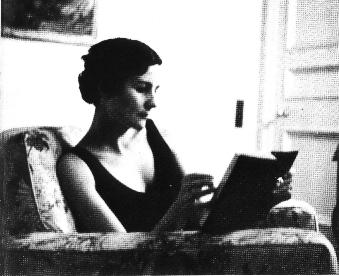
Here's Unity Mitford, surrounded by her treasured memorabilia:

She wanted to marry Hitler. I think, too, that he might have even come close to proposing. At least that's the rumor. Her love for him was ecstatic, almsot sado-masochistic. Like Sylvia Plath's "Daddy" poem. Longing for the brute black boot to stomp on her face, etc.
The little girl sitting down is Decca (Jessica) Mitford - who eventually became an ardent Communist (imagine the rupture with her fascist family!!) - moved to the United States, became an investigative journalist and also ran a bar in Miami - Unity stands behind Decca:
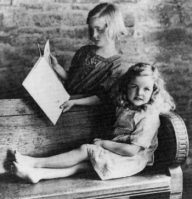
Here's Deborah ("Debo") Mitford - whose main goal in life was to become a Duchess. She did. I believe Debo is still alive. Oh, excuse me. The Duchess of Devonshire!

Pamela Mitford was the second oldest - and I cannot find a picture of her. She escaped scandal, and she lived a long life.
ALL of these girls were fiercely bright and literary. Only Nancy ended up becoming a well-known novelist - but many of them wrote books:
Here's Decca's autobiography
Here's one of Debo's books
And somehow - to me - the fact of the Mitfords stunning good looks - they're almost intimidatingly gorgeous - especially Diana - who is one of the most beautiful women I think I've ever seen - makes the whole family seem rather ... Hmm. I can't put my finger on it. All I know is that as I was reading that book about all of them, I KEPT finding myself drawn to all those pictures. They are billowy, gorgeous, seemingly breezy girls ... born to the highest ranks of society ... and all of them tossed themselves towards their own destinies with ferocity. It was like they had no barriers, nothing held them back - whoever they wanted to become. Nobody ever said NO to them. Nancy wanted to write books. She did. Some of them are still taught in college level English today. Diana was a fascist. Unity was a fascist. Unity was in love with Hitler. She spent most of her time fawning on him until finally she snapped and shot herself in the head. That is a kind of destiny. Decca was a communist. She broke with her family and threw herself into Communist Party activities - until the 50s when she became disenchanted and stopped. She then opened up a bar in Florida. Which is basically one way of saying, "Uhm, yeah. I accept capitalism." (Of all of them, Decca is the most likeable.) Deborah wanted to be a Duchess, and so she married a guy who would eventually become a Duke - and so she became a Duchess. It's a really interesting thing - despite all of the pain some of them went through (uhm, you know, shooting themselves in the head, being imprisoned, pilloried by their country - to this day, some of them, etc.) ... there is this heightened burning sense of destiny in all of them. That sense of fiery destiny could turn them into either monsters, or great artists. And the family did seem to split along those lines. FASCINATING.
The reason I am going on and on about this is because the letters of Decca (Jessica) Mitford (the Communist) have just been published and here's the review in the Times. I did not realize (or I had forgotten) that when Decca's father Lord Redesdale died - he bequest all of this stuff to his kids - and he added "except Jessica". So she was NOT forgiven. By him, anyway).
I think I need to get a copy of that book.
Here's an excerpt from the review:
Only a few letters battle directly; most report the details to friends. Her activism, though, is only one subject in a collection that deals with virtually every part of her life: her husbands, her children, her writing, her publishers and, more and more as the years pass, the Mitfords.Each one gets her own treatment. Early on, there was a touching reconciliation with her mother, and as the years pass, this becomes warmer and more solid, though after Lady Redesdale’s death, Decca can’t resist noting to a friend one of her mother’s diary entries: “Heifer born today. Mabel [a servant] two weeks holiday. Decca married. Tea with Führer.” (The Redesdales were visiting Unity in Germany.)
If Decca has forgiven her mother her one-time Hitler sympathies, has nothing but tenderness for the deluded and disabled Unity, is cautiously affectionate with Nancy and warm though prickly with Deborah, she is unbending about Diana’s steely and unrepentant Fascist history. Visiting London with her son, Benjamin Treuhaft, who is half Jewish, she notes Diana’s offer of a meeting: “I thought better not, as I didn’t want Benj turned into a lampshade.”
Just fascinating. I don't know why I kind of can't look away from the Mitfords - but I can't. I'm strangely drawn to all of them. Not like: Ooh, I endorse their beliefs ... but in the same way that I am strangely drawn to Stalin and to Charlie Manson and those who were true believers. They never cease to fascinate.
Librarians and Librarians-to-be:
(and I know I have so many folks in that category who read my site!):
You won't want to miss this post from De, a librarian herself.
I ... I ... I don't know what to say.
Perhaps I need a Thesaurus in order to form a sentence in response to that anecdote. Or ... wait ... what?
The Books: "Along the Shore - 'Four Winds'" (L.M. Montgomery)
Along the Shore - 'Four Winds' - by L.M. Montgomery
This story (much longer than many of her others) was written in 1908 - and Lucy Maud fans will recognize many elements which show up in other books, written later:
1. There's a Kilmeny of the Orchard feel to it - the most beautiful girl in the world - basically living like a prisoner in this out of the way house - with a grim-faced aunt and also her father.
2. Lynde Oliver (the heroine of our story - the most beautiful girl in the world) is walking along the lake shore one day - sees a flower just out of reach - tries to grab it, and then basically falls over the side of a cliff, hanging on to the edge for dear life. If she lets go - she will plummet to the rocks below. Then who saunters along but Alan Douglas - the guy who is the main character, the story is through his point of view. Anyway - he runs off to wherever - gets a rope - comes back - and saves Lynde. Any Emily fan worth her salt will recognize this entire episode.
3. And the plot-twist - the big ol' secret that Lynde Oliver is carrying around - is akin to the Leslie Moore situation in House of Dreams - only the man SHE was sold into marriage to is MIA. Not dead or alive - nothing known about his whereabouts - so I guess it's that she is STUCK, unable to live a free life - and so a whiff of scandal surrounds her. But then the plot is resolved - when - MIRACULOUSLY - the very man she was married to ends up being shipwrecked on the rocks RIGHT OUTSIDE LYNDE'S HOUSE. You know. It's one of those endings.
So this book is full of episodes which became well-known Lucy Maud set pieces some years later. Even though there's a lot that is really sentimental about this story (I find this to be the case when she lets a MAN be the lead character - a romantic man, that is. Think of the offensive stupidity of Kilmeny and his stupid sexist romantic longings. The guy's a boob, a vain boob. It's much better, I think, when Lucy Maud has the woman be the lead character - whether or not it's first person narratioin or no ... It just seems to come out of her with much more ease. My opinion, but I'm stickin' to it. I get annoyed with her male characters when they're in love - only NOT when the point-of-view is from the female. I am never annoyed with Gilbert Blythe's love for Anne, his courting of her, his feelings for her. But if she had written the story from his point of view - I might have been. Anyhoo.)
The story is this: Alan Douglas is a young minister who is new to the town of Rexton. And apparently - just from the way Lucy Maud describes him - the dude is movie-star gorgeous. Of course. But the story opens with him having trouble working on this one sermon - and he suddenly feels really cooped up. Like he needs a break. Like Rexton, with its neat orchards and trim homes, is too domestic for him. So he goes for a long walk - through the woods - and then out onto the lake shore.
Along the way he basically runs into Lynde Oliver (the first encounter is the excerpt below). She, naturally, is the most beautiful woman in the world - but that's not why he's gobsmacked by her - oh no!! It's because he's never seen her in church before. Why doesn't she come to church???? He becomes obsessed with the matter. Get a life, jagoff. But I digress. He asks his housekeeper who is gossipy and knows everything - and for some reason that entire family doesn't go to church and Lynde's father, a retired sea captain, is a fierce atheist and has literally thrown missionaries and tract-peddlers off his property. So now they're left alone.
But Alan cannot get that face out of his mind!!!! So he goes back!
And a "friendship" develops - but honestly, there is so little humor between these two, all they do is be tormented and vaguely mysterious, with their matinee idol good looks, that I think: You two bores are welcome to each other.
Don't get me wrong - the writing is good. Lucy Maud has found her stride. It is recognizable Lucy Maud here. But I am not sure that there is one funny moment in this whole story - and her stories suffer when she goes that way. (Think Kilmeny).
But here's the excerpt.
Excerpt from Along the Shore - 'Four Winds' - by L.M. Montgomery
With a half guilty glance at the futile sermon, he took his hat and went out. The sun of the cool spring evening was swinging low over the lake as he turned into the unfrequented, deep-rutted road leading to the shore. It was two miles to the lake, but half way there Alan came to where another road branched off and struck down through the pines in a northeasterly direction. He had sometimes wondered where it led but he had never explored it. Now he had a sudden whim to do so and turned into it. It was even rougher and lonelinr than the other; between the ruts the grasses grew long and thickly; sometimes the pine boughs met overhead; again, the trees broke away to reveal wonderful glimpses of gleaming water, purple islets, dark feathery coasts. Still, the road seemed to lead nowhere and Alan was half repenting the impulse which had led him to choose it when he suddenly came out from the shadow of the pines and found himself gazing on a sight which amazed him.
Before him was a small peninsula running out into the lake and terminating in a long sandy point. Beyond it was a glorious sweep of sunset water. The peninsula itself seemed barren and sandy, covered for the most part with scrub firs and spruces, through which the narrow road wound on to what was the astonishing feature in the landscape - a grey and weather-beaten house built almost at the extremity of the point and shadowed from the western light by a thick plantation of tall pines behind it.
It was the house which puzzled Alan. He had never known there was any house near the lake shore - had never heard mention made of any; yet here was one, and one which was evidently occupied, for a slender spiral of smoke was curling upward from it on the chilly spring air. It could not be a fisherman's dwelling, for it was large and built after a quaint tasteful design. The longer Alan looked at it the more his wonder grew. The people living here were in the bounds of his congregation. How then was it that he had never seen or heard of them?
He sauntered slowly down the road until he saw that it led directly to the house and ended in the yard. Then he turned off in a narrow path to the shore. He was not far from the house now and he scanned it observantly as he went past. The barrens swept almost up to its door in front but at the side, sheltered from the lake winds by the pines, was a garden where there was a fine show of gay tuliips and golden daffodils. No living creature was visible, and, in spite of the blossoming geraniums and muslin curtains at the windows and the homely spiral of smoke, the place had a lonely, almost untenanted, look.
When Alan reached the shore he found that it was of a much more open and less rocky nature than the part which he had been used to frequent. The beach was of sand and the scrub barrens dwindled down to it almost insensibly. To right and left fir-fringed points ran out into the lake, shaping a little cove with the house in its curve.
Alan walked slowly towards the left headland, intending to follow the shore around to the other road. As he passed the point he stopped short in astonishment. The second surprise and mystery of the evening confronted him.
A little distance away a girl was standing - a girl who turned a startled face at his unexpected appearance. Alan Douglas had thought he knew all the girls in Rexton, but this lithe, glorious creature was a stranger to him. She stood with her hand on the head of a huge, tawny collie dog; another dog was sitting on his haunches beside her.
She was tall, with a great braid of shining chestnut hair, showing ruddy burnished tints where the sunlight struck it, hanging over her shoulder. The plain dark dress she wore emphasized the grace and strength of her supple form. Her face was oval and pale, with straight black brows and a finely cut crimson mouth - a face whose beauty bore the indefinable stamp of race and breeding mingled wiht a wild sweetness, as of a flower growing in some lonely and inaccessible place. None of the Rexton girls looked like that. Who, in the name of all that was amazing, could she be?
As the thought crossed Alan's mind the girl turned, with an air of indifference that might have seemed slightly overdone to a calmer observer than was the young minister at that moment and, with a gesture of command to her dogs, walked quickly away into the scrub spruces. She was so tall that her uncovered head was visible over them as she followed some winding footpath, and Alan stood like a man rooted to the ground until he saw her enter the grey house. Then he went homeward in a maze, all thought of sermons, doctrinal or otherwise, for the moment knocked out of his head.
November 16, 2006
Bookie Bookie!
Book Meme!! I got it from Heather. I love her answers - it's always fun to see what other people were into, if they're big readers.
1. How old were you when you learned to read and who taught you?
My parents will have to confirm this. I was probably 3. I don't remember being taught - but my parents read to me all the time. So I guess I just picked it up - but I believe the story goes that I had learned to read without them even realizing it. The story is: I was in my car seat in the back seat of the car. They were driving to the Cape. Anyone who knows the Cape - knows about the big rotary that you have to go through to get onto the Cape. There is a huge A-frame liquor store on that rotary - where everybody stops to get booze before going out onto the Cape (I mean, I know that NOW - I didn't know it then.) The liquor store has a huge sign above the A-frame: LIQUOR. But anyway - my parents were circling the rotary, I was 3 years old in the back - maybe even younger - and I suddenly announced:
"LICK-WAR."
It took my parents some time to decipher this. What did she say? What is "lick-war"? Is she trying to tell us something? They finally realized that I had actually been READING. I read the sign on top of the A-frame.
2. Did you own any books as a child? If so, what’s the first one that you remember owning? If not, do you recall any of the first titles that you borrowed from the library?
We were very big on going to the library (naturally) - but I do remember that we owned some books. My sister Jean will probably remember better than I can. In terms of borrowing books - here were the favorites (and I'm sticking with books for much younger kids - once I get to about 7, 8 - we're into Anne of Green Gables land, and Narnia, and Beezus and Ramona ... but before that??)
I loved this book (with which I have now been reunited ). I could not get enough of it. The illustrations were addictive.
Other favorites which I remember we took out of the library:
Harold and the Purple Crayon Perfect book.
The Frog and Toad books (adored those)
The Frances books - oh man, I loved these!!! I especially liked Bedtime for Frances when she kept seeing monsteres in the corner, etc. I loved the badgers. Oh, and I loved the one about her little tea set.
Anything and everything by Ezra Jack Keats. I STILL love those books - and have since bought all of them - just because I need to have them. Snowy Day is sheer magic - but my favorite, my absolute favorite, was A Letter to Amy.
The Madeline books were huge favorites - and my favorite, in particular, (big surprise) was the one where Madeline and Pepito are kidnapped by circus folk. I just lost myself in that one.
If this is the book I think it is - then we loved loved loved this one. I still, when occasion warrants, say the words, " 'Soon,' said Mother'" - when asked WHEN something will begin. "Sheila, when does the movie start tonight?" "Soon, said Mother." That's from that old old book that we all loved - I can still see the illustrations in my head.
Oh, and despite his creepy photo on the back of all of his books: Shel Silverstein. Anything and everything Shel. My dad used to read us The Giving Tree. I have that book now and I can still hear those words in my dad's voice.
Rosemary Wells is a HUGE O'Malley favorite. Max? PLEASE. Who is funnier than Max? And his big sister Ruby (only we called her "Rubby"). We loooooved this one as well. And I can still recite long sections of Noisy Nora. "Nora," said her sister. "Why are you so dumb?" Also - at that point in my reading career - Noisy Nora was the book that had the word with the most syllables ("monumental") - well, that and Peter Rabbit with the even BETTER word "soporific") - and I remember feeling really proud when I read the word "monumental" out loud. It was a big word!!
3. What’s the first book that you bought with your own money?
I have no idea.
4. Were you a re-reader as a child? If so, which book did you re-read most often?
Oh my God - YES. Compulsively. Every single book above was totally pawed over and read a BAZILLION times.
As I got older - my reading list expanded - it's all here. Oh and here too!! And I read all of those books 100 times apiece.
5. What’s the first adult book that captured your interest and how old were you when you read it?
Well, I was always very advanced in terms of language comprehension (uhm - lick-war?). I guess Oliver Twist counts as an adult book and I read the entire thing when I was 10 years old. I remember carrying it around with me. That's probably the biggest leap - in terms of how young I was and how advanced the book was.
6. Are there children’s books that you passed by as a child that you have learned to love as an adult? Which ones?
Hmmm. Bridge to Terabitha ... That's the first one that comes to mind. For some reason - I did not read that book as a little girl - but then my friend Betsy basically made me read it when she found out I had never read it - I was in college when I finally tackled Bridge to Terabitha. It's phenomenal. Movie coming out soon!! Terrific book - I have no idea why I didn't read it originally.
Oh - and also - The Witch of Blackbird Pond - although that is a wee bit older than the other books I'm talking about here, in terms of reading comprehension- I think most people read that one in 5th grade, 6th grade - but for whatever reason, I just didn't read it as a kid. My dear friend Ann Marie leant me her copy - I read that book in my 20s. It's wonderful.
Bonus Question: Are there books you remember reading as a child that you either can’t find now or can’t remember the title?
Well - the bimulous night book was the biggest mystery - but as I mentioned earlier - I did end up finding it. I had been looking for it under the wrong title for, oh, 20 years? 25 years??? It's called When the sky is like lace - and I had been keeping my eye open for Bimulous Night.
I can't think of too many more lost books.
I even tracked down Summer Sleigh Ride, for God's sake. How much I loved that book I cannot even describe!! Good to own it again after - oh - 30 freakin' years.
Congrats to Richard Powers ...
... who just won the 2006 National Book Award for his latest novel The Echo Maker.
I have only read 2 others of his books - The Gold Bug Variations and Galatea 2.2. I tried to read his other books and got kind of stopped by them. The language was opaque. Or I flat out didn't get it. Especially Operation Wandering Soul. That book just ... STOPPED me dead in my tracks, man. But I gave them all a shot because Gold Bug Variations is one of my favorite novels. It is nearly impossible to describe (plot-wise), and also nearly impossible to describe why the damn thing just got so under my skin. It is one of THOSE books. I can't be objective about it, nor do I want to be. It got under my skin and has stayed there. I have read it again - since that first time - and it is just as good as I remembered. I've recommended it to people who then read it - and weren't wacky about it - but then I recommended it to my friend Ted, and the damn book changed his whole freakin' life. Ha!! I don't recommend it anymore - it's too specific a book. If you're into that kind of thing, you'll love it. If you're not, then you won't. So I guess you just never know. I don't mind so much if Richard Powers writes big hard books that sometimes I can't get into. I love to know he's out there. A real writer. Someone not trying to just repeat his Gold Bug success. A guy who hit the jackpot with a huge sprawling difficult novel like Gold Bug - and who has continued to push himself - even sometimes pushing himself away from his core audience. That's his right to do that. I'll stick with him. He's certainly a writer to follow. He's too good to ignore.
Since the masterpiece of Gold Bug (and seriously - I hate to even give a brief plot description - it's too daunting) - I read Galatea 2.2 - and I remember where I was in my life when I read that odd little book - a book with some of the most wistful yearning passages about love that I have ever read in my life. He's so heady, so cerebral - but then, on the flipside, he so gets that part of human existence. Yearning. The fleeting quality of connection. The sadness, the joy. This shows up in Gold Bug and it's what the whole story is about in Galatea. Finding someone who ... clicks with you ... fits with you ... cosmically, psychically ... those moments of connection that seem to be outside of time. And how difficult it is to walk away from those moments, especially if you are in love with that person. But the way HE writes about it is lyrical, elegiac. I read it in 1996 which I remember as being a rather difficult year. Someone I was madly in love with got married to somebody else that year. I don't know - and I was in grad school - and I was alone - and yet - this guy was marrying someone else ... the girl he chose instead of me ... and it just burned inside of me. The hurt burned. And I read Galatea during that time. The book - with its odd vision of unrequited love - or even a wistful looking back on a type of love you will ever yearn for for the rest of your life ... I ached reading it. It's this highly technical novel, about robots, and the English language, and circuitry, and technology ... but what I remember about it is the heartfelt ACHE in some of the language. Powers does that sort of ache really really well.
But Gold Bug is the one to read.
Holy mackerel.
Echo Maker is also on my "to read" list ... but I have to be in just the right mood for Powers. I need to be in the mood for challenging myself. For a book that does not just reveal its secrets, or make it easy on the reader. For a book that insists that you meet it halfway. I do love books like that (uhm - ya ever been around my blog on Bloomsday? Yeah.) - but not always.
Congratulations, Richard Powers. It's always kind of encouraging to know that an author like him - a difficult challenging beat-of-own-drummer author - has found success.
Stranger Than Fiction
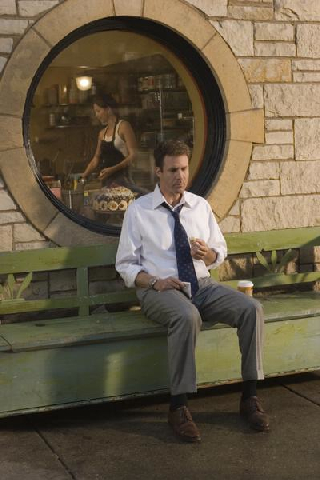
In this movie, which I saw last night, Will Ferrell successfully creates a character to whom eating a cookie is an enormous risk. Eating a cookie. He stares at the cookie. It's not so much the COOKIE that is the problem. It is the fact that it is a gift. And also the fact that he has never had homemade cookies, only store-bought, and he is afraid of having a new experience. He lives his life in such a way that he can avoid new experiences. I realized, in watching that moment - that moment when Will Ferrell hesitates when he is offered the cookie - or no, he doesn't hesitate - that's not it: He is offered the cookie. It has just come out of the oven. He immediately says, "No thanks." HIs whole LIFE is about saying "No thanks" to EVERYthing. Without thought. He has nothing against cookies. He's not allergic to chocolate. He doesn't think he's about to be poisoned. It's an automatic response for him. This is not an easy kind of character to create - and there is nothing in Will Ferrell's work before this that would suggest this KIND of man. Will Ferrell plays extroverts, jackasses, fearless eccentrics, weirdos, sex pervs. He's hilarious. But watch him in that moment when he can't take the cookie. This is truly the critical moment of his life. It all comes down to this moment. A lifetime boiled down to its essence. He is afraid. He is afraid. And why is he afraid? For the first time, ever, in his life - you can see him ask himself the question. Why am I so afraid? Not just of the cookie ... the cookie is only a symbol ... why am I afraid of EVERYTHING? Why? Will Ferrell is so perfect in this moment, so simple and true. My eyes flooded with tears - watching that brief expression of internal despair flash over his face - the hesitation, the caution, and now the knowledge that maybe ... just maybe ... he doesn't have to live like that.
It's a wonderful performance - one of the best I have seen this year - and the reason why is all encapsulated in the cookie scene. First of all, it's wonderful because - empirically - he does a good job with the scene. Second of all, it was the moment, for me, when I realized: Wow. This movie is fucking GOOD. Thirdly, I was watching an actor open himself up in a way that I had never seen before. Ferrell, personally - but also any actor. It's the kind of performance that is even MORE moving because of the expectations we have of Will Ferrell. He is not 'acting' - he doesnt' have one moment in this movie where he reminds us: Member? Member who I am? I'm Will Ferrell, funny guy!! He plays Harold Crick. A humorless shy cautious IRS agent. He IS that guy. It is a complete transformation - and even more moving and effective because it is HIM doing it. It's never schmacty, the way Robin Williams' more serious parts can sometimes be. It is real. It is a deeply compassionate performance. It has no ego in it. He submerges much of his natural tendencies into the demands of this particular part. I want to hug him for it.
During the cookie scene, my heart was breaking and sprouting wings at the same time. Now that's a good moment in a movie that can generate such a response. I felt: Oh God. Oh God. He's letting himself have feelings for her. He has feelings for her. And on the heels of that, I felt the sadness ... the inherent sadness of someone that shy, that pained ... letting himself open up. Trying to accept his own feelings. Trying to accept the cookie. Trying to not say "No thanks" for once ... but say "Yes". There's something heartbreaking about those moments. I have them myself. It's not easy for certain types of people to say "Yes".
There is so much else to love about this movie - the story itself, first of all. It really is about the artistic process - and Emma Thompson's search for the ending of her book. It is handled with humor, and yet - you just get the sense that the writer, the director - those who have made this movie - GET that this is an important search. To some, it would seem an easy choice: "Sheesh, who gives a shit about the ending of the book! Harold should live!" Ah yes, but that is only one way of looking at it. Another way is from the book-lover's point of view. What would happen if Dostoevsky killed Raskolnikov? The ending of that book - with its possibility of redemption - has always seemed to me to be piercingly correct. I remember the first time I read the book - and as I approached the end, I completely expected that Raskolnikov would either be killed, or would commit suicide. This seemed to be the only way the book would end. But no. Dostoevsky had other plans. Dostoevsky had something ELSE that he wanted to say. Even now, I can feel a lump growing in my throat as I think about the ending of that book. And this is what Stranger Than Fiction looks at. What if Dostoevsky's original plan had been to kill Raskolnikov? And what if Raskolnikov had somehow gotten wind that he was the main character in a novel being written ... and in order for the novel to be finished - he would have to die. Now yes, he would lose his life ... but he would be guaranteed immortality, and ALSO he would have the chance, for the first time in his miserable sorry little life, to be part of something GREAT. Harold Crick, a man who has never made waves in his life, who has no real friends, who is just now falling in love for the first time ever, who is slowly learning that to accept a cookie will not make him shatter into a million bits ... has to ask himself: What have I ever done that is as great as writing a masterpiece? What has been MY role on this planet? How have I contributed? Have I done anything that even comes CLOSE to what this author (played by a superb - when is she not - Emma Thompson) has done?
I found myself, by the end of the movie, wiping tears off my face. Why was I weeping? Because it was such an unbelievable joy to sit in that movie theatre and to watch that story unfold. Up until the last couple minutes, I had no idea how it would resolve ... and when it did ... it was so absolutely RIGHT that it seemed inevitable. Only I hadn't seen it coming. Roger Ebert in his review closes with:
The ending is a compromise -- but it isn't the movie's compromise, it belongs entirely to the characters and is their decision. And that made me smile.
I felt that. I felt the beauty of all of the characters - the choices they each had made, the ways that they had grappled with issues of death, and art, and love. These are not facile characters, or shallow. They are people who all deeply care about whatever it is that they care about. This is often not the case in movies - where the characters seem to be just the agents of the plotliine. They move the plot along. (And Dustin Hoffman, as the literature professor Harold Crick seeks out, makes that point. "Are you a victim of the plot? Or are you driving the plot? So stay home tomorrow - don't go to work - and do absolutely NOTHING - and see if the plot continues on without you.") These characters live. Watch how Maggie says, "You are not okay. You are severely injured." I am still laughing about how she says that line, and how beautiful and human and real it is. "You are severely injured."
But what I am really left with is the image of Will Ferrell, in his bland trenchcoat, holding his bland briefcase, staring at Maggie, with her little kerchief on her head, and the swooping red dragon tattoo flying up her arm ... and she holds out a plate of hot gooey cookies, smiling at him with a strangely open yet baffled smile ... and he just can't say Yes. He stands there, and he can't say Yes ... and he wonders, he wonders to himself: why. why. why can I not say Yes .... what would happen if I just said Yes?
Best movie I've seen all year.
The Books: "Along the Shore - 'A Soul That Was Not at Home'" (L.M. Montgomery)
Along the Shore - "A Soul That Was Not at Home" - by L.M. Montgomery
So this is the story of Paul and his Rock People in embryo. This story came out in 1909 (as did Anne of Avonlea) - so obviously this was a dress rehearsal. Many elements have changed once he appears in the Anne stories - but the character is exactly the same. And you know how Paul writes that letter to Anne and describes, in detail, his rock people? That shows up here in this story, word for word - only Paul is speaking it, rather than writing it. All of the Rock People are identical - Nora, the twin sailors ... you will recognize all of them. Beautiful - I love Paul.
In this story however, his circumstances are a bit different. Paul is an orphan (doesn't he have kind of an absentee father in the Anne books?) - and he is being raised by Stephen, a taciturn (that's putting it mildly) fisherman who used to be a beau of Paul's dead mother. So imagine THAT. Stephen may be taciturn - but his heart ... oh. my. God. He was in love with Paul's mother. But Paul's mother fell in love with someone else - whom she married - and he took her away from the little seaside town where she lived. And apparently she pined so for the sea that she became ill. (It happens, you know.) Her husband died - and she returned to her hometown, with her baby of 2 - but it was too late. She died within a couple of months. There was no one to look after baby Paul ... but Stephen, who had loved only one woman, and that was Paul's mother - stepped up and took the boy. And the two have been living in quiet restful harmony for 6 years. Stephen plays the violin at night. Paul sits on the beach in the day and writes stories about his Rock People in his big foolscap book. They are everything to each other. (It's a similar relationship to the one in "Each His Own Tongue" - that kind of intense unspoken bond between an older man and a young boy. It's almost painful.)
Anyway - a Miss Trevor stops to stay in the town, during the summer. I can't remember why she's there - but she's from the "city" (which probably means Charlottetown - not like Paris or anything like that). She comes, though, with the glamour of the outside world, and also artistic pretensions. She's also alone in the world. Anyhoo - she meets Paul one day on the beach and is completely taken by him. By his guilelessness, his beauty, and also his obvious gift of imagination. He immediately divulges about the Rock People, et al. To Miss Trevor, he looks like a prince - and is shocked to find that he lives in the bleached fisherman's shack over the dunes. Surely he should have better? (There's snobbery in Miss Trevor. You can feel it. When she meets Stephen, she patronizes him a bit. And it just kinda makes you really mad, reading it.) But she does get it in her head that Paul needs to have better schooling than could be offered here - and she wants to take him to live with her in town. She also is kind of obsessed with Paul's foolscap book and all the writing in it. She thinks Paul is a genius. A genius needs a better environment than a shack! (So she thinks.) So she asks Stephen if it would be all right ... and Stephen says, taciturn, you just don't know what's going on inside of him, he's too quiet and reserved - that she should ask Paul. If Paul wants to go, he can go. Paul is torn - he goes through some really bad moments. He loves Stephen. Loves him dearly ... but ... Stephen doesn't seem to care one way or the other if he stays or goes ... and Miss Trevor is so nice and so pretty ... but ... but ... how could he leave the Rock People??? Needless to say - Paul ends up going with Miss Trevor. And Stephen shows no emotion when he says goodbye. We, the reader, know that it is because he feels too much - but Paul thinks he doesn't care.
The excerpt below is from what happens when he gets to town. And goes to the end of the story. The Stephen moment that gets me in the throat is here.
Excerpt from Along the Shore - "A Soul That Was Not at Home" - by L.M. Montgomery
At first Paul lay very still on his luxurious perfrumed pillows. It was the first night he had ever spent away from the little seaward-looking loft where he could touch the rafters with his hands. He thought of it now and a lump came into his throat and a strange, new, bitter longing came into his heart. He missed the sea plashing on the rocks below him - he could not sleep without that old lullaby. He turned his face into the pillow, and the longing and loneliness grew worse and hurt him until he moaned. Oh, he wanted to be back home! Surely had had not left it - he could never have meant to leave it. Out there the stars would be shining over the harbour. Stephen would be sitting at the door, all alone, with his violin. But he would not be playing it - all at once Paul knew he would not be playing it. He would be sitting there with his head bowed and the loneliness in his heart calling to the loneliness in Paul's heart all the miles between them. Oh, he could never have really meant to leave Stephen.
And Nora? Nora would be down on the rocks waiting for him - for him, Paul, who would never come to her more. He could see her elfin little face peering around the point, watching for him wistfully.
Paul sat up in bed, choking with tears. Oh, what were books and strange countries? -- what was even Miss Trevor, the friend of a month? - to the call of the sea and Stephen's kind, deep eyes and his dear rock people? He could not stay away from them - never - never.
He slipped out of bed very softly and dressed in the dark. Then he lighted his lamp timidly and opened the little brown chest Stephen had given him. It held his books and his treasures, but he took out only a pencil, a bit of paper, and the foolscap book. With a hand shaking in his eagerness, he wrote:
dear miss TrevorIm going back home, dont be fritened about me because I know the way. Ive got to go, something is calling me. dont be cross. I love you, but I cant stay. Im leaving my foolscap book for you, you can keep it always but I must go back to stephen and nora
Paul
He put the note on the foolscap book and laid them on the table. Then he blew out the light, took his cap and went softly out. The house was very still. Holding his breath, he tiptoed downstairs and opened the front door. Before it ran the street which went, he knew, straight out into the country road that led home. Paul closed the door and stole down the steps, his heart beating painfully, but when he reached the sidewalk he broke into a frantic run under the limes. It was late and no one was out on that quiet street. He ran until his breath gave out, then walked miserably until he recovered it, and then ran again. He dared not stop running until he was out of that horrible town, which seemed like a prison closing around him, where the houses shut out the stars and the wind could only creep in a narrow space like a fettered, cringing thing, instead of sweeping grandly over great salt wastes of sea.
At last the houses grew few and scattered, and finally he left them behind. He drew a long breath; this was better - rather smothering yet, of course, with nothing but hills and fields and dark woods all about him, but at least his own sky was bove him, looking just the same as it looked out home at Noel's Cove. He recognized the stars as friends; how often Stephen had pointed them out to him as they sat at night by the door of the little house.
He was not at all frightened now. He knew the way home and the kind night was before him. Every step was bringing him nearer to Stephen and Nora and the Twin Sailors. He whistled as he walked silently along.
The dawn was just breaking when he reached Noel's Cove. The eastern sky was all pale rose and silver, and the sea was mottled over with dear grey ripples. In the west over the harbour the sky was a very fine ethereal blue and the wind blew from there, salt and bracing. Paul was tired, but he ran lightly down the shelving rocks to the cove. Stephen was getting ready to launch his boat. When he saw Paul he started and a strange, vivid, exultant expression flashed across his face.
Paul felt a sudden chill - the upspringing fountain of his gladness was checked in mid-leap. He had known no doubt on the way home - all that long, weary walk he had known no doubt - but now?
"Stephen," he cried. "I've come back! I had to! Stephen, are you glad - are you glad?"
Stephen's face was as emotionless as ever. The burst of feeling which had frightened Paul by its unaccustomedness had passed like a fleeting outbreak of sunshine between dull clouds.
"I reckon I am," he said. "Yes, I reckon I am. I kind of - hoped - you would come back. You'd better go in and get some breakfast."
Paul's eyes were as radiant as the deepening dawn. He knew Stephen was glad and he knew there was nothing more to be said about it. They were back just where they were before Miss Trevor came - back to their perfect, unmarred, sufficient comradeship.
"I must just run around and see Nora first," said Paul.
November 15, 2006
Along with the Hitchcock Blog-a-Thon ...
it is also Petula Clark's 74th birthday. And Annika is all over it. Keep scrolling.
Annika also asked me to write something for the Petula Fest. Which I happily did. It was my honor to participate.
But you have to go check out some of the Petula clips Annika found. SO FUN!
HAPPY BIRTHDAY, Petula!
The Hitchcock Blog-a-Thon!
Today is the long-awaited Hitchcock Blog-a-Thon
Here are a bunch of posts by other stellar bloggers - but just click around, you'll find more!
A marathon reviewing of the works of Hitchcock. I am in awe. Just keep scrolling. You'll see all of his reviews. Also, he's hosting the Blog-a-Thon - so you can see a compilation of people's posts at the bottom here.
More:
Sigh. Gorgeous. However, that is just ONE post. Go here and keep scrolling. So much good stuff.
A beautiful post of movie posters. How much do I want the third one down. The blue one. Ohmygod, gorgeous.
Focusing on To Catch a Thief. Really interesting thoughts there, all around.
Focusing on Grace Kelly. Funny:
Kelly and Grant had chemistry. He's always very Cary in his timing and delivery: "Not only did I enjoy that kiss last night," he tells Kelly with his usual mock inflections, "but I was awed by the efficiency behind it." And she warms up to his touch, losing her haughty demeanor as she takes delight in outing Grant as "The Cat," who is supposedly robbing the houses of the rich along the French Riviera: "I've never caught a jewel thief before. It's so stimulating!"
Edward Copeland: What if George Bailey had Vertigo?
Oh - and please: Hitchcock fans out there!! Share your own favorites!
The Hitchcock Blog-a-Thon: My Entry
More posts in the Hitchcock Blog-a-Thon here. I've been having so much fun reading them.
So here's mine. I decided to elaborate on some earlier posts I have written about one of my favorite movies ever made: Notorious.
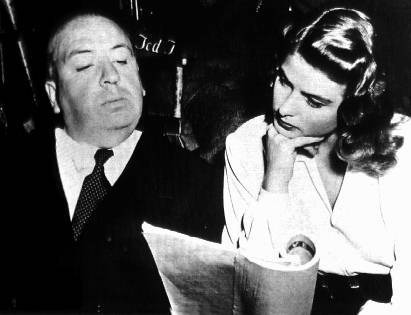
Top 5 moments in Alfred Hitchcock's Notorious - according to me:
1. The kiss between Cary Grant and Ingrid Bergman.
At the time this was the longest movie kiss in cinematic history. They had to keep breaking the kiss up to get around the censors. The censorship committee decreed that no screen kiss could last longer than 3 seconds. But Hitchcock made sure that their lips never touched for longer than 3 seconds - so if you put a stopwatch to it (and the censorship committee did) you would find that they were never over the time limit. But then they would pull back, nuzzle, speak against each other's mouths, kiss again for 3 seconds ... and repeat the whole thing. It's amazing - very very sexy. It's also REALLY neurotic. I love the underlying neurosis in this scene - it makes it so Hitchcock-ian. You can just tell that despite their desire for one another they are SO not trusting of each other.
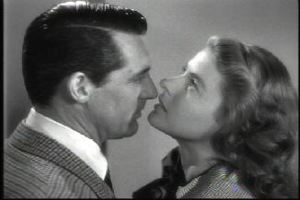
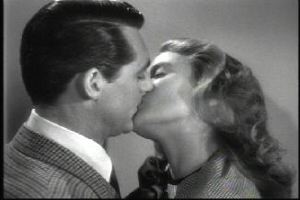
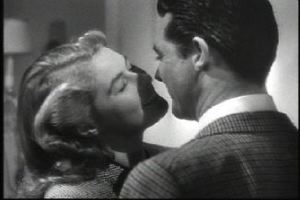
I love Roger Ebert's observations about Grant in this scene:
Look, for example, at his famous kissing scene with Ingrid Bergman in Hitchcock's "Notorious" (1946). In the movie, they are in love with each other, but Grant is a U.S. intelligence official trying to convince Bergman to marry Claude Rains, the leader of a postwar Nazi spy ring.Hitchcock's shot begins on a balcony overlooking Rio. Grant begins to kiss Bergman, and as they stay in each other's arms, they move slowly inside, where Grant picks up the telephone and makes a call, still holding her and kissing her, and then he guides them toward the door while she breathlessly makes dinner plans and he smiles rather remotely at her and then leaves, saying "goodbye" with an ironic smile.
This is the kind of scene that perfectly captures what was unique about Grant as a movie actor. He had the kind of handsome charm and sex appeal that made him completely convincing as a romantic leading man, but mere seduction never seemed very high on his list of priorities in the movies. He and his characters often had hidden agendas, secrets they were more interested in than love itself.
Yes. Watch his face at the door when he says good-bye to the literally swooning with lust/love Bergman. Watch that distant little smile. It's fascinating. Not at all what you expect, or want.
2. When Claude Rains looks up slowly at his evil Nazi mother and says, "I am married to an American agent."
First of all - I read someone describe Claude Rains as an "impeccable actor". I could not agree with this more. Is he ever false? Is he ever not perfect in whatever it is he is trying to portray? Is he not one of the best actors to ever practice the craft? I SO value him. Casablanca would NOT work without him ... but neither would Notorious. Think of all of his most famous parts. He, PERSONALLY, makes movies better ... just by being in them. Hitchcock's camera angle at the moment I am describing here in Notorious, the "I am married to an American agent" certainly enhances the emotional meaning of that moment. Hitchcock shoots him from above. We just see the top of Rains' head at first, he is looking down, troubled, we cannot see his face. In a way he is hiding from his Nazi shrew of a mother. But then he has to come clean. The camera does not move. Rains does. He slowly lifts his head so we can see the flat deadened acceptance on his face. Rains doesn't have an over-acting bone in his body. We all should be so simple, so real.
3. The frenzied sequence in the wine cellar during the party with an increasingly panicked Ingrid Bergman standing guard, and Cary Grant snooping around.
I saw Notorious last year on the big screen - and this scene was even more suspenseful in that environment. I could sense people around me putting their hands over their eyes, a woman 2 rows ahead of me gasped LOUDLY when the bottle fell ... And if you watch the movie again - please just watch the change in expression on Cary Grant's face as he watches the bottle fall. It's gone in a flash (the expression) - but I swear that half of the suspense in that scene is because of how well these two PLAY it. Watch the flash of horror on his face when he realizes it is too late. And that that bottle WILL fall. Marvelous.
4. The scene where Ingrid Bergman realizes her husband and his mother have been slowly poisoning her.
She's sitting in the chair ... across the room from them ... and she looks with dawning horror at the two little teeny cups of coffee ... and ... Well. seriously. Acting doesn't get any better than her freakout right here. She is tormented. You can feel her literally being killed, from the inside out. Go, Ingrid.
5. The entire last scene: Cary Grant finally coming to rescue her ... and then the long long descent down the stairway.
I've seen this movie more times than I count (I even considered going into rehab to wean myself) - and the scene never fails to catch me right in the throat. Moment to moment to moment.
-- Cool trivia about that last descent down the staircase: The staircase was not long enough for Hitchcock. He wanted the staircase to feel, literally, endless for that scene - to build the tension. But if they just slowly descended the staircase - they still reached the bottom with a couple of lines left over to say. So here was Hitchcock's solution: as they descended - if you notice the background behind Rains' head in the shots - Hitchcock had them go down the same stretch of stairway 2 or 3 times - so that it would FEEL longer. It's seamless in the film - unless you're looking at the blurry background you would never notice that for the first part of the scene they are not actually going anywhere. A beautiful example of how inventive Hitchcock was, how much he was able to create an illusion.
I wrote a long piece about that scene alone - so, in honor of Mr. Hitchcock, the man of the day, I will post it here. I focus on Cary Grant - but let's never ever forget - that it was Hitchcock who first saw the darkness beneath that handsomeness, and perceived that ... audiences would be disturbed, disoriented, by seeing Cary Grant in cranky cruel parts. Hitchcock intuited that there is always a bit of envy towards people as beautiful as Grant ... and so there is some pleasure in watching him suffer (huddling in a corn field, etc.) It's unspoken, but it is there. Hitchcock was brilliant for exploiting that. And I just cannot picture another actor as Devlin. The courage of Grant is rather amazing if you think about it. Grant had a lot to lose. But was willing to risk it, for Hitchcock.
So here are my thoughts on the last scene in Notorious and why Cary Grant is not just a great movie star, but a great actor.

In the last scene of Notorious, Ingrid Bergman lies in bed, trapped in the house of her Nazi husband. She is being slowly poisoned by Nazi-man (Claude Rains) and by his terrifying evil Fraulein mother. Bergman lies in bed, coming in and out of consciousness due to the poison, the sleeping pills - Cary Grant has come to rescue her - finds her in this state - and he tries to keep her awake, he dresses her so that they can leave that terrible mansion - and he also, in his tortured way declares his love for her.
He has been cruel, distant, misogynistic, etc., throughout the rest of the film - but the genius of it is that Cary Grant (and Hitchcock, of course) lets us in on the secret: Devlin (the character) is actually not a cruel or distant man at all - he is only cruel and distant because underneath all of that, he is vulnerable, too vulnerable, and he needs her too much. Cary Grant's performance is a show-and-tell masterpiece. He shows us everything, but he tells us NOTHING. WE can see the truth, but Devlin cannot. WE can look at him and see the vulnerability, but Devlin thinks he's invulnerable, and that he can't be hurt.
What the character DOES in the film is obvious: he throws her to the wolves, he hates her for her whorish past, he feels threatened by the fact that she is kind of a slut (or, uhm, nympho) - it's not JUST that he wants her to be untouched, it's that he feels ... deeply nervous about how he will measure up (again, this is never stated, but it's all there), he despises her on some level - mainly because of his own insecurities - he is insecure about her sexual experience, and punishes her emotionally for it - he refuses to believe that she can change her drunky-drunk Slutterson ways. But clues are dropped, along the way, that this guy is tormented about her, and actually loves her. Loves her so much that he can't bear it. There is no happiness for this man in love. Love does not bring peace. It's too painful. Too threatening. The clues are along the lines of "If a tree falls in the forest and no one is there to hear it ..." Devlin is unaware of the clues he is leaving behind. He thinks he has covered his tracks (emotionally, I mean.) But it's all there: He treats her like a whore, except when she is out of his presence, and then he gets very very touchy about any slights on her honor, he gets very protective of her. He defends her character to his fellow secret agents ("I don't think she's that kind of woman!"), and yet - refuses to defend her when she begs him to, in person. ("Did you tell them I'm not the kind of girl for this sort of work??")
In the last scene, he helps her to sit up, her head is flopping back. The lighting is spectacular: the pillow behind her head is blazing white, and her face is completely in the glow of the light. But he - he is a dark silhouette, he remains in the shadow. The only time he is fully lit in the final scene of this film is when the 2 of them emerge from the bedroom, and begin the descent down the stairway. And if you see the film again: LOOK at how different his face is when he steps out into the brightness with her.
Here it is:
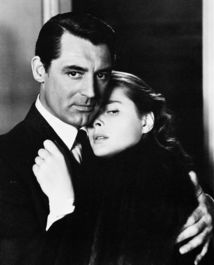
He looks, in that last section of the scene, during the descent down the staircase - he looks, for the first time, like a complete man - like he has joined the land of the living. He looks ... alive. Alert. With no barrier between himself and his own emotions. He is clear. He is strong. He is certain. He loves her. She is his. He will save her. He will get her down the stairs. He is thankful that he did not wait too long. He will save her, even if it means losing his own life. All of that is in that face when he emerges from the bedroom with her in his arms. Amazing acting job. The transformation.

For the rest of the film, he's uptight, guarded, his eyes are cynical, he never smiles (except when he's pretending, at the party). This guy is a sourpuss. He's intimidating. You want him to lighten up, loosen up ... but for his own secret reasons he cannot. Some woman did a number on him once upon a time. Something. He is damaged goods. But somehow, Cary Grant creates this character without completely alienating us in the audience. Despite the fact that he is a bastard to her! And Notorious is obviously on "her" side - the film sympathizes with Ingrid Bergman - she is the heroine, the victim - and yet - he is not villainized.
Hitchcock knew we would come to the film with preconceived notions about Cary Grant (from movies like Bringing up Baby and Holiday) - and he set about to deliberately mess with our expectations. Devlin is the darkest Cary Grant has ever been. This is a guy who is starving for love, and the only reason he resists it is because he needs it too much. The brilliance, of course, of all of this - is that that is only implied, never ever said.
Back to the last scene:
He sits with her on the bed, her face ablaze in the light, and he is a shadow-man, a black-cut-out silhouette.
He holds her. She whispers, "Why have you come ..."
He whispers, "I had to see you one more time ... so I could tell you I love you ..."

He has never said he loved her, and earlier on in the film, she makes reference to the fact that their love affair is very interesting, because he doesn't love her. He tries to weasle out of it, saying, "Actions speak louder than words..."
So the "I love you" in this last scene is not like other "I love yous" in films. There's no swelling music, no climactic moment - there's not a feeling that this "I love you" is a victory. It's more hard-won, more tragic. It's an "I love you" between two adults who have been damaged and chastened by life's hard lessons. This is a grown-up movie.
She is, again, falling in and out of consciousness - but when she hears those words - when she hears him whisper, "I love you" - tears come to her eyes (Bergman is absolutely spectacular in this film, especially in the last scene) - she says, "You love me? Why didn't you say so before?"
He holds onto her, says into the side of her cheek, "I was a fat-headed guy ... full of pain."
The entire scene is done in surreptitious whispers, which adds to the insecure feeling of it, the secretive-ness, the neuroses - this isn't a normal love scene. She's in the light, he's in the dark. These two people are all messed up, basically. I don't feel hopeful about their future together, really - even though they drive away in the same car. Whatever happened next, they'd have a difficult path as a couple. Being grown-up and being in love is tough.
If you want to know why Cary Grant is not just a great movie star, but a great actor - watch him say that "fat-headed guy" line. It's really more that he does nothing (like Claude Rains in the "I am married to an American agent" moment). Grant just says it - simply - with no self-pity, no self-importance, no ego, no attitude - he just says it. He is admitting something. He opens the door. The door of his heart. And the eyes ... his eyes ...
Richard Schickel writes about Cary Grant as Devlin:
As Devlin the counterspy Grant is cool, brusque, competent -- with an almost sadistic edge of cruelty about him. At the start it is clear that his assignment is distasteful to him -- recruiting and running an amateur, and a woman at that. And what a woman she is. Ingrid Bergman's Alicia is not only the personally loyal, if politically disapproving, daughter of a convicted Nazi spy, she is also a nymphomaniac and an incipient alcoholic, unstable to the point of explosiveness. And emotionally needy, pathetically so. "Why won't you believe in me, Devlin -- just a little bit," she begs at one point. And our shock at seeing Bergman violate her previously pristine image, degrading herself in her need is, like Grant's charmless manipulativeness, one of the things that makes this movie so superbly unbalancing. She is, in [Pauline] Kael's terms the pursuer, he the pursued, but in the movie's own terms that is less significant than the neurotic force-field it wants to set up between them.In effect, Devlin is forced to become her lover in order to calm her down enough to do her job, which is to insinuate herself into the home and circle (in Rio de Janeiro) of Alexander Sebastian, who is played by Claude Rains, in one of that actor's most delicious roles, as the only master spy in the history of the genre who is hag-ridden by his mother (yet another piece of pathology to reckon with)...
What Devlin does not count on is that he will fall genuinely in love with Alicia. Or that Sebastian will ask her to marry him. And that there is no way out of the match if she is to complete her mission.
What neither she nor the audience has counted on is Devlin's neurosis, which now comes to the fore.
He thinks she accepts the situation too easily; her attitude fits all too well with what he knows of her earlier promiscuity; and with all the fears and suspicions of women in general which she had almost made him forget.
He turns petulant as a jilted schoolboy, reaching levels of mean-spiritedness that from any leading man would startle an audience, but which from Cary Grant are almost devastating. Hitchcock and Hecht (the writer) have now stripped him bare of his protective image as they previously did Bergman.
The resolution of Notorious requires not just the restoration of moral order, but the rebalancing of psychological equilibrium as well. And what dark intensity this brings to the normally routine process of sorting out a spy drama's strands. One feels that if one of the Brontes had attempted an espionage story it would have turned out something like this.
With Notorious we come closer to the heart of Grant's darkness -- as close as he would allow us to come. There were two decades left to his career, but only once -- and then again for Hitchcock -- would he risk anything like this exposure. Something assuredly was lost by the reticence. And yet one can scarecely blame him. Self-revelation is a terrible trial for anyone; it is especially so for an actor, whose instrument is his person; most of all for an actor like Grant, who so carefully and deliberately created a screen character that was as much a fantasy to him as it was to his audience, in which he could comfortably hide himself, or whatever of himself -- that is to say, the Archie Leach who had been -- that still existed.
Maybe Cary Grant would have allowed Howard Hawks to mess about with his image. But not too many other directors. Grant was careful, cautious. But not with Hitchcock.
An extraordinary film, an extraordinary partnership.
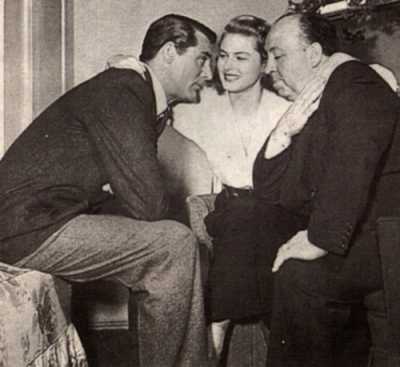
A Russian kind of night
Last night I went to see an evening of Chekhov one-acts (and also adaptations of his stories into plays). Adaptations done by the wonderful Michael Frayn. I knew one of the actors - the other two in it were previously unknown to me - but everyone was just fantastic. They all played about 15 parts a piece, and each was distinct, separate, recognizable ... The plays were howlingly funny at times - and then there was a moment in one which became so unblinkingly sad and tragic (in that Chekhov end-of-Cherry-Orchard-sound-of-axe-hitting-tree-trunk way) - that my eyes flooded with tears. Chekhov is hard, sometimes, to get - especially for Americans - who either over-psychologize him, or sentimentalize him. Americans are kind of optimistic,so Masha strolling around saying, "I am in mourning for my life" seems kind of ... weird ... but to Russians it would be recognizable, and also FUNNY. Last night was a delight - because it had that Chekhovian mix of tears and laughter - which seem so essential to any of his plays working. Marvelous night.
Then I came home and got into the ol' pajamas, and listened to the rain coming down outside, and finished Mikhail Bulgakov's The Master and Margarita (yes, the first book on my From the Stacks list!)
Written during the Great Terror of the 1930s. Bulgakov knew it would never be published in his lifetime. But he wrote it anyway. He wrote an entire first draft - and then was too afraid to have it lying around - and burned it. (There's a famous line in the book: "Manuscripts don't burn." Multiple meanings there.) And then - Bulgakov reconstructed it from memory later. Extraordinary. He wrote many sections of the book in the last months of his life - so there is an awareness of the approaching of death in the language. Death stalks Moscow in this book - quite literally. Satan is abroad. Wreaking havoc whereever he goes. The book is quite cinematic - entire movies unfurled in my mind as I read it - Satan's grand ball, for example ... It's not just descriptive language - Bulgakov isn't just interested in surfaces, of course - but he certainly knows how to set scenes, erect set pieces, show us where to look. All of this makes sense because he had been a hugely successful playwright - and had even written a play that Stalin approved of. This was why he became famous at the time. More on this later. Master and Margarita is a satire, a VICIOUS satire - the entire thing is describing what was actually happening in Russia at that time - but that nobody was allowed to say. His book was not published in Russia until 1966 - and even then - it was highly censored. And it is only in the last 20 years that translators have brought this book out to the American public. Much of the manuscript was in fragments - and it was often not clear which version Bulgakov would have used - if he had lived to complete the work. So there's a sense of reading a work in progress.
It's a terrifying book, so inventive. The ways he finds to express the Great Terror, without ever mentioning the Great Terror ... the ways he brings in black magic, and mass hypnosis, and strange arrests, and the casual-ness of groupthink ... But it is all done without ever saying what is really going on. He has plausible deniability. He's just writing a fanciful humorous tale about a black magician and his sidekick, a huge cat. He's not writing about the Great Terror. He's writing fiction! There's one section where an entire office building, every staff member, is under the spell of the magician - and they all are singing the same patriotic song - in unison - and they cannot stop. The entire office building. 100s of people, singing en masse. And they WANT to stop. They BEG people to try to break the spell. It is this kind of highly magical event that Bulgakov uses to describe the world around him. And so You want to kiss Bulgakov for his courage. For having the foresight to SEE what was going on. His life was ruined. He could not get anything published. But he kept writing.
I'll write more of my thoughts later.
The Books: "Along the Shore - 'The Light on the Big Dipper'" (L.M. Montgomery)
Along the Shore - "The Light on the Big Dipper" - by L.M. Montgomery
This story is told from the point of view of a very resourceful 12 year old, and in typical and beautiful Lucy Maud fashion, she can get right into the psychology of a child. I love it when she does that. Lucy Maud, as an adult, can see how absurd some things are - how children deal with things ... and yet - and I think this is why she is so hugely successful with children, to this day - she takes them seriously. She respects them. She writes about them with respect. It's so fun to read these stories, even now, because of that.
Mary Margaret Campbell is 12 years old. Her father is a sea captain and has been gone for 2 long years on a voyage. While Captain Campbell is gone - Mary Margaret, her mother, and her younger sister Nellie - all go to live on an island out in the bay called Little Dipper. Mary Margaret's uncle has a lobster fishing operation out there - and wants someone to keep house for him. There's another island - in sight of Little Dipper - and it's called Big Dipper - and Mary Margaret's Uncle George runs the lighthouse there. Mary Margaret has spent many happy afternoons there - and Uncle George showed her how to light the light, and give the distress signal, and all that.
But now - happiness! Captain Campbell is finally coming home! Mrs. Campbell is going to pick up her husband on the mainland - and leaves Mary Margaret in charge of little Nellie. Mary Margaret is 12 years old, can cook, can do everything - she is very responsbile. So there are no worries about her being by herself.
All the grownups leave the island. Mary Margaret and Nellie have a nice afternoon. Mary Margaret makes dinner. She lights the fire. She gets Nellie ready for bed. All very responsible. Meanwhile, though - a storm is coming up. A bad one. Darkening sky, and it begins to SNOW - heavily. Mary Margaret sits down by the window, and waits for the light to blaze out of the lighthouse at Big Dipper. Once the sun has gone down, I mean. Mary Margaret knows Uncle George's routine, so she sits down to watch the light come on across the water. Only ... no light comes on. And now the storm is raging. Waves, rain, chaos ... still no light!
Mary Margaret knows that something is horribly wrong. And ... she doesn't know what to do! Responsible little Mary Margaret is in a panic! What about all the ships out on the water right now? How would they know where they were? Everyone was in mortal danger!!!! Why won't the light come on?
Finally, Mary Margaret knows that there is only one thing to do. She must row across the water to the lighthouse and light the lamp herself, see if Uncle George is all right. But what to do with Nellie?? The small 4 year old sister? Mary Margaret is afraid ... she doesn't know what to do ... so she ties her sister in a chair ... so at least she can't get free and hurt herself ... and then goes to row across the water.
Also: having grown up in a seaside town, surrounded by fisherfolk, with lighthouses being a daily part of my life ... I love Lucy Maud's description of the community here. The importance of lighthouses, the URGENCY of lighthouses, etc. The entire community being aware of the lighthouse, and invested in it working properly.
Excerpt from Along the Shore - "The Light on the Big Dipper" - by L.M. Montgomery
Mary Margaret put on her jacket, hood and mittens, and took Uncle Martin's lantern. As she went out and closed the door, a little wail from Nellie sounded on her ear. For a moment she hesitated, then the blackness of the Big Dipper confirmed her resolution. She must go. Nellie was really quite safe and comfortable. It would not hurt her to cry a little, and it might hurt somebody a great deal if the Big Dipper light failed. Setting her lips firmly, Mary Margaret ran down to the shore.
Like all the Harbour girls, Mary Margaret could row a boat from the time she was nine years old. Nevertheless, her heart almost failed her as she got into the little dory and rowed out. The snow was getting thick. Could she pull across those black two miles between the Dippers before it got so much thicker that she would lose her way? Well, she must risk it. She had set the light in the kitchen window; she must keep it fair behind her and then she would land on the lighthouse beach. With a murmured prayer for help and guidance she pulled staunchly away.
It was a long hard row for the little twelve-year-old arms. Fortunately there was no wind. But thicker and thicker came the snow; finally the kitchen light was hidden in it. For a moment Mary Margaret's heart sank in despair; the next it gave a joyful bound, for, turning, she saw the dark tower of the lighthouse directly behind her. By the aid of her lantern she rowed to the landing, sprang out and made her boat fast. A minute later she was in the lighthouse kitchen.
The door leading to the tower stairs was open and at the foot of the stairs lay Uncle George, limp and white.
"Oh, Uncle George," gasped Mary Margaret, "what is the matter? What has happened?"
"Mary Margaret! Thank God! I was just praying to Him to send somebody to 'tend the light. Who's with you?"
"Nobody ... I got frightened because there was no light and I rowed over. Mother and Uncle Martin are away."
"You don't mean to say you rowed yourself over here alone in the dark and snow! Well, you are the pluckiest little girl about this harbour! It's a mercy I've showed you how to manage the light. Run up and start it at once. Don't mind about me. I tumbled down those pesky stairs like the awkward old fool I am and I've broke my leg and hurt my back so bad I can't crawl an inch. I've been lying here for three mortal hours and they've seemed like three years. Hurry with the light, Mary Margaret."
Mary Margaret hurried. Soon the Big Dipper light was once more gleaming cheerfully athwart the stormy harbour. Then she ran back to her uncle. There was not much she could do for him beyond covering him warmly with quilts, placing a pillow under his head, and brewing him a hot drink of tea.
"I left a note for Mother telling her where I'd gone, Uncle George, so I'm sure Uncle Martin will come right over as soon as they get home."
"He'll have to hurry. It's blowing up now ... hear it ... and snowing thick. If your mother and Martin haven't left the Harbour Head before this, they won't leave it tonight. But, anyhow, the light is lit. I don't mind my getting smashed up compared to that. I thought I'd go crazy lying here picturing to myself a vessel out on the reefs."
That night was a very long and anxious one. The storm grew rapidly worse, and snow and wind howled around the lighthouse. Uncle George soon grew feverish and delirious, and Mary Margaret, between her anxiety for him and her dismal thoughts of poor Nellie tied in her chair over at the Little Dipper, and the dark possibility of her mother and Uncle Martin being out in the storm, felt almost distracted. But the morning came at last, as mornings blessedly will, be the nights never so long and anxious, and it dawned fine and clear over a white world. Mary Margaret ran to the shore and gazed eagerly across at the Little Dipper. No smoke was visible from Uncle Martin's house!
She could not leave Uncle George, who was raving wildly, and yet it was necessary to obtain assistance somehow. Suddenly she remembered the distress signal. She must hoist it. How fortunate that Uncle George had once shown her how!
Ten minutes later there was a commotion over at Harbour Head where the signal was promptly observed, and very soon - although it seemed long enough to Mary Margaret - a boat came sailing over to the Big Dipper. When the men landed they were met by a very white-faced little girl who gasped out a rather disjointed story of a light that hadn't been lighted and an uncle with a broken leg and a sister tied in her chair, and would they please see to Uncle George at once, for she must go straight over to the other Dipper?
November 14, 2006
Early John Wayne
A marvelous post in every way about John Wayne - and Ken Maynard, a stunt rider - It's a marvelous post because of the information, the photos, the enthusiastic tone, and paragraphs like: "Ken’s stunt riding was like something out of Greek mythology. His near-total inability to act mattered not a lick. Neither did the epic-scale drinking, for his young constitution could stand abuse, and a few stiff belts only made him braver in the saddle."
Great great stuff.
Oh man
This is a riot. It's so stupid. And so funny.
"The Maldives were positively splendid this year, save for a certain insolence taking hold among the servants." ... having a hard time getting past that one ...
"Infant's eerily steady, unblinking gaze suggests forbidden knowledge of the ancients."
You know. STUPID. FUNNY!!!
Today in History: November 14, 1731
As a librarian's daughter, the event that took place on this day, in 1732 has very special resonance. I posted this last year. Here it is again.
Wonderful stuff:
On this day in history, the Library Company of Philadelphia (founded by Benjamin Franklin in 1731 - and still open today) hired its first librarian - and finally opened for "business".
Painting of Benjamin Franklin opening the first subscription library - by Charles Mill:

In 1731, the Library Company had enrolled members (who had to pay a small fee) - but then had to wait for books to arrive (which had been ordered from England).
The Library Company originally grew out of the informal meetings of a group of local merchants (Ben Franklin was one- the group called themselves "The Junto") - they met to exchange information, have discussions about philosophy, politics ... and they also discussed their general need for more comprehensive libraries. These gentlemen wanted to expand their OWN libraries - but eventually, these discussions expanded into the idea of having a subscription library for the entire community.
In 1774 - they ended up making their entire collection available to the first Continental Congress - gathering in Philadelphia in Sept. 1774.
Here are the "minutes" from the board of directors meeting where that decision was made:
[An] Extract from minutes of the directors of the Library Company of Philadelphia, dated August 31 st .,—directed to the President, was read, as follows:Upon motion, ordered,
That the Librarian furnish the gentlemen, who are to meet in Congress, with the use of such Books as they may have occasion for, during their sitting, taking a receipt for them.
By order of the Directors,(Signed) William Attmore, Sec'y.
Ordered, That the thanks of the Congress be returned to the Directors of the Library Company of Philadelphia, for their obliging order.
Gives me goosebumps!
Here's a description of the plan from HW Brands' biography of Ben Franklin: The First American:
Private libraries were common enough among men of wealth in the colonies. Franklin had taken advantage of a few himself. Nor were institutional libraries unheard of; these were usually joined to churches or other bodies heavenly bent. A secular subscription library, however, was something new. Subscribers would pool their resources to buy books all would share and from which all might benefit. Franklin floated the idea in the Junto; upon favorable reception he drew up a charter specifying an initiation fee of forty shillings and annual dues of ten shillings. The charter was signed in July 1731, to take effect upon the collection of fifty subscriptions.Franklin led the effort to obtain the subscriptions. At first, in doing so, he presented the library as his own idea, as indeed it was. But he encountered a certain resistance on the part of potential subscribers, a subtle yet unmistakable disinclination in some people to give credit by their participation to one so openly civic-minded. They asked themselves, if they did not ask him, what was in this for Ben Franklin that made him so eager to promote the public weeal. To allay their suspicions, Franklin resorted to a subterfuge. "I therefore put myself as much as I could of sight, and stated it as a scheme of a number of friends, who had requested me to go about and propose it to such as they thought lovers of reading."
Within four months the Library Company had its requisite two score and ten commitments. Compiling the initial book order involved identifying favorite titles and consulting James Logan, the most learned man in Pennsylvania. Logan knew Latin, Greek, Hebrew, French, and Italian and was said to be the only person in America sufficiently conversant with mathematics to be able to comprehend Newton's great Principia Mathematica. Before Franklin's emergence, Logan -- who was thirty years the elder and had been the personal protege of William Penn -- was the leading figure of Pennsylvania letters (and numbers). Naturally Franklin cultivated him as source of advice, patronage, and civic goodwill. Logan listed several items essential to the education of any self-respecting person; between these and the titles Franklin and the other library directors chose on their own, early purchases covered topics ranging from geometry to journalism, natural philopsophy to metaphysics, poetry to gardening.
Louis Timothée, a journeyman in Franklin's shop, was hired as librarian, and a room to house the collection was rented. Franklin and the other directors of the library instructed Timothée to open the room from two till three on Wednesday afternoons and from ten till four on Saturdays. Any "civil gentlemen" might peruse the books, but only subscribers could borrow them. (Exception was made for James Logan, in gratitude for his advice in creating the collection.) Borrowers might have one book at a time. Upon accepting a volume each borrower must sign a promissory note covering the cost of the book. This would be voided upon return of the book undamaged. The borrower might then take out another, building his edifice of knowledge, as it were, one brick at a time.
One of the things I am most impressed by, when it comes to our Founding Fathers, is how - unequivocally - each one of them, whenever they sensed a void - would go about creating whatever needed to be created to fill that void. They did not wait for others to do it for them. They did not bitch about how there wasn't such-and-such yet. They were NOT like the people described in that excerpt above: the ones who were suspicious of Benjamin Franklin's enthusiasm and civic energy.
Alexander Hamilton, working as a lawyer in New York, realized how his job was made so much more difficult because all of the laws in New York were not compiled and written down in one place. So whaddya know, he sat down and wrote that book.
Ben Franklin realized that a public subscription library would be a wonderful thing for the community. And so he set about creating it.
Recently - I had the great good fortune to actually film something IN the Library Company of Philadelphia. It was sooo cool. To be in that environment, the books, the relics, the quiet, the gorgeousness ... the history all around ... and then me. Walking around in front of those shelves, talking at a camera, gesturing, picking up books, putting them down, blah blah. An awesome privilege. One of those: "Wow, let's just take a moment and relish how cool this is, mkay?" experiences.
So today in history: the Library Company hired Louis Timothée, as the first public librarian in the United States of America.
Pretty damn cool, eh?
Cannot wait ...
... to see Stranger Than Fiction ...
I'm dying to see it. It sounds sooo good. And I'm excited to see Will Ferrell in a more serious part.
Great plot, great cast ...
I've been too busy to see the damn thing - no time. Maybe tomorrow or the next day.
It's been a while since I've been so psyched to see a specific movie.
Happy birthday, P.J. O'Rourke!
Love that guy.
Have a HUGE crush on that guy.
An embarrassing crush.
Like if I met him I would stand there blushing and tongue-tied.
It's his birthday today.
Happy birthday, Mr. O'Rourke!!
Why do I love him?
Example:
"Wherever there's injustice, oppression, and suffering, America will show up six months late and bomb the country next to where it's happening."
-- PJ O'Rourke
Or this ... perhaps my favorite line of his that he ever wrote (from an essay about traveling through the jungle and seeing tree sloths):
"Sloths move at the speed of congressional debate but with greater deliberation and less noise."
I don't know WHY that is so good - I just know that it is. I love his writing. Every single word of it. I like his writing because there's always a surprise in it. You know how some people THINK they're funny? As a matter of fact, it seems as though there is now an epidemic of people who THINK they're funny and who think quoting entire Seinfeld episodes will fool you, the trapped listener, into thinking they are witty ... or people who think that saying, "Alllllll righty then" makes them as funny as Jim Carrey ... etc. etc. I got news for those folks. Uhm - no. Quoting somebody else's humor does not make YOU funny. And then there are people like Dave Barry. David Sedaris. P.J. O'Rourke. These people are REALLY funny. It's hard to WRITE funny. A lot of comedians rely on physicality to get the joke across - but to do it in language is a gift. A rare gift. Like his quote below about boats. It's so dumb, it has a ba-dum-ching sensibility, it's almost vaudevillian in its humor ... but still. It works. To me, it works.
I read P.J. O'Rourke's essay about Haiti and how horrible it is - and yet some of his sentences make me guffaw and have to stop reading for a second. It's not that he doesn't take conflict seriously - it's that no matter what the hell is going on, he is aware that there is a level of absurdity to it all.
Here are some of my favorite quotes from his books:
-- A hat should be taken off when you greet a lady and left off for the rest of your life. Nothing looks more stupid than a hat.
-- Fish is the only food that is considered spoiled once it smells like what it is.
-- With Epcot Center the Disney corporation has accomplished something I didn't think possible in today's world. They have created a land of make-believe that's worse than regular life.
-- In fact, safety has no place anywhere. Everything that's fun in life is dangerous. Horse races, for instance, are very dangerous. But attempt to design a safe horse and the result is a cow (an appalling animal to watch at the trotters.) And everything that isn't fun is dangerous too. It is impossible to be alive and safe.
-- There are a lot of mysterious things about boats, such as why anyone would get on one voluntarily.
-- To grasp the true meaning of socialism, imagine a world where everything is designed by the post office, even the sleaze.
-- The French are a smallish, monkey-looking bunch and not dressed any better, on average, than the citizens of Baltimore. True, you can sit outside in Paris and drink little cups of coffee, but why this is more stylish than sitting inside and drinking large glasses of whiskey I don't know.
-- Bachelors know all about parties. In fact, a good bachelor is a living, breathing party all by himself. At least that is what my girlfriend said when she found the gin bottles under the couch. I believe her exact words were, "You're a disgusting, drunken mess." And that's a good description of a party, if it's done right.
-- Ecology is the science of everything. Nobody knows everything. Nobody even knows everything about any one thing. And most of us don't know much. Say it's ten-thirty on a Saturday night. Where are your teenage children? I didn't ask where they said they were going. Where are they really? What are they doing? Who are they with? Have you met the other kids' families? And what is tonight's pot smoking, wine-cooler drinking, and sex in the backseats of cars going to mean in a hundred years? Now extend these questions to the entire solar system.
-- Are we disheartened by the breakup of the family? Nobody who ever met my family is.
-- It's hard to come back from the Balkans and not sound like a Pete Seeger song.
-- People who are wise, good, smart, skillful, or hardworking don't need politics, they have jobs.
-- Earnestness is just stupidity sent to college.
So good. (I love the wine-cooler detail. It's so embarrassing and so PERFECT.)
List of PJ O'Rourke's book here - if you haven't read them already.
The Books: "Along the Shore - 'Fair Exchange and No Robbery'" (L.M. Montgomery)
Along the Shore - "Fair Exchange and No Robbery" - by L.M. Montgomery
Next story I'll excerpt (in this book that, er, nobody else appears to have read but me!!) is a really funny story -I like it a lot - it's a romance, but it's written in that way that Lucy Maud has - that really human voice, with an eye towards the comedy in any situation. She doesn't always use that tone - but it's one of my favorites of her narrative voices. Because - I get it. I get her sense of humor. Her impression that life is kind of abSURD. This story is like that.
There are two dear friends - who are in college. Katherine and Edith. Both are seriously involved with someone -Katherine with a guy named Ned and Edith with a guy named Sidney. But neither has met the others beau ... Ned goes to a different college, and Sidney is already out of college. The story opens with Katherine and Edith both getting ready for summer holidays. Katherine is going to spend the summer with her Aunt Elizabeth in a remote seashore town - and Edith is staying on the campus for the summer. But, through a random coincidence, Ned has transferred to Katherine's college and will be there - on campus for the summer - taking courses - and Katherine is bummed and kind of pissed that it should happen just as she is going away. Edith says that she will look out for Ned, and make him feel welcome, not to worry, not to worry. The girls also briefly exchange thoughts about their boyfriends - and you can see that both of them, while fond of their men, have a couple complaints. Katherine is bookish, and loves poetry. Ned laughs at poetry and thinks "women writers are an abomination". Edith's Sidney is VERY bookish - and kind of plain-faced. Katherine admires plain-faced men because they are not vain. Ned, on the other hand, is gorgeous - and very vain - so she has to take him down a peg. And yet she loves him, obviously - it's just two girls kind of complaining about their men and what they lack. Then it's off to vacation! Toodle-oo!!
We follow Katherine on her vacation - where she thinks she will die of boredom in this little seaside town with nothing to do. She ends up meeting a random man (their meeting is the excerpt below) ... and somehow they end up CLICKING. Not romantically - or, of course that is underneath - but ... they just have a good time together. It turns out that he is, actually, Edith's boyfriend - he is writing a book and needed a quiet place for the summer .. so they befriend each other ... and they can't admit what is REALLY going on because they are both involved with someone else. It is very hard for Katherine to say good-bye to him. She is devastated, frankly.
She goes back to the campus town - dreary, sad, not at all looking forward to seeing Ned ... and she comes back to the room she shares with Edith and overhears Edith and Ned inside, having a tormented conversation about what they should do ... how should they "break the news" to Katherine ... Oh, it's so awful ... Edith has STOLEN Katherine's boyfriend! Oh, what a tragedy this is!!
Naturally, to Katherine, it is not a tragedy at all. Because now she will be free to steal EDITH'S boyfriend ... and they can all stay friends ... it will be a fair exchange and no robbery.
This all sounds very prosaic when I write it out like that - but I just love how this story is written - the TONE. I love when she ponders that maybe he is a revivalist.
It was written in 1907 - a year before Anne of Green Gables was published.
Excerpt from Along the Shore - "Fair Exchange and No Robbery" - by L.M. Montgomery
To pass the time Katherine took to collecting seaweeds, and this involved long tramps along the shore. On one of these occasions she met with an adventure. The place was a remote spot far up the shore. Katherine had taken off her shoes and stockings, tucked up her skirt, rolled her sleeves high above her dimpled elbows, and was deep in the absorbing process of fishing up seaweeds off a craggy headland. She looked anything but dignified while so employed, but under the circumstances dignity did not matter.
Presently she heard a shout from the shore and, turning around in dismay, she beheld a man in the rocks behind her. He was evidently shouting at her. What on earth could the creature want?
"Come in," he called, gesticulating wildly. "You'll be in the bottomless pit in another moment if you don't look out."
"He certainly must be a lunatic," said Katherine to herself, "or else he's drunk. What am I to do?"
"Come in, I tell you," insisted the stranger. "What in the world do you mean by wading out to such a place? Why, it's madness."
Katherine's indignation got the bettero f her fear.
"I do not think I am trespassing," she called back as icily as possible.
The stranger did not seem to be satisfied at all. He came down to the very edge of the rocks where Katherine could see him plainly. He was dressed in a somewhat well-worn grey suit and wore spectacles. He did not look like a lunatic, and he did not seem to be drunk.
"I implore you to come in," he said earnestly. "You must be standing on the very brink of the bottomless pit."
He is certainly off his balance, thought Katherine. He must be some revivalist who has gone insane on one point. I suppose I'd better go in. He looks quite capable of wading out here after me if I don't.
She picked her steps carefully back with her precious specimens. The stranger eyed her severely as she stepped on the rocks.
"I should think you would have more sense than to risk your life in that fashion for a handful of seaweeds," he said.
"I haven't the faintest idea what you mean," said Miss Rangely. "You don't look crazy, but you talk as if you were."
"Do you mean to say you don't know that what the people hereabouts call the Bottomless Pit is situated right off that point - the most dangerous spot along the whole coast?"
"No, I didn't," said Katherine, horrified. She remembered now that Aunt Elizabeth ahd warned her to be careful of some bad hole along shore, but she had not been paying much attention and had supposed it to be in quite another direction. "I am a stranger here."
"Well, I hardly thought you'd be foolish enough to be out there if you knew," said the other in mollified accents. "The place ought not to be left without warning, anyhow. It is the most careless thing I ever heard of. There is a big hole right off that point and nobody has ever been able to find the bottom of it. A person who got into it would never be heard of again. The rocks there form an eddy that sucks everything right down."
"I am very grateful to you for calling me in," said Katherine humbly. "I had no idea I was in such danger."
"You have a very find bunch of seaweeds, I see," said the unknown.
But Katherine was in no mood to converse on seaweeds. She suddenly realized what she must look like - bare feet, draggled skirts, dripping arms. And this creature whom she had taken for a lunatic was undoubtedly a gentleman. Oh, if he would only go and give her a chance to put on her shoes and stockings!
Nothing seemed further from his intentions. When Katherine had picked up the aforesaid articles and turned homeward, he walked beside her, still discoursing on seaweeds as eloquently as if he were commonly accustomed to walking with barefooted young women. In spite of herself, Katherine couldn't help listening to him, for he managed to invest seaweeds with an absorbing interest. She finally decided that as he didn't seem to mind her bare feet, she wouldn't either.
He knew so much about seaweeds that Katherine felt decidedly amateurish beside him. He looked over her specimens and pointed out the valuable ones. He explained the best method of preserving and mounting them, and told her of other and less dangerous places along the shore where she might get some new varieties.
When they came in sight of Harbour Hill, Katherine began to wonder what on earth she would do with him. It wasn't exactly permissible to snub a man who had practically saved your life, but, on the other hand, the prospect of walking through the principal street of Harbour Hill barefooted and escorted by a scholarly looking gentleman discoursing on seaweeds was not to be calmly contemplated.
The unknown cut the Gordian knot himself. He said that he must really go back or he would be late for dinner, lifted his hat politely, then sat down on the sand and put on her shoes and stockings.
"Who on earth can he be?" she said to herself. "And where have I seen him before? There was certainly something familiar about his appearance. He is very nice, but he must have thought me crazy. I wonder if he belongs to Harbour Hill."
November 13, 2006
14
I just found this ... a Friday Fourteen: "There are several books on my shelves that I adored so much that I have really been itching to read them again. So, here, without further ado, books I want to reread."
I re-read books I love all the time ... so for the fun of it - here goes.
Books I either WANT to re-read - or books I HAVE re-read (I'll stick to fiction):
1. The Amazing Adventures of Kavalier and Clay - by Michael Chabon - I have only read this one once - but it was one of the best novels I've read in, oh, the last 20 years. Every word of it. The topic, the era, the specificity, the characters ... it is SO good. I've been eyeing it longingly recently - wanting to pick it up again ... so I probably will cave soon.
2. Sportsman's Paradise - by Nancy Lemann. Oh, how I love this dear, funny, touching book. I've only read it once - but I often pick it up and leaf through the pages, reacquainting myself with it. I'll re-read it someday.
3. Portrait of the Artist as a Young Man - by Jimmy J. I've already read it probably 5 times completely? So I'll never be done with it, I don't think. I always pick up something new each time I read it, too. It's one of those books that changes with you, the reader, as you go through your life.
4. Lady Oracle - by Margaret Atwood - I have had a hankering to re-read this one again. I've only read it once - years and years ago - and I remember actually laughing out loud a couple of times - which, you know, is rare for Atwood. I remember laughing out loud during the whole section describing the pretentious ridiculous Weather UNderground type group she gets involved with ... but I can't remember why it's so funny. On the list for re-reading.
5. Two Girls Fat and Thin - by Mary Gaitskill - I talked about that a bit here. I wasn't too wacky about the book - I found it disturbing and upsetting ... but I think it might just have been me. Regardless, I need to go back and investigate. See what I think.
6. Winner of the National Book Award: A Novel of Fame, Honor, and Really Bad Weather - by Jincy Willett This is the kind of book that I HAVE to recommend to friends I know will love it. Mitchell?? You would LOVE this book. RTG already read it. I begged her to. But it's just SUCH a delightfully weird funny dark little book. Laugh out loud funny at times ... and man, do I value an author who can do that! Also, it takes place in Rhode Island, and she just GETS it. She gets the Rhode Island thing perfectly. I enjoyed it so much I need to read it again.
7. Crime and Punishment - by Fyodor Dostoevsky. One of the best books ever. I've only read it once. This is a definite must-read-again book.
8. Jane Eyre - by Charlotte Bronte. You know. I just keep reading that book, and I'll never stop prob'ly.
9. Breaking and Entering - by Joy Williams. I was obsessed with this book when I first read it. I even had to read some of it outloud to myself. I loved the characters. It's been years since I've read it.
10. A Prayer for Owen Meany - by John Irving You know I've only read this book once - and it was YEARS ago - I was just out of college, or maybe still in college ... and I remember certain scenes almost word for word. The Christmas pageant lives on in my mind as one of the funniest things I have ever read in my life. I remember my boyfriend and I were reading it at the same time - racing through the book at almost the same speed - and we were at the beach, and he had surged ahead of me in the book and started in reading the whole pageant scene - and he was seriously SNORTING with laughter. I was dying because I hadn't gotten to it yet ... but then 2 pages later ... I start to SNORT with laughter too - and we both just read, and guffawed ... at the same time. Great book - need to read it again.
11. Time Traveler's Wife - by Audrey Niffenegger I just really liked this book. I thought it was quite good, and I'd like to read it again.
12. Moby Dick - by Herman Melville. If I re-read it - that will make it the third time. And it's daunting - I need to gear up for it ... but I am certainly not DONE with that book. I will re-read it again someday.
13. Wrinkle in Time - by Madeleine L'Engle. Always. I've read it a bazillion times. I'll read it a bazillion more.
14. Possession - by AS Byatt ... I've already read it probably 3 times completely? I am sure I will be drawn to read it again. It's just one of those books for me. I never get sick of it.
1:30 a.m. The 1 line
People's defenses are down at this time of night. It shows on their faces, the slackened jaws, the soft droopy eyes, the lost-in-thought faces or the deadened blank expressions. Everyone's slightly unbuttoned, in their own private space. On the subway hurtling downtown, the tiles a blur outside, the lights harsh and unforgiving. Woman with huge headphones on, her eyes are open, she is kind of fat, her hands folded over her belly, and her face shows that she is a million miles away. She's in the music. Her body is there ... but her mind is not. I love the look in her eyes. A man across from me - so big he takes up two seats - he is wearing a billowing black trench coat, a little black porkpie hat, and his skin is a dark black. He has fallen asleep, his mouth hangs open just a bit, and he is tipping over slightly to one side. As though he may just curl up on the subway seat and fall asleep in earnest. Nobody sits on either side of him. Everyone's lost in their own space. A homeless man sits over in the corner - a hood completely covering his head, his body in the relaxed still pose of the deeply passed out. His long lanky legs with his battered sneakers stick out into the subway train. It's a long ride. It's a local train. A guy gets on and sits next to me. He hunches over, reading a huge paperback. I'm guessing it was a textbook. It was enormous. If it weren't 1:30 in the morning, and if I weren't 3/4 asleep ... I might have squinted to get a load of the title. But it's too late for that. Too early. The tiles are a dizzying blur outside the window. We briefly emerge from the tunnel, and we go elevated for a bit. I can see the dim constellation of the Jersey side of the Hudson through the black, at the ends of the streets we hurtle over. I feel everything draining out of me. Thoughts, wants, judgments, energy. My eyes are soft and heavy. I am awake but I am on the edge of consciousness. There is life all around me ... well, maybe the homeless guy was dead, I have no way of knowing ... but our daytime jostling energy has softened. It's night, and the train is really loud and squeaky and rattly ... but somehow it feels quiet. Even the train noise has blurred. Blurred into the constellation across the black river. Washing away. The confrontational nature of the sound draining out, blurred edges. I know I made it home last night ... I know I took the subway to the bus and then walked down the dark street to my apartment ... but I don't remember it. I remember getting off at Times Square, my eyelids puffy, and after that ... only fragments. Orange lamplight on the brick sidewalk. A stark shadow. The rustling of the leaves. Damp street. And now it's morning and the barriers are up again. I woke up in my own bed so I obviously made it home in my somnambulistic state. I still feel a bit puffy-eyed and soft. Raw. Like I need to work a bit to get my game face on. The soft black blurred landscape of the wee hours is back in the daylight to its sharp insistent verticals. The city dismantles itself and then re-erects itself on a daily basis. I just try to ride the wave.
Flashback
This image totally brings back memories. High school, hanging out at Mere's, all of us, walking up to the mall, browsing about, dances, hot faces pressed on cold tile ...
All of it encapsulated in that image.
The Books: "Along the Shore - 'Mackereling Out In the Gulf'" (L.M. Montgomery)
Along the Shore - "Mackereling Out In the Gulf" - by L.M. Montgomery
Another seafaring story - this one about fishermen. Although it's also a romance. Benjamin Selby has always loved Mary Stella - since he was little. They were childhood friends. He has cherished a dream, a hope that someday .... and because of that, she has factored into his plans, and the man he has become. He is trying to be a good enough man to deserve her, etc. You get this within a couple paragraphs. Mary Stella is a sweet girl, and kind to Benjamin. These are all fisher-folk - Benjamin is a big swarthy dude who works out on his boat all day. Anyhoo ... suddenly a new guy comes to town - a Frank Braithwaite - and he's a city person, or ... at least he's not one of THEM. But he's handsome, nice ... and he falls for Mary Stella. He does realize that he has a rival in Benjamin Selby - he understands that ... but Mary Stella (you kind of don't know what's going on with her. She seems rather insipid, if you ask me) ends up choosing Frank. Benjamin ends up seeing them in a romantic moment along the shore one day ... and it is so upsetting to him that it's practically anguish. This is his whole LIFE! A couple days later, Frank Braithwaite goes out in a boat with two French Canadian boys (who are, as they always are in Lucy Maud's world, almost minstrel show-y in their behavior) ... none of them are really competent sailors. So they're idiots, basically. And a storm comes up. A horrible storm. People gather on the shore, terrified ... looking out to sea for the boats to come back in ... and all of them do, except for the one with Frank in it. That boat is struggling mightily - and panic rises along the shore ... are they going to drown? So now Benjamin has to make a choice ... he could go out and save them, or he could let his hated rival die ... and maybe then he could have Mary Stella ...
Naturally, Benjamin makes the right choice.
The story itself is kind of simplistic, I guess - there's not much to it - but I'm excerpting it because of the ending which I think is quite touching and very well done.
Excerpt from Along the Shore - "Mackereling Out In the Gulf" - by L.M. Montgomery
Braithwaite came to the shore next day somewhat pale and shaky. He went straight to Benjamin and held out his hand.
"Thank you," he said simply.
Benjamin bent lower over his work.
"You needn't thank me," he said gruffly. "I wanted to let you drown. But I went out for Mary Stella's sake. Tell me one thing - I couldn't bring myself to ask it of anyone else. When are you to be - married?"
"The 12th of September."
Benjamin did not wince. He turned away and looked out across the sea for a few moments. The last agony of his great renunciation was upon him. Then he turned and held out his hand.
"For her sake," he said earnestly.
Frank Braithwaite put his slender white hand into the fisherman's hard brown palm. There were tears in both men's eyes. They parted in silence.
On the morning of the 12th of September Benjamin Selby went out to the fishing grounds as usual. The catch was good, although the season was almost over. In the afternoon the French Canadians went to sleep. Benjamin intended to row down the shore for salt. He stood by his dory, ready to start, but he seemed to be waiting for something. At last it came: a faint train whistle blew, a puff of white smoke floated across a distant gap in the sandhills.
Mary Stella was gone at last - gone forever from his life. The honest blue eyes looking out over the sea did not falter; bravely he faced his desolate future.
The white gulls soared over the water, little swishing ripples lapped on the sand, and through all the gentle, dreamy noises of the shore came the soft, unceasing murmur of the gulf.
November 12, 2006
The Books: "Along the Shore - 'The Magical Bond of the Sea'" (L.M. Montgomery)
Along the Shore - by L.M. Montgomery
Okay, so I leave Emily behind with some regret ... she's my favorite ... but it's time to do some MORE Lucy Maud Montgomery excerpts. Her books take up 2 enter shelves - and since I'm also posting from short stories I like, from her collections, this is taking some time. But I'm in no rush.
Recently - through the 1990s - as Lucy Maud Montgomery's journals were being published - and as there was a resurgent interest in her (due to the television show, the movie, etc.) - a lot of her, uhm, "juvenilia" was dug up and published. Actually, not all of the collections were made up of her early short stories - some were the short stories that she continued to write throughout her career. She was always working on something - if not a novel, then these stories. Some are 5 or 6 pages long - others are more like novellas. Rea Wilmhurst, the editor, is someone we all owe a GREAT debt to. She's the one who put together all of these collections - and she did so SO beautifully, I think. Here's how she organized the stories (and it truly makes you in awe of Lucy Maud's output ... this was a woman who PRODUCED, man ... a workaholic): She identified some of Lucy Maud's more common themes - oh, and also genres - (orphans finding happiness and home, long-deferred romantic happiness, ghost stories/paranormal experiences, stories based on correspondence, romantic stories ending in marriage) and put together collections of stories in each of these themes. I love how she did it. There's an entire collection about stories that have something to do with the ocean - because the ocean was such a huge part of Lucy Maud's consciousness. For most of her life she ended up living away from the ocean - and she missed it so much that her heart nearly broke. She wrote a lot of stories about sea-faring folks, storms at sea, fishermen, etc. So there's an entire collection of those stories (that's the collection I'm gonna start with).
Some pre-date the publication of Anne of Green Gables - and so you can kind of feel her finding her way as a writer. Some of the stories are pretty bad - Lucy Maud wrote them for cash. She wrote them to order, too. Many of the stories depend on an outrageous coincidence which turns out making everything right (a la Dickens) ... but sometimes the story is just is its plot, and you can feel it creaking along. Sometimes they are way melodramatic. Sometimes they are treacly and would belong in a Sunday School pamphlet. But I loved reading them all because you can feel, first of all, Lucy Maud's work ethic. And I always found that so admirable. And also because - you can feel her working out some of the stories that she would later put into novels. Earlier versions of events show up in these stories all the time. If you're an autistic Lucy Maud freak, like I am, you will even recognize certain sentences: "Oh, she ended up using that sentence in House of Dreams ... oh, I remember that phrase, she put it into the grandmother's mouth in Magic for Marigold ..." Yes, it's that way with me. How entire books sit in my mind, word for word, I will never know ... but they do. So it's fun to read. In the Along the Shore collection there's a story called The Life Book of Uncle Jesse - which is, almost word for word, the story that ends up in House of Dreams - with "lost Margaret" and everything. Word for word. The story that ends up closing the collection, "A House Divided Against Itself" is almost word for word one of the plot-lines in her wonderful book Tangled Web - the two brothers arguing about the statue of Venus and one ends up getting caught in this hole in a rock in the shore - and the waves are coming in - and etc. etc. Word for word. Lucy Maud's books are often quite episodic - so these short stories acted as dress rehearsals. I love that. I love the little moment of recognition when I start to read one of them. I can feel her process, I can feel HER, if you will ... as a writer. It's really neat.
So yes, there is a lot of drivel here. But there's a lot that is truly wonderful as well, and I am thankful to Rea Wilmhurst for putting them all together. Oh, and even better: you get publication dates for the stories. So you can put together your own timeline ... and see where, in her life, she was working on it. Was it between Emily books? Was it BEFORE Anne? Rea Wilmhurst has even dug up stories from the late 1800s ... stuff Lucy Maud had published when she was 19, 20 ... and this stuff is hysterical - really melodramatic - some of it with Gothic horror overtones - she hasn't found her groove yet - but even that is really interesting, if you're a fan of her writing as a whole.
I won't excerpt every one of the stories - and not the ones that show up in novels later - but I will excerpt the ones I like, or ones I find interesting, in terms of Lucy Maud's development.
So. Along the Shore. A collection of stories about the ocean.
First story in the collection has the insipid title "The Magical Bond of the Sea" - but it's a lovely little story. Nora Shelley is a fisherman's daughter, she lives with her big rowdy family in a tiny 3 room shack on the shore (always Prince Edward Island in these stories, you don't even have to ask). And somehow - a rich aunt swoops in and says that Nora, a beautiful girl, age 15 or so, should have a chance at a better life - she should get some education - maybe marry a rich man. But she needs to be groomed for that ... and Nora, in her heart, wants to have a chance to see the big world as well. (This plot reminds me a bit of Cathy being taken away in Wuthering Heights - and coming back a nicely groomed lady). Nora loves her family ... and doesn't want to hurt her parents, her father and mother, by rejecting the life they provide ... but she does want to take this chance. So they let her go. There's a little going-away party - and you get the sense, with one of the guys hovering on the outskirts, that someone has a crush on her, her childhood friend ... who is now working as a fisherman, a nice boy. But now he must watch her go. (Melodramatic chords ensue). So Nora goes off ... and she is gone for almost a year. She writes letters home about her brilliant life of parties and travel and balls ... and the letters are read outloud by her family and by neighbors crowding in to listen. Her father, a "grizzled" old fisherman, can feel that Nora is changing. That she is no longer one of them. It makes him sad but on some level ... he knew he needed to let her go. Nora doesn't even come home for a visit. She immerses herself in this rich world. But then ... (dum da DUM) ... one summer they return, and Nora is staying at the big house across the bay ... and apparently she is slated to go home and visit the next day ... and there is a millionaire named Clark Bryant who supposedly is "courting" her and is stayiing a bit at the big house ... and everything is kind of hectic, etc. Nora is kind of unconscious of her deepest desires (a typical Lucy Maud heroine: unaware of what she wants until THE MOMENT ARRIVES WHEN SHE REALIZES IT ... ) ... she's there in the big house, she just arrived ... when suddenly she looks out the window ... and sees the bay right there ... and sees the little fishermen's town across the water ... and then ...
Here's the excerpt. I love it because of her response to being out on the water ... and how Lucy Maud writes that part. It's glorious.
"The Magical Bond of the Sea" was published in The Springfield Republican in September of 1903.
So this pre-dates Anne by about 5 years. But, in my opinion, you can feel her certainty as a writer here, in a way that you cannot feel in some of the earlier stories. She's writing in HER way ... it is obviously Lucy Maud Montgomery writing - any fan of hers would recognize this prose right away. In some of the earlier stories (the ghost stories, for example) - it is not as apparent who is writing. Lucy Maud didn't put her STAMP on some of those. But her stamp is here.
Excerpt from Along the Shore - "The Magical Bond of the Sea" - by L.M. Montgomery
At sunset on the day of her arrival Nora Shelley looked out cross the harbour to the fishing villagae. She was tired after her journey, and she had not meant to go over until the morning, but now she knew she must go at once. Her mother was over there; the old life called to her; the northwest wind swept up the channel and whistled alluringly to her at the window of her luxurious room. It brought to her the tang of the salt wastes and filled her heart with a great, bitter-sweet yearning.
She was more beautiful than ever. In the year that had passed she had blossomed out to a gracious fulfillment of womanhood. Even the Camerons had wondered at her swift adaptation to her new surroundings. She seemed to have put Racicot behind her as one puts by an old garment. In everything she had held her own royally. Her adopted parents were proud of her beauty and her nameless, untamed charm. They had lavished every indulgence upon her. In those few short months she had lived more keenly and fully than in all her life before. The Nora Shelley who went away was not, so it would seem, the Nora Shelley who came back.
But when she looked from her window to the waves and saw the star of the lighthouse and the blaze of the sunset in the window of the fishing-houses and heard the summons of the wind, something broke loose in her soul and overwhelmed her, like a wave of the sea. She must go at once -- at once -- at once. Not a moment could she wait.
She was dressed for dinner, but with tingling fingers she threw off her costly gown and put on her dark travelling suit again. She left her hair as it was and knotted a crimson scarf about her head. She would slip away quietly to the boathouse, get Davy to launch the little sailboat for her - and then for a fleet skim over the harbour before that glorious wind! She hoped not to be seen, but Mrs. Cameron met her in the hall.
"Nora!" she said in astonishment.
"Oh, I must go, Aunty! I must go!" the girl cried feverishly. She was afraid Mrs. Cameron would try to prevent her going, and all at once she knew that she could not bear that.
"Must go? Where? Dinner is almost ready, and --"
"Oh, I don't want any dinner. I'm going home - I will sail over."
"My dear child, don't be foolish. It's too late to go over the harbour tonight. They won't be expecting you. Wait until the morning."
"No -- oh, you don't understand. I must go -- I must! My mother is over there."
Something in the girl's last sentence or the tone in which it was uttered brought a look of pain to Mrs. Cameron's face. But she made no further attempt to dissuade her.
"Well, if you must. But you cannot go alone - no, Nora, I cannot allow it. The wind is too high and it is too late for you to go over by yourself. Clark Bryant will take you."
Nora would have protested but she knew it would be in vain. She submitted somewhat sullently and walked down to the shore in silence. Clark Bryant strode beside her, humoring her mood. He was a tall, stout man, with an ugly, clever, sarcastic face. He was as clever as he looked, and was one of the younger millionaires whom John Cameron drew around him in the development of his huge financial schemes. Bryant was in love with Nora. This was why the Camerons had asked him to join their August house party at Dalveigh, and why he had accepted. It had occurred to Nora that this was the case, but as yet she had never troubled to think the situation over seriously.
She liked Clark Bryant well enough, but just at the moment he was in the way. She did not want to take him over to Racicot - just why she could not have explained. There was in her no snobbish shame of her humble home. But he did not belong there; he was an alien, and she wished to back to it for the first time alone.
At the boathouse Davy launched the small sailboat and Nora took the tiller. She knew every inch of the harbour. As the sail filled before the wind and the boat sprang across the upcurling waves, her brief sullenness fell away from her. She no longer resented Clark Bryant's presence - she forgot it. He was no more to her than the mast by which he stood. The spell of the sea and the wind surged into her heart and filled it with wild happiness and measureless content. Over yonder, where the lights gleamed on the darkening shore under the high-sprung arch of pale golden sky, was home. How the wind whistled to welcome her back! The lash of it against her face - the flick of salt spray on her lips - the swing of the boat as it cut through the racing crests - how glorious it all was!
Clark Bryant watched her, understanding all at once that he was nothing to her, that he had no part or lot in her heart. He was as one forgotten and left behind. And how lovely, how desirable she was! He had never seen her look so beautiful. The shawl had slipped down to her shoulders and her head rose out of it like some magnificent flower out of a crimson calyx. The masses of her black hair lifted from her face in the rush of the wind and swayed back again like rich shadows. Her lips were stung scarlet with the sea's sharp caresses, and her eyes, large and splendid, looked past him unseeing to the harbour lights of Racicot.
When they swung in by the wharf Nora sprang from the boat before Bryant had time to moor it. Pausing for an instant, she called down to him, carelessly, "Don't wait for me. I shall not go back tonight."
Then she caught her shawl around her head and almost ran up the wharf and along the shore. No one was abroad, for it was supper hour in Racicot. In the Shelley kitchn the family was gathered around the table, when the door was flung open and Nora stood on the threshold. For a moment they gazed at her as at an apparition. They had not known the precise day of her coming, and were not aware of the Camerons' arrival at Dalveigh.
"It's the girl herself. It's Nora," said old Nathan, rising from his bench.
"Mother!" cried Nora. She ran across the room and buried her face in her mother's breast, sobbing.
November 11, 2006
Happy birthday to Mary Gaitskill
She's one of my favorite present-day writers. I first discovered her back when her first short story collection came out - Bad Behavior. My first boyfriend made me read it - telling me I was gonna flip out about this chick's writing. I did. Her stuff is rough - or it can be. It's a lot of sado-masochistic characters (literally), homeless people, prostitutes, callgirls, runaways ... This was Mary Gaitskill's background, which she is quite open about. She lived on her own from the time she was 16, and worked as a callgirl and prostitute. She writes about what she knows. And her prose!! I have to be in the mood for it - she can be quite dark, bleak - and also ... how to say this - kind of matter-of-fact about the most horrific things. She doesn't write with a ton of emotion. It's cold, clear. This is the world that this class of people lives in. But that's part of the fascination. And also, it can't be stressed enough: these are people, she makes these people come alive, even if you hate them, or pity them, or don't understand them ... You feel shivers of recognition at times in some of them ... or she describes a situation with such accuracy that you know you have been there before, even if you cannot recall the particulars.
Her debut was a stunner - I remember everybody talking about it. It was a big deal. (The movie Secretary was based on one of the short stories in that collection - although she did say that it was the "Pretty Woman version of what she wrote" - which is true. By the way - I just went to the IMDB page for the film and noticed the brief plot summary - rated R for "strong sexuality" and also "depiction of behavioral disorders". Hm. I don't know what behavior disorder is in that film. Obsessive cleanliness maybe? She was in a mental hospital - but the story isn't really about that. She may seem odd, different, but mentally ill? Insane? The film makes it a point of showing that she is not, and in a way she is the sanest one in the film. Or is it the S&M that is considered a behavior disorder? If you think there's an easy answer to that last question, or if your answer to that question is a very quick "yes" - then probably Mary Gaitskill isn't your girl.). The story is way darker than the film, and the story doesn't have the nice domestic ending. But I loved that movie - they were true ENOUGH to what she wrote ... in its controversial way ... the freedom that that character found in a sado-masochistic relationship. How addicted she was to it. And how to her - that was love. And who is to say that she is wrong? Of course everyone in the film says she is wrong ... but she knows. She knows that "normal" love just wouldn't work for her.
Gaitskill writes about people like that like nobody else I know. It's not artificial, or ... self-important. She's not writing about a sub-section of society that she finds interesting - which can be a condescending stance to take. She's writing about people she knew, and about the kind of struggles people like that have. The ones who grew up being raped, abused, abandoned ... what happens to those people when they're adults? Can they just start having normal relationships? Or has something twisted in them, for good? This is an open-ended question. Certainly some people survive such abuse and are able to then join society in a normal way ... but Gaitskill isn't writing about those people. She's writing about the other ones. The subversive ones. The ones who love pain, the ones who associate love or sex with humiliation. You know those people who are just so attracted to the very thing that will be the WORST for them? Gaitskill writes about them. But the great thing - and you can see it in Secretary perfectly - is that maybe the larger world, the conventional world - would look at that relationship and think: "How could she debase herself like that? Or ... how could she "let herself" be treated like that? She obviously has serious Daddy issues ... and so she's looking for an authoritarian figure in her boyfriend ... and that is absolutely the WORST thing she could look for ..." And yes, that is A point of view ... but it's not the only point of view. The OTHER point of view is that that girl in Secretary actually chooses the only way that is possible for her. It is the only way she can actually have what others have (a mate, a home, safety, stability) ... and in a way, she has chosen perfectly. She has made the BEST possible choice she could make.
Excerpt from the story:
When he asked me to come into his office at the end of the day, I thought he was going to fire me. The idea was a relief, but a numbing one. I sat down and he fixed me with a look that was speculative but benign, for him. He leaned back in his chair in a comfortable way, one hand dangling sideways from his wrist. To my surprise, he began talking to me about my problems, as he saw them."I sense that you are a very nice but complex person, with wild mood swings that you keep hidden. You just shut up the house and act like there's nobody home."
"That's true," I said. "I do that."
"Well, why? Why don't you open up a little bit? It would probably help your typing."
It was really not any of his business, I thought.
"You should try to talk more. I know I'm your employer and we have a prescribed relationship, but you should feel free to discuss your problems with me."
The idea of discussing my problems with him was preposterous. "It's hard to think of having that kind of discussion with you," I said. I hesitated. "You have a strong personality and ... when I encounter a personality like that, I tend to step back because I don't know how to deal with it."
He was clearly pleased with this response, but he said, "You shouldn't be so shy."
When I thought about this conversation later, it seemed, on the one hand, that this lawyer was just an asshole. On the other, his comments were weirdly moving, and had the effect of making me feel horribly sensitive. No one had ever made such personal comments to me before.
And so. In her own way ... this girl knows what she needs. And she ends up choosing it.
There are no victims in a Mary Gaitskill story.
This is a tough thing to get ... but that's one of the reasons why Gaitskill is such an important voice. Because she gets it. Her writing idol is Nabokov, and it's obvious why. She has that kind of complexity, that kind of relentless honesty about sexual impulse and how often it goes completely against what society says it should want.
But it's not for the CONTENT of her stories that I love her, although that is one of the reasons why she got so much attention. They're shocking stories, if you don't read that kind of stuff, or if you have no contact with that totally fringe element of society. But I've known a couple of prostitutes in my day (I mean, not THAT way - ha - but just people I knew - women who supported themselves by stripping - also one of my best friends was a prostitute once upon a time) - and I've known a lot of strippers ... So I guess I'm not all that shocked by some of her stories. You know, shocked by what these people go through, but also - part of the appeal of her stories is the commonplace way she writes about them. They are not mystical weird creatures who live completely weird lives. They are not all raging pathetic drug addicts. Some, sure, but not all. Gaitskill doesn't write about them with the hushed sense of "wow ... check out THESE people ..." It's all very bland, and normal - which is part of the horror of it. They have apartments, they go get Starbucks in the morning, they maybe want to go to art school, or law school ... You know, regular. Of course there's a lot of CRAP there as well ... the stories!! And the reasons WHY women make the choice to live that life are as random and diverse as the reasons why anybody does anything. So ... the content isn't really the draw, although I know it is for a lot of people - because it's a part of the population that isn't really, uhm, known. Except Biblically, of course. Still, though - it's totally peripheral. Under rug swept. Existing, but not acknowledged openly.
The draw for me is her writing, which still never ceases to stun me. She's the kind of writer where occasionally I have to put down the book, after some particularly good sentence, and just sit with it for a second. She's that good.
I have not read her latest novel - Veronica - which was a finalist for the National Book Award this year. I have heard certain critics describe it as a masterpiece, which is rather thrilling. After Bad Behavior made such a huge splash - she came out with her first novel: Two Girls Fat and Thin - which I remember not being wacky about. It might have been partly because of where I was at in my life at that point. I had just moved to Chicago, and was living in my little grey-carpeted studio apartment - and I shivered with adrenaline and possibility - but also - I wasn't really in a mood to concentrate. I remember vividly the books I read from that time in my life - as I remember everything about that time in my life (the music I was into, the food, the clothes) ... I read The Passion by Jeanette Winterson - now THAT was a book I could click into - and I read Lives of the Saints - by Nancy Lemann (a marvelous comedic book - made me laugh out loud - if Flannery O'Connor had a slapstick sensibility, she would have written this book - wonderful) - I read State of Grace by Joy Williams (terrific. But kind of stream-of-conscious - poetic - didn't make TOO many demands on me - I have since gone back and re-read it and found: wow, I didn't get SO much of this the first time around!! It was because I was so self-absorbed that everything I read HAD to somehow speak directly into my experience. That was just the mood I was in.) And for whatever reason - two Girls Fat and Thin was a letdown - I felt alienated by it. And it upset me. The sado-masochistic stuff seemed crueller than in Bad Behavior - I felt really sad reading this book. And I was NOT into feeling sad. I was NOT into feeling upset or contemplative. I described that part of my life a bit here. I feel the need to go back and read it again - just to see if my first impression was right. I have talked to other Gaitskill fans who loved it - so I think it might have been me.
She has also come out with another collection of short stories called Because They Wanted To which I just finished - and loved. LOVED. I posted an excerpt from one of the stories here. The last story, a four-parter called "The Wrong Thing" made me cry. It's one of her few first-person narratives - and the VOICE! It's so specific. So ... upsetting (if you're not in the mood for it.) I have to feel on pretty sturdy ground in order to be able to deal with Gaitskill. If I'm having a blue day ... or a blue month ... she's one of the writers I stay FAR away from. She doesn't wallow. She doesn't mope. None of her characters mope. That is what is so tragic about them. They survive. They are survivors. And there is something beautiful about survival but oh, there can be such sadness there too. When you have a consciousness of what you have lost along the way. Gaitskill writes about those moments ... those moments when you realize what you have lost.
Here's an excerpt from the story I mentioned above - the four-parter called "The Wrong Thing". I found this story almost unbearably sad. I read it recently and I have felt like I have been on a bit shaky ground these past couple months ... and maybe 5 or 6 pages in, I had to make a choice ... should I go on with this? Should I keep reading? I decided Yes, I would. But I went slowly, and I was very gentle with myself as I did so. My friends will know what I mean. I didn't let my mind wander into my own life experiences too much as I read, I didn't let myself identify too much with the narrator - even though my heart and soul felt completely exposed by that story - but I kept a bit of distance, which seemed necessary in order for me to be able to complete the story. It's a testament to Gaitskill's writer - and my regard for her - that even with such an un-balancing experience - I finished the story, and sat for a bit, profoundly moved. It was as though someone had pressed their finger into my skin - and for a second, the skin didn't bounce back.
Here's the opening of that story:
Today the clerk in the fancy deli next door asked me how I was, and I said, "I have deep longings that will never be satisfied." I go in there all the time, so I thought it was okay. But she frowned slightly and said, "Is it the weather that does it to you?" "No," I said, "it's just my personality." She laughed.It's the kind of thing that I enjoy saying at the moment but that has a nasty reverb. I want it to be a joke, but I'm afraid it's not.
Last week a woman I have not spoken to for years called to tell me that someone I used to have sex with had died of a drug overdose. I was shocked to hear it, but not especially sorry. He'd had a certain fey glamour and a knack for erotic choas that was both exhilarating and horrible, but he was essentially an absurdly cruel, absurdly unhappy person, and I thought that, in the end, he was probably quite relieved to go. I had not seen him in ten years, and our association had been pornographic, loveless, and stupid. We had had certain bright moments of camaraderie and high jinks, but none of it justified the feelings I'd had for him. Even now he occasionally appears in my dreams -- loving and tender, smiling as he hands me, variously, a candy bar, a brightly striped glass ball, a strawberry-scented candle. In one dream he grew wings and flew to South America with me clinging to his back, ribbons flying from our hair and feet.
"I know he hurt you," my friend said. "But I think he hurt himself a lot more."
"Yeah," I said. "He did."
When I got off the phone, I sat still for some moments. Then I got up and dressed for the party I was about to attend. It was a birthday party for an acquaintance, a self-described pro-sex feminist who had created a public niche for herself as a pornographer and talk-show guest. I put on a see-through blouse, a black bra, a tiny black skirt, high-heeled boots, and a ratty black wig I had found in the bargain bin of a used-clothing store.
I took a taxi to the party, and the driver, whom I had engaged in conversation, commented on my clothes. "I just wondered," he said, "why you're dressed so, well, so ... I mean ..."
"You mean like a slut?"
"Uh, yeah." He glanced in his rearview. "Not that I'm saying anything."
"It's okay," I said. "It's because I think it's fun. It's not a big scary sex thing. It's an enthusiastic, participatory kind of thing. Besides, I'm thirty-nine, and pretty soon I won't be able to do it anymore, because I'll be an old bag."
He nodded thoughtfully. "Well, that's cool," he said. "It's just that you don't seem like the type who needs the attention."
His comment was so touching that it made me feel maudlin, and feeling maudlin made me feel belligerent. "A guy I used to be involved with used to criticize me for not dressing slutty enough," I said. "He said I wasn't much of a girl. He'd probably like what I've got on, but the little jerk is dead now." I dug around in my bag for the fare. The driver's eyes flashed urgently in his rearview.
Happy birthday Mary Gaitskill - I look forward to all the books you have yet to write.
Terror in the mountains
The Bunny writes: "I was that nubile idiot in the horror flick who runs up the stairs instead of out the door."
Read the rest of the tale. Girl makes me laugh.
The Books: "Emily's Quest" (L.M. Montgomery)
 Emily's Quest - by L.M. Montgomery
This excerpt is near the end of the book - and it is some of my favorite prose of Lucy Maud's ever. It's practically elegiac. We're about 3 pages from the end of the novel here - and it feels like it will end this way. Which - I still remember my sensation the first time I read this book. I read it - and I read about the wedding that never was - and I was SHOCKED and yet somehow unbelievably thrilled, too - like: maybe now? Maybe now Emily's loneliness will end? Maybe now Emily and Teddy can say what needs to be said? FINALLY?? But then came this section and then came the chilling words: "Year after year ..." and I just remember finding it so unutterably sad when I first read it. And I still do ... but now that I know the ending ... the sadness doesn't feel quite so intense. Because I know that she will get a break soon. There will be a respite. To quote the Little River Band, help is on its way. But dammit, help doesn't arrive until the last damn page ... thanks for putting me through the wringer, Lucy Maud!
To me, this section proves that those who blithely say, "It is better to have loved and lost than never to have loved at all" are full of shit. Or, to be kinder - they are not fully thinking about what they are saying. They either think that that cliche is true ... or they do not know what to say, and that cliche seems to fit the bill. So I would respond to someone who made the mistake of saying that to me with: "Try it." (stealing a line from Men in Black). TRY it before you say that to me. If you can say that - and if you can say that so easily - then it says to me 2 things. 1. We are not the same kind of person. Maybe for SOME people it is "better to have loved and lost" blah blah ... but this is not true for EVERYBODY. And #2, which is meaner: it says to me that you do not know what you are talking about, and frankly, nobody likes someone who blabbers on as though they are an expert in a subject they know nothing about. If I sound angry, then it's because I am. I mean, not really right now - but anyone who has suffered a loss of any kind will know what I'm talking about. The stupid shit that people say to you. Now, yes, yes, people are well-meaning, people say things because they don't know what to say, people rely on cliche to get their point across - and I have cut these people slack for many years. Thank God this is my blog and I don't have to cut anyone slack here. I can take a break here from having to be a good sport, and nice, and polite.
Better to have loved and lost than never to have loved at all my ASS.
And finally - this section moves me so much because of Emily's continuing commitment to her love for Teddy. Or - bah - that's a horrible way to say it. It's all in the last paragraph of the excerpt - which still, after reading it so many times, over so many years, brings me to tears. I don't really write in the margins of novels (I do in all my non-fiction books - I bracket stuff, write question marks, underline ... but not in novels or fiction.) but at some point in my life - I put a bracket around that last paragraph. It obviously means a lot to me. It helped me to make sense of what I was doing in my own life ... after I had loved and lost. And no - the cavalry did not run in on the very last page to save me. Help was NOT on its way in my case. But still: the sentiment expressed there, while very difficult, is something dear to my heart.
Many people who get rejected - or not even rejected - who just have things not work out - then turn that into anger and bitterness towards the one who did the rejecting. I call them the "Love/Hate People". As in: "You love me? Oh, I love you too! Oh - now you hate me? Then I hate you too!" You see it all the time. Love turned to hate. This kind of switch-over doesn't really work for me, even though I've been rejected and even though ... sometimes it's even warranted! Like with this dude. If anyone deserves to be scorned and hated by Sheila, it's that dude. But ... I just can't do it. I'm not carrying a torch for him or anything ... it's just that I can't HATE him ... I can't suddenly think he's a bad person, just because he acted like an ass. He's not a bad person. And I can't help but WISH HIM WELL. And his response to me - on that hot sidewalk - as I wished him well - tells me that he was expecting me to be yet another Love/Hate Person. He was baffled by my good will towards him. But I just ... sometimes I have WISHED that I was a Love/Hate Person. That I could just switch off the love - when someone disses me - or hurts me - that I could say, "Okay then - FUCK. YOU." And then I would get to be all pissed and self-righteous. But I can't do that. Sometimes I should, believe me, sometimes I should.
But it's the sentiment in that last paragraph below ...
I guess it's one of my ... credos, maybe you'd call it. I believe in love like that. I really do. Invisible ... not recognized by the rest of the world ... and yet real.
This'll be the last excerpt of the Emily books. sniff, sniff. We will move on to yet another Lucy Maud book after this one - but I have SO enjoyed hanging out with all the Emily fans over these past couple weeks. It's been a total joy.
Excerpt from Emily's Quest - by L.M. Montgomery
II
That summer was a hard time for Emily. The very anguish of her suffering had filled life and now that it was over she realised its emptiness. Then, too, to go anywhere meant martyrdom. Every one talking about the wedding, asking, wondering, surmising. But at last the wild gossip and clatter over Ilse's kididoes had finally died away and people found something else to talk about. Emily was left alone.
Alone? Ay, that was it. Always alone. Love -- friendship gone forever. Nothing left but ambition. Emily settled herself resolutely down to work. Life ran again in its old accustomed grooves. Year after year the seasons walked by her door. Violet-sprinkled valleys of spring - blossom-script of summer - minstrel-firs of autumn - pale fires of the Milky Way on winter nights - soft, new-mooned skies of April - gnomish beauty of dark Lomardies against a moonrise - deep of sea calling to deep of wind - lonely yellow leaves falling in October dusks - woven moonlight in the orchard. Oh, there was beauty in life still - always would be. Immortal, indestructible beauty beyond all the stain and blur of mortal passion. She had some very glorious hours of inspiration and achievement. But mere beauty which had once satisfied her soul could not wholly satisfy it now. New Moon was unchanged, undisturbed by the changes that came elsewhere. Mrs. Kent had gone to live with Teddy. The old Tansy Patch was sold to some Halifax man for a summer home. Perry went to Montreal one autumn and brought Ilse back with him. They were living happily in Charlottetown, where Emily often visited them, astutely evading the matrimonial traps Ilse was always setting for her. It was becoming an accepted thing in the clan that Emily would not marry.
"Another old maid at New Moon," as Uncle Wallace said gracefully.
"And to think of all the men she might have had," said Aunt Elizabeth bitterly. "My Wallace -- Aylmer Vincent - Andrew -"
"But if she didn't -- love -- them," faltered Aunt Laura.
"Laura, you need not be indelicate."
Old Kelly, who still went his rounds -- "and will till the crack of doom," declared Ilse -- had quite given up teasing Emily about getting married, though he occasionally made regretful, cryptic allusions to "toad ointment". There was none of his significant nods and winks. Instead, he always gravely asked her what book she did be working on now, and drove off shaking his spiky grey head. "What do the men be thinking of, anyway? Get up, my nag, get up."
Some men were still thinking of Emily, it appeared. Andrew, now a brisk youn widower, would have come back at the beck of a finger Emily never lifted. Graham Mitchell, of Shrewsbury, unmistakably had intentions. Emily wouldn't have him because he had a slight cast in one eye. At least, that was what the Murrays supposed. They could think of no other reason for her refusal of so good a match. Shrewsbury people declared that he figured in her next novel and that she had only been "leading him on" to "get material". A reputed Klondike "millionaire" pursued her for a winter, but disappeared as briefly in the spring.
"Since she has published those books she thinks no one good enough for her," said Blair Water folks.
Aunt Elizabeth did not regret the Klondike man - he was only a Derry Pond Butterworth, to begin with, and what were the Butterworths? Aunt Elizabeth always contrived to give the impression that Butterworths did not exist. They might imagine they did, but the Murrays k new better. But she did not see why Emily could not take Mooresby, of the firm of Mooresby and Parker, Charlottetown. Emily's explanation that Mr. Mooresby could never live down the fact that he had once had his picture in the papers as a Perkins' Food Baby struck Aunt Elizabeth as very inadequate. But Aunt Elizabeth at last admitted that she could not understand the younger generation.
III
Of Teddy Emily never heard, save from occasional items in newspapers which represented him as advancing steadily in his career. He was beginning to have an international reputation as a portrait painter. The old days of magazine illustrations were gone and Emily was never now confronted with her own face - or her own smile - or her own eyes - looking out at her from some casual page.
One winter Mrs. Kent died. Before her death she sent Emily a brief note - the only word Emily had ever had from her.
"I am dying. When I am dead, Emily, tell Teddy about the letter. I've tried to tell him, but I couldn't tell my son I had done that. Tell him for me."
Emily smiled sadly as she put the letter away. It was too late to tell Teddy. He had long since ceased to care for her. And she -- she would love him forever. And even though he knew it not, surely such love would hover around him all his life like an invisible benediction, not understood but dimly felt, guarding him from ill and keeping from him all things of harm and evil.
November 10, 2006
RIP, Jack Palance
Jack Palance has died. I'm sure others can be more eloquent about this well-loved and LONG successful actor (look at his IMDB page - especially look at the dates .. there isn't really a significant GAP like there are with many old actors, gaps that show that they couldn't get work for, oh, 10, 20 years ... No gap. Palance has always worked.) ... so I will just note his passing with sadness. I always liked having him around. Crotchety, old-school, talented, didn't make a big deal about it, but obviously gave a crap about his work.
Oh ... and a little bit crazy.
You know:
I love nuts like him.
He will be missed.
Update:
I knew I could count on Alex. She has written a beautiful and detailed tribute to the guy. Palance fans - you don't want to miss it.
A preliminary obit in The Times which kind of captures why I liked the guy.
Rocky Balboa?
NAH!
Jake LaMotta?
FUGGEDABOUTIT.
Those guys got nuttin' on this boxer!.
Ha!
I love this sequence from City Lights - I'm so glad to see it again. It's a dance ... it's a story ... it's so FUNNY - a couple of moments consistently make me laugh out loud (when he rings the bell with the rope that is tied around his neck, when he throws himself at the referee by accident) ... it's just a great great sequence.
Hilarious!
Winter Book Challenge
Forgot to mention that I am going to join the "From the Stacks" challenge I've seen about the blog-world. Sounds fun - and I've actually already begun.
Here's what it is:
If you are anything like me your stack of purchased to-be-read books is teetering over. So for this challenge we would be reading 5 books that we have already purchased, have been meaning to get to, have been sitting on the nightstand and haven't read before. No going out and buying new books. No getting sidetracked by the lure of the holiday bookstore displays.
So. To read 5 books I already own between Nov. 1 and Jan. 30. Fun!!

Here is what I will read (and also write about):
1. The Master and Margarita - by Mikhail Bulgakov (I have already begun that one)
2. The Secret Life of Bees - by Sue Monk Kidd
3. Young Patriots: The Remarkable Story of Two Men. Their Impossible Plan and The Revolution That Created The Constitution - by Charles A. Cerami
4. Isaac Newton - by James Gleick
5. The Making of The Misfits - by James Goode
This will be good for me. Tackle that "to read" pile a mile high.
Diary Friday
And here is an entry which completely proves the power of cinema. Especially "movies with meanings".
It also affirms the power of Matthew Broderick and Ally Sheedy in particular.
I'm 15 years old ... it's my summer vacation ... here we go!!
JULY 10
I haven't been doing ANYTHING! Yesterday all I did was watch TV. The Great Gatsby was on. [hahaha I don't know why that strikes me as funny. But I did love that movie. Strangely enough. I think it's kind of awful now. But anyhoo. I sat around on my summer vacation watching ... The Great Gatsby?] And my weekday schedule is sleep till about 10, and just laze around until 12:30 and then follows my great soap opera stretch. [Oh man. I must have been driving my parents crazy.] Ryan's Hope, All My Children (skip One Life to Live) and then General Hospital - and then I do my paper route. Yawn. Yes, it is boring. I have to get a job. [Yes, you do.]
But oh, I have to tell you about Thursday. First of all, I got my ears pierced. See, my mother drove Mere and I up to the big malls - the one with the escalators and fountains. [Sheila, you have been to that "big mall" a gazillion times. Why do you suddenly feel the need to describe it? Also, Rhode Islanders - especially southern Rhode Islanders - does this language not sound familiar and crack you up?? "The big malls"?? "The big malls up there in the city"!! As opposed to the rinky-dink little mall in our town with Waldenbooks, Weathervane, Zero Wampum, and Richie's House-a Bah-gnz to keep us occupied.] She also had to do some birthday shopping so she dropped me and Mere off at the cinema so we could see War Games. There was a total of 7 people in the theatre (including us). It was GREAT! No bratty noisy kids. We bought candy, etc., and the movie started.
[Okay, here comes the embarrassing part. It's kind of long.]
The movie is totally anti-nuclear war. And Matthew Broderick - I am sorry, I really am [ha, as though my crushes BURDEN my journal], but add another name to the long list of heart throbs. [See? Embarrassing. What ... the JOURNAL is gonna add the name to a list? Who ya talkin' to?] I know it gets monotonous but he really is an excellent actor. He won a Tony and he's like 21 years old!! He is really good. And he's cute too. He has sort of a baby face - huge eyes - wide mouth - God, he was so good! [Wild that this was way before Ferris Bueller's Day Off. Matthew Broderick wasn't yet a household name. ] So was his girlfriend. I am not sure of her name [Uhm. Ally Sheedy. Again, this is pre-Breakfast Club, and it is hard to imagine a world BEFORE Breakfast Club ... but here we are. Where I did not know Ally Sheedy's name.] - but I would have loved to play that part. I felt like I could relate to her. At the beginning she was just a silly giggly teenybopper and by the end she was sensitive and caring [So ... uhm ... the character had an ARC? Is that what you're trying to say?]
I CAN'T WAIT TO SEE IT AGAIN! I can't go into the whole plot because it is massively confusing [Uhm. It is?] but by the end World War III is just about to be launched and they can't stop it because it's a stupid computer doing everything. So David Lightman (Matt) [Oh God. I am already shortening his name, as though I know him well enough to call him "Matt", not "Matthew".] tries to stop it by playing games with it to break the code. He starts to play Tic Tac Toe with it because an old strange professor said that WWIII would be like Tic Tac Toe - no winner. I mean, he's right. How can you win a nuclear war? You can't. (By the way, it drives me crazy when people say 'nucular'.) [And it still does. You won't even believe how MUCH it will end up driving you crazy, Sheila. Say, around 2002, 2003. You will shout at televisions, etc. ] So in this frenzied scene, the computer starts to zoom through trillions of combinations of Tic Tac Toe as it also plays out all the different turnouts of WWIII on its huge screens - the scene is crazy and sort of scary. And the last line in the movie is on the screen by the computer - Finally, the screens go blank and these words appear: I suggest another game. The only winning movie is ... not to play. Doesn't that give you shivers? God, it did me. If only people could think that way!! You can't just WIN a war like that. But I LOVE movies like that - with meanings. [hahahahahaha I'm sorry. Movies with meanings. I love myself here. I am so sincere.]
And Matthew Broderick did a really good job, I think. He was really impressive. I mean, half of the movie was computer talk, and him staring at a computer screen - and it could have been boring. I am glad they made it through the eyes of a kid. Somehow, it made the story less technical or something. And Matthew really held his own up against all those machines. [I actually think this is a rather astute observation. The majority of that movie is Broderick fiddling with computers. And yet he manages to convey an increasing sense of urgency, fear, vulnerability ... It could so easily have NOT been so, with an actor who wasn't so good.]
And - see - the movie could have been boring - but they put humanism in it. They put in the sub-plot of David and the girl and those two had some GREAT conversations. I think the most meaningful part was when the two of them were on this remote island with this eccentric old scientist who was a hermit. (He invented the big computer who played WWIII like a game). And the 2 of them went to find him to tell him he was the only one who could stop it. His house was cluttered with relics and dinosaur pictures and globes and all sorts of -- stuff. And to the kids dismay, he seems very blase about WWIII. And he says some things that really make you think, and make you scared. [This is pre-Berlin Wall falling - by the way: anniversary of that 2 days ago. Yip!! I know now that as I wrote this journal entry, the Soviet Imperium was cracking at the seams ... but I did not know that, and I was terrified of nuclear war, and terrified of a war between the Soviets and the US. NuCLEar war. I saw "The Day After". I read "On the Beach". I was freakin' scared. This movie totally tapped into those fears.] The scientist was saying stuff that scared me. Stuff like - I don't matter. Human beings don't matter. We don't matter. If the world blew up tomorrow, the sun would keep shining, the planets would keep going, no one would notice. In spite of this, I still, deep down, believe that things would change. So I don't agree. I think we do matter. Why, though? If we are stupid enough to destroy our world, the only world we have, then maybe we shouldn't matter. Maybe we should blow ourselves up, maybe we don't deserve to go on surviving. I don't know. I always push these thoughts out. Probably cause I'm too conceited. Like I think my life matters to the universe. We are all conceited. But it bothers me when I hear people say blase stuff like that - like the Professor was saying in the movie: "If we blew up tomorrow, it won't matter. Nature will just start over again ..." and the expressions on those two kids faces! I knew just how they felt!! Jennifer went, "But I'm only 17! I'm too young to die!" I may sound like a philosopher or it may sound like a bunch of crap - but I do think humans have a need to know they matter, that they have made their mark. I know I do. And if I thought the world was gonna blow up tomorrow - I don't know what I do! I haven't done anything to mean anything. It makes you realize how short a time we do have.
Well, I hope that if anyone is dumb enough to start WWIII, I'm either unaware of our immediate destruction so I won't go around dreading it, or old enough so I've lived my life and reached my goals, whatever they are. [Ah, Sheila. You are so young. "reached my goals". You say it so blithely, so easily.] That's what David said, in my favorite scene in the whole movie. They get frustrated with the Professor and left and start wandering around the island looking for a boat. But it's nighttime and they can't find a boat! So then Jennifer, who is an exercise freak, [as well as a raging anorexic, but that's another story] kicks off her shoes and says, "Come on! You want to try to swim for it? We can make it!" And David, who is now totally helpless, sighs, "It's gotta be 3 or 4 miles..." and she scoffs, "3 or 4 miles. Come on!!" And then he says, "I can't swim." She stares at him. "You live in Seattle and you can't swim" and David sinks down onto a log. "I always thought there'd be time." (God, what a line. Isn't it true of everyone?) Then there is this silence where Jennifer is frozen, just staring at him through the dark. Matthew was so good here. You could just feel his confusion - etc - he's all mized up. "I wish I didn't know about this. I wish I could just be asleep and then tomorrow would be the end ...." Can't you see? Isn't that true? If I knew it was coming, I think I'd kill myself before it happened. Just sitting around waiting to die would be hell on earth. I'd slit my wrists.
And he sits there, in tears almost, and she comes over and sits next to him and says cheerily, but softly, "You know, I was gonna be on TV this week." David looks up and stares at her. "Really?" "Yeah. Me and a couple of girls from my dance class were gonna do some aerobics." And then he grinned at her in his sweet way. "Wow! The movies!" She laughed. "No big deal. No one would have watched it anyway." Pause. David: "I would've." Shivers. Then he sort of took her face in his hands and kissed her.
Meanwhile, I am in the audience having a heart attack.
I pray I meet someone someday who is like a mixture of the conglomeration of men I have in my mind. [a mixture of the conglomeration?? And wait for it. Here comes the "the conglomeration". I truly hesitate to print this, because I open myself up for scorn - but here comes the list!!] Harrison Ford, James Dean, Matthew Broderick, John Stamos, JW, Lew S., Travis, Matt, Josh B. [Dear Rhode Island friends - let me know if you need any explanation for the Lew and the Josh ... although I think you will be able to guess.]
I am one desperate girl. I've never even kissed anybody. Will I have to wait for an impending nucular war to get a kiss? Oh well, I don't care. It's so much FUN and until I get bored of these crushes, I will keep having them. [Uhm. Uhm. Uhm. Uhm.]
But really, War Games was excellent. I KNOW Matthew Broderick will do more. He's on Broadway now - Brighton Beach Memoris - I hope - see every year Drama class goes to NYC for the weekend to see a play and I'm gonna push for that one. Even if the rest of the class goes to something else, I'm allowed to go to that one. I would die. I really really would. [I ended up not being able to wait for the Drama class trip in, say, December. I ended up being so on fire with the "Matt" Broderick thing - that I went down to NYC in August - stayed with my aunt Regina - and she got us tickets to go see it. It was heaven on earth. He was just as good as everyone was saying. He's even better live.]
To see him in person - acting - right in front of me! HELP!
I would love to act with him someday.
I love him I love him I love him
Cool
There's something really touching about this photo. Maybe it's because of how open and warm and young Elvis looks.
Edie

There was a moment last night during Edie's last number (she's singing it in that picture) "Another Winter in a Summer Town" when I felt this intense burning in my chest and heart - it was hot, like hot lava was bubbling up - it became unbearable - I thought I was going to burst out into crazy sobs - and holding that all back - actually burned. It's not just the song, and the situation, although it is that too. It is the performance. It is HOW she is doing it.
Christine Ebersole is magnificent.
Never seen anything like it.
I'm still processing it. The play itself is kinda flawed - and the first act ... hmmm ... something's not quite right with the first act ...
but her performance ...
New Yorkers: you do not want to miss it.
I'll write more later.
The Books: "Emily's Quest" (L.M. Montgomery)
Emily's Quest - by L.M. Montgomery
So all this sad stuff happens ... Emily breaks off her engagement - scandalizing her entire family (they were scandalized by the engagement itself, but then when she broke it off!!) - and then the Teddy second-sight moment - and then he and Ilse come home for the summer and there's all this ... unrequited unspoken stuff going on. Emily is haughty with Teddy - and to my eyes, he is being SO obvious with her. He is giving her an opening. He is saying I'M INTERESTED IN YOU. And she misinterprets a lot of it ... or she's afraid to even MENTION the second-sight moment ... she's afraid that will mean he will KNOW ... etc etc. So there's all this pent-up stuff during the summer, and Ilse is having her own rageful unrequited situation with Perry. All she can talk about is Perry. And yet in one chilling moment she confides in Emily that she has never liked Teddy so much as now. Then there's the dinner party ... Emily was looking forward to it ... and she sees by accident a really intimate look and conversation pass between Ilse and Teddy and it is like her heart has been smashed to the floor like a piece of crockery. Ilse and Teddy leave - and Emily then starts in to have the worst autumn of her life. She obviously is having some sort of depressive response to things. She writes in her journal that life, during that autumn, was unlivable. But of course life goes on ... we read her journal entries, and interestingly enough - more and more they are about nature. She writes about the snow, the stars, the pumpkins, the sunset ... These entries also reflect her MOOD (Lucy Maud is always so good at that - how the landscape can somehow express the mood of the main character) ... but she's trying not to be introspective. She's just trying to survive.
And then comes the next summer - Teddy and Ilse do NOT come home. And Emily has a series of ridiculous love affairs that mean absolutely nothing - she is pretty much just amusing herself - and (of course) her entire family is completely scandalized. Especially when she is being courted by a visiting Japanese prince, and she seems to take it seriously!! She accepts gifts from him! She walks in the garden with him at night! A Japanese prince!
But some of the suitors are just freakin'; hysterical - and you can see how Emily's breezy unconcern for their feelings, and for the opinion of her prudish clan - drives everyone nuts.
My favorite of all of the "love affairs" (and it doesn't even qualify) is the excerpt below. To me, the almost SLAPSTICK energy here - the sense that you are in the presence of a CRAZY person - is classic Lucy Maud. I love how she pits sanity against insanity, she pits civilization against chaos ... and the results are always comedic (I wrote about that here somewhere before).
Anyway, here's one of the funniest episodes. I just LOVE this guy who shows up. He's such a loon.
Background: an editor friend of Emily's asks her to help him out of a bind. He has a story he has been publishing, serial-fashion - and he lost the last chapter. Not to be found anywhere. Editor is furious - beside himself - turns to Emily for help: could she read the rest of the story, and figure out a concluding chapter, and write it? He would pay her. Emily thinks it would be an amusing task so she does. She reads the story (it sounds like a Gothic torrid romance - and it's all about kings and queens - which Emily finds amusing. Does the writer KNOW any kings or queens?) - but Emily does a good job - she comes up with an ingenious ending, a way to tie together all the threads of the plot ... the editor is happy - and the piece is published. Yay! Emily forgets all about it.
Until ...
Excerpt from Emily's Quest - by L.M. Montgomery
"I wonder if any of the readers will notice where the seam comes in," reflected Emily amusedly. "And I wonder if Mark Greaves will ever see it and if so what he will think."
It did not seem in the least likely she would ever know and she dismissed the matter from her mind. Consequently when, one afternoon two weeks later, Cousin Jimmy ushered a stranger into the sitting-room where Emily was arranging roses in Aunt Elizabeth's rock-crystal goblet with its ruby base - a treasured heirloom of New Moon - Emily did not connect him with A Royal Betrothal, though she had a distinct impression that the caller was an exceedingly irate man.
Cousin Jimmy discreetly withdrew and Aunt Laura, who had come in to place a glass dish full of strawberry preserves on the table to cool, withdrew also,w ondering a little who Emily's odd-looking caller could be. Emily herself wondered. She reamined standing by the table, a slim, gracious thing in her pale-green gown, shining like a star in the shadowy, old-fashioned room.
"Won't you sit down?" she questioned, with all the aloof courtesy of New Moon. But the newcomer did not move. He simply stood before her staring at her. And again Emily felt that, while he had been quite furious when he came in, he was not in the least angry now.
He must have been born, of course, because he was there - but it was incredible, she thought, he would ever have been a baby. He wore audacious clothes and a monocle, screwed into one of his eyes - eyes that seemed absurdly like little black currants with black eyebrows that made right-angled triangles above them. He had a mane of black hair reaching to his shoulders, an immensely long chin and a marble-white face. In a picture Emily thought he would have looked rather handsome and romantic. But here in the New Moon sitting-room he looked merely weird.
"Lyrical creature," he said, gazing at her.
Emily wondered if he were by any chance an escaped lunatic.
"You do not commit the crime of ugliness," he continued fervently. "This is a wonderful moment - very wonderful. 'Tis a pity we must spoil it by talking. Eyes of purple-grey, sprinkled with gold. Eyes that I have looked for all my life. Sweet eyes, in which I drowned myself eons ago."
"Who are you?" said Emily crisply, now entirely convinced that he was quite mad. He laid his hand on his heart and bowed.
"Mark Greaves - Mark D. Greaves - Mark Delage Greaves."
Mark Greaves! Emily had a confused idea that she ought to know the name. It sounded curiously familiar.
"Is it possible you do not recognize my name! Verily this is fame. Even in this remote corner of the world I should have supposed --"
"Oh!" cried Emily, light suddenly breaking in on her. "I -- I remember now. You wrote A Royal Betrothal."
"The story you so unfeelingly murdered - yes."
"Oh, I'm so sorry," Emily interrupted. "Of course you would think it unpardonable. It was this way -- you see --"
He stopped her by a wave of a very long, very white hand.
"No matter. No matter. It does not interest me at all now. I admit I was very angry when I came herre. I am stopping at the Derry Pond Hotel ofThe Dunes -- ah, what a name - poetry - mystery - romance - and I saw the special edition of The Argus this morning. I was angry - had I not a right to be? - and yet more sad than angry. My story was barbarously mutilated. A happy ending. Horrible. My ending was sorrowful and artistic. A happy ending can never be artistic. I hastened to the den of The Argus. I dissembled my anger - I discovered who was responsible. I came here - to denounce - to upbraid. I remain to worship."
Emily simply did not know what to say. New Moon traditions held no precedent for this.
"You do not understand me. You are puzzled - your bewilderment becomes you. Again I say a wonderful moment. To come enraged - and behold divinity. To realise as soon as I saw you that you were meant for me and me alone."
Emily wished somebody would come in. This was getting nightmarish.
"It is absurd to talk so," she said shortly. "We are strangers --"
"We are not strangers," he interrupted. "We have loved in some other life, of course, and our love was a violent, gorgeous thing - a love of eternity. I recognized you as soon as I entered. As soon as you have recovered from your sweet surprise you will realise this, too. When can you marry me?"
To be asked by a man to marry him five minutes after the first moment you have laid eyes on him is an experience more stimulating than pleasant. Emily was annoyed.
"Don't talk nonsense, please," she said curtly. "I am not going to marry you at any time."
"Not marry me? But you must! I have never before asked a woman to marry me. I am the famous Mark Greaves. I am rich. I have the charm and romance of my French mother and the common sense of my Scotch father. With the French side of me I feel and acknowledge your beauty and mystery. With the Scotch side of me I bow in homage to your reserve and dignity. You are ideal -- adorable. Many women have loved me but I loved them not. I enter this room a free man. I go out a captive. Enchanting captivity! Adorable captor! I kneel before you in spirit."
Emily was horribly afraid he would kneel before her in the flesh. He looked quite capable of it. And suppose Aunt Elizabeth should come in.
"Please go away," she said desperately. "I'm -- I'm very busy and I can't stop talking to you any longer. I'm sorry about the story - if you would let me explain -"
"I have said it does not matter about the story. Though you must learn never to write happy endings - never. I will teach you. I wil teach you the beauty and artistry of sorrow and incompleteness. Ah, what a pupil you will be! What bliss to teach such a pupil! I kiss your hand."
He made a step nearer as if to seize upon it. Emily stepped backward in alarm.
"You must be crazy," she exclaimed.
"Do I look crazy?" demanded Mark Greaves.
"You do," retorted Emily flatly and cruelly.
"Perhaps I do - probably I do. Crazy - intoxicated with wine of the rose. All lovers are mad. Divine madness! Oh, beautiful, unkissed lips!"
Emily drew herself up. This absurd interview must end. She was by now thoroughly angry.
"Mr. Greaves," she said - and such was the power of the Murray look that Mr. Greaves realised she meant exactly what she said. "I shan't listen to any more of this nonsense. Since you won't let me explain about the matter of the story I bid you good-afternoon."
Mr. Greaves looked gravely at her for a moment. Then he said solemnly:
"A kiss? Or a kick? Which?"
Was he speaking metaphorically? But whether or no --
"A kick," said Emily disdainfully.
Mr. Greaves suddenly seized the crystal goblet and dashed it violently against the stove.
Emily uttered a faint shriek - partly of real horror - partly of dismay. Aunt Elizabeth's treasured goblet.
"That was merely a defence reaction," said Mr. Greaves, glaring at her. "I had to do that - or kill you. Ice-maiden! Chill vestal! Cold as your northern snows! Farewell."
He did not slam the door as he went out. He merely shut it gently and irrevocably, so that Emily might realise what she had lost. When she saw that he was really out of the garden and marching indignantly down the lane as if he were crushing something beneath his feet, she permitted herself the relief of a long breath - the first she had dared to draw since his entrance.
"I suppose," she said, half hysterically, "that I ought to be thankful he did not throw the dish of strawberry preserves at me."
Aunt Elizabeth came in.
"Emily, the rock-crystal goblet! Your Grandmother Murray's goblet! And you have broken it!"
"No, really, Aunty dear, I didn't. Mr. Greaves - Mr. Mark Delage Greaves did it. He threw it at the stove."
"Threw it at the stove!" Aunt Elizabeth was staggered. "Why did he throw it at the stove?"
"Because I wouldn't marry him," said Emily.
"Marry him! Did you ever see him before?"
"Never."
Aunt Elizabeth gathered up the fragments of the crystal goblet and went out quite speechless. There was - there must be - something wrong with a girl when a man proposed marriage to her at first meeting. And hurled heirloom goblets at inoffensive stoves.
November 9, 2006
Mistaken ...
Uhm ... this is just my kind of funny.
It puts a whole little movie in my head - that is absolutely hysterical - I can see this out of his mind professor going OFF ... I can see the stunned students ... like: "Emily Dickinson was a 'bar rat'? What?"
hahahahaha
Funny
There's too much that is funny about this post to even say what I find funniest. It starts with the photo - which is real - and already made me laugh out loud - and then there is this sentence which ALSO made me laugh out loud: "What does this enchanted beverage do, meditate whilst making dream catchers?" (sigh. I adore her. That is just so funny on so many levels. Because of its specificity). - and it ends with an unlikely struggle between two worthy adversaries. I am in tears of laughter. Life is so ABSURD.
Go read it. Really fun.
Vintage McQueen cool-ness
Steve McQueen's widow is giving up a bunch of memorabilia belonging to her long-late husband - the coolest dude in the universe - and it's going up for auction.
Here are some of the items being sold. (click through - it's a slideshow). Pardon me as I DROOL. It's that era of stuff that I so love ... the chrome, the rounded edges of things, the deco, the SOLIDITY of the objects ... it's all just CLASSIC. Those aviator goggles make my heart beat faster.
And this:

Ouch.
Want. Need. Want. Need. Want. Want.
The Books: "Emily's Quest" (L.M. Montgomery)
Emily's Quest - by L.M. Montgomery
The whole 'furnishing of the Disappointed House' section is fantastically written. It's so domestic, so SPECIFIC - Lucy Maud gets into the decorating details with exquisite details ... the mirrors, the china, the knick knacks Dean brings in from all over the world, the pictures on the wall, the sofas ... Elizabeth's opinion on all of it ... and it's that very specificity that (to me) gives the whole section its eerie quality. Emily is putting all of her energy into furniture and wallpaper because what is WRONG is so wrong that to even look at it would seem like a betrayal. There's a moment where she admits to herself, at 3 a.m., that the house means more to her than Dean does ... but then Lucy Maud writes that she said that to herself and 'then refused to believe it the next morning.' Poor Emily. She knows the truth - her subconscious knows the truth - but she is REFUSING to look at it. And so she has moments of terrible haunting. Moments when she looks at the fireplace in the Disappointed House and remembers Teddy ... moments when she feels trapped by her engagement ring and like she wants to fling it away ...
It's depressing, yes, but Lucy Maud is at her best. Seriously. She's never been so successfully DARK as in this book. (She TRIED to be dark at points during Mistress Pat but by that point I am so annoyed at stupid freakin' Pat that I think she deserves what she gets. You're scared and haunted, Pat? Well, good. Maybe THAT will snap you out of your immature attachment to nothing ever changing. You need psychological HELP, Pat. Seriously. Get it, and soon. Ooooh, I can't wait to excerpt THOSE 2 books! The only ones where Lucy Maud fails - that's gonna be fun!!) But back to Emily: There are images from Emily's Quest that just stay with me - Emily pacing up and down the seashore in the middle of the night, in psychic agony. Staring at the emerald ring on her finger, hating it, thinking of it as a "fetter". Poor Dean - throwing himself into the fun of homemaking, for the first time in his life. And she sits beside him, staring into the fire, wondering if she will ever stop thinking of Teddy. Dean, now that he has captured her, relaxes a bit. He doesn't realize that the price Emily has had to pay to get to this point is too high. Her writing is done. She has lost interest in it. This may have made Dean happy ... but he didn't realize that this will come back to "get" him in the end. Nobody can give up a dream like that without serious repercussions. It has to be dealt with openly. You cannot force someone to downgrade or give up their dear dreams. Emily is not at that point yet ... she is just kind of listless and indifferent to the thought of all that ambition. The only thing she cares about is getting the right china for her house ... the house she loves so much. It is all she CAN care about.
It's an extremely eerie section.
And then it all culminates with Emily's last (at least in the books!!) second-sight experience. Each book has some kind of paranormal event ... where Emily is not just experiencing it, but changing the course of people's lives. Ilse Burnley's mother is found - after years of her whole family thinking she has run off with another man. Allan Bradshaw is found - he was trapped in an empty house for 4 days - he wouldn't have lived much longer - and Emily saw where he was in a dream. And now ... this moment. Where she reaches across the ocean - across the space-time continuum - to warn Teddy of impending disaster.
That's the excerpt below.
Excerpt from Emily's Quest - by L.M. Montgomery
II
But that letter from Ilse that day. Teddy was coming home. He was to sail on the Flavian. He was going to be home most of the summer.
"If it could have been all over - before he came," muttered Emily.
Always to be afraid of to-morrow? Content - even happy with to-day - but always afraid of to-morrow. Was this to be her life? And why that fear of tomorrow?
She had brought the key of the Disappointed House with her. She had not been in it since November and she wanted to see it - beautiful, waiting, desirable. Her home. In its charm and sanity vague, horrible fears and doubts woudl vanish. The soul of that happy last summer would come back to her. She paused at the garden gate to look lovingly at it - the dear little house nestled under the old trees that sighed softly as they had sighed to her childhood visions. Below, Blair Water was grey and sullen. She loved Blair Water in all its changes - its sparkle of summer, its silver of dusk, its miracle of moonlight, its dimpled rings of rain. And she loved it now, dark and brooding. There was somehow a piercing sadness in that sullent, waiting landscape all around her - as if - the odd fancy crossed her mind - as if it were afraid of spring. How this idea of fear haunted her! She looked up beyond the spires of the Lombardies on the hill. And in a sudden pale rift between the clouds a star shone down on her - Vega of the Lyre.
With a shiver Emily hurriedly unlocked the door and stepped in. The house seemed to be vacant - waiting for her. She fumbled through the darkness to the matches she knew were on the mantelpiece and lighted the tall, pale-green taper beside the clock. The beautiful room glimmered out at her in the flickering light - just as they had left it that last evening. There was Elizabeth Bas, who could never have known the meaning of fear - Mona Lisa, who mocked at it. But the Lady Giovanna, who never turned her saintly profile to look squarely at you. Had she ever known it - this suble, secret fear that one could never put in words? - that would be so ridiculous if one could put it in words? Dean Priest's sad lovely mother. Yes, she had known fear; it looked out of her pictured eyes now in that dim, furtive light.
Emily shut the door and sat down in the armchair beneath Elizabeth Bas' picture. She could hear the dead, dry leaves of a dead summer rustling eerily on the beach just outside the window. And the wind - rising - rising - rising. But she liked it. "The wind is free - not a prisoner like me." She crushed the unbidden thought down sternly. She would not think such things. Her fetters were of her own forging. She had put them on willingly, even desirously. Nothing to do but wear them gracefully.
How the sea moaned down there below the fields! But here in the little house what a silence there was! Something strange and uncanny about the silence. It seemed to hold some profound meaning. She would not have dared to speak lest something should answer her. Yet fear suddenly left her. She felt dreamy - happy - far away from life and reality. The walls of the shadowy room seemed slowly to fade from her vision. The pictures withdrew themselves. There seemed to be nothing before her but Great-aunt Nancy's gazing-ball hung from the old iron lantern - a big, silvery, gleaming globe. In it she saw the reflected room, like a shining doll's-house, with herself sitting in the old, low chair and the taper on the mantelpiece like a tiny, impish star. Emily looked at it as she leaned back in her chair - looked at it till she saw nothing but that tiny point of light in a great misty universe.
III
Did she sleep? Dream? Who knows? Emily herself never know. Twice before in her life - once in delirium - once in sleep she had drawn aside the veil of sense and time and seen beyond. Emily never liked to remember those experiences. She forgot them deliberately. She had not recalled them for years. A dream - a fancy fever-bred. But this?
A small cloud seemed to shape itself within the gazing-ball. It dispersed - faded. But the reflected doll's-house in the ball was gone. Emily saw an entirely different scene - a long lofty room filled with streams of hurrying people - and among them a face she knew.
The gazing-ball was gone - the room in the Disappointed House was gone. She was no longer sitting in her chair looking on. She was in that strange, great room - she was among those throngs of people - she was standing by the man who was waiting impatiently before a ticket-window. As he turned his face and their eyes met she saw that it was Teddy - she saw the amazed recognition in his eyes. And she knew, indisputably, that he was in some terrible danger - and that she must save him.
"Teddy. Come."
It seemed to her that she caught his hand and pulled him away from the window. Then she was drifting back from him - back - back - and he was following - running after her - heedless of the people he ran into - following - following - she was back on the chair - outside of the gazing-ball - in it she still saw the station-room shrunk again to play-size - and that one figure running - still running - the cloud again - filling the ball - whitening - wavering - thinning - clearning. Emily was lying back in her chair staring fixedly into Aunt Nancy's gazing-ball, where the living-room was reflected calmly and silverly, with a dead-white spot that was her face and one solitary taper-light twinkling like an impish star.
IV
Emily, feeling as if she had died and come back to life, got herself out of the Disappointed House, and locked the door. The clouds had cleared away and the world was dim and unreal in starlight. Hardly realising what she was doing she turned her face seaward through the spruce wood - down the long, windy, pasture-field - over the dunes to the sandshore - along it like a haunted, driven creature in a weird, uncanny half-lit kingdom. The sea afar out was like grey satin half hidden in a creeping fog but it washed against the sands as she passed in little swishing, mocking ripples. She was shut in between the misty sea and the high, dark sand-dunes. If she could only go on so forever - never have to turn back and confront the unanswerable question the night had put to her.
She knew, beyond any doubt or cavil or mockery, that she had seen Teddy - had saved, or tried to save him, from some unknown peril. And she knew, just as simply and just as surely that she loved him - had always loved him, with a love that lay at the very foundation of her being.
And in two months' time she was to be married to Dean Priest.
What could she do? To marry him now was unthinkable. She could not live such a lie. But to break his heart - snatch from him all the happiness possible to his thwarted life - that, too, was unthinkable.
Yes, as Ilse had said, it was a very devilish thing to be a woman.
"Particularly," said Emily, filled with bitter self-contempt, "a woman who seemingly doesn't know her own mind for a month at a time. I was so sure last summer that Teddy no longer meant anything to me - so sure that I really cared enough for Dean to marry him. And now to-night - and that horrible power or gift or curse coming again when I thought I had outgrown it - left it behind forever."
Emily walked on that eerie sandshore half the night and slipped guiltily and stealthily into New Moon in the wee sma's to fling herself on her bed and fall at last in the absolute slumber of exhaustion.
November 8, 2006
Honest to God
What other site out there can make me regularly burst into loud laughter? There's only one I can think of. Seriously.
"She looks like the drum major for the Greenwich Regional Institute for the Musically Curious Yet Criminally Insane."
I can't stop.
Letter to K-fed
... from the newly hot and newly free Brit Brit. The second paragraph is my favorite ... but read the whole thing.
I realize I probably seem deeply unserious - but this is just my public persona, please remember. Frivolity does my nervous heart good.
Go Brit Brit!!
Proust
I really enjoyed reading this post on the experience of reading Proust.
It sounds kind of marvelous, actually - and I have put off reading Proust because it's just daunting and huge, etc. My father has been working on the Things Past (not sure the new translation's name now) for a couple years now. He takes breaks, puts it down, reads something else, picks it up again. But I know he is totally enjoying his Proustian experience.
Memory resides in the senses. It's not something in your BRAIN ... although your cognitive mind can also retain memories. Memories assault you through what you smell, what you hear (a certain strain of music doesn't just remind you of 3rd grade - you feel like you are suddenly back there), what you touch ...
From what I understand, this is Proust's way in as well.
I wonder if neuroscientists read Proust. It seems very much the kind of thing they would be interested in. I have a friend going for his degree at this moment - and I know they do a lot of work with actors - because, just in terms of sense memory, and emotional memory - and how do you call up memories that can make you cry, or transport you into another emotional state ... and how do you do this on purpose ... Actors know how to do this. It is their job to know how to do this. Everyone has those rushes of memory come over them from time to time, swept away by the smell of cinnamon, or a certain candle ... but to decide to do this ... This is another thing entirely.
I should ask him about Proust. I will!!
A certain smell, or sound, or touch can open doors in the long hallway of your mind ... stuff flows out, you remember things ... entire experiences leap out at you three-dimensionally ... You can even feel like you are actually back in time. We all know that sensation - I guess it's a version of deja vu ... but different. A flash of "oh, I know this ... I have lived this ..."
I remember that Deli Guy had read Things Past all the way through. For some reason, that thought is really moving to me.
Oh - and my parents went to go see Little Miss Sunshine and of course Steve Carell plays a morose Proust scholar (the thought just tickles me no end) - and my father just thought it was hysterical.
Here's a link to the whole Proust post again.
iPod Shuffle ...this post will be updated continuously ... as long as I find it interesting ...
I moved this comment up from below the jump, because I think it's good to start with:
I know I'm being so boring in this post - but to quote Rachel Lucas (where the heck did that girl go?) or at least to paraphrase her with a line I use all the time - "I find my own boring-ness so compelling that I can't quite seem to stop".
Okay, now back to the regular post I had written:
It's raining. I feel strangely at peace right now. I finished Prep last night - seriously, I totally recommend it - it's kind of great. There were moments when my heart felt like it plummeted through my floor, and I thought: "oh no no no ... don't do that ... don't ..." The whole horrific moment with Devin, Cross' roommate - the "fish or cheese" list - horror ... and then when you hear Lee start to talk to the reporter ... and spill her guts ... you just KNOW that this will not turn out well. But Lee is a teenager, she makes mistakes, big ones ... and especially in that moment when she realizes that ... she had completely underestimated Cross, and her own self-involvement kept her from SEEING him. Wow. I have had those moments. Really good story.
The rain was coming down last night. I was pretty tired. I slept like a rock, woke up early, to hear the rain outside my window. Dark sky. Rain on leaves.
I made coffee and wrote for a while. Started Master and Margarita - which I actually had started maybe 8 or 9 months ago - and then got distracted by something else. I already knew I would love this book (and I have John to thank for giving me a copy!) ... and words can't even express. I'm starting it again - just so I can refresh myself ... the first chapter is chilling and compelling beyond compare.
A society declares to itself that it will no longer believe in God.
So then ... how does it respond when the devil himself shows up in Moscow?
Anything devil-related is really freakin' creepy to me - and this devil is a gentleman (ain't he always?) - and also very learned, knowledgeable, and bemused. Creepy.
Anyway, I'll keep you posted as I make my way through.
Stalinist Russia? The great terror? Moscow quivering in fear? The devil stalking through the streets? Please. Count me in.
So that's my prelude.
I came into the city, making my way through the rain, with the ol' iPod in the ears.
You know how sometimes when you play "shuffle songs" all you get is ... crap? Or at least I do. Maybe it's because I've uploaded too much music ... and who really wants to hear the Overture from The Music Man ono a regular basis ... but ... oh well. It's what I did.
So sometimes "shuffle" is frustrating, and it feels like I have NO good songs. heh heh How used to the whole iPod thing I have become.
But sometimes "shuffle" comes up with just a great mix - in and of itself. You hear songs you forgot you have ... old favorites come on ... unexpected surprises ... things you never would have chosen to listen to at this particular moment, but which fit right in with your general mood.
I had the SECOND kind of shuffle experience this morning, stuck in traffic, staring out at the rainy chaos going into the Lincoln Tunnel ... and song after song came on ... that I loved.
Here is the succession of songs I have listened to on this rainy rainy November morning:
Barcelona - Freddie Mercury and Montserrat Kabbalah
Stevie's Last Night in Town - Ben Folds Five
Run Away - Pink (I had totally forgotten how wonderful this song is)
Spend Some Time - Eminem (one of his more mellow songs ... he's all self-pitying, of course ... but good song)
Stuck In the Middle With You - Stealers Wheel (ha. This always makes me think of severed ears ... but also of Michael.)
Suspension without suspense - No Doubt (I adore this song, and I love her vocals in it even more ... it's songs like this which make it obvious why Scorsese asked her to play Jean Harlow)
Millbrook - Rufus Wainwright (sniff sniff)
Cabaret - Liza Minelli (That's Liza with a Z to you!)
The Air Near My Fingers - White Stripes (I had such a White Stripes phase a couple years ago that I kind of can't listen to them anymore - at least not regularly - but that's why the "shuffle" is so great ... a song of theirs comes up and it's a pleasant surprise. I like this one)
Dear God - XTC (one of my favorite songs of all time)
Raspberry Swirl - Tori Amos (I LOVE this song. This was from her Choirgirl Hotel album - the last one before she, in my opinion, went off the deep end into music that I could not care less about. Buh-by, Tori. Nice knowin' ya. But "Raspberry Swirl" is a great song.)
It's Raining Men - The Weather Girls (hahaha Awesome.)
Love's Recovery - Indigo Girls (okay, I can deal with a little bit of melancholy. Bring it on.)
Take a Look - Liz Phair (I have so many Liz Phair songs that she pretty much shows up in any shuffle with regularity ... weird how that happens. I do love this song in particular though.)
Happy Ending - Randy Newman (ha! I love this song!! It's the last song in Randy Newman's Faust)
King Nothing - Metallica (Yeah!! Load, as an album, is kind of ... uhm ... I can never make up my mind about it ... but the songs, individually, are pretty awesome. I love this one.)
J.A.R. - Green Day (I can never get enough of THEM. Love this song)
Easy and Slow - Clancy Brothers (I love how often I listen to them now that I have an iPod. But it is pretty funny to have, say, "Johnson's Motor Car" blast in my ears directly after some Led Zeppelin song. It's hysterical. "Easy and Slow". Lovely song. Melancholic, nostalgic.)
Symphony No. 29 - Mozart (random. But beautiful. Kind of happy positive music - light and airy)
Where Do I Go Now? - Pat McCurdy (okay, this is hysterical, you can hear the 1980s in this music. His old band - or one of them ... and here he is. It sounds kind of tinny. But I love it.)
Cruisin' - Stray Cats (I have so much Stray Cats and Brian Setzer that they also show up disproportionately in any shuffle ... but I love every single song ... I NEVER get tired of them. EVER. I mean, I've been listening to Stray Cats with regularity since, what, 1984? Pretty amazing. Same with U2, Elvis Costello, and Huey Lewis. Bizarre ... but these are bands and musicians I discovered in high school and have kind of never stopped listening to. Ever.)
My Little Soldier - Pat McCurdy (HYSTERICAL. STUPID. Lyrics here. SO ASININE and juvenile. And absolutely enjoyable.)
Whole Lotta Lovin' - speaking of Huey Lewis. And this is one of my favorites of his entire oeuvre. The harmonies!
I'll let you know how the rest of the shuffle goes ... but that's been my morning so far.
Pretty good.
More on the best shuffle ever
Angel is a Centerfold - J. Geils (now ... this is like my high school reunion. Huey Lewis and the Stray Cats and J. Geils? Now all we need to complete the flashback is: Go Gos, Adam Ant, Men at Work, Duran Duran, and Culture Club.)
Aurora - Foo Fighters (sniff, sniff. I adore this song. There's something sad and yet hopeful about it.)
Tonight We Fly - Divine Comedy (sigh. I love love love Divine Comedy. Pat gave me this album ... and every song on it is amazing. That album got me through a rough couple of months. Love it!)
Life's Too Short - Pat McCurdy (Okay, Pat, what the hell. You are dominating my shuffle. But this is one of my favorites of his songs and any time I make it back to one of my shows, he always remembers, and plays it for me. That and "Paris When It Burns". heh heh)
Crazy Little Thing Called Love - Queen (classic. Can't believe we haven't hit a "bad" song yet.)
God Bless America - Celine Dion (I know. There are many things that are wrong with this. First of all: she is Canadian. That's the first thing. Not that she can't bless America and everything. But still. She sang it on the music telethon right after September 11 - and I have the album of that telethon. She sings the song simply, without too much pyrotechnics ... and a TON of feeling. It's not as good as Whitney Houston's "Star Spangled Banner" - but then again, what is??)
Everybody Loves You, Baby - Don McLean (it feels like a huge chunk of my childhood is in this song. I should be listening to it on vinyl.)
The Goonies R Good Enough - Cyndi Lauper (HAHAHA Great song though! "Good enough for you ... It's good enough for me ... It's good it's good enough for me AYYIYIYIYIYI" Another flashback ... Who's bettah than Cyndi Lauper ...)
Hey Baby - No Doubt (okay, so here is the first song I want to skip. It got played too much on the radio and I got immune to it, even though I like it.)
Your Song - Ewan McGregor (do not even get me started on what this song means to me. It is all that is good and right and hopeful in the world.)
Soldier - Eminem (I have heard this song, what, 800 times? Countless times. And it still never fails to take my breath away. One of my favorites of his.)
Rev It Up and Go - Stray Cats (see above comment in re: Stray Cats.)
Tiocfaidh An Samhradh - The Cassidys (yup. Sad wistful Gaelic language on a rainy day redolent of the west of Ireland. I love the Cassidys. Oh - and the title means "Summer Will Come". Please. Not too soon. I love this rainy cold crap.)
Marry the Man Today - Guys and Dolls (ha. "you mustn't squeeze a melon til you get the melon home" ... "Now doesn't that kind of apply to you and I?" "You and me!" "Whatever.")
Together/Fireworks - Sally Mayes (she is marvelous, by the way ... this is from her Comden & Green songbook album. Her voice is so kick ASS.)
Did I Sleep Through It All - Tracy Bonham (God, I love her. Seriously, this is the best shuffle ever. I am obviously doing OTHER things as I provide you with my boring shuffle information. But again. My own boring-ness is unbelievably compelling to me.)
Christ for President - Billy Bragg & Wilco (ha!! Quite a propos today, I think. This wonderful album always reminds me of Cashel as a newborn. We were all very into this album and Cashel seemed to respond well to a lot of the songs - especially the first one on the album - "Walt Whitman's Niece". He would wriggle around his little peapod body in pleasure when that song came on.)
If I Were a Gambling Man - Pat McCurdy (okay. Stop taking over, Pat. But I love this one. The fastest song he ever wrote, according to him.)
Romance (if I can get it) - The Nylons (great a capella group. And this is my 2nd favorite of their songs. This always reminds me of college and Brett. Brett was the one who introduced me to the Nylons.)
Keep Young and Beautiful - Annie Lennox (ha!! What a snark-fest. Love her.)
Mockingbird - Eminem (more sadness, more self-pity. I like it, though.)
Rain is Falling - ELO (ohmygod. One of my favorites of their songs. Makes me want to cry. Or slow dance with somebody. Or something like that.)
Big Tall Man - Liz Phair (I'm trying to think of a Liz Phair song I DON'T like. Maybe "Uncle Alvarez" ... but that's really the only one that comes to mine. Love Liz Phair.)
Serenade for Winds - Mozart (2 Mozart songs in one shuffle. Not too shabby!)
Built for Speed - Stray Cats (hahahaha Again! "Well, I'm cruisin' low and I'm cruisin' mean ... You're my hot rod mama and you're really built for speed!" So - as of now - Stray Cats and Pat McCurdy are neck and neck for the most appearances ...)
Soap Star Joe - Liz Phair (like I said: Liz Phair always shows up with creepy regularity in my shuffle ... I love this one. It's from Exile to Guyville - it has the rawness of that whole album.)
Enough Space - Foo Fighters (from Colour and the Shape - which is a perfect album, in my opinion. I love this song ... but they're all amazing.)
Fake Friends - Joan Jett (hahaha Love it.)
My luck continues. It is quite stunning. And it's still raining.
Comforting Lie - No Doubt (I wasn't wacky about that album - and I'm a huge No Doubt fan ... but I loved this song. This one, "Suspension without Suspense" and "Ex-Girlfriend" are my favorites off that album)
In the Lost and Found - Elliott Smith (okay. This song is creepy sad. I can't listen to Elliott Smith too much - he's too sad. Makes me too sad. But I love pretty much every song off that album. You know, the one he recorded before stabbing himself in the heart.)
Pharaoh - The House Band (believe it or not this is an Irish band. All male singers. This song is rather amusing ... Irish instruments, a Celtic feel to the tune ... but they're singing "we're all workin' for the Pharaoh ...")
Amazing Grace - Bela Fleck (banjo. A slow contemplative banjo version of "Amazing Grace". God almighty. I love Bela Fleck anyway, I've seen him play in clubs a couple of times - great stuff ... but this version of Amazing Grace has got to be heard to be believed. It's off a compilation CD I have - of country singers singing Gospel and most of it is sentimental treacly sanctimonious crap - but not this song. Not this version of it.)
Polly - Nirvana (the live version. I prefer the live version actually.)
Gallant Forty Twa - Clancy Brothers (I adore them ... but I am just shaking with laughter right now ... If you could hear what I'm listening to ... hahahahahaha)
I'm Not Dead - Pink (I think she has a perfect rock and roll voice. Perfect pitch. Perfect. This is a very good song.)
There's a Rugged Road - Shawn Colvin (someday I'll write a post about this album - it's called "Cover Girl" and my life at the time I discovered it. Kate gave it to me on a tape - yes, we still were doing cassettes at that point. And I never - I mean NEVER - hear one of the songs off this album without thinking of that time in my life. My response to them change - there was a long period when I could no longer listen to this album - but I ALWAYS see August 1994 and September 1995 when I hear any one of these songs.)
Good Times Bad Times - Led Zeppelin (aweeeeesome.)
Fly Away - Poe (I really like Poe. Michael told me about her. We were talking about House of Leaves. I did not know Poe's connection to that book.)
Cold Day In the Sun - Foo Fighters (I'd listen to them sing "Happy Birthday" I love them so much. This actually kind of sounds like an Eagles song, weirdly)
Gold Dust Woman - Fleetwood Mac (this song gives me the chills. That whole freakin' album gives me the chills. Perfect album.)
The Lamb's Book of Life - Sinead O'Connor (angry song. Very good song. "Out of Ireland I have come ... great hatred in little rooms named us at the start ... and now home just breaks my heart ...")
Ten Year Night - Lucy Kaplansky (sad. Sad song. Beautiful but really sad.)
Indian War Whoop - John Hartford (ha! This is from the wonderful "O Brother, Where Art Thou" soundtrack - I love every song on that soundtrack.)
As Long As I'm Singin' - the Brian Setzer Orchestra (awesome. Seriously, never EVER get tired of Setzer)
Hills of LA - Mike Viola and the Candybutchers (thank you thank you to my sister Siobhan for REALLY getting me into them. My brother, my cousin Liam ... they've all been huge Candybutchers fans from way back. But it was Siobhan who helped me kick it into gear. Thank you!)
Another Girl - Beatles (you know - my luck has been quite extraordinary all day. And no - I have not been hovering by my computer all day. I have bought shoes. I have sent off mail. I have taken a walk. Etc. But the shuffle continues ... the shuffle continues ...)
Babe I'm Gonna Leave You - Led Zeppelin (ahhhhhhhhhhh)
Hero of the Day - Metallica - (wow, 2 in one day from "Load"?? Like I said - if I split them up and don't listen to the album all the way thru, I really like the songs. Wonder why that is? I like this song, actually - I like the bridge - or the transition part - when it gets really harsh, rough. Not as much into the melodic stuff stuff.)
40' - Franz Ferdinand (I'm a huge fan. Love that whole album.)
Go, Go, Go Joseph - Joseph and the Amazing Technicolor Dreamcoat (Okay. I'm laughing. "Go Go Go Joseph ... to the OTHER window." "We don't think that we will ever see the light of day again ... Hey, Joseph, help us if you can. We've had dreams that we don't understand!" Oh, come on, it's catchy. Albeit GEEKY.)
Life Story - from the "Closer Than Ever" soundtrack. One of the most heartbreaking songs ever written. Beautifull performed by Lynne Wintersteller - man, can she sing. Great song, though. sniff ...
Mal Bhan Ni Chuilionain - Aine Minogue (I love her. Have to be in the mood for her - a kind of quiet mood - which, thankfully, I am today.)
Jump Jive An' Wail - Brian Setzer Orchestra (I think Setzer is winning for most appearances ... He definitely is. Swingin'!)
You're Never Gonna Get It - En Vogue (God. Member them? Member how they dominated? Before Destiny's Child took over the entire solar system?)
I'm a Big Fat Idiot - Pat McCurdy (I'm howling. He's so retarded. "I'm stupid as shit and I'm proud of it ..." He makes me laugh.)
Kite - U2 (I love this song. I love the opening chords. There's something haunting and peaceful about them.)
The Wall - Johnny Cash (I mean, day-um. This is one of those albums - the Folsom Prison album - where you just HAVE to listen to it start to finish. AMAZING. I love how he starts laughing in the middle of this ... you can just feel the audience there ... it's palpable)
Yours, Yours, Yours - John and Abigail from "1776" (sniffle. Love this song)
Livin' on the Edge - Aerosmith (Okay. Uhm. Not too crazy about this song. Maybe I need to delete it from the ol' iPod. There is something unnecessarily ... florid about Aerosmith. Does anyone else agree? Like - stop it. You're just a sex maniac. Calm down. Stop being so FLORID. It's like they are always in the baroque stage of art history, with everything overdone and overblown. Calm down, guys. I beg you.)
You're the Boss - Brian Setzer and Gwen Stefani (SO fun. Her voice totally fits in with that style)
The Books: "Emily's Quest" (L.M. Montgomery)
Emily's Quest - by L.M. Montgomery
Now the Emily books start getting really really sad. The whole unspoken unrequited love thing with Teddy really speaks to me - even though it's frustrating to read it. I want to tell her to give up her pride - to make herself more available to him - to not make Teddy have to WORK so hard. But if she did any of those things, she would not be Emily. But more than that: the hope of her little book she wrote - having the hopes crushed by rejection letters - and then totally crushed by Dean. Dean, in his gentle way, goes right for the jugular - and basically says, "Stop hoping that you can DO anything with your writing, Emily." Emily is grief-stricken. She has no Teddy. All she has is her writing. What would life be without her writing? How can she stop hoping? She burns up her book - and then almost immediately afterwards - regrets it. She can never get her book back (of course she doesn't have a copy ... this is 1914 or whatever - NOW she would have to erase it off her hard drive as well!) ... and her sadness is so intense that she feels she must go outside, she must get OUT, she is trapped, a trapped creature - so she runs out into the hall, trips on something, falls down the stairs, and her foot is pierced by Laura's sewing scissors which had been left on the landing. The injury is so serious that it is thought Emily will never walk again. She tries to recover. But everything is different now.
Anyhoo. Here's an excerpt from this section. It's all really bleak and sad. Great writing, though, as always. Oh - and this excerpt good because we had that big discussiong about the merits of Dean yesterday.
And, I don't know ... these books always feel, to me, like Lucy Maud's most personal ... and the darkness in them is a reflection of that. Lucy Maud had a sad life. Sometimes reading her journals (especially from about 1918 on) are unbearable. Her sadness is so huge, and she can't express it. She must remain calm, and quiet ... because her husband's mental illness is a secret, and obviously stigmatized ... and he would lose his livelihood if it "got out" that he was a nutjob. I often wonder if people in those towns knew about him ... I am SURE they did. Lucy Maud can't have been the only one. He was a reverend - which means he was a public figure. It's not like he could just hang out in the house, and be all insane and stuff. He was out, about, visiting, heading committees, giving services, giving sermons ... I wonder about the remembrances of others in that town (probably too late now to find out) ... But Lucy Maud still bore that up all on her own. Thank God she was a famous woman, with her own money, and her own life ... she was not reliant upon him for anything. It wasn't a real marriage. She suffered in silence for, oh, 30 years? You want to tell her to share with someone, to talk about it, to not be ashamed ... but if she did then she would not be Lucy Maud.
There are a lot of similarities in that situation to Emily's. Not the FACTS of the situation ... but the energy behind it.
Lucy Maud, when she lost her cousin Frede in the 1918 influenza epidemic - lost her only confidante. The only friend she had. Her kindred spirit. She probably could have talked to frede about this stuff ... She could at least have not felt so alone. When Frede died, that was it for Lucy Maud, in terms of friends. She was a one-friend type of person, she could not have another.
At this point in Emily's life - Ilse seems so far away, so ... unreachable. She swoops into town on her vacations, she's dressed insanely well but also really glamorously - with earrings, and silks ... she parties hard, dances all night long, etc. She seems to be having FUN all the time ... and so there is a barrier between Ilse and Emily. Emily now has this darkness within her ... a loneliness, a sadness. She feels she MUST hide it ... she can no longer confide in Ilse. (She probably COULD, come to think of it ... Ilse is probably just as baffled by the distance between them as Emily is ... but neither of them break the ice ...) They are too distant.
It's all just really sad.
Excerpt from Emily's Quest - by L.M. Montgomery
From October to April Emily Starr lay in bed or on the sitting-room lounge watching the interminable windy drift of clouds over the long white hills or the passionless beauty of winter trees around quiet fields of snow, and wondering if she would ever walk again - or walk only as a pitiable cripple. There was some obscure injury to her back upon which the doctors could not agree. One said it was negligible and would right itself in time. Two others shook their heads and were afraid. But all were agreed about the foot. The scissors had made two cruel wounds - one by the ankle, one on the sole of the foot. Blood-poisoning set in. For days Emily hovered between life and death, then between the scarcely less terrible alternative of death and amputation. Aunt Elizabeth prevented that. When all the doctors agreed that it was the only way to save Emily's life she said grimly that it was not the Lord's will, as understood by the Murrays, that people's limbs should be cut off. Nor could she be removed from this position. Laura's tears and Cousin Jimmy's pleadings and Dr. Burnley's execrations and Dean Priest's agreements budged her not a lot. Emily's foot should not be cut off. Nor was it. When she recovered unmaimed Aunt Elizabeth was triumphant and Dr. Burnley confounded.
The danger of amputation was over, but the danger of lasting and bad lameness remained. Emily faced that all winter.
"If I only knew one way or the other," she said to Dean. "If I knew, I could make up my mind to bear it - perhaps. But to lie here - wondering - wondering if I'll ever be well."
"You will be well," said Dean savagely.
Emily did not know what she would have done without Dean that winter. He had given up his invariable winter trip and stayed in Blair Water that he might be near her. He spent the days with her, reading, talking, encouraging, sitting in the silence of perfect companionship. When he was with her Emily felt that she might even be able to face a lifetime of lameness. But in the long nights when everything was blotted out by pain she could not face it. Even when there was no pain her nights were often sleepless and very terrible when the wind wailed drearily about the old New Moon eaves or chased flying phantoms of snow over the hills. When she slept she dreamed, and in her dreams she was forever climbing stairs and could never get to the top of them, lured upward by an odd little whistle - two higher notes and a low one - that ever retreated as she climbed. It was better to lie awake than to have that terrible, recurrent dream. Oh, those bitter nights! Once Emily had not thought that the Bible verse declaring that there would be no night in heaven contained an attractive promise. No night? No soft twilight enkindled with stars? No white sacrament of moonlight? No mystery of velvet shadow and darkness? No ever-amazing miracle of dawn? Night was as beautiful as day and heaven would not be perfect without it.
But now in these dreary weeks of pain and dread she shared the hope of the Patmian seer. Night was a dreadful thing.
People said Emily Starr was very brave and patient and uncomplaining. But she did not seem so to herself. They did not know of the agonies of rebellion and despair and cowardice behind her outward calmness of Murray pride and reserve. Even Dean did not know - though perhaps he suspected.
She smiled gallantly when smiling was indicated, but she never laughed. Not even Dean could make her laugh, though he tried with all the powers of wit and humour at his command.
"My days of laughter are done," Emily said to herself. And her days of creation as well. She could never write again. The "flash" never came. No rainbow spanned the gloom of that terrible winter. People came to see her continuously. She wished they would stay away. Especially Uncle Wallace and Aunt Ruth, who were sure she would never walk again and said so every time they came. Yet they were not so bad as the callers who were cheerfully certain she would be all right in time and did not believe a word of it themselves. She had never had any intimate friends except Dean and Ilse and Teddy. Ilse wrote weekly letters in which she rather too obviously tried to cheer Emily up. Teddy wrote once when he heard of her accident. The letter was very kind and tactful and sincerely sympathetic. Emily thought it was the letter any indifferent friendly acquaintance might have written and she did not answer it though he had asked her to let him know how she was getting on. No more letters came. There was nobody but Dean. He had never failed her - never would fail her. More and more as the interminable days of storm and gloom passed she turned to him. In that winter of pain she seemed to herself to grow so old and wise that they met on equal ground at last. Without him life was a bleak, grey desert devoid of colour or music. When he came the desert would - for a time at least - blossom like the rose of joy and a thousand flowerets of fancy and hope and illusion would fling their garlands over it.
November 7, 2006
Happy place
Yet another photo of that "ordinary chap".
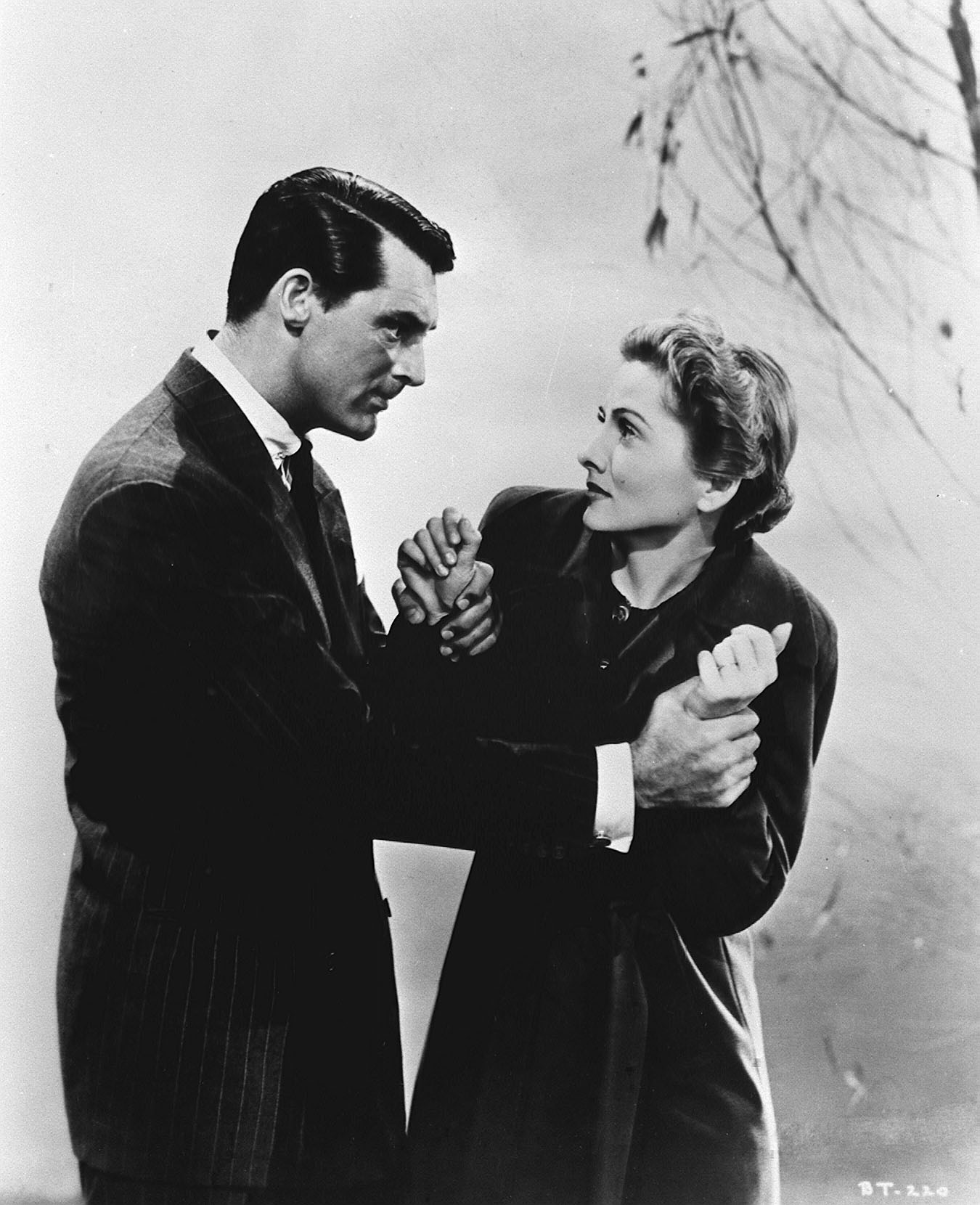
Yeah, you know. Totally ordinary. Uh huh. Reguluar dude.
Hitchcock saw something different in him. Suspicion (that's him with Joan Fontaine) was Hitchcock's first attempt to tap into the darkness beneath the gleam. It didn't work quite well although the film is SO worth seeing. Especially the spectacular shot of Grant ascending the staircase with the glowing glass of milk(Hitchcock put a lightbulb in the liquid.) But in Notorious - "ordinary chap" and Hitchcock really hit their stride together. I see Suspicion almost as a rehearsal for that other film (a film that I consider to be perfect. I don't say that about too many films. But to me - Notorious is without a flaw.)
Oh - and funnily enough - I get quite a bit of traffic to one of the quotes from my "movie quote" game - the one about "Your ucipital mapilary is quite beautiful". Ha! It's from Suspicion and I often wonder if people are looking for quotes from the film - or if they're looking for, you know, medical information: "My ucipital mapilary is swollen. Should I be worried?"
I guess I need a happy place because my gynecologist got kind of impatient with me today. Snapped at me a bit, and seemed like he didn't want to explain things more than once. And I feel really raw and upset about it. Like ... I just can't deal with that energy in that environment. It made me really upset.
Okay. Happy place.
90210 Fug
I know it's election day and everyone's all serious and stuff, and yes, I voted - but I just had to link to this. Because I have my priorities straight and there is just too much about that is funny.
One:
Those sleeves just scream "Doctor divorced from man she married because he knocked her up, back in town to try and seduce the self-righteous dude who refused to take the flower of her virginity when she offered it to him -- because he was moving back to Minneapolis -- in one of the most cringe-y scenes ever put to film, topping even the time Donna starred in David's 'Light the Match' video and was forced to wear hot pants and gyrate on the hood of a car, lighting matches under the disapproving eye of her dreamy and likewise virginal star quarterback boyfriend, Heart Condition Joe."
heh heh
And I think my favorite bit is in the text under the group shot ... the #3 of the list.
Ha!! So bitchy! So true!!
I love Jennie Garth. I want her to be my friend. She seems nice. I don't care what that sounds like, it's the God's honest truth.
And Mitchell, please let's not forget:
(First: head thrown back, throat exposed and yet somehow foreshortened as well - as though the head was smashed down with a hammer ... then shouted at the top of our lungs): "EHHHHHHHHBERRRYAN-AUSTIN-GREEN!"
Mitchell, what was our problem. Why were we such losers.
Prep
I am now reading Prep, by Curtis Sittenfeld, which is one of those books that has been hard to miss lately. Member what I said about "buzz" a couple posts below? Prep had BUZZ. It was everywhere. It was on display in every bookstore, every newspaper had articles about it, etc. Prep, Prep, Prep, that's all I ever hear. Sometimes I find buzz annoying because I feel like the people in charge (publishers, whoever) are trying to shove it down my throat. Like: let me decide, mkay? Is it a good book or not? Get off my back. I'll read it if I feel like it! But a couple people I admire recommended Prep - I've seen it mentioned on a couple of the book blogs I read - (Erin at Critical Mass is one, and I think Anne mentioned it as well??) - bloggers who have similar tastes as mine in terms of literature ... we speak the same language ... so I finally picked it up.
The fact that I am reading so much recently published fiction is way out of character ... but it's where I'm at right now ... and I had heard so much about Prep that I bought it a couple weeks ago and started reading it yesterday (now that I have The Historian and Life of Pi out of the way).
If I didn't have, you know, a LIFE ... I probably would finish it by tomorrow or the next day.
In it, there is such a specific ache of adolescence, particularly the adolescence of girls ... it's so specific - and yet I feel a breathless recognition from time to time reading it ...
I'm not even sure if it's really well-written or not. There are moments when I think it is. But what is really superb about it is its story. The story-telling aspects of it, the EVENTS - (like the whole game of Assassin - and what that brings about in our narrator ... the whole haircutting phenomenon ... ) the observations about human behavior - especially behavior of teenagers - and the events created - their specificity - their underlying sadness - I'm finding it kind of a sad book, nostalgic, melancholy ... We make mistakes during our teenage years (well, we keep making mistakes, we're human) ... but there's something REALLY poignant about the ones made during those years, because we don't really know better, we are struggling to form ourselves, we are trying to break away from our parents, yet we still desperately need them ... we look to our PEERS for validation ... and groups of teenage girls can be such a snakepit. It wasn't in my experience - I had great friends, who are still my friends - but I certainly saw that snakepit all around me. The viciousness, the TRICKINESS of girls. And to put our hearts in the hands of teenage boys? What?? You want to say: No! Don't!! But of course we do, because that's what you do when you're a teenager. I gave my heart to DW - a boy I had 2 classes with - never went on a date with - but extrapolated everything I needed to know about his personality from my brief interactions with him. I LOVED him. And when I asked him to go to my prom and his response was (in a very kind voice, not mean at all -and that was even WORSE): "I don't think I know you well enough." I mean ... it was unthinkable. It was so painful. Don't KNOW you well enough?? What? It's like that last scene in Summer and Smoke - although it's the teenage version. John says to Alma, "In the 2 or 3 times we've been together ..." and Alma says, "Only 2 or 3 times?" He says, gently, "Yes, it's only been 2 or 3 times that we have ever been alone together, Alma" ... and she says something like, "I felt that we even breathed together." Ouch.
Prep is all about that stuff. An unrequited crush. On a guy who seems hopelessly cool.
There are certain sections where Sittenfeld just NAILS a moment. She describes it with such simple perfection that I think: "God, I so know what she is talking about there. I've never put it into words ... but yes, I know just what she is talking about." It's quite remarkable. I've read a lot of books about teenagers ... i continue to enjoy the whole YA "genre" of books ... and I don't think this qualifies as YA, it's really a book for adults ... but I think this is a great evocation of adolescence. Especially female adolescence. It's kinda perfect. The narrator - Lee - is so consumed with how she is coming across, with how she is being perceived ... that it actually manifests itself as cruelty, from time to time. She hurts people's feelings because ... she is so awkward and insecure. Like her interactions with Dave Bardo - the guy on the kitchen staff. She has no sense of self. She is consumed with self-consciousness - which, eventually, just seems like - self-absorption. Can you look outside yourself for just ONE second? Can you perceive that the entire world does not revolve around you, Lee? Can you see that nobody gives a crap that you're from the Midwest - and if they do, then they're assholes, and who cares about them?? But of course, Lee is only 15, 16 ... she can't yet. She has to make her mistakes. She has to hurt Dave Bardo. She has to hurt others. She has to go through all of that herself.
When Lee is a freshman at Ault (the prep school of the title) - she is obsessed with the seniors. They seem so carefree, so THEMSELVES ... Lee pores over old yearbooks, looking thru the pictures, putting together the stories - Oh, so she dated him ... then they broke up ... but there they are as Homecoming king and queen, etc. ... It's such a specific sensation - but I so used to do that. As a freshman. The seniors seemed like ADULTS to me. They were not 17. They were ... nearly grown-ups. They had relationships. They drove around in their cars, and had open campus. They didn't even go to the dances anymore, because they were so beyond it. I was in awe of them. Curtis Sittenfeld remembers that moment with perfect clarity.
And then there's an excerpt like this ... which describes something kind of crazy, a sensation that doesn't make all that much sense, and yet which I so understand and actually share. It's a bizarre thing, I had never put it into words before:
I believed then that if you had a good encounter with a person, it was best not to see them again for as long as possible lest you taint the previous interaction. Say it was Wednesday and there was an after-dinner lecture and you and your roommate struck up some unexpectedly fun conversation with the boys sitting next to you. Say the lecture turned out to be boring and so throughout it you whispered and made faces at one another, and then it ended and you all left the schoolhouse. And then forty minutes later, you, alone now, without the buffer of a roommate, were by the card catalog in the library and passed one of these boys, also without his friend - then what were you to do? To simply acknowledge each other by n odding would be, probably, unfriendly, it would be confirmation of the anomaly of your having shared something during the lecture, and already you'd be receding into your usual roles. But it would probably be worse to stop and talk. You'd be compelled to try prolonging the earlier jollity, yet now there would be no lecturer to make fun of, it would just be the two of you, overly smiley, both wanting to provide the quip onw hich the conversation could satisfactorily conclude. And what if, in the stacks, you ran into each other again? It would be awful!This anxiety meant that I spent a lot of time hiding, usually in my room, after any pleasant exchange with another person. And there were rules to the anxiety, practically mathematical in their consistency: The less well you knew the person, the greater the pressure the second time around to be special or charming, if that's what you thought you'd been the first time; mostly it was about reinforcement. Also: The shorter the time that elapsed from your first encounter to your second, the greater the pressure; hence the lecture-to-library agony. And finally: The better the original interaction, the greater the pressure. Often, my anxiety would set in prior to the end of the interaction - I'd just want it to be over while we all still liked each other, before things turned.
And then this, about her friendship with Martha - this really struck a chord in me as well - I have great friends still from high school ... and something about this really resonates:
And as for Martha - I never understood when I was at Ault why she liked me as much as I liked her. Even now, I'm still not sure. I couldn't give back half of what she gave me, and that fact should have knocked off the balance between us, but it didn't, and I don't know why not. Later, after Ault, I reinvented myself - not overnight but little by little. Ault had taught me everything I needed to know about attracting and alienating people, what the exact measurements ought to be of confidence and self-deprecation, humor, disclosure, inquisitiveness; even, finally, of enthusiasm. Also, Ault had been the toughest audience I'd ever encounter, to the extent that sometimes afterward, I found winning people over disappointingly easy. If Martha and I had met when we were, say, twenty-two, it wouldn't have been hard for me to believe she'd like me. But she had liked me before I became likable; that was the confusing part.
"she had liked me before I became likable". Very astute.
And this might be my favorite passage in the book so far. I felt a chill reading it. I had a moment identical to this one. Identical.
"Where are you gonna go?" he said. "Harvard?""Yeah, right."
"I bet you're smart. Get all As."
"I'll probably go somewhere like --" I stopped. When Martha or I thought we'd done badly on a test, we'd say I might as well just apply right now to UMass, but invoking UMass as a last resort would, clearly, be a bad idea. "--to dog school," I said brightly.
"What?" Dave looked across the seat at me.
"Like obedience school," I said.
"You have a dog?"
"No, no, I'm the dog."
He looked at me again, and it was a look I always remembered, long after that night and after I'd left Ault. He was confused and was registering a new piece of information and this was what it was: that I was a girl who would, even in jest, utter the sentence, I'm the dog. It was a good lesson for me. It was a while before I stopped insulting myself so promiscuously, and I never stopped completely, but still -- it was a good lesson.
There's something in her writing I really like.
The Books: "Emily's Quest" (L.M. Montgomery)
Emily's Quest - by L.M. Montgomery
In a weird way, even with all its ... sadness and tragedy and thwarted passion (God almighty! The thwarted passion!!) - sometimes I think Emily's Quest is my favorite of the 3 Emily books (it's my least favorite of the titles though. It doesn't give a sense of the feel of the book at all.) I love this one because it, like all the others, is a blend of comedy and tragedy - we have her diary entries, we learn about her successes in writing ... we get the small domestic dramas (some second cousin the next town over is convinced that Emily "put her into a story" and she's upset about it) ... and then of course the romances.
Emily still hangs out with Dean Priest - but now that she's a woman of 19, 20, 21 years old ... the dynamic shifts a bit. It is Dean's moment, the one he has been waiting for since she was a small child. Which is kind of creepy, and reading the book - I STILL am wondering what she sees in Dean. As an adult, I mean. Other fans of the booK: what do YOU all think of Dean? What's your response to him? As her work grows in importance and relevance, as it starts to make her some money (not a lot at first, but some) ... Dean starts to resent it. He used to take her seriously - when she was a child, and her "work" was no threat to him, it might be something she would grow out of, it also made her charming and precocious ... but to keep on doing it? To have a passion in life other than ... him? He doesn't like that. I don't know. I want to smack Dean upside the head at times. He wants to CAPTURE Emily. And although I have never met the woman (uhm, she's fictional, remember?) and I do not know her personally, I do know one thing: you should never try to CAPTURE her. And you can never expect to be the only thing in her life. She will always have her writing. It will take her away from you. Deal. Are you man enough to deal? Dean Priest is not. It is not until Emily is completely BROKEN (this book goes to some pretty dark places) that she says, "Yes, I'll marry you, Dean." But she is only half a person by then. Her heart has been broken. And he is partly responsible for it. He condescended to her book, the book that she poured her heart and soul into. And it's not that she just wanted praise. Its that Dean LIED. Dean saw the special-ness of the book itself - but also saw how much it meant to her ... and oh no no we can't have THAT. We can't have Emily have a passion other than ME. So he lied. In my opinion, he's a selfish bastard. I can barely forgive him for that. And once he has broken her ... one she has burned up her book and injured herself by falling down the stairs and nearly died ... Dean thinks she is broken enough to accept being his wife. grrrr. I'm putting a dark spin on him but I don't know - that's what I see. Only then does Emily turn towards Dean, as something known and comforting ... his demands on her soul no longer bother her because her soul has been crushed. Lovely. And Dean Priest is the kind of person who would accept half a woman, because half is better than none at all. I don't know, I don't like the guy. He seemed oKAY when she was a kid - but even then there was something a little too ... proprietary about his affections for her. I dislike that intensely. Let Emily be. Don't assume you know her better than she knows herself. I've had people treat me like that before (also on this blog) and it is infuriating!
However, just because I don't understand something doesn't mean it's not interesting - quite the contrary. Dean is one of Lucy Maud's most interesting and intriguing characters. He's never expected, he always seems slightly creepy to me, and yet I trust Emily (fictional character that she is) - that something in her is fulfilled by their conversations. Perhaps his whimsy, his education, the fact that he has traveled the world ... also the fact that he is an ADULT, and he validates that she is SPECIAL. Like her father used to do. But nobody does that for Emily now. If anything it's the opposite. Emily isn't like anybody else and all of the adults around her are trying to force her into a different mold, a more conventional mold. Dean does not do that. Not at first, anyway. I do not understand Emily's attachment to Dean (anyone who said to me, "Don't worry about your art - Your smile and your eyes will get you way further than your art ever will" can expect to have my undying hatred forever) ... I am like Aunt Elizabeth and Aunt Laura who wonder, "What does she see in him??" ... but that just makes it all the more fascinating. And almost horrifying - to watch everything unfold. Because ... that's how life is sometimes. Things DON'T work out the way you want them to. You DO make choices that you think might be temporary and then they turn out to be permanent. There AREN'T always happy endings. You don't end up with who you are suppoesd to end up with. You are haunted by another. Blah blah. Life tasted sweet once ... there were possibilities .. .hopes ... but now, no more. Give up. Give up. This is the journey that Emily goes on in this book. And there are parts of it that are so freakin' SAD, filled with such loss ... that I really related to it. I really relate to Emily. I have had attachments to men that the majority of the people in my life found inexplicable. I have resisted getting attached to anybody - because so many men have that proprietary thing going on ... and I can't bear it. Love me, but don't feel you must OWN me. Because I won't be owned. I have been that sad, and for that long. So I may not get why she finds Dean's company so refreshing ... but that's not because I think there is something wrong in the book, or in Lucy Maud's description of it. There's nothing MISSING. It's just my personal response to the events that unfold. I want to scream at the book, "NO! YOU CAN'T MARRY HIM, EMILY! THIS IS GOING TO BE A HUGE HUGE MISTAKE!" But Lucy Maud makes us squirm, makes us wait ... it goes until almost the very last second ... the situation requires a sudden reversal (very typical of Lucy Maud's plots - a situation goes on unchanged for 25 years and then suddenly, in 5 minutes, with one or 2 sentences, the whole thing transforms. "I always loved you!" "I never forgave you." "I never got your letter." Etc.) And in Emily's Quest this wait is really agonizing - the most agonizing of all of Lucy Maud's stories. Emily's soul is on the rack. I mean, this woman goes through the wringer. And - I love her for it. I ache for her. Tears fill my eyes when she finds happiness because it is so hard-won, so RIGHT.
Here's an excerpt from the beginning of the book - an evening with Dean Priest.
And even though the excerpt itself is a foreshadowing of what will come - a cloud hangs over the whole thing, doesn't it?? - I love the typical Lucy Maud touch at the very end, where she talks about "thirty years later". Too funny. Really puts some perspective on it. It's never good to be TOO serious.
Excerpt from Emily's Quest - by L.M. Montgomery
Was Dean Priest changing from friend to lover? Nonsense. Arrant nonsense. Disagreeable nonsense. For she did not want him as a lover and she did want him madly as a friend. She couldn't lose his friendship. It was too dear, delightful, stimulating, wonderful. Why did such devilish things ever happen? When Emily reached this point in her disconneted musings she always stopped and retraced her mental steps fiercely, terrified to realise that she was almost on the point of admitting that "the something devilish" had already happened or was in process of happening.
In one way it was almost a relief to her when Dean said casually one November evening:
"I suppose I must soon be thinking of my annual migration."
"Where are you going this year?" asked Emily.
"Japan. I've never been there. Don't want to go now particularly. But whats the use of staying? Would you want to talk to me in the sitting-room all winter with the aunts in hearing?"
"No," said Emily between a laugh and a shiver. She recalled one fiendish autumn evening of streaming rain and howling wind when they couldn't walk in the garden but had to sit in the room where Aunt Elizabeth was knitting and Aunt Laura crocheting by the table. It had been awful. And again why? Why couldn't they talk as freely and whimsically and intimately then as they did in the garden? The answer to this at least was not to be expressed in any terms of sex. Was it because they talked of so many things Aunt Elizabeth could not understand and so disapproved of? Perhaps. But whatever the cause Dean might as well have been at the other side of the world for all the real conversation that was possible.
"So I might as well go," said Dean, waiting for this exquisite, tall, white girl in an old garden to say she would miss him horribly. She had said it every one of his flitting autumns for many years. But she did not say it this time. She found she dared not.
Again, why?
Dean was looking at her with eyes that could be tender or sorrowful or passionate, as he willed, and which now seemed to be a mixture of all three expressions. He must hear her say she would miss him. His true reason for going away this winter was to make her realise how much she missed him - make her feel that she could not live without him.
"Will you miss me, Emily?"
"That goes without saying," answered Emily lightly - too lightly. Other years she had been very frank and serious about it. Dean was not altogether regretful for the change. But he could guess nothing of the attitude of mind behind it. She must have changed because she felt something - suspected something, of what he had striven for years to hide and suppress as rank madness. What then? Did this new lightness indicate that she didn't want to make a too important thing of admitting she would miss him? Or was it only the instinctive defence of a woman against something that implied or evoked too much?
"It will be so dreadful here this winter without you and Teddy and Ilse that I will not let myself think of it at all," went on Emily. "Last winter was bad. And this - I know somehow - will be worse. But I'll have my work."
"Oh, yes, your work," agreed Dean with a little tolerant, half-amused inflection in his voice that always came now when he spoke of her "work", as if it tickled him hugely that she sholud call her pretty scribblings "work". Well, one must humour the charming child. He could not have said so more plainly in words. His implications cut across Emily's sensitive soul like a whiplash. And all at once her work and her ambitions became - momentarily at least - as childish and unimportant as he considered them. She could not hold her own conviction against him. He must know. He was so clever - so well-educated. He must know. That was the agony of it. She could not ignore his opinion. Emily knew deep down in her heart that she would never be able wholly to believe in herself until Dean Priest admitted that she could do something honestly worth while in its way. And if he never admitted it --
"I shall carry pictures of you wherever I go, Star," Dean was saying. Star was his old nickname for her - not a pun on her name but because he said she reminded him of a star. "I shall see you sitting in your room by that old lookout window, spinning your pretty cobwebs - pacing up and down in this old garden - wandering in the Yesterday Road - looking out to sea. Whenever I shall recall a bit of Blair Water loveliness I shall see you in it. After all, all other beauty is only background for a beautiful woman."
"Her pretty cowebs--" ah, there it was. That was all Emily heard. She did not even realise that he was telling her he thought her a beautiful woman.
"Do you think what I write is nothing but cobwebs, Dean?" she asked chokingly.
Dean looked surprised, doing it very well.
"Star, what else is it? What do you think it is yourself? I'm glad you can amuse yourself by writing. It's a splendid thing to have a little hobby of the kind. And if you can pick up a few shekels by it - well, that's all very well too in this kind of a world. But I'd hate to have you dream of being a Bronte or an Austen - and wake to find you'd wasted your youth on a dream."
"I don't fancy myself a Bronte or an Austen," said Emily. "But you didn't talk like that long ago, Dean. You used to think then I could do something one day."
"We don't bruise the pretty visions of a child," said Dean. "But it's foolish to carry childish dreams over into maturity. Better face facts. You write charming things of their kind, Emily. Be content with that and don't waste your best years yearning for the unattainable or striving to reach some height far beyond your grasp."
II
Dean was not looking at Emily. He was leaning on the old sundial and scowling down at it with the air of a man who was forcing himself to say a disagreeable thing because he felt it was his duty.
"I won't be just a mere scribbler of pretty stories," cried Emily rebelliously. He looked into her face. She was as tall as he was -- a trifle taller, though he would not admit it.
"You do not need to be anything but what you are," he said in a low vibrant tone. "A woman such as this old New Moon has never seen before. You can do more with those eyes - that smile - than you can ever do with your pen."
"You sound like Great-aunt Nancy Priest," said Emily cruelly and contemptuously.
But had he not been cruel and contemptuous to her? Three o'clock that night found her wide-eyed and anguished. She had lain through sleepless hours face to face with two hateful convictions. One was that she could never do anything worth doing with her pen. The other was that she was going to lose Dean's friendship. For friendship was all she could give him and it would not satisfy him. She must hurt him. And oh, how could she hurt Dean whom life had used so cruelly? She had said "no" to Andrew Murray and laughed a refusal to Perry Miller without a qualm. But this was an utterly different thing.
Emily sat up in bed in the darkness and moaned in a despair that was none the less real and painful because of the indisputable fact that thirty years later she might be wondering what on earth she had been moaning about.
"I wish there were no such things as lovers and lovemaking in the world," she said with savage intensity, honestly believeing she meant it.
November 6, 2006
Mary Astor
I love the "Monday Glamour" series on Greenbriar Pictures Show.
Today is Part 1 of a piece on Mary Astor, an actress I have always loved.
I loved this bit:
Mary Astor always conveyed a sense of having lived in the real world, as opposed to those who were just play-acting. When she came through the sound-stage door, she brought an aura of reality with her. A lot of that may have been the luck of a face that bespoke experience, or a manner that suggested past hopes ended in disappointment.

Yes. Yes.
Also (and this is not covered in the essay - although maybe it will be in Part 2) ... it's rather remarkable that the enormous scandal about her sex journal (chronicling her affair with George S. Kaufman) being found and published in the tabloids left her relatively unscathed. I mean - it was HUGE at the time, of course ... absolute shocker, if you go back and look at the headlines, it's obvious that that was all that the tabloids were discussing. It was a feeding frenzy. But she went on ... and it's so wonderful (and funny) to see her marvelous (yes, marvelous) performance in Meet Me in St. Louis and to know that she had once upon a time been held up as the Hester Prynne sex maniac of Hollywood, marriages ruined, words like "fuck" being printed in the newspaper - and it was in HER journal, not HIS - shocking!! A lady using words like that?? In her own private diary? How DARE she?? But after all that ... there she was in Meet Me in St. Louis, glorious hair up in a pompadour, voice mellifluous, part of a great ensemble, her acting is superb. She just IS that Victorian-era woman.
Survival. She's a great example of it.
She's the one who said this marvelous quote - which has been attributed to so many people that who the hell knows who actually said it - I've heard that Kim Stanley said it as well - but she may have been quoting Astor, who certainly had a long enough career to go through every phase:
Mary Astor said:
"There are five stages in the life of an actor: Who's Mary Astor? Get me Mary Astor. Get me a Mary Astor Type. Get me a young Mary Astor. Who's Mary Astor?"
Smart cookie, that one. Didn't have a smooth road ... but she survived.
"I wanted to be Lily Tomlin."
Awesome interview with Emma Thompson in this weekend's New York Magazine. I love it because she's talking about the books she loved.
Oddly enough, I’m probably still vaguely Victorian. Moderns are just different. As a child, my mind latched onto a kind of Victorian morality, which I don’t necessarily think did me that much good, to be honest. It’s not ideal. I suppose there’s something spinal, there’s something that lives in your ganglia, that connects you to past moral models, and it’s very difficult to unhook yourself from them.
Uhm, yes?
Also, I love it because she is one of those rare people who is just wired comedically. If there is humor in a situation - she will sniff it out. This is not a natural gift. It is a very rare gift. I gravitate towards such people in my own life. I love them. I love her - can't wait to see her next film.
This Thursday ...
I'm going to see Grey Gardens. I'm kinda beside myself. Cannot WAIT. I got a great seat too.
Now - everyone has heard about this musical, and its development, and also its off-Broadway run. The buzz has been undeniable. You could hear it from Rhode Island practically. It's weird - there's so much theatre that goes on in this town - and every season there are shows you feel you have to see - good reviews, whatever. But buzz like this is rare. It has more of the feeling of an EVENT - than just a play, however good. I am trying to remember the last time I've had that feeling about a play in New York ... a feeling that it was an EVENT. Kathleen Turner in Virginia Woolf had kind of that feeling to it ... I wasn't around for the original Evita - but it seems like Patti Lupone got that kind of press at the time ... That her performance was not just good, it was an EVENT. Barbra Streisand in Funny Girl. She was a PHENOM. You could feel it in the air. I mean, I wasn't there ... but that's what happened. Christine Ebersole in Grey Gardens ... I got the feeling around last year that something important and different was going on - with her performance - and the advance word of how good it was ... It felt like, I don't know - it's hard to describe - it's more of a zeitgeist feeling than anything else, a sensation that something is "in the air" ... It felt like this wasn't just her moment. But it was a MOMENT, a theatrical MOMENT ... a performance that will be remembered years from now, and talked about. Like Laurette Taylor in Glass Menagerie or Marlon Brando in Streetcar. People who saw Laurette Taylor as Amanda over 60 years ago STILL talk about it. About how they had never seen anything like it. How acting reached some kind of high watermark with her performance. Performances like that don't come along too often. I am having a hard time remembering if I have EVER seen a performance like that. I'm talking stage now. Live theatre. Well - the Irish actress who played Nora in Doll's House at the Abbey Theatre that I saw when I was 14 ... her performance remains so vivid, so wrenching, that I can even remember her BLOCKING. It made that much of an impression on me. She was fantastic. But ... what else? I'll have to think more about it.
This is the kind of advance buzz that Christine Ebersole has been getting. And sometimes buzz is hollow ... it's a fabrication ... it's publicists and agents trying to make a ton of money ... But sometimes buzz exists because the product is so extraordinary. Sometimes the buzz is not a fabrication - but an organic phenomenon. Julia Roberts' success was like that. Which is why she is kind of untouchable, whatever you think of her talent. Pretty Woman was not supposed to "hit" in the way that it did. Roberts didn't even do publicity for it. She was off doing her next movie when it opened. And within one weekend - it had happened. She had "hit". The AUDIENCE decided she would be a success. Not her agent. Not the studio. It was the AUDIENCE. And there is NOTHING more powerful than an audience collectively pointing at one person and saying, in one voice, "Her. We like her. More of her, please." It happens so rarely that you can probably count it on one hand. It happened to Marilyn Monroe, for example. The studios put her in crappy projects, they underpaid her ... and yet the audience (men AND women - another important factor for this kind of organic success - it crosses gender lines) said: "We love her. Please keep putting her in movies. We love her." So - this is the kind of feeling that appears to be "in the air" - when it comes to Ebersole's performance. I have read stuff about it that makes the hair on the back of my neck stand up. Hardened old grumpy critics basically laying down their critical pens and saying, "You must see this. You must see this performance." Critics are CAVING. They are SUCCUMBING to it, rather than resisting.
I read the review in The Times - by Ben Brantley and, to my ears, the TONE here ... the TONE of the review ... is quite out of the ordinary. Something is going ON. Something is going ON with this performance ... Christine Ebersole has HIT it ... What is going on here is bigger than the play, bigger than the actual project she is in. And I could not be more excited for her. I'm also excited to see it - but you know, I've liked Christine Ebersole for a long long time ... she's been around since I was in high school ... and to see her HIT this moment ... and TAKE her moment ... is just exhilarating. I can't wait to see it.
It's like that last moment in Postcards from the Edge, in the hospital - when Shirley Maclaine says to Meryl Streep, "It's your turn now. And I just think it's so important ... that you enjoy your turn."
See, I'm in tears.
Brantley opens his review with:
“Da-da-da-da-dum.”Not exactly a phrase that gleams with Shakespearean eloquence, is it? But once you’ve heard Christine Ebersole sing it — and believe me, this is an experience no passionate theatergoer should miss — “da-da-da-da-dum” is guaranteed to enter your personal memory bank of cherished quotations, the kind you summon when you’re feeling down and thwarted and need to smile.
This already fills me with an urgent sense of NEED. I MUST see what he is talking about.
What is even more powerful (and I haven't even seen it yet) is that Brantley discusses the faults and flaws of the show in great detail. But Ebersole? No. No flaws. She transcends. It is her moment. It is her TURN.
Check out this observation (it's Brantley at his best ... I like it when he actually expresses WHY something is good ... It's rare that a critic can do that. They just say, "The lighting was dreary, the music was not inspiring, and the lead actress left much to be desired." Awesome review ... but WHY??? Can you tell me why?)
But anyway, here's Brantley:
Still, pity the young actress who has to hold her own against Ms. Ebersole, who turns the first act into a personal tour de force. Dressed in the kind of at-home morning wear that wouldn’t look out place in a ballroom (the ubiquitous William Ivey Long did the costumes), Ms. Ebersole works her way through a catalog of period-pastiche numbers (including a hilarious minstrel-show paean to hominy grits) in a coloratura that captures exactly both long-gone musical genres and the particular egotism of the woman singing them.
He refers to Christine Ebersole's performance as "mind-boggling". Mind-boggling. A reviewer, a staid big time reviewer ... resorting to 'mind-boggling'. It must be something else.
And here is the end of the review, and it just makes me want to cry:
The wit, exact detail and, above all, compassion with which Ms. Ebersole infuses each of her numbers as Little Edie are ravishing. Even dancing like a drunken U.S.O. entertainer from World War II, flapping flags as if they were flyswatters, this Edie is never merely ridiculous. And when her voice goes pure and girlish for the show’s most conventionally pretty numbers, she becomes the frightened, resentful and perversely hopeful child that persists in everyone, longing for parental approval and the sanctuary of a real home.There is another phrase, by the way, in addition to the immortal “da-da-da-da-dum,” that I can’t get out of my head. This one is two words, “Oh, God,” and Ms. Ebersole sings them in her climactic number, “Another Winter in a Summer Town,” with a layering of despair, rebellion and surrender that becomes a heartbreaking epitaph for an entire life. Watching this performance is the best argument I can think of for the survival of the American musical.
Unbelievable.
It is an event. What is happening is an organic phenomenon. Ebersole is taking her turn. Stepping into the light. Transcending. What is going on is bigger than the show itself.
And I'm so glad that I'm going to be participating in it - just by seeing it.
The Books: "Emily Climbs" (L.M. Montgomery)
 Emily Climbs - by L.M. Montgomery Excerpt 7!!
I think this'll be my last excerpt from this book, although I love it so. I may change my mind tomorrow. I reserve the right to do that.
This, for me, is one of the funniest episodes in the book ... it's so RIDICULOUS, and it totally feels like it could have happened, because life just is that absurd sometimes. Perry comes and knocks on the window at Aunt Ruth's - he needs to talk to Emily. He had been invited to dinner at some illustrious judge's house - and Emily had been dying to hear how it all turned out. Perry is kind of lacking in manners - or, no - let's just say that certain refined manners do not come naturally to him - he needs to be REMINDED. Emily reminds him. Stuff like: don't fidget. Don't eat stuff off your knife. Don't slurp when you take a sip of water. Etc. So it's 11 pm or something like that - and Emily had gone down to the dining room to get something - she was in her nightgown - and suddenly there is Perry at the window, knocking. Emily knew she SHOLUDN'T open the the window ... but ... well. She's not a girl who worries all that much about should and shouldn't. She opens the window - and then comes a long conversation, with Perry standing outside, and Emily standing inside - where Perry tells her all about dinner at the judge's house. First of all, the entire story of all of the mishaps during the dinner ... Lucy Maud is in rare rare form. This is one of the times I love her best - in her comedic moments, when things go WRONG. Especially when things go wrong and everyone WANTS them to go right. Like in Anne of Green Gables (excerpt here) when Marilla has the new minister and his wife over for tea and lets Anne make the pudding - and suddenly during the tea - with everyone at the table, nice and civilized - Anne stands up suddenly and shouts at Marilla, "A MOUSE DROWNED IN THE PUDDING. I FORGOT TO TELL YOU BEFORE!" I am laughing right now as I type this. hahahahaha Lucy Maud has a wicked and almost subversive sense of humor. It's like the Marx Brothers. It is, Sheila? Yes, it is. To me, the Marx Brothers are funniest when they are in a situation where it is required that they be really civilized and proper. Because then you see even MORE how ridiculous it all is. You see how ridiculous even the CONCEPT of "order" is. Anyway, so Perry's big meal at the judge's is like that. Perry trips, he falls, he spills stuff, he blurts out inappropriate things ... but apparently, the judge is even MORE impressed with this young upstart. He thinks Perry is kind of brilliant.
But it's what comes AFTER Perry telling the story that is so funny to me. It's just ... well, it's perfect.
Excerpt from Emily Climbs - by L.M. Montgomery
"Why didn't you watch what the others did and imitate them?"
"Too rattled. But I'll say this - for all the style, the eats weren't a bit better than you have at New Moon - no, nor as good, by a jugful. Your Aunt Elizabeth's cooking would knock the spots off the Hardy's every time - and they didn't give you too much of anything! After the dinner was over we went back to the parlour - they called it living-room - and things weren't so bad. I didn't do anything out of the way except knock over a bookcase."
"Perry!"
"Well, it was wobbly. I was leaning against it talking to Mr. Hardy, and I suppose I leaned too hard, for the blooming thing went over. But, righting it and getting the books back seemed to loosen me up and I wasn't so tongue-tied after that. I got on not too bad - only every once in a long while I'd let slip a bit of slang, before I could catch it. I tell you, I wished I'd taken your advice about talking slang. Once the fat old lady agreed with something I'd said - she had sense if she did have three chins - and I was so tickled to find her on my side that I got excited and said to her, 'You bet your boots' before I thought. And I guess I bragged a bit. Do I brag too much, Emily?"
This question had never presented itself to Perry before.
"You do," said Emily candidly, "and it's very bad form."
"Well, I felt kind of cheap after I'd done it. I guess I've got an awful lot to learn yet, Emily. I'm going to buy a book on etiquette and learn it off by heart. No more evenings like this for me. But it was better at the last. Jim Hardy took me off to the den and we played checkers and I licked him dizzy. Nothing wrong with my checker etiquette, I tell you. And Mrs. Hardy said my speech at the debate was the best she had ever heard for a boy of my age, and she wanted to know what I meant to go in for. She's a great little dame and has the social end of things down fine. That is one reason I want you to marry me when the time comes, Emily - I've got to have a wife with brains."
"Don't talk nonsense, Perry," said Emily, haughtily.
"'Tisn't nonsense," said Perry, stubbornly. "And it's time we settled something. You needn't turn up your nose at me because you're a Murray. I'll be worth marrying some day - even for a Murray. Come, put me out of my misery."
Emily rose disdainfully. She had her dreams, as all girls have, the rose-red one of love among them, but Perry Miller had no share in those dreams.
"I'm not a Murray - and I'm going upstairs. Goodnight."
"Wait half a second," said Perry, with a grin. "When the clock strikes eleven I'm going to kiss you."
Emily did not for a moment believe that Perry had the slightest notion of doing anthing of the kind - which was foolish of her, for Perry had a habit of always doing what he said he was going to do. But then, he had never been sentimental. She ignored his remark, but lingered a moment to ask another question about the Hardy dinner. Perry did not answer the question: the clock began to strike elevent as she asked it - he flung his legs over the window-sill and stepped into the room. Emily realised too late that he meant what he said. She had only time to duck her head and Perry's hearty, energetic smack - there was nothing subtle about Perry's kisses - fell on her ear instead of her cheek.
At the very moment Perry kissed her and before her indignant protest could rush to her lips two things happened. A gust of wind swept in from the verandah and blew the little candle out, and the dining-room door opened and Aunt Ruth appeared in the doorway, robed in a pink flannel nightgown and carrying another candle, the light of which struck upward with gruesome effect on her set face with its halo of crimping-pins.
This is one of the places where a conscientious biographer feels that, in the good old phrase, her pen cannot do justice to the scene.
Emily and Perry stood as if turned to stone. So, for a moment, did Aunt Ruth. Aunt Ruth had expected to find Emily there, writing, as she had done one month previously when Emily had had an inspiration at bedtime and had slipped down to the warm dining-room to jot it in her Jimmy-book. But this! I must admit it did look bad. Really, I think we can hardly blame Aunt Ruth for righteous indignation.
Aunt Ruth looked at the unlucky pair.
"What are you doing here?" she asked Perry.
Stovepipe Town made a mistake.
"Oh, looking for a round square," said Perry offhandedly, his eyes suddenly becoming limpid with mischief and lawless roguery.
Perry's "impudence" - Aunt Ruth called it that, and, really, I think he was impudent - naturally made a bad matter worse. Aunt Ruth turned to Emily.
"Perhaps you can explain how you came to be here, at this hour, kissing this fellow in the dark?"
Emily flinched from the crude vulgarity of the question as if Aunt Ruth had struck her. She forgot how much appearances justified Aunt Ruth, and et a perverse spirit enter into and possess her. She lifted her head haughtily.
"I have no explanation to give to such a question, Aunt Ruth."
"I didn't think you would have."
Aunt Ruth gave a very disagreeable laugh, through which a thin, discordant note of triumph sounded. One might have thought that, under all her anger, something pleased Aunt Ruth. It is pleasant to be justified in the opinion we have always entertained of anybody. "Well, perhaps you will be so good as to answer some questions. How did this fellow get here?"
"Window," said Perry laconically, seeing that Emily was not going to answer.
"I was not asking you, sir. Go," said Aunt Ruth, pointing dramatically to the window.
"I'm not going to stir a step out of this room until I know what you're going to do to Emily," said Perry stubbornly.
"I," said Aunt Ruth, with an air of terrible detachment, "am not going to do anything to Emily."
"Mrs. Dutton, be a good sport," implored Perry coaxingly, "It's all my fault -- honest! Emily wasn't one bit to blame. You see, it was this way--"
But Perry was too late.
"I have asked my niece for an explanation and she has refused to give it. I do not choose to listen to yours."
"But---" persisted Perry.
"You had better go, Perry," said Emily, whose face was flying danger signals. She spoke quietly, but the Murrayest of all Murrays could not have expressed more definite command. There was a quality in it Perry dared not disregard. He meekly scrambled out of the window into the night. Aunt Ruth stepped forward and shut the window. Then, ignoring Emily utterly, she marched her pink flanneled little figure back upstairs.
Emily did not sleep much that night -- nor, I admit, did she deserve to. After her sudden anger died away, shame cut her like a whip. She realized that she had behaved very foolishly in refusing an explanation to Aunt Ruth. Aunt Ruth had a right to it, when such a situation developed in her own house, no matter how hateful and disagreeable she made her method of demanding it. Of course, she would not have believed a word of it; but Emily, if she had given it, would not have further complicated her false position.
Emily fully expected she would be sent home to New Moon in disgrace. Aunt Ruth would stonily decline to keep such a girl any longer in her house -- Aunt Elizabeth would agree with her -- Aunt Laura woudl be heartbroken. Would even Cousin Jimmy's loyalty stand the strain? It was a very bitter prospect. No wonder Emily spent a white night. She was so unhappy that every beat of her heart seemed to hurt her. And again I say, most unequivocally, she deserved it. I haven't one word of pity or excuse for her.
November 5, 2006
Life of Pi
Speaking of good books - I read that book this week as well. Started it on Wednesday and finished it yesterday. My sister Jean had given it to me for my birthday last year - and I'm just now getting to it. Or - no. I'm just now getting in a fiction mood again, after being out of that mood for, uhm, years?
Life of Pi. Holy crap.
I actually shed tears about that zebra. I sat reading the book and tears started rolling down my face. So dammit, the book works. It works without seeming like it's TRYING to work. It is the opposite of sentimental. It just tells its story. And yet ... there's a sense to it ... that ... maybe this is a fabrication? And does it matter? There's this whole thing about what is "the better story" - he introduces that thought early on ... and it comes back like gangbusters at the end.
I prefer to believe "the better story" - and I guess I always have. I create narratives out of my own life. I assign roles. I look at some disaster train-wreck that has occurred in my life and eventually ... it is turned into a story. You can read some of them on this here blog. This is how I get through life. Or one of the ways. This is how I try to survive, or manage, or ... make sense of the things that happen. I'm not a realist. I am very PRACTICAL - sometimes TOO practical - but I am not a realist. I am always looking for "the better story".
You can choose a story that will empower you. Or you can choose a story that will weaken you.
It's up to you.
I'm not sure if Yann Martel meant for me to have such thoughts as I read this tale - especially the end of it .. but that's what came up. The role of STORY in life. And NARRATIVE. And how we navigate events. How do we re-tell the stories of our lives to ourselves? What words do we use?
I have a lot more thoughts about it - and - notably, it really made me re-think my position on zoos - and I thought that was one of my rock-hard positions - I don't have too many, but I thought that was one of them - and Pi Patel talks about zoos in such a way that it made me think: Huh. Need to look at this opinion of mine again. A miracle! Jean and I were talking about that on the phone on Tuesday when I started to read the book and I said, "I may have to re-think zoos!" Jean said, "I know!! Me too!"
It's a quick read - another one that I could not put down. I read it on the treadmill, and on the bus. It's fast (unlike The Historian).
And I love the writing. I love the whole God aspect of it. It's presented with no sanctimony, no preaching. It is a description of this character's journey, and how he sees God, and how he came to be a practicing Christian, Hindu AND Muslim. His parents are like, 'Uhm ... it's great that you want to know God ... but you have to CHOOSE ONE." Meanwhile, his parents are totally secular. They don't get it at all. But Pi doesn't choose. To him, it's all about praising God, and about love. It's all about love.
Heart crack.
Those animals. Richard Parker.
I love that animal. I love his descriptions of its behavior. I love the whole psychology of it - wild animals and man ... alpha males ...
And then the whole survivor castaway aspect of the story ... It has a lot to say about sheer grit, and determination. I found myself utterly wrapped up in this tale ... horrified at certain parts of it - the storm, the zebra (couldn't believe I actually cried for the zebra, but I did) - horrified at just the THOUGHT of floating in a raft (with a Bengal tiger) for 227 days. Oh - and that freakin' algae island he comes upon near the end ... Now THAT was something out of a nightmare. Horrifying. Just horrifying.
I need to pick out some excerpts to post. Some of it was so deep and meaningful to me it seemed to speak directly into some of the experiences I am having right now in my life. It was one of those things when - reading along - with tears in my eyes - I thought, "This is exactly what I need to be reading at this moment." Hang on. Hang on. It is not the strongest who survive. It is those who are most attached to life. The sections where Pi realizes his own ferocity in terms of hanging on to life - even though he is barely alive - and huddled in the middle of the Pacific Ocean - terrified - but life. Life is all we have. Some people surrender it. Pi will not.
And Richard Parker.
Who knew. Who knew that a Bengal tiger could seem so ... know-able. I felt like I knew him. He was not anthropomorphized - that was one of the best parts of this book - Richard Parker was not a cuddly creature who happened to be a tiger - he was not described as though his emotions were like human emotions. No. He was a freakin' tiger, on a raft in the Pacific. But still ... animals experience things such as fear, or uncertainty, or relaxation. They know when things are wrong. They also fight for their lives. They fight to live. Richard Parker is one of the most in-depth characters I have met in a book in a long time.
I loved it. So so glad I read it.
The Historian
I stayed up until 3 am to finish it. I knew I would regret it today and I kinda do ... I just woke up, and I hate waking up when, you know, it's PM and not AM - but I just could not put the book down. I even fell asleep briefly at one point - with candles blazing all over my apartment - here, there, in the kitchen, the hallway, my room ... Lovely. I could have burned up in my sleep. But I woke up maybe 20 minutes later - and slogged myself back to the book. It was unthinkable that I would put the book down with only 50 pages to go. So I kept going. My back cramped, I hunched over it, sitting up in my bed ... and finally finished it. Naturally, when I went to sleep after that - I had a dream that I cut someone's throat. Lovely. I KNEW that too as I kept reading. It got very scary at the end and I thought, "I'm gonna regret this ..." But I finished it.
It's quite a book. It's terrifying, and actually - very sad. It ends up being about loss. Dealing with loss. Letting people go. If someone you loved was - you know - bit by a vampire - and you knew that they were now "undead" ... how would you let them go? How would you deal with this? The postcards from Helen to her daughter were, for me, some of the saddest parts of the book. Her feeling unclean, not clean enough to be near her daughter. She would contaminate her child and so she left. But what a sacrifice.
And believe it or not (Rob?? You're my buddy, the only person I know who's read it) ... I did NOT see the ending coming. The one in the Epilogue. I had a feeling this wouldn't be a "happily ever after" book - and I went back and looked at the prologue and saw that the very first sentence was something like, "After a shocking event, I have found myself wanting to tell this story ..." I had forgotten that. So ... in our narrator's present-day life - and we know that she is now in her 50s ... there has been a "shocking event"? What could that be?
When the librarian in Philadelphia came running out after her, saying, "You left these behind on the table ..." I STILL didn't see it coming.
And once I read what she had left on the table - once it was revealed ... I thought: Of course. Of course. This is how it MUST end. There is no other way for this book to end.
Sad. I found the book to be very sad. Not in a page-by-page way (not like Atonement is sad - where the entire book is suffused with absolute tragedy) ... in a page-by-page way, the book is a thriller. A horror story, a literary detective story, a romp through Eastern Europe chasing down leads ... It has no introspection, almost no subtext. But added up all together ... when I closed the book ... I felt sad. Sad about loss. Losing people. Having to let people change. Having to let people go. Not just when they die ... but when they have life events that change them, or alter them ... Things do not stay the same. We cannot get attached to things remaining unchanged. We have to just keep ... letting ... go ... It is one of the hardest things in the world.
Wonderful book - really excellent read - I highly recommend it.
The Books: "Emily Climbs" (L.M. Montgomery)
Emily Climbs - by L.M. Montgomery Excerpt 6!!
This is part of the section in the book where Emily has her second moment of "second sight". In Emily of New Moon (excerpt here) she "dreamt" she saw what happened to Ilse Burnley's mother - Ilse Burnley's mother didn't run off with another man so many years ago - Ilse Burnley's mother was taking a walk, and fell down an old nearly hidden well. And this turned out to be true. How could Emily know this? Lucy Maud writes about this event in a certain way: Emily isn't just upset at the thought that Ilse's mother ran off with another man, leaving her daughter and husband behind. Emily obsesses about it. She worries about it until she nearly makes herself sick. She loses appetite. She mopes. All joy is kind of sapped out of life for her. It's as though her entire consciousness is pouring into that mystery ... until she "sees" the truth.
In Emily Climbs this happens again. Emily and Ilse are taking a weekend - and going on a walking tour of the outlying areas of Shrewsbury - canvassing for subscriptions for the Shrewsbury Times. They're getting paid to do this - and they thought it would be fun. Emily gets permission from Elizabeth and Ruth to do this - they're going to stay one night with such and such a relative - so they have to make sure they're there by a certain time, and blah blah. Well, things don't work out in books the way they are supposed to - and Emily and Ilse decide to take a shortcut through the woods - after canvassing for a while - It should bring them out to a place where the town where they would spend the night would be visible. Instead of going all the way around the forest. Well, they come out on the other side - no town in sight. Just fields and farmhouses and church steeples. They are lost. It is sunset. No way will they make it to the appointed house by nightfall. So they decide to sleep in a haystack. It's a beautifully written section - Emily and Ilse - the country night - the two girls sharing secrets, looking up at the stars, talking about God, laughing ... a night to remember. The next day, they wake up for more canvassing, a little rumpled, with hay in their hair ... but ready to go.
And on their travels - they learn that a little boy, an Allen Bradshaw, has disappeared. A search party is out looking for him, but so far he is nowhere to be found. This, again, is one of those things that Emily fixates on. It's so upsetting to her, that she can't let it go. Ilse is able to put it out of her mind, but Emily walks along, worrying it to death. Where could he be? What happened to him? He CAN'T be dead ... he just can't!
I just love this one part of that larger story. Not sure why. It has something to do with her writing about the storm, or the oncoming storm ... Again, it's some of her best work. I can SEE that storm. And it just adds to the general anxietal feeling of the day ...
But more than that: like always: it's about character. Ilse is alive, as far as I'm concerned. Emily is alive. They are not just creatures on the page.
Oh, and the whole "house that belongs to me" section ... Later, of course, it turns out that Allan Bradshaw was exploring and accidentally got locked into that house (a summer cottage, no inhabitants at that time). But at the time - Emily is just inexplicably drawn to this random house.
Excerpt from Emily Climbs - by L.M. Montgomery
The story haunted Emily all the rest of the day and she walked under its shadow. Anything like that always took almost a morbid hold on her. She could not bear the thought of the poor mother at Malvern Point. And the little lad - where was he? Where had he been the previous night when she had lain in the ecstasy of wild, free hours? That night had not been cold - but Wednesday night had. And she shuddered as she recalled Tuesday night, when a bitter autumnal wind-storm had raged till dawn, with showers of hail and stinging rain. Had he been out in that - the poor lost baby?
"Oh, I can't bear it!" she moaned.
"It's dreadful," agreed Ilse, looking rather sick, "but we can't do anything. There's no sue in thinking of it. Oh" -- suddenly Ilse stamped her foot -- "I believe Father used to be right when he didn't believe in God. Such a hideous thing as this -- how could it happen if there is a God -- a decent God, anyway?"
"God hadn't anything to do with this," said Emily. "You know the Power that made last night couldn't have brought about this monstrous thing."
"Well, He didn't prevent it," retorted Ilse - who was suffering so keenly that she wanted to arraign the universe at the bar of her pain.
"Little Allan Bradshaw may be found yet - he must be," exclaimed Emily.
"He won't be found alive," stormed Ilse. "No, don't talk to me about God. And don't talk to me of this. I've got to forget it - I'll go crazy if I don't."
Ilse put the matter out of her mind with another stamp of her foot and Emily tried to. She couldn't quite succeed but she forced herself to concentrate superficially on the business of the day, though she knew the horror lurked in the back of her consciousness. Only once did she really forget it - when they came around a point on the Malvern River Road and saw a little house built in the cup of a tiny bay, with a steep grassy hill rising behind it. Scattered over the hill were solitary, beautifully shaped young fir-trees like little, green, elongated pyramids. No other house was in sight. All about it was a lovely autumnal solitude of grey, swift-running, windy river, and red, spruce-fringed points.
"That house belongs to me," said Emily.
Ilse stared.
"To you?"
"Yes. Of course, I don't own it. But haven't you sometimes seen houses that you knew belonged to you no matter who owned them?"
No, Ilse hadn't. She hadn't the least idea what Emily meant.
"I know who owns that house," she said. "It's Mr. Scobie of Kingsport. He built it for a summer cottage. I heard Aunt Net talking of it the last time I was in Wiltney. It was finished a few weeks ago. It's a pretty little house, but too small for me. I like a big house -- I don't want to feel cramped and crowded - especially in summer."
"It's hard for a big house to have any personality," said Emily thoughtfully. "But little houses almost always have. That house is full of it. There isn't a line or a corner that isn't eloquent, and those casement windows are lovable - especially that little one ihgh up under the eaves over the front door. It's absolutely smilig at me. Look at it glowing like a jewel in the sunshine out of the dark shingle setting. The little house is gretting us. You dear friendly thing, I love you - I understand you. As Old Kelly would say, ''may niver a tear be shed under your roof.' The people who are going to live in you must be nice people or they would never have thought you. If I lived in you, beloved, I'd always stand at that western window at evening to wave to some one coming home. That is just exactly what that window was built for - a frame for love and welcome."
"When you get through with talking to your house, we'd better hurry on," warned Ilse. "There's a storm coming up. See those clouds - and those sea-gulls. Gulls never come up this far except before a storm. It's going to rain any minute. We'll not sleep on a haystack tonight, Friend Emily."
Emily loitered past the little house and looked at it lovingly as long as she could. It was such a dear little place with its dubbed-off gables and rich, brown shingle tints, and its general intimate air of sharing mutual jokes and secrets. She turned aroun dhalf a dozen times to look upon it, as they climbed the steep hill, and when at last it dipped below sight she sighed.
"I hate to leave it. I have the oddest feeling, Ilse, that it's calling to me - that I ought to go back to it."
"Don't be silly," said Ilse impatiently. "There -- it's sprinkling now! If you hadn't poked so long looking at your blessed little hut we'd have been out on the main road now, and near shelter. Wow, but it's cold!"
"It's going to be a dreadful night," said Emily in a low voice. "Oh, Ilse, where is that poor little lost boy tonight? I wish I knew if they had found him."
"Don't!" said Ilse savagely. "Don't say another word about him. It's awful - it's hideous - but what can we do?"
"Nothing. That's the dreadful thing about it. It seems wicked to go on about our own business, asking for subscriptions, when that child is not found."
By this time they had reached the main road. The rest of the afternoon was not pleasant. Stinging showers came at intervals: between them the world was raw and damp and cold, with a moaning wind that came in ominous sighing gusts under a leaden sky. At every house where they called they were reminded of the lost baby, for there were only women to give or refuse subscriptions. The men were all away searching for him.
"Though it isn't any use now," said one woman gloomily, "except that they may find his little body. He can't have lived this long. I jest can't eat or cook for thinking of his poor mother. They say she's nigh crazy - I don't wonder."
"They say old Margaret McIntyre is taking it quite calmly," said an older woman, who was piecing a log-cabin quilt by the window. "I'd have thought she'd be wild, too. She seemed real fond of little Allan."
"Oh, Margaret McIntyre has never got worked up about anything for the past five years - ever since her own son Neil was frozen to death in the Klondyke. Seems as if her feelings were frozen then, too - she's been a little mad ever since. She won'kt worry none over this - she'll just smile and tell you she spanked the King."
Both women laughed. Emily, with the story-teller's nose, scented a story instantly, but though she would fain have lingered to hunt it down Ilse hustled her away.
"We must get on, Emily, or we'll never reach St. Clair before night."
They soon realized that they were not going to reach it. At sunset St. Clair was still three miles away and there was every indication of a wild evening.
"We can't get to St. Clair, that's certain," said Ilse. "It's going to settle down for ar steady ran and it'll be as black as a million black cats in a quarter of an hour. We'd better go to that house over there and ask if we can stay all night. It looks snug and respectable - though it certainly is the jumping-off place."
The house at which Ilse pointed - an old whitewashed house with a grey roof - was set on the face of a hill amid bright green fields of clover aftermath. A wet red road wound up the hill to it. A thick grove of spruces shut it off from the gulf shore, and beyond the grove a tiny dip in the land revealed a triangular glimpse of misty, white-capped, grey sea. The near brook valley was filled with young spruces, dark-green in the rain. The grey clouds hung heavily over it. Suddenly the sun broke through the clouds in the west for one magical moment. The hill of clover meadows flashed instantly into incredibly vivid green. The triangle of sea shimmered into violet. The old house gleamed like white marble against the emerald of its hilly background, and the inky black sky over and around it.
"Oh," gasped Emily, "I never saw anything so wonderful!"
She groped wildly in her bag and clutched her Jimmy-book. The post of a field-gate served as a desk- Emily licked a stubborn pencil and wrote feverishly. Ilse squatted on a stone in a fence corner and waited with ostentatious patience. She knew that when a certain look appeared on Emily's face she was not to be dragged away util she was ready to go. The sun had vanished and the rain was beginning to fall again when Emily put her Jimmy-book back into her bag, with a sigh of satisfaction.
"I had to get it, Ilse."
"Couldn't you have waited till you got to dry land and wrote it down from memory?" grumbled Ilse, uncoiling herself from her stone.
"No - I'd have missed some of the flavour then. I've got it all now - and in just exactly the right words. Come on - I'll race you to the house. Oh, smell that wind - there's nothing in all the world like a salt sea-wind - a savage salt sea-wind. After all, there's something delightful in a storm. There's always something - deep down in me - that seems to rise and leap out to meet a storm - wrestle with it."
"I feel that way sometimes - but not tonight," said Ilse. "I'm tired - and that poor baby ---"
"Oh!" Emily's triumph and exultation went from her in a cry of pain. "Oh -- Ilse -- I'd forgotten for a moment - how could I? Where can he be?"
"Dead," said Ilse harshly. "It's better to think so - than to think of him alive still - out tonight. Come, we've got to get in somewhere. The storm is on for good now - no more showers."
An angular woman panoplied in a white apron so stiffly starched that it could easily have stood alone, opened the door of the house on the hill and bade them enter.
"Oh, yes, you can stay here, I reckon," she said, not inhospitably, "if you'll excuse things being a bit upset. They're in sad trouble here."
"Oh -- I'm sorry," sttammered Emily. "We won't intrude - we'll go somewhere else."
"Oh, we don't mind you, if you don't mind us. There's a spare room. You're welcome. You can't go on in a storm like this - there isn't another house for some ways. I advise you to stop here. I'll get you a bit of supper - I don't live here - I'm just a neighbour come to help 'em out a bit. Hollinger's my name - Mrs. Julia Hollinger. Mrs. Bradshaw ain't good for anything - you've heard of her little boy mebbe."
"Is this where - and - he - hasn't - been found?"
"No -- never will be. I'm not mentioning it to her," with a quick glance over her shoulder along the hall -- "but it's my opinion he got in the quicksands down by the bay. That's what I think. Come in and lay off your things. I s'pose you don't mind eating in the kitchen. The room is cold - we haven't the stove up in it yet. It'll have to be put up soon if there's a funeral. I s'pose there won't be if he's in the quicksand. You can't have a funeral without a body, can you?"
All this was very gruesome. Emily and Ilse would fain have gone elsewhere - but the storm had broken in full fury and darkness seemed to pour in from the sea over the changed world. They took off their drenched hats and coats and followed their hostess to the kitchen, a clean, old-fashioned spot which seemed cheerful enough in lamp-light and fire-glow.
"Sit up to the fire. I'll poke it a bit. Don't mind Grandfather Bradshaw -- Grandfather, here's two young ladies that want to stay all night."
Grandfather stared stonily at them out of little, hazy blue eyes and said not a word.
"Don't mind him" -- in a pig's whisper -- "he's over ninety and he never was much of a talker. Clara -- Mrs. Bradshaw -- is in there" -- nodding towards the door of what seemed a small bedroom off the kitchen. "Her brother's with her -- Dr. McIntyre from Charlottetown. We sent for him yesterday. He's the only one that can do anything with her. She's been walking the floor all day but we've got her persuaded to lie down a bit. Her husband's out looking for little Allan."
"A child can't be lost in the nineteenth century," said Grandfather Bradhsaw, with uncanny suddenness and positiveness.
"There, there now, Grandfather, I advise you not to get worked up. And this is the twentieth century now. He's still living back there. His memory stopped a few years ago. What might your names be? Burnley? Starr? From Blair Water? Oh, then you'll know the Murrays? Niece? Oh!"
Mrs. Julia Hollinger's "Oh" was subtly eloquent. She had been setting dishes and food down at a rapid rate on the clean oil-cloth on the table. Now she swept them aside, extracted a table-cloth from a drawer of the cupboard, got silver forks and spoons out of another drawer, and a handsome pair of salt and pepper shakers from the shelves.
"Don't go to any trouble for us," pleaded Emily.
"Oh, it's no trouble. If all was well here you'd find Mrs. Bradshaw real glad to have you. She's a very kind woman, poor soul. It's awful hard to see her in such trouble. Allan was all the child she had, you see."
"A child can't be lost in the nineteenth century, I tell you," repeated Grandfather Bradshaw, with an irritable shift of emphasis.
"No -- no," soothingly, "of course not, Grandfather. Little Allan'll turn up all right yet. Here's a hot cup o' tea for you. I advise you to drink it. That'll keep him quiet for a bit. Not that he's ever very fussy - only everybody's a bit upset - except old Mrs. McIntyre. Nothing ever upsets her. It's just as well, only it seems to me real unfeeling. 'Course she isn't just right. Come, sit in and have a bite, girls. Listen to that rain, will you? The men will be soaked. They can't search much longer tonight - Will will soon be home. I sorter dread it - Clara'll go wild again when he comes home without little Allan. We had a terrible time with her last night, pore thing."
"A child can't be lost in the nineteenth century," said Grandfather Bradshaw - and choked over his hot drink in his indignation.
"No -- nor in the twentieth neither," said Mrs. Hollinger, patting him on the back. "I advise you to go to bed, Grandfather. You're tired."
"I am not tired, and I will go to bed when I choose, Julia Hollinger."
"Oh, very well, Grandfather. I advise you not to get worked up. I think I'll take a cup o' tea in to Clara. Perhaps she'll take it now. She hasn't eatne or drunk since Tuesday night. How can a woman stand that -- I put it to you?"
Emily and Ilse ate their supper with what appetite they could summon up, while Grandfather Bradshaw watched them suspiciously, and sorrowful sounds reached them from the little inner room.
"It is wet and cold tonight -- where is he -- my little son?" moaned a woman's voice, with an undertone of agony that made Emily writhe as if she felt it herself.
"They'll find him soon, Clara," said Mrs. Hollinger in a sprightly tone of artificial comfort. "Just you be patient - take a sleep, I advise you - they're bound to find him soon."
"They'll never find him." The voice was almost a scream now. "He is dead - he is dead - he died that bitter cold Tuesday night so long ago. O God, have mercy! He was such a little fellow! And I've told him so often not to speak until he was spoken to - he'll never speak to me again. I wouldn't let him have a light after he went to bed - and he died in the dark, alone and cold. I wouldn't let him have a dog - he wanted one so much. But he wants nothing now - only a grave and a shroud."
"I can't endure this," muttered Emily. "I can't, Ilse. I feel as if I'd go mad with horror. I'd rather be out in the storm."
Lank Mrs. Hollinger, looking at once sympathetic and important, came out of the bedroom and shut the door.
"Awful, isn't it? She'll go on like that all night. Would you like to go to bed? It's quite airly, but mebbe you're tired an' 'ud ruther be where you can't hear her, pore soul. She wouldn't take the tea - she's scared the doctor put a sleeping pill in it. She doesn't want to sleep till he's found, dead or alive. If he's in the quicksands o' course he never will be found."
"Julia Hollinger, you are a fool and the daughter of a fool, but surely even you must see that a child can't be lost in the nineteenth century," said Grandfather Bradshaw.
"Well, if it was anybody but you called me a fool, Grandfather, I'd be mad," said Mrs. Hollinger, a trifle tartly. She lighted a lamp and took the girls upstairs. "I hope you'll sleep. I advise you to get in between the blankets though there's sheets on the bed. They wuz all aired today, blankets and sheets. I thought it'd be better to air 'em in case there was a funeral. I remember the New Moon Murrays wuz always particular about airing their beds, so I thought I'd mention it. Listen to that wind. We'll likely hear of awful damage from this storm. I wouldn't wonder if the roof blew off this house tonight. Troubles never come singly. I advise you not to git upset if you hear a noise through the night. If the men bring the body home Clara'll likely act like all possessed, pore thing. Mebbe you'd better turn the key in the lock. Old Mrs. McIntyre wanders round a bit sometimes. She's quite harmless and mostly sane neough but it gives folks a start."
The girls felt relieved as the door closed behind Mrs. Hollinger. She was a good soul, doing her neighbourly duty as she conceived it, faithfully, but she was not exactly cheerful company. They found themselves in a tiny, meticulously neat "spare room" under the sloping eaves. Most of the space in it was occupted by a big comfortable bed that looked as if it were meant to be slept in, and not merely to decorate the room. A little four-paned window, with a spotless white muslin frill, shut them in from the cold, stormy night that was on the sea.
"Ugh," shivered Ilse, and got into the bed as speedily as possible. Emily followed her more slowly, forgetting about the key. Ilse, tired out, fell asleep almost immediately, but Emily could not sleep. She lay and suffered, straining her ears for the sound of footsteps. The rain dashed against the window, not in drops, but sheets, the wind snarled and shrieked. Down below the hill she heard the white waves ravening along the dark shore. Could it be only twenty-four hours since that moonlit, summery glamour of the haystack and the ferny pasture? Why, that must have been in another world.
Where was that poor lost child? In one of the pauses of the storm she fancied she heard a little whimper overhead in the dark as if some lonely little soul, lately freed from the body, were trying to find its way to kin. She could discover no way of escape from her pain: her gates of dream were shut against her: she could not detach her mind from her feelings and dramatise them. Her nerves grew strained and tense. Painfully she sent her thoughts out into the storm; seeking, striving to pierce the mystery of the child's whereabouts. He must be found -- she clenched her hands -- he must. That poor mother!
"O God, let him be found, safe -- let him be found safe," Emily prayed desperately and insistently, over and over again - all the more desperately and insistently because it seemed a prayer so impossible of fulfillment. But she reiterated it to bar out of her mind terrible pictures of swamp and quicksand and river, until at last she was so weary that mental torture could no longer keep her awak, and she fell into a troubled slumber, while the storm roared on and the baffled searchers finally gave up their vain quest.
November 4, 2006
The Legion of the Archangel Michael
Reading The Historian it is pleasing to me to discover that my own library is kind of a reference library for me. I have had that sensation before (tracked down a post I wrote about it) - but it doesn't happen often. Normally, they are just my books, background, sitting around my apartment like watching sentinels. I barely notice them. But then ... when I need something? There they are. I know where to go. I know WHAT I have, and I know in what book ... or sometimes I know only: Hmmm, I know I have read more information about this topic ... not sure in WHICH book, though. But I am my father's daughter and with a bit of searching (usually no more than a couple of minutes) - I can locate, to the exact passage, what I am looking for. I'm kind of autistic that way. All of my books on the Balkans, and the Ottoman Empire, and Byzantium has made much of the subject matter in The Historian old hat to me. I'm like, "Oh yeah, Carol II, sure, yeah, that guy ...Whatever ..." "Wallachia, awesome, yup, know all about THAT ..." etc. I feel like quite an expert, however ridiculous that may be, and it's a lot of fun. The Historian is not well written, I don't think, but it's the kind of thing where you can't put it down. I cannot. put. it. down. I am tearing through it - and the damn thing is 9,001 pages long. So it's taking me a while. You just have to turn the page. You just MUST! So ... to write a page turner that is 9,001 pages long is quite a feat. So hats off, Ms. Kostova, hats off.
I often have Robert Kaplan's Balkan Ghosts lying beside me as I read The Historian - so I can look up to see what HE said about this or that. More books as well. I love cross-referencing. It doesn't matter what the topic. Ann Marie and I, years ago, when we discovered our shared love for all things Lucy Maud, had a brief idea of creating a database for every single character that shows up in every single Lucy Maud book ... because many of them are interconnected ... many show up in different books ... Kind of a 6 degrees of separation database for the Lucy Maud world. Also, you could look up: "Okay, so in what other story does SHE show up??" Because some of the short stories contain character that show up in the novels ... etc. This kind of stuff is FUN for me. And from the insane GLEAM in Ann Marie's eyes, as we planned our database, I knew I had found, in the words of Anne Shirley, a kindred spirit.
From The Historian:
We had reached a clearing in the woods, and it was, astoundingly, full of men. They stood two rings deep around a bright bonfire, facing it and chanting. One, apparently their leader, stood near the fire, and whenever their chant rose to a crescendo each of them lifted a stiff arm in a salute, putting his other hand on the shoulder of the next man. Their faces, weirdly orange in the firelight, were stiff and unsmiling, and their eyes glittered. They wore a uniform of some sort, dark jackets over green shirts and black ties. "What is this?" I murmured to Georgescu. "What are they saying?""All for the Fatherland!" he hissed in my ear. "Stay very quiet or we are dead. I think this is the Legion of the Archangel Michael."
"What is that?"
Oh yes. Legion of the Archangel Michael. Oh yes, of course. THOSE guys. Hmmm, I have read about them before. Where is that passage ...
From Balkan Ghosts, by Robert Kaplan:
It was 10:30 a.m., November 30, 1940. Snow was beginning to fall in Bucharest. Inside the Church of Ilie Gorgani, built in the seventeenth century to honor a Romanian general who fought the Turks, hundreds of candles illumined the red-robed Christ in the dome. Coffins, draped in green flags with gold embroidery, lined the sides of the nave. Altar boys carried in trays of coliva (colored sugar bread) for the dead. Fourteen members of the Legion of the Archangel Michael - the fascist "Iron Guard" - including the organization's leader, Corneliu Zelea Codreaunu, were about to be buried and canonized as "national saints" by priests of the Romanian Orthodox Church, who had been chanting and swinging censers all night.Two years earlier, in 1938, King Carol II's police had strangled the fourteen men, stripped the bodies naked, and doused them with sulfuric acid in a common ditch to hasten their decomposition. But in late 1940, Carol fled and Romania fell under an Iron Guard regime. The victims' remains, little more than heaps of earth, were dug up and placed in fourteen coffins for reburial. At the end of the funeral service, the worshipers heard a voice recording of the dead Legionnaire leader, Codreanu. "You must await the day to avenge our martyrs," he shrieked.
A few weeks later, revenge was taken. On the night of January 22, 1941, the Legionnaires of the Archangel Michael - after singing Orthodox hymns, putting packets of Romanian soil around their necks, drinking each other's blood, and anointing themselves with holy water - abducted 200 men, women, and children from their homes. The Legionnaires packed the victims into trucks and drove them to the municipal slaughterhouse, a group of red brick buildings in the southern part of Bucharest near the Dimbovitsa River. They made the victims, all Jews, strip naked in the freezing dark and get down on all fours on the conveyor ramp. Whining in terror, the Jews were driven through all the automated stages of slaughter. Blood gushing from decapitated and limbless torsos, the Legionnaires thrust each on a hook and stamped it: "fit for human consumption." The trunk of a five-year-old girl they hung upside down, "smeared with blood ... like a calf," according to an eyewitness the next morning.
Good times, good times. Those Legionnaires sound like a barrel of laughs, huh?
Hmm, back to The Historian, although I am still pondering the Legion ... and I read:
"Who are they?"He tossed his match into the fire. "Criminals," he said shortly. "They are also called the Iron Guard. They are sweeping through the villages in this part of the country, picking up young men and coverting them to hatred. They hate the Jews, in particular, and want to rid the world of them." He drew fiercely on his pipe. "We Gypsies know that where Jews are killed, Gypsies are always murthered, too. And then a lot of other people, usually."
I described the strange figure I'd seen outside the circle.
"Oh, to be sure," Georgescu muttered. "They attract all kinds of strange admirers. It won't be long till every shepherd in the mountains is deciding to join them."
Huh. I need to know more.
I knew there was more in my book. I dug through Balkan Ghosts. Found what I was looking for.
In 1938, Carol had abolished all political parties and declared a royal dictatorship. After bankrolling the fascist Legion of the Archangel Michael for years, that anti-Semitic organization turned against him on account of his liaison with the Jewish Lupescu. So Carol had the Legionnaire leaders murdered. This angered Hitler, whom Carol for a time ignored. But after the Nazi conquest of France, Carol formed his own fascist party, which passed a series of anti-Semitic laws, forcing Romania's 800,000 Jews to live virtually an underground existence. When Stalin, in the summer of 1940, demanded that Carol cede him Bessarabia, Carol appealed to Hitler for help. Hitler answered Carol by forcing him to yield the northern part of Transylvania to the pro-Nazi regime in Hungary.The population felt these territorial losses like hammer blows. Roars of "abdica [abdicate]" rose from the crowds assembled in the square by the Athenee Palace. Carol "had been too clever," in his dealings with Hitler and Stalin, writes Manning in The Balkan Trilogy. "He had played a double game and lost."
Carol and Lupescu left Romania in the dead of night in late 1940, in a nine-car railway train filled with the country's gold and art treasures. The fascist Legion got wind of the couple's departure and tried stopping the train, but to no avail.
Again: good times, good times.
Carol II. What a guy.
But I knew there was more on the Legion itself. So I found it, with a distinct feeling of "A-ha ... here it is ..."
In 1927, the twenty-eight-year-old [Corneliu Zelea] Codreanu heard the voice of God calling him from an icon of the Archangel Michael, a fighting saint that Balkan peasants associated with the struggle against the Muslim Turks. Codreanu, an educated peasant influenced by the anti-Semitic teachings of his university professors in Jassy, heeded this voice and formed the Legion of the Archangel Michael, whose military wing would later by known as the Iron Guard. In Codreanu's view, the Legion was "a religious order" uniting all Romanians "dedicated to a heroic existence": those alive, those not yet born, and those already dead. He organized the Legion around cuibs ("nests") of thirteen members each. To join a cuib, an initiate had to suck the blood from self-imposed slashes in the arm of every other member of the nest, and then write an oath in his own blood, vowing to commit murder whenever ordered to do so. Before setting out to kill, each man had to let an ounch of his blood flow into a common goblet, out of which all would drink, thus uniting the entire nest in death. Members were also obliged to wear crosses and packets of Romanian soil around their necks. Romanian fascism, like Romanian Communism, was by no means standard-issue.Tall and handsome, Codreanu had riveting eyes and the chiseled features of a Roman statue. His followers called him Capitanul ("the Captain"). He liked to dress completely in white and ride a white horse through the Carpathian villages. There, he was worshiped as a peasant-god - the Archangel Michael's envoy on earth. When Codreaunu married, 90,000 people formed a bridal procession.
King Carol II saw Cordreanu as a dangerous rival, especially after Hitler told Carol to his face, during a 1938 meeting in Berchtesgarten, that he preferred Codreanu to the 'dictator of Romania". Carol, perhaps because of his overweaning arrogance, was no coward. He answered the Fuhrer by having Codreanu and thirteen other Legionnaires strangled to death in November, 1938, and then spread rumors that Codreaunu had "sold out to the Jews" (exactly what Codreanu had accused Carol of doing, on account of the King's liaison with Lupescu).
But the Romanians could never believe that their "Captain" had sold out to the Jews. To the peasant masses, Codreanu was still very much alive: "a tribune who stood in the imagination of the Rumanians as both martyr and prophet," writes Countess Waldeck. Many peasants claimed that they had seen "the Captain" riding his white horse through the forests at night, in the weeks and months following his supposed execution. Later, the Romanian Orthodox Church proclaimed Codreanu a "national saint".
Ah yes. God told you to chop up 5 year old Jewish girls, "Captain"? Rot in hell.
And of course, there is MUCH more on the Legion in my books ... horrible stories, all of 'em, I mean - they're all horrible - Carol is horrible, eveyrone is horrible - but that was the bit I had been looking for. To provide a little bit more depth, a little bit of the history, the context, if you will ... and then back to the novel.
More on Codreanu and his murderous Iron Guard here.
I have been reading the entire book in this back-and-forth manner. Which is why it is taking me forever, by the way.
Soundtrack shuffle
I've seen this at Tracey's - here's mine. There is much that I find amusing here. The song that came up for "Final Battle" for example made me laugh out loud. And I find the song that came up for "Falling in Love" pretty damn ... well, whatever. I also very much enjoy the soundtrack choice for me "waking up". Bwahahaha.
IF YOUR LIFE WAS A MOVIE, WHAT WOULD THE SOUNDTRACK BE?
So, here’s how it works:
1. Open your library (iTunes, Winamp, Media Player, iPod, etc)
2. Put it on shuffle
3. Press play
4. For every question, type the song that’s playing
5. When you go to a new question, press the next button
6. Don’t lie and try to pretend you’re cool…
Opening Credits: You Can't Always Not Get What You Don't Want - Tracy Bonham
Waking Up: Dirty Old Egg-Suckin' Dog - Johnny Cash
First Day At School: Break of Dawn - Stevie Wonder
Falling In Love: Waiting - Green Day
Fight Song: Peaches and Cream - Domestic Science Club (a more girlie song cannot be imagined. It's hilarious imagining some big fight with this song playing in the background)
Breaking Up: Praying for Time - George Michael
Prom: Joseph's Dream - Joseph and the Amazing Technicolor Dreamcoat soundtrack (I am SURE that this is quite a popular prom theme. Imagine all the high schoolers slow dancing to the romantic strains of:
"Joseph's coat annoyed his brothers
But what makes us mad
Are the things he often tells us
Of the dreams he often had ..."
Yeah. Really common prom theme song.)
Life: A Sleepin' Bee - Barbra Streisand
Mental Breakdown: The Meeting Place - XTC
Driving: The Wonder of You - Elvis Presley
Flashback: Down In the Meadow - Marilyn Monroe
Getting Back Together: Wig In a Box - Hedwig and the Angry Inch soundtrack
Wedding: Free Your Mind - En Vogue
Birth of Child: 18 Miles from Memphis - Stray Cats
Final Battle: I Think I'll Join a Cult - Pat McCurdy
Death Scene: Silhouettes - The Nylons
Funeral Song: She Loves Me Not - Closer Than Ever soundtrack
End Credits: From the Morning - Nick Drake
November 3, 2006
Diary Friday
I forgot it was Friday.
That tells you where MY mind has been.
Okay - I am picking this entry for one sentence alone. I still can barely type due to the laughter. It's when I start railing about Odysseus ... just so you know what I'm talking about.
This is from early on in my junior year.
There is MUCH to be embarrassed about here.
Well, first of all, just check out the first sentence.
Sept. 21
Sting is so intelligent. It blows me away. Okay - you know Oedipus? [Uhm ... not personally, no] In "King of Pain" there's a line "There's a king on a throne with his eyes torn out..." Can you believe it?? [Yes, actually, I can believe it. I know YOU just discovered Oedipus - but pretty much everyone else on the planet already knows about him. Welcome to being educated!]
Today at school was good. We had auditions for Cinderella. I tried out for the Fairy Godmother. She's funny, she speaks in an Irish brogue, I love the way it feels rolling off my tongue. [Oh, do ya now?]
Mrs. Franco gave us a surprise in-class essay today: How is the theme of loyalty central to The Odyssey?
That is so easy. [Oh. The contempt for the ease of her question.] Loyalty is everywhere! Penelope, Telemakhos - not Odysseus. J. and I both hate the man. He is an arrogant dork who lies and sleeps with a nymph while his wife mourns and thinks that only he is trustworthy. YUK!
Yesterday we broke up into discussion groups to talk about Odysseus. I heard J. say, immediately, to her group across the room, "I have nothing to say but 'I hate Odysseus.'" HaHa! Homer!
Today in gym when we had to run through the tires my foot twisted and I fell. [Mere - you got a visual on that??] Now I can't even walk on it. I hope it's not strained.
Then I had to walk on stilts [Seriously, guys, I am DYING right now typing this out ... I can't breathe ... Oh ... you HAD to walk on stilts? What??] and DW [first mention of him in the diary, peeps!! Foreshadowing!] kept helping me get up but then I'd teeter and totter and wobble and fall off right onto him, holding onto his neck so I wouldn't kill his ankle again. [Normally, in high school gym, you play soccer. Or volleyball. Or basketball. We practiced stilt walking, apparently. I have no memory of this.]
Alex - whenever he walks by - April and I just look at each other, lips pressed together. [What a strange image. I know what I MEAN - because Alex was the notorious "hot guy" in the school ... but my response to hotness is to look at my friend and press my lips together? Mkay.] Today he strolled into gym in shorts and a T, hair sticking up, stud in his ear [ohmygod, he was so cool, right? So John Taylor!], books under his arm, black punk glasses [please don't say "punk"] and Sony Walkman [You knew the brand name?] in his ears. That is what I mean by cool. Alex is cool. What's more - he is gorgeous.
OK, Diary, brace yourself [I hate it when I talk directly to my diary, it's so embarrassing.] Actually, forget it. [WHAT? Tease.] It's past midnight and I'm sleepy.
Tomorrow's subject to remind me - Chris W.
Enough to tantalize you, huh? [Oh, please stop. Also, I NEVER get back to what I was going to say about Chris. Hahahaha I never mention it again. And now, my writing gets HUGE and sprawls across the page in a frenzy]
I CAN'T BELIEVE how much better I'm feeling. GOD CAN DO ANYTHING!
THANK YOU GOD for creating the glorious human race!
"Your Fingernails Are Filthy."
A massive gloopy painting, greys and oranges and blue splatters. The colors gave her a headache. It looked so thick she wanted to touch it. Actually, her mouth watered, she wanted to eat it. Metallica's black album throbbed in her ears. Metallica was not a band to listen to casually while getting ready for work. Metallica grabbed her by the throat and jangled her about. She had no body, no limbs, no brain, only eyes.
So it was a complete and unwelcome shock when suddenly a guy stepped right into her view and basically began blabbing right in her face, gesturing; he was communicating purposefully with her. As though they were old friends. This jolted her back to pedestrian life, back into her body, and she resented it. She also couldn't hear a damn word he was saying because of Metallica. She hated it when people took no notice of the obvious fact that you were wearing a Walkman and started babbling at you regardless.
"Goddammit," she snapped, and turned off her music. People looked over. "Do I know you?" she demanded of the open-faced guy who had stopped talking, taken aback.
"No, no - you don't - I just - I don't know - I was looking at this painting - and I guess I hate it - I could tell you why - but ... you seemed so into it - you're obviously a painter - so I wanted to .... I don't know. Find out what you saw in it." The way she had spoken to him suddenly sank in, she could see his face change. It was a delayed reaction; the open door clicked shut. He snapped back, "Jesus, woman. You need to chill out."
The greys and oranges receded, releasing her from their gooey grip, leaving her in the world of social conventions, of civilization. She was sorry. She came clean.
"I kind of go into a trance when I'm here. I ... I didn't mean to snap at you."
He remained aloof. Aloofness did not sit well on his features. He muttered, "That's cool."
"It's kinda not cool. I'm a bitch. Sorry. You're the first person I have actually exchanged words with in two days."
Suddenly he laughed. A real laugh. "Wow. That's pretty fucked up."
"You don't have to tell me."
"When I said 'That's cool', what I meant was 'That's cool that you go into a trance in front of a painting', not 'That's cool that you're a bitch'. I can't turn off my brain. It's like I stand here - evaluating everything - 'Oh. I like that one - Oh, that one is pretentious bullshit.' So ... maybe that's why I wanted to talk to you."
"How did you know I'm a painter?"
"Your fingernails are filthy."
This mortified her, so she attacked. "Why do you even come to MOMA if you're just gonna stand back and judge?"
"Uh ..."
Then they stood there, not talking, looking around them vaguely. She cringed with awkwardness, her toes clenched up in her shoes. This was why she didn't start up conversations with strangers. She didn't know how to get rid of him. She wanted to put her Walkman back on, and step off the rails.
Following the excruciating pause, the guy said, "Wanna go get some Bloody Marys?"
In later days, this fearless leap of his continued to amaze. What would have happened if he hadn't invited her out? They would have been dead in the water, obviously. She had been frantic for the encounter to end, even though there was something about his open-face that she liked very much.
Somehow, without knowing how it actually happened, she ended up sitting with him in a small dusty bar nearby for the rest of the morning, drinking spicy Bloody Marys, talking. She told him what she saw in the thick greys and oranges, how she looked at art, how she approached it. He asked her endless questions. He listened to the answers. He was a freelance HTML-programmer, a techie, he had no background in art. He just liked to know what was going on. She talked to him like a person starving for the spoken word. Lack of human contact had made her odd, veiled, wrapped up in her own dream-scape. Ah, to speak, to hear her voice, to watch her words land across the table. The buzz from the Bloody Marys was mellow, soft. They took their time. He had nowhere to be. And neither did she. It was a grey and cold Sunday. He paid for everything. After three hours, he kissed her across the table. He was a gangly messy-haired guy, whose fashion idol appeared to be Kurt Cobain circa 1990, but his kiss was lovely, the epitome of sweetness.
His name was Josh. Her name was Alice.
(More in this piece here)
Aaron Sorkin ...
This is hilarious: What it would be like if Aaron Sorkin wrote a show about baseball.
More on William Styron
A really nice appreciation of his work and career, by Michiko Kakutani.
Excerpt:
The long shadow of William Faulkner, along with those of Thomas Wolfe and Robert Penn Warren, fell over Mr. Styron’s work, and like many members of the postwar generation, he struggled, at least initially, to come to terms with the daunting achievements of his predecessors. His prose bore the full imprint of the Southern tradition: it was lush, luxuriant, sometimes purple, and it was often put in the service of decidedly violent and gothic storylines.From the start, a sense of melodrama informed Mr. Styron’s work, and it would thread its way through his entire oeuvre. Evil, both personal and institutional, continually stalked his protagonists, leaving them haunted by a sense of guilt and mortality — a personal apprehension, in the words of Norman Mailer, of “the gulfs and hazards that lie beneath the surface of social life.” Many of Mr. Styron’s people would turn out to be victims — of history’s random corkscrew twists, of malign social ideologies, of an individual’s pathological power games, of their own cowardice and weakness.
Today in History: Nov. 3, 1916
Eugene O'Neill made his New York debut - with a one-act play presented in a night of three one-acts - at the new Playwrights Theatre - on 139 Macdougal Street, in Greenwich Village. It was the first season for this new theatre. The evening of one-acts were:
The Game, by Louise Bryant (ahem)
King Arthur's Socks, by Floyd Dell
Bound East for Cardiff, by Eugene O'Neill. (I posted an excerpt of this play here)
O'Neill was completely unknown at the time. So it's kind of a goosebump-y moment in history, his debut ... with a one-act. He went on to write some of the most influential American plays ever written - he won 4 Pulitzer Prizes - and he is the only American playwright to win the Nobel Prize. His work is untouchable, as far as I'm concerned. Nobody else even comes CLOSE.
In 1916, the Playwrights Theatre was formed by a group of young artists - they all were up in Provincetown on vacation - and they built the Playwrights Theatre on a wharf. They called themselves the Provincetown Players. They did everything, they were a true ensemble. Sets, lighting, props, costumes ...
When the idyllic summer ended (and you can see Warren Beatty's version of all of this in Reds) - the Provincetown Players relocated to Greenwich Village (where many of them lived already) - and opened up their theatre on Macdougall.
This was the beginning of Eugene O'Neill's career. He got enough of his short plays produced over the next 4 years - that his reputation began to grow - until finally Beyond the Horizon, his first full-length, opened on Broadway in 1920.
In the premiere of Bound East for Cardiff - O'Neill played the "second mate" which is basically a walk-on. He had one line:
"Isn't this your watch on deck., Driscoll?"
O'Neill's father, James, had been an actor, very popular, very successful, touring about doing Shakespeare (let's remember Long Day's Journey Into Night) - and on Sunday, Aug. 13, 1916 - A.J. Philpot, a journalist for the Boston Globe wrote a piece about the Provincetown Players - and mentioned Eugene O'Neill - the first moment of recognition of this great great writer:
Many people will remember James O'Neill who played "Monte Cristo." He had a son—Eugene O'Neill—who knocked about the world in tramp steamers…and saw life "in the raw," and thought much about it…He is one of the Players, and he has written some little plays which have made a very deep impression on those who have seen them produced here.
"some little plays". Amazing, right?? Knowing what was coming? Knowing the impact that O'Neill would eventually have?
Here's a photograph of O'Neill at Sea Island Bend (photographer: Carl van Vechten)

O'Neill, due to ill health, was unable to attend the Nobel Prize banquet in honor of him (in 1936) ... but he wrote his speech out, and had James E. Brown read it for him. Here it is in its entirety, but I liked this part especially:
This thought of original inspiration brings me to what is, for me, the greatest happiness this occasion affords, and that is the opportunity it gives me to acknowledge, with gratitude and pride, to you and to the people of Sweden, the debt my work owes to that greatest genius of all modern dramatists, your August Strindberg.It was reading his plays when I first started to write back in the winter of 1913-14 that, above all else, first gave me the vision of what modern drama could be, and first inspired me with the urge to write for the theatre myself. If there is anything of lasting worth in my work, it is due to that original impulse from him, which has continued as my inspiration down all the years since then - to the ambition I received then to follow in the footsteps of his genius as worthily as my talent might permit, and with the same integrity of purpose.
Of course, it will be no news to you in Sweden that my work owes much to the influence of Strindberg. That influence runs clearly through more than a few of my plays and is plain for everyone to see. Neither will it be news for anyone who has ever known me, for I have always stressed it myself. I have never been one of those who are so timidly uncertain of their own contribution that they feel they cannot afford to admit ever having been influenced, lest they be discovered as lacking all originality.
No, I am only too proud of my debt to Strindberg, only too happy to have this opportunity of proclaiming it to his people. For me, he remains, as Nietzsche remains in his sphere, the Master, still to this day more modern than any of us, still our leader. And it is my pride to imagine that perhaps his spirit, musing over this year's Nobel award for literature, may smile with a little satisfaction, and find the follower not too unworthy of his Master.
Beautiful. Beautiful.
The Books: "Emily Climbs" (L.M. Montgomery)
Emily Climbs - by L.M. Montgomery Excerpt 5!
One of the reasons why I think Lucy Maud's books are so special - so ... long-lastingly good ... is that they seem to have everything in them. It feels so much like a slice of life - that it is totally transportive. There is tragedy, there are comedic mishaps, there are deep converstaions about the meaning of life, there is leisure-time when nothing much happens ... There isn't a sense of urgency, or over-importance - as in: Here Is a Great Book. It's a story. The story is told. And nothing is left out. So we hear about Anne's dresses for the dances at Redmond ... and we get to know about the knick-knacks in her little house of Dreams - the trees she loves, the things she cherishes ... but at the same time, we have the larger story of her LIFE going on - her baby dying, her marriage with Gilbert, etc. And if you read all of the books in a series, you just can rest easy on this continuity - Lucy Maud just takes charge. And so ... when Rachel Lynde dies ... you get a real sense of loss. Because she has been a constant character throughout. She is REAL. To me, these books feel REAL. You can see the cupboards of damson preserves, you can see the doilies, you can see the fire in the stove on a wintry night, you can see the delicate wallpaper ... and you can also see these fictional PEOPLE ... come to life. I'm not sure if I'm saying this correctly ... it's just that I feel like I am looking at an entire WORLD when I read these books.
Emily Climbs - with all of the journal entries included - is especially special to me ... because if you're a diary person, you know that not every day contains some big event. Sometimes you write in your diary about how you have a headache, or how you're pissed that you can't find a recipe you want for Thanksgiving, or how you have so many errands to do that you're kind of freaking out. Boring everyday life moments. But they aren't boring, if you look at them in another way. If you look at them as helping to build up the illusion that you are looking at something that is REAL. So Emily's diary entries - with all their trivia and miscellania - help to create the impression that we are looking at a LIFE, not reading a book.
I love those diary entries, man. There are some chapters which are made up entirely of the diary entries ... and they are a hoot. Because we are not worried about the larger plot in those chapters - we are just listening to Emily talk and tell stories ... We are getting quick snapshots of her life, her thought process ... These chapters kind of function like a montage. They're great - I love them.
Anyway, here's one of my favorite little diary entries from the book. It makes me laugh out loud. It's not a big enough story to warrant an entire chapter ... it doesn't illuminate anything special about Emily ... it's not an epiphany moment, or a growth moment ... it's just something hysterical that happened to her ... and when you add up 20 of these moments, 30? You really feel like you are learning about a real living girl here.
Here's the excerpt. It's hilarious.
Excerpt from Emily Climbs - by L.M. Montgomery
"May 29, 19--
"Tonight Aunt Ruth came home with a portentous face.
"'Em'ly, what does this story mean that is all over Shrewsbury - that you were seen standing on Queen Street last night with a man's arms around you, kissing him?'
"I knew in a minute what had happened. I wanted to stamp - I wanted to laugh - I wanted to tear my hair. The whole thing was so absurd and ludicrous. But I had to keep a grave face and explain to Aunt Ruth.
"This is the dark, unholy tale.
"Ilse and I were 'dandering' along Queen Street last night at dusk. Just by the old Taylor house we met a man. I do not know the man - not likely I shall ever know him. I do not know if he was tall or short, old or young, handsome or ugly, black or white, Jew or Gentile, bond or free. But I do know he hadn't shaved that day!
"He was walking at a brisk pace. Then something happened which passed in the wink of an eye, but takes several seconds to describe. I stepped aside to let him pass -- he stepped in the same direction -- I darted the other way -- so did he -- then I thought I saw a chance of getting past and I made a wild dash - he made a wild dash - with the result that I ran full tilt against him. He had thrown out his arms when he realized a collision was unavoidable - I went right between them - and in the shock of the encounter they involuntarily closed around me for a moment while my nose came into violent contact with his chin.
"'I -- I -- beg your pardon,' the poor creature gasped, dropped me as if I were a hot coal, and tore off around the corner.
"Ilse was in fits. She said she had never seen anything so funny in her life It had all passed so quickly that to a by-stander it looked exactly as if that man and I had stopped, gazed at each other for a moment, and then rushed madly into each other's arms.
"My nose ached for clocks. Ilse said she saw Mrs. Taylor peering from the window just as it happened. Of course that old gossip has spread the story with her own interpretation of it.
"I explained all this to Aunt Ruth, who remained incredulous and seemed to consider it a very limping tale indeed.
"'It's a very stronge thing that on a sidewalk twelve feet wide you couldn't get past a man without embracing him,' she said.
"'Come now, Aunt Ruth,' I said, 'I know you think me sly and deep and foolish and ungrateful. But you know I am half Murray, and do you think any one with any Murray in her would embrace a gentleman friend on the public street?'
"'Oh, I did think you could hardly be so brazen,' admitted Aunt Ruth. 'But Miss Taylor said she saw it. I do not like to have one of my family talked about like that. It would not have occurred if you had not been out with Ilse Burnley in defiance of my advice. Don't let anything like this happen again.'
"'Things like that don't happen,' I said. 'They are foreordained.'
November 2, 2006
Jonestown: The Life and Death of Peoples Temple
Allison and I met up last night and saw the documentary Jonestown: the Life and Death of Peoples Temple. She and I both see a lot of documentaries - and you know, a lot of them suck ... but when you see a good one, you realize just what "good" means. This is one of the best documentaries I've ever seen - just in terms of HOW it told its story. Documentaries are tough ... they can be boring, or pretentious, or unclear ... It's hard to do one well.
First of all: there is no voiceover narration. None. It is a complete oral history. Which ... has got to be SO freakin' difficult - in terms of editing, and putting the whole thing together. But what a difference it makes - in terms of the experience of the audience. Because ... you're just IN it. The story is being told by those who were there. Who either knew him, or escaped, or had family members disappear, or journalists ... There was no omniscent voice, nobody telling us what to think or feel. Amazing. Very hard to do - and it is done nearly seamlessly here.
There are still a ton of questions left unanswered - you know: basically, like: WHAT THE HELL???? Questions like that. You know, you see Jim Jones' journey - his calling to be a minister - his charisma - his move to California - his socialism, his adopting a multi-racial family - his beliefs ... We hear from those who knew him along the way, those who were swept up in his racial harmony message, and those who ... were creeped out.
Even more fascinating were those who had downright WEIRD interactions with him - very early on - and STILL stayed on in the Temple.
There was inCREDIBLE footage of the services at the Peoples Temple in San Francisco. It was like they documented their entire lives - amazing, I had never seen a lot of it before. Apparently, as the filmmakers went out to interview survivors, or defectors ... many of them had stashed roles of film in their closets, stuff they hadn't looked at in years. It wasn't like it was in some public archive - these were people's home movies - but God, they just captured this mania, this ... Well, at one point, early on, I whispered to Allison, "That looks kinda fun." People were laughing, and swaying, and it looked like one of the most exciting church services I'd ever seen. Joyful. Black, white, together. One of the women who happened to be away from Jonestown on the day the suicide took place - said something like, "You know, you don't think you're joining a cult. Nobody decides, 'I'm going to join a cult.' You gather together, with people who seem to feel the same way you do about things ... you think that what you're joining could Never HURT you." And some of that footage from California DEFINITELY speaks to that. I could see that if I had been invited to a service like that, I might go back.
But - and this was left unexplained - then there was a shift. People were selling off their assets, and giving the money to the church. There were these Greyhound bus tours around the country, recruitment drives.
The footage of him doing a "faith healing" at one service - this woman getting up from a wheelchair and basically running around - and the entire place ERUPTING into absolute FRENZY - was so so weird. You just could feel the weirdness of it ... that something was deeply wrong here. Then one of the interviewed people said, "I heard later ... that that woman was actually one of his secretaries, nothing wrong with her at all."
Other impressions:
-- how sleazy he looked at all times. Like - ALWAYS with those skanky 70s porn-star sunglasses. There was one photograph of him sitting on the San Francisco Housing Committee - and they scanned down the table - and suddenly there he was - with the glasses - and the audience just erupted into laughter ... It was like a cartoon of a weirdo, sitting on this panel - with a bunch of people who looked normal. He had a vaguely Kim Jong-Il look to him. The black helmet hair, the eyes ALWAYS hidden ... and in the couple of moments you could see his eyes, they were alarmingly paranoid, gleaming whites, with this fire in them deep down. Insane eyes.
-- the fact that once they all got down to Jonestown - they had tapes of Jim Jones going on and on and on ... playing through loudspeakers ... all day long. So no matter where you were, you could hear him. I hadn't known that. And we heard snippets from those tapes. He was a big conspiracy theorist - convinced that people were coming after him - that the government was coming after him ... so the tapes were a lot about that. But the dulling effect that this would have on you ... and on your ability to remember that there was a big world out there, a world NOT in thrall of Jim Jones ... Classic brainwashing technique.
-- the footage of the kids playing on the swings, and laughing at the camera, in Guyana are almost heart-stoppingly terrible. You could hear people all through the audience just react to the footage, viscerally ... little moans, or gasps, hands over eyes ... Just every time you saw those laughing kids in the jungle. I wanted to scream RUN. They're innocent. They're lambs for the slaughter.
-- also the footage of the little old black ladies was pretty terrible too. You just could see their frailty, and also their hope. Here was a man who accepted them, a man who had created an interracial church, a utopia that so many of these people really believed in ... These little old ladies had handed over their money, their futures, their WILL to someone who turned out to be a psychotic drug-addled madman. But that was not what they signed up for. Little frail 75 year old black ladies, with thick glasses, and housedresses, throwing up their hands at the services, and whooping for joy. Horrible to look at, knowing the end.
-- Me being me - I wanted to get inside everybody's head and see what it was actually LIKE for them. Talk about Sophie's choice! How ... HOW ... do you just follow what this man says and pour cyanide down your baby's throat? What is it like to be that far gone?
-- This one man being interviewed just killed me - he was one of the few that survived - he and 5 others took off into the jungle. Now THAT is a story I also would love to hear. What? Where did they stay? Did they hook up with each other? Did they hide out? Did they go back to Jonestown and walk around? When were they rescued? Was there suspicion placed on them because they had survived? But anyway, this one guy - watched his wife give the baby KoolAid - you saw photographs of her, a beautiful smiling brown-haired woman ... and the baby ... you could barely look at the baby, it was too awful. And he said at one point - and you could tell he was holding back the tears - he said that during the long time when Jim was pouring out the Koolaid to the 900 plus people there - this guy described one of the moments he had as, "Everything was happening so fast ... It was almost like I wanted to shout, 'Just give me a MINUTE, please!'" A minute ... in the middle of this chaos. A minute to process. A minute to evaluate, to step back, to ask yourself, "Do I want to go this way? Is this right?" The fact that he STILL, after everything, was able to have that moment of thought like that was unbelievably terrifying to imagine. Because what that moment was was - his critical mind, his critical thinking jumping into play - after months, perhaps years, of lulling it to sleep. PROCESSING INFORMATION is what the brain does. But when you're in a cult - the mechanisms for that are cut off - the entire atmosphere is designed to STOP you from processing. But inside him, deep inside - he was crying out for a "minute". His humanity, his MIND ... still there. Looking around. Thinking ... NO. Meanwhile, his wife killed their baby and then herself. And he escaped into the jungle. How on earth does one go on.
-- One of the survivors said, "Even though it was a tragedy ... I still am proud that we at least tried to save the world." Okay. The man who said this? Lost his wife, his son and daughter, his mother, his 2 nieces ... He lost the majority of his family, all of whom swilled down the Kool-Aid when Jim Jones told them to - and he STILL seemed vaguely proud of what they tried to do BEFORE that. That is a level of denial that I cannot begin to understand - and this is also one of the keys to how cults work. They create such a web of culpability - that it is nearly impossible to back out of it. Because then you would just have to admit how mistaken you were, and that you were DUPED. And nobody wants to do that - especially when your entire family has committed suicide because some helmet-head wearing porn-star glasses tells them to. Unbelievable.
-- The sound of him urging to drink the Kool-Aid quicker - "Quickly, quickly, quickly, quickly, quickly" is something that will haunt me forever. And you can hear screams in the background. The whole thing is on audio tape.
-- The footage of the shootout at the plane was also chilling - something I had never seen before. One of the cameramen filming the guys in the truck - he's obviously crouching under the plane with his camera - and suddenly the camera goes to static. Dead. Dude is shot as he's filming. Filming his own murderers. A couple of stills of all of the dead bodies lying around this rickety plane. And unbelievably - a couple of the people there (a journalist, an aide to the congressman, a sound guy) survived. They all were interviewed. The congressman's aide (who had not wanted to go to Guyana, she had a really bad feeling about it) lay beside the plane pretending to be dead. The gunmen walked around, checking for survivors, and apparently shot her at point blank range. And yet still - she lived. Again, unanswered questions for me: What then?? How did she get out? They were in the middle of the jungle. 900 people were sprawled dead 6 miles away. What happened next?? [Here's an indepth article that tells what happened next. But the film doesn't get into that.]
-- One woman said (and my heart went out to her, it really did) - she was weeping - she said, "When I went down to Guyana - and saw the utopia there - the working together - all families together - I felt like it was heaven on earth. I thought it was heaven. And now I can't believe in heaven anymore." Tears are in my eyes right now as I type this.
It's a wrenching piece of work. Really really well done.
Here's the trailer. Be warned. It's graphic.
RIP, William Styron
I gasped out loud when I read the news this morning. I suppose it's not a shock. He was 81. Before I read the obit, I feared that he would have committed suicide. But it appears that he died from pneumonia, and general weakening from old age.
The obituary in the Times is extensive, respectful, and very informative. I didn't know a lot of his story, although I have read most of his books. He's not an easy writer. He never takes the easy way. He has many detractors. His book Confessions of Nat Turner will probably be held against him in certain circles forever (oh, whatEVER). As well as Sophie's Choice - which, while obviously highly praised and made into this major successful movie - also has its detractors. But vengeance was his - at least in the form of success. Pulitzer Prizes, Book Awards galore. He was a heavy-hitter, one of the few in the current-day pantheon. His books were anticipated, waited for. Many people disliked them. Hardly anybody was indifferent. I read Confessions - a long time ago - and I also read Sophie's Choice - I read that one when I was in high school, and I read it after I saw the movie - which pretty much made such a deep impression on me that it took weeks to regain my balance. I had to read the book. The book is much darker than the film - and also - it is incredibly graphic, sexually. I mean, you get that sense in the film - how Sophie tries to narcotize herself through sex - it's a drug, to forget, to lose herself ... and I had never read such explicit scenes. I was, like, 15 or something. But the movie had had such an impact that I couldn't let it go, and I plowed through that dark, wrenching, unforgiving, TERRIBLE book - because I needed to still be in that place, I couldn't go back to who I was before I met Sophie. Not yet, anyway.
And then - many years later - in response to Primo Levi's suicide - which many people were outraged by (this was a man who survived Auschwitz ... how DARE he take his own life??) - William Styron wrote a small book about his own depression (which, I agree with Styron - is completely the wrong word for the actual phenomenon. He prefers "brainstorm".) But anyway, Styron was angry at what he saw as a total lack of understanding at what depression actually WAS - and to take your own life, as Mr. Levi had done, was a completely personal decision, and only someone who had actually experienced a "brainstorm" could understand. Otherwise, shut the hell up. His book - called Darkness Visible is, in my estimation, one of the most accurate and piercing descriptions of the EXPERIENCE of depression in existence. I know there are many other books and memoirs out there about being depressed, blah blah ... but if you're interested in that kind of literature, then THIS is the book to read. It's short, it started as an op-ed column, written in response and protest to the general TONE of all of the obituaries for Mr. Levi. And it generated such a storm of positive response - people writing in saying, "This is EXACTLY what it feels like ..." - that he expanded it into a lecture - which then was published in book-form.
And what a book it is. What a gift. It's not an easy read. He describes it so well that at one point I did think, "I certainly would not blame you, sir, if you chose to end this agony."
Anyway, a marvelous writer - thinker - speaker. A tempestuous man, who stood strong against his many critics. Who wrote what he wanted to write. Who didn't bend to political correctness, or to bullying from those who said he, a white man, could NEVER write from the perspective of a black man ... or a female Polish Holocaust survivor ... or whatever. You name it. He got it with almost every book he wrote. Even his depression memoir got criticized from the usual suspects - who said: I know what depression REALLY is. Mr. Styron is just dabbling. Something in him rubbed people the wrong way.
But he could write. He really could.
I had a moment of deep sadness this morning, realizing that he was gone.
Rest in peace.
(Again, here's the obituary.)
And here's a post with a lot of Styron links.
Beautiful thoughts here. I totally agree.
And this elegy brought tears to my eyes.
The Books: "Emily Climbs" (L.M. Montgomery)
Emily Climbs - by L.M. Montgomery Excerpt 4!
This is an excerpt from another one of my favorite chapters. In it - Lucy Maud seems to cram an entire lifetime of experience. You feel like this has really HAPPENED. Emily is staying at Aunt Ruth's and going to high school. She enjoys it, except for the living with Aunt Ruth part. Then she gets involved with the spring play - and somehow, Aunt Ruth didn't get, originally, that this would be an actual PLAY (and we all know PLAYS are evil and actors are even worse!!) - so on the night of the play, Ruth finds out what is going on - and forbids Emily to take part in it. Emily fights back. Ruth is firm and unyielding. Emily has a big part in the play - so she pleads. She says she will go be in the play anyway. Ruth says, "If you disobey me - don't come back home tonight." Or something like that. Emily is in a RAGE. She stalks off - she has finally HAD IT with Aunt Ruth. She does the play. It's a great little triumph for her. She shines in her part, mainly because of the simmering RAGE beneath everything. Teddy walks her home. Emily doesn't believe Ruth will lock her out or anything - but she goes up to the door, and finds it locked. It is March, it is cold, it is 10 o'clock at night ... and she can't get into the house. This is the last straw. Emily is fed up with Aunt Ruth and how Ruth treats her. So - in a fit of rage and purpose - she is ON FIRE (I love how Lucy Maud describes it - anger like that DOES burn!!) - she decides to walk home to New Moon. She will no longer put up with Aunt Ruth. If that means she can't go to high school anymore, then so be it. It's 7 miles home. Emily is not wearing proper boots - she's wearing little kid slippers - it's freezing cold ... but she stalks home, the entire way - 7 miles - in a fury that carries her along. She gets home and it must be 2 or 3 in the morning - and she walks inside and Cousin Jimmy is up - totally shocked to see Emily, who is supposed to be in Shrewsbury, strolling into the kitchen. He realizes she is all upset and in a fury - so he sits her down, makes her eat doughnuts, and has her tell him all about it. So - for about 3 or 4 pages - Emily goes on complaining. It's a very funny section - because Jimmy agrees with everything she says (when he can get a word in edgewise) - but slowly - over the course of the complaining - Emily starts to get the strange uneasy feeling that she has kind of acted like an overdramatic little fool. It's so great the way Lucy Maud describes it ... We've all done stuff like that, especially high-tempered hot-headed teenagers - anyone who is known as 'sensitive' or 'dramamtic' - has had moments like this. Where you fly off the handle - and you feel TOTALLY justified - and in a TOWERING RAGE of self-righteousness and injured dignity ... and slowly ... you realize ... Uhm ... hm. Maybe I overreacted? it's not easy for Emily to admit this. She's so full of pride, and she hates to concede to Aunt Ruth anymore. But JImmy - with a couple of his simple pointed statements - makes her see that she needs to suck it up, go home to Aunt Ruth, and realize that she needs to be GRATEFUL to Aunt Ruth for taking her in. Because of Aunt Ruth - Emily is getting her chance at more education. She needs to be thankful for that. Emily fights against this, in her mind ... but gently ... and without judging her TOO much ... Jimmy prods her in the right direction.
So now it's like - 4 or 5 a.m. and Emily decides to walk back to Shrewsbury. Jimmy is kind of horrified at this thought - maybe Emily should wait until Elizabeth wakes up - and someone can drive her back?? But Emily's rage is done - she is no longer interested in making a big family SCENE - and she thinks it would be best if nobody knew about her little trek home.
So off she goes. To walk the 7 miles back home.
This walk back home is some of my favorite writing Lucy Maud has ever done.
Oh - and her little moment with Ruth at the very end is just perfection. It's not what you expect to happen ... you expect more of a scene, maybe ... but watch how Emily handles the moment. It's great.
Excerpt from Emily Climbs - by L.M. Montgomery
Emily went back to Shrewsbury through the clear moonlight. She had expected the walk to be dreary and weary, robbed of the impetus anger and rebellion had given. But she found that it had become transmuted into a thing of beauty - and Emily was one of "the eternal slaves of beauty," of whom Carman sings, who are yet "masters of the world." She was tired, but her tiredness showed itself in a certain exaltation of feeling and imagination such as she often experienced when over-fatigued. Thought was quick and active. She had a series of brilliant imaginary conversations and thought out so many epigrams that she was agreeably surprised at herself. It was good to feel vivid and interesting and all-alive once more. She was alone but not lonely.
As she walked along she dramatised the night. There was about it a wild, lawless charm that appealed to a certain wild, lawless strain hidden deep in Emily's nature - a strain that wished to walk where it would with no guidance but its own - the strain of the gypsy and the poet, the genius and the fool.
The big fir trees, released from their burden of snow, were tossing their arms freely and wildly and gladly across the moonlit fields. Was anything ever so beautiful as the shadows of those grey, clean-limbed maples on the road at her feet? The houses she passed were full of intriguing mystery. She liked to think of the people who lay there dreaming and saw in sleep what waking life denied them - of little children's dear hands folded in exquisite slumber - of hearts that, perhaps, kept sorrowful, wakeful vigils - of lonely arms that reached out in the emptiness of the night - all while she, Emily, flitted by like a shadowy wraith of the small hours.
And it was easy to think, too, that other things were abroad - things that were not mortal or human. She always lived on the edge of fairyland and now she stepped right over it. The Wind Woman was really whistling eerily in the reeds of the swamp - she was sure she heard the dear, diabolical chuckles of owls in the spruce copses - something frisked across her path - it might be a rabbit or it might be a Little Grey Person: the trees put on half pleasing, half terrifying shapes they never wore by day. The dead thistles of last year were goblin groups along the fences: that shaggy, old yellow birch was some satyr of the woodland: the footsteps of the old gods echoed around her: those gnarled stumps on the hill field were surely Pan piping through moonlight and shadow with his troop of laughing fauns. It was delightful to believe they were.
"One loses so much when one becomes incredulous," said Emily - and then thought that was a rather clever remark and wished she had a Jimmy-book to write it down.
So, having washed her soul free from bitterness in the aerial bath of the spring night and tingling from head to foot with the wild, strange, sweet life of the spirit, she came to Aunt Ruth's when the faint, purplish hills east of the harbour were growing clear under a whitening sky. She had expected to find the door still locked; but the knob turned as she tried it and she went in.
Aunt Ruth was up and was lighting the kitchen fire.
On the way from New Moon Emily had thought over a dozen different ways of saying what she meant to say - and now she used not one of them. At the last moment an impish inspiration came to her. Before Aunt Ruth could - or would - speak, Emily said,
"Aunt Ruth, I've come back to tell you that I forgive you, but that this must not happen again."
To tell the truth, Ruth Dutton was considerably relieved that Emily had come back. She had been afraid of Elizabeth and Laura - Murray family rows were bitter things - and truly a little afraid of the results to Emily herself if she had really gone to New Moon in those thin shoes and that insufficient coat. For Ruth Dutton was not a fiend - only a rather stupid, stubborn little barnyard fowl trying to train up a skylark. She was honestly afraid that Emily might catch a cold and go into consumption. And if Emily took it into her head not to come back to Shrewsbury - well, that would "make talk", and Ruth Dutton hated "talk" when she or her doings was the subject. So, all things considered, she decided to ignore the impertinence of Emily's greeting.
"Did you spend the night on the streets?" she asked grimly.
"Oh, dear no - I went out to New Moon - had a chat with Cousin Jimmy and some lunch - then walked back."
"Did Elizabeth see you? Or Laura?"
"No. They were asleep."
Mrs. Dutton reflected that this was just as well.
"Well," she said coldly, "you have been guilty of great ingratitude, Em'ly, but I'll forgive you this time--" then stopped abruptly. Hadn't that been said already this morning? Before she could think of a substitute remark Emily had vanished upstairs. Mistress Ruth Dutton was left with the unpleasant sensation that, somehow or other, she had not come out of the affair quite as triumphantly as she should have.
November 1, 2006
Seal
You know, I've always loved Seal. I've got a whole story around the whole Seal thing - which I'll leave for another day - but he's always seemed like a really cool person - and there's just something about that music, for me. It reminds me of a certain moment in my life ... a moment when everything shifted ... the clouds broke apart ... and I saw the end of the tunnel I was in. Especially the song "Deep Water". Total time-traveler, that song. Seal's music reminds me of that time.
Also, my friend Allison sees Seal and Heidi out and about with their dogs in her neighborhood - and says they're really nice and down to earth.
So I've always liked him.
And her? Please. I have an enormous crush on her based on her adorable-ness in Project Runway.
But anyway - I can't stop laughing looking at this picture. It's just so joyful, on so many levels.

LOOK at his INSANE FACE. And look at hers!!
He's Eve. He looks NUTS.
hahahaha Look at his HAIR. And his figleaf. And that snake curled around the apple is pretty. damn. cool.
Here's a whole series of them. They just look like they're having so much fun - and I just love his goofiness. LOOK at the manic insanity in his eyes in that first photo in the slideshow. hahahahaha
I didn't do Halloween this year. It was hysterical, though. I rode home on the bus last night - and there was a girl sitting in front of me who was a bumblebee. She was the only one on the bus in costume - she had big yellow wings crushed down against the seat, yet sticking out every which way - a padded black leotard - black and yellow striped tights - and glittery yellow fake eyelashes. Oh - and antennae coming out of her head. And she just sat there on the bus like that, reading her book. I kept looking up and getting a glimpse of her wings or her antenna and how nobody was even blinking an eye ... and I would just shake with laughter. Beautiful.
Los Angelenos: An O'Malley announcement!
A play by my cousin Mike O'Malley is opening next week in Los Angeles: Diverting Devotion. I'm going to try to get there in early December for the closing night - but I wanted to give everyone a heads up who might want to go - it opens November 9. You can find out more here.
Mike's a great writer - funny, human, intelligent. I saw this play in its earlier incarnation 10 years ago at the Irish Arts Center, here in New York. But this will be its Los Angeles premiere!
Oh - and my brother is in it! Oh - and Melody is in it! And ... it appears that my cousin Tim is stage manager.
Oh! It's a hoopla of personal connections for me!
It's directed by friend Larry Clarke (Grey's Anatomy fans will probably remember him from the bomb-stuck-in-the-guy's-body episode with Christina Ricci. He played the friend of the injured man - he was the dude in the World War II uniform - being berated by the wife - He got to be yelled at by Alex Karev. Larry did a great job, had some really good moments.) Anyway - Larry is also a terrific director, I've seen his stuff before - so I know this will be a great night.
Anyone interested, you can reserve tickets here.
It opens November 9.
Run!! Go see it!
Today in History: Nov. 1, 1897
The Library of Congress (in its own separate building for the first time) opened its doors. Construction on the joint had been going on for nigh on 20 years ... an immense project. Up until that point - the collection had been housed in the Capitol Building, in the main reading room. I'm sure most of us know the story of how the Library of Congress came to be. In the war of 1812, the British invaded Washington and burned shit up. (I remember that funny moment recently when Tony Blair visited the Capitol Building - and somebody said, "And there is the fireplace where you burned up all our books" - or something like that - and Tony Blair, without missing a beat, said, "My apologies.") There were 3,000 volumes in the library - all gone. So Jefferson - who was now Mr. Retired Philospher King on the mountaintop - sold [corrected from "donated"] his unbelievable book collection (the book collection that had him in perpetual debt up to his ears - there were almost 7,000 books in his own personal collection) to the United States government, to begin building up a national library again. sniff, sniff.
Of course, that original collection from Jefferson is now housed in the rare book room (which goldurnit I have to go see). Image of part of it here:

I am drooling.
Check this image out. Pretty amazing. That photograph is from 1888 - and it's the excavation of the site where the Library of Congress would eventually stand.
Marvelous.
As a librarian's daughter - such historical events have a very special resonance.
The Books: "Emily Climbs" (L.M. Montgomery)
Emily Climbs - by L.M. Montgomery Excerpt 3!
Okay - so we have been talking so much about Aunt Ruth in other Emily entries that I had to find an excerpt about her. There are so many that I love - she is quite a fearsome and unpleasant personality - but she is so comedically drawn ... even when she is totally giving Emily a hard time, there's something deeply deeply funny and absurd about Aunt Ruth.
So. Elizabeth is allowing Emily to go on to high school. The big high school in Shrewsbury. Ilse, Perry, and Teddy are going as well - and they are all rooming in one of the big dormitories. But no - a Murray would not be allowed to live like that - so Emily has to live with her Aunt Ruth, who lives in Shrewsbury. We have met Aunt Ruth before - and we know that she is not sympathetic, she is judgmental, and she is brutal - in terms of her honesty. But Emily is dying for a chance at more education - and this is the only way, so she sucks it up, and puts up with it. Oh yeah, and Elizabeth also made Emily promise that she would stop writing short stories and anything fictional for the entire three years of her high school years. Elizabeth is horrified that Emily would spend so much time on "lies". At first Elizabeth wants to ban h er from writing altogether (some people just never learn) - but Cousin Jimmy, I believe, talks her into a more gentle restriction. Emily is surprised when Mr. Carpenter, her teacher/mentor, approves of this restriction! He thinks holding off on the fiction and only writing what is true will be good training for her.
Anyhoo, so off Emily goes, to start high school.
I'll post an excerpt from one of the chapters made up entirely of random diary entries from Emily. It gives a great picture of Aunt Ruth.
Excerpt from Emily Climbs - by L.M. Montgomery Excerpt 3!
"I like Shrewbury and I like school but I shall never like Aunt Ruth's house. It has a disagreeable personality. Houses are like people - some you like and some you don't like - and once in a while there is one you love. Outside, this house is covered with frippery. I feel like getting a broom and sweeping it off. Inside, its rooms are all square and proper and soulless. Nothing you could put into them would ever seem to belong to them. There are no nice romantic corners in it, as there are at New Moon. My room hasn't improved on acquaintance, either. The ceiling oppresses me - it comes down so low over my bed - and Aunt Ruth won't let me move the bed. She looked amazed when I suggested it.
" 'The bed has always been in that corner,' she said, just as she might have said, 'The sun has always risen in the east.'
"But the pictures are really the worst thing about this room - chromos of the most aggravated description. Once I turned them all to the wall and of course Aunt Ruth walked in - she never knocks - and noticed them at once.
"'Em'ly, why have you meddled with the pictures?'
"Aunt Ruth is always asking 'why' I do this and that. Sometimes I can explain and sometimes I can't. This was one of the times I couldn't. But of course I had to answer Aunt Ruth's question. No disdainful smile would do here.
"'Queen Alexandra's dog collar gets on my nerves,' I said, 'and Byron's expression on his death-bed at Missolonghi hinders me from studying.'
"'Em'ly,' said Aunt Ruth, 'you might try to show a little gratitude.'
"I wanted to say,
"'To whom -- Queen Alexandra or Lord Byron?' but of course I didn't. Instaead I meekly turned all the pictures right side out again.
"'You haven't told me the real reason why you turned those pictures,' said Aunt Ruth sternly. 'I suppose you don't mean to tell me. Deep and sly - deep and sly - I always said you were. The very first time I saw you at Maywood I said you were the slyest child I have ever seen.'
"'Aunt Ruth, why do you say such things to me?' I said, in exasperation. 'Is it because you love me and want to improve me - or hate me and want to hurt me - or just because you can't help it?'
"'Miss Impertinence, please remember that this is my house. And you will leave my pictures alone after this. I forgive you for meddling with them this time but don't let it happen again. I will find out yet your motive in turning them around, clever as you think yourself.'
"Aunt Ruth stalked out but I know she listened on the landing quite a while to find out if I would begin talking to myself. She is always watching me - even when she says nothing - does nothing - I know she is watching me. I feel like a little fly under a microscope. not a word or action escapes her criticism, and, though she can't read my thoughts, she attributes thoughts to me that I never had any idea of thinking. I hate that worse than anything else.
"Can't I say anything good of Aunt Ruth? Of course I can.
"She is honest and virtuous and truthful and industrious and of her pantry she needeth not be ashamed. But she hasn't any lovable virtues - and she will never give up tryiing to find out why I turned the pictures. She will never believe that I told her the simple truth.
"Of course, things 'might be worse.' As Teddy says, it might have been Queen Victoria instead of Queen Alexandra.
"I have some pictures of my own pinned up that save me - some lovely sketches of New Moon and the old orchard that Teddy made for me, and an engraving Dean gave me. It is a picture in soft, dim colours of palms around a desert well and a train of camels passing across the sands against a black sky gemmed with stars. It is full ofl ure and mystery and when I look at it I forget Queen Alexandra's jewelry and Lord Byron's lugubrious face, and my soul slips out - out - through a little gateway into a great, vast world of freedom and dream.
"Aunt Ruth asked me where I got that picture. When I told her, she sniffed and said,
"'I can't understand how you have such a thing for Jarback Priest. He's a man I've no use for.'
"I shouldn't think she would have.
"But if the house is ugly and my room unfriendly the Land of Uprightness is beautiful and saves my soul alive. The Land of Uprightness is the fir grove behind the house. I call it that because the firs are all so exceedingly tall and slender and straight. There is a pool in it, veiled with ferns, and a big grey boulder beside it. It is reached by a little, winding, capricious path so narrow that only one can walk in it. When I'm tired or lonely or angry or too ambitious I go there and sit for a few minutes. Nobody can keep an upset mind looking at those slender, crossed tips against the sky. I go there to study on fine evenings, though Aunt Ruth is suspicious and thinks it is just another manifestation of my slyness. Soon it will be dark too early to study there and I'll be so sorry. Somehow, my books have a meaning there they never have anywhere else.
"There are so many dear, green corners in the Land of Uprightness, full of the aroma of sun-steeped ferns, and grassy, open spaces where pale asters feather the grass, swaying gently towards each other when the Wind Woman runs among them. And just to the left of my window there is a group of tall old firs that look, in moonlight or twilight, like a group of witches weaving spells of sorcery. When I first saw them, one windy night against the red sunset, with the reflection of my candle, like a weird, signal flame, suspended in the air among their boughs, the flash came - for the first time in Shrewsbury - and I felt so happy that nothing else matterred. I have written a poem about them.
"But oh, I burn to write stories. I knew it would be hard to keep my promise to Aunt Elizabeth but I didn't know it would be so hard. Every day it seems harder - such splendid ideas for plots pop into my mind. Then I have to fall back on character studies of the people I know. I have written several of them. I always feel so strongly tempted to touch them up a bit -- deepen the shadows - bring out the highlights a little more vividly. But I remember that I promised Aunt Elizabeth never to write anything that wasn't true so I stay my hand and try to paint them exactly as they are.
"I have written one of Aunt Ruth. Interesting, but dangerous. I never leave my Jimmy-book or my diary in my room. I know Aunt Ruth rummages through it when I'm out. So I always carry them in my book-bag.
"Ilse was up this evening and we did our lessons together. Aunt Ruth frowns on this - and, to be strictly just, I don't know that she is wrong. Ilse is so jolly and comical that we laugh more than we study, I'm afraid. We don't do as well in class the next day - and besides, this house disapproves of laughter.
"Perry and Teddy like the High School. Perry earns his lodging by looking after the furnace and grounds and his board by waiting on the table. Besides, he gets twenty-five cents an hour for doing odd jobs. I don't see much of him or Teddy, except in the week-ends home, for it is against the school rules for boys and girls to walk together to and from school. Lots do it, though. I had several chances to but I concluded that it would not be in keeping with New Moon traditions to break the rule. Besides, Aunt Ruth asks me every blessed night when I come home from school if I've walked with anybody. I think she's sometimes a little disappointed when I say 'No'.
"Besides, I didn't much fancy any of the boys who wanted to walk with me.