January 31, 2007
Fall 1995: Acting Notebook
Going through all these old notebooks - I came across the notebooks I kept during grad school. At first they start out all work, no play ... which is interesting in and of itself - but the notebooks I kept over the last 2 years, this sort of manic hilarity started to infuse all of them - and there were times reading some of them where I was HOWLING. The comments from Sam - my great acting teacher and mentor (he came into my life in 1996 - so he's not in this particular notebook). He was so irreverent, and yet also so brilliant. The things that are said in acting class sometimes ... are just the funniest things in the world. Because what we are working on is SERIOUS. And yet ... there is a level of absurdity to the entire endeavor. I always loved that dichotomy.
Anyway, here's the notebook I kept about my acting classes and stuff I was working on - my first fall in New York.
It's a mix. This is kind of the serious all-work-no-play notebook. Book lists. Quotes. Personal ruminations. Acting notes. Mish-mash. A lot of this is just me trying to work stuff out - character stuff, writing questions to myself, answering them, contemplating ... I guess I find it hard to believe that this was written so soon after this stuff. It was quite a year.
FALL 1995
Make Voyages.
Attempt them.
That's all there is.
-- T. Williams
Bobby: "Acting is not so much about letting people in. It's about letting you out."
Well, might it not be part of an actor's expertise to produce what is real?
-- Nicholas Mosley
Sept. 1
Watching Dog Day Afternoon with David.
David: "Did you see how when he was screaming - his whole throat and body remained relaxed? That's acting technique."
Sept. 5
Tomorrow. 10 am. Orientation begins. Total unknown. I am positively unprepared. And also pretty okay with that. Walk in with confidence. You know you're not cocky. Breathe in the air. Remember EVERYTHING. You belong here. You have been invited. Remember that audition. Remember how you felt. You felt validated without one soul telling you you did good. You knew it.
You are a child of the universe,
no less than the trees and the stars;
you have a right to be here.
Set yourself up only to be open, receptive, a sponge, ready to be hurt, ready to be wrong, ready to learn. Run screaming into the void.
Run from safety.
Even in small ways. Be yourself. But see, that has never been the real struggle for me. I carry my snail shell around with me. I hide til I know it's safe. I can't do that here. I must stop setting up barriers, inventing things to be afraid of, reasons to run away. Take your moment, Sheila. Own your own life. I am the sorceress. I dreamt of this, and now it has happened.
Don't be afraid. Remember Michael whispering to me over and over and over in the pitch darkness - I will never forget it - fear is death fear is death fear is death, Sheila, fear is death ... Tears sliding down my cheeks. Michael whispering, "That's right, Sheila - cry - scream - laugh - " From whence all this fear? I do not know.
Feel the fear and run through it screaming.
So tomorrow. Walk slowly. Take your time. Be conscious of your breathing. Be open. I am here for a reason. My feelings are mine. My life is mine.
Also. Remember your angel.
Know that you are not alone and never will be so.
Sept. 7
Boloslovsky - read more Boloslovsky
Anne Jackson: "Actors are braver than astronauts."
Meisner: conflict
Conflict is not just a quarrel. Conflict results from the glue between people. Conflict results when you ask the question, "Can either of those people walk away from that?" and the answer is no.
I don't know how this has happened - but so much of who I am is because of him.
Sally Field: razor blades inside, scraping herself raw - Then, just before it's time - letting that inner stuff start to bleed. Make herself available.
How painful this all has been for me. Moving. Leaving my home, my dear friends, my man. And yet I know now why I subjected myself to all of that. I sit in that darkened room - and there were times when I couldn't stop myself from smiling. I'm home. Here is where I should be.
Sept. 12
"calm brilliant power" - David
Sensory work: as if it were the last thing we were going to explore on this earth. Give it that importance.
Lee Strasberg: "If I ask for an apple, just a slice would be fine. Just don't give me 4 or 5 oranges."
Sept. 13
The key to the treasure chest is the 5 senses.
Concentrate. Focus. Engage your will
Sept. 15 - workshop with Estelle Parsons
she talked of Nijinsky
"Have faith in your gift"
"Bring your instrument to the playing space"
"I am my Stradivarius."
Sunday 17th Watched Scarface
What I saw at work there: besides all the character work that he buried - fucking buried himself in - I saw total utter Zen-like relaxation. No tension in the face, the throat - The ACTOR was relaxed - the CHARACTER was tense.
This is what I believe to be my greatest challenge. This is my goal - what I want - and what I will strive for.
Relaxation.
Walking down the street today after seeing Scarface - thinking about Pacino's relaxation - I remembered Kenny's favorite story about Ruth Nelson. When asked the key to acting, she said: "Love and relaxation."
Mary Stuart Masterson:
"I need to do what I can do to do a good job - not try to be a good girl."
On Chris Walken: "the relaxation with which he works is extraordinary" - Wow
On Johnny Depp: "He is a really safe place for me."
"You learn by observing."
"Practice the art of letting go. Don't try so hard to do it. Try to let it do you."
She said, "If you have a structure - then you have freedom." I so believe that. Madeleine L'Engle taught me that. I still am learning a way to work. You can't wait for inspiration. You have to work whether inspiration comes or not.
9-20
Stanislavsky: "In relaxation lay the whole secret, the whole soul of creativeness on the stage. All the rest would come from this state and perception of physical freedom."
Tuesday Sept. 26 Thinking about Action. Strasberg says that action is the most essential element in acting. I think people forget that about Strasberg. They get all caught up in the controversy of effective memory and forget that above all else, says Strasberg, is action. That's what I see in Lily Taylor's work. All of it. She tackles a scene with action. She is Doing. The reality of the Doing. Holly Hunter is that kind of actor, too. Action. What are you DOING?
"Even as I think of smells, my nose is full of scents that start awake sweet memories of summers gone and ripening fields far away." -- Helen Keller
10-2 Lee Grant She spoke of Meisner. Neighborhood Playhouse: -- breaking down a play so that there isn't a mystery - work thru the mystery. You want something - how badly you want it is what makes it exciting. Meisner taught: Keep your secrets precious.
"I like my secrets. It's where your juice comes from."
"Say yes to everything."
"When I get up to do a tough scene - I just have to trust that all the living I've done will be there."
She brought up Trust a lot
She said she lives and feels more intensely in her work, her acting, than she feels in her real life. Same with me.
10-6 Let the leap of faith immerse you in imaginary circumstances.
"Don't be afraid that it will take you nowhere." - E. Parsons
John Strasberg workshop
Think organically.
He said: "Boredom is very important in life. It helps you feel when something is wrong."
"Don't push through. Just direct yourself towards the life you imagine."
"It is in the accident/in the moment of silence that you find out who you are."
10-16 FAYE DUNAWAY
Kazan said to her: "You must not be ashamed of your emotions."
"The rhythms of being an actress - 1. Intensity, 2. Letting it out. It's like a heartbeat." - Faye D.
Faye: "The world of acting leaves nerve endings exposed. You have to learn that if they are touched, you won't die."
On Chinatown: "I tried to give that character a voice full of money."
On Days of the Condor: "That was very interior".
Pinter said: "No answers, no labels, just investigation."
Faye: "The character doesn't know what she is doing, she doesn't know what is in her subconscious - but the actress does. You have to gear up towards the moment of release."
On Network: "I just had to play that one like a bat out of hell."
On acting, in general: "I like to get in my own little world and play. It's private."
On Mommie Dearest: "There was a rift in that woman's psyche. I played the entire performance from inside that rift."
On Mommie Dearest: "It was really supposed to be more like a piece of kabuki - rather than realistic."
On Mickey Rourke in Barfly: "He works for 4 months before doing a role in order to throw it all away the seconds the cameras start to roll and find something else."
Faye: "When the cameras are rolling, I have permission to be the best of myself."
10-20
Working on The Loveliest Afternoon of the Year by John Guare
Remember what the title of the play is. Think more upon this.
-- 11 months of silence
-- What do I do all day?
-- Why? Why don't I speak to anyone?
-- I moved to NYC from Ohio. Why?
-- surrounded by piles of murder mysteries - what is that about?
I have moved to NYC from Ohio to find my soulmate. I know I'll have a better chance of finding him here. So I will wait. I will see what comes my way. And I would rather die than be without him. Literally.
He says to me: "You've saved my life." Likewise for me.
"I want to be married. I like you. I'd like to be married to you."
"Why fall in love with anybody? You just get hurt. I'm young. I'm pretty. I don't need anybody."
I am ready for love. I live in an empty apartment filled with murder mysteries I'm afraid to read.
I'm pretty. I know I'm pretty. This is why I cannot understand why no one will speak to me. Prettiness. Think more about that.
Uncle Vanya
"Life here is dreary and stupid and sordid." - Astrov
10-24
Elizabeth: "By breaking a pattern - we're already unlocking cages in the psyche."
10-26
Concentrate. Relax. Focus. Think of focus as a liquid thing - so that you can pour it. Be in my soul.
11-13 Glenn Close "Bring your whole day onto the stage with you." - Mike Nichols
She likes to work totally within the imagination. Within a character - she likes to have "a library of images from the character's life."
"I have to love whatever character I'm playing."
On live theatre: "Good live theatre should disturb molecules. An audience should come out of the theatre a little rearranged."
2 Character Play - T. William
'Fear is a monster" - ????
I mention a doctor (a psychiatrist?)
Magnust/Artists Management guaranteed press coverage
Felice says I "rage against fascism" to the press - what is that about? Like Stella Adler?
When I first walk in - where am I coming from? Felice says - "I called you" - was I passed out in the dressing room? We arrived at the theatre and I blacked out in the dressing room.
We have had two disastrous seasons in a row - we have no place to return to - we have to go on.
I told Felice to cut his play. What do I think needs to be cut? When I do cut, why? What do I cut? If I'm supposed to start the play at the window: how does the play really start? Is the first line really "who are you calling?"
Are we twins?
The cablegram: when do I notice it? Does he notice me notice it?
Sunflower: Here he says he saw the flower. At the end, I say it. Which way is it?
Esoteric astrology. Need costume jewelry for this part. T-strap shoes. Vintage dress.
Agoraphobia. Nuclear holocaust. Paralyzing self-consciousness.
I don't want to get lost in the play. He does. One of us has to be in touch with reality or we will never come back. He'll kill us both. I have to keep one foot out of the play.
"Fear is a monster" - some kind of incantation (taught by Father?) - to keep the fear back - is it something he would say before astrology readings (me and Felix under a blanket of tents - listening)
My Painting Project [the following image is pasted into my notebook. My assignment was: write a monologue for this woman - what would she say, whose hat is that on the radiator, who is she - and at some point - during the monologue - assume the pose - so that you "become" the painting - for just a moment. It's one of the best acting projects I've ever been assigned. Seriously. True high point. So these are my notes on creating this whole little show out of nothing. ]

-- Scott Joplin - "Solace"
-- stillness
-- smoking
-- contemplation
-- he loves me. He told me when he left last night.
-- stand at window, staring out.
-- he is too much for me. I am gonna fuck this up.
I can't do this. No way.
You're too much for me. Way too much. I don't like how I'm feeling right now. Something's happening to me. When you leave me - I am set adrift. I wander.
I'm afraid to go outside.
Everything hurts.
The air is full of glass.
I did not feel this way before I knew you. Other people can do this. Have relationships and things. But I can't. I am not made right.
When we make love I feel like I have a chance at a life.
I love you. You're nothing special, either, so I don't understand this.
I don't want to get involved. I don't get involved.
You're so fucking nice about all of this. I can't figure that part out. I know I'm a bitch. I'm a bitch on purpose.
In your presence I am disarmed.
I know what people think when they see me. I know what men think. I know who they think I will be. And I don't disappoint them.
Ever since we started sleeping together, I've been having this dream. It has to do with icebergs. Icebergs scare the shit out of me. Most of an iceberg is underwater. Why does that scare me so much? It just does. Huge skyscrapers of ice - and you see 20 feet of it. Same dream every time. I go into it and I know what's coming, I know the end, and I get ready - I succumb to the inevitable in the dream. It's like I'm blind - I can feel myself moving thru space - not space - but moving - and there is something ahead of me. Then boom! Suddenly I can see - and my entire view is this massive fucking iceberg.
I'm not stupid. I know what the dream means.
I want you to see all of me, not just the tip. I want you to see me. But I don't know how to do it. I am going to fuck this up. I might even fuck it up on purpose. Please. Don't let me do that.
You ever see pictures of what happens when an iceberg melts? It's not a popsicle melting on a hot summer sidewalk. It's huge fucking chunks of ice crashing into the water. That's an iceberg melting.
Need:
-- stool
-- black fringe
-- scarf
-- Daily News
-- little table
2 Character Play
p. 327 - he tells me to "stop repeating" - what am I repeating?
Then comes the section about the opal. It ends with Felice, p. 328 - "Nothing could be unlucky that looks so lovely" -
Why do the sunflowers scare me? Are they a sign we are near the end of the play? Then comes the cablegram section. Seeing it really pulls me out of the play. Am I stalling? Avoiding the sunflowers? But then he brings us back to the sunflower. I seem to be trying to avoid it. Then I say: "Front yard? Now I know you're fooling." What is that about? Where else would they be? He goes off on the sunflowers - I seem to cut him off - strike the piano - I want to get off the subject.
Question: the card isn't really there - but this event really happened. We both GO with the Citizens relief thing - it's like it's a shared memory we are re-living
p. 333 - I seem to wrestle us back to the script. "What's next on the agenda?"
p. 334 - I totally break and look out at the audience: "I don't want to do next" -
Questions:
Who is Fox? Normally he makes our hotel reservations. Is he the tour manager.
Villa Lobos. Brasilianas?
Who is Franz? I want him to get me coffee. He was supposed to call me to the stage. Stage manager?
Eleanor of Aquitaine
caro
I say "a state theatre of a state unknown" - are we in a Communist country? Touring theatres?
Our house in New Bethesda
sunflowers: were they really as tall as the house?
Felice describes us "a recluse brother and his sister"
I say about the flower: "It would be a monster of nature - not marvel - if it existed at all, and I know that it doesn't."
He imagined the monster flower?
Were we children when the event happened?
My secretiveness has served me well. And it no longer does. It is hurting me. I am hiding. Why is revealing such a shameful thing for me?
Wherefore is the shame?
As Olympia Dukakis said - these things like shame, and fear - they have to come with us - come on stage with us - be put into our work.
Uncle Vanya
What does this character want
My marriage - ???
"It wasn't my fault"
This conversation with Sonya would not take place in the day
The air has cleared from the storm
Gout: huge swelling ankles and feet, feet spilling over top of shoes
Boredom - the jumping off place
It is one a.m.
Almost a sleepwalking atmosphere
Vanya just hit on me
The tension between Sonya and me - she's been "sulking" - and no. I do not love her father. She sees me. She's got my number. I feel I need to talk to her about it.
*I am married to her Father. I am 10 years younger than she is.
Music. What have I given up? How talented was I?
Am I in love with Astrov?
Do I sleep with my husband anymore?
How much does he repulse me?
Have I had missed moments with Sonya before? Have I ever tried to connect with her before?
We've had no space
What's the hook here.
Can woman trust each other?
Sonya's unrequited love for Astrov - I relate to it. I also know that he does not love her. I can see it.
In the script:
Serebyakov says: "Ask my wife to come here" when I am right there
Does this happen a lot? I am invisible to him.
I am not invisible to Astrov. Or Vanya. Or Sonya.
When I open up to her - don't assume she wants to make up too. Risk. Higher stakes. Unknown territory. I could be hurt.
Sonya tells me about Astrov and his trees - then in our scene, I tell her about it. I tell her as though she has never told it to me. I have been mulling over what she said about Astrov in my mind. It impressed me.
Opposites. Remember opposites. Cover up how needy you are.
Happiness is not possible for me. I must give up on the hope for love in my life. Guilt: I don't love her father. Tap into that guilt more. I am faithful to him.
One must trust people or life becomes impossible.
I met Alexander when I was 17. He was a sort of celebrity in St. Petersburg. I had just started studying at the College of Music. I had read some of his essays on art and was awed by his brilliance. He kissed my hand when we were introduced. He said he could tell that my soul was on fire. And my soul was on fire when I played the piano. I was swept away. He was married, though. Years went by where I did not see him. I had a very unhappy love affair with another musician. A violinist. I fell in love. He did too. Then he fell out of love with me - suddenly - and married someone else. I stopped playing the piano. Then Alexander sought me out - he was now a widow. I was 25. He courted me beautifully. I had such heartache. He made me feel cured. Here he was again, after all those years. Destiny. He made me feel alive again. He worshipped my beauty. He called me a goddess. We married after only 3 weeks of courtship. I was very lonely. I had no one else in my life. I thought he was a genius. I loved his genius.
Never forget the underbelly. Astrov. Astrov occupies all of my fantasies. I am not free to have him. And Sonya is a threat. Not sexually. But he could marry her. I do need love - but not from Sonya. I need it from him
POWER! - There's the edge. Use your power.
Rocky: things I notice and love Part 2
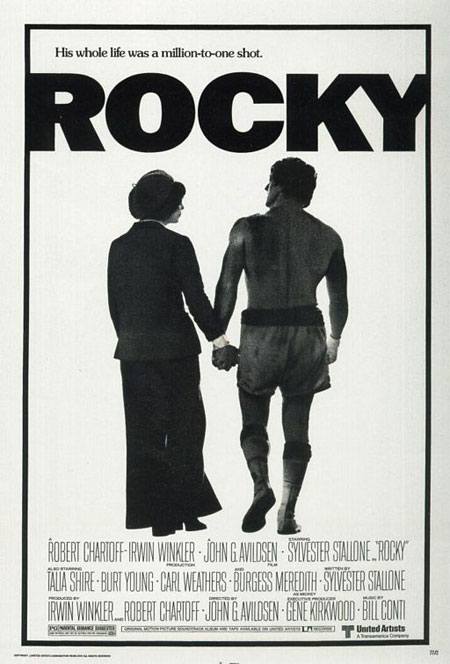
This is a multiple-part observation about a moment that lasts all of 20 seconds in the movie.
I am sick.
I want to talk about the scene where Rocky gets up in the middle of the night (the night before the fight) and gets up to go down to walk around the empty sporting arena. There are a couple of other scenes that inform this tiny little scene - and I'll talk about them too.
The scene (Rocky getting up in the middle of the night) - and how it is handled - so delicately and subtly - make me realize how PANDERING so many film-makers are today (or writers, or directors - or maybe it's just "the suits", who knows who to blame). They think people are stupid (and you know what, a lot of people are) so they feel the need to spell everything out for the retards in the audience. So a couple of things are NOT spelled out in this tiny silent scene with no dialogue that says WORLDS about what is going on. It's a 20 second scene. No speech. But there is so much to notice.
1. Rocky is sleeping on the couch. You see him lying there on the couch, it's the middle of the night, and his eyes are wide open.
A couple things here:
-- he's sleeping on the couch even though it's after Adrian has moved in. Now there have been a couple of moments leading up to this - in OTHER scenes - but nothing is spelled out too clearly, there is no conversation about why he is sleeping on the couch ...
After Rocky's first disastrous day of "working out" - when he can barely get to the top of the museum steps, when he has the fight with Paulie in the meat locker ("Are you balling her?" "'Hey. Don't talk dirty about your sister.") and then Rocky punches the meat ... he goes over to hang out with Adrian (she's in her old-lady pink bathrobe - the wardrobe is so great in this movie. Oh, and Talia Shire dressed herself. Those are all HER clothes - there was no money for wardrobe on this film - they all dressed themselves. So that gives another level to how brilliant Talia Shire was.)
So. Rocky sits on the couch like a big lump and he's a wreck. His hands are bloody from the meat - he is sweaty - and completely exhausted. Everything hurts. Adrian starts to make tentative love-making moves - he resists. Which is new ... when would Rocky ever NOT want to be connected? To anybody? Not just a sexual thing ... I mean, connection. He's a guy who looks for human moments. He's kind of lonely, you know? Instead of breaking the guy's thumbs on the docks, he starts to give advice. ("You should have planned ahead. You should have planned ahead.") He picks up the freezing bum on the street and hauls him into the bar. He banters not just with Adrian in the petshop, but with her boss. You know that kind of guy? A real social animal. He is looking for connection with everyone (think of the little girl he drags away from hanging out on the corner ... tries to give her advice ... Think of his "friendship" with the loan shark ... with the bartender ... Rocky is not a cold guy. He's isolated - but he would rather not be. His natural milieu is human interaction.). So anyway, to see Rocky push her hands away is ... we haven't seen this part of him yet in the movie. It's disconcerting and a little bit upsetting. But what's happening is: he's starting to take himself seriously. And when you start to actually take yourself seriously, and not say stuff like, "Yeah, I box ...but more like a hobby, you know?" ... then certain anxieties come up. Because now you have to actually work and risk. He is now facing the fact that he is not good enough to fight Creed. He is in way over his head. He has no illusions (which, I think, is one of the most appealing parts of this guy). And so instead of being just taken up with the moment to moment of life, like he is in the beginning of the movie (he goes to the gym, he stops off at the pet shop every day to tell a joke, he drives around with the loan shark, he talks to his turtles ... he has no real obligations ... he has nowhere to really BE ...) - instead of THAT ... now he actually has to start working, and focusing ... and investing in himself. This is a tough tough transition for Rocky. It goes against eveyrthing he knows, and the way he is wired. It's almost embarrassing for him. To take yourself seriously. He's a big lug, a child of the streets. You never want to be caught dead taking things too seriously in that environment. You'll get the shit kicked out of you. And what if you fail? What if you fail so big that everybody KNOWS you failed? If you say stuff like, "I box like a hobby..." then that protects you from ever having everybody SEE your disappointment.
He says something like, "I'm tired, Adrian ... no fooling around, okay?" But Adrian is blossoming now, she has roots, she is becoming her own person - so she persists, and tries to kiss him - and he gets annoyed. He says something like, "No fooling around during training. I need to stay strong." He says it with impatience and exhaustion. Again, it's a disorienting moment. Rocky is becoming an individual, singular, his own man. Finally. Adrian feels rejected and says, "Are you serious?" He says, "Yeah." There's this long still pause between them and he can't deal with it anymore, he just wants some SPACE, he had a terrible morning, he's totally out of shape, and for the first time ... he's scared. He's scared of facing Creed. It seems an insurmountable challenge.
When he pursues Adrian at the beginning of the movie - she's IT, in terms of his life, and what he has to look forward to. She's all he has going on, his awkward courtship of her is pretty much the only thing he focuses on. But now ... he has other obligations, other "promises to keep". And that's an awkward transition for Rocky. He pulls back the reins from her abruptly in that one scene, and it's painful - for both of them. He doesn't know how to balance. He says something to her like, "Why don't you go make the meat?" He brought over a package of meat from Paulie - and Adrian says, "Okay. I'll go make the meat." She goes. She's not in a huff, she's not being passive-aggressive - nothing like that. She's just trying to survive - survive the moment to moment with this man. It's overwhelming, when you're that much in love with someone. You become too connected, it's hard to deal with the realities of life ... because you're just so totally ga-ga. I speak from experience, obviously.
Rocky sits on the couch and watches her go. He's wearing the black winter hat, his hair is sweaty, hanging down from underneath the hat, he's wrapped up in a blue blanket, and his hands are completely torn up from hitting that beef. And it's such an eloquent silent moment. He's just as disoriented as she is. It's disorienting ... to suddenly start taking yourself seriously, after a lifetime of calling yourself a "bum", and having nothing much to do all day. It's not just a blast of Rocky theme music and there he is being triumphant, because YAY he believes in himself!!! You have to earn that. Rocky has to earn that. He's got to go through some hard times before he gets the payoff. In one of the interviews with Stallone on my DVD he references this scene when he pushes Adrian away - and says something like, "This is probably the most confused moment of Rocky's life up until that point." Stallone conveys all of this in the scene with no dialogue - it's my favorite kind of acting. Simple, clear, and yet very layered.
Rocky knows he can't just leave it this way with Adrian so he gets up (and he looks like a little old man, or a squaw or something - huddled in this blue blanket) - and shuffles over to the kitchen door. You can hear her bustling about in there. He says, "Yo." Of course. Then they have a silent little make-up scene. Or, not totally silent - she comes out - and has this kind of awkward moment - she doesn't know whether to hug him or not - so she walks back into the kitchen - and he can't deal with that, so he says again, "Hey." And back she comes- and he puts his arms around her - says, "I'm sorry" - and the last moment of the scene is him resting his chin on the top of her head, which is buried in his chest - and heaving this deep deep sigh. Great scene. I love the sigh at the end. It's complex. It's not a simple movie. A simple movie would have underscored that whole scene with sappy music, it would have been chock-full of closeups - of his or her face - which would telegraph: HE'S FEELING THIS, or SHE'S FEELING THIS ... and the resolution of the scene would be much more simple. Like; Yay, they made up! Rocky's strong now! No. Rocky is still scared, and nervous, and knows he's out of shape. But he also knows he has to balance a couple of balls in the air now - as opposed to only one, or none. He has to start training for real, he has to start to become an athlete. This is going to take WORK. But he also has to still be a good boyfriend. He has to do BOTH. That scene is about (in my opinion), Rocky learning that he's got to grow the fuck UP. So the deep deep sigh at the end, a sigh to himself really ... is so eloquent. It says it all. If you can do it without dialogue, screenwriters, then DO it. Imagine how bad it would have been if Rocky had said to her, in that moment, "I'm just realizing how out of shape I am, yo. I feel confused and I need some space. I can't screw you right now, Adrian, cause I gotta take myself seriously as a boxer, you know, yo?" I mean, it sounds so stupid writing it out - but how many scripts do we see that explain every human emotion in dialogue - when in reality so much of life (especially the hard stuff, the insecure stuff) is left unsaid?
That scene ends. With Rocky holding Adrian, but he looks so beat up - you can tell it hurts to even stand.
It is my theory, however, that they do end up making love after that - even though he's said "no fooling around". I think that because of the NEXT scene and what happens therein - and because I think there are no accidents in this script. Stallone is too good. So. We have the scene with Adrian coming on to him, and Rocky saying, "No fooling around."
Next scene: we are in the boxing gym. Rocky is in his filthy sweat suit (it's hysterical to notice how different he looks from the rest of the people in the gym) - punching on a bag like a MANIAC. He's drenched in sweat, and he is kind of all over the place. I don't know much about boxing but I do know that while he obviously looks very strong here - he also looks wild. Not like a real boxer yet. But he's going like crazy. Mick comes over and starts shouting at him about his lack of technique - and gets somebody to tie a string around Rocky's ankles. Mick growls, "This cured Rocky Marciano ... If you can still punch and hit to the body with your legs tied ... now you have balance. Now you become a very dangerous person." (Or: "poy-son", in Mick's accent). Rocky is a bit more docile now (docile meaning: he is accepting Mick as his coach, he "takes the coaching" rather than try to fight it). So he lets Mick tie up his legs. Mick keeps growling at him about balance, blah blah ... and at some point, two girls come up and ask Rocky for his autograph. He's obviously become a local celebrity. Rocky - who still has no focus, no discipline - is completely swayed by the request, even though it comes in the middle of a training session - and you can see him start to say "Sure" - before Mick ROARS at the two girls: "GET OUTTA HERE." Everything kind of stops ... the girls cower, and move backwards. Mick then takes the coaching to the next level, the psychological and comes back to Rocky saying, "And another thing. LAY OFF THAT PET SHOP DAME." Rocky, guileless, says, "Yeah, but I really like this girl, Mick." Mick ROARS: "THEN LET HER TRAIN YOU!" Rocky stops, doesn't say anything - you kind of expect him to let Mickey have it there - or to fight back, or something - Rocky doesn't take too kindly to being yelled at. But then he says, with this air of concession (it's a very funny moment, I love it - watch the expression on his face - I can't explain why I love it, I just do, it's so honest): "All right. No more foolin' around." And Mick nods, satisfied - and they go back to their training. Mick shouts, "WOMEN WEAKEN LEGS!" Rocky, punching the bag, repeats the phrase - he's kind of laughing, though - like it feels a little bit silly, but he's getting into the mode now, getting into the boxer mode. "Women ... weaken ... legs ..." PUNCH PUNCH PUNCH
Okay. So. There are the two scenes. In one we see Rocky push Adrian off, knowing he has to be strong. The scene ends with the two of them in a weary sort of battered embrace. Next scene - Mick brings it up - maybe he can tell that Rocky is distracted, or easily distracted ... Adrian's on his mind - whatever it is ... I'm sure athletic coaches (the good ones) are totally in tune with whatever the hell is going on with athletes to whom they are committed. That's why I think that Rocky did mess around with Adrian the day before. Despite his pushing her off initially. He did mess around with her - and Mickey can sense it. Rocky tries to defend himself - "I really like this girl, Mick!" but Mickey is having NONE of it.
So now ... what began as a vague plea to Adrian, based on nothing but his own instinct, and a little bit of fear at how far he has to go with this training - ("I need to stay strong, Adrian") - has now become a commitment. A commitment to himself, to doing his personal best in the fight with Creed - to actually following through on stuff. (That's why I love when he says to the guy on the docks in the beginning of the movie, "You should have planned ahead." Ha. You NEVER see Rocky "planning ahead" in the start of this movie. He's a moment to moment dude. There are no "plans" in his world. His only plan is to buy some more turtle food so he can try to court Adrian again. Maybe fight in some skeezy club once a month. This is not a guy with plans, yet here he is chastising this poor sack of a man, "You should have planned ahead.")
So after the big training montage - the famous one - we then suddenly are in the quiet little room where Rocky (and now Adrian) live. It's dark. Rocky is lying on the couch. Adrian is lying in bed. Nothing is explained or spelled out - and yet everything seems okay. Rocky has obviously made up his mind - and so they live like that, and it's okay. Because they're both growing up. And no way could Rocky sleep in the same bed with her and not get distracted. No way is this guy a "cuddle and spoon" kind of guy. Nope. So on the couch he is.
To me - those elements all add up (except they're just pieces ... and they don't fit together perfectly - just like they don't in life ... there are still cracks there, gaps in what we know about what happened) ... to a picture of Rocky getting serious about his training (at least in a psychological way - which sometimes is just as important as the physical) and knowing he has to lay off the sex for the duration. Maybe that's not true for all athletes - but for him it is - and the pieces that lead up to that moment are perfectly placed, I think. It's a little story within a story, as far as I'm concerned ... and that's what makes up a great movie, a movie I can watch over and over again.
2. The second thing I want to say about this scene is this (and it's subtle - I didn't notice it the first time, or the second time ... and now, funnily enough, it's ALL I can see!!): Adrian's decorating of Rocky's apartment.
Remember what that apartment looked like in the beginning scenes when he is there alone.
And now Adrian is there, she's his "roommate".
A lesser movie, a movie that thinks we, the audience, are mentally challenged, would have given us an Adrian montage, of her cleaning up the joint, putting her feminine stamp on that masculine bachelor nightmare of an apartment. We would have seen her dusting, scrubbing, tacking up nice pictures, blah blah. So we would "get it". We would "notice" the work that had been done. THAT'S a film that annoys me - a film that wants to be congratulated for the work that has been done - work that SHOULD be done in EVERY film. Why should I congratulate you for what you SHOULD be doing? So if they had put in an "Adrian cleaning montage" - then we, in the audience, would fully appreciate how detailed the art direction was in the film. So many movies operate like this. Not Rocky. We're in the apartment - and next time you see the movie - just notice how much that apartment has changed. It's beautiful. We only see it in passing - as Rocky gets up and puts on his coat and leaves - with one last look at the sleeping Adrian before he goes.
But it's everywhere. Her touch is everywhere.
It's Christmas time - so there's a little Christmas tree over in the corner. There are stockings hung up on the wall around the Rocky Marciano poster. Also a nice collage of boxing magazine covers featuring "The Italian Stallion". On that crappy wall over by the fridge - behind the front door - she has now put up all this flowered contact paper. It's on the wall, on the fronts of the drawers ... it doesn't look great - but it is a bold attempt at prettiness and civilization. Instead of the cluttered shelf behind the bed with the crosses and the bottles of Noxzema (which, sorry, I just love that detail - that Rocky is all about Noxzema) - there is a neat little shelf with a stereo on it. Or a radio - who knows what it is. And she's put up contact paper all around the bed - a black and white pattern ... It's decorating. It's her way of decorating. She probably lived with Paulie in their parents house ... and never got to put her stamp on things. Oh - and on the little bureau below the mirror - you can see a black and white framed photograph, candid, of the two of them, Rocky and Adrian. She's hugging him from behind and they're both laughing. Again: none of this is lingered on - to tell us: LOOK HERE. There are no close-ups of the contact paper, or the candid photo ... The main focus of the scene is that Rocky is troubled, it's the middle of the night, and for some reason he's putting on his coat and going outside. That's what we SHOULD be focused on. I'm just talking now as someone who has now seen this movie 8 times in the last 5 days. The thing about the change in his apartment - and the detail that is there - (oh, and the couch is a new one, too - the disaster couch from the beginning of the movie is gone - it is now a scratchy plaid couch) - anyway: the thing about it is: If you get it, you get it. If you don't, you don't. Maybe you'll get it the second time you see it. So instead of it being a telegraphing moment: See how she has changed the apartment?? - it continues on to feel like a slice of life.
Intimate. A whole world going on between the scenes. These people don't just live when the camera is pointing at them. Stuff is going on in between. This is life we're looking at ... not fiction.
Here's part 1!
Handy Randy
The sad-sack story of Handy Randy. (That's my new favorite blog, by the way.) I LOVE her. I love her writing. She makes me laugh, she takes great pictures, her personality sparkles off the page ... and she also practices her Ethel Merman impersonation when she is alone in her house. What is not to love about that.
Thanks, Robert Frost
Thanks, Robert Frost by David Ray
Do you have hope for the future?
someone asked Robert Frost, toward the end.
Yes, and even for the past, he replied,
that it will turn out to have been all right
for what it was, something we can accept,
mistakes made by the selves we had to be,
not able to be, perhaps, what we wished,
or what looking back half the time it seems
we could so easily have been, or ought...
The future, yes, and even for the past,
that it will become something we can bear.
And I too, and my children, so I hope,
will recall as not too heavy the tug
of those albatrosses I sadly placed
upon their tender necks. Hope for the past,
yes, old Frost, your words provide that courage,
and it brings strange peace that itself passes
into past, easier to bear because
you said it, rather casually, as snow
went on falling in Vermont years ago.
January 30, 2007
Gluttonous ...
I feel gluttonous just LOOKING at this list of lists. Eventually I must do them all. Of course.
I'll do a quick pass-thru - but I definitely need to go into more detail. Some of these list ideas are SO fun.
Worst Books Ever, or Five Hours of My Life I'll Never Get Back
Definitely The Notebook by Nicholas Sparks. I didn't even last 5 hours. What a piece of shit.
Books I Have Lied About Reading
I once told someone I had read Cannery Row when I hadn't.
Books I Have Lied About Liking
Women Who Run with the Wolves. It just seemed easier to agree, rather than not. Grease the wheels of life, baby. Be nice.
Book-to-Movie Adaptations Where, Frankly, the Movie Was Better
Ordinary People (although the book is great, too)
I'll think more about this ...
Books I Used to Love, of Which I Am Now Ashamed
Hm. I'll have to think about that. I'm not ashamed of much.
Best Book Titles of All Time
I think Wrinkle in Time is one of the greatest book titles ever.
I'll have to really go into this one.
Books That I Expected to Be Dirtier
All DH Lawrence.
My Real Guilty-Pleasure Reads, and Not the Decoys I Talk About Openly
The Story of O.
Also all of Anne Rice's Sleeping Beauty books.
See? I'm not ashamed of much.
Books You Must Read Before You Die, but Would Rather Die Than Read
Remembrance of Things Past
Books I Refused to Read for a Long Time Because too Many (or the Wrong) People Recommended Them
The Shipping News comes to mind. Once I read it, I realized: Oh. THAT'S why everyone told me I had to read it.
Books I Read Only After Seeing the Movie
will come back to this ...
Books I Most Often Try to Persuade Other People to Read
I don't really do that anymore. Probably Ryzsard Kapuscinski's stuff.
But a couple of other recommendations come to mind. I recommend specific books to specific people. Like recommending the Lindbergh biography to Allison. It's huge, it's exhaustive - I knew she would LOVE it. But I wouldn't recommend that to everyone. So it's not general
Authors I Wish Had Written More Books Already
Ryzsard Kapucinsky. sniff sniff
And, believe it or not, Madeleine L'Engle. She's written like 80 books but I still want more.
I'll come back to this one.
Overused Plot Points That Drive Me Nuts
needs more thought
Books in Which I Liked the Secondary Characters Better Than the Main Character, or Books in Which I Wanted to Beat the Main Character Senseless with a Tire Iron
hahahaha This is a great question. I'll come back to it
Books I Lied About Reading and Then Wrote an A+ Term Paper On
Genius. Well, the whole Country Wife nonsense in college comes to mind ... a story which I have yet to tell on this blog.
Books I Lied About Reading/Liking Solely to Look Smart/Pretentious
I don't really do that.
Books I Wish I Hadn't Finished, or Worst. Ending. Ever.
Hmm. Not sure I understand this one. I'll think more upon it.
Books I Read after Oprah Recommended Them
I don't really do that.
Books I Will Never Read Precisely Because Oprah Recommends Them
Ha. Nope, I don't do that either. She's chosen some great books.
Literary Characters I've Developed Crushes On
Mr. Darcy from Pride and Prejudice
Claude Collier (from Lives of the Saints - pitter PAT!
Cal from East of Eden
John from The Pigman
Books I Only Read to Impress Other People
I don't really do that.
Best Books Not to Read from Start to Finish, or Best Bathroom Books
David Thomson's Encyclopedia of Film. Best bathroom book ever.
Books I Shouldn't Admit Made Me Cry Like a Baby
I rarely cry reading books. The ones that have made me cry I freely admit. No shame.
Books I Only Read for the Title
good question. I will come back to it.
Books I Re-Read When I Have Nothing Else to Read
Possession. I'm re-reading that right now.
I also re-read Margaret Atwood's short stories.
I read Robert Kaplan when I've got nothing else to read.
And all Nancy Lemann books
Books People Keep Recommending That, Frankly, Sucked Ass
I read Nicholas Sparks' The Notebook on a recommendation (from a good friend) and I am serious when I say: I NEVER took a book recommendation from him again. I also didn't tell him how I felt about it - because why do that?
Books My Teacher Made Me Read That I Really, Really Liked
Tale of 2 Cities - in high school
Also The Pigman in 8th grade - and all of Robert Cormier's stuff. I still love those books.
Books My Teacher Made Me read That Made Me Question the Value of My Education
awesome one. I'll come back to that.
Books That Made Me Want to Have Sex with at Least One Character
I definitely would like to have sex with Mr. Darcy
Also Bud White in LA Confidential
What was the name of the young man in Atonement? Robbie? I should put him on the list too, probably.
Books I Actually Read but Got a Poorer Grade on the Paper I Wrote on the Subject Than My Best Friend Who Did Not Read the Book
Oh God, I have so many of these. It used to drive me INSANE. I'll come up with some examples.
Books I Read Because the Author Looked Hot
Huh?
Books I've Read Aloud
I read aloud a lot. Possession is a great read-out-loud book due to all of the different voices and poets and excerpts - I find that really fun. But I read out loud all the time ... it relaxes me.
Books I Love Even Though the Last Twenty Pages Made No Damn Sense
Books I Have Written a Prequel/Sequel to in My Own Head
Beautiful question ... i'll come back to it
Books I Keep Meaning to Read, but Then I See Something Shiny
well, that was the point of the whole From the Stacks challenge - which I completed in December! Stop getting distyracted! Read those books you already have on the stacks!
Books I Will Go to the Mattresses for, Even Though I Hate the Writer
I'll go to the mattress for a lot of things. I'll go to the mattress against censorship, against whiny anti-intellectual commentary (usually incorporating the word "latte" as though that is some kind of shorthand that we all can understand. Here's a hint: You look lazy when you use it too much. You look like an asshole. What the hell is wrong with "latte"? Unless you want to live in an echo chamber where everybody nods, and snickers about "latte" - and who knows, maybe you do - then you need to realize that that big huge CHIP you have on your shoulder about a certain kind of coffee drink makes me tune you out.) And maybe you don't care about having people listen to you. So be it. Just tellin' ya what it looks like over here. So writers who are attacked for THESE types of reasons ... as opposed to their books? I don't care WHAT they wrote. I'm sticking up for them.
Books You Must Read Because You Must Mock
I don't do that. Waste of time
Worst How-To Books Ever
I can't answer that on the grounds that I will incriminate myself
Books That Were on the 'To Be Read' List the Longest
War and Peace has been on my "to be read" list since the late 1980s.
Books I Hated Having to Read in School, But Love Now
Oh, I adore this question. Moby Dick is the first one. Tess of the D'urbevilles is another.
Books Whose References Have Worked Their Way into My Household Lexicon
Lives of the Saints by Nancy Lemann has definitely influenced how I talk. I should write more about that.
Books I've Never Read But Have Read the Cliffnotes Version
Oh. The Country Wife. That's a play. It's also a story I have never told on this blog. But I will someday.
Books I've Read Because I Liked Their Cover Design/Font
Hopeful Monsters by Nicholas Mosley - which is so scary because it is now one of my favorite books ever ... and I picked it up cause I liked the COVER DESIGN. Horrible to imagine not encountering that book.
Books Which, When It Comes Right Down to It, I Would Have No Problem Burning
Ha! Well - I have principles, you know. I stand by them. I despise Fred Phelps, but I wouldn't burn his books. If he wrote one. Which I highly doubt. I boycott publications, that's how I deal with it. I boycott magazines and online publications who publish the people I hate. And for me this is some sacrifice because ... well, a lot of them are good magazines. I don't BURN the magazines who publish these people. I just refuse to support them, with clicks, page views, or my hard-earned money.
Books Which I Read Only for the Sex Scenes
I think we covered this above.
Actually, too, there's a Ken Follett novel - and I'm not even sure what book it is - or why I read it ... but there's a sex scene in it which, I think, is one of the best ones I've ever read. Not for being sexy or anything - but for being REAL, and poignant ... It certainly sticks in my mind, whatever book it is. I'll check the title when I get home, I think I have it somewhere.
Books I Pretend to Like So People Won't Think I'm a Snob, or Books I Pretend to Like So I Won't Hurt Your Feelings
Now I never pretended to like The Notebook to make my friend feel better. I didn't say to him, "You LIKED that?" I would never do that. I was polite. I thanked him for the recommendation and left it at that. Actually, David and I were just laughing about this the other night. People (on the blog, not in my life) sometimes get defensive or kind of confrontational with me. I know it's out of insecurity, but whatever, it's tiresome. So someone will give a dig, like: "So do you not think Tom Clancy is a valid writer then?" They project a snobby attitude onto me ... for whatever reason that has nothing to do with me. Look. Here's the dealio. You don't make me read Nicholas Sparks and I won't force you to read Ulysses. But don't project your bullshit onto me. We got a deal? I read what I read because my tastes lead me that way.
Oh, and I think it's so hysterical that people think I'm a snob when two posts below this one I'm raving about how I can't wait to see Rhinestone.
Books with Covers So Embarrassing You Can't Read Them in Public
My friend Liz and I were laughing about this. She and I were talking about this book and dammit, now I can't remember the title ... it had something to do with "the domestic and the erotic" - it was a self-help book - but it sounded very VERY interesting - and Liz thought it was great, but she showed me the cover which had a fishnetted leg on it ... and it was very sexy looking ... and said she just could not read it on the train. She had to hide what she was reading. I actually want to read that book (whatever it was) but I would feel a bit embarrassed about just reading it openly on the subway.
Books You Are Sorry You Didn't Read Decades Ago
I'll think more on that.
See what I mean ... gluttonous. I can't even answer the questions properly.
Temple Bar ... ick
Really interesting interview with Patrick McCabe about his most recent novel. This part fascinated me:
That said, the characters who represent the ways of the old valley are also shape-changing murderers, which lends a degree of satire to any wistful depictions of a lost Ireland.?If you look at some of the old cowboy songs that started out as kind of campfire ballads, they are absolutely scatological and profane. The tension is when you yearn for something that wasn?t there in the first place ? some lost paradise.? But just as ?auld? Ireland fetishists are lampooned, so too is modern life. Here is Temple Bar, ?the epicentre of Dublin?s hedonistic empire, a playground exclusively populated by louche adolescent Euro-ramblers and indigenous chemical-fuelled youths vertiginously wading in the currents of an ever-expanding opalescent ocean, shorn of history and oblivious of religion.?
I read the passage back to McCabe. ?Slouchers,? he smiles. I say he must really loathe Dublin, but he shakes his head. ?It?s only harsh in the context of the character. In fact, I like it.?
His comments on Temple Bar are so right on. "louche adolescent Euro-ramblers" indeed - and 'stag parties' - with wasted guys vomiting on the sidewalk, and acting like complete assholes. It apparently became such a problem that the Irish tourist board actually addressed it ... trying to actually discourage huge tourist trips to "visit" Temple Bar.
Also - that whole "lost Ireland" thing ... reminded me of my conversation with Eamon in the echoey Ice Bar in Dublin. I'll post it below. I wrote it a couple years ago - I thought that maybe some Irish people would be mad at me for writing such a piece ... but funnily enough, the Irish Examiner ended up writing about it - and using it as a launching-off spot ... to talk about the changes (some of them unpleasant) going on in Ireland. I still get emails about the piece I wrote - mostly from Irish people, and not one of them has been hostile. So that's pretty cool. I certainly didn't mean it in a hostile way, or in a "oh, where is the green land of leprechauns I have fantasized about?" - that kind of Irish-American bull shit - the kind of person who would prefer to see Ireland remain impoverished, so that the fantasy won't be disturbed about the "auld country". I meant the piece in a purely observational way ... and I include myself in that. I am not perfect, or impartial. There was a part of me that was very put off by Seamus, and what I saw at the Ice Bar. That's the part of me that doesn't want anything to change. But then along came Eamon ...
Anyway, here it is. It's called ROAD WORKS AHEAD
Road Works Ahead
I'm standing in The Ice Bar at the Four Seasons Hotel in Dublin, sipping a tall drink with so many layers it looks like an overachieving jello-mold, green-white-clear-white-green. It is a work of art, but it has no taste. I think it's a mojito but I really can't be sure. With the exchange rate being what it is, the drink costs as much as my entire monthly electric bill.
The Ice Bar is a scene. I hail from Manhattan where, if you despise "scenes", as I do, you must verge off the beaten track, you must rely on word-of-mouth, you must be persistent in finding quiet pubs where you can relax. Otherwise you'll find yourself on a Friday night smack-dab in the middle of some hideous scene, sipping a wildly overpriced drink, feeling fatter than everyone else on the planet, and wondering, "Wow. Am I a total bitch or is everyone here incredibly shallow?"
Dublin is not "sceney". It is not "cool." Dublin is the kind of place where you can sit down in some unadorned dusty pub, and five minutes later find yourself deeply embroiled in a great conversation with a stranger, a stranger you could, conceivably, talk to all night. Dublin is relaxed, it is sociable. The opposite of sociable is, of course, "cool".
Well, it's a new Dublin now. Ireland is in the EU, money is pouring into the economy, and now Dublin needs a place called The Ice Bar, where the elite can congregate and consume. To see and be seen in the scene. I had no desire to go to The Ice Bar. None. However, we knew someone who knew someone who once went to school with a bartender there, and so we made our way to the palatial Four Seasons Hotel to check it out.
An Irish friend heard of our plans and gave us navigation tips for The Ice Bar experience. "Oh, so what you're gonna be seein' tonight then is cool Dublin. It's all about the phones and the clothes and bein' cool. So keep yourselves cool. And do not pay for a single drink. Look pretty, look approachable, and some man will pick up the tab. I will be very angry if I hear that you paid anything for one of those ridiculous drinks."
We took her advice seriously. We sprayed perfume on our wrists. We did our hair. We carefully defined the creases of our eyelids with smoky shadow. The primping felt like a grim duty. Cool Dublin is no fun. No fun at all.
The Ice Bar is a high airy white space, filled with confusing echoes. The noise is deafening. There are very few places to sit, and maneuvering through the bar is difficult. It is also nearly impossible to get to the bar itself to order your jello-mold. And once you're at the bar, it takes forever to attract the attention of the bartender. Everyone mills about, standing, talking at the tops of their lungs, doing battle with the echoes. In order to use the bathroom, you must venture out into the frightening hotel lobby, overwhelmingly plush and hushed, with flower arrangements, deep carpets and curly-cued chairs. The bathrooms are like something out of Versailles, and you feel embarrassed urinating in such a luscious immaculate setting. Not to mention the fact that the bathroom is where the dolled-up gorgeous-smelling teetering-heeled Irish women congregate, jabbering on their cell phones as they re-do their makeup. Gorgeous intimidating Amazons.
My eyelids may be smokily defined but I am wearing a biker's jacket, and I look like the lumpen proletariat party-crashing the rich folks' cocktail hour. I'm the buxom Irish maid scarfing wine in the pantry.
The bartender with whom we have a thrice-removed connection is nice enough, welcoming, although too busy to chat. We find empty spots at the bar, elbowed in by the Amazons, and we let him prepare drinks for us. Due to the green-white-clear nature of such drinks, they take twenty minutes to arrive. They are beautiful, with garnishes of mint, but I feel distinctly like an imposter sipping it. Like someone is going to race over and demand my Ice-Bar Identity-Card, because I obviously don't belong.
Now let me be clear. I do not yearn for the "good old days" of Irish famines and a gazillion % emigration and dark store-fronts on Sundays. What is happening now is a boom. I imagine someday the boom will collapse, like all booms do, and people will settle down, and the economy will stabilize. But Dublin, in the early years of the 21st century, has the manic energy, the gleaming greed of all boom towns in all eras. It is now Ireland's turn. Ireland has never had a turn. For the rest of my stay, I hang out in little pubs called McSorley's or The Four Provinces, meet funny down-to-earth people, drink whiskey, and have a grand old time.
But meanwhile, the forces of change and progress are upending this conservative society. The entire country appears to be under construction. By the end of our jaunts through the southern and western counties, my friend and I would laugh every time we saw another sign proclaiming "ROAD WORKS AHEAD". Road Works Ahead? Really. What a shock. The cranes and bulldozers and mountains of dirt everywhere are visible proof of what is happening. A country building itself up, digging down for a new foundation.
My friend's camera sits on the bar, and an enormous gentlemen beside me, waiting for his drink, says, "Is that yours?" He is huge. He has no neck. He is wearing a pinkie ring. A pinkie ring? In Ireland?
I reply, "No, it's my friend's."
"Oh, because I was going to tell you that I had that camera, but then I upgraded from my Nikon 2000 to a Minolta 5 million, and I also got a new digital blah-blah-blah which has video capabilities as well as a satellite hook up, 8000 megabytes of storage space, and my very own room with a view."
This entire monologue is unsolicited. I don't know how to respond, mainly because I have no idea what he is talking about, and so I struggle with my own facial expression. Does he need me to be impressed? What the HELL is he babbling about? It's all brand-names and numbers.
He isn't done yet.
"I'm very big on the upgrading. I now have two fully-loaded Mercs with 10-wheel drive and purple-tinted skylights, seat-warmer pads and a talking GPS system ?"
Honestly. He doesn't need me as a partner in this charade, this mockery of the word "conversation". If I walk away, he would keep talking into thin air. Maybe he has some compulsive-talking disorder. Mercs? Then I put it together. Mercedes Benz. Wow. This dude is pathetic. Not because he has "two Mercs", but because without even finding out my name, he has to blurt out all of his possessions. He is a materialistic Rainman.
The list of perks in the Mercs goes on. And on.
Again, I struggle with my own face, trying to wrench it into some mildly interested mask, and not let the outright boredom trickle down over my features.
Irish men, while sometimes rowdy, and never shy, are always polite. They know how to introduce themselves, they know how to ask for your name, and they always remember the name. One phrase you never hear in Ireland is: "Sorry, what was your name again?" Their good manners are instinctive in that respect. But Huge-Merc-Dude, while he speaks with an Irish accent, has none of the usual charm of the Irish Man. This is what money does. I feel like I am in a time-machine, and have suddenly been transported into a yuppie happy hour down on Wall Street, circa 1986, surrounded by blind self-interested greed.
He's still talking.
"And it has a Microwave-oven in the back, as well as TiVo, 20 horsepower engines ? and magnetic force fields around the ?"
After ten days of invigorating back-and-forth banter with people all around the country, it takes me a while to even register this gentleman's rudeness. And once I do, the guy is toast.
I interrupt the compulsive cataloguing. "What's your name." It's not a question. It's a command.
"Seamus."
Now I no longer worry about my facial expression. Now I am openly annoyed. "I'm Sheila."
A look of uncertainty wafts across Seamus' large ruddy face.
As always, the second I speak I give myself away as a visitor. I look like an Irish local wherever I go, and so I am now accustomed to the immediate response to my American accent.
"You're from the States?" Seamus asks, his first question of me. I can tell he has already lost interest. Not because I'm from the States, but because he literally could not care less about me, where I'm from, who I am ? what a boring topic compared to videos and cars and cameras.
"Yes. I'm from the States. Nice to meet you, Seamus." I'm blunt. I turn my back on him and leave him alone, and happier probably, with visions of gadgetry dancing in his head.
Guys like Seamus are a dime a dozen in New York City. But it is disorienting to meet one here. Maybe people's personalities change once they walk through the vaulted white doors of The Ice Bar. Maybe the echo-chamber of the bar does something to people's listening capabilities. Maybe if I met Seamus at McSorley's or The Four Provinces he wouldn't have been so pathetically eager to impress. I have no idea. I just know that if he listed one more "perk" at me, I might punch him in his fat head.
I put down my mint-julep or whatever it is, and order a beer. Fuck it. I'm a member of the proletariat and proud of it.
When Eamon first speaks to me, I have my guard up, a leftover from Seamus. How quickly one becomes jaded, hard. But with Eamon I go back into familiar Irish territory: talk that occurs spontaneously, takes on a life of its own. It is easy to keep the tennis ball in the air. Eamon grew up with the bartender we had come to see, they were childhood friends. Eamon lived in America for the last ten years, and has now come home for a three-month stay. He doesn't know what he wants to do next, and so he's moved home with his mother while he figures it out. He had been living in New Jersey, so he and I have a lot to discuss. We love the same pubs in Manhattan. We talk about Puck Fair, and Swift's. We talk about music, we exchange email addresses. The conversation is lovely, light, it's fun. Seamus recedes into the past.
Eamon and I get around to discussing The Ice Bar, and the deeper significance of such a place. I don't want to criticize his country, and I also don't want to be one of those obnoxious Irish-Americans who would prefer Ireland to be backwards and poor so that my fantasies of the place will remain undisturbed.
But Eamon takes a humorous view. "People come to The Ice Bar just to be seen, y'know?"
"Yeah, that's what it seems like."
"They'll come here for a quick drink, and then go off to a funner venue. Where they can watch rugby and have a bit of craic."
Indeed, I have noticed three distinct waves of people come and go. Eamon is right. People were not settling in at The Ice Bar. It's a pit stop, something they have to do.
Eamon says, "I've got my local where I hang out. I came here tonight to see Liam."
We glance at Liam, busily concocting complicated drinks for the hoarding masses, pushing up against the bar. There is the incessant ring of cell phones in the air.
"Not much time to talk to him, eh?" I say.
"No, indeed."
We discuss the economic boom, and how Ireland now has to deal with immigrants from different cultures for the first time in its history. Eamon is positive about it. Most everyone I talked to in Ireland takes a positive view of these new developments.
"I think it's a good thing for this country, you know?" Eamon says. "Immigrants bring a lot of energy with them, just like the Irish did when they moved to America."
I have not thought of it like that. "Good point."
"So a lot of people are grumbling now about immigrants taking jobs away from the Irish, but I still think it's really good for Ireland. We've never had to deal with any of this before, and I think the people coming here from India or Africa or wherever are bringing a lot of good things with them. It's opening Ireland up to the world."
The echoes of The Ice Bar ricochet over our heads. Missing us completely. I can hear him, he can hear me.
"You know, Eamon, it's interesting. I'm of Irish heritage, but I'm American. Obviously. And there is a huge contingency of Irish-Americans who don't want Ireland to be modern and successful, because it messes up their ideas about the 'old country'."
"Oh, Sheila, you've got that one so right."
"And half the time, these people have never even BEEN to Ireland."
"Right right right."
"If these people came here now, and saw that ? Oh. My. God. ? you guys have highways under construction and cell phones and an Ice Bar ? they would be devastated. They would feel betrayed."
Eamon starts laughing.
I say, "As an Irishman, does that drive you crazy?"
"Oh, I guess they just want to know where they came from. I understand that's important to Americans."
"But the Irish-Americans I'm talking about seem literally BUMMED that there are no more famines. They love that whole martyr thing. They aren't interested in getting to know Ireland now. All they care about is the famine and the Troubles. That's it."
Eamon pounces on this. "Sheila, you are very right on that score. To them, Ireland is the famine and the Troubles, but you have forgotten one item on your list, one very important item, that lies between the famine and the Troubles, and this one item has done more to sentimentalize this country than any other ? and it is called The Quiet Man."
I burst into laughter.
Eamon goes on, laughing too. "The Quiet Man is the reason for that Irish-American attitude."
I have to 'fess up: "The Quiet Man is great, though."
"Oh, I love the movie! John Ford, all that, his Irishness was very important to him indeed, but Americans see that movie and come to Ireland looking for that world. They think all Irish women are going to be Maureen O'Hara throwing pots and pans at them."
"That's so hilarious. So true."
In a world of 1847, The Quiet Man, and the Troubles, there would be no room for an Ice Bar.
The Ice Bar is one of the most obnoxious places I have ever been, but I now think that its obnoxiousness is a sign of hopeful growth for Ireland. What kind of person would begrudge this island, with its pained long history, a bit of success, a bit of money to spend? What kind of person would wish that Seamus didn't have two "fully-loaded Mercs", and instead had to tool around in a beat-up jalopy he shared with his six siblings? Who would prefer that Ireland remain narrow, hard-bitten, and hungry?
Eamon and I, before we parted ways, raise a toast to Ireland as it is now, to its future, to its success.
"May Ireland continue to flourish," says I, holding up my beer.
"Amen," says he.
And as we clink glasses in that white echo-mad place filled with fashion models and pinkie-ringed Seamuses, the epitome of the new "cool" Dublin, Eamon says what is, perhaps, the warmest friendliest word in the Irish language: "Slá©®te!"
It moves me. To hear that particular word in that ice-cool place. The old traditions alongside the new. Nothing is lost. It moves me to see Eamon's kind human grin as he says it.
Slá©®te.
Slá©®te to the new Ireland, Slá©®te to fat-headed Seamus, Slá©®te to The Ice Bar, and Slá©®te to road works ahead.
Obsession: some struggles
So. The obsession with Sylvester Stallone is moving right along. Going quite well, thanks for asking.
Sadly, the blossoming obsession means I must see movies like Judge Dredd and Demolition Man (in some cases, I need to RE-watch them - because, let's not forget, I've always been into Stallone ... it's just that now I have kicked it up a notch) ... but obviously I can always find something to latch onto, something to enjoy. Like Tango & Cash. Come on. Ridiculous. FUN. 2 of my favorite guys.
So the obsession is going as planned - it's just that there's so much CRAP to slog thru as well. There's even that hard-to-find p0rn0 movie he made before Rocky ... I think the Germans have released it or something ... I did a little bit of inquiring. That's the level to which I have stooped. THANKS, SLY! I think I might know where I can find a copy - there are a couple shops in Greenwich Village I could check out. Wouldn't surprise me at all if they had it. The funny thing is is that after Rocky was released and Stallone became so famous and important - the p0rn movie was re-released - and they called it The Italian Stallion. Trying to cash in. I think they cut out all the X-rated bits, though, which left the movie about half an hour long. Anyway, it sounds hilarious and I need to see it.
Now I happen to be a person that loves a little bit of CRAP ... like, I think Rhinestone is adorable, for example - I love that movie ... but I'll sit through all the other stuff as well. I feel it is my duty, as a Stallone maniac.
I'm seeing Lords of Flatbush tomorrow and I'm so excited that I feel like a 7 year old kid on Christmas Eve. Like ... I can't sleep or think. Sly? The Fonz? Brooklyn in the 50s? All of those guys on the cusp of major - not even just stardom - but PHENOM-dom.
I am beside myself.
I've got another Rocky post in the works. Just stuff I notice and love. More to come.
And don't even THINK I won't liveblog Rhinestone when the time comes.
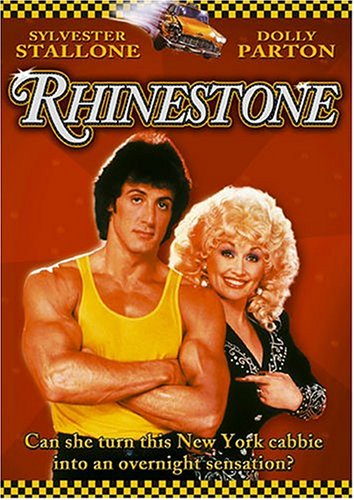
That time WILL come and I need to be ready. Emotionally.
the collective trance on 41st street
I've been thinking a lot about "gym behavior". That whole "being private in public" thing that happens at a gym. I'm not really a gym girl - I like to run outside, and get the sense of movement, of actually going somewhere - but it's finally cold here ... so I'm gym-ming it up on a daily basis. I love the sense of everyone there, in their own Idahos, doing whatever it is they do to work out, and we're all there together, but we might as well all be alone. I find gyms intimidating - but once I realized that nobody even sees me ... I can deal with it, and go off into MY own Idaho, and it's quite relaxing. Then there's locker room behavior, and casual nakedness in front of strangers, and just doing the things that normally you do only in front of your own mirror, or your husband ... slapping on deodorant, for example ... and wandering around in stages of undress, while chatting on your cell phone, meeting up with friends later, talking to your boyfriend about the Thai food you're gonna pick up on your way home ... all of that locker room stuff. Again, since we're ALL doing it at the same time there's something really anonymous about it ... and it COULD lead to total cacophony ... but the way I experience it is: I zone OUT. I am in my own Idaho. I do my gym thing. I sweat it up. I sauna it up. I chat on my phone. I slap on the deodorant. I bullshit with the guy waiting in line with me for the weights. I move on. It's almost like we're all in a collective trance. And since it's winter the windows totally steam up. So I'm on the treadmill, and I know that outside is 41st Street, and the new NY Times building going up across the way, and passersby rush along, bundled up in snorkle coats, and there's the nutso blinking neon a block away in Times Square... but I can't see any of it. Due to the FOG, the body heat, the condensation on the windows.
I look forward to going into that collective trance on a daily basis.
January 29, 2007
Tee hee ...
Check out the comments section: I feel like Borat right now. (Comments at 1:59 a.m., and then again at 3:00 pm and 3:09 pm). So strange and so funny - People get really worked UP and my post has already made it to the first page of Google searches for "Peter Gatien" which is rather frightening because the entire thing is made-up and there are many nutso people out there. I felt obligated to put up a disclaimer because I was afraid that Gatien would come after me, or be mad or something because I'm just making shit up, as though it's real. But still ... I'm gonna leave comments open down there, just so I can see who shows up to tell "Alexa" that she's horrible - or awesome - whatever the case may be. I love it. Punked! Also it just goes to show you how polarizing Gatien still is. hahaha It's great.
Brando
Stanley Crouch analyzes him - I honestly don't know if I've ever read anything more insightful and thought-provoking about Brando, and what he really is doing. It's a very nuanced take. Here's part of the piece ... but most certainly read the whole thing.
Reflections in a Golden Eye (1967), like any superior film, benefits greatly from the DVD format and the revisions it makes possible. The inclusion of the experimental gold and sepia tone, which was removed from the print shortly after the film was released, allows the audience of our moment to see a film that most did not when it was available in theaters. We now have director John Huston's vision intact. We also have Brando in one of the boldest performances ever given by an actor on screen. What validates that last claim is the exemplary courage of Brando's egoless deep sea dive into his character, Maj. Penderton, whose desperate and arrogantly veiled pathos tellingly overflows twice. The character's central problem is his feeling of inadequacy, of being less that he should, and his terrible loneliness because of the difficulty of handling his attraction to men.Brando reaches a nearly matchless desolation in the first instance of overflowing when his attempt to secretly equal his wife's control of her stallion is thwarted by the horse's power, which he cannot meet with the necessary combination of confident ease and equally confident force. When the stallion smells his fear, it is spooked into running through blueberry bushes that tear the animal's flesh and cut the face of the rider. The humiliation felt by a man facing the terrible pain of his limitations is far more intimate than cutting embarrassment?Brando evokes a moment of horrifying pathos. One thinks of Olivier's well-remembered theater cry after Oedipus has plucked his eyes out, for which the actor used the image of a seal shrieking when its tongue is stuck to the ice until it's clubbed to death by hunters. In the case of Brando's Maj. Penderton, the feeling is banked neither by having a tantrum nor by brutalizing the stallion with a tree branch; the violent action only deepens his sorrow to such a degree that the failed horseman slowly descends into apologetic sobs that cannot be held down. If a more shattering moment is available on film, I would like to know what it is.
This is brilliant analysis. Detailed, incisive ... One of the problems with most commentary about acting is that there is absolutely no understanding of the degree of difficulty ... or the rarity of certain things.
I've said it before - but it would be like a sportswriter who has no idea why a triple play is important and doesn't give it its due, for degree of difficulty - or the sheer fact of how rare one is.
January 28, 2007
Rocky: things I notice and love Part 1

-- how Mr. Gazzo takes a gasp off of an inhaler before bitching Rocky out for not breaking the guy's thumbs. What a detail. The inhaler. I LOVE actors, man. I have no idea why he gave the character asthma (it's not in the script) but he did ... and it's just fascinating.
-- Rocky's glasses. He puts them on in the backseat of the car with the loan shark, as he writes down his assignments for the next day. You know that he swiped those from a drugstore. They are the goofiest most inappropriate looking glasses. GREAT character choice.
-- How Adrian has pinned her watch to her sweater. Interesting detail.
-- the terrifically awkward moment when Rocky asks Adrian out (the first time - in the pet store) - and she is so shy that she doesn't even acknowledge that it has happened. He says, "Great game down at the Spectrum tonight ..." (he's not looking at her - pretending to look at the dogs, or whatever) - Adrian cleans the bird cage - nothing ... Rocky then says, "Want to go to a basketball game?" Not looking at her. Then a quick glance at her. She does not even look at him. And then right after that - Rocky moves on - as though it never even happened. As though he didn't just ask her out.
-- I love how Rocky bitches out Paulie in the bathroom: "I need a Cadillac to connect with your sister, or what?" Paulie is hunched over, trying to comb his 4 strands of hair in the tiny shard of mirror that is left on the wall. Beautiful. Every element of that scene: the dialogue, the set, the relationship ...
-- how in the beginning of the movie Rocky is a thug. By the end of the movie he has become an athlete. Like - in the first jogging-at-dawn scene - you can just tell that Rocky never gets up and jogs. Jog? Are you crazy? He's got the Converse on, it's dawn, his sweat suit is filthy (and hysterical - he looks so ridiculous in it - kind of chunky and pudgy) - and he does a few desultory stretches against the building - and then off he goes. He looks creaky. Not used to running. It's so eloquent - that shot.
-- I love how when Rocky first takes Adrian into his apartment he says to her, "You hungry? I think I got some donuts. Maybe some soda." She shakes her head. He says, "No? I got some cupcakes." She shakes her head. "I think I got some chocolate in there." She shakes her head. He says, "No? Okay." Uhm - donuts, soda, cupcakes, and chocolate. Perfect.
-- He sits on his couch, and tries to get her to join him. He says, "It's a nice couch, I don't know." Rocky. It is NOT a nice couch. There are beer bottles stuck in between the couch and the wall, the necks of the bottles hovering along the back of the couch like organ pipes. You have placed newspapers over the holes in the couch. A crumpled dirty blanket lies on half of a cushion. Now - there's no shame in being poor, Rocky. But that is NOT a nice couch.
-- Wonderful change of scene: Rocky comes home after the fight in the first scene. Talks to Cuff and Link. You know, that famous scene. He wanders around his disgusting apartment. You get the sense of his isolation. He has a beat-up face, band-aids on his eyebrow - a black eye - he goes to the fridge, takes out an ice tray, cracks it on top of the fridge - so a couple of ice cubes pop out into his hand. Some cubes go on the floor, he doesn't care. He takes the cubes and walks to his bed (you can so get the aches and pains in how he walks ...) - lies on the bed - it's a single bed - you can see a big wooden cross behind him - religious memorabilia on the shelf - and he lies on bed, his leg kind of curled up - and puts the ice cubes against his cut eye. And just lies there, with this ... battered look on his face, man. This battered flat dead-eyed look. The pose, the look says it all. This man is ALONE. But then: NEXT SHOT: we're inside the pet shop, it's daylight, and we see Rocky walk up to the window, from the outside - and he starts to tap and wave at the puppies - and his face is totally different. He glances up - waves at Adrian - there's still something a bit shy there, he's maybe trying to play up how unthreatening he is?? - but I just love that cut. We go from the violent guy lying in his single bed, no expression on his face, aching and throbbing from injuries ... to him trying to tell jokes to Adrian, trying to draw her out, make her laugh ... And BOTH of these things are true. Neither side is a pose. He is violent. Or - he has capability of great violence when he is in the ring, or when he feels threatened or disrespected. But then - he's sweet and ... kind to Adrian ... he takes just the right tone with her. There's no condescension there. He is truly interested in her. He's not just interested in her when she takes the glasses off later. He already thinks she is pretty. Anyway - I love that transition - that we go from one scene to another. Very effective.
-- I love the moment when Rocky goes to his locker, takes the lock - does the combination - but it won't open. He tries the combination again. No luck. So what does he do? He takes off his hat - takes a slip of paper out of the lining - which obviously has the combination on it for safekeeping - checks it, and tries the lock again. I just LOVE that detail. That was Stallone's idea - nobody told him to do that. He knew that Rocky was enough of a realist, and enough of a ... well, Rocky knew that the possibility of him forgetting his combination was pretty high ... so he put the combination in a place where he could get to it, where it would always be on him if he needed it. It is tiny details like this - that make up a great character. A 3-dimensional character. It's not just all the big things - his heart, his soul, his drive, his kindness, his struggle - The character itself is revealed in the fact that he is the kind of guy who keeps his locker combination on a slip of paper in the lining of his hat. Gorgeous.
Jan. to March 1995 Diary flotsam and jetsam
Quotes, snippets, fragments ... some of this I don't remember at all ... some is as vivid to me as a newsreel flickering of my own life before my own eyes ... I never go thru old journals - except the old high school ones for Diary Friday, but yesterday I went through some of them from this crazy 3-month period in Chicago (or, I should say - one of MANY crazy 3 month periods in Chicago) - I wasn't sure why I picked those particular journals out of the box, it was very random (seemingly) - but it soon became clear to me why those were the ones I chose to browse through. I was HOWLING with laughter at points, but ... there was other stuff, too. Quiet, memories, the whole thing coming back to me. Deep in thought these days. I've got stuff to do. (Ann - some of this stuff was just making me GUFFAW.)
Joe: "Member in Pulp Fiction --"
Ann: "No, see now, that was Sheila."
Ann: "Is that the one where your hair is different?"
Me: "No, that's your fantasy."
Me: "I'm just gonna be myself--"
Ann: "I think you should. Of course, if you need to be married ..."
Me: "I think M. knew he could show up and I would let him know I wanted him to be there --"
Ann: "Or you'd blatantly ignore him like that night at the Wrigleyside."
Fragments from M.'s improv show
"Thank you, Gore Vidal."
"Gash - Like a Wound - is offended."
"I wish I was a deformed midget.
1/13/95
Guess who crash-bang-boomed back into my life this week? M. We're quite a pair. I can't discuss the chemistry anymore (but of course I still will) - but it just exists. We're friends. M. is my friend. I really can see myself now paging him from a scary L platform somewhere and he'd come and save me. How do I BEGIN? Being with M. - after a year - is so familiar. It's like my maroon sweater or something. Oh, who KNOWS. I adore him. Like this is a surprise. It's a surprise to him, I think.
Mitchell: "Something has happened that I keep forgetting."
Me: "Isn't it great that M. is back in my life?"
Ann: "I think it's totally great, even though you know this is only going to lead to haikus and humidifiers."
Snippets from M.'s improv show
"I usually save an extra seat for the Narrator."
Roy, the Idiot Man-Child from the Service Station
"You're not even a zoologist!"
"Of course, we need to park on a street where there is a raging fire." - Me and Ann
Exchange between casting agent and M.
Casting agent: "The character is constantly getting into situations he needs to get out of. He's also a hopeless romantic. Do you think you can do that?"
M.: "I like acting."
M. to me, on that horrible night: "There are traction issues that you just can't understand."
Fragments - from M.'s improv show
"Leave some room, John!"
"I like working with pigs!"
"You're gonna have to wear an eyepatch!"
From Vindication:
I have not the constitution, the education, the ability to concentrate. I fear for my sanity sometimes. There are days when I am on the edge of tears. Sometimes I am so restless I do not know what to do. Sometimes I can talk all night, like King George, you know. I am too, too happy, and in the same day I can be sad beyond hope. Sometimes teaching the girls is all I can do. Sometimes I am magnificent at it. Sometimes I do not know what to do with myself, my hands, my eyes. I want to fling myself down on the grass, embrace it, thank it, each little stem of it. I want a beautiful blue dress, shimmery, the color of the ocean. I want to be the ocean and the clouds. No, not the clouds, that is too far away.
"Well, that will make you more three-dimensional." - Me (weaving a web of lies with Ann Marie)
"You sent the man 30 haikus. I don't think he'll mind if you come to a couple of his shows." - Ann
We were all talking about what our "type" was. I had just come back from a weekend with M. I said, "My type of guy punctuates each sentence with a shot of Rumpelmans."
Me to M.: "I have a kinder-whore appeal ... or at least so I've been told."
Joey, talking to the television, as we watched 30something: "These are nice people, Susannah. They want to like you because they love Garry."
I'm forever under lock and key
As you pass thru me
M.: "There came a point when I was - whatever, it was clear to my parents that I had to be having sex by that time - I was 23, whatever - and my mom said something to me like, 'Well, at least you're not having sex,' and I had to say, 'Mom. Look, I'm having sex.' and she said, 'I'm glad you're not having sex.' Total denial. She couldn't even hear what I was saying. I think my mom could walk in on me actually having sex, and she'd be like, 'I'm so glad you're studying!'"
From the party 12/10/94
"These Oreos are insanely delicious." - Joey
"You just never know what will happen with broccoli." - Me
"I just kicked a pig." - Ann
Heard simultaneously by Ann:
Me: (with a mouth full of food) "I have an eating disorder."
Mitchell: "I can honestly say I've never slept with ----- oh, wait --- yes, I have."
George and Ann, providing dialogue to an old movie, with the sound turned down:
George: "That's why your dancing frustrates me - because I can't move!"
Ann: "Well, don't you think I understand that? I mean, look at my eyebrows!"
Ann: "I was thinking about your life the other day ..."
2/20/95
Me: Hi, honey.
M.: Hi, spanky.
Jackie: "The symptoms of this disease are: trouble with social skills .... long legs ... developing breasts as a man - and small tightly formed gonads."
2/24/95
M. calls my house - Jackie picks up.
Jackie: "Hello. Tony's Pizza Palace."
M.: "I'd like a Sheila to go."
Jackie: "And what would you like on that?"
M.: "Nothing."
2/23/95
Me: "I have my period."
M.: "What else is new."
Me to M. (and I was dead serious): "It would totally not surprise me if I disappeared into a white slavery sex ring at some point."
Me to Mitchell (about M.): "Isn't he so sweet?"
Mitchell: "He is. He is sweet." Long pause. "He's a lunatic."
Mitchell: "The improv jam is pushing all my buttons."
Mitchell to me: "If you say 'improv jam' one more time, I'm going to scream at the top of my lungs."
2/26/95
Crying in M.'s arms - it was, God, 3 am? I said later, "Sorry for crying like such a werewolf." Not aware that werewolves were big criers. But anyway, I couldn't stop. It wasn't sadness, though. I had been so wound up for about a week, and then I relaxed with him, and started to cry, and then I couldn't stop. For about an hour. Poor man. I kept saying to him, "Don't be scared - the tears are good tears ... I'm happy ... I'm so happy ..." He had a cigarette dangling from his lips, he was holding me, and he said, drily, "I hope you don't mind if I just take your word for it that you're happy, okay? I mean, you're fucking crying ..." "I'm just happy, M, I'm happy ..." "Okay, okay, you're happy. Christ."
1/13/95
7 a.m. Jazz Bulls. The place closed its doors at 6 a.m. M. was working - so there was grey weird light seeping into the basement windows. Everything looked weird. Pre-dawn. It felt like we were the only 2 people on the earth. M. said, "You want some coffee before you go to work?" "You mean ... go out?" I didn't think there'd be time for that. He scoffed at the "out" question. "No - I can make you coffee here. You want some?" "God, yes." I hoisted myself up onto the bar and sat there as M made a pot of coffee. His pants were totally ripped by that loony Christine bitch. I loved watching him shuffle around dealing with filters and coffee and water. He was adorable. All the while we were talking about us. I told him how comfortable I felt with him. At one point I fell into a depression, having to go to work after being up all night. I said, "I can't believe I'm going to work right now."
He was standing with his back to me, pouring coffee. "Cream? Sugar?"
"Just black. And strong. And please don't say 'You like it like you like your men' or whatever. Everyone says that."
He poured sugar and cream into his own coffee, handed me mine, which I began to devour (it didn't even make a dent in my exhaustion) and then stood there, stirring his own coffee. We were lost in our own thoughts. He was deep in contemplation. Turns out, it was about me - but I didn't guess that in that moment. He was just pondering me, perched on top of the counter, pale, sipping the coffee he made for me, in the dawn-lit bar where he works, half an hour away from having to go to my job.
He turned to stare at me, still stirring his coffee. He looked at me for a long time. Contemplatively. I didn't ask what he was looking at me like that for. I just looked back at him. Then he said - slowly - choosing his words - or, no - not choosing his words - M. doesn't really do that - but slowly, as though this idea had just occurred to him and surprised him: "You must really like me."
That is SUCH a funny moment if I really ponder it. I've known this guy for 3 years, and now he says, in a tone of awe, "You must really like me!" It was so sincere. I started laughing. "Of course I like you. What are you, a moron?" Laughing at him. "You didn't know that I like you?"
"Well - no - I mean, I know you like me. But, I mean, you must like me. You've gotten no sleep because of me, and you're about to go to work - I mean, there's not too many people I'd do that for." (He didn't say if he'd do it for me or not.) "I think it's rare."
I felt like I should say something, but I didn't know what to say. M. sensed that in me, because he said, quickly, reassuring, "No, I mean - it's cool - that you like me - I mean ... I guess I just didn't know." He went back into contemplative stirring-coffee mode.
"Well, now you know." I said.
We drank coffee, not talking, the air clear between us. Both of us thinking. About the other. He gets shy. Like he doesn't want to say too much, or ruin anything.
He said, looking down into his coffee, "I feel like there's not a word evolved enough for what we are."
Fragile moment. I didn't speak. I let it hover. He had more to say. I knew it. He said, "You have always struck me, from the very beginning as ... someone who ... wanted to different than what you are."
That was an ambiguous thing to say. I saw 2 possible interpretations - or, no, actually - now I see the 2 interpretations - but this is how I took it at the time: Sheila, you have been trying to be something you're not.
So I felt a little chilled by that. I pursued it. "What do you ..."
He meant what he had said - but it wasn't the negative interpretation that I put on it. He meant that: I'm not satisfied anymore with being unhappy, repressed, uptight - and I am determined to get over myself, and get better, push through these barriers I have up.
I did not know that he had perceived that from the beginning. I remember him saying to me on a tequila-soaked summer's eve, when I was all upset and weepy, "Your journey ... has just begun." He knew. How did he know?
He explained what he meant: "The first time we went out ... " (neither of us know how to define this whole damn thing - we have no words - there are not words evolved enough for what we are) "Well - I told you this - you were so - " (he stopped talking, and then kind of hugged his arms around himself, put his head down - to show how closed I was and uptight) "And I wasn't -- sure how to handle it ... I wasn't sure if you ..." (unfinished sentence, wincing expression, awkward, shy) "But then ... you kept ..." (stopped himself - and smiled - and I knew what he meant. I had kept calling him, kept making myself available - he didn't say it in a mean way. It's the truth.) I said, grinning, "I kept coming back for more, huh." "Well ... yeah ... so I figured ... Okay ... This person is ..." (all of this accompanied with those subtle facial expressions and hand gestures he does - we transcend words - the expression and the gesture he made conveyed my whole life: pushing through, frustrated, upset, sick of being upset ... wanting to be happy. He saw all that?) I nodded in agreement with his interpretation of me. He said, nearly unable to get it out - too awkward and vulnerable, "So ... it's kind of cool, Sheila ... to see how you have progressed. It's ..." He stopped. It's like I was inside of him. Like he could hear those words "how you have progressed" and to him they suddenly sounded patronizing. But no. They were not. I said, softly, "It is cool, M. It is cool."

January 26, 2007
Robbie BARRRRRNS
Part 2. Photos of the blessed event here.
How much would I have loved to be there?
It hurts. That's how much.
"Ralph Macchio was my main squeeze for a long time"
I am in love with this post by Mejack. Read the whole thing, please. It's glorious.
On multiple levels.
First of all: the content. Ralph Macchio. I mean, what is not to love. He is also in the Rocky Balboa continuum so it's not TOO much of a segue for me.
I love her wording here too:
They were giggling about the IRONY of owning these movies. I wanted to wax on-wax off their asses. I am SO SICK of the IRONY. I am tired of the ironic Rainbow Brite shiny jackets and the ironic leg warmers. I am tired of the ironic PBR's in the dive bar that, ironically, has a jukebox that only plays 80's songs. Seriously. Is it really necessary that one has to be slightly self deprecating and clever with semi-obscure retro references at all times? Stop it. Enough Already. Everyone likes kitchy/campy things from past decades (like me with my Leif Garrett fascination) but most people, except the Hoopleheads, don't need to endlessly squawk on about the CLEVER IRONY of it all and make poor fashion choices to further demonstrate their cleverness.
I wanted to wax on-wax off their asses.
I'm with you, girl. Enough.
And may I say this: I love how, in your youth, you seemed to be consistently telling people you were closer to certain celebrities than you actually were. I love that.
"Yeah, Wolfman Jack's my uncle. Whatever. No big deal."
"Yeah, I was born in the same hospital as Ponyboy. Yeah, whatever, no big deal."
It's this yearning for closeness, closeness to the BURNING GLOW of their stardom.
I remember telling you at our American Idol night about how "Ralph Macchio saved my life" ... and I felt little to no judgment from you (which I truly appreciated) ... and here's that post I told you about. It's long. It's about your dear childhood "friend", Ralph Macchio.
Ack
If I had known it would be chosen as a Link of the Day - I would have edited the damn thing. I wrote it in about 20 seconds of fevered fangirl excitement.
But still: thanks, Keith! I appreciate it. I love those Links of the Day.
ROCKY
ROCKY
ROCKY
ROCKY
January 25, 2007
Brawn
It's hard for me to picture him as sick. It's hard for me to picture him fragile, weak, even though there were always elements of his body that seemed patched together, Frankenstein-esque. This was a man who had been battered to a pulp, shattered, and left for dead on the side of the street. This was a man who had had to be put back together, who had to learn to walk again at age 20. But he had come back. This was all before I met him, but that body - the body he had before the disaster - haunted me. It hovered around him like a ghost, in my eyes, a what-might-have-been.
M. had been an athlete. And he was still a big physical guy with a certain amount of grace. I watched him play basketball once with his friends. He was beautiful. In action, he was always beautiful. He hated it when I got sad about the accident that pre-dated me. He was quite forbidding about it, and got impatient with me, so we rarely talked about it; I could never get my tone right. My impression of M. was one of physical swagger, brawn, fearless macho gestures, not a hesitant bone in his body. There was an awkwardness there, too. Alongside the strange grace. The awkwardness always telegraphed to me, from the first moment I met him, a certain level of honesty. M. was unconcerned with being "cool", and so that often led to bumbling foolishness, or fits and starts of movement - he'd try to help me into a chair, get awkward about it, and end up tripping over the carpet - that kind of thing, or odd moments when he would start to say something, stop himself, and shake his head at his own silliness. Honesty. He exuded it. No manipulation. Never concerned with how he came across.
Many people disliked him. He could be obnoxious. He was perpetually cranky. He didn't make it easy to like him, he had no social graces, and could be very blunt. He wasn't always polite. He drank way too much. He was a major Woman Magnet. Women just loooooved this guy, and a lot of women found this suspicious, and disliked him, thinking of him as a dog, or a user. I am not saying my impression of him was the correct one. Everyone is going to have different responses to things and people - and who am I to say that mine is the right one? But all I know is what I know. There was something in M. that fit perfectly with me. It was purely pheromonal. And I don't mean that in a sexual way, or at least not just in a sexual way, because we certainly had a lusty combustability together that was rare, in my experience. I mean pheromonal in a body chemistry kind of way - a ... personality mesh kind of way - even before we had had a conversation, I could sense it. This pheromonal thing is something I really believe in, mainly from my experience with M.
I met him before I really met him. Which is odd enough, in and of itself. And - he had tried to hit on me in that first meeting. But I was being hit on by someone else, so nothing happened with M. This all came back to me much later, when stuff started happening with him.
Months later - I saw him again (I was in the audience, he was onstage), and I remembered having met him - but it was as though I was seeing him for the first time. He staggered onstage, and I felt a surge of heat - a small inner explosion of drive and purpose: "He is for you. He is for you." This is inexplicable and it sounds rather silly when you write it out, like you're talking about finding your soulmate or something - or something new agey, meeting eyes "cross a crowded room" - but I'm trying to talk on a chemical level here. It was all quite practical, when you get right down to it. Something in me needed him. This was not just lust, although it was certainly part of it, I ached to touch that man. It was barely pleasant. But like I said, my response to him was not just about lust. It wasn't recognition either, or love at first sight, or being smitten, or any of that. It was something else. It was like seeing what you've been longing for - physically, not emotionally - a drink of water, a breath of air, a glimpse of sun - and knowing that you had to have it, and that you must have it. It was somehow necessary. A low-level survival instinct kicked into place, and I saw in him something that I needed. There was nothing intellectual about this, or considered. I was thirsty, and he represented water.
The whole sensation was almost embarrassing to me at the time, I remember confessing kind of shamefacedly to Jackie, my friend, "I think he's my guy. I feel really weird about this." I didn't even know this person. I've never had such a visceral response to someone in my life. He's not classically good-looking or anything like that. In his own words, "I have a lumpy head and my eyes freak people out." But the effect on me had to do with something deeper, or higher - either one. A level of awareness that said to me: "See that stranger up there? The one with the black hair and the pale skin? He's what you need. Trust me on this one."
I am making this sound like a love story. I never really thought of it that way, as it was happening, although I did eventually love him. But this is how I remember meeting him. This is how I can describe what it was like to feel the impact of his physical presence land in my consciousness. I saw him and there was a THUD inside.
My instincts were so scarily right on in terms of M. and who he ended up being to me over the years, that I still sometimes shiver at the thought of how close the whole thing came to not happening. My vague sense that I "needed" him ... for what I had no idea ... was so prescient and correct (in retrospect) that I still don't think about it head-on all that much, it's too weird. What was it I sensed? How on earth was I so right? It can make me feel like God a bit, too. Because I did nothing with the surge I had felt. I did not make the first move, or initiate a conversation, or slip him my phone number after the show. I just sat back, and waited. On some level I was clearing the deck for him, I see that now. But I did nothing with that information. It was just a mental shift. How he picked up on that I will never know - but that's what I mean when I say there was a mystery at the heart of this thing. Pheromonal.
I ended up being in a bar where he was later that night, after his show, and we had a minor interaction at the bar, waiting for drinks - and there was a spark between us. It was such a big spark that I couldn't deal with it and turned and walked away. Mid-sentence, people. Leaving him sitting there, mouth open, still trying to talk to me. I was that weird at this point. My need was so intense that I felt out of control with him. How do you say to a total stranger: "I look at you and I feel like I'm in the desert and you are a tall glass of water." Yup. CUCKOO. Better just to stay quiet and see what he would do next. He was onto me. He had to feel it too. How did this happen? The "surge" had happened when he first came onstage - I was in the dark in the audience - he was doing his thing up there ... but now here we were, and this awkward courtship dance began. I felt like I had created this entire thing, could he actually be hitting on me? After I just had this totally personal experience watching him perform? Something he knew nothing about? Is he hitting on me right now? I had somehow summoned him. But it was too intense, and I couldn't hold up my end of the conversation at all, so instead of saying, "Nice to meet you - why don't you come join our table?" or perpetuating the conversation, or ending it gracefully, "Great show tonight ... see you later" ... instead of any of those socially acceptable options, I clammed up completely, and then turned abruptly and walked away from him, back to my friends. I needed to re-group before we went in for the next round. And he was the type of man who loved a challenge. Maybe because it was never difficult for him to get women, I don't know. Or maybe he felt a pheromone-surge with me, too. I believe it's the second one, naturally. If it had only been lust - then the rest of the relationship would not have unfolded as it did. Something else was going on. I walked away. He told me later (years later) how much he loved how I did that. "I was in the middle of saying something - and you had on those gloves - and that hat - I had no idea who you were - but I was talking and I had you - you were right there - listening - and then BOOM you vanished. No warning. What the hell? Where did she go?" I said, "I was freaked out that you were hitting on me." as though that excused my bizarre behavior.
He was not put off by me fleeing - or by what would have seemed to an unobservant person as my blatant rejection of him. He knew me walking away from him didn't mean what it looked like it meant. It meant, actually, the exact opposite. He was kind of a genius that way. So he took some time to re-group, get his act together, and then come in for a second try. It was all very tactical.
I sat with my good friends at a high table, all of us perched on bar stools, sharing a pitcher of beer, having a great time. But the surge was stronger inside me now. Alarming. Because he had noticed me. The pursuit had started, whether I was ready or not. I had never before gotten what I wanted in this kind of situation. Never so clearly and so easily. I hadn't had to do a thing. And somehow ... somehow ... I knew he would handle it. I just had to sit back and wait. He'd figure out a way. There was no grasping for it, on my end, no maneuvering. It was quite strange, unique in my experience. I felt, at the very same moment, fluttery and weak-kneed, and also tremendously powerful. I knew it was just a matter of time. This was not a game with me, or a coy "let him come to me" thing. I was truly flipping out. I couldn't even talk to him. It felt too revealing. I couldn't flirt. That would be ridiculous. We were already way beyond flirty banter. Something else had jump-started.
Sometimes surge-pheromonal moments like the one I experienced are WAY wrong. Because they're based on unreliable hormones. Or they're coming out of a desire to see what you want to see. You project. "I want that person over there ... so therefore he MUST be nice, and smart, and all that ... because I need him to be." And when reality shows up - and the object of your desire ends up not being interested in you at all - or a dullard, or a braggart or misogynistic, or whatever the turnoff is - it can be a baffling hurtful experience. Inside, you're thinking: But ... but ... my instincts ... my instincts were so strong! How could they have been so OFF?
9 times out of 10 I've had that experience. Haven't we all?
But this case - with him - was the exception. My instincts about him ended up being 100% correct. My instincts were based on almost no information, except what I sensed, and he ended up being pretty much beyond my wildest dreams. People who knew him - and knew me - were often completely confused by the two of us together. How does THAT work? There was a mystery at the heart of it - and there is a mystery there still, which is probably evident in how I write about it. The beginning of this thing was awkward - really exciting, but everything remained unspoken. We were just weirdly drawn to each other. But I was in a volatile stage in my personal development when I met him. I was guarded and yet completely uninhibited at the same time. I gave mixed signals. I didn't mean to, but I did.
The evening went on and my friends and I were whooping it up and eventually he joined us. He wasn't invited to join us, but he just walked over, and stood at the end of the table, opposite from me, like an awkward hovering Macy's Day float. He had nothing to say, or to add. Looking back on it, I laugh, thinking of how he could tolerate such a situation. I sure as hell couldn't do it. Like I said before, he was completely unconcerned with coming off as "cool" (which is the main reason why he was so successful with women, I might add). If he wanted something he went for it, even if he had to stand at the end of a table full of chattering beer-drinking girls, waiting to be noticed, waiting for an "in", wondering how the hell he was going to start up a conversation with me - when I was there surrounded by a huge crowd. My friend Jackie was at his end of the table - and he somehow intuited that she was the one to go to. The other people at the table were more acquaintances, people I knew in a kind of superficial way, but Jackie was (and is) an old dear friend. He somehow picked her out - again, he had a brilliance with subtext and he just knew what was going on underneath ("THAT'S the friend I need to talk to ...") - and he leaned over and started whispering to her. I saw this from my end of the table. And I knew what was happening. Here it was. He's making his move. Only not to me. Which, who can blame him. He had tried to talk to me and I had walked away in the middle of a conversation. Let's try to get to her through Jackie now. I heard him say to her, "I really like your friend Sheila but I think I just scared her." Jackie, being a wonderful friend, said something back to him, reassuring (of course I asked her for a play by play of the entire conversation later) - I had told her about the "surge-pheromone" thing after the show, even though it was embarrassing. So when there the object of my desire was - whispering into her ear about how he was afraid he had scared me away - she knew just what to do. I still laugh remembering this whole interaction. She said something along the lines of, "Oh, you need to get her phone number - she's so cool - but maybe a little bit shy or whatever -" He hesitated. The big galumphy guy hesitated. I had multiple levels of consciousness going on at this moment from my end of the table. I was pretending to listen to someone talk to me. Nodding, pretending, but all I could see was the tete a tete going on over there ... knowing it was about me ... straining my ears to hear what was happening. Jackie said to him, "Do you want me to give you her phone number?" He, still trying to keep it all private, he was hunched in towards Jackie, not making a big deal out of the interaction, took out his little notebook from his pocket. And that's when I heard Jackie say the first 3 digits of my phone number, and that's when I got involved.
Now I was safe. I knew I was wanted ... so I could leap in. The water's fine. I called over at him, "Did you ask her for my phone number?" He was busted. He looked at me with the strangest expression - almost a wince. I would get to know that wince really well. It was his acknowledgement of: "wow, I feel totally awkward right now." He was not a smooth operator. And yet he was this big handsome crazy sexy dude. An odd combination. So he winced at me, busted, and waited to see what would happen next.
Now I took the lead. I gestured, "Come over here right now." He obeyed and he was already laughing as he came over to my end. He loved being busted, it seemed, it struck him as funny, and he was totally enjoying the theatre of the moment, and his role as "awkward dude trying to get a girl's phone number". He got to my side and stood there, and then we were kind of dead in the water. We were completely inarticulate. We just stood there, not saying a word to each other. I am laughing out loud right now. Like I said, this so might not have happened between us, because we were both so incompetent - we had nothing to say to each other. It was just that there was this pheromone thing. That might just be lust. But it feels like something more. And dum dee dum, what do you say to someone when that is going on? If we had followed our impulses in that moment, we would have attacked each other like mating cheetahs, and it would have been completely normal.
We also were being watched by the rest of the table, which was so awkward. The conversation had stopped amongst the group, and everyone was drinking their beer, and just watching what would happen next between the two of us at the end of the table. He still had his notebook out, and more than anything in the world I wanted to take it from him, and flip through it, seeing what he wrote in there. Who is this person? What's his last name? What's his deal? Where does he live? How old is he? What would he write in that notebook? I knew nothing about him. He just stood there, hovering again, like a Macy's Day float. We were sort of looking at each other, but mostly not. I finally said, "You don't have to ask my friend for my phone number. I'll totally give you my number." Not in a scolding way - more in a humorous way. I took his notebook from him, my fingers itching to tear through its pages and see what he wrote in there, took the pen out of his fingers and started to write my number down in his notebook. If I had done what I felt like doing, I would have started jumping up and down in triumph. I had created this. I had summoned him. I said to myself, in the dark of the theatere - "He's it." and here he was, with no effort on my part. I had summoned him.
As I wrote down my number, he suddenly leaned over and kissed my cheek. And Jackie, deeply engrossed in watching us, screamed from her end of the table. The kiss jolted me completely. I didn't see it coming, and jerked my head back, looking at him. Who was this strange man? He was a bulldozer on stage - fearless - but there was something really gentle about how he was dealing with me, like I was a wild animal ... He handled me with care, in his awkward way. Who is he? He wasn't sorry he kissed me. He was just looking at me, straight on. I didn't even know his last name.
He said, simply, "I couldn't help it. Your eyes are ... " He didn't go on. I could sense the audience at the end of the table just watching this entire interaction. I gave him back the notebook, with my number in it. I cut to the chase. Finally. "I'm going out of town for a couple of days. I leave on Wednesday." He said, "I'll call you before then." "You better." "I will."
And he did.
Believe it or not, I was still completely shocked when I heard his voice on my answering machine a couple of days later. I nearly fell over. He called? This is happening? He called? I was already well on my way to being jaded. Nobody calls. They never call. But he did.
We always had between us the strangest mix of total relaxation and bizarre restlessness. This was still going on the last time I saw him, which was a couple of years ago. We never "settled in" with each other. There was comfort and trust there, from very early on, but we also never knew what the other person would do next, our interactions sparked, at all times. He was in town, teaching, and gave me a call. We met up at an improv bar in Manhattan, and there were lots of his old friends and colleagues there - all of them are now famous - and he is a little bit famous too, at least in that world - and some of them remembered me from those long-ago days in Chicago. They sort of blinked twice when they saw me, like, "Oh! Yeah! I remember you!" There were long stretches where I sat there next to him, as he and his friends bantered, talked, laughed - I had no part in the conversation, because I'm not in their world. I was there to see him. I sat next to him, and - just like the old days - I had this crinkly oddly pleasant mixture of contentment and nervous energy. I felt awkward. I watched basketball on the TV, drank, and enjoyed being in his presence again. He included me. He introduced me to everybody - "You remember Sheila maybe?" But I wondered, sometimes nervously, Am I a fifth wheel here? Am I the dreaded "hovering chick"? What do his friends think of me? Do they think I'm pathetic? This kind of thing was a constant with us. It never went away. And somehow it didn't get exhausting because there was this trust between us. What we had was indefinable - and nobody could understand it - but it made sense to us, and the entire thing took on a very ridiculous quality at times.
I would get overwhelmed when I was with him. It made me feel awkward and exposed, how fascinating I found him. What if he thought I was weird, or obsessive? This wasn't about being madly in love. It was about information, and a chemical reaction. And so I would protect myself by behaving like a lunatic. When I read Nancy Lemann's novel The Fiery Pantheon I came across the following paragraph and had to laugh - because I so recognize the two of us in this, and it's so specific:
It is always remarkable when someone sees your soul to a better degree than you see it yourself. You could count the people who see your soul on one hand. Others might know you but they would forget; their knowledge of you was like a weak and undisciplined thing. But that wasn't so with him. He didn't forget. It stuck in his mind. He had seen a kindred soul. He had seen it long ago. She only saw it now. But she was stricken with it. Suddenly she had identified him. There was the man she loved. As a result, she proceeded dementedly to behave as if the opposite were true.
I wasn't in love with him, not in the traditional way anyway - but when I was with him - I was with a kindred soul. And instead of sinking into it and accepting it, I would "dementedly ... behave as if the opposite were true." Mitchell would bust me on it. Ann Marie would bust me on it. I was hopeless. Thank God he put up with me.
For example - every Monday night I would go see Pat McCurdy play at Lounge Ax. When I say "every Monday night" I mean even when I was deathly ill with the flu, even if I was jetlagged ... My main social life revolved around Pat shows on Monday nights. I lived in Chicago for 4 years. Drop in on Lounge Ax on any given Monday night during that 4 year period - you would have seen me there. So if M. wanted to find me, he knew where to go. There were long long periods when I didn't see him at all. Months would go by. Occasionally haiku fits would be thrown. But we always started it up again. And sometimes M. would just show up at Lounge Ax on Monday nights, knowing I would be there, and he would wait for me at the bar.
Now here's the thing: I was never "over" him. I never got used to him. I was always just a tiny bit flipped out about him. I could chalk this up to pheromones as well, but I also think that there was something in our relationship that was so insistently casual (not indifferent - not indifferent), it depended on both of us being chill - it wouldn't work if it got too serious, it just flat out would not work, and we both knew that. All of this sounds rather rational to me, but the way it would manifest would be in increasingly bizarre behavior. M. would show up at Lounge Ax for one purpose and one purpose only: to see me. And someone would pass me the news - M's here. So it's safe, right? He's there to see me. What's the risk? But instead of running out to greet him and pull him to my side - I would play it cool (play WHAT cool?), and basically ignore him for half an hour. We all still laugh about this because it was so rude and so immature. Ann Marie said to me once, when I was blatantly ignoring him, "What is happening right now? You are acting so weird." Mitchell would roll his eyes and say, "Sheila. He's here for you." Finally, I would calm down enough inside - to go over and say Hi to him. I do not defend myself. I know I am weird. Socially dysfunctional. But here's the deal. Here is the perfect thing. Here is why my instinct about him on that very first night, when I didn't even know his last name, was so creepily on target. One night, M. was sitting at the bar at Lounge Ax, and I was standing off in the distance, talking to Ann or somebody - and Mitchell, to pick up my slack, went over to talk to M. Mitchell said, "Hey, M, how are you?" M. said calmly, "Doin' good. I'm just waiting for Sheila to stop ignoring me. She should be over in about half an hour." His instinct about me was always right. How can I explain. How can I explain the feeling of never being misunderstood - even when your behavior is prickly and seemingly antagonistic? M. never punished me for my weirdness, he never even brought it up! And I never punished him for his weirdness (because I haven't even expressed how weird this guy could be). M. somehow intuited that I needed time to just grasp the fact that he was there for me ... and I couldn't do it in his presence, I needed privacy ... and as insane as that is, and as annoying as it would be to a normal person - M. just waited it out. "Should be another 20 minutes - she'll be ready to deal with me." We were two nuts. But it made sense. And when Mitchell told me what M. had said - and I realized how OFF I had been in my own assessment of those moments when M. showed up ... that M. KNEW about my nerves, my hesitance, my need to "re-group" whenever I saw him ... I was a bit gob-smacked. I had no idea. After I knew that M. knew, that he knew I was purposefully ignoring him, and not just blithely oblivious to his presence ... I stopped behaving like such a jackass, and was able to greet him like a normal human being who had been raised right. But M. never melded with me. I was not him. He was not me. I had my own crap to go through that had nothing to do with him, and he took none of it personally. That's just Sheila, going through whatever she has to go through. She'll come back. I'll just be over here while I wait.
How could I have been so lucky.
Watching him play pool was like a symphony. I was addicted to him. Addicted to sitting back and watching him move around. The way he leaned across the table, cigarette dangling, his certainty with the pool cue, his unselfconsciousness ... I get glimpses of him still in my mind's eye, and that's how I see him. The bandana he'd wear around his head, the ubiquitous cigarette, the T-shirt, the jeans. He was such a guy.
He moved kind of funny, but that worked for him onstage. He said to me once, "I don't know what it is, but when I walk across a stage people start laughing." My impression of him was always one of strapping strength, strength used sensitively and well - not violently - but he was strong. He was like a bulldog. The way he walked. The bowlegged big John Wayne walk. The freedom he had with the rest of his body - onstage and off - He was a powerhouse.
On our third date - which was absolutely nuts - he invited me to a terrifying pool hall - and his car ended up being towed and I had to lend him a ton of cash to get the car out of hock - it was a marathon night, and we still really didn't know each other. We didn't warm up to each other right away. We circled each other warily. Magnetic forcefields pulling us in, but we didn't succumb right away. On that night, I sat on the sidelines again, watching him play pool. We had had our first kiss (besides the one on my cheek, I mean). We had kissed on our second date, I think. And by "kiss" I mean "raving makeout session". On our date at the pool hall, we did not refer back to the making out of the week before, we did not mention it, there was no sense of ownership between us - meaning: me owning him, him owning me - even though it was obvious we were together. But the memory of the clutch we had been in for hours the week before, his hands on my face, my neck, the way he was when he got suddenly aggressive, pushing in on me, holding me still ... boy knew how to take charge, I can tell you that ... hovered around us like an afterimage that night the pool hall. It was there between us, even though we were seemingly autonomous, you know, just "chillin'" ... drinking beers and shooting the shit. So we stood beside each other in this horrible pool hall and ... basically didn't even speak to one another. I met a good friend of his - I was the "hovering chick" - I sat back and drank him in, downloading all of his behavior into my head, watching everything. He was so loud and so crazy and such a good pool player that the shyness between us was startling. (Especially because we had already kissed so hard that my mouth was swollen the next day at my temp job. Like: can you even reference back to it, kids? Can you admit that it happened? Apparently not.) There was a reticence in him, contradictory to his aggressive (yet strangely subtle) mating tactics. His weird little hesitations before speaking. He would wince. Wince before telling me a story, letting me in. I loved that wince. And at some point, during this night of which I speak- he suddenly looked at me, took me in - all of me - my whole persona - and rambled the following monologue at me, which came out of nowhere (or so it seemed to). The monologue was incongrous with his tough-guy look which cannot be overstated. Jeans, T-shirt, bandana, cigarettes, big hands, big feet, a swagger to him, a cockiness in his demeanor. But suddenly - with no lead-in that I can remember he started saying (wincing the whole time), "I really like what you're about. Or I'm getting to see what you're about and I like it. A lot of people ... no. A lot of girls have problems with me. You know, for whatever reason. But you don't seem to have a problem with me."
Weird. The power of this connection. This was our third date. But that feeling was there from the start.
And I absolutely cannot explain it. I only can say that it was so.
Years later, this was a couple of years ago, he and I sat in a bar in Hoboken. He was teaching in the area and had called me. I hadn't seen him in a couple of years. He lived in Chicago - or maybe Los Angeles - and we had both moved on. But God. What it was to see him. We sat at the bar and talked for hours. So much. There had never been a regular friendship between us, like: "Hey, how was your day?" We never could do that with each other. The pheromone thing was too weird and too strong. But that night, sitting there with him, drinking him in ... for the first time, believe it or not, I realized the level of this friendship. Or I realized it in a deeper way. There had been times when I wondered what I actually meant to him. And there were times when I would get embarrassed about my "thing" with him, and be self-deprecating about it to friends. "Oh, whatever ... we're insane together ..." But there, in that quiet dark bar in Hoboken, 10 years after first meeting him that night at the improv club, I "got it". My connection with him is unique. Not possible to replicate it. He is my friend. My true true friend. He told me what was going on with him. We talked about September 11. He asked about my writing.
And we reminisced. This was something he and I had never done. Even over all of the years. So we sat there and talked about what we remembered, and our first impressions of each other ... I asked him, "What was your first impression of me?" And in that weird psychic way that I always had with him, I knew what his answer would be. He said, without a moment's thought: "Gloves." I burst into laughter. He had been obsessed with those gloves at the time, but who knew that that detail would travel through the years. He also said, in a tone of fond remembrance, "I also remember coming to get you at Pat shows, and how you would ignore me." Like ... this was a good memory for him. We reminisced. We laughed hysterically. "Remember ..." "Member all those haikus?" "Oh fuck, the haikus." On and on. We reveled in how WEIRD we both were and how this whole thing made sense to nobody but us.
Hoboken was quiet and still when the bar closed. I walked him over to his car. He had parked illegally. Some things never change. That was one of the most comforting things about us together. Some things never change. He knew where to find me. Always. And I knew where to find him. If I needed him. And he would pull up outside of my house, and park illegally, and then try to crawl through my window. Because he missed me. I'd wake up and see this crazy-haired maniac heaving himself over my sill at 4 am. It became expected. As we crossed the street to his car, he reached out and put his arm around me - in that way that he has - hard to explain if you didn't know him. There was always something vital about his body language - it was always a source of energy for me - how he moved, how he yanked me over to him in this fond crushing embrace - my arms pinned to my side, unable to hug him back - and he grabbed me to him on the dark Hoboken streets. No speech between us. Just crossing, on the diagonal, no cars coming - his bow-legged stomping walk, hard to keep up with or predict ... the salt of the earth awkwardness as familiar to me now as the air I breathe. There it was again. I wish he would live forever.
He said to me once, "Sheila, you could write a novel about what happened during the last 5 minutes."
I forget nothing. Obviously.
But neither does he. (Gloves.) "Others might know you but they would forget; their knowledge of you was like a weak and undisciplined thing. But that wasn't so with him. He didn't forget. It stuck in his mind."
I found out about him a couple weeks ago from a mutual friend.
The images come. Flashcards. His strength - so potent because he rarely used it - and strange gait and how he would jam the car into 4th gear or light a cigarette or even just walk across the street. How he had a kind of stagger to his walk. How he sat on the bar stool. How he would pull me to him as he walked along. How he would sit back and watch and wait. How he opened the car door and heaved himself into the seat. How he kissed.
His loping grace when shooting hoops.
The wince in his eyes.
Happy Birthday to "the Ploughman Poet" of Scotland
In other words: Robert Burns. Or, as they say in Scotland, "Rahbbie Barrrrrrrrns."

Robert Burns (love this guy) is a national hero in Scotland, his works are known by heart, and festivals go on in his name. Right now in Scotland, I assure you, people are standing up and proclaiming his verses into crowded pubs, while everybody chants along, everyone knowing the words. I love that. I love a nation that celebrates its writers, its own national voice. You kind of can't get any more beloved than Robert Burns to the Scots.
He was born poor, in the middle of the 18th century. He had a lot of brothers and sisters, and his parents were farmers. Yet his father decided that Robert, his eldest, should have a bit of an education. A tutor was hired, and Robert, in between the farm chores and hard work, learned how to read and write. And a whole world opened up to him through language (as it is wont to do). Writing came naturally to him. He started writing poems and songs almost immediately, some of which are still famous today.
Robert Burns was a wild man, a person who loved pleasure, loved fun. He loved women. He loved scotch. He had many illegitimate children. He loved life, basically. All of this shows in his work - which sparks with humor, sentiment, love, wit. He's AWEsome.
Here's one of my favorite quotes from Burns (outside of his poetry, I mean). Burns here writes about how he, a farmer's son, with informal education at best, had started to write. Where did the writing bug come from? And why?
Here is Burns' answer to that question:
For my own part I never had the least thought or inclination of turning poet till I got once heartily in Love, and then Rhyme and Song were, in a manner, the spontaneous language of my heart.
I love that. His poems do read like "spontaneous language" of the heart. They're songs.
Burns hated the climate in Scotland, and yearned to get the hell out and go someplace warm. But this ended up not being his fate. He eventually got married (to one of the chicks he had knocked up) ... and when his poems started being published, in collected works, he became famous in Scotland. People LOVED him. He wrote in their voice, he wrote in their dialects, he wrote about THEM. He became known as "the Ploughman Poet". With this fame, he decided to stay in Scotland.
He was prolific. Nobody even knows how much he actually wrote ... because there are probably lots of traditional songs and verses out there which he DID write, but which cannot be pinned down on him. As it stands, there are over 400 Robert Burns known songs in existence. He was a celebrity in his own time. (So rare for writers!!) But the fame he achieved in his own lifetime is NOTHING compared to the FRENZY that goes on now. It's kind of like the Bloomsday-freaks who behave like autistic lunatics every June 16. Sure, Joyce was famous in his day. But ... that famous?
The lyrics Robert Burns wrote have lasted generations. Some of them are so engrained in our culture that we can't even imagine that one person even penned them at all. They seem to have just descended upon us, whole, from Olympus, or something. But no ... someone actually WROTE these things.
Like "Auld Lang Syne" for example. That's a Robert Burns lyric.
He also wrote this simple little love lyric, one of his most famous I suppose (outside of Auld Lang Syne, I mean). I love it for its simplicity, its openness, its unembarrassed joy.
My Luve is Like a Red, Red Rose
O, my luve is like a red, red rose,
That's newly sprung in June.
O, my luve is like a melodie,
That's sweetly play'd in tune.
As fair art thou, my bonie lass,
So deep in luve am I,
And I will luve thee still, my dear,
Till a' the seas gang dry.
Till a' the seas gang dry, my dear,
And the rocks melt wi the sun!
And I will luve thee still, my dear,
While the sands o life shall run.
And fare thee weel, my only luve!
And fare thee weel, a while!
And I will come again, my luve,
Tho it were ten thousand mile!
One of the reasons why Burns is so cherished and revered in Scotland is because of how he put the voices of Scots, the accents, into his poems. He is THEIRS. We can all enjoy him, but he is THEIRS.
He died at 37. Over 10,000 people showed up at his funeral. The thought of that gives me the chills, I tell ya.
So I suppose it would be highly appropriate to end this commemorative post in honor of this extraordinary writer with his own words, words we all know:
Auld Lang Syne
For auld lang syne, my dear,
For auld lang syne,
We'll tak a cup of kindness yet,
For auld lang syne!
Should auld acquaintance be forgot,
And never brought to mind?
Should auld acquaintance be forgot,
And auld lang syne?
And surely ye'll be your pint-stowp,
And surely I'll be mine,
And we'll tak a cup o kindness yet,
For auld lang syne!
We twa hae run about the braes,
And pou'd the gowans fine,
But we've wander'd monie a weary fit,
Sin auld lang syne.
We twa hae paidl'd in the burn
Frae morning sun till dine,
But seas between us braid hae roar'd
Sin auld lang syne.
And there's a hand my trusty fiere,
And gie's a hand o thine,
And we'll tak a right guid-willie waught,
For auld lang syne.
January 24, 2007
Oh no
No. No! I am so sad right now. Ryszard Kapuscinski has passed away. He's a longtime idol of mine. His work means so much to me. Shit. He has one more book coming out. Travels with Herodotus.
I'm in tears. Rest in peace, great great writer. Rest in peace.
God. I'm just gonna miss knowing that he's out there. This feels like a personal loss to me.

I love this man.
Rest in peace. Thank you.
Marilyn Monroe ...
... photographed by Harold Lloyd.
The Harold Lloyd? The silent film star?
I like that picture. It has a strange candid feel to it. Ceci? Anything to add, o Marilyn Monroe expert?? Where is she? Is it candid? I love the comment over there to that post that Marilyn Monroe is always 3-D without the audience having to put on the goggles. Ha!
More of my obsessive sickness below the fold:
I do realize that I am all about Rocky right now, I am aware that I am very sick in the head - and that all roads do NOT actually lead back to Rocky Balboa, but for me, right now, they do. So. About Harold Lloyd. (Who was also Cary Grant's inspiration for the character in Bringing Up Baby - those silly round glasses.) I just bought the 2 disc collector's edition of Rocky - which just came out, on the heels of Rocky Balboa - and the entire thing has audio commentary from Stallone. I've only listened to a bit of it - but he was talking about the black hat Rocky always wears, and how it was kind of a battle with the studio to allow him to wear it. They didn't "get it" and didn't like what he looked like with the hat on - but Stallone felt it was important that Rocky be all armored up, and that he look ... well, like a thug. But Stallone also said in the commentary, "And there was kind of an homage there, too, that I liked - to Chaplin - the tramp - and Harold Lloyd and Buster Keaton - those little guys who took on the big guys ..."
Rocky III

Watched it last night. So fun!!!
I mean, come ON. Mr. T. With the feather earrings. And the furious eyeballs. And that BODY.
Also the apparently bottomless checkbook - because he apparently can fly about the country (and the world) to sit in the stands at Rocky's various fights and glower menacingly. But still: what a great scowl. A great villain. When he yells up at Adrian, "WOMAN! HEY! Woman!"
Like: uhm, there's a time and place, Clubber, and this ain't it.
So campy and enjoyable.
Also, how 'bout Hulk Hogan in that beginning "fight"? HA!!! What I love about it is how he scowls and grunts and acts like a complete animal - throwing cops into the stands, punching Paulie to the ground, whirling Rocky around - holding him high above his head - behaving like a total savage.
Then after the fight - Rocky (who looks like a teeny little midget next to Hulk Hogan) says, "Hey ... how 'bout gettin' a Polaroid with me and my wife?"
And Hulk Hogan, in this articulate deep clear voice, says, "I'd be happy to." Or some other urbane mannerly comment ... totally different from his in-the-ring persona.
And let me talk about Adrian for a second - and her role in the whole "training montage in LA" sequence. Here's the deal. To those who resent women in movies like this in general - you're never gonna be happy. You're also morons, and you have completely missed the point of the entire Rocky franchise, which is too bad. It's not that Adrian is trying to kill the rally, or trying to domesticate him. It's the total opposite, actually. She senses that Rocky's heart isn't in it. He doesn't have "the eye of the tiger" (how many times does Apollo Creed say that in the film? It could be a good drinking game. You'd be wasted by the end.) And she doesn't want to see Rocky be half a man, she doesn't want to see him do ANYthing out of obligation. She doesn't want to see him carve himself up into little slices ... she wants him to be whole. She, who knows him better than anybody, just senses that he somehow isn't engaged ... he doesn't want to win. And why fight if you don't want to win? Her husband is a winner - but for the beginning of that sequence in LA he is not acting like a winner. Adrian, in that scene on the beach, has to pull out the boxing gloves of her own, and tell him to act like a champion, to change his attitude - or to NOT fight.
In my opinion - if you look at her role in that sequence and roll your eyes and think she's being a wet blanket - then you've got some problems with women in general. You don't like the female element to be near your sporting events at all (and I know guys like that - and female sports bloggers definitely are up against that kind of attitude - not from everyone, so please don't take this personally if it doesn't apply to you!!) - but most men have women in their lives. Most men are not single-minded ambitious machines - they have multiple concerns. Rocky's got a wife. He considers what she has to say. he's not gonna be like, "SCREW YOU, ADRIAN. I'M GONNA FIGHT NO MATTER WHAT YOU SAY." Can you imagine him saying that? It would be so out of character. Especially because he thinks he's dumb, and she's smart. She's smart and, like he says in Rocky IV (which I also watched last night. Help. I have a sickness.) "Adrian always tells the truth." Rocky is not just a boxer. He's got other "roles" in his life - husband, father, all that stuff. He's a man- a three-dimensional character.
So anyway, I really liked the scenes with Adrian watching Rocky train and seeing her think, "Something's wrong. He doesn't want to win."
But back to Mr. T.
I love Clubber Lang. I love his crazy. I love how he punches out the photographers, and paces around like a tiger (eye of the tiger, eye of the tiger, eye of the tiger) in his locker room, snarling (literally!!) at the press. He is uncivilized. The shots of him running along the streets - are reminiscent of the shots in the first Rocky of Rocky running. They have a grit to them, they almost look like a documentary - the shot isn't "set up". It's a long shot. Contrast that to Rocky's ridiculous "training" in the Waldorf Astoria, or wherever he is. With an orchestra playing, as he punches the bag, interrupting himself to pose for pictures or sign autographs. It's good story-telling. Clubber Lang is in gritty gyms with filthy floors, by himself, pushing himself. You can see how far Rocky has come from who he used to be.
And I think the fight itself is spectacular. Those guys are amazing together. It looks real. Don't you think? There's something exciting, to me, about watching actors who are also athletes - or have athletic ability - really doing something. You can tell that 90% of that up there is them. Or who knows - maybe 100 - not sure if there were any doubles ... but that's real work going on up there. The punches are fake, but the athletic ability is real. And, in my opinion, Stallone is set apart from other "action heroes" - at least in this franchise, where he is very human - and the action is real, as opposed to comic book style. He feels pain. He takes punches. He has ... emotions ... as he goes through the fight. You can tell. He gets scared. He gets cocky. He gets mad. It's all going on. Think of other action star actors - and many of them could never get all that nuance in there. Especially when they are supposedly showing off their athletic prowess.
Oh, and I think my favorite dialogue in the movie is when Rocky, Adrian and Paulie are first walking through Apollo's ratty ghetto boxing club in LA, and Paulie is freaking out. We don't belong here ... this is bullshit ... this is a rat trap ... we deserve better than this .... etc. At one point he says something vaguely aggressive towards Apollo and Apollo gets his back up a bit. Rocky, immaculate in his black suit, intervenes, gently, and says to Paulie, "Now don't get mentally irregular." Which just CRACKS ME UP. Then Rocky turns to Apollo and says, in the tone of a peacemaker, "It takes about 6 years to get to know him." Apollo snaps, "I don't got 6 years." and walks away. But that whole part made me laugh. "Be patient. Wait 6 years. Paulie starts to grow on you after 6 years." hahaha
I'll write more but these are just my thoughts right now.
And Rocky IV is so damn campy and I still - STILL - love every second of it.
It's ridiculous. I mean ... Rocky chopping wood in Siberia? With a beard? HAHAHAHA It's genius. And ludicrous. Dolph Lundgren's dead Soviet eyes. "I vil break you." I love that movie.
"Into the Lincoln Tunnel"
She has put into words some of my everyday experiences and impressions and thoughts. Remarkable.
Into the Lincoln Tunnel by Deborah Garrison
The bus rolled into the Lincoln Tunnel,
and I was whispering a prayer
that it not be today, not today, please
no shenanigans, no blasts, no terrors,
just please the rocking, slightly nauseating
gray ride, stop and start, chug-a
in the dim fellowship of smaller cars,
bumper lights flickering hello and warning.
Yes, please smile upon these good
people who want to enter the city and work.
Because work is good, actually, and life is good,
despite everything, and I don't mean to sound
spoiled, but please don't think I don't know
how grateful I should be
for what I do have ?
I wonder whom I'm praying to.
Maybe Honest Abe himself,
craggy and splendid in his tall chair,
better than God to a kid;
Lincoln whose birthday I shared,
in whom I took secret pride: born, thus I was,
to be truthful, and love freedom.
Now with a silent collective sigh
steaming out into the broken winter sun,
up the ramp to greet buildings, blue brick
and brown stone and steel, candy-corn pylons
and curving guardrails massively bolted and men
in hard hats leaning on resting machines
with paper cups of coffee ?
a cup of coffee, a modest thing to ask
Abe for,
dark, bitter, fresh
as an ordinary morning.
January 23, 2007
1927: A banner year!

Oh how FUN. I am totally in. I have no idea what I will write yet (maybe something about Howard Hawks?) ... but my mind is already spinning with ideas. Maybe I should branch out. See more silents. Thinking ....
Thanks to the Self-Styled Siren for the heads up.
Book questionnaire ...
Long hard FUN book meme - I got this from Carl V. (Oh, and I forgot to link to his wonderful Friday Favorites from last week. Magical!!)
I am WAY out of my league here but here we go!
Science Fiction, Fantasy or Horror?
Horror. Not a huge sci-fi fan. And fantasy? Does Madeleine L'Engle count? She's one of my favorite authors ever.
Hardback or Trade Paperback or Mass Market Paperback?
I'm a mass market paperback girl. Also - if I start a "collection" with one type of book then i want all the rest to be that same type. Like all my AS Byatts. The Vintage copies of her books are all beautiful - beautiful cover designs - and ... they just look so nice all together. So I wait, most often, for the paperback to come out ... instead of immediately buying the hardcover - because I just love the look of all the books together. I am also rather picky about typeface - I'm weird that way - I enjoy the Modern Library typeface, and the Vintage book typeface - but there's a copy of War and Peace that I hesitate to pick up because the typeface just ... it's too small and daunting. Weird. My copy of Ulysses is your basic Vintage edition - but I love the feel of the pages, the look of the type ... It was a very welcoming typeface. Barnes & Noble Classics is bad news, in general.
1. The typeface is ... muddy and ... blah. I don't like it.
2. I read their edition of Middlemarch and I stopped counting the typos there were so many.
ANNOYING. I will never buy another one of their books.
Heinlein or Asimov?
I'm not sure. I imagine Asimov but this ain't my genre. I got no street cred here so I won't fake it.
Amazon or Brick and Mortar?
I use Amazon.
Barnes & Noble or Borders?
Barnes & Noble is more convenient. I like Border's selection better. But in general I shop at Barnes & Noble. I have the membership card and stuff.
Hitchhiker or Discworld?
I am assuming that first one is Hitchhiker's Guide? I love that series. I don't know what Discworld is - so this is an easy choice. I first read the Hitchhiker books in high school - and I've read them repeatedly ever since. They're a blast.
Bookmark or Dogear?
Neither. Although I am VERY against turning the page down to show where you left off. DON'T do it if I lend you a book. It turns my stomach. (Anne Fadiman has a VERY funny essay in Ex Libris about people who leave the book turned down and open on the table, to save their spot. hahahahaha Same type of horror) I usually just close the book - and when I pick it up again I know exactly, to the sentence, where I've left off. If it's a good book, that is.
Magazine: Asimov?s Science Fiction or Fantasy & Science Fiction?
No idea.
Alphabetize by author Alphabetize by title or random?
I alphabetize by author, for the most part - but I keep my "genres" separate. And then if I have (for example) 500 Madeleine L'Engle books I will (as Ann Marie will attest) organize those books by publication date. So on my history bookshelf I go by author.
Who would alphabetize by title? How would you find anything that way?? Title-alphabetizers, please divulge the method behind your madness. I love hearing about how (and why) people organize their book collections.
Keep, Throw Away or Sell?
I keep a lot of books (obviously). I enjoy having a library. Where I can think: "Hm. What was that speech that so and so gave in 1776?" and I can go look up the speech in my "history of the US in speeches" book. I like having reference books around. And if I'm a fan of an author - then I need to have all their books - even if I dislike the books themselves. It haunts me. The fact that I am missing a couple of Margaret Atwoods haunts me ... they all need to be together.
But I do also sell my books. Not often - but there's a great second-hand bookstore in Hoboken where I sell them.
Year?s Best Science Fiction series (edited by Gardner Dozois) or Years Best SF series (edited by David G. Hartwell)?
No comprende. Any sci-fi fans want to answer??
Keep dustjacket or toss it?
Since I'm a paperback girl - the dustjacket is usually not an issue. However - I always keep the dustjacket of hardcovers. It only seems polite. And sometimes the covers are really cool.
Read with dustjacket or remove it?
Sometimes a dust jacket is annoying. So then I'll take it off. But for the most part, I'm cool with leaving the damn thing on.
Short story or novel?
I don't understand. Why choose? Silly.
Harry Potter or Lemony Snicket?
I love both. I cannot choose. Well, I suppose I should choose Harry Potter even though - in my opinion - the Lemony Snicket books, with their darkness and bleakness are way more in line with my actual temperament. But seriously - I am counting the days until the next Harry comes out. I can barely wait.
Stop reading when tired or at chapter breaks?
I'm with Carl. I read everywhere. I am accustomed to stopping whenever, wherever. When the bank teller is ready for me. When it's my bus stop. If I'm reading at home, though - I can't read lying down (I believe I wrote about that before) - because it's like my body immediately goes: SLEEP. when my body is horizontal.
?It was a dark and stormy night? or ?Once upon a time??
It was a dark and stormy night? because that's how Madeleine L'Engle opened Wrinkle in Time one of my favorite books ever.
Buy or Borrow?
Buy. No question.
Buying choice: Book Reviews, Recommendation or Browse?
Mostly book reviews and browsing. There are a couple of people I will take recommendations from - my sisters, my brother, Allison, Kate - a couple others ... but mostly it's from my own taste ("Ooh, a book is coming out called Who Killed Kirov??? Have to get THAT!" or "A new Jeanette Winterson is coming out ... have to get it.") - or browsing. I've found some awesome books by browsing. Hopeful Monsters by Nicholas Mosley is one of my favorite books EVER - and I picked that up because 1. I liked the description of the plotline but also 2. I loved the book cover (which is different than the one in the link there).
I shiver to think of not picking up that book. It was a total accident that I chose it. I think Mosley, with his fascination with accidents and coincidence, would be pleased.
Lewis or Tolkien?
CS Lewis. Love Tolkien, but not like Lewis.
Hard SF or Space Opera?
No idea!
Collection (short stories by the same author) or Anthology (short stories by different authors)?
Not really into anthologies. I do like to have short story collections of authors I love.
Hugo or Nebula?
To those of you out there who follow all of this - answer me: Will you read a book just because it won one of these awards? Is that enough to make you pick it up?
For example, I read every book that wins the Booker Prize. I've read some real stinkers that way - but man, I've read some really awesome books (The Bone People) that I never would have picked up otherwise.
Golden Age SF or New Wave SF?
Out of my depth. Buh-bye.
Tidy ending or Cliffhanger?
Well. Tidy. Atonement has a "tidy" ending - meaning it seems inevitable and right when you land upon it - but it is the most unhappy last paragraph of a book I have ever read. But it certainly is "tidy".
Possession (a book I love) has a perfectly "tidy" ending ... but, like Atonement, it leaves you with a gasp of pain ... of things not said ... things left undone ... and yet you know that there would be no other way to end that book. I love an ending like that, even if it's painful.
So I guess I'll go with "tidy".
Morning reading, Afternoon reading or Nighttime reading?
All of the above.
Standalone or Series?
I'm into stand alone books. I assume that this question is geared more towards sci-fi or fantasy fans - where series are much more of a common part of the genre itself - but from the books I like, I think that it is very hard to sustain a really meaningful series. The ones I love (L'Engle's "time series" - Harry Potter - the Narnia books) are the anomalies. I wish L'Engle would live forever so that she could keep writing about the Murry family. I have never once gotten sick of ANY of those people. Same with Harry Potter. That's rare - and it's a good writer who can keep that up. Let the characters grow ... but also have that recognition factor ... like you get to know these people. You are invested in them.
But in general - I must prefer "standalone" books. The Shipping News. Atonement. Michael Chabon's books. These are singular masterpieces. No need for sequels.
Urban fantasy or high fantasy?
I am not sure if Narnia counts here, or the Tolkien books. I guess I haven't read any "urban fantasy". So I can't write about it.
New or used?
I'm with Carl. I prefer new but I certainly buy used.
Favorite book of which nobody else has heard?
Hopeful Monsters by Nicholas Mosley.
Some day ... some day ... I will write a post about this book. And why I love it. And what I learn from it. And how many times I've read it. It's overwhelming to think about, though. This book really has brought me through a lot of tremendously rough moments. It's profound. It's fun. It's stimulating. I adore it.
I made my dad read it so HE'S heard of it.
The rest of the questions are all about "genre books" and I really have no way to answer any of them - but Carl is all OVER this stuff!
Dinosaurs, tenderness
All I can see here are the flaws (I wrote the bulk of this in 2003 - and I think it's been sitting in a drawer long enough)... and what should be taken out ... but that's part of why I post such things. Only snippets, never the whole thing. I am eager to get to editing it. I haven't looked at a lot of this stuff in over a year.
Tenderness
"Zachary - take Erin home."
It was Lou's voice.
Erin woke up, disoriented, foggy. How long was she out? Did she actually just have some sort of narcoleptic episode in a bar? Why were her glasses off? She grappled for them, in a looking-glass world. It must be after last call. The lights were on, only a couple of stragglers left. Erin was piercingly embarrassed.
"Z, why didn't you wake me?"
"'Cause I didn't feel like it."
"How long did I sleep?"
"I don't know ... half an hour? 45 minutes? Who cares, Erin. Who cares how long it was?"
Erin felt like it was very bad manners to fall asleep in a bar. People might think she was a homeless person. Or terribly drunk. Her mother would be mortified. Molly would be pissed. Now, more than ever, she was "that girl".
Another stern command from Lou: "Z, take our little lady home. She needs to be in bed."
Zachary stood up. "Let's go." Erin didn't know where she was, when she was, who she was. So Zachary helped her. "Come on now, crazy girl. Let's get you home." Helping her off the stool, picking up her wallet, her cigarettes, handing it all to her.
Zack was never solicitous like this. His manly touch on her back, guiding her out of Compton's. He seemed changed to her. Or maybe it was she who was changed. It worried her. Confirmation of the broken thing. He saw it better than she did. That's what it meant to her when he held open the door for her, letting her go through first.
A soft rain was now falling. Zachary felt the drops on his face and gushed excitedly, "Awesome! Hope it's still coming down tomorrow so I can try my new wipers."
Erin had never said to Zack, "Oh, I just love how you are so into and enraptured by 'things'." It seemed like such an odd thing to love about someone, and also she didn't want him to get self-conscious about the "things thing". Talking about it would have killed it. And so it was her little secret. She took note of when he did it, and filed it away happily. And now, raindrops on her face, she located the "Zack and his Things" folder and catalogued the windshield-wiper moment. For safekeeping. But it was an awful ritual suddenly. She wanted to turn to him, take his face in her hands and say, open, "You love 'things'. I've never met someone who loves 'things' like you do. I love this about you."
The spell might then be broken. Or maybe the spell was already broken. She no longer trusted herself. She couldn't tell the difference between tenderness and pity. Zachary looked at her brokenness with tenderness. He had from the beginning. She looked at his brokenness with pity. And he had known this all along.
They headed through the rain to Zack's walk-up beside the EL tracks five blocks away. Chicago was asleep. The only sounds in the night were their footsteps and the rainfall. Erin forced herself to focus only on Zack's cool white sheets waiting for her, her head on his pillows.
Halfway in between Compton's and Zack's was St. Mary's, a big brick Catholic church, surrounded by black wrought-iron gates, a jungly lawn flourishing within, bushes crowding the paths, flowers falling over each other in profusion. Stone benches hidden in the tangled abundant green. As they passed, Erin peered through the gates at the dripping black leaves. A statue of Mary stood in a niche by the wall, softly lit in blue. Mary had her hands out, palms open and facing up, her eyes lowered. The expression on Mary's face brushed over Erin's heart, and stopped her in her tracks. She moved away from Zack and pressed her face up against the wet gate. Zack stopped. Erin could feel his dark shape hovering next to her, patient.
Rain fell on Mary's blue stone face, trickling down. Now there was true tenderness.
"She looks like she's crying, doesn't she?" Erin asked.
Zack's hands reached out and uncurled Erin's fingers from the gate. He gently pulled on her. "Come on, nutso. Let's go."
They walked again, holding hands - a rare event in the world of Erin and Z. A random car passed them in the night and Erin clutched onto Z's fingers. He looked down at her, with no expression on his face. Pieces of Zack had always been slightly hidden from her. That had been part of her fascination with him. Until now.
"What?" Zack asked.
"I'm sorry about your legs, Zack. I know you don't want me to be, but I am."
Zack sighed, and didn't speak for half a block. Then he said, beleaguered, grumpy, "I'm walkin', ain't I?"
Zack shook off the gloom, broke away from her, stalked out into the empty street, and hollered, "I'M WALKIN' HERE!" It was so loud Erin half-expected lights to come on in apartment windows. Zack screamed again, "I'M WALKIN' HERE!" and threw a laughing glance at her, stepping back up onto the curb. "Member that? Midnight Cowboy? So fucking great."
"Yeah. I remember."
She held out her hand to him again, but he didn't notice. He informed her quickly, "A velociraptor can get up to forty miles per hour." And then he was off, a fierce marauding beast, racing down the sidewalk, stopping randomly to peer through the windows of parked cars, bolting behind trees and popping out at her voraciously as she approached. He flew all the way to the end of the block and all the way back in what felt like five seconds. He definitely was approaching forty miles an hour. The velociraptor would race back to her side, jam its face up against hers, and glare manically into her eyeballs. Looking for what she had no idea. Then it would gallop away again.
He needed her to laugh.
So she did.
Zack would snap back into his own form for a second or two, and give her little-known facts about velociraptors ("The velociraptors traveled in packs." "They had great vision."), and then he immediately would dinosaur-ize again, and caterwaul like a lunatic down the street. The velociraptor careened into the alley behind Z's walk-up. Erin and Zachary always used the staircase on the back of the building to get to his apartment. Erin reached the bottom of the stairs, only to find a panting grunting dinosaur lying in wait for her.
She felt increasingly disconnected from him. It was terrible.
As she watched, the velociraptor lit a cigarette. Erin wondered if Zack would ever congeal back into himself. She also wondered if this would be the last dinosaur she would ever see.
The velociraptor began to harass her, in a tough-guy voice, cigarette dangling. "You wanna fuck me tonight, bitch? Huh? Huh? Do I turn you on, bitch?" It casually leaned on the stair railing beside her, taking a long sexy drag of smoke, and blowing it into her face. "Come on, bitch. I know you want me," it leered.
"Zachary," Erin said. "Snap out of it."
Her tone jolted Zack; he looked at her with startled human eyes, and burst into a laugh. Laughing at himself. Erin couldn't laugh. He leaned over and kissed her, a man again.
Perfume
I have been meaning to see Perfume for weeks now (not to mention reading the book - it sounds just great - and bizarre - I read reviews thinking: Wait ... the book is about what??) And the movie sounds marvelous, but I keep getting sidetracked (Hi, Rocky Balboa, how you doin'?) - but it sounds like my kind of movie frankly.
Matt Zoller Seitz has a great review. I love:
This sounds like a summary of one of the most distasteful film ever made -- or at the very least, one of the campiest. Perfume is perpetually at risk of becoming either (or both). But it never entirely succumbs.
Yup. Definitely my kind of movie. I also have no idea what to expect with it - which is always really appealing.
The Books: Akin to Anne: 'Jane Lavinia' (L.M. Montgomery)
 Akin to Anne - 'Jane Lavinia' by L.M. Montgomery
I like this story in the "orphan collection" as well. It doesn't rest its entire plot on an implausible coincidence ("Oh my lord, you have my mother's eyes ... oh my gosh, you must be my long-lost second cousin thrice removed!") This is a story of a young orphan named Jane Lavinia. She is 11 years old. She has some talent as an artist - her paintings have promise, and she loves to paint. It is something she does to lose herself in fantasy. She lives with her Aunt Rebecca - who is tough as nails (supposedly), unsympathetic towards artistic endeavors, and keeps Jane Lavinia very busy, milking cows, doing chores, etc. Jane Lavinia loves Aunt Rebecca, because she is family ... but Jane Lavinia is never sure if Rebecca loves her back. She has a sneaking suspicion that she might be a burden on her aunt ... that her aunt has taken her in as a duty. (Echoes of Emily here ... with her feelings about Aunt Elizabeth). 'Jane Lavinia' was published in 1906 - so it's pretty early, in terms of Lucy Maud's career - maybe 5 or 6 years in ... but there's a nice feel here, a really nice characterization - a dreamy sweet little orphan ... and a terrific literary character in Aunt Rebecca. It's all a cliche, of course - but whatever - the catharsis at the end always gets me.
Here's the ending. Jane Lavinia's artistic talents have been noticed by some city woman who offers to take Jane Lavinia away from Aunt Rebecca and get her to a good school in far off New York - get her art lessons - give her a chance to be a success. Jane Lavinia will have no shot at success if she stayed with Rebecca on the farm. Jane Lavinia is just a little girl but she decides to go with the city woman ... and Aunt Rebecca allows it.
Excerpt from Akin to Anne - 'Jane Lavinia' by L.M. Montgomery
On the morning of departure Jane Lavinia was up and ready early. Her trunk had been taken over to Mr. Whittaker's the night before, and she was to walk over in the morning and go with Mr. and Mrs. Stephens to the station. She put on her chiffon hat to travel in, and Aunt Rebecca did not say a word of protest. Jane Lavinia cried when she said good-by, but Aunt Rebecca did not cry. She shook hands and said stiffly, "Write when you get to New York. You needn't let Mrs. Stephens work you to death either."
Jane Lavinia went slowly over the bridge and up the lane. If only Aunt Rebecca had been a little sorry! But the morning was perfect and the air clear as crystal, and she was going to New York, and fame and fortune were to be hers for the working. Jane Lavinia's spirits rose and bubbled over in a little trill of song. Then she stopped in dismay. She had forgotten her watch - her mother's little gold watch; she had left it on her dressing table.
Jane Lavinia hurried down the lane and back to the house. In the open kitchen doorway she paused, standing on a mosaic of gold and shadow where the sunshine fell through the morning-glory vines. Nobody was in the ktichen, but Aunt Rebecca was in the little bedroom that opened off it, crying bitterly and talking aloud between her sobs, "Oh, she's gone and left me all alone - my girl has gone! Oh, what shall I do? And she didn't care - she was glad to go - glad to get away. Well, it ain't any wonder. I've always been too cranky with her. But I loved her so much all the time, and I was so proud of her! I liked her picture-making real well, even if I did complain of her wasting her time. Oh, I don't know how I'm ever going to keep on living now she's gone!"
Jane Lavinia listened with a face from which all the sparkle and excitement had gone. Yet amid all the wreck and ruin of her tumbling castles in air, a glad little thrill made itself felt. Aunt Rebecca was sorry - Aunt Rebecca did love her after all!
Jane Lavinia turned and walked noiselessly away. As she went swiftly up the wild plum lane, some tears brimmed up in her eyes, but there was a smile on her lips and a song in her heart. After all, it was nicer to be loved than to be rich and admired and famous.
When she reached Mr. Whittaker's, everybody was out in the yard ready to start.
"Hurry up, Jane Lavinia," said Mr. Whittaker. "Blest if we hadn't begun to think you weren't coming at all. Lively now."
"I am not going," said Jane Lavinia calmly.
"Not going?" they all exclaimed.
"No, I'm very sorry, and very grateful to you, Mr. Stephens, but I can't leave Aunt Rebecca. She'd miss me too much."
"Well, you little goose!" said Mrs. Whittaker.
Mrs. Stephens said nothing, but frowned codly. perhaps her thoughts were less of the loss to the world of art than of the difficulty of hunting up another housemaid. Mr. Stephens looked honestly regretful.
"I'm sorry, very sorry, Miss Slade," he said. "You have exceptional talent, and I think you ought to cultivate it."
"I am going to cultivate Aunt Rebecca," said Jane Lavinia.
Nobody knew just what she meant, but they all understood the firmness of her tone. Her trunk was taken down out of the express wagon, and Mr. and Mrs. Stephens drove away. Then Jane Lavinia went home. She found Aunt Rebecca washing the breakfast dishes, with big tears rolling down her face.
"Goodness me!" she cried, when Jane Lavinia walked in. 'What's the matter? You ain't gone and been too late!"
"No, I've just changed my mind, Aunt Rebecca. They've gone without me. I am not going to New York - I don't want to go. I'd rather stay at home with you."
For a moment Aunt Rebecca stared at her. Then she stepped forward anf flung her arms about the girl.
"Oh, Jane Lavinia," she said with a sob, "I'm so glad! I couldn't see how I was going to get along without you, but I thought you didn't care. You can wear that chiffon hat everywhere you want to, and I'll get you a pink organdy dress for Sundays."
Gouverneur Morris: "We the people ..."
I love the many anecdotes about this man - he seems quite likable, and yet also intimidating (the intellect, the fearlessness). Just came across a quote in a book I'm reading and it made me laugh. Morris, despite his wooden leg (or who knows, maybe because of it) was quite a womanizer. The ladies loooooooved him. And he looooooved the ladies. He was kind of a party hound, in an 18th century kind of way. He's the one who took Hamilton's dare: "Go over there and pat Washington on the back and say, 'How's it goin', dude?'" Or something like that, hahaha, something very familiar. Morris, gamely, took the dare. Went over and cuffed Washington on the arm, saying some genial friendly like thing - and Washington froze him with a frigid stare. Morris never got over the humiliation of the moment. He and Washington were good friends, though - so I think maybe that made Morris' social agony in that moment even worse.
But anyway - back to the quote I found that I liked. Many of Morris' fellow revolutionaries were a bit chagrined by the open-ness of his womanizing ... a gentleman should be more discreet ... and John Jay wrote the following in a letter:
"Gouverneur's leg has been a tax on my heart. I am almost tempted to wish he had lost something else."
hee hee
Morris is a guy I think I would have liked.
January 22, 2007
Weekend snapshots
Obviously I had an insane solitary photo shoot in my apartment this weekend and had so much fun that I think I need to do more. I have more hats and props and ridiculousness. It was so fun. But that was just an hour out of my life.
Other things accomplished:
-- Took a run in the freezing dawn on Saturday
-- Took a run in the freezing dawn on Sunday
The city at dawn - gleaming across the Hudson - with the sun rising behind the buildings ... It uplifts me so much. Takes my breath away.
-- I also watched Rocky 4 times. And I watched Rocky II twice.
-- I never said I wasn't an obsessive. I'm like RTG. Obsession blooms - and I then get into the mode of treating it like a JOB.
-- To some degree, I've taken the Rocky movies for granted. Especially that first one. How amazing it was to watch it again. I was amazed all over again by the first scene - the boxing scene - and the darkness of that room, the darkness and grittiness of the filming - it's the opposite of slick. You can't tell who is the star. It's violent, and it looks real. So anyway - I haven't seen them in years - or many of them, anyway, so now that rocky Balboa has catapulted Rocky back into the forefront ... I'm on my way. Into my obsession.
-- I watched Rocky once all the way through (it's been years. But some of those scenes are so familiar it's like an old comfy well-known and well-loved sweater. When Paulie gets out the baseball bat. The drinking of the eggs. Adrian's little outfits, and her watch pinned to her sweater. The detail! The contrast between Apollo's nice slick house and Rocky's poverty-struck cold-water flat. Stallone's body. I mean, come on, let us be honest. He's not too bulky - the way he got later - he looks appropriate for the level that Rocky is at. The body is yummy. Oh - and Burgess Meredith's face and wonderfully campy performance. "YOU'RE GONNA CRRRRRAP THUNDER!" Stop screaming, Mickey. The shot of Adrian through the bird cage when Rocky is trying to make her laugh. The way Rocky picks up the turtles when he wants to show them to Adrian in his apartment. I remember that moment so so clearly ... his arms are so big, and he just seems so ... impressive (not to mention sexy) - but the way he picks up the turtles - there's this delicacy and caution there - fascinatingly incongrous. Anyway. I had a BLAST sinking into this movie again.)
-- Then I watched all the special features.
-- Then I watched the whole movie again with the commentary track on.
-- Then I spent a glorious amount of time cherry-picking scenes I wanted to see again and again and again. Moments. Flashes of a look across Stallone's face. Tiny moments. The reality of the behavior. How real the fight looks. And it's all choreographed. Incredible. (Choreographed by Stallone, of course). Amazing. But the whole movie has that feel of reality. Things seem to be really happening as opposed to being staged ... or planned out. The movie is a little bit messy. In a good way. Like life is sometimes messy. Like the first kiss. It's ... Who can describe the SYMPHONY of experience that is a first kiss? Watch her. Watch her side of things. Then watch his side. He will not let her get away because he knows she wants it. But he can't move too quickly or too insistently because it will freak her out. Stallone, in the current-day interview in the special features, says, "You know, I watch that scene today and I disappear in that scene. And she is off the charts." He's right. Stallone is necessary for the scene to work - but it's really all about Adrian's eyes, looking up at him as he keeps coming at her ... She is phenomenal. She has no lines except, "I don't belong here." "I don't feel comfortable", etc. But she doesn't need lines. So I watched that scene many times - focusing on her, then focusing on him ... I watched the training montage a couple of times - just to revel how perfect it is that the music kicks in there ... it's so BIG, so unexpected - because there's been almost no soundtrack up to that point.
-- Anyway, I STUDIED Rocky. Scene by scene.
-- Then I watched Rocky II - which is surprisingly effective, even though it has a thankless job of coming after that first one. But Stallone! My GOD, he's just so good as this character!
-- In the interview with Stallone he said a great great thing. (And this was before Rocky Balboa - this was from 2001) - he said, "I will never ... ever ... have a voice like that again." (Meaning: not the actual physical voice ... but the expression of life that is Rocky. Perfect fit of actor and character.) He said (and this was the comment I really loved): "You know, if I say stuff, people don't believe me. But if I make Rocky say that stuff - I'll be believed. He's the best voice I've ever had."
More to come.
The Books: Akin to Anne: 'Charlotte's Quest' (L.M. Montgomery)
Akin to Anne - 'Charlotte's Quest' by L.M. Montgomery
Akin to Anne is a collection of Lucy Maud's stories - all having to do with orphans, people (mostly women) who are alone in the world and - at the end of a 10 page story - have discovered that their mother's second cousin is actually alive ... so ... family DOES exist. It's the same story (for the most part) over ... and over ... and over. It was one of Lucy Maud's ongoing themes, of course. The importance of family. This from a woman who was pretty much abandoned by her mother (who died) and then by her father (who left her behind with grandparents - moved out west - and started a new life out there, with a new wife - and never "called for" Lucy Maud) Lucy Maud was raised by stern cold grandparents - who ... sound rather exacting, and unsympathetic - and as they got older, much more difficult to deal with. Cranky, particular, aches and pains, demanding. Lucy Maud had an 11 year engagement because she was waiting for them to die - and her sense of duty would not let her abandon them. !!! Knowing what a disaster her marriage ended up being, I almost wish that Ewan had gotten sick of waiting. But no. He knew that he would never get another wife, because who the hell would marry that jackass except a woman who had had a disappointment in love when she was young, never got over it, and buried her heart forever? Nobody. So he waited. For 11 years. This just goes to show that Lucy Maud, even though she had a prickly relationship with her grandparents who probably would have preferred her to be a normal person - instead of a writer - horrors!! - she cherished them, because they were family. She was all alone in the world. She never dwelled on it, and she never said a bad word about her father in her journals. She made excuses for him. She rhapsodized over his rare letters. She went out there to visit his new family maybe ... twice? In her whole life? So he basically discarded his first child - started up again - and left her to fend for herself with the stern relatives of his dead first wife.
That dark belly underbelly of abandonment rarely makes it directly into Lucy Maud's stories. Anne is an orphan - but her imagination helps her to bear her years before Green Gables ... and her parents died when she was a baby, so she has romanticized them. She doesn't actively miss them. We don't have a depressive little Oliver Twist with Anne Shirley - we have a plucky little girl who has created an intense fantasy life to deal with her hard little life.
So these stories, monotonous as they can be when read all together, are very revealing. It's the most important thing in the world to know that you are not alone ... that you have people around you ... who are of your blood.
We have story after story about a poor work-hardened woman, living in a bleak boarding-house - (these characters are all the same, no individuality), and then discovering - through a random coincidence - that the rich man who just moved to town is actually her long lost brother - thought to be dead in the Klondike! So now she has family! Hooray!!! Etc. Over and over and over again ...
I won't bore you with those repetitive stories - only Lucy Maud die-hard fans would read all of them - but I actually find them kind of beautiful. I can really sense her personality, her concerns, her ... worries ... in these stories. There are a couple in the collection that do not follow the same pattern - and some that have a higher level of narrative prose - so I'll post excerpts from those.
The first story in the collection is "Charlotte's Quest" - published in the Family Herald in 1933. You can tell it was published at a late date. Her writing is strong, sure, and self-contained. The characters, while broad sketches, are clear, you know who they are ... They are individuals. They seem to have a breath of life to them, unlike the monotonous cardboard cutouts of many of the other stories.
Charlotte is 8 years old, and her mother is dead and her father only sees her as a "hindrance to his mountain-climbing". Her father has dropped her off at her aunt's and uncle's and has never been seen again. Charlotte is a serious rather ugly little girl with thick bushy black eyebrows - she is not cute, or sweet, like other little girls - she likes to read, and imagine things, and think by herself ...her aunt and uncle are loud, boisterous, social people and completely do not understand their niece. They want her to be like them. Charlotte has to share a bedroom with her loud cousins ... and she lives her life in complete misery. She is misunderstood, and totally alone in the world. She hears that there is a witch in the next town who will grant your wishes. So Charlotte sets out to find this witch - and ask the witch for a mother.
This is the scene where she finds the witch's house. I love the many levels in this scene. You can see where "Witch Penny" is coming from ... you can see the whole thing through her eyes too ... Very well done.
Oh, and also it's one of her rare sympathetic portraits of an Irish person. Normally they are drunk and filthy in her stories, little better than caricatures. Father Cassidy is a VERY sympathetic Irishman, in Emily of New Moon - and Judy Plum, in the interminable Pat books [excerpts here and here], is Irish - she's sympathetic too, even though gotta be honest: Judy Plum annoys me. If I had a housemaid like her, I'd want to slit my throat. Like: SHUT UP, PLUM. GIMME A MOMENT'S REST, FOR GOD'S SAKE. Speaking of "Pat" - this episode in the story below with the witch shows up in Pat of Silver Bush almost word for word, except that Pat is looking for a lost dog, not her mother.
Excerpt from Akin to Anne - 'Charlotte's Quest' by L.M. Montgomery
The Witch Penny's house was a little grey one nestling against the steep hill that rose from the pond about half a mile west of the small town. The gate hung slackly on its hinges. The house itself was shabby and old, with sunken window sills and a much-patched roof. Charlotte reflected that being a witch didn't seem to be a very profitable business.
For a moment Charlotte hesitated. She was not a timid child, but she did feel a little frightened. Then she thought of Mrs. Barrett rocking fiercely in her rocker and forever talking in her high, cheerful voice. "Mother is always so bright," Aunt Florence always said. Charlotte shuddered. No witch could be worse. She knocked resolutely on the door.
A thumping sound inside ceased. Had she interrupted Witch Penny in the weaving of a spell? ... and footsteps seemed to be coming down a stair. Then the door opened and Witch Penny appeared. Charlotte took her all in with one of her straight, deliberate looks.
She was grey as an owl, with a broad rosy face and tiny black eyes surrounded by cushions of fat. Charlotte thought she looked too jolly for a witch. But no doubt there were all kinds. Certainly the big black cat with fiery golden eyes that sat behind her on the lower step of the stair looked his reputed part.
"Now who may ye be and what may ye be wanting with me?" said Witch Penny a bit gruffly.
Charlotte never wasted breath, words or time. "I am Charlotte Laurence and I have come to ask you to find me a mother - that is, if you really are a witch. Are you?"
Witch Penny's look suddenly changed. It grew secretive and mysterious.
"Whist, child," she whispered. "Don't be talking of witches in the open daylight like this. Little ye know what might happen."
"But are you?" persisted Charlotte. If Witch Penny wasn't a witch, she wasn't going to bother with her.
"To be sure, I am. But come in, come in. Finding a mother ain't something to be done on the durestep. Better come right upstairs. I'm weaving a tablecloth for the fairies up there. All the witches in the countryside promised to do one apiece for them. The poor liddle shiftless craturs left all their tablecloths out in the frost last Tuesday night, and 'twas their ruination. But I've got far behind me comrades and mustn't be losing any more time. Ye'll excuse me if I kape on with me work while ye're telling me your troubles. It's the quane's own cloth I'm weaving, and it's looking sour enough her majesty will be if it's not finished on time."
Charlotte thought that Witch Penny's old loom looked very big and clumsy for the weaving of fairy tablecloths, and the web in it seemed strangely like rather coarse grey flannel. But no doubt witches had their own way of blinding the eyes of ordinary mortals. When Witch Penny finished it, she would weave a spell over it and it would become a thing of gossamer light and loveliness.
Witch Penny resumed her work and Charlotte sat down on a stool beside her. They were on a little landing above the stairs, with one low, cobwebby window and a stained ceiling with bunches of dried tansy and yarrow hanging from it. The cat had followed them up and sat on the top step, staring at Charlotte. Its eyes shone uncannily through the dusk of the staircase.
"Now, out with your story," said Witch Penny. "Ye're wanting a mother, ye tell me, and ye're Charlotte Laurence. Ye'll be having Edward Laurence for your father, I'm thinking?"
"Yes. But he's gone west to climb mountains," explained Charlotte. "He's always wanted to, but Mother died when I was three, and as long as I was small he couldn't. I'm eight now, so he's gone."
"And left ye with your Uncle Tom and your Aunt Florence. Oh, I've heard all about it. Your Aunt Florence's cat was after telling mine the whole story at the last dance we had. Your Aunt Florence do be too grand for the likes of us, but it's little she thinks where her cat do be going. Ye don't look like the Laurences - ye haven't got your father's laughing mouth - ye've got a proud mouth like your old Grandmother Jasper. Did ye ever see her?"
Charlotte shook her head. She knew nothing of her Grandmother Jasper beyond the fact of her existence, but all at once shhe knew who You-Know-Who was.
"No, it ain't likely ye would. She was real mad at your mother for marrying Ned Laurence. I've heard she never would forgive her, never would set foot in her house. But ye have her mouth. And what black hair ye've got. And what big eyes. And what little ears. And ye have a mole on your neck. 'Tis the witch's mark. Come now, child dear, wouldn't ye like to be a witch? 'Tis a far easier job than the one ye've set me. Think av the fun av riding on the broomstick."
Charlotte thought of it. Flying over the steeples and dark spruces at night. "I think I'm too young to be a witch," she said.
Witch Penny's eyes twinkled.
"Sure, child dear, 'tis the young witches that do be having the most power. Mind ye, everybody can't be a witch. We're that exclusive ye'd never belave. But I'll not press ye. And ye want me to find you a mother?"
"If you please. Nita Gresham got a new mother. So why can't I?"
"Well, the real mothers are hard to come by. All the same, mebbe it can be managed. It's lucky ye've come in the right time of the moon. I couldn't have done a think for ye next wake. And mind ye, child, I'm not after promising anything for sartin. But there's a chanct, there's a chanct ... seeing as ye've got your grandmother's mouth. If ye'd looked like your father, it wouldn't be Witch Penny as'd help ye to a mother. I'd no use for him."
Witch Penny chuckled. "What kind of a mother do ye be wanting?"
"A quiet mother who doesn't laugh too much or ask too many questions."
Witch Penny shook her head.
"A rare kind. It'll take some conniving. Here ..." Witch Penny dropped her shuttle, leaned forward and extracted from a box beside the loom a handful of raisins ... "stow these away in your liddle inside while I do a bit av thinking."
Charlotte ate her raisins with a relish while Witch Penny wove slowly and thoughtfully. She did not speak until Charlotte had finished the last raisin.
"It come into me mind," said Witch Penny, "that if ye go up the long hill ... and down it ... then turn yourself about three times, nather more nor less, ye'll find a road that goes west. Folly your nose along it till ye come to a gate with a liddle lane that leads down to the harbour shore. Turn yourself about three times more ... if ye forget that part of it, ye may look till your eyes fall out of your head, but niver a mother ye'll see. Then go down the lane to a stone house with a red door in it like a cat's tongue. Knock three times on the door. If there's a mother in the world for ye, ye'll find her there. That's all I can be doing for ye."
Charlotte got up briskly.
"Thank you very much. It sounds like a good long walk, so I ought to start. What am I to pay you for this?"
Witch Penny chuckled again. Something seemed to amuse her greatly.
"How much have ye got?" she asked.
"A dollar."
"How'd ye come by it?"
Charlotte thought witches were rather impertinent. However, if you dealt with them ...
"Mrs. Beckwith gave it to me before she went away."
"And how come ye didn't spend it for swaties and ice cream?"
"I like to feel I've something to fall back on," said Charlotte gravely.
Witch Penny chuckled for the third time.
"Says your grandmother. Oh, ye're Laurence be name but it goes no daper. Kape your liddle bit av a dollar. Ye've got a mole on your neck. We can't charge folks as have moles anything. It's clane against our rules. Now run along or it'll be getting too late."
"I'm very much obliged to you," said Charlotte, putting her money back in her pocket and offering her thin brown hand.
"Ye do be a mannerly child at that," said Witch Penny.
Witch Penny stood on her sunken doorstep and watched the little, erect figure out of sight.
"Sure, and I do be wondering if I've done right. But she'd never fit in up at the Laurences with their clatter. And once the old leddy lays eyes on her!"
Charlotte had disappeared around the bend in the road. Then Witch Penny said a queer thing for a witch. She said: "God bless the liddle cratur."
January 21, 2007
A Dangerous Combination:
1. My love for playing "dress-up" - which I did not discard when I reached a certain age. Obviously.
2. The camera on my Mac - and even more than that: the special effects that you can put on the photos you take.
I've gone a bit insane. I had an hour free yesterday before I was going to meet Flynn - and the wind whipped against my window - and I played music - and fiddled around with the camera ... and before you know it, I started pulling out costumes and items and characters began to be born ... and all hell broke loose.
I rarely post photos of myself - but I am now going to do so. At the risk of being annoying. I justify this by saying that these are not REALLY of myself. These are ... people who sprang to life yesterday afternoon.
They are:
1. Cat Lady
2. The Pleading Woman
3. Wings of the Dove Lady
4. Warp-Speed Red Lips
5. Peter Gatien's Bitter Protegé
6. Harassed Mentally Unbalanced Wife of a Red Sox Shortstop
I had so much fun. I almost called Flynn and re-scheduled because I just wanted to keep going.
Characters below!
Cat Lady
Cat Lady has only one defining feature: enormous pink glasses.
Cat Lady also got more and more volatile as the photo shoot went on. She sang. She talked to her cats. She yelled at people who were cruel to cats. She smouldered silently at the thought of abandoned kittens. She goes through the spectrum of emotions brought about from too much solitude and not enough human contact.
Here is Cat Lady in a relatively (and rarely) calm and forthright attitude.

Cat Lady is not always in control of how she comes off.

The thought of cruelty to animals makes Cat Lady go deep deep within herself. Into a fortress of rage.

Cat Lady quiets down her inner demons for a moment. Just a moment.

Singing to her brood of cats always makes Cat Lady happy.

Sometimes Cat Lady gets depressed. The blues come over her suddenly, with almost no warning.

It is useless to try to talk her out of these moods.

If you push her too hard to "cheer up", she very well may lash out at you.
For the sake of all of her cats, she does, on occasion. try to "put on a happy face". The cats are never fooled, however.

The black moods pass ... leaving Cat Lady exhausted and quiet within.

Now she can sing to her cats again, with a free and open heart. A heart filled with ... a thermal glow, apparently.

It is unknown how Andy Warhol came to know her. She lived in Tribeca when it was mainly an industrial area, so it is possible he saw her on the streets and became intrigued. But he captured her here, in one of her happy singing moods.
'

Pleading Woman
Pleading Woman is more of an emotional state than an actual character. She is upset about something. She is rather melodramatic. She is pleading. She is hurt. Pleading for: a second chance? To be loved? To stop the pain?
Hopefully Pleading Woman will move on from this moment in time. But for now, here she is.
Pleading Woman is stricken.

She can't believe it.

"Why?" she asks. "Why?"

Trying to accept.

Stunned.

The first cut is the deepest.

Wings of the Dove Lady
Wings of the Dove Lady is not really a good name for this character, but that was what I started calling her in my head, so I'll stick with that. But let's put it another way. She is rich. She is arrogant. She spends months traveling in Europe, with a retinue of servants and maids following her luggage about. She toys with people. She is cunning, sexually knowing, and manipulative. She is nobody's fool. She is loved by many men. It is their great misfortune to love her. She has not loved anyone. Ever. She loves power and power alone.
She is up to no good. Watch your back around this woman.

The look in her eyes here kind of says it all.

Don't be fooled by her laugh. It doesn't mean what laughs normally mean.

She prefers night to day. For obvious reasons.

Back in London, a woman who was once her lady's maid, writes fervently in her secret journal, hidden in a box at the back of her closet: "Someday ... someday ... this icy woman will be revealed for who she really is. Please God, please. Let it be so."

In the dictionary, beside the word "haughty", should be a photograph of this woman.

She is quite aware of the effect she has on men, and she uses it.

With all of her schemes and machinations, she has perfected what we would call, in our day and age, the attitude of "plausible deniability". Nothing can be pinned on her. And she knows it.

She will die unloved and unmourned.

Warp-Speed Red Lips
Warp-Speed Red Lips is a woman dominated by her own special effects. She has red lips. Occasionally she puts on what appears to be a burqa. Occasionally she wears glasses that look suspiciously like Cat Lady's glasses. And she endures life at warp-speed. She has no inner life. So don't look for one. Emotions lose their appeal at warp speed.
She has a strange Women's Studies je ne sais quoi here. Except for the red lips.

Here she is vaguely Saudi.

Warp-Speed Red Lips often wonders if her freckles could be any larger.

Uhm ... Garp?

Red Lips look as though they are a gushing wound at warp speed.

See what I mean?

Does anyone have a Bandaid?

Alexa: Peter Gatien's Bitter Protegé
If you do not know who Peter Gatien is, then you had best Google him right now before Alexa hears of your unbelievable ignorance. If you ask Alexa, his bitter protegé , "Who's Peter Gatien?", she is likely to pull out her switchblade. Silently, ominously. She might even check her lipstick in its glittery surface, just to freak you out. She probably wouldn't cut you with it, though. She's an heiress. Spent her childhood at boarding schools in Switzerland and France. Has never had to work a day of her life. She has financed some of Peter Gatien's clubs, but only because she's such a coke-whore that she won't be let in to other clubs. She needs somewhere to go. Gatien thinks she's "a trip". "You're a trip, Alexa," he growls. She can't tell if this is a compliment or not.
She's bitter because she missed the late 70s and 80s. She wants to bring them back. Clubs used to be important. Club owners were personalities, notorious, envied, fucked. Those days are gone. Alexa wants to bring them back.
She likes to think of herself as dangerous. Her friends are rappers who have done hard time, drug-dealers from Jersey, porn stars and moguls, and bored heirs and heiresses like herself. She likes men better than women. She thinks most women are pretty silly.
She doesn't think that she is silly. Not at all.
Posted without comment.


There is absolutely nothing wrong with Alexa's eye.
Harassed Mentally Unbalanced Wife of a Red Sox Shortstop
Nancy is married to a Red Sox shortstop. A dude who is now at the top of his game. At the top of the game, in general. He has become a celebrity. He's good-looking. He becomes one of the untouchables. One of the Gods.
Nancy was completely unprepared for what would happen when they moved to Boston. Or - she thought she was prepared, but nobody can prepare you for such a paparazzi onslaught. She's also a drunk. She thinks she just "drinks socially" but it is impossible to "drink socially" when you live in Boston and you are the wife of a famous Red Sox shortstop. She is caught out, here, there, everywhere, drunk, sloshy, getting in and out of cabs. Her behavior becomes increasingly erratic. Her husband does press conferences, asking the press to back off, because obviously "my wife is shy". This does not stop the bloodhounds. They smell her weakness. They stalk her everywhere. She does time in a rehab. When she comes out, after a couple of months, a barrage of photographers wait for her at the gate.
She is a PR nightmare for the Red Sox front desk. She tells reporters to "screw themselves". She says things at press conferences like, "I f***ing can't stand baseball. I prefer football." She doesn't bond with the other Red Sox wives.
She's a mess. She wears sunglasses. She doesn't know how to be gracious. She can't bear the attention.
She's slowly being driven insane by the flashbulbs of the cameras.
Here are some photos detailing the disintegration of her personality.
Nancy, coming out of O'Reilly's Cask and Flagon at 1:30 in the morning.
Nancy, stumbling out of Maxwell's Pub at half past midnight.

Nancy, staggering out of Lucky's Tavern, at 1:30 in the afternoon.
Someone from the Providence Journal took this photograph of Nancy at Fenway Park on July 31 - at the moment that her husband hit a grand slam. This was her response.

Later that night, she was caught by the Boston Globe, drinking by herself at Fitzgeralds.

Needless to say, when she heard the cameras clicking, she was not happy.
On August 2nd, her husband hit another grand slam. She slept through it, in the stands.
Then someone woke her up and told her about her husband's grand slam. This was her response.

The next day, she was besieged on the streets of Boston wherever she went.

Naturally, she did not handle it well.

Not at all well.

It's a long day for Nancy.

She's screaming something along the lines of: "Grand slam Shlamslam! I don't give a crap!"

And things go downhill from there. Quickly.

On August 4th, Nancy offers a meek apology to the press. She is wasted. She slurs the word "sorry". That afternoon, her husband hits a home run. Nancy is in the stands. This is her response.
I don't think Nancy is cut out to be the wife of a major league star. She just doesn't understand the rules of the game.
January 20, 2007
Rocky
I watched it again last night. My video store had it, thank GOD, because when I want something ... I really really want it. It suddenly got bitter cold last night, with whirling biting snow filling the night air - so I came home, made dinner, got in the ol PJs, the big furry slippers, curled up in bed under this fur blanket I have (that I adore) - and popped in Rocky. I was soooo excited. It's been years since I've seen it, I think! Years!
It was great, too, because the version I got was the 25th anniversary edition of it - with all these great special features, and a really nice interview with Stallone (current-day Stallone) - where he told these wonderful stories about how Rocky came about, what his life was like at that time, stories of the shooting of the film, a great story about Talia Shire's audition ... how poor he was at the time he wrote the Rocky script (and he wrote the bare bones of it in a 3 day period - it of course changed dramatically by the time it got to filming ... but the main script was done in a writing frenzy lasting a long weekend).
I'll write more about all of this because ... well ... I'm feeling an obsession coming on. It's been a while, hasn't it.
When I first saw Rocky - as a kid - I was ... I can't even find the words. The words would sound dumb. I was so young but I was absolutely gobsmacked. I didn't just watch the movie - I lived it - I wanted to BE Adrian - my heart just LOVED Rocky - the way he walked - that black silhouette against the gritty grimy streets - the way he tossed the ball up in the air as he walked - also his fingerless gloves - I loved those - I could feel the cold of that city, I could feel the cold of the dawn where he's running - when he punches the meat it felt like my hands hurt too - he made it so so real. I know I'm not alone in my response to that movie ... and the franchise has obviously made some mistakes - none of the sequels live up to that first one - but ... my response to that first movie was so strong, so ... elemental ... that I would never give up on it. A new Rocky's comin' out? I'm going. It's like a done deal. I'm not distanced from it. I don't maintain any objectivity. I LOVE those characters. And I fell in love with each and every one of them the first time I saw it - and I had to be ... 10 years old? 11? I mean, that's insanely young. But that was the beginning.
The Stallone interview is well worth seeing - if you haven't watched the film recently. He's so ... Okay, goofy word coming up but here goes: he's so sweet. There's something so sweet about him - if you've seen any candid interviews with him, where he's relaxed, you'll know what I'm talking about. He's big, with the deep voice, and he's huge, and his neck is a tree trunk - but there's also this sweetness there, a kind of self-deprecating self-awareness - that is just so appealing. There was something sweet about Rocky, even with the bluster and the rage and the tough-guy. That was part of the appeal. Part of the appeal?? That was the MAIN appeal. It's an archetype. A movie archetype. The tough guy with the tender underbelly that he can't show to anybody but the woman he is in love with. Bogart had that. Brando had that in On the Waterfront. Cagney had it. The movie "tough guys". Rocky (Stallone) is in that pantheon. I watched part of the movie last night with the commentary track on - Stallone doesn't participate in that - but the producers do (Irwin Winkler and Robert Chartoff) - and Chartoff said a cool thing. It was during the scene where Rocky pulls the 12 year old girl out of the bad group of kids on the corner and walks her home, lecturing her about not being a bad girl, because even though she's 12 - she could get a rep for bein a whore ("Guys'll think you're ... okay, I'm gonna use a bad word now, okay? Whore.") - this was a scene that the studio wanted to cut out, they didn't get what the point of it was (leave it to studio execs to just not have a goddamn clue!) - and of course the scene may not propel the PLOT along - but Rocky isn't only its plot. It's about this GUY. This character. If you looked at him and didn't know him - you might be afraid of him. He walks with a swagger. He seems huge and strong. He's all in black. He's got that scowly bull-doggy face. He's intimidating. But of course Stallone shows us the inner man ... and that scene is crucial to getting who Rocky is. And of course the scene ends perfectly. She doesn't say to him, "Thanks for the tip, Rocky - you're a good guy." She yells at him, "SCREW YOU, CREEPO." Rejected, Rocky walks off into the night. So Chartoff watching that moment - of Rocky walking away - this solitary figure - says, "There's something so ... interesting ... about seeing a big tough-guy ... who's scared, or alone. Movies don't often show that."
As a person who has dated some tough guys - I know the appeal of that sort of personality - with the discrepancy between who they are publicly (big tough guy) and who they are privately, with me (sweet gentle boyfriend). With certain guys, you just know that neither one of those aspects are poses. As in: He really IS a tough guy, and he really IS a sweet gentle boyfriend. Both things are true. They can exist at the same time. There are some tough guys who are just assholes, frankly, and can't ever let the tough-guy strong-man thing go. Some tough guys have such a contempt for weakness (or maybe it's a fear of it) that that contempt rubs off on all womankind. They hate women. But the ones who DON'T ... who don't see women as weak, but see women as the ones they can let down their guard with, and it'll be okay ... I know guys like that. Window-Boy was a guy like that. He didn't have to protect himself with me. But he also knew that when he was with all his buddies, and he was being a big tough guy (which was also a sincere part of his personality) - I wouldn't betray him. I wouldn't try to make him be the PRIVATE guy out in public. I know that there are two selves - public and private. And the ones who have different rules for who they are with their girls - than who they are with their buddies ... I feel safe with those types of guys. I feel looked out for. It's a weird thing - but it's all there in Rocky. He can be gentle with Adrian, he can be soft and kind. He doesn't ever try to bully her, or intimidate her. He knows he's dealing with a delicate person. He can make that adjustment in his behavior. It's a fascinating character study.
Okay, so a couple other things then I'll stop (for now).
Stallone was describing the apartment he lived in when he was broke (he had 106 bucks in the bank or something like that) - and where he wrote Rocky. He said the apartment was so small that there was no distractions. He said in the interview, "The apartment was so small that I was able to close the door - and open the window - while sitting on my bed." Ha. The image of that. So he lay in his little single bed, and scribbled out the script in 3 days.
One other thing that I just LOVED about the interview was his talking about how he constructed that last fight scene - and a couple of the different ways he had written it. Originally he had written it that - the fight ends - and Rocky is surrounded by people - and Adrian doesn't come running to him, she stands off at the edge of the stadium, watching, waiting. People start to disperse. The fight is over. The brou-haha is dying down. Rocky then, without a crowd around him, meets up with Adrian ... and the last shot of the film was the two of them, walking down a dingy hallway together, holding hands, towards the locker room. Stallone always said that he knew that the real heart to this story, the real key, was in that relationship. So that was the original ending - and as they went through filming, and as they got to the time to film that last scene (which took 3 days - Oh - the entire film was shot in 28 days. Think about that.) Okay - so anyway, as they got to that last fight scene - John Avildsen the director and Stallone both realized that that ending was not going to work. It was too quiet. It needed to end on the peak. On the peak of Rocky's experience. So they designed that ending sequence thinking of that. Rocky has lost. His eye is closed shut. He looks like hell. Mayhem around him. And all he can do is scream for Adrian to come to him. Cut to Adrian coming through the crowd - screaming HIS name. Of course they cannot hear each other - the noise is too loud. Stallone kind of laughed in the interview and said that they rigged Adrian's red fuzzy hat with a wire - so that it would be pulled off her head as she barged through the crowd.
And what is the first thing that Rocky says to her when she gets to him? Does he say, "I went the distance!" or "15 rounds!" or "I love you!"??
No. Rocky says, "Where's your hat?"
hahahahahaha Stallone, in the interview, started laughing too - this line was quite deliberate. It says EVERYthing about this beautiful character Rocky Balboa. Even with everything he has just been through, and his swollen eye ... the first thing he notices is that the fuzzy red hat is gone.
Stallone, in the interview, laughing, said, "He's just so into her ... and he just loves how she looks ... and it's all about where is your hat?"
A brilliant moment, I think. Brilliant because it seems so real. We say the weirdest things when we are having a peak experience. We notice weird things - your vision zooms in on certain details ... and Rocky just is in love with this weird little person, and loves it when she dresses up and puts on her little hats ... and so he stands there, staring at her out of his one good eye, and he wonders where her red hat went.
Perfect.
January 19, 2007
Karaoke snapshots from last night
-- Lisa, I have just found the spot where I will take you to do karaoke when you finally get your ass here. This place is beyond description.
And I will now describe it.
-- It is 5 floors up in a ratty-looking grey building in Korea Town. You would not know it is there. There's a sign out front saying "Music Studio - 5th floor" - but it's like a sandwich board, not a neon sign. The building looks like an office building.
That's because it IS an office building.
-- You go in - normal office hallway, and get into the elevator with other people going to regular offices - and you go to the 5th floor. You get out. You are in a dingy hallway. It is industrial-grey, a long line of closed grey metal doors. This is not a plush-carpeted office. You follow the pointed arrow signs saying "KARAOKE" down this dingy grey hall - and some of the doors are open on either side. I peek in as I walk by and see flashes of things ... an office filled with bolts of fabric ... and a small man sitting at a sewing machine. There are other karaoke joints in New York that are, you know, storefronts - with regular bars - and you can rent little rooms in the back, and it all feels KIND of like going to a bar. Except you also do karaoke. THIS was totally different.
-- This place is BYOB. Mkay? Weird. So we had gone into the Korean grocery across the street beforehand and bought a couple six packs, as well as 2 huge cans of Korean beer apiece. We were all set.
-- At the end of dingy grey metal hallway - you come into what looks like ... Oh, let me try to put it into words. There was so much that was incongruous so let me just tell you the different elements in the room:
1. Tile floor, like an elementary school, or any bureaucratic City of New York office - bleak, grey, nondescript.
2. There was a huge old-fashioned fire-engine-red phone booth standing in the corner. The phone itself was canary yellow.
3. There was a desk - behind which stood our Karaoke Enployee.
4. There was a refrigerator where you could buy Sprite, or orange juice.
5. There was a large TV suspended from the ceiling and an Usher video was playing over and over and over ... with no sound.
6. Beyond this main area - was a long Alice in Wonderland corridor - with numbered doors on either side. Behind each door was a karaoke room.
We were the only customers in the joint. We were the only customers in the joint for the entire night and we were there for hours. It was hysterical. I'd leave "our room" to go find the bathroom or whatever, and then as I returned I could HEAR our vocal shenanigans from down that damn hallway - I could HEAR my friends shrieking "OH- OH LIVIN' ON A PRAYYER ... " It was one of the funniest things I've ever heard. We were in that room and we were all TOTALLY unselfconscious - just singing and drinking and howling with laughter and dancing around ... and it was only when I walked outside that I realized ... Wow. We're actually out in the world right now ...
-- In the room there was a ring of padded couches, a table in the middle. We strewed our beer cans across the table. Above us was a multi-colored disco light - that was somehow attached (rhythmically) to whatever song we were singing. It was a robot light - turning, dipping - coloring the air. Oh - and there were also black lights. So we turned off all the lights. Our teeth gleamed. The karaoke books gleamed.
-- We drank. We sang. We laughed so hard we cried. We got SO INTO what we were doing. Nobody was a killjoy.
-- Oh! And I forgot to mention this: each room comes with two tambourines.
These karaoke owners know how to party.
We had so much fun with those tambourines. You have not experienced a Metallica song until you've heard it with a bit of tambourine shimmering in the background.
-- We could not stop. We could have gone on for hours ... but finally ... we had to say, "Okay. It's 11 pm. Time to go home." Oh, and you pay by the hour. That's where they get ya.
-- I had no idea how hard "La La" was (by Ashlee Simpson, shame on me that I know that, but I love that song) until I tried to sing it. Holy crap. If you think I'm lying, try to sing it. Try to sing it. I dare ya.
-- The duet version of Judas Priest's "Painkiller" that we were treated to will live on in my memory.
FOREVER.
-- As a group - we all did a pretty kick-ass "Creep". I have to say. We rocked that song to its heart.
-- I loved it when one of us would make a mistake with entering the number of the song we wanted - and then some random song would come on instead - a song which none of us had chosen ... and yet somebody always stepped up to sing it. Hilarious. Like: "Okay, I hadn't PLANNED on singing 'Just the Way You Are' tonight - but here I am doing so!"
I never realized how many songs I know.
-- I also never realized how many songs I THINK I know but really only know the chorus to.
-- Nirvana never gets old. At one point during "Lithium" I glanced around and all of us - literally all of us - were thrashing about. Thrashing! Singing at the tops of our lungs, yes, but also - just THRASHING. In the black light.
-- "Hopelessly Devoted to You" is an unbelievably awesome song.
-- Oh - and we were all women. It was so hilarious - there were times when it felt like the best slumber party EVER. With grown women. And Korean beer. And tambourines.
-- HOURS later, with aching throats, we walked down the dingy grey hallway - all the doors closed now ... sewing man gone home ... went down the elevator ... and out into the rainy night. Out onto the dingy busy streets of Korea Town.
You'd never know what psychedelic awesome SHRIEKING fun is to be had on the 5th floor of that dank stained building on 32nd Street in between 5th and Broadway.
Gulliver's Travels
This was the third book I read in my "classics challenge". Here's the main page of the challenge - it's really fun to look through and see what everybody else is reading. Of course there is lots of overlap. The two books I have already read on my list of 5 were Frankenstein and Tale of 2 Cities.
I am pretty sure I read Gulliver's Travels in high school. I know I read A Modest Proposal. And over the last 5 years or so, I've gotten very into Swift's poetry (I put up some of it here in his birthday post - but there's a lot more out there, of course, if you're interested.) But I had never re-visited Gulliver's Travels until now. It's a lot of fun, ridiculous satire - (and like I said to Rob at one point - I wish the footnotes in my version of the book were more detailed about the political and social intricacies of the time - what Swift was satirizing and who. It was very topical. He does everything but name names. And you can tell he's speaking of somebody very specific - but my notes did not explain who/what/why. Kind of a disappointment). But besides the satire - it's just a great story, at times hysterically funny. I also think that Gulliver is a bit of a puff-puff. Meaning, he's kind of a snooty know it all. I love how he is constantly reminding us of his credentials. Paraphrasing: "I speak 10 languages so I was well equipped to converse with the natives." "I am highly skilled in all levels of surgery so the procedure was not difficult at all for one such as myself." It's kind of his version of the "I fancy myself" game I used to play with my boyfriend in days of yore. "I fancy myself something of a botanist and a linguist." "I fancy myself a bit of a tailor and a tinker." Like - Gulliver. You're a human being. It's okay if you don't know everything. Obviously this is all deliberate on Swift's part. It's TYPES that seem to enrage him. Officious hierarchical TYPES and institutions. The human race as a group? Sucks.
In 1725 Swift wrote in a letter to his friend (and fellow poet) Alexander Pope:
I have ever hated all nations, professions, and communities, and all my love is toward individuals: for instance, I hate the tribe of lawyers, but I love Counsellor Such-a-one and Judge Such-a-one: so with physicians - I will not speak of my own trade - soldiers, English, Scotch, French, and the rest. But principally I hate and detest that animal called man, although I heartily love John, Peter, Thomas, and so forth. This is the system upon which I have governed myself many years, but do not tell, and so I shall go on till I have done with them. I have got materials toward a treatise, proving the falsity of that definition animal rationale, and to show it would be only rationis capax. Upon this great foundation of misanthropy, though not in Timon's manner, the whole building of my Travels is erected; and I never will have peace of mind till all honest men are of my opinion. By consequence you are to embrace it immediately, and procure that all who deserve my esteem may do so too. The matter is so clear that it will admit of no dispute; nay, I will hold a hundred pounds that you and I agree in the point.
"Men are cruel, but man is kind" and all that.
Gulliver's Travels - in 4 parts - builds slowly to the last part -Gulliver's sojourns among the Yahoos and Houyhnhnms - where Swift really lets out all the hatred towards his own race. It's brutal - the most brutal of all of the parts of the book. Gulliver, after his time with the horse Houyhnhnms - and the human Yahoos (whom he finds abhorrent and disgusting) - comes home forever changed. The ending of the book suggests that Gulliver did not bounce back from this particular trip. He walks into his house - and instead of seeing his dear wife and kids - he instead sees disgusting Yahoos. He can't stand the sight or smell of them. He refuses to let them touch him, so gross does he find them. This is how the book ends. He throws in his lot with the horses, basically - seeing the rest of the human race as just another version of the nasty Yahoos (who he seems to describe as almost hyena-like - vultures - cackling horrible creatures who have never created anything, done anything of worth, who fight over trifles, who display their anuses - I'm tellin' ya - I have never read a book outside of erotic stories or books where the word "anus" appears so frequently!) Swift has been hiding his cards a bit up until that last part. He still seems to see the race as perhaps redeemable. The giants of the land of Brobdingnag are kind with him (although they do trot him out as a freak show attraction which bums him out, and the giant ladies make him lie down on their naked bosoms which completely grosses him out) - there are the people on the Flying Island - contemplative mathematicians - the least practical people in the world - and yet benign, not menacing, not selfish at ALL. But it is the last journey, when he is forced to explain to the master Houyhnhnm who puts him up - how the human race (at least England) comports itself - when he fully realizes how disgusting people are.
And from that one journey, Gulliver does not fully return. The change is irrevocable. He turns his back on his own kind, because he finally sees them for what they are. He loses his puff-puff "I am a learned great person" attitude - and cringes at the fact that he is, in essence, a Yahoo. And for that he must forever hang his head in shame.
Swift (in the voice of Gulliver) writes:
My reconcilement to the Yahoo-kind in general might not be so difficult, if they would be content with those vices and follies only which nature hath entitled them to. I am not in the least provoked at the sight of a lawyer, a pickpocket, a colonel, a fool, a lord, a gamester, a politician, a whore-master, a physician, an evidence, a suborner, an attorney, a traitor, or the like; this is all according to the due course of things; but when I behold a lump of deformity and diseases both in body and mind, smitten with pride, it immediately breaks all the measures of my patience; neither shall I be ever able to comprehend how such an animal and such a vice could tally together.
Compare this to one of his many descriptions of the Lilliputians (who win his admiration even though they keep him tied up for ages!):
The reader may please to observe, that in the last article for the recovery of my liberty the Emperor stipulates to allow me a quantity of meat and drink sufficient for the support of 1728 Lilliputians. Some time after, asking a friend at court how they came to fix on that determinate number, he told me that his Majesty's mathematicians, having taken the height of my body by the help of a quadrant, and finding it to exceed theirs in the proportion of twelve to one, they concluded from the similarity of their bodies, that mine must contain at least 1728 of theirs, and consequently would require as much food as was necessary to support that number of Lilliputians. By which the reader may conceive an idea of the ingenuity of that people, as well as the prudent and exact economy of so great a prince.
And here is the infamous urination scene - which ends up causing Gulliver so many problems later. He is banished from Lilliput - not JUST because of this, there are foreign policy issues as well with Blefescu (probably France, I would guess) - and they think Gulliver might be a spy or a traitor. When all he did was wade across the Channel and cut loose their boats! But anyway, later - when the Lilliputians have untied Gulliver (they still only allow him to take walks at certain times - mainly because the entire populace must be warned to stay indoors because an enormous giant will be walking about, and he might inadvertently crush them) - a fire breaks out in the Lilliputian Queen's apartments.
... I made a shift to get to the Palace without trampling on any of the people. I found they had already applied ladders to the walls of the apartment, and were well provided with buckets, but the water was at some distance. These buckets were about the size of a large thimble, and the poor people supplied me with them as fast as they could; but the flame was so violent that they did little good. I might easily have stifled it with my coat, which I unfortunately left behind me for haste, and came away only in my leathern jerkin. The case seemed wholly desperate and deplorable; and this magnificent palace would have infallibly been burnt to the ground, if, by a presence of mind, unusual to me, I had not suddenly thought of an expedient. I had the evening before drunk plentifully of a most delicious wine, called glimigrim (the Blefuscudians call it flunec, but ours is esteemed the better sort) which is very diuretic. By the luckiest chance in the world, I had not discharged myself of any part of it. The heat I had contracted by coming very near the flames, and by labouring to quench them, made the white wine begin to operate by urine; which I voided in such a quantity, and applied so well to the proper places, that in three minutes the fire was wholly extinguished, and the rest of that noble pile, which had cost so many ages in erecting, preserved from destruction.
Ew.
But more than "ew" - of all of the angry passages in the book (openly angry, I mean, more obviously angry) - this one, to me, seems the angriest. It's not even angry. It's raging.
For me, I like it when the book gets angry. I do like all of his adventures, and I love Swift's imagination - but I'm in it for the satire, I'm in it for the rage.
Of all of his travels, I most enjoyed Gulliver's sojourn on the Flying Island (Laputa) with all of the contemplative moony-eyed astronomers - who are so distracted by celestial thoughts and calculations that they cannot carry on their end of a conversation and so need to have servants bop them on the head on occasion, in order to signal, "Your turn to speak!" It is such a common problem - this total distraction of the residents - that there are actually gadgets designed just for this bopping-on-head purpose!
I observed here and there many in the habit of servants, with a blown bladder fastened like a flail to the end of a short stick, which they carried in their hands. In each bladder was a small quantity of dried pease, or little pebbles (as I was afterwards informed). With these bladders they now and then flapped the mouths and ears of those who stood near them, of which practice I could not then conceive the meaning; it seems the minds of these people are so taken up with intense speculations, that they neither can speak, nor attend to the discourses of others, without being roused by some external taction upon the organs of speech and hearing; for which reason those persons who are able to afford it always keep a flapper (the original term is climenole) in their family, as one of their domestics, nor ever walk abroad or make visits without him.
I love how eventually Gulliver becomes so used to this whole flapping thing that he mentions it quite casually. It's hysterical.
I also loved Swift's description of the huge magnet in the bottom of the flying island, and how it was used as a steering device. It was fantastical - and yet so well described that I knew exactly what he was talking about.
But when Swift takes the gloves off - that's when I get excited. I love anger. I love subversive literature. I love those who despise the status quo, those who are uppity trouble-makers. There's a lot of trouble to be made. There are a lot of things which are just assumed to be true by the majority of people ... and anyone who comes out and says, "I HATE this" is held in suspicion. Swift was one of those people (even though in many ways he was part of the establishment). But he couldn't help but see, with his laser eye, how horrible politics were, how stupid everybody was (for the most part), and really how awful people were - just look at how we treat each other. It is indefensible. Swift does not defend that which is indefensible. Love that about him.
One of the centerpieces of the book is when Gulliver sits down with the King of the giants - and tries to answer all of the King's questions about law/politics/society of the rest of the world. Swift is brilliant here. His pen is a sword. But it's swift, sure, and cunning. Sometimes you can't even tell that he IS cutting something. His enemy might never have known he has mortally wounded until his arm fell off - the slicing is that smooth and perfect. Swift often uses terms of praise and approbation - but in a way where you can tell he means the exact opposite. It's brutal.
For example:
When I had put an end to these long discourses, his Majesty in a sixth audience, consulting his notes, proposed many doubts, queries and objections, upon every article. He asked what methods were used to cultivate the minds and bodies of our young nobility, and in what kind of business they commonly spent the first and teachable part of their lives. What course was taken to supply that assembly when any noble family became extinct. What qualifications were necessary in those who were to be created new lords. Whether the humour of the prince, a sum of money to a court lady, or a prime minister, or a design of strengthening a party opposite to the public interest, ever happened to be motives in those advancements. What share of knowledge these lords had in the laws of their country, and how they came by it, so as to enable them to decide what properties of their fellow-subjects in the last resort. Whether they were always so free from avarice, partialities, or want, that a bribe, or some other sinister view, could have no place among them. Whether those holy lords I spoke of were always promoted to that rank upon account of their knowledge in religious matters, and the sanctity of their lives, had never been compliers with the time while they were common priests, or slavish prostitute chaplains to some nobleman, whose opinions they continued servilely to follow after they were admitted into that assembly.
Heh heh. Swift shows the absurdity of all of this by putting it all into the questions from the King. One can imagine contemporaries of Swift howling with laughter at the thought of trying to answer those questions in the affirmative ("Were those holy lords I spoke of were always promoted to that rank upon account of their knowledge in religious matters?" "HELL NO!" etc.) ... and through that now-you-see-it now-you-don't literary maneuver, Swift stabs his opponent in the heart. The thing is: you could hear some pompous blowhard (who had been pricked, naturally, by the implications of the satire) try to defend himself - and say, 'Well, but yes, it is always more complicated than you would think ..." and it is THAT kind of person that Swift finds most disgusting. The ones with pride. The ones who have something to lose, the ones who choose to defend the indefensible. The rot goes to the deepest levels of society. If you try to deny it, you are Swift's enemy.
More from the observant (and yet baffled - that's Swift's genius here - the bafflement) giant king:
He was perfectly astonished with the historical account I gave him of our affairs during the last century, protesting it was only a heap of conspiracies, rebellions, murders, massacres, revolutions, banishments, the very worst effects that avarice, faction, hypocrisy, perfidiousness, cruelty, rage, madness, hatred, envy, lust, malice or ambition could produce.
hahahaha He puts it all into the mouth of the king. Not Gulliver. Perfect.
And I loved this bit:
He said, he knew no reason, why those who entertain opinions prejudicial to the public, should be obliged to change, or should not be obliged to conceal them. And as it was tyranny in any government to require the first, so it was weakness not to enforce the second: for a man may be allowed to keep poisons in his closet, but not to vend them about for cordials.
Really fun book. A feast for the mind, you know? That's how it felt. Also, funny funny funny.
Lizards, frogs, octopus ...
I love the images here. I like the octopus (pai?) best. Even though they scare me.
Snowy day!
Finally. Sheesh. I mean, it's just a sprinkling - nothing like the massive storms seen across the rest of the country ... and it will be gone by this afternoon ... but I did wake up, glance out my window, and think: ahhhh, yes. Winter!
Here is my back "yard".
A phantom island ...
in the Arctic circle ... So cool! Read all about it on Strange Maps!
In 1811, the Russian merchant and explorer Yakov Sannikov reported seeing a ?bluish fog? to the northeast of the New Siberian Islands. In 1886 and 1893, fellow Russian explorer Eduard Toll also sighted what many by then presumed to be an as yet undiscovered island, provisionally named ?Sannikov Land?. Intensive searches couldn?t locate it, but Sannikov Land appeared on maps well into the first half of the 20th century.
Updates!
on American Idol over at American Midol!
I have only seen the premiere so far - but I have been following along vicariously, through the last couple of days:
Curly writes:
Season 6 wasted no time producing its first convict.
heh heh
the debacle
Alex has "Video Friday" like I do (or sometimes do) Diary Friday. She's got a doozy today. I miss you, Alex. When are you coming to NYC, goldurnit.
January 18, 2007
Thoughts on "Rocky Balboa"
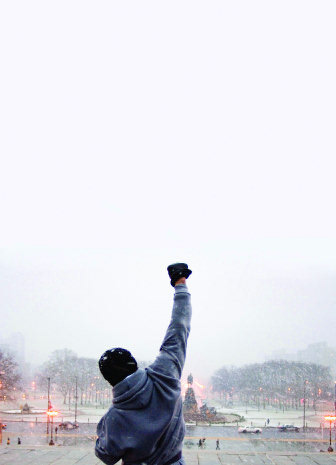
When Jen and I emerged from the movie last night into the cold night - we were so jazzed up and so exhilarated that we talked a mile a minute as we charged across the city to our subway stop. We talked and talked and talked - about Rocky, and Stallone, and the franchise itself (which we both just love), and the movie, and why it was good, and why it worked ... and at one point I exclaimed, in all my excitement, "Oh my God! I have boose gumps right now!"
Boose gumps.
That kind of sums up the entire experience for me, so I figured I'd start out with that.
And Jen made a great comment, too. At one point, the two of us sat in our seats, huddled together, holding ourselves back from clapping and screaming like lunatics, cheering Rocky on, just letting out some of our adrenaline, and also clutching Kleenex because the scene before that one had been a tear-jerker. We were beside ourselves. Later Jen said, "You know what? He didn't make that movie for himself. Or to prove he still 'got it'. Or anything like that. Member the moment when we were all huddled together, clapping, and losing our minds? He made that movie for those people."
Now. There is so much else to say about this very insightful point.
This movie, as far as I was concerned, had almost an absence of ego. Which is so surprising when you consider how much ego there COULD have been in such a venture. Even the ending credits ... which I won't give away ... just had this wonderful sense of ... non-self-importance, of playfulness, of celebration, of openness and ... It wasn't a movie that over-thought itself. It was a movie made for those of us who loved Rocky Balboa, and those of us who followed his journey, through movie after movie. Behind this film was a generosity of spirit. Behind this film was an acknowledgement of the fact that he, Stallone, had created something that resonated for YEARS with people who were fans of the franchise.
Stallone did not blow us - the giggly happy clapping cheering "Go, Rocky!" fans - off. He did not sell us out. He did not come back with an overblown bloated movie that made us embarrassed to have liked the franchise in the first place. That was my original fear when I heard about the "new Rocky". I was afraid it would be bad. I was afraid that I would be sad for him. I was afraid that I would be sad for Rocky, and sad that Stallone didn't just leave well enough alone.
How little faith I had.
Stallone is one of the oddest success stories in Hollywood. He is someone for other entrepreneur artists to emulate, to learn from. Nobody gave this guy jack SHIT until he showed his stuff, on his own. He IS Rocky Balboa (however, the funny thing is is if you hear him in interviews, he's way more articulate than Rocky - which is a reminder that he is actually, you know, ACTING.) He has created a character. A character he knows, inside out ... but it's not, strictly, HIM. He is not playing himself.
Stallone has ALWAYS played to his strengths. I don't think he gets enough credit for that. He doesn't try to show his versatility (although he has way more versatility than he gets credit for - Copland?). Stallone is very smart. He knows who he is, and who his persona is - and he hasn't made TOO many errors with it. And so his mis-steps are forgiven and forgotten. Sam, one of my great teachers, said to me once, "Self-knowledge is one of the most important aspects an actor can have." Know what you can do. And then DO it. Whether or not anyone asks you to do it. DO it. Nobody asked Stallone to create Rocky. He just went ahead and DID it. He knew he could "hit it" with that part. That was HIS part.
And his canniness as a screenwriter is also way under-rated.
Obviously, not totally under-rated. Rocky was highly decorated (nominations as well as awards) in 1976 - and Stallone became the third person to be nominated for acting and writing in the same year. (The other two were Charlie Chaplin and Orson Welles. Yeah. Uh-huh. THAT'S the kind of company this guy keeps.)
So now onto this latest film and why it didn't just exceed my expectations - but satisfied me on the deepest fangirl level.
-- Let's start with the title. Stallone is freakin' smart. He didn't title it Rocky VI. I think it started out with that as the title - but at some point along the way, it became Rocky Balboa. This is so right. It's not about Rocky topping himself, or going beyond, or any of the other things that that number would have suggested. He definitely has to push himself, and go up to his limits in this movie - but the REAL story is about Rocky Balboa realizing - that there is unfinished stuff in his life - "stuff in the basement" - stuff he needs to get out. It's not about beating an opponent. It's not even about winning. It's about getting back to who he really is. The title is perfect. Very smart.
-- I need to talk about Stallone's acting in this movie. He's not trying to show he's a tough guy - or that he's still 'got it'. You know how embarrassing that can be. Think Michael Douglas being married to Gwyneth Paltrow in that silly movie, and how ridiculous that was. Especially because the age difference was never referenced, or even brought up. We're supposed to just believe that a 22 year old girl would marry a man like that. For love. Cary Grant never ever made such a stupid mistake. He never opened himself up to that ridicule. Even when he made Charade - he was VERY concerned with the age difference. He spoke with Stanley Donen a lot about it - and wanted to make sure that it was SHE who did the pursuing. He knew it just wouldn't look right for a man his age to be pursuing a girl who was so much younger. (Never mind what he did in his personal life. That's irrelevant to this conversation.) And so the movie works - because there is this bemused understanding, from his side, that - "wow, I am WAY too old for this girl ..." It's self-knowledge (we're back to that again.) Michael Douglas just wanted us to swallow the fact that he got to marry Gwyneth Paltrow. He didn't want us to question it, because his own personal ego is wrapped up in the fact that he's still 'got it'. See what I mean? There's a lack of self-knowledge there which has hurt Michael Douglas in some of his choices. Again: I'm not talking about his personal life, which has nothing to do with his PERSONA, and how it is perceived.
And so Stallone did everything right in this movie. He didn't pump himself up. He didn't film himself lovingly, or with soft-focus anxiety. He didn't push the romance. I was SO glad he was smart enough to have it just be a friendship, a helper, a supportive woman. Maybe it WILL develop into a relationship, maybe not ... but the actual journey of the film is about Rocky Balboa stopping living in the past, and embracing the present. The woman in the film is a symbol of that. He's starting to come out of his shell.
But there would have been something wrong about seeing Rocky in a romance at this point. Stallone would have opened himself up to all kinds of criticism - for setting himself up to look too good (think about the criticism Barbra got for her nails in Prince of Tides - vicious. Directors have to be really careful about stuff they also act in. Especially in Stallone's case - where he also writes the stuff. If it looks too much like a vanity project, people can tell.)
Stallone went for the grit. He remembered what the whole franchise was about. He remembered what we loved about it. The local color, the rattling subway, the smoking sidewalks, the meat hanging in windows ... Rocky running by ... a local boy ... at heart. And Rocky Balboa embraces that.
There were moments where I felt like - my life flashed before my eyes. I have grown up with this franchise. I can't remember a time (literally) when I have not "known" Rocky Balboa. It's IN me. And so I have nostalgia. And I'm okay with that. And what I LOVE is that ... Stallone is okay with that too. I have nostalgia for Adrian. For that scene in the pet shop. For her glasses. For the scene in the ice rink. I feel like I was there. I can recite some of those scenes by heart. I KNOW these people. And Stallone, in this latest movie, gave it all to me. Without sentimentality. We revisit all the spots. We see Rocky in his familiar surroundings. We get a couple of blurry flashbacks of Adrian (poetically done - blurry and sometimes black and white - not literal) and I felt like: Oh God. It is so good to see her again.
There was one line in the movie that I thought was a bit too ... cheesy I guess ... but only one. Other than that, the script was fantastic. It was funny, unexpected, powerful - surprisingly emotional - it was all about the characters - really low on plot - which was good - and some of my favorite moments were the subtle ones.
Scenes to look for, in terms of how well-written and simple they are - and also how efficient and expedient - his scenes ALWAYS propel the movie along. There is NO FAT on his movies. Spielberg should take a page out of Stallone's book. When you think you are done with editing - edit MORE out. Faster is better. Shorter is better. Always. It is never the case that it is BETTER to say something in 2 pages that you could also say in 2 lines.
Scenes to look for:
-- the scene in the dog pound. It's so simple you might even miss it. But seriously: watch for the gentle humor of it, the verbal banter back and forth and also ... what the scene is actually about. It's not about Rocky getting a dog. It's about Rocky bonding with the kid. However. What they are both doing in the scene - is talking about the dog. That's good writing. It's not on the nose. There's no soundtrack cueing you how to feel. There's no closeups where it's bashed over your head: LOOK! THEY'RE BECOMING FRIENDS! Nope. What we see is Rocky and the kid trying to pick out a name for the dog. Beautiful work. All around. Beautifully written and beautifully acted.
-- The scene between Rocky and son on the street outside Rocky's restaurant. Jen said afterwards, "Now that is good parenting!"
All I can say is: My God. Watch Stallone when he says, "I just want to be involved..." and watch his gesture with his hands when he says that. Acting really is that simple. It told me everything I needed to know. About the character - Rocky's blunt honesty, his emotional maturity, his willingness to just say what's going on with him - and also - there's just something raw about it. That, for me, was always the appeal of that first Rocky. Its willingness to be raw. Its rawness was the whole thing. I mean - the way it ended! So not what would be expected. Stallone did not create this character originally to just be a winner, a big ol' champion. He created a MAN. Who didn't always win. Or at least - he didn't win in the obvious ways. He lost the match - but he won his battle within himself, and he won the girl.
THAT is the beauty of this franchise at its best - and the beauty of the last "chapter".
It never loses sight of the character. Or of why we loved him in the first place.
I may just be speaking for myself - but I don't think that Rocky was so loved just because he kicked people's asses. That was maybe why guys loved Rambo - but that's not what Rocky was about. He was human - people related to Rocky. What was awesome about that character was his underdog status, of course - how hard he had to work for everything he got - and also ... that heart, that big big messy raw open heart. I mean: "I LOVE YOU ADRIAN!" Seriously. I still can't watch that scene without being totally covered in boose gumps.
And Stallone does not make the mistake of thinking that we need to see him win. We need to see Rocky's struggle. We need to see his obstacles. We need to invest in his training (and, come on, awesome training montage with the song that I could sing in my sleep. Oh - and written by a Rhode Islander, thank you very much). We don't need to look at his opponent and think: "Rocky is TOTALLY gonna kick some ass." We need to look at his opponent and think: "Hm. I'm kinda scared for Rocky." We need to BELIEVE that once again Rocky has to go down into that basement, that dark place where he keeps his ambition, his fire, his drive ... and stand up. Stand up and fight.
Other scenes/moments to look for:
-- Before the big match in Vegas - Rocky is surrounded by paparazzi, and I can't remember the exact line - but they're all shouting questions at him, and he says (but not with ego - again, the no ego thing) - "I guess they say it ain't over til it's over." Something like that. And one of the reporters jokes, "Is that a saying from the 80s?" Joking about his age. And Stallone says, "I think it might be from the 70s." I can't explain WHY it is so funny - the way he says it - but it got a HUGE laugh. Beautiful.
-- There's a moment where Stallone is in the meat locker with Paulie (Paulie!!!) - and he's talking about the fact that he might want to fight again ... nothing big ... no big deal ... just local fights ... because he's still got some stuff ... "down in the basement" ... that he has to deal with. Paulie is trying to talk him out of it. "YOU'RE NUTS. YOU'RE 60! YOU'RE NUTS!" And Stallone has this monologue where he kind of explodes - not in a big actor-y way - it was totally real. He starts talking about how hard it is ... how he didn't think life was supposed to be so hard ... and during this monologue, Stallone suddenly gets choked up. And you know, there's something devastating about a man that big getting choked up. A man who is not used to crying, and so when the tears come up - they freak him out and must be suppressed immediately. When Ed Harris gets choked up in Apollo 13 it has the same effect on me in the audience. It feels like my heart might burst. Sometimes actors cry and we in the audience feel nothing. Perhaps because it seems too "actor"-y. Actors know how to cry and so sometimes the tears seem cheap, too easily come by. And therefore not really human. And here's another great acting lesson: If the actor tries to suppress the tears - then those in the audience will get the catharsis. The audience will cry. Sometimes I cry watching an actor cry (Gwyneth Paltrow breaking down in Sylvia comes to mind. When she starts weeping, I cry, too. Perhaps because her character is normally so tearless and brittle, so when she breaks down I feel like I get the release too). But when an actor is desperately trying not to cry ... it can be so effective. Because it seems real, it seems like life.
The scene ended and Jen silently handed me a napkin. And we both sat there mopping the tears off of our faces, and having the time of our lives.
The soundtrack to the movie was perfect. Subtle. Underneath scenes. But not in a cloying way, not too much. When the "training montage" came we got the burst of music - the music we all know - and it just felt so right, so familiar, so ... perfect ... The movie earned that. It didn't assault us with it from the get-go.
Intensity builds at the end - in a crescendo - and I hadn't read too many reviews that gave away the ending, and how it all comes out - so I just didn't know what the outcome would be. The theatre we saw it in wasn't packed - but people were definitely cheering and clapping - you could feel the urgency and stress in the air - Jen started punching the air a bit, during the fight. You were living the scene, rather than watching it. Like all great fight scenes in boxing movies. The fight just works. It works on every level it needs to work. It works on the level of plot - it needs to come to that in the story, and it does. It all feels inevitable and right. It works in terms of character - the journey of Rocky with his son, with Paulie, with his opponent. All of these elements are there in that fight. So we are invested. It is not an empty action sequence. It is not a done deal that Rocky will win. And also, at this point in his life - what is winning? THAT'S what the movie is about.
Here is how that last fight would go if Stallone was trying to still prove something or prove that he still 'had it' or was still a bad-ass:
He would have set up his entrance into the ring differently. He would have had it be ominous. Like: Uh oh. This upstart young heavyweight champion don't know what's about to hit him! Uh oh! Which would have been embarrassing. Because all we're feeling out in the audience is: Rocky, you're 60. Please be careful. Stallone knows we're feeling that and so his entrance into the ring ... and the music that Paulie chose for his entrance music ...
I won't give it away but it's a PERFECT choice.
Let me just say: that in my humble opinion Sylvester Stallone has ended this franchise in a perfect way with not one jangly off-key note.
Even through the credits (stay to the end, people. Stay to the end.) That last moment, if you love the Rocky series like I love it, is truly boose gump worthy.
I tracked down a review Roger Ebert wrote of the first Rocky. It's obviously written long after it had come out - maybe it was for his "great movies" series - but it just captures the feeling of this franchise (at its best) perfectly. Boose gumps. Read it below the jump.
Rocky
By Roger Ebert / January 1, 1976
She sits, tearful and crumpled, in a corner of her little bedroom. Her brother has torn apart the living room with a baseball bat. Rocky, the guy she has fallen in love with, comes into the room.
"Do you want a roommate?" she asks shyly, almost whispering.
"Absolutely," says Rocky.
Which is exactly what he should say, and how he should say it, and why "Rocky" is such an immensely involving movie. Its story, about a punk club fighter from the back streets of Philly who gets a crack at the world championship, has been told a hundred times before. A description of it would sound like a cliche from beginning to end. But "Rocky" isn't about a story, it's about a hero. And it's inhabited with supreme confidence by a star.
His name is Sylvester Stallone, and, yes, in 1976 he did remind me of the young Marlon Brando. How many actors have come and gone and been forgotten who were supposed to be the "new Brando," while Brando endured? And yet in "Rocky" he provides shivers of recognition reaching back to "A Streetcar Named Desire." He's tough, he's tender, he talks in a growl, and hides behind cruelty and is a champion at heart. "I coulda been a contender," Brando says in "On the Waterfront." This movie takes up from there.
It inhabits a curiously deserted Philadelphia: There aren't any cars parked on the slum street where Rocky lives or the slightest sign that anyone else lives there. His world is a small one. By day, he works as an enforcer for a small-time juice man, offering to break a man's thumbs over a matter of $70 ("I'll bandage it!" cries the guy. "It'll look broke"). In his spare time, he works out at Mickey's gym. He coulda been good, but he smokes and drinks beer and screws around. And yet there's a secret life behind his facade. He is awkwardly in love with a painfully shy girl (Talia Shire) who works inthe corner pet shop. He has a couple of turtles at home, named Cuff and Link, and a goldfish named Moby Dick. After he wins forty bucks one night for taking a terrible battering in the ring, he comes home and tells the turtles: "If you guys could sing and dance, I wouldn't have to go through this crap." When the girl asks him why he boxes, he explains: "Because I can't sing and dance."
The movie ventures into fantasy when the world heavyweight champion (Carl Weathers, as a character with a certain similarity to Muhammad Ali) decides to schedule a New Year's Eve bout with a total unknown -- to prove that America is still a land of opportunity. Rocky gets picked because of his nickname, the Italian Stallion; the champ likes the racial contrast. And even here the movie looks like a genre fight picture from the 1940s, right down to the plucky little gymnasium manager (Burgess Meredith) who puts Rocky through training, and right down to the lonely morning ritual of rising at four, drinking six raw eggs, and going out to do roadwork. What makes the movie extraordinary is that it doesn't try to surprise us with an original plot, with twists and complications; it wants to involve us on an elemental, a sometimes savage, level. It's about heroism and realizing your potential, about taking your best shot and sticking by your girl. It sounds not only cliché¤ but corny -- and yet it's not, not a bit, because it really does work on those levels. It involves us emotionally, it makes us commit ourselves: We find, maybe to our surprise after remaining detached during so many movies, that this time we care.
The credit for that has to be passed around. A lot of it goes to Stallone when he wrote this story and then peddled it around Hollywood for years before he could sell it. He must have known it would work because he could see himself in the role, could imagine the conviction he's bringing to it, and I can't think of another actor who could quite have pulled off this performance. There's that exhilarating moment when Stallone, in training, runs up the steps of Philadelphia's art museum, leaps into the air, shakes his fist at the city, and you know he's sending a message to the whole movie industry.
The director is John Avildsen, who made "Joe" and then another movie about a loser who tried to find the resources to start again, "Save the Tiger." Avildsen correctly isolates Rocky in his urban environment, because this movie shouldn't have a documentary feel, with people hanging out of every window: It's a legend, it's about little people, but it's bigger than life, and you have to set them apart visually so you can isolate them morally.
And then there's Talia Shire, as the girl (she was the hapless sister of the Corleone boys in "The Godfather"). When she hesitates before kissing Rocky for the first time, it's a moment so poignant it's like no other. And Burt Young as her brother -- defeated and resentful, loyal and bitter, caring about people enough to hurt them just to draw attention to his grief. There's all that, and then there's the fight that ends the film. By now, everyone knows who wins, but the scenes before the fight set us up for it so completely, so emotionally, that when it's over we've had it. We're drained.
Basketball
Found this on the Library of Congress website.
I can't stop looking at this photograph.
It reminds me of Luvvy and the Girls (a book I adored when I was a kid).

Girl's Basketball Team Milton High School North Dakota 1909 (John McCarthy is presumed to be the photographer)
I am especially struck by the background (obviously a backdrop), but my eyes are drawn to its curlicued ornate-ness, and its rampant velvet-tasseled domesticity.
January 17, 2007
Ben Franklin's Birthday!

I have only a few years to live and I am resolved to devote them to the work that my fellow citizens deem proper for me; or speaking as old-clothes dealers do of a remnant of goods, 'You shall have me for what you please.' --Benjamin Franklin to Benjamin Rush, before leaving for France in 1776
Ben Franklin was born on this day in 1706. His accomplishments have a way of making me feel like a little teeny homunculit with no contribution made to the betterment of the planet. I read his lifestory and just think: But ... but ... how ... how ... how does one man do so much? What a mind. What curiosity. What humor. Of all of the Founding Fathers, he seems the most human to me. Even though what he managed to do in his life is almost super-human. And any ONE of those things (the almanac, the kite, the Declaration of Independence, his sojourn in Paris) would have been enough to put him in the history books forever. But all of it? It's unbelievable. But still - even with all of that - somehow he seems the most ... accessible. Perhaps because he wrote a pamphlet about farts. Because of his almanac, and how funny it is. Perhaps because beneath all of it - you sense a man who LIVED. He was brilliant, of course - but ... he also seemed to be very much of this earth. He liked to drink, play cards, read, flirt ... His intelligence was of a wide scope. He inquired about everything. That is a mark of true intelligence: can you admit how much you DON'T know?
Every year I commemorate the day that the Library Company opened - which is one of my favorite stories of Franklin's life - the creation of that library, still a library today. Awe-inspiring.
Things he invented, investigated, developed - electricity, bifocals, the fire department in Philadelphia, the glass armonica, the list goes on and on.
I love this - I found this on the Library of Congress website. In response to the Stamp Act - which impacted Franklin's newspaper (and all newspapers) because it had to be printed on stamped paper - Franklin printed the following, on November 7, 1765. No date, no masthead, no page numbers.
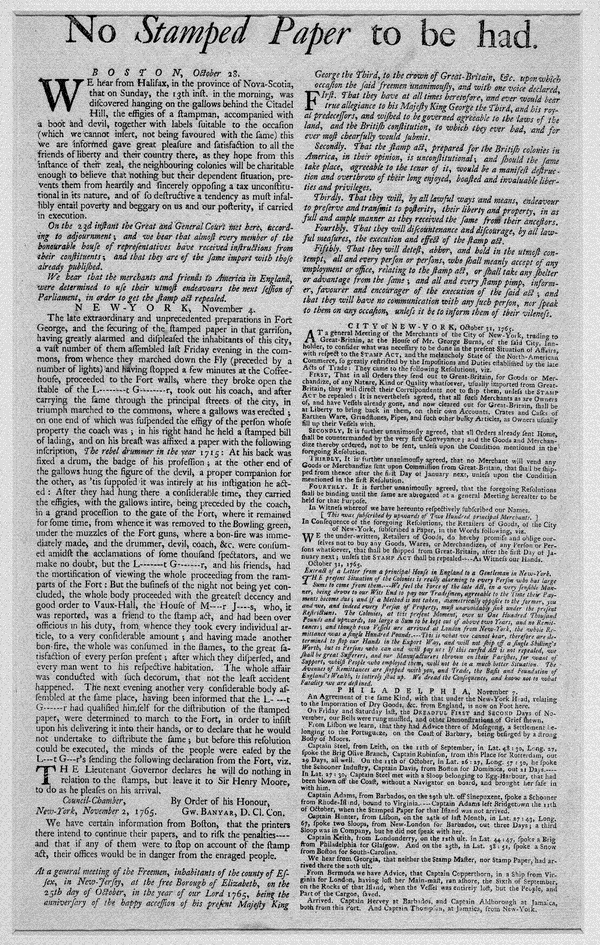
Ben Franklin said, "A man wrapped up in himself makes a very small bundle." Indeed. Reminds me of Henry Miller's great quote: "Develop interest in life as you see it, in people, things, literature, music - the world is so rich, simply throbbing with rich treasures, beautiful souls and interesting people. Forget yourself."
That, to me, describes Benjamin Franklin.
Happy birthday, Ben!
Update: I knew Alex had written a fun tribute to him last year. Just tracked it down!
The Books: Magic for Marigold (L.M. Montgomery)
 Magic for Marigold - by L.M. Montgomery
This is a novel - published in 1929. It is one of her few stand-alone novels, there is no Marigold: The Sequel. And you know, there are hints throughout the book that Marigold might not be made for adulthood. There's something fragile about her. She was a weak baby, and she takes everything very hard as a young girl. I can't remember where in the text Lucy Maud gives hints - but I know they were there.
All of that being said - I guess I'm not too wacky about Marigold. She just wasn't that compelling a heroine for me. She seemed to have a good imagination (which all of Lucy Maud's heroines do - except for stupid Pat of Silver Bush who couldn't imagine her way out of a paper sack. What a boring nitwit. She should be hospitalized. I think there's something actually wrong with her.) But anyway, back to Marigold. She sees the trees as creatures like fairies or wizards, she adores the hills on the horizon, she makes up a fantasy world - what is over that hill? A land of magic and rainbows and blah blah blah. I guess, to be honest, I've heard it all before. Lucy Maud has done this story - and much better - with Emily in the wind barrens in the spruce bush, and Anne with the White Way of Delight ... I guess Marigold just doesn't stand out, for me. However, there are some hilarious episodes in this book. Like when Marigold hears a missionary talk at a prayer meeting - and becomes so suffused with the desire to become holy - that she prays 14 hours a day, she stops eating, she wants to be pale and holy ... her family just tolerates this pious ridiculousness, knowing it's a fanatical phase. That's rather amusing. Some of the Lesley family members are quite memorable. I love Uncle Klondike. The woman-hater. Who then, naturally, turns around and marries the feisty female doctor named Marigold. Marigold is named after her. Marigold's mother is a pale sad nonentity. Lucy Maud didn't write parents very well. She had no experience with them herself - so whenever there are parents in her books - she either kills them off immediately (like in Emily) - or they are long dead by the time the book starts (like in Anne). In the few books where the parents live - Marigold, the Pat books - they're just ... not convincing. The mothers are usually saintly, sickly, and basically sit back and watch everyone else live their lives. And the fathers are jolly, twinkley, and rather detached from the main family action. The REAL characters are always people like the aunts, the uncles, the servants, the relatives, the extended family. Lucy Maud wrote about THEM like nobody's business. These people LIVE.
The excerpt I've chosen below is - well, it's a long one - and to be honest, it's some of my favorite writing that Lucy Maud has ever done. In her whole career. It's all just one woman talking - an extended monologue. But ... God, it's Lucy Maud shining, at her very very best.
Marigold, a little girl, is hanging out with her ancient great-grandmother - who is 99 years old. Great-Grandmother (referred to as "Old grandmother") is crotchety, bedridden, with laser-beam eyes that don't miss a thing, everyone lives in fear of her, she says what's on her mind, she is intolerant of foolishness, she is unpredictable ... and she has also lived for a bazillion years - so nobody can imagine her dying. It seems fine to let Marigold, a 6 year old, a 7 year old, stay at home with the great-grandmother while all the adults go out to a dinner party. Marigold can keep her company, and everything will be fine.
But Great-grandmother has other plans. She hasn't been outside for years. She is surrounded by younger generations, who all treat her as though she is ancient, and feeble and barely human. She hasn't been out in the garden for 20 years.
So when the house is empty - excpet for Marigold - Great-Grandmother decides. She wants to go out into the garden and see the moonlight. And not only that: but after she has done so, she will go back to her bed and die. With as little fuss as possible. By herself. She will choose her moment when she will go.
And that's what happens.
But it's the time in the garden - with Marigold, the 7 year old girl who is kind of afraid of her great-grandmother, and Great-Grandmother, the 99 year old terrifying bossy old fossil ... that I want to excerpt. The thing about it is: The Great-Grandmother has been set up in the chapters before this one as the opposite of a poetic or a ... contemplative personality. She's not mean - she's just hard as nails, she is not a lot of fun, she makes Marigold memorize Bible verses even though it's a bright sunny day out and Marigold wants to play - she's so old that everyone is alienated by her - and she tells the truth even if it's terrible - and everyone cowers when she is around. That is how she has been set up.
But now comes her last night on earth. She has decided it is going to be her last night. Marigold doesn't know this. But we, the reader, can tell. She's moving towards the boundary between life and death.
Lucy Maud shows her genius in this excerpt. Parts very poignant, parts laugh out loud funny (the bees at the wedding! the icing on the cake!), parts profound, and parts just plain old good story-telling ... It's what I find so damn compelling about her writing.
I only read Magic for Marigold in its entirety once. But I have read this excerpt many many many times. It's one of the pieces of writing I go to, regularly, if I need strength, or comfort, or perspective. I cherish it. And the last moment of the excerpt - the "Edith" moment - never fails to bring tears to my eyes.
Excerpt from Magic for Marigold - by L.M. Montgomery
Old Grandmother sank down on the stone bench with a grunt. She sat there silent and motionless for what seemed to Marigold a very long time. The moon rose over the cloud of spruce and the orchard became transfigured. A garden of flowers in moonlight is a strange, enchanted thing with a touch of diablerie, and Marigold, sensitive to every influence, felt its charm long years before she could define it. Nothing was the same as in daylight. She had never been out in the orchard so late as this before. The June lilies held up their cups of snow; the moonlight lay silver white on the stone steps. The perfume of the lilacs came in little puffs on the crystal air; beyond the orchard lay old fields she knew and loved, mysterious misty spaces of moonshine now. Far, far away was the murmur of the sea.
And still Old Grandmother dreamed on. Did she see faces long under the mould bright and vivid again? Were there flying feet, summoning voices, that only she could hear in that old moonlit orchard? What voices were calling to her out of the firs? Marigold felt a funny little prickling along her spine. She was perfectly sure that she and Old Grandmother were not alone in the orchard.
"Well, how have you been since we came out here?" demanded Old Grandmother at last.
"Pretty comf'able," said Marigold, rather startled.
"Good," said Old Grandmother. "It's a good test - the test of silence. If you can sit in silence with any one for half an hour and feel 'comfortable', you and that person can be friends. If not, friends you'll never be and you needn't waste time trying. I've brought you out here to-night for two reasons, Marigold. The first is to give you some hints about living, which may do you some good and may not. The second was to keep a tryst with the years. We haven't been alone here, child."
No; Marigold had known that. She drew a little closer to Old Grandmother.
"Don't be frightened, child. The ghosts that walk here are friendly, homey ghosts. They wouldn't hurt you. They are of your race and blood. Do you know you look strangely like a child who died seventy years before you were born? My husband's niece. Not a living soul remembers that little creature but me - her beauty - her charm - her wonder. But I remember her. You have her eyes and mouth - and that same air of listening to voices only she could hear. Is that a curse or a blessing I wonder. My children played in this orchard - and then my grandchildren - and my great-grandchildren. Such a lot of small ghosts! To think that in a house where there were once fourteen children there is now nobody but you."
"That isn't my fault," said Marigold, who felt as if Old Grandmother were blaming her.
"It's nobody's fault, just as it's nobody's fault that your father died of pneumonia before you were born. Cloud of Spruce will be yours some day, Marigold."
"Will it?" Marigold was startled. Such a thing had never occurred to her.
"And you must always love it. Places know when they're loved - just the same as people. I've seen houses whose hearts were actually broken. This house and I have always been good friends. I've always loved it from the day I came here as a bride. I planted most of those trees. You must marry some day, Marigold, and fill those old rooms again. But not too young - not too young. I married at seventeen and I was a grandmother at thirty-six. It was awful. Sometimes it seems to me that I've always been a grandmother.
"I could have been married at sixteen. But I was determined I wouldn't be married till I had finished knitting my apple-leaf bedspread. Your great-grandfather went off in such a rage I didn't know if he'd ever come back. But he did. He was only a boy himself. Two children - that's what we were. Two young fools. That's what everybody called us. And yet we were wiser then than I am now. We knew things then I don't know now. I've stayed up too late. Don't do that, Marigold - don't live till there's nothing left of life but the Pope's nose. Nobody will be sorry when I die."
Suddenly Marigold gasped.
"I will be sorry," she cried - and meant it. Why, it would be terrible. No Old Grandmother at Cloud of Spruce. How could the world go on at all?
"I don't mean that kind of sorriness," said Old Grandmother. "And even you won't be sorry long. Isn't it strange? I was once afraid of Death. He was a foe then - now he is a lover. Do you know, Marigold, it is thirty years since anyone has called me by my name? Do you know what my name is?"
"No-o," admitted Marigold. It was the first time she had ever realised that Old Grandmother must have a name.
"My name is Edith. Do you know I have an odd fancy I want to hear some one call me that again. Just once. Call me by my name, Marigold."
Marigold gasped again. This was terrible. It was sacrilege. Why, one might almost as well be expected to call God by His name to His face.
"Say anything - anything - with my name in it," said Old Grandmother impatiently.
"I -- I don't know what to say, --- Edith," stammered Marigold. It sounded dreadful when she had said it. Old Grandmother sighed.
"It's no use. That isn't my name -- not as you say it. Of course it couldn't be. I should have known better." Suddenly she laughed.
"Marigold, I wish I could be present at my own funeral. Oh, wouldn't it be fun! The whole clan will be here to the last sixth cousin. They'll sit around and say all the usual kind, good, dull things about me instead of the interesting truth. The only true thing they'll say will be that I had a wonderful constitution. That's always said of any Lesley who lives to be over eighty. Marigold --" Old Grandmother's habit of swinging a conversation around by its ears was always startling, "what do you really think about the world?"
Marigold, though taken by surprise, knew exactly what she thought about the world.
"I think it's very int'resting," she said.
Old Grandmother stared at her, then laughed.
"You've hit it. 'Whether there be tongues they shall fail - whether there be prophecies they shall vanish away' -- but the pageant of human life goes on. I've never tired watching it. I've lived nearly a century - and when all's said and done there's nothing I'm more thankful for than that I've always found the world and people in it interesting. Yes, life's been worth living. Marigold, how many little boys are sweet on you?"
"Sweet on me." Marigold didn't understand.
"Haven't you any little beau?" explained Old Grandmother.
Marigold was quite shocked. "Of course not. I'm too small."
"Oh, are you? I had two beaux when I was your age. Can you imagine me being seven years old and having two little boys sweet on me?"
Marigold looked at Old Grandmother's laughter-filled and moonlight-softened black eyes and for the first time realised that Old Grandmother had not always been old. Why, she might even have been Edith.
"For that matter I had a beau when I was six," said Old Grandmother triumphantly. "Girls were born having beaux in my day. Little Jim Somebody - I've forgotten his last name if I ever knew it - walked three miles to buy a stick of candy for me. I was only six, but I knew what that meant. He has been dead for eighty years. And there was Charlie Snaith. He was nine. We always called him Froggy-face. I'll never forget his huge round eyes staring at me as he asked, 'Can I be your beau?' Or how he looked when I giggled and said 'no'. There were a good many 'no's' before I finally said 'yes'." Old Grandmother laughed reminiscently, with all the delight of a girl in her teens.
"It was Great-Grandfather you first said 'yes' to, wasn't it?" asked Marigold.
Old Grandmother nodded.
"But I had some narrow escapes. I was crazy about Frank Lister when I was fifteen. My parents wouldn't let me have him. He wanted me to run away with him. I've always been sorry I didn't. But then if I had I'd have been sorry for that, too. I was very near taking Bob Clancy - and now all I can remember about him was that he got drunk once and varnished his mother's kitchen with maple-syrup. Joe Benson was in love with me. I had told him I thought he was magnificent. If you tell a certain kind of man he's magnificent, you can have him - if you really want that kind of a man. Peter March was a nice fellow. He was thought to be dying of consumption, and he pleaded with me to marry him and give him a year of happiness. Just suppose I had. He got better and lived to be seventy. Never take a risk like that with a live man, Marigold. he married Hilda Stuart. A pretty girl but too self-conscious. And every time Hilda spent more than five cents a week Peter took neuralgia. He always sat ahead of me in church, and I was always tormented with a desire to slap a spot on his bald head that looked like a fly."
"Was Great-grandfather a handsome man?" asked Marigold.
"Handsome? Handsome? Everyone was handsome a hundred years ago. I don't know if he was handsome or not. I only know he was my man from the moment I first set eyes on him. It was at a dinner-party. He was there with Janet Churchill. She thought she had him hooked. She always hated me. I had gold slippers on that night that were too tight for me. I kicked them off under the table for a bit of ease. Never found one of them again. I knew Janet was responsible for it. But I got even with her. I took her beau. It wasn't hard. She was a black velvet beauty of a girl - far prettier than I was - but she kept all her goods in the show-window. Where there is no mystery there is no romance. Remember that, Marigold."
"Did you and Great-Grandfather live here when you were married?"
"Yes. He built Cloud of Spruce and brought me here. We were quite happy. Of course we quarreled now and then. And once he swore at me. I just swore back at him. It horrified him so he never set me such a bad example again. The worst quarrel we ever had was when he spilled soup over my purple silk dress. I always believed he did it on purpose because he didn't like the dress. He has been dead up there in South Harmony graveyard for forty years, but if he were here now I'd like to slap his face for that dress."
"How did you get even with him?" asked Marigold, knowing very well Old Grandmother had got even.
Old Grandmother laughed until she had hardly enough breath left to speak.
"I told him that since he had ruined my dress I'd go to church next Sunday in my petticoat. And I did."
"Oh, Grandmother." Marigold thought this was going too far.
"Oh, I wore a long silk coat over it. He never knew till we were in our pew. When he sat down the coat fell open in front and he saw the petticoat - a bright Paddy-green it was. Oh, his face - I can see it yet."
Old Grandmother rocked herself to and fro on the stone bench in a convulsion of mirth.
"I pulled the coat together. But I don't think your great-grandfather got much good of that sermon. When it was over he took me by the arm and marched me down the aisle and out to our buggy. No hanging round to talk gossip that day. He never spoke all the way home - sat there with his mouth primmed up. In face he never said a word about it at all - but he never could bear green the rest of his life. And it was my color. But the next time I got a green dress he gave our fat old waserwoman a dress off the same piece. So of course I couldn't wear the dress and I never dared to get green again. After all, it took a clever person to get the better of your great-grandfather in the long run. But that was the only serious quarrel we ever had, though we used to squabble for a few years over the bread. He wanted the slices cut thick and I wanted them thin. It spoiled a lot of meals for us."
"Why couldn't you have each cut them to suit yourselves?"
Old Grandmother chuckled.
"No, no. That would have been giving in on a trifle. It's harder to do that than give in on something big. Of course we worked it out like that after we had so many children the question was to get enough bread for the family, thick or thin. But to the end of his life there were times when he would snort when I cut a lovely think paper-like slice, and times when I honestly couldn't help sniffing wh en he carved off one an inch thick."
"I like bread thin," said Marigold, sympathising with Old Grandmother.
"But if you marry a man who likes it thick - and I know now that every proper man does - let him have it thick from the start. Don't stick on trifles, Marigold. The slices of bread didn't worry me when your great-grandfather fell in love with his second cousin, Mary Lesley. She always tried to flirt with every male craeture in sight. Simply couldn't leave the men alone. She wasn't handsome but she carried herself like a queen, so people thought she was one. It's a useful trick, Marigold. You might remember it. But don't flirt. Either you hurt yourself or your hurt some one else."
"Didn't you flirt?" asked Marigold slyly.
"Yes. That's why I'm telling you not to. For the rest - take what God sends you. That was a bad time while it lasted. But he came back. They generally come back if you have sense enough to keep still and wait - as I had, glory be. The only time I broke loose was the night of Charlie Blaisdell's wedding. Alec sat in a corner and talked to Mary all the evening. I flew out of the house and walked the six miles home in a thin evening dress and satin shoes. It was in March. It should have killed me, of course - but here I am at ninety-nine tough and tasty. And Alec never missed me! Thought I'd gone home with Abe Lesley's crowd. Oh, well, he came to his senses when Mary dropped him for something fresher. But I can't say I was ever very fond of Mary Lesley after that. She was a mischief-maker, anyhow, always blowing old jealousies into a flame for the fun of it.
"I got on very well with the rest of the clan, though my in-laws were mostly very stupid, poor things. Alec's mother didn't approve of us having such a big family. She said it kept Alec's nose to the grindstone. I had twins twice just to spite her, but we got on very well for all that. And Alec's brother Sam was a terrible bore. Nothing ever happened to him. He never even fell in love. Died when he was sixty, in his sleep. It used to make me mad to see any one wasting life like that. Paul was a black sheep. Always got drunk on every solemn or awful occasion. Got drunk at Ruth Lesley's wedding - she was married from here - and upset two stands of bees over there by the apple-barn just as the bridal party came out here to the orchard to be married. That was the liveliest wedding I was ever at. Never shall I forget old Minister Wood flying up those steps pursued by bees. Talk about ghosts!"
Old Grandmother laughed until she had to wipe tears from her eyes.
"Poor Ruth. She was so stung up she looked like a bride with the smallpox. Oh, well, she had only about half a brain, anyway. She always threw her arms about her husband in public when she wanted to ask him some small favor. How red and furious he got! And he always refused. You'd have thought she'd have learned some sense in time. Some women never do. Be sure you have some sense, Marigold, when it comes to handling the men."
"Tell me some more stories, Grandmother," entreated Marigold.
"Child, I could tell you stories all night. This orchard is full of them. Up there by the scabby apple-tree Bess Lesley swooned because Alexander McKay asked her to marry him too suddely. People 'swooned' in my day - 'fainted' in your grandmother's. Now they don't do either. But what a lot of fun they miss. Alexander thought Bess was dead - that he'd killed her with his abruptness. We found him on his knees by her, tearing his hair and shrieking blue murder. He thought I was a brute because I threw a dipperful of water over her. She came to very quickly - her curls were only paper ones - and such a looking creature as she was, with them hanging limp about her face and a complexion like a tallow candle. But she had a wonderful figure. It seems to me the girls look like sticks nowadays. Alexander clasped her in his arms and implored her to forgive him. She forgave him - and married him - but she never forgave me. Talking of ghosts - they had a haunted door in their house. Always found open no matter how it was shut and locked."
"Do you really believe that, Grandmother?"
"Of course. Always believe things like that. If you don't believe things you'll never have any fun. The more things you can believe the more interesting life is, as you say yourself. Too much incredulity makes it a poor thing. as for the ghosts, we had another haunted house in the clan - Garth Lesley's-over-the-bay. It was haunted by a white cat."
"Why?"
"Nobody knew. But there it was. The Garth Lesleys were rather proud of it. Lots of people saw it. I saw it. At least, I saw a white cat washing its face on the stairs."
"But was it the ghost cat?"
"Oh, there you go again. I prefer to believe it was. Otherwise I could never say I'd seen a real ghost. Over there in that corner where the three pines are, Hilary and Kate Lesley agreed to tell each other what they really thought of each other. They thought it would be fun - but they never 'spoke' again. Kate was engaged at one time to her third cousin, Ben Lesley-over-the-bay. It was broken off and later she found her photograph in his mother's album adorned with horns and a moustache. There was a terrible family row over that. In the tail of the day she married Dave Ridley. A harmless creature - only he would eat the icing off his wife's piece of cake whenever they went anywhere to tea. Kate didn't seem to mind - she hated icing - but I always wanted to choke him with gobs of icing until he had enough of it for once. Ben's sister Laura was jilted by Turner Reed. He married Josie Lesley and when they appeared out in church the first Sunday Laura Lesley went too, in the dress that was to have been her wedding one, and sat down on the other side of Ben. Alec said she should have been tarred and feathered, but I tell you I liked her spunk. There's a piece of that very dress in my silk log-cabin quilt in the green chest in the garret. You are to have it - and my pearl ring. Your great-grandfather found the pearl in an oyster the day we were engaged and had it set for me. It was reckoned worth five hundred dollars. I've left it to you in my will so none of the others can raise a rumpus or do you out of it. Edith-over-the-bay has had her eye on it for years. Thinks she should have it because she was my first namesake. She owes me more than her name if she but knew it. She wouldn't exist at all if it hadn't been for me. I made the match between her father and mother. I was quite a matchmaker in my time. They really didn't want to marry each other a bit but they were just as happy as if they had. All the same, Marigold, don't ever let any one make a match for you."
Old Grandmother was silent for a few moments, thinking over, maybe, more old, forgotten loves of the clan. The wind swayed the trees and the shadows danced madly. Were they only shadows ----?
"Annabel Lesley and I used to sit under the syrup apple-tree over there and talk," said Old Grandmother - in a different voice. A gentle, tender voice. "I loved Annabel. She was the only one of the Lesley clan I really loved. A sweet woman. The only woman I ever knew who would keep secrets. A woman who would really burn a letter if you asked her to. It was safe to empty your soul out to her. Learn to keep a secret, Marigold. And she was just. Learn to be just, Marigold. The hardest thing in the world is to be just. I never was just. It was so much easier to be generous."
"I could sit here all night and hear you tell about these people," whispered Marigold.
Old Grandmother sighed. "Once I could have stayed up all night - talking - dancing - and then laugh in the sunrise. But you can't do those things at ninety-nine. I must leave my ghosts and go in. After all they were a pretty decent lot. We've never had a real scandal in thhe clan. Unless that old affair about Adela's husband and the arsenic could be called one. You'll notice when Adela's books are spoken of, she's 'our cousin'. But when the porridge mystery comes up she's 'a third cousin'. Not that I ever believed she did it. Marigold, will you forgive me for all the pills I've made you take?"
"Oh, they were good for me," protested Marigold.
Old Grandmother chuckled.
"Those are the things we have to be forgiven for. But I don't ask you to forgive me for all the Bible verses I made you learn. You'll be grateful to me for them some day. It's amazing what beautiful things there are in the Bible. 'When all the morning stars sang together.' And that speech of Ruth's to Naomi. Only it always enraged me, too, because no daughter-in-law of mine would ever have said the like to me. Ah, well, they're all gone now except Marian. It's time - it's high time for me to go, too."
Marigold felt it was such a pity Old Grandmother had to die just when she had got really acquainted with her. And besides Marigold had something on her conscience.
"Grandmother," she whispered, "I -- I've made faces at you when you weren't looking."
Old Grandmother touched Marigold's little round cheek with the tip of her finger.
"Are you so sure I didn't see your faces? I did - often. They weren't quite as impish as the ones I made at your age. I'm glad I've lived long enough for you to remember me, little child. I'm leaving off - you're beginning. Live joyously, little child. Never mind the old traditions. Traditions don't matter in a day when queens have their pictures in magazine advertisements. But play the game of life according to the rules. You might as well, because you can't cheat life in the end.
"And don't think too much about what people will say. For years I wanted to do something but I was prevented by the thought of what my cousin Evelina would say. At last I did it. And she said, 'I really didn't think edith had so much spunk in her.' Do anything you want to, Marigold - as long as you can go to your looking-glass afterwards and look yourself in the face. The oracle has spoken. And after all, is it any use? You'll make your own mistakes and learn from them as we all do. Hand me my cane, child. I'm glad I came out. I haven't had a laugh for years till to-night when I thought of poor Minister Wood and the bees."
"Why, I've heard you laugh often, Grandmother," said Marigold, wonderingly.
"Cackling over the mistakes of poor humanity isn't laughing," said Old Grandmother. She rose easily to her feet and walked through the orchard, leaning very lightly on her cane. At the gate she paused and looked back, waving a kiss to the invisible presences behind her. The moonlight made jewels of her eyes. The black scarf wound tightly round her head looked like a cap of sleek black hair. Suddenly the years were bridged. She was Edith - Edith of the gold slippers and the Paddy-green petticoat. Before she thought, Marigold cried out,
"Oh - Edith - I know what you looked like now."
"That had the right sound," said Old Grandmother. "You've given me a moment of youth, Marigold. And now I'm old again and tired - very tired. Help me up the steps."
Catalog Card for my blog

How fun!
I found the site Catalog Card Generator from Mental Multivitamin.
American Idol recap!
I'll be posting over there once I get over my shyness.
However, just reading Jess' notes from last night made me laugh out loud all over again.
January 16, 2007
Helm's Deep
I seriously cannot speak. Nothing I say could be adequate to respond to the genius and beauty of THIS. I'll just leave you with one tantalizing quote:
We used over 500 Gummy Bears as orcs and Uruk-Hai. The Elves, Dwarves and Men were represented by sour patch kids.
I love the human race. Deeply.
Here's the link. I can't stop looking at all of those photos.
Thanks, Faustus, for the link.
Things
I've been working a lot on off-line stuff - not the particular piece below (which is part of a long-ass novella I wrote) - but I figured I'd post this anyway. At the bottom I provide links to other bits from this long piece I've posted. You'll start to see the theme. Not the plot, perhaps, but the theme.
THINGS
Erin and Zachary sat in the dark smoky spaces of nighttime Chicago (when they were not in either his bed or her bed) and talked about things. Literally: Shower curtains. Forks. Ballpoint pens. Dental floss. Pringles. Filing cabinets. Objects held a talismanic power for him. The rocking chair from God, (described to her in such excruciating detail their first night together), had been Erin's first clue in this regard. She picked up on something going on here. Objects anchored him to the earth: a shower curtain will always be a shower curtain; things had a permanence that he found riveting. Although he never said it like that. He did not analyze himself. He just talked to her eternally about his elasticized sheets, his new phone, his confusing remote control. She loved this. She would prompt him, egg him on. "So ? tell me about your coffee maker." She was completely content hearing him describe his futon frame for the hundredth time.
When Zack's brother got married, he had given his old futon-frame to Zachary. Zachary told Erin about the problems with it in loving detail. When he tried to move the futon-frame up into its couch position, it kept slipping down. It wouldn't hold its shape. Something was wrong. Zack loved it when things were wrong. So he devised a way to keep it in position using a bungee cord. He demonstrated the process to Erin one night.
"Now watch. Watch what happens without the bungee."
Erin sat cross-legged on the dusty rug, drinking beer and watching, enthralled.
Zack flopped himself onto the un-bungee'd couch, making an elaborate obvious pantomime of his own everyday behavior, saying, "Oh, hey, whatever, I'd like to just sit on my couch?" and then, with a jolt, the frame crashed into horizontal mode, leaving Zack splayed out.
Zack leapt up. "But now ? watch this."
Deftly, he shoved the futon frame into position, grabbed the bungee, stretched it across the mid-section of the futon, and clipped the ends together round the back of the frame. Then Zack began the exact same pantomime from before. Erin felt like she was watching a Buster Keaton movie.
Zack exclaimed, overly casual, "Oh, hey, I feel like just sitting on my couch right now?" and he threw himself onto the futon, and lo and behold, it kept its form.
Erin applauded.
He was always dragging things in off the street, he couldn't stop himself. His apartment was cluttered with random un-needed furniture. He didn't care about spatial relations, or whether or not he actually needed the item. He put things anywhere. There was a huge bookcase in his tiny bathroom. He had a fancy curli-cued end table in his dank tiled kitchen. There were wooden chairs strewn about. It was accumulation, not decoration.
One night, at around 3 a.m., he had come across a desk on the street outside his apartment, and he had dragged it all the way up the three flights of stairs by himself. He had made such a ruckus, banging the desk accidentally against other apartment doors, making dents in the stairwell walls, long scratches in the paint, that other tenants had later complained to the landlord. Zachary admitted to Erin, "I was trashed. I felt like Popeye."
The desk only had three legs. Zack got in trouble with his landlord over a 3-legged desk. But he didn't care, the rest of it was in perfect condition. Z explained the entire desk to Erin in as much detail as someone else would describe their two-month trip through French Polynesia.
The 3-legged problem was solved by stacking milk crates up where the fourth leg would have been. Of course, the milk crates were full of things that Zachary needed to get to on occasion, all his video tapes, for example. So every time Zack and Erin wanted to watch a movie, the entire desk had to be dismantled and then put back together. It might have been simpler to keep the videos elsewhere, Erin thought, but she held her tongue, because Zack seemed to like the entire process too much. It filled him with excitement, and an awareness of his own ingenuity. By dismantling the desk repeatedly, he could realize again and again what a rock star he was for having it in the first place.
Zachary bombarded Liam and Erin one night with a rambling soliloquy about his coffee table (what it looked like, why it was so cool, why it changed his whole living room). At one point, 5 minutes into the speech, Liam turned, looked directly at Erin, and stated in a bored and over-it monotone, "It's a coffee table. It is not the reincarnation of Christ."
But Zack wasn't "bored and over" anything. And nothing was "just".
He said to her once, as they were drinking beer at O'Reilly's, "So I'm really excited about my new deodorant."
Erin lit up. "Tell me everything."
"Well, you know how much I sweat ? "
"Uh. Yes. I am aware of it."
"And no matter what I use, the sweat still comes. So I asked my doctor about it, and he recommended something called Dry Sol."
Dry Sol. He said it as though the words were "the ark of the Covenant".
"Dry Sol. What is that?"
"Well, it's deodorant," he said impatiently.
"Okay, okay. Calm down."
"And it is unbelievable. I no longer sweat. At all. I remain completely sweat-free for hours on end."
"Meanwhile, silver oxide is leaking out of your shoulder," was Erin's worried comment. Zack skipped over this.
"It's a miracle. I don't have to wash my clothes every other day anymore." He lifted his arm up and commanded her, "Feel my pits." They were in a public place, so Erin hesitated. Zack lifted his arm up higher, a bully, "Come on, feel my pits. Feel 'em!" A red-faced drunk sitting on the other side of Zack leered at this entire exchange, waiting to see what Erin would do.
Blushing, Erin placed her hand in Zack's armpit, investigating the situation.
"See? See? Am I not completely dry?" His tone were was one of "I told you so", intimating that Erin had been bad-mouthing Dry Sol for weeks.
A glow radiated within Erin, moving outwards, gliding over her skin. She leaned in to him and softly kissed his mouth. "Yes. You are completely dry."
Zack had gotten so worked up it looked like some sort of Tasmanian rage might be coming on. He bellowed, an off-kilter spokesman, "Dry Sol. It kicks some serious ass."
Other parts of this story:
January 14, 2007
Snapshots
-- I am almost done with Gulliver's Travels. I am having so much fun with this book. I'll write more about it when I'm done.
-- Just finished Taming of the Shrew - part of my 2007 Shakespeare project - and I'm gearing up for a huge essay about THAT as well. A la 2 Gents.
-- This is boring to anyone except me. I am absolutely THRILLED. I started ordering products from Melaleuca - basically because it's convenient, and cheap, and it comes to my door, and it's all part of my ongoing plan to outsource as much as possible. I checked them out on the advice of Flynn- and I was intrigued. My first delivery arrived last week. I got soap, and vitamins, and crap like that ... but the laundry detergent!! I have no brand loyalty with laundry detergent (which is odd - most people seem to have some sort of loyalty). I have not. Until now. I love the smell of this detergent so much that I feel almost addicted to it. It is a heavenly scent - I mean, laundry-ish and everything, but without a harsh industrial smell, and not too soapy. It just smells fresh and yummy. I am now ALL ABOUT MELALEUCA LAUNDRY DETERGENT. I took my first load out and then stood there for a while with my nose buried in my clean towels. I felt like a little kid in grade school (back in the day, I mean, back my MY day) - being handed a "ditto" and immediately shoving it up to my nose to take a nice deep long smell. (On a side note, Yankee Candle shoudl come out with THAT as a scent. "DITTO". Mmmmm.) Anyway. I adore my laundry detergent from Melaleuca and I ain't never goin' back. I have discovered brand loyalty at this late late stage in the game. I'll go to the mat for Melaleuca.
-- Allison and I had a rapturous afternoon together yesterday:
1. Talking about the black dahlia murder case
2. Talking about the rugby team who survived the plane crash in the Andes
3. Watching a show about Andrew Luster, the Max Factor heir who was a serial rapist - sick sick man. We were in heaven. At one point I said, after hearing about yet another girl he drugged and raped, "I have never had so much fun in my life." We were voracious. We had to keep pausing it to talk about it.
4. Talking about Marie Antoinette
5. Allison divulged how much she loved the book Our Mutual Friend - I've never read it, and she talked about it in such a way that made me want to pick it up right away
6. We watched the season premiere of The Extras - and Orlando Bloom!!! SO FUNNY! I have newfound respect for him. He TOTALLY made fun of his own persona - it was hysterical! In the episode, he was completely convinced that he was WAY better looking than Johnny Depp, and he was kind of fixated on it. If a woman preferred Johnny Depp to him - he even got angry about it. Like: No. Objectively, I am MUCH more better looking than Depp. He kept talking about Johnny Depp. He was so funny. Go, Orlando!! Love that show.
-- Went over to Siobhan's bar last night - hoping to get a chance to hang out with her - but the place was PACKED. I said "Hi!" to Siobhan, and then 45 minutes later, said, "Bye!" That was all she had time for. Poor woman. But it was okay because there were a couple of other of Siobhan's friends hanging out - and so we all got a table, and had a good time. Oh and apparently - the cute dude who played the brother in Bring It On was there. I didn't see him, though, it was too crowded.
-- Cool misty weather. Is it January?
-- Met up today with Jen to hear about her trip to Hawaii. The quote of the afternoon came from Jen:
"And then ... I found myself face to face with a wild boar."
I mean, really, what more is there to say.
10:45 p.m. last night
13th Street between 6th and 7th (one of my favorite blocks in the city).
Got a picture of one of my favorite churches in New York. Cell phone camera quality.
January 12, 2007
I want to make myself clear
First off, here's this to start:

But let me return to my main point. I am not reversing my position on mimes. Repeat: I am NOT reversing my position on mimes. No need to be alarmed. (My main beef with mimes are American mimes who stand in Central Park and "walk in wind tunnels" and hand you "flowers" and make "sad faces" as they "wave" good"bye". I want to punch THOSE mimes in the head. Because you know they're just a backrub boy theatre geek, with dirty toenails, and I just feel implicated and ikky when I am around such people.)
So no. I am not going soft on mimes.
Neither am I going soft on commedia dell arte. So Mitchell, don't yell at me. What I am about to say in this post is not a reversal on our position. Like you: I recognize the importance of commedia in theatrical history. I respect the theatrical form. And also I never want to hear about it again. Don't try to get me excited about commedia. It will just make me angry.
So, to recap:
Mimes: Dumb (mainly of the "let me hang out in Central Park and use this as an excuse to 'flirt' with pretty girls who would never give me the time of day otherwise because I'm so obviously a backrub boy" variety.)
Commedia: I understand the history. I understand the pantaloons, the masks, the historical context. Please don't ever speak to me of commedia again. Thank you.
All of that being said - I have just discovered a Russian theatre company called black SKY white (here's the website) - and I am absolutely entranced by what I see! I must must keep my eyes out for them coming to New York (or Philadelphia, or anywhere on the upper east coast, actually). I would LOVE to see what they are about.
At the moment, they are performing their production called Astronomy For Insects at the Escena Abierta theatre festival in northern Spain.
From what I gather, black SKY white takes as one of their influences Antonin Artaud and his "theatre of cruelty". (Artaud is another one of those artists every actor eventually studies - at least if you go to school - because the books he wrote, and his ideas about theatre, did push the artform forward. But - like many of these voices - his ideas are very very difficult to put into practice. If you start to read Artaud's work, or research what he means by 'theatre of cruelty' - you can't help but start to have practical questions. But ... how would all that WORK, Antonin? How would you make that into a play?? black SKY white appears to be trying to answer those questions.)
I mean check out that first photo. It's so full. It's archetypal - and almost abstract - and yet - to me, it resonates with emotion. It's not static. Okay, you know what I hate about amateur American mimes? You know what I hate most of all? (And I'm just realizing this right now). I can't stand their COYness. I hate coyness in general - in life and in theatre (unless it's part of the play or the character) - but a coy performance? It makes me angry. The understanding of human emotion in coyness is so shallow, so ... peremptory. Like: don't even BOTHER, mime. Don't even TRY, CHiPs.
But that image above? It's full of real emotion.
More from this theatre company below the fold. I will definitely need to keep my eye open for them. (See, and THAT is what I would do if I were rich. You know how you always get that question: "If you were rich, what would you do first?" I would love to own a house, I would love to be able to travel more, I would love to have a Jaguar, but I would also love to - on a whim - book a plane ticket to Spain tomorrow and go hang out at the festival! A couple of years ago I worked on a production with a wonderful theatre director from Iran and I'm not sure what her financial situation was - she must have been wealthy - but that's what she did in her time between productions. She worked in New York, or she worked in London - but then she would fly to Germany for a theatre festival, drive to freakin' Poland to catch a week-long festival there, she would then fly to Moscow to see the latest production of a director she loved... She showed me pictures of some of those productions and I would just drool at some of the images. Theatre that is NOT a profit-making enterprise. Theatre that is NOT just about the bottom line. There's a big world out there. Lots of amaaazing stuff going on and sometimes it's easy to forget that.)
black SKY white photos (oh, and these are not all from the same production - they are from their works through the years.) The second one from the bottom totally freaks me out. That's not just makeup. Whatever is going on in the makeup is also going on deep deep in the eyes. Shiver!


Next week!!
(of course) is the premiere of this season of American Idol.
I no longer have TV - or, I have TV, but no cable - so any participation I may have this year will need to be at the mercy of my good friends who have proper and 21st century television service.
This year's premiere will find me at Jess' - with Curly, and Mejack - for the festivities. I kind of cannot wait, to be honest with you.
You'll be able to read all about it here. At American Midol - the group blog that is Jess and Curly's hilarious brainchild. I was very happy when they asked me to participate this year. Thank you ladies!
Obsessives and fanatics - you'll NEED to go visit that blog throughout this next season. There will always be something going on over there.
And things are about to get NUTS!!
the secret lives of dresses
I got goosebumps reading the latest one. Marvelous.
Maude on DVD
I am thrilled to hear this news.
UPDATE
THE ENTIRE POST BELOW IS OUT OF DATE. HOLY SHIT. I HAD NO IDEA. NOBODY TOLD ME.
I'm so excited. I am buying them immediately.
Out-of-date bitching to follow:
Now can we PLEASE PLEASE release 30something on DVD too? I can't tell you how many stupid Internet petitions I've signed, the basic plea being: 'We, the undersigned, wish to see 30something be released ..." I met the former president of Lifetime at a dinner party a couple years ago - and I bombarded him with questions about who owns the rights to that show (because Lifetime played the entire show in re-runs during 1994 and 1995 ... a glorious time for all 30something fans) ... I demanded to know WHY it hadn't been released. He, naturally, did not know. I then said, "Uhm ... could you re-run it again, please? Just for me?" I wasted no time with small talk with this dude.
He: "I was once the President of Lifetime."
Me: "Awesome, good for you. Now what about re-running 30something again, chappie?"
I'm sure it will be released eventually - it's just a matter of time - but seriously. That show was a phenom at the time - and I know many people hated it, and bitched about it, and yapped and whined and moaned about it - wah wah, those people are so annoying, wah wah, what privileged yuppie saps, wah wah, I hate those people!
Shut up, please. To me, the only annoying people were the ones who bitched about that show nonstop for 2 years. You hate those people? Then don't freakin' watch it. Honestly. I loved the show. To me - some of those actors on that show had acting moments that were pretty much as good as it gets - not just in terms of television acting, but in terms of acting IN GENERAL ... Patricia Wettig? Forget about it. She was extraordinary on that show. But they all were. Perhaps not Mel Harris - but she did her part fine enough ... I want to see it all again. I actually video-taped as many episodes as I could during the glorious re-run time in the mid-90s - Mitchell will remember this well, since we lived together at the time. They ran them in order - every night was a new episode, at 11:30 pm. We ran our social lives around 30something. Because we were younger then, we would make plans to go out, and meet up with our various boyfriends, AFTER we watched 30something. And I taped them all. But the tapes are going bad. They're fuzzy now, nearly unwatchable.
The situation is growing urgent.
But regardless of my 30something gripe, yay for the release of the first season of Maude!
You know what? This makes me think I need to do a whole 30something post. I remember DBW and I talking about it a while back. It would be a great post. I have SO much to say about all of those people. I still haven't recovered from Garry's death. I never will, thank you very much. I grieve about it on long winter evenings. (movie quote, anyone??)
"So instead I stop & wonder ...
If that cloud was full of pain ..."
What? You do? Is that what you wonder, Jess?
One of my favorite ongoing series is Jess' posting of "Bad Poetry" she wrote when she was a teenager. They are delicious. They are earnest. The poems speak of the tragedies of life ... and they are written by a 14 year old girl. Hilarious.
How to read when you're an itsy-bitsy midget
... and the books are huge:
From Gulliver's Travels:
They have had the art of printing, as well as the Chinese, time out of mind. But their libraries are not very large; for that of the King's, which is reckoned the biggest, doth not amount to above a thousand volumes, placed in a gallery of twelve hundred foot long, from whence I had the liberty to borrow what books I pleased. The Queen's joiner had contrived in one of Glumdalclitch's rooms a kind of wooden machine five and twenty foot high, formed like a standing ladder; the steps were each fifty foot long. It was indeed a moveable pair of stairs, the lowest end placed at ten foot distance from the wall of the chamber. The book I had a mind to read was put up leaning against the wall. I first mounted to the upper step of the ladder, and turning my face towards the book, began at the top of the page, and so walking to the right and left about eight or ten paces, according to the length of the lines, till I had gotten a little below the level of my eyes, and then descending gradually till I came to the bottom; after which I mounted again, and began the other page in the same manner, and so turned over the leaf, which I could easily do with both my hands, for it was as thick and stiff as a pasteboard, and in the largest folios not above eighteen or twenty foot long.
I can just so picture that.
I'm having so much fun reading this book right now. I'll post more excerpts when I'm done. The chapters where Gulliver describes the government of his own country to the giant King - and the King shows absolute horror at how barbaric they are - especially in regards to politics - and Gulliver has actually felt, in his life, that his own kingdom of England is the most enlightened on the planet ... well, you can see what Swift is getting at there. The chapters are vicious. Vicious satire.
Gulliver has almost escaped from Brobdingnag now. His floating box in the ocean has been rescued by a ship.
Then I'll be on to his third voyage, in Part III of the book.
Friday Favorites ...
More science fiction art posted by Carl V. This stuff is magical.
I love love LOVE the Probability Moon one - and I also just adore City in Winter. But they're all incredible images.
January 11, 2007
Joseph Cornell's boxes

Something about Joseph Cornell's work speaks to me. It's hard to describe why so I'll try to put some of my thoughts into this post.
I think part of it has to do with that whole miniature thing I've talked about before. How much I loved, as a kid, things that were small. Like the Borrowers. Or Stuart Little. Or like the people who lived in a bookcase on Captain Kangaroo. (I'm re-reading Gulliver's Travels right now - and, incidentally, laughing out loud like a lunatic in public as I turn the pages - but I feel the same sort of thrill when I listen to Swift tell about how Gulliver made a chair, when he was in the land of the giants, and the materials he used to do so - and how things looked from the perspective of one who was so much smaller than everybody else.) I loved little mini people who used spools as tables, and matchboxes as beds. I wanted to become miniature myself.
So there's something in the boxes of Joseph Cornell, with their little cubby holes, their faces peeking out, the little marbles in tiny drawers ... that appeals to that childlike view of the world. You can imagine little creatures living in those boxes. He seemed to create them not just to be looked at - but for them to be inhabited. He built boxes for Emily Dickinson. Her ghost haunts those boxes (of course even more so when you know which ones are the "Emily boxes"). But he didn't build them as gifts FOR Emily Dickinson (who, of course, was long dead). He built them as spaces that she might inhabit. It was like "preparing a place" for her. That's why so many of the Emily boxes are empty. With open windows. Which is interesting, too. He always wanted to make sure that Emily had a way to escape.
I'm getting ahead of myself.
Joseph Cornell lived in Queens on Utopia Parkway his whole life (and the name of that street could not be more perfect, in terms of his life and his outlook), never venturing further than the island of Manhattan, except for one trip to the Jersey Shore, I believe. He spent his days walking up and down the avenues of Manhattan, finding little trinkets and antiques and cigar boxes and stuff for his art at second-hand shohps and junk shops. He sat in Automats and fantasized about waitresses. He loved gum-snapping ordinary girls who liked to go to the movies and who smoked cigarettes. He never talked to these women who served him his coffee (or, he rarely spoke to them) - but they lived large in his dream-life, his fantasy-world. He would write about them in his diary. Then every night he would come home to his Christian Scientist mother, his beloved brother who had severe cerebral palsy (Joseph was his primary caretaker) - and sat in his workroom and made these extraordinary boxes. He was on the frontline of the modern art movement in this country, being influenced by the Surrealists. He hung out with all the famous artists of the day, who loved his work, revered its innocence, its ingenuity. Artists would trek out to his little house on Utopia Parkway, and they would sit in the backyard, and hang out with Robert, the sick brother (who sounds like he had a helluva sense of humor - he loved to talk like an overdramatic War of the Worlds radio announcer as a joke), and drink milk (Cornell never had a drop of liquor in his life and had the worst sweet tooth known to man - you read his daily intake in his journal and you feel the sugar coursing through his veins). Mrs. Cornell, the frowning disapproving mother glowered out the window at the motley crew of artist, ballerinas, and homosexuals in her backyard. Cornell would take his friends into his workroom and show them his latest boxes.
He wasn't "modern" in how he lived his life. He died a virgin. His last words were, "I wish I had not been so reserved." (which just pierce my heart). And yet the beauty and mystery of his work captivated the greatest artists of the day - and still captivate people. I adore them. They are fairy tales made manifest (and not just happy-ending fairy tales. Some of them are downright scary). There is often a very ominous sense in the boxes. Either of a space just emptied, or a space waiting for something. The emptiness is not static. It is potent. Waiting.
Sometimes you can feel the almost stalker-ish vibe of the artist beneath the beautiful little boxes. He was never a creepy stalker - he wasn't really a sexual adult, he would never be aggressive with these women that he loved and admired. It was more like a revering thing, a heroine worship thing. He loved the girls who worked at Automats, but he also had intense fantasy relationships with certain actresses (Lois Smith, Lauren Bacall) and ballerinas. He made boxes for women he found gorgeous or mysterious. An actress would finish her performance, come back to her dressing room, and find this perfect amazing little box made by Joseph Cornell waiting for her on her table. He would never have hung around to have a personal interaction with her. He was too shy, too ... weird, frankly. He preferred his fantasies to remain fantasies. If he actually talked to Lois Smith, and found out that she was different from his fantasy of her, it would have been devastating. He protected himself from that. But these women would be awestruck by the detail, by the tribute ... in these little boxes ... made just for them. Boxes that now are in the Museum of Modern Art, at the Chicago Institute ... Those boxes have now traveled the world.
There's much more about this man ... way more ... I worked on an "untitled Joseph Cornell" project for a couple of years, a play being developed - and did mounds of research. Lois Smith was involved with the project as an advisor, since she had known him. We got to see the box that Cornell made for her. We went to MOMA to a little screening room and watched some of Cornell's "movies" (and I remember David and I being like: "Uhmmmm ... stick to boxes, Joseph, mkay?").
But mainly what we did was just look at those boxes. Over and over and over. We couldn't get enough of them. Any clue about Joseph Cornell's personality would have to be found there ... because the information on him, otherwise, is rather slim. His diaries are impressionistic, non-revealing. Well, that's not right. They are very revealing - and I love them - they're contemplative, ruminative, almost Proust-like - he goes from one sense to another - a small rainbow in an oil-slicked puddle transports him back in time to a moment in his childhood with his brother ... but Cornell writes none of this in a linear way. He truly is time-traveling in that diary. He isn't creating a memory ... he is actually experiencing it all over again. The diaries are tough reading, if you're looking for biographical information.
This huge tragedy in his later life - when he got involved with a woman who ended up being bad BAD news (that was my part in the Joseph Cornell project - I played the bad BAD news girl) - she was an Automat type girl, but definitely at the end of her rope. Not much is known about her except that Cornell befriended her. He probably wanted to save her. He had her out to Utopia Parkway a couple of times. He was probably in some sort of rhapsody of pre-pubescent female worship. And this woman (a girl, really) - stole some of his boxes out of his workshop. To sell. He discovered this later. The girl (obviously not the brightest bulb) went to a gallery in Manhattan and tried to sell them. Naturally, the gallery owner became suspicious - because this girl was rather ratty-looking - pretty, but definitely edgy. Gallery owner calls Joseph Cornell and tells him, "There's a young lady here with a bunch of your boxes." Betrayal. Cornell, though, who was probably cut to the core (but again, you'd never know, this is just me guessing) - refused to prosecute. He knew she had a terrible life, she was a drug addict, a runaway, probably a prostitute. She didn't need him prosecuting her. He let her alone. Not even a year later, she was murdered in the fleatrap hotel she was staying in on the upper West Side. Her killer has never been found, and the case remains a mystery. Nobody knows who did it, although it was assumed, at the time, that it was probably a drug-dealer. She ran with a very unsavory crowd.
Why I bring this whole thing up is: Not ONE word of this gets into the diaries. Or - if it does, it is so highly coded that you would never know. Cornell had his ways of escape. He knew, intuitively, that most women were trapped (and he had no experience with real actual women - this was just his sense from movies - he was a huge movie-goer). Women needed protection. Women needed to be nurtured and needed to be saved. And so he created boxes where they could be free. Which is a paradox, naturally. Because ... it's a box. Who can get out of a box? Isn't that just another way of trapping somebody? But in a way - if he created that space for his fantasy - (of Lauren Bacall, of the Automat girl he was in love with) then nobody could touch it. Nobody could wreck it, or make it unclean, or assign sinister cynical motives to it. It would be pure.
"I wish I had not been so reserved."
Oh, Joseph. But your work. Your work.
There is no reserve in your work.
And when you look at the images below: if you haven't seen a Cornell box in person, then just know that you can't really get the feel of them in a two-dimensional image. They are made to be seen in 3-D. They have depth. You can reach into them. You can roll little marbles down shoots in some of them. Things move. There are little springs. Hidey-holes. Drawers you can open. Sadly, you can't touch any of them in a museum - and that's probably rightly so - just because the wear and tear would be too much, and these are precious works of art.
But I'll leave you with one last story about Cornell. This is my absolute favorite. Cornell lived in the same neighborhood his whole life. He never left. And when I mean never, I mean never. I think, on the whole, he spent maybe 5 nights away from his house in his whole life.
So the little kids in the neighborhood were so not in awe of him. He was just "Joseph" who lived with his mother and his sick brother. And also he had this amazing workroom with boxes and sometimes Joseph would let the neighborhood kids come in and look around. He wanted the kids to touch them. He encouraged them. "See ... watch how when I drop the marble in this little hole ... watch where it goes ...." He would drop the marble, and look on, pleased to the tips of his toes at the googly-eyed look of amazement on the child's face. He would even let the kids borrow some of the boxes, if they really wanted to. Of course this probably horrified the gallery owners who showed his work. Like: That "toy" costs $200,000!!! Cornell wasn't an idiot savante - he was an artist and he knew that what he created was art - but still, he loved to see little kids, especially, play with them. One little girl was particularly taken with one of the boxes, so he let her take it home with her. The next day she brought it back. He said, "So soon?" She said, "Yeah. I'm done with it now."
Isn't that so perfect. She had done what she needed to do with the box. Maybe she played with it for a good 5 hours straight, hiding in her room with a flashlight late at night ... and so she was "done with it" after that.
A beautiful thing. Cornell absolutely loved that response - and of all of the critical raves he got from his peers - that one was the one he held most dear.
"I'm done with it now."

Verso of Cassiopeia 1
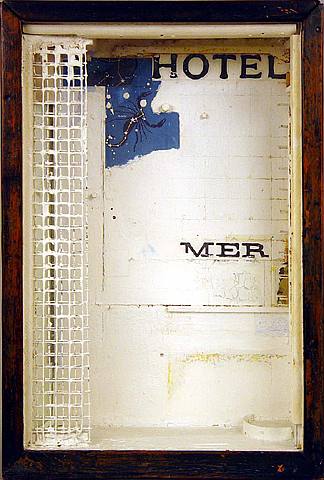
Untitled

Celestial Navigation with Alphabet Cube
Mlle Farretti (one of his many ballerina boxes)

Parrot for Juan Gris (Cornell had a huge thing for parrots)
Penny Arcade Portrait of Lauren Bacall (here's his most famous box probably - made for Lauren Bacall in 1946 - right after To Have and Have Not came out. Cornell was obsessed.)

Pharmacy - this one always seemed eerie to me. The little glass jars with objects inside ... it seemed like it could be poison, or the means to a suicide. It takes on meaning, whatever it is. The objects cease just being objects. All just my own interpretation of course - but that's what I love about his boxes.

Pink Palace This one terrifies me. I love it. The terrifying fairy tale. I could write an entire novel about that palace. I have a postcard of the Pink Palace up on my bulletin board. If you see it in person - then you'll see that you can reach into the space - the pink palace is set back - there's a hole for it, and the stage 'set' surrounds it like a proscenium. It gives it even more of a feeling of isolation and creepiness.

Soap Bubble Set - I think this might be my personal favorite. If I were a millionaire, I would buy it. I just want to have it around.
Toward the Blue Peninsula - This is his most famous "Emily Dickinson box". I could talk about what this box means and what Cornell was getting at for hours. My thoughts about this box never end.
Some more information on Cornell here.
If you're interested in learning more, Deborah Solomon's thorough biography is quite good.
And his diaries are fascinating, works of art in and of themselves.
The Art Institute in Chicago has the largest permanent collection of Cornell boxes. When I lived in Chicago I used to just go and visit them if I had a couple of hours free. I find them relaxing.
I can hear the drums, Fernando!!!
I am so excited about this news that I need to speak with Alex and Mitchell and Kate and Pastor Sean (ha, I'm laughing at myself for finding that link) and Guy IMMEDIATELY. Yes, I know Fernando is not included in the musical (sadness) but still. It seemed appropriate. I want the movie to open tomorrow, my anticipation is that bad. Alex, can you hear me? Mitchell, can you see me? Isn't this exciting? It's perfect, is what it is.
Little green men
I am loving reading this article about The 1955 Kelly, Kentucky, Incident.
I always wonder what CW will have to say about stuff like this. His posts on unidentified flying objects, and space aliens, and Area 51 are always really fun. I like his skeptical yet curious attitude about such things.
And then there's this screen grab. Which, obviously, is related.
I've been coming to this circle for about five years, and measuring it. The diameter and the circumference are constantly changing, but the radius stays the same. Which brings me to the number 5. There are five letters in the word Blaine. Now, if you mix up the letters in the word Blaine, mix 'em around, eventually, you'll come up with Nebali. Nebali.
Uh-huh. Nebali. Got it.
Happy birthday - to Alexander Hamilton
On this day, in 1755, Alexander Hamilton was born in the British West Indies. Happy birthday to one of the most compelling (to me anyway) founding fathers that we have. He was illegitimate (or - as John Adams called him: "the bastard brat of a Scotch pedlar")- his illegitimacy was a stain on his birth he strove to wipe away for the rest of his short life.

Hamilton:
Take mankind in general, they are vicious - their passions may be operated upon. Take mankind as they are, and what are they governed by? Their passions. There may be in every government a few choice spirits, who may act from more worthy motives [but] one great error is that we suppose mankind more honest than they are. Our prevailing passions are ambition and interest. Wise government should avail itself of those passions, to make them subservient to the public good.
Hamilton's also the one who said, at the end of his 6-hour long speech at the Constitutional Convention: "Decision is true wisdom." This is part of the reason why he is one of the most important members of that founding generation - but it is also the reason that people found him terrifying. Abigail Adams warned her husband, "That man is another Bonaparte."
There is a contradictory dynamic within him that I find so compelling.
I love the guy. What can I say. I fantasize about him. He's on my geeky historical freebie list, as well as on my: "People From The Past I would Like To Have At My Perfect Dinner Party" list.
Also. He's a bit hot.
Here's a big post I wrote a while back about one of my pet obsessions: the election of 1800. Some awesome information there about this man. Nobody was neutral about him. He was a polarizing kind of guy from the start.
Last year, the New York Historical Society had a massive Alexander Hamilton exhibit and Bill McCabe and I went - it was so so terrific. It was one of those events in New York when I was so excited to see all of it that I actually felt a bit nervous. You know what really got me? His DESK. I love actual objects ... the stuff historical figures actually touched, used ... He sat at that desk ...Here's a re-cap of our trip to the museum. Bill said something funny like, "I think this might be the first time I've gone to an exhibit like this where I'm with someone who knows MORE than I do about the topic." Hahahaha. History geeks - unite!!

The following is a letter the 17-year-old Alexander Hamilton wrote to his father, describing the hurricane that hit St. Croix on August 31, 1772 - one of the worst in the recorded history of the island. A couple of days later, Hamilton showed a copy of this letter to Reverend Knox (a very important person in the story of Alexander Hamilton - a real father figure to the boy.) Knox was so impressed with the prose that he arranged to have it published in the "Gazette". The letter was so well-received that Knox set the wheels in motion to send Hamilton to the colonies, so that he could get a college-level education. This move changed Hamilton's life. Here is the letter. It's riveting:
It began at dusk, at North, and raged very violently 'till ten o'clock. Then ensued a sudden and unexpected interval, which lasted about an hour. Meanwhile the wind was shifting 'round to the southwest ... it returned with redoubled fury and continued so 'till near three o'clock in the morning. Good God! What horror and destruction. It's impossible for me to describe or you to form any idea of it. It seemed as if a total dissolution of nature was taking place. The roaring of the sea and wind, fiery meteors flying about it in the air, the prodigious glare of almost perpetual lightning, the crash of the falling houses, and the ear-piercing shrieks of the distressed were sufficient to strike astonishment into angels.A great part of the buildings throughout the island are leveled to the ground, almost all the rest very much shattered, several persons killed and numbers utterly ruined, whole families running about the streets unknowing where to find a place of shelter; the sick exposed to the keenness of the water and air without a bed to lie upon or a dry covering to their bodies; and our harbors entirely bare. In a word, misery, in all its hideous shapes, spread over the whole face of the country ...
As to my reflections and feelings on this frightful and melancholy ocassion ...
Where now, oh! vile worm, is all thy boasted fortitude and resolution? What is become of thine arrogance and self-sufficiency? Why dost thou tremble and stand aghast? How humble, how helpless, how contemptible you now appear. And for why? The jarring of elements -- the discord of clouds? Oh! impotent presumptuous fool! Death comes rushing on in triumph, veiled in a mantle of tenfold darkness ... On his right hand sits destruction, hurling the winds and belching forth flames: calamity on his left threatening famine, disease and distress of all kinds. And oh! thou wretch, look still a little further. See the gulf of eternal misery open. There mayest thou shortly plunge -- the just reward of thy vileness. Alas! whither canst thou fly? Where hide thyself?
Uhm ... I look at my Diary Friday entries - written when I was 17 ... and ... er ... I hide my head in shame.
Hamilton, "stuck" in a clerking job in nowheresville-St. Croix, was 16 years old, and although he had a lot of responsibility as a shipping clerk, (a LOT of responsibility, he basically ran the joint) - he wanted to get things moving for himself. He wanted attention. He started to submit some of his poems to the "Gazette". He (as he did throughout his life) lied about his age, saying he was 17. When he was a kid he always said he was older, and when he was a man he always lopped a few years off his age (to make it seem like he was even MORE of a prodigy). Anyway, he sent these randy erotic poems to the newspaper, and they were published under the name "A.H." Both of the poems will show that the kid was wise beyond his years, on multiple levels. The poems made a sensation. Hamilton loved being "notorious".
Here's the first one:
In yonder mead my love I found
Beside a murm'ring brook reclin'd:
Her pretty lambkins dancing 'round
Secure in harmless bliss.
I bade the waters gently glide
And vainly hushed the heedless wind,
Then, softly kneeling by her side
I stole a silent kiss.
And here's the second one, even more explicit and sexy.
Coelia's an artful little slut;
Be fond, she'll kiss, et cetera -- but
She must have all her will;
For, do but rub her 'gainst the grain
Behold a storm, blow winds and rain,
Go bid the waves be still.
Very good erotic advice, AH, very good. I love the "et cetera". It says it all.
There is also that famous quote from a letter he wrote to his dear friend - who had already moved up to America, I believe - and Alexander wrote to him of his boredom, his feeling that he was stuck, his ambition.
I'm confident, Ned, that though my youth excludes me from any hopes of immediate preferment, nor do I desire it, but I mean to prepare the way for my futurity. I'm no philosopher, you see, and may be justly said to build castles in the air. My folly makes me ashamed and [I] beg you'll conceal it yet, Neddy, we have seen such schemes successful when the projector is constant. I shall conclude by saying, I wish there was a war.
"I wish there was a war".
He knew the advancement that war would bring (and indeed, it DID bring, eventually.)

The following is from Hamiton's 1774 pamphlet "The Farmer Refuted" - his first piece of Revolutionary writing.
The sacred rights of mankind are not to be rummaged for among old parchments ... They are written, as with a sunbeam, in the whole volume of human nature by the hand of Divinity itself.
The man was not yet 20 years old when he wrote that. There's a genius there - not just of sentiment but of expression. It has a Jeffersonian ring to it (although Jefferson would hate me for sayiing that.)
Hamilton's wrote "The Farmer Refuted" - while he was still a student at King's College (a loyalist college) - and yet getting swept away by revolutionary politics. He was surrounded by redcoats, surrounded by pro-British students ... and yet slowly he became convinced that the rebellious colonies were in the right. He wrote pamphlets under pseudonyms - "The Farmer Refuted" made a sensation. In it, he borrows from Locke's 2nd Treatise (as all "those guys" did). He was far ahead of many of the other Founding Fathers, in terms of becoming radicalized. The guys in Massachusetts were obviously radical, and ready for war ... many of the other colonies were more reticent. Hamilton foresaw the tumultuous year of 1776, and his prose reflects that.
In the former state [freedom], a man is governed by the laws to which he has given his consent, either in person or by his representative: in the latter [slavery], he is governed by the will of another. In the one case, his life and property are his own; in the other, they depend upon the pleasure of a master ... The foundation of the English consitution rests upon this principle, that no laws have any validity or binding force without the consent and approbation of the people, given in the persons of their representatives, periodically elected by themselves.
It is often surmised that because Hamilton was, essentially, an immigrant - he did not have that whole "I am loyal to my STATE" thing that all of the other founding fathers had. Jefferson referred to Virginia as "my country". Hamilton, if anything, felt loyal to New York - because it was King's College that opened its doors to him - but he wasn't from there. He didn't have a state loyalty. He was loyal to the idea of a united nation. He was way ahead of the curve. He already was an American.
Hamilton's war against Congress lasted pretty much his entire life. It began during the Revolutionary War, and he fired off letter after letter to officials and politicians, criticizing Congress' mishandling of the Army. He wrote a letter (one of many) to George Clinton about Congress (excerpt quoted below - Hamilton is only 23 years old here) - This letter launched his war. It was always a war to him. A war of words.
Folly, caprice, a want of foresight, comprehension and dignity characterize the general tenor of their actions. Of this, I dare say, you are sensible, though you have not, perhaps, so many opportunities of knowing it as I have. Their conduct with respect to the army especially is feeble, indecisive and improvident. We are reduced to a more terrible situation than you can conceive ...At this very day there are complaints from the whole line of three or four days without provisions. Desertions have been immense and strong features of mutiny begin to show themselves ... If effectual measures are not speedily adopted, I know not how we shall keep the army together. I omit saying anything of the want of clothing.
American once had a representation [in Congress] that would do honor to any age or nation. The present falling off is very alarming and dangerous. What is the cause? How is it to be remedied? The great men who composed our first council -- are they dead, have they deserted the cause, or what has become of them? Very few are dead and still fewer have deserted the cause ... They are either in the field or in the offices of the respective states. The only remedy is to return them to the place where their presence is infinitely more important.
A strong chord struck here - a harbinger of things to come: The states needed to give back their power and submit to a strong central government. The states needed to stop thinking of themselves as Virginians, Rhode Islanders, what-have-you. They needed to start thinking of themselves as Americans.
Hamilton was strongly in favor of arming the slaves against the British. As you probably know, Hamilton was very much against slavery, and many of his comments about prejudice are way ahead of his time. For example, he was saying in the mid-1770s: Perhaps it is not that the black population is not as smart, or not able to handle freedom -- Perhaps that is just what happens to a man when you do not allow him freedom or education. If you free blacks and educate them, then there is no reason that they should not succeed. Etc. This is all self-evident to us now, obviously, but back then? Not so much. Anyway, here is an excerpt from a letter Hamilton wrote to John Jay in 1779, recommending that they arm the slaves against the British.
I have not the least doubt that the Negroes will make very excellent soldiers with proper management. I frequently hear it objected to the scheme of embodying Negroes that they are too stupid to make soldiers. This is so far from appearing to me a valid objection that I think their want of cultivation (for their natural facilities are probably as good as ours) joined to that habit of subordination which they acquire from a life of servitude, will make them sooner become soldiers than our white inhabitants. Let officers be men of sense and sentiment and the nearer the soldiers approach to machines, the better.The contempt we have been taught to entertain for the blacks makes us fancy many things that are founded neither in reason nor experience. An unwillingness to part with property of so valuable a kind will furnish a thousand arguments to show the impracticability or pernicious tendency of a scheme which requires such a sacrifice. But if we do not make use of the slaves in this way, the enemy probably will. The best way to counteract the temptations they will hold out will be to offer them ourselves. An essential part of the plan is to give them their freedom with their muskets. This will secure their fidelity, animate their courage, and, I believe, will have a good influence upon those who remain [enslaved] by opening a door to their emancipation. This cirucumstance, I confess, has no small weight in inducing me to wish the success of the project, for the dictates of humanity and true policy equally interest me in favor of this unfortunate class of men.
So much to discuss there. So much revealed. He feels bad for them. But listen to that language: "The contempt that we have been taught" ... To realize that the contempt is not justified - that it has been taught - is so far and away beyond what most of his contemporaries felt, even the ones tormented by the fact of slavery. Hamilton goes much farther. He recognizes their natural abilities. And yet - and this is important, in terms of understanding who this man was: he would not give up his practical concerns. He is saying: if we don't arm the slaves, the British certainly will. Kind of Schindler-esque, if you know what I mean. But his compassion for "this unfortunate class of men" was not just opportunistic, as his behavior later in his life shows.
This is from a letter Alexander Hamilton wrote in 1780.
No wise statesman will reject the good from an apprehension of the ill. The truth is, in human affairs, there is no good, pure and unmixed. Every advantage has two sides, and wisdom consists in availing ourselves of the good and guarding as much as possible against the bad...A national debt, if it is not excessive, will be to us a national blessing. It will be powerful cement of our union. It will also create a necessity for keeping up taxation to such a degree which, without being oppressive, will be a spur to industry.
"A national debt, if it is not excessive, will be to us a national blessing." Ah. They are just words. But they went over like a BOMB exploding through the colonies. WHAT IS HE SAYING? WHAT IS HE TALKING ABOUT? IS HE THE DEVIL? hahahaha
Alexander Hamilton made a SIX HOUR speech at the Constitutional Convention ... People scrawled down notes of it, because he spoke without notes (except when he laid out his plan for the Government), so whatever we have of that speech is from those notes. How I wish I had been in that room. It was a rousing call to a strong central government, a rousing call for the states to give up their power and their identities - to submerge themselves into America. This obviously did not go over well in some quarters. Another delegate to the Congress described Hamilton as "praised by everybody but supported by none". Anyway, here are some excerpts from his 6-hour speech in Philadlelphia, 1787.
All the passion we see, of avarice, ambition, interest, which govern most individuals and all public bodies, fall into the current of the states and do not flow into the stream of the general national government ... How then are all these evils to be avoided? Only by such a complete sovereignty in the general government as will turn all the strong principles and passions to its side.
In the context of the time, it is not surprising at all that people hated Hamilton, and thought he spoke treasonously. They had just thrown OFF the yoke of a monarch who had "complete sovereignty" ... and now Hamilton wanted to put the yoke on again?? This was heresy to this brand new nation.
More:
In every community where industry is encouraged, there will be a division of it into the few and the many. Hence, separate interests will arise. There will be debtors and creditors. Give all power to the many, they will oppress the few. Give all power to the few, they will oppress the many. Both, therefore, ought to have power, that each may defend itself against the other.
Hamilton read aloud from his notes - and what HE proposed as the set-up for the national government is basically what we have to this day (except for the "executive for life" thing.)
I think he went way too far out on some of his ideas - the world was not yet ready for Alexander Hamilton - but that was his role, historically. I see him in that context. You always need someone like that - someone to be imaginative, bold, to push the boundaries OUT. It reminds me of that great EM Forster quote: "Don't start with proportion. Only prigs do that." I believe in my heart that Hamilton was the most far-seeing of all of our founding fathers. He saw the world we live in now. I don't know how he did, but he did. They all still lived in an agrarian society, where land was power and prestige. Jefferson couldn't really imagine any other kind of world. Hamilton did and could imagine it. He saw ahead to the industrial revolution. He knew our society's set-up would change drastically ... and he wanted the economy to be flexible enough to deal with those changes. Most of the commentary at the time from his contemporaries (all brilliant men in their own right) is all along the lines of: "Alexander Hamilton is frightening." "Hamilton is dangerous and must be stopped." Etc.
I think he was way ahead of his time, almost as though he had dropped in from the future - and people like that always meet resistance.
Here's an excerpt from Ron Chernow's magesterial biography of Hamilton.
Few figures in American history aroused such visceral love or loathing as Alexander Hamilton/ To this day, he seems trapped in a crude historical cartoon that pits "Jeffersonian democracy" against "Hamiltonian aristocracy." For Jefferson and his followers, wedded to their vision of an agrarian Eden, Hamilton was the American Mephistopheles, the proponent of such devilish contrivances as banks, factories, and stock exchanges. They demonized him as a slavish pawn of the British Crown, a closet monarchist, a Machiavellian intriguer, a would-be Caesar. Noah Webster contended that Hamilton's "ambition, pride, and overbearing temper" had destined him "to be the evil genius of this country." Hamilton's powerful vision of American nationalism, with states subordinate to a strong central government and led by a vigorous executive branch, aroused fears of a reversion to royal British ways. His seeming solicitude for the rich caused critics to portray him as a snobbish tool of plutocrats who was contemptuous of the masses. For another group of naysayers, Hamilton's unswerving faith in a professional military converted him into a potential despot. "From the first to the last words he wrote," concluded historian Henry Adams, "I read always the same Napoleonic kind of adventuredom." Even some Hamilton admirers have been unsettled by a faint tincture of something foreign in this West Indian transplant; Woodrow Wilson grudgingly praised Hamilton as "a very great man, ut not a great American." Yet many distinguished commentators have echoed Eliza Hamilton's lament that justice has not been done to her Hamilton/ He has tended to lack the glittering multivolumed biographies that have burnished the fame of other founders. The British statesman Lord Bryce singled out Hamilton as the one founding father who had not received his due from posterity. In The American Commonwealth, he observed, "One cannot note the disappearance of this brilliant figure, to Europeans the most interesting in the early history of the Republic, without the remark that his countrymen seem to have never, either in his lifetime or afterwards, duly recognized is splendid gifts." During the robust era of Progressive Republicanism, marked by brawny nationalism and energetic government, Theodore Roosevelt took up the cudgels and declared Hamilton "the most brilliant American statesman who ever lived, possessing the loftiest and keenest intellect of his time." His White House successor, William Howard Taft, likewise embracedf Hamilton as "our greatest constructive statesman." In all probability, Alexander Hamilton is the foremost political figure in American history who never attained the presidency, yet he probably had a much deeper and more lasting impact than many who did.Hamilton was the supreme double threat among the founding fathers, at once thinker and doer, sparkling theoretician and masterful executive. He and James Madison were the prime movers behind the summoning of the Constitutional Convention and the chief authors of that classic gloss on the national charter, The Federalist, which Hamilton supervised. As the first treasury secretary and principal architect of the new government, Hamilton took constitutional principles and infused them with expansive life, turning abstractions into institutional realities. He had a pragmatic mind that minted comprehensive programs. In contriving the smoothly running machinery of a modern nation-state - including a budget system, a funded debt, a tax system, a central bank, a customs service, and a coast guard - and justifying them in some of America's most influential state papers, he set a high-water mark for administrative competence that has never been equaled. If Jefferson provided the essential poetry of American political discourse, Hamilton established the prose of American statecraft. No other founder articulated such a clear and prescient vision of America's future political, military, and economic strength or crafted such ingenious mechanisms to bind the nationa together.
Hamilton's crowded years as treasury secretary scarcely exhaust the epic story of his short life, which was stuffed with high drama. From his illegitimate birth on Nevis to his bloody downfall in Weehawken, Hamilton's life was so tumultuous that only an audacious novelist could have dreamed it up. He embodied an enduring archetype: the obscure immigrant who comes to America, re-creates himself, and succeeds despite a lack of proper birth and breeding. The saga of his metamorphosis from an anguished clerk on St. Croix to the reigning presence in George Washington's cabinet offers both a gripping personal story and a panoramic view of the formative years of the republic. Except for Washington, nobody stood closer to the center of American politics from 1776 to 1800 or cropped up at more turning points. More than anyone else, the omnipresent Hamilton galvanized, inspired, and scandalized the newborn nation, serving as the flash point for pent-up conflicts of class, geography, race, religion, and ideology. His contemporaries often seemed defined by how they reacted to the political gauntlets that he threw down repeatedly with such defiant panache.
Hamilton was an exuberant genius who performed at a fiendish pace and must have produced the maximum number of words that a human being can scratch out in forty-nine years. If promiscuous with his political opinions, however, he was famously reticent about his private life, especially his squalid Caribbean boyhood. No other founder had to grapple with such shame and misery, and his early years have remained wrapped in more mystery than those of any other major American statesman. While not scanting his vibrant intellectual life, I have tried to gather anecdotal material that will bring this cerebral man to life as both a public and a private figure. Charming and impetuous, romantic and witty, dashing and headstrong, Hamilton offers the biographer an irresistible psychological study. For all his superlative mental gifts, he was afflicted with a touchy ego that made him querulous and fatally combative. He never outgrew the stigma of his illegitimacy, and his exquisite tact often gave way to egregious failures of judgment that left even his keenest admirers aghast. If capable of numerous close friendships, he also entered into titanic feuds with Jefferson, Madison, Adams, Monroe, and Burr.
The magnitude of Hamilton's feats as treasury secretary has overshadowed many other facets of his life: clerk, college student, youthful poet, essayist, artillery captain, wartime adjutant to Washington, battlefield hero, congressman, abolitionist, Bank of New York founder, state assemblyman, member of the Constitutional Convention and New York Ratifying Convention, orator, lawyer, polemicist, educator, patron saint of the New York Evening Post, foreign-policy theorist, and major general in the army. Boldly uncompromising, he served as catalyst for the emergence of the first political parties and as the intellectual fountainhead for one of them, the Federalists. He was a pivotal force in four consecutive presidential elections and defined much of America's political agenda during the Washington and Adams administrations, leaving copious commentary on virtually every salient issue of the day.
I have been studying Alexander Hamilton for 4 years now? Something like that? And he never ceases to surprise me. I am never "over" him. What an extraordinary man.

Here is the ringing first paragraph of Federalist 1, written by Alexander Hamilton, published on October 27, 1787, in the "New York Independent Journal" - the first of 85 essays (written by Alexander Hamilton mostly, but James Madison wrote Federalist 10 - maybe the most famous of all of them, and John Jay contributed 5 essays). The purpose of this onslaught was to put the case for the Constitution before the New York public for its review. Here is the first paragraph of the first essay:
After a full experience of the insufficiency of the existing federal government, you are invited to deliberate upon a new Constitution for the United States of America. The subject speaks its own importance, comprehending in its consequences nothing less than the existence of the UNION, the safety and welfare of the parts of which it is composed, the fate of an empire in many respects the most interesting in the world.
Uhm, yeah. That prose would have gotten MY attention - as I scanned the "For Sale" ads for ladies hats and buggy whips surrounding it.
Alexander Hamilton, as Secretary of Treasury, put forth a monumental report to Congress calling for a national bank. He wanted it to be run by private citizens, and not the government. The bank had the power to issue paper money - the federal government should not have that power. Hamilton opposed the government running the printing presses to produce money. He wanted it to be separate, entirely. A quote from his report:
The wisdom of the government will be shown in never trusting itself with the use of so seducing and dangerous and expedient.
Brilliant.
The following anecdote (and quote) is pretty much why people were terrified of Alexander Hamilton, and felt that he should be stopped. To give you the proper context: he was answering criticism from his former Federalist Paper collaborator James Madison that this proposed Bank of America was un-constitutional. Hamilton had asked for a federal charter for the bank, Madison said there was nothing in the Constitution saying that the government should fund corporations. Hamilton pointed out that the last article of the Constitution - the one about Congress being able to make "all laws which shall be necessary and proper" - He said that that article was sufficient evidence that a charter would be constitutional.
BUT - the way Hamilton summed it all up was not calculated to assuage his enemies who feared his lust for power. He wrote:
Wherever the end is required, the means are authorized.
Gotcha, Machiavelli. Thanks for sharing. Then he went on:
If the end be clearly comprehended within any of the specified powers, and if the measure have an obvious relation to that end, and is not forbidden by any particular provision of the Constitution, it may safely be deemed to come within the compass of the national authority.
Fascinating - the story of the turbulent national debate about Hamilton's financial plan for the country is amazing. I've read about it from all sides: Hamilton's side, of course - but then John Adams' analysis of it, his letters to his wife, Jefferson's side of it, Washington's side of it ... - If you don't know all the ins and outs of this debate, I highly recommend you go back and check it out, read a biography of Hamilton, read his financial essays ... Truly an incredible time in our nation's history.
And about that duel.
Joseph Ellis, in his wonderful book Founding Brothers, opens the book with the story of the duel between Hamilton and Aaron Burr on the riverside plain of Weehawken. (Ahem. I live down the street from the spot where the duel took place. When I take a run, I run right by the memorial. Life is awesome. There's an Alexander Hamilton Park right down the street from me. Love that.) Ellis approaches the duel with a forensic eye - there is still a mystery at the heart of what happened on that day.

Joseph Ellis closes his chapter on The Duel with these words - and I'll let these words close this post:
Oliver Wendell Holmes once observed that "a great man represents a strategic point in the campaign of history, and part of his greatness consists of his being there." Both Burr and Hamilton thought of themselves as great men who happened to come of age at one of those strategic points in the campaign of history called the American revolutionary era. By the summer of 1804, history had pretty much passed them by. Burr had alienated Jefferson and the triumphant Republican party by his disloyalty as a vice president and had lost by a landslide in his bid to become a Federalist governor of New York. Hamilton had not held national office for nine years and the Federalist cause he had championed was well on its way to oblivion. Even in his home state of New York, the Federalists were, as John Quincy Adams put it, "a minority, and of that minority, only a minority were admirers and partisans of Mr. Hamilton." Neither man had much of a political future.But by being there beneath the plains of Weehawken for their interview, they managed to make a dramatic final statement about the time of their time. Honor mattered because character mattered. And character mattered because the fate of the American experiment with republican government still required virtuous leaders to survive. Eventually, the United States might develop into a nation of laws and established institutions capable of surviving corrupt or incompetent public officials. But it was not there yet. It still required honorable and virtuous leaders to endure. Both Burr and Hamilton came to the interview because they wished to be regarded as part of such company.
Another famous quote from Hamilton, eerie in light of how he died. This is from a letter to his good friend John Laurens (a fascinating gentleman in his own right). Hamilton wrote this in 1779:
I am disgusted with everything in this world but yourself and very few more honest fellows and I have no other wish than, as soon as possible, to make a brilliant exit.
January 10, 2007

The Books: Against the Odds: 'The Strike at Putney' (L.M. Montgomery)
 Against the Odds - 'The Strike at Putney' - by L.M. Montgomery
This story is kind of cute. It's a relatively early one - 1903 - and it's pretty simple. It's about a small town - Putney - (kind of Avonlea-ish) - and it has to do with the ladies going on strike. The church in Putney is the pride of the area. It has a great minister, a devoted congregation, and it does a lot of good works. It has a Missions Aid society, a lecture series, a Ladies Aid society - it's very big on societies. Everyone is very involved.
Then comes the big tragedy.
I think a visiting minister was going to come and speak at an evening prayer meeting. He canceled at the last minute. Meanwhile: the Missions Aid Society had sent out an invitation for a female missionary, a famous one, to come speak at their meeting. Because the minister canceled - the Missions Aid Society voted to hold their meeting on that night - and have the missionary speak from the pulpit. It was going to be a great evening. But oh no no - to have a female in the pulpit? This cannot be!! (Sexist mo-fos. They deserve what they get.) All hell broke loose. The Missions Aid Society was told they could NOT hold their meeting that night ... and suddenly - the congregation ruptured. Men on one side, women on another.
So the women - just as devoted to their church as the men - decide to go on strike. Because naturally (naturally!!) all of the day to day stuff at the church (flowers, cleaning, supplies) is done by the women. Oh yes, it's fine for women to just serve men - but let them get out of line? Let them overstep their bounds? This cannot be! The ladies of Putney have had enough. They go on strike. Good. I wish they would have gone on strike forever. Get some REAL change going.
It's funny because Lucy Maud ended up marrying a minister - so all of this stuff ended up being her LIFE - not just her faith. She had to head up all of the societies, and missions aid teas, and luncheons ... Her life was almost totally taken up with that kind of stuff - a minister's wife was a big deal - she was always like a local celebrity (member Mrs. Allan in Anne of Green Gables??). So Lucy Maud is already writing about what she knows here.
It's a cute story.
Here's the moment when all the men realize that the women have struck.
Poor Eben Craig.
Against the Odds - 'The Strike at Putney' - by L.M. Montgomery
On Sunday morning the men were conscious of a bare, deserted appearance in the church. Mr. Sinclair perceived it himself. After some inward wondering he concluded that it was because there were no flowers anywhere. The table before the pulpit was bare. On the organ a vase held a sorry, faded bouquet left over from the previous week. The floor was unswept. Dust lay thickly on the pulpit Bible, the choir chairs, and the pew backs.
"This church looks disgraceful," said John Robbins in an angry undertone to his daughter Polly, who was president of the Flower Band. "What in the name of common sense is the good of your Flower Banders if you can't keep the place looking decent?"
"There is no Flower Band now, Father," whispered Polly in turn. "We've disbanded. Women haven't any business to meddle in church matters. You know the session said so."
It was well for Polly that she was too big to have her ears boxed. Even so, it might not have saved her if they had been anywhere else than in church.
Meanwhile the men who were sitting in the choir - two basses and two tenors - were beginning to dimly suspect that there was something amiss here too. Where were the sopranos and the altos? Myra Wilson and Alethea Craig and several other members of the choir were sitting down in their pews with perfectly unconscious faces. Myra was looking out of the window into the tangled sunlight and shadow of the great maples. Alethea Craig was reading her Bible.
Presently Frances Spenslow came in. Frances was organist, but today, instead of walking up to the platform, she slipped demurely into her father's pew at one side of the pulpit. Eben Craig, who was the Putney singing master and felt himself responsible for the choir, fidgeted uneasily. He tried to catch Frances's eye, but she was absorbed in reading the mission report she had found in the rack, and Eben was finally forced to tiptoe down to the Spenslow pew and whisper, "Miss Spenslow, the minister is waiting for the doxology. Aren't you going to take the organ?"
Frances looked up calmly. Her clear, placid voice was audible not only to those in the nearby pews, but to the minister.
"No, Mr. Craig. You know if a woman isn't fit to speak in the church she can't be fit to sing in it either."
Even Craig looked exceedingly foolish. He tiptoed gingerly back to his place. The minister, with an unusual flush on his thin, ascetic face, rose suddenly and gave out the opening hymn.
Nobody who heard the singing in Putney church that day ever forgot it. Untrained basses and tenors, unrelieved by a single female voice, are not inspiring.
There were no announcements of society meetings for the forthcoming week. On the way home from church that day irate husbands and fathers scolded, argued, or pleaded, according to their several dispositions. One and all met with the same calm statement that if a noble, self-sacrificing woman like Mrs. Cotterell were not good enough to speak in the Putney church, ordinary, everyday women could not be fit to take any part whatever in its work.
Sunday School that afternoon was a harrowing failure. Out of all the corps of teachers only one was a man, and he alone was at his post. In the Christian Endeavour meeting on Tuesday night the feminine element sat dumb and unresponsive. The Putney women never did things by halves.
January 9, 2007
Hardy
Very interesting review by Adam Kirsch of the latest biography of Thomas Hardy, (the biography is by Claire Tomalin.)
Any Hardy fans, or any literature fans, will want to take the time to read that review.
Quotes that stood out for me:
Yet, as Hardy grew older, it was failure that increasingly occupied his thoughts and inspired his best writing. Tomalin tries to account for this by suggesting that ?the wounds inflicted by life never quite healed over in Hardy.? But such bland psychologizing misses the essential point: Hardy?s pessimism was not a helpless reaction to traumas but the cast of his sensibility, that indispensable and unaccountable lens through which every artist makes sense of the world.
Yes. Yes. Stop with the Freudian analysis. Not everything is traced back to childhood. Some things, some human qualities, just ARE.
Another quote:
For the rest of his life, then, Hardy set to writing poetry with the grateful fervor of an escaped prisoner; his ?Collected Poems? fill more than eight hundred pages.
I love Hardy's poetry. Here's the one he wrote about the sinking of the Titanic:
The Convergence of the Twain
I
In a solitude of the sea
Deep from human vanity,
And the Pride of Life that planned her, stilly couches she.
II
Steel chambers, late the pyres
Of her salamandrine fires,
Cold currents thrid, and turn to rhythmic tidal lyres.
III
Over the mirrors meant
To glass the opulent
The sea-worm crawls -- grotesque, slimed, dumb, indifferent.
IV
Jewels in joy designed
To ravish the sensuous mind
Lie lightless, all their sparkles bleared and black and blind.
V
Dim moon-eyed fishes near
Gaze at the gilded gear
And query: "What does this vaingloriousness down here?". . .
VI
Well: while was fashioning
This creature of cleaving wing,
The Immanent Will that stirs and urges everything
VII
Prepared a sinister mate
For her -- so gaily great --
A Shape of Ice, for the time fat and dissociate.
VIII
And as the smart ship grew
In stature, grace, and hue
In shadowy silent distance grew the Iceberg too.
IX
Alien they seemed to be:
No mortal eye could see
The intimate welding of their later history.
X
Or sign that they were bent
By paths coincident
On being anon twin halves of one August event,
XI
Till the Spinner of the Years
Said "Now!" And each one hears,
And consummation comes, and jars two hemispheres.
Now it's odd but I think a lot of people still don't think of Hardy as a poet. They think of him as a novelist. Even though he stopped writing novels completely (that is all explained in the New Yorker piece) and devoted himself to poetry.
Ezra Pound, discerning critic and champion of genius, had this to say about Hardy's poems:
"Now there is clarity. There is the harvest of having written 20 novels first."
Fascinating.
Thomas Hardy created "Wessex" in all of his books - a place based on the places he knew. Even during his lifetime, "Wessex" tourist tours began. People coming out on pilgrimages, looking for the places in the novels. He did not venture forth, he did not write about anything other than the world he knew.
Hardy said, when criticized for being "provincial": "A certain provincialism is invaluable. It is the essence of individuality, and is largely made up on that crude enthusiams without which no great thoughts are thought, no great deeds done."
One last quote from the article that struck me:
No matter what the subject, Hardy devoted his poetry to laying out his magnificently sombre, completely disillusioned view of the world. The central fact of that world was the disappearance of God, and with it any reason for believing in providence or justice.
It's funny to me that the "establishment" who so vilified him during his heyday - then turned around and canonized him. Even gave him a huge Christian burial, which has to be amusing, since his fury at the church knew no bounds. Ah, hypocrisy. Also "self-delusion" (quote from article). A society has an endless capacity for "self-delusion". Almost like Ireland now "claiming" James Joyce (as well they should) - but still: Joyce had to FLEE from your country in order to live life as a bohemian artist libertine - because the society was so rigid, close-minded, hypocritical, and backwards. You claim him NOW, NOW when it's easy. Of course I think Ireland should claim James Joyce - but at least don't be deluded about it, at least don't be a jackass about it. Realize that it wasn't always the case, and perhaps acknowledge the shortcomings of your own nation. Thank you. (I say all of this knowing that James Joyce could never have written Ulysses while he was in Ireland. He NEEDED to leave, and he knew it. However, he didn't start writing books about Trieste or Paris. Oh no. All of his books about Ireland. Sometimes you need to get away, get far enough back, in order to write about a certain locale.)
I think even now some people don't GET just how anti-establishment Thomas Hardy was. He's just a "great novelist", who wrote "great books". Yeah. But have you READ those books? They seem vicious and bleak even today! The issues he writes about are STILL issues. Hypocrisy lives in every generation.
Speaking of poetry, and Hardy's atheism - here is one of his more famous poems. It's called "God's Funeral". And if you think that stuff like this doesn't still ruffle feathrers ... The words "self-delusion" again come to mind.
God's Funeral
by Thomas Hardy
I
I saw a slowly-stepping train --
Lined on the brows, scoop-eyed and bent and hoar --
Following in files across a twilit plain
A strange and mystic form the foremost bore.
II
And by contagious throbs of thought
Or latent knowledge that within me lay
And had already stirred me, I was wrought
To consciousness of sorrow even as they.
III
The fore-borne shape, to my blurred eyes,
At first seemed man-like, and anon to change
To an amorphous cloud of marvellous size,
At times endowed with wings of glorious range.
IV
And this phantasmal variousness
Ever possessed it as they drew along:
Yet throughout all it symboled none the less
Potency vast and loving-kindness strong.
V
Almost before I knew I bent
Towards the moving columns without a word;
They, growing in bulk and numbers as they went,
Struck out sick thoughts that could be overheard: --
VI
'O man-projected Figure, of late
Imaged as we, thy knell who shall survive?
Whence came it we were tempted to create
One whom we can no longer keep alive?
VII
'Framing him jealous, fierce, at first,
We gave him justice as the ages rolled,
Will to bless those by circumstance accurst,
And longsuffering, and mercies manifold.
VIII
'And, tricked by our own early dream
And need of solace, we grew self-deceived,
Our making soon our maker did we deem,
And what we had imagined we believed,
IX
'Till, in Time's stayless stealthy swing,
Uncompromising rude reality
Mangled the Monarch of our fashioning,
Who quavered, sank; and now has ceased to be.
X
'So, toward our myth's oblivion,
Darkling, and languid-lipped, we creep and grope
Sadlier than those who wept in Babylon,
Whose Zion was a still abiding hope.
XI
'How sweet it was in years far hied
To start the wheels of day with trustful prayer,
To lie down liegely at the eventide
And feel a blest assurance he was there!
XII
'And who or what shall fill his place?
Whither will wanderers turn distracted eyes
For some fixed star to stimulate their pace
Towards the goal of their enterprise?'...
XIII
Some in the background then I saw,
Sweet women, youths, men, all incredulous,
Who chimed as one: 'This is figure is of straw,
This requiem mockery! Still he lives to us!'
XIV
I could not prop their faith: and yet
Many I had known: with all I sympathized;
And though struck speechless, I did not forget
That what was mourned for, I, too, once had prized.
XV
Still, how to bear such loss I deemed
The insistent question for each animate mind,
And gazing, to my growing sight there seemed
A pale yet positive gleam low down behind,
XVI
Whereof, to lift the general night,
A certain few who stood aloof had said,
'See you upon the horizon that small light --
Swelling somewhat?' Each mourner shook his head.
XVII
And they composed a crowd of whom
Some were right good, and many nigh the best....
Thus dazed and puzzled 'twixt the gleam and gloom
Mechanically I followed with the rest.
Wow. This is powerful stuff.
I've never read a biography of Hardy - perhaps I should. I want to know more about his marriage. Like - what was THAT about??
Robert Louis Stevenson is just one of the many MANY people who visited the Hardys and had a visceral response to that wife. He wrote:
[He was] a pale, gentle, frightened little man, that one felt an instinctive tenderness for, with a wife -- ugly is no word for it! -- who said, "Whatever shall we do?" I had never heard a human being say it before.
Ha!
Here's a link to the New Yorker piece again. It's made me want to re-read Jude the Obscure.
The question is:
?Why do you have a dinosaur smoking a cigar on your leg?"
Exactly.
I know it's pathetic to be disappointed that somebody else's family didn't get together on Christmas (a family I don't even know) - but I admit it.
It's sad, really. The Hughes family gatherings are mythic in my own mind.
But there are compensations, such as this line:
One time, at a party, there was this Slip ?n? Slide, and Sleepy Dave rode that thing like a man while giving our friend Hunter a piggy-back ride.
Tattoo Man post here. (Oh - and if, perchance, you are not familiar with the Hughes Family Gatherings, then you MUST read them. Funniest writing on the internet. Follow Patrick's links.)
Mrs. King's mistakes
A psychic who gets everything wrong. So so funny.
I went to a psychic once. (Story at 11) I actually still sometimes think about some of the things she said to me.
But it is so funny to read Erik's story, of Mrs. King basically guessing.
The late John McGahern
A look at the late Irish novelist John McGahern.
A memoir has just been published which brings up interesting questions about biography and art ... I like the point of view in the article. That the greater truth can be found in his fiction. Those who look to biography for all of the answers usually have a rather simplistic view of art itself. They want the DIRT. They want ANSWERS. They then go back and read the stories, assuming that every piece of it is somehow biographical. But no - McGahern's life was his life, of course, and that is interesting - but there is a greater truth to be found in the fiction. There are those who, on dying, when asked: "What was the meaning of your life?" would point to whatever art they had created. There - you want to understand me? Don't look at my childhood, or read my diaries, or talk to my friends. No. Read my novel! Etc. McGahern's journey as an artist - being seen as a throwback - or as somehow nostalgic for a world that has passed - or as insufficiently condemning towards the Catholic church - is all in that article. His books (especially Amongst Women - woah) are not to be missed. He's a good writer period.
Here's the incoherent piece I wrote when I heard McGahern had died.
An interesting bit from the article I posted a link to above:
He was recognised as a master craftsman: a succession of awards and prizes confirmed that. But McGahern also came to be seen as something he never was, nor tried to be: a chronicler of Ireland?s journey from the past and an explorer of Irish identity.As he tried to explain in interviews, this way of looking at things held no attraction for him. It was not interesting; there was something childish in questing after the machinery of identity. He disliked the notion of the writer as romantic artist, a courageous solo swimmer in a sea of archetypes.
He wrote about the world he knew and the world his people had known for generations in rural Ireland. He came from the Catholic middle classes, and although he had left the faith behind, he refused to condemn it. It was part of what he was.
It has always been too easy to stereotype McGahern. When his second novel, The Dark, was banned in Ireland, and he was forced by the Catholic church to resign from his teaching job in Dublin, some wanted to use him as a cause c鬨bre, a literary crusader against the old repression.
McGahern rejected the role. He noted that Samuel Beckett was one of the few to inquire after his personal opinion before agreeing to join an anti-censorship campaign. To others, it seemed that McGahern must have been so deeply brainwashed by Irish Catholicism that he refused to denounce it.
But he was no campaigner. If there was any denouncing to be done, it could be undertaken by the reader after engaging with the truth of his fiction. He did not want to dignify the ban by openly opposing it. Readers of his work could see what had angered the hierarchy: not just the frank sexuality, but a portrait of a religious institution without spirituality, devoted to secular power.
Again, here's the whole article. Very interesting.
City Wendy ...
God, I love her writing. Her latest post really transported me. I really needed to hear those words today.
Close encounters

Last night I read, in one sitting, Spielberg, Truffaut & Me: An Actor's Diary - by Bob Balaban. Balaban, of course, was in Close Encounters - which was one of the largest films he had ever been in - they were filming it BEFORE Star Wars came out - so Balaban, without knowing it at the time, was part of the wave of the future. He was participating in it. So this was his backstage diary that he kept during the long LONG filming of this movie. There were times when I just threw back my head and howled with laughter. We all know how funny Bob Balaban is. I love him so much. It's one of the best making-of-a-movie book I've ever read (and believe me, I've read them all!) I'll post some excerpts. Some of the insights into Francois Truffaut were just wonderful - Balaban, of course, played Truffaut's partner so he spent most of his time hanging out with the great French director, who was really concerned about his English pronunciation, and worked on it really hard. Balaban speaks French so he would speak French with Truffaut - and in general, Truffaut sounds like a lovely lovely guy.
Any time there were kids around, Truffaut would gravitate towards them. He loved children, he loved them for their spontanaeity and how in the moment they always were. There's that one scene where Balaban and Truffaut talk to the army major - a cigar-chomping military man - and they hadn't had times to really learn their lines for the scene, and Truffaut was terrified of forgetting - so he taped his lines TO THE MAJOR'S CHEST. You can see Army Major kind of from the back, and he's talking to them - and they're talking back (anyone remember the scene?) And I just love the image of this big strapping dude having Francois Truffaut's lines TAPED TO HIS CHEST.
Many other great stories - especially about the little 6 year old girls who were hired to play all the extraterrestrials. They had all of these dance classes and training days - where they were taught to move like that - to glide around like that (with these huge heads put on them) - but, you know, they were still 6 year old girls - so there was much fooling around. At one point, during the shooting of that scene - one of the little girls, obviously annoyed with one of her fellow ETs, whipped off her rubber hand and started beating the ET next to her over the head with it. Spielberg, exhausted, calls: "CUT." hahaha Back to the beginning. Also, they had some issues because the 6 year old girls were apparently really into disco dancing (hahahaha) - remember it was 1976 during filming, 1977 - and so there were many times when the girls, getting slap-happy from the long hours, of having to stand around and wait, of having to wear these huge rubber heads and hands - would start to do the hustle. Sometimes when the cameras were rolling. Please imagine that scene - the glowing Mothership - the door opening - the gliding ETs appearing - and then suddenly ... it's like Saturday Night Fever and they start to do the hustle down the loading ramp. Again, Spielberg calls out, exhausted, "CUT! LET'S DO IT AGAIN."
Amazing insights into Spielberg as a director, too. I just fell in love with him.
The Books: Against the Odds: 'A Substitute Journalist' (L.M. Montgomery)
Against the Odds - 'A Substitute Journalist' - by L.M. Montgomery
This is an example of one of the more plot-driven stories in the collection. It was published in 1903, I think, so it has more of a utilitarian feel to it than her later stories, which she could write just because she felt like it, being under no financial pressure. But still - there are some moments which have the true Lucy Maud stamp - it makes reading all of these stories really worthwhile, moments like these.
Clifford and Patty Baxter are brother and sister (adults). Only their mother is living - and she is a weak woman, weakened by too much hard work, and too much going it alone. They struggle to get by - and there is much anxiety. Lucy Maud writes about those folks as well - not just ancestral families with huge houses and a lot of pride (the Murrays). She writes about penny-pinching working girls who live in little flats, and have to scrimp and save. Clifford is in training with a local newspaper. No pay in the position - but it is expected that his internship as a journalist will lead to a salaried position. He's a reporter. Patty, the sister, is a homemaker at heart. She has no skills, and would like nothing more than to have the free time to cook, clean, sew, keep a nice house, etc. But during the course of this story, she is forced, by circumstances, to come out into the world ... and, naturally, it ends up working out very well for them. Clifford has a very important assignment for the newspaper - he has to go interview some big railroad magnate. Of course Lucy Maud puts the fire under the situation, upping the stakes. I can't remember exactly what the stakes are but it's something along the lines of: If Clifford doesn't interview this guy on this one particular day, then the moment will be lost. Maybe the guy is leaving town, who knows. So it's VERY important. Not just for the story - but for Clifford's future at the newspaper. If he can come through with this interview - then he will be added to the newspaper staff. And not sure what happens - but I do know that Clifford, who was out of town on some other story, missed his train - and wouldn't be able to get home until the next day - but that would be too late. He would miss his appointment to interview the railroad magnate. All will be lost! They NEED that potential income from the newspaper job - Clifford must not blow it! What should they do??? Well, little shy homemaker Patty makes a choice. A bold choice. She - who has no experience (with writing, journalism, or interviewing) will go and interview Railroad Man in Clifford's place. Patty doesn't even know the ISSUES behind the situation - like: why he needs to be interviewed, what questions to ask, what are the issues on the table ... but she figures that just showing up and feeling her way would be better than canceling outright.
So she picks up pen and paper and goes to meet the man at the appointed time.
Naturally, it all works out in the end. Not only does Clifford keep his job - but Patty's interview ends up being such a scoop that the newspaper offers HER a job as well. happy ending!
But here is the excerpt with the interview. I like how Lucy Maud draws character in quick bold strokes. They are immediately recognizable. And, in my opinion, even in a superficial story like this one - they have the breath of life. Like when Mr. Reefer suddenly looks at Patty - and recognizes her. Not like he knows her from somewhere - but that he SEES her. It's a beautiful moment.
Against the Odds - 'A Substitute Journalist' - by L.M. Montgomery
Patty had just time to seat herself at the table, spread out her paper imposingly, and assume a businesslike air when Mr. Reefer came in. He was a tall, handsome old man with white hair, jet-black eyes, and a mouth that made Patty hope she wouldn't stumble on any questions he wouldn't want to answer. Patty knew she would waste her breath if she did. A man with a mouth like that would never tell anything he didn't want to tell.
"Good afternoon. What can I do for you, madam?" inquired Mr. Reefer with the air and tone of a man who means to be courteous, but has no time or information to waste.
Patty was almost overcome by the "Madam". For a moment, she quailed. She couldn't ask that masculine sphinx questions! Then the thought of her mother's pale, careworn face flashed across her mind, and all her courage came back with an inspiriting rush. She bent forward to look eagerly into Mr. Reefer's carved, granite face, and said with a frank smile:
"I have come to interview you on behalf of the Chronicle about the railroad bill. It was my brother who had the assignment, but he has missed his train and I ahve come in his place because, you see, it is so important to us. So much depends on this assignment. Perhaps Mr. Harmer will give Clifford a permanent place on the staff if he turns in a good article about you. He is only a handyman now. I just couldn't let him miss the chance - he might never have another. And it means so much to us and Mother."
"Are you a member of the Chronicle staff yourself?" inquired Mr. Reefer with a shade more geniality in his tone.
"Oh, no! I've nothing to do with it, so you won't mind my being inexperienced, will you? I don't know just what I should ask you, so won't you please just tell me everything about the bill, and Mr. Harmer can cut out what doesn't matter?"
Mr. Reefer looked at Patty for a few moments with a face about as expressive as a graven image. Perhaps he was thinking about the bill, and perhaps he was thinking what a bright, vivid, pluckky little girl this was with her waiting pencil and her air that strove to be businesslike, and only succeeded in being eager and hopeful and anxious.
"I'm not used to being interviewed myself," he said slowly, "so I don't know very much about it. We're both green hands together, I imagine. But I'd like to help you out, so I don't mind telling you what I think about this bill, and its bearing on certain important interests."
Mr. Reefer proceeded to tell her, and Patty's pencil flew as she scribbled down his terse, pithy sentences. She found herself asking questions too, and enjoying it. For the first time, Patty thought she might rather like politics if she understood them - and they did not seem so hard to understand when a man like Mr. Reefer explained them. Patty was in full possession of his opinion on the famous railroad bill in all its aspects.
"There now, I'm talked out," said Mr. Reefer. "You can tell your news editor that you know as much about the railroad bill as Andrew Reefer knows. I hope you'll succeed in pleasing him, and that your brother will get the position he wants. But he shouldn't have missed that train. You tell him that. Boys with important things to do mustn't miss trains. Perhaps it's just as well he did in this case though, but tell him not to let it happen again."
January 8, 2007
The Shakespeare Project: Two Gentlemen of Verona
Two Gentlemen of Verona
2 Gents is thought of, generally, as Shakespeare's earliest attempt at romantic comedy. The "publication" of this play is problematic - some place it before Comedy of Errors - others say that 2 Gents comes after (not too long after - maybe a couple of years). Clifford Leach, editor of the New Arden edition of the plays (1969), theorizes that Two Gentlemen of Verona might have been written in 2 phases - the first phase being in 1592, second phase being in late 1593. This might explain some of the inconsistencies (mistakes) in the play. Like - is the dude a Duke or an Emperor? It changes from scene to scene. Did Speed give the letter directly to Julia? One scene says Yes. Next scene has Lucetta come running in, saying that SHE was given the letter. Did Lucetta dress up as Julia? It's not made clear. It seems like this is an error that subsequent drafts might have ironed out - but nevertheless - the play is full of gllitches like that. You can't catch Shakespeare in such inconsistencies in later plays - they are airtight in every way- and also, with the later plays, I think the publication dates are much less in question. The dating becomes easier, as you get later in Shakespeare's career.
Anyhoo. That's neither here nor there. It makes Two Gentlemen interesting, in my opinion. To know you are looking at something that is basically in process. (That's the thing with all of Shakespeare's plays, though. Scholars who seem uncomfortable at looking at them as PLAYS are guilty of what the majority of civilians are guilty of: thinking that theatre is somehow a disreputable profession. You certainly don't want to be caught taking it seriously, because that's even worse. Some scholars prefer to look at all of this as another version of poetry. Which, naturally, it is, but sorry: They are also PLAYS. Meant to be PERFORMED.) Shakespeare, above all, knew this. So a script is, in its very nature, in process - because there are two things:
1. the words on the page. They can be enjoyed in and of themselves. That's all well and good.
2. But the scripst are also the potential of what will be performed. By living breathing actors. I think some scholars find this ikky. They like their Shakespeare pure. Without any annoying actors mucking up the poetry.
There are certain of Shakespeare's plays which really NEED to be performed. Taming of the Shrew comes to mind. I mean, it's fun to read and all - but ... something happens when you get that play up on its feet. It's a rough and tumble play, with lots of physical stuff, wrestling and rolling around ... but more than that - the characters seem to need to be brought to life more so than others. They can come across as stilted, or caricatur-ish when you just read it. Like they are not alive. While someone like Hamlet already IS alive. Whether or not an actor plays him. Viola IS alive. Petruchio and Kate seem very different on the page than when I've seen it actually performed. I saw a video of the famous Raul Julia/Meryl Streep production (which really launched her career) - and I felt like I was seeing a new play. I thought: Is it really like that? Are they improvising? I don't recognize this from my reading of it! (It's so freakin' good. If you can get your hands on it - I can't recommend it highly enough. You want to see what live theatre is about? That's it.)
Back to Two Gents.
Quotes from Anne Barton's introduction to the play in my Riverside Shakespeare:
The Two Gentlemen of Verona has the uneviable distinction of being the least loved and least regarded of Shakespeare's comedies. Even The Comedy of Errors and The Taming of the Shrew have always enjoyed a robust theatrical life. This fact has enabled them to surmount, even to mock, the disparagements of critics more concerned to praise Shakespeare's mature comedies at the expense of his early work than to distinguish the special qualities and merits of those early plays. As it happens, The Two Gentlemen of Verona does, when sympathetically acted and directed, possess a delicate, lyrical charm. Launce and Julia are splendid acting parts and, on the stage, the dog Crab is invariably seductive. There is some fine verse and some excellent comic invention. Nevertheless, that new critical assessment which has rehabilitated Love's Labor's Lost and discovered that The Comedy of Errors is more than knockabout farce continues to hesitate over The Two Gentlemen of Verona. Although there have been successful productions since Wiilliam Poel demonstrated in 1898 and 1910 that the play could hold an audience, it is still infrequently performed. It continues to engage academic attention less for itself than as a limping forerunner of Shakespeare's developed romantic style in comedy.
I saw a production of it last summer in Central Park. It was a lot of fun. It was certainly not a 'straight' production of it - it was a musical, it was ridiculous - and somehow it was very fitting for the ridiculous material. I had a ball. The play is very weird - and at the last minute, everything is resolved (which is true in other Shakespeare plays - but it is not QUITE as jarring as it is in Two Gents - because of the treachery of that main character. But I'll get to that in a minute.)
Barton writes, as well:
The play's faults of tone and structure, its various inconsistencies and contraditions, should not however be allowed to obscure its very real merits.
I found this to be a very interesting observation about the "immaturity" of Shakespeare as a playwright at this juncture (again from Barton):
Stanley Wells has pointed out to the almost exclusive reliance of this comedy upon soliloquy, duologue, and the aside as comment. Thirteen of its twenty scenes are realized entirely in terms of these three relatively uncomplicated dramatic techniques. Where Shakespeare does attempt a more complex orchestration of voices, the result tends to be awkward and ill-sustained. Characters are left to stand about, forgotten, in uncomfortable silence as the dialogue shifts back by preference to those tete-a-tete conversations which the dramatist knew how to handle. Wells remarks that although a similar technique can be observed in some Tudor interludes, neither The Comedy of Errors nor The Taming of the Shrew is limited in this way. Both these latter comedies are assured and confident in their construction of scenes involving the interplay of three or more characters. So, for that matter, are the three Henry VI plays and Richard III. The contrasted failure of The Two Gentlemen of Verona to make a success ou of anything more extended than the duet seems to suggest that it was the work of a man still more at home with narrative or lyrical verse than with drama: a man who might well have turned subsequently to the discipline of Roman comedy in order to acquire certain formal theatrical skills which he was conscious that he lacked. It is entirely possible that The Two Gentlemen of Verona was Shakespeare's first professional play.
It's interesting that some of the shortcomings of these plays (and please, if I could write a play as "immature" as this one, I could die in peace!) really only show up (at least glaringly) when you try to act them. You realize: Huh. I am onstage, Shakespeare has not had me leave, and yet I don't speak for 3 pages, and I have nothing to do, and ... WHY AM I HERE??? You would never feel that way when acting in, say, The Tempest or Hamlet or Macbeth - because, as mentioned above, Shakespeare is completely at the helm there, orchestrating not just his lead characters, but all of the second leads, and glorified extras, and people who have one line. It's a symphony. You never feel extraneous. He doesn't abandon you to your own devices. Another interesting point is about Richard III - one of Shakespeare's earlier plays - and, obviously, chockfull of the kind of parts that actors wait their entire lives to play. It's great. However: Shakespeare does not build breaks for the actor playing Richard III into his script. Richard III is onstage in pretty much every scene. This NEVER occurs in later plays (especially the tragedies). Shakespeare understood that actors are not superhuman beings, and they, too, need a bit of a break ... especially after a big monologue, a huge fight scene, or anything involving swordplay. You can FEEL it when you do a full production. You can feel, organically; Okay, that scene was exhausting, I kind of need a bit of a break before I go on again - and lo and behold, Shakespeare has given you one. But not so in Richard III. There are no breaks. This is why that role is considered one of the most back-breaking (literally) roles in the entire Shakespeare canon - and actors who have played him have had physical problems for the rest of their lives. (Remember - Richard III is a hunch back. So to do that without any prosthetics - and to sustain it not just for an entire performance but for an entire run of a show - can be quite dangeorus. ) Anthony Sher, who kept a diary of his experience playing Richard III, not only worked on his characterization, and memorized his lines, and tried to act the damn thing. He also worked with a chiropractor on the part ... to see how he could best create that hunchback, and best get through the entire run ... without injuring himself permanently. The fact that Richard III gets no breaks in the action is just a beginner's mistake (and again, please: if I could write such a play as Richard III as a beginner, I would die happy.) But hey - Shakespeare's the one who raised the bar, so he should be able to take it. I'm quoting Seamus Heaney there - who wrote an essay criticizing some of Joyce's verse. He wrote: "He's great enough that he can take this criticism." It's not a house of cards. The greatness is sustained.
Re-reading Two Gentlemen over the last week has been very interesting. First of all: I really noticed how many monologues there are. How much of the play is actors speaking directly to the audience. It's expedient, I suppose - you can cut right to the chase - but you also miss those complex group scenes, like in Midsummer Night's Dream - where 10 people are all on stage, all with different objectives, concerns, inner journeys ... and it's all clear. Glorious!!
The ending of Two Gentlemen is so messed up!!
Proteus - supposedly our "lead" - at least he's set up that way - then proceeds to act in the most disgusting manner imaginable - deceiving everyone - seemingly going after his friend's girl merely because his friend is interested in her - abandoning HIS girl in the process (who then dresses up like a man and follows him, realizing his treachery eventually). The play ends with a near rape by this "lead" character - and then everyone bursts out of the bushes to stop the rape - Proteus is revealed - and he's been such a bastard that you want him to be punished, or shunned, or SOMEthing. But no. It is all forgiven in 2 lines.
Proteus: I am ashamed! Please forgive me!
Valentine: You are forgiven.
Uhm ... you are??
And the women, too, while a BIT more substantial and moral than the guy characters ... also are like: Hey, it's okay you just almost raped me. No hard feelings. And Julia, his old girlfriend, is like: No biggie. I forgive you.
But I want blood! I want revenge! It has to be the most bizarre ending in all of Shakespeare. There is no explanation for it. Actually, there's no explanation for a lot of things in this play - which is why it's hard to pull off a good production of it. We open on Proteus, mooning and sighing over the woman he loves, Julia. We're supposed to like him. His best buddy, Valentine, is going off to serve in the Duke's court (or is it the Emperor? It changes from scene to scene) - and tries to convince Proteus to come with ... but no. Proteus is in love. He will stay behind. So fine, Valentine goes off. Eventually, Proteus' dad gets sick of his son just hanging around doing nothing - so he sends him off to serve in the Duke slash Emperor's court. Proteus arrives in the court, only to find that Valentine has fallen in love with Silvia, the Duke's daughter. IMMEDIATELY, Proteus tosses out the memory of Julia, the one he loves back home, - and decides to steal Silvia away from his friend. But why? Out of jealousy? Or out of Silvia being clearly superior to Julia? Or out of submerged homoerotic urges? (That's how it reads to me, frankly. Why is he so obsessed with Valentine? He doesn't even seem interested in Silvia. He is mainly interested in thwarting the love of his friend. Hmmm.) Anyway, so begins a play of treachery - with Proteus behaving more and more evilly - and poor Julia, left behind at home, decides to chase after her man, dressing up as a boy ... and once she arrives in Verona, she finds her erstwhile lover serenading some other bitch under her window! And Silvia is a great character - Proteus basically says to her: "I love you. You must be mine." Silvia says: "But aren't you best friends with Valentine? How could you do this?" Proteus' point is that romance trumps friendship. Silvia disagrees and tells him that any man who would be so deceitful to his friends is not to be trusted, in general. Also she finds out about Julia, the girl he left behind, and is even MORE offended - this time on behalf of her whole sex. "If you betray her - then why on earth should I take you? I'mon HER side you bastard!" But Proteus is a man on a mission.
Eventually it all becomes right and the 4 couples join hands in holy matrimony but ... uhm ... it's all a bit ikky. Would Valentine ever say to Proteus in the future, "You know we're friends and all that, but are we ever gonna talk about the fact that you nearly raped the woman who is now my wife? How do you explain yourself??"
It's very funny to contemplate how insanely ridiculous all of this is - and it seems to me that the only way to successfully pull it off is to play each part of it at 100%. So it really is like a farce. At the beginning of the play Proteus is 100% in love with Julia. Then he meets Silvia and instantely - INSTANTLY - without ever looking back - is 100% in love with her. Then when she spurns him, he is instantly 100% in a rage, and tries to force her to have sex with him. 100%. Then when he is busted, he is INSTANTLY 100% sorry. Heh. It's funny. Only sociopaths behave like that!
These aren't criticisms. They're just observations. I find it interesting.
Majorie Garber, in her wonderful book Shakespeare After All writes:
Were Shakespeare's play an allegory, like Spenser's Fairie Queene, or a medieval morality play, like Everyman, the unmasking of Julia's assumed identity and the unmasking of Proteus' inner nature would be underscored more pointedly. As it is, the dyad of Proteus and Valentine offers a double visioni of what such young men typically are like: ardent and changeable; selfish and optimistic; needlessly, carelessly cruel and hoping always, to be forgiven. The "friends" are types of friendship, but they are also versions of each other, in different moods and modes; the jealousy-substitution-usurpation plot is both characteristic of self-regarding young men of a certain age and class, and - just one plane below the surface of this deliberately superficial play - indicative of the different ways a single individual may behave in different places and different circumstances.
I love that interpretation.
Garber writes a lot upon the supposedly incomprehensible vacillations of Proteus.
As we have noted, Proteus does not fully appreciate, as the audience will, the determinative function of his name (the "changeable one"). His discrimination between the fair Silvia and Julia (the "swarthy Ethiope") is a fair/dark distinction that will recur in a later and better comedy, A Midsummer Night's Dream, where Hermia is at one point called an "Ethiope" in contrast to her friend and rival, Helena. (Romeo, however, will praise Juliet's beauty by invoking this exotic image: "It seems she hangs upon the cheek of night / As a rich jewel in an Ethiope's ear --" [Romeo and Juliet 1.5.42-43]) This does not mean, of course, that Julia is African, or looks African; "Ethiope" in this context is a deliberate rhetorical overstatement, meant to be comic: Julia may have darker hair, eyes, or brows than the "fair" Silvia, but the two women will be more similar than dissimilar (compare the "dark lady" of Shakespeare's sonnets, also dark-haired, not dark-skinned). And - as in the case of Dream, where the rival ladies are described as contrastingly tall and short, as well as fair and dark - the comedic effect here may be heightened if the distinction is not made too great onstage. What is being exhibited here is Proteus's own unreliable judgment, not some "real" difference between J ulia and Silvia.
That's a great point and one that I think bears out in the text. We do not get the message that Julia is a harpy, or a troll, or unattractive. On the contrary. The play opens with Proteus sighing over her beauty. When he meets Silvia, suddenly SHE is the object of all that sighing. We don't feel that Silvia is in any way a different caliber than Julia. It is all through Proteus's bizarre and biased vision that we "see" these two women. Garber also makes the point that anyone who has been in high school and who found one of the popular kids attractive - merely because they were so popular, rather than because of any characteristic they may have - will understand (perhaps) Proteus's journey here. He is not in love with Silvia because she is more lovable than Julia. He is in love with Silvia because his friend is in love with her, and therefore he must have her. Plain and simple. Proteus and Valentine are mirrors of one another, dear friends, deeply attached to each other since childhood. The prospect of romantic love threatens that primary bond. Proteus seems fine with that - he is perfectly willing to betray his friend in order to capture the girl ... but in the end, balance is restored. They both get domestic bliss, and their friendship survives. Tra-la!
Things about the play I noticed this time around:
-- Launce is a great character and has some terrific monologues. He's a great clown. The main love of his life is his dog Crab - and he has a funny monologue about this (Act 2, scene 3) It also involves a puppet show, telling us of how he loves his dog. You can totally see how in the right hands this monologue could be a highlight of the show.
-- Speed is also a great clown.
-- Listen to this. It's from Act III, scene 2 - in the midst of all the silliness comes this breathtaking poetry:
Say that upon the altar of her beauty
You sacrifice your tears, your sighs, your heart;
Write till your ink be dry, and with your tears
Moist it again, and frame some feeling line
That may discover such integrity:
For Orpheus' lute was strung with poets' sinews,
Whose golden touch could soften steel and stones,
Make tigers tame, and huge leviathans
Forsake unsounded deeps to dance on sands.
Make tigers tame, and huge leviathans
Forsake unsounded deeps to dance on sands.
That is just so good on so many levels. It satisfies. Say it out loud. It's perfect - the alliteration in the repeated "s" sound ... and then the imagery itself. It leapt off the page at me. (Uhm - like a huge leviathan forsaking the unsounded deeps). No, but seriously - the play is not full of lines like that - but wow. It's gorgeous.
-- Oh, and here's the moment of reversal. Actually, I'll back it up further than that. I'll take it from the near rape.
Proteus
Nay, if the gentle spirit of moving words
Can no way change you to a milder form,
I'll woo you like a soldier, at arm's end,
And love you 'gainst the nature of love - force ye.
Silvia
O heaven!
Proteus
I'll force thee yield to my desire.
Valentine
Ruffian! let go that rude
uncivil touch,
Thou friend of an ill fashion!
Proteus
Valentine!
Valentine
Thou common friend, that's without faith or love,
For such is a friend now! treacherous man,
Thou hast beguil'd my hopes! Nought but mine eye
Could have persuaded me; now I dare not say
I have one friend alive; thou would'st disprove me.
Who should be trusted, when one's right hand
Is perjured to the bosom? Proteus,
I am sorry I must never trust thee more,
But count the world a stranger for they sake.
The private wound is deepest: O time most ancient!
'Mongst all foes that a friend should be the worst!
Proteus
My shame and guilt confound me. [Yeah, but why did you do it??]
Forgive me, Valentine; [Uhm, no.] if hearty sorrow
Be a sufficient ransom for offense,
I tender't here: [What - you're sorry for nearly raping Silvia and betraying Julia and deceiving EVERYONE? I don't care that you're sorry.] I do as truly suffer
As e'er I did commit. [Yeah, right. You're just bummed you got BUSTED.]
Valentine
Then I am paid; [!!!!!!!]
And once again I do receive thee honest. [You're an idiot]
Who by repentance is not satisfied
Is not of heaven nor earth [Yeah, but, don't you want to know WHY your friend behaved like such a douchebag?], for these are pleas'd;
By penitence th'Eternal's wrath's appeas'd:
And that my love may appear plain and free,
All that was mine in Silvia I give thee. [!!!!!!!]
Julia
O me unhappy! [Swoons]
Okay - so we're about half a page from the end of the play now. Julia, also hiding in the bushes, dressed as a boy, faints at the prospect of Valentine "giving" Silvia to Proteus - who is HERS ... (meanwhile: what does Silvia have to say about all of this? "Hey, thanks a mil, pal, for passing me off to this would-be rapist here.") ... and they all rush to help "the boy" (Julia) and it is in that moment that it is revealed who she is. That she is Proteus' old flame come to find him. He then gives up his raping ways, takes Julia's hand, Valentine takes Silvia's hand - and she says NOTHING - I hope she gives him hell later - and they all go off happily.
Garber writes in her book about this amazing little sequence:
And yet less than twenty lines later this same Valentine will deliver himself of the play's most astonishing line, one that has sent critics and editors scurrying to find an explanation (a scribal error, a textual variant, a mistaken speaker, a mere strategem on Valentine's part?) of what he could possibly mean. When Proteus offers his apology - "My shame and guilt confounds me. / Forgive me, Valentine" -- Valentine instantly responds by apparently abandoning all claims to the lady he loves, ceding her to his friend instead:And that my love may appear plain and free,
All that was mine in Silvia I give thee.
5.4.82-83The cross-dressed Julia promptly swoons away, again prompting a critical debate. Is she faking, or not? And what is one to make of Valentine's offer? Can he be serious? Is he willing to swap Silvia for Proteus's friendship?
The answer, it seems pretty clear, is that no one is serious here - or, alternatively, that everyone is serious. Valentine follows one social script and then another: the stereotypical lover and the friend-by-the-book. In both he is genially over-the-top.
Ha. I like that.
Sociopaths, all of 'em.
Quotes/exchanges from the play I like
1.2.14-32
Julia
What think'st thou of the gentle Proteus?
Lucetta
Lord, Lord! to see what folly reigns in us!
Julia
How now? what means this passion at his name?
Lucetta
Pardon, dear madam, 'tis a passing shame
That I (unworthy body as I am)
Should censure thus on lovely gentlemen.
Julia
Why not on Proteus, as of all the rest?
Lucetta
Then thus: of many good I think him best.
Julia
Your reason?
Lucetta
I have no other but a woman's reason:
I think him so, because I think him so.
Julia
And wouldst thou have me cast my love on him?
Lucetta
Ay - if you thought your love not cast away.
Julia
Why, he, of all the rest, hath never mov'd me.
Lucetta
Yet he, of all the rest, I think best loves ye.
Julia
His little speaking shows his love but small.
Lucetta
Fire that's closest kept burns most of all.
Julia
They do not love that do not show their love.
Lucetta
O, they love least that let men know their love.
"I think him so, because I think him so." Excellent answer.
And I love this:
2.1.171-175
Speed
Ay, but hearken, sir; though the chameleon Love can feed on the air, I am one that am nourish'd by my victuals, and would fain have meat. O, be not like your mistress - be mov'd, be mov'd.
At the time it was supposed that chameleons subsisted on air. I didn't know that - but the chameleon image comes up more than once in this play, and I love how it is used as a metaphor.
Now here's the little snake Proteus, justifying his treachery, in Act II, scene 6:
Proteus
To leave my Julia - shall I be forsworn?
To love fair Silvia - shall I be forsworn?
To wrong my friend, I shall be much forsworn.
And ev'n that pow'r which gave me first my oath
Provokes me to this threefold perjury.
Love bade me swear, and Love bids me forswear.
O sweet-suggesting Love, if thou hast sinn'd
Teach me, thy tempted subject, to excuse it!
At first I did adore a twinnkling star,
But now I worship a celestial sun.
Unheedful vows may heedfully be broken,
And he wants wit that wants resolved will
To learn his wit t' exchange the bad for better.
Fie, fie, unreverend tongue, to call her bad,
Whose sovereignty so oft thou hast preferr'd
With twenty thousand soul-confirming oaths.
I cannot leave to love, and yet I do;
But there I leave to love where I should love.
Julia I lose, and Valentine I lose.
If I keep them, I needs must lose myself;
If I lose them, thus find I by their loss -
For Valentine, myself; for Julia, Silvia.
I to myself am dearer than a friend,
For love is still most precious in itself,
And Silvia (witness heaven, that made her fair)
Shows Julia but a swarthy Ethiope.
Anyway, he does go on and on ... and it's actually a very interesting monologue. I recognize myself in it at certain times in my life. When I must be true to myself, even if it means hurting another. But when does that kind of thinking go too far? When does it become immoral? What is worth being loyal to? What if your heart tells you one thing and your loyalty tells you another? If you think there are easy cut and dry answers to these questions, then you probably hate all art. Because art isn't designed only to give you answers, or to settle ambiguities. Sometimes it is just there to present the ambiguity. To (like Hamlet says) "put a mirror up to nature".
That's why I like that monologue - even though he is, in essence, justifying his own treachery. Don't we all do that? Even villains in life don't think of themselves as villains. They can tell you WHY they do what they do, and they feel perfectly justified.
Here's more between Julia and Lucetta. Julia now loves Proteus. This is in Act II, scene 7.
Julia
O, know'st thou not his looks are my soul's food?
Pity the dearth that I have pined in,
By longing for that food so long a time.
Didst thou but know the inly touch of love,
Thou wouldst as soon go kindle fire with snow
As seek to quench the fire of love with words.
Lucetta
I do not seek to quench your love's hot fire,
But qualify the fire's extreme rage,
Lest it should burn above the bounds of reason.
Julia
The more thou dam'st it up, the more it burns:
The current that with gentle murmur glides,
Thou know'st, being stopp'd, impatiently doth rage;
But when his fair course is not hindered,
He makes sweet music with th' enammel'd stones,
Giving a gentle kiss to every sedge
He overtaketh in his pilgrimage;
And so by many winding nooks he strays
With willing sport to the wild ocean.
Then let me go, and hinder not my course.
God, I just love that. It just rings with such truth for me. I so know what she is talking about.
The encounter between Speed and Launce in Act III, scene 1 is brilliant. Just perfect ba-dum-ching humor. Can't be improved upon. This is my favorite exchange in it:
Speed
"Item, She is proud.
Launce
Out with that too; it was Eve's legacy, and cannot be ta'en from her.
Another quote I love from the play is said by the Duke, Act III, scene 2:
Duke
This weak impress of love is as a figure
Trenched in ice, which with an hour's heat
Dissolves to water, and doth lose his form.
A little time will melt her frozen thoughts,
And worthless Valentine will be forgot.
I love "trenched in ice".
Oh - and one of the Outlaws who basically kidnap Valentine and turn him into their leader(Act 4, scene 1) says:
Are you content to be our general?
To make a virtue of necessity
And live as we do in this wilderness?
"Make a virtue of necessity". I thought it was Shakespeare who originated that phrase - but turns out its first appearance is in Chaucer's Canterbury Tales.
And I'll finish up with a mini-monologue by Valentine - now ensconced as the leader of the outlaws in the woods (having been banished by the Duke for falling in love with Silvia). Valentine now lives a wild life, on the outskirts of society (a typical theme in Shakespeare, it comes up again and again) - and at the beginning of the last scene in the play, he enteres, alone. He speaks (and I love these lines, they really resonate for me, personally):
Valentine
How use doth breed a habit in a man!
This shadowy desert, unfrequented woods,
I better brook than flourishing peopled towns:
Here can I sit alone, unseen of any,
And to the nightingale's complaining notes
Tune my distresses and record my woes.
O thou that does inhabit in my breast,
Leave not the mansion so long tenantless,
Lest growing ruinous, the building fall
And leave no memory of what it was.
Repair me with thy prresence, Silvia;
Thou gentle nymph, cherish thy forlorn swain.
It moves me. The tenantless mansion of the heart. And yes. It can grow ruinous. The building can fall, if neglected too long. (This brings to mind the end of Tess of the D'Urbevilles - I need to find the appropriate quote, but it has to do with: once you find yourself ready, in terms of outward circumstances lining up, for happiness - it may actually be too late. The building may have fallen. Too much neglect, too much structural damage. I live with this fear.)
I feel for Valentine there. He speaks a deep truth, one I know well.
The Books: Against the Odds: 'A Question of Acquaintance' (L.M. Montgomery)
Against the Odds - 'A Question of Acquaintance' - by L.M. Montgomery
This story was written in 1929 and you can just feel Lucy Maud's mastery of the form. I mean, she's beyond a "master" - what I get from this is her absolute certainty and her seemingly effortless skill at telling a story. You don't see the strings here. This seems to be true from her short stories after a certain point (and makes this one stand out in this particular collection, which is full of creaky here-is-the-moral type stories). A lot of the stories in this collection, while they have the Lucy Maud tone that I love so much, are also little more than their plot structures. She wrote a lot of those. They paid the bills. But by 1929, her bills were more than taken care of, and she wrote what pleased her. Sadly, this means she also wrote Pat of Silver Bush and Mistress Pat which I have yet to get to in this book excerpt series - but don't worry, we'll get there! Anyway, what I'm trying to say is - stories like 'A Question of Acquaintance' are a joy. It's about the characters. The plot is simple: A father with a daughter (no mother in the picture) - freaking out about his daughter's marriage prospects - and does NOT approve of his daughter flirting with the man next door. The father wants her to marry somone HE approves of. Naturally, the father is WAY out of date ... and is so crotchety and judgmental that everyone pretty much just humors him, and then goes ahead and does whatever they want to do.
Dr. Dimma lives with his daughter Merle. He is an old-fashioned man - and while he is scandalized by the fact that his daughter wears makeup, plays golf, and wears short skirts (it is, after all, the 1920s) - he knows that she is a CATCH and he has his heart set on a man named Clark Fairweather. The main thing that Dr. Dimma likes about Clark Fairweather is that he is a doctor, and Dr. Dimma thinks that it is the only profession worthy of respect. Merle, his lovely daughter, has a horrible habit of tossing roses over the fence at their next door neighbor - his roses! That he worked so hard at! She also goes to dances with the man, plays golf with him, and - in general - dates him. Dr. Dimma is out of his mind with apoplectic rage. Merle keeps trying to tell him the name of the next door neighbor (he just moved there) and how wonderful he is - but Dr Dimma will hear none of it. He doesn't like the next door neighbor because he isn't a doctor, also because he plays the violin at 2 in the morning, also because he is good-looking as a movie star, also because sometimes his pigs get loose and go into Dr. Dimma's yard, also because one day when Dr. Dimma came back from an unsuccessful fishing trip the neighbor called out from his porch, "Caught anything yet?" The nerve! But Merle, who is sweet and obliging, and yet obviously does whatever she wants, is now staying out at all hours of the night with the man ... and this must stop!! Dr. Dimma must stop it! She must marry Clark Fairweather!
Anyway, this whole thing ends up working itself out, of course ... but it's not about the plot - it's about the WAY Lucy Maud gets us to the conclusion. It's just fun, that's all.
Here's an excerpt.
Excerpt from Against the Odds - 'A Question of Acquaintance' - by L.M. Montgomery
Dr. Dimma worshiped his own profession. No other counted for much in his eyes. He had always hoped Merle would marry a doctor. To have a son-in-law with whom he could discuss germs and operations and cancers would have been the height of bliss in his eyes. And there had been no lack of candidates. Merle could even have had Cleaver Robinson, whose researches into various elusive bacilli had already put him in the limelight. To be sure, poor Cleaver looked rather like a magnified bacilli himself. No wonder Merle couldn't bear him. Dr. Dimma was not an unreasonable parent. But there was no fault to be found with Clark Fairweather personally, and it was high time Merle stopped her shilly-shallying with all the boys in Sangamo and settled down.
And no more roses over the fence. He'd see to that at once. Was he growing roses to see them wasted that way on a fellow who couldn't tell a Gloire de Dijon from a cabbage rose? Weren't they enough trouble and worriment without that? He didn't see why he wasted time and energy over the beastly things. Slugs - and spiders - and blight - and mildew! Any man was a fool who made a hobby of rose-growing. Any man was a fool to give his daughter so much of her own way. He'd show her!
And Dr. Dimma, who worshipped Merle and would have died if he couldn't grow roses, went down to breakfast in an atrocious humour with everything and everybody, and determined to make them feel it.
To make things worse, Merle was ten minutes late and told him his watch was wrong. It infuriated Dr. Dimma ever to be told his watch was wrong. He pounded the table and glared at her. Not that Merle cared. She was not in the least afraid of her father, though she had spent the most of her young life luring him to make up his mind as she wanted it made up, and explaining away his insulting remarks to her friends. Even now, behind his glare his pride in her was fairly sticking out of his bulging blue eyes. Not another girl in Sangamo was a patch on her. That trim, shining little black head of her! Those black eyebrows like little wings! Those fan-lashed velvety eyes! That dimple just below the red delightful mouth of her! That creamy throat above the linen collar of her pretty green sweater! A thoroughbred, every inch of her! Acres of family behind her. Showed her knees too much, of course. But at any rate they were knees that could be shown.
"My watch isn't wrong," he shouted. Dr. Dimma always believed that if he contradicted loud enough, people would be convinced. "Here I am, worn out after a sleepless night, and in a hurry to get down to the hospital. Do you realize that I have an important consultation at ten? And you keep me waiting for hours for my breakfast?"
Merle didn't ask why he didn't go ahead without her. She knew no meal had any pleasure for him if she were not facing him across the table. To him she was not only Merle - she was youth, beauty, mystery, romance - everything that had deserted the life of a rotund, bald-headed, elderly doctor. Instead, she went round and kissed him.
"Now, Daddy dearest, don't be cross," she pleaded.
Generally this placated the doctor. He liked to feel that his womankind felt the need of placating him. But the iron had bitten too deeply. A fiddle at three o'clock played by a nobody! "Caught any yet?"
"Never mind standing there in a skirt that is a sheer impertinence. Go and sit down."
Merle sat meekly enough. Trouble of some kind was brewing. Perhaps she, too had heard the fiddle! And understood better than the doctor what had been played.
"Did I," said Dr. Dimma impressively, "see you throwing a rose at that fellow next door last night?"
"You're only asking that for rhetorical effect, Daddy," said Merle coolly. "Of course you saw me throw a rose."
Dr. Dimma snorted ironically.
"Of course," he mimicked. "Well, this has got to stop."
"What has got to stop?"
"Everything - everything. I won't have you running around with that fellow. We don't know him."
"I do," said Merle.
"Ah, you do. What do you know about him, miss? What's his pedigree?"
"Daddy dear, he isn't a horse. He's very nice. He plays a beautiful game - such a pity you don't care for golf, Daddy - and - and - pehaps he's your future son-in-law. So you really ought to know him."
Dr. Dimma glared at her and banged the table. He knew Merle was only trying to tease him, but still!
"Son-in-law! No, thank you!" The doctor's sarcasm was terrible. "No son-in-law for me who plays the fiddle when decent people should be asleep."
"But, Daddy, he was overseas and he's been subject to insomnia ever since. Besides, it helps him to think."
"Oh, blame everything on the war. That fellow never smelled powder. As for thinking - don't tell me he thinks. A he-doll like that couldn't even try to think."
"You're unjust, Daddy. It isn't his fault that he's good-looking. And - and," Merle added dreamily, "you have no idea how divinely he can kiss!"
Dr. Dimma almost choked over the mouthful of coffee he had just taken in.
"What do you know - has he dared - has he dared -"
"Daddy, you'll have apoplexy. Now, dearest, stop spluttering. I haven't made up my mind yet that I really want him. But he's such a relief after Clark."
"What's the matter with Clark?" glared Dr. Dimma. "He's clever and rich and good-looking, isn't he? And he'll make you an affectionate husband."
"An affectionate husband. Oh, Daddy, you're so Victorian," groaned Merle. "Affectionate husbands are outmoded. We like the cavemen. The only thing I really have against Clark is the fact that his face demands side-whiskers a generation too late."
"Look here, Merle, I'm serious and I want you to be. You've got to stop associating with this - this -"
"His name is -"
"I know his name. It's all I do know about him, except the self-evident fact that he's an idler and a --"
"He's been -"
"Not a word. The Dimmas have been in Sangamo for six generations. You'll be good enough to remember what I say, Merle. I mean every word of it. And you'll find I'm firm."
Merle stood up. It was time to put an end to the interview. She felt a little anxious, though she didn't show it. There had been one or two times in her life when she couldn't wheedle her father. When Dr. Dimma really did make up his mind on any point, he had never been known to change it. And she knew his reverence for ancestry and pedigrees only too well.
"You'd be more convincing, Daddy love, if you weren't so cross. Being a tyrant isn't being firm, you know. Now, don't let's quarrel this lovely morning."
"Merle, remember what I say -"
"Of course I'll remember it. How can I help remembering when you're shouting at me like that! And glaring! You're such a nice-looking father when you don't glare. I've tried to bring you up properly, darling, but I can't seem to break you of glaring. Now, run along to your little hospital. I'm going out to the club with the Benson girls. We're the committee for the dance tomorrow night, you know."
Dr. Dimma snorted. He didn't approve of the Benson girls - though their pedigree equalled the Dimmas'. But for that matter he approved of none of those silky sophisticated creatures Merle ran with - snaky, hipless things, with shingle-bobs, and mouths that looked as if they had been making a meal of blood, and legs that might as well be naked, who powdered their noses publicly with the engaging unconcern of a cat washing its face in the gaze of thousands. Where were the girls of yesteryear? Girls that were girls - ah! But times had changed. Still, had a father no righst at all? This was all it came to - all your years of sacrifice and care. They flouted you - just flouted you in their slim insolence. Well, he'd show them - he'd show her, the darned little fool, playing fast and loose with a man like Clark Fairweather. It was time somebody brought her up with a round turn, even an outmoded father who had worshipped her and slaved for her, and was now told for his reward that a man he objected to could kiss divinely!
January 7, 2007
Sketchbook flotsam and jetsam
Ireland, 1998
"As long as we're headed An Lár ...." - Jean
"There's a random bale of hay driver." - Jean
Jean: "Can I put it in there?"
Me: "Tooo many books."
"Narth."
"Excuse me?"
"I want to go to County Mayo."
Irish person: "It's just fields."
"What did I do wrong?" - Brian, his screaming voice behind us
Siobhan: "Are you gonna kiss the back of my head?"
Brian: "No. I'm gonna turn you around and kiss you on the lips."
Brian, moaning: "Oh, the shame of the Irishman!" (talking about Ulysses and James Joyce's writing)
Me: "Say something in Irish."
Brian does.
Me: "What did you say?"
Brian: "You're fuckin' gorgeous."
To get to Clonmacnoise follow signs to Ballynahoun and take Paddy Kavanaugh's bus service.
Me: "Member Glencar?"
Jean: "Was that where I saw a cow and thought it was a bear?"
Brian: "She's probably got a boyfriend in Minnesota workin' on a crop plantation, sayin; 'This is all for Siobhan ...' "
"You're a sensitive little bastard."
"Sensitive is the operative word."
"Te - ha - co." - Jean saying "Texaco"
Listed in the index of Let's Go Ireland (otherwise known to us as "The Book"): "nuns drinking Guinness" - pg. 364
Sí¬Ą na Gigh - fertility statue, legs spread over head, Clonmacnoise. (PJ Harvey)
DJ, in thick thick brogue: "That was 'Blue Moon'!"
Jean: "And I am a leprechaun."
In Irish accent: "The secrets are in the Tarot!"
Jean: "We're going up to Dung Angus." Pause. "I am my mother's daughter."
Jean: "If anyone asks, tell them the bodhran is for my nephew."
Lush green fields - w/ a sparkley sapphire pool dipped into them
Left to Sallynoggin, right to Cabintealy
Port Laoise
Caisleán - castle
Lumneach: Limerick
Áth Cliath - Dublin
An Lár!
Jean: "Oh, look! There's a horse stadium ... or ... whatever ... a racetrack?" Horse stadium?
Sign at a truck stop: Open 7 am till Late
Glendalough in the dark. Jean: "There's a whole fuckin' Glendalough village down there."
The Wicklow gap. Sun going down. Moon rising. Lichen on the gravestones glowing white in the moonlight - as though it were ice ... the sound of rushing water ... and the darkening of the hills against the still light sky - the glowing sky of dusk - but we were way down in shadow ... faint gleams of streams making their way down - the clear silhouette of trees climbing up almost totally vertical hills. The graveyard by dark around that conical tower, all those tilting old gravestones - massive in comparison to what we use today. Most were taller than me. All in decay with moss eating away at the stones. So fantastic in the moonlight. Darkness all around.
"The fields are so green they almost look yellow!" I said (wearing my hyper-day-glo yellow sunglasses)
Getting lost in a suburb of Dublin and in the space of 5 minutes we saw a 7th Day Adventist Church, a sign for the Irish Jewish Museum and a sign for a Quaker Meeting House - by the time that last one rolled around Jean exploded, "Quaker Meeting House?" It made her ANGRY. We were shrieking with laughter. Where the HELL are all the Catholics?
Auntie Bridgie with a cell phone
The Stillorgan
"To be perfectly honest with you, it's really the Trapezoid of Kerry."
Jean, dancing and twirling, singing, "Fat man in a little coat ..." Brian: "Oh, don't get sentimental now."
Jean: "What was his pen name? Boris Dolan?" We lost it. BORIS?
Jean kept saying "Tony Blair" in a crusty English accent. He was in Dublin for a day so we could not escape from news of him. "Tony Blair."
Driving through the Wicklow Gap, listening to The Corrs. Siobhan: "They all look like Snow White." Their song is about the only song on the radio over here. "And we are so young now ... so young ... so young now ..." - and Jean, underneath it, in tune, in rhythm, as though she were a backup singer: 'Glendalough, Glendalough ...'
"So. What's Pete's last name?" "Power Equipment."
Siobhan's homestay - the little girl named her doll "Crystal Siobhan" (after the 2 homestay girls). She whipped the doll down the stairs. Siobhan expressed concern and the little girl said, "Oh, no, she likes it."
When we got lost that night - Jean was driving - she kept asking Siobhan which way to go. "Crystal-Siobhan - which way?"
Jean and I, walking in Dublin - heard a baby (about 3 years old) - in his stroller behind us - we heard him scream out, "HOLY JESUS." Jean and I started laughing - we couldn't help it - the father was like, "Sh!" (like: where did he learn that phrase from?) A man walking along with us was laughing a bit too, I made eye contact with him, and he said "Well, at least he's sayin' his prayers!"
Sinn Féin guy: "You won't meet too many people like me over here. You have to understand: I'm a real Irishman. I'm an alcoholic."
Talking to Brian and Tadhg from County Tipperary. "We come from a county in the middle of Ireland that starts with a T." I guessed. "Tipperary." Brian was thrilled that I guessed it. "Yes!" We had just come from there that day - so we all talked about Tipperary - and Jean and I later told Brian that we wanted to go to mass while we were in Dublin - and where did he recommend - he was so pleased about that too. "You want to go to mass? Really?" He told us the church he went to.
Me: "I had to buy a china Celtic cross." Sean: "Oh, you've got to buy all that shite so you can show everyone at home - 'Look! I've been to Ireland!'" Me: "Exactly."
Sean: Have you been to Newgrange? Me: We went today. Sean: How about the Aran Islands? Me: Yeah, we've done that. Sean: Have you done Glendalough? Or the rock of Cashel? Me: We're doing Rock of Cashel tomorrow. Jean: We went to Clonmacnoise! Sean: Is there anywhere you haven't gone? Jesus!
Jean and I arriving in Dublin at 6 am. It was still dark. We waited for the shuttle bus to take us to the car lot. The first streaks of dawn appearing in the sky - a clear dawn sky - only a couple of clouds which showed up black in front of the dawn. The air was cold and wet. Where the hell were we. We stood on the sisdewalk, shivering, not really talking to each other - and occasionally either Jean or I would start giggling, out of nowhere, spontaneous bursts of laughter. Everything was funny. Then the bus arrived - driven by this Irish cutie with a Caesar haircut - he was to die for. Probably 18 years old. And I got in the back first - he was blasting club music - and Jean went to climb up in the back with me and she had this huge backpack on - little Jean with this tall backpack - which added about a foot of height to her - and she missed the little step and slipped and fell. I burst into laughter, Jean started laughing - the Irish boy went to help Jean up and said, "Had some drinks on the plane, did you then?" Jean was still laughing, protesting, "No! No!" Then the drive to the car lot, with Erasure blaring in our ears through the dawn, and the 2 of us sat in the back, shaking with silent laughter. We could not stop. Jean reached down and pulled up the leg of her pants and in the glow of a streetlamp we could both see this huge gash on her leg, streaming blood. And this just made us laugh even harder.
Oh, and the way this kid gave us directions into Dublin: "Okay. You go down this road and then you take a left at the roundabout, and then you pick up N11." (By now we are totally familiar with all the motorways - an tlarthar - etc. - but we had no idea what "N11" was at that moment - or even what he had actually said.) It took us 3 tries for us to translate - "N11" - "Oh! N Eleven! Oh - okay - go on." "And then you need to get onto O'Connell Street - that's a big road in Dublin - and what you want to look for is the Stillorgan - " (By now, the Stillorgan has taken on mythical status to us. I will never forget the Stillorgan. Jean and I cannot stop saying it.)
N11 to Kilmacanogue
R755 to Laragh
756 to Glendalough
On bathroom wall, Dublin, 11/25:
In a garden of life we grow
And our beauty is in us to show
From the infanate eternal flow
"When you see a man recitin' limericks, turn left. There's a gate."
Our taped-on bumper. Jean, worried: "I hope that tape won't take the paint off." I felt compelled to reassure her even though I have no idea whether the tape will take the paint off - I literally was about to make something up, "Oh, well, I'm sure it won't take the paint off because that tape is made for the express purpose of ..." Finally I just said flatly, "I have no response."
Our laughter at Glendalough. It hit the 3 of us at the same moment. We lost it. Staggering, cackling, disrupting the peace of the graveyard, other people trying to commune with nature, and we were shrieking and snorting.
The "riot steps" at UCD. Siobhan telling us about a friend of hers doing an imitation of people tripping and stumbling down those steps.
Guy we met: "My wife just had triplets. She doesn't want to be seein' my face for a while."
Stella Maris Hostel. The 2 guys running it made it sound like the road to Rossaveal was so bad that you would need a range rover. "Best take the ferry from Galway." They made it sound like it would be a 2 and a half hour drive. But Jean and I actually made it to Rossaveal in less than an hour.
Jean: "Listen, lady. Just give us 5 minutes so we can take a picture of Kevin's Kitchen with the night flash."
Fido? Snoopy? Boring!
Sitting outside at a cafe having a glass of wine. Because, you know, it's January, and we can still sit outside here in New York. Uh-huh. It feels so WRONG.
But anyway, I was writing.
At the table behind me were two gay men, who seemed so lovely and so funny that I kept wanting to join them. Sitting around the foot of the table were their 3 small dogs. Adorable. At one point, I heard the names of the dogs - and I thought: That is genius. GENIUS. I wrote them down immediately.
The names of the 3 dogs were:
Gypsy Rose Lee
Latex
and Couture
I love those men.
January 6, 2007
self-deprecating personal ads
Excerpts from the howlingly funny They Call Me Naughty Lola - a book of personal ads from the London Review of Books.
Bald, short, fat and ugly male, 53, seeks short-sighted woman with tremendous sexual appetite. Box no. 9612
You're a brunette, 6', long legs, 25-30, intelligent, articulate and drop-dead gorgeous. I, on the other hand, am 4'10", have the looks of Herve Villechaize and carry an odour of wheat. No returns and no refunds at box no. 3321
Shy ugly man, fond of extended periods of self-pity, middle-aged, flatulent and overweight, seeks the impossible. Box no. 8623
Menopause made me subscribe to this magazine and I haven't looked back since (although I also came out this morning with no knickers and my bra on outside my jersey). Hormones a-go-go with flushed woman (54), putting the tins in the fridge at box no. 2534.
Heaven must be missing an angel. If you find her, tell her she bumped my car whilst trying to park her moronic, disco-blaring VW Beetle idiot mobile outside my flat during the early hours of September morning. Insurance details, please, to touchy archivist desperate for a good night's sleep in N1. Box no. 5897
I once found the perfect match in this column, but it turned out to be an ad I'd written two years earlier that they'd forgotten to publish. Still, you have to admire my consistency. Man, 43. Consistent. Admiring. Admirable. Box no. 4321.
I like my women the way I like my kebab. Found by surprise after a drunken night out and covered in too much tahini. Before long I'll have discarded you on the pavement of life, but until then you're the perfect complement to a perfect evening. Man, 32. Rarely produces winning metaphors. Box no. 5632.
Romance is dead. So is my mother. Man, 42, inherited wealth. Box no. 7652.
Know your thermocouple accuracy table, then love me like the fool you are. Geo-sex daddy of the rhodium-refining world (M, 62) seeks practically anyone. Anyone at all. I mean it. Please. Anyone. Box no. 7809.
Nothing in this world makes sense. Apart from Sphenodon punctatus, last survivor of the reptilian order Rhynchocephalia. If only there were a woman like it - cold, efficient and brutal in love, but also able to feed off small animals, inhabit the breeding burrows of certain small petrels and be in possession of a vestigial third eye. Zoologist, M (51), possibly a little too close to his work. And his mother. Box no. 8643.
This is the first time in my life I've appeared in any font other than Courier New. That's because my best work is still in my head, as are my years of financial stability, my buff physique, the respect of my peers, and my ability to trim sea bass. What were you expecting - Saul Bellow? Man, 34. Takes what he can get, as will you. Box no. 1763
Some chances are once in a lifetime. Not this one - I've been in the last 12 issues. Either I strike gold this time or I become a lesbian. Man, 43. Box no. 8504
Tell me your kidney-stone experiences - I'll set them to music and we'll make a West End fortune! Unemployable choreographer and amateur harpist (M, 62) seeks recovering alcoholic with feeble mind. Own tap shoes an advantage. Box no 7353
List your five favourite books. First, let me list mine: The Boy Who Couldn't Stop Washing: The Experience and Treatment of OCD, by Judith L. Rapaport; Brain Lock: Free Yourself From Obsessive Compulsive Behaviour, Dr Jeffrey Schwartz; The Doubting Disease: Help For Scrupulosity and Religious Compulsions, Joseph W. Ciarrochi; Imp of the Mind: Exploring the Silent Epidemic of Obsessive Bad Thoughts, Lee Baer; The River Cafe Cookbook, Rose Gray and Ruth Rogers. F, 32. Enjoys cookery, hairclips, light-switches. Box no. 8313
Not all female librarians are gay and called Susan. I, however, am, and would like to meet non-librarian gay women to 35 with names such as Polly, Kate or Demeter. Chichester. Box no. 5208
What is your favorite preserved body part? Mine is the diseased bladder of Italian biologist Lazzaro Spallanzani (currently on display in the Scarpa Room in the University of Pavia). This and many more conversation killers available from librarian and failed travel agent. F, 32. Northampton. Box no. 4279
Reply to this advert, then together we can face the harsh realities of my second mortgage. M, 38, WLTM woman to 70 with active credit cards. Box no. 8624
If Mother could see me now. Fortunately her bad hip prevents her coming up the stairs too often. Man, 36, seeks woman to 40 before the stairlift engineers are called out and my love life has to run its course in shopping-centre food courts yet again. Box no. 6407
I am not afraid to say what I feel. At this moment in time I feel anger, giddiness, and the urge to dress like a bear and forage for berries at motorway hedgerows. Man, 38. Box no. 3632
The Books: Against the Odds: 'Their Girl Josie' (L.M. Montgomery)
Against the Odds - 'Their Girl Josie' - by L.M. Montgomery
Time to start with the daily excerpt again. More Lucy Maud. Another story from the collection Against All Odds (which is not my favorite of the posthumous collections.) It's not my favorite because many of the stories seem made to order. They're plot heavy, and many of them depend on a completely unbelievable coincidence for the resolution of the story. I'm more into her character-based stories ... of which today's excerpt is one.
Cyrus and Deborah Morgan were not only horrified when their son - THEIR SON - married an actress - AN ACTRESS - but it put in their staunch Presbyterian hearts a hatred of "play-acting" and theatre for all time. They are rigid, unforgiving - and although they have never actually gone to see a play, it doesn't matter. Anyone who is involved in theatre is pretty much evil and not respectable. They pretty much disowned their son - who went off in a huff - leaving them with silence, no news of him. Then came word that within a short period of time their son and his wife had died - and they left behind their child, now an orphan - a baby girl with the actress-y name of Joscelyn. Cyrus and Deborah, now elderly, stepped up - and took the child in. (The actress mother's actress sister had wanted to take the baby but the grandparents refused. Their grandchild should not be raised by an actress.) Their granddaughter. They did not approve of her parents - and they certainly did not approve of her name ... but they raised Joscelyn, and of course, they love her DEARLY. However, Cyrus has let Joscelyn know from a very early age that she will NOT be an actress, like her mother. He watches over Joscelyn nervously, for any signs of "play-acting" tendencies. It is his worst fear that she will go into the theatre. So Joscelyn was forced to have a very narrow rigid childhood - but even with those limitations, she blossomed into a beautiful young woman. She was a voracious reader. She had the signs of a great beauty. Cyrus and Deborah were proud of her, proud of her smarts, her cleverness ... they hemmed her in for her own good (or so they thought.)
Eventually, though, there is a revelation (and that's the scene below): Cyrus and Deborah surprise Joscelyn one day, they come home when they were not expected - and they find Joscelyn (age 17) dressed up in a costume of some kind - declaiming a monologue, acting up a storm through the old-fashioned sitting room - completely lost in her fantasy.
Cyrus and Deborah are HORRIFIED. You have to take this seriously. Theatre is still seen as a barely respectable way to spend your time, even when you make money at it. Even with all of their warnings and limits ... here is the "acting gene" come out.
Eventually there is a confrontation - and Joscelyn, who knows her own mind, runs away and goes into theatre. This, of course, means that Cyrus and Deborah completely cut her off, they want to hear no more of her, she has completely betrayed them. The end of the story comes, though, when Cyrus (not a bad old chap, really - he's just strict and kind of close-minded) hears that Joscelyn will be appearing in a play in a nearby town. She has since become famous ... and it is an event - Local girl come back to her hometown, etc. Cyrus, who has never been to a play, who truly thinks that theatre is Satanic, can't help himself. He buys a ticket and he goes to see it. And he sits in the theatre and watches Joscelyn - in this part - not a lascivious evil part, not a Satanic part - but a wife and mother, and instead of finding himself confronted with evil ... Cyrus gets swept away in the sweet normal story, about sweet normal people. He forgets that Joscelyn is Joscelyn. He roots for her. He weeps tears for her. He laughs when she gets the better of someone. He glowers with rage when she is treated badly. Etc. And by the end of the play, he is overwhelmed with pride for her gift ... and he sees what her gift is. That it is, indeed, a gift - and she MUST share it.
End of story.
I do like this story, of course, because of the theatrical nature of it - she's written a couple of stories about performers - usually singers - but there are a couple of stories about actresses (Sophie Sinclair in Windy Poplars?) - and I always love those - just because Lucy Maud "gets" it. She gets what the whole thing is about. It's a gift, like any other - like a painter, a writer, a poet.
So anyway, here's the moment when Cyrus and Deborah catch Joscelyn in the act.
Excerpt from Against the Odds - 'Their Girl Josie' - by L.M. Montgomery
When Joscelyn was seventeen Deborah Morgan noticed a change in her. The girl became quieter and more brooding, falling at times into strange, idle reveries, with her hands clasped over her knee and her big eyes fixed unseeingly on space; or she would creep away for solitary rambles in the beech wood, going away droopingly and returning with a dusky glowing cheeks and a nameless radiance, as of some newly discovered power, shining through every muscle and motion. Mrs. Morgan thought the child needed a tonic and gave her sulphur and molasses.
One day the revelation came. Cyrus and Deborah had driven across the valley to visit their married daughter. Not finding her at home they returned. Mrs. Morgan went into the house while her husband went to the stable. Joscelyn was not in the kitchen, but the grandmother heard the sound of voices and laughter in the sitting room across the hall.
"What company has Josie got?" she wondered, as she opened the hall door and paused for a moment on the threshold to listen. As she listened her old face grew grey and pinched; she turned noiselessly and left the house, and flew to her husband as one distracted.
"Cyrus, Josie is play-acting in the room ... laughing and reciting and going on. I heard her. Oh, I've always feared it would break out in her and it has! Come you and listen to her."
The old couple crept through the kitchen and across the hall to the open parlour door as if they were stalking a thief. Joscelyn's laugh rang out as they did so ... a mocking triumphant peal. Cyrus and Deborah shivered as if they had heard sacrilege.
Joscelyn had put on a trailing, clinging black skirt which her aunt had sent her a year ago and which she had never been permitted to wear. It transformed her into a woman. She had cast aside her waist of dark plum-coloured homespun and wrapped a silken shawk about herself until only her beautiful arms and shoulders were left bare. Her hair, glossy and brown, with burnished red lights where the rays of the dull autumn sun struck on it through the window, was heaped high on her head and held in place by a fillet of pearl beads. Her cheeks were crimson, her whole body from head to foot instinct and alive with a beauty that to Cyrus and Deborah, as they stood mute with horror in the open doorway, seemed akin to some devilish enchantment.
Joscelyn, rapt away from her surroundings, did not perceive her grandparents. Her face was turned from them and she was addressing an unseen auditor in passionate denunciation. She spoke, moved, posed, gesticulated, with an inborn genius shining through every motion and tone like an illuminating lamp.
"Josie, what are you doing?"
It was Cyrus who spoke, advancing into the room like a stern, hard impersonation of judgment. Joscelyn's outstretched arm fell to her side and she turned sharply around; fear came into her face and the light went out of it. A moment before she had been a woman, splendid, unafraid; now she was again the schoolgirl, too confused and shamed to speak.
"What are you doing, Josie?" asked her grandfather again, "dressed up in that indecent manner and talking and twisting to yourself?"
Joscelyn's face, that had grown pale, flamed scarlet again. She lifted her head proudly.
"I was trying Aunt Annice's part in her new play," she answered. "I have not been doing anything wrong, Grandfather."
'Wrong! It's your mother's blood coming out in you, girl, in spite of all our care! Where did you get that play?"
"Aunt Annice sent it to me," answered Joscelyn, casting a quick glance at the book on the table. Then, when her grandfather picked it up gingerly, as if he feared contamination, she added quickly, "Oh, give it to me, please, Grandfather. Don't take it away."
"I am going to burn it," said Cyrus Morgan sternly.
"Oh, don't, Grandfather," cried Joscelyn, with a sob in her voice. "Don't burn it, please. I ... I ... won't practise out of it anymore. I'm sorry I've displeased you. Please give me my book."
"No," was the stern reply. "Go to your room, girl, and take off that rig. There is to be no more play-acting in my house, remember that."
He flung the book into the fire that was burning in the grate. For the first time in her life Joscelyn flamed out into passionate defiance.
"You are cruel and unjust, Grandfather. I have done no wrong ... it is not doing wrong to develop the one gift I have. It's the only thing I can do ... and I am going to do it. My mother was an actress and a good woman. So is Aunt Annice. So I mean to be."
"Oh, Josie, Josie," said her grandmother in a scared voice. Her grandfather only repeated sternly, "Go, take that rig off, girl, and let us hear no more of this."
Joscelyn went but she left consternation behind her. Cyrus and Debirah could not have been more shocked if they had discovered the girl robbing her grandfather's desk. They talked the matter over bitterly at the kitchen hearth that night.
"We haven't been strict enough with the girl, Mother," said Cyrus angrily. "We'll have to be stricter if we don't want to have her disgracing us. Did you hear how she defied me? 'So I mean to be,' she says. Mother, we'll have trouble with that girl yet."
"Don't be too harsh with her, Pa ... it'll maybe only drive her to worse," sobbed Deborah.
"I ain't going to be harsh. What I do for her is for her own good, you know that, Mother. Josie is as dear to me as she is to you, but we've got to be stricter with her."
They were. From that day Josie was watched and distrusted. She was never permitted to be alone. There were no more solitary walks. She felt herself under the surveillance of cold, unsympathetic eyes every moment and her very soul writhed. Joscelyn Morgan, the high-spirited daughter of high-spirited parents, could not long submit to such treatment. It might have passed with a child; to a woman, thrilling with life and conscious power to her very fingertips, it was galling beyond measure. Joscelyn rebelled, but she did nothing secretly ... that was not her nature. She wrote to her Aunt Annice, and when she received her reply she went straight and fearlessly to her grandparents with it.
"Grandfather, this letter is from my aunt. She wishes me to go and live with her and prepare for the stage. I told her I wished to do so. I am going."
Cyrus and Deborah looked at her in mute dismay.
"I know you despise the profession of an actress," the girl went on with heightened colour. "I am sorry you think so about it because it is the only one open to me. I must go ... I must."
"Yes, you must," said Cyrus cruelly. "It's in your blood ... your bad blood, girl."
"My blood isn't bad," cried Joscelyn proudly. "My mother was a sweet, true, good woman. You are unjust, Grandfather. But I don't want you to be angry with me. I love you both and I am very grateful for all your kind ness to me. I wish that you could understand what ..."
"We understand enough," interrupted Cyrus harshly. "This is all I have to say. Go to your play-acting aunt if you want to. Your grandmother and me won't hinder you. But you'll come back here no more. We'll have nothing further to do with you. You can choose your own way and walk in it."
With this dictum Joscelyn went from Spring Valley. She clung to Deborah and wept at parting, but Cyrus did not even say goodbye to her.
January 5, 2007
Books!!
I got this from the wonderful Stefanie.
Books you’ve been planning to read for ages
a biography of Queen Elizabeth (you know, as in the Virgin Queen). I don't care which one but I need it to be good (Lisa?? Recommendations?). I have been meaning to read a biography on her since ... 1991? i don't know - forever - I just have never gotten around to it.
Books you’ve been hunting for years without success
I tracked down Summer Sleigh Ride and that is probably the most obscure book from my past that I wanted to find, and did. Yay!
Recently I just tracked down 2 other old favorites - I remembered nothing of one of them except the title: Sarah and Katie. 2 good friends. They're in 5th grade. Something bad happens that drives them apart. It's awful. They get back together. I do not know what it was that I so loved about this book - there's something about a school play ... but I have never ever forgotten how I adored that book - and I just tracked down a used copy for 20 cents on Amazon. I can't wait for it to arrive!!
The other perennial favorite of mine is a MARVELOUS book called Into the Dream - with which my brother and I were absolutely obsessed when we were kids. (Read some of those reader reviews. So many of them say: "This book got me started reading." Or "I was totally obsessed with this book." Or "20 years after reading the book, I still remember it vividly.") I HIGHLY recommend it to this day. Great book - for kids and adults. Anyway, I just bought my own copy. I thought I had one, but apparently I do not - Brendan has one, I know that.
Oh - and it was my mission for many years to track down all of Max Shulman's books. (This was before I really discovered or even freakin' knew how to use Amazon. I'm behind the times.) I write about my love for Max Shulman here. I now have them all (thanks, Dad!) But when I was bound to look for books only in bookstores - I just despaired of the lack of Max Shulman, I despaired that he had gone out of print.
Books dealing with something you’re working on at the moment
Hm. Working on? I'm not really working on the French revolution - but it seems to be where my interests are leading me now. Marie Antoinette, Thomas Carlyle, Tale of 2 Cities ... it appears to be a theme.
I'm not really working on Shakespeare currently either - however I have given myself a course of study for 2007, which I am hoping will serve me later this year. I just bought this - on the strength of the introduction - so fun, so ... NON scholarly - It's a fan's reading of Shakespeare - so anyway, I'm gonna read every play (I've already read them all - but now it's going to be all together) ... in "chronological" order (estimated, anyway) and - follow along with my new Shakespeare book (each play has its own chapter). Anyhoo, this is my plan for 2007. I have already begun! But that's the general syllabus.
Books you want to own so they’ll be handy just in case
Hmm. I'll copy Stefanie. The OED.
Books you could put aside maybe to read this summer
Hm. Should I read Les Miserables this summer? To go along with my French Revolution theme? I am overwhelmed by the thought - but maybe that's what I should read this summer.
I also need to read John Irving's latest. I've been putting that one off - too much else to do.
Books you need to go with other books on your shelves
I'm a collector. Not really of NICE books or first editions (at least not yet) - but if I'm into an author I need to have all of the books. I am haunted by my missing Virgin in the Garden in my Byatt collection. I've got them all but for some reason I lost my copy of that book (and I love that book). Every time I peruse all my Byatt titles, I think: Hm. Need to get Virgin in the Garden. They all need to be together.
Books that fill you with a sudden, inexplicable curiosity, not easily justified
Any book that has to do with:
-- Charles Manson
-- mass murderers
-- cults
-- Central Asia
Books read long ago that it’s now time to re-read
I'm kinda in the process of doing that right now. Just re-read Tale of 2 Cities. And now I've started Gulliver's Travels as well. I adore the first chapter of that book - where he finds himself tied up by the teeny people. You kinda just can't stop reading that book once you start.
Books that if you had more than one life you’d certainly read but unfortunately your days are numbered
I hate to contemplate this. There is so much I haven't read.
I somehow fear I may never get to Proust's major opus - which I certainly feel like I MUST read. Not just because I "should" but because I think I would love it.
Oh - and any multi-volume biography of anyone. Or any of the collected letters and papers of all of those guys I adore. I know that there are volumes of Jefferson's papers out there - volumes of John Adams' papers - and I just ... I can't read them all. I can read SOME and I already have ... but I can't commit to an 8 volume biography of anyone.
Science fiction artists
Incredible images. That first one is awe-inspiring. Thanks for posting them, Carl V. (Your site is awesome, by the way.)
Samuel Johnson and the English Language
"The English Dictionary was written with little assistance of the learned, and without any patronage of the great; not in the soft obscurities of retirement, or under the shelter of academick bowers, but amidst inconvenience and distraction, in sickness and in sorrow. . . . I have protracted my work till most of those whom I wished to please, have sunk into the grave, and success and miscarriage are empty sounds: I therefore dismiss it with frigid tranquillity, having little to fear or hope from censure or from praise."-- Samuel Johnson
Insightful article about The Yale Edition of the Works of Samuel Johnson - which has been in the editing and preparation process since the 1950s - now being released.
Amazing.
wolfman jack et al
Great great photo. Look at freakin' Soupy. Honestly.
That's one of my favorite sites on the web. Every day there is some sort of artistic adventure. It's so varied, so interesting ... I love it.
Like Joan Crawford Before and After. Look at that Before photo every time the only vision of Joan you have in your head is of the shrieking loony in Mommie Dearest. The woman was SMOKIN.
January 4, 2007
Re-reading Tale of 2 Cities
A gorgeous essay on The Great Gatsby - by Jonathan Yardley. I love every word.
Here's a post I wrote a couple years ago about revisiting Great Gatsby for the first time since high school and what that was like. (Elegant Variation is re-reading Gatsby right now as well )
I loved reading Yardley's piece because of his passion, the sense that he got swept away ... and also - there's something about Yardley's writing that makes me want to read whatever he's reading. I think: Oh yes, THAT'S why Gatsby is so ... I don't even know what to say. Singular?
I'm also interested right now in the whole re-reading thing - or, more, the re-VISITING thing - because I am about 20 pages away from finishing Tale of 2 Cities - a book I last read when I was 15 years old.
I can't even talk about it yet. I'll write more when I get my head together but right now - it's just a whirl of hot emotion, and a love for Sydney Carton that just pierces my heart. It's killing me. The book is killing me.
Unlike some other books I was forced to read in high school - and despised - (Moby Dick - although I have now completely changed my tune on that score, but the first time around I was PISSED that I was being forced to read such a long and boring book) Tale of 2 Cities really appealed to me in high school. It's a page-turner, first of all. There aren't endless chapters about whale blubber and spermaceti. Tale of 2 Cities has a serious PLOT and each chapter moves you forward. There's never a dull moment. So that helped. And I guess I remember from my initial reading it on a summer reading list is that there was just something about Madame Defarge that totally got under my surface. My friend J. and I would sit around and talk about Madame Defarge, and we would kind of laugh about her, she struck us both the same way - as a delightfully evil caricature - and do our imitations of what she must look like, knitting all the time, knitting names of enemies of the State into her woolen scarves ... we found her to be so funny. Also horrifying, of course ... but there was something in the characterization that really pleased us. She's so memorable. Somehow J. and I picked up on the great-ness of that character, even in the midst of high school, and HAVING to read the book. We "got it".
But I'm seeing so much more right now - in the same way that when I read Gatsby as an adult, I suddenly saw the whole thing through Gatsby's eyes - something that would have been impossible as a teenager.
Sydney Carton. Sydney Carton. Sharon will know what I'm talking about. As she so often does.
His journey, and his character, did not really make an impression on me as a teenager - although that last scene blew me away, and all that. Or - he made an impression, but not like Madame Defarge did. J. and I were big diary keepers, and we would make jokes about the two of us being Madame Defarges. Like, we were always writing in our notebooks, any free moment when we were alone, out would come the diaries and we'd start scribbling away. The joke became, though, that we were evilly scribbling down the names of our enemies, keeping them in mind, scowling over at the popular table in the cafeteria, and grimly making lists. We found this very funny. But what Sydney Carton DID and who Sydney Carton IS didn't really get in there into my consciousness at the time.
But now ... as a grown-up ... I suddenly feel like I have never loved a fictional character as much as I love Sydney Carton. It actually hurts. There's one scene with Mr. Lorry near the end of the book that ... Bah, I have to think more on it - I just got to that scene this morning and I suddenly found myself weeping.
Good lord. It's like a whole new book to me.
I have a lot more I want to say and I know that this is all just babbling right now ... but it's really been on my mind.
"They learn that there's such a thing as art."
From this wonderful post by Lance Mannion:
But his admiration for them had grown way beyond simple identification.He admired them for what they could do.
At some point it had dawned on him that movie acting required more than looking and sounding good on film. It took talent and skill and his favorites had more of that than most other movie actors. He started asking himself why that was so, and how that was so. How did they do that? What exactly were they doing to achieve the effects they achieved?
More Chekhov
A winter season definitely worth seeing. I am going to try to get to them all. Peter Dinklage in Uncle Vanya? Perhaps AS Uncle Vanya? I so need to see that. Diane Wiest in The Seagull? Directed by Austin Pembleton? Wonderful!
(There's been a Chekhov theme lately. Perhaps there always IS a Chekhov theme, especially if you live a life in the theatre, and it is only just now that I am really noticing it.)
January 3, 2007
I believe this will only be relevant to New Englanders ...
maybe even just Rhode Island, I'm not sure ... I am pretty sure it was on channel 56, although again - I can't quite remember.
but here goes:
Okay, anyone who is vaguely my age, do you remember this song and the television show it was attached to?
Star of the day
Who will it be?
Your votes will hold the key ...
There were about 3 more lines to the song which I now cannot remember although they are juuuust at the tip of my tongue.
I would so love to watch that cheesy old show. I remember a baton-twirler. And tap dancers. And that horrible public television "set".
It was a really low-rent local American Idol type show. Genius.
But still, many fond memories.
Dan?? You're so often my go-to guy for stuff like this. Do you recall "Star of the Day"?
Or how about Beth, Betsy or Meredith? You guys remember that?
Also what's the end of that song?
If I squint, I can almost see the face of the host of that show in my mind.
Star of the day
Who will it be
Your votes will hold the key
Bah bum
Bah bum
Bah bum bum bum ba bum
Star of the
dayyyyyyy
something like that.
Beyond description
All I know is - is that this post just keeps getting funnier and funnier ... the text is funny ... each photo is funnier than the one before it ... the last photo is going to give me nightmares ... FUNNY.
Film restoration
Wonderful. I love the stories of the film restoration process, and the breakthrus in technology. (It makes me think of the ceiling at Grand Central Station - the glorious constellations glimmering, the pale green painted heavens, etc. Before it was cleaned up, a layer of grime rendered the images dull, dark ... kind of like the Sistine Chapel before its famous clean-up. The colors, when revealed, shocked even the experts in their brightness. It was like a whole new ceiling. After the Grand Central Station ceiling cleanup, the brightness and the vividness of the sky and the glimmering stars was startling - and just to point up the contrast - the restorers left a small patch of grime up over to one side, just so you can still see how damn dark that ceiling used to be. Marvelous! Next time you're in the main concourse of Grand Central, look up for a small patch of BLACK against the pale green of the ceiling. That's how the whole thing used to appear.)
January 2, 2007
Wow.
Just wow. An amazing story of true heroism. God bless that man.
2007 self portrait
and my own nod to a certain handheld horror movie that I saw with my dear friend Kate and she actually had to leave because she got motion sickness ... and I believe that I stayed to watch the rest of it ... instead of leaving the theatre with her ... which seems quite insane ... but that is how I remember it. If that is the case, Kate, please accept my belated apology. What a jagoff thing to do.
Anyway, I got tagged by Missy a shamefully long time ago - and I have not experimented yet with my little camera on my Mac yet ...
so here it is. I am not smiling, but why would I be smiling when I am so terrified?
Terror in the woods.
By Sheila O'Malley (eyebrows by Eric)
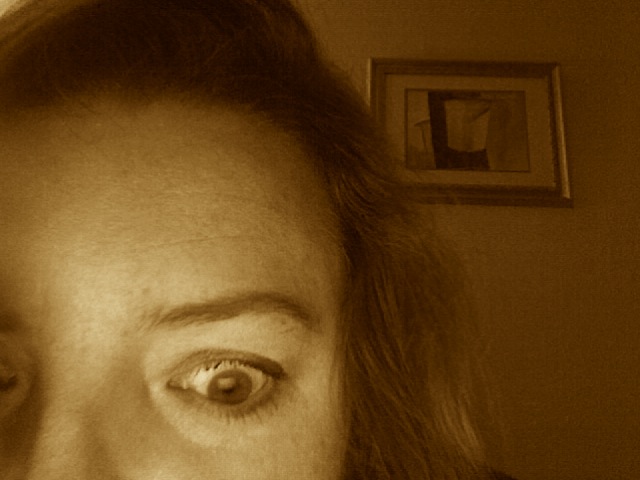
January 1, 2007
A perfect New Year's Eve
In pajamas by 7 pm.
Curtains drawn.
Candles lit.
Hot cup of tea with lemon.
Hall's Mentholyptus.
Fur slippers.
Fleece blanket.
Hours of reading.
Oh yeah. And I made lasagna. I have been pretty much unable to eat for 4 days. FOUR DAYS. So I had about 5 yummy bites of lasagna and then I called it a day.
Finished They Call Me Naughty Lola. Howling with laughter.
Continued to read The French Revolution by Thomas Carlyle - a book I have been working on slowly for months. I adore it but man, it's dense - I can only take a couple chapters at a time. For example:
Patrols of the new-born National Guard, bearing torches, scour the streets, all that night; which otherwise are vacant, yet illuminated in every window by order. Strange looking; like some naphtha-lighted City of the Dead, with here and there a flight of perturbed Ghosts.O poor mortals, how ye make this Earth bitter for each other; this fearful and wonderful Life fearful and horrible; and Satan has his place in all hearts! Such agonies and ragings and wailings ye have, and have had, in all times: -- to be buried all, in so deep silence; and the salt sea is not swoln with your tears.
Great meanwhile is the moment, when tidings of Freedom reach us; when the long-enthralled soul, from amid its chains and squalid stagnancy, arises, where it still only in blindness and bewilderment, and swears by Him that made it, that it will be free! Free? Understand that well, it is the deep commandment, dimmer or clearer, of our whole being, to be free. Freedom is the one purport, wisely aimed at, or unwisely, of all man's struggles, toilings and sufferings in this Earth. Yes, supreme is such a moment (if thou hast known it): first vision as of a flame-girt Sinai, in this our waste Pilgrimage, -- which thenceforth wants not its pillar of cloud by day, and pillar of fire by night! Something it is even, -- nay, something considerable, when the chains have grown corrosive, poisonous, -- to be free "from oppression by our fellowman." Forward, ye maddened sons of France; be it towards this destiny or towards that! Around you is but starvation, falsehood, corruption and the clam of death. Where ye are is no abiding.
See what I mean? Marvelous, really, but dense.
Also reading 1776. So much fun I can barely stand it. I am in love with Nathaniel Greene now. Good ol' Rhode Island man.
Switching back and forth between 2 books.
Refilling my cup with hot tea.
Soft music playing: Dean Martin. Swingin' with Dino.
Fell asleep at 11:30 pm.
Woke up at the brou-haha at midnight and thought, annoyed - "What the hell is going on out there? Keep it down!"
(This is reminiscent of one of my best New Year's Eve memories with Ann Marie. We got manicures, we went to her place, we had dinner on TV trays, we drank 2 beers a piece - and I believe we watched Sleepless in Seattle?? Or was it Harry Met Sally?? And it became midnight and we could hear horns going off and people screaming outside, and we both were like, "What the HELL is happening out there? Oh. Right. It's New Year's Eve. Happy New Year.")
This also reminds me of one of my favorite Ann Marie quotes. (The woman is so quotable, she is her own walking Bartlett's.) We were discussing how we didn't like to go out on New Year's Eve, because the drunkenness was usually out of control, and sloppy, and - as Ann has said - we both like people who can hold their liquor. Professionals can hold their liquor. Amateur drinkers are the ones who cause all the problems. Ann Marie summed it all up perfectly when she said:
"New Year's Eve is like open mike night at Alcoholics Anonymous."
Back to my reading.
The Bastille has just been stormed!
I always like to begin a new year ...
... with a back flip of some kind.
Mitchell, my circus performer best friend, has described to me, in detail, why this back flip of Cary Grant's in Holiday is so unbelievable. Back flips are bread and butter to circus folk - but this one is extraordinary because of how he sees her approaching - while he is upside down and in mid-air - and then - instead of landing on his feet - like most backflips end - he falls flat onto his body from a height of 3 feet in the air. Mitchell has never seen a back flip like it.
It sure as hell makes me laugh every time I see it.
He starts with a hand stand. Then he jumps back onto his feet and launches into his backflip from there.


Right around in here is where he sees her - he cranes his neck up - and catches a glimpse of her which makes him NOT complete the backflip and instead fall flat to the floor.