February 28, 2009
Her eyes follow me around
Some background. Back in December, somehow a conversation started up in a comments thread about Hope, and the idea came up that someone should turn one of my photos of Hope into the famous Obama poster with the word "HOPE" under it. The most humorous thing is that Mark, who hadn't been involved in that particular thread, suddenly showed up saying, "Sorry I'm late ..." knowing that it was HE we had been waiting for.
In a matter of moments, the deed was done. Much hilarity ensued and Mark received no less than three proposals of marriage, based on his sheer awesomeness.
It was one of my favorite moments ever in the history of my blog. Look at that image!!
So then a couple weeks later I go home for Christmas. It was the day after Christmas, and Siobhan came up to me with a package - another gift? - and said, with the weirdest look on her face, "This is for you."
"Wha ..? Huh?"
I was more confused by her expression than anything else. It was obvious she was just the messenger. I opened the thing and saw that there was a card from a "Dave E." Now I know a "Dave E." - he and I have been blog-buddies for, oh, five years now? Something insane like that. Awesome guy. But ... but ... this package was sent to my PARENTS' house. He wouldn't know that address. Or anything like that. So ... how would he have known where to send it? Also, what the hell? I was VERY confused and thought: "no ... it must be some other Dave E ..." I was discombobulated, also discombobulated because Siobhan was basically hovering over me, watching my reaction.
It was a cardboard roll, like you use for posters - and there was something inside it, a roll of ... fabric? I pulled it out ... and dudes. It was a giant BANNER of the Hope image that Mark had created. I started laughing and CRYING at the same time ... what? How had this happened?
Siobhan was the accomplice. From what I gather, Dave E. got the idea to make a banner for me. He somehow contacted Mark (they don't know each other outside of my blog, as far as I know - but through emails or whatever, he contacted Mark for the jpeg) ... then he took the bold move to track down my sister's email address, and tell her his plan ... that he wanted to send me a surprise gift, and could she possibly send the address??
Poor Siobhan got an email from this random guy and for a second she was like, "Who the hell is this? What does he want?" But I imagine he (because he is so nice) was able to explain himself in a way that DIDN'T sound creepy and bizarre (you know, not like, "I got a gift for your big sister. Gimme your parents address. Thanks. Love, The Unabomber") ... but friendly and funny. So Siobhan complied - and the thing arrived on Christmas Eve, I think.
The amount of work that that took ... Dave contacting Mark, Mark responding - then Dave contacting Siobhan - and creating the banner - everything ... truly is one of the nicest gifts I have ever received, and couldn't have come at a better moment.
I was beyond touched ... especially because I have not met Dave and I have not met Mark (although that seems like a technicality at this point) ... but they went out of their way to send me this thing they had created, and seriously, it meant the world to me. You guys are the best.
So.
The era of Hope has begun. After all, she's on my wall.

Joan Acocella: "Twenty-Eight Artists and Two Saints"
Joan Acocella has been a staff writer for The New Yorker for I don't know how many years, and I am just now starting to pay attention to her. She writes mainly about dance (her dance columns are amazing - and I don't go to see much dance, but it's a testament to her writing that I always read her column anyway) - but on occasion covers other topics too. My first encounter with her was in 1998, when she wrote a massive piece on Mikhail Baryshnikov for The New Yorker called "The Soloist". It's one of the best personal profiles The New Yorker has ever run, and certainly one of the best profiles I've ever read, period. It was over 20 pages long. It was brilliant.
She's an amazing writer. Her stuff is quite eclectic, perhaps delicate, and so there isn't the mass appeal of someone writing about movie stars or something like that - but she can't be beat as an author. I don't know her background, she has mentioned that she was basically a dance fan - it wasn't her vocation at first, she was a writer, but she found her "niche", almost by accident and she's been writing about dance for years. It is obviously her calling.
Finally, a collection of her essays over the years has been released in a wonderful edition called Twenty-eight Artists and Two Saints: Essays
It's been marvelous to get to know her better as a writer, first of all, and to realize the sheer DEPTH of her knowledge, not just about dance, but about many things. She is the kind of essayist and journalist I most admire. I can kind of get that her area of expertise is the early 20th century and the birth of modernism. She knows what she's talking about. The lives intersect - Joyce and Freud and Nijinsky and Stefan Zweig - and you get the sense that she is writing about a time that is still fully alive for her, a vibrant frightening time of upheaval for European artists. She's marvelous.
Many of the essays in the book, of course, focus on dance. There is a huge essay on Nijinsky. The Baryshnikov essay is included. She has essays on Suzanne Farrell, Balanchine, Lincoln Kerstein, all the giants of 20th century ballet. But also, delightfully (for me - who is just getting to know her) - she also has in-depth essays on authors of that period, too, some whose names I have heard of - but many whose work I don't know at all. Joseph Roth. Heard of him, knew nothing about him, never read him. I must rectify that immediately. Stefan Zweig. When I get back into fiction, Beware of Pity
As I read some of the essays, I realized I had read one of them before as well - her review of a biography of Lucia Joyce, Joyce's daughter. I had referenced Acocella's article here, in my annoyed blog-post about it.
One of the themes that emerges, as I read her work all together, is her interest in the business of art, how artists do what they do, how they compromise and sacrifice, and what it takes, psychologically. For some it is easy, for others it is torment. There are no easy answers. Acocella wants to examine the process. She is fascinated by people's processes. Some are delighted by fame, others hounded by it. To say one is right and the other wrong is to place a highly simplistic value system on something that is quite complicated - the diversity of human personality. I love her perspective.
There's an entire essay on the phenomenon known as "writer's block", and she recounts some of the most well-known stories (Ralph Ellison, primarily - what a tragedy - but others, too - Fitzgerald, Eugenides - the terror of the "second novel"). I think a lot of my affinity for Acocella is that, obviously, I agree with her point of view. She is more interested in the work, than in the explanations or psychologizing placed on motivation, etc. Her essay on Nijinsky (which is, actually, a book review of a psychiatric history of the poor doomed dancer) is a masterpiece in this regard. I love her focus.
I also love her for making my reading list longer, for introducing me to huge gaps in my education, and I am always grateful when someone does that, and with such elegance and wit.
I can't even count the times I have put down the book and just let myself THINK about what she just wrote. There's something very satisfying about it. These are not just profile pieces, but intellectual analyses, and I find myself getting very worked up thinking about all of it.
Just a smattering of her startlingly eloquent and funny and moving paragraphs below:
From "A Fire in the Brain", her essay on Lucia Joyce, the mentally ill daughter of James Joyce:

Many people are brilliant, and from that you may get one novel, as Zelda Fitzgerald did. But to write five novels (Scott) or seventeen (Nabokov) - to make a career - you must have, with brilliance, a number of less glamorous virtues, for example, patience, resilience, and courage. Lucia Joyce encouraged obstacles and threw up her hands; James Joyce faced worse obstacles - for most of his writing life, publishers ran from him in droves - but he persisted. When the critics made fun of Zelda's novel, she stopped publishing; when Scott had setbacks - indeed, when he was a falling-down drunk - he went on hoping, and working.
From "Blocked", her essay on writer's block:

A story that haunts the halls of The New Yorker is that of Joseph Mitchell, who came on staff in 1938, wrote many brilliant pieces, and then, after the publication of his greatest piece, "Joe Gould's Secret," in 1964, came to the office almost every day for the next thirty-two years without filing another word. In a series of tributes published in The New Yorker upon Mitchell's death, in 1996, Calvin Trillin recalled hearing once that Mitchell was "writing away at a normal pace until some professor called him the greatest living master of the English declarative sentence and stopped him cold."There are many other theories about Mitchell. (For one thing, "Joe Gould's Secret" was about a blocked writer.) It is nevertheless the case that, however much artists may want attention, getting it can put them off their feed, particularly when it comes at the beginning of their careers. That may have been the case with Dashiell Hammett.
From "True Confessions", her beautiful profile of Italian modernist Italo Svevo (whose life was changed from an encounter with James Joyce):

Svevo simply did not have enough certainty to join the ranks of Balzac and Zola. His world was not theirs, the world of causes - social, historical, economic - but something almost causeless, the mal du siecle, in its turn-of-the-century form: the crippling of action by thought, the erasure of the present by the future (fantasy) and the past (remorse). Bad as his circumstances are, Alfonso's main problem is internal. He cannot seem to do anything; he is too self-conscious, too busy watching himself. Like Joyce and Proust soon afterward, Svevo had discovered the subject of the twentieth-century novel, the self-imprisonment of the mind, but he didn't know how to write anything but a nineteenth-century novel.
From "Quicksand", her riveting portrait of Stefan Zweig:

Zweig, like many bold writers, posed himself problems that he could not always solve. In such cases, one has to ask oneself what feels true, what feels false, on the page. In Beware of Pity, what feels true are the scenes in which we are shown the futility of pity. This is a horrible lesson; it is also what makes the book radical and modern.
I knew very little about Zweig, although he does show up in Joyce biographies, because they met on a couple of occasions. His life was absolutely hair-raising, and Acocella has made me want to read everything this man ever wrote.
From "The Frog and the Crocodile", Acocella's review of the recent publication of letters between Simone de Beauvoir and Nelson Algren, a man who gave Beauvoir her first orgasm at 39 (take THAT, Sartre - I think my brother would agree), and who reduced the world's foremost feminist into a puddle of need and desire. Good on him. The hottie American proletariat and the prickly French intellectual. A tragic story, though - of missed connections and futile feelings - and when Beauvoir died in the 80s she was buried wearing a ring that Algren gave her in the 1950s, a ring she had never taken off. Pretty wild stuff. Here is the doomed pair, with another woman (who was also one of Sartre's mistresses):

But anyway, I love Acocella here.
When The Second Sex was published, in 1949, Frenchwomen had had the vote for only five years. If Beauvoir's mind, as her detractors claim, was swamped with "masculinist" ideas, those were the only ideas around at the time. If she omitted to tell her public about her lesbian experiences, to do otherwise would have been fatal to the reputation of any woman writer of that period. (Beauvoir's critics should also take another look at her defense of lesbianism - a whole chapter - in The Second Sex. For 1949, that was brave.) It is possible that the best writers on social injustice - certainly the most moving - are those who grew up when the injustice in question was not viewed as a problem, and who therefore say things that get them in trouble, later, with holders of more correct views, views that the earlier writers gave birth to. I am thinking of Abraham Lincoln's pre-Civil War statements on the inferiority of Negroes, so decried by recent historians. It is one thing to free a people whom you regard as equal. But what does it take to free a people whom you have been trained to regard as inferior, and who, by your standards, are inferior? It takes something else, a kind of imagination and courage that we do not understand.In the recent flap over Beauvoir we see again what might now be called Philip Larkin syndrome: the insistence on the part of modern critics that celebrated authors' lives be as admirable as their books. In the case of Beauvoir one might answer, "Do as she said, not as she did." (That, in fact, is the title of an article that Deirdre Barr was oved to write for the Times Magazine in response to the outrage over the revelations in her biography and in the Letters to Sartre.) But even if we did as she did, we wouldn't be doing so badly. After all, she did not move to Chicago, and her reasons were not just Sartre but also her career, her place in the literary life of Paris. If that career was tied up with her servitude to Sartre, good writing has sprung from more humiliating conditions. And, of course, the relationship with Sartre helped to germinate The Second Sex. The affair with Algren, so sexual, and therefore so searing, may have released her knowledge of the condition of women, but, whatever her denials, the knowledge was certainly there before.
From "Becoming the Emperor", a wonderful essay on another writer I knew very little about, Marguerite Yourcenar, author of Memoirs of Hadrian

Before she left Europe, Yourcenar had deposited a trunk in storage at a hotel in Lausanne. She had been trying for years to get it back, and one day in 1949 it arrived. Opening it, she looked first for some valuables, but they had vanished. All that was left was a bunch of old papers. She pulled her chair up to the fireplace and started pitching things in. Then she came upon the drafts of a novel about Hadrian that she had begun when she was twenty-one and had later put aside. At the sight of those pages, she said, her mind more or less exploded. It is hard to understand how she managed to produce Memoirs of Hadrian in two years. In a bibliographical note appended to the novel, it takes her seventeen pages to list the sources she consulted (mostly at Yale) in order to make her account factually correct: ancient texts by the score; histories in English, French, and German; treatises on archaeology, on numismatics. Then, there was the matter of writing the book, but she said that she composed it in a state of "controlled delirium". She recalled a train trip she took at the time:Closed inside my compartment as if in a cubicle of some Egyptian tomb, I worked late into the night between New York and Chicago; then all the next day, in the restaurant of a Chicago station where I awaited a train blocked by storms and snow; then again until dawn, alone in the observation car of a Santa Fe Limited; surrounded by black spurs of the Colorado mountains, and by the eternal pattern of the stars. Thus were written at a single impulsion the passions on food, love, sleep, and the knowledge of men. I can hardly recall a day spent with more ardor, or more lucid nights.Clearly, she was simply ready to write this novel, as she had not been at twenty-one. She herself said that the crux was time: "There are books which one should not attempt before having passed the age of forty." She was forty-five when she went back to Hadrian.
From "A Hard Case", her essay on Primo Levi, an author I adore. She reviews a biography of Levi that she basically finds annoying, for reasons that I find a lot of biographies annoying. The essays should be read in its entirety, she obviously loves Levi - but here is a bit where she gets her Irish up:

As for his life, the position she [the biographer in question] takes is roughly that of a psychotherapist of the seventies. She's okay. We're okay. Why wasn't he okay? Why did he have to work all the time? Why didn't he take more vacations? And how about getting laid once in a while? She records that as a teenager he mooned over various girls, but whenever he got near one he blushed and fell silent. "What was this?" Angier asks. "Can anyone ever say?" I can say. Has Angier never heard of geeks? They are born every day, and they grow up to do much of the world's intellectual and artistic work. One wonders, at times, why Angier chose Levi as a subject - she seems to find him so peculiar. And does she imagine that if he had been more "normal" - less reserved, less scrupulous - he would have written those books she so admires?
From "European Dreams", her essay on Joseph Roth:

One of the remarkable things about Roth's early writing is its political foresight. He was the first person to inscribe the name of Adolf Hitler in European fiction, and that was in 1923, ten years before Hitler took over Germany. But what makes his portrait of the Nazi brand of anti-Semitism so interesting is that it was done before the Holocaust, which he did not live to see. His treatment of the Jews therefore lacks the pious edgelessness of most post-Holocaust writing on the subject. In one of his novels of the 1920s - the best one, Right and Left - which opens in a little German town, he says that in this place most jokes began, "There was once a Jew on a train," but on the same page he narrows his eyes at Jews who ignore such jokes. In an essay of 1929, he speculates comically on why God took such a special interest in the Jews: "There were so many others that were nice, malleable, and well trained: happy, balanced Greeks, adventurous Phoenicians, artful Egyptians, Assyrians with strange imaginations, northern tribes with beautiful, blond-haired, as it were, ethical primitiveness and refreshing forest smells. But none of the above! The weakest and far from loveliest of peoples was given the most dreadful curse and most dreadful blessing" - to be God's chosen people. As for German nationalism, he regarded it, at least in the twenties, mainly as a stink up the nose, a matter of lies and nature hikes and losers trying to gain power. He was frightened of it, but he also found it ridiculous.
And two excerpts from "After the Ball Was Over", her gorgeous essay on Vaslav Nijinsky:

What we need to know about Nijinsky is not what was on his mind but how he transformed this material into art - how this tongue-tied introvert managed to become not only a great, eloquent, and (by all accounts) surpassingly glamorous dancer but also the first modernist choreographer in the history of ballet. In other words, we need a psychology of creativity. And that is exactly what most psychobiographers do not concern themselves with. Creativity - the thing that actually distinguishes their subject from the rest of humankind and therefore needs explaining - is to them a given. They work backward from there, to libido and aggression, the things that in no way distinguish their subjects from the rest of humanity.
Amen, sister!
And:
Whatever Nijinsky was in reality, he is by now a legend, a major cultural fact, and not just because of his extraordinary story but because of the way that story ties in with certain critical issues in ballet. Ballet's relationship to time - the fact that the repertory, unanchored by text, is always vanishing, just as the dance image on the stage is always vanishing - forms a large part of the vividness and poignance of the art. We are always losing it, like life, and therefore we re-create it, mythologize it, in our minds. Nijinsky's life - his rapid self-extinction and the disappearance of his ballets - is like a parable of that truth. If dance is disappearance, he is the ultimate disappearing act. Accordingly, he is held that much dearer. If many people today still believe that he was the greatest dancer who has ever lived, that is partly because there are so few records of his dancing.
And finally, from her masterpiece essay on Baryshnikov, "The Soloist":
What has made Baryshnikov a paragon of late-twentieth-century dance is partly the purity of his ballet technique. In him the hidden meaning of ballet, and of classicism - that experience has order, that life can be understood - is clearer than in any other dancer on the stage today. Another part of his preeminence derives, of course, from his virtuosity, the lengths to which he was able to take ballet - the split leaps, the cyclonic pirouettes - without sacrificing purity. But what has made him an artist, and a popular artist, is the completeness of his performances: the level of concentration, the fullness of ambition, the sheer amount of detail, with the cast of the shoulder, the angle of the jaw, even the splay of the fingers, all deployed in the service of a single pressing act of imagination. In him there is simply more to see than in most other dancers.

She's a fine fine writer and I look forward to the rest of the collection.
Related links
This ...
is related to this ...
is related to this gorgeousness. Hilarious! I love him. (Thank you, Luisa, for sending me that link. I adore him, and I adore how cranky he is about everyone else's perpetual crankiness!)
I agree with every word in every one of those links, contradictions and all. Those who balk at any tiny contradiction are the biggest bores on the planet I can imagine. "But you said THIS in 2003, now you say THIS?" Uhm, yeah. Because I'm still in process, you unimaginative nitwit. I'm also not a public figure who should remain consistent in their positions. I'm a private thinking citizen. I had one gentleman email me recently complaining that he now felt "self-conscious" on my site, because he had had a run-in with me where I asked him to stop being so negative (at least on my site). Well, listen, dude, maybe you SHOULD feel self-conscious about complaining constantly, although that is the public discourse in vogue at the moment. So maybe if it makes you think, "Huh ... am I being a boring person right now?" then a little self-consciousness is a good thing.
I can't believe I'm saying I agree with Gwyneth Paltrow, but I do. 100%. You can feel it, those who get their energy from negativity. It is their actual energy source.
Seriously: stay away, folks. Learn to recognize the signs. That shit is toxic.
And those whose first response to this would be to split hairs ("but ... sometimes it's appropriate to be outraged!") are the worst offenders, because they cannot tell the difference and they are protecting something, some secret, something they don't want to reveal. I don't know what, maybe they don't know what either. Their sense of outrage is really a mask for something much more wounded and childlike - disappointment, loss, embarrassment - who knows what ... (although whatever it is it is certainly more human than the other). I know that in the times in my life when I have been most unpleasant and most angry, it's usually been a mask because I feel helpless and fucking SAD ... so look out when someone is protecting something that they don't want you to see. That's why the viciousness, that's why the exhausting complaints. Because then they get to walk around being "right" all the time (you know, "relishing their rightness") and you either have to agree with their position of how right they are or step out of the conversation altogether or get into a fight with them. That's the whole point. No give and take. I've written about this a lot, and my struggles with staying open and free and vulnerable on my own blog. But I just happened to come across those two links and that great video this week, and they all seemed to dovetail quite nicely, giving me much food for thought in this time in my life when the whirlpool of bitterness is strong indeed. When my entire world has been rearranged and I don't know which end is up - and like my friend Ted said to me, "Loss brings up other loss." All it is is loss right now. I am sure that that is why I am sick now. I held it off as long as I could.
But I needed to really contemplate all of that this week, which was a hard one.
Reminds me of the note that Rosalind Russell's husband found tucked away in her prayerbook, after she had died of cancer. That note, in her handwriting, said:
Keep my mind free from the recital of endless details; give me wings to get to the point. Seal my lips on aches and pains. They are increasing, and love of rehearsing them is becoming sweeter as the years go by.
It is those who love to "rehearse" their negativity who are the toxic ones. Because through rehearsal, they make it perfect, they make it habitual, a way of life.
I don't avoid such people because I feel superior to them. It is just the opposite. I avoid such people because I recognize the trap. I have those tendencies myself. I have been that toxic person, and I could go there, like nobody's business. But what would be my quality of life be then? It is a FIGHT. A fight to focus on gratitude.
So, again, can't believe I'm saying this: but thank you, Gwyneth Paltrow.
Siobhan O'Malley: "Alibi Bye"

My beautiful and talented sister Siobhan has just had her second album released (after a good two years of almost non-stop work on it) and it is now available for purchase! It is called Alibi Bye. The sound on this one is really big, robust - and she had the great pleasure of working with seasoned and unbelievable studio musicians who would be like, "You want a jazzy harpischord solo here? No problem." "You need one tuba blast as an accent before the chorus? Let me call in my world-class tuba-playing friend." Etc. The album is rockin'!
Go, Siobhan!
Three dawns
There was the one yesterday and the day before.
Then there was today.
Like I've said, it's the greatest show on earth.

Ah, the happy doomed teens of "Jaws 2"
Their carefree summer fun, of bonfires and making out and sailboat races, is soon to be shattered by a monster of the deep.
In the film, the snotty marine biologist who examines the dead killer whale on the beach, says to Chief Brody, "Mr. Brody, sharks don't take things personally."
Well, this shark does.
It is not interested in filling its belly. It is interested in revenging its friends, and coming back to "get" you after you have set it on fire. It stalks, it lies in wait ... and even though in a matter of 24 hours it has eaten two scuba divers, a water skier, and two horny teens ... it is still not done, and feels that it would be appropriate to try to eat a helicopter, as well as two catamarans and three sailboats, not to mention the ten human beings populating these vehicles. This is not a hungry shark. It is an angry vindictive shark. With a long memory. It wants to right the wrongs done to it. You set me on fire beeyotch? You pour gasoline on my snout and then shoot me with a gun? I will make the entire COMMUNITY pay for your rudeness.
Chief Brody is right to be paranoid, I guess.
I like the kind of world-weary slightly skeezy sexual vibe brought to the Brody marriage - which was there in the original Jaws. They are tired of one another, yet sometimes when they get drunk they like to get naughty. The next morning they look at each other, almost embarrassed, like, Oh God ... we went THERE again ... You can imagine him slapping her ass and her laughing uproariously saying "Give it to me, Daddy", but inside loathing herself for succumbing ... but then the next morning it's like it never happened, and they are back where they started. She cooks bacon in a tired worn-down manner, he looks at her, with the memory of last night's dirtiness on his face. They forgive each other their trespasses, but their energy together is one of tired sexual depletion - which is such an odd choice in what is a summer blockbuster. You can imagine these two not only attending a key party, but throwing the key party, roping the entire town of Amity into sexual shenanigans that will ruin marriages.
So bizarre. Tell me you don't see that dynamic at work in their marriage! But I think it's part of why the original was successful. Because that marriage is pretty shaky, you can feel it. It's not completely broken, but there's something tired there, they're used up.
You can just tell that Jaws was made in the 70s, merely from the energy in the Brody marriage. Only in the 70s were characters in a movie such as this one allowed such adult sexual complexity - not to be explained or resolved, it just IS.
Brody's two sons now take center stage in Jaws 2, with his older son wanting to hang out with his friends, and pursue the pug-dog-faced girl of his current adolescent dreams. The younger son is the tag-along. Brody knows what his son is up to, he's not a hovering father, and it's obvious that Mike is currently about to lose his virginity, as well as have his first experience in overindulgence of alcohol, but whatever, the kid is 17, he's going to do what he's going to do. Brody is no saint. He doesn't care.
But when the vindictive shark who takes things VERY personally comes into the picture, Brody starts to assert his parental muscle.
You can lose your virginity every day of the week, son, more power to you, but I will not let you frolic in the same water as a stalking rolling-eyed monster. Get your damn boat out of the water and get a job!
This is tough to hear, especially when all of the teens in the town apparently live with very little parental supervision, hanging out on the docks all day, cruising on their sailboats, having various sexual experiences and romances, and trying to negotiate their way to adulthood. They're a mixed bag. We have the angry realistic pudgy kid, we have the lanky intellectual, we have the morose kid who knows no girl will ever be interested in him ... then we have the girls, who are more interchangeable, but who eventually emerge with some defining characteristics: the sexually precocious one, the sweet long-haired athletic one (that's Ben Marley's best girl, don't ya know), the wide-eyed romantic one (you just know she's doomed) in love for the first time, and etc.
I'm not trying to compare this to some brilliant teen expose. I'm just saying that without the specificity of the group of teens, the movie would sink into the morass of the shark's ragingly rational and conniving behavior. They seem like a real gang of kids, some more "experienced" than others, and with that strange mix of energies that you see in groups of 16 year old boys in particular: where some almost seem like men - and some still seem like they're pre-teens, anxious, with one foot still in boyhood. It's a huge gap. But they've grown up together, they've known each other forever, so the differences between them are not as noticeable to them as they are to us. But there's the one kid who is good with his boat, and makes cynical comments about the girls' bodies, and he might as well be 25 years old. I knew guys like that. They had a social ease, they were set apart from the pack. There were the guys who were just looking for a girlfriend, which - sure - might mean sex, but it was more important to have a girl to pal around with, especially in the summer. And then of course there were the guys like Patrick, played by Ben Marley, who is athletic, strong, the one you turn to in a pinch, and who has been dating the same girl forever (you know, for, like, five months), and almost seems like a responsible married man. I knew guys like that in high school, too.
So let's take a look, shall we?
I'm sick and worn out. Grabbing screenshots of Jaws 2, with three sneezes per screenshot from me, has been fun.
And yeah, most of these involve Ben Marley.
So?


Two dawns
Yesterday and the day before. It's like a whole new and different world in each photo. 24 hours apart.


February 27, 2009
My friend Phil talks about sex
My good friend Phil, we go way back, has just put up a new video which has made my day. I will not say any more than that.
So funny.
Phil talks about sex:
The making of Jaws 2:
A couple behind-the-scenes photos with, naturally, one that involves Ben Marley.
I have been laid low by the flu. This week has been very rough for me, although strangely productive as well, with me literally blackberry-ing people I need to contact for this or that project from my sick bed, sending huge attachments via email and then having to delete them instantly because my blackberry can't store all of it. But I am really run down. I'm surprised I haven't gotten sick sooner.
So, from my flu-ridden state, I take comfort where I can find it.
I do enjoy these photos, there's something delightfully absurd about the whole thing (especially the guy with the clapper submerged in the ocean. Ah, making movies!)
Apparently the shoot went on for so much longer than they had originally anticipated that they were filming much of the final sequence (with the smashed sailboats and stranded teens, etc.) in late December. Yes, they were in Florida, but it got chilly as hell, and it was supposed to be the middle of summer, and all of the kids were hanging out on the sailboats all day, filming their scenes, shivering, teeth chattering, and they would suck on ice cubes before a shot so their breath didn't show. Glamour!


Nureyev and gender
I still can't really read, but here are some Nureyev images, since he's been on my mind. I am halfway through the Nureyev book, and hopefully I'll get to finish it some day.
I love the androgyny of Nureyev in the pictures below (especially the one of him and Fonteyn, with him upside down - in the classic swan dive usually associated with females, her head close to his crotch level). It's gorgeous, erotic, but also unsettling to regularized gender roles, up-ending convention, which is one of the main things Nureyev appears to have contributed to ballet. As a youth, in Russia, the style was that the male was basically the "heavy" - he was meant to be statuesque, strong, and classical, and be able to lift the female about. Macho. Unemotional. This sort of static dancing, although highly technical, requiring great skill, bored Nureyev, and he got some intimation of the winds of change going on in the West, through seeing grainy tapes of this or that ballet dancer in the West, and he realized (perhaps without articulating it to himself) that things were changing "out there", outside of Russia, and he needed to be a part of it. Rigid preconceived notions of gender dissolving. Nureyev stopped modeling himself on the male dancers he saw around him, and began focusing on the ballerinas, imitating THEM, bringing their long flowing grace into the male parts ... and at the time it was hugely controversial.
Good for him.
He's so beautiful, and so strong, but there is also a softness about him that lets you, the viewer, in. It was a revelation at the time. It occurs to me that this is similar to the great conversation Catherine, Desirae and I had in the comments section to this post, about Kurt Cobain, that most superstars have a certain amount of androgyny. The hard mixed with the soft, female and male ... We were talking there about rock stars, but you can see it in actors too, especially the old-school actors with their set recognizable personae. Joan Crawford - all woman, all curves and legs, but with a backbone of steel and a hardness to her. Gary Cooper - all man, all lanky legs and straight-edges, but with the ability to show us behind the mask, all the softness and hopes and fears, in a way that would be "typically female". The obvious examples of Marlene Dietrich, who consciously toyed with gender in every role she played. Montgomery Clift, Katharine Hepburn, Rosalind Russell, Cary Grant, Barbara Stanwyck ... each had some aspect of androgyny to them, either conscious or no, which (to me) just makes them even more universal.
Nureyev made this androgyny his stock-in-trade. Well, that, and being the best dancer he could be. I think a lot of his persona was not so much calculated and consciously created, but just the result of a killer instinct.


The making of "Jaws 2": "everybody said that was a good idea"
Carl Gottlieb, screenwriter for Jaws 2 (as well as Jaws), was brought in a little bit into the game to flesh out the characters. He was flown down to Florida, where the entire 120-person company was basically sitting in a hotel on the beach, waiting for a script to be ready so they could shoot. No one was working. Everyone was just hanging out. All of the teenagers (including Ben Marley, ahem) were spending their days learning to sail, as well as working with a Navy SEAL to get in shape. According to Keith Gordon (who played one of the kids), there was much grumbling, much boredom ("Oh shit, we have to practice sailing again? When do we get to, you know, make the movie??"), as well as multiple tormented adolescent romances going on. They all were dating each other, and then breaking up, and getting back together, and guys who were friends the day before getting into fights with each other over one of the girls, and etc. and etc., which is so hysterical to me, and sounds like a blast. Can't you imagine the dramas? What an experience. Most of them were pulled straight out of high school, and for many this was their first big credit. The first director was fired a couple weeks into the picture, everything put on hold. The filming of this movie took from start to finish over a year. So there was a lot of down-time.
Gottlieb was called in to fix the script, build it out and make it all come together. The new director (the amusing and intelligent Jeannot Szwarc) was focusing on the special effects and action sequences, Gottlieb had to flesh out the story, and the characters. He describes holing himself up in the hotel room, and writing ... but every time he would leave, every other person would say to him, "How's it going??" Not in a mean or impatient way but like: How's that script going? Can we start shooting soon? As a writer myself, I freak out thinking about such pressure! He finally stopped leaving his hotel room because he couldn't take it. And finally, he lit upon a theme, or an idea, that he could flesh out. He knew that the group of teens, who are basically the linchpin of the whole thing, had to be made clear - each one needed a characteristic an audience could recognize, etc., but then he came up with the idea that I personally think makes the whole movie:
I had this notion that this cruising culture that was very popular with cars at that time - I said, What if kids cruised on the water the way they cruised on the boulevard? They've got these elaborate boats that they fix up, they socialize, all the boy-girl stuff, the interplay between the kids can be in connection with this cruising culture. And everybody said that that was a good idea.
Yes, yes, yes. VERY good idea. When you see Jaws 2, with all the balderdash, one of the things I like about it is its evocation of that boat culture, mixed in with teenagers. I grew up in a tourist beach town, not unlike Amity - where there were the rich cats who would flock there every summer, and then there'd be us - the local kids - working at pizza joints and restaurants, serving the wealthy, and hanging out on the beach all day. After all, it was OUR town.
Jaws 2 does that very very well, and I love to hear Gottlieb's story about how he came to that idea, and how he thought; There. I can write that. I know how to write that.
The many scenes of flirting aimless teenagers hanging out on their little sailboats really reminds me of my own adolescence in a state where there the only thing to do, in the summer, or really in any season, is hang out near or on the ocean as much as possible.
And so the director went with that idea, and he films the sailboat races with kids laughing and screaming from boat to boat as though it is American Graffitti.
What I like about this anecdote (revealed in the very nice DVD extras) is that it shows the amount of thought and, dare I say, artistry - that goes into even something like Jaws 2. Like any other writer, Gottlieb was looking for his "way in" to the story - a hook. Not just for the audience, but himself.
Some screenshots of that "cruising boat culture" below, with, yeah, a glimpse of Ben Marley manning his boat.
The "cruising culture" of American Grafitti was transposed to the world of Jaws 2, and it works. Not only does it work, but it is something that feels real (like I said, I recognize that world from my adolescence) - and in a movie like Jaws 2, with a basically sentient shark who is out for revenge, as opposed to a nice meal, you need as much grounding as possible, as much connection to the real world.


February 26, 2009
Jaws 2: Ben Marley
Sneak peek.
Boy is a glorified extra (he should have played Mike, Chief Brody's son - he's a much better actor) but instantly recognizable, of course.
More to come.

The "Square Pegs" pilot: In hot pursuit of popularity and Larry Simpson (aka Ben Marley) - Part Two
We left off at the halfway mark, after Patty fills Lauren in on the most amazing experience of her life - "fainting on Larry Simpson". She can be forgiven for exaggerating. She is 14.
Patty and Lauren have been volunteered (by Muffy) to make decorations for the freshman dance. They sit after school and paint posters, and all Lauren can talk about is Larry Simpson and how he LIKES Patty and how they have to somehow work this, because there is no time like the present! AS they are talking, naturally - who walks into the room but Larry Simpson. In gym shorts, help me Jesus.

Lauren sees Larry and his friend come closer and, more aggressive than Patty, calls out to him. Instead of being a douche, and rolling his eyes and strolling by, he sees that Lauren is sitting with Patty, and says, "Hi!" in a nice heart-cracking way that I, personally, would totally have misinterpreted as a 14-year-old, thinking he obviously liked me if he said "Hi" in that manner. Actually, I might mis-interpret it now too! He and Patty have a bond now. He stops to chat, which is even worse (and by "worse" I mean "better"), because he obviously wants to be there. Lauren is both just googly-eyed up at him and his friend.

Larry says something to his friend like, "This is the girl I told you about ... Patty ..."
THE GIRL I TOLD YOU ABOUT?
DON'T PLAY WITH MY HEART, BEN MARLEY!!


He's humorous and nice and makes Patty repeat "that funny thing you said the other day ..." In that moment, he's building her up. He's making her repeat something that made him laugh, to his friend.
This is all just soul-crushing.
Patty is on the moon. She says "that funny thing" again, and Larry Simpson laughs again and says, appreciatively, almost intimately, "You have such an unusual mind."
Where is the fork? I need to plunge it into my solar plexus.
But then Lauren, whose social skills leave a bit to be desired, butts in. She can't help herself. As a grown woman I would call this moment a "cock block", and I believe that it is essential to have female friends who intuitively understand what a cock block is, and why you should not do it ... it's just a sense that should be developed by the time you're an adult. Seriously. Bump it up the priority list if you don't have it down-pat, because nobody likes a cock-blocker. Anyway, Lauren doesn't mean any harm (many cock blockers don't - that's the worst part - and Lauren's too young to really get it yet) - but Patty and Larry are having a nice (to quote Eddie Izzard) "splashy-splashy" moment, when Lauren blurts out, "Larry, are you going to the dance?" all breathless and agog.
It stops the action. It interrupts. It is not on topic. The cock is blocked.
That's a no-no, Lauren.
Oh, and just in case you think I'm being too hard on the poor hapless cock-blockers, on one or two awkward occasions I have actually cock-blocked myself, so I do understand the problem. But get it together, and GET OUT OF THE WAY. I have often thought that my friends Ann Marie and Mitchell should give seminars (together) on how NOT to cock-block. They could make a killing. They bring not only non-cock-blocking but encouragement of the friend's romantic action going on to a high art form. It's sometimes impossible NOT to get laid when you go out with those two. They set you up as the funniest coolest person in the world, and then disappear into the night, leaving you to navigate the situation yourself. Brilliant!
Anyway, there's an awkward shrieking-on of the brakes when Lauren blurts out her comment, and you can see everyone awkwardly dealing with it. Larry Simpson says, "Yeah, sure ..."


Lauren gushes, "We'll see you there!"
It's one of those weird high school moments where you can totally tell that one group is 14 years old and one group is 18 years old. From a long-distance view, all teenagers may seem the same, but don't you remember on the ground when you were 14 and those senior classmen seemed like ADULTS? Like, they had RAZORS in their bathrooms and stuff like that. You were just a KID who still had teddy bears.
Larry says, "Okay ..." Again, he's nice to Lauren. He's not a douche, even though he probably can see what she is up to. He doesn't say, "Yeah, you wish you'd see me there ..." He nods and says, "Okay." But, inevitably, his eyes drag back to Patty.
Let us revel in the moment.
For as long as possible.


I'm guessing Patty feels the same way I do.

Granted, it's not the iconic American-male-movie-star hotness-with-years-of-similar-images-behind-it of something like this:

But in Square Pegs, he's playing a different kind of character, a regular boy from the suburbs, good at school, nice, obviously plays soccer, and cute as hell.
He then says the fateful words, "See you there", and strolls off with his friend, leaving the girls in a state of complete emotional dishevelment (and poor Marshall, who has to look on at the drool-fest going on).
Look at them watch him go!

Of course Patty and Lauren are whipped up into a frenzy about the words "See you there" which seems to hold some kind of ... promise?
Oh, girls. Watch out.
Change of scene, change of cock. Marshall and Johnny Slash are in the listening library at the school (well - Johnny Slash is listening to Devo or something), and Lauren and Patty are strategizing about how to get to the dance, and how romantic it will be. They actually believe that Patty is going TO the dance with Larry. At some point, Marshall comes up, and with many a "but seriously folks" interjection, asks Lauren to the dance. She is openly dismayed. She is at the point where Patty's life is far more important to her than her own. But they end up agreeing to go to the dance with Marshall and Johnny (who has a car), as long as Marshall and Johnny agree to stand six paces behind them at all times, like Prince Philip. Hahahaha Poor Marshall and Johnny agree to that. Johnny appears to be terrified of girls, in general. He may have a cool exterior, but inside he is a trembly mess.

Now, finally, the dance. The sad foursome stand out on the steps of the school, and they are all basically waiting for Larry Simpson to show up. Horrible! God, it brings me back to how embarrassing I could be in high school, waiting around for some dude to walk by, so I could maybe have eye contact with him and then write 20 pages about it in my diary.

Johnny Slash has completely divorced himself from the situation (what a shock), and is deeply engrossed in the music coming out of his headphone. Lauren and Patty peer off eagerly into the night. Marshall is still hopeful that the wind will swing his way, so he murmurs to Johnny that eventually they'll probably get to dance with Lauren and Patty. Johnny freaks out. "Dance? With them? I don't dance. I'm New Wave. Totally different head. Totally." Marshall, again stuck in the days of Sid Caesar, tries to teach Johnny how to dance, and they do an awkward waltz up and down the steps, much to Lauren's mortification.
Where is Larry? Why is he not coming?
Then the most romantic heart-stopping shot in the whole pilot.

Not just because it's Ben Marley, and he's running his fingers through his hair, but because I remember what it was like to be 14, and LIVING for a certain dance, because maybe I would see that upper classman I was so smitten with, and I had no classes with him, no interactions ... but at a dance, I could actually be in his presence in a social situation and maybe ... just maybe ...?
Damn Square Pegs for giving me flashbacks like that. They really are rather unpleasant.
Lauren gives Patty advice on what to say - that his presence makes her stomach go into butterflies, that "we will remember this night for the rest of our lives", and other such balderdash, and then drags Johnny and Marshall off, leaving Patty alone on the steps.
Larry, unaware of the brou-haha that he has caused, casually strolls up the steps in his washed-up 18th-century-French-literature professor's blazer ... and he's not looking for anyone (because, you know, he knows he's NOT on a date) so he almost walks right by Patty, and she calls out to him, "Hi, Larry!"

Awkward!
He's a smart guy (that's set up in how he's talked about), so he has a moment where he realizes what's happened. That she's standing on the steps forlornly waiting for him. But because he's also nice, he doesn't cringe away from her, or play it cool, or any of those other things that would crush her even more. He's nice. He stops and they have a sweet interaction. She's not wearing her glasses, and he comments on it. She pretends like she only wears the glasses "for reading sometimes", and he says, "You look nice" - in a way that has to be seen to realize its effectiveness. (Again, imagine you are an un-kissed geeky 14-year-old ... very important.) She, freaked out, blurts back, "You look nice, too" and he starts laughing and makes some self-deprecating comment about his clothes, although he DOESN'T say, "Yeah, my dad is a professor of 18th-century-French-literature and I borrowed his blazer."


He then says, "Well, we might as well go in, right?" As though they are together, pitter pat, and in they go. You like him. You feel bad for Patty. Life will go on.
Inside the dance is going on. I can't get over the music or the outfits. It's awesome. The Waitresses haven't shown up yet for their gig (they're such rock stars), and Muffy is getting very angry about that. The same dude in the full American Indian regalia is STILL in the full American Indian regalia dancing around, and he is the background of almost every shot, and it's hilarious!
Larry doesn't just ditch Patty when they walk in. They stand there together. It's the most exciting thing ever. Larry has the vibe of one of those guys in high school (again, calling Keith M.) - who was at the top of the peak, yet somehow still had a foot out of high school, giving him a better perspective. He knew there were more important things. That how you treat each other is what really matters. That life would go on after high school. Unlike those who truly believed that this was the most crucial time of their lives. Maybe it's being a senior, but I think there's more to it. Like the way he looks around at the dance. He's not making fun of it, but there's a part of him that does look around and find it all rather funny. That is SUCH a relaxing energy when you are a square peg underclassman and everything is so important!

So then Jami Gertz has her big moment introducing The Waitresses, on they all come, and they start to play "I Know What Boys Like". The place freaks out and everyone starts dancing. Except for Patty and Larry who kind of look on, chatting about nothing. He's being kind and sweet, and asking her if she wants a soda. She is awkward and bumbly, and making no sense at all. Meanwhile, Lauren watches like a hawk from across the gym, peering through the crowd.
Ah, memories!
At one point Larry says, "I like this song" (you know, the man is desperate for conversation at this point - but he takes it easy, not giving her a hard time - he's doing all the work as she bumbles about) - and she gushes, "Me too!" even though she probably doesn't even know what the song is.

One of my favorite moments that Ben Marley has in the episode is while the two of them are talking (with the American Indian war-whooping in the background). He asks Patty if she would like a soda, and in the middle of his comment, you can see him see something across the room, and it cracks him up. He tries to hide it - hand up over mouth - but it's too late. He says, "Uh ... I think your friend is trying to get your attention."
Cut to Lauren standing on the bleechers, waving and gesticulating at her like a maniac. Like - she can't WAIT for the update - she must have it now!!! But I just like how he catches a glimpse of the wind-mill-esque motions across the gym, knows exactly what's going on (it's nice to see a boy not be contemptuous of girls and how they operate, and treat it all with a bit of friendliness), and he tries not to laugh, but you know, she looks ludicrous so he can't help it.


It's MORTIFYING. Sarah Jessica Parker is MORTIFIED that her friend is making such a scene. But what is she to do? Windmill-arm her back, "LEAVE US ALONE. STOP COCK-BLOCKING"?? She cringes!

Larry Simpson, good boy, jokes, "Do you think she wants a soda too?"
Patty doesn't even know what she is saying ... the moment, so precious, is already slipping away. God, don't we all remember what that is like? She says, "She doesn't even drink soda!" and he looks at her with a nice expression, like, Okay, okay, it's okay, Patty ... and he exits the scene, to go get them some sodas, but also to allow the frantic friend to rush over and get the update. He gets it.
You know, it's moments of kindness like that that can make the wilderness of high school not seem so hostile.
Lauren then races over demanding to know if he has kissed her yet. Patty is horrified. "We just GOT here!" But she needs her friend and says, "Okay, quickly - what am I supposed to say to him again?" And Lauren launches into the butterflies in stomach and "we will remember this night for the rest of our lives" monologue. Patty nods, trying to burn it into her brain. Okay, got it. Larry returns, without sodas, and Lauren dashes off to leave them alone. Subtle!
Larry does NOT have sodas when he returns, and by now it's a slow song. They stand there, side by side, not speaking for a while.
It's killer. It killed me as a 14 year old ... that moment BEFORE something really happens. (Please look for the Indian doing his thing in the background. It kills me.)

Then he says, as though the thought just occurred to him, "Hey, you want to dance?"
She gushes, "Sure!"
Best moment of her life.
Of mine as well.

Oh, it's so sweet how he puts his arms out, and she steps into them (all with tomahawk man gyrating in the background - hysterical) and they slow dance for a while. It's achingly awesome.
They dance. They don't speak. She is obviously madly in love with him, and he ... well, here's what I think. He meant what he said earlier in the episode. He loves her mind. He thinks she's a kick. He's a smart guy, and he likes her smarts. He finds her amusing. And maybe, somewhere, he thinks she's cute too. (The way he said "You look nice" tells me that). He's aware that she is crush-ing on him big time, and so instead of being a dick to her about it, he is kind. He basically ignores her awkwardness, letting her get herself together, without punishing her for it ... and is kind and sweet in the face of someone else's insane regard for him. So. Basically what I'm trying to say is he is playing all of that as he dances with her. He's not "just" dancing with her, or staring over her shoulder. He's thinking about something. Best kind of acting. It doesn't matter if you're in a Pepto Bismol commercial or a Woody Allen movie. Think about something when you're acting. Especially on film where it is always the thought that counts.


Hmmm.
All of this is reminding me of something else.
What could it be?
Oh, yeah.

Not quite as palpitatingly hot and tormented, but just as sweet.
Patty, however, cannot just be in the moment. Of course she can't. She's 14. She's out of her MIND. She doesn't know you need to hold onto moments primarily by letting them be. She tries to force her hand. Basically so that she won't have to break the news to Lauren that she didn't say the right words.
She breaks the slow dance (and this is a very nice scene coming up, very nicely written), and says, in an overly dramatic voice, "Larry, we will remember this life for the rest of our nights."
He stops and says, "What?"
Uh-oh. She got her one line wrong.

Instead of correcting herself, or digging herself in deeper, she steps back away from him a little bit and basically pleads (and it's a lovely moment, very cathartic and high school-ish), "Well, don't you have that feeling??"
Good for you, Patty. Speak your truth. YOUR truth, not Lauren's.
Now comes Larry's moment in the sun and I'm sure this is why he was brought back for a later episode. His sweetness here is hard to describe without making it sound ... schmaltzy ... sweet is not the word, anyway. I know I keep saying "kind", but that's the word-clue that keeps coming up for me. I am also remembering who I was when I first saw it, ostracized and pudgy, and feeling such a sense of self-loathing that I would NEVER approach a guy to ask him to dance, or whatever. I was disgusting to myself. It makes me want to cry, looking back on it. Over the next couple of years of high school, there were, indeed, boys who were kind to me in my distress over them. They handled me gently (or as gently as they could, being only 16 themselves), and I will always appreciate that. They all turned me down, I had no success in high school, and finally - my senior year in high school started dating a 22 year old guy - which seemed my only hope! That turned into a major tragedy too, but my milieu was obviously not high school. I just couldn't get a grip on ANYthing.
So Larry here, and how he sees how flustered and upset she is, and instead of backing off from it - decides to speak directly to it - really made an impression on me.
He sees her face, pauses, and then says, "Patty - when you were out front on the steps ... were you waiting for me?"

Horrifying. She exclaims in defense, "No!"
He doesn't say anything (again, a kind moment - he lets her defend herself without scoffing at her or saying, "You were too, Patty, come on"), and she then caves and says, "Yes." She's already near tears.

It's crushing.
Here comes the nicely written scene, which - naturally - I remembered almost word for word. The time is now, he has to be honest with this poor girl, so he starts to say,
"Look, I don't know how to say this, but ..." when she interrupts, she can't help it, saying, "I thought you liked me!"
He says (and I believe every word - that's the gift Ben Marley brought to this nothing little part. You have to believe him - otherwise he's just another high school douchebag and we've all seen them before), "I do like you. It's just that I'm seeing somebody else." Gentle, gentle ... he knows it will hurt her.
Again, if you roll your eyes at this stuff totally then you miss so much. How often in life do I wish I had been let down just a little bit easier. With some understanding on the part of the man that this is going to hurt, and I'm sorry ... It's nice, you know?
She's really in it now, not trying to protect herself or play it cool, and she says, "Who?"
He says (and he does that thing guys do that kills me - his eyes kind of roam over her hair, her face, back to her eyes - it's hot, frankly - and tender), "You don't know her. She's in college." Terrible line for Patty to hear! How can one compete with a girl in college? He's REALLY a man! She can't speak, lowers her head, and he lifts up her chin with his hand. Ouch. Says, "You're not gonna cry, are you?"

I DIED watching this as a teenager. DIED.
She replies, "Yes. I mean no."
He's gentle, he feels bad. He starts to say, "I never meant to make you think that -" and this is when Patty gets herself together, starts to channel Lauren (who obviously loves old movies) and starts to put poor Larry at ease. She stands taller and exclaims, "Larry, you needn't reproach yourself. I understand perfectly. I've had some experience with this sort of thing before, you know."
He doesn't laugh. He says, "Really?" She nods, reassuring him. She is a woman of the world. She can handle this! Again, he doesn't laugh at her. He says (and this is a heart-cracker of a line - totally sincere, but what a knife in the heart): "Because I think you're a terrific kid with a lot of potential."
Kid?? But how nice he is there. And that's not an easy line to pull off and make it sound like, yeah, Larry Simpson says shit like that, and THAT is why he is popular - but Ben Marley pulls it off. He means it. But "kid"? Throw me in the open grave right now.
I love this next line of Patty's, because she channels Now Voyager (hmm, a connecting link to Bette Davis!): "Don't give it another thought. Why ask for the moon when we have the stars?"
Now he feels it's safe to smile. She's being very dramatic, but not obnoxious, and he appreciates her. It's okay to appreciate her. Killer closeup of him staring at her, with a strange mixture of tenderness, humor, and "if you were four years older" regret - and he says, "You certainly have an unusual mind for a kid your age."

She is sad but brave, and says, "I think I'll go join my friend now." and turns to leave when he says (and it's startling), "Patricia ..."
Out of nowhere, he calls her "Patricia". Patricia? What a grown-up name, after he's been calling her a "kid" for five minutes.
Nice writing. Nice touch.

She stops, and he walks over to her and slowly bends down and kisses her on the cheek, lingering there for a bit, and when he pulls back from kissing her, this sort of calm happy light comes over her face - and as he walks off, you can see Lauren dash over to get all the details ("I wish he wore lipstick so we could see the exact place where his lips touched your flesh!") ... but what was nice about the moment was that he made turning her down into a work of art, where he actually left her in a better spot than where she was before. He was tender enough that she would never be humiliated in looking back on it, he was honest with her, and then, out of nowhere, he calls her "Patricia", intimating, "some day, kid, some day ..."

Afterwards, although Patty is crushed, and Lauren is now plotting their next move ... they decide to finally allow poor Marshall and Johnny (who have been trailing around behind them like Prince Philip all night) to dance with them, and the pilot closes with the four square pegs gyrating around to the Waitresses ... they will survive!

February 25, 2009
When the world is too much with me late and soon
... and the world is often too much with me late and soon ...
I get in my car, loaded up with a thermos of coffee, a bottle of water, maybe some carrot sticks (you know, South Beach), or unsalted pistachio nuts ... and go to a certain parking lot along the Hudson River, a lot which is usually empty. It's not up on the cliff, it's on river-level - so you could step right into the Hudson should you feel so inclined. I like to go there when it's raining. I park my car, plug in my iPod, maybe bring a book - under the illusion that I will be able to read - or my writing - under the illusion that I will be able to write - and sit there for hours. Staring out my windshield, through the rain, at the grey Hudson and the mirage of Manhattan on the other side. It sometimes takes me an hour or so to "let the world go". I blank out, I time-travel, I enter the dreamspace completely. The music (I'm all Everclear now, all the time) infiltrates, and I lift up out of the muck, and float ... sometimes dipping down into memories, sometimes remaining detached, but looking on ... with fondly, no bitterness. But then sometimes bitterness comes, and I work on imagining myself out of it. Or I'll cry, head in hands. And then the music helps lift me out again.
I'm unable to go through all of this stuff at home.
So when I know I need it ... I pack up my car and off I go.
I'll be crushed if that parking lot starts being used on a regular basis by a large group of people. I couldn't go where I need to go if my car was hemmed in on all sides. As of now, the lot is next to an empty building, waiting to be filled with new tenants (good luck with that). I love that spot.
I've been doing this a lot lately. Sometimes I wake up at 6 in the morning and drive to my parking lot, after picking up a giant Dunkin Donuts coffee.
If you need me, I'll be in the only car in that one random rainy parking lot.
But only knock on my window if you really need me. Because it might not look like it ... it might look like I'm just sitting there not doing anything ... but believe me ... I am doing a lot. It's hard work.

The "Square Pegs" pilot: In hot pursuit of popularity and Larry Simpson (aka Ben Marley)
Square Pegs opens with a collage-style credit-sequence, with flashing images of various high school scenes (unpopulated, in a kind of bleached-out color scheme): the biology lab, the library, the hallway, the bathroom ... all with the frenzied voiceover of the two girls as accompaniment.
Let's go through it, shall we?
Memory Lane, revisited. First, let us revel in, what is for me at this moment, the most important fact of all.

Mkay?
Crucial to my emotional well-being.
The pilot starts with a pep rally for the freshman class on their first day of school at Weemawee High. A high school kid dressed in full American Indian regalia runs around the auditorium brandishing a tomahawk, wearing a full feather headdress, and doing an Indian war whoop. Today he would be sent to mandatory sensitivity training. But in the world of Square Pegs, he is revered. Such is progress.
Patty and Lauren (Sarah Jessica Parker and Amy Linker) sit amongst the crowd, and look around, ogling at the other students and trying to figure out who is the "in" crowd. Actually, that is more Lauren's job, who is more ambitious than Patty. Patty has given her glasses to Lauren, so she can't see anything anyway.
Tracy Nelson and her boyfriend Vinnie make a big entrance, and walk down the aisle of the gym as though it is a red carpet. Member those couples in high school? They were celebrities!

Does she look just like her father or what?

The laugh track on the show is really subtle, barely there. It's kind of refreshing.
Lauren is plotting her way up the social ladder. You know it will be an uphill battle.
We meet Muffy Tepperman who shouts at the gathered students as though she's running an Aryan Youth camp. She is obsequious towards the principal (Mr. Dingleman), so obsequious that you wonder if Jim Lipton had something to do with her portrayal. Mr. Dingleman introduces LaDonna, who will give "her rendition of the Weemawee Alma Mater - in her own style." LaDonna sashays onto the stage, in full Cyndi Lauper slash Jane Fonda's workout tape regalia - all leggings and long sweatshirts, and she performs the alma mater as though she is DEBORAH Gibson. Muffy Tepperman looks on, horrified, as though LaDonna has decided to rap the Gettysburg Address. LaDonna doesn't care what Muffy thinks. She dances around, singing, the class claps, it is an impromptu concert. The Weemawee song involves the words "virgin spring" which I imagine causes much hilarity among the students. As LaDonna sings, the American Indian cliche dances around the gym. Off to sensitivity training for you, bub!
Let the school year begin!
Patty and Lauren make their way into the hellhole that is a high school cafeteria. Where to sit? Lauren, of course, knows they need to sit with the "in" crowd, so they plop themselves down at a table with Jennifer (Tracey Nelson) and LaDonna (Claudette Wells). Jennifer and LaDonna act as though little squirmy bugs have just joined their party. Ew. Jennifer is particularly relentless, honing in on Sarah Jessica Parker's lunch box. "Did your mommy pack that for you ... with, like ... baggies and everything?" So mean.
The good thing about Lauren and Patty, and why they were fun heroines, is that they weren't crushed down by this kind of behavior. They didn't slink away, victimized. Parker saves the day by making a big lofty speech about how they realize they are not wanted, using huge vocabulary words, and the two friends flounce off, somehow becoming the victors of the moment.
BUT.
BUT.
Let me backtrack a moment. Jennifer and LaDonna have a conversation before Patty and Lauren barge over to sit with them.

Jennifer is bemoaning the fact that Vinnie isn't all that deep (which is hilarious because Jennifer is the least deep fictional character ever created). She says to LaDonna (although she calls her "LD"), "You know who I, like, like?" LaDonna who is horrified and kind of judgey (because Jennifer already has a boyfriend) says "Who??" Jennifer glances longingly across the cafeteria and says, with import and meaning, "Larry Simpson."
We see who she is looking at.

Larry Simpson (aka Ben Marley) is being fed ... like a PASHA.
Isn't that how hot nice guys seemed in high school when you stared at them from the faraway vantage point of freshman geekery? They seemed like desirable PASHAS, surrounded by giggling gorgeous acolytes, and there was no way on earth that you could ever get "in there" ... Girls like that acted as a Praetorian guard of sorts! Territorial, protective, loving, vicious.
So anyway. Larry Simpson. In all his cute high school glory.

At this moment, Patty and Lauren race over and sit down with Jennifer and LD, Lauren saying, "Who's Larry Simpson??"
Scene goes along as follows, with brief moments when all the girls drool over said Larry across the room.

But of course Jennifer and LD do not allow Patty and Lauren to infiltrate their clique, and make snotty comments about braces and lunch boxes until the two losers are forced to flee.
They then sit down with these two characters.

Man, doesn't it bring you back? Unlike Jennifer and LD, Marshall and Johnny Slash are NOT horrified at Patty and Lauren. Just the opposite. Marshall sees an opportunity to try out his new comedy routines (his sense of comedy was arrested with Sid Caesar apparently), and also to hang out with the mysterious entity known as GIRLS. Johnny Slash is hidden behind shades and walkman, and when he realizes there are GIRLS at the table, he gets very nervous. Marshall calms him down. Johnny Slash has obviously been kept back many times, he appears to be about 25 years old ... and he is "New Wave" ... his whole life is "New Wave". He is a rigid fascist about music, style, and labels. Patty innocently asks him if he is "punk" and he gets all offended.
Lauren, of course, is kind of a snob, and realizes immediately that these two guys are on the same echelon ... and barely gives them the time of day. They need to move UP, not SIDEWAYS.
Marshall is so insistent with his ba-dum-ching comedy routines that Johnny Slash eventually picks him up and walks him away.

What ridiculous rapscallions. I love them both.
Patty and Lauren are now in a dilemma. They begin to flush Patty's food down the toilet at school so that she need not go through the humiliation of lunch boxes any more (but also not piss off her mother who packs the lunch with "like, baggies and everything ...") I think flushing it down the toilet is rather high maintenance and believe that just stuffing the sandwich and yogurt and whatever else into a trash can would also do the trick, but no ... flushing is what needs to happen.
The two girls huddle in the bathroom during lunch time, and they run into Jennifer and LD who say kind welcoming things to them like, "Gross me out the door ..."
Muffy Tipperman also barges in at one point, in monogrammed preppy garb, and basically ropes them into the decorating committee for the upcoming freshman dance - "because you don't have anything better to do ..." she states.

Lauren, however, has other plans. She has set her sights on Larry Simpson. If they can somehow get in with him, they will be golden. Patty is doubtful. How will they ever get close to Larry Simpson who is, first of all, Ben freakin' Marley, is, second of all, a senior, and lastly, a PASHA? Impossible!
But lo and behold, a miracle occurs.
Patty has been skipping lunch all week, due to the lunch box dilemma, and she walks up the stairwell, and suddenly gets weak in the knees, and has to sit down.
And who sits down next to her, joking, "Do you come here often?" but the pasha himself, Larry Simpson.

The worst part (and by "worst" I mean "best") of this portrayal is that not only is he cute and desired by everyone, but also a nice guy. (Calling Keith M., phone call for Keith M.!) Killer combo. He saw the freshman Patty collapse on the stairs and he sits down, and is nice to her. He wonders if he should go for the school nurse. She tries to reassure him she's okay. He jokes with her, and he's so sexy (in that kind carefree high school boy way that is so effective you basically want to commit hari-kiri immediately) and also nice that it takes her a second to realize what is happening. That Larry Simpson is talking and joking with her. She doesn't freak out immediately. She starts to talk about her lunch, and how she felt light-headed and just had to sit down. He's trying to lighten her up, joke with her, being charming. Says, "What do you think Marcus Welby would do in a situation like this?"


Talk about looking like your father.

At some point, Patty realizes what is happening, and interrupts her monologue about fainting on the stairwell, with saying, "You're Larry Simpson!" You know, guys like that were like stars in high school. I loved Tina Fey's observation about that in the DVD extras for Mean Girls, how there were certain people in high school who were like celebrities - and the student body knew everything about them ... what they wore, their relationship ups and downs, their fights, their dramas ... the consciousness of the class revolved around these lucky few. So Patty breathes, "You're Larry Simpson!" in the same tone that one would say, oh, "You're Ben Marley!" (for example).

Instead of being cocky about her awestruck face, he is kind. (I mentioned in this post on Skyward the similarity between what he was doing in Skyward with what he did in Square Pegs - minus the cowboy hat and sexy ADD jangling-leg swagger). He played nice guys. Popular, sure, guys who look like that usually end up popular ... but nice, too. So he's kind to Patty. Look out, though, when you are kind to geek wallflowers. It might come back and bite you in the ass.

Ah, teenage adoration. When you are young enough to think that the one you love is perfect, and THAT is why you love him.
Then comes the most exciting moment of all, seen from the perspective of a 14-year-old square peg. Larry Simpson says to her, "You hungry? Want to get something to eat?"
So he takes her out to lunch at the local joint, where pretty much only cool kids get to go (similar to the damn Peach Pit in Beverly Hills 90210) ... it's like getting a glimpse of Xanadu's mythical "pleasure dome" for Patty ... and to show that, the booth they are sitting in starts to whirl around, with romantic music, and he's feeding her, and they're laughing, and time not only stands still, but stretches out, elongates, is made golden, and creamy, and delicious ... In truth, they probably just had some fries and talked about school, but as anyone who was in love in 14 knows, it FEELS like the booth is spinning around in a golden drenched light!
Poor Patty! She's headed for a fall!


I don't know, I'm a grown woman now, and I still find him handsome and adorable. That's not the case with all of my crushes from my youth, where I look back on it and think, What the eff did I see in that guy?
Flies preserved in amber, these Square Pegs episodes. I remembered all of it. Not to mention Ben Marley's huge charm, which was just perfect for me as a young lonely teenager. I could look at him and say, "THAT'S what I want." Ridiculous, I realize, but fantasies like that help get you through rough spots. (Not just when you're 14, I might add.)
SO. OH MY GOD LARRY SIMPSON TOOK HER OUT TO LUNCH.
Yes, she has launched herself into a fantasy-world where there is no escape, except through heartache, but that's part of life too.
During gym class Lauren tries to get all caught up on this miraculous experience as they run around the track. As I mentioned, this is (for me) the main strength of the show: the friendship between the two girls. Lauren could have been jealous that it was PATTY and not HER who was "chosen" by Larry Simpson, but instead she is more excited than even Patty is, and literally collapses into a writhing heap onto the track, moaning, "This is so romantic!" Now that's a friendship moment I recognized from my own life.

Second half coming up ....
February 24, 2009
"Square Pegs": a personal reminiscence coming from a "totally different head"

Hard to believe that Square Pegs only ran for one season. It's one of those glitches in the programming instinct of the powers-that-be that happens from time to time (I am thinking now of one of the heirs of Square Pegs - My So-Called Life), and you look back on it, thinking, 'That show should have run at least for a couple of seasons." Square Pegs was a hit (well, as I remember it it was, I don't know what the ratings were - WE all were watching it down on the ground) and in the 20-odd years since then, people's affection for it has only grown. People still remember the names of the characters by heart. How often does that happen? Muffy Tepperman. Johnny Slash. You have to be a certain age, obviously, to get the references - but to think that a show that was on for only one season would hit, and on such a deep level, is rather extraordinary. It also had a "cool" factor going on, with guest spots by Devo, The Waitresses, Bill Murray.
Speaking on a personal level, that show hit at just the time when I was moving into the whirlwind of adolescence. What it showed was what I was experiencing. It was similar to the bomb going off in my group of friends when Breakfast Club came out. These things now can be seen as almost relics, almost cute, or coy - because they were so of their time and place, kind of like watching Beach Blanket Bingo or something. "Oh, look how funny they wore their hair back then! Listen to the music!" But on the ground, in the moment, we weren't "ironic" or into it because it made fun of us and where we were at and the music we listened to. It validated us.
Now there is all kinds of art, and I'm not putting Square Pegs on a level with, oh, Andrei Rublev ... but neither should it be. All art does not have the same goals. Rebel Without a Cause or Catcher in the Rye may seem silly when you have passed the stage in life when you need to hear what they have to say. That's fine. But teenagers, in all their messiness and awfulness, are - like all of us still, as adults - looking for a mirror. A mirror that was not given to them by their parents, but one that is out in the world. I had, up until that point, found my mirror in books. Harriet the Spy, Ballet Shoes, Wrinkle in Time, Huckleberry Finn. I was not a pop-culture kid. How could I be? To quote Mark, we "only had three channels". I had parents who loved folk music and The Beatles so that's what I listened to (and still do, although I mix it up with my own taste too). Top 40 didn't make a dent in my consciousness. I wanted to live in the world of Oliver Twist. I was 12, but I was still a little girl. When I started growing breasts in the 6th grade, I doggedly slept on my stomach to try to push them back in again. I wasn't ready. I loved baseball, I was on a Little League team (before they had girls teams), I loved living in my imagination, and making up dances after school with my friends. I was dragged kicking and screaming into adolescence.
But then, along came a mirror called Square Pegs. And it managed to act as a mirror without being ponderous or preachy or too melancholic. It's kind of a hoot, actually. This show was funny. But that deeper level was there, and that's why it is so remembered.
Those two lead girls, Patty (in glasses, played by a geeky Sarah Jessica Parker) and Lauren (the pudgy girl with braces, more effervescent and embarrassing, played by Amy Linker) were like me. I didn't care about being popular, I wasn't a social climber like Lauren - but I certainly didn't fit in, and I had glasses, braces, my clothes were wrong, and I looked around at other girls and they just seemed so put together, and what ... did I miss a memo? Patty and Lauren had missed the memo, too. And better than all of this: they made it FUNNY. The show made the trials and tribulations of geeks FUNNY. It was a precursor to Freaks and Geeks, to all of the wonderful shows about the weirdo yet charming outcasts of the world that now dominate the airwaves. So I kind of could embrace my weirdness. Not totally, because yuk, I wasn't into being weird, and un-dateable. But it, like so many other key things that came along at key times (uhm, Skyward), said to me in no uncertain terms: "Hang on. You're kind of fabulous. You're just a weirdo right now. Don't try to change. Your time will come."
I'M STILL WAITING, BY THE WAY.
So the message was a big fat LIE from where I'm sitting now, but I am trying to imagine myself back into my 14-year-old self who thought it was appropriate to dress up like this on dress-up days at school, mkay? To quote my friend Beth, "And then we wondered why we didn't have boyfriends."
The other great thing about Square Pegs which was a mirror for me was the importance of having a good core group of friends. Now, I already had that. I have always been blessed that way. My friends from high school are still my dear friends, everyday friends, they comment on my blog, we Facebook like crazy, we are still in each other's lives in an intimate way, even though we live in different spots now. One of the strengths of Square Pegs was that it wasn't just ONE geeky girl trying to become popular. It was a constant strategizing session between TWO girls, who were obviously best friends. Their friendship was one I recognized from my own life (and that rarely happens with female friendship on television - which often is depicted in a catty competitive or shallow way - none of which was going on with my group of friends - we were a huge bottomless pit of support and shrieking encouragement.) It had a good heart, Square Pegs. Sarah Jessica Parker and Amy Linker, as Patty and Lauren, created a believable friendship. You believed those girls had been having slumber parties since they were eight. You believed they had known each other forever. Girls can be very intense with each other, and the show got that, and didn't condescend to it. Watching it now can be kind of embarrassing, because you remember all the melodramas you involved yourself in in high school and you want to erase it from the public record (unless you're like me, and you put your high school journals on the internet) ... but thank God you had friends you could feverishly fill in about the big moment of chatting you had with some hottie at his locker, and how important it all was, and how since he said THIS that obviously means THIS and OH MY GOD HE LIKES YOU (etc. etc.) My friends and I have moved on to be capable adults, with relationships and kids and houses and all that, but I love that I am still friends with the people who literally caught me when I swooned at a dance after dancing with the guy I was in love with (who was in a toga, too, so OUR SKIN TOUCHED which was a big deal for a girl who wouldn't end up getting her first kiss until she was 18 freakin' years old), or who listened sympathetically when I SOBBED because he wasn't in school that day, and I was just so disappointed.
Condescend to your younger self at your own risk.
You lose so much when you forget who you were. When you roll your eyes at how "stupid" you were, or "foolish". Embrace it. It's part of you. Sometimes it's the best part. If nothing else, man, I knew how to love back then. I had ZERO success at it, but boy did I know how to love someone! That's nothing to scoff at.
Square Pegs was not released on DVD until May of last year. It was another one of those strange annoying glitches. I have my pet peeves. Why the hell is thirtysomething not on DVD? Is it a music rights issue (which holds so many of these shows back)? I don't care WHAT it is, that show needs to be released. I have a couple others. Secret Garden, starring Margaret O'Brien and a child Dean Stockwell. I cannot BELIEVE that this is not available on DVD. It's a travesty. It seriously MUST happen. Sounder! Are you telling me Sounder is not on DVD? I can't believe it. I have it on VHS, but come on now.
Square Pegs, along with all these others, had been a bee in my bonnet for years, since old TV shows started becoming available on DVD. "Yay! I can watch I Love Lucy - hooray! But what about Square Pegs?"
I am sure its release had something to do with the unstoppable juggernaut that was the Sex and the City movie, but I didn't care about any of that. I was just happy to have that show again in my sweaty little hands, so I could relive the horror of high school, but also laugh my ass off at all of those characters I remembered so well. It was strange how much came back to me. Lines of dialogue, scenes ... "Oh wait ... isn't there some scene in the bathroom with a plunger right around here?" I was always right. So strange and actually kind of freaky. I wish I could remember OTHER things, like all the Latin I took in high school ... but no, I have entire episodes of Square Pegs memorized, not to mention every camera angle in the legendary Skyward. I want my Latin back!
The funniest thing about all of this, at the moment, is that I watched the entire series last June, after I bought the DVD. Had a great time, yuk yuk. Then Suzy Gilstrap came along in November and hijacked my life. Ben Marley took on more importance, as I watched Skyward, and I remembered the impact he had on me as that awkward girl on the cusp of just accepting I was not only a girl but a weird girl ... and so I looked him up and, naturally, realized that I had seen him many many many many times before. Facts of Life. Check. Jaws 2. Check. Pride of Jesse Hallam. Check. Square Pegs. Check. That TV movie starring Mare Winningham as a girl who goes back to high school after being a teenage streetwalker? Check. And then of course Apollo 13. Check. (Thank you, Lisa, for the checklist.) Seen them all, all throughout my life. I just hadn't put it all together (the Ben Marley thread of connection, I mean). I hadn't followed him, in the way I followed Ralph Macchio or Harrison Ford. He remained an isolated cute guy, but gotta say: in Square Pegs he was devastating - and I remember him very well from back when I first saw it - just the kind of guy who would crack your heart in a million pieces in high school ... and just attainable enough that it makes the whole situation even worse. Once I figured out his continuum (as of two weeks ago, after seeing Skyward, when Keith and Dan and I IMDB'd him to DEATH), I remembered him vividly and put it all together. Of COURSE he was Larry Simpson in Square Pegs. I remember his face, I remember their moments - I would expect nothing less!

"Larry Simpson is like ... deep ... you know? Vinnie can fake ID any time ... but you can't ... fake ........... depth."
I have such affection for those characters, it's insane.
I love Tracy Nelson as Jennifer DeNuccio, the popular dead-eyed fashion-plate Valley Girl beeyotch. I love Vinnie, Jennifer's swaggering Welcome Back Kotter boyfriend, who is always chewing on a toothpick, played by Jon Caliri. I also loved Claudette Wells as LaDonna, the black girl (the only black girl in Weemawee? Seemed like it), who palled around with Jennifer, and basically started off the entire series by singing the alma mater at a school pep rally "in her own style", which was reminiscent of Madonna. So unfortunately the one black girl is also a song-and-dance queen. But she was very funny and intimidating as a character, and I loved that her best friend was the Valley Girl. It's a nice and un-obvious choice, but that's the way life is, so often.

I adore Jami Gertz as Muffy Tepperman, the bossy preppy pep-squad queen, who hadn't a shred of humor about herself or anything. She is so annoying and very very funny.

I love John Femia as Marshall Blechtman, another annoying character, who wants to be a stand-up comedian and he is terrible. I loved Johnny Slash, played with great weirdness by Merritt Butrick - and the music he loved was the music that I loved by that point, so I felt a kinship to him. Every time Marshall would take Johnny's ubiquitous headphones off, you could hear some other cool song playing - B-52s, for example - "Private Idaho", I think was one of them. He was me. I get it, Johnny Slash, I love that music too!

So there's our main cast (I'll be focusing on Ben Marley as Larry Simpson soon enough!). These people have, like so many other characters, stayed in my brain for all this time. You know, you say "Johnny Slash" to someone of a certain age, and they will nod, and reply, "Totally different head."
The show was on for one damn season.
Remarkable.

Meaningless goals update.
One degree!
Meanwhile, I did a little digging on IMDB and came up with release dates for three movies/events which helped me grow up, had a huge impact. It was a pretty intense year, I'll tell you that.
May 21, 1980: Empire Strikes Back opened (I wrote what a shift it was for me - just emotionally - seeing that movie here)

November 20, 1980: Skyward aired (more than you probably ever wanted to know about that here and here)

February 18, 1981: The Eight is Enough episode "Vows" aired (more on the impact that had here)

Good morning, good afternoon, good NIGHT.
This year-long assault on my senses was far too much for me in my already hormonal state - and I emerged from it basically a teenager. I had been a little girl before. Now I had a taste of the pheromones, and put a fork in me, I'm done.
Looking at that timeline, I don't know how I stood it.
On Mickey Rourke in Diner:
Mick as Boogie was electric - girls wanted to do him and guys wanted to be him. Cooler than the Fonz and more fragile than an egg.
"more fragile than an egg".
How lovely.
I got that quote from this terrific retrospect of Rourke's career that came out around the time of Sin City, complete with a list of Rourke must-sees (some interesting choices). I love how much people remember Johnny Handsome (well ... except for me at first ... uhm ... sorry, Michael ... my post about the film here) - and how the "moment when he takes off the bandages" is referenced time and time again. NOT to be missed.
In the article I link to, he writes:
An older, wiser Rourke gingerly accepts the attention this time around, but the boxer's instincts remain. Play the game, but don't get played. Deep inside, you know it stings...why can't it just be about the acting? Ask the really intriguing actors about Mickey - the Penns, Walkens, Depps - and to a person they'll tell you how Rourke remains an untapped well of talent. How his swaggering but vulnerable machismo was an inspiration to them. How he could stand toe-to-toe with the best and still can. How he will generously share a small scene instead of trying to steal it, yet still make his turn one of the film's pivotal moments. That he's an actor's actor despite everything else, and that life's hard knocks have given him even greater resonance and depth.
Definitely go read the whole thing.
The Energizer Bunny
The Mickey Rourke piece I wrote for House Next Door is now on the main page of IMDB, the first link under their "Hit List".
Thanks for the heads up, Emily!
(To anyone who makes it over here from that link, here is my full Mickey Rourke archive of content. I do write about other things, too - like Ben Marley as well as Alexander Hamilton, the "miracle on ice", and various other random topics of interest.)
Screenshot of the link on IMDB courtesy of my good friend Emily:

Dear Ben Marley:
In the Square Pegs pilot, you play Larry Simpson, the hottest guy in school, and a SENIOR no less. You are the object of desire of pretty much everyone. You cross racial boundaries (even LaDonna with her swirly braids thinks you are fine - more on LaDonna later), and you become the symbol of being popular to our two hapless freshmen. If they can somehow get in with YOU, then they will be "in"!
My question for you is: when you go to the freshman dance, as hot as you are, why do you dress like an unmarried washed-up 18th-century-French-literature professor at a small women's college in Vermont?

"Square Pegs": Jami Gertz as Muffy Tepperman
I had forgotten how funny she is in this. She's funny in every line, every gesture. It is over-the-top old-movie-star Gloria Swanson behavior, all gesture and eyeball action, and it's hilarious.
For instance, in the pilot (you know, starring Ben Marley), The Waitresses show up to play for the freshman dance. Because, you know, that's how things happen at Weemawee High. Muffy Tepperman, as head of the social club, introduces The Waitresses with much ridiculous self-important fanfare. She says that The Waitresses will be "bigger than the Eagles".
They start to play "I Know What Boys Like" ... and please ... first of all, just look at Jami Gertz in the background. It's hilarious. And then watch how she dances. Muffy, please!


The "Square Pegs" opening: a refresher course before we get to Ben Marley
I am sure to those of you of a certain age group, this will all sound very familiar. Maybe you even have it memorized, by osmosis. I can't remember algebra, but I remember this opening voiceover.
"Listen, I've got this whole high school thing psyched out. It all breaks down into cliques."
"Cliques?"
"Yeah, you know - cliques. Little in groups of different kids. All we have to do is click with the right clique and we can finally have a social life that's worthy of us."
"No way. Not even with cleavage!"
"I told you. This year we're gonna be popular."
"Yeah?"
"Yeah. Even if it kills us."

February 23, 2009
Hope's quirks
She will never jump up on the bed directly from the floor below. She has to jump up onto my windowsill, tippy-toe along the sill, step delicately out onto my scanner, and then leap onto the bed. A more roundabout way you could not imagine. I don't know why this is the case. It is delightfully eccentric.
She sometimes likes to lie on the kitchen floor beneath one of my cool retro chairs. It is always the same chair. I imagine there must be a warm spot there but it's so cute. If I can't find her I know where to look.
She only likes Fancy Feast that is in MORSELS. She doesn't like the hard CYLINDERS of seafood delight, or whatever. I'll put down a CYLINDER in front of her, and I don't care if it's filet mignon, she stares at it, and then looks up at me like, "But ... where are the chunks? You know I don't like these ... these cylinders." It's a heart-cracking expression.
Sometimes I think she gets confused when she's eating and thinks she's in the litter box because she reaches out to do scratching motions after her meal, to "cover up" her food.
She loves my red fleece blanket. If I am washing it, leaving my down comforter exposed, she stares at the bed in confusion. Like: "where is that blanket I love so much?"
She lets me pet her belly when the moon is half-full and only when Scorpio is on the cusp of Uranus. But when she does let me pet her belly, she has a moment of hesitation and then basically hurls her body backwards and open, displaying her entire underside including Uranus to me. It is so vulnerable. I feel honored.
She is completely fascinated by the window sill in the kitchen which I don't want her to leap up onto because I have a plant there and a little china teapot and other things I don't want her to knock over. Hence: all she wants to do is be on the kitchen window sill. If she could just be up on that window sill, according to her, all would be right with the world. SHE MUST BE THERE.
She now blatantly sleeps wraps around my head.
When she sleeps on my bed, she prefers to be curled up directly ON one of my pillows. She doesn't so much enjoy being on the center of the bed, red fleece blanket notwithstanding.
She uses the red fleece blanket mainly for the whole kneading-of-paws thing that she does when she is feeling particularly relaxed and decadent.
She has really gotten into a groove with her cardboard box scratching post. She'll be racing around the apartment, having a spontaneous nervous breakdown, and suddenly she knows what she needs - and races over to the post to attack it like a maniac.
If I pet her while she's sleeping, something she makes a little dove-like chirrup in her throat as she wakes up.
She's only sat on my lap once. I held my breath the whole time, wondering when she would decide to get sick of it. She chose it, too. I was on the bed and she sat next to me, staring at me. It was completely clear what she wanted. I couldn't believe it. I petted my lap once or twice, like "come on, you can do it" and suddenly there she was, curled up and letting me pet her belly. I keep hoping that we will share such a moment again.

The love affair with the banana continues and shows no signs of abating.
"I decided to wear a jacket and a tie because I thought that's what directors from the '40s would wear and Bette Davis would like that ..."
Also:
"Skyward was really the piece of film that convinced studios I could direct features."-- Ron Howard
I can certainly see why. In the same way that I can see why that one episode of Eight is Enough would convince the powers-that-be in Hollywood that Ralph Macchio could carry a film as a romantic lead. Which, seriously, is not obvious on the face of it. He's a scrawny little guy, and handsome, of course, but lots of people are handsome. He also wasn't the lead inEight is Enough. Unless it was "his" episode, he was a minor character, face in the crowd. So who would have thought: Huh. That kid's got something? Well, after that one episode I bet a couple of smart people in power did. Being given a LEAD in a film is no small feat, and perhaps looking at Macchio you would see your typical Teen Beat heartthrob, a dime a dozen. But he wasn't. He was more than that, and he showed it in that episode.
And so you have to know what you're looking for, to "see" a star. I was 12 years old when I saw that Eight is Enough episode, probably one or two weeks after damn Skyward came out (it was a busy year) and I felt it. I felt that thing, that magic.
So something like Skyward was Howard's test, his "debut" - although he had done a couple things before. It showed a deftness with story, a knack for creating watchable characters, an obvious ability to deal with huge powerhouses like Bette Davis (very important for directors), a technical know-how to make those flying scenes come off, and - most important - a sense of how to move a large audience.
The germ of Ralph Macchio's Karate Kid smash success is in that one episode of Eight is Enough. Not every little cutie-pie on a regular television series can carry a movie like he did ... but you can see it already there. Now why isn't Eight is Enough on DVD? I actually didn't like the show at all - but I just want to own the Ralph Macchio season so I can check out that one episode again, which I haven't seen since it first aired, but obviously (if you read my review of it) remember vividly.
Same thing with Ron Howard and Skyward.
I got these quotes from a television interview with Howard below (or part of it) - where he talks about his early years directing TV movies and how one thing led to another. Big conversation about Skyward. Fascinating details, especially about Bette Davis.
All Skyward posts here.
Ben Marley reminder
I'm not done with Ben Marley. Not by a long shot.
Next up? His performance as the hot senior Larry Simpson in two episodes of Square Pegs! I remember him vividly - but again, I didn't put it together at the time that he was the hottie who rocked my world in Skyward. I am wiser now.
All Ben Marley stuff here!
(I still am unable to read - I was doing okay with the Nureyev book but I had to put it down, and my own book is now flying out into the world, trying to find a home - so I am disoriented at the lack of anything to do. Worst possible timing. But in a way it's a blessing. I couldn't work more on the book now if I had to. This - Ben Marley - is akin to a security blanket. It's something I can focus on, and it pleases me to do so. Not that I need to make excuses, dernit, I'm just saying.)
Ledger

I didn't like Dark Knight. I thought it was a mess. I didn't like individual elements and I didn't like the whole either. It's not that I didn't "get it", or that I was "afraid" of its implications. The fanboys have been rabid dogs about criticism of their baby, so I know all their arguments. No, it's not that I quivered in my seat afraid of what I was actually seeing, and its power, and therefore have to "attack" it. And I'm not attacking it, anyway. I just didn't like the movie, boys, chillax. More than anything, I felt it was incompetent. That was the weirdest thing about it, for me. A day after I saw it I could barely remember it. I've loved all the Batman films, so this was strange to me. But whatever, it's a movie, you can't win 'em all.
However, Heath Ledger's performance as The Joker is one of those rare rare things ... what I would call a "performance for the ages". I knew the second I saw the first scene with him in it that he was as good as everyone had been saying, and even better. The second you saw him, you couldn't imagine anyone else in the part (even though we have seen many many actors play that part). He took it to another level. A vision of apocalyptic chaos, with something truly great underneath it: a philosophy. This was a man devoted to chaos, yes, but what made him truly frightening was the thought behind it. He knew what he was doing. He wasn't a giggling lunatic rubbing his hands in glee (although he did that, too). He was a calculating thinker. That was where the fear came from, for me. It is difficult to suggest such a thing when you have that crazy makeup on your face, and you are required to say these "ba-dum-ching" pun-filled lines, which could add up to the impression that you think everything is a big "joke". What was extraordinary about the performance, and it has stayed with me, was that yes, he thought it all was a big joke, and no, he found none of it funny. There wasn't a shred of compassion in him, he was of a Ted Bundy-like nature - a cold-blooded killer, who not only enjoyed death and destruction, but enjoyed making people squirm beforehand.
I have been watching Heath Ledger for a long time. He had an interesting trajectory. With Knight's Tale, the marketing component for that movie took over the entire experience. It was one of the most promoted movies I can remember. I was sick of it before it hit the screens. And who was that blonde hottie and why am I supposed to care? It was overkill. But then I saw the movie, and it was a lot of fun, and he was adorable in it. A real hunk, you know?

The bossy insistence of the marketing campaign did not seem to affect his career. He seemed to choose carefully what he would do next. The next film he appeared in was the low-key three-person Monster's Ball. I couldn't believe it was the same guy, first of all. He was wonderful in that movie. Heartbreaking and taciturn - a throwback to male movie actors of old. There was something stoic about him, but he managed to suggest the deep wells of loneliness in this guy. It was a very touching performance. That was when I got excited about Heath Ledger. I felt I was looking at a true talent, as opposed to what the Knight's Tale marketing team wanted me to see: the Next Best Hot Thing. He was more than that.

Now he was somebody to really watch.
Lords of Dogtown was the next film I clicked into with Ledger - I hadn't seen Four Feathers, or Brothers Grimm, and in Lords of Dogtown, he is nearly unrecognizable to what I had seen before. There's almost a Dude-esque quality to his look here, all California beard and sunglasses, and the comparison to Jeff Bridges is deliberate. Jeff Bridges is my favorite living actor, and one of the things that Bridges, handsome, masculine, and without a doubt a movie star, can do is disappear. Like nobody else. This is not the current fetish of accents, weird walks, and "chameleon" tricks, which I find facile and ultimately shallow. Today I play a German-Latvian witch doctor, tomorrow I play a steel magnolia from Alabama with a cleft palate, and the next day I play the imperious Queen of Siberia in 300 A.D. Look at my skill!! It is what is being congratulated now, in acting, and acting - as a craft - goes through phases and developments just like any other craft. The days of big star PERSONAE are gone, where people like Katharine Hepburn, Spencer Tracy, John Wayne, et al, brought their star power to whatever role they did, always recognizably themselves, but marvelous to watch. No tricks. Nowadays, it is something else that is recognized as "good acting", and I have feelings and opinions about that, but whatever, it's the trend.
But Jeff Bridges disappears. These are not tricks, these are not skills. Whatever work he does (unlike most of the people being celebrated for this kind of stuff today) is completely invisible. His transformation is total. He submerges his personality entirely and something else emerges. Who knows how he does it. How is irrelevant. I mention Bridges because it is rare that a man that handsome has a career like the one he has. His sex appeal is undeniable, and obviously in his prime he played roles that capitalized on that - Against All Odds, Jagged Edge, Fabulous Baker Boys. But what he was actually doing in those parts was always way more subtle than your basic beefcake hottie fucking the gorgeous movie actress. I go into that in the piece I linked to above (especially in my comments on Fabulous Baker Boys).
When I saw Heath Ledger in Lords of Dogtown I was completely delighted by him. An old-fashioned word, but a propos. I just enjoyed him so much. Who was that guy? Not just the character, but HIM. He seemed to really get a kick out of acting, and not only that, but he had great skill. Skill that was (as I mentioned above) relatively invisible. He submerged himself, in all his young golden-boy handsomeness, into whatever part he was playing. There seemed to be very little ego in him. The JOB was the thing for him, not the celebrity or the sex symbol thing. That's rare. The pressure had been on him from the beginning to fit into a certain pigeonhole - hot new young actor - and the choices he made continuously bucked against that. Good for him. Knight's Tale, as cute as it was, could have ruined him. But he (and I am imagining he got a lot of advice telling him what to do, what to choose, what to play) did what he wanted. He took it down a notch. He got everyone's attention, with the billboards on every bus for Knight's Tale, and then immediately following, he took his career in a quieter more independent path. I thought that was really cool. Brave.

Then came the juggernaut that was Brokeback Mountain. I had a lot of feelings about that one going in, due to my love of the short story (I wrote about that here). I don't think its an exaggeration to say that that was one of the greatest short stories I have read in the last twenty years. It knocked my socks off. I read it when it first came out, in The New Yorker, and it almost made me nervous, as things usually do when I realize I am in the presence of not just greatness, but something mythic, something truly important. I felt that way when I read Mary Gaitskill for the first time. It's a rare sensation. That story came out in 1997, but my admiration for it was still vibrating through me when the movie came out. And although Ang Lee was at the helm (I thought that was a good, if not obvious choice), and I liked both Jake Gyllenhall and Heath Ledger - I got nervous. What would they do to it? I feel a sense of ownership towards that story, in the same way I do towards all works of literature that pierce me to my core. It took me years to see John Huston's "The Dead", because I felt I just couldn't bear to see it outside of my own head. (I loved the movie, by the way). I refused to see The Shipping News, because the second I heard they cast Kevin Spacey as Quoyle I realized which way the wind was blowing, what interpretation they were going to put on it, and I thought: Not on my fucking watch. I won't see that movie on principle. If they had cast John C. Reilly, I would have gone to see it, even though I would still have been nervous about what they had done to that precious book I love so much.
So I had all of that going in. Parts of Brokeback Mountain, the story, were with me word for word. I reread it before seeing the movie, trying to strengthen myself. Even if the movie was bad, it still wouldn't touch the story!
Watching that film was an odd and incredibly emotional experience for me. First of all, the story is 30 pages long. How do you make a two-hour movie of that? Well. They took entire parts of it word for word, first of all. They didn't change a damn thing, in terms of what those two men said to each other. And what they did add (details of Jack's marriage to the Texas rodeo queen, fleshing out what is suggested in the story) was just right. I felt they honored the original work, especially in how those two actors played the scenes. What the story manages to convey in 30 pages is nothing less than breathtaking. You feel like you have been sucker-punched by the last line. What Ledger and Gyllenhall played here was twofold: the stoic unreflective nature of both of these men. They are like the animals they watch over. They bear it (in Ledger's best line - "we just got to stand it.") But they also play that this, out of nowhere, is love. It's awful. It's truly awful. There is nowhere to put such love, it fits in with no kind of life, and there are no options out of it. "We just got to stand it." Both of them NAIL that very difficult balance throughout the film. It is that that gives the story its power (well, and Proulx's off-the-charts writing), and without it, you'd just have a prurient fuck-fest. The context surrounding these men is as important as their love. Ang Lee directed that with delicacy, I thought, and sensitivity, not being too on the nose. There is the scene at Thanksgiving where Gyllenhall has to keep getting up to turn off the television, and his wife's father keeps getting up to turn it back on. It's a wonderful scene, truly tense and awful, evocative of the entire life of humiliation and emasculation this guy has experienced. It's enraging. (This is one of the scenes that is NOT in the book, but it just goes to show you the adaptation was spectacular).
For me, it was Ledger's movie, through and through.

As I wrote in my piece about him when he passed away:
It is one of the more visceral performances of recent memory. You could smell the nicotine on the edges of his fingers, you could smell his sweat. This was not a man who spoke much, felt comfortable speaking ... and any time he did open his mouth to speak, it was as though the vocal cords took a while to realize: "Oh ... we're doing this now? We're talking?"
Jim Emerson wrote about Ledger's portrayal of Ennis:
Rare is the performance that can honestly be called a "revelation," but that's what it felt like to watch Heath Ledger in "Brokeback Mountain." Not only did he bring iconic life and nuance to the existential loneliness of Ennis Del Mar, a taciturn but complex (and conflicted) character, but for such mature work to spring from the teen-idol star of "10 Things I Hate About You" and "A Knight's Tale" was... well, revelatory itself -- the astonishing revelation of a suddenly, fully developed actor who, in the superficial juvenile parts he'd played previously, had given little indication he was capable of such moving depth and clarity. Ledger emerged as if from a cocoon, gleaming with promise and flexing his wings.
The performance was revelatory in a lot of ways. It was revelatory in what he was able to suggest, with very few lines, it was revelatory in its raw passion and silent suffering, and it was revelatory about manhood, in general. I mentioned it being a "throwback", and these are some of the things I have said before when I've written about Rourke, or Jeff Bridges, or Russell Crowe.
Brokeback Mountain relies on the cinematography of the gorgeous haunting landscape, as well as the sound of the wind whistling through almost every scene. You can feel the coldness of the mugs of coffee in their hands, and the scratch of the cold logs they sit on. The script is spare, and that is right. But none of it would have worked without Ledger's quiet suffering stoic presence. It was not a put-on, it was not contrived. I did not feel that he lived now, for example. Heath Ledger was obviously an early 21st century man, that's his time and place ... but in Brokeback Mountain, no way on EARTH was that guy "now". He does this with no tricks, no disguise.
The strangest thing about this is that when you saw him in interviews, and in person, he's really just a gangly skinny little guy. I was always amazed by how slight he seemed in person. That picture of him skateboarding at the top of this post makes him look like a teenager, not fully grown up yet.
But he seemed much bigger in Brokeback Mountain. Not because of weight gain or anything artificial (he might have had a bit of padding there at the end, to suggest middle age). His size came from his presence, and that is really what I mean when I talk about him being a "throwback". The old-time movie stars, creating personae that they would play in every movie, were huge because of their presence. Humphrey Bogart was a pipsqueak who had to stand on a damn BOX in his love scenes with Ingrid Bergman so that he seemed taller. But who had a bigger presence than that guy? And he didn't have to manufacture it, or pump it up. All he had to do was show up. He plays chess in the first time we see him in Casablanca, the camera moves up from the board, and there he is.

Pow. Gets you right in the gut.
Heath Ledger, with every squinting suffering quiet moment in Brokeback Mountain, has the power of the old movie stars. Jake Gyllenhall, although wonderful as well, does not. He has a bit more of a stretch to seem middle-aged (although he does a nice job - you can see the work, but it's okay, it's an okay job) - and he also has to play a character who is more chatty, restless, and emotional. He does all of that.
But it's Ledger's movie. The misery he endures, without a complaint, quiet, gritting his teeth, turning his wife over when he fucks her so he can't see her face, leaning against the trailer wall, head down ... not saying much, not revealing much ... but God, revealing everything. Marvelous. If our hearts don't break for him, then none of it will work. Jack is more of a wild-card. We don't worry as much about him, for some reason, even though he is the one more willing to flirt with danger. Ledger shows the heart of his character, a heart cracked open by love, something he almost resents and wishes would go the hell back where it came from.
It is an iconic performance, referencing us back to the giants of movie stars back then ... when the power of your presence was what made you a star. It is also an amazingly generous performance. He did not protect himself. He turned it all inside out, so we could see.
I had been watching him for a while. I was strangely proud of him for that performance. I felt to myself, watching it, "Wow. Holy fuck. Good for you, dude. Good for you."
Taken in context with the rest of his roles, it was obvious that we were looking at a giant talent.
The kind of talent I find lacking in today's current trend - of more showy actor-y parts (and nothing against many of those performances - I do love a lot of them ... it's just that I have a fondness for the other kind of acting). Ledger has presence. Which again, was so funny, because he almost had NO presence in person. But that's just the mark of his talent. His weirdness and passion and suffering went into his work. He didn't wear it on his sleeve as a regular man.
Before The Dark Knight came out, some stills had been released, and some photographs taken while filming.

The images were startling, terrifying. What the hell was going on with Heath Ledger? It was amazing to see, and I know for me it got my hopes up to see the movie. Jack Nicholson as The Joker made an indelible impression, what a wacky performance, but suddenly, with one backstage view of Ledger filming the movie, all that was swept away. He looked demonic. Not just because of the makeup, but because of the dead cobra-light in his eyes. It was powerful. This character had obviously infiltrated him. You could see it in those stills.
I know he had problems during filming. He was insomniac, and he made a couple of mentions about how playing The Joker had disturbed him, made him manic (small wonder). His exhaustion shows in the role. Not that he seems tired, on the contrary, but that he seems on edge, at the end of his rope, with the manic clarity that sometimes comes when you can't go to sleep, and it's suddenly 3 in the morning, and you have to get up at 6:30 a.m., and all kinds of horrible thoughts start catapulting through your mind, about the world, your life, your disappointments, your lost dreams. I've had those moments. He doesn't just nail such an energy, he plays it from the inside out.
It is a deeply unsettling performance. For me, it tipped the balance of the whole movie. Again, the fanboys have an answer for everything, and shriek, "BUT THAT'S THE WHOLE POINT." I don't think so.
Regardless, he is not just riveting - but inevitable, awful, relentless, with not a shred of conscience. We are so used to seeing "villains" onscreen, who are supposed to embody these anti-social things, but really just come off as cliched. The closest comparison to what Ledger did in Dark Knight is Javier Bardem in No Country For Old Men, although, thinking about it more, I would say that Robert Mitchum in Night of the Hunter is also close to what Ledger was getting at here. You do not reason with these men. You do not reason with a cobra. You kill the cobra. That's your only option. There are forces of anarchy on the planet, and it is best to recognize them for what they are, not rationalize them away, or try to "understand". The thing is: if you truly understand, then you know what you must do: obliterate that force as quickly as possible. Understanding does not always mean empathy. Sometimes it means resolve.
Heath Ledger is out of this world in that movie. He, as an actor, obviously tapped into something so primal and real that it made it down into his cellular structure. You cannot see an actor there - and with a part like The Joker, that is so difficult! It's all artifice and jokey lines. But he is truly frightening, especially when he gets quiet and "thoughtful".
The thing that is so great about his performance, so above-and-beyond anything else that is in that movie, is that it has a chilly inner logic to it, and that's the worst part of all. If The Joker just thrived on chaos, then we could perhaps condescend to him, like he's a silly (albeit dangerous) child, who needs a Time Out, and desperately. But Ledger is playing a man with a philosophy of life, far far stronger than those on the "right" side, who spout vague platitudes about justice and order, but who can't even come close to the level of belief that The Joker has in chaos.
He trumps everything.
Ledger, in a slamdunk, is not just acting here, he is embodying an idea - and boy, the pitfalls to be didactic and obvious are everywhere. He avoids all of them. His moments of grief, when tears stream down his face, are grotesque, commedia dell arte gone deeply satanic. The mask is so complete that he has internalized it. There is no differentiation between the face and the man.
How he accomplished all of this I will never know, but I chalk it up to his giant talent, which was already on display, and his power of imagination. What an imagination. He could dream his way into that? What else could this man do?
And so I sit here today, and I just find it odd and sad that he is gone.
A young man.
But he's left an impressive (albeit too short) body of work. I mourn now what I won't get to see. I mourn what won't be.
He was the real deal.
A young slim man in a hoodie skateboarding through Brooklyn.

February 22, 2009
This is how we do it
This is how we are.
If you've been following along on my site, then you'll know.

Mickey Rourke and Michael - and the strange and exciting melding of those two - helped me get through this terrible fall.
Side effects of South Beach
Jen: So ... cutting out carbs is supposed to skyrocket your sex drive. Have you noticed that?
Me: Oh God. I don't know if I can handle it if it goes any higher.
Jen: I totally understand.
Soundtrack to right now
Now - Everclear
Waste my time running in circles
Waste my time going bad on the vine
I spent the last year walking through the fire
Now I do believe it's my turn to shine
(Now it's my turn to shine)
Waste my time walking in rythym
Waste my time talking in rhyme
I spent the last year in a Mexican freefall
I do believe it's my turn to climb
I used to think I was born to know trouble
I used to think I was a born-again clown
I used to think I had everybody guessing
I looked like I was flying high when I was falling down
Now I am taller than I used to be
Now I am living again
Now I like where I have found myself
This is where I want to be now
Now this is where I want to be
Now this is where I want to be
Now this is where I want to be
I was falling free in Mexico
Living on those taco bars and sweet sunshine
Learning how to walk again in my own skin
Learning the art of losing my mind
I used to think I was born in a hurricane
I used to think I was jumping jack flash
I used to think I was a victim of circumstance
Beating up on everyone all the time
I should have been kicking myself
in my own ass
Now I don't worry about the future much
Now I don't think about the past
Now I'm learning how to laugh again
This is where I want to be now
Now I'm tired of the drama club
Now I'm sick with all the hate
Yeah, it's been one hell of a hard year
This is where I want to be now
This is where I want to be now
I want to be now

A mother's relief
This is what happens when you don't talk to your mother for five days (unheard of, when recently I have been talking to her daily), and the only way she stays in contact with you is by reading your blog. Big things went down this week - and, as always, I wrote about none of them here on the blog. My blog is not a diary. I sent my mother a long email, detailing all of the new developments in this or that area. She called me about half an hour later, after getting the email.
We chatted. I filled her in. She filled me in. I talked more, telling her this and that and what's going down.
Then I said, "God, Mum, sorry, I'm talking your ear off."
She said, "It's actually nice to hear something from you other than your thoughts on Skyward Christmas."
hahahahahaha
Ahem.
Skyward Christmas: Some changes and observations
Today in history: February 22, 1732
George Washington, first President of the United States, was born.

(All quotes from George Washington's letters below I got from my copy of the Library of America's compilation of his writings
Thomas Jefferson on George Washington:
The moderation and virtue of a single character probably prevented this Revolution from being closed, as most others have been, by a subversion of that liberty it was intended to establish.
In May, 1754, Washington wrote a letter home to his brother, after his first experience of battle in the French and Indian War:
I heard Bullets whistle and believe me there was something charming in the Sound.
In November, 1754, George Washington wrote:
My inclinations are strongly bent to arms.
GEORGE WASHINGTON, in a letter written to a friend in 1774
Does it not appear as clear as the sun in its meridian brightness that there is a regular, systematic plan to fix the right and practice of taxation upon us? Ought we not, then, to put our virtue and fortitude to the severest tests?
One of the things I love about Washington is that his progression to Revolutionary was gradual, and began with practical matters, like being taxed, and having his autonomy as a farmer taken away from him (the British regulated where he could buy parts, taxing him to death, etc.) His was not a high-flung "all men are created equal" mindset, like Thomas Jefferson's ... He began with the unfairness and humiliation of his status as someone who is being occupied and bossed around. It took all kinds to make that revolution. If we had just had Thomas Jefferson, we would have been in trouble. But we needed Thomas Jefferson to put the ideals into words, for the ages. But it was the mixture of personalities and mindsets that made it a success. Very important. John Adams countered Jefferson. Hamilton countered Washington and Jefferson. Ben Franklin gave it a glitter and notoriety. Madison was the brainiac lawyer. John Jay, Samuel Adams ... all with their area of expertise, their interests and passions. Thank God we had a good mix.
In 1755, Washington wrote a complaining letter to his friend Robert Dinwiddie:
We cannot conceive that because we are Americans, we shou'd therefore be deprived of the Benefits Common to British Subjects.
In 1758, Washington wrote a couple of letters to Sally Fairfax, a woman he was in love with - his first love - someone he never really recovered from (letters to her at the end of his life suggest that):
'Tis true, I profess myself a Votary to Love - I acknowledge that a Lady is in the Case - and further I confess that this Lady is known to you. - Yes Madam, as well as she is to one, who is too sensible of her Charms to deny the Power, whose Influence he feels and must ever Submit to. I feel the force of her amiable beauties in the recollection of a thousand tender passages that I coud wish to obliterate, till I am bid to revive them. - but experience alas! Sadly reminds me how Impossible this is. - and evinces an opinion which I have long entertained, that there is a Destiny, which has the Sovereign Controul of our Actions - not to be resisted by the Strongest efforts of Human Nature.The World has no business to know the object of my Love, declard in this manner to you - you when I want to conceal it - One thing, above all things in this World I wish to know, and only one person of your Acquaintance can solve me that, or guess my meaning. - but adieu to this, till happier times, if I shall ever see them ...
Excerpt from Joseph Ellis's His Excellency: George Washington
All of which is to suggest that Washington did not need to read books by radical Whig writers or receive an education in political theory from George Mason in order to regard the British military occupation of Massachusetts in 1774 as the latest installment in a long-standing pattern. His own ideological origins did not derive primarily from books but from his own experience with what he had come to regard as the imperiousness of the British Empire. Mason probably helped him to develop a more expansive vocabulary to express his thoughts and feelings, but the thoughts, and even more so the feelings, had been brewing inside him for more than twenty years. At the psychological nub of it all lay an utter loathing for any form of dependency, a sense of his own significance, and a deep distrust of any authority beyond his direct control.
Martha Washington wrote a letter to a relative on the eve of her husband's departure to the Convention in 1774:
I foresee consequences; dark days and darker nights; domestic happiness suspended; social enjoyments abandoned; property of every kind put in jeopardy by war, perhaps; neighbors and friends at variance, and eternal separations on earth possible. But what are all these evils when compared with the fate of which the Port Bill may be only a threat? My mind is made up; my heart is in the cause. George is right; he is always right. God has promised to protect the righteous, and I will trust him.
PATRICK HENRY, on his return home from the first Continental Congress in 1774 was asked whom he thought was the foremost man in the group:
"Colonel Washington is unquestionably the greatest man on that floor."
Abigail Adams first met Washington in 1774, and wrote to her husband:
You had prepared me to entertain a favorable opinion of him, but I thought the half was not told me. Dignity with ease and complacency, the gentleman and the soldier look agreeably blended in him. Modesty marks every line and feature of his face.
When George Washington was elected (unanimously) by the First Continental Congress to be Commander in Chief (this was in June, 1775) - here was the brief acceptance he made:
"Lest some unlucky event should happen unfavorable to my reputation, I beg it may be remembered by every gentleman in the room, that I this day declare, with the utmost sincerity, I do not think myself equal to the command."
In a 1775 letter to his brother-in-law, Burwell Bassett:
I am now Imbarked on a tempestuous Ocean from whence, perhaps, no friendly harbour is to be found ... It is an honour I wished to avoid ... I can answer but for three things, a firm belief of the justice of our Cause - close attention to the prosecution of it - and the strictest Integrity - If these cannot supply the places of Ability & Experience, the cause will suffer & more than probably my character along with it, as reputation derives its principal support from success.
GEORGE WASHINGTON, writing to Martha on June 18, 1775, following his nomination as commander in chief
My Dearest: I now sit down to write to you on a subject which fills me with inexpressible concern, and this concern is greatly aggravated and increased when I reflect upon the uneasiness I know it will give you. It has been determined in Congress that the whole army raised for the defence of the American cause shall be put under my care, and that it is necessary for me to proceed immediately to Boston to take upon me the command of it.You may believe me, my dear Patsy, when I assure you, in the most solemn manner, that, so far from seeking this appointment, I have used every endeavour in my power to avoid it, not only from my unwillingness to part with you and the family, but from a consciousness of its being a trust too great for my capacity, and that I should enjoy more real happiness in one month with you at home than I have the most distant prospect of finding abroad, if my stay were to be seven times seven years.
But as it has been a kind of destiny that has thrown me upon this service, I shall hope that my undertaking is designed to answer some good purpose.
George Washington describes here what a general expects in his aides:
The variegated and important duties of the aids of a commander in chief or the commander of a separate army require experienced officers, men of judgment and men of business, ready pens to execute them properly and with dispatch. A great deal more is required of them than attending him at a parade or delivering verbal orders here and there, or copying a written one. They ought, if I may be allowed to use the expression, to possess the Soul of the General, and from a single idea given to them, to convey his meaning in the clearest and fullest manner.
GEORGE WASHINGTON, letter to Joseph Reed, early December, 1775, after a disappointing recruiting drive
I have oftentimes thought how much happier I should have been if, instead of accepting the command under such circumstances, I had taken my musket on my shoulder and entered the ranks; or, if I could have justified the measure to posterity and my own conscience, had retired to the back country and lived in a wigwam. If I shall be able to rise superior to these and many other difficulties which might be enumerated, I shall most religiously believe that the finger of Providence is in it to blind the eyes of our enemies, for surely if we get well through this month it must be for want of their knowing the disadvantages which we labor under.
On August 1, 1777, Washington invited the newly arrived Marquis de Lafayette to witness a review of the troops. The American troops marched by, ragged, disheveled, shabby. Here is what the two men were reported to say to one another:
Washington: We are rather embarrassed to show ourselves to an officer who has just left the army of France.
Lafayette: I am here, sir, to learn and not to teach.
GEORGE WASHINGTON, on the self-sacrifice of his soldiers during the hard winter of 1777:
To see men without clothes to cover their nakedness, without blankets to lay on, without shoes, by which their marches might be traced by the blood from their feet, and almost as often without provisions as with; marching through frost and snow, and at Christmas taking up their winter quarters within a day's march of the enemy, without a house or hut to cover them till they could be built, and submitting to it without a murmur, is a mark of patience and obedience which in my opinion can scarce be paralleled.
In 1779, George Washington wrote:
Men are very apt to run into extremes; hatred to England may carry some into excessive Confidence in France ...; I am heartily disposed to entertain the most favourable sentiments of our new ally and to cherish them in others to a reasonable degree; but it is a maxim founded on the universal experience of mankind, that no nation is to be trusted farther than it is bound by its interest; and no prudent statesman or politician will venture to depart from it.
GEORGE WASHINGTON, letter of May 31, 1780, describing one of the things he was learning through the war - his frustration with Congress was constant, sometimes titanic rage (when he gets mad, boy, look out), other times just a nagging persistent annoyance.
Certain I am unless Congress speak in a more decisive tone, unless they are invested with powers by the several States competent to the great purposes of the war, or assume them as a matter of right, and they and the States respectively act with more energy than they hitherto have done, that our cause is lost. One State will comply with a requisition of Congress, another neglects to do it; a third executes it by halves; and all differ either in the manner, the matter, or so much in point of time, that we are always working up hill; and, while such a system as the present one or rather want of one prevails, we shall ever be unable to apply our strength or resources to any advantage.
Excerpt from Joseph Ellis's His Excellency: George Washington
One incident near the end of the war provides a clue to the transformation in his character wrought by the intense experience of serving so long as the singular embodiment of commitment to the cause. In 1781, Lund Washington reported that a British warship had anchored in the Potomac near Mount Vernon, presumably with orders to ravage Washington's estate. When the British captain offered assurances that he harbored no hostile intentions, Lund sent out a boatload of provisions to express his gratitude for the captain's admirable restraint. When Washington learned of this incident he berated Lund: "It would have been a less painful circumstance to me, to have heard, that in consequence of your non-compliance with their request, they had burnt my House, and laid the Plantation to ruins."
And here is a story - (perhaps it's a rumor - but I love it nonetheless) of Benjamin Franklin's response to the news of the surrender at Yorktown on October 19, 1781. He was, of course, in Paris at the time, setting the world on fire with his homespun wisdom, bacchanalian propensities, chess-playing abilities - and the vision he presented to the world of what liberty, American-style, looked like. An international celebrity.
Word came to France of the decisive American victory, and the complete surrender to George Washington in Yorktown. Franklin attended a diplomatic dinner shortly thereafter - and, of course, everyone was discussing the British defeat.
The French foreign minister stood, and toasted Louis XVI: "To his Majesty, Louis the Sixteenth, who, like the moon, fills the earth with a soft, benevolent glow."
The British ambassador rose and said, "To George the Third, who, like the sun at noonday, spreads his light and illumines the world."
Franklin rose and countered, "I cannot give you the sun or the moon, but I give you George Washington, General of the armies of the United States, who, like Joshua of old, commanded both the sun and the moon to stand still, and both obeyed."
Excerpt from Joseph Ellis's His Excellency: George Washington
After Yorktown, moreover, new life was breathed into these old fears, since Washington's insistence on maintaining the Continental army at full strength during a time when the majority of the citizenry believed, correctly it turned out, that the war was over only intensified fears that he intended to become the American Cromwell ... Such loose talk triggered the fear that the infant American republic was about to be murdered in its infancy by the same kind of military dictatorship that had destroyed the Roman and English republics in their formative phases. And since these were the only two significant efforts to establish republican governments in recorded history, the pattern did not bode well.Washington was fully aware of this pattern, and therefore recognized the need to make explicit statements of his intention to defy it. In May 1782 a young officer at the Newburgh encampment, Lewis Nicola, put in writing what many officers were whispering behind the scenes: that the Continental Congress's erratic conduct of the war had exposed the weakness of all republics and the certain disaster that would befall postwar America unless Washington declared himself king ... Washington responded with a stern lecture to "banish these thoughts from your Mind," and denounced the scheme as "big with the greatest mischiefs that can befall my Country." When word of Washington's response leaked out to the world, no less an expert on the subject than George III was heard to say that, if Washington resisted the monarchical mantle and retired, as he always said he would, he would be "the greatest man in the world".
While George III's judgment as a student of history has never met the highest standards, his opinion on this matter merits our attention, for it underlines the truly exceptional character of Washington's refusal to regard himself as the indispensable steward of the American Revolution. Oliver Cromwell had not surrendered power after the English Revolution. Napoleon, Lenin, Mao, and Castro did not step aside to leave their respective revolutionary settlements to others in subsequent centuries. We need to linger over this moment to ask what was different about Washington, or what was different about the political conditions created by the American Revolution, that allowed him to resist temptations that other revolutionary leaders before and since found irresistible.
GEORGE WASHINGTON, letter of (unwelcome) advice sent to governors of the 13 states, 1783, as the army began to disband.
Americans are now sole lords and proprietors of a vast tract of continent comprehending all the various soils and climates of the world and abounding with all the necessaries and conveniences of life - Heaven has crowned all other blessings, by giving a fairer opportunity for political happiness, than any other nation has been favored with - This is the time of their political probation; this is the moment when the eyes of the whole world are turned upon them; this is the moment to establish or ruin their national character forever; this is the favorable moment to give such a tone to our federal government as will enable it to answer the ends of its institution; or this may be the ill-fated moment for relaxing the powers of the Union, annihilating the cement of the Confederation and exposing us to become the sport of European politics, which may play one state against another, to prevent their growing importance and to serve their own interested purposes. For, according to the system of policy the states shall adopt at this moment, they will stand or fall; and by their confirmation or lapse it is yet to be decided whether the Revolution must ultimately be considered a blessing or a curse - a blessing or a curse, not to the present age alone, for with our fate will the destiny of unborn millions be involved.[He states that there are 4 requirements for the new America]
First. An indissoluble union of the states under one federal head. Secondly. A sacred regard to public justice (that is, the payment of debts). Thirdly. The adoption of a proper peace establishment (that is, an army and a navy). Fourthly. The prevalence of that pacific and friendly disposition among the people of the Union, which will influence them to forget their local prejudices and policies; to make those mutual concessions, which are requisite to the general prosperity; and, in some instances, to sacrifice their individual advantages to the interest of the community. These are the pillars on which the glorious future of our independency and national character must be supported.
Then there was the Newburgh Conspiracy, in March 1783, when a group of congressmen aligned with officers in the army threatened a military coup for various reasons. The new federal government was barely formed, there was no constitution yet - and the states were vying for powerful positions. It's important to remember just how tenuous all of this was at the time. It wasn't a smooth clear path full of Revolutionary-Era virtue and certainty, although there are bozos who claim that it was like that. They need to read their history books. Washington heard of the plot, and decided to address it headon. Now. One of the things I love about this story is that Washington - while he obviously said time and time again that he was uncomfortable with being a "symbol" (and I believe him) - he also realized that it was pointless to fight against it, and when he needed to USE that symbolic stature to get something done that he wanted, he had no problem with playing that card. This is a highly theatrical moment, described vividly by every person who was there, who left an account, and they all say the same thing. There wasn't a dry eye in the house. Perhaps it's my theatrical background, but I cannot believe that Washington was unaware of the effect he wanted to have, and that he did not USE that gesture described so vividly in a conscious manner. There is a way, you know, to be FALSE and TRUE at the same time. Any actor can tell you that. You are playing make-believe, you are pretending to be someone else - so that's the FALSE part - but your reactions and gestures all come from a very TRUE place, and many an actor will tell you that they feel MORE true when they are acting than when they are just out and about as a regular civilian. So that's my interpretation of Washington's big gesture here. It was certainly planned, and so that is FALSE ... but it was also organic and came from a true place. It was chosen for the EFFECT it would have. Washington was a celebrity. He knew that. He hated it. But he used it when convenient. Anyway, I'm going on and on but this is just one of my favorite moments of his life - I love its theatricality - and I also just wish I had been there. But so many people described the moment that I do feel like I can live it vicariously. Like Patrick Henry's "give me liberty or give me death" speech, where people record his gestures, his pantomime, the tenor of his voice. I have imagined myself there.
So Washington gets wind of this dangerous conspiracy, to basically take over, and undermine Washington's authority - not to mention the authority of the baby federal government.
Excerpt from Joseph Ellis's His Excellency: George Washington
For obvious reasons, the secret conversations within the officers' corps never found their way into the historical record, making all efforts to recover the shifting factions in the plot educated guesses at best. We can be sure that the crisis came to a head on March 11, when the dissident officers scheduled a meeting to coordinate their strategy. Washington countermanded the order for a meeting, saying only he could issue such an order, then scheduled a session for all officers on March 16.He spent the preceding day drafting, in his own hand, the most impressive speech he ever wrote. Beyond the verbal felicities and classic cadences, the speech established a direct link between his own honor and reputation and the abiding goals of the American Revolution. His central message was that any attempted coup by the army was simultaneously a repudiation of the principles for which they had all been fighting and an assault on his own integrity. Whereas Cromwell and later Napoleon made themselves synonymous with the revolution in order to justify the assumption of dictatorial power, Washington made himself synonymous with the American Revolution in order to declare that it was incompatible with dictatorial power.
On March 16, 1783, George Washington made the following speech to his group of officers:
Gentlemen: By an anonymous summons, an attempt has been made to convene you together; how inconsistent with the rules of propriety, how unmilitary, and how subversive of all order and discipline, let the good sense of the army decide...Thus much, gentlemen, I have thought it incumbent on me to observe to you, to show upon what principles I opposed the irregular and hasty meeting which was proposed to have been held on Tuesday last - and not because I wanted a disposition to give you every opportunity consistent with your own honor, and the dignity of the army, to make known your grievances. If my conduct heretofore has not evinced to you that I have been a faithful friend to the army, my declaration of it at this time would be equally unavailing and improper. But as I was among the first who embarked in the cause of our common country. As I have never left your side one moment, but when called from you on public duty. As I have been the constant companion and witness of your distresses, and not among the last to feel and acknowledge your merits. As I have ever considered my own military reputation as inseparably connected with that of the army. As my heart has ever expanded with joy, when I have heard its praises, and my indignation has arisen, when the mouth of detraction has been opened against it, it can scarcely be supposed, at this late stage of the war, that I am indifferent to its interests.
But how are they to be promoted? The way is plain, says the anonymous addresser. If war continues, remove into the unsettled country, there establish yourselves, and leave an ungrateful country to defend itself. But who are they to defend? Our wives, our children, our farms, and other property which we leave behind us. Or, in this state of hostile separation, are we to take the two first (the latter cannot be removed) to perish in a wilderness, with hunger, cold, and nakedness? If peace takes place, never sheathe your swords, says he, until you have obtained full and ample justice; this dreadful alternative, of either deserting our country in the extremest hour of her distress or turning our arms against it (which is the apparent object, unless Congress can be compelled into instant compliance), has something so shocking in it that humanity revolts at the idea. My God! What can this writer have in view, by recommending such measures? Can he be a friend to the army? Can he be a friend to this country? Rather, is he not an insidious foe? Some emissary, perhaps, from New York, plotting the ruin of both, by sowing the seeds of discord and separation between the civil and military powers of the continent? And what a compliment does he pay to our understandings when he recommends measures in either alternative, impracticable in their nature?
I cannot, in justice to my own belief, and what I have great reason to conceive is the intention of Congress, conclude this address, without giving it as my decided opinion, that that honorable body entertain exalted sentiments of the services of the army; and, from a full conviction of its merits and sufferings, will do it complete justice. That their endeavors to discover and establish funds for this purpose have been unwearied, and will not cease till they have succeeded, I have not a doubt. But, like all other large bodies, where there is a variety of different interests to reconcile, their deliberations are slow. Why, then, should we distrust them? And, in consequence of that distrust, adopt measures which may cast a shade over that glory which has been so justly acquired; and tarnish the reputation of an army which is celebrated through all Europe, for its fortitude and patriotism? And for what is this done? To bring the object we seek nearer? No! most certainly, in my opinion, it will cast it at a greater distance.
For myself (and I take no merit in giving the assurance, being induced to it from principles of gratitude, veracity, and justice), a grateful sense of the confidence you have ever placed in me, a recollection of the cheerful assistance and prompt obedience I have experienced from you, under every vicissitude of fortune, and the sincere affection I feel for an army I have so long had the honor to command will oblige me to declare, in this public and solemn manner, that, in the attainment of complete justice for all your toils and dangers, and in the gratification of every wish, so far as may be done consistently with the great duty I owe my country and those powers we are bound to respect, you may freely command my services to the utmost of my abilities.
While I give you these assurances, and pledge myself in the most unequivocal manner to exert whatever ability I am possessed of in your favor, let me entreat you, gentlemen, on your part, not to take any measures which, viewed in the calm light of reason, will lessen the dignity and sully the glory you have hitherto maintained; let me request you to rely on the plighted faith of your country, and place a full confidence in the purity of the intentions of Congress; that, previous to your dissolution as an army, they will cause all your accounts to be fairly liquidated, as directed in their resolutions, which were published to you two days ago, and that they will adopt the most effectual measures in their power to render ample justice to you, for your faithful and meritorious services. And let me conjure you, in the name of our common country, as you value your own sacred honor, as you respect the rights of humanity, and as you regard the military and national character of America, to express your utmost horror and detestation of the man who wishes, under any specious pretenses, to overturn the liberties of our country, and who wickedly attempts to open the floodgates of civil discord and deluge our rising empire in blood.
By thus determining and thus acting, you will pursue the plain and direct road to the attainment of your wishes. You will defeat the insidious designs of our enemies, who are compelled to resort from open force to secret artifice. You will give one more distinguished proof of unexampled patriotism and patient virtue, rising superior to the pressure of the most complicated sufferings. And you will, by the dignity of your conduct, afford occasion for posterity to say, when speaking of the glorious example you have exhibited to mankind, "Had this day been wanting, the world had never seen the last stage of perfection to which human nature is capable of attaining."
I hope you made it through that whole thing. It is rather extraordinary. BUT the most extraordinary thing is the "improvised" moment that came directly BEFORE he made that speech. It was the GESTURE that ended the coup, not his words. Or perhaps a mixture of both. But never ever underestimate the power of gesture.
Here is Joseph Ellis again on the moment in question:
Washington has just entered the New Building at Newburgh, a large auditorium recently built by the troops and also called The Temple. About 500 officers are present in the audience. Horatio Gates is chairing the meeting, a rich irony since Gates is most probably complicitous in the plot to stage a military coup that Washington has come to quash. Everything has been scripted and orchestrated beforehand. Washington's aides fan out into the audience to prompt applause for the general's most crucial lines. Washington walks slowly to the podium and reaches inside his jacket to pull out his prepared remarks. Then he pauses - the gesture is almost certainly planned - and pulls from his waistcoat a pair of spectacles recently sent to him by David Rittenhouse, the Philadelphia scientist. No one has ever seen Washington wear spectacles before on public occasions. He looks out to his assembled officers while adjusting the new glasses and says: "Gentlemen, you will permit me to put on my spectacles, for I have not only grown gray, but almost blind in the service of my country." Several officers began to sob. The speech itself is anti-climactic. All thoughts of a military coup die at that moment.
On November 25, 1783: George Washington "took back" New York.
The peace treaty had been signed a year before, France had pledged support and recognition of the new United States, but the redcoats remained in New York, waiting for their written orders from London. George Washington vowed that he would not go home, he would not break up his army, until every last redcoat had left.
Nov. 25 was that momentous day - the day the American troops marched back into town, after the departure of the British.
The exhausted army marched the long way downtown, through what was now a war-ravaged New York City. People lined the streets, throwing laurels in front of Washington's horse, screaming, crying ... a huge display of emotion and reverence that made the typically humble Washington feel uncomfortable.
A woman in the crowd that day wrote the following in her diary:
We had been accustomed for a long time to military display in all the finish and finery of [British] garrison life. The troops just leaving us were as if equipped for a show and with their scarlet uniforms and burnished arms made a brilliant display. The troops that marched in, on the contrary, were ill-clad and weather-beaten and made a forlorn appearance. But then, they were our troops and as I looked at them and thought upon all they had done and suffered for us, my heart and my eyes were full.
GEORGE WASHINGTON'S MOTHER to Lafayette, 1784:
"I am not surprised at what George has done, for he was always a good boy."
George Washington wrote the following on the eve of his inauguration in 1789:
It is said that every man has his portion of ambition. I may have mine, I suppose, as well as the rest, but if I know my own heart, my ambition would not lead me into public life; my only ambition is to do my duty in this world as well as I am capable of performing it, and to merit the good opinion of all good men.
David McCullough describes, in his book on John Adams
On the day of his inauguration, Thursday, April 30 1789, Washington rode to Federal Hall in a canary-yellow carriage pulled by six white horses and followed by a long column of New York militia in full dress. The air was sharp, the sun shone brightly, and with all work stopped in the city, the crowds along his route were the largest ever seen. It was as if all New York had turned out and more besides. "Many persons in the crowd," reported the Gazette of the United States "were heard to say they should now die contented - nothing being wanted to complete their happiness - but the sight of the savior of his country."In the Senate Chamber were gathered the members of both houses of Congress, the Vice President, and sundry officials and diplomatic agents, all of whom rose when Washington made his entrance, looking solemn and stately. His hair powdered, he wore a dress sword, white silk stockings, shoes with silver buckles, and a suit of the same brown Hartford broadcloth that Adams, too, was wearing for the occasion. They might have been dressed as twins, except that Washington's metal buttons had eagles on them.
It was Adams who formally welcomed the General and escorted him to the dais. For an awkward moment Adams appeared to be in some difficulty, as though he had forgotten what he was supposed to say. then, addressing Washington, he declared that the Senate and House of Representatives were ready to attend him for the oath of office as required by the Constitution. Washington said he was ready. Adams bowed and led the way to the outer balcony, in full view of the throng in the streets. People were cheering and waving from below, and from windows and rooftops as far as the eye could see. Washington bowed once, then a second time.
Fourteen years earlier, it had been Adams who called on the Continental Congress to make the tall Virginian commander-in-chief of the army. Now he stood at Washington's side as Washington, his right hand on the Bible, repeated the oath of office as read by Chancellor Robert R. Livingston of New York, who had also been a member of the Continental Congress.
In a low voice Washington solemnly swore to execute the office of the President of the United States and, to the best of his ability, to "preserve, protect, and defend the Constitution of the United States." Then, as not specified in the Constitution, he added, "So help me God", and kissed the Bible, thereby establishing his own first presidential tradition.
"It is done," Livingston said, and, turning to the crowd, cried out, "Long live George Washington, President of the United States."
George Washington said:
Men may speculate as they will, they may talk of patriotism; they may draw a few examples from current story - but whoever builds upon it as a sufficient basis for conducting a long and bloody war will find themselves deceived in the end - For a long time it may of itself push men to action, to bear much, to encounter difficulties, but it will not endure unassisted by Interest.
On August 17, 1790, George Washington visited Newport Rhode Island - and visited the Jewish congregation of the Touro Synagogue (which still stands - gorgeous building. We went on a field trip there in grade school). The congregation presented an address to George Washington, welcoming him to Newport, and to their synagogue. A couple of days later George Washington wrote an eloquent response. Both the address as well as Washington's response were printed in all of the "national" newspapers at the time.
August 21st, 1790
To the Hebrew Congregation in Newport Rhode Island.Gentleman.
While I receive, with much satisfaction, your Address replete with expressions of affection and esteem; I rejoice in the opportunity of assuring you, that I shall always retain a grateful remembrance of the cordial welcome I experienced in my visit to Newport, from all classes of Citizens.
The reflection on the days of difficulty and danger which are past is rendered the more sweet, from a consciousness that they are succeeded by days of uncommon prosperity and security. If we have wisdom to make the best use of the advantages with which we are now favored, we cannot fail, under the just administration of a good Government, to become a great and happy people.
The Citizens of the United States of America have a right to applaud themselves for having given to mankind examples of an enlarged and liberal policy: a policy worthy of imitation.
All possess alike liberty of conscience and immunities of citizenship. It is now no more that toleration is spoken of, as if it was by the indulgence of one class of people, that another enjoyed the exercise of their inherent natural rights. For happily the Government of the United States, which gives to bigotry no sanction, to persecution no assistance, requires only that they who live under its protection should demean themselves as good citizens, in giving it on all occasions their effectual support.
It would be inconsistent with the frankness of my character not to avow that I am pleased with your favorable opinion of my Administration, and fervent wishes for my felicity. May the children of the Stock of Abraham, who dwell in this land, continue to merit and enjoy the good will of the other Inhabitants; while every one shall sit in safety under his own vine and figtree, and there shall be none to make him afraid. May the father of all mercies scatter light and not darkness in our paths, and make us all in our several vocations useful here, and in his own due time and way everlastingly happy.
G. Washington
He expresses there my own issues with the concept of "tolerance", with his "It is now no more that toleration is spoken of, as if it was by the indulgence of one class of people, that another enjoyed the exercise of their inherent natural rights." Mitchell and I have bitched about that very thing before, only in not so beautiful language. Don't condescend to TOLERATE me. Don't "indulge" me, from your height of belonging, because that means that it is only by YOUR grace that I am tolerated. Fuck you. I don't care if you TOLERATE me or not, it makes no difference to me. I am protected by the laws of the land, and as long as I abide by those laws, then it doesn't matter in the slightest what you think of me. Good for you, George, for putting that into words. The Jewish people, as long as they were good citizens, had nothing to fear. It was not up to one group of people to decide to 'tolerate' them or not. They were citizens of the land, and therefore protected.
This is why John Adams said he wanted the new nation to be a nation "of laws, not men." Because men are fickle and subject to emotion and temptation. They may "tolerate" you one day and hate you the next. As long as we are a nation "of laws, not men" ... then that will not matter. Yes, there will be growth pains, as we saw in the suffragette movement, the civil rights movement, and as we continue to see in the gay / lesbian / transgender movement. Nothing is perfect. Thank God. Perfection means stasis, a perfect way to describe a totalitarian top-down state. We are not that. We are ruled by "laws, not men", so the Jewish synagogue in Newport was protected by the law, regardless of the anti-Semitism they may have faced around them.
Now I will wait for someone to pipe up "but Washington had slaves!"
Yes. He had slaves. You know why? Because he was a man of HIS time, not our own. It was a grave sin on the society at the time, and many - including Washington - were tormented by the contradiction. It was so interwoven with their own prosperity that many could not see a way out of it. But to discount everything he said because he happened to live THEN not NOW, and was therefore subject to the prejudices of his time, is ridiculous. It's also a shame. Because if you take that view - then you cut yourself off from the wisdom of the ages.
From Joseph Ellis' book Founding Brothers: The Revolutionary Generation
First, it is crucial to recognize that Washington's extraordinary reputation rested less on his prudent exercise of power than on his dramatic flair at surrendering it. He was, in fact, a veritable virtuoso of exits. Almost everyone regarded his retirement of 1796 as a repeat performance of his resignation as commander of the Continental Army in 1783. Back then, faced with a restive and unpaid remnant of the victorious army quartered in Newburgh, New York, he had suddenly appeared at a meeting of officers who were contemplating insurrection; the murky plot involved marching on the Congress and then seizing a tract of land for themselves in the West, all presumably with Washington as their leader.He summarily rejected their offer to become the American Caesar and denounced the entire scheme as treason to the cause for which they had fought. Then, in a melodramatic gesture that immediately became famous, he pulled a pair of glasses out of his pocket: "Gentlemen, you will permit me to put on my spectacles," he declared rhetorically, "for I have not only grown gray but almost blind in service to my country." Upon learning that Washington intended to reject the mantle of emperor, no less an authority than George III allegedly observed, "If he does that, he will be the greatest man in the world." True to his word, on December 22, 1783, Washington surrendered his commission to the Congress, then meeting in Annapolis: "Having now finished the work assigned me," he announced, "I now retire from the great theatre of action." In so doing, he became the supreme example of the leader who could be trusted with power because he was so ready to give it up.
Excerpt from Joseph Ellis's His Excellency: George Washington
The last days were spent hosting dinners and dances in his honor. The ceremonials culminated with the [John] Adams inauguration, where, somewhat to Adams's irritation, more attention was paid to the outgoing than incoming president. Adams reported to Abigail that he thought he heard Washington murmuring under his breath at the end of the ceremony: "Ay! I am fairly out and you are fairly in! See which of us will be the happiest." But the story is probably apocryphal. Washington's diary entry for the day was typically flat and unrevealing: "Much such a day as yesterday in all respects. Mercury at 41." The public man was already receding into the proverbial mists. The private man could not wait to get those new dentrues and place himself beneath those vines and fig trees.
Washington said, at one point, to the doctor, during his final illness in 1799:
"Doctor, I die hard, but I am not afraid to go."
George Washington's last words:
"I feel myself going. I thank you for your attentions; but I pray you to take no more trouble about me. Let me go off quietly. I cannot last long."
Henry Lee said, in eulogy:
First in war, first in peace, and first in the hearts of his countrymen.
Mark Twain wrote in 1871:
I have a higher and greater standard of principle [than George Washington]. Washington could not lie. I can lie but I won't.
Gouverneur Morris said, upon the death of George Washington:
It is a question, previous to the first meeting, what course shall be pursued. Men of decided temper, who, devoted to the public, overlooked prudential considerations, thought a form of government should be framed entirely new. But cautious men, with whom popularity was an object, deemed it fit to consult and comply with the wishes of the people. AMERICANS! -- let the opinion then delivered by the greatest and best of men, be ever present to your remembrance. He was collected within himself. His countenance had more than usual solemnity -- His eye was fixed, and seemed to look into futurity. 'It is (said he)too probable that no plan we propose will be adopted. Perhaps another dreadful conflict is to be sustained. If to please the people, we offer what we ourselves disapprove, how can we afterwards defend our work? Let us raise a standard to which the wise and the honest can repair. The event is in the hand of God.'--this was the patriot voice of WASHINGTON; and this the constant tenor of his conduct.
My father said, in regards to Washington being our first President:
"We were so lucky."
And below, a video in praise of "George Washington's awesome-ness": Did you know he weighed "a fucking ton"? Well, he did.
On that note, happy birthday, Mr. Washington!
February 21, 2009
"Skyward Christmas": part deux
We left off with me comparing Ben Marley to James Dean. I stand by my statement.
Onward.
Julie and Billie sit eating the damn chili (I bet THIS Billie's chili isn't as tough on the stomach as Bette Davis's chili!) and Julie is suddenly introspective and worried. She asks Billie why Coop has never learned to fly. Oh for God's sake, who cares. Billie is taciturn and tight-lipped about it (the only time she is those two things in the entire movie) and says, basically, None of your business. She ends the scene with, "It's not my story to tell."
Oh, so there's a story there! I thought Howard Hesseman revealed his reasons quite well in Skyward, but Skyward Christmas is like a dog with a bone.
We now see there is a bee in Julie's dumb bonnet. She must make Coop fly!
Next comes Gilstrap's first mistake, in a movie where she makes MANY. She does something so stupid, so - well - MEAN - that I actually actively disliked her for the rest of the movie, and wished that Ben Marley would dump the broad and go have hot teenage sex in the back of his pickup truck with one of the cheerleaders in the school. Seriously, Marley, you don't need to deal with a girl who makes THIS kind of bad choice!
Gilstrap is getting ready to go up for a flight. Coop is puttering around, checking the flight before it takes off. Gilstrap says, "The rudder's stuck ... could you check the blah blah blah ..." Coop climbs into the plane to give a look, and in that moment, Gilstrap guns the engine and starts speeding down the runway. Yeah, Gilstrap. That is a great way to get someone overcome their fears. What a dangerous stupid thing to do. If he has a panic attack while you're up in the air, then what will you do? No excuse, Gilstrap. No excuse. Coop does begin to freak out, clawing at the glass roof - but Gilstrap keeps speeding down the runway. Coop is openly panicking - Gilstrap finally sees the error of her ways and is screaming at Coop that she will stop the plane - but it's too late. Coop is in a frenzy and leaps out of the plane, falling to the runway, in a crumpled heap.

Gilstrap, who - obviously - cannot leap out of the plane and rush to his side, freaks out, screaming his name at the top of her lungs.
Good. You should be horrified. That was a terrible thing to do to someone.
Idiot.
I never really recovered from that moment. I was annoyed from then on.
The next scene we see Billie and Gilstrap racing behind the ambulance, taking Coop to the hospital. Gilstrap is beside herself, apologizing repeatedly, and Billie is unmoved. Just imagine this scene in the hands of Bette Davis, and you can really see what we're missing here. It becomes maudlin and cliche (which it already is, due to the silly script) - as opposed to a glimpse of something real and raw going on (which you got in Skyward). This scene feels like it goes on FOREVER because they both are just (with the help of the director) milking every moment until there is no more life in the thing whatsoever. Billie finally says to her, "I'm not the one who has to do the forgiving. That's Coop's choice."
Damn Coop and his choices.
The next scene is a quiet scene at the Gilstrap family home. Julie is obviously in trouble for the shit she just pulled. Good. Coop, obviously, is alive, but he's still in the hospital. Oh, and there were some other scenes in there involving the grandpa, but they were so awful that I blocked them out. Suffice it to say, grandpa is stranded in St. Louis and being a big baby about it - and Julie has hatched a plan to fly back there and pick him up for Christmas, as a surprise to her parents. Her sister is in on the plan. Grandpa is all proud and stuff, in the lobby of his rooming-house, telling everyone how his granddaughter is going to fly to pick him up. Yay for you, Grandpa.
Anyway, Julie's slick TV-actor dad (no longer the mumbly tormented Clu Gulagher) says that he's going to ground her. No more flying. Julie is heartbroken. What about Grandpa? But her parents stay firm. Good. Anyone who is that irresponsible as a pilot doesn't deserve a license.
Then comes the long drawn out scene in the hospital where Julie asks Coop for forgiveness. This is when this new Coop's true Forrest Gump stunted man-boy personality comes to the fore. He is holding a grudge. He sulks, basically. I think RAGE would be more appropriate Coop. After all, you were the one in Skyward who called Julie on her shit, wheelchair or no ... she deserves to be bitch-slapped from here to Kingdom Come! But instead Coop sits in bed, working on some airplane part ("the nurse'll be mad cause I get grease on her clean sheets" ...) and refuses to look at Julie, in her high-necked Big Love blouse, even though she is pleading and apologizing.
The whole thing is tiresome. I was already sick of both of them.
But then, halleluia, next scene involves Ben Marley. He drives her home from the hospital. Julie sits there with tears rolling down her face. He's got his hat on, which I found completely distracting, and could barely listen to what he was saying. But it was a simple scene, him trying to find out if Coop is all right, him trying to comfort her - not with words, really - just putting his arm around her, stuff like that ... all of which was, again, delightfully iconic and Hud-ish, due to his hat and his general demeanor. He's a good boyfriend, basically. I still think he needs to kick her to the curb and hook up with some irresponsible hottie because he's YOUNG, does he need this crap? Who needs Coop and his damn sulks?
But he's trying to do the right thing here. He doesn't try to cheer her up, not yet, he just tries to listen. Like I tried to listen, while watching the damn thing, distracted by the hat and the face.
"Wait - what did he just say?"
"I have no idea. LOOK AT HIM."


Next scene is indicative of the problem in the script, as well as Gilstrap's performance. I'm not really faulting her. She was not an experienced actress, and she was basically thrown to the wolves here, having to carry a series - and she wasn't up for it. In the other film, as I mentioned, her co-stars had weight and reality, Bette Davis, Marion Ross - and that helped Gilstrap. But here she starts to sink, going towards blatant sentimentality, with no subtlety. And in this context, "sentimentality" starts to look like "self-pity" - and all of the characters (except Ben Marley's) fall for it. Everyone is feeling sorry for themselves, holding grudges, and being difficult and passive-aggressive. That's the energy we're presented with here. Makes me want to leap into a waiting aircraft and fly away to ride a stupid bull, I'll tell you that!
So the next scene, Scott is taking Julie out for ice cream and trying to cheer her up. He swoops over to the table with two sundaes (again, with the symphony of movement he puts into his character's body language), saying something like, "Two Billings specials!" Julie is morose. What a shock. He sits across from her, and he's all about his ice cream, and trying to feed her a scoop of it. She shakes her head no. You don't deserve such a boyfriend, Gilstrap. Anyway, she is given lines like, "I just wish Grandpa could be with us for Christmas" and "The only time I am really me is when I fly" and "I'm just so sad about Coop" ... and she plays them right on the nose, not underplaying, or undercutting, or anything a more experienced actress would do with such obviously maudlin material. She goes right along with the line. But Ben Marley doesn't. That's why he's good. He listens, but he also manages to suggest that he is a bit distracted by his ice cream, he's not just eyeballing her, and listening with dead seriousness - he's still jiggly, and nervy, and also (perhaps?) a bit tired of the self-pity. He's all about solutions.

At one point he says, in regards to stupid Grandpa who won't get on a bus, and who now WON'T be picked up by Gilstrap since she's grounded: "Look." Putting his spoon down definitively. You know he's serious when he stops paying attention to his ice cream. He says, "I'll go pick him up. I'll give him the ride of his life - he won't never forget it." Kind of laughing to lighten the mood, and showing that kind of macho arrogant flyboy attitude that he would use to great success in Apollo 13. But Julie, still morose, shakes her head and says, "He won't go with anyone else but me!" Grandpa is a serious pain in the ass. Good lord. What a baby. So there's Ben Marley, basically acting by himself here ... making a scene happen ... meaning: using humor, charm, and then seriously listening when that is called for ... it's a mixed bag, not just one note. She ends the scene with saying, "What am I gonna do, Scott?" Pleading with him.
He looks up at her and says, "I don't know, Julie."
It's a nice moment, played simply and truthfully, with a big ol' closeup of his cute face. He, at least, knows how to play a closeup.


You know, closeups are all about character, thought, and what's going on in the eyes. Not plot. Let it go. The plot will take care of itself. Don't act, for God's sake, in your closeup! It's got to be honest and connected to the moment. That's what he does there.
Next we see Coop, who is back at work. He's got a bandage on his face, I believe, and he putters about in the hangar with a grim sulky look on his face. I don't blame him for being mad, it's the SULKING I can't abide. A good old-fashioned self-righteous anger would be way more appropriate.
But yay, more Ben Marley! Marley walks out to the hangar, in his white apron, carrying a tray of food for Coop. He's trying to be jokey and friendly - actually, no, he IS jokey and friendly, it's his easygoing personality - but there's all this other stuff beneath it, the ongoing fight between Coop and Julie, etc. His friendliness is covering that up.

He says, not looking at Coop, "How you feeling?"
Coop rattles off all of his injuries and then says, "What do you think?"
Marley doesn't take it personally. He's working up to something. Something on his mind.


Uhm, swoon? Let's see a couple more.


Dude is effing gorgeous, and that's my final answer.
Anyway, he tries to patch things up between Julie and Coop. Julie is grounded, not allowed out at the airport - and Ben wants to make sure that Coop knows "she said Merry Christmas". He is the messenger. Coop is still sulky, and holding onto a grudge, and ... in a moment that ends up being a clunky ba-dum-ching in the script - says, "She's not gonna pull any more surprises on me, is she?"
And then suddenly, as if on cue (as if??) we hear the engine of an airplane gunning ... and Coop jumps to attention. "Is someone stealing my airplane?" They look out at the runway, and there is Julie, with her goggles on, taking off in the plane. Unannounced, unplanned, she is basically stealing the damn thing to go pick up her Grandpa. Not to mention the fact that she is also grounded. She is breaking 10 rules at one time. But there's not time to worry about all of that. Coop and Scott run out of the tarmac, after the plane, calling at her to stop. It's actually a nice shot of our adorable short-order cook charging off after the plane.


But Julie is beyond the pale now. She ignores the shrieks and takes off into the air. Turns out that her best friend Kendra helped her into the plane ... "But I didn't know she was grounded! She said she was going to get her grandpa!"
Billie has come running out of the restaurant, and she is hysterical. Billie? Hysterical?


Coop, with that same sulk on his face, says something about how he had put a bad generator into the plane, to test it. Billie freaks out. "YOU PUT A BAD GENERATOR INTO THAT PLANE?" He says, aw shucks, "Well how else am I gonna work on it?" Julie knows none of this, so she has now taken off into the air with a bad generator.
The worried group on the ground stares up into the sky. The music is ominous. Billie says, with an air of disgust, "Let's hope she has the sense to put the radio on" (I doubt it, Billie) and goes back into the restaurant, leaving Scott worried and alone. And gorgeous.

We see Julie flying through the air. She's got her map out, planning her route.
Back down on the ground, hysteria is building in the restaurant. Billie and Coop huddle by the radio, and Billie screams into it, trying to contact Julie. Scott and Kendra look on. I liked Marley's vibe here, which again seemed natural and truthful, as opposed to actor-y. He's nervous, restless, he squints at the sound of the crackle on the radio, like he's trying to see her through the static, he keeps looking around, like - let's get the hell out of here and go get her. But it's not overdone, it's subtle and just right. You know, it's enjoyable to watch him. You stop worrying. With everyone else, you're afraid that the sentiment and melodrama will sink them, and so you wince, watching them act. But with him, you can just relax. Yes, you can also enjoy his beauty, which I do - but I maintained enough of a clear head to see what he was actually doing in these scenes, and it's good. Not too much.


Julie flies along happy as a clam. Billie screams into the radio like a shrieking Greek goddess. Julie is flying over swamps and lowlands, peeking down to make sure she's on the right course. Dum-dee-dum, just flyin' along in my stolen airplane ...

I think along in here we also get scenes with Grandpa, packing his bags, and heading to the meeting place in the middle of a field. His friend comes to wait with him and his friend is scornful like, "I highly doubt she'll make it ..." and Grandpa is all puffed up with pride and says, "She'll be here. My granddaughter is a pilot! She's coming to pick me up!" You know, upping the emotional stakes for everyone involved. Will Julie arrive? Will Christmas happen? Will Ben ride his stupid bull? These are the cliffhangers involved.
Then we are also in the restaurant, with the worried group huddled over the radio, and Coop is all twisted up like a pretzel, because of the generator that might go bad any minute, and Kendra is sad-faced because it's all her fault in the first place (no, it's not, Kendra. It's Gilstrap's fault and hers alone), and Scott is a tightly-coiled jiggling-legged ball of energy. What he wants to do is run, leap into his truck, and go after her.


The chronology gets a little cloudy here but at some point, of course, the generator fails and smoke begins to pour out of the engine of the plane. This is when Julie finally responds to the urgent radio calls, but by this point she is too far away to come through clearly. Of course the words that DO make it through are alarming: "smoke", etc. She sounds panicked. The panic on the ground grows. Billie is screaming at her to give the coordinates ... but the static is too loud. Julie is struggling with the airplane now, coughing because of the smoke, and she screams, "I'm going to crash!" or some such comforting remark.


They then lose contact with Julie altogether. We see Julie aim for a big field and she lands, but by then the airplane is out of control and she can't stop in time before she crashes into a tree. The plane is not on fire but there is a lot of smoke and Julie, using her upper body strength that she has been building, by using her manual wheelchair, hauls herself out of the plane and there's a terrible shot of her falling to the ground. It looks like it's really her, although it's probably not. It's a dead-weight kind of fall because of her legs and it's awful to watch. She tries to crawl away from the airplane and then collapses onto the ground.

Terrible, yes, but I'm sorry, that's what happens when you take off in someone else's plane without checking first. I'm glad you're okay, Julie, but honestly, you need to develop some common sense!
Once they lose contact with Julie, a still silence takes over the restaurant and everyone stands there, quiet and horrified. Billie then says, in a quiet voice (finally! she's quiet!): "Scott, you'd better go call her parents."
Scott bolts to the door. Finally he has something concrete to do!

Somewhere along in here, we get a shot of Grandpa, finally giving up waiting, and he's all wallowing in self-pity, that he has been forgotten ... AGAIN. I know we're meant to feel urgent, and like we want to leap through the screen and tell Grandpa that no, Julie TRIED to get there ... but instead I was just annoyed. Can't he just assume that everyone in the world is doing the best they can? Does he have to put the most cynical spin onto everything? But no, he is determined to feel bad and lonely. He scowls at the ground. He is inconsolable.
Meanwhile, back at the airport, Julie's glamorous new parents come rushing in, with sister in tow. Where is the adopted son? At home with a babysitter? It's so odd that they would add that kid and give him nothing to do.

The parents are hysterical (more of the same), demanding that they "get Julie down" - uhm, how do you propose they go about that? Scott and Kendra stand nearby, almost like guilty accomplices, even though this is all Julie's fault. The parents are out of their minds. "WHERE IS SHE? GET HER DOWN."


I know I grabbed screenshots of minute changes of expression on his face, but whatever, it's occupying my spare time, and I find it amusing and fun. I need all the help I can get. Again, he has a nice energy through all of this, underplaying the hysterical energy of everyone else.
We were talking about it later and Dan said something about, "So this was the pilot for a new series - but what would the series be? Every week she gets grounded and every week she goes on some dangerous mission?"
My contribution to the discussion was, "I wish the entire television series had been focused on the erotic possibilities in the relationship with Scott."
Dan agreed. "That's a television show I would have watched."
Billie explains to Julie's parents what has happened, and also that they don't know where exactly she is, but they believe she is somewhere near the Oklahoma border. The plan then becomes: the Ward parents will stay at the restaurant and man the radio, and Coop (on his motorcycle) and Billie and Scott (in his truck) will go out and look for Julie.
The parents, lonely and afraid, watch everyone run out the door ... and the Christmas wreath hangs on the door, as if in mockery of their family holiday.

Julie is injured and lying by the plane.
Then we see Coop flying down some country road on a motorcycle.
Then we see Billie and Scott, careening down some country road in his truck. They don't speak. Billie is all worried and emotional, and Marley is now in the position of having to underplay things, and keep things simple and clean. He's taken up with driving, he's focused on the task at hand, but at one point, he says, with no flourish or embellishment, eyes still on the road, "You ever get scared, Billie?"
Billie says, "Not if I can help it."
He says, still watching the road, "What about now?"
She thinks a minute and then says in a campy TV kind of way, "She's a good pilot. I am sure she touched down okay."
Scott doesn't look at her. He's driving, watching the road, deep in thought. Says, "Wish I was as sure as you."


Sometimes you need to know when not to do too much, and he plays that little scene just right.
Then I think Coop somehow locates her. How on earth he would find her I will never know. But he sees the plane off the road in a field, and, like an idiot, tries to charge across the field on his motorcycle - and of course he crashes. There are lingering shots of his dismayed face as he inspects his bike and its broken chain, telegraphing to us that it will provide no escape from the field. Meanwhile Julie lies in a crumpled heap just over there. Forget your damn bike and go help her, Coop!
Also, I was just so confused. The way it is filmed makes it seem like Coop turned off the road and started across the field. The road is right there. She's not in the middle of the Sahara. Even without a bike, couldn't Coop stand out on the road and either flag someone down, or start the hell walking to the closest town so he could send for help? I didn't understand the logistics or the geography of why they felt so TRAPPED. They're not at the summit of Everest with no possibility of rescue! But whatever, I realize I am over-thinking it. I don't mean to be a bitch. But I was confused, and kept saying to Dan and Keith, "But the road is right over there!"
I don't mind schmaltz. I even adore a little bit of cheese. But persistent illogicality in service of a bossy plot drives me crazy.
At some point too we see Grandpa's landlady come hand him a message "from your granddaughter". He lights up and says, "Julie?" She says, "Your other granddaughter." The message says that Julie had to crash the plane and is nowhere to be found, but people are looking for her. Grandpa is horrified. His response is full of self-hatred (of course - because ALL of his responses have to do with himSELF) - he says, bitterly, "And I couldn't take the bus." And then trudges up the stairs, furious at himself.
Billie and Scott have been pulling over at every gas station to call back to the restaurant to see if Julie or Coop has been heard from. Still no word.

Coop has raced across the field to pick up Julie, who is moaning and holding her stomach. He puts her on the wing of the plane, where she rests her head, and they are tearful and happy to be together and alive. They are friends again. She is apologetic, he is immediately looking to fix the plane ... and that will take some doing. Somehow he hooks up his bike's generator to the plane, or something like that ... and through various mechanical works of wizardry gets the radio to work. By now it is nightfall. Coop makes a fire. And then calls back on the radio to the restaurant. Julie's parents race to the microphone.

They have many questions, none of which Coop can answer. He tells them to call the Oklahoma state police, and the closest town, and blah blah ... and then puts Julie on the microphone to talk to her parents. It is as though it is a last goodbye. As though Julie is trapped in the wilderness in a blizzard 300 miles from civilization. It is vaguely ridiculous. She's not going to DIE, she'll be out of there by morning. But anyway, Julie and her parents have a tearful conversation, saying "I love you" and "I'm sorry" and all that. Relief. Yet they are not out of the woods yet.
And what about Grandpa???
Next scene is Billie and Scott stopped at another payphone. Billie is at the phone, and Scott sits in the truck, swathed in shadow, cowboy hat brim down. Kinda hot. What a shock. Billie slowly and tremulously comes to the door of the truck, and she stands in the doorway, trembling with emotion. It's way too much. Take it down just one notch, then maybe you would have had me. He glances up at her. She says, barely able to hold back the sobs, "Coop found her ... she's alive ... SHE'S ALIVE." Ben Marley is just one of those actors who knows how to keep things simple. It's nice to see. He takes in what she's saying, he doesn't burst into tears, he doesn't overact ... he just looks suddenly, relieved and relaxed, and reaches over and grabs Billie to hug her. An organic moment of emotion, not pushed. Well done. Not easy when your scene partner is literally trembling with too much of basically everything.


Now we come to Coop's big scene. Geoffrey Lewis plays it fine, it's just way too imposed on the action - a manufactured Freudian reason for his fear of flying. It's a big confession. He plays it to the hilt. He even wells up with tears at one point. But swallows it down, crushes down the emotion in the flickering firelight, as Julie stares on with compassion and love. The music is insistent. It's a big fat monologue. "Here's why I'm afraid to fly." And out pours this horror story from his past.
I liked it better when I didn't know that story.
Billie and Scott, now that they know she has been found, go back to the restaurant - and the entire group stands vigil around the microphone. It's dawn now.
I enjoy his thighs, which I believe I mentioned in my original Skyward post.

I can't remember why the Oklahoma police cannot get to the crash site ("but the road is right there!!" I kept saying) - but it becomes clear that Julie will have to fly them out of the field. Coop has fixed the propeller using his McGyver methodology. It works. Yes, she has internal bleeding, and yes, she is a minor, and yes, she can't walk ... but she must fly that plane! And even MORE important: Coop must be passenger. He must get over his fear. Now. But maybe because he finally told the story the ghost will be laid to rest. Do you think??
Let's go back to the restaurant and take a look at Scott waiting.
Isn't it to die for?


Oh, and just want to mention one thing that I already mentioned. Mrs. Ward and Billie are too similar, in terms of type. We kept getting confused, even though we know Mrs. Roeper was Billie. Separately, they are fine, but put them side by side, and confusion begins to grow. Especially since they basically were both playing the same worried scream-y mother-type.
See what I mean?


Who the heck is who?
Let's get back to more pleasant matters.

There. That's better.
Julie and Coop go through the pre-flight check, and finally ... tense with nervousness and the memories that haunt him from the past ... he climbs into the cockpit. Julie then starts up the propeller, and now it is time for takeoff. There isn't much room. Will they make it? Julie and Coop are flying across the field, and Coop looks scared to death, as well as vaguely stiff-upper-lip sulky ... like ... I'm scared, yup, but I will be strong. Then, at last, the plane is airborne.
And now comes a moment that I cannot believe wasn't cut. Who's in charge here? I want to speak to them! As the plane lifts from the ground, there is a shot of Coop, and suddenly, he not only looks relieved, but enlightened and full of grace and ease, and he is staring at something in the distance ... and he says, with a soft smile, "Hi, Dad."
I'm not even kidding.
Honest to God, you don't need it. All you would need is his look of relief and we would "get it", I swear to God - we'll get it - Just please don't have him stare off at a fixed spot and say, "Hi, Dad" just as the plane lifts off the ground. Please don't do that!!!
Poor Geoffrey Lewis. But he goes through it, says his lines, what're you gonna do? There are worse ways to make a living.
BUT STILL.
"Hi, Dad"???

Then we see the plane swooping and soaring, and Coop and Julie are laughing, and you know he's put to rest that old fear, and now he can be a pilot, and life will be beautiful and Billie will be proud.
But I ask you: what about Grandpa??
Our next (and final) scene is Christmas dinner at the Ward household. Scott is there. (Does he have a family? What is his deal?)

I think the set designer needs to CHILL with the Christmas decorations. I'm getting a headache just looking at that background.
The family is happy and thankful to be together. Julie is grounded for real, but you can tell the air is more cleared up between them, she knows she deserves it, blah blah blah, she learned her lesson. They say grace. A knock comes at the door.
Who could it be??
Billie enters, they all call out a greeting and then she says, "And I have a surprise guest!" She turns to look at the open door, and naturally Grandpa comes through.

The family flips out, crying, laughing, hugging ...
and can you guess what Grandpa is holding in his grizzled old hand?
The homemade Christmas tree angel, of course, constructed of broken light bulbs. Julie's mother clutches it (be careful! don't cut yourself!), and breaks down into grateful tears of happiness.
Julie smiles happily, looking on.
And here is the final shot of Skyward Christmas, which perhaps could have had more emotional "oomph" for me if I hadn't been so distracted by Scott's fly.

My apologies.
A girl can't look skyward ALL the time.
"Skyward Christmas": my opening salvo
Dan said, right before the movie started, "What do you want to bet it starts with the Gilstrap family trimming the tree?"
The story began at the airport, and we all had a moment, like, "Oh, well, Dan, you can't win 'em all ..." But then came the second scene, and there was the Gilstrap family trimming the tree, and Dan shouted, "I TOLD YOU. Didn't I TELL you?" Yes, yes, you told us.
"Skyward Christmas" was like that. It fulfilled your expectations, but unlike other movies that fulfill your expectations and are therefore satisfying, "Skyward Christmas" was embarrassing. You kept hoping they would just, you know, stop embarrassing you, but they could not leave well enough alone. She has one line, where she is crying in the truck over damn Coop's Oedipal issues, and her boyfriend (you know, Ben Marley) is trying to talk her through it, and the scene ends with her remembering the horror she just experienced, and saying bitterly, "Some Christmas present."
It's strange to be in the presence of something so wrong. It's not that any of the individual elements were bad. They weren't. Mrs. Roeper is a good actress. No shame there. Geoffrey Lewis is a reliable journeyman-actor. He's fine. Bibi Besch is a highly-experienced television actress, used to showing up and doing her part. She's okay. But the filming of it was abominably sentimental, and the script was clunky, bossy, and dripping with sentiment. At least Skyward had the tart presence of Bette Davis, to really bring a sense of reality to the situation - a wheelchair-bound girl who wants to fly ... and without that grounding presence Skyward Christmas is, frankly, lost. Also, the gravitas (if you want to call it that) of experienced actors like Marion Ross and Lisa Whelchel is now gone, and the entire thing rests on Suzy Gilstrap's shoulders, and she can't handle it. (I cannot believe I just associated "gravitas" with Lisa Whelchel. But I'm dead serious.)
Anson Williams and Ron Howard still co-produced the thing, but direction and script were in other hands entirely. I'm not saying that Anson Williams is on par with Ernest Lehmann, or something, but his elements, in Skyward, although obvious and rather clunky, worked. He had an understanding of balance, of how one scene needed to balance another, how it would be more interesting to have her sister be supportive rather than bitchy, and her potential boyfriend be a loser-in-hiding, rather than a true high school hero. In Skyward Christmas, that subtlety (and I am using the term loosely in this case) is lost, and we are just left with the swooning soundtrack and the terrible script.
There was one scene, a very simple one, actually, with the family trimming the tree, and maybe it was because we were all exclaiming about Dan's prophetic comments, but we missed a tiny bit of the scene, and it was written in such a strange way that we literally could not figure out what was going on. It was a group befuddlement. The mother was staring at a photo album and saying, longingly, "This will be our first Christmas without him." We all shouted, "WHO?" The whole family kept talking about "him", but it was filmed in such a drippy no-life kind of way that we weren't even sure what to focus on ... we also were baffled by the fact that an 8-year-old younger brother had been inserted into the story ... "who the hell is that?" we asked each other ... And seriously, this isn't like a David Lynch script, where you really need to pay attention or you will miss the subtleties ... This was a stupid script and we were totally lost. "What the hell are they talking about?" we asked each other. The father would enter the scene and say, "He is free to join us any time ..." We all shouted, "WHO?" It was hysterical. We're smart people but we could not understand Skyward Christmas.
Of course, it turns out, that they were all babbling about Grandpa, who had been left behind in St. Louis, and had not forgiven the family for moving. Grandpa, seriously, let your daughter live her own life.
Bibi Besch sits holding the "Christmas album" (the movie made me into a real Scrooge, I rolled my eyes at every Christmas reference) and she has a long monologue about Grandpa (her father), and how he made an angel to go on the top of the tree, and she thought longingly about that angel. Then comes an inadvertently funny line: "He made it out of smashed up light bulbs ..." She says this in a sweet and nostalgic voice, but the image of an angel made up of jagged broken glass would not leave my mind. We were all guffawing. Jesus, Grandpa, you make Christmas ornaments out of jagged smashed-up light bulbs? No wonder the family fled to Texas. You're frightening.
Suzy Gilstrap tries to comfort her mother. But this family insists on staying in the mood they are in. They will not BE comforted. They enjoy feeling sorry for themselves, and they enjoy being victimized by their own emotions.
I'll walk you through the progression of the movie.
This will be a very Ben Marley-heavy post ... because honestly, he is the only thing that saves this mess. He's sweet, real, and believable. Thank God.
Our story opens with Suzy Gilstrap flying through the air. She is engaged in a radio conversation with the airport on the ground (you know, Billie's airport). You can see that she is now confident and at home in the air (which means trouble, eventually. Girl is WAY over-confident), because she's saying stuff like, "10-4 good buddy, Foxhole-Niner-Gilstrap is due east-northwest, come in, good buddy" - or whatever ... babbling on in the code of the air.
I was more interested in the fact that Ben Marley is behind the counter in Billie's restaurant, wearing a white apron, and listening to the radio conversation going on, looking concerned and interested. I had no idea who anyone else was, since ... well ... they all look alike ... Mrs. Roeper looks like Bibi Besch and Coop looks vaguely like the man playing Gilstrap's father ... and it was all a mish-mash of TV-ready faces sitting there. But no matter. I was just looking at Marley anyway.

It becomes clear that this flight is a big deal. I don't know why. I mean, I eventually learned why, but in the opening sequence of the film I was more confused by the new cast, and couldn't focus on anything else. Anyway, this is a big flight for Julie, so her parents sit in Billie's restaurant, all tensed up and worried and proud (yuk), and we see Billie (Mrs. Roeper) also up in the air (with Julie? It's not clear), beaming with glimmery-eyed pride at what her pupil is doing. We see Coop, all crinkly-eyed and emotional, listening to the radio conversation ... and it's supposed to be a tense suspenseful moment. Everyone being gobsmacked by Julie's fearless control of her aircraft.
Whatever.
Then she comes in to land, speaking in her gibberish confident code. There is a flurry of activity on the ground, as the entire restaurant runs outside to watch her landing. Ben Marley even gets to shout, "YEEEEEEEEE HAW", but he can be forgiven. I mean, look at the boy.

Everyone is cheering like maniacs as the plane comes in to land.
They just won't stop cheering.
I wish they'd shut up.
Finally, the plane pulls up - and yes, Mrs. Roeper is in the back seat - and they open the cockpit, and she calls out, "Julie, I now pronounce you a private pilot". Or something along those lines. The cheering lunatics just keep cheering. Julie is happy, validated. Coop (go away, Coop) goes and tenderly lifts her out of the plane (her family is still screaming) and Ben Marley runs to get her wheelchair, wheeling it up in the middle of the jabbering crowd.

Champagne is popped and glasses poured all around. These people need to get a life. Also, Julie is a minor and as far as I can tell, so is Scott. Why are they drinking champagne? Her parents stand nearby, glamorous and unreal-looking, all worried and proud at the same time. The entire damn restaurant appears to be standing on the tarmac, celebrating Julie's graduation. Don't these people have work to do?
Ben Marley tenderly gives his girlfriend a cup of champagne.


He has a line that goes something like, "To Julie ... the kindest ... most beautiful ... sweetest pilot in Texas ... I love you."
That gives you an idea of the kind of script we're dealing with here. BUT. BUT. I will say that Ben Marley seems to have an instinct for this kind of thing, and he breezes through the line, without too much fanfare (he doesn't dwell on it, which would be the worst possible choice), and even makes "sweetest pilot in Texas" into a sort of funny line. He drawls it, like he knows he's being cheesy, so he's self-deprecating about it, and he's kind of embarrassed as well. So. Thank you, Ben Marley, for saving us from schmaltz. Not entirely, of course, because there's only so much you can do in such a moment - but you did your best, and it comes off as a sweet kind of funny line, instead of a tarpit of saccharine from which we will never emerge.
Julie, holding a glass of champagne, makes an interminable speech where she, to quote Maureen Stapleton's Oscar speech, thanks "everyone I have ever met in my whole life". She thanks her parents ... she thanks her sister ... she thanks Coop, who takes the praise with an "Aw shucks" manner that is rather nauseating to witness ... She thanks her best friend Kendra (I don't care about Kendra) ... Billie (aka Mrs. Roeper) is near tears watching all of this. Another bad choice. Everyone is near tears throughout the entire picture. STOP CRYING.

Julie thanks Scott and makes some promise about flying him to such-and-such ... "so you can ride that stupid bull ..." and everyone laughs, and Ben Marley is embarrassed, but grinning, too. And now I can't get the picture of Ben Marley riding that stupid bull out of my mind, and I wish that THAT had been the plot of Skyward Christmas, as opposed to trying to make a passive-aggressive old grandpa feel welcome in his own family. I want to see Julie fly Ben to some rodeo where he can ride a stupid bull. Why can't I see that??

Then we have the really confusing "Grandpappy made me an ornament out of smashed-up light bulbs and it sparkled like the star of Bethlehem" scene ... which was gratifying only because they were, indeed, trimming the tree. But we were too confused by the presence of the little brother (did the family adopt? Where the hell did HE come from?) to really pay attention to the important plot-points. Much to our chagrin later in the film.

I'm not clear on what happens next, but I do know that there is a long shot of the street outside the school, and we can see Julie wheeling along with Scott (in his cowboy hat) sauntering along next to her. We can hear them talking. About Christmas. (rolling of the eyes from this here Scrooge). Scott is launching himself alongside Gilstrap in a way that manages to be humorous and iconic at the same time. I'm not even kidding. It reminds me of James Dean, the sort of weird nervous-ball-of-energy body language, not to mention the skinniness of him in the cowboy hat and jeans. He's an ADD-type of guy, easily bored, and rather amused at his own personality. He's bantering with her, "Whatdja get me for Christmas, huh?" as he leaps off a curb. Stuff like that. She banters back, "What makes you think I got you anything?" He takes off his hat, flips it around, puts it on her head for a second, flips it back into his own hand, and plops it down on his head, all as he says, "Cause I'm irresistible. You know that."
Truer words were never spoken.


It's a nice scene. I like how he throws himself around, swaggering, and grinning, and tipping his hat to a truck going by, and teasing her, and launching himself from curb to curb. He probably was not directed to do all of this behavioral stuff ... that's usually the actor's talent that brings that out. It would have been just as easy to walk along beside her, chatting. But what is the interest in that? Also, it fits from what we know about his character from Skyward. He has excess energy, he talks a lot, running on his own motor, there's an unselfconsciousness about him somehow, and he is charming and gangly.
So spaketh Sheila.
More to come ...
Sneak preview of one of his darker more concerned moments:

Oh, Gilstrap, what have you gone and done ....
Hope smells like teen spirit
She definitely looks "over-bored" and "self-assured".
Whatever. Nevermind.


"Dunwich Horror" remake: Breaking news in the land of Dean Stockwell
A small break in the Ben Marley obsession to just mention some exciting news:
Dunwich Horror has been remade and will be released this week (at least according to IMDB). Dean Stockwell, who played Wilbur so campily and committedly in the cheesy (totally enjoyable) version in the 1970s will be back - this time playing Dr. Henry Armitage. I'm so excited! The only thing that would make me happier would be if Ben Marley had a role as well.
In preparation for the new Dunwich Horror, here is the post I wrote about it, at the height of my Stockwell obsession. Wonderful film, with not one lackluster moment. Brill.
THE DUNWICH HORROR
Dunwich Horror from 1970 has pretty much nothing to do with the HP Lovecraft story from whence/which it came - and that's a bone of contention for many people, Stockwell included. He was disappointed in how the movie came out - being a huge Lovecraft fan. But the point must be made that it is, essentially, a B-movie, with all the glory and mortification that that implies. It must not be taken too seriously, and it must be seen as an homage to Lovecraft - rather than a faithful adaptation.
The thing is a HOOT. I love B-movies: To me, they are the best examples of the sheer JOY of film-making. And Dunwich Horror, while it definitely has much better production values than Ed Wood's stuff, is in the same vein. It doesn't take itself too seriously - it's not ponderous or pretentious in the slightest - it doesn't worry too much about itself - it is unapologetically manipulative - and frankly, it's a blast.
Every time I find myself in the middle of such an obsession as the one I am in now - and I "go to work" - meaning: seeing everything the object of desire has done - there are always surprises. And there are always movies I discover that I NEVER would have seen otherwise.
Discovering movies like The Dunwich Horror has been so much fun.
Dunwich Horror wastes no time in getting started.
There's a "creepy" opening sequence as the credits roll - a cartoon depiction of a woman being impregnated by this massive devil-like creature - and then the first scene shows a plump and innocent Sandra Dee, with her immovable blonde bob, walking on a college campus with her professor. She is holding a huge book that looks very old. The professor says, "Could you please go return the Necromonicon to its case? Can I trust you with this task?" Suddenly - with no warning - we get a glimpse of a man nearby, eavesdropping. He is Dean Stockwell and he looks distinctly sketchy. He is intense, his eyes burning a B-movie glaze at Sandra Dee and the book. He also is wearing a totally porn-star-from-the-70s 'stache. It is so gross. Sandra Dee goes back into the library with the book - obviously an important book - and she goes to put it back into its case - and suddenly, as if from out of nowhere - Stockwell is there, intense, quiet, and asks if he can look at the book.
She, at first, is befuddled ... No, no, she can't ... the library is closing ... she's supposed to put it right back ... but he, with his subtle arts of persuasion (uhm, burning-eyed porno-stache brainwashing) gets her to give it to him to flip through. He sits down at a table, and naturally (because that's what you do) - he begins to read it out loud, in a quiet low voice - that builds in intensity as he turns the pages. The words he reads are all like:
"and then when the moon is ripe and the sea is in high, the door will open ... and the Old Ones will come through ... and all will flow, and all will cease to be, and all will move and churn and there must be a sacrifice ... there will be a sacrifice ... and then ... as has been decreed ... the Old Ones will rise again ..."
Total gibberish, new age gibberish - but Wilbur (Stockwell) is obviously enthralled. Watching Dean Stockwell sit in that library, reading those words out loud like a creepy incantation, has become one of the primary joys of my life. He has all these thick rings on his hand - with weird squiggles on them (what does it mean???) - and his shoulders are narrow in his little corduroy jacket - and he looks sort of normal, yet there is something OFF about this Wilbur. Is he attractive? Sandra Dee seems to think so. She murmurs to her friend, "Did you see his eyes?"
Uhm - how could you miss them with closeups like this one?

Dude. Step back. Learn boundaries.
Thanks.
So the movie is tons of fun. There are gloriously campy moments (Stockwell speaking some ancient "language", while holding his Ogam-stone rings up beside his head Ha!!! Love it, love it, love it, love it... Sandra Dee writhing almost naked on some Druidic altar as Stockwell places the sacred book in between her legs - to do his incantations - naked witchy hippie types running through fields in dream-esque sequences that are supposed to be horrifying yet end up looking just mildly amusing and vaguely erotic - lots of intense closeups of people looking evil or suspicious. Also there has to be the creepiest house in history. Wilbur takes Sandra Dee there for a "date" - and seriously, if some dude took me into his house, and it looked like that one, I'd run for the hills as quickly as I could.
Oh, some interesting trivia:
Curtis Hanson (you know, LA Confidential) wrote the screen play.
And Talia Shire is in it. This is pre-Rocky. She has a small part but it's always cool to see someone on the cusp of great fame. She has no idea what's going to happen in her career in the next decade, and it's going to be something else!!
Stockwell's great in the movie. One of the things he has said about it that I really liked was this:
He loves HP Lovecraft, so he was really psyched to be involved with the film. Very early on, though, he realized: Okay. This isn't exactly the movie I thought it would be. This ISN'T really about Lovecraft's story.
So what did he do? He adjusted how he played the part. He gave up the movie he wanted to be in, and accepted the movie he was in. He said he played the whole thing in a "tongue-in-cheek" manner - because that was the overall TONE of the movie. This is a very very smart move - and surprisingly difficult. I can think of examples of my own life where I had to give up my idea of what I WISHED was happening - and just go wtih what was actually happening. To quote one of my acting teachers in college, "It may not be the show you want, but it's the show you got."
I was in a version of The Effect of Gamma Rays on Man in the Moon Marigolds - and at the time, it was one of my favorite plays ever - and I had got the part I wanted. Tillie! The lead! So exciting! Dream come true! And very early on in the rehearsal process (one of the worst I can remember) it became apparent that ... well, I was gonna have to give up my fantasy of being in that play I loved so much ... because of certain factors I won't go into (the woman playing my mother, ahem) - It was NOT Zindel's play because that actress refused to play her role in the manner in which it was written. She used to go off stage and vomit. That was how big her antipathy was to the material. She REFUSED to play a bad mother, and basically - that's what the whole play was about. It was a devastating experience for me - a huge disappointment - but my acting teacher's maxim "it may not be the show you want, but it's the show you got" really came in handy.
The Dunwich Horror was a campy movie, with 'scary' moments, and an infrared "monster" raging through the woods, and lots of nudity and dream-sequence orgies (again, they're supposed to look scary but they actually end up looking really fun) ... and Stockwell went with the movie he was IN, rather than his fantasy of what the movie SHOULD have been.
And the tongue-in-cheek manner in which he plays that part is delicious.
It's one of his funnest performances.
There's a scene where his grandfather dies (his nutso bearded grandfather who wanders around the haunted house like a wraith - holding a huge stick) - and Wilbur and the Sandra Dee character go to the local graveyard to bury him. But because he was a Whateley - a hated entity in the town - the funeral is busted up by townsfolk who refuse to have a pagan madman be buried near their Christian relatives. But before the townsfolk show up - Wilbur goes through his pagan rituals, and guys? Seriously. I watch Stockwell with the little mortar and pestle, and his big shiny knife, and his chunky rings - he is also wearing a black cape - and he does these swoopy motions with the knife over the gravesite, saying things like, "Ick. Nick. Ick." Or whatever - gibberish - but you know it means something to Wilbur. Anyway, I watch him - and I am in love with him. I love actors. There is something beautiful about a job well done, even in a B-movie such as this one. There's dignity in it - and I love it.
Then at the end, Sandra Dee is all naked on the altar - she's gonna be a virgin sacrifice - or - it's going to be a Rosemary's Baby type situation - where some Beelzebub creature from the 9th dimension enters our world and impregnates her - or maybe it's like The Astronaut's Wife ... anyway, and Stockwell, in his stupid cape and his cheeseball mustache, walks around the altar - holding his hands up beside his face, knuckles facing out - so his rings are ... what ... facing the heavens? And he's shouting gibberish incantations into the wind ...
And I watch such scenes and think, "I have never been so happy. This is hysTERical."
Doing Hamlet is awesome. The classics are there for us, to challenge us, and to be embodied, generation after generation.
But something like The Dunwich Horror also has its place - and it's a blast. I highly recommend it.
Some screenshots below.


The freakin' rings.

Dude, I thought I told you to learn boundaries.

run for the hills, Sandra!!

The 'stache. In all its nasty glory.


That's such a Stockwell expression.

Run!!!

Up to the Altar of New-Age Death and Virgin Sacrifice.

You vill climb up on ze altar, you vill take off your clothes, and you vill soon feel very very sleepy ...
Here's a quote from Dean Stockwell:
"The best thing in The Dunwich Horror is a scene towards the end, where the guy takes the girl up and sticks her on the altar and does these incantations. It was indicated in the script that he opens his shirt. In Lovecraft's story, there's an indication that he has very weird stuff on his skin. So, I arranged to have a friend of mine, George Herms, a fine artist, paint my chest. He came down to the set and spent four hours in the morning, doing what looks like runic hieroglyphics, all on my chest. Those stand out when I open up my shirt and you see all these weird calligraphies on my body."

I love that that was his idea.
And here is part of the scene at the graveyard I mentioned above. I just love him. He's an actor, playing a part, he is behaving ridiculously serious ... but he's not at all condescending to the material. If that makes sense. Stockwell is not "slumming" in this movie. "Tongue in cheek" doesn't mean condescending - it means a certain attitude towards style. Wilbur Whateley (Dean Stockwell) is DEADLY SERIOUS as he does this stupid ritual, with runes, and dust, and shiny knives, while wearing a flowing black cape. I adore it. And look at Sandra Dee in the background, all concerned and womanly. Hilarious.


I just ... come on. Look at that. It's hysterical.

Those damn rings again.

Uh oh.

I have no words for how much I love that shot.

Oh whatever, I'm just wearing a black cape, reading my book, which just happens to be resting on your mons veneris, as you writhe about on an altar. Yeah, same ol' same ol' for me.

Wilbur, man, you gotta cut it out with that ring gesture. It's gettin' kinda old. ChillAX, bro!

I wouldn't look so cocky, Wilbur. Things are NOT going to end well for you, my friend.
All Stockwell stuff here
"Here we are now. Entertain us."

Yesterday was Kurt Cobain's birthday.
Excerpt from Cobain's journal
In the summer of 1983 ... I remember hanging out at a Montesano, Washington Thriftway when this short-haired employee box-boy, who kind [of] looked like the guy in Air Supply, handed me a flyer that read: "The Them Festival. Tomorrow night in the parking lot behind Thriftway. Free live rock music." Monte was a place not accustomed to having live rock acts in their little village, a population of a few thousand loggers and their subservient wives. I showed up with stoner friends in a van. And there stood the Air Supply box-boy holding a Les Paul with a picture from a magazine of Kool Cigarettes on it. They played faster than I ever imagined music could be played and with more energy than my Iron Maiden records could provide. This was what I was looking for. Ah, punk rock. The other stoners were bored and kept shouting, "Play some Def Leppard." God, I hated those fucks more than ever. I came to the promised land of a grocery store parking lot and I found my special purpose.
1989 review of Nirvana's show, written by Gillian Gaar in The Rocket:
Nirvana careens from one end of the thrash spectrum to the other, giving a nod towards garage grunge, alternative noise, and hell-raising metal without swearing allegiance to any of them.
1989 journal entry, Kurt Cobain:
My lyrics are a big pile of contradictions. They're split down the middle between very sincere opinions and feelings that I have, and sarcastic, hopeful, humorous rebuttals towards cliche, bohemian ideals that have been exhausted for years. I mean to be passionate and sincere, but I also like to have fun and act like a dork.

Bob Dylan, after hearing the song "Polly" for the first time:
The kid has heart.
Excerpt from Heavier Than Heaven: A Biography of Kurt Cobain
During one rambunctious night of partying at Kurt's house, Hanna spray-painted "Kurt smells like teen spirit" on the bedroom wall. She was referring to a deodorant for teenage girls, so her graffiti was not without implication: Tobi used Teen Spirit, and by writing this on the wall, Kathleen was taunting Kurt about sleeping with her, implying that he was marked by her scent.
Line from the first draft of "Smells Like Teen Spirit":
Who will be the king and queen of the outcast teens?

Excerpt from Heavier Than Heaven: A Biography of Kurt Cobain
On November 25 [1990], Nirvana played a show at Seattle's Off Ramp that attracted more A&R representatives than any concert in Northwest history. Representatives from Columbia, Capitol, Slash, RCA, and several other labels were bumping into each other. "The A & R guys were in full-court press," observed Sony's Damon Stewart. The sheer number of A & R reps altered the way the band was perceived in Seattle. "By that time," explained Susan Silver, "there was a competitive feeding frenzy going on around them."The show itself was remarkable - Kurt later told a friend it was his favorite Nirvana performance. During an eighteen-song set, the band played twelve unreleased tunes. They opened with the powerful "Aneurysm," the first time it was played in public, and the crowd slam-danced and body-surfed until they broke the light bulbs on the ceiling. "I thought the show was amazing," recalled Kim Thayil of Soundgarden. "They did a cover of the Velvet Underground's 'Here She Comes Now' that I thought was brilliant. And then, when I heard 'Lithium', it stuck in my mind. Ben, our bass player, came up to me and said, 'That's the hit. That's a Top 40 hit right there.'"
Excerpt from Heavier Than Heaven: A Biography of Kurt Cobain
... but the surprise came [at the show played in Seattle in April, 1991] when the band played a new composition. Kurt slurred the vocals, perhaps not even knowing all the words, but the guitar part was already in place, as was the tremendous driving drum beat. "I didn't know what they were playing," recalled Susie Tennant, DGC promotion rep, "but I knew it was amazing. I remember jumping up and down and asking everyone next to me, 'What is this song?' "Tennant's words mimicked what Novoselic and Grohl had said just three weeks earlier, when Kurt brought a new riff into rehearsal. "It's called 'Smells Like Teen Spirit,'" Kurt announced to his bandmates, stealing the Kathleen Hanna graffiti. At the time, no one in the band knew of the deodorant, and it wasn't until the song was recorded and mastered that anyone pointed out it had the name of a product in it. When Kurt first brought the song into the studio, it ha a faster beat and less focus on the bridge. "Kurt was playing just the chorus," Krist remembered. It was Krist's idea to slow the tune down, and Grohl instinctively added a powerful beat.
At the O.K. Hotel, Kurt just hummed a couple of the verses. He was changing the lyrics to all his songs during this period, and "Teen Spirit" had about a dozen drafts. One of the final drafts featured the chorus: "A denial and from strangers / A revival and from favors / Here we are now, we're so famous / We're so stupid and from Vegas." Another began with: "Come out and play, make up the rules / Have lots of fun, we know we'll lose." Later in the same version was a line that had no rhyming couplet: "The finest day I ever had was when tomorrow never came."
September, 1991 - letter written by Cobain to a friend, the same week that "Smells Like Teen Spirit", the single, would go on sale:
I got evicted from my apartment. I'm living in my car so I have no address, but here's Krist's phone number for messages.
Excerpt from Heavier Than Heaven: A Biography of Kurt Cobain
Two days later [September 15, 1991], Nirvana held an "in-store" at Beehive Records. DGC expected about 50 patrons, but when over 200 kids were lined up by two in the afternoon - for an event scheduled to start at seven - it began to dawn on them that perhaps the band's popularity was greater than first thought. Kurt had decided that rather than simply sign albums and shake people's hands - the usual business of an in-store - Nirvana would play. When he saw the line at the store that afternoon, it marked the first time he was heard to utter the words "holy shit" in response to his popularity. The band retreated to the Blue Moon Tavern and began drinking, but when they looked out the window and saw dozens of fans looking in, they felt like they were in the movie A Hard Day's Night. When the show began, Beehive was so crowded that kids were standing on racks of albums and sawhorses had to be lined up in front of the store's glass windows to protect them. Nirvana played a 45-minute set - performing on the store floor - until the crowd began smashing into the band like the pep rally in the "Smells Like Teen Spirit" video.Kurt was bewildered by just how big a deal it had all become. Looking into the crowd, he saw half of the Seattle music scene and dozens of his friends. It was particularly unnerving for him to see two of his ex-girlfriends - Tobi and Tracy - there, bopping away to the songs. Even these intimates were now part of an audience he felt pressure to serve. The store was selling the first copies of Nevermind the public had a chance at, and they quickly sold out. "People were ripping posters off the wall," remembered store manager Jamie Brown, "just so they'd have a piece of paper for Kurt to autograph." Kurt kept shaking his head in amazement ...
Though he had always wanted to be famous - and back when he was in school in Monte, he had promised his classmates one day he would be - the actual culmination of his dreams deeply unnerved him.
On September 24, 1991, Nevermind went on sale nationwide.

Lines began forming at record stores across the country.
Mark Kates, representative from DGC, was with Novoselic and Grohl in Boston, on that day, and they went to Newbury Comics, and passed by a record store with a line around the block. Kates said:
It was amazing. There were like a thousand kids trying to buy this record.
Excerpt from Heavier Than Heaven: A Biography of Kurt Cobain
It took two weeks for Nevermind to register in the Billboard Top 200, but when it did chart, the album entered at No. 144. By the second week it rose to No. 109; by the third week it was at No. 65; and after four weeks, on the second of November [1991], it was at No. 35, with a bullet. Few bands have had such a quick ascendancy to the Top 40 with their debuts. Nevermind would have registered even higher if DGC had been more prepared - due to their modest expectations, the label had initially pressed only 46,251 copies. For several weeks, the record was sold out.Usually a quick rise on the charts is attributable to a well-orchestrated promotional effort, backed by marketing muscle, yet Nevermind achieved its early success without such grease. During its first few weeks, the record had little help from radio except in a few selected cities. When DGC's promotion staff tried to convince programmers to play "Teen Spirit", they initially met with resistance. "People at rock radio, even in Seattle, told me, 'We cant play this. I can't understand what the guy is saying,'" recalled DGC's Susie Tennant. Most stations that added the single slated it late at night, thinking it "too aggressive" to put on during the day.
Nirvana gives me goosebumps to this day, and this is years into my listening their music on a regular basis. "Rape Me", "Lithium", "Smells Like Teen Spirit", and "Frances Farmer Will Have Her Revenge on Seattle" still, after all this time, make the hair on the back of my neck stand up.
A couple years ago, I asked my brother to write an experience of his down - one that he had told me many times - but which I never got sick of hearing.
Here it is.
This is what it means to have music be important to you, to have impact, and I would hope that even non-Nirvana fans could recognize that. It is a universal experience. But there was something else going on in 1991, a kind of from-the-ground-up revolution, that definitely was being managed and watched by record execs (sharks circling that they are), but there was an organic element to it, too, which made it unbelievably exciting (to anyone who had been unhappy with the way radio sounded in the late 80s). This is what my brother speaks of here.
Quelle Chanson, Non?
by Brendan O'Malley
My fifth year of college (!) was spent abroad in Orleans, France at L’Universite d’Orleans. Up until that point, I’d lived in Rhode Island all my life. From the time I was 15 until that year my main contact with the world outside of Little Rhody was through various punk rock bands.
This is what ’83 to ’91 looked like for me…
7Seconds were from out West and toured relentlessly, singing melodic breakneck hardcore punk that thematically took on ‘important’ issues like racism, sexism, and ‘the-world-doesn’t-understand-our-mohawks-ism’.
Minor Threat were from D.C. and not as upbeat as 7Seconds. They were more attuned to the forces that lay behind the ills of society and therefore less inclined to sing passionately about being able to change it. They later morphed into Fugazi, another of my all-time favs.
The Midwest was represented by a two-headed hydra of searing punk rock, The Replacements and Husker Du. The Replacements were the ill-advised Thursday night booze-off before a big test and Husker Du was the all-night study session for a political science exam that devolves into a meth-fueled rage against some machine.
All these bands were connected to other lesser lights. Before the internet, there was DIY (Do It Yourself) punk rock. They started their own record labels, they printed their own LP’s, they drew their own posters. They toured the country in vans sleeping on the couches of their biggest fans.
Rolling Stone didn’t write about them, radio wouldn’t touch them with an any length foot pole, MTV was already in the business of creating megastars, and the majority of the public winced at anything that was LOUD. I vividly remember playing a Replacements song for a friend of mine in high school. This guy was a musician, a guitar player who liked heavy metal for Pete’s sake, but he simply COULD NOT HEAR THE SONG. All he heard was noise.
This scene would be replayed throughout the late ‘80’s for me, both in high school and in my first few years in college. I had my circle of like-minded friends. There were four of us. Tom, Justin, Joe, moi. We were occasionally a band, but more often than not we were intense spectators. To be a fan of this music meant a certain level of danger. Concerts were rag-tag affairs in which the crowd threw itself against itself as ferociously as possible. There were violent elements who were attracted to this kind of freedom and we often found ourselves rescuing punk maidens from slam-dance circles and avenging uncalled for elbows with punches. Skinheads, completely missing the point, weren’t dancing so much as they were trolling for conflict. Depending on our mood, we either gave it to them or didn’t.
Outside the shows this underground element would collide with ‘normal’ American life. The leeriness of capitalism was astounding. The feeling of ‘us vs. them’ was overwhelming. Restaurants would refuse to serve you. Store owners would deny you their products. Business owners would REFUSE YOUR MONEY. I could romanticize that whole aspect as having added some level of enjoyment, but to be honest, it just sucked. I had thousands of ‘what is the deal with THAT’ conversations with my co-conspirators. The justifications we concocted on behalf of our oppressors could never quite be pinned down into any certain set of criteria. Suffice it to say, we were, by definition, outsiders.
Did this status affect my view of said mainstream? In other words, was I as much of a douchebag to the world as the world was a douchebag to me? Of course not. I bought ‘Thriller’ like everyone else. I rocked out to Van Halen’s ‘Runnin’ With The Devil’. I lusted over Sade. I never cared for Madonna, but I didn’t SPIT at people who did. I even had some classic rock in the collection. My tastes ran towards punk rock but I could appreciate Duran Duran, perhaps the weirdest boy band ever. And Prince was from Minneapolis like my other two favorite bands. What wasn’t there to like about Prince?
But my open-mindedness was definitely not reciprocated. For some reason the music that meant the most to me was not just disliked, it was seen as a threat.
So, college happened in there somewhere. In between punk rock concerts, I did a ton of plays at the wonderful University of Rhode Island theater department. I had a series of disastrous relationships and abused alcohol. I HAD A BLAST.
I kept three majors. Theater, English, and French. My youthful enjoyment of Inspector Clouseau had improbably turned into a major. Thus everything about my French studies seemed vaguely comedic to me. The opportunity to live in France for a year was going to be a laugh riot. I’d completed 4 full years of college and only needed 9 credits to graduate. 5 classes per semester equals 15 credits, so you do the math. Over the course of my two semesters in France, I only needed to do less than one semester of work. France was in trouble, people.
That summer wasn’t exactly a victory lap of an exit. I got Lyme’s Disease and went through a horrific breakup. I left the country an emotional wreck and very unhealthy. In fact, I took the last of my antibiotics right before I got on the plane, hoping they’d done their work. I invested in an expensive CD Walkman and a small set of speakers. I brought two notebooks of CD’s with me, perhaps 20 of my favorites.
My first couple of months in France were primarily recuperative. I went to classes with my other Foreign Exchange students, I ate pleasant dinners with my host family, I went to every movie in town to get used to listening to French when I didn’t have to respond. I read in my little dorm room. I ate the same meal twice a day at the cafeteria. Slowly the language unfurled itself to me and social situations became bearable.
Two of my American friends had joined a local American football team and made some French friends. This was what I was after. Instead of hanging out with my classmates, other non-French speaking foreigners, I began hanging out primarily with French people. But America was about to reach out to me.
The campus of L’Universite d’Orleans is a 20 minute bus ride outside of the city of Orleans. We all began to spend far more time in the city and very little on campus. On one of these excursions, we stopped in at FNAC. FNAC (said as one word by the French, hilarious) was the French version of Tower Records. In a ‘holy shit I feel old’ side note, Tower recently disappeared off of the face of the planet.
I’d been in France a couple of months and I’d yet to buy any music, preferring instead to start smoking. So I wasn’t all that into going to FNAC, to be honest. I loitered, looking at French chicks.
And then a song came on over the in-store stereo system.
I AM NOT EXAGGERATING ANYTHING THAT FOLLOWS.
My memory of this moment is like one of those long unbroken movie shots…the camera starts up in the very highest corner of the store. The song begins and slowly the camera begins to swoop, capturing the silly French fashions, the funny haircuts, the multi colored crazily buttoned jackets, the pointy shoes, late ‘80’s American culture reappropriated back to Europe and funneled inappropriately into Mass Appeal. The focus of the shot narrows in on the face of an obviously American post-teen. As the music builds, the camera nears his face as his mouth opens, his toes tap, his head bounces. He is obviously AMAZED at this sound. The sound obliterates everything else.
The camera stays in close up. The song ends. The next voice you hear you have to try to imagine a little bit. Do you remember the morning rock DJ in your town? Do you remember the inherent utter hyperbole in their speech? Now cross that with Inspector Clouseau…
‘Eh, mes amis, quelle chanson, non? C’etait le Number One des Etats Unis, la nouvelle son de…”
Interjection: Did I just hear him say that was the Number One song in the United States? When I flew out of Logan Airport, the number one song was ‘(Everything I Do) I Do It for You’ by Bryan Adams. It had just replaced ‘Rush Rush’ by Paula Abdul. Those were the big hits of the summer. Think about that for a second.
Cut back to gape-mouthed post-teen…
“…la nouvelle son de Nirvana! Smells Like Teen Spirit de l’album Nevermind.”
Dropping the camera metaphor, I could barely believe what I’d been hearing. I tore over to the Rock section and found Nirvana. Sold out. I had heard of them after they put out their ‘Bleach’ album in 1989 but I hadn’t bought the album and knew very little about them. I was almost angry. That song was Number One??? What the hell was going on back there???? I turn my back for one second and all of a sudden everyone can handle loud music??? Not only can they handle it, but it is THE MOST POPULAR SONG IN THE COUNTRY????
I seriously thought about getting on a plane and flying back to the States.
Imagine you work for a political candidate, Mr. So-and-so. You’ve been tirelessly campaigning for years. You’ve poured your heart and soul into a race that people seem ambivalent about at best. By some fluke, you are on a deserted island when the actual voting takes place. Your isolation makes you wonder what ever compelled you to get involved in politics in the first place. A plane flies overhead. Instead of rescuing you, it drops a newspaper on your head. The headline says, “So-and-So Elected in a Landslide!”
I’d spent the better part of ten years catching flak for how loud and out of control my tastes were, how what I liked was actually an affront to decent American consumerism, and that such a horrific assault on art and sound was everything that was wrong with the youth of today.
Bryan Adams was considered a ROCK STAR. Huey Lewis (god love ‘im) was a ROCK STAR. Now, I have nothing against either of these guys, but…come on. ROCK STARS? I don’t think so. Rock stars scare people. David Bowie is a ROCK STAR. Mick Jagger is a ROCK STAR. They scared people! They might even have slept together just to show the world they could do whatever they wanted! ROCK STARS change how people view the world.
I have never felt such a sensation of vertigo as I did that day in that French record store. One listen of that song and I knew that NOTHING would be the same when I got back to America. Name another song that could truthfully make such a claim.
One final note. I only got 8 credits and had to take another class when I got back Stateside. C’est la vie!

Tori Amos describes a similar moment to what my brother describes when she first heard "Smells Like Teen Spirit" (a song which she immediately covered). She was in Iceland, touring with just her piano and herself. She had not "hit" yet. That would come the following year. There was no place for her, either, in the world of radio at that time. She was unclassifiable. Perhaps she was okay with that, who knows - but she says she was in Iceland in a little bar, and suddenly she felt goosebumps go all over her body, as she heard "Smells Like Teen Spirit" start playing. What the hell was that song? What the hell was going on back in the United States that that was number one? It was a prescient moment for her. She had this strange prickly sixth sense that "it" could happen for her now. If there was a place for that in the Top 40, then there would be a place for her. (Here's an interview with Amos about that song.) She says, "'Smells Like Teen Spirit' was really like an injection. It propelled people to choose what they wanted to do with themselves and their questioning, and it gave a generation some juice."
Some Nirvana videos below the jump.
Although 'Smells Like Teen Spirit' gets most of the attention, and rightly so, my favorite Nirvana song (well, I flip flop) is "Lithium". That, and "Rape Me" (when he starts screaming "Rape Me" over and over at the end - and it's this catchy almost old-fashioned tune, but he's repeatedly screaming "Rape Me" - just unbelievable) ... but I think "Lithium" ultimately gets the gold from yours truly.
September, 1991 - letter written by Cobain to a friend, the same week that "Smells Like Teen Spirit", the single, would go on sale:
I got evicted from my apartment. I'm living in my car so I have no address, but here's Krist's phone number for messages.
Excerpt from Heavier Than Heaven: A Biography of Kurt Cobain
Two days later [September 15, 1991], Nirvana held an "in-store" at Beehive Records. DGC expected about 50 patrons, but when over 200 kids were lined up by two in the afternoon - for an event scheduled to start at seven - it began to dawn on them that perhaps the band's popularity was greater than first thought. Kurt had decided that rather than simply sign albums and shake people's hands - the usual business of an in-store - Nirvana would play. When he saw the line at the store that afternoon, it marked the first time he was heard to utter the words "holy shit" in response to his popularity. The band retreated to the Blue Moon Tavern and began drinking, but when they looked out the window and saw dozens of fans looking in, they felt like they were in the movie A Hard Day's Night. When the show began, Beehive was so crowded that kids were standing on racks of albums and sawhorses had to be lined up in front of the store's glass windows to protect them. Nirvana played a 45-minute set - performing on the store floor - until the crowd began smashing into the band like the pep rally in the "Smells Like Teen Spirit" video.Kurt was bewildered by just how big a deal it had all become. Looking into the crowd, he saw half of the Seattle music scene and dozens of his friends. It was particularly unnerving for him to see two of his ex-girlfriends - Tobi and Tracy - there, bopping away to the songs. Even these intimates were now part of an audience he felt pressure to serve. The store was selling the first copies of Nevermind the public had a chance at, and they quickly sold out. "People were ripping posters off the wall," remembered store manager Jamie Brown, "just so they'd have a piece of paper for Kurt to autograph." Kurt kept shaking his head in amazement ...
Though he had always wanted to be famous - and back when he was in school in Monte, he had promised his classmates one day he would be - the actual culmination of his dreams deeply unnerved him.
On September 24, 1991, Nevermind went on sale nationwide.
Lines began forming at record stores across the country.
Mark Kates, representative from DGC, was with Novoselic and Grohl in Boston, on that day, and they went to Newbury Comics, and passed by a record store with a line around the block. Kates said:
It was amazing. There were like a thousand kids trying to buy this record.
Excerpt from Heavier Than Heaven: A Biography of Kurt Cobain
It took two weeks for Nevermind to register in the Billboard Top 200, but when it did chart, the album entered at No. 144. By the second week it rose to No. 109; by the third week it was at No. 65; and after four weeks, on the second of November [1991], it was at No. 35, with a bullet. Few bands have had such a quick ascendancy to the Top 40 with their debuts. Nevermind would have registered even higher if DGC had been more prepared - due to their modest expectations, the label had initially pressed only 46,251 copies. For several weeks, the record was sold out.Usually a quick rise on the charts is attributable to a well-orchestrated promotional effort, backed by marketing muscle, yet Nevermind achieved its early success without such grease. During its first few weeks, the record had little help from radio except in a few selected cities. When DGC's promotion staff tried to convince programmers to play "Teen Spirit", they initially met with resistance. "People at rock radio, even in Seattle, told me, 'We cant play this. I can't understand what the guy is saying,'" recalled DGC's Susie Tennant. Most stations that added the single slated it late at night, thinking it "too aggressive" to put on during the day.
Nirvana gives me goosebumps to this day, and this is years into my listening their music on a regular basis. "Rape Me", "Lithium", "Smells Like Teen Spirit", and "Frances Farmer Will Have Her Revenge on Seattle" still, after all this time, make the hair on the back of my neck stand up.
A couple years ago, I asked my brother to write an experience of his down - one that he had told me many times - but which I never got sick of hearing.
Here it is.
This is what it means to have music be important to you, to have impact, and I would hope that even non-Nirvana fans could recognize that. It is a universal experience. But there was something else going on in 1991, a kind of from-the-ground-up revolution, that definitely was being managed and watched by record execs (sharks circling that they are), but there was an organic element to it, too, which made it unbelievably exciting (to anyone who had been unhappy with the way radio sounded in the late 80s). This is what my brother speaks of here.
Quelle Chanson, Non?
by Brendan O'Malley
My fifth year of college (!) was spent abroad in Orleans, France at L’Universite d’Orleans. Up until that point, I’d lived in Rhode Island all my life. From the time I was 15 until that year my main contact with the world outside of Little Rhody was through various punk rock bands.
This is what ’83 to ’91 looked like for me…
7Seconds were from out West and toured relentlessly, singing melodic breakneck hardcore punk that thematically took on ‘important’ issues like racism, sexism, and ‘the-world-doesn’t-understand-our-mohawks-ism’.
Minor Threat were from D.C. and not as upbeat as 7Seconds. They were more attuned to the forces that lay behind the ills of society and therefore less inclined to sing passionately about being able to change it. They later morphed into Fugazi, another of my all-time favs.
The Midwest was represented by a two-headed hydra of searing punk rock, The Replacements and Husker Du. The Replacements were the ill-advised Thursday night booze-off before a big test and Husker Du was the all-night study session for a political science exam that devolves into a meth-fueled rage against some machine.
All these bands were connected to other lesser lights. Before the internet, there was DIY (Do It Yourself) punk rock. They started their own record labels, they printed their own LP’s, they drew their own posters. They toured the country in vans sleeping on the couches of their biggest fans.
Rolling Stone didn’t write about them, radio wouldn’t touch them with an any length foot pole, MTV was already in the business of creating megastars, and the majority of the public winced at anything that was LOUD. I vividly remember playing a Replacements song for a friend of mine in high school. This guy was a musician, a guitar player who liked heavy metal for Pete’s sake, but he simply COULD NOT HEAR THE SONG. All he heard was noise.
This scene would be replayed throughout the late ‘80’s for me, both in high school and in my first few years in college. I had my circle of like-minded friends. There were four of us. Tom, Justin, Joe, moi. We were occasionally a band, but more often than not we were intense spectators. To be a fan of this music meant a certain level of danger. Concerts were rag-tag affairs in which the crowd threw itself against itself as ferociously as possible. There were violent elements who were attracted to this kind of freedom and we often found ourselves rescuing punk maidens from slam-dance circles and avenging uncalled for elbows with punches. Skinheads, completely missing the point, weren’t dancing so much as they were trolling for conflict. Depending on our mood, we either gave it to them or didn’t.
Outside the shows this underground element would collide with ‘normal’ American life. The leeriness of capitalism was astounding. The feeling of ‘us vs. them’ was overwhelming. Restaurants would refuse to serve you. Store owners would deny you their products. Business owners would REFUSE YOUR MONEY. I could romanticize that whole aspect as having added some level of enjoyment, but to be honest, it just sucked. I had thousands of ‘what is the deal with THAT’ conversations with my co-conspirators. The justifications we concocted on behalf of our oppressors could never quite be pinned down into any certain set of criteria. Suffice it to say, we were, by definition, outsiders.
Did this status affect my view of said mainstream? In other words, was I as much of a douchebag to the world as the world was a douchebag to me? Of course not. I bought ‘Thriller’ like everyone else. I rocked out to Van Halen’s ‘Runnin’ With The Devil’. I lusted over Sade. I never cared for Madonna, but I didn’t SPIT at people who did. I even had some classic rock in the collection. My tastes ran towards punk rock but I could appreciate Duran Duran, perhaps the weirdest boy band ever. And Prince was from Minneapolis like my other two favorite bands. What wasn’t there to like about Prince?
But my open-mindedness was definitely not reciprocated. For some reason the music that meant the most to me was not just disliked, it was seen as a threat.
So, college happened in there somewhere. In between punk rock concerts, I did a ton of plays at the wonderful University of Rhode Island theater department. I had a series of disastrous relationships and abused alcohol. I HAD A BLAST.
I kept three majors. Theater, English, and French. My youthful enjoyment of Inspector Clouseau had improbably turned into a major. Thus everything about my French studies seemed vaguely comedic to me. The opportunity to live in France for a year was going to be a laugh riot. I’d completed 4 full years of college and only needed 9 credits to graduate. 5 classes per semester equals 15 credits, so you do the math. Over the course of my two semesters in France, I only needed to do less than one semester of work. France was in trouble, people.
That summer wasn’t exactly a victory lap of an exit. I got Lyme’s Disease and went through a horrific breakup. I left the country an emotional wreck and very unhealthy. In fact, I took the last of my antibiotics right before I got on the plane, hoping they’d done their work. I invested in an expensive CD Walkman and a small set of speakers. I brought two notebooks of CD’s with me, perhaps 20 of my favorites.
My first couple of months in France were primarily recuperative. I went to classes with my other Foreign Exchange students, I ate pleasant dinners with my host family, I went to every movie in town to get used to listening to French when I didn’t have to respond. I read in my little dorm room. I ate the same meal twice a day at the cafeteria. Slowly the language unfurled itself to me and social situations became bearable.
Two of my American friends had joined a local American football team and made some French friends. This was what I was after. Instead of hanging out with my classmates, other non-French speaking foreigners, I began hanging out primarily with French people. But America was about to reach out to me.
The campus of L’Universite d’Orleans is a 20 minute bus ride outside of the city of Orleans. We all began to spend far more time in the city and very little on campus. On one of these excursions, we stopped in at FNAC. FNAC (said as one word by the French, hilarious) was the French version of Tower Records. In a ‘holy shit I feel old’ side note, Tower recently disappeared off of the face of the planet.
I’d been in France a couple of months and I’d yet to buy any music, preferring instead to start smoking. So I wasn’t all that into going to FNAC, to be honest. I loitered, looking at French chicks.
And then a song came on over the in-store stereo system.
I AM NOT EXAGGERATING ANYTHING THAT FOLLOWS.
My memory of this moment is like one of those long unbroken movie shots…the camera starts up in the very highest corner of the store. The song begins and slowly the camera begins to swoop, capturing the silly French fashions, the funny haircuts, the multi colored crazily buttoned jackets, the pointy shoes, late ‘80’s American culture reappropriated back to Europe and funneled inappropriately into Mass Appeal. The focus of the shot narrows in on the face of an obviously American post-teen. As the music builds, the camera nears his face as his mouth opens, his toes tap, his head bounces. He is obviously AMAZED at this sound. The sound obliterates everything else.
The camera stays in close up. The song ends. The next voice you hear you have to try to imagine a little bit. Do you remember the morning rock DJ in your town? Do you remember the inherent utter hyperbole in their speech? Now cross that with Inspector Clouseau…
‘Eh, mes amis, quelle chanson, non? C’etait le Number One des Etats Unis, la nouvelle son de…”
Interjection: Did I just hear him say that was the Number One song in the United States? When I flew out of Logan Airport, the number one song was ‘(Everything I Do) I Do It for You’ by Bryan Adams. It had just replaced ‘Rush Rush’ by Paula Abdul. Those were the big hits of the summer. Think about that for a second.
Cut back to gape-mouthed post-teen…
“…la nouvelle son de Nirvana! Smells Like Teen Spirit de l’album Nevermind.”
Dropping the camera metaphor, I could barely believe what I’d been hearing. I tore over to the Rock section and found Nirvana. Sold out. I had heard of them after they put out their ‘Bleach’ album in 1989 but I hadn’t bought the album and knew very little about them. I was almost angry. That song was Number One??? What the hell was going on back there???? I turn my back for one second and all of a sudden everyone can handle loud music??? Not only can they handle it, but it is THE MOST POPULAR SONG IN THE COUNTRY????
I seriously thought about getting on a plane and flying back to the States.
Imagine you work for a political candidate, Mr. So-and-so. You’ve been tirelessly campaigning for years. You’ve poured your heart and soul into a race that people seem ambivalent about at best. By some fluke, you are on a deserted island when the actual voting takes place. Your isolation makes you wonder what ever compelled you to get involved in politics in the first place. A plane flies overhead. Instead of rescuing you, it drops a newspaper on your head. The headline says, “So-and-So Elected in a Landslide!”
I’d spent the better part of ten years catching flak for how loud and out of control my tastes were, how what I liked was actually an affront to decent American consumerism, and that such a horrific assault on art and sound was everything that was wrong with the youth of today.
Bryan Adams was considered a ROCK STAR. Huey Lewis (god love ‘im) was a ROCK STAR. Now, I have nothing against either of these guys, but…come on. ROCK STARS? I don’t think so. Rock stars scare people. David Bowie is a ROCK STAR. Mick Jagger is a ROCK STAR. They scared people! They might even have slept together just to show the world they could do whatever they wanted! ROCK STARS change how people view the world.
I have never felt such a sensation of vertigo as I did that day in that French record store. One listen of that song and I knew that NOTHING would be the same when I got back to America. Name another song that could truthfully make such a claim.
One final note. I only got 8 credits and had to take another class when I got back Stateside. C’est la vie!
Tori Amos describes a similar moment to what my brother describes when she first heard "Smells Like Teen Spirit" (a song which she immediately covered). She was in Iceland, touring with just her piano and herself. She had not "hit" yet. That would come the following year. There was no place for her, either, in the world of radio at that time. She was unclassifiable. Perhaps she was okay with that, who knows - but she says she was in Iceland in a little bar, and suddenly she felt goosebumps go all over her body, as she heard "Smells Like Teen Spirit" start playing. What the hell was that song? What the hell was going on back in the United States that that was number one? It was a prescient moment for her. She had this strange prickly sixth sense that "it" could happen for her now. If there was a place for that in the Top 40, then there would be a place for her. (Here's an interview with Amos about that song.) She says, "'Smells Like Teen Spirit' was really like an injection. It propelled people to choose what they wanted to do with themselves and their questioning, and it gave a generation some juice."
Some Nirvana videos below the jump.
Although 'Smells Like Teen Spirit' gets most of the attention, and rightly so, my favorite Nirvana song (well, I flip flop) is "Lithium". That, and "Rape Me" (when he starts screaming "Rape Me" over and over at the end - and it's this catchy almost old-fashioned tune, but he's repeatedly screaming "Rape Me" - just unbelievable) ... but I think "Lithium" ultimately gets the gold from yours truly.
February 20, 2009
In the dentist's chair
I had a two-hour dental procedure done today. I have teeth anxiety, in general, and although I have excellent teeth (genetically, as well as actually - due to my flossing obsession) going to the dentist makes me freak. And two hours is a long time to handle such anxiety. They make you wear goggles now, psychedlic orange welder-goggles, to deal with the splashing of the jet and any other debris that might come flying out of your damn mouth during the procedure. My problem is that it is the SOUND that is awful, and often I cannot tell if I feel pain or if it is just the sound that is so horrifying. I have the best dentist who has ever lived, so she works with me, and tells me what she will do before she does it, but boy, it takes all of my Latinate-inspired Irish Catholic trance state (introibo ad altare Dei, introibo ad altare Dei, introibo ad altare Dei ... ) plus Zen Buddhism to get through it. "Is this hurting you?" she asks, as she drills away. I respond (gargled, due to the cotton and crap in my mouth), "I can't tell." Can a SOUND hurt a person? I am here to tell you yes.
But there were times when I found myself welling up with tears, thinking about pain, and what I have witnessed recently, in terms of pain endurance, and sheer fucking guts ... and then tears come. Not of pain but of loss and my own brand of guts. I can certainly put up with this, after what I have seen. But nothing comes by itself anymore. Joy comes with loss. Triumph comes with regret. This will be how it always is, from now on. That's life.
Regardless, I am very emotional right now, anyway, and maybe 45 minutes into the appointment, I got into a groove with it. Everything went slack. My limbs flopped, my eyes stayed closed, and the only thing that was tense was my left fist curled up into a ball. Everything else was in another zone entirely. The novocaine wasn't just numbing my face. It numbed everything. I went into my fantasy-land, where I can be free, (you know, leaping on a trampoline in the middle of a desert), and while the entire time I was enduring what was going on in my mouth, I was also 100% relaxed and felt like i could go to sleep at any minute. This is what training yourself in relaxation will do for you. Breathing must be low and deep, and there are "go to" places in your head that are relaxing ... use them, utilize them.
So I did. Tears rolling down my face. Limbs slack and dead. Caught, stuck, trapped, breathing.
Rolling images through my mind. An act of will. All I wanted to do is pull the cotton out of my mouth, and scream, "STOP. JUST STOP" and flee down Lexington Avenue. But I didn't. I endured. Breathing low, enduring my feeling of loss, and grief, and holding up before me images that helped.

I know I reveal myself with posts like this, and I open myself up to attack. The attacks come like clockwork. Some guy is writing a mean and contemptuous email as we speak. But I cannot worry about such things, or let it hold me back.
I am speaking my truth.
I have to believe there are those out there who understand.
Dana Stevens on Mickey Rourke
Dana Stevens has just written an article on how Mickey Rourke became "irresistible" again, and she quotes the piece I wrote about Rourke for House Next Door.
I'm very very flattered and excited. She called my piece "definitive". Well, well. That is just damn nice.
Thanks, Dana Stevens. I've been reading you for years. This is a real treat for me (and Michael, by proxy).
Go read her whole piece. Great stuff.
More television commercials from "Skyward Christmas"
Keith, Dan and I enjoyed the commercials more than the movie itself.


"Skyward Christmas": some changes and observations
-- Suddenly Julie and Lisa have a younger brother who is 8 years old. It is never explained. He is not important to the script at all. We found it baffling. Why add him? He doesn't even have lines. Weird.
-- Billie Dupree is no longer played by Bette Davis. She is now played by the vaguely glamorous (in a TV kind of way) and maternal Audra Lindlay (you know - Mrs. Roeper). Keith said, "Mrs. Roeper is playing Billie?" She's fine, but it's hard to get the memory of Bette Davis out of your head. It is a completely different character now. Billie Dupree is now very emotional, and maternal towards Julie, and all warm and cuddly. You just can't imagine Bette Davis getting hysterical in the way that Audra Lindlay does. Bette is much more of a cool character. After all, you'd have to be if you were a stunt pilot in the 30s and nearly got yourself killed in the flying sequences in 30 Seconds Over Tokyo.
-- Coop (I still don't care about Coop) is no longer played by Howard Hesseman. He is now played by the craggy-faced Geoffrey Lewis (father of Juliet Lewis - they look almost exactly alike). He does a fine job, I guess - I'm just rather annoyed by the character. He's passive-aggressive, and here in Skyward Christmas, he's almost like a stunted man-boy. Howard Hesseman at least played him as a capable grownup, even with his issues (that I don't care about). But Geoffrey Lewis almost plays him like Forrest Gump. A blunt childish man-boy. The character is already annoying, so I found this interpretation even more so. And this script takes him into Freudian territory, with a long sob story involving a father and an exploded airplane ... to explain why Coop "won't fly". Rather dumb. I just don't care. Sorry, Coop! But at least THIS Coop doesn't wear vests open, displaying his greasy chest.
-- Mrs; Ward is no longer played by the blowsy harried (and effective) Marion Ross. She is now played by the glamorous platinum-blonde Bibi Besch (long long career that woman had - she was on every television show known to man). But it's a problem here because she's too actress-y-looking. Only actresses have hair like that. And - she kind of looks like Audra Lindlay. We would get confused at points. "Wait - is that her mother? Or Billie?" It didn't help that Mrs. Roeper was playing Billie in a much more maternal way than Bette Davis did ... so the two women seemed to have identical characters and energies ... not a good choice. It turned Skyward Christmas into a concerned maternal shriek-fest, the action dominated by two overly emotional mother figures, screaming into the radio microphone, "JULIE! JULIE!". Nobody was there (well, Ben Marley was) to play under the scene, to keep cool, to play against the overwhelming sentimentality of the thing.
-- Lisa Whelchel is gone, sadly, and in her place is Kelly Ann Conn, who looks like a young Uma Thurman. She does an okay job, and at least she was trying to create the same character we had gotten to know in Skyward - unlike Mrs. Roeper, who made Billie Dupree a whole other kind of person. Kelly Ann Conn is supportive, kind, and always on the phone with her boyfriend. She's also the one who sticks up for Julie when Julie either gets in trouble or her parents want to hold her back.
-- Julie now has a best friend named Kendra. I don't care about Kendra.
-- Julie herself has blossomed. She and Scott are still a couple, but there's an aspect to her character in Skyward Christmas that is really unattractive. Give Gilstrap an inch and she'll take a mile. She behaves badly. She is WILLFUL, and so many of the bad things that happen you're like, "Well, Gilstrap, what did you expect? Sorry you crashed your plane, but I don't feel sorry for you - you had no business stealing that plane anyway."
-- Scott (aka Ben Marley) now works as a short-order cook out at Billie Dupree's restaurant at the airport. He spends most of the movie in a white apron, and is just as adorable as ever - but he doesn't have that much to do here. Naturally, for me, the whole thing comes alive when he's onscreen. I mean, not REALLY, because the script is so terrible, with lines like, "He told me the angel sparkled like the star of Bethlehem" ... and Christmas references thrown in, willy-nilly. But I still find him appealing, and one of the best things is that he wears the cowboy hat through the majority of the picture, so it starts to feel like I'm watching Hud or something.
-- The good thing, though, is that Ben Marley is playing the same character as he did in Skyward. Yes, he's now an established boyfriend - as opposed to a potential boyfriend ... so that's a change, but his energy is the same: chatty, kind of practical, a little bit egotistical, but in a jokey way - all the same guy. Same character. Thank GOD. Billie Dupree was so changed, with her glossy lipstick and heavy mascara, screaming hysterically into the phone for the police to go find Julie ... that I was relieved to see that at least SOME things on this planet remain the same, and a hot teenage boy in a cowboy hat still behaves in the same manner, launching himself in and out of his truck, grinning with a sweet openness, and basically being a dreamboat.
-- There is now a side plot about a grandfather, which is the linchpin of the entire thing - and it was so bad. The grandfather was mad that the family moved to Texas, he felt like they had moved just to get away from him. (Oh, get over yourself, grandpa.) The whole Ward family sits around missing grandpa and feeling bad that he won't be there for Christmas ... and the script is very bossy: Grandpa won't get on a bus because he has a bad back. He also won't buy a train ticket for some bullheaded reason. Julie is now a private pilot, and wants to go fly to pick him up and bring him home for Christmas ... and through various tragedies, she doesn't arrive at the meeting place. Grandpa wallows in self-pity, like: "Here I am ... being blown off by my family ... AGAIN." Grandpa, seriously, stop being so passive-aggressive. Everyone is trying to make the situation work. You're a grown man. Stop feeling sorry for yourself. At one point, he trudges back up the stairs of his rooming-house, all full of self-pity - and I said to Keith and Dan, "This is a VERY passive-aggressive family. They're driving me crazy."
MRS. ROEPER as BILLIE DUPREE

SUZY GILSTRAP as JULIE ... basically stealing an airplane to go pick up her passive-aggressive Grandpa
JULIE'S NEW PARENTS
JACK ELAM as JULIE'S PASSIVE-AGGRESSIVE GRANDFATHER

KELLY ANN CONN as the new LISA WHELCHEL

GEOFFREY LEWIS as COOP, THE MAN-BOY WITH OEDIPAL ISSUES

BEN MARLEY as the hottest short-order cook in Texas

Notice the random Christmas wreath, a subliminal reminder of how high the stakes are for this passive-aggressive bunch of whiners! At least Ben Marley keeps his cool! Everyone else is just freaking out at all times, screaming into CB radios, with tears glimmering in their heavily-mascara-ed eyes. And Coop is now a whimpering man-boy. Marley is our testosterone representative, and believe me, Skyward Christmas needs it!
I can't believe I just wrote this post. I am shaking with laughter.
February 19, 2009
More 1980s commercials from "Skyward Christmas"
I feel shame. Yet also longing. Because this is my heritage.


Beheaded before Skyward
I went over to Jen's last night (we lived together for nine years, there's a special bond there), and I had my South Beach snack and she made a veggie burger and we talked our heads off for many many hours. We talked about my life, her life, men, books, my book - oh, and this was funny - she had this random book on her coffee table and we could not stop laughing about it. It was called DIVORCED, BEHEADED, SURVIVED and it was a "feminist reinterpretation" of the wives of Henry VIII. But we could not take it seriously, and kept shouting, randomly, "What do you want from me? I was DIVORCED, I was BEHEADED, and I SURVIVED." I was like, "How on earth does one SURVIVE after one has been beheaded?" Jen would burst in from another room and declaim, "DIVORCED! BEHEADED! SURVIVED!"
I filled her in on the whole Skyward drama, and we both started laughing so hard that it was like I had been punched in the stomach. It was one of THOSE laughs. Tears were streaming down my face, Jen was cackling - we were looking through my screen shots, and HOWLING.
In the middle of all of this, my blackberry buzzed with an email. Throughout the night, our respective blackberries kept buzzing, so we would keep chatting, but check emails as well. Obnoxious to some, normal to us. I glanced down at the email I just received - it was from my cousin Mike - who has now, in a matter of 48 hours - gotten me one-degree away from Ben Marley. I was three degrees of separation on Monday, now I am one degree on Thursday. This is what happens when you "know" people. You ask one question: "Do you know Ben Marley?" and suddenly emails are flying back and forth, the posts I've written are being passed on to the man in question, and things begin to happen. I adore it. Stranger things have happened. Dean Stockwell hugged me last year (story at 11). I WILLED that to happen. And Stevie helped make it possible. I am now "friends" with Hedye Tehrani, one of my favorite actresses, on Facebook. She just "friended" me! What strange country, friends, is this? But since Jen and I had just been HOWLING about Skyward, crying off our mascara, it was even funnier. "Holy shit, Jen, listen to this ..." I read the email out. We were dying!
Jen's new man came over, and found us in this rather hilarious mascara-streaked state. He was nice and relaxed about it, nice guy. Jen said at one point, casually, to him, "Have you, by any chance, seen Skyward?"
We started guffawing. He had NOT seen Skyward, but he had seen all of the ABC Afterschool Specials, and we had a good reminiscing chat about all of them. They're all on DVD now, and I really need to reacquaint myself with them. Especially Lance Kerwin.
I realize that Lance Kerwin is now doing a U-turn for Jesus full time (look him up, you'll see what I mean - it seems like he is doing well, and that makes me strangely happy) -but I will always love him for his quivering sensitivity and victimized status in those ABC Afterschool Specials. The bowl cut and the sweet demeanor was not quite the over-the-moon effect of Ben Marley in his cowboy hat - but I saw the ABC Afterschool Specials when I was 10 and 11 and just a CHILD. By the time I was 12, I was ready for the glimpse of MAN-hood provided by Ben Marley in Skyward. It was like my response to Han Solo in Empire Strikes Back, seen at around the same time as Skyward. They came out the same year. A mere year before, I had been all pre-teen aching for the bowlcut sensitive underdog, and suddenly, a year later - through Ben Marley and Harrison Ford - I knew what the future was. Swaggering MEN. Not BOYS.
I didn't get to bed until three in the morning last night, which is so unlike me, but the whole night had been spent curled up on Jen's awesome vintage couch, having deep and emotional conversations, interspersed with guffaws of laughter about Skyward and my cousin Mike's emails.
It felt like at any moment there would be a knock at the door, and it would be Ben Marley standing there, saying, "Hi ... I hear you've been writing about me?"
I got an email from Mike at one point saying:
a) do you know who his father is?
b) GO TO BED
hahahahahaha
Of course I know who his father is. Look who I have had on my wall for almost 20 years.
But yes. I obeyed Mike. Time for bed. Do not resist the command of an O'Malley man. They have your best interests at heart.
An awesome thing about my DVD of "Skyward Christmas":
It's better than most of the acting (except for Ben Marley) and certainly better than the script.
It is that there are 1980s-era commercials included. Keith, Dan and I were GOBSMACKED watching this. It is amazing to see how our entire culture, it feels like, has changed. It was like ruminating over ancient hieroglyphics or something - and this is from my lifetime! Pretty scary.
Here is an advertisement for an upcoming night of television on the same network.
Glorious. I so want to go back in time and see all of these shows.

Barbara Mandrell ...
then:

Doug Henning's world of magic ...
then:

an expose about Rock Hudson's "close call" with heart surgery
Sneak peek of "Skyward Christmas"
It's really the most important aspect of the film, criminally under-used.

The boat cemetery
Ryszard Kapucinski in his book Imperium
Central Asia is deserts and more deserts, fields of brown weathered stones, the heat from the sun above, sandstorms.But the world of the Syr Darya and the Amu Darya is different. Arable fields stretch along both rivers, abundant orchards; everywhere profusions of nut trees, apple trees, fig trees, palms, pomegranates...
The waters of the Syr Darya and the Amu Darya, as well as of their tributaries, allowed famous cities to arise and to flourish --Bukhara and Khiva, Kokand and Samarqand. This way, too, passed the loaded-down caravans of the Silk Road, thanks to which the markets of Venice and Florence, Nice and Seville, acquired their importance and color.
Brezhnev decided to turn all of Uzbekistan into one large cotton plantation. He wanted Uzbekistan to be a showpiece of Bolshevik ingenuity. Environmentalists are rightly angry about what has happened to the Aral Sea, and have spearheaded literally every plan to save it, but to blame it on global warming is not just incorrect, it's a-historical. It's like blaming the famine in the Ukraine in 1933 or the famine in Ireland in 1847 on a couple of years of bad crops. Yes, the powers that be may want you to think that, but those were man-made disasters, conscious and conniving. While perhaps (perhaps! I am not prepared to go that far!) the destruction of the Aral Sea was an unintended consequence of moronic agricultural planning, I do not let the powers-that-be off the hook.
Communism treated nature and the natural world as just another element of production, to be controlled, dominated, manipulated. So that is what Brezhnev set out to do in Uzbekistan: no longer would the people along the two rivers grow fruit, and figs and apples (things they could actually survive on). All of their orchards and green fields were appropriated by the Soviet state, and planted with cotton. The repercussions of this ill-thought-out move were (and are) apocalyptically disastrous.
Uzbekistan is not a natural for cotton plantations. It's a desert. The people along the two great rivers lived in careful equilibrium with nature, growing things to support their communities, carefully handling the water supply, carefully monitoring how many people lived in each oasis ... because oases are not meant to overflow with people. One too many camels, and suddenly your water supply dries up. Brezhnev bulldozed through Uzbekistan, upending all of the orchards, all of the fields, and forced everybody to plant cotton.
Kapuscinski describes this process:
First, bulldozers were brought in from all over the Imperium. The hot metal cockroaches crawled over the sandy plains. Starting from the banks of the Syr Darya and the Amu Darya, the steel rams began to carve deep ditches and fissures in the sand, into which the water from the rivers was then channeled. They had to dig an endless number of these ditches (and they are still digging them now), considering that the combined length of the Syr Darya and the Amu Darya is 3,662 kilometers! Then along those canals, the kolkhoz workers had to plant cotton. At first they planted upon desert barrens, but because there was still not enough of the white fibers, the authorities ordered that arable fields, gardens, and orchards be given over to cotton. It is easy to imagine the despair and terror of peasants from whom one takes the only thing they have -- the currant bush, the apricot tree, the scrap of shade. In villages, cotton was now planted right up against the cottage windows, in former flower beds, in courtyards, near fences. It was planted instead of tomatoes and onions, instead of olives and watermelons. Over these villages drowning in cotton, planes and helicopters flew, dumping on them avalanches of artificial fertilizers, clouds of poisonous pesticides. People choked, they had nothing to breathe, went blind.
The rivers Amu and Syr Darya had been doing their thing for millennia. By diverting the waters of the rivers, by imposing an artificial restriction on them, the delicate balance of the desert land changed ... and it changed rapidly.
Kapuscinski:
The fields of rice and wheat, the green meadows, the stands of kale and paprika, the plantations of peaches and lemons, all vanished. Everywhere, as far as the eye could see, cotton grew. Its fields, its white drowsy sea, stretched for tens, hundreds of kilometers.
Grigory Reznichenko wrote a book in 1989 called The Aral Catastrophe, and he elaborates:
Around 20 million people live in the countryside in Central Asia. Two-thirds work with cotton and really with nothing else besides. Farmers, gardeners, orchard keepers have all had to change profession -- they are now employed as laborers on cotton plantations. Coercion and fear compel them to work with cotton. Coercion and fear, for it surely isn't money. One earns pennies harvesting cotton. And the work is tiring and monotonous. To fulfill his daily quota, a man mustbend down ten to twelve thousand times. An atrocious, forty-degree heat [Celsius], air that stinks of virulent chemicals, aridity, and constant thirst destroy the human being, especially women and children ... people pay with their health and their life for the personal well-being and power of a handful of demoralized careerists.
The "careerists" in Moscow would agree upon, beforehand, the amount of the coming cotton harvest. It was always a number which was completely unattainable. Then when the smaller harvest came in, Brezhnev and his nitwits would inflate the numbers and spread positive propaganda about the miracle they had worked in Uzbekistan. The "cotton mafia" got rich off of the completely imaginary massive cotton harvests. And the people working the cotton starved, because no longer could they feed themselves with their own orchards.
But all of this is pretty much just the normal tragedy (with different details) of all of the republics in the Union of Soviet Socialist Republics. The Communists raped the land, enslaved the citizens, and closed the borders. This is all par for the course.
What makes the tragedy in Uzbekistan stand out is the Aral Sea, the once-beautiful and vital Aral Sea, a sea which, in a matter of 25 years, has dried up off the face of the earth, creating global ecological issues.
The Soviets over-taxed the Amu and Syr Darya rivers, they cut tributaries into the desert, to divert the water where they wanted it to go. And almost immediately (the balance of nature is so delicate in any desert), both of the ancient and great rivers began to dry up, and shrink to nothing. Amu and Syr are what feed the Aral Sea. So the drying up of the two rivers had massive consequences for the Aral Sea, which began to shrink. It shrank so rapidly that if you look at satellite photographs of the sea, from 1967 to 1997, you see it almost completely disappear.
Kapuscinski again:
The waters of the Syr Darya and the Amu Darya, instead of flowing into the Aral Sea, were, according to man's will, sqandered along the way, spilled over fields, over unending deserts, along an immense distance of more than 3000 kilometers. For this reason, the calm and broad currents of both powerful rivers -- the only source of life in this part of the world -- instead of swelling and intensifying in the course of their journey (as is customary in nature), began to decline, to shrink, to get narrower and shallower, until, short of reaching the sea, they were transformed into salty, poisoned, and muddy pools, into spongy and foul-smelling ditches, into treacherous puddles of duckweed, finally sinking below ground and disappearing from view.
So the rivers shrink. Because the river shrinks, the sea disappears. And then there's the issue with salt. Here's some info about what the Aral Sea once was (I got this from the Aral Sea homepage):
The salt deposits rising to the surface because of the shrinking of the rivers destroyed the land, and because of all the windstorms and duststorms common to deserts, these salt deposits also ruined the atmosphere. This was exacerbated by all of the pesticides which had soaked into the land over the decades, so the pesticides are stirred up by the windstorms, and spread, ruining the air for miles and miles around.
Kapuscinski on the salt problem:
It is a known fact that a dozen or so meters below the surface of every desert lie large deposits of concentrated salt. If water is conducted to it, the salt, together with the moisture, will rise to the surface. And that is exactly what happened now in Uzbekistan. The concealed, crushed, deeply secreted salt started to move upward, to regain its liberty. The golden land of Uzbekistan, which was first cloaked in the white of cotton, was now glazed over with a lustrous crust of white salt.But one doesn't have to study the ground. When the wind blows, one can taste the salt on one's lips, on one's tongue. It stings the eyes.
More:
The Aral Sea and its tributaries provided sustenance for 3 million people. But the fate of this sea and its two rivers also impinges on the situation of all the inhabitants of this region, of whom there are 32 million.The Soviet authorities have long worried about how to reverse the disaster -- the destruction of the Aral Sea, the ruination of half of Central Asia. It is after all well known that the unprecedented increase in cotton cultivation has led to a tragic shortage of water, a shortage that is destroying a large part of the world (a fact which to this day continues to be concealed).
Then, of course, the USSR collapsed. Although the USSR was an ungainly bohemoth, an "evil empire", and although this whole mess was their fault in the first place, they still were the only ones aware enough of the problem to try to find solutions. Granted their "solutions" were insane: bombing glaciers in the Tienshan and Pamir mountains, for example, so that the run-off would flood the land again was one of their bright ideas, or redirecting the rivers of Siberia (thousands and thousands and thousands of miles away) to come down into Uzbekistan, so that Brezhnev's crazy dream of a Land of Cotton could be realized. This, if they had followed through with it, of course would have meant the ruination of Siberia.
Once the USSR collapsed, Uzbekistan was completely abandoned. All of the Russians who knew how to do anything fled the country, leaving it in the hands of a down-trodden uneducated populace, a populace who still remembers the sea, but who now live in a stinking polluted desert, with nowhere to go. And so the Aral Sea has died.
Environmental groups all over the world have stepped in, to try to save the situation. The Soviets had enslaved the Uzbeks and had given them no sense of agency in their destinies, they just were forced to harvest the cotton imposed on them, and tried to live their lives, while the environmental disaster in their own country intensified almost on a minute to minute basis. People die much earlier there. People get weird unclassifiable diseases. People are poisoned.
It's a lost cause.
So the Aral Sea is shrinking, and a process of "desertification" is taking place. The sands growing more and more insistent, taking over more and more acreage ... there are photos of once flourishing fishing villages overrun by giant dunes.
Kapuscinski, on his travels, visits Muynak, which was, literally only a couple of years ago, a fishing port on the Aral Sea.
[Muynak] now stands in the middle of the desert; the sea is 60 to 80 kilometers from here. Near the settlement, where the port once was, rusting carcasses of trawlers, cutters, barges, and other boats lie in the sand. Despite the fact that the paint is peeling and falling off, one can still make out some of the names: Estonia, Dagestan, Nahodka. The place is deserted; there is no one around ...It is a sad settlement -- Muynak. It once lay in the spot where the beautiful life-giving Amu Darya flowed into the Aral Sea, an extraordinary sea in the heart of a great desert. Today, there is neither river nor sea. In the town the vegetation has withered; the dogs have died. Half the residents have left, and those who stayed have nowhere else to go. They do not work, for they are fishermen, and there are no fish. Of the Aral Sea's 178 species of fish and frutti di mare, only 38 remain. Besides, the sea is far away; how is one to get there across the desert? If there is no strong wind, people sit on little benches, leaning against the shabby and crumbling walls of their decrepit houses. It is impossible to ascertain how they make a living; it is difficult to communicate with them about anything. They are Karakalpaks -- they barely speak any Russian, and the children no longer speak Russian at all. If one smiles at the people sitting against the walls, they become even more gloomy, and the women veil their faces. Indeed, a smile does look false here, and laughter would sound like the screech of a rusty nail against glass.
Children play in the sand with a plastic bucket that's missing a handle. Ragged, skinny, sad. I did not visit the nearest hospital, which is on the other side of the sea, but in Tashkent I was shown a film made in that hospital. For every 1000 children born, 100 die immediately. And those that survive? The doctor picks up in his hands little white skeletons, still alive, although it is difficult to tell.
One of my goals in life is to someday see the "boat cemetery" in the now-dried-up Aral Sea. It would be a terrible trip, haunting and sad (I am haunted by the big sign with a fish on it, from where a fish market used to be - now surrounded by a huge desert) ... but it is something I have been longing to see for about ten years now, maybe more.
Sometimes, in quieter moments, I suddenly think about those boats sitting in the desert all the way across the world. They're there right now, rusting and being eaten up by the rapidly-spreading dunes.
It's something I think it is important to acknowledge, first of all ... but it's also something I just really want to see.


Categories
Doing a little restructuring here, to make it easier for people to find content. At some point I need to invest in a reorganization again, it's been years since my last one, but I just can't do it right now. I need someone ELSE to do it, and it's going to be a big job - I know what I want and I am sure it is possible, but I need to sit down with some nerd and have them figure it out.
In the meantime, I've created some new categories - again, to make it easier to find stuff.
Here they are:
Friends - all content having to do with my awesome most awesome friends ... I wanted to pull that content out, and be able to highlight it easier - than having it looped under another category
Family - I had been looping the "family" content (as well as the "friends" content) all under the "My Life" category - but it was just getting out of hand. Too much stuff in there, a big content dump, impossible to locate really anything. I decided to break it up. I am happy with the result. It was even difficult for me to find content - not so much now.
Oh, and naturally, because it just seems to be going that way on my site:
Ben Marley now has his own category. I began to laugh AS I created it.
To quote his character in Apollo 13, "Yeah, baby."
Yes, I have categories for the Founding Fathers and Stalin. You know, I'm a serious person with serious interests. And so Ben Marley joins the ranks ... with Alexander Hamilton and James Joyce, and I honestly see no problem.
February 18, 2009
O'Malley women
Jean and Pat are now sitting poolside on a Caribbean island, Jean glorious and ridiculous in a "pregnancy tankini" (I am waiting for the pics to come in), reading her fantasy baseball book, and planning for "her" upcoming season. "I can't wait for baseball!" said Jean.
It makes me happy to think of Jean and Pat, relaxed and baking in the sun, on their delayed honeymoon. We all deserve a break.
Just two days ago, I took a walk with my mother and sister, along the sea wall in Narragansett.


February 18, 1967
On December 28, he offered her a ride home from the record hop even though he had no car.
When she got home that night, she told her older sister Anne that she had met a boy at the record hop. The boy had been telling her jokes all night, making her laugh. The girl told her older sister, "He's so funny, he reminds me of Jerry Lewis." The girl loved Jerry Lewis. It was a huge compliment. She also mentioned how when the boy talked to you, sometimes he looked at your forehead as opposed to right in your eyes.
Eight years later, on a cold February 18, 1967, they were wed.

February 17, 2009
Ben Marley in "Apollo 13"
In Apollo 13, Ben Marley plays John Young, an astronaut on the alternate team for the Apollo 13 mission, with Kevin Bacon (before Bacon gets bumped up to the main team when it is feared that Sinise will get the measles).
Now the funniest thing is: and I probably won't be believed, but whatever: I had no idea that this guy was Ben Marley, who was such a dreamboat to me as a 12 year old girl when he appeared in Skyward - but he (and his part) made an impression on me in Apollo 13. He is memorable. The movie isn't a star vehicle, although there are stars in it, obviously. It's an ensemble, one of the most special things about it. Ed Harris is important, but so is the little guy played by Ron Howard's brother. Tom Hanks is important, but so are all the Mission Control guys with their slide rules. It's a group effort to get those guys home, and it takes all hands on deck - the heroes and the geeks. The geeks ARE the heroes. What other movie has people doing arithmetic sums as a nail-biting sequence? So there's that aspect to the movie, where even the big stars kind of blend into the ensemble (my favorite kind of movie, by the way).
I'm not a big Ron Howard fan, and Beautiful Mind made me angry. It would take a hell of a lot for me to get over it and say I was a Ron Howard fan (Skyward notwithstanding) ... but Apollo 13 is a true high-point, I think, and one of my favorite all-time movies.
I remember seeing it in the theatre in Chicago with Jim, and there's the first scene - with everyone gathered at the Lovell house to watch the moon-landing. And there was that one long panning shot of everyone gathered in the living room (and yes, Ben Marley is there!), watching Neil Armstrong step onto the moon. It's not the footage on the television that is the moving part about that scene - it is the faces of everyone watching. Goosebumps. I heard Jim start to cry next to me. The scene then ended and Jim glanced at me and whispered, "This is going to be a long movie." We howled. 30 seconds in and we're weeping.
But BACK TO BEN MARLEY.
I've seen the movie so many times now that I admit I have it memorized and all of the bit parts are just as engrained in my memory as Ed Harris' best lines. Everyone NAILS their roles. There are no unimportant parts.
And Ben Marley has two moments that are among my favorite in the movie - again, having no idea even who he WAS when I first saw it.
The first moment I love is after the scene where Sinise, Hanks and Paxton are all in the simulator. This is before they've gone into space, obviously. Their team has been bumped up and they are racing to finish preparing before launch. It's a tense scene with Sinise as the pilot, trying to line up the whosiwhatsit with the thingamajig. He makes it without burning them all up - but as they come out, and as the alternate team (with Marley and Bacon) come up the steps for their training session, Sinise stops everything and says, "My rate of entry was still a little too steep ... I really think we need to try it again." The alternate team stops in their tracks, and kind of glance back at the head honcho, like ... okay, what do we do now? Someone says, "We really don't have time ... launch is tomorrow ..." Sinise is unmoved and says, "I don't feel good about it. I think we need to try it again." There's a pause and then Hanks, the commander, says, "Well, let's get it RIGHT" - and the top team goes to go back into the simulator, and the alternates (you know, Ben Marley, Kevin Bacon, et al), all suited up with nowhere to go, head back down the steps. There is a breezy macho Right Stuff exchange between the two teams - the alternates are all kind of laughing, like, "Fine, fine, we'll go back to second place" - and in the middle of that exchange, one of the astronauts says, laughing and nodding in a macho blase way, "Yeah, baby."
That man is Ben Marley. The scene fades out on his line.
It stuck with me.
Now I am not sure if astronauts in 1970 said "Yeah, baby", I am not sure if that was in the vernacular at that time, so the moment always struck me as a little anachronistic, but also charming and evocative of the entire relationship here between the two teams. It adds reality to what is not expressed in the script. That NEEDS to be in place, we need to "get" how the two teams operate, and how the system works ... and to me, that good-natured yet still kind of competitive, "Yeah baby" does it. I imagine that's why Howard kept it in. It is clearly improvised. Anachronistic or no, it acts as a shorthand, letting us, the audience know, how the whole thing works.
So that moment is one I love in this movie full of great moments.
Oh, and let me backtrack a bit.
When I watched Skyward with Keith and Dan, we all were swooning over Ben Marley's hot ass and other very important aspects of that film. Keith went to the computer afterwards and IMDB'd Ben Marley. Keith said, "Oh! He was in Apollo 13!"
Having seen that movie so many times, I stopped in my tracks, racking my brains to figure out which one he was - one of the mission control guys? There's that hot redhead who has one of my favorite lines in the film, which got one of the biggest laughs in the entire picture, "Okay, Jim. Copy that." He was hot enough that it made me wonder if THAT was Ben Marley - but then - suddenly - I knew exactly who Ben Marley was - and that HE was the one who has the "Yeah, baby" moment that I love so much. I could see his face. Mentally, I compared it with the hottie in Skyward. Of course. Same guy. And then his whole part came rushing back to me: dude is all through Apollo 13, he's in almost every scene.
Well, naturally, I raced home from seeing Skyward and Skyward Christmas (which I'll get to) and watched Apollo 13, ONLY looking for Ben Marley. It is quite a bizarre experience and I highly recommend it. There are huge crowd scenes in Mission Control, where normally I would be looking at Ed Harris or Gary Sinise, and this time I was scanning frantically for Ben Marley. What is he doing?? And whatever he was doing was always organic and right for the scene. This is true of the entire ensemble of that picture. Very few of them have closeups ... but without them? The movie flat out would not work.
The other moment of Ben Marley's that I love - that I loved before I knew it was Ben Marley, I really feel the need to make that clear - is after the explosion. Everyone at Mission Control is freaking out - and groups start to splinter off, to 'work the problem'. There's a scene in a classroom, where everyone is talking and freaking out and Ed Harris walks in and everyone kind of settles down. They begin to discuss what to do, with Ed Harris leading the conversation. Everyone has their say. I liked that aspect of the Mission Control scenes, and Gene Kranz himself has said that the movie really captured that aspect of what it was like. Yes, these guys are all (mainly) military men, used to a chain of command - but what Apollo 13 shows is that everyone has their say, authority was not just blindly followed - some ideas were taken on, others rejected - but you really get the sense that although Ed Harris is clearly in charge, this is not a top-down "do what I say" organization. He makes some comment about what they need to do, and a harassed guy explodes, "That is NOT the argument - we do a direct abort and bring them home NOW." He is not punished for insubordination or anything like that. The entire thing is a discussion, an urgent brainstorming session.
Actually, there are two moments looped into one here - and I just love how Ben Marley plays it. Ed Harris takes charge of the room, after the big discussion, and then says, in general - to everyone - "Get everyone in here who knows anything about that ship" -and suddenly, Marley, who has been leaning over and murmuring something to someone else, straightens up - and walks out of the room. It's like he's doing 3 things at once. He's involved in the problem, he's concerned, and what he is playing in the moment of leaning over to a colleague is probably saying, "We gotta get Ken Mattingly in that simulator" and in the same moment, Harris says, "Get everyone in here you know ..." A moment of synchronicity, of shared action, unspoken - that's one of the best things about this movie. A more emotional movie you would be hard-pressed to find, but it doesn't dwell on emotion, it is all about the DOING. Marley is leaning over, talking to his colleague, and is ALSO listening to Ed Harris. You know how you can hear two things at the same time in really stressful high-stakes moments - and so, at some unseen cue, he straightens up and walks out of the room. Having seen the movie a million times, it is so clear - he's off to get Ken Mattingly.
I just love that moment.
As I mentioned in my post on Skyward with the dance scene, Howard adds in a couple of shots in that scene that up the ante (people looking on, Lisa Whelchel looking on, Ben Marley's boot acting as a propeller) ... these things make the scene, which is already good, even better. Howard is at his best in those moments, I think. He does not let his sentimentality get the better of him (which is not the case in other moments in his films, when he cannot leave well enough alone).
The men in Apollo 13 are not introspective men. These are men of action. These are men of initiative. They are paid and rewarded for being able to figure shit out on their own, and the brief shot of the guy getting up and leaving the room - without asking permission, without running it by Ed Harris - just leaving - tells us all we need to know. It's why he's an astronaut good enough to be an alternate. You don't get to that level without showing you can do shit on your own and make on-the-spot choices.
I don't know how many times I've seen the movie, but I always look forward to that moment - him bolting from the room.
This loops in to the next moment of his that I love.
Gary Sinise, as Ken Mattingly, has been wallowing in a tarpit of self-pity, drinking beer and watching television with the phone off the hook, because he's so bummed he was bumped from the mission. So obviously Ben Marley has been trying to contact him via phone for 45 minutes, an hour - before finally Marley can't wait, drives to the motel (it looks like) where Mattingly is staying and has the landlord let him into the room. Sinise is passed out in the bed when Marley comes busting in, turning on the lights.
Sinise is groggy, looks up blurrily at Ben Marley and Marley says (my next favorite part of his in the movie), "Good. You're not dead."
It's a very funny moment, because it's not played sentimentally, or with any emotion. Marley is more pissed than anything. He has needed to find Mattingly, he has been ringing the room nonstop, but the phone is off the hook. Mattingly has made all of this WAY more difficult than it needs to be, and Marley has had to waste the time to DRIVE to the motel in this high-pressure situation and get someone to let him in.
"Good. You're not dead," he says flatly to Sinise, and then barges through the room, turning on all the lights, going into the bathroom to get Sinise's stuff ready for him, clothes, razor, whatever he needs.
Sinise is coming out of sleep, and groggy, he has no idea what has happened ... and so it is up to Ben Marley to fill Sinise in, but also to re-cap for us, the audience, what is going on. He's got a big monologue. Some of it is said as we see him rustling through the bathroom - but most of it is heard in voiceover, with a big ol' closeup on Sinise's face, as he begins to realize what has happened.
Ben Marley as John Young, the astronaut:
"We gotta get you into the simulator. We've got a ship to land. There's been an explosion. Oxygen tanks are gone, two fuel cells gone, command module's shut down. The crew's fine so far. Trying to keep them alive in the lem. We're going to have to shut that down too. We got a lot of people working the numbers on this one, Ken. Nobody's too sure how much power we're gonna have when we hit re-entry. The command module's gonna be frozen up pretty good by then."
Again, this is not a flashy part. There are no flashy parts in a movie such as this one. You just show up, embody your character, and do your best to fit in to the whole. You can't outshine the others, because that would tip the balance of the film, but when it is your moment to, you know, shine - that's what you do. Nail it. That's why you're cast. Like the pudgy little guy who has one big scene, building the filter for the CO2 cartridges, making a square peg fit into a round hole. That guy maybe has three lines, but my God, who doesn't remember him? His look of dismay when Paxton tears the bag, and then he says, harassed, "They should have one more up there ..." He's MARVELOUS - but does anyone know his name? It doesn't matter. Whoever he is, he shows up, does his part, and is an integral part of the whole.
Ben Marley, with his scene here in the motel room with Sinise, is an integral part of the whole. He re-caps the crisis for us, but he does it in a way that does not feel like boring exposition. He has made it seem organic.
Then comes the whole Loren Dean section of the film. He doesn't make his entrance until more than halfway through. He is the one who suggests to Ed Harris that the issue is really POWER, not time or the engine or oxygen, only power. Everything hinges on the power in that lem, and it needs to be maximized for re-entry. This is why Gary Sinise needs to get into the simulator and work the sequencing, to try to save as much power as they can.
It's almost like there are two movies here: Pre-Loren Dean, During-Loren Dean. Once he takes over, his plot-line becomes the secondary path of the film, NOT the ones with the dudes in Mission Control. In the second half of the film, we have the three guys up in the lem, and Loren Dean, Gary Sinise and Ben Marley trying to figure out the power issue in the simulator.
Ben Marley fans (all of you new fans out there) won't want to miss it!
Gary Sinise and Ben Marley enter the simulator area, and Loren Dean breathes a sigh of relief that Sinise is finally there. "We gotta get you in there," he says to Sinise. Marley is the third person in the scene. He is not peripheral. He is essential. Part of the team. As Sinise goes to get into the simulator, it's like Roy Scheider saying, "Show time!" in All That Jazz. Loren Dean has already rushed off to the office, and Ben Marley calls out to the crowd of technicians:
"Let's get this show on the road. Put 'im in space, fellas."
Yes, SIR.
Frankly, you can put ME in space any time you like.
I remember Skyward. I was THERE, my friend.
Then comes the tense ongoing sequence of trying to get the order right of powering down so that they don't over-amp-age, watt-age, whatever. Gary Sinise is in the simulator, Loren Dean and Ben Marley are in the office, with little headsets on, and with each mistake, things get tenser. Time is running out. There isn't time to dick around - they MUST figure it out. Now Loren Dean is obviously running these scenes, but Ben Marley's quiet presence, beside him, full of thought and urgency and support, is essential to the sequence working, for an audience. If it had just been Loren Dean and Sinise in the simulator- it wouldn't have worked as well. Ron Howard has an uncanny sense of things like that. It has to be THREE in those scenes, not just TWO. Because THREE brings in the waiting outer world, THREE adds to the sense of urgency. If it was just two, then the audience might be lulled into the sense that working out the power sequence is just an intellectual exercise. But no, having the third there - Marley - another astronaut - reminds us of the stakes. Loren Dean is the brainiac. He lives in isolation, going over his numbers by himself. Sinise is the rejected astronaut, not at all involved (except peripherally) in the mission. But having Marley in those scenes, hovering, concerned, quiet - brings all of those waiting guys in Mission Control, brings Ed Harris into those scenes.
Essential.
A couple moments I noticed in my last viewing that I adore beyond measure:
They finally get the sequencing right. It's incredibly tense. Loren Dean and Marley glance at each other, almost afraid to move, then Dean says, "I think we got it ..." and CUT.
Next we see a car screaming up to the Mission Control building door, and out of the car jump Loren Dean, Gary Sinise and Ben Marley. Gary Sinise is busy putting on his jacket, he's got on Ray Banz, he's basically hot as shit ... he's clutching papers in his hand, with the sequence on it ... Ben Marley jumps out of the car and the three men dash to the door. A security guard kind of steps forward, about to ask them, "Who are you guys?" and Marley - firmly, yet somehow gently - moves the man out of the way - so they can blow by. GREAT MOMENT. I had never noticed it before, but this last time of course I had to watch it five times. Loren Dean and Sinise are charging forward - the security guard makes a move - and suddenly Marley is there, moving the dude physically out of the way. HAWT! The camera follows the three men as they barrel into the building, with people hustling to get out of the way, knowing that these three are IT ... get out of the damn way, these are the men we have been waiting for ...
The three men burst into the Mission Control main room, and you can hear someone say, "Ken's here ..." and Sinise is there, in all his star power as an actor, moving into the room, grabbing a headset - but Loren Dean and Ben Marley are right at his side. The team who have, after all this time, "figured it out".
The rest of the film has Gary Sinise gently talking the exhausted and sick crew up in space through the sequence. Throughout, you can see Ben Marley in the background, deep in thought - almost willing himself up into the wounded ship, to try to MAKE these guys get home safe. Isn't that just what you would do if you were him? Wouldn't you just want to be up there with them? That's what he's playing, all by himself, in the background. The other guys in the scene are the engineers and technicians ... but he is actually an astronaut, and he has the quiet crazy energy of a guy who knows what it's like, and is trying to keep CALM, like he would do if he were in the pilot seat.
Seriously, Ben Marley fans - you want to have some fun? Watch the final 25 minutes of Apollo 13 and just focus on Ben Marley, and what he is doing during those huge crowd scenes. You want to see why I love actors so much? Watch HIM during Apollo 13, not the stars. Movies like Apollo 13 would not be possible without actors like him in the smaller parts. Everything he does adds to the general vibe Howard needs in every moment, everything he does is part of the STORY. It has no SELF in it. Of course there are stars, and they deserve their big fat closeups, they're stars after all - but none of it would be possible without everyone AROUND them, doing their jobs, with no glory, and setting up the star to be, well, a star. It's why I count Thomas Mitchell as one of my favorite actors of all time. Or Claude Rains. These people were not leading men, they did not carry pictures - but imagine Notorious without the Claude Rains character. Imagine It's a Wonderful Life or Only Angels Have Wings without Thomas Mitchell. NOT. POSSIBLE. It is those actors, the second-tier actors, who REALLY make the movies we love possible. Stars are awesome, I love me some stars, but they do not act in a vacuum. They need their support players to be as committed, as IN the world they are trying to create, as they are.
That's what's going on with Ben Marley in those last scenes. And not just him - but all the Mission Control guys. Yes, when Ed Harris breaks down at the very end, it's an amazing moment - one of my favorites in a career of great moments. But without all those little guys - Ron Howard's brother, the pudgy dude who made the filter, and Ben Marley - he would be acting in a vacuum.
So kudos, Mr. Marley. I know actors like you are never congratulated for the work you do in movies like Apollo 13. You are not nominated for Oscars. You are not remembered by name. But believe me, you are noticed. You are valued. None of it would be possible if people like you were not AS committed to your job as the stars of the film.
Great job.
CREDITS

"What network do we want?" calls out Ben Marley to the group in the first scene

Ben Marley is leaning over the television, his body in the foreground.

Hmmm. That shot reminds me a little bit of something ... I can't quite place it ... where have I seen it before .... let me think ...

A reference thrown to the Skyward fans? A closeup blurry shot of Ben Marley's body? A message from Ron Howard to us, his fans from 1980? Why not?
What I call the "Yeah Baby" moment

"Yeah, baby ..."

Mission Control Pow-wow

Ben Marley here is sprung tight as a coil, ready to leap into action .. he needs to do SOMEthing ...

Leaning over to chat ... when Ed Harris says his line about "Get everyone you know in here ..."

Ben Marley is OUTTA there, like a bullet from a gun. Great moment.

Bursting into Ken Mattingley's motel room

"Good. You're not dead."

Re-cap delivered by Ben Marley. Hot, on every level.


A flurry of motion. Gary Sinise and Ben Marley burst into the simulator area, to be met by Loren Dean ... conversation, quick and macho


Gary Sinise has been in the simulator for hours. Time is running out. Ben Marley opens the curtain and peeks in. "You need a break, Ken?" (I love the wrinkles in his forehead. Hot.)

Tension growing. A fight between Loren Dean and Gary Sinise, with Ben Marley looking on ... quiet, coiled, attentive.


At one point, Loren Dean covers his mike and says to Ben Marley, "I don't know where we're gonna find it" ... A private moment of tension between them on their side of things


Closer ... closer ... to a solution ... things get very still in the office ... the men afraid to move, afraid their success in the moment will unravel at closer examination ...


They've got it. The three men run towards the Mission Control building, and Ben Marley gently but firmly bodily moves a security guard out of the way. It's so alpha. I love it.

Connecting with the astronauts, in the Mission Control main room

Let me just say this: Look at Ben Marley here. The focus of the scene here is, rightly, on Gary Sinise. It is HIS scene. So look at where Ben Marley is looking. That is smart, selfless acting, in touch with STORY as opposed to SELF

If you look at everyone in this shot, everyone is IN IT ... not one false note. This is acting 101, I realize ... this is what you EXPECT of your cast, but it so often doesn't happen that I want to point it out. Look at the involvement of everyone, and Ben Marley quietly just ENDURING the tension of the moment.

The wide shot

Waiting ... waiting ...

The astronauts have re-entered the earth's atmosphere. A sigh of relief. Ben Marley can't quite "let go" yet ... he's still "in it" ... which makes sense ...

This is Gary Sinise's big closeup, but look at Ben Marley in the background. It's stuff like that that makes this a good movie.

Celebration

Excuse me, but you also get to see Ben Marley blow a smoke ring after taking a big puff on a huge macho cigar. I have died and gone to heaven.

ONE LAST THING I NOTICED:
This is the kind of thing you would only notice if you were tracking one minor character through a major movie. In the final scene of celebration, as everyone is freaking out, and Ed Harris slowly sits down, choked up ... there are a couple of shots of Gary Sinise, closeups, saying into the mike, "Welcome home", etc. - and behind him, you can see all the Mission Control guys shaking hands, breaking out cigars. Now there is one big closeup of Sinise - the focus is only on Sinise, although there are all of these other guys (including Ben Marley) in the shot. I noticed Ben Marley in the background hold out his hand to one of the other guys to shake it -but the actor didn't notice it, was already shaking hands with someone else. An awkward moment, right? But Marley rightly understood that nobody on earth (except for Sheila O'Malley years later) would be looking at HIM in that moment, so he almost acts AS IF his hand had been shaken, and goes back to puffing on his cigar, proud and puffed up, undeterred by the slightly awkward moment that just went down. He acts AS IF it had never happened ... Now, if he had been the star of the film, that moment would have had to be done over. If it had been Gary Sinise having an awkward moment in the crucial moment of celebration, Howard would have called for another take. But Ben Marley understands that in that moment the focus is not on him - NOBODY is looking at him ... it is enough that the impression is given that hands are being shaken ... so he doesn't stop, he moves on ... realizing that the focus is not on him, and it is more important that the STAR is set up properly, rather than him having a gratifying moment with another actor. It's not easy to ignore an awkward moment like that. A lesser actor would have called attention, subtly or not so subtly, to the weird moment he had just had - and Howard would have been required to call for another take, because the action in the background had pulled focus from the main scene. Marley, in the graceful way he handles another actor basically blowing him off, never pulls focus, allowing the moment, Gary Sinise's moment, to happen.
And that, my friends, is why I love actors, and why I think (at its best) it is a noble profession. My deepest admiration, Ben Marley, for how you fit yourself into the story, and did what the story required you to do: create your own character and motivation ("Yeah, baby") - but more important than that: your JOB is to set up Gary Sinise for his big moments at the end. That is your job.
I remember Tommy Lee Jones came and spoke at my school, and someone asked a question about The Fugitive, and his acting job in that, what he "worked on". Jones said, and I love this, "I felt like my main job in that picture was just to pay attention to Harrison Ford."
That's what Ben Marley does in that moment in Apollo 13.
Just pay attention to the star, and model yourself on a basketball player ... where the assist is sometimes more important than the play itself.
Swimming through the bees
I remember hearing "Mrs. Potter's Lullaby", the 8-minute-long song by the Counting Crows long before 1999 when the album was released (just looked it up). I associate "Mrs. Potter's Lullaby" with the spring and summer of 1995, a time of personal loss and grief, but also possibility and hope, when I was so lost and yet also so alive. Loneliness, weird stasis - almost like a plane hovering over the runway, smothering heat wave, lots of sex, burning nostalgia... yearning for the past, excited for the future, sad it all will end ... I was SURE that "Mrs. Potter's Lullaby" was a big part of that whole time. But no. It came afterwards. Long afterwards.
I may be confusing it with the earlier album, which came out in 1993 - the one with "Anna Begins" on it, but it's "Mrs. Potter's Lullaby" that I remember.
I guess that's just how memory works. It melds together two intense times, or superimposes a soundtrack from a different era onto another time, because the mood is right. Or the music fits with the era because it either so reflects your own experience that you had had at that time, and you want to relive it, or shocks you out of certain moods, propelling you down a different path. For example, I do have some "get happy" songs. It is not always possible for me to get happy - nor do I always want to "get happy" (especially not now) - there is sadness too big to touch, but if I can sense a sadness approaching (of the vague self-pitying kind - not the acute immediate kind, which will not be stopped) ... there are songs that can help me snap out of it. I've written posts before about how certain songs seem to actually contain memories - and so I need to be careful, sometimes, of what I listen to. Because I'm not always in the mood to be transported. It'll be the strangest things, and sometimes the song, and my relationship to it, does change - but here's an example. It's not like I am transported to that specific time when I hear that song. I am transported. Here's another example, a song that, to this day, has the potential to (literally) take my breath away. More here.
It is one of my favorite topics. Perhaps it's because of acting and theatre - you get used to dealing in emotion, figuring out what works, what doesn't ... it's like you have to build up your arsenal of weapons. "Watershed" by the Indigo Girls makes me cry, no matter how happy or contented I am when it comes on. It is a trigger. Not just because of the lyrics, but the sound, the chord progression, and also the memories the song itself contains. But I also am interested in memory itself, and how the brain latches onto things, and how even if it is not literally true, there is sometimes a deeper truth, not connected to facts or accurate timelines.
I know that "Mrs. Potter's Lullaby" came into my life because of my friends David and Maria, who love The Counting Crows (I do, too - but I had somehow missed owning this album). And now I don't own ANY Counting Crows albums, because I just don't really care about them anymore - but I sure as hell own "Mrs. Potter's Lullaby". My music collection would never be complete without it. It's a "go to" song, meaning: I'm a fantasist. I manage to pay my bills and clean my house and maintain relationships, but at heart, I prefer the dream to the reality. My fantasies are places I wallow in, languishing, I could spend hours there, and I do. These aren't just sexual fantasies, although I have those too, of course. Sometimes they are "revenge fantasies", where I "get" someone back, sometimes they are casual fantasies - chatting, my head in someone's lap, comfort, peace (have to be careful about those) ... sometimes they are wild and out there, involving home movies and me jumping on a trampoline in the middle of the desert (I love that one ). Music is attached to all of this. And nothing general: specific songs help me go to the specific fantasy. The "home movie-trampoline" song is "Holding my Breath" by Hello goodbye, for example.
Something I go through phases of listening to a song on eternal repeat (and when I say "eternal repeat" I mean that I drove for four hours yesterday listening only to "Now" by Everclear). Right now, a time when I need comfort and reminders of certain TYPES of emotions - other than loss and self-hatred and fear and disappointment - I have a couple of "go to" songs, and it's one of the reasons why I can't just randomly listen to music right now. I cannot be ambushed. Music also doesn't hold my attention.
A lot of times I stay away from "Mrs. Potter's Lullaby" due to the associations I have (however incorrect), of a summer of baffled loss. It's not something I choose to call upon. Like the song itself says:
And the price of a memory is the memory of the sorrow it brings
But there is something transcendent in the song at times too, it feels like something in me rises up to meet it. "We drove out to the desert just to lie down beneath this bowl of stars ..."
It's eight minutes long. It appears to be repetitive (it is repetitive). But it transports.
I have never looked up the lyrics. I didn't feel I needed to.
There was one of those lines that made me burn with a joy almost too sweet to bear: "So I throw my hand into the air and it swims in the bees..."
When I was heartsick and aching, that image - of running, and throwing my hand into the air, and having it "swim in the bees" - was strangely comforting - terrible actually - because wouldn't it sting? But it reminded me of things, things I loved, things I was trying to stop myself from loving, things that could save me if I let them - joy, acceptance, gratitude ... and it hurt. That line HURT. But I got something from it. It spoke to me. I remembered running through the fields with Michael, before he caught up to me and tackled me, I remembered running towards the surf on the last day of high school and Betsy jumping in, I remembered bopping around in my parents' car with Mitchell on a summer night, going to Dairy Queen and listening to Barbra Streisand ... freedom, and laughter and friendship ... that is poignant now only because it is over.
For some reason today I Googled the lyrics.
I was shocked and saddened (at first) - after all these years - that the hand does not "swim through the bees". It's not bees at all. The hand swims "through the beams". But this is a post about memory, which is notoriously faulty, first of all, but also notoriously more reliable than anything else.
Those lyrics (my lyrics, I mean) have connotations for me, connotations of joy and hope that felt so far away for me in that summer of 1995, and feel very far away from me right now.
It is hard to point at something in my life at this time and say, "There. There is the 'substance of things hoped for.' I can see it. I can feel it." My hands grasp empty air.
It feels like a moral imperative for me to focus on being grateful right now ... but it is also not so easy, and something I struggle with on a second-to-second basis, at times. I feel lost, grief-struck, frightened, and sometimes overwhelmingly sad. Entire days are lost.
But when I hear that bit of the song, once again, the images come ... from years ago ... as if on cue ... running across some golden field, throwing my hand up in the air, and letting it swim through the bees. I can even feel the light touch of those bees on my hand ... the slight sting ... it doesn't really hurt, it's really just a pinprick... hot and sharp.
I'm rather surprised I can listen to this song right now, but I think I need those bees.
I've always known what I needed.
Well I woke up in mid-afternoon cause that's when it all hurts the most
I dream I never know anyone at the party and I'm always the host
If dreams are like movies, then memories are films about ghosts
You can never escape, you can only move south down the coast
well, I am an idiot walking a tightrope of fortune and fame
I am an acrobat swinging trapezes through circles of flame
If you've never stared off in the distance, then your life is a shame
and though I'll never forget your face,
sometimes i can't remember my name
Hey Mrs. Potter don't cry
Hey Mrs. Potter I know why but
Hey Mrs. Potter won't you talk to me
Well, there's a piece of Maria in every song that I sing
And the price of a memory is the memory of the sorrow it brings
And there is always one last light to turn out and one last bell to ring
And the last one out of the circus has to lock up everything
Or the elephants will get out and forget to remember what you said
And the ghosts of the tilt-a-whirl will linger inside your head
And the ferris wheel junkies will spin there forever instead
When I see you a blanket of stars covers me in my bed
Hey Mrs. Potter don't go
Hey Mrs. Potter I don't know but
Hey Mrs. Potter won't you talk to me
All the blue light reflections that color my mind when I sleep
And the lovesick rejections that accompany the company I keep
All the razor perceptions that cut just a little too deep
Hey I can bleed as well as anyone, but I need someone to help me sleep
So I throw my hand into the air and it swims in the beams
It's just a brief interruption of the swirling dust sparkle jet stream
Well, I know I don't know you and you're probably not what you seem
But I'd sure like to find out
So why don't you climb down off that movie screen
Hey Mrs. Potter don't turn
Hey Mrs. Potter I burn for you
Hey Mrs. Potter won't you talk to me
When the last king of Hollywood shatters his glass on the floor
and orders another
Well, I wonder what he did that for
That's when I know that I have to get out cause I have been there before
So I gave up my seat at the bar and I head for the door
We drove out to the desert just to lie down beneath this bowl of stars
We stand up in the palace like it's the last of the great pioneer town bars
We shout out these songs against the clang of electric guitars
You can see a million miles tonight
But you can't get very far
Oh, you can see a million miles tonight
But you can't get very far
Hey Mrs. Potter I won't touch
Hey Mrs. Potter it's not much but
Hey Mrs. Potter won't you talk to me
Ben Marley in Apollo 13
A little glimpse ... before we begin:
Posted by sheila Permalink | Comments (12) | TrackBack
I love it when Hope ...
.... sits on her own arms.
She's not supposed to be on my desk but sometimes it seems she just has to be, because she needs to be close to me, and keep an eye on me. And also sit perched on her own arms. Because she likes to be warm and all tucked in.

Presidents Day and South Beach
I drove over the George Washington Bridge yesterday and shot the following photo which I guess I should have posted for Presidents Day but I have no sense of time right now - for example, I think today is Wednesday, and it also feels like mid-January to me. I am discombobbled. But anyway, I took the picture because I think it looks cool and it's also fun to take photos as you are driving over an enormous bridge.
I also snapped a photo of myself while driving and I post it because it makes me believe that the South Beach diet is working and I need all the confidence I can get.
So happy Presidents Day. And happy South Beach.
GWB + FLAG = PRESIDENTS DAY

ME LOOKING THINNER TO MY OWN EYES FROM SOUTH BEACH

One of my goals right now is to make this place as unwelcome as possible to the people who feel it necessary to write me mean emails that start with douchebag-infested sentences like, "Listen, let me tell you what men are like, since you seem to think you're so smart ..." Or "I look forward to when the whole TMI thing ends on your blog and you get back to real content." I have written before about my contempt for those who are all freaked out by "TMI" (which, to those people, really is just ... anything personal .. at all). Now - the question of why such people would continue to read MY blog says more about their retarded psychologies than my own deficiencies. Besides, if I feel like posting a picture of Hope every day, I will. I'm not doing this for money. I'm not trying to be important or relevant. What kind of blog did they think they were reading? A blog devoted to herb gardens? To the intricacies of power politics in Washington? To taking down the liberal MSM? Where exactly do you think you are on the Internet? And my contrary nature just loves a challenge, especially if you are a douche to me in an email. The more you bitch about TMI, the more I will post pictures of myself, and my apartment, and my cat. The more you bitch about how stupid women are, the girlier and girlier my posts will become. Because I know the truth. I know who I am. I am not looking for acceptance or love here. I already have that in my life. I have been trying to survive. That's all. Focusing on self and home and family and photos is how I have been surviving.
To those of you who go with me on whatever journey I want to go on - thank you ... your beauty and openness as readers is NOT ignored by me.
It also must be said that over the last month or two, I have received some of the nicest emails I have ever gotten in the history of my site. Some from total strangers - who just want to thank me, or share a little bit of themselves - some from people I already know a little bit. The mean emails do not overtake the nice ones - but boy, the mean ones have been really mean lately. Must be pushing some buttons. Poor big tough guys being forced to read a girlie blog! Because yeah, you know how you are FORCED to read certain blogs? I hate it when that happens.
And so the fun and fizzy and "go with it" adolescent energy of the Ben Marley posts have really brought me through a rough week, and it's been great. (The mania is spreading, too, which I love.)
So. South Beach Diet.
I am still loving it. I have not had a piece of bread in almost three weeks now, and I'm not sure, but I think that has made the difference in my overall weight. That's my guess. I miss bread, yes, but I've got momentum now and I'm not going back.
I am enjoying making oven-roasted vegetables for snacks - sprinkled with kosher salt - and I made a really good chicken-pistachio salad last week. I make yummy omelettes in the morning, with egg substitute mainly ... and scallions and peppers and it's just delish. Cooking in the morning is TOTALLY new for me. I'm a big cereal and yogurt kind of girl, but it's really nice. I enjoy the ritual of it, and I enjoy switching it all up a bit.
I have not gotten on a scale, and I won't ... not yet. I need to get more into a groove, and not focus on the results so much. Just focus on health and diet and creating a routine. But I can see it in my face.
I have usually been so disappointed with myself when I try to diet. It's never "stuck". I either go totally anorexic, or do something half-assed. The South Beach diet is on my radar, it's something I think about and consider - and for the first two weeks I really didn't go out, which was good, because it helped me to get through that first detox, without complicating things in restaurants, etc. I hovered over my skillet at 6:30 a.m. and sometimes I found myself with tears dripping down my face.
It's been a process.
I am unable to read right now, and while the writing is coming back a little bit (which it better be ... I've got a lot of "book" things to do) - the reading isn't really there yet. I decided, almost on a whim, to start South Beach. My friend David was doing it, and my sister Jean had done it, and I already had the book so one morning I just started.
I'm on week three now. It's not been easy at times and there was once when I had to forcibly propel myself away from the bread aisle at the supermarket, because I felt like I would literally kill somebody for a loaf of bread. But it's helped focus me, and given me a project, something engrossing ... it's changed my routine in an enormous way, and at the same time, it's been gentle, and slow-going. I try not to get freaked out. I try to just keep putting one foot in front of the other. Don't get too far ahead of myself. Don't think about my bikini. Just think about getting more scallions, and also the ginger-orange chicken I'm going to make tonight. That's as far ahead as I can go.
And if I cook and cry, then I cook and cry.
I love the South Beach book, too. I am eating healthier than I have in a long long time, and am finding snacks and things that really work for me.
This is a revelation. I am so used to being disappointed in myself, and not being able to stick with something. But I have a lot of support - friends, my mother - and so it's happening, it's really happening ... and I'm very grateful for it.
Oh, and also proud of myself.
I'm proud that I have done this. I'm proud that I have gotten this far.
Watch Hill, sunset
A beautiful evening walk wtih my mother in the quaintest little town imaginable. If you've seen Dan in Real Life, you'll recognize a lot of the locations - much of it was filmed in Watch Hill. It's nice to be there off-season when you're the only ones around. And the nice thing about the beach, unlike a lot of Rhode Island beaches, is that it is kind of isolated and hard to get to. There's a really interesting history here - Napa Tree Point was wiped off the face of the planet in the hurricane of 1938 - and you can see why ... it's a long thin strip of sand, completely unprotected. One little girl on Napa Tree Point was hanging on to the joist of her house when the whole thing washed away, and poor little thing floated all the way to Stonington, Connecticut. Stories abound. But boy, is it beautiful. There's an old carousel in town, and cute little houses and stores lining the main drag. And a lighthouse out on a point.
We were on the beach right at "magic hour" (or "magic 20 minutes") when the sunset hits the houses at just the right angle and all of the windows flame out into blazing red and orange.
THE HARBOR

THE HARBOR, THE INN

SIDEWALK, MAIN DRAG

SIGN IN BOOKSTORE WINDOW

THE MAIN DRAG, WATCH HILL

FENCE ON THE WATER

ANOTHER FENCE ON THE WATER

CAROUSEL ROOF, WEATHERVANE

HARBOR

HARBOR SHORELINE, GOLDEN DUNES

DUNES

GOLDEN DUNES

MUM

ENTRANCE TO THE BEACH

DUNES

HOUSES ON THE POINT

LIGHTHOUSE

WATCH HILL BEACH, SUNSET

February 16, 2009
Ben Marley in Apollo 13
I'm not sure we're ready, emotionally, as a group to 'go there' - since we are all still recovering from the hot sweetness of Ben Marley in Skyward. But I think we need to gear up for where we're going on the journey led by yours truly, so here is just a taste of what is to come.
On September 20th, 2008:
My sister Jean and Pat got married at the pagoda by Narragansett Beach. My father walked Jean down the aisle. It was an incredible day.
Yesterday, I took a walk with my mother and my sister Jean, and we ended up going by the pagoda by Narragansett Beach.
I said to Jean, "Go stand in the aisle!" The aisle where she walked on September 20th with my father.
She stood there and I said, "Let me see the profile!"
She obliged.
From September 20th, a miracle day if ever I saw one, to February 15, another miracle day. It's hard, sometimes, to feel the joy of what is happening. There will always be pain mixed in with it. But then ... to see that profile ...
there is a blaze of joy ...

I already love that little baby so so much! I can't wait to meet it!!!!
Cashel, who is at this point cousin-less, said to me on Christmas morning, when we were both up before everyone else and having some cereal in the kitchen, "You know what is the best Christmas present ever?"
I was already beside myself, for various reasons. "What, Cash?"
He said, "Auntie Jean being pregnant."
I agree, Cash. I agree. Good boy. Good good boy.


February 15, 2009
PART TWO: Ron Howard's Skyward (with particular praise for Ben Marley)
Here is Part one of my essay on Skyward ...
It ended on a real cliffhanger!
Julie has refused Scott's apology which, if you think about it, shows just how far she has come. A mere week before she was the new girl in school who has never had a boyfriend, or even a friend, and now she is turning down an apology from a hot football player. Progress!
She is also deeply involved in her flying lessons - all of which is going on behind her parents' back.
Keith and Dan and I, as viewers, were collectively concerned and said things to one another like, "The girl is a minor - is Bette Davis allowed to take her up flying like that??"
Julie keeps up the charade that she's going to her Y class after school, when she's spending all her time with Coop and Bette out at the airport.
I smell trouble.
Onward.
Julie is starting to prepare to really start flying. Up until now it has all been on-the-ground lessons. In the blistering hot sun, with Bette Davis' sneakers sticking to the tar, the two of them go through the pre-flight lineup, what you do, what you have to be aware of, the things you need to check and double-check.
Like I said, Bette Davis could do this role in her sleep, but she brings a nice reality here to her knowledge of airplanes. I believe that she is a pilot. She doesn't appear to be "slumming" in the role, she doesn't appear to be trying to 'do Bette Davis'. No. She's playing the character.

Billie takes Suzy up in the gorgeous biplane we saw Billie flying at the beginning of the movie. This time, she lets Suzy take over for a bit. Suzy is nervous, but she does really well, banking to the left, and so forth. Billie has the feeling that, with experience, Suzy will make "a damn good pilot".


Back on the ground, things are not going so well. After their disastrous attempt at a first date, Suzy and Scott (Ben Marley, of course) have had very little contact. He tried to apologize, she told him to get lost. Then she tried to be nice to him, and he walked away. There's some things to be said.
Suzy, becoming stronger now and her own woman - not so much a victim of how she thinks other people see her - decides to make amends. It's really her job to do so. She was the one who acted like a brat on the date. She can see that now.
Now that she's flown a damn plane for 30 seconds, she can see what she needs to do.
All of this was heart-rendingly romantic to me as a 12-year-old, and I have to say it ain't so bad to me now either. Some things never change. Life isn't easy. We don't always "do our best", especially in the moments that count where the stakes are high. But how do we make amends?
Ben Marley comes out of a class, and sees Suzy sitting at his locker, waiting. God, the memories of high school when you would memorize where the beloved's locker was and make sure you were walking by in the break that you knew he would be there. It was byzantine, because what if your third period class was on the first floor, but you knew HE would be at his locker on the fourth floor right beforehand? Well, that means you make sure you're on the damn fourth floor, to see him at his locker, and then you RACE down the stairs to your class, and slide into your seat just as the late bell rings, that's what you do.
Anyway, he sees her sitting there, and you can tell he's still pissed. She blew it. He was ready to be berated before, he was willing to take it because he knew she was upset - but now that she's refused his apology and been such a bitch - forget about it, lady, I'm over it.
Suzy says, "Can I talk to you?" He doesn't say yes or no, just starts to put his books in his locker, not looking at her. She says, "I know I was wrong. I thought the whole thing was just a big joke." This gets him, makes him mad all over again, and he says, "I told you, I wouldn't do something like that."
She says, "I know. I know that now. I just wanted everything to go perfect."

He doesn't respond to that, because what are you supposed to say, but she's feeling stronger now, and feels ready to open up. She thinks for a long time, and then confesses, "I'd never been on a date before."
He takes this in and then says, "Well, you shoulda told me that. I would have understood."
Excuse me. But Ben Marley broke my heart into a million pieces when I was 12 years old with how he said that.

She then opens up more and says, "Sometimes I get so scared." She stops herself and says, "Guess that's kind of stupid, huh."
He suddenly grins and says, "Guess you can't be smart all the time."
This makes her smile.
I think that was a nicely written scene, and I ain't ashamed to say it.
It's now the end of the day and we can see Suzy Gilstrap tearing down the ramp outside her school, going a million miles an hour, obviously urgent and late for her date at the airport. At the bottom of the ramp, she crashes into Ben Marley (I am determined to get his name up in Google searches ... it won't be easy because of the whole Bob Marley and Bob Marley Dynasty factor, but I will make it happen!! I'm on page 9 now. It is so nice to have meaningless goals.) They have a funny moment of laughter, and it's weird - you can see now that something has changed for him. He's now openly crushing on her. He's lit up at the sight of her, and there's a gentleness in his regard - especially because she seems to have other things going on. Ah, the rules of love. When you have a lot going on - the men just FLOCK to you!!
She says, "I'm kind of in a hurry."
He, all crushing on her and it's kind of devastating, says, "Can I give you a ride?"
Now let me say one thing: OBVIOUSLY the story of Skyward is really of her becoming a pilot. But for me, at 12, it was allllllll about the romance. These are the scenes I remember almost word for word. Of course now I have the DVD and JUST saw it, so the dialogue is fresh - but it was incredible to me how much came back to me, fully formed, when I saw it with Keith and Dan. This was one of those scenes. How she was kind of antsy, in a hurry, and he towered over her, trying to delay her because he just wanted to talk to her more. He likes her now.

Now there's an interesting aspect to his character. Let me talk about this as though it is Middlemarch. Because it pleases me to do so.
The self that he is presenting to Julie is a confident gregarious football star. He can get away with it because she's the new girl in school and she also doesn't like football. We don't know until later that he is actually the dud on the team, that he never plays, sits on the bench through games, and is pissed and bummed and embarrassed about it. This does come out later in an argument they have - I am sorry to jump ahead but I feel it is necessary to bring up some things here in Ben Marley's performance. I talked a little bit about this type of person in my giant piece on Mickey Rourke:
You don't need to be a star, in the Hollywood sense, with a salary and an entourage, to be a star. We all know guys like that, guys who are not famous, but who have a glitter to them, something "extra." It could be the security guard at the building where you work who throws out flirtatious comments as you walk by, and instead of being weird or offensive, it makes your day. Or it could be the old guy at the corner coffee shop, who sits there every day, doing the crossword, holding court, over-tipping the breakfast waitress just because he knows it's the right thing to do, dispensing advice and opinions that everyone remembers.These people are "stars."
This is the kind of person Ben Marley is playing. He's actually NOT a star, in terms of football-ability, although he wants to be, but his personality is star-like. The way he jokes with everyone, the way he steps up to the plate in awkward moments, the way he seems to be living in a movie in his own mind, where he is the friendly likable star. Not everybody has a personality like that. He does. It's what makes him appealing.
I don't know how many people remember Square Pegs (I mean, with as much detail as I do) - but he played the hot senior Larry Simpson in the pilot, the one that Sarah Jessica Parker falls for - and then he played him in another episode ... the most attractive boy in school who also happens to be smart and also nice. He didn't play cocks. He played the object of desire, sure ... but guys who had that little extra something, maybe you'd call it charisma.
But what is interesting (and I think this is where Potsie, too, was smart in his script for Skyward) is that he is NOT a star (we don't know it at this point - we're as taken in as she is). He's the loser of the team.
It's interesting to watch this scene knowing later what we know about him ... to see how he's just surviving, through being an extrovert, through being nice, all that. Surviving his own sense of disappointment. He is the opposite of morose.
Nothing like a long discourse on Ben Marley for Valentine's Day.
So anyway. Back to our story.
She tells him she's in a hurry to get somewhere and he says, not wanting the interaction to end, "Can I give you a ride?" She then says, confused, "But what about practice?"
He says, "Ah, I don't have to go - they're training the rookies this week - I don't want to hurt 'em, know what I mean?" Flashing her a grin and I think he even WINKS. What we know later is that he actually DOES have to go to practice ... he's blowing off practice for her - but deeper than that, he's blowing it off because he can't stand not being good at football, it's embarrassing to him. But his energy here, with her, is cocky, assured, and friendly. It's an interesting choice. I'll TRY to stop talking about it, sometime in the next five years, but for now, I'm not done.
So off they go to his truck. (Of course he has a truck.) He's almost like a little boy here, jazzed up, excited - wanting to do the right thing, be a gentleman, all that. But he's so jazzed up that he jumps into his truck, into the driver's seat, without thinking of ... hmmm ... how will she get in? So we get a closeup of him, all businesslike and boyfriend-ish, getting his keys out, you know - playing it cool, or trying to ... but then he realizes: something's missing ... why isn't she in the car?

This is one of the scenes emblazoned in my memory. How he behaved, how he was - I even remembered the shots. Bizarre. He looks out the passenger side window and sees:

Oh dear. Then he has this whole kind of embarrassed frantic response, like - DUH, of course you need my help - and leaps out of the truck, races around the back ... but it's so endearing because of course he has NO IDEA WHAT THE HELL HE IS DOING. How does one put her in the truck? Where does her wheelchair go? Do I ... pick her up in my arms? But what is so endearing is that despite being totally new at this, he just blazes forward and makes decisions, on the spot - book bag first, open door, uhm - then what ... oh yeah, pick you up ... But he's losing it the whole time.

And then, awkwardly and sweetly, he picks her up in his arms and puts her in the truck.
He may be mortified this entire time - for not knowing what to do, for the fact that people are all around ... but he goes ahead and does what he needs to do anyway.

I died a million deaths, I tell ya.
I just love the whole sequence. I love it because it's not played romantically, even though the end-result is TO DIE FOR. No, instead it is played with embarrassment, firm and utter frenzy, and also his essential kindness. It's just a slam-dunk.
We don't see their ride to the airport. We don't know what they talked about or if she told him her secret plans. The next thing we see is the sun is setting, and Julie is wheeling quickly across the tarmac to the waiting plane - obviously just disembarked from Scott's truck. We're seeing it from Scott's perspective - kind of at a distance. All he sees is her roll up to this waiting man (Coop) - who picks her up in his arms, plops her right in the airplane - then we hear Bette Davis' voice shout "CLEAR" (I could hear her shout that all day long) and the plane starts to roll off.
Scott - who is wearing a damn cowboy hat at this point and just a tall slim glass of water as far as I'm concerned - watches agog, as the plane taxis down the runway. He can't believe what he's seeing. Then, in a beautiful shot, with the sun going down, the plane zooms down the runway, and then is airborne.
Scott follows the plane's ascent, and he's just blown away.
Forget about "crush" - he is now into this girl. Nothing will stand in his way. That little shy wallflower in a wheelchair is flying a damn plane? He's in.


Keith and Dan were swooning at those shots. Keith was like, "Why am I finding this so attractive?" I shouted, "LOOK AT HIM." Keith said, "I'm confused. That hat should totally turn me off." I shouted, "ARE YOU KIDDING ME??"
Sheila, stop shouting at your hosts.
Next comes a very tense scene. Bette Davis and Suzy Gilstrap are up in the air. Gilstrap is taking the controls now, and she gets validation from Bette in the back. "Good, Julie ..." Etc. The lesson is going well. As they approach the runway, Bette warns about the cross-breeze. Suzy Gilstrap says yes, she can see it, she'll be fine. Bette starts to get nervous - and we get a shot of the zigzag approach to the runway ... Gilstrap is losing control of the aircraft. Bette's voice comes tense and tight, "Line it up with the runway ..." Then - uh oh - big trouble - Bette commands, "I'm taking over." Gilstrap shouts, "I can do it!" Bette commands again, "Give me control of the plane, Julie." Gilstrap shouts, "NO!"
Gasp!
Big brat! We see the plane from the ground and it is all over the place, and we can hear Bette saying again, "Give me the controls, Julie ..." And then Bette shouts (in true Bette form): "DAMN YOU!" Ahhhh ... all of cinematic history is in how Bette says that line.
It is that which shocks Gilstrap out of her foolhardiness and she raises her hand off the controls and Bette - her mouth tight and pissed off - takes over and lands the plane.
You're almost afraid at what will happen when they land.
Coop comes over to the plane to help Suzy out - and Bette is taking her headphones off, and steam is basically coming out of her ears. She tells her to NEVER question her authority again. Gilstrap is bratty to the end, willful, we're seeing an ugly side of her now - and she gives Bette Davis shit back. I mentioned this scene in this post. Gilstrap is over-acting, she doesn't have the skill to make the scene work - and Bette drops her energy, and completely dominates the scene. Davis is telling her she's acting like a baby, and Gilstrap freaks out. "I'LL ACT HOWEVER I WANT. IF YOU DON'T LIKE IT MAYBE I SHOULD GET A NEW TEACHER." Bette Davis takes this calmly and says, "Maybe you should" and walks back to the restaurant, not looking back.
Who needs Gilstrap? I mean, seriously. Pain in the ass.
Coop (damn Coop with his open vest) has been standing off to the side watching this whole thing, not saying a word. He silently takes Julie out of the airplane and then gives her a stern talking-to which then turns into a total telling-off. He says, "What you are going to do right now is go over there and apologize to Billie." Julie is defiant: "NO!" Coop says, "She cares about you, Julie!" This tips Julie over the edge. "NO SHE DOESN'T. SHE DOESN'T CARE ABOUT ME." Coop says, "Yes, she does, Julie!" Julie is back in her old ways now, the self-pitying ways, and says, "She does not. She just feels sorry for me." Coop starts to laugh and says, "I think Billie Dupree has better things to do than feel sorry for a little crippled girl."
Julie basically pops a wheelie and rolls away from him. He yells after her, "You know what your problem is? You can't believe that anyone cares about you. You think everyone is going around saying, 'Oh that poooor little crippled girl ... nobody ever gave her a chance!'

Dan gasped. "He's really telling her the truth!"
(I loved watching this movie with these two gentlemen. Can you tell?)
So. Things are bad. Julie has behaved badly. Again.
The next scene is in school. Yay! Ben Marley again! Julie is at her locker, putting her books away, and he runs up to her - he's obviously been looking for her. He is out of his mind.
"Julie - was that you flying that plane?"
She's all freaked out, and starts to roll off, trying to put him off, make him keep his voice down, anything - she says, "Yeah."
He flips. "I knew it! I knew it! Julie! My God - I watched that plane take off - and you were up in the air - what the hell were you doing??" He's basically running to keep up with her in the hall.

Julie is short with him. "I was taking a flying lesson."
Scott is so psyched. "When do you take another one?"
"I don't know ..."
He's trotting along beside her. It's totally awesome. A dream come true for a pudgy little girl like myself. He says, "You need a ride? I'll drive you out there any time you want."
She is now, basically, the coolest girl he has ever seen in his life.
Finally, she has to take the reins and she says to him, "Listen. You can't tell anyone about this, okay? You have to promise."
He's a little bit disarmed now. Not just by her seriousness, but the fact that she does this thing after school that he doesn't understand, and he is just so impressed. He's kind of struck dumb by her, and he says, "Okay ... sure ..." (He even gives her body a little once-over ... really subtle ... but it's there! Like - dude is hot for her now.)
Then they part ways and as she rolls off, he calls after her, "Nobody'd believe me even if I did tell them!"
Julie turns to look back at him, and there's a crazy moving-in closeup at that point - Ron Howard flexing his muscles. It's almost like a moment from one of those kung-fu movies, with weird closeups coming from a great distance. You can tell that she didn't like that remark. It seems to suggest how much people underestimate her.
Now, Gilstrap, it's time to eat crow.
She goes back to the airport. Bette Davis is sitting with all the old geezers in the restaurant and they're making her tell airplane-horror stories. It's so funny to see BETTE DAVIS in that environment. She's howling with laughter saying, "I knew the tail was on fire but there was nothing I could do about it" and they all burst out laughing. Hilarious. Then, at the door of the restaurant ... Julie.
You might think after the brou-haha that Billie would hold a grudge - but she's lived a long life, she's honest and forthright, and isn't petty. She calls out to Julie, "Come on in - these old fellas won't bite!"
But Julie stays at the door and says, "Can I talk to you?"
The two go outside. Bette is wearing a khaki skirt. Just thought I'd mention that. And her hair is always tucked up under her hat.
Julie apologizes. What is Bette's response? She says, "I can't hear you!" and so basically Julie has to SHOUT her apology. "I was wrong - it won't happen again." "It better not," barks Bette Davis.
Ah, Bette, I love you so.

Now comes the next plot-point which will eventually become a vise from which Gilstrap cannot extricate herself. In order to fly solo (according to Skyward anyway), you have to be medically approved by the FAA doctor. And, if you're a teenager, obviously, you need parental permission. So Bette asks Suzy when she can meet her parents. Suzy hems and haws. "They're really busy right now." Naturally Bette says the immortal words, "Have them come over and have some of my chili!" Gilstrap is vague, but then Bette gets down to business; "I need your medical records to be signed by the FAA doctor, and I need to meet your parents." Gilstrap says, uneasy, "Okay." Another thing that comes up is that now they will be losing the light at the end of the day - and in order to become a pilot, in order to solo, Gilstrap needs more flying time. Bette Davis suggests that Gilstrap come to the airport before school, at 6:30, and get a lesson in then.
Hmmm. So then we see Gilstrap at the dinner table, making up some bullshit story about a school project she and Scott are working on, which requires them to get up really early. "We're doing a report on city morning jobs ..." Gilstrap babbles to her harassed unknowing parents. Neither of them are wacky about the idea ... but her father says (or mumbles) "Well ... as long as it's for school ..." Julie races off to call Scott. She's obviously taking him up on his offer to drive her to the airport. I'm not sure that picking her up at 6 in the morning was what he had in mind.
But there he is, at dawn the next morning, pulling up to her house. Good boy. She rolls down the ramp to meet him and she's glowing at the sight of him. He's kind of shy here, apologizing for being late, saying it won't happen again. It's a date. Kind of.

Then off to the airport. There's an absolutely gorgeous shot of the plane flying over a river as the sun is coming up. And you can hear Bette Davis' voice from the cockpit - "I really need those medical records, Julie. And when can I meet your parents? You're almost ready to solo."
The web of lies is starting to strangle Gilstrap.
How on earth will she get her medical records and how will she ever let her parents know what she has been doing in her spare time?

In order to deal with these issues, Suzy Gilstrap basically engages in criminal activity, using Ben Marley as her accomplice. The next scene shows the two of them in the empty school office, where they had spent so much time when they couldn't go to gym class, the office where they first met. Ben stands watch, itchy and restless, as Suzy Gilstrap goes through a filing cabinet looking for the medical records that had been provided to the school when she registered. It's not exactly what Billie needs, because it's not FAA approved or whatever, but Gilstrap is desperate. Ben is nervous. He says, "Are you almost done? You really shouldn't be doing that."

Gilstrap is beyond the pale now. She's determined. "They're my records." Finally she finds what she needs and Marley says, "Let's get out of here."
They skedaddle.
Scott drives Suzy out to the airport, and they go to drop off the bogus medical records to Bette Davis. They come into the restaurant together, and it's a nice moment because Bette calls out from behind the counter, "Hi, Julie - Hi, Scott" - which shows that Scott has become a regular presence out there too. But now he's an accomplice and he looks kind of edgy and guilty. Julie says, "Billie, I brought you the medical thingamajigie ..." which, to me, shows her lying act right away. "Thingamajigie?", Gilstrap? I'm onto you. Don't try to snow Billie. But Billie is snowed, for the moment. She comes out from behind the counter, pleased, and takes the folder, saying, "Excellent. Your parents brought you to the FAA doctor. Good."

She doesn't look at the records yet, and says, "Now. When do I get to meet them?" Julie prevaricates. "I'm not sure ..."
So what do you do in such awkward moments?
Julie says, "Scott wants to try the chili."
Bette Davis says, for the 20th time in the film, "Two bowls of chili comin' up."
As Bette goes back behind the counter, Julie glances at Scott, who looks ... uneasy. He doesn't like what they just did. Not one bit.

We now arrive at the ten minutes of the film which stayed with me almost word for word from when I first saw it in 1980 (my only viewing until now). The scenes here remained in a small newsreel of images in my memory banks - glances, gestures, pauses - the whole damn thing - I knew what would happen before it came up. I remembered camera angles (the boot on the floor at the dance, in particular), and cutaways. This tells you how transported I was by it when I was twelve. I was out of my mind.
I'll walk you through it.
Oh, and right before this section came up, I said to Keith and Dan - "There's a pep rally coming up - where Scott is really angry ..." and then, right at that moment, the scene began. Amazing, how memory stores these things for us. I hadn't thought of Skyward in years, until it came up randomly that night with Keith and Dan when they invited me over to see The Wrestler. But suddenly, out of nowhere, the entire thing leapt out of my memory banks, fully formed. I didn't just remember the plot. I remembered the way characters said things, I remembered specific lines, scenes, pauses, gestures ... Truly remarkable. I wonder what else is in there. My memory, I mean.
The front steps of the school. A huge crowd of students. Cheerleaders jumping and screaming. A pep rally. Then, we cut to the interior of the school. The hallways are empty. Ben Marley, holding a duffel bag and sneakers over his shoulder, bursts out of an office and he is obviously agitated.
Dan gasped, "What's happening?"
Marley walks to the door and, in a burst of rage, kicks it open.
Excuse me. Hawt.

The pep rally is raging, and Ben Marley shoves his way through the crowd, obviously upset, trying to hold it together. He just wants to get out of there.

Julie is in the crowd and she sees him shove by, without seeing her, and she calls out after him, "Scott!" He hears her but he keeps walking. Uh-oh. What's going on. She rolls after him, calling his name again, and this time he stops. But the way he stops was really upsetting to me as a 12-year-old. He stops with reluctance, and gives her a look like, "Again? What do you want?" This is how I felt the boys I liked looked at me and treated me when I wanted to talk to them, at the tender age of 12. They were like, "You again?" So his energy here cut me like a knife.
She says, "I get to go the dance tomorrow night." It must be the Homecoming Dance. And his response is shocking. He says, "Great. Maybe they'll name you Queen." Then goes to his truck, flings the duffel bag into the back (a gesture I remembered in my DNA from, like, almost 30 years ago) and flings the door open to get inside. It's awful.
But this is HIS moment. This is when we get to know HIM and when Julie, finally, comes outside of her SELF and realizes that there are other damn people in the world.
She says, staring at him, hurt, "Don't you want to go?"
He shouts, "No!"
She's trying to find her ground (after, uhm, being skyward for so long) and asks, "What's the problem?"
He's really upset and he can't share it with her. It's too embarrassing, and he's pissed off. He doesn't want to be bothered, he wants to go off and lick his wounds in private. "There's no problem!"
Then, of course, Julie goes to that place she goes ... the "poor little crippled girl" pose that Coop called her on ... and she asks, "Are you embarrassed to be seen with me?"
This puts him over the edge and he shouts from the truck, "No! I just ain't gonna be there, all right?"

But Julie isn't easily swayed this time. She knows something's going on and she needs to find out what it is. She says, "Aren't you gonna play in the game?"
Scott starts laughing, and it's an ugly sight. It's a bitter laugh. Our hot sweet chatterbox? Bitter and mean? It was AWFUL to watch as a 12-year-old. I wanted to crawl into the television so I could hold his hand. He says, bitter, "Sure. Coach just pulled me into the office and said, 'Billings, you haven't been to practice in weeks, but I'm gonna put you in the starting lineup.'"

Now Julie starts to get mad. "Why didn't you go to practice?"
Scott flips out. "Because I was too busy driving YOU all over the place!"
They're in a fight now, loud and jagged. Julie shouts back, "Well, why'd you do that when you knew you had to be there?"
Scott, upset and hurt, shouts the thing he will regret, "Because I felt sorry for you, okay?"
Julie is in a rage. "Well, DON'T" she shouts and rolls away like a mad woman.
Scott slams the door to his truck and sits there, fuming for a minute ... then knows he can't just leave it like that so he flings himself out of the truck (again - I remembered his whole body language so vividly - he flings the door open so hard you feel like it might come off - and he launches himself out of the truck, slamming the door behind him, and then runs off - or stamps off - to track down Julie.)
She sits in the empty gym, by herself. Scott finds her there and hurries over to her. But he's not hurrying in a submissive "oh my God I'm so sorry" way. He's more urgent and upset, about what he's just gone through, and he knows he has to make it right - but he's also still pissed off about what just happened to him before the scene began. Like I said: I think he's a good character and the way he is written serves our cheeseball story very well. If he was too perfect, and submissive to Julie, and totally understanding at all times - it would have been dumb. It might have worked on me as a 12 year old, but not as me now. But I like this guy. I feel for him. He's got a life too, y'know, Gilstrap. You're not the only person with problems.
And can I just say that I remember exactly how he stood and leaned in this scene. And may I also say that I love how his thighs look in those jeans.

Good lord. You should count your blessings, Gilstrap.
He's all out of breath, and he has a million things going on, but he manages to say, "Look, I'm sorry. I didn't mean that. It's got nothing to do with you."
Then Gilstrap whines, "Then why did you blame me?"
Shut up, Gilstrap.
He reiterates, "I didn't mean to." And now comes his big moment - where he comes clean - about who he really is. The funniest thing (for Keith, Dan and myself) is that since this is a DVD made from an old VHS tape - it starts to get glitchy here - like the tape is old ... and on his big line of confession, the tape speeds up a bit so that Ben Marley suddenly sounds like Alvin and the Chipmunks. And it only happens on his big line!! We were HOWLING. We rewound it five times, and did multiple imitations of it. Normal deep voice - then Alvin and the Chipmunks for the big confession - then back to normal deep voice. It was hilarious!
He says, "I just came from the coaches office ..." deep breath, then - in Alvin and the Chipmunks voice, "He kicked me off the team."

Julie doesn't know what to say. She may be thinking, "Why are you talking in that high fast voice all of a sudden??"
But finally she says, tentatively, "Well, if you never showed up for practice ..."
Scott now flips out, angry, resentful, embarrassed. It's his moment of truth. "What's the point of going to practice if he never plays me anyway? You don't know what it's like sittin' there on the bench and you're no good and everybody knowin' it."
Julie says, "I DO know what it's like."
Scott won't be swayed now. "It's different. It's just ... you're doin' something. You're flying an airplane!"

Julie says, "You're a big part of that."
Scott says, "I'm good at one thing, kay? Nothing."
"That's not true!" Julie says.
Scott is all restless and pissed, he's kind of beside himself. He shouts, "I'm a lousy ballplayer!"
After all his talk to her, all his braggodocio ... here is his truth. And I think on some level he did feel like he was "being nice" to the girl in the wheelchair ... it felt good to be nice to her ... but now that he knows she's doing this crazy thing he can't even imagine, and that she's good at it ... it makes him feel like a loser. And feeling like a loser in front of a girl in a wheelchair makes him feel even more like a loser. He wishes he were better at football, basically, so he at LEAST could have something going on in his life that could rival her flying an airplane. He has nothing to offer. Life sucks.

Julie says, "I don't care about that!"
Scott moves off into the gym, pissed. He can't get out of himself now. But then Julie says the line (and kind of badly, I might add, but let's try to forgive her) that stops him in his tracks. She says, in a blunt flat voice which really has no resonance or depth or emotional complexity, "I care about you!"
But whatever. Scott kind of stops, his energy changes, and he looks at her and says - with total honesty - I love the moment still, "Why?"
He truly doesn't get it. He's a loser. Why would she - a freakin' airline pilot - care about him? It's ridiculous. It all sounds rather cheeseball and of course it is, but the way he plays the moment - soft and truly confused - is still effective.
Then comes the best line in the movie. It is not what we expect her to say. It is not what we expect her to feel. It is not at all what we think she will say. We think she'll say, "Because you're good and kind and you've been nice to me." Or "Because you've been my friend when I really needed one" or some such chick-lit malarkey.
But no. She looks at him, and she seems to be deciding whether or not to say what she really thinks - and finally just goes for it.
She says, " 'Cause I think you're a babe."
HA!!! Keith, Dan and I all burst into laughter - I would say that that was probably the only really spontaneous moment that this ham-hocked script has ... and it just worked. Dan was screaming. "She did NOT just say that!!"
I shouted (again, Sheila? With shouting at your hosts?), "He IS a babe! Look at him!"
We rewound to see it a couple of times, because it was so gratifying. Gilstrap calling Ben Marley a babe.
And his reaction is hysterical. She says it and he's kind of stunned into silence, and then he starts to laugh, and looks away. Like ... what?? He turns back to her and says, "Pardon me?" It was all just so charming.
Julie says, "You heard me."

He's still kind of laughing. She embarrassed him. But obviously he liked being called a babe. We can see his problems now ... he feels like a loser, and now he realizes that he's basically been chosen by this cool chick who is a pilot who also happens to be in a wheelchair. He feels flattered, but more than that: he's psyched. Because he's into her. So there's all of that going on.
twitterpat.
The fight is over. They're in a new realm, a kind of sexy romantic realm and he says to her, almost shy, "Can you dance in that thing?"

She nods.
Then comes, bar none, THE WEIRDEST MOMENT in the movie. Keith, Dan and I were like, "What the hell?" What was Ron Howard thinking? Ben Marley looks at her, and then slowly walks towards her ... but it's filmed so that he, and his naked chest, walk right into the camera. It's such a "bow-chick-a-bow" moment and it comes out of NOWHERE ... and while, sure, I'd love to see his naked chest at close range ... it is SUCH a weird moment ... almost creepy ... like he's about to walk over to Gilstrap, whip it out, and say, "Suck it, bitch." (Not that I wouldn't want to see something like that, but in Skyward?? What just happened?)

We were HOWLING. "Jesus, is this a porno movie all of a sudden?"
"Why did he make that choice?"
"That was so weird!"
"Bow-chick-a-BOW, chick-a-BOW ..."
I can see what Howard was going for based on what the next scene is, which is the dance. Basically he had Ben Marley in his checked shirt come right to the camera until he blurred out - then that faded into the next scene - where he, now in a nice white shirt, walks away from the camera to join Suzy on the dance floor. So it's meant to be a fade-out-fade-in situation, almost part of the same scene ... but the way it's done just looks so sexual and porn-y - we were dying.
The dance absolutely killed me as a young girl. I really never recovered. It was the most romantic thing I had ever seen in my life.
The dance is in the gym. And Waylon Jennings is singing that Rolling Stones song "The Way I Am" ... kids are slow-dancing all over the place, and we see Scott, all dude-d up in his white Western shirt, jeans, and cowboy boots (HELP ME) - approach Julie, who is all dressed up, with strange little white ribbons in her hair (but they're low in her hair ... like down near her chin ... it's a very weird hairdo) ... and, all tentative and embarrassed but determined NOT to be embarrassed - he sits on the arm of her wheelchair, and puts his arm around her. She rests her head on his chest, and - as the song plays - they slowly wheel around the gym. It sounds so stupid, but I swear - it's not. It is, still, to my more jaded eyes, devastatingly romantic. She's serious - Dan was like, "I'm getting sick of her now. You think she'd be excited - but no, she's still morose" ... and he is tender, and also ... he's playing something else ... This isn't just like slow-dancing with any girl, because - he's doing something for the first time. He's dancing with a girl in a wheelchair, in public, and he doesn't want to mess up. You can see that self-consciousness on his face, but also seriousness. There's depth here. Depth of feeling.


Now a word or two on the filming of this scene:
Howard is on firm ground here (after the "bow-chick-a-bow" mistake). There are a couple of things he adds in to the pot which make the scene work. If it was just closeups of the two of them circling, that would have been nice ... but it wouldn't have had that "oomph". The two of them are engrossed in each other, and that's all well and good - but Howard adds in shots of some of the other students, slow-dancing with each other, glancing over at the couple. One is the boy who had joked "Does she have a license to drive that thing" in the hallway - and he looks over - and sees them dancing, and kind of smiles. It's cheesy, yes, but not TOO cheesy. He doesn't BEAM upon the couple - it's just that he sees what's going on, and for a moment is elevated above his high-school concerns and thinks, "Well. That's nice."
Those couple of moments of students looking at them - and not judging or laughing or snickering - are lovely.
Howard also adds in a shot of Lisa Whelchel, slow-dancing with her boyfriend, and watching her sister dance with Scott on the dance floor - and she's got this really emotional look on her face. Like she wants to cry. She's happy for her sister. It's a really nice addition to the scene.
And lastly: as they circle, Ron Howard has the camera move subtly down so that we can see Ben Marley sort of propelling them along, slowly, with his cowboy boot. NICE shot. I remember Dan and Keith both going, "Oh ..." when they saw it, because it was effective. Subtle, not too much ... just another level of reality to the moment.
And as we have seen with the Twilight books, if you hook in the 12-year-old set, you're golden. Sometimes for life. There is nothing like the loyalty of a 12-year-old fangirl. Seriously. You condescend to that demographic at your own risk.
So Ron Howard, in his filming of the dance scene, really showed his talent - if you want to call it that - in the choices he made, where he placed the camera, when he cut away, how he chose to include onlookers. It's a very nicely done scene, the best one in the movie, in terms of how it was filmed.


Swoon.
Next scene we're back out at the airport, and Coop, Julie and Scott are standing by the old plane that Coop has been working on since the beginning. They're all excited because it has been approved by the FAA, and Coop even had hand-controls put into the cockpit, so that when Julie is ready she'll be able to fly THAT plane - a plot-development you could have seen from the beginning. Coop is happy - his life's work is now complete, or some such bullshit like that - I don't care about Coop ... and they're all just hanging around the airplane when Bette Davis bursts out of the restaurant, holding a piece of paper in her hand, and you just have a bad feeling about it. Uh-oh.
Gilstrap is about to be busted.
Julie calls out to Bette Davis, "Billie! We got FAA approval - I'll be able to fly this plane soon!"
Bette snarls - yes, she SNARLS - "NOT if I have anything to say about it."
She waves the paper in Julie's face and says, "Who were you trying to fool here with these phony medical records?"
She is on fire with rage and betrayal. In the 110 Texas heat. It's a beautiful sight.

Nothing to do but to come clean. Julie says, "My parents will never let me fly."
Bette is having none of that. She says, bluntly, "I trusted you."
Julie starts to cry. "I'm sorry!"
Bette storms off - back into the SHADE - because, after all, her sneakers are sticking to the tar, SHIT!
Coop, Scott and Julie are left in the aftermath of the confrontation, and Coop says (with a pause in between every line - Howard Hesseman just MILKS this thing): "Over on Main Street ... there's a doctor ... he gives the medical exams ... for all the pilots ...." Long long pause. Then: "Hell, she's 16 now. She doesn't need her parents' permission to get a medical exam."
Next scene is crucial. We assume that yes, Julie has gone to the FAA doctor dude, but now comes the moment of truth when she has to tell her parents what has been going on. No more avoiding. They need to know.
Time to grow up, Gilstrap. Take responsibility for your actions.
Her parents are in the kitchen and Julie comes in and says, "Can I talk to you?" Now the father (Clu Gulagher) doesn't really stop what he's doing (trying to fix the toaster) - because it seems that he does his best to not really be a part of his own family. That's the sense I get. But Marion Ross stops and looks at her daughter, realizing that something is going on.
Julie starts with a very scary sentence (if you see it from her parents' point of view): "You know all those mornings I got up early? And all those afternoons after school when I was supposed to be at the Y? I wasn't."
The two parents stop and stare at her. It's terrifying. Marion Ross says, "What have you been doing?"
Then comes the big shocker, "Taking flying lessons."
All hell freakin' breaks LOOSE. Clu Gulagher puts down the damn toaster, Marion Ross almost leaps across the room to attack her own daughter - they had no idea what she was going to say but "taking flying lessons" wasn't on their radar at all. They're both like, "What? What?? What?"
Everyone starts to talk at once.
Julie is saying, "I'm really good! I'll be ready to solo soon!"
Her father says, "You'll do nothing of the sort, young lady."
Uh-oh. At some point during the brou-haha, Lisa Whelchel comes into the kitchen to see what is going on - and I loved her moment here. Amidst the chaos, Marion Ross says to Lisa, in an aggrieved angry tone, "Julie has been taking flying lessons!" Lisa stops, stares at her sister, and then exclaims, "That is so GREAT!" (I love her. I love sisters. My sisters would do that for me, too.) But Marion Ross does not like to hear this. "It is not great, Lisa! She could get hurt!" Meanwhile, Julie and her father are shouting at each other. It's amazing because he really has not been involved at all up until this point. He's FURIOUS.
"I don't know who these people are who have been teaching you - they should be arrested ..."
Julie is shouting, "Come out and meet them, Dad! They're wonderful! I WANT TO FLY. I AM GOING TO FLY."
Etc. It's an enormous family blowout, which ends with Julie racing off to her room in tears. She sits by her window, weeping, and her father comes in to talk to her. Now this is HIS big moment. After mumbling his incoherent way through the rest of the movie, he finally has something to say. He sits down on the bed and says gently, "I'm just trying to protect you, honey. I can't let anything happen to you."
She says, in tears, a mess, "You can't protect me forever, Dad!"


She goes off on him. Finally. "Every time you look at me, Dad, you just see a crippled girl. You can't deal with it. That's why you're never home, that's why you're always at the office - you can't even look at me!"
He says, "I can't let you get hurt, Julie."
She shouts (and it's a good line, although not really delivered well by Miss Gilstrap - she gets flat and monotone when she has to yell, a beginner's mistake - but again, you forgive her, because you're IN it by this point): "Dad, YOU DON'T KNOW WHAT HURT IS."
Still. A good line.
He says, "I'm sorry, honey. I can't let you do it." And he leaves the room.
Gilstrap knew that this would be the response to what she was doing. It was why she put it off. (This aspect of the movie really resonated for me too as a youngster - fearful that what I wanted to do would not be accepted or supported.) The next morning - before the sun has come up - we see Julie sitting at her desk (with the duck and five books) writing a note, which she then leaves on the dining room table. She goes outside and rolls off down the street. Obviously she is going to the airport - not even waiting for Scott to come pick her up.
Now we're coming to the big finale. There's lots of cross-cuts and back-and-forth, to up the stakes of what we are already seeing ... You know, when she solos it has to be:
1. In secret
2. Flying the plane that Coop has been working on his whole life
3. with her parents rushing to the scene to try to stop her ...
4. ... only to arrive at the airport just as she takes off ...
You know. That's the kind of sequence we're going for here.
She arrives at the airport before anyone is up. She's not supposed to be there. But she is desperate, afraid, and very upset. She goes into the hangar by herself, where Coop's plane is sitting, and tries to haul herself into the cockpit. You know, she's out of her mind. But it's scary, because she's hanging on to the side of the airplane, and the wheelchair kind of rolls backward, leaving her suspended and unprotected. She tries to hang on but she falls - and the wheelchair knocks over a barrel, causing a big crash. This wakes up Coop, in the shack nearby, and he races to see what has happened - and finds Gilstrap, lying on the ground beside the airplane. He rushes to help her - and she is frantic - he's carrying her back to the wheelchair, and she's reaching her arms out to the plane, saying, "Put me in the plane, Coop - I have to go up - I have to go up - put me in the plane ..."
At some point Billie arrives to see what the commotion is, and she stands there, looking at Julie with a soft expression of compassion - when she sees the state she is in. You know. Billie understands the need to "go up". She gets it. Gilstrap is frantic. "My parents won't let me fly. Please put me in the plane, Coop - I have to go up ..."
Then comes Coop's big moment. Which, frankly, I don't care about - but it does become the only unresolved issue that Skyward leaves - which then becomes an important plot point in the abysmal Skyward Christmas, but I won't get into that.
Julie rolls over to the plane, reaching up to it, and says, "Coop - take me up - please?"
Bette Davis, knowing what is coming, looks at Coop and doesn't say a word.
Coop looks down at Julie and suddenly says, flatly, "I can't fly."
"What?"
"I don't know how to fly. I've never been able to fly." Coop says with bitterness, the bitterness of the ages.

This is a tough admission to make, and Coop walks away, leaving Julie upset and confused. She says, "But what about all those stories you told me about what it's like to fly?"
Coop, ashamed, says again, "I can't fly." Then he goes into this long monologue about how he joined the Air Force, but had to quit, and had this dream of barnstorming, but now it will never come true, and yadda yadda.
Here is where Suzy Gilstrap screams in his face, "YOU LIED." - which was such an inadvertently funny moment that the three of us watching burst into laughter.

Like ... is the worst thing about this moment, Gilstrap, that he lied? THAT'S what you're mad about? You're going to waste time feeling betrayed NOW?
Coop has now revealed his entire problem. He can't fly, he's afraid to fly, he's never done anything with his life, but he loves flying - and so he lives at an airport and works on airplanes, hanging out only with pilots - but he himself has never learned to fly. It is a deeply shameful thing to admit. Bette Davis - who obviously has had years of knowledge about this fact - and lots of feelings about it too - stands by and looks at her friend. You can see her feeling for him. You can also see that she has probably pushed to teach him to fly for YEARS and he's been too scared. There are no lines to suggest it but it's all in Bette Davis' face.

Coop says to her, "I told you those lies because I didnt want you to be discouraged - I wanted you to know that you were a flier."
So basically I don't care about Coop, let's move on.
Coop can't take her up but she's ready to solo. She went to the FAA doctor, he signed off on her, the plane is ready and adjusted for her limitations (hand controls, etc.) - she's got her certificate, and she doesn't need her parents' permission to fly solo since she's 16 now. I guess that's how it works. Whatevs. Don't fact-check Skyward, you'll ruin it. Thanks.
Bette Davis sees the desperation of Gilstrap and knows that she must "go up", so she basically says, "Let's get you in that plane and get you up there for your first solo flight."

Meanwhile, back at the ranch.
Marion Ross, in her bathrobe, has woken up and gone into the kitchen. She goes to get something off the dining room table, sees the note, and picks it up to read it. At first she's casual, but then she reads what it says - and bursts into action, screaming in alarm, "STEVE, SHE'S GONE TO FLY THAT PLANE!" running off to get her husband.
The entire family kicks into action. Lisa comes along (of course she does) - and they all run out to the car together, screaming and shouting, in their bathrobes. Scott is standing there at the curb, by his truck, no idea what is going on - and Clu Gulagher says to him, "Julie's gone to fly that plane - I'll talk to YOU later ..."
Everyone leaps into their cars and peel off down the street.
It will now be a race to the finish. Can the Ward family arrive at the airport BEFORE Julie takes off in the airplane? HOW WILL IT END????
Back at the airport, Coop has settled Julie into the cockpit of his dream-airplane. The propellers are going, they're getting ready ...

Bette Davis comes over to the airplane and gives her some last-minute advice. Something about this plane being a "tail-dragger" like the one Julie learned on. Why they would allow a teenager in a wheelchair who has never flown solo before to basically TEST-DRIVE an antique airplane is one of the greatest mysteries of our time. But anyway, then - in a moving moment - you know, a big emotional moment - Bette Davis silently hands her pilot goggles (Red Baron pilot goggles) over to Gilstrap. Like, here you are, sweetheart, I'm passing the torch. They're yours now.
Coop leans into the airplane and says some encouraging bullshit like, "Give her the ride of her life ... Let's see that girl fly ..." or whatever.

Then we cut back to the Ward family (followed by Scott in his truck) racing to get to the airport in time. Scott is smiling, peering out his front window up at the sky, looking for the plane that he knows Julie will be flying - but her parents are much more nervous and agitated.
They MUST stop her from flying!
But Julie has already started to taxi down the runway, goggles on ... everything is 'CLEAR' for her to go.

And just as she takes off into the air, we see the car and the truck peel into the parking lot and everyone leaps out at the same time. Bette Davis and Howard Hesseman are standing there, staring up, and then they turn to see the Ward parents barreling at them, screaming - "Get her down!"
Marion Ross is hysterical. "CALL HER ON THE RADIO - SOMETHING - MAKE HER COME DOWN FROM THERE!"
Clu Gulagher wants revenge. He shouts, "I don't know who is responsible for this ..."
Bette Davis barks over her shoulder, "I am." (Ha!)
He stalks up to her and says, "I should have you arrested for this."
She's cool as a cuke. "Nobody's going to be arrested. Julie is 16, she has her student license, she doesn't need anyone's permission to fly."

Bette Davis says something like, "If it wasn't me, it would have been someone else."
Clu Gulgaher grabs Howard Hesseman by his damn vest and shouts, "SHE IS A MINOR!"
I wish he would grab him by the vest and say, "BUTTON THIS THING UP, SON!"
They are about to get into some serious fisticuffs.
Meanwhile, we keep cutting back up to Julie - in the air - flying her first solo flight.

She is exhilarated.
The folks on the ground? Not so much.

The Ward parents are flipping out - and Bette Davis says the big line of the movie, and she says it with firmness and all of her movie-star power, "Mr. Ward, for the first time in her life Julie is doing what she wants to do." Brief powerful pause. "And she's damn good at it."
Soaring violins.
SkyWARD Christmas
SuZY Gilstrap ...
Davis turns back to watch her student fly solo.

Coop and Scott stand together, watching, chests on display, proud and happy.

And slowly, once they realize it is too late, and that their daughter is - holy shit - flying an airplane - the Ward parents slowly transform. They slowly move toward and stand by the abandoned wheelchair on the tarmac (the symbolism is a bit much) - staring up ... Marion Ross is near tears. Clu Gulagher glances at his wife, like: "Please tell me how I am supposed to respond to this."
Marion Ross grabs his arm, eyes still to the sky, and says, "That's Julie. Flying!"
Violins soar even more.
Then suddenly, Marion Ross breaks out into a huge smile and starts waving frantically at her daughter up in the air. It's a sweet moment. I love her. I've always loved her as an actress.


We see more shots of Julie swooping and turning and it does appear that she, Gilstrap, is actually the one in the plane. There's obviously a real pilot there somewhere, hidden, but we see Gilstrap's face - and the way it is filmed, from an adjacent airplane, makes it clear that we are seeing something real - not CGI or blue-screen ... this is really happening.
We go back to the ground and get a big ol' closeup of Lisa Whelchel, grinning ear to ear. I love that character.

And finally - slowly - lovingly - the camera moves in from above, slowly down to Bette Davis' face. Our movie star. Great American movie actress and icon. Having her moment, which Ron Howard gives to her, in no uncertain terms. The movie ends with this shot:

Julie has now broken the barriers - with her parents, her own limitations - and it appears that she is now close to breaking the sound barrier too.
And that, dear readers, is Skyward - a movie that transported me into dreamland when I was 12 years old, which has stayed clear and vivid in my mind all these years - Ben Marley's thighs! The way he threw his duffel bag! - and Glenn, a kind man in Texas, has made it possible for me to see it again - and again - and to share all these crazy screenshots with you.
Hopefully one day Skyward will be released for real.
It's not a great movie, but it's effective, in its way ... and it's wonderful to see Bette Davis, near the very end of her career, before the stroke which debilitated her, acting up a storm, and dominating the picture, like she should.
And naturally it's been great to reacquaint myself with Ben Marley again.
So for now, let's all remember to keep our eyes to the sky, and never forget that anything is possible.
Just ask Suzy Gilstrap.
February 14, 2009
PART ONE: Ron Howard's Skyward (with particular praise for Ben Marley)
... because I know you're all dying for it
A morose wheelchair-bound heroine. And Bette Davis. And hot Ben Marley in tight pants and cowboy boots. Fasten your seat belt, Stevie, it's going to be a bumpy night!
In other words: Joy.
The funniest thing is that after Keith, Dan and I saw it - Dan told me he liked my version better. You know, the one I acted out for him on that fateful first night when the words "Suzy Gilstrap" were first said to me, and the entirety of Skyward came rushing back into my head.
Here we go.
Ron Howard's Skyward:

We open in a suburban home where all is chaos. Marion Ross, as the mother, is bustling around trying to get organized. Packing is going on. She is yelling at everyone, trying to wrassle up the troops. Her one daughter (played by Lisa Whelchel) is crying on the phone with her boyfriend saying things like, "I'll always love you! I promise!" Clu Gulagher, as the father, is in the bathroom, taking apart the toilet. We'll understand in a bit that he is removing the whatchamacallit that allows Suzy Gilstrap to go to the bathroom - but in that first moment, we haven't seen Gilstrap yet, we don't know the lay of the land. It is apparent that the family is getting ready to move. The car is parked out front. Marion Ross is losing her shit ... begging Lisa to get off the phone, telling her husband to not lift certain things ("you know what the doctor said") and basically being a pain in the ass.
I adore Marion Ross.
Then she opens the door to a room we haven't gone into yet. We then get a closeup of Gilstrap, staring out the window.

Marion Ross' energy changes here, gets quiet, and gentle, maybe even a little bit condescending. Says, "It's time to go, sweetie. You ready?"
Gilstrap drags her eyes away from the sky, and nods. Then we get a full view of the room and see that she is in a wheelchair.
A directorial choice from Howard. (It was funny - Keith and Dan commented on a couple of these choices where Howard was creative, trying to see what the camera could do, how he could illuminate a scene visually and not just rely on Potsie's script. I mean, most of it was kid's stuff - but still, you can feel a director struggling to be free.)
Lisa (the sister) is devastated that they are moving because she is in love and will miss her boyfriend. Julie sits out by the car in her wheelchair, staring up, and you wonder, "What is up with this chick? Do I have to spend two hours with this non-verbal drip?"

The family gets in the car and takes off as the credits roll. It's a long ride. This is a big move. We learn later that they have moved from St. Louis to Texas because Dad got a transfer with his job. As they drive over the highways, Gilstrap sits in the backseat staring up at the sky. Naturally.
Then there is a change of scene. It's almost like we follow Gilstrap's eyes up into the sky. We see a small biplane (Glenn, please feel free to illuminate us on what that plane is if you feel so inclined - some gorgeous airplanes in the movie!). The plane hovers over the landscape, it is a beautiful shot. Then we are in the cockpit and we see:

She is happy, serene, flying along.
Then a cut to the ground, a small dusty runway. A man (Howard Hesseman of course) is sweeping off the runway. It becomes clear that she wants to land, and he has planted himself smack-dab in the middle of the runway, just to bust her balls. She, up in the air, sees him there, blocking her arrival, and she says, as if this is well-trod ground in their relationship, "Damn!" Then she gets mad. And look out when she gets mad. (Keith, Dan and I were howling watching this ... imagining that it was really Bette Davis in the cockpit). Then comes our North by Northwest reference. The Howard Hesseman character stands on the runway, sweeping, and whistling, as though he hasn't a care in the world, and she zooms up behind him.

He doesn't budge and she is forced to swoop back up into the air - and she does a loop-de-loop, just to show him she's still boss. Again, imagining Bette Davis doing a loop-de-loop was glorious. He stands there, squinting up into the sky, laughing.
It's a messed-up relationship, obviously.
Then she finally lands the plane, and he is still sweeping and whistling, as though he has no idea what just happened and she stalks up to him - little Bette Davis - in khakis, sneakers, a cap and a cotton shirt - and reads him the riot act. He is blase about it, unconcerned. He says, "You loved it, Billie!" This is part of setting up the scene for Gilstrap. Meaning that Billie has retreated from the world of risk ... and that moment on the runway with Coop (Hesseman), where she took off and did a spontaneous loop-de-loop made her come alive again. But Billie isn't so easy. She's still enraged.
Her line to him is: "If you do it again .... I'll get ya." With a jabbing finger in his chest and then stalking off.

Nice line, Potsie. Lemme guess, first draft?
But it's a scene that sets up their relationship. They're friends, sparring partners.
And that's the last we'll see of Bette Davis for a good HOUR.
Now we go back to the Ward household (the new one) - and the family is moving in. Boxes are everywhere. Marion Ross is still freaking out. She's kind of a high-maintenance worry-wart. She is unpacking boxes in the kitchen as Gilstrap sits there, not helping. We can hear the swoops of airplanes roaring over the house. Marion Ross is freaking about that too. "That's ANOTHER thing that the realtor FORGOT to tell us!" Gilstrap finally decides to come out of her stupor and help unpack the dishes. The way it is filmed you already know it will end badly.
Dan murmured, "Oh, no. She's going to drop a plate."

Ya think?
Which, of course, she does. Marion Ross, whose back is turned, hears the crash and freaks out, assuming that it is Lisa who dropped it - she screams, "LISA - THAT WAS MY BEST CHINA ..." then turns and sees that it is Julie who is the culprit. Her entire demeanor changes. She softens ... "Oh ... Julie ... what are you doing, honey?"
Dan and Keith gasped, at the revelation of how this family operates.
Nobody ever holds Julie accountable. Poor little crippled girl. No wonder she wants to leap into an airplane and fly away.
The next morning it is time to get the girls off to their new school. From a brief interaction between Marion Ross and her husband the night before we know that Julie is going to be mainstreamed into a public school for the first time in her life. Marion is concerned about it. How will she do?
The father goes off to work, mumbling about something. Clu Gulagher mumbled all but two of his lines. We didn't understand a word he said. Any time he spoke, Keith or Dan would shout, "WHAT??"
He is the typical distracted workaholic father. Of course he has other issues, which will become clear by the end of the movie ... but it was hard to discern what they might be since his diction was so bad.
The three women walk (and roll) off to school, which is a short way from the house. Marion and Lisa surge ahead of poor Gilstrap ... and at one point during their walk a small plane flies by overhead, and Gilstrap stops in her tracks, staring up at the plane.

She is riveted! Then poor Marion, who appears to suffer from some sort of anxiety disorder, turns, sees that Gilstrap has lagged behind, and calls in a harried manner, "Julie! Keep up! Were going to be late!"
Morosely, Julie drags her eyes away from the sky, and rolls off after her mother and sister.
Next scene is a conference between Marion Ross and the principal of the new school, whose bangs almost threaten to take over the entire picture.

We were at first stunned by her bangs and glasses, but as she began to speak, Keith exclaimed that he knew who she was, and listed a couple of her credits. I can't remember them now, but I love people who can LOCATE obscure character actors like this one. Anyway, the scene really has to do with Marion Ross confiding in the principal that she is nervous about Julie going to public school for the first time. "She's sensitive. We're very concerned." The principal reassures her that everything is going to be fine, Julie will fit in just great. Marion Ross is not convinced, but, as the principal says, "Let's get the girls to class, it's almost the end of first period" ... so off they go. Julie, again, sits there, quietly, eyes down.
"I think she's depressed," said Dan.
Marion Ross leans over to talk to her encouragingly and there is something about her posture and demeanor that makes it clear that she thinks Julie is on the level of a toddler, in terms of development ... her energy is totally different with Lisa, her other daughter, whom she treats with exasperation and firmness. So she leans over to Julie and gives her a gentle pep-talk, as though Julie is about to start nursery school. She tells her hair looks lovely.
"It does!" gushed Dan.

When Julie enters the first classroom - all heads turn to stare at her. There is a long shot of the other students, all at their desks, and everyone is staring at her, some people are whispering. It's kind of awful. Not to mention the fact that the teacher comes over and says, right to the camera, as though the camera is Julie, "Hi, Julie. We're very happy to have you here." and there's something creepy and pedophiliac about his entire approach.

The three of us were like, "EW! Get away from me, creep!"
He leads her to a desk in the front row - talking to her as though she is mentally disabled, as opposed to just physically - and the whole class is whispering and murmuring, and you just feel for Julie. Of course her chair wont fit under the desk, so that's a problem, embarrassing - but the teacher, as much as he is a creepster, tries to make it all okay. "We'll get you a proper desk later ..." Then he tries to get back to his lecture, even though everyone is distracted with staring at poor Julie. Julie is unhappy (what a shock) and sits there, staring out the window. Staring up, of course.

Then there are some shots of Julie wheeling through the school hallways in between classes, and people have to dodge out of the way, and of course some mean kids make jokes. "Do you have a license to drive that thing??" She breezes by, sullen, ignoring the insults, but you know they've hurt her feelings.

Next scene, Julie is sitting at a desk in the school office, doing some filing. It eventually becomes clear that because she can't take gym she has to go to the office during that period and help out. A secretary with a humped back ("Poor lady, she has a hump," whispered Dan) is giving Julie chores.
Are we ready for the entrance of hot Ben Marley? Get ready!
This boy haunted my dreams for weeks after I saw Skyward!
The door opens, and a boy on crutches enters. He obviously can't take gym either. He is handsome, in a slim-jim late 1970s kind of way, lean and hard and skinny.

He reminds me of Keith McAuliffe, the boy I was in love with when I was nine years old. He has that vibe, that kind of easy-going friendly vibe.
A word or two on this character before we move forward: what is good about the script (thank you, Potsie) is that he is not written to be a cock, or an asshole, who learns to be friendly through his interactions with the crippled girl. It's more subtle than that. He's gregarious, first of all, and talks and banters with everyone. There's a scene later in the lunch line in the cafeteria where he's chatting up the ladies behind the counter, and things like that. He's friendly. He talks about himself all the time, like most high school boys do, but it's not off-putting ... and later we realize that he's kind of pumping himself up, because his position is actually NOT all that great on the football team. He's not as good as he says he is, and he knows that. So he has something in common with Julie. It just would have been cliche and dumb if he had been a popular cocky jock, who slowly realizes how cool Julie is. That's not how it happens. He's nice from the get-go. Yes, it's romantic, but then I think of someone like Keith McAuliffe and how he treated the mentally disabled boy who was in our gym class that one day. There wasn't a shred of condescension in Keith's behavior. He was straight-up just being nice, goddammit, because he's a nice person, and he didn't change his personality in different situations - the way a lot of the "popular" kids did. He was the same when surrounded by his friends as he was when he was alone. So that's the kind of person that Ben Marley is playing. It's a nice choice, and is part of why the romance in this movie is very affecting, and absolutely killed me when I was a young unhappy adolescent.
Back to our plot.
You can tell from the way the hump-back secretary treats him that he is kind of a trouble-maker and rather exasperating for the administration of the school. She berates him. "The period is almost over. Where have you been?"
He is lackadaisacal, humorous, grinning over at Julie (the only other one in the room - and she's sitting behind a desk so you can't see her wheelchair - very important detail) - says to hump-back, "I'm slowed down on the crutches, know what I mean?"

Hump-back will not be charmed. She demands to see his doctor's note. He gives it to her, still grinning. She says, "Who signed this?" He says, "Bugs Bunny." throwing a grin over at Julie, who remains morose (what a shock). Hump-back says sternly, "This is not a play period. When you come here, you WORK." Ben looks at her and says, kind of quietly, almost appealing to her higher sense of self, "Gimme a break, all right?"
He sits down, Hump-back walks away, and now he and Julie are left alone. Shivers!
He immediately starts chatting her up. It is a steady-stream of dialogue, none of which she responds to. She barely looks up. Of course it doesn't help that the first words out of his mouth are,
"I feel like a crip with these things ..." gesturing at the crutches.
Keith and Dan GASPED at this line. Dan gasped, "He doesn't see the wheelchair!!!"

You can see her kind of flinch at the word "crip", but he doesn't pick up on it. He keeps babbling. He is incredibly appealing. "Scott's the name, football's my game ..." Despite the fact that she is quiet and shy, he just keeps talking, about how hard it is to sit out when "you know you can help your team, know what I mean?" There are long pauses where maybe he is waiting for her to pick up HER end of the conversation, and he realizes that that won't happen, so he just keeps talking. He is an entertaining individual. Perhaps a bit ADD, a bit self-centered, but he doesn't seem like a "playah", or anything like that. He's just bored out of his mind, and she happens to be sitting there, so he chats her ear off.

Oh, and this was funny: at one point, when the conversation lags, he kind of looks around, restless, not sure what to do with himself, he sees a staple-remover and picks it up, kind of playing with it, and then idly puts it in his mouth, with the teeth facing out, and kind of makes the teeth chop up and down.
Keith burst into laughter and said, "I used to do that!"
Dan was baffled. "Why?"
Keith said, "Because! It's like they're little fangs!"
hahahahahaha

At one point he looks at her (and I just swooned as a 12 year old watching this) and says, "So what are you in here for? Did you sprain your ankle roller-skating or something?"
He doesn't mean anything by it. It's a friendly flirty line. But of course it has all of these other implications because of what he doesn't know. She doesn't respond (what a shock). Then the bell rings. He goes to grab his crutches and she rolls away from the desk, so the wheelchair is fully revealed. You can see him see it as she rolls by towards the door, and he has a moment, nicely played, where he looks away, hating himself for the gaffe he has just committed. She goes to try to open the door, and he hobbles over, quickly, and opens it for her - "Here, let me get that for you ..." She rolls off, not looking back, and he stands there, watching her go, and you can tell he is hating himself.
SWOON.

Next scene is a killer. This is one of the scenes I remembered in exquisite detail from my first viewing and was one of the scenes I described to Keith and Dan when I acted the whole movie out. The second the scene started, Dan said, "Oh! I remember this scene!" hahahaha From my re-telling of it! Julie, already kind of upset from her interaction with Scott, goes into the ladies room. There are two girls there at the mirror (one of them is smoking) - and they're putting on makeup. Julie enters and you can see the two girls kind of stop, and stare. Horrifying. Julie rolls over to one of the stalls, opens the door, and then there is a shot from above of Julie trying to fit her wheelchair into the stall. No go.
She starts to get upset, jamming her chair against the stall, as she realizes that nope, she won't fit. This place is not set up for her. There's a shot of the two girls at the mirror, kind of starting to laugh as they watch Julie struggle. Bitches.

Finally Julie gives up, slams her fist on the side of the stall, and wheels off, in a rage. She goes to the nurses office and the nurse, who is very apologetic - saying that they will get the bathroom facilities updated - hands her a bedpan. Julie stares at it, and tears are rolling down her cheeks. It is a mortifying moment.
Poor morose Julie. This school was obviously not ready for her to be mainstreamed. They have a ramp out front and that's good but what, nobody thought that the stalls would need to be widened?
Next shot is Julie rolling down the crowded hallway, in tears.
After school, Julie sits outside watching two workmen put a ladder up against the school. As her eyes go up to the top of the building - suddenly - whoosh - two gliders fly by overhead in the sky. Julie, electrified, watches them fly off ... and suddenly she is no longer the sad little girl in a wheelchair, but a woman with a mission. Following the planes with her eyes, she starts to roll down the street. It is rather alarming because you want her to stay on the sidewalk, but this is a small town, not much traffic. She is determined to find that airport.


She rolls along, eyes turned upwards, and eventually she is on the outskirts of town ... there are fields and open spaces ... and there is a really cool shot of the two gliders descending down to what is the runway (only the runway can't be seen from Julie's perspective - it looks like the gliders are going right into the grass).

Julie knows she's really close, so she sets out to find the airport, bumping along a nearly-unpaved road. Finally, we get THE shot of the entire movie.

Only unauthorized vehicles my ASS. Julie stops, stares at the sign, and then just keeps on rolling by. Good for you, Gilstrap! At the airport, there is no one around. Planes sit still and unmonitored. She is by herself. In a long quiet scene, she rolls around, through the airplanes, sometimes reaching out to touch the wings, sometimes peeking into the cockpits of the planes much lower to the ground. She is in awe.

Eventually, she hears music playing, off in one of the rickety hangars, so she goes off to investigate. And sitting there, covered in grease, working on the wheel of a big broken plane, with only half a wing on one side, is Howard Hesseman, in the role of a lifetime. He is a grease-monkey, his shirt is totally open (we were all kind of grossed out by that - "button your shirt, Howard!" we begged) ... and he's smoking. She sits nearby, staring at him, watching him work, until he finally becomes aware of her. He glances up, takes in what he sees. Nobody speaks. The silence goes on FOREVER - with shots of her, then shots of him, then shots back at her ... it's a bit much. Keith said, in mock surprise, "Silence? In a Ron Howard movie?"
I made the comparison that all of these scenes between Howard Hesseman and Suzy Gilstrap are like the half-hour long opening sequence of The Black Stallion, with the boy trying to get the wild stallion to trust him. That's what's going on here. It doesn't really work - there are too many of the scenes, first of all - we'd cut back to Hesseman and Gilstrap, and Dan would groan, "These two again??" Also, we kept waiting for Bette Davis. Too much Hesseman, not enough Davis. In my opinion, you could have cut the Hesseman character altogether - and made it DAVIS the one who had to break through Gilstrap's shyness ... make Davis the one working on the plane, etc. etc. You didn't need the go-between.
But obviously the choice was made to give Davis a sidekick - maybe cut down on the number of days she had to work - and give the added complexity of "Coop" to the story, who has his own issues and problems. But the scenes between him and Gilstrap go on too long.
I also would have liked more of the romantic scenes. CUT one or two of the Black Stallion-esque scenes, and give us more of Ben Marley!
Sadly, I am not in charge of the universe.


Hesseman doesn't say anything at first, but he takes in how she is looking at him and the plane, how fascinated she seems. Then, pausing every other word practically, really drawing it out, he asks her if she could go over to his tool box and grab him a big set of pliers. She does. She watches him work. He asks her to get him another tool he needs. She complies. No other conversation happens. Eventually, at some strange point, Julie turns her chair around and wheels off, without introducing herself or saying hello. Totally Black Stallion. Hesseman is baffled and calls after her, "The name's COOP!"
Sure it is.
But she is gone. Rolling off into the sunset with nary a word.
The next scene we see her going to the local Y, where Marion Ross had signed her up for an after-school class. We don't know what the class is, but when Julie approaches the door and peeks in, she stops. A teacher is running an art class, and speaking in sign language to one of the students. The majority of people are in wheelchairs. Julie stares at all of them, not entering. There's a condescending vibe to the teacher. "What beautiful colors!" she gushes, at the drawing done by a man who is in his 30s. These people are just in wheelchairs, lady, they're not retarded!! Julie stares around at the scene and then the teacher notices her. Again, with the kindergarten tone-of-voice, the teacher says, "Class? We have a visitor! This is Julie!"

Slowly, Julie backs away. "I don't think I'm in the right place," she says. The teacher, smiling ear to ear, says, "Yes, this is the right place!" Julie shakes her head, says, "No" and rolls away.
REBEL!
So begins the web of lies that Julie spins throughout the movie. Her parents expect that she will be going to "Y class" every day after school. It's close to the house so Julie can just roll home, her parents don't need to pick her up. What she does is she goes out to the airport, hangs out out there, then gets home at about the same time she would have if she had gone to the Y class, and says "Y class was great" to her parents.
I gotta admit, I keep waiting for Ben Marley to reappear. He's so cute and I love his jeans and how he wears his shirt open as though he's some disco god.
The next scene obliged me.
It's the cafeteria at school, lunch-time. Julie, her books in her lap, rolls up to get in line. As she does so, we can see Scott (aka hot Ben Marley) emerge from the crowd off in the back, still on crutches, and he calls out her name, "Julie!" (sigh, pitter pat) He hobbles over to her, and then they go through the line together, again with Julie not saying much and Scott chattering away. "Whatcha reading? Catcher in the Rye? You got Mr. Emerson for English right? Yeah, me too." Blah blah blah, on and on ... it's kind of charming. It's not all puffed up with ego, he's not trying to impress her - or, he is, but how he does it is charming. It's sweet. "You like football?" She says, "Not really." He says, as though that hadn't been her response, "Great game ..." Then he goes on to describe last weekend's game and how bad he felt sitting on the bench. "You don't know what it's like to sit on the bench knowing you can help your team but you're not able to." Then he realizes what he's said and corrects himself, "Uh ... who knows ... maybe you do ..."

Meanwhile, he totally takes over her lunch-ordering process. "Make sure you ask for the food from the back - they put the old stuff in the front ... can we have one of those salads from the back? What kind of dressing you want? Oil and vinegar? Yeah, can we have some oil and vinegar - none for me, thanks ... You don't want to eat the hamburgers, they taste like old footballs ... on Thursdays, they have chocolate pudding - you like chocolate pudding?" It is a nonstop barrage of dialogue, with zero responses from her. And, of course, what Ben Marley is really playing (and, again, why his character works for me) is that he knows he screwed up with this nice girl when he first met her, by saying the word "crip" in her presence, and he feels really bad about it and wants to show her he's not a jerk. It's charming. The charm works on her. As they go through the line you can see her loosening up. She even smiles at him a couple of times.
Gilstrap? Smiling?
By the time they reach the end of the cafeteria line, he has talked her ear off about everything under the sun. But just before they part, you can see him gearing up for what he has wanted to say all along. He says, "Listen, Julie - I'm sorry about the other day. I didn't know."
She looks up at him, sees his sincerity, and smiles. Twice in one day?? Says, "It's okay."
He grins down at her, relieved.
It's a nice moment.


Heartcrack.
Then we're back out at the airport, and Julie is hanging out with Coop, who is still working on that plane. We get some exposition taken care of. Coop went to the same high school Julie went to ("about a hundred years ago"), he's a local boy, he lives out at the airport, and his life's work is trying to put this antique plane back together. His goal in life is to get it FAA approved so that it can fly again. But since it's an antique he has to cobble it together by hand, sometimes making the missing parts himself, and it's a project. "This plane has more honor than most people you'd ever meet." Uh-huh. And what do you want to bet when it's time for Gilstrap to finally solo - that it will be THIS plane she flies? Validating Coop's entire life? I'm not sayin' ... Julie is in love with the plane, too. She helps Coop. She is still silent, most of the time, not revealing anything about herself. He says, "You don't talk much, do you? It'd make it a darn sight easier on the conversation if you did." He asks her if she has ever flown, she says no - not even in a big commercial flight. She asks him about what it's like to fly. He tells her it's like being a bird (Cary Grant in Only Angels Have Wings would roll his eyes at that. When Jean Arthur first sees the plane take off she says, "That is so amazing" and he looks at her with contempt. "Reminds you of a great big beautiful bird, doesn't it," he sneers. She says breathless, "No, it doesn't at all. That's what's so beautiful about it. It is like a flying human being." And that is the first moment where we see him fall in love with her. But that's neither here nor there.) She asks if it's scary to fly. Coop says only in the first few minutes of take off but once you're up there it's the most wonderful thing in the world. Gilstrap is wistful. She doesn't say she wants to learn to fly, but you can feel her working up to it.

Button your vest, Coop!
At some point, Coop says, "You hungry? Billie makes a mean bowl of chili ..." (first mention of chili in the script) "but boy she gives me hell if I get there after the kitchen is closed." They start off for the restaurant together ... and you can feel the impending presence of Bette Davis. And then Coop says, a propos of nothing, "You know, if you wanted to learn to fly, Billie'd be the one to teach you." Suzy Gilstrap stops rolling, as though she has been hit by an arrow. He keeps walking, unaware that she has stopped - and when he realizes it he turns to look at her. We see Gilstrap staring at him, angry. "I can't fly!" she declares. "Why not?" Coop asks. "Because! My legs don't work!" He shrugs. "You don't have to pedal the damn thing to stay up there." Then he turns and walks into the diner, leaving Gilstrap to stew in her own limitations.
And now, finally, Bette Davis.
Inside the little restaurant, there are a bunch of old geezers sitting at the counter, and Bette Davis stands behind the counter. It's the kind of place you want to hang out in. Coop comes in, Davis looks up and barks, "KITCHEN'S CLOSED."
We all burst into laughter watching that.
Coop pleads with her. "It's not that far after five o'clock, Billie!"
She says, "Fifteen minutes! You'll have to starve to death."
All the old geezers start laughing. You get the sense of the lay of the land, who Billie is (a raconteur, frankly) ... and how she runs the joint.

Julie gets distracted by some pictures on the wall of airplanes (you know ... the ones Bette flew when she was a stunt pilot in the 1930s) ... and stops, staring at them. Coop goes behind the counter. Bette Davis has noticed Julie, and she is watching her, wondering who she is, what's going on. "Who's that?' she says to Coop. Coop says, "Your new pupil."
Bette flips out, whipping her head to stare at Coop with her angry bug-eyes. "I don't have time to teach anymore, Coop! You know that!"

She finally goes over to talk to Julie. She asks her if she wants some chili. There is much banter about how strong Billie's chili is, and how you need a tough stomach to take it. I mean, these people are obsessed with chili. Calm down. Julie says sure, she'll have some chili. Bette says, "Two bowls of chili comin' up ..."
Dan was just beside himself watching all of this. It was awesome.

Billie sits down and watches Julie eat. Julie says, in regards to the damn chili, "It's good!" and Bette kind of laughs, and says, throwing a glance at Coop - in such classic Bette fashion and prosody that you'd just have to hear it: "I like her. Where'd you find her?"
We all guffawed.
Then Bette gets down to business. "So you want to learn to fly?"
There's a long pause, reminiscent of the Black Stallion scenes, and Julie finally says, "Yeah."
Bette asks, "Why?"
Gilstrap thinks a bit and then says, "Because I'm tired of looking up all the time."
Jackpot. Davis is struck by those words, and gives a subtle emotional glance at Coop. The answer really got to her.

BRILL!!!
Bette decides to take Gilstrap up for a spin. Seeing Bette Davis yell, "CLEAR" at Coop from the cockpit is one of the most wonderful things I've seen in my life. Actually, it goes like this. Coop has picked Gilstrap up in his arms, and put her into the plane. He straps her in. Bette is already sitting in the pilot's seat, with her headphones on, and it's all rather hysterical. Gilstrap looks up at Coop and says, "I wish you could come with us!" and Bette barks from her spot, "I'm not givin' rides, I'm givin' lessons. CLEAR!"
HOWLING with laughter.
We all had to repeat that line multiple times.
"I'm not givin' rides, I'm givin' lessons. CLEAR!"

And away they go. It is Gilstrap's first time in an airplane, but instead of being agog and Anne-of-Green-Gables-ish - like you would expect - she was still serious and withdrawn. Dan started to get frustrated with her.
"You'd think she'd be excited, but no, she's still morose."
Some awesome flying sequences.


Later that night, still keeping up the pretense that she had been at her Y class all afternoon, Julie is tucked in by her mother. There's a kind of infantile thing going on here. Julie is 15 years old, and Marion Ross treats her like she's a preschooler, tucking her in, etc. Julie is then left alone in her dark room, and slowly ... she sits up ... pulls herself out of bed and into her wheelchair, and goes over to her desk where she turns on the light. Opens the drawer and pulls out all the aviation books given to her by Billie Dupree -which she has since hidden - and basically burns the midnight oil.
Now please look at this shot. I include it because it reminds me of a funny moment during our showing. This is what it is like to watch a film with two people who have really really good eyes ... who are not just looking at the scene, or passively receiving the plot ... but have roving eyes ... that take in EVERYTHING. Watching a movie with Allison is like that, too. She notices set decoration, production design, beautiful shots, details ... I love it. Anyway, here's the shot:

I was basically just watching the scene, watching Gilstrap sneak around behind her mother's back ... but suddenly Dan said, "She's got a duck and five books."
I am laughing out loud as I type this, guffawing actually.
We kept saying that. "Look, she needs to fly. All she's got is a duck and five books."
"Would her mother please give her a break? The girl only has a duck and five books."
"Of course she's morose. She's only got a duck and five books."
Okay, so onward. Skyward.
Thankfully, we next get back to Ben Marley. I am saying his name this many times because I want to see my post climb in the Google searches for Ben Marley. I'm blatant about it.
Julie and Scott (Ben Marley, Ben Marley) are in the office during the gym period, doing filing, and you can tell that they've become friends by this point. He's bitching to her about wanting to get back to playing football. "You don't know how hard it is sitting on that bench ..." he says, then stops himself. "Well. Maybe you do." She has come out of her shell a bit and she says, "It must be really hard." She's a sympathetic listener. Which is what most boys really need. It's sweet. Then the bell rings, and he says to her, "Let's get out of here." They're now "together" ... it's nice. As they leave the office he says, a propos of nothing, "Hey, you like James Bond movies?" He's such a relentless chatterbox that it is not immediately apparent that he is working up to something. She says, "Yeah." They're now out in the crowded hallway, on their way to the next class, surrounded by other students. He says, determinedly not looking at her (I love how he plays the moment), "There's a new one opening Friday night. Wanna go?" Gilstrap, true to form, stops rolling. Just stops. Right there. She says, "With you?" Ah, to be 15. He looks back at her and smiles. "I just asked you, didn't I?"


Now it's her turn to be a chatterbox. For the first time in her damn morose life. She only has a duck and five books, after all. She says, lighting up, "Sure! I'd like that! But I have to check at home first. But I'm sure they'll let me."
He's all relieved, like - phew, she didn't turn me down ... and they walk (or walk and roll) off together. She's glowing.
Next scene is excruciating.
Poor Ben Marley - all dressed up - in pants that are so tight that you could read the date on the dime in his pocket (I stole that line) - and his shirt opened to his navel - sits in the living room at Julie's house, being stared at by Julie's parents. Nobody speaks. It is so awkward. I'm mad at the anti-social behavior of the Ward parents. Make the poor boy feel comfortable. Make small talk. Anything! But no, they sit across from him, staring at him, and not speaking. He sits there, crossing his legs, uncrossing his legs, not knowing where to look, and appearing to be scared to death.
Meanwhile, back in Gilstrap's room, she is trying on different blouses, and freaking out. She asks Lisa Whelchel if she can borrow her new blouse. Lisa Whelchel does a nice job in this movie. She doesn't have much to do but her part is important ... she is the only one in the Ward family who doesn't condescend to Julie. She treats Julie with equality, and instead of being jealous that her younger crippled sister has nabbed a date with the hot football star - she's totally supportive (without being condescending). There's a nice scene where she helps Julie put on mascara and the two of them are giggling together. I liked that the script (Potsie's script) did not make her be the typical mean-girl older sister. It works very well. Yes, she's pretty and popular and has boyfriends, but she also loves her younger sister and wants her to be happy and free. I know I'm talking about Skyward as though it is Anna Karenina, but whatevs, leave me alone, I'm trying to be happy. I liked that the script let the Lisa character be complex. What you might expect would be that she's a bitch, and shallow, and when push comes to shove - tries to steal her younger sister's boyfriend, because he's hot and desirable, and SHE should get the desirable boys. But Skyward doesn't go that way, and I think it's a good choice. You love Lisa Whelchel.
"Oh! The sisters are bonding!" Dan gasped with happiness.

Meanwhile, poor Ben Marley is sweating it out in that awkward living room, waiting for what seems to be ages for Gilstrap to appear. I was pissed. Be nice to this boy ... make him feel at least a little bit welcome, for God's sake! Marion Ross goes and joins Lisa Whelchel and Gilstrap in the bathroom - and suddenly she too is all girlie and supportive - screaming over the roar of the blow dryer, "He seems like such a nice boy!" and both Gilstrap and Whelchel shush her feverishly.
Poor Scott. He is now left alone with Mr. Ward, the mumbling and stern Clu Gulagher, who doesn't say a word to him.
Rude!

Finally Julie arrives, with makeup on and lipgloss, surrounded by her hovering mother and her proud happy sister. Scott stands up when she arrives, and stares at her, all vulnerable and sweet, and basically heartbreaking to the 12-year-old set. He was to DIE FOR. He says quietly, "You look great." She's all shy and glimmering, and you can see Lisa Whelchel beaming with excitement in the background, and you just want to die. Good grief!


Now comes their date. And this is one of those scenes that I remembered almost word for word. Down to the smallest gesture and glance.
Gilstrap and Marley approach the movie theatre (they obviously walked there - there was no car involved). As they get to the door, the ticket holder - a petty tyrant obviously - sees the wheelchair and stops them. "You'll have to leave ... that ... outside ..."
Scott says, "The wheelchair?" Like: it's okay, you can say the word, douche.
Scott gets into an argument with the ticket holder. It seems outrageous that they can't just sit in the back, but no, the wheelchair is a fire hazard apparently - it's an old theatre, it's not built for wheelchairs. Scott starts to get angry. He's basically embarrassed, you can tell, but he's pissed OFF. Gilstrap is mortified. The ticket holder cannot be budged and says, "You'll have to leave the chair outside and carry her into the theater." The line is growing behind them. The situation is very tense. Like I said, I remembered this whole thing word for word. How Scott finally says, in a rage, "Can I see the manager, please?" Then, at his wit's end, he turns to Julie and says, "Okay ... let me carry you in ..."
But she backs away, embarrassed, mortified, and says, "I DON'T WANT TO SEE THE STUPID MOVIE ANYWAY."
Gilstrap!! Look, I know you only have a duck and five books, but is that any way to treat your date? He's doing the best he can!
She starts off without him and he's desperate, running after her, saying, "I don't know who that guy thinks he is - who cares about the movie - let's go get something to eat ..."
But she's too embarrassed, and screams over her shoulder, "LEAVE ME ALONE" and rolls off into the night like an engine of doom and tragedy.
He stops, watches her go, and then in frustration (and this I remembered vividly) kicks a trash can.
It's a hot hot moment, people.
Not to mention the porn-star tightness of his polyester pants and the shirt open to show his hot sculpted chest.

Yum, feathered hair and all. Right, Stevie??
The next day at school, Julie - all glum and angry - slams shut her locker and suddenly Scott comes around the corner - looking for her. "Julie, Julie - I'm so sorry about the theatre - I didn't know they wouldn't let you in ..."
But Gilstrap is now showing some of her personality defects. She assumes that people are embarrassed by her (although Scott obviously is not), and so she projects that onto them. It happens repeatedly throughout the movie. She rolls away from him saying, "I'm sure you and your friend had a lot of laughs about it."
He basically jumps in front of her wheelchair to stop her and says, "Hey. I wouldn't do that."
She doesn't believe him. "I know everyone loves crip jokes - it must have been great for you guys ..."
He's gobsmacked by this attack which really is rather unfair. After all, hadn't they been hanging out every day? Doesn't she know by now that he's not that kind of person?
He says again, "Julie. I wouldn't do that."
"Sure you wouldn't." And off she rolls, refusing to accept his apology.
It was upsetting to watch (I mean, not so much now - but I remember how upset I was back when I was twelve.) It was the unfairness of it that made it so upsetting.

Things begin to go south for Gilstrap after this horrible date. The next scene she is working on the plane with Coop, and she gets frustrated and shouts, "THIS THING IS A PILE OF JUNK AND YOU KNOW IT."
Uhm, Suzy?
Deal with your issues. Thanks.
Then she's in a tutoring session with Davis - and she is sullen and uncommunicative. Davis asks her a question about the east-west quadrant or something and Gilstrap doesn't respond, she also seems indifferent to the correct answer. Davis takes a good long look at Gilstrap and decides to make it into a teaching moment. (I love Bette Davis.) She says something like, "A good pilot has nothing on his mind up in the air but that plane." No response. Davis pushes on. "Is there anything you want to talk about?" Gilstrap shakes her head no. Davis says, "I'm a good listener." Suddenly Gilstrap is in tears and says something about how she wishes she could be like everyone else, but she's just not.
That's all well and good, Gilstrap, but what about Ben Marley? Did he deserve your bullshit??
Davis suddenly realizes that "it's time". You can see it happen on her face. Coop (go away, Coop) comes in and Davis says something to him about getting the glider ready. Coop grumbles, "I just put the damn thing away ..." and Davis says, as though she is in the greatest movie ever made and this is her big moment:
"Take it out again. I've got a student here who is ready to fly."

Violins soaring!
Gilstrap's coming out of her funk!
Then there's some incredible footage of Gilstrap in the glider (one of the ones she saw early on in the movie - a sleek skinny white structure, beautiful). She's not flying it herself, but she's swooping and soaring and it's all very emotional. Or, it's supposed to be, let's say that. Ron Howard cannot let well enough alone and the Skyward theme is EVERYWHERE.
Keith began to sing along to it, in tune and rhythm. These were the words to the song he made up on the spot:
"Su-ZY Gilstrap ...
SkyWARD Christmas !!
Su-ZY Gilstrap ...
SkyWARD Christmas ..."
We had all basically lost our minds.

Something about soaring around in the air like that of course gives Gilstrap some well-needed perspective. She has gotten out of her self-involved state, her focus turning up ... and out.
When they get back on the ground, Bette says the "Squeeze my hand" ("Pull my finger") line and tells her she needs to build up her arm-strength to get ready for some real flying. The next scene shows Gilstrap, out of self-pity mode, in the garage of her house - trying to pull out her old wheelchair. The one she has now is an electric one, but she wants her old one, the manual one, which will help her build up her arms. Her parents (who appear to be waiting just around the corner - like, what, these people have no lives?) come in and are all worried and bossy, like - what is she doing? No, no, we spent a lot of money on your new wheelchair - you don't need the old one ... Gilstrap is determined, fighting for what she wants now. "I want my old one!" You can see how they still think of her as a helpless baby. Why should it be a family decision if she wants to switch wheelchairs? Marion Ross is all concerned and trying to make things all right. Clu Gulagher is uncommunicative (what a shock) and takes the old wheelchair from Gilstrap and puts it back. "You're a big girl now," he says to her, in one of the most infuriating lines in the movie. "You don't need that old thing."
But - gratifyingly - in the next scene, we see Gilstrap out at the airport hanging out with Coop ("Oh God, these two again?" groaned Dan) - and you can see that Gilstrap won the battle and is now in her manual wheelchair. She is also lifting weights.

Things are getting crazy for La Gilstrap!
And again, that's all well and good - but what about Ben Marley? What are you gonna do about HIM?
Frankly, I need more of Ben Marley's tight pants and less of Howard Hesseman's bare chest. My needs are simple and I have no problem expressing them.
As if on cue, the next scene shows Julie rolling down the hall in school - this time using her manual wheelchair which makes things even more awkward for her. She has a hard time getting a door open, and suddenly - someone holds the door open for her. She looks up and it's Scott. But that nice openness is now gone from his face. He's not even looking at her, he's staring off, avoiding her gaze. Like: Fine, fuck you, Julie, you won't accept my apology ... but whatever, I'll open the door for you. But I ain't bending over backwards for you anymore. You treated me like shit. She's kind of struck by the look on his face and she says, "Thanks ..." and he nods quickly, still without looking at her, and then turns and walks off without saying a word to her.
It's hot.
Not to mention the carefully unbuttoned shirt.

He walks off down the hall and - as one - Keith, Dan and I were all like, "YUM. Look at his ASS."
We rewound it several times to watch it, each time exclaiming on the general hotness of his boy-body.

Because, really, that's what it's all about right there. Skyward shmyward, can we please see his butt some more?
Julie watches him go, and you can see that she feels ... bad (finally) ... and that she needs to somehow make it right ...
TO BE CONTINUED ...
February 13, 2009
Character development
I'm not sure, but this is what I have so far. These are to be added to other characters I have created with Mac Photo Booth, one of the best toys ever for a bored narcissist like myself.
Alexa: Peter Gatien's bitter protege
Heartless Wings of the Dove lady
Pleading woman
Crazy Cat Lady
Nancy: Harassed mentally unbalanced wife of a Red Sox shortstop
The person below:
-- lives in the Chelsea Hotel
-- rummaged through garbage cans with Valerie Solanis one day and never tires of telling the story to anyone and everyone she meets
-- chain-smokes
-- secretly still has a crush on Leif Garrett, but is ashamed of this, so pretends to be in love with Lou Reed, even though she can't stand him
-- whips out her tambourine at a moment's notice, thinking that such musical accompaniment will be welcome at parties
-- is ashamed of her breasts and so wears baggy clothes
-- tries to commit suicide every March 3rd, for unknown reasons - she switches it up: sometimes pills, sometimes razors, sometimes head-in-oven, and once she threw herself into the Hudson only to be rescued by a homeless man who saw her jump
-- two of her ex-boyfriends and one of her ex-girlfriends have restraining orders against her. This fills her with rage. She is constantly breaking the restraining order and constantly being arrested.
-- is, deep down, a hopeless romantic and writes poems with titles like "When The White Flowers Are In Bloom" and that end with phrases such as "my heart has opened up, the sky is pink and full of spring". She has never shown the poems to a soul.
-- Thank God. They're awful.


Ron Howard's Skyward: Bette Davis
Suzy Gilstrap plays Julie Ward, a young paraplegic girl (it is never explained in the script if she was injured, or born without the use of her legs - which I think is a good choice. Well done, Potsie.) mainly sits in her wheelchair wherever she is, staring up at the sky. She is kind of a morose character. Shy, withdrawn, never speaks. But later in the movie when Bette Davis, hair tucked up under her cap, asks her why she wants to be a pilot, Julie thinks a bit and then says, "Because I'm tired of looking up all the time."
And whaddya know, those are the magic words that make Bette Davis decide to take on this pupil - despite her challenges (she is only 15, she is in a wheelchair) ... There's a big ol' closeup of Bette's indelible face in reaction to Gilstrap's line, and you can see her eyes squint a bit, and she glances subtly over at Howard Hesseman. She is moved. It was the 'right' answer.
All of this can be seen as rather silly, but a couple words on Bette Davis - and I truly hope that Dan ends up writing about this, too - I'd love to hear his perspective:
In a couple of the scenes you can tell that Davis is struggling with the blistering heat. She is winded, she has to take time between words ... and then in other scenes she is at the top of her game, with a couple of camp-Davis moments that will please her fans (one rolling on the eyes moment, a couple of big angry moments) - but also just fulfilling the role she needs to play. Davis always was a real actress, more so than many of her contemporaries, who were "stars" only.
Billie Dupree, the character she plays, was once a stunt pilot (which, just the thought of that made Keith, Dan and I guffaw) with her husband - and they flew planes in movies during the 30s. At one point, Bette Davis is bringing a tray of chili to the table, and she says, in regards to one of the photographs on the wall, "That one was from 30 Seconds Over Tokyo. We damn near got ourselves killed."
Why is that so funny to me? We were all just howling.
Ah yes. Bette Davis. A stunt pilot in a movie called 30 Seconds Over Tokyo.
In the film, she is way past her prime, obviously - but has created a life for herself that makes sense and suits her. She runs a small dusty airport on the outskirts of town. Pilots come and go, and they stop by her little rickety restaurant she runs for a bowl of her famous chili. (I swear, how many times does Bette Davis say the words, "Want some chili?" in this movie. I need to know.) There was also an amusing moment when Davis is trying to figure out how strong her new pupils' arms are, since they need to be strong to manage the controls of the airplanes. She reaches out and says to Gilstrap, "Squeeze my hand."
And perhaps because of all of the chili references that have come beforehand, Keith, when we were watching it, said at that moment, in Bette Davis' voice, "Pull my finger."
Ah, the fun we had.
There are lines (mainly from Howard Hesseman's character) intimating that Billie Dupree has kind of stepped out of the action. She's old now, she doesn't mess around as much, and she doesn't take risks in her flying like she used to. This, I suppose, is to up the stakes for HER character ... that SHE finds new life by teaching this young student. That element didn't really work in the movie, for me, because it's hard to believe that Bette Davis would ever step out of any action. Even if she's just making a bowl of that damn chili, she seems engaged, 100%. It would be more interesting to watch her make a bowl of chili than to hang out with some daredevil bungee-jumping off the Verrazanno Bridge.
But whatever, that's what the plot requires. She doesn't want to take a new pupil. She doesn't "have time". She doesn't teach any more. She's done with all that.
But then ... but then ... Suzy Gilstrap wheels through her door ... and everything changes.
What is interesting to me to watch is Davis in her closeups. Ron Howard uses them sparingly - at least with Davis - so when he moves in you pay attention. I'm not saying this is a brilliant performance or anything like that - Davis could play this role in her sleep - but to watch what she does when that camera is 2 inches away from her face, to watch how well she knows her own face, and how to work it ... how to fill her eyes up with thought ... It's truly remarkable, and I have to say - without even trying, she shows up everybody else in the picture. It's easy for her. That's what acting is. It's her talent. When the camera moves in, time to let the guard down. That's what closeups are for.
She manages some very delicate subtle moments here and there, where you can see Billie thinking, or troubled, or getting angry.
Unlike Howard Hesseman, who is, pardon me, acting the SHIT out of his character - with an accent, a walk, a swagger, a cheese, a malarkey, an attitude ... it is so overdone, man!! Not without charm at times ... but good Lord, man, just chillax. Stop all that acting, please!
In certain moments, when Davis is in a scene with Gilstrap - who is doing her best, but let's be honest - not great ... and suddenly, Davis "goes under", playing UNDER, bringing it down ... not matching Gilstrap's energy, but softening her own. This is a technical feat - you can see it happen all the time onstage: one person's bad acting kind of infects the rest of the cast, and people either try to match the vocal energy of the bad person, because bad-ness like that can be a vortex that sucks you in ... or, with those who know how to survive better, detaching a bit, playing underneath that energy, resisting the pull of generality.
There's one big fight scene, after a particular lesson, when Gilstrap disobeyed one of Bette's commands, while in the air. Bette gets out of the plane when they are back on the ground, and she is FUMING. She says to sulky Gilstrap, "Don't you EVER question my authority again."
Gilstrap is a brat and shouts back, "I'LL DO WHATEVER I FEEL LIKE DOING."
Now.
What is a good actress to do in a moment like that? Bette doesn't ratchet up her energy - instead, she drops it. Says calmly, "Julie, you're acting like a baby."
Gilstrap shouts, "I'LL ACT HOWEVER I WANT TO ACT. AND IF YOU DON'T LIKE IT MAYBE I SHOULD GET A NEW TEACHER."
Again, Bette receives this calmly. Standing on the tarmac (her "sneakers sticking to the TAR, shit!!"), she says, "Maybe you should just do that."
Gilstrap shouts, "OKAY I WILL."
Bette turns to go back to the diner and in a brief moment you can see her roll her eyes, almost with tiredness. It's the most honest moment in the movie. We burst out laughing when we saw it. You can almost feel Davis the actress going, "What the hell am I doing right now? Why is that little chippie yelling at me? Jesus Christ, I need to go get into the shade. This is bullshit."
But mainly what I see in the entirety of the movie is that even if an alien from another planet were to watch the film ... or someone who had no idea who Bette Davis was ... out of the entire cast, you would be able to pick out the gigantic movie star.
It's obvious. Your eye goes to her. She knows that. And she knows how to not do anything, if that is what is necessary, and she also knows how to make a scene flash and crackle, if that is what is necessary.
It's really fun to watch her.
Dan has perspective on her later career - and much of her other later television work that she did in the early 80s and late 70s - much of which he said was rather mannered and stilted. Here she is neither.
I just would love it if this film could be made available to everyone - so that the Bette Davis fanatics out there could see it.


Diary Friday
What is clear to me now from this journal entry is that one of the things that is actually going on here, although I never say it, is that I am in love with three men at the same time. I never recognized it - because basically I am thick as fog usually - but that is what is happening. Yes, it is possible. Maybe you need to possess an abnormally large heart to achieve such a thing, or a willingness (overall) to let life get chaotic. Both are true for me. I'm not gonna lie. I am not fickle. These three men are giants in my own personal lexicon to this day, and while I have never been a date-r, or someone who was out and about with a million different men (I'm pretty steady and focused) ... it just so happened that on this one 48-hour period in question ... all three men from the past year converged into my life at one specific time.
I put this up today because of Michael, who has pestered me lately until I respond, until I am involved (he WILL. NOT. BE. IGNORED) and while it can be annoying, it also makes me feel cared for. Like it matters. He will not let me hide. He lets himself get upset with me. He wonders where I am and why I am not "there". Grateful, grateful, grateful.
I put this up today because the other men in the entry - referred to as "P" and "M" are, forever forever, men in my heart ... but it is Michael who is the one who is still in my life. I mean, in a real and friend-y kind of way. And isn't that insane. I mean, it is to me, because I feel like I never would have guessed that at the time, but then when I read this crazy journal entry, I think: Yes. Of course. I didn't just guess that that would be the case ... it is there, tangibly, in the words I chose to describe what was, relatively, a casual encounter with him.
What strikes me here is the unbelievable intensity in which I appeared to be able to operate, on an everyday level. I am gobsmacked by my own endurance. And not just that ... but how I used a journal back then, to work things out, to hash out issues, to really TALK to "someone" (a blank book), and try to figure out what was going on.
I no longer use a journal in that way. I barely keep a journal at all.
In this entry, I describe a 48 hour period during the very end of my time in Chicago. David has always said that he felt my life was a "literary conceit", that things line up for me in a neat psychological way that seems unusual to him ... and here it is obvious, in full force.
It was May. I was auditioning for grad school in June. I had a feeling I would get in, and that would mean I would have to move to New York. In August. Everything felt tremulous. On the verge of huge change. I loved Chicago. Chicago changed my life. Saved it. The thought of leaving was absolutely terrible. But I just knew it would happen.
I was recovering from a failed love affair with "P" - but I wasn't recovering very well. I am amazed at how haunted I sound in this entry. It gives me a chill. I would remain haunted by him for years. Haunted still? Well, well, I just have better coping skills now. I see him every now and then when he comes to town, and it's fun and good to see him, I still have one or two pretty bad moments during those times, it seems unavoidable, but philosophy returns in a matter of days, and I can incorporate the loss back into my understanding of life, and that's just the way shit goes down sometimes. Man up.
But at the time of the journal entry, the wound was fresh, and I could not get over it. I wasn't so much sad as baffled by what had happened. It confused me more than anything else.
Meanwhile: I had been hanging out on an almost constant basis with "M", a boy I had met and dated (loose term) from almost my first month upon arrival in Chicago. So we're talking years. By the time of this entry below, we had been going strong in our particular insane vein for four years. I've written quite a bit about him in the past. I cannot describe it except to say: it never had a label, sometimes we saw each other a couple times a week, and there was one time when we went nine months without seeing each other (and I didn't miss him) ... and yet we always kept revolving back to what we had created. I always knew I would hear from him again. He was a crazy man, wild, grumpy, immature, fun, and strangely deep. He was so relaxing for me - or that's how I remember this time anyway - everything else was so crazy, but I could relax with him. Turns out there was a bit more darkness in the scenario which I had forgotten - we had had this huge awful fight at a terrible bar called The Gingerman Tavern and I had vowed never to speak to him again ...which I actually stuck to for about two or three months. He would call and I wouldn't answer. Stuff like that. I don't remember much of this, actually. Strange.
Then there is Michael.
Timing-wise - this diary entry is in May. Michael and I had dated in the autumn of the previous year, and then sort of drifted apart. Nothing bad happened, no falling out, just ... we were at different points in our lives, there was a significant age difference (although it's not significant at all now - but six years was HUGE back then - I was like Mrs. Robinson, for God's sake, sneaking my underage boyfriend into bars so we could go to Trivia Night, and helping him do his laundry), and so we let each other go on our separate ways.
I hadnt held on to Michael, which I think is one of the main reasons why we are such good friends today (but what a bittersweet lesson to have to keep learning ... but that is definitely the theme of my life ... I am a master at this, and should give seminars ... and if anyone says "if you love something set it free" you can expect to be punched straight in the throat by yours truly) ... and was not haunted by him or missing him at the time of this entry. I was far more taken up with the spectre of "P", he was on the forefront, because I sensed I would be moving, and that would make it REALLY be over. But I was definitely missing "M", by then too, because he was the one who - through playing pool with me, driving me around at breakneck speed in his car, climbing through my window at three in the morning, and deciding to order us fast food at 4 in the morning - helped me forget all my troubles.
Into this wilderness stepped Michael. And click click click some things clicked into place. Not with "P", but then, that situation would never "click into place". It was meant to be a mess, and it is still a mess, frankly. I just cope with it better now.
These three men who are all in this entry below I refer to as my "triumvirate". Long-time readers will recognize that. And here they all are in one place (well - in my journal) at the same time. It is rather odd and unsettling to read.
This entry's intense. Much of it makes me laugh out loud.
I was approaching a huge change. I knew I was going to move to New York, even though I hadn't been accepted to grad school yet. But I just knew I would get in ... and that the Chicago phase was about to end. That freaked me out to no end.
In the entry below, only Michael gets to keep his own name. He's earned that. I think he expects it too.
MAY 15
I have FORCED myself to continue forward with my plans, even though I'm apathetic, a huge part of me doesn't want to leave Chicago AT ALL. A huge part of me wants, at least, to be near P. I can't let it go. I can't.
[Then, in the middle of this text, I have written - and I have NO IDEA what it means: "Hello you monkeys and lovers and lovebirds and shriners." Seriously - THAT LINE shows up right after "I can't let it go. I can't." hahahahahahs Shriners?? WHAT???]
But I have to. Or, I certainly can't abandon my plans. I could not live with myself. I am already trying to prepare myself for the wrench of leaving. Also ... about P. It's done. It's over. But in my heart it is so not. I live for word of him. My heart beats faster. But - like a steamroller - I keep making plans, taking the steps, 1-2-3 - without even really thinking about it. Forcing myself. And now I am flying to NYC in June for the audition. I'll deal with the move when it happenns. Listen to how I talk about this - as though moving would be bad.
However, I think I am a pretty evolved person. I think my understanding of and feeling for the shades of grey in life is pretty deep. I understand how good and bad can be mixed. A "good" thing can happen and a really 'bad" thing can be attached to it. That's life. That's being an adult.
I have a problem with the word "happy" anyway. I always have. Happiness, for me, is encapsulated in a moment. Not meant to last. The first glimpse of the skyline as I run around a curve in the lake ... sitting in the sun on my front steps drinking coffee ... dancing on P's feet in the hot darkness, his arms tight around me ... driving with Ann with the windows down singing the theme song to Greatest American Hero at the top of our lungs ...
Moments.
When I feel a burst of contentment ... Happy? I can see clearly (now the rain has gone ...) I don't say "I'm happy". I live in shades of grey, despite all the hyperbolic stances. So I am preparing myself for this wonderful move - and preparing myself for the grieving I will do. Grieving for my life here. But what's weird is - as of now - I am only thinking about the bad side of it. I can't get to the place of excitement, ambition - I don't feel it yet.
I just had a chilling thought.
5/15
[Looks like I put the pen down - because of my 'chilling thought' - went off, did something, and came back to the journal later on the same day ... to write the following:]
Capture my heart and then bite it in two.
I won't forget.
MAY 16
I had to put down the pen. It's too awful. The chilling thought I had was this. It just occurred to me: what if that is going to be my life from now on. Not being able to "get to" excitement, in any pure or unabashed way - but knowing I have to keep forcing myself to make plans, care about things ... force myself to go on living.
Once again, things shift so that the fantasy world is more potent and real than reality. Ann and I talked about that - the times in your life when your life is what you fantasize about.
"There were a couple of months when I couldn't even read books because they couldn't hold my interest like my own life could," said Ann.
She's right.
I cannot picture being in that state again.
I felt it briefly on that frozen day when I had 3 auditions in a row. I revelled in my own life on that day. I revelled in being myself.
I am being too dramatic. I am talking myself into a depression. There is no need to do that. My emotions need fluidity. I do not want to petrify. That is where bitterness comes in. Also, it will kill my acting. [I am really working things out here in writing.]
When depression hits - I go with it. What the hell. I am really sad that this abyss is between me and P. I am devastated that we did not get a chance to add a bit of light to the universe. And I am still overwhelmed by a feeling of wrongness. This is wrong wrong wrong. But mostly I just live with it. I bear it. Somedays I can't bear it. I don't judge myself.
This is why I cannot go to see his shows.
He blots out the sky for me. I get lost in his shadow.
A couple weeks ago I was called in to read for Suburbia - one of the hit shows in Chicago right now. The show is a smash and they're looking to extend it so they were reading for replacements. I would kill to play that role. Despite my huge problems with the script itself - I think I could make something fabulous out of that part.
The audition was on a Saturday morning. I had kind of a weird day - full of serendipity. It was a grey day. Drizzly. I dressed totally Generation X for the audition. Plastic barettes, corduroys, etc. I walked to the Theatre Building - with Liz Phair blasting in my ears. Much wind. Light drizzle.
Walked into the Theatre Building lobby and couldn't see clearly because it was dark after being outside. I sensed a group of waiting actors in one area, so I walked over there, my eyes adjusting. The first actual face I perceived was Michael's. He was sitting down, grinning up at me, wryly - waiting for me to see him. I remember the moment - I was walking with purpose - striding really - and then I saw him. There was that audition-going-on hush in the air so I didn't make a sound - but my heart leapt out of my chest at the sight of him. I have MISSED that boy.
So as I circled aorund the row of chairs between us to get to him, I mouthed silently, "Oh my God!" - my quiet ecstatic reaction to seeing him. I haven't seen him in months. We've talked a couple times on the phone, we always say "Let's get together" but it never happens. I certainly don't want to get into a situation where just meeting for a coffee is a huge fucking ordeal. He knows where to find me if he wants me. We're friends. I think we could be great friends. We had a real connection - that is still apparent. We are not estranged. [Hello, Jane Austen.]
I wanted to dance and sing at the sight of him and I would have if we hadn't been in the cathedral atmosphere of an audition. We had to contain ourselves. He was happy to see me. He played it pretty cool, but I could tell. We were very in sync that whole day. He stood up to meet me and he actually looked kind of moved. It wasn't a simple "Hey, great to see you" - for him or for me. Something happened between us in Ithaca and we both recognized it. We had a fabulous hug amidst all the actors on the floor, filling out forms. We were holding onto each other and he wouldn't let me go. He's Italian. So not Irish. We both were whispering into each other's ears, "It's so good to see you! Oh my God it's so good to see you!" We moved ourselves out of the group of actors so we wouldn't disturb anyone and we basically said "Hi!" ecstatically for 5 minutes. There's something about him that makes me laugh.
After we both auditioned - we hung out for a bit.
I said, "Did you watch our boy on the Oscars?" ("Our boy" means, of course, John Travolta.)
Oh, wait - before this - I said, "Oh! I'm in a show now." He immediately was so excited for me. I love actors. I love my actor friends. Everyone gets so excited for each other. He leapt on the news.
"Really? What?"
"Oh, Michael. It's a Bailiwick gay pride show and it's called Lesbian Bathhouse."
(It is so hard to tell people what I'm doing. "What show are you doing?" "Oh, it's a sweet little romantic comedy called Lesbian Bathhouse." I told M - he actually just called me, story at 10 - anyway - I said to him, "It's called Lesbian Bathhouse." There was a pause, and then he said, "Lesbian Bathhouse? What. The. Fuck." That is generally the reaction.)
But anyway, Michael and I laughed about Lesbian Bathhouse - and then he said, "I always knew you were gay" and I just BURST into laughter. First of all, I was so damn happy to see the boy I couldn't keep the smile off my face. Also - he just goes right back into our little drama - "I always knew you were gay". I love that he thought I was gay at first, and that held him back from making the first move.
Then - I brought up the Oscars and John Travolta. He said, "Of course I watched it."
I said, "I was bummed he lost. How are you doing with it?" Kiddingly serious with him. [John Travolta was his childhood hero]
He said, "Yes, he lost, but ... he looked cool though. Don't you think? Didn't he look cool?"
He is like Christian Slater in True Romance saying that he would fuck Elvis Presley - and only Elvis Presley - no other guy - but he would fuck Elvis. So anyway, as Michael spoke - he kind of became a 14 year old girl right in front of my eyes. He went off into Travolta Dream Land - he kind of stuck his hip out, standing there like Michelangelo's David, a little sexy flirtatious pose - and as he said, "He looked so cool" - he, without thinking about it, started playing with his nipples. [I AM HOWLING right now!] Laughter flowed out of me - unstoppable. I had to say it: "Michael, look at you. And you think I'm gay?" Michael said, "For Travolta, I'm gay."
Here's a serendipitous thing: the 2 of us were both happened to be wearing our Ithaca "uniforms". We basically wore the same clothes every day in Ithaca - and there we were again, on this day so many months later, happening to be wearing the same clothes: I had on my flannel shirt which I bought in Ithaca - he had on the tan corduroy jacket which will forever remind me of Ithaca. He slept in the damn thing, for God's sake. And he told me later - that the Suburbia audition was the first time he had worn it in MONTHS. It was the first spring-ish day - he put it on - and who does he run into on that day but me. And I was wearing my flannel shirt, brown corduroys, and my plastic barrettes.
I sat down to fill out my form, I glanced over at Michael, and he gestured at his jacket like, "Look what I am still wearing."
My audition went really well and they invited me to come see the show that night. They invited Michael too - so we made a date to go together to the show and it was just what I needed. I was in a funk.
The night before Jackie and I had gone to see some improv - and I don't remember why - but I left without saying good-bye to M, who had performed.
Why do I act so weird? I felt so weird about how I acted. He was talking with some people - but he totally knew I was there - we had talked before the show - and then - I just had an implosion and I left without saying goodbye to him. I reverted to my weird behavior.
Then - even weirder - I got home - I walked home thru the drizzly night and I felt so confused at my behavior. I suddenly, also, got this very desolate feeling - and I realized how - without M right now - my romantic life would be at a standstill. He is it. If he goes and starts dating someone else - and I am not his girlfriend and I have never been his girlfriend - not really - then I'll be stuck. However, I am his friend and I should have at least said goodbye or good show or something. That was just plain rude. And my behavior freaked me out. Why am I freaking out? M and I had really got into a nice groove (before the eve of the Gingerman) - but I hold back. He holds back.
It's probably for the best.
But I felt all itchy and edgy on that walk home. I felt sudden panic, too, when I entertained the thought of M getting involved with someone else. I becamse super-conscious of how tenuous it all was - how nothing holds me and M together - nothing. I mean, I have always known that, but I was very uncomfortable about it, suddenly. My heart sank at the thought of losing M. Where would that leave me? He's all I've got - and what we've got is so transient - it has no weight at all. [Speaking with the 20/20 of hindsight, it most certainly did have weight. Things are not always what they seem, my dear.]
Let me say one thing: this has been a very tough winter and spring for me. I have been lonely, sad, depressive - and M has helped me a lot. He has gotten me thru - just by his presence, his kisses, his company. He has helped me bear the sadness - these have been the darkest hardest months for me - and I de-focused all of that all over him. [Lucky him.]
But then - after all that - I left the show last night without saying goodbye. What is that about? So - weirdo that I am - I paged him when I got home and told him I loved his show, which I did, and that I was sorry I left without saying goodbye. He is a fearless giant onstage - he is one of the most exciting performers I have ever seen.
But look at me: I see his show, I don't speak to him afterwards when he is right there in front of me, and then I page him from 3 blocks away. I am crazy right now. I am not behaving in a rational manner. It is all P's fault. I have lost my balance completely.
I went to bed that night - quite uneasy. I got this weird feeling. This weird doomed span-of-time feeling, as in: Maybe this will be my life. Maybe this is it. This peripheral relationship will be all I am capable of. This is it.
And then who did I run into the next day at the audition? But Michael.
A guy who got under my skin, despite all my baggage from P. A guy I could care about, and did care about. This guy who showed me I could care about someone else right after P. The guy who held me down when he kissed me, making me take it, making me stay still, and be in the present moment with him. It was a very significant experience for me. I was all "oh my heart is dead" and Michael randomly showed up last fall and showed me my heart was not dead.
Bringing him coffee in the morning
Trivial Pursuit
Our first kiss - on the living room floor of the drug-addict gay guy they were staying with
Kissing under the waterfall
Breakfast all day long
Talk talk talk
Our fights on the sidewalk
Dancing with him - we loved to dance together
Standing on the porch at night, watching him walk off - the dark trees, leaf shadows, the quiet, the country sounds - assailed by the sweetness of life - my country boyfriend walking away
Falling into his eyeball
Driving around - Laurie driving, Pat up front, me and Michael in back, his head on my lap
The guttering candles at he and Pat's damp dark place - the sound of the river below - the shadows of the leaves
laughing HYSTERICALLY
Joe Daily and my cobalt blue bra [I can't even get into this ... it's too funny and too weird ... the landlord, the angry letter Michael wrote, and my random cobalt blue bra sitting in the middle of the room at a crucial mortifying moment ... too much to discuss ... so funny though]
WINE TASTING MAGIC
The Haunt - that was an underage dance club - I danced on a platform at The Haunt
Oh and that was the night that Laurie cried - she cried at the Haunt. Michael called it "random crying". He said, "I have no idea what's going on with you, Laurie. This is just random crying, as far as I'm concerned." Laurie called him a "goober" and a "wanker" because he did not validate her "random crying".
So anyway - I ran into Michael that very next day at the audition - after my uneasy doom-filled night, all worried about my non-romance with M, and also how weird it was that after all this I didn't feel comfortable talking to M after his show ... and Michael and I had a date for that night to go see Suburbia. It was the perfect medicine. Serendipity. M. doesn't have to be the only guy in my life.
But listen to this craziness - I walked home from the audition. It was about 5:30 pm. I was going to meet Michael back at the theatre at 8 or whatever.
The night before I was all anxious that M. had taken on a boyfriend role in my mind - and I didn't like that, I didn't like having to double-think how I interacted with him - so what did I do? I fled into the night, only to page him from my house three blocks away. I was freaked out at how he had become IT. I don't want him to be IT.
But then ... who did I run into the next day? Michael. Showing me that no, M. is not "it".
It was like: all of these people in my life ... it's almost like I have created them. I have made them all up to serve certain personal purposes.
So I walked home on Southport. Still buzzing from the encounter with my young-buck hot ex-boyfriend Michael. I felt so good about it, and I felt good about my audition and how well it had gone. It had already been a great day and I was looking forward to going to see the show that night with Michael. Michael came out after his reading - I had waited for him. He came over to where I was sitting and said, "I have to hug you again" and he just burrowed himself into me - it was so sweet. He hugs me like he means it.
What I liked about my behavior that day (as opposed to the day before when I blew M off after his show) was how open I was to Michael. I was happy to see him and I let him know. I felt young and unjaded. I lit up at the sight of him. Openly. Trusting he wouldn't get scared and reject me. All was okay.
I need to strip myself of my layers of protection. They isolate me. I no longer want protection.
Hurt me - love me -- Life's too short to miss out on any of it.
And of course - as I walked by the Starbucks by the L tracks - I ran into M.
The whole day I felt like this sorceress. Like I woke up and thought: "Hm. I feel like M is the only man in my life at this moment and I don't like it. I wish I could run into someone who makes me realize that that is not true." And then POOF! "Here's Michael. Hm. I feel very badly about leaving last night without saying goodbye to M. I wish I could run into him so that I can make it up to him." And then POOF. "Here's M."
I was approraching Starbucks on the east side of the street - and then I saw, rounding the NW corner of that intersection - a figure with familiar insane hair and a familiar technicolor coat. I didn't even have time to process the coincidence. After all, I basically knew I was going to run into him. Didn't I? It didn't surprise me at all.
I called out his name. The figure stopped and looked in my direction. He's so scruffy. He's a mole. He didn't see me - I saw him look around - then give up and turn to go to his apartment. So I called out his name again, and this time waved and started towards him. He saw me. Cute smile. He's so cute and awkward. He stood there, gangly, untethered, waiting as I crossed the 2 streets to get to him. At one point, I felt goofy so I did a slow-mo run - and I could hear him start laughing.
He had gone out to order lunch. He had a jar of pink lemonade in one hand. He had clearly just woken up and was getting ready to go to work. We stood there and talked for about 5 minutes. I can't even really remember what we talked about. His show, I told him how good I think he is, I told him about my audition, he told me about his show, and that was it. He went his way, I went mine ... but that weird edgy feeling that had been palpitating around my heart from the night before was gone. I had made my peace with him. It was important to me. He means a lot to me. It's not his fault I'm leaving soon and having a nervous breakdown about it.
Michael and I had a great time that night at the show - there was a distinctly date-like aura over the evening, but we've been through so much together somehow that we are comfortable with all of that. It was great to be with him. Fun. We were giggling like teenagers. He was also ALL OVER ME at ALL TIMES. I like him because he's unafraid, and totally masculine. He's meaty and physical. I am not. I want to be - but whatever, instead I ignore M. and flee into the night, instead of doing what I want to do which is pull him into a corner and hump his thigh. I'm so careful with myself physically - especially if I feel like I could ever be hurt by that person. But there was Michael, playing with my hair, untying my shoes, putting his arm around me - fun, playful, annoying me - not being careful with me. Not being careful with me. I appreciate that.
We were sitting in the theatre and he took my arm in his hands and peered closely at my fingers. "How're the warts?" [bwahahahahaha. This makes me laugh!! When he met me - I had this freakin' awful outbreak on my poor fingers. So attractive, right? But still: my warts took over my life during our entire relationship, which occurred directly in the aftermath of the P breakup. I am convinced that it was because of the stress of the P situation - everything in my body went haywire. I stopped sleeping, eating, I dropped to a size 2 for the first time in, like, ever, my skin changed, and I had warts on my fingers. So there are pictures of Michael and me, in Ithaca, doing whatever - playing cards, reading, and you can see the band-aids on my fingers. Romantic! But it was funny because it had been months - but there was Michael, picking up my hand to peer closely at it.]
Michael's all in my space. I like it. We flirted like maniacs - but because we've already basically had a relationship - there's a different feel to it. It feels safe. The currents run deeper.
As we walked to his car (he has a car!) - he kept hugging me and wrestling with me and whirling me around - I joked at one point, "Hey. Learn boundaries." That kind of pseudo-therapy talk always made Michael laugh so hard. He said, "Fuck you. I can't have boundaries with you." While he's pulling my hair, and grabbing me by my belt buckle, pulling me to him.
We had a ball during the show. We had issues with the production - and with the script - we both felt like we had done great in our auditions, so we had fun, in that bitchy actor way - whispering criticisms to each other. We talked at intermission, getting into it - and of course, all we were doing was telling the other one that they were MUCH better than the actual actor playing it on stage.
Oh, and he laughed openly at my plastic barrettes and called me a "kinder whore".
I feel pretty when I'm with him. Weird. I had that feeling with P, too. P made me feel like I was the inventor of beauty and mystery and sex. Like I was Cleopatra. It's not quite that intense with Michael - but when he looks at me - I just feel the appreciative imprint of his eyes. I feel seen. I wonder if I make him feel the same way. Or is all of this talk, as M says, "a girl thing"?
Oh, and Michael calls me "dude" - the whole "dude" thing was an Ithaca phenomenon - and we all caught it. We all referred to each other as "dude". All of us. We said "Thanks, dude" to the cashier at Ben and Jerry's. Men, women, didn't matter - all were "dude". So he called me "dude" on the way back to the car - and I said, "Dude! God! I forgot about that!"
Out of the blue - in the lobby of the theatre - Michael said very hostilely, very confrontational, "So ... have you seen that 60 year old guy you were in love with?"
Every time Michael references P - he makes him older. So P. is 60 now! I couldn't help but laugh - at the surly attitude, too.
I didn't ask him about his ex-girlfriend - although I wanted to. See? There's the main difference between me and him. I don't ask something if I might not like the answer. He asks.
I want to be more like him. He's not passive-aggressive either. He's out there. Revealed.
But that, so far, was that. It's okay, though. I don't want another peripheral guy. I want a boyfriend.
P and I recently talked a little bit - he's reading Mating now - on my recommendation - and I think that maybe that book plus my letter are the sources of the new look in his eyes recently. A deeper understanding. A kindness. A patience with me. An ability to deal. He doesn't try to jostle me into the way it used to be. We cannot go back.
I have this vision of myself coming back here. 5 years from now. 10 years from now. Whevener. And I can see myself going to see his show - sitting in the back - not letting him know that I'm out there - and I have this feeling - I just KNOW (it's more than just a feeling) that, whatever else may change, our connection won't.
Quantum mechanics at work. 2 alternate separate yet very similar lives travelling along at the same moment. The Double Life of Veronique. We wil not see each other for years. And I can see me - 5 years from now - being really into a certain band, a new book - or, less obvious - I'll be experiencing a sudden random surge of interest in - oh, I don't know - Brigadoon - It doesn't even really matter what it is - and I know that the following will happen: I will be in a big Shenandoah phase, a big Seven Brides for Seven Brothers phase - and I'll sneak to the back of the club to see him play - and during the show P will reference Shenandoah, or Brigadoon, or he'll do a medley from 7 Brides - Whatever. I know that this will happen. [And it did. Again and again and again. Still does.]
Even when we are separated by miles and years - the connection will remain.
Love never dies.
Not really. It's like matter. It cannot be destroyed.
A connection like that - when it happens - can't be erased. You can pretend it is erased - but that would be all it was: Pretense.
We will go on, totally separate, more and more separate every day, but that silver cable will remain.
Nothing gold can stay. Right?
February 13, three letters, one year apart:
On Board the Frigate Boston
5 O Clock in the Afternoon
Feb. 13, 1778
Dearest of Friends
I am favored with an unexpected Opportunity, by Mr. Woodward the later Man who once lived at Mr. Belchers, and who promises in a very kind manner to take great Care of the Letter, to inform you of our Safe Passage from the Moon head, on Board the ship. --The sea ran very high and the Spray of the seas would have wet Us, but Captn. Tucker kindly brought great Coats on Purpose with which he covered Up me and John so that We came very dry. -- Tomorrow Morning We sail. -- God bless you, and my Nabby, my Charley, my Tommy and all my Friends.
Yours, ever, ever, ever yours,
John Adams
Febry. 13. 1779
My Dearest Friend
This is the Anniversary of a very melancholy Day to me, it rose upon me this morning with the recollection of Scenes too tender to Name. -- Your own Sensibility will supply your Memory and dictate to your pen a kind remembrance of those dear connections to whom you waved an adieu, whilst the full Heart and weeping Eye followed your foot steps till intervening objects obstructed the Sight.
This Anniversary shall ever be more particularly Devoted to my Friend till the happy Day arrives that shall give him back to me again. Heaven grant that it may not be far distant, and that the blessings which he has so unweariedly and constantly sought after may crown his Labours and bless his country.
It is with double pleasure that I hold my pen this day to acquaint my Friend that I have had a rich feast indeed, by the Miflin privateer, which arrived here the 8th of this month and brought his Letters of 9 of Sepbr., 23 of october, 2d of November, 2d of December all together making more than I have received since your absence at one time. The Hankerchiefs in which the[y] were tied felt to me like the return of an absent Friend - tis Natural to feel an affection for every thing which belongs to those we love, and most so when the object is far - far distant from us.
You chide me for my complaints, when in reality I had so little occasion for them. I must intreat you to attribute it to the real cause - an over anxious Solicitude to hear of your welfare, and an illgrounded fear least multiplicity of publick cares, and avocations might render you less attentive to your pen than I could wish. But bury my dear Sir, in oblivion every expression of complaint - erase them from the Letters which contain them, as I have from my mind every Idea so contrary to that regard and affection you have ever manifested towards me. -- Have you a coppy of your Letter December the d. Some disagreeable circumstances had agitated your mind News from Rhoad Island - or what? Why was I not by to sooth my Friend to placidness - but I unhappily had contributed to it. With this consideration I read those passages, which would have been omited had the Letter been coppied.
And does my Friend think that there are no hopes of peace? Must we still endure the Desolations of war with all the direfull consequences attending it. -- I fear we must and that America is less and less worthy of the blessings of peace.
Luxery that bainfull poison has unstrung and enfeabled her sons. The soft penetrating plague has insinuated itself into the freeborn mind, blasting that noble ardor, that impatient Scorn of base subjection which formerly distinguished your Native Land, and the Benevolent wish of general good is swallowed up by a Narrow selfish Spirit, by a spirit of oppression and extortion.
Nourished and supported by the flood of paper which has nearly overwhelmed us, and which depreciates in proportion to the exertions to save it, and tho so necessary to us is of less value than any commodity whatever, yet the demand for it is beyond conception, and those to whom great sums of it have fallen, or been acquired, vest it in Luxurys, dissipate it in Extravagance, realize it at any rate. But I hope the time is not far distant when we shall in some measure be extricatd from our present difficulties and a more virtuous spirit succeed the unfealing dissipation which at present prevails. And America shine with virtuous citizens as much as she now deplores her degenerate sons.
Enclosed you will find a Letter wrote at your request, and if rewarded by your approbation it will abundantly gratify your
Portia
Passy Feb. 13 1779
My dearest Friend
Yours of 15 Decr. was sent me Yesterday by the Marquiss whose Praises are celebrated in all the Letters from America. You must be content to receive a short letter, because I have not Time now to write a long one. -- I have lost many of your Letters, which are invaluable to me, and you have lost a vast Number of mine. Barns, Niles, and many other Vessels are lost.
I have received Intelligence much more agreeable than that of a removal to Holland, I mean that of being reduced to a private Citizen which gives me more Pleasure, than you can imagine. I shall therefore soon present before you, your own good Man. Happy - happy indeed shall I be, once more to see our Fireside.
I have written before to Mrs. Warren and shall write again now.
Dr. J. is transcribing your scotch song, which is a charming one. Oh my leaping Heart.
I must not write a Word to you about Politicks, because you are a Woman.
What an offence have I committed? -- a Woman!
I shall soon make it up. I think Women better than Men in General, and I know that you can keep a Secret as well as any Man whatever. But the World dont know this. Therefore if I were to write any Secrets to you and the letter should be caught, and hitched into a Newspaper, the World would say, I was not to be trusted with a Secret.
I never had so much Trouble in my Life, as here, yet I grow fat. The Climate and soil agree with me - so do the Cookery and even the Manners of the People, of those of them at least that I converse with. Churlish Republican, as some of you, on your side the Water call me. The English have got at me in their News Papers. They make fine work of me - fanatic - Bigot - perfect Cypher - not one Word of the Language - aukward Figure - uncouth dress - no Address - No Character - cunning hard headed Attorney. But the falsest of it all is, that I am disgusted with the Parisians - Whereas I declare I admire the Parisians prodigiously. They are the happiest People in the World, I believe, and have the best Disposition to make others so.
If I had your Ladyship and our little folks here, and no Politicks to plague me and an hundred Thousand Livres a Year Rent, I should be the happiest Being on Earth - nay I believe I could make it do with twenty Thousand.
One word of Politicks - The English reproach the French with Gasconade, but I dont believe their whole History could produce so much of it as the English have practised this War.
The Commissioners Proclamation, with its sanction from the Ministry and Ratification by both Houses, I suppose is hereafter to be interpreted like Burgoines - Speaking Daggers, but using none. They cannot send any considerable Reinforcement, nor get an Ally in Europe - this I think you may depend upon. Their Artifice in throwing out such extravagant Threats, was so gross, that I presume it has not imposed on any. Yet a Nation that regarded its Character never could have threatened in that manner.
Adieu.
February 12, 2009
Katharine Hepburn: Her work ethic, her courage.
This is an old piece that I wrote for House Next Door, but I have a lot of new readers, and I can't seem to write much these days ... so perhaps you all would enjoy it.
Katharine Hepburn: 5 for the day.
Ron Howard's "Skyward", at last: A personal prologue

Skyward, directed by Ron Howard, one of his earliest efforts in directing, came out with much fanfare. It was a 2-hour TV movie, sponsored by GE (we bring good things to life), and it appears to have been run again the following year, I imagine in preparation for the Skyward Christmas pilot, which would hopefully be a new series (it didn't make it). Ron Howard had directed before, but mainly shorts and also Grand Theft Auto, a huge wacky production which, looked at in light of his whole career, seems like an anomaly. Skyward was his first serious venture, it got a lot of press - it was a big deal at the time - and watching it now you can feel the Ron Howard sensibility running all through it (for good and ill). He found his legs as a director here (again, for good and ill). The first title screen says "Ron Howard's Skyward", which shows you the sense of ownership and impending stardom right there. He wasn't a hired hand. He was making a play, a grab for the brass ring.
It was based on a story by Anson Williams (aka Potsie), and then Nancy Sackett took Potsie's idea and turned it into a screenplay.
Howard filled out the cast with old friends (after all, boy had been in show business since he was a baby) and old colleagues: Marion Ross played the mother. Lisa Whelchel (Blair from "Facts of Life") played the main character's older sister. Clu Gulagher, a TV veteran, played the father. Howard Hesseman, who had already been in the business for years, and very successfully, was only a year or two away from huge mainstream stardom with WKRP in Cincinnatti at the time he played "Coop" ("that's short for Cooper") in Skyward. Coop was the mechanic out at the small airport on the edge of town. A young cute actor named Ben Marley (more on him later, much more) played Scott, the football player at the school who ends up dating our paraplegic lead. And, of course, Miss Bette Davis was snagged, miraculously, to play Billie Dupree, the tough-talkin' hang-out-with-the-guys dame who runs the airport as well as a small diner on the premises, who eventually gives the paraplegic girl flying lessons. Bette Davis, at the time of Skyward, was only two years away from the debilitating stroke she would suffer in 1983 (not to mention a mastectomy), and she looks hearty, fit and in great form here (with a nice subtle face lift, very good work done).
Not a bad cast for a young director starting out. Not to mention the fact that this wasn't just a three-handkerchief television movie of the week, shot mainly in interiors. There were major complex elements to be worked out: the flying sequences, shooting entirely on location, dealing with a star of the magnitude of La Davis, and then of course finding an actress to play Julie, the lead role, the paraplegic girl who becomes a pilot.
At some point in the preproduction process, it was decided to look for an actual paraplegic to play the part. I don't know if it was part of some larger campaign of GE's to make more places handicapped accessible (which I do remember being a big deal at the time ... In the movie, you see Gilstrap struggling to open doors left and right, and I think now of all of the automatic doors that are in most public buildings like supermarkets and the like, and I realize how much has changed), but the casting folks threw out a wide net to look for the actress to play Julie.
They saw 50 paraplegic girls for the part. What I wouldn't do to get those audition tapes.
And Suzy Gilstrap, a young girl of 15, won the role. She had been paralyzed at the age of 11 when a branch from a eucalyptus tree fell on her (details! details! Here is the People article about her from back then which Keith read out to Dan and myself on the first Suzy Gilstrap night) during a school field trip. She seems (according to what I can find about her) to have rolled with that punch and not let it stop her. Part of her recovery (to build up her arms, which she would need way more now that she was wheelchair-bound) involved tennis lessons with Brad Parks, a wheelchair-bound champion. He was the one who heard about the casting call for Skyward, and got her to go.
Skyward was filmed on location in Texas, I believe, during a blistering hot summer. It was not an easy shoot. Bette Davis' "SNEAKERS were sticking to the TAR, SHIT!" You had one lead who was in her 70s and another lead who was in a wheelchair. But the movie was completed, and shown on television with much brou-haha and advance publicity.
The publicity even filtered down to my level - the level it needed to reach, because obviously I would be their main fan base (well, that and Bette Davis fans, of course) - young wistful romantic girls who hoped that their dreams could come true someday, etc. They played me like a violin, boy.
It aired on November 20, 1980.
I saw Skyward when it first came out, and I have no memory of seeing it again after that time, and I know I never saw the fateful Skyward Christmas, so let me locate November 20, 1980 (as much as it will hurt). It was a week before my birthday and I was in 8th grade. The horrors of 7th grade had passed, 8th grade was much better, due to my developing friendship with Meredith and Beth, and the fact that I had classes again with my main pals from grade school, Betsy and J. Our group flourished, and I was more protected than I was in 7th grade when I was isolated with no friends. 8th grade was also better due to the inspirational example of Ralph Macchio in that one episode of Eight is Enough. But things were still rough, socially. I look back on junior high as a howling wilderness. Grade school had been great for me. I was at the top of my class, well-liked - and, actually, way more similar to the person I am now than who I was through my early teen years. I was not prepared for adolescence. I didn't get it. The rules had changed. I had crushes and everything, but I still was really a little girl, and not ready to grow up. The "mean girls" sensed this in me and made my life a torment, making fun of my clothes, my hair, my glasses, my walk ... and yes, there was a lot to make fun of, I was incredibly geeky and not at all up on styles or anything like that ... and there was also this type of behavior to consider ... but the meanness of those girls had really crushed my spirit, as they meant for it to do.
Into that environment came Skyward. And it was one of those moments, similar to the one I had watching that Eight is Enough episode, where I got my head above the misery I was in, and saw a little bit further down the road. It gave me hope, it told me to hang on, that some boy would eventually see me, would pass over more flashy beauties, and choose ME. That it wasn't necessary for me to change too much, I could just keep being myself, and eventually it would happen for me. In 7th and 8th grade, that was a revelation. Because everything in my world at that time said, in no uncertain terms, "Nope. Nope. This is not for you."
In Eight is Enough, the girl in question wore modest long skirts and loafers and her main passion was old movies. She was not a cheerleader or your typical girl. In Skyward, the girl in question was a paraplegic, and that was her main "issue" - she's very cute, and while her personality kind of suffers from being rather drippy and quiet (Dan called her "morose"), you can guess that most of that is because she is in a wheelchair, she is treated like a baby by her parents, totally dominated, and she also assumes that everyone is embarrassed by her. She has zero experiences with boys, she has not been mainstreamed into the public school system (although she is during the course of the movie), she has spent her whole life in a ghettoized atmosphere of disabled people. She's grumpy, withdrawn. She senses her parents will never understand what she REALLY wants to do, which is clear from the first shot of her in the film, staring out a window. Her dream is to be a pilot. But her parents won't let her do ANYTHING, so she knows they would never let her fly!
Much of this resonated for me on a really deep level at the time, when I was (if not withdrawn) kind of embarrassed at the intensity of my own dreams and hobbies, and felt the need to hide how much I loved certain things - because love for me often takes the form of obsession and repetition, which can make people nervous. I yearned to bust out, to do something big ... and I would secretly make these crazy plans. Like writing a personal letter to Martin Charnin, creator of Annie the musical, begging him to hold auditions in Providence so that I could attend. But I sensed my parents' nervousness about this aspect of me, so all of it was done in the dead of night, with much secrecy. Perhaps I was being overdramatic, but I don't think entirely. So Suzy Gilstrap's struggle in the movie (sorry, I can't call her by her character name - she will always be Suzy Gilstrap to me) really spoke to me.
Not to mention the fact that through a series of coincidences, she ends up befriending a boy named Scott, who also has to "sit out gym class" due to breaking his ankle ... and they start a shy hesitant romance (with multiple bumps in the road, due to Gilstrap's passive-aggressive paranoia, and other such adolescent problems) ... and I have to admit it was the romance that got to me. The romance swept me away.
It wasn't quite as intense as what happened to me when I watched that one Eight is Enough episode, but it was intense enough that when I recently saw Skyward again last weekend, I remembered some of their scenes together almost word for word. I remembered his gestures, I remembered how he kicked that trash can when he was frustrated, how he threw his duffel bag in the back of his truck. I knew things were coming before they happened. "Oh. The pep rally must be coming up when he gets really mad and they have a fight and then make up in the gym."
I don't know why such things are stored so vividly in my mind. I guess you could say my brain, my emotions, are very suggestible. If something moves me, it stays there forever. I was amazed at how much I remembered. Of course I remembered the plot and all that, and I was wrong on some things (Lisa Whelchel plays the SISTER, not another girl at the school) ... but on certain things I remembered gestures, pauses, how a line was said, how he slammed his locker. It was truly odd.
I love it, though. I have a strange photographic memory with things I love - and if I ever go blind (KNOCK WOOD), I could re-run entire movies that I love in my head. My brain is a movie projector.
It was 1980 when I was last saw Skyward. I just saw it again in 2009 for the first time since. Entire scenes of dialogue had been preserved in my mind like flies in amber. I couldn't believe it. There's one moment where Marion Ross, as the hovering worried mother, washes Suzy Gilstrap's hair, and it's a tender mother-daughter scene, with laughter and such, and at one point Gilstrap says, "Mom, you're pulling my hair!" And out of nowhere I knew Marion Ross' next line, said through laughter, "Am I pulling it??" Extraordinary to me.
So while there is much CHEESE to be had in Skyward (the theme music, for example, which is not quite as insistent as the theme in Ice Castles, but pretty damn close) ... I have a great and eternal affection for it, because it helped me at the time. It told me to not be embarrassed about who I am, to just keep trying to be the best Sheila I could be, and things would fall into place. It would not be easy - nothing worthwhile ever is - but part of growing up is learning to say, "Look. This is who I am. This is who I NEED to be" and Skyward was a big part of that message getting to me.
And also, Ben Marley was so cute and so appealing that I dreamt about him for weeks.
But like I said, more on him later.
Keith, Dan and I watched the entire thing AGOG (there were times when I would turn and watch THEM as opposed to the movie, because their expressions were almost as entertaining as what was going on on the screen) ... and we found much, as a group, to criticize. The scenes between Gilstrap and Hesseman go on way too long. Howard holds Bette back, introducing her (except for the very beginning) about halfway through the movie, and we wanted more of her. There were some lines ("he's an old dog but he's feisty" "Sleep tight - don't let the bedbugs bite") that had zero originality, and Gilstrap struggles with some of her more emotional scenes ("YOU LIED" she screams at Howard Hesseman at one point, and Keith, Dan and I burst into laughter at how she said it) ... but for me, it still worked on the level it worked when I saw it as a teenager. Dan and I talked about that afterwards. They, of course, were seeing it for the first time, and so the adolescent-connection with it that I felt was not there for them. But we all have those movies - or television shows - or moments ... when something grabs you by the throat, just when you need to be grabbed ... and gives you a message of something eternal, something hopeful. Alex writes about those moments all the time, sitting in front of the television as a young boy in Illinois, aware that she was different, that something was different ... and then seeing someone on the television who seemed to be saying directly to her: "Yes. You are different. That's okay." These moments, if not life-saving, are certainly moments that can save your spirit. It gives a LONG view, as opposed to a short. By that I mean, I was 12 years old when I saw Skyward. I was in the muck of junior high. I was pudgy, I had braces, glasses, and my clothes were terrible. I didn't understand about bras, nor did I want to understand. I wanted to fit in, but I got the message loud and clear that I did not. My life would not change right then, not possible ... but the long view given to me by Skyward was that who I was was already good enough ... adolescence sucks for everyone ... just hang on, Sheila, hang on ... your time will come.
I will always love Skyward for that.
For now, here are some screen shots of our leads, and a more in-depth review of the movie to follow.
BETTE DAVIS as BILLIE DUPREE

MARION ROSS as MRS. WARD

CLU GULAGHER as MR. WARD

LISA WHELCHEL as LISA WARD

HOWARD HESSEMAN as COOP

BEN MARLEY as SCOTT

SUZY GILSTRAP as JULIE

Some quotes from my siblings that have made me laugh over the last week
From an email from Brendan:
reading 'being and nothingness' by sartre. what a load of horse doadies. hey, jean-paul, pick up a shovel. do something.
From an email from Siobhan:
ben and i go to BAM tongiht to see sam mendes' direction of "a winter's tale". i've never seen a production of a winter's tale so i'm excited. it has the funniest stage direction ever ("exuent, persued by bear"), which i can't wait to see.
From a conversation with Jean last night:
Me: So what books are you bringing on your vacation?
Jean: A fantasy baseball book and Sound and the Fury.
Silence. Then huge laughter.
February 11, 2009
"For courageous are those who reach Skyward."
So said Ron Howard at the beginning of Skyward, and as I prepare to write my big post on the movie (it's coming!) - I thought it would be appropriate to show that I, too, am "courageous", that I, too, am looking "skyward". I figured I didn't want to show myself as a hypocrite right off the bat.
So without further adieu:
PROOF of my seriousness and solidarity with Gilstrap.
Solidarity, hell.
As you will see below, I go much farther than Gilstrap ever could or would.
Watch and learn, Gilstrap, watch and learn.


I like to take pictures of:
Drinks.
I don't know why. Do not ask why the heart wants what it wants. I just like what it looks like.


I like to take pictures of:
Flags.
Cannot get enough. Always on the lookout.
And, of course, working at 30 Rock put me at the veritable epicenter of Flag Obsession.


I like to take pictures of:
The (now hard to find) purveyors of smut in New York. But I know where they all are!


I like to take pictures of:
Objects that I see in the windows in the garment district in New York.
Specific, I know, but any time I am in that neighborhood I make sure I have a camera.


Highly biased appreciation of Hope's beauty
Based on the look on her face in this photo alone, I want to submit it to America's Next Top Model. I think Tyra would be very impressed.

February 10, 2009
Movie Poster mania
I love movie posters.
Maybe some of you out there do, too.
I don't put up the posters below because I like the movies in question (although a lot of times I DO) ... I think the posters are works of art in and of themselves.
Enjoy.
Movie poster
Another stop-you-in-your-tracks poster. Not just scary - but creepy.
Maybe go down and look at it (it's the second image - not the first, but I'll explain that in a minute) and then come back.
Here's what I thought when I looked at that poster for the first time:
In the recent Macbeth I saw, with Patrick Stewart, out at BAM, the way the three witches were handled in this particular production was brilliant (which is so strange, because the witches are usually the weak link in any production of that play).
First of all, they were SCARY. So often the witches just aren't handled right, they seem like cackling hags from a fairy tale, kind of silly, and you get that Macbeth is scared of them - but the audience NEVER is.
These witches? They seriously made the hair on the back of my neck stand up. First of all, they were camouflaged into scenes. You never knew where they would turn up. They worked in Macbeth's kitchen, they were nurses on the battlefield ... they were all young actresses, maybe 21, 22 - all slim and boyish shapes ... and wearing uniforms that made them look the same: maid uniforms, nurses uniforms, so you could not tell them apart.
I have goosebumps right now writing this.
The idea was to give the feel of a secret police in a totalitarian society. They are not out on the wild heath. They are in your effing house. They are preparing your food. They huddle over your bed when you are sick.
And so below: please see, first, the image of the first appearance of the witches in that production - only you didn't know at the time that they were the witches. They had said no lines yet, they were busy and official and seemed like extras, space-fillers, part of the crowd.
The three descended in the elevator, dressed up as nurses, and entered the room, ready to take care of wounded soldiers. They raced around the bed, white nurses caps and dresses gleaming in the darkness, setting up IV drips, passing instruments to one another ... In the distance you could hear the sounds of battle. And I was sucked in. I was more focused on the screaming wounded soldier rather than the nurses, who appeared to just be "background".
And then one of them said to the other, over the operating table:
"When shall we three meet again?"
And I swear to God, gasps went through the audience. It was a truly dangerous moment. They had sucker-punched us. You never ever could trust that they wouldn't come up right behind you, from that moment on. They were everywhere. You realized that the call was most definitely coming from inside the house.
Brilliant, I thought.
Anyway.
Image from Macbeth below ... followed by the movie poster. I know nurses are par for the course in horror movies - but I still think these images are very reminiscent of one another.


Movie poster
I like this poster for its old-fashioned feel (reminiscent of the sweeping romances of the 1940s), and the fact that it's a drawing - not photos. Gives a strange story-book feel to it, rather epic, which I think is appropriate.
I just like the poster. Even though it gives away the last damn scene IN THE POSTER.

Movie poster
It's one of my all-time favorite movies, so I realize I am biased towards the poster ... but just looking at this is so damn satisfying to me.

Movie poster
There are certain movie posters I want to have on my wall, because they're works of art, and I find them pleasing to look at. There are others, like the Funny Games poster somewhere below, that I think are incredible images - but I would never want to look at them every day on my wall. Too disturbing.
The poster below, luscious and dark and beautiful, is one of those posters.


Movie poster
Here's an example where I really like the "closeups of movie stars" concept for a poster, otherwise known as "big floating heads".
I like it because, unlike so many "big floating heads" posters of today - it actually does seem like these three actors are in the photo shoot together. Whether or not they are is irrelevant. It could be three separate images blended together ... but the appearance is not disjointed, like so many movie posters today - where it is so obvious that everyone has been Photoshopped in within an inch of their lives, and nobody is in the same space.
But I also think it is perfect not only because of the stars involved - but perfect for a movie about self-involvement, image, yearning for connection, and celebrity itself.
Movie poster
I don't believe I've seen this movie (although I know Dan has!!) but I am in love with the poster.
Movie poster
The color, the typeface, the busy-ness, the sense of movement ... all add up to a really exciting image.
Movie poster
This poster stands alongside the poster for Badlands and the poster for Chinatown in my mind as my idea of a top-notch image.
Gorgeous.


Movie poster
If I had to choose, but please don't make me, this would be my favorite movie poster of all time.


Movie poster
You know, I like all the posters for this particular series, but there's just something about the first one. It's CHEESY, first of all (something more serious fanboys would do well to remember when they criticize the latest film for being "unrealistic" - huh? What are you boys, on crack?) ... and looks like an old poster, like the one for Casablanca, with basically all the characters of the movie, floating in disembodied heads behind the two leads.
I like it for its self-consciously throwback nature. I also like it because of the memories it brings up.

Movie poster
I had this on my wall in college. I have affection for it, and love it as an image, in general. I'd like to get a HUGE version of it to take up an entire wall.

Movie poster
One of the things that I think is effective about this poster is that it is NOT what is expected: two closeups of the two world-famous leads, with their floating glamorous heads over the title, wistful serious expressions on their faces, or some other unbearable thing. I am not against floating-head posters on principle, they certainly can work, but I do like to see a poster that goes outside the box a little bit.
Two of the biggest stars in the world - and yes, their names are in red - that's the focus - but they are two small figures walking along a beach, almost like it's a grainy photo from their photo album.
I just think it works, that's all.


Movie posters
You know, I've always really liked this poster. There's something cynical about it, something truly corrupt (which works), and at the same time, there's a goofiness there, which only becomes more clear when you see the picture. I also just think it's a good-looking poster. Imagine what it COULD have been, and how "Porky's III" it could have been if put into the wrong hands ... nice ad campaign.

Movie poster
I've always really liked this image. Ominous, a bit of a throwback, but with a modern spin on it as well.

Movie posters
Kind of a neat counterintuitive image. Not literal, not a bunch of floating heads ... but the idea made manifest.

Movie posters
I just love this poster, everything about it. I love that red.

Speaking of Mildred Pierce, the Siren has a great post up about the film, with (as always) an awesome discussion in the comments (which cannot be said for the discussion at Big Hollywood. I could barely make it through that one!)
Movie posters:
I've mentioned before how startling I find this poster to be. It literally stopped me in my tracks when I was walking through the lobby of a movie theatre last year. It MADE me look at it. That's the only way I can describe it.
Piece of shit movie, but these posts aren't meant to be evaluations of the movie in question (ie: I am putting up posters of movies I love, tee hee!). These posts are about the effectiveness of the poster itself. Sometimes those two things overlap, sometimes not.
This is one of the most effective movie posters I've ever seen.


Movie posters:
Not the poster most seen for this movie (if you're a fan of the film, you'll know the poster that is most used to represent it) - but I prefer the one below.
Phenomenally weird image.

Movie posters
My favorite poster from last year. The one BEFORE they put the faces of the stars of the movie on the poster, hovering like little floating heads. That was still a good-looking poster, but I like it better in its starkness here. It's terrifying.


Movie posters:
Goosebumps.
Not just for the cool-ness of the poster but because of what it evokes from my own life. A whole time, a whole ME ...


Movie posters:
One of those old-school movie posters, reminiscent of pulp novel covers, that somehow transcends the pulp-iness and becomes iconic.
I love this.

Movie posters:
A lovely (and, when you think about it in context of the movie) very frightening poster.
Very eye-catching.


February 9, 2009
Let's get the Skyward ball rolling
Just for starters. A screen grab.
In the midst of our hilarity while watching this movie, this shot came up and Keith immediately said, "Okay, this has to be where you start. This has to be your main screen grab."
He rewound and paused it ... a couple of times ... and we were literally ROLLING around on the couch with laughter.
But he's right!
Here, in this one shot, is the entire theme of the movie.
It's kind of a family epidemic.
These photos were taken on the same day. It was not planned. It's just how things are when you are an O'Malley.
MY SHIRT

MY BROTHER'S SHIRT


Happy birthday to Brendan Behan

Thank you, Therese, for the sweet reminder - and also your wonderful post about Behan.
Shakespeare said pretty well everything and what he left out, James Joyce, with a judge from meself, put in. -- Brendan Behan
Brendan Behan, Irish playwright, Irish terrorist, was born on this day, in Dublin, in 1923. He led a life of poverty, violence, controversy, and seemingly aimless wandering. He spent time in jail as a teenager, for being part of a plot to blow up a bridge (he had the bombs in his bag). Then he was involved in the attempted murder of two detectives, and was sentenced to 14 years in prison. While in prison, he (like so many other convicts) spent that enforced solitude writing. He wrote memoirs, confessions, poetry. He was still only 23 years old. His IRA activities ceased after that time, although he remained connected and friendly with most of its members (naturally - his whole family was involved). While in prison, he learned the Irish language. He drank like a fish. He had trouble getting published in Ireland (so he was in a grand continuum of other Irish writers who faced similar censorship issues). Behan was raised in a staunchly Republican family. His father was involved in the Easter uprising. Behan was Catholic (of course) - but not by name only. He was a true believer.
In the 1950s, he left Ireland (again, in a grand continuum of Irish writers who feel they must leave in order to be an artist) and moved to Paris. He wanted to be free, to write, to publish, to live life the way he wanted to live it.
I have a total irreverence for anything connected with society except that which makes the roads safer, the beer stronger, the food cheaper, and the old men and old women warmer in the winter and happier in the summer.
When we were in Ireland as a family, my dad took us to the writer's museum in Dublin. It's like going to the Vatican of artists. Nobody is more dominant in the written word than Irish writers. Who knows why that is - but it doesn't even matter why. The museum is great. Even as a kid I appreciated it, especially because I grew up being surrounded by these old Irish authors, on my dad's bookshelves. I hadn't READ any of the books, but people like Flann O'Brien and Brendan Behan and Francis Stewart and WB Yeats were a part of the warp and weft of our family. We had a big picture of Brendan Behan in our living room - actually, we still do: it was a drawing of Behan's big bloated meaty face - and it was all done in one line, with the pen never lifting from the page. You can see it on the wall over the television in this photo here. I still remember our visit to the museum and seeing Behan's battered typewriter under glass (you can see images of it on the museum's link). I didn't even know who he was, as a writer - I just knew his books were all over our house, and I just knew that he was on our living room wall. So he was omnipresent. And even as a young teenager, I was into "objects", the same way I am now. Like seeing Alexander Hamilton's DESK at the New York Historical Society and literally having to walk away from the display because I didn't trust myself to not reach out and touch the damn thing. Behan's typewriter is one of the few things I remember from that trip to the museum. I think perhaps it is because I had a battered typewriter of my own - given to me on my 10th birthday - and it lasted me pretty much until I went to college. Old-fashioned, where had to buy ink ribbons on spools, and where certain letters came out quirky, no matter what you did. I loved my typewriter, and I wish I still had it. Even just as a curio. Behan's typewriter looked kind of like mine, which was strange to me ... I was a teenager living in the early 1980s ... Behan seemed like a man from ancient Rome to me, yet his typewriter was like mine!
"I am a drinker with writing problems."
His cynicism about the Irish and Ireland borders on the psychotic at times (but if you know the Irish, you know that cynicism about themselves appears to be built in to the national character - part of why they are so charming and so much fun. They ARE serious, but they don't take themSELVES seriously.)
"If it was raining soup, the Irish would go out with forks."
But he also said:
"It's not that the Irish are cynical. It's rather that they have a wonderful lack of respect for everything and everybody."
In my opinion it is his cynicsm that makes his work so exciting to read. It palpitates on the page. His feelings and judgments tremble before you. He lives in his words. He is unforgiving. Yet also so so funny. A typically Irish combination. If you just have the unforgiving attitude, you'll be a rather humorless writer, a propagandist. But Behan was a riot.
"Never throw stones at your mother,
You'll be sorry for it when she's dead,
Never throw stones at your mother,
Throw bricks at your father instead."
-- Brendan Behan, "The Hostage", 1958
It doesn't surprise me at all that he and Jackie Gleason were best friends. Of course they were. They both had the same dead-eyed response to absurdity, the same intolerance for stupidity and silliness, the same potential for explosive rage and explosive tragedy, and also the same huge humor.

They had become friends because of a notorious drunken appearance by Behan on a television talk show, where Gleason was also a guest. Behan was wasted, it was shocking to many - but Gleason saw a kindred spirit.
So happy birthday, to a wonderful Irish writer, a man I grew up with, a character in my childhood lexicon. He was not outside our family at all, he was inner circle, like Flann OBrien (one of his friends) and Yeats and Joyce and Synge. Behan was on our wall. He was one of us. As an adult, I finally read all of his plays and realized what the fuss was all about. He's fantastic.
1954's The Quare Fellow, about his time in prison, ran for a short time in Dublin, and was a modest hit. The prison language is meaty, funny, and shows Behan's gift for satire. There's a Pinter-esque quality in some of it (strange as that may sound if you are familiar with Pinter) - in that a lot of times the events that happen OFFstage take on far more importance than what is happening ON. So that adds to the audience's feeling of imbalance, or wanting to peek around corners to get the whole story. "The Quare Fellow" is never seen in the play, although he is referenced constantly. Now enters Joan Littlefield and her Theatre Workshop into the picture. We really can thank her for the fact that Brendan Behan is so famous today. I am not sure that fame was a done deal for someone like Behan - in the same way that it was for someone like Joyce, who seems destined to be a singular star. Behan was more on the fringe, more of a scrabbler. But Littlefield, a theatre director and producer, took The Quare Fellow over to England where it was a smashing success. Eventually the play moved to Broadway, bringing Behan worldwide fame.
My dad wrote me a note about The Hostage (another one of Behan's plays):
Dearest: I saw the play done once in the 70s: it seemed like John Cleese [or some other Python] had adapted Frank O'Connor's Guests of the Nation for the stage. I believe that it owes most of its success to the director [Joan Littlefield?]. love, dad
My father's comment reflects the general consensus that seems to be out there: that it was Joan Littlefield who took Behan's work, wrestled it into a theatrical form, produced it so that its strengths could shine through, hiding its weaknesses - and that any collaboration that Behan had afterwards suffers in comparison. Behan owed much to Littlefield. Perhaps that is why they had such a testy relationship, notoriously difficult.

The Hostage
Interestingly enough, my copy of the book, given to me by my father, was an early edition, 1959, and in the biographical sketch on the back it says: "Brendan Behan, the son of a house painter, left school at thirteen, and three years later served his first prison term for political reasons. As an IRA terrorist he has spent eight years of his life in various jails ..." The use of the word 'terrorist' really stood out for me. So often now, regardless of whether the person is actually a terrorist or not, the word is surrounded by little quotation marks. Or it's just not used at all. They're "insurgents", they're "rebels", they're "militants", "freedom fighters", etc. That little bio of Behan is quite a time-traveler, from an earlier decade when people weren't so hesitant to call a spade a spade.
Yeah, he was a terrorist. He blew shit up. He went to jail.
He also was a writer.
I appreciate the clarity and openness of that biographical sketch, and miss that kind of forthrightness (without the huge chip on its shoulder, too) today.
The Hostage was an enormous theatrical success in London, Paris, and New York. I love the play. It's laugh-out-loud funny at times, but also angry, pointedly political, sad ... with certain Keystone Cops slapstick elements. In my opinion, it should be played like a bat out of hell. You should only "pause" when Behan tells you to pause. Other than that, let it fly, keep the speed up, ba-dum-ching! Otherwise, the thing could be in danger of taking itself seriously. The points made are awesome and difficult and prickly - still relevant today ... but points such as those must not be underlined for the audience. God, I wish every director - for stage, TV, and film - would fucking LEARN NOT TO UNDERLINE (with music, dialogue, closeups, repetitive language in the script to make sure we all "get it") what is already obvious.
Behan's work exists in a fiery world of high stakes, humor, and denial. If you pause, if you slow it down, its power unravels.
The Hostage takes place in a brothel in Dublin which is owned by a former IRA commander. The cast of characters is a motley array of whores and night-owls and other fringe-dwellers. It's a fast-moving theatrical work, very Irish - full of wise cracks, and jokes. It seems that NOTHING is taken seriously. But that's so very Irish. When the play opens, we eventually learn that the following day an 18 year old IRA member is to be hanged. He was accused of killing an Ulster policeman. This is on everybody's minds. Lots of talk and chatter about the IRA, and 1916, and martyrdom, and Ireland ... A young Cockney soldier, Leslie Williams, is held hostage in the brothel, in the hopes that somehow this might stave off the execution ... When the IRA member is hanged the following day, the British police eventually attack the brothel, and Leslie ends up getting killed by gunfire.
The Hostage was Behan's last major success.
Literary critic Kenneth Tynan said:
"While other writers horde words like misers, Behan sends them out on a spree, ribald, flushed, and spoiling for a fight."
Amen.
Here is an excerpt from The Hostage - a play that is well worth looking into if you are not familiar with it. Don't forget, despite the IRA themes and the title: this is a comedy.
Notice in the excerpt below that a "pause" is written into the script. And, hysterically, the Officer shouts "SILENCE!" after the pause. If you're in a production that is floppy, in terms of cue pickups, with pauses left and right, people stopping to think, or ponder - then that moment would be lost, the timing would not be right, you need to be able to "hear" the joke that Behan has written into the thing. It needs to be rat-a-tat dialogue all along, no pauses between lines, so then that sudden "Pause" will really have an effect ... and the fact that the Officer shouts "Silence" after the ONE pause in the script so far - is hysterical, and says worlds about that character. (This, too, is very Pinter-esque. In terms of "Pinter's pauses" - follow them like you would a musical score. Do not add more. Do not subtract any. Just DO WHAT HE SAYS ... and almost by default, the script will take on an ominous almost unbearably tense feeling. Example here of what a Pinter script looks like. Those "silences" are deliberate, written into the thing by Pinter. This is not always the case with such "directorial" additions to a script - sometimes they are added from production notes, and are not BY the playwright. But in Pinter's case, he wrote those "silences" in. They are much a part of the dialogue as the things actually spoken. It's not up to the actor to muck with that stuff, to decide when to pause - at least not with Pinter. With Pinter, you do what he says. Believe me, it will help.)
So happy birthday to Brendan Behan.
You make me think, basically, of my whole damn life. You were given to me, by my father, like he gave me so much else. It was through osmosis, rather than anything more deliberate.
Wherever I look, you are there.
EXCERPT FROM The Hostage
OFFICER: Now your rent books, please, or a list of the tenants.
PAT. I can give you that easy. There's Bobo, Ropeen, Colette, the Mouse, Pigseye, Mulleady, Princess Grace, Rio Rita, Meg, the new girl, and myself.
OFFICER. [PAT fetches his notebook] I'll tell you the truth, if it was my doings there'd be no such thing as us coming here. I'd have nothing to do with the place, and the bad reputation it has all over the city.
PAT. Isn't it good enough for your prisoner?
OFFICER. It's not good enough for the Irish Republican Army.
PAT. Isn't it now?
OFFICER. Patrick Pearse said "To serve a cause which is splendid and holy, men must themselves be splendid and holy."
PAT. Are you splendid, or just holy? Haven't I seen you somewhere before? It couldn't be you that was after coming here one Saturday night ...
OFFICER. It could not.
PAT. It could have been your brother, for he was the spitting image of you.
OFFICER. If any of us were caught here now or at any time, it's shamed before the world we'd be. Still, I see their reasons for choosing it too.
PAT. The place is so hot, it's cold.
OFFICERE. The police wouldn't believe we'd touch it.
PAT. If we're all caught here, it's not the opinion of the world or the police will be upsetting us, but the opinion of the Military Court. But then I suppose it's all the same to you; you'll be a hero, will you not?
OFFICER. I hope that I could never betray my trust.
PAT. Ah yes, of course, you've not yet been in Mountjoy or the Curragh glasshouse.
OFFICER. I have not.
PAT. That's easily seen in you.
OFFICER. I assure you, my friend, I'm not afraid of Redcaps.
PAT. Take it from me, they're not the worst [to audience] though they're bastards anywhere and everywhere. No, your real trouble when you go to prison as a patriot, do you know what it will be?
OFFICER. The loss of liberty.
PAT. No, the other Irish patriots, in along with you. Which branch of the IRA are you in?
OFFICER. There is only one branch of the Irish Republican Army.
PAT. I was in the IRA in 1916, and in 1925 H.Q. sent me from Dublin to the County Kerry because the agricultural labourers were after taking over five thousand acres of an estate from Lord Trales. They had it all divided very nice and fair among themselves, and were ploughing and planting in great style. G.H.Q. gave orders that they were to get off the land, that the social question would be settled when we got the thirty-county Republic. The Kerrymen said they weren't greedy like. They didn't want the whole thirty-two counties to begin with, and their five thousand acres would do them for a start.
OFFICER. Those men were wrong on the social question.
PAT. Faith and I don't think it was questions they were interested in, at all, but answers. Anyway I agreed with them, and stopped there for six months training the local unit to take on the IRA, the Free State Army, aye, or the British Navy if it had come to it.
OFFICER. That was mutiny.
PAT. I know. When I came back to Dublin, I was court-martialled in my absence and sentenced to death in my absence, so I said they could shoot me in my absence.
Pause.
OFFICER. Silence!
PAT. Sir!
OFFICER. i was sent here to do certain business. I would like to conclude that business.
PAT. Let us proceed, shall we, sir? When may we expect the prisoner?
OFFICER. Today.
PAT. What time?
OFFICER. Between nine and twelve.
PAT. Where is he now?
OFFICER. We haven't got him yet.
PAT. You haven't got a prisoner? Are you going down to Woolworths to buy one then?
OFFICER. I have no business telling you any more than has already been communicated to you.
PAT. Sure, I know that.
OFFICER. The arrangements are made for his reception. I will be here.
PAT. Well, the usual terms, rent in advance, please.
OFFICER. Is it looking for money you are?
PAT. What else? We're not a charity. Rent in advance.
OFFICER. I might have known what to expect. I know your reputation.
PAT. How did you hear of our little convent?
OFFICER. I do social work for the St. Vincent de Paul Society.
PAT. I always thought they were all ex-policement. In the old days we wouldn't go near them.
OFFICER. In the old days there were Communists in the IRA.
PAT. There were, faith, and plenty of them. What of it?
OFFICER. The man that is most loyal to his faith is the one that will prove most loyal to the cause.
PAT. Have you your initials mixed up? Is it the FBI or the IRA that you are in?
OFFICER. If I didn't know that you were out in 1916 I'd think you were highly suspect.
PAT. Sir?
OFFICER. Well, at least you can't be an informer.
PAT. Ah, you're a shocking decent person. Could you give me a testimonial I could use in my election address if I wanted to get into the coroporation? The rent, please!
February 8, 2009
"Skyward": "My sneakers were sticking to the tar! SHIT!"
Yesterday I went out to Brooklyn, with my DVDs from Glenn of the mythical Skyward and the even more mythical Skyward Christmas in my bag, terrified that they would be cracked or scratched en route, and then where would I be?
Dan had emailed me the day before saying he had waited all his life to see Skyward. As a huge Bette Davis fan, he thinks that there are only three movies out of the 100-plus movies she made that he hasn't seen, Skyward being one of them. Another one he hasn't seen was from the 30s, and it was about contraception, and it is called (grossly) Seed. Ew. But it's nigh on impossible to find, so I'm just putting it out there, to the Google universe ... just as a man named Glenn taped Skyward and Skyward Christmas back in the early 80s ... maybe someone out there has a bootleg copy of Seed (ew). If you do, please shoot me an email. Dan will be very appreciative.
The three of us were GIDDY from the second I walked into their house. It was nonstop hilarity from start to finish. We talked about NOTHING BUT SKYWARD ... it's like we have no lives outside of Skyward ... we barely said "Hi, how are you, how have you been ..." We just launched into Skyward.
The best part was that Dan had taken out his Bette Davis books and had placed bookmarks in all the Skyward passages (it was usually only a paragraph long). Dan did dramatic readings of the passages for us, while Keith and I cried with laughter. It was absurd! As a matter of fact, I walked in the main room, I hadn't even taken my coat off, we were all talking at once, and bursting into random guffaws of laughter - when Dan picked up one of his books and launched into a dramatic reading ... but I was still too giddy to even process what was happening - and had to beg him to start over. He was doing Bette Davis impersonations when she was quoted - and I just couldn't take it all in. "Start over!!"
So Keith and I sat on the couch, as though it were story hour, and Dan read out loud to us, complete with Bette mannerisms and invisible cigarette.
When asked what she thought of Suzy Gilstrap as an actress, Bette sniffed, "She's okay."
In Bette's daughter's book, Bette goes OFF on poor Suzy Gilstrap - in a monologue that I find highly suspect. "SHE, the little crippled girl, got to sit in the shade - while I had to stand in the 110 degree heat. My SNEAKERS were sticking to the TAR! Shit!"
That is a direct quote. From the book, anyway.
Keith and I were CRYING. "My SNEAKERS were sticking to the TAR! SHIT!" became one of the refrains of the day. We'd be watching Skyward and there'd be some scene with Bette standing on the tarmac, and one of us would shout, "My SNEAKERS are sticking to the TAR! SHIT!"
Then, with no fanfare, no leadup, no small talk, we sat on the couch, and popped in Skyward.
"Hey whassup. Let's watch Skyward."
It is one of the funniest weirdest most awesome byproducts of my blog that has ever happened.
Thank you, Glenn!
Bigger more detailed post to follow.
A couple of photos below. They capture what the day was like. In the first photo, please notice the small neat pile of books on the table beside Dan. That's his Bette stash, all ready with post-its and bookmarks for our screening. And look at how Keith is pointing up. You know, skyward. Look how crazy and hyped-up and hilarious they both look! We were out of our minds.
Brilliant.


Manhattan nocturne, 1 a.m.
A huge parrot, just living its life. It was stretching its wings in a creaky pterodactyl-esque fashion when I passed by.


Happy place
Time for another happy place. I need one today.

Happy birthday, Elizabeth Bishop

Elizabeth Bishop is one of my favorite poets - and she actually didn't write all that many poems throughout her life - not compared to other poets who lived as long as she did (here's the collected poems) - but the ones she DID write - resonate, reverberate - they're classics.
She was independently wealthy - she traveled the world - she was best friends with Robert Lowell - they had a kinship that can only be described as intimate - She lived all over the place, and finally settled down in Key West.
"It took me an hour or so to get back to my own metre."
Elizabeth Bishop wrote that to Robert Lowell, after reading one of his poems. An amazing symbiotic relationship - the two influencing one another, loving one another - while living separate lives. I am most interested in how the work affected each other. Lowell was much more famous in his own day than Elizabeth Bishop was - although now I am SO pleased to see that she is having a bit of a renaissance, she is one of my favorite poets.
Bishop and Lowell kept up a correspondence for the 30 years of their friendship, and while some have already been published (in a collection of Bishop's letters

They never married. Lowell had many lovers, and a wife, Bishop stayed with one woman for many many years (sadly, this woman committed suicide - yet another plot-point in the tragic story that was Bishop's life). But theirs was a soulmate kind of connection. Lowell did ask her to marry him, and her cooler head prevailed. It seems, though, that they were each other's "perfect reader". Every writer needs one. Not a critic, not a gushing fan ... but someone who is able to really hear not just the words, but the intent. Who can speak to the theme, the greater picture. Last summer I read one of my pieces out loud to Rachel and Mitchell - it was one I had been struggling with. As we settled in for my reading, Rachel said, "What do you want us to be listening for?" Now THAT is a good reader. It helped me to focus my own intentions and goals - and it helped me to think about the piece in a larger way, so that I could work on that LARGER element, not just the language or the progression of events.
Bishop and Lowell were two very different poets - it is hard to imagine their rapport. She was solitary, with a tiny literate following. She wrote about fish houses and the beach and small moments. He upended his psychology, pouring passion and unrequited feeling into his poems. They worked FOR one another, over decades.

It was a highly passionate relationship, and you ache reading some of their letters.
William Logan writes, in the NY Times piece:
Their admiration even made them light fingered — they borrowed ideas or images the way a neighbor might steal a cup of sugar. Lowell was especially tempted by this lure of the forbidden, using one of Bishop’s dreams in a heartbreaking poem about their might-have-been affair, or rewriting in verse one of her short stories. They were literary friends in all the usual ways, providing practical advice (the forever dithery and procrastinating Bishop proved surprisingly pragmatic), trading blurbs, logrolling as shamelessly as pork-bellied senators (Lowell was adept at dropping the quiet word on her behalf). There was a refined lack of jealousy between them — that particular vice never found purchase, though in letters to friends they could afford the occasional peevish remark about each other. The only time Bishop took exception to Lowell’s poems was when, in “The Dolphin” (1973), he incorporated angry letters from his ex-wife Elizabeth Hardwick — “Art just isn’t worth that much,” Bishop exclaimed. She flinched when poets revealed in their poems too much of themselves, once claiming that she wished she “could start writing poetry all over again on another planet.”These poets, in short, inspired each other. Lowell always seems to be stuffing her newest poem into his billfold, so he can take it out later like a hundred-dollar bill. Bishop saw immediately how strange and even shocking “Life Studies” (1959) was (its confessional style caused as violent an earthquake in American poetry as “The Waste Land”); but he noticed something more subtle, that she rarely repeated herself. Each time she wrote, it was as if she were reinventing what she did with words, while he tended to repeat his forms until he had driven them into the ground, or driven everyone crazy with them. Bishop was loyal enough to admire, or pretend to, even Lowell’s mediocre poems.
If Lowell and Bishop often seem to love no poems more than each other’s, as critics perhaps they were right. A hundred years from now, they may prove the 20th century’s Whitman and Dickinson, an odd couple whose poems look quizzically at each other, half in understanding, half in consternation, each poet the counter-psyche of the other. Their poems are as different as gravy from groundhogs, their letters so alike — so delightfully in concord — the reader at times can’t guess the author without glancing at the salutation.
Her influences were Marianne Moore and Gerard Manley Hopkins. For a long time she was known as a "poet's poet" - but I think her appeal is much broader than that (although her works may not be as well-known as those with more populist appeal). In my opinion, she's up there with Robert Frost. She's in the same continuum. Her work has that grandeur, and also that ... homeliness. She writes about "small" things - the look of waves, a moose in the darkness, fishing rods - in the same way that Frost writes about "small" things - an axe, a snowfall ... Yet nobody could ever say that these are trivial poets, or "surface" poets. They plumb the depths of the human condition itself, not by focusing on their experiences with electric shock therapy, or their family psychodramas but by excavating the meaning and grace and import in things, objects, nature. Bishop's poem 'One Art' stands out - it is different from her other poems. In it, she speaks in an "I" voice - rather than a detached narrator, or observer. You can feel the influence of her soulmate Robert Lowell - even though the expression, the poem itself, is all hers. People who know about poetry love Elizabeth Bishop - and rightly so - but her work is not inaccessible, you don't need Cliff Notes to "get" it ... And yet she is as deep as the ocean. I love her stuff so much.
It's a toss-up what is her best-known poem. There are two that seem to consistently make it into the anthologies "At the Fishhouses" and "One Art" (which I mentioned above). If you read these poems one after the other it is very difficult to not be in awe of her versatility with language. They are both truly great poems - and yet the voice used in each is so completely specific, and perfect to the subject matter.
I love "At the Fishhouses" (I suggest reading it out loud to get the full effect) - maybe I love it because it is familiar to me - as an East Coast girl who grew up 10 minutes from the vast heaving Atlantic. The fishing industry is a part of the landscape of my childhood - and there's just something about it that Bishop captures - and it's in the images, yes - but ... more than that ... it's in the language. Bishop is truly a master. She makes it look so easy that it is hard to remember just how good she is.

And then there's "One Art" - which has a blunt open-faced honesty - and I love the last line - with the italicized word ... She expresses something I know, on a cellular level, which is the "art of losing". Disaster. She's marvelous.
Here are both poems:
At the Fishhouses
Although it is a cold evening,
down by one of the fishhouses
an old man sits netting,
his net, in the gloaming almost invisible,
a dark purple-brown,
and his shuttle worn and polished.
The air smells so strong of codfish
it makes one's nose run and one's eyes water.
The five fishhouses have steeply peaked roofs
and narrow, cleated gangplanks slant up
to storerooms in the gables
for the wheelbarrows to be pushed up and down on.
All is silver: the heavy surface of the sea,
swelling slowly as if considering spilling over,
is opaque, but the silver of the benches,
the lobster pots, and masts, scattered
among the wild jagged rocks,
is of an apparent translucence
like the small old buildings with an emerald moss
growing on their shoreward walls.
The big fish tubs are completely lined
with layers of beautiful herring scales
and the wheelbarrows are similarly plastered
with creamy iridescent coats of mail,
with small iridescent flies crawling on them.
Up on the little slope behind the houses,
set in the sparse bright sprinkle of grass,
is an ancient wooden capstan,
cracked, with two long bleached handles
and some melancholy stains, like dried blood,
where the ironwork has rusted.
The old man accepts a Lucky Strike.
He was a friend of my grandfather.
We talk of the decline in the population
and of codfish and herring
while he waits for a herring boat to come in.
There are sequins on his vest and on his thumb.
He has scraped the scales, the principal beauty,
from unnumbered fish with that black old knife,
the blade of which is almost worn away.
Down at the water's edge, at the place
where they haul up the boats, up the long ramp
descending into the water, thin silver
tree trunks are laid horizontally
across the gray stones, down and down
at intervals of four or five feet.
Cold dark deep and absolutely clear,
element bearable to no mortal,
to fish and to seals . . . One seal particularly
I have seen here evening after evening.
He was curious about me. He was interested in music;
like me a believer in total immersion,
so I used to sing him Baptist hymns.
I also sang "A Mighty Fortress Is Our God."
He stood up in the water and regarded me
steadily, moving his head a little.
Then he would disappear, then suddenly emerge
almost in the same spot, with a sort of shrug
as if it were against his better judgment.
Cold dark deep and absolutely clear,
the clear gray icy water . . . Back, behind us,
the dignified tall firs begin.
Bluish, associating with their shadows,
a million Christmas trees stand
waiting for Christmas. The water seems suspended
above the rounded gray and blue-gray stones.
I have seen it over and over, the same sea, the same,
slightly, indifferently swinging above the stones,
icily free above the stones,
above the stones and then the world.
If you should dip your hand in,
your wrist would ache immediately,
your bones would begin to ache and your hand would burn
as if the water were a transmutation of fire
that feeds on stones and burns with a dark gray flame.
If you tasted it, it would first taste bitter,
then briny, then surely burn your tongue.
It is like what we imagine knowledge to be:
dark, salt, clear, moving, utterly free,
drawn from the cold hard mouth
of the world, derived from the rocky breasts
forever, flowing and drawn, and since
our knowledge is historical, flowing, and flown.
One Art
The art of losing isn't hard to master;
so many things seem filled with the intent
to be lost that their loss is no disaster.
Lose something every day. Accept the fluster
of lost door keys, the hour badly spent.
The art of losing isn't hard to master.
Then practice losing farther, losing faster:
places, and names, and where it was you meant
to travel. None of these will bring disaster.
I lost my mother's watch. And look! my last, or
next-to-last, of three loved houses went.
The art of losing isn't hard to master.
I lost two cities, lovely ones. And, vaster,
some realms I owned, two rivers, a continent.
I miss them, but it wasn't a disaster.
--Even losing you (the joking voice, a gesture
I love) I shan't have lied. It's evident
the art of losing's not too hard to master
though it may look like (Write it!) like disaster.
But in my opinion - it is "The Moose" that is her greatest poem. Somehow I had missed that one, I was not familiar with it - and for whatever reason, recently, my Dad brought it to my attention - saying, "Have you read "The Moose"? You have to read it."
So I sat down and read it. Its greatness speaks for itself. Breathtaking.
THE MOOSE
From narrow provinces
of fish and bread and tea,
home of the long tides
where the bay leaves the sea
twice a day and takes
the herrings long rides,
where if the river
enters or retreats
in a wall of brown foam
depends on if it meets
the bay coming in,
the bay not at home;
where, silted red,
sometimes the sun sets
facing a red sea,
and others, veins the flats'
lavender, rich mud
in burning rivulets;
on red, gravelly roads,
down rows of sugar maples,
past clapboard farmhouses
and neat, clapboard churches,
bleached, ridged as clamshells,
past twin silver birches,
through late afternoon
a bus journeys west,
the windshield flashing pink,
pink glancing off of metal,
brushing the dented flank
of blue, beat-up enamel;
down hollows, up rises,
and waits, patient, while
a lone traveller gives
kisses and embraces
to seven relatives
and a collie supervises.
Goodbye to the elms,
to the farm, to the dog.
The bus starts. The light
grows richer; the fog,
shifting, salty, thin,
comes closing in.
Its cold, round crystals
form and slide and settle
in the white hens' feathers,
in gray glazed cabbages,
on the cabbage roses
and lupins like apostles;
the sweet peas cling
to their wet white string
on the whitewashed fences;
bumblebees creep
inside the foxgloves,
and evening commences.
One stop at Bass River.
Then the Economies
Lower, Middle, Upper;
Five Islands, Five Houses,
where a woman shakes a tablecloth
out after supper.
A pale flickering. Gone.
The Tantramar marshes
and the smell of salt hay.
An iron bridge trembles
and a loose plank rattles
but doesn't give way.
On the left, a red light
swims through the dark:
a ship's port lantern.
Two rubber boots show,
illuminated, solemn.
A dog gives one bark.
A woman climbs in
with two market bags,
brisk, freckled, elderly.
"A grand night. Yes, sir,
all the way to Boston."
She regards us amicably.
Moonlight as we enter
the New Brunswick woods,
hairy, scratchy, splintery;
moonlight and mist
caught in them like lamb's wool
on bushes in a pasture.
The passengers lie back.
Snores. Some long sighs.
A dreamy divagation
begins in the night,
a gentle, auditory,
slow hallucination. . . .
In the creakings and noises,
an old conversation
--not concerning us,
but recognizable, somewhere,
back in the bus:
Grandparents' voices
uninterruptedly
talking, in Eternity:
names being mentioned,
things cleared up finally;
what he said, what she said,
who got pensioned;
deaths, deaths and sicknesses;
the year he remarried;
the year (something) happened.
She died in childbirth.
That was the son lost
when the schooner foundered.
He took to drink. Yes.
She went to the bad.
When Amos began to pray
even in the store and
finally the family had
to put him away.
"Yes . . ." that peculiar
affirmative. "Yes . . ."
A sharp, indrawn breath,
half groan, half acceptance,
that means "Life's like that.
We know it (also death)."
Talking the way they talked
in the old featherbed,
peacefully, on and on,
dim lamplight in the hall,
down in the kitchen, the dog
tucked in her shawl.
Now, it's all right now
even to fall asleep
just as on all those nights.
--Suddenly the bus driver
stops with a jolt,
turns off his lights.
A moose has come out of
the impenetrable wood
and stands there, looms, rather,
in the middle of the road.
It approaches; it sniffs at
the bus's hot hood.
Towering, antlerless,
high as a church,
homely as a house
(or, safe as houses).
A man's voice assures us
"Perfectly harmless. . . ."
Some of the passengers
exclaim in whispers,
childishly, softly,
"Sure are big creatures."
"It's awful plain."
"Look! It's a she!"
Taking her time,
she looks the bus over,
grand, otherworldly.
Why, why do we feel
(we all feel) this sweet
sensation of joy?
"Curious creatures,"
says our quiet driver,
rolling his r's.
"Look at that, would you."
Then he shifts gears.
For a moment longer,
by craning backward,
the moose can be seen
on the moonlit macadam;
then there's a dim
smell of moose, an acrid
smell of gasoline.
February 6, 2009
Don't let this feeling end
I have seen only a couple of movies since January 2 - my mother, my sister Jean and I watched Dan in Real Life (I had seen it, they had not) - and it was a trip because every single scene, every new location, would bring on calls of recognition from my sister and mother. "That's Misquamicut!" "That's the beach in Jamestown!" It was hysterical. Townies, the both of them.
I went to see Revolutionary Road with my cousin Kerry and my sister Siobhan.
And then when my brother was staying with me, we watched Only Angels Have Wings together, which he had never seen, so I was thrilled to no end to show it to him.
But my normal moviegoing has ceased. Just no desire. I've tried. But I can't make it through. My Netflix account is on hold. I have had the same movies (Mickey Rourke movies) for two months now. Just no desire.
Scanning photos is the only thing that engrosses me now. That, and chatting with my friends and family on Facebook, a nurturing and protective environment. Oh, and also working on my book, which I thought would be more difficult than it is. It feels positive, like moving forward.
I'm doing the South Beach Diet as I mentioned and I am now on Day 8. I don't know what weight I have lost, although I can tell I have lost some just from looking at my face, and I am going to hold off on checking until I'm at the end of the first two weeks. Trying to do this without obsessing over results. Trying to look at it as a change in and of itself, rather than something I am attaching an expectation to. It's the only way I can do it. I have really enjoyed the diet so far, and am branching out in my cooking and grocery-shopping, and I really like it. I like organizing my life and my kitchen in a way that is new, and I like the recipes provided in the book. Tonight I'm making a ginger-lemony chicken thing. Its been a while since I have committed to a diet, and this one is really "clicking" with me. I like it a lot. All of the time I had spent reading and watching movies is now spent huddled over my recipe book. That will eventually change, but for now I'm just going with what feels right.
I am going to attempt to watch a movie tonight. Nothing too arduous, nothing too serious ... I won't be watching Zodiac, for example, or Reds. I had to choose very carefully. My first thought was something inspirational - like one of the sports-formula movies I own that I love so much. The Great Debaters or The Rookie or maybe Stand and Deliver! NOT Field of Dreams ... like I said in another post, I know what I can and cannot do right now. So I thought that maybe one of my old sports-formula favorites - like Blue Crush or even Center Stage would do the trick. But I've seen all of those so many times. Nothing was calling to me.
Yesterday I was browsing in a Blockbuster and looking at the for-sale section of DVDs.
A movie JUMPED out at me from the shelf. I grabbed it and bought it immediately.
I have not seen it in 25 years probably. It was one of "those" movies when i was growing up, a phenom, something everyone talked about, and now jokes about, but has its place in movie history.
It is also a sports-formula movie (although, my God, I realize I am stretching the definition here).
I'll give it a shot. Maybe I'll just cook for a while, and read my Nureyev book - I have a big day tomorrow, a long day involving multiple subway rides ... I need my rest.
But maybe I will watch the movie that I bought yesterday. Maybe it'll be the right one.
I'm laughing just thinking about it.

Looking at that poster reminds me of this hilarious conversation Alex, Mitchell and I had about the whole "Billy Joe threw somethin' off the Tallahassee Bridge" movie we all saw as kids ... and that the movie had felt the need to add a creepy gay man who approaches Robby Benson on the bridge, to make it seem like THAT was the reason he jumped. Yup, nothin' like a creepy gay dude hitting on you that brings on thoughts of suicide. But anyway, we were talking about the weird "homosexual panic" element that had been added to that movie and I said, in all seriousness, "Robbie Benson's entire career was based on homosexual panic."
That's my story and I'm stickin' to it.
Sam Shaw's artistry: Marilyn Monroe
Another one of my favorites from the Shaw / Monroe collaboration.
This is an interior shot, so there is probably some artificial lighting going on, but the effect is that of totally natural light. And while she can't help but be glamorous - because she, like Jessica Rabbit, is just "drawn that way" ... it also has a candid "caught" feeling to it, that, to me, deepens our view of Miss Monroe. It's not quite a "glamour" shot. She's a woman in a slip, beautiful, yes, with a slamming body, but more is going on there ... she is "caught" in what appears to be almost a private moment.
A beautiful photo.

Sam Shaw's artistry: Marilyn Monroe
Marilyn on the phone. I love her twining legs in the photo. I could not do that with my legs if you paid me a hundred dollars. They just don't seem to "go" that way. Her legs remind me of this famous photo of Anne Sexton, used to promote Sexton's poetry readings in Cambridge (which my father attended, once upon a time):

I love how Monroe looks like she maybe just woke up, or maybe came in from a swim ... there's something lazy and disheveled about her that reminds me of long summery days.

Sam Shaw's artistry: Marilyn Monroe
I love this one. Classic period photo - the purse, the stole, the whole look and feel.

Sam Shaw's artistry: Marilyn Monroe
Marilyn frolicking in the surf. That first one just makes me smile every time I see it. Maybe because I don't see that much difference between her there, a grown woman, and me here, a small child. It has that same unselfconsciousness.


Sam Shaw's artistry: Marilyn Monroe
Marilyn dancing around in her yard in Connecticut. These are just so much fun.


Sam Shaw's artistry: Marilyn Monroe
I adore these photos.
When I did After the Fall, I gave these two photos to the amazing costume designer, to give her an idea of what I was thinking for the first costume. I didn't want it to be va-va-voom, not too much - I wanted it to be the character's version of what is ladylike and sweet. A summery dress, white gloves ... sweet. Here is what the costume designer came up with. God, I loved that dress.
Here are the two inspirations for that costume.


Sam Shaw's artistry: Marilyn Monroe
Ceci - my dear friend whom I have never met - counts this as her favorite photo of Marilyn (am I right?)
It's mine as well.

Sam Shaw's artistry: Marilyn Monroe
"Hers was the joy of being alive and loving her work: the life recalled and held out to us in these sweet, haunting reminders."
-- Sam Shaw
One of the Sam Shaw photos of Marilyn below. I like the less glamorous shots - the more casual ones. Sam Shaw, as will be obvious in most of these, preferred to use natural light. That Marilyn would allow this just goes to show you how much she trusted him.

Sam Shaw's artistry: First up, John and Gena - then on to Marilyn Monroe
Marilyn Monroe was, of course, beloved by photographers. While generally agreed that she could be quite plain-faced in person, rather flat-looking, actually - when a camera was turned on her, magic happened. Photographer Burt Glinn said:
She had no bone structure -- the face was a Polish flat plate. Not photogenic in the accepted sense, the features were not memorable or special; what she had was the ability to project.
Photographer Eve Arnold (who took some of my favorite pictures of Monroe) said:
I never knew anyone who even came close to Marilyn in natural ability to use both photographer and still camera. She was special in this, and for me there has been no one like her before or after. She has remained the measuring rod by which I have -- unconsciously -- judged other subjects.
Here is a post I wrote a while back about the making of The Misfits (which was unique, at that time, because of the phalanx of world-class photographers who were hanging out at the shoot, documenting the whole thing). Some very cool comments from photographers there, about their process, and also their impressions of Monroe as a subject.
Sam Shaw was a close friend of Marilyn Monroe from even before she became a star. She became an honorary member of the Shaw family, which was part of Marilyn's thing - sort of adopting herself into already-existing families - but the Shaws loved her, and it was a friendship that lasted until Monroe's death. Sam Shaw took many pictures of Monroe - one being the most famous and most replicated of all (Monroe on the grate with her skirt blowing up) - but my favorites that he took are the more casual ones, of Marilyn cavorting in the lawn of the house she shared with husband Arthur Miller, hanging out in various places, reading the newspaper, whatever.
Before we get on to Marilyn, I wanted to mention one other thing about Sam Shaw. My love for him pre-dates my love for Marilyn, strangely enough, because in the early 90s I came across some photos in Interview magazine that Sam Shaw had taken while hanging out at the Cassavetes household. There's John Cassavetes, Ben Gazzarra, and Peter Falk clowning around beside the pool. There's the garden that Gena Rowlands loved to work in outside her house. And - best of all - one of my favorite photographs of all time, spread out over two pages - of John and Gena, holding their dog. I ripped the pages out and went to a Xerox joint and made a huge copy of the two ripped out pages on thick heavy paper - not just cheap Xerox paper. I have had it on my wall ever since. You can see the rip down the middle in the Xeroxed copy. I love it for its character and also its long history in my own life. I love it that it has a quote from Ben Gazzarra on the photo, about John's love for Gena as an actress. I love the roughness of it, and the image itself. I have never seen this image online anywhere else - in Sam Shaw collections or elsewhere - so it's even more precious to me, especially in its imperfections. It has been on my wall in every apartment I have lived in, my apartments in Chicago, in Hoboken, in New York ... I look at it, and I remember who I am, who I want to be, the kind of life I would like to have (and, come to think of it, the kind of life I do have), my values.
I know it might sound goofy but Michael told me he fell in love with me when he first walked into my bedroom and saw that I had this on my wall.
So without further ado, here's a picture of the Sam Shaw photo I have on my wall (and yes, it is that faded, and sepia-toned) of John Cassavetes and Gena Rowlands:

A moment captured
I love this photo for many reasons. Its truly candid nature, the people it shows - my good friends from college, Rolt and Nancy - but also just the composition of it, the three poses, the spaces in between us - the looks captured on all of our faces - I think it's a nice-looking photo in and of itself. Good job, Mum!
This is my graduation from college, and we are slowly moving up onto the stage on the quadrangle to receive our diplomas. My father, in resplendent red robes and a big black velvet beret, was sitting up there, ready to step in when it was my turn to personally hand me my diploma. It was a really really special moment.
But this photo is during the approach.

February 5, 2009
Reunion
Speaking of Joyce and February 2nd and Sylvia Beach and Shakespeare and Company:
Here is a great photo of a Shakespeare & Co. reunion. What a cast of characters. Posted on that wonderful website on February 2nd. Coincidence? I think not.
"In olden days a glimpse of stocking ..."
The funniest thing about these already-funny pictures is that I can't quite remember what the joke was.
I know it had to do with me singing "Anything Goes" and doing inappropriately-placed and badly-executed tap solos, as my boyfriend went off into gales of laughter. He would make me do it. Any time, anywhere. He never got sick of it. But I can't remember where the joke came from, or what exactly it entailed.
These photos were taken with the self-timer on my camera, and I remember it was a freezing cold day, and he was driving me to some huge audition in Boston, I think - some regional theatre cattle-call. And instead of getting into serious audition mode, instead of being all business ... we spent some time in the parking lot taking pictures of me doing terrible tap solos in basically mid-sentence in my version of "Anything Goes". I think we might have been imagining how funny it would be if I had gone up onto the stage for my audition and instead of launching into my Medea monologue, or singing "Skylark" as planned - I started to do THIS. A capella. No warning.
So inappropriate!
What I love about these, so many years, later, is how hard he is obviously laughing.
I also love how in one of the photos you can tell that neither of my feet are touching the ground. I am truly airborne in my absurdity.


Everything changes eventually
I cannot be alone in my tendency to go visit things (meaning: objects) that I love and have some connection to. I visit favorite trees. I visit statues (calling Alexander Hamilton). I visit rocks in the ocean. I have my pilgrimages that make up my solitude. "Let's go visit that one tree I love, see how it's doing, what stage it is in right now."
I also visit graffitti that I love. Now graffitti is less eternal than the other things and you cannot depend on it staying there, at least not in the original form. You can't get too attached. That's the beauty of it.
Under the highway sort of near my house, there is a piece of graffitti that I love. I would have to walk by it every day, and I always looked at it, as I passed. I don't know why. It was like checking on it. "How you doing? Still there? Okay, good. Hope you're well."
In the last year, my routine has shifted, and I no longer was walking under the highway every day. So I lost touch with my dear graffitti. It's not on Facebook, either, so I can't IM with it in the middle of the night when I'm lonely, like I can do with all my other insomniac friends and family members. But I never forgot about its existence. How could I? When I love once, I love forever.
Last weekend, I took a long glittering freezing walk, and my route took me under the highway. As I approached where I knew it would be, I felt a small flutter of anticipation. I was excited to see my graffitti again.
And, true to its form, it has changed.
But I somehow enjoy the change, too. It's not what it once was, but then again ... which of us are?
June, 2007

January, 2009

"We only lived when we danced." - Rudolf Nureyev
"They seemed aware of each other even when their backs were turned. When their eye met, a message was passed." -- Alexander Bland on Rudolf Nureyev and Margot Fonteyn

"To see Fonteyn was one thing. To see Nureyev was another thing. But to see Fonteyn and Nureyev together, on the same stage, with their particular love and assurance, was almost indescribably special." -- NY Times, 1979
"Combine the smolder, the mystery, the dynamic presence, the great streaks of vivid movement which Nureyev gives us with the beauty, the radiance, the womanliness, the queenliness and the shining movements of Dame Margot…" -- Walter Terry, ballet critic
"You couldn't believe they both hadn't sprung from the same school." -- Ninette de Valois, director of Royal Ballet
" ... two ends meeting together and making a whole." -- Ninette de Valois
"My husband called it [the partnership of Nureyev and Fonteyn] a celestial accident. To probe into its componenets is like trying to analyze a moonbeam." -- Maude Gosling, (ballerina wife of writer Nigel Gosling - good friends of Nureyev - and the two wrote a dance column together, under a joint pseudonym, Alexander Bland)
"Emotionally, technically, physically - in every way. They were just meant to meet on this earth and dance together." -- Ninette de Valois
Excerpt from Nureyev: The Life
When their rehearsals recommenced in Italy, Margot, despite having broken their deadlock, sensed a major challenge. Who in the audience would look at her "with this young lion leaping ten feet in the air and doing all these fantastic things?" Enormously competitive by nature, she also thrived on adventure and risk (the side that had made her a faux-guerrilla in her husband's abortive minirevolution in Panama in 1959). Tapping into this, Rudolf taunted her one day by saying, "So - you are Great Ballerina. Show me!" Suddenly she found herself virtually outdancing her partner, while he watched "puzzled," asking himself how it was possible that she, "without technique was doing technical things, and me, taught the best technique ... not always there?" Only too aware of her stature - her name in world terms being far better known than that of Ulanova - Rudolf himself now "felt a bit ... Well, when I'm onstage beside her, who's going to look at me?" He had always found it extraordinary the way Margot, even without this new virtuoisic confidence, could make her impact felt not through showy aplomb but through her soft, lyrical, English restraint and unforced line. There was no trace of sensationalism in her artistry, yet something so excitingly internalized that, even when standing motionless, she could draw all eyes toward her. "She came onstage," as Rudolf said, "and she made light."
"I've found the perfect partner." -- Margot Fonteyn
"We become one body. One soul. We moved in one way. It was very complementary, every arm movement, every head movement. There were no more cultural gaps; age difference; we've been absorbed in characterization. We became the part. And public was enthralled." -- Rudolf Nureyev
"In many ways they were very bad for each other. Margot had always been so serious and professional, but she changed entirely when Rudolf was around. They were never on time, and we'd sit in the bus waiting to go to rehearsal until finally they would roll up giggling and joking like a couple of children." -- Annette Page, a Royal Ballet principal
"I never saw her so liberated. The confidence it gave her was incredible. It was a development of somebody who suddenly had about ten years taken off her." -- Ninette de Valois on the 1962 production of Le Corsaire (their debut)
Excerpt from Nureyev: The Life
Waiting in the wings for her entrance, the ballerina admitted that she found it so exhilarating to watch Rudolf that she lost all nervousness for herself. She claimed that it was her belief that the audience was looking at him, not her, that had allowed her to relax, and "really dance for the first time".
"He was transfigured when he danced. I'd never seen such unearthly beauty. He seemed unreal; not of this world - like an archangel." -- Ballet fan on Nureyev
Excerpt from Nureyev: The Life
"We have to remember what Rudolf looked like back then on a staid British stage," says writer and photographer Keith Money: "The bare midriff and all that glitzy Soviet campery were to some the absolute height of bad taste." Most people, however, were transported by the sight of this exquisite youth yearning up toward Margot as the curtain fell, his fingers splayed, his back arched and pelvis thrust forward - "like a great Moslem whore". And it was not only his passion and animality that were so stirring, but the speculation their union prompted about the ballerina's own sexual depths. It made Verdy think of the King Kong legend - a "scene of seduction and cruelty ... like the whole thing really was a bedroom ... and you were watching through the keyhole."

"He brought her to a higher pitch of approach. He came at a period when she had lost Michael [Somes - Fonteyn's dance partner for 14 years] and it was all rather run of the mill. Suddenly this enormous impulse came, and she just responded to him." -- Frederick Ashton
"Had I been younger, I would have found it extremely difficult to accommodate Rudolf's very fixed ideas and his, shall we say, outspoken way of expressing them. Quite simply, we were so far apart that we could come together." -- Margot Fonteyn
Excerpt from Nureyev: The Life
No Royal Ballet premiere had ever been so eagerly anticipated as the charity gala on March 12, 1963. It had been a risk submitting a nineteenth-century penny-novel melodrama to a public just waking up to a new era of kitchen-sink reality (even Ashton admitted his story was "old hat"). But to Peter Brook, reviewing the ballet for The Observer, the dancers' depth of conviction not only brought dramatic credibility to their roles, it breathed life into the genre itself, making "the most artificial old forms suddenly seem human and simple." There was certainly nothing conventionally "balletic" about Margot's display of anguish, the kind of raw, visceral emotion said to have defined Sarah Bernhardt's portrayal of Marguerite. It was a starkness that derived from the novel, not the play, which is as trite, sentimental, and far removed from the original as the 1966 film of Marguerite and Armand is from the stage version of the ballet. Ashton wanted a kind of jarring effect from his dancers, their primal lack of inhibition countering the billet-doux sweetness of what had gone before. Keith Monty still remembers the bluntness of the closing image: "When at last he let her hand fall away, she let it thump of its own weight onto the stage. Audibly. It was simply gut-wrenching, and so final. I'd never experienced quite that sort of theatrical involvement before - of being absolutely wrung out."
"Margot always said that for her, real life comes when she's onstage. I absolutely agree. We functioned between those snatches of real life onstage. We only lived when we danced." -- Rudolf Nureyev


February 4, 2009
Can / Cannot
Things I can't do right now:
Read fiction
Watch movies
Write in a journal
Write anything other than emails and captions to my photos on Facebook and my blog
Be in large groups of people. I can't go to movies, for example, or lectures, or poetry readings.
Tolerate
-- any "been there, done that" type of attitude
-- purposeful misunderstanding of someone else in order to make your OWN point
-- people whose default position in life is bitching-and-moaning
-- people who are not attempting to be self-aware
-- people who think "playing devil's advocate" is the height of intelligence and witty repartee. It is sometimes. But always? If that's the only way you know how to join a conversation, it doesn't mean you're more intelligent. It means you're a fucking bore.
-- anything (like all of the above) that my gut tells me is toxic.
Listen to music.
Have more than one "night out" a week with friends. One's my limit.
Think too far ahead.
Write about what has happened
Things I can do right now
The South Beach Diet. The diet is taking up most of my time and I am loving it. The other day I had to run out to the store because I had run out of fat-free evaporated milk and eggplant. Me? I don't even know who I am anymore, but the diet is good for me. Hard to wean myself from bread - that's what I miss most - but I enjoy the feeling of taking control of my health. I enjoy cooking all the time. I enjoy experimenting (this is also one of the reasons why I have started to think I must move - I have zero counter space.) The diet helps because of my added time in my schedule due to #1, #2, and #3 in the list above. I need to lose weight. I want to lose weight. I am really enjoying being on this diet.
Scan photos. I have scanned 12 of my photo albums in their entirety up onto Facebook and Flickr, and have spent most of my time talking with friends and cousins about all the photos (Facebook is brilliant that way). It has been compulsive and, as always, has been just the thing I need. Surrounded by company when I am alone.
Watch in fascination and glee what has happened with Lingerie Media. I think it's so entertaining and I cannot get enough.
Read my Nureyev biography. 20, 30, 40 pages at a clip.
Talk or email with my siblings daily.
Ditto my mother.
Get together with one friend a week.
Look forward to Skyward. That's my one night out this week!
Take long walks on Boulevard East, holding a notebook, writing down all the For Rent signs I see.
Protect myself. Hunker down. I know what I'm doing. I can feel how much I know exactly what I am doing.
Chat with agent, take notes on what she says about my book, follow through on bullet points, move forward, despite everything. It's going really well.
Make lists.
One.
Hard to pick one answer for each. Got this from Ted.
One book you’re currently reading: I am only reading one. I cannot read fiction right now. I can barely read, if you want to know the truth, but I do what I can. I am now reading Nureyev: The Life
One book that changed your life: Harriet the Spy
One book you’d want on a deserted island: My Riverside Shakespeare
One book you’ve read more than once: Just one? I'll go with Mating
One book you’ve never been able to finish: "Never"? I don't like that word. Most books I CHOOSE not to finish because they effing SUCK. Like that Nicholas Sparks book I tried to read in Ireland, whichever one it was. So far, I have "never" been able to finish War and Peace
One book that made you laugh: Scoop
One book that made you cry: Geek Love: A Novel
One book you keep rereading: Helter Skelter
One book you’ve been meaning to read: Villette

One book you believe everyone should read: "Everyone"? I don't know about that. I'm not really that bossy. But I think if you haven't read Crime and Punishment
Grab the nearest book. Open it to page 56. Find the fifth sentence…
In many ways Rudolf was better suited at that time to the Bolshoi's broad bravado style, which has always lacked the Kirov's refinement.
Well, clearly.


Subway
Taking pictures in subway stations is a big challenge for me. I have a hard time getting the light right, first of all - they either come out grainy or I am forced to use a flash, which ruins the whole thing.
Here are a couple I took that I like. They actually seemed to come out like my idea in my head. That so rarely happens.


Hope's pillow
Now maybe this is just me, but I prefer my pillows to be soft.
Hope has other preferences.

A fragmentary tour ...
... of my wee darling abode. A lot has changed since I took these, but what the hell.
This is to make the "TMI" brigade even more insane and to also show that just because you rent an apartment doesn't mean you don't think of it as home.
It's also because I am going to move. I don't know where yet, although the wheels are in motion. So one day I will be glad I have all these random photos.
There are places I have lived in my life where I have almost no proof that I once lived there. Not that they were awesome places, far from it, but I'm all about proof. I love to have something tangible to look at. People say I have a good memory, but that's not really true. It's just that I'm obsessed with documenting things, so that I can look things up if I have to, about my own life.
I have to laugh when I think of Ree's "peeks" into the Lodge she just refurbished on her ranch. That's not even their main house - it's a SECOND house. First of all, it's one of the most beautiful things I've ever seen in my life and I want to spend a winter there writing my second book (Ree? Can we make that happen?) - and second of all, if I look at THAT and compare it to MY offering below ... all kinds of things can start happening to me. Shame, for one. That I still live in such a small place. Well, shame about all kinds of things. Hesitance to let people in, to see where I live ... BECAUSE of that shame. Etc. And believe me, this is the Internet - if you feel shame about something, there will always be some jagoff who feels it his duty to tell you, "Well, you probably SHOULD feel shame about that! The way you live is indicative of everything that is wrong with America" or whatever the problem is with me. But then, even after perusing Ree's beautiful photos about her new Lodge, I think: But ... but ... that's MY problem if I judge what I have against what she has. That's not her problem or anyone else's. Her life is her life, and I love to peek in on it, and my life is my life, and she peeks in on mine as well. It's cool, actually. Because not all lives are the same. Not all stages of life are the same. If I constantly compare where I am at with those who are my age or whatever, I might throw up my hands in despair. This must not happen. I cannot afford to let that mindset into my life. At all anymore.
I am proud of my little apartment, eensy-weensy as it is, and it has been a really wonderful move for me. I am certainly ready to move on, and spread out more - but for now, here are some glimpses.
Front door to apartment building.

My actual street.

And, of course, this is the view at the end of my street. When I move, it will be this that I miss most. As a matter of fact, I think one of the reasons I haven't moved, despite my space challenges, is because I am so addicted to my view.

Grimy urban mailboxes. You can see why no one can send me a package to my home. My mailbox is big enough for two envelopes and that's about it.

The mysterious door to my bathroom. I love my apartment because it has all these strange individual details - like frosted warped glass in the bathroom door. Very strange and distinct.

Towel hanging on hook on strange bathroom door.

Bathroom in miniature.

Some things I have on my bathroom wall.


Kitchen (before the re-org). Some people may just see clutter. I see things that I love EVERYWHERE.

For example:


(I'm vaguely superstitious about drinking out of the same coffee cup two days in a row. This comes from a conversation I had with my godmother YEARS ago, as well as some interview I read with Tina Turner, where she said the same thing. I see it as symbolic. I love my coffee cups. I have each one for a reason. Oh, and I stole one of them.)
My bedroom has completely changed now. Everything shifted, bed moved, desk moved, barrister bookcase moved ... but here's a glimpse.
Corner of my bedroom. I was just talking to my mother the other day and I mentioned how "susceptible" I am to environments. Like, I don't get "over" things. I am not "over" the beauty of such corners in my apartment, even though I have lived here for almost 7 years now. I look at something like that and feel totally satisfied.

My window in my bedroom.

Mitchell gave me that piece of stained glass years ago. I am so amazed that it has survived all of my moves. I cherish it.
Desk

My glorious bookcase (which has now been moved)

Again, everywhere I look in my main room I see objects that I love, that have traveled with me, that have stories attached to them, memories, connections.


I try to keep the home fires burning for myself.

And then, naturally, the main event in my apartment, besides Hope and myself.


I find my joy where I can get it these days
And one of the things that brings me joy are the titles of the Judge Judy clips on Youtube. I love them almost more than the clips themselves (and that's saying a lot because I love Judge Judy).
Some examples. It just gets funnier and meaner as it keeps going.
Karate Kid Cries, Caned by Yapping Instructor
Crazy Mother Sues Drugged Up Son
Robust Boy-Toy Boots Texas Brunette Beauty
Careless Cocky Brother Scars Stout Sister's Jeep
Bimbo's Lil Blonde Whiplashed with Butch In-Law Gokarting
Horrid Cheating Trojan Twat, Humiliated on Judge Judy
Unethical Sexual Appetite - Part 1
Fiddling with Hair, Lying Asian Ass Empties Puerile's Paypal
Arrogant Slut Owes For Utilities
Stupid Bitch Owes Friend Money
Joseph And His Technicolor Confusion
Broad Shouldered Beauty Fears for Her Safety
Dirt Bike Madness
Leather Delusions Pt. 1
Blonde Air-Head Pwned
Trail Of Evidence Leads To Moron Pt. 1
February 3, 2009
Suzy Gilstrap and Skyward Update
I am going over to Keith and Dan's on Saturday for a ceremonial screening of Skyward and A Skyward Christmas. Very exciting.
As per Glenn's suggestion, I checked both of them out briefly - to make sure all was a-okay ... It has taken an act of superhuman strength to not immediately watch Skyward. I basically fast-forwarded through Skyward, to check it was all there ... God forbid I show up at the screening and half the movie was missing or something! The brief flash-forward scenes I saw thrilled me to no end, and I remembered scenes BEFORE they came, even though it has been almost 30 years since I saw the damn thing. "Oh, next we'll see the pep rally, and Gilstrap's boyfriend will be storming by ..." VOILA, there was the pep rally with Gilstrap's boyfriend storming by. And Howard Hesseman appeared gloriously sweaty and crotchety, and Bette Davis, as Billie Dupree, seemed awesome (in a fast-forward kind of way), with her mechanics overalls and her red lipstick, hangin' out with the boys. Just like I remembered!
I realized that my memory had played a trick on me. I had told Keith and Dan that Suzy Gilstrap's boyfriend in the movie had "cro-magnon features". That was how I remembered it. But as I fast-forwarded I realized I had been wrong. Her boyfriend was not cro-magnon at all. He was more of a lean skinny Dukes of Hazzard type. It took me a second to realize why I had superimposed cro-magnon features onto a man who had none. It was because of Babycakes, a television movie starring Ricki Lake, about a fat girl who falls in love with a hunk and I can't remember the details, but he falls in love back, and there is all kinds of social pressure issues (along the lines of Shallow Hal - with his friends thinking he could "do better", and her parents thinking she is reaching too high ... and it's all about the limitations placed on us, and that we place on ourselves, because of our appearance.) Very similar to Skyward, where a shy almost non-verbal paraplegic somehow nabs the football star of her school. I remember Babycakes as being a very sweet movie, and the hunk was played by Craig Sheffer who does, indeed, have vaguely cro-magnon features.
But I was haunted by my error, and felt I had mis-led Keith and Dan, so I had to send an email. Here follows our exchange:
Me to Keith and Dan:
I am holding myself back from watching Skyward - although I did fast-forward through both to make sure they were complete.Turns out I was wrong about the cro-magnon features of the boyfriend. He has more of a 1970s long-haired slim-jawed handsomeness.
But all of that will become clear this Saturday.
I received this email as a response from Dan:
Whatever the bf's appearance, anyone who gives La Gilstrap some love is just fine, in my book--Best-
Billie Dupree, barnstorming pilot
I just got an email from "Billie Dupree" in which the words "La Gilstrap" were used.
This makes me so happy.
The flatness of Hope
I never get sick of looking at her when she makes herself all flat and stretchy.

Sunrise
I love how no two sunrises are ever exactly the same.
Each one has a mood, a color scheme, and a look ... distinct from the rest. I am usually up for sunrise, so it's my morning ritual to go out to the end of my street, with my cup of coffee, sometimes in my bathrobe (but with my winter coat on over it), and watch the drama unfold. It's pretty amazing. But I love best how I never know what I'm going to see when I walk out my front door. I never know what that sunrise will be up to until I'm out there.


Terminal Bar
I've always been a little bit obsessed with the play Terminal Bar

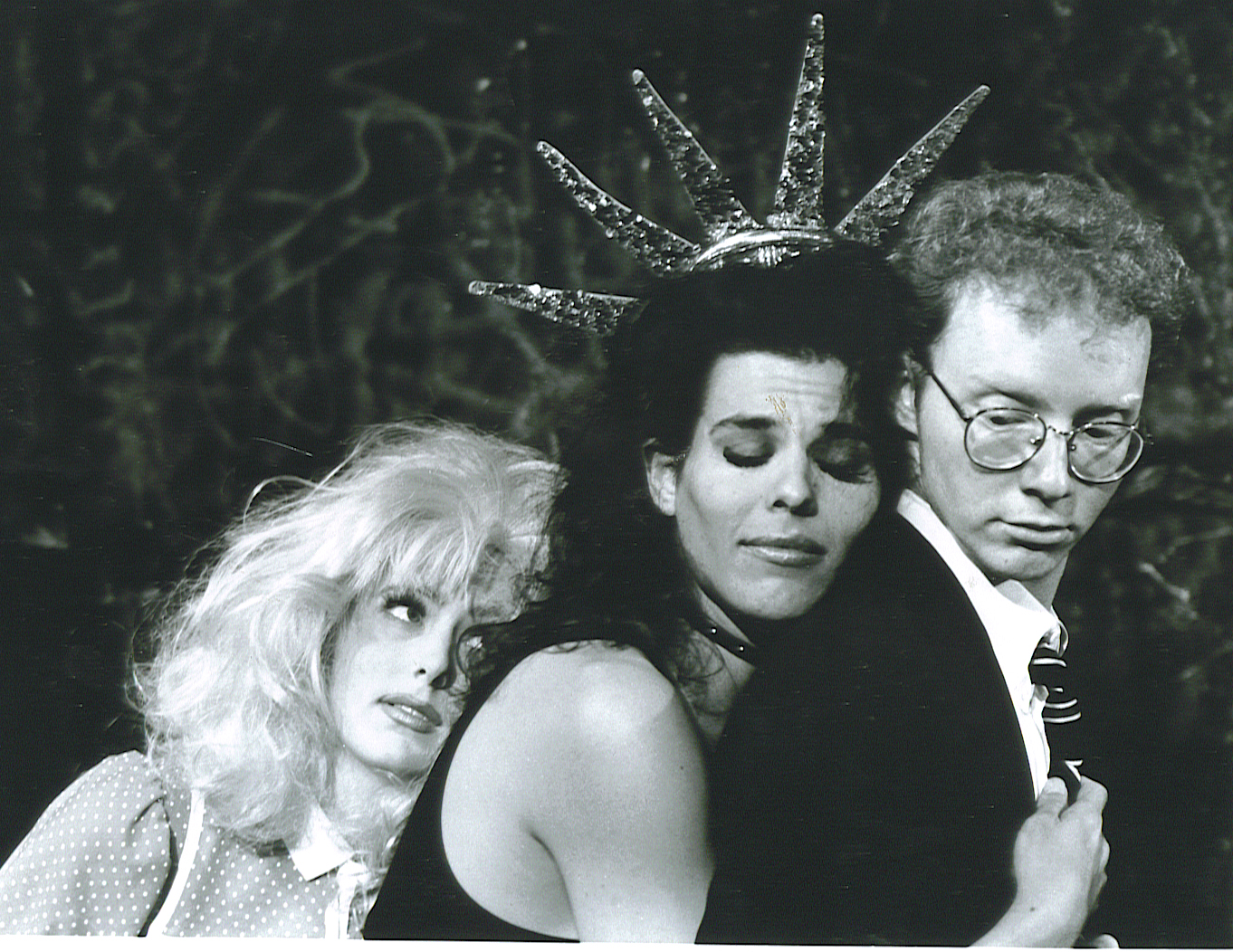
I love the play. It's only a one-act but it feels full-length, with three awesome juicy characters.
I worked on it in grad school, playing the part of my dreams, and it was a lot of fun, although frustrating, because all I wanted to do was rehearse the play for realz and put it up!
The funniest and weirdest thing is that I got a Polaroid camera (of course) to take photos of myself through the scene. The whole point is that she has to look at herself immediately - the Polaroids become her mirror. "How am I doing? Do I look sick? Do I need more Aqua Net? More rouge?"
It's grotesque. But somehow hilarious as well.
It's almost unheard-of to take pictures of yourself in the middle of a scene, so these two photos make me laugh. The second one is TERRIFYING. She really is under the impression that she looks like a million bucks!
And please, where did my upper lip go? I have never smiled like that before or since, thank the good Lord above, JESUS.


"I'll give you a winter prediction: It's gonna be cold, it's gonna be grey, and it's gonna last you for the rest of your life."
A not-to-be-missed appreciation and analysis of Harold Ramis' Groundhog Day.
The important question to ask is: "Oh, wait! Where's the banana?"
When I first got Hope, I bought her many toys. Bizzy balls and little feathery fish on elastic strings ... catnip mice and other kitty-cat pleasures. She's okay with those. She'll bat a bizzy ball around in her spare time. She'll attack a feathery fish if she's bored.
But you just don't know what a cat will "choose" as its main toy. It will always be something unexpected.
The toy Hope "chose" is a small stuffed bunch of two bananas. I believe there was catnip in it once upon a time. It has no bells and whistles. It doens't move on its own. It just sits there like a lump.
But Hope LOVES it. In almost every picture I take of her, the two stuffed bananas are also somewhere in the frame. She can't really let it out of her sight. She'll take a nap on the floor, clutching the two bananas in her paws, or lying directly ON the two bananas, because that way she won't have to worry about her toy's location.
When I went to go pick up Hope after her month-long stay at Kerry's, we were gathering together Hope's belongings ... and I said, suddenly frightened, "Oh wait. Where's the banana?"
Kerry immediately understood. She had obviously experienced Hope's adoration of the two bananas. "The banana! Where is it?"
Then began a search, and Kerry found the banana under her couch.
Phew. I would have had to go out and buy another one just like it, to keep her placated.
Hope is surrounded by things that should be interesting. Scratching posts, bizzy balls, hair ties, feathery fish, and my bamboo plant which she seems to find delicious.
But the bananas have won her heart. She's a one-toy kitty.

Books.
The situation has reached critical mass. I have cleared out books I don't need or want anymore (two boxes full) to make room for new purchases, and it's now just a hopeless situation. No more re-org. No more clearing-out. Everywhere I look are stacks of books. It's better than stacks of laundry or stacks of garbage, I admit. Sometimes it's rather cozy and it's always a stimulating atmosphere. I've lived here for six years now and I still feel a little sigh of pleasure when I walk into my apartment. It's a perfect little space and I love it.
But the books have now taken over. Hope and I cower in the corner, outnumbered. And I am no longer willing to get rid of any to make space. No. The point is to get more space.
Nothing to do now but move. I'm working on it.


February 2, 2009
More Joyce
In my web wanderings today, I came across this wonderful post - a man tracking down Joyce's birthplace in Rathgar. With photos and commentary. He braved "the apocalyptic snows of Leinster to find the truth."
And thanks for the link, Ernie. You've been sending all kinds of fascinating people my way.
Today in history: February 2nd
Two things happened on today in history:
February 2, 1882: James Joyce was born in Rathgar.
February 2, 1922: Joyce's Ulysses

James Joyce had already written a collection of short stories (Dubliners


It took James Joyce seven years to write Ulysses. Later, he would joke, when faced with criticism that the book was just too damn big - "I spent seven years writing it. People could at least spend seven years reading it."
His next book was Finnegans Wake (excerpt here) and that took him seventeen years to write.
Boy marched to the beat of his own drummer.
The history of the publication of Ulysses is a book in and of itself.
James Joyce had fled Ireland, leaving a wake of debt and scandal behind him, back in 1904. Joyce got a job teaching English at a Berlitz school in first Zurich (that didn't work out), and then Trieste. He convinced his new-found love, Nora Barnacle, a wild girl from Galway, to run away with him. He had known her for only a couple of months. They had met on June 16, 1904 - the day that he would choose to set the entirety of Ulysses on, the ultimate tribute to what she gave him. James and Nora lived in Trieste for 10 years, having children (two of them), not getting married just to spite tradition - although they referred to one another as "husband" and "wife" (the two would eventually marry in the 1930s) ... and living below the poverty line. Meanwhile, Joyce was working on Dubliners, which was quite a struggle. He could not find anyone willing to publish it. Dubliners was eventually published in 1914. He had already been working on it for years. Portrait of the Artist As a Young Man was published (in serial form) in 1914 and finally brought out as a book in 1916. It had been serialized in the highly influential The Egoist. Around this time, James Joyce was taken under the wing of Ezra Pound (what a shock. Pound was everywhere).
James Joyce had been interested in the plight of the Jews for a long time. Especially as a man living in perpetual exile, country-less, yet always looking "homeward". He felt that there was an affinity between the Jews and the Irish, and he thought it was something to explore. He had considered writing a story along these lines for Dubliners but it didn't end up happening. However, the idea percolated. It ended up being one of the main ideas in the book Ulysses, based, of course, on Homer's epic, but Joyce, with his obsessive tendencies, was the kind of man who saw connections everywhere. Exile, journey, what does "home" mean, where is it? These were questions of great relevance to the Jews, but also to himself, who felt he could never live in Ireland again (and he never did). Leopold Bloom, the protagonist of Ulysses is a Jew, living in Ireland. Stephen Dedalus (Joyce's alter ego, the "star" of Portrait of the Artist as well) is one of the aimless men Ireland is so fond of creating, a man looking for a father figure, a guide. Through their mutual wanderings through the city of Dublin, on June 16, 1904, they eventually cross paths. It is not that a kindred spirit is revealed, not really. They do not connect, or heal, or grow, or become empowered. None of those pat concepts are at work in Ulysses. It is more that it is a meeting of the minds. A realization of the connection between them, but also that such connection is transitory. At the end of the book they go their separate ways.
Joyce wrote:
Ulysses is the epic of two races (Israel - Ireland) and at the same time the cycle of the human body as well as a little story of a day (life). The character of Ulysses always fascinated me ever since boyhood. I started writing it as a short story for Dubliners fifteen years ago but gave it up. For seven years I have been working at this book-- blast it!
What was such a big deal about Ulysses? A book where nothing, let's be honest, really happens?
Much of the brou-haha (at least in the literary set) was about the writing itself, a deepening and broadening of the landscape he had explored in Portrait: what is existence really like? What is it like to live, moment to moment?
James Joyce wrote once:
"Why all this fuss and bother about the mystery of the unconscious? What about the mystery of the conscious? What do they know about that?"
Joyce did not delve into the psychologies of his characters so much, although we get to know Leopold Bloom and Stephen Dedalus better than we even know our best friends through reading Ulysses. Joyce goes behind closed doors. He goes inside the body. Circulation, digestion, sex drive, the splitting of cells ... all of that is going on in his writing, because the book - as well as being an homage to Homer's Odyssey - as well as being set up in a complicated structure, mirroring Homer's work - as well as having colors associated with each episode, and a different writing style for each episode ... it is also, chapter by chapter, a dissection of the human body. One chapter (the Cyclops chapter, naturally) is the "eye" chapter. One chapter is the stomach chapter. One chapter is the sex organs chapter. And etc. None of this is explicit. There is no guide. You have to know what you're looking for. You have to get into HIS mode when reading the book, and let your OWN mode go. This is why many people were (and are) annoyed by Joyce. But geniuses have always annoyed people. As William Blake famously wrote:
The eagle never lost so much time as when he submitted to learn of the crow.
Ouch. Crows don't like that when you point it out. But eagles, in general, shouldn't worry about the response of crows to their superiority. They need to just keep being eagles.
But James Joyce wouldn't have thought of it like that. His defenders (like myself) say stuff like that all the time, but Joyce (perhaps disingenuously) really didn't see what the big deal was. He wrote what he wrote because it amused and fascinated him. He wrote only what he could write. He wasn't going for an effect, he wasn't trying to be clever. He loved puns and language and hidden connections. He wrote from that stance. He realized that he was ahead of his time, he really did, but he wasn't precocious, he wasn't self-conscious about it. (Actually, he was - but I'll touch on that in a bit.) The thing to get about Joyce (and this is where he is truly an eagle) is that he wrote Ulysses not to make a big splash, not to stick it to the censors, not to show lesser writers how it's REALLY done (although all of these things were results) ... he wrote it because he liked it. He found it funny. Engaging.
He said (and this may be perhaps my favorite Joyce quote, and it is something to keep in mind should you pick up Ulysses for the first time - it's a clue in HOW to read it):
The pity is that the public will demand and find a moral in my book, or worse they may take it in some serious way, and on the honour of a gentleman, there is not one single serious word in it.
I believe him. Certainly there were serious ideas in the book, it's a revolution, really ... but looked at in another light, in Joyce's light, there is "not one single serious word in it". It's a joke, a maze, a puzzle, an examination of ridiculous coincidences and connections. What does it "mean"? That's the stupidest question of all to concern yourself with. It means nothing.
Samuel Beckett's wonderful quote in regards to Finnegans Wake is also applicable to Ulysses:
You cannot complain that this stuff is not written in English. It is not written at all. It is not to be read. It is to be looked at and listened to. His writing is not about something. It is that something itself.
And THAT is why Joyce is such a big deal. THAT is why the book went off like a bomb throughout the literary world. THAT is why people like T.S. freakin' Eliot, no slouch himself, said, "I wish, for my own sake, that I had not read it." James Joyce lived in a world of giants. Hemingway, Proust, Virginia Woolf, Pound, Fitzgerald, Gertrude Stein, T.S. Eliot ... the modernists. He was part of his time, but he went so much further than any of his contemporaries that many of them never quite recovered from the Ulysses juggernaut. The comments of other writers about Ulysses are absolutely marvelous, because they all recognized what has come. They all realized what had happened. The 20th century had arrived. They had all been working towards it, trying to wrestle the 19th century out of existence, bringing new forms to light. And it's not that any of these people failed. But Ulysses was the "star". Ulysses was the real death-knell.
T.S. Eliot said that Ulysses "killed the 19th century".
James Joyce hadn't set out to "kill the 19th century", but his sensibility - contrarian, sensitive, angry, loving - led him to a form that couldn't help but do so.
Now let me talk about the actual publication of the book.
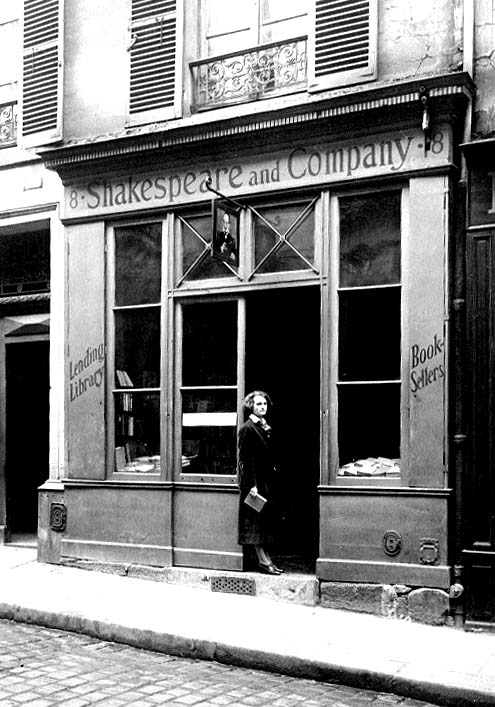
Into our story now steps Sylvia Beach. Born in Maryland, as an adult she became a major force in the literary ex-pat community in Paris. She served in World War I with the Red Cross in Serbia, and after the war settled in Paris, where she opened up a bookshop - the enormously influential Shakespeare & Co.. Shakespeare & Co. became the hub-bub, the vortex of them all. Oh, for a time machine, to go hang out at that place in the 1920s, where Hemingway would stop by, Fitzgerald would browse, Joyce would sneak in and out, Gertrude Stein would bitch and moan (haha) ... and Pound would negotiate with all of them, trying to help them all out and promote his favorites ... they ALL were there.
I love this - here is a cartoon of Joyce sitting at a table with all of his friends (try to find Joyce - isn't that hysterical?? He doesn't even have a body! That was how he was seen - just a big floating brain with enormous glasses!).

Who was the cartoonist?
F. Scott Fitzgerald.
In this vibrant world of literary rivals and giants struggling for the stage, Sylvia Beach played an important role. She had good taste, first of all, she liked the "good" ones, and didn't waste her time with the crows. She also had courage (as we shall see).
When Beach met James Joyce, he had already written Ulysses, and it was a finished manuscript by that point (or as finished as any Joycean manuscript ever would be) - but essentially unpublishable, due to its being deemed "obscene". You have to get into the mindset of the censors, as unpleasant an experience as that is. What on earth is "obscene" about Ulysses? Ultimately, the book expresses love. You cannot deny it, you cannot escape from it. It is love. Leopold Bloom, throughout his long long day, is only thinking about his wife Molly, and how much he loves her, and how afraid he is that she is being unfaithful. There is only one woman for him. In the same way that there was only one woman for Joyce. Love, it is love that drags us home after our long journey. Only love. But Joyce did not shy away from the more unsavory aspects of life (and let's remember his comment about the "mystery of the conscious" - that's so so important: he did not, as Proust did, or Woolf did, or some of the other modern writers - delve into psychology and the workings of the subconscious. He did not look at motivations and childhood repression. Let's not forget the huge influence of Freud at this time. A revolution in the understanding of the workings of humanity. Whether or not you agree with Freud, and whether or not you think Freud is over-rated is irrelevant. I am talking about the time and place from which Joyce wrote. Freud - and Jung - were hugely influential to writers like Joyce and Proust.) But Joyce, unlike Proust, did not explore how memory works, and how the senses trigger thoughts and feelings and entire narratives from our lives ... He was much more prosaic. Blunt. He presented man in the most honest manner possible. Leopold Bloom takes a dump, for example. He sits on the toilet after breakfast, and thinks about things, worrying about things, as he goes to the bathroom. Now, this is one of the most human of experiences. Anyone who says they haven't sat on the toilet, pondering their day, and what they are worried about, is lying. But to put that in a book?? What are you, cracked?
There are those who feel that while such things may be 'real', they have no place in literature. Now we're getting into the realm of the censors, who wanted to control what could be shown. It's the same as people nowadays who seem to feel that saying "TMI" is the be-all and end-all of human interaction. You complain that you stubbed your toe that morning, and certain people will say, "TMI!" Someday I'll write a post on how much I despise the "TMI" trend, and how I think it is actually indicative of so much that is effed up ... "TMI" is nothing new. There have always been those who really DON'T want to know you, who really DON'T want the truth when they ask "How are you?" It's just that now that we have "TMI" to say, it's way over-used. If I never hear the phrase "TMI" again, I will fall asleep a happy woman. Sure, there's such a thing as "over-sharing", but I'm not really talking about that. I am talking about something far more insidious. Something that is not in any way, shape or form new - it's been going on forever, as long as human beings have been in contact with one another. There is a shying away from real experience of one another. Of course. Because if you allow yourself to experience what it is like for another person, then that might mean you might have compassion for them, or empathy, or you might have a sense of recognition, an awareness of the universal: "Yes, I do that, too!" Many people do not want to be shaken out of their selves like that. I include myself, by the way, although you will never ever catch me saying "TMI"! I am all ABOUT "TMI"! But the first response for many, to some demand for connection, or understanding, is to batton down the hatches, draw the line in the sand, and say, "Nope. Nope. That's YOU, that's not ME."
Joyce cuts right to the core of that very human experience. He will not let the reader off the hook. If you insist on insisting, "That's YOU, not ME", then Ulysses will be a terribly confronting book. Joyce, above all else, was a humanist, although his cynicism and rage were titanic. That's what The Dead, with its final revelation of connection to all in the last four paragraphs, is all about. Gabriel realizes, as he watches his wife sleep, that he loves her, and yet that he has never really known her. And in that realization, his consciousness rises up and up, until he is looking down on the snowy landscape, on all of Ireland ... and he, for the first time, feels connected to life, because of his experience of heartbreak. He feels connected not just to all mankind, but also to all of the "shades", all of those people who have gone before.
To walk around saying "TMI, TMI" whenever anyone reveals anything about themselves is to exclude yourself from the human family.
The irony of all of this is that Joyce was one of the most isolated of beings, although not melancholy or a downer or any of that. It's just that he was rather old-fashioned, believe it or not, a family man, who had dinner every night with Nora and his kids and that was that. There is no scandal about Joyce. He didn't sleep with every woman in Paris. He didn't experiment with free love. Yes, he lived in sin for 30 years before tying the knot, but he was faithful to Nora. He wasn't a big socializer. He was a big drinker, but everyone was then. He wasn't dancing in fountains like F. Scott Fitzgerald was, and cheering as his wife did a jig on the table. He was rather conventional, rather bourgeois.
Additionally, there is a tremendous self-consciousness in his books (which I mentioned earlier). He can ONLY write from his own life. He was not an "inventor". He did not make up characters, and devise complicated plots. He did not write one standard novel. It was all self self self self self. I truly believe that you MUST be a genius in order to only focus on self. The memoir-trend in publishing today proves that, in my mind. There are very few good ones out there, very few stories worth telling ... the thing that elevates one memoir over another is, of course, the writing style ... If you're not a good writer then nobody cares that your mama locked you in a closet and your papa couldn't put down the whiskey. Angela's Ashes was such a phenomenal success because of McCourt's writing. You write that same story without McCourt's voice and you'd want to vomit. I know that there are folks in Limerick, especially, who already want to vomit when reading McCourt's book - but that just goes to show you that you can never please everybody.
Ulysses picked up where Portrait left off. As Portrait comes to a close, the traditional narrative voice breaks down, leaving us only with Stephen Dedalus' journal entries. There is no more voice outside the "I". Joyce has abandoned the traditional narrator. Dedalus will now take over. We are inside experience, as opposed to looking on. In the third episode in Ulysses Stephen Dedalus takes a walk on the beach. We learned in the first chapter that he had broken his glasses. This fact is mentioned only once in the entire 800 page book, but we are meant to remember it. In the third chapter, during his walk on the beach, sans glasses ... the experiences come at him through a vague impression of colors and sounds. If you somehow missed that he has no glasses, and this episode is told from the perspective of someone who can't see, then you might not know what the hell is going on. At one point:
The dog's bark ran towards him, stopped, ran back again.
As someone who needs her glasses, I can say that that is just just right. When I have been stranded without glasses, it is as though sounds "run towards" me ... It is not the DOG running at Dedalus, it is its BARK.
Perhaps now it seems obvious, or perhaps now it seems like everyone tries to write in this subjective manner. But that's only because Joyce did it first.
All of this made Ulysses a tough sell to publishers, not even counting the bowel movements, and penises, and the evening in "Nighttown" (Dublin's red-light district) and Molly Bloom's long 40 page run-on sentence that closes the book, full of farts and menstruation and masturbation. But also, please, let us not forget, that it is some of the most beautiful writing in the English language ... and her image of embracing her husband as they lie among the rhododendrons is some of the most romantic language of all time:
the sun shines for you he said the day we were lying among the rhododendrons on Howth head in the grey tweed suit and his straw hat the day I got him to propose to me yes first I gave him the bit of seedcake out of my mouth and it was leapyear like now yes 16 years ago my God after that long kiss I near lost my breath yes he said I was a flower of the mountain yes so we are flowers all a womans body yes that was one true thing he said in his life and the sun shines for you today yes that was why I liked him because I saw he understood or felt what a woman is and I knew I could always get round him and I gave him all the pleasure I could leading him on till he asked me to say yes and I wouldnt answer first only looked out over the sea and the sky I was thinking of so many things he didnt know of Mulvey and Mr Stanhope and Hester and father and old captain Groves and the sailors playing all birds fly and I say stoop and washing up dishes they called it on the pier and the sentry in front of the governors house with the thing round his white helmet poor devil half roasted and the Spanish girls laughing in their shawls and their tall combs and the auctions in the morning the Greeks and the jews and the Arabs and the devil knows who else from all the ends of Europe and Duke street and the fowl market all clucking outside Larby Sharons and the poor donkeys slipping half asleep and the vague fellows in the cloaks asleep in the shade on the steps and the big wheels of the carts of the bulls and the old castle thousands of years old yes and those handsome Moors all in white and turbans like kings asking you to sit down in their little bit of a shop and Ronda with the old windows of the posadas glancing eyes a lattice hid for her lover to kiss the iron and the wineshops half open at night and the castanets and the night we missed the boat at Algeciras the watchman going about serene with his lamp and O that awful deepdown torrent O and the sea the sea crimson sometimes like fire and the glorious sunsets and the figtrees in the Alameda gardens yes and all the queer little streets and pink and blue and yellow houses and the rosegardens and the jessamine and geraniums and cactuses and Gibraltar as a girl where I was a Flower of the mountain yes when I put the rose in my hair like the Andalusian girls used or shall I wear a red yes and how he kissed me under the Moorish wall and I thought well as well him as another and then I asked him with my eyes to ask again yes and then he asked me would I yes to say yes my mountain flower and first I put my arms around him yes and drew him down to me so he could feel my breasts all perfume yes and his heart was going like mad and yes I said yes I will Yes.
Brings me to tears every time.
The book was a bomb waiting to go off. No one would touch it. Pound had arranged for some excerpts to be published and that was the start of it. Writers, in general, were itching to get their paws on the book ... what the hell is that crazy Joyce working on now?? ... people felt competitive, nervous ... he helped them up their own game ... but in terms of the business side of things, the controversy had started before the book had even been published.
But Sylvia Beach - who had never published a book before - took a risk and said that Shakespeare & Co. would put out the book. She would publish it herself. She knew what she was doing, and she knew what the repercussions could be. It was an act of courage. Perhaps she went into it recklessly, thinking that giving a space for genius would be its own reward - perhaps she went into it knowing the eventual fallout that would crash down upon her head - But whatever her interior process, she published it. On February 2, 1922.
I was on the platform, my heart going like the locomotive, as the train from Dijon came slowly to a standstill and I saw the conductor getting off, holding a parcel and looking around for someone -- me. In a few minutes, I was ringing the doorbell at the Joyces' and handing them Copy No. 1 of Ulysses. It was February 2, 1922. -- Sylvia Beach
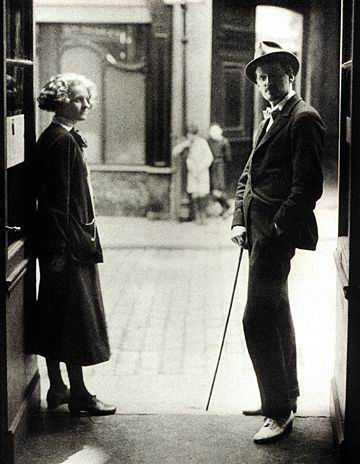
And the shit hit the fan.
Nora Tully describes it thus:
The response to Ulysses was immediate and extreme. Writer and literary critic Malcolm Cowley described it using the metaphor of a stone dropped into water: there was a moment of silence, the stone was dropped, "then all the frogs who inhabited the pool began to talk at once".
Once it was published, the obscenity controversies heated up, the book was banned everywhere - Ireland, America - everybody was talking about it, but who had actually read it? The first edition was only 1000 copies! You couldn't get the book anywhere. Additionally, you could be arrested for trying to smuggle it into certain countries - so there were a couple of years where the only place on the planet that you could get a copy of Ulysses was at Beach's bookshop in Paris. And so the orders flew in from folks around the world. People who were book readers, other writers, people who were collectors, people who sensed the historic moment and just wanted a copy.
Here is a copy of Peggy Guggenheim's urgent order-form, sent to Sylvia Beach:

Imagine you are dying to read the book. Imagine you can't get it anywhere. Imagine that it is illegal to smuggle it back into the United States. Imagine the frenzy. You can see it in Guggeinheim's writing, can't you?
Harriet Shaw Weaver, who had supported Joyce financially for years (at Pound's insistence) also arranged for another edition to be published by The Egoist press. She also arranged for them to be shipped to the United States, but they were seized by the customs officials. In 1923, John Rodker, through The Egoist again, arranged for a small printing of the book, but these were burned by English customs officials. In 1924, Shakespeare & Co., a small outfit really, and not set up to handle the demand, brought out another small printing.
Extraordinary.

Eventually, as the controversy died down, Joyce ended up going with another publisher, which really left Beach bereft financially. She already had suffered as a consequence of taking the risk to publish Ulysses. She was hounded by the police, by the censors ... so although Joyce really did need to move on, to a publisher who could handle his stardom, Beach was the first. Beach was the pioneer. Amazing woman.
Meanwhile, the comments from people who had actually read it were pouring in. This went on for years. You could read it in Europe, but America had declared it obscene, and would not allow it to arrive on its shores.
Finally, on August 7, 1934, over 10 years after its first publication by little Sylvia Beach and her little Shakespeare & Co. - a far-seeing and open-minded US Court of appeals judge, Judge Woolsey, declared that Ulysses was NOT obscene and could be admitted into the United States. It was a ground-breaking moment, a true historical watershed - and his decision reads almost like an insightful and intuitive literary review. Not to be missed. Go, Judge Woolsey!
The comments of other great writers on this book are of great interest to me. I can't get enough. I have compiled them all in a notebook. I love to read through them. The responses run the gamut from disgust, elation, despair, awe, humility ... He made other writers feel like putting down their pens. He enraged those who felt that THEY deserved HIS accolades (phone call for Gertrude Stein, Gertrude Stein, phone call) ... but whatever the response, the only emotion you will NOT find is indifference.
Joyce had made his mark.
Yeats (an early champion of Joyce) had this as his first response on reading Ulysses: "A mad book!"
Then later, as he let the book percolate, Yeats corrected himself: "I have made a terrible mistake. It is a work perhaps of genius. I now perceive its coherence ... It is an entirely new thing -- neither what the eye sees nor the ear hears, but what the rambling mind thinks and imagines from moment to moment. He has certainly surpassed in intensity any novelist of our time."
Hart Crane said: "I feel like shouting EUREKA! Easily the epic of the age."
George Bernard Shaw was disturbed by Ulysses, he took it personally, he did not like what it revealed - about man, about Irish men, about the life of Ireland, but he grappled with the implications in an honest way: "If a man holds up a mirror to your nature and shows you that it needs washing -- not whitewashing -- it is no use breaking the mirror. Go for soap and water."
T.S. Eliot was especially devastated by the book, and his comments on it are numerous. Examples: "How could anyone write again after achieving the immense prodigy of the last chapter?"
T.S. Eliot again: "I hold Ulysses to be the most important expression which the present age has found; it is a book to which we are all indebted, and from which none of us can escape."
Edmund Wilson wrote of it:
The more we read Ulysses, the more we are convinced of its psychological truth, and the more we are amazed at Joyce's genius in mastering and in presenting, not through analysis or generalization, but by the complete recreation of life in the process of being lived, the relations of human beings to their environment and to each other; the nature of their perception of what goes on about them and of what goes on within themselves; and the interdependence of their intellectual, their physical, their professional and their emotional lives. To have traced all these interdependences, to have given each of these elements its value, yet never to have lost sight of the moral through preoccuptation with the physical, nor to have forgotten the general in the particular; to have exhibited ordinary humanity without either satirizing it or sentimentalizing it - this would already have been sufficiently remarkable; but to have subdued all this material to the uses of a supremely finished and disciplined work of art is a feat which has hardly been equalled in the literature of our time.
Wilson also wrote:
Yet for all its appalling longeurs, Ulysses is a work of high genius. Its importance seems to me to lie, not so much in its opening new doors to knowledge -- unless in setting an example to Anglo-Saxon writers of putting down everything without compunction -- or in inventing new literary forms -- Joyce's formula is really, as I have indicated, nearly seventy-five years old -- as in its once more setting the standard of the novel so high that it need not be ashamed to take its place beside poetry and drama. Ulysses has the effect at once of making everything else look brassy."
Carl Jung read the book and wrote Joyce a letter:
Dear Sir, Your Ulysses has presented the world such an upsetting psychological problem, that repeatedly I have been called in as a supposed authority on psychological matters.Ulysses proved to be an exceedingly hard nut and it has forced my mind not only to most unusual efforts, but also to rather extravagant peregrinations (speaking from the standpoint of a scientist). Your book as a whole has given me no end of trouble and I was brooding over it for about three years until I succeeded to put myself into it. But I must tell you that I'm profoundly grateful to yourself as well as to your gigantic opus, because I learned a great deal from it. I shall probably never be quite sure whether I did enjoy it, because it meant too much grinding of nerves and of grey matter. I also don't know whether you will enjoy what I have written about Ulysses because I couldn't help telling the world how much I was bored, how I grumbled, how I cursed and how I admired. The 40 pages of non stop run at the end is a string of veritable psychological peaches. I suppose the devil's grandmother knows so much about the real psychology of a woman, I didn't.
Well I just try to recommend my little essay to you, as an amusing attempt of a perfect stranger that went astray in the labyrinth of your Ulysses and happened to get out of it again by sheer good luck. At all events you may gather from my article what Ulysses has done to a supposedly balanced psychologist.
With the expression of my deepest appreciation, I remain, dear Sir,
Yours faithfully,
C.G. Jung
Joyce was very proud of this letter and would read it out loud to guests in his house. Nora would snort at the end, "Jimmy knows nothin' about women!"
Katherine Mansfield wrote in a letter:
"Joyce was rather ... difficile. I had no idea until then of his view of Ulysses -- no idea how closely it was modelled on the Greek story, how absolutely necessary it was to know the one through and through to be able to discuss the other. I've read the Odyssey and am more or less familiar with it but Murry [Mansfield's husband] and Joyce simply sailed out of my depth. I felt almost stupefied. It's absolutely impossible that other people should understand Ulysses as Joyce understands it. It's almost revolting to hear him discuss its difficulties. It contains code words that must be picked up in each paragraph and so on. The Question and Answer part can be read astronomically or from the geologic standpoint or -- oh, I don't know!"
The most humorous part of this is that Joyce said, after meeting Katherine and her husband:
"Mrs. Murry understood the book better than her husband."
Hilarious.
George Moore, another Irish writer, wrote:
"Ulysses is hopeless; it is absurd to imagine that any good end can be served by trying to record every single thought and sensation of any human being. That's not art, it's like trying to copy the London Directory."
Hemingway wrote in a letter to Sherwood Anderson:
"Joyce has a most goddamn wonderful book. It'll probably reach you in time. Meantime the report is that he and all his family are starving but you can find the whole celtic crew of them every night in Michaud's where Binney and I can only afford to go about once a week...The damned Irish, they have to moan about something or other..."
Gertrude Stein wrote:
"Joyce is good. He is a good writer. People like him because he is incomprehensible and anybody can understand him. But who came first, Gertrude Stein or James Joyce? Do not forget that my first great book, Three Lives, was published in 1908. That was long before Ulysses. But Joyce has done something. His influence, however, is local. Like Synge, another Irish writer, he has had his day."
Joyce heard what Stein wrote, thought about it, and said, "I hate intellectual women."
George Bernard Shaw again:
"I have read several fragments of Ulysses ... It is a revolting record of a disgusting phase of civilization; but it is a truthful one; and I should like to put a cordon round Dublin; round up every male person in it between the ages of 15 and 30; force them to read it; and ask them whether on reflection they could see anything amusing in all that foul mouthed foul minded derision and obscenity...It is, however, some consolation to find that at last somebody has felt deeply enough about it to face the horror of writing it all down and using his literary genius to force people to face it. In Ireland they try to make a cat cleanly by rubbing its nose in its own filth. Mr. Joyce has tried the same treatment on the human subject."
Ezra Pound said:
"Joyce -- pleasing; after the first shell of cantankerous Irishman, I got the impression that the real man is the author of Chamber Music, the sensitive. The rest is the genius; the registration of realities on the temperament, the delicate temperament of the early poems. A concentration and absorption passing Yeats' -- Yeats has never taken on anything requiring the condensation of Ulysses."
Yeats wrote:
"It is an entirely new thing -- neither what they eye sees nor the ear hears, but what the rambling mind thinks and imagines from moment to moment. He has certainly surpassed in intensity any novelist of our time."
William Carlos Williams wrote (echoing what many of Joyce's contemporaries felt):
"Joyce is too near for me to want to do less than he did in Ulysses, in looseness of spirit, and honesty of heart -- at least."
E.M. Forster wrote:
"Perhaps the most interesting literary experiment of our day."
Dr. Joseph Collins reviewed "Ulysses" in The New York Times and wrote:
Ulysses will immortalize its author with the same certainty that Gargantua and Pantagruel immortalized Rabelais and The Brothers Karamazov Dostoevsky ... It comes nearer to being the perfect revelation of a personality than any book in existence.
Hart Crane, who had totally lost his head about the book, wrote:
"The sharp beauty and sensitivity of the thing! The matchless details! His book is steeped in the Elizabethans, his early love, and Latin Church, and some Greek ... It is my opinion that some fanatic will kill Joyce sometime soon for the wonderful things said in Ulysses."
Ford Madox Ford wrote:
"For myself then, the pleasure -- the very great pleasure -- that I get from going through the sentences of Mr. Joyce is that given me simply by the cadence of his prose, and I fancy that the greatest and highest enjoyment that can be got from any writing is simply that given by the cadence of the prose."
William Faulkner wrote:
You should approach Joyce's Ulysses as the illiterate Baptist preacher approaches the Old Testament: with faith.
Vladimir Nabokov wrote:
Ulysses, of course, is a divine work of art and will live on despite the academic nonentities who turn it into a collection of symbols or Greek myths. I once gave a student a C-minus, or perhaps a D-plus, just for applying to its chapters the titles borrowed from Homer while not even noticing the comings and goings of the man in the brown mackintosh. He didn't even know who the man in the brown mackintosh was. Oh, yes, let people compare me to Joyce by all means, but my English is pat ball to Joyce's champion game.

That's a drawing by Guy Davenport, entitled "Joyce Writing a Sentence".
Last year, at around this time - almost exactly a year now - my father gave me his treasured and rare copy of Ulysses - part of the 1924 printing of Shakespeare & Co. The book is falling apart. The pages are thin and rustly, and little bits of them drop off if you pick it up. It is enclosed in a box, to protect it - which has on the spine: ULYSSES - PARIS, 1924.
I have been unable to look at it over the past year. I brought it home with me, put it on a special shelf, and stayed the hell away from it. It seemed to mean something ominous, something final. I didn't want to pick it up, and be casual about it. Even just looking at the book gives me a chill down my spine.
This morning I took it out and spent an hour with it, treating it as carefully as a glass figurine. Every page has something of interest on it. There is a sticker on the first page - stamped with the personal imprint of the couple who had bought the book (my father, naturally, knew everything about them). The copyright page is amazing. First of all, it lists all of the controversial editions that had gone before ... 500 copies burned, etc. And to see the legendary "Shakespeare & Co.", in print, signing its name, so to speak, to the book, bravely putting it out again, knowing what will happen to their small operation ... It's just something that makes me feel humble, awed, and proud that I am aware that such people existed.
My copy of the book is not one that I will take out and read. It is too fragile.
But it is now my most prized possession. I spent some time with it this morning. 4 a.m. to 5 a.m. In honor of the man who gave it to me, and in honor of the birthday of this book that means so much to me, that connects me to something so deep, so powerful - that I can barely speak to it.
I took some photos of this gift from my father. They are below.
The last photo has a framed picture of my dad in the background, standing by Yeats' grave. That was not deliberate. I did not consciously place the framed photo in the frame. It's just that everywhere in my apartment that you look you will see evidence of my heritage, my family, my inheritance. My father taught us well.
Happy birthday to Jimmy Joyce and to his masterpiece.


February 1, 2009
Classic.
I just love this picture, of the front billboard of Wrigley Field - corner of Addison and Clark in Chicago. Middle of winter. 27 degrees.

The Alvin Ailey flat-back series
Here is a picture of my dear friend Shelagh and myself, before dance class at the great Alvin Ailey dance studio. We took classes in the famous Horton technique - which involves the "flat-back series", great for balance and also your abs and thighs - lots of squats and lunges - all with your back flat as a board ... but it sure makes you look ridiculous. We would watch the real dancers - the real Alvin Ailey dancers - taking classes and we would watch them do the same flat-back series and think, "God, it looks so elegant when they do it. We look like crouching Hobbits hidden midgets."

Two shadows, and my crazy brother
No matter how many times I look at this photo, it still makes me howl.
It's a visual joke, but it's also a mistake ... a blessed mistake. My parents, my brother and my uncle Tom and I went out to the Statue of Liberty. It was a great day. Really cold and glittery. I hadn't been out there since a field trip when I was 9 years old. The sun was getting lower in the sky so the shadow of the Statue stretched across the little island, long and thin. My parents were standing directly in the shadow of the statue, and asked me to take a picture. My brother stood off to the side - trying to duplicate in his own shadow the look of the Statue's shadow, arm in the air, etc.
The idea was that across the ground there would be two identical shadows - only one would be the huge statue's, and one would be his. Funny, right? But I didn't really get the joke of what my brother was going for - so I included him in the picture. Which completely killed HIS joke but made another joke on another level.
The idea was to cut him out off to the side, but include his shadow.
So it looks like my parents are nice and smiling and oblivious as this insane man crouches in a frozen isolated pose off to the right.
If I ever need a good laugh - and I often do these days - I pull out this picture.
