

Kentucker Audley
Director, writer, actor, editor Kentucker Audley has been working in independent film in various capacities for 20 years now. Born Andrew Michael Nenninger, he adopted the name “Kentucker” as a nod to his birthplace, Kentucky. He’s mostly associated with Memphis, where he went to film school and got his start as a filmmaker in the low-budget to no-budget vibrant scene there. (He started a film coop called No Budge, launching it on Tumblr – appropriate for both the subject matter and the mid-2000s environment – and it now has a streaming platform.) He met his now-wife and long-time partner (romantic and artistic) Caroline White during a tour of Graceland. I mean, come on.
He’s done it all, and was chosen as one of the 25 faces of independent film by Filmmaker Magazine in 2007, based on the strength of his first feature Team Picture, which he made for almost no money in Memphis, and which he did with a two-person crew. Audley first came on my radar in 2012 because of his performance in Amy Seimetz’s Sun Don’t Shine, where he plays opposite Kate Lyn Sheil, an actor I’ve actually written quite a bit about in various reviews, but I should probably devote something solely to her. I love her.
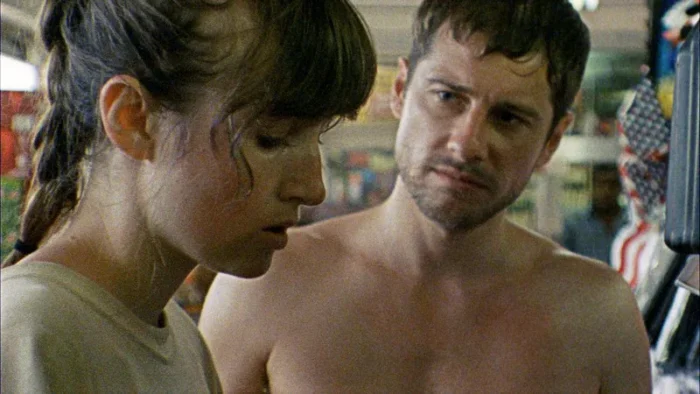
Kate Lyn Sheil and Kentucker Audley in “Sun Don’t Shine”
She comes from the same realm as Audley (as does Seimetz, whom I was lucky enough to get to know during our time as jurors at the Indie Memphis Festival). I was unaware Audley was a filmmaker when I saw Sun Don’t Shine, but I soon did the proper catch-up work. He’s been on my radar since then. I’ll see whatever he does.
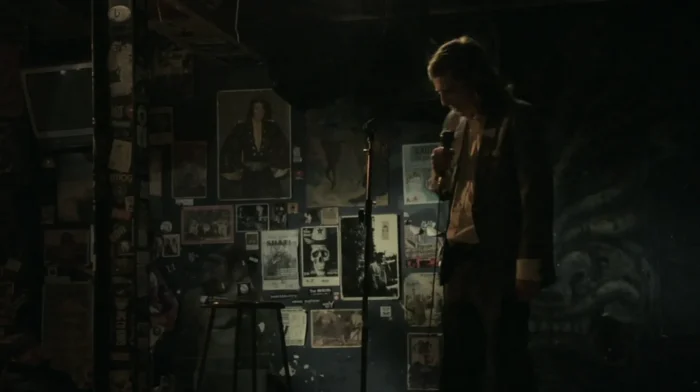
Kentucker Audley in “Bad Fever”
In 2011, he appeared as a hopeful standup comedian in Dustin Guy Defa’s Bad Fever. Filmed in Salt Lake City, it is a bleak and uncompromising work, and Audley plays a man who has nothing going on, really, who for some reason wants to do this thing that is totally not natural to him. I wrote about it on my Substack.
He’s always fascinating to watch as an actor. He’s so handsome. But his face is both mysterious and transparent at the same time. This makes him intriguing. I said in a review that he doesn’t walk around on film as though he is aware how handsome he is. In some things, he’s so recessive he’s almost invisible. And yet, he’s magnetic, in a way that doesn’t call attention to itself. I know guys like this in real life. He’s a minimalist as an actor. It’s almost like he does as little as possible. He says the same is true for him as a filmmaker. He doesn’t try to make a splash with “style”. He’s not trying to imprint himself on the films visually. For him, as an actor, doing as little as possible makes you lean in. There’s always a lot going on in there. This is most obvious in Christmas, Again, a plot-less wonder of a movie, which I’ll talk about in a bit.
He’s co-directed two movies with Albert Birney, the first one being Sylvio (2017).

Sylvio was one of my favorite films that year and it wasn’t released in theatres and it doesn’t even have a Wikipedia entry. I don’t care. For a movie about a wistful gorilla, who spends his days working the phones as a debt collector and his nights alone eating microwaved dinners, you wouldn’t expect delicate tenderness, you wouldn’t expect a sensitively observed character study. Especially since the whole thing started as sketches on the Vine app. (RIP Vine. The days of innocence.) I read a review that called the vibe of Sylvio “subdued slapstick”, which I think is perfect. They released it online. It’s a must-see. (I interviewed Brett Hanover, another “no budget” Memphis filmmaker, who was inspired by people like Audley, to make his own films, which he did, starting when he was a teenager. We gave his film Rukus the Hometowner Award at Indie Memphis. Hanover released the film online for free. This was part of the spirit of the project.) Memphis “mumblecore” is a whole THING, and Audley was one of the pioneers of the whole scene.
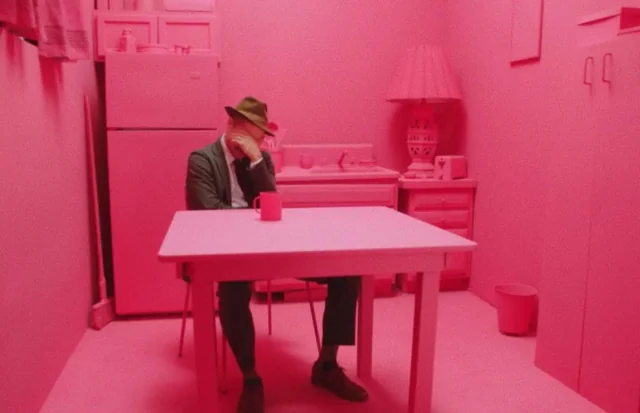
Kentucker Audley, “Strawberry Mansion”
The second film he directed with Birney was the excellent Strawberry Mansion (2022), which I reviewed for Ebert.
He’s worked with a lot of very good directors, often when they were up-and-coming, like David Lowery (Ain’t Them Bodies Saints), Adam Wingard (V/H/S), Ti West (Sacrament), Alex Ross Perry (Queen of Earth and Her Smell), Ma – a wonderful experimental film – with no Wikipedia entry – which I reviewed. (Audley has a small part in it, but director Celia Rowlson-Hall is “someone to watch”: this is her only feature, but she appeared as the adult Sophie in Aftersun.) Most recently, Audley appeared in the VERY unsettling She Dies Tomorrow, where he reunited with director Amy Seimetz and Kate Lyn Sheil. It’s SO good. (I reviewed).

Kate Lyn Sheil and Kentucker Audley, “She Dies Tomorrow”
But my all-time favorite is Christmas, Again, directed by Charles Poekel in his feature film debut. Christmas, Again came out in 2015, and I gave it a rave for Ebert. I have introduced so many people to this movie, and I watch it every year, reveling in its heartache-y Christmas New York lonely vibe.

Kentucker Audley, “Christmas, Again”
I cannot say enough good things. There was a long period where it was un-seeable, not streaming. The director reached out to me and sent me one of the commemorative DVDs they released, in limited edition. I was so touched. It is now streaming, thank God, and it’s also picked up steam, creating its own audience because of the streaming. It just played in London and has made it on a couple of lists of “best Christmas movies”, and I have to agree.

Kentucker Audley and Hannah Gross, “Christmas, Again”
It’s my kind of movie. It shows a very specific seasonal sub-culture, so familiar to anyone who lives in New York City: the routines of those who sell Christmas trees on every corner in December. Poekel himself did this job. The lead character is named “Noel”, perfect considering the holiday, but ironic, because Noel is not, how you say, filled with Christmas spirit. In fact, he is walking around weighted down by heartbreak. He doesn’t say much but his experience fills the entire movie. The dialogue does not drive the plot. There is no plot. When characters talk in the film, you feel the currents of chaos driving so many conversations in real-life, the zig-zags, the silences, the sudden shifts, the unresolved feelings. These energies/rhythms are so rarely portrayed in film, because so many films are so concerned with “story”. Noel is buried in himself, and interactions are painful for him: he’s short with people, he has to be snapped to attention. Christmas, Again feels no pressure to be anything other than what it is. It’s a tone-peom about being lonely.

Kentucker Audley, “Christmas, Again”
The arc of the story can be seen in the face of its star.
Dan Mecca at Film Stage interviewed Audley about Christmas, Again as well as all of the other stuff Audley’s got going on.
I was especially interested in Audley’s conception of the nearly-wordless character he plays in Christmas, Again and the challenges this provides him as an actor:
So basically the process for me was withholding. For the first hour withholding any kind of expression or life in the face of the eyes. And just lean into that difficult time I feel like we can all relate to and let whatever’s washing around me, just let it be there and don’t find satisfaction in anything. And then when I do shift to find some joy in the moment ,and you really notice that because you haven’t seen it and you haven’t realized you haven’t seen it. So it’s a pretty simple shift but it somehow – I think it works in the film because we show so much restraint that any small, little shift is noticeable and recognizable.
He’s so smart. Audley has a website called Talkhouse where he shares video-essays, short films, essays, etc.
I get so excited when I “meet” a new actor or director. And he’s young-ish, too. There is still so much to look forward to.


