
My progress:
Shakespeare Reading Project
Henry VI, parts 1, 2, 3 and Richard III
Two Gentlemen of Verona
The Taming of the Shrew
Titus Andronicus
The Comedy of Errors
Love’s Labour’s Lost
Romeo & Juliet
A Midsummer Night’s Dream
Richard II
King John
The Merchant of Venice
Henry IV, Part 1
Henry IV, Part 2
The Merry Wives of Windsor
Much Ado About Nothing
Henry V
Julius Caesar
As You Like It
Hamlet
Dear friend.
I send you a flower from my garden – Though it dies in reaching you, you will know it lived, when it left my hand –
Hamlet wavered for all of us-
— Emily Dickinson to Mary Higginson, 1877
With all the many many many words in Hamlet – it is Shakespeare’s longest play – there are so many words, so much theorizing and reflecting and articulated mental struggle – so many questions and so few answers – when you get to the center of it, or at least what you might think is the center – what you find is silence. The silence you might hear in a portal to the farthest reaches of the universe. Everyone speaks. At length. What they say has meaning. We still quote what they say. But what, ultimately, does it all MEAN?
The fact that people have been arguing about the play for 400 years, struggling to dominate the discourse or express a Grand Theory of Everything Hamlet, just speaks to the play’s unruly and unnerving power. I feel like people are uncomfortable with the play’s open-endedness, with its refusal to just say what it means. This discomfort is appropriate, and – in fact – might be the play’s reason for existing?
It’s easy to forget that Hamlet is SUCH a strange play. There’s so much in between the play and our experiencing of it – it’s SO well-known we take it for granted. There are centuries of commentary, famous performances, etc. The play is covered in barnacles of research and opinion. And so we are overly familiar with it, and THUS, Hamlet is normalized. It’s “the establishment”. But take a step back. Take a couple. The play is not normal. The play is radically experimental. Nothing about it follows the rules.
This starts with the first moments of Act 1, scene 1, where two sentinels (Barnardo and Francisco) meet up on the ramparts of the castle. Famous opening, right? The first line of the play is “Who’s there?” Famously straightforward. “Who’s there?” (along with “how far that little candle throws its beams” from Merchant) is one of my favorite lines in all of Shakespeare. “Who’s there” is so practical – a question that requires a simple answer. This play – so full of questions – starts with one. Also, “Who’s there?” is such a humorously BRIEF question to open Shakespeare’s longest play. However, if you take “Who’s there?” as a metaphor, or as at least somewhat abstract, there you are again at the portal to the universe … or, if you like, standing down center stage looking out into the darkness. Who’s there? “Who’s there” is a wormhole.
Here is the opening exchange:
BARNARDO:
Who’s there?
FRANCISCO:
Nay, answer me. Stand and unfold yourself.
BARNARDO:
Long live the King!
FRANCISCO:
Barnardo?
BARNARDO:
He.
FRANCISCO:
You come most carefully upon your hour.
BARNARDO:
’Tis now struck twelve.
One sentinel relieves the sentinel already on duty. Big whup.
But look closer. It is the relieving-sentinel (Barnardo) who asks: “Who’s there?”
Think about it.
Barnado, the relief sentinel, approaches Francisco, the sentinel on duty, and says, “Who’s there?” Shouldn’t you know who’s there, because you’re approaching to take over the watch? You know the guy who’s on duty. It should not be a surprise who’s there. “Who’s there?” seems like it should be said by the OTHER guy, the sentinel currently on duty, looking out into the night and hearing someone approach. Francisco replies to Barnardo’s “Who’s there”, understandably, with, “Nay, answer me. Stand and unfold yourself.” Basically: “hey, asking ‘who’s there’ is MY job. Who are YOU?” Instead of identifying himself, though, Barnardo cries, “Long live the king!” Which is pretty funny. A desperate display of allyship, i.e. “I come in peace!” By this point, and “by this point” I mean three lines into the play – THREE!! – Francisco recognizes the voice and asks, “Barnardo?” These two are friends and Barnardo has complicated – unnecessarily – what should be a simple, “Wassup, I’m here, go home and get some sleep.” Barnardo confirms, “He.” Francisco says, a bit freaked out, “You come most carefully upon your hour.” Why you sneaking up on me, bro?
Again, these are the first seven lines. Hamlet starts in a state of total confusion. Nobody is identified. Everyone is “who’s there”-ing everyone else.
The rest of the scene does the opposite of providing clarity. Both sentries saw the Ghost the night before and are scared it will come again. Horatio arrives, calm skeptical Horatio. He’s heard the story and scoffs, “‘Twill not appear again.” Barnardo settles in to describe what they saw and you get the sense it’s going to be a long story, but he only gets five lines in when he is interrupted by the Ghost entering. The Ghost doesn’t speak (he only speaks to Hamlet). So … the exposition is interrupted by what the exposition was about to describe. Horatio gives a long (long) shpeel on the politics going on, and the conflict between the old Hamlet (the dad, the ghost) and Fortinbras. Not the Fortinbras who shows up at the end, but Fortinbras’ father, also named Fortinbras. To an audience who doesn’t know that both fathers have the same name as their sons, Horatio’s monologue is basically incomprehensible. Again: only in retrospect does it make sense. In the moment, clarity is not provided.
Meanwhile: let’s see what we HAVEN’T heard about in the first scene. We haven’t heard anything about Claudius, Gertrude, the quickie marriage, we haven’t heard anything about Hamlet! HAMLET doesn’t arrive until the SECOND scene, and he doesn’t speak until halfway through. He’s just part of the crowd (and the first time he speaks – fascinatingly – it’s an aside to us.) Most Shakespeare plays start with a scene where everything is laid out so we can orient ourselves. The first scene here does the opposite of setting up the story. We don’t know who is the lead, or what is the story, we can’t orient ourselves and neither can the characters. Nobody knows who anybody is! Wait, Horatio, which Fortinbras are you talking about?
There’s more strangeness though. The scenes are discrete little pockets, and there is a narrative – sort of – but it keeps diffusing and scattering. There’s no coherent throughline, although the play keeps attempting to straighten itself out. It’s so fascinating. There really is nothing else like it, unless you skip forward four hundred years to the breakdown of narrative in the modernist era. The action – Hamlet getting his revenge – is postponed throughout, almost to the point it becomes funny. Hamlet is going to go meet the ghost, but before that we get a whole long scene with Polonius and his kids Laertes and Ophelia. Then Hamlet and Horatio go to see the ghost, but before that Horatio delays the meeting, and Hamlet has this long speech about scandal. Hamlet is headed to see his mother, and then gets distracted by Claudius praying. Oh, and how about this: Hamlet is told to revenge his father’s death and who is his first target? Ophelia! The totally innocent Ophelia! He decides to “act crazy” and who does he test it on? Ophelia! Scaring her half to death. Ophelia has nothing to do with Claudius marrying Gertrude, so it’s like Hamlet has to cut her off – maybe because he knows he’s going to go somewhere murderous psychologically, and she won’t be able to follow. He knows he is going to change beyond recognition? Or maybe he hates her softness because he hates the softness in himself. (i.e. incel?). In other words, nothing happens when or how it should. There’s no urgency. In the middle of the whole revenge plot, Hamlet devotes himself to directing and writing a play! And he’s way more into THAT than he is into the revenge.
You could say, as Lawrence Olivier does at the start of his 1944 film: “This is a tragedy of a man who could not make up his mind.” This is a common interpretation: Hamlet can’t make up his mind whether or not to kill Claudius. This is a pretty good summing-up of what the play FEELS like … but the reality is much more fluid. At the end of the play eight people have died. But the way they die … it’s not exactly a one-man massacre. Ophelia dies at her own hand. Gertrude dies by accident, and it’s only because Claudius put the poison in the cup meant for Hamlet. She wasn’t supposed to drink from that cup. Hamlet stabs Polonius, but it’s only because he THINKS it’s Claudius behind the curtain. Laertes and Hamlet fight, but they switch rapiers by accident so Laertes dies but only because Hamlet now has the rapier with the poisoned tip. LOOK at this train of events. This is not just “a man who could not make up his mind”.
It’s well-known that Hamlet is a “revenge tragedy”, a very popular genre in Shakespeare’s time: Thomas Kyd’s The Spanish Tragedy launched a thousand ships, including Hamlet. But … what does revenge even mean in the scenario described in the paragraph above? Did Hamlet get his revenge? Not really! A revenge tragedy has familiar elements, all of which appear in Hamlet, but they are undercut repeatedly: it’s genre as skeleton only.
Hamlet wanting — and delaying — revenge is only part of the whole. There’s a dual investigation going on. Instead of blindly obeying the ghost, Hamlet spends almost the whole play testing whether or not the Ghost was correct. He wonders, worriedly, “What if the Ghost was actually the devil? What if he was lying?” So he puts together all these ways to test everyone around him, wreaking havoc and observing the results. So that’s one side: Hamlet investigating whether or not the Ghost was right. The other side belongs to Claudius, Gertrude, Polonius, Ophelia, Rosencrantz and Guildenstern, basically the whole court: They see that Hamlet is not like himself. They wonder if he is “mad”. If he IS mad, then why? Is it because he’s madly in love with Ophelia? Polonius thinks this is the reason. Or is it something else? This cohort sets up test after test as well, setting themselves up as secret audiences to observe Hamlet’s reactions to things, hoping to understand the genesis of his madness. We swing back and forth between these two investigations, as every character wrestles for control of the play, for what the story actually IS. The castle cohort is still arguing about Hamlet’s madness in Act IV!! They still don’t know why he’s crazy or IF his craziness is real! Meanwhile, Hamlet gets involved in a theatrical production, creating an excuse to continue his investigation into whether or not Claudius killed his father. But … you get the sense that being engrossed in a rehearsal process is more important to Hamlet. In Act IV, he is sent away on a ship to England, after killing Polonius by accident. Act IV is LATE to have the actual theme and plot of the play still so much up in the air.
There are all these patterns and motifs throughout, which you can’t help but cling to for clarity and structure:
Ears. (Not just the body part but that almost every scene features people eavesdropping.)
Boundaries. (corporeal and supernatural)
Garden. (Ophelia drowning, Claudius in the garden)
Rotten-ness. Images of decay, words like “foul” and “rank”. Political corruption.
Poison. Poison in the cup, poison in the ear, poison on the rapier tip, “fanged adders”, but also poisoned reputations, poisoned minds.
“Heaven and earth”. The phrase itself shows up multiple times (or “earth and heaven”). This could be a subset of the “boundaries” motif.
Acting/theatre. This is probably the biggest motif of all! You could say the play itself is a play. Plays within plays. Hamlet “acting” – as an actor – but also “acting” – as a revenger. Putting up pantomimes for an audience, whether paying or not. Hamlet “acting crazy”. Hamlet correcting his own death warrant, writing in Rosencrantz and Guildenstern’s names … he’s a playwright. The word “play” shows up … everywhere, always. Even stuffy Polonius gets in on the action when he mentions he was an actor back in his school days (nobody cares, Polonius), and one time he played Julius Caesar. (Shakespeare’s Julius Caesar was written around the same time as Hamlet, by the way. And Shakespeare’s Brutus is a clear precursor of Hamlet. So Caesar (Polonius) is stabbed by Brutus (Hamlet). What if, back in the day, the actors who played Julius Caesar and Brutus ALSO played Polonius and Hamlet. The regular audience would get the joke. Worlds within worlds.
All of these symbols and motifs and patterns … they exist. You feel them in the text. But what doe it all mean, ultimately?
Hamlet goes into the duel with Laertes in a suicidal mood. (Or, more suicidal than usual. Hamlet is the prototype of suicidal ideation.) You could see the “duel” as an act – which it is – it’s planned out like a play, it’s not spontaneous. You could also see it as the pretext Hamlet needs for his own death. Death-by-cop. The ultimate avoidance of responsibility. Does Hamlet even want revenge? Does he care about being king eventually? He went away to college. He got OUT. The Ghost is seen wearing full armor: Dad Hamlet was a warrior king. His son is a university intellectual, a poet, a drama club kid. Like father like son is not this story, although Hamlet is filled with fathers and sons: Hamlet, Laertes and Polonius, Fortinbras and his dad, even Pyrrhus in the play within the play. When The Murder of Gonzago/The Mousetrap is presented, everything onstage splits or fractures into multiple spheres of “watching” and “action”: the audience in Elsinore watches the play, while Hamlet watches Claudius. We out here in the audience watch the play Hamlet, and so we watch Mousetrap too, but we can see that the REAL “play” in Act III, scene 2, is going on in the audience. The one up onstage, the fictional one, but also the audience we ourselves are actually in.
A word on the whole ‘Hamlet procrastinates’ thing, and this might get preachy:
Hamlet resists the Ghost’s command and keeps putting off the revenge. This can be frustrating, but only if … you think Hamlet killing a man is okay. In killing Claudius, Hamlet would be killing the thing that makes him him – his sensitivity, his liveliness, his interest in art … and in fact we watch that side of him die over the course of this thing. Hamlet is RIGHT to put off his revenge, because he doesn’t WANT to kill his stepfather, because somewhere he knows if he DOES, he will never be the same again. Wanting the revenge to play out is bloodthirsty and in a way Shakespeare is commenting on how these things usually go and maybe – maybe? – criticizing the audience for wanting to just get to the revenge.
There are a couple of similar theatrical moments that come to mind:

In an episode of Chernobyl, Barry Keough plays a kid drafted into cleanup duty, where he is put on “pet killing” detail. The character resists with every fiber of his being because he knows if he completes his task he will no longer be the same kind of person. He is killing himself, the soft tender part (the best part). I’ve seen YouTubers react to Chernobyl and many get frustrated with him, especially when he wounds a dog and hesitates to put it out of its misery. But … if he came out of the truck on his first day and started blasting away dogs and puppies … he’d be a psycho. No, he has to “come around to it”. In so doing, he has to murder the soft part of himself. His hesitation is the best in him, the best in us.

In Saving Private Ryan, Jeremy Davies crouches on the stairs crying, instead of running upstairs with the ammo. People – safely sitting in front of their computers, never having gone to war – HATE him, and JUDGE him for his cowardice. Spielberg said over and over during the press tour, “That character is me. That’s who I would be in that situation.” We want to think we’d be better than that character. We resist identification with him, even though the director insists we do.
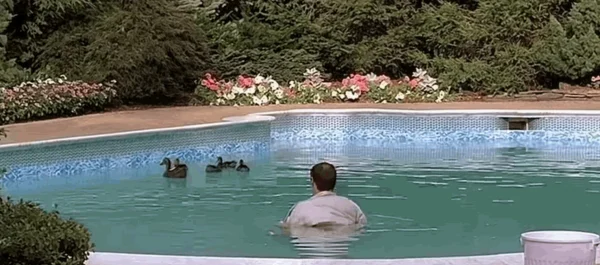
There were those who got frustrated with the dual nature of The Sopranos: there’s the therapy personal-life side, and there’s the mob violence side. The ones who were in it for the violence – who viewed the other stuff as “filler” – were a vocal cohort, as you will recall if you watched the show in real time. I always felt that this cohort conveniently forget the pilot: the ducks in the pool, the panic attacks, the therapy, Tony Soprano breaking down in tears about the ducks, the empty pool, the empty sky. The pilot told you what the show would be, in no uncertain terms. It’s one of the best pilots ever because of this. Those who hated the ending also forgot the pilot. The show was not about bloodshed, cathartic or random. David Chase was very open about why he did what he did. Having the members-only jacket guy come out of the bathroom guns blazing like Michael Corleone would be a betrayal of what the show CLEARLY said it was interested in.
Hamlet putting off revenge reminded me of those things.
We all want catharsis. Aristotle understood this. Some dramas provide it and many of these dramas work, eternally. But when an audience is denied the catharsis they seek, they can turn on the work of art, judge it as imperfect, or somehow “avoidant” – when it is really the audience who is actively avoiding the implications of a work of art WITHOUT a catharsis.
People wish Hamlet would stop dilly-dallying and just kill the king.
But what about the soliloquies? What about everything else in the play? What about Hamlet’s delicacy and imagination? We want him to kill off those beautiful qualities? We think he would be better off if he was a murderer?
This is not to say Hamlet is without its classical elements. Tragedy requires an audience to identify somehow and wish they could intervene in the events. Think Romeo and Juliet. That’s in operation in Hamlet too. You can’t help but think … wouldn’t Hamlet be better off if he just left Denmark altogether and ran away with the acting troupe? He loves being around the actors! His whole mood changes when they show up. It’s the only time in the play he is authentically activated! You want this funny creative drama nerd to kill everyone? Critics considered the “messiness” of the play, and the lack of structure/ambiguity a flaw for centuries. T.S. Eliot called the play a “failure”, since so much is left unresolved, unexplained, and the central character is so ambiguous. The play is very strange but the strangeness is a feature, not a bug. I think part of critical resistance to Hamlet is he is seen as “unmanly”, like Jeremy Davies weeping soldier is, like Barry Keough’s hesitant pet killer is. We want these guys to “man up”. Hamlet is actually called “unmanly” in the play. Shakespeare knew what he was doing. He also knew that the “unmanly” part of Hamlet – the one who went off to school, who reads, who likes theatre – is the best part of him – and us. This is why Hamlet resists the revenge. He likes those parts of himself. He doesn’t want to say goodbye to them.
However, let’s not get it twisted: Hamlet is not a softboi. He is unpredictable and can be breathtakingly cruel. Hamlet has a little Hal in him. (“For worms, Percy.”) Hamlet’s treatment of Ophelia is shocking. We know they had a relationship but we never see the good times. We come in at the end, just in time to watch Hamlet put a torch to the whole thing. He doesn’t “break up” with her, he shatters her, and still refuses to leave her alone. He accuses her of all kinds of things, which clearly aren’t true … all in full view of her family, who fail to protect her, and just continue to use her as a way to get close to Hamlet and see what’s going on with him. Hamlet is shockingly vicious to his mother. “the inmost parts of you” is terrifying. He is cruel to the point of psychopathy to Polonius, including calling his dead body “the guts”. He knows he is the center of everyone’s attention, and so he goes about pulling on puppet strings because he sees everything that’s going on. He knows Rosencrantz and Guildenstern are up to no good. (Yes, but sending them off to their deaths is extreme.) He also knows Horatio is good and trustworthy. He commands Horatio to tell his story…

I read the play three times this year, once before I watched Riz Ahmed’s Hamlet and then twice for this, and each time I’m surprised by it. I remember all the scenes but still they take me by surprise, it’s like they arrive before I’m ready for them. I’m like “Oh! Claudius is praying now? I thought it came later??” or “Oh wow, the players are here already??” “Oh shit, here’s ‘rogue and peasant slave’, here we go …”
You can memorize the order of Romeo and Juliet, and the story/play is intact in any re-telling of it. The play exists on its own events, gorgeous language or no. There’s nothing outside the play’s plot. Not so with Hamlet. Awareness of “everything outside” the play flickers on the periphery, sometimes visible, always felt … At one point Polonius says:
I will find
Where truth is hid, though it were hid indeed
Within the center.
This is true of the play Polonius is in. Truth is hid, and it’s hidden in the center. Meaning can be found in the center. And the center is so deep you can’t even GET to it.
Hamlet without the magnificent soliloquies ceases TO BE. This makes me think of a great exchange in the Canadian television series Slings & Arrows, when Jack, the movie star playing Hamlet (played by Luke Kirby), is freaking out before opening night about the bigness of the role, and Geoffrey, the artistic director (played by Paul Gross), tries to talk him down.
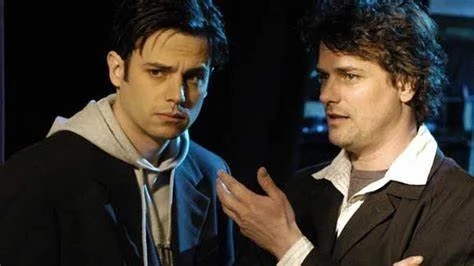
Geoffrey: I want you to think of it in terms of six soliloquies, okay? Count them off with me. ‘O that this too too solid flesh’. ‘O what a rogue and peasant slave am I.’ ‘To be or not to be.’ ‘Tis now the very witching hour’ – that’s a short one, that’s only twelve lines. ‘Now might I do it pat’. ‘How all occasions do inform against me.’ That’s it. Six. And the rest, as they say, is silence.
Jack: I think there’s some dialogue in between.
Geoffrey: Filler.
An exaggeration, of course, although to the guy playing Hamlet it might be helpful. Put your focus where it matters. Without the soliloquies, Hamlet isn’t Hamlet. The play is ABOUT the experience of interiority, which is why Act V is such a shock to the system. Hamlet has no soliloquies in Act V. He’s beyond it. He’s closed the door on his own interior life. Also, alarmingly, awfully, he starts to refer to himself in the third person.
So. These are (some of) my thoughts on Hamlet. When I read the play, I try to come to it fresh. I try to forget the interpretations handed down to us over the years. The amazing thing is Hamlet resists interpretation, ultimately. And it doesn’t matter somehow what everyone has said over the centuries … the experience of reading the play is still – still – a shock. The whole thing is so improbable, so unruly, so diffuse. The pieces can’t be gathered together. This is not to say the play is imperfect, or whatever, but I do believe strongly that uncategorizable works – works which cloak themselves in a genre but then undercut and wriggle out from under the rules of the genre – works that refuse the rules, and allow themselves to be wide-ranging, loose-limbed, even chaotic, have more staying power, not because of what they say, but because of what they suggest. A work that suggests will always be more powerful than a work that says. (Paul Thomas Anderson’s Magnolia comes to mind. A mad work of art, resistant to easy explanation.) This is true, too, of great movie stars: the ones who lead with eccentric individuality (however curated) rather than tried-and-true formulas … they are the stars we keep coming back to again and again, drawn to the mystery, drawn to what they suggest. (Cary Grant, for example. Greta Garbo, for another. We cannot get to the bottom of them. Our conversation with them will never end.)
Hamlet is scary because it is endless.
Quotes below, mainly from my own personal reference library:
Harold Bloom, Shakespeare: The Invention of the Human
Charles Lamb’s pieces on Shakespeare’s plays
Oscar Wilde, various essays and lectures
Samuel Taylor Coleridge: essays / lectures
W.H. Auden, lectures
Mark Van Doren, Shakespeare
Harold Goddard, The Meaning of Shakespeare (volumes 1 and 2)
William Hazlitt, Characters in Shakespeare’s Plays
Marjorie Garber, Shakespeare After All
Stephen Booth, “On the Value of Hamlet” (from the collection Close Reading Without Readings
Quotes on the play
“Hamlet is the antithesis of Everyman.”
— Harold Bloom, Hamlet: Poem Unlimited
“Something in Hamlet dies before the play opens.”
— Harold Bloom, Hamlet: Poem Unlimited
“Hamlet is part of Shakespeare’s revenge upon revenge tragedy and is of no genre.”
— Harold Bloom, Hamlet: Poem Unlimited
“You cannot reduce Hamlet to any consistency, even in his grief.”
— Harold Bloom, Hamlet: Poem Unlimited
“Over familiar yet always unknown, the enigma of Hamlet is emblematic of the greater enigma of Shakespeare himself: a vision that’s everything and nothing, a person who was (according to Borges) everyone and no one, an art so infinite that it contains us, and will go on enclosing those likely to come after us.”
— Harold Bloom, Shakespeare: The Invention of the Human
“The apparition left the regions of the dead to little purpose.”
— Samuel Johnson, cranky
“For Hamlet, the self is an abyss, the chaos of virtual nothingness. For Falstaff, the self is everything.”
— Harold Bloom, Shakespeare: The Invention of the Human
“In Hamlet, where the ego and the self are separate, the self becomes questionable, and this separation means an awareness of and a responsibility for, the self … Hamlet tries to free himself by freeing it of all relations, all the ties to society that determined his nature, but he is also afraid of losing himself.”
— W.H. Auden, 1947 lecture
It is as proper to our age
To cast beyond ourselves in our opinions
As it is common for the younger sort
To lack discretion. — II.ii.114-17
“This is not the remark of a weak man. The vice of age is too much suspicion. Man long accustomed to the wiles of life cast commonly beyond themselves, let their cunning go further than reason can attend it. This is always the fault of a little mind, made artful by long commerce with the earth.”
— Samuel Johnson, Johnson on Shakespeare
“Hamlet, too, ceases to represent himself and becomes something other than a single self — a something that is a universal figure and not a picnic of selves. Shakespeare became unique by representing other humans, Hamlet is the difference that Shakespeare achieved.”
— Harold Bloom, Shakespeare: The Invention of the Human
“Nothing is proved in Hamlet, or in Troilus and Cressida, in any sense of ‘proved’. Hamlet, Nietzsche’s precursor is a transvaluer of all value, still reigns at Troy, as he will do in all subsequent Shakespeare. Himself bereft of both son and father, Shakespeare wrote a final Hamlet that seems to go beyond Christian belief into a purely secular transcendence. Nothing is got for nothing, and the nihilism of the Problem Comedies is part of the cost of the conversion. Yet it is a strangely joyous cost: what matters most about Troilus and Cressida, All’s Well That Ends Well, and Measure for Measure is their negative exuberance, almost as though a fusion of Hamlet and Falstaff had written these plays.”
— Harold Bloom, Shakespeare: The Invention of the Human
“Does anyone, except Hamlet, ever fall out of love in Shakespeare? Hamlet denies anyway that he ever loved Ophelia, and I believe him.”
— Harold Bloom, Shakespeare: The Invention of the Human
“[Shakespeare’s greatest characters were] free artists of themselves.”
— Georg Wilhelm Friedrich Hegel
“Such a man [as Polonius] is positive and confident, because he knows that his mind was once strong, and knows not that it is become weak. Such a man excels in general principles, but fails in the particular applications. He is knowing in retrospect, and ignorant in foresight … The idea of dotage encroaching upon wisdom, will solve all the phaenomens of the character of Polonius.”
— Samuel Johnson, Johnson on Shakespeare
“Some critics believe Hamlet when he complains that he is caught up in a play not at all suitable for him. I once believed that, but now I rather doubt that we ought to give credence to Hamlet, because he is his own Iago as well as his own Falstaff.”
— Harold Bloom, Hamlet: Poem Unlimited
“Falstaff is larger than the Henry IV plays, superb as they are, even as Hamlet seems to need a sphere greater than Shakespeare provides him.”
— Harold Bloom, Shakespeare: The Invention of the Human
“I confess myself utterly unable to appreciate that celebrated soliloquy in Hamlet beginning ‘To be or not to be,’ or to tell whether it be good, bad, or indifferent,; it has been so handled and pawed about by declamatory boys and men, and torn so inhumanly from its living place and principle of continuity in the play, till it is become to me a perfect dead member.”
— Charles Lamb, “On the Tragedies of Shakespeare”
On “to be or not to be”:
“Of this celebrated soliloquy, which bursting from a man distracted with contrariety of desires, and overwhelmed with the magnitude of his own purposes, is connected rather in the speaker’s mind, than on his tongue, I shall endeavor to discover the train, and to shew how one sentiment produces another. Hamlet, knowing himself injured in the most enormous and atrocious degree, and seeing no means of redress, but such as must expose him to the extremity of hazard, meditates on his situation in this manner. Before I can form any rational scheme of action under this pressure of distress, it is necessary to decide, whether, after our present state, we are to be or not to be.”
— Samuel Johnson, Johnson on Shakespeare
“I am not arguing that Hamlet should not be acted, but how much Hamlet is made another thing by being acted.”
— Charles Lamb, “On the Tragedies of Shakespeare”
“Disgust in Apollonian fear at a melting borderline … Hamlet rails against the ‘reeching kisses’ of ‘the bloat King’ (III.iv). A bloated male is my pregnant paralyzed clown. Or it is a ripe corpse in a garden, the thrifty baked meat of the royal wedding table. Hamlet, as all sons of all mothers, is bloated with ‘this too too solid flesh.’ His first soliloquy is a strange chain of associations with a hidden chthonian logic: it moves from suicidal self-disgust to thoughts of the world as ‘an unweeded garden,’ overgrown by ‘things rank and gross in nature,’ and ends in lurid visualization of his mother’s sex life amid rumpled ‘incestuous sheets,’ sweaty soiled rags, both swaddlings and shroud, mother nature’s bindings of birth and death. The play is full of bad smells. The stench is from an unavenged corpse but also from the female prima materia, the humid base of organic life, which Hamlet resists in decadent revulsion.”
— Camille Paglia, Sexual Personae: Art and Decadence from Nefertiti to Emily Dickinson
“Although these two plays [Hamlet and Troilus and Cressida], written about the same time, are radically different in tone and structure, they share a predilection for images of disease and physical corruption. They are also alike in exploring the hiatus between a character’s words and actions, between the verbal formulation of intent and subsequent behavior.”
— Anne Barton, Riverside Shakespeare
“Rosalind is the normative center in Shakespeare: good will, charm, the innocence of language at its most intelligent, benignity that refuses power over other selves. Hamlet, in a history or a comedy, would have delighted in Falstaff and Rosalind. But he has been placed in a poem unlimited masking as revenge tragedy, where his isolation is absolute.”
— Harold Bloom, Hamlet: Poem Unlimited
On “Nymph, in thy orisons …” — III.ii.89
“This is a touch of nature. Hamlet at the sight of Ophelia, does not immediately recollect, that he is to personate madness, but makes her an address grave and solemn, such as the foregoing meditation excited in his thoughts.”
— Samuel Johnson, Johnson on Shakespeare
“[Like Hamlet, the Sonnets] are full of some stuff that the writer could not drag to light, contemplate or manipulate into art. And when we search for this feeling, we find it, as in the sonnets, very difficult to localize.”
— T.S. Eliot
“Hamlet, in the scene with Rosencrantz and Guildenstern, somewhat abruptly concludes his fine soliloquy on life by saying ‘Man delights not me, nor woman neither, though by your smiling you seem to say so.’ Which is explained by their answer — ‘My lord, we had so much stuff in our thoughts. But we smiled to think, if you delight not in man, what lenten entertainment the players shall receive from you, whom we met on the way’ — as if while Hamlet was making this speech, his two old schoolfellows from Wittenberg had been really standing by, and he had seen them smiling by stealth, at the idea of the player crossing their minds.”
— William Hazlitt, On Shakespeare
“More than any other play by Shakespeare (or by anyone else), Hamlet is an endless provocation to the world, because the world has found an unsolved mystery in it.”
— Harold Bloom, The Anxiety of Influence
“[Hamlet’s denunciation of Gertrude shows] that almost physical disgust which is so characteristic a manifestation of intensely ‘repressed’ sexual feeling.”
— Ernest Jonest, Hamlet and Oedipus, 1949
There were lunar/solar eclipses in 1598 – which added to the perhaps apocalyptic feeling present in Hamlet, coming, too, at the end of a century:
“Gloucester in King Lear thinks back uneasily to those late eclipses, but Edmund zestfully mocks them. There is an apocalyptic edge to King Lear. We are less accustomed to think of Hamlet as an end-piece, yet its ambivalences, to me, portend a more profound nihilism than is embodied in King Lear and in Macbeth. Hamlet does not say that the state is out of joint, but the time; and his acceptance of Claudius’ final entrapment is the defiant ‘What is’t to leave betimes? Let be.'”
— Harold Bloom, Hamlet: Poem Unlimited
“Shakespeare flirts persistently with audience mutiny in Hamlet — where, for just one of many instances in which potentially audience-shaking events fail to shake us, audiences agree with the ghost when it scolds Hamlet for delaying his vengeance on the King, even though both ghost and audience have a full view of Polonius’ corpse.”
— Stephen Booth, “The Acquiescent Audience” (2012)
“That his soul may be as damn’d and black
as hell, whereto it goes.”
“This speech, in which Hamlet, represented as a virtuous character, is not content with taking blood for blood, but contrives damnation for the man that he would punish, is too horrible to read or to be uttered.”
— Samuel Johnson, Johnson on Shakespeare
“Flattery poisoning the court world of Hamlet is one cause of the hero’s chronic nausea. Polonius and the young courtier Osric agree like annoying echoes with each of the exasperated Hamlet’s nonsensical assertions. The court hermaphrodite has no gender because he has no real self or moral substance. Most painful to Hamlet is the betrayal of his childhood friends, Rosencrantz and Guildenstern, who turn spy for the king. Hamlet calls Rosencrantz a ‘sponge … that socks up the king’s countenance, his rewards, his authorities’ (IV.ii.) … Shakespeare’s dramatic doubling of Rosencrantz and Guildenstern is the court hermaphrodite sterilely cloning itself. Inseparable and indistinguishable they hover in floating passivity.”
— Camille Paglia, Sexual Personae: Art and Decadence from Nefertiti to Emily Dickinson
“After four centuries, Hamlet remains our world’s most advanced drama, imitated but scarcely transcended by Ibsen, Chekhov, Pirandello and Beckett. You cannot get beyond Hamlet, which establishes the limits of theatricality …”
— Harold Bloom, Hamlet: Poem Unlimited
“We become lovers when we see Romeo and Juliet, and Hamlet makes us students. The blood of Duncan is upon our hands, with Timon we rage against the world, and when Lear wanders out upon the heath the terror and madness touches us. Ours is the white sinlessness of Desdemona, and ours, also, the sin of Iago. Art, even the art of fullest scope and widest vision, can never really show us the external world. All that it shows us is our own soul, the one world of which we have any real cognizance. And the soul itself, the soul of each one of us, is to each one of us a mystery. It hides in the dark and broods, and consciousness cannot tell us of its workings. Consciousness, indeed, is quite inadequate the explain the contents of personality. It is Art, and Art only, that reveals us to ourselves.”
— Oscar Wilde, The Portrait of Mr. W.H.
“A sense of corruption in the flesh makes Hamlet frenzied, for he will never admit that it is his own flesh … A creeping, unclean thing he seems … His nasty poking and sniffling at his mother, his traps for the King, his conceited perversion with Ophelia make him always intolerable …”
— D.H. Lawrence
“When Shakespeare’s plan is understood, most of the criticisms of Rhymer and Voltaire vanish away. The play of Hamlet is opened, without impropriety, by two sentinels; Iago bellows at Brabantio’s window, without injury to the scheme of the play, though in terms which a modern audience would not easily endure; the character of Polonius is seasonable and useful; and the Grave-diggers themselves may be heard with applause.”
— Samuel Johnson, Johnson on Shakespeare
“Shakespeare concludes the play with audacious irony: Hamlet receives full military honors, as if he too would have become a great killing machine. The largest representation we have of consciousness carried beyond conceivable limits is to be buried as though he were Henry V.”
— Harold Bloom, Hamlet: Poem Unlimited
“A great critic at the beginning of this century said that Hamlet is the most difficult to personate on a stage, that it is like the attempt to ’embody a shadow.’ I cannot say that I agree with this idea. I would be inclined to say that Ophelia is the more difficult part. She has, I mean, less material by which to produce her effects. She is the occasion of the tragedy, but she is neither its heroine nor its chief victim. She is swept away by circumstances, and gives the opportunity for situations of which she herself is not the climax, and which she does not herself command.”
— Oscar Wilde, “Hamlet at the Lyceum” (1885)
“[Hamlet] is a kind of changeling, nurtured by Yorick, yet fathered by himself, an actor-playwright from the start, though it would not be helpful to identify him with his author.”
— Harold Bloom, Hamlet: Poem Unlimited
On Rashly,
And prais’d be rashness for it. — V.iii
“Hamlet, delivering an account of his escape, begins with saying, that he rashly — and then is carried into a reflection upon the weakness of human wisdom. I rashly — praised by rashness for it — Let us not think these events casual, but let us know, that is, take notice and remember, that we sometimes succeed by indiscretion, when we fail by deep plots, and infer the perpetual superintendence and agency of the Divinity. The observation is just, and will be allowed by every human being who shall reflect on the course of his own life.”
— Samuel Johnson, Johnson on Shakespeare
“I have never been able myself to discern a difference between [Guildenstern and Rosencrantz]. They are, I think, the only characters Shakespeare has not cared to individualize.”
— Oscar Wilde, “Hamlet at the Lyceum” (1885)
“In Shakespeare, thought itself can be considered tragic or comic, or any shade between the two. Or, because of the Shakespearean detachment, so triumphant in the consciousness of Hamlet, we may hear what Wallace Stevens subtly terms ‘the hum of thoughts evaded in the mind.'”
— Harold Bloom, Best Poems in the English Language
On Ophelia’s description of Hamlet’s madness:
“How aafter this airy, fantastic idea of irregular grace and bewildered melancholy any one can play Hamlet, as we have seen it played, with strut, and stare, and antic right-angled sharp-pointed gestures, it is difficult to say, unless it be that Hamlet is not bound, by the prompter’s cue, to study the part of Ophelia.”
— William Hazlitt, On Shakespeare
“Finding that the Lear, Hamlet, Othello and other masterpieces were neither in imitation of Sophocles, nor in obedience to Aristotle, — and not having (with one or two exceptions) the courage to affirm that the delight which their country received from generation to generation … talk of Shakespeare as a sort of beautiful ‘lusus naturae,’ a delightful monster,–wild, indeed, and without taste or judgment, but like the inspired idiots so much venerated in the East, uttering amid the strangest follies, the sublimest truths.”
— Samuel Taylor Coleridge, “Shakespeare’s Judgment Equal to his Genius”
“When [Samuel Johnson] was nine years old, and was reading Hamlet alone in his father’s kitchen, the ghost scene made him hurry upstairs to the street door, that he might see people about him, and be saved from the terrors of imagination.”
— Walter Alexander Raleigh, preface to Johnson on Shakespeare (1908)
“There are two mysteries of Hamlet: one is theatrical, the other is visionary. The theatrical can be analyzed … But the visionary dimensions of what ought to be an actor’s role trouble even the most rigorous and subtle of minds, like Hume’s and Wittgenstein’s. Hamlet’s tone is itself a vision. His voice testifies that what we see and feel comes from our narcissistic fall into what the hermetists called ‘love and sleep.’ Unloving and awake, Hamlet seems fallen.”
— Harold Bloom, Hamlet: Poem Unlimited
On:
“As Peace should still her wheaten garland wear
And stand a Comma ‘tween their amities…” — V.iii.41-2
“The Comma is the note of connection and continuity of sentences; the Period is the note of abruption and disjunction. Shakespeare had it perhaps in his mind to write, that unless England complied with the mandate, war should put a period to their amity; he altered his mode of diction, and thought that, in an opposite sense, he might put, that peace should stand a Comma between their amities. This is not an easy style; but is it not the style of Shakespeare?”
— Samuel Johnson, Johnson on Shakespeare
“Shakespeare himself seems drawn to the experience of bottomlessness. In Troilus and Cressida he conjures up ‘the incomprehensible deep’. In Hamlet, Horatio warns Hamlet against following the ghost because it might tempt him toward ‘the dreadful summit of the cliff … And draw you into madness’, There’s a strikingly similar moment in Lear in which Edgar, the good son, conjures up a dizzying vista of bottomlessness in the mind of his blinded father Gloucester … In Henry IV the elusive secrets of the future ‘sound the bottom of the after-times’. In The Tempest ‘the dark backward and abysm of time’ conjures up the temporal dimension of bottomlessness, the bottomless pit of the past … And when Bottom the weaver decides that he should write a ballad about his dream … he declares ‘It shall be called Bottom’s Dream because it hath no bottom.'”
— Ron Rosenbaum, The Shakespeare Wars: Clashing Scholars, Public Fiascoes, Palace Coups
“Despite many satires, the Mona Lisa will remain the world’s most famous painting. Supreme western works of art, like Oedipus Rex and Hamlet, preserve their indeterminacy through all interpretation. They are morally ungraspable.”
— Camille Paglia, Sexual Personae: Art and Decadence from Nefertiti to Emily Dickinson
“… there is no one else in all Shakespeare who resembles Horatio, whose gracious receptivity lingers on in our memories of the drama … Without Horatio, we are too distanced from the bewildering Hamlet for Shakespeare to work his guile upon us.”
— Harold Bloom, Hamlet: Poem Unlimited
“Now this [Gertrude’s ‘There is a willow …’] is an instance of the core unconscious power of mind which is as true to nature as itself. The leaves of the willows are, in fact, white underneath, and it is this part of them which would appear ‘hoary’ in the reflection in the brook. The same sort of intuitive power, the same faculty of bringing every object in nature, whether present or absent, before the mind’s eye, is observable in the speech of Cleopatra, when conjecturing what were the employments of ntony in his absence: — ‘He’s speaking now, or murmuring, where’s my serpent of old Nile?’ How fine to make Cleopatra have this consciousness of her own character, and to make her feel that it is for which Antony is in love with her! She says, after the battle of Actium, when Antony has resolved to risk another fight, ‘It is my birthday; I had thought to have held it poor: but since my lord is Antony again, I will be Cleopatra.’ What other poet would have thought of such a casual resource of the imagination, or would have dared to avail himself of it? The thing happens in the play as it might have happened in fact.”
— William Hazlitt, On Shakespeare
“And it is in [Hamlet’s] final soliloquy … that Hamlet has the last chance to reflect on the question of revenge, delay, on the question of self-consciousness itself (the phrase ‘some craven scruple / Of thinking too precisely on th’ event,’ which appears in that soliloquy might be an instance not of self-consciousness but of something more complex: self-conscious self-consciousness, meta self-consciousness.”
— Ron Rosenbaum, The Shakespeare Wars: Clashing Scholars, Public Fiascoes, Palace Coups
“Richard II is an early version of Hamlet. He can also be compared to other unsuitable kings, to Henry VI, a pious man who would be a monk and is forced to be a king … and to Richard III, a man of action who insists upon becoming king … which is what Bolingbroke does not do.”
— W.H. Auden, 1946 lecture
“Dennis and Rhymer think his Romans not sufficiently Roman; and Voltaire censures his kings as not completely royal. Dennis is offended, that Menenius, a senator of Rome, should play the buffoon; and Voltaire perhaps thinks decency is violated when the Danish Usurper is represented as a drunkard. But Shakespeare always makes nature predominate over accident; and if he preserves the essential character, is not very careful of distinctions superinduced and advantitious. His story requires Romans or kings, but he thinks only on men. He knew that Rome, like every other city, had men of all dispositions; and wanting a buffoon, he went into the senate-house for that which the senate-house would certainly have afforded him … Kings love wine like other men, and … wine exerts its natural power upon kings. These are the petty cavils of petty minds; a poet overlooks the casual distinction of country and condition, as a painter, satisfied with the figure, neglects the drapery.”
— Samuel Johnson, Johnson on Shakespeare
“The soliloquies of Hamlet are as deep as the soul of man can go … and as sincere as the Holy Spirit itself in their essence.”
— D.H. Lawrence
“Hamlet throughout, but particularly after his return from the sea, knows something we want and need to know, and part of his play’s power over us is that we ransack it hoping to find out the secret.”
— Harold Bloom, Hamlet: Poem Unlimited
“Richard II has only literary gifts, and he is stupid. Hamlet has intellectual ones, and can see what happens to him is universal. Richard sees only himself. Both characters are egotistic, though Hamlet does more harm. Behind both is the real grief of the reflective melancholic person over the problem of whether to be or not to be. For Hamlet, it is an open possibility to choose one or the other. The only escape for Richard is into language. Shakespeare is able to work the lyrical style out of his system through the depiction of Richard II and proceed to the men of action in the plays of his middle period. In his last period he develops lyrical plays that avoid men of action.”
— W.H. Auden, 1946 lecture
“Multiplicity of personae, afflicting Hamlet but magnifying Rosalind and Cleopatra, is a major principle in [Shakespeare’s] plays, just as multiplicity of language is his poetic style.”
— Camille Paglia, Sexual Personae: Art and Decadence from Nefertiti to Emily Dickinson
“We will not leave the world of players and plays until Hamlet stands poised, sword in hand, above the kneeling and praying Claudius (Act III, scene iii, 70-96). By then, the prince has been perspectivized for us as being only the most substantial shadow on a stage of shadows. We are so mastered by Shakespeare (as we should be) that we rarely stop to reflect upon how bizarre Hamlet’s story has become. Is it still a drama? Isn’t Hamlet himself no more or less ghostly than his father? So powerfully has Hamlet impressed his creator, as well as ourselves, that he is asked to survive as a veritable apocalypse of theatricalities, heaped upon one another.”
— Harold Bloom, Hamlet: Poem Unlimited
“In Act I, scene 5 of Hamlet, Hamlet puts on his ‘antic disposition’ 50-odd lines before he announces his plan to do so; we are left to feel silly for not knowing what we had no way of knowing.”
— Stephen Booth, “2 Henry IV and the Aesthetics of Failure”, Close Reading Without Readings
“How can one be a Prometheus in a cosmos devoid of Zeus? Unsponsored and free, Hamlet longs for a mighty opposite, and discovers he has to be his own.”
— Harold Bloom, Hamlet: Poem Unlimited
“If the dramas of Shakespeare were to be characterized, each by the particular excellence which distinguishes it from the rest, we must allow to the tragedy of Hamlet the praise of variety.”
— Samuel Johnson, Johnson on Shakespeare
“There is something like critical agreement that Shakespeare’s three greatest achievements in character portrayal are Falstaff, Hamlet, and Cleopatra, to whom Iago is sometimes added as a diabolic fourth. Now Falstaff, Hamlet, and Cleopatra, different as they are in a hundred ways, have this in common: they are all endowed with imagination, and especially with dramatic and histrionic power, to something like the highest degree. Each is a genius of play. (Even Iago is in his perverted way.) In a word, they all are in this respect like their creator, a kind of proof that even Shakespeare could draw people better who resembled himself than he could others.”
— Harold Goddard, The Meaning of Shakespeare
“Where theatricalism governs all, and Hamlet is master of the revels, we hold fast to Horatio, who is too drab to be theatrical. We hope we are not drab, but we cannot keep up with Hamlet who is always out ahead of himself.”
— Harold Bloom, Hamlet: Poem Unlimited
“Falstaff, like Hamlet, is an actor living in a world of words. Falstaff is attached positively to life through Hal, and when he is rejected, he dies. Hamlet is attached negatively to life by the crime of his mother and uncle, and he sees politics as personal relations.”
— W.H. Auden, 1946 lecture
“Hamlet cannot tolerate being the protagonist of a revenge tragedy.”
— Harold Bloom, Shakespeare: The Invention of the Human
^^ Harold, you do go on and on, but sometimes you come out with something like this and it’s a bullseye.
“[Henry V] is a play produced on the heels of Henry IV, practically contemporary with As You Like It and Julius Caesar, and just preceding Twelfth Night, Troilus and Cressida, and Hamlet. Judged by these titles, Shakespeare was incapable of producing anything but masterpieces at this time. (Even Merry Wives is one in its inferior kind.)”
— Harold Goddard, The Meaning of Shakespeare
“[Hamlet] is a beautiful being that succumbs under the load he can’t distance itself without it.”
— Johann Wolfgang Goethe, Wilhelm Meister’s Apprenticeship
“Unlike Oedipus or Lear, Hamlet never seems victimized by dramatic irony. What perspectives can we turn upon Hamlet other than those he himself revealed to us? … For all his brilliance, Oedipus the king — and nnot the blind wanderer at Colonus — is contrived by Sophocles to know less than the audience does. Hamlet’s unique relation to the audience is just the reverse: he knows that he knows more.”
— Harold Bloom, Hamlet: Poem Unlimited
“[In As You Like It], Jaques remains in the country. Like Shylock, he won’t join the dance, like Hamlet, his involvement with society is unhappy, like Caliban he is unassimilable.”
— W.H. Auden, 1947 lecture
“… the maelstrom that constitutes the sequence that goes from Act II, scene ii, line 315 through Act III, scene ii, line 288… For almost 1,000 lines, a fourth of the play, Shakespeare cuts a gap into his representation of reality, or imitation of an action.”
— Harold Bloom, Hamlet: Poem Unlimited
“Every time I open Hamlet, I am stunned by its hostile virtuosity, its elusiveness and impenetrability.”
— Camille Paglia, Sexual Personae: Art and Decadence from Nefertiti to Emily Dickinson
“Multiplicity of personae, afflicting Hamlet but magnifying Rosalind and Cleopatra, is a major principle in his plays … Voice is so primary in Shakespeare.”
— Camille Paglia, Sexual Personae: Art and Decadence from Nefertiti to Emily Dickinson
“Ophelia, ‘serviceableness,’ the true lost wife of Hamlet, is marked by having a Greek name by that of her brother, Laertes; and its signification is once exquisitely alluded to in that brother’s last word of her, where her gentle preciousness is opposed to the uselessness of the churlish clergy — ‘a ministering angle shall my sister be, when thou liest howling.'”
— John Ruskin
On:
“Had I but time — …
O, I could tell you —
But let it be.” — V.ii.
“He seems to want to tell us something beyond our relationship to him. He says that he is already dead, an acknowledgement he could have made in the graveyard…Silence is the salient aspect of what is coming for all of us, and Hamlet has been anything but a silent protagonist. What can the world do with a silent Hamlet?”
— Harold Bloom, Hamlet: Poem Unlimited
“Polonius, who is the personified memory of wisdom no longer actually possessed. This admirable character is always misrepresented on the stage. Shakespeare never intended to exhibit him as a buffoon; for although it was natural that Hamlet — a young man of fire and genius, detesting formality, and disliking Polonius o political grounds, as imagining that he had assisted his uncle in his usurpation — should express himself satirically, yet this must not be taken as exactly the poet’s conception of him. In Polonius a certain induration of character had arisen from long habits of business; but take his advice to Laertes, and Ophelia’s reverence for his memory, and we shall see that he was meant to be represented as a statesman somewhat past his faculties; — his recollections of life all full of wisdom, and showing a knowledge of human nature whilst what immediately takes place before him, and escapes from him, is indicative of weakness.”
— Samuel Taylor Coleridge, “Recapitulation and Summary of the Characteristics of Shakespeare’s Dramas”, lecture
“Gertrude and Claudius certainly are one of the happiest marriages in Shakespeare.”
— Harold Bloom, Hamlet: Poem Unlimited
“That Piece of his which seems to have most affected English Hearts, and has perhaps been oftenest acted of any that have come upon our Stage, is … a series of deep Reflections, drawn from one Mouth, upon the Subject of one single Accident and Calamity, naturally fitted to move Horror and Compassion. It may be said, of this Play that it has properly but ONE Character or principal Part.”
— Earl of Shaftesbury, 1710 (one of the earliest recorded “responses” to Hamlet – showing how widespread the play/character already was)
On “About, my brains …” (II.iii.584)
“Since Hamlet has already requested the Player King to play The Murder of Gonzago, with revisions by the prince himself, his ‘About, my brains’ is redundant. But as his own best audience, Hamlet wants to play it again, exalting ‘the very cunning of the scene.’ It is doubtful that he thinks his father’s spirit to be a devil, but he wants the play.”
— Harold Bloom, Hamlet: Poem Unlimited
“Hamlet is, through the whole play, rather an instrument than an agent. After he has, by the stratagem of the play, convicted the King, he makes no attempt to punish him, and his death is at last effected by an incident which Hamlet has no part in producing.”
— Samuel Johnson, Johnson on Shakespeare
“The paradoxical reason for the play’s undying popularity is its ceaseless interrogation. Famously, it begins with questions…As the play goes on, questions and hypotheses proliferate (‘I’ll call thee Hamlet, / King, father, royal Dane’), but there are few answers (‘O answer me!’)”
— A.N. Braunmuller, Intro to Pelican Hamlet
“[Shakespeare is] writing a play about the kind of play he is writing … Human flesh is sullied with self-consciousness, with theatricality.”
— Richard Lanham
“One feels that as heroic a sexuality as Gertrude’s deserves some warmth in a final salutation; she should have mothered Falstaff rather than Hamlet.”
— Harold Bloom, Hamlet: Poem Unlimited
“Grandiloquent and sublime, sometimes both and more simultaneously, these soliloquies purport to be meditative and reflective, the words of a speaker pondering ideas, possibilities, choices. And so the speeches are but they are also a dramatic convention died long ago. Producers of the play have found it a difficult connection because it strongly resists being naturalized and made to seem ‘realistic’.”
— A.N. Braunmuller, Intro to Pelican Hamlet
^^ I am sure we have all felt this when we’ve seen productions of the play.
“Hamlet is a name: his speeches and sayings but the idle coinage of the poet’s brain. What, then, are they not real? They are as real as our own thoughts. Their reality is in the reader’s mind. It is WE who are Hamlet.”
— William Hazlitt, Characters in Shakespeare’s Plays
“Hamlet is a god in ruins … To know that you are a fallen divinity is a difference that makes a difference: annihilation becomes a welcome alternative.”
— Harold Bloom, Hamlet: Poem Unlimited
“It is the one of Shakespeare’s plays that we think of oftenest, because it abounds ost in striking reflections on human life, and because the distresses of Hamlet are transferred, by the turn of his mind, to the general account of humanity.”
— William Hazlitt, Characters in Shakespeare’s Plays
On “O, what a rogue and peasant slave” soliloquy:
“And yet the prince’s mind, though it cannot prevail over the universe of death, sets the standard by which Milton, Wordsworth, and Stevens will measure the extent of their own power over outward sense. Hamlet’s will loses the name of action, but not the true nature of action, which abides in the exaltation of mind. It can be objected: where is there such exaltation in this soliloquy? And the answer is: Everywhere, in each phrase, in each pause, as this grandest of consciousness overhears its own cognitive music.”
— Harold Bloom, Hamlet: Poem Unlimited
“The attention is excited without effort, the incidents succeed each other as matters of course, the characters think and speak and act just as they might do, if left entirely to themselves. There is no set purpose, no straining at a point.”
— William Hazlitt, Characters in Shakespeare’s Plays
^^ This is the play’s most striking and unusual characteristic.
“Like several critics before me, I have located the dramaturgical crisis of Hamlet in the closet scene — which, however, I do not interpret either as family romance or as another play-within-the-play. Hamlet, so individual everywhere else, is absolutely bizarre in his language as he confronts his mother … tub-thumping away like an American televangelist denouncing sin. Shakespeare threw away all decorum of diction by inventing Hamlet, who will not ever shut up or confine himself to courtly conventions.”
— Harold Bloom, Hamlet: Poem Unlimited
“He is the prince of philosophical speculators, and because he cannot have his revenge perfect, according to the ost refined idea his wish can form, he misses it altogether. So he scruples to trust the suggestions of the Ghost, continues the scene of the play to have surer proof of his uncle’s guilt, and then rests satisfied with this confirmation of his suspicions, and the success of his experiment, instead of acting upon it. Yet he is sensible of his own weakness, taxes himself with it, and tries to reason himself out of it [‘how all occasions …]”.
— William Hazlitt, Characters in Shakespeare’s Plays
“If Shakespeare really intended the shuffling Claudius as Hamlet’s ‘mighty opposite,’ then he blundered, since the typical exchange between uncle and nephew tends to turn the exasperated usurper into a hysteric.”
— Harold Bloom, Hamlet: Poem Unlimited
“It is not for any want of attachment to his father or abhorrence of his murder that Hamlet is thus dilatory, but it is more to his taste to indulge his imagination in reflecting upon the enormity of the crime and refining on his schemes of vengeance, than to put them into immediate practice. His ruling passion is to think, not to act.”
— William Hazlitt, Characters in Shakespeare’s Plays
“We confess, we are a little shocked at the want of refineent in those who are shocked at the want of refinement in Hamlet.”
— William Hazlitt, Characters in Shakespeare’s Plays
I love him.
“Between Hamlet’s ‘To be or not to be’ soliloquy and his Shakespeare-like instructing of the players, we are given the prince’s astonishingly brutal verbal assault upon Ophelia, which far surpasses his need to persuade the concealed Claudius of his nephew’s supposed madness. What broader ambivalence Hamlet harbors toward Ophelia, Shakespeare will not tell us, but neither Polonius’s exploitation of his daughter as unwitting spy, nor Hamlet’s association of Ophelia with Gertrude, can account for the vehemence of this denunciation.”
— Harold Bloom, Hamlet: Poem Unlimited
On “Get thee to a nunnery”:
“There are overtones here of the slang meaning of ‘nunnery’ as ‘whorehouse,’ but primarily Hamlet consigns Ophelia to a life of pious chastity. Yet in effect, he is murdering Ophelia, and starting her on the path to suicide.”
— Harold Bloom, Hamlet: Poem Unlimited
“Shakespeare has been accused of inconsistency in [Polonius] and other characters, only because he has kept up the distinction which there is in nature, between the understandings and the moral habits of men, between the absurdity of their ideas and the absurdity of their motives. Polonius is not a fool, but he makes himself so.”
— William Hazlitt, Characters in Shakespeare’s Plays
“[Hamlet] is full of weakness and melancholy, but there is no harshness in his nature. He is the most amiable of misanthropes.”
— William Hazlitt, Characters in Shakespeare’s Plays
“Sarah Bernhardt played Hamlet, and I am glad to say she broke her leg in doing it.”
— W.H. Auden, 1947 lecture
“I would question whether anyone has succeeded in playing Hamlet without appearing ridiculous. Hamlet is a tragedy where there is a part left open, as a part is left pen for an improvisational actor in a farce. But here the part is left open for a tragedian.”
— W.H. Auden, 1947 lecture
^^ I have thought about this so much.
“Not just the most experimental of plays, Hamlet truly is the graveyard of drama. Shaksepeare escaped from Hamlet to write Othello and King Lear, Macbeth and Antony and Cleopatra, but no one else — playwright or novelist — quite gets out of that burial ground. Our deep subjectivity hovers there, in emblem the skull of Yorick.”
— Harold Bloom, Hamlet: Poem Unlimited
“One is not sure that at this point Shakespeare even wants to be a draatist. Hamlet offers strong evidence of this indecision, because it indicates what Shakespeare might have done if he had had an absolutely free hand: he might well have confided himself to dramatic monologues. The soliloquies in Hamlet as well as other plays of this period are detachable, both from the characters and the plays. In earlier as well as later works, they are more integrated…The ‘to be or not to be’ soliloquy in Hamlet is a clear example of a speech that can be separated from both the character and the play.”
— W.H. Auden, 1947 lecture
“Despite [Hamlet’s] passion in the graveyard, we have ever reason to doubt his capacity to love anyone, even Ophelia.
— Harold Bloom, Hamlet: Poem Unlimited
“In the early plays, the low or comic characters — Shylock as well as Launcelot Gobbo in The Merchant of Venice, for example — speak prose. An intellectual character like Falstaff speaks prose, in contrast to a passionate character like Hotspur, who speaks verse. In As You Like It, contrary to tradition, both the hero and heroine spoke prose. In Twelfth Night, Viola speaks verse at court and prose to herself, and the characters in the play who are false or have no sense of humor speak verse. Those who are wiser and have some self-knowledge speak prose. In the tragedies Shakespeare develops an extremely fertile prose style for the tragic characters. Hamlet speaks both verse and prose. He speaks verse to himself, in his soliloquies, and in speeches of violence to others, as in the scene with his mother. He otherwise speaks prose to other people … In Antony and Cleopatra, the boring characters use prose, the rounded characters, verse.”
— W.H. Auden, 1947 lecture
“The foreground to Shakespeare’s tragedy is Hamlet’s consciousness of his own consciousness, unlimited yet at war with itself.”
— Harold Bloom, Hamlet: Poem Unlimited
“Shakespeare develops Hamlet from a number of earlier characters who are in differing ways proto-Hamlets. Richard II is a child, full of self-pity, who acts theatrically, but who is not, like Hamlet, conscious theatrically, but who is not, like Hamlet, conscious of acting. Falstaff is like Hamlet, an intellectual character and the work of an artist who is becoming aware of his full powers, but he is not conscious of himself in the way Hamlet is. When Falstaff does become conscious of himself, he dies, almost suicidally. Brutus anticipates Hamlet by being, in a sense, his opposite. Hamlet is destroyed by his imagination. Brutus is destroyed by repressing his imagination, like the Stoic he is. He tries to exclude possibility. The nearest to Hamlet is Jaques, who remains unexplained and can take no part in the action.”
— W.H. Auden, 1947 lecture
“Hamlet is intensely self-absorbed and that self-interest continues to the very last moment. He delays. The task is to choose oneself, to accept the now. ‘I must not want to be somebody else. I must realize that I mustn’t hide part of myself from myself and make the situation easier than it is, the way Brutus dies. I have to choose myself. How can I transcend this self I have accepted, and then forget all about it?’ Hamlet could either avenge his father promptly or he could say it isn’t my business to judge other people, it is God’s business. He does neither. Instead, he finds the situation interesting.”
— W.H. Auden, 1947 lecture
On Hamlet’s speech to the players:
“We long to listen to Shakespeare’s own voice and are rarely offered it, even in the Sonnets. Now we hear it.”
— Harold Bloom, Hamlet: Poem Unlimited
“[Hamlet] lacks faith in God and in himself. Consequently, he must define his existence in terms of others, e.g., I am the man whose mother married his uncle who murdered his father. He would like to become what the Greek tragic hero is, a creature of situation. Hence, his inability to act, for he can only ‘act’. He is fundamentally bored.”
— W.H. Auden, 1947 lecture
On Act IV, scene iii: “Now Hamlet, where’s Polonius?” — Claudius
“It is palpable that Claudius is a minor-league rhetorician confronting an all-time all-star … If Claudius is only a minor-league Machiavel, Laertes isn’t even that, but just an amateur assassin. Their plot, absurd and messy, would fool no one, except that the Hamlet of Act V wishes to make an end.”
— Harold Bloom, Hamlet: Poem Unlimited
On Act II, scene 1:
“The linkage of the incidents, the way they glide into one another without our being earned, is more important than their number … The scene twitches remote corners of a dramatic web whose size we for the moment do not see; we gather that the whole play is implicit here, though we cannot be specific as to what is coming.”
— Mark Van Doren, Shakespeare
^^ This is what I’ve been saying.
“Iago was the solution that Shakespeare’s genius found to the impasse Hamlet constitutes … Iago constructs his own isolation; Hamlet already is isolation. Shakespeare uses Iago to get started again, but with no ambition to go beyond Hamlet, which may be impossible.”
— Harold Bloom, Hamlet: Poem Unlimited
“Shakespeare for once has perfectly translated idea into art. Whatever the idea was, we now have only the play, and it is so clear that it becomes mysterious. For it is nothing but detail. The density of its concreteness is absolute. We do not know why Hamlet does this or that, we only know that he does it, and that we are interested in nothing else while he does it. We can no more understand him than we can doubt him. He is an enigma because he is real. We do not know why he was created or what he means. We simply and amply perceive that he exists.”
— Mark Van Doren, Shakespeare
“[Hamlet] is that unique thing in literature, a credible genius.”
— Mark Van Doren, Shakespeare
On Act III, scene 2:
“No playwright ever attempted a subtler scene, or ever achieved it with so little show of labor. The only thing we are conscious of is the intentness with which we follow the waves of meaning across Hamlet’s face. The whole meaning of the play is in vibration there, even if we cannot put it in words of our own. There is, of course, no slightest reason why we should desire to do so.”
— Mark Van Doren, Shakespeare
“Freud thought it was all over before our first birthday; Hamlet seems to give us even less freedom from overdetermination. If anything that ever happens to you is only a mirror of your own character, then holding the mirror up to nature becomes rather a dark activity: all of us are the fools of love, victims of an unfolding we cannot affect. I do not think that this is Shakespeare’s own vision, nor will it be Hamlet’s in Act V, yet it is evidently Hamlet’s ground of despair in the life he has endured before his return from the sea. When we see him in the graveyard, in Act V, he will have been resurrected.”
— Harold Bloom, Hamlet: Poem Unlimited
“Richard II had been an amateur of the boards, Jaques had been a sentimentalist spoiling to be a star, and Brutus to his own loss had been no actor at all. Hamlet is so much of a professional that the man in him is indistinguishable from the mime.”
— Mark Van Doren, Shakespeare
“His life as we have it is so naturally and completely a play that we can almost think of him as his own author, his own director, and his own protagonist. We can even think of him as his own entire cast, he is the plexus of so much humanity, the mirror in which so many other minds are registered.”
— Mark Van Doren, Shakespeare
“It is not in his nature to dominate humanity, and at last destroy it. Yet he does; this gentleman warps every other life to his own, and scatters death like a universal plague.”
— Mark Van Doren, Shakespeare
“[Hamlet has] gifts and graces that stem … from certain of Shakespeare’s heroines … — for, like Rosalind, that inimitable boy-girl, Hamlet is an early draft of a new creature on the Platonic order, conceived in the Upanishads, who begins to synthesize the sexes … What wonder that actresses have played his role, or that among the theories about him one of the most inevitable, if most insane, is that he is a woman in disguise. Mad literally, the idea embodies a symbolic truth.”
— Harold Goddard, The Meaning of Shakespeare, Volume 1
“… in the abyss of Act III, scene ii, through Act III, scene iv, all artistry is put to the question: Are we spectators at a play, or are we the play?”
— Harold Bloom, Hamlet: Poem Unlimited
“Having given us in Hal and Henry (not to mention Romeo and Richard II) a divided man easily won by circumstances to the side of violence, and in Brutus a man so won only after a brief but terrible inner struggle, what then? Why, naturally, the next step in the progression: a divided man won to the side of violence only after a protracted struggle. And this is precisely what we have in Hamlet.”
— Harold Goddard, The Meaning of Shakespeare, Volume 1
“Each of these men [Romeo, Brutus, Hal) wanted to dedicate himself to life. Romeo wanted to love. Hal wanted to play. Brutus wanted to read philosophy. But in each case a commanding hand was placed on the man’s shoulder that disputed the claim of life in the name of death. Romeo defied that command for a few hours … Hal evaded it for a while … Brutus tried to face the issue, with the result of civil war within himself. But death won… Hamlet is the next step.”
— Harold Goddard, The Meaning of Shakespeare, Volume 1
“Because [Hamlet] is himself an imaginative genius, he needs no Falstaff to spur him on. Hamlet is his own Falstaff.”
— Harold Goddard, The Meaning of Shakespeare, Volume 1
“A.C. Bradley … fantasizes an encounter between Hamlet and Iago, in which the prince would see through Iago in a moment and then drive the Satanic villain to suicide by incessant satire and ironic mockery. Edmund of King Lear would do no better, nor would any other Shakespearean negation. Hamlet is the most formidable ironist ever to walk upon a stage, and Shakespeare is well aware of this. When the prince speaks of ‘mighty opposites,’ he is only being wistful.”
— Harold Bloom, Hamlet: Poem Unlimited
“Brutus became the victim of insomnia. He stifled his conscience by action and saw no ghost until after the deed. Hamlet saw his before the deed — as Brutus would have if his soul had been stronger.”
— Harold Goddard, The Meaning of Shakespeare, Volume 1
“Hamlet’s delay, then, instead of giving ground for condemnation, does him credit. It shows his soul is still alive and will not submit to the demands of the father without a fight.”
— Harold Goddard, The Meaning of Shakespeare, Volume 1
^^ This is what I’m talking about!
“Oscar Wilde, interpreting the enormous influence of Hamlet, remarked that the world has grown melancholy because a puppet, the prince, was sad … Wilde argued that nature held a mirror up to playing.”
— Harold Bloom, Hamlet: Poem Unlimited
“That these [primitive, biological] drives are present deep down in Hamlet, as they are in all of us, need not be denied. That Hamlet was ultimately overthrown by his instinct may not only be granted but should be insisted on. But the fact of the matter is that he was conquered only after a protracted struggle. About this the Freudians have nothing to say.”
— Harold Goddard, The Meaning of Shakespeare, Volume 1
“It is as if Hamlet, of all characters in literature, were created not to be understood by the Freudian psychology.”
— Harold Goddard, The Meaning of Shakespeare, Volume 1
“that I, with wings as swift
As meditation or the thoughts of love,
May sweep to my revenge
Wings, meditation, love: what inappropriate equipment for a deed of blood! As so often in Shakespeare, the metaphors undo the logic and tell the truth over its head.”
— Harold Goddard, The Meaning of Shakespeare, Volume 1
“Any Fortinbras or Laertes could chop Claudius down; Hamlet knows he deserves the prime role in a cosmological drama, which Shakespeare was not quite ready to compose.”
— Harold Bloom, Hamlet: Poem Unlimited
“For the mockery of insanity differs by a hairline only from the thing it mocks. It is perilous to release the brakes when going down hill, even in fun. It is generally easy to distinguish the passages where Hamlet deliberately puts on an antic disposition, as when he is teasing Polonius, from those where some demonic power quite beyond his control boils over from inside him, as in Ophelia’s grave. But the one blends imperceptibly into the other.”
— Harold Goddard, The Meaning of Shakespeare, Volume 1
“From the moment when Hamlet cries:
The time is out of joint; O cursed spite,
That ever I was born to set it right!
he becomes an example, unequalled in modern literature until Dostoevsky, of the Divided Man.”
— Harold Goddard, The Meaning of Shakespeare, Volume 1
“As in the case of Antonio’s loathing of Shylock, only buried forces that Hamlet does not comprehend can accord for [Hamlet’s treatment of Polonius] … Scorn is a diluted form of murder.”
— Harold Goddard, The Meaning of Shakespeare, Volume 1
“But for the Ghost’s second appearance, we wonder if Hamlet would murder Gertrude, as Nero executed his mother, Aggrippina, who had poisoned her husband, another Claudius.”
— Harold Bloom, Hamlet: Poem Unlimited
On the Rorschach blot of cloud shapes:
“A camel — the beast that beard burden. A weasel — an animal noted for its combined wiliness and ferocity and for the fact that it can capture and kill snakes (remember the royal serpent!) A whale — a mammal that returned to a lower element and so still has to come to the surface of it occasionally for air, not a land creature, to be sure, not yet quite a sea creature. What an astonishing essay on Hamlet in three words! (It is things like these that tempt one to think that Shakespeare was omniscient.”
— Harold Goddard, The Meaning of Shakespeare, Volume 1
“Ophelia and Hamlet are two children who dare not trust the instinct to disobey.”
— Harold Goddard, The Meaning of Shakespeare, Volume 1
“His ‘Get thee to a nunnery!’ is a cry to his own polluted soul to purify itself, or, if ‘nunnery’ be taken in its jocose Elizabethan sense, his notice to that soul that it is lost. His words to Ophelia at the play grate on the ear as do no others in his entire role. That Hamlet should descend to the level of Laertes is bad enough. But he goes below it. Here he actually pushes Ophelia toward the abyss of madness and the grave.”
— Harold Goddard, The Meaning of Shakespeare, Volume 1
This is the impostume of much wealth and peace …”
How all occasions do inform against me …” — IV.iv.
“An abscess or cyst that breaks inwardly: at once this is societal, and an event in Hamlet’s consciousness. G.K. Chesterton liked to say that Chaucer’s irony was too large to be seen. Hamlet’s irony is visible (not because it lacks immensity), but it is too varied to be categorized as rhetorical irony. His soliloquy spurred by the impostume is the last time we hear Hamlet in Act IV, and already he has intimations of the different stance he will assume in Act V.”
— Harold Bloom, Hamlet: Poem Unlimited
“[Rosencrantz and Guildenstern] are the Tweedledee and Tweedledee of the genteel world and their very nonentity makes them perfect reflecting surfaces. It is their function to be nothing except when they give back from the world around them. They are conformists … They contaminate their friendship for Hamlet by obeying the King when he invites them to be spies. But what is Hamlet doing but obeying another King and following another mode in accepting the code of blood revenge? … This unperceived analogy is unquestionably the ground of Hamlet’s devastating contempt for these harmless fashion plates.”
— Harold Goddard, The Meaning of Shakespeare, Volume 1
“His soul cries out over and over: Do not obey your father. Do not kill the King.”
— Harold Goddard, The Meaning of Shakespeare, Volume 1
Entrance of the players:
“Instantly, we have another Hamlet — a man happy as a man can be only in the presence of the thing he was made for … The very tone of his voice alters … This is God’s Hamlet.”
— Harold Goddard, The Meaning of Shakespeare, Volume 1
Act III, scene 2:
“One of the half dozen or so supreme scenes in all dramatic literature.”
— Harold Goddard, The Meaning of Shakespeare, Volume 1
“[The Murder of Gonzago] is not just a play within a play, but a play within a play within a play.”
— Harold Goddard, The Meaning of Shakespeare, Volume 1
Hamlet’s advice to the players:
“[Hamlet] has naturally not cast himself for a part in the play. But he has a role in another play — along with the King, one of the two leading roles … The success or failure of this other play which Hamlet, unknown even to the players, is staging will depend on whether he himself, as playwright-spectator, can maintain precisely whether he can avoid those excesses against which he has warned them. It is this above all that makes that advice integral and indispensable.”
— Harold Goddard, The Meaning of Shakespeare, Volume 1
“The final act of Hamlet is a maelstrom, punctuated by its protagonist’s admonitions: ‘Let be” and ‘Let it be.'”
— Harold Bloom, Hamlet: Poem Unlimited
“The play is nothing but a continuance for murder on the mental plane. To be or not to be an artist. To be or not to be a murderer. These are the questions.”
— Harold Goddard, The Meaning of Shakespeare, Volume 1
In the play, when Lucianus pours the poison:
“It is the supreme moment. There are many crises in Hamlet, but this is the crisis of crises — this, and not the sparing of the praying King or the killing of Polonius, which are but the inevitable outcome of what happens here. Now, for the last time, Hamlet is free.”
— Harold Goddard, The Meaning of Shakespeare, Volume 1
“Hamlet fails because he does not trust ‘utterly’ the art he loves. He does not let the play speak for itself. Seldom has Shakespeare tied the end of a scene to its beginning more quietly, and more ironically and tragically. No, Hamlet’s discourse on histrionic art — it has to be repeated — is no purpose patch. It is the heart of the whole matter.”
— Harold Goddard, The Meaning of Shakespeare, Volume 1
Claudius praying:
“Here is the perfect opportunity! Yet where is the man who would have Hamlet take it? Those who think he ought to kill the King no more have the courage of their convictions at this moment than Hamlet.”
— Harold Goddard, The Meaning of Shakespeare, Volume 1
This is what I mean about the Barry Keough Chernobyl of it all.
“Hamlet cannot believe that the proper use of his capability and godlike reason is to perform a revenge killing. Hamlet’s impostume is the absurdity of accommodating his greatness to the rotten state of Denmark.”
— Harold Bloom, Hamlet: Poem Unlimited
“In his heart Hamlet does not believe in blood revenge in any circumstance. The excuse he offers for not seizing the present perfect opportunity proves this as nearly anything as anything of the kind can be proved. He says he would not send his enemy to heaven. He will wait until he can send him to hell. Dr. Johnson declared these words of Hamlet too terrible to be read or uttered.”
— Harold Goddard, The Meaning of Shakespeare, Volume 1
“Who was Antonio, with his argosies on seven seas, to take Shylock to task for love of money> Who was Hal, fresh from Gadshill and the tavern, to lecture Falstaff on his wild courses and low life? Who was Brutus, his hands still read with Caesar’s blood, to attack Cassius so savagely for accepting bribes? Who now is Hamlet, just after thrusting a rapier through a curtain at a cry behind it, to turn and lecture his mother for letting her blood get the better of her judgment? It is not by chance that a looking-glass is the central symbol throughout the scene.”
— Harold Goddard, The Meaning of Shakespeare, Volume 1
“Anger and sensuality (plus the cruelty in which they both usually culminate) are the two dominant animal passions in man, one generally masculine, the other feminine. Thus each is an image of the other. When Hamet sees his mother descend into the second, it is a picture of himself descending into the first.”
— Harold Goddard, The Meaning of Shakespeare, Volume 1
^^ Brilliant.
Clowns’ conversation about drowning and suicide:
“Read it alongside the apology to Laertes and behold! it is the same speech translated from the abstract to the concrete … What a tribute by Shakespeare to this witty old clown to identify his wisdom … Here, once more, is the ‘democracy’ of Shakespeare, the kind of human ‘equality’ in which he believed.”
— Harold Goddard, The Meaning of Shakespeare, Volume 1
“There’s a divinity that shapes our ends,
Rough-hew them how we will –“
“It would be interesting to know how many times that last line-and-a-half has been quoted as Shakespeare’s own religious wisdom by persons who never read or never noticed the apostrophe to rashness and indiscretion that precedes it, or the account of the callous and superfluous murder, of which it is made the justification that follows it.”
— Harold Goddard, The Meaning of Shakespeare, Volume 1
“The one word that explains the Shakespeare miracle is unconsciousness.”
— Henry David Thoreau
“Is the Tragedy of Hamlet, Prince of Denmark Shakespeare’s impostume? The break into inwardness was unsurpassable and made possible Iago, Othello, Lear, Edmund, Edgar, Macbeth, Cleopatra, Antony, an eightfold whose paths to the abyss were charted by Hamlet, death’s ambassador to us.”
— Harold Bloom, Hamlet: Poem Unlimited
On ‘The rest is silence.’
“The tragedy is summed up in those four mysterious words.”
— Harold Goddard, The Meaning of Shakespeare, Volume 1
“If ever a play seems expressly written for the 20th century, it is Hamlet.”
— Harold Goddard, The Meaning of Shakespeare, Volume 1
“At first glance Hamlet does not seem ‘universal’ at all.”
— Marjorie Garber, Shakespeare After All
“I have a smack of Hamlet myself, if I say so.”
— Samuel Taylor Coleridge
“Before Act V, Hamlet is confident of his soul’s immortality, but I think he is different after his return from the sea, and I suspect he courts annihilation. When the impostume breaks, the man dies, and perhaps the soul with him.”
— Harold Bloom, Hamlet: Poem Unlimited
“These [soliloquies] with their rich imagery and their unerring rhythmic ebb and flow, are among the most moving and complex speeches in our literature.”
— Marjorie Garber, Shakespeare After All
“The diction [of ‘To be or not to be’] — the single string of relentless monosyllables, the repetition of the infinitive ‘to be’ — draws a verbal picture of the anguish of thought. And this almost unbearable moment of full consciousness — too full consciousness — is what we think of as the condition and the tragedy of modernity.”
— Marjorie Garber, Shakespeare After All
“What we have called Western romanticism is the last embellishment of Hamlet’s great shadow, cast off to become a thousand other selves.”
— Harold Bloom, Hamlet: Poem Unlimited
“‘To do or not to do’ is the kind of quandary that affects Macbeth … [It] is also the problem that confronts Othello. But although Hamlet likewise contemplates action, contemplates murder, contemplates revenge, it is being, not doing, that has made this character the mirror that subsequent writers, philosophers, and critics have held up to human nature.”
— Marjorie Garber, Shakespeare After All
“Hamlet sees everything around him as a play, a ‘dumb show’ — fakery, pretending — people pretending grief. Hamlet the prince now becomes his own household fool, and allows himself to speak the truth.”
— Marjorie Garber, Shakespeare After All
“The Grave-digger is the reality principle, morality, while Hamlet is death’s scholar. Shakespeare sets Hamlet’s death, in the Court, at Elsinore. By then, however, Hamlet long has seemed posthumous.”
— Harold Bloom, Hamlet: Poem Unlimited
On Hamlet to Laertes at Ophelia’s grave:
“Who in Shakespeare could confront this Hamlet: not Iago, perhaps Cleopatra, certainly Sir John Falstaff, whose pwoers of irony and of diction would hold the prince off… Once out of the graveyard, Act V becomes the play of Hamlet the Dane, whom we scarcely have encountered before.”
— Harold Bloom, Hamlet: Poem Unlimited
On “Who’s there?”:
“These sentries, instead of repelling invaders, find themselves in the confusion of a civil misunderstanding. The challenge comes not from outside Denmark but from within it. And all of this is established within the first four lines.”
— Marjorie Garber, Shakespeare After All
Claudius’ first speech, Act 1, scene 2:
“His speech is a model of policy, a masterly reduction of language to formal public utterance. Its very first word is the politician’s ‘thought’ — a conditional hedge… The language here has become more than language. It is now part of the play’s part, communicating to the audience in the theatre — and to certain listeners ontage — something opposite from what we are apparently being told. If we listen closely, and detect the strain that holds ‘mirth’ and ‘funeral’ together, we will sense that there’s something wrong as surely as we did when we stood in imagination with the shivering sentries to watch the silent figure of the Ghost.”
— Marjorie Garber, Shakespeare After All
“Though Hamlet’s apotheosis is so difficult to describe, the audience’s sense of it appears to be all but universal. Even to the most secular among us, Hamlet’s death has vicarious resonances, though it cannot be called an atonement.”
— Harold Bloom, Hamlet: Poem Unlimited
“The split between words and thought, words and meaning, is essential to the way Hamlet works. When the everyday language of human beings cannot be trusted, the only ‘safe’ language is deliberate fiction, plays, and lies. The only safe world is the world of the imagination. And all of this Shakespeare sets out for us in the architecture of his first act.”
— Marjorie Garber, Shakespeare After All
“Detachment towards his dilemma is all but absolute in new Hamlet: ‘We defy augury.’ Defiance is scarcely detachment, but Hamlet’s defiance is not easy to characterize.”
— Harold Bloom, Hamlet: Poem Unlimited
“One of this playwright’s most substantial achievements is that, whenever he cites truisms or platitudes, he puts them in the mouths of suspect speakers.”
— Marjorie Garber, Shakespeare After All
“[The Ghost’s language] derived in part from contemporary translations of the tragedies of Seneca, this is a language that Shakespeare has already burlesqued in the Pyramus and Thisbe play in A Midsummer Night’s Dream.”
— Marjorie Garber, Shakespeare After All
“[Hamlet] remains a revenger, though a revenger with a conscience and consciousness. His attraction to revenge and his resistance to it are part of the intellectual tension that makes Hamlet such an engaged and engaging character. In the play, revenge — like the Ghost — goes underground.”
— Marjorie Garber, Shakespeare After All
“The question may be asked whether Shakespeare, having been compelled by the course and exigencies of the drama to gradually modify his original hero into a man with more and more of the feminine element, may not at last have had the thought down upon him that this womanly man might be in very deed a woman.”
— Edward P. Vining, The Mystery of Hamlet, 1881
His comment is both insulting and enlightened.
“How does [Hamlet] explain his irresolution in avenging his father by the murder of his uncle? How better than through the torment he suffers from the obscure memory that he himself had contemplated the same deed against his father out of passion for his mother?”
— Sigmund Freud, letter to Wilhelm Fleiss
“Shakespeare emphasizes that Hamlet and Fortinbras never meet. Why are they kept apart?
Shakespeare’s omissions fascinate me: Lear and Edmund never exchange a word; Antony and Cleopatra, except for a moment, are not seen alone together; it is left uncertain whether Othello and Desdemona ever consummated their marriage. So sly is Shakespeare that Hamlet has time to mock the fop Osric but is not allowed to confront Fortinbras, whose father was slain by Hamlet’s father, and who, like Hamlet, is blocked from the throne by an uncle.”
— Harold Bloom, Hamlet: Poem Unlimited
Act III, sc 2, the play within the play:
“Through the players, through fiction, he finds not only emotion — a way of engaging and accessing his own suppressed and unarticulated feelings — but also what he so badly needs and longs for: action. ‘Action’ and ‘passion’ are two sides of the same coin.”
— Marjorie Garber, Shakespeare After All
Hamlet’s command to Horatio to “tell his story”:
“… as we have seen so often at the close of Shakespearean tragedy — an injunction to perform the play. In Romeo and Juliet, Othello, King Lear, Antony and Cleopatra, in almost every tragedy Shakespeare wrote, this intuition, to ‘speak of these sad things,’ is a way of making tragic events bearable, by retelling them.”
— Marjorie Garber, Shakespeare After All
“[Horatio] himself cannot really [tell the story]. He has not heard the soliloquies, without which the play has a very different quality, for more sensational and inexplicable.”
— Marjorie Garber, Shakespeare After All
“He has not heard the soliloquies” – exactly! If you tell the story of Hamlet without those then … you’ve got nothing.
“The signal characteristic of Hamlet’s inner nature is by no means irresolution or hesitation or any form of weakness, but rather the strong conflict of contending forces.”
— Harold Bloom, Hamlet: Poem Unlimited
“In order to understand [Hamlet] it is essential that one should reflect on the constitution of one’s own mind.”
— Samuel Taylor Coleridge, lecture on Hamlet
“[Hamlet’s] craving of the indefinite …”
— Samuel Taylor Coleridge, lecture on Hamlet
^^ The man had a way with words
“With the single exception of Cymbeline, [the opening scenes] either place before us at one glance both the past and the future in some effect, which implies the continuance and full agency of its cause, as in the feuds and party spirit of the servants of the two houses in the first scene in Romeo and Juliet; or in the degrading passion for shows and public spectacles, and the overwhelming attachment for the newest successful war-chief in the Romen people, already become a populace, contested with the jealousy of the nobles in Julius Caesar; for the explanation in the following scenes… [The first scene strikes] at once the key-note and give the predominant spirit of the play, as in the Twelfth Night and in Macbeth; — or finally, the first scene comprises all these advantages at once, as in Hamlet.”
— Samuel Taylor Coleridge, lecture on Hamlet
“Shakespeare, though he fought against his creature’s transcendence of all forms, loses the battle in the final scenes.”
— Harold Bloom, Hamlet: Poem Unlimited
“Compare the easy language of common life, in which [Hamlet] commences, with the direful music and wild wayward and rhythm and abrupt lyrics of the opening of Macbeth … nothing bordering on the cosmic on one hand, nor any striving on the intellect on the other. It is precisely the language of sensation among men who feared no charge of effeminacy for feeling what they had no want of resolution to bear. Yet the armor, the dead silence, the watchfulness that first interrupts it, the welcome relief of the guard, the cold, the broken expressions of compelled attention to bodily feelings still under control — all excellently accord with, and prepare for, the after gradual rise into tragedy; — but, above all, into a tragedy, the interest of which is as eminently ad et apud intra, as that of Macbeth is directly ad extra.”
— Samuel Taylor Coleridge, lecture on Hamlet
On “Who’s there?”:
“If I should not speak it, I feel that I should be thinking it; — the voice only is the poet’s, — the words are my own. That Shakespeare meant to put an effect in the actor’s power in the very first words — ‘Who’s there?’ — is evident from the impatience expressed by the startled Francisco in the words that follow — ‘Nay, answer me: stand and unfold yourself.’ A brave man is never so peremptory, as when he fears that he is afraid. Observe the gradual transition from the silence and the still recent habit of listening to Francisco — ‘I think I knew then’ — to the more cheerful call out, which a good actor would observe, in the — ‘Stand ho! Who is there?'”
— Samuel Taylor Coleridge, lecture on Hamlet
“O heaven! words are wasted on those who feel, and to those who do not feel the exquisite judgment of Shakespeare in this [first scene], what can be said? Hume himself could not have had faith in this Ghost dramatically.”
— Samuel Taylor Coleridge, lecture on Hamlet
On “A little more than kin …”
“Hamlet opens his mouth with a playing on words, the complete absence of which throughout characterizes Macbeth.”
— Samuel Taylor Coleridge, lecture on Hamlet
“Shakespeare lavishes everything upon Hamlet; there is little left for any other character in the play, the Grave-digger briefly excepted.”
— Harold Bloom, Hamlet: Poem Unlimited
“O, that this too too solid flesh …”
“This taedium vitae is a common oppression on minds cast in the Hamlet mould, and is caused by disproportionate mental exertion, which necessitates exhaustion of bodily feeling. Where there is a just coincidence of external and internal action, pleasure is always the result; but where the former is deficient, and the. mind’s appetency of the ideal is unchecked, realities will seem cold and unmoving. In such cases, passion combines itself with the indefinite alone. In this mood of his mind the relation of the appearance of his father’s spirit in arms is made all at once to Hamlet: — it is — Horatio’s speech in particular — a perfect model of the true style of dramatic narrative; — the purest poetry, and yet in the most natural language, equally remote from the ink-horn and the plough.”
— Samuel Taylor Coleridge, lecture on Hamlet
Act 1, scene 5: “O all you host of heaven! O earth!”
“I remember nothing equal to this burst, unless it be the first speech of Prometheus in the Greek drama, after the exit of Vulcan and the two Afrites. But Shakespeare alone could have produced the vow of Hamlet to make his memory a blank of all maxims and generalized truths, that ‘observation had copied there,’ — followed immediately by the speaker noting down the generalized fact, —
‘That one can smile, and smile, and be a villain!'”
— Samuel Taylor Coleridge, lecture on Hamlet
Act 1, scene 5: “Hillo, ho, ho, boy!come, bird, come”
“Paradoxical as it may appear, the terrible by a law of the human mind always touches on the verge of the ludicrous … laughter is equally the expression of extreme anguish and horror as of joy … escape from his own feelings of the overwhelming and supernatural by a wild transition to the ludicrous, — a sort of cunning bravado, bordering on the flights of deirium. For you may, perhaps, observe that Hamlet’s wildness is but half false; he lays that subtle trick of pretending to act only when he is very near really being what he acts.”
— Samuel Taylor Coleridge, lecture on Hamlet
On “To be or not to be …”
“This speech is of absolutely universal interest, — and yet to which of all Shakespeare’s characters could it have been appropriately given but to Hamlet? For Jaques it would have been too deep, and for Iago too habitual a communion with the heart; which in every man belongs, or ought to belong, to all mankind.”
— Samuel Taylor Coleridge, lecture on Hamlet
Act III, scene 1: “ha, ha, are you honest?” “My lord?” “Are you fair?”
“The penetrating Hamlet perceives, from the strange and forced manner of Ophelia, that the sweet girl was not acting a part of her own, but was a decoy; and his after speeches are not so much directed to her as the listeners and spies.”
— Samuel Taylor Coleridge, lecture on Hamlet
“King Lear has a stop, as does Macbeth; Hamlet does not. We exit believing that Lear has told us everything he had to tell, and that Macbeth has exhausted tale-telling. Hamlet, as seen, tantalizes us with what he has not the time to divulge.”
— Harold Bloom, Hamlet: Poem Unlimited
On the following exchange:
Rosencrantz: My lord, you once did love me.
Hamlet: So I do still, by these pickers and stealers.
“I never heard an actor give this word ‘so’ its proper emphasis. Shakespeare’s meaning is — ‘lov’d you? Hum! — So I do still.’ &c. There has been no change in my opinion: — I think as ill of you as I did. Else Hamlet tells an ignoble falsehood, and a useless one.”
— Samuel Taylor Coleridge, lecture on Hamlet
^^ I love this. It makes way more sense than Hamlet actually being like: “I love you.” There is no evidence he loves either of those traitors.
On Act III, scene 3: “Now might I do it, pat…”
“Dr. Johnson’s mistaking of the marks of reluctance and procrastination for impetuous, horror-striking, fiendishness! — Of such importance it is to understand the germ of a character.”
— Samuel Taylor Coleridge, lecture on Hamlet
On Act IV, scene 5, Claudius “There’s such divinity doth hedge a king …”
“Proof, as indeed all else is, that Shakespeare never intended us to see the King with Hamlet’s eyes; though, I suspect, the managers have long done so.”
— Samuel Taylor Coleridge, lecture on Hamlet
Claudius being tortured by guilt is so striking when you read the play.
“Can we envision Hamlet, even a mock Hamlet, in another Shakespeare play? Where could we locate him, what context could sustain him? The great villains — Iago, Edmund, Macbeth — would be destroyed by Hamlet’s brilliant mockery. No one in the late tragedies and romances could stand on stage with Hamlet; they can sustain skepticism, but not an alliance of skepticism and the charismatic. Hamlet would always be in the wrong pay, but then he already is.”
— Harold Bloom, Shakespeare: The Invention of the Human
As I have said, Bloom can be a blowhard, but sometimes he is exciting.
“It does not take supreme intelligence and capacious consciousness to cut down Claudius, and Prince Hamlet is more aware than we are that he has been assigned a task wholly inappropriate for him. Had Hotspur or Douglas killed Henry IV, Hal would have been overqualified for the avenger’s role, but he would have performed it at top speed.”
— Harold Bloom, Shakespeare: The Invention of the Human
“Hamlet, very much his own Falstaff, has not been grafted onto a revenge tragedy. Instead, rather like Falstaff only more so, Hamlet takes up all the mental space that any play can hope to occupy. The two-thirds of the lines that Hamlet does not speak are all in effect written about him, and may as well have been written by him.”
— Harold Bloom, Shakespeare: The Invention of the Human
“Nothing of Hamlet’s ‘antic disposition’ lingers after the graveyard scene, and even there the madness has evolved into an intense irony directed at the gross images of death. Why did Shakespeare compose the graveyard scene, since the evocation of Yorick scarcely advances the action of the play?”
— Harold Bloom, Shakespeare: The Invention of the Human
“Our complete Hamlet, of 3,850 lines, has the virtue of reminding us that the play is not only ‘the Mona Lisa of literature’ but also is Shakespeare’s white elephant, and an anomaly in his career.”
— Harold Bloom, Shakespeare: The Invention of the Human
“For the rapture of the Dionysian state with its annihilation of the ordinary bonds and limits of existence contains, while it lasts, a lethargic element in where all personal experiences of the past become immersed. This chasm of oblivion separates the worlds of everyday reality and of Dionysian reality. But as soon as this everyday reality re-enters consciousness, it is experienced as such, with nausea: an ascetic, will-negating mood is the fruit of these states.
In this sense the Dionysian man resembles Hamlet: both have once looked truly into the essence of things, they have gained knowledge, and nausea inhibts action; for their action could not change anything in the eternal nature of things; they feel it to be ridiculous or humiliating that they should be asked to set right a world that is out of joint. Knowledge kills action; action requires the veils of illusion: that is the doctrine of Hamlet … Not reflection, no — true knowledge, an insight into the horrible truth, outweighs any motive for action, both in Hamlet and in the Dionysian man.”
— Friedrich Nietzsche, The Birth of Tragedy
“Nietzsche’s most Shakespearean realization is pure Hamlet: we can find words only for what is already dead in our hearts, so that necessarily there is a kind of contempt in every act of speaking. The rest is silence; speech is agitation, betrayal, restlessness, torment of self and of others.”
— Harold Bloom, Shakespeare: The Invention of the Human
“Inwardness as a mode of freedom is the mature Hamlet’s finest endowment, despite his sufferings, and wit becomes another name for that inwardness and that freedom, first in Falstaff, and then in Hamlet. Even the earliest Shakespeare in the Henry VI plays, shows the inward impulse, though he is too crude to accomplish it. Marlowe coudl not help Shakespeare to develop an art of inwardness … Chaucer could and did. Chaucer’s Pardoner is a human abyss, as inward as Iago or Edmund. The Wife of Bath provided a paradigm for Faltaff, and the Pardoner might have done as much for Iago. But there is no Chaucerian figure who could help in shaping Hamlet.”
— Harold Bloom, Shakespeare: The Invention of the Human
On the “Pirandello effect” of Hamlet:
“Hamlet can seem an actual person who somehow has been caught inside a play, so that he has to perform even if he doesn’t want to.”
— Harold Bloom, Shakespeare: The Invention of the Human
“We cannot envision Falstaff giving instructions to the actors, or even watching a play, since reality is a play to Sir John. We delight in Faltaff’s acting of King Henry IV and then of Hal, but we would gape at Falstaff acting Falstaff, since he is so at one with himself. One of our many perplexities with Hamlet is that we never can be sure when he is acting Hamlet, with or without an antic disposition.”
— Harold Bloom, Shakespeare: The Invention of the Human
“Falstaff surely got away from Shakespeare, but I would be inclined to judge that Shakespeare could not get away from Hamlet, who was built up from within, whereas Falstaff began as an external construction and then went inward, perhaps against Shakespeare’s will. Hamlet, I surmise, is Shakespeare’s will, long pondered and anything but the happy accident that became Falstaff.”
— Harold Bloom, Shakespeare: The Invention of the Human
“Consciousness is [Hamlet’s] salient characteristic…Hesitation and consciousness are synonyms in this vast play.”
— Harold Bloom, Shakespeare: The Invention of the Human
“Hamlet ironically destroys any coherent idea of time even more dramatically than Othello will do.”
— Harold Bloom, Shakespeare: The Invention of the Human
“Tentativeness is the peculiar mark of his endlessly burgeoning consciousness; if he cannot know himself wholly, that is because he is a breaking wave of sensibility, of thought and feeling pulsating onward … Self-consciousness, in Hamlet, augments melancholy at the expense of all other affects.”
— Harold Bloom, Shakespeare: The Invention of the Human
“Hamlet will not do anything prematurely; something in him is determined not to be overdetermined. His freedom partly consists in not being too soon, not being early.”
— Harold Bloom, Shakespeare: The Invention of the Human
“The prince has no remorse for his manslaughter of Polonius, or for his vicious badgering of Ophelia; madness and suicide, or for his gratuitous dispatch of Rosencrantz and Guildenstern to their undeserved deaths. We do not believe Hamlet when he blusters to Laertes that he loved Ophelia, since the charismatic nature seems to exclude remorse, except for what has not yet been done. The skull of poor Yorick evokes not grief, but disgust; and the son’s farewell to his dead mother is the heartless ‘Wretched Queen, adieu.'”
— Harold Bloom, Shakespeare: The Invention of the Human
“The Hamlet of Act V has stopped playing; he has aged a decade in a brief return from the sea, and if his self-consciousness is still theatrical, it ensues in a different kind of theatre, easily transcendental and sublime, one in which the abyss between playing someone and being someone has been bridged.”
— Harold Bloom, Shakespeare: The Invention of the Human
“Mockery, of others and of himself, is one of Hamlet’s critical modes, and he so mocks vengeance as to make it impossible for us to distinguish revenge tragedy from satire.”
— Harold Bloom, Shakespeare: The Invention of the Human
“He is neither funny nor melancholy in Act V: the readiness or willingness is all.”
— Harold Bloom, Shakespeare: The Invention of the Human
“Hamlet’s permanent strangeness … [he is] a class of one.”
— Harold Bloom, Shakespeare: The Invention of the Human
“What seems most universal about Hamlet is the quality and graciousness of his mourning. This initially centers upon the dead father and the fallen-away mother, but by Act V the center of grief is everywhere, and the circumference nowhere, or infinite.”
— Harold Bloom, Shakespeare: The Invention of the Human
“There is a bewildering range of freedoms available to Hamlet: he could marry Ophelia, ascend the throne after Claudius if waiting was bearable, cut Claudius down at almost any time, leave for Wittenberg without permission, organize a coup … or even devote himself to botching plays for the theatre. Like his father, he could center upon being a soldier, akin to the younger Fortinbras, or conversely he could turn his superb mind to more organized speculation, philosophical or hermetic, than has been his custom … But how much freedom can be afforded Hamlet by a tragic play? What project can be large enough for him? … What was Shakespeare to do with a new kind of human being, one as authentically unsponsored as Hamlet is?”
— Harold Bloom, Shakespeare: The Invention of the Human
“What is really unique about Hamlet is not his unconscious wish to be patricidal and incestuous, but rather his conscious refusal to actually become patricidal and incestuous.”
— Harold Bloom, Shakespeare: The Invention of the Human
“Hamlet’s freedom can be defined as the freedom to infer. Inference in Hamlet’s praxis is a sublime mode of surmise … Inference becomes the audience’s way to Hamlet’s consciousness.”
— Harold Bloom, Shakespeare: The Invention of the Human
“You cannot demystify Hamlet; the sinuous enchantment has gone on too long.”
— Harold Bloom, Shakespeare: The Invention of the Human
“‘Let be’ has become Hamlet’s refrain, and has a quietistic force uncanny in its suggestiveness. He will not unpack his heart with words, since only his thoughts, not their ends, are his own … ‘Let be’ is a setting aside, neither denial nor affirmation. What Hamlet could tell us is his achieved awareness of what he himself prepresents, a dramatic apprehension of what it means to incarnate the tragedy one cannot compose.”
— Harold Bloom, Shakespeare: The Invention of the Human
“With a cunning subtler than any other dramatist’s, before or since, Shakespeare does not let us be certain as to just which lines Hamlet himself has inserted in order to revise The Murder of Gonzago into The Mousetrap. Hamlet speaks of writing some 12 or 16 lines, but we come to suspect that there are rather more, and that they include the extraordinary speech in which the Player King tells us that ethos is not the daemon, that character is not fate but accident, and that eros in the greatest accident.”
— Harold Bloom, Shakespeare: The Invention of the Human
“The canonical sublime depends upon a strangeness that assimilates us even as we largely fail to assimilate it.”
— Harold Bloom, Shakespeare: The Invention of the Human
“There is no absolutely accurate term (or terms) for Hamlet’s attitudes toward life and death in Act V. One can try them all out — stoicism, skepticism, quietism, nihilism — but they don’t quite work. I tend to favor ‘disinterestedness,’ but then find I can define the word only with reference to Hamlet.”
— Harold Bloom, Shakespeare: The Invention of the Human
“His fear of a ‘wounded name’ is one more enigma, and hardly refers to the deaths of Claudius and Laertes, let alone of his mother, for whom his parting salute is the shockingly cold ‘Wretched Queen, adieu.’ His concern is properly theatrical, it is for us, the audience.”
— Harold Bloom, Shakespeare: The Invention of the Human
On the age gap of Act V:
“Consciousness itself has aged him, the catastrophic consciousness of the spiritual disease of his world, which he has internalized, and which he does not wish to be called upon to remedy, if only because the true cause of his changeability is his drive toward freedom.”
— Harold Bloom, Shakespeare: The Invention of the Human
“No other protagonist of high tragedy still seems paradoxically so free. In Act V, he is barely still in the play … the final Hamlet is both in and out of the game while watching and wondering at it.”
— Harold Bloom, Shakespeare: The Invention of the Human
“Hamlet knows himself to be nothing in himself. He can and does repair to that nothing at sea, and he returns disinterested, or nihilistic, or quietistic, whichever you may prefer. But he dies with great concern for his wounded name, as if reentering the maelstrom of Elsinore partly undoes his great change. But only in part: the transcendental music of cognition rises up again in a celebratory strain at the close of Hamlet’s tragedy, achieving the secular triumph of ‘The rest is silence.'”
— Harold Bloom, Shakespeare: The Invention of the Human
“The history of criticism shows us too ready to indulge in not wholly inexplicable fancy that in Hamlet we behold the frustrated and inarticulate Shakespeare furiously wagging his tail in an effort to tell us something.”
— Stephen Booth, “On the Value of Hamlet” (1969)
“A faint intellectual uneasiness is provoked when the first personal note in the play sets up expectations that the play then ignores. Francisco says, ‘For this relief much thanks. ‘Tis bitter cold, and I am sick at heart.’ We want to know why he is sick at heart. Several lines later Francisco leaves the stage and is forgotten. The scene continues on smoothly as if the audience had never focused on Francisco’s heartsickness.”
— Stephen Booth, “On the Value of Hamlet” (1969)
“In Hamlet the audience does not so much shift its focus as come to find its focus shifted.”
— Stephen Booth, “On the Value of Haephen Booth, “On the Value of Hamlet” (1969)
Claudius’ speech in Act 1, scene 2:
“What he says is overly orderly. The rhythms and rhetoric by which he connects any contraries moral or otherwise, are too smooth. Look at the complex phonetic equation that gives a sound of decorousness to the moral indecorum of ‘With mirth in funeral and with dirge in marriage.’ The excessively lubricated rhetoric which Claudius makes unnatural connections between moral contraries is as gross and sweaty as the incestuous marriage itself. The audience has double and contrary responses to Claudius, the unifier of contraries.”
— Stephen Booth, “On the Value of Hamlet” (1969)
“With ‘A little more than kin, and less than kind’ Hamlet takes the audience for his own, and gives himself to the audience as its agent on the stage. Hamlet and the audience are from this point in the play more firmly united than any other such pair in Shakespeare, and perhaps in dramatic literature.”
— Stephen Booth, “On the Value of Hamlet” (1969)
“The play persists in taking its audience to the brink of intellectual terror … For the duration of Hamlet the mind of the audience is as it might be if it could take on, or dared to try to take on, its experience whole, if it dared drop the humanly necessary intellectual crutches of compartmentalization, point of view, definition, and the idea of relevance, if it dared admit any subject for evaluation into any and all the systems of value to which at different times one human mind subscribes.”
— Stephen Booth, “On the Value of Hamlet” (1969)
“A play guarantees us that we will not have to select a direction for our attention; it offers us isolation from matter and considerations irrelevant to a particular focus or a particular subject. Hamlet is more nearly an exception to those rules than other satisfying and bearable works of art.”
— Stephen Booth, “On the Value of Hamlet” (1969)
“In Hamlet the problems the audience thinks about and the intellectual action of thinking about them are very similar. Hamlet is the tragedy of an audience that cannot make up its mind.”
— Stephen Booth, “On the Value of Hamlet” (1969)
“The archetypal revenge play is The Spanish Tragedy. In the first scene of that, a ghost and a personification, Revenge, walk out on the stage and spend a whole scene saying who they are, what they are, why they are there, what has happened, and what will happen. The ghost in The Spanish Tragedy gives more information in the first five lines of the play then there is in the whole first scene of Hamlet. In The Spanish Tragedy, the ghost and Revenge act as a chorus … They keep the doubt and turmoil of the characters from ever transferring themselves to the audience.”
— Stephen Booth, “On the Value of Hamlet” (1969)
“What have come to be recognized as the problems of Hamlet arise at points where an audience’s contrary responses come to consciousness. They are made bearable in performance (though not in recollection) … In performance, at least, the play gives its audience strength and courage not only to flirt with the frailty of its own understanding but actually to survive conscious experiences of the Polonian foolishness of faith that things will follow only the rules of the particular logic on which we expect to see them.”
— Stephen Booth, “On the Value of Hamlet” (1969)
“Except for brief periods near the end of the play, the audience never has insight or knowledge superior to Hamlet’s, or, indeed, different from Hamlet.”
— Stephen Booth, “On the Value of Hamlet” (1969)
Stephen Booth is so interesting and I wish I thought like him.
“Ophelia says that Hamlet made her believe he loved her. Hamlet’s reply might just as well be delivered by the play to the audience: ‘You should not have believed me.’ In his next speech Hamlet appears suddenly, inexplicably, violently, and really mad — this before an audience whose chief identity for the last hour has consisted in the knowledge that Hamlet is only pretending. The audience finds itself guilty of Polonius’ foolish confidence in predictable trains of events. It is presented with evidence for thinking just what it has considered other minds foolish for thinking — that Hamlet is mad, mad for love of an inconstant girl who has betrayed him. Polonius and the audience are the self-conscious and prideful knowers and understanders in the play. They both overestimate the dogma of safety they have as innocent bystanders.”
— Stephen Booth, “On the Value of Hamlet” (1969)
“Whenever the play seems mad, it drifts back into focus as if nothing odd had happened. The audience is encouraged to agree with the play that nothing did, to assume (or perhaps for other reasons it should) that its own intellect is inadequate. The audience pulls it off together, and goes on to another crisis of its understanding.”
— Stephen Booth, “On the Value of Hamlet” (1969)
On Act I, scene 5:
“For a moment, the play seems to be the work of a madman. Then Hamlet explains what he will do, and the audience is invited to feel lonely in foolishly failing to understand that that was what he was the day before.”
— Stephen Booth, “On the Value of Hamlet” (1969)
On Act 2, scene 2, Polonius and Hamlet:
“This is madness without method. The audience finds itself trying to hear sense in madness … The audience has been where it has known that the idea of sanity is insane, but it is there very briefly; it feels momentarily lonely and lost — as it feels when it has failed to get a joke or when a joke has failed to be funny. The play continues blandly across the gulf.”
— Stephen Booth, “On the Value of Hamlet” (1969)
On “to be or not to be”:
“The soliloquy sets out with ostentatious deliberation, rationality, and precision, Hamlet fixes and limits his subject with authority and — considering that his carefully defined subject takes in everything humanity conceivable — with remarkable confidence. “To be, or not to be — that is the question.” He then restates and further defines the question in four lines that echo the physical proportions of ‘To be or not to be’ (two lines on the positive, two on the negative) and also echo the previous grammatical construction (‘to suffer … or to take arms’).”
— Stephen Booth, “On the Value of Hamlet” (1969)
“As an audience listens to and comprehends the three units ‘To die,’ ‘to sleep,’ and ‘no more,’ some intellectual uneasiness should impinge upon it. ‘To sleep’ is in apposition to ‘to die,’ and their equation is usual and perfectly reasonable. However, death and sleep are also a traditional type of unlikeness; they could as well restate ‘to be or not to be’ (to sleep or to die) as ‘not to be’ alone …What is happening here is that the apparently sure distinction between ‘to be’ and ‘not to be’ is becoming less and less easy to maintain.”
— Stephen Booth, “On the Value of Hamlet” (1969)
“It is not until we hear ‘must give us pause’ that we discover that ‘what dreams may come’ is a noun phrase, the subject of a declarative entence that only comes into being with the late appearance of an unexpected verb.”
— Stephen Booth, “On the Value of Hamlet” (1969)
“Hamlet has hesitated to kill Claudius. Consideration of suicide has seemed a symptom of that hesitancy. Here the particular form which Hamlet’s conclusions about his inability to act derive is his hesitancy to commit suicide. The audience hears those conclusions in the context of his failure to take the action that suicide would avoid.”
— Stephen Booth, “On the Value of Hamlet” (1969)
“These last lines are accidentally a compendium of phrases descriptive of the action of the speech and the process of hearing it. The speech puzzles the will, but it makes us capable of facing and bearing puzzlement. The ‘to be or not to be’ soliloquy is a type of the over-all action of Hamlet.”
— Stephen Booth, “On the Value of Hamlet” (1969)
“The soliloquy is above all typical of a play whose last moments enable its audience to look unblinking upon a situation in which Hamlet, the finally successful revenger, is the object of Laertes’ revenge; a situation in which Laertes, Hamlet’s victim, victimizes Hamlet, a situation in which Fortinbras, the threat to Denmark’s future in scene one, is its hope for political salvation; in short, a situation in which any identity can be indistinguishable from its opposite. The soliloquy, the last scene, the first scene, the play — each and together — make an impossible coherence of truths that are both undeniably incompatible and undeniably coexistent.”
— Stephen Booth, “On the Value of Hamlet” (1969)
Hamlet’s poem to Ophelia on doubt:
“In the play at large an alliteration of subjects — a sort of rhythm of ideas whose substance may or may not inform the sitution dramatized — gives shape and identity, nonphysical substance, to the play that contains the situation. Such a container allows Shakespeare to replace conclusion with inclusion.”
— Stephen Booth, “On the Value of Hamlet” (1969)
“The thing about Hamlet that has put Western man into such a panic to explain it is not that the play is incoherent, but that it is coherent. There are plenty of incoherent plays; nobody ever looks at them twice. This one, because it obviously makes sense and because it just as obviously cannot be made sense of, threatens our inevitable working assumption that there are no ‘more things in earth’ that can be understood in one philosophy. People then can be understood in one philosophy. People see Hamlet and tolerate inconsistencies that it does not seem they could bear.”
— Stephen Booth, “On the Value of Hamlet” (1969)
“Truth is bigger than any one system for knowing it, and Hamlet is bigger than any of the frames of reference it inhabits. Hamlet allows us to comprehend — hold on to — all the contradictions it contains. Hamlet refuses to cradle its audience’s mind in a closed generic framework, or otherwise limit the ideological context of its actions. In Hamlet the mind is cradled in nothing more than the fabric of the play.”
— Stephen Booth, “On the Value of Hamlet” (1969)
“Hamlet, in addition to all its other titles to veneration and notoriety, was the first great tragedy Europe had produced for 2,000 years.”
— Frank Kermode, Riverside Shakespeare
“It is not so much a perplexing personality as … a state of perplexity into which we enter.”
— Harry Levin, Shakespeare and the Revolution of the Times: Perspectives and Commentaries
“Every thing in the play that is not Hamlet himself is peculiarly archaic … Hamlet is far too good for this antique vehicle, which could wheeze along with just a commonplace hero (or hero-villain) at the center. The entire cast are mindless shadows when confronted by the bookish, theatre-going, skeptical prince, who seems centuries later than everyone else, including the audience.”
— Harold Bloom, Hamlet: Poem Unlimited
“There is no doubt that on a purely dramaturgical level the changes made by Shakespeare reduce plausibility. If the old play [the Ur-Hamlet] followed Belleforest in stressing Hamlet’s difficulty in getting at the King, Shakespeare was not much interested and located the problems within the hero’s own personality.”
— Frank Kermode, Riverside Shakespeare
“The play — difficult enough in all conscience to comprehend, a mass of problems indeed – is made even less simple by the presence of certain inconsistencies and anomalies entailed by the drastic rehandling of the sources.
— Frank Kermode, Riverside Shakespeare
“Everything conspires to make the play long: those wild changes of mood from antic to melancholic; those fierce renewals of passion or when he turns again on his already reeling mother in the closet scene; the game of feeding suspicions with evidence as when he helps Polonius to believe that love is the cause of his distemper, and Rosencrantz and Guildenstern to compile reports on his ambition; all these, and Hamlet’s own pale cast of thought, make of Hamlet a delaying play at least as surely as Hamlet himself is a delaying revenger.”
— Frank Kermode, Riverside Shakespeare
Act 1 scene 1:
“Shakespeare had worked for a long time in the theatre, and written a good many plays before reaching the point at which he could write those 22 lines.”
— T.S. Eliot
“As far as plot goes, this might be the opening scene of a play about a Caesar-like Hamet now dead but stil posthumously interested in empire. Young Hamlet is not even mentioned until line 170 — after nearly nine minutes’ playing time.”
— Frank Kermode, Riverside Shakespeare
Act 1, scene 2:
“Only when the ambassadors leave does Hamlet enter the story or the dialogue. The effect is, of course, theatrical and calculated. We have had before us Hamlet’s two rivals, Fortinbras and Laertes, we have seen his enemy the King … we have met the mature and rational Horatio, and then at last, twelve minutes after the start, the black Hamlet. He opens with an antic quibble and his first sustained speech is a melancholy moralizing on the great bulf between being and seeming.”
— Frank Kermode, Riverside Shakespeare
“This for all its violent action, is the mood of the play, a play in which an Osric can postpone the imminent catastrophe for over a hundred affected lines, in which even Hamlet’s soliloquies seem slightly misplaced, in which the characters busy themselves with rival theories about the nature of Hamlet’s unease.”
— Frank Kermode, Riverside Shakespeare
“If these long delays at the outset are intended to kindle the interest of the audience in this new Hamlet — how will he differ from the old? what kind of hero and revenger will he be? — they will find that there is no simple answer to their questions. Hamlet is not what they expected; they must join with the other characters in the great Hamlet activity of guessing, theorizing, waiting, testing.”
— Frank Kermode, Riverside Shakespeare
“Hamlet’s problem is a problem of action, but has more than a mere semantic relation to play-acting: hence the great soliloquy ‘O what a rogue’ and its rapidly following segues, ‘to be or not to be’, each of them dealing with a sense of the word act. This at least gives one a notion of the urgency and complexity of Shakespeare’s intentions. Hamlet raises issues as to the validity of its own existence as a play.”
— Frank Kermode, Riverside Shakespeare
“Over and over again in Hamlet, chance turns into a larger design, randomness becomes retribution.”
— John Holloway
“The question at issue is: Whose grave is it?”
— Harold Bloom, Hamlet: Poem Unlimited
“If it is anyone’s play besides Hamlet’s and the Grave-digger’s, it is Yorick’s, whose Ghost should have returned in place of King Hamlet’s.”
— Harold Bloom, Hamlet: Poem Unlimited
Quotes from the play
Who’s there?
— BARNARDO, I.i.1
Barnardo?
— FRANCISCO, I.i.3
Who is there?
— FRANCISCO, I.i.14
What, is Horatio there?
— BARNADO, I.i.19
HORATIO:
Stay, speak. I charge thee, speak.
MARCELLUS:
‘Tis gone and will not answer.
— I.i.51-52
‘Tis strange.
— HORATIO, I.i.64
This bodes some strange eruption to our state.
— HORATIO, I.i.69
What might be toward that this sweaty haste
Doth make the night joint laborer with the day?
— MARCELLUS, I.i.77-78
In the most high and palmy state of Rome,
A little ere the mightiest Julius fell,
The graves stood tenantless and the sheeted dead
Did squeak and gibber in the Roman streets;
As stars with trains of fire and dews of blood,
Disaster in the sun; and the moist star
Upon whose influence Neptune’s empire stands
Was sick almost to doomsday with eclipse.
— HORATIO, I.i.113-120
If thou hast any sound or use of voice,
Speak to me.
— HORATIO, I.i.128-129
BARNARDO:
‘Tis here.
HORATIO:
‘Tis here.
MARCELLUS:
‘Tis gone.
— I.i.141
So much for him.
Now for ourself.
— CLAUDIUS, I.ii.25-26
And now, Laertes, what’s the news with you?
… What is’t, Laertes?
… What wouldst thou beg, Laertes…
… What wouldst thou have, Laertes?
— CLAUDIUS, I.i.42-50
CLAUDIUS:
But now, my cousin Hamlet, and my son —
HAMLET: (aside)
A little more than kin and less than kind!
— I.ii.64-65
Hamlet speaks!! And his first comment is TO US.
GERTRUDE:
All that lives must die,
Passing through nature to eternity.
HAMLET:
Ay, madam, it is common.
GERTRUDE:
If it be,
Why seems it so particular with thee?
HAMLET:
Seems, madam? Nay, it is. I know not “seems”.
— I.ii.72-76
… Together with all forms, moods, shapes of grief,
That can denote me truly. These indeed seem,
For they are actions that a man might play.
But I have that within which passes show —
These but the trappings and the suits of woe.
— HAMLET, I.i.82-86
‘Tis unmanly grief.
— CLAUDIUS, I.ii.94
The following 5 quotes from the “O that this too, too sullied flesh would melt soliloquy”:
Or that the Everlasting had not fixed
His canon ‘gainst self-slaughter — O God, God,
How weary, stale, flat, and unprofitable
Seem to me all the uses of this world. — I.ii.131-134
Hyperion to a satyr… — I.ii.140
Heaven and earth, must I remember? — I.ii.142
Let me not think on’t. — I.ii.146
^^ Hamlet interrupts himself in his own soliloquy
But break my heart, for I must hold my tongue. — I.ii.159
I am glad to see you well.
Horatio — or I do forget myself.
— HAMLET, I.ii.161
I would not hear your enemy say so,
Nor shall you do my ear that violence.
— HAMLET, I.ii.161
^^ Remember the violence done to his father’s ear
HAMLET:
My father — methinks I see my father.
HORATIO:
Where, my lord?
HAMLET:
In my mind’s eye, Horatio.
— I.ii.184-185
Everything in the play happens in Hamlet’s minds’ eye?
He was a man, take him for all in all,
I shall not look upon his like again.
— HAMLET, I.ii.187-88
I doubt some foul play.
— HAMLET, I.ii.256
^^ “Doubt” comes up a lot in the play and it sometimes means “doubt” and it sometimes means “think” or “fear”
But, good, my brother,
Do not as some ungracious pastors do,
Show me the steep and thorny way to heaven,
Whiles like a puffed and reckless libertine
Himself the primrose path of dalliance treads
And recks not his own rede.
— OPHELIA, I.iii.45-50
^^ So “primrose path” came from Hamlet or was that proverbial at the time? Also, we live in a world right now where “ungracious pastors” who are really “libertines” are … basically running the country.
Tender yourself more dearly,
Or (not to crack the wind of the poor phrase,
Running it thus) you’ll tender me a fool.
— POLONIUS, I.iii.106-108
So oft it chances in particular men
That for some vicious mole of nature in them,
As in their birth (wherein they are not guilty,
Since nature cannot choose his origin),
By the o’ergrowth of some complexion
(Oft breaking down the pales and forts of reason),
Or by some habit that too much o’erleavens
The form of plausive manners—that these men,
Carrying, I say, the stamp of one defect,
Being nature’s livery or fortune’s star,
His virtues else, be they as pure as grace,
As infinite as man may undergo,
Shall in the general censure take corruption
From that particular fault. The dram of evil
Doth all the noble substance of a doubt
To his own scandal.
— HAMLET, I.iv.22-38
I mean, my God, just look at that. He talks like that for five acts. I don’t even know what to do.
Angels and ministers of grace defend us!
— HAMLET, I.iv.39
Why, what should be the fear?
I do not set my life at a pin’s fee,
And for my soul, what can it do to that,
Being a thing immortal as itself?
— HAMLET, I.iv.65-68
… might deprive your sovereignty of reason
And draw you into madness? Think of it.
The very place puts toys of desperation,
Without more motive, into every brain
That looks so many fathoms to the sea
And hears it roar beneath.
— HORATIO, I.iv.73-78
^^ Looking ahead to King Lear.
MARCELLUS:
Something is rotten in the state of Denmark.
HORATIO:
Heaven will direct it.
— I.iv.90-91
… though I am native here
And to the manner born …
— HAMLET, I.iv.14-15
HAMLET:
Murder?
GHOST:
Murder most foul.
— I.v.25
Haste me to know’t that I, with wings as swift
As meditation or the thoughts of love,
May sweep to my revenge.
— HAMLET, I.v.29-31
This is exactly what he DOESN’T do.
Brief let me be.
— GHOST, I.v.59
Okay so … four acts later Hamlet, famously, says “Let be.” But also, the Ghost says “brief” and then goes on for 30 lines. Hamlet is not the only character who talks a lot in this play.
Cut off even in the blossoms of my sin,
Unhouseled, disappointed, unaneled,
No reck’ning made, but sent to my account
With all my imperfections on my head.
— GHOST, I.v.76-79
^^ Thinks about later when Hamlet decides not to kill Claudius while he is praying, his rationale being: Claudius just cleansed his soul and if I kill him now he’ll go to heaven, so let me wait a little bit so Claudius’ soul can get dirty again, so I can send him to the other place. So Hamlet the father was killed the SECOND way.
Leave her to heaven
And to those thorns that in her bosom llodge
To prick and sting her.
— GHOST, I.v.86-87
Uhm …

… I had no idea.
Remember thee?
Ay, thou poor ghost, whiles memory holds a seat
In this distracted globe. Remember thee?
Yea, from the table of my memory
I’ll wipe away all trivial, fond records,
All saws of books, all forms, all pressures past,
That youth and observation copied there,
And thy commandment all alone shall live
Within the book and volume of my brain,
Unmixed with baser matter.
— HAMLET, I.v.95-104
Again, he just TALKS like this. I need to call the workings of my own mind “this distracted globe”. I will begin today.
Meet it is I set it down
That one may smile, and smile, and be a villain.
— HAMLET, I.v.107-108
HORATIO:
O day and night, but this is wondrous strange!
HAMLET:
And therefore as a stranger give it welcome.
There are more things in heaven and earth, Horatio,
Than are dreamt of in your philosophy.
— I.v.167-170
How strange or odd some’er I bear myself.
— HAMLET, I.v.173
The time is out of joint. O cursed spite
That ever I was born to make it right!
— HAMLET, I.v.191-192
POLONIUS:
And then, sir, does a this — does —
What was I about to say? By the mass, I was about to say something! Where did I leave?
REYNALDO:
At “closes in the consequence.”
POLONIUS:
At “closes in the consequence” — Ay, marry!
— II.i.49-53
^^ Extraordinary.
My liege and madam to expostulate
What majesty should be, what duty is,
Why day is day, night night, and time is time,
Were nothing but to waste night, day, and time.
Therefore, since brevity is the soul of wit,
And tediousness the limbs and outward Flounces,
I will be brief. Your noble son is mad.
— POLONIUS, II.ii.86-92
Polonius is NEVER “brief”.
That he’s mad, ’tis true, ’tis true, ’tis pity,
And pity ’tis ’tis true.
— POLONIUS, II.ii.97-98
lol
Mad let us grant him then, and now remains
That we find out the cause of this effect,
Or, rather say, the cause of this defect,
For this effect defective comes by cause.
Thus it remains, and the remainder thus.
Perpend.
— POLONIUS, II.ii.100-106
Poor guy, he’s trying.
But what might you think,
When I had seen this hot love on the wing
— POLONIUS, II.ii.132-133
Take this from this, if this be otherwise.
If circumstances lead me, I will find
Where truth is hid, though it were hid indeed
Within the center.
— POLONIUS, II.ii.156-159
Now, Polonius is a fool but here he trips over the real crux of the thing, not just for Hamlet but for … everyone? The truth is usually hidden “within the center”. And the center, as we have discussed, is a wormhole to the infinity of space.
To be honest, as this world goes, is to be one man picked out of ten thousand.
— HAMLET, II.ii.78-79
POLONIUS:
What do you read, my lord?
HAMLET:
Words, words, words.
— II.ii.191-192
HAMLET:
Yet I hold it not honety to have it thus set down, for yourself, sir, shall grow as old as I am if, like a crab, you could go backward.
POLONIUS:
(aside) Though this be madness, yet there is method in’t. — Will you walk out of the air, my lord>
HAMLET:
Into my grave.
POLONIUS:
Indeed, that’s out of the air.
— II.ii.201-207
POLONIUS:
My lord, I will take my leave of you.
HAMLET:
You cannot take from me anything that that I will not more willingly part withal — except my life, except my life, except my life.
^^ Here’s an example of the duality: Hamlet “playing” mad, but the madness infusing the reality: what is the difference? If you play mad, you find the truth in the madness, when the guardrails of sanity are removed, even if deliberately.
HAMLET:
What news?
ROSENCRANTZ:
None, my lord, but the world grown honest.
HAMLET:
Then is doomsday near.
— II.ii.236-238
I have of late, but wherefore I know not, lost all my mirth, forgone all custom of exercises, and, indeed, it goes so heavily with my disposition that this goodly frame, the Earth, seems to me a sterile promontory; this most excellent canopy, the air, look you, this brave o’erhanging firmament, this majestical roof, fretted with golden fire — why, it appeareth nothing to me but a foul and pestilent congregation of vapors. What a piece of work is a man, how noble in reason, how infinite in faculties, in form and moving how express and admirable; in action how like an angel, in apprehension how like a god: the beauty of the world, the paragon of animals — and yet, to me, what is this quintessence of dust? Man delights not me — nor women neither…
— HAMLET, II.ii.267-279
We are still only in Act II.
HAMLET:
But my uncle-father and aunt-mother are deceived.
GUILDENSTERN:
In what, my dear lord?
HAMLET:
I am but mad north-northwest.
Uhm …

For the play, I remember, pleased not the millions; ’twas caviar to the general.
— HAMLET, II.ii.376-378
I love how he says that.
“So as a painted tyrant Pyrrhus stood,
And like a neutral to his will and matter
Did nothing.”
— FIRST PLAYER, II.ii.420-422
Just like Hamlet, “neutral to his will” and “did nothing”
“But as we often see, against some storm,
A silence in the heavens, the rack stands still,
The bold winds speechless, and the orb below
As hush as death, anon the dreadful thunder
Doth rend the region, so after Pyrrhus’ pause,
Aroused vengeance sets him new awork.”
— FIRST PLAYER, II.ii.423-428
This is too long.
— POLONIUS, II.ii.438
Good my lord, will you see the players well bestowed? Do you hear, let them be well used, for they are the abstract and brief chronicles of the time. After your death you were better have a bad epitaph than their ill report while you live.
— HAMLET, II.ii.426-466
From “O what a rogue and peasant slave am I” soliloquy:
About, my brains. — 526
The spirit that I have seen
May be a devil, and the devil hath power
T’assume a pleasing shape …
The play’s the thing
Wherein I’ll catch the conscience of the King.
… turbulent and dangerous lunacy …
— CLAUDIUS, III.i.8
‘Tis too much proved, that with devotions visage,
And pious action we do sugar o’er
The devil himself.
— POLONIUS, III.i.46-48
From “to be or not to be” – Extracting text destroys it, but …
Who would fardels bear,
To grunt and sweat under a weary life,
But that the dread of something after death,
The undiscovered country from whose bourn
No traveler returns, puzzles the will
And makes us rather bear those ills we have
Than fly to others that we know not of?
Thus conscience does make cowards of us all,
And thus the native hue of resolution
Is sicklied o’er with the pale cast of thought,
And enterprises of great pitch and moment
With this regard their currents turn awry
And lose the name of action.
— HAMLET, III.i.78-88
HAMLET:
I did love you once.
OPHELIA:
Indeed, my lord, you made me believe so.
HAMLET:
You should not have believed me, for virtue cannot so inoculate our old stock but we shall relish of it. I loved you not.
OPHELIA:
I was the more deceived.
HAMLET:
Get thee to a nunnery. Why wouldst thou be a breeder of sinners?
— III.i.115-122
It’s so brutal it takes your breath away.
I am myself indifferent honest, but yet I could accuse me of such things that it were better my mother had not borne me: I am very proud, revengeful, ambitious, with more offenses at my beck than I have thoughts to put them in, imagination to give them shape, or time to act them in. What should such fellows as I do crawling between earth and heaven? We are arrant knaves all; believe none of us.
— HAMLET, III.i.123-129
Or if thou wilt needs marry, marry a fool, for wise men know well enough what monsters you make of them.
— HAMLET, III.i.138-140
He hates women so much. Hamlet the incel.
O, what a noble mind is here o’erthrown!
— OPHELIA, III.i.150
The glass of fashion and the mold of form,
Th’observed of all observers, quite, quite down.
— OPHELIA. III.i.153-154
… that noble and most sovereign reason
Like sweet bells jangled, out of time and harsh,
That unmatched form and feature of blown youth
Blasted with ecstasy.
— OPHELIA, III.ii.157-160
This something-settled matter in his heart.
— CLAUDIUS, III.i.173
O, it offends me to the soul to hear a robustious, periwig-pated fellow tear a passion to tatters, to very rags, to split the ears of the groundlings, who for the most part are capable of nothing but inexplicable dumb shows and noise. I would have such a fellow whipp’d for o’erdoing Termagant. It out-Herods Herod.
— HAMLET, III.ii.8-14
Very famous words from a very famous longer speech about the art of acting.
Why should the poor be flattered?
No, let the candied tongue lick absurd pomp,
And crook the pregnant hinges of the knee
Where thrift may follow fawning.
— HAMLET, III.ii.58-61
… blessed are thoe
Whose blood and judgment are so well commeddled
That they are not a pipe for Fortune’s finger
To sound what stop she please.
— HAMLET, III.ii.67-70
The whole “play this pipe” exchange is so interesting.
Excellent, i’faith, of the chameleon’s dish. I eat the air, promise-crammed.
— HAMLET, III.ii.92-93
Again, he just talks like this all the time. Every line. He is overwhelming.
Belike this show imparts the argument of the play.
— OPHELIA, III.ii.134
^^ This is so meta.
But woe is me, you are so sick of late,
So far from cheer and from your former state,
That I distrust you.
— PLAYER QUEEN, III.ii.159-161
Where joy most revels, grief doth most lament;
Grief joys, joy grieves, on slender accident.
— PLAYER KING, III.ii.194-195
Our wills and fates do so contrary run
That our devices still are overthrown;
Our thoughts are ours, their ends none of their own.
— PLAYER KING, III.ii.207-209
HAMLET:
Madam, how do you like the play?
GERTRUDE:
The lady doth protest too much, methinks.
— III.ii.225-226
Why, let the stricken deer go weep,
The hart ungalled play.
For some must watch, while some must sleep,
Thus runs the world away.
— HAMLET, III.ii.266-269
Sir, I lack advancement.
— HAMLET, III.ii.333
Act III, scene 2 is a MONSTER.
You would play upon me, you would seem to know my stops, you would pluck out the heart of my mystery, you would sound me from my lowest note to the top of my compass; and there is much music, excellent voice, in this little organ, yet cannot you make it speak. ’Sblood, do you think I am easier to be played on than a pipe? Call me what instrument you will, though you can fret me, you cannot play upon me.
— HAMLET, III.ii.358-365
HAMLET:
Then I will come to my mother by and by. (aside) They fool me to the top of my bent. — I will come by and by.
POLONIUS:
I will say so.
HAMLET:
“By and by” is easily said.
— III.ii.376-380
Tis now the very witching time of night,
When churchyards yawn and hell itself breathes out
Contagion to this world: now could I drink hot blood,
And do such bitter business as the day
Would quake to look on. Soft! now to my mother.
O heart, lose not thy nature; let not ever
The soul of Nero enter this firm bosom:
Let me be cruel, not unnatural:
I will speak daggers to her, but use none;
My tongue and soul in this be hypocrites;
How in my words soever she be shent,
To give them seals never, my soul, consent!
— HAMLET, III.ii.380-391
The cess of majesty
Dies not alone, but like a gulf doth draw
What’s near it with it; or it is a massy wheel
Fixed on the summit of the highest mount,
To whose huge spokes ten thousand lesser things
Are mortised and adjoined, which, when it falls,
Each small annexment, petty consequence,
Attends the boist’rous ruin.
— ROSENCRANTZ, III.iii.15-22
What if this curs’d hand
Were thicker than itself with brother’s blood,
Is there not rain enough in the sweet heavens
To wash it white with snow?
— CLAUDIUS, III.iii.43-46
In the corrupted currents of this world
Offense’s gilded hand may shove by justice,
And oft ’tis seen the wicked prize itself
Buys out the law. But ’tis not so above.
— CLAUDIUS, III.iii.57-60
O wretched state! O bosom black as death!
O liméd soul, that struggling to be free
Art more engaged! Help, angels!
— CLAUDIUS, III.iii.67-69
I’m sorry, I know Claudius killed Hamlet but he is not a villain. Or, at least, Shakespeare complicates it. Look at that guilt!
Am I then revenged,
To take him in the purging of his soul
When he is fit and seasoned for his passage?
No.
— HAMLET, III.iii.84-87
My words fly up, my thoughts remain below.
Words without thoughts never to heaven go.
— CLAUDIUS, III.iii.97-98
HAMLET:
Come, come, and sit you down. You shall not budge.
You go not till I set you up a glass
Where you may see the inmost part of you.
GERTRUDE:
What wilt thou do? Thou wilt not murder me?
Help, ho!
— III.iv.18-22
“see the inmost part of you” is some serial killer shit. But remember: Hamlet does NOT kill her in this scene. In fact, he doesn’t kill her at all. If you want to be technical about it, Claudius kills her by accident.
Those wretched, rash, intruding fool, farewell!
I took thee for thy better.
— HAMLET, III.iv.32-33
^^ This is what he says when he discovers it’s Polonius and not Claudius he killed. Heartless.
thought-sick …
— HAMLET, III.iv.51
What devil was’t
That thus hath cozened you at hoodman-blind?
Eyes without feeling, feeling without sight,
Ears without hands or eyes, smelling sans all,
Or but a sickly part of one true sense
Could not so mope. O shame, where is thy blush?
Rebellious hell,
If thou canst mutine in a matron’s bones,
To flaming youth let virtue be as wax
And melt in her own fire. Proclaim no shame
When the compulsive ardor gives the charge,
Since frost itself as actively doth burn,
And reason panders will.
— HAMLET, III.iv.76-88
Gertrude telling Hamlet to stop speaking over and over:
O Hamlet, speak no more!
No more, sweet Hamlet!
No more!
Do you not come your tardy son to chide,
That, lapsed in time and passion, let’s go by
Th’important acting of your dread command?
— HAMLET, III.iv.106-108
Reminder: this entire scene between Gertrude and Hamlet takes place with the dead Polonius on the floor right there.
It will but skin and film the ulcerous place
Whiles rank corruption, mining all within,
Infects unseen.
— HAMLET, III.iv.147-149
I must be cruel only to be kind.
— HAMLET, III.iv.178
… my two schoolfellows,
Whom I will trust as I will adders fanged,
They bear the mandate; they must sweep my way
And marshal me to knavery. Let it work.
For ’tis the sport to have the enginer
Hoist with his own petard.
— HAMLET, III.iv.201-207
I’ll lug the guts into the neighbor room.
— HAMLET, III.iv.212
He’s talking about Polonius. Brutal. I recoil from Hamlet here.
ROSENCRANTZ:
My lord, you must tell us where the body is and go with us to the King.
HAMLET:
The body is with the king, but the king is not with the body. The king is a thing —
GUILDENSTERN:
A thing, my lord?
HAMLET:
Of nothing.
— IV.ii.22-27
CLAUDIUS:
Now Hamlet, where is Polonius?
HAMLET:
At supper.
CLAUDIUS:
At supper? Where?
HAMLET:
Not where he eats, but where he is eaten.
— IV.iii.16-19
This is th’imposthume of much wealth and peace,
That inward breaks and shows no cause without
Why the man dies.
— HAMLET, IV.iv.27-29
How all occasions do inform against me
And spur my dull revenge! What is a man,
If his chief good and marked of his time
Be but to sleep and feed? A beast, no more.
— HAMLET, IV.iv.52-55
Now, whether it be
Bestial oblivion, or some craven scruple
Of thinking too precisely on th’event —
A thought which, quartered, hath but one part wisdom
And ever three parts coward — I do not know
Why yet I live to say “This thing’s to do”,
Sith I have cause, and will, and strength, and means
To do’t.
— HAMLET, IV.iv.39-46
O Gertrude, Gertrude,
When sorrows come, they come not single spies,
But in battalions first …
— CLAUDIUS, IV.v.72-75
Truth, Claudius.
‘Tis Hamlet’s character, “Naked!”
And in a postscript here, he says “alone”.
— CLAUDIUS, IV.vii.47-50
Laertes, was your father dear to you?
Or are you like the painting of a sorrow,
A face without a heart?
— CLAUDIUS, IV.vii.105-106
There lives within the very flame of love
A kind of wick or snuff that will abate it,
And nothing is at a like goodness still,
For goodness, growing to a pleurisy,
Dies in his own too-much. That we would do
We should do when we would, for this “would” changes,
And hath abatements and delays as many
As there are tongues, and hands, are accidents,
And then this “should” is like a spendthrift sigh,
That hurts by easing.
— CLAUDIUS, IV.vii.112-121
Which time she chanted snatches of old lauds,
As one incapable of her own distress,
Or like a creature nature and indued
Unto that element.
— GERTRUDE, IV.vii.175-178
“incapable of her own distress” describes something so specific so perfectly.
One other thought: Gertrude’s beautiful speech about Ophelia’s death is very interesting. She comes in to say Ophelia has died, and instead of saying “she drowned herself” – strict reportage of what happened – she describes it. Like she was there. Like she watched and did nothing. It’s not reportage. It’s an eyewitness account.
For here lies the point: if I drown myself willingly, it argues an act, and an act hath three branches — it is to act, to do, to perform.
— CLOWN, V.i.10-12
“to act, to do, to perform” – and the challenges of these things – is what Hamlet is all about.
Alas, poor Yorick! I knew him, Horatio, a fellow of infinite jest, of most excellent fancy.
— HAMLET, V.i.173-174
Imperious Caesar, dead and turned to clay,
Might stop a hole to keep the wind away.
O, that that earth which kept the world in awe
Should patch a wall t’expel the winter’s flaw!
— HAMLET, V.i.202-205
Sweets to the sweet! Farewell.
— GERTRUDE, V.i.232
Gertrude saying this over Ophelia’s grave kind of turns my stomach, especially if you picture her watching Ophelia drown herself and not doing anything.
What is he whose grief
Bears such an emphasis? whose phrase of sorrow
Conjures the wand’ring stars, and makes them stand
Like wonder-wounded hearers? This is I,
Hamlet the Dane.
— HAMLET, V.i.243-247
For though I am splenitive and rash,
Yet have I in me something dangerous,
Which let thy wisdom fear.
— HAMLET, V.i.250-252
Dost come here to whine?
To outface me with leaping in her grave?
— HAMLET, V.i.266-267
Let Hercules himself do what he may,
The cat will mew, and dog will have his day.
— HAMLET, V.i.280-281
HAMLET:
Sir, in my heart there was a kind of fighting
That would not let me sleep. Methought I say
Worse than mutines in the bilboes. Rashly,
And praised be rashness for it — let us know,
Our discretion sometimes serves us well
When our deep plots do pall, and that should learn us
There’s a divinity that shapes our ends,
Rough-hew them how we will —
HORATIO:
That is most certain.
— V.ii.4-12
Or I could make prologue to my brains,
They had begun the play.
— HAMLET, V.ii.30-31
He’s a playwright throughout.
‘Tis dangerous when the baser nature comes
Between the pass and fell incenséd points
Of mighty opposites.
— HAMLET, V.ii.59-61
OSRIC:
I know you are not ignorant —
HAMLET:
I would you did, sir.
— V.ii.118-119
… but to know a man well were to know himself.
— HAMLET, V.ii.124
HAMLET:
What’s his weapon?
OSRIC:
Rapier and dagger.
HAMLET:
That’s two of his weapons — but well.
— V.ii.128-130
He did comply, sir, with his dug before he sucked it. Thus has he, and many more of the same breed that I know the drossy age dotes on, only got the tune of the time, and, out of an habit of encounter, a kind of yeasty collection, which carries them through and through the most fanned and winnowed opinions; and do but blow them to their trial, the bubbles are out.
— HAMLET, V.ii.168-174
It’s so disturbing but so gorgeously said.
HAMLET:
I shall win at the odds; but thou wouldst not think how ill all’s here about my heart. But it is no matter.
HORATIO:
Nay, good my lord —
HAMLET:
It is but foolery, but it is such a kind of gain-giving as would perhaps trouble a woman.
HORATIO:
If your mind dislike anything, obey it. I will forestall their repair hither and say you are not fit.
HAMLET:
Not a whit. We defy augury. There is a special providence in the fall of a sparrow. If it be now, ’tis not to come; if it be not to come, it will be now; if it be not now, yet it will come. The readiness is all. Since no man of aught he leaves knows, what is ’t to leave betimes? Let be.
“Let be” coming after “the readiness is all” gives me chills.
At some point during the final confrontation in Act V, Hamlet starts speaking in the third person. He has completely dissociated. The most interior character EVER has no more interior.
Was’t Hamlet wronged Laertes? Never Hamlet.
If Hamlet from himself be ta’en away,
And when he’s not himself does wrong Laertes,
Then Hamlet does it not; Hamlet denies it.
Who does it, then? His madness. If’t be so,
Hamlet is of the faction that is wronged;
His madness is poor Hamlet’s enemy.
— HAMLET, V.ii.211-217
Gertrude, do not drink.
— CLAUDIUS, V.ii.273
I dare not drink yet, madam — by and by.
— HAMLET, V.ii.276
The callback to “by and by” is crazy.
LAERTES:
My lord, I’ll hit him now.
CLAUDIUS:
I do not think it.
LAERTES: (aside)
And yet it is almost against my conscience.
— V.ii.278-279
Follow my mother.
— HAMLET, V.ii.310
Had I bur time — as this fell sergeant, Death,
Is strict in his arrest — O, I could tell you —
But let it be. Horatio, I am dead;
Thou livest; report me and my cause aright
To the unsatisfied.
— HAMLET, V.ii.319-323
If thou didst ever hold me in thy heart,
Absent thee from felicity awhile,
And in this harsh world draw thy breath in pain,
To tell my story.
— HAMLET, V.ii.329-332
HAMLET:
He has my dying voice.
So tell him, with th’occurents, more and less,
Which have solicited — the rest is silence.
HORATIO:
Now cracks a noble heart. Good night, sweet prince,
And flights of angels sing thee to thy rest!
— V.ii.339-343
And let me speak to th’yet unknown world
How these things came about.
— HORATIO, V.ii.362-363


Thanks for plugging Slings and Arrows. A great series about Shakespeare and theater in general.
Biff – hey!
Yeah, Slings and Arrows is so good! Honestly it’s been years since I’ve watched the show – even just writing this piece made me want to watch it again! Guest director Darren Nichols! “I’m Darren Nichols. Deal with THAT.” I love that ridiculous character.
the series is so smart – about that kind of theatre company – about Shakespeare too – art vs commerce – but also just so funny and ridiculous.
Time for a rewatch!!
For me, too! The young talent in that series, especially Rachel McAdams and Sarah Polley, was amazing.
Oh gosh, yes. Honestly it’s one of my favorite Rachel McAdams performance to this day!
also you know Hannah Gross is the daughter of Paul Gross and Martha Burns! so I’ve watched her career with interest – ever since she showed up in Christmas Again, which I reviewed and fell in love with – I watch it every year. and she was a complete unknown so I looked her up and whaddya know she’s got these fabulous Slings & Arrows parents!
My mother and I went to go see Paul Gross on Broadway in Private Lives (with Kim Cattrall). His charisma is INSANE, live!
Totally going to start a rewatch. There are so many things I’m sure I have forgotten.
I love the subtlety of observation – there’s a moment when the actors playing Romeo and Juliet stand onstage in their abstract metal costumes – and “Juliet” murmurs, “Oh God, we’re in a bad show, aren’t we?” lol like she didn’t get it until that moment. This is so real!
There are so many details like that, real drama nerd stuff!