February 27, 2004
Diary Friday
This entry is from September, 1994, a rather tumultuous time in my life. I was about to head out of town (I was living in Chicago at the time) - I had gotten cast in a show at a theatre in Ithaca, New York, and so I was in rehearsal for that in Chicago, and getting ready to leave for a month and a half. Additionally, in August of 1994 an important love affair of mine ended. And I was an absolute wreck about it. But at the same time, thrilled that I had gotten this great part and this great out-of-town opportunity.
In the middle of all of this, my sister Jean and a couple of friends swung through town on a cross-country journey and stayed with me. I was living with my friend Mitchell.
I wanted to post this today because it describes so perfectly my sister Jean. My dear sister Jean.
September 14, 1994
Poor Jean. Comes to town for 3 days and I'm in this state. She's so wonderful, though. She's an O'Malley to the core.I always go back to that image/memory of the 4 of us standing in a huddle at Mummy Gina's wake, and for some boneheaded reason, we were talking about TV movies. (I mean, the wake went on for 2 days, it had many different phases). I ended up describing to them the TV movie I saw with Beau Bridges about the baby down the well. And I told them about the rescue worker saying to another rescue worker, "I can't wait to see her"… which even NOW brings tears to my eyes – but anyway, I just LOVE my family, and my brothers and sisters so much, when I remember this, picture this – I could not even get the story out. I barely formed the words "I can't wait to see her", because I started WEEPING and all three of my siblings began to weep as well. I'll never forget it. Brendan was shaking with sobs. God, I love him. I just love all of us. Our emotions are so huge, they are RIGHT THERE. No wonder why so many of us are actors. Of course, we were just raw, because of the death of Mummy Gina, but the tears came out about this damn TV movie. Remembering me, Bren, Siobhan and Jean crying about a TV movie at Mummy Gina's wake makes me very glad that I was born into this family.
So. We are all okay. We all have big-bad-wolf emotions.
Jean expects to go to the deep level, to talk about real stuff. She can't do small talk. Even small talk with Jean feels deep. She's one of those people.
Jean is leaving today. Next stop – Minneapolis. Then down through the Dakotas. I remember being utterly entranced by North Dakota. It was the strangest place, so beautiful. It looked uninhabited: grey skies going forever, fields of heavy-headed sunflowers, hawks, rain, truck stops, hay balls …
Then on to Boulder. Utah. I loved Utah, too. In the way that you would love Mars. Totally foreign place, totally weird, bizarre … a red landscape, prehistoric-looking.
Then up to Seattle, and then all down the west coast till San Diego. I'm so psyched for her. I would love to get up into Washington state.
I got home from rehearsal early last night, 10:30 or so … and they all, Mitchell included, were just hanging out, drinking beer (wine for Mitchell), playing music. They had spent the day wandering around, went to the Art Institute, the zoo, walked everywhere.
Mitchell put on Big River, and Mitchell, Jean and I sat on the couch, and sang every single word, we sang every single word of every single song throughout the entire show. The three of us are obsessed. We know every character voice, every part, every trill, and when we sing along, all 3 of us, we can't help but do all these things. What was particularly scary was all of us doing this SIMULTANEOUSLY. Jean and I are identical in our singing impulses. We choose the same harmony lines consistently. It was scary. There were times when the three of us, all alone in our insanity, would start laughing HYSTERICALLY at our own behavior.
The other two sat out on the stoop and we were laughing about how we basically chased them out of the living room. Like – I wouldn't want to have been in that living room if I wasn't one of the three of us. we were totally amused by ourselves, but I am sure we were also very annoying. Such a riot.
I just look at Jean's face and start laughing. She is such a special human being. Very Betsy-ish. With Betsy's wisdom and understanding of things.
Jean, with a towel-turban, beer in her hand, boxer shorts, curled up on the couch, singing at the top of her lungs, singing "Looka here, Huck, do you wanta go to heeeeeee-aven…." in this shrieking false soprano, singing with utter conviction and sincerity.
And then the next morning – I am so glad we did this. We got up early and went out for coffee together, before they all left. It was like in Rhode Island when the two of us got up at 7 in the morning, got Bess Eaton coffees, and went to Matunuck beach. It's my favorite memory of this last time in RI. We walked the beach, which was totally empty. It was foggy. We didn't swim. We walked in the surf. Sometimes we talked, sometimes we didn't. I was on a mission to find a piece of beach glass to send to *****. And I just couldn't find one. It was so important to me. I brought him a little blue glass bottle instead, corked, and I filled it up with sand from Narragansett.
Anyways – Jean and I sat on the edge of the dunes, drinking coffee, watching the crashing surf, misty, a lone person walking by us, and we talked for a couple of hours. About everything.
It was magical.
And last night Jean had said to me, "Wake me up before you go to work. We'll get coffee."
When I woke up this morning, it was quarter past six. People were crashed, all over my living room. It was so early. I had a moment of hesitation, like: "Oh – she won't want to wake up – I'll just let her sleep – and leave her a note of good-bye." But then I nudged her awake. She was alert immediately. And within 10 minutes, we were off in search of coffee. I am so glad we did that. We got in a good hour of talk before I had to leave.
We strolled up and down Southport, looking for an open coffee shop. ("Kaffee Haus!!") We sat at Starbucks. We talked about her life, what she wants in her life, what she is looking for. We drank espresso. We talked about *****.
I told her about our last phone conversation, and what led up to it, and when I told her that he had said, "Am I ever gonna see you again?" – she looked at me, and she had this huge Jean smile on her face – but it was really more of a sympathetic wince than a smile – a very Jean-ish reaction – and her eyes filled up with tears.
I said, "I know, Jean, I know."
"Oh, my God."
"I know. It's like the cleats." [Ed: This is a private thing between Jean and I – very hard to explain – but saying "it's like the cleats" is the equivalent of saying, "My God, the vulnerability and beauty of humanity … it's so tragic and yet also so beautiful…" Referencing the "cleats" is a shorthand.]
Jean is one of those special and kind of tortured people who hurts for the world, who takes it all on as her own very personal pain. Not only was she feeling my pain, but when I told her about him saying "Am I ever going to see you again?" – she was feeling his pain. It was like her own heart was broken. She can feel what I feel, see what I see.
What can I say – Jean was the person who felt sorry for Darth Vader because no one liked him, and he knew it.
Therein lies the essence of Jean.
Passion
I'm not gonna write some huge polemic about this film, culling in references to back up my points. All I can do, or all I feel like doing - is talking about it in terms of it being a MOVIE - not a theological event.
This is not a coherent review. I barely know what I think about the whole thing yet. I am all over the place. I just wanted to respond, on a gut-level, to what I saw.
One thing: I saw the film with about 8 other people, many of them Jews. We stood around in the lobby, after the film, discussing it intensely. It was fantastic. I could not have gone to see the film with a better group of people.
Spoilers below. Be warned.
For me - the violence is way over the top. I could barely watch half of the movie. I know that Christ suffered. But knowing that Christ suffered is a million miles away from slo-mo close-ups of pieces of flesh being ripped off of his back. Violence in movies is very tricky. It is hard to do it well. I would say that the first scene in Saving Private Ryan is some of the most effective violence I have ever before seen, on film. There wasn't too much slo-motion. That's the real problem I have with most war movies and violent movies in general: the over-used device of slow motion to depict the action. I don't like it. When people talk about the problem of "glorifying violence" in movies, I think most of that has to do with the tendency of violent scenes to be done in slow motion. Violence that happens in real time, like in Saving Private Ryan, or like the last scene in Taxi Driver, is terrifying. Nothing glorious about it at ALL.
Roger Ebert said that Passion was the most violent movie he had ever seen. I agree.
It was unwatchable at times.
And yet - there were moments of beauty. I am talking in terms of film-making here.
The first scene, in Getshemene, was gorgeous. Everything bathed in blue, the moon, the fog, the sleeping disciples, Jesus praying and weeping, in Aramaic. There were no colors in the scene, except blue and black. I thought it was a beautiful way to begin.
There is this androgynous Devil who haunts the entire film, showing up at random moments, staring up at Jesus on the cross from the crowd. This devil is obviously a woman, but more in an Annie Lennox way. Her face is angular, severe, her eyes huge and knowing. A black cloak is over her head ... so you see no hair, nothing to indicate it is male or female. Steve didn't like the "androgynous devil" as we came to call it - but I did.
I liked how it was done, first of all. The devil moves through the crowd, as though he/she is just another bystander ... and yet obviously Gibson had put the actor on some kind of rolling dolly ... so the actor glides smoothly through. Hard to explain, but it's a very good effect.
I don't know. I'm afraid of the Devil. Is that the Catholic upbringing? Maybe. The devil in Gibson's film is how I have imagined him. Cold, knowing, amused.
But the violence...
I cannot reiterate enough how violent this movie is. It is relentless. Watching the film is almost completely an unpleasant experience.
I am sure that that is Gibson's point.
Gibson: This man died for our sins. You think his passion was a picnic?
Me: I GET that, Mel, I GET that ... but I'm talking about a MOVIE, and how an audience responds to a movie ... and I wanted Jesus to be put out of his misery about half an hour into the flick.
You cannot believe what this man goes through. And the crucifixion is the LEAST painful part of it.
By the way, I came home, and got out my Bible, and read all 4 versions of the passion in Matthew, Mark, Luke and John.
A very interesting exercise.
In some versions, the temple is rent in two when Jesus dies. In other versions, that is not mentioned. Mel Gibson has the temple split in half following Jesus "giving up the ghost".
But in NO versions does it say: "And they beat his back with metal spikes until his skin literally came off his back."
In John it says, "They smote him with their hands."
Obviously, "They smote him with their hands" is hugely different from "They smote him with metal spikes".
In Matthew, I think, it says "And then they scourged him."
So I'm assuming THAT was the version Mel went to for the scene of Jesus being beaten by the Roman soldiers. It was one hell of a "scourging". I find it hard to believe that someone could even survive what was depicted up on the screen.
What did I like?
Me being me, I liked the small moments. Not the apocalyptic crowd scenes. But the little human moments, the more casual moments ... the character-revealing moments.
I liked the flashback of Jesus and Mary, long before he left home. He was building something in the back yard, and she came out to bring him water. I loved how the relationship was imagined. She was concerned about him, she was motherly - and he was trying to tease her out of it. He splashed water in her face, and they both laughed.
I loved that.
My favorite part was when Simon, in the crowd, was compelled by the Roman soldiers to help Jesus with his cross.
The actor playing Simon was just marvelous ... although it's hard to even talk about the "acting" in a movie such as this. Let's just say, this guy was perfectly cast. He was swarthy, and manly ... and the scenes of he and Jesus struggling through the streets, and Simon's dawning horror at what was happening - I was very very moved by that. Very. I loved Simon.
It's the small human moments that make a film great, and not just a damn pamphlet.
I don't know how to talk about the film anymore because the violence was so overwhelming and so unrelenting. What ends up happening with violence like that, at least for me, is that my brain shuts off. I distance myself from it. I don't feel anything. I was not overwhelmed with compassion for what Jesus suffered. Or if I did have compassion, it was extremely intellectual. Half the time, I had to keep my eyes closed. I don't want to see blood spraying out of Jesus' back and up onto the faces of the laughing Roman soldiers. I cut off.
One thing I DID get from that scene, though ... and I've heard it mentioned by other reviewers ... was this deep-down gut-level horror at what man is capable of. The horrors that man can do. The horror of man's inhumanity to man.
This is not a new concept, obviously, and is not the first time I have realized this, but ... the violence of the scene, as I said, was so ... I don't even have the words ... relentless, that my heart shut down, completely, and my head was left to respond. And what I kept thinking was, "My God. Look at what man is capable of. Look at how cruel Man is."
I don't know how to address the anti-semitism, because I'm not a Biblical scholar. I definitely found Mel Gibson's portrayal of Caiaphas very problematic. Especially in conjunction with Pontius Pilate. Caiaphas, in the Bible, though is very much like the Caiaphas in the film. Pilate is presented in the film as a pretty reasonable guy, pretty compassionate. Which ... I don't know. That's not exactly what I "get" from Pontius in the Bible, although he does seem like a relatively reasonable man. After all, he's the "I wash my hands of you" guy. Gibson made it seem like Caiaphas pushed a reluctant and basically nice Pontius to crucify Christ.
Again, when I went back and read the 4 Gospels last night ... all of their lines in the film were pretty much word for word. (Gibson obviously went back and forth from one Gospel to another, which is also problematic.)
Pontius' lines in the film were taken directly from the Bible.
But let me say this, about the anti-semitic charges:
Yes, Caiaphas was a high priest. He supposedly represents the "Jews". And he was a pretty unsympathetic character.
However - EVERYONE in the film was a Jew. And their characters ran the gamut. Simon was a Jew - he showed tremendous compassion for a fellow human being. Regardless of the fact that Jesus was being executed as a criminal. The women crying along the route, the woman who came out and wiped his face ...
But - I can understand why Gibson is taking a lot of heat. Caiaphas is pretty much un-redeemable. Irredeemable. Whatever.
Especially in comparison with Gibson's version of Pontius Pilate, a kind of mild-mannered gentleman.
Oh, and on a completely trivial note: the actor playing Pontius is freakin' SEXY. Sorry to be such a jackass, but this is a rambling discourse on my impressions of the film, not a review ... and my thoughts obviously are not clear yet on this movie. And Pontius Pilate is a babe. And that's all I'm sayin'.
I'll never forget the film. There are certain images emblazoned in my mind. Mary Magdalene's dirty face, with pale streaks of tears on her cheeks ... Judas' painfully chapped and bloody lips as he stares at the torment of his former friend in the temple ... the blueness of the garden, the fog, the full moon ... the one centurion who had compassion for the man on the cross, and handed him up the sponge doused in vinegar for Jesus to drink - I liked that actor, too ... the performance of the actor playing Simon - wonderful job, dude, whoever you are ... and all of the actors speaking Latin, Aramaic and other languages ... as fluidly as if it were their native tongue ... pretty amazing.
But the violence, people. It's raw. It's definitely raw.
February 26, 2004
This evening
I'm off. I'm going to the gym. And then I'm going to see Passion. I feel a bit apprehensive, truth be told.
As a child, I was told in Sunday school about what crucifixion is like. You do not die from the nails in your hands. You die from suffocation. You cannot hold your head up.
I was very impressionable (or, I prefer to think I was just imaginative, and already an actress-type, trying to imagine my way into other people's shoes) - but that image of Jesus suffocating haunted me. Even more so than imagining your head being cut into with a crown of thorns, or the nails in your hands and feet. It was the suffocation that terrified me. I lay in bed agonizing over it. I kept trying to imagine what it was like to have your body dragging your head down ... your little spindly neck trying to hold your head up ... It horrified me. As it was meant to, obviously.
And so I do not feel that I suffer from a "lack of reality" in terms of my (albeit cursory) understanding of what Jesus went through.
I would sit in church, and stare up at the placid statue of Jesus, imagining his head being dragged down.
This was before they replaced the statue with a post-modern rendition of the crucifixion - so post-modern that Jesus doesn't appear in it at all! It's now a shiny wooden sleek cross, and way up at the top, wrapped around it ... is a thin silver crown ... but I'm sorry, it looks like a basketball hoop.
Anyway, as a kid - there were actual statues on the altar. Jesus on the cross, his body bent to one side, but his face was placid, serene. It was not one of your blood-and-guts Catholic churches. We were a University campus congregation and so a bit more progressive. We had youth masses. Daisies were handed out. There was a little hippie-ish band, who played guitars, and the drums. And sang: "A---a--amen...A---a---men....A-men, A-men, A-men..." Not exactly from the Catholic hymn book.
But I would stare at Jesus' placid face, and literally feel, in sympathy, as though my head were being weighed down.
I don't know why that image or vision took such a grip on my imagination, but it did.
I do feel I need to see this film, because it's an important event. It's an important event, and I want to see it for myself so I can decide for myself.
The "first family"
I am deeply engrossed in reading, for the 8,421 time, the letters of Abigail and John Adams. They never fail to stun me, to take my breath away.
Sometimes, I get swept away by the world events described, the sense of being in the middle of an important moment in history - but then other times I just get overwhelmed by their love for one another, and their long long separations.
One of her letters, her sad letters to him, she signs:
"Yours yours yours."
There's such longing in it, such intimacy, such trust. It kills me.
Excerpts from John Adams' diary are also in my book, and here's one of them. I love this.
John Adams is sent as a delegate to France, to join Ben Franklin and Silas Deane. Ben Franklin is living the high life (John Adams describes in his journal Franklin's leisurely schedule with haughty scorn). John Adams was more stern, more simple, more "republican", as he called it. That word, obviously, had totally different connotations then. It was before the splitting up of the government into dueling parties. He was talking as an anti-monarch.
Adams was overwhelmed by the politeness of the French, and by how eager they were to please the Americans. (Please no snarky comments. Once upon a time we hated Great Britain, and now "we have no better friend than Great Britain".)
John Adams keeps all of his impressions of France, and the French people, in his journal, and in letters home to Abigail.
On his second or third night in France, he is at a dinner - and has the following exchange with a French woman, who asks him a particularly "brazen question". John Adams blushed his way through the conversation, not being used to women with open and free airs, but his ANSWER to her question - how he ANSWERS the French woman's question ... It kills me.
It's a perfect description of sexual chemistry.
John Adams' Journal, 1778 April 1 Wednesday
One of the most elegant Ladies at Table, young and handsome, tho married to a Gentleman in the Company, was pleased to Address her discourse to me. mr. Bondfield must interpret the Speech which he did in these Words "Mr. Adams, by your Name I conclude you are descended from the first Man and Woman, and probably in your family may be preserved the tradition which may resolve a difficulty which I could never explain. I never could understand how the first Couple found out the Art of lying together?"
Whether her phrase was L'Art de se coucher ensemble, or any other more energetic, I know not, but Mr. Bondfield rendered it by that I have mentioned.
To me, whose Acquaintance with Women had been confined to America, where the manners of the Ladies were universally characterised at that time by Modesty, Delicacy and Dignity, this question was surprizing and shocking: but although I believe at first I blushed, I was determined not to be disconcerted. I thought it would be as well for once to set a brazen face against a brazen face and answer a fool according to her folly, and accordingly composing my countenance into an Ironical Gravity I answered her.
"Madame My Family resembles the First Couple both in the name and in their frailties so much that I have no doubt We are descended from that in Paradise. But the Subject was perfectly understood by Us, whether by tradition I could not tell: I rather thought it was by Instinct, for there was a Physical Quality in Us resembling the Power of Electricity or of the Magnet, by which when a Pair approached within a striking distance they flew together like the Needle to the Pole or like two Objects in Electrical Experiments."
When this Answer was explained to her, she replied, "Well I know not how it was, but this I know it is a very happy Shock."
I should have added "in a lawfull Way" after "a striking distance," but if I had her Ladyship and all the Company would only have thought it Pedantry and Bigottry.
February 25, 2004
Inappropriate Lenten Moment
Someone said to me today, in all sincerity, "Happy Lent!"
Uh ...
Lent is melancholy. Lent is about sacrifice and reflection.
I thought it was pretty amusing. Like saying, "Hey, happy Pearl Harbor Day!" or something.
If you have a "happy" Lent, you're ... er ... missing the point.
On that Lenten note, I'm off to rehearsal. I hate to leave while my Insta-crush is still raging on ... I hope you'll all be good while I'm gone. :)
Recovered Memories
This is a long article, but it is very worth it.
From the New York Review of Books, an in-depth reveiw of a couple different books on the hot topic of "recovered memories".
"False Memory Syndrome" has interested me for a very long time. I am not sure why, but I think it has to do with my fascination with the human mind, and my interest in brainwashing techniques, cults, mind-control, group-think, etc. etc. The interest may come from my acting training, and my interest in human psychology ... not sure.
Rick Ross, a very controversial figure who breaks people out of cults, has an INCREDIBLE web site, which is THE web site to go to if you have a concern about a certain group's practices. Needless to say, I could get completely lost on this site.
There are too many groups catalogued to even get into. Even tiny cults of 5 or 6 people get mentions. He is tireless.
He has, of course, a section on "false memories". This is not so much a cult, as in Jonestown or anything like that - but a cult of psychology.
"Memory recovery" had its vogue, and is now on the way out, thank God. If any of you saw the film Capturing the Friedmans (which was chilling, damn!!) you can see the effect this type of bogus therapy can have. Someone makes a claim that children have been sexually abused in the house of a man who teaches an after-school computer class. What is supposed to have happened is sexual abuse on a massive scale, involving group sex, orgies, etc. Only problem is: none of the kids really remember anything like that. They aren't saying what the prosecutors obviously WANT them to say. If there is no memory of massive orgies, then the prosecutors have no case.
And so each child is sent to therapy, to try to "recover" the memory.
And whaddya know, a bunch of children come out of therapy having "recovered" the memory of the trauma, in excruciating detail ...
"Recovered memory" theory has pretty much been debunked, and many judges will not allow such testimony in the courtroom.
(Dave J - Any comments? I read some article where a judge called it "junk science", but I don't know if that's the opinion of the Bar itself, or if it's up to the judge to decide...)
But back to the book reviews:
What has happened, in many cases, is that these "recovered memories" get more and more fantastical and bizarre ... involving a group delusion of trauma or Satanic rituals where there were none...The human mind is so suggestive, so fragile in some ways.
Frederick C. Crews starts his review with:
Every now and then a book appears that can be instantly recognized as essential for its field--a work that must become standard reading if that field is to be purged of needless confusion and fortified against future errors of the same general kind. Such a book is Remembering Trauma, by the Harvard psychology professor Richard J. McNally. To be sure, the author's intention is not revolutionary but only consolidating; he wants to show what has already been learned, through well-designed experiments and analyses of records, about the effects that psychological trauma typically exerts on our memory. But what has been learned is not what is widely believed, and McNally is obliged to clear away a heap of junk theory. In doing so, he provides a brilliant object lesson in the exercise of rational standards that are common to every science deserving of the name.McNally's title Remembering Trauma neatly encapsulates the opposing views that, for a whole generation now, have made the study of trauma into psychology's most fiercely contested ground. Are scarring experiences well remembered in the usual sense of the term, or can some of them be remembered only much later, after the grip of a self-protective psychological mechanism has been relaxed? This is the pivotal issue that McNally decisively resolves. In the process, he also sheds light on a number of related questions. Does memory of trauma stand apart neurologically from normal memory? Does a certain kind of traumatic experience leave recognizable long-term effects that can vouch for its historical reality? What memory problems typify post-traumatic stress disorder, and does the disorder itself "occur in nature" or is it a cultural construct? And is memory retrieval a well-tested and effective means of helping adults to shed depression, anxiety, and other psychological afflictions?
McNally's book provides examples of these runaway traumas:
In the 1980s, as McNally relates, day care workers risked prosecution and imprisonment on the coerced testimony of bewildered and intimidated three-year-olds who were prodded to "remember" nonexistent molestations. Meanwhile, poorly trained social workers, reasoning that signs of sexual curiosity in children must be "behavioral memories" of rape, were charging parents with incest and consigning their stunned offspring to foster homes. And most remarkably, whole communities were frantically attempting to expose envisioned covens of Satan worshipers who were said, largely on the basis of hypnotically unlocked "memories," to be raising babies for sexual torture, ritual murder, and cannibal feasts around the patio grill.In the same period many psychotherapists, employing hypnosis, dream analysis, "guided imagery," "age regression," and other suggestion-amplifying devices, persuaded their mostly female patients to "remember" having been molested by their fathers or stepfathers through much of their childhood, in some cases with the active participation of their mothers. The "perpetrators" thus fingered were devastated, embittered, and often publicly shamed, and only a minority of their accusers eventually recanted. Many, in fact, fell in with their therapists' belief that young victims of sexual trauma, instead of consciously recalling what was done to them, are likely to develop multiple personalities. Disintegrating further, those unfortunates were then sent off to costly "dissociative identity" wards, where their fantasies of containing five, a dozen, or even hundreds of inner selves were humored until their insurance coverage expired and they were abandoned in a crazed condition. At the height of the scare, influential traumatologists were opining that "between twenty and fifty percent of psychiatric patients suffer from dissociative disorders" - disorders whose reported incidence plummeted toward zero as soon as some of the quacks who had promoted them began to be sued for malpractice.
Think I'm gonna have to pick up Remembering Trauma. Crews describes the essential problem as:
"how much damage can be done when mistaken ideas about the mind get infused with ideological zeal"
Passion
So tomorrow's the day. Tomorrow's the day I see Mel Gibson's film. I'm going with Steve, and Bill, and a couple others. Of course I have to withhold judgment until I see it.
I've always thought Cazaviel was a wonderful actor, and a bit under-rated, so I'm excited to see what he can do.
I'll be sure to report back on the brou-haha.
An Ash Wednesday Tale
Last year, my friend Beth took her two kids, Ceileidh and Conor, to an afternoon mass on Ash Wednesday. They got their ashes put on their forehead. Then they sat back down in the pew.
Father Creedon's sermon (Father Creedon is an amazing priest, a great speaker) was about faith and pride - that your faith should not be something you take pride in - that you should not want to SHOW your faith ... that you should not be PROUD of the ashes on your forehead ... You should approach your faith with humility. Without the need to show it off.
Lovely long impassioned sermon.
Beth and her kids listened in silence.
The sermon ended. The congregation, all ashed up, sat quietly, pondering the lesson.
And Conor then leaned over to Beth and whispered, "Mom, next year - can we go to the morning mass - so I can wear my ashes to school?"
February 24, 2004
Encroachment upon The Beauty Myth
More on the Naomi Wolf 20-years-too-late sexual misconduct (or "encroachment") allegation.
In the article, Wolf describes Harold Bloom's encroachment - and - who knows, I was not there ... but the wording of the story smacks of elaboration to me. Like prosecutors interviewing witnesses report - as the witness tells the story over and over, more and more details come out. The story takes shape. Make of that what you will.
Wolf says:
"I set [the manuscript] between us. He did not open it. He did not look at it. He leaned toward me and put his face inches from mine. 'You have the aura of election upon you,' he breathed...The next thing I knew, his heavy, boneless hand was hot on my thigh. I lurched away. 'This is not what I meant,' I stammered. The whole thing had suddenly taken on the quality of a bad horror film. The floor spun. By now my back was against the sink, which was as far away as I could get. He came at me. I turned away from him toward the sink and found myself vomiting, in shock. Bloom disappeared. When he re-emerged -- from the bedroom with his coat -- a moment later, I was still frozen against the sink. He said: 'You are a deeply troubled girl.'"
Uh ... I would have to agree with Bloom's end assessment there.
However, it is not hard, either, to imagine Bloom whispering, "You have the aura of election around you". Sounds just like his blow-hard self.
This is just a sense I have but ... details like "heavy boneless hand" ring wrong, for me. It rings as ... a writer's voice. She is going into description, invention. I have no proof of this, obviously. It just doesn't "sound right". I am not saying she made it up, or made up that something occurred - but I think she is elaborating, and embellishing. Embellishing details, to sway people to her side.
If it was just a hand on the thigh and an inappropriate comment that sent her into an abyss and made her "soul" stop being "fine" ... then, sorry Naomi, but ... you're a bit too fragile to get by in this world.
Update:
Thanks so much to Noggie, (a faithful reader who always sends me the coolest links), for this additional article in the Globe and Mail: A prof, a pass and a co-ed.
Great piece. If the Wolf/Bloom thing interests you at all, I suggest you give it a read.
Margaret Wente writes about campus sex in the 1970s as opposed to the 1980s. Wente knows of what she speaks, she was an English major in the 70s.
I majored in English during the early dawn of feminism. It was a glorious time on campus. The professors had traded in their ties for love beads. The most popular ones offered courses where you could grade yourself, and fraternized shamelessly with their students. We smoked dope with them. Sometimes we slept with them, or hoped to. Two of my best friends wound up marrying their professors. I spent my last semester futilely trying to seduce my thesis supervisor. In fact, my failure to have a single erotic encounter with a faculty member was a source of great disappointment to me.By 1983, times had changed. Talk of gender inequity, sexual harassment, and power imbalances filled the air on campus, and sexual relations had become distinctly problematic. That's when Harold Bloom made the mistake of putting his hand on Naomi Wolf's 20-year-old thigh at Yale.
I am not saying that there are not improprieties, or even sexual assault. Of course not. But I have always believed that you just have to stand up for yourself, take care of yourself, and not victimize YOURSELF every time something unpleasant happens.
Wolf talks about an unwelcome pass from her mentor. Okay. Fine. Yes, if it happened, it probably was unpleasant. But - why should something like that shatter your soul? Making such an overblown deal out of an "unpleasant" experience diminishes the REAL trauma suffered by actual victims of violent rape. I suppose that she was more upset because she had put Harold Bloom up on a pedestal, he was probably, because of his intellect, supposed to be "different" from other men ... and so her fantasies were crushed when it turns out he just wanted to get laid like every other man.
But Naomi - why should Harold be blamed because you put him up on a pedestal?
It seems like a rather small incident to me - a guy putting his hand on your thigh, even if he is a mentor.
I've had guys come on to me, and I haven't wanted them to. I mean, God, of course. And so I've had to be my own Red Army, patrolling my own borders. I was a late-bloomer, not ready for much in terms of sex until pretty late (at least compared to many of my friends). And so I had to negotiate the wilds of college sex on my own, and keep myself out of harm's way.
There were some uncomfortable moments. Guys, for the most part, backed off when I told them to.
I've had unpleasant experiences. I consider that to be part and parcel of being a free and liberated woman, (or, forget that: a free and liberated PERSON), free to make my own choices, my own mistakes, my own misjudgments of someone's character. Everyone is not there to take care of ME.
An unpleasant sexual experience is not rape.
This simple statement alone is enough for me to get thrown out of the local NOW office. But it's a matter-of-fact take-responsibility-for-yourself attitude that I find completely sensible.
Naomi Wolf wants revenge.
Read the Globe and Mail piece.
Mercifully, Ms. Wolf's version of victim feminism is out of date. Most people would agree that her 20-year-old effort to get even (and her extravagant claims for the trauma she suffered at the time) are a bit bizarre. But they are no more bizarre than campus sexual-harassment policies, where victim feminism still reigns supreme. These policies treat every case of boorish, drunk behaviour as sexual predation, and they define sex between faculty and students as essentially illicit. Consensual sex across the lines is deemed to be impossible because of built-in power imbalances.It's ironic that not so long ago, female students were objecting that the university administration had no business being sex police. My girlfriends would have been insulted by the notion that they couldn't make such decisions for themselves. And they were well aware of the special power they possessed.
Again, Camille Paglia has the last word:
"It really grates on me that Naomi Wolf for her entire life has been batting her eyes and bobbing her boobs in the face of men and made a profession out of courting male attention by flirting and offering her sexual allure."
Update # 2
Thanks to one of the comments below, I just read Anne Applebaum's great piece in the Washington Post today on the Naomi Wolf accusation called "I am Victim".
She presents in a coherent, clear-headed way, the ludicrous-ness of Naomi Wolf's stance. Applebaum starts out by saying:
Sometimes in the course of a great American debate there comes a moment when the big battle guns fall silent, the pundits run out of breath, and -- unexpectedly -- the long, bitter argument suddenly turns into farce.
The serious-ness of such issues as not taking women seriously when they claim they have been raped, the true problem of blaming the victim, the problem of how to handle in an adult way such allegations - blah blah blah - has now turned into a big attention-getting farce.
But Applebaum gets to the crux of the matter, the crux of my issue with Naomi Wolf and her way-after-the-fact allegation that she has been permanently damaged by SOMEONE PUTTING HIS HAND ON HER THIGH:
Indeed, Wolf not only never mentions any of this, she seems to want us to believe that none of it matters -- and that deep down inside she is still a quivering 19-year-old whose single experience with a man she describes as a "vortex of power and intellectual charisma," had "devastated my sense of being valuable to Yale as a student, rather than as a pawn of powerful men." She was not exactly emotionally traumatized, she writes (and seems sorry that this avenue of legal argument isn't open to her) but her "educational experience was corrupted." And, somehow, that allows her to equate her experience with that of children harassed by Catholic priests or female cadets raped by fellow soldiers. She, and they, are all victims of "systemic corruption."
Oh, gimme a break.
Wolf also re-writes the past in her description of what happened. She was supposedly in a "tailspin", she could not recover, she was an academic mess ...
Er ... Rhodes scholarship?
Er ... writing your first major best-seller (and not just a best-seller but a hit-the-freakin'-jackpost bestseller) WHILE you are a Rhodes scholar?
Sorry, babe. It doesn't wash.
Applebaum, in the end, bemoans what women like Wolf do to the REAL issue of sexual harassment, the REAL issue of women's equality. By not wanting to take responsibility for themselves, by turning themselves willingly into a "victim", by exaggerating an event to make their victimhood seem even more severe - they strip other very real and pressing issues of their power.
But in the end, what is most extraordinary about Wolf is the way in which she has voluntarily stripped herself of her achievements and her status, and reduced herself to a victim, nothing more. The implication here is that women are psychologically weak: One hand on the thigh, and they never get over it. The implication is also that women are naive, and powerless as well: Even Yale undergraduates are not savvy enough to avoid late-night encounters with male professors whose romantic intentions don't interest them.
If I fell apart psychically every time some guy put his hand on my thigh, I'd be locked up in a mental institution.
Toughen up, girls. Get a thick skin. Grow up.
To those of you with a knee-jerk response to all of this, I will remind you:
I am not talking about real issues of rape and violent attack. These issues are no joke.
I'm talking about turning an unwelcome pass into a symbol of sexual degradation and psychological humiliation ... something so deep and so horrifying that you can never ever recover.
Gimme a break.
Update # 3:
From the desk of Jane Galt, a post entitled "I am woman, hear me whine."
She asks:
What would we think of a man who said that, after a female professor (or a male one, for that matter) put a hand on his knee, he was so unutterably wounded that his grades declined? That he's been carrying the "wound" around with him for twenty years? We'd think he was a hysterical fool, that's what. Naomi Wolf does the cause of equality no favours by implying that for women, such hysteria is only natural.
Glenda
I want to thank everyone who reads this blog - for the emails, the comments of condolences - on the event of the murder of my childhood friend Glenda. Truly - it has been overwhelming, the response - and I thank you all so much.
Michele, another good friend of mine, remained friends with Glenda into adulthood, and left a beautiful comment in the post below, about Glenda - who Glenda was, as an adult, what this world has lost by Glenda's murder. It's a tragedy.
It makes me think how precious and fragile this life is - how precious and fragile our existence is here. How 'counting our blessings' must not be something we do when things go wrong, when things are bad - but it must be a daily practice. Perhaps this is a mundane thing to realize, but I don't care. I am reminded, once again, of my deep love for all of my friends, my family, all my cousins and extended family, and also my family here on this blog. I can never express it enough.
Glenda actually starred in one of my Diary entries that I posted here - and it conveys PERFECTLY who she was for me, what a funny funny girl she was, so filled with a comedic sensibility. Not everybody is, you know. But Glenda had it in spades. If something was funny, she went after it like a banshee. She loved to laugh.
So here is the excerpt, in memory of my childhood friend:
January 23, 1983
Today has been really quiet. I went to church and Sunday school, and I sat with Glenda V. in church. I had forgotten how funny she was!
I remember in 4th grade, Dee Dee wanted to get together a rock group - she wanted to call it The Shooting Stars - and we had one rehearsal at Erica's house, in which we sang for about 5 minutes, got into fights, and broke the closet door so that Carolyn got trapped.
Anyway, the whole thing was so ridiculous. We all sat on Erica's bed, trying to sing these 60s hippie songs, from one book that Dee Dee had.
O.K. Now Dee Dee had this old battered guitar that was so out of tune it wasn't even funny, and Dee Dee's voice was this weepy off-tune thing. And she looked like a hippy with her long disheveled frizzy hair, and jeans jumpsuit, and just watching her strum dreamily along on this twangy guitary and singing a ballad, shakily, swaying, her eyes closed - it was just hysterical.
And Glenda and I have always had a problem with going into hopeless hysterics at crucially serious moments.
So anyway, just watching Dee Dee was enough, but Glenda leaned over to me, during the singing, and murmured, "I'm going to stuff a handkerchief in my mouth so I won't laugh out loud."
Well, this obviously made things worse.
Whenever Dee Dee opened her mouth to sing, Glenda would calmly and matter-of-factly open her mouth wide and stuff the handkerchief all the way in. And that would send me absolutely rolling off the bed.
So The Shooting Stars obviously didn't get very far.
Glenda is so funny. Glenda told me to come to the Prout mixer that was open to all schools, so that a bunch of girls wouldn't be standing around dancing with each other, and I want to go.
February 23, 2004
The Sombrero Chronicles
And now for some humor. Or - hopefully some humor. The two anecdotes I am about to share may fall under the "you had to be there" category - but what the hell - since "Don't even try, Chips" went over so well, let me give these two a go.
They both involve a sombrero, and both stories come from the same alcohol-soaked weekend house party in, oh, about 1989.
THE SOMBRERO CHRONICLES
The Set-up
My first boyfriend, a wonderful man named Antonio, had a grandmother who lived in a spectacular ocean-side house in Rhode Island. During Hurricane Gloria in 1985, Antonio sat in the living room, and literally watched the waves rolling up to the side of the house. Antonio lived there during his college years and had some pretty legendary parties there. As you can imagine.
Bonfires down on the rocks, Frisbee on the lawn, late-late nights spent in utter and complete hilarity.
An Antonio Party at the Grandmother's House was always an event.
At one of these house parties, which lasted an entire weekend, a sombrero was unearthed from somewhere in the house. It was used as a prop in many of our crazy games over the weekend.
Sombrero Anecdote # 1
Now this one may be the most difficult to describe. You know those moments when something strikes you so funny that you laugh so hard you feel you might die? Literally? And then later, when you try to regale people with the tale, you are met with relatively blank stares of incomprehension?
There are only a very few people who have heard this anecdote in second-hand fashion and really "got" why Antonio and I found it so funny that the two of us felt compelled to literally throw ourselves down in the driveway, and writhe about in the gravel, laughing so hard that we begged for mercy.
To this day, if I'm ever asked, "What's the hardest you have ever laughed?" the "sombrero moment" is one of the first things I think of.
I warn you : it is completely idiotic. And absolutely STUPID. Which is mostly why Antonio and I lost it so completely.
My friend Brett, who is, hands down, one of the most apocalyptically funny people I have ever met, was at this party (of course). What makes Brett funny? (Bill, you met Brett. He is the man who coined the term "bitch-wipe".) Brett is funny for SO many reasons but his brand of humor comes from the fact that he almost never ever edits what comes out of his mouth.
Early on, on the first day, Tonio and I, already rather tipsy - but in a sloshy loving FUN way - were standing outside by the front door. I do not know why we were there. We were drunk. We were enjoying the salt-breeze. Whatever.
Anyway, Brett emerges from the house, also a bit drunk, and he is wearing a sombrero. With a blithe and mildly manic expression on his face.
The three of us stand about, we talk, we laugh, we do not mention the sombrero because - it doesn't seem all that odd to us. I mean, Brett always made us laugh, sombrero or not.
And then - in a moment of inspiration - or a moment of supreme stupidity, depending on how you look at it - Brett took the sombrero off his head and threw it into the air.
Almost as if in slo-mo, the sombrero came down - and landed directly on top of a big fat bush of pink flowers.
The three of us drunkenly and silently stared at the absurd tableau - the sombrero resting on the "head" of the pink flower bush. Nobody said anything. Silence ensued.
And then Brett said, in a tone of a commercial tag-line, "Mexico....The flower of Europe."
I just ...
I suppose ... if you can put yourself in the position of Tonio and myself ...
I don't know ... we let the stupidity and nonsensical nature of the words sink in ... neither of us said a word ... Both of us were actually trying to silently make sense of Brett's nonsense...
"Mexico...? Uh ... the flower Europe, Brett?"
Brett obviously doesn't think that Mexico is in Europe. Brett just opened his mouth and that was what came out.
25 minutes later, Tonio and I were still unable to speak, unable to move past it ... It kept replaying itself in our brain:
the slow descent of the sombrero...
its perfect placement on top of the pink flower bush ....
Brett's calm infomercial voice..."Mexico. The flower of Europe."
See what I mean? You had to be there. But if you HAD been there, maybe you would have felt compelled to lie down in the gravel driveway and writhe about in spasms of laughter, too...
Sombrero Anecdote # 2
Same weekend. Same sombrero.
The party had been raging for 8 hours straight. It had gone all day long. We had started off with Bloody Marys, we switched to beer with lunch, we had wine with dinner ... we played volleyball, we played improv games, we cranked the music ... and we continued to drink. All. Day. Long.
And Mitchell - a friend of mine mentioned on this blog many many times - was directly responsible for ending the party.
At least for THAT day.
And again, the sombrero played a role in all of this.
It was 11 pm. A bunch of die-hards were sitting around in the kitchen, talking, laughing, being crazy, being drunk. I was there, Tonio was there, Brett was there, Mitchell was there, Tonio's great brother Philip, a bunch of others. Many other revelers had long since retired, and were camped out all over the house, but we in the kitchen could not stop.
The sombrero lay on the table, forgotten by the group.
But then Mitchell noticed it.
Mitchell, with a slow drunken (BULL SHIT) sense of ceremony and self-importance, picked up the sombrero, and put it on.
And then - he began to do a little bullshit dance step - with a cha-cha beat - "1-2-3, 1-2-3..." and he said, in a BOGUS Mexican accent:
"I have lived---" (1-2-3) "many lives..."
I have lived many lives.
We all watched this occur, no one said a word (I mean, what could we say?), and then suddenly, Philip, Mr. Party Animal, stated, "That's it. I'm going to bed."
The party dispersed. We are still laughing about that today.
"I have lived" (cha-cha-cha) "many lives."
"That's it. I'm going to bed."
I know that these are definitely "had to be there" stories but it has cheered me up to write them.
A girlfriend of mine recently called me up, out of the blue, and said, "What is that story you told me once about a sombrero? And you laughed so hard you fell down in the driveway?"
All I needed to say to her was, "Mexico. The flower of Europe" and she understood.
Senseless
One of my childhood friends was murdered and then decapitated on Monday, February 16, 2004, in Pasadena.
I can't get my mind around it. It is so senseless, so horrible. I'm so angry.
I hadn't seen her in years. We knew each other from grade school, and church - and then she went to a girl's Catholic high school, and she and I lost touch.
But my memories of her as a little girl are strong. We used to be unable to sit near one another in church because we would go into complete hysterics throughout the entire mass. Or, let me put it this way: We still sat with each other, despite the danger of laughing all the way through. We would sit there, shaking with hysterics over God knows what, tears of laughter pouring down our faces, our stomachs HURTING with suppressing the guffaws.
It was apparently a murder-suicide. Her boyfriend murdered her, cut off her fucking head, and then walked out onto the Interstate and was killed himself.
I just don't understand it. I am angry. I am upset. It's so unfair.
I remember the laughing face of my 9 year old friend.
February 21, 2004
"What's your type" quiz
So I found this "What do you find attractive" quiz over at Wunderkinder - and decided to take it. Although I already know what I find attractive.
I found the quiz rather rigorous, and kept wanting to back out of it - there were too many questions - it took a damn long time to finish - but I finally completed it and here is who they deem to be "My Type":
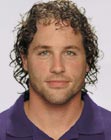
And I would have to say: Yup. Pretty creepily accurate.
Michele took the quiz, too. Check out her type. I like how he's smiling off into the upper left-hand corner of the photo - as though he's participating in the opening sequence of the Brady Bunch.
February 20, 2004
Questionnaire
A wee questionnaire from Cheddar X.
Dan answered it, which is where I picked it up.
1. What was your last good deed for a stranger?
Sunday night, waiting on 46th Street in the freezing cold, as Pat jacked up our car to change the now-flat tire. A passerby dropped a huge box of fliers that went everywhere. I went over and helped him pick up his fliers. Embarrassingly, when I looked at the fliers - all I saw, over and over, was the picture of someone's naked ass, and a huge red-letter logo: COME TO THE LAST ASS SHOW!! I handed this guy back his fliers, and he gave me this kind of embarrassed sheep-faced look, like ... "Uh ... thanks..."
But that was a good deed.
2. Describe the last relationship that ended badly or with regrets.
Er ... all of them? I never walk away from something I love with ease and rosy expectations for the future. I have to be dragged away, screaming, "NO". I'm very very very big on regrets.
3. Do you love or hate your job? Why?
As an artist-type, my "job" isn't really my "job". In terms of how I make my money. At least not yet. So I don't really relate to the question.
4. What was the strangest place you've lived?
A huge sprawling place called Breezy Corners. I lived there for a semester during college. It was a beautiful house, but it inadvertently became a half-way house for every runaway drug-addicted teenager in town. And each runaway seemed to bring a pet with them, and all the pets camped out in a pigpile in the empty fireplace. That house was NASTY.
5. What blogs do you occasionally read just because you have no idea why anyone would have any interest in reading them?
Life's too short for that. I just read stuff I like.
6. Have you engaged in comment wars before? On your blog or on someone else's? What was the war about?
No, I haven't. I hate that shit.
7. Do you ban IP's and commenters? Who and why?
I ban people all the time. Weirdos, wackos, stalkers, penis-enlargers ...
8. What is the first thing you notice about someone when you first meet them?
If they take themselves too seriously, and/or have no sense of humor. It's almost like a scent I pick up on: "Uh oh, humorless chap right here..."
9. Have you already made up your mind about the next Presidential Election?
A couple quotes come to mind.
Joan Armatrading: "I am not in love, but I'm open to persuasion..."
Philip Barry: "The time to make up your mind about people is never."
Do with that what you will.
Another Hamiltonian quote
This came from his 1790 proposal (he was Secretary of the Treasury) to create a Bank of the United States.
There's a lot of financial jargon I have a hard time understanding - but this one sentence stood out for me - clear, startling:
The wisdom of the government will be shown in never trusting itself.
I read that, and had to put the book down for a second, to think about it. Amazing.
I love it when Camille goes on a rampage
Naomi Wolf, author of The Beauty Myth, adviser to Al Gore (as in Ms. "Wear Earth Tones" Wolf), has, 20 years after the fact, accused Harold Bloom, her adviser at Yale, of sexual harassment.
This is patently ridiculous on 5,678,923 levels.
It's stupid, it's hypocritical, it's wrong. 20 years? Ms. Feminist Stand-up-for-myself? Some guy put his hand down your pants, and you can't seem to ever ever ever get over it? You are haunted years later??
Harold Bloom was responsible for your Rhodes scholarship, having written you a glowing recommendation ...
This is why I also scorned the feminist establishment's lifting up Anita Hill into some kind of idol. If the woman were sexually harassed, she did not speak up, she did not come forward - and she benefitted fully from Clarence Thomas' attentions - moving up the ranks. And NOW? Now she comes forward?
Sorry. There are PLENTY of women who REALLY fight sexual harassment, who lose their damn jobs because of it ... who put their reputations, their futures on the line, in order to stand up for what is right. THOSE are the women we should admire. Not Anita Hill, for God's sake.
Naomi Wolf has always bugged me and I am always happy when someone comes forward and calls her on her shit. I could not have been happier when she was lambasted for her "be an Alpha Male, wear earth tones" advice to the floundering Vice-President.
THIS is what feminism has amounted to?
I have one thing to say: Ick.
Camille Paglia, who never loses an opportunity to bash Naomi Wolf, has come forward and raged about this latest incident (Wolf has demanded that Yale University apologize to her). God, that is just so STUPID. 20 freakin' years later?? Grow the fuck up.
Camille Paglia, who traded blows with Ms. Wolf in the early 1990’s over their radically different views on female sexual power, said she was no longer at war with Ms. Wolf, but was "shocked" to learn of Ms. Wolf’s accusations against Mr. Bloom, who is a long-time mentor of Ms. Paglia’s."I just feel it’s indecent that if Naomi Wolf did not have the courage to pursue the matter at the time, or in the 1990’s, and put her own reputation on the line, then to bring all of this down on a man who is in his 70’s and has health problems—who has become a culture hero to readers in the humanities around the world—to drag him into a ‘he said/she said’ scenario so late in the game, to me demonstrates a lack of proportion and a basic sense of fair play," said Ms. Paglia, who is professor of humanities and media studies at the University of the Arts in Philadelphia, where she said she helped institute that university’s sexual-harassment policies in the 1980s.
"At the beginning of the 90’s, people said, ‘Oh, Naomi Wolf, this great thinker,’" said Ms. Paglia. "But what she’s managed to do in 10 years is marginalize herself as a chronicler of teenage angst. She doesn’t want to leave that magic island when she was the ripening teenager. How many times do we have to relive Naomi Wolf’s growing up? How many books, how many articles, Naomi, are you going to impose on us so we have to be dragged back to your teenage-heartbreak years? This is regressive! It’s childish! Move on! Move on! Get on to menopause next!"
Er ... but how do you really feel, Camille?
You go, Camille. You go.
I am responsible
for launching an accidental Socialist revolution last week, directing my ire not at the kulaks or the Czar's family - but at George Lucas' revisionist policies in regards to the Star Wars trilogy.
I didn't quite mean to call forth my comrades to revolt, but it has occurred, and Emily has taken up the Cause and discusses, in depth, what uniform we should wear - those of us who are in accord on this very important matter. Any Socialist worth his or her salt must wear some kind of uniform.
I am particularly thrilled and repulsed at Bill's idea of the Youth Brigades of the Cause wearing red T-shirts with a simple picture of Yours Truly.
Comrades! Our Beloved Trilogy is at Risk! Join the Millions and Millions who are already Marching towards the Glorious Light and Truth of the Force as we originally understood the Term! The Force is not in the Blood, the Force cannot be counted like Corpuscles or Homunculits.
The Force is in the Hearts and Minds and Spirits of all Righteous Men and Women!
Diary Friday
or: The Continuous Mortification of Sheila.
Here's an entry from my junior year in high school. There are too many exclamation points in the entry to even count. Why use two exclamation points when you could so easily use three????????
October 27
What a week! I wish I had written every day!!First of all – today – "Cinderella" was put on today. I'm the Fairy Godmother, by the way. It's such a fun part, vampy and jazzy. I get to spray paint my hair green, I do a wild dance. It's such a funny show. I got out of afternoon classes and we did the show for the elementary school kids.
Then tonight we did it for the general public.
Betsy and I got there really early. We went into the Faculty Room, and I put on lipstick – hairspray – Betsy sprayed the back – I looked GROSS. My hair was so brittle it felt like it could snap.
Meanwhile, Betsy, in her long blue dress (she's an evil stepsister) was swooping madly around the room. I was howling with laughter.
When Beth came, she told us that DTS was in the audience!!!! The last time I saw him was that day in Walden's.
We were all bustling around backstage, setting props. There were about 6 people in the audience. Although it was, indeed, unprofessional, I peeked out for a second. There was DTS, in the back row in the corner, with this small black wool cap on – like the one Jack Nicholson wore in "One Flew Over the Cuckoo's Nest". DTS was also wearing a big army fatigue jacket, and he was reading a magazine. I hissed his name at him, through the curtain. He looked up and around, spotted me through the curtain, grinned and waved. What a sweetheart. I miss him.
Michael plays the Prince. He is positively hysterical. He wears a leather jacket, a wallet chain, jeans, sunglasses. And every single line makes everybody laugh!!
It was before the show, everyone was getting all psyched in the Faculty Room, talking at once, there was a yearbook photographer running around, everyone was practicing lines and songs, putting makeup on, horsing around. I always get very weird on play nights. I never stop talking, or moving, or laughing. A-hem.
Anyway, Michael was eating a candy kiss. It looked scrumptious so I ran over to him and yelled, "Oh! Can I have a kiss??" Everyone sort of glanced over at me, and then BURST out laughing. Michael grabbed me and swept me over backwards – and in doing so, I knocked my hip quite painfully on the couch.
The show was terrific!! I did my vamp number … Mere was the page-turner for Peter the pianist. She was so cute – when I had to get the audience involved in counting the bongs of the clock, I have to say, "Everyone of ye! The piano man, too!" But during the show, because Mere was there, I changed it – I said, "Everyone of ye!" and looked straight at Mere, eagerly, still in character, and said right at her, "The piano people, too!" Mere was just laughing!! She nodded up at me, like, "Okay, okay … I'll count the clock-bongs too…" I felt such camaraderie with her, even though she was down there, and I was onstage in a weird costume with green hair and a bogus Irish brogue. I just remember looking right at her, and her nodding – it was so hilarious. I love that girl!!!!!!
Today was great after 5th period.
See – I had a Math test today and DAMN it was frustrating. I knew what I was doing, knew how to do it, but I would do each problem zillions of times and get different answers EVERY SINGLE TIME. God, I got so MAD!!
Last night, when I was studying, I really started sinking into a depression. My schedule for this week was a joke. It was too much. Work, Cinderella, rehearsals, homework, the play – it just all crashed in.
I got so mad at myself studying for Math. I didn't know what was happening to me. Every single time I got it wrong was because of an addition or subtraction mistake. EVERY SINGLE TIME!! My mom was painting the living room and Brendan was teasing me – I cannot explain how furious I got every time I got one wrong – I was trying so hard – so finally I just started crying. And I am not one for tears. No way. But when I start, get out the rowboats, people, strap on the life-preservers, here comes the damn flood.
My mom started past me for the kitchen and saw my face. "Oh, honey, come on now … don't do this to yourself … come on … you know what you're doing … you'll do fine. If you screw up this quarter, you can work extra hard 2nd quarter…"
I was SOBBING. I think it was really just because I was so exhausted. I had come home from work, I had supper, I looked at Math for 15 minutes, I put my Cinderella costume together, I went to a 2 ½ hour dress rehearsal, came home at ten, and now was trying to cram.
My mother (I thank God for her every day!) said, "Just go to sleep, Sheila, and you'll feel so much better tomorrow."
I was hysterical – "I won't feel better! I can't fail this test! God, I am so stupid!"
My mom hastily ran for the Kleenex. Brendan then came over and showed me how to do negatives and positives, but I didn't care anymore. I looked an absolute mess. I flopped into bed totally wiped out and depressed. I couldn't get to sleep. I kept thinking of Math. I felt sick to my stomach. F's loomed before me. These are my previous grades – 78 and a 40 – I woke up with mascara streaks and blotches down my face, and the sickening feeling that I would have to act today – when we did Cinderella – and act all cheerful, even though I just flunked another Math test.
But – Diary, I GOT A 90!!!!!!!! AHHHH! An honest-to-God 90!!!
Oh, that made my day.
Acting class was beautiful, going to work was heaven, boys are beautiful things!!! Boys are put on this earth to give me joy and humor.
In Chemistry today, Mere and I were working in the lab – before Math – and yesterday, Keith McAuliffe and I had been laughing in Math because of some of our answers. Keith was in the same situation as myself. He KEPT coming up with wrong answers, no matter what he did. And we were so on the same wavelength. We were getting these weird weird answers like 104/31 and negative 3/56 … Like: CLEARLY those are wrong answers. But we would look at each other like, "What the hell????? How the hell did I come up with THAT weirdness?"
So later in Chemistry, I said, "Keith." He looked over. I said, "With Mr. James, does he like take off if the signs are messed up, or does he give partial credit, if he sees that you know HOW to do the problem…"
He shrugged. "I have no idea. I mean …." He stopped, and then he just burst into laughter. "'Cause some of the answers we were getting in there … I mean … 104/31?" He just flopped back in his seat laughing.
So basically what I am trying to say is I love him. I love Keith McAuliffe.
So anyway, he and I both got 90s on the test, and we got the same two wrong. It is creepy. I swear that we do not sit anywhere near eacah other!
As we started up for lunch, he was ahead of me on the stairs, and I said, "Keith!" Keith turned around, one foot a step higher than the other, and waited for me to catch up to him – He said, "Yeah, I got a 90." "Me too!" He just started laughing again, his laugh is so real, so friendly – And he kept laughing, and said, "Man, they were all just stupid mistakes!"
I said, "Mine too! God!"
I wonder if he realizes how special he is. Probably not and that is why he is so special.
Mere's birthday is coming up. I want to get her a life-size Marlon Brando poster. I hope she likes it.
February 19, 2004
"This bird had flown"
Norwegian Wood
I once had a girl, or should I say, she once had me.
She showed me her room, isn’t it good, norwegian wood?
She asked me to stay and she told me to sit anywhere,
So I looked around and I noticed there wasn’t a chair.
I sat on a rug, biding my time, drinking her wine.
We talked until two and then she said, "it’s time for bed".
She told me she worked in the morning and started to laugh.
I told her I didn’t and crawled off to sleep in the bath.
And when I awoke I was alone, this bird had flown.
So I lit a fire, isn’t it good, norwegian wood.
Okay, so there are the lyrics. The interpretation I am about to put out may have already been made 5,000 times over - but I haven't read any doctoral dissertations on "Norwegian Wood", so I wouldn't know. Forgive me if I am stating the obvious here.
I always saw the story of this song as ending in an act of arson, not quiet contemplation by the fireplace in her empty apartment.
I pictured him setting a fire in the middle of that empty room, and walking out, letting the whole place go up in flames. Arson as revenge for being "had" by her. Arson as revenge for her laughter at him, for making him sleep in the bath.
Opinions needed.
"Our prevailing passions are ambition and interest"
I am tearing through the biography of Alexander Hamilton at breakneck speed.
At this point, Hamilton has teamed up with Jay and Madison, after the Constitutional wrangling in Philadelphia, a divisive and vicious process - and the three of them have decided to publish a series of newspaper articles, which, of course, will later be known as "The Federalist Papers".
Hamilton's blowing my mind. As he went about to study to become a lawyer in New York, he realized that all of the laws were not written down, there was no handbook, no law book to pass out, in regards to New York State law. And so, of course, Hamilton wrote the book.
It's that kind of single-minded focus, and determination that all of these guys had in common - even though each one of them had a different take on the "how should we move forward" question.
Oh - so this book doesn't exist. But this book NEEDS to exist. So, clearly, I must write it.
It was Hamilton who said, during his 6 hour long speech at the end of the Constitutional Convention, "Decision is true wisdom."
It's that very view that can make him rather terrifying, at times.
But still. I could not be more facinated by him.
Hamilton said:
Take mankind in general, they are vicious - their passions may be operated upon. Take mankind as they are, and what are they governed by? Their passions. There may be in every government a few choice spirits, who may act from more worthy motives [but] one great error is that we suppose mankind more honest than they are. Our prevailing passions are ambition and interest. Wise government should avail itself of those passions, to make them subservient to the public good.
The "We" of Baseball
The Bambino's Curse has a great post about the "we" and the "us" of baseball fan-dom. A commenter had asked: "We? Our? I don't understand the use of personal pronouns on any of these posts. Are any of you members of the Red Sox or the Yankees?"
He answers this question thoroughly and perfectly. Fans do feel that they "own" their respective teams. For all kinds of different reasons.
For me, being a Red Sox fan is part of the culture I grew up in - the same thing as being Irish, being Catholic, and coming from a Boston family. I still can remember my first jaunts to Fenway Park, as a kid, with my uncles, my cousins. My memory of 1976 and Carlton Fisk's home run are still vividly emblazoned in my mind. I jump up and down and cheer when they win. I sink into sadness when they lose.
Like ALL fans who really love the game.
Yankee fans don't have a monopoly on loving their team.
But the post I point to says it perfectly:
So when I consider the Boston Red Sox, I'm not only conjuring up objective facts of the team, the wins and losses, the errors, the fantastic plays, the pine tar on Trot Nixon's batting helmet … I'm also twitching upon the thread of who I am, the trips to Fenway with my dad, the muddy corduroy pants of 6th grade recess when my friend Andy Audet reenacted Doyle's slide in Game 6 of the '75 World Series… Seeing the "B" logo on a cap invokes the sound of my friend John's soft, Maine accent reenacting a game over the phone … seeing the green expanse of Fenway on TV brings me back to a lazy summer Saturday afternoon when my dad brought home our first color set and how we couldn't wait to watch the Sox in color, with Curt Gowdy's voice like Gabriel carrying the word of God …These are some of the things that are the I and the We and the Us and the Ours of the Boston Red Sox.
"twitching on the thread of who I am". Very nice.
Good work. Especially the bit about the "muddy corduroy pants at 6th grade recess". I think I had the same pants.
The Death of Freud
Great piece in the LA Times about the death of Freudian analysis, and the increasing lack of faith in his theories. Major debunking going on, and it is about time.
The year 2000 — the centenary of "The Interpretation of Dreams" — should have been a triumph for Freudians. Instead, amid the celebrations was a funereal whiff of defeat: The psychoanalytic century was over before the 21st century had begun. Everyone knew the answer to Time's rhetorical question. Psychoanalysis was indeed dead.Well, almost everyone knew. You can always count on intellectuals to keep a candle burning for whatever idea they've invested long years, enormous sums of money and, perhaps above all, limitless ego promoting.
I'm a fan of the cognitive therapy school, having read every word Martin Seligman has said on the topic - especially in his ground-breaking book Learned Optimism. He veers off, spectacularly, from Freud - and creates an entirely different paradigm.
The article in the LA Times details the myriad issues with Freud, issues that have been "whitewashed" by his followers:
We also know that Freud never seriously dealt with the problem of "suggestion," which totally compromised his clinical findings and, by extension, his theories. Already, by the 1890s, few believed in Freud's convenient claim that suggestion — the undue influence of the psychoanalyst over the patient — was possible only in the biologically predisposed and was thus of no consequence to his findings. Amazingly, these critical insights were buried under Freud's rhetoric of denial and by his growing fame. Now we've come full circle. Today we know better than to trust in memories, or in free associations, that supposedly issue from the "therapeutic alliance" between analyst and patient.
This is not an anti-psychiatry screed - not at all. But there is no need for orthodoxy in a field as muddy and difficult to understand as the human mind. Freud has dominated for far too long. Freudian analysis, in the end, is meant to perpetuate itself. Patients are not meant to stop therapy, they MUST continue - because the analyst has the key to the patient's unconscious.
This is nonsense.
Seligman very simply, in Learned Optimism lays out a course of recovery for people troubled by depression. (Clinical depression, I mean.) There are, obviously, those people who need to be medicated. Medication should not be shunned. William Styron, in his great and tormented book Darkness Visible, where he describes his own clinical depression, continues to say over and over again, like a mantra, "If I had been put on some kind of anti-depressant or anti-psychotic years before - instead of struggling my way through therapy - I would have been able to recover." Depression is not a feeling of sadness. Depression is a feeling of lethargy, a grey fog laid over the entire world. Depression is exacerbated by its own symptoms: One cannot sleep, one cannot eat. If you attack the SYMPTOMS (give a person a sleeping pill, as opposed to trying to delve into WHY that person can't sleep), then the crisis period may pass. And with much more velocity than if you spend hours and hours in therapy, trying to figure out why you are depressed.
Clinical depression is just that - it is clinical. Freudian analysis cannot, and should not, touch it.
Seligman believes that if you transform the way you actually think about things, if you transform the "story" you tell yourself about yourself when bad things happen - you can conquer depression, without being in analysis for years.
By 'story' I mean: If something bad happens to you (let's say, someone breaks up with you...) what do you tell yourself about the event?
Some people face life's hard knocks with: "This always happens to me. I am cursed by God. Nothing good will EVER happen."
These people, with their sense of pervasiveness and permanence, are more prone to long bouts of clinical depression.
And then some people, when faced with life's hard knocks, say, "Ah well, better luck next time." Or someone breaks up with them, and they say to themselves, "Man, that person doesn't know how much they're missing out!"
Seligman has found a way to help those with a pessimistic outlook change their way of thinking. He calls this "Learned Optimism".
This is completely anti-Freud. Seligman is not interested so much in the WHYs, except in how it might explain a person's pessimism. He is not interested in the workings of the subconscious. He is interested in helping people become more consciously competent in how they negotiate their way through the shoals of life.
The LA Times article ends, with a kind of elegy for Freudian psychoanalysis:
Of course, as with exorcism, the psychoanalytic "cure" hinges upon belief in mysterious entities such as the unconscious. For with belief we are back in the realm of suggestion and, at its best, the placebo effect. True, that's not nothing. But the cult-like exigencies of psychoanalysis dictate that normal human suggestibility be exploited for the cause of conversion. As Karl Kraus put it many years ago, psychoanalysis itself became the poison it purports to cure. Another way to put it is that it is psychoanalysis itself that has infected the Western soul with penis envy, Oedipal conflicts, death drives and so on. For these ideas are not given to, and cannot be found in, the world. They must be created. Consequently, the death of psychoanalysis is itself the only cathartic event psychoanalysis was ever designed to deliver.
Yes!!
(Full disclosure - sort of: I was in therapy for years. And - for all practical purposes - my depression got worse, as my therapy continued. I'm not saying this would be true for everyone, but it was true for me. The "episodes" of depression got longer, and more intense as time went on. I wasn't depressed all the time - there were just 3 or 4 month bouts when I was out of commission. Therapy could not touch whatever it was that was ailing me. It took me a while to put it all together, it took me a while to realize that I had come to rely on therapy - as opposed to relying on myself. I don't mean to paint this with too broad a brush - because I know people whose lives were saved by therapists. But this was not the case for me. Reading Seligman's book did for me in one month what my therapist was unable to do for me in 6 years.)
February 18, 2004
Coming Clean about A-rod
I haven't written so far on the A-Rod thing because - I didn't have the words - and I found the whole situation unbearable and hateful. I have NO SENSE OF HUMOR. Got that??
ba-dum-ching
Anyway, thanks to Steve Silver, I read the following column by Sports Guy - an insane Red Sox fan - and all I can say is: I concur. Yes.
Bring it on. Bring it on, mo-fos ... Bring it on.
This season is gonna be damn exciting - from day one. It will be a baseball season filled with hatred, scorn, wild bursts of competitive laughter, schaudenfraude, contempt, and very little joy.
In other words - a lot of fun.
It was 37 years ago today...
that Bill and Sheila said "I do."
My parents met at a sock-hop (no, literally, a sock-hop). They were 16. He went to a boy's parochial school, she went to a girl's parochial school - and they met at a joint dance. There are pictures of this dance in one of my parents' yearbooks. There's a picture of my mom, 16 years old, her face lit up with excitement, her hair up in a big early 60s bouffant, and still, to this day, it is strange for me to see that picture. It's like: "Damn, that teenage girl is going to end up being my MOTHER - and that very night she would meet the man she would marry!"
My dad offered to give my mom a ride home from the sock-hop. My mom said, "No, that's okay, I drove here myself." There was a long pause, and then my dad, who had actually ridden his bike to the sock-hop, and had offered her a ride having no idea how he would pull it off if she had taken him up on it, said, "Then - can I have a ride home?"
They got married on February 18, 1967 - on a snowy day.
9 months later, they had a daughter with cross eyes and crooked legs - who eventually turned out to be me. (My eyes straightened out, and I wore a brace on my legs for the first year of my life to re-align my hips. My poor parents, 23 year old kids, didn't know that most babies are cross-eyed at the beginning, were a bit panicked about me. My mom describes driving me home from the doctor, my legs now encased in braces, I sat in my car-seat, perfectly happy, fine, and my mother was SOBBING. Every time she would look back at her "crippled" daughter, she would burst into sobs again. But all ended out fine. When they finally took the brace off of me, I was the one who sobbed like a maniac. I missed my brace!)
I also, even as an infant, slept 8 hours a night.
My parents would prod me awake, to spend time with me. "Okay, she's slept long enough. We miss her. Get her up."
So now it is 37 years later.
I have said it before, and I will say it again - I almost feel like, on some cosmic level, that I might have chosen my parents. I am definitely blessed. Definitely blessed.
Here is, I think, my favorite story about my parents:
I was in my mid-20s, and home from Chicago for a visit. I was in that awkward stage where - I was living a free and independent life in Chicago, an adult, making my own choices, doing my own thing - but then I would come home and suddenly feel like I was 12 years old all over again. I still had some level of a rebellious attitude towards my parents, as in: "I'm doing what I want to do right now!!" (Meanwhile, they weren't criticizing my choices at all!!)
Basically - my whole life was centered on myself. And I'm not sorry about that, by the way. It was a necessary stage for me to go through. I had never lived for myself before, I had never created my own life before. I needed to cut the strings with the past, and figure out how I wanted to do things.
But I was in the awkward in-between stage of that process.
One morning, while I was home, I woke up at around 5:30, maybe 6:00 am. It was dawn. I was sleeping upstairs in my old room - and so I definitely had a feeling of regression. Like: Get me back to the life where I am an ADULT! Jesus!
Dimly - somewhere else in the house - I heard something.
Voices? No, that couldn't be. It's 5:30 in the morning! But something ...
So I got out of bed, and tiptoed down the stairs to go investigate.
The door to the kitchen was ajar, although mostly closed. The sounds were coming from in there.
Let me just say right now: that I am so glad I didn't just barge in. Because then I would never have had the opportunity to really SEE my parents. As separate beings, autonomous from myself.
I don't know if you know what I will mean when I say the word "see". I'm not just talking about seeing with my eyes. I'm talking about perception, about a deeper kind of sight - how sometimes, in just one seconds-long glimpse, you can see EVERYTHING in a person.
I peeked through the crack in the door.
The sun was rising through the trees across the street. I could smell coffee brewing.
And there were my parents, up at 5:30 in the morning, both sitting at the kitchen table.
My dad was reading the newspaper.
But what blew me away was my mother. My mother sat next to my dad, softly and gently strumming on a guitar.
A tiny bit of background: My mom is a great guitar player, and made extra money when we all were little giving guitar lessons to the kids in the neighborhood. She would take out her guitar at family parties. There are pictures of her in her college yearbook, sitting on the Quad, holding a guitar, playing. My earliest memories of my mother have to do with her playing a guitar.
But for years - maybe since I was 10 or 11 - who knows why - my mom never ever took her guitar out.
Or - I never saw her do it. She didn't play for us, like she used to when we were little. She didn't teach lessons to kids in the neighborhood anymore.
My mom put her guitar away.
Now here is where the narcissism of kids is obvious: My mother put her guitar away and I barely even noticed. I was 11 years old. I didn't say, "Hey, Mom, why don't you ever play the guitar anymore?" My mother was not a separate autonomous being to me - she was my mother. That was all.
So it wasn't until I was 26 years old, basically spying on my parents at 5:30 in the morning, that I suddenly realized: "Holy shit, I have not seen my mother with a guitar in her hands in ... 15 years ... What happened? Why did she stop playing?"
But then in the next moment - I thought - Wait a second, maybe she didn't stop playing. Obviously she didn't, because there she is, playing for my dad - in a private moment - while her 4 children slumbered throughout the house.
Suddenly, I felt like I had no idea who my mother was. I saw her - completely - as a woman, separate from myself - a woman with dreams, ambitions, complexity ... It was beautiful.
Maybe I'm making this sound bigger than it was.
All I know is - I took one look at that dawn-lit tableau of my parents - my parents stealing a quiet-moment together in the craziness of having all their kids home - drinking coffee - not talking - my mom playing the guitar for him - and I never quite looked at the two of them in the same child-like way again.
I tiptoed back up to bed, realizing that this was "their time".
My parents needed alone-time. Their kids are not their whole life. Their entire relationship is not based on their children - although, of course, we are all HUGE to them.
And - I was always grateful that I got that glimpse of the two of them - together - with no kids around.
It was so peaceful.
It made me very glad that they were my parents.
They're precious people to me, dearer to me with every passing year - and I'm so glad that they met at that sock-hop so many years ago.
Happy anniversary, Mum and Dad. You guys are the best.
February 17, 2004
An Inglorious Moment
Here's the set-up of the scene:
Time: Last night
Where: My friend Allison's apartment
Curtain rises: Allison and Sheila watch television, lying in Allison's bed, as Charlie the cat stalks about, his body flat, his eyes wide-open and terrifying.
Allison and Sheila watch, in succession: "My Big Fat Obnoxious Fiance" (reality TV show #1) and then "Average Joe: Hawaii" (reality TV show #2).
As regular readers of this blog know, Sheila has no television.
So Sheila got completely sucked into the Roman coliseum of reality television.
The first show, in particular, HORRIFIED the innocent eyes of Sheila, who had spent the entire day immersed in Presidential quotations and the colossal minds of our Founding Fathers.
The show's "plot" is out of a totalitarian society where the family unit becomes a property of the State. This girl has to convince her poor unsuspecting parents and siblings that she is actually going to marry this "big fat obnoxious guy", who is actually an actor, hired to be as obnoxious as possible, hired to act like he is her fiance - and if she convinces all of them that this is not just an act and the real thing - she gets a million dollars.
You literally could not pay Sheila enough money to trick her mother like that - to make her mother weep on national television - just so Sheila could pocket a million bucks.
Sheila would do a lot of things for a million dollars - but she would never betray her family, and set them up to look like dipshits for all the world to see. She would never ever be able to tolerate looking at her parents' baffled hurt faces without screaming out immediately, "It's all an act! It's all an act!"
It's soulless. It's awful. It's disgusting.
And yet ...
and yet ...
Sheila couldn't look away.
At one point, she exclaimed, in a rage, "This is HORRIBLE!" Long pause. Then: "I kind of never want it to end, though."
Allison HOWLED.
Sheila participated in the trend. Sheila felt dirty afterwards.
And so, of course, Sheila invited herself over to Allison's next Monday, for the season finale. So that Sheila can feel more dirty, and more ashamed, and more angry, and more disgusted ...
It's sick, I tell ya, sick.
February 16, 2004
President's Day...
My disk problems are solved - and so ... unfurling out below you ... is my tribute to President's Day.
Thomas Jefferson, 1826 "Let the annual return to this day forever refresh our recollections..."
THOMAS JEFFERSON, in a letter to the mayor of Washington, June 24, 1826, declining an invitation to the 4th of July celebration in Washington - (Jefferson died 10 days later):
May it be to the world, what I believe it will be (to some parts sooner, to others later, but finally to all) the signal of arousing men to burst the chains under which monkish ignorance and superstition had persuaded them to bind themselves, and to assume the blessings and security of self-government … All eyes are opened or opening to the rights of man. The general spread of the light of science has already laid open to every view the palpable truth, that the mass of mankind has not been born with saddles on their backs, nor a favored few, booted and spurred, ready to ride them legitimately by the grace of God. These are the grounds of hope for others; for ourselves, let the annual return to this day forever refresh our recollections of these rights, and an undiminished devotion to them.
George Washington's mom, 1784
GEORGE WASHINGTON'S MOTHER to Lafayette, 1784:
"I am not surprised at what George has done, for he was always a good boy."
Adams and Jefferson
From David McCullough's John Adams – on the later-in-life correspondence between Adams and Jefferson:
Once, briefly, a difference in philosophy was touched upon, when Jefferson observed that the "paper transactions" of one generation should "scarcely be considered by succeeding generations," a principle he had earlier stated to Madison as "self-evident," that "'the earth belongs to usufruct to the living': that the dead have neither the power of rights over it." Adams, however, refused to accept the idea that each new generation could simply put aside the past, sweep clean the slate, to suit its own desires. Life was not like that, and if Jefferson thought so, it represented a fundamental difference in outlook.
"The rights of one generation of men must depend, in some degree, on the paper transactions of another," Adams wrote. "The social compact and the laws must be reduced to writing. Obedience to them becomes a national habit and they cannot be changed by revolutions that are costly things. Men will be too economical of their blood and property to have recourse to them very frequently." Jefferson's wish for a "little rebellion now and then to clear the atmosphere," as he had once put it to Abigail, did not stand to reason, Adams was telling him. nor did reason have any bearing on what was happening in France, Adams insisted in another letter:"Reason has been all lost. Passion, prejudice, interest, necessity have governed and will govern; and a century must roll away before any permanent and quiet system will be established … You and I must look down from the battlements of Heaven if we ever have the pleasure of seeing it."
Politics, Jefferson answered, was "a subject I never loved, and now I hate."
1801: The Inauguration of Thomas Jefferson
From David McCullough's John Adams:
On Inauguration Day, Wednesday, March 4, 1801, John Adams made his exit from the President's House and the capital at four in the morning, traveling by public stage under clear skies lit by a quarter moon. He departed eight hours before Thomas Jefferson took the oath of office at the Capitol, and even more inconspicuously than he had arrived, rolling through empty streets past darkened houses …To his political rivals and enemies Adams' predawn departure was another ill-advised act of a petulant old man. But admirers, too, expressed disappointment. A correspondent for the Massachusetts Spy observed in a letter from Washington that numbers of Adams' friends wished he had not departed so abruptly. "Sensible, moderate men of both parties would have been pleased had he tarried until after the installation of his successor. It certainly would have had good effect."
By his presence at the ceremony Adams could have set an example of grace in defeat, while at the same time paying homage to a system whereby power, according to a written constitution, is transferred peacefully. After so vicious a contest for the highest office, with party hatreds so near to igniting in violence, a peaceful transfer of power seemed little short of a miracle. If ever a system was proven to work under extremely adverse circumstances, it was at this inauguration of 1801, and it is regrettable that Adams was not present…"We are all Republicans, we are all Federalists," Jefferson said famously in his inaugural address before a full Senate Chamber, his voice so soft many had difficulty hearing him. A passing tribute to Washington was made before he finished, but of Adams he said nothing…
Whatever Adams' state of mind, he was leaving his successor a nation "with its coffers full," as he wrote, and with "fair prospects of peace with all the world smiling in its face, its commerce flourishing, its navy glorious, its agriculture uncommonly productive and lucrative."
In turbulent dangerous times he had held to a remarkably steady course. He had shown that a strong defense and a desire for peace were not mutually exclusive, but compatible and greatly in the national interest. The new navy was an outstanding achievement…Further, by undercutting [Alexander] Hamilton and making his army useless, he may have saved the country from militarism.
In his four years as President, there had been no scandal or corruption. If he was less than outstanding as an administrator, if he had too readily gone along with the Alien and Sedition Acts, and was slow to see deceit within his own cabinet, he had managed nonetheless to cope with a divided country and a divided party, and in the end achieved a rare level of statesmanship. To his everlasting credit, he chose not to go to war when that would have been highly popular and politically advantageous in the short run. As a result, the country was spared what would almost certainly have been a disastrous mistake…To his dying day he would be proudest of all of having achieved peace. As he would write to a friend, "I desire no other inscription over my gravestone than: 'Here lies John Adams, who took upon himself the responsibility of peace with France in the year 1800.'"
John Adams, 1820 "I wish your nation to be admitted ..."
JOHN ADAMS, 85 years old, 1820 - replying to a letter from Mordecai Noah, a Jewish editor from New York:
I have had occasion to be acquainted with several gentlemen of your nation and to transact business with some of them, whom I found to be men of as liberal minds, as much as honor, probity, generosity, and good breeding as any I have known in any seat of religion or philosophy. I wish your nation to be admitted to all the privileges of citizens in every country in the world. This country has done much, I wish it may do more.
George Washington's farewell speech
An excerpt from George Washington's farewell speech (which actually, it was later discovered, was written by Alexander Hamilton):
The name of AMERICAN, which belongs to you in your national capacity, must always exalt the just pride of patriotism more than any appellation derived from local discriminations.
John Adams: "We ought to support every administration as far as we can..."
JOHN ADAMS:
I think instead of opposing systematically any administration, running down their characters and opposing all their measures, right or wrong, we ought to support every administration as far as we can in justice.
1797 - The Inauguration of John Adams
David McCullough on the inauguration of John Adams (March 4, 1797):
The room was filled to overflowing, every seat taken by members of the House and Senate, justices of the Supreme Court, heads of departments, the diplomatic corps, and many ladies said to have added a welcome note of "brilliancy" to the otherwise solemn occasion.There was a burst of applause when George Washington entered and walked to the dais. More applause followed on the appearance of Thomas Jefferson, who had been inaugurated Vice President upstairs in the Senate earlier that morning, and "like marks of approbation" greeted John Adams, who on his entrance in the wake of the two tall Virginians seemed shorter and more bulky even than usual.
It was a scene few who were present would ever forget.
Here were the three who, more than any others, had made the Revolution, and as many in the audience supposed, it was to be the last time they would ever appear on the same platform. Adams felt as he had when he first appeared before George III – as if he were on stage playing a part. It was, he later told Abigail, "the most affecting and overpowering scene I ever acted in."Jefferson's height was accentuated by a long blue frock coat. Washington was in a dress suit of black velvet. Adams, the plainest of the three, wore a suit of grey broadcloth intentionally devoid of fancy buttons and knee buckles…
Though in print [Adams' inaugural speech] would seem a bit stilted, it was delivered with great force and effect. Stirred by emotion, and in a strong voice, Adams recalled the old ardor of the American Revolution and spoke of the "present happy Constitution" as the creation of "good heads prompted by good hearts." In answer to concerns about his political creed, he expressed total attachment to and veneration for the present system of a free republican government. "What other form of government, indeed, can so well deserve our esteem and love?" He spoke of his respect for the rights of all states, and of his belief in expanded education for all the people, both to enlarge the happiness of life and as essential to the preservation of freedom. The great threats to the nation, Adams warned, were sophistry, the spirit of party, and "the pestilence of foreign influence."
He paid gracious tribute to Washington's leadership… Then, having issued a solemn invocation of the Supreme Being, he stepped down from the platform to a table at the front of the chamber, where Chief Justice Oliver Ellsworth administered the oath of office, Adams energetically repeating the words.
And so Adams became President of the nation that now – with the additions of Vermont, Kentucky and Tennessee – numbered 16 states…
Many in the chamber were weeping, moved by his words, but still more, it seems, by the prospect of Washington's exit from the national stage. "A solemn scene it was indeed," Adams wrote, noting that Washington's face remained as serene and unclouded as the day. "Methought I heard him think, 'Ay! I am fairly out and you are fairly in! See which of us will be the happiest!'"
John Adams, 1793, "unbridled majorities"
JOHN ADAMS, in a 1793 letter, responding to the revolution in France:
Mankind will in time discover that unbridled majorities are as tyrannical and cruel as unlimited despots.
John Quincy Adams: "political heresies"
JOHN QUINCY ADAMS, in a public letter addressed to Thomas Jefferson.
Jefferson had made mention of Edmund Burke's book Reflections on the Revolution in France , and had endorsed it as the answer to "the political heresies that have sprung up among us." -- (This was an obvious reference to John Adams.)
John Quincy Adams went on the attack for his father, and published a letter anonymously in the newspaper:
I am somewhat at a loss to determine what this very respectable gentleman means by political heresies. Does he consider this pamphlet of Mr. Paine's as a canonical book of political scripture? As containing the true doctrine of popular infallibility, from which it would be heretical to depart in one single point? I have always understood, sir, that the citizens of these States were possessed of a full and entire freedom of opinion upon all subjects civil as well as religious; they have not yet established any infallible criterion of orthodoxy, either in church or state … and the only political tenet which they could stigmatize with the name of heresy would be that which should attempt to impose an opinion upon their understandings, upon the single principle of authority.
John Adams as Vice-President
JOHN ADAMS, on being Vice President, in a letter to Abigail:
My country in its wisdom contrived for me the most insignificant office that ever the invention of man contrived or his imagination conceived.
John Adams on "division of the Republic"
JOHN ADAMS:
There is nothing I dread so much as a division of the Republic into two great parties, each arranged under its leader and converting measures in opposition to each other.
Jesus. If he could see us now, he would be horrified.
1789: The Inauguration of George Washington
Exerpt from David McCullough's John Adams:
On the day of his inauguration, Thursday, April 30 1789, Washington rode to Federal Hall in a canary-yellow carriage pulled by six white horses and followed by a long column of New York militia in full dress. The air was sharp, the sun shone brightly, and with all work stopped in the city, the crowds along his route were the largest ever seen. It was as if all New York had turned out and more besides. "Many persons in the crowd," reported the Gazette of the United States "were heard to say they should now die contented – nothing being wanted to complete their happiness … but the sight of the savior of his country."In the Senate Chamber were gathered the members of both houses of Congress, the Vice President, and sundry officials and diplomatic agents, all of whom rose when Washington made his entrance, looking solemn and stately. His hair powdered, he wore a dress sword, white silk stockings, shoes with silver buckles, and a suit of the same brown Hartford broadcloth that Adams, too, was wearing for the occasion. They might have been dressed as twins, except that Washington's metal buttons had eagles on them.
It was Adams who formally welcomed the General and escorted him to the dais. For an awkward moment Adams appeared to be in some difficulty, as though he had forgotten what he was supposed to say. then, addressing Washington, he declared that the Senate and House of Representatives were ready to attend him for the oath of office as required by the Constitution. Washington said he was ready. Adams bowed and led the way to the outer balcony, in full view of the throng in the streets. People were cheering and waving from below, and from windows and rooftops as far as the eye could see. Washington bowed once, then a second time.Fourteen years earlier, it had been Adams who called on the Continental Congress to make the tall Virginian commander-in-chief of the army. Now he stood at Washington's side as Washington, his right hand on the Bible, repeated the oath of office as read by Chancellor Robert R. Livingston of New York, who had also been a member of the Continental Congress.
In a low voice Washington solemnly swore to execute the office of the President of the United States and, to the best of his ability, to "preserve, protect, and defend the Constitution of the United States." Then, as not specified in the Constitution, he added, "So help me God", and kissed the Bible, thereby establishing his own first presidential tradition.
"It is done," Livingston said, and, turning to the crowd, cried out, "Long live George Washington, President of the United States."
George Washington, 1789 "My only ambition is to do my duty in this world"
GEORGE WASHINGTON, to his private secretary David Humphreys, on the eve of his election, in 1789:
It is said that every man has his portion of ambition. I may have mine, I suppose, as well as the rest, but if I know my own heart, my ambition would not lead me into public life; my only ambition is to do my duty in this world as well as I am capable of performing it, and to merit the good opinion of all good men.
George Washington, 1783 "This is the favorable moment"
GEORGE WASHINGTON, letter of (unwelcome) advice sent to governors of the 13 states, 1783 – as the army began to disband. It may have been unwelcome advice to the governors whose attitude was: "It's pretty presumptuous of an army commander to tell us how to set up the country..." But it is obvious, in the following words, why he was chosen as our first President:
Americans are now sole lords and proprietors of a vast tract of continent comprehending all the various soils and climates of the world and abounding with all the necessaries and conveniences of life … Heaven has crowned all other blessings, by giving a fairer opportunity for political happiness, than any other nation has been favored with … This is the time of their political probation; this is the moment when the eyes of the whole world are turned upon them; this is the moment to establish or ruin their national character forever; this is the favorable moment to give such a tone to our federal government as will enable it to answer the ends of its institution; or this may be the ill-fated moment for relaxing the powers of the Union, annihilating the cement of the Confederation and exposing us to become the sport of European politics, which may play one state against another, to prevent their growing importance and to serve their own interested purposes. For, according to the system of policy the states shall adopt at this moment, they will stand or fall; and by their confirmation or lapse it is yet to be decided whether the Revolution must ultimately be considered a blessing or a curse – a blessing or a curse, not to the present age alone, for with our fate will the destiny of unborn millions be involved.[He states that there are 4 requirements for the new America]
First. An indissoluble union of the states under one federal head. Secondly. A sacred regard to public justice (that is, the payment of debts). Thirdly. The adoption of a proper peace establishment (that is, an army and a navy). Fourthly. The prevalence of that pacific and friendly disposition among the people of the Union, which will influence them to forget their local prejudices and policies; to make those mutual concessions, which are requisite to the general prosperity; and, in some instances, to sacrifice their individual advantages to the interest of the community. These are the pillars on which the glorious future of our independency and national character must be supported.
Ben Franklin, 1781 "I cannot give you the sun"
BEN FRANKLIN, 1781 – The following story may be just a rumor handed down over the years, but it is one of my favorites. Franklin was in France, and word came to France of the decisive (and shocking) American victory. Franklin attended a diplomatic dinner shortly thereafter – and, of course, everyone was discussing the defeat of the British, and the victory of America.
The French foreign minister stood, and toasted Louis XVI, "To his Majesty, Louis the Sixteenth, who, like the moon, fills the earth with a soft, benevolent glow.
The British ambassador rose and said, "To George the Third, who, like the sun at noonday, spreads his light and illumines the world."
Franklin rose (reportedly) and countered, "I cannot give you the sun or the moon, but I give you George Washington, General of the armies of the United States, who, like Joshua of old, commanded both the sun and the moon to stand still, and both obeyed."
George Washington, 1780 "we are always working uphill"
GEORGE WASHINGTON, letter of May 31, 1780 – describing one of the things he was learning through the war – the need for a strong central government:
Certain I am unless Congress speak in a more decisive tone, unless they are invested with powers by the several States competent to the great purposes of the war, or assume them as a matter of right, and they and the States respectively act with more energy than they hitherto have done, that our cause is lost. One State will comply with a requisition of Congress, another neglects to do it; a third executes it by halves; and all differ either in the manner, the matter, or so much in point of time, that we are always working up hill; and, while such a system as the present one or rather want of one prevails, we shall ever be unable to apply our strength or resources to any advantage.
George Washington, 1777
GEORGE WASHINGTON, on the self-sacrifice of his soldiers during the hard winter of 1777:
To see men without clothes to cover their nakedness, without blankets to lay on, without shoes, by which their marches might be traced by the blood from their feet, and almost as often without provisions as with; marching through frost and snow, and at Christmas taking up their winter quarters within a day's march of the enemy, without a house or hut to cover them till they could be built, and submitting to it without a murmur, is a mark of patience and obedience which in my opinion can scarce be paralleled.
George Washington: Patriotism "will not endure unassisted by Interest"
GEORGE WASHINGTON
Men may speculate as they will, they may talk of patriotism; they may draw a few examples from current story … but whoever builds upon it as a sufficient basis for conducting a long and bloody war will find themselves deceived in the end … For a long time it may of itself push men to action, to bear much, to encounter difficulties, but it will not endure unassisted by Interest.
Washington and Lafayette, 1777
THE MEETING OF GEORGE WASHINGTON AND MARQUIS DE LAFAYETTE
August 1, 1777 – Washington invited the newly arrived Lafayette to witness a review of the troops – They marched by, ragged, disheveled, shabby:
Washington: We are rather embarrassed to show ourselves to an officer who has just left the army of France.Lafayette: I am here, sir, to learn and not to teach.
John Adams "extravagant popularity"
JOHN ADAMS, in a letter to his daughter Nabby:
If the way to do good to my country were to render myself popular, I could easily do it. but extravagant popularity is not the road to public advantage.
Abigail Adams on George Washington
ABIGAIL ADAMS, on George Washington (lifting a quote Shakespeare):
"Take his character all together, and we shall not look upon his like again."
Abigail Adams to John Quincy Adams, 1786
ABIGAIL ADAMS, in a cautionary letter to her genius future-president son, John Quincy Adams, 1786, during his first semester at Harvard. Abigail had heard through the grapevine that her son could be "a little too decisive and tenacious" in his opinions. She shot off the following letter:
If you are conscious to yourself that you possess more knowledge upon some subjects than others of your standing, reflect that you have had greater opportunities of seeing the world, and obtaining a knowledge of mankind than any of your contemporaries. That you have never wanted a book but it has been supplied to you, that your whole time has been spent in the company of men of literature and science. How unpardonable would it have been in you to have been a blockhead.
Thomas Jefferson: "I like a little rebellion now and then"
THOMAS JEFFERSON, letter to Abigail Adams, 1787, who had written to him, concerned about mob violence in Massachusetts. He responded:
The spirit of resistance to government is so valuable on certain occasions, that I wish it to be always kept alive. I like a little rebellion now and then. It is like a storm in the atmosphere.
John Adams, 1779 - the writing of the Massachusetts Constitution
From David McCullough's John Adams:
On Adams' writing of "A Constitution or Form of Government for the Commonwealth of Massachusetts" – completed on October 30, 1779 (Adams' 44th birthday)
The work was to be his alone, and if ever he had a chance to rise to an occasion for which he was ideally suited, this was it. so many of his salient strengths – the acute legal mind, his command of the English language, his devotion to the ideals of the good society – so much that he knew of government, so much that he had read and written, could now be brought to bear on one noble task …In any event, the result was to be one of the most admirable, long-lasting achievements of John Adams' life…
A tone of absolute clarity and elevated thought was established in the opening lines, in a Preamble, a new feature in constitutions, affirming the old ideal of the common good founded on a social compact:"The end of the institution, maintenance, and administration of government is to secure the existence of the body politic; to protect it; and to furnish the individuals who compose it with the power of enjoying, in safety and tranquility, their natural rights and the blessings of life; and whenever these great objects are not obtained, the people have a right to alter the government, and to take measures necessary for their safety, happiness and prosperity…"
A Declaration of Rights, following the Preamble and preceding the Constitution itself, stated unequivocally that all men were "born equally free and independent" … and that they had certain "natural, essential, and inalienable rights." It guaranteed free elections, and in one of a number of articles borrowed from the constitution of Pennsylvania, guaranteed "freedom of speaking" and "liberty of the press". It provided against unreasonable searches and seizures, and trial by jury. While it did not guarantee freedom of religion, it affirmed the "duty" of all people to worship "the Supreme Being, the great creator and preserver of the universe," and that no one was to "hurt, molested, or restrained in his person, liberty, or estate for worshiping God in the manner most agreeable to the dictates of his own conscience", provided he did not disturb the public peace…
There would be two branches of the legislature, a Senate and a House of Representatives, an executive, the governor, who was to be elected at large annually and have veto power over the acts of the legislature. But it was the establishment of an independent judiciary, with judges of the Supreme Court appointed, not elected, and for life ("as long as they behave themselves well"), that Adams made one of his greatest contributions not only to Massachusetts but to the country, as time would tell.
In addition, notably, there was Section II of Chapter 6, a paragraph headed "The Encouragement of Literature, Etc.", which was like no other declaration to be found in any constitution ever written until then or since. It was entirely Adams' creation, his original contribution to the constitution of Massachusetts and he rightly took great pride in it.
"Wisdom and knowledge, as well as virtue, diffused generally among the body of the people being necessary for the preservation of their rights and liberties; and as these depend on spreading the opportunities and advantages of education in various parts of the country, and among the different orders of the people, it shall be the duty of legislators and magistrates in all future periods of this commonwealth to cherish the interests of literature and the sciences, and all seminaries of them, especially the university at Cambridge, public schools, and grammar schools in the towns; to encourage private societies and public institutions, rewards and immunities, for the promotion of agriculture, arts, sciences, commerce, trades, manufactures, and a natural history of the country; to countenance and inculcate the principles of humanity and general benevolence, public and private charity, industry and frugality, honesty and punctuality in their dealings, sincerity, good humor, and all social affections, and generous sentiments among the people."
It was, in all, a declaration of Adams' faith in education as the bulwark of the good society, the old abiding faith of this Puritan forebears. The survival of the rights and liberties of the people depended on the spread of wisdom, knowledge, and virtue among all the people, the common people, of whom he, as a farmer's son, was one. "I must judge for myself, but how can I judge, how can any man judge, unless his mind has been opened and enlarged by reading," Adams had written in his diary at age 25 …
As had no constitution before, Adams was declaring it the "duty" of government not only to provide education but to "cherish" the interests of literature and science – indeed, the full range of the arts, commerce, trades, manufactures, and natural history …
Because wisdom and education were not sufficient of themselves, he had added the further "duty" of government to "countenance and inculcate" the principles of humanity, charity, industry, frugality, honesty, sincerity – virtue, in sum. And amiability as well – "good humor," as he called it – counted for the common good, the Constitution of Massachusetts was to proclaim, suggesting that such delight in life as Adams had found in the amiable outlook of the French had had a decided influence.
He had written Section II of Chapter 6 in a burst of inspiration, the words "flowing" from his pen, but expected the convention to "show it no mercy," as he later said. "I was somewhat apprehensive that criticism and objections would be made to the section, and particularly that the 'natural history' and 'good humor' would be stricken out." To his surprise and delight, the whole of the paragraph passed intact, and, as he also noted, "unanimously without amendment!"
In the end, the convention approved nearly all of his draft, with only a few notable changes. Preferring what Jefferson had written in the Declaration of Independence, the convention revised the first article of the Declaration of Rights, that all men were "born equally free and independent", to read that all men were "born free and equal", a change Adams did not like and would like even less as time went on. He did not believe all men were created equal, except in the eyes of God, but that all men, for their many obvious differences, were born to equal rights.
The reference to freedom of speech was removed, not to be reinstated until much later, and the worship of God was declared a right of all men, as well as a duty. The legislature was also given power to override the governor's veto, another change Adams regretted, as it was contrary to his belief in a strong, popularly elected executive.
None of the alterations, however, diminished his overall pride in what he and the convention had achieved, and the acclaim it brought. "I take vast satisfaction in the general approbation of the Massachusetts Constitution," he would tell a friend. "If the people are as wise and honest in the choice of their rulers, as they have been in framing a government, they will be happy, and I shall die content with the prospect for my children."
As time would prove, he had written one of the great, enduring documents of the American Revolution. The constitution of the Commonwealth of Massachusetts is the oldest functioning written constitution in the world.
Jefferson on Washington
THOMAS JEFFERSON, on George Washington:
The moderation and virtue of a single character probably prevented this Revolution from being closed, as most others have been, by a subversion of that liberty it was intended to establish.
John Adams to Abigail, July 3, 1776
JOHN ADAMS, in a July 3, 1776 letter to Abigail, after the signing of the Declaration of Independence on July 2:
The Delay of this Declaration to this Time, has many great Advantages attending it. – The Hopes of Reconciliation, which were fondly entertained by Multitudes of honest and well meaning tho weak and mistaken People, have been gradually and at last totally extinguished. – Time has been given for the whole People, maturely to consider the great Question of Independence and to ripen their Judgments, dissipate their Fears, and allure their Hopes, by discussing it in News Papers and Pamphletts, by debating it, in Assemblies, Conventions, Committees of Safety and Inspection, in town and County Meetings, as well as in private Conversations, so that the whole People in every Colony of the 13, have now adopted it, as their own Act. – This will cement the Union, and avoid those Heats, and perhaps Convulsions which might have been occasioned, by such a Declaration Six Months ago.
But the Day is past. The Second Day of July 1776, will be the most memorable Epocha, in the History of America. – I am apt to believe that it will be celebrated, by succeeding Generations, as the great anniversary Festival. It ought to be commemorated, as the Day of Deliverance by solemn Acts of Devotion to God Almighty. It ought to be solemnized with Pomp and Parade, with Shews, Games, Sports, Guns, Bells, Bonfire and Illuminations from one End of this Continent to the other from this Time forward forever more.You will think me transported with Enthusiasm, but I am not. I am well aware of the Toil, and Blood, and Treasure that it will cost Us to maintain this Declaration, and support and defend these States. Yet, through all the Gloom, I can see the Rays of ravishing Light and Glory. I can see that the End is more than worth all the Means, and that Posterity will triumph in that Day's Transaction, even though We should not rue it, which I trust in God We shall not.
Jefferson to Adams 1812 "opinions, which are equally honest on both sides, should not effect personal esteem"
THOMAS JEFFERSON, in a letter to John Adams, 1812
To me then it appears that there have been differences of opinion, and party differences, from the establishment of governments to the present day, and on the same question which now divides our country, that these will continue through all future times: that everyone takes his side in favor of the many, or of the few, according to his constitution and the circumstances in which he is placed, that opinions, which are equally honest on both sides, should not effect personal esteem or social intercourse…nothing new can be added by you or me to what has been said by others, and will be said in every age.
Adams to Jefferson, 1812: "Checks and balances, Jefferson"
JOHN ADAMS, in a letter to Jefferson, 1812:
Whether you or I were right posterity must judge. I never have approved and never can approve the repeal of taxes, the repeal of the judiciary system, or the neglect of the navy. Checks and balances, Jefferson, however you and your party may have ridiculed them, are our only security.
Adams to Jefferson "Who will ever be able to write it?"
FROM THE CORRESPONDENCE OF ADAMS AND JEFFERSON, after they both had been President and mended their relationship:
Adams, in a letter: Who shall write the history of the American Revolution? Who can write it? Who will ever be able to write it?
Jefferson's reply: Nobody, except perhaps its external facts.
Adams to Jefferson: "You are afraid of the one, I the few"
JOHN ADAMS, in a letter to Thomas Jefferson, describing their essential differences:
You are afraid of the one, I, the few. We agree perfectly that the man should have full, fair and perfect representation [in the House]. You are apprehensive of monarchy; I, of aristocracy. I would therefore have given more power to the President and less to the Senate.
August 2, 1776: "My hand trembles, but my heart does not"
Excerpt from David McCullough's John Adams – on the signing of the Declaration of Independence
Apparently, there was no fuss or ceremony on August 2 [1776]. The delegates simply came forward in turn and fixed their signatures. Also a number of the most important figures of Congress were absent – Richard Henry Lee, George Wythe, Oliver Wolcott, Elbridge Gerry – and would sign later. A new representative from New Hampshire, Matthew Thornton, who had not been a member when the Declaration was passed, would sign his name in November, and Thomas McKean of Delaware appears not to have signed until January 1777, which made him the last.
Like the others, Adams and Jefferson each signed with his own delegation, Adams on the right, in a clear and firm plain hand, Jefferson at lower center with a signature more precise and elegant, but equally legible.The fact that a signed document now existed, as well as the names of the signatories, was kept secret for the time being, as all were acutely aware that by taking up the pen and writing their names, they had committed treason, a point of considerably greater immediacy now, with the British army so near at hand.
Whether Benjamin Franklin quipped, "We must all hang together, or most assuredly we shall hang separately" is impossible to know, just as there is no way to confirm the much-repeated story that the diminutive John Hancock wrote his name large so the King might read it without his spectacles. But the stories endured because they were in character, like the remark attributed to Stephen Hopkins of Rhode Island. Hopkins, who suffered from palsy, is said to have observed, on completing his spidery signature, "My hand trembles, but my heart does not."
Abraham Lincoln: "All honor to Jefferson"
ABRAHAM LINCOLN, on Jefferson's writing of the Declaration of Independence:
All honor to Jefferson, to the man who had the coolness, forecast, and capacity to introduce into a merely revolutionary document an abstract truth, and so to embalm it there, that today, and in all coming days, it shall be a rebuke and a stumbling-block to the very harbingers of reappearing tyranny and oppression.
"An Angel rides in the Whirlwind"
JOHN PAGE TO THOMAS JEFFERSON, July 20, 1776 – on the signing of the Declaration of Independence:
God preserve the United States. We know the Race is not to the Swift nor the Battle to the Strong. Do you not think an Angel rides in the Whirlwind and directs this Storm?
Thomas Jefferson: "We hold these truths to be self-evident"
Excerpt from David McCullough's John Adams
[Jefferson] worked rapidly [on writing the Declaration of Independence] and, to judge by surviving drafts, with a sure command of his material. He had none of his books with him, nor needed any, he later claimed. It was not his objective to be original, he would explain, only "to place before mankind the common sense of the subject.""Neither aiming at originality of principle or sentiment, nor yet copied from any particular and previous writing, it was intended to be an expression of the American mind, and to give to that expression the proper tone and spirit called for by the occasion."
He borrowed readily from his own previous writing, particularly from a recent draft for a new Virginia constitution, but also from a declaration of rights for Virginia, which appeared in the Pennsylvania Evening Post on June 12. it had been drawn up by George Mason, who wrote that "all men are born equally free and independent, and have certain inherent natural rights … among which are enjoyment of life and liberty." And there was a pamphlet written by the Pennsylvania delegate James Wilson, published in Philadelphia in 1774, that declared, "All men are, by nature equal and free: no one has a right to any authority over another without his consent: all lawful government is founded on the consent of those who are subject to it."But then Mason, Wilson, and John Adams, no less than Jefferson, were, as they all appreciated, drawing on long familiarity with the seminal works of the English and Scottish writers John Locke, David Hume, Francis Hutcheson, and Henry St. John Bolinbroke, or such English poets as Defoe ("When kings the sword of justice first lay down,/They are no kings, though they possess the crown. / Titles are shadows, crowns are empty things, / The good of subjects is the end of kings"). Or, for that matter, Cicero ("The people's good is the highest law.")
Adams, in his earlier notes for an oration at Braintree, had written, "Nature throws us all into the world equal and alike … The only maxim of a free government ought to be to trust no man to endanger public liberty."…
What made Jefferson's work surpassing was the grace and eloquence of expression. Jefferson had done superbly and in minimum time.
"I was delighted with its high tone and flights of oratory with which it abounded [Adams would recall], especially that concerning Negro slavery, which, though I knew his southern brethren would never suffer to pass in Congress, I certainly would never oppose. There were other expressions which I would not have inserted, if I had drawn it up, particularly that which called the King tyrant … I thought the expression too passionate; and too much like scolding, for so grave and solemn a document; but as Franklin and Sherman were to inspect it afterwards, I thought it would not become me to strike it out. I consented to report it, and do not now remember that I made or suggested a single alteration."
A number of alterations were made, however, when Jefferson reviewed it with the committee, and several were by Adams. Possibly it was Franklin, or Jefferson himself, who made the small but inspired change in the second paragraph. Where, in the initial draft, certain "truths" were described as "sacred and undeniable", a simpler stronger "self-evident" was substituted.
We hold these truths to be self-evident, that all men are created equal…
It was to be the eloquent lines of the second paragraph of the Declaration that would stand down the years, affecting the human spirit as neither Jefferson nor anyone could have foreseen. And however much was owed to the writing of others, as Jefferson acknowledged, or to such editorial refinements as those contributed by Franklin or Adams, they were, when all was said and done, his lines. It was Jefferson who had written them for all time:
We hold these truths to be self-evident, that all men are created equal, that they are endowed by their Creator with certain unalienable rights, that among these are life, liberty, and the pursuit of happiness. That to secure these rights, governments are instituted among men, deriving their just powers from the consent of the governed.
Thomas Jefferson: "John Adams was our Colossus"
THOMAS JEFFERSON, remembering John Adams' speeches at the Continental Congress:
John Adams was our Colossus on the floor. He was not graceful nor elegant, nor remarkably fluent but he came out occasionally with a power of thought and expression, that moved us from our seats.
George Washington, 1775: "the finger of Providence"
GEORGE WASHINGTON, letter to Joseph Reed, early December, 1775, after a disappointing recruiting drive
I have oftentimes thought how much happier I should have been if, instead of accepting the command under such circumstances, I had taken my musket on my shoulder and entered the ranks; or, if I could have justified the measure to posterity and my own conscience, had retired to the back country and lived in a wigwam. If I shall be able to rise superior to these and many other difficulties which might be enumerated, I shall most religiously believe that the finger of Providence is in it to blind the eyes of our enemies, for surely if we get well through this month it must be for want of their knowing the disadvantages which we labor under.
George Washington, 1775: "one and the same Spirit may animate the whole"
GEORGE WASHINGTON, speech on July 4, 1775 – He arrived in Cambridge to take up his post, stood outside Harvard and formally took command of the Continental Army:
The Continental Congress having now taken all the Troops of the several Colonies which have been raised, or which may be hereafter raised for the support and defence of the Liberties of America; into their Pay and Service. They are now the Troops of the UNITED PROVINCES of North America; and it is hoped that all Distinctions of Colonies will be laid aside; so that one and the same Spirit may animate the whole, and the only Contest be, who shall render, on this great and trying occasion, the most essential service to the great and common cause in which we are all engaged.
George Washington, 1775: "a kind of destiny"
GEORGE WASHINGTON, writing to Martha on June 18, 1775, following his nomination as commander in chief
My Dearest:
I now sit down to write to you on a subject which fills me with inexpressible concern, and this concern is greatly aggravated and increased when I reflect upon the uneasiness I know it will give you. It has been determined in Congress that the whole army raised for the defence of the American cause shall be put under my care, and that it is necessary for me to proceed immediately to Boston to take upon me the command of it.You may believe me, my dear Patsy, when I assure you, in the most solemn manner, that, so far from seeking this appointment, I have used every endeavour in my power to avoid it, not only from my unwillingness to part with you and the family, but from a consciousness of its being a trust too great for my capacity, and that I should enjoy more real happiness in one month with you at home than I have the most distant prospect of finding abroad, if my stay were to be seven times seven years.
But as it has been a kind of destiny that has thrown me upon this service, I shall hope that my undertaking is designed to answer some good purpose.
George Washington, 1775: "I do not think myself equal to the command"
GEORGE WASHINGTON – his brief acceptance speech June 15, 1775 to the members of the Continental Congress who had just elected him commander in chief of the Continental troops:
"Lest some unlucky event should happen unfavorable to my reputation, I beg it may be remembered by every gentleman in the room, that I this day declare, with the utmost sincerity, I do not think myself equal to the command."
Abigail Adams on George Washington
ABIGAIL ADAMS, on first meeting Washington in 1774, wrote to John Adams:
You had prepared me to entertain a favorable opinion of him, but I thought the half was not told me. Dignity with ease and complacency, the gentleman and the soldier look agreeably blended in him. Modesty marks every line and feature of his face.
Patrick Henry on George Washington
PATRICK HENRY, on his return home from the first Continental Congress in 1774 was asked whom he thought was the foremost man in the group:
"Colonel Washington is unquestionably the greatest man on that floor."
John Adams, 1774, "The magnanimity and public spirit"
JOHN ADAMS, entry in his diary, 1774, during the first Continental Congress in Philadelphia
There is in the Congress a collection of the greatest men upon this continent in point of abilities, virtues, and fortunes. The magnanimity and public spirit which I see here make me blush for the sordid, venal herd.
Martha Washington, 1774 "George is right; he is always right"
MARTHA WASHINGTON, in a letter written to a relative – on Washington's departure to Philadelphia in 1774 for the first Continental Congress:
I foresee consequences; dark days and darker nights; domestic happiness suspended; social enjoyments abandoned; property of every kind put in jeopardy by war, perhaps; neighbors and friends at variance, and eternal separations on earth possible. But what are all these evils when compared with the fate of which the Port Bill may be only a threat? [The Port Bill was to close the port of Boston – as a punishment for the Boston Tea Party] My mind is made up; my heart is in the cause. George is right; he is always right. God has promised to protect the righteous, and I will trust him.
George Washington, 1774 "clear as the sun in its meridian brightness"
GEORGE WASHINGTON, in a letter written to a friend in 1774
Does it not appear as clear as the sun in its meridian brightness that there is a regular, systematic plan to fix the right and practice of taxation upon us?…Ought we not, then, to put our virtue and fortitude to the severest tests?
John Adams, Dec. 17, 1773: "I consider it as an Epocha in History"
ENTRY IN JOHN ADAMS' DIARY, December 17, 1773 – day after the Boston Tea Party
There is a Dignity, a Majesty, a Sublimity, in this last Effort of the Patriots, that I greatly admire. The People should never rise, without doing something to be remembered – something notable and striking. This Destruction of the Tea is so bold, so daring, so firm, intrepid, and inflexible, and it must have important Consequences, and so lasting, that I can't but consider it as an Epocha in History.
Thomas Jefferson: "[Patrick] Henry spoke as Homer wrote"
From ANGEL IN THE WHIRLWIND, by Benson Bobrick
On May 29, 1765, Patrick Henry rose in the Virginia House of Burgesses to introduce a series of momentous resolutions which he had hastily drafted on a blank leaf of an old law book…Henry accompanied these resolutions with a fiery speech given the next day in which he concluded, "Caesar had his Brutus, Charles the First his Cromwell and George the Third"—amid cries of "Treason" that arose from all sides of the room – "and George the Third," he continued artfully, "may profit by their example. If this be treason, make the most of it!"Thomas Jefferson, then a student at the College of William and Mary, was standing in the doorway and heard Henry speak. "I well remember the cry of treason," Jefferson wrote afterward, "the pause of Mr. Henry at the name of George III, and the presence of mind with which he closed his sentence, and baffled the charge vociferated."…To Jefferson it seemed as if Henry "spoke as Homer wrote".
John Adams
JOHN ADAMS
"I believe in a government of laws not of men."
Thomas Jefferson, 1785 "I tremble for my country when I reflect that God is just"
THOMAS JEFFERSON, a denunciation of slavery, 1785
The whole commerce between master and slave is a perpetual exercise of the most boisterous passions, the most unremitting despotism on the one part, and degrading submissions on the other. Our children see this, and learn to imitate it…The parent storms, the child looks on, catches the lineaments of wrath, puts on the same airs in the circle of smaller slaves, gives a loose to his worst passions, and thus nursed, educated, and daily exercised in tyranny, cannot but be stamped by it with odious peculiarities. The man must be a prodigy who can retain his manners and morals undepraved by such circumstances … if a slave can have a country in this world, it must be any other in preference to that in which he is to be born to live and labor for another … or entail his own miserable condition on the endless generations proceeding from him … Indeed, I tremble for my country when I reflect that God is just: that his justice cannot sleep forever.
Benjamin Franklin 1783 "He means well..."
BENJAMIN FRANKLIN, describing John Adams in a letter of July 22, 1783
He means well for his country, is always an honest man, often a wise one, but sometimes and in some things, absolutely out of his senses.
I love that quote.
Lincoln, "You must kneel to God only"
Excerpt from Jay Winik's April 1865
The next day, April 4 [1965], brought an equally stunning sight. While General Grant was off in hot pursuit of Lee's army, President Abraham Lincoln, in a high silk hat and long black coat, landed at Rocketts in the early afternoon and, accompanied by a naval guard of ten sailors, six in front, four in the rear, set foot on Richmond's vaunted soil and began the nearly two-mile walk up the hill to Capitol Square. But even four long years of continuing war had not prepared the lanky president for the unprecedented reception he was to receive along a simple one-mile stretch. Out came a sound: "Glory to God!" It was a black man working by the dock. Then again: "Glory to God! Glory! Glory!"
Leaving their squalid houses and their tar-paper shacks, an impenetrable cordon of newly freed blacks followed Lincoln down the rubble-strewn streets, starting with a handful and swelling into a thousand. "Bless the Lord!" they shouted. "The great Messiah! I knowed him as soon as I seed him. He's in my heart four long years. Come to free his children from bondage. Glory hallelujah." And Lincoln replied, "You are free. Free as air." "I know I am free," answered one old woman, "for I have seen Father Abraham and felt him."One of Lincoln's aides asked the mass to step aside and allow the president to proceed, but to no avail. "After being so many years in the desert without water," a man said happily, "it is mighty pleasant to be looking at las' on our spring of life." Weeping for joy, they strained to touch his hand; dizzy with exultation, they brushed his clothing to see that he was real; fearing that it was only a dream, they wiped their tears to make sure they were in fact looking out upon his face. Moved, Lincoln ignored his bodyguards and waded deeper into the thickening flock.
One black man, overcome by emotion, dropped to his knees, prompting the president to conduct a curbside colloquium on the meaning of emancipation. "Don't kneel to me," said the president. "That is not right. You must kneel to God only, and thank Him for the liberty you will enjoy hereafter."
Lincoln, 1865 "My God! My God!"
Excerpt from Jay Winik's April 1865:
On March 24, [1865] the Union president came to City Point, to meet with his highest lieutenants – General in Chief US Grant, General William Tecumseh Sherman and Admiral David Dixon Porter – to discuss exactly the core of that crisis: how the Federals would corner Lee. It was billed as a vacation. But he also wanted to be near the battle, to see with his own eyes the forces and the weapons, to read the wires, and to visualize the lines. He would stay a full two weeks …It was, arguably, the most important meeting a president has ever had with his combat generals in the history of the country.
Grant, now preparing to launch a final assault against Petersburg, assured Lincoln that the end was at last within reach. Sherman, the loquacious, hot-tempered redhead, agreed.
Lincoln desperately wanted to be convinced, but he could not shake his own overriding fears, that somehow victory would slip through their hands, that Lee would break away from Grant and lead his forces into North Carolina … Nor did Lincoln's fears concern lee alone. "Johnson," he bluntly told Sherman, might slip out of his grasp and "be off south with those hardy troops of his." He gloomily continued, warning the general, "Yes, he will get away if he can, and you will never catch him until miles of travel and many bloody battles."
Lincoln's lieutenants shared his foreboding. Grant would later describe this time as "the most anxious of my experience," confessing, "I was afraid every morning, that I would wake from my sleep to hear that Lee had gone … and the war prolonged for another year."…
"Must more blood be shed?" Lincoln asked. "Cannot this bloody battle be avoided?" No, came the answer. Both generals thought not. Lee had foiled them before when the odds were longest. And, Lee being Lee, they curtly reminded Lincoln, there was likely to be "one more desperate and bloody battle."
"My God," Lincoln instantly interjected, "my God! Can't you spare more effusions of blood? We have had so much of it!"
But in truth, the answer to that heartfelt question resided with the selfsame man who was doing the asking, Abraham Lincoln. Indeed, it had always been Lincoln's question to ask and answer. For the Union president, who had spent many months pondering this very subject, how the war would end was every bit as crucial as how it had been prosecuted. And its resolution hinged on the most delicate balancing act of the entire conflict: the potentially irreconcilable contradictions of the total war now being waged by Sherman and Grant directly clashing with his cherished notion of "Union"; the moral fervor over slave emancipation and suffrage colliding with the urgent practicality of quickly healing the nation; and the gnawing concern that these two great sets of goals could, in the final months and final weeks and final days, drift dangerously apart rather than unite in tandem.
In fact, if the United States were truly to be reunited as one nation, Lincoln believed deeply that the war must not conclude with wholesale slaughter, nor could it slowly dwindle into barbarism or inquisition or mindless retaliation. All, he felt, would bode ill. To unite the country anew, it must be marked by reconciliation, by the lubricants of civil order, by a rejuvenated sense of what Lincoln termed on the River Queen the "rights as citizens of a common country." For this reason, as Admiral Porter would later observe, Lincoln now "wanted peace on almost any terms."
Wringing his hands, Lincoln thus enunciated to Grant and Sherman what would become known as the River Queen Doctrine, offering the South the most generous terms: "to get the deluded men of the rebel armies disarmed and back to their homes … Let them once surrender and reach their homes, [and] they won't take up arms again." And, further, "Let them all go, officers and all, I want submission and no more bloodshed … I want no one punished; treat them liberally all around. We want those people to return to their allegiance to the Union and submit to the laws."
Lincoln, 1865 "with charity for all"
ABRAHAM LINCOLN, March 4, 1865 Inaugural address
With malice toward none; with charity for all; with firmness in the right, as God gives us to see the right, let us strive to finish the work we are in; to bind up the nation's wounds; to care for him who shall have borne the battle … to do all which may achieve and cherish a just and lasting peace, among ourselves, and with all nations.
"I am obnoxious, suspected and unpopular. You are very much otherwise."
Conversation between Thomas Jefferson and John Adams, regarding who should be the author of the Declaration of Independence. (This is how Adams remembered it occurring, years later. Jefferson had no such memory. regardless – I love it, and choose to believe that this exchange did take place.)
John Adams insisted that the author be Jefferson.
Jefferson: You should do it.
Adams: Oh no.
Jefferson: Why will you not?
Adams: I will not.
Jefferson: Why?
Adams: Reasons enough.
Jefferson: What can be your reasons?
Adams: Reason first: you are a Virginian and a Virginian ought to appear at the head of this business. Reason second: I am obnoxious, suspected and unpopular. You are very much otherwise. Reason third: You can write ten times better than I can.
Jefferson: Well, if you are decided, I will do as well as I can.
Thomas Jefferson "keep within yourself"
THOMAS JEFFERSON, to his grandson:
When I hear another express an opinion which is not mine, I say to myself, he has a right to his opinion, as I to mine. Why should I question it. His error does me no injury, and shall I become a Don Quixote, to bring all men by force of argument to one opinion? Be a listener only, keep within yourself, and endeavor to establish with yourself the habit of silence, especially in politics.
John Adams, 1776 "government under the people..."
JOHN ADAMS, letter to Abigail, May 1776
I have reasons to believe that no colony which shall assume a government under the people, will give it up.
Jefferson vs. Adams
From David McCullough's John Adams
[Thomas] Jefferson was devoted to the ideal of improving mankind but had comparatively little interest in people in particular. [John] Adams was not inclined to believe mankind improvable, but was certain it was important that human nature be understood.
John Adams, 1776 "The middle way"
JOHN ADAMS, letter to General Horatio Gates, 1776
The middle way is no way at all. If we finally fail in this great and glorious contest, it will be by bewildering ourselves in groping for the middle way.
John Adams, 1774
JOHN ADAMS to Jonathan Sewall, July 1774
Swim or sink, live or die, survive or perish, [I am] with my country. You may depend upon it.
John Adams, 1770 "Ambition...
JOHN ADAMS, journal entry, 1770:
Ambition is one of the more ungovernable passions of the human heart. The love of power is insatiable and uncontrollable.There is danger from all men. The only maxim of a free government ought to be to trust no man living with power to endanger the public liberty.
John Adams, 1755 "Be not surprised..."
JOHN ADAMS, letter to Nathan Webb, October 12, 1755 – while Adams was a student at Harvard:
Soon after the Reformation a few people came over into the new world for conscience sake. Perhaps this (apparently) trivial incident may transfer the great seat of empire into America. It looks likely to me. For if we can remove the turbulent Gallics, our people according to exactest computations, will in another century, become more numerous than England itself. Should this be the case, since we have (I may say) all the naval stores of the nation in our hands, it will be easy to obtain the mastery of the seas, and then the united force of all Europe, will not be able to subdue us. The only way to keep us from setting up for ourselves is to disunite us. Divide et impera. Keep us in distinct colonies, and then, some great men in each colony, desiring the monarchy of the whole, they will destroy each others' influence and keep the country in equlibrio.Be not surprised that I am turned politician.
DAMN
I had an entire President's Day Blitzkrieg planned - I have compiled an obsessive amount of quotes from all my favorite guys (Adams, Jefferson, Washington, Lincoln, etc.) and it's all on a damn disc - which worked at home - but now suddenly - at this Kinko's - the disc "cannot be read".
Grrrrrrrrr.
I will overcome - I will figure it out. There's so much good stuff TRAPPED on the stupid disc.
Happy Presidents Day.
February 14, 2004
My Valentine is Alexander Hamilton
The Hudson has been frozen for weeks, heaving chunks of ice pushing up against Chelsea piers. The sky is an unremitting white, a pale white. That blank white winter sky. We've had "white sky days" for a month now. Today - there seems to be something else happening - a quickening, a letting-go - the Hudson gleamed blue at the bottom of the cliff at the end of my street - with almost geometrical shapes of ice - now floating separately. Breaking up. The air is cold. But not bitter. If that makes sense. And the sky is blue.
I am going into rehearsal next week for a play. I have a lot of work to do.
I also have just been given a script for yet another project - haven't read it yet - but so far it looks like an amazing opportunity. If the script SUCKS, I'll have to re-think my position on that. So I'll read it tonight. Can't wait to get my itchy little fingers all over it!
In addition to that - I have my writing schedule I have to keep up - as well as tearing my way through a biography of Alexander Hamilton. Which I absolutely love. Dammit, I love all those guys, all those Revolution guys. I've loved them since I was a little kid, and I saw the musical "1776". Of course, I knew all the names - from school and stuff - and from the bicentennial celebrations - but when I saw that musical, they all became real to me. I have also been blessed with a father who is a nut on the American Revolution. We, as children, were told the story of the Boston Tea Party, as though it were a fairy tale, a bedtime story - and it became alive for us. My mom loves Thomas Jefferson - that is her fascination - and my dad is a big John Adams fan.
A nice balance.
Alexander Hamilton rocks. I am filled with awe towards this man - this illegitimate poor kid from the West Indies, a prodigy, a brilliant manipulator - an ambitious articulate youth - incredible. I have a little bit of a crush on him.
Sometimes that happens. I get crushes on historical figures.
And today is Valentine's Day. I saw a couple of men rushing by me on the sidewalk, clutching bouquets, on their way somewhere else - their faces tight and flat with obligation and ... something else. Terror.
I'm happy to be heading home with my script to read - a movie rented (The Winslow Boy, an old favorite) - and my book on Mr. Hamilton. It should be a good night.
February 13, 2004
Just what we need:
a Valentine's Day free of p*rn*graphy. How romantic.
Diary Friday
Sometimes when I type in "Diary Friday", I feel like I'm Mr. Rogers. "And now, boys and girls, it's time to go to the land of Make-Believe ..." "And now, boys and girls, it's Diary Friday!!"
Today's entry is the tale of a weekend in Nov. 1995, my first year of graduate school. I was a bit of a raw-nerve throughout my first year in school. School was brand-new, I hadn't been in a school situation for years, I had left my home and my friends in Chicago, I was so homesick! I also had a big crush on a guy in my class - and I literally cannot even remember what was so attractive to me about him. I suppose it was just that I needed the distraction of a "crush". But I re-read this entry and was completely shocked that I had actually shed a tear over this person.
How insane!
I was really homesick. I had left someone behind in Chicago, someone I really loved. I couldn't get over him. I never ever say his name - I just refer to him as "he" or "him", underlining the words. "And then he came to mind..." I wanted to be back in Chicago.
Names have been changed. Of course.
November 19, 1995
Friday. Last [acting] workshop with Vivien [Nathan]. Bought her roses. After: Decided to go for a drink. Autumn.Me, Emily, Christine, Leslie, Matthew - confusion of where to go. I was irritated at everyone's lack of decisiveness. Matthew said to me, grinning: "Maybe you should tell them how you feel." Laughter.
Walk to Art Bar. Matthew carried Christine on his back. I was -- something was disturbed in me. Loneliness? I don't know. Something was wrong.
In Art Bar. Darkness. Candles. Guys in suits with sexy-looking martinis. Emily, looking at the line of martinis at the bar, exclaimed: "The olives look like belly buttons!" Beautiful!
Matthew and Leslie talking. Exclusively. Christine, Emily, and I talk. I overhear snippets from Matthew and Leslie:
Matthew: "I've experienced a lot of rejection over my life. Like 'That guy's too intense.' "
"I find myself doing these self-abandoning things."
"There have been times in my life when ... I've been suicidal ..."
He had said earlier: "I would never want to be a kid again. No, wait. I'd like to be the kid I could have been."
He and Leslie were talking of relationships. It was a deep and close conversation. He told Leslie that the last girl he dated was a "runway model". I wanted to leap out of a window when I heard that. Then: "And ever since her ...I haven't even felt like kissing anyone ..."
As this went on I will admit my feelings: Jealousy. Hurt. Fear. (I invested too much in nothing. I made it all up. He never felt like kissing me.) And slowly, sitting there, I knew my feelings were drifting away from Matthew, towards myself, and towards him. [Ed: I'm not sure, but I do believe that the "him" mentioned here is not Matthew - but the guy I left behind in Chicago.] And then I knew I would have to leave the Art Bar. My sadness ballooned out in just one second to 100 times its original size.
Leslie went to the bathroom. Matthew looked at me. We smiled. A small superficial conversation occurred. I said something seriously. He laughed. I didn't like it.
I said, "You know, you laugh a lot when I say serious things to you."
I blindsided him. Unfair.
He was awkward. "No ...I was just ..." Then he stopped - fumbling. I make him feel awkward, uncomfortable. He said, "I'm sorry."
I had to leave. I left my money, kissed my new friends, Matthew standing, I moved past him. "Sheila -- you leaving?" Kind -- yet confused.
"Yeah. I'm taking off. Are you going to E's class tomorrow?"
"Class? What class?" Panic.
"Calm down. Her sensory class." I was impatient with him.
"Oh. No way! I get enough sensory work as it is."
"Okay. Whatever."
He leaned over and kissed me. Awkward.
I said, "Have a nice weekend."
"You too, Sheila." He has such a kindness. That's the word-clue I get.
I got the hell out of there, just in time. I was going to lose it. Publicly.
Then I got lost. Hopelessly. The fucking West Village. There was the World Trade Center. Glittering. When I see the World Trade Center, I know which direction I am facing. But when I lose sight of it, I lose my way. [Ed: That line kills me. Jesus.]
I wandered, out of breath. I had this bruised feeling in my chest area. Wind knocked out of me. I was seriously talking to myself, trying to calm down.
So much has nothing to do with Matthew. I am just susceptible now. .... I am vulnerable. I am still hurt. I miss him.
Finally. The subway...Thoughts of him ... How much I miss him. How unnatural and unfair it feels to not be in his life.
Home. It felt like I was running there before the wall of water rising up behind me engulfed everything. Just get me home.
It was 9:30. I began making calls. I felt afraid. Needed to diffuse the intensity a bit. Calling Christine. Good talk.
Matthew apparently said to Christine, after I left: "Did Sheila seem in kind of a funk to you?"
"Yeah, I guess she did."
"I hope she's all right. I'll call her tomorrow."
Brendan and Maria helped.
"Of course!" said Maria. "Of course you would be hurt by him talking this way to another girl! You should be kinder to yourself."
Had a horrible night sleepwise.
Jim, Jackie, and George [Ed: friends from Chicago] called me from Moody's [Ed: This was one of our favorite night-time spots in Chicago – we would go there after rehearsals – it was a dark Hobbit-like pub – with big dark wooden tables, big dark benches, fires roaring in the fireplace – Moody's was our place] -- bless them -- but they called at 12:45 a.m. I was fast asleep.
Jackie exclaimed, remembering: "Oh, the time change!"
After I hung up with them, I lay in bed, WIDE AWAKE as though jazzed on caffeine. Got up, read Interview, drank water.
Woke early. I had E's class to get to, at 10 am. Sat at New World Coffee, drinking coffee, writing, feeling calmer, more myself. I felt still inside, again. No more of the chaos and noise of the night before. I knew, let me just say, that -- something would happen in class. I knew the magnitude of my -- whatever -- my loneliness, my sadness, my anger, my loss -- whatever -- I knew it was waiting to come out during class. All I wanted to do really was to turn it inwards, give it free rein, crawl into bed, and let it fucking have me for two days. Self-destructive shit.
But I fought this. I kept it contained until class. Take this pain and turn it into art, Sheila. That's the only way to get through this.
Breakfast with Christine.
Class: Toasty warm room at school. Grey carpet -- grey sky -- Lights off. I realized as I lay down for relaxation that I had been holding on for this, waiting. Hang on, Sheila, hang on. Almost time for class. Almost time for class.
Lay down with an immense and happy sigh. I was working on Chekhov. Sophie in Uncle Vanya.
When I left class, my eyes were almost stuck-shut from tears. It was definitely a day of breakthrough. I worked on Sophie's monologue to Elena about her unrequited love for the Doctor – and at one point - the floodgates opened. It was a faucet – a faucet I had been holding back from turning on, ever since I left the Art Bar. I do not want to be sad anymore. So I waited for class to turn that faucet on – and when class was over I turned the faucet off. The flow of emotion was still behind it; I just closed the valve.
It was kind of amazing. There is a way to survive this. Anything I feel, anything I go through, needs to be put into my work.
Christine and I went to the Lincoln Center Library after class, on a search for sheet music. Found some German Christmas carols. Xeroxed "Stille Nacht" for Matthew. He had been looking for it. I was still bruised in the lung area about him. Found "Lo, How a Rose Ere Blooming". It made me think of being a little girl. Grandpa and his violin, Katy playing piano, harmonizing voices, my family.
I was so wiped out. Pale, drawn, wan. Went home. My poor face. I looked old. Shadowed. Lived-in.
When I got home, I called Matthew to tell him not to go on a wild goose chase for "Stille Nacht". I had it. Long story, but Matthew has moved, and hasn't got a new phone number yet, he retains his phone at his old apartment, where he still picks up messages from time to time. So I called, not expecting him to pick up - In fact, the only reason I called was that I assumed he would not be there. He was there, though, and picked up, after three rings.
"Matthew? I totally didn't expect you to answer!"
"Well, actually--wow--it's kind of weird that I did--"
I told him then, leaping right into my reason for calling, about "Silent Night". I was all-business. He was immensely grateful. I saved him a couple hours of hassle. "Thank you so much..." he said.
I was all calm. Realistic. Voice of reason. "So you can see if it's right for you, the key and everything..."
Business out of the way, I wanted to quick-quick close it down: "Okay, bye! See you on Monday!" That's what I felt like doing – I didn't feel like being vulnerable to him, or to let him know that I liked him, and that I wished he had been talking to ME in that intimate way last night, not Leslie.
So I wanted to get off the phone as quickly as possible – but he wouldn't let me. He said, "So ..... how are you?" He never asks a question like that expecting a normal answer. He really means How are you? And I heard -- unspoken -- beneath his words -- the reference to my prickly behavior the night before.
Later he said: "Yeah, I asked because ... only because last night you seemed ... " Left unfinished.
I didn't address it directly. I did not bring him into it. I'm not ready. Obviously. I can see that now. I am not ready to be in love with anybody else just now. I am still in love with someone else. So – it's not important to me to have some big "I like you, do you like me" conversation just yet.
What I realized I wanted, which wouldn't have happened if he hadn't been there to answer the phone, was that I wanted to open up to him, and become friends - I wanted him to know me in a deeper way. I wanted to talk to him about me. He has some ideas about who I am – and I wanted him to know that I'm not just this one thing. Please! If you're going to care about me at all, please try to see all of me ... Don't laugh me off. Don't laugh when I try to be serious.
We talked for an hour. I talked. Sympathetic silence on the other end...I told him what had happened to me at the Art Bar and how I got lost in the Village afterwards. How I got upset. How I made phone calls.
I left my feelings for Matthew out of my story, somehow, and I also didn't talk about him. The man I left behind. I didn't say, "God - I can't STAND not seeing him, not hearing from him - it's eating me up inside!!" I don't know how I managed to tell the Art Bar tale without divulging all of that, but I did. I told him about Chicago, what Chicago was about for me. How -- the me I am now did not exist before Chicago. Matthew listened, he was learning my landscape. I have to be brave enough to show him my landscape ... It's not HIS fault that he doesn't know me yet. And, of course, he was so wonderful. Kind, insightful, a good listener. We talked about happiness. How hard it is to trust it, get used to it...
During the Chicago section, re: friends -- he said, "You seem to be surrounding yourself with those kind of people now."
"I know what to look for now."
He laughed. Which pushed a button in me. I said, "You laugh. But I'm serious."
He hastened -- clearly he remembered the exchange of the night before -- eager to explain it to me. "That laugh, Sheila ... I don't know quite why I do that ... I'm not laughing at you ... Sometimes I think it's a cynical laugh --" He told me about his family, and how they laugh at painful events -- they laugh like "I can't believe we got through that." "So I think that's part of it. But with you – it's more of a recognition thing. Do you know what I'm saying? You say stuff so often that I recognize, and that's where that laughter comes from."
His words were honest, brave, self-reflective. And just what I needed to hear.
All in all, it was a great talk. I wasn't just the well-adjusted always-cool-and-calm confidante I have become to him. I was me. Lying on my couch. I told him about what happened in E's class. Told him everything. I told him about waiting to turn the faucet on until I was in class.
"So, Sheila--" (he said, pouncing) "You -- went to E's class -- with all of this stuff going on -- and you chose to work on something that would directly deal with all this stuff?"
"Yes." It made sense to me, but it blew him away. He could not believe it. "Sheila! Do you realize how courageous that is? How brave you are?"
What? Suddenly I felt like crying all over again. I didn't think it was brave at all! He kept going: "To know yourself that well -- to be able to orchestrate a catharsis like you did today -- I think it's incredible."
I hadn't seen it that way at all. It had seemed totally logical to me, choosing to work on Sophie – it was the only way I wanted to deal with my emotions. It was the only way I wanted to deal with my feelings for the man I left behind. But Matthew thought it was an amazing and brave application of our work. Maybe it was. I liked his admiration. It was unexpected. It was needed. The whole talk -- out of the blue -- helped me gain a bit of perspective. I never would have called, either, if I thought he would be there. I only called because I knew for certain a machine would pick up.
So. It was ... what's that word ... "manna" for my troubled soul. This friendship, at least, is not in my head.
He called me glamorous again. He thinks I'm glamorous, which is so hysterical to me.
I'll tell him something I feel insecure about, or whatever, and he will exclaim, disbelievingly, "But, Sheila, you're so glamorous!"
This cracks me up. I said, "Yeah, me in a T-shirt and jeans and hi-tops!"
He said, "It has nothing to do with that. Your glamorous-ness comes from your dignity."
Hm. Layers peeling away. So interesting to see how you are seen.
I thought about what he said, and I said, "Too much dignity."
And you know what? He got it. It was a pretty oblique statement but he heard what I was saying. He heard what was going on underneath. Kudos ... I do not just want to be a dignified good-listener, someone who is always there for others, always has her shit together. I'm human, dammit. I fall apart too. Too much dignity, sometimes. He repeated it. "Too much, huh? ... Yeah, I can see that."
The bruised feeling left a little bit, through the talk. A connection was made. A deeper level reached. Which is what, in actuality, I was yearning for all along. Not romance – I'm still in love with someone else – but a connection. I hadn't realized. It helped. He helped. I told him so.
For some reason, the blip of the Art Bar changed me, left me off at a different place. I didn't hang up with him and think, "Oh, good, back to where we were ... things are normal again..." The time at the Art Bar had illuminated to myself the depth of my loneliness -- how close to the surface he is for me, as much as I don't deal with it, but it's there. He is always ready to swarm back into my heart if I let him. The past is not the past. He follows me around everywhere.
I was not into the dynamic that had developed with Matthew. Where I was always the calm girl, the one who listened to him, the "good friend". After our phone conversation, I could not have cared less whether or not he had a crush on me.
And then Saturday night.
Despite my exhaustion (I still felt like crawling into bed and not emerging for the whole weekend) I went out with Ted. His friend Adam (high school friend - who is a clown. I mean, a Ringling Bros. clown) had a birthday party.
It was a drizzly night. Met Ted at Paola's - Adam's girlfriend's apartment by Carnegie Hall. She is Italian, thick accent, black velvet top, beautiful woman -- casually making mounds of incredible food. She has that European self-possession and sexuality, etc. I kind of fell in love with her. Sexy, in velvet, carrying food to the table.
I walked there from 59th -- through the drizzle -- all the NY icons in my face -- Radio City -- Carnegie Hall -- Russian Tea Room -- lines to get into Planet Hollywood of all places.
Adam: so sweet, demonstrative, child-like, funny. He commented on my "Vamp" nail polish immediately, and gave me a kiss. People arriving.
A group of us went ice skating at Wollman Rink nearby. Ted had brought his ice skates in a blue and green plaid skate-case. We walked there together through the light drizzle.
Ice skating! I haven't ice skated since I was 13 or 14, I believe. With Meredith. At Potter's Pond, near my house.
The rink was crowded with Hispanic teenagers, who were all done up -- It was like Ocean Skate -- the teenage mating dance -- insane whizzing skaters -- reckless -- fabulous -- loud pounding rap music -- crowds, chaos, stimulus -- outside - New York -- Central Park at night.
I joined the throngs – in my bright blue skates -- Nervous! I leapt in, joining the whizzing throngs -- would they run me down?
Ted and I skated together, holding hands. He took a spill once, and so I had to fall as well. We crashed to the ice in unison. I got confident pretty quick. Kept my balance.
My friend Ted and I: holding hands, drizzle coming down, skating on a frozen rink, under the black city sky, MUSIC -- surrounded by crazy Hispanic teenagers, lots of mating going on, guys peacocked by, skating like maniacs, strutting their stuff for the giggling black-lipsticked girls.
Ted and I skated around, talking about [Lee] Strasberg. I really wanted to talk about Lee. Why is he such a dirty word at the Actors Studio – he helped form the damn thing!! Why is he so unmentionable? It seems unfair. Discussion, as we skated, of acting teachers, and how their methods of teaching come out of the kinds of actors they were. Meisner, Stella -- their versions of "the Method" served the kinds of actors they were.
Talk talk talk, as we circled the crowded ice, drizzle spotting our glasses, the words flowing, freely, happily.
I was so glad I went – even though I had been so tired. It was really wonderful. I was glad I wasn't home curled up in bed, nursing my wounds.
Then all of us skaters went back to the party, with our aching ankles. We felt fabulous. It was raining harder now. The bedraggled disheveled group headed back to the apartment, where Paola was waiting -- beautiful, serene, sexy -- cooking -- the perfect hostess. Lots of people arriving. Gifts piling up.
Adam juggled (literally) everything in the room.
Ted and I only knew each other, so we drank wine, ate Italian pizza and delicious stuffed zucchini, sat in a corner and talked about music and da capo and arias and David Hobson and Ted's music workshop -- maybe done at my school -- his friendship with Adam, me and men, what I felt I had discovered during the day -- My question to Ted: How do you casually be interested in someone? How do you not care how it turns out? I can't seem to do it.
Then -- cheesecake. Phenomenal tiramisu made by Paola. There was a little white-haired girl at the party, so CUTE. A big man (her father) had a laugh so much like Bobby's laugh (the laugh you never would expect to come out of Bobby) that Ted and I gasped at the sound, and Ted's eyes filled up with tears. Wild! Both of us got a vivid sense of Bobby, in the same moment, hearing that man's laugh.
Gift-opening. Adam, clearly, is such a wonderful person. He was openly surprised and happy with every gift. He balanced each one on his nose, after opening it.
After the dessert - I became aware of another sensation creeping in. How to describe it...
It was past midnight, and -- it was a sensation I haven't had in a long time. It's very specific. It was late. Way past my bedtime. I had had a very long and draining day, with a lot of things accomplished, and I couldn't wait to go home and go to sleep, but (and here's the key): I wasn't in any kind of panicked rush to get home, like I usually am, as in: "Oh my God, I have to get up in 5 hours!" or "I have ten things to do tomorrow!"
I had not ONE thing to do the next day, except read Marlowe's Dr. Faustus. I didn't have to set my alarm. This is the ultimate in decadence and luxuriousness these days. (Appropriate for a glamour-girl like me.)
And I was happy, in a way, to put it off a little bit, put off the pleasure of getting into bed and SLEEPING IN.
I was sleepy on the subway. Stopped at the 24 hour store to buy some coffee for the morning. Then I went to sleep. Oh, the sleep. Woke up at 10:15. Unbelievably decadent. Made coffee. Sat around with Bren and Maria. Grey skies outside. Sammy the cat is having trouble adjusting. Sat on my bed, reading, writing, talked to Liz and Brett.
Then -- took a long run. Hooray for Sheila. I haven't taken a run in months. Chilly day. Grey. Crispy leaves. Grey streets, grey skies. B52's on the walkman. Ran north.
I ran up to see the Cathedral of St. John the Divine. Ran down 110th, waiting for my first glimpse. I saw what I thought was it – and it was smaller than I pictured -- Maybe it was just the rectory -- but then, as I ran further, the full magnitude of the cathedral was revealed to me. It literally took my breath away. The SCOPE! It is so TALL. It dominates the sky. Not to mention 5 city blocks.
I ran around the cathedral. Stopped to gape and gawk and gasp. The rose window -- the DOORS! -- the steps – the stone-carved angels jutting out along the roof – perpendicular to the ground – it is all so massive and beautiful and vibrant -- lots of people – It was totally awe-inspiring.
I ran for about 45 minutes. I got all the toxins out. I surprised myself. My own sense of self-preservation still surprises me. Taking a run was the best thing I could have done. I ran down Amsterdam -- down West End -- back up beautiful quaint Riverside Drive -- The drive was deserted, huge wind to fight against -- up-- up -- up -- I was drenched in sweat.
The B52s tape reminded me of days gone by. Chicago. Golden Boy. Running on Lake Michigan. Playing pool with Jack. In between his fits of becoming a dinosaur, for my benefit. All of those images resurfacing ... through the music.
Came home. Read Dr. Faustus. Painted my toenails with my new "Vamp" polish.
Another message to George Lucas
The biggest Star Wars fan I know (besides my nephew Cashel) is my friend Tom. I went to grad school with Tom. On our first day of orientation (a nerve-wracking experience) - we all sat in a circular room - 100 of us - and had to stand up and tell the entire group (all complete strangers from all over the world) who we were, and why we wanted to be at this school. Not any other school, but this one. The adrenaline in that room!
Tom was one of the first guys to stand up. He made an impression. He was (and is) completely bald. He has a red goatee. And his arms are covered in unbelievable Star Wars tattoos - fabulously rendered. They're art.
He had to acknowledge the tattoos, because they were so noticeable, and he said something about, "I would love to, somehow, be part of that myth, that story - I have such respect for those stories."
I asked him for his opinion on the Greedo-shooting-first debacle - I really needed his input - and he responded in full. (He reads this blog, too, so, in keeping with my earlier post, and with Michele's "poem-contest" he wrote his own poem about the prequel debacles).
Ladies and gentlemen, I give to you: TOM:
Luke trusted his feelings and not the computer
and that's the thing that made him a straight shooter
But somewhere between the old and the new
George Lucas turned the technological screw
One giant step on the road to has-been
was not giving these scripts over to Lawrence Kasdan.
And now we Star Wars fans are stuck like the rest
watching our beloved franchise become a CGI suckfest.
George, if you're listening (I doubt you are anyway),
you're screwing the pooch in a galaxy far, far away
You are not to be trusted with your own creation,
so give the stories to ME to bring to the nation!
Bravo.
And here is Tom's analysis of George's "improvements":
Greedo shooting first is awful looking even if you divorce that bit from it's ruinous effect on Han's character. After roundly acknowledging that technical fact, we can move on to how it waters down the ambiguous essence of Solo. SOLO for Christ's sake. It's depressing in these times that film makers would hack their own films in some revisionist PC meltdown. Greedo shoots first, the Feds brandish walkie-talkies. Bad things from the makers of my favorite movies. I will of course see SWIII because I have to. I will see it more than once. I will buy the DVD. Why? Because I am an addict and the intermittent reward scenario is enough to have me crawling on my knees, weeding through the dirty shag carpet of shitty dialog for the dropped rock-cocaine of lightsaber duels and asteroid-field spaceship chases.
See why Tom and I are friends?
February 12, 2004
The Problem of Over-Praise
Something about this article reminds me of the thesis put out in this article.
So, the two girls who hit it huge with The Nanny Diaries - (that is a complete understatement - they didn't just hit it huge - they hit the jackpot) have had their second book turned down. Or - not turned down - but returned to them with suggestions for major changes. Our two now-celebrated authors, completely over-praised for their thin accomplishment in their first book, have refused to make the changes.
Life's a bitch, ain't it girls? It's so HARD when you don't hit the jackpot EVERY TIME, isn't it?? Life is so UNFAIR! It must be the fault of the stupid EDITORS!! Don't they know that you've been on the national best-seller list for a year now?? WHAT IS THEIR PROBLEM??
Join the club, morons. You've got to EARN some praise now. You got a lucky break with that first book. The critics gave you pretty much a free pass.
Time to actually WORK now, girls.
To people who have never encountered tough criticism before - because they have been coddled - or over-praised - or straight-out lied to - are MORTIFIED when criticism comes along. It does not fit with their world-view that their finger-painting blobs are like Picassos. A world-view given to them in one unending chorus from Day One. They cannot handle dissension, they cannot handle a ripple in the mirror of any kind. They freak. They blame the judges, they blame the teachers, they blame the editors, the publishers, they blame the public, they blame Simon Cowell (the sharp-tongued American Idol judge who is ruthless in his criticism), they end up blaming their parents who blew the smoke up their asses in the first place.
They refuse to look inward. They refuse to reflect on how they might be able to grow, what they might be able to learn from failure, from criticism.
An excerpt from the second article:
TMPR [Too Much Positive Reinforcement] has now officially reached epidemic proportions. How else to explain the legions of the talent-free who wait in line for days for a chance to show their stuff to Mr. Cowell and company—then are stunned to be told they don’t make the grade? After decades of upper-middle-class parenting designed to shield Junior from all possible failure, and from any honest judgement of his talents, it’s no wonder we need television shows like American Idol and its fellow showcase for TMPR victims, The Apprentice. These shows are delivering the spanking—sorry, the time-out—that our culture of bloated self-evaluation is subconsciously craving. Their success signals that we may be reaching the end of a long national delusion. There is simply not room enough at the top these days for everyone raised to believe they belong there—and, deep down, we all know it.
Leave it to Jon Stewart to sum it all up nicely for us, speaking to Howard Dean:
"When did our elections become the Special Olympics? You’re not all winners. Not everybody gets a hug. You guys got crushed."
A quick personal story:
I was in a production of Golden Boy years ago in Chicago, directed by a brilliant man named Bobby Ellerman. (Read his comment to this post, and you will see what I mean). This man knew his stuff, in terms of acting, and in terms of working with actors. He was fierce, he was tough on all of us, he asked the hard questions, and we all worked our asses off to get the play right.
And one of the actors - can't remember which one - argued with Bobby about one of his directions. He refused to take the criticism, and instead defended his choice. He backed up his case. He explained himself. He would not concede.
Bobby spent some time defending his case - saying, "I see what you're saying - but no - I think it should be this way..."
The actor arguing with Bobby (and every single actor in this production was phenomenal - we are not talking about second-rate amateurs here - these people were, and still are, amazing) - was determined to not let Bobby win. He wanted Bobby to let him do it "his way".
Bobby finally had had enough and BOOMED (nobody could "boom" like Bobby): "LET ME BE RIGHT SO YOU CAN BE BETTER."
I have never ever forgotten those words. There have been so many times, with teachers, or directors, where I want to fight for my way - I want to defend my position. After all, nobody loves to be criticised. Well, masochists do, but normal people don't look forward to another person saying, "That's no good, do it again." But a lot of times, the best thing to do is shut up, take the criticism, and actually GROW, actually LEARN something - actually realize that you don't know everything. (Horrors!!)
And as a quick point: a lot of people out there actually do NOT know what they are doing, and you would be RIGHT to refuse their direction. You must learn to differentiate between criticism that is useless, and criticism that can help you grow. Because theatre is full of bone-heads.
Bobby was not a bone-head.
I have often thought of the lesson I learned on that day during a Golden Boy rehearsal: "Let me be right, so you can be better."
What I have learned is this:
If a piece of criticism comes from someone, and I immediately feel like fighting it - and lashing out - and defending my position - I usually know that that is the very moment when I need to "let them be right so I can be better." Such kneejerk distaste to a critique is your biggest clue that the critic is probably onto something, and you need to shut up and LISTEN.
Trivia Question...
Now no Google cheating!! Scout's honor!
Here's the question:
What was the largest single building in the British American colonies - at the time of the American Revolution?
February 11, 2004
Quote
"You mean to tell me they can find Saddam Hussein in a fucking hole, but you can’t tell me who shot Tupac?"
-- Chris Rock
Message to George Lucas:
STOP WITH THE "IMPROVEMENTS". STOP.
Do you know WHY those movies were so successful?? Do you even care? The ORIGINAL versions, the ones we all saw in the movie theatres, are FINE. They ARE the successful films.
WE LOVE THEM. WE LOVE THAT HAN SOLO WAS DANGEROUS AND KIND OF SKETCHY. WE LOVE THAT HAN SOLO IS IN BETWEEN GOOD AND EVIL.
stop with the improvements, George. just. stop. now.
And please: Han shoots first. With no warning. That is what you filmed. That sets up the character. Sorry. LIVE WITH IT.
So does Michele. Make sure you read the comments - she has a "poem contest" going - where people get to rail at George Lucas, but only in verse.
My favorite, so far, is this one - sent in by one of her commenters:
There once was a bastard named Lucas
Whose head was rammed firm up his tuckus.
But what's really worse -
That Greedo shoots first,
Or that George doesn't CARE if it suckus?
Here's another gem in the comments, but all of them are funny:
Gather round my children, and I'll spin a tale,
Of Star Wars, and Lucas and the prequels that fail.
Star Wars gave us Chewie, and Han and Artoo
And a gay robot, Threepio, which was something quite new.It was a grand great adventure, that first trilogy,
And it made Lucas money, a large chunk from me.Then Lucas got greedy, as is often the case,
He remade the damn movies, and did so with straight face.The new "extra" scenes, they all competed for worst,
Then there was Greedo, shooting at Han fucking first.You'd think it impossible, to outdumb the Ewoks,
But then Lucas made Jar Jar, and I hurt when he talks.One film remains, and I kind of hope that it tanks,
But that won't stop Lucus, from doing fucking remakes.
Dan responds to the "sanitization" of Han Solo.
I don't want my Han Solo sanitized. I don't want his actions to reflect clearly good intentions. Why Han Solo was so amazing, why we all loved him so much - was that he was the most human of the bunch. He was tough, he wasn't all lit up with ideology - he was a hired hand. He didn't give a crap.
Uhm - George - have you noticed how enormous a star Harrison Ford has been for the last 28 years?? Uh - that's because of the original UN-IMPROVED version of Han Solo. Okay?
George Lucas is an idiot.
An Ode to a very special teacher
I have a friend who grew up in a nightmare, surrounded by poverty, abandonment, and chaos. He and his siblings clung to one another through it all, and they have emerged intact: healthy beautiful people. But they were brought up in an abusive and reckless nuthouse.
And this post is an ode to a teacher. A teacher who saved my friend's life. When I say this I am quite serious, although she did not drag him from out of a burning house, or leap in to save him from drowning. No. She recognized the light within him, and she made it her business to protect it, and nurture it, and make sure it survived. If that's not saving someone's life, then I don't know what is.
My friend is extremely intelligent. His parents did not value this in him. On the contrary, it threatened them. To add to all of this, my friend, from a very young age, knew he was "different" from other boys. Somehow. How many other boys would stay home from school and put hot-rollers into their sister's Cher-doll's hair? How many other boys could recite Meet Me in St. Louis? How many other boys lip-synched to Barbra Streisand albums? He couldn't put a name to what was different because he was just a little boy. But he knew it was there.
The teasing he got, from within his family and at school, was brutal. Teasing of this kind has one goal and one goal only: to crush what is different. The difference in him was like a scent and other kids could smell it. So they set out to destroy it. Which is why he would stay home from school, playing with his sister's Barbies.
The little boy reached the 2nd grade. He had already learned some very hard lessons. He had already experienced cruelty, betrayal, terror. The end of this story could have been a terrible one. All of the cards were stacked against this person.
He might never have gotten out, were it not for his 2nd grade teacher.
I cannot remember her name, but I will hold a place in my heart for her forever. I did not meet this "little boy" until college when we became fast friends, but to my view, this 2nd grade teacher was directly responsible for the fact that this little boy went to college (the first one in his family to do so), that this little boy broke the pattern of abuse in his family, that this little boy got the hell OUT and said NO to what seemed to be his logical fate.
This 2nd grade teacher read E.B. White's Stuart Little to the class.
And my friend, then 7 years old, had what can only be described as a life-changing experience, listening to that book.
Stuart Little is a mouse, born to human parents. Everyone is confused by him. "Where the heck did HE come from?" My friend, a little boy who was so "different" he might as well have been a mouse born to human parents, a little boy who was, indeed, smaller than everybody else in the class, listened to this book, agog, his soul opened up to it, and it changed his life.
First of all: for the first time, he really got reading. By this I mean the importance, and the excitement, of language. Language can crack open windows in places you thought were just flat brick. Language can create new and better worlds. Language is a way out. To this day, my friend is a voracious reader. I will never forget living with him while he was reading Magic Mountain. We lived in a one-room apartment, and so if I wanted to go to sleep and turn the lights off, my friend would take a pillow into the bathroom, shut the door, curl up on the bathmat, and read Magic Mountain long into the night.
I believe that this voraciousness is a direct result of that 2nd grade teacher reading Stuart Little to the class. If that had not happened, and if it hadn't been that particular book, my friend might not have become a huge reader, might not have gone to college, might not have gotten OUT. It was that significant.
Stuart Little is "different". Just like my friend was "different". In hearing the words of that story, my friend rose above the pain, the loneliness, the torture, the fear, and realized that there were others out there who were "different" too. And that different was GOOD!
And here was the major revelation: Stuart Little's small-ness ends up being his greatest asset. That which seemed like the biggest strike against him is not at all in the end! My friend, in his 7-year-old epiphany, embraced his size. Small didn't mean "weak". Not at all.
Somewhere, in his child-like soul, he knew he was gay although he did not have a word for it. It wasn't a sexual orientation so much, at that time, but a sensibility. He wasn't like the other kids. He didn't know yet what that would mean for him, in his life, but it certainly isolated him in school. And it isolated him at home. And so, hearing about the adventures of Stuart Little, my friend realized that this life that he was living right now , the narrow circle of poverty and pain, did not have to be his life. He suddenly knew, for the first time in his life, that everything was going to be okay.
As the teacher read the story to the class, my friend had the intense sensation that the teacher was reading it directly to him, and only to him. It was such a strong feeling that he was able to describe it to me, vividly, years and years later. The rest of the class fell away, and it was as though she had singled him out, she was trying to give him a message of some sort, through the words of E.B. White. That book was for him.
By the time high school came around, my friend had learned that wit was the best defense against teasing. His humor, his sarcasm became his armor, but it also became the way he made friends. In a very short time, he acquired what can be only referred to as bodyguards, high school football players, who thought he was hilarious, and who protected him in the locker room, pushing anyone off who tried to mess with him.
My friend had a close circle of friends, all witty, artistic, interesting people, and these friends pushed him to apply to college, because they all were applying to college. And so he applied to college. He got in. He went to college. He graduated.
Years later, many years after college, he ran into that 2nd grade teacher in a breakfast restaurant in Rhode Island.
She (a teacher to the core) recognized him immediately, even in his adult-ness. She said, "My goodness - it is so wonderful to see you! I have heard so many wonderful things about what you are up to - how are you??"
They talked for a while. He caught her up on his life, she listened and supported him. She still was invested in what had happened to that small special boy she had taught many many years before.
And then, in a burst of open-ness, my friend said to her, kind of blowing it off, laughing at himself, "You know ... this is kind of silly ... but I want to tell you that ... I remember so vividly you reading Stuart Little to the class. It had a huge impact on my life ... and ... I know it's crazy and everything, but at the time, I truly had the feeling that you were reading it just to me."
She looked at him then, smiled, and said, "I was."
Vieux Carre
Mike Hendrix has a wonderful post up, describing a day in New Orleans. Please just go read the whole thing.
But I will pull out a few quotes.
I love how he writes.
I get up hungover sometime after noon and quickly run out of smokes, so I decide to go walking until I find a store to replenish the coffin nails and maybe grab a sandwich. I’m thinking Verti Mart on Royal, which is fortunately (or unfortunately) close to both Karen’s place and a place I have friends in called the R Bar. I figure if I run into anything on the way, I’ll stop there instead. Head pounding, I walk without success in my mission until I come to the R and have an internal debate with myself. See, if I go in, I’m liable to run into someone I know and get trapped there until 3 AM.
Hilarious. It's only noon, but he knows, without a shadow of a doubt, that it is not too early to get "trapped there until 3 am."
Needless to say, he does get trapped.
But my favorite section - which gave me chills - is his description of running into a junior-high marching band:
It’s some sort of junior-high marching band coming right down the middle of the street, stepping high, wide and handsome, elbowing rush-hour traffic out of the way using nothing but verve and attitude. They’re dressed in ordinary junior-high-kid clothes, rehearsing for one of next week’s Mardi Gras parades. The kids are almost all black, as is their director, who strides alongside them with a whistle around his neck, half-scowling as he checks those lines. Those lines are ragged, the kids are hardly in step at all, and they don’t give a damn. Truth to tell, neither does the director; they’re moving in their own way, and it’s exactly the way they ought to be moving. That sweet Dixieland jazz sound just trumps all consideration of orderliness in its relentless pursuit of joyous release.
Isn't that beautiful?
Essential Music
Emily has a post up now regarding the ever-interesting question: If you were on a desert island (or, alternatively, if your house were burning down) what music would you either want to have with you, or save from the inferno?
Limit it to 10 CDs/albums/tapes, please.
My choices are here:
1. Nirvana: Smells like Teen Spirit
2. Beatles: The White Album (counts as one...)
3. Beatles: Rubber Soul
4. Foo Fighters: The Color and the Shape
5. Eminem: The Eminem Show
6. Metallica: the black album
7. Patty Griffin: Living with Ghosts
8. O Brother Where Art Thou soundtrack
9. Green Day: International Superhits
10. Stray Cats Greatest Hits
Update: I am already having second thoughts about # 9 - even though I love every song on that album, and listen to it straight-through.
I might have to replace it with a Pat McCurdy CD.
Perhaps "Fainting with Happiness". I love that album.
However - Mark, if you're reading this - I think my favorite Pat CD is a bootleg copy of one of his Wednesday night shows (known to the locals as "Intimate Pat") - where he doesn't play his crowd-pleasers, but does lesser-requested songs, wonderful songs. It's called "Intimate Pat" and it has some of my all-time favorites on there. "Who says we have to be in love" - what an awesome song - "Tomorrow's Gonna Be another Day" - another terrific song. "Black Cloud" - wonderful. And "Second Honeymoon". Love that song. And he sings the SHIT out of it!!
So I think Green Day has to go. "Intimate Pat" is coming with me to the desert island.
February 10, 2004
"Do you believe in Miracles?"
I finally went and saw "Miracle" - a movie I could hardly wait to see. (Evidence to that here and here) I am highly attached to the HBO documentary, telling the story of the 1980 Olympic hockey team - and I hoped they would not mess it up.
They did not.
For people who have never heard of the 1980 Olympic "miracle on ice" - the film might not work as well, because it is not clear, exactly, what the big deal is. I walked into it, knowing the implications of that hockey-game, understanding the hugeness of it - and judging from the majority of the audience (all men, many of them wearing hockey jerseys) they understood the theme, too. But if you don't know the actual story, it might feel like kind of a slow weird film.
The film-maker does weave in excerpts from the news at that time, the invasion of Afghanistan, the "crisis of confidence" speech - but it runs over the opening credits, and if you're not aware that the story they REALLY are telling is: "The Cold War was at its height. And in the middle of one of the tensest moments - 2 hockey teams faced off..." it might be a bit baffling.
But since I know the story, and since I know all of the players' names, as though they are my personal friends, I ate up every second of it.
They cast extremely well. The guys look very much like their real counterparts. Aruzione, O'Callahan, Craig - they all looked quite a bit like the real guys, but they also had some of the essence, the essence captured so well in the HBO doc.
Aruzione's open-faced enthusiasm, O'Callahan's attitude - the fighting Irish, the sensitivity of Jim Craig ... The casting did half the work for them, it was perfect.
The filming of the miracle on ice is stupendous. You are out on the ice, the entire time, in the middle of the game. It is confusing, loud, thrilling - You are rarely up in the stands, seeing all of the action. And yet - in the crucial moments - like Aruzione's goal that put them in the lead - (that basically won the game for them) the action slows down a bit, so you can see exactly what is happening, you can get a sense of the import of it.
And Kurt RUSSELL.
God, I just want to shake his hand. He transforms. His appearance transforms, yes, but - there's also an interior shift. He is not recognizable as the Kurt Russell persona (and I'm not just talking about that goofy hair and the plaid pants). He has become Herb Brooks. His voice is different, his manner is different - Russell has obviously studied footage of Brooks like a maniac, his performance is incredibly detailed, and spot-on.
There's a moment in the HBO documentary, during an interview with the real Brooks, when you get a glimpse of the power of this man as a coach. It's very subtle, the hairs rise up on my arms at the same moment, every time I see it.
It's the kind of influence any great teacher has. Not only is what they are saying meaningful, and important - but it is HOW they say it.
Brooks was describing the US team;s nervewracking arrival at Lake Placid. Brooks had felt for years that the Russian team was too cocky, they were OVER-confident. The US team was terrified and intimidated by the Soviet team, especially since they had just been crushed by them at Madison Square Garden 3 days before. Brooks started to chip away at the mystique with his team - making fun of the looks of the players, giving them all silly nicknames ...
Anyway, Brooks is describing this - and he says, "I kept saying to the team - whetting their appetite - 'Someone's gonna beat those guys. I don't like how they're playing. They think they're better than they are.' I made fun of the Russian players - to relax my team, to help them build up their confidence - but also - to remind them ... Someone's gonna beat those guys."
I suppose you have to hear how he says it, to get the power of it.But it is clear, in that moment, in how he keeps repeating, like a mantra, "Someone's gonna beat those guys" - that Herb Brooks is a motivational and inspirational man.
One of the sportscasters interviewed for the documentary said, "For a few hours - a magical coach convinced a magical group of kids - that they could do something ... that they really, actually, couldn't do."
This is the power of Herb Brooks - and Kurt Russell GETS that. He's not a nice guy, he's tough on them, there are no warm and cuddly moments - nothing like that. But he makes them a team, dammit, and he recognizes what is great in all of them. Not as individuals, but as a unit.
His performance is marvelous.
The best part of the film is the ending. Not the US team winning - but what happens immediately following.
Everyone flips out, of course. The team is rolling around, crying, screaming, hugging - the entire rink is losing its mind - Al Michaels is screaming like a lunatic (they use most of his original voice over, which is so fun, because he completely LOSES it) -
Anyway, during the hullaballoo, Herb Brooks rushes away from the rink, back up towards the locker room.
(Geek alert: The same thing occurs in the documentary. Herb Brooks did not rush out onto the ice to hug his guys, to congratulate them - He completely backed away from the moment - and there is a shot of him hurrying up the ramp away from the ice)
I always wondered:
Was he overcome with emotion and he wanted to hide it? Where was he going?
I always just imagined that Herb Brooks, the tough hockey coach, who screamed "I'll bury your goddamn stick down your throat!" at a player from Czechoslovakia during the early rounds of the Olympics when the Czech knocked Mark Johnson to the ice in a cheap shot - Brooks screamed this on national television - love it - Anyway, I always imagined that this rough gruff man, who loved it when all the players were bonded together in their collective hatred of him - was completely overcome with emotion and had to get away to express it in private.
Anyway. The film sort of comes to that conclusion, too - but it's not an in-your-face moment, where we get a close-up of Russell's tear-streaked face, and we understand that all of his dreams have come true (cue: violins).
No. It's subtler than that. The camera still keeps its distance from the moment - which is a great choice - because then it lets the audience feel it, fully.
This is a lot of talk - but I saw the film - and it excited me tremendously.
I was not let down at all.
Go, Kurt Russell. Excellent job.
Thanks for the fruit and money, pal
I don't know how much of you have been following this - but the missing Russian politician has been found.
Rybkin said he was just taking a break. In the Ukraine. Without telling anyone where he was going. Nobody. He vanished.
Rybkin had this to say for himself:
"I didn't disappear anywhere. I bought a newspaper today and was stunned."
Uh ... what?
Even the people working on his campaign had no idea where he went. It was a very suspicious situation. He was a harsh critic of Putin. And then - poof - he disappears. Another member of the Liberal Russia party, of which he was a member, was assassinated last year. So obviously, the situation did not look good. Had Rybkin been wiped out? Had someone killed him?
Where the hell was he?
Well, he was hanging out with his friends in Kiev, cell phone turned off.
Clearly, he is not cut out to be the leader of a massive country like Russia if he can't understand what the big deal is about his disappearance. He "decided to have a rest from the fuss which has surrounded me", and took off without a word. Uh - sorry. If you're the president of Russia you can't do that.
He didn't even tell his wife where he was going. Here's a quote I love:
"I left fruit and money for my wife."
If I were his wife, I would take that fruit and I would throw it at his head. Repeatedly. (As though they were pretzels.)
Fight like hell at Point A
I have to point to a couple of posts - in regards to the Carlie Bruscia murder. A murder of a child is hard to get my head around - my brain refuses to deal with it, or contemplate it in any serious way - and the security camera footage Bruscia being led away is - I just have no words. It is horrible. Horrible. She is going to her death. She looks so docile. That's what strikes me at the core about that footage. She looks so freakin' DOCILE.
This reminds me of one of the first lessons of self-defense - taught to me by cops who came and did a seminar for us in grade-school about stranger-danger:
"People don't want to hurt you at Point A. They want to hurt you at Point B."
Meaning: put up a hell of a fight at Point A. Fight like hell to avoid being moved to a Point B situation. If you're gonna fight for your life, do not wait. Fight immediately. Do not let the perpetrator move you. Die at Point A, if you have to.
Years later, when I took a self-defense course as an adult, the very same lesson was taught - only it was put in blunter terms than when I was a kid - since this was a class taught by tough Chicago cops, and the people in the class were all adult women.
"Girls don't get raped and die at Point A. Girls get raped and die at Point B."
There is only so much you can control - but if you can have the presence of mind to fight like a tiger at Point A - it might save your life.
Carlie Bruscia did put up a fight, apparently, bless her. May she rest in peace. But that fight did not happen at Point A.
The footage is so chilling to me, for that reason. DAMMIT.
Michele has a kick-ass essay up right now, about parenting, driving her kids to school, the dangers facing kids today, and being accused of being an "over-protective" parent, who coddles her kids. Etc. She pulls no punches, and it is a great post.
And Key Monroe also weighs in. (Something's up with her permanent links - scroll down to the post entitled "Infuriating".) Don't miss this post.
February 9, 2004
Farewell, Bottom Line
I am the last one to know anything.
The Bottom Line has closed. The Bottom Line, one of the best music clubs in the city - a truly beloved place - by musicians and audiences alike - has closed its doors.
This is terrible. It was a home, to many musicians - a place where they could come, where "everybody knows your name".
I've seen a ton of shows there. Tuck & Patti, Cliff Eberhardt (multiple times), Christine Lavin ... and many many more. It is a special place, a community - in a business where community means NOTHING - The Bottom Line really MEANT something to people! It's more than just a club. It's a symbol, a metaphor - something to believe in. Musicians have gotten their start there. Through the ups and downs of a normal music career, certain favorites could always come and play there, regardless of what the music critics were carping about on that day.
I'm SAD, dammit!!
Bruce Springsteen apparently offered a ton of money to bail the club out (bless him) - The survival of such clubs is essential. But apparently the situation was too far gone.
Thanks for the memories, Bottom Line.
New York City is a little less brighter now.
February 8, 2004
"The landscape has to inspire you with awe"
Along with The Screwtape Letters (Emily! I start it tonight!), I am also re-reading one of my favorites: Stella Adler on Ibsen, Strindberg, and Chekhov. Adler deserves a whole post of her own at one point - but suffice it to say this:
Stella Adler was one of the premier actresses of her generation. She came from the "Adler" family, a famous family of actors, she came out of the Yiddish theatre tradition (which was hugely formative - centered in lower Manhattan).
She was one of the founding members of the Group Theatre, in the 1930s.
And she went on to become one of the best teachers of acting this country has ever known. The Stella Adler Conservatory, established in 1949, is still going strong, although Adler died in 1992.
She taught Marlon Brando. (Although, to be precise, here is what Stella Adler said about the young Marlon Brando: "Brando was in my class, yes. But I did not teach him anything. Marlon Brando in an acting class was like sending a tiger to jungle school.")
She taught Robert DeNiro, Harvey Keitel, Benicio del Torro.
Her main strength as a teacher, and what she will probably be remembered for, is her "script analysis" class.
Robert DeNiro, when asked what Adler taught him, always mentions that "script analysis" class.
American actors are very strong on emotional truth, the strongest actors in the world on that point, actually, and yet we are weak on script analysis.
The focus in acting, for the last 50 years, has been on emotion.
Stella Adler, who was part of the beginning of that movement, eventually thought it was all bogus - she thought that there was too much emphasis on emotion, and not enough emphasis on the script, and on imagination.
We, as actors, must dream our way into the play - through research, through learning - We can't just sit around and be concerned with crying cry on cue, because that is an insult to Shakespeare, to Ibsen, to whomever. We must enter the world of the play.
Kimber, my great acting teacher in college, said, "You have to find the pulse of the playwright."
Many actors are more concerned with finding their OWN pulses, as opposed to the pulse of the playwright. I have been there, myself - and it is a very important part of any actor's process. You MUST be able to access your own emotions, you MUST not be afraid of tears, of rage, of sexuality - at least in the expression of these things. So you do have to focus on finding your own pulse, and cherishing it, too, because this business is so brutal it won't cherish your individuality at all, and so you BETTER cherish it!! Do not let anyone damage what is valuable and precious in you!
However - for many actors - the process stops there. To me, that is still amateur league acting.
The TRUE test of an actor is not whether or not he or she can cry on cue - but whether or not he can come fully alive under imaginary circumstances.
And to do that, you need more than just access to your emotions. You need to light up your imagination, and you need to be interested in the world of the PLAY. Not just your own world.
Stella Adler's father, Jacob Adler, a giant star in his day said this:
...unless you give the audience something that makes them bigger - better - do not act. Do not go into theater.
Stella Adler took this advice very seriously. She was a celebrated actress. She must have had quite a gift - everyone who saw her act talked about it. When she did Success Story with the Group Theatre in the 1930s - even giants of the theatre were blown away. John Barrymore (a veteran, a giant) came to the play repeatedly, in order to study her work in the last scene. Noel Coward came to see the show 7 times, because he could not get enough of watching her work.
The book I am reading now is a collection of tape recorded lectures she gave, and talks, on Ibsen, Strindberg and Chekhov.
It absolutely captures the GENIUS of her level of script analysis.
She doesn't just want to do a bit of research, to know what the politics were like in Norway at the time of Doll's House - to give an example. She wants to make Norway in the 1800s come alive for herself. No stone left unturned. EVERY SINGLE LINE examined. What does it mean when Nora says they have to "economize"? What was the economy like in Norway then? And what, exactly, did Nora have to economize ON? What is Nora doing without? Religion - what role did religion play in Norway then? How would it affect things?
If you like this kind of reading, if you like plays, then this is an exhilarating book.
With each playwright, she starts off in a more general tone, and then - gradually - circling her way in closer and closer to closer. She always starts with the outer world, the "context" of each play - because without that context, you are not a good actor. She says, "You cannot be in a play that takes place in the 1930s and act like you are in the 1940s." Her research is exhaustive, she is tireless. And to her, this kind of work is not drudgery. To her, it is THE THING, the MOST important work any actor can do.
Stella Adler thought that the word "actor" was inappropriate, anyway. She thought the real title of the job was "script interpreter".
There's so much more to say about Stella Adler. I will, someday.
But for now, I will leave you with an example of her script analysis technique from the book. These were lectures she gave at 90 years of age. Amazing. Her speech so vibrant, so real - her ability to communicate her passion, her knowledge - She doesn't come off as a know-it-all. The effect on me, an actress, reading these lectures, is that I immediately want to leap up and try it out - I want to DO. That is the mark of a great teacher..
She discusses Ibsen's plays. Doll's House in particular. She goes into the growth of the middle class, the conservative small-town atmosphere of Norway, the lessening importance of religion ... the birth of realism in the theatre (which began with Ibsen) - how he changed all the rules, and what realism really means ... All of these questions MUST be asked by any serious actor.
Adler talks about Norway itself, and how, if you are going to play Ibsen, you MUST understand what Norway is like - the sensory details, what the characters see when they look out the window - how, essentially, you cannot be just YOU playing the part. You MUST enter Ibsen's world. If you do not, then you have no business calling yourself an actor.
She speaks in generalities about Norway - because theatre (Ibsen especially) is about archetypes. Not stereotypes, but archetypes. Archetypes are extremely important in Ibsen.
Adler says:
If you say in an Ibsen play, "I am unhappy", it is not that you are unhappy but that millions of people like you in the world have the same problem and are unhappy. To play it without lifting up the cosmic problem is wrong. You have it in you but you must know that within you as work on it. Knowing that it has this size will make you not play it as if it were personal.
And here is my favorite excerpt from her "learn about Norway" lecture. These transcrtips are word-for-word - so they have an immediacy that an edited text would not:
Adler on Ibsen
The sense of place - nature, the scenery - had to be truthful in realism. Where you were had to be as truthful as the new dialogue.
Ibsen desired to replace stilted language by the unbeautiful, unemotional language of every day. To tone down the loudness of tragic, classical acting. To tone down the stage effects with the bourgeois fondness for the intimate and homey.
This is the end of the reign of complete illusion in the theatre. From now on, the effort is to conceal the fictitious nature of how a play is acted and presented. Classical acting portrayed a man with contact to the exterior world but never influenced by it. The bourgeois drama portrays him as a part and function of his environment and shows him not to be controlling reality, as in classical plays, but being controlled and absorbed by it.
From now on, the place where the action happens isn't just background. It takes an active part in shaping him on stage. There is no more break between the inner and outer world; now all action and feeling contain powerful elements of the external world.
In most of Norway, there are only two real months of daylight. People live without the sun - seventeen hours of night. This affects their temperaments, how their houses are lit. How do you light your house when it's dark outside all day? That is up to you to find out.
Ibsen says the lines should sound different depending on whether they are said in the morning or evening. You must know whether your scene is taking place in day or night. Otherwise you will just walk in, out of - and into - nowhere.
An actor who gets up to act without knowing when and where he is is insane. Everybody is somewhere. Except an actor, often. He's the only one who can be somewhere and not know where.
Navigation in Norway is very dangerous. It is continually stormy. The nervousness of the weather affects the personality of the people, dating back to the Vikings. They are dominated by darkness and blackness. The plays are influenced by that. There are very few musical comedies that come out of Norway.
What does "twenty miles south of Oslo" mean? [Ed: Doll's House takes place '20 miles south of Oslo'] I could say, get fifteen books on Oslo, on the Vikings, on the history of the royalty there. I'll give you this free of charge.
But for Christ's sake, learn where you are going to do your acting.
Be interested in the fact that Norway has the largest ice fields in the world and that it's very difficult to travel except by sleigh.
I like that. I like knowing that Nora comes home by sleigh. People pass each other on the narrow road. I know that a sleigh has bells and that sleigh bells have a kind of gaiety in them. If it is dark eight months of the year, they must give themselves something to make them happy. They recognize each other's sleigh bells. Twilight is at noon. That affects you, if night lasts seventeen hours.
If you know this, it will affect your acting. It will make you understand certain things you need to understand.
They have hailstones of a size we can't imagine. These hailstones will be used in the last act of Enemy of the People. People throw them at Dr. Stockmann's house. You have to know such things. You must not be so much with you. Whatever is left of my me, you can have. I do not give a goddamn about my me, only what I can give you. That is what is important. That is why my life has been important.
I am interested in acting, not "being a professional".
When you look out your stage window, you must see water - fjords and water running along the streets. It's 1880, but it's not an 1880 street. It's a 1780 street with planks. The water runs along those planked streets. You can only cross them a certain way. It is not easygoing. You can go by horse or maybe by stagecoach. You come home late because you had to catch the coach. If you're late just because the words say so, you are in trouble. But not if you know that it's because there was too much baggage to put on the coach. [She's talking about acting here. If you walk in, and say your lines obediently, "I'm late", without knowing why you are late, and knowing where you were coming from, then your acting is no good.]
Don't act from the words. Act from knowing whether you arrive by coach or whether you have money enough to hire a sleigh.
The fjords are very threatening. They are black and contain bodies that have been disintegrating very slowly for years because the water is so cold. It is a country with a great many psychological problems. Everybody is in trouble. The churches date from the twelfth century. The twelfth century in this crazy Scandinavia produced a very special kind of architecture. It's a big thing about the churches there. Look them up. They have great gargoyles. Do not think of your own pretty little church in East Hampton. You have to see that church people go to with the gargoyles and the frightening things inside it.
Their unique landscape is unduplicated anywhere on earth.
What made Ibsen so great is that he used this unusual place to give him such great truths. So when you think of this space, think of it not as your space. Think of the mountains, the water. It must inspire awe in you, so when you get to a difficult scene you will have the help of the landscape.
So that if you get to a scene where someone has to flee, you will see the waterfalls, the difficulties.
All of a sudden now, I want to cry ...
The landscape has to inspire you with awe!
The fingers of water reach seventy miles into the land from the sea. That makes quite an obstacle if you are thinking of leaving Norway. To cross the sea from the north and come south means that you have risked death to get there, and when you arrive you must arrive with death in you.
In Mrs. Linde's entrance [in Doll's House], when she says, "I have just arrived from the North," and somebody says, "How did you do it?" -- it does not mean by what conveyance. It means, "How did you survive?"
If the country has no railroads, what do you think a doctor has? He does not have anesthetics, he does not have machines and technology.
Always try to see the difference between you and him - beteween then and now. Try, all through the play, to see how this can open things up to you. You cannot do without it. If you do not know these things, you cannot act. You must know.
What does it mean to live in a small town in Norway 110 years ago?
What is it like in summer and winter there?
What does 'Norway' mean?
Norway is three quarters water, surrounded by dark sea. It is different from any concept you have. Look up pictures of its water and mountains. Get an idea for yourself where these people live. Understand that the landscape is always used by the author.
Before Ibsen, actors had never been told that - never knew it, never thought about it, never learned how to use it.
Chekhov and [Eugene] O'Neill always use the landscape. You cannot move without it. You must know how to behave inland - know what O'Neill means by inland when his captain in Anna Christie keeps saying, "I want to get to the sea!" You will have to understand Mr. O'Neill's sense of inland like you have to understand Ibsen's sense of rain and water.
From now on, the landscape always plays an important part.
Your responsibility is to find out how it is different from your own.
Sweet Sixteen
Today was a family brunch for my cousin Emma - who is now 16. (With a diamond stud in her nose and a driver's permit in her wallet to prove it.)
I'm not sure "sweet" sixteen is appropriate, because the O'Malleys are many many things - but ... I would not say "sweet" is one of them. (Thank God. Who needs "sweet"?) LOUD, perhaps. Loving. Intelligent. Conversation filled with insults - people getting all riled up, people warned, "Don't take the bait, don't take the bait!" But someone always takes the bait.
"So where's the loser?" my father called out to Emma - referring, lovingly, to Emma's brother.
In the O'Malley family, "where's the loser" translates as: "I miss Ian. I wish he were here. How is he doing?"
It was wonderful, though - My parents drove down, my uncle Tony, aunt Marianne - my uncle Tom, his wife Betsy - my unbelievably cute 3-year old cousin Grace (I asked her how old she was and she shouted, enthusiastically, "FREE!!")- Grace had an enormous barrette in the front of her staticky hair, holding together about 5 strands of hair, and even with all her writhing about and running around - it never moved, it never fell out. My cousin Liam, his wife Lydia - my uncle Tom's son Chris (it was his birthday too) and his girlfriend - my aunt Regina (Emma's mom) - my cousin Kerry's husband Adam ... my sister Siobhan ... Hm. Did I miss anyone?
We all convened on the Bowery Bar for brunch - to celebrate the 16th birthday of Emma.
Family is IT.
Family is all that matters.
Each and every person - precious to me.
Happy birthday Emma! And Chris!
Quote of the evening
Last night - a wine and cheese fondue fest at Artisanal with 4 good friends. Decadence unleashed.
A day at the Turkish baths. Filled with macho half-naked Russians.
One of the men was built like a real-life Ken Doll, the epitome of perfection - sculpted breast plate, sculpted thighs, bright blonde hair, very handsome face. There is a machismo in spa-going for these people - how hot can you take the steam room? How long can you take it? It's none of this pansy-assed day-spa nonsense, where you are pampered and coddled. The Turkish baths are hard-core.
Later, discussing the Ken Doll, my friend Felicia said (and this is a word-for-word quote):
"He looked like an Aryan youth." Pause. "Only he was Russian and he was an adult."
February 6, 2004
Uh-Oh
I can feel a new obsession coming on. (Thank you, Oxblog Patrick, for pointing to it).
Michael Quinion, writer, cidermaker, entrepreneur, (take your pick) is also a contributor of citations for the Oxford English Dictionary.
And on this page, he fields questions from readers on the derivations of too many words and phrases to even count. I feel like a kid in a candy store - I don't even know where to begin.
Blue Plate Special. Where did that term come from?
The first example in the big Oxford English Dictionary is from a book by Sinclair Lewis dated 1945, but it is also the title of a story by Damon Runyon published in 1934. We have recently learned, because the digital complete text of the New York Times has become available, that it’s recorded in that newspaper as far back as 1926, and is probably older still.A good description of the way the term was used is in an issue of the periodical The Restaurant Man for January 1929 under the title Quick Lunchplaces Have Own Vernacular. In an attached glossary, the writer wrote that: “A ‘blue plate’ is the label given a special daily combination of meat or fish, potatoes and vegetables, sold at a special price, and is ordered with the words, ‘blue plate’ ”. (My thanks to Barry Popik for finding this.)
So far so good, but finding out where the phrase comes from is rather more difficult. Though blue ribbon or blue riband, as a badge of honour that implies distinction and excellence, dates from early in the nineteenth century, it’s very doubtful whether it had any link to inexpensive restaurant meals, however good their value. The idea that it comes from a real blue plate on which the meal was served seems to be the right one. The Random House Webster’s Dictionary says of blue plate: “a plate, often decorated with a blue willow pattern, divided by ridges into sections for holding apart several kinds of food”. The Dictionary implies that the inexpensive meals were served on such plates.
Daniel Rogov, in the online Culinary Corner, recently provided an answer that may clear the whole thing up, though I’ve not been able to confirm what he says. He claims the first use of blue-plate special was on a menu of the Fred Harvey restaurants on 22 October 1892. These restaurants were built at stations to serve the travelling public on the Atchison, Topeka, and Santa Fe Railroad and it seems the blue-plate set meal was designed to rapidly serve passengers whose trains stopped only for a few minutes. He went on to say, “As to why the term ‘blue plate’—no mystery here. Fred Harvey bought nearly all his serving plates from a company in Illinois. Modelling their inexpensive but sturdy plates after those made famous by Josiah Wedgwood ... these were, of course, blue in color. Thus, quite literally, the ‘blue plate’ special”.
I could read shit like that ALL DAY. But I have a LIFE, and I must RESIST.
Boycott. How 'bout that one? The question is asked: I searched for the word boycott on your site but could not find anything. A television program recently said, I believe, that it was about the Revolutionary War and the boycott of British taxes.
Quinion's reply:
Wrong period and wrong country, I’m afraid. No one who organised a boycott at that time could have used the word, because it only appeared in the language in 1880. It’s an excellent example of an eponym, a word based on a proper name, like wellington boots, garibaldi biscuits or the mackintosh.Captain Charles Cunningham Boycott was an Englishman working in Ireland. In the 1870s he was farming at Loughmask in County Mayo and serving as a land agent for an absentee English landlord, Lord Earne. This was the time of the campaign organised by the Irish Land League for reform of the system of landholdings. In September 1880, protesting tenants demanded that Captain Boycott give them a substantial reduction in their rents. He refused. Charles Stuart Parnell, the President of the Land League, suggested in a speech that the way to force Boycott to give way was for everyone in the locality to refuse to have any dealings with him. Labourers would not work for him, local shops stopped serving him (food had to be brought in from elsewhere for him and his family), and he even had great trouble getting his letters delivered. In the end, his crops were harvested that autumn through the help of fifty volunteers from the north of the country, who worked under the protection of nine hundred soldiers.
The events aroused so much passion that his name became an instant byword. It was first used—in our modern sense of collective and organised ostracism—in the Times of London in November 1880, even while his crops were still being belatedly harvested; within weeks it was everywhere. It was soon adopted by newspapers throughout Europe, with versions of his name appearing in French, German, Dutch and Russian. By the time of the Captain’s death in 1897, it had become a standard part of the English language.
More answers:
I may never return from reading this site.
Finally...
Miracle has opened. It's playing in Times Square. This is definitely one of the movies I must go to see alone - because it already means too much to me - and if it's a disappointment, I need to skulk away, on my own, to heal.
But if it's a wonderful experience, then I need to be by myself to revel in it, and not ruin it all by talking with someone who may not feel the same way.
Now I just have to figure out when the hell I can go. I'm going to an Irish music festival tonight - tomorrow I'm going to spend the afternoon at the Turkish baths (a hilarious experience - you sit in steam-rooms in your bathing suit for 5 bucks a pop, surrounded by old Eastern Europeans - it's so much fun) with a couple of girlfriends, then going out for wine and cheese ... Perhaps a matinee on Sunday.
Roger Ebert liked Miracle - and has good things to say about Kurt Russell's performance ... I liked this bit especially from the review:
This is a Kurt Russell you might not recognize. He's beefed up into a jowly, steady middle-age man who still wears his square high-school haircut. Patricia Clarkson, who plays Brooks' wife, has the thankless role of playing yet another movie spouse whose only function in life is to complain that his job is taking too much time away from his family. This role, complete with the obligatory shots of the wife appearing in his study door as the husband burns the midnight oil, is so standard, so ritualistic, so boring, that I propose all future movies about workaholics just make them bachelors, to spare us the dead air. At the very least, she could occasionally ask her husband if he thinks he looks good in those plaid sport coats and slacks.
And this particular paragraph gives me a clue that this film attempted to get the story right, as opposed to Hollywood-izing it:
We know all the cliches of the modern sports movie, but "Miracle" sidesteps a lot of them. Eric Guggenheim's screenplay, directed by Gavin O'Connor, is not about how some of the players have little quirks that they cure, or about their girl, or about villains that have to be overcome. It's about practicing hard and winning games. It doesn't even bother to demonize the opponents. When the team finally faces the Soviets, they're depicted as -- well, simply as the other team. Their coach has a dark, forbidding manner and doesn't smile much, but he's not a Machiavellian schemer, and the Soviets don't play any dirtier than most teams do in hockey.
So the drama is big enough already. It does not need to be pumped up. We do not need to delve into Jim Craig's psychological issues and torment over losing his mother. We need to see how he stepped up to the plate (to mix a metaphor) and played like a genius. It's about the GAME, not the personalities.
This was my hope for this film.
And I'm thrilled to see Kurt Russell get a chance to do some character-acting. He has always been capable of it.
Ebert says:
Although playing a hockey coach might seem like a slap shot for an actor, Russell does real acting here. He has thought about Brooks and internalized him.
Beautiful. Can't wait to see it.
The Missing 727
Carlos W (or CW) has written a very interesting essay about the plane that went missing last year from Angola- a plane that has not yet turned up. Definitely go read it - it's excellent.
He has a very good blog over there, by the way. Beautiful photographs, and extensive essays on myriad topics. His essays on Belize made me feel like I was right there with him, seeing it all.
Diary Friday
This is a diary entry from 1995, the winter months. I was living in Chicago.
I had been dating for about 3 weeks a guy whose nickname was "Beaver" (no, really. I would get messages on my answering machine, like this: "Hey, Sheila, it's Beaver..." Ridiculous). I do not know why that was his nickname. Perhaps because he was always very “busy”. I don’t think it had a sexual connotation.
Anyway, despite how nice he was, I had to break up with Beaver, because ... well, I wasn't feeling it, basically. But I kept putting it off because he was such a nice guy, so sweet, all that. (He's married now, by the way.) Meanwhile, I was continuously hanging out with a guy who I will call Max, a man who is still a good friend. He has starred in many a Diary Friday entry. (He's also married now.) A man REALLY had to get my attention for me to give up the sojourns with Max. Again - it is amazing to me how DETAILED I get, in writing about this one person's psychology.
He came to New York to teach a class last year, and we got together for a drink. I told him I had written a short story, based on the two of us.
He, in typical grumpy fashion, repeated what I had just said. "You wrote a short story based on the two of us?"
I said, "Yeah. Maybe I'll expand it into a novel. Whaddya think about THAT?"
He thought about it and then said, "Sheila, you could write a novel about the last 5 minutes."
He forgives me my obsession with detail.
So basically this entry describes two days in my life, when I was trying to break up with "Beaver", while fielding calls from Max.
Also, a funny thing: at one point Max tells me he has an audition for a show which is "like that show Friends...You know that show?" I felt like I was in a time-warp. "Friends" was in its first or 2nd season, at this point, and although many people loved it – it wasn’t in the cultural consciousness yet, in the way it is now. So at the time, he still had to check in with me, if I had heard of it.
February, 1995
So last week was big: I had to break up with Beaver. And I was seeing Max almost every other day. I was a stress-ball.I met up with Beaver on a freezing cold white-sky day. I knew I needed to end it with him. We had plans to go out that night. Mitchell and George were gonna meet us at Coffee Chicago after rehearsal, so that would give me a good two hours for the wind-down talk. Jackie has been very helpful in this whole process.
So I meet Beaver at Coffee Chicago, after having spent nearly 24 hours with Max.
And Beaver threw me off my "let's wind this thing down" track, by bringing me a book, and a MIX TAPE he made for me. The second he started pulling this stuff out of his bag for me, especially the damn mix tape, I knew I'd put it off another day. Which I did.
Two days later was when he and I had our first talk, initiated by me. It really did not go well.
I told Ann some of his responses and she said, "Oh, my God. He has never talked about anything in a relationship before." I think she is right. He was flabbergasted, his jaw dropped, he couldn't imagine why I would ever want to discuss any problems I may be having ... He could NOT believe it.
But - even though it was an unpleasant evening (unpleasant because the thing with Beaver wasn't really ended), I did have a couple of moments where I could rise above what was going on and give myself a little pat on the back. I recognized the fact that I have grown up a bit, since my first relationship when I was scared to talk about problems.
This is a difficult conversation being started up by ME. Listen to how differently you talk, Sheila! Listen to how far you have come! I'm saying stuff like: "We can't not talk about stuff." I was so afraid to talk about ANYTHING back then. I had to have felt, at some level, how fragile our base was. If we challenged it, it would shatter.
And literally, here I am, full circle. And it wasn't easy, it didn't feel good, it wasn't a piece of cake, and it didn't go how I wanted it to go -- but I couldn't not do it. I couldn't live with the situation as it was. A lot of what I felt, and feel, when I reflect on the night where I tried to talk to Beaver, is sympathy with my first boyfriend. It must have been hard for him, to bring stuff up with me. I clammed up, down-periscope, I DID NOT WANT TO TALK ABOUT ANYTHING. Total nightmare.
And I do not live my life that way anymore. Thank God. I have changed my landscape. It will be a constant struggle, but now I am aware that there needs to be a struggle. I understand the nature of the beast now, and it is good.
But the thing with Beaver was still left ambiguous because I wasn't brave enough to say, "No more". I let it sit in the "Let's Slow Down" area. Bad. Mitchell said to me, when I was berating myself, "Sheila, could you give yourself a break on this, please? You've never had to do anything like this before." And he's right.
So that was that. I managed to put off the inevitable confrontation for another WEEK. Beaver and I went to a movie on a snow-bitter Sunday, had fun, went out for coffee after, we have very interesting conversations, but I feel nothing romantic. Nothing.
...Jim came to visit during this next week. I think he arrived on -- Tuesday? We had such a ball with him. He's moving here June 1. !!! We are all so excited. It seems like the right decision for him.
We had a riotous visit. I've been living my life at a pretty frenzied rate lately, manic, high-pitched, auditions, Max, Beaver, so Jim was thrust into the middle of all of it. I said to Jim, "It seems like every time you come here, my life is going nuts!" But the second I said that, I had to stop myself and say, "No. I think my life is always nuts, actually."
Wednesday Beaver and I had "plans". He wanted to go see a band, and I knew I had to veto this. Too much like a date. So when he called me to set up the plan, I said, "Actually, I'd like to get together and talk." I was so stressed, I felt almost sick about it, I just wanted it DONE. Also, he really was -- so weird about the talking thing. He wanted no part of any "talking". But we decided to meet at Coffee Chicago "to talk". He acted as though he were humoring the impulses of a neurotic. But I had to come to grips with (and Jackie helped me a lot on this) the fact that he wasn't going to like what I had to say, he wasn't going to be happy, he wasn't going to think kindly of me. So be it.
We met, I told him I had to stop seeing him, we had maybe a 15 minute discussion about the whys and wherefores involved, and then he said, joking, "It's your loss!" And then we moved onto other things, and we sat there, talking, having fun actually, for an hour and a half. The weirdest breakup I've ever experienced. When I broke the news to him, I saw a flicker of sadness and anxiety pass thru his eyes, and that was it. He walked me home, we had a big hug on my steps, and said goodbye.
I walked into my apartment, Jim was there, and the first thing he said to me was, "You just missed Max’s call."
I flipped out and immediately demanded every detail. Max had called and left a message at 6 or so. It was on the machine, he was calling to see what I was up to later that night, could we get together? He called again at 10 and spoke to Jim. Is Sheila there? No. And he basically drilled poor Jim about where I was. Well, where is she? Do you know when she'll be back?
In my defense, I did have a moment of: Poor Beaver. He walks home in the cold, probably more bummed out than he let on, he probably sits at home, and talks it over with his roommate for a while, working it out for himself.
Meanwhile, I am racing around, re-applying lipstick, and dashing down the street to meet another guy.
I mean, it's amusing. But still: Poor Beaver. Such is life. I can't help it.
So Max had called twice. Hm. What's up, Max ? It's not like him to stalk me. I called him and left a message, "Hi, Max -- It's Sheila. Sorry I wasn't home when you called, but I was out breaking up with that guy I told you about--" (Jim burst into laughter) "But that's done now, I'm home, I'd love to see you, so call me."
He called me half an hour later or something. He said, "I've been trying to track you down!"
"I know you have. What's up?"
"I have an audition tomorrow. The casting director submitted me for something. They never submit me for stuff. I just went and picked up the sides today --"
"Max , that's great! Good luck!"
He was all kind of casual and cavalier about it, BUT, the fact that that was how he responded to my How are you question -- my heart cracked into a million pieces on the floor. I feel free to read into stuff with Max . I feel like I have some kind of insight into him. He can be so obviously vulnerable that it hurts me, like him casually telling me about this audition, him casually telling me he moved out of his parents house. But he's also such a big gruff tough guy - he would never let on openly about that stuff - he is so uncommunicative about what's going on, that when he decides to tell something, it feels big. It is indicative of how major something is. He's not cool or cavalier about anything, even though he pretends to be.
"Yeah, I've got this audition ... "
As thought it were not a big deal to him. And yet here he is calling me. (Subtext: Big Deal.) OKAY, SHEILA. POINT TAKEN. STOP TALKING ABOUT IT.
So I was very affirming, very excited for him, asked questions. What's it for? (a TV pilot), etc. Then I said, "Well, let's get together at a local drinking establishment and talk about all of this. You want to?" (Max would never go out for coffee.)
"Yeah. A 'local drinking establishment'?"
I grabbed the reins. I knew where I wanted to go. "Why don't we go to that - bowling alley - it's right by your place - "
He was totally confused. "Bowling alley?"
"Yeah. We've actually been there before. Southport Lanes. There are bowling alleys, pool tables, a bar - "
He remembered. "Oh! Yeah! Okay!"
"All right, well, I just walked in the door, so I want to take a shower."
"I want to stop by Justin's and say to some friends of mine."
"Okay - so how about ... 45 minutes?"
"45 minutes?"
"Is that all right?"
(I swear to God I remember conversations to this level of detail. Word for word. I remember him repeating "45 minutes" to me, and just how he said it. Weird. Or is it? I don't know.)
So we were set. I'm such a shrieking banshee. I was so happy he called, happy he had an audition - Danger Danger Danger. Mitchell came home and said, "Sweetheart, be careful."
"I know, Mitchell, I know." And I do know.
"I'm excited that you're excited - but, well. You know. He's crazy."
"I know. I know."
It was a good reminder. Most of the time, I don't need it with Max . I can do my own reminding. But Mitchell was being a good friend. Like Nancy Lemann writes in Lives of the Saints some people hold “the world’s dark magic” for us, and we cannot explain why. The person who holds the “dark magic” is not necessarily appropriate for us. But the “dark magic” exists. Max holds “the world’s dark magic” for me. And so yes. I should be careful.
I walked down to Southport Lanes, a place where I have many memories.
I remember me and Max , hanging out there a couple years ago, and he picked me up in his arms, and lifted me up over his head, holding onto my waist, and the bar cheered. People cheered. Did I dream that, or did it really happen? No, it happened. It was like Officer and a Gentleman. So strange - it's like a dream now.
I remember Ted falling into the bar, coming to meet me, very early on in my time in Chicago. We ate then went to see the double feature of "Play it Again, Sam" and "Harold and Maude" at the Music Box with John. Ted and I laughed ourselves SICK at "Harold and Maude", as a silently jealous John walked beside us. That night was the beginning, the true beginning, of my friendship with Ted.
These memories are tied up with Southport Lanes. And now I live just around the corner from this potent place.
When I got there, I didn't see him at once. I strolled along the bar. I thought I saw him at the end of it, but believe it or not, I wasn't sure. So I went in to get a closer look. Circled him from the opposite side, and tried to peer subversively at his face, a weird angle. He turned to me and caught me doing this.
"Hello," I said.
"Hi."
It's easy for me to be with him. I don't think many people would find him easy to be with, but I do. It's arduous, it's disturbing, at times we crackle with disagreement, but it's comfortable. It's easy. I ask him questions, he answers awkwardly and warily, and somehow it's satisfying to both of us. I love his face. Rubbery. Pale. Expressive. Afraid.
After the preliminaries, I hadn't even taken my coat off yet, I was still standing next to him, there was a brief pause, and then he said, "Do you have to work tomorrow?"
"Yes."
"Shit."
"Why?"
"I wanted you to help me for my audition tomorrow. I picked up the scripts today, and I wanted you to read them with me."
I didn't say yes right away, because I was conflicted, but once he pressed me, I caved. I pulled up a stool. "So ... tell me about the script. What is it? Do you like it?"
"Yeah! It's good! It's like that show 'Friends'. You know that show?" I nodded. "And usually with these things, you know, you get the scripts and they're like -- " His face filled in the blank. Boring. Stupid. "But Neil and I were reading it over today and we both were like: This is good!" (In a tone of surprise.)
"Really? What's good about it?"
"The conversations sound real. There seems to be real characters. At least stuff to start with, y' know?"
"Uh-huh."
"So it's cool."
He was also doing a Murder Mystery the next day. His character's name was "Eddie Testosterone". He hadn't even looked at the script. So he had a couple of things he wanted me to help him with.
I remember we talked of his money worries - but still - he paid for all my drinks, despite my protests. He pulled out four 20s to show me. We are like CHILDREN when it comes to our money. Crumpled wads that we shove at people and at each other. "Here. Look what I have."
Max said to me, and I knew just what he was referring to, "So ... how'd it go?" (in the voice of a Jewish grandmother).
Referring to what I had basically forgotten completely already: my talk with Beaver.
I said, "Well. It's done. That's all I care about."
"But I mean ... well, you said to me that you thought he felt-- more, or whatever."
I said, "Yes. I was definitely the one doing the breaking up, and I feel totally relieved. It was kind of a weird thing. I told him that I had to stop seeing him and for about a second, he looked stricken, and then five minutes later, he was like, 'It's your loss!' Like he had already forgotten.
Max nodded, smiling. And then stated loudly, "Denial!"
"But all in all, he took it well, and I feel much better."
So mean, but he and I did laugh about me dashing out the door to meet him, directly after this break-up scene with another man.
Max was very affirming of my choice. "Well, that's good. Now you only have a couple more times where you'll talk to him and it'll be awkward, or you'll run into him and then it'll be done."
"Correct."
He talks a lot about Kathy, the ex. He was wearing a necklace, a cool thing with bizarre little beads. It caught my eye. I touched it. "That's nice."
He said. "Kathy made it."
"Did she? It's really cool."
"Yeah ... I like it. She made me a couple other things too. She's ... a very artistic girl, and she was always -- bummed with me because I have no taste. She wanted me to get better taste. I went out to California to visit her, and she sent me out, on my own, to buy a necklace. I had no idea what I was doing, I basically did it to please her, and I bought the first thing I saw. It was awful. I'd never wear it. So she made me some stuff to wear."
The whole monologue screamed "issues" at me, but I refrained from commenting. I just said, "It's a very nice necklace." He nodded, his eyes full of stuff he wasn't saying. I let him not say anything.
I asked him to tell me about the murder mystery. He said the company called his boss, and she basically recommended her "most desperate" people. I laughed out loud.
I told him about the callback I had on Sunday that, in looking back on, I think was a front for a call-girl service, or something very very shady. I thought I was auditioning for a sci-fi film. That was how it was advertised. But ... something was way off. I got the hell out of there as quickly as I could.
So I told him all about it, and he basically was horrified, and his horror manifested itself in him becoming angry and blaming me for putting myself into that situation in the first place. He has no patience for me being in any kind of danger, any kind of sketchy situation.
Like the time I was trapped on the L platform up in Rogers Park, scared of the men at the bottom of the stairs who had threatened me on the train, and then waited for me in the station below. I was like a trapped animal up there. I finally called Hubbell who lived a couple blocks away - thank God the pay phone worked on the platform - and he came and rescued me. Hubbell, my little gay male friend, who is tough as nails. Ready to do battle with the thugs - who had disappeared by the time Hubbell arrived.
Anyway, when Max heard about this whole L-platform thing, he YELLED at me. "Don't you EVER put yourself in that position again. And if you EVER are in such a position again, you CALL ME. Right away. I don't EVER want to hear that you're trapped or scared, and you didn't call me. Do you hear me?"
I was meekly apologetic. "Yes ... I'm sorry ... I'll call you ... I'm sorry."
But my apology didn't matter, he was too mad. He wouldn't talk to me for half an hour.
He said about the "sketchy" audition, demanding, "Where'd you hear about this?"
"It was in The Reader."
He yelled at me. "Well, what did you expect? Jesus CHRIST."
"Don't blame me! I figure every actress is allowed one naive story, and this one will be mine."
He winced at me in his eyes, a couple of times during the story, that typical Max thing. That wince deep down in his eyes, a reaction, a response. He's such a pacifist, even though he's also this big jock-y guy. Like he would have to be pushed to fight. But the story of me at the shady callback made him want to punch someone. He was holding back his anger.
So he convinced me to blow off work and help him work on his audition. No problem.
Back in his messy chaotic room. His ratty white and grey striped flannel sheets, a wooden shelf unit (that was in their bathroom in the old place), with books on it. Jonathan Swift. He loves Jonathan Swift. Hemingway. Salinger. Eugene O'Neill. Plato's Republic.
Working on his audition: Max made coffee. We sat in the living room with our coffee and danish, and only one fork. (He informed me: "We only have one fork. We lost all our silverware in the move somehow. We don't know how it happened. We had all this stuff, and now we have nothing. We only have one fork and we can never find it. We never know where it's going to turn up.")
I loved that. "We never know where it's going to turn up." Like the one fork had a life of its own.
So I ate some danish with this one fork. I dropped some on the rug, their battered faded Oriental rug. Max made this noise of annoyance, and I went to pick up the crumb, and he stopped me, laughing. "No, I'm just kidding. I just like to look indignant. Watch." Then he made a series of indignant faces. And I watched.
What is my life.
He took out the sides. There were 3 or 4 scenes. We read through them, 4 times, 5 times.
His character's ex-girlfriend was named Sheila. When I tried to bond with him about the weirdness of that, the coincidence, he was his usual cynical self. "Yeah, when I read that, I thought: God -- THAT. Is. So. WEIRD!"
"Oh, shut up." I said, mouth full of danish, clutching the solitary fork.
A fond and typical exchange.
The writing of the script was not bad. I agreed with him on that. I would stop him to correct him if he got stuff wrong, he'd stop himself, lean over to me: "Wait, what's the line..." All of this very familiar actor behavior. Frighteningly close to boyfriend/girlfriend behavior. I got more coffee. I sat next to him, sitting with one leg curled under me, holding the script up. After the second time through, I practically had my lines memorized. We looked thru his murder mystery script too.
"I'm gonna take a shower."
"Okay. I'll hang out. More coffee."
Later: he stood in the bathroom shaving. I was pouring more weak coffee in the kitchen. We were talking. He mentioned to me two other things that bothered him re: Kathy the ex:
1. She didn't get or like The Simpsons
2. She liked Sinbad - thought he was really funny
I just LAUGHED as he explained to me, ultra-seriously, why he couldn't be with someone like that.
And then here was the breaking point:
He explained: "When I was a kid I saw Zero Mostel do Fiddler on the Roof. My dad took us. He was really into musicals. And it was amazing -- and Zero Mostel! I mean: Zero Mostel! I've seen the show other times -- and I'm sorry -- no matter how good the guy was -- he just wasn't Zero Mostel. Zero Mostel was -- he was so BIG -- and his FACE -- Jesus. He is the best. And then Kathy and I were watching TV and Zero Mostel came on, he was in something, and Kathy said, 'Who's that?' -- and I was like --"
He stopped talking, everything suspended, razor paused in its action ... as he tried to express what he felt in that moment ... He had no words. He had no words for someone who had never heard of Zero Mostel. "I cannot even begin to describe who Zero Mostel is. I don't know how." The abyss opened up between himself and her, a gap that was in essence uncrossable. If you don't know who Zero Mostel is ...
I mean, the two of them may have had many problems in their relationship, emotional problems, etc., but those Max could live with, work with, but ... but ... but ... she didn't know who Zero Mostel is! He could not work with that!
After the shaving, we went into the bedroom to pick out an outfit for the audition. I said to him, "What are you going to wear?"
"I have these black pants--"
"Not jeans?"
"No. My butt looks fat in jeans."
"It does NOT. I love you in jeans. You're nuts." (However: I would love him if we wore a sari. So ... take that into consideration.)
I sat on the bed, and I put on his little leather hat. Max was running around like a teenaged girl late for a date. He pulled the black pants out of his closet and put them on. "They're pretty wrinkled. Do you think they're wrinkled?"
I surveyed him. "Yes."
"Well. Too late."
"It's black. It doesn't really show." (I lied.)
Earlier, when he was shaving, I was out in the living room, I walked by the bathroom to go into Max’s bedroom, and as I walked by the open door, I heard him doing a little sing-song, using my name as the sole lyrics. A meandering tune, no real melody, merely singing my name in a lazy way to pass the time as he was shaving. He was doing it completely privately, not for my benefit. It killed me. "Sheila, oh Sheila, Sheila, Sheeeeeeila, Sheila Sheila...sheilasheila..."
When he finally was dressed, we had to deal with the picture and resume thing.
He picked up a resume. "Oh, this is old. Oh, well..."
He couldn't find a stapler.
So I surged off into the chaotic wilderness of that apartment, which had only one fork in it, to try to find a stapler. Max (who I think was getting nervous for the audition) was dancing from room to room, singing silly little songs. He finally found the stapler in Neil's room. Then we took all his stuff out into the living room. His audition was half an hour away, in the Loop, but there he sat on the couch lazily, smoking a cigarette.
I was amazed at his attitude. "If I were you, right now I would have been sitting in a coffee shop across the street from my audition for two hours already."
Finally, (he was driving me NUTS) he was ready to go. He had so much stuff that we split it up between us, both of us talking at the same time. "Okay, could you take this?" "Do you have your--" "Make sure you have--" "Where is my--?"
Then he stood outside his doorway, fumbling through his 200 keys. I couldn't help but start to laugh. "Your keys! Okay, give me the rest of your stuff." I took his suit from him, his scripts, he finally locked his door, and then the two of us went down the stairs. And outside. Chilly. Sky aglow. His car was parked right there. I handed him his stuff.
"Okay. Break a leg." I said.
"Thanks," he said.
"Now, go! Don't be late!" I said.
Then we had this totally over-it preoccupied good-bye kiss. Like a husband and a wife kiss: Hi-Bye-I know you-Kiss-Bye -- We've never been a kissie-huggie pair. So this was a first. He started off for his car. I was headed to the corner, turned and called to him, "Call me, and tell me how it went!"
"Okay!"
Then we were done. It was quite a chore, actually, getting him ready to walk out that door. And, technically, he wasn't ready. His pants were wrinkled, his resume outdated, his hair a mess. I feel very protective of him. I hover.
But I strolled home, feeling so happy that I had broken it off with Beaver, I was FREE, and still laughing about some of the moments between Max and me.
"She liked Sinbad. I just couldn't deal with that."
I laughed out loud about that one, as I walked home.
I arrived home, and Mitchell and Jim were there, and they told me the theatre in Ohio had called and wanted me to fly out for a call back. Exciting.
I sat on the couch, and reveled in the company of my friends. Good good good to be home. Too much "dark magic" is not healthy.
"Reality unhinged"
"It is, I think, true to say that the [British] intelligentsia have been more wrong about the progress of the war than the common people, and that they were more swayed by partisan feelings. The average intellectual of the Left believed, for instance, that the war was lost in 1940, that the Germans were bound to overrun Egypt in 1942, that the Japanese would never be driven out of the lands they had conquered, and that the Anglo-American bombing offensive was making no impression on Germany. He could believe these things because his hatred for the British ruling class forbade him to admit that British plans could succeed. There is no limit to the follies that can be swallowed if one is under the influence of feelings of this kind. I have heard it confidently stated, for instance, that the American troops had been brought to Europe not to fight the Germans but to crush an English revolution. One has to belong to the intelligentsia to believe things like that: no ordinary man could be such a fool. When Hitler invaded Russia, the offiials of the MOI issued "as background" a warning that Russia might be expected to collapse in six weeks. On the other hand the Communists regarded every phase of the war as a Russian victory, even when the Russians were driven back almost to the Caspian Sea and had lost several million prisoners. There is no need to multiply instances. The point is that as soon as fear, hatred, jealousy and power worship are involved, the sense of reality becomes unhinged. And, as I have pointed out already, the sense of right and wrong becomes unhinged also. There is no crime, absolutely none, that cannot be condoned when "our" side commits it. Even if one does not deny that the crime has happened, even if one knows that it is exactly the same crime as one has condemned in some other case, even if one admits in an intellectual sense that it is unjustified -- still one cannot feel that it is wrong. Loyalty is involved, and so pity ceases to function."
-- George Orwell, "Notes on Nationalism", May 1945
February 5, 2004
Waldorf and Statler at the Wakefield Cycle
I must get this down while it is fresh in my mind.
I just returned from seeing Classic Stage's adaptations of the York and Wakefield cycles which were, in general, abysmal. The plays were filled with actors who were completely blown away by the depth of their own emotions. There was a lot of spitting when they spoke. Because they felt so deeply. There were some good moments - I liked the slapstick Noah and the Ark section - but for the most part it was self-conscious nonsense. Condescending. An entire row of people fell asleep.
However - there was a man sitting a bit diagonally behind us, in the 2nd row, who wept, openly, during the entire Pontius Pilate and crucifixion cycle. So it got to someone.
But the most entertaining part of the entire evening was overhearing the conversation of the two men behind us at intermission.
They were like the grouchy muppets in the theatre balcony, Waldorf and Statler (thanks, Dave J).
They were 2 men in their 60s, who obviously had known each other for, say, 50 years. Old friends. With a kind of dry "oy vey" delivery to everything.
Their conversation turned, during intermission, to Shakespeare, and the controversy over whether or not Shakespeare was, in fact, the author of all those plays.
I WISH I had had a tape recorder.
Here are some of the snippets I remember:
Guy #1: So there's one theory that he didn't write all those plays.
Guy #2: WHO didn't write all those plays?
Guy #1: Shakespeare! Shakespeare didn't write all those plays.
Guy #2: What do you mean, he didn't write all those plays?
Guy #1: It's a theory, that's all ... There were other guys (he listed a bunch of names - Marlowe was one of them)
Guy #1: I mean, think about it. What do we know about this guy?
Guy #2: What guy?
Guy #1: Shakespeare! Shakespeare!
Guy #2: Oh - Shakespeare.
Guy #1: We don't know anything about him! And it was only 400 years ago and we don't know anything!
Guy #2: 400 years ago? We're not even sure about what happened 50 years ago!
Guy #1: We don't know if Shakespeare went to school.
Guy #2: (he began to say something, and then changed his thought in the middle of the sentence) Shakespeare never ... He was very smart. (He said this in a tone of generous concession.)
Guy #1: You don't have to be smart to write a play. (Ed: Oh, really??)
Guy #2: Shakespeare was good at writing poetry.
(Now that's an understatement)
Guy #1: You think Shakespeare wrote any of that stuff down?
Guy #2: What do you mean, he didn't write it down?
Guy #1: It wasn't like it was now, you know. Only if something was produced was it then written down! And actors would only get their parts copied out on a piece of paper! Shakespeare's name wasn't on any of it!
After the curtain call to our York cycle extravaganza, I heard one of the guys say, "I didn't understand those last 2 scenes." His friend replied, dryly, "That's cause you're a Jew." Then they started snorting with laughter.
Post Office Love and Perfume
Today, on my lunch break, I stood in a labyrinthine line at the post office. It is highly frightening in that line. People break into riots IMMEDIATELY if the person next in line does not IMMEDIATELY respond when the "next available teller" calls out, "Window 5."
Literally if the person next in line pauses .54 seconds in order to figure out which window is calling, someone in the line will shriek, "NEXT WINDOW! Jeez!!" It's awful. I want to punch people in the head. I feel like I am supposed to have eyeballs all up and down the side of my body, in order to monitor the situation at each and every window. (It's a huge post office)
Anyway, I'm standing in line, in my huge sheepskin coat, my shapeless fleece hat, my enormous white wool scarf, my thick tights and my big chunky shoes. (I am only listing my outfit to let you know how lumpy and unfeminine I appeared.) I was already nervous, because my turn to be "next in line" was getting close, and the natives were restless.
Suddenly, this very pretty girl next to me said, "Excuse me ... what perfume are you wearing? It is incredible... Is it an aromatherapy blend or something?"
I only wear one perfume, and you can only buy it at one place - a day-spa called Carapan on 16th street. It is "their" perfume, and it is called "Plateau". Hard to describe the scent, but ... let's just say that this is not the first time a total stranger has asked me about it. It's not an overwhelming flowery girlie scent at all - it's very subtle. Like a pine woods, maybe. A man on the bus once turned around and asked me what it was, and then took down the address of Carapan, so that he could go buy some for his girlfriend.
Lately, I have feared that Carapan may be going out of business. I do not know WHAT the hell I will do then.
I have stocked up and bought a couple of bottles, in preparation.
Anyway, I felt like such a huge lump-ette, with my thick tights and fleece hat, and so I was pleased that I actually was recognized as a woman, first of all, and also that I had INFORMATION that somebody might want. This pleases me. Especially if it's another woman, for some reason. Women are always giving each other helpful tips, like, "Cheap and good manicures at this place on this afternoon..." or "Sample sale up the street from 4 to 6 today..." I never have information like that to give. It's not my scene.
But damn, I know about this perfume.
I said to her, "You can only get it at Carapan on 16th street..."
She took out her pen.
"It's in between 5th and 6th ... and ... I think they may be going out of business ... so definitely go soon."
She was so happy. "Thank you so much!!!"
While this nice little girlie exchange occurred, another window opened, and an absolutely ENRAGED person five slots back in line, roared up at me, "Next window open!" like she wanted to rip my head off and drink my blood, out of sheer rage.
A calm "plateau" of connection shattered. But that's okay. That's what it means when you stand in line. You must submit to the energy of the line.
"What - did you grow up in Chad?"
Frank J. has a post up right now addressing one of my favorite questions:
Why are certain things funny? Why is it funnier when a certain word is used as a punchline, when a synonym just would not work as well?
This is obviously a topic for people who are not tone-deaf when it comes to comedy.
He uses this as one example:
There was a radio ad for Steven Wright who is appearing at a local auditorium. If you don't know Steven Wright, he's a comedian who speaks in a monotone, bored voice and makes a number of funny statements instead of doing a coherent routine. One of the sound clips in the radio ad was of this joke of his: "Do you think when George Washington was asked for ID, he'd just pull out a quarter?" Now, you could replace "quarter" with "dollar" and the joke would still work, but why is quarter funnier?
For the sake of debate - let's all agree that quarter is funnier. (I do agree with that, by the way.)
You could insert a million other jokes in for that one, and still have the same question. Some things LAND, in terms of comedic potential - other things do not.
I was hanging out with my friend Ann Marie who is, to put it mildly, NOT tone-deaf when it comes to comedy. If there is a comedic moment hovering at the edge of its potential somewhere, she will leap in, pull it out, and make it far funnier than you could ever have conceived.
Anyway - we were talking to someone - some random person - and this person divulged that he had never seen "Willy Wonka".
Ann Marie said, point-blank, "What - did you grow up in Chad?"
Now:
The point is not whether or not there are movie theatres in Chad. Okay? Let's not be literal here. We are talking about comedy.
Ann Marie got an ENORMOUS laugh for that line, and rightly so. Why is "Chad" funnier than ... say ... Angola? Or ... Burma?
Basically, the point was - she randomly chose a 3rd-world country - which brought up all kinds of associations in all of our minds (a desert land, cut off from modern society) - and everyone ROARED.
In my opinion "Chad" is funnier than "Angola" because it is a funnier-sounding word to begin with, with its blunt one syllable. "Chad" lands, in a funnier way, to sensitive ears. The punchline of the joke was just that - a punch.
This is just my opinion, though - the whole thing is a never-ending mystery - and it is a GIFT. People who can make you laugh like that have a GIFT. Nathan Lane came and did a seminar at my graduate school - and it was like he had super-natural powers, in terms of comedic sensitivity.
My stomach ached for 2 days afterwards.
Every joke was explored. If one fell flat, he then would find, in the next moment, a way to make it land. He was like a scientist, a well-tuned instrument, a MACHINE. He was a comedy machine.
But he did it all with fluidity, grace, and a measure of desperation. Comedians NEED to make you laugh.
I find that to be one of the most beautiful things about them. 80% of the guys I have dated have been stand-up comedians or improv comedians for that very reason. It can get a bit old, at times, true. You want to say, "Okay, champ, drop the routine. Let's talk seriously." But for a girl of my sensibility, that rarely occurs. I am more interested in laughing for 3 hours straight than sitting down and having a heart-to-heart.
And so: Why do you think "quarter" funnier than "dollar"?
No. 15 Usher's Island Restored
No. 15 Usher's Island, the house in Dublin made immortal by James Joyce in "The Dead", has been rescued from obscurity and dereliction. To make room for a new bridge over the Liffey, the house was going to be torn down. However - it was bought, in order to be preserved by June 16, 2004 - (the 100th anniversary of "Bloomsday" - the day on which the entirety of James Joyce's Ulysses takes place.)
No. 15 Usher's Island -- the "dark, gaunt house" on the south quays of Dublin's River Liffey immortalized in Joyce's best-known short story "The Dead" -- very nearly didn't survive the passage of time.When Dublin barrister and Joyce fan Brendan Kilty bought the four-story Georgian building three years ago, it was little more than a wreck, testimony to the local authority's failure to protect Dublin's illustrious heritage.
The top floor had been torn down to save its then owners the trouble of patching up a leaking roof, while the back wall was bowed to the point of near collapse.
"We removed two buckets of syringes from the ground floor alone -- it was a total squat," said Kilty, who set about transforming what he considers one of the world's premier literary addresses.
I particularly liked the quotes from Joycean scholar David Norris, who "first identified the house as the setting for Joyce's masterpiece 30 years ago."
Norris says, in regards to Usher's Island, and Dublin's literary history in general:
"People used to say if you threw a stone in Grafton Street you were sure to hit a poet...Well, if you throw a stone anywhere in Dublin you're sure of hitting some kind of literary landmark, but you can't preserve them all."
I was glad to see the article make this essential point:
Of course, the irony is that the pride Dublin now takes in its most famous author wasn't reciprocated by Joyce who held ambivalent feelings about his home city and spent most of his life abroad.Kilty readily admitted that early 20th century Ireland was undoubtedly a very stifling atmosphere for creative artists, with a hangover of morals from the Victorian era.
Brendan Kilty heads up the restoration effort at Usher's Island - he is a barrister, as well as a huge James Joyce fan. He sounds like a bit of a ... well, a bit of a puff-puff - making references about how "everything will fall into place" - clearly echoing the famous last lines of "The Dead". Ah, well. We all have our passions.
James Joyce makes people a bit nutty. He makes me a bit nutty.
I've gotta think up something very GRAND to do this year for Bloomsday.
(hat tip: Noggie)
For those of you interested in such obsessive events as Bloomsday, here is my post from last year - describing June 16, 2003, spent with my Irish friend Aedin at a bar called, appropriately, "Ulysses". The post, as usual, takes a meandering turn - describing my walk around Ground Zero, to get to my Bloomsday party.
Bloomsday, June 16, 2003
Friend Aedin called me yesterday, late in the afternoon, in the middle of my own James Joyce mania, and invited me downtown (wayyyy downtown) to the opening of a new bar called Ulysses, where a Bloomsday celebration was in full swing. Twas fortuitous.
So I found my way there, which was a bit arduous. I had to get to Hanover Square, a teeny little park squashed down between towering Wall Street buildings. Closer to the East River than the Hudson. As a matter of fact, Hanover Square was so far east that to my left, as I walked there, I could see the gleaming river a block away, and the buildings in Brooklyn on the other side. It felt a bit like Chicago: being in a large city, but always being aware of the nearness of a large body of water just blocks away. It changes the feeling of a city. Opens it up, lets in possibility, excitement. It was significantly chillier downtown, because of the wind tunnels created by all those tall buildings crowded in upon one another. The night was beautiful, perfection. It was only six o'clock, so the sun still was up, but again, because it's all very tall buildings down there (as opposed to Chelsea or the Village) it felt like night-time.
Because I didn't know exactly where I was going, and because I wasn't clear on the exact way to get there (and neither was Aedin, all she said was, "It's really far down"), I took the C train to Chambers.
New Yorkers will hear me say "I took the C train to Chambers" and will know what that means. It's the World Trade Center site. It's the train I used to take for my Monday night classes at the World Trade Center. It's the train I would take to go see my sister Siobhan play at a bar called The Orange Bear, a block away from the World Trade. I never have a reason to go that far downtown anymore, so any time I do, like last night, what the f*** has happened hits me in the face all over again.
The Chambers Street subway stop is huge. The platforms in between the trains are enormous, to handle the once-massive throngs of commuters pouring into the WTC on a daily basis. Also, subway platforms usually have concrete floors, stained, damp in spots, kind of gross, whatever, it's a subway. But not at Chambers. Not for the white-collar commuters and tourists. It's a tile floor down there. Shiny, immaculate. So the whole place looks different. For the most part, before September 11, the only time I was in that subway station was at around 6:30 pm, racing down to the WTC for my class, just as everybody else was pouring OUT of WTC to go home. I had to literally beat my way through the crowds. The words "sea of people" would be appropriate. Making my way thru the turnstile to get OUT of the subway station was like going into battle. I would have to negotiate with the 50 people lined up to come through the same turnstile going INTO the subway station. It was absolutely insane. I never got used to it. Even as a New Yorker. That many people. At rush hour.
Now, of course, the Chambers Street station is very different. People still work downtown, obviously, but not at all to the degree when the WTC was still standing.
The second you step out of that train, you feel the difference.
You feel what has happened. You feel the impact, all over again. This is not an intellectual thing, this "feeling" does not come from your brain, or your memories of September 11, or from cerebral consciousnss, or anything like that. It has nothing to do with anything that is WITHIN you. It is in the air down there. It is external. It is like how people describe what it feels like to visit Auschwitz, or Dachau. You are in the presence of something horrific. Something beyond belief. It is haunted. I am not speaking metaphorically, or in a new age-y way. I am speaking quite literally when I say the place is "haunted". It is a place filled with ghosts. It has not recovered.
The space, the air, the ground itself has not recovered from what occurred there.
First of all, it was 6:15, 6:30, when I got out of the train which was my normal time to be down there, from the old days when I was at the WTC once a week. But the tiled clean subway station was nearly empty. Where was the "sea of people"? Maybe 10 people got off the train with me.
The place echoed with only a couple of footfalls. I was not used to the emptiness. I will never be used to the emptiness. I still thought to myself, "Wait a second...where is everybody?" And in the next second comes the impact. All over again.
It is a collective experience. I am not an individual when I go down to that area of town, the few times I have been down there since. You are no longer yourself, your individual self. You join the wider human family.
The feeling which pulsed insistently through New York City in the weeks after September 11, before dissipating into normalcy (or: an aftermath which masqueraded as normalcy: rude cab drivers, people bitching each other out on the street, etc.), is still alive downtown. The feeling of collective pain, of the importance of memory, the necessity of loving one another, of being kind and helpful to one another because we are all in this HELL together ... All of that is felt, palpably, the second you get off the train. People speak in lowered respectful voices. You are in church.
Or, if not church, then a more generalized holy space. You hear people talk about the World Trade Center site as hallowed ground, and again, this is not an intellectual concept. It is reality. It is FELT, and palpably, in the air you breathe.
It is devastatingly sad. Too sad for tears. No response but silence is appropriate.
You emerge from the subway, and you are on the corner across the street from the big hole in the ground. St. Paul's Church is right there, right beside you as you climb the stairs. The iron gates, wreathed with memorabilia, notes, flowers, flags, patches from firehouses all across the country, and the world. A firehouse from New Zealand, from Germany. The church is a miracle. Its story is well-known.
It's not a holy place because it is a church. It stands on holy ground, is surrounded by holy air.
The hole across the street still shocks with its enormity.
The iron cross found in the rubble stands alone, behind the fence. People mill around. Tourists. But there is a pall over everything. You can feel it. It draped over you like a blanket. You can kind of forget about all of this uptown. But not down here. Never down here.
Later, Aedin said, "The souls are still here. I saw the bodies fall. The souls fall. And they're still here."
That is what is in the air. Not just memories of that day, but the actual souls of those who were lost.
There is nothing casual down there. I started south, looking for Hanover Square, but my thought-process was no longer of the normal going-to-meet-someone variety (as in "Okay, so it's 6:15 ... I think Hanover Square is off Liberty Street ... Should I call Aedin and let her know I'm close?") None of that. There was no thought-process at all. Just solemn awareness of the hallowed ground I was walking on.
The other thing I notice when I'm down there is: that the buildings surrounding, the ones that survived ... it's hard to really see them for what they are, just buildings, black glass, concrete, windows ... because laid over them is an afterimage of what they looked like for weeks following the attack. Everything down there was covered in dust. The air was white with dust. You scuffed through it on the street. It covered your clothes, got in your throat. The buildings were veiled in white, blasted by the dust from the rubble. They looked completely different than the normal workaday buildings I saw before me. It is hard to put together the two images. It is hard to realize they are the same buildings.
It seems absolutely inconceivable that they are the same buildings.
I cannot imagine what it must be like for the people who still work down there, who deal with walking by that hole every day. I suppose anything can become relatively normal, with enough time. You get used to only having one leg, although you always miss having two.
By the time I found the bar "Ulysses" (which was hopping, it was the day of its opening) I was far enough away from the hole, I couldn't see it anymore, that I was able to leave it behind. Momentarily.
The Bloomsday celebration was in full swing. TV cameras were there, the press.
I sat on a barstool, with Aedin, and her friends, all Irish, (no hyphens for them) and listened to people read excerpts from Ulysses, poems by Joyce, his broadsides.
There were a couple of singers there. An incredible Irish soprano, who sang "Danny Boy" with such a full and open throat that everybody was in tears. Another singer sang "The Lass of Aughrim", and we all sang along. There were duets.
An Irish woman read from "The Citizen" in Ulysses, the section where two pages of names are rattled off. She plowed through, with her thick brogue, chewing up the names, spitting them out. As the list went on and on and on, and she never faltered and never paused, it got funnier and funnier and funnier. When she finished the list with a "take THAT" nod of her head, the place erupted into cheers.
Aedin read a bawdy poem with gusto.
Frank McCourt was there. Malachy McCourt was there.
Brian Mallon, who I actually know a little bit, from the Actors Studio, was the master of ceremonies. He was in Brian Friel's Translations with my cousin, and he does an absolutely phenomenal one-man show about Richard Burton. I cannot recommend it enough, if you should ever notice that it has come to your area.
The bar was filled with the illustrious Irish citizens of New York. Actors, musicians, writers. Every single person, including myself, had their copy of Ulysses. The table was strewn with Xerox-ed pages from Ulysses, certain parts highlighted, written on, sections crossed out.
I felt like everybody was absolutely insane, and I felt like I was in perfect company.
All day long I had felt lonely for Ireland, lonely for people who were Irish, for people who were as into Bloomsday as I was, and then lo and behold, there I was, surrounded by more Irish-ness than I thought I could stand, singing "Danny Boy" at the top of my lungs with 30 other people, everybody wiping away tears.
Afterwards, I walked across lower Manhattan, through the wind tunnels, to take the ferry home, just the way I used to do after my Monday night classes. The night-time ferry ride home was one of my favorite rituals: Sitting on the roof deck of the ferry boat, watching Manhattan pull away from me. This is another thing I have not done since September 11. Before September 11, what had been most spectacular and overwhelming about the receding skyline, was obviously the World Trade. Impossibly high. Impossibly high and lit-up. Dwarfing everything else.
If the roof-deck was empty, I would lie on my back, and watch the towers move, float away, making myself dizzy.
I was the only one up on the roof, last night. I was feeling very Irish, the sounds of the brogues resonating through my head. Something in me had been satisfied.
But the floodlights from Ground Zero were sobering ... You never forget. You never forget.
And now, when the boat pulled away, all I saw was empty dark sky above me. Which didn't make me dizzy at all.
I'm not used to it.
I'm used to getting dizzy when that ferry first pulls away.
What comes to mind is a poem by Auden - "The More Loving One". I know he's not Irish, but that's no matter. The truth expressed in the poem is one of the most difficult truths to accept on earth.
Oh, I fight with this poem. I fight tooth and nail.
It was the last stanza which came to my mind as the ferry pulled away, and I noticed how damned empty the sky was.
Looking up at the stars, I know quite well
That, for all they care, I can go to hell,
But on earth indifference is the least
We have to dread from man or beast.
How should we like it were stars to burn
With a passion for us we could not return?
If equal affection cannot be,
Let the more loving one be me.
Admirer as I think I am
Of stars that do not give a damn,
I cannot, now I see them, say
I missed one terribly all day.
Were all stars to disappear or die,
I should learn to look at an empty sky
And feel its total dark sublime,
Though this might take me a little time.
God bless Ireland. God bless New York City. And happy Bloomsday.
A small story about the ridiculousness of my persona
Any time I get too big for my britches, or start to take myself too seriously, my friend Mitchell is wont to say, quietly, " 'Don't even try'..."
'Don't even try' is a quote - or part of a quote - a quote from one of my more absurd moments. It is good to remember this moment on occasion, because it keeps me from thinking I'm some big cerebral wizard (uh ... do I even think that?)
Here's the scoop:
I was in college. All of us were at a party at "Sue and Seann's". Sue and Seann were a couple, their names blended together into one word: SueandSeann - and they had a house "down the line" (on the beach, that is) and we would convene there for raucous cast parties. Hilarious parties.
At one of these parties - I literally do not remember why this began - but someone turned on the TV and CHiPs was on. A show I watched obsessively as a young kid. I loved John, not Ponch. Ponch's pearly whites alienated me. John seemed like a guy you could actually talk to.
So we all sat around, watching Chips, re-living our respective childhoods - there were about 6 of us doing this.
I hadn't watched Chips in years - so it was hysterical - we made fun of it, throughout - the way they rode their motorcycles in formation, the terrible C-level actors who played bit parts - the cheesiness of Estrada's behavior ...
Now. Here is where it gets blurry.
I would block this event out, if Mitchell didn't keep reminding me of it.
I was sitting next to my boyfriend at the time. And one of the age-old episodes of Chips came into my mind, and I started to describe it to him.
Perhaps you might remember it:
Ponch fell in love. He loved, lost, grieved, and recovered - all in a one-hour episode. The woman he fell in love with was Beverly Sasson, a dark-haired cheesy-looking beauty. Ponch's love-personality was unbelieably cheesy. There were a couple of montages - of the two of them walking on the beach, eating ice cream ... (to show time passing, love growing). There was even an embarrassing shot of the two of them on a carousel, laughing at how quickly their love was growing over this montage.
Were there issues in their relationship? I cannot remember. All I know is - Ponch loved this woman. I think Ponch wanted to marry her, and he bought her a ring. He was getting all ready to propose - when tragedy struck.
Beverly Sasson was crossing a street and she was hit, and killed, by a drunk-driver.
Ponch is devastated. Erik Estrada is given some screen-time where his eyes fill up with horrified tears - all to please the Tiger Beat audience members (of which I was one, even though I loved John. I loved John because I have always had a soft spot for the underdog ... It didn't seem fair to me, my 10 year old self, that Ponch got all the female attention just because of those damn teeth.)
Anyway - (listen to how seriously I am discussing this! It is so absurd!) The episode ends with Ponch standing on the sunset beach, the very beach where they had walked together, during their multiple montages, staring out at the waves, letting his lost love go. He throws the engagement ring into the surf.
You know, somehow, that Ponch will never love again.
The screen goes black.
And THEN - white words on the black screen:
"Every year 5 kajillion people are killed by drunk drivers. Please don't drink and drive."
Okay.
So there's a lot going on here. Let me try to get my thoughts together.
Even as a 10 year old, I had HUGE scorn for that ending. Especially the white words on the black screen. I remember thinking, "But ... the entire SHOW wasn't about drunk drivers ... "
It seemed to me that the producers of Chips had a confused approach: they wanted to have a gushy romantic story, featuring Ponch, to please the ladies in their audience. But then they also wanted to do an "issue" show, to show that they are actually a serious series.
If the show had begun with Beverly being hit by a drunk driver, and then the rest of the hour spent with Ponch trying to get justice for her, or trying to punish the drunk driver - THEN those white words on the black screen would have made sense.
But as it was - it seemed like just a cynical ploy, a plot-point - a RUSE to make Chips seem like an important show ...
I had HUGE scorn for that, as a 10 year old. I saw right through their stupid little game.
Okay, so there's the back-story. Fast-forward to Sue and Seann's. I was telling this whole thing to my boyfriend, who was listening patiently, I am sure on some level enjoying me, enjoying how seriously I took this.
"And so then, there's this whole stupid montage where they fall in love ... God, he was just so cheesy ... and THEN ... he buys her a ring ... and he's all excited ... but you just know it's not gonna work out well, because there's only 10 minutes left in the show ...."
Then I described the ending, and the white letters on the blank screen.
I was caustic in my indictment: "They wanted to suddenly turn themselves into a serious issues show where they tackle stuff like drunk driving - but it was so stupid because she was killed in the last 15 minutes of the show - That's not a whole SHOW devoted to an issue - They turned her death into some stupid plot-point, and then tried to SPIN it as some big important issue!!"
As I spoke like this, my rage at Chips grew.
And here is what happened next:
I was leaning right into my boyfriend's face, all worked up at how stupid CHIPS was, and I was yelling (yes, I was yelling):
"Don't even TRY!!!" (then, caustically, as though speaking right to them:) "CHIPS. Don't even TRY, CHIPS!"
I said it multiple times. I was yelling, "Don't even try, Chips" at my boyfriend.
At some point, he started laughing at me. He had been enduring my assault - and when he realized that somehow I had turned him into the producers of CHIPS - and that I was seriously yelling at him - he LOST it.
Mitchell, who had been watching me slowly get worked up for the last 5 minutes, stood off to the side, stunned - and then he started laughing at me too.
I was so ANGRY that "Chips" even "TRIED" to be a serious show. Like: do not even TRY, Chips!! You're CHIPS. Accept that you are CHIPS. DO NOT EVEN TRY.
"Don't even try, Chips" is still a common phrase between Mitchell and I.
Recently I said something to him like, "I mean, yeah, I'm a serious woman, and all that, and I'm cerebral - but that's not all there is to it! I have other sides too."
Pause.
Mitchell interjected, "Don't even try, Chips."
For some reason, the memory of me yelling "DON'T EVEN TRY, CHIPS" right into my boyfriend's face reminds me that, after all, I'm kind of a silly girl. Would a truly serious person get all worked up over Chips?? Over Chips even "trying"?
February 4, 2004
Life in the West Village
There were 3 separate movies being filmed in the West Village last night, all within a 4-block radius. Every time you go to the Village, you run into movie crews. It's fun to watch them set up and everything, and it's fun to look for stars - but if I actually lived in the Village, that kind of thing would get old REALLY fast.
"Hi. You can't come out your front steps for 3 days this week."
"Uh - what? Why?"
"We're filming Kirsten Dunst's new movie here."
"But ... my steps ... my life!!"
"But - Kirsten Dunst!!!"
"Oh, who gives a crap about Kirsten Dunst! The new Robin Williams movie was filmed on my street LAST week ... I am OVER the movie-star thing, okay? I need to be able to come out of my house when I feel like it!"
The West Village is a prime movie-making neighborhood. There are certain streets (Barrow Street, Bedford) where ... if there were not cars parked along the curb ... you could believe that you were in the late 1800s. Nothing would give our present-time away.
Warren Beatty shot the whole beginning section of Reds right in Greenwich Village - only he put horses and buggies on the streets. Nothing else had to be changed, because the landscape there, the architecture is from another time. It is untouched.
It's beautiful: the cobblestones, the trees, the wrought-iron lampposts, the brownstones ...
...and ...
around every corner ... a massive bustling movie crew.
Quote
A human being is a part of the whole, called by us "Universe", a part limited in time and space. He experiences himself, his thoughts and feelings as something separated from the rest - a kind of optical delusion of his consciousness. This delusion is akind of prison for us, restricting us to our personal desires and to affection for a few persons nearest to us. Our task must be to free ourselves from this prison by widening our circle of compassion to embrace all living creatures and the whole of nature in its beauty. Nobody is able to achieve this completely, but the striving for such achievement is in itself a part of the liberation and a foundation for inner security.-- Einstein
I like that - that "striving for such achievement is in itself a part of the liberation".
Success is impossible, but it is the striving that matters.
I am reminded of Rilke's words to the young poet: "Live the questions now."
Spalding Gray
New York magazine has an extensive article about the life and now the disappearance of Spalding Gray ... Thank you, Emily, for sending it along. I had seen his face on the magazine stands here, but did not get around to buying the magazine.
I read it, and felt enormous empathy for this tortured individual.
Never a light-hearted soul, he was always able to take his OCD, take his pathological obsession with numbers and coincidences, his obsession with mortality - and turn it into art.
But after the car accident in Ireland in 2001 - where his skull was fractured, his hip was crushed - the art left him. He was unable to transform his pain into work. He was only left with the despair.
Spalding was never the same after the accident,” says Robby Stein, a Manhattan psychotherapist and Theo’s godfather, with whom Gray stayed for several weeks after Ireland. He was in intense physical pain. Mentally, he was worse. He could barely talk except for strange obsessive ruminations on the same few topics. Why had they gone to Ireland? Why had they moved from Sag Harbor to North Haven? Several doctors at different hospitals all diagnosed his problem as depression—not physical trauma. “They hadn’t recognized that he had a skull fracture!” fumes Stein. “It was complete mistreatment.”In place of the amusing old neurotic tangents, an alarming bitterness crept in. “He was always saying to me, ‘Why was I the only one hurt? Why weren’t you hurt, too?’ ” Tara Newman says.
The article goes into his childhood in Rhode Island (he was from Barrington! I didn't know he was from Little Rhody), it goes into his early days in New York, in the 60s, when experimental theatre was at its height - and not imitating itself in pale reflections, like it does now. Spalding Gray (along with Lanford Wilson, and Andre Gregory, and others) were at the foreground of that movement.
“He was the first actor I knew who was working with his persona as a meta-persona,” says Kate Valk, a Wooster Group member. “He was so interested in his own persona and exploring that.” By 1979, Gray had essentially minted a new medium to fit his talents—the autobiographical monologue.“The monologues were Spalding’s very creative way of processing a very messy, distressing, chaotic life,” explains Shafransky, who met Spalding in 1979 when she was a film critic for the Village Voice. “He used to say that making monologues was like the fairy tale “Rumpelstiltskin,” that he was spinning garbage into gold. I’d say it was more like he was spinning sadness.
“But he really came alive in front of an audience,” she stresses. “He could have the flu, but the second he walked from the wings onto the stage, it was as if a bicycle pump had pumped him up. He got taller. His color improved. He literally, physically transformed.”
Art saves.
It really does.
My wonderful teacher Doug Moston (RIP) used to say to us in his class, "I am a big fan of sublimation for actors. What sublimation really is - is you take your pain, and you make it sublime."
That was Spalding Gray's gift. His saving grace. Without it, he would have been just another tortured depressive.
But his monologues gave him a window out - a way out. He could take his pain, and make it sublime.
That grace ran out, after his accident.
Life must have felt like a howling wilderness to him.
I was especially moved that the last film he saw was Tim Burton's Big Fish. He went with his sons. Big Fish is the story of a son trying to reconcile with his big-talking tall-tale-telling father. The son cannot forgive the father - the son just wants the TRUTH. The son does not realize that the father's "tall tales" are a version of the truth - and perhaps these tall tales were what "saved" the father from living a quiet unhappy life. There are many versions of reality. I have memories of things in my past which I am sure are the truth - but other people who were there may remember things very differently. The son has to learn that he must love the father, tall tales and all - He has to embrace the astonishing life-force that is his father.
Gray’s choice of Big Fish is crushing in its poignance. Throughout most of Tim Burton’s film, the character of the son is trying to cut through the haze of his father’s tall tales, dissecting the brilliant myths his father has spun to find the real man within. In the end, however, the son is won over by his father’s imagination. As the old man lies dying in the hospital, he challenges the son to summon his own fantasy of his father’s death—one in which the ailing man strolls down to a riverbank in his native Alabama and, before a gathering of a lifetime of friends, throws himself into the roiling water. Miraculously, the dying man then morphs into a giant fish and swims away and out of sight.“Some friends said I shouldn’t see it, but I had to, I went last night,” says Russo. Holding back the tears again, she adds softly, “You know, Spalding cried after he saw that movie. I just think it gave him permission. I think it gave him permission to die.”
Here's the article, a wonderful and sad tribute to this man.
February 3, 2004
Actual conversation
HE: So - want to meet up at Jekyll and Hyde before the show and grab a bite to eat?
(Jekyll and Hyde is a theme restaurant here in NYC ... monsters, cobwebs, coffins, etc.)
ME: Sure.
Pause.
HE: Is that too immature?
Pause.
ME: A couple months back, I rang the doorbell of Liv Tyler's new house in the Village - and then ran away like a maniac.
The importance of failure
Here follows one of my favorite essays about acting (but really - it can apply to all of us - in any of our pursuits). It was written by Walter Huston, a very famous actor in his day. He began his career in 1905, and became a vaudeville trouper throughout the teens. He worked in a team with his wife, doing sketches on the vaudeville circuit for many years. (You may remember him as the toothless prospector in The Treasure of the Sierra Madre, directed by his son, John Huston.)
In 1924, Huston got his break - and appeared as Ephraim Cabot in Eugene O'Neill's Desire Under the Elms. This was a very controversial play at the time, many looked down their noses at it, but others recognized the greatness of the writing - and Huston became a star.
In 1937, Huston, who was by this time one of the biggest stars on Broadway, appeared as Othello, in New York. It is from that experience that Huston wrote this phenomenal essay about the importance of failure in any human being's life. He had thought he was a success, that the show was incredible, but, he writes, after reading the reviews: "No matter how I deluded myself, I could not escape the clear cry against my performance."
We always learn more from what DOESN'T work in life, but not too many people are brave enough to discuss it, to delve into it, to delve into the hopes, the dreams ... and the disappointments, the terrible feeling of letting everyone down, of letting yourself down.
Walter Huston's essay is essential for that reason.
Read it. You won't be sorry. It's the ending where he really kicks into gear. Imagine if Ben Affleck of J. Lo or any of the huge stars we know of who experienced huge defeats had written such a humble essay.
About what they had learned from having a failure.
God bless Huston, for writing it all down, for having that courage.
The Success and Failure of a Role
by Walter Huston, essay in Stage Magazine, 1937
We were about to open Othello in New York. We knew we were fairly intelligent actors. But just so there would be no doubt about it we sailed in and played Othello with a relish and a zest, played it as we would have on a dare - with all the knowledge we had, with all the verve and understanding we could bring to it. Our performances were made better by the stimulation of a large New York first-night audience, which always brings a great excitement to bestow upon the play if the actors will absorb it.
For my own part, I never felt better on any stage than I did that night. My performance, it seemed to me, had never been so keen. Between acts I spoke of it, "I'm really enjoying this," I said. "I've never known it to go like this." And everyone else seemed to feel the same. There was no doubt in our minds that the audience felt it too, for we on stage could sense it. We felt we had it in the palms of our hands. That we could move it at will ... We were certain we were a success. We earnestly believed, as deep down as a man can, that we had given a hell of a performance, as fine a piece of work as our lives ever fashioned.
Certainly I had never had that warm feeling of successful achievement as I had it that night. It occurred to me during the broil and confusion of the aftermath that I had spent too many years of my life outside the magic circle of Shakespeare.
I awoke at seven o'clock and, having awakened, I could not resist the disturbing desire to see the morning papers. I decided to read the News first, for I knew that Burns Mantle's star system of rating could be seen at a glance. The two-and-a-half stars I found above Mr. Mantle's column gave me a shock. That meant he had found little in Othello to praise.
Hastily I picked up the Times. Tabloids might be all right for the movies and the modern drama, but for appreciation of the classics, I assured myself, one had to look at the Times. Imagine the shock to find that Mr. Atkinson's opinion was no more favorable than Mr. Mantle's! Quickly I snatched up the other papers, as a stunned prize fighter clutches his opponent, but as I read them one by one it slowly dawned on me that the show was a failure. I could hardly believe it. After all those months of work, after all that fond care, after all that had been said, after hundreds of changes and experiments - after we had patted down every minute detail, could it be that we had produced a poor thing?
The brunt of all the criticism fell on me. No matter how I deluded myself, I could not escape the clear cry against my performance. I tried to tell myself that the trouble with the critics was that they did not want me, whom they considered a homespun fellow, to try to put on airs. I refused to see any truth in the adverse criticism I read, but instead turned it around and used it to criticize the critics. Did they not know that I had studied the role longer, had given it more thought, than any role I had ever played? Couldn't they accept my conception rather than dictate to me from their own ignorance?
But then I knew this argument would not hold water, either. All they knew about my performance, I was slow to admit, was that it did not move them; that it did not grasp and hold their interest; that it did not entertain them, did not ring their approbative bells. On the contrary, their stomachs ached for me. But then I knew that even if I had encompassed the character of the Einstein Theory so that it made plain and good sense to me, it need not necessarily therefor appeal to the public. That was a hard and large lump to swallow.
What made it so hard, I guess, is the fact that Othello was my first failure in thirteen years - that and the fact that I had bent every effort toward making it as fine a production as the American theatre had evere known.
Here it appears, is my principal fault in playing the Moor: I was not ferocious enough; I did not rave and rant. I have no intention of defending myself here, of justifying my performance, my conception of the character of Othello. Either I was convincing in my performance or I was not; and evidently I was not. But after the abundant criticism, when it was obvious we were going to sink, I decided to play the role as my critics thought I should. I went forth with a mighty breath in my lungs and tore through the performance like a madman. I hammed the part within an inch of burlesque; I ate all the scenery I had time and digestion for; I frightened the other actors, none of whom knew I had changed my characterization. And upon my soul, the audience seemed to enjoy it. But please accept it from me - that performance was no good; on the contrary, it was terrible. Any 20 year old schoolboy could have played it that way. I was ten-twenty-thirty melodrama of the very lowest sort, so far as my actions were concerned, in beautiful costumes and against magnificent settings.
If that is acting then I have spent the last 35 years of my life in vain.
My subdued conception may not be the right one for Othello, I will grant, but it is so far superior to giving the role the works that there is no comparison, honestly. If I had the whole thing to do over again ... I think I would arrive at the same characterization I gave opening night.
It is good to have a failure every now and then, especially for someone like myself who has had so much good fortune. It balances the books, you might say: it draws you up sharp and makes you take stock. That is not always pleasant. You know, you forget about failures if you have a series of successes. It seems to you odd that men cannot get along in this world. In all probability you begin thinking you are composed of extraordinary ingredients, that you are not like other men. So you feel sorry for the beggars on the streets and give them dimes. Now I'm not trying to be sentimental, and I hope I'm not being too platitudinous when I say what any fool knows - that is, that success breeds success, just as money breeds money, and rabbits breed rabbits. It is true also that the rich man loses heavily. That is good. He should.
I'm glad I was a failure or I should have forgotten these simple things, things I learned many years ago when, wandering about the streets of New York looking for a job, I was penniless and hungry. It does you good to quit kidding yourself.
I don't think I'm through playing Shakespeare. There is no desire in me to show anybody, and least of all the dramatic critics of New York newspapers, that I can play it. The hell with such vanity. But the truth is that I have become ensnared by the magic of the guy's web. It is quite clear to me now why so many of the world's great actors (practically all of them) have grown up to play Shakespeare. His work is a challenge to any actor. His work holds a fascination for the actor such as nothing else in the literature of our theatre does. Having played Shakespeare, even in a production which flopped, was an experience by which my life is immensely enriched. I'm tickled pink to have done it. And I'm not picking up any crumbs when I say I am not in the least disheartened that it was not a success.
And yet, just the same, it would have been nice if it had been.
February 2, 2004
Baxter
Oh. my. God. SEE this movie.
It is called Baxter - and it is one of Emily's favorite films - she sent it east, to be passed from Bill McCabe to me so we both could see it too...Emily wrote a review of Baxter for Blogcritics - Read it here.
"Baxter" is the story of Baxter, who is a Bull Terrier ... who thinks things, and is envious of humans, and wants to meet a human who is "like" him ... He wants to be a part of the human world, he wants to understand. But those pesky humans keep getting in the way.
It is an absolutely hysterical film - but also ... well, quite frankly, it is rather disturbing, but there are also parts of it that are very moving, and eerie. (The scene at the graveyard comes to mind - when the old man comes to visit his friend who has died, and she appears to him.)
First impressions, favorite moments:
-- all of the extreme close-ups of Baxter's face. Baxter is a bull terrier. The camera gets right up in his face. Sometimes all you see are his eyeballs. He looks so pathetic - the face is so hilarious - and the profile. The profile was too much as he stared longingly across the street at the house of the young couple.
-- the VOICE of Baxter the dog. Baxter speaks in a male voice, very low and gravelly, and he sounds like he could literally go off the deep end and snap at any moment.
-- I loved the words of Baxter as well. He spoke in very blunt cut-and-dry terms. I laughed UPROARIOUSLY at this part: he was living with "the old lady" (what a chaotic unhappy time in his life) - and she wouldn't let him go outside, and everything was weird for him, and he became obsessed with the couple across the street. He had "unnatural thoughts" (HAHA). He would sneak to the window to stare at them. Multiple shots of the profile of the dog's face as he looks out the window, which was funnier every time I saw it. The Old Lady closes the door of her bedroom, and he can't go in there. Here comes the voiceover:
"She does things in there I'm not allowed to see. So I go to the window and imagine that I am smelling the garden."
All said in this kind of barely-psychotic voice-over voice. I HOWLED.
-- I also loved the shots of Baxter running like mad behind the kid's bike (before their relationship turned sour as well). Oh, he was so happy - he was running SO HARD - with this little bow-legged run - but you know that in his heart, this is one messed-up dog, who has already killed The Old Lady and tried to kill "the creature" (the newborn baby of the couple across the street) - so his glee at running down the street is intensely disturbing.
-- Oh, and how could I forget: Baxter in the damn tutu. I couldn't STAND IT. I was howling with laughter. Baxter, with that psycho male voiceover voice, in a tutu, being made to stand on his hind legs and dance.
The indignity of it all. The indignity of being a dog.
Yes, and Emily, that one line: "If it weren't for Hitler, it would have made a great love story" was classic.
There were so many great lines. Baxter's ruminations on life with all these different people, what people smell like, what he senses in them - how the little boy is the only one he really loves - because the little boy trains him, and harshly. Baxter confesses that it "hurts" not to obey the command "Heel".
But Baxter ... poor Baxter ... cannot keep from thinking "unnatural thoughts" (who among us can, really?) and so he must pay the price ...
It's a great movie.
Thank you, Emily, for passing it along! After telling me and Bill about it those months ago at the speakeasy in the West Village....(was that before or after we toasted Tony Blair?)
The Oral Tradition as continued by Cashel
My 6 year old nephew Cashel dictated the following stories to his mother, as she feverishly scribbled it down, then typed it out, and sent it out to all of us who love Cashel.
Here are Cashel's stories, written word for word as he told them. Peter Jackson should option these ideas now, while he still has the chance.
Cashel's Stories
Garl
Garl used to work for the Killer. But when Garl was mixing a potion because the Killer got a bad eye. And the potion was to make one of those thingys that have the glasses with the rope and they go on your eye. (Ed: I believe the reference here is to a monacle.) But Garl made a mistake and while he was mixing it he knocked over a potion and the glass bottle fell in. Garl was so surprised that his hand swung down into the potion, but it was hot hot hot. Then he went to get a bandage but the chemical z potion, its color just faded away, so the Killer didn't know that he had the wrong kind of eyeglass. Now he has the most powerful eyeglass [monacle] in the world. He is mad at Garl because he wanted a plain one. Now the Killer has been hunting down Garl to make him toast!
Shadow
Shadow was really just a plain kid. But then when Light Man grabbed him from Dark World, he fell into the Halls of Darkness and then he got circles around his eyes. Then he got super powers and all the people wanted to come see him, and he wanted to get away, so he got away to earth with his super powers. His super powers are a mystery. He has dark monsters that grab people that eat em and they go into Shadow's powers, but he has much more super powers that are a mystery, it's like a crack mystery except not soft. Then there were a lot of dark clothes on the ground and he had brought his chemistry set with him. He dipped some potions onto the clothes, he stuck them together, then with the last strike, he took one potion and a few strips of clothes were transformed into an armored helmet. Then 18 years later he met Garl. But the people from Dark World have been trying to find him for a thousand years. On Dark World you can live much longer. When he met Garl they started fighting together. Shadow was Garl's sidekick.
The Killer
I can't think of a story for the Killer so I'm going to skip over to Glop.
Glop
Glop was created by Sintizu. And now he's been trying to stomp down good guys for years and that's the end. This is a really short story.
Paul Revere and the phenomenon of 'connectors'
I spoke below of my friend Mitchell, as an "ultimate connector".
Malcolm Gladwell's book The Tipping Point (a treatise on the phenomenon of epidemics - crime waves, fashion trends, etc... It's very interesting) dissects what it is to be a "connector" - one of those special (and rare) people who know a lot of people, but it's not just about having a huge address book. It's about having a gift for bringing people together, it's about being the connecting link between multiple over-lapping worlds.
The whole blog-epidemic could probably be traced back to one or two "Connectors".
Malcolm Gladwell fills his book with interesting examples from real life, but one of my favorite examples he uses is Paul Revere. Paul Revere as a "Connector". It wasn't just that he went on his famous ride, and rallied the troops - it was that he was the kind of person who could galvanize others, who knew EVERYBODY, and everybody knew him ...
Read on. It's very interesting.
Paul Revere's ride is perhaps the most famous historical example of a word-of-mouth epidemic. A piece of extraordinary news traveled a long distance in a very short time, mobilizing an entire region to arms ...At the same time that Revere began his ride north and west of Boston, a fellow revolutionary -- a tanner by the name of William Dawes -- set out on the same urgent errand, working his way to Lexington via the towns west of Boston. He was carrying the identical message, through just as many towns over just as many miles as Paul Revere. But Dawes's ride didn't set the countryside afire. The local militia leaders weren't altered. In fact, so few men from one of the main towns he rode through -- Waltham -- fought the following day that some subsequent historians concluded that it must have been a strongly pro-British community. It wasn't. The people of Waltham just didn't find out the British were coming until it was too late. If it were only the news itself that mattered in a word-of-mouth epidemic, Dawes would now be as famous as Paul Revere. He isn't. So why did Revere succeed where Dawes failed?
The answer is that the success of any kind of social epidemic is heavily dependent on the involvement of people with a particular and rare set of social gifts. Revere's news tipped and Dawes's didn't because of the differences between the two men.
[Revere] was gregarious and intensely social. He was a fisherman and a hunter, a cardplayer and a theatre-lover, a frequenter of pubs and a successful businessman. He was active in the local Masonic Lodge and was a member of several select social clubs. He was also a doer, a man blessed -- as David Hackett Fischer recounts in his brilliant book Paul Revere's Ride -- with "an uncanny genius for being at the center of events."
It is not surprising, then, that when the British army began its secret campaign in 1774 to root out and destroy the stores of arms and ammunition held by the fledgling revolutionary movement, Revere became a kind of unofficial clearing house for the anti-British forces. He knew everybody. He was the logical one to go to if you were a stable boy on the afternoon of April 18th, 1775, and overheard two British officers talking about how there would be hell to pay on the following afternoon. Nor is it surprising that when Revere set out for Lexington that night, he would have known just how to spread the news as far and wide as possible. When he saw people on the roads, he was so naturally and irrepressibly social he would have stopped and told them. When he came upon a town, he would have known exactly whose door to knock on, who the local militia leader was, who the key players in town were. He had met most of them before. And they knew and respected him as well.
But William Dawes? Fischer finds it inconceivable that Dawes could have ridden all seventeen miles to Lexington and not spoken to anyone along the way. But he clearly had none of the social gifts of Revere, because there is almost no record of anyone who remembers him that night. "Along Paul Revere's northern route, the town leaders and company captains instantly triggered the alarm," Fischer writes. "On the southerly circuit of William Dawes, this did not happen until later. In at least one town it did not happen at all. Dawes did not awaken the town fathers or militia commanders in the towns of Roxbury, Brookline, Watertown or Waltham."
Why? Because Roxbury, Brookline, Watertown and Waltham were not Boston. And Dawes was in all likelihood a man with a normal social circle, which means that -- like most of us -- once he left his hometown he probably wouldn't have known whose door to knock on. Only one small community along Dawes's ride appeared to get the message, a few farmers in a neighborhood called Waltham Farms. But alerting just those few houses wasn't enough to "tip" the alarm.
Word-of-mouth epidemics are the work of Connectors. William Dawes was just an ordinary man.
"Marlon is a genius, but she's a worker and she will get better..."
So here is an addition to my recent-theme of "first productions of great American plays" - (Death of a Salesman here, and Glass Menagerie here and here)
Here's an excerpt from Elia Kazan's autobiography, regarding the opening of Streetcar Named Desire. The true juice of the passage is in the final paragraph, when Tennessee Williams gives Kazan some advice, but the rest of the story is pretty fascinating theatrical history as well.
Jessica Tandy was already a celebrated actress. Marlon Brando was practically unknown. Kazan noticed which way the wind was blowing during rehearsals, and it concerned him on many levels. Basically what was happening was that Marlon Brando was acting Jessica Tandy off the stage. EASILY. When the two of them were on stage, you only looked at one of them, and it wasn't Tandy you were loooking at. Without breaking a sweat, Brando stole the show right out from under her. Jessica Tandy fought to keep her ground (which, actually, is perfect for the theme of the show and for the character of Blanche Dubois), but Kazan's main concern was that Blanche would turn into a laughable character. Kazan was worried that the audience, because of Brando's undeniable stage presence, and the electricity of his acting, would completely side with Stanley, and not have any sympathy for Blanche at all.
The balance of the play was off.
Anyway, there's the setup. Here's what Kazan has to say about it. And also Tennessee Williams comes by to drop in his two cents:
But what had been intimated in our final rehearsals in New York was happening. The audiences adored Brando. When he derided Blanche, they responded with approving laughter. Was the play becoming the Marlon Brando Show? I didn't bring up the problem, because I didn't know the solution. I especially didn't want the actors to know that I was concerned. What could I say to Brando? Be less good? Or to Jessie? Get better? ...Louis B. Mayer sought me out to congratulate me and assure me that we'd all make a fortune ... He urged me to make the author do one critically important bit of rewriting to make sure that once that "awful woman" who'd come to break up that "fine young couple's happy home" was packed off to an institution, the audience would believe that the young couple would live happily ever after. It never occurred to him that Tennessee's primary sympathy was with Blanche, nor did I enlighten him ... His misguided reaction added to my concern. I had to ask myself: Was I satisfied to have the performance belong to Marlon Brando? Was that what I'd intended? What did I intend? I looked to the author. He seemed satisfied. Only I -- and perhaps Hume [Cronyn, Tandy's husband] -- knew that something was going wrong ...
What astonished me was that the author wasn't concerned about the audience's favoring Marlon. That puzzled me because Tennessee was my final authority, the person I had to please. I still hadn't brought up the problem, I was waiting for him to do it. I got my answer ... because of something that happened in the Ritz-Carlton Hotel, across the hall from my suite, where Tennessee and Pancho [Tennessee's companion at the time] were staying. One night I heard a fearsome commotion from across the hall, curses in Spanish, threats to kill, the sound of breaking china ... and a crash ... As I rushed out into the corridor, Tennessee burst through his door, looking terrified, and dashed into my room. Pancho followed, but when I blocked my door, he turned to the elevator still cursing, and was gone. Tennessee slept on the twin bed in my room that night. The next morning, Pancho had not returned.
I noticed that Wiilliams wasn't angry at Pancho, not even disapproving -- in fact, when he spoke about the incident, he admired Pancho for his outburst. At breakfast, I brought up my worry about Jessie and Marlon. "She'll get better," Tennessee said, and then we had our only discussion about the direction of his play. "Blanche is not an angel without a flaw," he said, "and Stanley's not evil. I know you're used to clearly stated themes, but this play should not be loaded one way or the other. Don't try to simplify things." Then he added, "I was making fun of Pancho, and he blew up." He laughed. I remembered the letter he'd written me before we started rehearsals, remembered how, in that letter, he'd cautioned me against tipping the moral scales against Stanley, that in the interests of fidelity I must not present Stanley as a "black-dyed villain". "What should I do?" I asked. "Nothing," he said. "Don't take sides or try to present a moral. When you begin to arrange the action to make a thematic point, the fidelity to life will suffer. Go on working as you are. Marlon is a genius, but she's a worker and she will get better. And better."
Mitchell and the phenomenon of 'connectors'
Mitchell is one of my best friends. Our connection is so cosmic that we decided at one debauched New Year's Eve party that our souls had traveled vast planetary distances in order to hook up in this realm of the space-time continuum on a college campus in Rhode Island. We referred to one another as "space twin".
I read a very interesting book awhile back called The Tipping Point, by the wonderful New Yorker writer Malcolm Gladwell. Let me quote from the back of the book to give you a clue as to what it is about:
"The Tipping Point is that magic moment when an idea, trend, or social behavior crosses a threshold, tips, and spreads like wildfire. Just as a single sick person can start an epidemic of the flu, so too can a small but precisely targeted push cause a fashion trend, the popularity of a new product, or a drop in the crime rate. This widely acclaimed bestseller, in which Malcolm Gladwell explores and brilliantly illuminatese the tipping point phenomenon, is already changing the way people throughout the world think about selling products and disseminating ideas."
So...what the hell does The Tipping Point have to do with my friend Mitchell?
Gladwell pinpoints what he calls the three "rules" of the Tipping Point of any "epidemic", whether it be the flu, a crime wave, or the fact that suddenly everyone starts wearing bellbottoms. The only law which applies to Mitchell is the first law, which is called The Law of the Few.
The Law of the Few: Gladwell says "the success of any kind of social epidemic is heavily dependent on the involvement of people with a particular and rare set of social gifts." Gladwell shows that the people who have these "rare set of social gifts" are few and far between, yet any kind of epidemic depends on them.
Gladwell breaks this "law of the few" down into three separate components. For each epidemic to "tip", you need certain kinds of people to make it all happen. He calls them The Connectors, The Mavens, and The Salesmen.
Briefly, Connectors are people who know lots of people, who have many different social circles, who have a gift for bringing people together. The social impulse of Connectors is not cynical or manipulative. They are not "players". They genuinely love people, and genuinely love introducing their friends to each other. They love blending their different social circles. Introducing their church friends to their work friends to their childhood friends. This is not anxiety-provoking to a Connector. Some people like to keep all their different circles separate, but to Connectors, such a feeling of connectedness is what the makes the world go round.
Mitchell is the Ultimate Connector:
Here's a quote from the book:
Suppose that you made a list of the forty people whom you would call your circle of friends (not including family and co-workers) and in each case worked backward until you could identify the person who is ultimately responsible for setting in motion the series of connections that led to that friendship. My oldest friend Bruce, for example, I met in first grade, so I'm the responsible party. That's easy. I met my friend Nigel because he lived down the hall in college from my friend Tom, whom I met because in freshman year he invited me to play touch football. Tom is responsible for Nigel. Once you've made all the connections, the strange thing is that you will find the same names coming up again and again.I have a friend named Amy, whom I met when her friend Katie brought her to a restaurant where I was having dinner one night. I know Kate because she is the best friend of my friend Larissa, whom I know because I was told to look her up by a mutual friend of both of ours -- Mike A. -- whom I know because he went to school with another friend of mine -- Mike H. -- who used to work at a political weekly with my friend Jacob. No Jacob, no Amy. Similarly, I met my friend Sarah S. at my birthday party a year ago, because she was there with a writer named David who was there at the invitation of his agent, Tina, whom I met through my friend Leslie, whom I know because her sister, Nina, is a friend of my friend Ann's, whom I met through my old roommate Maura, who was my roommate because she worked with a writer named Sarah L., who was a college friend of my friend Jacob's. No Jacob, no Sarah S.
In fact, when I go down my list of forty friends, thirty of them, in one way or another, lead back to Jacob. My social circle is, in reality, not a circle. It is a pyramid. And at the top of the pyramid is a single person -- Jacob -- who is responsible for an overwhelming majority of the relationships that constitute my life. Not only is my social circle not a circle, but it's not 'mine' either. It belongs to Jacob. It's more like a club that he invited me to join.
These people who link us up with the world, who bridge Omaha and Sharon, who introduce us to our social circles -- these people on whom we rely more heavily than we realize -- are Connectors, people with a special gift for bringing the world together.
I could substitute many of the names from my own life, replacing Gladwell's circumstances with my own...and come up with my own pyramid of friends, at the top of which stands Mitchell.
He has a gift. Truly. His consciousness is expansive and inclusive. Mitchell has no sense that it would somehow be threatening to HIM if he introduced his wildly cool high school friend to his other wildly cool friend from his circus company. He is not threatened at all if these two separate people, with only Mitchell as the connection, veer off and form an intense and loving separate bond of their own. In fact, nothing gives him more joy.
This, to me, is the meaning of generosity.

February 1, 2004
Woah ...
I missed Janet Jackson flashing 5 billion people? Was it as compelling as Swordfish?

Misunderstood song lyrics
Unfortunately, I can't link to her exact posts - but Blind Cave Fish is a laugh-riot, and you should check her out.
Go to her main page, and scroll down to the post called "Misunderstood Song Lyrics".
Blind Cave Fish's best friend Julie is the Queen of Misunderstood Song Lyrics, and she lists multiple examples.
Here's my favorite one (but go read the whole thing):
Julie: You know that few brackets song?
Me: No.
Julie: Yes you do.
Me: Sing it.
In a world of few br-ackets
Me: Human wreckage, Julie. In a world of HUMAN WRECKAGE.
Julie: Damn, I really thought I had that one. I put a lot of thought into it.
Me: That's frightening.
Julie: No, like they were talking about how people can just run amok in society today. Because there's so few brackets.
Me: How exactly are we friends again?
God, that makes me laugh. "People can just run amok in society today. Because there's so few brackets."
In Praise of my friend Ruben
Ruben deserves to have an essay written about him - but for the moment, let me just say this:
Last year, whenever opening day of baseball season was, Sharon Stone threw out the first pitch.
She looked absolutely stunning. Her hair was short and scruffy, she wore a sleeveless white dress, a cross around her neck, white pumps, and a big black baseball mitt.
I fell in love with her haircut, and decided I needed to get all my hair chopped off.
But by the time I made the decision to do so, I could not find any of the photos online anymore. For a couple of weeks they were everywhere, and then the moment passed, and I even looked on her fan websites, looking for the image - to no avail.
I mentioned to my friend Ruben at the time (who is an absolute genius, in terms of FINDING SHIT on the Web) - "Can you track it down?"
He's also an IMMEDIATE kind of guy. A year and a half ago, I mentioned to him (in an IM conversation) that I had a date that night, and I needed to go shopping for "girlie shoes." Within literally 3 minutes, he bombarded me with link after link after link, of cool-looking shoes.) He does things right away.
So within an hour, he IMd me back and said, "Looks like Yahoo took it off its server ... You might want to keep track of the fan sites in the next couple of weeks - It'll probably show up there."
Life went on. I forgot about Sharon Stone's gorgeous haircut. The summer began. The summer passed. The autumn began. The autumn passed. The winter began. And kept going.
Two days ago, I get an email from Ruben, with the very photo I had been looking for attached.

He and I literally had not discussed that photo since opening day last year.
But he saw it - and remembered.
You rock, my friend.
One of these days, I'll have to write a long essay about Ruben, and what he's done for me, and who he is for me. He's kind of a personal hero of mine.
But he just blew me away, all over again, with the Sharon Stone photo.
I want to get my hair cut this week - but I'm starting rehearsals for a new show in a couple days. I'm going to see a play with the director this week (otherwise known as my high school boyfriend ... WHAT?) - so I'll check with him if it's okay if I have shorter hair for the part.
I'm ready for a transformation. A shedding.
Love and Hate
What do you hate that (you believe) everyone else loves? What do you love that (you believe) everyone else hates?
Read all the comments - they are awesome. People really coming clean, and freely, about what they love and hate, against the advice of the whole entire world.
Here are some of mine:
I hated Forrest Gump. I was very gratified to see how many people over at Michele's hated it too.
I hate bananas.
I wouldn't say I "hate" The Rolling Stones - but I just don't care for them. (I KNOW, I KNOW!!) (Exception: "Paint it Black" which I think is one of the most exciting songs ever written)
I hate licorice.
I do not find Brad Pitt attractive (I stole that one from one of the comments over there - but it is so true - and it is a relief to admit it here)
I do not give a shit about football. AT ALL. (Baseball is another story.)
I do not get what the big deal is about Henry James. I read his books and think: SO WHAT???
I love John Mayer.
I love Julia Roberts. Think she's a very talented actress.
I love "The Real World" and I love "Road Rules". (Mary-Ellis Bunim, Rest in Peace)
I loved Titanic. Thought it was a multi-million dollar art film. (SHUT UP, I DON'T WANT TO HEAR IT)
I loved Alanis Morrissette's SECOND album. Very controversial of me, I know, but I think it was far superior to her first album which was a shriek-fest.
I'm sure I will think of more to add to this list.
Oh God, I just remembered right now, the #1 thing I HATE that everybody else on the planet LOVES:
Cake.
Here's Bill McCabe's list. Let's hear it for hating Forrest Gump! After reading all the comments at Michele's, and Bill's list, it makes me wonder: Who DID like that movie?? Don't be afraid to admit it if you did - Please explain why in the comments. You will not be judged or scorned.
Or - you will be judged or scorned if you say anything to me like, "YOU DON'T LIKE CAKE??"
Birthday parties absolutely tormented me as a child for that very reason. It was a never-ending refrain.
"YOU DON'T LIKE CAKE??"
I go to baby showers now, with my adult friends, and I still get the same thing.
Stereotypes
Okay, so stereotypes are obnoxious because there are always exceptions.
But just for kicks, and maybe to get a little discussion going, I am going to list here - Top 5 ways I conform to the 'gender stereotype' and Top 5 ways I do NOT conform.
Top 5 Ways I Conform to the Gender Stereotype
1. I am very invested, emotionally, in my lipstick-color-choice on any given evening out. The lipstick must match the ensemble. Very very important. I have about 50 lipsticks.
2. Ewan McGregor is so hot that I cannot look at him directly, or even think about him all that much because he would then completely take over my life
3. I obsess about my weight
4. I melt when I see a little butterball baby
5. I have been known to weep at the end of Officer and a Gentleman. Not EVERY time I see it, but probably every FIFTH time I see it.
Top 5 Ways I Do NOT conform to the Gender Stereotype
1. I literally could not care less about "window treatments" of any kind
2. Shopping is NOT a pastime. I am strictly a mission-oriented shopper: Get in, get the hell out.
3. I do not need to be wined and dined by a man. As a matter of fact, wining and dining makes my teeth itch, and somehow causes me to be 10 times more sarcastic than usual.
4. I am not a multi-tasker, and I am sick of the "Women multitask and men don't" stereotype. I cannot talk on the phone, and ALSO cook. I have to turn down the radio as I approach a toll-booth.
5. I think Joan Jett is hot.
Feel free, as always, to add your own ruminations about how you do or do not conform to your own gender's stereotype.