June 30, 2006
Kung Food guy!
For the first time ever - Cashel has commented on my blog! I'm so excited! I knew he read the posts that I put up about Kung Food Guy (he doesn't read my blog, of course - this is a grown-up blog - but when a Kung Food Guy installment goes up he is allowed to take a look at it with his mom or his dad watching) - but so far he's never commented! I am so excited.
So any Kung Food Guy fans who are out there - just want you to know - that Cashel is open to taking requests to the next part of the series - as he states right here!
One reminder: Cashel is 8 - and just remember how kids like to be taken seriously.
But I know there's a lot of love for him here - so if you have any ideas for him, or messages for him - go here!
Yay for the ladies!!
Okay, this took me forever. SHEESH!
So it appears that, like clockwork, some woman is a-boo-hooing about the lack of women bloggers. Emily smacked her down, and deservedly so.
Dear Mary: If you came out of your wee little windowless political world, you'd find a lot of chicks who blog. And whatevs, there are women who blog about politics too - but that's just a TEENY TINY portion of the entire blog-world.
So, without further ado, Mary - I have put together a list for you of just a SAMPLING of the ladies on my blogroll. I've even gone to the trouble of finding a cool post or 2 for you to read - so you won't have to scan through the blog yourself.
The problem, Mary, seems to be that you want to be taken seriously. You think blogging is serious. But for most of us out here, it's a HOBBY. When you start taking a hobby too seriously, you are in danger of becoming a whining blowhard.
SO:
HERE ARE THE LADIES WHO BLOG. (and again - it's just a sample from the blogroll)
1. A Dress A Day. This is a blog I check in with on a daily basis - because her title is not a lie. She posts every day. She's a terrific writer - and although I don't sew (I mend, and that's about it) - I love her insights, her photos, and her enthusiasm.
Posts to check out:
Secret Histories of Dresses part 1
2. Alexandra Billings. Yes, she is one of my best friends. But the woman can write better than any political blogger chick I know. Please. Not even a contest. Don't even try, CHiPs.
I'll just point you to her latest: a tribute to Lana Turner.
3. Blind Cave Fish (or Jess). It's rare that you come across a writer that can make you laugh out loud. She does, on a regular basis. She has a whole series that she does that I adore called "Bad Poetry Written when I was a Teenager". HYSTERICAL. Here is the latest. To give you another taste, here is her response to the Colin Farrell sex tape.
4. I shouldn't even have to remind you of Book Slut. Yes, she has a co-blogger who is male, but Jessa started it. Fantastic blog. Indispensable. Read it every day, Mary. Get your head out of your political ass, mkay? Big world out there.
5. City Wendy. Wonderful writer. I actually was going to link to one of her posts the other day but I got sidetracked. So here it is: Meeting Summer Again. The part about the people salsa dancing on the sidewalk gave me little goosebumps. A writer who can make you revel in everyday observations.
6. Cursed to First. Beth's Red Sox blog. Although I am partial, of course, to the topic - it's more than that that keeps me going back. It's her writing. I'd watch her go head to head with any of the thinly talented political writers ANY day. (I won't name names, but I know who I'm thinking of.) Okay, I'll stop snarking at Mary and political bloggers and get on with it. Beth has a GIFT. Just yesterday she wrote a post about ghosts in Fenway that is well worth a read.
6. Emily. Of course. Emily. It's hard to even know what to pick, frankly. She's a wonderful writer - a good friend - she makes me think, makes me laugh out loud, makes me her partner in outrage, etc. etc. She's a gem of the blog-world. I just scrolled through at random looking for stuff of hers that I love. Came across this - her response to the book Geek Love. And this one made me cry when I first read it, and I got choked up again when I read it just now. I'll say no more about it. And PLEASE do not miss her laugh out loud funny live-blogging of Battlefield Earth. Seriously.
7. Anne. I've written about her before - and why I find her blog so unique, so special. I don't care WHAT she writes about. I'm there. Here's a random sampling.
The best egg creams in the city
Her description of a random charming moment
Again: every day there's something like that at her blog. She's great.
8. Go Fug Yourself. Seriously. These girls have now entered the cultural consciousness. I go there every day. It's not just the photos that are funny. It's the WRITING, the observations.
9. Curly McDimple Uhm, what to even say? FUNNY. TOUCHING. Here's a random sample from her most popular posts:
The now-classic On thanksgiving and why i think peppermint patty is a big ol' bitch
The Alan Alda Sensitivity Project
I love how Curly's post titles are kind of like the titles to Robert Ludlum books.
10. The Hot Librarian. I personally love this one - about the best shower she's ever had. And then there's this one - where she ends up going off on John Gray, which made her a hero to me forever.
11. Ilyka Damen. That's her new blog - with not as much content on it yet - but check out her old blog. The woman can WRITE, folks. She's fearless about it, too. I think she's terrific. I loved her "Blog Against the Strawfeminist Week". Here's her wrapup. But scroll back through it to see Ilyka in all her glory.
12. De. I've been reading her for ... wow ... for years now. I never know what I will find when I visit her blog. Sexy stuff, book reviews ... and I just have to link to this: Scroll through here and read her Evacuation Monologues from last September, during the Hurricane Season from Hell. I love her.
13. Mental Multivitamin. I don't know much about this blogger except that she is a she - and that she is a kick-ass writer and thinker. She homeschools her kids - and provides us with periodic glimpses of her nightstand, which I love. She also has posts like this one. I read her blog, I go visit it and read entries like that - and it's like she single-handedly banishes any brain fog I may have.
14. Mimi Smartypants. I won't forget the thrill when I first discovered her. I felt that weird little prickle up my spine ... ohmigod ... this is a truly FUNNY writer. They are so rare that I treasure them when I find them. For example: her book review of The Lorax. Tears of laughter, I am telling you, tears!
And seriously: this is one of the funniest things I have ever read: THE MAJOR SESAME STREET ARCANA AND A CONSIDERATION OF WHETHER OR NOT I WOULD HANG OUT WITH EACH (IN ALPHABETICAL ORDER)
The woman's brilliant.
15. Sarah K. I love Sarah K. I love how free she is with her blog - she chats to it, she shares her life with us, she gives us details, recipes, she is obsessive about Alias, and American Idol (this is just ONE example) ... she just seems like an awesome person, and her personality sparkles off the page. I enjoy "hanging out" with her, virtually.
16. Tassy from Spread the Pink. A pink-haired sexy girl who lives openly on the web - no holds barred. I am thankful to another awesome blogger -the Mighty Jimbo (I should do a praise-list for boy bloggers on my blog-roll next! This is fun!!) - for pointing me her way. He's got pictures of Tassy up here and here. (He's an incredible photographer, in general.)
17. My friend RTG - back to blogging after a hiatus. She blogs about politics - but it's her fiction and her essays that leave me drooling for more. She's a scrumpdiddlyumptious writer. Every word tastes good, seriously. This one almost made me weep. And then fascinating glimpses of her life in posts like this one. RTG understands structure. Her posts always have it.
18. Roo. I love Roo. I read all of her posts - but check out stuff like this. She's a costume designer. It's great to get glimpses of her work. I love artists. She is one, and I love to see whatever it is she's working on.
19. Joan. As in Joan Crawford, as you can tell. A rated-X blogger, for the most part! Flirty, fun, informative, and fearless. I love Joan - she's got a beautiful writing style, and her comments section has a vibe to be admired. Full of old friends, and admirers. Very little friction - it's really fun to hang out there. She's another one, like RTG - her personal posts have structure. I read her every day. And then there's this post in memory of her grandmother who had just passed away. Joan's special. I love her stuff. She also started a project called Seven Inches of Service - an amazing blog carnival written by a group of military wives and girlfriends.
20. The Bunny Blog! Too much to even talk about. Just go over there and start reading her archives. Amazing writer.
21. My girl Lisa!!! Who has just posted pictures of herself with these words: "I leave you to ponder just how massive my hair was in the late 80s." I love that woman. Never met her, but I consider her a friend. One of my favorite things about Lisa is that she found my blog by Googling "St. Elmo's Fire fan club". I mean ... seriously. She's a kindred spirit.
22. Sars at Tomato Nation. The woman is an industry unto herself. And she's one of those people who seems to be just wired comedically - she sees things in a funny way - and better than that: she is able to explain all of that to us in a way that makes US laugh. She's a true gem of the Internet. If you're not checking in with her on a daily basis to see what's going on over there - then I honestly don't know what to say to you about your own deficiencies.
23. Tracey at Worship Naked. Seriously, you have GOT to start reading this woman, if you are not already. We've got the American Idol hilarity (here's just one example) - we've also got her beautiful posts on neat artwork she has found on the Web - like this one on paper and her whole artists trading card obsession ... Tracey's the kind of person who gets so passionate about things that she transfers that to the reader. It is totally infectious. And then she is also capable of breaking your heart in a million pieces. I mean - wow. I always feel honored that she lets me into her world. Seriously. It's an honor.
I've skipped many worthy people - I just, frankly, went down my blogroll and yanked out people. There are more - if I left you off, IT MEANS NOTHING.
This has been brought to you by the Foundation for Celebrating the Women Bloggers in all Their Diversity!!
The Mid-air pause

Rudolf Nureyev, known (among other things) for his spectacularly high jumps, was once asked: "How do you make your leaps so incredible? What is it, exactly, that you do?" Nureyev thought a bit, and then replied, "Well - I leap into the air - and when I reach the highest point - I just pause for a moment."
We have all seen dancers who seem able to pause in mid-air. Up they go - and then something happens that doesn't seem to happen to us normal people when we jump up in the air. These magical beings seem to float - laterally - through the air. Gravity is defeated.
And last night Coco Crisp appeared to pause in mid-air during his have-to-see-it-to-believe-it catch late in the game:
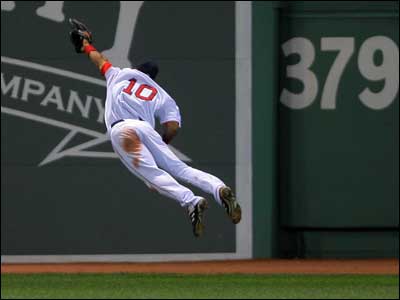
Crisp said it himself - he paused:
"I got a pretty good jump. I didn't know if I could catch it, so I went straight at it. I took a leap of faith. I was going full-speed so I was able to hang in the air just long enough to make the catch."
He hung in the air just long enough to make the catch ...
Athletes, man. They amaze me.
Seriously. I just love this shit.
And now - I will link to the article about it in my home state paper of record - the good ol' Pro Jo.
Oops, let me add this:
What do you want to bet that RIGHT NOW in backyards throughout Massachusetts and Rhode Island - or wherever Red Sox fans abide, little kids are re-enacting Coco Crisp's catch? They are all now taking turns "being Coco" ... and flying through the air. Attempting to pause.
Diary Friday
As I continue to deal with "life after Picnic" - I keep going back and filling in the blanks from the whole experience. It was as though I was writing myself back into the past (of, er - 2 weeks ago).
So none of this is linear - I'm in the present, I go back into the past - events are speeding up, so sometimes I don't even know what to write about.
Lots of actor talk here. If you find an actor's process interesting - there's a ton of stuff here.
This one'll be a 2-parter. The orignal entry is probably 40 pages long.
DEC. 24
Oh Diary.
Tomorrow's Christmas.
I'm a crazy woman.
[That is quite a triumvirate]
A real-life freindship with Brett has been growing. I feel so comfortable with him. My whole outlook on myself with guys is different.
My life is FULL TO BURSTING. [I don't have a font big enough to imitate what it looks like in my journal]
On Closing Night, I got to the theatre in a frazzle with my bag of cards. I had made a sign to tack up on the bulletin board. It said: " 'Rarely do members of the same family grow up under the same roof.' That's how I feel about all of you. Love, Millie."
I was on the verge of joyous tears the whole night.
I came into the girls dressing room and went around to each mirror and put my card there. Joanna came in and did the same thing. I opened mine from her and started crying. Then I heard her on the other side going, "Oh, where is Sheila?" and I went running around to her. I had given her 2 cards - one had a poem on it about being sisters [she played Madge - my sister in the play] - the other was a letter. Hers was a hard one to write, too, because she came to mean so much to me - as a friend and as my sister. When we saw each other, we just started hugging - I wanted to hug her until there was nothing left of her.
Kate gave me this book for Christmas with all these quotes in it, and one quote screamed off the page at me [Jesus. That sounds terrifying] - and I think of it now when I have difficulty describing my tremendous love for someone:
"Love sees through a telescope - not a microscope."
Those feelings are not meant to be put into words.
Joanna ended her letter with a little poem for me:
"And when you stop and think about it
You won't believe it's true
But all the love you've been giving
has all been meant for you."
After our hug, we just beamed at each other and she said, "The best is yet to come."
Then we ran off to play dodge ball in J Studio. [Okay. That is HYSTERICAL. I had forgotten that. The entire cast would get to the theatre maybe an hour before curtain ... and before going to put on our costumes or makeup or whatever ... we would all congregate in J Studio - a massive echoing black-box space - and play dodge ball. SO FUN.]
Back in the dressing room, Jennifer (about my favorite person in the world) had just read my letter - and when I walked in, she looked up at me with tears streaming down her face and said to me, her beautiful Southern accent, "You are such a doll." I started crying and we both just hugged. She is so free with her emotions. I love it.
I miss her. She went home for Christmas - I talked to her on the phone last Tuesday to say goodbye. I am thinking of her. [Uhm, you sound a little bit like a stalker now.]
I was down in the lobby and Brett was there reading all the little cards people tacked up - and also my sign - and then he saw me just standing there and he came over to me and said, "Thank you for what you wrote." Then he kissed me and hugged me so gently I thought my heart would crack. [My heart was ALWAYS cracking, apparently.] That whole night I was so tremulously happy that I was about to cry the whole time. I hadn't gone into the guys dressing room yet to give them their cards. So later on I went and knocked on the door. Joe yelled, "Come in!" so in I went and gave each one their envelope.
I love Eric. He's left - he moved to NYC - He's such a wonderful guy. It's just inexpressible.
I don't have to describe all of it. I will remember it.
What a blessing it was that I got in Picnic. I have formed lasting meaningful frienships and I am so psyched. What is so great is that they love me - not some face I've put on.
I remember a while ago when I read my Seventeen horoscope [ohmigod, no] and it said, "You won't be certain who are. Perhaps you'll know when you see yourself reflected in his eyes." [Are you KIDDING me, Seventeen???? I feel like suing them right now.] I never really understood what that meant - but suddenly - on Closing Night - after I handed the card to Brett - and he looked at me - I felt like what he was seeing. I could see myself the way he saw me. The fondness and caring in his eyes was so much that it went right through me - and I just felt so good about myself. He makes me feel special and unique. In the same way that my friends do. Sometimes I really need that.
In high school there is such a definite line between friendship and romance. If you talk seriously to a guy, or sit with him, people ask, "You going out with him?" It's really impossible to have a friendship with a guy in high school - because at least in my school - boys and girls do not mix outside of romance. [What is this - a high school in Riyadh? Lighten up, people!] If you're going out with someone, you're inseparable - but other than that ...
But here I am finding that a friendship with a guy is so satisfying - so normal. I am on TOP of the world. Because I can't put a label on what we have. It's not just friendship. It's not romance. What is so WONDERFUL about me and Brett is: Usually when I think about guys, I think: "Okay, there's friendship - and then there's more. Something more." It's like everything needs to be defined. Friendship or romance, choose. I can't find a name for me and Brett except beautiful. Fulfilling. I love him, and it's a gift. I think I sense a kindred soul in him.
A while later, I went back into the guys dressing room with Liz to give Joe a Christmas ornament that I stole from a Woolworths tree. [What?? Also: wow. Woolworths] Joe is notorious for swiping ornaments so amidst total hysteria, I presented it to him. Liz was in convulsions. Joe was slapping on face powder and praising my actions. [hahaha I remember that. It was so old-school dressing-room behavior.] I was laughing. I looked at Brett. I knew he had read my card, and I was scared to look at him. I was embarrassed. The minute I came in I was aware of Brett standing up, and he just stood there quietly during the crazy loudness -
Junior year is lightyears behind me. It's now almost a dream. Did all of that happen? It's sad how I was. I was such a basketcase. For Pete's sake, the best day of my life was when DW bought two of my damn Rice Krispie treats at the Drama Club bake sale. [I am literally shaking with laughter rightnow] I don't think I loved DW as much as I believed I did. I mean, all the stupid times he looked at me - and I would interpret it to mean something - and you know what? It doesn't even hurt anymore. I used to fall in love all over again whenever I would see him - but now - I just remember it. I can remember loving him with every fiber that I had - but I can't conjure up the feeling anymore. I don't feel stabs of pain. I haven't for a long long time. I guess it was just an infatuation.
So anyway, I finally got the courage to glance at Brett - I had the feeling that he had read my card. I felt awfully open.
He didn't smile, when I looked at him. He just jerked his head at me, to tell me to come over to him. Joe and Liz were still loudly talking. So I walked over to Brett. He looked so serious. No, not serious. He looked moved. In one moment we were hugging - just one of those indescribably hugs - I could feel I LOVE YOU - I am me - I am still Sheila Kathleen, I am the same girl I have always been - but now you are in my life, Brett, and nothing will ever be the same again. [And this is actually true. Meeting Brett changed my life.]
During rehearsals, as I slowly got more comfortable with people - they all seemed to get more at ease with me, too. Brett is such an affectionate person. He blew me away, and I didn't know what to make of him. How he would hug me, or grab me, or ruffle my hair. It's all very real, though. He says "I love you" a lot too. In later rehearsals, he would always tack on, "But not that much" and everyone would yell at him. The fact that he didn't say it with deep serious tones didn't lessen his sincerity at all. But when we were hugging in the dressing room - he said "I love you" - and he didn't tack on "but not that much" - the hug was so long - so tight - I knew then that my letter had been the right thing to do. I really just wanted to give him a gift in return for all he has given me.
Happines scares me sometimes.
No other feeling really scares me like happiness does. It makes me feel helpless sometimes, for no reason.
I knew there was some greater meaning to my getting in Picnic. It was my chance to assert myself. It was my chance to become a real actress. It presented me with all sorts of chances - but not just theatrical. I just feel so much more alive right now. Because of all of those people.
Brett broke the hug, and gave me a little shove. "Get the hell out of here. I'm starting to cry."
Then Eric came over and swung me up off the ground to thank me for the card.
I was happy. Forget trying to be eloquent. [hahaha As though my journal is rolling its eyes, thinking, "God. She's so inarticulate."]
When I left that dressing room, I was shaking. My nerves were electrocuted anyway [good lord] because it was Closing Night - way more so than Opening. The world was coming once more. Kate, J, Mere, Carolyn, my parents, Bren, Brian, Geddy and Don came down. Oh, and TS came too - although he didn't tell me he was coming.
Before each show we would always meet in the Green Room and psyche up. We'd always do our Circle. Hold hands, and zoom in and zoom out, yelling - or - send a squeeze around the circle through each other's hands - faster and faster - like an electric current - The big thing was to squeeze hands as tightly as possible and go "SSSSSSSSSS". You can't imagine how much energy it would give me.
On Saturday, though, we all held hands and just stared at each other. My knees were knocking. Brett said, "Okay, let's just be quiet for a minute and think about what Picnic has meant to us." So for a while, we all just squeezed hands and didn't say anything. All I could think of to say to God was, "Thank you". But I meant it from the very pit of my soul. This wasn't just a play for me. I don't think it was for anyone else either.
The show was beautiful. I tried not to think, "This is the last time I'll be doing this" but I couldn't help it.
We all started screaming and hugging in the Green Room - I was in the perfect mood to do a show - I couldn't WAIT to get out onstage. I was right behind Joanne and Joanna - right before we entered the backstage area, I said to them, without even thinking, "God, I love you guys." Joanne froze and turned around to look at me. Then she put her arms around me and said, "Some people you love because they don't let you do anything else." We walked backstage together. Before every show, the two of us would grab each other's arms and go "SSSSSSS". Then she and Joanna would do it, then me and Joanna - then the three of us together - and right then, it hit me. It's gonna be over so soon. That day to dayness of seeing these wonderful close friends I've made is almost over.
Before the show, backstage - it wasn't like we were saying goodbye to each other. But almost a goodbye to the show. Because right after the show, we had to immediately strike the houses. So we were all just hugging really tight.
Liz beckoned to me and Joanna and we sort of huddled with our arms around each other. Liz said, "If I ever become a mother, I would hope that my kids would be just like you two."
Oh God. She became my mother during rehearsals. She always called me and Joanna Millie and Madge - and she would tell us what to do. [hahahahaha LIZ!!!] Or she'd tell us to be careful, and drive safe, or whatever.
Brett came over to our side to hug each of us before the show. You know what's weird - I used to think TS and I were alike. But we aren't at all. We are because we both act, and we like NYC, but - we used to be alike. But since Picnic I've opened myself up. I am not afraid to be vulnerable, and I like to be around people who also aren't afraid to be vulnerable.
I can kid around with Brett, goof on him, laugh with him - he made me laugh so hard once that I almost wet my pants - but also - I can talk to him. We also can just be silent together. So I know now that I need somone that I can talk to. Someone I don't have to watch myself with, or watch what I say. I don't want to be uptight anymore. I don't want to be anyone else but myself.
The show went great. We all just had SO MUCH FUN. I had a blast - being Millie for the last time - knowing all my buddies were out there watching. I love to run the show through in my mind even now.
One of the most vivid moments for me from the last show was during Act III during Brett's and my scene. The scene was always so real, and awkward and uncomfortable. I always felt like crying during it. Because here's what I decided: I had done a lot of thinking. I knew that Alan would be leaving. I knew that I probably would never see him again - at least not this way. And it hurts me - but I knew that I had to say what I had to say, while I had the chance.
During the intermission between Act II and Act III, and during Scene 1 of Act III that I wasn't in - I sat backstage preparing, sitting between two heavy black curtains. I plugged my ears, closed my eyes so that I was in my own world. And I went through my preparation. I went through the whole picnic in my mind, let myself feel it - coming home after the picnic and finding that Madge isn't in her bed. I knew what that meant. I went through me lying in my bed all night, thinking. Millie has a dark night of the soul. She separates herself from her family. I went through all of that in my mind.
Then I opened my eyes, unplugged my ears - it was so weird, everything was so loud suddenly, so harsh. It slapped me in the face.
I remembered Madge's face as she danced towards Hal. And right then it hit me, "Holy shit. Madge is with Hal."
So when Howard's card drives up, I run around the curtain - like I'm seeing if it's Madge. But then it hits me - Alan. Oh God - it's Alan. And what about Alan. It hit me so hard it hurt. I look back over the summer - how nice Alan has been to me, all the times he let me go places with him, and the times he took me swimming.
I don't exactly know how preparing to go onstage works [sounds like you're doing a pretty damn fine job, young Sheila] - but that's what I would do. And sometimes, backstage, I would almost start to cry - I would start off feeling totally rejected. Because Hal rejected me. Thoughts of DW would float through my mind. I would sit there thinking "Why not me?" - and I couldn't tell if it was me thinking it, or Millie.
I felt despearte. I realized that everything was crumbling.
Then I would watch the love scene between Madge and Hal. And Brett would always watch it too. What a pinch that must have been.
All of this preparation helped me so much to do Act III - and helped me during our scene. I love Alan, in a way. And it hurts to have him leave because I know that the only reason he hangs around our house is because of Madge. He won't be coming back. So. I have made up my mind to tell him how I feel about him, before it's too late. And I do. [I don't know, girl, you're kinda blowing me away here. That's a powerful choice to make. Good choice.]
Act III on Closing Night was more me than Millie - I knew it. There are so many goodbyes in that act. But that one scene with Brett, I felt so choked up inside - but also so determined. And my last line is: "I don't expect you to do anything about it. I just wanted to tell you."
I have never felt it the way I felt it then. The firmness. The determination. "I just wanted to tell you."
Alan doesn't know yet about Madge and Hal, but I guessed. So I know before he does that he will be going. "I just wanted to tell you" (subtext: before you leave, before I never see you again, Goodbye Alan, goodbye to my friend Alan, thank you, thank you, thank you for being my friend.) [Holy shit. Is this a 17 year old girl writing this? Seriously. I am very impressed with myself right now]
Act III. I came offstage for the last time. Usually I don't listen to the rest of the play because it makes me cry and I can't cry for curtain call. Also, to be real about it - I wouldn't hear any of it. I am Millie, and I am on my way to my first day of school - and I am a different grown-up person now.
But the last night I did listen.
Usually when Joanna comes off, she is really crying. Joanne and I give her a minute to herself and then go to her to calm her down. I don't know where Joanne was the last night - but I heard Joanna behind one of the curtains weeping. Total hysterics. By then all the lights had come down - I went to her - and took her in my arms. She was shaking and sobbing. It was like holding J at Kate's grandmother's funeral. I didn't know what to do. She was so out of control.
It was over. We both knew it.
We hurriedly wiped off our faces to go running out to bow. After our curtain call, we all tore (as planned) to the Green Room to pop the champagne. The screaming! The mayhem! I ran into the Green Room shrieking for no real reason - everyone was screaming - Brett caught me up and whirled me around - then Eric came in and Joe - we all were yelling - and Liz! I got soaked with champagne. It sprayed everywhere. Joe hugged me and I started crying. Liz saw me and came running over to me. I love that girl. She is a gem.
In the hysteria, Kimber came in, saw me, handed me this thing,- saying, "Letter for you."
I was like, "What?"
I had no idea what it was. It was a piece of folded black construction paper. On the cover was stapled a white piece of paper with a pencilled drawing on it that I immediately recognized. It was a drawing of Paul McCartney on the cover of the Abbey Road album walking across the street with bare feet. I was quite confused. I opened it and inside was stapled a piece of blue construction paper and on it was written in crayon -
"Happy birthday/Congrats on the debut.
I'm quite sure I'm probably very proud of you.
Love, TS
(Remember, the key to success is there is not a not.)"
[This card is taped into my journal - right at this spot, by the way. My journals are filled with stapled relics of my life - cards, notes, etc. They're all plastered through the pages.]
I totally lost it. I had had NO idea that he was in the audience. I hadn't talked to him since I don't even know when - but I couldn't believe that he had actually come, and written me a letter. Right then I forgot my anger. [Oh shit. No, hang onto it!! You're gonna need it!] I started to sob as I looked at that letter.
It was just everything. I have so much love in me. I didn't know that I could love that much.
I saw Joanne, standing there with tears in her eyes. She's transferring so she won't be here next year. [She ended up staying!] I went over to her, and we both just lost it, hugging. I somehow managed to say, "I'll miss you." I learned so much about acting from her. I watched her, and I learned. She sort of took me under her wing theatrically.
Opening Night, before the show, I was not a human being. I was a shivering bundle of nervousness. We were backstage before the show, and I said, "Why do I do this if it makes me feel this way>" And she said to me, "Then leave. Walk out. You have two choices here. Either you say: Fuck it, and leave. Or you go out there and blow them away. To go out there and fail is not a choice you have."
I will always remember that. [And I always have.]
I was SO glad that TS came! I was kind of hurt that he hadn't come already.
Back in the dressing room, I had to have Linda unhook my skirt because I was not functioning. I was so eager to go upstairs that I would have run up there naked if someone hadn't stopped me. I waited for Liz to dress, then we hollered for Brett (whose parents and brother had come) Brett has a brother my age - isn't that so weird?
I've never had that much pent-up energy before. The three of us ran up the stairs and burst into the lobby.
Mere was so great - she was hugging me and beaming at me, saying, "My friend."
And there stood TS. He looked so cute. He had a suit on. I wanted to hug him and say "I love you" - but - there we go - I had to say to myself, "Wait. This is TS." I hugged him anyway. Maybe he felt awkward but I didn't.
The weirdest thing was introducing my Picnic friends to my other friends. I live in 2 worlds now, and in both worlds the different groups of people know the same Sheila - which is so great for me. I am not different with one group than another. But they are 2 worlds. It was a blending of the 2 worlds that night and it felt SO strange. Liz came running over looking freshly washed and young, after all her wrinkles and eye-shadows were scrubbed off and put her arms around me. "Introduce me! I know your faces from the Homecoming Dance picture but I don't know names."
So I said, "Liz, this is Mere, TS, J, Kate, and Carolyn." Then Joe came over and I went through it again Then Brett bounded over - and I got very confused at that point. I mean, all before the show and during - I was amazed at my own love for him. It was so much,and so happy - then I got TS's letter and immediately my soul was screaming, "TS!" So having to say, "Brett, this is TS, TS this is Brett" - I mean, it was almost funny. My whole life is hysterical. Anne started laughing as I introduced the two guys.
But I liked finally introducing my friends to this legendary person amed Brett.
After a few minutes of awkwardness, where we all stood and stared at each other - I said, "Well, I have to go knock down my house now."
Another round of tight wonderful hugs. Mere was so cute -just glowing at me. It is weird sometimes - to have people proud of me - and to be proud of myself. It makes me feel set apart and it's strange.
Then we struck the set.
It was a total downer. First of all, it totally drained me. By the end of it, my eyes were practically closed, and they were swollen cause of all the dust and sawdust. I ached. And watching our beautiful houses just coming down - like that - it was a smack in the face. A dash of ice cold reality. It's over, you fuckers. Ha ha
It was rough for everyone in the cast, but we got through it. I said to Brett, "Okay, I'm gonna turn my mind off to what we were doing." And it wasn't as hard as it seemed. I just kept myself busy, taking out nails, rolling away furniture, carrying lights and flats. There were a few times when I just stood back - watching the roof come down, or the porch come off. I'd look across the stage and see Joanna standing there, staring too. She's a kindred soul, too. I didn't really talk to people during strike. I got so tired. And sort of quietly depressed and resigned. I really thought that because Picnic was over I would never see them again. I forgot what Brett had written to me in his card: "Always remember the bond it created."
One thing happened during strike which totally lifted me. It's the only time I can remember associating with anyone during strike. Brett and I were carrying this platform to this scaffold to put it down and as we put it down, he leaned across it to me and said, "Thank you so much for what you wrote. I mean it. I almost cried." I said, "I meant it." I was being honest. I'm just not eloquent enough [again with the eloquence anxiety??] to think of anything to say. And he looked at me again in that way that sends shivers through me. It's like I know that he sees me. That's the only thing I really remember from the strike,e xcept for getting totally exhausted. I was practically sleeping while standing.
I was looking forward to the huge party afterwards at Brett and Joe's - hoping it would pep me up. Also, I was gonna sleep over so I had all my lens stuff. I had slept over once before - the Saturday before after another big party. That was a wonderful time. It was strange how comfortable I felt doing things that I could never have imagined myself doing.
I still felt kind of numb, though. It was over.
I was thinking that because we were no longer a cast, we would all drift our separate ways. I was resigned to it. I asked Joe, "Does the party usually cheer you up?" and he said, "Oh yeah!"
I got all my stuff together after the stage was totally clear. It looked so weird and desolate. I couldn't really look at it. And the dressing room - oh, the whole thing was just a weird feeling. I feel so at home in that theatre now. It was my home for 2 months. My name taped up on my mirror.
But I couldn't wait for the party.
Then Patty (one of the girls who lives with Brett and Joe) offered me a ride. There had been this fiasco a few nights before when she drove me over to Giro's - but that's another story. Patty is a nice girl but she sort of latched onto me for some reason - Carolyn does sort of the same thing. She clings. She hovers. It bugs me.
Jennifer came to the rescue. God, I love that girl - Anyways, Patty was just waiting around for me - even though I was stalling to see if I could get a ride with Joe or Joanna or Brett. I wanted to go to the party with someone who was in the show - who would understand - I didn't want to be with her. She is not someone to be with when you are feeling quiet and depressed. I just really wanted to be with cast members. She's kind of dense that way. So Jennifer, the doll, said, "Patty, could you give me a ride home before we go to the party? I have to get something." Then she winked at me. What a sweetheart.
Just then I heard Liz calling my name out in the hall - I went out there - she was peeking out of the guys dressing room and said, "Brett's gonna give you a ride."
Relief flooded over me.
I grabbed my stuff and went into the guys dressing room. Brett was putting on his sneakers. It was so comforting to be near him. I felt so lost. Our set was gone. Our houses were gone. Our little Kansas world was no more. I would have been totally floundering in space with Patty.
We headed out to his car. The night was cool and breezy with a full bright white moon.
We got in the car. We both were really quiet. My whole being felt so calm and unemotional and dead. Like: "It's over." I think Brett was more listening to my silence than being quiet on his own. Because - we sat there in his car for a minute, not talking, before he turned the key.
I couldn't believe what 2 months of my life could do.
Sitting in that car with him was such a comfort to me. Brett sighed and turned the key and away we went from the theatre. We could have driven the whole way to his house in silence and it would have made me feel better - just being with him makes me feel better. I mean, with TS - there's one second of silence and it's agonizing. I suppose I shouldn't compare but I can't help it.
We did talk in the car though. At first not about much, but then there was another lull in the conversation and I was just looking out the window and --
Brett took a deep breath and said, "Now ------ you have our phone number." He reached over and sort of patted my knee. "Use it."
I felt so full of emotion I couldn't talk. We looked at each other. Brett said, "I'm glad you feel comfortable with me." Once again, no words. I felt so good inside suddenly. I mean, the play was over, but I was going to a party, and it didn't have to be OVER over yet.
I feel so wondrous that lal this is happening to me.
We talked on the way there - I asked him if he could tell how nervous and awkward I had felt during the first rehearsals and he said, "Oh yeah. I knew just how you were feeling too. But what made me feel really good is when you started goofing on me. That was so cool because - I don't goof on everybody - especially not girls - but it was neat when you felt comfortable enough with me to bust on me."
I have always thought of friendship as "cool" but it was romance that was the "something more". I never thought this was possible - but friendship with Brett already is "something more". There is no dividing line. It's not one or the other. It's more just in being itself.
I'm shouting Brett's name to the mountains! [Uhm, Rhode Island has no mountains]
We got to the house. It was such a beautiful night. I don't know how he can stand living where he does. The view they have. And on that clear moonlit night. I love it in that little crowded beachhouse.
Millions of people were there. I was feeling so mellow and peaceful, not at all crazy. At the strike I was thinking, "Oh, it'll be fun to dance and go wild." But once I was there, I just wasn't into it. All I could think of was that this was the last Picnic party, and there were so many loud people there who I didn't know. I didn't drink. I had a sip of champagne but that was it. I sat on the couch with Joanna and Brett and we stared into the fire. We all felt the same way. I didn't feel tired anymore. I just felt like sitting around with Picnic people and talking. But it was so loud in that tiny house.
Brett glanced at me. "I am so not into crowds tonight. Are you?" I shook my head. "Not at all."
Then he said to me, "Want to go for a walk on the beach?"
That was just what I wanted. It sounded so beautiful, so peaceful - just what I needed.
We weaved our way through the throngs and went up to his room to get our coats. I said, "Do you think that this'll look a little suspicious?" We looked at each other and stopped. "Yeah, it does." he said. But still, I was aching to go - and get out of the house. The moon was so bright and so full. And the beach. The ocean. We decided to go anyway. Fuck what people thought.
We went to find Joe and Liz - but Liz wanted to shave off Joe's mustache [I am laughing out loud!!!!] so they said that they would come down later.
So Brett and I got our coats and slipped out of the house into the quiet still night.
Other Picnic entries:
Part 1. The audition
Part 2: The callbacks, getting into the play
Part 3: First meeting with the director
Part 4. The calm before the storm ... the time before rehearsals started ... memorizing lines, etc.
Part 5. Rehearsals start
Part 6. Rehearsals. Stress building.
Part 7. Crush with Brett intensifying. Finding my own way as an actress. Stress building.
Part 8. Dropping out of religious retreat with much sturm und drang.
Part 9. Being invited to college party
Part 10. Going to college party
Part 11. Aftermath of college party!
Part 12. Rehearsals! Life! Going crazy!
Part 13. The rehearsal when the play clicks into place, emotionally.
Part 14. Opening night approaching. Homecoming Dance approaching.
Part 15 Homecoming Dance. Homecoming football game. Rage.
Part 16 Last rehearsal before 3 day Thanksgiving break. Heaven!
Part 17 Opening Night!
Part 18 More on Opening Night.
Part 19 The show closes. Drama with the boyfriend. Reconnecting with my friends.
June 29, 2006
Lana Turner Day
There are so many terrific posts to lose yourself in! (OH. Today is the Lana Turner Blog-a-thon - if you didn't know already.)
Definitely go check out all of these well-written insightful essays - I've been having a lot of fun reading them.
Here is Flickhead's post. I liked this part:
If the Postman delivered anything, it was Lana inconceivably cast as a roadhouse hash slinger (!), radiant in open-toed shoes, white blouse and shorts, her beautiful bare legs held in awe by the lens, and those vacant, faraway eyes framed by a turban. Indeed, her introductory shot in that picture stands among the supreme and least plausible of all Hollywood glamour images. The great riddle — what madman cast the warm and fuzzy Cecil Kellaway as the husband? — went unanswered, but no one really cared. Lana had, as they say, ‘arrived.’
Here is Greenbriar Picture Shows post (that site is my new addiction, by the way - thank you SO much Hank for the link!) Read the whole post, and make sure to check out the picture of the absolute MOB scene beneath the marquee with her name. It's a really interesting take on Lana, on how in her heyday - there was nobody bigger. And yet it's hard to see, now, what all the fuss was about. But it would be a huge mistake to just blow off that Lana Mania as "Well, they just didn't know what was good". No, no. Let's look at her in the context of her time.
One excerpt:
The ones who could tell us all about Lana Turner and what she meant to her once wildly enthusiastic fan base are a dwindling lot of world war veterans --- the men who served and worshipped Lana, and the women who crowded her movies stateside and lived vicariously through her romances, both onscreen and off. It’s easy for our generation to regard her as a studio manufactured joke, for we never experienced the anxieties that a star like Lana was there to alleviate. She was comfort food with a brief shelf life, but like strawberries fresh from the market, she had an intoxicating flavor that just can’t be experienced so many years after the initial purchase, and a movie like Marriage Is A Private Affair can give but the barest hint of what it must have been like to taste Lana in her prime. She would certainly make better pictures (The Postman Always Rings Twice, The Bad and The Beautiful, Imitation Of Life), but none that summon up her essential appeal like this one.
And I so agree with John (who wrote that) that her films are "fascinating time capsules" for those of us who love the movies. Go read his whole post, though - and definitely scroll around his unbelievable site. I am DROOLING over some of the images.
A beautiful articulate post by one of my favorite bloggers - the Self-Styled Siren. REALLY cool insights there about Lana's beauty - and how she used it, and knew she had to use it.
In The Postman Always Rings Twice, probably the peak of Lana's looks if not her talent, the power turns to desperation. See her clinging to John Garfield, throwing every bit of her allure at him like a spear. Can't he see, for God's sake? Lana knows, she knows she's never going to get more beautiful and she sure as hell isn't going to get any smarter. She has to get away from Cecil Kellaway (Flickhead is right, that casting was bizarre), and Garfield's feckless character is unfortunately the only way out. When what she wants is murder, even Lana has to put some muscle into it. The result is that Lana's scenes of persuasion with Garfield are not subtle, but they are entirely true to a woman actually having to work on a man for the first time, after years of having them roll over and play dead.
Wow. SO true. Go read the whole post.
Here is a post by The Evening Class. It makes me NEED to see Imitation of Life again, in order to watch that one moment.
Coffee, coffee, and more coffee does a post about The Sea Chase - a film I have not seen with John Wayne and Lana. Excerpt:
It may have been part of her contract, but Turner first appears wearing a fur coat. Later she is seen wearing some form fitting sweaters, a reminder of what made her a star in the first place. While the ship's crew gets grubbier as the film progresses, Turner remains her glamorous self no matter how primitive the conditions around her.
Heh heh. Those were the days.
Here's John Garfield and Lana in Postman. I have a postcard of this image on my fridge. There's just something about it.

Lana Turner died on this day, in 1995.
Her star has faded a bit - she is now seen as a symbol of other things - but I've got to believe that someone whose career lasted that long - (she may not have done a gazillion movies a year - but she worked steadily) had a hell of a lot of moxie, ambition, and ... maybe not smarts (uhm ... 7 husbands, Lana? Johnny Stomponato? Uhm ... Lana?) ... but survival skills. She started out as the "It Girl" because of how she looked in a sweater. "It Girls" are a dime a dozen. If you want to last beyond your big season of being the "It Girl", you need to have more going on than just looks, or luck. Will we ever have a Sienna Miller Blog-a-Thon day? Time will tell.
I am not saying I think Lana Turner is under-rated. I don't. I'm not saying she's an unsung Great Actress. But she has her damn fine moments - when she is used well - when a director "gets" her - and I celebrate that part of her. I really like watching her act. It's a bunch of hoo-hah, really - breathy sleepy-eyed hoo-hah - and a relic from another time - but that's part of why I like it.
Conflict
When taking care of someone else's beloved fish, there are two conflicting emotions going on simultaneously, at all times:
1. An almost Zen-like appreciation of the fishes and their fluttery flashing underwater movements
2. Intense anxiety about finding them all gone belly-up during my reign as caretaker
I don't think I've ever experienced Zen-like peace at the same time as intense anxiety - it's an extremely odd sensation. I've experienced each one separately - but together? Only the caretaking of fish has brought about this strange conflict.
The Books: "Harry Potter and the Sorcerer's Stone" (J.K. Rowling)
Next book on the shelf ... (we're in my children's and young adult bookshelves, by the way):
 Next book on the shelf is Harry Potter and the Sorcerer's Stone by J.K. Rowling. Here we go!!!
Well, I can't resist. I need to post an excerpt from the first chapter. I'll just explain why. This is a series - this is a phenomenon ... So it is interesting to look at the BEGINNING. I remember reading that first chapter for the first time - and at the last paragraph - I literally got a little goosebumpy.
This was a true BEGINNING. It doesn't feel like a fluke that this series took off, and that Harry Potter became as huge as he did - especially not when you read that first chapter, and even more specially: when you read the last paragraph of the first chapter.
I am probably not explaining myself well. But I think JK Rowling knows exactly what she's doing - and while it may have been one of those lucky strikes of fortune that helped propel this book into mythic status - I still imagine Rowling sitting in the coffee shop, scribbling this first chapter in a cheap looseleaf notebook .... or on stray napkins ... whatever piece of paper was handy. There was no guarantee. There are no guarantees. The success of Harry Potter was not a foregone conclusion, even though the whole thing seems inevitable now. I think that if the first chapter were not so, well, perfect ... the series might not have taken off as it did. How can you not keep on reading?
But also (in my opinion - and not to overthink this) - there's a little bit more to it - than just setting up a cool story. And whatever it is in that last paragraph.
The only word I can think of to use is an appropriate one - Magic.
Suddenly, in that last paragraph ... there is magic. Basically, the microscope becomes a telescope, in one fell swoop. You can see it in the writing. Minute detail ... and then pulling back, way way back ... Even now, re-reading it this morning, I got a little, ehm, lump in my throat, and felt the goosebumps. It WORKS.
Here's the end of that first chapter:
Excerpt from Harry Potter and the Sorcerer's Stone by J.K. Rowling.
If the motorcycle was huge, it was nothing to the man sitting astride it. He was almost twice as tall as a normal man and at least five times as wide. He looked simply too big to be allowed, and so wild - long tangles of bushy black hair and beard hhid most of his face, he had hands the size of trash can lids, and his feet in their leather boots were like baby dolphins. In his vast, muscular arms he was holding a bundle of blankets.
"Hagrid," said Dumbledore, sounding relieved. "At last. And where did you get that motorcycle?"
"Borrowed it, Professor Dumbledore, sir," said the giant, climbing carefully off the motorcycle as he spoke. "Young Sirius Black lent it to me. I've got him, sir."
"No problems, were there?"
"No, sir -- house was almost destroyed, but I got him out all right before the Muggles started swarmin' around. He fell asleep as we was flyin' over Bristol."
Dumbledore and Professor McGonagall bent forward over the bundle of blankets. Inside, just visible, was a baby boy, fast asleep. Under a tuft of jet-black hair over his forehead they could see a curiously shaped cut, like a bolt of lightning.
"Is that where --" whispered Professor McGonagall.
"Yes," said Dumbledore. "He'll have the scar forever."
"Couldn't you do something about it, Dumbledore?"
"Even if I could, I wouldn't. Scars can come in handy. I have one above my left knee that is a perfect map of the London Underground. Well - give him here, Hagrid - we'd better get this over with."
Dumbledore took Harry in his arms and turned toward the Dursleys' house.
"Could I -- could I say good-bye to him, sir?" asked Hagrid. He bent his great, shaggy head over Harry and gave him what must have been a very scratchy, whiskery kiss. Then, suddenly, Hagrid let out a howl like a wounded dog.
"Shhh!" hissed Professor McGonagall, "you'll wake the Muggles!"
"S - s - sorry," sobbed Hagrid, taking out a large, spotted handkerchief and burying his face in it. "But I c-c-can't stand it - Lily and James dead - an' poor little Harry off ter live with Muggles --"
"Yes, yes, it's all very sad, but get a grip on yourself, Hagrid, or we'll be found," Professor McGonagall whispered, patting Hagrid gingerly on the arm as Dumbledore stepped over the low garden wall and walked to the front door. He laid Harry gently on the doorstep, took a letter out of his cloak, tucked it inside Harry's blankets, and then came back to the other two. For a full minute the three of them stood and looked at the little bundle; Hagrid's shoulders shook, Professor McGonagall blinked furiously, and the twinkling light that usually shone from Dumbledore's eyes seemed to have gone out.
"Well," said Dumbledore finally, "that's that. We've no business staying here. We may as well go and join the celebrations."
"Yeah," said Hagrid in a very muffled voice, "I'll be takin' Sirius his bike back. G'night, Professor McGonagall - Professor Dumbledore, sir."
Wiping his streaming eyes on his jacket sleeve, Hagrid swung himself onto the motorcycle and kicked the engine into life; with a roar it rose into the air and off into the night.
"I shall see you soon, I expect, Professor McGonagall," said Dumbledore, nodding to her. Professor McGonagall blew her nose in reply.
Dumbledore turned and walked back down the street. On the corner he stopped and took out the silver Put-Outer. He clicked it once, and twelve balls of light sped back to their street lamps so that Privet Drive glowed suddenly orange and he could make out a tabby cat slinking around the corner at the other end of the street. He could just see the bundle of blankets on the step of number four.
"Good luck, Harry," he murmured. He turned on his heel and with a swish of his cloak, he was gone.
A breeze ruffled the neat hedges of Privet Drive, which lay silent and tidy under the inky sky, the very last place you would expect astonishing things to happen. Harry Potter rolled over inside his blankets without waking up. One small hand closed on the letter beside him and he slept on, not knowing he was special, not knowing he was famous, not knowing he would be woken in a few hours' time by Mrs. Dursley's scream as she opened the front door to put out the milk bottles, nor that he would spend the next few weeks being prodded and pinched by his cousin Dudley ... He couldn't know that at this very moment, people meeting in secret all over the country were holding up their glasses and saying in hushed voices: "To Harry Potter - the boy who lived!"
June 28, 2006
The long-awaited sequel to Kung Food Guy
I am so excited about this that my heart just LEAPT when I saw the email from my brother.
So we have experienced Kung Food Guy. There were immediate cries for a sequel.
And Cashel has come through!!!
Wait until you see. I have many comments but I will wait for now.
Here is ....
This one has a particularly terrifying (meaning: satisfying) ending.
Awesome, Cash-man! Great job, hon!
A couple of "wow" links
All from the same blog.
Wow. (Love her. I first encountered her as the playwright in Cassavetes' Opening Night - years and years after her heyday - so it's been so fun to reacquaint myself with her work in the 30s. She was terrific.)
Wow. It's just a movie still - but it's art. I love that: when a movie can be Paused - and wherever you are in it - the paused image comes out as art. Now THAT'S a good movie.
Wow. Makes me nostalgic for a life I never lived.
Picture the scene.
You are a Japanese orphan.
You live in an orphanage in Tokyo.
You are a baby.
You live with many other Japanese orphans. You wait to be adopted. You wait to grow up. You wait to be rescued. You live your life.
One day (May 28, 2006 to be exact) a visitor comes to the orphanage. How thrilling! You think, as you peer out between the slats of your crib: "Perhaps this will be the day I get a new mom and dad? Perhaps this will be the day I get noticed and rescued! Maybe today I will be adopted!"
And then this walks through the door.

Dear cousin Kerry:
I didn't blog what I said I was gonna blog about! Sorry! Life intervened!
But in lieu of my own words on the event: you couldn't do any worse than to read this gorgeous post. Beth's was the first site I visited today. :) I NEEDED to hear what she had to say. Truly heartwarming and awesome moment.
David: are you going tonight?
hahaha I am communicating with my friends and family directly through my blog.
Today in history: June 28, 1914
Archduke Franz Ferdinand and Duchess Sophie took a tour through Sarajevo.
Here they are, on that morning.

Just gives you a chill, doesn't it. To look at them, and to know what is coming.
Rowling speaks
I love this article. Someone may die in the final installment ... a major character ... and who knows, it could be Harry. Rowling isn't saying. But I do just love how whenever this woman opens her mouth, it's an EVENT. For some reason I don't find it obnoxious.
Details in the article that I found really interesting:
She says: "The last book is not finished. But I'm well into it now. I wrote the final chapter in something like 1990, so I've known exactly how the series is going to end," she said.
Fascinating. You can tell when you read those books (well, for the most part - there are the meandering sections where I get bored as hell and it seems like Rowling is just marking time) - but in general, you can tell that Rowling knows what she's doing. She's setting stuff up because she knows where she's going. I've always felt that. I know the chapters and the incidents that I would cut - but hey, I'm not Rowling. I just love the idea that she wrote the last chapter to this whole series 15 years ago.
I also love this: "The final chapter is hidden away, although it's now changed very slightly. One character got a reprieve. But I have to say two die that I didn't intend to die," she said. "A price has to be paid. We are dealing with pure evil here. They don't target extras do they? They go for the main characters. Well, I do."
She's kind of awesome. No. They do not "target extras".
And the piece closes with: "I don't think I'm ever going to have anything like Harry again. You just get one like Harry."
I don't think these books are classics, like the Narnia books. I think they are a phenomenon. I don't think they're particularly well-written - although she does have her moments - but I do know this: I can't put the books down once I start them. They are addictive. And that takes some serious story-telling skills, which Rowling has in spades.
And judging from this article - (and I guess THIS is why I love the piece so much): I really get the sense (unlike other literary phenomenons) that this is ALL ROWLING. Things get so over-marketed so immediately these days that it's really quite disheartening - nothing even gets a chance to survive or not. Now these books are obviously marketed really well, it's an entire business - but the books themselves, the writing of the books - is all Rowling. I still get the feeling that she sits alone in her room, and loses herself in her work - in the same way that she did when she was on the dole, scribbling the first book on napkins at the coffee shop. Listen to her wording: "two die that I didn't intend to die" ... I love that. She's not completely in control of this book - it's almost like IT is telling HER where she needs to go. Madeleine L'Engle talks a lot about characters in her own books who have surprised her, who have suddenly done things she found incomprehensible ... and yet it took the book to the next level. But the magical thing is that; she is writing it!! Isn't she just sitting there making stuff up? Yes, but then there is this little thing called inspiration. That's why some writers talk about feeling like "vessels" or "channels". It's not a completely conscious artform - and I just really like that Rowling seems to be in that place. The book is leading HER. I feel like she hasn't changed, even though now, apparently, she is richer than the Queen of England. In my opinion, the books have gotten better, not worse, as the series went along ... She doesn't seem to compromise. There's a lot of pressure on her - publishers, the movie franchise, marketers ... It's gotta be intense. She has to come up with the goods. Many writers would cave under such a circumstance. Rowling seems to still know how to create that private space around herself - where she can write, and create. Because I thought the last 2 books were the best in the series. So obviously, she is not just trying to repeat herself. She's not lazy.
I personally can't freakin' wait for the next book.
The Books: "The Westing Game" (Ellen Raskin)
Next book on the shelf ... (we're in my children's and young adult bookshelves, by the way):
 Next book on the shelf is The Westing Game by Ellen Raskin.
This is such a great book that I'm not going to say anything about it. I'm just going to post an excerpt and DARE you to not want to read further.
This is the first chapter of the book, called 'Sunset Towers'.
Excerpt from The Westing Game by Ellen Raskin.
The sun sets in the west (just about everyone knows that), but Sunset Towers faced east. Strange!
Sunset Towers faced east and had no towers. This glittery, glassy apartment house stood alone on the Lake Michigan shore five stories high. Five empty stories high.
Then one day (it happened to be the Fourth of July), a most uncommon-looking delivery boy rode around town slipping letters under the doors of the chosen tenants-to-be. The letters were signed Barney Northrup.
The delivery boy was sixty-two years old, and there was no such person as Barney Northrup.
_______________________________________
Dear Lucky One:
Here it is - the apartment you've always dreamed of, at a rent you can afford, in the newest, most luxurious building on Lake Michigan:
SUNSET TOWERS
You h ave to see it to believe it. But these unbelievably elegant apartments will be shown by appointment only. So hurry, there are only a few left!!! Call me now at 276-7474 for this once-in-a-lifetime offer.
Your servant,
Barney Northrup
P.S. I am also renting ideal space for:
______________________________________________
Six letters were delivered, just six. Six appointments were made, and one by one, family by family, talk, talk, talk, Barney Northrup led the tours around and about Sunset Towers.
"Take a look at all that glass. One-way glass," Barney Northrup said. "You can see out, nobody can see in."
Looking up, the Wexlers (the first appointment of the day) were blinded by the blast of morning sun that flashed off the face of the building.
"See those chandeliers? Crystal!" Barney Northrup said, slicking his black moustache and straightening his hand-painted tie in the lobby's mirrored wall. "How about this carpeting? Three inches thick!"
"Gorgeous," Mrs. Wexler replied, clutching her husband's arm as her high heels wobbled in the deep plush pile. She, too, managed an approving glance in the mirror before the elevator door opened.
"You're really in luck," Barney Northrup said. "There's only one apartment left, but you'll love it. It was meant for you." He flung open the door to 3D. "Now, is that breathtaking, or is that breaktaking?"
Mrs. Wexler gasped; it was breathtaking, all right. Two walls of the livig room were floor-to-ceiling glass. Following Barney Northrup's lead, she ooh-ed and aah-ed her joyous way through the entire apartment.
Her trailing husband was less enthusiastic. "What's this, a bedroom or a closet?" Jake Wexler asked, peering into the last room.
"It's a bedroom, of course," his wife replied.
"It looks like a closet."
"Oh Jake, this apartment is perfect for us, just perfect," Grace Wexler argued in a whining coo. The third bedroom was a trifle small, but it would do just fine for Turtle. "And think what it means having your office in the lobby, Jake; no more driving to and from work, no more mowing the lawn or shoveling snow."
"Let me remind you," Barney Northrup said, "the rent here is cheaper than what your old house costs to upkeep."
How would he know that, Jake wondered.
Grace stood before the front window where, beyond the road, beyond the trees, Lake Michigan lay calm and glittering. A lake view! Just wait until those so-called friends of hers with their classy houses see this place. The furniture would have to be reupholstered; no, she'd buy new furniture - beige velvet. And she'd have stationary made - blue with a deckle edge, her name and fancy address in swirling type across the top: Grace Windsor Wexler, Sunset Towers on the Lake Shore.
__________________________________
Not every tenant-to-be was quite as overjoyed as Grace Windsor Wexler. Arriving in the late afternoon, Sydelle Pulaski looked up and saw only the dim, warped reflections of treetops and drifting clouds in the glass face of Sunset Towers.
"You're really in luck," Barney Northrup said for the sixth and last time. "There's only one apartment left, but you'll love it. It was meant for you." He flung open the door to a one-bedroom apartment in the rear. "Now, is that breathtaking or is that breathtaking?"
"Not especially," Sydelle Pulaski replied as she blinked into the rays of the summer sun setting behind the parking lot. She had waited all these years for a place of her own, and here it was, in an elegant building where rich people lived. But she wanted a lake view.
"The front apartments are taken," Barney Northrup said. "Besides, the rent's too steep for a secretary's salary. Believe me, you get the same luxuries here at a third of the price."
At least the view from the side window was pelasant. "Are you sure nobody can see in?" Sydelle Pulaski asked.
"Absolutely," Barney Northrup said, following he suspicious stare to the mansion on the north cliff. "That's just the old Westing house up there; it hasn't been lived in for fifteen years."
"Well, I'll have to think it over."
"I have twenty people begging for this apartment," Barney Northrup said, lying through his buckteeth. "Take it or leave it."
"I'll take it."
Whoever, whatever else he was, Barney Northrup was a good salesman. In one day he had rented all of Sunset Towers to the people whose names were already printed on the mailboxes in an alcove off the lobby
OFFICE Dr. Wexler
LOBBY Theodorakis Coffee Shop
2C F. Baumbach
2D Theodorakis
3C S. Pulaski
3D Wexler
4C Hoo
4D J.J. Ford
5 Shin Hoo's Restaurant
Who were these people, these specially selected tenants? They were mothers and fathers and children. A dressmaker, a secretary, an inventor, a doctor, a judge. And, oh yes, one was a bookie, one was a burglar, one was a bomber, and one was a mistake. Barney Northrup had rented one of the apartments to the wrong person.
June 27, 2006
The best bar in the world
I had a crush on Crazy Erik for approximately 2.3 seconds. I do not know if he was christened as Crazy Erik, but that was the name he answered to. I would call him, he would answer his phone - "Hello?" I would say, "Crazy Erik?" He would say, "Yup!" Just so you get the idea of what we're dealing with here. He did not call me by my name either. He called me Sunshine. I don't know if he ever said my actual name, which is rather funny when you think about it. I don't have harmless crushes anymore - I'm way too old for that crap - but this one was totally benign and fun. Crazy Erik and Sunshine sittin' in a tree! Yay!!
Crazy Erik managed a bar in Jersey City. He talked about it as though it was literally the greatest bar that had ever existed. Think of any of the great bars you have been into. Green Parrot in Key West? Jazz Bulls in Chicago? Chumley's in New York? Bah. They are NOTHING compared to Crazy Erik's bar. When I first walked into the joint, I saw that it was ... well, it was a dive. The smell of stale smoke in the air. Rickety little bowls of pretzel on the short little bar. There were a couple tables - a jukebox - and a cigarette machine. He had made me think that it would literally BLOW MY MIND when I walked in how cool it was! It was basically re-defining what a bar WAS!
WAIT TIL YOU SEE MY COOL BAR, SUNSHINE!!
His behavior was cute because he didn't know it was cute. He was being sincere. I don't think he had an insincere bone in his body. But ... er ... it was a dive. Let's be honest. However, I said, accordingly, "Wow! This place is so great, Crazy Erik! It's awesome!" Because it was expected of me, and because he smiled at me with such anticipatory excitement. No harm done. Truth is way over-rated, you have to pick your moments. And in a moment like that, you should always choose to be kind. I had two choices: Truth or Kindness. I chose Kindness.
So during the 2.3 seconds that I had a crush on Crazy Erik he bombarded me with tales about his bar, and different promotions and drink specials he was running, and how it was going to be THE place to hang out, and how it was ladies night this night, and two-for-one that night, and Guinness night the next night ... Like, every night of the week had some hugely specific SPECIAL THING that was going on. It was way too high-maintenance for me. When I go to a bar, I like to just sit and chill with my drink ... not have to do a hula dance in order to earn the right to have a second drink, or whatever. But still, Crazy Erik was really excited about all of it.
Phone rings. I pick up. "Sunshine!" shouts Crazy Erik. "Hey, Crazy Erik - what's up?" (Please remember that I have a crush on him - not realizing that it is nearly halfway done at this point - so my heart leaps with excitement that he has called me! Crazy Erik called me!!) He plunges right in, "Just wanted you to know that Thursday night we're having a pajama party at the Coolest Bar in the World - just show up in your pajamas and your first drink will be free!" Again, with the unbelievable high-maintenance of this damn bar. Paint your face green, get a free glass of wine! Jump rope for 20 minutes on the sidewalk - get 2 margaritas for the price of one! Bang your head against the wall until it bleeds - happy hour prices! I mean, please, just chill out. Let me drink in peace.
But he was so excited about the pajama party, and I had a huge crush on him, so I figured - okay, whatever, I'll go.
And obviously I HAD to go in pajamas. It would have been completely unacceptable for me to show up in regular clothes. He would have been very disappointed in me, and I couldn't deal with that.
Now, let's factor this in: This is February. So it's the middle of winter, frigid, bleak, ice-coated winter.
I babble to my roommate and dear friend Jen about all of this. "He invited me ... should I wear pajamas? ... what the hell should I do? ... I have such a crush on him! Help me!" You know. Nuts. Jen said, "I'll come with you!" Which immediately relaxed me. Now I can have a partner in crime for this insane adventure, and I won't have to go to some random bar (even if it is the Coolest Bar in the World) and sit there while my current crush is busy working, and socializing and running the joint ... and feel really awkward and silly and yukky. Now we could make a night of it!
It was a night of freezing rain, the night of the pajama party.
This is the test of true friendship. Jen and I put on our pajamas. We then primped, did our hair and makeup. As freezing rain battered against our windows. We then put on big heavy boots, our winter coats, and called for a cab to come get us. We are in our pajamas. We hurry down the ice-drenched steps to clamor into the car, feeling incredibly subversive and SILLY because our flannel-clad legs are sticking out beneath our coats. What are we doing?
Oh yeah, and the "party" didn't start until after 10 p.m. Which is way late for me to be going out. I know I'm a fuddy-duddy, but it's true. I can stay out until 4 in the morning, don't get me wrong - but I have to START my evening earlier than 10. If I go home before going out - forget about it. I will not leave my apartment again. So to put on pajamas, walk outside into freezing February night, at 10 pm ... just shows you how intense the crush was. Granted, the crush only had about 1 second left to live - but I didn't know that at the time. I was livin' it up! Havin' my crush! Wearing pajamas at night! In public!
Jen and I started getting extremely giggly halfway to the bar. It was so rainy that night that I remember flood waters were gushing out of the sewage drains on corners. Our cab would have to slow down to go through the raging rivers. For whatever reason, the floods were funny to us ... because we had pajamas on? I don't know. We started laughing, and our mascara ran a little bit.
The cab dropped us off at the bar. A dive on a random corner in Jersey City. The neon beer signs gleamed out through the wet, smudging like watercolors ... It actually did look kind of cozy, from outside. Jen and I huddled under the umbrella and ran from the cab to the bar. In that time, we became absolutely drenched. Freezing gushing water. Over our primped hair and makeup.
We walked in.
Only to discover that we were the only ones in our pajamas.
Crazy Erik was nowhere to be seen.
Everyone looked at us. Since it was, after all, a dive ... it had a bunch of hard-drinking regulars - women with hard faces, feathered hair, and a penchant for playing The Allman Brothers or Lynrd Skynrd over and over on the jukebox. And we clamored in, giggly, soaked, with plaid flannel sticking out every which way.
"Remain calm," Jen said to me, and we floated nonchalantly to one of the tables. We took off our coats, brazenly revealing our pajama-ed glory for the entire place - and sat there, casually, as though nothing was weird at all. Did we get the wrong night? How could that have happened? We were in Jersey City in a bar in our pajamas. We had no explanation for our behavior.
As you can probably imagine, hysteria began to gurgle up in our throats. We were nearing the abyss of a laughing fit. It was coming. We perched on the stools, waiting to be served, looking around us - rain battering against the windows ... and suddenly - there was Crazy Erik. He came bursting out of the kitchen. And he was wearing pajamas! As well as a long flannel robe.
He saw me immediately and freaked out with excitement. "SUNSHINE! Holy shit, you came!!" He embraced me gustily, and I was beyond thrilled. Jen had never met Crazy Erik, so she sat there shyly, in her pajamas (I have to keep reiterating that), waiting to be introduced. I introduced them. Crazy Erik was a great person, let me just say that. He was naturally friendly. Naturally gregarious and outgoing. You felt relaxed when you were with him, even if you were shy. He was really nice. Crazy, don't get me wrong - but so friendly. Natural friendliness is a rare quality. He had it in spades. He was laughing so hard at our tale of making our way through the floodwaters of Jersey to get to his bar in our pajamas. He inspected our pajamas, loving every minute of it. He thought it was so great that we were there - and that we were playing along with his game. We were not "above" the game. We leapt into the game with him. This seemed to be all he wanted. He was also really handsome. If Bob from Sesame Street were hot (can you imagine that?) - Crazy Erik would look like that.
"So! Sunshine - Jen - what do you want to drink? No, wait - let me make you something. Can I? It'll be a surprise - can I???"
How could one say "no" to that. I did manage to say, "Please. Nothing with coconut." because I just can't have that ... but off he went, bathrobe fluttering behind him, so excited to make us special drinks.
We had 5 minutes until he came back, so of course Jen and I sat there discussing him vigorously. "So what do you think?" "He's so cute - I think he really likes you, Sheila." "He's adorable, isn't he? He calls me Sunshine." "He's cute ..." Etc. We analyzed everything that happened thus far in excruciating forensic detail. In our pajamas. When Crazy Erik returned with our drinks, he said, "Okay! You can stop discussing me now!" Much laughter.
The drinks were lemony martinis - something I never would have ordered - but yummy, tart and chilled. Again, NOT liking the drink seemed not to be an option - he was so excited about his concoction - so we both took sips and said, "Omigod, delicious!"
Crazy Erik was busy running the bar, so it was great that Jen was there. I knew I needed a partner in crime. We teetered on our stools, sipping our martinis, talking, and laughing hysterically. Everything shimmered. We were kind of disheveled, just because the freezing storm outside had ruined our primping efforts - but there, in that warm cozy space - it didn't seem to matter. We went to the jukebox and stood there, having a great time looking through all the selections, and picking out songs. We ordered beers. We sat there, not talking, totally enjoying the music. People played darts. Jen noticed a random helium balloon floating around aimlessly on the ceiling. It looked like it was alive, and kind of a wallflower balloon, looking for company. This also struck us as hugely amusing and we could not stop looking at it, and commenting on its behavior. "Oh, maybe it wants to join that group over there." "Yeah, maybe." "Oh - nope. It wants to talk to us now apparently ..." "Wow, it turned away. I feel really rejected." Occasionally Crazy Erik would come over and stand with us, grinning, having a great time, loving that people were hanging out in his bar, having fun on a cold cold night. Loving that we had actually taken his pajama directive seriously. He couldn't get over it.
Jen and I didn't know where we were, and we had come on a whim.
The bar had a big front window, and when we looked outside, we could see the sheets of rain coming down, we knew how cold it was out there, we could see the rain battering the concrete. If the temperature dropped tonight - the sidewalks would be sheets of ice by tomorrow. But we were inside - with Crazy Erik taking care of us - and songs like "Tainted Love" and "Enter Sandman" playing on the jukebox - and the sounds of laughter bursting from this corner, or from the bar, or from that table - and the lonely balloon wandering by above, looking for company - and our dangling pajama-clad legs ... and I guess, in that moment, I suddenly couldn't believe that I had ever thought of this place as a "dive". It had transformed before my eyes and I realized that Crazy Erik was right. It was the best bar in the world.
The Air Guitar championship
Bowery Ballroom, June 22, 2006.
And one more competitor. hahahaha
I love this. I love geeks who are brave enough to do air guitar in front of throngs of people. God love 'em.
For those rainy indoor days ...
... why not play the Save Suri Game!
(I found this via Gallery of the Absurd)
Springsteen on Conan
This video is one of the happiest things I've ever seen. It feels spontaneous ... I am seeing life itself - not an imitation of it, not a fabrication - but the real thing. I could not keep the smile off my face as I watched it.
(Thanks Round Headed Boy for linking to it)
There are moments when TV transcends itself ... when a moment of sheer greatness, perfection, and spontanaiety is allowed to exist. It doesn't happen often. TV is the most skittish of mediums. But sometimes ... sometimes ... a true moment just happens and they become engrained on our concsiousness with indelible ink. Bette Midler singing "One for the Road" to Johnny Carson on his last show - I've seen it a million times, and I still don't get over how moving it is, how ... how perfect. Springsteen on Letterman, actually - jumping up on top of Paul Schaefer;s piano. How often does something exhilarated and unexpected happen on television? The entire first season of Saturday Night Live. Now that was new. That was thrilling.
But WATCH that video of Springsteen and his band - playing with the Conan O'Brien band - and obviously letting everyone who was also on the show that night participate. I keep thinking it's gonna end - but then it goes to yet another level of joy. There are SO MANY people on that stage. Look at them all moving together. Look at Conan playing the guitar with Bruce! And keep an eye out for Jimmy Fallon in the background, playing spoons as though his life depended on it.
I LOVE PEOPLE.
I can't believe it. I just watched it twice all the way through.
UPDATE: Check out the response to this video on Bloggledygook. I love his insights about Springsteen, and music, in general. (And thanks for the kind kind words.)
The Books: "The Mysterious Disappearance of Leon (I Mean Noel)" (Ellen Raskin)
Next book on the shelf ... (we're in my children's and young adult bookshelves, by the way):
 Next book on the shelf is The Mysterious Disappearance of Leon (I Mean Noel) by Ellen Raskin.
Holy moly, how all the O'Malley kids loved this book. Actually, we were huge Ellen Raskin buffs - but this was the book that started it all. Ellen Raskin is amazing - her books are intricate whodunits - the reader becomes a participant in solving the mystery (actively - in Leon (I Mean Noel) - where she has encouraging footnotes shouting at us: "REMEMBER THIS PART. WRITE IT DOWN. OR PUT A BOOKMARK HERE. THIS IS A CLUE!" Etc. Her books are soooo fun. She's kind of a genius. Not only does she create these masterful mysteries - almost interactive - but her characters are great as well. My favorite of hers is The Westing Game - I can't recommend that one highly enough - but The Mysterious Disappearance of Leon (I mean Noel) was my introduction to Ellen Raskin.
I haven't read this book in years but here is what I remember:
It opens with 2 families - the Fishs and the Carillons - they're neighbors - they both have farms, and one family grows only tomatoes and the other family grows only potatoes. They are having a rough year, financially - so they get together on Thanksgiving, pool their resources for a dinner. The Carillons have a little boy named Leon and the Fishs have a little girl named Caroline only everyone calls her Little Dumpling. (Everyone in this book has multiple names. Which you can guess from the title) Anyway - one family brings a bunch of tomatoes, the other brings potatoes - and they wonder: Hmm, what can we create out of this for a Thanksigivng dinner? They end up making soup - which turns out to be so spectacularly good - that they end up selling the recipe I believe and making gazillions of dollars. (Sorry - the details are not clear). Oh - but before that happens - the two sets of parents decide to cement their legacy, keep it all in the family, so to speak, by marrying their two children. Who are only, what, 7 years old? The two little kids - Little Dumpling and Leon, stand in the living room, with runny noses, their mittens dangling from their wrists, and they are promised to one another.
So. Long story longer. Leon and Little Dumpling of course have to go ahead and grow up before they can actually live as a married couple - but now - instead of everyone calling Little Dumpling Caroline - or Caroline Little Dumpling - everyone (including her parents) call her Mrs. Carillon. Even when she's only 9 years old. This is such a wacky book.
Leon and Little Dumpling are separated for most of their childhood. Throughout that time, Leon sends Little Dumpling cryptic messages (one a year) - which sound very benign - "I'm growing a red mustache" - but end up being clues later on.
At the age of 19 they are reunited ... and they are sailing in a boat - and a huge wave comes and knocks the boat over - and as Leon disappears under the water he glub-blubs one last message - which is totally mysterious - and ends up sending Little Dumpling on a worldwide search for him - because - he didn't drown ... the hospital confirms that for her, they released him ....? What was he trying to tell her? What did those last glub-glubs mean?
This is a book that is like a word game. You have to cut and paste different pieces of words to see if when put together again they make sense. It's like a game of hangman or Jeopardy - where you have to visualize what the complete word or phrase is when you only have a few letters.
This is all I remember of the book. My siblings will probably remember more. I can't even remember if it's a happy ending. But it's totally engrossing, and loads of fun. I read it when I was about 10.
Here's an excerpt, from early on in the book - Notice her little warning guideposts in the footnotes. So much fun to read when you're 10 - and as an adult!
Excerpt from The Mysterious Disappearance of Leon (I Mean Noel) by Ellen Raskin.
At times she thought those seven long years of pokes and jabs and smells of simmering soups would never end, then suddenly, one day, her dream came true.
Leon's fourteenth card with the fourteenth message had arrived.
____________________________
Nineteen-year-old Mrs. Carillon locked the last suitcase and studied herself once more in the full-length mirror. She was singing one of Leon's messages at the top of her lungs, because she was happy, and because it hurt Miss Anna Oglethorpe's sensitive ears.
"Grown a mustache - it's red, red, red ..." *
Every December 9th Leon had written her a message inside identical wedding anniversary cards decorated with violets. Mrs. Carillon knew every word of the fourteen messages by heart; still, she wondered what her husband looked like as a grown man. Would she recognize him?
"No problem," she thought as she pinned a stray black curl in place. "Leon, I mean Noel, is sure to recognize me." She appeared taller than her five feet in her purple high-heeled shoes; but she had to admit that she still looked something like a dumpling. Besides, she was wearing a purple-flowered dress.
A car horn honked. Mr. Banks had arrived to drive her to the station.
Mrs. Carillon grabbed her bags stuffed with purple-flowered resort clothes and ran down the stairs.
"Good-by soup! Good-by house!" she shouted.
"And good-by, forever, Miss Anna Oglethorpe!"
LEON'S FOURTEEN MESSAGES**
1. Hi! Leon
2. I am fine. How are you? Leon
3. I hate school. I'm the smallest one here. Leon
4. Got to wear glasses because I can't see the blackboard. Leon
5. My best friend is called Pinky. Leon
6. I'm writing the story of my life. You are in it. Leon
7. I'm going to wear a black tie to mourn my folks from now on and always. Leon
8. Who wrote that awful soup song? I can't stand it! I hate the song as much as I hate the soup. In fact, I hate all soup - except won ton. Leon (I hate my name, too!)
9. Pinky taught me how to ride a horse - it's great fun, except the stable only has slow nags. I think I'll get a horse of my own. Noel (That's my new name. It's much more genteel, don't you think?)
10. Help! Mr. Banks won't let me buy a horse. Try and make him change his mind. Noel
11. Found a great job. Tell tight-wad Banks to keep his old riding boots - I don't need handouts. Noel
12. Grown a moustache. It's red! Noel
13. Shaved off my moustache. Noel
14. Meet me at the Seaside Hotel, Palm Beach, this Friday. Noel
Leon? Noel!
No one in the lobby of the Seaside Hotel recognized her, or her purple-flowered dress. She announced herself to the desk clerk and was handed a key to room 1164. No one was in the room.
Mrs. Carillon wondered whether today was Friday; then she saw the note in the familiar handwriting propped up on the desk.
Put on a bathing suit and meet me at the dock. Noel
No one seemed to recogniz her, or her purple-flowered swimsuit. She jostled through the throng of vacationers looking for - no, not a black tie, no one wore neckties with bathing trunks - glasses, perhaps, and a red ... Suddenly, she saw him.
"Leon, I mean Noel!" Mrs. Carillon shrieked and threw her arms around a skinny man with brown hair, red moustache, and sunglasses. The little man struggled desperately to free himself from her tight embrace.
She didn't realize her mistake until a pretty blonde woman hissed, "Seymour, what are you doing?" and yanked him out of her arms. Mrs. Carillon watched the couple hasten away. She was too confused and embarrassed to feel someone tapping her on the shoulder.
"Mrs. Carillon?" And another tap.
Mrs. Carillon spun around. A tall, clean-shaven man with brown hair and sunglasses smiled down at her.
"Leon?" she asked in a hoarse whisper.
"Noel," he replied.
THE LAST MESSAGE***
It was an awkward moment, not at all the way she had dreamed it would be. Fourteen years had passed; they had grown up into strangers.
"We still have time for a sail," Noel said at last. "Let's go!"
Mrs. Carillon studied her handsom husband as he guided the sailboat out of the bay. "I never would have recognized you," she said.
Noel turned to her and smiled.
She smiled.
They sat there and smiled.
They didn't move; the boat didn't move. It hung suspended on the crest of a monstrous wave. It teetered. It crashed into the thrashing sea, smashed.
Mrs. Carillon somersaulted into the wild water, rose to the surface, climbed onto the broken hull, and looked about her.
"Leon, Leon!" she shouted at the bobbing head a few yards away. The head went under; the head came up; the head went under; the head came up.
"Leon!" she cried.
And he answered:
"Noel glub C blub all .... I glub new ..." ****
__________________________
Mrs. Carillon didn't know what hit her, or what happened next. Two days later she woke up in a hospital with an aching head.
"How's Leon -- Noel?" were her first words.
"Leon Noel?" repeated the nurse. "You must mean the man who was rescued with you. Just a cut on the elbow. We patched him up right away and let him go."
Mrs. Carillon returned to the hotel, but Noel was no longer registered there. The only message was a checkroom stub for her luggage. She finally found a bellhop who remembered delivering a plane ticket to a man of her description.
"A ticket to New York, I think."
* Message 12. Strange, for Leon had brown hair, but not impossible.
** Some very important clues here. You don't have to memorize all the messages as Mrs. Carillon did; a bookmark will do.
*** Hereupon referred to as the glub-blubs.
**** That's it! Copy it down, or memorize it; most of all, try to solve it.
June 26, 2006
Lana Turner ...
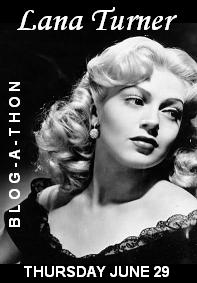
So this Thursday there's going to be a Lana Turner blog-a-thon (I love my new film-site friends) ... and That Little Round-Headed Boy has posted his piece early.
I love it - a great review of Somewhere I'll Find You a movie I have not seen, starring Clark Gable and Lana Turner.
I remember reading Detour when I was 14 years old. I had an after-school job in the local library and I read all KINDS of inappropriate stuff while working there. I didn't JUST read the Betsy-Tacy-Tib stories. I was also delving deep into salacious Hollywood biographies. I read Carroll Baker's detailed descriptions of quivering extra-marital sex with Ben Gazzara. I read stories of James Dean's bisexuality, and (on the flipside) his openness about his virginity. I read Shelley Winters' 2-volume autobiography which pretty much chats openly about every guy she screwed. (I love those books to this day.) I read the book about Edie Sedgwick - which - please. I had no business reading that. Drugs, sex, burning hotels, madness ... But I loved it all. Anyway, I had heard of Lana Turner by that point - just by osmosis - I had heard about how she was "discovered" and all that ... I had also read Lana Turner's autobiography - which you truly cannot do any better, if you are looking for salacious fascinating reading. She had a LOT to apologize for - I mean, good Lord, her daughter killed her gangster boyfriend! With a KNIFE!!!! Horrors. But anyway, her autobiography led me to Cheryl Crane's side of the story - which is actually a terrific book. I've read it since. It is a tell-all, it's horrible, it's a true crime book, whatever - but if you're interested in this stuff, and in what was going on psychologically in that house that led up to the 14 year old taking a knife and stabbing the slick gangster who was beating up her mother ... that's the book to read. It's horrible. But great!
I need to think up a post about Lana. Postman Always Rings Twice is, of course, a classic - that everyone's seen - but still. I think it's worth revisiting. And she's really good in it - the chemistry with Garfield is nearly unbearable - How they got all that past the censors is a mystery. It's almost uncomfortable to watch - and he is great.
There's also a campy side to the film which makes it even more enjoyable and also completely RIDICULOUS. Like: her first entrance is ludicrous - and yet when you see it, even though you want to laugh - you are also stunned dumb - just like John Garfield is. She's the wife of a country-diner owner? A small-town girl? A simple housewife?
And she's wearing a white turban and white short shorts?
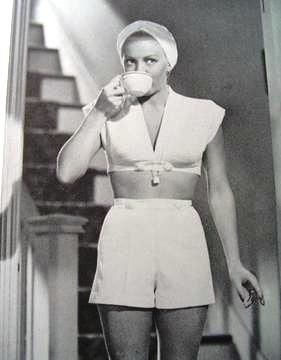
Uhm ... Lana? What's goin' on?
It is so ridiculous and so AWESOME.
I look forward to reading everybody's posts.
But go read TLRHB's post. I need to check that film out.
I think I'll end with the poem by Frank O'Hara:
Poem
by Frank O'Hara
Lana Turner has collapsed!
I was trotting along and suddenly
it started raining and snowing
and you said it was hailing
but hailing hits you on the head
hard so it was really snowing and
raining and I was in such a hurry
to meet you but the traffic
was acting exactly like the sky
and suddenly I see a headline
LANA TURNER HAS COLLAPSED!
there is no snow in Hollywood
there is no rain in California
I have been to lots of parties
and acted perfectly disgraceful
but I never actually collapsed
oh Lana Turner we love you get up
"je ne sais mime"
To those who cringe when you remember the 80s ... to those who experienced it ... to those who LIVED IT ...
You must go to Stitchy McYarnpants (which you should be reading ANYway) and look at the latest.
I have no words. Make sure you read the commentary - don't just look at the pictures. The observations made are why Stitchy McYarnpants is sooooooo fuuuuuuuuunny.
When she calls one of the sweaters "the jazz-handiest of the collection" I laughed out loud.
I will be forever grateful to Lisa for introducing me to Stitchy McYarnpants.
Happy birthday ...
... to the Atlantic City boardwalk.
The first section of it was opened to the public on this day in 1870.
Here are two bathing beauties - this photo was taken at Atlantic City - in the late 1800s. I just love the insouciance of these girls. Even though they are wearing BLACK FROM HEAD TO TOE ... look at their jaunty little legs kicking up in the air.
You go, girls. Don't let anyone keep you from the ocean on a hot day.

They're Gibson girls in the flesh!
Happy birthday, boardwalk!
Awesome
Check this out - I saw this in my referral log and went to check it out. I have no idea but that looks like Russian to me? Again, no idea. When I saw it, I thought - hmmm, wonder if they are discussing this post of mine? Or this maybe? You know, because Russians only talk about Stalin. ?? But no, the link of mine that comes up is this - an excerpt from the Tennessee Williams play "Talk to me like the rain ... and let me listen." The first post on that forum says:
Ищу пьесу Теннеси Уильямса "Говори со мной, словно дождь, и не мешай слушать...". Буду рада любой информации!!!
I am guessing here, but the "Говори со мной, словно дождь, и не мешай слушать..." seems to me to be the title of the play - and I would bet that this: Теннеси Уильямса is Tennessee Williams. I have no idea what they are saying. They could be saying, "I found a post by this really pompous bitch American woman about Tennessee Williams!" Who knows.
This is one of the things I love about the Internet - and about having certain posts really high up in the Google ratings. It gives a sense of the world being a small place. Also, I've said it before: I feel at home with actors anywhere. You sit down with actors from, oh, Belarus, or Mongolia ... whatever other cultural differences you may have ... there's a larger similarity that binds us all together. My 2 Laurette Taylor posts are #1 and #2 now. This post and this post. They rank higher than her IMDB page, her Broadway database entry, and her wikipedia entry. Those posts now get the most traffic on my site, at least continuously ... and when I think to check where the traffic is coming from, I see IP addresses from Vietnam, Brazil, England, Russia - seriously. And just knowing that ... people out there know about Laurette Taylor - or are curious about her - and looking for more information - and that it's a world-wide thing, not just localized to Americans, or even to New York - just seems so so awesome to me.
The Books: "Betsy and Joe" (Maud Hart Lovelace)
Next book on the shelf ... (we're in my children's and young adult bookshelves, by the way):
 Next book on the shelf is Betsy and Joe by Maud Hart Lovelace.
Senior year at Deep Valley High! Hmm, let's see. Betsy has had a kind of school rivalry as well as an unrequited crush type thing on Joe Willard - She and Joe are always neck and neck for the top grades, etc. And he's different than the rowdy group of guys she hangs out with. He's more serious. I think he's poor, if I recall correctly, so he has after-school jobs - and he really puts his nose to the grindstone with his studies. 2 books after this one, Betsy and Joe get married. So even though Joe has been peripheral in the other 3 books, now he starts to take center stage.
There's lots of drama going on. Tacy actually falls in love with someone - a guy she ends up marrying. Tib falls for the vain kind of dandyish quarterback - his name is Ralph Maddox. Tony, Betsy's long-time friend, falls in love with her, starts to pursue her. Betsy feels about Tony in a sisterly way. So there's a lot of drama there.
Here's an excerpt about some dance. Tony asks Betsy to go and she feels like she has to say Yes, because Joe hasn't asked her yet. This gives her much torment. Also, I think she and Joe had a fight of some kind ... she was hoping he would get over it and ask her to the dance, but he appears to be holding some kind of grudge. Then it turns out that Joe is there with someone else ... I think. Can't remember. Anyway - it's just one of those awkward situations which feels SO TRAGIC AND IMPORTANT when you are 17 years old.
Excerpt from Betsy and Joe by Maud Hart Lovelace.
At last the chime clock brought the New Year's Eve dance.
Tacy wasn't going. She had been given a second chance; Cab had asked her. But she had decided that she would prefer going to her uncle's with the family.
"Her uncle's!" said Tib, throwing complete incomprehension into her voice.
"I can't make her out," said Betsy.
"She's sure to be an old maid unless we take steps."
Tib had come as usual to dress for the party with Betsy - and to do Betsy's multiplicity of puffs. The pompadour was rolled over a big sausagelike mat and each puff was rolled over a small one.
"The rat and all the little mice, Tony calls them," said Betsy, acting lighthearted.
The new white wool dress was a dream. Below the tucked, form-fitting bodice, the skirt fell into pleats. It was tripped with gold and she wore a gold band, of course, around her hair.
Tib's self-made pink silk was a triumph. She wore pink shoes and stockings and a wide pink band around her head.
"You both look lovely," said Mrs. Ray, dashing in, in her taffeta petticoat. She, too, was dressing for the ball.
Margaret, who was going to stay up for the first time to see the old year out, with Anna, making fudge, leaned over the rail as Betsy and Tib went lightly, proudly down the stairs.
Ralph and Tony waited, pressed and immaculate. Tony held the pale blue opera cape.
"Pretty skippy!" he said admiringly, putting it around Betsy's shoulders.
Betsy didn't like the new opera cape. She felt as though it were a hoo-doo.
The boys had engaged a hack. This unheard-of gesture was a tribute to the elegance of the Melborn Hotel. Betsy felt unbelievably worldly as the hack, on its winter runners, slid along the snowy streets and halted at the illuminated entrance to the Melborn.
They went through the swinging door into the lobby. It smelled of cigars and the fat red leather chairs. They crossed the room and ascended the grand staircase which rose at the far end.
The ballroom was two stories high and overlooked the river. Here Deep Valley gave its most fashionable parties. Mamie Dodd didn't play for this dance. Lamm's Orchestra, behind a screen of potted palms, was tuning up provocatively. The ballroom was decorated with poinsettia and holly. There were red shades on the chandeliers.
"Supper is going to be served in the Ladies' Ordinary," Carney told Betsy and Tib. She looked very pretty in the store-bought party dress, and Tom looked distinguished in his uniform.
The high school crowd seemed stimulated by the entrance into the world of fashion. All the girls looked pretty and the boys were kindled to unusual politeness, gallantry, and wit.
Betsy was excited, almost joyful, in spite of that doom in her breast, but her spirits died like a quenched fire at the first glimpse of Joe. She and Tony were dancing the opening waltz, "I Wonder Who's Kissing Her Now." She was happily floating in his arms - no one could waltz like Tony, no one! - when she saw a light pompadour and stalwart shoulders. Joe's lower lip was outthrust in a look Betsy knew. He was gazing at Irma, whose irresistible face, framed in natural (not Magically Waved) curls, was lifted to his.
"If he isn't crazy about her now, he soon will be," Betsy thought, and suddenly felt completely wretched. But she didn't show it. She smiled glowingly at Tony.
Joe didn't ask Betsy for a dance. The program ran on through "Howdy Cy" and "Ciri Biri Biri" and "Tonight Will Never Come Again." Betsy grew gayer and gayer, but none of her vivacity came from within. Inside, she ached. She ached all over, as you do when you have the grippe.
Laughing and flushed, she barn-danced, waltzed, and two-stepped. She chattered with the other girls about the marvelous party. She rushed up to her mother to exclaim. Tony went with her, to ask Mrs. Ray for a dance. He nodded his head negligently at Betsy.
"That daughter of yours! She's like a balloon on a string."
"Not a balloon! Oh, Tony! No! I only weigh a hundred pounds."
Mrs. Ray smiled at them. Loving parties, she was as happy as Betsy seemed to be. She whirled off with Tony, while Betsy, more sedately, circled with her father, who danced, as he did everything else, with benevolent dignity.
When the New Year came in, the orchestra played Auld Lang Syne. Everyone joined hands in a giant circle which revolved, singing:
Should auld acquaintance be forgot
And never brought to mind ...
Tony's dark eyes were bright with joy. He looked at Betsy as they swung hands and sang. Then the circle broke and people threw confetti and blew horns. Everyone called, "Happy New Year!" "Happy 1910!"
Nineteen-ten! That was the year they would graduate in, the year they had been looking forward to for so long. How could it possibly start off so badly, so horribly! In the crowded, clamorous room, filled with laughing voices and the bright rain of confetti, Betsy felt forlorn.
She looked around and found Joe across the room. He was looking at her. But as soon as their glances crossed, he looked away.
And presently she saw him dancing with Irma to "Yip-i-addy-i-ay!"
June 25, 2006
Under-rated movies: #13
13. Eye of God
Directed by Tim Blake Nelson (he also wrote it - it started out as a play), the film was pretty much ignored when it came out - and is so ignored to this day that I could barely find any images of the film online. It was critically acclaimed - the reviews are universally fantastic - but it didn't find an audience. In America this is obviously a sin ... but I think some films are not meant for a broad audience, and as long as they can continue to get made, and be appreciated in certain circles, I'll be happy. It is in films like Eye of God that you can see a movie with very few compromises. Most big budget films make all kinds of compromises - with script, or casting, or general thematic elements - and sometimes the films are successes regardless, but other times they are complete debacles (uhm - Bonfire of the Vanities? Imagine how incredible that film could have been with a smaller budget, no stars in it, a script that actually went where Tom Wolfe went and didn't soft-pedal the racism in the book, and a director with the courage of his convictions. It could have been amazing. But once you cast Tom Hanks, you are saying something about what kind of a film it will be, for better or for worse. Once you let Morgan Freeman demand a gazillion dollars for 2 days of work, when he was seriously miscast anyway - you have compromised the project irrevocably. This is why the smaller indie films like Eye of God, the ones ignored by most people, are so often better made, despite the smaller budget.)
Nelson has gone on to greater success - he's an actor, too (look up his credits - some massive hits there) - and Eye of God was his directorial debut. Which is even more amazing when you watch the film which, in my mind, doesn't make a misstep.
It's one of the most unsettling movie experiences I have ever had. This film is not for the light-hearted, or for those who need morals at the end. It's one of the bleakest pictures of humanity I can think of - and the fact that film-makers feel the need to apologize for this - apologize for making serious films - is a sorry commentary on the state of things. Yes, there is a place for comedic films, romance films - but these genres are not the natural default position for films. Neither are serious films, by the way - there IS no default position, but especially now in this day of blockbusters, when opening day grosses are printed in the newspaper - people feel inclined to apologize for any seriousness that may be in a film. Or at least WARN people. "Look out - this isn't a comedy!"
I'm not warning you - because I don't think seriousness is a bad thing. I don't think bleakness is anything to apologize for. I don't want it as a regular diet but it's just as much a part of life as anything else. This film is bleak. It is heart-achingly bleak. And it does not congratulate itself for it. You know those films that are bleak and think it's really cool to be so bleak? Eye of God is bleak because you know why? Sometimes shit happens, and sometimes life DOESN'T work out for people. And that is bleak.
I can't say much about Eye of God because it is full of secrets. The story is not told in chronological order - we jump around - we think we're moving in a linear way, and then we realize that sometimes we go backwards, sometimes we skip forwards. It's not a gimmick. Or it doesn't feel like one.
And the title resonates long after the credits roll, because it is not explained in the film. Nobody spells it out. A character doesn't do an impassioned monologue about the eye of God, to let us know what we are supposed to feel, to telegraph: "Here is 'The Meaning' of the movie." After I first saw it, I sat - stunned - in my living room - I'm telling you, the film is horrifying - it takes on the qualities of a Greek tragedy, in that the whole thing starts to feel inevitable, even though you, in the audience, can see: "Oh wait - if she didn't do THAT, then THAT would not have happened ..." We feel how if so and so made one different choice, then the awful consequences would not have followed. Life feels incredibly precarious after you watch this film. I wondered if the title had to do with the audience: we, in the audience, are omniscent, in a way. We know the end. Since the story is jumbled up, we know some of the things that will happen before the characters do. So we feel their fragility, we feel their vulnerability - as these huge events approach, and they remain oblivious. And yet - what does that say about the film's opinion on God? God sees all, but he never intervenes. Therefore, what good is he? The film is brutal in this way. But again, none of this is spelled out. All I know is, I have rarely felt so hopeless and so enraged when watching a film. It is an intensely wrenching experience. And - unlike the Greeks - there is no catharsis. This film reveals the lie of "everything happens for a reason". This film is an indictment of that kind of easy tie-it-up-in-a-bow thinking. There is evil in this world, and it preys on the innocent. Tim Blake Nelson obviously does not think that Ainsley's suffering "happens for a reason".
In his review of this film, Ebert writes:
The villain in the film is not exactly Jack. Like an animal, he behaves according to his nature, and the way to deal with him is to stay away from him. The movie is more about Ainsley's luck than Jack's behavior. Somebody always marries these jerks, but you gotta hope it's not you.
Exactly. We have empathy for Ainsley. Not only that, though, we are screaming at her, mentally, to run. Run. As fast as you can. Run! He's a monster. Run!!! But she does not run. Because she is an innocent. And she does not see the world as a place where evil stalks. So when it shows up on her doorstep, with a friendly warm smile, she lets him in.
The acting in this film is superb.
Kevin Anderson (I guess his biggest film hit would be the next-door neighbor in Sleeping with the Enemy - but he's a hugely accomplished stage actor) plays Jack - the ex-convict. Martha Plimpton, in one of her most interesting roles (I thought she should have been nominated for an Oscar) plays Ainsley, the bored small-town girl who seems to just be ... waiting. She is waiting. For what we don't know, she doesn't know either ... But her life is small. And somehow, she thinks ... it should be bigger. She's a waitress in a diner. She goes and sits at a 7-11 type store out on the highway - just so she can watch the people come and go. Maybe so she can live vicariously. Even just by watching them pump gas ... she can imagine that maybe one day she will get to travel, too. You love Ainsley. She is not a melancholy character - although Plimpton manages to suggest the deep wells of sadness within her. No. She's the kind of person who puts on a happy face, who looks on the bright side of things, who has had horrible horrible things happen to her - and yet it has not destroyed her essential innocent core. Plimpton, who has always been wise beyond her years (member her Calvin Klein ads, when she was - oh - 10 years old?) is almost unrecognizable here. And completely believable. Without her performance, the film would not work. And by "work" I mean - put us through the wringer. She is not a complicated character. Or - she IS, but she doesn't complicate things in her own mind. She is not self-reflective, or intelligent about who she is. But her vague yearnings for ... something more ... are at the heart of this movie. Perhaps if she hadn't thought that something ELSE might be out there for her ... Jack would not have come into her life. And perhaps she would not have welcomed him in with such warmth and such trust.
Hal Holbrook plays the sheriff in the town - in a wonderful performance which capitalizes on the Holbrook-ness of Hal Holbrook. Holbrook can sometimes, in the wrong material, veer off into sentimental folksiness. This is so not the case here. He is our way into this story, first of all. He is our closest link to anything even resembling a linear narrative ... so we need him. He is kind and patient to the character played by Nick Stahl (in a heart-rending performance) - as he questions him about what "happened out there". He is kind and patient, yes, but we feel the growing anger within (and the questioning takes place over the course of the film - we keep cutting away to the story and then coming back to it - a constant reminder of where these c haracters are going) - We can feel Holbrook's honing in on the hidden evil in their midst. He begins to sense the inevitable too. He is a man of law and order. He is a small-town sheriff. He knows everyone in the town, and perhaps his job is not all that exciting on a day to day basis. It's pretty slow, on the whole - no burglaries, maybe a couple drunk-and-disorderly problems - but nothing like THIS. However, here he is, faced with a blood-covered young boy, who has lost the ability to speak - he has gone mute with horror over whatever it was he witnessed - and you can see the genius of all good cops everywhere. You can see his inherent goodness, and his inherent hatred of badness. So although he is kind and patient - you get the feeling that this is NOT a man to be messed with.
Kevin Anderson is absolutely marvelous in his role - and it's funny - I have watched Sleeping with the Enemy a gazillion times, mainly because it seems to be on television pretty much every day - and I never found him all that convincing in his part as the kindly rather baffled drama-teacher guy who lives next door. I know that is partly due to the filming because director Joseph Rubin wanted to keep us on edge, not let us trust him right away. But even so - even with Anderson's shaggy shock of hair, and nice soft smile, and kind eyes - there was something there - something that never really sat well with me. I guess I just didn't find him all that convincing. I saw him on Broadway in Death of a Salesman - he played Biff - and he was GREAT. Better than Dennehy. Well - everyone was better than Dennehy in that. But then - when I saw Eye of God - the little light-bulb went off in my head. He is so good in this film, and so convincing - that you, the audience member, get as discombobbled as Ainsley at times. He is a wolf in sheep's clothing - and you get that very early on, so I'm not giving anything away. But his true milieu is not the nice guy who gets the girl - despite the cute-boy looks. It's much more menacing. He is nothing less than 100% convincing in this part. I thought he should have gotten an Oscar nomination as well. He's that good.
I said earlier in this post that this is an example of a movie that has very little compromise in it. I was talking in terms of the overall movie - the cast is excellent, everyone knocks their role out of the park, the script doesn't hold back - it stays true to its story. The tone of the film is perfect. There are eerie moments of stillness which are nearly unbearable. The tension never lets up. We see a line of dark trees on the other side of a pond, and the camera rests on them - not moving - for what feels like forever. There are no sounds. No voices. And it's one of the most terrifying images in the film. Nelson was not forced by a studio to tack on a happy ending, or at least give a moral so the audience can have some hope. No. He filmed what he wanted to film. No compromises.
But in another meaning of the word - this is an uncompromising film in its theme, and in its insistence on the story it wants to tell. It is uncompromising in its views of loneliness, hope, love, redemption, mercy, God.
A wrenching film, it stayed with me for days after I saw it, and stays with me still.
The Books: "Betsy Was a Junior" (Maud Hart Lovelace)
Next book on the shelf ... (we're in my children's and young adult bookshelves, by the way):
 Next book on the shelf is Betsy Was a Junior by Maud Hart Lovelace.
If I had to choose - I might say that this is the best one of the series. I remember the sensation reading it the first time - and it made me feel uncomfortable, because I could see that she was making all these bad choices, and I didn't like her priorities, and I felt like reaching through the pages and telling her to stop being so SILLY. But because of all of that - the catharsis at the end of the book, the resolution - is really well-earned. I love that I'm talking like this about BETSY WAS A JUNIOR, for God's sake, as though it's Prometheus Bound or something. Oh well. My well-loved books are ALWAYS well-loved books and I guess I take them seriously. I don't blow stuff off as "Wow, that's just for kids." You know?
This is (duh) about Betsy's junior year. Betsy's older sister Julia goes off to college - and sends home stories of being courted by various sororities. It seems like the only way to really belong is to join a sorority - although Julia was never really a joiner. Betsy gets the idea to create sororities and fraternities in their high school - and the whole thing just takes off. People have to rush, and then there's a selection process - and naturally, although it's really fun for those who are "chosen" - a lot of resentment builds up about the whole thing from people who were either rejected or not interested in the first place. The social gatherings of the sororities and fraternities take over ... They are THE events to go to, blah blah, but you need to be invited ... Whatever. Reading the whole thing, and reading how Betsy kind of doesn't have time to be friends with a nice girl in her class named Hazel - who obviously is a sort of kindred spirit - but she's not in the sorority so that's THAT. Schoolwork gets put off, yadda yadda. Tacy is not really involved in all of this - she remains as steadfast as ever, never really a silly person - but Betsy starts dressing her hair in a huge pompadour, she starts to wear a fur muff and fur cloak thingie to school - Betsy becomes kind of obnoxious actually.
It's a good book.
Here's an excerpt, which kind of gives you an idea of why I found these books soooo fascinating. It just feels so REAL, first of all - and I felt like it could have been describing my own experience in high school - even though I lived in the 1980s, and Betsy was back in 1910 or whatever. It was all the same stuff. Friendships, and crushes, and schoolwork, and dances ... But there was an added layer of glamour in these books (at least I thought so) because it was back in "olden days" ... and the girls wore pompadours, and shirtwaists, and the boys had watchchains ... and it all just seemed hopelessly romantic and I wanted to step into the pages of the book.
Excerpt from Betsy Was a Junior by Maud Hart Lovelace.
January had been mild, but February came in cold and snowy. The air was filled continually with a white descending haze. Drifts climbed to the window ledges. The thermometer dropped to twenty, thirty, thirty-five below. Tacy and Tib, stopping to call for Betsy in the morning, wore scarves over their faces.
Tib came early so that she could do Betsy's hair. Mr. and Mrs. Ray both protested the practice.
"Betsy doesn't need puffs for school."
"But I'm coming right past the house, Mrs. Ray. I always stop anyway; and I love to do them."
She continued to come, and although Betsy felt a little silly she delighted in the puffs. Sustained by them she joined Tacy in singing the "Cat Duet" at Zetamathian Rhetoricals. It was definitely childish but it had to be sung; it had become a tradition in the Deep Valley High. Betsy read an original poem for rhetoricals. It was named "Those Eyes" and sounded a little like Poe. She wrote more poems than stories on Uncle Keith's trunk this year - when she found time to write at all. This was usually late at night, when she had finished her homework or come in from a party. The house would be quiet; cold, too, sometimes, but she put on a warm bathrobe. She curled up beside the trunk and read poetry and wrote it, and she had an uncanny feeling then, too. This wasn't Betsy Ray, the "popular" girl. This wasn't Betsy Ray, the Okto Delta.
The Sistren still met regularly, sometimes with boys, sometimes alone. The girls brought their sewing to the afternoon parties, and Betsy always brought the jabot. She offered to read aloud if someone would work on it for her and the famous piece of neckwear passed from hand to hand.
"What a souvenir for college!" Carney said. "Samples of everybody's sewing, as well as all these choice knots and spots."
"Those spots you refer to so lightly," said Betsy, "are where I was pricked by a needle. You're taking my heart's blood to Vassar."
Carney was looking ahead to the Vassar entrance exams and worked harder all the time. Tacy was sobered by a growing interest in music, but Betsy and Tib continued irrepressible.
Madame DuBarry and Madame Pompadour revived their soirees. These were hilarious affairs, for Cab and Dennis were irrepressible, too. Fast friends, the same age and about the same height, they were a carefree pair. They were, Betsy admitted, more fun than Dave.
But he was fun, too, on outdoor excursions. Groups of four, six, eight Okto and Omega Deltas often braved the cold for moonlight strolls. One night for a lark boys and girls exchanged wraps. Dave was as comical as Dennis, parading in Betsy's furs. He was always the first to sight a pan of fudge set to cool on a doorstep - lawful booty, whether the doorstep belonged to a friend or a stranger.
In recompense for stolen fudge, perhaps, the groups went serenading. They sang in parts underneath lighted windows, their breath congealing into silver notes.
"Old, old is honeymoon trail ..."
"You are my rose of Mexico ..."
"My wild Irish rose ..."
The Crowd, Julia often said, sang like a trained chorus. But the Okto and Omega Deltas were not quite the Crowd. They missed Tony's rolling bass.
As Betsy had feared, they saw Tony less and less. He still came to the Rays' now and then but he had dropped the Crowd and what he had put in its place was not good. He skipped school, hung around a pool hall which had a bad reputation in Deep Valley. He went with that fast clicque of older boys he had been drifting toward early in the winter. Tony had always had a zest for new experiences whether good or bad. But he had been restrained before by his scornful, indulgent, deeply loyal fondness for the Crowd.
Betsy felt pricked all the time by worry about Tony. She wouldn't give in to it; she was having too much fun. But she looked for a chance to say a restraining word and one Sunday night she thought she saw it.
Sometime before she had revived her last year's successful experiment in "reforming". Phil's pipe still hung beside her dressing table. She discovered that Dave had a pipe and secured it to hang beside Phil's. Dennis gave her a sack of tobacco and some cigarette papers. Cab contributed a cigar.
Betsy had protested that. "You don't smoke! You're giving me one of your father's cigars."
"Well, gosh Betsy," Cab grinned. "If everyone else is going to be reformed, I want to be reformed too."
Her father teased her about this enterprise and he brought up the subject as Tony and Betsy stood out in the kitchen watching him make his inimitable sandwiches. He always sat down to make them for he was growing heavier and his feet tired easily. There was often an admiring circle around his chair.
"Have you heard about Betsy turning Carrie Nation?" he asked, spreading slices of bread with butter which he had set out to soften earlier. A cold loin of pork and a jar of mustard stood alongside. "I can't make out why she doesn't object to my cigars."
"You're too old to reform," said Betsy, smoothing his silky dark hair.
Tony searched through his pockets and found a piece of billiar chalk.
"Here," he said. "Add this to your collection. You ought to try to keep boys away from the pool hall, Betsy. It's a den of iniquity, Miss Bangeter says."
Betsy said she would tie the chalk on a ribbon and hang it over her mirror. She laughed into Tony's black eyes which looked hurt, although he was smiling. A new group of guests came to watch Mr. Ray and Betsy went back to the fire. Tony followed with his lazy saunter.
They sat down and looked into the flames, and Betsy said, imitating a grave tone of Julia's, "There was truth in what Miss Bangeter said about that pool hall, Tony. I wish you'd spend less time there and more time - well, at the Rays', or out serenading with the Crowd."
"What Crowd?" asked Tony. His face looked a little bitter. "There isn't any Crowd any more, just a couple of frats. I'm a barb. You don't want me around."
"Tony!" said Betsy. "Don't be ridiculous!"
"Ridiculous, am I?"
"Everybody misses you. The Crowd, Pap, Mamma, Margaret."
"You said one true thing. Margaret does." Tony called out to Margaret, who was reading the funny papers in her father's big chair. "Margaret, I'll beat you a game of parchesi."
Margaret's face lighted and she ran to get the board. Betsy felt snubbed.
Dave came in just then, followed shortly by Squirrelly, and Tib, and Winona. Winona went to the piano and when the parchesi game ended Tony lifted his voice in song. But after the sandwiches were eaten he quickly said good-bye.
He shrugged into his overcoat, set his cap at a rakish angle on his bushy curly hair.
"I'll see you when I need some more reforming," he said to Betsy and went out.
June 24, 2006
The Books: "Betsy in Spite of Herself" (Maud Hart Lovelace)
Next book on the shelf ... (we're in my children's and young adult bookshelves, by the way):
 Next book on the shelf is Betsy in Spite of Herself by Maud Hart Lovelace.
So this is about Betsy's sophomore year in high school! More wonderful-ness. More trials and tribulations. Betsy decides to basically create another personality - more mysterious and glamourous and sophisticated - in order to capture the attention of the new kid in school - I think his name is Phil - and he drives a red jalopy (and cars are a huge novelty - so he is basically the coolest guys ever) - so Betsy tries to be different. Of course - by the end of the book - she realizes that she just has be herself ... The. End. But still: wonderful book, just as good as Heaven to Betsy. It's great because you follow the same cast of characters all the way through high school - you get to know them. I just loved these books.
Okay, so this excerpt. Summer vacation is coming to an end. Sophomore year is about to start. Everyone had a summer reading list - and everyone was supposed to have read Ivanhoe. Betsy already had read it - but everybody else was basically cramming. Staying up all night, trying to download Ivanhoe into their heads. And Betsy's good friend Cab (a great character) keeps saying, "I'll start tomorrow ... I'll get up at 6 and read the whole day ..." but then something keeps happening, and he puts it off again. Betsy starts to get worried for him. There are end-of-summer picnics and gatherings - and every time Cab shows up at one Betsy is like, "Cab ... you really need to start reading Ivanhoe ..."
Anyhoo, on the first day of school - Tony and Cab (2 of Betsy's friends) show up at her house early, before school starts - and say, "Look. We can't read it. Why don't you just tell us the story?"
So Betsy becomes Cliff Notes.
I love how this excerpt ends.
Excerpt from Betsy in Spite of Herself by Maud Hart Lovelace.
Betsy gulped her cocoa and put the cup aside. She folded her hands on the table then, and Cab and Tony took chairs opposite and stared hard, as though by looking at that curly beribboned head they could absorb its precious knowledge of Scott's masterpiece.
"Well," began Betsy, and paused. She thought of Joe Willard and took a deep breath and started again. "I have to say something that will shock you. It's a perfectly grand book."
"What?" Cab and Tony cried together.
"Perfectly grand. If you don't say so, Gaston will know you haven't read it, because you couldn't read it without liking it."
Tony looked at her sharply. "You're not fooling?"
Cab wrote down on his pad of paper, "Perfectly grand."
Betsy decided to begin where Scott had.
"It begins," she said, "in that pleasant district of merry England which is watered by the River Don."
Tony put down his pencil. "You are fooling!"
"No really. That's the first sentence. It opens in a forest with a swineherd named Gurth, and Wamba, son of Witless ..."
"See here, Betsy! In ten minutes we can only hit the high spots."
"All right," said Betsy, yielding. It saddened her that Cab and Tony should not know about Gurth and Wamba, and the meeting with the Pryor. She felt she was cheating them, but it couldn't be helped.
"The important characters," she said, "are Wilfred of Ivanhoe, a knight, returned from the Crusades; Rowena, the girl he's in love with; Cedric, her guardian, who disapproves; Rebecca, a girl who's in love with Ivanhoe; and some assorted villains."
"Fine!" said Tony. "Now we're getting somewhere."
"King Richard's in it, too. He went to the Crusades, and left England in charge of his brother Prince John, who's a crook. Richard comes back to see what's going on, disguised as the Black Knight. He comes to the tournament and on the second day when Ivanhoe is fighting three men at once ..."
"A good fight?" asked Cab, leaning forward.
"Just the best one ever written, that's all." Betsy's cheeks flamed. She told the story of the tournament and told it so well that Anna leaned across the table, breathing hard, Tacy's eyes sparkled and the boys forgot to scribble notes.
"Betsy," said her mother. "You'll be late for school."
They went out to an almost empty High Street with Betsy still talking, Tacy, Cab, and Tony now hanging on every word.
"Does Prince John give in, and admit that Ivanhoe won?"
"Yes, and Ivanhoe chooses Rowena to be Queen of Beauty."
"Do they live happily every after?"
"Heavens, no! She's kidnapped, and so is Rebecca. They're held captive in a castle, with Ivanhoe, and the Black Knight storms it."
They dropped down on the school steps, and Betsy kept on talking. The first gong rang and they moved slowly toward the upper hall where Betsy continued to talk until the second gong clanged.
"Anything else?"
"Remember the bad feeling between the Normans and Saxons."
"What happens to Rebecca?"
"She goes into a convent."
"Sounds like quite a tale," drawled Tony, returning his notes to his pocket.
"Wilfred of Ivanhoe, Rowena, Cedric, Rebecca ..." muttered Cab.
Tacy took Betsy's arm. "It was wonderful the way you told it, Betsy." And then Tacy too started muttering, "Wilfred of Ivanhoe, Rowena, Cedric, Rebecca ..."
All through the morning, whenever Betsy looked toward Tacy, Tony or Cab she saw them muttering.
Mr. Gaston greeted the rhetoric class with a glance derisively bland. He gave the next day's assignment, ignored the frantic whispering going on all over the room, and said casually, "Now I want each one of you to write me an essay on Ivanhoe."
He leaned back in his chair and unfolded a scientific journal.
Betsy swept a glance around the room. Tony, Cab and Tacy were all muttering. Joe Willard looked as he had looked before he set to work on the Essay Contest last year. His paper, ink, and pen were ready and he was brushing his fingers thoughtfully over his yellow hair.
Betsy smiled at her paper. What a delightful assignment! What fun to write an essay on her beloved Ivanhoe! She dipped her pen in ink.
She began where she had tried to begin before, and now there were no Tony or Cab to cry, "Just give us the high spots, Betsy!" She told all about Gurth and Wamba and described the Lady Rowena's beauty and Ivanhoe's mysterious coming and the arrival of Rebecca and her father.
The clock said that half the allotted time was gone, so she hurried on to the tournament. She tried to make spears ring in her prose as they rang in Sir Walter's. Now and then she almost thought she succeeded.
Looking up dreamily, she saw that Tony and Cab had already finished. Joe Willard still had his pen in his hand, but he was reading what he had written. Mr. Gaston had closed his magazine. He was tapping the desk and looking at the clock, obviously impatient.
Betsy rushed for the finish, scattering blots. But Rowena and Rebecca were still captive, the story hung in the air like a bright banner, when the gong sounded and Mr. Gaston said:
"You may leave your papers on my desk as you go out."
Betsy was sorry she had not finished, but after all, she reflected, panting and warm from her attempt, Mr. Gaston would certainly see that she knew her Ivanhoe. It was nice what she had said about those silvery spears: and the part about Rowena's hair. Even Sir Walter hadn't thought to compare it to maple syrup.
"How did you get along?" she asked Cab anxiously.
"I think I did the noble work justice."
"Mine was a masterpiece," said Tony.
"Mine was all right, too," said Tacy.
Betsy sighed in proud relief.
It was two days before Mr. Gaston returned the papers. And during those two days Ivanhoe continued to possess the Ray household.
"If Washington should have kittens ... but he won't, because he's a boy ... I'd name one Ivanhoe and one Rowena," Margaret said.
Mr. Ray heard about Betsy's fifteen-minute condensation of the masterpiece with a chuckle.
"I wonder how Cab and Tony will come out?"
"I think they will get Fair at least," Betsy said. Mr. Gaston marked his papers Excellent, Good, Fair, and Poor.
When the class filed in on the third morning the papers were piled on his desk. After roll call he tapped them condescendingly.
"These essays on Ivanhoe weren't bad," he said. "Really, they weren't bad at all. Three of them are marked 'Excellent', and from a class of the mentality of this one, that's pretty good." Mr. Gaston liked to make that sort of joke.
Three 'Excellents'! Betsy, without thinking, flashed Joe Willard a glance. She intercepted one from him, and they both smiled. Both felt sure where two Excellents had gone, but what about the third one?
"None of you," Mr. Gaston continued, "will be surprised to hear that one 'Excellent' went to Joe. But the other two may startle you. They did me."
He smiled mockingly.
"Tony and Cab," he said, "drew 'Excellents' too."
To say that the class was startled was putting it mildly. Tony and Cab grinned from ear to ear. Tacy threw up her hands in pantomime to Betsy.
"Tony and Cab," Mr. Gaston continued, "turned in essays that showed they had read the book. I must admit, Cab, when you told me you had finished it, I had my doubts. But you and Tony obviously had not only read Ivanhoe. You had digested it. Therefore, your papers are brief, concise. You just ..." Mr. Gaston's smile for once was genuinely approving, "you just hit the high spots."
Tony slipped down until the desk almost hid his face. Cab's ears were red.
"Your admirably organized papers," Mr. Gaston went on, "were in contrast to some I received. Some writers who, perhaps, had not even finished the book tried to show off their so-called literary skill at Scott's expense."
At that Betsy turned crimson. Mr. Gaston had spoken in the plural, but no one in the class would doubt that he meant her alone. For just a moment she was appalled. Then the joke in the situation struck her, and she smiled around at Cab, Tony and Tacy. Joe Willard was looking at her with a puzzled expression.
Tony and Cab after football practise, headed for the Ray house. They paused on the hill to pick a bouquet of sumac, goldenrod, asters and prickly thistles, and presented it to Betsy with sweeping bows. There was much joking and when Mr. Ray heard the story, he laughed until he shook.
But saying good-by to Betsy, Cab turned serious. He was, after all, Welsh Calvinistic Methodist.
"Betsy!" he said. He looked around to make sure that no one was listening. "Betsy, I just want you to know ... I'm going to read the noble work. The whole five hundred and thirty-four pages. Darned if I don't!"
And he did.
June 23, 2006
Happy birthday, Bob Fosse!
How much do I love this picture of Fosse. With the cigarette hanging out. So old-school.

I found this great link online (click on it to make it bigger) - called "A Step-by-Step Tour Through the Moves of Bob Fosse". It details his slinky anti-gravity counter-intuitive completely recognizable style.
See photo below? Immediately recognizable as Fosse. UPDATE: My cousin Kerry told me that the photo below is actually NOT Fosse - but Ann Reinking's Fosse-esque choreography for Chicago. So ... er ... it may be "immediately recognizable" as Fosse but ... er ... it's NOT Fosse. (I wrote a bit about Ann Reinking further below in the post.) Thanks, Kerry!
Again:
Check out how the hands go. It's opposite of what is expected. Same with the way the bodies lean out like a flat board. It's off kilter. It's sexy, but in a kind of sick way.
And here he is directing Liza in the film of Cabaret:
Liza was one of the quintessential Bob Fosse dancers. When you watch her in her prime - doing that choreography - you are witnessing perfection.

Here he is with Gwen Verdon, his wife. Their insane marriage was immortalized, by Fosse, in All That Jazz. I love this picture.
Verdon had this to say about Fosse: "I was a great dancer when he got hold of me, but he developed me, he created me."
So many dancers have similar memories of him.
Ann Reinking ... who was brilliant in his All That Jazz ... basically holds the legacy to the Fosse style. She was already an incredible dancer when he got hold of her ... but he transformed her, morphed her, twisted her - Phenomenal to watch.
He was a brilliant film director as well. All That Jazz comes pretty close to greatness in my opinion. Star 80 is fantastic, with some great acting by Eric Roberts - but it's a bit too unrelentingly dark for my taste. Cabaret is amazing - but, to me - All That Jazz is one of the most audaciously personal films ever made. He films his own death. He fantasizes about it. He enacts it. But ... the film isn't self-indulgent at all. Or ... it is so blatantly self-indulgent that we verge on genius here. Genius as in: indulging in his own fantasies to such a degree that most people never allow. He just GOES there. It's brutal. He imagines his own death as an opera, with a cast of thousands. There's a beautiful woman in white (Jessica Lange) beckoning him on. This was his daily life, the siren song of death always in his ears.
Not a happy man. But he had work to do - and he did it.
More information about him here.
Quite a legacy.
Movie poster awards
One of my favorite sites out there has listed the winners of Hollywood Reporter's 35th annual movie poster awards. You've gotta check out the international version of the poster for Batman Begins (which won for "Best International Poster"). Phenomenal. Click on it to make it bigger, too - just to see the details of it.
(Here's the American version of the Batman Begins poster - just to compare. I actually like both of them - but I far prefer the international one. Gives me goosebumps.)
Diary Friday
After the show closes - things get kind of nuts in my life. I had a really hard time adjusting to life "after Picnic". And so I spent a lot of time playing catch up in the journal and writing about the run of the show. So I could re-live the glory days of, uhm, last week.
DECEMBER 13
Up till yesterday this week has been good, other than being completely exhausted. I've kept in touch with Picnic. Monday night, Brett, Joe and I went to see Liz's play that she directed. Tuesday night a whole bunch of us went roller skating at Ocean Skate (oldies but goodies night - I had a BLAST!) - and yesterday Kimber came to talk to my Drama class - and Joe, Brett, and Liz came along. That was wonderful. [I have no memory of any of that.]I am so tired. I fell asleep twice in school yesterday - once in Physiology, once in French. I'm home from school today because if I don't rest I am going to become deathly ill. And this weekend, our Drama class is going to NYC! I'm psyched but I won't be able to catch up on any sleep this weekend.
So I have 2 1/2 hours alone here now - and last night - It was about 10:30 and I couldn't even keep my eyes open but I had to study my Physiology. [Hahaha That sounds unintentionally sexual] I know that I am overtired - so that's part of why I feel overwhelmed - but there was more. A few tears rolled down my cheeks and then suddenly I was burying my head in my pillow and sobbing so hard I thought my heart would crack. And you know why - it's because Picnic is over. It really hadn't hit me yet because I've still been able to see my buddies - but - we found out on Monday that we aren't going to New Hampshire - a slap in the face. I mean, for so long every single day was a new adventure because of the rehearsal that night. Nobody but me will ever know how dreadfully I'm going to miss them. I don't think I've ever really missed anyone before. I'm feeling it now. It aches. I feel desolate and bleak. I love them. I feel so alone and lonely and it's only been a day since I saw them. I have this love for Brett - but it's a kind of love I cannot explain. It's almost more than I can bear. It almost feels sacred - too special to touch, too special to write about.
Oh, and let's come back to the present. On Monday Anne told me, by slip of the tongue, that after the Homecoming Dance, TS said to her, "I don't want to give Sheila the wrong impression. I don't want her to think I like her that way." I could NOT believe it. I was so angry that I couldn't even express it. I ran out of French to ponder things over in the lav. [Taken just as is - that is a very funny sentence.] What the fuck? If he didn't want me to get the wrong impression - then why did he give it to me? I mean, he was the one who started the whole thing. Does he think he's doing me some massive favor by going on dates with me? Fuck him if that's what he thinks. I used to need him. I am so much more confident with guys now. I am unafraid. I don't need this shit. I need someone I can talk to. Brett and I have had conversations that make me ache with happiness when I look back on them. But there's such a happy medium with us. We can be crazy and out of control with laughter - and also serious. It's all natural. TS doesn't ever want to be serious, and it wears me out. I get tired of having to be jokey and on all the time. Of never getting serious.
So anyway. I am so pissed. I have been pissed since the Homecoming Game, actually. So on Monday I went home and called him. He wasn't there. So I left a message. Then he called me back and I think he knew somehow. I think he knew that I had called him about something serious because - I could just tell. Like he was saying hi and everything but he was also just waiting for me to start. So I said, "Hi - I have got to talk to you." I blundered around for a second and finally I just spit it out. I said, "I heard from someone that you said you don't want me to get the wrong impression - and - well - what the fuck?" We then had a very confusing conversaion. Nothing was straightened out in my mind. He was so nice about it that I found myself not telling him all the things about him that make me angry. He said, "I like being buddies with you - I don't want that spoiled." Okay, fine, whatever. Let's be buddies then. But why did he start the whole thing? It's too far along now to just fizzle it out? I mean - during the summer - it could have - but now? Come on.
[Obviously I still had a ways to go in expressing what was going on with me. Because now? I would have annhiliated this dude. I would have left him a smoking pile of shame-faced rubble. I actually probably - if someone treated me like this now - wouldn't even confront it. I would just totally disappear from his life, with not a word of explanation. Never return phone calls or emails, etc. A brutal disappearance. I'm not saying that this is progress, by the way, but I must speak the truth here, and this is what I would do. I would never be derailed now by someone's "nice"ness after a rejection like that. Nice shmice. You've been playing games with me and you will PAY.]
DECEMBER 17
I have had a breakdown. A long overdue breakdown.When I was in Picnic and had 5 million things to do at the same time, they always got done. My grades have never been that good. I've never been that happy. But now suddenly I have free time and everything is overwhelming me so much. Homework, work, applications, essays, money. [God, this is still the same way with me. I do better with handling stuff when I'm really busy]
When I was in Picnic, rehearsals and shows and those people - those were what made me high - no matter what, I would come out floating. Now I haven't seen them for 4 days and I feel totally lost. It's like I need them. I need them to get in touch again - make me feel real again. [Oh boy]
I miss them. No one will know how much. God. I miss them.
Last Friday Kate's grandmother died - I felt so so awful - I've seen it coming but still, it's so painful. This weekend we all went to NYC (it was a blast - the hotel didn't know we were minors and sent 2 complementary bottles of champagne to our rooms - we had so much fun!) [There are SO many inappropriate stories aobut our drama class trips to New York ... I need to write a huge post on those trips, with pictures.] And today, I am drained. Exhausted. Shuffling. We got home at 11:30. My eyes are swollen.
Today was the funeral at 10:00. Betsy brought the car so after 2nd period we all left for it - Me, Betsy, J and Mere - I was glad to be going there for Kate. She doesn't cry and she always says, "I'm fine." The funeral was at Christ the King. I don't know what I was expecting - I've never been to a funeral outside my own family before.
Kate did a reading - her favorite one. That was when I started crying. She is so brave. She went up there - "If God be for us, who can be against us?" - and she started crying - up at the podium - the four of us sitting there all broke down - I remember seeing J. put her hands up over her face. Kate lost control and Father Creedon walked over to her, and hugged her - and I heard her whisper, "I want to do it!" And by God, she did - in the strongest voice - it was absolutely amazing. The love in that church.
"For I am persuaded, that neither death nor life, nor angels, nor principalities, nor powers, nor things present, nor things to come, nor height, nor depth, nor any other creature, shall be able to separate us from the love of God, which is in Christ Jesus our Lord" - and after it - she said in the strongest most firm voice: "This is the word of the Lord." Words can't express it. We were all wrecks.
Father Chew gave a beautiful sermon and Mr. D read the eulogy. He started to cry - Betsy reached over to me and we just squeezed hands through the whole thing. So many people came for support. Beth's parents - Humanity is wonderful. I've been really lucky with my group of friends.
The last song was "Be not afraid" - Hearing Betsy's pure crystal voice in my ears - Meredith was a mess. None of us even knew Kate's grandmother that well - but we all were just wrecks. All of her friends were there - and looking at them made me cry. This old old man with real pain in his eyes and tears on his face. It was horrible. Grief.
After the mass, we were all shook up - we went up to Kate's dad and hugged him - He said, "She went out in style. She had a long fulfilled life."
At the very end of the mass, the sun came out and flooded in all the windows. I just nudged Betsy, we looked at each other. It was beautiful.
I felt shy with Kate. Betsy went right over to her and gave her a big hug - but I felt shy. J. was shaking with sobs - I held onto her - and Mere and I then hugged, and we both were just crying. [Wow - the intensity of this - I don't really remember this either!]
We finally went back to school after having a makeshift lunch at Betsy's.
[Look out - there's no segue here at all]
Closing Night was so special. What a beautiful memory. Purely wonderful. A beautiful way to end Picnic. It was such a LONG night too - I fell asleep at 5:00 am Sunday morning. I had bought cards for everybody and I wrote them all at home - It was hard. It took me so long. It was like caritas. When I came to Brett's card, I sat there staring at the card for half an hour, blankly. Finally I just wrote - Honesty. I can't even remember what I said really, but I meant it. I thanked him for making me feel so totally welcome from Day One. I told him how comfortable I felt with him and how I felt like he was becoming one of my best friends. And he is.
Oh, and Brett constantly says to people, "I love you ---" then adds - "But not that much." It's a joke. After the Tuesday show when we all went to Del Mor's, we were getting ready to leave and he hugged me from behind really tight and said, "God, I missed you yesterday! I really did!" I snuggled my head against his arm around my neck and he said, "I love you ...... but not that much." I sort of hit his arm and said, "Don't do that to me!" and we both burst into hysterics. Then he put his arm around me and we walked out of Del Mor's together and he said, "You know I don't goof on anyone I don't care about."
I actually just called his house today because - God. I just want to talk with him! But he wasn't home. Only Lenny was. He said to me, "You know, Sheila - you won't be seeing us for about 5 weeks now." Thanks, Len.
I just don't want to have to deal with things now. I have to go Christmas shopping. I have no money.
I need to catch up on all of Picnic. It's just that it's such a lovely memory [Uhm - it just ended last week] that I still haven't gotten over feeling good about it.
June 22, 2006
The Coreys? Together again??
Dare I hope????
Could Corey Haims be poised for a resurgence?
Should I not even say that out loud? (I was a huge fan of Corey Haim dating from Lucas - a performance which still holds up, by the way. He's lovely in that movie.)
But ... could he ... come back? From his molar-selling eBay problems?? Could he step back into the limelight?
Dare I hope??????
In keeping with the Billy Wilder theme ...
I have an entire archive devoted to my ramblings on the dude. It's his birthday today!
Lots of good quotes from him there. Scroll on through!
Curly's debut
So 2 nights ago I went to go see Curly make her debut at the WYSIWYG Talent Show, held every month at the Bowery Poetry Club. This month the topic was WAY GAY. heh heh (Read her account of it here - as well as the text of what she read.) Curly said she was nervous. Freaking out quietly, etc. But I'm telling you; once she got up on that stage, you NEVER could have discerned the nerves. She was funny, snarky, and seemed completely and utterly at home up there. It was just awesome. Awesome, too, to hear the rolling waves of laughter go thru the club at some of her lines. I particularly lost it at the "adopt a whale" moment (which is, Curly said, the "gayest thing I have ever done" - still can't stop laughing about that) - but still: It was SO great to see her up there, knowing how petrified she was beforehand, knowing her nerves - and to see her just soar!
Also, apparently Jess served as "wardrobe consultant" - and I have to say that the red shirt worn by Curly was perfect. Great color for her - so well done, Jess!
It was also a cool night because two of the other people reading are kind of, well, stars in the blog world - and people I have been reading for a couple of years now. I felt a little bit starstruck. They are Joe.My.God and Faustus. I read those guys daily (well, I read whatever they post, let's just say that - fanTAStic writers, both of them) - and to see them in the flesh was really cool. I will love Faustus forever, because it is through him that I became acquainted with the Brick Testament. And honestly, that is a gift that just keeps on giving.
It struck me, sitting there, in that raucous friendly funny NY blog community - folks with book deals, terrific writers all of them - they all have followings, almost like a cult - but anyway, it's such an event - and it struck me, yet again, how odd it is that political bloggers (you know the ones I mean - the stars of the genre, the ones whose names we all know) truly believe that they are at the center of blogging. Maybe they've gotten the most press - although come on, Dooce is probably more famous than any of 'em. Dooce has now become a VERB. "You got Dooced? Oh no!" Dooce doesn't have to have a day job anymore. Her blog pays her mortgage. Uhm - what? But political bloggers truly think that THEY are the forefront of this new medium. It's insufferable. Once you're out of that ghetto, you realize how insular it is.
Curly had a ton of friends there to support her - and I had met some of them before, at various birthday parties or gatherings - but some I had not met. A couple of them were "characters" from her blog - which was also really cool - and I got to meet Mejack!! Who, from the little I have seen, is one of the funniest people on the Internet. (I forgot - I had linked to one of her classic American Idol posts. Genius.) You know - it's awesome to actually meet these folks who only have a screenname.
Here's a link, again, to Curly's piece - which is hysterical.
Great GREAT job, girl, and I look forward to more performances!
UPDATE: My bad, I totally forgot to mention that Chris was there! Which was yet another treat of the evening. Haven't seen him since our Hitchhikers Guide extravaganza last year when Emily flew into town with just a towel and a Douglas Adams prose-poem in her heart! So fun to catch up with him.
A great night all around.
The Books: "Heaven to Betsy" (Maud Hart Lovelace)
Next book on the shelf ... (we're in my children's and young adult bookshelves, by the way):
 Next book on the shelf is Heaven to Betsy by Maud Hart Lovelace.
So, uhm, yeah. My family is totally going to remember me reading these Betsy books as a teenager. I had an almost unhealthy obsession with them. I loved them. I pored over them. I read them repeatedly. I was OBSESSED. I still think it's a pretty great series for young girls to read. The whole series started off as the Betsy-Tacy series - a story about 2 young girls in the early 1900s. They live in Deep Valley, a small town in Minnesota. They're best friends - and there are 3 or 4 "Betsy-Tacy" books that chronicle their adventures as little pipsqueaks. There's a third girl who joins their friendship in one of the books - her name is "Tib". Tib? Well, yes! So then the books become the "Betsy-Tacy-Tib" series. They're lovely but I wasn't NEARLY as into those early books as I was to these later books. Woah, boy. Major obsession. There are 4 books in the later series - one for each year of high school - and Heaven to Betsy is the first in the series.
Maud Hart Lovelace wanted to write down all of the stories told to her by either her mother or her grandmother, about life at the turn of the century, what high school was like, being a teenager - the trends, the music, the boys - just what it all was like - and these 4 Betsy books are all about that. I just LOVED them.
Heaven to Betsy chronicles the freshman year in high school. Betsy, who has an older sister, Julia - and a younger sister Margaret, is very excited to start high school. She is eager to grow up. To be treated like Julia is. Betsy and Tacy love high school - The books are not just about the boys they have crushes on, but also about their academics, their struggles - religious issues come up (Julia decides she wants to be an Episcopalian) - There are parties, new friends to be made, boys to dance with ... etc. I could go on. I just wanted to LIVE in this book and wear a furry muff and go to an ice skating party, and then have hot chocolate at a neighbor's house before going home to bed.
Betsy's the main character in all of these books - and it's about her journey becoming a young woman. She's flawed, she makes mistakes - you can see that the boy she chooses to have a crush on is a total playah - she needs to learn how to be more discerning - She also has a tendency to leave studying til the last minute and then have to CRAM - etc. etc. These books are great to read while you're in high school, because it makes you realize that it's all the same stuff - even though it takes place in 1906, and the boys wear suits and the girls wear middy blouses.
So here's an excerpt. Betsy meets a bunch of people who will become her new friends in high school.
From Heaven to Betsy by Maud Hart Lovelace.
It was to develop later that the younger high school crowd had the most indoor funn at the Ray house and the most outdoor fun at the Sibleys ... on the wide, trampled side lawn, and the porch running across the front and around the side of the house. The porch was unscreened and shaded by vines, now turning red. It was broad enough to hold a hammock and some chairs and a table, but nothing too good, nothing rain would hurt.
The porch was deserted today. A bonfire smouldered in the driveway; rakes lay beside it, and a crowd composed of Caroline Sibley's brothers, Herbert Humphreys and his older brother Lawrence, Caroline and Bonnie, were seated on the leaf-strewn lawn. Cab and Betsy dropped down beside them and no one seemed to think it strange that Betsy had come. Caroline said, "Hello," showing a surprising solitary dimple, and introduced Bonnie.
Caroline Sibley was the only girl Betsy had ever seen who had only one dimple. She was also the only girl Betsy had ever seen who looked prettier in glasses than she could possibly have looked without them. They were eye glasses and suited her demure, piquant face. She had slightly irregular teeth which folded over in front, twinkling eyes, and a skin like apple blossoms. Her straight brown hair was parted and combed smoothly back to an always crisp hair ribbon. Her shirt waist was unbelievably white, the slender waistband neat. Caroline's people came from New England, and she had a prim New Englandish air that contrasted with the dimple in a fascinating way.
Bonnie's blonde hair was as smooth as Caroline's and her shirt waist as snowy and fresh. Betsy's hair was forever coming loose, and her waists had a way of pulling out from her skirts just as soon as she forgot them and began to have a good time. She immediately admired Caroline's and Bonnie's trimness.
"Of course they're sophomores," she told herself consolingly. "Probably by the time I'm a sophomore I cn keep my waist tucked in, too."
Bonnie had calm blue eyes. She was short, but her figure was more mature than Caroline's and her skirts were sedately long. She had small, plump, very soft hands, and a soft, chuckling laugh that flowed continuously through the conversation. In spite of the laugh, however, she seemed womanly and serious, as befitted a minister's daughter.
Lawrence Humphreys was as dark as Herbert was light, as big or bigger, and equally handsome. But he was quiet. He lacked Herbert's wild high spirits. Not that these were apparent, today. Herbert seemed glum, subdued, and most of the time gazed moodily at Bonnie.
"He has a crush on Bonnie," Betsy thought, proud of her acumen.
Lawrence, whom they all called Larry, played football on the first team. After Saturday, he said, he'd be in training and he told the girls to spoil him while they could.
Caroline was making a wreath of red ivy leaves from the porch. She was going to crown him, she explained, as the Romans crowned guests at their banquets. She and Bonnie and Larry were all studying Caesar or Cicero and were full of Latin quotations.
"O di immortales!" was Caroline's favorite exclamation. It made Betsy's Latin come considerably alive.
While waiting for his crown, Lawrence was being fed peanuts by Bonnie to the accompaniment of her soft giggle.
"Heck! I'm going out for football, too. What about me?" Herbert protested.
"And what about me?" asked Cab, flexing his muscles. "Boy, what football material!"
Caroline's brothers, all still in grade school, laughed appreciateively.
The Humphreys were Philos, Betsy discovered, and Caroline and Bonnie were Zets.
"What do Philomathian and Zetamathian mean, I wonder?" asked Betsy.
Bonnie knew. Philomathian meant Lover of Learning and Zetamathian, Investigator.
"My father told me," she explained, tossing off her knowledge.
Betsy liked her. She liked Carney, too. Already she was calling Caroline Carney, Lawrence Larry, and exclaiming O di immortales! with the rest of the crowd. At last Carney's brothers went back to their raking which reminded Larry and Herbert that they too had a lawn.
"And, gosh, I've got a paper route!" Cab said. "But if you'll go home now, Betsy, I'll escort you. Always the perfect gentleman, by gum!"
"I can find my way," said Betsy. "Me and my trained bloodhound!"
"Betsy isn't going to hurry," said Carney. She smiled up at Larry. "I think you're mean to go. You haven't worn your wreath."
"You wear it. You'll look nice in it."
"All right. And I'll make one for Bonnie and one for Betsy!"
"Hey! You'll be a Triumvirate!" What, Betsy wondered, was a Triumvirate?
"Girls! We're a Triumvirate!" cried Carney, flashing her dimple. "I want to be Caesar. He's so cute in the pictures. You can be Crassus, Bonnie, and Betsy, you can be Pompey."
"A Triumvirate of Lady Bugs!" jeered Larry.
"There are three of you boys, too," cried Bonnie, soft giggles bubbling. "You're a Triumvirate your own selves. What's the name of yours? Make one up, somebody."
"They're a Triumvirate of Potato Bugs," said Betsy.
This was a triumph. The boys, departing, yelped, and Carney and Bonnie doubled up with appreciative mirth. Their laughter continued while they robbed the porch of ivy leaves and Carney made wreaths. Carney and Bonnie laughed at everything Betsy said.
"Betsy, you're so funny!" Bonnie kept gasping. And Betsy, delighted, laughed so hard at her own wit that she could hardly keep on being witty.
When the wreaths were finished she put hers on askew over the left eye. Carney put hers on over the right eye. Bonnie hung hers on one ear. They leered drunkenly, imitating Romans. Exhausted, at last, they rolled in the grass.
Carney sat up suddenly and said, "I hereby invite the Triumvirate to go riding tomorrow after school."
"Will we wear crowns?" asked Betsy.
"We ought to wrap up in bedsheets like those old Romans."
"O di immortales!" cried Carney, rocking back and forth. "We'd scare Dandy."
"Who's Dandy?"
"He's our horse. All our horses are named Dandy."
"All our horses are named Old Mag," said Betsy, "whether they're girls or boys."
This struck Carney and Bonnie as so supremely comical that they were obliged to fall shrieking into the grass again. But the Big Mill whistle, blowing for six o'clock, brought them all to their feet.
"Gee, I didn't know it was that late," Betsy said.
"I ought to be in helping my mother," cried Carney.
"Walk home with me, Bonnie," Betsy urged. "I hate to think of that long walk all alone."
"But I'd have to walk back all alone."
"No you wouldn't. I'd walk halfway back with you. That would make everything fair."
So Bonnie walked home with Betsy, and having gained the new green house on High Street, they turned around and Betsy walked halfway back with Bonnie. From the time they said goodbye to Carney until they said goodbye to each other, they didn't laugh at all. In a sudden shift of mood, Betsy asked Bonnie about Paris, and Bonnie told her a little about it, but she failed to create any picture of Paris in Betsy's mind.
"There are lots of hacks," she said. "They drive like mad. And there was a merry-go-round -- carousels, they call them - in the park where I played after school."
"Do you speak French?"
"Of course. Father was in the pastorate there for four years."
"Say some for me," said Betsy.
Bonnie looked embarrassed but obediently murmured something.
"What does that mean?"
"It means I like Deep Valley better than Paris."
Betsy remembered that many years ago Tib had said she liked Deep Valley better than Milwaukee. Deep Valley, Betsy thought, looking up at the hills and down at the town, must be a pretty nice place.
She told Bonnie about Tib ... how pretty she was, small and dainty with yellow curls. She told her that Tib was going to be a dancer.
"She and Tacy are my two best friends," Betsy explained.
"Carney's my best friend," said Bonnie. "It's wonderful having a chum. We're having our Sunday dresses made just alike."
"Exactly alike?"
"Exactly. Miss Mix is making them."
"How marvelous!" cried Betsy. She wished that she and Tacy had thought of doing that.
"Carney's going with Lawrence. Did you know it?"
"I guessed it," said Betsy.
"Do you go with anyone?" asked Bonnie.
With a feeling of unutterable thankfulness Betsy answered carelessly, "Only Cab. He's just a neighbor, of course."
"I'll tell you something, Betsy," said Bonnie. "Promise not to tell a soul. Herbert has a crush on me."
"I noticed it," said Betsy. "I think it's thrilling. Herbert was just the idol of all the girls in grade school. We trembled when we saw him, practically."
"But he's such a child," cried Bonnie. "He's such an infant. Why, he's only a freshman, and I'm a sophomore. I wish I could hand him over to you."
"And I wish I could find a nice sophomore boy for you," said Betsy. "Not that you need anybody found for you," she added, and repeated what Cab had said about Bonnie having greatly increased attendance at Christian Endeavor.
"How silly!" said Bonnie. "I try not to think about boys at Christian Endeavor." She looked so sincerely devout that Betsy was impressed.
They parted at a point on Plum Street which was exactly half way between High Street and Broad.
Betsy instead of Julia was late for supper that night. Her father gave her a reproving glance when she entered the dining room, but he relented quickly; she looked so radiantly happy. She was full of talk all through supper. Anna, clearing the plates, paused to listen.
"But who is this Bonnie?" Mr. Ray asked.
"Bonnie Andrews. Her father is the new Presbyterian minister."
"And Carney?"
"Caroline Sibley. Don't be surprised, though, if I call her Julius Caesar. We've formed a Triumvirate."
"What's a Triumvirate?" asked Margaret, looking up from her plate.
"She doesn't even know what a Triumvirate is! O di immortales!" Betsy cried.
June 21, 2006
The Books: "The Lion, the Witch and the Wardrobe" (C.S. Lewis)
Next book on the shelf ... (we're in my children's and young adult bookshelves, by the way):
 Next book on the shelf is The Lion, the Witch and the Wardrobe by C. S. Lewis.
I mean, please.
This book was read out loud to our 4th grade class. Unforgettable. I still remember my first encounter with this book. The magic, the heartache, and ... just the writing - the DETAIL! It was always the DETAILS that got me, sucked me in. The description of Mr. Tumnus' cave ... I mean, honestly. Who would not want to live in that cozy spot?? The terrifying first meeting between the White Witch and Edmund ... who wasn't fascinated by Turkish Delight? Who didn't relate to Edmund in that scene? But the way that Witch appears, and the two line description of her made me go all goosebumpy when I was a kid and I still go all goosbumpy when I read it: "Her face was white - not merely pale, but white like snow or paper or icing sugar, except for her very red mouth. It was a beautiful face in other respects, but proud and cold and stern." See? Goosebumps. Details. The smell and scratch of the fur coats in the wardrobe, and the sudden wintry chill. That damn lamppost. Etc. I could go on and on and on and on ...
I'll post what may be a rather innocuous excerpt except for the brief hint of things ominous to come at the very end - but it's one of my favorite bits of writing in the entire book. It was when I was a kid, too. I remember my mouth almost watering when I heard this part read to me for the first time. The food smells, the coziness after the winter, the roaring fire, the melty butter ...
CS Lewis made that world real.
From The Lion, the Witch and the Wardrobe by C. S. Lewis.
Above the dam there was what ought to have been a deep pool but was now of course a level floor of dark green ice. And below the dam, much lower down, was more ice, but instead of being smooth this was all frozen into the foamy and wavy shapes in which the water had been rushing along at the very moment when the frost came. And where the water had been trickling over and spurting through the dam there was now a glittering wall of icicles, as if the side of the dam had been covered all over with flowers and wreaths and festoons of the purest sugar. And out in the middle, and partly on the top of the dam, was a funny little house shaped rather like an enormous bee-hive and from a hole in the roof smoke was going up, so that when you saw it (especially if you were hungry) you at once thought of cooking and became hungrier than you were before.
That was what the others chiefly noticed, but Edmund noticed something else. A little lower down the river there was another small river which came down another small valley to join it. And looking up that valley, Edmund could see two small hills, and he was almost sure they were the two hills which the White Witch had pointed out to him when he parted from her at the lamp-post that other day. And then between them, he thought, must be her palace, only a mile off or less. And he thought about Turkish Delight and about being a King ("And I wonder how Peter will like that?" he asked himself) and horrible ideas came into his head.
"Here we are," said Mr. Beaver, "and it looks as if Mrs. Beaver is expecting us. I'll lead the way. But be careful and don't slip."
The top of the dam was wide enough to walk on, though not (for humans) a very nice place to walk because it was covered with ice, and though the frozen pool was level with it on one side, there was a nasty drop to the lower river on the other. Along this route Mr. Beaver led them in single file right out to the middle where they could look a long way up the river and a long way down it. And when they had reached the middle they were at the door of the house.
"Here we are, Mrs. Beaver," said Mr. Bever, "I've found them. Here are the Sons and Daughters of Adam and Eve" -- and they all went in/
The first thing Lucy noticed as she went in was a burring sound, and the first thing she saw was a kind-looking old she-beaver sitting in the corner with a thread in her mouth working busily at her sewing machine and it was from it that the sound came. She stopped her work and got up as soon as the children came in.
"So you've come at last!" she said, holding out both her wrinkled old paws. "At last! To think that ever I should live to see this day! The potatoes are on boiling and the kettle's singing and I daresay, Mr. Beaver, you'll get us some fish."
"That I will," said Mr. Beaver and he went out of the house (Peter went with him) and across the ice of the deep pool to where he had a little hole in the ice which he kept open every day with his hatchet. They took a pail with them, Mr. Beaver sat down quietly at the edge of the hole (he didn't seem to mind it's being so chilly) looked hard into it, then suddenly shot in his paw, and before you could say Jack Robinson had whisked out a beautiful trout. Then he did it all over again until they had a fine catch of fish.
Meanwhile the girls were helping Mrs. Beaver to fill the kettle and lay the table and cut the bread and put the plates in the oven to heat and draw a huge jug of beer for Mr. Beaver from a barrel which stood in one corner of the house, and to put on the frying pan and get the dripping hot. Lucy thought the Beavers had a very snug little home though it was not at all like Mr. Tumnus's cave. There were no books or pictures and instead of beds there were bunks, like on board ship, built into the wall. And there were hams and strings of onions hanging from the roof and against the walls were gum boots and oilskins and hatchets and pairs of shears and spades and trowels and things for carrying mortar in and fishing rods and fishing nets and sacks. And the cloth on the table tho' very clean was very rough.
Just as the frying pan was nicely hissing Peter and Mr. Beaver came in with the fish which Mr. Beaver had already opened with his knife and cleaned out in the open air. You can think how good the new-caught fish smelled while they were frying and how the hungry children longed for them to be done and how very much hungrier still they had become before Mrs. Beaver said, "Now we're nearly ready." Susan drained the potatoes and then put them all back in the empty pot to dry on the side of the range while Lucy was helping Mrs. Beaver to dish up the trout, so that in a very few minutes everyone was drawing up stools (it was all three-legged stools in the Beavers' house except for Mrs. Beaver's own special rocking chair beside the fire) and preparing to enjoy themselves. There was a jug of creamy milk for the children (Mr. Beaver stuck to beer) and a great big lump of deep yellow butter in the middle of the table from which everyone took as much as he wanted to go with his potatoes and all the children thought - and I agree with them - that there's nothing to beat good freshwater fish if you eat it when it has been alive half an hour ago and has come out of the pan half a minute ago. And when they had finished the fish Mrs. Beaver brought unexpectedly out of the oven a great and gloriously sticky marmalade roll, steaming hot, and at the same time moved the kettle on to the fire, so that when they had finished the marmalade roll the tea was made and ready to be poured out. And when each person had got his (or her) cup of tea, each person shoved back his (or her) stool so as to be able to lean against the wall and gave a long sigh of contentment.
"And now," said Mr. Beaver pushing away his empty beer mug and pulling his cup of tea towards him, "if you'll just wait till I've got my pipe lit up and going nicely - why, now we can get to business. It's snowing again," he added, cocking his eye at the window. "That's all the better, because it means we shan't have any visitors; and if anyone should have been trying to follow you, why he won't find any tracks."
Dear Falun Gong protesters who block the sidewalk up and down 7th Avenue on a daily basis:
I do not care about your plight.
I repeat:
I do not care about your plight. There's only so much on this planet that I can conceivably care about and I do not care about your plight.
Besides, uhm, you are a cult.
Please get out of my way so I can get to Whole Foods.
Thanks so much!
June 20, 2006
A Wilder July
I haven't seen any of these on the big screen. Look at that list of films!
So there goes my July.
It also reminds me that I have to get back to my under-rated movie thing. I have many more.
Author photos
I remember this thread - Cool author photos - on I Love Books - it's terrific:
That thread getting a lot of traffic right now - so some of the images aren't showing up - but keep trying, and keep scrolling. Some truly incredible ones. And any thread that includes Louise Fitzhugh, author of my favorite book, along with people like Edward Gibbon, Mark Twain, and Balzac is okay by me.
Also, follow the links that people leave in the thread. You too can see Proust on his death bed! But beautiful photos of Mark Twain - and an EXTRAORDINARY photo of Buster Keaton and Samuel Beckett which is just making me DROOL.
And also - check out this "Pictures of Writers" thread. Again, it is taking a while for the photos to load - but some real gems there. Worth the wait if you're into this kind of stuff.
via Book Slut
A needless warning leading to uncontrollable hysteria
I was on my little commuter bus, which was falling apart at the seams. They all are. This is an incredibly underground operation - and if I was ever injured on that bus, and wanted to sue - I would have no idea who to even CALL. Salsa music was BLARING (like always) and a Spanish talk show was playing on the television. There is a television on my bus. It's not a video tape or a DVD either - it's actual television, so when we go through the Lincoln Tunnel, the TV goes to snow. It's ridiculous. Everyone on the rickety bus was watching the talk show with rapt bilingual attention, and swaying happily to the salsa music. My busride is always a cacophony of sound and it is totally annoying to tell you the truth - even more annoying when folks bring on their stinky McDonalds food - the aroma of which takes over the whole bus - but the ride is cheap, and so convenient that I can roll out my front door practically, hail the damn bus down, and be on my way. It's distinctly third-world. The woman next to me was reading her Bible in Spanish. She was in the Book of Genesis. In case you care.
This is how I get into the city. It is always like this. It is completely absurd but I no longer find it odd. Like I said, it's annoying sometimes - especially when my bus is pulled over by the cops for going through an EZ Pass lane into the Tunnel. Ya gotta love it when your bus is pulled over by the cops on a semi-regular basis. And when the driver speaks NOT ONE WORD, not ONE WORD of English. So the cop is saying, "You can't go through the EZ Pass lane - how many times do I have to tell you that? If I catch you again ..." And the bus driver is staring blankly at the cop, having no idea what is being said. Or - of course they know what is being said - and they probably DO speak English but pretending to NOT speak English works more to their advantage. Who knows. I don't even care. All I know is is that now I will be late for whatever because this jagoff won't follow simple rules.
New Jersey Transit also goes near my 'hood - but it's not as convenient. It just isn't. You can't FLAG DOWN New Jersey transit. Or - you CAN, but the driver will ignore you and shriek on by. But you can flag down these busses!
So this morning.
I put the ol' iPod in the ol' earlobes and blast my music and the whole world drifts away. The whole Salsa-music-ridden world. My commute is not long. Well, it's VERY long if my bus is pulled over by the cops. But without any law enforcement interference, my commute is usually no longer than 15 minutes.
I am, at this moment, in a music-loop of Prince which shows no signs of abating. I feel like I'm in college again where I couldn't listen to anything BUT Prince. And even more specific than that, I am kind of stuck on one song: "Cream". Yup. Kinda can't listen to anything else right now. The second it finishes I consider, "Uhm ... move on to the next song?" 1.2 seconds go by. "Nope. Back to the beginning. Listen to it again."
Anyhoo, I climbed up the battered steps into my bus, "Cream" blasting in my ears for the 20th time this morning, and sat down.
For whatever reason, I noticed a sign I had never seen before at the front of the bus, pasted above the driver's head.
KEEP HEAD, HANDS, AND FEET INSIDE VEHICLE.
Okay.
Immediately, I got a picture of someone - one person - breaking all of those rules at the same moment. It was an unavoidable mental picture. I saw the head stcking out the window, hair blowing in the breeze, the manic grin. I saw the two waving hands. And I saw the contorted position the person would have to be in in order to get both FEET out of the window as well.
And then I started laughing - and once I started laughing, I could not stop.
I was out. of. control.
I turned off the Prince - and was immediately bombarded with manic Salsa music - which dug the hole of laughter even deeper.
The laughter was the kind of laughter you got as a kid in church, when your parents would be giving you deadly glares to "shut up" and you could not ... for the life of you ... shut up.
I tried to keep it under wraps, breathing in deep, saying to myself, "Please. Stop laughing. Now" ... but it was to no avail. I kept seeing someone sticking their head, both their hands, and also both their feet out of the window as the bus careened towards the Lincoln Tunnel - and I was a goner.
Famous couples
Wow. 3 incredible photographs - but the one of Joan Crawford and Douglas Fairbanks Jr. is particularly spectacular.
The Books: "The Diamond in the Window" (Jane Langton)
Next book on the shelf ... (we're in my children's and young adult bookshelves, by the way):
 Next book on the shelf is The Diamond in the Window by Jane Langton.
Maybe not as well known as some of the other children's classics - this was one of my absolute FAVORITES when I was a kid. It was a toss-up between Harriet the Spy and Diamond in the window. I put it on my list of Favorite Childhood Books. I still read it on occasion! My cousin Susan got me into Jane Langton's stuff. She read another book of Langton's called Her Majesty Grace Jones (a terrific book) - which I loved so much that I went home to my local library to see what other books by that author were there. This was how I came across Diamond in the Window. So Susan, I will be forever grateful that you introduced me to Her Majesty Jane Langton!!
Eleanor and Edward Hall are brother and sister. They live in Concord, Massachusetts - in a big old rambling house - with their spinster aunt and bachelor uncle (who are also brother and sister). I can't remember what happened to their parents. Eleanor and Eddy both have bright orange hair. The book opens with a threat from outside: their big rambling house may be sold. It has all kinds of historical significance for Concord, yadda yadda, and they all might have to move. Eleanor and Eddy are horrified at this. Move?? They LOVE this old house, with its crystal gazing ball in the garden, its stuffed peacock in the hall, its busts of Thoreau, Emerson, and Louisa May Alcott - its nooks and crannies. In the first chapter, they stare up at the house - realizing that they may have to say good-bye to it - and suddenly - after living there all their lives - they notice a tiny little dormer window sticking out of the roof - and the glass of the window is shaped like a keyhole. They are baffled. Where is that window? They've never seen it before. Is there a secret room in the house? They go off to explore.
What they discover leads them on a tremendous journey which will change their lives. They find the secret room - and it has 2 little beds in it, perfectly made, a toy chest full of toys, and in the center of the keyhole window is what looks like an enormous shimmering diamond. Scratched on the pane of glass is a long poem. Which Eleanor and Edward, fascinated, try to decipher.
The deciphering process takes the entire book. They end up both having these intense dreams at night - dreams that are hard to say are not real - For example, in one, Eleanor plummets out of a tall oak tree, scratching her leg. When she wakes up in the morning, the scratch is still there.
The dreams lead them through the poem scratched on the window. Thoreau shows up. Louisa May Alcott shows up. The Concord heroes.
It's a literate book. It's sometimes very very scary. There's a sentient jack-in-the-box which, frankly, freaks me out terribly. But it's very moving and also - unlike a lot of kids books - there is really excellent character development here. Edward is his own person. You can't put him in a little box - he reveals himself over the course of the book. He is tremendously smart, which alienates him from kids his own age. He's 9 years old. He has one goal in life: to be the President of the United States. He also talks fluently in backwards language, and has a whole alter ego that he daydreams about named; Trebor Nosnibor. Aunt Lily and Uncle Freddy, bachelor brother and sister, are interesting complex characters as well. Freddy was once considered a genius. He was a scholar, and author - and his topic was the Transcendentalist movement in the 1800s (Uhm - what? This was my introduction to the concepts of that movement. At age 10). And something happened to him, some disappointment, something - which has made him lose it, mentally. He lives in a world of complete fantasy - where his only true companions are the twin busts of Thoreau and Emerson, his heroes. He talks to the busts. He yells at the Louisa May Alcott bust, because what is that little strumpet doing even breathing the same AIR as the intellectual giants who must ALWAYS be male!!! He's a tragic character. Everyone loves Freddy so much, but they wish he would be back to his old self. This is one of the payoffs of the book - the Freddy character. It is unclear, at first, why Lily is a spinster - she's beautiful, she has long red hair, she teaches piano to the kids in Concord ... but something sad happened to her once, too - and she never really recovered. So now Lily and Freddy raise Edward and Eddy ... in a house with a secret room ... where there is a diamond in the window.
GREAT BOOK!!!!!!
Here's an excerpt.
From The Diamond in the Window by Jane Langton.
They all wore their new finery on the way to church. Even Aunt Lily's single mitten adorned one hand (the other hand was in her pocket). Eleanor's legs felt cold and beautiful in her new stockings. Uncle Freddy sported his muffler. Edward would have liked to stalk up the aisle in his new skates, but he had to be content to wear his nose-warmer.
The service in the big white church was crowded, sentimental and grand. Aunt Lily's choir outdid themselves. Timothy Shaw, the tenor, simply soared. (After the service he gave Aunt Lily a new handkerchief, bashfully -- it had a pink L in one corner.) Everybody sang The First Nowell. Eleanor, feeling silky wrinkles around her ankles, carolled happily,
They looked up and saw a star
Shining in the East beyond them far ...
Benjamin Parks was standing in the next pew with his family. Eleanor pretended not to notice. But on the way out he gave her a gruff "hello." She returned it with a lovely freckled smile and squeezed Uncle Freddy's arm tight.
It had been a good day. Just before bedtime, Uncle Freddy took it into his head to go fishing with his new pole in the Mill Brook. "We'll all go," said Aunt Lily. They bundled up and walked across the brown field. Edward put on his new skates and skated up and down.
Uncle Freddy cut a hole in the ice and let his line down into it. Then he looked up at the sky. The stars were out in crowds.
Eleanor jumped up and down to keep warm. She had changed her new stockings for her wool ones, but it was very cold. "Which star do you suppose was the star in the East?" she asked.
Aunt Lily pointed at one with her new mitten. "Maybe it was Sirius," she said, "the Dog Star, following Orion across the sky. See Orion up there?" Sirius was brilliant, rising low over Emerson's house. Eleanor's astigmatism made it look like a great teardrop, welling up in the eastern sky.
"Where's the Big Dipper?" said Edward. "Oh, there it is."
They all stood with their heads thrown back. Then suddenly, Uncle Freddy yanked his line out of the ice and started to whirl it around his head. He tossed it up at the stars. "Fish in the sky!" he cried. "Now, there's a stream to fish in! Look at those bright pebbles at the bottom!" He flung his line up again and again. "If I could catch just one star, just one, to hitch my wagon to, then how I should fly!"
His hook became entangled in his muffler. "Fred, dear," said Aunt Lily, "we'd best go in."
But Uncle Freddy struggled with his tangled line and jabbed his thumb on the fishhook. "Now, there, I've gotten blood all over it!" He flapped his muffler and sucked his thumb.
On the way to bed Edward stumbled on a ripped place in the stair carpet, and almost fell down the whole flight. "If only that silly lady lighted up," he said thickly, almost crying.
"Poor old Mrs. Truth," said Aunt Lily, helping him to his feet. They looked up at the statue on the newel post, pathetically holding up her star with its burned-out bulb.
'Poor old Eddy, you mean," said Edward.
Eleanor climbed into her little bed, put her head down on the pillow, thought happily for a minute about Benjamin Parks, and then fell asleep. But Edward lay awake for a little while, looking out the window. He searched for the star Aunt Lily had called the Dog Star. What was its other name -- Truth? No, no, that was the other star, the one with the burned-out bulb. He had them mixed up. There it was, the Dog Star. From where he lay he could just see it at the corner of one pane of colored glass. If he moved his head a little on the pillow, the light of the star shone right through the diamond. It was like catching the sun in a pocket mirror. The diamond, ignited, blazed forth, now blue, now red, now flashing white. It became the incandescent focus of Edward's dream, and Eleanor's.
June 19, 2006
Father's Day
Sometimes it's joyful. Sometimes it's sad. And sometimes it is terrifying.
(That's written by one of the famous - to me, anyway - Baltimore Boys, by the way - He makes me laugh!)
The Books: "From the Mixed-Up Files of Mrs. Basil E. Frankweiler" (E.L. Konigsberg)
Next book on the shelf ... (we're in my children's and young adult bookshelves, by the way):
 Next book on the shelf is From the Mixed-Up Files of Mrs. Basil E. Frankweiler by E.L. Konigbsburg
Uhm - this book is fantastic. For any age level. Who read this book as a kid and didn't want to be Claudia and Jamie - camping out in the Metropolitan Museum? Like - how COOL was that??
As an adult, though, I can see just how good this book is - how sophisticated. It is actually written by "Mrs. Basil E. Frankweiler" - and it is addressed to her lawyer "Saxonburg". On occasion, Mrs. Frankweiler will interrupt her own narrative to give a slyly teasing or mocking comment to 'Saxonburg" - as though she is having a running conversation with him throughout. It's kind of a brilliant device. Because for most of the book, or for at least half of the book - you have no idea who Mrs. Basil E. Frankweiler is. As far as the story is concerned - it is all about Claudia and Jamie deciding to run away - to teach their parents to miss them, basically - and appreciate them - and how they survive, by camping out in the Met, sleeping in one of the huge beds in one of the exhibits, and stealing pennies from the bottom of the fountain. Who is this Frankweiler woman and why does she know every intimate detail of this story? And why does she constantly give Saxonburg a hard time, about how uncultured he is, how shocked she is that he isn't aware of this or of that? And who the hell is Saxonburg?? It all becomes clear ... There's a mysterious statue in the Metropolitan Museum ... and Jamie and Claudia start to investigate it .... And it's brilliant, that's all. E. L. Konigsburg is a fantastic writer.
Here's an excerpt.
From From the Mixed-Up Files of Mrs. Basil E. Frankweiler by E.L. Konigbsburg
"Come along, Sir James. To our bath. Bring your most elegant pajamas. The ones embroidered in gold with silver tassels will do."
"Where, dear Lady Claudia, dost thou expect to bathe?"
"In the fountain, Sir James. In the fountain."
Jamie extended his arm, which was draped with his striped flannel pajamas, and said, "Lady Claudia, I knew that sooner or later you would get me to that restaurant."
(It makes me furious to think that I must explain that restaurant to you, Saxonburg. I'm going to make you take me to lunch in there one day soon. I just this minute became determined to get you into the museum. You'll see later how I'm going to do it. Now about the restaurant. It is built around a gigantic fountain. Water in the fountain is sprayed from dolphins sculptured in bronze. The dolphins appear to be leaping out of the water. On the backs are figures representing the arts, figures that look like water sprites. It is a joy to sit around that wonderful fountain and to snack petit fours and sip expresso coffee. I'll bet that you'd even forget yhour blasted ulcer while you ate there.)
Lady Claudia and Sir James quietly walked to the entrance of the restaurant. They easily climbed under the velvet rope that meant that the restaurant was closed to the public. Of course they were not the public. They shed their clothes and waded into the fountain. Claudia had taken powdered soap from the restroom. She had ground it out into a paper towel that morning. Even though it was freezing cold, she enjoyed her bath. Jamie, too, enjoyed his bath. For a different reason.
When he got into the pool, he found bumps on the bottom, smooth bumps. When he reached down to feel one, he found that it moved! He could even pick it up. He felt its cool roundness and splashed his way over to Claudia. "Income, Claudia, income!" he whispered.
Claudia understood immediately and began to scoop up bumps she had felt on the bottom of the fountain. The bumps were pennies and nickels people had pitched into the fountain to make a wish. At least four people had thrown in dimes and one had tossed in a quarter.
"Some one very rich must have tossed in that quarter," Jamie whispered.
"Some one very poor," Claudia corrected. "Rich people only have penny wishes."
Together they collected $2.87. They couldn't hold more in their hands. They were shivering when they got out. Drying themselves as best they could with paper towels (also taken from the restroom), they hurried into their pajamas and shoes.
They finished their preparations for the night, took a small snack and decided it was safe to wander back into the Great Hall to look again at their Angel.
"I wish I could hug her," Claudia whispered.
"They probably bugged her already. Maybe that light is part of the alarm. Better not touch. You'll set it off."
"I said 'hug' not 'bug'. Why would I want to bug her?"
"That makes more sense than to hug her."
"Silly. Shows how much you know. When you hug someone, you learn something else about them. An important something else."
Jamie shrugged his shoulders.
Both looked at Angel a long time. "What do you think?" Jamie asked. "Did he or didn't he?"
Claudia answered, "A scientist doesn't make up his mind until he's examined all the evidence."
"You sure don't sound like a scientist. What kind of scientist would want to hug a statue?"
Claudia was embarrassed, so she spoke sternly, "We'll go to bed now, and we'll think about the statue very hard. Don't fall asleep until you've really thought about the statue and Michelangelo and the entire Italian Renaissance."
And so they went to bed. But lying in bed just before going to sleep is the worst time for organized thinking; it is the best time for free thinking. Ideas drift like clouds in an undecided breeze, taking first this direction and then that. It was very difficult for Jamie to control his thoughts when he was tired, sleepy, and lying on his back. He never liked to get involved just before falling asleep. But Claudia had planned on their thinking, and she was good at planning. So think he did. Clouds bearing thoughts of the Italian Renaissance drifted away. Thoughts of home, and more thoughts of home settled down.
"Do you miss home?" he asked Claudia.
"Not too much," she confessed. "I haven't thought about it much."
Jamie was quiet for a minute, then he said, "We probably have no conscience. I think we ought to be homesick. Do you think Mom and Dad raised us wrong? They're not very mean, you know; don't you think that should make us miss them?"
Claudia was silent. Jamie waited. "Did you hear my question, Claude?"
"Yes. I heard your question. I'm thinking." She was quiet for a while longer. Then she asked, "Have you ever been homesick?"
"Sure."
"When was the last time?"
"That day Dad dropped us off at Aunt Zell's when we took Mom to the hospital to get Kevin."
"Me too. That day," Claudia admitted. "But, of course, I was much younger then."
"Why do you suppose we were homesick that day? We've been gone much longer than that now."
Claudia thought. "I guess we were worried. Boy, had I known then that she was going to end ujp with Kevin, I would have known why we were worried. I remember you sucked your thumb and carried around that old blanket the whole day. Aunt Zell kept trying to get the blanket away from you so that she could wash it. It stank."
Jamie giggled. "Yeah, I guess homesickness is like sucking your thumb. It's what happens when you're not very sure of yourself."
"Or not very well trained," Claudia added. "Heaven knows, we're well trained. Just look how nicely we've managed. It's really their fault if we're not homesick."
Jamie was satisfied. Claudia was more. "I'm glad you asked about that homesickness, Jamie. Somehow, I feel older now. But, of course, that's mostly because I've been the oldest child forever. And I'm extremely well adjusted."
They went to sleep then. Michelangelo, Angel, and the entire Italian Renaissance waited for them until morning.
June 18, 2006
An epistolary love affair: Part 3
She saved their correspondence. She would print out the emails, to and from, and tape them into a notebook. She saved everything. She had always been like that, never learning her lesson, that some things should not be saved because they will come back to bite you in the ass.
She tried once to look through the notebook, on a rainy Sunday morning and only made it through two emails before the tears came. Big tears. The whole day was lost. There would be no comfortable nostalgia with this one. She never looked through the notebook again. She had been warned.
Yet she was unable to throw it away.
Subj: Fatty Arbuckle
Date: 11/11/00 6:04:03 AM Eastern Standard Time
From: Bertie1999
To: Frecklejuice
Moira,
I had a great time with you last night and this morning at John's. We dominated the impromptu trivial pursuit. I am glad I met you. Here are some poems, in case you feel like reading some. You were good enough to put up with my rot about my dad and religion, so I've included some of that.
I just got home.
All the best,
Bert
Subj: Re: Fatty Arbuckle
Date: 11/11/00 7:02:15 PM Eastern Standard Time
From: Frecklejuice
To: Bertie1999
Bert, you are a complete blast. I had a great time with you as well. I guess what I want to say is I like your brain. I'm intrigued. I also don't think I'll ever be able to erase the image of you acting out the plot of Middlemarch with no words - as though the whole thing could be done in mime. I was howling!! And yeah, we completely dominated trivial pursuit. Not much fun for the others, perhaps, but a hell of a lot of fun for us. I love that you know the entire sad story of Fatty Arbuckle.
Wow, just noticed that your email was written at 6 am.
Thanks so much for your poems. I'm flattered. I will print them out and read them tomorrow. If you ever do poetry readings anywhere, let me know. The NY poetry scene is completely unknown to me. I'd love to see what it was all about.
Hope to see you again sometime,
moira
p.s. The subject line of your email made me laugh out loud.
Subj: Re: Fatty Arbuckle
Date: 11/12/00 7:58:37 PM Eastern Standard Time
From: Frecklejuice
To: Bertie1999
Bert, you are a marvelous writer. I was completely moved. With the first poem I experienced it almost completely in my senses. I read it, yes, but it was more about the textures, the colors, the sounds. I loved the image of the little boy thinking the music would topple over in a flutter of birds. I also liked the image of the guns and high heels - and then with the last 2 lines, suddenly tears came to my eyes. Looking back on the innocence of ourselves as children, and mourning that innocence. How we want to protect and hover over our young selves crouched on the stairs in our pajamas, because we know what comes after. Pain, heartache, rejection, loss, grief. A maternal impulse came up in me at the end. My heart went out to the little boy.
The second poem terrified me. The image of the white horse in the distance - it has haunted me ever since I read it. Why is it such a scary image? I don't know, but it is. I just finished Moby Dick and I don't know how long ago you read it but there's a chapter called The Whiteness of the Whale which is a tour de force. I underlined almost every sentence. He's talking about how the whale was terrifying because he was a big ol' whale, yes ... but there was something else going on. It was the WHITENESS that terrified and struck horror in the hearts of sailors. The whiteness of the whale. That's what came up for me when I read that line in your poem. If I have nightmares tonight about a far-away white horse I will have you to thank.
Thank you so much for sharing these with me. You are very generous. I would love to read more if you ever care to send them along.
take care
moira
Subj: Moby Dick
Date: 11/12/00 8:26:01 PM Eastern Standard Time
From: Bertie1999
To: Frecklejuice
Moira,
I'm glad you enjoyed the poems. I agree about the distant white horse. It is an arresting and frightening image, but I think that is due to a combination of two things: one, a white horse against a dark valley is a crisp image. Two, it's disjunctive. It makes no sense to answer a question that way.
The whiteness of the whale: yes, that, well Melville probably had some residue of Plato's spirit forms in his head when he was writing that book. Moby Dick, the whale itself, is based on an actual legend of a white whale and the ramming of a whale ship by a sperm whale. The Platonic bits resonate more clearly in the Masthead chapter, when he warns the lookout not to go mad from staring at nothing all day and plunge into the water. Also, there is the mystical image of the infinite pairs of whales in processions with a great white whale, like a snowy mountain (an actual mountain visible from his study at the time he was writing), eternal and sexless. The whiteness is not an obliteration of knowledge but the absence of it. Without stimulus, the human mind cannot work. In the Counterpane chapter, he explains that we understand the world through oppositions, as in warmth of a Counterpane from the one extremity sticking out on a winter's ight. Because the whale is white, a blankness, a tabula rasa, it can be interpreted differently by each man who encounters it. The mutinous Shakers, for instance, believe it is the Shaker God, a blind god at the center of the universe. Queequeg, the last of his people, believes it is one of his tribe's gods. Each of the first mates has his own relationship with the whale. Ahab believes that Moby Dick is a spiteful, thinking animal, the embodiment of meaning and evil in the cosmos. Starbuck, a righteous if unimaginative man, believes this blasphemy. To this accusation, Ahab famously answers: "I'd strike the sun if it insulted me!"
It is a great disaster of a novel but a Great book. Unfortunately it is being replaced on high school and college curricula by books about the Middle Passage of the African slaves to North America - usually a more readable and certainly more topical choice.
I last read the book the day after my father's funeral, in 1990. Of course I read his edition, which I still have. My parents were called in for a parent-teacher conference when I was in third grade. The teacher had taken my copy of Moby Dick, since she caught me reading it in class. To be fair, I think it was math class, but nevertheless the book has always been important to me and haunts me.
Bert
Subj: Re: Moby Dick
Date: 11/13/00 10:44:37 AM Eastern Standard Time
From: Frecklejuice
To: Bertie1999
Bert, wow. I guess I came to the right person to talk about Moby Dick! The book haunts me as well, completely. Why do you think it is a disaster of a novel? I agree with you that it is a Great Book with capital letters, but I would like to hear your thoughts on the other. Also, what, in your opinion, happens to Pip in the Castaway chapter? What is it that makes him go mad? Is it a vision of death? Or bliss? Or endlessness? I read it 3 times, chilled with some sort of horror, not sure why it was so scary, and it seems to me that the truth of the situation remains somewhat mysterious. Between the lines. Like so much of life ... between the lines. Maybe that is the terror of going mad. It lies outside of language.
Do you like Mary Oliver?
moira
Oh, and I am very sorry about your dad.
Subj: Re: Moby Dick
Date: 11/13/00 12:20:47 PM Eastern Standard Time
From: Bertie1999
To: Frecklejuice
Moira,
I don't mind Mary Oliver, but my mom likes her, so I can only like her so much.
Pip goes mad because of the confrontation with emptiness. At least that's what I think. There's nothing for the mind to grab onto.
It's a disaster of a novel because: it isn't really a novel, at least not by standards of the day. You havea romances, novels, things of that nature, but this is really an Odyssey. It's a disaster, in my opinion, for these reasons:
Melville lifts whole sections out of Cetological studies and drops them into Moby Dick, though this has been viewed as a metalinguistic foray, the comparison of the knowable part of the whale to the unknowable, virtually unseen White Whale.
His mixture of Quaker religious images and classical Greek images is unstable and barely fits together.
The two main characters, Ishmael and Ahab, have no direct contact. The first person narrator is Ishmael at the beginning of the novel, but the narrator jumps without explanation to a third-person narrator and back again, since we are told of events at which Ishmael was not present.
It is likely that Ahab isn't even aware of Ishmael's existence. He knows he has a certain number of crew members, but he doesn't care who they are really, aside from the first mates.
There's no clear development of plot. There are no women, aside from the two who say goodbye at the docks at Nantucket. This absence is one of the things that inspired the book Ahab's Wife. Melville was a violent and unabashed misogynist. On one occasion, a local preacher helped his wife to fake her own death in order to get away from him. It is highly likely that he had many homosexual encounters as a sailor.
Held up against a perfectly constructed novel like James' Portrait of a Lady, it seems incredibly sloppy and overwrought. By today's standards, it's fine as a novel, so I'll leave it alone. Its rediscovery in the thirties no doubt opened a lot of doors for novelists since. Faulkner remarked upon finishing it: "Damn, I wish I had written that book."
Bert
Subj: Lady Lazarus
Date: 11/13/00 11:50:03 PM Eastern Standard Time
From: Bertie1999
To: Frecklejuice
Moira,
Have you ever heard the recording of "Lady Lazarus" that Sylvia Plath made a couple months before she committed suicide?
I've put a link to it here.
Somehow, I bet you're a Plath fan, right?
Bert
Subj: Re: Lady Lazarus
Date: 11/14/00 2:09:29 PM Eastern Standard Time
From: Frecklejuice
To: Bertie1999
Goddammit. That was terrifying. There was such accusation in her voice, such suppressed rage. She's a Medusa. I felt like at any second she would burst into stormy tears and start tearing things/people to bits. Holy shit, was she pissed off. In my opinion, the most touching line she ever wrote is in one of her last poems ... for her children, where she talks about leaning over her baby's crib, and knowing that her baby looks up and sees:
"this troublous wringing of hands.
This ceiling without a star."
I am sure that a major motivation for her suicide was to prevent her children from having a mother who was a ceiling without a star.
best to you,
moira
Subj: Re: Lady Lazarus
Date: 11/14/00 3:23:44 PM Eastern Standard Time
From: Bertie1999
To: Frecklejuice
I'm glad you liked the Sylvia. I'm working on a review right now of Michael Schmidt's Lives of the Poets for next month. I think you might like the book a lot.
Tell Amy I said hi, by the way.
Bert
Subj: Bowery Lounge
Date: 11/14/00 8:14:38 PM Eastern Standard Time
From: Bertie1999
To: Frecklejuice
My friends at Bowery Lounge just got two stars from the New York Times food critic so I'm headed down there for some chow and booze.
Talk soon.
Bert
Subj: 2 star restaurant
Date: 11/15/00 12:52:28 PM Eastern Standard Time
From: Frecklejuice
To: Bertie1999
I remember that conversation we had at the party about the starring systems for restaurants. In the New York arena, 2 stars is good, correct? So congrats to your friends. Kevin is one of them, right? The Bowery Lounge is an awesome place. I used to go there all the time.
What is the only 4 star restaurant in Manhattan again? The red wine I drank last night obliterated that information.
I just reread this email and realized that every sentence was of almost equal length. It really doesn't read very well at all because of that.
moira
Subj: Re: 2 star restaurant
Date: 11/16/00 12:19:31 AM Eastern Standard Time
From: Bertie1999
To: Frecklejuice
Moira,
Red wine obliterates many things.
Here's a poem I love, by e.e. cummings.
somewhere i have never travelled, gladly beyond
any experience,your eyes have their silence:
in your most frail gesture are things which enclose me,
or which i cannot touch because they are too near
your slightest look easily will unclose me
though i have closed myself as fingers,
you open always petal by petal myself as Spring opens
(touching skilfully, mysteriously) her first rose
or if your wish be to close me, i and
my life will shut very beautifully, suddenly,
as when the heart of this flower imagines
the snow carefully everywhere descending;
nothing which we are to perceive in this world equals
the power of your intense fragility: whose texture
compels me with the color of its countries,
rendering death and forever with each breathing
(i do not know what it is about you that closes
and opens; only something in me understands
the voice of your eyes is deeper than all roses)
nobody, not even the rain, has such small hands
Subj: a frail gesture, an intense fragility
Date: 11/16/00 9:33:42 AM Eastern Standard Time
From: Frecklejuice
To: Bertie1999
I do not know what is going on with me right now. I read that poem, and of course I already know it, but for some reason I just feel like crying for 5 hours right now. I've already been crying for 10 minutes.
I have lived for quite some time like Kipling's cat, Bert. The one who walked by himself. "He is the Cat that walks by himself and all places are alike to him, and if you look out at nights you can see him waving his wild tail and walking by his wild lone---just the same as before." Being Kipling's cat has its advantages. But I am aware of another need right now. A need for connection, tenderness.
I feel like I want to give you something. I want to give you something in return.
Here is this, from James Agee's Let Us Now Praise Famous Men:
Each is drawn elsewhere toward another: once more a man and a woman, in a loneliness they are not liable at that time to notice, are tightened together upon a bed: and another family has begun:
Moreover, these flexions are taking place everywhere, like a simultaneous motion of all the waves of the water of the world: and these are the classic patterns, and this is the weaving, of human living: of whose fabric each individual is a part: and of all parts of this fabric let this be borne in mind:
Each is intimately connected with the bottom and the extremest reach of time:
Each is composed of substances identical with the substances of all that surrounds him, both the common objects of his disregard, and the hot centers of stars:
All that each person is, and experiences, and shall never experience, in body and in mind, all these things are differing expressions of himself and of one root, and are identical: not one of these things nor one of these persons is ever quite to be duplicated, nor replaced, nor has it ever quite had precedent: but each is a new and incommunicably tender life, wounded in every breath, and almost as hardly killed as easily wounded: sustaining, for a while, without defense, the enormous assaults of the universe.
moira
Subj: Re: a frail gesture, an intense fragility
Date: 11/16/00 11:02:15 AM Eastern Standard Time
From: Bertie1999
To: Frecklejuice
Kipling's Cat and James Agee in the same email. It's quite a combination.
I am happy to hear that the poem had the same effect on you it has for me.
Bert
Subj: Re: a frail gesture, an intense fragility
Date: 11/20/00 11:02:15 AM Eastern Standard Time
From: Bertie1999
To: Frecklejuice
What are you doing for Thanksgiving? I'm visiting my brother. I only see him on holidays, which is a shame. The truth is, I just don't get out of the city that much.
Best,
Bert
Subj: Re: a frail gesture, an intense fragility
Date: 11/20/00 3:17:47 AM Eastern Standard Time
From: Frecklejuice
To: Bertie1999
Flying out to Chicago to be with my family. I also have a high school reunion on Saturday night which should be hysterical.
moira
Subj: something overheard
Date: 11/21/00 6:07:20 PM Eastern Standard Time
From: Frecklejuice
To: Bertie1999
I was sitting in a hallway. I was writing. A guy and a girl stood next to me. She was very babe-alicious. He was clearly trying to make the moves on her, trying to have a deep meaningful conversation with her. And this is what I heard:
He: (leaning in, significant tone) Do you know about solipsism?
She: (after a brief pause) I don't take medication of any kind.
Subj: Re: something overheard
Date: 11/21/00 9:20:03 PM Eastern Standard Time
From: Bertie1999
To: Frecklejuice
That is so unbelievably excellent. Almost too good to be true.
Subj: yo
Date: 11/29/00 10:30:30 PM Eastern Standard Time
From: Frecklejuice
To: Bertie1999
Bert,
Hi. Here's the deal. I felt a connection with you when we met that I cannot quite explain. I was happy when you emailed me your poems. And the ee cummings. I don't know you. I don't know where you are from, I don't know your middle name, I don't know anything about you. But I felt a click with you. Like, my God. This guy is so fantastic. He is so smart, and so much fun. I feel a bit awkward right now. I do not know your situation. Hell, I don't even know your phone number, but I do know that I would like to see you again. God, this sucks, doing this by email. But I figured what the hell.
Want to go drink some Guinness and play hangman and talk until 2 am?
And whether or not you can join me, I still just want you to know how much I thoroughly enjoyed meeting you that night. I'm from Chicago, and I have experienced Manhattan, at times, in comparison, as an isolating intimidating place.
So I can't express how beautiful it was to play with you that night.
You're a true gentleman. Just an old-school great person. Someone I feel honored to know.
moira
Subj: Re: yo
Date: 11/30/00 3:58:53 AM Eastern Standard Time
From: Bertie1999
To: Frecklejuice
Moira,
I admire your style. I am currently involved with the daughter of a major book editor. I had a great time with you as well. We deserve each other, so keep me in mind for the future. Here's a poem you inspired:
A splendid freckled girl from Ireland, or Chicago,
leaned across the table, being what she is, always,
asked me if I understood grace. I said I believe in it,
But I don't know what it is or what it can be to us.
She smiled and shrugged her breasts toward me.
And I was gone from this world, like smoke or air.
Moira, remember me as a kind soul. I'm confused where relationships are concerned. I have been in love again and again. I don't need anymore trouble from your sort, an intelligent and beautiful soul.
All my best. I look forward to seeing you again.
Bert
Subj: hey
Date: 12/1/00 9:31:13 AM Eastern Standard Time
From: Frecklejuice
To: Bertie1999
First off, I want to thank you for your honesty. I admire your style as well. And of course I will remember you as a kind soul. I understand what you mean when you say "I don't want anymore trouble." I'm Kipling's cat, member? I have proclaimed to the universe on occasion: "Okay, that's IT. I have HAD it." The universe yawns in response.
Now I have to be honest. When you said to keep you in mind for the future - alarm bells went off. Basically, because I am a master at unrequited love affairs. I could hold seminars on the topic. I am so loyal that it's almost a mental illness. I feel like I could wait forever, especially for someone like you. I don't feel a click with many people, Bert. I'm too weird and specific. But you? You would be worth the wait. But I cannot wait. I cannot even say that I will keep you in mind for the future. So I have a proposal, and I'll just be blunt. Should your situation ever change, you should look me up. Come find me. I don't know where I will be, or what my own situation will be at that time, of course. But I can't, at this moment anyway, let go of the notion that whatever would happen between you and I would be worth the trip. Trouble and all. I find you exhilarating. I haven't been this exhilarated by a human being since I was in 4th grade and in love with a classmate.
The poem you wrote about our moment of grace moved me. The weird thing is - I keep a journal, kind of off and on. But I like to write down what I call "nuggets". Things I want to remember. I only wrote one thing about the party where I met you, and it was about that moment. Here's what I wrote:
And then there was the Grace moment. It was early on, still lots of people there. Everyone around the table. People sitting, standing. Jeff Buckley's "Grace" playing. A lot was going on, many different conversations, and I heard Bert say, to no one in particular, "Grace. Everyone knows what grace is. But no one can explain it." This was said amongst the chaos. A little pod of quiet floating through the noise.
It felt like truth. I heard it, if no one else did. And it called to me - a magnetic pull from across the table. Amongst the chaotic random-ness of nature, 2 photons - spinning in the same direction. A universe apart. I looked at him - it was more like my gaze was dragged over to him - as though I were a piece of iron and he was a big magnet sitting there.
"That's totally true," I said.
He looked at me. We acknowledged the moment silently. He seemed to have something I wanted.
"What is grace?" I asked.
He said, "That's the thing. Everyone's felt it. But no one can describe it. No one knows what it is really."
"But it exists."
Bert nodded. "It sure does."
Bert, to me, that moment is a gold nugget at the bottom of a sieve. I don't know why. It was perfect. Like grace is perfect. A perfect moment between two strangers.
So. I think of you with pleasure, with curiosity, and I wish you well.
I hope our paths cross again someday.
moira
Subj: Re: hey
Date: 12/5/00 4:03:26 AM Eastern Standard Time
From: Bertie1999
To: Frecklejuice
Who are you? Were you even born? Where did you grow up? Go to school? What do you do everyday? Do you cook? What's your apartment like? Tell me everything. Who was your first fuck? Have you been to Italy? What's your favorite movie? Who are you? You seem created, not born. Your voice has been echoing through my head for 4 days now.
Don't answer any of those questions I just asked. I want to know everything about you, but I need to stop this. I can't go on otherwise.
You're trouble, Moira. Big trouble.
Bert
The Books: "Jennifer, Hecate, MacBeth, William McKinley and Me, Elizabeth" (E.L. Konigsberg)
Next book on the shelf ... (we're in my children's and young adult bookshelves, by the way):
 Next book on the shelf is Jennifer, Hecate, MacBeth, William McKinley and Me, Elizabeth by the great great E.L. Konigbsburg - who also wrote Mixed-up Files etc etc
I know how much her Mixed-up Files book is loved - I love it too - but this book is wonderful as well - I actually preferred it to the other, when I was a kid. Has anyone else out there read it??
It was the spark. For a good YEAR, I was obsessed with all things witch-y. I wanted to go back in time and live in Salem. I wanted to cast spells. I wanted to BE "Jennifer" in the book - who doesn't just pretend she's a witch during her free time. She walks around AS a witch.
By the end of the book - Elizabeth, the main character, who SO looks up to Jennifer - and wants to be just like her - anyway, Elizabeth realizes that all along Jennifer was just pretending, she's not a witch - she's just a lonely girl whose parents don't love her, or her parents are getting divorced - I can't remember what the plot point is - but all along, Jennifer has been haloed in this kind of mystique. She's bossy. She knows everything about being a witch. She wears black stockings and black shoes with buckles. She is domineering, serious, and bossy. When she and Elizabeth hang out, they don't "play". They do serious witch-stuff. Jennifer is the boss. And in this way, the two become friends. Elizabeth is eager for Jennifer's approval. She does things to try to get Jennifer to say "Good job!" Jennifer has that kind of imperious-ness. But at the end of the book - ack - something is revealed about Jennifer - we get a tiny glimpse into her world - and it is NOT a pretty picture - and obviously the whole witch thing is her defense mechanism, her way of escape into a fantasy world that she prefers. Her way of being important and different. No, she's not just a child whose parents are divorcing. She's a witch!!
But this revelation that Jennifer is actually NOT a witch rocks Elizabeth to her core - and she is furious. She feels betrayed, angry, stupid ...
I LOVED this book when I was a kid. First of all, it's E.L. Konigsburg - so you know it is VERY well-written. It's funny, it's deep, the language is not condescending to kids - I remember there were words I had to look up, and I also remember a whole chapter where Jennifer basically analyzes the spells in Macbeth for Elizabeth. Jennifer is not messing around!!
Now - one last thing about this wonderful book (which, if you have a daughter, who is 10, or 11 - I think this would be a great book for her to read!):
The illustrations are great (just like in Mixed-up Files) - and it always struck me as a kid, and it strikes me now: In the illustrations, we can see that Jennifer is black. But it's never mentioned in the book. I found that to be fascinating when I was a kid - one of those "a-ha" moments in life when I realize: "Oh! It doesn't matter what skin color anyone is! She's just Jennifer!" Like - I was so used to there being some explanatory text in the story - you always hear what people LOOK like. But not in this book. You hear about Jennifer's clothes, you hear about her voice, you get her entire personality - but only in the illustrations do you see her skin color. For some reason, I just love that. It makes the point, loud and clear, that the skin color thing should just be a non-issue.
Here's an excerpt from the book where Jennifer discusses Macbeth to an enthralled Elizabeth. Remember - these girls are, like, 10 years old. Listen to how bossy and dominating Jennifer is! She completely captivated me when I was a kid. Great character.
From Jennifer, Hecate, MacBeth, William McKinley and Me, Elizabeth by E.L. Konigbsburg
When we met on Saturdays in March, Jennifer always brought Hilary Ezra with her. Hilary Ezra was our toad. Around New York most people don't have toads in March or watermelons in January. Jennifer was not most people. She came to the park the first Saturday in March and said, "Today I brought the toad." She held him out in her hand. He wasn't very big. For a minute I thought he was the plastic kind that you buy in kits. The kind that are stuck on a cardboard under one big plastic bubble. Sometimes they are glued on a card under separate little plastic bubbles, and the card says "Farmyard Friends", or "Dinosaurs - Great and Small." The toad moved. I jumped. Jennifer closed her hand.
"Where did you get him?" I asked.
"Witches always have toads," she answered. "Toads are the first ingredient." She paused a second, looked up toward the sky and said, "What's the matter, didn't you ever read Macbeth?"
"Well, no," I said. "I've heard about Macbeth."
"Every modern witch ought to read Macbeth." Jennifer said. "Those witches cooked up a wonderful brew. Not flying ointment brew. Trouble brew. And the first ingredient to go in was a toad." Then Jennifer stared at me and recited:
"Round about the cauldron go:
In the poison'd entrails throw.
Toad, that under cold stone
Days and nights has thirty one
Swelter'd venom sleeping got,
Boil thou first i' the charmed pot."
She stared at me the whole time she was reciting.
"Did Macbeth say that?"
"Of course not," she scolded. "Macbeth wasn't a witch. The witches say that as they stir their brew of trouble. Notice they boiled the toad first in the pot."
"What are the witches' names in Macbeth?" I asked.
"First witch, second witch, third witch," she answered, "and Hecate, the queen of the witches is in it, too."
"What kind of trouble was in the pot?" I asked.
"They gave him a warning," she replied.
I thought a minute and said, "It doesn't sound mean to warn someone. That doesn't sound like trouble. Sounds rather nice, as a matter of fact."
"It wasn't nice," Jennifer insisted. "How can you be a witch and be good, too? The two just don't go together."
"What did they warn him of?"
"The truth."
I couldn't understand what could be so awful about the truth. I had heard grown-ups talk about the awful truth, but I couldn't understand what they meant. So I asked, "What's so bad about the truth?"
"They told him the truth in such a way that he got to feeling too sure of himself. He became careless and brought about his doom."
"What did they tell him?" I asked.
"I won't tell. You have to read Macbeth. Every modern witch should. Those witches were wonderful."
"Give me an example," I begged. "Please?"
"I'll give you an example of the kind of thing they did." She thought a long minute before beginning. "Suppose they said to you first, 'Elizabeth, beware of ... beware of the toad. The toad will cause you pain.' You think to yourself that you like the toad. Besides, you can't imagine how any toad with no sharp claws and no sharp teeth can cause you pain. But since the witches warned you - you will beware."
"Yes," I said. "I would listen. They might mean that I'll get a wart and need to have it burned off."
Jennifer nodded. "Next they tell you that no animal born where rain can fall will harm you. Then you think to yourself ... toads are always born out of doors in a pond or a lake where rain can fall. So you don't have to worry much about the toad or about most animals."
I silently agreed. Then Jennifer continued, "Next they tell you that you'll have no pain until the home of the toad comes to you. You think ... how can a lake or a pond or a park come to me? So after the first warning, which you are perfectly willing to believe, you end up feeling pretty sure of yourself."
"What's wrong with feeling pretty sure of yourself?" I asked.
"Pretty sure is okay. But too sure isn't okay. Imagine being so sure of yourself for a test that you never even open the book."
"Oh, I'm never that sure." I was watching the toad and wanting to pet him.
Jennifer was still concentrating on Macbeth. "In Macbeth Hecate says:
'And you all know, security
Is mortals' chiefest enemy.'"
"Is man a mortal?" I asked.
"Of course," Jennifer answered.
"Then, is this Hecate's way of saying the story of the tortoise and the hare? You know, that fable about the rabbit being so sure of winning the race that he wasn't even careful. He didn't try very hard to win."
"Yes," Jennifer explained. "Except that they didn't make Macbeth sure of winning ... they made him sure he'd never lose."
"Never lose what?" I demanded.
"His life," she croaked. She looked at me hard. I swallowed hard.
"Jennifer," I asked, "what do you ever do besides read?"
She looked up at the sky and sighed and said very seriously. "I think." She continued looking up at the sky and added, "Now do you absolutely understand about the witches' warning?"
"Macbeth's witches?" I asked.
"Any witches."
I nodded. For just a minute the idea crossed my mind that Jennifer actually was warning me. Then I thought, "Oh, well, how can a lovely little toad cause me pain?"
"May I hold him?" I asked.
"Of course." She handed him to me.
"Jennifer, do witches ever name their toads?"
"Never," she answered.
"I think we should," I said.
"We shouldn't," she said.
"I think we should call him Hilary. Hilary means cheerful. And he is bright-eyed and cheerful."
"Witches don't name toads," she said.
"Yep, Hilary is a fine name."
"Witches don't name toads," she repeated.
"Hilary means cheerful, and you are cheery, dearie," I murmured. To the toad ... not to Jennifer.
"He should be called Ezra if he's called anything at all," she replied.
"Why Ezra?" I demanded.
"Because Ezra means help ... and he'll help us make the flying ointment."
"Hilary is better," I insisted.
"Ezra," she said.
"How about Hilary Ezra?" I asked.
"Agreed," she answered.
I think I grew to love Hilary Ezra from that very second. Naming him was the first argument I ever won from Jennifer.
Close ... but not close enough
It is truly upsetting when, for an evening out, you attempt to make your hair look like this and instead it ends up looking like this.
June 17, 2006
Diary Saturday
More fragments ... now that the show has opened!
DECEMBER 3
I don't know where to begin. I seem to be weeks behind but - my God. I've changed. Since opening night.
Nobody would believe this weekend.
We've done 4 shows so far - each one individual and different - I have never gotten as nervous as I was opening night.
Opening night was such a damn high. WOW! And the nights before - the last few rehearsals - so exciting and after each one, we went out to Giro's and had fun - or went to Del Mor's and had some coffee. [Have fun or have coffee. These are your choices.]
Wednesday night we had a Preview Audience - just people from the Drama Department - even with only a few people in the audience, my heart was pounding. I was almost crying I was so nervous. Whenever anyone in the cast would look at me, they'd start to laugh and go, "Look at Sheila!" When we finished the show successfully - to say the least - we were all quite wired.
I called home to ask (or tell) them if I could go out. Monday night had been a dead downer night. It was one of those nights when I wanted to cry after the rehearsal was over. I really did. And when I heard that a small group was going out to Del Mor's, I almost begged to go. I couldn't go home with those feelings. So I went to call my dad - he said yes, but to be home by 12:00. Diary, I don't know why, but that depressed me so much - it wasn't like he yelled at me or anythjing - but it made me so so so down. [I was sick of being a kid, I'm thinkin'! I was still only 16 though! Or I had just turned 17. Whatever - I still had to call home for permission and I still had to do what they say. This was devastating. hahahahaha] I hung up the phone and tears started streaming down my cheeks. After each show my emotions are so haywire anyway. A lot of times I just cry myself to sleep. It's hard. Everything's painful and open.
I came back into the theatre. I had wiped off my tears, but I think everyone sensed my depression. Everyone else was feeling it too. That happens. Every night the show affects us differently - but as a whole the same. I mean, it's practically impossible to have a great show on your own. It's such a together thing that - it's intrinsic - Usually everyone is affected the same way. My energy level had totally dropped. I just wanted to go out and be with those wonderful people. I was standing alone getting my coat on - Brett came over to me. I needed what he did right then. He didn't really do anything, but his gentleness and his kindness was just exactly what I needed. Of course it made me start to cry again, but I felt so loved. He came over and took hold of my sholuders. "You comin' to Del Mor's?" I looked up at him. I felt those damn unexplained tears in my eyes. And he saw them. I said, "Could I come?" And he said, "You can always come with me, kid." Then we smiled and he sort of started to walk away and- on an impulse - I reached out and squeezed his hand. And he squeezed back.
I could never do that with TS. [Oh boy. The guy I was kinda dating at the time.] I could never be open like that. By the way, he hasn't called me. I'm glad cause I'm really trying to sort out my feelings. Wait til you hear about this past week! It's been so amazing and exciting and I totally haven't wanted to write about it.
Wednesday was totally opposite. After that rehearsal, I had to go out to have a blast and to do something with all my incredible high energy - I felt like getting drunk. Wasted. Me! I was practically screaming with my happiness and fizzy excitement. Everyone was yelling and racing around - I went with Brett. Sometimes I look forward to things so much that just thinking about what is to come makes me feel good - like it's already happened. That's what happened to me when Brett and I were going out to his car. First of all, he was driving me - and one of my favorite things to do now is talk and laugh with Brett. He is one special person, Diary. [hahahaha "Diary"] He is such a REAL person.
That night at Giro's was such a blast. Brett and I were the first ones there so we slid in a booth and ordered a pitcher. That felt pretty weird. Then everybody else came and it got really fun. Joanne and Donna - the dynaimc due - were dancing crazily - we were in the main part of the bar too. The whole night Brett was loving busting on me, rolling his eyes at me, laughing at me. Back at the theatre, I finally said, laughing, "Why are you making me feel inferior?" The whole time we were both sort of cutting on each other, having fun - so when I said that he started laughing uncontrollably and came running over to me to HUG me. Both of us laughing. Laughing with him has got to be the most fun thing in the world. [Yup. Still is.] So at Gior's we were talking and he said, "You know that I bust on you only cause I love you so much." This was not said in a sappy lovey way which was great. Playing games drives me nuts. Brett makes it sound so straightforward. I trust him.
Me. Brett, and Joanna were all talking, deep in conversation, and suddenly Dancing in the Dark came on the jukebox and right in the middle of our talk Joanna screeched and leaped out on the floor to dance with Joanne and Donna, leaving Brett and I in midstream. I started yelling, "JOANNA! COME BACK!" Brett and I both started to laugh - and suddenly he said, "You are the coolest kid I have ever known." and leaned over and kissed me on the cheek.
On Sunday - after our Thanksgiving break - it was like a camp reunion, it was great. It's amazing how close this has made us all. I have a feeling that this is rare. There are NO personality conflicts. NONE. I've never experienced anything like this.
Sunday was a 13-hour Tech Rehearsal (brother, was it BORING) but I came into the theatre, so psyched to see everyone again. It had only been 4 days but I was aching to see them. The first person I saw was Joe. We both went, "Hey!" and he picked me up off the ground and squeezed me. I was so happy to be there again. My Thanksgiving had pretty much sucked because of TS and the Homecoming. The theatre was all dark and shadowy. Our houses were up - they looked beautiful - but also very ominous. The houses loomed in the dark.
I heard this "Sheila!" from somewhere. I looked around and it was Brett, sitting up on the Owens' dark porch. He called, "Come up here!" It was so wonderful to see him again! I went running up onto the porch. He was sitting on the couch and we hugged - and Liz was there - and we hugged and kissed. I love her. I think she is such a great great person. The first thing they both wanted to kow was if I had gotten in trouble on that night when I couldn't get in the house. [hahahahahaha I love Brett and Liz!! ] Liz said, "We were petrified that you were gonna get grounded and we'd lose Millie!" I assured them that I wasn't in trouble and then Brett did an absolutely hysterical imitation of me trying to get into my house. We were all ROLLING.
Eric came in and Brett hailed him - "Hey!" They hugged. And guess what Brett told me! On Saturday, we spent the day at Terry and Diane's (our second Thanksgiving) and we got home at 6:30. On Sunday Brett said to me, "Hey I tried to call you Saturday night to go to Amadeus but there was no answer." Turns out he called at 6:00. There is literally no justice in the world. Can you imagine how fun that would have been? I was quite full of anguish that I missed his call. [hahahaha "no justice" "anguish", etc. etc. Yup - you're still 17, Sheila]
That rehearsal was tres boring because while techies were working with light and sound, we'd all be sitting backstage, waiting - but it was still fun.
I will never forget these days. They are already PRECIOUS. How could I forget them?
Opening Night was intense because the world came. Beth, Betsy, J., Mere, Anne, Dad, Mum, Bren, Jean, Siobhan - you know, it was one of those no pressure situations.
The show went woderful. There is NOTHING like that kind of high. You cannot get that feeling anywhere else. Who'd want to? And that my friends were out there - it was such a great night. Once I got out on stage I was fine and boy did I have a blast. I won't even try to put it into words because it'll ruin the memory. The memory is enough.
Usually at rehearsals after the show we all drift off to calm down - then come back. We did our curtain call, we come out to bow one by one -all my friends screamed like crazy when I came out to bow. It felt terrific. So after we came off - Good Lord - we were all leaping and laughing and screaming and hugging. Everyone! We tore out into the hallway to find each other. Mass pandemonium. Five minute hugs - that took the breath out of me - It was so great - me and Joanna just hugging and hugging. Then everyone went leaping into the dressing rooms. We were all screeaming - we burst open the champagne - it tasted so GOOD - then Kimber came in to hug each one of us - so cool. Then he broke the news to us: "The judges ere here tonight. We've been keeping it a secret." [The judges for the ACTF. A big deal in college theatre.]
Liz started to yell, "NO WAY!"
Then we all started yelling - and hugging - AGAIN - for another 10 minutes - at that point we became convinced that we were going to UNH. [The next stage in the ACTF competition which eventually leads to the Kennedy Center in DC]
Then I got dressed, took my batches of flowers and made a hysterical entrance into the lobby - I felt like saying, "Just give me a tiara." I felt totally ludicrous. And there was my huge group of wonderful friends - my family - I admit it. I felt like a celebrity and I loved it. They assaulted me. I was crushed by hugs and kisses. I was so high I hardly knew their names. I only knew my feelings, my LOVE. I am so so glad they all came on opening night. I really felt very special and I liked it. I gave all my stuff to my mother (I think my parents liked it too) and said, "Well, goodbye for the next 2 weeks!" I rarely will be at home. And I had to go out on Opening night.
What a blast we had!
At first, we all went to the Pump House because that's where the judges were eating. We only stayed for a while. The cast pulled all these tables together. The judges sat alone with Kimber. I was served. It was exciting. I was sitting on an end with Brett and Liz. The waitress came over. People were ordering real drinks so I was sitting there like, "What the fuck do I do ..." Liz ordered wine, Brett ordered a sea breeze, and she came to me - I looked at the two of them like, "Help!" (Embarrassment was intense) So Brett immediately took over. [Brett. Sweetheart. Taking care of me.] "Want to have a sea breeze with me? Come on - have a sea breeze with me." So I did. After the waitress left, Brett smiled at me. "Don't worry about it. I remember what that feels like - not knowing what the fuck to do." I just love him. He makes me feel at ease. Same with Liz and Joe. They notice if I'm uncomfortable and they'll say something to me. It touched me. The sea breeze was delicious. [I don't even know what a sea breeze is but I'm glad I liked it in my own underage way!]
We were all so aware of the judges. Brett whispered to me, "I feel like I have a stick up my ass." So the two of us sat there pretending to be deep in conversation while we eavesdropped on the judges. Brett's back was to the judges so he could sit and look like he was listening but I - who was facing their table - had to sit and smile pleasantlyl at Brett and nod my head in agreement. I heard the judges say "Millie" once and I could almost see Brett's ears prick up. But the whole judges table then turned to look right at me so I immediately started to talk nonsense to the air, pretending to be talking to Brett. "Oh yeah - exactly - mm-hmm, exactly."
Everyone was passing around the message that soon we'd split the Pump House and go to Giro's because we wanted to relax. It was so funny. We all disappeared within like five minutes of each other.
It was a great time. I had the most incredible talk with Eric. It was almost too deep to be deciphered. I was so into it. We were both sitting against the wall in different booths, talking. It was so great.
DECEMBER 10
Well. Much has happened since I last wrote.
I decided during Picnic's run that I would just enjoy it, live it, experience it, and think about it. Let it happen without worrying about recording it. I will record it eventually because -
Diary -
I have grown up. I mean it. Today's sort of like the Day After for me. The play is over. I am back in high school for real, but I am so different. I still must talk about Opening Night - and also Closing Night (Saturday).
Okay.
Where do I fucking begin? So so much. This one last week.
I am so different now.
I find it so much easier to open up. So much easier. Especially with guys. I feel very open and exposed, but it's not scaring me. It used to. I really don't feel petrified of openness anymore. For example - I just called TS to ask him what the hell was going on.
God, I don't know where to begin!
No one can believe what is going on in my life. I can't believe it but the thing is is - it is real and beautiful and vital and LOVE - and it is happening. That is how I will remember Picnic. Especially Saturday night.
OH LORD.
[hahahaha I love that last explosion there.]
Closing night - I'll get frustrated if I try to write it down just yet. Not ready.
But Opening night - after Giro's - Brett was driving me and Liz - In the car, they told me that they were going to go back to the theatre. They do that a lot, I guess. It's dark, no one's there, it's magical. They invited me to come back there with them. It was so magically weird in the theatre. At first it was just me, Brett and Liz. NOBODY ELSE in the entire theatre. It was shadowy. Silent. We went up and sat on the Owens' porch and it was freaky. It felt like we were in church. Brett whispered, "Just listen ..." So we did. The feeling was so weird. Our set, our world, empty - totally quiet - dark. The only word for it is magical. An empty quiet theatre is always magical anyway. We all feel so attached there. I could hear the quiet set. I could still see us all up there. I could hear our lines, our voices - when I looked at the cistern it wasn't just a cistern. It was where Madge cries, where I sit - I could see us there. The swinging kitchen door. I could hear it slam. Everyone was still there. Our ghosts.
Joe came in. We ended up having so much fun. Liz fell asleep on the couch and me, Brett and Joe had THE BEST TIME. We practically ran the whole show - but we rotated roles - and did imitations of each other - and switched parts. I played Alan mostly. Joe played Hal - so we had the best time doing the motor-boat scene. I was riding piggy-back on him and he was tearing around. Brett was sitting on the edge of the stage watching. I do a great imitation of Brett as Alan. Brett was literally falling over laughing whenever I said anything. Finally it ended up that I was playing Alan and Brett was playing Madge [hahaha this is hilarious] and we came to "their scene". We were laughingn SO hard - and suddenly Joe went running offstage (he was Hal) and Brett and I were standing there staring at each other. Brett got so psched to do this next scene - said, "Oh GOOD!" and sat on the cistern like Madge does. I plunged in, saying his lines, trying to mimic him. He did the FUNNIEST imitation of Madge. I squatted beside him saying, "I honestly never believed a girl like you could care for me." Brett fluttered his eyelashes and looked away. "Oh, Alan." [I am laughing out loud] I made my voice even deeper - like he always does there. "I hope you do care for me, Madge." And then he turned to smile at me - as Madge does - with this real goopy grin. The thing is is that the kiss coming up was up to me. Alan makes the move - Madge doesn't. So I leaned forward and our lips touched for like a split second before I - being the stupid awkward blundering idiot that I am - chickened out and made it into a joke kiss. I threw my arms around him in a passionate fire (Alan would never do that) and then the two of us tipped off the cistern laughing hysterically. Joe came running back in (as Hal) to interrupt it.
Brett and I did the Howard and Rosemary scene with Joe critiquing from the house - pretending he was Kimber. The best was watching Brett be me - doing an imitation of me sketching during the fight with Madge. He sounded so exactly like me. I couldn't even stand it. It was a blast.
Liz was curled up on the couch but the three of us were bouncing off the walls and laughing uproariously. It was so fun! I felt very WILD but still like me. But I felt like me doing wild fun new things. In the space of one week I HAVE CHANGED SO MUCH. So much so that I can feel it.
It was special. Just happiness full to bursting. BURSTING at the seams with h appiness. I mean, all the wonderful letters from people that made me cry, the excitement, our fantastic show itself, performing is such a huge high - and then after the show - all the hugging - everyone screaming - Brett hugging me tight - and Eric picking me up and twirling me around and around - the screaming and the champagne and the love - And the letters.
At about 2:00 am - Joe said, "Well, I'd better take you home, Millie." So we all got our stuff. Brett gently woke up Liz. Joe drove me home so I had to say goodbye to them then. I was up on the porch and Brett and I hugged so so tight - oh, it was so wonderful!
I said, "Thank you for the letter." And he said, "I meant every wrod." Then we hugged again.
He's right. There is a bond between us. It is special. It exists. There is so much more to tell - but I don't think I will. Some of it is practically sacred to me. I don't want to spoil it by writing it down. I love them all so massively that it aches. I almost can't believe they all are real. But they are. They are real human beings and I LOVE THEM.
The Books: "A Separate Peace" (John Knowles)
Next book on the shelf ... (we're in my children's and young adult bookshelves, by the way):
 Next book on the shelf is A Separate Peace by John Knowles.
This book always makes me think of my sister Jean - I know how much she loves it. The character Phineas is one that most teenagers can really look up to - and admire. He's mysterious, he's interesting, he's - in the end, he's tragic. I haven't read this book in years - but I have fond memories of it. It takes place at a boarding school for boys during WWII. The narrator goes back and forth between the past (his boyhood at the school) and the present (his visit to the school as an adult - and you can tell that something BAD is coming from how the present-day voice speaks). Gene is the narrator. As a boy, he's lonely, smart - not really meant to be a popular kid. Phineas, on the other hand, is a true loner - but not in the same way. He's a loner in that he has an aura of greatness, of individuality - that the other kids sense and respect. I knew guys like that in my school. They could get away with ANYthing because they seemed so confident, so devil-may-care. Josh Lott was a guy who was a couple years ahead of me - and he was like that. He was insanely good-looking (as a matter of fact, we all called him "hot" - "Hotness" is very different from "cute". "Hot" implies sex appeal - which he had!), he was very smart, and he just did not care what people thought about him. He was popular - but he didn't care about that. He was friends with everyone. He would wear clothes from thrift stores - he dressed like Herb Brooks in the 1970s. I'm not kidding - you know the clothes Brooks wore during the 1980 Olympics on the sidelines? Josh Lott dressed like that. Our high school was very clothes-conscious, very label-conscious ... Things were brutal if you did not have the right clothes. Josh Lott would stroll through school wearing PLAID PANTS and get away with it. Phineas is kind of like that.
The two boys become friends, kind of ... but there is tension. WWII hangs over the book. The spectre of war, and what will be waiting for them when they graduate. Phineas is on a different plane than the other kids. He seems purely good. He's a daredevil - he's an incredible (and naturally gifted) athlete - but he's not competitive, or not in the way it is expected - he doesn't seem to hold any malice or hatred or resentment in his soul. Gene doesn't understand this. Finny doesn't have to work at being good at things. Things just come easily to him. And yet somehow he is not resented for this. Josh Lott again!
I don't remember the ins and outs of the plot - but I do know that it's a tragic ending - the ending of the book has a betrayal in it so huge it took my breath away when I was a kid. And two lives are forever changed.
In its own quiet way, this book has become a classic for adolescents.
Here was one of my favorite parts of the book when I was a kid. I remember reading it and feeling, like Gene, frustrated and baffled by Finny. Like: you have to TELL someone what you just did!!! But the fact that Finny DOESN'T tell, and that he doesn't CARE to tell - is the key to his character.
From A Separate Peace by John Knowles.
One day he broke the school swimming record. He and I were fooling around in the pool, near a big bronze plaque marked with events for which the school kept records - 50 yards, 100 yards, 220 yards. Under each was a slot with a marker fitted into it, showing the name of the record-holder, his year, and his time. Under "100 Yards Free Style" there was "A. Hopkins Parker -- 1940 -- 53.0 seconds."
"A. Hopkins Parker?" Finny squinted up at the name. "I don't remember any A. Hopkins Parker."
"He graduated before we got here."
"You mean that record has been up there the whole time we've been at Devon and nobody's busted it yet?" It was an insult to the class, and Finny had tremendous loyalty to the class, as he did to any group he belonged to, beginning with him and me and radiating outward past the limits of humanity toward spirits and clouds and stars.
No one else happened to be in the pool. Around us gleamed white tile and glass brick; the green, artificial-looking water rocked gently in its shining basin, releasing vague chemical smells and a sense of many pipes and filters; even Finny's voice, trapped in this closed, high-ceilinged room, lost its special resonance and blurred into a general well of noise gathered up toward the ceiling. He said blurringly, "I have a feeling I can swim faster than A. Hopkins Parker."
We found a stop watch in the office. He mounted a starting box, leaned forward from the waist as he had seen racing swimmers do but never had occasion to do himself - I noticed a preparatory looseness coming into his shoulders and arms, a controlled ease about his stance which was unexpectedc in anyone trying to break a record. I said, "On your mark -- Go!" There was a complex moment when his body uncoiled and shot forward with sudden metallic tension. He planed up the pool, his shoulders dominating the water while his legs and feet rode so low that I couldn't distinguish them; a wake rippled hurriedly by him and then at the end of the pool his position broke, he relaxed, dived, an instant's confusion and then his suddenly and metallically tense body shot back toward the other end of the pool. Another turn and up the pool again - I noticed no particular slackening of his pace - another turn, down the pool again, his hand touched the end, and he looked up at me with a composed, interested expression. "Well, how did I do?" I looked at the watch; he had broken A. Hopkins Parker's record by .7 seconds.
"My God! So I really did it. You know what? I thought I was going to do it. It felt as though I had that stop watch in my head and I could hear myself going just a little bit faster than A. Hopkins Parker."
"The worst thing is there weren't any witnesses. And I'm no official timekeeper. I don't think it will count."
"Well of course it won't count."
"You can try it again and break it again. Tomorrow. We'll get the coach in here, and all the official timekeepers and I'll call up The Devonian to send a reporter and a photographer --"
He climbed out of the pool. "I'm not going to do it again," he said quietly.
"Of course you are!"
"No, I just wanted to see if I could do it. Now I know. But I don't want to do it in public." Some other swimmers drifted in through the door. Finny glanced sharply at them. "By the way," he said in an even more subdued voice, "we aren't going to talk about this. It's just between you and me. Don't say anything about it, to ... anyone."
"Not say anything about it! When you broke the school record!"
"Sh-h-h-h-h!" He shot a blazing, agitated glance at me.
I stopped and looked at him up and down. He didn't look directly back at me. "You're too good to be true," I said after a while.
He glanced at me, and then said, "Thanks a lot," in a somewhat expressionless voice.
Was he trying to impress me or something? Not tell anybody? When he had broken a school record without a day of practice? I knew he was serious about it, so I didn't tell anybody. Perhaps for that reason his accomplishment took root in my mind and grew rapidly in the darkness where I was forced to hide it. The Devon School record books contained a mistake, a lie, and nobody knew it but Finny and me. A. Hopkins Parker was living in a fool's paradise, wherever he was. His defeated name remained in bronze on the school record plaque, while Finny deliberately evaded an athletic honor. It was true that he had many already - the Winslow Galbraith Memorial Football Trophy for having brought the most Christian sportsmanship to the game during the 1941-1942 season, the Margaret Duke Bonaventura ribbon and prize for the student who conducted himself at hocky most like the way her son had done, the Devon School Contact Sport Award, Presented Each Year to That Student Who in the Opinion of the Athletic Advisors Excels His Fellows in the Sportsmanlike Performance of Any Game Involving Bodily Contact. But these were in the past, and they were prizes, not school records. The sports Finny played officially - football, hockey, baseball, lacrosse - didn't have school records. To switch to a new sport suddenly, just for a day, and immediately break a record in it -- that was about as neat a trick, as dazzling a reversal as I could, to be perfectly honest, possibly imagine. There was something inebriating in the suppleness of this feat. When I thought about it my head felt a little dizzy and my stomach began to tingle. It had, in one word, glamour, absolute schoolboy glamour. When I looked down at that stop watch and realized a split second before I permitted my face to show it or my voice to announce it that Finny had broken a school record, I had experienced a feeling that also can be described in one word - shock.
To keep silent about this amazing happening deepened the shock for me. It made Finny seem too unusual for -- not friendship, but too unusual for rivalry. And there were few relationships among us at Devon not based on rivalry.
"Swimming in pools is screwy anyway," he said after a long, unusual silence as we walked toward the dormitory. "The only real swimming is in the ocean."
June 16, 2006
Fionnula's Molly
I knew I could count on Mental Multivitamin for a gorgeous Bloomsday post.
Fionnula Flanagan, a well-known Irish actress (maybe more so in Europe than here - she was one of the creepy dead in The Others) - has made a sort of separate name for herself, performing Molly Bloom's run-on monologue - on college campuses, at Bloomsday celebrations, etc. It is a sight to behold. (I bring it up because M-mv discusses a class she took where they watched a video of it.)
Thanks for the beautiful post.
Dedalus
The cartoon Ulysses. heh heh heh heh The meowing cat one kills me. I also love Bloom peeking over the hill in the Nausicaa chapter. hahahaha
There's a kind of Kung Food Guy charm to the animation.
(via Tinkerty Tonk)
Before we begin with today's celebration ...
Read the below.
I hate to do this, but experience has told me that I must.
If you don't like Joyce, don't comment today.
If you think I'm nuts for liking Joyce and spending so much time on him, don't comment today.
If you think I'm an "elitist" for liking Joyce (yup - I got that one last year), don't comment today. As a matter of fact, don't ever comment. You suck.
I'm not here to explain Joyce to people who already have a negative opinion of him. I'm not here to defend why I love him. I'm not here to reassure you that it's okay that you don't "get" Joyce. That's not why I blog. I blog for me - to share my enthusiasms and passions.
If you're not into what I'm into - then that's fine - I'm not an evangelist. I'm not trying to convince anyone of anything. I am in this for ME. I am in this for the people who send me emails in February, or even last October - saying, "Just so you know: I make sure to stop by your blog every June 16!"
THOSE are the people this is for.
If you haven't read Joyce but you're open to all of this, and find this fun to read about, etc. ... then have fun! There's a lot of good stuff here.
Sorry - I hate to do posts like this - but it happens every year and I figured I'd just let you know that this is a celebration that I enjoy - and that's what it's all about.
It's also for my father - who introduced me to Joyce. It's Father's Day coming up and it was just my dad's birthday.
All of this is for him.
Rejoyce!
A cornucopia below ... in honor of one of my favorite days of the year.
Bloomsday: The plot thickens!
Okay, so here is the plot of Ulysses.
Joyce used, as the structure, the "Odyssey" - and each section of the book has its corresponding section in The Odyssey. Knowing the Odyssey is extremely useful to understanding Joyce's book. Because Joyce doesn't label any of his chapters, as clues. The episode known as the "Proteus episode" is not labeled as such in Ulysses, you have to put it together yourself. Or you have to ask your father. And he will tell you.
"Oh, that's the Cyclops episode." Etc.
The first three chapters make up Part I of the book, known to Joyce freaks as the "Telemachia". In The Odyssey, Telemachus is awakened to manhood by Athena. James Joyce believed that, on June 16, 1904 (the day the entirety of Ulysses takes place) he became a man. Introspection ended, or at least transformed - and he started to come out into the world. This is the entire driving force of the book.
Chapter I "Telemachus" episode ... it is early morning, 8 am.
We start off with the character of Stephen Dedalus - who was also the lead character in Portrait of the Artist as a Young Man. Ulysses doesn't quite pick up the strand from where that book left off - but it's close enough.
Stephen is rooming with a couple of friends in an old round square tower. He awakens. He has broken his glasses. It is June 16. He starts off for work.
Chapter II "Nestor" episode ... it is now 10 a.m.
Stephen teaches in a school. After class, he has a long conversation with Mr. Deasy, the headmaster - who is, basically, the wise Nestor in "The Odyssey". Their conversation is about history. Irish history. Deasy asks Dedalus if he could drop off a couple of things he had written at 2 Irish newspapers.
Deasy says to Dedalus at one point:
-- You think me an old fogey and an old tory, his thoughtful voice said. I saw three generations since O'Connell's time. I remember the famine. Do you know that the orange lodges agitated for repeal of the union twenty years before O'Connell did or before the prelates of your communion denounced him as a demagogue? You fenians forget some things....I have rebel blood in me too ... On the spindle side. But I am descended from sir John Blackwood who voted for the union. We are all Irish, all kings' sons.-- Alas, Stephen said.
The generational difference. A major propelling force in Dedalus, who must strike out on his own. Must fight against artifice.
Chapter III "Proteus" episode ... This is around 11 am, it takes place on the Strand - I've quoted from it already here and here .
Stephen goes for a walk on the beach. He is blind, his glasses have broken. And so all impressions come to him through sounds, all colors blur together ... which is a perfect reflection of his own state of mind. He has not yet broken free yet, he has not yet separated himself from his inspirations, his tradition, his world. It's very Hamlet-esque - which makes sense, because Stephen (and Joyce) were obsessed with Hamlet.
Quote from this section:
Jesus wept: and no wonder, by Christ.
And the Proteus episode ends the "Telemachia". After the "Telemachia", the actual "Odyssey" begins. And we now enter the world of Leopold Bloom.
In the Odyssey, Ulysses must leave Calypso - the female, the nymph. He travels, he visist with the Phaenicians - he tells them all the long tale of his travels, his misfortunes, etc. They transport him back to Ithaca. Back home. That's the arc of the book (so simplistic!!) But simplicity is good. It helped me out, in reading Ulysses to remember that fact: It's just a journey. It's the journey of two men through one day.
Their paths start out as separate. And eventually they converge.
Part II of Ulysses is the section of the actual Odyssey.
Chapter IV The "Calypso Episode" - This takes place in Leopold Bloom's house - at 8 a.m. - the very same moment that Stephen Dedalus is waking up across town in his Tower
Leopold Bloom has breakfast. Then he takes a dump. That is basically the "plot" of the section. However: you get a couple of clues. He's worried that Molly (his wife) is cheating on him. The thought torments him. He goes upstairs - and she's lying in bed. Bloom gets ready to go to a funeral of a friend. Molly is waiting for him to leave, basically, so that she can go meet up with her lover. This is a strange chapter - it's all about the innards of things. What people eat, what people excrete ... it's body without any redeeming soul.
Chapter V "The Lotuseater" episode
Leopold Bloom leaves his house ... it's around 10 am. He wanders the streets of Dublin, window-shopping. He goes to the post office. He turns left, he turns right, he walks a block, he stops, he turns left, he turns right ... This is one of those chapters where you could re-construct a map of Dublin from the prose.
I am sure there are people right now, in Dublin, walking around, holding Ulysses up in front of them - following the commands of this chapter. The chapter ends with Leopold Bloom visiting the baths, lying down in the water.
Enjoy a bath now: clean trough of water, cool enamel, the gentle tepid stream. This is my body.He foresaw his pale body reclined in it at full, naked, in a womb of warmth, oiled by scented melting soap, softly laved, buoyed lightly upward, lemonyellow: his navel, bud of flesh: and saw the dark tangled curls of his bush floating, floating hair of the stream around the limp father of thousands, a languid floating flower.
Obviously, Bloom is a troubled man.
Chapter VI "The Hades" episode
This is where Bloom attends the funeral - an obvious parallel to the journey through Hades. Stephen Dedalus is at the same funeral - but their paths do not cross yet. Not really. Bloom is in the same carriage as Dedalus' kinda deadbeat father - as well as some other people. It is 11 a.m. The mourners all crowd into carriages, and travel to the graveyard. They stare out the windows, and talk about what they see - another microscopic glimpse of the world of Dublin. It's a gossipy chapter, filled with different and conflicting voices.
They drove on past Brian Boroimhe house. Near it now.-- I wonder how is our friend Fogarty getting on, Mr Power said.
-- Better ask Tom Kernan, Mr Dedalus said.
-- How is that? Martin Cunningham said. Left him weeping I suppose.
-- Though lost to sight, Mr Dedalus said, to memory dear.
The carriage steered left for Finglas road.
The stonecutter's yard on the right. Last lap. Crowded on the spit of land silent shapes appeared, white, sorrowful, holding out calm hands, knelt in grief, pointing. Fragments of shapes, hewn. In white silence: appealing. The best obtainable. Thos. H. Dennany, monumental builder and sculptor.
Passed.
On the curbstone before Jimmy Geary the sexton's an old tramp sat, grumbling, emptying the dirt and stones out of his huge dustbrown yawning boot. After life's journey.
Gloomy gardens then went by, one by one: gloomy houses.
After the graveside service, they pile back into carriages again. They leave Hades.
The gates glimmered in front: still open. Back to the world again. Enough of this place. Brings you a bit nearer every time.
Chapter VII "The Eolus" episode
This is when Stephen Dedalus goes to the newspaper office to drop off Mr. Deasy's letters, and Leopold Bloom is there to sell advertisements. Their paths almost cross here ... but they just miss each other.
I was completely BAFFLED by this chapter until I got what Joyce was doing - and then had to go back and read it again. The entire episode, which Joyce wanted to be symbolic of lungs, air, rhetoric - a lot of "windbags", actually - is all talk talk talk talk - and because it takes place in a newspaper office, the text is interspersed with wacko headlines.
It was a lot of fun to read, once I got the structure. It made perfect sense.
Like Joyce said himself, "With me, the thought is always simple."
The form may be complex, convoluted - but the thought never is.
Everyone's full of a lot of hot air in this chapter. Yak yak yak yak
LOST CAUSES NOBLE MARQUESS MENTIONED-- We were always loyal to lost causes, the professor said. Success for us is the death of the intellect and of the imagination. We were never loyal to the successful. We serve them. I teach the blatant Latin language. I speak the tongue of a race the acme of whose mentality is the maxim: time is money. Material domination. Dominus! Lord! Where is the spirituality? Lord Jesus! Lord Salisbury. A sofa in a westend club. But the Greek!
See what I mean? Yak yak yak.
Chapter VIII "The Lestrygonians" episode
This has as its parallel the episode with Ulysses and the cannibals. In this episode, Leopold Bloom goes to get lunch. And again - we're back with the old disgust at the body, disgust at what it must do - how it must chew, how it must digest ... How can anyone ever rise above that and find anything spiritual or refined?
Leopold Bloom's anxiety increases ... as he gets closer and closer to the time he suspects Molly will be meeting with her lover. He becomes consumed by thoughts of her - as he sits and has his lunch. He imagines everyone talking about him, he is paranoid.
The chapter is a cornucopia of grossness. Images of childbirth splitting someone open, of a throat clogged, of the nastiness of food in general ...
Men, men, men.Perched on high stools by the bar, hats shoved back, at the tables calling for more bread no charge, swilling, wolfing gobfuls of sloppy food, their eyes bulging, wiping wetted moustaches. A pallid suetfaced young man polished his tumbler knife fork and spoon with his napkin. New set of microbes. A man with an infant's saucestained napkin tucked round him shovelled gurgling soup down his gullet. A man spitting back on his plate: halfmasticated gristle: no teeth to chewchewchew it. Chump chop from the grill. Bolting to get it over. Sad booser's eyes. Bitten off more than he can chew. Am I like that? See ourselves as others see us. Hungry man is an angry man. Working tooth and jaw. Don't! O! A bone! That last pagan king of Ireland Cormac in the schoolpoem choked himself at Sletty southward of the Boyne. Wonder what he was eating. Something galoptious. Saint Patrick converted him to Christianity. Couldn't swallow it all however.
Ha!
Chapter IX "The Scylla and Charybdis" episode
Okay. Love this chapter. This is the chapter where Joyce basically sounds off about all of the things he has been thinking about - putting them in the mouth of his alter-ego Stephen Dedalus.
It is 2 pm, and Leopold Bloom, after having his lunch, comes to the library. He basically hides behind a statue, and eavesdrops on a long conversation between Stephen Dedalus and his friends. In it, Dedalus talks about his theory of Hamlet, and his ideas about Shakespeare.
To me, this chapter is FOOD FOR MY BRAIN.
There's also the brilliance of the parallel: the rocks of Scylla and Charybdis - the whirlpool in between ... Dedalus caught - between traditions, geography, trying to navigate his way through.
The entire chapter is a vibrant literary discussion. Eventually, they see Leopold Bloom sneaking away from them ... and they gossip about him, about his wife's obvious infidelities. This chapter, too, is Dedalus (who eventually - we know - because he is Joyce - will get the hell OUT of Ireland) emerging from un-knowingness - and from the pre-language ramblings of the Proteus episode - into articulation. He speaks. And speaks, and speaks.
The birth of the writer.
It is in this chapter that Stephen says the famous line: "A man of genius makes no mistakes. His errors are volitional and are the portals of discovery."
Chapter X "The Wandering Rocks" episode
Joyce now takes us out of the interiors (the library, the pub, the baths, the carriages) - and out into the raucous streets of Dublin. It's a melee - a mish-mosh - a montage - We see everyone, snippets, bits, pieces, behavior, incomprehensible and comprehensible ... exactly as one does on city streets anywhere. You get glimpses of other passersby - you see things - you move on - everyone walking in their own direction, passing each other by.
Joyce saw this chapter as moving away from the obvious BRAIN of the chapter before, and into the blood-stream.
Everyone is circulating in this chapter, Dublin is on the move.
This section, actually, is missing from Homer's account of the Odyssey. But Joyce wasn't just copying the structure, he was transforming it, melding it, molding it ... and he couldn't leave out the Wandering Rocks.
Because it, to him, was the perfect opportunity to SHOW us Dublin, and Dubliners. When they don't know that anyone is watching them.
There's some kind of parade going on - or a motorcade or something. And that is the structure that Joyce uses, to take us through the blood-stream (or the "wandering rocks") of Dublin. The motorcade passes this, it passes that ... all of the citizens of Dublin are the rocks through which the motorcade passes.
In the last section, it's like the car speeds up - and we see everyone we have just met - in increasing speed - just glimpses - like you would get from out of the window of a car.
Leopold Bloom and Stephen Dedalus are not seen. And by this point, I wondered: Hm. Where the hell are those two?
Chapter XI "The Sirens" episode
It is 4 pm, by this point. 4 pm is the time of Molly's rendesvous with her lover. Leopold stops by a hotel bar/concert hall to have a drink, and to listen to the singers.
Two barmaids stand there, chattering.
Because the parallel of this is the Sirens episode in the Odyssey - which is all about SOUND - we get none of Leopold's inner thoughts. We just hear what he hears. And because of his increasing anxiety and paranoia - it all comes to him as meaningless jibber-jabber.
It's a brilliant device.
Again, once I knew what Joyce was up to - it became great fun. Here's an excerpt - it is going to read like gibberish, and it's supposed to. It's the way other people's jabbering conversations may sound to you - when your mind is elsewhere, when you are deep in thought.
Jingle. Bloo. Boomed crashing chords. When love absorbs. War! War! The tympanum. A sail! A veil awave upon the waves. Lost. Throstle fluted. All is lost now. Horn. Hawhorn. When first he saw. Alas! Full tup. Full throb. Warbling. Ah, lure! Alluring.
Of course they're alluring. They're the sirens.
Bloom through the bardoor saw a shell held at their ears. He heard more faintly that that they heard, each for herself alone, then each for other, hearing the plash of waves, loudly, a silent roar.Bronze by a weary gold, anear, afar, they listened.
Her ear too is a shell [Ed: He's thinking about Molly now], the peeping lobe there. Been to the seaside. Lovely seaside girls. Skin tanned raw. Should have put on coldcream first make it brown. Buttered toast. O and that lotion mustn't forget. Fever near her mouth. Your head it simply. Hair braided over: shell with seaweed. Why do they hide their ears with seaweed hair? And Turks their mouth, why? Her eyes over the sheet, a yashmak. Find the way in. A cave. No admittance except on business.
The sea they think they hear. Singing. A roar. The blood is it. Souse in the ear sometimes. Well, it's a sea. Corpuscle islands.
Chapter XII "The Cyclops" episode
The action moves now to a tavern - it's around 5 p.m. I found this entire chapter opaque, until - again - my dad came to the rescue.
Suddenly, we have a brand-new narrator - and he is speaking in the first-person - and he is not Leopold Bloom, and he is not Stephen Dedalus - and he appears to be regaling a group of his friends with a tale of what had happened in the Tavern earlier that day.
It is a run-in. A run-in by a windbag old Irish radical referred to as "the Citizen" - and Leopold Bloom, who has stopped by for a drink. Things get ugly. It's anti-Semitic. It's nasty. Bloom knows that everyone knows he is a cuckold.
However: the whole thing is told in the voice of someone else - saying to his friends at the pub later that night: "So let me told you what I saw today!!"
I didn't get it at ALL. Held the book out to my dad and said, "What the HELL is going on here?"
He took one look at the page and said, "It's the Cyclops episode."
Er ... my dad didn't even have a chance to READ any of it - I said, "How do you know that?"
Dad held the book out to me and said, "Look at how many times the word 'I' appears on every page."
And then ... it all unfolded. Sense came. I got the music, I got the sense of it.
The episode is the parallel to the monstrous CYCLOPS episode. And so - the episode in Joyce's book is filled with 'I'. hence - the first-person.
"says I, says I, says I..."
And it is true: once you know the sense, the reasoning - you can tell just by looking at the page which episode you are in.
The Citizen - old windbag - hostile - is the Cyclops. He's a broken old patriot, living on the glories from the past - No one can tell him anything, he brooks no opposition, he is always right. Out of this Irish patriotic vibe comes his sudden verbal attack on Leopold Bloom, sitting nearby. Bloom insists that although he is a Jew, his country is Ireland, because he was born here.
You can smell the hostility in the room, you can feel the contempt all have for Bloom - not just because he is Jewish, but because his wife is blatantly cheating on him, sleeping with her lover at that very moment.
Everyone laughs at Bloom. Poor guy.
Chapter XIII "The Nausikaa" episode
An extremely creepy and bizarre chapter. It takes place on the rocks, down by the beach, at about 8 pm. Leopold Bloom is avoiding going home to his adulterous wife. He sits on the rocks, brooding. He sees 2 young women, also on the beach. He hides behind the rocks and masturbates.
This all sounds very simple - but the weird thing is is that the entire chapter is written in the overblown overly romantic turgid prose of a bad romance novel.
Joyce chose this for ... well, I can guess why: Leopold Bloom, in that moment, in that moment of avoiding going home, and in the moment of sunset-time, looking at the fresh young women on the beach ... is filled with the yearning of a romance novel. He is almost adolescent in his praise of their purity, their beauty.
Ironically, their beauty is what makes him masturbate in a frenzy. Filled with shame and loathing. It's quite tragic, actually.
How moving the scene there in the gathering twilight, the last glimpse of Erin, the touching chime of those evening bells and at the same time a bat flew forth from the ivied belfry through the dusk, hither, thither, with a tiny lost cry. And she could see far away the lights of the lighthouses so picturesque she would have loved to do with a box of paints because it was easier than to make a man and soon the lamplighter would be going his rounds past the presbyterian church grounds and along by shady Tritonville avenue where the couples walked ...For Gerty had her dreams that no-one knew of.
The chapter ends with a bell chiming in the distance:
Cuckoo
Cuckoo
Cuckoo
An obvious and taunting reminder to Bloom of his marital condition. He is cuckoo, a cuckold.
Chapter XIV "The Oxen of Sun" episode
It's now 10 o'clock at night. It appears that none of the men in Dublin want to go home, and are wandering about. (Having been to Dublin many times, I can say that that is still the case.)
All the men converge on a maternity hospital - where a friend's wife has just had a baby.
And here - at last - Stephen Dedalus and Leopold Bloom meet.
It makes perfect sense. Childbirth, something transforming, something coming to life ... in a rather sterile and white atmosphere, actually. But what was once an embryo is now a full human life.
Paths converge.
The writing in this chapter is a precursor (I would say) of Finnegans Wake. A non-stop onslaught, a constant repeating of themes, a constant embellishment on the themes of the chapter (wombs, medicine, embryos, life)...The prose is like the development of a child inside a woman. Fingers developing, toes coming out, head forming itself, organs forming ... a constant process of transformation, repetition, and growth.
Once you know that that's what's going on - it becomes quite easy to get through, actually.
Also: that it takes place in the waiting room of a maternity ward. A bunch of men, sitting around, aimlessly, in the world of women.
Therefore, everyman, look to that last end that is thy death and the dust that gripeth on every man that is born of woman for as he came naked forth from his mother's womb so naked shall he wend him at the last for to go as he came.The man that was come into the house then spoke to the nursingwoman and he asked her how it fared with the woman that lay there in childbed. The nursingwoman answered him and said that that woman was in throes now full three days and that it would be a hard birth unneth to bear but that now in a little it would be. She said thereto that she had seen many births of women but never was none so hard as was that woman's birth. Then she set it forth all to him that time was had lived nigh that house. The man hearkened to her words for he felt with wonder women's woe in the travail that they have of motherhood and he wondered to look on her face that was a young face for ny man to see but yet was she left after long years a handmaid. Nine twelve bloodflows chiding her childless.
The men sit, in the waiting room, and talk about all of this. Dedalus and Bloom recognize one another. Not just "Oh hey, I know your face" - but as kindred souls.
Dedalus is looking for a father. A spiritual father, a real father. Bloom appears.
Chapter XV "The Circe" episode
Dedalus and Bloom visit the red-light district in Dublin, known as Night Town.
This chapter is a psychedelic ride, I'll tell ya. It's all written like a script, with stage directions. It is completely unrealistic. People change shapes, shift into horrible visions -
Bella (the Madame of Night Town) is "Circe" - and she indulges Bloom in what we have seen, thoughout the day, in his masochistic fantasies. He is reduced to a snivelling snorting little piglet, licking her boot-soles.
Dedalus is suddenly tormented by the ghost of his dead mother - etc. All females represented to him as the death of this one important female.
It's midnight. The whole thing takes on the feel of one mass hallucination.
There's so much in this chapter, it's immensely long - it's about death, sex, Ireland, women, the search for meaning, life, fear, love of pain, patriotism ...
Like I said, it's quite a ride.
And the Circe episode ends Part II of this book. The journey out has ended - now it's time to go back in.
Part III of Ulysses is the "Nostos" - the return.
Ulysses, in the Nostos, reveals himself to his son. They slaughter the suitors together, and he returns to his kingdom as a hero - to regain his country and also to regain Penelope.
In Part III of Joyce's book, Bloom has to go home again. He has to go and face his "Penelope" - lying in bed now, waiting for him.
Chapter XVI "The Eumeus" episode
It's now 1 a.m., and Dedalus and Bloom have escaped from the madhouse of the brothel, with their sanity barely intact. They still don't want to go home. So they stop off at a midnight cafeteria where the carriage-drivers of the city hang out off-duty - to have a cup of soup.
The parallel here is:
The Eumeus, in the Odyssey, is all about the navigation home, the sailors, the sea. Joyce's chapter does the same thing. The men in the cabbie shelter become the sailors, the ones bearing Dedalus and Bloom towards home.
The men are also referred to as "wrecks" - They also become the shipwrecks out on the sea, the danger facing Dedalus and Bloom on this journey home.
They're not out of the woods yet.
They all sit, it's 1 a.m., and they discuss many things. Of course, they all start to discuss Ireland.
Stephen is exhausted. Testy. He says:
-- We can't change the country. Let us change the subject.
Love that line.
Dedalus, Bloom, and the sailors - huddled over their midnight snack - discuss women and marriage, too. Bloom worries, tormentedly:
Can real love, supposing there happens to be another chap in the case, exist between married folk?
It is throughout this episode that intimacy grows, unspoken, between Stephen Dedalus and Bloom. They realize the parallels in their lives, they have both had identical June 16ths ...
Bloom thinks at one point:
Though they didn't see eye to eye in everything, a certain analogy there somehow was, as if both their minds were travelling, so to speak, in the one train of thought.
Chapter XVII "Ithaca" episode
Bloom and Dedalus leave the homeless shelter - it's now 2 a.m. They walk, exhausted, and yet also invigorated by discovering one another - they walk through the dark Dublin streets, talking. Endlessly. Bloom invites Dedalus into his house when they arrive - for a cup of tea.
Molly is asleep upstairs. Bloom approaching -- we have been hearing about this woman all day -- and now she is right up the stairs.
This chapter is written in extremely impersonal prose. Joyce saw this chapter or episode as a "skeleton". It was meant to be, literally, bare bones.
It is the kind of raw and open and absolutely honest conversation that one can only have at 2 o'clock in the morning. Do you know what I mean?
It is TRUTH.
But it's not messy or emotional - they're too tired for that. It's a cut to the chase thing, an intellectual and philosophical and "what is the meaning of life" conversation that, again, could only happen when half the planet is asleep.
It's done in a series of questions and answers.
To me, it is the most brilliant thing in the book. We get distance now. It is as though we are far far back, and studying Stephen Dedalus and Leopold Bloom from the perspective of centuries of distance.
It's like a lecture series on Bloom and Dedalus. And people in the class ask questions about these 2 characters, and the professor answers. It goes on and on and on - and I cannot tell you how riveting it is, and moving it is - once you have read the entire book.
There's scope. There's galaxies of distance. Human beings are so small, so unimportant ... and yet also so miraculous, and so beautiful. Connection is still possible. Even though usually galaxies separate us.
That's what the "Ithaca" section makes me think of.
Here's an example of how the entire chapter goes:
Was there one point on which their view were equal and negative?The influence of gaslight or electric light on the growth of adjoining paraheliotropic trees.
Had Bloom discussed similar subjects during nocturnal perambulations in the past?
In 1884 with Owen Goldberg and Cecil Turnbull at night on public thoroughfares between Longwood avenue and Leonard's corner and Leonard's corner and Synge street and Synge street and Bloomfield Avenue.
It's encyclopedic. We have been inside the story with Bloom and Dedalus, and now we are way out.
One other example (but truly, the chapter is cumulative ... it's so powerful when you read it all the way through):
What was Stephen's auditive sensation?He heard in a profound ancient male unfamiliar melody the accumulation of the past.
What was Bloom's visual sensation?
He saw in a quick young male familiar form the predestination of a future.
James Joyce, in the end, believes that it IS possible for human beings to connect. Even those as different from one another as Bloom and Dedalus.
The two of these nocturnal creatures sit in Bloom's kitchen, where the Odyssey began, and talk long into the night. Molly is upstairs, in bed. Bloom offers Stephen a bed for the night (still putting off going up the stairs) - Stephen declines, and leaves.
Now there's no more putting off.
By the end of the Ithaca chapter, we are ready to join Molly.
Chapter XVIII "Penelope" episode
In bed with Molly. Her interior monologue. A female. Inside the mind of the female. Her boredom, her horniness, her body betraying itself, her love for Leopold, her humor, her menstruation, her boredom with her lover, she re-lives an erotic moment with Leopold, she masturbates, but ... truly ... to try to sum it up is RIDICULOUS. It's a 40 page run-on sentence.
Joyce always said that he wanted to end his book on "the most positive word in the English language".
And so he did.
yes when I put the rose in my hair like the Andalusian girls used or shall I wear a red yes and how he kissed me under the Moorish wall and I thought well as well him as another and then I asked him with my eyes to ask again yes and then he asked me would I yes to say yes my mountain flower and first I put my arms around him yes and drew him down to me so he could feel my breasts all perfume yes and his heart was going like mad and yes I said yes I will Yes.
The end.
Bloomsday:
What is Bloomsday?
On June 16, 1904, James Joyce first went walking, in Dublin, with his future wife, Nora Barnacle.
Years later, Ulysses was published. Ulysses, of course, an 800 page book, takes place all in one day. And what day does it take place on? June 16. Clearly, Joyce saw meeting Nora as a turning point in his life. A graduation from boy to man. I'm not sure if it has been nailed down, without a shadow of a doubt, what happened on that day. But everyone (all biographers, I mean) agrees that something sexual happened on June 16, 1904. You can tell from how Joyce talked about that day later.
At that time, of course, there was nowhere to go in Dublin, for a "date". You didn't "date". It was a rigid Catholic country, with rigid separations of the sexes. James Joyce wanted freedom, yearned for a free and open life - where men and women could live together and actually "touch one another" - He meant more than sex.
He considered it one of the greatest blessings in his life that he ran into Nora one day on the streets of Dublin.
Nora was basically running away from her Galway past (and the boy she had loved who had died - Joyce used that as his plot for the exquisite The Dead). Nora was working as a waitress in Finn's Hotel.
Joyce met Nora on the street, on June 10, and asked if he could meet her.
Eventually, after a blow-off or two, Nora agreed. The two of them walked through the streets of Dublin, on June 16, 1904.
And 3 months later, in September of 1904, James Joyce and Nora Barnacle fled Ireland. Forever.
They fled Ireland without getting married, leaving a wake of scandal (and debt) behind them. Poor Stanislaus Joyce, Jim's loyal brother, was left behind to smooth over the mess.
And except for one or two visits, they never returned to Ireland.
They lived in Trieste, and had two children - Giorgio and Lucia.
They got hitched, officially, in 1931.
They remained steadfastly devoted (albeit in a stormy Irish-passion kind of way) to one another for the rest of their lives.
Ulysses - considered by many to be the greatest novel of the 20th century - is James Joyce's tribute to Nora Barnacle, the wild Galway girl who took a risk on this nearly-blind always-broke writer, the Galway girl who threw away respectability to take on a life with him.
In a way, she saved him. She also cemented his chance for immortality. He would not have written Ulysses without her.
She was the catalyst, the inspiration. He said often that he could only write about one woman. He only knew one woman - and that was Nora. Nora, to him, represented the mystery of ALL women - and through studying her character, and stealing the experiences from her own life, and how she would express them - he was able to delve into the relationship between the sexes in a grandly universal way.
I don't want to say that Nora is the REASON for Joyce's genius, because I don't believe that at all. Joyce was a genius, regardless.
But she ended up being the galvanizing force, the illuminating candle in the darkness - from which he would begin to write his best and his most personal work.
Without Nora confessing to him her old and painful love affair with the boy who had died (after standing beneath her window in the rain) - James Joyce never would have written The Dead - which I believe is the greatest short story ever written.
The Dubliners is a very interesting book - because in it, you can see Joyce's development as a writer. The Dubliners is a series of short stories, all taking place (duh) in Dublin. It was considered very scandalous at the time. The book told the truth about Ireland, about Dublin - about the kind of life it offered its people (its young men, in particular). I've read it tons of times, but the most interesting way to read the book is to read it from start to finish - first story to last story. Don't skip around.
The Dead is the last story.
The rest of the book is filled with great snippets of writing, interesting images, Irish humor - but it's kind of bitchy, it's a book of gossip - it is a book meant to HURT. Joyce wanted to hurt Ireland - he wanted to force them to look in the mirror, and see themselves. This is his motivation with 95% of the stories in Dubliners. And that's cool, a lot of the best books in the world have been written out of rage, out of a desire for revenge, as an "I'll show them"...
Most of the book has that tone.
And then in The Dead ... suddenly ... in one motion - Joyce draws back the curtain, and there you see what is behind all the bitchiness. You see ineffable tenderness, unbearable loss, and a sweet sweet (bittersweet) love. Oh, how he loved Dublin, oh how he loved Ireland, and Dubliners ... how he loved it all ... and yet ... he could not live there, he could not live in Ireland without experiencing a kind of soul-death.
However - he never could write about anything else. All of his books are about Ireland, and he wrote not one of them on his native soil.
John Waters, columnist for The Irish Times, wrote: "Ulysses was about Ireland but it was not for Ireland. You could even say that it was against Ireland because Joyce was alienated from, and by, Ireland."
John Banville wrote: "Ulysses is not mainstream, nor was it ever meant to be. When people claim Joyce had his eye on posterity, that is true, but it was intellectual posterity he was after, not mass approval.'
Bloomsday: the events of June 16, 1904
From Richard Ellmann's biography James Joyce:
The experience of love was almost new to him in fact, though he had often considered it in imagination. A transitory interest in his cousin Katsy Murray had been followed by the stronger, but unexpressed and unrequited, interest in Mary Sheehy. He shocked Stanlislaus [Joyce's brother] a little by quoting with approval a remark of a Dublin wit, 'Woman is an animal that micturates once a day, defecates once a week, menstruates once a month and parturiates once a year.' Yet tenderness was as natural to him as coarseness, and secretly he dreamed of falling in love with someone he did not know, a gentle lady, the flower of many generations, to whom he should speak in the ceremonious accents of Chamber Music.Instead, on June 10, 1904, Joyce was walking down Nassau Street in Dublin when he caught sight of a tall, good-looking young woman, auburn-haired, walking with a proud stride. When he spoke to her she answered pertly enough to allow the conversation to continue. She took him, with his yachting cap, for a sailor, and from his blue eyes thought for a moment he might be Swedish.
Joyce found she was employed at Finn's Hotel, a slightly exalted rooming house, and her lilting speech confessed that she was from Galway City. She had been born there, to parents who lived in Sullivan's Lane, on March 21, 1884. Her name was a little comic, Nora Barnacle, but this too might be an omen of felicitous adhesion. (As Joyce's father was to say when he heard much later her last name was Barnacle, 'She'll never leave him.') After some talk it was agreed they should meet in front of Sir William Wilde's house at the turning of Merrion Square on June 14. But Nora Barnacle failed to appear, and Joyce sent her a note in some dejection:
60 Shelbourne Road
I may be blind. I looked for a long time at a head of reddish-brown hair and decided it was not yours. I went home quite dejected. I would like to make an appointment but it might not suit you. I hope you will be kind enough to make one with me -- if you have not forgotten me!
James A. Joyce 15 June 1904
The appointment was made, and for the evening of June 16, when they went walking at Ringsend, and then arranged to meet again.
To set Ulysses on this date was Joyce's most eloquent if indirect tribute to Nora, a recognition of the determining effect upon his life of his attachment to her. On June 16, as he would afterwards realize, he entered into relation with the world around him and left behind him the loneliness he had felt since his mother's death. He would tell her later, "You made me a man." June 16 was the sacred day that divided Stephen Dedalus, the insurgent youth, from Leopold Bloom, the complaisant husband.
Bloomsday: "a language which is above all languages"
"I'd like a language which is above all languages, a language to which all will do service. I cannot express myself in English without enclosing myself in a tradition."
-- James Joyce...
Bloomsday: "yes I said yes I will Yes"
The ending of the book Ulysses:
(And here's just a small story: a couple of years ago I went to a Bloomsday celebration at a bar in the financial district called, appropriately, Ulysses. During the day-long celebration, my friend Aedin read the last 2 pages of Molly's 40-page run-on sentence monologue that closes the book. And as she approached the end - which I have printed below - many of those in the crowd there listening - started reciting along with her - many of them without looking down at their books. And of course - the last triumphant phrase is memorized by all - and we all just SHOUTED it up into the canyons of Wall Street. One of my most memorable New York memories. Joyce is NOT solemn. Joyce is NOT abstract. That is how Joyce is meant to be read.)
Without further ado, here's Molly (for those of you who haven't read the book - if you read this out loud - it will become immediately apparent what is going on):
the sun shines for you he said the day we were lying among the rhododendrons on Howth head in the grey tweed suit and his straw hat the day I got him to propose to me yes first I gave him the bit of seedcake out of my mouth and it was leapyear like now yes 16 years ago my God after that long kiss I near lost my breath yes he said I was a flower of the mountain yes so we are flowers all a womans body yes that was one true thing he said in his life and the sun shines for you today yes that was why I liked him because I saw he understood or felt what a woman is and I knew I could always get round him and I gave him all the pleasure I could leading him on till he asked me to say yes and I wouldnt answer first only looked out over the sea and the sky I was thinking of so many things he didnt know of Mulvey and Mr Stanhope and Hester and father and old captain Groves and the sailors playing all birds fly and I say stoop and washing up dishes they called it on the pier and the sentry in front of the governors house with the thing round his white helmet poor devil half roasted and the Spanish girls laughing in their shawls and their tall combs and the auctions in the morning the Greeks and the jews and the Arabs and the devil knows who else from all the ends of Europe and Duke street and the fowl market all clucking outside Larby Sharons and the poor donkeys slipping half asleep and the vague fellows in the cloaks asleep in the shade on the steps and the big wheels of the carts of the bulls and the old castle thousands of years old yes and those handsome Moors all in white and turbans like kings asking you to sit down in their little bit of a shop and Ronda with the old windows of the posadas glancing eyes a lattice hid for her lover to kiss the iron and the wineshops half open at night and the castanets and the night we missed the boat at Algeciras the watchman going about serene with his lamp and O that awful deepdown torrent O and the sea the sea crimson sometimes like fire and the glorious sunsets and the figtrees in the Alameda gardens yes and all the queer little streets and pink and blue and yellow houses and the rosegardens and the jessamine and geraniums and cactuses and Gibraltar as a girl where I was a Flower of the mountain yes when I put the rose in my hair like the Andalusian girls used or shall I wear a red yes and how he kissed me under the Moorish wall and I thought well as well him as another and then I asked him with my eyes to ask again yes and then he asked me would I yes to say yes my mountain flower and first I put my arms around him yes and drew him down to me so he could feel my breasts all perfume yes and his heart was going like mad and yes I said yes I will Yes.
Bloomsday: "It is an entirely new thing"
Yeats read a chapter or two of Ulysses, which had been serialized in the Little Review from Paris.
His first comment was: "A mad book!"
But then later, not much later, he said, "I have made a terrible mistake. It is a work perhaps of genius. I now perceive its coherence ... It is an entirely new thing -- neither what the eye sees nor the ear hears, but what the rambling mind thinks and imagines from moment to moment. He has certainly surpassed in intensity any novelist of our time."
Bloomsday; hahahahaha
Gertrude Stein had this to say:
"Joyce is good. He is a good writer. People like him because he is incomprehensible and anybody can understand him. But who came first, Gertrude Stein or James Joyce? Do not forget that my first great book, Three Lives, was published in 1908. That was long before Ulysses. But Joyce has done something. His influence, however, is local. Like Synge, another Irish writer, he has had his day."
Joyce was told Stein's comment, and his response was: "I hate intellectual women."
Bloomsday: "the last chapter"
"How could anyone write again after achieving the immense prodigy of the last chapter?"
-- TS Eliot...
Bloomsday: the "meteor" of Ulysses
Stefan Sweig on meeting Joyce:
"He was inclined to be testy, and I believe that just that irritation produced the power for his inner turmoil and productivity. His resentment against Dublin, against England, against particular persons became converted into dynamic energy and actually found release only in literary creation. But he seemed fond of his own asperity; I never saw him laugh or show high spirits. He always made the impression of a compact, somber force and when I saw him on the street, his thin lips pressed tightly together, always walking rapidly as if heading for a definite objective, I sensed the defensive, the inner isolation of his being even more positively than in our talks. It failed to astonish me when I later learned that just this man had written the most solitary, the least affined work -- meteor-like in its introduction to the world of our time."
Bloomsday: "dammed up sources of collective speech"
Carlos Fuentes:
"That James Joyce is indeed a black Irishman, wreaking a vengeance, even wilder than the I.R.A.'s, on the English language from within, invading the territory of its sanitary ego-presumptions with a flood of impure, dark languages flowing from the dammed up sources of collective speech, savagely drowning the ego of the traditional speaker and depositing the property of words in everybody, in the total human community of those who speak and have spoken and shall speak."
Bloomsday: the hotel porter
James Joyce:
"A German lady called to see me today. She is a writer and wanted me to give an opinion on her work, but she told me she had already shown it to the porter of the hotel where she stays. So I said to her, 'What did your hotel porter think of your work?' She said, 'He objected to a scene in my novel where my hero goes out into the forest, finds a locket of the girl he loves, picks it up and kisses it passionately.' 'But,' I said, 'that seems to me to be a very pleasing and touching incident. What did your hotel porter find wrong with it?' And then she tells me he said, 'It's all right for the hero to find the locket and to pick it up and kiss it, but before he kissed it you should have made him wipe the dirt off it with his coat sleeve.' And I told this [German lady], and I meant it too, to go back to that hotel porter and always to take his advice. 'That man,' I said, 'is a critical genius. There is nothing I can tell you that he can't tell you.' "
Bloomsday: "the woman word" in Chinese
YES I SAID: TRANSLATING ULYSSES INTO CHINESE
by Jim Di
Poets and Writers, November/December 2002
Joyce's deliberately repeated use of yes, as what he called "the woman word", in the final episode to characterize Molly's mentality is at odds with the genius of the Chinese language, which requires lexical adjustments to express the multitude of ideas carried by the English yes. There is not one Chinese term, much less the standard "counterpart" -- shi-de -- that can in a Chinese version of the novel more or less consistently replace yes. This contrasts with such European language counterparts as si, oui, ja, and so on, in their versions. If I followed Joyce's lead and repeated one Chinese term in all the eighty-odd occasions in the chapter where yes is found in the original, I would most certainly ruin the end text with expressions that would sound idiotic to most Chinese readers. Joyce's demand for emphatic repetition runs headon into a conflict with the genius of the Chinese language.
After a long and careful study I decided that a large number of Mollys' yeses do not serve as much more than a kind of emphatic affirmation of the speaker's own sincerity. There is hardly any other substantive content to those yeses, so it is possible to choose a Chinese term of affirmation that sounds natural on such occasions. This decision meant fewer repetitions of Joyce's yes, but enough to produce an impression of a habitual locution in someone's mouth, as "the woman word" must do.
The repeatable term of emphatic affirmation I chose is zhen-de -- "really" -- which is a kind of habitual locution with some speakers of Chinese. It is repeated dozens of times in my translation of the last episode, and like Joyce's yes, it does stand both at the beginning and the end of it, conspicuously but quite naturally. At the same time, the other yeses are rendered flexibly, each in a way that suits its particular context. Some of the yeses in the final passage of the episode, for instance, involve the very serious matter of accepting a marriage proposal, for which neither shi-de nor zhen-de will suffice. My rendering for that is yuan-yi, a formal term that means "I will".
Yet in its Chinese form the pronoun I is understood, and the ending of the novel becomes "yuan-yi wo yuan-yi zhen-de." I believe this carries the same emphasis as Joyce's original yes I will Yes. -- which in fact happens to be its only back-translation.
Bloomsday: "Yo, Bloom, Happy Bloomsday!"
Aaron Beall - co-founder of New York City’s International Fringe Festival - said:
Last year on Bloomsday, I dressed in my theatre as Bloom, in a black mourning suit, black bowler and portmanteau before jumping on the No. 1 train to head uptown to Symphony Space. I was a celebrity. On the train people would come up to me and ask shyly, "You're Bloom, aren't you?" and I would nod "yes". Everyone was delighted to see me, they were looking for me, their literary pop star, and out on the street, they called to me, "Yo, Bloom, Happy Bloomsday," waving their copies of Ulysses, from out of whose pages I'd stepped.
Bloomsday: "an egomaniacal Irishman"
Caraid O'Brien said, in regards to Bloomsday celebrations:
On Bloomsday, we are Joyce's puppets as we willingly surrender ourselves to his world. Only from the mind of an egomaniacal Irishman could such a holiday be created.
Bloomsday: "nothing comes of it, and yet ..."
Carl Jung, who was obsessed with the book, wrote:
The incredible multifariousness of Joyce's style has a monotonous and hypnotic effect. Nothing comes to the reader; everything turns away from him and leaves him to gape after it. The book is always up and away; it is not at peace with itself but is at once ironic, sarcastic, poisonous, disdainful, sad, despairing, and bitter.
He also wrote:
I had an old uncle whose thinking was always to the point. One day he stopped me on the street and asked, "Do you know how the devil tortures the souls in hell?" When I said no, he declared, "He keeps them waiting." And with that he walked away. This remark occurred to me when I was ploughing through Ulysses for the first time. Every sentence raises an expectation which is not fulfilled; finally, out of sheer resignation, you come to expect nothing any longer. Then bit by bit, again to your horror, it dawns upon you that in all truth you have hit the nail on the head. It is actual fact that nothing happens and nothing comes of it, and yet a secret expectation at war with hopeless resignation drags the reader from page to page.
Bloomsday: "pure reverie"
Emeric Fischer:
Ulysses can be read with passion without intellectually understanding the text. In this case, we identify ourselves completely with the character, our imagination lays hold of his sensation, his pleasure, his remiscences, and we live with him, we dream with him. The prolonging of the interior monolgue in our imagination will provoke pure reverie ... Because the interior monologue in its fragmentary incoherence includes, as we have seen before, all the logical structure and grammatical armature of thought.
Bloomsday: "Ulysses and Telemachus"
Ezra Pound - one of Joyce's greatest champions and supporters:
The action takes place in one day ... in a single place, Dublin. Telemachus wanders beside the shore of the loud and roaring sea; he sees the midwives with their professional bags. Ulysses breakfasts, circulates; mass, funeral, bath house, race tracktalk; the other characters circulate; the soap circulates; he hunts for advertising, the "ad" of the House of Keyes, he visits the national library to verify an anatomical detail of mythology, he comes to the isle of Aeolus (a newspaper office), all the noises burst forth, tramways, trucks, post office wagons, etc.; Nausicaa appears, they dine at the hospital; the meeting of Ulysses and Telemachus, the brothel, the brawl, the return to Bloom's, and then the author presents Penelope, symbol of the earth, whose night thoughts end the story as counterweight to the ingenuities of the male.
Bloomsday: submit
Philippe Soupault:
Joyce extracts from his reader an effort which cannot be dispersed. He first imposes on him his tone, his color, his style. The imagination is never allowed free rein. From the first word, he who dares to begin reading is as though seized, and cost what it may, he must submit himself to the will of the author. It is a test of strength.
Bloomsday: the epic of two races
James Joyce:
[Ulysses] is the epic of two races (Israel - Ireland) and at the same time the cycle of the human body as well as a little story of a day (life). The character of Ulysses always fascinated me ever since boyhood. I started writing it as a short story for Dubliners, fifteen years ago but gave it up. For seven years I have been working at this book - blast it!
Bloomsday: a wish
"I wish, for my own sake, that I had not read it."
-- T.S. Eliot
Bloomsday: "the damned Irish"
Ernest Hemingway wrote in a letter to Sherwood Anderson - after reading Ulysses:
"Joyce has a most goddamn wonderful book. It'll probably reach you in time. Meantime the report is that he and all his family are starving but you can find the whole celtic crew of them every night in Michaud's where Binney and I can only afford to go about once a week...The damned Irish, they have to moan about something or other..."
Here's Joyce and his family - the "celtic crew":
Bloomsday: "an exceedingly hard nut"
Here is the letter Carl Jung wrote to Joyce, after he finished Ulysses:
Dear Sir, Your Ulysses has presented the world such an upsetting psychological problem, that repeatedly I have been called in as a supposed authority on psychological matters.Ulysses proved to be an exceedingly hard nut and it has forced my mind not only to most unusual efforts, but also to rather extravagant peregrinations (speaking from the standpoint of a scientist). Your book as a whole has given me no end of trouble and I was brooding over it for about three years until I succeeded to put myself into it. But I must tell you that I'm profoundly grateful to yourself as well as to your gigantic opus, because I learned a great deal from it. I shall probably never be quite sure whether I did enjoy it, because it meant too much grinding of nerves and of grey matter. I also don't know whether you will enjoy what I have written about Ulysses because I couldn't help telling the world how much I was bored, how I grumbled, how I cursed and how I admired. The 40 pages of non stop run at the end is a string of veritable psychological peaches. I suppose the devil's grandmother knows so much about the real psychology of a woman, I didn't.
Well I just try to recommend my little essay to you, as an amusing attempt of a perfect stranger that went astray in the labyrinth of your Ulysses and happened to get out of it again by sheer good luck. At all events you may gather from my article what Ulysses has done to a supposedly balanced psychologist.
With the expression of my deepest appreciation, I remain, dear Sir,
Yours faithfully,
C.G. Jung
Joyce was very proud of this letter, very proud that he had won Jung's boredom and admiration, that he had made Jung curse him. Joyce read it out loud to a group of people, Nora included. Joyce finished reading the letter, and Nora turned to someone beside her and said flatly, "Jim knows nothing at all about women."
Bloomsday: February 2, 1922
Sylvia Beach (publisher of "Ulysses"):
I was on the platform, my heart going like the locomotive, as the train from Dijon came slowly to a standstill and I saw the conductor getting off, holding a parcel and looking around for someone -- me. In a few minutes, I was ringing the doorbell at the Joyces' and handing them Copy No. 1 of Ulysses. It was February 2, 1922.
Bloomsday: "spicy books"
"Joyce was soon deriving a steady income from Ulysses in spite of the fact that it was denied its normal outlets in the English-speaking countries. And, of course, its reputation as a banned book helped the sales. It was saddening, however, to see such a work listed in catalogues of erotica alongside Fanny Hill, The Perfumed Garden and that everlasting Casanova, not to speak of plain pornography like Raped on the Rail. An Irish priest, purchasing Ulysses, asked me, 'Any other spicy books?'"
-- Sylvia Beach
Here's a picture of Sylvia Beach (publisher of Ulysses) and Joyce:
Bloomsday: mud-covered universe
"Ulysses is a dogged attempt to cover the universe with mud. It is an inverted Victorianism, an attempt to make crossness and dirt succeed where sweetness and light failed, a simplification of the human character in the interests of Hell."
-- EM Forster.
Bloomsday: "I just assumed he was someone they knew"
Actress Fionnula Flanagan says:

Like James Joyce, I was born and raised in Dublin. Those years of the grey post-war fifties, seem to me now, looking back, to have been a time when Dublin was cobwebbed, as it were, by a leftover Edwardianism of a uniquely Irish kind. Many of the landmarks of Joyce's world remained, their coinage unchanged and in common usage -- street names, certainly, newspapers and adverts, shops and pubs, churches, restaurants and monuments, the turn of phrase, the prejudices, the mythologies, the past.My father, Terry, knew Dublin intimately, loved it fiercely. He would take us children on Sunday "rambles" into the inner city during which odysseys he talked, nonstop, of its history. Bloom-like, we walked everywhere. On Saturday nights in my Grandma Flanagan's front parlor, while my aunts sipped port and conversed in whispers about "women's ailments", my father and my uncles sang operatic arias loudly, drank whiskey, and hotly argued Irish politics. Shades of "The Dead" and "Ivy Day in the Committee Room," although I didn't yet know of the existence of those stories. Of course I also didn't know I was living in the geography of the very world Joyce had known and then recreated so brilliantly in his writings. Whenever my parents quoted or paraphrased him, casually -- as in "Joyce understood that" or "As Joyce said ..." -- I just assumed he was someone they knew, an acquaintance from the vigorous Dublin intellectual set of their youth. But Joyce was everywhere in my childhood, in all the ordinary things we did that made up the fabric of our lives. We went to funerals in Glasnevin Cemetery -- half my family is buried there -- and on very special occasions we were treated to lunch at Jammets. We tramped out to the Shelley Banks and watched the Liverpool boat until it was just a speck, then raced miles out to find the tide on Sandymount Strand; we spied on the naked men swimming in the Forty Foot below the Martello Tower, where Buck Mulligan held his shaving bowl aloft. In summer the Howth tram swayed us to the top of the Head with its rhododendrons blazing purple and we tumbled on the grassy mound where Molly Bloom gazed out over Dublin Bay while Poldy pressed her to say "yes". I went to school in Eccles Street and walked by No. 7 twice a day. Of course the Blooms had lived there. Lived there still, had anyone asked me. For all that the house is gone, they are there yet.
Bloomsday: The commonplace
From Richard Ellmann's biography James Joyce:
To any other writer of the time, Nora Barnacle would have seemed ordinary; Joyce, with his need to seek the remarkable in the commonplace, decided she was nothing of the sort. She had only a grammar school education; she had no understanding of literature, and no power of or interest in introspection. But she had considerable wit and spirit, a capacity for terse uteterance as good in its kind as Stephen Dedalus's. Along with a strain of coquetry she wore an air of insulated innocence, and, if her allegiance would always be a little mocking, it would nevertheless thoroughgoing. She could not be an intellectual companion, but Joyce was not inclined to care. Though his compatriots Yeats and Lady Gregory might prate of symbolic marriages of the artist and the peasantry, here was a living union. Purer than he, she could receive his litanies, and better still, his confidences.
Bloomsday: Giving Dublin to the world
"When you remember that Dublin has been a capital for thousands of years, that it is the 'second' city of the British Empire, that it is nearly three times as big as Venice it seems strange that no artist has given it to the world."
-- James Joyce on Ulysses
Bloomsday: Jim's conclusion
"I have come to the conclusion that I cannot write without offending people."
-- James Joyce
Bloomsday: the rhododendrons on Howth
From Richard Ellmann's biography James Joyce:
Joyce had fixed upon June 16, 1904, as the date of Ulysses because it was the anniversary of his first walk with Nora Barnacle. He was able to obtain, perhaps on his last visit to Dublin, copies of the newspapers of that day.In his book, Bloom's fondest memory is of a moment of affection plighted among the rhododendrons on Howth, and so is Mrs. Bloom's; it is with her recollection of it that the book ends. In this sense Ulysses is an epithalamium; love is its cause of motion. The spirit is liberated from its bonds through a eucharistic occasion, an occasion characterized by the joy that, even as a young man, Joyce had praised as the emotion in comedy which makes it a higher form than tragedy. Though such occasions are as rare as miracles, they are permanently sustaining; and unlike miracles, they require no divine intercession. They arise in quintessential purity from the mottled life of everyday.
Bloomsday: "my hazardous life"
Letter from James Joyce to Nora on Sept. 16, 1904 - shortly before the two of them fled Ireland together, without getting married:
"When I was waiting for you last night I was even more restless. It seemed to me that I was fighting a battle with every religious and social force in Ireland for you and that I had nothing to rely on but myself. There is no life here -- no naturalness or honesty. People live together in the same houses all their lives and at the end they are as far apart as ever ... The fact that you can choose to stand beside me in this way in my hazardous life fills me with great pride and joy ... Allow me, dearest Nora, to tell you how much I desire that you should share any happiness that may be mine and to assure you of my great respect for that love of yours which it is my wish to deserve and to answer."
Bloomsday: The English language
Joyce tutored two young women in English, while living in Zurich. He read to them from Ulysses. He did this to demonstrate to the girls that English was also inadequate at times.
The girls asked him: "Aren't there enough words in English?"
Joyce replied: "Yes, there are enough, but they aren't the right ones."
Bloomsday: Kipling
"If I knew Ireland as well as Kipling seems to know India, I fancy I could write something good."
-- James Joyce, 1907. "Dubliners" was finally published in 1914.
Bloomsday: The Dubliner
James Joyce:
"Dubliners, strictly speaking, are my fellow-countrymen, but I don't care to speak of our 'dear dirty Dublin' as they do. Dubliners are the most hopeless, useless and inconsistent race of charlatans I have ever come across, on the island or the continent. This is why the English Parliament is full of the greatest windbags in the world.The Dubliner passes his time gabbing and making the rounds in bars or taverns or cathouses, without ever getting 'fed up' with the double doses of whiskey and Home Rule, and at night, when he can hold no more and is swollen up with poison like a toad, he staggers from the side-door and, guided by an instinctive desire for stability along the straight line of the houses, he goes slithering his backside against all walls and corners. He goes 'arsing along' as we say in English. There's the Dubliner for you."
Bloomsday: Is Molly Bloom Nora?
Molly Bloom, the cuckolding wife of Leopold Bloom appears only at the very beginning of the book, cooking breakfast, and then she disappears for the entirety until her stupendous inner monologue which ends the book. And yet - Leopold is so obsessed with her, so worried about her infidelities, as he journeys throughout Dublin - that you can feel her presence throughout the book. And you, as a reader, make judgments about her. At least I did. You spend the entire book with worried Mr. Bloom, who feels impotent, scared, intimidated by her sexuality ... and she starts to grow, in your mind, into a monster woman. Who is this ghoulish woman who would make this sweet harmless man feel so insecure?
But then when she actually appears ... and you actually get to get into HER brain ... you must give up those judgments. You must succumb to Molly's personality. Just go with it. Do not fight it.
Joyce blatantly stole a lot of his wife's expressions for Molly, her salty no-nonsense humor, her passionate sexuality, her earthiness (Molly gets her period, during the 60 page monologue, etc. And the final 2 pages, with its interspersed "yes yes yes" - as she reminisces about a romantic and erotic moment with Leopold - in the rhododendrons - gives you the impression she's masturbating.) There's a lot of that going on in her monologue - after all of the intellectualizing, after all of the talk talk talk ... suddenly there we are, with the feared female, in the dark ... and all Joyce does is show us her humanity. He probably would scorn that tepid way of describing it ... He doesn't show us her humanity. That's not right.
Or maybe it is that simple. Like Joyce said, "With me, the thought is always simple."
It would be like everyone warning you that "so and so is a bitch" - and when you meet her, and she's sweet and kind, and funny - you have to re-adjust yourself. You have to give up the expectations everyone has placed on you ...
Apparently, when Nora wrote James letters in the very few times they were ever separated, she didn't use punctuation. Everything was a run-on sentence.
And so, for 60 pages, while you are inside Molly's head, there are no commas, no periods, no nothing.
After Joyce died, Nora continued to be pestered about him, and a reporter once asked her if she was actually Molly Bloom from Ulysses.
Nora replied, "I'm not -- she was much fatter."
Bloomsday: Honesty
Interviewer to Joyce: Whom do you consider the greatest writers in English today?
Joyce: Aside from myself, I don't know.
Bloomsday: Shaw
"If a man holds up a mirror to your nature and shows you that it needs washing -- not whitewashing -- it is no use breaking the mirror. Go for soap and water."
-- George Bernard Shaw, after reading Ulysses
Bloomsday: "the bridge"
James Joyce on "Ulysses":
The only thing that interests me is style. From my point of view, it hardly matters whether the technique is 'veracious' or not; it has served me as a bridge over which to march my eighteen episodes, and, once I have got my troops across, the opposing forces can, for all I care, blow the bridge sky-high.
Bloomsday: surrender
On Dec. 6, 1933 - Judge Woolsey ruled that Ulysses was not obscene - and could be published and sold in the United States. Joyce's response to this was:
"Thus one half of the English speaking world surrenders. The other half will follow ... And Ireland 1,000 years hence."
Bloomsday: "ferocious masturbation"
Henry Miller:
Endowed with a Rabelaisian ability for word invention, embittered by the domination of a church for which his intellect had no use, harassed by the lack of understanding on the part of family and friends, obsessed by the parental image against which he vainly rebels, Joyce has been seeking escape in the erection of a fortress composed of meaningless verbiage. His language is a ferocious masturbation carried on in fourteen tongues.
Bloomsday: "the Irish paradox"
Stanislaus Joyce (Jim's brother):
Joyce exhibited a character trait so common among Irishmen that it could be called the Irish paradox - faithfulness to one woman and at the same time a profound hostility toward women in general. This may be due to the Puritanism which exists in Irish Catholicism ... It would be interesting to determine whether the coldness, the bigotry, and the absolute lack of romance in Irish women are innate or whether they are unconsciously desired by the males of the race; for, in the final analysis, women are always blamed for being what men themselves desire them to be.
Bloomsday: National Library
Francis Blake, attendant, National Library of Ireland:
I remember James Joyce as a regular visitor to the Library during the years 1899 to 1904 ... he was a tall willowy young man, dressed in a double-breasted reefer jacket, and with a blue yachting cap. He was rather given to striking poses, and would sometimes stand at the desk staring around him at the other people in the waiting-room.
Bloomsday: Swiss wine
Lettie Teague - wine editor of Food & Wine - wrote the following in regards to Joyce's penchant for Swiss wines. His French friends were horrified at his awful taste in wine - but here is Teague weighing in:
I don't know anyone who drinks Swiss wine. Or talks about Swiss wine. Or buys or sells Swiss wine. Swiss chocolate yes, Watches, of course. But not wine. Swiss wine is expensive and hard to find - its best quality is said to be an agreeable neutrality. So when I read that James Joyce was a big fan of Swiss wine, specifically those made in the Neuchatel region, I was taken aback. What could the author of Ulysses and Finnegans Wake have found in such wines? I decided to investigate. So I bought a bottle of good Neuchatel. It was certainly a pleasant enough drink - crisp and clean and completely forgettable. Perhaps that was the secret: A great writer could be too distracted by an equally great wine.
Bloomsday: "I'm sure of one thing"
Nora Joyce:
I don't know whether or not my husband is a genius, but I'm sure of one thing, there is no one like him.
Bloomsday: "very graceful"
Constantine Curran:
Joyce at that time [while at university] was a slim and elegant young man, with very blue eyes, thin lips, rather square chin, forehead, as he carried his head always very, in almost an arrogant fashion, with his chin pushed out. A very graceful carriage.

(Joyce in 1904 - the year he met Nora)
Bloomsday: Uhm - jealous??
Gertrude Stein:
His influence, however, is local. Like Synge, another Irish writer, he has had his day.
Bloomsday: "tortured by a word"
Philippe Soupault:
I see him again, during one of the days I spent with him, tortured by a word, almost rebelliously construction a framework, questioning his characters, extracting a vision from some music, throwing himself exhaustedly on a couch, the better to hear that phrase which was about to be born, about to burst into light. Then for an hour or more a deep silence, broken by laughs.
Man, I love that.
Bloomsday: "the halt and the blind"
Paul Leon was a friend of Joyce's - as well as a sort of assistant in Paris. 4 months after Joyce's death, Leon wrote to Jean Paulhan - publisher of the "Nouvelle Revue Francaise" - here's a part of that letter.
I recall a day in late September 1930. I was leaving for a holiday and Joyce had insisted on walking with me part of the way towards the Gare de Lyon. I am a very poor walker, just the opposite of Joyce, and our strolls aroused in me only moderate enthusiasm. I believe, however, that he felt safer crossing the streets when I held his arm. But the two of us must have made a sorry pair in the streets of Paris and, in fact, Philippe Soupault had baptized us "the halt and the blind". That day, as we walked quietly along the Boulevard Raspail, Joyce was suddenly stopped by a young girl who, somewhat awkwardly but charmingly, complimented him on his work. Joyce lifted his unfortunate eyes towards the still-sunny sky, then brought them back to the boxed trees growing along the Boulevard: "You would do better," he said to the girl, "to admire the sky or even these poor trees." Should that young girl chance to read these lines, she will perhaps recognize herself, but I should like [her] to know how great a truth lay behind this apparently banal suggestion. This was not false modesty, but a genuine admiration for the natural universe; for its colours which he could hardly distinguish, but which he appreciated all the more fully in consequence; for the constant mobility of its forms, whether pleasing or unshapely; for its sounds, to which only recently we listened together, stretched out on the grass in the Allier; for the human beings who people and quicken it with their thoughts, their passions, whether good or evil, noble or base, harmonious or discordant.
Bloomsday: "directed spiritual activity"
Paul Leon:
The most general and lasting impression I shall always retain of Joyce the man is his exquisite genteness, together with his infinite power of comprehension. By this I do not mean a quality of heart ... I am referring to a more general characteristic, one that partakes, as it were, of the elementary force of his makeup. For gentleness and comprehension, in his case, did not spring from weakness or indifference, but were allied to an inner strength, a directed spiritual activity, such as I have never seen in anyone else.
Bloomsday: "nearly normal"
Stanislaus Joyce:
Jim says that he writes well because when he writes his mind is as nearly normal as possible.
Bloomsday: "I prepare myself for a sacrament"
Philippe Soupault:
Together we went often to the theatre, which, like all good Irishmen, he loved. It was the theatre as theatre that he loved. I mean that he was attracted less by the play than by the atmosphere, the footlights and spotlights, the spectators, the kind of solemnity in a theatre. He preferred opera. When he had decided to go, he was happy as a child. He chose a companion, refused to dine (I prepare myself for a sacrament, he told me, explaining this abstinence), and after the performance he had supper at a restaurant, where he had arranged to have his favorite white wines. At the theatre, seated in the first row -- presumably because of his very bad eyesight -- he carefully watched the actionn and listened closely to the performers. Only children are as passionately attentive as Joyce was.
Bloomsday: "his memory"
Oliver St. John Gogarty:
His memory was stupendous, but he would go out and withdraw from company, and surely that must have been for note-taking.
Bloomsday: "His distraction"
Philippe Soupault:
His distraction is comparable only to that legendary kind of certain scholars. People who met him in passing, without observing him and without his noticing them, spoke only of his distraction, sometimes calling it egotism. But he was the most affectionate, the most sensitive of friends, and the one who had the greatest impact on me of all those that I have had.
Bloomsday: "like a vomit"
Henry Miller:
For at bottom there is in Joyce a profound hatred for humanity -- the scholar's hatred. One realizes that he has the neurotic's fear of entering the living world, the world of men and women in which he is powerless to function. He is in revolt not against institutions, but against mankind ... Ulysses is like a vomit spilled by a delicate child whose stomach has been overloaded with sweetmeats.
Bloomsday: "Joyce made no distinction between ..."
Paul Leon:
The student of the human soul should read attentively Joyce's writings in which it is mirrored, for Joyce made no distinction between actual life and literary creation. His work is one long self-confession, and in this respect he is akin to the greatest of the romantics.
Bloomsday: "the formal calm of the Jesuit"
Wyndham Lewis:
But on the purely personal side, Joyce possesses a good deal of the intolerant arrogance of the dominie, veiled with an elaborate decency beneath the formal calm of the Jesuit, left over as a handy property from his early years of catholic romance -- of that Irish variety that is so English that it seems stranger to a continental almost than its English protestant counterpart.
Bloomsday: Saint Aloysius
Nora Tully:
As his forty-four-year-old mother lay in a coma in the final stages of life, James and his brother Stanislaus reportedly refused to kneel. The equivalent occurs in Ulysses and Buck Mulligan reproaches Stephen for not granting his mother her deathbed wish. James Augustine Joyce chose the confirmation name Aloysius, after the saint who refused to be alone in a room with his mother and feared contact with all women, an interesting detail when viewed within the context of Joyce's own complicated relationship with women. Joyce had been close to his mother and after her death he wandered the streets of Dublin in mourning. In June of 1904, he met Nora Barnacle.His interest in Nora was obsessive and he expressed his affection in a spectrum of emotions that ranged from exaltation to degradation. He experienced bouts of jealousy that occasionally verged on extreme. Joyce's letters to Nora demonstrate a vast flux from transports of romantic cherishing to the more lewd attentions he paid her, this volatility perhaps a means of keeping a necessary distance, presumably for the protection of his art. Although they shared a love of music among other interests, Nora seemed indifferent to his work. In 1922, when Ulysses was published in Paris by Shakespeare and Company, and Joyce gave her an inscribed copy, Nora jokingly threatened to sell the copy he gave her.
Joyce and Nora:

Bloomsday: "interdependence"
Edmund Wilson:
The more we read Ulysses, the more we are convinced of its psychological truth, and the more we are amazed at Joyce's genius in mastering and in presenting, not through analysis or generalization, but by the complete recreation of life in the process of being lived, the relations of human beings to their environment and to each other; the nature of their perception of what goes on about them and of what goes on within themselves; and the interdependence of their intellectual, their physical, their professional and their emotional lives. To have traced all these interdependences, to have given each of these elements its value, yet never to have lost sight of the moral through preoccuptation with the physical, nor to have forgotten the general in the particular; to have exhibited ordinary humanity without either satirizing it or sentimentalizing it - this would already have been sufficiently remarkable; but to have subdued all this material to the uses of a supremely finished and disciplined work of art is a feat which has hardly been equalled in the literature of our time.
Bloomsday: "the great talkers"
"JAMES JOYCE" by Djuna Barnes
Vanity Fair, April 1922
Because he had heard of the suppression of The Little Review on account of Ulysses and of the subsequent trial, he sat down opposite me, who was familiar with the whole story, ordering a white wine. He began to talk at once. "The pity is," he said, seeming to choose his words for their age rather than their aptness, "the public will demand and find a moral in my book - or worse they may take it in some more serious way, and on the honour of a gentleman, there is not one single serious line in it."
For a moment there was silence. His hands, peculiarly limp in the introductory shake and peculiarlyl pulpy, running into a thickness that the base gave no hint of, lay, one on the stem of the glass, the other, forgotten, palm out, on the most delightful waistcoat it has ever been my happiness to see. Purple with alternate doe and dog heads. The does, tiny scarlet tongues hanging out over blond lower lips, downed in a light wool, and the dogs no more ferocious or on the scent than any good animal who adheres to his master through the seven cycles of change.
He saw my admiration and he smiled. "Made by the hand of my grandmother for the first hunt of the season" and there was another silence in which he arranged and lit a cigar.
"All great talkers," he said softly, "have spoken in the language of Sterne, Swift or the Restoration. Even Oscar Wilde. He studied the Restoration through a microscope in the morning and repeated it through a telescope in the evening."
"And in Ulysses?" I asked.
"They are all there, the great talkers," he answered, "them and the things they forgot. In Ulysses I have recorded, simultaneously, what a man says, sees, thinks, and what such seeing, thinking, saying does, to what you Freudians call the subconscious, -- but as for psychoanalysis," he broke off, "it's neither more nor less than blackmail."
He raised his eyes. There is something unfocused in them, -- the same paleness seen in plants long hidden from the sun, -- and sometimes a little jeer that goes with a lift and rounding of the upper lip.
Bloomsday: out the window
Nola Tully:
Joyce felt that his true contemporary audience was the other writers and artists of his day and remained steadfast in his campaign to have his work read. He wrote letters, collected the reviews, and monitored every detail of the Ulysses saga. The more heated the response, the more it pleased him. He sent copies to friends and acquaintances. His friend Robert McAlmon wrote a review without bothering to finish the book, and informed Joyce he was planning to throw Ulysses out the window. Joyce wrote back, "Don't throw Ulysses out the window as you threaten. Pyrrhus was killed in Argos like that. Also Socrates might be passing in the street."
Bloomsday: Amen
Morris L. Ernst, counsel for Random House - who successfully defended "Ulysses" against obscenity charges in 1933-34 - wrote in his foreward to the 1934 edition:
It would be difficult to underestimate the importance of Judge Woolsey's decision. For decades the censors have fought to emasculate literature. They have tried to set up the sensibilities of the prudery-ridden as a criterion for society, have sought to reduce the reading matter of adults to the level of adolescents and subnormal persons, and have nurtured evasions and sanctimonies.
Bloomsday: love
Frank McCourt:
Joyce's work has liberated many an artist while his life stands as a lesson for all of us. He suffered greatly: the growing failure of his eyes, the growing madness of his daughter. All his days he skirmished for pennies and fought pitched battles for his art. He was a family man, fiercely tribal, and we must not forget he was driven by love.Did he love Ireland? As the squirrel loves the nut.
Did he love Catholicism? Imagine his work without it.
Bloomsday: "the rambling mind"
"It is an entirely new thing -- neither what they eye sees nor the ear hears, but what the rambling mind thinks and imagines from moment to moment. He has certainly surpassed in intensity any novelist of our time."
-- WB Yeats
Bloomsday: "setting the standard of the novel"
"Yet for all its appalling longeurs, "Ulysses" is a work of high genius. Its importance seems to me to lie, not so much in its opening new doors to knowledge -- unless in setting an example to Anglo-Saxon writers of putting down everything without compunction -- or in inventing new literary forms -- Joyce's formula is really, as I have indicated, nearly seventy-five years old -- as in its once more setting the standard of the novel so high that it need not be ashamed to take its place beside poetry and drama. "Ulysses" has the effect at once of making everything else look brassy."
-- Edmund Wilson
Bloomsday: Eureka!
"I feel like shouting EUREKA! Easily the epic of the age."
-- Hart Crane
Bloomsday: The Freudians and their "dirty and degraded cult"
"I say deliberately that it is the most infamously obscene book in ancient or modern literature. The obscenity of Rabelais is innocent compared with its leprous and scabrous horrors. All the secret sewers of vice are canalised in its flood of unimaginable thoughts, images and pornographic words. And its unclean lunacies are larded with appalling and revolting blasphemies directed against the Christian religion and against the name of Christ ... The book is already the bible of beings who are exiles and outcasts in this and every civilised society. It is also adopted by the Freudians as the supreme glory of their dirty and degraded cult."
-- James Douglas, reviewing "Ulysses" in the Dublin "Sunday Express".
June 14, 2006
On the stairmaster in the Roman Empire
So I'm reading this book on the fall of the Roman Empire. And the author uses words such as "big business", "working out", "blitzkrieg", "fiscal-military establishment" ... There are more. I should keep a list. So I get it. He's trying to make it relevant and ... you know ... he's trying to write in a way that I can relate to it. Because God forbid I learn about a world OTHER than my own. It has to SOMEHOW be relevant to mine in order to hold my attention. Right??? Because I'm so self-centered and unimaginative that if you DARE to write about a world other than my own my head will literally fly off my head and explode in a fiery mesh of confusion and dismay.
"Wait ... there were no cars back then? What strange country, friends, is this?????"
Etc.
This is a side issue.
But ... "working out" has been in the lexicon, how long? Cary Grant, by our modern standards, "worked out". He lifted weights, swam, whatever. But he said, "I try to keep fit by exercising." "Workout" is a modern term for "exercise". I mean, whatever, of course I have to bring up Cary Grant because I'm a geek - but ... to read about Pompeinius Maxiumus Glutitodinus III "working out" ... just doesn't seem right!! I highly doubt Cicero would be like, "Yo, man - I'm gonna go work out ... I'll orate with you later ..." Well, he was kind of a sickly dude, so maybe he wouldn't "work out" anyway - but ... I don't know. I'm not wacky about the language in this book. (Gibbon can be tough to get through - but I think his language is perfect for describing antiquity.)
And "big business" ... I mean, I realize there were businessmen in ancient times - but ... it's such a shorthand kind of word, meant to trigger a response in the reader - which in many cases I don't think is appropriate.
It's jarring. It's not just that they're modern words - because of course, you have to use modern language to write books about the ancient world - it's just ... using SUCH localized terms as "working out" and "big business" and "blitzkrieg" - which is TRULY modern ... seems kinda lazy.
But whatevs. I'll finish it. After my workout.
The envy that I feel ...
... for those who will be there for this event tonight and tomorrow night ... is really beyond words.
I actually kind of ACHE about it.
It's a genius conception, first of all - what a ballsy idea - so RUFUS-ish of him!! I love the oh-so-shy (and, of course, ironic and snarky) "WORLD'S GREATEST ENTERTAINER" on the poster ... hahahaha He's so lovely. He really is. And if he pulls it off (which I imagine he is capable of) ... what an incredible night it will be.
I hope they film it and ... oh ... next year it's an HBO special or something like that.
I saw him perform on Valentine's Day, 2002 at Town Hall here in NYC. Allison and I went. Someday I'll write about the special-ness of that concert. If you ever get a chance to see him perform, I say: do it. He's marvelous in person. The voice is just as good as it is on the albums (which obviously, in this day and age of lip synching and double/triple tracking of the voice is not always the case) - and he's real old-school. An old-school crooner. Old-school except for his flowy patchwork bellbottom pants, of course.
He's an amazing performer (even when he was a bit drunk, like he was the night I saw him) - and I am soooo jealous of those who will be there tonight that I kinda can't even deal with it.
Cocaine/Pan Am
CW has another great post in his Pan-Am series. (It seems to me that what he doesn't know about Pan Am isn't worth knowing.)
Scroll down his blog to see his other Pan Am posts, listed on the right-hand side.
The Books: "Myself and I" (Norma Johnston)
Next book on the shelf ... (we're in my children's and young adult bookshelves, by the way):
 Next book on the shelf is Myself and I by Norma Johnston. Sixth and last book in the Keeping Days series.
Saranne's story continues - Paul Hodge (the bad boy) had moved away at the end of the last book - but in this one he returns. Saranne is obviously in love with him ... but by this point she's also dating someone else (in a very 1917 way) named Tim Molloy. So she's still struggling with her good-girl/bad-girl image. Tish, her aunt, who is now a widow - meanwhile is kind of reconnecting with Ken, her old beau from the whole Keeping Days series - so there's a lot of drama going on, family drama. Some of it is melodramatic, but in my mind - it's always good writing, and very true - because sometimes life (especially in a big messy family) is melodramatic.
Paul is now on a personal quest to discover the truth about his mysterious childhood. Saranne takes on the quest as well - she realizes that the older generation (of which her aunt Tish is a part) KNEW the truth, they KNEW what happened ... but they all closed ranks, and decided to lie - not just to themselves, but to the younger generation. Paul is determined to find out who his father was, and what happened back there.
Here's an excerpt - of a scene between Saranne and her aunt Tish. Saranne is going through a box of Tish's old things in the attic, I think. Yearbooks, notebooks, etc. She's looking for clues to Paul's past.
From Myself and I by Norma Johnston.
Here were not only albums and school yearbooks, but all the Browning Quarterlies from Letitia's school years - she must have gotten those from the little house - and boxes of letters, souvenirs, a group of dog-eared composition books.
I resisted the temptation to browse at random and sorted Quarterlies, snapshots, labeled souvenirs into careful piles: 1902 - the year of the Quarterly story Mary had written, that had led me to guess she was Paul's mother; 1901 - the year Paul was born; 1900 - the year Mary had "gotten into trouble...."
Snapshots, unlabeled except for year. Mother, looking beautiful. Letitia, with my aunts and uncles. Letitia with school friends - Mary in curls and sweetness, both of which looked artificial. Mary with a blond boy. Letitia with a blond boy. A little headache was gathering in the back of my skull.
I picked up one of the composition books.
I begin this new Journal, otherwise known as The Tears and Trials of Letitia Chambers Sterling ... One of Letitia's old diaries. I put it aside and turned to the Quarterlies.
Poetry, some bad, some good. Articles on burning issues. An exciting story by Kenneth Latham about a train wreck. ("Thought we were done with you after the train wreck," Aunt Sadie'd said.) A story by Letitia on prejudice. A story by Letitia about a fire.
I let the Quarterly fall aside. The ache in my head was pounding steadily now. Or maybe it was in my leg. Or in my conscience. I closed my eyes, and inside my brain, superimposed on images Letitia's story had conjured up, was the image of the Halloween bonfire ... Mr. Hodge and Mary Hayes in silhouette ... a stream of obscenities spewing out, and a name, a name I hadn't told a soul.
I opened my eyes, and there were Letitia's journals, looking so like school notebooks and so innocent, pulling at me with such hypnotic fascination.
Invading another person's privacy was wrong. I was doing so many wrong things these days - prying, evading issues, permitting intimacies, telling lies - all for Paul.
Letitia was part of the conspiracy of silence that was putting Paul through hell, and that was wrong too.
I picked up the Tears and Trials of Letitia Sterling 1901.
Last night my sister Katherine Allison was born, and I'm never going to be afraid of birth again ... How do I learn to forgive - not those who've hurt me, but what is seventy times harder, the ones who hurt the people that I love? ... Oh, Letitia was so much like me. The pages burned my fingers as I skimmed at random. Much about Kenneth, little about Mary Lou except scathing comments about her appearance, her vulgarity, her way of "throwing herself at men". But no names mentioned, all references were cryptic; Letitia had been living in a big, curious household, and she took no chances.
Letitia and Kenneth were in Romeo and Juliet together. Letitita afraid of her own responses when he touched her. Letitia accused by others of not caring or thinking about anything in the world but Ken - I felt as if I were reading my own unwritten journal - Ken who was in anguish because of some unspecified but profound trouble. I read feverishly, trying not to see what wasn't relevant and to seize what was.
May, 1901. Mary Lou tried to kill herself last night.
For a moment, everything was a haze, and my heart was pounding. I forced myself to go on reading ... Letitia's handwriting frantic, illegible, as though she was racing because a dam had broken. But no names, no specifics -- daren't write it, I mustn't ever writer or tell ... I should have known, I should have guessed. I'm so afraid for him. He feels so guilty, feels so dirty. And I'm not old or wise enough to help. I would do anything for him, but I'm so afraid ... All I could do was lie with him, and hold him, hold him, while he tried to lose himself in me, but we can never go back to innocence again --
This time I didn't even hear a creaking on the stairs.
Letitia in the doorway, white-faced and blazing, a Letitia who was a stranger to me. "What do you think gives you the right to invade another person's secret self?"
My whole body flamed, and the book dropped from my fingers like a live coal. "I'm sorry! I know I shouldn't have, but there's a good reason --"
"How many other things have you done we don't know about, for that same good reason?" Letitia swept the journals up, her voice shaking. "Let me tell you something I learned the hard way, Sarane. When love starts to corrupt you - makes you go against your own moral code, or lose perspective, for that love's sake - whatevere sins you commit for it end up doing more harm than good. Not just to the two of you, but to everybody else your two lives touch. I hope to God you realize that before it's too late."
June 13, 2006
More on Treadwell ...
Sars describes her response to Grizzly Man. Not to be missed.
One excerpt - but go read the whole thing - it made me want to see the movie again:
And then you've got Timothy Treadwell, giving the bears cutesy nicknames like "Mr. Chocolate" and "Wizard," and touching them in the face, and capering around in the foreground with his back turned on the bears as big as New York one-bedrooms in the background, and repeating baby-voiced incantations of "I love you, I love you" at bears as they amble away from him before he turns back to the camera to characterize various bears as "grumpy" or "cranky," and it's just utter insanity to watch. I don't camp, I don't bird, I don't raft, I don't know anything about the outdoors except what I had to learn about a narrow stratum of New Jersey botany twenty-five years ago to get a Girl Scout merit badge -- by design, because nature is dangerous. Nature is lovely, but you might have noticed that man as a species moved inside eventually, because nature is also scratchy, bitey, sting-y, scrapey, cold (and also hot), sandy, damp, and hungry. Nature can eat you. Nature wants to eat you.And bears…don't care if you give them little names like you think you live in the ursine version of Watership Down, or that you "love" them or are "in love with" them. Bears do not make allowances for the fact that you have some kind of disorder in relating to other human beings, to the point where, instead, you excessively anthropomorphize the bears, and also the foxes that live near your camp, and to the point where, when one of the foxes makes off with your baseball cap, you chase it for like ten minutes and yell at it, angrily, like it's personal, like the fox is a sassy eight-year-old who is deliberately disobeying you, and you explain to it that you need that hat back and you'll get really mad if it takes the hat to its den and hides it, which of course it is going to do, because it is a fox.
Yup. Great stuff. Go read.
The importance of tipping well ...
Love this story! There's a surprise celebrity-sighting ending. I've always loved him ... he always seemed like a nice normal guy.
About tipping: If you're a celebrity and you're a bad tipper (John Cusack!!) word gets out - people talk, man, and nobody talks more than bartenders and waiters and waitresses - and that rumor will stick to you for YEARS and you will NEVER be forgiven. It will be like: "Yay for you you won 10 Oscars in a row. But you're a terrible tipper. Jagoff." Etc. That's how it will go. If you're a celebrity and you're a good tipper (Chris Rock!!) you are a hero, and you are spoken of in hushed awed tones for years to come as well. (Chris Rock is famous among waitstaff across the country for tipping 100% on any of his checks.)
But the whole point here is: go read this post!
Happy birthday - to William Butler Yeats
William Butler Yeats.
The O'Malley children were made to memorize Yeats' epitaph as part of our weekly allowance ritual. Say Yeat's epitaph, get a dime!! Such were the rules in our house. Nothing, and I say NOTHING, could obliterate that epitaph from my memory:
Cast a cold eye
On life on Death
Horseman pass by
Once more for good luck!
Cast a cold eye
On life on Death
Horseman pass by
When we visited his grave in Ireland, as kids, we all felt kind of amazed that ... it was REAL. That the epitaph we had been rattling off since we were toddlers actually existed out in the world.
Here's a biography of Yeats, Nobel prize winner in 1923.
So much to say, so little time. Yeats, as a poet, has always been one of my favorites (even with the early stuff and the "cloud-pale eyelids" monotony), but what truly inspires me is his work in Irish theatre, and the creation of the Abbey. An amazing story. His Nobel lecture was on the Irish Dramatic Movement. I wrote a big long post about his nurturing of John Synge, author of Playboy of the Western World. Synge, as a young man, was a floundering artist bohemian type - until Yeats got a hold of him, and told him to go stay on the Aran Islands for a while, to discover the real Irish people. The result? A revolution in Irish theatre.
Yeats' poem "The Second Coming" has been called one of the greatest poems of the 20th century. That and "Sailing to Byzantium". I had a conversation once with the doppelganger about "greatest poems of the 20th century" and we discussed these two poems. We said any list of "greatest poems of the 20th century" that DIDN'T include those two poems was not a worthy list. "The Second Coming" is quoted (and mis-appropriated, more often than not) and quoted again ... by people who want to use it for their own ends. It's a dark ominous crystal ball. Written in 1919 - when the world had already become familiar with horror - a horror of a kind never before seen on earth - the poem predicts the chaos of the 20th century.
"The Second Coming"
Turning and turning in the widening gyre
The falcon cannot hear the falconer;
Things fall apart; the centre cannot hold;
Mere anarchy is loosed upon the world,
The blood-dimmed tide is loosed, and everywhere
The ceremony of innocence is drowned;
The best lack all conviction, while the worst
Are full of passionate intensity.
Surely some revelation is at hand;
Surely the Second Coming is at hand.
The Second Coming! Hardly are those words out
When a vast image out of Spiritus Mundi
Troubles my sight: somewhere in sands of the desert
A shape with lion body and the head of a man,
A gaze blank and pitiless as the sun,
Is moving its slow thighs, while all about it
Reel shadows of the indignant desert birds.
The darkness drops again; but now I know
That twenty centuries of stony sleep
Were vexed to nightmare by a rocking cradle,
And what rough beast, its hour come round at last,
Slouches towards Bethlehem to be born?
And here ... now ... a plethora of Yeats quotes. I end with one of my favorites.
"I hate journalists. There is nothing in them but tittering jeering emptiness. They have all made what Dante calls the Great Refusal. The shallowest people on the ridge of the earth."
"Irish poets, learn your trade, sing whatever is well made, scorn the sort now growing up all out of shape from toe to top."
"The worst thing about some men is that when they are not drunk they are sober."
"Words are always getting conventionalized to some secondary meaning. It is one of the works of poetry to take the truants in custody and bring them back to their right senses."
"Do not wait to strike till the iron is hot; but make it hot by striking."
"And say my glory was I had such friends."
Yes. That last one really moves me - it's from one of his poems. I feel the same way about my life, and my friends.
Words to live by:
Never give all the heart
Never give all the heart, for love
Will hardly seem worth thinking of
To passionate women if it seem
Certain, and they never dream
That it fades out from kiss to kiss;
For everything that's lovely is
But a brief, dreamy. Kind delight.
O never give the heart outright,
For they, for all smooth lips can say,
Have given their hearts up to the play.
And who could play it well enough
If deaf and dumb and blind with love?
He that made this knows all the cost,
For he gave all his heart and lost.
I also love love LOVE his poem to Jonathan Swift where he writes: "Imitate him if you dare."
Swift's Epitaph
Swift has sailed into his rest;
Savage indignation there
Cannot lacerate his breast.
Imitate him if you dare,
World-besotted traveller; he
Served human liberty.
Speaking of epitaphs, you can't get any better or more eloquent than Auden's stunning poem in memory of Yeats:
In Memory of W.B. Yeats
by Auden
I
He disappeared in the dead of winter:
The brooks were frozen, the airports almost deserted,
And snow disfigured the public statues;
The mercury sank in the mouth of the dying day.
What instruments we have agree
The day of his death was a dark cold day.
Far from his illness
The wolves ran on through the evergreen forests,
The peasant river was untempted by the fashionable quays;
By mourning tongues
The death of the poet was kept from his poems.
But for him it was his last afternoon as himself,
An afternoon of nurses and rumours;
The provinces of his body revolted,
The squares of his mind were empty,
Silence invaded the suburbs,
The current of his feeling failed; he became his admirers.
Now he is scattered among a hundred cities
And wholly given over to unfamiliar affections,
To find his happiness in another kind of wood
And be punished under a foreign code of conscience.
The words of a dead man
Are modified in the guts of the living.
But in the importance and noise of to-morrow
When the brokers are roaring like beasts on the floor of the Bourse,
And the poor have the sufferings to which they are fairly accustomed,
And each in the cell of himself is almost convinced of his freedom,
A few thousand will think of this day
As one thinks of a day when one did something slightly unusual.
What instruments we have agree
The day of his death was a dark cold day.
II
You were silly like us; your gift survived it all:
The parish of rich women, physical decay,
Yourself. Mad Ireland hurt you into poetry.
Now Ireland has her madness and her weather still,
For poetry makes nothing happen: it survives
In the valley of its making where executives
Would never want to tamper, flows on south
From ranches of isolation and the busy griefs,
Raw towns that we believe and die in; it survives,
A way of happening, a mouth.
III
Earth, receive an honoured guest:
William Yeats is laid to rest.
Let the Irish vessel lie
Emptied of its poetry.
In the nightmare of the dark
All the dogs of Europe bark,
And the living nations wait,
Each sequestered in its hate;
Intellectual disgrace
Stares from every human face,
And the seas of pity lie
Locked and frozen in each eye.
Follow, poet, follow right
To the bottom of the night,
With your unconstraining voice
Still persuade us to rejoice;
With the farming of a verse
Make a vineyard of the curse,
Sing of human unsuccess
In a rapture of distress;
In the deserts of the heart
Let the healing fountain start,
In the prison of his days
Teach the free man how to praise.
And lastly, a poem that has great personal meaning for me:
The wild swans at Coole
The trees are in their autumn beauty,
The woodland paths are dry,
Under the October twilight the water
Mirrors a still sky;
Upon the brimming water among the stones
Are nine-and-fifty Swans.
The nineteenth autumn has come upon me
Since I first made my count;
I saw, before I had well finished,
All suddenly mount
And scatter wheeling in great broken rings
Upon their clamorous wings.
I have looked upon those brilliant creatures,
And now my heart is sore.
All's changed since I, hearing at twilight,
The first time on this shore,
The bell-beat of their wings above my head,
Trod with a lighter tread.
Unwearied still, lover by lover,
They paddle in the cold
Companionable streams or climb the air;
Their hearts have not grown old;
Passion or conquest, wander where they will,
Attend upon them still.
But now they drift on the still water,
Mysterious, beautiful;
Among what rushes will they build,
By what lake's edge or pool
Delight men's eyes when I awake some day
To find they have flown away?
Happy birthday to William Butler Yeats.
Imitate him if you dare.
Boring stuff
-- I have now graduated in my life to a higher thread count. I have been living for years with kinda scratchy low-thread-count sheets, because I never wanted to spend the money for the higher thread-count. But after rolling around in Allison's bed a couple weeks ago, and glorying in the SOFTNESS of those SHEETS ... I figured that I was no longer willing to scrimp on the thread-count. I now have the softest bestest most scrumptious-est sheets ever. Going to sleep is a newfound pleasure.
-- I'm reading Orwell's collected essays now. I've read all his political ones before - but not his book reviews, and his personal essays. His essay about his boarding school upbringing ("Such, Such Were the Joys" ...) is devastating. His honesty takes my breath away. It's an indictment. On all counts. His essay on Dickens is ENORMOUS - a mini-book ... and I'm looking forward to reading that one next.
-- I watched Shopgirl the other night and ended up crying myself to sleep. Literally - like Diane Keaton in Something's Gotta Give. I have no idea if it really is that powerful or if it's just my mindset right now - no way to tell. It cut me to the core. I thought it was a tremendously moving and serious film. During the opening shots - which is a helicopter shot of LA from above - long, slow, and very very "omniscent" - that was the word that came to me. It was like God looking down, indifferent to all of us. Anyway, as I watched the opening of the film, knowing that this was going to be a small story, a delicate 3-way story ... I thought to myself, "This camera stuff is a bit ponderous and omniscent for a story like this one ..." Two minutes later, Steve Martin's voice over comes in: "I think for Mirabelle, we need to find an omniscent narrator ..." or something like that. So the omniscence I sensed was appropriate. I felt really smart. That was the point of that story. How smart I felt.
-- Every year I say to myself: "Make sure you avoid the city on the day of the Puerto Rican parade!" It's the worst parade of the year. Sorry, Puerto Ricans. Glad you're proud of yourselves! Your parade SUCKS. It's the WORST. But every. single. year I forget and I find myself in, like, Times Square, right in the middle of it. It's so annoying. This year was no different. I really need to remember next year - put it in my calendar or something so I stay OFF THE ISLAND that day.
-- Hard to believe that this is actually real, and not air-brushed. So so gorgeous.
The Books: "Nice Girl Like You" (Norma Johnston)
Next book on the shelf ... (we're in my children's and young adult bookshelves, by the way):
 Next book on the shelf is Nice Girl Like You by Norma Johnston. Fifth book in the Keeping Days series.
Sometimes I feel like a crazy person during my early morning excerpt ritual.
Oh well!
So to anyone out there who is reading this:
This book, the 5th in the series, was actually my favorite one of all - and for some reason, I never owned this book - so years went by until this past February when I suddenly thought about it and tracked it down again. I haven't re-read it just yet but I'm a strange little collector like that - I just like to HAVE it ... so that if I ever DO feel like re-reading it, I will be able to IMMEDIATELY. (To the gentleman who hates my capitalization habit and was so rude about it - your head is probably popping off RIGHT NOW, isn't it??)
So what I remember about this book is: We skip forward in years. The 4th book in the series (Mustard Seed of Magic) takes place in 1902. Tish, the heroine, the whiny heroine, is 15. Now, in this book, we are in 1917. WWI is going on. We're focusing in on the same Sterline family, only on the younger generation. The new "star" of the series is Saranne - who is Bron's daughter. Tish, now a grown woman, and a war widow with a son, does come back into the story. She has been living in England and she returns to America, after her husband is killed. Tish is a writer, I believe (what a surprise) - and she's now all sad and serious and widow-y.
Meanwhile: the main thrust of the book is how Saranne (the "nice girl" of the title) befriends Paul Hodge - widely known to be the "bad boy" in town.
But there's a secret about Paul Hodge. He has been raised unaware that his big sister (in her 20s - and now a silent film star - the Mary Lou Hodge of the earlier part of the series) is actually his MOTHER. So the kid was shot in the foot before leaving the gate. But he has a bad reputation - because "he's a Hodge, and they're all bad" ... but Saranne ends up seeing another side of him ... and befriends him ... and it's a huge scandal ... and they end up kissing under a willow tree (a la East of Eden) and she wears middy blouses and there's red white and blue bunting on the city hall and it's all very evocative and I just ate that shit UP when I was a teenager. I was DYING to wear a middy blouse and be innocently patriotic and have long hair in a braid. I wanted to LIVE in Meet Me in St. Louis.
Anyhoo. Here's an excerpt.
From Nice Girl Like You by Norma Johnston.
Paul kissed me. No, I'll be honest: we kissed each other. I started to ry some more. He took me in his arms and we clung together, and then wordlessly, awkwardly, we went back to the house. Gram and Gramp were home, and dinner odors were coming from the kitchen stove.
"You'd better both stay for dinner," Aunt Tish said. She was still wraithlike, but more serene. "You still haven't had a chance to work on Shylock's lines."
Paul telephoned home; he was terse, and spoke in tones we could not hear. I telephoned, and when I got finished telling Dad about the fracas with the reporter, he had Aunt Tish get on the line and give particulars so he could call the paper as her lawyer.
"Just to forestall further attempts or charges," she said, hanging up.
Katie came home from the library, looked at Paul and me oddly, but didn't pry. Nichola came downstairs, cuddling the puppy. "He's called Paul Anthony."
Gram darted a sharp look at Aunt Tish, whose face went still with pain. Paul saw it. "That's quite a mouthful. Why don't you call him Antonio, like the character in our play?"
Nichola shook her head. "He's Captain Paul Anthony, of the Royal Air Force. I'll make him a jacket with an insignia like Papa's on it, and then nobody will dare to call him German." She hugged him tightly.
She followed Paul around like a shadow, and Paul was very kind to her. He was good with children. "You should have had younger brothers and sisters," I said, striving to sound natural.
"I guess I was enough of a shock to my parents. Sixteen years after my sister Mary. Ma's always saying she hadn't bargained on raising a second family."
We had felt so -- right, together, without pretenses or defenses, in the little private world beneath the porch. Here among the others, everything was different, strained.
We ate, with Gramp and Uncle Peter providing casual conversation, and Aunt Melissa bustling in at last, her head spinning. Leslie had been accepted for Officers' Training Camp, and they were making plans for a military wedding. "In June, Mama. Leslie doesn't want to wait until his training's over, because he could be shipped out right away." That sent Gram into the expected tizzy, but amid all the excitement four were silent. Me. Paul. Tish and Katie, watching us.
Paul and I went into Gramp's study to work on his lines, but that only made things worse. Paul was forgetting what he'd known before and cussing beneath his breath, then turning red, and I could not sound natural to save my soul.
Paul saw me home in silence, acting as if he half hated me. When we reached our house I stopped at the foot of the path, well out of the pool of light coming from the door. "We didn't get much work done on your lines."
"I'm sorry I wasted your time."
"You didn't! It's my job to help, and besides, you were a lifesaver, and you know it. I don't know what Letitia would have done --" I stopped. "Honestly, I feel like a Gramophone record that's gotten stuck! Paul Hodge, how long is it going to take you to believe you're good to have around?"
"Probably never. And it's not part of your job to convince me, so don't think you have to."
"Hasn't it registered on you that I want to? That it's right?"
I meant his being in the play, helping Aunt Tish and Nichola and me, but all of a sudden the words referred to a whole lot more. We stood, staring at each other. It was Paul who spoke, and his voice was ragged.
"A whole lot more's happening than we bargained for, isn't it?"
"Yes, it is." Another stillness. I groped for words. "I'm sorry. It was awful tonight, and I didn't help."
"Don't worry," Paul said brusquely. "I won't embarrass you. You can just go back to where it hadn't happened."
"We can't go back. And I don't want to."
"You do have guts, dont you?" Paul said huskily. He took my hands in his and bent towards me. I thought he was going to kiss my mouth again, but he just pressed his lips against my forehead gently. And went, in silence.
June 12, 2006
A Century 21 nightmare
This story is hilarious. I mean, I'm glad it didn't happen to me but I SO enjoyed the telling of it.
Happy birthday, Raiders of the Lost Ark!
Today is the 25th anniversary of Raiders - and I'm all excited about it, like a crazy person.
I remember where I was when I saw it, I remember who I was with, I remember everything about the film. I have seen it more times than I have seen any other film. I don't even own it - but I can recite it. When I watch it now, every single scene unfolds just the way it plays out in my head. It never gets old.
But look here!! This is so exciting!
In honor of the birthday of this, one of my favorite movies ever:
Read this WONDERFUL essay about Karen Allen as Marion. Read the whole thing. He could not be more spot on in his assessment of why the character of Marion is so essential to the success of this film.
YAY! Great post.
Collaborators ...
An amazing photo. Lugosi looks a bit like Ben Kingsley there.
The Books: "Mustard Seed of Magic" (Norma Johnston)
Next book on the shelf ... (we're in my children's and young adult bookshelves, by the way):
Next book on the shelf is Mustard Seed of Magic by Norma Johnston. Fourth book in the Keeping Days series. It's now 1902. I gotta be insane to remember these books so clearly - it's been kind of fun, though, to pick them up again and flip through the pages. Memories coming back. I loved this series as a teenager. Not as much as any of the LM Montgomery series, or any Madeleine L'Engle series - but almost as much. I'm really glad I still HAVE these books ... I bet they were sitting in a box in my parents attic for years until I was settled enough to go and get them.
So what happens in this book? Tish asks for her beloved writing teacher, Mrs. Owens, to give her private tutoring sessions. She wants to grow as a writer. Huge melodrama ensues. Turns out, Tish only wanted praise, not criticism!! Also going on: Mary Lou Hodge, the girl who got pregnant earlier in the series, is now back in school - after her "vacation" (nobody mentions where she's gone) - and scandal and gossip still follow her around - and yet now it seems undeserved. The baby she had is .... I can't remember - I think her parents are raising it to believe that THEY are her parents and Mary Lou is its sister. I think that's the plan. Let's see what else. Oh - more drama between the Tish and Ken, her sweetheart - sort of. His family has moved away - but they come back once or twice a year - and Tish and Ken write these long tortured letters to each other. Blah blah. They're 16. They'll get over it.
Here's an excerpt involving the poor outcast floozy, Mary Lou Hodge.
From Mustard Seed of Magic by Norma Johnston.
The Living Pictures were an artistic success, and, having been carefully chosen, were innocuous enough for the whole neighborhood to approve. But the biggest show of the evening, and decided controversial, was Mary Lou Hodge, who showed up to usher wearing an overelaborate pompadour and her sister Viney's notorious peek-a-boo blouse.
Mrs. Owens was backstage, engrossed in a multitude of details, when Mary Lou unveiled this tawdry splendor, which probably explains why the situation wasn't dealt with tactfully thre and then. The first I heard of it was when Stella seized me in the wings, a few seconds before the lights went down.
"Did you see her? She looks like something off a burlesque poster. I just caught a glimpse through the curtain crack, and what's more Miss Albright and your aunt are staring at her with judgment in their eyes."
"Wouldn't you think she'd have had more sense? And why didn't the president make her go home and change? He's right out there taking tickets at the door."
"He's male," Stella said scathingly. "He either didn't notice her clothes, or he noticed too much and didn't use his head. But Miss Sadie's head's working, I'll bet you anything."
The house lights went out, to the accompaniment of applause and stamping feet. There were the usual catcalls and silly giggles; then the footlights went up and Stella stepped out, flushed and self-possessed, to welcome the audience and introduce the program.
I read my narration, and it and I were well received. So was the program; there was so much applause we were obliged to reopen the curtain to encore several popular scenes. Mrs. Owens was pleased, congratulating everone on the hard work done, announcing we'd taken in enough money to guarantee Literary Magazine printing bills for the balance of the year. I gathered from her manner that nobody'd gossiped to her yet about Mary Lou's attire; I hoped the necessity would not arise.
It was an empty hope. We all went back to Bron's for hot chocolate and dessert, and Miss Sadie and Aunt Kate raced each other to see who'd be the first to explode with righteous wrath.
"Girl obviously hasn't learned a thing ..."
"... knew there would be trouble if the hussy were allowed ..."
"... undesireable influence ..."
"... moral leaders; have a Christian duty to reprimand ..." And on, and on.
I was sick to death of the whole subject of Mary Lou Hodge.
June 11, 2006
Carol Channing vs. Tovah Feldshuh
This is one of the funniest things I have read in a long LONG time.
First of all - in the beginning, Carol won't let anyone get a word in edgewise. The beginning of the interview is HYSTERICAL. hahahaha She just keeps talking!!
Then later - all she does in interject these little one-liners ...
Tovah Feldshuh (I adore her) says, "And Mary Martin played it--"
Channing interjects: "Without a laugh in it."
Then - the comments on the film version of Dolly:
Feldshuh says, "It was a disaster."
Channing says, "They're still trying to make enough money to tear the sets down."
I'd love to see Tovah Feldshuh in this part. I bet she kicks some butt!!
The Books: "The Sanctuary Tree" (Norma Johnston)
Next book on the shelf ... (we're in my children's and young adult bookshelves, by the way):
 Next book on the shelf is The Sanctuary Tree by Norma Johnston. Third book in the Keeping Days series.
Uhm, let's see. More Sterling family drama. More of Tish Sterling's over-dramatization of things. I related to it and admired it as a teenager myself - now I find it annoying. Tish's beloved Grandfather dies. Tish, who is only 15, is so devastated she won't go to the funeral. She grieves "in her own way". Her family won't forgive her for this. In my mind, a 15 year old doesn't get to grieve "in her own way". You go to the funeral with your family!! Then the Sterlings decide to sell the Grandfather's farm in Pennsylvania - where they had spend every summer. Again, Tish throws a fit. They auction off Gramps' furniture. Another fit from poor Tish, who thinks she loved Gramps more than anyone else. Tish: get a grip or I might have to bitch-slap you! Meanwhile, Tish's sweetheart Ken is having major issues. His older brother Doug got a girl in trouble (Tish's classmate) and the family is so disgraced that they are going to move. This means Tish and Ken will have to say goodbye. Let's see what else. Oh yeah, another school play. This time it's Doll's House with Tish's good friend Stella as Nora. Sanctuary Tree takes place in 1901, 1902 - and Stella is all fired up with suffragette fever ... but of course the play will not let her get on a soapbox - and so she has a hard time playing the part. Uhm ... there's more, but I can't remember. Oh yeah - Bron (Tish's older sister) is married now, and pregnant with her first child.
Here's an excerpt from after the auction of Gramps' furniture. Tish had been fighting it every step of the way, flinging herself in front of various pieces of furniture, shouting, "No! You can't sell this!" Finally, she was sent away for the day because she couldn't behave herself. She returns home.
From The Sanctuary Tree by Norma Johnston.
Presently people started drifting off, murmuring things about having to be out in the fields early in the morning. Ben and Marnie and Peter and the twins went to see if they could strip another barrel of apples off the trees. Mama and Aunt Annie settled on the side lawn with Mr. and Mrs. Beeson, who were talking about the modernizations they had in mind. Indoor plumbing and hot water would be a definite improvement, but something very special and unique would be gone.
No, was already gone. Something that had made the farm a sanctuary to me had long since vanished. I would have that, from now on, only in my heart. It had been folly for me to think a geographical entity had anything to do with it. Oh, Mama had known that, hadn't she, all along? That was why she had been able to look with stony equanimity on those wagons driving off with all the bits and pieces of what once had been a home. What had been stripped in the auction today was nothing but the shell.
And it came to me that, drat it all, maybe Mr. Stanyon had been right, that to hold onto a husk, to delude oneself that the breath of life could still be in it, was a blasphemy and an idolatry. The only constant in life was change. No, there was more. There were also memories. And love.
I had not found sanctuary here, because sanctuary was not a geographical location. I had to find it - and wasn't that what Gramps had always been trying to teach me - in myself. And in kindred people, like Gramps himself. And Ken.
How odd, that Ken and I had both thought we had to get away from a neighborhood, get to a place. We should have remembered that when we just knocked down the walls of our own self-consciousness, we were always able to be wells to one another.
It was easy to say, I thought wryly, once it had been faced. But I was all too human, as I well knew. I didn't have Gramps's seventy-odd years of experience to fall back on for reassurance. I needed tangible talismans, whatever folly it might be to believe that they could give me strength or comfort.
The sky was darkening. From the orchard came the sound of laughter and gay voices, and Aunt Annie strode over there purposefully to propel her two to bed. The Beesons left. I went down to the river and sat on a tree branch extending out over the quiet water. I had not been there long before a weird figure came toward me from the house. It was Mama, carrying Gramps's old rocker. She plunked it down on the ground, near to me but not intruding on my private space.
"Might as well have it. Nobody'd like to've bought it anyhow, seeing's the paint's most gone from his hanging wet dishcloths across the back to dry." She turned and stomped back to the house. My mother, whom Gramps had once likened to a prickly pear, the harsh exterior only a defense for the softness hidden deep inside.
The stars came out, and a breeze blew from the river, and all alone I sat down in the old chair and cried.
June 10, 2006
Under-rated movies: #12
12. Mr. Lucky
This is Cary Grant's 43rd film and it came out in 1943! So that HAS to mean SOMEthing! (Uh, yes. It means that you're nuts, Sheila, for even knowing that.) This actually was a hit when it was released and was one of the highest-grossing RKO movies that year. But it's not really remembered. It's not a perfect film - it has its flaws - but the moments that work are particularly good - and Cary Grant shows elements of himself he'd never before shown - and it works. He's doing something different with this part - it is really well worth a look. There are some truly hysterical moments (uhm - see photo above) - and one spectacular bit of responsive acting from Cary Grant - which involves him just listening to someone else. (Howard Hawks said about Grant: "He was the best receiver I've ever known." Wanna know what that means? Watch Cary Grant when he is NOT talking. Watch him when he is listening ... to Katharine Hepburn babble in Bringing Up Baby, to Ingrid Bergman's slutty acting-out in Notorious, watch him listen to Jimmy Stewart's drunken monologue in Philadelphia Story ... In Mr. Lucky, near to the end of the film, Grant is sitting in a dark church with a Greek priest - he needs the Greek priest to translate a letter for him ... The Greek preist reads the letter, which is a harrowing story of murder and war ... The entire time the priest reads, the camera stays on Grant, who is staring straight ahead, listening. You just watch him. Just watch him listen! It's one of my favorite bits of Grant's acting ever.)
Cary Grant plays Joe Adams - a totally amoral gambler, who runs and owns a gambling ship called The Fortuna. He keeps it docked in lower Manhattan under some other name. Joe Adams lives just one step in front of the law. He's not really a nice guy. I mean, he's charming - because he's freakin' Cary Grant - but the guy is a mover, a shaker, a maniuplator, and a callous liar. There's a Casablanca element to this film - especially in the love story - and most especially in the very last scene, which even looks like the last scene in Casablanca - fog, night, blurry street lamps, shadows, etc. But Joe Adams doesn't, in the end, have the character that Rick Blaine has. He's too selfish. Rick Blaine would never pull the shit that Joe Adams does.
For example: In order to avoid the draft, he takes on the identity of one of his crew members who has just died. Unfortunately, this crew member has had 3 prior convictions (Grant;s character doesn't know this, though - hence all the hijinx that eventually ensue) - but the good thing about this guy is that he was declared unfit to be drafted. So that's pretty sleazy, right?
Adams and his gambling cronies need to raise some cash quick - so they eventually come up with a scheme: The war is going on and they decide to infiltrate the female-run War Relief organization and cheat it out of the money it will make at a huge upcoming charity function.
Some of the funniest scenes are when Cary Grant, this slick sleazy gambler, walks into this female-run office - and tries to convince them that he is so passionate about war relief that he is willing to work with women - even learn how to KNIT (see photo above) - do anything in order to help. Laraine Day plays Dorothy Bryant, the brisk efficient woman who runs the organization.
Of course - pretty much instantly - Grant takes a shine to her. But you can't tell what's real with this guy because he has no scruples. Maybe she's just a dame like any other dame? He can't help but flirt with her because she's pretty and that's how he gets what he wants? Grant plays that, for sure - but he also plays another level. (This is why I think Grant is the greatest of all film actors. No exaggeration. There's never just one thing going on with him. EVER.) Grant also, throughout the film, is letting us know that Joe Adams' conscience is awakening. That sounds so stuffy and un-fun and moralistic - and I suppose there is a level of that in the film - but it's more about: can this guy be a good person? Can he ever do something totally selflessly? (Hence - the whole Casablanca similarity). Can he ever act altruistically? Is his soul lost? Or can it be saved?
This is NOT just a plot-point. Many actors just play the plot. By that I mean: when the character is bad and selfless - they play bad and selfless. During the revelation scene when the character realizes that they no longer want to be bad and selfless - the actor plays the revelation moment. After the revelation moment - when the character is now trying to be good - the actor plays trying to be good. It's a very LITERAL way of acting.
Good actors are always letting the audience in on secrets - secrets unknown even to the character himself. Watch how Cary Grant does this in Mr. Lucky. Sometimes it's just a flash in the eyes, or a hesitation before he speaks ... You start to root for this bad guy. You root for him to be honest, tell Dorothy the truth ... We root for him not just because he's being played by Cary Grant (although that has to be acknowledged as a huge part of it) - we root for him because Cary Grant subtly, and with no dialogue, lets us know that something is starting to bother Joe Adams ... Joe Adams can't even admit it yet ... but the lying and swindling life is starting to ... not sit well with him ... It's not just about the fear of getting caught. It's more spiritual than that. It's an awareness of ... sin, I guess you'd call it. Living wrong. When you're amoral, you're not even aware that it's wrong - you just do whatever you have to do to get what you want. Joe Adams still moves forward in his scheme ... but ... something is not right ...
It is because of this hesitation that we truly root for this character. He's flawed. He actually needs people to root for him. There's a similarity here to Jim Gandolfini's acting in The Sopranos, especially in this last season. Gandolfini, very subtly, with not much dialogue to support it ... is starting to show us that ... this badness is no longer unconscious for him. He is now aware of it. He can't deal with that knowledge yet - it's too complicated - and how can one completely change? Can one ever really "go good"?
Grant and Dorothy Bryant have numerous very good scenes together. She's from "society" - he - well, nobody really knows where he came from - although he does have a very good, and suddenly angry monologue at her - when all of his class resentment comes out. "You look through me like I was a dirty pane of glass." Great line.
But my favorite moment between them - one which is so revealing about his character, and which also just works, dramatically - is a good-bye moment between them. He's such a tough guy, all the walls up - this isn't your typical romance at all. He's got a wisecrack for everything. (Also - wonderfully - the guy knows all the Cockney rhyming slang - which is something Cary Grant added to the part, improvising it. We don't know how Joe Adams would know all that Cockney stuff, but Cary Grant, as a Cockney himself, sure did - so it's so so fun to watch him teach Dorothy Bryant all the slang, knowing that this was from Grant himself.) Anyway, at one point, at the end of the night, Dorothy leans in and gives him a tender kiss. They've never kissed.
Now there are a couple of problems here. First of all: Dorothy Bryant has no idea that this guy is actually planning to swindle her organization out of its bucks. She thinks he's a do-gooder like herself. Second of all: Joe Adams has never been in love with a nice girl. How does one kiss a nice girl? It's easy to kiss a floozy. How do you kiss a nice girl?
So he doesn't really respond to the kiss. She pulls back and says, "Didn't you like it?"
Out comes the tough-guy voice, cranky, flat, "I haven't decided yet." He turns, walks out of her house, gets in his car, and peels away from the sidewalk. We then see him in his car, driving - we see him going across a bridge, and the camera then shows us what he sees - we see the signs in the middle of the lane, as he drives across the bridge: over and over they come: NO LEFT TURN, NO LEFT TURN, NO LEFT TURN, NO LEFT TURN. Then the camera cuts back to Grant's face - so much is going on there - suddenly his lips tighten, he grips the wheel - and jams the wheel left. We see the car do a shrieking U-turn in the middle of the bridge.
The next shot is him bursting back into her house - she is now standing on the staircase, maybe going upstairs to bed - she stops when he bursts in, looking at him absolutely stunned - He runs up the stairs, grabs her, and kisses her passionately. For what feels like forever.
Then he pulls back, looks at her, and says in the same flat voice, just confirming something for himself, "Yup! I liked it!" Then turns and runs back out of the house again, leaving her breathlessly staring after him.
How this whole thing works out - how the plot untangles itself - is something you'll just have to see for yourself. I thought I knew where the film was going - but the ending is actually quite a surprise, and I found myself suddenly quite moved by it. It has the feeling of inevitablity - like the film has been moving towards it all along - and yet somehow it still packed a huge punch.
An interesting thing about this film is the date in which it was released. 1943. The heyday of screwball comedy was the 1930s. It had a very brief heyday. Cary Grant was the reigning king. In screwball comedy he found his first milieu. Screwball was what released him from being just a generic leading man. His spirit was never generic, although his looks could ONLY have given him a career as a leading man. But his spirit is that of a character actor. A goofball. Screwball comedy and Cary Grant were the perfect mesh. It liberated him.
1943 is already in post-screwball era. But this film still has screwball elements. The whole knitting thing - which is actually hilarious - because although Joe Adams is so embarrassed and PISSED at having to knit ... eventually he really gets into it, becomes proud of his knitting - and all of his gambling goombah friends take it up as well. So Cary Grant will come out of an office, and a car is there waiting to pick him up, and some gambler is sitting at the wheel, knitting, while he waits for Grant. hahahaha It's so ridiculous, so enjoyable.
But the 1930s are done. The depression is over. WWII is on. Casablanca has come out. Screwball comedy was strictly a 1930s genre. Many actors who flourished during the 30s in that vein didn't really translate well into the more serious world of the 1940s.
This film represents the cross-over. It's a screwball - yet the war is going on - it's a screwball - yet suddenly the whole class-war element is present (something that rarely came up in screwball comedy - where everyone wore tuxedoes, and traveled by train, and drank martinis) - People have dark secrets here. The world is a darker more ominous place. Would Cary Grant, with his glitter, his international charm, his humor, his ease ... translate in the 1940s? Or would a new kind of movie hero be necessary?
For a couple of years in the 1940s, after Mr. Lucky - Grant made some not so good pictures. He was looking for his new spot ... Screwball comedy fit Grant like a glove. Was that it for him? So for a couple of years, Grant floundered. I mean, he's always good - but the films themselves are not up to his level of genius. He is an awkward presence in them. He is either trying too hard to be socially relevant and personal (None but the Lonely Heart - although I do love him in that, and he got an Oscar nomination - but still: that was not his milieu) - or he was lost in a project that was meaningless and silly (Night and Day) - or the projects were cutesy and plot-driven (Once Upon a Time). Cary Grant in the 1930s made, in succession: The Awful Truth, Bringing Up Baby, Holiday, Gunga Din, and Only Angels Have Wings. Maybe Jack Nicholson in the 1970s gave such a series of iconic performances - but nobody else comes even close to that kind of record.
Was the Cary Grant persona only relevant to the needy dark 1930s?
Well finally in 1946 came Notorious. This was a new Grant. A darker Grant, cruel, humorless, pained. It is his greatest performance. He messes with our idea of him in the most courageous way of any actor I have ever seen. It is completely lacking in self-congratulation. Watch how other glittery handsome actors play "against type" and somehow - you can feel how much they want to be praised for it. No. Cary Grant never pulls that shit.
Notorious was a resurgence of the seriousness of Cary Grant's career, and the re-assertion of his place as the #1 leading man in America. Nobody could touch him. Grant, of course, went on to play dozens of silly films - and it was more often than not Hitchcock who would swoop in, on occasion, and give him a chance to really mess with his own persona. But Grant wouldn't let just anyone mess with his persona. Hitchcock was allowed to - but nobody else was.
So all of this is just to say:
Mr. Lucky can be seen, now, in light of what came afterwards - as a bridge. It is the connecting link - between the screwball Cary of the 1930s and the serious romantic leading man of the 1940s and beyond.
And watch the scene where Cary Grant listens to the priest read the letter.
You can see him, the actor, on the bridge of his own career in that moment. Screwball is over. What next? Cary Grant was always ready for whatever came next.
The film is well worth a look.
Scroll through here to see more of my under-rated movie picks
June 9, 2006
Diary Friday
Now the journal starts to get fragmented. You'll see what I mean. You'll also see why.
NOVEMBER 28
Day before we open. Haven't had a chance to update you on my wonderful life.
It's now Thursday, actually. It's about 12:00 as I write this.
Yesterday was my birthday and I think it is the best birthday I have ever had. First of all, I was in a good mood anyway.
_______________________________________________________ [There are a couple of these lines throughout. They mean nothing - at least not narratively. They're just 16 year old me saying to myself: "Time has passed ..."]
Yesterday was such a great great A plus day! WOW!
I got up before school to open my presents. What a family and parents I've been blessed with.
Thursday
Well, today is really the day. It is now 5:00. Oh my God.
At 6:30 I have to be there.
I feel sick, Diary.
I honestly feel nauseous. I think about it and I feel this sickening lurch.
I had a wonderful time last night. We all went to Giro's
I don't know what time it is - but here I am in the lit-up dressing room. [Okay - so obviously I am already "there". Like I said: fragments]
I've had the most wonderful week. Oh my God!
I came in just now and there was a single red rose at my place from the guys. Then I had cards and Tootsie Rolls. I got the most incredible cards from Brett and Joe. And I just came from the library where I got a whizdinger of a card from J. [J and I both worked at the local library.] We both hugged and cried. Then I came here and - there was a single red rose at my place and the card said: "To all the lovely ladies of Independence, Kansas. Love the guys: Brett, Joe, Eric, Lenny." Everyone got one.
___________________________________________________
Okay. It's over.
I'm high. I really am.
Okay. It is 3:00 am and I just got home. What is happening to me? I don't care. I don't care about a thing! Me, Liz and Joanna's picture was in the ProJo today. A big article too.
More later about my birthday and tonight. This wonderful wonderful night.
But now I must sleep.
NOVEMBER 30
The excitement last night was unbelievable. I've never felt anything like it. The air sizzled. I was shaking.
First I came in - well, first of all - J's letter. She gave it to me, I read it, then we hugged, and we both started crying. 11 damn years. I met her when we were 7 and we still share a locker! Listen to the letter:
"God, Sheila, we've come such a long way. Tonight when I'm in the audience watching you, I'll probably start to cry because I love you so much and I'm so happy for you. I still can't get over it. You are so wonderfully talented!!! You know, sometimes I feel guilty because our friendship is still going strong after 11 YEARS. I mean, a lot of friends, people we know - used to be friends but have grown apart. But look at us! You'll always be first! (Well, second, if you count him) to KNOW. Well, what can I say except good luck. But you've got it made, Sheila. Just relax - I know it's impossible for you to be anything but hyper right now but try anyway. Oh yes - HAPPY BIRTHDAY! Love, J"
I walked to the theatre from the library.
Outside it was cold and windy and dark. I was crying from my happiness. My happiness was so large - and my nervous energy and excitement and anticipation and love - not one bad emotion. And - right over the intersection before Independence Hall I noticed for the first time - this mammoth banner whipping in the wind that said in huge black letters:
PICNIC
Nov. 29, 30, Dec. 1, 2, 4, 5, 6, 7, 8
I stood and stared up at it - exploding inside - It was freezing and windy and I started yelling, "I'M IN THAT! I'M IN THAT!" and I started running. I had so much energy, and the very night itself was energetic.
And - never having been in a real Opening Night - I didn't know what to expect.
The guys had bought the girls a big bottle of champagne and on the outside bulletin board were all these cards and stuff, and everyone had presents and letters at their spaces. The minute I saw the surprises I felt like I did when it was Caritas - when I saw all those brown lunch bags.
Liz gave me a flourescent pink book of matches that says on it, "I know what boys like!" Inside she wrote, "Good luck, Millie. Love, Flo." Joe's letter - I LOVE JOE! What a sweet sweet wonderful person!!
His card was this dancing jester and on it said 'Life's too mysterious ... Don't take it serious!"
And inside he wrote - "Sheila - you are a wonderful actress and a real fun person to be with. You know that? Thanks for all the fun we've had during the show - but there is still more to come! Break a leg, Millie. Lots of love, Howard. PS 'You're a good-lookin' kid - I never noticed that before.'"
I wanted to hug someone.
The tension was building anyway and I sat and read that -
And the one from Brett - I had to go for a walk after I read it so I could cry.
I LOVE THEM. More than anything. GOD, I LOVE THEM
I saw the second envelope with my name on it and opened it. It was a drawing of a porch overlooking a bay. I opened the card and saw it was from Brett. My heart started pounding.
'Sheila - I envy your chance at working in this type of atmosphere with a group so united and caring. Never for a moment should you feel outside of this group. Our bonds go beyond age. They are locked deep in the heart and mind. Never look back and miss this when it is gone. Always remember the bond it created ....
Act IV Picnic, by Brett
(Alan Seymour returns to Independence to find Millie Owens. He has since matured and remembers a brief conversation to the effect: "I always liked you, Alan!" He invites her to his front porch (see cover) and they discuss Frost and Hemingway and Shakespeare. They marry and become quite wealthy and one day Millie grows restless and leaves. She drives off in Alan's Mercedes as we hear Alan cry ...)
Alan: (with great loss) Good bye, Millie! Goodbye Millie!!!
Break your ass, kid.
Brett'
[Brett - that little skit is so feckin' funny. hahahahahahahaha And thank you for the card. You spoke very very true words, my friend. Still true today.]
Do you believe him? I look at him and I swear - all of this is better than romance. I couldn't love him any more if I were in love with him. Romance never felt this great! [Ain't it the truth, honey ...]
Then there were Tootsie Rolls and a flower and the thought that my friends were probably all up in the lobby buying tickets and holding programs.
During all of this Jennifer came in and passed out the programs for us to look at. They were beautiful. So goddamned professional. I felt my throat clog. This is it.
They had biographies of us. My credits are astounding:
'Sheila is a senior in high school. Although she has not committed herself yet, we look forward to working with her in the future."
The excitement was unbelievable.
And to top it all off - people kept coming in with armfuls of bouquets saying, "Flowers for Sheila! Flowers for Sheila!"
All of my friends sent me flowers. I must have gotten 6 bunches! It got to be this huge joke. I couldn't believe it.
I was toppling over with my happiness and love and nervousness.
Other Picnic entries:
Part 1. The audition
Part 2: The callbacks, getting into the play
Part 3: First meeting with the director
Part 4. The calm before the storm ... the time before rehearsals started ... memorizing lines, etc.
Part 5. Rehearsals start
Part 6. Rehearsals. Stress building.
Part 7. Crush with Brett intensifying. Finding my own way as an actress. Stress building.
Part 8. Dropping out of religious retreat with much sturm und drang.
Part 9. Being invited to college party
Part 10. Going to college party
Part 11. Aftermath of college party!
Part 12. Rehearsals! Life! Going crazy!
Part 13. The rehearsal when the play clicks into place, emotionally.
Part 14. Opening night approaching. Homecoming Dance approaching.
Part 15 Homecoming Dance. Homecoming football game. Rage.
Part 16 Last rehearsal before 3 day Thanksgiving break. Heaven!
Mysteries of Pittsburgh
Talk about incredible first novels. Mysteries of Pittsburgh is up there on my top "best first novels" of all time. And Chabon, even with his insane "I have way more awesome sex than any other Mommy in the Play-Date Group" wife, has gone on to MORE than fulfill the promise he showed in that first book. The Adventures of Kavalier and Clay is a great American novel. Written recently.
But his gift was already clearly apparent in his wonderfully written first novel (he was 22 when he wrote it - but he already knew how to tap into bittersweet nostalgia ... It's not a put-on, or a pose. It seems truly generated.)
The book seems made to be turned into a film - (This is compared to Chabon's other book Wonder Boys - which - when I heard they were making a movie out of it, I thought - HOW? It mostly takes place inside people's heads ... and it's about a WRITER and movies about writers are notoriously difficult to make ... how do you make it interesting? And of course - that film is fantastic - I was so happy about that. Ridiculous I know, but I felt invested in that film's success because of my regard for Michael Chabon. His work is really important to me.) But anyway - Mysteries of Pittsburgh doesn't re-invent the wheel - it's a regular old story about a kid who lives in Pittsburgh - and he's bumming around the summer after he graduates college. It's a coming-of-age story. There's a love-triangle. There are parental issues. There's a lot of partying, and basic hanging around. But people are growing up, hurting each other, moving on, etc. Chabon wrote about what he knew. And damn, that boy can write. The characters made indelible marks in my mind. Phlox. Who could forget Phlox? I mean, with a name like Phlox, first of all ... I remember one section where he describes the left-over smudge of glittery makeup on her cheek, from a night out partying. But it's like the next afternoon. So that one detail - that she hasn't washed her face - means a lot. Tells you a lot.
My personal 2 favorite characters were the biker named Cleveland - I LOVE Cleveland - he's legendary. He's just one of those guys who is completely famous in the city. Awesome character. And I love Jane. Her breezy nonchalance. There's a raging party going on, with loud music, and many drugs, and people having sex in the bathtub, and wasted morons cavorting like satyrs on the roof, and drunken people falling into the flowerbeds ... and out on the quiet lawn, far off from the house, Jane stands ... practicing her golf swing. Over and over and over. All by herself. She is completely wrapped up in her swing, in what she is doing. It's been a while since I read the book - but those two characters - Cleveland and Jane really stick with me.
All of this is just to say that they're finally making this one into a film. It's really early yet, they haven't cast it yet - although Sienna Miller appears to be bandied about for Phlox - which is kind of perfect, just in terms of sensibility. Both are cute and stylish party girls - who also just give you the impression that they might be a little bit ... uhm ... dirty? I don't mean "dirty" in a sexual way, I mean dirty like - she doesn't wash her damn face every day. She goes to bed with her makeup on. She smokes a cigarette first thing when she wakes up and then doesn't brush her teeth. Etc. But she's so cute and she's only 21 so you don't really notice. Not yet anyway.
I wonder who will be Cleveland and Jane. A 21 year old Julianne Moore would have been perfect for Jane. Jane has to be a breed apart. Not a snob, not really. But kind of casually beautiful - but not even that: she's not like anybody else and she's not trying to be different - she just is. People give her a wide berth, throwing admiring and yet kind of confused glances in her direction. She's like a character out of Gatsby, plopped down in the middle of Pittsburgh. Great character.
It's also good to hear that they have permission to film in Pittsburgh. It's hard to do stuff like that nowadays - when Toronto can pretty much stand in for any American city (but you can tell the blandness - the place-lessness of some American movies now - because - duh - it's all filmed in Toronto!) - and Pittsburgh has its own feel, its own look ... So this, so far, is very good news. Chabon is pleased about that too. I liked his quote: "Look, it's in the title, right? I really hope and pray and wish that it can be worked out."
I'll be very interested to watch this whole project develop. Need to re-read the book as well.
Moonlighting
Reading this post was heaven. That was one of my favorite shows - haven't seen it in years - but my memory of it is strong and sharp. Fantastic writing. Great rapport between the two stars. Sizzle! Great supporting cast. I still can't forget the kind of revelation that Bruce Willis was at the time. Like ... look at him!! Who is that? He's so funny, so quick!! He made much of his dialogue seem improvised. Perhaps a lot of it was improvised. It makes me think that if he had been around in the 1930s, he would have been great in screwball comedies.
Anyway - Moonlighting fans: go check out the post!
Under the revolving Bubba Gump sign
Beth came to town this week as one of the chaperones on a 4-busloads-of-teenagers excursion to New York City. They careened into town, they went to see Mamma Mia, they had an hour to kill (all 4 busloads) before heading back home. It was a pouring rainy day. One of the many we have had this week. Beth was in charge of 6 teenage girls - one of whom was her daughter. We had made plans to maybe meet up - in that hour she had free after the show. She would be in Times Square, I could meet them, whatever. We left it open ... I just told her to call me when she was out of the show, and tell me where they were and I'd come find them. This is how it ended up working ... and it's just one of those glowing little moments of beauty, in the middle of what has been a chaotic and very weird week for me ... a random moment of connection and funniness - which I was cherishing as it happened (and we all know how rare that is).
So. 4:30. My phone rings. It's Beth. They're out of the show. Heading down to Times Square. The girls want to shop. They need to be back at the bus by 6. I said I'd call them at about 5:15 - see where they were, and come to meet them. I was in the garment district at that point (37th, 38th). 5:15 comes. Let me reiterate: it is POURING. So here's Beth - in charge of 6 girls - in the middle of Times Square - oh, and did I mention that Beth has completely lost her voice? She's working to get it back again, but her voice is totally blown out - so she couldn't shout, "COME THIS WAY, GIRLS" or "KEEP IT MOVING" or "WHERE'S SO AND SO???" It was quite a big job for one woman - I wished I had been around the whole day so that I could help her out.
I started to walk north towards Times Square, while on the phone with Beth. She, with her blown-out voice, was trying to get some kind of consensus from the girls of what they wanted to do. (Impossible.) The rain poured down. The streets were INSANE with people who were carrying deadly umbrellas. New York City should produce a pamphlet entitled "Proper Umbrella Behavior". I'm telling you, it was nuts out. It had literally been raining all day, so there were massive lakes gathered at every street corner - so you couldn't just step off the sidewalk, you had to go around the lake ... which of course created a huge logjam. Times Square is always insane, but on a rainy day at around rush hour? You just want to escape!!
I was also aware of the time constraint ... Beth would have to get her girls back to the bus on 55th and 8th by 6 pm. Hmmmm ... how would THIS work? It was 5:15 ... This was gonna cut it pretty close. Especially because on such a day, on such a rainy crowded day - it was impossible to just go from Point A to Point B. There were just too many people in the way.
So. I'm walking up 7th Avenue. I'm on the phone with Beth. I'm saying, "So ... where are you now?" "We just passed the Olive Garden ..." My mind blanked, trying to remember where there is an Olive Garden ... Then Beth said, "We're passing the ticket place ..." Aha. TKTS. Yes, there is an Olive Garden just north of that ... right smack-dab in the middle of Times Square. I am now crossing 42nd Street - so basically Beth and I are about 4 blocks apart right now.
It's POURING. But thank goodness both of our phones kept working.
I said, "Okay ... now ... where are you in relation to ..."
Beth said, "I see the Virgin Records store ..."
"You do? Okay ... I can too - I'm walking towards it from the southside ..."
Beth said, "I'm on the opposite side of the street from it ..."
"Me too!"
"So we're on the same side of the street?"
"We basically are walking towards each other RIGHT NOW. Okay - so keep going the way you're going ... and eventually we'll meet up. ... So ... what do you see now?"
"There's the Toys R Us...."
"Yup. I see that too. Can you see the sign for the Hard Rock Cafe? It's on our side of the street?"
"Uhhhhhmmmmm ...."
"Okay. Never mind that ... How about the big revolving Bubba Gump sign?"
"Uhhhh ... hmmmm...."
"Look up - it's up in the air."
Pause. Beth says, "Yes! I see it - I'm almost right beneath it."
"I am approaching it now!"
Suddenly I was overwhelmed with happiness and humor - after the stress of the day - here we are, coming towards each other, unseen to one another, talking on our cell phones, heading towards the beaming beacon of the Bubba Gump sign. I could FEEL Beth coming towards me. It was hilarious!!!!
"I'm right under the sign now." I said.
"I'm at the crosswalk."
"Me too."
"I'm waiting to cross the street."
"Me too."
I am peering at the crowd across the street ... knowing Beth is in there SOMEWHERE!
"What are you wearing?"
"Pink raincoat. What are you wearing?"
"White raincoat."
Okay - now we got the Walk sign.
I stepped into the crosswalk. "I am crossing right now."
"So am I."
"I am crossing ... I am crossing ..." (there are 100 people crossing around me. I could not see Beth ... She is THERE SOMEWHERE.) Finally, I just put the phone down and screamed her name at the top of my lungs. It was just so funny to be in the middle of that moving swirling wet crowd - knowing my dear friend was 2 feet away but i couldn't see her! And then - her face beaming under her white hood - there was my dear friend Beth. With 6 girls in tow.
What came next was a frenzied 40 minutes of shopping in Times Square (words cannot describe how crowded and insane it was!) Beth and I stood off to the side in various stores, and I heard about Beth's crazy day - and then we would herd up the girls and go to the next store. We actually managed to do quite a bit before it was time for them to leave.
We went to:
1. The MTV store
2. The Virgin Records store
3. The Hershey store
That's a LOT. With 6 girls! Who all want to buy things, and there are lines to the cash register everywhere! Beth and I would be having our hurried adult conversation, and then quickly - in the middle of it - doing a rushed headcount - before getting back to our adult talk.
It was literally 5 of 6 when we left the Hershey Store on, 47th I think it was ... That gave them 5 minutes to run to 55th Street. It's hard enough to do that when you're by yourself, let alone having to harness together 6 girls who want to window-shop! Beth was right on top of it. "Girls. No browsing. No stopping. We must be back up there by 6 pm. We have to MOVE."
Flurried hug with Beth. And I stood there watching as the 7 of them hurried up 8th Avenue, in the rain.
It was NUTS. But beautiful. A beautiful glowing little moment.
June 8, 2006
First Novels
This is a great page - I've been having a lot of fun scrolling through it. Anne linked to it (a reference to George Eliot, of course!) - and I'd bookmarked the page to read later. I finally just got to it.
There's an in-depth fascinating essay on the left-hand side (ack - my eyes - the print's too small!!) about famous writers' first novels (a pet topic of mine) - by Craig Seligman. Mmmmm, I love reading stuff like this. It's a terrific essay.
Then on the right hand side are the "recollections" from a bunch of authors about first novels. Great stuff!
They start off with John Banville's thoughts on James Joyce - and I thought I'd post it here for my dad, who loves Banville and collects his books. It's also a good way to start to get in the mood for next Friday.
Here's John Banville on James Joyce:
It seems anachronistic to refer to A Portrait of the Artist as a Young Man as a first novel, just as it seems anachronistic to think of Joyce as a novelist, in the sense in which we usually understand the term. And indeed, one might say that his first first novel was the ur-Portrait, abandoned by him and published posthumously as Stephen Hero. However, Stephen is a fragment, and Joyce, even late in life, when he gave the manuscript to Sylvia Beach, considered it badly written. Certainly, it has none of the sheen and gleam of Portrait.Among the greatest novels of the early twentieth century, Portrait's only rival surely is Thomas Mann's Buddenbrooks. Even a cursory comparison between the two works is instructive. Joyce from the start was an innovator, while Mann was firmly in the tradition of the nineteenth-century bildungsroman, and more of an Ibsenite than Joyce, even though Joyce's idol at the time of Portrait was the Norwegian master builder. Buddenbrooks, however, leads smoothly to The Magic Mountain and Doctor Faustus, with no modernist pyrotechnics along the way to surprise us, while no one reading Portrait on first publication could have been expected to foresee the fireworks display that would be Ulysses.
Yup.
And just for fun, here's Mary Gordon's essay on "The Dead" which I have always loved and have posted here before.
Mary Gordon on James Joyce's "The Dead"
It begins with a slap in the face. "Lily, the caretaker's daughter, was literally run off her feet."
Well, and did you fall for that one? Literally? Don't you know the difference between literally and figuratively? You're no better than Lily herself, are you? Or perhaps you're not Lily, but the garrulous speaker of the second paragraph, the platitude-spouting fool. "It was always a great affair, the Misses Morkan's annual dance ... Never once had it fallen flat. For years and years it had gone off in splendid style as long as anyone could remember ... Though their life was modest they believed in eating well; the best of everything: diamond-bone sirloins, three-shilling tea and the best bottled stout."
"The Dead" is built around a party, and for most of its duration we, like partygoers, swim in a clamor of voices, not only Gabriel's and the omniscient narrator's. Even Gabriel has many voices. There is the self-conscious Gabriel, the prissy Gabriel, the pompous Gabriel, the affectionate Gabriel, the lustful Gabriel. But many others speak: Miss Ivors, the political nettler; Mr. Browne with his forced jokes; Freddy Malins, who's just a little bit "screwed"; his mother, who tells us everything is "beautiful", including the fish her son-in-law caught in Scotland and had boiled for their dinner by the innkeeper. There is the novelettish voice of such sentences as "Aunt Kate was making frank use of her handkerchief," and the society-page gabble of "the acclamation which followed was taken up beyond the door of the supper-room by many of the other guests and renewed time after time." There is Aunt Julia's voice singing "Arrayed for the Bridal" and Bartell D'Arcy's singing "The Lass of Aughrim." There is the voice of Patrick Morkan, Gabriel's grandfather, imitated by Gabriel: the very model of a stuffy twit when his h orse makes a fool of him by walking round and round the statue of the King: "Go on, sir! What do you mean, sir? ... Most extraordinary conduct! Can't understand the horse!"
To add to the tumult, Joyce offers us a series of lists, giving us information we have no need of: things that are only there for the pleasure of their naming. Guests are introduced briefly, for the sound of their names: Mr. Bergin, Mr. Kerrigan, Miss Power, Miss Furlong, Miss Daly. There are the secondhand booksellers on the Dublin quays: Hickey's on Bachelor's Walk, Webb's and Massey's on Aston's Quay, O'Clohissey's in the by-street. And, most important, the meal spread out before us, like Homer's catalogue of ships. Followed by dessert, the sweetmeats joined together by their jumpy integument of "and's".
This is the hubbub of realims, the buzz and Babel of the nineteenth century. Words, words, words, talk talk talk, and in so many voices, such an abundance that of course there must be misunderstandings and mistakes. "The Dead" is chock full of mistakes, beginning with Gabriel's ill-considered joshing of Lily about her beau, to which she replies, "The men that is now is only all palaver and what they can get out of you." Twice, Aunt Julia misunderstands: she doesn't know what galoshes are and doesn't get Gabriel's reference to the Three Graces. Browne repeated calls Freddy Malins Teddy and embarrasses the young laides by telling the kind of joke they don't like. Errors of tone abound. Gabriel takes the wrong tone in responding to Miss Ivors's political challenge, and he mistakes the pressure of her hand for a conciliatory gesture, when it is really a prelude to her standing on tiptoe to whisper into his ear: "West Briton." Aunt Kate offers an ill-considered criticism of the pope's decision to banish women from choirs in favor of young boys, and she is chastised for doing this in the presence of Mr. Browne, who is of "the other persuasion". A conversation about monks sleeping in their coffin is dropped because it is too "lugubrious". And Freddy is ready to pick a fight in defense of a black opera singer whom no one, in fact, has criticized. "And why couldn't he have a voice too? Is it because he's only a black?"
The mistakes and misunderstandings seem to be smoothed over by Gabriel's speech in praise of his aunts and cousin, whom he compliments for their hospitality, their harmoniousness. There is the bustle of leave-taking, when Freddy Malins and Mr. Browne can't make the cabdriver understand them, and everyone shouts directions from the door, only adding to the confusion. Finally, the cab takes off, and upstairs there is the sound of music.
In the quiet surrounded by music, Gabriel sees his wife standing on the stairs. "There was grace and mystery in her attitude as if she were a symbol of something. He asked himself what is a woman standing on the stairs in the shadow, listening to distant music, a symbol of."
We usually think of mistakes as affairs of language, a by-blow of the very separateness that causes us to wish to communicate with one another. But what Gabriel perceives and tries to create in silence -- a woman who is a symbol -- constitutes the central mistake both of his life and of the story. He assumes that the light in her eyes and the color on her cheeks have to do with him, as he will later assume that she has understood his desire for her and shared it. In his silent creation of Gretta -- a creation brought about without a word from her -- Gabriel has misconstrued the woman he has lived beside. Just as the narrator refers to Gretta only as Mrs. Conroy or Gabriel's wife, Gabriel assumes that Gretta's whole identity is connected to him. It is only after she speaks what is in her heart, after she tells her story, that the vision which both takes in and transcends separateness can occur.
She tells him of a boy she knew as a young girl in the West Country, a boy who died for love of her. Afterward, she sleeps. And in this silence, the silence which comes after true speech, Gabriel is transformed from petty if dutiful pedant to a man of vision.
The process happens in stages. He is dully angry, and this anger rekindles his lust. He is jealous. He is ironic. He feels humiliated, seeing himself as far less than the boy who died for her. When he speaks, his voice is "humble and indifferent," the humility and indifference Joyce thought to be the necessary conditions of the true artist. Then he is terrfied at the "impalpable and vindictive being ... coming against him, gathering forces against him in its vague world." He notes that Gretta's not as young as she used to be and feels disgust for the reality of her body, represented by her petticoat string and the limp upper of her boot.
He thinks of his Aunt Julia's impending death, and this thought, born of benevolence, leads him to understand that to be alive is to be in the process of becoming a shade. Tears fill his eyes, and his blurred physical vision allows him to imagine the dead boy -- a shade, to be sure, but standing near, under a dripping tree. Gabriel loses himself, that distinct and separate self by which he has been able to be named. He is among the dead.
"His own identity was fading out into a grey impalpable world: the solid world in itself which these had one time reared and lived in was dissolving and dwindling." What a strange word, the word "reared". What does it imply? That the dead have nurtured the world we think of as the real one as parents "rear" a child, feeding it, sheltering it, educating it, until it is ready to leave them?
Gabriel's vision takes him to the graveyard where the boy is buried. The snow is falling. In the extraordinary last paragraph of "The Dead", the word "falling" is repeated seven times: seven, the theologically magic number, the number of the seven deadly sins, the seven moral virtues, the seven corporal and spiritual works of mercy.
The vagueness of the flickering shades subsides. Gabriel sees the snow on "the crooked crosses and headstones, on the spears of the little gate, on the barren thorns," those singular sharp things asserting, inexorably, their individuality, their separateness from their fellows. But the snow that is falling generally falls on them all alike and muffles their sharpness, their distinctness. "His soul swooned slowly as he heard the snow falling faintly through the universe and faintly falling, the descent of their last end, upon all the living and the dead."
Consider the daring of Joyce's final repetitions and reversals: "falling faintly, faintly falling" -- a triumph of pure sound, of language as music. No one has ever equaled it; it makes those who have come after him pause for a minute, in awed gratitude, in discouragement. How can any of us come up to it? Only, perhaps, humbly, indifferently, in its honor and its name, to try.
And he did it all when he was twenty-five. The bastard.
This is so dumb
... and so funny ...
Commencement speech by Whitney Houston
Star Wars DVD art ...
Great post on a great site.
Make sure to click on the links to see the side-by-side comparisons of poster-art for the 3 films.
As always, I'm a traditionalist. I'm into the old posters, the old art - - I don't like the new re-done ones with photos - I like the posters with the DRAWINGS of Luke, Leia, Han - Yes, there's a sort of cheesy 1970s album cover feel to it - but that's part of the appeal. Of course that could just be because of my own nostalgia. I am completely not reliable when it comes to this stuff. I like my childhood gods to REMAIN childhood gods, thank you very much.
But anyway - VEDDY interestink.
Whatever happened to the ice-cream blonde

Thelma Todd - a silent film star (her movie resume here) - known as "the ice-cream blonde" - was murdered on December 16, 1935 (the story of the notoriously shoddy and suspect investigation, etc., is in that link.) The murder has never been satisfactorily solved. If you do a quick Google search of Thelma Todd you will see how many sites are devoted to this actress, to her death, and to re-opening the investigation. Kinda like the Black Dahlia. A TV movie was made in 1991 called White Hot: The Mysterious Murder of Thelma Todd with Loni Anderson as Thelma Todd. Hmmmmm. Not seein' it. Anyway - it's just one of those long-enduring Hollywood mysteries (like the death of Paul Bern), something people obsess about. There's always something a bit gruesomely romantic about an unsolved mystery.
All of this is just to say: How cool is this? A Thelma Todd celebration in New Hampshire - a 3-day local festival! Thelma Todd was from Lawrence, Massachusetts - her family (or later generations of it) still live in the area.
I'm actually going to be up that way at the end of July - so I might have to take a day-trip and go check it out.
But with Thelma Todd’s 100th birthday approaching this summer, Stevenson decided to stage a special event. And so (drum roll, please), next month Manchester will play host to a full-fledged three-day festival of vintage movie screenings.Some films will feature Todd, of course; others will be rare prints of obscure films of interest to scholars and collectors. The festival is organized to take place mostly in Manchester’s downtown area, with screenings at UNH Manchester and accommodations for out-of-town guests at the Radisson. The word is already out in the vintage film community; it’s expected to attract devotees from far and wide to the Queen City for screenings and discussions.
Uhm .... awesome??
Thanks to the my daily pitstop site Trouble in Paradise
June 7, 2006
Under-rated movies: 11
11. Truly, Madly, Deeply
When you hear the plot of this movie, you think immediately two things:
1. Ghost
and
2. Chick flick.
It is NEITHER. I cannot stress that enough. I think perhaps when people heard what it was about, they thought, "Oh, whatever, we saw Ghost - same movie." It is NOT. This is a wrenching film, filled with humor, and memorable individuals, great writing - and it is TRULY (madly deeply) a look at grief, and the mourning process - not a faux glycerine-tears mourning process like in Ghost. It takes a stab at really looking at what it would be like to be haunted by someone you love who has died ... not just metaphorically - but actually. And he's actually there. Like she can touch him, and hang out with him, and make love to him ... but he's a ghost. So ... what does this mean? She is marrying herself to death? What about the pull of the living? If she answers the call to life ... will she be betraying her dead partner? Will it be like she is cheating on him?
Juliet Stevenson - a wondrous actress (mostly stage stuff) - plays Nina. (Or, I should say: she's done a ton of movies, but she always plays quirky little character parts with only a couple of scenes - also, she pretty much sticks to English films. She kind of can't stand Hollywood - probably because they only care about 19 year olds with stick bodies and lollipop heads. She knows that Hollywood is not the arbiter of what is GOOD - although it is obviously a very powerful force - so she doesn't let it bother her that they do not want her. She's said as much in interviews. Onstage she has played all of the great classical parts - including an unforgettable Nora from Doll's House -which was filmed - I saw it - tremendous. She is a leading lady of the stage - and will be remembered thus.)
When the film opens, Nina's boyfriend has been dead for a year, I think. His name was Jamie. He was a cellist. Nina lives in their old flat - which is falling apart - tons of problems, rats, mice, plumbing ... she finds it all rather overwhelming, and all of the concerned people in her life want her to move, get a fresh start. Of course, when one is seared by grief and loss, such suggestions as "get a fresh start" are not just clueless, they are cruel. Nina cannot move. She cannot throw away his cello. There are scenes of her alone in the apartment - and although we haven't met Jamie yet, and we did not hang out with them - we can FEEL how quiet the apartment is, and oh how we miss the sound of the cello. The cello stands in the corner. You always feel its presence.
Nina lives a double life. She is a busy social worker, helping immigrants adjust to London life - helping them learn English, finding them doctors, etc. We see her breezing in and out of the office - her co-workers are all completely memorable - really well-written individuals - Lots of humor. It is obvious, within a few exchanges, that Nina is loved. You know how when you hang out with a group of friends you are not a part of, and you can just feel how much they all love each other. It's not in the words they say. It's in their behavior. This is what Anthony Minghella (the director) and all of the actors capture in those office scenes. It doesn't feel like Nina's life starts when the film starts. Her life has been going on whether we watch it or not ... we just happen to be lucky enough to get to eavesdrop. That's VERY hard to do - to get a sense of overwhelming familiarity, the sparkle of inside jokes, the things left unsaid ... All of the co-workers are, frankly, worried about Nina. She spends too much time alone. Is she healing? Is she getting better? Nina is no whiner. She is a smiley beautiful energetic woman, committed to her clients ... yet there is a hole within where Jamie used to be. She is not her old self. And everyone senses the change and wonders whether it will be permanent. People glance at each other behind Nina's back - she catches them at it and says, with a big open smile, "Guys ... I'm fine. Really."
But then there's that empty apartment ...
There's a scene in a psychiatrist's office - the entire thing is done in tight tight close-up on Stevenson's face. She is feeling it. She is in a RAGE at what has been taken from her. She howls with grief. I have goosebumps just writing it. It is acting that takes your breath away. When you see what Stevenson does in this scene - it makes you realize that every other "mourning" scene you have ever watched pales in comparison. She puts every other actress who has done such a scene to shame. Because the first time I saw it - it was so real and so powerful and so PRIVATE - that's the thing - so PRIVATE ... that I felt like I almost shouldn't be watching it. I felt like I was intruding. You never see the psychiatrist's face ... maybe briefly at the end. The psychiatrist says nothing. But we just hear Nina's howling emptiness, her rage at the universe for taking Jamie from her, her unutterable loneliness ... This is not the face she shows to anyone. This is a private moment. It makes you wonder why Juliet Stevenson is not more well known. She is to London theatre-goers - her career is one an actress dreams of ... but her availability, her openness, her fearlessness in that one scene rivals any of the great actresses with names we all know. She is truly magnificent.
And then one night, wandering around her empty quiet flat ... she sits down and starts to play the piano. We don't know why it is important, but we know that it is. We know that somehow the piano has something to do with Jamie. She plays ... oh God, people, please see this movie! - as she plays, she starts to laugh suddenly, sometimes she starts to weep ... she is having a full-blown experience, almost like she feels he is with her again. If I had to compare the level of her spontanaeity with any other actors - her level of commitment to emotional truth - it would be Brando. She's that good. As she plays the piano, the camera does a slow slow pan around her - and as the camera pans - we see a figure in the background, sitting by his cello. We can't see his face, he is in a black overcoat ... and suddenly ... he starts to play with her. The long slow notes of the cello blend with the piano ... she catches her breath ... She keeps playing ... She can't tell, though: Is it real? Have I finally gone mad? Am I just remembering the cello, or is it really there?? Anyone who has ever missed someone so badly that your heart aches up out of your chest will sympathize with her confusion. He is still there - this is not a trick of the camera - he is obviously just there, in the material world, playing the cello ...
Finally she stops playing, turns, and sees him. (It's Alan Rickman, by the way, in one of his best roles ever.) For a long time nothing happens. You feel her even stop breathing. She is truly trying to comprehend the moment. Is that ... you? Is that ... could it be ...
What follows next is a reunion moment (part of which is showed in the picture above) which is so searingly moving and beautiful and awful that your heart aches for all of the people in the world who have yearned for such a moment. To touch someone again ... to smell them in ... to feel their lips ... to touch their skin ... to have them not be just a memory ... something you cannot grasp ... but REAL. In the end, sometimes, it is the sensoral details that you miss the most. The twisted grin of the beloved, the way their fingernails were, how they kissed, how they tasted ... It is intoxicating once it is gone.
The difference between this and Ghost (and I actually enjoyed Ghost) is that it REALLY entertains what it would be like. How Juliet Stevenson treats him in those beginning moments of his return seems exactly what one would do. It is not dramatic in an ACTOR-ly sense - which I felt was what Demi Moore did in Ghost. She cried beautifully, she pouted her lips, she seemed sad ... but did she really feel what it would ACTUALLY be like?? Juliet Stevenson does. She breathes him in, she laughs in this fierce frightening way - like she is taking a ferocious bite out of life - she clutches at his face, feeling his skin ... Guys. This is acting as good as it gets.
So anyway. He's back! Jamie is back! Who knows why ... even he doesn't know why. He's not strictly alive ... he's always freezing cold, he has to walk around in blankets (which ends up being so grimly humorous - Juliet Stevenson comes home from a busy day at work in the sunlit real world, to find her grumpy dead boyfriend slouching around the house, draped in blankets like a squaw.) - but he can kiss, talk, laugh, open doors, make a cup of tea, etc. There is no weird science here. He is THERE, but he isn't there.
Nina immediately has a resurrection of her spirits (her friends are all completely baffled at the change). He's back!! She can't tell anyone, of course ... but her life is back. She is no longer sad. She is over the moon. There are some great great scenes of the two of them hanging out in the apartment - making love, and joking around, and singing stupid songs they used to love to sing - making each other laugh. Alan Rickman is just so goldurn wonderful. He's wry, he's humorous, he's pained ... He looks at her at one point, and of course now she is glowing and happy because he's back ... but he says to her, in that Alan Rickman way (nobody draws out a line like he does): "Thank you ... for missing me." Oh, it's so moving. To realize, after you are dead, just how much you were loved.
But then, of course, as time goes on ... things get a bit more complicated.
First of all, Jamie has brought back a bunch of dead friends from the underworld. Now one of the amusing and really special thing about this film is that when people come back from the dead - instead of haunting subway stations, or being spooky in dark corners - like most other films - these people just want to do what they did when they were alive. These ghosts - all men - all in black trenchcoats, all freezing as well - just want to watch all their favorite old movies. They give Nina lists of movies they want to see again. There's a VERY funny scene when Nina, wiped out after her long day, lies in the bathtub, relaxing. Jamie comes in to say something - maybe to tell her they're making popcorn or something because "High Noon" is about to come on. Nina, submerged in the tub, looks up and says, flatly, "I can't believe I have a bunch of dead people watching videos in my living room." hahaha But it's so well done - because - well, maybe it's just me, as a movie-watcher - but I just thought that was such a funny choice. If I got to come back from the dead, wouldn't I want to see Only Angels Have Wings or Notorious or Center Stage just one more time??
It's a wonderful script. So there are shots of Nina in the kitchen, making dinner - and you can hear all of these angry voices in the other room arguing about Fitzcarraldo. IT'S HYSTERICAL.
As Nina comes back out of her grief - of course other men start to take notice. There's a melancholy Russian who works in her office who is really quite lovesick about her. He continuously says to her in his thick Russian accent, "Please. Fly to Paris with me. Please make love with me." Most of the offers she doesn't take seriously - why should she? Jamie's back! But then ... there's one man she meets ... randomly ...
Now the beautiful thing about the casting of this man is that he is not some Johnny Depp stud. This is a film inhabited by real people. He is balding, looks a bit gaunt - like Jonathan Pryce ... and he just really really likes her. He has no idea that she has lost the love of her life ... and he also no idea that a ghost is basically skulking around her apartment, playing his cello and waiting for her to come home.
Nina and this man have a conversation in the park ... and she starts to get very itchy, sort of deflecting his interest in her ... He's asking questions (but all in that very offhanded British way) and she's putting him off ... and finally he says, "Okay. Here's what we're gonna do. I will go from here to that wall over there - hopping on one foot - and I will tell you my entire life story in that time." She is obviously like, "Uhm ... you're insane ..." but he's so sweet and funny that she says Okay. She walks with him as he hops along like a maniac, giving her bullet points of his life because he doesn't have much time. (This would be a great tactic on a date, actually. Get that shit out of the way!) So he's hopping, and saying, "Nervous breakdown at 20! Architectural degree at 25! My father hates me! I love coffee! I live by myself!" etc. It's hysterical. You love him. I mean, by this point in the film - you are so in love with Alan Rickman (because she is) that you resist this charming self-effacing sweet man. It's just how Juliet Stevenson feels. Her ghost-Jamie is so much more real to her. She can't bear to think of giving him up. Then he makes HER do it ... so she hops along, laughing at herself, giving him bullet points ...
It's just a lovely lovely scene. You realize, for the 800th time, how few good scripts there are out there.
So how the whole thing works out you'll just have to see for yourself - but honestly - I cannot recommend this movie higher than I do.
It's a glorious cathartic and funny experience - and what it makes you feel like doing is appreciate every moment you have with the people you love. It makes you want to savor every second and not forget anything. That is a true gift that a film can give.
And the two lead actors are virtuosos, doing an extended duet.
See it.
Scroll through here for more of my under-rated movie picks.
(Another note: this post has been edited due to my forgetting a very important plot-point!)
Xenu preserve us!
(I particularly enjoy this: "I received a certificate of merit from Mole Bump, Oklahoma for participating in the potato sack races at their annual Fourth of July picnic." PUT THAT CERTIFICATE ON THE WALL, good man!!)
Sopranozzzzzzzzzzzzzzzzzzzzzzz
So ... what did you think of the Sopranos finale?
Here's my response: I thought this season started off with a huge BANG - and the whole Tony-in-an-alternate-universe thing was, I think, one of my favorite things I've ever seen on the show. It was truly eerie. And it confirmed my belief (that I have held since True Romance way back when - when I was like: "Oh. My. God. WHO IS THAT ACTOR??") that James Gandolfini is a marvelous actor - with WAY more range than he is ever allowed to play.
And I thought the finale was a major snooze-fest, culminating in a silent family tableau around the Christmas tree. No tension, no cliffhanger, no NOTHIN' ... I mean, I guess I should care about AJ with the Puerto Rican girlfriend ... and Christopher using drugs again with Juliana Marguiles (she's supposed to be a druggie? Yeah, right.) ... but ... but ...
The finale is supposed to leave you DYING for more. Everyone knows that.
Of course I will tune in to their FINAL season which will go on a year from now - but I really think the whole momentum they had built up in the first three episodes petered out sadly. I'm disappointed.
The one thing which I truly felt WORKED, in terms of me thinking: "Wow ... wonder how this will play out ... I MUST tune in to the next season" ... was Carmela's growing curiosity about what happened to Adriana, even going so far as to call a private detective.
She is now (unwittingly - or can she be that ignorant??) investigating her own husband's dirty work ... and the ending of that cannot be good.
But still.
zzzzzzzzzzzzzzzzzzzzzzzzzzzzzzzzzzz
By contrast - Big Love - a show which I found particularly boring all season (and yet - hmmmm - somehow couldn't stop watching it) had a FANTASTIC finale. HOLY CRAPOLA. Now THAT was a finale.
Jeanne Tripplehorn. Who knew?? That woman can ACT. The moment at the very end ... when she is revealed ... the LOOK on her face ... You just can feel her blood turn to ice.
Now I NEED to see what happens next with that messed-up family.
But the Sopranos?? What were they thinking? That just wasn't a good finale. It felt like the lead-up to the final show, not the final show itself.
Glad to see I am not alone in my assessment.
Gross-ness
Curly is running a poll right now - grossest TV commercial! Go and vote! My contribution to the poll is the really disgusting skanky guy who SNIFFS at empty White Castle containers sent to him by his friend. Great campaign, White Castle! Somehow associate your food with an image of STINKY GARBAGE. Morons.
I was wrong .... again
So I admitted my EGREGIOUS mistake in blowing off Patrick Dempsey for 20 years. I'm still in shock at my own moronic lack of judgment.
And now I must admit how unbeLIEVABLY wrong I was ... again ... in thinking Kathy Griffin was annoying. I was so MEAN to her when she did the red carpet thing at the Oscars, 2005. She was fired from that job, by the way. As was Star Jones. (My opinion of Star Jones' awfulness remains intact.) But now Kathy Griffin has basically taken over the Bravo channel - and I cannot get enough of her. I love her. I love her SO MUCH. Again: what was my problem???
Alex tried to explain to me why I was wrong. She did so gently, and with tremendous patience. (Uhm. Not.)
For whatever reason, Griffin rubbed me the wrong way. And now I am literally a HUGE fan.
Her observations, her fearlessness ... Can't get enough.
There's a moment in one of her stand-up routines when she talks about how nervous it makes her to be around white people who NEED to pretend they are black. She says she doesn't know where to look, or ... all she wants to do is glance at a nearby African American and check in with THEM to see if it's okay ... All of this came about because she was in Eminem's Slim Shady video - and she said Eminem's entire entourage is black, but Eminem was the blackest-acting person there. "Eminem is so black - now that is a black man. But Justin Timberlake ... Justin Timberlake is practically Nubian right now."
Favorite stories of hers:
-- Her imitation of Gwyneth Paltrow on David Letterman (and everywhere else, actually) - amazing imitation - how does one imitate Gwyneth?? Watch Kathy Griffin - it's spot on.
-- The moment backstage with Celine Dion, where Kathy Griffin was so nervous she realized at one point that she was petting Celine Dion's long hair
-- The humorlessness of the Destiny's Child girls - hahahahahaha
-- "Justin Timberlake is practically Nubian right now." Nubian?? sooooo funny
-- Getting a call that Steven Spielberg was "personally upset" with her and her response ("He's personally upset with me? So ... that means I won't be starring in any more Spielberg movies?? Fuuuuuuuuuuuuck you!")
-- The whole story of Barbra Streisand on Oprah (I wish I had seen that interview!) - and then Kathy Griffin's moment with Oprah a couple months later - GENIUS!!!
-- Her saying, "I'm so far to the left that I'm basically a Sandinista." hahahahahahahahahahaha
-- Her stories of going to Afghanistan and basically losing it - going right up to a group of local men and saying, "Hi! LOOK AT ME. LOOK AT MY FACE. YUP. HERE IS MY WHORE-FACE. PLAIN AND CLEAR. I'M AN AMERICAN WOMAN! LOOK AT MY FACE." Forcing them to shake hands with her, even though they didn't want to. "THIS IS HOW WE DO IT IN AMERICA. SHAKE MY HAND, YOU FUCKER." And some kindly Marine basically dragging her away ....
-- She's done a couple USO tours - awesome stories all along the way ... Standing on the platform in the middle of the desert, with a huge audience, saying, "Can't we have our next war in, oh, St. Lucia or something??"
-- Her whole obsession with Clay Aiken - and seeing him backstage at his show in Vegas. HYSTERICAL. Her observations about him ... I mean, she loves him ... but he gets NO slack from her!!
-- Saying to the audience, "You guys are actually nervous that I'm making fun of Oprah right now."
The woman is a breath of fresh air.
I was wrong, wrong, wrong.
(What's next? I'm going to suddenly realize that Jewel has been an awesome singer/songwriter all along? I'm going to suddenly develop a deep appreciation for Mischa Barton's phenomenal acting? What next??)
But in this case, it's a PLEASURE to be proven wrong - because Kathy Griffin is just a JOY.
The Books: "Glory in the Flower" (Norma Johnston)
Next book on the shelf ... (we're in my children's and young adult bookshelves, by the way):
 Next book on the shelf is Glory in the Flower by Norma Johnston. Second book in the Keeping Days series.
It is now 1901! Tish is 14, going on 15! Still sensitive and annoying!!
40 year old Mama has a new baby girl on the night of a raging blizzard! Tish gets cast as Juliet in the school play of Romeo and Juliet! And her friend Ken, the boy she has a huuuuuge crush on, gets cast as Romeo! Much drama ensues. Celinda, Tish's best friend, has problems at home. Her mother is a wacko fundamentalist nutjob (kinda like Carrie's mother "cover your dirty pillows") and basically stands on street corners haranguing townspeople about how they're all going to hell, etc. It gets so bad at home that Celinda comes and stays with Tish for a while. Uhm, let's see what else - oh yeah. Tish writes a poem, gives it to her father - and then later, she hears him chuckling with his wife about it, as though she's cute for even trying to be a good poet. Tish, being Tish, is literally sent into a tailspin of betrayal and sadness. (Actually, I'm making fun of Tish - but it really is a very moving section of the book ... the description of that kind of pain). And of course - she hears her father chuckling on Opening Night of Romeo and Juliet so then she has to go off and do the play. The title of the book refers to the Wordsworth verse:
There's nothing can bring back the hour
Of splendor in the grass, of glory in the flower
We will grieve not, rather find
Strength in what remains behind.
Ouch. So this book is basically the story of Tish's leaving the world of "splendor in the grass, of glory in the flower" - it's the story of her losing some of her illusions about life ... and yet finding "strength in what remains behind".
Oh yeah, and here's another thing: Mary Lou Hodge is a big character in these books. She's the wild girl in Tish's class. She wears rouge! She curls her hair! She is only 14, but she is just one of "those" girls. She has a bad reputation - not really for any REASON, but just because she likes to hang out with crowds of boys, etc. She starts to date Ken's older brother Doug - who is 16? It's a huge scandal. Mary Lou Hodge is too young to date anyone! Ken and Tish, who obviously like each other, and he carries her books when they walk, etc., sometimes have awkward shy conversations about the Doug/Mary Lou situation - and how his parents are NOT happy about the situation. Mary Lou and Tish used to be friends when they were little girls - but it's one of those things where adolescence just rips people apart. I had a couple of friends like that. It was weird. Junior high came, and BOOM, they were gone. For good!!
So Tish has very little sympathy for Mary Lou's various scandals - Mary Lou is kind of a lost little girl (and it's interesting - in the later books in the series - the 5th and 6th books - which leap forward in time to the early 1920s - we learn that Mary Lou Hodge has become a silent film actress - which makes total sense.) Even though Mary Lou Hodge seems like a classic "mean girl", she's actually NOT - and one of the strengths of these books is how nobody is pigeon-holed like that. Everyone has more to them than just the surface, and Norma Johnston has a really nice way of showing that.
So but here's an excerpt from near the end of the book - where we get to see beneath Mary Lou Hodge's wild and kind of bitchy arrogant exterior. She and Tish had a big blow-up. Here's the aftermath.
From Glory in the Flower by Norma Johnston.
I turned towards the cloakroom door and there, effectively cutting off my exit, was Mary Lou Hodge.
"I've been waiting for you. I want to talk to you."
"What about?"
I realized with a sinking sensation that I shouldn't have given her an opening, for she closed in firmly, "About the things you said about me that day - the stories you've been spreading around the school." With no audience around, Mary Lou wasn't bothering about what impression she was making. Her cheeks were an unhealthy red and her eyes looked driven. She must have been hanging around waiting to waylay me ever since school got out. "There's only one person you could have gotten that stuff from, and that's Doug. He won't tell me what he's been saying, so you've got to."
"My mother's waiting for me." I tried to duck past her out the door, wishing fervently that Mrs. Owens hadn't left. Mary Lou grabbed my arm so hard that her fingernails bit my wrist.
"Oh no, you don't. I've been trying to talk to you for over a week, but your sweet little pals wouldn't let me near you. You're not getting away from me this time. Not till you tell me exactly how you knew. Did Doug tell your brother? Is that it?"
"I don't know what you're talking about!"
"Oh, yes, you do. Those things you shouted at me in the hall. That's what this all started from, or are you too dumb to know. And I've got to find out exactly what you heard."
I was beginning to feel thoroughly frightened. "I didn't hear anything. I don't even know what I said - things I'd read in books. I was so mad. I was just yelling. Nobody'd believe me."
"Oh yes, they would. They do. They think," she mimicked savagely, " 'The Sterlings are such nice people. That sweet little Sterling girl couldn't say a thing like that if it wasn't true.' You and your saintly goody-good pillar-of-church-and-community family! You make me sick!"
I remembered some things I hadn't thought about for years - Mr. Hodge carrying home a pail of beer from the saloon on Saturday nights, Mrs. Hodge trailing blowzily around in a wrapper at mid-day, the fact that Mary Lou and Viney always seemed to hang around other kids' houses instead of vice versa. I felt kind of sick myself.
"Mary Lou - honest - I don't remember what I said."
"You called me a whore," Mary Lou said bluntly. She released my wrist and pushed her hair back from her face. "Tish, can't you try to understand why I've got to know? I -- love Doug," she said painfully. "I've trusted him. If he's saying -- things like that about me, can't you see I've got to know? You couldn't have gotten it out of thin air, not you with your pure little mind. What did he say? Was it to Ben? Or Ken?"
"I don't know what you're talking about," I said. And then I stopped, staring at her, sick. Because all at once I did know. The pieces added up. One of the arrows I had flung blindly into the air had landed dead on target. A whore, I'd said. Well, maybe not a whore, in the technical financial definition of the term, but close enough. And everybody'd believed me, not because I'd known, not because it was true, but what was far worse - because it was what they wanted to believe. Mary Lou was right, we did have dirty minds. And for far too long I'd had my own head buried in the sand.
"You have to have heard something. You couldn't have made it up. And it couldn't have come from anyone but Doug." Mary Lou broke off, staring at me oddly. "You really didn't know, did you?" she whispered. "Not till I just told you. Here I've been imagining - worrying - and you didn't even ... Ha ha! It's funny, really. Oh, God, I'm going to be sick." She stumbled into the girls' lavatory, and I followed.
The last thing in the world I ever expected to be doing, on that or any other day, was kneeling on the dingy tiles of a lavatory cubicle holding Mary Lou's heaving shoulders while she was very sick indeed. I held her till it was over and she was leaning, limp and trembling, against the wall; then I went and got her a glass of cold water and bathed her face. I sat down on the floor across from her and neither of us knew where to look.
"Tish," Mary Lou's voice was low. "I'm not used to begging, least of all from you. Please don't tell anybody. It's bad enough now."
I forced a glance on her. Both her masks were gone now, the tough one and the too-cute flirt. For the first time, I thought, I'm really seeing Mary Lou. She looked bedraggled and unlovely and very human. And afraid.
I had precipitated this mess - through ignorance, through hurt feelings, through not putting myself in someone else's place. Strangely enough, I could believe her when she said she loved Doug Latham. And remembering a lot of things I didn't want to face, I could understand exactly what she was feeling. Couldn't I? And in that moment I knew exactly what I had to do.
I told her the story of Herbie Willis and the pantry closet. All of it. "It may not sound like much," I finished. "All I can tell you is if the story got out, I'd feel exactly the way you do right now. I've trusted you with it, so you know you can trust me. Because if I tattle, you can too."
I went and got her gaudy coat and got her into it. That coat was like the Sterling chin-thrust, I thought: a bright banner of pride against unfriendly winds. We went outside into the misty rain and walked in silence towards Vyse Avenue and home.
Mary Lou thrust her hands deep into her pockets, and she didn't look at me. She didn't look at anything, but her head was high. I walked her to her house, and when we reached it she went inside without a word. I knew what she was feeling. I knew because it was happening inside me, too, as if she were an extension of myself.
I never knew I could ache so much with someone that I couldn't even like.
June 6, 2006
Smooch
I guess today, June 6, as well as being Beelzebub's Special Day of Honor - is International Kissing Day. Whatevs.
But in honor of that, here's an old post. A truly international kiss with an appropriately Joycean flavor.
Under-rated movies: #10
10. Something's Gotta Give

Time will tell, of course, but I think this is one of those rare movies that will grow in stature as the years go by. Kinda like Groundhog Day has done. I truly believe that Groundhog Day will be considered a classic 50 years from now. And at the time it came out - sure, people liked it - but the groundswell of support for it has only increased, the further away one gets from its original release. This is my belief with Something's Gotta Give. Yes, Diane Keaton was nominated for an Oscar (and with MY criteria she should have won - but alas, I am not in charge of the world) - and yes, it was a huge popular success for pretty much everyone involved in it - but it didn't REALLY get the props that I feel it deserved - as not just high-quality entertainment - but a movie that is really ABOUT something, a movie that really GOES there - a movie that works, again, on multiple levels - with a minimum of cliches. I felt like it was written off as a chick flick - and don't get me started on that bullshit.
I have written about this movie before - mainly honing in on Diane Keaton - but that post is a pretty good indicator of my regard for this film.
Allison and I went and saw it in the movie theatre when it first came out. I think we saw it on the first weekend - the place was PACKED. I don't think I had really wanted to see it for some reason - maybe the marketing of it didn't hit me, or something about it didn't appeal to me, even though I love Keaton, Nicholson, and Frances MacDormand - but for whatever reason, I kind of wrote it off beforehand. I think a lot of people did. It's because of that bullshit "chick flick" thing - and again, don't get me started. (haha)
But we sat there - and I remember just where we were sitting in the movie theatre - and I remember what that whole night was like - and I remember Allison and I both just falling in LOVE with the film. It was such a delight! What a SMART script - watch Nicholson at the dinner table trying to deal graciously with being interrogated by Keaton and MacDormand. Great script - great playing OF script. There are moments in the movie that are laugh out loud funny - but a lot of it is subtle, observational humor.
Like the day after he accidentally sees her naked (and is horrified - he's never seen a woman his own age naked) - they run into each other in the hall - and she is wearing a baggy black turtleneck, a black hat, sunglasses - she looks completely protected - He tried to bring up the awkwardness of having seen her naked - she says, "Please, let's not talk about it, okay?" The conversation gets a bit prickly - and she walks away, and Nicholson calls after her, "Well I'm not the one wearin' weird outfits and sunglasses ..." That's smart writing (he notices that she has over-dressed, as a response to the naked moment) - but the way he plays it is fuuuuuuuuunny.
The mother-daughter relationship in the film is another one of those unexpected delights - light on the cliches - it doesn't go where you THINK it will go - and this makes me realize how many bad movies there are out there, with atrocious writing - that I am SURPRISED when writing is good.
The daughter, gorgeously played by the TOTALLY under-rated Amanda Peet -(I'm a huge fan - I'd love to see her have a moment in the sun - and frankly I was surprised that she didn't get it with Something's Gotta Give - because she, and how she plays her part, is part of why the movie is so effective. Nicholson said that himself. So genous!) - Anyhoo - the daughter is not in competition with her mom - you THINK the movie might become a sort of madcap competition beteween two women for the attention of this one man. 100 other movies would have gone that way. Not this one. Watch the look on Amanda Peet's face during the pancake-making scene when she realizes that something is going on between her mother and Jack Nicholson. It's just one brief close-up of her face - and in one second she realizes: Holy crap. My mother - my uptight celibate unhappy SUCCESSFUL mother - is having a date right now ... omigod omigod omigod this HAS to work out for her - it HAS to - okay okay whaddo i do whaddo i do ... I have to back out of the picture ... how will this work??? Amanda Peet has one close-up that lasts for .3 seconds - and ALL of that is on her face.
The ending packs an enormous punch - even I was surprised by how moved I was. Allison and I were just on cloud nine after seeing the film - and I've seen it countless times since. It always works. I rarely fast-forward through any scene. Because each one still has tremendous meaning, humor - the behavioral moments, little glances, etc. - it's so so rich.
Like I said - I think this is a classic, and of course time will tell - but I think it will FAR outlast some of the huge blockbusters over the last couple of years. It's a special film - filled with well-written funny intelligent flawed characters - it takes its time in its set-up - it doesn't go where you think it will go - I think Nicholson gives one of his best performances - untamed, funny, SMART (watch the moment where he falls off the bed after falling asleep looking through her yearbooks - it's like Cary Grant's pratfall in Bringing Up Baby for me - no matter HOW MANY TIMES I've seen it, I always howl.)
And Diane Keaton's 5-day crying jag? I literally cannot think of another actress who could do that montage - of a woman HOWLING with misery - for FIVE DAYS STRAIGHT - and have it be as funny as it is.
But then, at the end ... with the midnight IM conversation between her and Jack - and she's still in the weepy mode ... somehow, somehow, and this is the true genius of Diane Keaton ... you no longer laugh. You have been laughing at the various shots of her weeping for about 5 minutes - there she is crying in bed, crying at the typewriter, howling in the shower, howling on the beach - it is soooooooooo funny - and suddenly, in that quiet little IM'ing scene - you see her bubble up again - with grief, loss ... and you no longer feel like laughing. You ache for her.
That is a master of her craft. Nobody else could have done that part. We have a lot of great actresses in their 50s and 60s in this country - but that part could only have been played by Diane Keaton.
Very under-rated film. It's marvelous. One of the best films I've seen in the last 20 years.
Scroll through here for more of my under-rated movie picks.
The Books: "The Keeping Days" (Norma Johnston)
Next book on the shelf ... (we're in my children's and young adult bookshelves, by the way):
 Next book on the shelf is The Keeping Days by Norma Johnston. This is kind of a forgotten series - and it's a shame, because I think they're really good books. They are the epitome of teenage-girl books - but I've since read them as an adult, and very much enjoyed them. Norma Johnston has actually written many books - but the "Keeping Days" series was her biggest success, I believe. There are 6 books in the series.
The series starts in 1900 - and the last book in the series takes place in the early 1920s. It's the story of a sprawling argumentative funny family who live in Everytown, America. Or whatever. The Sterling family. The heroine of the book is a sensitive girl who wants to be a writer (yawn) and her name is Tish Sterling. Tish can be kind of a drip - HOWEVER, all of the characters around her (her parents, her best friend, the boy at school she likes, her siblings) are all fascinating - It's the kind of thing where the narrator of the book is not halfway as interesting as the supporting cast - but that's kind of cool, because Tish is a limited person, she's "sensitive", she holds grudges, she's over-dramatic about things ... but you somehow don't get TOO annoyed because it's so fun hanging out with all the OTHER people in her life.
This is the first book in the series. Tish has just turned 14. She has an older sister Bronwyn - who is beautiful, and trying to decide who to marry. They used to be close, as sisters - but now Bronwyn seems to be moving into another world. Tish wants to be considered a grown-up, or at least MORE grown-up. (Seeing as she acts like a bratty little poet half the time, I think she has a ways to go - but that's beside the point). Tish's mother is a great character - she has 5 kids - and in the beginning of the book, the parents announce to the family that they are going to have another baby. It is CLEAR (from this adult woman's eyes) that this pregnancy was not planned - Mrs. Sterling is obviously in her early 40s. So it's kind of a stressful situation - and in the middle of that, the father loses his job. Tish and her mother have a very prickly relationship - the mother is very HARD, shall we say. She has no patience with Tish's sensitivity, and has a way of trampling all over any poetic moments. Some of the best moments in the book, though, come when you see beneath that hard surface. Terrific characte.r You love her.
I can't remember exactly what happens - but somehow, the parents have a huge blow-up - which terrifies all the kids in the family -Mrs. Sterling is kind of a nag, truth be told, and the father finally has had it. He goes to his sister's house next door, and stays there. This sends the family into a complete tizzy. Divorce is not really even thinkable ... but still, it's very scary for everyone. And Mrs. Sterling is hard as nails, pregnant at 40, and she won't give in.
The following excerpt is from a family meeting in the middle of this crisis. Tish goes next door late at night, and summons her father to come back - and make up with his wife.
I think Norma Johnston is really good at dialogue - especially big huge group discussions. Every character has their own distinctive voice, and it really feels real to me. I love this series. Anyone out there who has a tween daughter, or a teen daughter - this series would be great to introduce her to!!
If you read this as an adult - you might scoff at some of the sentiment. You're missing the point if you do. Look at how Norma Johnston, at the end of the excerpt, brings in the complexity. It doesn't end on a happily ever after note - because life is more complex than that. Growing up is hard. It's a mixed bag. These books are all about that. They're gems.
From The Keeping Days by Norma Johnston.
In Aunt Kate's yard I paused to reconnoiter. All was dark and silent except where one light burned. I climbed precariously up the trellis and succeeded in throwing a handful of pebbles through the open window. After the second handful, Pa's startled face appeared beside me.
"Tish! What are you ..."
"Hush, Pa! Pa, come outside, please! I've got to talk to you."
Pa looked at me. "I'll be out directly. Now get off that trellis before you break your neck."
I waited under the rose arbor, hands clenched tightly, until Pa stepped cautiously out on the back stoop. LIke me, he had pulled clothes hastily over his nightgown. "Tish, is anyone sick?"
"No, I just had to talk."
Pa tucked my hand through his arm and we walked into Vyse Avenue, spectral in the moonlight.
"How are things going?" Pa asked presently.
"Not good." Unaccountably my teeth started chattering and then the dam burst. "Oh, Pa, we've tried to fill your place, but all of us put together can't do it. The - center's gone out of things. I never appreciated before how much you give us."
Pa gave a short laugh. "I'm afraid your mother doesn't think so."
"She will. Maybe she does already. If you'll just come home with me now and talk to her."
"It's not that simple, Tish." Pa sounded infinitely old. "A man needs to feel he's respected as a human being, that his wife sees him, all of him, not just the weaknesses he knows about already."
"Since when did you ever teach us anything had to be simple or easy!" The words burst out before I knew they were coming, and they hit Pa, I could see they did. I might as well be hung for a sheep as a lamb, I thought. "You always told us it took the really big person to make the first move. Can't you do that now, even if it does mean eating the Sterling pride?"
Pa looked at me, and I was afraid I'd gone too far. Then his shoulders sagged. "Out of the mouths of babes," he said. "All right, Tish. You win. Let's go home."
I didn't like the price of victory if it made Pa look like that. But I didn't dare think about that now. There were bigger obstacles ahead. My heart pounded harder than ever as we went up the kitchen steps.
Mama was in the kitchen, obviously in the middle of a row with Bron. When she saw Pa, she flushed and jerked her head away, pulling her wrapper tight together at the throat. Pa closed the door and leaned against it, waiting. Bron and Ben and I lookeda t each other and wondered where to start. It wasn't as exciting as we once had thought, having the leadership depend on us.
Finally Ben cleared his throat. "Let's -- go into the dining room," he said. That was where we always sat for formal conferences. Pa led the way, but instead of going to the head he drew a side chair out, looked pointedly at Mama, and waited. Mama sniffed and flounced into it with poor grace. Pa, deliberately, sat down across from her. Ben looked at Bron and me, then stepped to Pa's usual place at the table's head.
"All right," Mama said ominously. "We're waiting."
"That's what we're doing," Ben said quietly. "Waiting for you two to act like grown-ups instead of what you're always calling us - spoiled kids."
I would have applauded if I hadn't been so scared.
"We're not a family any more," Bron said. "We need you back."
"Glad you recognize that," Mama retorted. But the wind had been taken out of her sails, as all could see.
"We're to blame, too." I looked at my mother's rigid face, then down at my hands. "We've taken for granted that you'd always be around for us. We've never thought of you as having needs."
There was silence, and I knew Mama was caught in the crossfire of her two favorite speeches, the one about Families Should Always Be There For Each Other, and the one on Children Should Consider Parents' Feelings. Part of me enjoyed the paradox, but the rest of me had a very empty feeling.
Pa coughed. "I appreciate your perception, Tish. But it's natural for children to take parents for granted. They need the security of being able to."
"Maybe that's true at Missy's age, or Peter's," Bron said earnestly. Peter looked aggrieved at being lumped with Missy, but Marnie nodded.
"Where do parents get the idea we've got to see them as gods? We ought to -- to be able to respect each other as human beings. Definitely," she added darkly, "what we need around here is more respect. For all of us."
"Even when we're being pains. Like not doing things that embarrass each other - or not picking on things we're ashamed about already. And trust in each other's good intentions, even when they don't work out." I remembered my orgy of self-pity the night of my birthday party. "More concern for others, and less over whether they hurt us."
"Glad you're finally realizing it," Mama spoke in a raspy echo of her usual tartness.
"We're talking to you, too, Mama," Bron retorted.
Before Mama could answer, Ben's voice sliced in, clean and sharp. "I guess what we're saying is we don't need little tin gods. Or caretakers. But is it too much to ask for human beings who practice what they preach about understanding and respect, instead of getting wrapped up in their own stubborn pride? Because how in tarnation can you two expect us to act like adults when you don't yourselves?"
His words fell like a weighted rock, and in the little hush of shock that followed, he thrust his legs out and his chin forward in a replica of Pa's own gesture. Mama's breath came back to her in a rush, and for the first time she looked straight at Pa. "See what happens when a father lets his children run wild. Outrageous for them to talk that way to their parents."
"Shut up, Evie," Pa ordered, not taking his eyes from Ben.
Mama gasped. "How dare you -- tarnation, look at me!"
"Why?" Pa asked. "How long has it been since you've looked at us, Evie, or listened to us either? If you had, you might have noticed it's your own highhandedness pushed me out of taking a hand with the children."
"If you'd been here more, instead of traipsing around from court to court ..."
"That traipsing around, Evie," Pa said evenly, "was in the interest of keeping a roof over your head. Or haven't you noticed that the city's administration's changed? I guess you've forgotten my job's a political appointment. And maybe it hasn't occurred to you that it's hard for a man in his mid-forties to find another job. Tish is right, you are insensitive."
I wanted to sink through the floor. But Mama was too shocked and angry to notice me. "How's a woman to know a man has worries if he shuts her out like she's just a hired housekeeper? And makes her feel she's not a very good one at that? How can she feel like standing behind him when he doesn't stand behind her? If every time she needs a word of tenderness what she hears instead is, 'Tarnation, woman, why can't you iron my shirts as well as Kate?' I'm tired of ironing!" Mama's eyes were very black. "I'm tired of trying to keep my house as neat as a single woman's who's got no children muddying it up as soon as she's got something done. I'm tired of trying to keep your son from burning the house down around our ears, and one of your daughters from running wild. I'm just plain tired! And as for my dragging around the house like a sick cat, Mr. Sterling --" She took a deep breath and her chin jerked a mile high. "I wouldn't be that way if I wasn't, at my age, carrying another child of yours when I don't know how to cope with the ones I have already!"
In the hush Pa's voice went on like a low scratched gramophone record. "And another thing. After twenty years a man gets tired of hearing his wife call him 'Mr. Sterling' as if they'd only just been introduced."
"Oh, Edward," Mama whispered, staring at him, and started to cry. I saw Pa move toward her. Bron rose quickly.
"We'll make coffee." She steered us firmyl toward the kitchen, all but Missy who had fallen asleep with her head on the table. The door swung shut behind us. I felt queer and shaky, as if I were starting to get better from a long siege of the grippe. Mama was going to have a baby, and Pa might lose his job, but the important thing was that we were back to being a family again.
Only it wasn't quite the same way it had been before. I could feel this in my marrow much later, when we had finally taken the coffee tray, with the brew long since boiled thick and bitter, into the dining room and were sitting a whole family once again, in our accustomed places. We had never felt so awkward with each other, and yet so close.
We talked for a long while, quite quietly and calmly - about Pa's job, and money, and the new baby, and being a family. For the first time, I realized, Pa and Mama were really talking to us as if we were grown-up. I'd wanted that for a long while, and it was queer that I should find myself almost envying Missy, who huddled sleepily in Mama's lap and didn't understand a word of what was going on.
June 5, 2006
You know you are a total geek ...
... (and you know are a totally unapologetic geek) when the fact that June 16 approaches gives you such a thrill of delight and anticipation that you almost can't wait.
The work has already begun .... It's gonna be a doozy!
Amazing sight...
Annika has a cool post up right now:
"What is the most amazing sight you have ever seen?"
The answers from people are just ... beautiful. Not surprising at all that so many of the answers involve nature.
Here's one of mine - which I shared (briefly) over there.
It's kind of got me thinking about other "most amazing sights" I've seen.
I'll post on those a bit later - in the meantime, go check out Annika's post and join the discussion!
God bless Cabbies
As someone who has pretty extraordinary cross-culturally informative cab rides on an almost weekly basis I LOVED this post. (By the way - I had another great cab ride yesterday - the driver told me all about her plans to open up a manicure shop - she told me she had a "rough life" and that she wasn't really a "college person" although she loved to read - and that she has "worked really hard, and deserves to be the boss of somebody else for a change". Her nails were spectacular, long and frosty white. She was great.)
I am a person who has discussed with cab drivers (among other things):
1. The blowing up of Buddhist statues in Afghanistan (which involved me saying, "Why'd you guys blow 'em up, ya think?" Uhm - "you guys', Sheila?? Did he do it personally? Good conversaiton though, about religious extremism) This was before 9/11 too.)
2. The tragedy of Mount Ararat for the Armenian people
3. My Bangladeshi driver's upcoming arranged marriage
and
4. My psychological profile
So I totally loved the story she told in that post The frustration of all-day traffic gridlock - and then - suddenly - a whiff of beautiful humanity. I love that passenger she describes!!
Bizarre crafts
Have you perused through this site? It's along the lines of the Weight Watchers recipe cards classic, and all of James Lileks' books on America's most kitschy side.
Here is her section on "bizarre crafts". (Example of her prose: "This child looks old enough to know the apron is dorky, not cute. Check out his facial expression. He's looking forward to his teen years, so he can experiment with drugs and alcohol. Then when his parents ask where they went wrong, he can hand them this picture." or "They're not stupid. They know that a snowman doesn't need six arms, all embellished with mismatched mittens.") Etc.
So much fun.
June 4, 2006
The Books: "The Long Secret" (Louise Fitzhugh)
Next book on the shelf ... (we're in my children's and young adult bookshelves, by the way):
 Next book on the shelf is The Long Secret by Louise Fitzhugh. A sort of sequel to Harriet the Spy - only Harriet isn't the lead of this one. She's the second lead. The lead of this book is Beth Ellen (a mousy girl who appears peripherally in Harriet the Spy). The girls are now 12 - and it's summer vacation - and their families both have houses in a place like The Hamptons (of course they do!! You always could tell Harriet's family was wealthy.) And there's a mystery in the town - someone has been writing strange notes, and leaving them all over town. Notes like: JESUS HATES YOU. Or random quotes from the Bible. The butcher gets one, the librarian gets one, etc etc. Nobody knows who is writing these notes, and it gets the town into a kind of tizzy.
The intricacies of the plot are not as clear to me with this one as with Harriet - I can't remember - Beth Ellen is staying with her grandmother, I know that - and her mother is ... off gallivanting with a new man in Europe or something? Beth Ellen is kind of a sad character. Not loved by her parents. Dumped off with the grandmother.
Oh, and the whole menstruation topic is HUGE with Beth Ellen and Harriet (oh, and good old crazy Janie comes into the book as well) - since they are 12, and Beth Ellen starts menstruating that summer. Harriet cracks me UP. She's such a little temperamental tyrant.
Here's an excerpt. Beth Ellen has just gotten her period for the first time - Harriet is cranky because she hasn't gotten it (not that she wants to menstruate - but she hates being left behind) - Beth Ellen's mother is not in the picture so she has no one to go to for advice except her Grandmother - so Beth Ellen and Harriet talk to Janie, the crazy scientist girl from their class, to see if she knows what this whole period thing is about.
From The Long Secret by Louise Fitzhugh.
The next day was Saturday and Beth Ellen went to Harriet's house for the day. When she came into the bedroom, Harriet and Janie were discussing the situation.
"I've been working on a cure for this thing ever since it happened to me," Janie said, frowning and looking very serious, even though she was lying upside down on the bed in a bathing suit with her feet straight up against the wall.
"What kind of cure?" asked Harriet, after she had said Hello to Beth Ellen.
"I just want to end it, that's all," said Janie in a furious way.
"But ... doesn't it have something to do with babies?" asked Harriet.
"How would you know, Harriet Welsch? You haven't even done it," snarled Janie, swinging her legs down to the floor and sitting up. "You wouldn't know a Fallopian tube if you fell over one."
Chagrined, Harriet pointed to Beth Ellen. "She's done it, yesterday. She told me."
Beth Ellen turned bright red, looked at the floor, and wanted to die. They both stared at her.
Janie finally spoke, and said softly, "What's there to think about? It's a nuisance, that's all, and frankly, I think should be done away with."
Beth Ellen kept looking at the floor.
"What's it feel like?" asked Harriet.
"Yuuuuuchk," said Janie. "It has absolutely nothing to recommend it." She looked at Beth Ellen as she continued, "You don't feel like working or playing or anything but just lying around and looking at the ceiling, right? Icky. Right, Mouse?"
Beth Ellen nodded but still couldn't look up for some reason.
Janie looked at her a minute, then said, "It happens to everybody, though, every woman in the world, even Madame Curie. It's very normal. And I guess, since it means you're grown up and can have babies, that it's a good thing. I, for one, just don't happen to want babies. I also have a sneaking suspicion that there're too many babies in the world already. So I'm working on this cure for people that don't want babies, so they won't have to do this."
Beth Ellen looked up at Janie and asked tentatively, "Do those rocks hurt you too?"
"Rocks?" Janie yelled.
"Those rocks inside that come down," said Beth Ellen timidly.
"WHAT?" screamed Harriet. "Oh, well, if they think I'm gonna do anything like that, they're crazy."
"There aren't any rocks. Who told you that?" Janie was so mad she stood up. "Who told you there were rocks? There aren't any rocks. I'll kill 'em. Who told you that about any rocks?"
Beth Ellen looked scared. "My grandmother," she said faintly. "Isn't that right? Aren't there little rocks that come down and make you bleed and hurt you?"
"Right? It couldn't be more wrong." Janie stood over her. "There aren't any rocks. You got that? There aren't any rocks at all!"
"WOW!" said Harriet. "ROCKS!"
"Now, wait a minute," said Janie, holding up her hand like a lecturer, "let's get something straight here before you two get terrified."
They both looked up at her. Beth Ellen was frightened and confused. Harriet was angry and confused.
"Now, you must understand," said Janie, looking very earnest, "that the generation that Beth Ellen's grandmother is was very Victorian. They never talked about things like this, and her grandmother thought that telling her this was better than telling her the truth."
"What's the truth?" said Harriet avidly.
Beth Ellen didn't care about the truth. The rocks were bad enough to think about. What could the truth be?
"That just goes to show you," said Janie, looking like a stuffy teacher, "that people should learn to live with fact! It's never as bad as the fantasies they make up."
"Oh, Janie, get on with it," said Harriet. "What is the truth?"
"Aw, what a question," said Janie.
"JANIE!" said Harriet in disgust. Janie could be very corny and exasperating when she turned philosophical.
"Okay, okay," said Janie as though they were too dumb to appreciate her, "it's very simple. I'll explain it." She sat down as though it would take a long time.
"Now, you know the baby grows inside a woman, in her womb, in the uterus?"
They nodded.
"Well. What do you think it lives on when it's growing?"
They both looked blank.
"The lining, dopes!" she yelled at them.
They blinked.
"So, it's very simple. If you have a baby started in there, the baby lives on the lining: but if you don't have a baby, like we don't, then the body very sensibly disposes of the lining that it's made for the baby. It just comes out."
"Falls right out of you?" screamed Harriet.
Oh, thought Beth Ellen, why me?
"No, no, no. You always exaggerate, Harriet. You would make a terrible scientist. You must be precise. It doesn't fall out like you say; it comes out a tiny bit at a time over a period of from, well, say four to six days, depending on the woman. It's very little at a time, and it doesn't hurt or anything. You just feel tired."
"I hurt," said Beth Ellen.
"Well ..." said Janie, "sometimes there's a little pain, but it really isn't much. I just, frankly, don't care for it," she said as though she'd been asked if she liked a certain book.
"Well," said Harriet.
"Another thing I don't like is people making up these silly stories about it, like those rocks. Why can't people just take life as it is?"
Beth Ellen thought of her grandmother taking life as it is. She couldn't imagine her grandmother talking to her about babies, linings, Fallopian tubes, and so forth. She felt a little sorry for her grandmother. She supposed that she had been trying to make it nicer for her, but it had been wrong because the rock story had scared her.
"The thing is," said Harriet, "does your grandmother really believe there are rocks? Maybe we should tell her."
"Of course she doesn't," said Beth Ellen, "and you won't tell her anything."
"That's silly," said Janie to Harriet. "You don't take into account how different each generation is."
"Well!" said Harriet, considerably miffed. "Instead of just lying there talking, why don't you make a cure?"
"I'm going to cure this one way or the other if it's the last thing I do." Janie looked determinedly out the window as though there were a cure sitting in the backyard.
"I just can't wait to not do this," said Harriet.
"Well," said Janie, "you might as well, since everyone else is. You'd feel pretty silly if you didn't. Besides, you get to skip gym when you have it."
"Yeah?" said Harriet and Beth Ellen in unison. They both hated gym.
"Yeah," said Janie with one of her fiercest smiles.
"Well!" said Harriet.
That, thought Beth Ellen, is a decided advantage.
June 3, 2006
Under-rated movies: #9
9. Joe vs. the Volcano

This is another one of those movies that I can't be objective about. I can't ever stand back from it. It's silly at times, it's tremendously moving at times, the "special effects" at the end with the volcano and the South Sea island are like from something out of an Ed Wood film ... but that adds to the charm - no, bad word. Not charm. The magic. This movie for me is not just good. It is magic.
So few movies are magic.
John Patrick Shanley has magic in him. There is a rough poetry to his language, a willingness to open up the heart to the rawness of our need for one another (think of the wonderful scene between Olympia Dukakis and John Mahoney in the restaurant in Moonstruck - Shanley's entire body of work could be summed up in that one scene alone.) Read this post here - for my favorite essay of Shanley's. I don't need to read it too much. The first time I read it, it was like it just freakin' burned a hole into me. It was that powerful. It makes you want to stand up taller ... and, in the words of a great movie hero - get busy livin' or get busy dyin'. That is what Shanley is all about.
Shanley wrote and directed this film. I know I am not alone in adoring it. It's not just that people think it's a "good movie" - which still has a sort of distance to the response. People love it.
Listen to the first paragraph of Roger Ebert's original review of it:
Gradually through during the opening scenes of "Joe Versus the Volcano," my heart begin to quicken, until finally I realized a wondrous thing: I had not seen this movie before. Most movies, I have seen before. Most movies, you have seen before. Most movies are constructed out of bits and pieces of other movies, like little engines built from cinematic Erector sets. But not "Joe Versus the Volcano."
Ebert has this to say about the writing:
The characters in this movie speak as if they would like to say things that had not been said before, in words that had never been used in quite the same way.
A beautiful example, for me, is when Patricia (the third role Meg Ryan plays in this film - at her most delightful!!) - anyway - Patricia and Joe are out on the yacht on their way to the South Pacific. It is their first night out there. They did not get off on the right foot. She was rude to him. He is baffled as to why. He is lying in his bed on the yacht, and she comes to the door. Asks if he needs anything, just chit-chat ... she starts to leave, and then she stops ... comes back in the room ... and she says (and it's some of Meg Ryan's simplest acting work ever - it just GETS ME) - but listen to the writing - this is all Shanley magic here:
"I've always kept clear of my father's stuff ever since I got out on my own. And now he's pulling me back in. He knew I wanted this boat and he used it and he got me working for him, which I swore I would never do. I feel ashamed because I had a price. He named it and now I know that about myself. And I could treat you like I did back out on the dock, but that would be me kicking myself for selling out, which isn't fair to you. Doesn't make me feel any better. I don't know what your situation is but I wanted you to know that mine is not just to explain some rude behavior, but because we're on a little boat for a while and... I'm soul sick. And you're going to see that."
But watch Meg Ryan deliver this monologue. Look at the look in her eyes when she says "now I know that about myself". And look at her expression when she says - "soul sick". It's not a big histrionic moment. It's quiet, simple, and true.
Shanley talks to the loneliest part of us, the part that yearns for love, for connection ... the part of us that notices a teeny daisy struggling to survive through the cracks in the pavement ... and in our "soul sick" states, find a chastened and faint hope when we see that daisy. Maybe we can persevere? Maybe things will be okay? And not specifically, not like: I want to get married, get a raise, buy a house ... No, by "things will be okay" Shanley is always talking on an Uber level. A soul level.
People have always scoffed at him for that. The word "sentimental" is bandied about. First of all, you have to be the kind of person who thinks "sentimentality" is a bad thing. People scoff at Truman Capote's earlier books as "sentimental". Who could ever read The Grass Harp and come up with "sentimental" seriously has something missing from their heart, in my opinion. Now yes, there is a danger with this kind of Joe vs. the Volcano material ... it could be so schlocky that the audience would gag on their own tongues. But it's not. For me, the key is in the genius opening of the film - the unbelieavble world created in those opening shots - the factory, the zig zag, the slowness of the people walking, and Tom Hanks' acting ... I haven't been a fan of Tom Hanks for a while now. I miss him being an actor. He's so busy being an institution now, a product, that I miss his real-ness. I forget how good he really is. And I've been into him since Bosom Buddies ... so I'm no fair-weather fan!!
His acting in this film, in particular, is some of his best work, I think.
Watch the scene where he's on the raft in the middle of the night - and he basically falls into the moon. Or, his soul does. It's all done in a close-up. He's staring at the enormous moon - he's sunburnt, chapped lips - it's nighttime - this massive moon rises, I mean we all know the scene - Joe stares and stares into the moon ... and then says (with no tears, nothing, but emotion so strong that I feel a lump in my throat every time I watch it): "Dear God, whose name I do not know - thank you for my life. I forgot how BIG... thank you. Thank you for my life." Okay, I'm a goofball but tears came to my eyes when I just typed that out. Watch Tom Hanks' ACTING here. It's so unselfconscious - and has ZERO self-importance. It's not a big "actor's moment" - it's not "oooh, here is my big Serious Actor closeup". I think all Tom Hanks does now is go from one big "actor moment" to the next - and I miss the simplicity, the humanity - and also the HUMOR. I am sure directors push him in the big Serious Actor direction because he's such a giant star now. But he wasn't a giant star yet in Joe vs. the Volcano and there is something so refreshingly open and RAW about his acting. The perfect Shanley hero.
Also, the music for this film is beyond perfect.
And any movie that puts Abe Vigoda in the dress of a Polynesian chief, complete with war paint, so that he looks like the Bronx version of a statue on Easter Island is okay by me!
Here's how Ebert ends his review:
What's strongest about the movie is that it does possess a philosophy, an idea about life. The idea is the same idea contained in "Moonstruck": that at night, in those corners of our minds we deny by day, magical things can happen in the moon shadows. And if they can't, a) they should, and b) we should always in any event act as if they can.
If I am ever soul sick, (and I am often soul sick) - I watch this movie. It helps. It really does.
More under-rated movies after the jump ... (and there will be more to come - I have about 20 more on my list ...)
The first five (Ball of Fire, Only Angels Have Wings, Dogfight, Zero Effect, Manhattan Murder Mystery)
Oh I forgot to mention
I got caught out in a freakin' monsoon yesterday. I was 5 minutes from my house. I had gone to the post office. Here is what I saw as I walked:
A shining blue sky over Manhattan
A black sky over my town - there was literally a line - where the black started and the blue stopped.
The clouds were huge, sludgy-looking, with a sickly greenish tinge.
Something big was coming.
But hey, I live in the present, baby, so I sashayed forth in my fluttery gauze skirt and my brand new clogs and I did not carry an umbrella!
On the way back from the post office, I literally could feel the mugginess of the air leave - as though a balloon had been punctured - and a whoosh of cold refreshing wind raced over me. Needless to say, this was the harbinger of a MAJOR FECKIN' MONSOON ... but did I care? No. I stood there, in my gauze skirt, and my new clogs ... enjoying the cool cool wind.
Which is when all hell broke loose.
The rain was so heavy it was like billowing silver curtains of sheer water. I could not see. Floods raged through the street, and the grates on every corner became literal fountains gushing up and out.
I ran for cover. My gauze skirt became extremely problematic (read: skintight and see through) and my clogs became so waterlogged that my feet kept falling out of them. Lovely!
The awning of the deli nearby was my destination ... so I ran, slipping out of my clogs, battered by the billowing silver curtains ... completely unprotected ... and suddenly - during my mad skintight-skirted dash - water pounding against my face in buckets - I suddenly realized that my damn contact lenses had literally washed out of my eyeballs.
That was how hard the rain was.
It flooded into my eyeballs and washed my lenses out into the flooding waters on the street.
All I could do was laugh. I stood under the awning and waited for the rain to stop being a solid substance battering down. I waited 20 minutes. I was now blind as a bat. I was beyond soaked. I had basically become a liquid substance myself. My contact lenses were careening towards Manhattan, far far away from my eyeballs.
So whatever. Life is too short, and the rain looked like it would never let up. So I stepped out from beneath the awning, the world a silver-drenched blur to me, and staunchly walked home. Through the battering silver curtain. Struggling to keep my clogs on my damn SOAKED feet.
The damage done to my clothes and my shoes is beyond description. My skirt will never be the same again.
The silver curtain actually continues on outside my window. This morning there was a mild misty let-up and I did a ton of errands - pharmacy, post office again, candle shop, grocery ... through the cold misty morning ... I made it home ... and now there's once again a battering ram of a silver curtain going on outside.
I have never before had contact lenses flow out of my eyes, unannounced.
I'm mad
Why am I mad? Because of Captain Jack? No, I've moved on now that I've gotten that off my chest.
I'm mad because I finally saw Batman Begins last night and I think it is truly a fanTASTIC film - on every level it needs to be fantastic - and I'm mad because Couchy McShortyCult and his Zombie Girlfriend completely hijacked the entire thing with their red carpet shenanigans and the movie missed the mark because of it. It got amazing reviews - and now I can see why - but I think because of Douschebag O'Xenu Christian Bale was ROBBED of his moment in the sun.
Because believe me: I think Christian Bale deserves a HUGE moment in the sun. I've thought that for a while - he's been working up to that for a long time - he's always been good - but this? He's maaaaaaarvelous. He carries the film. He is a true movie star. He's deep, he's complex, he's mysterious - I buy every single moment he has ... and because of the selfishness of Midget-Despot MacGlibby nobody talked about Christian Bale. There was no room for Christian Bale on that red carpet.
Even without seeing the film I sensed the unfairness of what was going on. But now that I have seen it, I can perceive with even more clarity that a great injustice has occurred.
I'm mad about that.
I'm mad because of the destructive cult and its evil glazed-eyed minions. Yes.
But now I'm REALLY mad because that was a really good movie ... and it kind of came and went because the brou-haha over the romance + turkey baster took over the airwaves.
Also - how interesting was it that the Zombie Girlfriend's character in the film had a whole disaster involving a "psychotropic" drug. It's bizarre, isn't it? Makes me wonder if TightJeans McProzac-Hater somehow knew about that plot point and honed in on her, in particular, to introduce to his turkey baster.
I'm mad.
It's a great film. And Christian Bale is amazing in it.
Boy got ROBBED.
The Books: "Harriet the Spy" (Louise Fitzhugh)
Next book on the shelf ... (we're in my children's and young adult bookshelves, by the way):
 Next book on the shelf is another childhood favorite: Harriet the Spy by Louise Fitzhugh.
I don't know what to say. This is one of my favorite books of all time. I wrote a huge thing about it here, if you're interested. It kind of covers why I think this book is so great.
It STILL surprises me, this book. It has not grown old, or quaint. I don't re-read it, thinking, "Oh, man ... member how much I loved this as a kid?" No. I re-read it, and think: "Oh shit, Harriet's gonna get into trouble for that one ..." or "Oh man ... what will Harriet do without Ole Golly?" etc. It's STILL a good read.
Harriet herself amazes me. I wonder if you could get away with writing such a character today. Also, her parents! Would such parents be understood today? Or would someone look at the Harriet character and think she was "neglected"? Harriet has no after-school activities, like kids have today every night of the week. No - she comes home, and she occupies herself. She writes. She goes on her spy route, which involves BREAKING INTO OTHER PEOPLE'S HOMES. Uhm, Harriet? That's illegal? She has TONS of unsupervised time - which seems to not really exist for kids as much anymore as it did when I was a kid. There seems to be such a conformist attitude afoot in the culture at this moment in time ... people hemmed in by what is acceptable, offensive, politically correct. Being "nice" is HIGHLY prized. (Look at how people were bitching about Prince blowing off Ryan Seacrest on American Idol. I thought it was GREAT - because, hey, Prince is Prince ... He's not "nice" and if he were "nice" then he wouldn't be Prince.) I'm not saying "niceness" wasn't a virtue in other times - but being "nice" is really not the only thing in life - there are MUCH greater and more complex qualities to strive for ... and this book completely acknowledges that. It's about the messiness of someone who might be destined for greatness. Such a person must reconcile themselves to being a loner, to being misunderstood. THIS is Harriet's journey. A more conventional book would have this prickly 10 year old loner learn some tough lessons about how to "fit in", how to not be so weird and mean, how to "play well with others". This book does not go that route. Because to smooth out Harriet's rough edges would be to smooth out what is special and unique about her. She has to accept who she is. She has to accept that she will NEVER be a "nice" normal person ... her life is going to be weird, and she has to be okay with that. (Ahem - see why I loved this book as a kid??) I am now thinking of Katharine Hepburn, a great example of this type of thing. She had to be who she was - she couldn't hem herself in just to make the "nice" people of the world feel more comfortable - but she had to just accept her loner status. Now - one of the important things about childhood is learning how to "play well with others". In a way (and this is just me observing from outside) - it seems that "plays well with others" is now the PRIMARY virtue. I find that a bit disturbing. I mean, of course - be nice to each other, blah blah blah ... but when I read Harriet the Spy I realize, yet again, that there are things more important than being "nice" to everyone.
Harriet is not nice. The ending of the book is not neat. There is definitely some resolution between Harriet and Sport and Janie ... but it doesn't come in a conventional way. Harriet is very sorry about her mean diary ... but she's not sorry that she had those thoughts about other people. It's just that by the end of the book she realizes that her meanness might be her best quality - as long as she can channel it into something ARTISTIC. She starts taking her mean little diary - and writing short stories, and she puts out a fabulous school newspaper - filled with biting observations about everyone in the school. Again - not "nice" observations - She definitely calls people OUT. But now - instead of just bitching about how ugly someone is, or how they smell, or wondering how their parents could love them ... she turns them into characters in a story. Or - there's something empowering about what she chooses to share in the newspaper. "Janie has just won the battle. If you don't know what I'm talking about, go ask her." So ... even though she's STILL observing everyone around her with the cold clear eyes of a spy ... there is something a bit different in what she chooses to share.
This just occurred to me, in writing this: Perhaps what has happened to Harriet is this - perhaps THIS is Harriet's real journey: The plot of the book is: She writes in her journal all day long. It is a private expression. It is how she gets stuff out. She is hostile, biting, mean ... even to people she loves. Anyone who has ever kept a really honest journal will know what what this is like. But then - the kids at school steal her journal and read the whole thing. HORROR. They read all the mean things she has said. They confront her. They are not just mad - but mean. For the first time in her life Harriet really feels afraid, looking at all their mean faces. Harriet gets into big trouble. Her parents won't let her write in her notebook anymore - or they limit how much time she can write. They won't let her take it to school, etc. Harriet seriously suffers from withdrawal. She aches to write stuff down. When she starts her journal again, it is different. You'd have to read the whole book to see how ... but it is.
And perhaps what has happened to Harriet is that for the first time in her life she has become aware of having an AUDIENCE. And so now ... when she writes in her journal - she is aware of that audience. She is aware of what they need, of what they are looking for ... And instead of crippling her expression, that awareness of an audience actually sets Harriet free.
Every writer has to have SOME idea of their audience. There's lots of talk in writing books about the "ideal reader" ... You know, if you're a writer: who is your reader? You can't control who reads you, of course - but who is your IDEAL reader? By that I mean: who is the perfect listener? When you sit down to write, all by yourself, with no audience there ... who is the person you are writing for? Yeah, whatever, write for yourself ... but the "ideal reader" exists for most writers, and it's really interesting (at least for me, in my own process) how letting in an awareness of who that person is - for me - has helped me to become a better writer.
I apologize for myself less. I don't give a shit about the rolling-eye crowd. I'm not writing for them. Once I started getting more readers - it affected my writing for a while. I go back into my archives, and look, and can see the difference between the writing then and the writing now. I was self-conscious for a while - having people showing up to read my site - and that's fine - but it's NOT okay when it actually affects the writing itself.
So over the past year or so - I have been working with this ideal reader idea.
My ideal reader is someone who shares my sense of humor, who "gets it", someone who doesn't roll their eyes at excitement or enthusiasm, someone who loves to get fired up about this or that, who isn't put off by a grown woman blithering like a 13 year old. My ideal reader is someone who likes to go deep. Who isn't afraid to go deep. My ideal reader is not the kind of person who needs to make a joke, nervously, when the mood gets serious.
Now: I'm not talking to ANY of my ACTUAL audience right now and I'm not talking about trying to mold my ACTUAL audience (although I've worked on that as well - see the comment policy - heh heh) - I'm talking about the imaginary person who is right beside me when I write ... the perfect listener ... the person who wants to hear my thoughts, my ambivalence, my darkness, my humor ... the imaginary reader who sets my own creativity free. Because imagining that ideal reader - makes it possible for me to write stuff like this. One of my ACTUAL readers completely took that piece the wrong way - made a comment that hurt my feelings so badly that I banned him forever. Good riddance. He had made comments on my blog before which had already revealed him as, to put it mildly, NOT my ideal reader. He was condescending, snarky, completely political at all times, and thought women were kind of, well, silly. He didn't like how emotional I got. Which makes me wonder: that's FINE, he doesn't NEED to like emotion - but why on earth would you read ME if emotion makes you uncomfortable? Or why on earth would you read me if you think women are, in general, kind of silly creatures not to be taken seriously? Bizarre. But here's the deal: here's what I'm REALLY trying to say: Some people (and you can probably think of examples) write with their most critical readers in mind. If I wrote with just that one dousche-bag in mind, my writing style would be very different, wouldn't it?
"I know that you probably think that most women are wack-jobs - and maybe you're right - but I'm telling you that this was a serious moment for me ..."
"Mind you, I know what you are thinking. God, can't she just grow up and start acting like an adult?"
Etc.
You get the picture. That's horrible writing, in my opinion - but I see it all the time. I could fall prey to it myself - so I have to really edit my stuff sometimes, to clip out such argumentative apologetic sentences. Some bloggers are just yelling at phantom critics throughout their entire posts.
I have made a conscious effort to NOT do that. This is because I am trying to write for my "ideal reader" - not someone who holds me in contempt. Not someone I have to argue with, or over-explain myself to ... No. I write for the "ideal reader" who gets me. This is how I get into the state of mind that helps me be personal, open up, share stuff ... I consciously edit out phantom argument comments like: "Now I know that some of you are probably thinking ..." because it weakens the writing. If someone's main response to my writing is a rolling of the eyes - then I will not waste my time writing FOR that person.
Anyway - as you can see - Harriet has MANY lessons for me - to this day.
By the end of the book, even though she is only 10 years old, she has accepted that she is a writer. And people want to read her stuff. When she writes now - she always has that audience in mind. I see that in some of my Diary Friday stuff - me speaking to some imaginary reader. I ALWAYS had that. I always was writing TO someone. My journals don't feel private - they are FOR someone. Now there are certain things in those journals that I will NEVER share - I would NEVER want people to read certain parts - too awful, too revealing ... but in the writing of it, it was almost like how Anne Frank created "Kitty" - as her ideal pen pal. "Kitty" was the perfect listener. Kitty did not judge. Kitty did not roll her eyes, Kitty did not tell Anne to stop being so dramatic, or to grow up, or be "nice". Kitty just listened. Kitty listened patiently, and with love, as Anne worked things out for herself.
I have strayed far far from the path, but this just goes to show you the impact that this one book has had on me.
Here's an excerpt. This is from the beginning half of the book, before Harriet's whole world falls apart. I love how the cook has no name. It's just "Cook". I also love how OBNOXIOUS Harriet is.
From Harriet the Spy by Louise Fitzhugh.
It was time for her cake and milk. Every day at three-forty she had cake and milk. Harriet loved doing everything every day in the same way.
"Time for my cake, for my cake and milk, time for my milk and cake." She ran yelling through the front door of her house. She ran through the front hall past the dining room and the living room and down the steps into the kitchen. There she ran smack into the cook.
"Like a missile you are, shot from that school," screamed the cook.
"Hello cook, hello, cooky, hello, hello, hello, hello," sang Harriet. Then she opened her notebook and wrote:
BLAH, BLAH, BLAH. I ALWAYS DO CARRY ON A LOT. ONCE OLE GOLLY SAID TO ME, "I COULD NEVER LOSE YOU IN A CROWD, I'D JUST FOLLOW THE SOUND OF YOUR VOICE."
She slammed the notebook and the cook jumped. Harriet laughed.
The cook put the cake and milk in front of her. "What you always writing in that dad-blamed book for?" she asked with a sour little face.
"Because," Harriet said around a bite of cake, "I'm a spy."
"Spy, huh. Some spy."
"I am a spy. I'm a good spy, too. I've never been caught."
Cook settled herself with a cup of coffee. "How long you been a spy?"
"Since I could write. Ole Golly told me if I was going to be a writer I better write down everything, so I'm a spy that writes down everything."
"Hmmmmmmph." Harriet knew the cook couldn't think of anything to say when she did that.
"I know all about you."
"Like fun, you do." The cook looked startled.
"I do too. I know you live with your sister in Brooklyn and that she might get married and you wish you had a car and you have a so that's no good and drinks."
"What do you do, child? Listen at doors?"
"Yes," said Harriet.
"Well, I never," said the cook. "I think that's bad manners."
"Ole Golly doesn't. Ole Golly says find out everything you can cause life is hard enough even if you know a lot."
"I bet she don't know you spooking round the house listening at doors."
"Well, how am I supposed to find out anything?"
"I don't know" -- the cook shook her head -- "I don't know about that Ole Golly."
"What do you mean?" Harriet felt apprehensive.
"I don't know. I just don't know. I wonder about her."
Ole Golly came into the room. "What is it you don't know?"
Cook looked as though she might hide under the table. She stood up. "Can I get you your tea, Miss Golly?" she said meekly.
"That would be most kind of you," said Ole Golly and sat down.
Harriet opened her notebook:
I WONDER WHAT THAT WAS ALL ABOUT. MAYBE OLE GOLLY KNOWS SOMETHING ABOUT COOK THAT COOK DOESN'T WANT HER TO KNOW. CHECK ON THIS.
"What do you have in school this year, Harriet?" asked Ole Golly.
"English, History, Geography, French, Math, ugh, Science, ugh, and the Performing Arts, ugh, ugh, ugh." Harriet rattled these off in a very bored way.
"What history?"
"Greeks and Romans, ugh, ugh, ugh."
"They're fascinating."
"What?"
"They are. Just wait, you'll see. Talk about spies. Those gods spied on everybody all the time."
"Yeah?"
"'Yes', Harriet, not 'yeah'."
"Well, I wish I'd never heard of them."
"Ah, there's a thought from Aesop for you: 'We would often by sorry if our wishes were gratified.'" Ole Golly gave a little moo of satisfaction after she had delivered herself of this.
"I think I'll go now," Harriet said.
"Yes," said the cook, "go out and play."
Harriet stood up. "I do not go out to PLAY, I go out to WORK!" and in as dignified a way as possible she walked from the room and up the steps from the kitchen.
June 2, 2006
I'm going to say something that may piss some people off
So here goes.
First a prologue:
I have been a Billy Joel fan forever. I realize the cheese factor, but I think he's kind of awesome, and some of his songs are really great.
But you know what?
The narrator in Captain Jack can go fuck himself.
Get over it, Captain Jack dude. Move on. So they found your father in the swimming pool. I am truly sorry to hear that, but how long are you going to keep wallowing? Get a backbone. Stop drinking. Sell your brandnew Chevrolet that you're so proud of and go back to school. Do SOMETHING. You're at the place in your life where you want to go on vacation but then don't because you think there's no place to go to anyway. Dude, this is a sorry state of affairs.
If you're tired of living in your one-horse town, then why don't you freakin' MOVE? Oh but no. You just want to wive in a wittle hole in the gwound, don't you? Fine. Do it. Stop thinking I GIVE A CRAP.
Also, get your damn finger out of your nose. It's disgusting. Maybe that's why nobody likes you and why that girl won't call you. Because you're a loser in New English clothes, picking your nose on the corner.
You're gross.
Springsteen
I love it when Mitch writes about Springsteen. It's so passionate, so personal. Here's his latest post. Springsteen lovers, music lovers - you don't want to miss this one!
Totalitarian reading
Over the weekend I finished two books:
Why Orwell Matters by Christopher Hitchens (READ IT) and The Language of the Third Reich by Viktor Klemperer (I could say READ IT - but you would seriously have to be as obsessed with totalitarian systems as I am - it is an exhaustive obsessive book about the language utilized by the Nazis - the calcification and distortion of the language - and it is AWESOME - but only true obsessives could make it through it.)
And now - appropriately - I am reading Robert Conquest's (one of my idols) new book The Dragons of Expectation. I am TEARING through it. He's so damn unbelievable - talk about breath of fresh air. He is just amazing. He and Hitchens are kindred spirits in many ways. Hitchens actually dedicated Why Orwell Matters to Robert Conquest ("with his permission"). Conquest is one of those big-picture guys. He always was. Big picture guys are usually hated. They are not listened to. Conquest's experience was not unique. It's those people not attached to any one ideology - it's those people who distrust fanaticism of ANY kind, be it left-wing or right-wing - Kaplan is in that group, Naipaul is in that group, Rebecca West is the QUEEN of such a group ... These people who can rise up and actually see things clearly - even with their own belief systems and prejudices - Orwell is in that camp as well, of course - and look at HIS reputation in certain circles. To this day he is despised by many - and also consistently misunderstood and misappropriated. Hitchens' book addresses why that is, and why conservatives don't understand Orwell when they think he is on their "side" and why liberals don't understand Orwell when they think of him as an enemy to their "side" - People want to simplify Orwell in order to make him more palatable and everyone is kind of missing the boat on that score. Hitchens goes into this in his typical awesome contemptuous way. Hitchens hates rigid ideologues just like I do! heh heh Hitchens also opens his book with a poem written by Conquest about Orwell - it's all just so ... incredible. If I want to have a guide through the totalitarian, fascist, and communist nightmares of the 20th century - I want it to be Hitchens. Or Orwell. Or Conquest. Or Rebecca West. These are the people I trust.
I HIGHLY recommend Hitchens' book, by the way. In case you didn't get that from my ranting and raving.
And I am DEVOURING Conquest's latest. One of the great things he says in the book is that so many current day problems come from people who have politics as a "mania". Like politics is EVERYTHING to these people. This echoes something Robert Kaplan has said on numerous occasions. That "apathy" is often a GOOD sign for a society. Kaplan doesn't find low voter turnout distressing - he finds it encouraging. It's the fanatics, the ones who politicize everything, the ones who insist that their "side" has to be right - and COMPLETELY RIGHT - who have the potential to run everything into the ground, and insist on the centralization of the fringe mentality. Conquest put it much better than I just did - he has a whole section on this whole political-mania crowd ... which really resonated for me.
Great book so far!
Cashel's latest
Truly there is nothing else to say - except maybe WOW!!
The Books: "The mystery of Lonesome Manor" (Harriet Evatt)
Next book on the shelf ... (we're in my children's and young adult bookshelves, by the way):
Next book on the shelf is another childhood favorite: The mystery of Lonesome Manor by Harriet Evatt. And again - I think it was discarded from our local library back home because that's the copy I have. A hardcover, with a beautiful old-fashioned sticker (not the right word - dad??) on the front page - with a beautiful little drawing of the front-door of our local library (in existence since colonial times. George Washington actually freakin' hung out in that building during his peripatetic war travels ... They would have freakin' revolutionary meetings in that building. hahaha) Anyway, I LOVED this book.
It's about a little French-Canadian girl named Alouette. She has 11 brothers and sisters. She lived in a world very different from my own - a world of sleighs, and fur muffs, and the casualness of wearing snowshoes all the time, and being multi-lingual. I LOVED her. There was one moment where she woke up on the morning of her birthday and it was so cold that there was ice in the wash basin in her room and she had to crack it in order to wash her face. It was all so vivid, and different, and I just loved it.
So there's an old deserted manor in Alouette's town - no one has lived there as long as anyone can remember. There's some mystery about it. Alouette senses that, but no one will talk about it. It's not a story for children. But then one night, in the middle of a snowstorm - Alouette is basically confronted by an Indian on snowshoes, and he calls himself the Northern Traveler. He gives her a beautiful emerald ring sent by some mysterious person in the far-off mystical land of Manitoba. The ring will bring Alouette good fortune apparently.
Right after Alouette receives the mysterious ring, suddenly lights are seen in the windows of the lonesome manor. Who is there? What is going on?
Alouette becomes determined to solve the mystery - it is a beautiful woman with pure white hair who comes and goes from the manor in a gold sleigh drawn by a silver horse - who is she? Why is her face so sad??
It's a beautiful story. Hauntingly well-written, and one of my beloved childhood books.
Here's an excerpt from the first chapter called "A Gift from a Stranger".
From The mystery of Lonesome Manor by Harriet Evatt.
Meanwhile, Alouette, unaware that she was being watched and discussed by the village gossip, rode happily down the road, whistling in tune withi the brass bell on Herbert's harness.
But as she neared the gate to the lane that led to the Robinette farmhouse, a figure seemed to appear from nowhere out of the snowstorm, and to loom up beside the sledge.
"How!" A man was standing with right hand held high in an Indian's peaceful greeting.
"How ... how!" quavered Alouette. "I ... I didn't see you coming, it's snowing so hard."
Alouette brushed the snow from her eyes and peered at the stranger. She thought, "It is an Indian, and he is on snowshoes."
The man stood and waited as Alouette looked at him. His long black hair was partially covered by a wide-brimmed hat with a round crown. His clothing was made of deerskin.
She knew all the friendly Hurons who came from the Indian village of Lorette by sight, but this man was a stranger.
At last the Indian spoke: "Where you think you go so fast?"
"I don't think, I know. I'm going home to supper."
"Nice warm supper, eh?"
"Of course. Doesn't everyone go home to a warm supper in the wintertime?"
"Not all. Some wander on face of earth. Sometimes warm supper, sometimes no.
You live near?" he asked suddenly, changing the subject.
"Yes, up there." Alouette pointed toward the lane.
Herbert moved restlessly and pawed the snow. It was his suppertime, too, and he was growing impatient. Still the stranger seemed reluctant to let her go.
Alouette began to be frightened. "Look here," she said. "If you are hungry and will follow me up the lane to the house, Maman and Grandmere will give you supper. No one has ever left the Robinette kitchen hungry."
"Ahha ... that is Robinette farm!" the man said, ignoring her invitation.
"Certainly. Everyone knows that."
"No. You be Alouette Robinette? And is Christmas tree grove back your house?"
Alouette nodded. "Yes, I am Alouette, and Grandpere raises Christmas trees to sell in Quebec at the Christmas market."
"You are called Little Featherhead."
"Yes. Who knows that better than I do?"
"This your birthday but one sun. Tomorrow you be eleven years. Is true?"
"Yes."
"What you think this?" The stranger reached into his pocket and dangled something before her startled eyes.
"Oh, what a beautiful ring!" The Indian was holding up a ring on a golden chain ... a ring unlike anything she had ever seen. Set in a wreath of flashing green stones was a milky gray stone. As she looked at it closely she discovered that a light streak ran through the center of the stone, for all the world like the pupil in the eye of a cat.
"Why, it is beautiful ... it ... it looks like a cat's eye!" she gasped.
"That name of stone. It cat's eye, and emeralds around," the Indian said, placing it in the palm of her hand. "This rare and old ring. Is but one other ..." He broke off, then said, "It is for you, the ring, if you do two things."
Alouette nodded, her fascinated eyes held by some mystic spell the beautiful ring seemed to work on her.
"First thing is you tell no one about the ring, not show to any, not even family," the man explained.
"I promise. And what then?"
"You know tune 'Alouette'? If yes, whistle for me."
"Oh yes. My uncle, Jacques Robinette, taught me to whistle that tune." And once again Alouette's clear, birdlike whistle broke the winter silence.
The Indian nodded. "Now whistle 'Frere Jacques'."
Alouette did as he asked her.
"Why are you asking me to whistle these old French songs?"
"Because Alouette and Jacques belong together," was the mysterious response.
"Now here keepsake for you from way-off Manitoba," he said, "because I know you one I seek." And he closed the fingers of her mittened hand over the beautiful ring on its golden chain.
"But who are you then?"
"Call me Northern Traveler."
Alouette looked up then and said, "Thank you. Oh, thank you! The ring is so beautiful. Thank you, Northern Traveler."
But there was no one there to hear her. The stranger had disappeared as silently as he had come, vanishing into the snowstorm. Even the tracks of his snowshoes were disappearing. There was nothing to do but slip the ring and the chain into her pocket. She turned Herbert up the lane toward the warm barn and the twinkling lights of the friendly old farmhouse.
It was growing bitterly cold as the wind blew in from the St. Lawrence River, but Alouette did not notice the cold. She was turning the Northern Traveler's words over and over in her mind. "A keepsake for you, from way-off Manitoba," the stranger had said.
"But who, then?"
The little farm girl, born on the island of Orleans, did not know a living soul in faraway Manitoba.
Diary Friday
Ehm ... okay, so when we left off, I was shouting ALL IN CAPS and I was VERY VERY ANGRY. Also I kept dropping hints about this mythical "Tuesday" that was so awesome. In this next entry the mystery will be resolved.
NOVEMBER 24
What started me off on this huge high I was on was Marvin remembering me, recognizing me - He saw me coming down the aisle - his face brightened, he smiled and said, "Hey! Sheila!" I mean, that really perked my life up. [But is it enough to make you have a major manic episode??] We talked. Again, I was struck by how friendly h e was. He blew me away at the party. It's not that he is overwhelmingly affectionate - just a nice nice person. I really sensed it. And he recognized me! I had really agonized about saying hi - like "What if he doesn't know who the hell I am?" But it was hip [stop it with the "hip" - To quote Inigo Montaya: "You keep using that word. I do not think it means what you think it means."] and fun and he remembered my name and it really put me in a great screaming mood. [Jeebus. That sounds terrifying.]
I just felt so incredibly good.
Then after school before rehearsal, Anne called me and asked if I wanted to go shopping for her Homecoming dress with her. And it was about 5:30 so I said "Great!" I like being with Anne. Whenever I see her I feel this warmth. We have the best talks. So she came to get me. The wisdom that spurts from that girl's mouth! [Uhm ... might want to re-word that thought, Sheila.] Things are just moving so fast right now for me and I can't just let things roll - I'd be in trouble if I let it roll. [What the hell are you talking about?] Tuesday and Wednesday were the most confusing days in my life. I don't know if you can imagine it. I felt like this two times which left me quite breathless. I mean, the Homecoming was such a change in pace, a shift - It left me dazed. I'm so confused. I always feel like I have to be doing something about it. [I am imagining that I am babbling on like this about either Brett or TS]
We shopped for a while and met up with Betsy. Anne didn't buy anything but we all tried dresses on.
Then Anne took me to rehearsal. Anne is always totally honest with me, but I love it. Honesty, to me, is like a breath of fresh air, a glass of icy water - so refreshing. When I am with Anne, I feel real. I feel worthy. I feel like me.
You might as well know since I don't write every day - I LIVE for rehearsals. Not just because of Brett - because all of them are indescribable. But from Day One there's been something neat between Brett and me. Maybe I've imagined it but I don't think so. We are such great friends. And I've only known him since October!
It's unreal that I'm in this play. I'm taking it all for granted but there are odd little moments when I just look around me.
The scenery all went up - two huge houses with porches, roof - real swingig doors - It's just incredible. I look at the set and think - wow, I'm really here! And all of a sudden 10 new wonderful people are in my life and part of my life now. Wow!
So Anne and I had a good talk - and I took her into the theatre just for a minute so she could see the set. She was like, "I don't care about the scenery. I just want to meet Brett." I admit that I felt really thrilled and excited to finally have someone meet him. But I was nervous - my hands were almost shaking. So in we went - they had just put Mrs. Potts' house up so I stopped on the first step, staring. Brett was sitting on the edge of the stage and looking up at me, smiling. I waved and said, "Is that Mrs. Potts' house?" He nodded. I started laughing. "It looks like an outhouse." I gestured to Anne to follow and we went down the stairs. He was grinning at me the whole way. When I got close enough, he said, "Hey, you got your hair cut!" I had. I got it cut very very short. Like Peter Pan short. And they chopped off my tail. [Then there is a huge sad face. Uhm ... member tails??] My hair is so short now!
Joanna called out to me, "Oh Sheila! Let me see!"
So I fluffed out my hair for everyone (as much as you can fluff out hair 3/4 of an inch long). And I glanced back at Brett and he was smiling at me in that heartbreaking way he was [Uhm - do you mean a "nice" way??]. People should NOT be nice to me because it makes my heart ache. A good ache but still an ache. [You know what? This is still true. Actually, it's even more true now.]
And then I said, "Anne - this is Brett - Brett, this is Anne." He held his hand out to her and smiled - they shook. I BEAMED.
He is so special. So is Joe. And Liz! We're sort of the Four Muskateers, cause Joe drives us home - so it's always the four of us in the car - Joe is just so so cool. Where are the adjectives that I need? The ones that describe these people? There are no adjectives. The word "wonderful" will just have to do.
Anne had to leave, so everyone called goodbye to her. Then Brett turned back to me, smiling, looking at my hair. "You look so much younger. Wait - go up on stage and let me see you."
So I went up onstage and did a little pose. Then I started to tango. The worst part of this show is for me is: I open Act II. I hear music - I come onstage alone - and I dance alone. It is the hardest part for me. It's tango music, so I have to do an "impromptu" tango. The first time I did it, the whole cast came out in the house to watch. I was more nervous at that moment than I was at the auditions! Because now I know them all - and it's a rough enough part of the show for me - the feelings I experience - and having them all WATCH [Nothing harder than creating a true "private moment" on stage - That's what the beginning of Act II is. A private moment of fantasy for Millie. So hard to do when there's an audience.] When I finished - it was like SK Pades [explanation] They all clapped and cheered for me. I shook for about 10 minutes.
What will it be like to do that before a real audience? Oh my God. The world is coming on Thursday night. Oh LORD. I feel sick.
It was a good energetic rehearsal. We were just on the edge of a vacation - they were looking forward to going home - and everyone was up - especially because we were working with the real houses. It felt a little more real. Everyone was in such a terrific mood. I guess I did get a little giggly, but everyone did. Kimber was in a great mood, everyone was.
We did the dancing scene - me and Eric - it's so funny - and then the getting drunk part - that's my favorite scene. I love getting into it. I love yelling like that, and crying. I love it.
After our run-through, which was pretty good, everyone felt so together - not just as a cast. It really did feel like we were a group of happy people, friends, looking forward to the vacation. Since everyone was so up, including Kimber - there was talk of going out after rehearsal. It was only 10:00. And everyone was laughing and calling, "I'll see you there!"
I felt very lonely. I mean, I felt like - nobody loved me. God, it was weird. It could have been a scene in a movie, everyone all clustered together and me alone to the side, feeling left out. I was queer. Oh well.
Then Joanna came over to me, "Do you think you can come?" [I still, so many years later, LOVE how they included me ... and LOVE, too, how they accepted my high school status. They didn't try to corrupt me. They always knew I had to check with my parents about stuff, and they respected that and yet STILL included me. LOVE YOU ALL, you guys!]
It seems like after every rehearsal I get so down. [That's nothing compared with what's gonna happen to you after the show closes.] During notes, and trying to find a ride - no matter what, I feel like I'm about to cry. Loneliness really sucks.
So I could feel this lift of hope - "Oh God! I don't have to go home! I can go out and have fun with these people! I don't have to take this feeling home with me where it festers." (That was exactly what I thought). And then Joanna just made me feel so wonderful: "Well, just call home and ask. We'd love you to come."
Diary, all I can say is thank God my parents are such good eggs and thank God they let me go because I SWEAR that I have NEVER had so much fun. Joanna drove me over and we got into such hysterics on the way she almost drove into a river. We were laughing SO hard about flubs during rehearsal - we were totally gone.
Let it be said here - Thank you (whoever) for letting me be in this show. My life is so full. Thank you. It's gonna be hard to leave it behind but I'll never forget it. I'm not the same person. I'll never be the same again. (Thank you.)
So we got to Giro's [Giro's!! Awesome local] - I'd never been there so when we walked in I was like, "Oh my God. It's a bar. A pub." Whatever - I felt like everyone was looking at me like, "That girl is 16. She's never been in a bar before." Our party pracitcally took up a whole room - 3 booths. Kimber, Lenny and Joanna at a table. Eric, Jennifer and me at a table. Joe, Liz, Brett and Jennifer (our new stage manager) at a table. But we were all rotating chairs and running around.
Jennifer. I am so close to that girl. She is so incredible.
Everyone's so laidback. Each table ordered a pitcher. The waiter didn't even blink. He gave our table 3 mugs. [Which is kind of incredible because I am still carded NOW on occasion. Imagine how young I looked back then!] I decided: "What the hell. Only one more day of school." Jennifer glanced at me hesitantly, "Do you want any?" Nobody cares! I can't even get used to it. Everyone cares so much about the drinking thing in high school. But I said sure, I'd have a beer.
In vino veritas.
A part of me came out that is hard for me to bring out - and it was magnified. It was SO fun. We were all just laughing and lively - in total hysterics. I love Eric. He is so so cool. And he's gorgeous. We were all just yelling to each other's tables.
The truth: I would love to be like that all the time. I wasn't shy or awkward. I thought at the Dance, "If I was drunk I'd be handling this better." [hahahahaha] I know everyone's now stroking their chins and saying, "Well, we are now witnessing the beginning of Sheila's downfall." But I don't think so. I have social problems. I really do. But God, on Tuesday - I'm smiling right now! We all were just celebrating the vacation - Eric did his imitation of Arthur - and Jennifer told us that a good game to play is Arthur - watch the movie and take a drink every time Dudley Moore takes one and you are totally trashed by the end.
Brett was sitting right behind us and he poked Jennifer and said, "Move over. I want to talk to Sheila." So Jennifer moved over beside Eric - we were all having so much fun. I always thought of being drunk as being gross and going nowhere in your life - but Brett was very drunk, and he was hysterical.
The big thing I remember about Tuesday night is laughing. That made up the majority of it. I love laughing with Brett - because I am really laughing with him - we are together - we are on the same plane.
Like one of the funniest things - it still makes me smile - the thing is it really isn't a bit funny. But God - I thought it was then - and also - it was a reaction to Brett. What makes me smile is remembering Brett and I laughing so hard that tears streamed down our faces. I started to act very giggly - but it felt so GOOD - and Brett was cracking jokes with Liz - and he made this really dumb joke and I started laughing without thinking about it, and then I said, as I was laughing, "I'm laughing .... and it isn't even funny."
I have no idea why this struck us both as so funny but Brett laughed so hard he fell off the booth.
Later, he put his arms tight around me and announced to Eric and Jennifer, "I think she is so cool!"
Liz was telling us about her project for acting class, how she has to direct a One Act and how she wants Brett to be in it. She has to find a good script for him.
I can't even believe that the whole Homecoming thing happened after Tuesday.
Okay, world, here's an announcement. I love everyone in this cast. I love them so much it makes me cry. I love them like I love my own family.
Then we all talked about neat moments in Picnic - and Brett said, "When you get sick in Act II - I really love what we do backstage. It helps me so much - it gives me enough pinch for the next scene - It's really cool."
I love talking with Liz. She has become one of my best friends. I told her all about my Homecoming plans. [I love Liz. She was all into the girlie details of my high school life.]
Then Brett, Eric and I talked about Stripes for a while. This is another very vivid moment for me because we were practically clutching each other laughing so hard, remembering funny scenes.
All I can think of is: friendly, fondness, buddy-buddy - that's what the whole night was. That's why I was so screwed up about Homecoming. I mean, the night at Giro's was not romance but my heart was just so FULL - that going to the Homecoming dance seemed so boring. I didn't even want to see TS. It just feels so weird now.
Brett and I talked about our scene. Brett called it "the highlight of the show".
Joe, the sober one, was driving me, Liz and Brett home. It was like camp. We all weren't gonna see each other for 4 days. It was a big deal! They're part of my day to day existence now. I somehow managed to get my coat on - and then everyone just hugged everyone.
Jennifer, one of my favorite people, came over to me to hug me so tight. Eric squeezed me - And Joanna and I - huge tight hug - there are times when I honest to God feel like she's my sister. That hug was special to me.
Then out into the cold the four of us went. Joe and Liz weren't really drunk. It was about one in the morning, in deserted Peace Dale - we came outside and Brett grabbed me in the middle of the street and started to twirl me around and around, waltzing with me. Our breath was frosty and we were breathlessly laughing. The stars were so bright and there were so many of them. I couldn't believe how shiny they were.
Joe and Liz got in the front, Brett and I in the back. It was a freezing cold night. Brett put his arm around me and we sat that way the whole way home. (In vino veritas) Oh shut up. [hahahahaha It's like I have some kind of Latin-speaking Tourettes]
We drove past cops, and everyone yelled at Joe to slow down. Brett shouted, with his arm around me, "There are 2 drunk minors being intimate in the back seat!" [Okay, that is feckin' FUNNY. Also - wow. He was a minor too. I so thought of him as a major ADULT type person!!]
I was so carefree. For so long I have had so many worries - and they were all gone on Tuesday. I didn't even think of TS. I was so happy I didn't know what to DO with it all!
Oh yeah, back at Giro's - we were all talking about the auditions and Brett was remembering when I first walked in on that audition Sunday - the very first time I ever saw him. It was really me, Brett and Liz talking about it and it was neat hearing what their first impressions of me were because I didn't even know them then and I was almost sure I would never see them again.
Brett said to me, "I remember when you first walked in - you were so nervous. When you left, Michelle said, 'She's in high school, you know.' And I thought - 'Wow. Has she got balls to do this.' Later, Kimber said, 'I would love to cast her as Millie, but she's too pretty.'"
I stared at him. He stared at me. I said, "He didn't say that." He nodded, grinning at me, in this way - like: How do you like that? Stop being so insecure!
I still couldn't believe that Kimber would say that.
Joe drove to my house - and then we all had to say good-bye for 4 days! I leaned over the front seat and hugged Joe and then Liz. I love that girl like I've known her forever. We were all saying, "Have a great Thanksgiving!" Brett got out to let me out - it must have been 1:30 - all the lights were off.
I waved goodbye once more and we were calling, "Have a wonderful vacation!" I made it to the door through the dark - and I turned the knob - to find that the damn door was locked. Can you imagine my agony? Oh God, I felt so trapped and EMBARESSED! [Yes, that's how I spelled it. And I would STILL spell it like that if I could.] Because when they saw that I couldn't get in, they stayed in the driveway. So - horror of horrors - I started to knock and cautiously ring the bell. Maybe it was for a minute but it felt like forever. I mean - eternity. The car in the driveway and the agonizing fact that NO ONE was coming to the door.
Finally my mom came and I went inside and flickered the lights to tell them it was okay.
My parents had totally forgotten about me. Mum went back to bed and I just paced in the dining room, tingling with how wonderful I felt. How purely perfectly h appy I was.
And the thing is - is that feeling is recreated for me whenever I even think about that night.
Other Picnic entries:
Part 1. The audition
Part 2: The callbacks, getting into the play
Part 3: First meeting with the director
Part 4. The calm before the storm ... the time before rehearsals started ... memorizing lines, etc.
Part 5. Rehearsals start
Part 6. Rehearsals. Stress building.
Part 7. Crush with Brett intensifying. Finding my own way as an actress. Stress building.
Part 8. Dropping out of religious retreat with much sturm und drang.
Part 9. Being invited to college party
Part 10. Going to college party
Part 11. Aftermath of college party!
Part 12. Rehearsals! Life! Going crazy!
Part 13. The rehearsal when the play clicks into place, emotionally.
Part 14. Opening night approaching. Homecoming Dance approaching.
Part 15 Homecoming Dance. Homecoming football game. Rage.
June 1, 2006
Today ... Marilyn Monroe would have turned 80.

She was so photographed it's hard to even see her anymore - see her without the myth, the legend, the baggage, the stories about how she died, etc. All of that hovers over her, like a cloud, halo, something obscuring our access to her.
Here's a big post I wrote about her. I actually find it kind of difficult to write about her. It's too personal, almost.
And here's another one. The anecdote shared about her in that post always brings a lump to my throat. I actually heard that anecdote in person - from Johnny Strasberg himself. Yeah, I know. I am SO COOL. I had to literally calm myself down AS he was telling it.
Alex just posted a wonderful tribute - made up entirely of quotes from Marilyn.
Sam Shaw, in my opinion, captured a Marilyn that nobody else really captured.
He took some of my favorite photographs of her. Like the one below:
Sam Shaw liked to photograph her outside - just naturally beautiful and earthy, rather than all dolled up. Even the photo above, while very alluring, has a natural-ness to it. Natural light - or at least it looks natural - and her pose looks almost candid.
Here's another one from Sam Shaw: So beautiful, right??
And of course - he took my favorite photo of her ever - there's just so much in it - I could look at it forever:
And a couple more images:
The photos below were from Bert Stern's famous last session with Marilyn - which involved her drinking champagne and rolling around naked in a big white bed. There are hundreds of photos from that shoot - all of them hypnotic. She is a chameleon. That's what's so amazing about her. So many beautiful women have only ONE LOOK. They need to arrange their faces into that ONE LOOK in order to continue to be beautiful. I mean, think about the practiced red carpet smiles of all the soulless little starlets parading about now. Monroe is, by any standards, gorgeous ... but it's amazing how alive she is, in print. Laughing, pensive, mischievous, serious, shy - all of it seems real, vital, in the moment, not rehearsed ... This is what it means to be a genius at being a model. And Marilyn was a genius - I'm not sure she was as an actress, but in terms of print work? Nobody even comes close to her abilities.
Anyway:
Bert Stern sent Marilyn the proofs of what we now know was her last photo shoot. Marilyn sent the proofs back with big X-es over the ones she hated. Stern has spoken about how she didn't just put a little X up on the side, like most more vain starlets did - she just X-ed the entire image out, sometimes scribbling so hard the pen came thru the page. We shouldn't read too much into this - as so many have done. (Like: "oooooh, she wanted to destroy the very thing which made her famous".) Now there may be an element of truth in that - after all, she died very soon after these photos were taken - but make no mistake: Marilyn was as good as it gets, in terms of still photography. Her only rival in this regard is Bettie Page. Marilyn STILL sets the mark for how it should be done, and she STILL shows up the actresses of today. She USED still photography to further her persona, to play with it, to create, to add to her own mystique. The starlets of today who flounce around on the cover of Vogue and Bazaar flashing toothy smiles and siliconed cleavage should look at these rejected proofs of Marilyn's and LEARN.
I try to see the X-ed photographs through her eyes. Like: what was off, for her? What didn't she like? This was not just a neurotic moment, I don't believe. I think she was able (unlike so many people in her position) to stare at herself coldly, as though she was a product. This may have been part of her problem, in the end ... but she was never EVER just an "employee" in those photo shoots. She knew exactly what she was doing.

Here's another X-ed out one. I think it's gorgeous. For Marilyn, it didn't make the cut. (Some of the other X-ed out ones are obviously not ones to be used and she would probably be HORRIFIED that they are all in a book right now. There are some where one of her eyes is closed - or her smile looks a bit lazy - stuff she NEVER would have allowed us to see.)
Anyhoo:

And now look here. Look at this beautiful beautiful girl. Look at her sandals. Look at her hair.

How unselfconscious she seems (again: we have no idea what was going on in her heart - maybe she was being taken advantage of? Maybe she hated her hair that day? Maybe the photographer wanted to sleep with her and it made her feel awkward? We just can't know.) But she SEEMS unself-conscious - beautifully unselfconscious - and that is half the battle in being an actress. No matter how bad you feel, or how awful you feel about how your thighs look in your costume ... you must know how to SEEM unselfconscious. Marilyn always seems to have had that.
It was an act of WILL, I tell ya. This is what I believe.
The camera would never reject her. She knew how to have a relationship with it. She knew how to be loved by it. Her soul came pouring out of her because she trusted she would be received well. No rejection possible.
She was beloved.
She was not bitter about being beautiful. She didn't hate her own beauty - she was GRATEFUL for it. (She was hurt, though, that men saw her as sexually superhuman merely because of her body shape and the persona she created as an actress - she said to one of her friends, "My men expect so much of me because of the image they have made of me and that I have made of myself, as a sex symbol. Men expect so much and I can't live up to it. They expect bells to ring and whistles to whistle, but my anatomy's the same as any other woman's. I can't live up to it.") But still, with all of that: she was never bitter about the beauty - because the beauty gave her a LIFE. The camera ... that was her only way out. It saw her. It looooooooved her. It made her life possible. Hence - the clear-eyed X-ing through of her own image.
I always wonder who you would be now if you were alive. I like to think you would have found happiness. I think the 1960s and 1970s might have been VERY good to you. But who knows. No one can know.
Happy birthday, Marilyn.
Storytelling!!
The chick can WRITE. She's been on a bit of a hiatus - I think she's working on a book - but I just love her stuff. It's laugh out loud funny.
Her stuff is long ... and she always holds my attention. That's rare (for me, anyway - with web writing. It has to be really good for me to get all the way through something. I always read her stuff all the way thru.)
I just love her observational humor (for example in her latest: the juxtaposition of pondering psycho sex partners at the same time that she peruses her new benefits package ... just go check it out, it all makes sense - and it's so BEAUTIFUL to me) ... Peruse through her archives, too - this might be one of my favorites of hers - oh, and I love this one too - she's just so honest, and so so so funny.
4 things
I can't remember, first of all, where I found this - and I also can't remember if I've done it or not. Oh well. This blog sucks. But it's fun.
Four things I f*cking hate:
1. Coconut/applesauce (right, Tom?)
2. Self-righteous rigid idealogues, moral scolds, etc. It's always just a matter of time before people like that fall (and when those people fall? They CRASH), and I cackle with GLEE when they are inevitably brought down by their own appetites, and ultimately their own hypocrisy. Serves 'em right. People like that bring out my meanest streak and I glory in someone else's humiliation. You know - like when a member of the God squad is caught with his pants down in a dark alley, smoking a joint with 2 illegal-immigrant Mexican hookers? AWESOME.
3. Traveling on a Friday night before a holiday - by train. There's this vibe in Penn Station - controlled panic - so many people - they don't announce the gates until the last minute and then there's a stampede - Every time I do it, I swear: "this is the LAST TIME". It's just an AWFUL vibe.
4. Being LATE! Can't stand it.
Four things I would do if I were a millionaire:
1. Buy a house/apartment - something cute and cozy.
2. Travel
3. Travel
4. Travel
Four things I would change if I could:
1. I would make it so that civilians could cheaply go up into outer space. Like - you could just book a rocket ride out to the space station and it would be no big deal. I would SO take advantage of such a program. On an almost weekly basis.
2. I would make it so that time travel is a reality. I know there are many complications with such a project, but I don't care. I want to go back in time.
3. I would bring back the old elegance of air travel.
4. I'd wave a magic wand and make all of my friends who suffer from some disease completely well. Abracadabra.
Four songs I can't help but sing along to:
1. Summer Lovin' (from Grease, of course)
2. Magic - (from Xanadu, of course)
3. Somebody to Love - Queen
4. I love rock and roll - Joan Jett
Four movies I would be a different person without:
1. Goofy, I know - but I have to say The Legend of Bagger Vance. It's a dumb movie - but it affected me so intensely at the time that I had one of the only panic attacks I've ever had in my life directly following it. Weeping, literally sobbing - my heart burning out of my chest in a fiery mesh - a CRAZY night. I was out of my mind. Made a lot of changes in my life based on that one film alone.
2. Bless the Beasts and the Children - I saw it when I was WAY too young and it crushed me. Devastated me. I was 12, maybe ... but ... the ending ... it was a TV movie, I think - I have no memory of any of it - but my entire worldview was pretty much rocked after seeing that movie. It was one of those soul-growth moments - and it feckin' HURT. So so sad, very tough lessons. Like: sometimes things just DON'T. WORK. OUT.
3. Dog Day Afternoon. I covered that here.
4. Candleshoe. Starring Jodie Foster as a youngun. I've gotta put this on here because it is, I believe, the first movie I ever saw. Like - in a theatre, etc. The only thing I remember about it is a scene with kids sliding across a slippery floor.
Four of my Favorite Things:
1. The sound of rain outside my window
2. Ocean waves
3. Talking with Cashel about whatever it is that he's thinking about, or up to, etc.
4. A nice cold beer after a long hot day
Four Reasons I Can't Stand the Idea of Being A Teenager Again:
1. Sadie Hawkins dances
2. Having to go out with boys who are teenagers as well.
3. In my case - I can't stand the thought of being so self-conscious again, so worried about belonging, fitting in
4. I can't stand the idea of being a teenager because back then - the whole contact-lens thing was SUCH an ordeal. You had to put saline tablets into solution - let it dissolve - and then you had to plug the container in - to....what ... BAKE the bacteria off the lenses? I LOVE disposable lenses, and how easy it all is now.
Four Songs I'm Putting On Rotate Lately
1. Too Much Love will Kill you - Queen
2. Stars and Planets - Liz Phair (if that's what "selling out" sounds like - then give me more of it! I love Liz Phair and I've loved her since her Exile to Guyville days - and the whole "wah wah she sold out" thing is so predictable and so tiresome. I think Stars and Planets is one of her best songs.)
3. Gone - Kelly Clarkson
4. 21 Things - Alanis Morrisette
Four Things That I Can't Drive Without
1. First of all, drive?
2. Okay, let me pretend I have a car.
3. Uhm - music.
4. Large iced coffee from Dunkin Donuts
Four Things That Make Me Smile
1. The sound of babies hysterically laughing
2. Being with my friends out in Beth's backyard, hanging out, being together, kids splashing in the pool ... heaven
3. The memory of my brother's imitation of what it would be like if Helen Keller went camping. I am laughing right now.
4. Any kind of Real World/Road Rules marathon.
Four Things That I Watched and Loved
TV series is how I'm taking it:
1. Cheers
2. Flame Trees of Thika
3. Sesame Street
4. Project Runway
Four Things I Would Do If I Won a Lottery
1. Give a ton of it away to friends, family, etc.
2. Travel to the Caucasus, or to Central Asia
3. Buy a car (so I could drive around drinking iced coffee from Dunkin Donuts)
4. Move
Four of My Most Prominent Heritages
1. Irish
2. Irish
3. Catholic
4. Red Sox
Four Things I Routinely Lie About
I ain't givin' away all my secrets now. I lie, but why would I admit that? Sheesh.
Four Things I Wish More People Knew About Me
Uhm ...
1. That I love Huey Lewis, and always will
2. That I continue to be baffled at the premature cancellation of Square Pegs
3. That Madeleine L'Engle is one of my idols
4. I was so addicted to General Hospital in high school that I literally CRIED when my swimming lesson conflicted with the show.
American Idol haikus ...
... written by another very very funny Emily. We all know who the FIRST very very funny Emily is - but I regularly read Emily's stuff on Progressive Boink, and she pretty much always makes me laugh out loud.
I loved her comment on Mandisa. YUP.
The running joke about Lisa Tucker's Soviet eyebrows ...
And also - I love that her favorite was Elliot as well. She described his performance style as "Blue-eyed soul crossbred with extreme nervousness."
hahahaha so true!!
Also: "The melted visage of Clay Aiken." Can't stop laughing ......
Anyhoo, enjoy!
The double life
So I got called to do a reading of a play last night. The script was sent to me, I was told my part, and I just had to show up. It was a fun play - with tons of characters - and my part was a small one. I had 6 lines. I was a dumb French whore at the time of the storming of the Bastille. The play takes place on July 14, 1789. I am a dumb whore (literally - I'm not using the word "whore" as a judgment - like, that was my character's profession) and my lines were like: "Duke de Tremouille, can I play with your sword?" etc. hahahahaha
There's just something so funny and so SATISFYING about leading what I call the "double life". I go about my day, I do my normal things, and then - on occasion - I have to go to a random venue and pretend to be someone else. I can think of nothing more satisfying. It just struck me last night as I hurried through the hot grimy streets to the Stella Adler Studio on 27th - the double-ness of it all, and how natural it seems, and has always seemed to me. As a matter of fact, I can't imagine my life without that double-ness. I'm still like a little kid. You know how little kids must play their make-believe games for a good HOUR before they are ready to join polite society again? (Ahem. Cashel. He goes into his room, shuts the door, and you can hear random laser blasts and explosions ... It's his way of relaxing.) Anyway, I still have that need to play make-believe games. I'm actually really no good as a human being, and no good to polite society, if I DON'T, on occasion, get a chance to play make-believe. And it just seemed so funny: Yesterday I had my normal day. I did my normal adult Sheila things. Then I rushed to the studio, took my place with the rest of the actors - many of whom I knew - I also ran into the fight choreographer from my last show in the hallway there - so cool to see him, then we all sat down, took out our scripts, I pretended to be a dim-witted French whore for 45 minutes, and then I was done, and on my way home. hahahaha But it's like working out. You know how you feel better after working out? That's how I felt. I feel clearer, more open, more available. It doesn't matter WHAT I am pretending to be ... it's just the mere act of accepting another world, another personality, and going with it.
Also it was pretty cool - I love the Stella Adler place because you walk in and there is a massive (I mean: MASSIVE) bust of Harold Clurman and over the reception desk are two HUGE oil paintings of Stella herself, back in her glory days. It's just - the tradition of it. I love it.
And there were some moments last night - with some of the other actors - where I just felt in love with all of them. The HUMOR ... especially this one guy - we were all sitting in chairs in a circle, and every time he said a line he was cutting straight to its comedic center. He was playing a total pretentious blowhard (one of the dudes whose heads would eventually roll in the French revolution) - but also with a deep core of anxiety in regards to his wife's fidelity. He was INSANELY JEALOUS ... and she seemed to give him good reason to be jealous. She was very funny, too. Being blase, and making tons of sexual innuendoes - in a bored voice - which of course drove her poor "husband" insane. But whatever - this actor, whoever he was, was so feckin' FUNNY. Being completely pompous one minute, going off into his own private Idaho of poetic glory ... and then hissing nervously at his wife about this or that indiscretion. I loved this guy. I just loved his commitment. We're all holding scripts, and the whole thing is very casual - we're all drinking coffee, sitting in a circle, no big deal - but he was funny, man. He was making us all GUFFAW. Again, I love it. My kind of crowd. Adults. FUNNY PEOPLE. Who love to randomly come to a random studio on a Wednesday evening and pretend to be other people.
Just another chance to play make-believe.
The Books: "The summer sleigh ride" (Betty K. Erwin)
Next book on the shelf ... (we're in my children's and young adult bookshelves, by the way):
Next book on the shelf is The summer sleigh ride by Betty K Erwin.
I LOVED this book when I was a kid - my love was something akin to mania. I had to constantly take it out of the library so I could read it AGAIN. There were illustrations - sort of black scratchy drawings - and I just found the whole thing magical. It's long out of print now but last fall I did a search on Amazon and found it - at some used bookseller's in Texas. I flipped. I ordered it. When it arrived, it was the exact same edition of the book that I remembered as a kid. Not only that but this was a "discarded" library book, with the word DISCARD written across the main page. I couldn't believe it when I held it in my hands again. Last time I had even seen the book I was 11 years old. Here it is!! I don't even really remember what exactly it WAS that I loved so much but that doesn't matter! Summer Sleigh Ride and Sheila are back together again!
I couldn't even remember the intricacies of the plot - all I remembered was that these 4 young girls all somehow were whisked, via sleigh, into an alternate universe. A sort of Aldous Huxley-esque universe. I flipped through it when I got it and the entire thing came back to me: These 4 friends live in a small town in, oh, Minnesota - something like that. And in their normal girlhood experiences one year (carving pumpkins for Halloween, sitting on the roof of one of their houses star-watching, etc.) - they start to get the feeling that someone is following them. They aren't sure if it's a game or if it's real, but they all get that feeling. Then one of them disappears. Off the face of the earth, it seems. A huge search ensues. Everyone goes nuts. It's a Natalee Holloway type situation. Only without the Dutch government. The 3 friends left behind walk around the town, putting up posters, yadda yadda - it's horrible (this Betty Erwin is a lovely writer) - and then, winter comes - and one snowy night they somehow start speaking to a man driving a huge sleigh - and he says he knows where Emilie is. If they'll just get into the back of the sleigh and come with him, he'll take them to her. Excited, they leap into the back of the sleigh. They're 11 years old. Forgive them for their naivete. Oh, and the book takes place in 1933. I loved books that took place in earlier times.
Anyway - the sleigh ends up acting as some kind of time traveler - because eventually - they slip into an alternate universe - an exact replica of their old town but with all different people, and with one very eerie difference: There are no children in the town. The girls are treated like wild animals at the zoo, to be gawked at, stared at, feared. Are they real? What do we feed them? We've heard rumors of such creatures but now here they are!
It all works out in the end, of course.
Here's an excerpt from the beginning half of the book, before they all are kidnapped.
I just loved the 4 girls back when I was a kid - they each have a different and distinct personality - as little girl first I related to one, then to another ... I just loved them. And I kind of wanted to be friends with them.
From The summer sleigh ride by Betty K Erwin.
The coal hole was behind the church; it was covered by a trapdoor which led into the cellar. Since the door was flat with the surrounding brick, very people knew it was there.
Emilie was last. When she got there the girls were holding the trap up for her. She swung down into the dark and Margaret let down the trapdoor. It was black as pitch.
"Now where did I leave that candle?" Belle was saying. She fumbled around on a shelf in the blackness. She found a candle and a match at last; there was a flare of light and then the welcome flame burned steadily.
"I left some candy, too, the last time I was here," Belle said. "Where did I put them? A couple of bars at least."
"The janitor probably ate them," Margaret said. "He could live on the food you scatter behind you."
"Here they are," Belle said, "two good Hershey bars. Let's divide them."
There was a noise from above. The trapdoor opened and two legs appeared in the candlelight.
"Here you are," a voice said. "I knew I'd catch up to you. I've got something to tell you."
"Dick Stone," Margaret said disgustedly, "why can't you leave us alone? We don't go following you around, for heaven's sake!"
"Keep your hair on, Meg," Dick said. "I'm trying to do you a good turn."
"Good turn," scoffed Belle, "why, you wouldn't help your grandmother across the street!"
"All right," he said. "you''ll see. I've come to warn you."
"Warn us!" Polly said. "Don't be silly. You're trying to frighten us because we let your poor old raccoon go."
"So it was you!" he said wisely. "No, that isn't it. This time you've got to believe me. Listen --" And for once his pale bony face wore such a look of earnestness that, in spite of themselves, the girls were impressed.
"Listen," he said, "you know when you were up in that tree back of Polly's? There was a man watching you!"
"Pooh!" Emily said bravely. "I don't believe you."
"Who was he?" Belle asked.
"I've never seen him before," Dick said. "He wasn't like anyone I know. He was standing by the corner of the shed, watching and watching. It gave me the willies. Gosh! I wouldn't like to be you! He was a funny-looking guy."
"You're just trying to frighten us, Dick Stone," Margaret said.
"Cross my heart and hope to die," he said soberly.
For a minute they believed him, and then Belle said, "You get out of here this minute. We're not going to listen to you any more!"
"All right," he said, "I'll get. But I wouldn't be surprised if he wasn't hanging around out there now."
"Pooh!" Polly said.
Dick went out the trapdoor and when it was safely shut the girls looked at each other, their eyes round and shiny in the candlelight.
"Well," Emilie said, "what do you make of that?"
"Nothing," Belle said. "I don't believe it."
"At this rate," Margaret said, "what with being followed all over the place we won't have to look for a new game."
"What if he is out there?" Polly asked.
"You wanted adventure," Belle said. "This is it."
The curfew began to ring. Even underground, they heard it.
"C'mon," Margaret said, "we'll walk Emilie partway home and then run back. Are you afraid?"
"Of course not," Polly said. "Let's pretend someone is following us. It'll be fun."
Belle blew out the candle, and, like a thrifty housewife, put the candle end away. She put the Hershey bars away too. The girls had forgotten them and they would come in handy another time.
Once outside they drew together and clasped hands. For a moment, all common sense was lost and they felt eyes staring at them from every tree. "Goodness," Emilie said. "I think our old games were nicer."
"You wait," Margaret said. "This is going to be fun. It may lead to anything!"
Long afterward, looking back, they agreed that this night, with the warning they had laughed at, was the first thing. They counted them up -- four things all together, before the adventure.
All unwittingly, they had found a new game. Or a new game had found them.