November 30, 2005
Happy birthday, Jonathan Swift

Jonathan Swift was born on this day, in 1667. Here's a ton of biographical information if you are interested.
Primarily known for Gulliver's Travels and A Modest Proposal he was also a poet of pretty uncommon gifts. I LOVE his stuff. He's also one of the most quotable of all writers. This man had acid running in his veins, acid of contempt for his fellow human beings.
But you think that it is time for me to have done with the world, and so I would if I could get into a better before I was called into the best, and not die here in a rage, like a poisoned rat in a hole.
His hatred and contempt have echoed across the centuries and given us the primary examples of satire that all writers should study. I am sorry that satire is so tepid these days. I find most of it way too coy, and ... obvious. They WISH that what they were doing was satire of the highest order - but what they are really doing is just bitching and whining in a tiny airless corner. A dying art. Swift was merciless.
Swift said, in regards to satire:
Satire is a sort of glass, wherein beholders do generally discover everybody's face but their own.
hahahaha So true!
Swift embraced hate. It's hard to describe any other way - and yet he did not embrace corruption. Most people who fill their souls with hate (and I can think of many examples in our present-day political discourse as I am sure you can as well) completely corrupt their humanity. Their hatred for everyone else (and their inability to look in a goddamn mirror) leaves them with no humanity. Swift does not seem to have had that problem. He was just alert, that's all. He just saw the things going on around them, and wrote it all down. He pulled no punches.
I never wonder to see men wicked, but I often wonder to see them not ashamed.
And also:
Politics, as the word is commonly understood, are nothing but corruptions.
He called things as he saw them:
We have just enough religion to make us hate, but not enough to make us love one another.
Obviously such blunt truth was highly unwelcome in many circles - and still is today. Oh, how much the pious haters despise those who call them on their phoniness!! Again: it all comes back to this: Can you look in the mirror? Can you face yourself? Can you entertain the possibility that that which you hate is also inside of you? Oh ho ho no. Many people don't even know what the HELL you are talking about when you talk like that!
But then there is also this:
It is in men as in soils where sometimes there is a vein of gold which the owner knows not.
The belief in the good in people. Not universally - oh, no. Swift was perfectly willing to see some people as just plain assholes with no redeeming qualities - and I'm pretty much with him on that. But occasionally - where you least expect it - a "vein of gold".
Many professional haters (and don't get me wrong - I think Jonathan Swift was a first-class straight-A hater - he said it about himself!) have ZERO senses of humor. Oh, they think they do, and I see them chortling on political talk shows, and yet - there's no wit. No humor. None.
But Swift? He used humor. He used it like a whip, yes, but also - well - there's something like this statement which makes me laugh out loud every time I read it:
There were many times my pants were so thin I could sit on a dime and tell if it was heads or tails.
Self-knowledge - a willingness to include himself in his own merciless searchlight:
Where I am not understood, it shall be concluded that something very useful and profound is couched underneath.
And his POEMS. Let me post a couple of them. They're marvelous. Funny, biting, mean ... and yet sometimes so heartfelt (the ones to Stella - the woman he loved all his life - comes to mind) that they bring tears to my eyes.
A Satirical Elegy: On the Death of a Late Famous General
His Grace! impossible! what dead!
Of old age, too, and in his bed!
And could that Mighty Warrior fall?
And so inglorious, after all!
Well, since he's gone, no matter how,
The last loud trump must wake him now:
And, trust me, as the noise grows stronger,
He'd wish to sleep a little longer.
And could he be indeed so old
As by the news-papers we're told?
Threescore, I think, is pretty high;
'Twas time in conscience he should die.
This world he cumber'd long enough;
He burnt his candle to the snuff;
And that's the reason, some folks think,
He left behind so great a stink.
Behold his funeral appears,
Nor widow's sighs, nor orphan's tears,
Wont at such times each heart to pierce,
Attend the progress of his hearse.
But what of that, his friends may say,
He had those honours in his day.
True to his profit and his pride,
He made them weep before he dy'd.
Come hither, all ye empty things,
Ye bubbles rais'd by breath of Kings;
Who float upon the tide of state,
Come hither, and behold your fate.
Let pride be taught by this rebuke,
How very mean a thing's a Duke;
From all his ill-got honours flung,
Turn'd to that dirt from whence he sprung.
I love the line: "How very mean a thing's a Duke". It just says it all.
And here is my favorite of the "Stella poems":
Stella's Birthday March 13, 1727
This day, whate'er the Fates decree,
Shall still be kept with joy by me:
This day then let us not be told,
That you are sick, and I grown old;
Nor think on our approaching ills,
And talk of spectacles and pills.
To-morrow will be time enough
To hear such mortifying stuff.
Yet, since from reason may be brought
A better and more pleasing thought,
Which can, in spite of all decays,
Support a few remaining days:
From not the gravest of divines
Accept for once some serious lines.
Although we now can form no more
Long schemes of life, as heretofore;
Yet you, while time is running fast,
Can look with joy on what is past.
Were future happiness and pain
A mere contrivance of the brain,
As atheists argue, to entice
And fit their proselytes for vice;
(The only comfort they propose,
To have companions in their woes;)
Grant this the case; yet sure 'tis hard
That virtue, styl'd its own reward,
And by all sages understood
To be the chief of human good,
Should, acting, die, nor leave behind
Some lasting pleasure in the mind;
Which by remembrance will assuage
Grief, sickness, poverty, and age;
And strongly shoot a radiant dart
To shine through life's declining part.
Say, Stella, feel you no content,
Reflecting on a life well spent?
Your skilful hand employ'd to save
Despairing wretches from the grave;
And then supporting with your store
Those whom you dragg'd from death before?
So Providence on mortals waits,
Preserving what it first creates.
Your gen'rous boldness to defend
An innocent and absent friend;
That courage which can make you just
To merit humbled in the dust;
The detestation you express
For vice in all its glitt'ring dress;
That patience under torturing pain,
Where stubborn stoics would complain:
Must these like empty shadows pass,
Or forms reflected from a glass?
Or mere chimæras in the mind,
That fly, and leave no marks behind?
Does not the body thrive and grow
By food of twenty years ago?
And, had it not been still supplied,
It must a thousand times have died.
Then who with reason can maintain
That no effects of food remain?
And is not virtue in mankind
The nutriment that feeds the mind;
Upheld by each good action past,
And still continued by the last?
Then, who with reason can pretend
That all effects of virtue end?
Believe me, Stella, when you show
That true contempt for things below,
Nor prize your life for other ends,
Than merely to oblige your friends;
Your former actions claim their part,
And join to fortify your heart.
For Virtue, in her daily race,
Like Janus, bears a double face;
Looks back with joy where she has gone
And therefore goes with courage on:
She at your sickly couch will wait,
And guide you to a better state.
O then, whatever Heav'n intends,
Take pity on your pitying friends!
Nor let your ills affect your mind,
To fancy they can be unkind.
Me, surely me, you ought to spare,
Who gladly would your suff'rings share;
Or give my scrap of life to you,
And think it far beneath your due;
You, to whose care so oft I owe
That I'm alive to tell you so.
"Does not the body thrive and grow By food of twenty years ago?" God ... that just kills me. Yes, Swift ... yes, it does.
And this one - hahahaha -
Oysters
Charming oysters I cry:
My masters, come buy,
So plump and so fresh,
So sweet is their flesh,
No Colchester oyster
Is sweeter and moister:
Your stomach they settle,
And rouse up your mettle:
They'll make you a dad
Of a lass or a lad;
And madam your wife
They'll please to the life;
Be she barren, be she old,
Be she slut, or be she scold,
Eat my oysters, and lie near her,
She'll be fruitful, never fear her.
His rhythm is perfection.
Michael Schmidt's book Lives of the Poets has a chapter devoted to Jonathan Swift, John Gay, and Alexander Pope - it's called "Three Friends". Schmidt's book is a must-read for poetry lovers - he's not a critic first of all. He's an editor and a book publisher. He's a FAN of poetry. He writes like a fan writes - and yet his knowledge is encyclopedic. I LOVE the book.
Here is some of what he has to say about Jonathan Swift:
His vexed relations with women, especially "Stella" and "Vanessa", and his disgust with physical functions, have given much latitude to Freudian interpretations. Disgust informs much of the prose and verse, but so does a real interest in common people, their language, actions and concerns. The verse opens on this area of his genius, and on his darker musings. It possesses the satiric virtues of the prose with an additional element: the "I" speaks, speaks as itself, with an uncompromised acerbity that few poets have masterd. When he died in 1745, Ireland and England were in his debt. The topicality that limits the appeal of some of his prose is itself the appeal of the verse: it catches inflections and remembers small actions now lost -- the voices of gardeners, street vendors, laborers ... the tone of a cryptic man of conscience speaking of his world, his bitter, life, his wary loves.
Jonathan Swift described style, in writing, as "proper words in proper places". I think he pretty much mastered that - in his prose, certainly, but also in his poems. There isn't an extra word there - there is no FAT in his language - he has pared everything down to its essentials. The verses come to us as though they were born complete - and perfect.
More from Schmidt - and this, I believe, is a brilliant point:
In the more ambitious pieces Swift challenges the reader ... There is a unique irony at work, not normative, like Dryden's, but radical: thematic rather than stylistic. This is why his poems, even the most topical, retain force today. "I take it to be part of the honesty of poets," he wrote, "that they cannot write well except they think the subject deserves it." The subjects he chose he approached as if for the first time, as if we stepped from the chill, clear world of reason into a world of men.
More (and Schmidt contradicts me here - back when I said Swift was "quotable" - but I see his point definitely - most of the quotes I excerpted above were from his prose works - His poems are pretty much complete - and need to be read straight through - they are difficult to excerpt. They depend on momentum.):
Swift is hard to recommend as a poet because he is hard to quote out of context. There are few purple passages, detachable maxims; the poetry is drawn evenly through the poem in ways that out-of-context quotation violates. The epitaphs, the spoofs, the eclogues, the anecdotes spoken by various voices, the ironic love poems, the first-person poems, will not be broken up into tags like the rich couplet bric-a-brac of Pope. In Swift we come upon a writer who might have preferred to be called versifier rather than poet. There is a difference in kind in his work from that of his predecessors; and he is not "polite" enough to have beguiled his contemporaries into imitation. He stands alone, he doesn't sing, he never ingratiates himself. He speaks, and he understands how the world wags.
And on that note, I will close this ginormous post - but I will let William Butler Yeats have the last word on this absolutely goosebump-inducing writer:
Swift's Epitaph
Swift has sailed into his rest;
Savage indignation there
Cannot lacerate his breast.
Imitate him if you dare,
World-besotted traveller; he
Served human liberty.
Yup. Imitate him if you dare.
Red's Bookshelf: Excerpt from "Vieux Carré"
And here is my next excerpt of the day from my library.
 Next Tennessee Williams play on the shelf is a full-length play (yes, another full-length!!) called Vieux Carré. This one was produced in 1978 - and it's very much like the film Moulin Rouge - same basic plot and theme.
A young idealistic writer comes to New Orleans to write. He gets a room in a rooming house - a famous one that's on the tourist track - Vieux Carré - on Toulouse Street. And during his stay there - he encounters all kinds of degenerates, and people on the fringe of society - and he writes it all down - but at the same time, being side by side with such sadness, loneliness, degeneracy - changes him forever. He loses his idealism forever.
Some great characters. There's Nightingale - the gay painter - who is dying of tuberculosis and refuses to admit that it is anything more than a cold. He is a lecherous old queen, always sneaking into other people's rooms (men's rooms) and trying to feel people up. He believes that he is a great painter, that his major work is left undone - but in the meantime, he sits in various gay coffee houses and bars in the cities and does watercolors of the clientele. This is his way of picking people up. He's a sad and kind of disgusting character.
There's a couple: Jane and Tye. Tye is a barker at a stripshow - a gorgeous young hunk of man, but completely corrupt in his soul. He uses heroin. Jane was a fashion designer, and she comes from "the North" (meaning "the Northeast") - she used to be respectable - but she met Tye - and basically no one has ever touched her the way Tye touches her - and so, with his help, she sinks down into the gutter. Tye is not faithful. Of course not. But there is something in the sex they have together that completely entraps Jane, time and time again, no matter how many times she tries to get away.
There's the loony landlady Mrs. Wire (played by Sylvia Miles in the original production). She knows that her rooming house is famous, a historical landmark, and she relentlessly harasses all of the loser tenants - she monitors their comings and goings, she eavesdrops ... she thinks they're a bunch of losers. She's a lunatic - great character.
There are two little spinster ladies who live together in the rooming house - they have no money - they are behind in their rent - and they scrounge through garbage cans during the daytime for food. They huddle together in spinsterish fright, they are like one person.
There's Sky - a beautiful young drifter - who takes on symbolic meaning to all the people in the house. He's a clarinet player. He's planning a trip "West". He has no money, just a car ... he kind of befriends The Writer and invites him to come along on the trip with him.
The Writer, within 4 months of staying at Vieux Carré, starts to find it impossible to even contemplate leaving. The sadness and desperation all around him has seeped into him. He is as trapped as they are.
Occasionally, the Writer will turn out to the audience and narrate. He is our guide through Vieux Carré.
I'll excerpt from one of the scenes between The Writer and Nightingale, the lecherous dying gay painter.
From Vieux Carré, by Tennessee Williams
[There is a spotlight on the writer, stage front, as narrator]
WRITER. That Sunday I served my last meal for a quarter in the Qyarter, then I returned to the attic. From Nightingale's cage there was silence so complete I thought, "He's dead." Then he cried out softly --
NIGHTINGALE. Christ, how long do I have to go on like this?
WRITER. Then, for the first time, I returned his visits. [He makes the gesture of knocking at Nightingale's door] -- Mr. Rossignol ... [There is a sound of staggering and wheezing. Nightingale opens the door; the writer catches him as he nearly falls and assists him back to his cot] -- You shouldn't try to dress.
NIGHTINGALE. Got to -- escape! She wants to commit me to a charnal house on false charges ...
WRITER. It's raining out.
NIGHTINGALE. A Rossignol will not be hauled away to a charity hospital.
WRITER. Let me call a private doctor. He wouldn't allow them to move you in your -- condition ...
NIGHTINGALE. My faith's in Christ -- not doctors.
WRITER. Lie down.
NIGHTINGALE. Can't breathe lying -- down ....
WRITER. I've brought you this pillow. I'll put it back of your head. [He places the pillow gently in back of Nightingale] Two pillows help you breathe.
NIGHTINGALE. [leaning weakly back] Ah -- thanks -- better ... Sit down.
[A dim light comes up on the studio area as Tye, sitting on the table, lights a joint]
WRITER. There's nowhere to sit.
NIGHTINGALE. You mean nowhere not contaminated? [The writer sits.] -- God's got to give me time for serious work! Even God has moral obligations, don't He? -- Well, don't He?
WRITER. I think that morals are a human invention that He ignores as successfully as we do.
NIGHTINGALE. Christ, that's evil, that is infidel talk. [He crosses himself] I'm a Cath'lic believer. A priest wouldl say that you have fallen from Grace, boy.
WRITER. What's that you're holding?
NIGHTINGALE. Articles left me by my sainted mother. Her tortoise-shell comb with a mother-of-pearl handle and her silver framed mirror. [He sits up with difficulty and starts combing his hair before the mirror as if preparing for a social appearance] Precious heirlooms, been in the Rossignol family three generations. I look pale from confinement with asthma. Bottom of box is -- toiletries, cosmetics -- please!
WRITER. You're planning to make a public appearance, intending to go on the streets with this -- advanced case of asthma?
NIGHTINGALE. Would you kindly hand me my Max Factor, my makeup kit?
WRITER. I have a friend who wears cosmetics at night -- they dissolve in the rain.
NIGHTINGALE. If necessary, I'll go into Sanctuary! [The writer utters a startled, helpless laugh; he shakes with it and leans against the stippled wall] Joke, is it, is it a joke? Foxes have holes, but the Son of Man hath nowhere to hide His head!
WRITER. Don't you know you're delirious with fever?
NIGHTINGALE. You used to be kind -- gentle. In less than four months you've turned your back on that side of your nature, turned rock-hard as the world.
WRITER. I had to survive in the world. Now where's your pills for sleep, you need to rest.
NIGHTINGALE. On the chair by the bed.
[Pause]
WRITER. Maybe this time you ought to take more than one.
NIGHTINGALE. Why, you're suggesting suicide to me which is a cardinal sin, would put me in unhallowed ground in -- potter's field. I believe in God the Father, God the Son, and God the Holy Ghost ... you've turned into a killer?
WRITER. [compulsively, with difficulty] Stop calling it asthma -- the flu, a bad cold. Face the facts, deal wtih them. [He opens the pillbox] Press tab to open, push down, unscrew the top. Here it is where you can reach it.
NIGHTINGALE. -- Boy with soft skin and stone heart ...
[Pause. The writer blows the candle out and takes Nightingale's hand]
WRITER. Hear the rain, let the rain talk to you, I can't.
NIGHTINGALE. Light the candle.
WRITER. The candle's not necessary. You've got an alcove, too, with a window and bench. Keep your eyes on it, she might come in here before you fall asleep. [A strain of music is heard. The angel enters from her dark passage and seats herself, just visible faintly, on Nightingale's alcove bench] Do you see her in the alcove?
NIGHTINGALE. Who?
WRITER. Do you feel a comforting presence?
NIGHTINGALE. None.
WRITER. Remember my mother's mother? Grand?
NIGHTINGALE. I don't receive apparitions. They're only seen by the mad.
[The writer returns to his cubicle and continues as narrator]
WRITER. In my own cubicle, I wasn't sure if Grand had entered with me or not. I couldn't distinguish her from a -- diffusion of light through the low running clouds. I thought I saw her, but her image was much fainter than it had ever been before, and I suspected that it would fade more and more as the storm of my father's blood obliterated the tenderness of Grand's. I began to pack my belongings. I was about to make a panicky departure to nowhere I could imagine ... The West Coast? With Sky?
[He is throwing things into a cardboard suitcase]
November 29, 2005
The last scene of "Notorious"
... and why Cary Grant is not just a great movie star, but a great actor.

In the last scene of Notorious, Ingrid Bergman lies in bed, trapped in the house of her Nazi husband. She is being slowly poisoned by Nazi-man (Claude Rains) and by his terrifying evil Fraulein mother. Bergman lies in bed, coming in and out of consciousness due to the poison, the sleeping pills - Cary Grant has come to rescue her - finds her in this state - and he tries to keep her awake, he dresses her so that they can leave that terrible mansion - and he also, in his tortured way declares his love for her.
He has been cruel, distant, misogynistic, etc., throughout the rest of the film - but the genius of it is that Cary Grant (and Hitchcock, of course) lets us in on the secret: Devlin (the character) is actually not a cruel or distant man at all - he is only cruel and distant because underneath all of that, he is vulnerable, too vulnerable, and he needs her too much. Cary Grant's performance is a show-and-tell masterpiece. He shows us everything, but he tells us NOTHING. WE can see the truth, but Devlin can't. WE can look at him and see the vulnerability, but Devlin thinks he's invulnerable, and that he can't be hurt.
What the character DOES in the film is obvious: he throws her to the wolves, he hates her for her whorish past, he despises her on some level - mainly because of his own insecurities - he is insecure about her sexual experience, and punishes her emotionally for it - he refuses to believe that she can change her nympho-drunk ways. But clues are dropped, along the way, that this guy is tormented about her, and actually loves her. The clues are along the lines of "If a tree falls in the forest and no one is there to hear it ..." Devlin is unaware of the clues he is leaving behind. He thinks he has covered his tracks (emotionally, I mean.) But it's all there: He treats her like a whore, except when she is out of his presence, and then he gets very very touchy about any slights on her honor, he gets very protective of her. He defends her character to his fellow secret agents ("I don't think she's that kind of woman!"), and yet - refuses to defend her when she begs him to, in person. ("Did you tell them I'm not the kind of girl for this sort of work??")
In the last scene, he helps her to sit up, her head is flopping back. The lighting is spectacular: the pillow behind her head is blazing white, and her face is completely in the glow of the light. But he - he is a dark silhouette, he remains in the shadow. The only time he is fully lit in the final scene of this film is when the 2 of them emerge from the bedroom, and begin the descent down the stairway. And if you see the film again: LOOK at how different his face is when he steps out into the brightness with her.
Here it is:
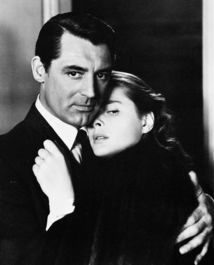
He looks, in that last fully-lit section, during the descent down the staircase - he looks, for the first time, like a complete man - like he has joined the land of the living. He looks ... alive. Alert. With no barrier between himself and his own desires. He will get her down the stairs. He will save her. He is thankful that he did not wait too long. He will save her, even if it means losing his own life. All of that is in that face when he emerges from the bedroom with her in his arms. Amazing acting job. The transformation. For the rest of the film, he's uptight, guarded, his eyes are cynical, he never smiles (except when he's pretending, at the party). But somehow, Cary Grant creates this character without completely alienating us in the audience. Like: he's a bastard to her! He's cruel! And Notorious is obviously on "her" side - the film sympathizes with Ingrid Bergman - and yet - he is not villainized. Hitchcock knew we would come to the film with preconceived notions about Cary Grant (from movies like Bringing up Baby and Holiday - and he set about to deliberately mess with our expectations. Devlin is the darkest Cary Grant has ever been. This is a guy who is starving for love, and the only reason he resists it is because he needs it too much. The brilliance, of course, of all of this - is that that is only implied, never ever said.
So I guess you could say that this is my interpretation of the character of Devlin.
Back to the last scene:
He sits with her on the bed, her face ablaze in the light, and he is a shadow-man, a black-cut-out silhouette. He holds her - she says, "Why have you come ..." He whispers, "I had to see you one more time ... so I could tell you I love you ..."

He has never said he loved her, and earlier on in the film, she makes reference to the fact that their love affair is very interesting, because he doesn't love her. He tries to weasle out of it, saying, "Actions speak louder than words..."
So the "I love you" in this last scene is not like other "I love yous" in films. There's no swelling music, no climactic moment - there's not a feeling that this "I love you" is a victory. It's more hard-won, more tragic. It's an "I love you" between two adults who have been damaged and chastened by life's hard lessons. Man. I so relate to that. This is a grown-up movie.
Back to the last scene:
She is, again, falling in and out of consciousness - but when she hears those words - when she hears him whisper, "I love you" - there are tears in her eyes (Bergman is absolutely spectacular in this film, especially in the last scene) - she says, "You love me? Why didn't you say so before?"
He holds onto her, says into the side of her cheek, "I was a fat-headed guy ... full of pain."
The entire scene is done in surreptitious whispers, which adds to the insecure feeling of it, the secretive-ness, the neuroses - this isn't a normal love scene. She's in the light, he's in the dark - These two people are all fucked up, basically. I don't feel hopeful about their future together, really - even though they drive away in the same car. Whatever happened, they'd have a difficult path. Being grown-up and being in love is tough.
If you want to know why Cary Grant is not just a great movie star, but a great actor - see what he does with that "fat-headed guy" line. It's really more that he does nothing, that's why it's so incredible - he just says it - simply - with no self-pity, no self-importance, no ego - he just says it ... but the eyes ... the eyes ...
You can feel it. "Fat-headed guy full of pain".
Richard Schickel writes about Cary Grant as Devlin:
As Devlin the counterspy Grant is cool, brusque, competent -- with an almost sadistic edge of cruelty about him. At the start it is clear that his assignment is distasteful to him -- recruiting and running an amateur, and a woman at that. And what a woman she is. Ingrid Bergman's Alicia is not only the personally loyal, if politically disapproving, daughter of a convicted Nazi spy, she is also a nymphomaniac and an incipient alcoholic, unstable to the point of explosiveness. And emotionally needy, pathetically so. "Why won't you believe in me, Devlin -- just a little bit," she begs at one point. And our shock at seeing Bergman violate her previously pristine image, degrading herself in her need is, like Grant's charmless manipulativeness, one of the things that makes this movie so superbly unbalancing. [Ed: I love that. A perfect description. "Superbly unbalancing".] She is, in [Pauline] Kael's terms the pursuer, he the pursued, but in the movie's own terms that is less significant than the neurotic force-field it wants to set up between them.In effect, Devlin is forced to become her lover in order to calm her down enough to do her job, which is to insinuate herself into the home and circle (in Rio de Janeiro) of Alexander Sebastian, who is played by Claude Rains, in one of that actor's most delicious roles, as the only master spy in the history of the genre who is hag-ridden by his mother (yet another piece of pathology to reckon with)...
What Devlin does not count on is that he will fall genuinely in love with Alicia. Or that Sebastian will ask her to marry him. And that there is no way out of the match if she is to complete her mission.
What neither she nor the audience has counted on is Devlin's neurosis, which now comes to the fore.
He thinks she accepts the situation too easily; her attitude fits all too well with what he knows of her earlier promiscuity; and with all the fears and suspicions of women in general which she had almost made him forget.
He turns petulant as a jilted schoolboy, reaching levels of mean-spiritedness that from any leaading man would startle an audience, but which from Cary Grant are almost devastating. Hitchcock and Hecht (the writer) have now stripped him bare of his protective image as they previously did Bergman.
The resolution of Notorious requires not just the restoration of moral order, but the rebalancing of psychological equilibrium as well. And what dark intensity this brings to the normally routine process of sorting out a spy drama's strands. One feels that if one of the Brontes had attempted an espionage story it would have turned out something like this.
With Notorious we come closer to the heart of Grant's darkness -- as close as he would allow us to come. There were two decades left to his career, but only once -- and then again for Hitchcock -- would he risk anything like this exposure. Something assuredly was lost by the reticence. And yet one can scarecely blame him. Self-revelation is a terrible trial for anyone; it is especially so for an acotr, whose instrument is his person; most of all for an actor like Grant, who so carefully and deliberately created a screen character that was as much a fantasy to him as it was to his audience, in which he could comfortably hide himself, or whatever of himself -- that is to say, the Archie Leach who had been -- that still existed.

-- Cool trivia about that last descent down the staircase: The staircase was not long enough for Hitchcock. He wanted the staircase to feel, literally, endless for that scene - to build the tension. But if they just slowly descended the staircase - they still reached the bottom with a couple of lines left over to say - this was not good enough for Hitchcock. So here was his solution: as they descended - if you notice the background behind Rains' head in the shots - Hitchcock had them go down the same stretch of stairway 2 or 3 times - so that it would FEEL longer. It's seamless in the film - unless you're looking at the blurry background you would never notice that for the first part of the scene they are not actually going anywhere. A beautiful example of how inventive Hitchcock was, how much he was able to create an illusion.
Movie quote
"I have two ex-wives, a mother and several bartenders depending on me."
Half-blood prince snapshots
SPOILERS BELOW.
I REALIZE THAT I AM THE LAST PERSON ON THE PLANET TO READ THE LATEST HARRY POTTER - BUT JUST IN CASE THERE IS SOMEONE OUT THERE WHO HAS NOT READ IT - STOP NOW!!
I saw so many posts when the book first came out that announced "SPOILERS BELOW" - and so I avoided those posts - and I am forever grateful that the bloggers in question gave me a huge heads up.
So again:
SPOILERS BELOW.
-- Dumbledore. Wow. I did not see that coming. Well - not until they went into that horrible cave. Then I started thinking: "oh boy ... something's going to happen here ..."
-- Horrible. That awful battle at the end. I kept thinking: "If Dumbledore is dead ... then ANYone can die!" (Sorry, Cedric - I already recovered from the shock of your death.) I thought Hermione was going to die. I don't know why. I just got it into my head that she was going to die. And poor Bill. Being bitten by a werewolf is certain to impact him in future years.
-- But the one scene in the hospital when Fleur suddenly says, "Of course I will love him even with his wounds .." and suddenly she and Mrs. Weasley are crying and hugging was PERFECT. That's just how families actually work, and it was a very touching moment.
-- I understood the whole horcrux thing only while I was reading that chapter. I mean, I get it - but I had to keep reading to keep getting it, and ... it required momentum for me to keep understanding what they were trying to do and what it all meant Bits of Voldemort's soul split off and hidden in objects. Okay. Got it.
-- The entire romantic sub-plot was wonderful, I thought. It stretched out throughout the book - but never overwhelmed the plot. It kept my interest. It didn't become sappy or tiresome. I loved how Hermione was obviously trying to make Ron jealous by dating only the people that would drive Ron NUTS. Smart girl. And Ron basically practicing his "snogging" skills on Lavendar - who is SUCH a type - didn't we all know a girl like that in high school? Hell, I know women like her now. Women who can't WAIT to have a man, so that she can then clip his wings, and domesticate the hell out of him. I honestly do not understand women like that - I never have - but they exist - some of them are my good friends, and whatever - a lot of men must love that kind of shite, because women like that are ALWAYS in relationships whereas I am not. Lavendar wants to "have" Ron so that he will be trapped. I thought it was hysterical how Ron ended up hiding whenever he saw her coming. And Harry with his unrequited love for Ginny - and how she suddenly ran at him in the common room with her face "blazing" and suddenly he found himself kissing her. The moment he had been waiting for. I liked how it all played out. It was subtle - and yet it was treated with the right amount of importance. Romance is really important to people who are 16 years old ... and the book reflects that. I mean, romance is important to adults too - but that FIRST romance you never forget! ("The first cut is the deepest" and all that.)
-- Snape. I cannot figure him out. WHY did Dumbledore trust him? I am still not sure I got an answer to that.
-- When Harry comes upon the pale Draco crying in the boy's bathroom - I suddenly felt this rush of compassion and pity for Draco - while normally I just think he's an evil little putz. Like: has Draco been racing along on a little treadmill, being USED by Voldemort or Snape? Does he want to get out of it but CAN'T? Or does Draco just want to revenge his now imprisoned father (which would make sense ...) I think it would be pretty cool if, for whatever reason, Harry and Draco ended up joining forces. Now THAT would be unexpected.
-- The ending blew me away. Harry, although he has one year left, has seen too much, experienced too much, and he has outgrown Hogwarts. It's over. It is now time for him to go out and slay the dragon on his own. His protection (Sirius, Dumbledore) is now gone. He must fight. He can't sit in a classroom learning about potions. He needs to take action.
-- And the book ends on a melancholy nostalgic note. Beautiful last sentence. A perfect last sentence, I thought. Knowing that innocence is already dead, knowing that he can no longer just sit around enjoying simple pleasures while Voldemort is still out there ... he takes one last moment to enjoy his friendships, his girlfriend ... He knows it will be the last time.
I am in love with these books and I already can't wait for the next one.
How Patrick Hughes ruined Thanksgiving
Too much that is funny here to even discuss.
One quote:
The food was traditional Thanskgiving fare, nobody set anything on fire or challenged anyone to a headbutting contest, and we all got properly and decently drunk on many many many beers and the occasional glass of wine. Despite a pledge to avoid this sort of thing and take the high road, we spent the bulk of the evening swapping stories about Cousin Barry, eventually retiring to our separate rooms to barricade the doors lest he show up there in the middle of the night with eyes full of murderous intent and a plate full of lasagna.
I enjoy how all the cousins have their own hyperlinks. hahaha Everyone in the family has their own story.
I also enjoy:
Getting up early to fish is all-American and manly and helps keep the prostate clean of all that terrible, sissy communism going around.
And his father's "one concession to gay pride" - with the accompanying photo - made me laugh out loud.
Happy birthday, Louisa May Alcott

Truth be told, I have only read Little Women. But that, frankly, was enough for me. To me, it is a perfect book - a book I go back to again and again and again - always seeing something new in it, always finding new levels. The characters seem to grow up with me. When I first read it, when I was 10 years old, I was ALL ABOUT JO. And my love affair with Jo continues to this day. She is one of my favorite female characters ever written (it's a tie between Jo March and Harriet the Spy). Jo LIVES. No one can convince me that she is just a fictional character. Nope. You cannot do it.
But as I have grown up, and as I have continuously gone back to the book - the other sisters have come to the foreground - I see myself in all of them. Parts of me are like Amy, parts of me are like Meg, and I would like to think that parts of me are like Beth. But honestly: Jo is the one. Jo is the one I most relate to. She's the artist. The tomboy. The independent wild spirit. The one who is afraid to make the wrong choice. The one who sticks to her guns.
I still am not really reconciled to the fact that she and Laurie did not end up together - HOWEVER, I can see Jo's point. They were like brother and sister. But ... but ... but ... couldn't that have segued into a love thing? The intimacy they have together, the comfort?
When I was a kid, I HATED the professor. With his stupid German accent, and his goofy poetry as he wooed Jo. I resented the fact that he wasn't Laurie. I loved Laurie.
Now I know that Louisa May Alcott was forced by her publishers to marry Jo off. She wanted her to stay single. And if you really think about it, THAT would be much more logical - it makes much more sense that Jo, even with all her passion, and her ability to understand men (in a way that Meg, the one with all the love affairs, doesn't) - would choose to spend her life alone. She would marry her writing. In that day and age, those were the choices. It was the choice Louisa May Alcott herself made. She could not submit to the demands of wifehood and motherhood - it would infringe on her writing. She knew it, even when she was 15 years old, and wrote in her journal: "I will do something by and by. Don’t care what, teach, sew, act, write, anything to help the family; and I’ll be rich and famous and happy before I die, see if I won’t!"
Alcott's background is very interesting. She grew up in Concord, one of 4 girls, and her father was buddies with Emerson, and part of the Transcendentalist movement. Her father was a teacher, and at the time, his views on teaching were very controversial: He actually believed that students should enjoy learning. Heaven forbid! He thought that students should be actively involved in their own education, and not just sit back and be passive little drones. Louisa May Alcott had a passionate girlish love of Emerson - a crush, if you will. His intellect, his library that she was allowed to use, whatever ... She adored him.
In 1862, Alcott (as always, determined to make a living - and to contribute financially to her family) traveled to Washington DC as a Civil War nurse. By this point, Alcott had already started getting stuff published - poems, short stories in the Gothic melodramatic vein ... She actually preferred Gothic melodramas to the kinds of books that later would make her name. She despised Little Women and found the writing of it extremely tedious. But anyway, her experience as a nurse in the Civil War prompted her to publish a book called Hospital Sketches. At that point, her publisher asked her if she would write a book "for girls". Never one to back off from a challenge, Louisa May Alcott sat down and wrote Little Women in two months. She had grown up with 3 sisters - and she put her entire childhood and life into that book, even as she despised doing it, and didn't think the book would amount to much.
Little Women was published in 1868 and was an immediate rip-roaring success. The publisher, within only a couple of weeks of its publication, begged Alcott to get to work on a sequel. So Alcott did. Another smash success. Louisa May Alcott had become a star.
Every book she wrote after that was eagerly awaited for by a breathless loving public. Success had, indeed, come - her childish ambitions to be 'rich and famous' came to fruition tenfold ... but 'happy'? Was she happy? Sorry, Louisa, but does it matter??
She never married. She ended up taking care of her sister May's daughter - after May died from complications in childbirth. Being a surrogate mother to this young girl was one of the most fulfilling experiences of Alcott's life. She kept writing, kept publishing ... although she began to get more and more ill from mercury poisoning she had received years earlier during the Civil War (she had, like many other Civil War nurses, contracted typhoid fever - and at the time, the proscribed cure was something called "calomel" - a drug laden with mercury).
Near the end of her life, Alcott became active in the suffragette movement, canvassing door to door to try to convince women to demand the vote. In 1879, Louisa May Alcott was the first woman to register to vote in Concord - for the school committee election. Of such small steps ultimate victory was made.
Her beloved father passed away on March 4, 1888. Louisa May Alcott died two days later.
An extraordinary woman.
She didn't care for the book that made her name ... and probably wished that her legacy was different ... but that's okay. It is not for the artist to decide what the audience will react to, what the reader will respond to. She created something with Little Women that transcends the ages, that pierces through the centuries. It is a classic book. And perhaps it's fitting, in a way, that she wrote it for hire, pretty much - it was not her idea, and yet - look at what she was able to create. Look at what she was able to bring out!!
Jo March is immortal.
When I was 16 years old, one of the assignments we had in our Drama class was to do a one-person show - maybe 15, 20 minutes long - based on either a real person from history, or a fictional character - and we had to come into the class as that character, and do a monologue - based on our research - and then take questions. What a marvelous assignment. Marvelous. I still remember my core group of friends and their projects: Beth came in as Mae West. She was incredible. She had on a blowsy blonde wig, and wore a tight sparkley dress - and I still remember the shock when Beth started telling us all about birth control options - because Mae West was an early champion of birth control for women. It was awesome. Beth was fearless. Betsy did Paddington Bear (and I still remember how one of the questions for Betsy was: "Why don't you eat some of your marmalade?" and Betsy - who despises marmalade - had to dip her hand into the jar, take out a big scoop of it, and eat it - pretending she liked it. Now that's dedication to the acting craft!). Michele did Marilyn Monroe. Unbelievable. Michele was an amazing actress - I always wish she had kept up with it. She got the sadness beneath the blonde glamour of Marilyn. Beautiful.
And I did Louisa May Alcott.
One of my first forays into the one-person show format ... I did hours and hours and hours of research for a mere 20 minute piece - because I had no idea what questions people would ask, and I had to be ready for anything!
It was great, because I had known nothing about her before that. All I knew was that she was the author who created Jo March!! We also had visited her house in Concord as a family. Orchard House:

Once I learned all this stuff about her, my admiration for her just grew. I also loved that our birthdays were almost the same. She was a Sagittarius too.
Little Women. One of the all-time great books.
“A happy Thetan is a clear Thetan.”
Look out. The infiltration has begun.
The Books: "Something Unspoken" (Tennessee Williams)
And here is my next excerpt of the day from my library.
Next Tennessee Williams play on the shelf is a one-act called Something Unspoken.
Another example of Williams' genius. Any of you out there who are Williams fans: I highly recommend you checking out this one-act if you haven't already. It's in the collection 27 Wagons Full of Cotton. Again: the amount of informaiton that he is able to pack into a one-act - without any of it seeming forced or artificial - is truly extraordinary. These plays are slices of life. Entire worlds are suggested in their meagre pages.
Here's the plot: Miss Cornelia Scott is a wealthy Southern spinster in her 60s. She is a grande dame. She dresses elaborately, does her hair up in pompadours, and lives her life with a lot of pomp and circumstance. The amazing thing that Williams does with her character, though, is ... by the end of the play, he has completely shown us what is going on beneath her facade - we completely see the REAL Miss Cornelia Scott - even though she would never be in charge of letting us see her so intimately. Her defenses are too strong for that - but no matter: Williams lets us see inside anyway. She is so lonely it aches. She is so eager for approval that she loses sleep at night. She is so afraid of rejection that she can barely even think about it. But nobody would ever guess that Miss Cornelia Scott was so vulnerable.
She has a secretary - a woman in her 40s - who has been with her for 15 years. Her name is Grace. They have a complex codependent relationship. There is tension between them - something unacknowledged (ahem - notice the title of the play) - we are not sure WHAT are the guts of this relationship but we know something is there.
Miss Cornelia Scott is waiting on tenterhooks (uhm - have I ever used that phrase before? What does it mean??) to hear about the elections of the local chapter of the Daughters of the Confederacy. She has been a member for years. She wants to be Regent. She has held every other office - but she wants to be Regent. The only problem is: her fear of rejection is so huge that she cannot submit to the indignities of campaigning - and unless it is a unanimous vote - unless everyone says, as one, "WE MUST HAVE CORNELIA SCOTT AS OUR LEADER" then she feels she must resign from the organization. Williams, in his genius way, lets us see that what is really going on here is that Cornelia Scott has no one in her life who loves her. Everyone fears her, and tiptoes around her - but no one loves her. And even though Cornelia Scott pretends that this doesn't matter, it eats away at her.
All of this ends up coming to a head in a confrontation between her and her secretary.
An incredible relationship portrayed.
Grace ends up having a monologue that, in the context of the play, knocks my socks off (I'll include it in my excerpt). Nobody pulls back the veil to reveal the truth like Tennessee Williams. And watch how when Grace finally starts to spit out that "something unspoken" - Miss Cornelia is not angry or offended. She eagerly listens, she wants more. Because it is THE TRUTH. And nobody in her life ever tells her the truth, good or bad.
Here's an excerpt from the play. Miss Cornelia Scott has given Grace a gift - 15 roses to commemorate her 15 years as her secretary. The bouquet is the catalyst for all that follows.
From Something Unspoken, by Tennessee Williams
GRACE. Thank you for the roses.
CORNELIA. I don't want thanks from you either. All that I want is a little return of affection, not much, but sometimes a little!
GRACE. You have that always, Cornelia.
CORNELIA. And one thing more: a little outspokenness, too.
GRACE. Outspokenness?
CORNELIA. Yes, outspokenness, if that's not too much to ask from such a proud young lady!
GRACE. [rising from table] I am not proud and I am not young, Cornelia.
CORNELIA. Sit down. Don't leave the table.
GRACE. Is that an order?
CORNELIA. I don't give orders to you, I make requests.
GRACE. Sometimes the requests of an employer are hard to distinguish from orders. [She sits down]
CORNELIA. Please turn off the victrola. [Grace rises and stops the machine] Grace! -- Don't you feel there's -- something unspoken between us?
GRACE. No. No, I don't.
CORNELIA. I do. I've felt for a long time something unspoken between us.
GRACE. Don't you think there is always something unspoken between two people?
CORNELIA. I see no reason for it.
GRACE. But don't a great many things exist without reason?
CORNELIA. Let's not turn this into a metaphysical discussion.
GRACE. All right. But you mystify me.
CORNELIA. It's very simple. It's just that I feel that there's something unspoken between us that ought to be spoken ... Why are you looking at me like that?
GRACE. How am I looking at you?
CORNELIA. With positive terror!
GRACE. Cornelia!
CORNELIA. You are, you are, but I'm not going to be shut up!
GRACE. Go on, continue, please, do!
CORNELIA. I'm going to, I will, I will, I -- [The phone rings and Grace reaches for it] No, no, no, let it ring! [It goes on ringing] Take it off the hook!
GRACE. Do just let me --
CORNELIA. Off the hook, I told you! [Grace takes the phone off the hook. A voice says: "Hello? Hello? Hello? Hello?"]
GRACE. [suddenly she is sobbing] I can't stand it!
CORNELIA. Be STILL! Someone can hear you!]
VOICE. Hello? Hello? Cornelia Scott? [Cornelia seizes phone and slams it back into its cradle]
CORNELIA. Now stop that! Stop that silly little female trick!
GRACE. You say there's something unspoken. Maybe there is. I don't know. But I do know some things are better left unspoken. Also I know that when a silence between two people has gone on for a long time it's like a wall that's impenetrable between them! Maybe between us there is such a wall. One that's impenetrable. Or maybe you can break it. I know I can't. I can't even attempt to. You're the strong one of us two and surely you know it. -- Both of us have turned grey! -- But not the same kind of grey. In that velvet dressing-gown you look like the Emperor Tiberius! -- In his imperial toga! -- Your hair and your eyes are both the color of iron! Iron grey. Invincible looking! People nearby are all somewhat -- frightened of you. They feel your force and they admire you for it. They come to you here for opinions on this or that. What plays are good on Broadway this season, what books are worth reading and what books are trash and what -- what records are valuable and -- what is the proper attitude toward -- bills in Congress! -- Oh, you're a fountain of wisdom! -- And in addition to that, you have your -- wealth! Yes, you have your -- fortune! -- All of your real-estate holdings, your blue-chip stocks, your -- bonds, your -- mansion on Edgewater Drive, your -- shy little -- secretary, your -- fabulous gardens that Pilgrims cannot go into ...
CORNELIA. Oh, yes, now you are speaking, now you are speaking at last! Go on, please go on speaking.
GRACE. I am -- very -- different! -- Also turning grey but my grey is different. Not iron, like yours, not imperial, Cornelia, but grey, yes, grey, the -- color of a ... cobweb ... [She starts the record again, very softly] -- Something white getting soiled, the grey of something forgotten. [The phone rings again. Neither of them seems to notice it] -- And that being the case, that being the difference between our two kinds of grey, yours and mine -- You mustn't expect me to give bold answers to questions that make the house shake with silence! To speak out things that are fifteen years unspoken! That long a time can make a silence a wall that nothing less than dynamite could break through and -- [She picks up the phone] I'm not strong enough, bold enough, I'm not --
CORNELIA. [fiercely] You're speaking into the phone!
GRACE. [into phone] Hello? Oh, yes, she's here. It's Esmerelda Hawkins. [Cornelia snatches the phone]
CORNELIA. What is it, Esmerelda? What are you saying, is the room full of women? What a babble of voices! What are you trying to tell me? Have they held the election already? What, what, what? Oh, this is maddening! I can't hear a word that you're saying, it sounds like the Fourth of July, a great celebration! Ha, ha, now try once more with your mouth closer to the phone! What, what? Would I be willing to what? You can't be serious! Are you out of your mind? [She speaks to Grace in a panicky voice] She wants to know if I would be willing to serve as vice-Regent! [into phone] Esmerelda! Will you listen to me? What's going on? Are there some fresh defections? How does it look? Why did you call me again before the vote? Louder, please speak louder, and cup your mouth to the phone in case they're eavesdropping! Who asked if I would accept the vice-regency, dear? Oh, Mrs. Colby, of course! -- that treacherous witch! -- Esmerelda!! Listen! I -- WILL ACCEPT -- NO OFFICE -- EXCEPT -- THE HIGHEST! Did you understand that? I -- WILL ACCEPT NO OFFICE EXCEPT -- ESMERELDA! [She drops phone into its cradle]
GRACE. Have they held the election?
CORNELIA. [dazed] What? -- No, there's a five-minute recess before the election begins ...
GRACE. Things are not going well?
CORNELIA. "Would you accept the vice-Regency," she asked me, "if for some reason they don't elect you Regent?" -- Then she hung up as if somebody had snatched the phone away from her, or the house had -- caught fire!
GRACE. You shouted so I think she must have been frightened.
CORNELIA. Whom can you trust in this world, whom can you ever rely on?
GRACE. I think perhaps you should have gone to the meeting.
CORNELIA. I think my not being there is much more pointed.
GRACE. [rising again] May I be excused, now?
CORNELIA. No! Stay here!
GRACE. If that is just a request, I --
CORNELIA. That's an order! [Grace sits down and closes her eyes] When you first came to this house -- do you know I didn't expect you?
GRACE. Oh, but Cornelia, you'd invited me here.
CORNELIA. We hardly knew each other.
GRACE. We'd met the summer before when Ralph was --
CORNELIA. Living! Yes, we met at Sewanee where he was a summer instructor.
GRACE. He was already ill.
CORNELIA. I thought what a pity that lovely, delicate girl hasn't found someone she could lean on, who could protect her! And two months later I heard through Clarabelle Drake that he was dead ...
GRACE. You wrote me such a sweet letter, saying how lonely you were since the loss of your mother and urging me to rest here till the shock was over. You seemed to understand how badly I needed to withdraw for a while from -- old associations. I hesitated to come. I didn't until you wrote me a second letter ...
CORNELIA. After I received yours. You wanted urging.
GRACE. I wanted to be quite sure I was really wanted! I only came intending to stay a few weeks. I was so afraid that I would outstay my welcome!
CORNELIA. How blind of you not to see how desperately I wanted to keep you here forever!
November 28, 2005
Movie quote
"As the years go by, romance fades and something else takes its place. Do you know what that is?"
"Senility."
"Trust."
"That's what I meant."
Happy Birthday, William Blake!

He may be one of my favorite poets, and I have to thank the doppelganger for introducing me to him. Or - I should say - RE-introducing me to him. I know I read "The Chimney Sweep" in the poetry survey class I took in college - but it wasn't until after the conversation he and I had about Blake at the infamous party where we first met - that I thought: "Hmmm. Need to give Blake another look." I am SO glad I did!!! What a poet!!
Fascinating man as well.
He was a poet (virtually unknown in his own lifetime), and also an engraver (I've put some of his startling work in the extended entry - but if you want to see more of his work, check out this link.) He did illustrations for children's books, religious books, volumes of poetry ... and now his stuff is considered pretty much priceless.
William Blake was born in 1757 in London - the third of five children. He went to school until he was 14 - and then had to go to work. He got a job as an apprentice to an engraver - which is how he ended up making his paltry living. He lived in pretty much poverty for his entire life. He married at 25 - to the illiterate Catherine Boucher. Blake taught her how to read, and they ended up becoming collaborators in bringing out volumes of his poetry. He did engravings to illustrate his poems. Catherine was the one who bound the books, and got them ready for publication. The entire thing was a joint production - they did all the work themselves.
The two of them never had any children. They were extremely unconventional, shall we say - and visitors tell of stopping by the Blake house to find the two of them sitting out in their back garden completely naked. Just hanging out, reading, working together - NUDE. No shame. They had a whole philosophy about nakedness, and sex, and innocence - that there was nothing dirty about any of that stuff. It was human prudery that made celebration of the body a dirty thing. But still - some of the tales told about Blake are hysterical. I would have LOVED to meet the guy. He sounds amazing.
William Blake had visions. He speaks about them openly and much of his work has a phantasmagorical religious feeling to it. When he was a young boy, he said he looked up into a tree and saw that it was full of winged angels. He would get visions of Gabriel, the Virgin Mary, yadda yadda.
His view of God, the Spirit, the Holy Trinity, what have you - is so inspiring to me. It's vital, it's alive, and it seems to be all about love. There's not too many people I would call "genius" - but Blake I most certainly would. On the edge of sanity? Sure. Whatever. Many geniuses are.
However - again - William Blake, despite these astonishing works of poetry he put out during his lifetime - died unrecognized.
Now, though, he is considered to be one of the greatest poets in the English language. If you haven't encountered William Blake's stuff, I highly recommend you giving it a look. It's not the EASIEST poetry to get into - but God, every single page is chock-full of so much ... you can't believe that it came from only one man.
His poem about the little lisping chimney-sweep is in the "canon" - If you took any kind of sweeping Poetry 101 course, you probably would have encountered it. I'll post it below. But it's really his long form poems, especially the SPECTACULAR "Marriage of Heaven and Hell", where the guy literally has no equal. None. Blake has no peers.
Here's the one about the chimney sweep, which is - in its own way - an indictment of the society in which he lives - a society that treats its most innocent members in such a horrible way.
"The Chimney Sweep" - from Songs of Innocence
When my mother died I was very young,
And my father sold me while yet my tongue
Could scarcely cry 'weep! 'weep! 'weep! 'weep!
So your chimneys I sweep, and in soot I sleep.
There's little Tom Dacre, who cried when his head,
That curled like a lamb's back, was shaved: so I said,
"Hush, Tom! never mind it, for when your head's bare,
You know that the soot cannot spoil your white hair."
And so he was quiet; and that very night,
As Tom was a-sleeping, he had such a sight, -
That thousands of sweepers, Dick, Joe, Ned, and Jack,
Were all of them locked up in coffins of black.
And by came an angel who had a bright key,
And he opened the coffins and set them all free;
Then down a green plain leaping, laughing, they run,
And wash in a river, and shine in the sun.
Then naked and white, all their bags left behind,
They rise upon clouds and sport in the wind;
And the angel told Tom, if he'd be a good boy,
He'd have God for his father, and never want joy.
And so Tom awoke; and we rose in the dark,
And got with our bags and our brushes to work.
Though the morning was cold, Tom was happy and warm;
So if all do their duty they need not fear harm.
And here ... for those of you who are interested ... is "Marriage of Heaven and Hell" in its entirety (accompanied by more of Blake's engravings).
Just go with it. Just succumb.
As you can see, the guy was so ahead of his time that he is timeless. He predicts the Beat generation, he predicts modernism, he would fit in with the poetry slams of today (except that he is, well, you know - GOOD) ... He was a man who plumbed his unconscious for material. He brought what was within him - OUT. His poetry is the literary version of Van Gogh's Starry Night. Van Gogh was not interpreting the sky. That was actually how Van Gogh saw the stars. Get into Van Gogh's world. See the world through HIS eyes. William Blake is the same way.
I think my favorite line from William Blake is:
The eagle never lost so much time as when he submitted to learn of the crow.
I have reminded myself of those lines from time to time, when I am surrounded by mediocrity. Mediocrity that wants to bring you down. Wants you to be mediocre as well, so that you won't make anyone feel bad.
Yup. I'm a snob. I plan on being an eagle and I will no longer submit to learn from crows. Don't waste my time.
Thanks, Blake! Wish I could have visited you and your wife in your back garden, and sat around with you all, nude, drinking tea, and talking about angels.
Happy birthday!
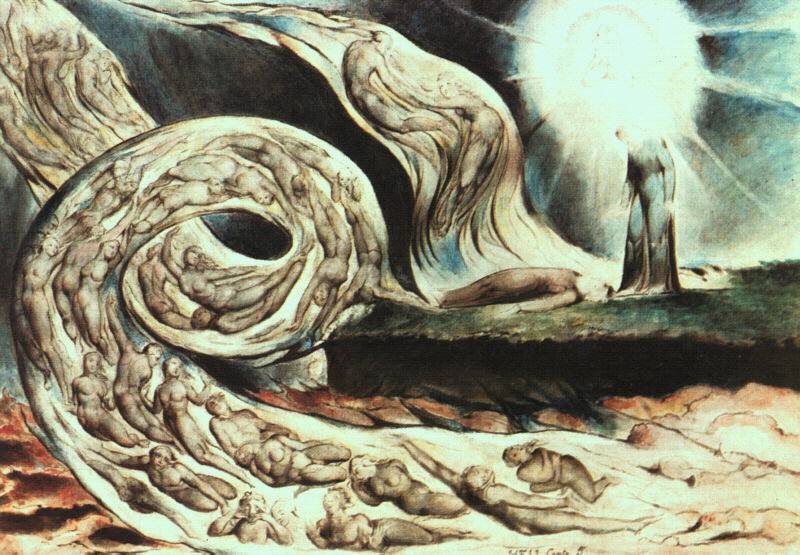
Engravings below:
Christ in the sepulcher guarded by angels - 1805

Whirlwind of Lovers (Illustration to Dante's Inferno)
The Ancient of Days - 1794

My birthday
I had a really nice birthday. I came to the theatre and the cast and crew had all signed a card for me. My brother and his girlfriend Melody were in the audience yesterday - I haven't seen my brother in months, so I was SO excited. We had a "talk back" after the show, where the cast, the director, and the writer, sit on the stage and take questions from anyone in the audience who wishes to stay. It was a great conversation. These people ... they're the off-Broadway theatre crowd ... These are not people I know, not people any of us knew ... It's just amazing. Nothing like live theatre, and it's people like THAT who help keep it alive. It was great fun. Great fun, too, to see Brendan and Melody out there in the audience, listening, participating. My character is kind of a polarizing character. People either love it, or don't get it. We heard both sides during the talk-back. Interesting. An audience member said, "So ... you are a psychic who works with the police?" I said, "Well, I prefer clairvoyant ... but yes ..." hahahaha It was a very good discussion.
Afterwards, Ted (my director), Brendan, Melody and I went out to a local pub and drank beer and ate hot chicken wings and jalapeno poppers and talked about the play. Brendan gave me his birthday present: a 2-disc collector's edition of Casablanca. WHOO-HOO!!! Can't WAIT to see it! We also had an awesome conversation about Bob Dylan. It was great. We're all Dylan fans - so it was really interesting, really fun. Brendan told a great story about the meeting between John Lennon and Bob Dylan. They were fans of each other - this is the early 60s - when the Beatles had just come to America. Dylan goes to see a Beatles show. And afterwards, he gets into a huge limo with John Lennon. They're kind of awkward with each other, since they admire each other so much, etc. And finally Dylan says to Lennon: "You know, you don't have to write songs just about girls." hahahaha I love that story.
Afterwards, Brendan, Melody and I took a long walk through the city streets. Talking, laughing ... Had a nice phone conversation with my parents. They're proud of me. Of what I'm up to right now in my life. It brings a lump to my throat to know they're proud of me. I also had a brief phone conversation with Cashel, who was on the cusp of falling asleep - therefore, he was kind of weepy and irritable. hahaha "Do you need to go to sleep now, honey?" Weepy small Cashel voice coming at me over the phone line: "Yes." "Okay. You go sleep now."
We sat in Starbucks. We talked. We laughed. It's been months since we all were together. Brendan had on his Red Sox jacket. Melody is beautiful. A member of our family.
Came home and talked with my sister Jean for a while, just a short birthday call. A couple of other friends left messages on my cell phone with birthday wishes.
It was a good birthday.
The Books: "Talk To Me Like the Rain ... And Let Me Listen" (Tennessee Williams)
And here is my next excerpt of the day from my library.
Next Tennessee Williams play on the shelf is a one-act called Talk To Me Like the Rain ... And Let Me Listen.
A favorite with actors - it's a two person play. There are two unnamed characters: Man and Woman. They live in a cold-water flat on the Lower East Side. He is a drunk. She is wasting away to nothing. There is intimacy between them - the intimacy of desperation. He woke up that morning in some random hotel in a bathtub full of ice cubes. No idea how he got there. He found his way home. Meanwhile, she has drunk nothing but water for 3 days. She stares out the window. She is wasting away. On purpose. Actors love this play because both characters have nice long juicy monologues - and also it's one of those plays where all you need to do is just show up, be honest, be in the moment, and connect to the other actor. It's a very rich piece of writing. He keeps begging her to talk: "talk to me like the rain ... and let me listen ..."
I've seen this play done where it's been TERRIBLE. The writing is poetic, heightened, Williams-esque ... and when the actors don't get inside of it, don't own the language, and also don't connect to each other - they look like jagoffs. But I have also seen this play done (my friend Jen did it - this is the production I'm talking of) where it is absolutely RIVETING. You are drawn into the world of these two people who ... even though they are on their last legs ... love each other more than anything.
The play doesn't "go" anywhere - there is no plot ... so I'll just excerpt a bit from their conversation.
From Talk To Me Like the Rain ... And Let Me Listen, by Tennessee Williams
MAN. Can you talk to me, honey? Can you talk to me, now?
WOMAN. Yes!
MAN. Well, talk to me like the rain and -- let me listen, let me lie here and -- listen ... [He falls back across the bed, rolls on his belly, one arm hanging over the side of the bed and occasionally drumming the floor with his knuckles. The mandolin continues] It's been too long a time since -- we levelled with each other. Now tell me things: What have you been thinking in the silence? -- While I've been passed around like a dirty postcard in the city ... Tell me, talk to me! Talk to me like the rain and I will lie here and listen.
WOMAN. I --
MAN. You've got to, it's necessary! I've got to know, so talk to me like the rain and I will lie here and listen, I will lie here and --
WOMAN. I want to go away.
MAN. You do?
WOMAN. I want to go away!
MAN. How?
WOMAN. Alone! [She returns to window] I'll register under a made-up name at a little hotel on the coast ...
MAN. What name?
WOMAN. Anna -- Jones ... The chambermaid will be a little old lady who has a grandson that she talks about ... I'll sit in the chair while the old lady makes the bed, my arms will hang over the -- sides, and -- her voice will be -- peaceful ... She'll tell me what her grandson had for supper! -- tapioca and -- cream ... [The Woman sits by the window and sips the water] -- The room will be shadowy, cool, and filled with the murmur of --
MAN. Rain?
WOMAN. Yes. Rain.
MAN. And?
WOMAN. Anxiety will -- pass -- over!
MAN. Yes ...
WOMAN. After a while the little old woman will say, Your bed is made up, Miss, and I'll say -- Thank you ... Take a dollar out of my pocketbook. The door will close. And I'll be alone again. The windows will be tall with long blue shutters and it will be a season of rain -- rain -- rain ... My life will be like the room, cool -- shadowy cool and -- filled with the murmur of --
MAN. Rain....
WOMAN. I will receive a check in the mail every week that I can count on. The little old lady will cash the checks for me and get me books from a library and pick up -- laundry ... I'll always have clean things! -- I'll dress in white. I'll never be very strong or have much energy left, but have enough after a while to walk on the -- esplanade -- to walk on the beach without effort ... In the evening I'll walk on the esplanade along the beach. I'll have a certain beach where I go to sit, a little way from the pavillion where the band plays Victor Herberg selections while it gets dark ... I'll have a big room with shutters on the windows. There will be a season of rain, rain, rain. And I will be so exhausted after my life in the city that I won't mind just listening to the rain. I'll be so quiet. The lines will disappear from my face. My eyes won't be inflamed at all any more. I'll have no friends. I'll have no acquaintances even. When I get sleepy, I'll walk slowly back to the little hotel. The clerk will say, Good evening, Miss Jones, and I'll just barely smile and take my key. I won't ever look at a newspaper or hear a radio; I won't have any idea what's going on in the world. I will not be conscious of time passing at all ... One day I will look in the mirror and I will see that my hair is beginning to turn grey and for the first time I will realize that I have been living in this little hotel under a made-up name without any friends or acquaintances or any kind of connections for twenty-five years. It will surprise me a little bit but it won't bother me any. I will be glad that time has passed as easily as that. Once in a while I may go out to the movies. I will sit in the back row with all that darkness around me and figures sitting motionless on each side not conscious of me. Watching the screen. Imaginary people. People in stories. I will read long books and the journals of dead writers. I will feel closer to them than I ever felt to people I used to know before I withdrew from the world. It will be sweet and cool this friendship of mine with dead poets, for I won't have to touch them or answer their questions. They will talk to me and not expect me to answer. And I'll get sleepy listening to their voices explaining the mysteries to me. I'll fall asleep with the book still in my fingers, and it will rain. I'll wake up and hear the rain and go back to sleep. A season of rain, rain, rain ... Then one day, when I have closed a book or come home alone from the movies at eleven o'clock at night -- I will look in the mirror and see that my hair has turned white. White, absolutely white. As white as the foam on the waves. [She gets up and moves about the room as she continues] I'll run my hands down my body and feel how amazingly light and thin I have grown. Oh, my, how thin I will be. Almost transparent. Not hardly real any more. Then I will realize, I will know, sort of dimly, that I have been staying on here in this little hotel, without any -- social connections, responsibilities, anxieties or disturbances of any kind -- for just about fifty years. Half a century. Practically a lifetime. I won't even remember the names of the people I knew before I came here nor how it feels to be someone waiting for someone that -- may not come ... Then I will know -- looking in the mirror -- the first time has come for me to walk out alone once more on the esplanade with the strong wind beating on me, the white clean wind that blows from the edge of the world, from even further than that, from the cool outer edges of space, from even beyond whatever there is beyond the edges of space ... [She sits down again unsteadily by the window] -- Then I'll go out and walk on the esplanade. I'll walk alone and be blown thinner and thinner.
MAN. Baby. Come back to bed.
WOMAN. And thinner and thinner and thinner and thinner and thinner! [He crosses to her and raises her forcibly from the chair] -- Till finally I won't have any body at all, and the wind picks me up in its cool white arms forever, and takes me away!
MAN. [presses his mouth to her throat] Come on back to bed with me!
WOMAN. I want to go away, I want to go away! [He releases her and she crosses to center of room sobbing uncontrollably. She sits down on the bed. He sighs and leans out the window, the light flickering beyond him, the rain coming down harder. The Woman shivers and crosses her arms against her breasts. Her sobbing dies out but she breathes with effort. Light flickers and wind whines coldly. The Man remains leaning out. At last she says to him softly --] Come back to bed. Come on back to bed, baby ... [He turns his lost face to her as --]
THE CURTAIN FALLS
November 27, 2005
The comfort of conspiracy theories
The thing about conspiracy theories are ... they are comforting. They assure you that there is some ORDER in the universe, that there are connections between not just some events, but ALL events. There are no such things as coincidences in the middle of a conspiracy theory. When I've been in love with someone, and he hasn't loved me back ... I tend to read into all the coincidences - he likes this and so do I - therefore THAT means that we should be together ... etc. I draw conclusions based on COINCIDENCES. This is a very human thing, but I certainly wouldn't want to LIVE in that mind-space. Where everything means something, and every random event means something. It must be what it feels like to be an end-of-the-world apocalyptic Christian. The wind blows from the East ... Therefore, the end of the world is coming. It is a place of CERTAINTY. I know that human beings, in general, are uncomfortable with uncertainty. Of course. It's awful to just accept that you CAN'T know what is going to happen. But that's the deal, that to me is one of the points of life: to be able to BEAR uncertainty. Conspiracy theorists absolutely cannot bear uncertainty. And the truly paranoid ones are the ones who just can't deal with reality. The reality sometimes is quite simple. But it's NEVER simple to a conspiracy theorist.
If you are a conspiracy theorist - you see connecting threads everywhere. Your mindset becomes grandiose, paranoid ... You believe in the essential BIG-ness of things. By that I mean: everything happens on a grand scale. There is some kind of over-riding SENSE to be made of things ... and if you can only connect enough of the threads ... you will be able to see clearly, through the veil of lies put out by some enormous organization - the government, the CIA, the ATF, the Rat Pack (Marilyn Monroe's death, in case you're wondering), whatever - you will pierce through the lies and come close to the actual root of all power. You believe that there IS a root of all power. NOTHING is coincidental. There is no chaos. EVERYTHING makes sense, in a kind of unbearable way. It appears on the surface to be chaos, but if you can just make sense of the cacophony, you will see the wizard behind the curtain. You will actually SEE him. The most important thing for a conspiracy theorist is that they actually have to believe that there IS a wizard in the first place. They have to believe that someone, somewhere, no matter how hidden, knows the TRUTH of what is going on ... and someone, somewhere, holds the KEY to putting the pieces together ...
To a conspiracy theorist, there is actually such a thing as power - plus efficiency. Power plus efficiency plus an ability to keep a secret. These three things MUST exist in a very very real way to conspiracy theorists, and they must be interlocked. I believe in power. I believe in efficiency. And I believe that there is such a thing as being able to keep a secret. But do I believe that those three particular things can actually go hand in hand? Not on your LIFE.
I'm fascinated by conspiracy theorists. It seems to me it would be very comforting if I could believe what they believe. If I could believe that someone, somewhere, knew what the hell they were doing ... and if only I could pierce through the web of LIES ... I could come close to the source of real power. It would be comforting to actually believe that there WAS a secret, and that I could pull back the curtain to see the phony wizard.
I can see why people succumb to the conspiracy theory mindset. It makes perfect sense to me.
It's a childlike response to the unfairness of things - the fact that we can't KNOW everything - the fact that some things just HAPPEN. The conspiracy theorist cannot stop asking "Why?" Asking "why" is not a bad thing. As a matter of fact, people who don't ask "Why" freak me out. They seem like dumbbells. Sheep. Willing to believe anything. They have their OWN kind of certainty. But if you know any conspiracy theorists - and I do - then you know that their "Why"s get more and more elaborate, more and more paranoid ... Nothing ever just IS to a conspiracy theorist. That CAN'T be all there is. There are NO accidents.
Now, to me - I can certainly succumb to a conspiracy theory mindset. It is extremely compelling and attractive. How wonderful would it be to truly believe that someone out there knew what the hell he was doing. Whoever that person is. This is one of the reasons why politics, government, coup d'etats, revolutions - all that stuff - has so gripped my fascination for so many years. Why? I was talking to CW about this once (because frankly, he seems like the kind of guy who "knows stuff" - hahaha), and I said, "I just ... want to get high enough up in my learning ... so that I can know what the big guys know. Like ... how high up in power do you have to go to really get a nice view of the whole landscape?" I want to get up high enough to really be able to SEE ... surely SOMEONE out there has the whole picture in mind!
But I actually think that, in general, very very very few people have the whole picture. I have my own opinion about the people who have large pictures in their minds ... you might have your own. To me, guys like Robert Kaplan are looking at a large picture. Christopher Hitchens. VS Naipaul. Ryzsard Kapuscinski (his essay called "The Soccer War" is a perfect example of what I am talking about. The ability to be improvisational, flexible, and to admit that you do not KNOW something - Kapuscinski didn't know what was going on, and yet - all signals pointed to war, because of the riot at a soccer game. Maybe that doesn't seem logical - so what that they're rioting at a soccer game? ... but impending war was what he sensed, and turns out that he was right, that was what was REALLY going on. Anyone who gives a crap about how things really happen in this world should read "The Soccer War" and that's all I'm saying. Genius.) People like Bernard Lewis. Elias Canetti. Or the obvious choice of Samuel Huntington. Perhaps the best example is Rebecca West. Now there was a woman with large global pictures in her head. Her accomplishment in this regard has so far not been matched. Now you may disagree with some of these people's conclusions. I disagree with some of their conclusions too. But to me? Those people are BIG PICTURE PEOPLE, and what they see is a reflection of what I see. It's just that they have better access than I do, and bigger vocabularies. But when I read their stuff, I start to feel like I can actually get a GLIMPSE of how things work.
You'll notice that NONE of these people are government people. They are independent thinkers, writers, journalists.
But again - it's a short list. Like I said: "very very very few people". And "very very very few people" cannot create some vast conspiracy involving multiple government agencies. My small group of friends can barely keep a secret among us. Fuggedaboutit.
Lastly: in general, I think that government is pretty much incompetent. I mean, please. Let us look at how much governments have gotten WRONG in the last 100 years. Enormous globe-changing events NOT predicted or foreseen - despite the fact that massive bureaucracies have been put into place for that sole purpose alone, signals missed, signals crossed, signals misinterpreted, huge wars hitting us by surprise ... etc. etc. Now, if there was some all-powerful Wizard behind some curtain - wouldn't you think he would be able to SEE what was coming?
I don't think the government is competent enough to tie its own shoes, let alone create vast international conspiracies. Bureacracies in general. Sheesh. Filled with incompetent people who don't give a shite. On a tiny level: Have you called the DMV lately and tried to get a change of address on your license? Incompetence is indemic.
The other thing about conspiracy theorists is that unless you believe what they believe they are impossible to talk to. There is not a rational mind at work there. They are delusional. And these people are not crazy. They are regular people, not in need of institutionalization, but they are delusional. You can't have a rational discussion with them, and try to point out the holes in their big elaborate theories. It's like trying to have a rational discussion about interpretations of the Bible with an evangelical born-again Christian. You cannot pierce their certainty. You cannot. Their entire worldview is set up so that their certainty is unpierceable. You can never get "in there" with them. Because they know the truth. And that's final. The Bible is THEIRS. End of story. They've got an answer for everything. How comforting, right? How comforting to truly believe that you know it all.
However, again - I see the attraction. I'm as fascinated by Area 51 as the next girl. And after I read Marilyn: The Last Take I became CONVINCED that Marilyn's death was orchestrated by the highest levels of our government, to shut her up. Now ... some of this may indeed be true - but again, when you come right down to it: what I know about most governnmental organizations is that they are slothful bureaucratic mazes full of incompetent unimaginative people who could not be flexible or improvisational if you put a gun to their heads.
It would be comforting to believe in vast interlinking conspiracies. It really would be. It would be comforting to believe that bureaucracies were actually EFFICIENT enough to cover up ANYTHING ... instead of believing that they were bumbling careerists trying to protect their small bit of turf. It would be comforting to believe that there IS a big picture, and, like I said to CW ... if I could just get high enough up ... I could SEE what was REALLY going on up there.
I just don't believe that there is any "there there".
The Books: "This Property is Condemned" (Tennessee Williams)
And here is my next excerpt of the day from my library.
Next Tennessee Williams play on the shelf is, along with 27 Wagons Full of Cotton (excerpt here), probably his most famous one-act - and it is called This Property is Condemned. This Property is Condemned is also probably one of his most difficult pieces to stage, for various reasons, the first being: the lead girl is 13 years old. Finding a child actor who can act is difficult enough - but to find one who can play this lead part?? It would require a Jodie Foster level of child actor talent. A child actress who can also convey a world-weary sense of knowingness. This is a damaged young girl. A Blanche DuBois in training. She is sexually knowing. She is a child. A tough mix. Other child actresses who could do it ... Anna Paquin would have been great ... maybe a young Claire Danes ... And the other character, Tom, has to be a 16 year old boy. So again - there are casting struggles here. If the characters are not in their teens, the play doesn't really work.
Also - it's only 9 or 10 pages long, but it is an entire WORLD created. This is why it's so famous, I think. The two characters - Willie and Tom - are complete individuals, three-dimensional ... Williams is amazing how he just tosses you right into their world.
It takes place in Mississippi - in the middle of nowhere. A nowhere town with train tracks running through it.
Willie is a 13 year old girl. Listen to how Williams describes her to us. Makes me think he also could have written novels:
She is a remarkable apparition -- thin as a beanpole and dressed in outrageous cast-off finery. She wears a long blue velvet party dress with a filthy cream lace collar and sparkling rhinestone beads. On her feet are battered silver kid slippers with large ornamental buckles. Her wrists and her fingers are resplendent with dimestone jewelry. She has applied rouge to her childish face in artless crimson daubs and her lips are made up in a preposterous Cupid's bow. She is about thirteen and there is something ineluctably childlike and innocent in her appearance despite the makeup. She laughs frequently and wildly and with a sort of precocious, tragic abandon.
God. Williams just helps actors out enormously with character descriptions like that one.
The curtain goes up and we see her balancing herself precariously on a railroad track, walking along, trying to keep steady - it is a game, she tries to go further and further every day, starting at the water tank - in one hand she holds a doll, in the other she holds a rotten banana. Tom strolls along, he is holding a kite ... he strikes up a conversation with Willie. He has heard about her, in the town, through gossip, but hasn't met her before. She dropped out of school years ago.
Her story is this: She and her parents and her older sister Alva ran a boarding house right next to the train tracks. The main clientele were railroad men - and most of them continued to stop over there because of the attraction of Alva. All of this comes out in Willie's conversation with Tom. We can read between the lines of Willie's tale - Alva was sleeping with these men for money, and for things. They gave her chocolates, "jewels", they took her out ... But make no mistake - "they" took her out, not just one of the guys. Alva was sleeping with the entire staff of the railroad. The boarding house was a sort of one-girl whorehouse. Willie, a child, witnessed all of this and knew that the only thing she wanted to be when she 'grew up' was to be just like Alva. Meanwhile, Alva was probably 16 years old while all this was going on ... so the entire story is sordid, depressing, and awful.
Then, Willie informs Tom, her mother died ... her father disappeared ... and for a while it was just Willie and Alva. Then Alva got sick in the lungs, and after a brief illness, she died. Willie is now on her own, orphaned, and still living in the old boarding house - which now has a big sign outside saying: THIS PROPERTY IS CONDEMNED. Willie hides upstairs when the inspectors come. She rummages through garbage pails for food. And she dresses up in her dead sister's whorish clothes. She puts makeup on her face. She is a garish little whore-in-training.
The whole thing is just awful. AWFUL. Williams is remarkable how he gets all of this information out. The entire play is exposition - basically Tom asking questions, and Willie answering - but none of it feels like exposition. It feels like this awful story being revealed, slowly ... and the MOST awful thing about it is that Willie doesn't really see it as awful. She wants to be a whore - she wishes the railroad men would come around again - she wants them to give her chocolates, and jewelry, and take her out dancing ... but she is only 13 years old.
Argh. Great one-act. One of the best ever written I'd say. Beginning playwrights would do well to study the CRAP out of this play!!
I'll start my excerpt almost 3/4 of the way through the play and take it to the end.
From This Property is Condemned, by Tennessee Williams
TOM. Frank Waters said that ...
WILLIE. What?
TOM. You know.
WILLIE. Know what?
TOM. You took him inside and danced for him with your clothes off.
WILLIE. Oh. Crazy Doll's hair needs washing. I'm scared to wash it though 'cause her head might come unglued where she had that compound fracture of the skull. I think that most of her brains spilled out. She's been acting silly ever since. Saying an' doing the most outrageous things.
TOM. Why don't you do that for me?
WILLIE. What? Put glue on your compound fracture?
TOM. Naw. What you did for Frank Waters.
WILLIE. Because I was lonesome then an' I'm not lonesome now. You can tell Frank Waters that. Tell him that I've inherited all of my sister's beaus. I go out steady with men in responsible jobs. The sky sure is white. Ain't it? White as a clean piece of paper. In Five A we used to draw pictures. Miss Preston would give us a piece of white foolscap an' tell us to draw what we pleased.
TOM. What did you draw?
WILLIE. I remember I drawn her a picture one time of my old man getting conked with a bottle. She thought it was good, Miss Preson, she said, "Look here. Here's a picture of Charlie Chaplin with his hat on the side of his head!" I said, "Aw, naw, that's not Charlie Chaplin, that's my father, an' that's not his hat, it's a bottle!"
TOM. What did she say?
WILLIE. Oh, well. You can't make a school-teacher laugh.
You're the only star
In my blue hea-VEN ...
The principal used to say there must've been something wrong with my home atmosphere because of the fact that we took in railroad men an' some of 'em slept with my sister.
TOM. Did they?
WILLIE. She was The Main Attraction. The house is sure empty now.
TOM. You ain't still living there, are you?
WILLIE. Sure.
TOM. By yourself?
WILLIE. Uh-huh. I'm not supposed to be but I am. The property is condemned but there's nothing wrong with it. Some county investigator come snooping around yesterday. I recognized her by the shape of her hat. It wasn't exactly what I would call stylish-looking.
TOM. Naw?
WILLIE. It looked like something she took off the lid of the stove. Alva knew lots about style. She had ambitions to be a designer for big wholesale firms in Chicago. She used to submit her pictures. It never worked out.
You're the only star
In my blue hea-ven ...
TOM. What did you do? About the investigator?
WILLIE. Laid low upstairs. Pretended like no one was home.
TOM. Well, how do you manage to keep on eating?
WILLIE. Oh, I don't know. You keep a sharp lookout you see things lying around. This banana, perfectly good, for instance. Thrown in a garbage pail in back of the Blue Bird Cafe. [She finishes the banana and tosses away the peel]
TOM. [grinning] Yeh. Miss Preston for instance.
WILLIE. Naw, not her. She gives you a white piece of paper, says, "Draw what you please!" One time I drawn her a picture of -- Oh, but I told you that, huh? Will you give Frank Waters a message?
TOM. What?
WILLIE. Tell him the freight sup'rintendent has bought me a pair of kid slippers. Patent. The same as the old ones of Alva's. I'm going to dances with them at Moon Lake Casino. All night I'll be dancing an' come home drunk in the morning! We'll have serenades with all kinds of musical instruments. Trumpets an' trombones. An' Hawaiian steel guitars. Yeh! Yeh! [She rises excitedly] The sky will be white like this.
TOM. [impressed] Will it?
WILLIE. Uh-huh. [She smiles vaguely and turns slowly toward him] White -- as a clean -- piece of paper ... [then excitedly] I'll draw -- pictures on it!
TOM. Will you?
WILLIE. Sure!
TOM. Pictures of what?
WILLIE. Me dancing! With the freight sup'rintendent! In a pair of patent kid shoes! Yeh! Yeh! With French heels on them as high as telegraph poles! An' they'll play my favorite music!
TOM. Your favorite?
WILLIE. Yeh. The same as Alva's. [breathlessly, passionately]
You're the only STAR --
In my blue HEA-VEN ...
I'll ---
TOM. What?
WILLIE. I'll -- wear a corsage!
TOM. What's that?
WILLIE. Flowers to pin on your dress at a formal affair! Rosebuds! Violets! And lilies-of-the-valley! When you come home it's withered but you stick 'em in a bowl of water to freshen 'em up.
TOM. Uh-huh.
WILLIE. That's what Alva done. [She pauses, and in the silence the train whistles] The Cannonball Express ...
TOM. You think a lot about Alva. Don't you?
WILLIE. Oh, not so much. Now an' then. It wasn't like death in the movies. Her beaux disappeared. An' they didn't have violins playing. I'm going back now.
TOM. Where to, Willie?
WILLIE. The water-tank.
TOM. Yeah?
WILLIE. An' start all over again. Maybe I'll break some kind of continuous record. Alva did once. At a dance marathon in Mobile. Across the state line. Alabama. You can tell Frank Waters everything that I told you. I don't have time for inexperienced people. I'm going out now with popular railroad men, men with good salaries, too. Don't you believe me?
TOM. No. I think you're drawing an awful lot on your imagination.
WILLIE. Well, if I wanted to I could prove it. But you wouldn't be worth convincing. [She smooths out Crazy Doll's hair] I'm going to live for a long, long time like my sister. An' when my lungs get affected I'm going to die like she did -- maybe not like in the movies, with violins playing -- but with my pearl earrings on an' my solid gold beads from Memphis ...
TOM. Yes?
WILLIE. [examining Crazy Doll very critically] An' then I guess --
TOM. What?
WILLIE. [gaily but with a slight catch] Somebody else will inherit all of my beaux! The sky sure is white.
TOM. It sure is.
WILLIE. White as a clean piece of paper. I'm going back now.
TOM. So long.
WILLIE. Yeh. So long. [She starts back along the railroad track, weaving grotesquely to keep her balance. She disappears. Tom wets his finger and holds it up to test the wind. Willie is heard singing from a distance]
You're the only star
In my blue heaven --
[There is a brief pause. The stage begins to darken]
An' you're shining just --
For me!
CURTAIN
November 26, 2005
Arranging
A wonderful essay about the importance of how you arrange your books. Only obsessives need apply. (Thanks to Iain, for the link!!)
An excerpt:
It's bad enough having huge gaps in your reading, even worse in your interests, without declaring it in your bookshelves. I imagine the volumes being given the once-over by one of the more waspish professors at UCL who once took me to task, rather randomly, for not being Scottish. I see their contents being analysed scathingly by a brilliant Oxford don who objected to a bunch of flowers I gave her one Christmas because she liked her flowers growing in the earth.The absences, of course, are as shaming as the small areas of speciality. Why the nine biographies of Judy Garland? Why every book by Henry James but not a word of Hemingway? Why four annotated Tennysons? Why no Virginia Woolf? If only I could argue that the books I have simply represent me; but in that case how to explain the glut of Dryden? And where are all the embarrassing titles? Surely when none of those are on view something in the household must be seriously amiss.
Ha ha!! I love that! I feel the same way about my library - although my library is something I am, indeed, obsessively proud of. Hmmmm ... only one Faulkner book on the shelf. How did THAT happen? And then I have 7 books about Cary Grant ... hmmmm. Interesting. The books reveal my interests. My personality. My passions. I have three shelves of biographies of Founding Fathers, and books about the American Revolution. I have three shelves of biographies of various entertainers. I have probably 10 books on Iran alone. I have every collection of Sylvia Plath's poetry. hahaha It kind of says it all, doesn't it?
I know that the first thing I do when I go into someone's home ... or, no, not the first thing ... but one of the things I love to do when going into someone's house for the first time is to peruse their bookshelves. The books people buy, the books people choose to have on display, tell you a lot about who they are. And I admit it: if there are no books, I notice immediately. To quote Miss Clavel: "Something is not right!" The lack of books comes across as a silent scream.
Here's the breakdown of my library (in my small small apartment). Come to think of it - that post already needs to be updated. I have since acquired another bookshelf which is in the kitchen (bringing the total # of bookshelves in my kitchen to three!) - and I have filled that bookshelf with all of my books on writing, my compilation books - best essays of 2004, 2005, etc. - all my essay books - Orwell, Didion, EB White ... And then, randomly, the bottom shelf holds all of my Cary Grant videos. You know, a city girl's gotta store shit where she can!!
Casablanca Appreciation Day
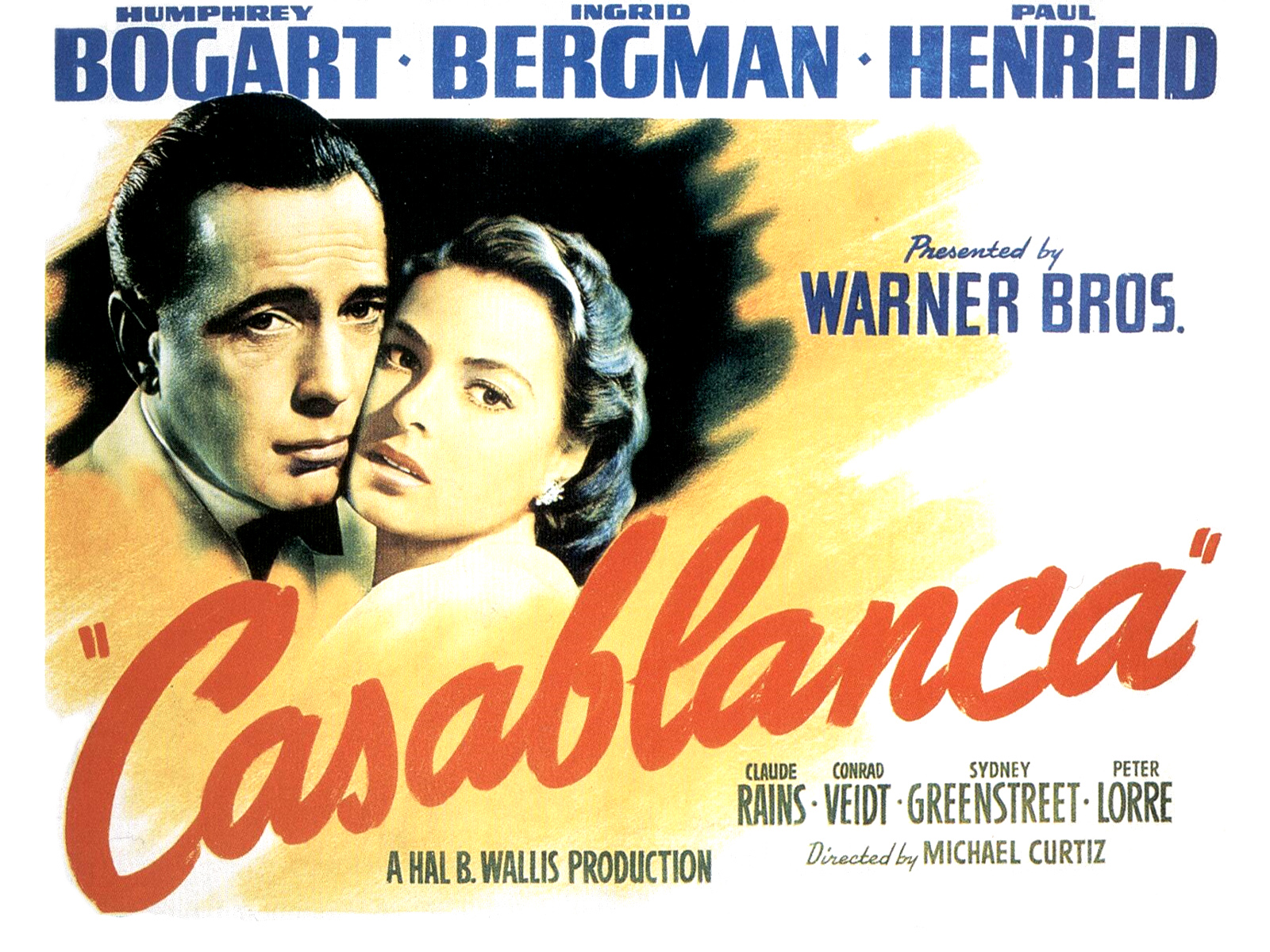
So. Today is the anniversary of the premiere of Casablanca. It premiered on this day in New York City. Reviews were actually mixed - it was seen as just another melodrama that Warner Brothers had become so practiced at churning out - but the public loved it and it went on to win an Academy Award for best picture in 1943. And of course now - the film has reached cult status.
I have put together 5,000 quotes about Casablanca from the book The Making of Casablanca.
Here is one of my favorite anecdotes from the book. hahahaha Claude Rains is one of my favorite actors.
Anyway, I hope you enjoy all the quotes. A couple are in the extended entry here:

Assorted quotes:
Billy Wilder says, "This is the most wonderful claptrap that was ever put on the screen ... Claptrap that you can't get out of your mind. The set was crummy. By God, I've seen Mr. Greenstreet sit in that same wicker chair in fifty pictures before and after, and I knew the parrots that were there. But it worked. It worked absolutely divinely. No matter how sophisticated you are and it's on television and you've seen it 500 times, you turn it on."
Sociologist Todd Gitlin writes:
Casablanca dramatizes archetypes. The main one is the imperative to move from disengagement and cynicism to commitment. The question is why Casablanca does this more effectively than other films. Several other Bogart films of the same period -- Passage to Marseilles, To Have and Have Not, Key Largo -- enact exactly the same conversation. But the Rick character does not simply go from disengagement to engagement but from bitter and truculent denial of his past to a recovery and reignotion of the past. And that is very moving, particularly because it is also associated with Oedipal drama. But there is also a third myth narrative, a story about coming to terms with the past. Rick had this wonderful romance; he also had his passionate commitment. It seems gone forever. But you can get it back. That is a very powerful mythic story, because everybody has lost something, and the past it, by definition, something people have lost. This film enables people to feel that they have redeemed the past and recovered it, and yet without nostalgia. Rick doesn't want to be back in Paris. And the plot is brilliantly constructed so that these three myths are not three separate tales, but one story with three myths rushing down the same channel.
Aljean Harmetz, author of The Making of Casablanca writes:
I was in elementary school during World War II; I did my part in the war by rolling tinfoil and rubber bands into balls and bringing them to the Warners Beverly Theatre on Saturday mornings. World War II had receded with all its certainties and moral imperatives, leaving muddy flats behind. The world is a cornucopia of grays. I believed the romantic interpretation of Casablanca then -- love lost for the good of the world -- and believe it now. But it is the very ambiguity of Casablanca that keeps it current. Part of what draws moviegoers to the movie again and again is their uncertainty about what the movie is saying at the end ...Casablanca's potent blend of romance and idealism -- a little corny and mixed with music and the good clean ache of sacrifice and chased down with a double slug of melodrama -- is available at the corner video store, but Casablanca couldn't be made today. There is too much talk and not enough action. There are too many characters too densely packed, and the plot spins in a hard-to-catch-your-balance circular way instead of walking a straight line. There is no Humphrey Bogart to allow the audience a permissible romance without feeling sappy. And the studio would insist that all the ambiguity be written out in the second draft.
Happy birthday, Casablanca! Hard to imagine the American film landscape without it.
Casablanca Appreciation Day
From The Making of Casablanca:
"Bogart had competence," says Billy Wilder. "You felt that, if that big theatre where you were watching Casablanca caught on fire, Bogart could save you. Gable had that same competence and, nowadays, Mr. Clint Eastwood." But Gable is too heroic for a disillusioned world. Three decades after his death, Bogart still seems modern. "He wore no rose-colored glasses," wrote Mary Astor. "There was something about it all that made him contemptuous and bitter. He related to people as though they had no clothes on -- and no skin, for that matter."
Continued below:
Film critic Stanley Kauffmann was born in 1916 and has watched six generations of film heroes. "People never go to see my favorite American film actor of all, Fredric March," says Kauffmann ruefully. "Bogart absolutely encapsulates permissible romance. In this disillusioned, disenchanted world here was a romantic hero we could accept. I think that that disenchantment began with World War I and the emergence of what could be called the Hemingway -- the undeluded -- generation. And I think that that revulsion with the romances and the lies of the nineteenth century and the twentieth century has persisted. There have been plenty of representatives of the lovely bucolic strain of American life on the screen. Bogart was someone urban -- in a sense more jagged and abrasive than Cagney -- who you felt was suffering. Cagney was triumphant. Bogart was tough, but he had sensitivity. Certainly the epitome he stood for was in Casablanca. I was misinformed. That's the twentieth century."
Casablanca Appreciation Day
From The Making of Casablanca:
Of the seventy-five actors and actresses who had bit parts and larger roles in Casablanca, almost all were immigrants of one kind or another. Of the fourteen who were given screen credit, only Humphrey Bogart, Dooley Wilson, and Joy Page were born in America. Some had come for private reasons. Ingrid Bergman, who would lodge comfortably in half a dozen countries and half a dozen languages, once said that she was a flyttfagel, one of Sweden's migratory birds. Some, including Sydney Greenstreet and Claude Rains, wanted richer careers. But at least two dozen were refugees from the stain that was spreading across Europe. There were a dozen Germans and Austrians, nearly as many French, the Hungarians SZ Sakall and Peter Lorre, and a handful of Italians.
Continued below
"If you think of Casablanca and think of all those small roles being played by Hollywood actors faking the accents, the picture wouldn't have had anything like the color and tone it had," says Pauline Kael.Dan Seymour remembers looking up during the singing of the Marseillaise and discovering that half of his fellow actors were crying. "I suddenly realized that they were all real refugees," says Seymour.
Casablanca Appreciation Day
From The Making of Casablanca:
Bogart and Rains admired each other, and that admiration comes through their scenes together. What seems to be a genuine friendship between Rick and Renault takes the sting out of the ending of Casablanca. "My father loved Humphrey Bogart," says Jessica Rains. "He told me so." The cockney who turned himself into a gentleman was unexpectedly compatible with the gentle-born son of a doctor and a famous illustrator who turned himself into a rowdy. "Professional" is the word the people they worked with pin, like a badge, to both men. "Bogart never missed a cue," says script supervisor Meta Carpenter. "He was completely professional." Rains, says assistant director Lee Katz, "was very professional altogether." To the Warner hairdressers, said Jean Burt, Bogart and Bette Davis were "the real pros. They were on time; they knew their lines; they knew their craft."
Casablanca Appreciation Day
From The Making of Casablanca:
[During shooting] Bogart was snappish and moody. Love scenes were uncharted waters for him. "I've always gotten out of my scrapes in front of the camera with a handy little black automatic," he told a journalist who visited the Casablanca set during production. "It's a lead pipe cinch. But this. Well, this leaves me a bit baffled." The interview is typically frothy and insubstantial as Bogart plays with the idea of becoming a sophisticated lover or a caveman lover. But, even as he jokes about it, his uneasiness is obvious. "I'm not up on this love stuff and don't know just what to do."
Continued below
According to a memoir by Bogart's friend Bathaniel Benchley, before Casablanca began shooting, a mutal friend, Mel Baker, advised Bogart to stand still and make Bergman come to him in the love scenees. Bogart appears to have taken the advice, but his reticence may have been as much innate as calculated. Nearly a dozen years after Casablanca, Bogart told a biographer that love scenes still embarrassed him. "I have a personal phobia maybe because I don't do it very well," he said.
"What the women liked about Bogey, I think," said Bette Davis, "was that when he did love scenes he held back -- like many men do -- and they understood that." Miscast as an Irish horse trainer in Dark Victory, Bogart had tried to make love to Davis, who played his rich employer. Said Davis, "Up until Betty Bacall I think Bogey was really embarrassed doing love scenes, and that came over as a certain reticence. With her he let go, and it was great. She matched his insolence."
However distant Bogart and Bergman may have been from each other in real life, and however uneasy Bogart may have been with Bergman in his arms, their love scenes have the poignancy and passion that Hollywood calls chemistry. "I honestly can't explain it," says Pauline Kael, "but Bogart had that particular chemistry with ladylike women. He had it with Katherine Hepburn in The African Queen and he so conspicuously had it with Lauren Bacall -- who pretended to be a tough girl but really wasn't -- in To Have and Have Not. But he didn't have it with floozy-type girls."
Critic Stanley Kauffmann explains the match between Bogart and Bergman as the resonance of a relationship between brash America and cultured Europe. "She was like a rose," he says. "You could almost smell the fragrance of her in the picture, and you could feel his whiskers when you looked at the screen. It was intangible."
Casablanca Appreciation Day
From The Making of Casablanca:
Of the stars, Bergman had the more difficult job. Bogart had only to play a man in love. Foreshadowing without giving away too much, Bergman had to let the audience know that love wasn't enough.ILSA. And I hate this war so much. Oh, it's a crazy world. Anything can happen. If you shouldn't get away, I mean, if something should happen to keep us apart. Wherever they put you and wherever I'll be, I want you to know that I -- Kiss me! Kiss me as though it were the last time.
Continued below
And Bergman had to hold the audience even when she was saying dialogue that was so richly romantic that it was almost a parody, including, "Was that cannon fire? Or was it my heart pounding?"
Her voice and her face could make almost anything believable. In 1947, several top sound men agreed that Bergman had the sexiest voice of any actress. "The middle register of her voice is rich and vibrant, which gives it a wonderfully disturbing quality," said Francis Scheid. "It's sexy in a refined, high-minded way." "The face is quite amazing," says Pauline Kael. "I think she had a physical awkwardness on the stage and in her early films, but I think somehow that the beauty of her face obviated it. Even in Casablanca, her physical movements are not very expressive. But you didn't really care."
Casablanca Appreciation Day
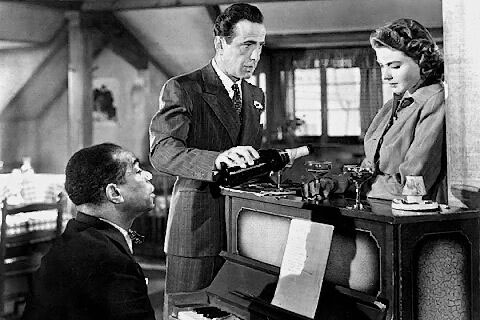
From The Making of Casablanca:
Casablanca started on Stage 12A with the flashback to Rick and Ilsa's romance in Paris. It was an accident that Bogart was required to make love to Bergman almost before he was introduced to her. Originally, production was to start in Rick's Cafe on Stage 8, but the intricate clockwork that matched actors, scripts, stages, and sets had been thrown off because Irving Rapper was two weeks behind schedule on Now, Voyager. Claude Rains didn't finish his role as the wise psychiatrist in Now, Voyager until June 3. Paul Henreid was not free until June 25. So the [Michael] Curtiz movie began with the scene in the Montmartre cafe. The first day, a lovestruck Richard Blaine -- "His manner is wry but not the bitter wryness we have seen in Casablanca" say the stage directions -- pours champagne for himself, Ilsa, and Sam while the Germans march toward Paris and Sam plays, "As Time Goes By".
Continued below:
According to Geraldine Fitzgerald, Bogart and Bergman had lunch together a week or ten days before Casablanca started production. "I had lunch with them," she says. "And the whole subject at lunch was how they could get out of the movie. They thought the dialogue was ridiculous and the situations were unbelievable. And Ingrid was terribly upset because she said she had to portray the most beautiful woman in Europe, and no one would ever believe that. It was curious how upset she was by it. 'I look like a milkmaid,' she said.
Casablanca Appreciation Day
From The Making of Casablanca:
"I remember," says film critic Pauline Kael, "my friends and I talked about when are the executives going to discover this guy [Humphrey Bogart]. It was early in his career, when he appeared in horror movies and all sorts of stuff that Warners threw at him. We liked him years before he got the leading roles. he was small, but he knew how to use every part of himself. By the late thirties, he was quite in charge of everything in his performance. He had a tension, like a coiled spring. You didn't want to take your eyes off him."
Continued below:
In The Maltese Falcon, as Dashiell Hammett's detective Sam Spade, Bogart carried to the right side of the law the wary watchfulness, the cynicism, and the ambiguities that had infused his deadliest killers. "I think it was his very best performance," says Kael, who was twenty years old in 1941 when she saw the movie for the first time. "Because you got a sense of the ambivalances in th eman, and he used all the tensions marvelously physically. I don't think he could have been as good as he was in Casablanca if he hadn't done the Falcon first, because he really discovered his powers in the Falcon. he created more tension in his scenes than he ever had before. And I think afterwards he drew on the qualities he had discovered in himself in the Falcon. So I think it was [John] Huston who brfought those things out. And [Michael] Curtiz benefited from them."...The arc of Bogart's career at Warner Brothers can be seen in how and when he chose to fight Warner -- and with what success. Bogart was suspended for refusing to play the part of the outlaw Cole Younger in Bad Men of Missouri ... His suspension ended in June 1941, when George Raft, whose career decisions at Warners were unerringly wrong, refused The Maltese Falcon because "it is not an important picture." And what would have happened if Raft had agreed to play Sam Spade? The odds are high that Bogart would have made a breakthrough in some other movie. The disillusionment, stoicism, and weary aloofness that he brought to the screen fit the heroes of a new kind of movie melodrama, film noir, too well to have gone unnoticed ...
Warner Brothers could overuse and misuse its actors. It could dump Van Johnson and Susan Peters in 1942 and let MGM build their careers. But the studio would not have remained in business if it had missed the obvious. The Maltese Falcon had been immensely profitable, and George Raft was becoming more difficult with every role he was offered. In January 1942, Bogart demanded $3,000 a week and the right to do ten guest radio appearances a year. He was given a new contract, starting at $2,750 a week. After six years at Warners, Bogart finally had a star's contract. Warner Brothers was stuck with him for seven years, and the studio began to look for a role that would turn him into a romantic lead.
On February 14, [Hal] Wallis sent a memo to Steve Trilling: "Will you please figure on Humphrey Bogart and Ann Sheridan for Casablanca, which is scheduled to start the latter part of April." Six weeks later, Jack Warner wrote Wallis that George Raft was lobbying him for the role. Wallis held firm and Casablanca had the first of its three stars.
Casablanca Appreciation Day
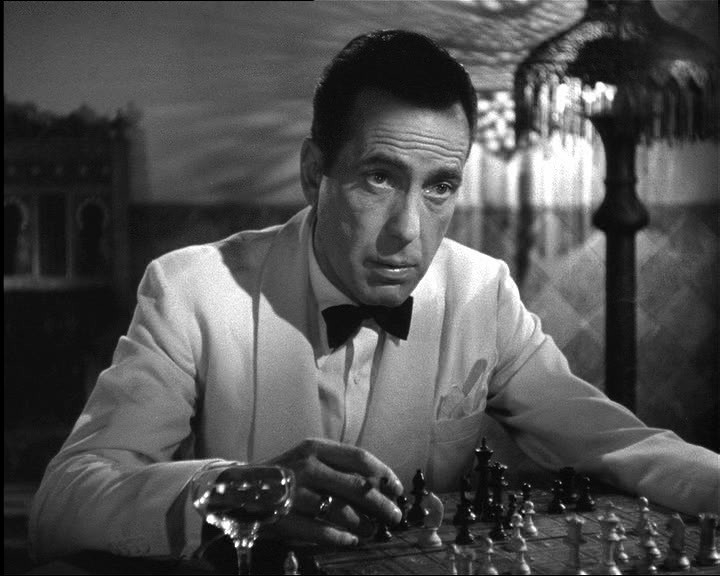
From The Making of Casablanca:
Much of the major work on the Casablanca screenplay was done between April 6, when Howard Koch was assigned to the movie, and June 1, when a revised final script was mimeographed ...Each subsequent script for Casablanca became leaner and sharper, more economical, the scenes rearranged for greater dramatic effect and the speeches polished and clipped. Within the confines of a studio that both Koch and Julie Epstein describe as 'a family", Koch rewrote the Epsteins to give the movie more weight and significance, and the Epsteins then rewrote Koch to erase his most ponderous symbols and to lighten his earnestness.
Continued below:
This kind of survival-of-the-fittest script is unlikely to happen today, when writers, director, and studio executives come insecurely and suspiciously together to make a single movie, the original writer is rarely brought back after his work is rewritten, and screen credit means that someone gets extra money from television and videocassette sales...At the beginning of May, the Epsteins finished the second section of the script of Casablanca, while Howard Koch turned in his revision of the Epsteins' first act. Earlier, in nineteen pages of suggestions of "Suggestions for Revised Story", Koch had warned:
There is also a danger that Rick's sacrifice in the end will seem theatrical and phony unless, early in the story, we suggest the side of his nature that makes his final decision in character. It would be interesting to have Renault penetrate the mystery in his first scene with Rick when he guesses that the cynical American is underneath, a sentimentalist. Rick laughs at the idea, then Renault produces his record -- "ran guns to Ethiopia", "fought for the Loyalists in the Spanish War." Rick says he got well paid on both occasions. Renault replies that the winning side would have paid him better. Strange that he always happens to be on the side of the underdog. Rick dismisses the implication, but throughout the picture we see evidences of his humanity, which he does his best to cover up.Koch's script of May 11 also deepened Rick's character and underlined the political tensions in subtle ways. For example, Koch makes the man Rick bars from his gambling room -- who was an English cad in the play -- into a representative of the Deutschebank. When the owner of the Blue Parrot offers to buy Rick's Cafe, Koch has added dialogue in which the character played by Sidney Greenstreet also offers to buy Sam, and Rick says, "I don't buy or sell human beings." (In their rewrite of Koch's script, the Epsteins would build on Koch's line by having Greenstreet respond, "That's too bad. That's Casablanca's leading commodity.") If Koch layered the politics rather heavily -- in his version, Victor Laszlo forces Renault to toast liberte, egalite, fraternite -- the Epsteins would remove those speeches in the script of June 1. With delicate balance, Koch managed to hold down the gags while the Epsteins managed to cut out the preaching.
Casablanca Appreciation Day
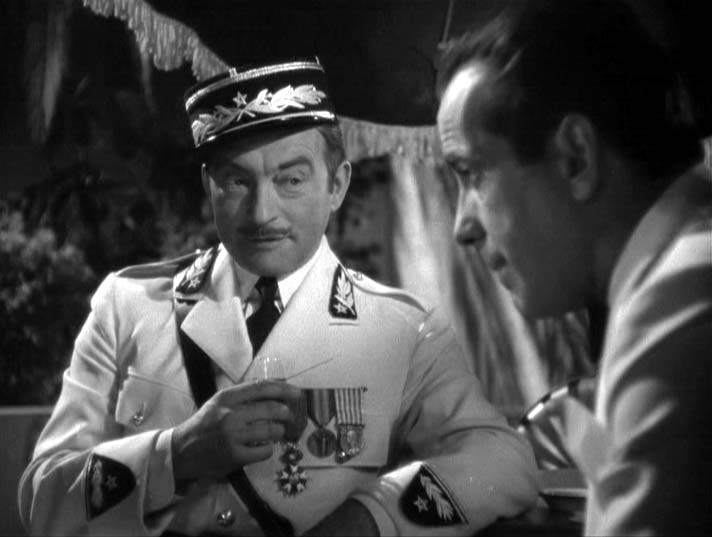
From The Making of Casablanca:
In the Epsteins' first script, Lois is still Lois and Renault's womanizing still has an unpleasant edge. However, the groundwork has been laid for the relationship between Rick and Renault, which may lie as close to the emotional heart of the film as the relationship between Rick and Ilsa. The Epsteins have created a bantering between equals, an admiration at the edges of the frame.
Continued below
RENAULT. I have often speculated on why you do not return to America. Did you abscond with the church funds? Did you run off with the President's wife? I should like to think you killed a man. It is the romantic in me.
RICK. It was a combination of all three.
RENAULT. And what in Heaven's name brought you to Casablanca?
RICK. My health. I came to Casablanca for the waters.
RENAULT. Waters? What waters? We are in the desert.
RICK. I was misinformed.
Says Epstein today: "My brother and I tried very hard to come up with a reason why Rick couldn't return to America. But nothing seemed right. We finally decided not to give a reason at all."
Casablanca Appreciation Day
From The Making of Casablanca:
The sixty-six pages of script, labeled Part I TEMP., were mimeographed on April 2. The Epsteins had written the first third of the movie, the section preceding the flashback to Rick and Ilsa's Paris romance. Ilsa and her Resistance-hero husband had come to Casablanca, and at the end of the Epsteins' script, Rick was sprawled drunkenly in his empty cafe, waiting for her to return."That first part was very close to the play," Epstein says. "It was with the second half that we had trouble."
Continued below:
Those sixty-six pages mirror the final movie. The Epsteins even begin with a spinning globe, an animated map, and a description of the refugee trail that leads to Casablanca. Everybody Comes to Rick's took place inside Rick's Cafe, and Rick was the first character to be introduced. The Epsteins start by creating the feel of Casablanca: A man whose papers have expired is short by the police; a pickpocket warns his victims that vultures are everywhere; refugees look up longingly as an airplane brings the Gestapo captain (a few scripts later he was promoted to major) Strasser to Casablanca and lands beyond a neon sign that reads RICK'S. Inside the cafe, a dozen desperate refugees try to buy or sell their way to freedom. Rick is not introduced until page 15, when a hand writes "Okay -- Rick" on the back of a check and the camera pulls back to a medium shot of Humphrey Bogart. And the plot is driven by an invention of the Epsteins: the Letters of Transit were being carried by two German couriers who have been murdererd.Of the four major characters in Everybody Comes to Rick's, only the noble Victor Laszlo remains essentially the same in the movie. Rick, who in the play is a self-pitying married lawyer who has cheated on his wife, takes on Bogart's persona of wary, hooded toughness. Says Jules Epstein: "Once we knew that Bogart was going to play the role, we felt he was so right for it that we didn't have to do anything special. Except we tried to make him as cynical as possible."
Casablanca Appreciation Day
From The Making of Casablanca:
However, there was no mistaking the fact that Casablanca, with its snappy dialogue, eccentric characters, witty cynicism, wary anti-hero and liberal political message was definitely a Warner movie. Casablanca is a less raw and angry melodrama than the studio might have made a few years earlier, but it has the same distrust of authority and suspicion of human nature. America's entry into the war was already softening movies by requiring them to throb with patriotism, but the milieu of Casablanca is still corrupt, and the little people still don't get a fair shake.
Casablanca Appreciation Day
From The Making of Casablanca:
Bogart's response to the success of Casablanca was more typically sardonic. He enjoyed telling his fourth wife, Lauren Bacall, how Charles Enfield, the studio's head of publicity, had had the amazing revelation that the actor had sex appeal. Says Bacall, "Bogie would say, 'Of course, I did nothing in Casablanca that I hadn't done in twenty movies before that, and suddenly they discover I'm sexy. Any time that Ingrid Bergman looks at a man, he has sex appeal.'"
Casablanca Appreciation Day
From The Making of Casablanca:
Warner Brothers was the most frugal of the studios, and little was wasted there in 1942. World War II gave the studio's president, Harry Warner, an excuse to pick up nails dropped by careless carpenters. But he had obsessively picked up nails before the war made iron scarce. Casablanca moved onto the French Street created for The Desert Song the day after that film moved off. A few signs and two live parrots turned the French Morocco of heroic freedom fighter El Khobar into the French Morocco of heroic freedom fighter Victor Laszlo. And half a dozen bit players with foreign accents got a full week's work by straddling the two films. More than half of the movies Warners made in 1942 dealt in one way or another with the war, a bonanza for actors who had fled from Berlin or Vienna. Casablanca was filled with those Jewish refugees, many of them playing Nazis.
Specifics
Alex has up a really nice post right now, praising my observations about Bud White and Russell Crowe in that role. She writes: "I love people that notice the little things about actors."
Speaking of noticing specific little things about actors - you have GOT to check out Alex's ginormous post about Streetcar Named Desire.
AMAZING! Go read the whole thing, but here is what Alex has to say about Kim Hunter's portrayal of Stella:
Hunter's Oscar winning (and Tony winning) perfromance is stunning. In one of the scenes Kazan was forced to cut out in the final edit, Hunter stands on the stairs after Brando's violent outburst. There's a look of primitive lust in her eyes that the censors of the 50's found "morbid" and "disgusting". Elia was forced to remove the scene. If you get the Director's cut, you can see this amazing 2 minutes on screen. Hunter shows a side to Stella that helps us understand why she needed him. Craved him. And wanted him badly to "taker her off of that high white cloumn in those fancy pictures." She is in desperate need of him on a very basic level. It's miraculous.
Yup. If you can get your hand on the Director's Cut - you really have got to see it.
Alex writes about how the balance of the play shifted in the casting of Brando. Brando was so powerful on stage that although he was a brute, and a rapist, audiences sided with him. Elia Kazan had been very concerned about that from very early on in the rehearsals when it became apparent which way the wind was blowing. He could tell that what Brando was doing was going to change everything ... but would it be right for the play???
Here is how Kazan describes that whole process - and listen to how Tennessee Williams responds. Incredible:
But what had been intimated in our final rehearsals in New York was happening. The audiences adored Brando. When he derided Blanche, they responded with approving laughter. Was the play becoming the Marlon Brando Show? I didn't bring up the problem, because I didn't know the solution. I especially didn't want the actors to know that I was concerned. What could I say to Brando? Be less good? Or to Jessie? Get better? ... Louis B. Mayer sought me out to congratulate me and assure me that we'd all make a fortune ... He urged me to make the author do one critically important bit of rewriting to make sure that once that "awful woman" who'd come to break up that "fine young couple's happy home" was packed off to an institution, the audience would believe that the young couple would live happily ever after. It never occurred to him that Tennessee's primary sympathy was with Blanche, nor did I enlighten him ... His misguided reaction added to my concern. I had to ask myself: Was I satisfied to have the performance belong to Marlon Brando? Was that what I'd intended? What did I intend? I looked to the author. He seemed satisfied. Only I -- and perhaps Hume [Cronyn, Tandy's husband] -- knew that something was going wrong ...What astonished me was that the author wasn't concerned about the audience's favoring Marlon. That puzzled me because Tennessee was my final authority, the person I had to please. I still hadn't brought up the problem, I was waiting for him to do it. I got my answer ... because of something that happened in the Ritz-Carlton Hotel, across the hall from my suite, where Tennessee and Pancho [Tennessee's companion at the time] were staying. One night I heard a fearsome commotion from across the hall, curses in Spanish, threats to kill, the sound of breaking china ... and a crash ... As I rushed out into the corridor, Tennessee burst through his door, looking terrified, and dashed into my room. Pancho followed, but when I blocked my door, he turned to the elevator still cursing, and was gone. Tennessee slept on the twin bed in my room that night. The next morning, Pancho had not returned.
I noticed that Wiilliams wasn't angry at Pancho, not even disapproving -- in fact, when he spoke about the incident, he admired Pancho for his outburst. At breakfast, I brought up my worry about Jessie and Marlon. "She'll get better," Tennessee said, and then we had our only discussion about the direction of his play. "Blanche is not an angel without a flaw," he said, "and Stanley's not evil. I know you're used to clearly stated themes, but this play should not be loaded one way or the other. Don't try to simplify things." Then he added, "I was making fun of Pancho, and he blew up." He laughed. I remembered the letter he'd written me before we started rehearsals, remembered how, in that letter, he'd cautioned me against tipping the moral scales against Stanley, that in the interests of fidelity I must not present Stanley as a "black-dyed villain". "What should I do?" I asked. "Nothing," he said. "Don't take sides or try to present a moral. When you begin to arrange the action to make a thematic point, the fidelity to life will suffer. Go on working as you are. Marlon is a genius, but she's a worker and she will get better. And better."
And if you're interested - here's my tribute to Marlon, written right after he died.
Anyway: please go read Alex's post.
Have you ever ...
Fun - I got this from Chai-rista:
HAVE YOU EVER:
Smoked a cigarette or tried it: Yes.
Crashed a friend's car: No. But I did crash the car (in a very mild fender-bender way) DURING MY DRIVER'S TEST. Needless to say, I failed.
Stolen a car: No
Been dumped: Oh God, yes. It sucks, don't it?
Shoplifted: I'm sure I have, but I cannot remember what item.
Been fired /laid off: Yeah - I was laid off by this real estate firm I worked for in Chicago. It was awesome. I collected unemployment for the entire winter.
Been in a fist fight: Uhm ... no fists ... but it did involve a broken pool cue, a karate kick, and 10 firemen trying to hold the two of us apart.
Snuck out of your parent's house: Snuck? I'm sure I have, but I can't remember why.
Been arrested: No
Gone on a blind date: I honestly can't remember. Probably.
Lied to a friend: Yup.
Skipped school: Just like Chai-rista - I skipped classes in college, but never in high school.
Seen someone die: Well, I saw the World Trade Center collapse. So yes. I saw thousands of people die in one moment.
Been to Canada: Yes.
Been to Mexico: No.
Eaten Sushi: Yes. As often as I can!
Met someone in person from the internet: Totally! Only from when I started blogging though. Well, actually, I guess my three Match.com dates would qualify as well.
Taken pain-killers: Of course.
Had a tea party: No.
Cheated while playing a game: I'm sure I have, but I don't remember when.
Fallen asleep at work: No.
Used a fake ID: Nope
Felt an earthquake: Yup. I lived in San Fran and LA so I felt the tremors.
Touched a snake: Yup.
Been robbed: Uhm ... don't think so.
Petted a reindeer/goat: I have touched a goat. I admit it.
Won a contest: I won an art contest when I was ... 8? We had to design our own flag for the state of Rhode Island - and I won 2nd place. It was hung in a local art gallery.
Been suspended from school: No.
Been in a car accident: Yes - but all pretty minor ones.
Had braces: Yup.
Eaten a whole pint of ice cream in one night: I'm sure I have. But it's not a compulsive regular thing with me like it is for some girls. You know, the whole: "Oh God, he dumped me, let me eat a vat of ice cream." I'm more like: "Oh God, he dumped me, let me eat 5 pieces of pita bread. And let me be REALLY bad: I'm gonna eat 5 pieces of the NON whole wheat pita bread!"
Witnessed a crime: Yup.
Swam in the ocean: To anyone who answers "No" to this question, I am truly sorry for you.
Sung karaoke: As often as I can.
Paid for a meal with only coins: hahahaha I love this question. And yes - I have. I remember it vividly. It was in college - at Del Mor's. Counting out PENNIES to pay for my sandwich. heh heh heh
Laughed until some kind of beverage came out of your nose: Oh God yes.
Been kissed under mistletoe: I guess I should remember if I have, but I don't.
Crashed a party: Yes. The most memorable was Brooke and I crashing a luau party at some frat in college. Insanity ensued. Right, David??
Worn pearls: Yes
Jumped off a bridge: No.
Ate dog/cat food: Ew. No.
Kissed a mirror: Yup. You know, a girl has to practice her technique when she's only 13.
Glued your hand to something: No.
Done a one-handed cartwheel: Yes
Talked on the phone for more than 6 hours: Probably - although you think I would remember something like that.
Didn't take a shower for a week: Yup. I lived out of a camper van for 2 months. Hygiene was pretty sketchy. When we got to Moab, and checked into a cheap motel as a huge splurge, we both took 20, 25 minute showers apiece. Awesome feeling.
Pick and ate an apple right off the tree: Yes.
Been told by a complete stranger that you're hot: Yup. More than once, actually. But only one turned into a major love affair type situation. We met in a bar. He stopped me as I strolled by to the jukebox or whatever, and blurted out, in his awkward goofy sexy way, his opinion of my ... attributes. It stopped me dead in my tracks ... should I pretend to be insulted? Should I say, 'Thanks' ... what happens now? I had already had my eye on him for a while, though - he had caught my eye in a BIG way ... so to know that he obviously had had his eye on me as well - to have him approach me even in an awkward, "Excuse me, but you are so hot" way was AWESOME. And whaddya know, that night launched a thousand ships, and years later he was crawling through my window (or other people's windows, as the case may be) on a regular basis just to say Hi. To this day, he still remembers what I was wearing that first night. hahahaha So you never know what will happen!! Drunken encounters in bars don't always have to mean only one thing! Sometimes when guys say, "You're hot" it comes out in a hostile way ... or it's ... yukky ... It's like they hurl it at you ... It is in no way a compliment. Instead of a conversation STARTER it's a conversation ENDER ... but sometimes it comes out and it is such a compliment that it completely disarms you. Window-Boy should give seminars on how he hit on me that night. First of all: he sealed the deal. He got my digits. Very important. Granted, he asked my FRIEND for my digits, not me ... and I totally busted him doing this ... "Are you asking HER for MY phone number?" He looked so GUILTY ... muttered something like, "I ... didn't want to scare you away any more than I already have ..." hahahaha But the important thing is: he got my digits. He did not let the moment slip away. When he said goodbye to me that night, about half an hour after he scored my digits, he impulsively kissed me on the cheek - out of nowhere - we had barely said 5 words to each other, and he said, "I'm totally gonna call you. You're just so pretty." So ... let's just say ... with the combination of open interest and sweet awkwardness (mixing in the "you're hot" with the "you're just so pretty" and the kiss on the cheek as though we were in a production of Our Town - or, Our Town with beer, let's say) - he had me hook, line, and sinker. AND - he called me 3 days later. hahaha The requisite 3 days. But he did call. I don't know. The guy was amazing. I'm not easy, shall we say. I'm not a flirt. But whatever he did, it worked.
The Books: "Hello from Bertha" (Tennessee Williams)
And here is my next excerpt of the day from my library. Still in Tennessee Williams land.
Next Tennessee Williams play on the shelf is a one-act called Hello from Bertha.
This play takes place in "the valley" - a red-light district in East St. Louis. Bertha, a whore who works in a whore-house, is ... well, she's dying. But she won't admit it. Something is seriously wrong with her. She has been lying on her bed for two weeks, unable to do anything, she feels awful, she knows deep down inside that this is the end. Goldie, the woman who runs the whore-house, comes into Bertha's room at the top of the play and demands: "what are you going to do?" Basically, she can't continue to put Bertha up if Bertha will no longer work and bring in money. Goldie is not a bad woman, just a practical business-minded woman - so she pushes Bertha to decide: what are you going to do? Bertha resists, becoming hysterical. Goldie threatens to call the hospital and have her taken away. Goldie then suggests that Bertha write to "Charlie" - Charlie owns a hardware store in Memphis and Bertha used to work in the store before she moved away. And from the sound of it, they had a torrid affair, involving "the back room" of the store, etc. This was years ago. But apparently, Charlie once said to her: "If you ever need anything, you just let Charlie know." Bertha has never forgotten. Charlie is now married, with a kid ... but Bertha still remembers Charlie, and kind of keeps the Charlie option open in her heart ... as something that she can always call upon when things get too bad. (As an audience member, I am not so sure of Charlie's goodness - he sounds like a sleaze-bag to me - but I think that's the whole point. It doesn't matter what I think - to this Bertha person, she would not have been able to get through her rough years as a whore without knowing that out there, somewhere, was a man who had been kind to her, and cared about her welfare. Loneliness does horrible things to a person's soul.) Bertha has Charlie's address memorized. Goldie keeps telling her to write to him, have him wire some money, help her out so she can get looked at by a doctor ... Bertha gets more and more hysterical. Bertha probably has some kind of mental illness - she's paranoid, suspicious, delusional, etc. Goldie keeps pushing her to decide - she asks her if she wants a priest, she thinks it might be time to confess her sins ... it is obviously the end of the road for Bertha. Finally, Goldie leaves the room - and she does, indeed, go and call an ambulance to come take Bertha away. But we don't know that. Bertha is left alone in her room for a bit. She is hysterical.
I'll excerpt from that point to the end of the play.
From Hello from Bertha, by Tennessee Williams
BERTHA. Oh, Charlie, Charlie, you were such a sweet, sweet! [Her head rocks and she smiles in agony] You done me dirt more times than i could count, Charlie -- stood me up, married a little choir-singer -- Oh, God! I love you so much it makes my guts ache to look at your blessed face in the picture! [Her ecstasy fades and the look of schizophrenic suspicion returns] Where's that hell-cat gone to? Where's my ten dollars? Hey, YOU!! Come back in here with that money! I'll brain you if ever I catch you monkeying around with any money belonging to me! ... Oh, Charlie ... I got a sick headache, Charlie. No, honey. Don't go out tonight. [She gets up from the rocker] Hey, you! Bring me a cold ice-pack -- my head's aching. I got one hell of a hang-over, baby! [She laughs] Vagrancy, huh? Vagrancy your Aunt Fanny! Get me my lawyer. I got influence in this town. Yeah. My folks own half the oil wells in the state of -- of -- Nevada. [She laughs] Yeah, that's a laugh, ain't it? [Lena, a dark Jewish girl in pink satin trunks and blouse, comes in the door. Bertha looks at her with half-opened eyes] Who're you?
LENA. It's me, Lena.
BERTHA. Oh, Lena, huh? Set down an' take a load off yer feet. Have a cigarette, honey. I ain't feeling good. There ain't any cigarettes here. Goldie took 'em. She takes everything I got. Set down an' -- take a --
LENA. [in doorway] Goldie told me you weren't feelin' so good this evening so I thought I'd just look in on you, honey.
BERTHA. Yeah, that's a laugh, ain't it? I'm all right. I'll be on the job again tonight. You bet. I always come through, don't I, kid? Ever known me to quit? I may be a little down on my luck right now but -- that's all! [She pauses, as if for agreement] That's all, ain't it, Lena? I ain't old. I still got my looks. Ain't I?
LENA. Sure you have, Bertha. [There is a pause]
BERTHA. Well, what're you grinning about?
LENA. I ain't grinning, Bertha.
BERTHA. [herself slightly smiling] I thought maybe you thought there was something funny about me saying I still had my looks.
LENA. [after a pause] No, Bertha, you got me wrong.
BERTHA. [hoarsely] Listen, sweetheart, I know the Mayor of this God damn little burg. Him and me are like that. See? I can beat any rap you try to hang on me and I don't give a damn what. Vagrance, huh? That's a sweet laugh to me! Get me my traveling bag, will you, Lena? Where is it? I been thrown out of better places than this. [She rises and drags herself vaguely about the room and then collapses on bed. Lena moves toward the bed] God, I'm too tired. I'll just lay down till my head stops swimming ... [Goldie appears in the doorway. She and Lena exchange significant glances]
GOLDIE. Well, Bertha, have you decided yet?
BERTHA. Decided what?
GOLDIE. What you're gonna do?
BERTHA. Leave me be. I'm too tired.
GOLDIE. [casually] Well, I've called up the hospital, Bertha. They're sending an ambulance around to get you. They're going to put you in a nice clean ward.
BERTHA. Tell 'em to throw me in the river and save the state some money. Or maybe they're scared I'd pollute the water. I guess they'll have to cremate me to keep from spreadin' infection. Only safe way of disposin' of Bertha's remains. That's a sweet laugh, ain't it? Look at her, Lena, that slut that calls herself Goldie. She thinks she's big-hearted. Ain't that a laugh? The only thing big about her is the thing that she sits on. Yeah, the old horse! She comes in here talking soft about callin' a priest an' havin' me stuck in the charity ward. Not me. None a that stuff for me, I'll tell you!
GOLDIE. [with controlled fury] You better watch how you talk. They'll have you in the strait-jacket, that's what!
BERTHA. [suddenly rising] Get the hell out! [She throws a glass at Goldie, who screams and runs out. Bertha then turns to Lena] Set down and take a letter for me. There's paper under that kewpie.
LENA. [looking on the dresser] No, there ain't, Bertha.
BERTHA. Ain't? I been robbed a that, too? [Lena walks to the table by the bed and picks up a tablet]
LENA. Here's a piece, Bertha.
BERTHA. All right. Take a letter. To Mr. Charlie Aldrich, owner of the biggest hardware store in the City of Memphis. Got that?
LENA. What's the address, Bertha?
BERTHA. It's 563 Central Avenue. Got it? Yeah, that's right. Mr. Charlie Aldrich. Dear Charlie. They're fixing to lock me up in the city bug-house. On a charge of criminal responsibility without due process of law. Got that? [Lena stops writing] And I'm as sane as you are right this minute, Charlie. There's nothing wrong with my upper-story and there never will be. Got that? [Lena looks down and pretends to write] So come on down here, Charlie, and bail me out of here, honey, for old times' sake. Love and kisses, your old sweetheart, Bertha ... Wait a minute. Put a P.S, and say how's the wife and your -- No! Scratch it out! That don't belong in there. Scrach it all out, the whole damn thing! [There is a painful silence. Bertha sighs and turns slowly on the bed, pushing her damp hair back] Get you a clean sheet of paper. [Lena rises and tears another sheet from the tablet. A young Girl sticks her head in the door]
GIRL. Lena!
LENA. Coming!
BERTHA. Got it?
LENA. Yes.
BERTHA. That's right. Now just say this. Hello from Bertha -- to Charlie -- with all her love. Got that? Hello from Bertha -- to Charlie ...
LENA. [rising and straightening her blouse] Yes.
BERTHA. With all ... her love ... [The music in the lower room recommences]
CURTAIN
November 25, 2005
Announcement
I bought Harry Potter and the Half-Blood Prince on Wednesday. I am already halfway through. Cannot. Put. It. Down.
More thoughts later.
PLEASE NO SPOILERS. I know there's something HUGE coming - I have heard mention of this big thing that goes down in this book - but I have somehow managed to not hear a word of it - so BE CAREFUL WHAT YOU SAY.
Here's where I am now in the book:
Slughorn just hosted his Christmas party. Ron and Hermione are pretty much fighting (it's that whole Howard Hawks type battle of the sexes - when a man and a woman fight all the time, you know they're meant for each other) - Ron is now constantly making out with Lavendar, and Harry feels left out of this whole thing. Harry has yearnings towards Ginny - but Ginny is too busy making out in random corridors with Dean to notice. (hahahaha For me, the book has become all about the teenage romance - not the whole, you know, WIZARDS thing) Draco is up to no good, and Snape has pulled Draco out of the Slughorn party ... Harry eavesdropped on their conversation, and while it is apparent that the two are somehow in league with one another - Harry cannot figure out what is going on. He has become fixated on the fact that Draco must be a Death-Eater. Everyone is pretty much tired of hearing him talk about it. Dumbledore is giving Harry private lessons - where they go into the Pensieve, and take walks down random memory lanes. I have learned of Voldemort's Oliver Twist-esque beginnings.
And that's pretty much where I'm at right now.
I will probably finish it in the next couple of days.
Again: her ability to create an entire vibrant world is pretty much remarkable. I leap into the book - total suspension of disbelief - and I have come to know these people like old friends. Oh, there's old Neville! And there's Parvati! Etc. They are broadly drawn characters, but no less interesting because of that.
Oh, and I have no idea who the Half-Blood Prince is, but Harry Potter is kicking some serious butt in his Potions class because of the marginilia in the Half-Blood Prince's textbook that Harry inherited.
I love, too, how the book opens - and you can tell how the wizard world is at war. Diagon Alley has changed, everyone is frightened, rushing around, locking their doors ... the innocence of the earlier part of the series (even though a lot of bad stuff went down then as well) is gone. Everyone is scared. Nobody trusts anyone. Spies are everywhere.
Great stuff.
The ocean mist turkey bowl
The night before Thanksgiving, Siobhan and I drove down to the Ocean Mist - what amounts to our local pub - to meet up with Jean and Pat. Siobhan is now obsessed with Fiona Apple's latest, and so we blasted it on the way down. I have to say: I only heard the first three tracks and I was blown away. The Ocean Mist is a big rickety shack that sits right on the ocean - there are stilts underneath the deck, and at high tide, the waves roll right under the bar. Apparently, a surfer who had been struggling in the strong rip tide had washed up underneath the deck that very morning and crashed against the pilings. One of the guys in the bar had heard the thud and went running down to see a surfer face down in the sand, the waves pulling him back out. The surfer was alive - and apparently, after he sat upand cleared his head for a second - said he was fine and didn't need to go to the hospital. He strolled off down the beach, as though it were an ordinary morning. Dude - you just smashed against the pilings underneath a fisherman's bar. Maybe you should go get your head checked out? Uhm ... no? Okay, then, happy Thanksgiving!
The white birds were in their usual place, bobbing up and down on the dark waves, lit up by the lights of the bar. So bizarre. Nobody is quite sure why they congregate there, but we discussed many theories. They like the light? Fish hang out there too? The water is warmer? No idea. But the image of them never ceases to startle me - like little white origami formations, clustered together on the dark ocean, going up and down with the surging of the waves.
The Ocean Mist is one of those bars that always gives people an incentive to come back - bands, drink specials, door prizes ... Sadly, they have canceled their very popular open mike night because the guy who was running it had other obligations. So they tried to come up with something, something fun that would keep people there ...
The activity for the night before Thanksgiving was Turkey Bowling. A frozen turkey, wrapped up in electric tape ... a bunch of bowling pins set up on the stage ... and you had to sign up for your turn to Turkey Bowl.
Now before the Turkey Bowl began, everyone was totally making fun of it and laughing at how lame it was. "Man ... they cancel open mike night and all they can do to replace it is a Turkey Bowl???"
And of course - once the Turkey Bowl actually began, it is hard to describe just how INTO it everyone was. The guy running the thing had a clipboard, which we all just thought was hilarious. So official! A local dude with a Red Sox hat on, a big sweatshirt, making checkmarks on his clipboard FOR THE TURKEY BOWL.
The turkey, naturally, had stopped being frozen maybe half an hour into the thing - so it was dripping all over the place. People had to wear surgical gloves so they wouldn't get nasty turkey drips all over them. It soon became clear that you could not ROLL the turkey at the bowling pins ... because, of course, it would not roll. No, you had to HURL it at the bowling pins. So there we all were, on a cold windy night, the waves rolling underneath the bar, the white terns bobbing on the waves outside the window - cheering and shouting at the turkey bowlers. Who were CHUCKING this turkey across the stage with all their might.
Jean, in her fuzzy black angora sweater, threw the turkey across the stage and missed every bowling pin by a mile. I wish I had a photo. Jean, glamorous, black-clad, her long hair, her big black boots, shouting about how it was unfair how far back they had to stand, and could she try again. I was crying with laughter watching Siobhan up on the stage, hurtling a frozen turkey through the air. WHAT ARE WE DOING?? It was awesome.
November 22, 2005
Bud White
Russell Crowe has become such an enormous star in such a relatively short amount of time that it's hard to remember what an impact he made - with his performance of Bud White in LA Confidential.
This was not just about women going crazy with lust (although that was a part of it - a HUGE part of his success, not to be discounted. It had been a while since a guy showed up on the scene who made women go that nuts). This was about something else. Men went nuts too. At least in my crowd - the actor crowd. His performance as Bud White made the actors I know PUMPED. They wanted to BE him ... he also validated something within them ... the man of action, the man of simple right and wrong morality - and yet, of course, he had the complexity within him that made him an interesting character. I remember my friend Wade saying to me (an incredible actor himself): "When he breaks that chair, man ... holy SHIT ..."
Bud White is not a happy guy. He's not happy just being the muscle. Watch how excited he gets when he's lying in bed with Kim Basinger, talking about what he really wants to do is work homicide. His whole body language changes. He props himself up on one elbow on the pillow, and suddenly he's as enthusiastic and open as a little boy. But none of his colleagues will ever see that side of him. No male will ever see that side of him. Women are the only ones who will ever be allowed to see his vulnerability. This is a throw-back to old movie stars. Humphrey Bogart, for example. His characters are loners. He may have sidekicks, or worthy foes (like in Casablanca) - but you never really see the guy as having a close male friend. He's too much of an individual, a loner for that. His heart, his soul, is reserved for the female sex. She has to work for it, sure, and she better be worth his trust ... but she's the one who gets to see that side of him. But just like Humphrey Bogart: for Bud White it has to be the right woman. Not all women, no ... but the right woman? Fuggedaboutit. That's why when he realizes she has slept with Exley he is so devastated. Intimacy is not casual for Bud White. He is the opposite of a ladies man. He is a one-woman kinda guy. I would bet that Bud White has actually never had a relationship before Lynn Bracken. Maybe he slept with hookers from time to time, just to have the release, but I think this whole being-in-love thing is new to him. .
But in every other situation, Bud White is all brawn. I love him in the very first scene when he's doing the stakeout outside the house where the guy is beating up the woman. Bud White walks up onto the lawn - watch how he walks - the impulse, the objective is IN the way he walks. It's not Russell Crowe's walk, people. It's Bud White's walk. The bulldog, moving forward, on impulse - he WILL stop the beating. He has no idea how, but he WILL stop it. He sees the cord leading up to the Santa on the roof, and it's just a glance - a quick glance - he sees the cord leading up, he quickly assesses the situation - he reaches out, and gives the cord a huge YANK. The Santa comes crashing off the roof. Now: I just love that quick glance he gives before he pulls it down. This is the first scene of the film. This is when Bud White is established. There's a lot going on in that first scene, a lot of information comes at us: we see that obviously something about domestic violence drives this guy nuts. He's FIXATED on it. Okay, so we've got that. That's important to know - that is Bud White's entire raison d'etre - it isn't just what he does, it is who he is. We also see that his partner kind of treats him with bemused tolerance. We see how Bud White beats the CRAP out of the violent husband. This is more information. Bud White will not play by the rules when it comes to people beating up on innocents. Nope. The jag-off deserves what he gets. And THEN - when the wife comes out onto the porch, trembling ... we see how gently Bud White treats her, with deference, and respect. He calls her "Ma'am." He lifts up the fallen cord so that she can pass beneath it - and his action in THAT moment, is full of grace. It's like a dance move - totally different from the violence he displayed 2 seconds earlier. I love that moment: how he gently lifts up the cord for her to pass underneath. He does it unconsciously. He does it instinctively. This is who Bud White is with women.
Member Chris Rock's jokes during the Oscars about Crowe? "If you want to see how someone walked and talked three weeks ago, you get Russell Crowe!"
Russell Crowe, as Bud White, seems to actually inhabit that time. It's a period piece. But it's not kitschy. Or - it shouldn't be. Bud White is a product of his time. And Russell Crowe - in those little moments - how he lifts up the cord for the beaten lady - isn't ACTING LIKE he is back 50 years in time. He actually seems to just live there. This is so much harder than maybe it would seem. You can do all the research in the world, and look at old fashion magazines, and immerse yourself in the newspapers of that day, whatever ... but then ... after all the research ... there's got to be that moment of magic. The magic of transformation. Some people can pull it off. Others can't. Russell Crowe obviously did a ton of research - the mores of the time, being a cop at that time, also - the American accent - yadda yadda - but at the end of the day, he just had to get up and DO it. I never for one second lose trust in him. I suspend my disbelief. He is not an actor in the late 20th century. He's a bulldog cop with a buzzcut in the 1940s. And that's final.
It's a star-making performance. Strange. I just remember the buzz in my little world of actors about this new guy - Russell Crowe - and how incredible he was in LA Confidential. People talked about him differently than they did about other new actors ... It was almost like the second he arrived (at least in America, he had been doing great work in New Zealand for a while) - but anyway - it was almost like the second he arrived we couldn't imagine what it was like before he got there. Or ... something like that. He seemed INEVITABLE.
And the inevitability was the result of Russell Crowe's enormous talent, sure but also because of the ROLE of Bud White. It was Bud White that made him a star.
I would even say (and I'm going out on a limb here, but whatevs) - that it is the first moment we see him that made him a star. All it took was one moment.
The movie has the prologue - narrated by Danny Devito - where we hear about the tabloids, and how it works, and the dirtiness beneath the surface of LA ... it's light, it's funny, it's flashy, the music swings, we go from person to person, we see the grainy photographs in the tabloids ... Then, that kind of fades away ... and the screen goes to black.
The next thing we see is an intense close-up of Bud White. It's not a slow fade-in to the close-up. The scene doesn't come up slowly out of the black - no. The screen goes to black, and then BOOM, we're in the close-up. We see a man. Staring at something. We don't know what yet.
But it doesn't matter.
It is one of the most amazing close-ups I have ever seen. How courageous to start the movie with that. Curtis Hanson tosses you right in. We don't know what is going on, we don't know who this man is (and remember: Russell Crowe was unknown then - he didn't have "brand" recognition yet - he was a stranger to us) ... but we know that ... we cannot look away. He is unbelievably still. He doesn't blink. He just stares. He's a snake, or some kind of predator. He is waiting for his moment. But one of the reasons why the close-up is so arresting, so startling ... is that beneath all of that ... somehow ... is sadness. What this man is looking at makes him sad. It's subtle - it's just a whiff of sadness ... but it's there.
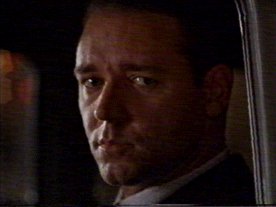
Now that is some great film acting.
"One more word out of you, and I will hold you in contempt!" "I hold myself in contempt!"
Member my "trip from hell"? Where I eventually became the gallumphing Muppet giant from The Muppet Movie? (Yes. I know my trip from hell ended with a woman barking like a dog on the runway ... but it began with a bus accident on the highway.)
I have been summoned as a witness in the court case ... or ... someone must be suing the bus company? I have no idea. My court date is next week. I guess I have a guilty conscience - because the summons came in the mail, and I literally immediately assumed that I had done something HORRIBLE. My immediate assumption was: Well, CLEARLY I am guilty of SOMETHING.
I'm an idiot. Thanks, years of Catholic guilt - thanks a lot!!
I felt this bolt of GUILT shiver through my soul ... and fear and self-loathing became paramount. hahaha Sheila: don't you think you would KNOW if you had done something so wrong that you get a court summons???
Maybe I should submit that original blog post as Exhibit A.
Fall
Today is bleak, cold. The leaves are sodden, fallen on the wet pavement. Rain falls outside, and I can feel the chill in the air. A couple mornings ago, I heard the call of the geese - finally leaving town.
This week it's Thanksgiving. I'm going home for a day ... it will be good to get out of the city. I want to go down to the beach. My favorite time to see the ocean is in the late fall, and the winter. The bleakness is - poetic to me, cathartic. Much better than the sun-blasted days of summer.
I'm finally joining Actor's Equity. It'll all be final in the next couple of weeks. This is good good news.
This week it's also my birthday. I've been keeping a low profile about it. Whatever. Normally, I get all stressed out in the days approaching my birthday - but I think that usually happens when I don't have too much else going on, and all I do is sit around thinking about myself. THEN I get stressed out. Not wacky about the birthdays. But this year, it feels okay. Even though, you know, I'm still not married and stuff like that.
I watched LA Confidential last night. Uhm ... I've seen that movie ... 15 times, maybe? It never gets old. I never get tired of certain scenes. It's just ... a marvelous accomplishment. Maybe I'll talk more about it later. But it was really fun to watch it again - haven't seen it in quite some time. Guy Pearce was the one who really struck me this time around - Normally, I am too gob-smacked by Russell Crowe's performance to really notice anyone else - but Guy Pearce is terrific in it. Just terrific. Even more terrific when you see him in interviews, etc., and realize he is NOTHING like Exley. He has a couple of close-ups that are phenomenal. After Dudley (the great Cromwell) says "I'd like you to look up an associate of Vincennes ... a Rolo Tomassi ..." Close-up of Pearce's face. The dawning horror. But he has to hold it together. GREAT close-up - that's exactly what a close-up SHOULD be - a psychologically probing moment, where we get to see inside someone's thought process. Then Dudley walks on - leaving Exley behind - and the shot is: we see the back/side of Exley's head, and as Dudley passes, Exley turns to the camera, and watches Dudley walk out of sight. Now that's ANOTHER phenomenal close-up. Anyone remember that moment? His eyes are like laser beams - there is suddenly a hardness in his face, a coldness - he has lost the smugness in one moment ... He now knows the kind of monster he is dealing with. In those two close-ups, we see Exley - an insufferably vain and smug man - give all that stuff up, and become a man - he becomes a COP, a real COP in those two close-ups. Great job. I love that movie.
Happy Birthday, George Eliot!
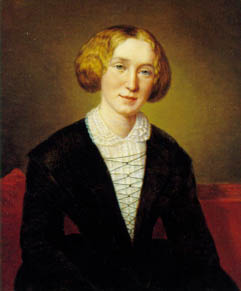
I actually know very little about her real life - all I know is is that I recently read Middlemarch and it was one of those "A-ha" moments in life. When you realize: Ohhhhh, so THAT'S why everybody talks about her! THAT'S why this book is so important! Woah. What a reading experience. Day-um!
Anne has written about George Eliot quite often - but here is my favorite post of hers on the subject - it is called The Saddest Letter Ever Written.
November 21, 2005
The Books: "The Long Goodbye" (Tennessee Williams)
And here is my next excerpt of the day from my library. Still in Tennessee Williams land.
Next Tennessee Williams play on the shelf is a one-act called The Long Goodbye.
A sad sad sad little play. Ouch. It makes my heart hurt.
Joe is a frustrated writer. He is haunted (literally) by the ghost of his dead mother. He still lives in the apartment where he grew up - and as the play opens - movers have come and are taking the furniture away. He will be moving on. But this is not easy for him. In leaving this apartment, he will be leaving his past. He has a kid sister - Myra - who was a hot little number. He hasn't seen her in years - she has moved away. The dead mother AND Myra (in a couple of different incarnations through the years) walk in and out of the present action, as the movers take the stuff away ... Joe is literally a haunted man. He's a writer. He can't write. He has lost touch with Myra - who was, when he knew her, a hot young thing - but a good kid with a good heart. She just happened to be a swimming champion who looked great in her bathing suit - and so had a lot of attention from boys. But then when she would go out with them, wanting a little bit of fun (really - just fun - like dancing, and flirting, etc.) - the guys would always turn nasty and try stuff with her. She fended them off the best she could. But now Myra - as is so often the case with girls who develop early - has slid off the rails. By the end of the play, when she "appears" to Joe - she is now a blowsy whorish woman - obviously wearing rich clothes given to her by some sugar daddy. Innocence lost. Sexuality cheapened.
Oh, and the father ... the father is a total mystery. He is only spoken of in passing ... a silent, grumpy man ... who one day just basically got up, walked out of the house, and was never heard from again. He has left everyone baffled in his wake. Did he just ... not love them at all? WTF??
The play is the movement of Joe ... trying to accept his past, his losses ... and trying to move on.
It's tragic.
I'll post the bit where he talks to his dead mother. Some gorgeous writing here. Williams at his best.
From The Long Goodbye, by Tennessee Williams.
[Mother appears in the door -- a worn, little woman in a dingy wrapper with an expression that is personally troubled and confused]
MOTHER. Joe, aren't you going to bed?
JOE. Yes. In a minute.
MOTHER. I think you've written enough tonight, Joe.
JOE. I'm nearly finished. I just wanta finish this sentence.
MOTHER. Myra's still out.
JOE. She went to the Chase Roof.
MOTHER. Couldn't you go along with her sometimes? Meet the boys that she goes out with?
JOE. No, I can't horn in on her dates. Hell, if I had a job I couldn't pay tips for that crowd!
MOTHER. I'm worried about her.
JOE. What for? She says she's older than I am, Mother, an' I guess she's right.
MOTHER. No, she's only a baby. You talk to her, Joe.
JOE. Okay.
MOTHER. I regret that she took that job now, Joe. She should've stayed on at high school.
JOE. She wanted things -- money, clothes -- you can't blame her. 'S Dad out?
MOTHER. Yes ... She's given up her swimming.
JOE. She got kicked off the Lorelei team.
MOTHER. What for, Joe?
JOE. She broke training rules all the time. Hell, I can't stop her.
MOTHER. She listens to you.
JOE. Not much.
MOTHER. Joe --
JOE. Yes?
MOTHER. Joe, it's come back on me, Joe.
JOE. [facing her slowly] What?
MOTHER. The operation wasn't no use. And all it cost us, Joe, the bills not paid for it yet.
JOE. Mother -- what makes you think so?
MOTHER. The same pain's started again.
JOE. How long?
MOTHER. Oh, some time now.
JOE. Why didn't you ---?
MOTHER. Joe ... what's the use?
JOE. Maybe it's -- not what you think! You've got to go back. For examination, Mom!
MOTHER. No. This is the way I look at it, Joe. Like this. I've never liked being cramped. I've always wanted to have space around me, plenty of space, to live in the country on the top of a hill. I was born in the country, raised there, and I've hankered after it lots in the last few years.
JOE. Yes. I know. [Now he speaks to himself] Those Sunday afternoon rides in the country, the late yellow sun through an orchard, the twisted shadows, the crazy old wind-beaten house, vacant, lop-sided, and you pointing at it, leaning out of the cary, trying to make Dad stop --
MOTHER. Look! That house, it's for sale! It oughta go cheap! Twenty acres of apple, a hen-house, and look, a nice barn! It's run-down now but it wouldn't cost much to repair! Stop, Floyd, go slow along here!
JOE. But he went by fast, wouldn't look, wouldn't listen! The snake-fence darted away from the road and a wall of stone rose and the sun disappeared for a moment. Your face was dark, your face looked desperate, Mother, as though you were starving for something you'd seen and almost caught in your hands -- but not quite. And then the car stopped in front of a road-side stand. "We need eggs." A quarter, a dime -- you borrowed a nickel from Dad. And the sun was low then, slanding across winter fields and the air was cold ...
MOTHER. Some people think about death as being laid down in a box under earth. But I don't. To me it's the opposite, Joe, it's being let out of a box. And going upwards, not down. I don't take stock in heaven, I never did. But I do feel like there's lots of room out there and you don't have to pay rent on the first of each month to any old tight-fisted Dutchman who kicks about how much water you're using. There's freedom, Joe, and freedom's the big thing in life. It's funny that some of us don't ever get it until we're dead. But that's how it is and so we've got to accept it. The hard thing to me is leaving things not straightened out. I'd like to have some assurance, some definite knowledge of what you were going to do, of how things'll work out for you ... Joe!
JOE. Yes?
MOTHER. What would you do with three hundred dollars?
JOE. I'm not going to think about that.
MOTHER. I want you to, Joe. The policy's in your name. It's in the right hand drawer of the chiffonier, folded up under the handkerchief box and it's got ... [Her voice fades out and two of the Movers come in carrying a floor-lamp]
I want it that way
Thank you thank you thank you to Lisa who sent me this. It has given me SUCH joy on this kind of yukky day. You kind of just have to settle in and watch the whole thing. I LOVE IT.
There is so much to discuss:
-- the way the kid's eyes roll back in his head when the music starts. Like ... he is getting into the mood ... feeling the music ...
-- their burning intensity and earnestness - watch the kid who's behind the one in the front - watch how INTO it he is, especially as the song goes on
-- the random dude in the background, like - totally not paying attention to the raging music video that is happening behind him
-- their outfits - what??
-- the cast on the hand of one of them - random
It's so FUNNY - but mainly because I did stuff like this when I was a kid (my friend Betsy and I would lip synch to the ENTIRE Oliver soundtrack and make our parents watch it - thank God this was pre-Internet!!) -
But also: I find it strangely touching too. Even though it is HILARIOUS. Like: they're so supportive of each other's goofiness. Watch how they look at each other when one of them takes over the lead vocals - there is no smirky irony in their faces - they are totally like: "You go, bro, you go ..."
This is awesome.
It has made my day.
And the results are in ...
Alex has chosen her top 5 TV characters.
South Park
I watched the Scientology episode of South Park last night and laughed so hard my neighbors probably got nervous. When they were explaining the wholke Xenu thing - and the screen below kept flashing: "THIS IS WHAT SCIENTOLOGISTS ACTUALLY BELIEVE" - I couldn't STAND IT.
And R. Kelly with his gun ... I was HOWLING. Then when he joined Tom Cruise and John Travolta in the closet, and you heard his voice singing, "Now I'm in the closet ..."
The Nicole Kidman cartoon was HILARIOUS. Her eyes, her accent!!
The reporter who kept cutting in: "Breaking news ... Tom Cruise is STILL in the closet ..."
And all the brain-washed Scientologists at the end, who were listening to the reincarnation of L. Ron Hubbard giving new information, all taking notes feverishly - their eyes were large and googly (or - more googly than most other South Park characters) - and they listened with baited insane breath.
The voice of Tom Cruise was perfect.
The whole thing was like a big plate of food that is AWFUL for you but tastes SO GOOD you cannot stop eating.
A year ago ...
... my friend Allison and I were in Ireland, having the time of our lives. I wrote a couple of posts about our experiences once we returned home, and I actually think they're rather good. I've posted a couple of them below.
The murderer I befriended
The murderer I befriended knew all the United States capitals, even though he was Irish. He began to rattle them off for me, his brogue thick and rich, the words "Boise, Idaho" coming at me through the din of O'Neal's Pub.
The murderer I befriended had a name so Irish that it could have come out of an old dusty book of Celtic legends.
The murderer I befriended had a sidekick with him named Aidan, a bloke who got way too drunk and became so enslaved by an attack of hiccups that he seemed possessed by some demonic force. I feared for his health, actually.
The murderer I befriended was quite concerned over the behavior of my travel companion. She kept getting up to stroll through the bar, stopping to talk to people, moving on, stopping with another group. She would disappear for half an hour at a time. The murderer I befriended referred to her grumpily as "Walkabout". "So where's Walkabout?" She would then come back and regale us with the stories: the sexually explicit conversation she got roped into with that rowdy group of Australians over there, the random guy who cornered her and asked her to go home with him over there... She would tell us all this, and then proceed to walkabout again. The murderer I befriended said to me, with a grim look on his face, "Walkabout is playin' a very dangerous game."
The murderer I befriended taught carpentry in a juvenile detention center, so that the underprivileged trouble-making kids could have a useful craft when they got out.
The murderer I befriended told me of his time in the United States, driving around with truckers, going north, south, east, west. The murderer had lived in Chicago for eight years and had hooked up with a nice American girl. The murderer had a daughter he had never seen.
The murderer I befriended told me that if he saw Osama bin Laden on the street, he would gladly kill him for President Bush. I thanked him for his kindness and consideration.
The murderer I befriended had a hard and once-handsome face. Blunt angry features. A rough shock of hair and a mouth that twisted off to one side. Not always, but sometimes, when he was contemplating something unpleasant or worrisome. The thought of Osama bin Laden on the loose made his mouth go off to the side. He watched Walkabout saunter by on her way to another group of people, his eyes following her, and then he briefly shook his head, his mouth twisting off to one side. But what really stays with me about the murderer I befriended were his eyes. They were an icy white-blue and startlingly light, gleaming out of his rough bludgeoned face. They were the eyes of a sled-dog, of Buck, a once-loving animal, one of God's creatures, who has had the softness and love thrashed out of him. The murderer's eyes were like that. I guess it's true that eyes are windows to the soul, although I've never really thought about it all that much. I perched on a bar stool, beside the murderer I befriended, and we talked about America, and we talked about his job, but his icy eyes gleamed up at me, from out of a pit of darkness.
The murderer I befriended kept saying my name, repeatedly, in between topics. A pause would descend, broken only by a violent hiccup from the sidekick. And then the murderer I befriended would sigh, to himself, "Ah, Sheila …" He said my name with a long "e", like I prefer. It sounded like something other than a name, when said by him, in that sighing regretful way. It sounded like a sad prayer.
The murderer I befriended of course did not present himself to me as a murderer immediately. His confession (for that, indeed, was what it was) came much later. Our banter began casually, organically, as banter always does in Ireland. He had the wit, the quickness, the humor, the anger of his people running in his veins. It was a pleasure conversing with the murderer I befriended.
The murderer I befriended stepped outside the pub for a smoke, and I followed. When Walkabout and I had entered O'Neals, after spending the afternoon with the Book of Kells at Trinity College, the light was already disappearing from the sky, an early descent of evening over Dublin. And now, it was full-on night. The sidewalks buzzed with smokers. The murderer and I did not join any bigger groups, we stayed apart. We seemed to have some sort of understanding, he and I, on a primal human level. I suppose you could say that I found a kindred spirit in the murderer that I befriended. We had been talking, non-stop, for three hours. He smoked. We didn't speak. Until he did.
"Sheila, I need to tell you somethin'. I need you to know who I am and what I done."
The mouth twisted off to one side.
I was nervous that he was about to profess his love slash lust to me, and I wasn't interested in him in that way. But I held my tongue. The streets were shadowy now, but I could still see his eyes.
"Sheila, I murdered a man. I did eight years prison time for it, Sheila. I'm not allowed to leave Ireland now, and so I can't know my own daughter. But I murdered a man, Sheila. I took his life."
I was not surprised by this revelation. His time in jail was on his face, etched into the lines around his mouth, and coming out of those eyes. I still didn't speak.
"I was a kid of eighteen, Sheila … and I went up to Belfast, y'know … there was a Protestant guy up there … who had tortured 26 Catholics, Sheila … he tortured 'em, and I went up there and I found him and I slit his feckin' throat."
It was then that my soul re-coiled from him, for the first time. I had been laughing with the murderer for hours. And he had done this thing.
He was watching me intently, his eyes scanning my face for its response. Anxious hungry eyes.
"I slit … a man's throat, Sheila …" he said again, the words landing flat and cold between us.
It takes commitment to slit someone's throat. It takes commitment and a willingness to be involved. This was not a clean bullet to the back of the head. This was slaughter. I tried not to imagine it.
Then he backed off from me. "Oh, you're gonna think differently about me now … I can see it …" He was dismayed. "I just felt like I could talk to you, Sheila … I felt like I could confess my sins to you … like you might understand me or somethin'…"
It was eight p.m. on a Friday night in Dublin, Ireland. But I suddenly had no idea where, when, or who I was. I felt chosen by the murderer. He had chosen me.
"Nobody knows what I done … well, Aidan does … and that's why we're friends for life … he knows … he knows what I done …"
Silence in my head.
"This guy tortured 26 Catholics, Sheila. He tortured 'em. He loved torturing 'em."
And so, in his world, this Protestant deserved what he got. He deserved to meet the murderer I befriended with the ice-blue eyes in a dark alley somewhere in Belfast.
Was Walkabout playing the dangerous game, or was I?
Finally, I figured out what I wanted to say to this beaten-down Irish sled-dog. It wasn't comforting or trite or spoken from my own world of obvious right and wrong. It was a question. Something I wanted to know. And so it came out very simply.
"Can you live with what you did?"
I expected something else. I expected, I guess, more of the "tortured 26 Catholics" story. But instead, the hard armor over that face cracked back, terrifying, and out came agony. Agony unlike anything I have ever seen before, and agony I hope never to witness again.
"No. I can't. I lie awake at night. I can feel his throat between my hands. Oh Sheila … Oh Sheila … what have I done … what have I done … I see that man's face before me … every night … I'm gonna pay for what I done when I meet my Maker. I'm gonna pay for it. I took a man's life, Sheila. Sheila. I took his life."
All around us the sounds of flirting laughing snippets, the buzz of groups, the talk. I might as well have been on a quiet dark planet at the farthest end of the galaxy. With the murderer I befriended.
More than regret, more than sorrow, what I saw in his eyes was fear. Fear of the retribution of God.
"I know it's coming, Sheila. I have to pay for it. And I will. God stares down at me. He's starin' down at me right now. He's not angry, Sheila. He's just waiting. He's just waiting."
And suddenly I could feel the Presence, too, filling these dark chattering streets, and God's searchlight rested, immovably, on the murderer I befriended. It had been there all along.
Munch's "The Scream" has always seemed a little humorous to me: the psychedelic colors, the writhing figure, the gaping O-mouth. I have seen it so many times that it feels like third-hand information, fourth-hand. Nothing about my response to the painting is original or deeply felt. I know the image by heart, and that twisting figure had nothing to tell me. It was only then, watching the murderer I befriended break down, seeing the terror in his eyes, hearing his voice say over and over, "I'm gonna pay for what I done … I'm gonna pay, Sheila … I'm gonna pay for what I done …" that I understood. That I got Munch's message. The murderer I befriended had that gaping O-mouth of terror shining out of his icy eyes.
It was terror too great to be borne.
It was torment of the eternal kind.
It was facing the great abyss revealed by the pitiless searchlight of God.
God was patient. God could wait for the murderer I befriended to die of natural causes. God could turn His attention to other matters. There was no rush. But God would not forget. God had the murderer's name in a little black book. There were not enough years in eternity to make God forget "what he done".
And so the murderer I befriended hangs out with his hiccupping sidekick.
And so the murderer I befriended teaches kids from the Dublin slums how to build bookshelves and cabinets.
And so the murderer I befriended goes out drinking every night to obliterate the self that had done this terrible thing, to block out that patient searchlight.
And so the murderer I befriended waits. Just waits.
Glendalough
Now I've been to Glendolough a couple times in my life - maybe 4 times or something like that, and I always say it is one of my favorite places on earth ... and there have been times, stressful times, when I've been slogging my way down 7th Avenue in New York - that I'll take a second and remember Glendolough, and think to myself: "It's out there now. It's out there right now. It exists."


On to the rest of the story:
We ended up staying over in the area because it was dark and the prospect of driving out of there through the Wicklow Mountains was rather daunting (although my sisters and I did do just that!). We hung out at the local pub. And of course, made lifelong friends. I have acquired more email addresses on strips of paper than I know what to do with.
But the best part ... the best part of this particular trip to Glendolough ... was that I got to live out a fantasy I have always had. Every time I have gone there before, it's to visit the ruins, like a good tourist does ... see the sights ... and then leave. The place is always packed, filled with people wandering around ... which is not a bad thing, not at all ... but my fantasy has always been to walk through those ruins at night, by myself. To hang out with the gravestones, the old cathedral, the "kitchen", etc. To be alone with the place.
And once the pub closed, I did just that. There was a wind storm going on, it was a wet and windy night, the air filled with the roar of wind, and the clattering of the full stream nearby. There were spectacular stars. Glendalough is in a valley, with brown wooded mountains rising steeply on either side. You are in a gap, a deep trough in the hills. The wind races between the mountains like a ravening ghost. It was indeed a bit creepy ... to stroll amongst the graveyard alone, at 1 a.m. - and I need to take some time with myself to be able to describe it.
I feel that, in Glendalough, I am confronted with a mystery of some kind. The place doesn't give up all its secrets. Ever. Not in the daylight, certainly not, but even less so in the middle of the night.
There were moments when I could not tell what century I was in. It certainly was not a modern century ... it was in the late 5th century, when Christianity was close to its pagan roots. The place has a fierceness to it - which I had sensed in my other visits there, you can't get away from it, but the fierceness came out full throttle in the middle of the night, when I was there on myh lonesome. The high Celtic crosses shadowed in the black, the silhouette of the tower off to my right rising up into the sky. And it gave me a very weird feeling - I'm telling you, I haven't quite found the words yet. The best way I can describe it is that I was in the presence of Mystery itself. It also felt like this had to be holy ground ... it is a holy place. Not just because of St. Kevin and all that ... It feels like it was a holy place before St. Kevin even arrived. He just recognized what was already there.
I probably sound goofy and all that ... but it was one of the most primal powerful experiences of my life, walking in the pitch black - the PITCH BLACK - amongst the enormous tilting gravestones, gravestones which are covered with white lichen - so they glimmer oddly in the pale moonlight ... the shadowed silhouettes of these ancient stone buildings all around me ... the graves, the stream, the crumbling stones ...
I was almost in tears when I went back to my room. I didn't know what it was that I sensed. Something very powerful, something fierce, something ... almost UN-holy. It's a ferocious place - and I've only seen it surrounded by other tourists and visitors. Regardless, even if you see it then, in the daylight, during visiting hours, it is a very very special place.
But at one in the morning, by yourself, surrounded by the stone ruins, the gravestones, the moonlight and the roaring sounds of rushing water ... it is like a different place altogether.
I will never forget it in all my life.
The Kinsale Procession
After making our way successfully through the "hairy roundabout", we started to see signs, finally, for Kinsale. Our destination. We had time constraints ... Jimmy needed to go somewhere at 7, and so we needed to reach the B&B before then. I assumed he was meeting friends for pints, or whatever, but this ended up NOT being the case, and in light of what he actually needed to do, I am tremendously glad that we made it there in time.
Allison drove us to Kinsale, after we left our new best friends at the gas station in Cork. The road was a two-way road, and yet ... by US standards, the road was only big enough to be a one-way road. Thankfully, everyone still pretty much drives teeny cars over there, an SUV on this road would be an utter disaster. The headlights shrieked up at us through the dark, the road was winding, it was night-time ... we were a bit stressed.
But then, at last, Kinsale. I could smell the salt air when I rolled down the window, so I knew we were very close. We still needed to find our way to Jimmy's B&B, but from our street map of Kinsale the Town, it seemed like a pretty wee place, not too difficult to navigate.
It was now 6:50.
We immediately found ourselves in the middle of town, which ... I mean, we had heard about the quaintness and the beauty of Kinsale ... but the reports of its beauty were almost under-played. It is one of the sweetest prettiest places I have ever seen. However, we could not ogle the sights, or the harbor, because we had to find Jimmy. Time was running out.
Randomly, we took a left-hand turn, and as we both glanced to our right, we saw an odd sight. We saw a line of people stretching down the sidewalk, there had to be hundreds of people (not an exaggeration) clustered along the street, all standing in line. But for what?
Allison wondered, "Is that a night-club or something?"
But ... it was only 6:51? A line into a nightclub at 6:51? In Kinsale?
We left that mystery behind us, drove around for a bit, on streets that are teeny, lined with shops, sudden curves, sudden hills, all adorable, but confusing ... no street signs.
At last, we asked a couple of people for directions. True to form, they gave us AWESOME directions. Directly to Jimmy's door. They knew Jimmy. Of course they did.
And then, there we were. The B&B was right next to a massive Catholic church, and we parked in the church parking lot. It was 7:01. I could see a man standing in the golden glow of lamplight coming out of the open door of the B&B ... "That's Jimmy!" There was a wintry breath in the air, the bite of the nearby water ... a different feeling in the air than the windy mountainous energy of Wicklow. The moon was high, and waxing. Beautiful. Soaring above the church.
Allison and I left our bags in the car and ran up the steps of the B&B, apologizing. "I am so sorry - we truly thought we would be here at 7!"
Jimmy, of course, was lovely, kind, understanding. "I know how it is ... time when you're traveling and all that ..."
He said to us, "There's a funeral next door tonight at 7 ... A local guy died, so I'm going to go over to go to the funeral, and I'll be back in about half an hour..."
Good Lord, I felt like an ass. I had assumed he was maybe going out with friends. Instead, he had to go to a funeral. Jesus.
I said, "God, I am so sorry."
"Oh, no problem, Sheila, no problem ... You're fine parked where you are. Why don't you bring your bags in now, so that you won't have to walk through the procession ..."
I wasn't sure what he was talking about, but Allison and I went back to our car, shivering in the night-cold, to grab our bags.
And then came the procession.
The "procession" was the huge crowd of people we had seen in the center of town.
We found out later that what happened was: they all gathered at the funeral home, down on Market Street, and then walked, as a group (and we are talking about 300 people ... the procession went on forever) up to the church.
Allison and I didn't feel right walking through the funeral procession with our bags, so we stood back, in the shadows, and just watched.
It was cold enough to see everyone's breaths. The hearse had led the way, and then stopped outside the church. The procession, which filled the street in front of the B&B, and then curved away out of sight and down the hill, the procession must have been half-a-mile long, stood quietly, stamping in the cold, hands in pockets, clouds of frosty breath in the air. There were old people, little children, there were couples holding hands, there were teenagers with their parents ... Everyone was there.
The coffin was lifted out of the hearse, and the pall-bearers lifted it up over their heads, so that it appeared to float through the air, and then they walked it up the long ramp into the lit-up brick church.
The procession didn't move. Neither did Allison and I.
We had come across a private moment. The private moment of this small community. The inner life of this small town revealed to us, outsiders. A rarity indeed. We didn't want to intrude, or break it up, or ignore it. We just watched.
When the gleaming coffin had floated its way into the church, the procession started to move. And that's when we really saw how many people there were. The line just kept coming from around the corner, as everyone walked up the steps and into the church for the funeral. More people just kept coming, silently, respectfully, maybe you would hear the chatter of a child here and there, but for the most part ... just silence.
Obviously a well-loved man. Jimmy told me all about him later. He was only 62, he was a musician, and played with a number of local bands. He hadn't even been sick, but apparently he fell down over the summer, and X-rays revealed that he was riddled with cancer. Nothing to be done at that point, really ... and he died in November. Sad.
But to watch this small town slowly walk into that church ...
Allison and I kept coming back to it, over the rest of our journey. "Member the funeral in Kinsale?" We felt that we had witnessed something very special, very private. I felt honored to be there, but also a little bit like ... it wasn't something for us to witness. All we could do was stand back, and not intrude. Be respectful, quiet, and watch. It was a town mourning its dead. With throngs and throngs and throngs of quiet chilly people coming up the hill, around the corner, up the hill, around the corner, up the hill, into the church ... in an endless flood.
Asking for directions in Cork
We were headed for Kinsale. We were very close, only 20 or so miles away ... we knew our way to Cork, and after that, all we knew was - we needed to head almost directly south. And there would be Kinsale.
In our dreams.
I was Driver at this point, and Allison was Navigator. It was dark now. It was about 6:00 pm ... and I had promised Jimmy at the B&B in Kinsale that we would be there by 7, because he had to leave at 7. Cork, obviously, is a city, and I find that driving in the city is far more stressful than a long inter-county roadway, even with all the roundabouts. So we pretty much promptly got lost. We didn't know where we were, or how to get where we were going, etc. I also had to pee. So I did a blasted RIGHT HAND TURN and we pulled into a gas station.
Allison asked a young guy pumping gas for directions. (One thing: I found, in my experience over there, that the Irish are incapable of giving bad directions. We got absolutely awesome directions from no matter who we asked ... but this particular time was parTICularly good ...)
So the young guy started telling Allison where she needed to go to get to Kinsale, and then almost immediately stopped himself. "My mother's inside - we should wait for her to come out. She's great at directions."
Boy, was she ever.
Allison and I LOVED these people.
This mother was so unbelievably generous with us, she gave us sterling directions ... I mean, we didn't realize how sterling they were until we were on the road again, and at every single point when we COULD have got confused, then there would come the landmark she had told us about, or whatever.
"Wait - where are we?"
"Oh ... there's the river and the trees ... she told us we'd see that when we came round the bend ... this is the right way ..."
She drew us an awesome map. Her son hung around with us, too, validating his mother. "Yeah, that's right ... then you go through the Tunnel ... right ..." She was the FIRST person on our journey to tell us about the Americans crashing into the Minister of Parliament. Ha ha ha ha
We stood by the gas pumps, as she drew her map, all of us chatting up a storm - how we found it driving on the other side of the road, where we had been, what our plans were ... We also chatted quite a bit about what she called "the hairy roundabout" - She gave us profuse warnings about "the hairy roundabout", which we needed to go through to get to Kinsale. It was south of Cork, and apparently a gazillion cars have crashed there, and she made it sound like shrieking hellatious chaos. We had to get ourselves into a certain lane, otherwise we would get stuck in the roundabout forever, etc ....
And goldurnit, we followed her instructions to the letter, and lo and behold, we were in Kinsale at 7:01. With poor Jimmy waiting for us at the door. Not too shabby!
As we stood around the car, and she walked us through the directions, another car drove up. She glanced up and waved. Informed us, "That's my husband." Then another car pulled up to one of the other pumps, she waved to the driver of THAT car, and informed us, "If I weren't married to my husband, I'd be married to him."
And one by one, all of these various people - her husband, and the guy she'd be married to if she wasn't married to her husband, joined our little coterie and looked at the map, and gave us suggestions ... We were a small party by Gas Pump # 2.
Our ring-leader woman would introduce us to every new arrival: "These 2 American girls are trying to get to Kinsale ..."
Every new arrival informed us of the "Americans crashing into the Minister of Parliament". And every new arrival put the fear of God into us about "the hairy roundabout".
More suggestions came in, adding, clarifying, until we had the most specific set of directions EVER GIVEN for a mere 20 mile drive. She even gave us emotional directions for "the hairy roundabout":
"Just stay calm ... stay calm ... get yourselves in the right lane, and stay calm ..."
Allison and I drove off waving hail and farewell to all of our new-found friends. At the gas station in Cork.
Roundabout Support
We got a stick-shift, first of all ... so you're doing all your stick-stuff with the left hand. Thank goodness the clutch and the gas pedal weren't moved. Took a bit of mental adjustments to get used to - Occasionally I would automatically reach down with my right hand for the clutch.
We did GREAT as a team, I have to say. We took turns being Navigator and Driver. Two essential jobs.
The one who was Navigator also had another very important job: Emotional Supporter of the Driver.
The Driver could not do her job without the Emotional Support of the Navigator.
"You are doing so good."
"Okay, so a roundabout is coming up ... take your time ... you're doing awesome ..."
"Member to look right ... but you're doing so great!"
Occasionally, the Driver would blurt out: "I don't care that there are 20 cars behind me right now. I have to drive slow."
The Navigator would say, "You do whatever you need to do."
There was definitely a specific sub-set of Emotional Support which deserves its own category:
Supporting One Another Through the Endless Roundabouts.
Now - a word on "roundabouts". I grew up in Rhode Island, a state of many many many rotaries. We are very used to rotaries, the yielding rules, what you do when you're IN the rotary, etc. The rules are exactly the same in Ireland, except that when you yield, you must look right, as opposed to left. To someone who has NEVER driven through a rotary before (and unless I'm mistaken, there are some states in the US that don't have them) - all of that might be mind-bogglingly scary.
For the first 10 roundabouts, we would get into this hunker-down almost military attitude. "Okay. Here comes a roundabout. Get ready. You ready? Everything's going to be fine."
Navigator would scan the signs for which exit to take off said roundabout.
"Okay, so you're going to go 3/4 of the way around ... follow the signs for N6 ... "
Driver pulls up. Yields. Looks right. Pulls into rotary, swings around, finds exit, takes it ... and then Navigator congratulates Driver. "GREAT job. That was perfect."
We were old hands at roundabout behavior within 2 days, but those first couple ones were a wee bit stressful - and definitely required 2 people to make it all come off.
When we dropped the car off, with no bumps, no bruises, no crashes, no disasters, nothing ... we felt like rock stars. Allison said, "I didn't want to gloat about it until we had passed over the keys ... seemed like it would be bad luck."
Funnily enough (or - er - actually, not funny at all) - a couple weeks before we arrived, 2 Americans were driving along somewhere in Ireland, blithely on the wrong damn side of the road, and crashed head-on into a car coming the other way. This is probably not noteworthy at all, as Americans are always driving on the wrong freakin' side of the road all over Europe (there were stickers placed throughout the car - reminding us: "DRIVE LEFT", etc.) ... but what made this one kind of funny (and it was mentioned to us time and time again during our travels) - was that the car they crashed into was being driven by a Minister of Parliament. Everyone kind of cackled with glee over that one. "Did ya hear about those Americans who crashed into the Minister of Parliament??" Again, it's not funny - because the 2 Americans (in their tiny car) were badly hurt - while the Minister of Parliament, in his enormous official car, was untouched - I believe the Americans are still in the hospital.
However: we never drove on the wrong side of the road. We didn't even have any "oops!" moments like that. The teeny country-roads at night were a bit scary - the one down to Kinsale especially. Night-time, no lights, small road ... no idea where we were going ... STRESS. But we arrived in one piece.
And we were both terrified of and a little bit angry about right-hand turns. They stressed us out to no end - we almost wanted to drive out of our way to avoid having to deal with them. Left-hand turns, no big deal, easy-peasy. Right-hand turns required total concentration, lots of emotional support, and frantic looking back and forth ... "Am I okay? Am I okay?" "You're great - okay - GO. NOW."
Allison, murmuring, as she pulled up to an intersection: "Shit. A right-hand turn."
I was Navigator/Emotional Supporter so I said, "Take your time. You're gonna do great."
And she did. And we both did.
It was a good little car. My, she was yar!
Hurricane Fatigue
CW - still cleaning up from Wilma - is tired - as another hurricane approaches.
It's amazing to me how little press Wilma got. It sounds like the damage was disastrous for the Keys.
To my friends in Florida - You are in my thoughts!
Weekend moments
-- Yesterday, within the first 2 seconds of our show, two sentences into the thing, a little old lady out in the audience said, at full volume, "WHAT IS HE SAYING? CAN ANYONE ELSE HEAR WHAT HE IS SAYING?" She was roundly shushed by the rest of the crowd. I think the median age of our audience yesterday was 98.
-- In-depth conversation with Carmen about the black dahlia murder. She is as obsessed with it as I am. Not too many people care about the black dahlia thing - but if you're into it, it's like you're a member of some freaky little club. She had just read Black Dahlia Avenger, and I haven't seen her in ... a year?? So we had MUCH to talk about. We were like, "Hey, how are you, good to see you ... so what did you think of Black Dahlia Avenger?" We cut right into the forensic details.
-- My favorite moment of the weekend was on Friday - or, actually - it was Saturday morning. Maybe at 2 or 3 in the morning. My sister Jean and her boyfriend Pat came down to see the show. We ended up hanging out where my sister Siobhan bartends until ... uhm ... 4 am? It was great. Anyway; best moment: Randomly, a Canadian stand-up comic joined our group. None of us knew him, but he rightly felt that we were the funnest group in the joint. Anyway, my two sisters ended up singing for him the Canadian national anthem - in French - with MUCH GUSTO at circa 3 am. Candlelights flickering, beer glasses all around, and the O'Malley sisters BELTING OUT "O Canada" IN FRENCH. hahaha I kind of wished they had kept on singing forever. I honestly don't think Canadian Comic Boy knew WHAT the hell to do. He tried to make a joke about it afterwards, but I think that the only appropriate response would have been: "You two just blow my mind. Wow."
November 20, 2005
Marilyn Monroe Appreciation Moment

From Who the Hell's In It, by Peter Bogdonavich:
The fact is that Marilyn was in bad trouble from the day she was born as Norma Jean Mortenson on June 1, 1926, in the city of angels and movies, a poor bastard angel child who rose to be queen of a town and a way of life that nevertheless held her in contempt. That she died a martyr to pictures at the same time as the original studio star system -- through which she had risen -- finally collapsed and went also to its death seems too obviously symbolic not to note. Indeed, the coincidence of the two passing together is why I chose to end this long book about movie stars with Marilyn Monroe.What I saw so briefly in my glimpse of Marilyn at the very peak of her stardom (and the start of my career) -- that fervent, still remarkably naive look of all-consuming passion for learning about her craft and art -- haunts me still. She is the most touching, strangely innocent -- despite all the emphasis on sex -- sacrifice to the twentieth-century art of cinematic mythology, with real people as gods and goddesses. While Lillian Gish had been film's first hearth goddess, Marilyn was the last love goddess of the screen, the final Venus or Aphrodite. The minute she was gone, we started to miss her and that sense of loss has grown, never to be replaced. In death, of course, she triumphed at last, her spirit being imperishable, and keenly to be felt in the images she left behind to mark her brief visit among us.
Marilyn Monroe Appreciation Moment
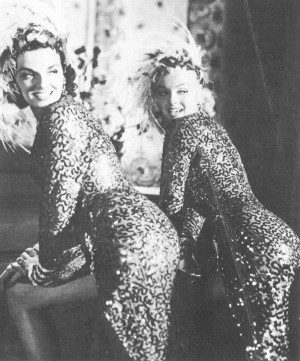
From Who the Hell's In It, by Peter Bogdonavich:
Howard Hawks, who directed her first big success, Gentlemen Prefer Blondes (co-starring established, top-billed sex goddess Jane Russell), had initially directed her a year earlier, in a major supporting role, with Cary Grant and Ginger Rogers, in Monkey Business (1952), which actually featured the first great Marilyn Monroe performance. In fact, her scenes with Cary are the highlights of the picture and make you wish they could have done an entire romantic screwball comedy together. The same year Marilyn died, Hawks told me, "Marilyn was frightened to come on the stage -- she had such an inferiority complex -- and I felt sorry for her. I've seen other people like that. I did the best I could and I wasn't bothered by it too much. In Monkey Business, she had only a small part -- that didn't frighten her so much -- but when she got into a big part ... For instance, when we started her singing [for Gentlemen Prefer Blondes], she tried to run out of the recording studio two or three times. We had to grab her and hold her to keep her there. She sang quite well, actually. I got a great deal of help from Jane Russell. Without her I couldn't have made the picture. Jane gave Marilyn that "You-can-do-it" pep talk to get her out there. She was just frightened, that's all -- frightened she couldn't do it" ...Ironically, the picture that made Monroe a sex symbol, Gentlemen Prefer Blondes was intended by Hawks as "a complete caricature, a travesty on sex -- it didn't have normal sex." In a 1967 interview I did with Hawks for the BBC, he said, "Their sex was a sort of a symbol, an obvious thing, which all you can do is really make fun of and enjoy, you know, and watch them perform. You don't try to make reality. Monroe never was any good playing the reality. She always played in a sort of a fairy tale. And when she did that she was great -- something happened. But as far as doing a real story with her, I don't believe that she's ever done a good picture that was a real story. They were all more or less of a fairy tale quality. Kind of a musical-comedy sort of a thing."
Hawks had told me that when he knew her on those early pictures, Marilyn wasn't "very sexy in real life." He said, "Monroe couldn't get anybody to take her out -- nobody. A funny little agent about five-feet-two used to cart her around. But they both [Monroe and monogamous housewife Jane Russell] were sex symbols to the motion picture public ..." Hawks also said that while Russell peaked in one or two takes, Marilyn continued to improve through repetition: "With Monroe, the more you kept going, the better she got."
Marilyn Monroe Appreciation Moment
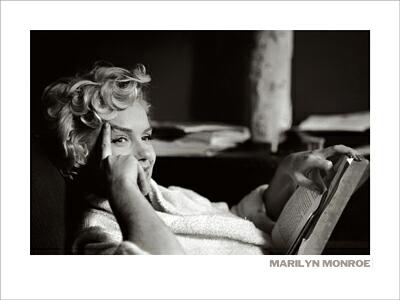
From Who the Hell's In It, by Peter Bogdonavich:
More than forty years have passed since Marilyn's mysterious death, but her legend and persona have survived. This is all the more remarkable because she actually made very few films, and even fewer that were any good. But there was a reality to her artifice -- she believed in the characters she played, even if they were inherently unbelievable. "Everything she did," [Arthur] Miller said to me, "she played realistically. I don't think she knew any other way to play anything -- only to tell you the truth. She was always psychologically committed to that person as a person, no matter what the hell it was, rather than a stock figure. Because the parts she got could easily have been stock figures, which had no other dimension. But she wouldn't have known how to do that. In other words, she did not have the usual technique for doing something as a stock figure ... She was even that way when [director] John Huston used her the first time [in a memorable walk-on bit] in The Asphalt Jungle [1950]."This went for every picture she did in her surprisingly, painfully short career as a star, barely a decade, little more than a dozen pictures. Though she managed to work with quite a number of major directors, it was not necessarily always in their best efforts; but still they were Fritz Lang, Howard Hawks (twice), Otto Preminger, Billy Wilder (twice), George Cukor (twice, if you count her last unfinished one), John Huston (twice), Laurence Olivier, Joshua Logan, and Joseph L. Mankiewicz (bit part in 1950's classic All About Eve). In my conversation with Miller, he said, "I thought she had the potential for being a great performer if she were given the right stuff to do. And if you look at the stuff she did do, it's amazing that she created any impression at all because most of it was very primitive. And the fact that people remember these parts from these films is amazing ... She was comitted to these parts as though they were real people, not cardboard cutouts. Even though the director and author and the rest might have thought they were cutouts and would deal with them that way. The way the two men [Tony Curtis, Jack Lemmon] in Some Like It Hot felt with their parts, or George Raft with his part. She was real. And therefore she had the potential of being a great comedienne." (Norman Mailer, in his book on Monroe -- he never met her -- wrote that starting with 1953's Gentlemen Prefer Blondes, she was a great comedienne.)
Marilyn Monroe Appreciation Moment

From Who the Hell's In It, by Peter Bogdonavich:
I recalled Orson Welles telling me about being at a Hollywood party which Marilyn attended (circa 1946 or '47) while she was still a lowly starlet, and seeing someone casually pull down the top of her dress in front of people and fondle her. She had laughed. Welles said that "just about everyone in town" had slept with her. Yet, [Arthur] Miller had gone on to say that the kind of mythological figure Marilyn created on the screen was all her own and a great achievement for her...The year before her much-speculated-over death at thirty-six (rumors of presidential involvement, etc.), playwright Clifford Odets told me that she used to come over to his house and talk, but that the only times she seemed to him really comfortable were when she was with his two young children and their large poodle. She relaxed with them, felt no threat. With everyone else, Odets said, she seemed nervous, intimidated, frightened. When I repeated to Miller this remark about her with children and animals, he said, "Well, they didn't sneer at her."
Marilyn Monroe Appreciation Moment
Arthur Miller wrote, in his autobiography Timebends:
She was a whirling light to me then, all paradox and enticing mystery, street-tough one moment, then lifted by a lyrical and poetic sensitivity that few retain past early adolescence. Sometimes she seemed to see all men as boys, children with immeidate needs that it was her place in nature to fulfill; meanwhile her adult self stood aside observingt he game. Men were their need, imperious and somehow sacred. She might tell about being held down at a party by two of the guests in a rape attempt from which she said she had escpaed, but the truth of the account was far less important than its strange remoteness from her personally. And ultimately something nearly godlike would emerge from this depersonalization. She was at this point incapable of condemning or even of judging people who had damaged her, and to be with her was to be accepted, like moving out into a kid of sanctifying light from a life where suspicions was common sense. She had no common sense, but what she did have was something holier, a long-reaching vision of which she herself was only fitfully aware: humans were all need, all wound. What she wanted most was not to judged but to win recognition from a sentimentally cruel profession, and from men blinded to her humanity by her perfect beauty. She was part queen, part waif, sometimes on her knees before her own body and sometimes despairing because of it -- "Oh, there's lots of beautiful girls," she would say to some expression of awed amazement, as though her beauty betrayed her quest for a more enduring acceptance.
Marilyn Monroe Appreciation Moment
Elia Kazan wrote about Marilyn:
Relieve your mind now of the images you have of this person. When I met her, she was a simple, eager young woman who rode a bike to the classes she was taking, a decent-hearted kid whom Hollywood brought down, legs parted. She had a thin skin and a soul that hungered for acceptance by people she might look up to ...The girl had little education and no knowledge except the knowledge of her own experience; of that she had a great deal, and for an actor, that is the important kind of knowledge. For her, I found, everything was either completely meaningless or completely personal. She had no interest in abstract, formal, or impersonal concepts but was passionately devoted to her own life's experiences. What she needed above all was to have her sense of worth confirmed. Born out of wedlock, abandoned by her parents, kicked around, scorned by the men she'd been with until Johnny, she wanted more than anything else approval from men she could respect. Comparing her with many of the wives I got to know in that community, I thought her the honest one, them the "chumps". But there was a fatal contradiction in Marilyn. She deeply wanted reassurance of her worth, yet she respected the men who scorned her, because their estimate of her was her own.
November 19, 2005
Marilyn Monroe Appreciation Moment
I've never done a proper post about Marilyn Monroe. She's one of those topics that I almost shy away from. I have a couple of them - mainly because the thought of sitting down and putting all my random thoughts and emotions into words - is kind of daunting. John Cassavetes is another one. If I sit down and write about Cassavetes, I have to do it RIGHT, and that will take a lot of energy. Someday I will ... but I put it off.
Monroe's like that.
Some Like It Hot is on right now. I am in heaven.
So - until I'm ready to write my OWN thoughts about this fascinating actress - I'll let other people speak for me.
Here's a quote from John Strasberg - son of the famous acting teacher Lee Strasberg. Marilyn studied with Lee Strasberg, and idolized him. The Strasberg family basically adopted her. She was a grown woman, and one of the biggest stars in the world, but she would hang out at their house until all hours of the night, never wanting to go home. She didn't think she was a good actress. She wanted legitimacy. Lee Strasberg (and his wife Paula - a pretty much universally reviled woman) gave her confidence, treated her like a real actress (and also, incidentally, really messed with her head.) The Strasbergs had two kids - Susan and Johnny - both of them were teenagers when Marilyn was hanging around their house. I actually studied with John Strasberg - who is now a director, and an incredible acting teacher - just like his father - but that's a story for another day.
John Strasberg was a teenager when Marilyn Monroe came into the Strasberg household ... He describes the moment:
The first time I met her I remember she came out of the living room and Pop said, "This is my son," and my first impression of her was that she was different from most of the people who came to the house. I'd watch all these people trading their most human qualities, betraying themselves for success at all costs, to become rich and famous, and afterward, when it was too late, they'd realize they had lost the best part of themselves along the way, but she, she was like me. When I looked into her eyes, it was like looking into my own, they were like a child's eyes. I was still a child. You know how children just look at you. My feeling was she had less ego or was less narcissistic than most of the actors who never really bothered with me. She was just another person to me, another one from that world I felt cut off, excluded, from. She was nicer, real simple, no makeup, and she really looked at me as if she saw me. It wasn't that I wanted people to look at me, but I knew the difference when she did. I knew everyone said she was the sexiest, most sensual woman in the world. Not to me. I thought there was something wrong with me for not feeling that from her. I'd felt it from other women who came to the house. I was pretty sexually frustrated then. She was so open, so loose, and her sensuality as such was so totally innocent, nothing dirty in it at all, and the first time it was just like talking to an ordinary person, only realer than most who came into the house in those days. She was quiet, too, I remember, like an animal is quiet, and I was like that too, survival tactics. She seemed smart, but not in an educated way, instinctively smart, nobody's fool.
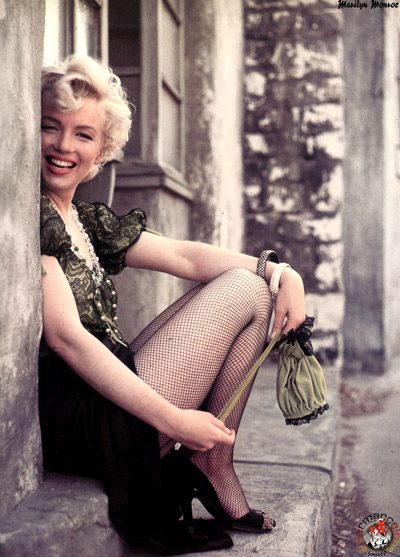
She befriended Johnny Strasberg, this lonely shy teenager, cowed by his own family, and by the constant stream of famous visitors. She was kind to him. He remembered her as overwhelmingly kind.
Here is my favorite story John Strasberg tells about Marilyn. It just brings a lump to my throat. See? I can't talk about Marilyn and be articulate. So here's the story:
I think I was talking about cars to Mother and Father. You know how I loved cars. I'd just come home and it was going to be my eighteenth birthday. I'd wanted to come for that.Mother and Father hadn't wanted me to come. "Why don't you wait till the end of the year?" Well, i'd already been kicked out of college. They didn't know yet.
When I'd gone off at the airport, I'd turned to Mother and said, "For two cents, I won't go." Nobody gave me the two cents, but I'd meant it. What I'd wanted to do was work. I'd wanted to work from the time I was fifteen, and they were always against any effort on my part to be strong or independent. I remember how much I resented it. "You don't have to work, we'll take care of everything," undermining me.
So I was talking about cars, no one was listening, and Marilyn was there and out of the blue said, "Why don't you take my car, Johnny?"
I thought I hadn't heard her right, and I said, "What?" She had remembered the summer before, in California, I'd had that Chevy I'd rented. God, I loved that car, a '57 Bel Air silver Chevy, and she had the Thunderbird.
She continued, "I've got the Ford Mustang the corporation gave me, and Arthur and I have a car. That one's just sitting in the garage, we don't use it."
I was stunned. I couldn't believe she meant it.
Mother and Father were horrified; they didn't like it at all. I don't know if it felt like too much to give me or if they were worried about my driving in my state of mind, but they objected strenuously. "He's too young. Maybe later, Marilyn. You don't have to. It's impossible, he can't afford it, it could be dangerous."
Marilyn just said, "Well, don't worry about any of that, it's in the corporation's name, so I'll take care of the insurance."
I'll never forget that ... There were so few, so very few people who were generous like that. Especially to me, who couldn't do anything for her.
I think that car saved my life.
What do you want to bet that Marilyn, even with all her breezy casualness in that anecdote, knew exactly what that car would mean to that trapped parent-pecked young man ...
OK Cupid says:
in this test... that I am The Window Shopper: Random Gentle Love Dreamer (RGLDf) - got the quiz from Jess.
Tis rather accurate, I must say: it's about who you are in your love life. Here are my results: I have added related links when I felt they were appropriate. hahaha I am linking to excerpts from my own damn life ... how ridiculous and funny!
You are The Window Shopper: Random Gentle Love Dreamer
Loving, hopeful, open. Likely to carry on an romance from afar. You are The Window Shopper.
You take love as opportunities come, which can lead to a high-anxiety, but high-flying romantic life. You're a genuinely sweet person, not saccharine at all, so it's likely that the relationships you have had and will have will be happy ones. You've had a fair amount of love experience for your age, and there'll be much more to come.
Part of why we know this is that, of all female types, you are the most prone to sudden, ferocious crushes. Your results indicate that you're especially capable of obsessing over a guy you just met. Obviously, passion like this makes for an intense existence. It can also make for soul-destroying letdowns.
Your ideal match is someone who'll love you back with equal fire, and someone you've grown to love slowly. A self-involved or pessimistic man is especially bad. Though you're drawn to them, avoid artists at all costs.
The Books: "The Strangest Kind of Romance" (Tennessee Williams)
And here is my next excerpt of the day from my library. Still in Tennessee Williams land. Funny - my sister Jean said to me last night: "Uhm ... will we moving on soon? I had NO IDEA the guy wrote so much. Sheesh ... take a break, buddy!!" haha
Next Tennessee Williams play on the shelf is a one-act called The Strangest Kind of Romance. It takes place (of course) in a rooming-house. A falling-down rooming house in an industrial town. The factory chugs away outside the window. It starts with the landlady showing a room to a potential tenant (the character name is Little Man). The tenant is a nervous sickly man, who shakes uncontrollably. He hopes to get a job at the factory. She shows him the room - all the men who have stayed there before have written their names on the wall. And one of them left a cat behind. The cat stays in the room and is a character in the play. The nervous man ends up taking the room basically because he feels a bond with the cat. The landlady is a talkative blowsy woman who pretty much accepts whatever male tenant comes as her lover, because her husband is ill. The nervous man kind of falls into a thing with the landlady - but the "strangest kind of romance" in the title is the romance between the man and the cat. The man has never loved anything. He loves this cat.
I'll excerpt from the second scene. It opens with the Little Man telling the sleeping cat about his day. He talks and talks and talks ... and the Landlady ends up walking in on this. Oh, and the Landlady also carried around a balalaika with her, and plays it occasionally. She sits down and starts to talk to the Little Man.
From The Strangest Kind of Romance, by Tennessee Williams.
LANDLADY. Some nights I hear you -- talking through the door. Who is he talking to, I used to wonder. [She chuckles] At first I imagined you had a woman in here. Well, I'm a tolerant woman. I know what people need is more than food and more than work at the plant. [She plays dreamily for a moment] So when I heard that talking I was pleased. I said to myself -- "That lonely little man has found a woman!" I only hoped it wasn't one picked up -- you know -- on the street. Women like that aren't likely to be very clean. Female hygiene's a lot more -- complicated. Well ... [The Little Man looks down in an agony of embarrassment[
LITTLE MAN. It wasn't -- a woman.
LANDLADY. I know. I found that out. Just you. Carrying on a one-sided conversation with a cat! Funny, yes -- but kind of pitiful, too. You a man not even middle-aged yet -- devoting all that care and time and affection -- on what? A stray alleycat you inherited just by chance from the man who stayed here before you, that fool of a Russian! The strangest kind of a romance ... a man -- and a cat! What we mustn't do is disregard nature. Nature says -- "Man takes woman or -- man is lonesome!" [She smiles at him coyly and moves a little closer] Nature has certainly never said, "Man take cat!"
LITTLE MAN. [suddenly, awkwardly rising] Nature has never said anything to me.
LANDLADY. [impatiently] Because you wouldn't listen!
LITTLE MAN. Oh, I listened. But all I ever heard was my own voice -- asking me troublesome questions!
LANDLADY. You hear me, don't you?
LITTLE MAN. I hear you singing when I come home sometimes. That's very good, I like it.
LANDLADY. Then why don't you stop in the parlor and have a chat? Why do you act so bashful? [She rises and stands back of him] We could talk -- have fun! When you took this room you gave me a false impression.
LITTLE MAN. What do you mean?
LANDLADY. Have you forgotten the conversation we had?
LITTLE MAN. I don't remember any conversation.
LANDLADY. You said you wanted to do just like the Russian.
LITTLE MAN. I meant about the cat, to have her with me!
LANDLADY. I told you he also helped about the house!
LITTLE MAN. I'm on the night-shift now!
LANDLADY. Quit dodging the issue! [There is a pause and then she touches his shoulder] I thought I explained things to you. My husband's a chronic invalid, codein, now, twice a day! Naturally I have -- lots of steam to blow off! [The Little Man moves nervously away. She follows ponderously, reaching above her to switch off the electric globe] Now -- that's better, ain't it?
LITTLE MAN. I don't think I know -- exactly.
LANDLADY. You ain't satisfied with the room?
LITTLE MAN. I like the room.
LANDLADY. I had the idea you wasn't satisfied with it.
LITTLE MAN. The room is home. I like it.
LANDLADY. The way you avoided having a conversation -- almost ran past the front room every night. Why don't we talk together? The cat's got your tongue?
LITTLE MAN. You wouldn't be talking -- to me.
LANDLADY. I'm talking to you -- direckly!
LITTLE MAN. Not to me.
LANDLADY. You! me! Where is any third party?
LITTLE MAN. There isn't a second party.
LANDLADY. What?
LITTLE MAN. You're only talking to something you think is me.
LANDLADY. Now we are getting in deep.
LITTLE MAN. You made me say it. [turning to face her] I'm not like you, a solid, touchable being.
LANDLADY. Words -- wonderful! The cat's let go of your tongue?
LITTLE MAN. You're wrong if you think I'm -- a person! I'm not -- no person! At all ...
LANDLADY. What are you, then, little man?
LITTLE MAN. [sighing and struggling] A kind of a -- ghost of a -- man ...
LANDLADY. [laughing] So you're not Napoleon, you're Napoleon's ghost!
LITTLE MAN. When a body is born in the world -- it can't back out ....
LANDLADY. Huh?
LITTLE MAN. But sometimes --
LANDLADY. What?
LITTLE MAN. [with a bewildered gesture] The body is only -- a shell. It may be alive -- when what's inside -- is too afraid to come out! It stays locked up and alone! Single! Private! That's how it is -- with me. You're not talkingn to me -- but just what you think is me!
LANDLADY. [laughing, gently] Such a lot of words. You've thrown me the dictionary. All you needed to say was that you're lonesome. [She touches his shoulder] Plain old lonesomeness, that's what's the matter with you! [He turns to her and she gently touches his face] Nature says, "Don't be lonesome!" [The curtain begins to fall] Nature says -- "Don't -- be lonesome!"
CURTAIN
November 18, 2005
James Cagney Appreciation Day
I have to agree with Bogdonavich below - that the prison mess hall scene in White Heat when Cagney freaks out - is one of those moments in movie history that you never forget - a high water mark for actors, if you will.
I wrote about it (and the whole movie) here.
Chilling. Amazing acting. He just GOES. Anyone remember that scene? Sheesh. Got goosebumps just thinking about it. I tried to find a long-shot of the moment, but failed - The picture above is when he hears the news of his mother's death - BEFORE the freak out. Amazing acting.
From Who the Hell's In it:
... that psychopathic mama's-boy killer in White Heat, which also features two of my favorite Cagney scenes. In the first, set in a prison mess hall, he is told that his beloved mother has died, and Cagney slowly builds an astonishing reaction from disbelief through sorrow, grief, and finally, complete hysteria -- among the most chilling sequences in movies. At the end of the picture, fatally wounded and trapped by the law on top of a huge globular gas tank, he grins malevolently, laughs, then fires his pistol into the tank itself and, as flames shoot up around him just before the blinding explosions begin, he screams, maniacally happy, "Top of the world, Ma! Top of the world!"

I can say without hyperbole - it kind of doesn't get any better than that.
I know the "top of the world, Ma" is the more remembered scene - one of those immortal movie moments - but to me, the prison mess hall freak-out is one of the most astonishing (I'll steal Bogdonavich's word) sequences I've ever seen in a film.
James Cagney Appreciation Day
That picture, by the way, is from the unbelievable last scene of Roaring Twenties - the "big shot" moment.
I thought it would be appropriate to post the excerpt that mentions how beautifully Cagney always did death scenes. Bogdonavich - who had a chance to hang out with Cagney - relates a story about this:
From Who the Hell's In it:
One of the guests asked how he had developed his habit of physically drawn-out death scenes, probably the best coming at the conclusion of The Roaring Twenties, where he runs (in one long continuous shot) along an entire city block, and halfway up, then halfway down, the stairs in front of a church before finally sprawling dead onto them. In answer, Cagney described a Frank Buck documentary he'd once seen, in which the hunter was forced to kill a giant gorilla. The animal died in a slow, "amazed way," Cagney said, which gave him the inspiration, and which heplayed out for us in a few riveting moments of mime.
I think it's definitely in the top 5 death scenes ever filmed. His physical acting is truly amazing. I'm sure it has something to do with his training as a dancer, and how comfortable he is in his own skin ... but I LOVED to learn that he used the inspiration of a gorilla, dying in a slow "amazed" way ... for the death scenes he did.
Amazing.
James Cagney Appreciation Day
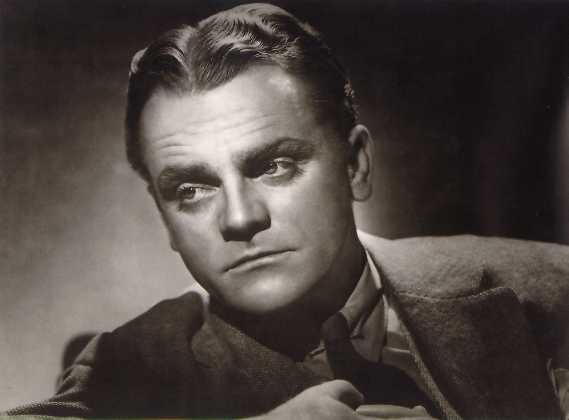
I love the analysis below - I find it to be amazingly perceptive.
From Who the Hell's In it:
He was different from most of the great stars of the golden age in that he often played villains -- even late in his career -- comically in Mister Roberts, with unsentimental pathos in Love Me or Leave Me, with complicated and disturbing psychopathic ambivalence in White Heat. His essential persona was as fixed in the public's consciousness as Bogart's or Cooper's or Gable's but -- being a more resourceful and versatile actor -- he could express ambiguities in a character even if they weren't written into the script or featured by the direction. Because he was innately so sympathetic, his heavies created an intriguing, even alarming, tension in the audience. As a result, White Heat, as an example, contains a decidedly subversive duality: in the glare of Cagney's personality -- though his character is in no way sentimentalized -- the advanced, somewhat inhuman technology of the police and the undercover-informer cop become morally reprehensible. As a result, I remember [Orson] Welles and I hissing the law and rooting for Cagney like schoolboys. That rarest of actors -- who could totally transcend their vehicles -- and in common with a number of other stars in the movies' greatest period, he was indisputably one of a kind.
James Cagney Appreciation Day
From Who the Hell's In it:
Of course, he was like no other dancer: his straight-legged, cocky, constantly surprising way of hoofing -- which is how he started in show business -- was seen only in a couple of other films, not really very good ones. Footlight Parade (1933) is the best of these, yet his manner as an actor and his grace as a performer no doubt owe quite a lot to his dancing days. He just moved eloquently, and therefore could easily have been a great silent star. However, he arrived with the talkies, and gave even the least of them a large measure of his boundless panache.
James Cagney Appreciation Day
From Who the Hell's In it:
One critic wrote of White Heat that only a hard-boiled director like Raoul Walsh could get away with having Cagney -- during a terrible migraine attack -- sit on his mother's lap, a moment of startling intimacy. But I think Cagney could probably have got away with almost anything, because he had as a performer such amazing intensity and conviction. Whether it was shoving a grapefuit in his girlfriend's face -- in William Wellman's highly prized if a bit overrated The Public Enemy, the 1931 gangster film that made him a star overnight -- or doing a little dance step down the stairs of the White House after meeting FDR (in 1942's Yankee Doodle Dandy), Cagney's indisputable authority as a film personality and his flawless sense of honesty as an actor could transform even the most improbably material into something totally believable.
That grapefruit scene (shown above) is so incredible - the photo cannot come CLOSE to capturing what that moment was in the movie: its violence, its contempt, its spontanaeity. You almost wish he had hit her. That would have been cleaner, not so degrading. An incredible acting moment - Cagney at his best.
James Cagney Appreciation Day
Cagney, one of my favorite actors of all time. You know how so many of you have this really personal lump-in-throat response to Wayne? I get that with Cagney. I can't watch him dance in Yankee Doodle Dandy without wanting to weep. I feel like weeping now just thinking about it!!
So - those of you who followed my John Wayne appreciation moments, will know the drill. I'll put up quotes and excerpts from the chapter on Cagney from Peter Bogdonavich's marvelous book, Who the hell's in it.
Cagney fans, get ready!!
From Who the hell's in it:
The year before I had run for Orson Welles a 16mm print of Raoul walsh's devastating gangster film starring Cagney, White Heat (1949); Welles had never seen it and was a very enthusiastic admirer of both Cagney's and Walsh's, so we looked at it one night. Afterwards, Orson got to musing on the absurdity of all those theoretical writings about the supposedly huge difference between movie acting and stage acting. "Look at Cagney!" Orson exclaimed. "Everything he does is big -- and yet it's never for a moment unbelievable -- because it's real, it's true! He's a great movie actor and his performances are in no way modulated for the camera -- he never scaled anything down."
Cagney's another one where you can say: nobody has ever been quite like him. There's only one James Cagney.
Diary Friday
Two entries from my junior year of high school. The second one, when i came across it this morning, made me laugh so hard that tears streamed down my face. It's about one of our teachers who used to give us all nicknames. Could you EVER get away with such stuff in a classroom now? Who knows, maybe you could ... but some of them (one in particular) are truly in bad taste ... but no matter ... I was guffawing reading them.
Once again, my junior year was when I was WILDLY AND PASSIONATELY IN LOVE ... with a boy who sort of liked me. As a person, not as a girl. It took me an entire YEAR to realize that he liked me as a person, not as a girl. Bummer.
In the first entry, my mother gives me some AWESOME advice ... (which, of course, I blatantly ignored for the next 20 years - until, through the school of hard knocks, I finally got the message. I think I've got the hang of it now, though ... Thanks, Mum!! You were right!)
December 2
Thank God the week is over. And tomorrow -- I shall be in NYC with Drama Class and Mere and Kate and Beth. I really need this break now. I can't wait! The city just excites, exhilarates me. [Still does] I can forget about stupid Chemistry and stupid school. Oh yes - I finished my paper for English. I am so proud of it! I worked really hard on it - 12 typed pages. Last night I got 4 - count them - 4 hours of sleep. I typed and typed - my back still aches. I got up late and had to dash out without breakfast. I got to school - I felt so weak and light-headed - J. told me my face was stark white. My stomach gnawed painfully - I must have looked gorgeous.
Once again - French picked me up. [Shorthand translation: HE was in my French class, so I got to be in his presence] French comes at a perfect time for me -- in the middle of the day. Project Adventure days [a gym class that HE was in with me] are heaven. First period just sets me off in a good mood. I don't have to struggle on to get to period 4. [Okay, Sheila ... so ... you might want to look at your propensity to WILT when you are not in the presence of the guy you love. Not a good habit to get into.] He has no idea.
I came home today and thought about him really intensely. [Stop doing that. Go for a run. Jump in the lake. Do ANYTHING other than sit around thinking about him "really intensely"] I didn't think about us [Uh - there is no "us"], or asking him to dance - but I thought about him. He's a person. Why is that so thrilling to me? [Don't ask me.] I just look at him - hair combed, glasses - Mum said to me, "I think at the dance, you should wait for him to ask you. You've let him know, don't push it. But also - you don't want to take away from his masculinity, his maleness." [Go, Mum!! Awesome advice! Too bad I ignored it for so many years!] It sounds sexist but I know what she means. If he does feel something, then I want to give him a chance to do something about it first. I hate being such a dreamer. I'm gonna be crushed someday. [You will be crushed over ... and over ... and over ... and over ... ]
I think humans are beautiful. Aren't people beautiful? I imagine his growth [as in height? or his soul-growth?] and his teenager-hood - He is a teenager. Just like everyone else. He has up days, down days. I don't really know what I'm trying to say but -- I know that when he looks at me, I feel in awe of nature for just creating life. Individuals. Created out of the stuff of nature. Atoms. Molecules. And him -- I mean - who is he? What is it like inside his head? Does he have questions or fears about sex? Is he a virgin? Oh God I don't even want to contemplate that one. I wonder if I look as virgin pure as I feel (and am!!!!)
I think the masculine race is wonderful.
[I still do. And I'm glad that now, in my old age, I realize that men are, in fact, NOT a different RACE, but a different GENDER. But when I was 16, they sure seemed like a different race altogether.]
December 3
Dance tomorrow night. I am not going. I wouldn't care about it if he weren't there. [All eggs in one basket. A basket who liked me as a PERSON, not as a GIRL. Not a good idea.] That was the reason I went to Homecoming and it was going to be the reason I went to this one. He is now at Harvard representing some little country and debating. [This must be Model UN. At least I hope it is. Otherwise I have no idea what he was up to.] I WISH I WERE THERE! I'll have to get April to tell me all about it.Next week - the 15th - the band puts on their annual Christmas concert in the gym. Of course I planned on going. Now what I didn't know was that he is in the Stage Band and -- he has a solo where he stands up alone to play. J. says he really gets into it, leaning into the music. I can't wait!
I have too much homework. I feel extremely close to a mental breakdown.
Every night I stay up until midnight. Chemistry is plaguing my life out, no thanks to Mr. Amoeba Man. I really am teaching myself Chemistry. History is so boring. [Yup. I had to find a love of history all on my own. My parents helped too.] Mr. Butler is really sexist. He openly tells the girls in our class he doesn't think it's right that girls wear pants. "Oh, Kelly, you look very pretty today. It's a shame that girls wear sweatpants nowadays." Uhm - Kelly has gym right before History. Asshole. I mean, he's a nice grandfatherly sort of guy, but he condescends to the girls when they ask questions, and treats the boys like members of his team. It gets a bit much!! First period studies and gym are heaven. Studies -- of course we never study! Studies are not there to study in, are you crazy?
Kate, J., April and I sit at one table and cry with laughter for forty-five minutes. It's a blast!
Math is crazy. Mr. James is crazy. He throws chalk and erasers at people. He threw a pencil at me - it hit me in the tooth. He gives everyone nicknames. He calls Kim Gately - Rusty. (Think about it.) He calls Dawn Wemmer - Sunrise. He calls Tim Devinck - Leonardo. Steve W. has his hair cut really evenly - he is called Bowl. Mark W. has the same haircut, and he is called Bowl II. John Marcus is called Aurelius. Sue Rice is called Corn Flakes. He calls me Marsha. (As in Marsha Malley). Oh yeah, and there's this kid in our class named Tuan Do - Mr. James calls him Don Ho. Sean O'Brien is this kid who looks like a leprechaun, or an elf, maybe. Or the Baby New Year in the Christmas special. Mr. James always calls him Baby New Year, right to his face. "Who knows the answer - Baby New Year?" [Is anyone else guffawing right now? This is all SO inappropriate and SO FUNNY] Everyone laughs in that class so much. The kids who don't have nicknames feel left out. Mr. James is always saying, "Hey, come on, Sean - wake up! New Years is coming!"
I CAN'T WAIT FOR THE CHRISTMAS CONCERT! [I find the lack of segue and the capital letters quite alarming]
My favorite author, by the way, is JUDITH GUEST. Oh my God - her books honestly make me cry. It's rare to find a book just as good as the movie or vice versa. But - it runs both ways here, with her Ordinary People. I loved both equally. I bought her 2nd book Second Heaven in NYC. I love how she writes. Her characters are wonderful! I'd love to act in a movie of one of her books. I'd love to be able to have one of her characters and say, "That's my character." If I was a guy, I would have killed to play Conrad!! I hope Judith Guest keeps writing more and more and more and more.
God, this entry is boring. I'm bored just writing it - so I am going back to Chemistry and p+ and e- and moles and Avagadro's number and 6.02 x 10²³ and I can't wait!
Movie quote:
"But this last time was not my fault."
"What happened."
"It was a little ... a little classroom ... and it ... sort of ... burned down ..."
"Burned down??"
"Well, blew up, actually."
"Political activism?"
"Chemistry major."
congratulations ...
My deepest heartfelt congratulations go to Trav S.D., who just published his first book: No Applause--Just Throw Money : The Book That Made Vaudeville Famous. It has been reviewed in The Washington Post, the Wall Street Journal and The New York Times. Trav is an old old friend of mine, we go way way WAY back ... he was my boyfriend for a time in high school. I took him to my senior prom. We then lost touch for, oh, EIGHTEEN FECKIN' YEARS ... until 2003 - when we got back in touch again.
One of the most beautiful things for me, about the success he has now achieved, is that it is not at all a surprise - remembering the boy he was. The boy who, at 18, made me watch all the Marx Brothers movies, because he was horrified I hadn't seen them. Who didn't just watch the Marx Brothers ... he STUDIED the Marx Brothers. The boy who was, even then, encyclopedic on vaudeville - knew all the names, all the anecdotes ... and I remember the feeling, back then, that to him - WC Fields, and the Marx Brothers, and Mae West, etc. etc. were as vital and important to him as modern-day movie stars. It's how I feel now, in my life, having the Cary Grant, Bogart, Gary Cooper love that I have ... They are as much a part of my consciousness as the guys who are in the movies NOW - as a matter of fact, they have even MORE of an impact. I compare everyone to them. I prefer the old movies. It's just the way it is. Trav was like that as a teenager. And now - he's published his first book, on the history of vaudeville. How beautiful, how APT.
Congratulations, my old old friend. I couldn't be happier for you. I can't WAIT to read it!!
100 Greatest TV characters ...
Alex has launched Part 4!! Now all we have to do is wait for her Top 5 to complete the list.
A couple of my favorite comments in this particular list - but do go over there and read them all:
-- on Mr. Spock: "He was a complete and utter amalgamation. Logic battling emotion. Half human, half Vulcan. He considered Kirk more than just his friend, yet found the attraction and the need repulsive and nonsensical. He made me think. About everything."
-- on Richard Kimble: "I love ordinary people forced to act extraordinary. Innocent and on the run, Richard was merely searching for the truth, and unfortunately being chased by the law. He had only his hope and his determination to sustain his faith. He was one of the strongest characters on Television."
-- on Tony Soprano: "He was an okay guy. I think if I could befriend him, he’d protect me in a dark alley. In fact, he’d probably revel in it."
-- on JR Ewing: "He was a piranha in search of his ultimate lover: Glory. I loved every inch of him."
And her paragraph on Edith Bunker brought a lump to my throat.
The suspense is killing me ... what are your top 5 characters, Alex?? I know who ONE of them HAS to be ... but the other 4??
The Books: "Lord Byron's Love Letter" (Tennessee Williams)
And here is my next excerpt of the day from my library. Still in Tennessee Williams land. Williams was prolific!
Next Tennessee Williams play on the shelf is a one-act called Lord Byron's Love Letter. A funny sad little play. There are four characters: The Spinster, The Old Woman, The Matron, and The Husband. It takes place in New Orleans during Mardi Gras in the late nineteenth century.
The Old Woman and the Spinster (they are either mother and daughter or grandmother and granddaughter) live in a dilapidated residence and claim to have, in their possession, a love letter from Lord Byron, written to The Spinster's grandmother. They charge money to anyone who wants to see it, and hear them tell the tale of how this meeting took place. At the very end of the play, it becomes clear that the entire thing is a scam. But, because it's a Tennessee Williams play, your heart kind of aches for the two con artists - because, yes, they are con artists - but also: for whatever reason, they have constructed this elaborate fantasy - the closeness of their family to the legendary Lord Byron - and they have created this fantasy not just to make money, but to give some meaning to their lives, to touch immortality. It is a fantasy they adore, it makes them feel important, as though their lives were somehow blessed by his presence. The Spinster and The Old Woman are fantasists of the highest order.
A woman (The Matron) shows up to see the letter. She is in town with her husband for Mardi Gras. Her husband tags along, uninterested in the letter - mainly because he is wasted. The Matron politely asks to hear the story of the romance between Lord Byron and their ancestor ... so The Spinster and The Old Woman read out loud from their ancestor's journal (again - you realize at the end of the play that none of this was real) - and then ... the big moment ... they let the guests SEE the letter. No one is allowed to READ the letter, though. They are only allowed to look at the envelope. Kind of a gyp, if you ask me!
Strange: whenever anyone arrives to see the letter and hear the story, The Old Woman, in some kind of ritual that I don't understand, goes and stands behind one of the window curtains so she is out of sight. And yet - as The Spinster starts to tell the story, The Old Woman continuously chimes in with corrections, additions, from behind the curtain.
There is a possibility - from reading the play - that the whole thing actually did happen (or something like it) to the Old Woman herself. Not at all the way these two say it, but perhaps she SAW Lord Byron once ... and elaborated that sighting of him into an entire love affair -- her excuse to retire from the world, and never go out again ... her excuse to bury her heart ... This would explain why she feels the need to hide behind the curtain ... and also would explain why, even though she is hidden, she has to keep chiming in with corrections.
I'll excerpt a bit from when the two are telling the story, and reading out loud from the journal.
From Lord Byron's Love Letter, by Tennessee Williams
SPINSTER. Near the end of her tour, my Grandmother and her Aunt went to Greece, to study the classic remains of the oldest civilization.
OLD WOMAN. [correcting] The oldest European civilization.
SPINSTER. It was an early morning in April of the year eighteen hundred and --
OLD WOMAN. Twenty-seven!
SPINSTER. Yes. In my Grandmother's journal she mentions --
OLD WOMAN. Read it, read it, read it.
MATRON. Yes, please read it to us.
SPINSTER. I'm trying to find the place, if you'll just be patient.
MATRON. Certainly, excuse me. [She punches her Husband who is nodding] Winston!
SPINSTER. Ah, here it is.
OLD WOMAN. Be careful! remember where to stop at, Ariadne!
SPINSTER. Shhh! [She adjusts her glasses and seats herself by the lamp] "We set out early that morning to inspect the ruins of the Acropolis. I know I shall never forget how extraordinarily pure the atmosphere was that morning. It seemed as though the world were not very old but very, very young, almost as though the world had been newly created. There was a taste of earliness in the air, a feeling of freshness, exhilarating my senses, exalting my spirit. How shall I tell you, dear Diary, the way the sky looked? It was almost as though I had moistened the tip of my pen in a shallow bowl full of milk, so delicate was the blue in the dome of the heavens. The sun was barely up yet, a tentative breeze disturbed the ends of my scarf, the plumes of the marvelous hat which I had bought in Paris and thrilled me with pride whenever I saw them reflected! The papers that morning, we read them over our coffee before we left the hotel, had spoken of possible war, but it seemed unlikely, unreal: nothing was real, indeed, but the spell of golden antiquity and rose-colored romance that breathed from this fabulous city."
OLD WOMAN. Skip that part! Get on to where she meets him!
SPINSTER. Yes .... [She turns several pages and continues] "Out of the tongues of ancients, the lyrical voices of many long-ago poets who dreamed of the world of ideals, who had in their hearts the pure and absolute image--"
OLD WOMAN. Skip that part! Slip down to where --
SPINSTER. Yes! Here! Do let us manage without any more interruptions! "The carriage came to a halt at the foot of the hill and my Aunt, not being too well--"
OLD WOMAN. She had a sore throat that morning.
SPINSTER. "-- preferred to remain with the driver while I undertook the rather steep climb on foot. As I ascended the long and crumbling flight of old stone steps --"
OLD WOMAN. Yes, yes, that's the place! [The Spinster looks up in annoyance. The Old Woman's cane taps impatiently behind the curtains] Go on, Ariadne!
SPINSTER. "I could not help observing continually above me a man who walked with a barely perceptible limp--"
OLD WOMAN. [in hushed wonder] Yes -- Lord Byron!
SPINSTER. "-- and as he turned now and then to observe beneath him the lovely panorama --"
OLD WOMAN. Actually he was watching the girl behind him!
SPINSTER. [sharply] Will you please let me finish? [There is no answer from behind the curtains, and she continues to read] "I was irresistibly impressed by the unusual nobility and refinement of his features!" [She turns a page]
OLD WOMAN. The handsomest man that ever walked the earth! [She emphasizes the speech with three slow but loud taps of her cane]
SPINSTER. [flurriedly] "The strength and grace of his throat, like that of a statue, the classic outlines of his profile, the sensitive lips and the slightly dilated nostrils, the dark lock of hair that fell down over his forehead in such a way that --"
OLD WOMAN. [tapping her cane rapidly] Skip that, it goes on for pages!
SPINSTER. "... When he had reached the very summit of the Acropolis he spread out his arms in a great, magnificent gesture like a young god. Now, thought I to myself, Apollo has come to earth in modern dress."
OLD WOMAN. Go on, skip that, get to where she meets him!
SPINSTER. "Fearing to interrupt his poetic trance, I slackened my pace and pretended to watch the view. I kept my look thus carefully averted until the narrowness of the steps compelled me to move close by him."
OLD WOMAN. Of course he pretended not to see she was coming!
SPINSTER. "Then finally I faced him."
OLD WOMAN. Yes!
SPINSTER. "Our eyes came to gether!"
OLD WOMAN. Yes! Yes! That's the part!
SPINSTER. "A thing which I don't understand had occurred between us, a flush as of recognition swept through my whole being! Suffused my --"
OLD WOMAN. Yes ... Yes, that's the part!
SPINSTER. "'Pardon me,' he exclaimed, 'you have dropped your glove!' And indeed to my surprise I found that I had, and as he returned it to me, his fingers ever so slightly pressed the cups of my palm."
OLD WOMAN. [hoarsely] Yes! [Her boxy fingers clutch higher up on the curtain, the other hand also appears, slightly widening the aperture]
SPINSTER. "Believe me, dear Diary, I became quite faint and breathless, I almost wondererd if I could continue my lonely walk through the ruins. Perhaps I stumbled, perhaps I swayed a little. I leaned for a moment against the side of a column. The sun seemed terribly brilliant, it hurt my eyes. Close behind me I heard that voice again, almost it seemed I could feel his breath on my --"
OLD WOMAN. Stop there! That will be quite enough! [The Spinster closes the journal]
MATRON. Oh, is that all?
OLD WOMAN. There's a great deal more that's not to be read to people.
MATRON. Oh.
SPINSTER. I'm sorry, I'll show you the letter.
MATRON. How nice! I'm dying to see it! Winston? Do sit up! [He has nearly fallen asleep. The Spinster produces from the cabinet another small packet which she unfolds. It contains the letter. She hands it to the Matron, who starts to open it]
OLD WOMAN. Watch out, watch out, that woman can't open the letter!
SPINSTER. No, no, please, you mustn't. The contents of the letter are strictly private. I'll hold it over here at a little distance so you can see the writing.
OLD WOMAN. Not too close, she's holding up her glasses! [The Matron quickly lowers her lorgnette]
SPINSTER. Only a short while later Byron was killed.
MATRON. How did he die?
OLD WOMAN. He was killed in action, defending the cause of freedom! [This is uttered so strongly the husband starts]
SPINSTER. When my Grandmother received the news of Lord Byron's death in battle, she retired from the world and remained in complete seclusion for the rest of her life.
MATRON. Tch-tch-tch! How dreadful! I think that was foolish of her. [The cane taps furiously behind the curtain]
SPINSTER. You don't understand. When a life is completed, it ought to be put away. It's like a sonnet. When you've written out the final couplet, why go on any further? You only destroy the part that's already written!
November 17, 2005
Goblet of Fire
So far, I have read two very positive reviews for Goblet of Fire. Berardinelli and Ebert.
To quote my nephew Cashel:
"Dare I hope?????"
A not-to-miss post
... (although very tough to read - just warning you - at least I found it really hard to get through) ... by my good friend Alex.
Yes, girl. You still had a lot of stuff to do. (Not to mention meeting me!) I feel so lucky that we have become friends.
The Books: "Auto-Da-Fé" (Tennessee Williams)
And here is my next excerpt of the day from my library. Still in Tennessee Williams land. Williams was prolific!
Next Tennessee Williams play on the shelf is a one-act called Auto-Da-Fé. A bizarre little play - but, in my opinion it is amazing how Williams can establish two distinct characters, with distinct voices, in 7 pages. The two characters created here are their own people - it doesn't matter that it's a little one-act, that it's only 25 minutes long ... They are fully fleshed out complex people. He doesn't save all his good stuff for his full-length plays. The two characters in this play don't, to my knowledge, show up in other versions of longer plays - the way some of his one-act characters do. These two seem very distinct.
It is a mother and son who live in the Vieux Carré in New Orleans. The son is in his 30s. Williams writes, of the both of them: "Mother and son are both fanatics and their speech has something of the quality of poetic or religious incantation".
The son, Eloi (pronounced Ell-wah), is sickly. He is asthmatic, nervous, prone to colds, and a fanatical puritan. He finds living where he does to be nearly intolerable - surrounded by all that open SIN. He feels that the moral filth is actually in the air, like pollution.
His mother, Mme. Duvenet, is a bit more laid-back about it - or, no - not laid-back. She runs a boarding house, she is a practical woman - she believes that the spirit can take care of itself wherever it is.
Eloi spends most of his time ranting and raving about the evils around him, and about how the entire town should be razed. (Ouch.) He yearns for the purification of fire. He thinks burning down the French Quarter would be a good thing for mankind, in terms of redemption.
Meanwhile, a week earlier he happened to come across a nudie picture - through various circumstances - and it has almost prompted him to have a nervous breakdown. He wants to prosecute the person who sent it through the mail, he begins his own investigation - Meanwhile, though, his moral outrage has become so acute that he is pretty much shattered, psychically. He's like any fundamentalist. The rigidity is actually NOT a sign of strength and certainty. The rigidity makes the fundamentalist way more fragile. Trees that bend in the wind don't crack during wind-storms. But more rigid trees snap when the wind picks up, snap and fall over. This is the perfect analogy for the fundamentalist. As long as there's no wind, the fundamentalist will be fine. But look out - when there's a windstorm, the fundie will SNAP!! Eloi has snapped. The play ends with him running into the house (the two of them have been sitting on the porch) - locking the door - so his mother can't get in - and then setting fire to the place. With himself in it. He burns himself alive.
The play is a comedy.
No, just kidding.
I'll post a small excerpt from the beginning of the play. This is before Eloi tells his mother about the nudie picture that has shattered his entire world.
From Auto-Da-Fé, by Tennessee Williams
ELOI. Even the air in this neighborhood is unclean.
MME. DUVENET. It is not as clean as it might be. I love clean window-curtains, I love white linen, I want immaculate, spotless things in a house.
ELOI. Then why don't we move to the new part of town where it's cleaner?
MME. DUVENET. The property in this block has lost all value. We couldn't sell our place for what it cost us to put new paint on the walls.
ELOI. I don't understand you, Mother. You harp on purity, purity all the time, and yet you're willing to stay in the midst of corruption.
MME. DUVENET. I harp on nothing. I stay here because I have to. And as for corruption, I've never allowed it to touch me.
ELOI. It does, it does. We can't help breathing it here. It gets in our nostrils and even goes in our blood.
MME. DUVENET. I think you're the one that harps on things around here. You won't talk quietly. You always fly off on some tangent and raise your voice and get us all stirred up for no good reason.
ELOI. I've had about all that I can put up with, Mother.
MME. DUVENET. Then when do you want to do?
ELOI. Move, move. This asthma of mine, in a pure atmosphere uptown where the air is fresher, I know that I wouldn't have it nearly so often.
MME. DUVENET. I leave it entirely to you. If you can find someone to make an acceptable offer, I'm willing to move.
ELOI. You don't have the power to move or the will to break from anything that you're used to. You don't know how much we've been affected already!
MME. DUVENET. By what, Eloi?
ELOI. This fetid old swamp we live in, the Vieux Carré! Every imaginable kind of degeneracy springs up here, not at arm's length, but right in our presence!
MME. DUVENET. Now I think you're exaggerating a little.
ELOI. You read the papers, you hear people talk, you walk past open windows. You can't be entirely unconscious of what goes on! A woman was horribly mutilated last night. A man smashed a bottle and twisted the jagged end of it in her face.
MME. DUVENET. They bring such things on themselves by their loose behavior.
ELOI. Night after night there are crimes taking place in the parks.
MME. DUVENET. The parks aren't all in the Quarter.
ELOI. The parks aren't all in the Quarter but decadence is. This is the primary lesion, the -- focal infection, the -- chancre! In medical language, it spreads by -- metastasis! It creeps through the capillaries and into the main blood vessels. From there it is spread all through the surrounding tissue! Finally nothing is left outisde the decay!
MME. DUVENET. Eloi, you are being unnecessarily violent in your speech.
ELOI. I feel that strongly about it.
MME. DUVENET. You mustn't allow yourself to sound like a fanatic.
ELOI. You take no stand against it?
MME. DUVENET. You know the stand that I take.
ELOI. I know what ought to be done.
MME. DUVENET. There ought to be legislation to make for reforms.
ELOI. Not only reforms but action really drastic!
MME. DUVENET. I favor that, too, within all practical bounds.
ELOI. Practical, practical. You can't be practical, Mother, and wipe out evil! The town should be razed!
MME. DUVENET. You mean this old section torn down?
ELOI. Condemned and demolished!
MME. DUVENET. That's not a reasonable stand.
ELOI. It's the stand I take.
MME. DUVENET. Then I'm afraid you're not a reasonable person.
ELOI. I have good precedence for it.
MME. DUVENET. What do you mean?
ELOI. All through the Scriptures are cases of cities destroyed by the justice of fire when they got to be nests of foulness!
MME. DUVENET. Eloi, Eloi.
ELOI. Condemn it, I say, and purify it with fire!
MME. DUVENET. You're breathing hoarsely. That's what brings on asthma, over-excitement, not just breathing bad air!
ELOI. [after a thoughtful pause] I am breathing hoarsely.
MME. DUVENET. Sit down and try to relax.
ELOI. I can't any more.
MME. DUVENET. You'd better go in and take an amytal tablet.
ELOI. I don't want to get to depending too much on drugs. I'm not very well, I'm never well any more.
MME. DUVENET. You never will take the proper care of yourself.
ELOI. I can hardly remember the time when I really felt good.
MME. DUVENET. You've never been quite as strong as I'd like you to be.
ELOI. I seem to have chronic fatigue.
MME. DUVENET. The Duvenet trouble has always been mostly with nerves.
ELOI. Look! I had a sinus infection! You call that nerves?
MME. DUVENET. No, but ---
ELOI. Look! This asthma, this choking, this suffocation I have, do you call that nerves?
MME. DUVENET. I never agreed with the doctor about that condition.
ELOI. You hate all doctors, you're rabid on the subject!
MME. DUVENET. I think all healing begins with faith in the spirit.
ELOI. How can I keep on going when I don't sleep?
MME. DUVENET. I think your insomnia's caused by eating at night.
ELOI. It soothes my stomach.
MME. DUVENET. Liquids would serve that purpose!
ELOI. Liquids don't satisfy me.
MME. DUVENET. Well, something digestible, then. A little hot cereal maybe with cocoa or Postum.
ELOI. All that kind of slop is nauseating to look at!
MME. DUVENET. I notice at night you won't keep the covers on you.
ELOI. I can't stand covers in summer.
MME. DUVENET. You've got to have something over your body at night.
ELOI. Oh, Lord, oh, Lord.
MME. DUVENET. Your body perspires and when it's exposed, you catch cold!
ELOI. You're rabid on the subject of catching cold.
MME. DUVENET. Only because you're unusally prone to colds.
ELOI. [with curious intensity] It isn't a cold! It is a sinus infection!
MME. DUVENET. Sinus infection and all catarrhal conditions are caused by the same thing as colds!
ELOI. At ten every morning, as regular as clock-work, a headache commences and doesn't let up till late in the afternoon.
MME. DUVENET. Nasal congestion is often the cause of headache.
ELOI. Nasal congestion has nothing to do with this one!
MME. DUVENET. How do you know?
ELOI. It isn't in that location!
MME. DUVENET. Where is it, then?
ELOI. It's here at the base of the skull. And it runs aorund here.
MME. DUVENET. Around where?
ELOI. Around here!
MME. DUVENET. [touching his forehead] Oh! There!
ELOI. No, no, are you blind? I said here!
MME. DUVENET. Oh, here!
ELOI. Yes! Here!
MME. DUVENET. Well, that could be eye-strain.
ELOI. When I've just changed my glasses?
MME. DUVENET. You read consistently in the wrong kind of light.
ELOI. You seem to think I'm a saboteur of myself.
MME. DUVENET. You actually are.
ELOI. You just don't know. [darkly] There's lots of things that you don't know about, Mother.
MME. DUVENET. I've never pretended nor wished to know a great deal. [They fall into a silence, and Mme. Duvenet rocks slowly back and forth. The light is nearly gone. A distant juke-box can be heard playing "The New San Antonio Rose". She speaks, finally, in a gentle liturgical tone.] There are three simple rules I wish that you would observe. One: you should wear under-shirts whenever there's changeable weather! Two: don't sleep without covers, don't kick them off in the night! Three: chew your food, don't gulp it. Eat like a human being and not like a dog! In addition to those three very simple rules of common hygience, all that you need is faith in spiritual healing! [Eloi looks at her for a moment in weary desperation. Then he groans aloud and rises from the steps] Why that look, and the groan?
ELOI. [intensely] You -- just -- don't -- know!
MME. DUVENET. Know what?
ELOI. Your world is so simple, you live in a fool's paradise!
MME. DUVENET. Do I indeed?
ELOI. Yes, Mother, you do indeed! I stand in your presence a stranger, a person unknown! I live in a house where nobody knows my name!
MME. DUVENET. You tire me, Eloi, when you become so excited!
ELOI. You just don't know. You rock on the porch and talk about clean white curtains! While I'm all flame, all burning, and no bell rings, nobody gives an alarm!
MME. DUVENET. What are you talking about?
ELOI. Intolerable burden! The conscience of all dirty men!
MME. DUVENET. I don't understand you.
ELOI. How can I speak any plainer?
MME. DUVENET. You go to confession!
ELOI. The priest is a cripple in skirts!
MME. DUVENET. How can you say that?
ELOI. Because I have seen his skirts and his crutches and heard his meaningless mumble through the wall!
MME. DUVENET. Don't speak like tha tin mym presence!
ELOI. It's worn-out magic, it doesn't burn any more!
MME. DUVENET. Burn any more? Why s hould it?
ELOI. Because there needs to be burning!
MME. DUVENET. For what?
ELOI. [leaning against the column] For the sake of burning, for God, for the purification! Oh, God, oh, God. I can't go back in the house, and I can't stay out on the porch! I can't even breathe very freely, I don't know what is about to happen to me!
MME. DUVENET. You're going to bring on an attack. Sit down!
Catharsis
Tonight is rainy and cold. I made my way to the theatre through the rain, and I had no umbrella. I dried off at the theatre and then started my preparation for the show. It's a long process, and I'm obsessive about it: I do certain things at certain times ... I can't start a certain part of the preparation until a certain time ... I'm like Nomar Garciaparra. I hear the stage manager out on stage calling out each numbered light cue - for the assistant stage manager in the booth to run the cue ... it always happens at a certain time and it lets me know where I'm at, in terms of time left, and what I should be doing. I like ritual. It's very relaxing. So I hear her voice calling out, methodically: "23 ..." long pause as the cue is run ... "24 ..." another pause ... "25 ..."
We had a full house tonight. A couple of good friends of mine were going to be in attendance. I was looking forward to performing for them. It's good to never forget the audience.
In a way I cannot quantify yet - being in this show has changed my life. It's not "just another show" for some reason. It's so many other things.
I am in the first scene very briefly - but I have no lines and I am in the background. It's someone else's scene and the lights are not on me. The house is FULL of people. I am facing out during that first scene - and obviously I am not sitting up there, scanning the audience for my friends ... tee hee - I can be seen, I'm in character ... but there's that dual thing that goes on where you have multiple levels of consciousness going on. You are aware of the audience, and yet you are in the world of the play. I think such moments are only possible if you are relaxed. If you are tense - you can barely do ONE thing at a time, let alone 2 or 3. Hence: the long rituals before the show.
So anyway, I'm there for the first scene. I glance up at the audience. And immediately see my acting mentor - one of the most important men in my life - sitting smack dab in the front row. He will be sitting directly beneath me when I have my big moment in my scene. He will be looking STRAIGHT UP MY NOSE. Now - this man deserves an enormous post of his own - I haven't really talked about him, because I don't know how to talk about it. This man has seen me at my most raw. This man has seen stuff that even my dearest friends haven't seen - because when you're involved in an acting process, often you get even MORE raw there ... than you would with your friends. This man knows me.
I have not seen him in a couple of years, for various reasons ... and I have felt guilty about losing touch. I know where he is now, what he's doing ... through the grapevine but every time I have thought about picking up the phone, I hesitate. There's never enough time. (Lame excuse) I need to be completely focused and clear when I talk to him and I'm always too rushed. (Lame excuse)
What it really is is that ... just the FACT of seeing him makes me confront myself, my dreams for myself, my hopes, my goals. HE holds onto all of those things. FOR me. If I'm not able to believe in myself, HE is there to do it for me until I get back on my feet again. He has gone to bat for me. It is an amazing thing to have someone believe in you the way he believes in me - but it also can be quite a responsibility. And if I'm not in a good space with myself, I tend to withdraw from him. I can't deal with him then. The guilt pangs are amazing.
So. There he was. There he was.
I took a moment to register this. I didn't lose my shit, I didn't suddenly forget my blocking ... but knowing that he was there completely changed everything. I had to factor him in.
I know I'm not explaining that part right. It's not like I suddenly went backstage and feverishly tried to change my performance so I would be "good enough" for him. No. I have more confidence in my ability than that. Nothing would be changed. But he was out there. And suddenly - like I knew I would be - like I have been avoiding over the past year when I haven't picked up the phone to call him - I was confronted, yet again, by his unswerving belief in me. Also confronted by ... this deep sense of anxiety and loss. Wondering if I will seem very changed to him. If he will think: "Wow. What has happened to Sheila." The man has power over me, no doubt about it. I happen to think he more than deserves it - but there it was.
There it was. In that theatre with me.
My scene went very well. The second I was on, and the lights were on me, and the second I opened my mouth - I forgot his watching eyes, I forgot all of that stuff, and I played the scene.
After the show, I raced around getting out of my costume - I had my friends to go out and see, yes, but I had to see him, too - and I felt like ... I felt like a little impatient kid. I could not get out there soon enough. GET. THIS. COSTUME. OFF. ME. Why are these pantyhose NOT COMING OFF? GET. THEM. OFF. ME. NOW.
I went out into the lobby and there were my three friends. Hugs all around. People coming over to me to say stuff to me - people I don't know - my attention being scattered - but the whole while, my eyes scanned the lobby.
Then I saw him - he had started back into the theatre, obviously to go look for me - and I broke away from my friends - and took a couple of steps, calling out his name. He turned back, saw me, opened his arms - and suddenly we were hugging - and out of nowhere, I BURST into tears. I hadn't thought I would cry - but then I BURST out crying. Which I never do. Maybe trickly tears, easy to deal with - but this was a sudden storm.
And once I started - I couldn't stop. I still haven't stopped. I cried and cried and cried into his shoulder, saying his name over and over, and he was squeezing me so tight it almost hurt, and kissing the side of my face, and laughing out loud in joy at seeing me again. And I just clung to him, crying into his down parka like a little girl.
It was amazing.
I feel like something that has been a bit broken in my heart for a while has now been mended. I feel blessed. I cried the entire time we talked - and we were talking about the show, and his work, and how much he loved my work, and we laughed about how he had been looking up my nose for my entire scene, and we made an appointment to have lunch next week - and the entire time, tears kept welling up, spilling over, welling up, spilling over ... faster than I could wipe them away.
November 16, 2005
Random thought - not meant to be bitchy
I've been following, with some interest, the whole Pajamas Media thing - or I guess it's now Open Source Media? If it IS Open Source Media, looks like it won't be that way for long - due to trademark violations. (Uhm, guys? Maybe you should have checked on trademark issues BEFORE making the announcement of the name).
I don't normally talk about blogging and other bloggers - or comment on how people run their own blogs - it's not my business, and I really don't care. But I have found THIS particular venture very interesting (probably not for the reasons they want me to) ... and have been following it, albeit in a desultory way.
Anyway - a lot of bloggers I respect and read daily are involved in this thing. So this is not meant to be bitchy - it's just an outsider's perspective - based on their press releases and also based on the unbeLIEVABLY touchy responses the bloggers involved put out whenever anyone DARES to criticize them. I mean - they sound like petulant whiny brats when anyone asks a valid question like: "Uhm ... so what's the business model?" (Okay, that was a little bitchy, sorry.) They show up in other bloggers comments sections and go APESHIT. It's very unprofessional. Get a thick skin, guys. You've got a tough road ahead, and you had BETTER start taking some of those questions seriously if you want to stick around.
Ann Althouse has been a great source for these questions - here's her latest post - (I really think the Pajamas people should be listening to these people and not dealing with every criticism as "Oh, whatever, sour grapes." So every single criticism that comes your way is due to "sour grapes"? Isn't that convenient!).
Jeff Jarvis has been great to read as well - if you're interested in this whole thing.
And, of course, Dennis the Peasant. Just keep scrolling. And here is a good place to start.
An insider's view. One of many.
I am getting this huge 1999 deja vu feeling looking at all of this. One of the PM's press releases talked about "word of mouth" marketing. Dudes. I don't even know what I'm TALKING about but I know that "word of mouth marketing" is ... What? WHAT DOES THAT MEAN? Fine. Great. It's revolutionary, whatever: but tell me how it will work.
I remember the mania of that time back then, the self-congratulation, the evangelical feeling of MISSION ... and also ... there was a distinct sense of ANNOYANCE in certain people when someone asked them to GET SPECIFIC. Anyone who asked for specifics, or who tried to put the brakes onto all the "irrational exuberance" was seen as a party-pooper to the wave of the future.
Pajamas Media doesn't even seem like a really good idea to me. I must be missing something. It certainly isn't revolutionary, it certainly isn't new. Again: a lot of those people I respect and read all the time. It would be great if they made some cash.
But from the little I've seen ... I ... I guess I just can't get a grasp on the whole thing. On what they MEAN, on what they are going to DO, and WHY it is new ... This could just be because I'm a dim bulb intellectually, and can't understand their business model - but ... I don't know ... shouldn't business models be relatively simple? Shouldn't they be easily explainable to dolts like myself? HOW will it WORK? WHAT does "word of mouth marketing" MEAN? And tell me your steps that you are going to take?
Also: just a quick aesthetic comment: The design of their website is atrocious. I have no words for how bad it is. All right, I have some. Boring and yet confusing. Nothing "gets" me. I don't know where to go. Also: it's slooooooow. I hate the grey. My brain goes to mush looking at the dern page. It's awful. Don't they have anyone who could design them a nice-looking page that actually ... reflects what they're supposed to be?
This is a subjective comment from a girl who has sprinkled her own page with Gibson Girls (designed, for me, by the marvelous Curly McDimple). I designed my page that way - with her help - because I wanted it to reflect my little world here, also I think they're lovely and they make me feel peaceful when I look at them, and happy to be a woman. I love them.
I don't know. The Open Source Media page looks like a disaster to me. I know it's new and all - but you would think the kinks would be ironed out by the time of launch. That's how MOST businesses are run.
And the whole touchy-to-the-point-of-hysteria response to criticism has got to end.
So that's my post. I can't be accused of sour grapes, though, since I was never asked to join.
DOH! Now that really DOES sound like sour grapes!!
I swear - I don't want to be involved in it - I'm just giving my perspective. I'm confused. Don't get it. Don't get it.
Okay, on to more important things:
What?
Good God.
What an absolutely incredible and heart-wrenching story. (Warning: horrible photo at the top - difficult to look at. Sorry, ricki!! Should have put a warning there.)
I have extremely personal responses to the issue of lobotomy - and I don't know why. I don't know anyone who was lobotomized. But it fills me with horror - and yet I also am drawn to the topic. Tennessee Williams' sister - Frances Farmer ... If I believed in previous lifetimes I could theorize that either I had been lobotomized or I was a doctor who performed them. It brings up such a visceral response of terror and pity. For example - I could barely get through the article above. It was very painful for me to get through, and I had to ignore the top photo. Too much. Odd. I can't explain it.
Good for you, Howard Dully, good for you for having the courage to look into your own past, to try to find out "what was missing". And then for having the courage to share it.
Amazing.
I love people
Why? Because they create things like this:
Romeo and Juliet - told entirely through emoticons.
The Books: "Portrait of a Madonna" (Tennessee Williams)
And here is my next excerpt of the day from my library. Still in Tennessee Williams land. Williams was prolific!
Next Tennessee Williams play on the shelf is a beautiful little one-act called Portrait of a Madonna. There are elements in this play that show up very prominently in his major full-length plays: the ending is straight out of Streetcar, with the kindly doctor leading away the fearful insane woman. The main character - Lucretia Collins - is how Miss Alma from Summer and Smoke very likely will end up. It's tragic. What life gives to some people.
Miss Lucretia Collins (like Miss Alma) was a minister's daughter once upon a time, a good girl, a respectable girl. And she fell in love with a boy in her town ... but, like Miss Alma, nothing ever worked out with him. He married someone else. And Lucretia Collins never recovered from that blow.
She is now, at the play's open, living in a small dingy apartment. And every night, she believes that Richard (the man she once loved) breaks into her room every night to "indulge his senses". heh heh That's a direct quote from Summer and Smoke. The play opens, and you can hear her voice pleading with someone from behind a closed door. This person is not real. It is her fantasy come to life. Lucretia Collins has become unhinged from reality.
Meanwhile, everyone in the apartment building sort of knows that she's crazy ... and time has run out for Miss Collins. Miss Collins has called down to the building manager to report that she has had an intruder. The porter and the elevator boy come up to "investigate" but really: a doctor has been called to come take her away to an institution.
This play shows the moments leading up to the doctor's arrival. The elevator boy (a cocky young guy who thinks Miss Collins is a creature of fun, to be laughed at) and the porter (an infinitely compassionate man, who sees the deep pain behind Miss Collins' fantasy) stand in her main room, waiting for the doctor to come. Miss Collins now believes that she is pregnant with her fantasy-lover's baby ... etc.
She's a tragic character. But, in true Tennessee Williams, fashion, she is noble. In his view: someone who is able to love like that, with a love so burning that it consumees their entire psyche, is noble - no matter what the end. If we all were able to love one another like that, maybe the world would be a kinder place.
Lucretia Collins is a great character. I'd love to play her.
I'll excerpt from the scene between the elevator boy, the porter, and Miss Collins.
From Portrait of a Madonna, by Tennessee Williams
ELEVATOR BOY. Is the man still here, Miss Collins?
MISS COLLINS. Oh, no. No, he's gone now.
ELEVATOR BOY. How did he go, out the bedroom window, Miss Collins?
MISS COLLINS. [vaguely] Yes ...
ELEVATOR BOY. I seen a guy that could do that once. He crawled straight up the side of the building. They called him The Human Fly! Gosh, that's a wonderful publicity angle, Miss Collins -- "Beautiful Young Society Lady Raped By The Human Fly!"
PORTER. [nudging him sharply] Git back in your cracker box!
MISS COLLINS. Publicity? No! It would be so humiliating! Mr. Abrams surely hasn't reported it to the papers!
PORTER. No, ma'am. Don't listen to this smarty pants.
MISS COLLINS. [touching her curls] Will pictures be taken, you think? There's one of him on the mantel.
ELEVATOR BOY. [going to the mantel] This one here, Miss Collins?
MISS COLLINS. Yes. Of the Sunday School faculty picnic. I had the little kindergardeners that year and he had the older boys. We rode in the cab of a railroad locomotive from Webb to Crystal Springs. [She covers her ears wiht a girlish grimace and toss of her curls] Oh, how the steam-whistle blew! Blew! [giggling] Blewwwww! It frightened me so, he put his arm round my shoulders! But she was there, too, though she had no business being. She grabbed his hat and stuck it on the back of her head and they -- they rassled for it, they actually rassled together! Everyone said it was shameless! Don't you think it was?
PORTER. Yes, Miss Collins.
MISS COLLINS. That's the picture, the one in the silver frame up there on the mantel. We cooled the watermelon in the springs and afterwards played games. She hid somewhere and he took ages to find her. It got to be dark and he hadn't found her yet and everyone whispered and giggled about it and finally they came back together -- her hangin' on to his arm like a common little strumpet -- and Daisy Belle Huston shrieked out, "Look, everybody, the seat of Evelyn's skirt!" It was -- covered with -- grass-stains! Did you ever hear of anything as outrageous? It didn't faze her, though, she laughed like it was something very, very amusing! Rather triumphant she was!
ELEVATOR BOY. Which one is him, Miss Collins?
MISS COLLINS. The tall one in the blue shirt holdiing onto one of my curls. He loved to play with them.
ELEVATOR BOY. Quite a Romeo -- 1910 model, huh?
MISS COLLINS. [vaguely] Do you? It's nothing, really, but I like the lace on the collar. I said to Mother, "Even if I don't wear it, Mother, it will be so nice for my hope-chest!"
ELEVATOR BOY. How was he dressed tonight when he climbed into your balcony, Miss Collins?
MISS COLLINS. Pardon?
ELEVATOR BOY. Did he still wear that nifty little stick-candy striped blue shirt with the celluloid collar?
MISS COLLINS. He hasn't changed.
ELEVATOR BOY. Oughta be easy to pick him up in that. What color pants did he wear?
MISS COLLINS. [vaguely] I don't remember.
ELEVATOR BOY. Maybe he didn't wear any. Shimmied out of 'em on the way up the wall! You could get him on grounds of indecent exposure, Miss Collins!
PORTER. [grasping his arm] Cut that or git back in your cage! Understand?
ELEVATOR BOY. [snickering] Take it easy. She don't hear a thing.
PORTER. Well, you keep a decent tongue or get to hell out. Miss Collins here is a lady. You understand that?
ELEVATOR BOY. Okay. She's Shoiley Temple.
PORTER. She's a lady!
ELEVATOR BOY. Yeah! [He returns to the gramophone and looks through the records]
MISS COLLINS. I really sh ouldn't have created this disturbance. When the officers come I'll have to explain that to them. But you can understand my feelings, can't you?
PORTER. Sure, Miss Collins.
MISS COLLINS. When men take advantage of common white-trash women who smoke in public there is probably some excuse for it, but when it occurs to a lady who is single and always com-pletely above reproach in her moral behavior, there's really nothing to do but call for police protection! Unless of course the girl is fortunate enough to have a father and brothers who can take care of the matter privately without any scandal.
PORTER. Sure. That's right, Miss Collins.
MISS COLLINS. Of course it's bound to cause a great deal of very disagreeable talk. Especially 'round the church! Are you gentleman Episcopalian?
PORTER. No, ma'am. Catholic, Miss Collins.
MISS COLLINS. Oh. Well, I suppose you know in England we're known as the English Catholic church. We have direct Apostolic succession through St. Paul who christened the Early Angles -- which is what the original English people were called -- and established the English branch of the Catholic church over there. So when you hear ignorant people claim that our church was founded by -- by Henry the Eighth -- that horrible, lecherous old man who had so many wives -- as many as Blue-beard they say! -- you can see how ridiculous it is and how thoroughly obnox-ious to anybody who really knows and understands Church History!
PORTER. [comfortingly] Sure, Miss Collins. Everybody knows that.
MISS COLLINS. I wish they did, but they need to be instructed! Before he died, my father was Rector at the Church of St. Michael and St. George at Glorious Hill, Mississippi ... I've literally grown up right in the very shadow of the Episcopal church. At Pass Christian and Natchez, Biloxy, Gulfport, Port Gibson, Columbus and Glorious Hill! [with gentle, bewildered sadness] But you know I sometimes suspect that there has been some kind of spiritual schism in the modern church. These northern dioceses have completely departed from the good old church traditions. For instance our Rector at the Church of the Holy Communion has never darkened my door. It's a fashionable church and he's terribly busy, but even so you'd think he might have time to make a stranger in the congregation feel at home. But he doesn't though! Nobody seems to have the time any more ... [She grows more excited as her mind sinks back into illusion] I ought not to mention this, but do you know they actually take a malicious de-light over there at the Holy Communion -- where I've recently transferred my letter -- in what's been going on here at night in this apartment? Yes!! [She laughs wildly and throws up her hands] They take a malicious deLIGHT in it!! [She catches her breath and gropes vaguely about her wrapper]
PORTER. You lookin' for somethin', Miss Collins?
MISS COLLINS. My -- handkerchief ... [She is blinking her eyes against tears]
PORTER. [removing a rag from his pocket] Here. Use this, Miss Collins. It's just a rag but it's clean, except along that edge where I wiped off the phonograph handle.
MISS COLLINS. Thanks. You gentlemen are very kind. Mother will bring in something cool after a while ...
ELEVATOR BOY. [placing a record on the machine] This one is got some kind of foreign title. [The record begins to play Tschaikowsky's "None but the Lonely Heart".]
MISS COLLINS. [stuffing the rag daintily in her bosom] Excuse me, please. Is the weather nice outside?
PORTER. [huskily] Yes, it's nice, Mr. Collins.
MISS COLLINS. [dreamily] So wa'm for this time of year. I wore my little astrakhan cape to service but had to carry it home, as the weight of it actually seemed oppressive to me. [Her eyes fall shut] The sidewalks seem so dreadfully long in summer ...
ELEVATOR BOY. This ain't summer, Miss Collins.
MISS COLLINS. [dreamily] I used to think I'd never get to the end of that last block. And that's the block where all the trees went down in the big tornado. The walk is simply glit-tering with sunlight. [pressing her eyelids] Impossible to shade your face and I do perspire so freely! [She touches her forehead daintily with the rag] Not a branch, not a leaf to give you a little protection! You simply have to en-dure it. Turn your hideous red face away from all the front-porches and walk as fast as you decently can till you get by them! Oh, dear, dear, Savior, sometimes you're not so lucky and you meet people and have to smile! You can't avoid them unless you cut across and that's so ob-vious, you know ... People would say you're peculiar ... His house is right in the middle of that awful leafless block, their house, his and hers, and they have an automobile and always get home early and sit on the porch and watch me walking by -- Oh, Father in Heaven -- with a malicious delight! [She averts her face in remembered torture] She has such penetrating eyes, they look straight through me. She sees that terrible choking thing in my throat and the pain I have in here -- [touching her chest] -- and she points it out and laughs and whispers to him, "There she goes with her shiny big red nose, the poor old maid -- that loves you!" [She chokes and hides her face in the rag]
PORTER. Maybe you better forget all that, Miss Collins.
MISS COLLINS. Never, never forget it! Never, never! I left my parasol once -- the one with long white fringe that belonged to Mother -- I left it behind in the cloak-room at the church so I didn't have anything to cover my face with when I walked by, and I couldn't turn back either, with all those people behind me -- giggling back of me, poking fun at my clothes! Oh, dear, dear! I had to walk straight forward -- past the last elm tree and into that merciless sunlight. Oh! It beat down on me, scorching me! Whips! ... Oh, Jesus! ... Over my face and my body! ... I tried to walk on fast but was dizzy and they kept closer behind me ---! I stumbled, I nearly fell, and all of them burst out laughing! My face turned so horribly red, it got so red and wet, I knew how ugly it was in all that merciless glare -- not a single shadow to hide in! And then -- [Her face contorts with fear] -- their automobile drove up in front of their house, right where I had to pass by it, and she stepped out, in white, so fresh and easy, her stomach round with a baby, the first of the six. Oh God! ... And he stood smiling behind her, white and easy and cool, and they stood there waiting for me. Waiting!! I had to keep on. What else could I do? I couldn't turn back, could I? No! I said dear God, strike me dead! He didn't though. I put my head way down like I couldn't see them! You know what she did? She stretched out her hand to stop me! And he -- he stepped up straight in front of me, smiling, blocking the walk with his terrible big white body! "Lucretia," he said, "Lucretia Collins!" I -- I tried to speak but I couldn't, the breath went out of my body! I covered my face and -- ran! ... Ran! ... Ran! [beating the arm of the sofa] Till I reached the end of the block -- and the elm trees -- started again ... Oh, Merciful Christ in Heaven, how kind they were! [She leans back exhaustedly, her hand relaxed on sofa. She pauses and the music ends] I said to Mother, "Mother, we've got to leave town!" We did leave after that. And now after all these years he's finally remembered and come back! Moved away from that house and the woman and come here -- I saw him in the back of the church one day. I wasn't sure -- but it was. The night after that was the night that he first broke in -- and indulged his senses with me ... He doesn't realize that I've changed, that I can't feel again the way that I used to feel, now that he's got six children by that Cincinnati girl -- three in high school already! Six! Think of that! Six children! I don't know what he'll say when he knows another one's coming! He'll probably blame me for it because a man always does! In spite of the fact that he forced me!
ELEVATOR BOY. [grinning] Did you say -- a baby, Miss Collins?
MISS COLLINS. [lowering her eyes but speaking with tenderness and pride] Yes -- I'm expecing a child.
ELEVATOR BOY. Jeez! [He claps his hand over his mouth and turns away quickly]
MISS COLLINS. Even if it's not legitimate, I think it has a perfect right to its father's name -- don't you?
PORTER. Yes. Sure, Miss Collins.
MISS COLLINS. A child is innocent and pure. No matter how it's conceived. And it must not be made to suffer! So I intend to dispose of the little property Cousin Ethel left me and give the child a private education where it won't come under the evil influence of the Christian church! I want to make sure that it doesn't grow up in the shadow of the cross and then have to walk along blocks that scorch you with terrible sunlight!
November 15, 2005
So now it's your turn, John Wayne fans
Here's what I would love for you to discuss, share, talk about, what have you.
What's your favorite John Wayne film? But more than the title - could you talk about why?
A lot of people have very personal responses to John Wayne - it's like he reminds them of something else - and this, to me, is the mark of those great movie stars of the studio system years. They got INTO us in a way that modern movie stars do not.
And ... any specific favorite John Wayne MOMENT that you have ... what moment of his, in terms of acting, is emblazoned in your brain? A glance, the way he said a line, anything ... Describe it.
Let's discuss his acting. It's so good, and I can tell, from all of these comments (which have greatly moved me, by the way) - how passionately you all feel about him, how much his work means to you.
So.
John Wayne films and moments: GO!!
John Wayne Appreciation Day
John Wayne started out as a prop guy. He was a college student, and he picked up extra cash doing props for movies and occasional extra work. This was how he met John Ford. He almost got fired from a couple of Ford's films (as a prop guy - never as an actor) for various snafus - which are HYSTERICAL to hear about.
Here's my favorite one. I laughed out loud, again, reading it.
Ford was a prop guy working on Ford's Four Sons in 1928:
That was the next time I pretty near left the business. I was just working vacations, wasn't really interested in the business as such, but I really liked Ford. He had this wonderful woman, Margaret Mann, who had never done anything before, and he was talking a performance into her -- taking two, three hours to talk her into the right mood for this scene. It was the fourth son bringing the letter from the third son she's lost in the war. It's fall, and when the door opens, my job as property man was to throw up the maple leaves, and they had a fan there to blow them out -- it was a silent picture, remember. The fan turned on, and down came the breeze into the middle of the set and the door closed and I relaxed. Then I'd go out and sweep the leaves away and get ready to do another take. We kept doing this over and over, and it got to be fairly monotonous for one who wasn't as interested yet in the business as he should have been. So this one time, they opened the door, the son went in, I threw up the leaves, the leaves wafted in, I figured the scene was over, you know. The fellow turned off the fan and I picked up the broom, went in, and started to sweep. And I looked up and I'm looking right into two cameras -- and they're turning! And looking at me are the cameraman, and John Ford, and the wife of the man who was head of the studio then. Shit, there I was. I just threw down my goddamn broom and started to walk off. There was that moment of tension and then, again, Ford broke up laughing, so they all laughed. They said, "Woah now!" They had Archduke Leopold's Serbian heir working on the picture, and a lot of German guys, so they played a martial piece of music and marched me around, and then took me to the Archduke and bent me over in front of him and he pinned the Iron Cross on me. Then they took me back to Ford and he bent me over and kicked me in the ass. And then they sent me off the set, because this actress laughed every time she looked at me -- she couldn't stop laughing. I was never so goddamned embarrassed in my life.
John Wayne Appreciation Day
From Who The Hell's In it, by Peter Bogdonavich:
To me, Duke had always seemed slightly out of breath, as though he hadn't yet caught up on the last twenty years, not to mention the last twenty minutes. Both [John] Ford and [Howard] Hawks truly loved him, of course, and even knowing him a little, as I did, it was pretty difficult not to like him. All this, and a lot more, obviously communicated itself to the public -- still the top American star more than seventy years since his beginning. His visual legacy has defined him as the archetypal man of the American West -- bold, innocent, profane, idealistic, wrongheaded, good-hearted, single-minded, quick to action, not given to pretension, essentially alone, ready for any adventure -- no matter how grand or daring; larger, finally, than life or death.
John Wayne Appreciation Day
That's one of my favorite images of John Wayne, by the way - from Red River. He's so IN it, isn't he?? I wish I could have found a closer image of his face - He is so in that moment.
Here's a couple of exchanges between Bogdonavich and Wayne that, I think, points out Duke's incredible dedication to his craft. Italicized lines are Bogdonavich's:
One of the most memorable moments of any picture I've seen you in is a silent moment in The Searchers. After you see what's been done to the white women, there's a close-up of you, camera moves in --I turn back. Terrific shot. Helluva shot. And everybody can put their own thoughts to it. You're not forced to think one way or the other.
Your gestures in pictures are often daring -- large -- and show the kind of freedom and lack of inhibition you have. Did you get that from Ford, or did you always have that?
No, I think that's the first lesson you learn in a high school play -- that if you're going to make a gesture, make it.
To be honest: that has to be some of the best acting advice I've ever heard.
"If you're going to make a gesture, make it."
So much of bad phony acting is when people make gestures half-heartedly, or they PRETEND to make gestures .... hoping the audience won't pick up on the fact that they're not REALLY making the gesture ...
but audiences always know the difference between phony and real. They just do.
John Wayne Appreciation Day
More from the transcript of the interview John Wayne gave with Peter Bogdonavich - This is FAScinating. I wish all action stars looked at their jobs in this way - we'd get some better movies.
Any time there was a chance for a reaction -- which is the most important thing in a motion picture -- he [John Ford] always took reactions of me, so I'd be a part of every scene. Because I had a great deal of time in the picture when other people were talking, and all my stuff was just reactions. They become very important throughout a picture, they build your part. They always say I'm in action movies, but it's in reaction pictures that they remember me -- pictures that are full of reactions, but have a background of action.
John Wayne Appreciation Day

John Wayne talks about John Ford - this is from an interview he gave to Peter Bogdonavich. I laughed out loud at the last line of this story. Obviously, John Wayne was a very good story-teller.
A funny thing happened with Ford after The Big Trail. He was a strange character, you know. After I did that picture, I came back, and he was making Up the River. I went over and said, "Hi, coach." Nothing. I thought he didn't hear me. So I figured, Oh, well, he didn't even see me. The next time I saw him I went, "Hi, coach, hi." And again I didn't get anything. So the next time I just went right up in front of him and went, "Hi, coach." And he turned and talked to somebody else. I thought, That's that -- he won't speak to me. I don't know how the hell I can communicate.About two years later, I was in Catalina with Ward, having a belt, and Barbara [Ford], his daughter -- she was a little girl then -- she ran in and said, 'Daddy wants to see you." I said, "Whoa, wait a minute, Barbara, you got the wrong boy -- must be Ward." She said, "No, it's you, Duke." So I said, "Yeah, honey, run along, you know this is a bar." So his wife, Mary Ford, came to the door and she said, "Duke, come here. Jack is expecting you out there." I said, "All right." So I went out to the Araner, his boat, and I go aboard -- I remember Jim Tully was there and four or five guys -- and Jack was in the middle of a goddamn story, and he looked up at me and said, "Hi, Duke, sit down." And to this goddamn day I don't know why he didn't speak to me for two years.
John Wayne Appreciation Day
From Who the Hell's In it, by Peter Bogdonavich:
His performances in these pictures [Rio Grande, The Quiet Man, The Searchers, The Wings of Eagles, Man Who Shot Liberty Valance] rate with the finest examples of movie acting, and his value to each film is immeasurable; yet none of them was recognized at the time as anything much more than "and John Wayne does his usual solid job," if that -- more often he was panned. The Academy nominated him only twice; first for Allan Dwan's excellent Sands of Iwo Jima, an effective and archetypal John Wayne Marine picture of non-Ford/Hawks dimension. Yet I remember that Wayne's sudden death from a sniper at the end of Sands was the first real shock -- and one of the most lastingly potent -- I ever had at the movies. The reason why this worked so powerfully for me at age ten, as well as for millions of all ages, was because of Wayne's even then accepted indestrucability. In fact, Sands of Iwo Jima was the second of only five films in which Wayne dies. Still, it wasn't until twenty years later, when he put on an eye patch, played drunk, and essentially parodied himself in True Grit, that anyone thought he was acting, and so with this over-the-top performance Duke Wayne got his second nomination and finally won his Oscar.The particular quality in a star that makes audiences instantly suspend their disbelief -- something men like Wayne or Jimmy Stewart or Henry Fonda naturally bring with them when they enter a scene -- is an achievement which normally goes so unnoticed that most people don't even think of it as acting at all. To a lot of people, acting means fake accents and false noses, and a lot of emoting ... John Wayne was at his best precisely when he was simply being what came to be called "John Wayne".
Amazing.
John Wayne Appreciation Day
From Who the Hell's In it, by Peter Bogdonavich:
There's a moment in Rio Bravo -- which features, I think, Wayne's most genuinely endearing performance -- when he walks down the street of the jail/sheriff's office toward some men riding up to meet him. Hawks frames the shot from behind -- Wayne striding slowly, casually away from camera in his slightly rocking, graceful way -- and the image lingers a while to let us enjoy this classic, familiar figure, unmistakable from any angle, Americ'as twentieth-century Hercules moving across a world of illusion he had more than conquered.
John Wayne Appreciation Day
From Who the Hell's In it, by Peter Bogdonavich:
And after forty years in films, Duke had more excitement about the job than most people just starting out. He liked working with newcomers, too, and was generous with advice; those who didn't let ego stand in their way could learn quite a few good tricks. And all of this came without a note of pomposity or pretentiousness. In fact, he always seemed genuinely surprised, even slightly embarrassed, by praise. Without ambiguity, [Howard] Hawks said to me that "when you have someone as good as Duke around," it became "awfully easy to do good scenes" because the actor helped and inspired everybody.
John Wayne Appreciation Day
From Who The Hell's In It, by Peter Bogdonavich:
In a lifetime of almost thirty years as a top-ten box-office attraction (plus twenty before that as a not unpopular star actor), Wayne's accumulated persona had even before his death attained such mythic proportions that by then the most myopic of viewers and reviewers had finally noted it. He brought to each new movie (good or bad) a powerful resonance from the past -- his own and ours -- which filled the world with reverberations above and beyond its own perhaps undistinguished qualities. That was the true measure of a great movie star of the golden age.
It's the casting, stupid!
A wonderful post about Stephen King, and the movies made from his books.
I was particularly gratified to read this:
I stayed up three nights running to read It. I did not leave a room without it under my arm; my mother could barely persuade me to put it aside during dinner, which I would then wolf down in ten minutes so I could power through the dishes and get back to reading. I can't remember the last book that had my attention that completely. The Secret History, maybe.It is a scary book and horrible things happen in it, but I couldn't put it down because of the people -- the characters, the human beings. King is a great plotter, but he's a master of characterization in tandem with that: realistic reactions to unrealistic situations, natural dialogue in unnatural circumstances. The attraction of the horror genre is not just about freaking yourself out so bad that you have to sleep with a light on; it's about trying to control something that you think, secretly, could maybe possibly happen to you one day, and reading as much as you can about it so you'll know what to do.
"I couldn't put it down because of the people" - that was exactly my experience with that great book.
But go over there and read her analysis of why some movies based on King stories are great - and why some suck. She puts it on the CASTING of the films, which I think is quite interesting, and I can't really think of any exceptions.
Her paragraph about Timothy Hutton in The Dark Half is hilarious.
But why not just cast the George part with another actor, instead of one who can't stick a Southern accent for more than five words in a row and whose idea of a scream of rending pain is actually closer to the gargle of a clogged bathtub drain? Because it is possible for an actor of Hutton's physical stature to convince me of what he's doing. Buscemi could do it. Buscemi would not back down from that shit even if the check bounced. Hutton plays it like he cheated on you, got caught, and is now crying about it and making you comfort him about how his parents got divorced and he's a really self-hating person. This character kills people with a straight razor, Timbo. Get your damn back into it for five minutes.
Timbo ... heh heh heh heh
The 6 Train - part deux
More evidence of the generalized sense of entitlement that is rampant on the 6 train. If you think the guy who responds to the pregnant woman is being unnecessarily rude, then you obviously haven't ridden the 6 train, where everyone appears to get uppity about their personal space - which is completely inappropriate when you're on the subway. No one cares if you have a stroller. No one cares if you're pregnant, actually. Maybe someone might - but certainly not everyone. No one cares if you have a bike. No one cares if you have 20 bags from Bloomingdales. No one cares. Join the crowd, suck it up, hang onto the pole, and stop your whining about why YOU deserve a seat over the 300 other people around you. When I'm on the 6 train, I will only give up my seat to someone on crutches, or someone who is elderly. Also: Sometimes in a subway crowd of that size you can't help but be shoved into people, or be jostled, or to push at people - IT'S PART OF LIVING IN NEW YORK CITY- and to scream out: "Stop pushing, everyone" is ridiculous. Go buy a farmhouse in the country if you don't want to be pushed.
(Here's another piece of anecdotal evidence in regards to this issue.)
I've seen it, people. I've seen it with my own eyes.
Honestly.
I am truly frightened by this image.
The commentary is CLASSIC, especially: "Are we being forced to endure her 15 minutes of fame in dog years, or something?"
The Books: "The Last of My Solid Gold Watches" (Tennessee Williams)
And here is my next excerpt of the day from my library. Still in Tennessee Williams land. Williams was prolific!
Next Tennessee Williams play on the shelf is The Last of My Solid Gold Watches. Kind of a Death of a Salesman for the Missisissippi Delta. It's a one-act - and Williams dedicated it to Sydney Greenstreet "for whom the principal character was hopefully conceived". You read it and you just SEE Sydney Greenstreet in the role, in all his glorious girth, his sense of self-importance ... What a classic actor.
Mr. Charlie Colton (the lead role) is a traveling shoe salesman. Once one of the best. But now ... the world is changing ... people don't care about quality anymore ... even the younger salesmen don't care about quality ... and worse than that: they have never even heard of the great Charlie Colton. Colton is a Willy Loman-esque character, at least in his plight, and in his pathos.
He shows up at a hotel in some Mississippi Delta town - where he has always stayed - and he and the old "Negro porter" kind of bond over how much the hotel has deteriorated since Colton was there last. Colton remembers coming to the hotel when it was glittering, packed with people, and when he could get a bunch of high-rollers to play poker in his room. No more. You can tell that he and the Negro porter are both, actually, members of a dying world.
He sends the Negro porter down to the lobby to find one of the younger salesman and have him come up to play cards. This younger salesman, Harper, is visibly bored in Colton's company - he doesn't do the proper thing, which would be: to laugh uproariously at Colton's bad jokes, listen agog to his stories of how it used to be on the road, never interrupt him, etc. Colton is kind of a bore ... but, like Willy Loman, you ache for him. His time is ending. He knows it. It fills him with despair. What, then, was his entire life?
I'll excerpt part of the long exchange between Colton and Harper that leads into the end of the play.
From The Last of My Solid Gold Watches, by Tennessee Williams
HARPER. [restively squirming and glancing at his watch] How long you been on th' road?
MR. CHARLIE. Fawty-six yeahs in Mahch!
HARPER. I don't believe yuh.
MR. CHARLIE. Why would I tell you a lie about something like that? No, suh, I want you t'know -- I want you t'know -- Hmmm ... I lost a mighty good customer this week.
HARPER. [with total disinterest, adjusting the crotch of his trousers] How's that, Charlie?
MR. CHARLIE. [grimly] Ole Ben Summers -- Friar's Point, Mississippi ... Fell over dead like a bolt of lightning had struck him just as he went to pour himself a drink at the Cotton Planters' Cotillion!
HARPER. Ain't that terrible, though! What was the trouble?
MR. CHARLIE. Mortality, that was the trouble! Some people think that millions now living are never going to die. I don't think that -- I think it's a misapprehension not borne out by the facts! We go like flies when we come to the end of the summer ... And who is going to prevent it? [He becomes depressed] Who -- is going -- to prevent it! [He nods gravely] The road is changed. The shoe industry is changed. These times are -- revolultion! [He rises and moves to the window] I don't like the way that it looks. You can take it from me -- the world that I used to know -- the world that this boy's father used t'know -- the world we belonged to, us old time war-horses! -- is slipping and sliding away from under our shoes. Who is going to prevent it? The ALL LEATHER slogan don't sell shoes any more. The stuff that a shoe's made of is not what's going to sell it any more! No! STYLE! SMARTNESS! APPEARANCE! That's what counts with the modern shoe-purchaser, Bob! But try an' tell your style department that. Why, I remember the time when all I had to do was lay out my samples down there in the lobby. Open up my order-book an' write out orders until my fingers ached! A sales-talk was not necessary. A store was a place where people sold merchandise and to sell merchandise the retail-dealer had to obtain it from the wholesale manufacturer, Bob! Where they get merchandise now I do not pretend to know. But it don't look like they buy it from wholesale dealers! Out of the air -- I guess it materializes! Or maybe stores don't sell stuff any more! Maybe I'm living in a world of illusion! I recognize that possibility, too!
HARPER. [casually, removing the comic paper from his pocket] Yep -- yep. You must have witnessed some changes.
MR. CHARLIE. Changes? A mild expression. Young man -- I have witnessed -- a REVOLUTION! [Harper has opened his comic paper but Mr. Charlie doesn't notice, for now his peroration is really addressed to himself] Yes, a revolution! The atmosphere that I breathe is not the same! Ah, well -- I'm an old war-horse. [He opens his coat and lifts the multiple golden chains from his vest. An amazing number of watches rise into view. Softly, proudly, he speaks] Looky here, young fellow! You ever seen a man with this many watches? How did I acquire this many time-pieces? [Harper has seen them before. He glances above the comic sheet with affected amusement] At every one of the annual sales conventions of the Cosmopolitan Shoe Company in St. Louis a seventeen-jewel, solid-gold, Swiss-movement Hamilton watch is presented to the ranking salesman of the year! Fifteen of those watches have been awared to me! I think that represents something! I think that's something in the way of achievement! ... Don't you?
HARPER. Yes, siree! You bet I do, Mistuh Charlie! [He chuckles at a remark in the comic sheet. Mr. Charlie sticks out his lips with a grunt of disgust and snatches the comic sheet from the young man's hands]
MR. CHARLIE. Young man -- I'm talkin' to you, I'm talkin' for your benefit. And I expect the courtesy of your attention until I am through! I may be an old war-horse. I may have received -- the last of my solid gold watches ... But just the same -- good manners are still a part of the road's tradition. And part of the South's tradition. Only a young peckerwood would look at the comics when old Charlie Colton is talking.
HARPER. [taking another drink] Excuse me, Charlie. I got a lot on my mind. I got some business to attend to directly.
MR. CHARLIE. And directly you shall attend to it! I just want you to know what I think of this new world of yours! I'm not one of those that go howling about a Communist being stuck in the White House now! I don't say that Washington's been taken over by Reds! I don't say all of the wealth of the country is in the hands of the Jews! I like the Jews and I'm a friend to the niggers! I do say this -- however .... The world I knew is gone -- gone -- gone with the wind! My pockets are full of watches which tell me that my time's about over! [A look of great trouble and bewilderment appears on his massive face. The rather noble tone of his speech slackens into a senile complaint] All of them -- pigs that was slaughtered -- carcasses dumped in the river! Farmers receivin' payment not t'grow wheat an' corn an' not t'plant cotton! All of these alphabet letters that's sprung up all about me! Meaning -- unknown -- to men of my generation! The rudeness -- the lack of respect -- the newspapers full of strange items! The terrible -- fast -- dark -- rush of events in the world! Toward what and where and why! ... I don't pretend to have any knowledge of now! I only say -- and I say this very humbly -- I don't understand -- what's happened ... I'm one of them monsters you see reproduced in museums -- out of the dark old ages -- the giant rep-tiles, and the dino-whatever-you-call-ems. BUT -- I do know this! And I state it without any shame! Initiative -- self-reliance -- independence of character! The old sterling qualities that distinguished one man from another -- the clay from the potters -- the potters from the clay -- are -- [kneading the air with his hands] How is it the old song goes? ... Gone with the roses of yesterday! Yes -- with the wind!
HARPER. [whose boredom has increased by leaps and bounds] You old-timers made one mistake. You only read one side of the vital statistics.
MR. CHARLIE. [stung] What do you mean by that?
HARPER. In the papers they print people dead in one corner and people born in the next and usually one just about levels off with the other.
MR. CHARLIE. Thank you for that information. I happen to be the godfather of several new infants in various points on the road. However, I think you have missed the whole point of what I was saying.
HARPER. I don't think so, Mr. Charlie.
MR. CHARLIE. Oh, yes, you have, young fellow. My point is this: the ALL LEATHER slogan is not what sells any more -- not in shoes and not in humanity, neither! The emphasis isn't on quality. Production, production, yes! But out of inferior goods! Ersatz -- that's what they're making 'em out of!
HARPER. [getting up] That's your opinoin because you belong to the past.
MR. CHARLIE. [furiously] A piece of impertinence, young man! I expect to be accorded a certain amount of respect by whippersnappers like you!
HARPER. Hold on, Charlie.
MR. CHARLIE. I belong to -- tradition. I am a legend. Known from one end of the Delta to the other. From the Peabody Hotel in Memphis to Cat-Fish Row in Vicksburg. Mistuh Charlie -- Mistuh Charlie! Who knows you? What do you represent? A line of goods of doubtful value, some kike concern in the East! Get out of my room! I'd rather play solitaire, than poker with men who're no more solid characters than the jack in the deck! [He opens the door for the young salesman who shrugs and steps out with alacrity. Then he slams the door shut and breathes heavily. The Negro enters with a pitcher of ice water]
NEGRO. [grinning] What you shoutin' about, Mistuh Charlie?
MR. CHARLIE. I lose my patience sometimes. Nigger --
NEGRO. Yes, suh?
MR. CHARLIE. You remember the way it used to be.
NEGRO. [gently] Yes, suh.
MR. CHARLIE. I used to come in town like a conquering hero! Why, my God, nigger -- they all but laid red carpets at my feet! Isn't that so?
NEGRO. That's so, Mistuh Charlie.
MR. CHARLIE. This room was like a throne-room. My samples laid out over there on green velvet cloth! The ceiling-fan going -- now broken! And over here -- the wash-bowl an' pitcher removed and the table-top loaded with liquor! In and out from the time I arrived till the time I left, the men of the road who knew me, to whom I stood for things commanding respect! Poker -- continuous! Shouting, laughing -- hilarity! Where have they all gone to?
NEGRO. [solemnly nodding] The graveyard is crowded with folks we knew, Mistuh Charlie. It's mighty late in the day!
MR. CHARLIE. Huh! [He crosses to the window] Nigguh, it ain't even late in the day any more -- [He throws up the blind] It's NIGHT! [The space of the window is black]
NEGRO. [softly, with a wise old smile] Yes, suh ... Night, Mistuh Charlie!
CURTAIN
November 14, 2005
Beauty in the Blockbuster
So I'm reading (more like inhaling) Peter Bogdonavich's latest book: Who the hell's in it - his conversations with and reflections on his favorite actors. It's beyond good. It's an inspiration - I can't believe it. It's so so so good. I will be posting MANY excerpts when I finish it. His essay on Dean Martin ... It's the kind of book that makes you want to go out and rent every single movie he mentions.
I read the chapter on John Wayne today - and found myself in tears multiple times. Guys, I'm telling you. It's so amazing, so invigorating ... I mean, everyone knows John Wayne is great ... but to read someone who can delve into WHY ... Bogonavich interviewed John Wayne for a documentary he was doing on John Ford and he puts the entire transcript of that interview into the book. I wept reading it. What a craftsman. What a dedicated actor. My feckin' GOD.
So it's my night off. I have shows every night but Monday. So I decided to go out and rent Stagecoach or Rio Bravo. Those were the two I was pumped up to see.
I NEEDED TO SEE JOHN WAYNE.
NOW, DAMMIT.
NOW.
I go to Blockbuster. Their set-up SUCKS. They no longer put the classics in their own section - they mix them in - which, in theory, is cool - but it does make it hard to find things. Because ... you have to get into the Blockbuster mindset in order to figure out what THEY think a certain movie is. Oh, so they think THIS is a drama ... ooooookay. It sucks.
Anyway ... they need to have a Western section. Sorry. I know they're action films, but they're WESTERNS. THEY ARE THEIR OWN GENRE.
But here's what was beautiful (although frustrating for me, in my impatient state):
EVERY John Wayne movie was already rented. They had quite a few films in stock - but ALL of them were rented.
I went to find Stagecoach. Already out. Okay. Let's try Rio Bravo. Out. Hmmm. Plan C. Went to go find The Searchers. Out. Went to go find Man who shot Liberty Valance. Out. Sands of Iwo Jima. Out. She wore a yellow ribbon. Out. Quiet Man. Out. True Grit. Out.
GodDAMMIT. I was so KEEN on seeing John Wayne that I stood there, in the grimy blue-carpeted space of my local Blockbuster, frustrated, feeling completely helpless. For a moment. I thought: "But ... but ... I want to see him NOW ..."
And then in the next second, another feeling washed over me - a deeper realization of what had just happened ... and how it completely validated the sensations that Peter Bogdonavich's gorgeous essay had awoken in me ... not only that, but it confirmed the points Bogdonavich had made:
Every John Wayne film in that store was rented.
It hit me again.
Every John Wayne film in that store was rented.
Yeah, they have 50 copies of Herbie the Love Bug Unplugged, yeah, they have 800 copies of Troy placed right by the door because THAT IS WHAT THE PUBLIC WANTS ... and that's fine ...
but every John Wayne film in that store was rented.
I felt this sweep of emotion go over me ... overpowering really ... my throat clogged up ... and standing there, in that glaringly-lit inartistic horribly set-up Blockbuster: I felt that actor's enduring greatness all around me.
His power will never die.
They just don't make 'em like that anymore.
Movie exchange:
"Oh, you still pursue your feminist activities?"
"Oh yes."
"Pity. It's a lost cause."
"Oh, do you really think so? How little you know about women. Good-bye. I doubt that we shall meet again."
"Oh, do you really think so? How little you know about men."
(Just saw this movie again this weekend and continue to be amazed by it. I've tried to write a post about this film about 20 times ... but it's almost like I feel too much for this movie to be articlulate about it. I'll get to it one day. Can anyone guess what movie the exchange is from??)
Happy birthday, PJ O'Rourke!
Love that guy.
LOVE. HIM.
I wish I could go on a date with him. There. I've said it. I know he's married, but I've got a big ol' intellectual crushy-crush on PJ O'Rourke and I always have.
His writing reminds me of Joseph Heller's on occasion in that every other sentence is laugh-out-loud funny. Not EVERY sentence - but every OTHER one. It's a style, a rollicking style, full of ba-dum-CHINGS. It's hard to believe Heller could keep it up for an entire BOOK, but he did. What the style does is; it lulls you into complacence for one sentence. You think things are about to be "played straight". But then in the next sentence, you get the guy slipping on the banana peel, the pie in the face. Then in the next sentence, we're back to the serious - then comes the ba-dum-CHING again. It's so much FUN to read. PJ O'Rourke's writing is like that. One sentence will be a serious one, a truthful one - and the next sentence will be some lampoonish gag. Or - the same format will exist in one sentence.
For example:
"Wherever there's injustice, oppression, and suffering, America will show up six months late and bomb the country next to where it's happening."
That's from O'Rourke's latest book. THAT SENTENCE MAKES ME LAUGH. I know it's not a funny topic - but ... that's part of O'Rourke's appeal as a satirist, a biting commentator - whatever you want to call him. He wrote an essay about Somalia that made me guffaw. Tragic tale, hilarious writing style.
His travel essays have got to be the funniest most cantankerous travel essays ever written.
Love the guy. Love his mind. Love his writing talent.
Want to go on a date with him. That's all.
More PJ O'Rourke quotes, chosen at random by Googling the guy - I don't have any of his books with me at the moment. Look for the serious-funny style I mentioned above - it's on display in almost every quote.
-- A hat should be taken off when you greet a lady and left off for the rest of your life. Nothing looks more stupid than a hat.
-- A little government and a little luck are necessary in life, but only a fool trusts either of them.
-- Fish is the only food that is considered spoiled once it smells like what it is.
-- With Epcot Center the Disney corporation has accomplished something I didn't think possible in today's world. They have created a land of make-believe that's worse than regular life.
-- In fact, safety has no place anywhere. Everything that's fun in life is dangerous. Horse races, for instance, are very dangerous. But attempt to design a safe horse and the result is a cow (an appalling animal to watch at the trotters.) And everything that isn't fun is dangerous too. It is impossible to be alive and safe.
-- There are a lot of mysterious things about boats, such as why anyone would get on one voluntarily.
-- To grasp the true meaning of socialism, imagine a world where everything is designed by the post office, even the sleaze.
-- Moscow has changed. I was here in 1982, during the Brezhnev twilight, and things are better now. For instance, they've got litter. In 1982 there was nothing to litter with.
-- The French are a smallish, monkey-looking bunch and not dressed any better, on average, than the citizens of Baltimore. True, you can sit outside in Paris and drink little cups of coffee, but why this is more stylish than sitting inside and drinking large glasses of whiskey I don't know.
-- Bachelors know all about parties. In fact, a good bachelor is a living, breathing party all by himself. At least that is what my girlfriend said when she found the gin bottles under the couch. I believe her exact words were, "You're a disgusting, drunken mess." And that's a good description of a party, if it's done right.
Here is one of my favorite sentences from All the trouble in the world: It's so simple. Why is it so funny? I don't know. I just know that it's perfect.
-- Sloths move at the speed of congressional debate but with greater deliberation and less noise.
HAHAHA I laughed out loud when I read the sentence in that book and I just laughed out loud coming across that sentence right now.
More quotes:
-- Ecology is the science of everything. Nobody knows everything. Nobody even knows everything about any one thing. And most of us don't know much. Say it's ten-thirty on a Saturday night. Where are your teenage children? I didn't ask where they said they were going. Where are they really? What are they doing? Who are they with? Have you met the other kids' families? And what is tonight's pot smoking, wine-cooler drinking, and sex in the backseats of cars going to mean in a hundred years? Now extend these questions to the entire solar system.
-- Are we disheartened by the breakup of the family? Nobody who ever met my family is.
-- It's hard to come back from the Balkans and not sound like a Pete Seeger song.
-- Of course, the humans in Haiti have hope. They hope to leave.
-- People who are wise, good, smart, skillful, or hardworking don't need politics, they have jobs.
And here's the last one - my favorite:
-- Earnestness is just stupidity sent to college.
hahahaha
Happy birthday, PJ O'Rourke! I love you! I've got a girlie intellectual crush on you! I would blush if I met you!! I would become tongue-tied and stupid. I read everything you write! I want to kiss you! I have your picture on my wall!!
100 Greatest TV Characters
It's her little descriptions that I find so wonderful - she makes me see these characters in a new way. A few of my favorites, but definitely go read them all:
Kojak: "I loved that he was able to shoot a bad guy in the head, and then went to the office with a lollipop in his mouth. It said volumes about who he was. Dark and light."
Kermit the Frog: "He and Miss Piggy defined codependency."
Maverick: "Black hat, dusty pants, gambler, drinker, and a smirk that could make you hand over the deed to your farm. Sexy and smart, he was a man’s man but a guy who would light your cigarette if you asked him nicely. He was a protector with ammo, and a heart of gold."
Alex P. Keaton: "My Republican Brother. He was never wrong, he counted pennies, and he wooed women. He was shocked he was in the family he was in, and they felt the same. His overwhelming love for his family and his need to protect America went hand in hand. A man who wore his heart on his sleeve and if you wanted to see it, it would cost you a nickel."
Emma Peel: "Is there anything sexier on the planet? Show me."
Go read them all. So much fun!!
Humor from other people's misfortunes
My good friend Wutzizname has told me this story before, and made me laugh out loud. If you think it's very very funny when you see other people fall or trip (Meredith?) - then this story is for you.
Read the whole thing. I feel like I am IN that rowdy line because of how well he tells the story. SO FUNNY.
hahahahahaha
This is so harsh. But I relate. And of course it happened on the 6 train. Of course it did. You probably wouldn't have an encounter like that on the N or the R.
Today in history: Nov. 14, 1732
As a librarian's daughter, the event that took place on this day, in 1732 has very special resonance:
On this day in history, the Library Company of Philadelphia (founded by Benjamin Franklin in 1731 - and still open today) hired its first librarian - and finally opened for "business".

In 1731, the Library Company had enrolled members (who had to pay a small fee) - but then had to wait for books to arrive (which had been ordered from England).
The Library Company originally grew out of the informal meetings of a group of local merchants (Ben Franklin was one- the group called themselves "The Junto") - they met to exchange information, have discussions about philosophy, politics ... and they also discussed their general need for more comprehensive libraries. These gentlemen wanted to expand their OWN libraries - but eventually, these discussions expanded into the idea of having a subscription library for the entire community.
In 1774 - they ended up making their entire collection available to the first Continental Congress - gathering in Philadelphia in Sept. 1774.
Here are the "minutes" from the board of directors meeting where that decision was made:
[An] Extract from minutes of the directors of the Library Company of Philadelphia, dated August 31 st .,—directed to the President, was read, as follows:Upon motion, ordered,
That the Librarian furnish the gentlemen, who are to meet in Congress, with the use of such Books as they may have occasion for, during their sitting, taking a receipt for them.
By order of the Directors,(Signed) William Attmore, Sec'y.
Ordered, That the thanks of the Congress be returned to the Directors of the Library Company of Philadelphia, for their obliging order.
Gives me goosebumps!
Here's a description of the plan from HW Brands' biography of Ben Franklin: The First American:
Private libraries were common enough among men of wealth in the colonies. Franklin had taken advantage of a few himself. Nor were institutional libraries unheard of; these were usually joined to churches or other bodies heavenly bent. A secular subscription library, however, was something new. Subscribers would pool their resources to buy books all would share and from which all might benefit. Franklin floated the idea in the Junto; upon favorable reception he drew up a charter specifying an initiation fee of forty shillings and annual dues of ten shillings. The charter was signed in July 1731, to take effect upon the collection of fifty subscriptions.Franklin led the effort to obtain the subscriptions. At first, in doing so, he presented the library as his own idea, as indeed it was. But he encountered a certain resistance on the part of potential subscribers, a subtle yet unmistakable disinclination in some people to give credit by their participation to one so openly civic-minded. They asked themselves, if they did not ask him, what was in this for Ben Franklin that made him so eager to promote the public weeal. To allay their suspicions, Franklin resorted to a subterfuge. "I therefore put myself as much as I could of sight, and stated it as a scheme of a number of friends, who had requested me to go about and propose it to such as they thought lovers of reading."
Within four months the Library Company had its requisite two score and ten commitments. Compiling the initial book order involved identifying favorite titles and consulting James Logan, the most learned man in Pennsylvania. Logan knew Latin, Greek, Hebrew, French, and Italian and was said to be the only person in America sufficiently conversant with mathematics to be able to comprehend Newton's great Principia Mathematica. Before Franklin's emergence, Logan -- who was thirty years the elder and had been the personal protege of William Penn -- was the leading figure of Pennsylvania letters (and numbers). Naturally Franklin cultivated him as source of advice, patronage, and civic goodwill. Logan listed several items essential to the education of any self-respecting person; between these and the titles Franklin and the other library directors chose on their own, early purchases covered topics ranging from geometry to journalism, natural philopsophy to metaphysics, poetry to gardening.
Louis Timothée, a journeyman in Franklin's shop, was hired as librarian, and a room to house the collection was rented. Franklin and the other directors of the library instructed Timothée to open the room from two till three on Wednesday afternoons and from ten till four on Saturdays. Any "civil gentlemen" might peruse the books, but only subscribers couold borrow them. (Exception was made for James Logan, in gratitude for his advice in creating the collection.) Borrowers might have one book at a time. Upon accepting a volume each borrower must sign a promissory note covering the cost of the book. This would be voided upon return of the book undamaged. The borrower might then take out another, building his edifice of knowledge, as it were, one brick at a time.
One of the things I am most impressed by, when it comes to our Founding Fathers, is how - unequivocally - each one of them, whenever they sensed a void - would go about creating whatever needed to be created to fill that void. They did not wait for others to do it for them. They did not bitch about how there wasn't such-and-such yet. They were NOT like the people described in that excerpt above: the ones who were suspicious of Benjamin Franklin's enthusiasm and civic energy.
Alexander Hamilton, working as a lawyer in New York, realized how his job was made so much more difficult because all of the laws in New York were not compiled and written down in one place. So whaddya know, he sat down and wrote that book.
Ben Franklin realized that a public subscription library would be a wonderful thing for the community. And so he set about creating it.
And today in history: they hired Louis Timothée, as the first public librarian in the United States of America.
Pretty damn cool, eh?
The Books: "The Lady of Larkspur Lotion" (Tennessee Williams)
And here is my next excerpt of the day from my library. Still in Tennessee Williams land. Williams was prolific!
Next Tennessee Williams play on the shelf is The Lady of Larkspur Lotion. Yes, Williams was prolific - it is kind of amazing. There has to be about 20 plays left (at least in my collection - I'm sure I've missed some). The Lady of Larkspur Lotion is another pretty famous of his one-acts. He's really working at the top of his game here, I think.
It takes place in a cockroach-infested boarding house in the French Quarter. There are three characters:
Mrs. Hardwicke-Moore - one of the tenants. She is a woman in her 40s, with dyed blonde hair. She has sex with men for money, but denies that she does. She has made up a fantasy first of all - she is one of the Hapsburgs - and second of all - that she owns a rubber plantation in Brazil - and that her money comes from the periodic checks she receives. She rhapsodizes about her time on the rubber plantation. It is the one thing that keeps her going, as she sits in her room full of cockroaches. Meanwhile: every night she "entertains" men in her room. A bleak existence. She can barely make her rent.
Mrs. Wire is the landlady. An abrasive sort of woman who knows that Mrs. Hardwick-Moore is lying about the Brazilian rubber plantation - but humors her (in a very snarky way) - until she can't make her rent. Then the gloves come off. She also wants her to stop using the boarding house as a house of prostitution. So the play begins with her coming into Mrs. Hardwick-Moore's room and confronting her about this. Mrs. Hardwick-Moore, who can't even admit to herself that she is a whore, keeps talking about the cockroaches, and how she refuses to live under such conditions ... Mrs. Wire demands the rent she is owed. Mrs. Hardwick-Moore says she is waiting for a check from the rubber plantation. Mrs. Wire pushes her even further. Mrs. Hardwick-Moore continues to insist, with growing frenzy, that there IS a rubber plantation, and she is waiting for a check from them.
Oh, yes, and the Larkspur Lotion of the title? It was, apparently, a remedy used for lice and body vermin. Ewwwww. There's a bottle on the dresser, and Mrs. Wire asks about it and Mrs. Hardwick-Moore says she uses it to take polish off her nails. Mrs. Wire, again, knows better.
In the middle of Mrs. Wire badgering Mrs. Hardwick-Moore, the door bursts open and in comes the third and final character: The Writer. He also stays at the rooming house. He is a raging alcoholic. Supposedly he has a 780 page manuscript in his drawer - a novel he has been working on for 20 years. So anyway, the Writer bursts in and starts shouting at Mrs. Wire to stop harassing poor Mrs. Hardwick-Moore.
The Writer, as we shall see, is on the side of the dreamers. Even if it means they're a bit loony.
Mrs. Hardwick-Moore has made up a fantasy about a rubber plantation so that she is able to survive the bleakness of her everyday life. Who is Mrs. Wire, who is ANYONE, to take that away from her?
Tennessee Williams was always on the side of those who had a hard time navigating - because of their own shattered hearts, or broken dreams, or sensitivity. He was that way himself. His sister Rose was that way - and she ended up lobotomized. I always think of the following quote when I read certain plays of his like Lady of Larkspur Lotion: A reporter asked Williams, during an interview, "What's your definition of happiness?" Tennessee thought a bit and said, "Insensitivity, I guess."
I could think about that one forever.
So I am going to excerpt the end of this beautiful and sad little play. It's in the middle of the argument - but I really want to get The Writer's big speech in - because I think it pretty much states one of Tennessee Williams' most enduring philosophies.
The fight between the two ladies is escalating. The Writer bursts into the room ... and I'll excerpt the rest of the scene that goes to the very end of this play.
From The Lady of Larkspur Lotion, by Tennessee Williams
WRITER. Stop!
MRS. WIRE. Oh! It's you!
WRITER. Stop persecuting this woman!
MRS. WIRE. The second Mr. Shakespeare enters the scene!
WRITER. I heard your demon howling in my sleep!
MRS. WIRE. Sleep? Ho-ho! I think that what you mean is your drunken stupor!
WRITER. I rest because of my illness! Have I no right --
MRS. WIRE. [interrupting] Illness -- alcoholic! Don't try to pull that beautiful wool over my eyes. I'm glad you come in now. Now I repeat for your benefit what I just said to this woman. I'm done with dead beats! Now is that plain to yah? Completely fed-up with all you Quarter rats, half-breeds, drunkards, degenerates, who try to get by on promises, lies, delusions!
MRS. HARDWICK-MOORE. [covering her ears] Oh, please, please, please stop shrieking! It's not necessary!
MRS. WIRE. [turning to Mrs. Hardwick-Moore] You with your Brazilian rubber plantation. That coat-of-arms on the wall that you got from the junk shop -- the woman who sold it told me! One of the Hapsburgs! Yes! A titled lady! The Lady of Larkspur Lotion! There's your title! [Mrs. Hardwick-Moore cries out wildly and flings herself face down on the sagging bed]
WRITER. [with a pitying gesture] Stop badgering this unfortunate little woman! Is there no mercy left in the world anymore? What has become of compassion and understanding? Where have they all gone to? Where's God? Where's Christ? [He leans trembling against the armoire] What if there is no Brazilian rubber plantation?
MRS. HARDWICK-MOORE. [sitting passionately erect] I tell you there is, there is! [Her throat is taut with conviction, her head thrown back]
WRITER. What if there is no rubber king in her life? There ought to be rubber kings in her life! Is she to be blamed because it is necessary for her to compensate for the cruel deficiencies of reality by the exercise of a little -- what shall I say? -- God-given -- imagination?
MRS. HARDWICK-MOORE. [throwing herself face down on the bed once more] No, no, no, no, it isn't -- imagination!
MRS. WIRE. I'll ask you to please stop spittin gme in the face those high-flown speeches! You with your 780-page masterpiece -- right on a part with the Lady of Larkspur Lotion as far as the use of imagination's concerned!
WRITER. [in a tired voice] Ah, well, now, what if I am? Suppose there is no 780-page masterpece in existence. [He closes his eyes and touches his forehead] Supposing there is in existence no masterpiece whatsoever! What of that, Mrs. Wire? But only a few, a very few -- vain scribblings -- in my old trunk-bottom ... Suppose I wanted to be a great artist but lacked the force and the power! Suppose my books fell short of the final chapter, even my verses languished uncompleted. Suppose the curtains of my exalted fancy rose on magnificent dramas -- but the house-lights darkened before the curtain fell! Suppose all of these unfortuante things are true! And suppose that I -- stumbling from bar to bar, from drink to drink, till I sprawl at last on the lice-infested mattress of this brothel -- suppose that I, to make this nightmare bearable for as long as I must continue to be the helpless protagonist of it -- suppose that I ornament, illuminate -- glorify it! With dreams and fictions and fancies! Such as the existence of a 780-page masterpiece -- impending Broadway productions -- marvelous volumes of verse in the hands of publishers only waiting for signatures to release them! Suppose that I live in this world of pitiful fiction! What satisfaction can it give you, good woman, to tear it to pieces, to crush it -- call it a lie? I tell you this -- now listen! There are no lies but the lies that are stuffed in the mouth of the hard-knuckled hand of need, the cold iron fist of necessity, Mrs. Wire! So I am a liar, yes! But your world is built on a lie, your world is a hideous fabrication of lies! Lies! Lies! ... Now I'm tired and I've said my say and I have no money to give you so get away and leave this woman in peace! Leave her alone. Go on, get out, get away! [He shoves her firmly out the door]
MRS. WIRE. [shouting from the other side] Tomorrow morning! Money or out you go! Both of you. Both together! 780-page masterpiece and Brazilian rubber plantation! BALONEY! [Slowly the derelict Writer and the derelict woman turn to face each other. The daylight is waning grayly through the skylight. The Writer slowly and stiffly extends his arms in a gesture of helplessness]
MRS. HARDWICK-MOORE. [turning to avoid his look] Roaches! Everywhere Walls, ceiling, floor! The place is infested with them.
WRITER. [gently] I know. I suppose there weren't any roaches on the Brazilian rubber plantation.
MRS. HARDWICK-MOORE. [warming] No, of course there weren't. Everything was immaculate always -- always. Immaculate! The floors were so bright and clean they used to shine like -- mirrors!
WRITER. I know. And the windows -- I suppose they commanded a very lovely view!
MRS. HARDWICK-MOORE. Indescribably lovely!
WRITER. How far was it from the Mediterranean?
MRS. HARDWICK-MOORE. [dimly] The Mediterranean? Only a mile or two!
WRITER. On a very clear morning I daresay it was possible to distinguish the white chalk cliffs of Dover! ... Across the channel?
MRS. HARDWICK-MOORE. Yes -- in very clear weather it was. [The Writer silently passes her a pint bottle of whiskey.] Thank you, Mr. ---?
WRITER. Chekhov! Anton Pavlovitch Chekhov!
MRS. HARDWICK-MOORE. [smiling wiht the remnants of coquetry] Thank you, Mr. -- Chekhov.
CURTAIN
November 13, 2005
Opening night snapshots
Whoo-hoo! We finally OPENED!! It's been a long haul. And now here it is. We had a packed house ... and it was incredible to have ... you know ... PEOPLE THERE to see what we have all been working on so hard. The first time I said something that got a laugh, I felt a thrill quite unlike any other ... I've felt it before ... I truly don't think there is anything like that sound when you know that it's because of YOU ... I can see why people devote their entire lives to making people laugh ... but anyway, the first time I heard a laugh, I got so excited that I felt on the verge of becoming what is known as a "laugh whore" ... It happens sometimes early on in the run. You've been working in isolation. It's lonely. You feel insecure. You wonder if you're any good. Then you get your first laugh, and suddenly - all the work you've done goes OUT THE WINDOW and ALL YOU CARE ABOUT is making people LAUGH LIKE THAT AGAIN. I felt a laugh-whore impulse within me - that very human Sally Fields response of: "You like me!!" - and then I took a breath, let it go, and kept going on with what I was doing ... It's amazing, though, what the sound of laughter can do to an actor. It's visceral. You MUST hear that sound again. It takes a lot of focus to not just go for the laughs (I mean, if you're not Robin Williams - and you're trying to do an actual role where it's not always appropriate to get laughs.)
Here are some snapshots of the evening:
-- the full-length mirror in my dressing room was designed by Satan himself. I find my reflection in it so upsettingly fat that I took a piece of black drop-cloth that I found backstage and draped it over the entire mirror. I use the full-length mirror in the boys' dressing room to check out my total look. Problem solved. So there, Satain!
-- at the party we had in the lobby after the show, I found myself talking to a guy I've met before who is a poet. We drank champagne. Within 30 seconds of speaking with him (I am not kidding: 30 seconds) I said the following words: "I don't care what the Plath freaks say: Ted Hughes is an amazing fucking poet." Shut up, Sheila. But I have to say, even though I'm an asshole, he overwhelmingly agreed with me.
-- my parents were there. HEART CRACK. During one of my monologues - where I am facing out front - I caught a glimpse of my father's glasses glimmering through the darkness. What I felt in that moment was indescribable.
-- Mr. Lion came!! I was so touched! He said he would come opening night - and he did. Thank you, Lion!! Day-um - his review is already up. You are a true gentleman, sir.
-- We had a run-thru this afternoon. Yup. Before our opening. What can I say - tech week has been NUTS. In the hour we had in between shows, I raced to the gym, galloped upon the treadmill for a feverish 20 minutes, did an insanely rushed steam room where I could not keep my mind from racing even though I tried to relax in my nude steamy glory, and then hurried back to the theatre for my call time. This is the beauty of doing a show in Times Square. It's CONVENIENT. My gym is everywhere in New York - but there are about 3 of them in the Times Square district alone.
-- Speaking of how I have no time, I have now convinced myself that pretzels are one of the five major food groups.
-- The sound people, the lighting people - all our technical team - are absolutely extraordinary. And that's all I can really say. What they have created, for a limited off-Broadway run, with minimal equipment is nothing less than miraculous. There's also half a car onstage. And it has to be a car that is semi-functional - people get in and out of it, they hang out in it, they slam doors, they have fights and are rammed up against the car - and because of an amazing guy who works in a junkyard in Brooklyn, we have our car. This guy was unbelievable. He built us a friggin' CAR. He hauled it into Manhattan, in parts, and built it on the stage - and it is just PERFECT.
-- One example of how amazing our team is: I have to come out and sit down at a desk where a bunch of things are already set: a tea kettle, tea cup, saucer, crackers ... Our wonderful assistant stage manager who is in charge of pre-setting all the props - has been putting all of the stuff on the table in a very logical way - tea kettle with handle towards me, so that it's convenient, tea cup with tea bag perfectly placed ... etc. But ... I just knew I needed them to be set a little bit MESSILY. Because I (the character) had not put them there myself - I am not in my home where I can have things just as I want them - I have come into an unfamiliar setting and the tea things have been set up FOR me by someone who thinks I'm a bit loony, and doesn't really care about me. So if HE was setting up all that stuff, he would place everything any which way ... to show how much he didn't care about me and my stupid demands. I felt a bit awkward but I approached her after the run-thru this afternoon and said, "I know this is really anal ... but can we discuss how everything is set on the table?" She immediately took her pencil in her hand. I'm telling you: IMMEDIATELY. "Yes. What do you need?" So I blunderingly explained to her the concept: "If you could set things up a bit MESSIER so that I then have to neaten things up ... that would be so helpful. If you could set the tea kettle so the handle is facing AWAY from me ... and if you could put the tea cup just out of my reach, and maybe turn it upside down ... that would be great ..." All of this may sound silly to a layman's ears, but that's just it: to a layman it WOULD sound silly. But we're in the business of art here. We're trying to create some kind of illusion of reality FOR the layman. And so to the assistant stage manager, it sounded like just another task on her long list. So I come into the theatre tonight at my call-time, and I go around and check my props (I have to do that - it's relaxing to know that everything is there for me) ... and I go to the desk onstage, and I see that the tea kettle has been set with the handle away from me, and the tea cup is placed at the far corner of the table, and the tea cup is upside down ... I cannot even tell you how much these small seemingly trivial details end up adding to the performance. They don't just HELP. They are INTEGRAL to what I am trying to do. It helps establish my character if - the first time you see her - she is rearranging the tea things how SHE wants them to be. THAT'S the kind of technical team you want to have working with you as actors. Who don't treat a request like mine as some diva weirdness - but as PART of creating this show. It's beautiful.
-- I enjoyed nothing more than standing out in the lobby afterwards with my parents, chatting about the show. It made me so happy that I am just HIGH right now.
-- A fellow actor and I commiserated over champagne about how we get to sleep in tomorrow. We have a matinee but nothing beforehand. Now we can settle in to the run. He said, "I get to go home ... have a shot of scotch ... and a Vicodin ... and go to SLEEP."
Uhm ... please don't OD and miss your call time. No, just kidding.
It's been a long haul. But now we are finally here. The show is what it is, it is now up and running, and now - maybe - we can enjoy it.
November 12, 2005
The Books: "The Purification" (Tennessee Williams)
And here is my next excerpt of the day from my library. Still in Tennessee Williams land. Williams was prolific!
Next Tennessee Williams play on the shelf is The Purification. This play, an extended poem, contains some absolutely superb writing - although the format is pretty pretentious. It's one of those plays which you can easily imagine being done SO EARNESTLY and SO AWFULLY at some community theatre --- with horrible declamatory acting, and people behaving as though they are really upset and earnest. You would have to REALLY treat this material delicately and sensitively - or it could be god-awful. First of all: the whole thing is in in verse. So there's a lot of opportunity for schmacting here. It takes place in the 19th century, out in the western ranch-lands of America. The wild west. A trial is taking place. A woman has been murdered. The community gathers. It's informal - because there isn't a real structure set in place yet for justice ... but there is a Judge - an honorable member of his community - to hear all the sides.
What is eventually revealed is that the murdered woman had been having an affair with her brother. Her husband (a grizzled lonely old rancher) found out about it, and murdered her with an axe.
Occasionally, the murdered woman appears in the courtroom - but there are two versions of her - depending on who sees her. When the brother sees his dead sister, she is Elena of the Springs - a cool refreshing image, supposed to represent mountains and cool mountain springs, holding a candle, smiling. When the rancher sees her, she is Desert Elena - a parched vision - wearing a bleached-out dress, holding dried flowers. The rancher, in a sexless marriage to her, felt parched with her, deprived. He always felt that she had some reservoir within her, some deep spring she could draw on ... This made him feel left out.
Other characters are a cackling old Indian servant - who was a witness to the fact that brother and sister were having an affair.
Mother and Father refuse to believe it.
Meanwhile, as background (Tennessee usually adds some element of nature into his plays - the heat in Cat on a Hot Tin Roof is as much a character in the play as Brick is) - they are in a drought. The land has dried up. Everyone is just waiting for rain, watching every wisp of cloud hopefully. But they are all losing hope. The rain will never come.
Other elements: there is a Chorus, meant to be watching members of the community - they speak in unison - repeating things that other characters say in a droning mantra ... There is a guitar player, who sits in the courtroom, and accompanies the entire thing with music.
And there you have it!
I'll excerpt a bit from when the Rancher starts to tell the story of his marriage to the woman.
From The Purification, a play in verse by Tennessee Williams.
THE JUDGE.
Senores,
Your passion is out of season.
This is the time for reflection to calm the brain,
as later, I hope, the rain will cool our ranches.
I know that truth
evades the certain statement
but gradually and obliquely filters through
the mind's unfettering in sleep and dream.
The stammered cry gives more of truth than the hand
could put on passionless paper ...
My neighbor from Casa Rojo,
Stand and speak your part in this dark recital.
You say that the woman Elena
never allowed you freely the right of marriage?
RANCHER.
Never freely, and never otherwise.
It was no marriage.
They have compared her to water -- and water, indeed, she was.
Water that ran through my fingers when I was athirst.
Oh, from the time that I worked at Casa Blanca,
a laborer for her people, as they have mentioned,
I knew there was something obscure -- subterranean --
cool -- from which she drew her persistence,
when by all rights
of what I felt to be nature
she should have dried -- as fields in a rainless summer,
a summer like this one that presently starves our grain-fields,
she should have dried, this seemingly loveless woman,
and yet she didn't.
Yes, she was cool, she was water,
even as they have described her --
but water sealed under the rock -- where I was concerned.
I burned.
I burned.
I burned ...
[Three dissonant notes are sounded on the guitar. There is a feverish, incessant rustling sound like wind in a heap of dead leaves]
RANCHER. [hoarsely]
I finally said to her once,
in the late afternoon it was, and she stood in the doorway ....
[The dissonant notes are repeated. The rustling is louder. A sound of mocking laughter outside the door, sudden and brief. The Desert Elena appears. It is the same lost girl, but not as the brother had seen her. This is the vision of the loveless bride, the water sealed under rock from the lover's thirst -- not the green of the mountains and the clear swift streams, but the sun-parched desert. Her figure is closely sheathed in a coarse-fibered bleached material, her hair bound tight to her skull. She bedars a vessel in either hand, like balanced scales, one containing a cactus, the other a wooden grave-cross with a wreath of dry, artificial flowers on it. Only The Rancher observes her.]
RANCHER.
'Woman,' I said to her, 'Woman, who keeps you alive?'
'What keeps you sparkling so, you make-believe fountain?'
[to the vision]
'You and the desert,' I told her,
'You are sisters -- sisters beneath the skin!'
But even the desert is sometimes pregnant with something,
distorted progeny,
twisted, dry, imbecilic,
gives birth to the cacti,
the waterless Judas tree.
The blood of the root makes liquor to scorch the brain and put foul oaths on the tongue.
But you -- you, woman, bear nothing,
nothing ever but death -- which is all you will get
with your pitiful -- stone kind of body.
ELENA.
Oh, no -- I will get something more.
RANCHER.
More? You will get something more?
Where will it come from -- lovely, smiling lady?
[The dead leaves rustle]
Will it come singing and shouting and plunging bare-back
down canyons
and run like wild birds home to Sangre de Criso
when August crazes the sky?
ELENA. [smiling]
Yes!
RANCHER. [to the Judge]
Yes, she admitted, yes!
For in their house, these people from Casa Blanca -- no one
can say they fear to speak the truth!
ELENA.
Perhaps it will come as you say -- but until then
The fences are broken -- mend them.
The moon is needing a new coat of white-wash on it!
Attend to that, repair man! Those are your duties.
But keep your hands off me!
RANCHER.
My hands are empty -- starved!
ELENA.
Fill them with chicken-feathers! Or buzzard-feathers.
RANCHER.
My lips are dry.
ELENA.
Then drink from the cistern. Or if the cistern is empty, moisten your lips with the hungry blood of the fox that kills our fowls.
RANCHER.
The fox-blood burns!
ELENA.
Mine, too.
I have no coolness for you:
my hands are made of the stuff in the dried sulphur pools.
These are my gifts:
the cactus, the bleached grave-cross with the wreath of dead vines on it.
Listen! The wind, when it blows,
is rattling dry castanets in the restless grave-yard.
The old monks whittle -- they make prayer-beads in the cellar.
Their fingers are getting too stiff to continue the work.
They dread the bells. For the bells are heavy and iron
and have no wetness in them.
The bones of the dead have cracked from lack of moisture.
The sisters come out in a quick and steady file and their black skirts whisper dryer and dryer and dryer,
until they halt
before their desperate march has reached the river.
The river has turned underground.
The sisters crumble: beneath their black skirts crumble,
the skirts are blown and the granular salty bodies
go whispering off among the lifeless grasses ...
I must go too,
For I, like these, have glanced at a burning city.
Now let me go!
[She turns austerely and moves away from the door. Three dissonant notes on the guitar and the sound of dead rustling leaves is repeated. A yellow flash of lightning in the portal, now vacant, and the sound of wind.]
RANCHER.
My hand shot-out, whip-like, to catch at her wrist,
But she had gone ...
My wife -- that make-believe foundtain -- had fled from the door.
[He covers his face with his hands]
THE JUDGE. [rising]
Player, give us the music
of wind that promises rain.
The time is dry.
But clouds have come,
and the sound of thunder is welcome.
Now let the Indian women tread the earth
in the dance that destroys the locust!
[The three white-robed women rise from their bench and move in front. They perform a slow, angular dance to drums and guitar. Their movement is slow. The music softens. The dance and the music become a reticent background for the speech]
RANCHER.
Elena had fled through the door as the storm broke on us.
She had fled through the open door, out over the fields
darkening down the valley
where rain was advancing
its tall silent squadrons of silver.
Her figure was lost
in a sudden convulsion of shadows
heaved by the eucalyptus.
[The dancers raise their arms]
The rain came down
as sound of rapturous trumpets rolled over the earth,
and still
and delicate warmthless yellow
of late afternoon persisted
behind
that transparent curtain of silver.
At once the clouds
had changed their weight into motion,
their inkiness thinned,
their cumulous forms rose higher,
their edges were stirred
as radiant feathers, upwards, above the mountains.
Distant choral singing. Wordless. "La Golondrina" is woven into the music]
A treble choir
now sang in the eucalyptus,
an Angelus rang!
[Bells]
The whole wide vault of the valley,
the sweep of the plain
assumed a curious lightness under the rain.
The birds already, the swallows,
before the rainstorm ceased,
had begun to climb
the atmosphere's clean spirals.
Ethereal wine
intoxicated these tipplers,
their notes were wild
and prodigal as fool's silver.
The moon,
unshining, blank, bone-like,
stood over the Lobos mountains
and grinned and grinned
like a speechless idiot where
the cloud-mass thinned ...
I saw her once more -- briefly,
running along by the fence at the end of the meadow.
The long and tremendous
song of the eucalyptus described this flight:
the shoulders inclined stiffly forward,
the arms flung out, throat arched,
more as though drunk
with a kind of heroic abandon -- tahn blinded -- by fright.
[He covers his face]
Forgive me ...
[The cloud that darkened the sun passes over. The stream of fierce sunlight returns through the door and the window. The women return to the bench]
END OF SCENE II
November 11, 2005
Night o' carnage
This story is a re-post, and it is pretty grim. It involves a certain evening drive through the streets of southern Rhode Island with my dear friend Jackie. An evening that ended up involving a couple of dead animals.
We were in college. Jackie is like a finely-tuned instrument, hooked into the comedic spheres. Trust me: you've never met anyone like Jackie.
Here's a Jackie story, before I get to the story of animal-carnage:
One evening, Jackie, another friend and I, had a very debauched wine-soaked evening at my house. This was also during college. We drank an inordinate amount of wine, and sat around the table, absolutely out of control with laughter for a good 2 hours. Then, as one, we all stumbled into bed, where we fell asleep. My bed was a double bed, with 3 of us passed out in it.
The next morning, HURTING with the hangovers, we woke up at the same time. Each one of us moaning, squinting, holding onto temples ....
But did Jackie say, "Man, I am so hungover."
Did Jackie say, "I feel like crap!"
No. Jackie opened her eyes, spent half a second contemplating her hangover, and then announced in a flat voice, "You could tap my liver and feed communion to a small Catholic church."
And now - onto the animal-slaying.
Jackie and I were restless one night. We had nothing to do. I have no idea why. We both were in college. Jackie had a car. And ... we were kind of driving around aimlessly. I don't know where we were going, maybe down to the beach, something.
As we drove down Rte 108, we felt a thud, a sickening thud, and then, filling the air immediately, the unmistakable scent of skunk.
We both gasped, as we drove on.
"Oh no!"
"Did we just kill an animal!"
"Oh shit, we just killed something!"
(We both love animals. I mean, we don't love skunks in particular, but still - we were upset that we had just careened over one.)
Jackie, upset, felt compelled to turn around and go check. So we did a U-turn, and slowly drove back to the murderous spot. Skunk-scent filled the air. Jackie slowed down to almost a crawl, and as we crept by the spot, we both peered out at the dead skunk in the road.
A bit chagrined, we turned the car around again, and drove on. We felt bad for the skunk, yes, but hey, life goes on. We had to keep going ... we had to keep driving around ... (for what purpose, girls?)
Only a quarter of a mile later, a small white mouse raced out into the middle of the road and we careened right over it, killing it instantly.
Jackie and I both started SCREAMING.
"Ahhhh! Did you see that??"
"Did we just kill a mouse too?"
"What is going on??"
Jackie murmured in a grim tone, "Next thing you know, we're gonna see a stallion galloping towards us."
We were on the edge of hysterical laughter. We had murdered two animals in 20 seconds.
Jackie said, hunched over the wheel, "I better get off the road before I kill something else."
The moments passed, and the situation started seeming funnier and funnier to us. We were crying tears of laughter about the carnage we had left behind, up and down Route 108. We HOWLED about the dead skunk. We ROARED about the dead mouse. We kept making jokes about the larger and larger animals we were going to kill as the night went on.
We kept driving. We were down near the beach, on a larger road than 108 - with 2 lanes on either side of the yellow line. It was a dark night.
Killing the animals had put us in kind of a giddy hilarious mood.
But then: We careened around a corner and suddenly - we saw something huge and dead lying in the middle of the road.
We freaked OUT.
"Oh my God - there's something dead in the road..."
"What is it?"
"Sheila - what is going on??? What is going on tonight?"
The dead thing was in the center lane, and there were cars approaching, so we couldn't just stop right there to investigate. We pulled over into the breakdown lane, and got out of the car.
It was a dark night but by the light of the streetlamps, we saw that it was a massive Husky dog who was now an enormous dead fur ball in the middle of the street. A gorgeous dog. Obviously a beloved pet. We were sad for it. We looked up and down the road, but most of the houses didn't have any lights on. We wanted to knock on some doors. We wanted to get out there to the dead fur ball so that we could check the dog's collar for the contact information and then contact the owners. But the dead dog was lying at a curve of the street, where cars could come whipping around in the dark, and not see us before they hit us.
And ... I am so so sorry to say ... that was what proceeded to happen as we watched ... over and over and over and over ... with that dog in the street.
We saw that dog get hit over and over and over again.
The dog was flying up through the air. The dog was splattering down again on the street. And then a car would come around that curve and send the dog flying up into the air again.
Jackie and I, watching this, were doing three things:
1. We were screaming at the tops of our lungs.
2. We were crying hysterically.
3. And we were laughing hysterically.
Every time we heard the horrible "thump" of the dog being hit again, we ROARED with laughter. Every time we saw the dog flying up through the dark night air, we GUFFAWED. But it was HORRIBLE. Tears streamed down our faces, and we GUFFAWED with laughter.
We finally realized that we could not get out to that dog to drag it off the road without risking getting killed ourselves, we were completely out of control - screaming and crying and laughing - so we drove over to my ex-boyfriend's beach house. He lived a couple streets away.
I was probably in a very conspicuous fight with him at the time (we were always fighting and snarling at each other). So he opened the door, and immediately looked shocked to see me - his angry ex-girlfriend on his doorstep - but there we were, Jackie and I, crying and laughing at the same time, screaming right in his face, "Can we use your phone? Can we use your phone?"
All of this only became truly amusing much later. When it was all over.
My favorite memory of that weird evening of carnage is Jackie huddled over the wheel, muttering, "I've gotta get off the road..."
Please.
If I ever say the words "verbal judo" without irony - if I ever say it and think it's actually clever and cool - please shoot me.
Read Zach's latest. It's grotesque. It actually kind of makes me angry.
But Zach, as usual, skewers the lucky pair.
Favorite moments:
They spent the next few months in a courtship that involved an inordinate amount of trust at one moment and outrageously coy cat-and-mouse games at the next.Again, I have no idea what this is supposed to mean. In fact, this sentence describes a courtship so harrowing and repulsive that I won't address it.
hahahahaha
Yeah - the line about the "inordinate amount of trust" stuck out to me. What is an "inordinate" amount of trust? What does that look like? She let him read her diary? He told her inappropriate secrets? Why not say "trust"? What about their level of trust was "inordinate"?
Also, Zach is so SPOT ON about the whole "uptown/downtown" dynamic of 9/11. I can't explain it better than he did. But he's right. So right.
And the pictures are nauseating.
Love Zach!!
Richard Gere: "his silky walk and fluid gestures"
In this review of The Bee Season (which sounds very interesting)Manohla Dargis has this pointed bit of analysis of Richard Gere's acting:
The casting of Mr. Gere proves a challenge the filmmakers never surmount - not only because of his celebrity, but also because he fails to convince as a man devoted to the life of the mind. An appealing and poised screen presence, Mr. Gere wears designer threads and Navy uniforms with ease. His gifts as a film actor are located in his body, in his silky walk and fluid gestures, but he does not have the open, expressive eyes that so often serve as the way into a character, particularly one meant to have a lot going on behind those same eyes.
Fascinating. I never quite thought of it that way before. I wouldn't call myself a Richard Gere "fan" - but I loved him in Officer and a Gentleman and I loved him in American Gigolo - he's wonderful. But sometimes he annoys me (don't even get me started on Chicago) - or ... it's not that he annoys me, it's just that sometimes there's something OFF in his character portrayals. When he's good he's good - and when he's not good, he seems to ... not even BE there up on the screen. Strange. I always thought that maybe it was because he was too self-centered to submit to another character - but I am not sure that that's true. I actually met the dude, and he was very nice, and interested in other people. Also, he SO gives a shit about acting. He was very friendly with all of us actors-in-training - his stories about his early days were terrific. I was also surprised at how FUNNY he was. I never would have imagined Richard Gere to be funny - not from his screen performances - but he is.
So ... I didn't get an overwhelmingly narcisstic vibe from him - and, come to think of it, it doesn't quite sit well with me ... That's not WHY he can't "get into" certain characters. At least I don't think it is.
Although - (sorry for all the flip flops) - I do think he has a difficult time NOT being the leading man anymore. That, for me, was one of the main issues with Chicago - that movie was about the WOMEN, dude, not you. That was not "a Richard Gere film". He couldn't surrender the screen to the women. I noticed the same issue in Pretty Woman - He tried to OWN the scenes - as though it were a Richard Gere vehicle - but she just walked away with that movie. Easily. And the scene when they go to the opera in San Francisco in his private jet - there's a scene of the two of them getting into a limosine and he doesn't open the door for her. She's in that long red ballgown ... and he gets into the car first. It always struck me as ... a very revealing moment about Richard Gere. And who he is as a movie star.
That movie was all about Julia Roberts. It was about making her a star. I think Gere had a problem with that, on some level. Ah, I don't know. Not sure exactly what my problem was with Chicago - but I know it wasn't JUST the abhorrent presence of Renee Z.
I think mainly - when it seems that he is OFF, it's a matter of casting: He has a limited range. I don't mean that as a criticism. Most actors have a limited range. We can't be EVERYthing. But actors get in trouble when they over-step, when they don't know WHAT their range is. Most actors who become major stars know exaclty what their range is. They know who they are. Actors who don't know who they are don't get very far.
If you're fat and you can't or won't lose weight, then embrace it, and go for the fat-girl parts. Don't bitch about how people judge you on your looks. They judge EVERYONE on their looks. You think Jessica Alba doesn't get JUDGED on her looks?? It might even be WORSE for her because if she gains two pounds, she will definitely hear about it from her manager, her agent, her publicist, etc. Camryn Manheim's fat. She never let ANYONE stop her. And she was so good that directors CHANGED how they viewed a character so they could have HER in whatever show they were producing. Her first big break was in a national car commercial where she played a mechanic. The producers/directors of the spot had only been seeing men, of course - guys who fit the "mechanic" type. Big blurpy blue-collar types. My friend, who is a casting director, had seen Camryn's one-woman show and had thought she was FABLOUS. She called her in for as much stuff as she could. And she snuck Camryn into the audition lineup for the mechanic part. One woman (Camryn) against 50 guys. Guess who got the part? The director changed his entire VIEW on who the mechanic should be - based on Camryn's audition. How amazing is that?? Nobody gave Camryn Manheim anything. She FORCED people to see her TALENT, not her fat. Good for her.
If you're a geeky skinny nerd, then know your range. Know you will be given geeky skinny nerd parts, and embrace it.
If you're a hot leading man, don't be embarrassed about it, and don't get pissy because you won't be cast as the Hunchback of Notre Dame. Embrace your leading man-ness.
LATER, if you reach some success, and you have TALENT - THEN maybe you can "stretch" and pick other parts ... but unless you're really talented in that chameleon way (and sorry, beautiful people - but it's usually the character actors who are talented in that chameleon way) - then you better stick to your type. Actors have made extremely successful careers out of playing one thing.
Gere, when he's cast well - like American Gigolo - is suPERB. He's so good in that film that I cannot imagine anyone else in the part.
But until I read the review of The Bee Season this morning, I hadn't really clarified WHY. It is because his "gifts as a film actor are located in his body ..." That is so so true. Very few actors have what he has. His comfort in his own body. He moves with grace - and when he crosses a room with purpose (watch how he leaps up after Debra Winger when she tries to storm out of the cheap motel) - it is very exciting. His body is coiled, ready to strike - but laidback - filled with potential. Watch some of the scenes in Looking for Mr. Goodbar when he's half-naked and freaking out on coke, and putting a knife to Diane Keaton's throat ... and then bursting into laughter. He's incredible. Fearless with his body. Watch how he walks in American Gigolo. Watch how he kisses Debra Winger in Officer and a Gentleman - and ... just watch how he walks into that factory in the end. The whole scene is set up to make you excited, sure, but watch how he WALKS and the excitement in that scene can mainly be found in how he WALKS.
Diary Friday
A sweeping entry from my sophomore year in high school. I honestly don't know what I'm talking about half the time. My obsession with James Dean was raging unabated, and I was freely propelling myself into the blazing star. This is an entry that kind of spans a whole week- and the entire week basically went by in anticipation of Rebel without a cause being on TV on Saturday night. This is pre-VCR-in-every-home. So I was dependent on the networks, I read TV Guide every week - I HAD to - because if I missed something, I would then have to wait another YEAR for it to come to television again!
APRIL
Slept over Mere's. I was exhausted. Mere is teaching herself to juggle and balls were flying everywhere. We watched For Your Eyes Only and The Jerk. Oh, Steve Martin. We woke up - Mere's curls were all tousled, and my hair looked like a mohawk. We all shuffled into the kitchen and had an English breakfast - which was like an Irish breakfast - bacon, eggs, toast - except in Ireland we had sausages. We listened to the radio while we ate, and Jayne came in. She has a cold and had to work the night before. Anyway, we ate, and Mere juggled, and we all talked. [That image makes me SO HAPPY] Here's the plan: Mere is going to become a really good juggler and she'll get a job at the hospital as a clown, and her grandmother has a simple octave note accordian and I can teach myself to play it and we'll be a team. Wouldn't that be neat? [Only if your highest ambition is to be Patch Adams. Sheila, do you honestly want to play the ACCORDION at a hospital? What??]
I bought some clothes that make me look really thin!
And then Saturday at 5:00 there's gonna be a cast party for Scapino. [I love that random outburst about looking thin. It kind of goes nowhere ...] Everyone's gonna be there. That'll be so neat! A co-ed party! [What is this - "Bye Bye Birdie"?] I mean, I've been to co-ed parties, but not real ones with cute neat guys. The only other co-ed party I went to was when I was 13, and we played spin the bottle. Hopefully this one will be different.
Then after the party!! AT 11:30 PM!!! JIMMY DEAN!!!! I can't wait! I have been waiting for this day all week.
Friday
God, I have to do some catching up!
First - cast party. It was great. They had the video of Scapino [this was a play done by the Drama Club. And it was, I swear, AMAZING. I went to go see it every night - There were SO many talented people in our Drama Club that year.] Everyone was there! Even Matt M! [He was gorgeous, aloof, and seemed like a grown man even though he was 17. Also: very talented. He's still in "the biz", last I heard.] Watching the video was great. I kept glancing at Matt when he was laughing. He is a breathtaking looking person. And T. is adorable. OK, maybe I do have a crush. Who cares? T. had on a black blazer with a Beatles pin and he just looked so cute. After that, we all had pizza, and then watched Stir Crazy. [HAHAHAHAHAHA OH. my. God. I love that movie!! Makes me laugh just thinking about it.] Gene Wilder and Richard Pryor. What a pair they are. I kept watching T. He was leaning forward, elbows on his knees, and his face was intent and curious. But then, of course, there had to be a nude scene. The nude woman was dancing all over the screen - and I can't even explain it - we all just sat there like zombies, and all the girls tried to look blase and cool about it, and I whispered to Beth, "Watch the boys." Oh God, it was a riot. T. kept fidgeting and moving around ... Beth and I almost lost it watching how uncomfortable all the boys looked. But it was fun.
Then I went home and sat around waiting around until 11:30 and then I watched Jimmy Dean. Diary, I think he is the best actor in the world. [Woah. Obviously I had never heard of ... oh ... Richard Burton or Al Pacino or Cary Grant ... But whatever. Dean appealed to me so much at that time in my life because he was rebellious, unconventional, and sensitive. High school felt cruel to me. It was cruel to people like Dean, too. His work meant a great deal to me back then. Also, I can tell: I was learning from him. I was already interested in acting, and ... I STUDIED him. I wasn't just a fan.] I am not saying that in a childish way. I mean it: He is the best actor in the world. [Uhm ... Laurette Taylor? Duse? Lawrence Olivier? Brando??] I am not saying this in a passionate moment either. [Oh, I see. You are saying it in the cold clear light of day. hahahaha I love how vehement I am. I'm STILL like that!] I still can't get him out of my mind. His face is magnificent - this is the first whole movie I've seen with him. I was even shocked by him. Like - he was unpredictable. I had no idea what he would do next. GOD HE CAN ACT. He blew me away. I mean, I found myself focusing on his every move, every mannerism, gesture, every expression, every fuckin' word ... The man was a genius.
I mean, there was a scene where he was drunk and the policeman is searching him and he gets ticklish and starts to giggle like a little kid. And I read where he wasn't directed to do that. That was all instinct. All from within him. Man. That blows me away. And just his tenderness, his awkwardness - He portrayed what every damn person goes through so well. I don't know what else to say!
After, I went up to my room and sat like a blob, feeling inside so much but I could never put it into words. My feelings were so excessive. It was too much. I felt as if I was gonna explode! I still can't get over it.
On Monday, we went up to the Boston Marathon. I took Mere. I couldn't wait for her to meet Lisa. [My cousin] We had a great time. Here were the jokes of the day:
-- ... You are so beautiful ...
-- getting the water and cups
-- running across the street
-- Ken and the wheelchairs
-- Hey, she thinks you're cute
-- These people hate us
You see, I hate to let memories slip by. They're precious. [I now have no idea what half of those jokes mean. The memories slipped away anyway. I do remember "Ken and the wheelchairs". It is emblazoned in my mind.] I can't bear to let anything be forgotten. Memories are the most important thing to me. I never throw anything out. I can't throw out the memory. I need to have all the frayed stories, dried flowers, and folded drawings - they're what keeps me going.
I think Mere had fun. I'm glad. It was fun. [Mere, I wonder if you showed my cousin Lisa how you could juggle??]
This morning, I got up at 8 and it was POURING. That day I went to URI to spend the day with a drama student - you know, go to their classes, absorb stuff. I was really psyched. I was hoping to meet some gorgeous guys. Andrei Hartt for one. [Holy crap. I have not thought of that name since ... the early 1980s. But suddenly his face just popped back into my head. I LOVED him.] He was in Academania. He was SO talented. SO SO talented. [How 'bout 'so so SO talented' - want to go for three, Sheila?] Jessica knows him. He wants to be on Broadway but he's majoring in computer science. [HAHAHAHAHAHAHA]
It was a great day but tiring because I spend the whole day just sitting and watching. But I absorbed and learned more than I did in a whole half-year of Drama class. We watched students do really intense improvisations. Some were just -- I don't know what I was expecting, but God, those kids are great. I mean -- really, they are kids, and they were so ... I don't know. They had so much depth and their acting didn't look like acting.
Then on Wednesday - listen to this day:
10:00 - dentist appointment.
12:00 - 2:00 - shopping for my confirmation dress.
2:30 - haircut
3:30 - orthodontist
I did not stop moving the entire day. At least the shopping was successful. I got two dresses! My confirmation dress is sort of a rough off-white material with a white rounded collar and ruffles down the front. It looks really nice on me and makes my stomach look flat and my boobs look fuller. I mean, I look sophisticated. Then I got this GORGEOUS dress. When it's not on me it looks like a maternity dress, but not when it's on me. [Horrible sentence structure. Horrible dress.] I look like a model in it. It's just like Susan's - the one I told you about. [Then there is a small drawing of the dress] And I got beautiful marshmallow pink heel shoes with a purse to match. [Ewwwwwww] I look like a successful career woman. [Uhm ... do "successful career women" wear MARSHMALLOW PINK HEELS????]
On Thursday, I babysat from 8:30 to 3:00 and I GOT $15.00! [I can't tell if I think that's good or bad. Personally, I think that's awful. 15 bucks for a full day of work? Cheap bastards. ] And today I helped this neighboring woman supervise her daughter's birthday party. It was fun. She paid me 6 bucks. [Jesus. What a bunch of cheapskates.] So I made $21 in 2 days!!!! [Wow. I was excited about that. I think you were being taken advantage of, Sheil-babe.]
And tomorrow is my confirmation.
I'll reflect on what that means to my life tomorrow. I'm too exhausted right now.
[The Catholic Church can wait, basically, for my moment of contemplation. After all, I bought marshmallow-pink heels for the big day ... WHAT MORE DO THEY WANT FROM ME??]
100 greatest TV characters
We've got Laura Petrie, David Addison and Maddie Hayes (yay!!!), Jim Ignitowski (I love Alex's comment: "The sad thing is, I understood everything he ever said."), John Boy (Alex. I just LOVE you for putting John Boy on the list: "I loved his sense of solitude. I loved that he wrote constantly. I loved that education was so important to who he was. He was, on the outside, simple, gentle, and wispy, but he had the heart and soul of a poet. A fierce poet. I could always sense the danger and the need to get out seething underneath. He was, for me, the brother I always wanted."), Mork from Ork ... and many many more.
Go and check it out!
The Books: "27 Wagons Full of Cotton" (Tennessee Williams)
And here is my next excerpt of the day from my library. Still in Tennessee Williams land. Williams was prolific!
Next Tennessee Williams play on the shelf is 27 Wagons Full of Cotton. This is probably Tennessee's most famous one-act. It was expanded upon and developed into the film Baby Doll, which is a riot - I love that movie.
Baby Doll was written strictly as a screenplay - there is much in it that is not recognizable to the original - but it's all the same characters, same plot (babyish woman-child, swarthy neighbor, doofus husband - burning-down cotton gin ... etc.) - only the tone of the film is much lighter, more madcap ... 27 Wagons, the one-act, is bleak, man. The characters are slightly altered, to become a bit more palatable to a movie-going public (like the main character is not so much a mentally handicapped woman obsessed wtih Coca Cola and her plastic purse - but a woman-child sexpot, trapped in a loveless marriage). Still shocking - but not so much as the spectre of raping a mentally disturbed woman, as payment for financial losses.
However, the movie was still condemned by the Catholic Church, and community groups, and moral police, etc. It is, actually, quite a perverse film. But that's, in my opinion, something to recommend it - not something against it. There was a billboard in Times Square of Carroll Baker, as the character of Baby Doll, which caused an uproar. heh heh heh
Here was the image on the billboard - 3 blocks long in Times Square:

Like I said, perverse.
Baby Doll is a grown woman. But she's a child. In the film version, this is all taken to its logical conclusion: she sleeps IN A CRIB. She sucks her thumb. She sashays around her house sucking on lollipops. She's married to a man who controls her and roughs her up ... and ... she likes it. She enjoys pain. She screams and cries and tries to get away, but something in her likes it.
The upstanding people of the 1950s flipped OUT when they saw all this. It was far too ambiguous.
The film basically has a happy ending. But there is no happy ending in the one-act. However, just to throw a wrench into all of this, the full title of the one- act is 27 Wagons Full of Cotton - a Mississippi Delta Comedy. An insight into how he saw the whole thing. Actors would do well to remember that when they try to play these scenes. They SEEM dark ... but there should be a comedic level to all of it. It's not a tragedy.
Okay, so off of the film and into the one-act.
Baby Doll, in the play, is named Flora. Flora is married to Jake. Jake owns a cotton gin, and is a big stupid brute of a man. Flora is content in her life as long as she has bottles of Coca Cola in the house, and she gets to carry her nice little white kid purse. She is probably mildly retarded, actually. Or maybe just "simple". Who knows. She's in a marriage that has this sado-masochistic element to it. Jake treats her like a big dumb nobody, she ignores it, or tries to protest.
The play opens with an enormous explosion offstage. The plantation next door, owned by an Italian man named Silva Vicarro, caught on fire - and the cotton gin burned down. Flora watches the fire from the porch, incredibly annoyed because Jake had promised to take her downtown for a Coke, and now he is nowhere to be found.
He finally returns ... and within 2 or 3 lines it is obvious that he has set fire to the plantation next door, in order to boost up his business - Vicarro will need to have someone take care of the 27 wagons full of cotton that were just picked - and Vicarro will have to come to him, out of the convenience of it. Jake tries to coach Flora into believing that he never left the house, that he was there the whole time - setting up his alibi - but Flora doesn't get it. She keeps insisting, "You was NOT here!" Finally, with a little physical force, Jake gets Flora to say, "You were here the whole time!!" That's scene 1.
Scene 2 is one of the staples in scene classes across America. I did this scene. All my friends have done this scene. I've seen it a gazillion times. There's a reason why: it's a perfectly crafted two character scene. Two opposing objectives - clashing. It's great stuff.
Scene 2 opens with Silva Vicarro (played by Eli Wallach in the film) talking with Jake about handling the 27 wagons full of cotton. You can just tell that Vicarro knows that Jake set the fire. Vicarro is laid back, though - like a snake waiting to pounce - he doesn't make accusations - he just knows what he's dealing with - knows what Jake is - and has decided to get his revenge another way. Jake goes off to oversee the cotton, and leaves Flora with Vicarro, giving her the instruction to make Vicarro feel comfortable. Flora is all a-flutter, and Vicarro hones in on her ... he keeps her off-balance, he asks her sudden penetrating questions about where her husband was the night before - she gets all flustered - He starts coming on to her - and she is so susceptible to being touched that she starts to melt almost immediately. Against her will. He also has a riding whip with him - he switches it at her playfully throughout the scene - but it's a threat. Anyway, the whole scene ends with him raping her inside the house. He gets his revenge on the man who burned down his plantation by terrorizing his wife.
Uh ... yeah. I'd call that a comedy!!
Great scene, though - so, of course, I will excerpt a bit from that scene. It's a long one, but I'll just excerpt the end of it.
From 27 Wagons Full of Cotton, by Tennessee Williams
VICARRO. There's a lot of fine cotton lint floating round in the air.
FLORA. I know there is. It irritates my nose. I think it gets up in my sinus.
VICARRO. Well, you're a delicate woman.
FLORA. Delicate? Me? Oh, no, I'm too big for that.
VICARRO. Your size is part of your delicacy, Mrs. Meighan.
FLORA. How do you mean?
VICARRO. There's a lot of you, but every bit of you is delicate. Choice. Delectable, I might say.
FLORA. Huh?
VICARRO. I mean you're altogether lacking in any -- coarseness. You're soft. Fine-fibered. And smooth.
FLORA. Our talk is certainly taking a personal turn.
VICARRO. Yes. You make me think of cotton.
FLORA. Huh?
VICARRO. Cotton!
FLORA. Well! Should I say thanks or something?
VICARRO. No, just smile, Mrs. Meighan. You have an attractive smile. Dimples!
FLORA. No ...
VICARRO. Yes, you have! Smile, Mrs. Meighan! Come on -- smile! [Flora averts her face, smiling helplessly] There now. See? You've got them! [He delicately touches one of the dimples]
FLORA. Please don't touch me. I don't like to be touched.
VICARRO. Then why do you giggle?
FLORA. Can't help it. You make me feel kind of hysterical, Mr. Vicarro. Mr. Vicarro --
VICARRO. Yes?
FLORA. I hope you don't think that Jake was mixed up in that fire. I swear to goodness he never left the front porch. I remember it perfeckly now. We just set here on the swing till the fire broke out and then we drove in town.
VICARRO. To celebrate?
FLORA. No, no, no.
VICARRO. Twenty-seven wagons full of cotton's a pretty big piece of business to fall in your lap like a gift from the gods, Mrs. Meighan.
FLORA. I thought you said that we would drop the subjeck.
VICARRO. You brought it up that time.
FLORA. Well, please don't try to mix me up any more. I swear to goodness the fire had already broken out when he got back.
VICARRO. That's not what you told me a moment ago.
FLORA. You got me all twisted up. We went in town. The fire broke out an' we didn't know about it.
VICARRO. I thought you said it irritated your sinus.
FLORA. Oh, my God, you sure put words in my mouth. Maybe I'd better make us some lemonade.
VICARRO. Don't go to the trouble.
FLORA. I'll go in an' fix it direckly, but right at this moment I'm too weak to get up. I don't know why, but I can't hardly hold my eyes open. They keep falling shut ... I think it's a little two crowded, two on a swing. Will you do me a favor an' set back down over there!
VICARRO. Why do you want me to move?
FLORA. It makes too much body heat when we're crowded together.
VICARRO. One body can borrow coolness from another.
FLORA. I always heard that bodies borrowed heat.
VICARRO. Not in this case. I'm cool.
FLORA. You don't seem like it to me.
VICARRO. I'm just as cool as a cucumber. If you don't believe it, touch me.
FLORA. Where?
VICARRO. Anywhere.
FLORA. [rising with great effort] Excuse me. I got to go in. [He pulls her back down] What did you do that for?
VICARRO. I don't want to be deprived of your company yet.
FLORA. Mr. Vicarro, you're getting awf'ly familiar.
VICARRO. Haven't you got any fun-loving spirit about you?
FLORA. This isn't fun.
VICARRO. Then why do you giggle?
FLORA. I'm ticklish! Quit switching me, will yuh?
VICARRO. I'm just shooing the flies off.
FLORA. Leave 'em be, then, please. They don't hurt nothin'.
VICARRO. I think you like to be switched.
FLORA. I don't. I wish you'd quit.
VICARRO. You'd like to be switched harder.
FLORA. No, I wouldn't.
VICARRO. That blue mark on your wrist --
FLORA. What about it?
VICARRO. I've got a suspicion.
FLORA. Of what?
VICARRO. It was twisted. By your husband.
FLORA. You're crazy.
VICARRO. Yes, it was. And you liked it.
FLORA. I certainly didn't. Would you mind moving your arm?
VICARRO. Don't be so skittish.
FLORA. Awright. I'll get up then.
VICARRO. Go on.
FLORA. I feel so weak.
VICARRO. Dizzy?
FLORA. A little bit. Yeah. My head's spinning round. I wish you would stop the swing.
VICARRO. It's not swinging much.
FLORA. But even a little's too much.
VICARRO. You're a delicate woman. A pretty big woman, too.
FLORA. So is America. Big.
VICARRO. That's a funny remark.
FLORA. Yeah. I don't know why I made it. My head's so buzzy.
VICARRO. Fuzzy?
FLORA. Fuzzy an' -- buzzy ... Is something on my arm?
VICARRO. No.
FLORA. Then what're you brushing?
VICARRO. Sweat off.
FLORA. Leave it alone.
VICARRO. Let me wipe it. [He brushes her arm with a handkerchief]
FLORA. [laughing weakly] No, please, don't. It feels funny.
VICARRO. How does it feel?
FLORA. It tickles me. All up an' down. You cut it out now. If you don't cut it out I'm going to call.
VICARRO. Call who?
FLORA. I'm going to call that nigger. The nigger that's cutting the grass across the road.
VICARRO. Go on. Call, then.
FLORA. [weakly] Hey! Hey, boy!
VICARRO. Can't you call any louder?
FLORA. I feel so funny. What is the matter with me?
VICARRO. You're just relaxing. You're big. A big type of woman. I like you. Don't get so excited.
FLORA. I'm not, but you --
VICARRO. What am I doing?
FLORA. Suspicions. About my husband and ideas you have about me.
VICARRO. Such as what?
FLORA. He burnt your gin down. He didn't. And I'm not a big piece of cotton. [She pulls herself up] I'm going inside.
VICARRO. [rising] I think that's a good idea.
FLORA. I said I was. Not you.
VICARRO. Why not me?
FLORA. Inside it might be crowded, with you an' me.
VICARRO. Three's a crowd. We're two.
FLORA. You stay out. Wait here.
VICARRO. What'll you do?
FLORA. I'll make us a pitcher of nice cold lemonade.
VICARRO. Okay. You go on in.
FLORA. What'll you do?
VICARRO. I'll follow.
FLORA. That's what I figured you might be aiming to do. We'll both stay out.
VICARRO. In the sun?
FLORA. We'll sit back down in th' shade. [He blocks her] Don't stand in my way.
VICARRO. You're standing in mine.
FLORA. I'm dizzy.
VICARRO. You ought to lie down.
FLORA. How can I?
VICARRO. Go in.
FLORA. You'd follow me.
VICARRO. What if I did?
FLORA. I'm afraid.
VICARRO. You're starting to cry.
FLORA. I'm afraid.
VICARRO. What of?
FLORA. Of you.
VICARRO. I'm little.
FLORA. I'm dizzy. My knees are so weak they're like water. I've got to sit down.
VICARRO. Go in.
FLORA. I can't.
VICARRO. Why not?
FLORA. You'd follow.
VICARRO. Would that be so awful?
FLORA. You've got a mean look in your eyes and I don't like the whip. Honest to God he never. He didn't, I swear!
VICARRO. Do what?
FLORA. The fire ...
VICARRO. Go on.
FLORA. Please don't!
VICARRO. Don't what?
FLORA. Put it down. The whip, please put it down. Leave it out here on the porch.
VICARRO. What are you scared of?
FLORA. You.
VICARRO. Go on. [She turns helplessly and moves to the screen door. He pulls it open]
FLORA. Don't follow. Please don't follow! [She sways uncertainly. He presses his hand against her. She moves inside. He follows. The door is shut quietly. The gin pumps slowly and steadily across the road. From inside the house there is a wild and despairing cry. A door is slammed. The cry is repeated more faintly.
CURTAIN
November 10, 2005
From the mailbox
I feel like tooting my own horn right now. I want to share with you two random emails I have received from total strangers - these are not regular commenters, or even people who read my blog regularly. It appears that somehow they have tripped over certain posts I wrote ... and got sucked in. It is stuff like this that make blogging one of the most rewarding and cool and ... life-affirming ... projects I have ever taken on.
People write me emails like THIS??? What? It is an awesome privilege. I'm doing my thing here. I do it because I love to write, and blogging is a fun hobby.
So to actually have people come across certain posts ... and then take the time to write me letters ... makes me feel all proud and humble at the same time.
Here is an email I received just the other day:
I just read 74 facts and a Lie. I didn't see #5 coming, but when it hit me... oh god the pain, I already knew how it ended. I feel like I've been kicked in the stomach (again). I'll never stop asking myself why.
That was it. That was the whole email. A total stranger feeling "kicked in the stomach" over something that happened to ME. Extraordinary. I know I've felt the same way with other bloggers and the way they write ... I get involved in their stories ... I don't NEED to know them ... but it's still amazing when it happens.
And here - in its unedited version - is my #1 favorite email I have ever received. I cannot even explain to you how WIDE my smile was as I read her words.
Brief background: i wrote this post about finally tracking down one of my favorite childhood books. I had remembered it as having the title "Bimulous Night" - which turns out was incorrect - and that's why it never came up in any of my searches. But now - because of that one post - I cannot even tell you how proud I am that I am now number 1 on Google for "bimulous night" - so anyone else out there who might be yearning to find that book, and only can remember the words "on a bimulous night" ... will now be able to track it down.
Through such teeny steps, the world becomes a better place.
Anyway. Read this email. I still get a lump in my throat when I read it:
ohmygod. i work at a preschool, and when i came in this morning, there were watercolor paintings set out to dry, so i asked one of my co-workers about the project, and she began, "oh, yesterday we read this book about a bimulous night, so - "and i interrupted with "OHMYGOD! A BIMULOUS NIGHT WHEN THE SKY IS LIKE LACE?!" and she said yes, and i was such a babbling idiot - "and something about pineapple?? and orange??" she kinda laughed at me, and gestured towards the book corner. "it's in that basket. go see."when i saw the book and picked it up, my breath hitched. my heart sped up. i was literally shaking... wow, holding it in my hands after ALL THESE YEARS... it was so magic. i read it, slowly, cover to cover, twice, grinning in wonder and disbelief. it was such an amazing feeling to reconnect with that book after all this time. my hazy memories - of the feeling of magic and joy - have always been mere wispy tendrils that teased me, made me wonder if i was losing my mind. reading "when the sky is like lace" again today solidified and magnified the memories and feelings, as warm and real as a hug.
of course, i had to read the book to the kids several times today, whenever any of them would listen, and sometimes even when they wouldn't. :) even when the kids wandered off, i stayed to finish the book! and when a teacher from another room came in, i even roped her into reading the book, and sat and listened more intently than the kids! oh, i just felt 7 years old again!!
and now i am dying to have a bimulous night so i can make spaghetti and pineapple sauce and wear no orange and feel the velvet-soft grass under my bare feet and sing about how katydidn't and revel in the splendid-strangeness of the plum-purple and dance in the moonlight and stay up all night long!!
during my lunch break today, i rushed home, found the book on amazon, and ordered it! i can't wait to have my very own copy! i may even make color copies of the illustrations to hang them on my wall!
Thanks, strangers, for taking the time to send me emails ... and make my day.
What constitutes sexy??
It took me a while to get to this, but here goes.
The question posed this week by the Demystifying Divas is "What constitutes sexy in a member of the opposite sex?"
This is obviously extremely subjective - and just one woman's opinion.
I'm a big believer in pheromones. I am also a big believer in the fact that pheromones are, essentially, mysterious. And have to do with a mixture of body chemistry, past experiences, and plain old taste. What makes me go nuts might might someone else cringe. It's just pheromones.
There's a perfect example of the one guy I saw on the train who literally sent me through the roof. I haven't had such a strong attraction to someone in years. Just a dude on the train. Sent me through the roof in such an intense way that I ended up crying myself to sleep over my loneliness.
That can ONLY be explained by a powerful pheromonal attraction. My body chemistry responding to HIS, and saying: "That. I like that. Of all things available - I choose that."
This doesn't only have to do with looks. I would dare say that this has very little to do with looks, actually. At least not classic good looks. I'm big on the intelligence in the eyes, the way a person laughs, and also - hand gestures. I love love love hands, and I love a man who gestures with his hands. But it's very specific - and again, goes back to pheromonal attraction. I am sure that some guys would drive me NUTS with their hand gestures, and would make me want to physically restrain them to stop their damned gross hands from moving ... but that's because all the other pheromonal stuff wasn't in play.
I want to reiterate, too, that again - this isn't about good looks, per se. Or someone that, empirically, would be considered good-looking. I don't really care about that stuff - although I can appreciate a good-looking man with the rest of them.
To me, one of the sexiest guys I ever knew was a bit on the pudgy side, had thinning hair that he wore in a ponytail, and had skin so pale it was as though he had never seen the light of day. But God. The laugh! The way he listened! The way he told a story! His curiosity, his enthusiasm, his smarts, his sense of humor ... all added up to a devastating combo.
You can't fight nature.
I have to laugh because there have been times when I have written before here about "my type" - and there have been some comments (from people who I have never met) where people seem to get a bit offended because they, apparently, are not "my type". Er ... mmmmmkay. So I'm supposed to be attracted to everybody, just so no one feels bad? That's not quite how it works. I'm not saying I would rule out someone who didn't fit some perfect little mold - I'm just saying that these are the things that make me go BERSERK, just by SEEING them.
Although I've dated all kinds of men - here is what is, for me, a devastating combination. Perhaps not for a lasting relationship, but that's not the question being posed.
What Is Sexy:
-- Big beefy guys - not too cut, not too ripped in the abs - I like the meaty bodies, not the toned bodies
-- Guys who are in shape but not because they go to the gym - they're in shape because they play baseball on the weekends, or meet up with their friends after work to play basketball, or they paint houses for a living - I like guys who are in shape like THAT
-- any guy who is a huge baseball fan, preferably one wearing a Red Sox hat
-- Irish.
-- I love the Irish look of: pale skin, blue eyes, and black hair. Fuggedaboutit. It KILLS me.
-- Guys with big open laughs
-- Anyone who is unselfconscious. I don't like "cool" guys. I like goofballs.
-- The unselfconsciousness leads to the whole hand gesture thing. Guys who get all vehement about double plays and gesture with their hands wildly ... it takes someone unselfconscious to behave that way. I love that.
-- Guys who obviously like women. Liking women is very very sexy to me. Guys who have some kind of unworked-out issues or latent hostility towards women practically give off a scent (pheromones again). I can usually tell within the first 20 minutes of talking to someone if that kind of crap is in play. But a guy who likes the company of women (even if he is thinking privately: "Now .... what the hell is she babbling about?") is VERY sexy
Now I could go on about stuff that I think needs to be there for a "relationship" - but again, that's not the question. What is necessary for a lasting relationship is a little bit different - although pheromonal attraction MUST come into play. At least for me.
Go see what all the other Divas (and the Male Contingency weighing in) have to say!!
Kathy, Phoenix, Just Breathe, Stiggy (who I love merely for mentioning the "intercostal clavicle"), Phin, The Foreign Minister, Jamesyboy and Nugget , Fistful of Fortnights (who writes: "Most of all, a sexy man with his own distinct personality and who isn’t just a big fat faker is to be cherished. Don’t fuck around with adopting the Chandler Bing persona if you aren’t him, which will set off a chain reaction of severe personality vertigo." heh heh heh)-
I've been having fun reading all of them!
I love all the different preferences - it's fascinating to read.
The coma contingency
Yes. The title of this post sounds like a Robert Ludlum novel.
I have been spurred on to reveal this semi-embarrassing thing about myself because DeAnna was brave enough to write a post like this. I recognize myself in a post like that. It's been a while since I've gone a little bit crazy, but when I do go crazy? I break all the records. You never SEEN crazy like Sheila crazy!!
So her post describing her increasing hysteria (based only upon her own morbid imagination) reminds me of The Coma Contingency.
The Coma Contingency dates from ... the mid-1990s. I was in love with someone. It didn't work out causing me to go pretty much insane for ... well, far too long. One of my dear friends at the time (I will not reveal her name ... unless she steps forward and says: "I AM SHEILA'S PARTNER IN CRIME!" Because this story involves the two of us. But this is my blog, and I am only going to reveal MY secrets. It's not up to me to reveal stuff about other people.) So anyway - one of my dear friends was also madly in love with someone. It didn't work out. She and I were always scarily in sync. Romances for both of us would sometimes go in identical cycles. We would both be flying high, full of happiness, excitement, over our new relationships, and then - over the course of the SAME weekend - be full of tears and tragedy.
So this was one of those times.
We were both really really sad. We would sit around and talk about our lost loves. We would analyze. We basically just supported each other, and tried to move on.
And one of the ways we did that was to put in place a plan that we called The Coma Contingency.
The Coma Contingency existed for YEARS ... and ... er ... man, it still may BE in place for all I know. We would reference it on occasion. 6 years later ... "So ... you still there for me with the Coma Contingency?" "Yup. No problem."
So. Let's create a hypothetical so that you can see how the Coma Contingency should work.
I was madly in love with this guy. But he hadn't even been my boyfriend. Not really. This put me in a VERY precarious position - (try to imagine being crazy, and then this will all make sense.) Let's say I had a horrible accident and went into a coma. People would have to be notified, right? Parents called ... friends ... but ... who would know to notify the guy I loved? He wasn't in my address book. He didn't exist - as far as my documentation was concerned. He wasn't "in there". This was VERY precarious - because if I were in a coma, I would DAMN well want him to know!! (Why? Oh, you know, because then he could rush to my side and be with me ... or then -- even though I would be in a coma and lost to the world, I believed that it was important for him to KNOW that I was in a coma - that somehow his KNOWING would change what it was like for me, in my coma-ness ... I could go on, but I think it's better if I stop talking right now) ... The thought of me being in a coma and him going blithely about his business, unaware of my situation, was UNBEARABLE.
The same was true for my friend. We concocted this whole thing together, by the way. We were, of course, scarily in sync, in terms of our fears about being in a coma and having our ex-loves NOT know.
So. We came up with what we called The Coma Contingency. If I were in a coma, then she would know what to do. She would, no matter where she was, contact the guy I loved, and let him know. And if she were in a coma, then I would know what to do. Even if the coma happened 5 years hence. Come hell or high water, I would track down the guy she once loved, and let him know.
You see, too, how we assumed we would still NEED the Coma Contingency 5 years later. We created the Contingency in the freshness of our grief and loss, when we thought we would feel that way FOREVER.
But we promised: IF there were to be ANY comas ... involving either of us ... then the one left conscious had to PROMISE to track down the old flame ... and let him know.
Trying to imagine that conversation.
Ring, ring ...
"Hello?"
"Hi ... I realize you're married and have 3 kids now ... and it's been 15 years since you knew her ... but just wanted to let you know that Sheila's in a coma. Have a good day. Bye."
Strange cosmic tumblers converging
So I was reading this this morning. Laughing out loud, of course. Go read it. And if you DON'T read Tomato Nation on a regular basis, you are totally missing out.
A couple of my favorite quotes from today's post:
-- He's pretty clearly one of those guys who has to do it for like three hours all "fuck Sting and his tantric bullshit."
-- And if you don't make it out like you're having the most awesome time ever, he'll get all scary and start licking a knife.
-- I think that Collins and the others will make a whole hairy deal out of pointedly sighing in the press that Gabriel refuses to be a good sport and do a tour with them, and they are sad, because they miss him, is all, but if that's how he wants it, okay, boo hoo Peter Gabriel is a big meanie, and finally Gabriel will be like, "Fine, FINE, just SHUT UP already" and give in, and then he'll be standing out front of the band with a tambourine, looking like he just ate a bug.
-- I think I saw that picture in the dictionary next to "imp from hell."
heh heh heh heh heh heh That chick can WRITE.
But here's the weird thing, the random thing (and if you didn't read what I linked to, you won't get it.):
I actually had a conversation about Vincent Gallo's penis last night. I mean - how random. How specific. I don't sit around talking about Vincent Gallo's penis on a daily basis. As a matter of fact, I do my best to block out the memory of what I have seen.
But last night, Vincent Gallo came up and I said the words: "What IS it with that guy and his penis? I mean, I'm glad you love your penis, dude, but this is bordering on fixation now ... He has this NEED to show it to us or something ... it's weird."
Cosmic tumblers clicking down ... and they are somehow converging on the over-exposed penis of Vincent Gallo.
I'm kind of bummed, though, because he was so so good in one of my favorite movies of all time: Arizona Dream. I still remember that performance vividly (especially when his character, for a local talent show, decides to re-enact the crop-dusting scene from North by Northwest - what?? hahaha It's a GREAT scene) - and I think he's got a lot of talent. But ... er ....
I think he might need psychological aid or something.
I'm just basically accepting that I'm gonna get a lot of weird Google searches from this post.
The Books: "This Is the Peaceable Kingdom or Good Luck God" (Tennessee Williams)
Next in my Daily Book Excerpt:
The next play on the script shelf is:
 Next Tennessee Williams play on the shelf is This Is the Peaceable Kingdom or Good Luck God
It's set in a nursing home during the strike - where everything is on the verge of chaos. There is no staff in the nursing home. The (haha I was going to say "inmates" - but I meant "patients") patients are dependent on family to come take care of them, feed them, etc., but many do not have family. There are a lot of racial tensions in the nursing home. The blacks against the Jews against the whites ... Animosity and tensions growing. It's a very depressing play. Everyone is in wheelchairs and everyone has just been shuffled off into the nursing home so that no one will see them. Only the Jews appear to "take care of their own" and come visit their family members on a regular basis. This causes envy among the other patients.
Oh, and there's graffitti on the walls in the nursing home - like the kind you used to see on subway cars in New York - and the words "GOOD LUCK GOD" are clearly visible across the back wall.
Occasionally, in the middle of the action of the play, a "strange voice" will suddenly intone - as though over a loudspeaker: "This is the Peaceable Kingdom, this is the Kingdom without fear ..." It is never explained what the voice is, or where it comes from ... but it has an effect on the cantankerous nature of pretty much everyone on the stage. Things become gentler, more compassionate - for just a SECOND.
Eventually, the tensions become too much and the nursing home explodes into violence and rage. It's not done in a realistic way - because realistically these people would be too infirm to riot and fight - but as the riots go on, they all seem to gain strength, and power. They become a force to be reckoned with. Charity do-gooders who come to the nursing home, bearing food as gifts, are pretty much torn to shreds, their clothes ripped off them ... television crews clamor to get into the nursing home ... etc. etc.
You get the picture.
Meanwhile, the strange voice warns, beckons, cajoles: "This is the Peaceable Kingdom, this is the Kingdom without fear ..."
I'll excerpt from one of the group scenes. We have Saul and Bernice Shapiro, brother and sister in their 60s, who are there to feed and take care of their drooling aged infirm toothless mother who only speaks Yiddish. We have Lucretia and Ralston - two people in wheelchairs - we're not sure what the connection is between them, but there is a connection - Lucretia is impatient, and angry - Ralston tries to calm her - and then we have two old black men in wheelchairs (offstage) making ribald jokes. The two old black men are kind of like Waldorf and Statler, the muppets in the balcony. They provide a running commentary of bad jokes, and loud laughter that drives everyone else crazy. But they're managing to have a great time.
There are a bunch of separate scenes going on here - but they overlap. Saul and Bernice to one side of the stage - Lucretia and Ralston to the other.
From This Is the Peaceable Kingdom or Good Luck God
LUCRETIA. Why am I left here, surviving?
RALSTON. Maybe for me. -- I need you.
LUCRETIA. The time will come when we won't recognize each other or one of us will be taken and the other remain here, alone.
RALSTON. [touching her hand again] Lucretia, you seem a little depressed today.
MRS. SHAPIRO. [with a retching sound] Anh!
SAUL. Stop pushing food in her. I think she's about to vomit.
LUCRETIA. [raising her voice] Has anyone here got the time?
FIRST BLACK MAN [from offstage] I got th' time, but who'll hold the hawses. Haw haw, that's an ole one, that one's older'n me.
SECOND BLACK MAN [from offstage] What's it mean by hawses, what hawses?
FIRST BLACK MAN. Hawses used to draw the ice wagon down the alleys. This honkey bitch wants to git laid ev'ry day by the iceman when he come by so she wait on the back step and she always holler out to him, "You got the time?" meanin' time for a layt, and after a while he'd had enough of that business so this time he hollers, "Yeh, I got the time but who's gonna hole the hawses?" - Haw, haw, haw ...
SECOND BLACK MAN. Aw. [He gives a perfunctory laugh]
LUCRETIA. Ain't that awful, them Blacks talkin' so dirty?
RALSTON. Best not to hear 'em.
LUCRETIA. How'm I not gonna hear him loud as they talk. Dirty talk, dirty talk, all th' time dirty talk. Why don't you wheel your chair over there toward 'em and tell 'em it's bad enough to go hungry without this constant dirty talkin' makin' me want to puke with nothin' in me to, to -- puke ...
RALSTON. -- I reckon you're right. They's got to be some limit. [He slowly wheels his chair stage right and calls out in a loud quaver] You black fellers ought notta talk so much dirty talk with ladies round here to hearya!
FIRST BLACK MAN. [from offstage] What lady you tawkin' about?
RALSTON. I'm with a white lady here, Mrs. Lucretia Dempsey.
FIRST BLACK MAN. She think she the Queen of Sheba?
SECOND BLACK MAN. [from offstage] Is she Jew? To be the Queen of Sheba she gotta be Jew.
LUCRETIA. I'm not a Jew or a nigger, I am a white Christian woman!
RALSTON. Be careful what you say.
LUCRETIA. At my age in my circumstances, I am not going to start being careful of what I say when I know it's the truth.
SAUL. A pair of anti-Semites, shouting in there!
BERNICE. Be careful what you say.
RALSTON. [leaning towards Lucretia] You hear that remark? Anti-Semites? That's the key word to look out for.
LUCRETIA. Why?
RALSTON. Influence. Power.
[Bernice whispers to Saul, gesturing toward the recreation room]
SAUL. You are the one to be careful what you say.
BERNICE. Remember your dignity, Saul. And Mama's complete dependence on the attitudes here.
LUCRETIA. Do they outnumber?
RALSTON. Lucretia, will you be careful what you say? It's not the number.
LUCRETIA. Money. Influence. Huh?
RALSTON. Lucretia, you've got a powerful voice for your age and your circumstances.
LUCRETIA. And so I've got to be careful what I say? I think that you'd better set an example for that.
[Saul looks round the door, then returns to Bernice]
SAUL. Senile couple. Senility and anti-Semitism are --
LUCRETIA. I HEARD THAT REMARK!
BERNICE. For God's sake, remember Mama and don't agitate them against us. This is not a classroom at NYU.
LUCRETIA. It's plain to me that they are back in the saddle.
SAUL. The secret of Jewish survival over the ages --
LUCRETIA. All right, Mr. Ralston, say nothing? 'Sthat what you mean by be careful what you say?
BERNICE. I am not a student of yours in your classes at NYU.
SAUL. No. I'd have you expelled.
BERNICE. Be careful what you say in front of Mama. I feel her shaking.
SAUL. Mama's gone past understanding and I am grateful for that. The time of the closed cattle cars with human excrement on the floors for two and three nights and days to Auschwitz and --
BERNICE. Be careful what you say. You know perfectly well that this place is goyim, goyim.
LUCRETIA. This place is Christian, Christian!
RALSTON. Lucretia, Lucretia, be careful what you say in that powerful voice of yours with them at the door, taking notes.
LUCRETIA. I repeat it is CHRISTIAN! Hail, Mary, full of Grace, blessed art Thou among women, and blessed is the fruit of Thy womb, Jesus.
BERNICE. It's not too late for Mama to be transferred to the B'Nai Brith Home for the Aged.
SAUL. Look at Mama, drooling, no teeth in her mouth, deaf, blind, reduced to a vegetable and then you tell me transfer her. She will not be transferred.
BERNICE. Saul, you had better be careful what you say, we are surrounded by goyim.
LUCRETIA. CHRISTIAN!
BERNICE. GOYIM!
LUCRETIA. Country admitted them freely for what? To be robbed and insulted! Christ, I wish I was --- [She bangs her hand violently against the wall back of the chairs]
STRANGE VOICE. [resonant, all pervading] This is the Peaceable Kingdom, the kingdom of love without fear. The Peaceable Kingdom is without --
BERNICE. All right, I teach high school math, you teach Hebrew at NYU. However --
SAUL. I teach ancient tongues, yes, but humanities also, as you know, Bernice, if you know your faith is Judaic.
BERNICE. All I know is be careful what you say here.
SAUL. Limit of your knowledge? You admit it?
BERNICE. Imperative to face it! Be careful what you say.
LUCRETIA. SUFFERING! BE QUIET! DYING PEOPLE DON'T CARE ABOUT RELIGIONS OR DIFFERENT RACES OR NOTHING BUT DARK FALLING!
RALSTON. Oh, Lucretia! You refused to be careful of what you say ...
STRANGE VOICE. [audibly but faintly] Peaceable Kingdom, kingdom of love without fear.
November 9, 2005
A breakthrough
I've been reading Dooce regularly for 2, maybe 3, years now. She's a daily pitstop. A joy, a delight. LOVE her.
And today she has disclosed some information that - if you read her, and if you know her daily struggle - warrants huge congratulations. I mean, this struggle has been so omnipresent that it is on her About Me page.
Welcome to the happy land of the regular people, Heather! Ain't it grand??
Today in history: Nov. 9, 1938
Today is the anniversary of Kristallnacht - or Night of the Broken Glass. It's generally regarded as the beginning of the Holocaust - although that is, of course, an oversimplification. But on this day - the gloves came off. It was a nationwide attack on Jewish synagogues, businesses, homes. The destruction was massive. The message was clear. The attacks were meant to LOOK spontaneous, but they were directed from Goebbels and Hitler. The police were told not to interfere. Only Jews were arrested.

Devastating.
Only an ostrich would think that this thing would "blow over". There are those who say 'war never solves anything'. My response is: "Never? Really? Never?" War "solved" the problem of the Nazis. It was the only language they understood and it was the only thing that would have stopped them.
1938 was a devastating year. You read the march of events and you get this overwhelming feeling of doom. This isn't just retrospect talking, although of course - I wasn't there. But people at the time knew what was coming. Many were in denial, but many many were not. Kristallnacht was a signal of the clear intentions of Hitler. Czechoslovakia, Munich, Kristallnacht....

Even the name "Kristallnacht" gives me the chills. In German it's "night of the broken glass" - but to my English ears, it sounds vaguely Christmas-y, and like a crystal night of snow ... something beautiful, and ceremonial ... I remember learning about "Kristallnacht" in high school history ... and I couldn't get the idea that it meant "crystal night" out of my mind. It was like something out of a nightmare. I imagined people singing Christmas carols as the synagogues burned.

From William Shirer's Rise and Fall of the Third Reich:
On the night of November 9 - 10, shortly after the party bosses, led by Hitler and Goering, had concluded the annual celebration of the Beer Hall Putsch in Munich, the worst pogrom tha thad yet taken place in the Third Reich occurred. According to Dr. Goebbels and the German press, which he controlled, it was a "spontaneous" demonstration of the German people in reaction to the news of the murder in Paris. But after the war, documents came to light which show how "spontaneous" it was. They are among the most illuminating -- and gruesome -- secret papers of the prewar Nazi era.On the evening of November 9, according to a secret report made by the chief party judge, Major Walther Buch, Dr. Goebbels issued instructions that "spontaneous demonstrations" were to be "organized and executed" during the night. But the real organizer was Reinhard Heydrich, the sinister thirty-four-year-old Number Two man, after Himmler, in the SS, who ran the Security Service (SD) and the Gestapo. His teletyped orders during the evening are among the captured German documents.
At 1:20 am on November 10 he flashed an urgent teletype message to all headquarters and stations of the state police and the SD instructing them to get together with party and SS leaders "to discuss the organization of the demonstrations."
a. Only such measures should be taken which do not involve danger to German property. (For instance synagogues are to be burned down only when there is no danger of fire to the surroundings.)b. Business and private apartments of Jews may be destroyed but not looted ...
d. .... 2. The demonstrations which are going to take place should not be hindered by the police ...
5. As many Jews, especially rich ones, are to be arrested as can be accommodated in the existing prisons ... Upon their arrest, the appropriate concentration camps should be contacted immediately, in order to confine them in these camps as soon as possible.
It was a night of horror throughout Germany. Synagoges, Jewish homes and shops went up in flames and several Jews, men, women and children, were shot or otherwise slain while trying to escape burning to death ...
A number of German insurance firms faced bankruptcy if they were to make good the policies on gutted buildings (most of which, though they harbored Jewish shops, were owned by Gentiles) and damaged goods. The destruction in broken window glass alone came to five million marks ($1,250,000) as herr Hilgard, who had been called in to speak for the insurance companies, reminded Goering; and most of the glass replacements would have to be imported from abroad in foreign exchange, of which Germany was very short.
"This cannot continue!" exclaimed Goering, who, among other things, was the czar of the German economy. "We won't be able to last, with all this. Impossible!" And turning to Heydrich, he shouted, "I wish you had killed two hundred Jews instead of destroying so many valuables!"
Man's inhumanity to man. Still has the power to stun my entire brain to silence. No matter how much I learn, no matter how much I read, no matter how much I PACK my bookcases with books about genocide and dictators and autocracies and gulags, I will still never get it. I will still never get to the heart of what would make a Goering (or anybody) say something like that.
And here's a quote from the journal of Viktor Klemperer - a German Jew - whose diary I Will Bear Witness is one of the most extraordinary first-hand accounts of the entire period. DO NOT miss this book (actually there are two volumes) if you haven't read it yet.
December 3, 1938Today is the Day of German Solidarity. Curfew for Jews from 12 noon until eight. When at exactly half past eleven I went to the mailbox and to the grocer, where I had to wait, I really felt as if I could not breathe. I cannot bear it anymore. Yesterday evening an order from the Minister of the Interior: local authorities are henceforth at liberty to restrict the movement of Jewish drivers both as to time and place. Yesterday afternoon at the library, Striege or Streigel, who is in charge of the lending section, an old Stahlhelm man of middling position and years ...: I should come into the back room with him. Just as he had announced the reading room ban a year ago, so he now showed me the complete ban on using the library. The absolute end. But it was different from a year ago. The man was distressed beyond words, I had to calm him. He stroked my hand the whole time, he could not hold back the tears, he stammered: I am boiling over inside ... If only something would happen tomorrow ... -- Why tomorrow? -- It's the Day of Solidarity ... They're collecting ... one could get at them ... But not just kill them -- torture, torture, torture ... They should first of all be made to feel what they've done ... Could I not give my manuscripts to one of the consulates for safekeeping ... Could I not get out ... And could I write a line for him. -- Even before that (I knew nothing about the ban yet) Fraulein Roth, vdery pale, had gripped my hand in the catalog room: Could I not get away, it was the end here, for us too -- St. Mark's was set alight even before the synagogue and the Zion Church was threatened, if it does not change its name ... She spoke to me as to a dying man, she took leave of me as if forever ...
But these few, sympathizing and in despair, are isolated, and they too are afraid. The developments of the last few days have at least rid us of inner uncertainty; there is no longer any choice: we must leave.
Today in history. One of the ugliest days in the history of the human race.

The Books: "Now the Cats with Jewelled Claws" (Tennessee Williams)
Next in my Daily Book Excerpt:
The next play on the script shelf is:
Williams was prolific!
Next Tennessee Williams play on the shelf is Now the Cats with Jewelled Claws
It takes place at a lunch counter in New York. Outside the window of the lunch counter is a street. The street is deserted. Across the street is a movie theatre showing a porno movie (that's why I think this play is from the late 70s) called "Defiance of Decency". Occasionally, during the action of the play, a man will walk down the street - carrying various signs. These signs are omens, or they are comments on what is going on ... You are supposed to feel that something is coming down, something is approaching ... a huge event. Along the lines of the Second Coming. Jesus Christ hovers over this play. People seem to be waiting for Him. His name is never said - he is referred to as "the Mystic Rose". And while people wait for the Mystic Rose - they re-enact the torture he went through - only through rough sex in public bathrooms. Or something like that. Honestly, I have no idea. It's very unclear to me.
Madge and Bea are two bickering friends having lunch at the counter. Bea just returned from a department store where people were literally fighting over certain toys. She arrives disheveled from the ordeal.
The waitress is pregnant with a black eye. She rarely speaks.
The manager is an old lascivious queen - with dentures. He wants to fire his female waitress and hire hot young boys. Give the place a different feel. He has hostility for women. He hates that Madge and Bea are sitting there. He despises women, and keeps going over and reprimanding them for stupid things. Mainly because he wants to live in a male-only universe. I don't think it's a coincidence that one of the characters has a line in the play about how the word for "hysteria" is, in Greek origin, the word for female sexual organs - hence: "hysterectomy". This fact (along with the whole "pudendum" factoid - Greek root meaning "shame") is one of those things that if I think about it too long I become a man-hating rageful feminazi. The hatred of women built into the language. I try not to dwell on it. So I think Tennessee was making a point there.
Eventually, two young gay hustlers walk in. They are in love - but they make money hustling guys to have sex for money. They wear pink leather jackets that say "Mystic Rose" on the back.
I don't know what ANY of this means.
I do love the title of the play, though. Especially the "Now" part of it. A nice touch. "The Cats with Jewelled Claws" is a way more obvious title - but putting the "Now" in there adds an immediacy, and a mystery. I like it.
Oh, and to add to all of this: occasionally these characters stand up and do a musical number. They dance. They sing. They speak in rhyme. Then they see the guy go by outside with a placard, and they freak out at what it means. Only ... I have no idea what it means.
Tennessee, does any of this add up or were you just high? Please advise.
One of my other thoughts is that - even though the Manager of the luncheon has very few lines - he is really Tennessee's alter ego on stage. The plight of the old gay man. The manager is the one who ends the play ... A tragedy occurs outside. One of the hustlers (called "first young man") - who earlier expressed disgust at "the old fruit" (meaning: the manager) - and says something like: "I would die before going with a guy like that" - anyway, the play ends with him succumbing, and going into the men's restroom with the manager. Right before they leave the stage, the first young man says to the manager: "Who in hell are you?" The manager replies, chillingly, "Your future. I'll introduce you to it."
The gay fetish of YOUTH. The manager (old, decrepit, dentures) is everything that gay men never want to be. The young hustler doesn't even want to LOOK at the manager, because it is like looking into a dark mirror. In the end, though, the first young man stops fighting. He goes to meet his future.
Which is very depressing, if you think about it. Why is the ONLY option for a gay man to become an old decrepit toothless queeny-queen? Well, that's how Tennessee saw it. That was the world he grew up in. And that is also why I say he has to have written this play as an old man. Because he was already THERE. His youth was gone. He IS the manager.
Just a thought.
I'll excerpt from a scene between the two young men in the pink leather jackets.
From Now the Cats with Jewelled Claws
FIRST YOUNG MAN. The old fruit is giving us the eye.
SECOND YOUNG MAN. Don't speak contemptuously of our admirers, Babe.
FIRST YOUNG MAN. I never go with that type.
SECOND YOUNG MAN. You will. You will.
FIRST YOUNG MAN. I'd die first. No shit.
SECOND YOUNG MAN. Sure, but eventually -- death becomes a habit.
FIRST YOUNG MAN. Not for me. There's a limit.
SECOND YOUNG MAN. Constantly -- ex -- tending.
[Their lines here are a capella]
FIRST YOUNG MAN. Christ, you're bringing me down.
SECOND YOUNG MAN. From what glorious height? Top floor of the old Ansonia?
FIRST YOUNG MAN. It's this solitary hustling of yours, the types you go with. You adopt their attitudes and their talk; there's even a slightly different expression in your eyes.
SECOND YOUNG MAN. And so?
FIRST YOUNG MAN. Let's quit it.
SECOND YOUNG MAN. The hustling?
FIRST YOUNG MAN. The solitary hustling. Look. I'm going to say it.
SECOND YOUNG MAN. Don't.
FIRST YOUNG MAN. It's degrading to our love.
SECOND YOUNG MAN. The alternative?
FIRST YOUNG MAN. If we've got to hustle, we could do it together.
SECOND YOUNG MAN. They're scared of pairs.
FIRST YOUNG MAN. Don't they like to be scared? Isn't that part of the mystique of the leather and the bikes? I'm getting sick of it. I'm getting scared of it. You know what they say.
SECOND YOUNG MAN. Yeah. They say, "How much?" and if it's less than fifty, I laugh, "Ha ha!"
FIRST YOUNG MAN. Then I guess you must be gratifying them.
SECOND YOUNG MAN. Meaning?
FIRST YOUNG MAN. You know what I mean. Doing what they request.
SECOND YOUNG MAN. Oh, I do kinky things, like pissing in their faces and calling them dirty names, and if they want chains and ropes and a bit of correction, yeah, I gratify them.
FIRST YOUNG MAN. They don't get into you, do they?
SECOND YOUNG MAN. You know fucking well they don't and never will.
FIRST YOUNG MAN. They say.
SECOND YOUNG MAN. What?
FIRST YOUNG MAN. You know. Today's trade is tomorrow's joke. I'm scared. I love you and I'm scared. You're my life. I'm -- scared ...
SECOND YOUNG MAN. Of what?
FIRST YOUNG MAN. Tomorrow and -- Look! Look out the window!
[The hunched man passes the window with another placard on which is printed, "Mr. Black".]
SECOND YOUNG MAN. What about it? He's paging Mr. Black?
FIRST YOUNG MAN. [rising] See him go, black as a crow? A placard bearing along the street? The name of the rap that we can't beat? [He faces in turn, Bea and Madge, the waitress, the manager] Do you see him? Do you see him? Do you see him? [They all shake their heads in denial] There, now, you see, he's visible only to you and me!
SECOND YOUNG MAN. Sit down, Babe. Hysteria's for girls with beauty parlor curls. Mr. Black could be anyone under -- [He rises, too, then staggers back from the apparition passing along the walk] -- the fading of the -- sun ... [He falls back into his chair] Hysteria, ha ha! The word is derived from the Greek word for female organs. Hysterectomy, when they're removed, partial or total. Okay, now?
FIRST YOUNG MAN. Don't give me Greek, you poor man's shiek. You saw him, too, and your face turned pale as if you'd lived your life in jail.
SECOND YOUNG MAN. Roses are red, violets are blue, I have a late, late date with you.
FIRST YOUNG MAN. Your place or mine?
SECOND YOUNG MAN. If we're going to argue about it, forget it. Old joke ... He's past, at last.
FIRST YOUNG MAN. But not burned in your brain?
SECOND YOUNG MAN. I forget what I can't explain, drop a white cross that lifts me high.
FIRST YOUNG MAN. Height of a hill, where He died, the first Mystic Rose was crucified.
[The duet ends]
SECOND YOUNG MAN.
November 8, 2005
Zach's back
My favorite part is when he comments on the screaming "before, during and after". I'm still laughing at the image of the perpetually screaming man that Zach has put into my head.
How low can you go ...
The other night I watched the last 15 minutes of My Fair Brady and ... it was the season finale ... and ...
yes. I cried.
I cried because of My Fair Brady.
I need help.
The Books: "Lifeboat Drill" (Tennessee Williams)
Next in my Daily Book Excerpt:
The next play on the script shelf is:
Next Tennessee Williams play on the shelf is Lifeboat Drill
This very short one-act takes place in a first-class stateroom on the Queen Elizabeth II. Mr. and Mrs. Taske, an ancient couple riddled with physical issues, are staying in the stateroom. They are cantankerous and it appears that they cannot stand one another, and have NEVER been able to stand each other. They bicker. They fumble with dentures, glasses ... They can barely move without falling over and breaking their hips. Mrs. Taske is very very prudish and makes a big stink about having had a male steward help her get dressed the other day. She wants a female steward because she felt the male steward got a bit too familiar. Meanwhile - on the ship, a lifeboat drill is going on. The male and female stewards come into the room and tell them not to worry - they don't need to participate in the drill. Mr. and Mrs. Taske are horrified at this ... they will be left behind in case of an emergency .... so once the stewards leave, they try to read the lifeboat drill instructions and figure out what they should do if they need to evacuate the ship. A comedy of errors ensue, as they try to put on the life jackets, as they try to understand the instructions - all of this is punctuated by one or the other of them falling down. They are on their last legs. It becomes a battle of survival - between the two of them. Who is MORE healthy, who is the LEAST infirm ...
From Lifeboat Drill
MR. TASKE. [reading the instructions slowly and loudly] The signals for attendance are a succession of seven or more short blasts followed by one long blast on the ship's whistle, supplemented by electrically operated gongs.
MRS. TASKE. Department of useless. Who cares what operates them?
MR. TASKE. If I were you, Ella, I would give this drill more serious attention. Of course, if you feel it doesn't apply to you and that you're not concerned in it, laugh it off, ignore it. After all, it's up to you. Nobody's forcing you to.
MRS. TASKE. I reserve the right.
MR. TASKE. I'm not arguing with you.
MRS. TASKE. How about the life jacket? It seems to me you're supposed to wear a life jacket. -- Well? -- Where is it? You'd better locate it first before you follow those red arrows to the lifeboat station.
MR. TASKE. Life jacket, huh? Life jacket?
MRS. TASKE. Yes, exactly, life jacket, necessary for boat drill. [Mr. Taske scrambles awkwardly about the bed, panting and wheezing] Are you having convulsions?
MR. TASKE. Looking for printed instructions. You have the printed instructions? Give me the printed instructions.
MRS. TASKE. [angrily] I don't have the printed instructions. [She raises her hands] Do I appear to have the printed instructions? I was not permitted to look at the printed instructions.
MR. TASKE. Not permitted, did you say not permitted?
MRS. TASKE. I reached for them, you held them back.
MR. TASKE. [panting] Ludicrous -- accusation! Why would I hold back the printed instructions?
MRS. TASKE. The reason was obvious to me if not to you. Survival, your own, is all that has ever concerned you. However, be that as it may, it is I, not you, who will participate in the lifeboat drill. You will remain in stateroom, wallowing like a walrus beached on your bed, but I will get into my life preserving, the jacket, and proceed as instructed. Now will you hand over the printed instructions? That is not a request, that is a demand to which I suggest you comply unless you wish to explain your refusal to do so in court. And if you think for one moment I don't intend to call Shawl, Shawl, Shawl, SAUL, shit to, SHIP to -- SHORE! -- immediately after this lifeboat drill is over, you have a surprise coming to you, oh, do you ever, I tell you! So now hand over to me that sheet of printed instructions or else!
MR. TASKE. Hell and damnation, Ella, take the printed instructions if you can find them!
MRS. TASKE. You had the printed instructions in your hand!
MR. TASKE. Did, yes, but now don't!
MRS. TASKE. Lost, are they? Where are they lost?
MR. TASKE. If I knew where they were lost, they would not be lost. HAH! WHAT'S THIS? [He holds up a crumpled piece of paper]
MRS. TASKE. Well?
MR. TASKE. Found! Found! [He holds the sheet at various distances from his face] And now, by God, the print's invisible to me!
MRS. TASKE. The fact you've removed your glasses could explain that, you know.
MR. TASKE. Not removed, dropped off.
MRS. TASKE. Off where?
MR. TASKE. Look between beds, Ella! -- LOOK BETWEEN THE BEDS!
MRS. TASKE. How DARE, don't you DARE, shout me orders like to a domestic.
MR. TASKE. You can see, have on glasses.
MRS. TASKE. Have on my own, not yours! What would I do with your glasses? My lenses not cataract lenses, thick as plate glass! [He falls with a crash between the beds. There is a pause.] --Now what? -- Did you take a spill? [Pause. He clambers slowly onto her bed] OFF! -- Senile lechers -- disgust me!
MR. TASKE. Presence on -- your bed -- accidental, assure you.
MRS. TASKE. Not assured. Hope to resume relations? Of what nature impossible to conceive. I SAID OFF! MEANING OFF! [She shoves him off the bed. Pause. Slowly, he sits up, putting on his glasses]
MR. TASKE. One -- lens -- only. Broke other.
MRS. TASKE. One's better than none. Read instructions out loud, since both concerning.
MR. TASKE. [reading hoarsely] Life jacket -- will be found in -- accessible position in -- the stateroom.
MRS. TASKE. Very illuminating, that piece of information. Stateroom's full of accessible positions. Which accessible position is referred to, if any? Floors, walls, ceiling?
MR. TASKE. Inquire of steward, it says. Says -- "usually under bed".
MRS. TASKE. Is it?
MR. TASKE. See it!
MRS. TASKE. Get it!
[Mr. Taske attempts to crawl beneath the bed but can't make it]
MR. TASKE. HELP!
MRS. TASKE. What?
MR. TASKE. Stuck! Ring! Steward!
MRS. TASKE. Never, never!
MR. TASKE. Hahhhh -- GOT IT!
RIP John Fowles
John Fowles, British novelist, author of The French Lieutenant's Woman
Here's the obit in the New York Times. Well worth reading.
I loved the description of what it was about French Lieutenant's Woman that made it so ... startling:
The book, set in 1867, tells the story of Charles Smithson, a gentleman geologist (as was Mr. Fowles) in Lyme Regis and a budding adherent of the theories of Charles Darwin. Engaged to a young woman of his class and station, Smithson finds himself drawn to a willful governess who has been wooed and abandoned by a French sailor. On the surface, the story seems classically Victorian, with elaborate 19th-century language, highly wrought plot twists and extensive epigraphs introducing each chapter.But the book's narrator is straight from the 1960's, and it is his all-knowing voice - constantly interrupting the narrative with mini-lectures on extra-textual subjects, freely discussing people who haven't been born and historical events that haven't yet happened - that makes "The French Lieutenant's Woman" so unusual. Along the way, the reader is treated to the narrator's - that is, Mr. Fowles's - views on Victorian England, Freud, Marx, the dilemma of the modern novelist and 20th-century existential despair.
Exactly. If you've read the book, you know that there's really nothing quite like it. Fowles is imitated all the time now. But he was the first one there.
I love this too:
As much as it frustrated some of his readers, Mr. Fowles always believed he had done the right thing by leaving the endings of his most celebrated novels open-ended. But he was not above bending his own rules when the occasion called for it.He once told an interviewer that he had received a sweet letter from a cancer patient in New York who wanted very much to believe that Nicholas, the protagonist of "The Magus," was reunited with his girlfriend at the end of the book - a point Mr. Fowles had deliberately left ambiguous. "Yes, of course they were," Mr. Fowles replied.
By chance, he had received a letter the same day from an irate reader taking issue with the ending of "The Magus." "Why can't you say what you mean, and for God's sake, what happened in the end?" the reader asked. Mr. Fowles said he found the letter "horrid" but had the last laugh, supplying an alternative ending to punish the correspondent: "They never saw each other again."
If you're a Fowles fan (and I am) really what you should read is Anne's brief comments on him, and the one comment (so far) to her post.
Anne writes:
my dad always struck me as glamorous. He read a lot of Fowles, and seemed like a Fowles hero: curious, perhaps a bit naive but struggling toward knowingness, having some kind of UK-inflected post-adolescent sixties hangover, and enthralled by the mysteries of women.
And from the one comment to the post:
To this day, "The Magus" remains among the two or three books that made my life better, both as a writer and a man.
Rest in peace.
November 7, 2005
Tech week
So. We're going into tech week. Tech week is grueling. Tech week is important. It is when you add all of the technical elements to the acting elements. We have been rehearsing for a month. The technical people have been planning and designing and working out problems for that whole month ... and this is their week. This is when they take over. And eventually - by the end of tech week - we come together. The actors come together with the technical elements - and ideally - we all become one. And we become THE PLAY. Something bigger than ourselves. THE PLAY. We all have one goal. It's truly beautiful if I step out of the whirlwind and really look at it. I walked into the theatre tonight on 43rd Street - our first "time" in the theatre - and "load in" was today. All the flats loaded in, etc - everything that eventually will be our set. So I walked in, through the lobby, to see a total Willy Wonka Chocolate Factory situation in the theatre. People were EVERYWHERE. People were hanging from the rafters with screw guns, guys with cloth gloves were moving flats, there was wood and wood shavings EVERYWHERE - stuff piled up, cables running out into the lobby - it looks like utter chaos, although it is completely controlled. Hard to believe it will all be cleaned up not only by Saturday but by tomorrow. There were groups of people huddled over the floor plans ... sudden called-out questions - everyone moving, and passing, and crossing - carrying ladders ... people moving out of the way ... a beautiful dance of cooperation. Meanwhile, the sound people sat up in the house, working out their cues - so random bursts of sound would come out into the air, adding to the cacophany. Snippets of music, a motorcycle starting up, a police siren ... the levels adjusted ... Otis Redding ("Try a little tenderness" is an important cue in the play) ... So we've got buzzing electric saws, we've got banging hammers, and we've got "Try a little tenderness" booming through the space ...
I just LOVE tech week. Mainly because it's about collaboration. We, the actors, have been working our asses off. We are focused on ONE THING. Our performances. That's as it should be. But meanwhile - off out of sight (at least as far as the cast is concerned) - are all these OTHER people ... figuring out how to make the floor, how to hang the lights, collecting sound cues ... trying to bring the vision of the playwright and the director to fruition. These are practical people, sure, they walk around with tool belts - but they're artists, make no mistake about it.
The girl designing our sound is just wonderful - she's been coming to rehearsals to take notes on where she thinks sounds should go - she is a completely technical person. That's her job. But I've seen her take notes from our director. During a break, she will play for him some of the sound cues she's put together ... He will listen, and he will think about it, and then say, "I think it needs to be darker. More eerie. You know ... like it suggests a whole other underground world. Something from out of a dream." He speaks to her in the language of an artist. It is her job to interpret it, and to find the right thing. She will nod, take notes, and come back with another choice ... It's just BEAUTIFUL. How all the elements come together, and how everyone is so essential.
I was early, so I sat out in the theatre to watch for a while. Of course, pretty much every seat in the theatre was filled with ... STUFF. People's knapsacks, coats ... electrical saws lying peacefully in a plush seat that by next week will be occupied by some blue-haired subscription member ... heh heh ... There are tables placed over some of the seats ... so that the sound people can spread out their work and see what they're doing.
I watch two guys put down the floor. They're both big beefy guys, they're wearing cloth gloves, they have enormous tape measures clipped to their belts. They are serious, focused. They are working on OUR show. They are CARPENTERS but they are working in the theatre. They are here ... for US. By next week, it's going to be ALL ABOUT US ... the ones in the spotlight ... but literally: it cannot be overstated how important these people are. Their job at the moment is huge and takes up a lot of space - they need people to get out of their way ... they gently tap people on the shoulder with their big cloth-glove fingers ... "Sorry ... maybe you could move over there?" People give, bend, are flexible ... because everyone has the same goal. Occasionally, one of the big beefy guys makes a joke to the other one ... and the other one guffaws with laughter.
I fell deeply in love with them both, frankly.
I'm a sucker for the tech guys.
I could have sat there watching for hours ... although that would have been highly obnoxious. To watch other people working. It would have been rude not to pitch in.
But the thing about tech week that so GETS me ... is the practicality of it all. The marriage of practicality with the high-flying ups and downs of art.
Watching everyone bustle around like Oompa Loompas made me ache with pride. That I'm a small part of it all.
It's gonna be a long feckin' week.
Also - I had a moment of exhilaration: walking to work through Times Square. I work here. Most of the other shows I have done have been way downtown. Below Houston. If you're a New Yorker, you'll know what that means. It's great, it's always great to have a job ... but to have a job in Times Square ...
I have been going non-stop for weeks now ... and I know I need to just take a moment, occasionally, and look around me and ... give thanks. I walked on 42nd Street, with the crazy lights, and the neon, and the throngs, and the nuttiness ... and I took a second, a quick second to say, "Thank you ... whoever ... thank you ... This is just so ... cool ..."
Imagining the little girl that I was ... the little girl with the huge dreams ... and how she would feel if she could see me now ...
Now I'm crying.
But that's okay. It's all a part of tech week.
Today in History: Nov. 7, 1917

A bunch of rogues with the idea that they could create a new kind of human being through state control took over Russia!

I love the grainy old photographs of all of them - they always look so twinkly and jolly, don't they? It's such a dichotomy. A more humorless bunch has never existed. Stalin's face always seems to be twinkling, as though he is Santa Claus on his day off. It's creepy. But they ALL look like that to me. Like they are chortling from on high. I say "I love the grainy old photographs" not cause it does my heart good to see Trotsky smiling - but because I find them VERY interesting. Especially, as I mentioned, the collective twinkle in the eye.
CREEPY.
Anyhoo. On this day, the workers seized the government buildings and put out a proclamation declaring the new government. There was almost no resistance.
Oversimplify? You accuse me of oversimplifying? I NEVER oversimplify ... (quote from What's Up Doc?)
Here are a couple of sites with information about the Russian Revolution - here and here. I cannot vouch for these sites, politically - I did browse through them in a cursory way to make sure I didn't see any pictures of Che, haha, to make sure I wasn't sending you all to some "whoo-hoo, yay for Communism" site - but it's hard to tell at times. Click through the links if you're interested in learning more.
The Russian Revolution is, along with Cary Grant and the early career of Ralph Macchio, one of my enduring fascinations.
Many reasons why.
First of all: I love politics and history - and whatever the outcome, you would be hard pressed to find a more important moment of political upheaval in the entire 20th century than the Russian Revolution. It changed the world.
Second of all: because it turns out that it was SUCH a bad idea. Communism is SUCH a bad idea. I read the original works of all those dudes - and what their PLAN actually is ... I mean, I read all their grand schemes and I literally roll my eyes. Utopianism. I've said it before and I'll say it again: any time some politician starts talking to you about Utopia, grab your loved ones and run for the hills. Make sure you are heavily armed. Utopianism is one step away from totalitarianism. In order to actually achieve any kind of Utopia, the individual must be ground to powder. There can be no individuals in a Utopia. But .... er ... no matter what you do, you cannot get rid of the individual. Totalitarian states don't care that their very IDEAS are illogical. They just want absolute power.
Thirdly: I am fascinated in the Russian Revolution because of the world-wide repercussions of it - and also because I vividly remember the entire edifice cracking apart in the late 80s. I couldn't believe it. I am in that generation that still grew up being afraid of Russia. We were the last generation to grow up with that fear. We have OTHER fears now - but not that one. I grew up during the dying gasps of the Cold War. So - to learn about the BEGINNINGS of such a political movement - something that would be entrenched for the better part of a century - has always been important to me.
And lastly, and this is where I get a little hoo-hah new age-y: For whatever reason: cults will ALWAYS fascinate me. Any kind of mind-control, or brainwashing ... any attempt to erase the individual's sense of agency ... It doesn't matter if it's Patty Hearst being kidnapped or what is being taught in the madrassahs of Pakistan - it's an attempt at mind control. And that stuff just GETS to me.
There's something in the Russian Revolution - the early heady days (I know that's such a cliche - but it's a perfect way to put it) of the Bolshevik takeover - something in their Utopian talk, their twinkly assurance that they could re-make the world, their convoluted reasoning - and - just the LANGUAGE itself -how the Communists used language - all of that points to a level of mind control - the beginnings of it - A very ominous thing. Imposing a mindset, a correct way of thinking, on a country of millions.
I've read John Reed's 10 Days That Shook the World
But back to the mind-control thing: Reed puts a lot of the communiques from the leaders of the Revolution into the book. He prints their pamphlets, fliers, announcements - and all of it is in that LANGUAGE of Communism, that deadening blunted-edge language - with no poetry, no humanity in it. It is FROM a collective and it is TO a collective. You know what I'm talking about? Anyone who has read any of that stuff from Lenin or Trotsky will know what I am talking about. .I'm jumping around with this topic. Can't help it. I get all pumped up when the Russian Revolution come up, and I don't know where to begin.
To control a population: you MUST control their language. You MUST control how they express themselves. You MUST show them the "correct" way to speak. There is only ONE meaning of the word "state". There can only be ONE meaning of the word "freedom". So the leaders of the Revolution set out immediately to co-opt the language. Watch any developing revolution anywhere in the world. And watch how they start by controlling the language.
George Orwell knew this, of course, and that's where the whole Newspeak thing comes from, in 1984
I find it interesting, and horrifically ironic, that Lenin would say: "While the State exists there can be no freedom; when there is freedom there will be no State."
Okay, you hear that language? Look at that language. Also, look at the Utopianism. I am not convinced that any of these people truly believed in the Utopia - or some of them did - but I think most of it was just a big ol' power grab, doctored up in political Newspeak language. Anyhoo. Lenin makes that statement - but then of course what happened in Russia? The State became EVERYTHING, and no, there was no freedom. The State was the religion.
I refuse to just blame this on Stalin's evil - although I do think he was evil - and missing whatever piece it is that makes most of us human. But I don't think Stalin took an essentially good idea and made it bad and evil. I think it was a terrible idea to begin with.
Again: anyone in power who talks about Utopias is NOT TO BE TRUSTED. They can't WAIT to put you under the iron boot of the State. THAT'S Utopia.
Okay. See what I mean? I can't shut up.
Check out the picture below - of junkers lounging around in the Winter Palace in the fall of 1917:

From John Reed's 10 Days That Shook the World - one of his descriptions of the events of Nov. 7, 1917
By this time, in the light that streamed out of all the Winter Palace windows, I could see that the first two or three hundred men were Red Guards, with only a few scattered soldiers. Over the barricade of firewood we clambered, and leaping down inside gave a triumphant shout as we stumbled on a heap of rifles thrown down by the yunkers who had stood there. On both sides of the main gateway the doors stood wide open, light streamed out, and from the huge pile came not the slightest sound.Carried along by the eager wave of men we were swept into the right hand entrance, opening into a great bare vaulted room, the cellar of the East wing, from which issued a maze of corridors and stair-cases. A number of huge packing cases stood about, and upon these the Red Guards and soldiers fell furiously, battering them open with the butts of their rifles, and pulling out carpets, curtains, linen, porcelain plates, glassware ... One man went strutting around with a bronze clock perched on his shoulder; another found a plume of ostrich feathers which he stuck in his hat. The looting was just beginning when somebody cried, "Comrades! Don't touch anything! Don't take anything! This is the property of the People!" Immediately twenty voices were crying, "Stop! Put everything back! Don't take anything! Property of the People!" Many hands dragged the spoilers down. Damask and tapestry were snatched from the arms of those who had them; two men took away the bronze clock. Roughly and hastily the things were crammed back in their cases, and self-appointed sentinels stood guard. It was all utterly spontaneous. Through corridors and up stair-cases the cry could be heard growing fainter and fainter in the distance, "Revolutionary discipline! Property of the People ...."
Alex is making lists again
... and I am VERY excited.
Her latest is "100 Greatest TV characters". Part 1 is up right now. As always, her little comments about each character are priceless.
Take THAT, you "Turn off the TV" jag-offs!!
We've got Maxwell Smart on the list ... and Herman Munster ... and CJ Craig ... and Xena ...
And that's only the beginning!
The Books: "A Perfect Analysis Given By a Parrot" (Tennessee Williams)
And here is my next excerpt of the day from my library. Still in Tennessee Williams land.
Next Tennessee Williams play on the shelf is A Perfect Analysis Given By a Parrot
This is a one-act written in 1958. There's really not much TO it ... the ending kind of leaves you with nothing ... but the dialogue, I think, is very good. There's just no story. I think some of these one-act plays (and I've read them all) are places where Williams would experiment ... or ... he would have a THEME that he couldn't get out of his mind ... something ... and so to start off, he'd put that theme into a one-act. That seems to have happened quite a bit. Later on, that same theme (or even same characters, etc) might show up in a huge complex three-act play ... but he would start off with the one-act. Just to get it OUT.
A Perfect Analysis Given By a Parrot takes place in a divey bar in St. Louis. Two giggly over-the-top women, dressed in violently loud colors, with enormous flouncy hats, enter ... They are from Memphis and are members of the "Women's Auxiliary of the Jackson Haggerty Post of the Sons of Mars" - and they are in St. Louis for the National Convention of the Sons of Mars which happens once a year. Their names are Flora and Bessie. They are looking for a good time. They are nearing 40 and yet they are "boy crazy". There's something adolescent about them. Every year they go to the National Convention. And they pretty much tag along with "the boys" ... Or they hang out in hotel bars looking for "fun" - which means picking up men. And yet - they're kind of fussy fidgety prissy women with their hats, their gloves, their giggles ... It's an interesting contrast. As the play opens, they have lost the "boys" from Sons of Mars that they were tagging along - So they stop off at this tavern for a drink.
I'll excerpt a snippet from their conversation. It's interesting - in terms of character development, and the theme that Williams seems to be working on.
From A Perfect Analysis Given By a Parrot
BESSIE. A Son of Mars wouldn't blow his nose on this place.
FLORA. Well, you was all for stoppin' at th' Statler.
BESSIE. And what's wrong with the Statler?
FLORA. When did we ever have any luck at the Statler?
BESSIE. Twice.
FLORA. In whose recollection?
BESSIE. Mine! You wasn't along.
FLORA. Nope, I guess I wasn't.
BESSIE. But you've heard me speak of that restaurant man from Chicago?
FLORA. Heard you speak of him? Continually -- yes ...
BESSIE. The Statler was where I made that man's acquaintance.
FLORA. And well do I remember how that turned out.
BESSIE. I don't regret it; I have no regret whatsoever.
FLORA. Bessie, you've got no pride where men are concerned.
BESSIE. [slowly and sententiously] No, I've got no pride where men are concerned, and you haven't got any pride where men are concerned and nobody's got any pride where men are concerned. That's how it is, so let's face it! I'm not coldhearted and when I get out with a boy I am just as anxious as he is to have a good time.
FLORA. More.
BESSIE. Yes, that's right, often more. That is to say, I always go halfway with him.
FLORA. More than halfway, honey.
BESSIE. Yes, I sometimes even go more than halfway and I see no reason why I should be criticized for it.
FLORA. Nobody's spoken a word of criticism.
BESSIE. I do my part to create some happiness in the world, even if it's just for one night only. It isn't a crime to give a good time and a pleasant memory, even to a stranger.
FLORA. Whoever said that it was?
BESSIE. Some people seem to take that attitude.
FLORA. I certainly never.
BESSIE. You talked about pride as if I didn't have any. [She leans back with considerable effort in order to stare at Flora from under the brim of the cartwheel]
FLORA. [quickly] I said false pride, not pride. There's a difference, Bessie.
BESSIE. That's exactly what I was pointing out.
FLORA. All I mean is a girl mustn't compromise with her self-respect.
BESSIE. She don't need to -- and I don't see why she should.
FLORA. That's exactly the point I was making.
BESSIE. Except you sometimes go to the other extreme.
FLORA. I do?
BESSIE. Uh-huh.
FLORA. Extreme of what, may I ask?
BESSIE. Self --- respect.
FLORA. You mean I'm not a good sport?
BESSIE. That is just the opposite of my meaning.
FLORA. Your meaning is private as far as I am concerned.
BESSIE. The trouble with you is your mind wanders off a subject but you go right on chopping your gums together as if you weighed every single word that was spoken. [She is powdering her face furiously] That's what makes it so difficult to talk with you!
FLORA. Oh -- foot! [She looks slowly and wearily away from her girlfriend, but Bessie's look remains on Flora. Flora's head begins to droop like a heavy flower on a thin stem]
BESSIE. [suspiciously] A penny for your thoughts, Miss Merriweather.
FLORA. I had my character read this afternoon.
BESSIE. Who by? A gypsy?
FLORA. No, it was read by a parrot.
BESSIE. Are you kidding?
FLORA. No, I gave a man a dime and he opened the parrot's cage and the parrot hopped out and stuck his head in a box and picked up a piece of paper in his beak. I took the piece of paper and guess what it said?
BESSIE. How would I guess what it said on that piece of paper?
FLORA. I'll tell you, Bessie. "You have a sensitive nature, and are frequently misunderstood by your close companions!"
BESSIE. Huh!
FLORA. Imagine it, Bessie. A perfect analysis given by a parrot!
BESSIE. I don't have very much faith in that sort of thing. [Flora tilts her head way back to give her girlfriend a long and critical look]
BESSIE. [nervously] Well?
FLORA. Wipe your chin off, Bessie. You've got foam on it.
BESSIE. Thank you, Miss Merriweather. [There is a pause] May I ask you a question?
FLORA. [suspiciously] What, Miss Higginbotham?
BESSIE. Are you still keeping up those Youthful Beauty treatments?
FLORA. I had a Youthful Beauty treatment this afternoon.
BESSIE. How are you satisfied with what they're doing?
FLORA. I have noticed one-hundred-percent improvement in my skin since I started taking those Youthful Beauty treatments, Bessie.
BESSIE. I'm glad you've noticed it, honey.
FLORA. Why, haven't you?
BESSIE. [lighting a cigarette] Flora, your main beauty problem is not blackheads. It's large pores, honey.
FLORA. [with fierce conviction] I haven't a single blackhead left in my face, just a few little whiteheads, and this little do-hickey here which is just a spot where I squeezed out one with a hairpin!
BESSIE. Well, Flora, your problem is skin and you might as well face it.
FLORA. Everyone's problem is skin, including yours, Bessie. But of course your primary problem is keeping down weight.
BESSIE. I am a type that can carry a good deal of weight because I have large bone structure. However, it's always been well-distributed on me.
FLORA. As long as you won't face facts, it's no use talking. Complacency's one thing and -- optimism's another!
BESSIE. What does a man look at with greater int'rest, a straight-back chair or a rocker?
FLORA. Depends on the man an' the relative size of the rocker.
November 6, 2005
The ongoing saga of the crushed skull
I can't stop laughing about the Real World re-caps in Television without Pity.
Favorite sentences in the latest one: (you will need knowledge of this past season to understand the jokes)
-- Wow, these idiots can find the most touristy dive bars no matter where they are. In the middle of the desert, they could find drunk Australians dancing and shooting bad tequila.
-- trust me, Danny, that melon of yours is a mammoth target for some Costa Rican street urchin with rage issues and a hatred of Americans.
-- Danny camera-talks, a ridiculous do-rag over his alarmingly gigantic dome, keeping the shattered pieces together.
hahahahahahahaha
-- Mel's boobs bounce, illustrating the topography of Costa Rica's highway system.
-- Wes thinks Danny needs therapy. And skull surgery.
hahahahaha
-- Wes talks about how great it is to see the countryside and soak it all in...while we see him actually sleeping on the bus, missing all the countryside. Funny.
-- Danny falls, splitting his head open on coral.
hahahaha They will NEVER move past the collapsed eyeball of the first episode.
-- I'm no twelve-step expert, but I do believe "Breaking up with your girlfriend because she thinks the Prince of England is cute" might be a sign of a drinking problem
hahahahaha
-- Whoa, Danny is sweating like a pig in these confessionals. I'm sure it's pure agave coming out of his pores.
Question for war fanatics and history buffs:
Is there a definitive history of the war of 1812?
I'm reading a book right now about it and ... it's interesting because of the story ... but the writing is very bad. He actually includes the words "By the way" many times (very bad) ... and one sentence began with the word, "Hey". As in, "Hey, the British were impressing American sailors so they left the United States little choice." Hey???
Anyway - I'd like to read THE book about that war - if there is one.
I know Teddy Roosevelt wrote a massive study of the navy and he covered the war of 1812 extensively - but I fear that might be too technical for me.
Recommendations?
The Weather Man
Saw The Weather Man last night. I've always liked Nicholas Cage even when I'm not wacky about his performance. Why? Because he takes risks. (The first time I ever saw him was in the beautiful Valley Girl. I still remember thinking: "Holy crap ... who is THAT??" Great film.) One of his greatest strengths as an actor is that he is not interested in being LIKED - and that, in a movie star of his caliber - is very rare. He makes big action movies - where the audience is on his side - he makes a huge salary with those movies- which then gives him the freedom to do films like Adaptation or The Weather Man on the side. I admire that. But he's ALWAYS been like that. I didn't like his slobbery bizarre performance in Peggy Sue Got Married but in a way I thought: Good for him for taking such a RISK. THAT'S where good actors should be. On the edge of success, not right in the middle of it. They should be willing to fail. This is why Robert DeNiro (in my opinion) is no longer an important actor, and his best work can now be said to be decades in the past. He is not willing to take a risk.
The Weather Man is being marketed as a comedy. A black comedy. The movie poster, with Nic Cage staring at us, with a kind of hangdog expression, is the poster for a comedic film, a kind of humorous look at a man's trials and tribulations. Ho ho ho, mid-life crisis, ho ho ho. But this film is actually tragic. There is very little to laugh about here. Unless you're a mean-spirited person who likes to see other people sink to depths of embarrassing despair. It is an unforgiving psychological portrait of a man who cannot get a grip on his own life. No one in their right mind would ever look at this movie and think "black comedy". Sure, there are some outrageously funny moments ... but as the movie moves on ... the laughs come less and less ... This is not black comedy. This is tragedy. This is Death of a Salesman territory. You do not like him, and you would not want to spend time with him, but you ache for him. It is an unpleasant experience, sitting there, watching it. However: not ALL of us out here in America only want pleasant experiences at the movies.
I think marketing campaigns like the one for The Weather Man are a huge mistake. Because you're missing your main market: the minority of us out there who do not think "depressing" is a criticism, and who do not stay away from "tragic" films. We want more of those.
There are those of us in America who like films about GROWN UPS. Who, yes, LOVE films like Blue Crush but who also want films that are a bit more unforgiving. A bit more brutal. Not feel-good romantic comedies. But movies about LIFE, and life's STRUGGLES. In the 70s, studios did not feel the need to APOLOGIZE for such movies - the way Paramount is pretty much apologizing for The Weather Man right now.
Less and less in our culture, is there a space for GROWN-UPS. I'm sick of it, frankly. I don't have kids and I resent having the public sphere geared more and more towards the rated G crowd. I resent having movies be dummed down so a certain demographic will go see it. I'm an ADULT and my money is ALSO worth something in this country. And there are those out there (I know many of them) who have kids but who don't expect the entire world to be G-rated just because they have children.
That's why when films like Eternal Sunshine of the Spotless Mind do well ... especially in the midst of a year where pretty much every big "blockbuster" TANKED ... I just feel so happy about it. So gleeful. The fact that Napoleon Dynamite and March of the Penguins made ENORMOUS profits (compared to the cost of making the films) - while the big blockbusters hemorrhaged money and didn't make it back ... just make me want to clap my hands in vengeful glee.
The Weather Man is depressing. But I actually don't find that to be a strike against it. There are many audience members out there like me ... who do not say "it's depressing" as a warning. It's just a fact.
He is having a midlife crisis. He wants his father's approval. He feels like he has lost touch with his kids. Things are BAD.
What - such movies shouldn't be made? Or if they are, we should apologize for them? Or try to trick people into thinking it's a comedy through advertising?
Ebert nails it in his review - he says it much better than I could:
Dave's problem is that he is never able to find the right note, the appropriate gesture, and correct behavior, try as he does. Perhaps he tries too hard. Perhaps he is always trying, and people sense it. His wife is not an unreasonable woman, and allows Dave access to the children. But she is amazed that, at this point, Dave seriously expects them to remarry. The girl, meanwhile, puts on weight, and the boy's counselor wants the kid to take off his shirt for some photos.Does all of this make for a good movie? I think so -- absorbing, morbidly fascinating. One of the trade papers calls it "one of the biggest downers to emerge from a major studio in recent memory -- an overbearingly glum look at a Chicago celebrity combing through the emotional wreckage of his life." But surely that is a description of the movie, not a criticism of it. Must movies not be depressing? Must major studios not release them if they are? Another trade paper faults the movie for being released by Paramount, when it "probably should have been made by Paramount Classics. For this is a Sundance film gussied up with studio production values and big stars."
I find this reasoning baffling. Are major stars not allowed to appear in offbeat character studies? Is it wrong for a "Sundance film" to have "studio production values?" What distinguishes Nicolas Cage as an actor is his willingness to take chances. His previous film, "Lord of War," was also about an off-the-map character. Should he stick with films like "National Treasure"? Before that he made "Matchstick Men" and "Adaptation," both brilliant, but "Matchstick" was criticized because it was directed by a big name, Ridley Scott, while "Adaptation" was by the indie Spike Jonze. Both invaluable movies. "The Weather Man" seems to offend some critics because it doesn't know its place, and wants to be good even though Paramount made it with a star.
I could not agree with that more.
The Weather Man is a very good movie, with a VERY good performance by Nicholas Cage. He has a moment when he is doing a three-legged race on ice skates with his fat prepubescent daughter - with whom he just cannot connect - and ... he so wants it to be a nice father-daughter moment - he so wants it to be a bonding thing ... but ... it's not ... and his face as he looks down at her, with this wide-open kind of frantic smile ... was so tragic that tears involuntarily flew to my eyes.
An in-depth psychological portrait of a man in torment. But a man who can barely even admit he IS in torment.
Also - the film SO gets what it's like in Chicago in the dead of winter (an experience I know intimately, and still have the ruined tissue of my ear lobe to prove it!) The heaving ice floes on Lake Michigan, the slate-grey skies, the cold wind ...
The brutal winter of middle age.
Oh, and Hope Davis does a wonderful job - AND - the little geeky kid from About a Boy (LOVE THAT MOVIE) is now a teenager, and does an amazing American accent. You would never know he was British. Michael Caine, however, does a completely unconvincing American accent. His acting is wonderful, wonderful, but no way is that an American accent. I never buy him as an American. It's just not ... his inherent sensibility. But good accent or no - he and Nicholas Cage have a scene together toward the end of the film - sitting in the car - listening to "Like a Rock" - a scene that was so suddenly powerful that it kind of blindsided me. In the middle of the bleakness- a moment of connection. I hadn't realized how much I had been YEARNING for that connection and how the movie had NO human connection in it ... until that scene. It just cracked me open. Beautiful work.
Well worth seeing.
The Books: "The Gnädiges Fräulein" (Tennessee Williams)
And here is my next excerpt of the day from my library. Still in Tennessee Williams land.
Next Tennessee Williams play on the shelf is The Gnädiges Fräulein
This play is WACKED.
There are two gossipy old bitches - one who runs a boarding house (she calls it "the big dormitory") and has social-climbing aspirations, and one who is the gossip columnist of the local newspaper. (It takes place on one of the Florida Keys - it's called Cockaloony Key. Obviously because the key is filled with these birds) So the two old bitches are named Molly and Polly - and Molly (the one with the boarding house) is constantly conniving to get Polly (the gossip columnist) to write a flattering column about her and all the work she has done for the community. Of course - Polly is more interested in dirt and scandal ... and always comes sniffing around the boarding house for any news. The boarding house is full of weirdo disreputable characters ... Indian Joe has to be one of Williams' strangest creations. Williams says, in the character desription, that Indian Joe could be played by a dancer - because he has next to no lines - and it is more important that he be a perfect physical specimen than an actual actor. He is an Indian, and he dresses up in buckskins, wears no shirt, has a feather in his hair, and carries a tomahawk. But his hair is straw-blonde, and his skin a pale gold ... He is very weird, he speaks in mono-syllables, and I can't even begin to describe his character, and what he's all about. He's just WEIRD.
But then there is The Gnädiges Fräulein - another boarder. This woman was a singer of some repute in the days of the Hapsburgs - apparently she was part of a very successful vaudeville act in Austria - something that now, 40 years later or whatever, SHE CANNOT GET OVER. She barely has any lines. She looks through her old scrapbooks. She has memorized all of her clippings. She dresses as though she is a reject from the Moulin Rouge. She is broke. And Molly told her that if she brings fish to the kitchen 3 times every day - for lunch - then she won't be evicted. So 3 times every day The Gnädiges Fräulein, dressed in her Moulin Rouge outfit, races down to the fish docks to gather up any thrown away fish. She has to RACE because if she doesn't get there first, the cockaloonies will get all the fish. So basically - the cockaloonies have it IN for this new competition - and they start to crowd her, follow her around ... and eventually, by the end of this damn weird little play - they have pecked out both her eyeballs.
Good times, good times.
I'll excerpt a bit from when Molly tells Polly the story of The Gnädiges Fräulein's early career.
From The Gnädiges Fräulein
MOLLY. OK. Now open you rnotebook and spit on the point of your pen. I'm gonna give you the historical data on the Gnädiges Fräulein. [She rises from rocker, slings drum over her shoulders, and advances onto the forestage] I'm going to belt it out with my back to you and the face of me uplifted to the constellation of Hercules toward which the sun drifts with the whole solar system tagging along on that slow, glorious joyride toward extinction. [She beats the drum] -- "The Gnädiges Fräulein!" -- Past history leading to present, which seems to be now discontinued! [She beats the drum] -- Upon a time, once, the Gnädiges Fräulein performed before crowned heads of Europe, being the feminine member of a famous artistic trio! [She beats drum]
POLLY. Other two members of the artistic trio?
MOLLY. Consisted of a trained seal and of the trained seal's trainer. [Drum]
POLLY. This don't sound right, it don't add class to the write-up.
MOLLY. The trained seal trainer was a Viennese dandy. [Drum] Imagine, if you can, a Viennese dandy -- can you?
POLLY. Continue!
MOLLY. This was in the golden age of Vienna, the days of the Emperor Franz Josef and the trained seal trainer, the Viennese dandy, was connected collaterally with the House of Hapsburg -- a nobleman, a young one, with a waxed blond mustache and on his pinkie a signet ring with the Hapsburg crest engraved on it. Now! [Drum] Imagine, if you can, the Viennese dandy ...
POLLY. Figure?
MOLLY. Superb.
POLLY. Uniform?
MOLLY. Glove-silk: immaculate: gold epaulettes, and, oh, oh, oh, many ribbons, all the hues of the rainbow. Eyes? Moisture-proof, but brilliant. Teeth? Perfect. So perfect you'd think they were false, as false as the smile that he threw at his admirers. Now can you imagine the Viennese dandy?
POLLY. Sure I can, I know him.
MOLLY. Everybody's known him somewhere and sometime in their lives -- if they've lived -- in their lives. [Drum] Now hear this! [Drum] Scene: a matinee at the Royal Haymarket in London? Benefit performance? Before crowned heads of Europe?
POLLY. The Gnädiges Fräulein!
MOLLY. The Gnädiges Fräulein! -- The splendor, the glory of the occasion, turned her head just a bit. She overextended herself, she wasn't content that day just to do a toe dance to music while bearing the paraphernalia back and forth between the seal and the trainer, the various props, the silver batons and medicine ball that the seal balanced on the tip of his schnozzola. Oh, no, that didn't content her. She had to build up her bit. She suddenly felt a need to compete for attention with the trained seal and the trained seal's trainer.
POLLY. How beautiful was the beautiful Viennese dandy?
MOLLY. I described him.
POLLY. I lost concentration during the description.
MOLLY. Imagine the Viennese dandy like Indian Joe. [Polly gasps and scribbles frantically for a few moments] Now then ... the climax of the performance. [Drum] The seal has just performed his most famous trick, and is balancing two silver batons and two gilded medicine balls on the tip of his whiskery schnozzle while applauding himself with his flippers. [Drum] The audience bursts into applause along with the seal. [Drum] Now, then. The big switcheroo, the surprising gimmick. The trained seal trainer throws the trained seal a fish. What happened? It's intercepted. Who by? The Gnädiges Fräulein. NO HANDS. [She imitates the seal] She catches the fish in her choppers! [Drum] Polly, it brought down the house. [Drum] This switcheroo took the roof off the old Royal Haymarket, and she's got clippings to prove it! I seen them in her scrapbook!
POLLY. Why'd she do it?
MOLLY. Do what?
POLLY. Intercept the fish that was thrown to the seal.
MOLLY. Why does a social leader like me, in my position, have to defend her social supremacy against the parvenu crowd, the climbers and Johnny-Come-Latelies? [She shouts through the megaphone] HANH? HANH? ANSWER ME THAT!
POLLY. I figured that maybe she had a Polynesian upbringing and dug raw fish.
MOLLY. You're way off, Polly. Y'see herer's how it was, Polly. Always before when he threw a fish to the seal, he would throw to the Gnädiges Fräulein an insincere smile, just that, a sort of a grimace, exposing white teeth and pink gums, while clicking his heels and bending ever so slightly in an insincere bow.
POLLY. Why?
MOLLY. WHY! -- He regarded her as a social inferior, Polly. A Viennese dandy? Elegant? Youthful? Ravishingly attractive? Hapsburg crest on the signet ring on his pinkie? What could he throw to the Gnädiges Fräulein but an insincere smile with a very slight insincere bow tha tbroke her heart every time she received it from him. He couldn't stand her because she adored him, Polly. Well, now. A gimmick like that, a switcheroo, a new twist as they say in show biz, well, it can't be discarded, Polly. If the public buys it, its' got to be kept in the act, regardless of jealous reactions among the rival performers. Well -- [Drum] There was, of course, a hell of a hassle between the trained seal's agent and the Gnädiges Fräulein's. There was complaints to Equity and arbitrations and so forth. But it was kept in the act because it was such a sensation. The trained seal's agent threatened to break the contract. But popular demand was overpowering, Polly: the new twist, the switcheroo, had to be kept in the act. The trained seal's agent said: Sit tight! [Drum] Bide your time! [Drum] And it appeared for a time, for a couple of seasons, that the trained seal and the trained seal trainer would accept, acquiesce to force majeure, as it were! However -- Now hear this! [Drum] At a gala performance before crowned heads in Brussels, no, no, I beg your pardon, before the crowned heads at the Royal in Copenhagen! [Drum] -- Tables were turned on the Gnädiges Fräulein! [Drum] -- When she made her sudden advance, her kangaroo leap, to intercept the fish that was thrown to the seal, the seal turned on her and fetched her such a terrific CLOUT! [Drum] -- Left flipper, right flipper! [Drum] -- To her delicate jawbone that her pearly whites flew from her mouth like popcorn out of a popper. [Drum] Honest to Gosh, sprayed out of her choppers like foam from a wild wave, breaking! [Drum] -- They rang down the curtain. -- The act was quickly disbanded ... After that? She drifted. The Gnädiges Fräulein just drifted and drifted and drifted ... -- She lost her sense of reality and she drifted ... -- Eventually she showed on the Southernmost Key. Hustled B-drinks for a while at the old Square Roof. Celebrated Admiral Dewey's great naval victory in the Spanish-American War, by mounting a flag-pole on the courthouse lawn in the costume of Lady Godive but with a GI haircut. All this while she was running up a big tab at the big dormitory. However! -- [Drum] -- In business matters, sentiment isn't the cornerstone of my nature. I wasn't about to carry her on the cuff when her cash gave out. Having read her press clippings, I said, OK! Hit the fish-docks, baby! Three fish a day keeps eviction away. One fish more keeps the wolf from your door. -- All in excess of four fish do as you please with! -- POLLY! TELESCOPE, PLEASE! [She has turned her attention to a sudden increase of disturbance down at the fish-docks. Polly tosses a telescope to her as she crosses to the gate]
POLLY. -- Any sign of her, Molly?
MOLLY. Yep, she's on her way back.
POLLY. Alone?
MOLLY. No. With a cockaloony escort.
POLLY. Is she making much progress?
MOLLY. Slow but sure. I admire her.
POLLY. [sentimentally] I admire her, too.
MOLLY. I hope you'll give her a sympathetic write-up.
POLLY. I'm gonna pay tribute to her fighting spirit.
MOLLY. Don't forget to mention the big dormitory.
POLLY. I'll call it The Spirit of The Big Dormitory.
November 5, 2005
Disorientation
I guess I needed to sleep. I took a 5 hour nap today. How embarrassing. I'm not a napper. I am in AWE of people who feel refreshed after naps. It is a skill I do not have. I have a VERY hard time bouncing back from naps. I don't have a difficult time waking up in the morning after a good night's sleep. I hear the alarm, and I am UP, the coffee's brewing in a matter of 30 seconds, the teeth are brushed, the eggs are a-cooking, and I'm curled up in my chair for a good 2 hours of reading and quiet time ... I am UP. I am ALERT. I am READY. But after a nap? An hour later I am still shuffling through my apartment in my flannel pjs, scratching my butt, standing still and stretching for no reason, looking around me with vacant eyes, and wondering what the hell day it is.
I'm going out tonight. I haven't had a day off in 3 weeks.
I am literally beside myself with excitement
I literally thought I would die.
There were literally 5 million people in line at the bank.
I use the word "literally" when I mean "figuratively" all. the. time. It drives some people nuts and I have gotten condescending comments about it. I think it's FUNNY to use "literally" when I mean "figuratively". I also think it's FUNNY to be hyperbolic. I think it's way funnier to say "There were 5 million people in line at the bank" rather than "There were 15 people in line at the bank but it FELT like 5 million." Sheesh, this seems self-evident but apparently not. I think the people who bitch and moan about incorrect usage of "literally" do not put a high premium on humor. They would rather be accurate. Yawn.
Alex had the same experience recently. She wrote a wonderful post, and some jag-off didn't even comment on the post, just said: "One of my pet peeves is when people use 'literally' when they mean 'figuratively'." Hey, thanks for sharing, bozo.
To those people who make comments like that: How on earth do you think that this:
My headache was so bad that my eyeballs were figuratively on fire.
is preferable to this:
My headache was so bad that my eyeballs were literally on fire.
Because suddenly you get an image in your head of some poor sap with a conflagration in the eyeballs, and it is, in general, rather amusing.
So imagine my delight and glee when I read this marvelous piece about the long and storied history of writers using the word "literally" when they mean "figuratively".
When I realized what great historical company I have been keeping all this time, my heart took wing. Literally.
Marilyn

Here's Billy Wilder on Marilyn Monroe. He had a notoriously difficult time directing her ... and yet he knew that if he wanted movie magic, he had to put up with her neuroses. No one like her. No one before like her, and no one after has even come close.
Here are his words:
"Whatever she threw away, we printed it, and it was very good. It was very, very good. She had a kind of elegant vulgarity about her. That, I think, was very important. And she automatically knew where the joke was. She did not discuss it. She came for the first rehearsal, and she was absolutely perfect. She had a feeling for and a fear of the camera. Fright. She also loved the camera. Whatever she did, wherever she stood, there was always that thing that comes through. She was not even aware of it."
Below is, I think, my favorite picture taken of Marilyn ever. Out of the thousands of them in existence ... this one is my favorite.
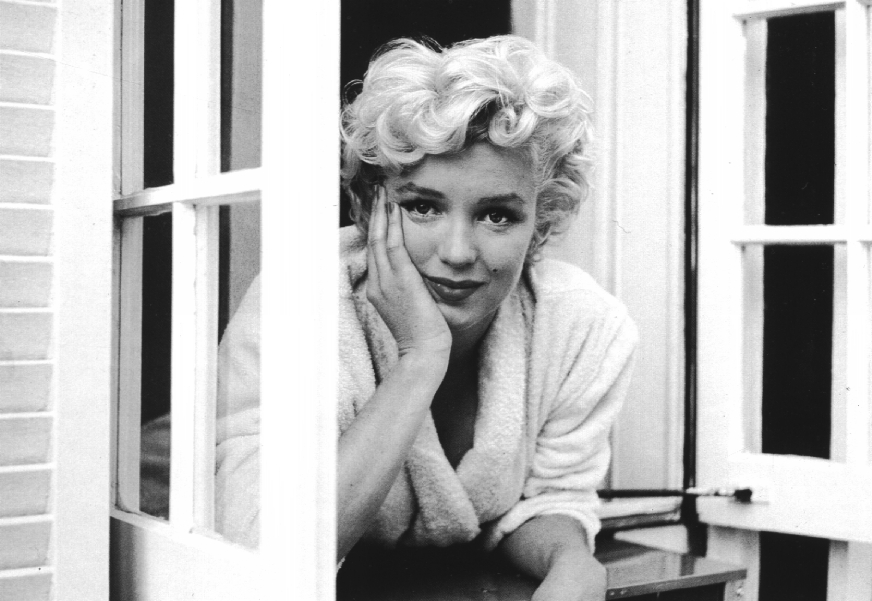
Bad News Hughes ... the comedy ... it hurts!!
This is one of the funniest essays I have read in a long long time. It ... hurts ... the comedy ... hurts .... (Pet peeve: don't comment if you don't read what I link to. Mkay? Major pet peeve.)
We're not talking a mild chuckle, or a snarky snicker at the foibles of humanity. We're talking making-a-scene laughter, where people look at you like you're having some kind of psychotic break with reality. I feel like I hurt my stomach yesterday, actually, reading the damn thing.
It says a lot about me that I read that entire essay and one of my first thoughts was: "I could marry a man like that."
The essay includes this paragraph:
Now, usually it takes a few weeks to see the doctor. At least. I reckon they want that cough or twinge to really work itself up into something good, something expensive and chronic and debilitating, before you go bothering them. I know if I was a doctor I'd get pretty pissed every time Grandmaw Dustpussy hobbled in with some phantom complaint like a broken hip, just because there was a mix-up with Social Security and her cable got cut off and she can't talk to the TV during Matlock and needs a little attention, with her stupid hip, a boo hoo hoo. No, Granny better get, like, tuberculosis in her eyes or spine worms or something awesome before she goes stinking up my waiting room. And, oh shit — if I was a doctor I'd totally be up to something nefarious, too, like making a Frankenstein in the back room or inventing a ray that gives you the plague. So I totally understand the delay, and don't begrudge those guys anything.But it turns out that when you have ass blood it kind of moves you to the head of the line. At first, I was like, "Shit, only two days? That's awesome." But then I started thinking, "Man, they wouldn't rush you in there if they didn't think you were gonna, you know... Die."
I cannot even express to you how much I enjoy this guy's writing.
But I can feel my anxiety and anger rising — I mean I have ass blood. I need to get that shit checked out. They move you up to the front of the line for ass blood."Who?" I think, sitting in my truck. "Where? Where can I get a man to finger my ass? Why does it have to be so... damn... hard... to simply get a goddamn man to finger me up in my ass?"
Husband material. Seriously.
And then there's this essay about the girl he loved in high school. If it were a book I would say: "I could not put it down" - but let's just say: I read the damn thing from beginning to end. BEAUTIFUL essay. Funny, specific, universal ...
Bad News Hughes - My new addiction. Thank you, Beth!
The emerald-green hotel room
Talked with a man last night who knew Tennessee Williams and who had been in Something Cloudy, Something Clear
I GRILLED this man for information. It was wonderful talking with him.
A couple of things:
-- Tennessee was actually kind of shy and quiet. He would sit in the back of the theatre during rehearsals and not say a word.
-- One time, the director and Tennessee started conferring about something - while all the actors were up on stage - and the director said to Tennessee, "Why don't you go down there and direct the scene?" (Not in an argument - it was completely the opposite - They obviously had been going back and forth about what was going on in the scene and the director said Go and tell them how you want it!!) So Tennessee - who had no directing experience directly, and only a little bit of acting experience - walked up on stage. The actors stood around, looking at this little old man, waiting for him to tell them what to do. Tennessee said to the man who I talked with last night, "Okay ... so ... you start the scene from the other side of the stage ..." So the man I spoke with crossed the stage to start the scene from there. Tennessee just stood there, looking around at all the waiting actors, and finally just said, "Well, the scene kind of directs itself, doesn't it?" I love that story.
-- After the play opened, Williams still worked on the script. New pages of edits would come to the cast on a daily basis. Tennessee was a great FIXER - we talked about that last night. He may not have known how to direct actors - he had no experience - but if a scene wasn't working on the page, he knew how to fix it. 99.9% of playwrights when they go to "fix" something - make it worse. They THINK they're making it better, but they make it worse. Tennessee had a great eye, and a great ear ... a great poetic sense ... Something Cloudy Something Clear was not a critical success (the critics were extremely harsh on Tennessee for the last 20, 30 years of his life - they couldn't forgive him for experimenting, they couldn't forgive him for not repeating himself, they couldn't forgive him for not producing another Streetcar ... Most critics are an unimaginative bunch. If you set out to try to repeat yourself as an artist - you are DESTINED to fail. There are no exceptions. You all can probably think of a million movie sequels not as good as the original that would prove this point alone) I loved the image of the show being up and running, and pages were still coming in from Tennessee. What an experience.
-- One day, there was some kind of a photo shoot involving Tennessee. The man I spoke with last night was sent to pick him up at his hotel and get him to the photo shoot. I can't remember the name of the hotel - but it was on the Upper West Side - and it had a very Tennessee-ish name - like The Elysian Fields - or something like that. It was the summer time, and very very hot - the man I spoke with described the heat, and also - the cacophony of the New York streets - loud construction - one of those brash blinding unbearable summer days here on the island of Manhattan - and he goes up to Tennessee's room. He knocks on the door. He is let into the room. The room is painted emerald-green. Everything is green. Even the ceiling. An undersea kind of green. In the middle of the hot dirty city. Now Tennessee always had an entourage with him ... a crowd of hangers-on ... He also always had some kind of male partner, not always the same one, but always the same type: younger than Tennessee, buff, Latino usually ... These were the constant elements of Tennessee's life. So the man I spoke with last night is let into this emerald-green hotel room - There are three high-backed chairs set up in the middle of the green-ness, and Tennessee and two other people are perched on these chairs, and they are all reading Rilke out loud. Taking turns.
The man telling the story just said the whole thing was so bizarre - and that Williams lived his life in that way - it was a strange life. He was an eccentric. A committed eccentric. It was a decision he made long before he became famous. He was a writer. He was gay. No way would he ever fit in, although he yearned to. So he would not try. He would be himself. He would surround himself with like types ... and he would embrace being an outcast (his words - the word "outcast" is a continuing theme in all of his plays) But the man telling the story started laughing about the memory ... how weird it was, to step into that green world for a second ... so surreal ... the emerald-green walls ... Tennessee Williams and his entourage ... an enclave of German poetry in the middle of the loud hot city ...
Woah!
Harsh! But oh so satisfying! Speaking of politically incorrect, it is COMPLETELY politically incorrect, and yet ... it's something that we all (at least living here in New York) have YEARNED to say on occasion. And there it is: evidence that someone has actually said it! (Read the whole link, otherwise you won't get my post.)
I know I have lost my patience (not to mention my compassion) living here for so long, but I can't stand it when I get on a subway and there's some blowhard pontificating. I just want to ride the fucking subway, dude. Shit. I now visibly roll my eyes when I sit down, the doors close, the subway starts up again, and suddenly you hear a loud voice, "Ladies and gentlemen, sorry to disturb you but ..." and then they go off on a long story about their lives, and how they need money to get a sandwich.
Compassion Fatigue set in about 2 years after moving here.
Now I only give money to street musicians (if they're good, I mean - yup. I'm a hardass), or to people who have animals with them. Those are my main rules - I give money to you if you have TALENT and actually DO something for my hard-earned cash, and I give money to you if you have a kitten curled up next to you on the sidewalk. There. If you're in a wheelchair or disabled in any way ... then sometimes I will give you money. Not always - because honestly, there are so MANY of you out there, and I'm not rich, yo. I'm actually a paycheck to paycheck girl, so I'm sorry you all are down on your luck, but I'm just trying to survive myself. Sorry.
So my general rules are:
-- GOOD street musicians, not jackasses trying to hustle me by banging on the back of a pail.
-- Anyone who has an animal with them. I know it's the biggest con in the world ... like the frat boy who brings a puppy to frat parties knowing the women will flock to him ... but what can I say. I love animals more than people sometimes.
-- If they're disabled in any way
I try to keep to those rules, because otherwise you just feel like you're being robbed, the entire day. You feel hustled. You feel taken advantage of.
I love, in that link, the guy's random comment: "it's all relative" ... Uhm, what exactly are you referring to there, sir? Or are you just saying that because it sounds vaguely cool?
The Books: "The Frosted Glass Coffin" (Tennessee Williams)
And here is my next excerpt of the day from my library. Still in Tennessee Williams land.
Next Tennessee Williams play on the shelf is The Frosted Glass Coffin
It takes place on the sidewalk outside the Ponce de Leon - a cheap hotel filled with old people in Miami. They all live there. Across the street is the cheapest cafeteria in Miami, and every meal-time all the geriatric cases line up in the blinding hot sun for a cheap meal. There's a huge controversy afoot because the cafeteria is raising their prices by about a nickel. And now you can't get free refills of coffee. This sends shock-waves of alarm and anger through the Ponce de Leon.
Three old men - (called One, Two, and Three) sit outside the Ponce de Leon, early one morning, watching the line form across the street. They talk about the price hike, they talk about a woman in the hotel who died suddenly the night before, they gossip. Underneath all of this casual chit-chat, is an overwhelming awareness of death. They are all close to death. Not that they are sick ... but when you're in your 70s and 80s, you know that you've gotta be close.
One is only in his 60s while the other two are in their 70s - and One was also once the mayor of a small town in one of the Carolinas - so he basically feels superior to the other two. He's kind of a blowhard, truth be told.
Three is almost completely deaf.
I'll excerpt the part of the play where, while watching the line form across the street, they see one of the little old ladies collapse from heat exhaustion. I like this play because there's a lot of humor in the banter between the three old men. I like it when Williams lets his humorous side out. It's wonderful.
From The Frosted Glass Coffin
[Excited outcries across the street catch their attention]
ONE. What's that commotion over?
TWO. Looks like one of 'em's collapsed right before the locked door.
[They rise and shuffle out to the proscenium, leaning forward peering, commenting]
THREE. Man or woman?
TWO. Woman.
ONE. Then it ain't coronary, women don't git coronaries.
TWO. I've known 'em to get heart failure.
ONE. Unusual.
THREE. Too damn unusual.
VOICE. [offstage] Will somebody call an ambulance for the lady?
TWO. Can you see who collapsed, is it anybody we know?
ONE. Yep, it's little old Miss Walker. I thought it was but I wanted to be sure before I said so because in this company, it's absolutely imperative to be absolutely certain before you commit yourself to an opinion of something.
TWO. Little Miss First-One-In, well, how about that.
ONE. Yep, Little Miss First-One-In is now Miss First-One-Out before she even got in.
[They chuckle together. Three loses his balance and almost falls into the orchestra pit]
VOICE. [shrieking] You men over there, will one of you run to the taxi stand on Flagler and git a taxi for this unconscious woman?
[They turn about and shuffle back to their seats, not desiring involvement]
ONE. [sitting down] "Run", she said. [He chuckles sadly] She must be practickly blind. In our age bracket you're living in a glass coffin, a frosted coffin, you just barely see light through it.
TWO. Yep: that's about it.
THREE. What?
ONE. Light through it.
THREE. Who? What?
ONE. [turning away from Three who is cupping his ear] In some cases the conversation consists of almost nothing but one-syllable questions like who, who, what, what, where? The silent question is WHEN. The silent meaning of it is: when do I go? There's no one to answer that question, if it was asked out loud, and mighty damn few would have the guts to ask it if there was. Now take what happened last night to Mr. and Mrs. Kesley ....
THREE. What, what? Who?
ONE. See what I mean about living in a frosted glass coffin unburied? He don't even know what happened last night to the Kelseys.
THREE. What about the Kelseys?
ONE. Frosted glass coffin, unburied! [He raises his voice to Three] You mean to sit here and tell me you're the only resident of this twelve-story hotel that don't yet know what happened to the Kelseys last night at Mercy?
THREE. Not a word of it: what happened?
ONE. [oratorically and unctuously] At nine p.m. last night little Mrs. Kelsey was struck by what they thought was a little gall-bladder trouble. She had put Kelsey to bed: you know he has to be cared for like an infant. Then this sharp pain hits her in her abdomin, in the gall-bladder region, so she got dressed and came down to the lobby so she wouldn't distract ole Kelsey. I was down there, jawing with the night clerk. She don't come up to the desk. She sits down on a sofa. After a while I notice she's clutching the right side of her abdomin and that she had sweat on her forehead which she kept patting off with those sheets of toilet tissue she carries instid of Kleenex. I whisper to the night cler, I said, "Sam, will you look at Mrs. Kelsey? That woman's in pain, and she's sitting down here at this hour so Kelsey won't know about it." Sam, he looked over at her and said, "Goddam it, you're right, she's got the death-sweat on her," and without another word he picked up the phone and called up Mercy Hospital to send an ambulance for her.
THREE. Holy Moses. Great Scott.
ONE. They picked her up and removed her to Mercy Hospital just before eleven p.m. An hour later I was about to go up to our room, when the telephone rang. It was Mercy. They said, "We'd like to speak to Mr. Kelsey about his wife." Sam said, "I don't think I better disturb Mr. Kelsey unless it's absolutely critical." Well, they said it was so critical that unless Kelsey got out there inside of an hour, they couldn't promise he'd see her alive again.
THREE. Lawdamighty!
ONE. Well, I woke up Betsy and between the two of us, we got Kelsey up. Of course we didn't inform him how critical it was, we just said Mrs. Kelsey had had a little stomach upset and had gone to Mercy.
TWO. Sam got a taxi for him and I gave him the fare. Well, he got there too late.
ONE. Betsy went with him to Mercy. She says that Mrs. Kelsey had the sheet over her head and was already cold. You know what Kelsey said? He said, "She seems sort of weak," and Betsy said he wouldn't believe she was gone even when they rolled her down to the morgue at Mercy.
THREE. I never thought Mrs. Kelsey would go before Kelsey.
ONE. Vital statistics show that two or three times as many men go as wimmen.
TWO. That's a ridiculous statement: if that was true, the world population would of been nothing but female for a thousand years now.
ONE. I'm talking about OLD COUPLES! There must be --
TWO. Excuse me: Mr. Geriatrics Journal: I'd like to point out that the men fight the wars and that the wars have hit every single generation of men in this country, and if, in addition to that --
ONE. You're off on some tangent.
TWO. Wait: if in addition to that, what you say is true about men dying two or three times the rate of wimmen --
ONE. Will you shut up for a second so I can say what I was actually saying?
[There is a pause. One glares at Two in real fury]
TWO. --- What was you actually saying?
ONE. --- Nothing. My time and my breath are too valuable, too important to me, to --
THREE. [cutting in] Who would of thought that Kelsey would outlive his Mrs.? Why, Kelsey was in and out of Mercy like a jack rabbit.
TWO. Yep. Ev'ry whipstitch little ole Mrs. Kelsey would come down without him. I'd say, "Where's your ole man this mawnin'?" -- The answer was: "Back in Mercy."
THREE. In, out, out, in, in, out like a jack rabbit. So now she's gone. Explains why they haven't come down yet. Did they keep him at Mercy?
ONE. Nope, he's back. Betsy had him hauled out of Mercy in a wheelchair and all the way out to the taxi he kept calling for Winnie. In the taxi she held onto his hand: and he thought her hand was his Missus'.
THREE. Don't he realize she's gone yet?
ONE. Betsy says he started to realize it when she'd got him back into bed and hollered to him, "Now go to sleep, Mr. Kelsey. Everything is going to be taken care of, don't you worry." Then he seemed to realize a little that Winnie was gone, not till then. -- You know, it's not so surprising that Winnie went first after all, because old Kelsey has crossed that age limit where the human body, all its functions and its processes, are so slowed down that they live a sort of crocodile existence that seems to go on forever. The question is what to do with him.
TWO. He ought to have a practical nurse but can't afford one, I reckon.
ONE. The answer's a nursing home, huh?
TWO. I reckon that's the only possible answer unless they chloroform him like an old dog.
November 4, 2005
No!
I thought I made myself clear but apparently not. There is more to be endured.
Speaking of this dreadful situation, I read the following on the Fug site today (an inner monologue of Sienna's):
maybe Jude and I are sort of perfect for each other and should probably just try having some kind of open relationship or something because that would probably work for us since neither of us seems to be predisposed to monogamy and maybe that's okay as long as we have an arrangement and no one throws her engagement ring at anyone while sobbing that she's been betrayed when really she's been betraying people all over town, too, and shouldn't we really be embracing these similarities in our personalities rather than fighting them...
heh heh heh
Anyway. Maybe it's true. Neither of them have any business being in a monogamous relationship. Trying to be some kind of "It Couple" clearly doesn't work for them, because the media will expect them to be monogamous and would hound them to death about "transgressions" - even if, in their world, it's not a transgression. YOu cannot ask the editors of Hello! to understand the workings of an open relationship.
But then we have to deal with the REALITY (yes. I said REALITY) of the grainy photos of Sienna staggering through London parks, wearing huge sunglasses ... obviously in deep deep mourning over Jude's cheating ways ... even though he cheated on his wife with HER ... so ... what'd ya expect, girlie in the bo-ho chic??
So anyway, the grainy photos tell me that the It girl (WHO ELECTED HER "IT"? WHAT HAS SHE DONE TO BE IT? Ahem.) kind of ISN'T okay with an open relationship ... and loved the fantasy of being Mrs. Jude Cheatin' Law.
Oh, it's so messed up. I have spent HOURS pondering this. HOURS pondering the intricacies of the on-again off-again relationship of Jude and Sienna.
Actually, no I haven't. Like I said in my original post on the matter: They are not big enough stars for me to REALLY obsess on their problems.
But start me talking about TomKat? I will bore you all night long! Just ask my friend David!!
Anyway. Jude and Sienna had lunch together. So they're "talking". So maybe there's "hope".
Shit.
Movie quote
Okay - knowing my audience - this one is going to be guessed really fast:
"I'm a doctor."
"Of what?"
"Music."
"Can you fix a hi-fi?"
"No, sir."
"Then SHUT UP."
Diary Friday
Okay. Two successive entries from my sophomore year in high school. So many elements here just make me LAUGH. The first sentence of the first entry makes me laugh.
They crack me up. I go from one thing to the other with lightning speed. And ... I bring up a person in the second entry who I literally have not thought of for ... 15 years? I laughed out loud when I see what I wrote about him. I have not put his name here - but I think my friends will be able to guess who he is from the description. I despised him. hahahahaha
MAY
Thursday.
I am going to Revenge of the Jedi tonight with Mere. God, it feels like I'm going to a Broadway play! I'm so excited! I've already made up my mind to SCREAM when he comes on. [You have? Sheila. Please don't. Also: "he" is Han Solo. There is no other "he". There still isn't. Don't argue.] We're going out for pizza before. What a teeny-bopper night!
Oh, DTS is going to the Prom with Michelle! I am SO happy for her! She is such a good kid and they always laughed hysterically at each other's jokes. I'm not even jealous or anything. [HAHAHAHAHA] I'm still great friends with him.
Today I found out that DTS and I sit at the same seat in Biology. I looked down at my desk and saw his name written on it in his square writing. So in 7th period I went up to him and said, "Hey guess what!" (in a joking way, eyes wide) "Shame on you. You write on your desk in Biology." And he went, "How do you know? Where do you sit?" "Right there." And then he gave me that look of his - the secretive grin, eyebrows raised, Steve Martin-ish. "Wait till you see what I write tomorrow." And then he tousled my hair past the point of no return.
Jayne thinks he should have asked me to the Prom. [hahahaha!! Jayne sticking up for me!] It would have been nice, but oh well. Everyone is telling me to ask him to my junior prom next year. He'll be in college by then. [I actually did end up taking him to my senior prom. Then we proceeded to not see one another for 18 years. And recently, we have gotten back in touch, and have been hanging out on occasion. SO WEIRD. Very cool though!!] I know he likes me so maybe he'd go to the Prom with me, even though he'd be out of high school. I'm just glad he's my friend. He's the only boy that I can be myself around. He seems to just like me for me.
10:00 I saw it. Oh, Lord. I wanted to SCREAM when he came on! [hahahaha Look how I adjusted my mania down. "I WILL scream ..." to "I WANTED to scream."] He broke my heart! I still like Empire Strikes Back better [Good girl.] - because there was more talking, and more emotions. [Uhm, yes. That is called ACTING. And there is definitely more ACTING in Empire than in all the other ones. It's one of my favorite movies. Ever.] This one was probably the funniest one, though. I thought the Ewoks were a little gross. [Good girl.] And Harrison!! Oh -- he is so sensitive. But he's hysterical. I really hope he does some modern-day comedy - like a Neil Simon script or something. He would be great in something like that. [I still feel that way. Even with all the Indiana Jones stuff and his action movie stuff, I think Harrison Ford would TRULY be at home in drawing-room comedies.] All of them, I think, have improved as actors. Especially Mark Hamill. [I am sure Mark Hamill would be thrilled to know that a 15 year old high school girl thought his acting had improved.] We had a blast. Going out for pizza and then getting frantic when 3 people lined up. [Mere - we must have been at Italian Village so we could see the movie theatre across the street!!] We waited in line for an hour.
I studied my Biology. The frog test is tomorrow. [Of course it is.]
Friday.
Fun day. No homework! I really fucked up my English paper on Merchant of Venice. I didn't follow one train of thought.
We have this kid in our class - he is such a jerk. He cheats on everything. Every single test we take, I can see his eyes moving around. If you sit next to him, you have to huddle over your test so he doesn't cheat. He also has no ear lobes. He wants to be a model. We take the same school bus - and once he tripped on the stairs into the bus - and he acted like it was the stairs fault. He is a total shit-head. We were reading The Dutchman with black people in it [what?????] and when we were discussing it, he said, "Well, if I saw this nigger lying around --" and Mr. Crothers didn't say anything! He drives me crazy! (Not Crud. No-Lobes.)
[First of all: I think it is hysterical that to me, in this context, "Not Crud. No-Lobes" makes perfect sense and needs no explanation. "Not Crud. No-Lobes". Uh-huh. Know JUST what you mean.
Second of all: students all referred to Mr. Crothers as "Crud" or "The Crud". Believe it or not, we all loved him and he was one of the most popular teachers in our school. We would refer to him as "Crud" TO HIS FACE. IN CLASS. "Crud ... when will the midterm be?" etc. But apparently he did not reprimand No-Lobes when No-Lobes used that offensive term in class. I see now why I hurriedly described The Dutchman as "with black people in it" – I was setting up the conversation about racism - but still!!! That's all I can say about it?? "with black people in it"????? ]
Oh, I came into Biology today and sat down, and the light hit my black desktop in a way so that I could see the pencil written words: "Sheila You Dummy". Guess who. I started laughing hysterically. It was neat that he remembered. I imagine him sitting there scratching out a message for me. So I thought and wrote back: "You're a sly fox, DTS." See, when we were in the play Peter Cottontail together he played Reddy Fox, the conniving villain - and the way he played him - Michelle and I would sit backstage and laugh so hard that we could not hold down the noise and then we would get yelled at. He would run his hands together and sneer and cackle. We called him a sly fox. And when he signed a Sadie Hawkins picture for me he said, "Oh, I'm a sly fox." I AM GONNA MISS HIM NEXT YEAR. And all the seniors. They are such a part of our school. I've become friends with some of them and it's gonna be so weird without them there. DTS' hair is kind of long now and he looks exactly like a Beatle. When he signed my picture he left this enigma on the back: 'So you see Sheila, we are the burroughs of New York. I'm Brooklyn, you're Queens, but no man is as big as an island. Except Man Hattan. And Ed McMahon -- he's at least as big as Hawaii."
We have a great 3 day weekend ahead of us. 2 more weeks until the play! And we've had only one rehearsal on the stage. Terrific. Oh, well. It'll pull through.
HAPPENING REUNION TOMORROW! [This was a religious retreat thing I went on my sophomore year in high school] Betsy and I are taking a bus up together at 9:00 am. Jay's gonna pick us up at 10:15. I can't wait to see him! And Judy and Gordy and Sue -- I miss them so much already! I'm sleeping over Maria Campana's house tomorrow. I'll bring this book and let you know what's going on in my muddled brain and twisted-up heart.
Take back the half-tard
I agree with Mimi Smartypants when she writes:
If we agree that it's no longer kosher to use the word "retarded" to refer to the cognitively disabled, does that open the word up for more general usage? Because I constantly call stuff "retarded," and I constantly get taken to task by language cops (more like language crossing guards, really) who have nothing better to do than email every time I use the word. All it takes is a Google search to see that I have indeed (mea culpa) referred to retarded people as "retarded" (although not to their faces, obviously), but I have also used the word in reference to ants, Parents magazine, Fiona Apple, the toothbrushing song I sing to my daughter, computerized medical-appointment-setting systems, and, most frequently, myself.
I think we need to ignore the language police on this one. Sometimes I do obey the language police because I, personally, find certain words offensive and would never use them. But retarded is a great descriptive word, and should be used as much as possible.
Mitchell and I have a variation on the retarded theme, and it is, actually, rather offensive. This is why it makes us laugh.
Example of how it works:
I trip off the curb. Or I stumble. Or I spill my coffee. Whatever. Moment of clumsiness. Mitchell will glance at me and say, "What are you, half-tard? Quarter-tard?" (In a Rhode Island accent, though - so it comes out - "half-tahd? Quawtuh-tahd?" Much funnier.)
I am proud to say that "retard" and "retarded" are still in common usage in Rhode Island. Not to describe people who are mentally disabled. No. But to describe ridiculous situations, or traffic jams, or idiotic business ideas, or the marriage of Jessica Simpson and Nick Lachey. I find it very refreshing.
Election Day
Nov. 4 1845 was the first uniform election day in this country. Congressional legislation had been passed the year before - which made the elections of electors in each state simultaneous.
I love the photo below. It's not from 1845, obviously, but it is a big moment in terms of the election history in this country ...
Three suffragettes casting votes in 1917: Love the hats. LOVE the hats.

The Books: "Confessional" (Tennessee Williams)
Next in my Daily Book Excerpt:
The next play on the script shelf is:
Next Tennessee Williams play on the shelf is Confessional
All the elements that end up in Small Craft Warnings are here, in some form ... only simplified, not so complex and human.
I love it when different versions of Williams' stuff is published - I love to read both versions in tandem. I just love to do that ... to really try to get a sense of how he worked.
In general, he ALWAYS made the correct choices, in terms of editing himself. So many playwrights, when they edit, make their plays worse. I can't even tell you how much that is the norm. They do not know how to FIX things. Williams, man - he knew how to fix stuff if it wasn't working.
Anyway, here's an excerpt from Confessional - one of Leona's big long monologues at the beginning of the play. It's not exactly her confession here - at least it doesn't start out that way - she actually is addressing the drunken patrons of the bar. But by the end, all the lights dim, and Leona turns to the audience ... Leona is a blowsy hairdresser, a drifter, a mean drunk, loud-mouthed and obnoxious - she lives in a trailer, she picks up men ... but she is a survivor. She lands on her feet. The wonderful thing about these "confessions" is that they reveal the truth. We all have a social face we put on (unless we're insane). We all manage to say, on occasion, "I'm fine", when we are NOT fine. If someone says to you, "How was your weekend?" - unless you are insane, with no boundaries, in general you say, "Good! Busy! Too short! Got a lot done! Had a nice time!" Whatever. You don't say (especially if the person asking you the question is a co-worker or your doorman or whatever): "I spent Saturday night drunk alone in my apartment, staring at myself in the mirror, and wondering why I had ever been born." So the confessions of this play gives these characters - these tough street-wise characters who HAVE to put on a big show of how FINE they are - a chance to open up, to let us know that they actually are NOT doing okay.
Leona's following speech is a perfect example.
From Confessional
LEONA. I don't care how I look as long as I'm clean and decent -- and self-supporting. When I haul into a new town, I just look through the yellow pages of the telephone directory and pick out a beauty shop that's close to my trailer camp. I go to the shop and offer to work a couple of days for nothing, and after that couple of days I'm in like Flynn, and on my own terms which is fifty percent of charges for all I do, and my tips, of course, too. They like my work and they like my personality, my approach to customers. I keep them laughing.
BILL. You keep me laughing, too.
LEONA. -- Of course, there's things about you I'll remember with pleasure, such as waking up sometimes in the night and looking over the edge of the upper bunk to see you asleep in the lower.
[Bill leaves the table. She raises her voice to address the bar-at-large]
Yeah, he slept in the lower cause when he'd passed out or nearly, it would of taken a derrick to haul him into the upper bunk. So I gave him the lower bunk and took the upper myself.
BILL. As if you never pass out. Is that the idea you're selling?
LEONA. When I pass out I wake up in a chair or on the floor, but when you pass out, which is practically every night, I haul you onto your bunk. I never would dream of leaving you stoned on the floor, I'd get you into your bunk and out of your shoes when you passed out on the floor, and you know Goddam well you never done that for me, oh, no, the floor was good enough for me in your opinon, and sometimes you stepped on me even, yeah, like I was a rug or a bug, and that's the God's truth and you know it, because your nature is selfish. You think because you've lived off one woman after anotehr woman after eight or ten other women you're something superior, special. Well, you're special but not superior, baby. I'm going to worry about you after I've gone and I'm sure as hell leaving tonight, fog or no fog on the highway, but I'll worry about you because you refuse to grow up and that's a mistake that you make, because you can only refuse to grow up for a limited period in your lifetime and get by with it. -- I loved you! -- I'm not going to cry.
[Violet starts weeping for her]
When I come to a new place, it takes me two or three weeks, that's all it takes me, to find somebody to live with in my home on wheels and to find a night spot to hang out in. Those first two or three weeks are rough, sometimes I wish I'd stayed where I was before, but I know from experience that I'll find somebody and locate a night spot to booze in, and get acquainted with -- friends .... [The light has focused on her. She moves downstage with her hands in her pockets, her face and voice very grave as if she were less confident that things will be as she says] And then, all at once, something wonderful happens. All the past disappointments in people I left behind me, just disappear, evaporate from my mind, and I just remember the good things, such as their sleeping faces, and -- Life! Life! I never just said, "Oh, well," I've always said, "Life!" to life, like a song to God, and when I die, I'll say "death" like a song to God, too, because I've lived in my lifetime and not been afraid of -- changes ... [She goes back to the table] -- However, y'see, I've got this pride in my nautre. When I live with a person I love and care for in my life, I expect his respect, and when I see I've lost it, I GO, GO! -- So a home on wheels is the only right home for me.
November 3, 2005
Visual joke
... which no one will get ... because you cannot see me in my costume for my play ...
But I do think that how a fellow actor described me in my costume will let you know exactly what I looked like.
Guys, I literally have been unable to stop HOWLING about this since he said it. I just had to leave a public space because I was making a scene with my hysterics, and go take a brief walk, guffawing out into the open air.
My costume is great. It transforms me. I will not wow anyone with my beauty in this costume. I will not get any erotic notes from audience members passed to me backstage. No. But I'm not supposed to. Trying not to be vain about it is hard. I want to be PRETTY. But she's not supposed to be. The costume is perfect. When I put it on, half my acting work is done for me.
Costumes are serious business. The shoes, the glasses, the rings to wear ... important decisions made. So I'm in my costume. And I'm serious. I'm discussing the hem-length of my skirt. I am turning this way and that. I am putting my glasses on, taking my glasses off. I am trying out some of the movements I have to do in the play, to make sure the costume won't give me any problems.
Another actor for the show walks in for his appointment. I really like this guy. Very nice, very funny.
But I didn't know HOW funny until this moment.
He took one look at me and stated, "You look like the head of the Parapsychology department at Delaware State."
Cannot. Stop. Laughing.
He is so right that his words felt like a bolt from the divine blue.
"the head of the Parapsychology department at Delaware State ..." WHAT?????
Don't try to improve on it, people. You can't improve perfection.
I need to go take another walk to guffaw out loud into the city streets.
Happy Birthday, Walker Evans
Biography of Walker Evans here.
Below you will find a bunch of his photographs - interspersed with one of my favorite paragraphs from his collaboration with the brilliant James Agee: Let Us Now Praise Famous Men. Some of the photographs do come from his work with Agee - others are his urban photographs (which actually, I prefer - some of them strike me as living Edward Hoppers).
Enjoy!
From James Agee and Walker Evans: Let Us Now Praise Famous Men
Each is drawn else where toward another: once more a man and a woman, in a loneliness they are not liable at that time to notice, are tightened together upon a bed: and another family has begun:
Moreover, these flexions are taking place everywhere, like a simultaneous motion of all the waves of the water of the world: and these are the classic patterns, and this is the weaving, of human living: of whose fabric each individual is a part: and of all parts of this fabric let this be borne in mind:
Each is intimately connected with the bottom and extremest reach of time:
Each is composed of substances identical with the substances of all that surrounds him, both the common objects of his disregard, and the hot centers of stars.

All that each person is, and experiences, and shall never experience, in body and in mind, all these things are differing expressions of himself and of one root, and are identical:
not one of these things nor one of these persons is ever quite to be duplicated, nor replaced, nor has it ever quite had precedent: but each is a new and incommunicably tender life, wounded in every breath, and almost as hardly killed as easily wounded: sustaining, for a while, without defense, the enormous assaults of the universe.
The Books: "I Can't Imagine Tomorrow" (Tennessee Williams)
Next in my Daily Book Excerpt:
The next play on the script shelf is:
Next Tennessee Williams play on the shelf is I Can’t Imagine Tomorrow
But anyway - how we decided upon a scene from this random snippet of a play, I must go back into the memory banks and figure out ... Maybe because it was vague and random enough that we could come at it as a blank slate, we could just go in there and be ourselves, pretty much ... and not have to worry about the auditors' preconceived notions of the characters we were playing. Like if you walk into an audition and say, "Yes, I will be doing Stanley's 'Stella' monologue from Streetcar" ... well, first of all, you are an idiot. But second of all: the SECOND you say the word Streetcar ... immediatley, whether you like it or not, visions of Marlon Brando will start floating through people's heads. And you will have to contend with that ghost. And you do not want that kind of stress and distraction in an audition. Actors who play the role now still have to deal with the ghost of Brando ... it's inevitable. So I think David and I wanted to avoid that, if possible.
Anyhoo. Enough about that ... I should do a proper post about that whole experience someday.
But for now - here's an excerpt. The play's alternate title was Dragon Country which I think is a MUCH better title. "I can't imagine tomorrow" is the last line of the play ... so I think making it the title is a weeeee bit heavy-handed. I know Tennessee was in a bad way in the 1960s, but still ... I love him so much that I feel I can criticize him a little bit without taking anything away from him. Dragon Country is a much better title.
The play's about loneliness. Loneliness and the hope for human connection. Tennessee's main theme throughout his life: can we reach past the barriers we have between us ... can we ever break through and really connect?
I'll post the opening moment.
From I Can’t Imagine Tomorrow
[One and Two are, respectively, a woman and a man approaching middle age: each is the only friend of the other. There are no walls to the set, which contains nonly such pieces of furniture (a sofa, a chair, another chair on the landing of a low flight of stairs, a lamp table and a card table) that are required by the action of the play. There is a doorframe far down stage left. Soft blue evening dusk is the lighting of the play, with soft amber follow spots on the players. The sofa and chair should be upholstered in satin, pastel-colored, perhaps light rose and turquoise. Beside the chair on the stair landing there might be a large potted palm or fern. The woman, One, stands downstage, near the doorframe, with her arms spread apart as if she were dividing curtains to look out a window. She wears a white satin robe with a wine stain on it. The man, two, appears before the doorframe; the woman draws back and covers her face with her hands. Two raises an arm as if to knock at a door. This action is repeated two or three times before the woman crosses to the doorframe and makes the gesture of opening the door]
ONE. Oh, it's you.
TWO. Yes, it's me.
ONE. I thought so. [There is a strangely prolonged silence, during which neither moves] You have on your ice-cream suit. [Two laughs at this, embarrassed] Well, don't just stand there like a delivery boy without anything to deliver.
TWO. You didn't say come in.
ONE. Come in, come in -- enter!
TWO. [entering] Thank you. [There is another strange pause] As I came up the drive I saw you at the window. Then you closed the curtain.
ONE. What's wrong with that?
TWO. I had to knock and knock before you -- opened the door.
ONE. Yes, you nearly broke the door down.
TWO. I wondered if --
ONE. If what?
TWO. You didn't want to -- to --
ONE. Want to what?
TWO. -- to see me this -- this evening.
ONE. I see you every evening. It wouldn't be evening without you and the card game and the news on TV.
TWO. But --
ONE. It's not getting any better, is it?
TWO. What?
ONE. I said it's not getting any better, your difficulty in speaking.
TWO. It will. It's -- temporary.
ONE. Are you sure? It's been temporary for a long time now. How do you talk to your students at the high school, or do you say nothing to them, just write things on the blackboard?
TWO. No, I --
ONE. What?
TWO. I've been meaning to tell you. It's been five days since I've met my high school classes.
ONE. Isn't that strange. I thought so. I thought you'd stopped. What next? Something or nothing?
TWO. There's always --
ONE. What?
TWO. Got to be something, as long as --
ONE. Yes, as long as we live.
TWO. Today. Today I did go.
ONE. To the clinic?
TWO. Yes. There.
ONE. What did you tell them? What did they tell you?
TWO. I only talked to the girl, the --
ONE. Receptionist?
TWO. Yes, she gave me a paper, a --
ONE. An application, a --
TWO. Questionnaire, to --
ONE. Fill out?
TWO. I -- I had to inform them if I --
ONE. Yes?
TWO. Had ever before had --
ONE. Psychiatric?
TWO. Treatment, or been -- hospitalized.
ONE. And you?
TWO. Wrote no to each question.
ONE. Yes?
TWO. No.
ONE. [impatiently] Yes, I know, you wrote no.
TWO. Then the receptionist told me --
ONE. Told you what?
TWO. There wasn't an opening for me now, right now, but -- I'd be informed as soon as -- one of the --
ONE. Doctors?
TWO. Th-- therapists could -- fit me into his -- schedule.
ONE. Did you tell her you were a teacher and the situation was desperate because you can't talk to your classes?
TWO. She was just the receptionist so I -- didn't go into that. But I put on the, the --
ONE. Questionnaire?
TWO. That there was only one person that I -- could still talk to -- a little. I underlined desperately and I underlined urgent.
[He pauses. Abashed, he turns away slightly]
ONE. [gently] In this dim light you could pass for one of your students, in your ice-cream suit, just back from the cleaners.
[She drifts away from him]
TWO. On the way coming over I passed a lawn, the lawn of a house, and the house was dark and the lawn was filled with white cranes. I guess at least twenty white cranes were stalking about on the lawn.
ONE. Oh? So?
TWO. At first I thought I was seeing things.
ONE. You were, you were seeing white cranes.
TWO. I suppose they were migrating on their way further south.
ONE. Yes, and stopped off on the lawn of the dark house, perhaps to elect a new leader because the oldone, the one before, was headed in the wrong direction, a little disoriented or losing altitude, huh? So they stopped off on the lawn of the dark house to change their flight plans or just to feel the cool of the evening grass under their feet before they continued their travels.
TWO. It's only a block from here. Would you like to go over and see them?
ONE. No. Your description of them will have to suffice, but if you would like to go back over and have another look at them, do it, go on. I think they'd accept y ou in your lovely white suit.
TWO. The maid didn't come today?
ONE. She came but couldn't get in, the door was bolted.
TWO. Why?
ONE. i didn't want her fussing around in the house. She knocked and called, and called and knocked and finally gave up and -- went away ...
TWO. Everything's just like it was yesterday evening. The cards are still on the table. You still have on your white robe with the wine stain on it.
ONE. I've stayed down here since last night. I haven't gone upstairs. I finished the wine and I slept on the sofa. Oh. No supper tonight. None for me. I did go into the kitchen and opened the Frigidaire, but the sight and smell of the contents made me feel sick. So go in the kitchen and make yourself a sandwich or whatever you want while I deal the cards.
TWO. I'll make something for us both.
ONE. No, just for yourself! Do you hear me? And eat it out there, in the kitchen. [He goes out of the lighted area. She wanders back to the windowframe and draws her hands apart as if dividing curtains] --- Dragon Country, the country of pain, is an uninhabitable country which is inhabited, though. Each one crossing through that huge, barren country has his own separate track to follow across it alone. If the inhabitants, the explorers of Dragon Country, looked about them, they'd see other explorers, but in this country of endured but unendurable pain each one is so absorbed, deafened, blinded by his own journey across it, he sees, he looks for, no one else crawling across it with him. It's uphill, up mountain, the climb's very steep: takes you to the top of the bare Sierras. -- I won't cross into that country where there's no choice anymore. I'll stop at the border of the Sierras, refuse to go any further. -- Once I read of an old Eskimo woman who knew that her time was finished and asked to be carried out of the family home, the igloo, and be deposited alone on a block of ice that was breaking away from the rest of the ice floe, so that she could drift away, separated -- from -- all ... [Two returns with a plate of sandwiches] Back, back, take it back or I'll send you away!
November 2, 2005
Today in History: November 2, 1889
North Dakota and South Dakota were admitted to the United States as the 39th and 40th States.
Happy ... er ... birthday, Dakotas!!!
I drove across the country with my boyfriend years ago. We went to many many states. We saw many beautiful things. We went through mountains and plains and prairies. But the states that touched us the most - the states that, frankly, blew us away ... were the Dakotas.
Weird, but I don't remember the two of us even SPEAKING to one another as we moved our way through the Dakotas. I know we did. But there was something about the landscapes there that struck us dumb. With wonder? Awe? Yes. But something else. Perhaps an awareness of our own smallness. We LOVED the Dakotas.
My memories there are rich, sensoral, and just snippets:
-- Heavy grey clouds pressing in from horizon to horizon ... watching the lightning occuring miles and miles away ...
-- The wet highway stretching out before us to the vanishing point
-- An isolated gas station surrounded by dun-brown fields as far as the eye could see - the neon sign of the gas station gleaming through the rain - desolation - but poetry
-- Rich fields of sunflowers on either side of the highway. The late afternoon light falling across the bobbing yellow heads of the flowers ... the rich dark-brown soil
-- The two small white-headed children we saw sitting on top of a fence - in the middle of nowhere - no grown-ups in sight - and in the paddock (also in the middle of nowhere) were about 10 grazing buffalo. The buffalo being watched over by these small gleaming tow-headed children. Odd. My boyfriend and I talked to them for a while. In blunt simple language.
Something about the landscape in the Dakotas made language seem unnecessary.
And here's an old post I wrote about one of my favorite memories of all time. It's from an experience we had in one of the Dakotas. It says it all. Hovering over this piece is an enormous silence. The silence of the surrounding land, the enormous sky ... It didn't press in on us, it wasn't suffocating ... but it wasn't exactly liberating either. The landscape and the sky FORCED us to be contemplative. FORCED us to BE with ourselves. The silence persisted. Filling it up with silly chit-chat would have been useless because the silence was too big.
My love for the Dakotas is piercing and sensoral - and I was only there for 5 days.
Dakota post below:
Standing on a high windy plain with my first boyfriend as a thunderstorm gathered on the horizon and the light got low, and sickly-green, and so charged with potential you nearly wanted to scream. Waiting for the release. We had been hiking for hours, watching as the day changed, as the sky got more ominous. There had been a massive wind, whipping the tall grass on its side, nearly carrying me away with it. We got some incredible pictures of the approaching storm (we had no business being up on the high plains watching forks of lightning jag their way towards us, but whatever, it was gorgeous) ... but the pictures cannot convey the feeling in the air itself . The hairs on my arm rose up, to meet the electricity in the molecules.
There were no people out there but us. (For obvious reasons. We were idiots.) Just a huge sky, changing on a moment to moment basis, getting fuller and fuller, lower and lower, and GREEN - not black, not purple ... but GREEN ... the sound of the wind in the grass ... the feeling that we were about to get caught out in something pretty enormous and spectacular.
And then, I'll never forget it:
For a brief whooshing moment, everything went still. The wind stopped. As though a giant hand had turned off the wind machine. Hush. A sudden alarming hush fell over the land. My boyfriend and I both stopped, feeling the change. We paused ... holding our breath ...
We were having the time of our lives. We were watching the storm unfold as though it was the best movie we had ever seen. We kept looking at each other, wordlessly, like: hoooly shiiiiit ...
Silence covered the plains (this was the real calm before the storm, turns out - when everything came to a sudden sharp stop ... took a breath ... and then the heavens opened up) ... and in that silence, we heard a sound. Something that, to be honest, I've only heard in movies.
The thundering sound of horses hooves ... galloping horses ... the galloping sound of MANY horses ...
It has got to be one of the most exciting sounds I've ever heard in my life. Even though I've only heard that sound in movies, when it came to my ears, there was a rush of familiarity, and love, and knowing: Yes. That is that sound. I know that sound. Something in my DNA knows that sound intimately. It was thrilling.
We were on the edge of a large dip in the land, a bit off the trail, and the sound came from far below. We walked over to the edge, in the middle of the eerie stillness, all the grass suddenly straight, still, motionless, and looked out over the dip in the land. And there we saw them - we had only heard about them and heard that it was rare to get a glimpse of them - but there they were - a herd of wild horses, racing along the bottom of the plain in a massive herd. There were about 20 of them, galloping like mad things, freaking out because of the storm ... their manes and tails flying, their hooves churning up the dirt ... neighing and whinnying in alarm, bucking and kicking and running ...
I have never seen anything so beautiful, so moving, so unbelievable in my life.
They were fierce, savage, a bit scary, almost mythical. I've seen wild horses like that in my dreams. My fantasies.
We got no pictures, obviously. We couldn't have captured it. We didn't need to capture it.
I love horses anyway, but ... to see wild horses ... and not to see them grazing on a hill ... but to see them AS wild, to see them running ... Oh my God. Like Marlowe said: "the wondrous architecture of the world..."
Boyfriend said to me after we gaped at their frenzy far down the plain for a while, "We should get the hell back to the van. They know something we don't."
And we RAN off the plains, as quickly as we could, as the wind started picking up again, alarmingly, this time cold - a whoosh of cold ... and we made it back to the van before the gods unleashed the torrents upon us in a thunderous crash. Hell broke loose. Massive wind/rain/electrical storm on the high plains.
But I am glad we took the risk. To see those horses. Those spectacular wild horses.
Love, dreams - and congratulations
A beautiful post by my dear friend Alex - who was just inducted into the Gay and Lesbian Hall Of Fame. She describes the ceremony as only she can. My heart was full reading it.
Thinking of Mitchell working the room just makes me soooo happy. If I had been there, I suppose he would have forced me to go get some random person's autograph or something ...
And I'm in tears because of this paragraph:
I stared at Chrisanne, who had parked the car and made it in time to see me get my award. She was beaming. 29 years we’ve been together. 29 years of fights, make ups, lies, lost loves, ignorance, tolerance, secrets, bad jokes, food, and lots of hope and prayers. All of that, summed up in a bout 15 seconds. I took the award, and made it down the stairs. No tripping, and lucky for the audience, I didn’t speak. I hadn’t written anything down, and God help me if they ask me to improvise.I sat in my seat with Chrisanne directly behind me. I could literally feel her smiling.
If you know Chrisanne, then you know that her smile is one of the warmest smiles on the planet.
And the image of Alex feeling Chrisanne's smile - even though she wasn't looking directly at her ... I so get that. I so get the love there. It's piercing.
Congratulations, Alex. (Or, as Mayor Daley calls you, "Ms. Alexandra"!)
The "turn off the TV" morons among us
It's been a while since I ranted. I have not edited this. I am also not shouting at anyone in particular. I am shouting at the people out there who say stuff like, "I don't even HAVE a television" - with the assumption that that is BETTER. If this shoe fits you, then I am shouting at you. If it doesn't? Then I am not shouting at you.
Here goes. (Michele Catalano used to rant about this on a yearly basis - they were awesome posts!. I miss her already.)
I watched television as a child AND I read books.
HOW ON EARTH WAS I ABLE TO MANAGE THAT? I was able to do BOTH THINGS??? Oh no! This so ruins the agenda of the "turn off the TV" fanatics!
Let's take a look:
Not only did I watch television AND read books but I also watched television AND played outside for hours ....
but I also watched television AND spent time with my family ...
but I also watched televsion AND did my homework ...
but I also watched television AND managed to blow through half the public library in a week's time.
If you think the balance is off in your household, then limit the amount of time you watch television. Simple. Stop acting so superior because you have no control over yourself and can't handle having a television near you without sinking into a 12 hour sinkhole of passive viewing. That's YOUR problem. Stop being such a snot. Stop saying, "I don't even HAVE a television." Oh man. If I never hear some superior jagoff say to me, "I don't even HAVE a television." it will be way too soon. There's an assumption with a certain group of people that of COURSE it is BETTER to not watch television. Of COURSE.
Uhm - why? Who made up that rule? A bunch of superior snots? Well, excuse me if I don't pay attention to THEM.
I'm an adult, living alone, and I monitor my own television watching. I could zone out for hours watching television. I could lose hours of my life to that activity. I choose not to go there.
Television ain't the problem.
The problem is YOURS.
I happen to enjoy stupid shows like The Real World. Is this evidence of moral rot? If you think it is, then again I suggest that the problem is YOURS and not mine. I also suggest that you mind your fucking business. Just because YOU can't understand watching The Real World as a leisure activity, doesn't mean that there is something WRONG with those who DO enjoy it as a leisure activity. I enjoy shows like that because I can relax, they are mindless, I can sink into my armchair, and just chill out for a half hour ... I do not think television needs to educate. To preach. I do not think entertainment needs to always be edifying. I think it's great for escape, for fantasy, for release, for catharsis ... Relaxation/leisure time ... HIGHLY undervalued in our society. So to the "what is the meaning of it all" snots (I love that word - can you tell), I say: Fine - go watch your PBS shows or the History Channel, and do whatever you need to do. But please leave me alone so I can zone out to Breaking Bonaduce after a 17 hour nonstop day.
I watch Breaking Bonaduce AND I carry a copy of The Federalist Papers with me at all times - cause you never know when you're gonna want to dip into it, right?
Breaking Bonaduce. The Federalist Papers. Deal with THAT disconnect. I think I heard some unimaginative brains explode ... the type of folks who thinks art ALWAYS has to be educational.
I would like to state, for the record, though, that I AM learning stuff from Breaking Bonaduce.
What am I learning?
-- I am learning that Danny Bonaduce is OUT OF HIS MIND
-- I am learning that there is a certain sub-set of celebrity in Hollywood whose ONLY HOPE is to appear on a reality show
-- I am learning that rehab is no picnic - even if you go to a cushy rehab center outside of Los Angeles with new agey therapists, and rock-climbing
-- I am learning that somehow Danny Bonaduce's wife is able to weep in her therapists' office and still look gorgeous. I need to know what kind of foundation she uses. Even when she cries it doesn't clump up.
-- I am learning that it is bad to mix steroids with Vicodin and alcohol
I am learning MANY things.
But mostly. It's entertaining. It's interesting. I enjoy relaxation. I take it where I can get it these days.
I live primarily in my mind. In case you haven't noticed. I am a heady bookworm-ish intense and kind of uptight person. My body is stiff ... but my head is WHIRLING with thoughts ... ya got it? I don't relax easily.
But with certain shows, I can just sink back, let it all go, let my brain off the hook for half an hour ... and be entertained.
Now the "turn off the TV" cabal (hahahaha love that word) will never accept this explanation from me, an explanation that comes out of my own life, my own experience. They're the black-and-white people. They have one stance: TV is BAD. TV is bad: talk to your family! Read books instead!!!
Uhm ... again: why the either/or? As a child, I talked to my family. AND I watched James at 15 almost religiously. What if the Eight is Enough episode that changed my life had been aired during some TV Turnoff week extravaganza?? I would then have not seen the show that gave me the inspirational strength to get me through the rest of junior high. You think I'm exaggerating? I'm not.
So yes: if you watch TV for 6 hours every day you've got some problems - but the problem is NOT the television. The problem is YOU. So what that it's there? That means it always has to be on? No - that means that YOU have no control over your impulses. I have a box of ice cream sandwiches in my freezer. Does that mean I should eat 10 in one sitting? Uhm - no. I have them there for when I feel like something sweet. If I can't control myself - and I know I can't control myself - then I should not have ice cream sandwiches in the house.
It's the superiority I can't stand. It's the condescension I can't stand. It's the nosy busybody moral-scold snottiness that I cannot stand. From people who don't get it anyway. I don't want to be scolded by people who don't get relaxation and entertainment in the first place!!
The attitude appears to be: Since I don't see the point in Big Brother: The Celebrity Version - then NO ONE should see the point in it.
Oh wait ... but that's my real point. Shows like that DON'T have a point. Shows like that are ... ENTERTAINMENT. There is no point. If you want a point - then watch the news, or watch the History Channel, or watch documentaries. But there is a PLACE for stuff that HAS NO POINT. So just shut UP. SHUT UP about how bad pop culture is. SHUT UP. There is PLENTY of stuff out there for ALL OF US.
I know it's an extremely difficult thing to grasp: but I watch The Real World AND I watch The History Channel.
If you can't deal with that, then you seriously need more help than just turning off a television will give you. Actually, Danny Bonaduce's therapist seems like a really good guy (even though he appears to have had his face ironed out into a silk-like smoothness that is highly unnatural) ... maybe you should give him a call!
The Books: "The Mutilated" (Tennessee Williams)
Next in my Daily Book Excerpt:
The next play on the script shelf is:
 Next Tennessee Williams play on the shelf is The Mutilated
A one-act play published and produced originally in 1966 - it has the feel, to me, of a full-length play, though. It's not a snippet, or a moment in time. There are 3-dimensional characters, a whole world created ... it's a dense rich play. I actually saw this done once at the Actors Studio. Nobody's heard of it, except for Williams fans, but I definitely think it's one of his best one-acts.
It takes place in the French Quarter in New Orleans - and the whole world he describes is like ... oh, Ironweed or Bar Fly. This is a world of con artists, drunks, whores, and homeless people. But of course it is also a world of lonely people, the loneliest people in the world. People on the fringe of society. It takes place on Christmas Eve which adds to the melancholy mood. To be alone in a cockroach-ridden hotel on Christmas Eve is pretty bleak.
The two main characters are Celeste and Trinket. Celeste is a whore. She is also a shoplifter, and probably mentally challenged in some way. There's something wrong with her, mentally. She has no impulse control. She has a large bosom - and she is very proud of her breasts. Always displaying them, stroking them, leading with them. She's a pathetic character. Everyone in town knows she's a drunk, knows she's broke, knows she's a shoplifter - so she basically can't go anywhere. No one will serve her, she is thrown out of every place she goes into.
Trinket lives in the Silver Dollar Hotel (a cheap hotel filled with drunks and thieves). But Trinket is actually loaded. Her father has three oil wells that he left to her - and she walks around with a load of cash in her purse. She stays at the crappy hotel because she has stayed there for years, and she is very attached to her room. She kind of treats the Silver Dollar Hotel as though it is a five-star hotel. Trinket is a tormented character. She obviously has cancer - even though that word is never spoken. One of her breasts has been removed, and she is morbidly sensitive about it. (This is revealed WAY into the play ... you don't know what exactly is going on because she is too freaked out to even mention it ... she just keeps talking about her "mutilation") She no longer can have lovers, because she doesn't want to subject them to her mutilation. But again - all of this is revealed in a very sideways manner ... What we are mainly faced with is a character who sits in her room, on the edge of panic, and who constantly keeps one of her hands on her chest. She is in a lot of pain. Always.
She has kept her "mutilation" a secret. But she and Celeste had become friends - of a sort - a friendship based on loneliness. Also, Trinket would invite Celeste into her room and give her cups of wine and food. That was mainly why Celeste was interested in being friends with Trinket: for the food. Trinket confessed her mutilation to Celeste. (This all happened before the play starts) And now: the two of them have had a falling out, Trinket has locked her door against Celeste, and Celeste has gone berserk - writing grafitti all over the walls of the hotel - about Trinket's mutilation.
So. The course of the play is one Christmas Eve ... with Trinket trying to keep Celeste out of her room - and Celeste making a nuisance of herself in the hotel lobby ... Christmas carollers wander the streets, and sing - showing up at the ends of each scene ... Trinket goes out to her one bar that she goes to, sits by herself, and orders her absinthe frappe. Two soldeirs from the Navy enter the bar looking for someone. Trinket is completely struck by the appearance of one of them - he seems like an angel to her. Trinket ends up taking him home with her - even though she is "mutilated".
I'm going to excerpt from the scene between Trinket and Slim, the sailor - once they are alone in her room. You can see that Trinket just wants love ... not sex. She wants a connection. But Slim ... obviously Slim has other ideas. Trinket is also putting off the sex - because she doesn't want him to know she is mutilated. That's one of the reasons she talks so much.
I love this play. I'd love to play either Trinket or Celeste - two great characters.
From The Mutilated.
[Trinket's bedroom is lighted, as she comes up the outside stairs with Slim, who is leaning heavily on her]
TRINKET. Well, here we are. Did you think we'd ever make it?
SLIM. Yeh, I thought we'd make it.
TRINKET. I wasn't so sure. I mean that we'd make it together. But here we are, together. This is my -- little home ...
SLIM. Not much to it.
TRINKET. No, there's not much to it, but it's -- familiar, it's -- home. I lived here before my father's good luck in the oilfields and I became so attached to this room that I stay on and on. You know, you can love a room you live in like a person you live with, if you live with a person. I don't. I live alone here. I have the advantage of a private, outside entrance, and that's an important advantage, especially if I, when you -- have a guest with you at night. I don't, you, uh, don't -- always want to have to go through the hotel lobby which I'd have to do at any big hotel with --
SLIM. -- With house dicks in it?
TRINKET. With anyone, everyone in it.
SLIM. [suspiciously] Hmmmm.
TRINKET. You're so tall you make the ceiling seem low. Take off your coat and sit down.
SLIM. Not till I make up my mind if I want to stay here or not.
TRINKET. [nervously] Oh.
SLIM. "Oh." I can take care of myself in this situation or any Goddam situation that that wop Bruno's ever gotten me into. Las' week-en' he innerduced me to a rich ole freak that had a two-story apartmenet at the Crescent Hotel. I looked around and I was alone with this freak. I said to the freak, "Something's not natural here," an' the freak said to me, "I'm your slave! I'm your slaaaa-ve!" -- I said, "OK, slave, show me the color of your money!"
TRINKET. [sadly] Oh.
SLIM. What do you mean by "oh".
TRINKET. I just mean oh.
SLIM. [broodingly] Oh. Then that rich freak says, "Master, I am your slave. My money is green as lettuce and good as gold." I said, "Slave, forget the description, lemme see it -- Show me the color of your money!"
TRINKET. -- Are you speaking to me, or --?
SLIM. I'm telling you something that happened las' week-en' which cost me home leave for Christmas. This character, this freak, fell down on her knees an' said, "You hit me, oh, boo, hoo, you hit me." I hadn't touched this freak. But then I got the idea. The freak wanted me to hit her. "OK, slave, get up." The freak got up and I shoved her into a gold frame mirror so hard it cracked the glass. "Now, slave, I don't wanna hear a description of you rmoney, I wanna see it." -- What're you messing aroun' with over there?
TRINKET. Me?
SLIM. You.
TRINKET. I'm boiling some water to make you some instant coffee. [She comes from behind an ornamental screen or hanging]
SLIM. Are you having a heart attack?
TRINKET. Oh, no! Why? Why?
SLIM. You keep a hand over your chest. [He reaches out to pull her hand away. She gasps and retreats.]
TRINKET. No, no, no, no, no! [In panic, to divert him, she snatches a photograph from the dresser] Look at this! Would you recognize me? In this newspaper photo I am standing between the Mayor and the president of the International Trade Mart. Then, at that time, I was in the field of public relations, I was called the Texas Tornado. I planned and organized the funeral of Mr. Depression, yes, I had the idea of burying Mr. Depression, holding an exact imitation of a funeral for him. All civic leaders backed me. There was a parade, I mean a funeral procession -- no, no, no, no, no! [He has stretched his hand out again to remove her hand from her chest] For, for Mr. Depression! [It should be apparent that this was the climax of her life]
SLIM. There's something not natural here.
TRINKET. Oh? No! -- Mr. Depression was carried along Canal Street and up Saint Charles with big paper lilies on his twelve-foot coffin and there was a band playing a funeral march and I led the band, I walked in front of it dressed like a widow sobbing in a black veil. [He reaches again for her hand still clasped in panic to her chest.] No, no, no, no, no! -- It went, the procession went, all the way to Audobon Park: and then can you guess what happened? [Slim, weaving, pays no attention to this] -- It rained like rain had never fallen before upon the earth! Cats, dogs, crocodiles -- ZEBRAS! The procession broke up, band quit, everything dissolved, dispersed in the cloudburst! -- Kettle's whistling ... [She rushes back of the screen or hanging]
SLIM. Morbid!
TRINKET. [rushing back out] Here, but let it cool first before you -- [He takes the cup and empties it onto the floor] -- Oh, you spilt it, I'll -- [She rushes back of the screen and back out with a towel, mops up the spilt coffee] -- Now I'm no longer in public relations at all, it seems like another life in another world to me. It's hard to imagine the energy, confidence, drive I had when I first hit this town. Personalities go through such radical changes when something happens to change the course of their lives. Don't they? Haven't you noticed? [There is a pause between them. Celeste appears before the hotel. She has two pursues: Trinket's and hers. She stands at the foot of the outside stairs to Trinket's room and stamps her foot twice]
SLIM. There's somethin' Goddam wrong ehre, peculiar, not natural, morbid.
TRINKET. -- I don't know what it could be except that you won't sit down and you won't take coffee. -- Is it somethinga bout me? I'm a simple, ordinary person, and you're my guest and I'm your friend, not your slave. I've always maintained that this city is hard on the unformed characters of young people that come here, especially if they, oh, now, please sit down! Do! I'd be so happy!
SLIM. I don't sit down and stay down in any morbid place till I know if I want to stay in it. Be my slave. And show me the lettuce color of your money. -- Good as -- gold ... [Celeste remains at the foot of the stairs. She stamps her foot twice more]
TRINKET. [in a shamed voice] It's green as lettuce and it's -- good as my father's continual gusher in Texas ... [Celeste stamps her feet twice more and tosses Trinket's purse onto the sidewalk. She stamps on the purse]
CELESTE. [in a strange changing voice, separating each syllable]
Sa-rah Bern-hardt had one leg.
The oth-er was a wood-en peg
But good she did, yep, she did good,
Clump-ing on a STUMP OF WOOD.
[She throws back her head and laughs at the sky]
TRINKET. It's a pity so many people choose the night of Our Savior's birth to behave in such a -- [Celeste kicks Trinket's purse into the orchestra pit as a policeman comes on]
POLICEMAN. Move along.
CELESTE. That's just what I'm doing. [She goes off one way, the policeman the other]
SLIM. What've you got to drink here?
TRINKET. You don't want more to drink, Slim.
SLIM. Don' argue with me or I'll throw you across a room an'---
TRINKET. Oh, Slim, you don't mean that. You only say that because I'm afraid your friend has led you into the wrong kind of company, Slim. Oh, your hair is red gold, red gold, your skin is like -- sunlight on snow ...
SLIM. Liquor! Out with it! Quick, before I --
TRINKET. I have nothing but wine here.
SLIM. Produce it, out with it, quick, before I -- break you a -- mirror!
TRINKET. No one can frighten me, Slim, but -- [She pours a glass of wine from her crystal decanter] -- here!
SLIM. You take a drink of it, first, I'm takin' no chances.
TRINKET. Why, thank you, I will. I can use it. [She sips the wine, then offers the glass to him]
SLIM. Pour me a clean other glass. I don't wanna drink outa yours an' catch somethin' morbid.
TRINKET. You mustn't talk like that to me, even though you don't mean it. Do you know how long it's been since a man has been in this room? Several years. And it seemed like a lifetime -- a death time. [Celeste marches into sight again, stops at the foot of the stairs, and stamps her foot twice as if about to commence the formal parade of a palace guard]
SLIM. [falling onto the bed] I'm paralyzed here in a morbid -- situation ...
[Celeste opens her huge purse and removes a key: then she mounts the stairs, saying "Clump!" with each step. Trinket gasps and rushes to bolt the outside door. Celeste tries the door with her key: no luck: then she throws back her head like a dog yowling at the moon and she cries out--]
CELESTE. Agnes -- JOOOOOO -- OOOOOnes!
TRINKET. Yes, it's the whore that snatched my purse on the street! [She gasps and turns out the light as if that would protect her from Celeste's maniacal steps]
CELESTE. You'll find your empty purse outside in the gutter where I kicked it, you FINK! It's got your rosary in it an' your father's picture standin' next to his GUSHER! You better come out an' get it before the trashman sweeps it into a sewer!
TRINKET. Celeste, go back to the House of Detention and ask for medical help there. You are out of your mind, howling like a mad dog on my stairs.
CELESTE. You told Bernie and Katz I'd been to jail, you fink.
TRINKET. You scratched a hideous lie on the stairs about me!
CELESTE. I scratched the truth about you! You got two mutilations, not one! The worse mutilation you've got is a crime of the Christian commandments, STINGINESS, CHEAPNESS, PURSE PRIDE! Your rosary's in the gutter with your GUSHER! Goddam, you got me thrown out, out, out! [She stamps her foot with each "out"] And everything that I owned is locked up in a basement!
TRINKET. You know what you did, I don't have to remind you, and now go back down the stairs before I -- I have the phone in my hand! [She has picked up the telephone]
CELESTE. FINK! MUTILATED FINK!
TRINKET. [into the telephone] BERNIE! [Celeste runs down the stairs. At the bottom, she stops and looks up sobbing at the sky, weeping like a lost child. There is a pause, a silence. Celeste approaches the orchestra pit, stoops, her hand extended. The purse is handed back to her from below. She returns sobbing to the bottom of the outside staircase; she removes the rosary from Trinket's purse and begins to "tell her beads," sobbing] I believe she --
SLIM. -- I'd a-been home for Christmas an' not broke Mom's heart if I hadn' gone AWOL las' week-en' but 'stead of home I'm paralyzed here in a morbid situation with a morbid hooker an' Goddam Bruno's gone where?
TRINKET. [at the telephone] Bernie? Trinket! [Bernie is lighted dimly at the switchboard in the lobby] -- Be a doll, Bernie, and fetch me two hamburgers from the White Castle and a big carton of black coffee, and hurry back with it. This is a five-dollar tip night for you, Bernie. [Celeste stands shivering in a blue spotlight at the foot of the outside stairs]
CELESTE. Anyhow, I'm not mutilated. She is. [Bernie walks past her to the White Castle] Bernie! -- Sweetheart? [He ignores her as he goes. Slim falls back onto the bed. Trinknet unties his shoes]
SLIM. [falling asleep] Morbid, unnatural -- slave .....
TRINKET. Oh, please stay awake with me!
SLIM. Ah-gah-way ... [He rolls away from her and begins to snore]
TRINKET. -- Well, anyhow, I have somebody here with me. Celeste's alone but I'm not, I'm not alone and she is.
CELESTE. [sinking onto the bottom step of the outside stairs] No, I'm not mutilated. She is. [Trinket switches on the radio: it's soundless]
TRINKET. -- The candlelight service is over. -- The Holy Infant has been born in the manger. Now He's under the starry blue robe of His Mother. His blind, sweet hands are fumbling to find her breast. Now He's found it. His sweet, hungry lips are at her rose-petal nipple. -- Oh, such wanting things lips are, and such giving things, breasts! [The carollers have quietly assembled before the hotel. As the bedroom scene dims out, they begin to sing.]
CAROLLERS.
I think for some uncertain reason
Mercy will be shown this season
To the wayward and deformed,
To the loney and misfit
A miracle! A miracle!
The homeless will be housed and warmed.
SINGLE CAROLLER. [stepping out of the group]
I think they will be housed and warmed
And fed and comforted a while
And still not yet, not for a while
The guileful word, the practiced smile.
CAROLLERS.
A miracle! A miracle!
The dark held back a little while.
[They disperse]
November 1, 2005
Average American
Am I average? Let's see. I got this from Kathy who got it from the Llama Butcher Boys. Fun stuff.
Here's the meme. An average American apparently does all of the following things. See if you are average.
-- Eats peanut butter at least once a week - No. I do not do that.
-- Prefers smooth peanut butter over chunky - No. I do not prefer smooth over chunky. I actually will not eat smooth peanut butter (the texture grosses me out - it's not the taste) - when I DO eat peanut butter, I get the "super chunk" brand. So it's basically like eating granola with a tiny bit of peanut butter sticking it all together.
-- Can name all Three Stooges - Of course! Oh, and go read Steve-O's response to this question at Llama Butchers - because he's RIGHT!
-- Lives within a 20-minute drive of a Wal-Mart - I am SURE this is true. But I don't know where the nearest Wal-Mart is to my house. Since I don't - ahem - have a car - it would be useless information anyway.
-- Eats at McDonald’s at least once a year. No. I do not eat at McDonalds. Maybe "once every 5 years" would be more appropriate.
-- Takes a shower for approximately 10.4 minutes a day. Yes. This is true. I sometimes take 2 showers a day. New York is nasty gross, ya gotta clean that shit off when you come home.
-- Never sings in the shower. WHAT?? The average American never sings in the shower??? What is the problem with you people? Singing in the shower is so damn fun, and so relaxing, that I honestly couldn't start my day without it. Also, it's well known that EVERYBODY sounds like Celine Dion or Bono in the shower. It's a FACT. Your voice sounds AWESOME. This morning I gave an exTREMELY moving version of "Bill" from Show Boat. It brought the house down. You shoulda been there.
-- Lives in a house, not an apartment or condominium. Again, no. I live in an apartment.
-- Has a home valued between $100,000 and $300,000. I'm sorry, I don't speak that language.
-- Has fired a gun. No, I have not fired a gun. Doesn't mean I don't want to - I actually do.
-- Is between 5 feet and 6 feet tall- I believe I am 5'5.
-- Weighs 135 to 205 pounds. Yes.
-- Is between the ages of 18 and 53 Yes.
-- Believes gambling is an acceptable entertainment option. I have mixed feelings about gambling. Not that I don't want OTHER people to gamble if they enjoy it, whatever - go for it - but I don't get the appeal of it AT ALL. I so much don't get the appeal that I have never even bought a lottery ticket. That's how strongly I feel about it. DIDN'T YOU PEOPLE READ "1984"???? But again, if that's how you want to spend your leisure time ... have at it. Same thing with hunting animals for sport. I will NEVER hunt animals for sport. NEVER. I went to Vegas once, and it was a spectacle, and I'm glad I saw it, but seriously - I found the whole thing so depressing that I had a little bit of a bleak "what is life all about" episode in our hotel room afterwards. Maybe I was a gambling addict in a former life. I know that most people who sit around at slot machines are not millionaires - so my lack of funds is not an explanation. I just care about other things, and want to spend the money that I actually HAVE, not theoretical money I will magically get in the future. Also: DIDN'T YOU PEOPLE READ "1984"?????
A small update: I guess I differentiate between things like buying lottery tickets and sitting in front of a slot machine with playing games like poker and blackjack - which actually require some skill. I still don't like to gamble away my money - but I can GET why people like to play poker. But the other kind of gambling? Baffling to me.
-- Grew up within 50 miles of current home. No. This is not true for me.
Late birthday present for Meredith
Walking to the bus this morning through the gleaming air. Scuffing through the fallen leaves. Wearing a sweater and a skirt ... a lovely fall morning.
Oops, there's my bus! Let me run the 5 steps to get to it!
I only got two steps before disaster struck, and I fell. Let me make it clear: I fell on NOTHING. I fell on a crack in the atmosphere. I didn't just trip. I WIPED OUT. I basically flew through the air. (I finally "flew up"!!) My bag went flying and its contents: my gym clothes, my sneakers, my script, my keys, my makeup ... spilled out into the street. But mainly - I went flying. I flew through the air towards the bus. Worse: I made a horrible yowling scream, mid-air. Then, in full view of an entire road full of traffic, other people waiting for the bus, and the people ON the bus ... I landed on the street, in a hodge podge of arms and legs ... my belongings now scattered nearly to Secaucus ...
Of course I tried to break my fall with the palms of my hands so I now have full-on stigmata.
My hosiery is now torn and bloodied, and my knees look too awful to mention.
I'm just glad I didn't land on my feckin' FACE. Good God. Just thinking about it makes me shiver.
Happy birthday, Meredith!
Famous Last Words
John Adams - died July 4, 1826: "Thomas Jefferson--still survives..." (or perhaps ... "Thomas Jefferson ... lives..." There are enough eyewitness accounts to believe that he said something along those lines.)
On the exact same day, Thomas Jefferson died. He began slipping in and out of a coma. At one point, on July 3, he woke up and said, "Is it the Fourth?" He died the next day.
Ethan Allen, American Revolutionary general, died in 1789, and was told by his doctor, "General, I fear the angels are waiting for you." Ethan Allen responded, "Waiting are they? Waiting are they? Well--let 'em wait." Those were his last words.
Lady Nancy Astor, fell very ill, and woke up, to find her entire family standing around her bed. She said, "Am I dying or is this my birthday?" These were her last words.
James Joyce apparently said, as his last words, "Does nobody understand?" I don't seem to recall this fact being told in the Ellmann biography, though, so it may not be true. No, Jim, nobody really does understand - but your work will live on regardless. Genius lives. Understanding is over-rated.
Tallulah Bankhead, wild-woman actress, died in 1968. Her last words were, "Codeine . . . bourbon."
P. T. Barnum, died in 1891. His last words were, "How were the receipts today at Madison Square Garden?"
I think my favorite might be Beethoven's last words: "Friends applaud, the comedy is finished." Jesus. Amazing.
Humphrey Bogart's last words are almost TOO perfect. "I should never have switched from Scotch to Martinis." Classic.
Napoleon died, murmuring, "Josephine ... Josephine ..."
Dominique Bouhours, who was one of those strict hard-nosed French grammarians, died in 1702. Last words were: "I am about to -- or I am going to -- die: either expression is correct." (hahahahahahahahahahahaha)
Tacitus tells us that Caligula, who was stabbed to death by his own guards in 41 AD, had as his last words the following scream: "I am still alive!"
Louise, Queen of Prussia, who died in 1820, faced the harsh realities in her last moments, and said, before dying, "I am a Queen, but I have not the power to move my arms."
Chekhov's last words are also a personal favorite of mine. They seem to encapsulate exactly what I love about his writing, his outlook on life: "I am dying. I haven't drunk champagne for a long time."
Chopin's last words are horrific. He died of tuberculosis. His last words are: "The earth is suffocating . . . Swear to make them cut me open, so that I won't be buried alive." A terrible death.
Very different from Elizabeth Barrett Browning's last words. Her husband asked her how she felt. She replied, "Beautiful" and died.
Winston's Churchill's last words before slipping into a coma were: "I'm bored with it all." 9 days after saying that, he died.
Joan Crawford was on her death-bed. Her housekeeper started to pray out loud to God. Joan Crawford snapped, "Damn it . . . Don't you dare ask God to help me." Then Mommie Dearest died.
Karl Marx died in 1883. As he lay dying, his housekeeper apparently raced in with a pad of paper, and hovered over him, waiting, literally waiting for him to die, so that she could write down his last words for posterity. Marx barked at her, "Go on, get out - last words are for fools who haven't said enough."
Teddy Roosevelt said, bluntly, "Put out the light." and then died.
Charles Darwin, unsurprisingly, stated, "I am not the least afraid to die." And then promptly died.
(It's incredible how people reveal themselves so completely in these intimate vulnerable last moments.)
I find Edison's last words so comforting, so mysterious. I wonder what it was he saw: "It is very beautiful over there."
Eugene O'Neill's last words, which hold a world of grief and loss, were, "I knew it. I knew it. Born in a hotel room - and God damn it - died in a hotel room."
Edmund Gwenn, an actor in the 30s and 40s (Miracle on 34th Street, Life with Father, a couple of Lassie films) said, when someone asked him if it was "tough" facing death: "Yes, it's tough, but not as tough as doing comedy." Then he died. God bless him.
Victor Hugo said, as his last words before death, something which chills me, "I see black light." Maybe he saw a "darkling plain".
Boris Pasternak died saying the following, and I know it's uncompassionate of me, but I find his last words rather comical: "Good-bye . . . why am I hemorrhaging?"
Anna Pavlova, one of the most famous ballerinas who ever lived, said before she died, in 1931, "Get my swan costume ready."
General John Sedgwick, Union Commander in the Civil War, was killed in battle in 1864, saying, "They couldn't hit an elephant at this dist. . . ."
A relatively famous (and comi-tragic) one is the last words of Dylan Thomas, who reportedly said, "I've had eighteen straight whiskies, I think that's the record . . ."
This next one cracks my heart in two. If he only knew. Leonardo DaVinci's last words were, "I have offended God and mankind because my work did not reach the quality it should have."
Oscar Wilde's might be the most famous of all, and for good reason. "Either that wallpaper goes, or I do." Clearly, the wallpaper stayed.
Famous epitaphs
John Keats, great poet, who died in 1821 (and I think his birthday was Sunday), wrote his own epitaph, which is now rightly famous:
"Here lies one whose name was writ in water."
But actually, the full epitaph reads like this:
This Grave
contains all that was Mortal
of a
Young English Poet
Who
on his Death Bed
in the Bitterness of his Heart
at the Malicious Power of his Enemies
Desired
these words to be engraved on his Tomb Stone
"Here lies One Whose Name was writ in Water."
"the Malicious Power of his Enemies" ...
Woah. A bit of bitterness there.
As children, the O'Malley siblings had to memorize William Butler Yeats' epitaph, in order to get our allowance of 50 measly cents. Nothing, and I mean NOTHING, could knock that epitaph out of my brain.
It is:
Cast a cold eye
On life On death
Horseman pass by
Damn. Now that is something. I could ponder that forever.
There are a couple of other relatively famous epitaphs I am familiar with - (I used to plan out, as a teenager, what I wanted on my tombstone - Finally, I settled on "After life's fitful fever, she sleeps" - Shakespeare - I was insane. I was 15 years old, picking out the best epitaph for myself.)
Anyway, speaking of Shakespeare, here is his epitaph, written on his grave in Stratford-on-Avon:
Good friend for Jesus's sake forbear
To dig the dust enclosed here
Blest be the man that spares these stones
And cursed be he that moves my bones
Got it, Bill. We won't move your bones. We promise.
Other epitaphs I know by heart - I don't know if any of my readers out there also have an interest in this kind of thing - but if you do, feel free to pipe up.
Jack Dempsey's epitaph was (and I LOVE this):
A Gentle Man and a Gentleman
Robert Frost has as his epitaph (and this is certainly something to keep me up at night, pondering):
I had A Lover's Quarrel With The World
Emily Dickinson, like Keats, wrote her own. It says it all:
Called Back
F. Scott Fitzgerald has, as his epitaph, the famous last line of Gatsby:
So we beat on, boats against the current, borne back ceaselessly into the past.
(Come to think of it, I wouldn't mind having that as my epitaph either ... Hm. Must make a note of it.)
Sir Christopher Wren, architect, has as his epitaph (he is buried in St. Paul's Cathedral - his greatest achievement):
"Lector Si Monumentum Requiris Circumspice" (Reader, if you seek his monument, look about you).
Thomas Jefferson wrote his own:
Here was buried Thomas Jefferson,
author of the Declaration of American Independence,
of the statute of Virginia for religious freedom,
and father of the University of Virginia.
(Fascinating that he did not mention being President of the United States. It says a lot.)
And of course, the epitaph of the Unknown Soldier, which everybody knows:
Here Rests in
Honored Glory
An American
Soldier
Known But to God
And finally - Jack London - who has this as his epitaph:
The Stone the Builders Rejected
(The end of that phrase in the Bible is: "...has become the capstone." But London only put the first part on his tombstone.)
Seasons
There is an assumption here on the East Coast (I'm sure it exists elsewhere, but please, I'm talking about the East Coast right now) that everyone PREFERS the summer. We have four distinct seasons here ... and as the days get shorter, and as the rains start to come ... there is a general assumption that NOBODY likes what is happening and EVERYONE yearns for the dog days of summer again. This assumption goes down to the weatherman. EVERYONE assumes that
1. Summer = good
2. Winter = something to endure
It's too funny. For me it is completely the opposite. Summer is something to endure, and winter (and fall, too) are my prime moments. The moments when I look around, breathe in the beauty of the chill grey skies, the leafless trees, the bitter wind, and think: "Ahhhh. Good to be alive."
But the weathermen persist. "Well, it's gonna be a gloomy week, folks ... but never fear! Some sunshine this weekend!"
I love that they put EMOTIONS onto the weather and assume everyone is in sync. They are so wrong. I think: "Gloomy week? I'm PSYCHED! I can revel in the rain and cold and chill for 4 days before it becomes disgustingly sunny again!"
So we are now coming into my season. It's been a long summer ... and yesterday it was in the 70s here. But it is undeniably getting to be fall. There's a chill in the air in the mornings, and heavy grey clouds cover the sky. I love it when it feels like it's going to rain. That's my favorite kind of weather.
I saw this photo today - and my heart just leapt up!
Kentucky:

That's one of the most beautiful things I've ever seen.
Search terms
Just a question:
What would make someone read my blog and then put pornographic search terms into the search box?
It happens all the time.
Does this happen to other bloggers? Does this happen to male bloggers? I'm just asking. Do male bloggers have people putting stuff like "pictures of your cock" in their Search box? I'm truly asking this because I don't know the answer.
The porno search terms feel hostile to me. I'm not losing sleep over it - it happens too often for me to get really bothered by it - but I have to admit, I don't get it. Why would people think they could find nude photographs of me here? Is it something in how I write? But ... that can't be. How could you look at what I write and think that I'm THAT kind of blogger?
This is why I say that those search terms feel very very hostile to me.
If it were an isolated incident I wouldn't even mention it ... but it happens all the time.
I don't believe these people are really looking for nudie pictures of me. I don't believe these people really believe that I would post pictures of myself having sex. I think that they read what I write, and somehow it either pisses them off (which is so bizarre ... what, they can't stand Cary Grant fans or something?), or, more likely: there's something in me that they don't GET ... and that bugs the SHIT out of them ... so to 'get back at me' they put words like "pussy" and "pictures of your cunt" (I woke up to that one this morning - thanks, dude!) in my search box - knowing that I will see them. Knowing that I will see them and ... what ... have a moment of shame and humiliation? They want to shame me. They want me to have a moment of shame. They look forward to that. They look forward to bringing me down. Or something pathetic like that.
I still don't understand why this is the case. I have my theories. Oh, I've got theories!
I just ban their IP addresses and as I do so I shake my head, thinking: "Man. Another loser jag-off at his keyboard who has no life."
But still. It's curious to me.
The Books: "I Rise in Flame Cried the Phoenix" (Tennessee Williams)
Next in my Daily Book Excerpt:
The next play on the script shelf is:
 Next Tennessee Williams play on the shelf is I Rise in Flame Cried the Phoenix
This is a one-act play Williams wrote in 1951. One of Williams' artistic idols (if not THE artistic idol) was DH Lawrence. He actually ended up befriending Lawrence and his wife Frieda ... and this was mainly because he pursued Lawrence like a maniac. He wanted to write a play about him, he wanted to write a play about his volatile marriage with Frieda. He wanted Lawrence's involvement in the play. The three of them ended up traveling together a bit, across the American Southwest, planning out this project, talking about it ....
It ended up not happening. But Williams did write this one-act about DH Lawrence and Frieda Lawrence.
His small preface tells us of his feelings for the man:
Lawrence felt the mystery and power of sex, as the primal life urge, and was the life-long adversary of those who wanted to keep the subject locked away in the cellars of prudery. Much of his work is chaotic and distorted by tangent obsessions, such as his insistence upon woman's subservience to the male, but all in all his work is probably the greatest modern monument to the dark roots of creation.
Williams explains the background of the play:
Not long before Lawrence's death an exhibition was held of his paintings in London. Primitive in technique and boldly sensual in matter, this exhibition created a little tempest. The pictures were seized by the police and would have been burned if the authorities had not been restrained by an injunction.
Williams set the play in the French Riviera, directly following this exhibition - when Lawrence gets word of the calamitous response. The play is only 15 pages long. Lawrence is very ill, very frail, and is being taken care of by his robust wife Frieda. Bertha, the third character in the play, is a friend of the Lawrences and she returns to them from London, having been sent back there by Lawrence to report on the exhibition. Bertha completely idolizes DH Lawrence.
From I Rise in Flame Cried the Phoenix
[Frieda returns with Bertha, a small, sprightly person, an English gentlewoman with the quick voice and eyes of a child]
FRIEDA. My God, he's got up!
BERTHA. He shouldn't?
FRIEDA. Another hemorrhage will kill him. The least exertioin is likely to bring one on. Lorenzo, where are you?
LAWRENCE. [from the rear] Quit clucking, you old wet hen. I'm fetching the tea.
BERTHA. Go back to him, make him stop!
FRIEDA. He wouldn't.
BERTHA. Does he want to die?
FRIEDA. Oh, no, no, no! He has no lungs and yet he goes on breathing. The heart's worn out and yet the heart keeps beating. It's awful to watch, this struggle, I wish he would stop, I wish that he'd give it up and just let go!
BERTHA. Frieda!
FRIEDA. His body's a house that's made out of tissue paper and caught on fire. The walls are transparent, they're all lit up with the flame! When people are dying the spirit ought to go out, it ought to die out slowly before the flesh, you shouldn't be able to see it so terribly brightly consuming the walls that give it a place to inhabit!
BERTHA. I never have believed that Lorenzo could die. I don't think he will even now.
FRIEDA. But can he do it? Live without body, I mean, be just a flame with nothing to feed itself on?
BERTHA. The Phoenix could do it.
FRIEDA. The Phoenix was legendary. Lorenzo's a man.
BERTHA. He's more than a man.
FRIEDA. I know you always thought so. But you're mistaken.
BERTHA. You'd never admit that Lorenzo was a god.
FRIEDA. Having slept with him -- no, I wouldn't.
BERTHA. There's more to be known of a person than carnal knowledge.
FRIEDA. But carnal knowledge comes first.
BERTHA. I disagree with you.
FRIEDA. And also with Lawrence, then. He always insisted you couldn't know women until you had known their bodies.
BERTHA. Frieda, I think it is you who kept him so much in his body!
FRIEDA. Well, if I did he's got that to thank me for.
BERTHA. I'm not sure it's soemthing to be thankful for.
FRIEDA. What would you have done with him if ever you got your claws on him?
BERTHA. Claws? -- Frieda!
FRIEDA. You would have plucked him out of his body. Where would he be? -- In the air? -- Ahhh, your deep understanding and my stupidity always!
BERTHA. Frieda!
FRIEDA. You just don't know, the meaning of Lawrence escapes you! In all his work he celebrates the body! How he despises the prudery of people that want to hide it!
BERTHA. Oh, Frieda, the same old quarrel!
FRIEDA. Yes, let's stop it! What's left of Lorenzo, let's not try to divide it!
BERTHA. What's left of Lorenzo is something that can't be divided!
FRIEDA. Shhh! -- He's coming.
BERTHA. [advancing a few steps to the door] Lorenzo!!
LAWRENCE. [out of sight] "Pussycat, pussycat, where have you been?"
BERTHA. [her voice catching slightly] "I chased a little mouse -- under a chair!"
[Laughing, he appears in the doorway, pushing a small teacart. Bertha stares aghast]
LAWRENCE. Yes, I know -- I know .... I look an amateur's job of embalming, don't I?
BERTHA. [bravely] Lorenzo, you look very well.
LAWRENCE. It isn't rouge, it's the fever! I'm burning, burning, and still I never burn out. The doctors are all astonished. And disappointed. And as for that expectant widow of mine - she's almost given up hope.
[Bertha moves to assist him with the table]
LAWRENCE. Don't bother me, I can manage.
FRIEDA. He won't be still, he won't rest.
LAWRENCE. Cluck-cluck-cluck-cluck! You better watch out for the rooster, you old wet hen!
FRIEDA. A wonderful Chanticleer you make in that lavendar shawl!
LAWRENCE. Who put it on me? You, you bitch! [He flings it off] Rest was never any good for me, Brett.
BERTHA. Rest for a little while. Thenw e go sailing again.
LAWRENCE. We three go sailing again!
"Rub-adub-dub!
Three fools in a tub!
The Brett, the Frieda,
the old Fire-eater!"
BERTHA. [tugging at his beard] The old Fire-eater!
LAWRENCE. Watch out! Now I'll have to comb it! [He takes out a little mirror and comb]
FRIEDA. So vain of his awful red whiskers!
LAWRENCE. [combing] She envies my beard. All women resent men's whiskers. They can't stand anything, Brett, that distinguishes men from women.
FRIEDA. Quite the contrary. [She pours the tea]
LAWRENCE. They take the male in their bodies -- but only because they secretly hope that he won't be able to get back out again, that he'll be captured for good.
FRIEDA. What kind of talk for a maiden-lady to hear!
LAWRENCE. There she goes again, Brett -- obscene old creature! Gloating over your celibacy!
FRIEDA. Gloating over it? Never! I tink how lucky she is that she doesn't have to be told a hundred times every day that man is life and that woman is just a passive hunk of protoplasm.
LAWRENCE. I never said passive. I always said malignant. [He puts the comb away and stares in the mirror] Ain't I the devil to look at?