June 30, 2005
The plague of Lotuses
I'd like to see the Lego rendition of THIS.
(I think what she was ACTUALLY referring to was this ... she just got a little confused.)
Moonlight Graham
Steve Silver's post gives me chills!!
That movie, man. DAMMIT. Read that monologue. It's just marvelous cinematic writing, ain't it? The whole script is that way. Of course, we all know how I feel about Annie Kinsella. And it looks like, judging from the comments, that I'm not alone.
But man. Archie "Moonlight" Graham ... as created by both Frank Whaley and Burt Lancaster ... Beautiful. Got a big ol' lump in my throat right now.
Dave has a post about it too. I love it!!
Homework!
So I'm taking a class at the 92nd Street Y. I have homework! For the first time in years, I have assignments. I love it!! There's something very relaxing about setting aside 2 or 3 hours, or whatever, and going about the task at hand, whatever it may be. Certainly has a different energy than homework in high school. Every week, we are assigned to read a short story from You've Got to Read This: Contemporary American Writers Introduce Stories that Held Them in Awe
Then we discuss them in class.
Uhm ... can I describe how heavenly this is? To sit around with a bunch of strangers, and we only have one goal for 3 hours once a week: to discuss short stories, to talk about form, and structure, and story, and how an author gets his point across, and what it all means ... It's just plain old awesome.
We sit in one of the nursery-school rooms on the 6th floor of the Y. So there are finger paintings on the walls, and mobiles hanging everywhere. There is an enormous skylight, and last night we could hear the rain beating down on it. It's a cool atmosphere, in general - the 92nd Street Y - you walk in and you can feel the buzz - but I think it's hysterical that we sit around and talk about John Cheever with finger painted blobs all around us, the ghosts and echoes of the little kids who spend most of their days in that room.
But I leave class feeling all pepped up and energized. We also read our work to the class. Which, naturally, is nervewracking - because it's not a place where you get 100% praise. What needs to be worked on is discussed and parsed apart exhaustively. But it's all with the intent to help the writer grow, and push himself or herself, which makes a huge difference. It feels honest. It's not a pampering atmosphere, which has its own brand of dishonesty, and it's not an abusive critical atmosphere, which is also dishonest.
One woman read something she wrote last night, and it made her so nervous to do so. But anyway, the piece this girl read last night was funny (much laughing out loud from all of us), and sweet, and it left us wanting more. It ended in the middle of an anecdote, and we all were dying to find out what happened. But the beginning of the piece meandered a bit - you weren't sure who the narrator was right off the bat - and so there was much discussion about all of this. Meanwhile, the woman was busy writing everything down, nodding, sometimes speaking up to explain herself, but mostly just taking notes. And once she finished reading and started listening to the critique, the beautiful thing was - she didn't seem nervous anymore. Because she was no longer focused on herself, and the "shortcomings" of her work - No. She had found confidence in what she had created, and she was ready to hear about what the next step should be.
It's a cool thing.
So I've been doing a lot of writing, and research for my writing. And also reading all of these great short stories for discussion in class.
This week we have to read Cheever's Goodbye, My Brother, which I've already read ... but I started it again last night, to refresh my memory, and realized how much i had forgotten. how much I had blocked out. It's a painful story. And it's hard to say why, because the tone is so light, so seemingly superficial ... But there's a world of pain and disconnect underneath.
I just love having homework. It's a good way to start structuring my time more efficiently.
Biblical Legos
The Brick Testament is AWESOME.
It's the Bible ... told through Legos. You kind of have to see it to believe it.
Here's a random sample:
Look at this dude.
Cain and Abel's different offerings. (And of course we all know how THAT one turned out!)
hahahahaha Look at Noah!! I also enjoy the panic of the three horses in the background.
And here's the flood. So creatively done. I love it.
Uhm ... check out the Holy Ghost coming to Mary. (Also ... I love how the angel has 5 o'clock shadow.)
I mean ... this just kind of speaks for itself. God always looks the same. I love his mad eyebrows.
Check out the face of the Israelite with the black hair way over to the right, and also the one up and to the left. The wide open laughing mouth. Or is he fearful? Is he shouting? What the heck is going on with him?
Uhm ... love this one.
A naked Lego Adam watering the flowers in Eden.
I love Adam's little Lego rib.
Adam and Eve ate the apple. Realized they were naked, and became ashamed of it. They promptly covered up (in the Lego version it looks like they are going to a luau, or extras in a Tarzan movie) ... but of course, you cannot fool God. The following image might be my favorite one: God, blurry in the background ... approaching. Adam and Eve know they are going to be in SO MUCH TROUBLE. Look at her cleavage! Look at their faces!!

The whole project is an amazing and relatively insane accomplishment. So much work. Day-um!! I haven't even looked at half of the pictures!
Postpartum vitamins
Here's an interesting and amusing op-ed about how Tom Cruise has inadvertently furthered the cause of Brooke Sheilds.
Funny:
Tom Cruise and Matt Lauer discussing postpartum depression. Hmm. What's wrong with this picture?Do you think Katie Couric and Brooke Shields would go on national TV to discuss the best way to treat male pattern baldness?
"Trust me, Katie, some guys could really benefit from minoxidil."
"Puh-lease. All they need to do is rub their skulls and eat hairy foods, like peaches."
Yes, generally it's better to leave discussion of any illness to people who have experienced, studied or treated it.
Also - let's not forget. Tom and Nicole ADOPTED their kids. He has no experience, first-hand, with a pregnant woman, or a postpartum woman, and has no idea what he is talking about. (Of course, try to picture arguing that with him, and you'll see the problem. I'm sure he has been personally responsible for helping "postpartum-ly depressed" women "step off" drugs, or ... enrolled them in a good step class maybe?? ... We all know that all they really need to do is just exercise. I am sure he could tell you a million stories about his first-hand experience. But the fact remains: YOU DON'T KNOW, Tom.)
But again: gotta love Brooke Sheilds. She just came out publicly and thanked him, saying that her book sales have skyrocketed, and she has been getting BAGS of letters from women and men all over the world, who have either experienced postpartum depression, or been married to someone who experienced it.
The Books: "Faith Healer" (Brian Friel)
Next in my Daily Book Excerpt
So I'm done with Christopher Durang, for now ... the next playwright on the script shelf is the Irish playwright Brian Friel.
 I have a a collection of some of his plays
Faith Healer, first done here in New York in 1979, is considered one of his most important plays. The plot (and structure) of the play are simple. It tells the story of Frank Hardy, the faith healer, and his wife Grace. The play is told through a series of long monologues - two spoken by Frank, one spoken by Grace, and one spoken by Teddy, Frank's manager. Frank and Grace travel around England, Scotland, and Wales in a caravan, offering to heal the sick. There's a couple of tragedies at the heart of this story - one being the death of Frank and Grace's baby.
I'll post an excerpt from Grace's monologue. All the monologues are about 10 to 15 pages long (memorizing them must be a beeyotch!), so I'll just post a bit of it. The ending of this section of the monologue is just a killer. So well done. It's why he's a successful playwright. He keeps it simple, he doesn't bash you over the head with emotion, but dammit: he gets the job done.
EXCERPT FROM Faith Healer
GRACE. Abergorlech, Abergynolwyn, Llandefeilog, Llanerchymedd, Aberhosan, Aberporth ...
It's winter, it's night, it's raining, the Welsh roads are narrow, we're on our way to a performance. He always called it a performance, teasing the word with that mocking voice of his -- "Where do I perform tonight?" "Do you expect a performance in a place like this?" -- as if it were a game he might take part in only if he felt like it, maybe because that was the only way he could talk about it. Anyhow Teddy's driving as usual, and I'm in the passenger seat, and he's immediately behind us, the Fantastic Francis Hardy, Faith Healer, with his back to us and the whiskey bottle between his legs, and he's squatting on the floor of the van -- no, not squatting -- crouched, wound up, concentrated, and happy -- no, not happy, certainly not happy, I don't think he ever knew what happiness was -- but always before a performance he'd be ... in complete mastery -- yes, that's close to it -- in such complete mastery that everything is harmonized for him, in such mastery that anything is possible. And when you speak to him he turns his head and looks beyond you with those damn benign eyes of his, looking past you out of his completion, out of that private power, out of that certainty that was accessible only to him. God, how I resented that privacy! And he's reciting the names of all those dying Welsh villages -- Aberarder, Aberayron, Llangranog, Llangurig -- releasing them from his mouth in that special voice he used only then, as if he were blessing them or consecrating himself. And then, for him, I didn't exist. Many, many, many times I didn't exist for him. But before a performance this exclusion -- no, it wasn't an exclusion, it was an erasion -- this erasion was absolute: he obliterated me. Me who tended him, humoured him, nursed him, sustained him -- who debauched myself for him. Yes. That's the most persistent memory. Yes. And when I remember him like that in the back of the van, God how I hate him again --
Kinlochbervie, Inverbervie,
Inverdruie, Invergordon,
Badachroo, Kinlochewe,
Ballantrae, Inverkeithing,
Cawdor, Kirkconnel,
Plaidy, Kirkinner ...
(quietly, almost dreamily) Kinlochbervie's where the baby's buried, two miles south of the village, in a field of the lefthand side of the road as you go north. Funny, isn't it, but I've never met anybody who's been to Kinlochbervie, not even Scottish people. But it is a very small village and very remote, right away up in the north of Sutherland, about as far north as you can go in Scotland. And the people there told me that in good weather it is very beautiful and that you can see right across the sea to the Isle of Lewis in the Outer Hebrides. We just happened to be there and we were never back there again and the week that we were there it rained all the time, not really rained but a heavy wet mist so that you could scarcely see across the road. But I'm sure it is a beautiful place in good weather. Anyhow, that's where the baby's buried, in Kinlochbervie, in Sutherland, in the north of Scotland. Frank made a wooden cross to mark the grave and painted it white and wrote across it Infant Child of Francis and Grace Hardy -- no name, of course, because it was still-born -- just Infant Child. And I'm sure that cross is gone by now because it was a fragile thing and there were cows in the field and it wasn't a real cemetery anyway. And I had the baby in the back of the van and there was no nurse or doctor so no one knew anything about it except Frank and Teddy and me. And there was no clergyman at the graveside -- Frank just said a few prayers that he made up. So there is no record of any kind. And he never talked about it afterwards; never once mentioned it again; and because he didn't, neither did I. So that was it. Over and done with. A finished thing. Yes. But I think it's a nice name, Kinlochbervie -- a complete sound -- a name you wouldn't forget easily.
June 29, 2005
"Voici mon secret."
Today is the birthday of Antoine de Saint-Exupery.
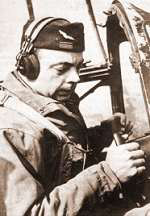
Saint-Ex had a brief intersection with the Lindberghs. Anne Lindbergh wrote the whole thing up feverishly in her journal. She spent 24 hours with the man, and she fell in love with him. It was an emotional thing, I think ... it's hard to tell ... there was no affair, nothing like that. But even though they could barely communicate, she felt seen by him in a way she had never felt before. She felt understood. (Being "understood" is probably the most common cause for infidelity - actual or emotional. It's not about the sex. Not really. How many people say, "She really listened to me ..." or "I felt like I could just talk to him ..." when they talk about cheating on their partner.) I'm not sure if Lindbergh realized how lonely his wife was at this point. Who knows. It's all speculation. Lindbergh and Saint-Ex could bond about mechanics and flying - but it was in the realm of art that Anne bonded with the Frenchman. He had written a foreward to one of her books, and it mortified her: how much he had picked up on, how much he had seen ... She hadn't realized how much her books about her trips with her husband revealed about her innermost soul. But Saint-Ex saw, and she loved him for that. She met him, briefly, and he disappeared shortly thereafter. It left her despondent. Her kindred spirit, her soulmate - even if she could never have him - was now gone forever.
Her journal entries about her time with Saint-Ex are FASCINATING and I will post them all here. (Well, actually, I already have - I will just link to the entries). But they're marvelous. They show marvelous insight into who Saint-Ex was, through the eyes of a woman who revered him, was a little in awe of him.
I have read all of his books on flying, and they are incredible. True high water marks in the genre of aviation writing.
But just for fun, I will post what is probably the most famous chapter of The Little Prince
Here is Chapter 21:
It was then that the fox appeared.
"Good morning," said the fox.
"Good morning," the little prince responded politely, although when he turned around he saw nothing.
"I am right here," the voice said, "under the apple tree."
"Who are you?" asked the little prince, and added, "You are very pretty to look at."
"I am a fox," said the fox.
"Come and play with me," proposed the little prince. "I am so unhappy."
"I cannot play with you," the fox said. "I am not tamed."
"Ah! Please excuse me," said the little prince.
But, after some thought, he added:
"What does that mean-- 'tame'?"
"You do not live here," said the fox. "What is it that you are looking for?"
"I am looking for men," said the little prince. "What does that mean-- 'tame'?"
"Men," said the fox. "They have guns, and they hunt. It is very disturbing. They also raise chickens. These are their only interests. Are you looking for chickens?"
"No," said the little prince. "I am looking for friends. What does that mean-- 'tame'?"
"It is an act too often neglected," said the fox. It means to establish ties."
"'To establish ties'?"
"Just that," said the fox. "To me, you are still nothing more than a little boy who is just like a hundred thousand other little boys. And I have no need of you. And you, on your part, have no need of me. To you, I am nothing more than a fox like a hundred thousand other foxes. But if you tame me, then we shall need each other. To me, you will be unique in all the world. To you, I shall be unique in all the world..."
"I am beginning to understand," said the little prince. "There is a flower... I think that she has tamed me..."
"It is possible," said the fox. "On the Earth one sees all sorts of things."
"Oh, but this is not on the Earth!" said the little prince.
The fox seemed perplexed, and very curious.
"On another planet?"
"Yes."
"Are there hunters on this planet?"
"No."
"Ah, that is interesting! Are there chickens?"
"No."
"Nothing is perfect," sighed the fox.
But he came back to his idea.
"My life is very monotonous," the fox said. "I hunt chickens; men hunt me. All the chickens are just alike, and all the men are just alike. And, in consequence, I am a little bored. But if you tame me, it will be as if the sun came to shine on my life . I shall know the sound of a step that will be different from all the others. Other steps send me hurrying back underneath the ground. Yours will call me, like music, out of my burrow. And then look: you see the grain-fields down yonder? I do not eat bread. Wheat is of no use to me. The wheat fields have nothing to say to me. And that is sad. But you have hair that is the colour of gold. Think how wonderful that will be when you have tamed me! The grain, which is also golden, will bring me back the thought of you. And I shall love to listen to the wind in the wheat..."
The fox gazed at the little prince, for a long time.
"Please-- tame me!" he said.
"I want to, very much," the little prince replied. "But I have not much time. I have friends to discover, and a great many things to understand."
"One only understands the things that one tames," said the fox. "Men have no more time to understand anything. They buy things all ready made at the shops. But there is no shop anywhere where one can buy friendship, and so men have no friends any more. If you want a friend, tame me..."
"What must I do, to tame you?" asked the little prince.
"You must be very patient," replied the fox. "First you will sit down at a little distance from me-- like that-- in the grass. I shall look at you out of the corner of my eye, and you will say nothing. Words are the source of misunderstandings. But you will sit a little closer to me, every day..."
The next day the little prince came back.
"It would have been better to come back at the same hour," said the fox. "If, for example, you come at four o'clock in the afternoon, then at three o'clock I shall begin to be happy. I shall feel happier and happier as the hour advances. At four o'clock, I shall already be worrying and jumping about. I shall show you how happy I am! But if you come at just any time, I shall never know at what hour my heart is to be ready to greet you... One must observe the proper rites..."
"What is a rite?" asked the little prince.
"Those also are actions too often neglected," said the fox. "They are what make one day different from other days, one hour from other hours. There is a rite, for example, among my hunters. Every Thursday they dance with the village girls. So Thursday is a wonderful day for me! I can take a walk as far as the vineyards. But if the hunters danced at just any time, every day would be like every other day, and I should never have any vacation at all."
So the little prince tamed the fox. And when the hour of his departure drew near--
"Ah," said the fox, "I shall cry."
"It is your own fault," said the little prince. "I never wished you any sort of harm; but you wanted me to tame you..."
"Yes, that is so," said the fox.
"But now you are going to cry!" said the little prince.
"Yes, that is so," said the fox.
"Then it has done you no good at all!"
"It has done me good," said the fox, "because of the color of the wheat fields." And then he added:
"Go and look again at the roses. You will understand now that yours is unique in all the world. Then come back to say goodbye to me, and I will make you a present of a secret."
The little prince went away, to look again at the roses.
"You are not at all like my rose," he said. "As yet you are nothing. No one has tamed you, and you have tamed no one. You are like my fox when I first knew him. He was only a fox like a hundred thousand other foxes. But I have made him my friend, and now he is unique in all the world."
And the roses were very much embarrassed.
"You are beautiful, but you are empty," he went on. "One could not die for you. To be sure, an ordinary passerby would think that my rose looked just like you-- the rose that belongs to me. But in herself alone she is more important than all the hundreds of you other roses: because it is she that I have watered; because it is she that I have put under the glass globe; because it is she that I have sheltered behind the screen; because it is for her that I have killed the caterpillars (except the two or three that we saved to become butterflies); because it is she that I have listened to, when she grumbled, or boasted, or even sometimes when she said nothing. Because she is my rose.
And he went back to meet the fox.
"Goodbye," he said.
"Goodbye," said the fox. "And now here is my secret, a very simple secret: It is only with the heart that one can see rightly; what is essential is invisible to the eye."
"What is essential is invisible to the eye," the little prince repeated, so that he would be sure to remember.
"It is the time you have wasted for your rose that makes your rose so important."
"It is the time I have wasted for my rose--" said the little prince, so that he would be sure to remember.
"Men have forgotten this truth," said the fox. "But you must not forget it. You become responsible, forever, for what you have tamed. You are responsible for your rose..."
"I am responsible for my rose," the little prince repeated, so that he would be sure to remember.

Note from me before we move on to the French: This section pretty much rocked my world when I read it in high school. It changed how I thought about a lot of things: about love, and friendship, and what it means to be loyal.
"It is only with the heart that one can see rightly; what is essential is invisible to the eye." Probably the most famous line from the book, and rightly so. But - to be a broken record - it sounds better in French.
Okay, so here comes the French!
Chapter XXI
C'est alors qu'apparut le renard.
-Bonjour, dit le renard.
-Bonjour, r�pondit poliment le petit prince, qui se tourna mais ne vit rien.
-Je suis l�, dit la voix, sous le pommier.
-Qui es-tu? dit le petit prince. Tu es bien joli�
-Je suis un renard, dit le renard.
-Viens jouer avec moi, lui proposa le petit prince. Je suis tellement triste�
-Je ne puis pas jouer avec toi, dit le renard. Je ne suis pas apprivois�
-Ah! Pardon, fit le petit prince.
Mais apr�s r�flexion, il ajouta :
-Qu'est-ce que signifie "apprivoiser"?
-Tu n'es pas d'ici, dit le renard, que cherches-tu?
-Je cherche les hommes, dit le petit prince.Qu'est-ce que signifie "apprivoiser"?
-Les hommes, dit le renard, ils ont des fusils et ils chassent. C'est bien g�nant! Il �l�vent aussi des poules. C'est leur seul int�r�t. Tu cherches des poules?
-Non, dit le petit prince. Je cherche des amis.Qu'est-ce que signifie "apprivoiser"?
-C'est une chose trop oubli�e, dit le renard. Ca signifie "Cr�er des liens�"
-Cr�er des liens?
-Bien s�r,dit le renard. Tu n'es encore pour moi qu'un petit gar�on tout semblable � cent mille petits gar�ons. Et je n'ai pas besoin de toi. Et tu n'a pas besoin de moi non plus. Je ne suis pour toi qu'un renard semblable � cent mille renards. Mais, si tu m'apprivoises, nous aurons besoin l'un de l'autre. Tu seras pour moi unique au monde. Je serai pour toi unique au monde�
-Je commence � comprendre, dit le petit prince. Il y a une fleur� je crois qu'elle m'a apprivois�
-C'est possible, dit le renard. On voit sur la Terre toutes sortes de choses�
-Oh! ce n'est pas sur la Terre, dit le petit prince. Le renard parut tr�s intrigu� :
-Sur une autre plan�te ?
-Oui.
-Il y a des chasseurs sur cette plan�te-l� ?
-Non.
-Ca, c'est int�ressant! Et des poules ?
-Non.
-Rien n'est parfait, soupira le renard.
Mais le renard revint � son id�e :
-Ma vie est monotone. Je chasse les poules, les hommes me chassent. Toutes les poules se ressemblent, et tous les hommes se ressemblent. Je m'ennuie donc un peu. Mais si tu m'apprivoises, ma vie sera comme ensoleill�e. Je conna�trai un bruit de pas qui sera diff�rent de tous les autres. Les autres pas me font rentrer sous terre. Le tien m'appelera hors du terrier, comme une musique. Et puis regarde! Tu vois, l�-bas, les champs de bl�? Je ne mange pas de pain. Le bl� pour moi est inutile. Les champs de bl� ne me rappellent rien. Et �a, c'est triste! Mais tu a des cheveux couleur d'or. Alors ce sera merveilleux quand tu m'aura apprivois�! Le bl�, qui est dor�, me fera souvenir de toi. Et j'aimerai le bruit du vent dans le bl�
Le renard se tut et regarda longtemps le petit prince :
-S'il te pla�t� apprivoise-moi! dit-il.
-Je veux bien, r�pondit le petit prince, mais je n'ai pas beaucoup de temps. J'ai des amis � d�couvrir et beaucoup de choses � conna�tre.
-On ne conna�t que les choses que l'on apprivoise, dit le renard. Les hommes n'ont plus le temps de rien conna�tre. Il ach�tent des choses toutes faites chez les marchands. Mais comme il n'existe point de marchands d'amis, les hommes n'ont plus d'amis. Si tu veux un ami, apprivoise-moi!
-Que faut-il faire? dit le petit prince.
-Il faut �tre tr�s patient, r�pondit le renard. Tu t'assoiras d'abord un peu loin de moi, comme �a, dans l'herbe. Je te regarderai du coin de l'oeil et tu ne diras rien. Le langage est source de malentendus. Mais, chaque jour, tu pourras t'asseoir un peu plus pr�s�
Le lendemain revint le petit prince.
-Il e�t mieux valu revenir � la m�me heure, dit le renard. Si tu viens, par exemple, � quatre heures de l'apr�s-midi, d�s trois heures je commencerai d'�tre heureux. Plus l'heure avancera, plus je me sentirai heureux. � quatre heures, d�j�, je m'agiterai et m'inqui�terai; je d�couvrira le prix du bonheur! Mais si tu viens n'importe quand, je ne saurai jamais � quelle heure m'habiller le coeur� il faut des rites.
-Qu'est-ce qu'un rite? dit le petit prince.
-C'est quelque chose trop oubli�, dit le renard. C'est ce qui fait qu'un jour est diff�rent des autres jours, une heure, des autres heures. Il y a un rite, par exemple, chez mes chasseurs. Ils dansent le jeudi avec les filles du village. Alors le jeudi est jour merveilleux! Je vais me promener jusqu'� la vigne. Si les chasseurs dansaient n'importe quand, les jours se ressembleraient tous, et je n'aurait point de vacances.
Ainsi le petit prince apprivoisa le renard. Et quand l'heure du d�part fut proche :
-Ah! dit le renard� je preurerai.
-C'est ta faute, dit le petit prince, je ne te souhaitais point de mal, mais tu as voulu que je t'apprivoise�
-Bien s�r, dit le renard.
-Mais tu vas pleurer! dit le petit prince.
-Bien s�r, dit le renard.
-Alors tu n'y gagnes rien!
-J'y gagne, dit le renard, � cause de la couleur du bl�.
Puis il ajouta :
-Va revoir les roses. Tu comprendras que la tienne est unique au monde. Tu reviendras me dire adieu, et je te ferai cadeau d'un secret.
Le petit prince s'en fut revoir les roses.
-Vous n'�tes pas du tout semblables � ma rose, vous n'�tes rien encore, leur dit-il. Personne ne vous a apprivois� et vous n'avez apprivois� personne. Vous �tes comme �tait mon renard. Ce n'�tait qu'un renard semblable � cent mille autres. Mais j'en ai fait mon ami, et il est maintenant unique au monde.
Et les roses �taient g�n�es.
-Vous �tes belles mais vous �tes vides, leur dit-il encore. On ne peut pas mourir pour vous. Bien s�r, ma rose � moi, un passant ordinaire croirait qu'elle vous ressemble. Mais � elle seule elle est plus importante que vous toutes, puisque c'est elle que j'ai arros�e. Puisque c'est elle que j'ai abrit�e par le paravent. Puisque c'est elle dont j'ai tu� les chenilles (sauf les deux ou trois pour les papillons). Puisque c'est elle que j'ai �cout�e se plaindre, ou se vanter, ou m�me quelquefois se taire. Puisque c'est ma rose.
Et il revint vers le renard :
-Adieu, dit-il�
-Adieu, dit le renard. Voici mon secret. Il est tr�s simple : on ne voit bien qu'avec le coeur. L'essentiel est invisible pour les yeux.
-L'essentiel est invisible pour les yeux, r�p�ta le petit prince, afin de se souvenir.
-C'est le temps que tu a perdu pour ta rose qui fait ta rose si importante.
-C'est le temps que j'ai perdu pour ma rose� fit le petit prince, afin de se souvenir.
-Les hommes on oubli� cette v�rit�, dit le renard. Mais tu ne dois pas l'oublier. Tu deviens responsable pour toujours de ce que tu as apprivois�. Tu es responsable de ta rose�
-Je suis responsable de ma rose� r�p�ta le petit prince, afin de se souvenir.
Voici mon secret. Il est tr�s simple : on ne voit bien qu'avec le coeur. L'essentiel est invisible pour les yeux.
I could say that all day. "L'essentiel est invisible pour les yeux" Beautiful.
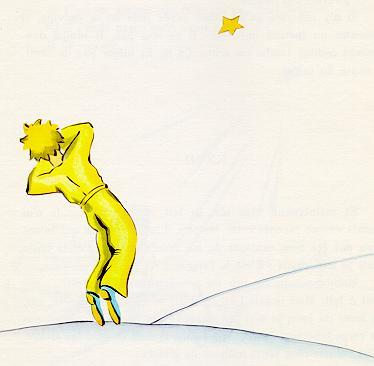
"Ted being asked to sign a ball he had struck out on"

From The Teammates: A Portrait of a Friendship
When [Ted] was generous there was no one more generous, and when he was petulant there was no one more petulant, and sometimes he was both within a few seconds. Once in the mid-1950s, Pedro Ramos, then a young pitcher with Washington, struck Ted out, which was a very big moment for Ramos. He rolled the ball into the dugout to save, and later, after the game, the Cuban right-hander ventured into the Boston dugout with the ball and asked Ted to sign it. Mel Parnell was watching and had expected an immediate explosion, Ted being asked to sign a ball he had struck out on, and he was not disappointed. Soon there was a rising bellow of blasphemy from Williams, and then he had looked over and seen Ramos, a kid of 20 or 21, terribly close to tears now. Suddenly Ted had softened and said, "Oh, all right, give me the goddamn ball," and had signed it. Then about two weeks later he had come up against Ramos again and hit a tremendous home run, and as he rounded first he had slowed down just a bit and yelled to Ramos, "I'll sign that son of a bitch too if you can ever find it."
Heat wave
This piece - about what it's like here during a heat wave - is so right ON. Makes me laugh out loud.
I won't sit here and try to tell you that it's like The Truman Show over here. It ain't. Looting happens. Desperation happens. People lose their shit. Eight million people in one place, not everyone's going to behave all the time. But when a transformer blows up on 4th Avenue at midnight and the city sends 30 trucks from 11 different fire houses, six black-and-whites, a transit van, a Salvation Army mobile transfer unit, the bomb squad, the K-9 squad, and a bunch of dudes in construction helmets, it's not a riot situation. It's an open a window, lean out to rubberneck, see your neighbor doing the same thing, wave and ask her what she knows, tell her what you know that you heard on a police scanner on the Web because you are nosy and a nerd, head downstairs to ask the deli guys what they know because the deli guys function like a subplot seismograph for your block (see also: nosy; nerd), buy some coffee, eavesdrop, swap theories with the lady with the Pomeranians who lives on 2nd Street, swap Pomeranian Lady's theory with Afrika Bambaataa T-Shirt Guy whose friend knows a dude whose brother works at the Lyceum and the brother says it's not the subway at least ("thank you, Simone"), bum out a cigarette to a cop, hear it's not an evacuation deal, and go back upstairs situation. Jury duty, same thing. Five prospective jurors, one Times crossword…you find a way to work it out. Especially if it's the Friday.
Hahahaha So TRUE.
And with the heat? This observation is bang on the money:
Eighty-five, eighty-eight, everyone's still in the game with the linen separates and the eye liner and the neatly knotted tie, pretending to ignore the convection current currently turning everyone on the N/R/Q/W platform into jerky. Any temperature starting with a nine, a collective decision is made, unwittingly, that any pretense of cool in the social sense is only contributing to the lack of cool in the weather sense, and it's just out the window, everywhere you go -- entrances into department stores accompanied by bursts of the Hallelujah chorus, Hiltonoids pulling out their camis from their chests and just blatantly blowing down between their boobs, pocket squares used to wipe armpits, moms putting bags of ice into strollers under the babies, married couples picking the longest movie out in theaters and catching some sweat-free shut-eye in the back row. You walk past a pod of teenage girls while drinking one Diet Coke and rolling the other one around under your tank top when it's only eighty-four, you're going to get mocked. You do it when it's ninety-four, you're going to get copied.
"the linen separates" hahaha
You've got to read the whole thing. She is so great.
The Books: "Sister Mary Ignatius Explains It All For You" (Christopher Durang)
Next in my Daily Book Excerpt:
 More from Christopher Durang Volume I: 27 Short Plays
The following excerpt is from his funny (and angry) play Sister Mary Ignatius Explains It All For You. Durang obviously grew up Catholic. His essay about why he wrote this play (and when he wrote the play - during the year that his mother was dying) is fascinating. He grew up in the 1950s, so his experience of Catholicism was strictly pre-Vatican II. He wrote:
Looking back, I realized that the Catholicism of my childhood had an answer for absolutely everything -- it was extremely thorough. I had this impulse to write a play in which a nun came out and explained everything -- the nature and purpose of the universe, if you will, but as told through the prism of Catholic dogma.
And so that's what he did. Sister Mary Ignatius sweeps on stage, in full habit, and talks at us for 10 pages in an uninterrupted (VERY FUNNY) monologue. It is not one of those "hahaha look at the crazy nun" things, Durang is very clear about that in his notes to the actors. Mary Ignatius must be completely sincere, whether or not you think she is bonkers or not. She COMPLETELY believes that everyone is going to hell, and everyone is on the verge of moral collapse at all times. She is SINCERE in this fear. Play it for real. I've seen actresses play it for real, and when they do? When they don't turn her into stereotype rigid nun, and really play her as a believer who is TRULY frightened for the rest of humanity ... it is absolutely hilarious. But only if you play it real.
After the Sister lectures us (and "explains it all"), 4 or 5 adults knock on her door, and enter ... turns out that they were her students back in the 1950s, and they have come back to ... well, to confront her.
Remember though - this play is a comedy. A broad comedy. It's really hard to get the tone right. Durang did not hate Catholicism. But he did hate the black and white "have an answer for everything" side of it, and so he completely lampoons it in this play. Sister Mary Ignatius has all the answers, knows how you should respond to every situation, and that's FINAL.
Mary Ignatius, still a terror in the same way she was to the other characters when they were children, interrogates them on their life choices since they left her school. All hell breaks loose.
EXCERPT FROM Sister Mary Ignatius Explains It All For You, by Christopher Durang.
SISTER. (to Philomena) You, with the little girl. Tell me about yourself.
PHILOMENA. Well, my little girl is three, and her name is Wendy.
SISTER. There is no Saint Wendy.
PHILOMENA. Her middle name is Mary.
SISTER. Wendy Mary. Too many Y's. I'd change it. What does your husband do?
PHILOMENA. I don't have a husband.
(Long pause)
SISTER. Did he die?
PHILOMENA. I don't think so. I didn't know him for very long.
SISTER. Do you sign your letters "Mrs." or "Miss"?
PHILOMENA. I don't write letters.
SISTER. Did this person you lost track of marry you befolre he left?
PHILOMENA. (sad) No.
SISTER. Children, you are making me very sad. (to Philomena) Did you get good grades in my class?
PHILOMENA. No, Sister. You said I was stupid.
SISTER. Are you a prostitute?
PHILOMENA. Sister! Certainly not. I just get lonely.
SISTER. (to Philomena and the audience both) The Mother Superior of my own convent may get lonely, but does she have illegitimate children?
ALOYSIUS. There was that nun who stuffed her baby behind her dresser last year.
(Sister stares at him)
ALOYSIUS. It was in the news.
SISTER. No one was addressing you, Aloysuis. Philomena, my point is that loneliness does not excuse sin.
PHILOMENA. But there are worse sins. And I believe Jesus forgives me. After all, he didn't want them to stone the woman taken in adultery.
SISTER. That was merely a political gesture. In private Christ stoned many women taken in adultery.
DIANE. That's not in the Bible.
SISTER. (suddenly very angry) Not everything has to be in the Bible. (to audience, trying to recoup) There's oral tradition in the Church. One priest tells another priest something, it gets passed down through the years.
PHILOMENA. But don't you believe Jesus forgives people who sin?
SISTER. Yes, of course. He forgives you, but he's tricky. You have to be truly sorry, and you have to truly resolve not to sin again, or else. He'll send you straight to hell just like the thief He was crucified next to.
PHILOMENA. I think Jesus forgives me.
SISTER. Well I think you're going to hell. (to Aloysius) And what about you? Is there anything the matter with you?
ALOYSIUS. Nothing. I'm fine.
SISTER. But are you living properly?
ALOYSIUS. Yes.
SISTER. And you're married?
ALOYSIUS. Yes.
SISTER. And you don't use birth control?
ALOYSIUS. No.
SISTER. But you only have two children. Why is that? You're not spilling your seed like Onan, are you? That's a sin, you know.
ALOYSIUS. No. It's just chance that we haven't had more.
SISTER. And you go to mass once a week, and communion at least once a year, and confession at least once a year? Right?
ALOYSIUS. Yes.
SISTER. Well, I'm very pleased then.
ALOYSIUS. I am an alcoholic. And recently I've started to hit my wife. And I keep thinking about suicide.
SISTER. (thinks for a moment) Within bounds, all those things are venial sins. (to audience) At least one of my students turned out well. (to Aloysius) Of course, I don't know how hard you're hitting your wife; but with prayer and God's grace ...
ALOYSIUS. My wife is very unhappy.
SISTER. Yes, but eventually there's death. And then everlasting happiness in heaven. (with real feeling) Some days I long for heaven. (to Gary) And you? Have you turned out all right?
GARY. I'm okay.
SISTER. And you don't use birth control?
GARY. Definitely not.
SISTER. That's good. (looks at him) What do you mean, "Definitely not"?
GARY. I ... don't use it.
SISTER. And you're not married. Have you not found the right girl?
GARY. In a manner of speaking.
SISTER. (grim, choosing not to pursue it) Okay. (walks away, but can't leave it, comes back to him) You do that thing that makes Jesus puke, don't you?
GARY. Pardon?
SISTER. Drop the polite boy manner, buster. When your mother looks at you, she turns into a pillar of salt, right?
GARY. What?
SISTER. Sodom and Gomorrah, stupid. You sleep with men, don't you?
GARY. Well ... yes.
SISTER. Jesus, Mary and Joseph! We have a regular cross section in here.
GARY. I got seduced when I was in the seminary. (Sister looks horrified) I mean, I'd been denying it up to then.
SISTER. We don't want to hear about it.
GARY. And then when I left the seminary, I was very upset, and then I went to New York and I slept with five hundred different people.
SISTER. Jesus is going to throw up.
GARY. But then I decided I was trashing my life, and so I only had sex with guys I had an emotional relationship with.
SISTER. That must have cut it down to about three hundred.
GARY. And now I'm living with this one guy who I'd gone to grade school with and only ran into again two years ago, and we're faithful with one another and stuff. He was in your class too. Jeff Hannigan.
SISTER. He was a bad boy. Some of them should be left on the side of a hill to die, and he was one.
GARY. You remember him?
SISTER. Not really. His type.
GARY. Anyway, when I met him again, he was still a practicing Catholic, and so now I am again too.
SISTER. I'd practice a little harder if I were you.
GARY. So I don't think I'm so bad.
SISTER. (makes a "vomit" sound) Bleeeeeeeeeeeeeggghhhhhhh. You make me want to "bleeeeeegggghhhh."
War of the worlds
Tom Cruise, whether he knows it or not, really needed War of the Worlds to be a smash hit. I am not sure he is aware of the damage he has done to his own reputation in the last couple of months, but that wouldn't matter AT ALL if the movie was a smash hit. Sorry, purists. That's the breaks. We live in a capitalist society. Huge ASSHOLES have remained stars for DECADES because their films bring in the doe. It's about the MONEY. All of that being said: Cruise needed this movie to be a huge hit, along the lines of ... oh ... Top Gun. A hit that could, conceivably, sweep away the last couple of months ... so that suddenly all we can talk about is the MOVIE as opposed to his bouncing chimpy ravings. This is what really needed to happen, at this point in Cruise's career. How quickly the mighty fall (but again - I'm not sure that he's aware of how his star has fallen - at least not yet. He is now surrounded entirely by "yes" men - or to be more accurate: "yes" women. So I'm not sure reality is really getting in there yet.)....
So now it looks like the smash hit won't happen. I've read a couple of reviews and while they are not hostile, or unremittingly negative (no, they couldn't be. Spielberg is too good for that) - they certainly aren't emanating "smash hit". It will not be enough to sweep away the public perception that Tom Cruise is now legitimately insane, and either needs to shut UP, or just GO AWAY.
Ebert's review is really interesting, I think. He gets caught up in the WHYS of the alien invasion, which - under the circumstances - is a really good question. He kind of can't get past it, which is not a good sign for the film as a whole.
The problem may be with the alien invasion itself. It is not very interesting. We learn that countless years ago, invaders presumably but not necessarily from Mars buried huge machines all over the Earth. Now they activate them with lightning bolts, each one containing an alien (in what form, it is hard to say). With the aliens at the controls, these machines crash up out of the Earth, stand on three towering but spindly legs and begin to zap the planet with death rays. Later, their tentacles suck our blood and fill steel baskets with our writhing bodies.To what purpose? Why zap what you later want to harvest? Why harvest humans? And, for that matter, why balance these towering machines on ill-designed supports? If evolution has taught us anything, it is that limbs of living things, from men to dinosaurs to spiders to centipedes, tend to come in numbers divisible by four. Three legs are inherently not stable, as Ray demonstrates when he damages one leg of a giant tripod, and it falls helplessly to the ground.
This paragraph I think is particularly interesting:
Does it make the aliens scarier that their motives are never spelled out? I don't expect them to issue a press release announcing their plans for world domination, but I wish their presence reflected some kind of intelligent purpose. The alien ship in "Close Encounters" visited for no other reason, apparently, than to demonstrate that life existed elsewhere, could visit us, and was intriguingly unlike us while still sharing such universal qualities as the perception of tone. Those aliens wanted to say hello. The alien machines in "War of the Worlds" seem designed for heavy lifting in an industry that needs to modernize its equipment and techniques. (The actual living alien being we finally glimpse is an anticlimax, a batlike, bug-eyed monster, confirming the wisdom of Kubrick and Clarke in deliberately showing no aliens in "2001").
That's a good point, I think.
Ebert keeps going back to his questions, although he does touch briefly on the acting and the special effects. But to him: it's almost a childlike response (which is one of the best responses a reviewer can have ... Kids smell bullcrap from MILES away).
Ebert:
The thing is, we never believe the tripods and their invasion are practical. How did these vast metal machines lie undetected for so long beneath the streets of a city honeycombed with subway tunnels, sewers, water and power lines, and foundations? And why didn't a civilization with the physical science to build and deploy the tripods a million years ago not do a little more research about conditions on the planet before sending its invasion force? It's a war of the worlds, all right -- but at a molecular, not a planetary level.All of this is just a way of leading up to the gut reaction I had all through the film: I do not like the tripods. I do not like the way they look, the way they are employed, the way they attack, the way they are vulnerable or the reasons they are here. A planet that harbors intelligent and subtle ideas for science fiction movies is invaded in this film by an ungainly Erector set.
Looks like the film War of the Worlds will not be enough to take our attention away from "the crazy".
It is interesting to contemplate, though: The dude has been everywhere lately. Yes, because he's a big movie star, and he got engaged, and so the tabloids will be interested. But obviously, the REAL reason he has been everywhere lately, is because he has a movie coming out. (You wouldn't know that from his interviews, where he seems to focus on his medical expertise rather than THE MOVIE ... but still. That is the primary reason why Tom Cruise is all over the place. He has a MOVIE coming out.)
Okay, so now the movie's opened.
No more press junkets, no more blitzkriegs, no more public spotlight (I mean ... relatively. Cruise always lives in the public spotlight, he can't help it). But ... what on earth will he do now? The press blitzkrieg will die out in a couple weeks ... but then what? He and Katie will settle down to decorate their house ... or ... what? Cruise lives with his entire family, his sisters, his mother, their kids, all of whom are scientologists. Will Katie be moving into that commune? Or ... Still, that's a side question. The real question is: without a built-in reason to be here, there, and everywhere (big movie coming out) - how will Tom Cruise deal with reality? How will the couple deal with the relationship OUT of the glare? What the heck?
I think the next couple of months will be very very interesting.
June 28, 2005
God, I am so embarrassed
But I am ADDICTED to that reality show Blow Out - about the hotshot alpha male hairdresser. I find him FASCINATING. I just ... God. I am succumbing. What am I saying ... I HAVE succumbed. It's over. I'm in. I'm hooked.
Dan Update
Please keep Dan and his wife in your thoughts. He's in the hospital right now.
More crazy!!
More crazy! More crazy!! This is so much crazy for a 48 hour period, I don't even know what to do!!
Watch the video. I absolutely love the guy interviewing him. Great job, dude.
A couple of things I need you to notice:
-- the absolute aggression of the laugh. If you weren't paying attention, you might really think that it was real. But it is not. Watch. The. Laugh.
-- look at the dimwitted expression on Katie Holmes' face. The girl appears to be on some kind of psychotropic drug although we know that is not possible.
-- he refers to her as his "soulmate". Well. Yippee for them. I, however, have skepticism about the very word "soulmate" (here, here, and here) and think it's often a smokescreen for other emotions. Say: TERROR??? SELF-LOATHING??? INABILITY TO BE CLOSE TO ANOTHER HUMAN BEING??? People like THAT break out the "soulmate" word. Sigh. I need to calm down. I need my Xanax. Don't tell Tom.
-- and now: watch the shift when he starts to talk about Ritalin. Just watch the transformation. I am now getting used to that shift, but I still find it alarming to watch. He goes into Defcon One mode.
Reconciliation
Nathan Lane got his start in Terrence McNally's plays, making enormous splashes for himself in Lisbon Traviata, Lips Together, Teeth Apart and Love, Valour, Compassion. It was one of those relationships between a playwright and an actor that you dream of finding. Rare. Lane was almost McNally's muse. McNally brought out the best in Nathan Lane, and Nathan Lane lifted McNally's words off the page and made his plays LIVE. If all you know of Nathan Lane is his performance in The Birdcage (which is wonderful, by the way) - then you only know half of what this man can do. To see him onstage??? People. People. The man is a stage actor. It's not just that he is funny and broad and over-the-top, although he is all of those things. But ... it's a matter of technique, I guess, or spirit. Not sure. He plays to the back row. His work is specific, emotionally connected, like a laser beam, he has comedy down to a SCIENCE and yet you never feel him mugging or pandering to you ... He is great in The Birdcage but he is one of the best there is onstage.
Lane and McNally had a rather famous falling out. I am not sure of the wheres and whyfores of it, but I believe it had something to do with whatshisname from Seinfeld - Jason Alexander - being cast in Lane's role in the movie version of Love, Valour, Compassion. Both Lane and McNally have been rather reticent on this, but it is apparent that something pretty bad went down between the two friends over this issue. Lane made a kind of wistful comment about it when he came and talked at my school, basically saying that he would love to work with McNally again, and wouldn't it be great, wouldn't it be something ... But he made that comment years ago.
Now it looks like it is actually happening. Nathan Lane has joined the cast of Terrence McNally's new play Dedication or the Stuff of Dreams , premiering at Primary Stages.
I saw the notice today and it made me happy. Made me happy to think that these two old New York pros had obviously buried the hatchet, and decided to work together again. Wonderful.
Whatever you do:
Do not be GLIB!
Tom Cruise knows a lot of shite.
(I think my favorite part is ""Listen, Conan. You shouldn't be sitting here, leading America on, by saying that the space shuttle is lifted from the ground by the burning of liquid oxygen from the booster tanks. That's just not true. NASA "scientists" [makes diacritical marks] have known since 1947 that the only way to get propulsion of such magnitude is to defy the artificial gravity created by Xenu that keeps us tethered to Earth--they've known this since 1947, and they keep telling you otherwise. I know for a fact that if you can perform a high-enough level audit, you can fly. I fly all the time. The first time I flew my heterosexual girlfriend Penelope Cruz crapped her pants.")
hahahaha
But please. NO MORE GLIBNESS. Accept the Cruise-ology. Accept. Surrender.
I am an enormous geek
Why? Because here are the results to Norm's "best movie star" poll (a poll in which I participated) and Cary Grant is number one. He is number one! YEAH. I am LAUGHABLY geeky about that man. But then again, you guys know that. I feel proprietary about him, which, if you think about it, is completely inappropriate and actually a little bit creepy. Oh well. I enjoy it.
But still. I love that he's number one. I want to have a party.
Here is my list.
1. Cary Grant
2. Katherine Hepburn
3. Marilyn Monroe
4. Humphrey Bogart
5. Ingrid Bergman
6. Jeff Bridges
7. Marlon Brando
8. Gary Cooper
9. Clark Gable
10. John Travolta
(And here I explain my choices.)
I guess I'm kind of shocked that Clark Gable and Gary Cooper didn't make the top list over at Norm's. And Jodie Foster did??? Huh? I mean, Jodie's fine, whatever, but ... she beat Clark Gable??? (But then again: I have a couple of issues with Jodie, on occasion. Nothing huge, nothing like my Renee Z. pathology ... I just think her acting can get a bit busy, if she's not directed well. She does too much. Maybe I'll get into that at some other point.)
I knew Travolta and Bridges were wild cards, and it's interesting - it appears that they were on nobody else's lists.
I maintain my position on both of these guys. Riveting, amazing, actors MADE to be on film. These guys are BORN to be film stars.
But yeah: let's hear it for Cary Grant!!
(geek, geek, geek, geek ...)
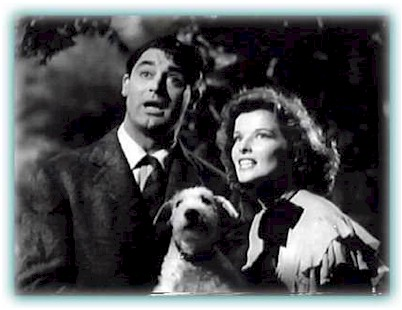
Picture of a scene from Bringing Up Baby below. One of my favorite scenes, actually - when they try to serenade the leopard down from off the roof, and end up getting dragged off to jail. My favorite part of the scene? When David Huxley suddenly, spontaneously, stops being all flustered and anxious ... and actually has a moment of pride because he found a nice harmony line during the serenade. Does anyone remember that moment? It's hilarious. Makes me laugh every time I see it.
The Books: "The Actor's nightmare" (Christopher Durang)
Next in my Daily Book Excerpt:
More from Christopher Durang's selection of short plays
The following excerpt is from his funny play The Actor's Nightmare. The actor's nightmare happens to all of us: we dream that we are suddenly in the middle of a production of Macbeth, and we are playing Lady Macbeth, and there is a packed house out there, only we have had no rehearsals, we don't know ANY of our lines, and we have no idea what is going on. I've had 5,000 of these dreams.
Christopher Durang wrote a play about it.
A guy named George suddenly finds himself having to go on in a play he has never heard of, and even worse: his co-stars are 3 famous stage actors from history: Sarah Siddons, Ellen Terry, and Henry Irving. I'll post the opening of the play, so you can get the jist of it. It's very funny.
EXCERPT FROM The Actor's Nightmare, by Christopher Durang:
Scene: Basically an empty stage, maybe with a few set pieces on it or around it. George Spelvin, a young man, wanders in. He looks baffled and uncertain where he is. Enter Meg, the stage manager. In jeans and sweatshirt, perhaps, pleasant, efficient.
GEORGE. Oh, I'm sorry. I don't know how I got in here.
MEG. Oh, thank goodness you're here. I've been calling you.
GEORGE. Pardon?
MEG. An awful thing has happened. Eddie's been in a car accident, and you'll have to go on for him.
GEORGE. Good heavens, how awful. Who's Eddie?
MEG. Eddie.
(He looks blank.)
MEG. Edwin. You have to go on for him.
GEORGE. On for him.
MEG. Well, he can't go on. He's been in a car accident.
GEORGE. Yes, I understood that part. But what do you mean "go on for him"?
MEG. You play the part. now I know you haven't had a chance to rehearse it exactly, but presumably you know your lines, and you've certainly seen it enough.
GEORGE. I don't understand. Do I know you?
MEG. George, we really don't have time for this kind of joshing. Half-hour. (Exits)
GEORGE. My name isn't George, it's ... well, I don't know what it is, but it isn't George.
(Enter Sarah Siddons, a glamourous actress, perhaps in a sweeping cape)
SARAH. My God, did you hear about Eddie?
GEORGE. Yes I did.
SARAH. It's just too, too awful. Now good luck tonight, George darling, we're all counting on you. Of coursre, you're a little too young for the part, and you are shorter than Edwin so we'll cut all the lines about bumping your head on the ceiling. And don't forget when I cough three times, that's your cue to unzip the back of the dress and then I'll slap you. We changed it from last night. (She starts to exit)
GEORGE. Wait, please. What play are we doing exactly?
SARAH. What?
GEORGE. What is the play, please?
SARAH. Coward.
GEORGE. Pardon?
SARAH. Coward. (looks at him as if he's crazy) Coward. Noel Coward. (suddenly relaxing) George, don't do that. For a second, I thought you were serious. Break a leg, darling. (exits)
GEORGE. Coward. I wonder if it's Private Lives. At least I've seen that one. I don't remember rehearsing it exactly. And am I an actor? I thought I was an accountant. And why does everyone call me George?
(Enter Dame Ellen Terry, younger than Sarah, a bit less grand)
ELLEN. Hello, Stanley. I heard about Edwin. Good luck tonight. We're counting on you.
GEORGE. Wait. What play are we doing?
ELLEN. Very funny, Stanley.
GEORGE. No really. I've forgotten.
ELLEN. Checkmate.
GEORGE. Checkmate?
ELLEN. By Samuel Beckett. You know, in the garbage cans. You always play these jokes, Stanley, just don't do it onstage. Well, good luck tonight. I mean, break a leg. Did you hear? Edwin broke both legs. (Exits)
GEORGE. I've never heard of Checkmate.
(Re-enter Meg)
MEG. George, get into costume. We have fifteen minutes. (Exits)
(Enter Henry Irving, age 28-33, also somewhat grand)
HENRY. Good God, I'm late. Hi, Eddie. Oh you're not Eddie. Who are you?
GEORGE. You've never seen me before?
HENRY. Who the devil are you?
GEORGE. I don't really know. George, I think. Maybe Stanley, but probably George. I think I'm an accountant.
HENRY. Look, no one's allowed backstage before a performance. So you'll have to leave, or I'll be forced to report you to the stage manager.
GEORGE. Oh she knows I'm here already.
HENRY. Oh. Well, if Meg knows you're here it must be all right I suppose. It's not my affair. I'm late enough already. (Exits
MEG. (offstage) Ten minutes, everybody. The call is ten minutes.
GEORGE. I better just go home. (Takes off his pants) Oh dear, I didn't mean to do that.
(Enter Meg
MEG. George, stop that. Go into the dressing room to change. Really, you keep this up and we'll bring you up on charges.
GEORGE. But where is the dressing room?
MEG. George, you're not amusing. It's that way. And give me those. (takes his pants) I'll go soak them for you.
GEORGE. Please don't soak them.
MEG. Don't tell me my job. Now go get changed. The call is five minutes. (Pushes him off to dressing room; crosses back the other way, calling out:) Five minutes, everyone. Five minutes. Places.
(A curtain closes on the stage. Darkness. Lights come up on the curtain.)
Happy birthday to ...
Mel Brooks!
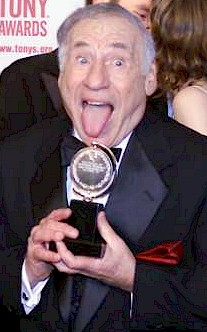
I love the following stories about Mel Brooks, told by Gene Wilder when he came to my school.
Gene Wilder, a young actor, was in some show on Broadway, kind of a big break. Forgive me, can't remember what it was. One night, after the show, a knock came on his dressing room door. He opened it, and there was Mel Brooks, a man he did not know. Chit-chat ensued, and Brooks then told him about a project he had in his mind that he would like to do ... and he immediately thought of Gene Wilder for one of the leads. The project was called Springtime for Hitler. This is all so amusing, in retrospect because ... NOW we know how funny The Producers is, NOW "Springtime for Hitler" is recognized as absolutely hilarious ... but ... then? The way Wilder told the story was so funny. Like: who is this nutty small Hobbit-like man who wants me to star in his movie called SPRINGTIME FOR HITLER?? Still, the two of them hit it off. Gene Wilder told him that he would love to read the script, whenever it was ready.
THREE YEARS proceeded to go by. Not a word from Brooks. Nothing. Nada. Wilder continued on with his career, doing plays in New York. Life goes on. He didn't yearn for Springtime for Hitler to come to fruition ... he basically put it out of his head, and never thought about it.
Then - Wilder was doing some OTHER play, it had been 3 years since the original encounter, and again, a knock came on his dressing room door one night after the show. Wilder opened the door, and there stood Mel Brooks. Mel said, "You didn't think I'd forgotten, did you??"
hahahaha And at that point, he had a completed script, and it was now called The Producers and the rest is history.
The other story I like about Mel Brooks, told by Gene Wilder, is this:
Wilder wrote Young Frankenstein, and despite the fact that Brooks only directed stuff that HE wrote, he agreed to take on the project. Apparently, this took some doing. But Wilder and Brooks were very good friends by this point, and finally Brooks said sure, he would direct.
The two then began to have script conferences at Wilder's apartment. (They lived only a couple of blocks away from each other). Apparently, these "script conferences" often degenerated into shouting matches. Creative differences.
There was one particular time when Brooks, disagreeing with Wilder over something, absolutely FLIPPED OUT. Screaming, carrying on, until finally he stormed out of Wilder's apartment, slamming the door behind him.
5 minutes later, Wilder's phone rang. Wilder picked up. "Hello?"
Mel Brooks said, in a calm quiet voice, "Who on earth was that maniac who just left your apartment? I could hear the screaming from down here! What a lunatic, sheesh, you need to be more careful about who you let into your home ..."
So it's Mel Brooks' birthday today. I would imagine he is going through a rather tough time right now, since the death of his wife, Anne Bancroft.
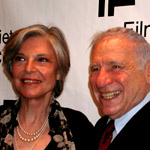
It must be a sad time for him. Meanwhile - the movie version of The Producers musical is being filmed AS WE SPEAK ... how exciting for Mel, right? But I feel for him. It can't be easy to continue on after such a loss.
So happy birthday, Mel! Thanks for the years and years and YEARS of laughter.
"Put ... the candle ... back..."
"Shut up, I'm having a rhetorical conversation."
"Not many people know it, but the Fuhrer was a terrific dancer."
"You have exactly ten seconds to change that look of disgusting pity into one of enormous respect!"
"How could this happen? I was so careful. I picked the wrong play, the wrong director, the wrong cast. Where did I go right?"
"I'm tired of men always coming and going, going and coming and always too soon."
"Follow me, faggots!"
"DESTINY! DESTINY! NO ESCAPING DEATH FOR ME! DESTINY! DESTINY! NO ESCAPING DEATH FOR ME!"
"Igor, would you give me a hand with the bags?" "Certainly, you take the blonde and I'll take the one in the turban."
"If science teaches us anything, it teaches us to accept our failures, as well as our successes, with quiet dignity and grace."
Please add more of your favorite Mel Brooks-isms in the comments ...
June 27, 2005
Glories strung like beads
I got this from Norm. This is my version.
I love to go back and re-read the books I was forced to read on my high school summer reading lists. Some are still stinkers (uhm Billy Budd


I love the opening chords of "Smells like Teen Spirit". Gives me goosebumps no matter how many times I hear it.
I love a flawless double play.
I love the late-night scene in Only Angels Have Wings where Cary Grant and Jean Arthur find themselves alone in the now-empty juke joint, and they drink, and talk, and he propositions her. All he says is, "Would you like to come up to my room?" but he makes it sound like the most indecent and FUN thing in the world. Sexual tension never has been played so perfectly.
I love North Dakota. The flatness, the horizon all around, the vistas: thunderstorms seen miles and miles away. There may be a more spectacular place on earth, but I'd have to see it to believe it.
I love the contradictory nature of almost every sentence in Catch 22. Whatever is said in one sentence is then upended in the next, and it gives such an atmosphere or lunacy and madcap chaos.
I love Tori Amos' album Little Earthquakes. I love it because it's a great album, but I love it too because of the associations it brings. Freedom, running along Lake Michigan, single for the first time in years, living on my own for the first time ever ... I was skinny, muscular, with boundless energy, on fire, my hair in crazy red curls ... Tori Amos's album was the soundtrack of that time.
I love reading the letters of John and Abigail Adams. Poetry, romance, passion, intellect. The sacrifice, the compromise, the sense that generations to come would be watching their actions ... It has to be the most romantic correspondence in the public record. "My dearest friend ..."
I love seeing old architecture in New York City. You can still see old signage here and there, in between the neon. I love the gargoyles, the detail of the stonework ... it gives New York City a pagan feel to it. Powerful, primal.
I love the poetry of Seamus Heaney.
I love the transformations Jeff Bridges goes through in The Fisher King, one of my favorite movies ever. I love the scene when he and Mercedes Ruehl take Robin Williams and Amanda Plummer out on a double-date ... and it is kind of a disaster ... but he and Mercedes sit in the background, starting to see the humor of it, and starting to LOSE it with guffawing. Trying to hold back, but they can't help themselves. That scene, to me, is when I realize how much the two of them love each other.
I love Christopher Guest.
I love the overpass going through Milwaukee. It was unfinished when I was there, or under construction ... but I will never forget it, vaulting itself over the Summer Fest, like a dinosaur skeleton, or like one of the structures left behind on earth when all the humans are gone. P.M. called it "Sheila's bridge". I loved it. I have a picture of it, kind of blurry in the sunset mist, and it brings back my time there every time I see it.
I love the show Hill Street Blues. One of my favorites from way back when.
I love the films of John Cassavetes, and the acting of his wife Gena Rowlands in those movies. She doesn't "nail" a scene, she doesn't get anything right, no. Nothing that neat, or intellectual. She plays her scenes on the edges of it, she does not tie things up neat for us, she does not let us know how we should feel. She is my idol. I have her picture on my wall right now.
I love going to the Actors Studio, a converted church on 44th street. The ghosts crowd up against me in the balcony: Paul Newman, Marilyn Monroe, Shelley Winters, Ben Gazzara, Al Pacino ... The exposed brick at the back of the stage has soaked up the memories of 4 generations. A more potent place on earth there is not.
I love old maps.
I love Fenway Park.
I love the old rock club (no longer there) called Lounge Ax in Chicago. A million memories there. Some of the most important things in my life, to date, happened there. Life, love, friendship, fun, freedom, idolatry ... I am sorry it is gone, but I have the memories. It's also in a scene in High Fidelity, so I can visit Lounge Ax any time I watch that movie.
I love James Joyce. I love his writing, sure, but more than that, I just love the FACT of him.
I love how fat babies' arms and legs are. I love how they have creases where their ankles and wrists should be. I love how babies smell. I love their soft big heads.
I love celebrity gossip. If I had the money, I would subscribe to Us, People, In Touch, Star, Vanity Fair, and a host of others. I love fame. I love watching how people handle it, either gracefully or not.
I love men. I love their hands, their laughs, their body language, how they smell, how they are strong but how they can suddenly turn gentle.
I love Mark Bowden's book Black Hawk Down
I love the footage of a young un-famous Barbra Streisand appearing on Judy Garland's television show. It's exhilarating. She's 19. She sings a couple of duets with THE Judy, and she is RAW, and FEARLESS ... she wears a middy blouse, she looks unlike anything you have ever seen before ... and that VOICE. She's a TEENAGER. Phenomenal.
I love the soundtrack to Ragtime. Glorious!! Now THAT is a musical!
I love Ellen von Unwerth's photography.
I love polar bears. I love them to DEATH.
I love the movie Moulin Rouge. I found it crushingly moving.
I love Fleet Week. I love seeing soldiers in their whites, strolling through our fair city. I mean, of course, I love it because they all look so hot - but I also love it because it makes me feel so PROUD.
And finally: I love the last scene in Notorious. I never get tired of it. Never.
The Books: "'Dentity Crisis" (Christopher Durang)
Next in my dailiy book excerpt:
More from Christopher Durang's collection of his short plays
The following excerpt is from his short play 'dentity Crisis, a favorite at colleges, and in acting classes. It's a spoof on the therapy culture. I'm going to post the "Peter Pan" monologue, which, in its way, at least in my world, is very well known. In the world of actors everyone knows this monologue - and people have chosen it so frequently as audition material that now you pretty much are advised NOT to choose it, and find something not so well known. It's a scene between Jane, the depressed patient, and Summers, the psychiatrist.
EXCERPT FROM 'dentity Crisis, by Christopher Durang:
JANE. (at piano) I don't remember taking piano lessons.
SUMMERS. Maybe you've repressed it. My wife gave me the message about your attempting suicide. Why did you do it, Jane?
JANE. I can't stand it. My mother says she's invented cheese and I start to think maybe she has. There's a man living in th ehouse and I'm not sure whether he's my brohter or my father or my grandfather. I can't be sure of anything anymore.
SUMMERS. You're talking quite rationally now. And your self-doubts are a sign of health. The truly crazy person never thinks he's crazy. Now explain to me what led up to your attempted suicide.
JANE. Well, a few days ago I woke up and I heard this voice saying, "It wasn't enough."
SUMMERS. Did you recognize the voice?
JANE. Not at first. But then it started to come back to m e. When I was eight years old, someone brought me to a theatre with lots of other children. We had come to see a production of Peter Pan. And I remember something seemed wrong with the whole production, odd things kept happening. Like when the children would fly, the ropes would keep breaking and the actors would come thumping to the ground and they'd have to be carried off by the stagehands. There seemed to be an unlimited supply of understudies to take the children's places, and then they'd fall to the ground. And then the crocodile that chases Captain Hook seemed to be a real crocodile, it wasn't an actor, and at one point it fell off the stage, crushing several children in the front row.
SUMMERS. What happened to the children?
JANE. Several understudies came and took their places in the audience. And from scene to scene Wendy seemed to get fatter and fatter until finally by the second act she was immobile and had to be moved with a cart.
SUMMERS. Where does the voice fit in?
JANE. The voice belonged to the actress playing Peter Pan. You remember how in the second act Tinkerbell drinks som epoison that Peter's about to drink, in order to save him? And then Peter turns to the audience and he says that Tinkerbell's going to die because not enough people believe in fairies, but that if everybody in the audience claps real hard to show that they do believe in fairies, then maybe Tinkerbell won't die. And so then all the children started to clap. We clapped very hard and very long. My palms hurt and even started to bleed I clapped so hard. Then suddenly the actress playing Peter Pan turned to the audience and she said, "That wasn't enough. You didn't clap hard enough. Tinkerbell's dead." Uh ... well, and ... and then everyone started to cry. The actress stalked offstage and refused to continue with the play, and they finally had to bring down the curtain. No one could see anything through all the tears, and the ushers had to come help the children up the aisles and out into the street. I don't think any of us were ever the same after that experience.
SUMMERS. How do you think this affected you?
JANE. Well it certainly turned me against theatre; but more damagingly, I think it's warped my sense of life. You know -- nothing seems worth trying if Tinkerbell's just going to die.
SUMMERS. And so you wanted to die like Tinkerbell.
JANE. No.
SUMMERS. (with importance) Jane. I have to bring my wife to the hospital briefly this afternoon, so I have to go now. But I want you to hold on, and I'll check back later today. I think you're going to be all right, but I think you need a complete rest; so when I come back we'll talk about putting you somewhere for a while.
JANE. You mean committing me.
SUMMERS. No. This would just be a rest home, a completely temporary thing. Tinkerbell just needs her batteries recharged, that's all. Now you just make your mind a blank, and I'll be back as soon as I can.
JANE. Thank you. I'll try to stay quiet 'til you return.
June 26, 2005
"One good pitch"
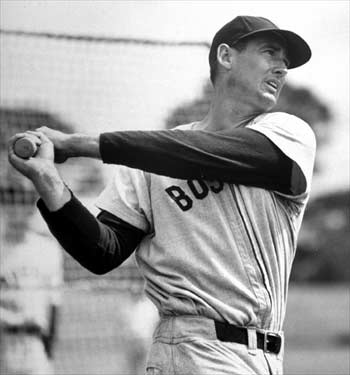
From The Teammates: A Portrait of a Friendship
In his playing days, he would be there every day in the clubhouse, holding forth -- the Ted Williams Lescture Series -- at least a speech per day, orating and arguing at the same time. Mel Parnell, the great Boston lefty, told me you failed to listen to him at your own risk, because for all the stuff you did not need to hear, there was always so much to learn, often about hitters on the other team, because he was so smart, and he missed nothing that happened on a ball field."I can," John Pesky said 60 years after he heard the basic lecture for the first time, "still hear him telling us, because he said it again and again, 'You'll only get one good pitch to hit. One good pitch. That's all. Don't count on more. So you better know the strike zone. And when you get that one good pitch you better hit it and hit it hard. Remember, just one good pitch.'"
Mental health
Nothing like getting out of the land of concrete - even for just a day and a half.
I feel sun-baked (maybe a couple more freckles on my face) and lazy and relaxed. I slept 9 hours. This is unheard of. Swimming, and hammocks, and shrimp on the grill, and the outdoor shower, and star-gazing ... Nighttime was totally quiet except for the occasional splash of a jumping fish. I had a run-in with a daddy long-legs, and dealt with it calmly. (To be perfectly accurate: I had about three freaked-out run-ins with the terrifying buggers before I was able to deal with it calmly. But what a breakthrough to have the run-in go something like: "Oh, look, there's another one. So anyway, as I was saying ...") Sitting in the shade under the big umbrella-table, doing my homework for my writing class. I also read the Raymond Carver story "Cathedral" which I had never read. Holy CRAP. The guy is amazing. Windows to the lake. The most amazing maple tree - massive. A horse trail near the house ... watching the riders go by. Huge hills covered in trees. A lone woman doing the backstroke in the lake. Kids leaping off the blown-up trampoline in the water. Lazing about. Watermelon. A smoky fire at night. Major stars and also a glowing planet. Oh, and we went to a small cafe which sold:
1. Iced coffee
2. Used books.
Can we say: HEAVEN? I bought David McCullough's Truman for five bucks. Psyched.
Nice to get the hell out of here for even a day.
I think I'm gonna watch North by Northwest tonight.
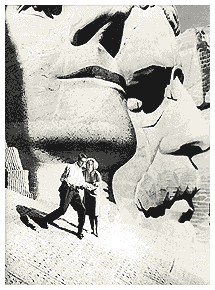
You know ... the search for stress-release never ends for me:
June 24, 2005
Harriet the spy
I've been tagged! Thanks, Candace, I love the question, which is:
What was your favorite book during those important early years? What impact has that story had on your life? How can you relate that story to current events?
I had a couple of different choices. The first thing that came to mind was Charlotte's Web


But then I had to throw those precious books aside - as marvelous and important as they were to me - and go with Harriet the Spy
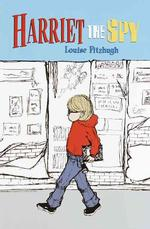
I honestly don't know if Harriet the Spy could even be published today. She is such an unconventional heroine. She's not always likable. She's bossy, secretive, contemptuous, and sometimes witheringly mean to her best friends. She sees people's weaknesses - that is Harriet's great gift and great curse. She finds weaknesses interesting. She spies on people. SHE BREAKS INTO PEOPLE'S HOMES TO SPY ON THEM. She hides in the dumbwaiter of one rich old broad's house, who never gets out of bed, and writes down everything the rich old broad says. Harriet sees things like: women buying 50 cans of cat food in the store, and she wonders about it. Why? Can someone have that many cats? And if so, why? What is that woman's life like? Then she will follow that woman home to find out. She peeks through windows, stares through air shafts ... she has certain pitstops she has to hit every day. She memorizes people's schedules so she knows where to be at what time. Harriet is a lunatic. A small criminal in training.
However, when I say Harriet is hugely responsible for who I am today - I am not talking about being a criminal. I'm talking about being observant. I'm talking about finding the human race interesting enough to make it your calling. Observing, imitating, delving into, writing about it. Whatever it may be. Harriet certainly judges. She feels bad for the man with the cats. She hates some of the kids at school. She thinks the Drama teacher is a moron. But above all else: she finds them all interesting. She is a difficult person. She is 11 years old and she is already an eccentric.
I was like that. I was not an easy child. I did not fit into any mold. I knew who I was very early. Harriet seared into me. She flames off the page. Still. Harriet still has the power to make me be brave in scary situations. To face the truth. To grow up. To let go of things that are stupid. To trudge through the tough times, gritting your teeth and bearing it. Etc. She is still my role model, in so many ways. Role models aren't perfect. Anyone who is a paragon of good-ness is highly suspect in my eyes. I don't trust them. In the same way that I do not trust fundamentalists, or those who know - without a shadow of a doubt - that they are right. Nope. That's a house of cards. I do not trust those people. I do not trust people who do not admit weakness in themselves, but who are so eager to see weakness in others. But someone who is flawed? Who struggles, and honestly? Who makes mistakes and maybe is awkward and bumbling at growth? I trust those people.
Through the course of the book, Harriet eventually learns to have compassion for people's weaknesses, as opposed to just ghoulish curiosity. However, there is no real "lesson", or moral here. That's one of the extraordinary things about this book, the difficult things. Kids are spoon-fed stupid morality lessons nowadays - every single piece of literature has to "teach" you something - hence the quality of books have gone down, and difficult complex truths are avoided.
At the very end of the book, after Harriet goes through HELL because the entire school reads her private (and very bitchy and very mean) journal ... Harriet eventually realizes, in a moment of clarity: "Sometimes you have to lie."
Let's hear it again: Sometimes you have to lie.
Those words just echoed through my head when I first read them, and they still echo today. "Sometimes you have to lie." I still think of that, at times. If you think your best friend is ugly and a little bit crazy, does it in any way help her to tell her point-blank, "I think you're ugly and a little bit crazy"? Harriet learns to hold her tongue, and she learns to lie. And in the context of the book, that is a good thing. It is part of growing up. I mean ... what?? (Come to think of it, I just wrote about this this past week.) It's a complex thought, and it's not spelled out for the kids reading the book. It's not wrapped up in a neat little bow to make it palatable and understandable to kids.
Harriet, at the end of the book, is not any less brilliant, or any less ambitious. She is going to be a writer. Or a spy. Or something GREAT. But she has learned to censor herself and her contempt for others. She has been beaten down by too much truth, and she chooses to keep her two best friends in her life (Sport and Janie) rather than lose them.
I love Harriet. It hurts how much I love her. There is NO WAY ON EARTH that you could EVER convince me that Harriet does not live off the page, that she does not go on, that Harriet is not "out there" somewhere. She is REAL.
Maybe the book is about learning to take the high road, even if it means sacrificing things you hold dear. Maybe the book is about not sweating the small stuff. Maybe the book is about loyalty. But loyalty to what? Harriet must not betray her inner voice. Harriet NEEDS to spy on people. Harriet might have a great future in the CIA, who knows. She could be working for the United States government right now. She has a gift. She is 10 years old, and she is damn good at what she does. She sets out every day on her "rounds". She has her notebook, and her special belt - where she has clipped a flashlight, a penknife, and other tricks of her trade. What feeds Harriet? What turns Harriet on? Humanity. PEOPLE. She NOTICES things.
Harriet, with all her faults and failings, is AWAKE.
God, I loved her for that, and I still do. She taught me how to look. How to really see.
Harriet taught me how to be awake. I started keeping a journal because of Harriet, and because Harriet always used one of those black and white composition books, so did I. I used those as a kid, and I still use them today. Diary Friday all comes out of piles and piles of black and white composition books.
Harriet's life looked nothing like mine. She grew up in New York City. She was a strictly urban kid. She had a nanny who was a highly mysterious and bossy woman, a hard-ass, but so lovable you think your heart might crack open, named Ole Golly. (I refused to see the movie because Rosie O'Donnell was Ole Golly. This so offended my interpretation of the character that I refused to subject myself to it. A cutesy eunuch Ole Golly? What are you - out of your mind?? Ole Golly has a secret life, a secret boyfriend ... this is a woman who has de-sexualized herself completely in one area of her life - as a nanny - and who lives it UP in another area of her life - with her secret long-term beau. Ole Golly is a grown-up, dammit, not a pug-faced self-regarding homunculit.) Harriet's parents were urbane busy atheists. Yup - atheists. AND they are not judged for it by the book. They are who they are. The parents leave Harriet HIGHLY unsupervised. I mean, their child goes out every day wearing a SPY OUTFIT, and breaks into people's homes ... and they have no idea. They are going to the opera, to benefits, the theatre ... They are not involved in the nitty-gritty of Harriet's life. But Ole Golly sure as hell is.
I grew up in a small university town, with acres of turf farms on one side, and the Atlantic ocean on the other side. I had parents who loved me and who were very involved. Catholics. I did not have a nanny.
But I related to Harriet's soul. I still do. I still learn from Harriet. I probably read that book once a year. She's one of the greatest female characters of all time. She's right up there with Jane Eyre and Anna Karenina, as far as I am concerned.
I still try to live up to Harriet's high standards. I can be unforgiving like Harriet. I can have contempt for other people's weaknesses. I can hold people to a standard which is impossibly high, so that it sets me up for crushing disappointment. But through writing - through the act of putting pen to paper - I am usually able to see deeper, to go beyond the surface of things.
And to never ... ever ... lose interest in people. Like Tracy Lord says in Philadelphia Story to "Mike" - "The time to make up your mind about people ... is never."
And if I had to say how Harriet relates to current events? I don't know. In terms of my own current events, I think I have already covered that. But in terms of the world? I'll riff a little bit, and see what I come up with:
-- Harriet learns that honesty is not always the best policy. Sometimes it is the better thing to soften the blow, to be more diplomatic. "Sometimes you have to lie." That seems to be relevant.
-- In terms of parenting, and the whole craze of over-protective parents everyone talks about all the time: Harriet is indicative that little kids can handle a lot of independence, and they may get into trouble- Harriet gets into major trouble - but by avoiding trouble, or by protecting your kids vigorously from every brand of trouble - you will be robbing them of great life experiences. Harriet is laid LOW through her troubles. She goes through the bleakest time imaginable when the entire school hates her. It's even hard to read about. But she needs to go through that. Even Ole Golly bails on her. Ole Golly realizes that Harriet no longer needs "a nanny" ... and the best thing for Harriet would be for her to be abandoned. I mean, this is a tough tough lesson, and Ole Golly is willing to do it. Harriet needs to grow the fuck up, and she will be unable to do so as long as Ole Golly is around as a crutch. So Ole Golly leaves. Harriet must fend for herself. This is not an easy book, and Harriet's loneliness and fear is palpable. You want to climb into the book and tell her it's going to be okay, this too shall pass, she's an amazing person, she will be an amazing woman ... but that wouldn't help Harriet. Harriet can't skip that step of growing up. Her parents can't protect her, Ole Golly can't protect her ... Harriet makes mistakes, and she has to learn how to clean up her OWN messes. And she does. This book is a perfect example of how sometimes letting kids just go is the best policy.
The other thing the book shows, in terms of parenting, is that parents can invest too much in their little progeny. They actually believe that they can mold the child's personality, that they can create a mini-them. I'm not talking about instilling values or morals - I'm talking about parents who believe that they can create little mirror images of themselves, and then are SHOCKED when the kid has a mind of her own. Well, that's the parent's fault. The kid is a person on their own. Why don't you just sit back and let the KID tell you who they are? Sure, help them with tough decisions, teach them right from wrong ... but other than that? Leave them alone and maybe YOU'LL learn something from THEM.

Look at her belt! Look at her sneakers! She didn't need the glasses, but she wore them because they made her look sharp and smart. Harriet is NUTS. I love her to death.
This is one of my favorite books of all time.
Stress release
I'm very stressed out. I'm going away this weekend. A weekend in the country. A cabin! A lake! A campfire! A hammock! WHOOPEE, right? But ... I always get stressed out in the last moments before going away. Left some things I have to get done til the last minute (bad Sheila, bad Sheila), I have a writing thing I'm working on that I need to get done, and ... in general ... I just am a nervous Nellie right now.
So what do I do when I get stressed out?
How do I relax?
How do I cope?
Oh, you know. The usual way:
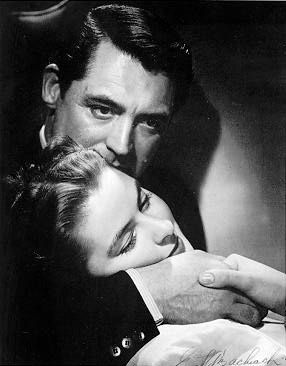
Ahhhh ... that makes me feel a little bit better.
Still stressed, though.
So here's more:
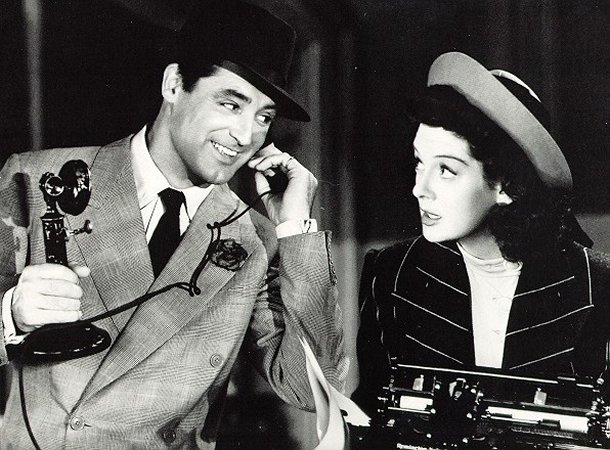
Sigh. Heart rate slowing ....
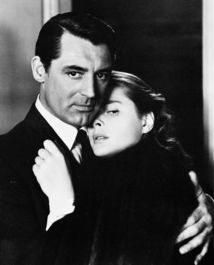
I need more. Isn't he just beautiful in this one below? That bemused grin. Beauty.
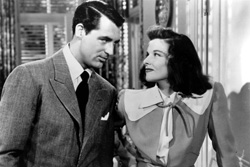
Here's another one below. This is from the pretty terrible movie (but quite daring in its day) where he played a renegade gynecologist, who saves a girl from a botched abortion, and then marries her. Yeah, you heard me right. He plays a renegade bachelor gynecologist who also conducts the orchestra at the univeristy (that's what the photo below is - him conducting). The movie was called People will talk, and it's ridiculous, and Hume Cronyn over-acts up a stinky STORM ... but, as usual, Grant is great in it.
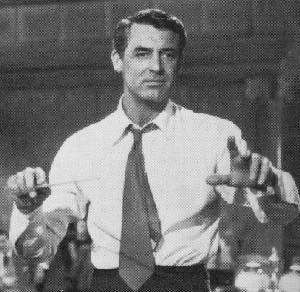
And, of course ... my all-time favorite stress-reliever, a movie that has come to mean so much to me I don't even know how to discuss it anymore: Grant as Geoff Carter in Only Angels Have Wings:
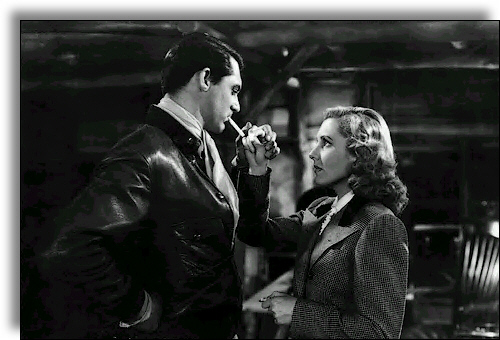
Sigh. Makes me feel all strangely weepy for some reason. I'm just stressed out. The country air will do me good.
Oh boy.
Speaking of not being nice anymore, check out how Berardinelli goes OFF on Bewitched. Uh oh. I had a feeling about this one. Something about it just stank to high heaven - you can tell sometimes. Like with Life of David Gale or whatever that movie was called - with Kevin Spacey (or, as I call him: "the shallowest most over-praised actor in America!") and the lovely Kate Winslet. That thing started to reek LONG before it even opened. You pick up on the smell through osmosis.
But anyway. Woah. Check out the Berardinelli rant!!!
He opens with this sentence:
Warning: vicious personal-sounding attacks to follow. I want revenge on those who stole 100 minutes of my life.
AWESOME! (Not wishing a failure on Will Ferrell and Nicole Kidman - I actually like both of them a lot ... but this one had "dud" written all over it. Move along, kids. Better luck next time.)
More notable quotes:
"a stillborn 100 minutes" Wow.
"It's hard to imagine it being worse."
"This movie is enough to convert even the most die-hard Bewitched lover into a fan of I Dream of Jeannie." Now that is truly harsh.
"She gets the nose twitch right - probably because the script smells so bad that it's a natural reaction." Good GOD.
"It's a disgrace from start to finish." Right, right, we got that, but how do you really feel?
"rancid cinematic morsel"
woaaaahhhhhh
"no one that thin could possibly hit."
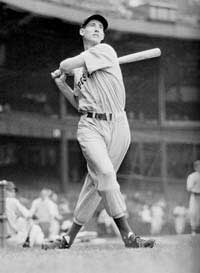
From The Teammates: A Portrait of a Friendship
[Bobby] Doerr remembered his first glimpse of Ted. It was June 1936, and the original Hollywood Stars had just moved to San Diego and been reborn as the Padres, after Bill Lane, the owner, balked at a 100 percent rent increase for Wrigley Field, the ballpark the Stars and the Los Angeles Angels shared. Some San Diego businessmen induced Lane to move the team south to what then was a city of only 200,000 people. It was right before a game, just as the regulars were taking batting practice, when Williams, who had been playing for a local school, Herbert Hoover High, was brought in for a tryout."I was standing right near the batting cage," Doerr remembered, "on the first-base side -- I don't know why I was there, but I remember the scene distinctly. And here is this kid, and he is really skinny. You wanted to laugh -- no one that thin could possibly hit. 'Let the kid hit,' Shellenback is saying, because he's been told that by the owner, Bill Lane, who wants to look at Ted. The veterans are all grumbling -- you know, we all wanted our batting practice swings. No one thinks he can be a ballplayer, he's much too thin, and we've got a game in an hour or two, and he's not even going to play with us. So we're impatient and there's a lot of resentment, a lot of muttering. And then he started to swing. And we all remembered that swing. You paid attention to the swing. He hit six or seven balls very hard, and all the veterans are starting to watch, and it's getting very quiet, and I remember one veteran player saying, 'That kid is going to be signed before the week is out.'"
Dominic DiMaggio remembered a similar scene. "It was my first year in the league. It was early in the season. I was playing for the San Francisco Seals, and we were playing San Diego. I wasn't starting yet. Brooks Holder was our centerfielder, very fast, but he couldn't catch the ball, so there was going to be a place for me. Lefty O'Doul was our manager. The other guys, the San Diego players, are taking batting practice, and eventually Ted comes up to take his swings. And suddenly Lefty, who was a great hitter, and a great hitting instructor, jumps up from our dugout and goes to the other side of the field, near their dugout. That's very unusual -- you just didn't do that in those days. And he waits there, and finally Ted finishes his swings, and Lefty calls him over, and they talk for a little bit. Maybe twenty or thirty seconds. And then Lefty comes back to our dugout. And we're all sitting around, and someone asks him, 'Skip, what was that all about?' And Lefty says, 'That kid is one hell of a hitter. And all I told him was, "Don't let anyone ever tamper with your batting stroke. Just don't let anyone ever touch you."'"
Cult news ...
Last night, Alex and I were on the phone, discussing Tom Cruise like the two maniacs that we are. I call her. She answers on the first ring. She obviously has me programmed into her phone, she knows it's me ... because she does not say "Hi" or "This is Alex" ... No. Her first word to me is: "Wait." Okay, she's in the middle of something. I wait. She periodically repeats the word, "Wait ... wait ..." I continue to wait. At some point, I begin to laugh. She murmurs to me, "Sorry ... just finishing reading something on Cult News ..." hahahahaha
Alex was describing to me a bizarre interaction she had yesterday. I will not go into details, but she was telling me about how her response to this interaction was to just go completely blank ... like, she could not think of an appropriate response ... NOTHING was in her head ...
She said: "If there was a close-up of my face in that moment, you would have seen an absolute BLANK."
Then Alex summed it all up by saying, "I felt like I was in a deleted scene from Waiting for Guffman."
This is outrageous
Heads should roll over this one. What a major mess-up.
The Books: "For Whom the Southern Belle Tolls" (Christopher Durang)
Next in my Daily Book Excerpt:
We now must leave Chekhov behind on the script shelf, and go to the next playwright: Christopher Durang!!
I have a collection of his short plays

The first play of Durang's I'll excerpt is called For Whom the Southern Belle Tolls - and it is a parody of The Glass Menagerie.
In his introduction to the play, Durang writes:
Though I as a child always felt sympathy for Laura, as an adult I started to find Laura's sensitivity frustrating. I mean, how hard was typing class really?And though in my youth I found Laura's interest in her glass animals to be sweet and otherwordly (with the appropriately perfect symbolism of her loving her glass unicorn best because it was different), now as an adult, I felt restless with her hobby. Did she actually spend hours and hours staring at them? Couldn't she try to function in the world just a little bit? Why didn't she go out bowling or make prank phone calls or get drunk on a good bottle of bourbon?
Anyway, I started to find Laura annoying and frustrating.
It's out of this irritation with Laura's sensitivity -- a feeling greatly at odds with the Williams' original -- that I seem to have written this parody, For Whom the Southern Belle Tolls. (I say "seem" because I often say "seem" and because I approached writing this parody on impulse, unaware consciously of how my feelings toward the play had changed. Writing the parody was a way of playing with, and releasing, some of what I felt after seeing the play for what seemed like the 100th time.)
I'll excerpt the opening scene.
EXCERPT FROM For Whom the Southern Belle Tolls, by Christopher Durang:
Enter Amanda, the Southern belle mother.
AMANDA. Rise and shine! Rise and shine! (calls off) Lawrence, honey, come on out here and let me have a look at you!
(Enter Lawrence, who limps across the room. In his 20s, he is very sensitive and is wearing what are clearly his dress clothes. Amanda fiddles with his bow tie and stands back to admire him.
AMANDA. Lawrence, honey, you look lovely.
LAWRENCE. No, I don't, mama. I have a pimple on the back of my neck.
AMANDA. Don't say the word "pimple", honey, it's common. Now your brother Tom is bringing home a girl from the warehouse for you to meet, and I want you to make a good impression, honey.
LAWRENCE. It upsets my stomach to meet people, mama.
AMANDA. Oh, Lawrence, honey, you're so sensitive it makes me want to hit you.
LAWRENCE. I don't need to meet people, mama. I'm happy just by myself, playing with my collection of glass cocktail stirrers. (Lawrence smiles wanly and limps over to a table on top of which sits a glass jar filled with glass swizzle sticks)
AMANDA. Lawrence, you are a caution. Only retarded people and alcoholics are interested in glass cocktail stirrers.
LAWRENCE. (with proud wonderment) Each one of them has a special name, mama. This one is called Stringbean because it's long and thin. And this one is also called Stringbean because it's long and thin. And this one is called Blue because it's blue.
AMANDA. All my children have such imagination, why was I so blessed? Oh, Lawrence, honey, how are you going to get on in the world if you just stay home all day, year after year, playing with your collection of glass cocktail stirrers?
LAWRENCE. I don't like the world, mama. I like it here in this room.
AMANDA. I know you do, honey, that's part of your charm. Some days. But, honey, what about making a living?
LAWRENCE. I can't work, mama. I'm crippled. (He limps over to the couch and sits)
AMANDA. (firmly) There is nothing wrong wtih your leg, Lawrence honey, all the doctors here have told you that. This limping thing is an affectation.
LAWRENCE. (perhaps a little steely) I only know how I feel, mama.
AMANDA. Oh if only I had connections in the Mafia, I'd have someone come and break both your legs.
LAWRENCE. Don't try to make me laugh, mama. You know I have asthma.
AMANDA. Your asthma, your leg, your excema. You're just a mess, Lawrence!
LAWRENCE. I have scabs from the itching, mama.
AMANDA. That's lovely, Lawrence. You must tell us more over dinner.
LAWRENCE. Alright.
AMANDA. That was a joke, Lawrence.
LAWRENCE. Don't try to make me laugh, mama. My asthma.
AMANDA. Now, Lawrence. I don't want you talking about your ailments to the feminine caller your brother Tom is bringing home from the warehouse, honey. No nice-bred young lady likes to hear a young man discussing his excema, Lawrence.
LAWRENCE. What else can I talk about, mama?
AMANDA. Talk about the weather. Or Red China.
LAWRENCE. Or my collection of glass cocktail stirrers?
AMANDA. I suppose so, honey, if the conversation's comes to some godawful standstill. Otherwise, I'd shut up about it. (Becomes coquettish, happy memories) Conversation is an art, Lawrence. Back at Blue Mountain, when I had seventeen gentlemen callers, I was able to converse with charm and vivacity for six hours without stop and never once mention eczema or bone cancer or vivisection. Try to emulate me, Lawrence, honey. Charm and vivacity. And charm. And vivacity. And charm.
LAWRENCE. Well, I'll try, but I doubt it.
AMANDA. Me too, honey. But we'll go through the motions anyway, won't we?
LAWRENCE. I don't know if i want to meet some girl who works in a warehouse, mama.
AMANDA. Your brother Tom says she's a lovely girl with a nice personality. And where else does he meet girls except the few who work at the warehouse? He only seems to meet men at the movies. Your brother goes to the movies entirely too much. I must speak to him about it.
LAWRENCE. It's unfeminine for a girl to work at a warehouse.
AMANDA. Now Lawrence -- if you can't go out the door without getting an upset stomach or an attack of vertigo, then we have got to find some nice girl who's willing to support you. Otherwise, how am I ever going to get you out of this house and off my hands?
LAWRENCE. Why do you want to be rid of me, mama?
AMANDA. I suppose it's unmotherly of me, dear, but you really get on my nerves. Limping around the apartment, pretending to have asthma. If only some nice girl would marry you and I knew you were taken care of, then I'd feel free to start to live again. I'd join Parents Without Partners, I'd go to dinner dances, I'd have a life again. Rather than just watch you mope about this stupid apartment. I'm not bitter, dear, it's just that I hate my life.
LAWRENCE. I understand, mama.
AMANDA. Do you, dear? Oh, you're cute. Oh, listen, I think I hear them.
TOM. (from offstage) Mother, I forgot my key.
LAWRENCE. I'll be in the other room. (starts to limp away)
AMANDA. I want you to let them in, Lawrence.
LAWRENCE. I couldn't, mama. She'd see I limp.
AMANDA. Then don't limp, damn it.
TOM. (from off) Mother, are you there?
AMANDA. Just a minute, Tom, honey. Now, Lawrence, you march over to that door or I'm going to break all your swizzle sticks.
LAWRENCE. Mama, I can't!
AMANDA. Lawrence, you are a grown boy. Now you answer that door like any normal person.
LAWRENCE. I can't.
TOM. (from off) Mother, I'm going to break the door down in a minute.
AMANDA. Just be patience, Tom. Now you're causing a scene, Lawrence. I want you to answer that door.
LAWRENCE. My eczema itches.
AMANDA. I'll itch it for you in a second, Lawrence.
TOM. (from off) Alright, I'm breaking it down.
(Sound of door breaking down. Enter Tom and Ginny Bennett, a vivacious friendly girl dressed in either factory clothes, or else a simple, not-too-frilly blouse and slacks)
AMANDA. Oh Tom, you got in.
TOM. Why must we go through this every night??? You know the stupid fuck won't open the door, so why don't you let him alone about it? (to Ginny) My kid brother has a thing about answering doors. He thinks people will notice his limp and his asthma and his eczema.
LAWRENCE. Excuse me. I think I hear someone calling me in the other room. (Limps off, calls to imaginary person:) Coming! (Exits)
June 23, 2005
Big news!!!
Mr. Cruise is going to appear on Letterman in half an hour.
Can. Not. Wait. For. The. Crazy.
Quotes
Letterman: "This Tom Cruise guy is so volatile ... romantically ..."
Letterman announced that they have a Justice of the Peace backstage, ready to marry the two at any moment. They just showed the Justice of the Peace, in his black robes, nodding benevolently backstage.
Cruise's entry music? "Jump" by Van Halen. That's pretty funny.
Cruise thinks the judge backstage is hilarious. "That is so funny."
"I've never felt this way before. I don't know how to describe it. It's just amazing and I can't restrain myself." (Oh, Tom. Stop talking.)
Oops. Tom is laughing too hard.
"She's the most stunning woman. She's the most stunning person."
Dude. Stop.
(I feel bad for Cruise. The man is brainwashed by a dangerous cult. It's not his fault. My heart goes out to him.)
"We had chocolate on our first date and just stared at each other."
Ew. How 'bout just going to a movie? How 'bout makin' out on the beach?
No ... that wasn't the first date. It was after their engagement. My bad.
Letterman: Have you had any moments around the house yet where she's said 'Would you pick up your socks?'
Cruise: I'm the kind of guy who just picks up his socks.
I AM NOT KIDDING. HE JUST SAID THAT.
Cruise is charming. I'll give him that.
Now he's talking about how he wants to climb Mt. Everest. That's pretty cool.
Again: it's not his fault that he got hooked in by that evil cult!!!
He really is a squat little pipsqueak, isn't he?
Wow. He's actually TALKING ABOUT THE MOVIE HE'S GOT COMING OUT. Good for you, Tom. Spielberg must be watching thinking, "Jesus Christ, it's about feckin' time."
The two of them are now bonding about being fathers. Cruise brought it up. See, that's why he's a mega-star. He starts asking Letterman questions. See what I mean? "Did it change you ... how do you feel about stuff now?" Etc. Cruise is disarming that way.
Letterman's awesome.
Now we're gonna see a clip.
Okay, it's over now. That wasn't all that crazy, actually. He was charming, funny, present ...you can see why everyone who works with him feckin' loves him. He got that glazed insincere look in his eyes when he talked about Katie ... They've known each other 10 weeks. It just doesn't look real. His acting seems real, but his personality in that context does not seem real.
But other than that ... he was obviously in the mode of being a huge and powerful star, there to promote his film.
I called it.
Back when James Frey's first book came out, there was a fascinating interview with him in the NY Observer ... sadly, the link doesn't work anymore ... but it pissed me off so much that I wrote a rant about it on my old blog when I was much angrier with much more frequency. Posted below. Just want everyone to know I called it. Oprah may have been duped, but I wasn't.
Oh, and let me just say this before we begin: some of James Frey's annoyances with today's literary stars I share. Some of his frustration with the cleverness, and coyness is stuff I also share. I just don't think, as he obviously does, that HE is the solution.
March 2003
I don't think I've ever read an interview with a greater moron than this man. I do not even know where to begin.
Does James Frey (whose first book, A Million Little Pieces
Is his book any good?
Let me pick out some quotes from the Observer profile:
"The Eggers book pissed me off. [A Heartbreaking Work of Staggering Genius] Because a book that I thought was mediocre was being hailed as the best book written by the best writer of my generation. F*** that. And f*** him and f*** anybody that says that. I don't give a f*** what they think of me. I'm going to try to write the best book of my generation and I'm going to try to be the best writer. And maybe I'll fall flat on my f***ing face, I'll fall flat on my f***ing face trying to do it."
You might fall flat on your face, but at least you'll flat on your face while trying to fall flat on your face? Is your book as articulate as that?
The following quote shows Mr. Frey's humility:
"[This one agent] went ballistic over [my manuscript], called and said, 'We're going to turn you into an industry.' I said, 'What are you talking about?' 'You know who Deepak Chopra is?' I was like, 'Yeah.' 'You're going to be the Deepak Chopra of recovery. We're going to start a whole line of self-help books with your name on it. We're going to publish your own version of the Tao. We're going to send you out on speaking tours. We're going to build a religion around you.' I was like, 'You must be f***ing kidding me!' I very much admired the enthusiasm, but it was bizarre."
There's something off here. I don't trust this guy. He's got too much to prove. He exudes fragility ... there's something "off".
It gets more obnoxious as the piece goes on, if that is possible. H
"I guess I'm the poster boy for unconventional addiction thought. They were trying to lead me into saying certain things. They kept trying to get me to swear. Stossel was like, 'I heard you swear a lot. I heard you're feisty. Why won't you swear for me?' Because my mom and my wife asked me not to. 'Well forget about them, I need you to swear!' So I was like, 'O.K., f*** you!' I'm terrified of what they're going to do to me now. They're going to cut me up."
Dude, do you hear yourself? Your years of therapy and 12-stepping have not helped you see what you actually are doing. You are NOT terrified of what "they" are going to do to you now. You love it. You love being notorious, you love all the attention, you love being criticized, you love being the wild-card of the literature world ... So just admit it! I find him to be extremely disingenuous. I realize I have never been in his presence, so I can't say for sure, but what the hell. It's my blog and I'll judge if I want to.
The tone continues:
"My wife calls me a savage. Because I eat with my hands. Because my best friends are my dogs. And I like pit bulls. And N.W.A. And I love boxing. I think boxing is beautiful. The purity of fighting is a beautiful thing. Writers aren't like that anymore.all these guys who have f***ing masters' degrees and are so 'sophisticated' and 'educated' and ... well, I'm not a guy with a master's degree. I think I'm sophisticated. I can write big fat books. But I'm not an effete little guy."
What a complete and utter jackass. I like NWA. I don't have a chip on my shoulder about it, though. There's something adolescent here, about how he lists what a pig he is ... it's like a teenage boy choosing to wear smelly socks ... but he's only doing it to thumb his nose at his mother. Like, you might THINK you're being rebellious - but a TRUE rebel isn't always glancing around at authority figures to see how "outraged" everyone is. A true rebel just does his thing and doesn't care. James Frey cares. Oh my God, he cares. I don't believe a word he's saying.
While he was in L.A., Mr. Frey acquired a number of tattoos, his own personal footnotes. "I've seen you glance at this one," he said, displaying a row of letters on the inside of his left wrist: S.P.C.D.H.C. "Simplicity, Patience, Compassion, Discipline, Honesty, Courage," he said. "Words to live by. When I see that, it reminds me that these things embody the person I want to be."He pulled back his shirt to reveal others. "That's a symbol of birth and rebirth," he said, pointing to a small phoenix. "That is a Taoist symbol of life. I have my wife's initials on my chest. I very deliberately scar myself so that I remember these things. However twisted my logic may be, by scarring myself, I'm making a commitment to myself. I'm committed to the things on my wrist."
WHAT? What the hell are you talking about? "I very deliberately scar myself so that I remember these things." (As opposed to "sort of deliberately scarring yourself"?) "By scarring myself, I'm making a commitment to myself. I'm committed to the things on my wrist."
Euuuuuuuuuuuuuuu! I guess my feeling is: you can FEEL things like that, but don't SAY IT OUT LOUD. You just sound ridiculous. I have a tattoo, bro. Lots of people do for lots of reasons. You are not inventing the wheel. People who think they are inventing the wheel by, rebelling, having sex, getting drunk - whatever - are immature. Besides. Lots of people have tattooes. Nobody, and I mean NOBODY, is thinking, "Oooooohhhhhh that James Frey ..... he's such a BADASS ... he likes NWA and he has tattooes!" And the fact that I sense he NEEDS that response from me makes me go even colder.
He's not being real. If this was really who he was, fine - go for it. But it's affected.
Then he trashes the literary stars of the day (Dave Eggers and David Foster Wallace), always a good ploy right before your first book comes out:
"I think they're full of bells and whistles and tricks and being cute and being ironic and being all this shit. To be honest, I don't understand it. It's not how I think or how I feel...Eggers and I are exactly the same age. If there's a guy out there who is 'The Guy' of my generation, it's Eggers. In that sense, I was honored by the comparison."
Ah, now that sounds a bit like truth. You bitch and moan about Eggers, which seems transparently envious to me, yet you should be "honored by the comparison". Phony. Nothing worse than a big fat phony.
Give me a raging asshole any day of the goddamn week, but spare me from the phonies.
"All that matters is what the feelings are and what the events are. It's not about all this trickery. When I think about writing, I have a very simple formula: Where was I? Who was I with? What happened? And how did it make me feel? Those are the only important things. It doesn't matter if I can write a sentence that's a page long or if I have 30 pages of footnotes in the back or people chuckle at the introduction page. I want to move people and have them understand what I felt, what I went through and what I felt other people were feeling and going through."
And ... let me get this straight ... you are the first person to write in this manner? You are the first writer to ever "want to move people and have them understand"? No other writer has ever done this before? Ever? You sure?
Lastly:
"I don't give a f*** what Jonathan Safran whatever-his-name does or what David Foster Wallace does. I don't give a f*** what any of these people do. I don't hang out with them, I'm not friends with them, I'm not part of the literati. I think of myself as outside of this publishing culture. Kirkus called me pretentious. Am I pretentious in my self-regard because I'm serious about what I do? Because I'm moving against the trend of irony? I don't know. I hope I'm a bullet in the heart of that bullshit."
Frey, you are not a bullet through the heart of anything. You are a tiresome bore.
"Let us add, if we please, but let us preserve what they have left"
Read this on the bus this morning. From Reflections on the Revolution in France
The improvements of the national assembly are superficial, their errors fundamental.Whatever they are, I wish my countrymen rather to recommend to our neighbours the example of the British constitution, than to take models from them for the improvement of our own. In their former they have got an invaluable treasure. They are not, I think, without some causes of apprehension and complaint; but these they do not owe to their constitution, but to their own conduct. I think our happy situation owing to our constitution; but owing to the whole of it, and not to any part singly; owing in a great measure to what we have left standing in our several reviews and reformations, as well as to what we have altered or superadded. Our people will find employment enough for a truly patriotic, free, and independent spirit, in guarding what they possess, from violation. I would not exclude alteration neither; but even when I changed, it should be to preserve. I should be led to my remedy by a great grievance. In what I did, I should follow the example of our ancestors. I would make the reparation as nearly as possible in the style of the building. A politic caution, a guarded circumspection, a moral rather than a complexional timidity were among the ruling principles of our forefathers in their most decided conduct. Not being illuminated with the light of which the gentlemen of France tell us they have got so abundant a share, they acted under a strong impression of the ignorance and fallibility of mankind. He that had made them thus fallible, rewarded them for having in their conducts attended to their nature. Let us imitate their caution, if we wish to deserve their fortune, or to retain their bequests. Let us add, if we please, but let us preserve what they have left; and, standing on the firm ground of the British constitution, let us be satisfied to admire rather than attempt to follow in their desperate flights the aeronauts of France.
Another one detained
Let's just detain the whole damn island, shall we?
I'm getting sucked into the story. Kind of against my will, because frankly I am sick of the following trend: "Only if you are a cute white chick and preferably pregnant will you get national news coverage as a missing person, mkay?". It drives me nuts. God forbid if you are a fat homely middle-aged woman with a mole on your nose and you happen to go missing. You'll be shit out of luck. The news will not give a crap about your whereabouts. And GOD HELP YOU if you are a minority or a man. Fine - go missing for all we care, get your head chopped off in a smelly ravine ... we don't give a shite. You're on your own. Your family can call the local news stations all they want ... but if your high school picture shows a troll-like pimply dude with horrible teeth ... nobody's gonna jump to promote the story.
Yuk. Makes me really really mad.
But. THAT BEING SAID.
The Aruba case is, actually, quite interesting to me, because of the intrigue that appears to be going on behind the scenes. CW's been posting about it a bit, and his posts have led me to Scared Monkeys, which appears to be information central for this whole thing. Here is today's post. I can certainly understand the frustration of Holloway's family, having to deal with such a different system, and having no sense of what is actually going on, and nobody having been charged yet - even though they are detaining everyone in sight. (Hyperbole is my friend.)
Dutch father and Dutch son (whose face creeps me out, by the way - I know guys like that. Sorry - so general, and so presumptuous of me - but what the hell - I'm not on a jury: I look at that kid's face and I can see that something is missing there - like, uhm, kindness, maybe? Concern for others?) - now both "detained".
(Oh, and to connect the dots on my blog here today: This photo of the Dutch parents being interviewed is from an interview they did with Fox News' Greta van Susteren, who also happens to be a lockstep member of the glazed-eyed thetan-fighting brigade!!)
And another thing ...
... have you noticed how Tom Cruise refers to the woman we all knew as KATIE Holmes, as "Kate"? (Well, besides his constant refrain of "magnificent woman", "magnificent woman", "magnificent woman".) From the beginning, he re-christened her as "Kate". It stood out for me, and always has (in the weeks and WEEKS of time that I have been obsessing about this): it seemed important to him that she was Kate and not Katie. I have spent way too much time wondering why this might be.
My friend Mitchell is always annoyed when people shorten his name to "Mitch", and they usually do it instantly upon meeting him. Nothing wrong with the name "Mitch", but he doesn't go by "Mitch", he goes by "Mitchell".
"Hi, my name is Mitchell." He holds out his hand.
Person shakes hand, says, "Hi, Mitch, nice to meet you."
I've been there when this happens. It happens all the time. Mitchell doesn't make a big deal out of it or anything ... but it sure is an interesting phenomenon. Like: I have told you, in the way I introduce myself, how I refer to myself. I have called myself "Mitchell". And immediately, you ignore that, and give me a nickname? Why??
Mitchell believes (and I agree with him) that because he is gay - those who meet him sometimes have the desire to "butch him up" (Mitchell's words). They are friendly, nice, they shake hands ... it's not a hostile moment or anything like that ... but they do not call him "Mitchell". They choose the "butcher" Mitch.
I don't really have a name that can be shortened, although Mitchell's mother always did call me, with great affection, "She". Mitchell's entire family picked up on that, and I actually loved it. I'd see Mitchell's brother after a long time of separation - we would hug - and he would say, "Hi, She!!"
I would walk into Mitchell's house, and be greeted with happy cries of, "It's She!" "She's here!" "Hi, She!"
But sometimes ... when people decide to shorten your name on their own ... it's a matter of aggression (in a very passive sense, of course) and control.
"Hi, my name is David."
"Hey, Dave, what's up? Nice to meet you."
"Uhm ... I said my name was DAVID."
It's a strange thing, and very common to those who have names that can be shortened.
But here's Tom Cruise, talking about Kate this, and Kate that ... and it's weird to me. So you not only indoctrinate her into your Xenu world, but you adjust her name as well? She's KATIE, bub. I mean, I know she's not a ginormous star (and thanks to you, perhaps now she never will be) ... She's not a household name like, say, Lindsay Lohan is (ahem.)... but still: she's been "Katie" since The Ice Storm, my friend. Why are you shortening her name? Are you trying to butch her up? haha No, but seriously: what's up with that?
I am glad I am not the only one who has noticed this. Because, frankly, this is one of the most important issues of our day.
Check out this, from Fugging it up.
Favorite phrase? "spastic man-child fiance"
hahahahaha
This is She, signing off ...
The Books: "The Cherry Orchard" (Anton Chekhov)
Next in my Daily Book Excerpt:
 More from The Plays of Anton Chekhov
Can you tell that I love Chekhov? One of the things I love about him is that there always seems to be something new to discover. His plays, while they certainly have plot points, are not really about the plot. At least I don't think they are. And that's why he can be so difficult to play, as discussed before - because instead of focusing on the plot, the actors and director focus on a "mood". Focusing on a "mood" while rehearsing a play is a dastardly mistake. I've been in plays where, at the first rehearsal, the director starts talking about the "mood" he wants to capture, and I immediately steel myself for a disaster. Here's my view: If the director wants to blither on about mood, then he should do it to his production designer. Tell HIM all your ideas on mood, and have him build the mood into the set, the sound effects, the lighting. Set designers are trained to turn abstracts like "mood" into reality. But you talk about "mood" to your actors, and you're in trouble. Why? Because if we start playing the "mood", then you get a dreadful general performance, where the actors are trying to fulfill some vague abstract emotional description - as opposed to doing what an actor's job really is which is: uhm: ACT. (Funny, my great acting teacher Sam Schacht always says, "The name of the job is not FEELER. The name of the job is ACTor." What are you DOING is far more important than what you are FEELING.)
Chekhov, more than any other playwright I can think of, presents the danger of being a "mood piece", as opposed to a series of events, presented on stage. Apparently, the production of Glass Menagerie, on Broadway right now with Jessica Lange, has fallen into the "mood piece" trap. Jessica Lange is playing a mood, the entire production seems designed to express a MOOD, as opposed to tell the damn STORY. I haven't seen it, but I trust Ben Brantley to tell me the truth.
Chekhov called The Cherry Orchard a "comedy". I've read the play many times, and while there are amusing parts in it, and funny lines, etc., the main thing I always remember about that play is the very last moment, where you hear, offstage, the sound of an axe cutting a tree down, and you know the destruction of the orchard has begun. That last moment always struck me as SO TRAGIC - and yet Chekhov calls the play a "comedy". Fascinating. It helps me to read the play in a correct way, it helps me to find, as a great old mentor of mine used to say, "the pulse of the playwright".
It's not about finding your pulse, and how you react to something, and how you respond to something ... A play should always be striving to find "the pulse of the playwright". And you can tell, in productions that are beating along with the pulse of the playwright ... You can FEEL the difference.
There was kind of a famous production of Cherry Orchard done at Williamstown, and Blythe Danner played Dunyasha and Frank Langella played Yepikhodov. I've seen production stills from some of their scenes together, and even just the stills make me laugh! I wish I could have seen it.
The following excerpt is from the party scene, in Act III. As I read it, it becomes obvious that, despite the tragic last moment, this piece is not only a comedy, but it's a high comedy. I laugh out loud reading this play.
EXCERPT FROM The Cherry Orchard, by Anton Chekhov
(Anya and Varya dance together. Firs enters, leans his walking stick against the side door. Yasha appears and stands watching the dancers.
YASHA. What's the matter, pops?
FIRS. I don't feel so good. The old days, we had a dance, we had generals and barons and admirals; nowadays we have to send out for the postmaster and the stationmaster. And they're none too eager to come, either. Oh, I'm getting old and feeble. The old master, their grandfather, anybody got sick, he used to dose 'em all with sealing wax. Didn't matter what they had, they all got sealing wax. I've been taking sealing wax myself now for nigh onto twenty years. Take some every day. That's probably why I'm still alive.
YASHA. You're getting boring, pops. (Yawns) Time for you to crawl off and die.
FIRS. Oh, you ... you young flibbertigibbet. (Mumbles)
(Trofimov and Liubov dance through the ballroom, into the sitting room)
LIUBOV ANDREYEVNA: Merci. I need to sit down and rest a bit ... I'm so tired.
(Enter Anya)
ANYA. (upset) There was a man in the kitchen just now, he said the cherry orchard's already been sold!
LIUBOV ANDREYEVNA: Who bought it?
ANYA. He didn't say. And he's gone now. (Dances with Trofimov; they dance off across the ballroom)
YASHA. That was just some old guy talking crazy. It wasn't anybody from around here.
FIRS. And Leonid Andreyich still isn't back. All he had on was his topcoat; you watch, he'll catch cold. He's all wet, that one.
LIUBOV ANDREYEVNA: I'll never live through this. Yasha, go out and see if anybody knows who bought it.
YASHA. It was just some old guy. He left long ago. (laughs)
LIUBOV ANDREYEVNA: What are you laughing at? What's so funny?
YASHA: That's Yepikhodov. What a dope. Old Double Trouble.
LIUBOV ANDREYEVNA: Firs, suppose the estate is sold -- where are you going to go?
FIRS. I'll go whereever you tell me to.
LIUBOV ANDREYEVNA: What's the matter? Your face looks so funny ... Are you sick? You should go to bed.
FIRS. Yes. Yes, sure, go to bed, and then who'll take care of things? I'm the only one you've got.
YASHA. Liubov Andreyevna, there's a favor I have got to ask you; it's very important. If you go back to Paris, please take me with you. Please! You've got to! I positively cannot stay around here. You can see for yourself this place is hopeless. The whole country's a mess, nobody has any culture, it's boring the food is lousy, and there's that old Firs drooling all over the place and talking like an idiot. Please, take me with you -- you've just got to!
(Enter Pishchik)
PISHCHIK. Beautiful lady, what about a waltz? Just one little waltz! (Liubov crosses to him) You dazzler, you! And what about a loan, just one little loan, just a hundred and eighty, that's all I need. (They begin to dance) Just a hundred and eighty ... (They dance off into the ballroom)
YASHA: (sings to himself) "Can't you see my heart is breaking ..."
(In the ballroom, a figure appears dressed in checkered trousers and a grey top hat, jumping and waving its arms. We hear shouts of "Bravo, Carlotta!")
DUNYASHA: (stops to powder her nose) The missus told me to dance -- there's too many gentlemen and not enough ladies -- so I did, I've been dancing all night and my heart won't stop beating, and you know what, Firs? Just now, the postmaster, you know? He said something almost made me faint.
(The orchestra stops playing)
FIRS. What did he say?
DUNYASHA. That I was like a flower. That's what he said.
YASHA. (yawns) What does he know about it? (goes out)
DUNYASHA. Just like a flower. I'm a very romantic girl, really. I just adore that kind of talk.
FIRS. You're out of your mind.
(Enter Yepikhodov)
YEPIKHODOV. (to Dunyasha) Why are you deliberating not to notice me? You act as if I wasn't here, like I was a bug or something. Ah, life.
DUNYASHA. Excuse me?
YEPIKHODOV. Of course, you may be right. But if you look at it, let's say, from a ... a point of view, then you're the faulty one -- excuse my expressivity -- because you led me on. Into this predicament. Look at me! Every day something awful happens to me. It's like a habit. But I can look disaster in the face and keep smiling. You gave me your word, you know, and you even --
DUNYASHA. Do you mind? Let's talk about it later. Right now I'd rather be left alone. With my dreams. (plays with a fan)
YEPIKHODOV. Every day. Something awful. But all I do -- excuse my expressivity -- is try to keep smiling. Sometimes I even laugh.
June 22, 2005
The ferry
For 2 years, I took a class every Monday night at the World Trade Center, in the North Tower. The ritual was: I would take the A train downtown, get off at Chambers Street, walk a couple blocks, and cross the massive courtyard to enter the building. I loved it down there, mostly because it was foreign to me - I never spent a lot of time down on Wall Street and it is a whole different world down there. The streets feel like canyons. People struggle to open doors against the wind tunnel effect. But then you emerge onto that courtyard - open, expansive, abstract - with the towers screaming up into the empty sky above you, and you just know that there's no other place in the city like it. Something about the landscape around the World Trade Center, wide-open, concrete, extremely PLANNED, reminded me of DeChirico's eerie paintings, paintings that had haunted me since I first encountered them in Mrs. Franco's humanities class in high school. Of course, the urban landscape down at the World Trade Center was always packed with people, and DeChirico's paintings are always frighteningly empty - except for a long human shadow coming from around the corner, or teeny people in the far distance, dwarfed by the urban structures around them.
The World Trade Center was a part of my everyday life. I knew the security guards, especially one in particular who I really liked. I knew the guy in the coffee shop downstairs, who had my coffee ready for me by the time I got to the counter, having memorized what I liked within 2 days. I could make my way through that Concourse to the underground PATH station in my sleep. My class ended at 10, I think, or 9:45 ... If we got out on time, then I would race down through the echoey Atrium (again, like a DeChirico painting - especially late at night - with the amphitheatre style marble steps, and the massive indoor palms - and everything glass - but since it was nighttime, all you saw was darkness all around you, strange reflections ... an odd space, pregnant with meaning) - burst out through the doors, and tear down to the Hudson, where I would pick up the last ferry to Hoboken. If my class went a little late, then I would miss the ferry, and have to walk through the echoing empty Concourse - with the mannequins in the windows at the Gap standing still, all the lights off in the stores, nobody around, empty escalators running, me the only figure on them, smiling at the 8th security guard I saw at the bottom ... and, of course, racing to catch the train when I heard it coming in, so that I wouldn't have to sit in the bowels of the World Trade Center, in that echoing station by myself. Other random late-night folks were usually milling about, too. This was, after all, the financial district. People worked crazy hours.
But my main goal was to get out of class promptly so I could have the pleasure of taking the ferry.
The station for the ferry was outside the spectacular Atrium, and it was a floating tented dock in the Hudson. You got to it by walking on this metal ramp. As you stood in line to buy a ticket for the ferry, the entire dock bobbed up and down on the small waves of the Hudson. You could see the lights of Jersey across the way. Especially you could see this enormous lit-up clock - south of Jersey City, not sure what town it was in - Bayonne, maybe? When I say "enormous", I mean that it is probably 10 stories tall. Maybe Mr. Bingley knows how big it is. You can easily see the time from all the way across the river. A couple of different ferries used the floating dock - one from Hoboken and the other from further south down the Jersey shore. You could see them leave their docks from across the river, and start to cross the water to get us. I always found that strangely exciting. Seeing my ferry set out from Hoboken, small, making its way south, getting larger, larger ... until there it was ... smacking up against the side of the floating dock. Normally, because I love the night, and I love wind, and I love water ... I wouldn't wait in the enclosed part of the floating dock. I would buy my ticket, walk back up the ramp onto the walkway that runs all around the periphery of the bottom of Manhattan ... and stare out into the Hudson. I loved that part of my night. Even if it was freezing, I would choose to brave the elements. The splashing water against the side of the island of Manhattan, the strange achey creaking sounds that the dock made as it floated up and down ... those were pretty much the only sounds. Way over there, on the river-side of the trade center, you didn't really hear much traffic. It was just the sound of the water, maybe the wind, or raindrops ...
I have such peaceful memories of those few minutes, squeezed into a busy day ... my quiet time, my thoughts roaming free, but there was a mellowness to it, too. There was something soft about how my thoughts felt in my own head, after a long day, ready to go home and go to bed.
Odd. And again, made even more odd by the imposing buildings towering over us. It's a landscape built for people. It is meant to be crowded. It only makes sense if it's crowded. I suppose if I worked there, I would have a whole different experience of the place - I would experience it as a packed madhouse, filled with busy people going through turnstiles, and constant rivers of human beings, moving this way and that. I've temped in massive office buildings before, and I know what rush hours are like. But I was always at the World Trade Center on off-hours, so my memories of it are quieter, echoey ... They have to do with silence ... and ... I'm trying to express this right. You know how some landscapes, whether man-made or natural, seem to just have so much meaning, in their very structure? Like: if you look at the Grand Canyon and you are indifferent, or unchanged ... then frankly something is wrong with you. Not that you should have a particular experience ... not that it should "fill you with awe" ... No. There is no required response. But SOME thing should happen to you. The landscape is trying to tell you SOMEthing. When I first saw the Grand Canyon, I actually felt something akin to deep and powerful despair. I couldn't take it in. Just trying to SEE IT made me feel that I never could really see it. There was no way I could comprehend the entirety of the thing, its massiveness, just the FACT that it is THERE is hard to deal with. The experience of looking filled me with hopelessness. I eventually got used to the size, the scope ... or, no, that's not the right way to say it. I managed to deal with it in small doses. I gave myself a lot of time to just stand there and stare. My point is is that there are certain places on this planet that seem to have some kind of message, or some kind of import ... if you can only listen closely enough. I have felt the same thing on the Mall in Washington DC. Like: something is going on here. A cigar is not just a cigar. There is MEANING in the architecture, everything i see has a message for me ... The World Trade Center, the Atrium, the Concourse, the floating dock ... all of that stuff, on my Monday nights, felt like that for me. I never got used to it. I never was "over" it. I never strolled through there, not noticing where I was. This may sound like retrospective romanticizing, but I assure you it is not. I have the diary entries for my Monday evenings for over 2 years to prove it. It was almost as though the class I was taking was incidental, and not really important. The REAL thing to learn was from the concrete, and the space, and the quiet down there at that time of night.
The ferry would pull up, always with the same cute guys running it ... I got to know their faces too, over those 2 years. They would open the gate, take our tickets, say "Hey, what's up ..." to the 10 of us who were waiting to get home across the river.
For the most part (especially if it was drizzly, or snowing, or cold) everyone would sit in the downstairs area, the enclosed area of the boat.
I don't think I sat down there once. I always trudged up to the roof. I COULD NOT GET ENOUGH of it up there. I soaked it up. The wind in my face, all that stuff ... I just loved it up there, and wished the boat ride were longer. I love being out on the water anyway, it reminds me of being a kid, and going out in the motorboat at Lake Sunapee, and how exhilarating it is to travel on water ...
If nobody else was up there (and usually it was empty), I would lie down on my back across two of the benches, and stare up at the empty black sky - waiting for us to pull away. Because when we pulled away, and did a kind of ferry 3-point-turn, suddenly the glittering towers would swoop into my view blotting out the rest of the sky - and they were right overhead, they were so close. I would get vertigo. The boat would sweep around, the towers would sweep around, and everything seemed enormous and fluid - hard to tell if it was the boat that was moving away from the island, or if it was the island that was moving away from the boat. Then, I would watch the towers recede out of my view.
3 minutes later, we would pull up to the docks in Hoboken, with the same cute guys opening up the gate to let us off ... and I would trudge through the station up to the street, to grab a cab home. My warm bed.
Somehow, if I took the train home, I didn't get the same sense of release, freedom, openness, joy ... as when I took the ferry. The ferry ride had the feeling of a "crossing", in the mythicological sense. I know there are people who take the ferry every day, and they may be used to it, and may have no idea why I got such a kick out of it - but I never got used to it. I think part of it had to do with the fact that it was night-time, too. A quieter more reflective time, contemplative, people giving up the rush of the day.
I still have my World Trade Center identity card, which I needed in order to get into the building. My name's printed on it, and the expiration date is 8/19/01.
I am so sorry
One more link:
I know this is a candid shot, and we all can look goofy in candid shots ... but for some reason, I CANNOT STOP LAUGHING about this photograph. (Also, it's kinda creepy to see Scarlett there before the "You must join my crazy cult if you want to be in my next movie" debacle)
And here ...
... is one of the many reasons why I love Poland. (Other reasons? Ryszard Kapucinski, Czeslaw Milosz , Zbigniew Herbert and Lech Walesa to name just a few.)
The chick at the Polish tourist office said: "We decided the best response was humour."
And that right there is why I love Poland.
"The Second Coming" of Bob Geldof
Always loved Bob Geldof and the Boomtown Rats. We loved them in high school. His stuff, in a way, was a precursor to what took over the world in 1991 with the release of Nirvana's "Nevermind". Or with early Pearl Jam stuff, like "Jeremy". Regular radio stations didn't know what to do with them, really, but the college radio stations (which we listened to obsessively) played their songs all the time. But because this was the mid 1980s, when the airwaves were clogged with Air Supply, Lionel Richie, and Loverboy ... there wasn't really a place for him. It didn't matter. He got our attention anyway. We also were big big big into "DO THEY KNOW IT'S CHRISTMAS TIME AT AAAALLLLL." - the song, sure, but also who Bob Geldof was. He was a hero to us. That he could make such a thing happen. Basically, he just ASKED, and all these mega-stars cleared their schedules and showed up to record that song. How many people have ideas like that, but don't ask ... assuming that everyone will say No? Bob Geldof seems to not experience the word "No" in the way many of us do. It is not an ending. "No" does not mean "No" to Bob Geldof, there's no finality in it. It's just a reason for him to find another way in, to work harder to get people to say "Yes". I really admire him for that. Anyway, I've always thought he was a cool guy, with his head on straight ... who made the kind of music that disenchanted excitable teenage kids adore. I love people like that.
He's been much in the news lately, obviously ... I think it's awesome what he's trying to do.
BUT the point of this post is that Bob Geldof recently did a reading of Yeats poems, with Sinead Cusack and Rupert Graves at the British Library. Damn!! What a night! Wish I could have seen it!!
One question: the Yeats readings are part of a poetry series, created by a woman named "Josephine Cox" in the article. Later in the article, Ms. Cox is identified as the author of Damage - a book that absolutely ROCKED MY WORLD when I first read it. (I wonder if it would hold up now?) Anyway, as far as I knew, her name was Josephine Hart. Is this a mistake? Did she get married? But if she did get married, why would she give up the name that made her famous?
Inquiring minds want to know ...
But anyway: Go, Bob Geldof!!!
The Books: "The Three Sisters" (Anton Chekhov)
Next book in my Daily Book Excerpt:
More from The Plays of Anton Chekhov
There's so many scenes to choose from here, not to mention the HEART-CRACK of the last scene, and Olga's unbelievable monologue that closes the play. But I decided to go with (in honor of my sister Siobhan who played her) Natasha's entrance to the party. The mood here is almost slapstick, and this is in the middle of a Chekhovian drama. That's why I love him. He doesn't choose a tone for his plays. There are tragic moments, thoughtful moments, and absolutely hilarious moments. They feel like life. Or ... life lived by people who really can feel things, who are not cut off.
This scene makes me laugh out loud.
EXCERPT FROM The Three Sisters, by Anton Chekhov.
(Enter Natasha; she wears a pink dress with a green belt)
NATASHA. They're already eating ... I guess I'm late ... (Stops briefly in front of the mirror and fixes herself up) Well, at least my hair's okay. (seeing Irina) Irina Sergeyevna, happy birthday! Congratulations, honey! (Gives her a hug and several effusive kisses) You've got so many guests, I feel sort of embarrassed ... Hello, Baron, how are you?
OLGA. (coming into the living room) Well, if it isn't Natalya Ivanova. How are you, my sweet?
(They exchange kisses)
NATASHA. You've got such a big party I really feel awfully embarrassed ...
OLGA. Now, now, none of that, it's all just friends ... (lowers her voice, a bit shocked) A green belt! Darling, that just isn't done!
NATASHA. Why? Is it bad luck or something?
OLGA. No ... it just doesn't look right with that dress ... well, it looks a bit odd, that's all.
NATASHA. But why? It isn't really so green -- I mean, it's more, you know, greenish ...
(She follows Olga into the dining room. Everyone is now at the table; the living room is empty)
KULYGIN. Irina dearest, here's hoping you find a suitable fiance. It's about time you got married.
CHEBUTYKIN. Here's hoping Natlya Ivanova finds herself a boyfriend too.
KULYGIN. Natlya Ivanova already has a boyfriend.
MASHA. (banging her plate with a fork) I'll have another little glass of that wine. Well, we only live once, by God, and sometimes you win, sometimes you lose.
KULYGIN. You get an F-minus in conduct.
VERSHININ. This vodka is delicious. What gives it that spectial taste?
SOLYONY. Cockroach juice.
IRINA. (crybaby voice) Oh! That's disgusting!
OLGA. We're having roast turkey and apple pie for dinner tonight. Thank God, I've got the whole day off, and the evening too ... I hope you'll all be able to come for dinner.
VERSHININ. I hope you'll let me come too.
IRINA. Of course.
NATASHA. They're very informal around here.
CHEBUTYKIN. "It's love that makes the world go round ..." (laughs)
ANDREY. Will you all please stop it! Aren't you tired of it yet?
(Fedotik and Rohde enter with a big basket of flowers)
FEDOTIK. Oh, they're already having lunch.
ROHDE. (in a deep loud voice, with exaggerated 'r's) Lunch? Yes, it's true, they are already having lunch!
FEDOTIK. Wait a minute! (takes a picture) There! Now one more ... everybody hold still! (takes another picture) There! Now you can all move!
(They take the basket of flowers and go into the dining room where everyone greets them noisily)
ROHDE. (in a loud voice) Happy birthday and best wishes! The very best! The weather is just wonderful today, really beautiful. I took some of the high-school boys out for a walk this morning ... I'm the gymnastics coach at the high school.
FEDOTIK. That's all right, irina Sergeyevna, you don't have to hold still, it's all right! (takes a picture) You look very interesting today. (takes a top out of his pocket) Oh, I forgot. A present for you, a top. It makes an amazing sound ...
IRINA. Oh, it's divine.
MASHA. "Beside the sea there stands a tree, and on that tree a golden chain ... and on that chain an educated cat goes around and around and around ..." (tearfully) Why do I keep saying that? I can't get it out of my head ...
KULYGIN. There are thirteen of us at table!
ROHDE. Surely, ladies and gentlemen, you are above such silly superstitions?
KULYGIN. If there are thirteen at table, that means two of them are in love. Ivan Romanich, I certainly hope nobody's in love with you ...
CHEBUTYKIN. Oh, not me. I'm just an old boozer. But look at Natalya Ivanovna: what do you suppose she's got to blush about?
(Everybody laughs loudly. Natasha gets up and runs into the living room. Andrey follows her)
ANDREY. It's all right, don't pay any attention to them! Wait ... don't go, please ...
NATASHA. I'm so embarrassed. I just don't know what's the matter with me; they just make fun of me all the time. I know it's not polite to leave the table like that, but I just couldn't stand it, I really couldn't ...
ANDREY. Oh, darling, please, please don't get upset. They're only joking, honestly they are; they all mean well. Darling, they're all nice people; they love me and they love you too. Come on over here by the window -- they can't see us over here...
NATASHA. It's just that I'm not used to these social occasions ...
ANDREY. Oh, you're so young, so young and beautiful! Darling, oh, darling, don't get upset. Believe me, believe me ... I feel so good. I feel so full of love and I'm so proud ... Oh, they can't see us! Don't worry, they can't see us. I don't know how I fell in love with you, or when, or why -- I just don't understand any of it. Darling, you're so sweet and so ordinary ... I want you to marry me! I love you, I love you ... I've never loved anybody before ...
(They kiss. Two officers enter, see them kissing, and stop in amazement.
CURTAIN
Okay, so I think the funniest line in this scene? Or potentially funniest line? Is Natasha's interjected comment to herself: "They're very informal around here."
June 21, 2005
Thomas Hardy
Great novelist. I love his writing. Recently re-read Tess of the D'Urbervilles
But he was also a poet (he came to it late - long after he became a successful novelist), and in a way I am more partial to his poetry than his novels.
Ezra Pound said, after reading Hardy's poems: "Now there is clarity. There is the harvest of having written 20 novels first."
The poem he wrote about the Titanic frankly just cannot be beat. I put that one in the extended entry. It gives me chills up my back every time I read it.
But here's another beauty. It's simple, no big revelation, no flowery language ... just a moment described. He's great at that.
A Thunderstorm in Town
She wore a new 'terra-cotta' dress,
And we stayed, because of the pelting storm,
Within the hansom's dry recess,
Though the horse had stopped; yea, motionless
We sat on, snug and warm.
Then the downpour ceased, to my sharp sad pain,
And the glass that had screened our forms before
Flew up, and out she sprang to her door:
I should have kissed her if the rain
Had lasted a minute more.
The Convergence of the Twain
I
In a solitude of the sea
Deep from human vanity,
And the Pride of Life that planned her, stilly couches she.
II
Steel chambers, late the pyres
Of her salamandrine fires,
Cold currents thrid, and turn to rhythmic tidal lyres.
III
Over the mirrors meant
To glass the opulent
The sea-worm crawls -- grotesque, slimed, dumb, indifferent.
IV
Jewels in joy designed
To ravish the sensuous mind
Lie lightless, all their sparkles bleared and black and blind.
V
Dim moon-eyed fishes near
Gaze at the gilded gear
And query: "What does this vaingloriousness down here?". . .
VI
Well: while was fashioning
This creature of cleaving wing,
The Immanent Will that stirs and urges everything
VII
Prepared a sinister mate
For her -- so gaily great --
A Shape of Ice, for the time fat and dissociate.
VIII
And as the smart ship grew
In stature, grace, and hue
In shadowy silent distance grew the Iceberg too.
IX
Alien they seemed to be:
No mortal eye could see
The intimate welding of their later history.
X
Or sign that they were bent
By paths coincident
On being anon twin halves of one August event,
XI
Till the Spinner of the Years
Said "Now!" And each one hears,
And consummation comes, and jars two hemispheres.
Lies, lies, lies yea-ah
I have been invited to be an understudy, if you will, for one of the Demystifying Divas, who take on a topic a week.
This week's topic?
What lies do we tell our significant other?
The first thing that popped into my head when I read the question for this week was poor Ruth Fisher on 6 Feet Under. Poor repressed Ruth, having had a series of relationships after the death of her husband ... finally finds someone she clicks with. She meets him they date for 6 weeks, they get married. BOOM! It's a tornado. He is funny, giving, sexy, and he looks just like James Cromwell. He is kind, he makes her laugh, and they have sex so loudly that they wake up the rest of the family. Sure he's been married 7 times before, and he doesn't talk to the majority of his kids ... but what does that matter? Ruth is an eternal optimist. She can love him all the way through it, she can love him so HARD, and so TRULY ... that he will have a break-through in communication and suddenly be a great dad to his abandoned kids. Ruth? Don't be an idiot. The dude is what, 68? 69? You think he can change?
But anyway, back to the topic.
While yes, there appeared to be some shadows on the horizon of this new and passionate love during last season ... nothing can compare to what is going on THIS season.
Dude turns out to be an OCD nightmare, gibbering about mercury in the water, and building out a bomb shelter that would rival the one in Blast from the Past. Dude is obsessed with the end of the world. Dude has bouts of complete black despair. Dude is dragged out of the bomb shelter screaming, and put into an ambulance and taken off to the nuthouse. Ruth goes to visit him, carrying an enormous bag of oranges for some reason. As though he will develop scurvy after being in the hospital for only a week. But anyway, the doctor says to Ruth, assuming that she, as the wife, would know this: "Well, of course he has had a long history of mental problems ..."
Ruth did not know this. Ruth was not aware she had married a loony-tunes manic-depressive who is fixated on polluted water to the degree that he is willing to live in a bomb shelter permanently. No. She thought she was marrying a sexy loving geologist who just had some communication issues with his family.
Long point longer: Something like: "I have a history of paranoid schizophrenia" should probably not be withheld from the significant other. It should probably be revealed early on in the dating process, so that the mate is not blindsided by the information. We should always feel free to CHOOSE what we are getting into, and a history of mental illness is important information.
Same thing with sexually transmitted diseases, obviously.
Or information like: "I only have 5 months to live." I would want to know that from the get-go.
Also, if someone is, say, $100,000 in debt ... I think you should obviously know that before settling down with the person. Do you want to marry someone who carries such a huge amount of debt? Are you willing to take that on?
Again: it's important that you feel that you are choosing all this stuff, that even if you do say Yes to this person, at least you know exactly what you are getting into.
All of these things are clues. If someone says, "No. I don't have a raging case of herpes", and they are lying and sleep with you anyway? That's cause for justifiable homicide. Tell the truth. Don't lie if it's going to hurt the other person.
But I also don't think you should always feel the need to tell the truth, and for the same reason. I think sometimes we, in relationships, need to manage our OWN problems, and not involve the partner in every single emotional decision we make, no matter how trivial. People get all caught up in telling EVERYTHING, every thought, breath, up, down ... This to them is "honesty".
But what did Yeats say? "Never give all the heart ..."
Wise words, wise words.
You ever see that movie Closer? They talked a lot about "truth" in that movie. "If I can't be totally truthful with you ..." "I need to be honest with you ..." Well, you know what truth and honesty looked like to me in that movie? A lot of pain and torment. No relaxation whatsoever. Brutality. They used "truth" to hurt one another, to get back at one another. They used "honesty" as a weapon. I have seen couples in real life do this. They spend an exhaustive amount of time being "truthful' and coming clean about EVERYTHING... when from my point of view: why bring it up? What difference does it make? Can you handle working out certain problems on your own? Or do you need constant supervision from your mate?
I can talk myself out of a tizzy fit. Something will happen, a boyfriend will say something that sets me off on a tizzy ... but within 2 or 3 seconds, I can say: "Okay. Wait. You're totally over-reacting. Stop." I don't feel the need to divulge to him every time that happens. Is that a lie? I know some people who feel if they are not basically using their boyfriend as their own Journal, and using him as the repository for every single thought that comes through their heads, then they are not being "honest".
If my boyfriend goes out with his friends and gets a lap dance ... uhm ... am I supposed to feel threatened, first of all? Because I kind of don't. And second of all ... why would he need to tell me? I don't care. I see women put their men through the WRINGER over stuff like this, and I just don't. Like, they ANGST about it, they PUNISH their men over it, they feel almost like he's cheated ... Now if my boyfriend was going to a strip club on a nightly basis, that might give me some pause. But on occasion? Strip clubs don't bother me in the least. I just don't care. Get a lap dance, man, live it up. I don't need to hear about it, you don't need to confess ... and you don't need to feel guilty if you don't tell me. Besides, I'll be home watching Only Angels Have Wings for the third time in a row, which is my equivalent of a strip club ... so if you're not threatened by that behavior, then I'm not threatened by your behavior.
I'm not a big fan of total truth. I'm not a big fan of unblinkered honesty. I think it can get exhausting, and I think a lot of joy and happiness depends on cutting the other person SOME SLACK. And not RIDING THE PERSON'S ASS ALL THE TIME asking them to tell the truth, be honest, share more, share more ...
Uhm, you know what? Please don't share TOO much.
If I've gained 10 pounds, you can rest assured that I already KNOW THAT, and if I ask you, "Does this dress make me look fat?" I am not asking for the truth. I am asking you to reassure me, and tell me I look attractive. This is Dealing With Women 101, and most men know the rules. I do not think we should prey on one another's insecurities. If I am aware that my boyfriend is insecure about, say, his paunch, or his receding hairline (regardless of the fact that I think he's a gorgeous hunk!!) - then I will not mention it. I will not make him more aware of it, and I will bombard him with reassurances of how hot I think he is.
Dear prospective mate: Do I need to know that you were so in love with your ex-girlfriend that when she broke up with you you sold your house, shaved your head, became a Buddhist monk, set yourself on fire, and lived to tell the tale?
Well, actually, yes. I do need to hear that story, because it sounds like a good one.
But to detail every relationship? Especially as I get older, this becomes less and less important to me. Yeah, we all have pasts. My past gets longer by the second. So what. What are we doing right NOW?
There are times, in the early parts of a relationship, when "confessing" stuff is beautiful, part of getting closer. You know. When questions like: "What were you like in high school?" are asked, and then long monologues ensue, with much laughter. Fun conversations where you sort of get caught up on the person's life from before the point at which you met them. I love conversations like that. (I'm only into them once I feel comfortable with the guy, though. If I feel like I'm being interrogated on my past too aggressively - or if it's a quid pro quo kind of thing too early in the game - I get cagey and vague with my answers. You have to earn my trust, it doesn't come on the first date. But I remember with my first boyfriend, we would have these looooong beautiful hilarious conversations where we would tell each other stories from our own childhoods. It was awesome.)
But the nitty-gritty of past relationships? Nah, keep it to yourself. I'm certainly gonna keep the nitty-gritty of my past relationships to myself. It doesn't matter. Let's just start from the here and now, see where that takes us.
More Divas on the topics of LIES:
Fistful of Fortnights, Kathy, Twisty, Silk, and Chrissy (she's the one I'm understudying for - thanks, girl!!)
And the boys weigh in on this topic!
The Wizard, Phin, Stiggy, and Naked Villainy
It's an awesome thing ... all the different opinions, and weigh-ins ... Definitely click around and see what everyone is saying.
Thanks for inviting me to be an honorary Diva, girls!
Here's a tip:
If you see an "s" in an out-of-the-way place in your apartment - say, way up in the corner of the ceiling - and you think to yourself: "Okay. There's an 's'. It's small, but it's hard to get to. I'll kill it later." - just know in your heart that the "s" might not be there later. Just so you know. They do have a tendency to move, as awful a thought as that might be.
And so when the "s" disappears, just know that you are going to have a couple of bad moments, wondering where the hell it went to. And then you will forget about it. Because life goes on, despite disappearing "s"s.
But then the "s" will return, and it will no longer be in an out-of-the-way spot, safely far away from you, it will no longer be stationary and sleeping or whatever it is the "s"s do in their evil webs ... No. The "s" will now reappear, in its full glory, in the shower with you, while you are covered in suds, with soap in your eyes, and it will drop down, literally in front of your soapy eyes, in the process of building its web - AROUND YOUR NAKED BODY. And NOW the "s" will no longer be curled up and stationary, and therefore easy to manage. (Mentally, I mean). No. Now the "s" will be in full work-mode, busy busy busy ... And you will now be defenseless and soapy and you will be forced to leap from the shower and finish rinsing off your hair in the sink, because you are unable to deal with an "s" when you have no clothes on. Then ... hair rinsed, you will begin the process of killing the 's". But the problem is: when an "s" dangles from a thin thread, it is very difficult to tell WHERE IT WILL BE AT ANY GIVEN MOMENT IN TIME. The "s" will dangle, frighteningly, in mid-air ... It could do a Tarzan maneuver without warning and then be ALL THE FECK OVER YOU. You would then die instantly of fear. So you will get a broom. You will swat at it. It wil fall. It does not die. You will get a book. You throw the book at it like a pissed-off judge ... and the book misses! Not only is the "s" still alive, but now your Hitchhikers Guide title page is soaked. Where is my towel? The "s", knowing its moments are numbered now, will struggle down the side of the tub, and that is when you will squash him dead with a wadded-up chunk of paper towel large enough to squash a small rat. You then will flush the "s" down the toilet, victorious.
Lesson learned.
If you see an "s", even if it's in an out of the way spot, kill it immediately. Leave NOTHING to chance. Because if you don't? It will come back to get you GOOD when you are naked and defenseless.
This has been a public service announcement from a freaked-out redhead.
The consequences of love
When I was 19, I fell in love. I was a junior in college. I was carrying a full course-load, not to mention acting in plays. I was the lead in the fall musical, during the height of this wacko relationship. It was a massive part, requiring a hell of a lot of work. And suddenly: LOVE! For the first time! I should probably put that in quotations, actually, due to my retrospective take on the matter: "LOVE"! But still. It was my first romance, so whatever. It sure felt real to me at the time. A sweeping passionate roller-coaster love affair which OBSESSED ME. We were going out, we were breaking up, we were going out, we were breaking up ... (I described the whole thing here - I wrote that piece in the context of the J-Lo and Ben Affleck insanity... member them?)
Anyway, this post DOES have a point, and I will get to it.
Somehow, I still managed to get a 4.0, and kick some MAJOR ASS in the play I was doing ... but it was a struggle, man. It was a struggle to not just concentrate on the dude I was dating (or not dating, depending on the week). All I wanted to do was moon about thinking about him, and writing in my journal. All I wanted to do was hang out at his house and play Mario Brothers. All I wanted to do was be with him, and go to the movies, and flirt over cups of coffee, and fight in public, and make up in public, and wander around the campus having adventures.
But I had bigger fish to fry. I was in school. I am a perfectionist. I needed to do well in school. I was in a play. I had a huge part. It took a lot of work. I had to manage my time - and not only my time, but my mental focus. THAT was the key for me. Because I was in college, and having the busiest semester of my life, my time already was managed for me. From the second I woke up until 11 o'clock at night, I knew where I had to be. There was no free time. So that part was settled. But my mental focus? I could sit in class and just doodle in my notebook, and daydream about my boyfriend. That's all I wanted to do. He took up so much space in my brain - but there needed to be some internal brake put on my own desires, because: I needed to get good grades, and I needed to work my ass off for this play. I needed to say, on a daily basis - sometimes on a minute to minute basis - "Okay. Stop thinking about him. Study." or "Put him out of your mind during your voice lesson. FOCUS, Sheila." And for the most part, it worked. I was able to do my work, AND be crazy wild nuts over this guy.
I ain't saying it was easy. But it was what I had to do. Great lessons there, for the future. Life doesn't stop just because you happen to fall in love. Maybe it stops for a little while, and all you can think about is the new love ... but that phase cannot last. (This is the phase where the person in love totally blows off all her friends. A woman gets a boyfriend and suddenly she disappears off the face of the earth. The friend-blowoff usually happens in this beginning phase. BUT: when that phase ends, and real life picks up again ... this is when the person in love has to make a bunch of apologetic phone calls to her blown off friends. "Hi ... sorry I haven't been around lately ... how are you? I miss you! Can we have a girls night out?" It's a textbook scenario, totally to be expected.) Life has to go on. You still are a PERSON outside of that, you still have your OWN stuff to do, and you cannot neglect those things. You cannot. Otherwise, life gets all messed up.
Why am I rambling about this?
Oh, because I just read this article over at Bill McCabe's.
Quote:
Katie Holmes has reportedly been dropped from the next Batman movie - for getting engaged to laugh-a-minute Tom Cruise.Warners Bros chiefs are reportedly unhappy that her blossoming love for the Mission Impossible star diverted attention away from Batman Begins.
Katie, Katie ... you've let the first blush of love (however misguided we all think it is) cloud your judgment. You are making the mistake of thinking that this first moment of passion must sweep away all other concerns. You are hurting your career.
More:
Bale as Batman was the first to put pen to paper, followed by Caine as butler Alfred and Freeman as Bruce Wayne's business associate Lucius Fox."Everyone is in agreement that the movie's strength is with Christian Bale, Michael Caine and Morgan Freeman," a source is quoted in pagesix.com.
And the insider added Holmes is out.
"She won't be in the sequel, the next romantic interest will be a much stronger actress. Warner is happy that people are now focusing on who'll be playing the Joker rather than Katie and Tom," he added.
Ouch. This is a complete reprimand. This is a criticism that she should listen to. This is a total and public rejection. Day-um.
Her behavior over the last 3 weeks has alienated a major movie studio. She lost her priorities. (Maybe Mr. Cruise wants her to lose her priorities?) She lost her "mental focus", if she ever had it. She let the love affair be #1, when it should have been the movie that was #1. These are not easy choices to make ... and I'm not saying I handled my situation with grace AT ALL. I had a lot of meltdowns that fall semester, with everything on my plate.
"Do I pay attention to my mental health and skip a class so I can GET SOME SLEEP??? Or do I suck it up, and go to class, and just know I'm going to be tired ... Do I go out with my boyfriend tonight after rehearsal ... or do I go home and get some shut-eye? When do I sleep? When do I eat? I'M IN LOVE! AHHHHHH No, no, stop thinking about it. You have to get to rehearsal. Keep it down, keep it down ... keep your eye on the ball ... "
Every. Single. Day that was my interior monologue.
And here's the deal (and that was my point in one of the stories I linked to up there - the J-Lo and Ben Affleck one) ... I was lucky enough that I could struggle through all this on the relatively small stage of a university setting. The eyes of the world were not watching, and millions of dollars were not at stake.
If I had decided to just get C's for the semester, oh well, I need to just be in love right now, and I can't focus on my schoolwork ... there definitely would have been repercussions, in terms of my GPA ... but who the hell remembers all of that 20 years after the fact? Who cares? I got an F in Freshman Psychics in high school. An F. It was one of the worst and scariest times of my life. But do I remember it? Do I define myself by it? Do people say about me, "Ah, Sheila. Great girl. She's the one who got an F in Freshman Physics."? No. It is not remembered. I was able to mess up and not ruin my chances for the future.
Katie right now is ruining her chances for the future. It's already happened. She may break up with him, and come back and surprise us all ... but her behavior over the last month will not be forgotten. The public will forget about it quicker than Warner Brothers will.
She messed UP. She pissed off Warner Brothers. What is she, nuts? Being famous can make you lose your bearings, obviously. You live in a bubble, and people around you want to support that bubble, because probably their paychecks depend on you still being famous. So she is protected from what people are really saying.
But this is undeniable. This is proof positive. She will not be involved in the rest of the Batman franchise.
She BLEW IT.
As I have written before: If I had been world-famous during my junior year of college, the tabloids would have had a field day. Not only that ... but by the end of my junior year, the public would have experienced complete Sheila Fatigue. Like: enough. ENOUGH with the dramas, Sheila. Settle down. Either date this guy or break up with him. But ENOUGH with this: ooh, are they together, are they not, they were seen having breakfast at Del Mor's at 7 am ... what does THAT mean?? ... Rumor has it that they did not speak to each other for the entirety of the cast party ... If they were ignoring one another, though, then what is THIS photo about?? Exclusive! Exclusive! This is unconfirmed, but a very reliable source tells us that Sheila threw a pretzel at his head during a recent argument ... Sheila, Sheila, is it true?
No comment.
Wouldn't you roll your eyes in line at the supermarket, staring at the tabloids, if you had to read that malarkey every time you wanted to buy a gallon of milk? Wouldn't you, in your un-famous life, think: "Good God, woman, why do we care about your melodramas? Just break up with the guy. I am sick of you. Why should we care about you and your stupid romance?"
I was young. I was in love. I was insane. And luckily for me and my future reputation: I was not famous.
The Books: "Uncle Vanya" (Anton Chekhov)
Well, it's 6:15 in the morning and you know what that means! It's time for a Chekhov excerpt! I'm a lunatic.
Next up in my Daily Book Excerpt:
More from my collected plays of Chekhov
This one's for my dear friend Kate, who is currently doing a production of Vanya in Chicago, which I wish I could see!
I think Uncle Vanya is my favorite of all of his plays. It makes me cry.
This is the scene between Yelena and Sonya. It's late at night. People are retiring for the night. The two women are alone. It's a perfect scene, that's all, just a perfect perfect scene. Right up until the very last line, which is an absolute KILLER moment, if played correctly (by both women.) I've seen the last moment sort of skipped over, or missed - which is a shame, but I've also seen it land like a ton of bricks ... Yelena has no lines, it's Sonya's line that ends the scene ... but if the actress playing Yelena misses the opportunity of that last moment ... the scene doesn't really work. At least the last moment doesn't.
It's a perfect scene.
EXCERPT FROM Uncle Vanya, by Anton Chekhov.
SONYA. (alone) He didn't say anything ... I still don't know what he thinks or feels about me, so why do I feel so happy? I told him he was sensitive, that he had a gentle voice ... I hope that was a proper thing to say ... When I said that about having a younger sister, he didn't understand. Oh, why aren't I beautiful? It's awful, just awful, being so plain, and I am, I'm ugly, I know I am, I know I am! Last Sunday coming out of church, I heard two ladies talking about me, and one of them said, "She's such a good girl, such a sweet disposition; it's too bad she's so plain." Plain ...
(Enter Yelena; she goes to a window and opens it)
YELENA. The storm is over. Fell how fresh the air is! (Pause) Where's the doctor?
SONYA. He left.
(Pause)
YELENA. Sophie...
SONYA. What?
YELENA. How long are you going to stay mad at me? We haven't done anything to hurt each other; it doesn't make sense, being angry like this. Let's stop it, shall we?
SONYA. Oh, I've wanted to ... (hugs Yelena) I'm tired of being angry all the time.
YELENA. Oh, I'm so glad!
(Both women are genuinely moved)
SONYA. Is Papa asleep?
YELENA. No; he's sitting up in the living room. It's been weeks now that you and I haven't been speaking -- God only knows why. (Notices the sideboard is open) What's all this?
SONYA. I fixed the doctor something to eat.
YELENA. There's some wine left. Let's drink to friendship -- you want to?
SONYA. All right, let's.
YELENA. Out of the same glass. (Pours a glass of wine) That's the best way. Friends?
SONYA. Friends.
(They drink and kiss)
SONYA. I've wanted to make up for a long time, but I was ashamed, I don't know why ... (starts to cry)
YELENA. What are you crying for?
SONYA. I don't know ... it's just me.
YELENA. There, there ... (begins crying herself) You silly, now you've gotten me started. (Pause) You were mad at me because you thought I took advantage of your father when I married him. I swear to you, Sonya, I married him out of love. Won't you believe me? I was dazzled by him; he was so famous and so intelligent. It wasn't real love, it was all a fantasy, but at the time I thought it was real. And I'm not sorry I married him. But ever since the wedding you've been looking at me with those intelligent, accusing eyes of yours.
SONYA. Oh, don't. Friends, friends -- remember?
YELENA. You mustn't look at people like that. It's not really like you. If you can't trust people, what's the point of living?
(Pause)
SONYA. Tell me something truly, as a friend ... Are you happy?
YELENA. No.
SONYA. I knew you weren't. Let me ask another question. Be honest now ... Wouldn't you rather have a younger husband?
YELENA. What a child you are! Of course I would. Well, go on -- ask me something else.
SONYA. Do you like the doctor?
YELENA. Yes, very much.
SONYA. I must seem stupid, don't I? He just left, and I can still hear his voice and his footsteps, and I look at the darkened window and I think I see his face -- no, let me finish. Only I really can't say it out loud; I'm too embarrassed. Come on up to my room; we can talk there. Do you think I'm being stupid? Do you? (Beat) Talk to me about him.
YELENA. What should I say?
SONYA. He's so smart, he knows about everything, he takes care of people, he plants trees --
YELENA. Oh, it's much more than just caretaking and tree planing. Don't you understand, darling? That man has genius! Do you know what genius means? It means daring, a free-ranging mind, a sense of vision. To plant a tree and be able to imagine that tree a hundred years from now -- that means to imagine the future happiness of humanity! People like that are very rare; they deserve to be loved. Yes, he drinks; yes, he's messy and vulgar; but what's so wrong with that? These days you can't expect a man of genius to be neat and orderly. Think of the life that doctor leads! The miserable roads, the cold, the rain and snow, huge distances he has to travel; these people out here, they're all backward and filthy. A man who struggles with all that day in, day out, you can't expect him to reach his forties and still be sober. With all my heart, I want you to be happy. You deserve to be. Me? I'm boring, I'm trivial. When I play the piano, when I'm home with my husband, in all my relationships, it's always the same. I'm a trivial person. It's the truth. When I think about it, Sonya, I have to face it. I'm a very, very unhappy woman. There is no happiness for me anywhere; no, none. Why are you laughing?
SONYA. Because I am happy -- I'm so happy!
YELENA. I feel like playing the piano now, I really do.
SONYA. Then go play something. I can't go to sleep now. Please play something.
YELENA. All right, I will! (Beat) But your father's still awake. When he's feeling like this, music drives him crazy. Go ask him. If he doesn't mind, I will. Go on.
SONYA. I'll be right back. (Goes out)
(Outside, the watchman's tapping is heard)
YELENA. I've been without music for such a long time. All I want to do now is play and weep, weep like a lost soul. (at the window) Is that you, Yefim?
WATCHMAN: (off) Yes, ma'am, it's me.
YELENA. Don't make so much noise; the Professor isn't feeling well.
WATCHMAN: (off) All right; I was just going home. (whistles to his dog) Here, boy! Come on, boy! Come on!
(Sonya appears in the doorway)
SONYA. He said no.
CURTAIN
June 20, 2005
Woah
Tom Cruise was squirted in the face with water by a freelance camera crew on the red carpet of the premiere of Batman in London. Follow that link to see the live video of it. He stepped over to give an interview and got a face-full of water. I think a prank like that is over the top and rude, actually. Cruise's anger is completley justified. It's also another example of how Cruise has lost control of his own image and persona. He seems relatively unaware of how much his star has fallen (not because of his acting, but because of his shenanigans and general craziness - which has been kept pretty much under wraps until now) - but his anger in that video clip is palpable. I think he's a nutbag but I was glad he bitch-slapped that camera crew. The camera crew were arrested, by the way.
"Take that, Duff!"
We met up at the AMC Empire theatre in Times Square to see The Perfect Man. You may THINK that this is the new movie starring Hilary Duff, Heather Locklear, and Chris Noth ... but you're only half right. It's REALLY the new movie starring my cousin Mike. He is really all that matters, mkay? Just so we got that straight.
Siobhan, Nate and I gathered out front, and purchased tickets. We were very excited. It was funny to be going to see SUCH a major chick flick with Nate. Some of his comments during the film were just cracking me UP. Like ... you think you can resist the pull of the chick flick, but at some point ... you can't help it ... it starts working on you, and you get sucked into the vortex. For instance, once the movie ended, one of Nate's first comments was how he didn't like the tux worn by one of the characters in the last scene. HAHAHA It was such a girlie comment, and Nate is so not girlie. Very funny!!
To see Mike's name on the screen ... so cool!! We couldn't wait for our first view of him.
So let me just say this, as a whole:
Mike has some of the most naturally funny moments in the entire film. People were HOWLING. He plays a guy who works in a bakery, who has one passion in life - one passion, and that is the band Styx. At the first mention of the band "Styx", there was kind of a stunned silence in the movie theatre - and then this one random woman down front just GUFFAWED. And after that, every time he said the word "Styx", you would hear her just start to LOSE IT.
He asks Heather Locklear out on a date. She says Yes. He mentions that he's taking her to a "Styx" concert. Which ... I mean. Come on. That's funny in and of itself.
He comes to pick her up in the most ridiculous overblown vroom-vroom car imaginable, and as they walk out to the car, he starts to list off, like an autistic person, all its features. "Tranny loaded, dual engine, blah blah, it's got an ejector seat, 10 power blah blah ..." It was so SAD!! But he was proud of his car. Then, right as she goes to sit in the car, he says, with this kind of very sad vulnerable look on his face - vulnerable but tight-assed: "Uhm ... could you take your shoes off, please? The mats are new ..." Like: he knows he sounds crazy, but she MUST take her shoes off.
And the Styx concert has to be seen to be believed. Suffice it to say, that Mike's character holds up a lighter, and starts to CRY. But ... it's REAL. That's what's so damn funny about it. We were DYING. Everyone was.
Mike completely endeared himself to the audience. Yes, the guy was kind of a loser ... but he was funny, sweet, kind of bumbling, heartfelt ... and he also has a ridiculously funny private moment when he does air-guitar with a loaf of bread when he thinks nobody is watching.
It was AWESOMELY fun to see him up there. He did a great great job - and hearing the rolling gales of laughter through the theatre every single time he even showed his face - was GREAT.
The title of this post comes from something Nate murmured, when something goes wrong for Hilary Duff's character. Siobhan and I glanced over at Nate, and there he was, all sucked in to watching this chick flick - enough so that he would murmur, with a sense of vindication: "Take that, Duff!"
SO funny.
For me, the movie is all about Mike. He's in the entire film - it's not just a cameo - so every time he would re-appear, you could hear people immediately start to laugh.
GREAT JOB, MIKE!!
The Books: "The Seagull" (Anton Chekhov)
Next in my Daily Book Excerpt:
More from my collected plays of Chekhov
The Seagull - one of the classic plays about acting and theatre that is out there. Actually, about "art", in general. There's so much in there. I first read The Seagull in college, I think ... and fell in love with it immediately. Of course: young idealistic actors always fall in love with this play. It fits their idea of life. Especially Nina's tragic end: she gives up happiness for her art. It is her "vocation". Ahhh .... how glorious! To suffer for your art!!! But as I've grown older, the play has changed. (Ha. I love it how that happens.) I can see more clearly Arkadina's frustration with that kind of blind idealism (especially if the blind idealism is not connected to any, uhm, TALENT!!). Nina's blind idealism is the kind of thing that ruins people's lives, it's a steamroller, it runs over everything in its way.
But her monologue ... her "I am a seagull" monologue ... has to be one of the most heartbreaking heartwrenching (and challenging) monologues ever written. It's a marvelous piece of writing. "And when I think of my vocation, I am not afraid of life." Words to live by if you want to call yourself an artist.
So what the hell ... I'll post that last scene.
Konstantin, the young playwright, son of the famous actress Irina Arkadina, sits in the study working on his play, struggling with it. Suddenly Nina - his childhood friend, and teenage sweetheart - appears at the door, bedraggled, shivering. She had run away from home with Trigorin (who had been Arkadina's lover). Trigorin, a middle-aged man, fell in love with Nina's youth and freshness, and the two ran away together, causing a huge scandal, and heartbreak behind them. After that, Nina dropped off the face of the earth. No one heard anything about her for years, except rumors. The romance between she and Trigorin did not last. Then - randomly - she reappears back in the town, but stays with her parents. She does not go to see Konstantin (this hurts him deeply - he's a sensitive neurotic dude).
But on this particular night, she re-appears at her old sweetheart's door. This is the end of the play. There are spoilers involved here, if you do not already know the end.
EXCERPT FROM collected plays of Chekhov
(Someone knocks on the window near the desk.)
KONSTANTIN. What's that? (Goes and looks through the window) It's so dark I can't see a thing. (Opens the French doors, looks out at the garden, calls) Who's there? (Goes out; we hear his footsteps on the veranda) Nina! Nina! (In a moment he returns with Nina) Nina!
(NIna leans her head on his chest and sobs softly.)
(Deeply moved) Nina! Nina! You! It's you! I knew you'd come, I knew it! All day long I've had this terrible sense of something wrong ... (Takes off her hat and coat) Oh my darling, my wonderful darling, you've come back! Come on now, we're not going to cry!
NINA. There's someone here.
KONSTANTIN. No, there's not.
NINA. Lock the door; they may come in.
KONSTANTIN. No one will come in.
NINA. I know your mother's here. Please, lock the door ...
(Konstantin goes to the door right and locks it, then crosses to the door left)
KONSTANTIN. There's no lock on this one. I'll prop a chair against it. (Pushes an armchair in front of the door) Don't be afraid; nobody's going to come in.
NINA. (stares at him intently) Let me look at you. (Beat. She looks around.) It's lovely here, nice and warm ... This used to be a parlor, didn't it? Have I changed a lot?
KONSTANTIN. Yes ... You've gotten thinner; it makes your eyes look larger. Nina, do you know how strange this is, seeing you like this? Why didn't you want to see me? Why didn't you come see me before this? I know you've been here almost a week now. I've been going to stand under your window, like a beggar.
NINA. I was afraid you'd hate me. Every night I dreamed you were looking at me and you didn't recognize me. I wish you knew ... Ever since I got here I've been coming out, just to walk around the lake. I walked by this house several times; I just couldn't bring myself to go in. Let's sit down. (They sit) Let's sit and talk and talk. It's so nice here, so comfortable and warm ... Can you hear that wind? There's a passage in Turgenev ... "Happy the man on such a night who has a roof of his own and a place by the fire ..." I'm the seagull ... No, that's not right. (Wipes her forehead) What was i saying? Oh, yes, Turgenev. "...and may the Lord help all homeless wanderers." It doesn't matter. (Sobs)
KONSTANTIN. Nina, don't cry, you're ... Nina!
NINA. It doesn't matter; I feel better now. I haven't cried in two years. I came out here last night, late, to see if our theatre was still standing. And there it was. And I cried for the first time in two years. It made me feel better, lighter somehow. See? I'm not crying anymore. So now you're a writer. You're a writer, and I'm an actress. We've both been sucked into the whirlpool. And that was such a happy life, back then. We were still children. I'd wake up in the morning and start singing. I was in love with you, I was in love with fame ... And now? I have to get up early tomorrow morning to catch the train to Yelets, third class, with all the peasants, and in Yelets I have to put up with the attentions of dirty-minded businessmen who claim to love art. What a horrible life!
KONSTANTIN. What are you going to Yelets for?
NINA. The theatre there hired me for the winter season. It's time for me to go.
KONSTANTIN. Nina, I cursed you, I hated you, I tore up your letters and photographs, but I realized every minute that my soul was tied to yours forever. I can't not love you, Nina, I just can't. Ever since you left, since I saw my first story in print, my life has been unbearable. My youth got snatched away, and I feel as if I've lived ninety years already. I call your name, I kiss the ground you walked on, everywhere I turn I see your face ...
NINA. (with dismay) Why are you telling me all this? Why?
KONSTANTIN. I'm all alone, no one loves me, I'm cold as an empty cave, and everything I write is dead. Stay here with me, Nina, please! Or let me come with you! (Nina quickly takes up her coat and hat.) Nina, where are you going? For God's sake, don't leave me! (Watches her put on the coat and hat.)
(Pause)
NINA. I've got a carriage waiting at the gate. Don't come with me. I want to go by myself. (almost in tears) Can I have a drink of water.
KONSTANTIN. (pours her a glass of water) Where are you going now?
NINA. Back to town. (Pause) Is your mother here?
KONSTANTIN. Yes. My uncle took a turn for the worse on Thursday, so we sent a telegram asking her to come.
NINA. Why did you say you kissed the ground I walked on? You should have killed me instead. I'm so tired! I want to rest, I just want to rest. I'm the seagull ... No, that's not it. I'm an actress. That's it. (From the other room we hear Arkadina and Trigorin laughing. Nina listens for a minute, goes to the left door, and looks through the keyhole.) He's here too. He is, isn't he? Well, never mind. He never believed in the theatre, he laughed at all my dreams, and little by little I stopped believing in it too. And then all the emotional stress, the jealousy; I was always afraid for the baby ... I started getting petty, depressed, my acting was emptier and emptier ... I didn't know what to do with my hands, I didn't know how to hold myself onstage, I couldn't control my voice. You don't know what that's like, to realize you're a terrible actor. I'm the seagull ... No, that's not it ... Remember that seagull you shot? A man comes along, sees her, and destroys her life because he has nothing better to do ... subject for a short story. No, that's not it ... What was I saying? Oh yes, the theatre ... I'm not like that anymore. I'm a real actress now. I enjoy acting, I'm proud of it, the stage intoxicates me. When I'm up there I feel beautiful. And these days, being back here, walking for hours on end, thinking and thinking, I could feel my soul growing stronger day after day. And now I know, Kostya, I understand, finally, that in our business -- acting, writing, it makes no difference -- the main thing isn't being famous, it's not the sound of applause, it's not what I dreamed it was. All it is is the strength to keep going, no matter what happens. You have to keep on believing. I believe, and it helps. And now when I think about my vocation, I'm not afraid of life.
KONSTANTIN. I don't believe, and I don't know what my vocation is. You've found your way in life, you know where you're heading, but I just go on drifting through a chaos of images and dreams, I don't know what my work is good for, or who needs it.
NINA. (Listens) Shhhh...I'd better go. Goodbye. When I become a great actress, come watch me act, won't you? Promise. It's late. I can barely stand. I'm so tired, I'm so hungry ...
KONSTANTIN. Then stay. I'll get you something to eat.
NINA. No, no, I can't. No, don't come with me, I can go by myself; it's not far to where the carriage is ... So she brought him with her, didn't she? Oh well, what difference does it make? When you see Trigorin, don't say anyting about this ... I love him. I love him even more than before. Subject for a short story. I love him, I love him, I love him to despair. Things were so lovely back then, Kostya, weren't they? Remember? We thought life was bright, shining, joyful, and our feelings were like delicate flowers. Remember? (Recites) "Human beings, lions, eagles, quail ... you horned deer, you wild geese, you spiders and you wordless fish who swim beneath the wave ... starfish, stars in heaven so distant the human eye cannot perceive them, all living things, all, all, all ... all living things have ended their allotted rounds and are no more ... For more than a thousand centuries the earth has been lifeless, no single living creature yet remains ... And the weary moon in heaven lights her lamp in vain. The cranes in the meadows awake no more, their cries are silent; the flight of beetles in the linden woods is stilled ..." (Embraces Konstantin suddenly, then runs out through the French doors.)
KONSTANTIN. I hope nobody sees her in the garden and tells Mama. Mama would be upset. (For the next two minutes he tears up all his manuscripts and throws them under the desk. Then he goe sout through the door right.)
DORN. (From outside the door left) Strange. The door must be locked. (Pushes his way in, puts the chair back where it belongs) What is this, an obstacle course?
(Enter Arkadina, Paulina, Masha, Yakov carrying a tray with bottles, then Shamrayev and Trigorin)
ARKADINA. Put the wine and beer for Boris Alexeyich over here on the table. We'll play lotto and have a few drinks. Come on, everybody, sit down!
PAULINA. (to Yakov) And bring the tea. (lights the candles, then sits down at the card table)
SHAMRAYEV. (Takes Trigorn over to a cupboard) Here's what I was talking about before. (Takes a stuffed seagull fromt he cupboard) I did what you told me.
TRIGORIN. (looking at the seagull) Funny, I don't remember. (Thinks) No, don't remember at all.
(From offstage comes a gunshot; everyone jumps)
ARKADINA. What was that?
DORN. Nothing. Probably a bottle in my medicine bag popped its cork. Don't let it worry you. (Goes out right, and comes back after half a minute) Just like I thought. It was a bottle of ether. (Starts singing) "Once more, love, before you, enchanted I stand ..."
ARKADINA. (sits down at card table) Oof! That scared me! It reminded me of when ... (covers her face with her hands) I thought for a minute I was going to faint.
DORN. (to Trigorin, flipping through the pages of a magazine) There was an article in here two months ago, a report from America. I wanted to ask you about it ... (Puts his arm around Trigorin and leads him downstage) It's a very interesting piece ... (Lowers his voice) Get Irina out of here somehow. Konstantin just shot himself.
CURTAIN
June 19, 2005
Calling all Catholics
If I have any Catholic readers who have any memories of Vatican II - or any stories to tell of their parents who experienced Vatican II - I would LOVE to hear these stories. It's for one of the projects I am working on. Basically, I am looking for personal reflections and anecdotes about that period of transition in the Catholic Church, and would love to hear personal stories about it - either pro or con, I don't care. What I am NOT interested in is glorified op-ed columns where you tell me your opinion on whether or not Vatical II was a good idea. Opinions are fine - but I really am interested in the anecdotes. Like: "my mother still went to confession once a week" or "I loved how we didn't have to kneel so much anymore" That's what I'm really after.
Any help any of you Catholics can give would be greatly appreciated.
Pauline Kael: "Sylvia Scarlett"
Sylvia Scarlett 1936
This Katherine Hepburn film, directed by George Cukor, was not a success -- and, fascinating as it is, you'll know why. Taken from a Compton MacKenzie novel, and set in Cornwall but actually shot on the California coast, it features an oddly erotic transvestite performance -- Hepburn is dressed as a boy throughout most of the flim -- and a pecularily upsetting love affair between Edmund Gwenn, as her con-man father, and an uncouth young tease (Dennie Moore). The movie seems to go wrong in a million directions, but it has unusually affecting qualities. Cary Grant plays a brashly likable product of the British slums -- this was the picture in which his boisterous energy first broke through. He and a fearfully smirky Brian Aherne are the male leads, and the beautiful Natalie Paley is the bitch-villainess. The extraordinarily free cinematography is by Joseph August; no other Cukor film of the 30s ever looked like this one. But this is a one-of-a-kind movie in any case: when the con artists weary of a life of petty crime, they become strolling players, and at one lovely point, Hepburn, Grant, Gwenn, and Dennie Moore sing a music-hall number about the sea. Script by Gladys Unger, John Collier, and Mortimer Offner. Hepburn tetlls the story that after the disastrous preview at Cukor's house, she and Cukor offered to do another picture for the producer Pandro S. Berman for nothing, and he said, "I don't want either of you ever to work for me again." (They did, though.)
Yes. This is indeed a "one of a kind movie". It can't be classified, and Kael is right about its odd erotic intense charm. It's also fascinating to watch because this is the film which propelled Hepburn out of Hollywood and back to Broadway. It was a disaster for her. On the flipside: this film is Cary Grant's breakthrough. Cukor was the first director to take the reins off of this odd too-tall too-handsome Cockney guy. He wasn't a classic leading man - but his good looks fooled people into thinking he was. Cukor just let him run free. His performance in this is absolutely extraordinary.
Hepburn said, years later, about this film, "I'm very bad in this movie. The only reason to see it is Cary Grant."
I wouldn't go that far. She is notoriously unforgiving of herself. This movie is a gem. And yes, maybe it doesn't work ... as a whole ... but still: it sits in a niche of genius all its own.
I love it.
i wrote a couple different posts about it:
Obsession central: Cary Grant "Sylvia Scarlett"
Cary Grant: "I pretended to be somebody I wanted to be"
Obsession Central: Archie Leach
Pauline Kael: "Suzy"
Suzy 1936
Jean Harlow in a pasted-together story about an American showgirl barging about London and Paris during the First World War. She marries Irish inventor Franchot Tone in London, then, thinking him dead, goes to Paris and marries famous French aviator Cary Grant. Naturally, Tone comes to Paris to work for Grant ... It's negligible, all right, but it isn't too awful, because Dorothy Parker and the other writers tossed in some dexterous badinage, and Grant brings an elfin bounce to his role, especially in the sequence in which Harlow is trying to sing and he demonstrates that he knows how. His song seems to tickle her -- she smiles in a fresh, open way. (The clip appears in That's Entertianment!)
Pauline Kael: "She done him wrong"
She done him wrong 1933
Mae West, the great shady lady of the screen, wiggles and sings "Easy Rider" and seduces virtuous young Cary Grant. A classic comedy and a classic seduction.
Classic, indeed. This movie is really fun. Mae West is great ... and it's so weird to see Cary Grant before he became, well, Cary Grant. Stardom was just around the corner, but he didn't know it yet.
I discuss this movie obsessively in this, the most obsessive post I think I ever wrote about Archie Leach.
Pauline Kael: "Penny Serenade"
Penny Serenade 1941
Irene Dunne and Cary Grant, who made audiences laugh in The Awful Truth and My Favorite Wife, jerked tears this time. They play a childless couple who adopt an infant, learn to love it and then lose it. The director, George Stevens, dragged his feet (the picture is over 2 hours long), and he wasn't very subtle; it's "sincere" in an inert and horribly pristine way. Yet he made the sentimental sotry covincing to a wide audience; many people talk about this picture as if it had been deeply moving. It may be that the unrealistic casting does the trick: the appeal to the audience is that two glamorous stars play an ordinary couple and suffer the calamities that do in fact happen to ordinary people. When tragedy strikes Irene Dunne and Cary Grant, it hurts the audience in a special way. (And Grant could hardly have been better. Using his dark eyes and his sensuous, clouded handsomeness as a romantic mask, he gave his role a defensive, not quite forthright quality, and he brought out everything it was possible to bring out of his warmed-over lines, weighing them perfectly, so that they almost seemed felt.)
Grant was nominated for his first Oscar for this part, mainly because of that one scene where he pleads his case to the judge and starts to cry.
I love him in this. I actually love this movie. Yes, it is schmaltzy and sentimental - and their adopted child is so sickly-sweet that you develop cavities merely from watching the film - but I love the two of them together. The scenes are long (yes, they could have been cut ... but at what cost? There is a long LONG scene where Irene Dunne struggles to diaper the new baby ... and it is funnier the longer it goes ... her bumbling, her trying to show that she knows what she's doing ... she's gorgeous in this part).
And Kael is so RIGHT ON in her observations: Yes, this guy Grant plays is pretty much your average leading man. On paper. But Grant adds this whole other layer. There is something there that he is hiding. He's marvelous at suggesting what it might be, but you never ever quite know. All you know is that he is totally laid low by his "failure" to provide for his family. It strikes at the heart of this man's ego. You really feel for him. He is shattered.
Also: I love one of the early scenes, from when the two characters are dating. They're at the beach. They eat Chinese food, and look at their fortunes. It's subtle what he does in this scene ... he actually doesn't seem like a leading man. He seems like a regular guy. He is a bit uncomfortable with how much he feels for this woman. Like real people are in real life. He tries to brush it off, he tries to play it cool, but ... you know he's gaga. It's a lovely little scene.
Need to watch this movie again. I find it deeply satisfying.
Here's my long-ass raving post about it.
Pauline Kael: "Once Upon a Honeymoon"
Once Upon a Honeymoon 1942
This clammily contrived anti-Nazi comedy-melodrama, set in Europe, attempts to show the public the evils of Nazism while sugar-coating the message. Ginger Rogers is an American burlesque queen married to an Austrian baron (Walter Slezac) who is a Nazi agent. Cary Grant is the American radio correspondent who tries to show her the miseries that her husband and his associates are causing. Grant twinkles with condescending affection when the (supposedly adorable) nitwit stripper develops a political consciousness and helps a Jewish hotel maid escape from danger. With Albert Dekker, Albert Basserman, and Hans Conried. Directed by Leo McCarey, who also wrote the script, wtih Sheridan Gibney. They must have been very eager to be done with this abomination, because they finally dispatch the Nazi baron by means of a casual sick joke so they can have Rogers and Grant get together.
Pauline Kael: "Notorious"
Notorious 1946
Alfred Hitchcock's amatory thriller stars Ingrid Bergman as the daughter of a Nazi, a shady lady who trades secrets and all sorts of things with American agent Cary Grant. The suspense is terrific: Will suspicious, passive Grant succeed in making Bergman seduce him, or will he take over? The honor of the American is saved by a hairbreadth, but Bergman is literally ravishing in what is probably her sexiest performance. Great trash, great fun.
Absolutely. One of the best movies ever made. We certainly never saw Grant give such a performance again. Amazing film. And yes: Bergman is out of control good in this movie. If you haven't seen it, all I can say is: you are really missing out. Rent it. Love it. Go forth and prosper.
Last year, I actually started having sort of a PROBLEM. I couldn't stop obsessing over this film. I think I probably watched it every day, for about 10 days in a row. And I STILL didn't get to the bottom of its appeal.
Great great film.
My posts on it, if you're interested:
Obsession central: Cary Grant in Notorious
Top 5 moments in Alfred Hitchcock's Notorious
Pauline Kael: "North by Northwest"
North by Northwest 1959
The title (from Hamlet's "I am but mad north-northwest: when the wind is southerly, I know a hawk from a handsaw") is the clue to the mad geography and improbably plot. The compass seems to be spinning as the action hops all over the US and people rush about in the wrong direction. Though not as cleverly original as Strangers on a Train, or as cleverly sexy as Notorious, this is one of Hitchcock's most entertaining American thrillers. It goes on too long, and the script seems shaped to accommodate various set pieces (such as the chase on Mount Rushmore) that he wants to put in. But it has a classic sequence, in which a crop-dusting plane tries to dust the hero (Cary Grant), and a genial, sophisticated, comic tone. Just about everybody in it is a spy or a government agent (except Grant, who is mistaken for one). His performance is very smooth and appealing, and he looks so fit that he gets by with having Jessie Royce Landis, who was born the same year he was, playing his mother. The heroine is Eva Marie Saint, who doesn't seem quite herself here; her flat voice and affectless style suggest a Midwestern Grace Kelly, and a perverse makeup artist has turned her face into an albino African mask. With James Mason, Leo G. Carroll, Martin Landau as the blue-eyed menace Leonard, and in smaller roles, Josephine Hutchinson, Philip Ober, Carleton Young, Adam Williams, and Ned Glass. The music is by Bernard Hermann; the script, by Ernest Lehman, has a family resemblance to Hitchcock's The 39 Steps (and bits of it turn up again, slightly transposed, in Lehman's script for Mark Robson's The Prize.
"a perverse makeup artist has turned her face into an albino African mask"
hahahahaha
Pauline Kael: "Night and Day"
Night and Day 1946
William Bowers, one of the three scenarists, said later that he was so ashamed of this picture that about a year after it came out he called Cole Porter, whose biography it is purported to be, and told him how sorry he was, and Porter said, "Love it. Just loved it. Oh, I thought it was marvellous." Bowers says that he told Oscar Hammerstein how puzzled he was by this, and Hammerstein said, "How many of his songs did you have in it?" Bowers answered, "Twenty seven," and Hammerstein said, "Well of course he loved it. They only turned out to be twenty-seven of the greatest songs of all time. You don't thin khe heard that stuff that went on between his songs, do you?" This utterly wretched movie is possibly endurable to others who can blank out on that stuff in between, which involves Cary Grant, as the composer, starting as an excruciatingly unconvincing bouncy Yale undergraduate. Later on , Grant embraces Alexis Smith from time to time, but nervously, unwillingly -- as if she were a carrier of Rocky Mountain spotted fever. No doubt the movie was trying to tell us something. Grant looks constrained and distracted -- as if he would give anything to get out of this mess; he relaxes briefly when he sings "You're the top" with Ginny Simms. With Monty Woolley and many other unfortunates.
Ah yes, the film that tries to convince us that Cole Porter's "problems" in his marriage were due to him being a workaholic. Ah yes, of course. Meanwhile: what problems in the marriage? It is my understanding that his wife knew he was gay, and had no problem with it. It was a marriage based on companionship, and support. He adored her. Obviously, they couldn't deal with THAT complexity, so they just ignored his homosexuality blatantly - and the film shows the strain. Most definitely.
Cary Grant is wonderful in the aforementioned scene, though. It's very fun to hear him sing.
But the whole thing is laughable, because it refuses to mention THE BIG ELEPHANT IN THE CENTER OF THE ROOM. The elephant ain't in the corner, he's front and center: Cole Porter is gay. And everyone knew it. Cary Grant was friends with Cole Porter. What a strange thing.
I do love the anecdote in Kael's review though ... about Cole Porter loving the movie. Of course. Makes perfect sense.
Pauline Kael: "My Favorite Wife"
My Favorite Wife 1940
Tennyson wrote Enoch Arden in 1864, and the movies have been making versions of it ever since. DW Griffith did it in 1908 (and again in 1911.) This one is the most famous and the funniest. On the day Cary Grant (as Nick Arden) marries Gail Patrick, his wife, Irene Dunne, shipwrecked seven years before comes home. She follows the newlyweds on their honeymoon, prevents the consummation of the marriage, and, like a smart kitty, purrs herself to an ultimate victory. Garson Kanin was 27 (and at his liveliest) when he directed this screwball-classic hit. Randolph Scott plays the vegetarian scientist who was Dunne's companion on the island.
A version of this film Something's Got to Give was to be Marilyn Monroe's last film. She played the Irene Dunne part. But she was fired from the film, and died soon after - so the movie remains unfinished.
Pauline Kael: "Mr. Lucky"
Mr. Lucky 1943
A wartime comedy-melodrama, with Cary Grant as a draft-dodging gambler out to bilk a charity organization. He meets a wholesome society girl (Laraine Daly) and reforms. It's meant to be breezy, and Grant does get a chance to use Cockney rhyming slang, but the script is gimmicky. He looks uncomfortable in the role of a brash heel and his mugging doesn't help.
Oh, Pauline, I love this movie. Let me just say this: It is hard to imagine (I know) that there could be a bigger fan of Cary Grant out there than yours truly. But there is, and her name was Pauline Kael. She held him to the highest of high standards and was less forgiving than I am about stuff that doesn't work. She literally thought that he was the Best There Ever Was.
Anyway, enough of that. I loved Mr. Lucky, especially the scene where he learns to knit. It's so RIDICULOUS, but what is so funny in that scene, is how seriously he takes the lesson. He is REALLY trying to learn. Very very funny.
He's also damn sexy in this film.
Pauline Kael: "Indiscreet"
Indiscreet 1958
Rather tired. One of those would-be fluffy comedies written by Norman Krasna. Cary Grant, an American diplomat abroad, pretends to be married so that Ingrid Bergman, an actress with whom he's having an affair, won't get matrimonial ambitions. Of course, he's found out, and the wheels grind on to a happy ending. Stanley Donen directed; Cecil Parker and Phyllis Calvert round out the cast of people who are a little overage for the childish pranks.
One of the joys of this movie is just watching Grant and Bergman together again, after their spectacular pairing in Notorious. And yes, they do seem to be a bit too old to be acting so insane. But the scenes between the two of them are delicious to watch.
Also, this is the only film where Cary Grant got to actually be a leftie because it's in the script that the character is left-handed. Grant, a natural leftie - at a time when perhaps there was more stigma attached to it - had to make all of his characters be right-handed. You wouldn't think that would even matter, but apparently it did in those days. Having someone write with his left hand called attention to itself, and so he acted like a rightie. When there were close-ups of his hand writing a note, or something, he would have to have a "handwriting double" do the job for him.
However, if you're as insane as I am, you can catch him slip a hundred times. I grew up in a family of lefties, so I know all the signs.
The dinner scene in Bringing up Baby - how he uses knife and fork. The lighting cigarette scenes in Only Angels ... he lights his cigarette the way a leftie would.
I'm nuts. I realize. But you know what? I'm very happy.
In Indiscreet, the character boldly says he's a leftie ... and Cary Grant loved that.
Pauline Kael: "The Howards of Virginia"
The Howards of Virginia 1940
Cary Grant, miscast as a rough-hewn surveyor at the time of the American Revolution. Costume pictures were never his forte, and he gives one of his rare really bad performances in this one. Martha Scott is the highborn woman he courts; Cedric Hardwicke is her proud, aristocratic brother. The script, by Sidney Buchman, from Elizabeth Pageg's novel The Tree of Liberty, also saddles Grant with a crippled son, whom he rejects until the maudlin end, when his son's bravery wins him over. Glimpses of Jefferson (Richard Carlson), Washington (George Houston), and Patrick Henry (Richard Gaines) provide a cultural note without adding much to the party.
Cary Grant agreed with Pauline Kael's assessment. "I was very bad in that movie."
Pauline Kael: "Holiday"
Holiday 1938
In the 30s, Katherine Hepburn's wit and nonconformity made ordinary heroines seem mushy, and her angular beauty made the round-faced ingenues look piggy and stupid. Here she is in her archetypal role, as the rich tomboy Linda in Philip Barry's romantic comedy. She had understudied the role in 1928 on Broadway and had used it for her screen test, and she was the moving force behind this graceful film version, which Donald Ogden Stewart and Sidney Buchman tailored for her and which George Cukor directed. In the pivotal role of a man who wants a holiday in order to discover his values, Cary Grant manages to make a likable and plausible character out of a dramtist's stratagem. With Edward Everett Horon and Jean Dixon as the man's friends; Lew Ayres as Linda's brother; Henry Kolker as her father; Doris Nolan as her stuffy, patrician sister; and Henry Daniell and Binnie Barnes among her obnoxious relatives.
I love this movie. I love his acrobat tricks when he feels nervous. They're amazing. I love the theme of the film. I think Lee Ayres, as the dissipated brother, gives the performance of his life. It's funny, it's tragic ... He steals every scene he's in, and rightly so. He's fantastic.
Pauline Kael: "His Girl Friday"
His Girl Friday 1940
In 1928 Ben Hecht and Charles MacArthur wrote The Front Page, the greatest newspaper comedy of them all; Howard Hawks directed this version of it -- a spastic explosion of dialogue, adapted by Charles Lederer, and starring Cary Grant as the domineering editor Walter Burns and Rosalind Russell as Hildy Johnson, the unscrupulous crime reporter with printer's ink in her veins. (In the play Hildy Johnson is a man.) Overlapping dialogue carries the movie along at breakneck speed; word gags take the place of the sight gags of silent comedy, as this race of brittle, cynical, childish people rush around on corrupt errands. Russell is at her comedy peak here -- she wears a striped suit, uses her long-legged body for ungainly, unladylike effects, and rasps out her lines. And, as Walter Burns, Grant raises mugging to a joyful art. Burns' callousness and unscrupulousness are expressed in some of the best farce lines ever written in this country, and Grant hits those lines with a smack. He uses the same stiff-neck cocked-head stance that he did in Gunga Din: it's his position for all-out, unstuble farce. He snorts and whoops. His Burns is a strong-arm performance, defiantly self-centered and funny. The reporters -- a fine crew -- are Ernest Truex, Cliff Edwards, Porter Hall, Roscoe Karns, Frank Jenks, Regis Toomey; also with Gene Lockhart as the sheriff, Billy Gilbert as the messenger, John Qualen, Helen Mack, and Ralph Bellamy as chief stooge -- a respectable businessman -- and Alma Kruger as his mother.
Honestly, is there a funnier movie out there? It's hard to figure where Cary Grant is funnier - in Bringing up Baby or in this ... The humor is so different in each movie. It's amazing. Bringing up Baby, of course, features him playing the # 1 Geek who has ever lived. Sputtering, unsure of himself, DESPERATELY trying to be polite ... even when all his plans are derailed ... I mean, the images of him trying to be polite to Katherine Hepburn even as she embarrasses him publicly time after time ... are enough to make me laugh out loud just thinking about them. But Walter Burns is a completely different creation. Confident, loud, rude, rarely ruffled, the dude has NO problem with not being polite. And the pairing of Grant and Russell has pretty much never been topped.
Love. This. Movie.
Pauline Kael: "Gunga Din"
Gunga Din 1939
One of the most enjoyable nonsense-adventure movies of all time -- full of slapstick and heroism and high spirits. RKO intended to make one of those trouble-in-the-colonies films, and it was supposedly to be "inspired" by the Rudyard Kipling poem. Howard Hawks was set to direct; he brought in Hecht and MacArthur, who stole the plot of their own The Front Page and threw some wonderful hokum together. Then Hawks brought in William Faulkner for some rewriting. RKO soon decided that the project was becoming too expensive, got rid of Hawks, and put George Stevens, who was under contract, in charge. Stevens brought in Fred Guiol, a gagwriting buddy from Stevens' Laurel & Hardy days, and at some point Joel Sayre also did some rewriting. The result of these combined labors is a unique pastiche -- exhilarating in an unself-consciously happy, silly way. The stars are a rousing trio: Cary Grant, having the time of his life as a clowning roughneck; the dapper, gentlemanly Douglas Fairbanks, Jr.; and the eternal vulgarian, Victor McLaglen. Who was forgotten Eduardo Ciannelli in dark makeup as some sort of mad high priest, or Sam Jaffe as Gunga Din, the essence, the soul of loyalty? Who remembers Joan Fontaine as the pallid and proper heroine?
"Exhilarating" is, indeed, the word for Gunga Din. I know it's considered a "boy movie", etc., but I love every feckin' second of it. The last 20 minutes of this movie is just plain old genius. Every shot has been copied ad nauseum by film-makers in following years. They probably don't even realize anymore what they're imitating - but Gunga Din started it. It's one of THE action-adventure movies. So much fun.
Run Scarlett Run!
Good for Scarlett Johansson! Damn, this story just keeps getting better and better.
Interesting, that the room she was taken into was supposedly "stifling hot". Another classic brainwashing technique.
The Books: "Collected Plays of Anton Chekhov" - 'Swan Song' (Anton Chekhov)
Next up in my Daily Book Excerpt:
Next book on the script shelf is my collected plays of Chekhov, translated by Paul Schmidt
First play in the collection is a really moving short play called Swan Song: A Dramatic Sketch in One Act. It is 7 pages long and there are two characters: Vasily Vasilich Svetlovidov (a 68 year old actor) and Nikita Ivanich (a prompter in the theatre). It takes place out "in the provinces", on a theatre stage, late at night, after the audience has gone home. Basically, Svetlovidov, an actor coming to the end of his life, does not want to leave the theatre. The void at the heart of a life of an actor.
EXCERPT FROM Swan Song, by Anton Chekhov.
NIKITA INVANICH: (gently, respectfully) Vasily Vasilich, it's time for you to go home.
SVETLOVIDOV: No, no, I can't! I haven't got a home! I can't! I can't!
NIKITA IVANICH: Oh dear. Did you forget where you live?
SVETLOVIDOV: I won't go back there -- I can't! I'll be all alone, Nikita. I haven't got anybody -- no wife, no children, no family. I'm all alone. I'm like the wind in an empty field ... I'm goingt o die, and no one will remember me ... It's awful to be alone. No one to hug you, keep you warm, put you to bed when you're drunk ... Who do I belong to? Does anybody need me? Does anybody love me? Nobody loves me, Nikita!
NIKITA. (almost in tears) The audeince loves you, Vasily Vasilich!
SVETLOVIDOV: The audience? Where are they? They've gone home to bed and forgotten all about me. No, nobody needs me, nobody loves me. No wife, no children ...
NIKITA. Now, now, what are you getting all upset about?
SVETLOVIDOV. I'm a human being, aren't I? I'm still alive, aren't I? I've got blood in my veins, not water. And I come from a good family, Nikita, a very good family. Before I got involved in show business I was in the army. I was an officer -- I was an artillery officer. You should have seen me when I was young. I was so good-looking, I was clean-cut, strong, full of energy, full of life! Oh my God, where did it all go? And what an actor I was, Nikita, huh? (gets up, leaning on Nikita's arm) Where did it go, all that? My God, I ... Tonight I looked out into that darkness, and it all came back to me, everything! That darkness swallowed up forty-five years of my life, Nikita. But what a life! I look out into that darkness and I can see it all again, just like I see you now! My youth, my confidence, my talent, the women who loved me ... the women who loved me, Nikita!
NIKITA. Vasily Vasilich, I think it's time for bed.
SVETLOVIDOV. When I was a young actor, and just beginning to feel how good I was, I remember, there was this one woman ... She loved me for my acting! She was tall, beautiful, elegant, young, innocent. She burned with a pure flame, like the dawn light in summer! One look from those blue eyes, that magic smile, you couldn't resist! I remember one time, I stood before her, just like I'm standing before you now. She was so beautiful that day, so beautiful, and she was looking at me -- I'll never forget that look, not to my dying day. Her eyes like velvet, full of love, full of passion, the dazzle of her youth! I wanted her, I was mad for her, fell to my knees in front of her ... (His voice starts to trail off) And she said, you have to choose. Me or the theatre. (Beat.) Give up the theatre! You understand? She wanted me to give up the theatre. She could make love to an actor, but marry one -- never! And I remember that day; I was playing ... oh, it was some awful part, nothing but cliches, and I was out there onstage ... and all of a sudden my eyes were opened! And I realized then there was no holy art of acting, it was all lies and pretending, and I was just a toy, a slave to other people's pleasure, a clown! Just a cheap clown! That's when I realized what the audience was after, what they wanted from me! And after that I never believed the applause, the bouquets of flowers, the glowing reviews. It's true, Nikita! They applaud me, they buy my photographs, but we are strangers to one another, and they think of me as trash, as a whore! They want to get to know me because I'm a celebrity -- it flatters them -- but they wouldn't lower themselves to let me marry one of their sisters or daughters! And I don't believe their applause! (falls back onto the stool) I just don't believe them anymore!
NIKITA. Vasily Vasilich, you're scaring me ... You look just awful! Let's you and me go home. Come on now ...
SVETLOVIDOV. That's when I finally found out what it was all about, Nikita. I understood what they were like, and that knowledge has cost me dear! After that -- after that girl -- I rished off without any direction, didn't care what my life was like, never thought ahead. I played cheap parts, cynical parts, I played the joker, I seduced anyone I could get my hands on...But what an actor I was, what an artist! And then I let my art go, I got vulgar and commercial, I lost the divine spark ... That black hole out there swallowed me up! I didn't realize it until now, but now, just now, when I woke up, I looked back, and I saw those sixty-eight years! I'm old! My life is over! I have sung my swan song! (sobs) I have sung my swan song!
June 18, 2005
"Recovered memories"
An absolutely amazing article about a woman who has been "missing" since 1990. Her mother has been tireless in trying to find out what happened to her daughter, convinced that she was still alive.
Well, it turns out that yes, she is alive. Illinois police have confirmed that they have located this woman, now 33 years old. She is living under an assumed identity.
At the time of the disappearance, Robin Mewes had been receiving mental health counseling in Paris, Ill. Reports about the circumstances indicate a counselor convinced the teenager that she was a victim of intergenerational satanic cult abuse - a claim her mother says is false.In mid-September 1990, Mewes told family members she was on her way to see a friend in southern Illinois. She never showed.
A day later, she was seen at a Rax Restaurant in Terre Haute. Her mother believes Robin met with her counselor and three police officers before receiving a new Social Security number and taking on a new identity. Her family has not seen her since.
Okay, you got that? This whole "recovered memory" trend of therapy has always been fascinating to me - I guess because it taps right into my questions about identity, reality, and ... what is memory? What is it?? What is the self? Can someone get into your brain and actually plant things in there?? Well, of course they can. That's what brainwashing is all about. I'm fascinated by that whole process. It frightens me, yet draws me in ... Is my identity so fragile? What about in situations like the aborted Stanford Prison Experiment? Personalities shattering under completely phony circumstances ... Within 24 hours, the "guards" behaved like brutal prison guards and the "prisoners" began to panic and crumble. Amazing. You would think ... that under a manufactured experiement ... SOME part of you could maintain your sense of self, your sense of "this is only make-believe" but not one person did. Not even the guy who set up the experiement!! Even he ended up getting sucked into the charade, and his "role". 5 days in, his main goal became to "protect the prison" - as though he were a warden. He forgot that his main goal was to "monitor the effects of the experiement" ... He forget who he was!! Fascinating and very frightening. I know it's a controversial experiment to this day, and I have problems with some of it (the experiment itself, and also how the results are used to push certain public policies) - BUT I think we ignore the message there about personality/identity/pressure at our peril.
Added later: The following paragraph is a rant based merely on past experience. Which is kind of silly, I know. We all must try to live in the present. So take it with a grain of salt. I won't edit it, because the sentiments I express are true - and I meant them when I wrote them ... but I was probably over-reacting based on being condescended to by assholes in the past.
(And please, here's a message to all you know it alls out there who, in general, find my curiosity about things kind of silly - no matter the topic - and feel the need to talk down to me whenever I have the vulnerability to ask a question: Do not scorn the fact that I ask questions, and if you provide a too-ready or too-facile answer, then I do not trust you. Sorry to be blunt and rude, but whenever I write on this stuff, I always get some know-it-all scorning the fact that I'm curious at all, because the answers to all my questions are sooooooo self-evident. PLEASE. Do not be boring like that. If you're interested in speculating about this with me, if you have anything to add ... feel free. But a too-quick assumption of complete knowledge - at least in this area - is a huge red flag of dishonesty to me. So don't do it.) I'm interested in this problem of the "personality", and the self, and drawn to it - my longest post about it is here ... even more so witnessing the quick and complete surrender of Katie Holmes ... Where is the identity? If you lock me in a closet for 2 weeks, and tell me my family are evil ... would I then emerge, and put on a black beret, and change my name to Tania, and shoot up a bank? It is hard to contemplate, but it's FASCINATING to me. The nature of consciousness, of personality, of self ... how fluid is it, how impressionable are we really?
What is "recovered memory" therapy? I wrote a really long post about it, providing links to a couple of really informative sites. Dorothy Rabinowitz won a Pulitzer for her investigative journalism in this area. It's a deep deep pool - this whole recovered memory thing. It appears that therapists can implant false memories of abuse - which appears to be what has happened in the case of this woman from Illinois. It's a tricky thing to talk about - because there are real cases of real abuse out there, and those must not be discounted, but there are also charlatans out there, like these therapists, who are creating chaos where there was none. This "recovered memory" stuff has ruined families - it seems to come in waves, too. I'm not sure - but a wave of hysteria about ritualistic Satanic cult abuse will overtake a community - one child says he remembers something - then another child says he remembers the same thing ... when all of it could very well be fabricated.
Rick Ross (as always) has an extensive archive on some of these "recovered memory" cases. It's horrifying reading.
Pamela Freyd is executive director of the False Memory Syndrome Foundation.
The article about the Illinois woman says:
Freyd says 23,000 families have contacted the foundation since, seeking help when family members have broken off contact after being convinced through therapy sessions of being abused as children.According to the foundation's Web site, about 18 percent of families they surveyed have been accused of being part of an intergenerational cult that dress in robes, sacrifice babies and engage in cannibalism and bestiality. No evidence supports existence of such an intergenerational cult, the site says.
Freyd does not downplay the problem of sexual abuse. She knows it's real.She also knows that some therapy techniques are detrimental.
"In therapy, we've had a lot of fads that have taken hold and existed for awhile," she said. She is optimistic that the trend of recovered memory is waning; the foundation is receiving fewer reports of false memory syndrome.
Robin Mewes, the woman who "disappeared" in 1990, so far has not been reunited with her family.
Freyd of the False Memory Syndrome Foundation said that's not an easy process."Something has to get through to them that makes them question the reality of their beliefs," Fryed said. About half of the families surveyed by the foundation have been reunited.
(via Cult News - which is now the first place I stop every day.)
Steve McQueen
A really interesting essay by Matt Feeney about Steve McQueen. McQueen fans (and I am one of them): check it out. He is one of the most mysterious of movie stars - his appeal (at least in my opinion) goes under that strange and rare heading of "Magic". Whatever it was about his face, and not just his face - but more importantly how the camera saw his face ... whatever you want to call it, that alchemy was magic.
Feeney describes perfectly, I think, where McQueen's appeal comes from (because although he is, most certainly, an actor people LOVE ... and many people list some of his movies as their favorite movies EVER) ... his is an elusive talent. Even the directors who worked with him said that about him. He was mercurial, touchy, and completely relied upon spontanaiety. McQueen could not rehearse. He was a "first take- only take" kind of actor. After repetition, he lost the magic. This is not a criticism. It's just something that is really interesting. Steve McQueen refused to even do 'walk throughs" of the set before a day's shooting. Some actors like to stroll around, try out the doors, walk through the space ... just to get familiar. Like: if the set is supposed to represent their character's kitchen - then of course the room should be familiar to you, right? You should know automatically that the door to the dining room swings in, not out, right? All that stuff. McQueen didn't care about any of that stuff. He knew, instinctively, that his talent was mercurial, and ... unreliable. So he kept himself, as much as he could, in a state of complete unknowingness - he relied on the spontaneity of the first time. As you can see from his performances, his instincts about himself were pretty much spot on. Directors who forced McQueen to rehearse got bad acting out of the guy. Best to just leave him alone.
Mark Rydell (who directed On Golden Pond) but also directed McQueen in ... The Rievers, I think - spoke at my school and talked extensively about working with the guy. How much McQueen tested directors, what a son of a bitch he could be, how difficult he could be, how broken he was ... McQueen looked for a father figure in every single man he met, and he looked for one in Rydell. When Rydell made him do something he might not have wanted to do, he would throw a temper tantrum - as though he were a toddler, and Rydell were the "bad father". He was really messed up and weirdly fragile, for all his tough-guy stuff, and riding around on a motorcycle. Rydell said something very interesting (and again: this is in no way a criticism): "Steve McQueen was not a great actor. But he was a great movie star. One of the greatest we have ever had."
You can teach someone how to be more a competent actor. But you can never teach anyone to have even a smidgeon of what Steve McQueen had. It's innate. If you don't have it? Learn to live without it and learn to work with what you got ... because it cannot be taught, bought, borrowed or stolen.
Feeney writes:
McQueen cultivated his own mythology through a strenuously aloof style of acting that is not without its critics. David Thomson, for one, observes a certain "dullness" about McQueen. Perhaps, but it was an especially radiant sort of dullness. With McQueen, it's hard to decide whether you hardly notice him, or you hardly notice that you never take your eyes off of him. He had one of the greatest of all movie faces, even though he wasn't perfectly handsome. The broad masculine nose and deep leathery creases around his taut mouth didn't connect to those scary blue eyes. What brought his features alive on-screen were his wide cheekbones and a narrow tapering chin—the kind of triangular bonework more commonly associated with female beauty. Shot from certain high angles, McQueen could resemble an extremely macho elf.
He definitely had a face made to be in the movies!
More on his craft:
As an actor, McQueen seemed to emit no excess, no psychic surplus that might register as hamminess or irony. Yet he was a deeply insecure and conflicted man, and fanatically willful about his craft. Watching the laconic, slow-to-react title characters in The Cincinnati Kid (1965) and Bullitt (1968), it's easy to imagine that the performance is just Steve McQueen showing up and acting like himself. But when Steve McQueen showed up and really acted like himself, it wasn't pretty: He was a hothead and a paranoid, a grimly compulsive womanizer and a prolific druggie far ahead of his time (according to the biographer Christopher Sanford, McQueen was into LSD and peyote by the early '60s and later became a serious cokehead).
McQueen is in the very short list of actors (Cary Grant, Humphrey Bogart, Gary Cooper) who, upon receiving any script, sat down and cut out most of his own lines. He knew that he could do more with a turn of his head than another actor could do with 10 explanatory lines. His power and magnetism lay not in his voice, or even in the PARTS he played ... it lay in that face, and what it could convey, with absolutely no language.
And here, I think, Feeney makes a genius point - genius:
The raw inner core of soulfulness and vulnerability was there all along, and the great McQueen mystique—the "cool" that was somehow so feverish, the poker face that was somehow so animated—came from his half-successful effort to hide it.
YES!!! A true movie star will always have secrets, and will never reveal everything. There is a mystery at the heart of Marilyn Monroe that keeps people coming back. Same with Cary Grant. Clark Gable. They do not wear their hearts on their sleeves. They are hiding things. Their success comes from the "half-successful efforts" to hide it.
Perfect example: Cary Grant in Only Angels Have Wings. I babbled about it ad nauseum here. Geoff Carter has to be the crankiest leading man in all of cinematic history. He is a big CURMUDGEON. And yet ... there are flashes ... moments ... momentary looks in his eyes (that great late-night scene with Jean Arthur) ... when you see his loneliness. The sensitivity at the heart of this cranky macho guy. But he never makes a big deal out of it, and Cary Grant never EVER fetishizes his own emotions. EVER. (So many actors do that these days. They have a self-important aura around every feckin' tear they shed. As though we should give them a goddamn medal for having a heart and a soul.) Cary Grant HID his emotions ... and therefore, we loved him for it. Because we knew they were there anyway.
Very human. REAL human beings don't walk around showing us their emotions all the time. Or if they do? They probably should be institutionalized. Real human beings try to hide their vulnerability. Doesn't mean we can't see it all the same ... but that's not the point.
McQueen had that cool aloof thing going on ... but there's a reason why he has such massive appeal to not only men but also women. There was something cracked underneath the exterior, something sweet, and in need of the female. But he would NEVER broadcast this, or fetishize it. He was too busy trying to HIDE that vulnerability, so we wouldn't guess his weaknesses.
This duality, this inner contradiction, is part of what makes a great movie star. He keeps us guessing. We want to get "in there" with him, but he never satisfies us completely.
It's deeee-lish.
The Books: "Middle of the Night" (Paddy Chayevsky)
Next in my Daily Book Excerpt:
 Next play on the script shelf is from my collected stage plays of Paddy Chayefsky: Middle of the Night
I touched on it a bit yesterday. Middle of the Night is a really simple play. No bells and whistles. But it somehow just works. There's a young woman - she works as a secretary in a factory (her boss is "The Manufacturer" in the excerpt below). She's a very beautiful girl (Gena Rowlands played her in the original production - and she was - and still is - a stunner), and she married a horn player. She basically married him for the sex (the play takes place in the 50s. That was the only legitimate way you could have sex, and so "the girl" married him because of they had that kind of chemistry - only to rue the day later). She and the horn player had a steamy sex life but not much else. They teeter on the edge of separation ... she moves home with her parents ... and she starts to suffer from insomnia (ahem - the title) - and general nervous problems. In comes her boss: "The Manufacturer", a middle-aged married man. They are two lonely people, connecting in the middle of the night. It's a rather bleak play, but damn good. As you will see in the excerpt below, the writing is nothing spectacular. By that I mean: it doesn't call attention to itself. There's no poetry in it - except for the everyday kind of poetry you sometimes hear when people are speaking from the heart. Paddy Chayefsky's gift lies in his ability to capture moments of raw emotional truth.
This excerpt is all about that.
EXCERPT FROM Middle of the Night
THE MANUFACTURER. (Smiling) You know what time it is?
THE GIRL. Boy, I�ve been talking your head off.
THE MANUFACTURER. It�s half-past six. Do you mind if I use your phone?
THE GIRL. Mr. Kingsley, I�m terribly sorry I used up your afternoon like this.
THE MANUFACTURER. Don�t be sorry. Do you feel better?
THE GIRL. Oh, I feel much better. (She stands) I really do, got this all off my chest. Gee, half-past six. I don�t know where my mother and my sister are. My mother�s on a new shift now. I don�t know what time she gets home. Would you like to stay for dinner, Mr. Kingsley?
THE MANUFACTURER. No, I don�t think so. I have to make a call though.
THE GIRL. The phone�s right there. (He reaches for the phone, but before he can pick up the receiver, THE GIRL is talking again.) So, what do you think I ought to do? I�ve been considering a divorce for a couple of months now, but it seems so complicated. I don�t know anybody who�s divorced, so I don�t know how you go about it. My mother, she won�t hear about divorce. My grandmother was Catholic. My mother�s a Lutheran, but even so. My husband, it would just kill him. His vanity would be so hurt. (She sits and stares at the middle-aged cigar-smoking man in the soft chair.)
THE MANUFACTURER. Betty, tell me something. How old are you?
THE GIRL. I�ll be twenty-four in March.
THE MANUFACTURER. Twenty-four years old. I have a daughter of my own, twenty-five years old, lives out in New Rochelle, she�s married now with two fine children, and you make me think of her when she was ten years old. So I�m going to talk to you like I was your father. About twenty times tonight, you�ve asked me, �What should I do about my husband?� Betty, this is a decision you have to make for yourself. Don�t expect your mother to make it for you, or your husband�s mother, and don�t worry so much about hurting your husband.
THE GIRL. Because I know this would hurt him.
THE MANUFACTURER. The only person you have to worry about hurting is yourself. You have to do what you want to do, not what other people want you to do; otherwise you and everyone else concerned will be miserable. You have to say to yourself, �Do I want to go back to him or do I think I can find something better for my life?�
THE GIRL. I don�t want to go back to him.
THE MANUFACTURER. All right, there�s your decision. (THE GIRL looks at him, a little confused at the sudden clarity of her situation.) If it means a divorce, then you go ahead and get one. You go to a lawyer, and he�ll tell you what you have to do. It may be a little complicated, but nothing is too complicated. Then you start going out on dates again, and take my word for it, you�ll run across some young fellow who will understand that you need a lot of kindness. There are plenty of nice young fellow around, believe me.
THE GIRL. You know something? I really feel much better now ...
THE MANUFACTURER. Sure, you do ...
THE GIRL. ... talking it out like this.
THE MANUFACTURER. Well, you made a decision, and suddenly there�s not such big, black clouds in the sky, and it isn�t going to rain, and life isn�t so terrible. Life, believe me, can be a beautiful business. And you�re a young kid, and you got plenty of joy ahead of you. So go wash your face. I want to make a phone call.
THE GIRL. (stands) I want to thank you very much, Mr. Kingsley, for letting me pour my heart out.
THE MANUFACTURER. There�s nothing to thank, sweetheart. (THE MANUFACTURER reaches over for the phone and begins to dial.)
THE GIRL. Your wife must have had a wonderful life with you. (THE MANUFACTURER pauses in his dialing to look up at THE GIRL.)
THE MANUFACTURER. That�s a very sweet thing for you to say, my dear.
THE GIRL. Well, I�ll go wash my face. (She turns and goes out into the foyer, disappearing to her right. We see her passing the open doorway of her sister�s room. THE MANUFACTURER returns to his dialing. He waits, then gets an answer.)
THE MANUFACTURER. (on the phone) Hello, Evely, this is Jerry ... No, I�ll tell you what happened. Is Lillian still there? ... Well, I see it�s half-past six. I tell you, I�m very, very tired right now. Why don�t you drive out with Lillian, and I�ll catch a bite around the corner, and you can take the train in from New Rochelle tomorrow ... Well, I�ll tell you. I never got out to Brooklyn. Remember I told you about this girl in the office who was sick? ... I didn�t tell you? ... No, Betty Preiss, the very pretty one. She sits by the reception window ... You know her. The very pretty one. So I had to stop off at her house, pick up some papers she had, she didn�t come in today. So I come up here, I tell you, this girl was in an emotional state. So, to cut a long story short, I talked to her, it turns out, she�s leaving her husband, that�s why she couldn�t come in today, and it poured out of her, the whole story ... No, no, no, the blond girl, the very pretty one. The fat one is Elaine ... The exceptionally attractive one. I used to look at her, I used to think, �A beautiful girl like that, what problems could she have? The young men must fall all over themselves.� This girl is a real beauty. I�ve seen lots of girls on television who aren�t so beautiful. An intelligent girl, a good worker, but emotionally very immature ... (Annoyed) Oh, don�t be foolish. What did you mean, I�m showing a marked interest in how beautiful she is? It happens that she�s a very pretty girl ... All right, so you go out to New Rochelle if you want to and ... I�ll tell you the truth, I think I�ll just come home and go to bed ... (THE GIRL returns to the living room doorway, where she pauses. THE MANUFACTURER darts a look at her) No, I�ll be fine...Apologize to Lillian for me ... Absolutely, why should you stay in the house? ... Fine, give my regards to Jack and the kids ... All right, I�ll see you. (He hangs up, stands, frowning for some unaccountable reason.)
THE GIRL. I don�t know what happened to my family. (THE MANUFACTURER has found his coat and is putting it on.)
THE MANUFACTURER. I�ll take the slips here with me.
THE GIRL. I hope I didn�t inconvenience you too much, Mr. Kingsley.
THE MANUFACTURER. It was no inconvenience. I was supposed to go out to the factory, but, I tell you, I was grateful to get out of it. I had the boy deliver the stuff. (He puts on his hat.) I have the feeling you didn�t eat anything at all today.
THE GIRL. You know, I really don�t think I did.
THE MANUFACTURER. Well, eat something now. (He starts for the door to the foyer, pauses on the threshold, looks at his watch) It�s almost seven o�clock. (He frowns) Listen, you want a bite to eat? Come on, I�ll buy you a little bite to eat. (THE GIRL considers this suggestion with no particular expression.)
THE GIRL. I�d like to very much, Mr. Kingsley. I have to put some makeup on.
THE MANUFACTURER. Hurry up, put some makeup on.
(THE GIRL smiles briefly, turns and heads for the foyer door.)
THE GIRL. (As she goes) I�ll just be a minute, Mr. Kingsley.
(She disappears into the foyer, carrying her purse, which she has picked up on her way out. THE MANUFACTURER moves slowly downstage into the living room. He puts his hands into his coat pockets and walks slowly around the room.)
THE MANUFACTURER. (suddenly calling out) You like Italian food? Very good restaurant here on Seventy-ninth Street. (Apparently THE GIRL doesn�t hear him, for there is no answer. He moves around the room aimlessly. He pauses by a wall, pokes it with his fist. Then he moves downstage again, almost up to the footlights. He punches his head lightly, self-admonishingly. He mutters.) Jerk. Jerk. What are you doing? Jerk. (He continues to move around the room.)
Curtain
June 17, 2005
"Unctuous". "Happiness." "Anger."
This is one of the funniest sites I have come across in a long time.
Eric Conveys an Emotion. It's self-explanatory. I can't stop clicking through.
My favorite "acted-out emotion" so far is "sarcastic respect for authority figures". Check out "satanic" too, though. hahaha I also love that he has "pending requests".
Genius. I love the Internet.
(Thanks for pointing to it, Dean)
Waiting in line
My post about acting in Chekhov made me think of a piece I wrote called "The Line".
In it, I describe the time I waited in line for 18 hours to get free tickets to Mike Nichols' production of The Seagull in Central Park. It was in August, 2001. You might not think that waiting in line for that long would be dramatic or tension-filled or fascinating ... but it WAS. I discovered a lot. First of all: the mere act of waiting in line itself and what that does to the human personality. It's stressful. People get obsessed with "cutting", etc. Second of all: we're all used to waiting in line for, 5 minutes, 10 minutes, 15 minutes ... but 18 hours? That's a whole different kind of waiting and has even MORE of an impact on the human personality. Many revelations there. Third of all: just the plain old human element. It was amazing.
Anyway. I thought I'd post the essay I wrote about it, entitled "The Line". It's not been published elsewhere. YET.
It's long ... so read it when you have the leisure and only if you feel like it.
Oh, and a weird time-travel moment: Chandra Levy was still missing at this point in time. I mention her often.
It's funny: I read this, and it's almost like my own love letter to New York City. To New Yorkers themselves. Camping out for 18 hours - and in some cases - 36 hours - to score tickets to the event of the summer. A love letter to New York a month before September.
And now I present to you: THE LINE.
August, 2001
Although I knew I would be sleeping and sitting on the ground for eighteen hours, I neglected to bring a blanket or a pillow. I did, however, bring a bag of books. To keep me company through the night. Hours later, lying curled up on the hard dirt, rocks jutting into my back, using my lumpy book-filled knapsack as a pillow, staring at everyone else's elaborate sleeping contraptions set up around me, I contemplated my choices in life.
I remembered The Scarlet Letter and forgot the blanket. That is all that needs to be said about my entire personality.
Meryl Streep. Kevin Kline. Christopher Walken. Chekhov’s The Seagull directed by Mike Nichols. A much-anticipated event. Come August I started hearing the stories: people camping out, sleeping in Central Park, waiting in line for the coveted free tickets handed out at 1 p.m. by The Delacorte Theatre the day of each performance.
I was, to some degree, waiting for the random phone call from the random friend: "Hey, I have an extra ticket!" Three weeks into the run, I realized that the show was closing soon, and I had to take control of my destiny. I decided to go join the line.
Thursday
6:45 p.m. I approached the already-existing line on the green slope of grass outside The Delacorte, in Central Park. My behavior was tentative, shy. I was afraid that there were invisible rules and that I would be accosted immediately for some infraction.
Because I so believe that people are out to get me, I find that people are often actually out to get me. Which is what happened the second I joined the line.
7:00 p.m. "Excuse me – you just CUT."
My attacker had three Saran-Wrapped cushions tied to a little cart, a cooler slung over one shoulder, and some bedrolls strapped to her back. She looked like a Sherpa.
"That was MY SPOT. You can't just come along and TAKE SOMEONE'S SPOT."
Would a Sherpa yell at someone like this?
I have no way of knowing if this woman is normal and polite in her real life. To my eyes, she was a lunatic. Not to mention the fact that she was wearing a miner's helmet and I had no idea why. Hours later, in the dead of night, when I saw her reading by the beam of light shooting out of her forehead, I understood (and envied) her madness.
But at the time of the attack she was just a fiery-eyed Sherpa in a miner's helmet yelling at me.
I still don't understand how I cut in line since no one was behind me. But apparently there were invisible rules (there always are), and I broke all of them at once.
I felt like screaming, "I DIDN'T MEAN TO CUT!"
One sweet gentle guy with little round glasses came up and said, "We really would appreciate it if you would move back and give her back her spot."
His gentleness was more terrifying than the Sherpa's rage. I got very scared at his use of "we". It was an intimidation tactic, which worked like a charm. I stepped back, baffled, embarrassed, and for the next ten minutes entertained extremely satisfying revenge fantasies. Saying with haughty scorn, "Listen, Sherpa-Bitch, cut me some slack…"
I could not discern at the time that three hours later I too would become a fire-breathing maniac if someone tried to cut in front of me. And I would not have cared one bit if they "didn't mean to", either. A lot of people don't MEAN to do evil in this world and they go ahead and do it anyway. Does that mean they should go unpunished?
I learned an important lesson in that first moment. The worst crime in the universe, unforgivable, is cutting in line. The revolutionary battles in France and America can be explained thus: people simply had had it with other people who felt that it was their right to cut and get in the front of the line. The British empire lasted so long because the English accept their place in the line, and rarely try to barge ahead.
7:30 p.m. I sat in the dirt.
There was a dude to my right who had come all the way up from Baltimore just to get himself in the line. He was a playwright, choked up with possibility. He hadn't brought a blanket or sleeping bag either, so he and I eventually were complete dirtballs.
To my left were Max and Elena. He was from Long Island and she was from Russia. It was perfect that I waited in line for The Seagull with an actual Russian. I became very involved with Max and Elena's relationship through proximity and osmosis.
They got into an argument at one point during the evening. She said to him, "Max, I thought that we were in this together. I thought that we were a team. Why do you abuse me because you lost your glasses? Why is that?"
His comment was, "This is the Cold War all over again."
He had a long conversation on his cell phone with his mother who was going in for some sort of scary surgery the following morning. I did not know Max, but I could hear the anxiety hovering in his voice.
Right before he hung up he said, trying to get her attention, "Ma?…Ma?…Ma—"
I thought to myself, "He wants to tell her that he loves her."
There was a pause, when clearly his mother settled down enough to listen, and he said, "I love you, Ma. Okay? I love you." He hung up and lay back down on his mat, not saying a word, clearly "replete with very thee". Actually, just "replete with very 'Ma'". Elena rolled over and took him into her arms. They lay there silently, in the line, holding each other. I heard Max murmur into Elena's neck. "She's really nervous."
I thought of my own mother with longing and fear.
7.40 p.m. I called my parents from my cell phone, and left a message telling them I loved them.
8:00 p.m. We could sense when the show inside began because of the way the molecules shifted in the atmosphere, creating more space. You could smell the excitement, like ozone in the air.
8:30 p.m. His name was Gabriel, which was quite a propos, since he saw himself as a messenger. However, he didn't quite bring us tidings of great joy.
He moved down the line, in a vaguely militaristic way, shouting at different sections of the ever-lengthening line.
"Hi, everybody! My name is Gabriel and I've waited in line now 13 times—" (a little rustle of alarm went up and down the line. We said to one another, "13 times? What?") "So let me tell you how this works! We all wait in line here until 1:30 a.m., which is when they close the park. At that time, the cops come along and kick us out. There's one cop named Officer Foccaccia…" (something like that) "He gets what we're trying to do here and tries to help us maintain the integrity of the line as we march out to Central Park West—"
I got a chill at the words "maintain the integrity of the line". Suddenly Gabriel was no longer the Angel of the Lord to me. He was more like Robespierre.
"But it's up to us to keep the order of the line. So we're gonna send a list down. Just sign it and pass it on. The Delacorte will not honor this list – it's mainly for us to police ourselves. We stay out on Central Park West until 5:30 a.m. when they open up the park again. And then we come back here. There's a girl who works for the Delacorte whose job it is to watch over the line. Her name is Kathleen. If anyone tries to jump the line – and they will – tell Kathleen. They start to give out tickets at 1 p.m. No more than two tickets per person. Do you guys have any questions?"
Up went Elena's hand.
Gabriel turned to her. "Yes?"
Elena asked, her voice filled with incomprehension and scorn, "Why would you wait in line 13 times?"
I do not believe that this was the sort of question Gabriel had in mind.
He said briefly, "My uncle's a congressman" and then moved down the line to repeat his speech to the next group of people, leaving us with more questions than answers. We discussed the meaning of "My uncle's a congressman" endlessly. Was the congressman so selfish that he kept saying to Gabriel, "I've got two tycoons who invested in my campaign, they want to see The Seagull, please wait in line", knowing that this meant 18 hours out of Gabriel's life? Was that any way for an uncle to treat his nephew? And what was the matter with Gabriel that he kept saying yes?
8:40 p.m. A lifelong bond formed between two guys and two girls over to my left, strangers before getting in line. One of the girls looked so much like Chandra Levy that I considered calling the FBI. Or at least approaching her and saying, "A lot of people are very worried about you right now."
The four of them huddled around a lantern while the guys taught the girls a card game. The girls were very slow at picking up the rules. An hour into the game I could still hear what sounded like extremely elementary questions coming from Chandra and her friend.
"So … do two 5's beat three 3's?"
I hate card games and can never retain the rules because I nearly collapse from the psychological boredom but even I could tell that that was a pretty simplistic question coming so late in the game. But the guys just kept teaching the girls the same rules, over and over, by the glow of the lantern, their low laughter floating through the night air.
8:45 p.m. One guy (who had forgotten, as I did, to bring along a miner's helmet) moved his lawn chair out of the line to sit under a streetlight with John Irving's latest. Max and Elena and I murmured to one another, anxiously admiring his boldness. "Is that allowed?" I huddled over The Scarlet Letter, squinting at the pages, tilting the book towards the light, ruining my eyes in the space of one evening.
8:55 p.m. Max started to get restless and irritable. The reality of his situation was hitting him hard.
"What are we DOING?" he demanded of Elena.
Elena said calmly, "We are waiting in line for a great theatrical event, Max."
"Yeah, but … Chekhov? Maybe for Ibsen I'd wait in line all night, but Chekhov? All these people are just here to see the celebrities. And that's it."
"Max, you have absolutely no feeling for the theatre. We are not here to see the celebrities. We are waiting in line to see actors interpret a classic."
I thought, "Yes. Russians understand art."
9:10 p.m. I polished off The Scarlet Letter, closed the book, the wind moving the trees above, and put my head down on my knees. I had tears in my eyes. I wondered what became of Pearl, what her life was like.
9:30 p.m. Parts of the show reached our ears, carried on the wind. Echoes, reverberations of the play occurring 200 feet away. At one point, we could clearly hear Meryl Streep's agonized shriek. An electric current passed down the line, and we all fell silent, listening intently. I heard Chandra murmur seriously, "That was her."
"Her".
I lay down in the dirt, my head on my bumpy knapsack. The dark trees covered the night sky above me. So often in life I anticipate or worry about what is coming next. But right then, in Central Park, the moment was enough. More than enough.
9:35 p.m. People crawled into sleeping bags, settling in for the night, as though this were a normal time for night-owl New Yorkers to go to bed. It was dark and we could not leave the line. What else was there to do? Elena and Max curled up underneath a blanket. I heard her whisper at one point, "Bite my elbow." I did not peek to see if Max complied with her request.
9:50 p.m. My teeth felt fuzzy. I was hungry.
I wanted to leave the line and find a deli over on Lexington. Gabriel had told us that if we left the line for over half an hour our spot might not be there when we return. "The Line does not look kindly upon you if you leave for three hours and return looking rested and freshly showered and still expect to have your place…" Gotcha, Robespierre.
It took me 15 minutes to get up the nerve to leave.
I told Baltimore Dude my plans, just in case. I trusted he would stick up for me and my spot in line (#56) should questions or accusations arise.
10:05 p.m. I hurried through empty shadowy Central Park as though I had nothing to be apprehensive about, and gangs of wilding boys were not waiting to attack me. I was not just a foolish girl walking through Central Park at night; I knew I was part of something much much bigger.
10:08 p.m. I raced to a deli, feverishly grabbing snacks, my eyes on the clock, ants in my pants. "It's been almost ten minutes! Hurry!!" Nature abhors a vacuum and I coveted my place. Others, further back in the Line, were not guaranteed a ticket. It was a crapshoot for them. But I loved my #56 placement. For me, seeing the show the following evening was a done deal.
As I returned, coming over the grassy knoll, I could feel the Line check their watches, monitoring the length of my absence.
11:00 p.m. The audience emerged from the show, strolling by our refugee camp. They were all dressed up, suits, high heels, clean hair, but the night before they were lying in the dirt, too. There was a sort of force field between the two groups. They smiled over encouragingly. But warily, too. They did not approach us. It was like we were under quarantine.
One of the card-playing guys called out to them, "How was the show?"
Answers came back.
"Oh, wonderful!"
"Terrific!"
"Wait until you see her!"
But one guy said flatly, "If you're not too busy to take the day off and wait in line, then the show's okay."
This last comment angered the Line. We only wanted raves. Be positive and enthusiastic or keep your mouth shut, please.
I heard people on our side repeating it to each other, contemptuously. "'If you're not too busy'?? What the hell kind of answer is that??"
Envy radiated from both sides of the force field. The envy from our side came from the obvious fact that we still had 14 hours of waiting ahead of us. It was an eternity. The envy from their side was subtler. We in the Line still had so much ahead of us, so much to look forward to. Their experience was over, on its way to being just a memory.
11:20 p.m. A good friend called my cell phone before going to sleep in her warm bed, to see how I was holding up. Baltimore Dude was snoring lustily beside me, and I held the phone out towards him so that she could hear. I described to her the scene before my eyes. The dark serpent of people weaving through the trees, little rounded tents, bobbing lights, low distant conversation. "I feel like I'm in The Hobbit, you know?"
11:30 p.m. I curled up in the dirt, the wind on my face, and fell asleep.
Friday
1:30 a.m. Movement. Confusion. I opened my eyes and saw people on their feet all around me. Squinting into the flashing lights of Officer Foccaccia's vehicles, completely disoriented but following orders, I got to my feet, lugging my bag of books up onto my shoulder.
The great Migration from Central Park out to the street was soon underway.
Maintaining the Line during our march was paramount. The pace was ruthless. If your shoe became untied, if you dropped something, if you tripped and broke your leg, the Line would flow mercilessly on, never looking back. The Sherpa dropped her shrink-wrapped cushion contraption and we all marched past her unfeelingly.
Well.
This is not strictly true.
I had some feelings.
I had feelings of triumph and glee. I felt like calling out, "Better you than me, sister!"
Within six hours of being in line I did not recognize myself. All compassion for my fellow human creatures dissolved in favor of keeping the Line in order.
Emerging onto Central Park West had its own particular brand of chaos. People were hanging around out there, waiting to join the Line and we in the already-established Line were blatantly not happy to see them. They could easily take advantage of our sleepy pandemonium and start cutting left and right.
We barked at these newcomers. "Stay back! Stay back!" "The end of the line is THAT way." "I SAID STAY BACK." We were bleary-eyed and punchy, racing to re-establish the Line, tearing about, staking territorial claims. I saw people toss sleeping bags down ahead of them and take flying leaps into place. I scored two feet on a park bench. Chandra and her friend feverishly erected a tent on the sidewalk. The two guys they had befriended joined them inside. As though they had known each other all their lives. I wondered about the sexual politics of the situation. Baltimore Dude, a successful man with a good job, curled up on the cobblestones surrounded by cigarette butts. Elena put her yoga mat down on the sidewalk and lay on her back. Max took up the rest of the bench with me.
During the flurry of activity, Max glanced up and down the line, taking it all in, transfixed, and then shook himself, saying, "I forgot for a second what we all were doing here."
1:55 a.m. Unbelievably, I was still #56 after all that mayhem. Someone actually went up to the front once everyone had settled down, and counted back, obsessively.
2 a.m. Max glanced down at Elena, stretched out in solitary state on the sidewalk, her hair fanning out, arms folded over her chest like a mummy. He contemplated her for a while and then said, "Right now you look just like you looked the day I fell in love with you."
After 2 Busses lumbered by with eerie lit-up interiors, like an Edward Hopper on wheels, all the people inside staring out at the scene in disbelief.
A cab drove by and I heard a guy scream from the back seat, triumphantly, "I SAW IT!!" I don't think he meant the production, I think he meant the phenomenon of the Line. The Line had been written up in the New York Times, and he had "seen it". Like aurora borealis. Or Snuffleupagus. But of course I cannot be sure of what he actually meant because I never got to ask him about it.
After 2 It did not take the Line long to discern that this was the evening for Upper West Siders to toss their furniture out onto the sidewalk. A frantic scavenger hunt began, people dashing up and down 81st and 82nd, lugging the discarded mattresses back to the Line. Mattresses, which had just that day been up in some penthouse, were now comforting the Seagull squatters a block away.
Max dragged back a single mattress for him and Elena to share, which was a relief for me. It had seemed odd to me to see Max way up on the bench with Elena way down on the pavement. There was something very wrong about all that empty space between them.
2:30 a.m. or so The newcomers looked crestfallen when they emerged from the subway station outside the Museum of Natural History and saw the sprawling tent-city which stretched into the distance. They thought they were so on top of things, so radical, setting out to get in line at 2 a.m., but they were unaware that there were throngs of people in NYC crazy enough to grab a spot in line at 7 p.m. One cute little couple slowly walked by us, holding bedrolls, making their way around Chandra's tent, glancing down at Elena and Max on their mattress. They did not say a word as they passed us, but as they moved on I heard the guy murmur to the girl, "We're never gonna get tickets. These people are hardcore."
3 a.m. or so The mugginess of the day disappeared, and a chilly wind blew over us. My goal was to find a position on the bench where none of my skin touched the air. This became an interesting project for me and took up quite a bit of time. I must have looked like a Kama Sutra for When You're By Yourself video. Eventually I slept. Sort of.
Sometime after that I opened my eyes for no apparent reason. The Line slept. Everything was quiet and dark and chilly. The windows of the penthouse apartments lining CPW stared down on us darkly. I wondered what we looked like from up there. Occasional empty cabs floated up the avenue aimlessly.
I looked down at Max and Elena, curled up on their bare mattress, spooning, their legs intertwined, arms wrapped around each other. In full view. Beautiful. Simple. They were a haiku made manifest, on the pavement.
Sleepily, I thought of Michael, one of my ex-boyfriends. My favorite ex-boyfriend. He would have been a perfect partner for an adventure such as this. I lay there, shivering, twisted up like a pretzel, images of him drifting by. Suddenly, even though our relationship was long buried, I missed him intensely. It seemed wrong that I had lost track of him so completely. I have no idea where he is right now, if he is alive or dead, happy or not. I hate that: how some people are lost, and disappear forever.
5:30 a.m. The Return of Officer Foccaccia.
The world was grey. The grey dawn light seeped into the buildings, the trees, the grass, and our sleepy skin. We got ourselves together and began the surreal procession back through the misty deserted park. We walked calmly and silently in single file, sleeping bags draped over shoulders, mattresses hoisted over heads like canoes. This march had none of the cutthroat anxiety of the first one. How easily one grows accustomed to insanity. How quickly the absurd becomes mundane.
Camps were re-erected in all of two seconds. People fell back asleep instantly.
7:15 a.m. Morning in Central Park. Normal New Yorkers slowed down as they passed by us, dogs on the leash, staring at us blatantly, wondering what the hell we were doing. The Line was still asleep, for the most part, so we must have looked a bit like Jonestown.
We, by that point, had been in line for so long that our normal everyday lives had completely disappeared. We had taken time off work, gotten babysitters, cancelled plans. It was incredible to us that there were people on the planet who were NOT in line and who had no desire to get in line.
Who are these freaks? we thought, as we lay on our stolen mattresses and curled up in the dirt, brushing our teeth in public. What is the MATTER with them?
8:30 a.m. One of the members of the line began to stretch. Endlessly. This was not your basic morning knee-bend. She stretched as though she were about to randomly run a marathon and be back in time so she wouldn't lose her place. She flipped herself over a park bench and did crunches. She used trees in innovative ways. She did dance-y runs up and down the path in front of us, her long grey hair billowing. Perhaps she had taken a break from her Navy SEAL training to join the line. I tried to read Catch 22 but she kept pulling focus. I heard Chandra say to her friend, "I wish she'd stop. She's stressing me out."
9:10 a.m. Kathleen from the Delacorte stalked up and down the line, screaming at us, letting us know what was going to happen and when. Gabriel had done the same thing the night before and the Line, as a whole, had bristled with resentment. Who does he think he is? Who elected him Lord of the Line? Who gives a damn that his uncle is a congressman? But our night out in the open had beaten us down a bit. We accepted autocracy meekly and gladly now. People waiting in line, confused, bored, ambitious, cling to the one who promises to organize them. The Line yearned for a strong hand after a time of chaos and hardship. Many incomprehensible regimes from history began to make sense to me.
10:30 a.m. "Would you like to sign our petition?" "Want to join this mailing list?" "Here's a petition – you want to sign?" Representatives of every boneheaded cause in New York moved up and down the line. Or at least the causes seemed boneheaded to me on three hours sleep. By the time the 5th or 6th person came down the line asking us to support turning all of the East Village into some matriarchal society of grass huts, we categorically refused to sign. Please stop taking advantage of us because you know we cannot get away from you.
10:40 a.m. A festival of bonding around me. The card players finalized plans to get together again in their normal lives, outside the Line. Strangers found obscure things in common. Two men, one from Norway and one from Mexico, who had met only because they sat next to each other, struck up a chess game. A deep emotional bond clearly had formed between them. I gave my email address to at least five people. I overheard one man say to a woman he had just met in the Line, "Well, send me your resume. I can pass it on to HR."
11:10 a.m. My cell phone rang. Tearing myself away from Catch 22, I answered.
"Hello?"
I heard my friend Rich say, "How do you like your coffee?"
11:45 a.m. Rich appeared, carrying a picnic basket which contained two steaming thermoses of hot coffee, and two bagels with cream cheese. He sauntered up, grinning, and tossed a New York Times into my lap. We chowed on bagels and I talked his head off. I beamed upon him, thinking, like the song says, that I "must have done something good" to have such a one as he in my life.
12:10 p.m. As Rich was about to leave, a petitioner approached, her smile tentative from rejection. "Hi … excuse me … we're trying to get cars banned from Central Park. Would you like to sign our petition?"
Elena said, kindly but firmly, "I don't think that will ever happen."
The woman's smile looked now like a shriek of rage. "I was there when they took down the Berlin Wall and people thought that would never happen either."
Rich said, "But Central Park was built for cars to be able to go through it."
A guy sitting to our right chimed in, "I think we have more to fear from the roller bladers in Central Park. One of them plowed into me once."
A tense silence fell, and No-Car woman snapped, "Okay, fine. So I guess you guys don't want to sign" and stalked off.
Rich and I marveled at the ludicrous equation of no cars in Central Park to the Berlin damn Wall coming down. What are you SAYING, woman?
"Only a truly privileged person would make a comparison like that," I said with gusto, gulping down the last of my coffee, filthy, happy, righteous. (And privileged myself.)
12:30 p.m. Kathleen ordered us around like Lucy Van Pelt. "Okay, everybody! Stand up! Make a single line! Tickets are handed out starting at 1 p.m." We obeyed, packing up our sprawling selves, sucking our meanderings into a single-line formation. We felt threatened by the people wandering around on our outskirts like hyenas, eyeing us greedily, waiting for us to look the other way so that they could leap into the line. We huddled together, closing up the vulnerable spaces between us.
12:40 p.m. Baltimore Dude and I had a conversation with only three elements to it:
1. One of us would state the title of one of Meryl Streep's films.
2. Both of us would make some sort of brief subjective exclamation.
3. The other would vehemently list another one of her films.
And so on. It went on forever.
"Silkwood! Amazing!"
"Oh! Totally! And Sophie's Choice! Come ON!"
"Yes! And how about French Lieutenant's Woman? Gorgeous!"
"Oh my God. And Postcards From the Fucking Edge. Hilarious!"
"Brilliant! And don't forget Kramer vs. Kramer—"
"My GOD…"
What can I say. We had had three hours of sleep in the dirt. We did the best we could.
12:50 p.m. Baltimore Dude told me that he had just had spinal surgery and was missing his morphine. He blatantly confessed, "Morphine is great for the pain, but it makes it really hard to go to the bathroom." There was a pause. He went on, clarifying the finer points for me: "Number One and Number Two."
I did not find it at all odd that a stranger would confess this to me, or that an adult would say the words "Number Two" right to my face. I was completely sympathetic and horrified for him. "Wow. No Number Two, either? That sounds terrible!"
"Oh, it is! It is!"
12:52 p.m. The inevitable occurred. Someone "cut". It was far back in the line and word of it flashed up to us in front at the speed of light.
"Someone cut—"
"What? What?"
"Where?"
"Wait – what? Someone cut?"
"Who cut? Who cut?"
We craned our necks to see "the cutter", all of us straining out of the line diagonally, surging with blood lust. Someone, a grown man, called out at the top of his lungs, "KATHLEEN! SOMEONE CUT!" His face was in a frenzy of rage. We applauded him. Tattle-tales get what they want out of life.
Kathleen catapulted into action, and charged down the path toward the "cutter". We cheered ferociously, as though we were at the Coliseum.
"You GO, Kathleen!"
"You get him, Kathleen!"
She was a tiny girl for a gladiator, wearing plastic barrettes and high-top sneakers, but she was our defender because we could not defend ourselves. We loved her.
The entire line had turned away from the Delacorte to watch Kathleen's blazing trail. Suddenly Max exclaimed, in a tone of horrified realization, "It's a diversionary tactic! Now the front of the line is undefended!" Alarmed, we whirled around to face the Delacorte again. Max kept talking, pumping up our paranoia: "It's a classic flank maneuver! This is how Napoleon won the battle at Lodi!"
1:15 p.m. The next thing I knew my dirty little fingers clutched two free purple tickets.
1:20 p.m. Baltimore Dude and I had a happy beaming moment of parting, saying, "I'll look for you tonight." I floated down the path, triumphant, in my filthy baggy overalls, my hair sleep-spiked around my face. All around me I saw people saying goodbye to the new friends they had made in line.
"I'll see you tonight."
"I'll see you tonight."
We looked forward to seeing one another again.
7:00 p.m. I ran into Elena outside the Delacorte in the midst of the teeming hoard, while waiting for my sister Siobhan. Elena and I greeted one another with the affection of old friends. Her green eye shadow swooped upwards, like Cleopatra. Over to our right I could see the line burgeoning on, folks getting ready to spend their second night out in Central Park.
7:50 p.m. Once we were inside the theatre, Siobhan eventually stopped asking, "How do you know that person?" I recognized almost everyone there from the Line. I heard a woman say a few rows back, "It's so funny seeing everyone look so nice now. The last time I saw these people, they were all so grubby."
I saw the Sherpa. I almost didn't recognize her without all the gear strapped to her back. Now that she was out of the line she seemed like a perfectly nice normal woman. Her mission was accomplished and she was in HER seat. At long last. Having a seat of one’s own was what each of us wanted, after all.
The Seagull A couple of times during the show, when we all would laugh or clap, my consciousness would slip itself up over the wall and peer down on the Tolkien landscape below. I could see the twisting line, the gnomes crumpled in the dirt, pricking up their ears, keeping hope alive in their Hobbit hearts. I remembered when we heard Meryl Streep's voice flying out over us, and how exciting it was. Hearing her voice helped us to endure, to hang on, because at the end of the 18 hours, at the end of the line, there would be her.
We had waited long hours, we had peed in the bushes, we had no sleep. All for them. In return, they bombarded us with their gifts. We were a raucous vocal entranced audience, letting them know at every second how we felt about them. It was a two-way current of love and appreciation, the likes of which I have rarely experienced in the theatre.
At some point during the ovations, I burst spontaneously into sobs. I cannot explain why I was crying except to say that suddenly I was overwhelmed with the "too much-ness" of everything.
11:00 p.m. Siobhan and I staggered down the path, not speaking. I glanced over and saw the lanterns, the tents, the dark forms on the ground. The Line went on, but it was a different Line now. Not my Line. I felt a little bit lonely for my Line. I wondered how Max liked the show. If he became reconciled to Chekhov, and forgave the seagull for not being a wild duck.
11:03 p.m. A couple charged up to us, holding hands, smiling excitedly. I noticed the sleeping bags under their arms. The guy demanded, "Is it worth it?"
For a brief moment I hesitated, for the production was not without its flaws.
But as I took in the happy open-faced couple, I remembered how angered we all were the night before at the "If you're not too busy to wait in line, it's okay" comment. So I said, smiling, "Oh, yeah. It is totally worth it." I spoke the truth. It was worth every second.
In my own dear bed that night, my final thought was not of Meryl Streep or Kevin Kline or Anton Chekhov. My final thought before drifting off was of Max's mother. I wondered how her surgery went and I hoped that she was all right. I thought of Max and Elena, too. I hoped that all was well with them, and that all would continue to be well.
I am sure ...
... we are all well aware of a certain celebrity engagement that has just been announced.
His comment? ""Today is a magnificent day for me, I'm engaged to a magnificent woman.... The Eiffel Tower is magnificent, her new movie is magnificent, and the poop I took this morning was beyond magnificent. Magnifcent magnificent day!"
My comment?
FINALLY they're engaged. Damn, I thought he would NEVER pop the question.
Sheesh!
They were so back-and-forth and up-and-down for so long ... I was getting frustrated. It was like J-Lo and Ben Affleck all over again. Like: PLEASE. MAKE UP YOUR MINDS ALREADY. ENOUGH with the WAFFLING.
No but seriously: the whole thing is creepy and ultimately very entertaining to watch. Because it's not happening to me personally.
Also, I love this comment from him:
"We haven't discussed that — one step at a time," he said. "Let's see. We're not sure."
One step at a time??? bwhahahahahahaha There were STEPS involved here?
1st step. Call the publicists of 5 upcoming starlets.
2nd step. Set up meeting with 5 upcoming starlets.
3rd step. Make a choice. FAST. I've got a movie coming out.
4th step. Gross everybody out with red-carpet make-outs.
5th step. Immediately enroll her in Scientology classes so she can clear out her BTs.
6th step. Attack Oprah.
7th step. Go all psycho on Access Hollywood.
8th step. Steal Christian Bale's spotlight.
9th step. Discover the word "magnificent".
So ridiculous to talk about "one step at a time" as though it's a normal romance as opposed to an 8-week crash course in brainwashing, getting "clear", and publicity hogging.
An O'Malley announcement
My cousin Mike, long-time star of the CBS sitcom Yes Dear, brother of Liam (my resident Kinks expert), father of two, also a sometime commenter here (how's that for a resume) is in the movie Perfect Man, which just opened - it stars Hillary Duff and Heather Locklear. Needless to say, I MUST see it. He was also in 28 Days, and I remember going to see that in some random theatre on 23rd Street with my brother, and we had such a fun time ... sitting there, watching our cousin up on the big screen.
What is especially awesome about this whole Perfect Man thing is that the lukewarm New York Times review closes with this paragraph:
The wittiest character, though, isn't Mr. Kressley's worn-out stereotype but Jean's co-worker Lenny Horton (Mike O'Malley), a weepy lug obsessed with the band Styx who falls head over heels for his vanilla yogurt dream girl the moment he lays on eyes on her. Even after he screeches "Lady" under her window, Jean is so desperate for a husband that she refuses to rule him out as a possibility. You can't get more desperate than that.
GO, MIKE!
Diary Friday
I am about to embarrass not only myself but all of my friends from high school who read this blog.
Every junior class in our high school had to put on a production, a variety show if you will, called "SK Pades". (My town's initials were "SK"). SK Pades is a tradition. It is a HUGE deal. There are faculty advisors for the show, of course - but other than that: it is completely student-run. Students come up with the theme, the skits, the order, who does what ... Usually, a lot of the skits have to do with impersonating different teachers, and - most importantly - impersonating members of the senior class. It's a good-natured (hopefully) night of making fun of EVERYONE. It is a wonderful experience for a bunch of 16 year old self-involved kids, actually. You learn leadership, organization, compromise ... also how to get OVER yourself ... Because everyone in the class is involved in it - there are no clicques - the most unpopular kid in the class is also involved. The crazy pecking order diminishes a little bit. So what ended up happening (at least with our year) is that with all of our differences, and adolescent problems, and hatreds, and rivalries ... we came together, we had meetings, we had rehearsals ... and we bonded as a group. It was amazing. The geeky kids from the AV Club were suddenly TOTALLY important. The "band geeks" were also suddenly TOTALLY important. Hierarchies shifted, and everyone was appreciated. I may be romanticizing this ... and there were probably those back then who felt left out. High school is rough, man. I had a terrific core group of friends who are still my friends, but I wasn't in the "popular" crowd ... and I had had an awful time in junior high school, when I was actively "unpopular". So I had a complex about being disliked and judged. I was very sensitive about it, as this long-ass entry will reveal.
SK Pades is put on for two nights only. The entire school comes. The entire class' families are in attendance. And everyone compares the current year's SK Pades to the year before. It is inevitable.
The SK Pades of the junior class 2 years before ours remains legendary to this day. (I may be exaggerating, but I don't think so.) Anyone who saw it could never forget it. It was like a professional Saturday Night Live evening. Brilliant. So we were very aware of the competition and everyone worked their asses off to do a good show.
Here is my ranting and raving about the SK Pades. There are many many many names listed here. "so and so said this, and then so and so said that ..." Meanwhile: my unrequited invisible love affair with "David" continued. Full throttle. I was the only one who was aware of it (I mean, besides my friends), but that didn't make it any less intense.
MARCH
Diary, this shall be a very very long entry. I'm in the mood now to write it all down to the minutest detail. [Lucky us.] SK Pades is over. But I realize right now: This, so far, has been the peak of my high school years. This is the best I have ever felt. I feel loved, like I belong - My class -- Diary, I love them all for who they are. And they love me!
Okay. I'll tell you all. I am on such an enormous high. My senior year is gonna be GREAT. Our class has really pulled together. Everyone is so nice, so wonderful. OH BROTHER, I LOVE EVERYONE!
All right.
After work on Friday, I went to the junior high. [SK Pades was held in the auditorium/cafeteria in the junior high since my high school DIDN'T EVEN HAVE A PROPER THEATRE. It does now, but it didn't then.] I wasn't psyched yet. It hadn't hit me yet. During all the rehearsal though, I've felt it all coming together. It's been great. Dress rehearsal took about 4 hours and was really disorganized, but on Friday, as everyone started getting ready, I felt myself start to tingle. Not wiht nervousness but with anticipation. I knew that for Saturday night I would be a wreck! [Saturday night was, per tradition, when the entire senior class came to see, to compare, to judge, and sometimes to heckle. Fights have broken out in years past between the class performing on stage and the class sitting in the audience. You know. Drama.] Buzzy, Rick, Dave, Jayne - I didn't even want to talk about it. Nick and Eric, too!
Putting on makeup was fun. I never wear makeup anyway, so it was neat to overdo it. I had on so much and this bright purple lipstick, and slowly, it started to hit me. This is our SK Pades! Our class!! I remember being a freshman and gaping at Travis, Matt, Josh Lott ... SK Pades was a foreign concept then. And now: it's happening. It's so unreal how everything rushes by so fast. All of us just kept looking at each other and saying, "Can you believe SK Pades is really here?"
It was hysterical putting makeup on the boys. Absolutely hysterical. At about 7:00, someone was trying to get Bill Moclair to sit down and get makeup on - he was saying, "No. I don't want to put it on until the moment when I absolutely have to." All the big football players checking out their properly-applied foundation in the mirror. It was so endearing. Also endearing was all those same guys not being afraid to be up on stage and look silly. I felt such a togetherness with everybody, you wouldn't believe. I never thought our class could be so human.
As it grew closer to 8, everyone started getting really psyched. Tension was building and it was a full house. We all were in costume and running around. Ms. Force and Lori gave us all pep talks, which we ended with screams and hugs and then we all tore off to go backstage.
The show started. I could not believe it. The dress rehearsal was awful, and honest to God, our Friday night show was FLAWLESS! It went so smoothly and everyone was great - our class rose to the occasion. YIPPEE! It was so incredibly fun I can't even describe it to you! We all were in a state of shock and JOY. It was great how everyone cooperated. Like, there was a skit onstage once, and the kids who were in the next skit (the Argyle skit) were practicing around the corner and they were too loud, so I came out into the hall and hissed to Keith who was down the hall, "Keith ... tell them to be quiet ..." And he nodded and whispered, "Hey you guys ... keep it down ..." The communication. Everyone was helping out, changing sets, saying "Good luck" to each other.
My song was the all-time high for me, personally. [I sang the Tom Lehrer song "So Long, Mom". I dressed in head to toe fatigues, and carried an American flag.] It went really excellent. They laughed in all the right parts, and were really enthusiastic. I had a lot of fun. It's hard being up onstage alone knowing that backstage everyone else is just sitting around, listening to you. But after, when I came dancing off, brandishing my flag, everyone (not just my friends) were saying, "Good job ... good job ..." I BELONG. [See what I mean? I had a bit of a complex.]
Andy really cares. [Andy who? Oh you know. The spitball Valentine boy.] He's the perfect class president. He cares about people, and their feelings. In the skit with all the football players, he plays Mr. James (the coach) - and he was perfect. But he had one line that really cut down on Tommy J. (played by Bill Moclair), and he didn't say the line. When they came off stage, Bill asked him, "Why didn't you say it?" And Andy said, "Cause his parents are in the audience. I don't want to do that to him." My heart just ached. He has always been that kind of guy. I have known him, honestly, forever. From 6th to 8th grade, I was madly and passionately in love with him. I'm not anymore but there is a very special friendship there that I love. We have been friends since kindergarten. So weird. He is special. So is Keith M.
Then we ALL crowded on stage for the finale, call clutching streamers, and we sang our song. [Part of the tradition is that every SK Pades ends with the entire class on stage, singing a song that everyone has agreed upon will be "the song" of the class. Ours was the theme song from "Cheers". "Where everybody knows your name..." I remember there was a big controversy - and the administration didn't want to let us have that song, because it referred to a bar ... but somehow, we over-ruled them.] Everyone had their arms around each other. It almost brought tears to my eyes (of course!) We ended with throwing up mounds of confetti and releasing balloons and screaming.
Right before we went on for the finale I was talking to David Grey - another terrific kid - and I was saying, "I can't believe we pulled this off so perfectly!" And he said, "Yeah, I know. I was really worried last night." Before the show, while Ms. Force was talking, he was standing next to me, bouncing up and down. I asked him if he was nervous, and he nodded vigorously in time with his bouncing. A lot of boys were trying to act cool and over-it, and couldn't just admit to being nervous. Also, it was just so funny - seeing him with makeup on his face.
I went home sailing. Success. I loved everybody and myself and SK Pades and my friends. We really feel like a class now. Crissy Judge said beforehand, "Even if this isn't the best show in the world, if it unites the class it'll be worth it." [If I recall correctly, she won "Most School Spirit" the next year. Easy to see why.] It has made us a class, and is it worth it! I have made so many friends with people I used to consider snobs and grubs. [Uhm ... "grubs", Sheila? Do you include youself in the "snobby" category, because I really think you should.]
Then the next night. I was more nervous. I mean, I felt sick to my stomach. Kate kept saying, "I don't want to discuss who's going to be in the audience." Okay -- DAVIDE [the dude I loved, a senior], Nick, Eric, Buzzy [honest to God, Buzzy? Who the hell is Buzzy? Beth - do you remember?] Rick, Matt, Trav, and JAN GRANT!! (my director for 6 years) [Jan Grant deserves her own post.] I had to be fabulous for her! When Betsy told me Jan was coming, I almost fainted. Including the entire critical senior class out there that always jumps on the chance to put us down. I was really worried about that. But most of all, I felt very faint just knowing that Dave’s eyes would be on me. When there was applause, his hands would be part of it. When I said that, Kate cried, “Oh, Sheila, I never thought of that! What a terrible thing to think!” [I would think it would be even more terrible if they DIDN’T clap … but this is just with decades of perspective.] I got ready in a daze. David was going to be watching me. You can’t imagine what it felt like waiting for that. I was nervous, but in a weird way. I mean, don’t get the wrong idea – but I knew he’d think I was okay – but I felt positively jittery about it. The waiting was the worst. I mean, by 7:30, I knew he was out there. Ohmygod. I put on makeup with my heart pounding. There were all these rumors going around that the seniors were planning to run up on the stage and ruin it, but Mr. Klaiman talked to them (lectured) and if they tried anything like that, their Prom would be taken away. I can’t imagine Dave running up there on the stage to ruin our show. God, the whole class was already bracing themselves for cracks during the show. The seniors can be obnoxious jerks (some of them).
We had another pep talk, where they told us not to relax or get cocky – and to stay above the seniors – even if they heckled. If they make fun of us, ignore them. Keep going. We all screamed again, and that felt GOOD. My heart was fluttering. We were all screaming, “Good luck” at each other. I bounded down the hall wishing I could scream some more to release some energy. I was talking to Anne as we went down the hall, and suddenly she nudged me, “Sheila – look –“ I turned around and there HE WAS going into the bathroom. All the guys were hailing him: “DaVID, DaVID …” He was smiling as he went into the bathroom. He didn't look malicious at all. [Huh?? This made me laugh out loud. I guess we really did take the threat of senior-sabotage seriously - and so I was surprised that David wasn't skulking around backstage, cackling like Iago ... too funny. "He didn't look malicious..."] He looked like Dave, the GUY I LOVE! [Who else would he look like?] I couldn't talk to him though because he disappeared into the bathroom. Feeling so excited I almost couldn't contain myself - feeling my heart suspended on a string - I leaped backstage FULL OF LOVE FOR DAVID. [Good grief.]
I got so excited I had to move around, so I went out to get a drink from the bubbler. I suppose i did it also on the slim chance that we might cross paths. (In all honesty, Diary, that was the only reason I went out to get a drink from the bubbler.) [HAHAHAHA] So just as I came out of the backstage door, he came out of the bathroom door. We saw each other and he smiled at me so kindly, so fondly. I stopped, smiled back. That smile -- it was the reallest smile I've ever seen on his face. He looked really and honestly thrilled and happy to see me. [One quick word, from the retrospect of many years: Although I was way off base in having this imaginary love affair with him, and I was headed for MAJOR disappointment because of that ... he really was a nice person. I wasn't THAT off base. He was a good guy.] He came over to me and said really sincerely, "Good luck tonight, Sheila. I really mean it. I am looking forward to it." And Diary, he wasn't like, "Hey, good luck, break a leg!", being all excited - No. He was very serious. I mean, he was smiling, but he really meant it. I smiled, said, "Thanks" really soft voice - and he headed off, smiling over his shoulder at me. HE'S SO TALL. [hahahaha Random outburst.] I just stood there watching him go off. Then I launched into a mad ballet routine, by myself in the hallway. [HAHAHAHA]
Kate came backstage, and I hissed to her, "HE SPOKE TO ME." She hissed back, "WHAT?" But then the show started.
The first number was a bunch of us dancing around on the stage [I believe we danced to "All Night Long" by Lionel Richie...], I felt so good. But also weird. Knowing that he was out there, his eyes were on me. But I really got into it, wanting to do my best.
Then during our Bloom County skit, things started happening. I had to rattle off all of Binkley's fears and frustrations -- a long list of words beginning with "F" -- factoring, faculty, fallout, females, fire, fig newtons, fillet-o-fish, fist fights, fission reactions, flab, flame throwers, flow charts, flouride treatments, flying buttresses, French, fractions, fungus, fusion, and the future. Well, some dopey old person said something in the audience that I assume was adding one more F word to the list - and then this little group of people burst out roaring, purposefully laughing really exaggeratedly and loudly - to take attention away from us, to distract me ... but I kept going, even louder - I didn't even smile, or get flustered.
There was one group of senior girls who were so mean. Cunts. The senior boys weren't mean at all - they were really supportive. All the senior football players - who we made fun of in skit after skit after skit - they just LOVED it. They were howling and high-fiving each other. They can take it. It was all good-natured jabbing, they all do it anyway. But the girls. So immature. Bitches. They're just jealous because they can't get up onstage and do anything worthwhile. They never do anything without their friends. They dress alike. They snicker as I walk by in the cafeteria. I wish them DEAD. They're afraid. While Soccore was singing Flashdance (sorry, but she is better than irene Cara - when I first heard her sing, the goosebumps rose on my arm. It's a beautiful voice.) - Anyway, she messed up once, maybe her voice cracked - and that one group of girls all raised their arms up high and flipped Soccore off. I didn't see it - neither did Soccore, thank God. Why did they want to ruin it for us? Because they're cunts, that's why. [Sorry everyone. Fierce language from a 16 year old. But it's appropriate in this case. These girls were the "mean girls" of SK.] The joking between seniors and juniors is really the base of the show, but what they did was just plain old mean and stupid.
I was starting to be afraid about what they would do to me during my song. I was really afraid they would ... do something. What if they laughed at me, in front of Dave ... and JAN! (She sent us all a bouquet of flowers, by the way. I love that woman.) So I went out there in my army clothes, I picked up my mike ... already I could hear some snickers from that group of cunts. I gritted my teeth, I ignored them, and I started my song. I know in my heart that more that 3/4 of the place loved me, and that's who I sang to. Mr. and Mrs. W., Jayne, Jan, Buzzy, [I swear to God, if I say "Buzzy" one more time ... WHO IS BUZZY AND WHY WAS HE/SHE SO IMPORTANT?] Trav, Davide ... but that little group of girls - they were right in the front row, so that is all I remember. People came up to me afterwards telling me they liked it, but my lastingimpression was the sarcastic snickers from the Bitch Brigade. At one point, as I sang, I became convinced my fly was down so I tried to subtly check it. Difficult to do when you are holding a mike and an American flag. I don't know what they were laughing at, but I did not have ANY fun up there. My spirit started to sag in the middle of it. I could feel it happen. They were getting to me. I was giving up. But then I remembered: I AM ON STAGE. I am ALONE. DAVE is watching. Also: I am GOOD. They can fuck off. So I kept going, and I sang like crazy. I shouldn't have let that little group of losers get me down, because at the end I got a few whistles, and cheers - clapping - but I ran off stage, and I just felt humilitaed.
I was up there alone. Totally vulnerable - and exposed. I hated that feeling. I know it must seem like I am the biggest crybaby, but I came back stage and I did have tears in my eyes. It's not fair. What were they laughing at??? Michele Laurent (thank God for her) came over to me and said, "Hon, what's wrong?" I told her and she hugged me for the longest time. I really needed that right then. Andy ran by, stopped, ruffled my hair and said, "That was perfect, Sheila." Lori - I have always despised her - but she came running up to me and said, "Those bitches don't have the guts to do what you do. Forget about them." Now I love Lori. People stuck up for me. We became one unit. A class. We stuck together.
I was leaning up against a locker, in between skits, and Keith came over to me, cupped my face in his hands, and said, "Whatsa mattah? You are so cute." (That's a line in the show: "You're cute!") It cheered me up. That group of girls in the front row were making fun of everything and everybody, so we all just bonded together against them. And for the first time, I really felt like a part of this class.
We pulled off the show, and it was terrific. They loved me, Betsy, Kate, and J. doing "We got the beat". We dressed up like Go-Gos and danced up the stairs onto the stage singing, "See the people walkin' down the street ... Fall in line watchin' all the feet - they don't know where they want to go but they're walkin' in time ...We got the beat, we got the beat YEAH" And right there, Mere peeked her head out in the middle of the curtain, and said, just like the lady in the commercial, "Where's the beets??" And then, from behind our backs, we took out enormous beets, and kept singing, using the BEETS as our microphones. People howled.
You know, I'm sort of glad (not glad) that there were a few jerks in the audience because everyone just supported each other and we kept going. We did not let them break us down. Everyone just became so human. I've said it before and I'll say it again: I BELIEVE THIS: I'm with Anne Frank - I believe that humans, by nature, are good. They are.
After our crazy finale, and 5,000,000 sets of screams and opening and closing the curtain, we went out front. The first person I saw was Jayne. We were screaming and hugging - then Dolores and I did - and Mr. and Mrs. W came over beaming - Mrs. W. was practically crying. I was just standing there looking around when I felt someone tap my shoulder. I turned around and there was Jan Grant. I screeched and we threw our arms around each other. Oh, she was so proud! She's beautiful! I love her! I am so very glad she came. She's the one who started me off, put the performing bug in me. A while later, Trav came over to me, gave me a hug. He looks great. New haircut, all chopped up. "I did it myself." "Oh really? I never would have guessed." Then he said, "Hey, you really were good singing Flashdance." He said that to everyone. Kate came over, he said it to her. Beth came over, he said it to her, Mrs. W came over, he said it to her.
Suddenly, I turned and saw through the crowd Mere - and tears were streaming down her cheeks. In the 5 years I've known her, I have never seen her cry like that. Those tears just shook me. I went over to her and just said, "Mere!" She was sobbing. She put her arms around me and clutched on to me, so I clutched her back - even though I didn't know why. We hugged for about a minute. I'm not kidding. Tears started streaming down my face, too, hearing her crying into my shoulder. Finally, she told me: It was Jan. Jan came running up to Mere, beaming, bursting with pride and excitement - Mere said she had turned around, saw Jan, and practically keeled over. We haven't seen Jan in millions of years, so it just HIT Mere in the gut, seeing her. Seeing how proud she was of us.
And - here is the high point of my night. I mean, of my LIFE. [What do you wanna bet it has to do with Dave?] Diary, I CANNOT BELIEVE THIS. This whole time I was very aware of big tall Dave milling around (could it be a coincidence that he was always somewhere near me?) [Hm, Sheila, that's a tough question. Let me ponder it. Uhm, here's the answer: YES. It is always a coincidence. Carry on.]
I saw Buzzy [oh for Christ's sake, again with the Buzzy] and I ran over to hug him. I was still hoping that Dave might say Hi or something. WELL, I finally was alone - just standing there - and he was just wandering around, and he stopped, and our eyes met. [Cue music] Usually, when I meet eyes with someone, I smile or say, "Hello", whatever - Anyways, he didn't just pass by. He smiled and said, (I quote this word for word) "That was good when you sang." Oh Diary, I want to cry. THEN - suddenly - he put his arms around me and hugged me. [I know I'm making fun of myself and everything, but this whole thing is kind of disturbing to read. Is it just me, or do I come off as completely fragile? I don't know. I sound pretty break-able to me. Like: a hug is SUCH an earth-shattering event. Onward...]
The hug lasted about a second ... (but the pause between this sentence and the last one lasted about 15 minutes) ... but it was enough time for me to hug him back. It felt very quick and awkward. I couldn't even speak. That is literally the most monumental of my entire life.
Then I walked off [monumental moment over, I suppose] saw Kate and J, and we all leaped at each other, hugging, and screaming. I told them about Dave hugging me. I've always said that telling them stuff is half the fun, and it is. Was. We all just were hugging, and jumping up and down.
I ran back to the dressing room - I can't remember being in this good a mood ever.
After the audience left, our whole class settled down to eat the 20 pizzas we sent out for, and the 20 cases of soda we bought. As we ate, we all pulled up chairs to watch the video tape of our performance.
Mrs. Aaronson said in her pep talk, "You started rehearsals for SK Pades as juniors, and you are coming out of this a class."
We watched the tape, and we just cheered for each other. Every single skit in the show received cheers, applaus - it was heaven, sitting around, passing around pizzas. When my song came on, and the spotlight picked me up, Crissy Judge sat up and cried, "Oh goody, this is great." Everyone knew I had been mad at those bitches - so ... I thank God for human beings. I thank Him for my old friends, surely, but also the new ones I've just made. I sat there, and we all watched the film of me singing- and everyone laughed at the funny parts - and at the end - they all clapped for me - for SO LONG. Everyone just started cheering. And Keith stood up, clapping and smiling at me - John Long was clapping, smiling at me, saying, "Really good, Sheila." Michele Laurent was jumping up at down ... for about 15 seconds, the whole class was about me. I can't tell you how moved I was. I saw Kate's smile across the room. I saw Andy grinning over at me, clapping ... I will never ever forget what that felt like. Ever.
After, when we were all getting ready to go, I went over to Michele and said, "You're a good kid." We squeezed each other tight.
It feels so good to discover so many wonderful people in the world in just a WEEK.
I went home. It was 1:30 a.m. No one was up. I sat at the dining room table, put my head down in my arms, and thanked God for them all. All of them. I just listed the names of every single person in my class ... and thanked God for them.
I'm still high! I've been writing all day, and I'm still psyched!!
The difficulty of playing Chekhov
Anyone who's ever acted in a Chekhov play ... or seen a Chekhov play ... or worked on a Chekhovian monologue ... or did a scene from a Chekhov play in scene study ... KNOWS how difficult he is.
When it's done right? There is nothing better. Chekhov is absolutely glorious.
When it's done badly? You twitch in your seat, wondering: "Why the hell is this playwright so hard to do???"
I saw The Seagull in Central Park ... starring Meryl Streep, Kevin Kline, Christopher Walken, Natalie Portman, Philip Seymour Hoffman, Marcia Gay Harden ... directed by Mike Nichols ... and it was one of the most satisfying and wonderful theatrical experiences I have ever had. (One of the reasons was that I slept overnight ON THE GROUND in Central Park with hundreds of other people, in order to get tickets. Uh-huh. I curled up in the dirt for Chekhov.) But what I loved about the play was how FUNNY it was. Meryl Streep got a laugh on every line. But ... with no hamming it up. Philip Seymour Hoffman was the only one who was "doing Chekhov badly", and I normally like him, but he fell into the Chekhov trap. His character kills himself at the end of the play. It should come as a shock, even if you know the play. But Hoffman, from his FIRST SCENE, was telegraphing to us in the audience: "I am going to kill myself." It was pretty bad. It made him look like an amateur actor. But the rest of it? God, when you see Chekhov done with a sense of joy and life, you feel like there has never been a better playwright.
The people in Chekhov's plays are stuck. They want a better life. They dream of release, of joy. Think of the three sisters in Three Sisters, dreaming of Moscow. The trap in Chekhov is to play it like this:
-- We are doomed to be disappointed. We will never get to Moscow. Life is dreary and meaningless. Oh, woe is me. My dreams will never come true. I am sad.
NO. This is WRONG WRONG WRONG.
Chekhov was a man full of life!! He called most of his plays "comedies". The three sisters FULLY BELIEVE they will get to Moscow. It is the driving force of their lives. It is not a pipe dream. It is REAL.
When it doesn't come about by the end, you should be left with a dull sense of tragedy, heartache, sadness. But only because they had dreamed so big, and believed it so fully.
I'm writing like this because there's a new production of The Cherry Orchard here in New York, and I winced when I read the first paragraph of the review:
To laugh or not to laugh. To cry or not to cry. The debate about evoking the proper measurements of humor and pathos in the plays of Anton Chekhov will endure as long as they are produced, which is to say as long as civilization endures. The new staging of "The Cherry Orchard" that opened last night at the Atlantic Theater Company, directed by Scott Zigler, settles the question, evenly if dubiously: it fails more or less equally at eliciting laughter and tears.
Ouch. You must not play Chekhov carefully or preciously. It sounds as though this may be a precious and careful production - eager not to step on toes, eager not to discredit Chekhov ... and in their caution, they have not pleased anyone.
The review closes with a paragraph that I find to be so RIGHT ON. It is what I have experienced myself, when working on Chekhov (which it cannot be underestimated: he is TOUGH) ... and what I have experienced when I have seen unsuccessful productions:
Strangely, Chekhov's plays have a way of disintegrating entirely when they are presented in ineffective productions like this one. Despite our affirmed knowledge of this dramatist's artistry, we find ourselves mystified, staring at a stage full of ill-defined characters hurling sighs, gripes and non sequiturs at one another. Where did all the genius get to?
So true. Chekhov's plays rely on the acting. Unlike Shakespeare where, even if the actors suck, there is still that LANGUAGE. The language transcends bad acting. Chekhov's language does not. It depends on absolute truth and honesty from the actors. If there is self-consciousness or self-importance or unspecificity in the performances - the language disappears. You feel like you have never loved the play before. You look at it and think: "Why on earth do people care so much about Chekhov?"
It's an interesting problem, and one of the reasons why Chekhov can be so satisfying. If you nail Chekhov? If you "do it right"? The glory of the language flows forth in a way unrivalled by any other playwright. An odd thing. Meryl Streep, in her unbelievably terrific performance, made acting in Chekhov look like the ONLY thing an actor should EVER do.
The Books: "Marty" (Paddy Chayevsky)
Next in my Daily Book Excerpt:
 Next play on the script shelf is one of the plays from my collected screenplays of Paddy Chayefsky: Marty
Paddy Chayefsky has always been one of my faves. His play Middle of the Night
Marty was one of Paddy Chayefsky's television plays. He wrote at a time when tv was live - and when everyone working on television was either a Broadway star, or a Broadway hopeful ... or working their ass off at the Actors Studio. TV was based in New York. They filmed everything live, like a play ... so obviously they needed competent actors to deal with such a stressful thing. I would have LOVED to be a part of those early days of television. When people like Arthur Penn were directing for television, and you could work on pieces by people like Paddy Chayefsky.
Marty was a big hit and it launched the young Rod Steiger's career. It ended up being done again, it had been so successful - only this time in more of an expanded version - starring Ernest Borgnine. You can still see Marty, if you're interested - I rented the Rod Steiger version. Has anyone seen either one?
You know who would be GREAT as Marty in the actors of today? John C. Reilly. He's born to play a part like this one. He kind of already did in Magnolia ... it's that same type of guy. Oh, and you know who John C. Reilly was NOT born to play? Stanley Kowalski. I'm just sayin'.
The script itself is what is so juicy and marvelous. It's heart-wrenching. So HUMAN. Basically: it's about this 34 year old guy named Marty ... who lives with his parents, never been married ... and ... well, not much happens except he goes on one date with this girl named Clara and there is a barrage of talk. The way Paddy Chayefsky characters talk: they always have their guard up. They're tough guys, they know how to shield themselves, they're New York tough guys ... but underneath is a world of loneliness. You just ache for Marty. Marty is literally doing the best he can, he is really trying to find a girl, fall in love, get a life that he likes ... But watching this, knowing his chances (he is not attractive - he comforts himself with how ugly his father was: "If an ugly guy like my father can get married..."), your heart just aches for him.
If you ever see a copy of Marty anywhere, I highly recommend you pick it up. It's really cool, first of all, to see how television was done in them thar olden days ... but it's also just a wonderful script, wonderful story ... well worth it.
So now for the excerpt. This is part of the marathon-long date Marty goes on during the course of the play. He meets a girl at a dance in the opening scenes, and they hit it off, and go out for coffee and talk for hours. It is obvious how out of practice he is with the whole romance thing. You just ache for the poor dude. Stop telling her about your problems!! But that's the thing: he can't. You never judge him. At least I don't. I just feel compassion for him, and I so want him to be happy. Now this just might be me - or an actor-thing - but I read Paddy Chayefsky's words, and I feel I MUST say them out loud. They BEG to be spoken.
EXCERPT FROM Paddy Chayefsky's Marty
GRAND CONCOURSE LUNCHEONETTE
CLOSE ON Marty and Clara still in the booth, but two more cups of coffee have been set down in front of each of them. There are also two pie-plates. Clara has left half of her pie. Also an empty pack of cigarettes, and another pack half-gone. They are both smoking. Marty is still talking, but the mood is no longer laughter. A pensive, speculative hush has fallen over them. They have been talking for hours, and they have reached the stage where you start tearing designs in the paper napkins.
MARTY. ... When I got outta the army, Clara, I was lost. I didn't know what I wanted to do. I was twenny-fived years old, what was I gonna do, go back to my old job, forty cents an hour. I thought maybe I go to college under the G.I. Biller Rights, you know? But I wouldn't graduate till I was twenny-eight, twenny-nine years old, even if I made it in three years. And my brother Freddie wanted to get married, and I had three unmarried sisters -- in an Italian home, that's a terrible thing. And my kid brother Nickie, he's a one got marrie dlast week. So I just went to pieces. I used to walk inna streets till three, four o'clock inna mornings. My mother used to be so worried about me. My uncle Mario come over one time. He offered me a job driving his hack onna night shift. He got his own cab, you know. And God forgive me for what I'm gonna say now, but I used to thinka doing away with myself. I used to stand sometimes in the subway, and God forgive me what I'm going to say, I used to feel the tracks sucking me down under the wheels.
CLARA. (deeply sympathetic) Yes, I know.
MARTY. I'm a Catholic, you know, and even to think about suicide is a terrible sin.
CLARA. Yes, I know.
MARTY. So then Mr. Gazzara -- he was a frienda my father -- he offered me this job in his butcher shop, and everybody pleaded with me to take it. So that's what happened. I didn't wanna be a butcher.
CLARA. There's nothing wrong with being a butcher.
MARTY. Well, I wouldn't call it an elegant profession. It's in a lower social scale. People look down on butchers.
CLARA. I don't.
(Marty looks quickly up at her, then back down.)
MARTY. Well, the point is Mr. Gazzara wantsa sell his shopo now, because he and his wife and lonely, and they wanna move out to California in Los Angeles and live near their married daughter. Because she's always writing them to come out there. So it's a nice little shop. I handle his books for him, so I know he has a thirty-five percent mark-up which is not unreasonable, and he takes home net maybe a hundred, hundred and fifty bucks a week. The point is, of course, you gotta worry about the supermarkets. There's two inna neighborhood now, and there's an A&P coming in, at least that's the rumor. Of course, mosta his trade is strictly Italian, but the younger Italian girls, they get married, and they don't stick to the old Italian dishes so much. I mean, you gotta take that into account too.
CLARA. It's my feeling that you really want to buy this shop, Marty.
MARTY. That's true. But I'm gonna have to take outta loan inna bank eight thousand dollars. That's a big note to carry, because I have to give Mr. Gazzara a mortgage, and what I have to weigh is: will it pay off in the end more than I can make onna salary?
Clara looks down at her fingers, her face alive and sensitive. She carefully assembles her words in her mind. Then she looks at the squat butcher across the table from her.
CLARA. Marty, I know you for three hours, but I know you're a good butcher. You're an intelleigent, sensitive, decent man. I have a feeling about you like sometimes a kid comes in to see for one reason or another. And some of these kids, Marty, in my classes, they have so much warmth in them, so much capacity. And that's the feeling I get about you.
Marty shuts his eyes, then opens them quickly, bows his head.
CLARA. If you were one of my students, I would say, "Go ahead and buy the butcher shop. You're a good butcher."
Clara pauses.
MARTY. (not quite trusting the timbre of his voice.) Well, there's a lotta things I could do with this shop. I could organize my own supermarket. Get a buncha neighborhood merchants together. That's what a lotta them are doing. (He looks up at her now. Wadda you think?
CLARA. I think anything you want to do, you'll do well.
Tears begin to flood his eyes again. He quickly looks away. He licks his lips.
MARTY. (still looking down) I'm Catholic. Are you Catholic?
Clara looks down at her hands.
CLARA. (also in a low voice) Yes, I am.
Marty looks up at her.
MARTY. I only got about three bucks on me now, but I just live about eight blocks from here on the other side of Webster Avenue. Why don't we walk back to my house? I'll run in, pick up some dough, and let's step out somewhere.
CLARA. I really should get home ...
She twists in her seat and looks toward the back of the luncheonette.
MARTY. It's only a quarter of twelve. The clock's right over there.
CLARA. I really should get home, I told my father ... Well, I suppose a little while longer. I wonder if there's any place around here I could put some makeup on ...
Marty considers this problem for a second, then leans out of the booth and calls out
MARTY. Hey, Mac!
CAMERA ANGLES to include the Proprietor of the luncheonette. He is sitting in one of the booths ahead reading the Sunday Mirror. He looks up twoard Marty.
MARTY. You gotta Ladies' Room around here?
PROPRIETOR. Inna back.
MARTY. (to Clare) Inna back.
Clare smiles at this innocent gaucerhie, then edges out of the booth, taking her purse with her.
June 16, 2005
Ah, to be recognized
... and not only recognized, but correctly recognized.
I'm in the Today's Blogs section on Slate today, and I am called a "Joyce fanatic". Not only that - but out of all my Joycean quotes today, they also excerpt something I said. Like I'm an expert or something!
So yes. As Kathy pointed out, I'm nuts. But to have my lunacy called out in a validating way??
Beautiful. I have arrived. Where exactly, I am not sure. But it feels nice.
My relationships in the past ...
... were wonderful. But there was always something missing. Sometimes it was obvious what the missing piece was, other times it only became apparent in retrospect. Some relationships I STILL can't put my finger on what it was I lacked.
But now I know REALLY what I was missing in all those old relationships in the past. Every. Single. One of them.
Was it emotional support? Nah, the boyfriends had that covered.
Was it a sense of fun and excitement? Nah, my boyfriends were always really fun people who kept me laughing.
Was it open cmmunication? No, I like guys who are straight-up with that.
No.
What I was REALLY missing was a Scientology baby-sitter to "keep me on the path" and fight off any "suppressers".
Of course! No relationship is complete without a baby-sitter like that.
And all along I thought there might be something wrong with ME!!
(thanks, Noggie, for the heads up)
Bloomsday:
It's all about Bloomsday here today. June 16 is eternally reserved.
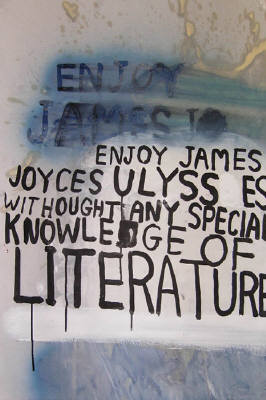
Thanks, Jim!
yes I said yes
Here's Ewan McGregor as James Joyce, in the film he produced and starred in: Nora:

You know. I just had to include Ewan. I had to!!
This is the scene where he waits for her to show up for their first "date", and she blows him off (basically because she can't get off work.) (Description of that from Ellmann's biography of Joyce here.)
The next time the two met, it was a couple days later, on June 16, 1904.
And here is McGregor as Joyce, and the marvelous Irish actress Susan Lynch as his wife Nora:
Bloomsday ...
Here is a photo of James Joyce, Nora Joyce, and their solicitor - directly following getting married in 1931. They had eloped to the Continent in 1904, had two kids (Giorgio and Lucia) before they eventually decided to make it official.
Nora said, of her relationship with James: "You can't imagine what it was like for me to be thrown into the life of this man."
yes I said yes I will Yes
And here is the ending of Molly's 60-page run-on sentence that closes the book. If you read it out loud, it will become immediately clear what is going on, what she is doing:
yes when I put the rose in my hair like the Andalusian girls used or shall I wear a red yes and how he kissed me under the Moorish wall and I thought well as well him as another and then I asked him with my eyes to ask again yes and then he asked me would I yes to say yes my mountain flower and first I put my arms around him yes and drew him down to me so he could feel my breasts all perfume yes and his heart was going like mad and yes I said yes I will Yes
"It is not to be read"
Samuel Beckett said, on the language of Finnegans Wake:
You cannot complain that this stuff is not written in English. It is not written at all. It is not to be read. It is to be looked at and listened to. His writing is not about something. It is that something itself.
"the odour of ashpits"
James Joyce had a hell of a time getting Dubliners published anywhere, but it was most difficult in Ireland. Here is his response to a potential publishers objections to material in The Dubliners:
"It is not my fault that the odour of ashpits and old weeds and offal hangs round my stories. I seriously believe that you will retard the course of civilization in Ireland by preventing the Irish people from having one good look at themselves in my nicely polished looking-glass."
Joseph Campbell weighs in ...
Joseph Campbell:
If our society should go to smash tomorrow (which, as Joyce implies, it may) one could find all the pieces, together with the forces that broke them, in Finnegans Wake.
"the immense prodigy"
Here are a couple of different quotes from TS Eliot - which give you a sense of the real vertigo that other serious writers felt when they first read Joyce's book:
"I wish, for my own sake, that I had not read it."
and
"How could anyone write again after achieving the immense prodigy of the last chapter?"
"It is an entirely new thing"
Here are two different quotes from WB Yeats about Ulysses:
1. He read a chapter or two of Ulysses, which had been serialized in the Little Review from Paris. His first comment was: "A mad book!"
2. Not too long after making that first comment, Yeats had this to say, "I have made a terrible mistake. It is a work perhaps of genius. I now perceive its coherence ... It is an entirely new thing -- neither what the eye sees nor the ear hears, but what the rambling mind thinks and imagines from moment to moment. He has certainly surpassed in intensity any novelist of our time."
"What about the mystery of the conscious?"
James Joyce:
Why all this fuss and bother about the mystery of the unconscious? What about the mystery of the conscious? What do they know about that?
Rejoyce!
More below ... in honor of James Joyce.
This picture, for some reason, just kills me.
This quote is for my friend David:
I think he'll like it.
James Joyce said: "Irresponsibility is part of the pleasure of all art; it is the part the schools cannot recognize."
Nora and Finnegans Wake
James Joyce worked on Finnegans Wake for 17 years or something like that.
Nora, looking at the gibberish pages, the ciphers, the codes, said, "Why don't you write books people can read?"
Ha!
However: Nora always thought that Finnegans Wake - which pretty much the entire world thought was incomprehensible - was his best book. She understood it. She understood the language.
By the way, if you ever feel like taking on that book - I cannot stress how important it is to read it out loud. It's incomprehensible on the page, but when you HEAR it? It's marvelous. It's meant to be read out loud.
Years after his death, she was still pestererd by reporters about her famous genius husband. And nobody ever asked about Finnegans Wake . It was always Ulysses, Ulysses, Ulysses.
She commented once, confused, irritated, "What's all this talk about Ulysses? Finnegans Wake is the important book."
For some reason, that gives me a chill. I think she might actually be onto something. She - an uneducated unintellectual wild-haired country girl - got it. That's why Joyce knew that the most important decision he had ever made in his life was choosing this particular woman.
"an Irish safety pin"
James Joyce:
"To me, an Irish safety pin is more important than an English epic."
"With me ..."
To those of you who have not read James Joyce, and might feel intimidated by him, or like: Jesus, what the hell is the big deal, etc., here is a quote from James Joyce, which I love:
"With me, the thought is always simple."
And you know what? It's TRUE. Even in Finnegans Wake.
"It seemed to me that I was fighting a battle with every religious and social force in Ireland for you"
Letter from James Joyce to Nora on Sept. 16, 1904 - shortly before the two of them fled Ireland together, without getting married:
"When I was waiting for you last night I was even more restless. It seemed to me that I was fighting a battle with every religious and social force in Ireland for you and that I had nothing to rely on but myself. There is no life here -- no naturalness or honesty. People live together in the same houses all their lives and at the end they are as far apart as ever ... The fact that you can choose to stand beside me in this way in my hazardous life fills me with great pride and joy ... Allow me, dearest Nora, to tell you how much I desire that you should share any happiness that may be mine and to assure you of my great respect for that love of yours which it is my wish to deserve and to answer."
Joyce's conclusion
James Joyce:
"I have come to the conclusion that I cannot write without offending people."
You tell 'em, Nora
Nora Joyce (Joyce's wife) - after Joyce's death - was asked about which new writers she read. Here is what she said:
"Sure, if you've been married to the greatest writer in the world, you don't remember all the little fellows."
What happened on June 16, 1904
Excerpt from Ellmann's masterful biography, about the events of June 16, 1904:
The experience of love was almost new to [Joyce] in fact, though he had often considered it in imagination. A transitory interest in his cousin Katsy Murray had been followed by the stronger, but unexpressed and unrequited, interest in Mary Sheehy. He shocked Stanlislaus [Joyce's brother] a little by quoting with approval a remark of a Dublin wit, 'Woman is an animal that micturates once a day, defecates once a week, menstruates once a month and parturiates once a year.' Yet tenderness was as natural to him as coarseness, and secretly he dreamed of falling in love with someone he did not know, a gentle lady, the flower of many generations, to whom he should speak in the ceremonious accents of Chamber Music.Instead, on June 10, 1904, Joyce was walking down Nassau Street in Dublin when he caught sight of a tall, good-looking young woman, auburn-haired, walking with a proud stride. When he spoke to her she answered pertly enough to allow the conversation to continue. She took him, with his yachting cap, for a sailor, and from his blue eyes thought for a moment he might be Swedish.
Joyce found she was employed at Finn's Hotel, a slightly exalted rooming house, and her lilting speech confessed that she was from Galway City. She had been born there, to parents who lived in Sullivan's Lane, on March 21, 1884. Her name was a little comic, Nora Barnacle, but this too might be an omen of felicitous adhesion. (As Joyce's father was to say when he heard much later her last name was Barnacle, 'She'll never leave him.') After some talk it was agreed they should meet in front of Sir William Wilde's house at the turning of Merrion Square on June 14. But Nora Barnacle failed to appear, and Joyce sent her a note in some dejection:
60 Shelbourne Road
I may be blind. I looked for a long time at a head of reddish-brown hair and decided it was not yours. I went home quite dejected. I would like to make an appointment but it might not suit you. I hope you will be kind enough to make one with me -- if you have not forgotten me!
James A. Joyce 15 June 1904
The appointment was made, and for the evening of June 16, when they went walking at Ringsend, and then arranged to meet again.
To set Ulysses on this date was Joyce's most eloquent if indirect tribute to Nora, a recognition of the determining effect upon his life of his attachment to her. On June 16, as he would afterwards realize, he entered into relation with the world around him and left behind him the loneliness he had felt since his mother's death. He would tell her later, "You made me a man." June 16 was the sacred day that divided Stephen Dedalus, the insurgent youth, from Leopold Bloom, the complaisant husband.
Here's a photograph of the young Galway girl, Nora Barnacle:
Who killed the 19th century?
TS Eliot:
"He single-handedly killed the 19th century."
(This pissed Gertrude Stein off, because she thought that SHE had single-handedly killed the 19th century. Sorry, Gertrude. A century is a century is a century, right?)
In honor of Bloomsday ...
5,000 more quotes - about Joyce, by Joyce ... you name it. Every June 16 I lose my mind.
Here's a picture of Joyce, and Sylvia Beach (the courageous woman who decided to publish Ulysses):
"I just assumed he was someone they knew"
Actress Fionnula Flanagan:
Like James Joyce, I was born and raised in Dublin. Those years of the grey post-war fifties, seem to me now, looking back, to have been a time when Dublin was cobwebbed, as it were, by a leftover Edwardianism of a uniquely Irish kind. Many of the landmarks of Joyce's world remained, their coinage unchanged and in common usage -- street names, certainly, newspapers and adverts, shops and pubs, churches, restaurants and monuments, the turn of phrase, the prejudices, the mythologies, the past.
My father, Terry, knew Dublin intimately, loved it fiercely. He would take us children on Sunday "rambles" into the inner city during which odysseys he talked, nonstop, of its history. Bloom-like, we walked everywhere. On Saturday nights in my Grandma Flanagan's front parlor, while my aunts sipped port and conversed in whispers about "women's ailments", my father and my uncles sang operatic arias loudly, drank whiskey, and hotly argued Irish politics. Shades of "The Dead" and "Ivy Day in the Committee Room," although I didn't yet know of the existence of those stories. Of course I also didn't know I was living in the geography of the very world Joyce had known and then recreated so brilliantly in his writings. Whenever my parents quoted or paraphrased him, casually -- as in "Joyce understood that" or "As Joyce said ..." -- I just assumed he was someone they knew, an acquaintance from the vigorous Dublin intellectual set of their youth. But Joyce was everywhere in my childhood, in all the ordinary things we did that made up the fabric of our lives. We went to funerals in Glasnevin Cemetery -- half my family is buried there -- and on very special occasions we were treated to lunch at Jammets. We tramped out to the Shelley Banks and watched the Liverpool boat until it was just a speck, then raced miles out to find the tide on Sandymount Strand; we spied on the naked men swimming in the Forty Foot below the Martello Tower, where Buck Mulligan held his shaving bowl aloft. In summer the Howth tram swayed us to the top of the Head with its rhododendrons blazing purple and we tumbled on the grassy mound where Molly Bloom gazed out over Dublin Bay while Poldy pressed her to say "yes". I went to school in Eccles Street and walked by No. 7 twice a day. Of course the Blooms had lived there. Lived there still, had anyone asked me. For all that the house is gone, they are there yet.
"Several grains of salt ..."
Ray Gandolf:
My favorite Joyce story was told to me by Gilbert Seldes many years ago. Many years before that, as a young, callow, and nervous reporter, he had managed to secure an interview with Joyce in Paris. All he could recall of the meeting, said Seldes, was that Joyce's favorite Irish whiskey was Jameson's. Because, said Joyce, according to Seldes, its distillery was downstream from a sewage outlet on the River Liffey -- and thus contained the true essence of Dublin. Several grains of salt are recommended.
"Henceforth no sin"
Henry Miller:
After the closing picture of Molly Bloom a-dreaming on her dirty bed we can say, as in Revelation -- And there shall be no more curse! Henceforth no sin, no guilt, no fear, no repression, no longing, no pain of separation. The end is accomplished -- man returns to the womb.
"Joyce's champion game"
Vladimir Nabokov:
Ulysses, of course, is a divine work of art and will live on despite the academic nonentities who turn it into a collection of symbols or Greek myths. I once gave a student a C-minus, or perhaps a D-plus, just for applying to its chapters the titles borrowed from Homer while not even noticing the comings and goings of the man in the brown mackintosh. He didn't even know who the man in the brown mackintosh was. Oh, yes, let people compare me to Joyce by all means, but my English is pat ball to Joyce's champion game.
"it is a book to which we are all indebted"
TS Eliot:
I hold Ulysses to be the most important expression which the present age has found; it is a book to which we are all indebted, and from which none of us can escape.
"goddamn wonderful"
Ernest Hemingway, true to form:
Joyce has a most goddamn wonderful book.
"a picture of Dublin so complete"
James Joyce:
I want to give a picture of Dublin so complete that if the city one day suddenly disappeared from the earth it could be reconstructed out of my book.
February 2, 1922
Sylvia Beach (publisher of "Ulysses"):
I was on the platform, my heart going like the locomotive, as the train from Dijon came slowly to a standstill and I saw the conductor getting off, holding a parcel and looking around for someone -- me. In a few minutes, I was ringing the doorbell at the Joyces' and handing them Copy No. 1 of Ulysses. It was February 2, 1922.
"faith"
William Faulkner:
You should approach Joyce's Ulysses as the illiterate Baptist preacher approaches the Old Testament: with faith.
"Blast it!"
James Joyce:
Ulysses is the epic of two races (Israel - Ireland) and at the same time the cycle of the human body as well as a little story of a day (life). The character of Ulysses always fascinated me ever since boyhood. I started writing it as a short story for Dubliners fifteen years ago but gave it up. For seven years I have been working at this book-- blast it!
"a ferocious masturbation"
Henry Miller:
Endowed with a Rableaisian ability for word invention, embittered by the domination of a church for which his intellect had no use, harassed by the lack of understanding on the part of family and friends, obsessed by theparental image against which he vainly rebels, Joyce has been seeking escape in the erection of a fortress composed of meaningless verbiage. His language is a ferocious masturbation carried on in fourteen tongues.
His last words
Eva Joyce - James' sister:
His last words were, 'Does nobody understand?' -- and I'm afraid that's what none of us did -- understand him.
"I'm sure of one thing..."
Nora Barnacle - James Joyce's wife:
I don't know whether or not my husband is a genius, but I'm sure of one thing, there is no one like him.
"a curious sense of his own powers"
Oliver St. John Gogarty:
Looking back, there was something uncanny in his certainty, which he had more than any other writer I have ever known, that he would one day be famous. It was more than mere wishful thinking. It goerned all his attitudes to his compatriots and accounts for what many referred to as his arrogance. He was never really arrogant, but seemed to have a curious sense of his own powers and wouldn't tolerate anyone who didn't really appreciate his work.
"he liked blackberry jam"
Edna O'Brien:
He would carry his work "like a chalice" and all his life he would insist that what he did "was a kind of sacrament." Father, Son and Holy Ghost along with Jakes McCarthy informed every graven word. On a more secular note he liked blackberry jam because Christ's crown of thorns came from that wood and he wore purple cravats during Lent.
"To call this man angry ..."
Edna O'Brien:
To call this man angry is too temperate a word, he was volcanic.
Today will be all Joyce ...
... all the time. In honor of Bloomsday. (Here is what I wrote about Bloomsday last year - which was the 100th anniversary.)

Many snippets below. More to come.
"I prepare myself for a sacrament"
Philippe Soupault:
Together we went often to the theatre, which, like all good Irishmen, he loved. It was the theatre as theatre that he loved. I mean that he was attracted less by the play than by the atmosphere, the footlights and spotlights, the spectators, the kind of solemnity in a theatre. He preferred opera. When he had decided to go, he was happy as a child. He chose a companion, refused to dine (I prepare myself for a sacrament, he told me, explaining this abstinence), and after the performance he had supper at a restaurant, where he had arranged to have his favorite white wines. At the theatre, seated in the first row -- presumably because of his very bad eyesight -- he carefully watched the actionn and listened closely to the performers. Only children are as passionately attentive as Joyce was.
"He might have other timidities"
Herbert Gorman:
Where the arts were concerned, Joyce was far from timid. He might have other timidities, might in fact be a curious amalgam of sensitive superstitions and nervous fears, but he was entirely unselfconscious when it came to those profound expressions that were liberated by musical notes and written words.
"one long self-confession"
Paul Leon:
The student of the human soul should read attentively Joyce's writings in which it is mirrored, for Joyce made no distinction between actual life and literary creation. His work is one long self-confession, and in this respect he is akin to the greatest of the romantics.
"when he writes ..."
Stanislaus Joyce (Joyce's brother):
"Jim says that he writes well because when he writes his mind is as nearly normal as possible.
"Mad Ireland"
Edna O'Brien:
He would never relinquish the anger that he felt then, revolt at the sight of the grey block of Trinity College "set heavily in the city's ignorance," or the statue of Thomas Moore, the national poet, covered in vermin. Even the guileless flower girl entreating him to buy flowers exasperated him and reinforced his fury over his own poverty. No Proustian madeleine would summon up this rigorous landscape. For him, as Auden would say of Yeats, "Mad Ireland hurt you into poetry."
Joyce and Proust and truffles
Arthur Power:
Joyce met Proust once at a literary dinner, and Proust asked Joyce did he like truffles, and Joyce said yes, he did, and I know Joyce was very amused afterwards. He said " ... the two greatest literary figures of our time meet and they ask each other if they like truffles."
"allied to an inner strength"
Paul Leon:
The most general and lasting impression I shall always retain of Joyce the man is his exquisite genteness, together with his infinite power of comprehension. By this I do not mean a quality of heart ... I am referring to a more general characteristic, one that partakes, as it were, of the elementary force of his makeup. For gentleness and comprehension, in his case, did not spring from weakness or indifference, but were allied to an inner strength, a directed spiritual activity, such as I have never seen in anyone else.
"it will appear overwhelming"
Paul Leon:
[Joyce] had the necessary courage, perseverance, inner strength, and energy of mind -- any one of which might easily have been insufficient -- to overcome all obstacles, all suffering, and to attain perfection. When his work comes to be judged according to its true value, as posterity will judge it, it will appear overwhelming, if only because of the crushing labour that it obviously represents, and one man's life will seem to have been conceived on too small a scale in comparison with the immensity of the effort involved.
"he had never met a bore"
Sylvia Beach:
As for Joyce, he treated people invariably as his equals, whether they were writers, children, waiters, princesses, or charladies. What anybody had to say interested him; he told me that he had never met a bore.
Judge Woolsey's "obscenity" decision, in regards to "Ulysses"
Read the whole thing. Astonishing.
United States Discrict Court, Southern District of New York, Opinion A. 110-59
December 6, 1933
On cross motions for a decree in a libel of confiscation, supplemented by a stipulation -- hereinafter described -- brought by the United States against the book "Ulysses" by James Joyce, under Section 305 of the Tariff Act of 1930, Title 19 United States Code, Section 1305, on the ground that the book is obscene within the meaning of that Section, and, hence, is not importable into the United States, but is subject to seizure, forfeiture and confiscation and destruction.
United States Attorney -- by Samuel C. Coleman, Esq., and Nicholas Atlas, Esq., of counsel -- for the United States, in support of motion for a decree of forfeiture, and in opposition to motion for a decree dismissing the libel.
Messrs. Greenbaum, Wolff and Ernst, -- by Morris L. Ernst, Esq., and Alexander Lindey, Esq., of counsel -- attorneys for claimant Random House, Inc., in support of motion for a decree dismissing the libel, and in opposition to a motion for a decree of forfeiture.
WOOLSEY, J:
The motion for a decree dismissing the libel herein is granted, and, consequently, of course, the Government's motion for a decree of forfeiture and destruction is denied.
Accordingly a decree dismissing the libel without costs may be entered herein.
1. The practice followed in this case is in accordance with the suggestion made by me in the case of United States v. One Book Entitled "Contraception", 51 F. (2d) 525, and is as follows:
After issue was joined by the filing of the claimant's answer to the libel for forfeiture against "Ulysses", a stipulation was made between the United States Attorney's office and the attorneys for the claimant providing:
1. That the book "Ulysses" should be deemed to have been annexed to and to have become part of the libel just as if it had been incorporated in its entirety therein.
2. That the parties waived their right to a trial by jury.
3. That each party agreed to move for decree in its favor.
4. That on such cross motions the Court might decide all the questions of law and fact involved and render a general finding thereon.
5. That on the decision of such motions the decree of the Court might be entered as if it were a decree after trial.
It seems to me that a procedure of this kind is highly appropriate in libels for the confiscation of books such as this. It is an especially advantageous procedure in the instant case because on account of the length of "Ulysses" and the difficulty of reading it, a jury trial would have been an extremely unsatisfactory, if not an almost impossible, method of dealing with it.
2. I have read "Ulysses" once in its entirety and I have read those passages of which the Government particularly complains several times. In fact, for many weeks, my spare time has been devoted to the consideration of the decision which my duty would require me to make in this matter.
"Ulysses" is not an easy book to read or to understand. But there has been much written about it, and in order properly to approach the consideration of it it is advisable to read a number of other books which have now become its satellites. The study of "Ulysses" is, therefore, a heavy task.
3. The reputation of "Ulysses" in the literary world, however, warranted my taking such time as was necessary to enable me to satisfy myself as to the intent with which the book was written, for, of course, in any case where a book is claimed to be obscene it must first be determined, whether the intent with which it was written was what is called, according to the usual phrase, pornographic, -- that is, written for the purpose of exploiting obscenity.
If the conclusion is that the book is pornographic that is the end of the inquiry and forfeiture must follow.
But in "Ulysses", in spite of its unusual frankness, I do not detect anywhere the leer of the sensualist. I hold, therefore, that it is not pornographic.
4. In writing "Ulysses", Joyce sought to make a serious experiment in a new, if not wholly novel, literary genre. He takes persons of the lower middle class living in Dublin in 1904 and seeks not only to describe what they did on a certain day early in June of that year as they went about the City bent on their usual occupations, but also to tell what many of them thought about the while.
Joyce has attempted -- it seems to me, with astonishing success -- to show how the screen of consciousness with its ever-shifting kaleidoscopic impressions carries, as it were on a plastic palimpsest, not only what is in the focus of each man's observation of the actual things about him, but also in a penumbral zone residua of past impressions, some recent and some drawn up by association from the domain of the subconscious. He shows how each of these impressions affects the life and behavior of the character which he is describing.
What he seeks to get is not unlike the result of a double or, if that is possible, a multiple exposure on a cinema film which would give a clear foreground with a background visible but somewhat blurred and out of focus in varying degrees.
To convey by words an effect which obviously lends itself more appropriately to a graphic technique, accounts, it seems to me, for much of the obscurity which meets a reader of "Ulysses". And it also explains another aspect of the book, which I have further to consider, namely, Joyce's sincerity and his honest effort to show exactly how the minds of his characters operate.
If Joyce did not attempt to be honest in developing the technique which he has adopted in "Ulysses" the result would be psychologically misleading and thus unfaithful to his chosen technique. Such an attitude would be artistically inexcusable.
It is because Joyce has been loyal to his technique and has not funked its necessary implications, but has honestly attempted to tell fully what his characters think about, that he has been the subject of so many attacks and that his purpose has been so often misunderstood and misrepresented. For his attempt sincerely and honestly to realize his objective has required him incidentally to use certain words which are generally considered dirty words and has led at times to what many think is a too poignant preoccupation with sex in the thoughts of his characters.
The words which are criticized as dirty are old Saxon words known to almost all men and, I venture, to many women, and are such words as would be naturally and habitually used, I believe by the types of folk whose life, physical and mental, Joyce is seeking to describe. In respect of the recurrent emergence of the theme of sex in the minds of his characters, it must always be remembered that his locale was Celtic and his season Spring.
Whether or not one enjoys such a technique as Joyce uses is a matter of taste on which disagreement or argument is futile, but to subject that technique to the standards of some other technique seems to me to be little short of absurd.
Accordingly, I hold that "Ulysses" is a sincere and honest book and I think that the criticisms of it are entirely disposed of by its rationale.
5. Furthermore, "Ulysses" is an amazing tour de force when one considers the success which has been in the main achieved with such a difficult objective as Joyce set for himself. As I have stated, "Ulysses" is not an easy book to read. It is brilliant and dull, intelligible and obscure by turns. In many places it seems to me to be disgusting, but although it contains, as I have mentioned above, many words usually considered dirty, I have not found anything that I consider to be dirt for dirt's sake. Each word of the book contributes like a bit of mosaic to the detail of the picture which Joyce is seeking to construct for his readers.
If one does not wish to associate with such folk as Joyce describes, that is one's own choice. In order to avoid indirect contact with them one may not wish to read "Ulysses"; that is quite understandable. But when such a real artist in words, as Joyce undoubtedly is, seeks to draw a true picture of the lower middle class in a European city, ought it to be impossible for the American public legally to see that picture?
To answer this question it is not sufficient merely to find, as I have found above, that Joyce did not write "Ulysses" with what is commonly called pornographic intent, I must endeavor to apply a more objective standard to his book in order to determine its effect in the result, irrespective of the intent with which it was written.
6. The statute under which the libel is filed only denounces, in so far as we are here concerned, the importation into the United States from any foreign country of "any obscene book". Section 305 of the Tariff Act of 1930, Title 19 United States Code, Section 1305. It does not marshal against books the spectrum of condemnatory adjectives found, commonly, in laws dealing with matters of this kind. I am, therefore, only required to determine whether "Ulysses" is obscene within the legal definition of that word.
The meaning of the word "obscene" as legally defined by the Courts is: tending to stir the sex impulses or to lead to sexually impure and lustful thoughts. Dunlop v. United States, 165 U.S. 486, 501; United States v. One Book Entitled "Contraception", 51 F. (2d) 525, 528; and compare Dysart v. United States, 272 U.S. 655, 657; Swearingen v. United States 151 U.S. 446, 450; United States v. Dennett, 39 F. (2d) 564, 568 (C.C.A. 2); People v. Wendling, 258 N.Y. 451, 453.
Whether a particular book would tend to excite such impulses and thoughts must be tested by the Court's opinion as to its effect on a person with average sex instincts -- what the French would call l'homme moyen sensuel -- who plays, in this branch of legal inquiry, the same role of hypothetical reagent as does the "reasonable man" in the law of torts and "the man learned in the art" on questions of invention in patent law.
The risk involved in the use of such a reagent arises from the inherent tendency of the trier of facts, however fair he may intend to be, to make his reagent too much subservient to his own idiosyncrasies. Here, I have attempted to avoid this, if possible, and to make my reagent herein more objective than he might otherwise be, by adopting the following course:
After I had made my decision in regard to the aspect of "Ulysses", now under consideration, I checked my impressions with two friends of mine who in my opinion answered to the above stated requirement for my reagent.
These literary assessors -- as I might properly describe them -- were called on separately, and neither knew that I was consulting the other. They are men whose opinion on literature and on life I value most highly. They had both read "Ulysses", and, of course, were wholly unconnected with this cause.
Without letting either of my assessors know what my decision was, I gave to each of them the legal definition of obscene and asked each whether in his opinion "Ulysses" was obscene within that definition.
I was interested to find that they both agreed with my opinion: that reading "Ulysses" in its entirety, as a book must be read on such a test as this, did not tend to excite sexual impulses or lustful thoughts but that its net effect on them was only that of a somewhat tragic and very powerful commentary on the inner lives of men and women.
It is only with the normal person that the law is concerned. Such a test as I have described, therefore, is the only proper test of obscenity in the case of a book like "Ulysses" which is a sincere and serious attempt to devise a new literary method for the observation and description of mankind.
I am quite aware that owing to some of its scenes "Ulysses" is a rather strong draught to ask some sensitive, though normal, persons to take. But my considered opinion, after long reflection, is that whilst in many places the effect of "Ulysses" on the reader undoubtedly is somewhat emetic, nowhere does it tend to be an aphrodisiac.
"Ulysses" may, therefore, be admitted into the United States.
JOHN M. WOOLSEY
United States District Judge
"A moment of silence"
Nola Tully on "Ulysses":
The response to Ulysses was immediate and extreme. Writer and literary critic Malcolm Cowley described it using the metaphor of a stone dropped into water: there was a moment of silence, the stone was dropped, "then all the frogs who inhabited the pool began to talk at once.
Below: a compilation of quotes from "all the frogs" talking at once.
George Bernard Shaw:
A famous letter from Shaw to publisher Sylvia Beach:
"To you possibly Ulysses m,ay appeal as art; you are probably (you see I don't know you) a young barbarian beglamoured by the excitements and enthusiasms that art stirs up in passionate material; but to me it is all hideously real: I have walked those streets and know those shops and have heard and taken part in those conversations. I escaped from them to England at the age of twenty; and forty years later have learnt from the books of Mr. Joyce that Dublin is still what it was, and young men are still drivelling in slackjawed blackguardism as they were in 1870. It is, however, some consolation to find that at last soembody has felt deeply enough about it to face the horror of writing it all down and using his literary genius to force people to face it. In Ireland they try to make a cat cleanly by rubbing its nose in its own filth. Mr. Joyce has tried the same treatment on the human subject. I hope it may prove successful."
Wow.
Ford Madox Ford
"For myself then, the pleasure -- the very great pleasure -- that I get from going through the sentences of Mr. Joyce is that given me simply by the cadence of his prose, and I fancy that the greatest and highest enjoyment that can be got from any writing is simply that given by the cadence of the prose."
-- Ford Madox Ford
James Joyce says:
"The pity is, the public will demand and find a moral in my book -- or worse they may take it in some more serious way, and on the honour of a gentleman, there is not one single serious line in it."
-- James Joyce
Hart Crane
"The sharp beauty and sensitivity of the thing! The matchless details! His book is steeped in the Elizabethans, his early love, and Latin Church, and some Greek ... It is my opinion that some fanatic will kill Joyce sometime soon for the wonderful things said in Ulysses."
-- Hart Crane
Dr. Joseph Collins ...
"Ulysses will immortalize its author with the same certainty that Gargantua and Pantagruel immortalized Rabelais and The Brothers Karamazov Dostoevsky ... It comes nearer to being the perfect revelation of a personality than any book in existence."
-- Dr. Joseph Collins, reviewing "Ulysses" in The New York Times
EM Forster:
"Ulysses is a dogged attempt to cover the universe with mud. It is an inverted Victorianism, an attempt to make crossness and dirt succeed where sweetness and light failed, a simplification of the human character in the interests of Hell."
-- EM Forster.
EM Forster also called Ulysses: "Perhaps the most interesting literary experiment of our day."
As you can see, no one was neutral about this book.
Sylvia Beach
A bit of biographical information about her here. I wrote about her on her birthday.
"Joyce was soon deriving a steady income from Ulysses in spite of the fact that it was denied its normal outlets in the English-speaking countries. And, of course, its reputation as a banned book helped the sales. It was saddening, however, to see such a work listed in catalogues of erotica alongside Fanny Hill, The Perfumed Garden and that everlasting Casanova, not to speak of plain pornography like Raped on the Rail. An Irish priest, purchasing Ulysses, asked me, 'Any other spicy books?'"
-- Sylvia Beach
Carl Jung's letter to Joyce
Here is the letter Jung wrote to Joyce, after he finished Ulysses:
Dear Sir,Your Ulysses has presented the world such an upsetting psychological problem, that repeatedly I have been called in as a supposed authority on psychological matters.
Ulysses proved to be an exceedingly hard nut and it has forced my mind not only to most unusual efforts, but also to rather extravagant peregrinations (speaking from the standpoint of a scientist). Your book as a whole has given me no end of trouble and I was brooding over it for about three years until I succeeded to put myself into it. But I must tell you that I'm profoundly grateful to yourself as well as to your gigantic opus, because I learned a great deal from it. I shall probably never be quite sure whether I did enjoy it, because it meant too much grinding of nerves and of grey matter. I also don't know whether you will enjoy what I have written about Ulysses because I couldn't help telling the world how much I was bored, how I grumbled, how I cursed and how I admired. The 40 pages of non stop run at the end is a string of veritable psychological peaches. I suppose the devil's grandmother knows so much about the real psychology of a woman, I didn't.
Well I just try to recommend my little essay to you, as an amusing attempt of a perfect stranger that went astray in the labyrinth of your Ulysses and happened to get out of it again by sheer good luck. At all events you may gather from my article what Ulysses has done to a supposedly balanced psychologist.
With the expression of my deepest appreciation, I remain, dear Sir,
Yours faithfully,
C.G. Jung
Joyce was very proud of this letter, very proud that he had won Jung's boredom and admiration, that he had made Jung curse him. Joyce read it out loud to a group of people, Nora (his wife) included. Nora's comment was typically brief. Joyce finished reading the letter, and Nora turned to someone beside her and said flatly, "Jim knows nothing at all about women."
William Carlos Williams
"Joyce is too near for me to want to do less than he did in Ulysses, in looseness of spirit, and honesty of heart -- at least."
-- William Carlos Williams
Stephen Spender ...
"It is a stupendous attempt to present us with a truer picture of the human mind than has ever been achieved before, by creating the discontinuous stream of thoughts, habits of mind rising from the past, disturbances caused by the environment, and even suggested by purely physical movements of the body, which pass through the fragmentary and interrupted consciousness of people at every moment."
-- Stephen Spender
James Douglas ...
"I say deliberately that it is the most infamously obscene book in ancient or modern literature. The obscenity of Rabelais is innocent compared with its leprous and scabrous horrors. All the secret sewers of vice are canalised in its flood of unimaginable thoughts, images and pornographic words. And its unclean lunacies are larded with appalling and revolting blasphemies directed against the Christian religion and against the name of Christ ... The book is already the bible of beings who are exiles and outcasts in this and every civilised society. It is also adopted by the Freudians as the supreme glory of their dirty and degraded cult."
-- James Douglas, reviewing "Ulysses" in the Dublin "Sunday Express". Hahahaha See why Joyce felt the need to attach Ireland, hold her down, and shove a mirror in her face? Because of dudes like Douglas.
Crane ...
"I feel like shouting EUREKA! Easily the epic of the age."
-- Hart Crane
Wharton ...
"It's a turgid welter of pornography (the rudest schoolboy kind) & unformed & unimportant drivel; & until the raw ingredients of a pudding make a pudding, I shall never believe that the raw material of sensation & thought can make a work of art without the cook's intervening."
-- Edith Wharton
Wilson ...
"Yet for all its appalling longeurs, "Ulysses" is a work of high genius. Its importance seems to me to lie, not so much in its opening new doors to knowledge -- unless in setting an example to Anglo-Saxon writers of putting down everything without compunction -- or in inventing new literary forms -- Joyce's formula is really, as I have indicated, nearly seventy-five years old -- as in its once more setting the standard of the novel so high that it need not be ashamed to take its place beside poetry and drama. "Ulysses" has the effect at once of making everything else look brassy."
-- Edmund Wilson
Pound ...
"In a single chapter he discharges all the cliches of the English language like an uninterrupted river."
-- Ezra Pound
Yeats ...
"It is an entirely new thing -- neither what they eye sees nor the ear hears, but what the rambling mind thinks and imagines from moment to moment. He has certainly surpassed in intensity any novelist of our time."
-- WB Yeats
Frank McCourt: "The book sings in your head."
Frank McCourt on "Ulysses", and the famous readings done at Symphony Space every June 16 - called "Bloomsday on Broadway":
Nineteen sixty-four, the year of my forgettable thesis, was the sixtieth anniversary of Bloomsday. (Richard Ellmann had published his masterly biography in 1959.) Joyceans might have marked June 16 on their calendars in 1964 but you'd search in vain for the kind of celebration the day has engendered since. In certain places Ulysses, all of it, is read by people, some who haven't the foggiest notion of what they're reading. Still, the book sings in your head for a long time and you won't forget its characters -- Bloom, Stephen, Molly, Blazes Boylan, or scenes. It's your life.
At these readings there is still a thrill in the crowd with the opening line that Joyceans know refers to my man, Gogarty: "Stately plump Buck Mulligan came from the stairhead ..." We're off on a journey through Dublin and Ireland and family and Catholicism and eroticism and love and infidelity. The journey ends on a powerful, tumescent note, "yes I will Yes." (Note the uppercase Y on the final Yes. This is not an end but a beginning.)..Look! Ulysses is more than a book. It's an event -- and that upsets purists, but who's stopping them from retiring to quiet places for an orgy of textual analysis?
I will read at "Bloomsday on Broadway" as long as Isaiah permits me and as long as I can croak out Joyce's wondrous words.
Over the years we've aged, the hair whitening or graying, and many of us have long passed the age at which Joyce died, fifty-eight. Joyce's work has liberated many an artist while his life stands as a lesson for all of us. He suffered greatly: the growing failure of his eyes, the growing madness of his daughter. All his days he skirmished for pennies and fought pitched battles for his art. He was a family man, fiercely tribal, and we must not forget he was driven by love.
Did he love Ireland? As the squirrel loves the nut.
Did he love Catholicism? Imagine his work without it.
From James Joyce's "Ulysses" ...
... in honor of Bloomsday:
This is from the Scylla and Charybdis episode in the book. The episode in the library, when Stephen Dedalus finally starts to speak. And out comes a flood of words. The discussion? Hamlet. Interesting. Peter Greenblatt, author of the book Will in the World, about Shakespeare, has mentioned that the "discussion about Hamlet in Ulysses" is beyond compare, and helped him, as a younger man, to deepend his understanding of that play. It's true. You may think you know Hamlet - but if you think that? If you are sure in your knowledge and you HAVEN'T read Ulysses? Then, sorry - no understanding of Hamlet is anywhere near complete without studying that chapter. People have devoted their entire lives to studying this particular chapter.
In this following excerpt ... a chatty librarian talks about an upcoming compilation of poets, and the fact that Ireland has yet to inspire a real epic. heh heh heh That was James Joyce's big thing. When librarian says: "they say we are to have a literary surprise" I can't help but think that Joyce is speaking about his own book, Ulysses. A surprise for Ireland, indeed. But he was living in exile - unlike all the other writers mentioned in this excerpt. He had rejected Ireland, he couldn't bear to live there. Yet it remained his lifelong obsession - to describe it, to hold up a mirror to its face, to immortalize it so well that you could use his books as a literal streetmap through Dublin 100 years hence. (And you kind of can.)
From Ulysses:
--They say we are to have a literary surprise, the quaker librarian said, friendly and earnest. Mr Russell, rumor has it, is gathering together a sheaf of our younger poets' verses. We are all looking forward anxiously.Anxiously he glanced in the cone of lamplight where three faces, lighted, shone.
See this. Remember.
Stephen looked down on a wide headless caubeen, hung on his ashplanthandle over his knee. My casque and sword. Touch lightly with two index fingers. Aristotle's experiment. One or two? Necessity is that in virtue of which it is impossible that one can be otherwise. Argal, one hat is one hat.
Listen.
Young Colum and Starkey. George Roberts is doing the commercial part. Longworth will give it a good puff in the Express. O, will he? I liked Collum's Drover. Yes, I think he has that queer thing, genius. Do you think he has genius really? Yeats admired his line: As in wild earth a Grecian vase. Did he? I hope you'll be able to come tonight. Malachi Mulligan is coming too. Moore asked him to bring Haines. Did you hear Miss Mitchell's joke about Moore and Martyn? That Moore is Martyn's wild oats? Awfully clever, isn't it? They remind one of don Quixote and Sancho Panza. Our national epic has yet to be written, Dr Sigerson says. Moore is the man for it. A knight of the rueful countenance here in Dublin. With a saffron kilt? O'Neill Russell? O, yes, he must speak the grand old tongue. And his Dulcinea? James Stephens is doing some clever sketches. We are becoming important, it seems.
The Books: "Road" (Jim Cartwright)
Next book in my Daily Book Excerpt:
 Next play on the script shelf is from my collected plays of Jim Cartwright: Road
Road is an actor's dream. It's basically a series of long monologues - juicy challenging monologues - spoken directly to the audience. Scullery, the main character, walks up and down a road, acting as a kind of tour guide for us. He points out things for us to notice, and he sets up the context for the lives of the people who live along the road. This is not, in any respects, a happy play. It's bleak, dark, and angry. There are also lots of funny moments, too - Cartwright can be marvelously funny - but the underlying emotional themes are despair and fear.
Cartwright, by the way, as you will notice through the excerpt, is masterful at writing accents. They're so specific, and also: HOW people speak, the way they construct their sentences ... each character is completely different from the one before it. Cartwright has an unbelievably good ear for that stuff.
I also love Cartwright because he wrote the play The Rise and Fall of Little Voice specifically for the marvelous Jane Horrocks (one of those situations where her GINORMOUS talent was not being utilized, her range not explored - and so he set out to rectify the situation). It was a massive hit, and it eventually became a movie and Jane Horrocks was nominated for an Oscar. Rightly so. The movie is called Little Voice. I HIGHLY recommend it. And NOT just because Ewan McGregor is in it.
Now on to the excerpt. Two small background things: Joey is a teenager, and he has gone on hunger strike, in his parent's house. He feels despair about the future, the prospects for his generation (this is an entirely working class and under-class play) - his young girlfriend Clare begs him to eat, his parents beg him to eat, he has locked himself in his room, and refuses to eat. Eventually, Clare joins him in his hunger strike, and the two starve to death.
EXCERPT FROM Road
The lights come up on Joey's room. Two weeks later. Joey is sitting up in bed with his arm around Clare. She is sleeping. Joey's face really shows the strain now, it is taut and white.
JOEY. I feel like England's forcing the brain out me head. I'm sick of it. Sick of it all. People reading newspapers: 'EUROVISION LOVERS', 'OUR QUEEN MUM', 'MAGGIE'S TEARS', being fooled again and again. What the fuck-fuck is it? Where am I? Bin lying here two weeks now. On and on through the strain. I wear pain like a hat. Everyone's insane. The world really is a bucket of devil sick. Every little moment's stupid. I'm sick of people -- people, stupid people. Frying the air with their mucky words, their mucky thoughts, their mucky deeds. Horrible sex being had under rotten bedding. Sickly sex being had on the waterbed. Where has man gone? Why is he so wrong? Why am I hurt all through? Every piece of me is bruised or gnawed raw, if you could see it, my heart's like an elbow. I've been done through by them, it, the crushing sky of ignorance, thigh of pignorance. What did I do! What was my crime? Who do I blame? God for giving me a spark of vision? Not enough of one, not enough of the other, just enough for discontent, enough to have me right out on the edge. Not able to get anyone out here with me, not able to get in with the rest. Oh God I'm so far gone it's too late. I'm half dead and I'm not sad or glad. I'm not sad or glad, what a fucking, bastard, bitching, cunt state to be in. I'm black inside. Bitterness has swelled like a mighty black rose inside me. Its petals are creaking against my chest. I want it out! out! out! Devil, God, Devil, God, Devil, God, save me something. Anything. There's got to be summat will come to help us. If only we can make the right state. If I can only get myself into the right state. This is it. This is why I'm on the diet. (He looks around, remembering) Fucking hell am I in a film or what? Or snot, or what? (He is tightening) IIIIIIIIIIIIIIIII bring up small white birds covered in bile and fat blood, they was my hopes. I bring up a small hard pig that was my destiny. I'd like to bring it all out but bbbbbbbbbbbbut I've gone all constipated on bitterness, it won't remove itself. God give me a laxative if you got one. Ha! AArrrrrrgh! Arrrrrrgh! Oh AAArrrrrgh! (He's sweating and straining) Come out, come out, you tight bastard. Oh no! Death suck me up through that straw inside my spine! No leave me! Oh I'm full of dark frost. Who's done this to me! And why? Oh why? Is it worth that extra bit of business to see me suffer, is it? I blame you BUSINESS and you RELIGION its favorite friend, hand in hand YOU HAVE MURDERED THE CHILD IN MAN! MURDERERS! CUNTS! I'D LIKE TO CUT OPEN YOUR BELLIES AND SEE THE BROWN POUR!
(It should appear that he's going to get out of bed to really kill somebody. Then Clare wakes. She puts her arm on him.)
CLARE. Joey.
JOEY. Eh?
CLARE. Joey, I feel so faint and white. I can't hardly see my Joey.
JOEY. Don't worry about it. There might be a message or a sign soon.
CLARE. Uh?
JOEY. You never can tell when it's a going to come on y ou. Fuck me I wish I could sweat or something. I'm like paper.
CLARE. I'm empty and dried-out too, it's so weird now Joe. (Silence) Joe, is my skin cracking?
JOEY. No.
CLARE. Around my mouth at the corners is there any cracking?
JOEY. (a quick glance) No.
CLARE. It feels like it is. (She starts to sing to herself, very soft.) 'Don't know much about history. Don't know much about society. But I do know that I love you and I know if you'd love me too what a wonderful world this would be. What a wonderful world this would be.'
Silence.
I love you so much, Joey.
JOEY. Eh?
CLARE. I love you, my man. Perhaps if I cried you could drink up my tears.
JOEY. Be quiet now.
CLARE. It feels right funny. I can feel things very fine with my body now. Very fine like the silence within silence within silence. Joey is it death-time?
JOEY. (shocked) Stop it! You're talking now like you've never talked in your life.
CLARE. Where's it coming from?
JOEY. You! You!
CLARE. Who?
JOEY. Oh no. You're more advanced now than me. You're going somewhere. A state. Into a state.
CLARE. Eh?
JOEY. Are you in a trance or what?
CLARE. I don't know.
JOEY. Just shout out things. That's how I'll test you. Just say things what come into your head.
CLARE. How can a? A can't hardly speak.
JOEY. What do you mean?
CLARE. I'm so knackererd out. A feel I'm just holding on my the threads. One or two fine wet threads, the rest have dried an' broke.
JOE. Oh my dear.
CLARE. Don't worry. I still love you, that's left. I keep on seeing faces, like me dad's, me mum's, me dad's again. I still want to cry when I see me dad's dismantled face. He lost his last job you know. Just think one day there might be the last job on earth. And everyone will come out to see the man lose it. They'll all watch as he comes up to his last hour. The last hooter blow whoooooooooo oh oooooooo ooooooooooooooooo I'm being corny now, in't a Joey? Oh my it's white in here behind the eyes, so mist.
She closes her eyes. Joey holds her. He makes a fist. He shakes it at the audience. He shakes it up at the sky. He shakes it at the door where the family are outside. He shakes it down under the bed. Then he puts it in front of his face and bites into his hand.
Blackout.
June 15, 2005
Message to Karl Marx : Dude, you were so WRONG!
A must-read book review by Roger Kimball about what seems to me to be a must-read book: Main Currents of Marxism: The Founders, The Golden Age, The Breakdown
Kimball describes it as:
In its nimble mastery of intellectual history and generous humanity, the book has no equal. Kolakowski�s survey of Marxist thought is breathtaking in its sweep�from the Bible and the Greeks through the web of nineteenth-century socialist thought and the florid dissemination of Marxist and quasi-Marxist ideas in the �new-age� redoubts of the twentieth century, Kolakowski has provided the definitive account of a spiritual-political itinerary gone terribly wrong.
A massive 3-volume book, originally published in 1978 - it has now been reissued, except all 3 volumes are now one volume. So the book must be massive. I MUST have it. (Read that article to see its publication history in France. Faaaaaaascinating.)
Kimball writes:
As far as I can tell, the text is unchanged except for the addition of a brief preface. Although only a few pages long, the preface is valuable for three things. It reminds us straightaway�this emerges as a theme of the book�that Marxist doctrine, by calling for the abolition of private property and the more or less total subordination of the market to state control, provided �a good blueprint for converting human society into a giant concentration camp.� (�[T]he abolition of the market,� Kolakowski comments elsewhere, �means a gulag society.�) Kolakowski also makes the important point that, notwithstanding the collapse of the Soviet Union, Marxism is still eminently worth studying, not least because its aspirations continue to percolate in the dreams of various utopian planners. (You needn�t go to China or even Cuba: just look at the increasingly pink and authoritarian complexion of the European Union.) Moreover, as Kolakowski puts it in his introduction to My Correct Views on Everything,Communism was not the crazy fantasy of a few fanatics, nor the result of human stupidity and baseness; it was a real, very real part of the history of the twentieth century, and we cannot understand this history of ours without understanding communism. We cannot get rid of this specter by saying it was just �human stupidity,� or �human corruptibility.� The specter is stronger than the spells we cast on it. It might come back to life.... The philosopher David Stove once observed, �As an item on the intellectual agenda, Marxism is scarcely even a joke� . Marxism is a fearful social�and police�problem, but so is the drug trade. It is a fearsome political problem, but so is Islamic fundamentalism. But an intellectual problem Marxism is not, any more than the drug trade or Islamic fundamentalism.� Kolakowski has devoted the 1500 pages of Main Currents of Marxism as well as a dozen or more essays to Marxism, its genesis, its permutations, its horrifying record of mass murder.
Sounds like my kind of philosopher. I've always had a gut feeling that the actual POINT of Communism was for a couple of dudes to become ruthless brutal mass murderers with a ton of power. All the "life will be wonderful, and rivers will flow with milk, and the proletariat will join hands" crap seemed like a smokescreen. A brilliant smokescreen. There's the section in the "secret book" in 1984 which basically admits this smokescreen. I should excerpt that - it makes my blood run cold. The calculating indifference to human suffering, the ruthless grabbing of power, the stomping boot on millions and millions of people - ... none of that was a byproduct of a mis-guided philosophy, or the result of a couple of over-zealous believers ... No. It was the actual POINT of the endeavor.
Kimball writes of Kolakowski:
He does not give Marxism the benefit of the doubt, exactly, but he does give it the benefit of patient scrutiny and the highest level of historical intelligence.The results of that scrutiny are devastating. Notwithstanding its pretensions to �science� (perhaps the most grotesque aspect of Marxism�s intellectual pretension�remember, for example, Engels� insistence that social laws were no less objective than geological deposits), Marxism has proven to be completely barren as an instrument of social understanding or prediction. This does not mean, as Kolakowski points out, that Marx�s theories have not been useful. It�s just that their usefulness has been confined entirely to providing �a set of slogans that were supposed to justify and glorify communism and the slavery that inevitably goes with it.�
All of Marx�s major predictions have turned out to be wrong. He said that societies based on a market economy would suffer spiraling class polarization and the disappearance of the middle class. Every society lucky enough to enjoy the fruits of a market economy shows that Marx was wrong about that. He predicted the growing immiseration and impoverishment of the working class in capitalist societies. (Actually, he didn�t merely predict that it would happen, he predicted that it would happen necessarily and inevitably�thanks, Hegel!) The opposite has happened. Indeed, as Kolakowski notes, �in the second edition of Capital Marx updated various statistics and figures, but not those relating to workers� wages; those figures, if updated, would have contradicted his theory.�
Marx further predicted the inevitable revolution of the proletariat. This is the very motor of Marxism. Take away the proletarian revolution and you neuter the theory. But there have been no proletarian revolutions. The Bolshevik revolution, as Kolakowski points out, �had nothing to do with Marxian prophesies. Its driving force was not a conflict between the industrial working class and capital, but rather was carried out under slogans that had no socialist, let alone Marxist, content: Peace and Land for Peasants.� Marx said that in a capitalist economy, untrammeled competition would inevitably squeeze profit margins: eventually�and soon!�the economy would grind to a halt and capitalism would collapse. Take a look at capitalist economies in the hundred and fifty years since Marx wrote: have profit margins evaporated? Marx thought that capitalist economies would hamper technical progress: the opposite is true.
Anyway. MUST read this book. I kind of want to go out and buy it right now.
It's definitely worth it to read Kimball's review in its entirety.
Yayyyy!!!!
For our unsung hero of the week ...
Berardinelli has this to say:
Keaton, Kilmer, and Clooney allowed the costume to dominate their performances. Here, it's the other way around. Bale comes close to being the definitive Batman.
!!!!! Hoo-yah! Revenge!! I've read mixed reviews of the film, and most of the criticisms seem to say: "woah. It's frigging BATMAN, okay, not Clausewitz. It takes itself waaaayyy too seriously." However: Berardinelli is one of my most trustworthy reviewers and I am so pleased to see Christian Bale (you know: THE STAR OF THE FILM) get some props, in light of the moronic behavior of his dipshit brainwashed-in-6-weeks costar.
And here's my mean side coming out: She's been getting uniformly bad reviews. I'm glad. I'm unabashedly glad.
Strange. I've always liked her in the past. I liked Dawson's Creek, I liked her in Ice Storm, in Wonder Boys ... I think she has the qualities of a young Michelle Pfeiffer, and also that much potential.
But I'm glad that the bubble has burst, at least in terms of her reviews. Maybe it'll be a necessary shock of reality in her nutso BT-ridden world. I look forward to the day (which I believe is inevitable) when this "magnificent woman" (according to her OT-6-level boyfriend) is single again, and able to get back to the business of her career. It's bound to happen. She deserves it.
But let me reiterate: Yay for Christian Bale. Give the boy the props!!
And here is what Ebert has to say:
This is at last the Batman movie I've been waiting for. The character resonates more deeply with me than the other comic superheroes, perhaps because when I discovered him as a child, he seemed darker and more grown-up than the cheerful Superman. He has secrets. As Alfred muses: "Strange injuries and a nonexistent social life. These things beg the question, what does Bruce Wayne do with his time?"
AWESOME. I realize I am treating this like a personal triumph, which is completely inappropriate because I had nothing to do with this movie ... but still. After the publicity-hogging red-carpet behavior of TomKat over the last few weeks, I think it's about time that people pay attention to ... uhm ... you know ... THE MOVIE. Good.
Ebert on Bale:
Bale is just right for this emerging version of Batman. It's strange to see him muscular and toned, after his cadaverous appearance in "The Machinist," but he suggests an inward quality that suits the character.
And he ends with this slam-dunk:
I said this is the Batman movie I've been waiting for; more correctly, this is the movie I did not realize I was waiting for, because I didn't realize that more emphasis on story and character and less emphasis on high-tech action was just what was needed. The movie works dramatically in addition to being an entertainment. There's something to it.
Again: I feel a surge of inappropriate pride and victory. Sheila, you were not involved in the making of this film .... Sorry. Still: YAY!!!!
Read the first damn paragraph.
Near the big-bang finish of "Batman Begins," the title avenger, played by the charismatic young British actor Christian Bale, scoops up a damsel in distress, played by Katie Holmes, and spirits her away to his lair. Watching this scene, it was hard not to think how nice it would have been if Batman had instead dispatched the infernally perky actress, whose recent off-screen antics have threatened to eclipse this unexpectedly good movie. As it happens, the most memorable rescue mission in "Batman Begins" isn't engineered by the caped crusader, but by the film's director, Christopher Nolan.
I can only imagine how displeased Warner Brothers is with her right now. That's what I 'get' from that paragraph, and so many others. She has been reprimanded - she has tried to rectify matters - but she can't help herself. Interviewers only want to know about Tom, so she only talks about Tom ... and the whole circus completely took over. It was forgotten that an actual FILM was about to open.
But still: let's get back to Bale. Here's some snippets from the Times about Bale's performance:
Conceived in the shadow of American pop rather than in its bright light, this tense, effective iteration of Bob Kane's original comic book owes its power and pleasures to a director who takes his material seriously and to a star who shoulders that seriousness with ease. Until now, Mr. Bale, who cut his teeth working with Steven Spielberg on "Empire of the Sun" almost two decades ago, has been best known for his scarily plausible performance in "American Psycho," an intellectual horror movie that now seems like a prelude to this one: think American Psycho redux, this time in tights.As sleek as a panther, with cheekbones that look sharp enough to give even an ardent lover pause, Mr. Bale makes a superbly menacing avenger. His Batman is leagues away from Adam West's cartoony persona, which lumbered across American television screens in the mid- and late-60's with zap and pow, but never an ounce of real wow. Mr. Bale even improves on Michael Keaton, who donned Batman's cape both in Tim Burton's 1989 "Batman" and its funhouse sequel three years later, and gave the character a jolt of menace. What Mr. Keaton couldn't bring to the role, and what Mr. Bale conveys effortlessly, is Bruce Wayne's air of casual entitlement, the aristocratic hauteur that is the necessary complement of Batman's obsessive megalomania.
Also, big ol' props to director Christopher Nolan - which really pleases me:
What Mr. Nolan gets, and gets better than any other previous director, is that without Bruce Wayne, Batman is just a rich wacko with illusions of grandeur and a terrific pair of support hose. Without his suave alter ego, this weird bat man is a superhero without humanity, an avenger without a conscious, an id without a superego. Which is why, working from his and David S. Goyer's very fine screenplay, Mr. Nolan more or less begins at the beginning, taking Batman back to his original trauma and the death of his parents. With narrative economy and tangible feeling, he stages that terrible, defining moment when young Master Wayne watched a criminal shoot his parents to death in a Gotham City alley, thereby setting into motion his long, strange journey into the self.
Gonna have to see this one.
Mary Gordon on "The Dead"
The course material for this writing class I am doing is very simple - we are working solely out of the anthology You've Got to Read This: Contemporary American Writers Introduce Stories that Held Them in Awe
I love the slant of this book. Today's leading fiction writers tell us which short story most inspired them to be a writer - and they also explain why in little introductory essays coming before each of the short stories. It's a wonderful book. We've got Tobias Wolff writing on Raymond Carver's Cathedral


Last night, I read Mary Gordon's essay on James Joyce's The Dead
What I love about her essay is - well, a couple things. I've read that story countless times, but I never get tired contemplating it, and hearing different interpretations, responses to it. It's exciting to me. I swear to God, just thinking about the last 4 pages (not to mention the last paragraph) is enough to give me goosebumps. Best. Writing. Ever. Don't argue. At least not here.
I also love how Gordon's essay ends. It's exactly how I feel. Yes!!!
Mary Gordon on James Joyce's "The Dead"
It begins with a slap in the face. "Lily, the caretaker's daughter, was literally run off her feet."
Well, and did you fall for that one? Literally? Don't you know the difference between literally and figuratively? You're no better than Lily herself, are you? Or perhaps you're not Lily, but the garrulous speaker of the second paragraph, the platitude-spouting fool. "It was always a great affair, the Misses Morkan's annual dance ... Never once had it fallen flat. For years and years it had gone off in splendid style as long as anyone could remember ... Though their life was modest they believed in eating well; the best of everything: diamond-bone sirloins, three-shilling tea and the best bottled stout."
"The Dead" is built around a party, and for most of its duration we, like partygoers, swim in a clamor of voices, not only Gabriel's and the omniscient narrator's. Even Gabriel has many voices. There is the self-conscious Gabriel, the prissy Gabriel, the pompous Gabriel, the affectionate Gabriel, the lustful Gabriel. But many others speak: Miss Ivors, the political nettler; Mr. Browne with his forced jokes; Freddy Malins, who's just a little bit "screwed"; his mother, who tells us everything is "beautiful", including the fish her son-in-law caught in Scotland and had boiled for their dinner by the innkeeper. There is the novelettish voice of such sentences as "Aunt Kate was making frank use of her handkerchief," and the society-page gabble of "the acclamation which followed was taken up beyond the door of the supper-room by many of the other guests and renewed time after time." There is Aunt Julia's voice singing "Arrayed for the Bridal" and Bartell D'Arcy's singing "The Lass of Aughrim." There is the voice of Patrick Morkan, Gabriel's grandfather, imitated by Gabriel: the very model of a stuffy twit when his h orse makes a fool of him by walking round and round the statue of the King: "Go on, sir! What do you mean, sir? ... Most extraordinary conduct! Can't understand the horse!"
To add to the tumult, Joyce offers us a series of lists, giving us information we have no need of: things that are only there for the pleasure of their naming. Guests are introduced briefly, for the sound of their names: Mr. Bergin, Mr. Kerrigan, Miss Power, Miss Furlong, Miss Daly. There are the secondhand booksellers on the Dublin quays: Hickey's on Bachelor's Walk, Webb's and Massey's on Aston's Quay, O'Clohissey's in the by-street. And, most important, the meal spread out before us, like Homer's catalogue of ships. Followed by dessert, the sweetmeats joined together by their jumpy integument of "and's".
This is the hubbub of realims, the buzz and Babel of the nineteenth century. Words, words, words, talk talk talk, and in so many voices, such an abundance that of course there must be misunderstandings and mistakes. "The Dead" is chock full of mistakes, beginning with Gabriel's ill-considered joshing of Lily about her beau, to which she replies, "The men that is now is only all palaver and what they can get out of you." Twice, Aunt Julia misunderstands: she doesn't know what galoshes are and doesn't get Gabriel's reference to the Three Graces. Browne repeated calls Freddy Malins Teddy and embarrasses the young laides by telling the kind of joke they don't like. Errors of tone abound. Gabriel takes the wrong tone in responding to Miss Ivors's political challenge, and he mistakes the pressure of her hand for a conciliatory gesture, when it is really a prelude to her standing on tiptoe to whisper into his ear: "West Briton." Aunt Kate offers an ill-considered criticism of the pope's decision to banish women from choirs in favor of young boys, and she is chastised for doing this in the presence of Mr. Browne, who is of "the other persuasion". A conversation about monks sleeping in their coffin is dropped because it is too "lugubrious". And Freddy is ready to pick a fight in defense of a black opera singer whom no one, in fact, has criticized. "And why couldn't he have a voice too? Is it because he's only a black?"
The mistakes and misunderstandings seem to be smoothed over by Gabriel's speech in praise of his aunts and cousin, whom he compliments for their hospitality, their harmoniousness. There is the bustle of leave-taking, when Freddy Malins and Mr. Browne can't make the cabdriver understand them, and everyone shouts directions from the door, only adding to the confusion. Finally, the cab takes off, and upstairs there is the sound of music.
In the quiet surrounded by music, Gabriel sees his wife standing on the stairs. "There was grace and mystery in her attitude as if she were a symbol of something. He asked himself what is a woman standing on the stairs in the shadow, listening to distant music, a symbol of."
We usually think of mistakes as affairs of language, a by-blow of the very separateness that causes us to wish to communicate with one another. But what Gabriel perceives and tries to create in silence -- a woman who is a symbol -- constitutes the central mistake both of his life and of the story. He assumes that the light in her eyes and the color on her cheeks have to do with him, as he will later assume that she has understood his desire for her and shared it. In his silent creation of Gretta -- a creation brought about without a word from her -- Gabriel has misconstrued the woman he has lived beside. Just as the narrator refers to Gretta only as Mrs. Conroy or Gabriel's wife, Gabriel assumes that Gretta's whole identity is connected to him. It is only after she speaks what is in her heart, after she tells her story, that the vision which both takes in and transcends separateness can occur.
She tells him of a boy she knew as a young girl in the West Country, a boy who died for love of her. Afterward, she sleeps. And in this silence, the silence which comes after true speech, Gabriel is transformed from petty if dutiful pedant to a man of vision.
The process happens in stages. He is dully angry, and this anger rekindles his lust. He is jealous. He is ironic. He feels humiliated, seeing himself as far less than the boy who died for her. When he speaks, his voice is "humble and indifferent," the humility and indifference Joyce thought to be the necessary conditions of the true artist. Then he is terrfied at the "impalpable and vindictive being ... coming against him, gathering forces against him in its vague world." He notes that Gretta's not as young as she used to be and feels disgust for the reality of her body, represented by her petticoat string and the limp upper of her boot.
He thinks of his Aunt Julia's impending death, and this thought, born of benevolence, leads him to understand that to be alive is to be in the process of becoming a shade. Tears fill his eyes, and his blurred physical vision allows him to imagine the dead boy -- a shade, to be sure, but standing near, under a dripping tree. Gabriel loses himself, that distinct and separate self by which he has been able to be named. He is among the dead.
"His own identity was fading out into a grey impalpable world: the solid world in itself which these had one time reared and lived in was dissolving and dwindling." What a strange word, the word "reared". What does it imply? That the dead have nurtured the world we think of as the real one as parents "rear" a child, feeding it, sheltering it, educating it, until it is ready to leave them?
Gabriel's vision takes him to the graveyard where the boy is buried. The snow is falling. In the extraordinary last paragraph of "The Dead", the word "falling" is repeated seven times: seven, the theologically magic number, the number of the seven deadly sins, the seven moral virtues, the seven corporal and spiritual works of mercy.
The vagueness of the flickering shades subsides. Gabriel sees the snow on "the crooked crosses and headstones, on the spears of the little gate, on the barren thorns," those singular sharp things asserting, inexorably, their individuality, their separateness from their fellows. But the snow that is falling generally falls on them all alike and muffles their sharpness, their distinctness. "His soul swooned slowly as he heard the snow falling faintly through the universe and faintly falling, the descent of their last end, upon all the living and the dead."
Consider the daring of Joyce's final repetitions and reversals: "falling faintly, faintly falling" -- a triumph of pure sound, of language as music. No one has ever equaled it; it makes those who have come after him pause for a minute, in awed gratitude, in discouragement. How can any of us come up to it? Only, perhaps, humbly, indifferently, in its honor and its name, to try.
And he did it all when he was twenty-five. The bastard.
The Books: "By the Bog of Cats" (Marina Carr)
Next in my Daily Book Excerpt:
 Next play on the scripts shelf was given to me by my sister Siobhan - I believe she saw it done at the Abbey Theatre in Dublin and absolutely loved it. It is called By the Bog of Cats
This play is so full of juicy great female characters that you think you've died and gone to heaven. It's set in rural Ireland at a place called The Bog of Cats, and it's a re-telling of Medea - with all the same themes of betrayal, revenge, murder, abandonment. It tells the story of Hester Swane, a tinker (that's probably a politically incorrect term now) - who is deeply connected to the land in a way that is almost a torment. (Of course it is. She's Irish.) Hester was born to tinker parents, she killed her brother years ago, and now she has to watch the love of her life, the father of her child, marry someone else. She snaps, and goes on a journey of revenge.
The tone of the play is not realistic. It's kind of poetic, mysterious, and ... scary, frankly.
Here's how it opens. I just loooove her writing.
From By the Bog of Cats
Dawn. On the Bog of Cats. A bleak white landscape of ice and snow. Music, a lone violin. HESTER SWANE trails the corpse of a black swan after her, leaving a trail of blood in the snow. The GHOST FANCIER stands there watching her.
HESTER. Who are you? Haven't seen you around here before.
GF. I'm a ghost fancier.
HESTER. A ghost fancier. Never heard tell of the like.
GF. You never seen ghosts?
HESTER. Not exactly, felt what I thought were things from some other world betimes, but nothin' I could grab onto and say, that is a ghost.
GF. Well, where there's ghosts there's ghost fanciers.
HESTER. That so? So what do you do, Mr. Ghost Fancier? Eye up ghosts? Have love affairs with them?
GF. Dependin' on the ghost. I've trailed you a while. What're you doin' draggin' the corpse of a swan behind ya like it was your shadow?
HESTER. This is auld Black Wing. I've known her the longest time. We used to play together when I was a young wan. Wance I had to lave the Bog of Cats and when I returned years later this swan here came swoopin' over the bog to welcome me home, came right up to me and kissed me hand. Found her frozen in a bog hole last night, had to rip her from the ice, left half her underbelly.
GF. No one ever tell ya it's dangerous to interfere with swans, especially black wans?
HESTER. Only an auld superstition to keep people afraid. I only want to bury her. I can't be struck down for that, can I?
GF. You live in that caravan over there?
HESTER. Used to; live up the lane now. In a house, though I've never felt at home in it. But you, Mr. Ghost Fancier, what ghost are you ghoulin' for around here?
GF. I'm ghoulin' for a woman be the name of Hester Swane.
HESTER. I'm Hester Swane.
GF. You couldn't be, you're alive.
HESTER. I certainly am and aim to stay that way.
GF. (looks around, confused) Is it sunrise or sunset?
HESTER. Why do ya want to know?
GF. Just tell me.
HESTER. It's that hour when it could be aither dawn or dusk, the light bein' so similar. But it's dawn, see there's the sun coming up.
GF. Then I'm too previous. I mistook this hour for dusk. A thousand apologies.
Goes to exit. HESTER stops him.
HESTER. What do ya mean you're too previous? Who are ya? Really?
GF. I'm sorry for intrudin' upon you like this. It's not usually my style.
Lifts his hat, walks off.
HESTER. (shouts after him) Come back! --- I can't die -- I have a daughter.
June 14, 2005
Brain space
My apartment is awesome. I should take some pictures some time and post them. It's adorable and I personally think it has the best vibe in the world. Especially with the advent of
1. The curtains.
2. My feng shui makeover.
However ... the size is SUCH a challenge, and I am talking on an every day basis. Like: every feckin' day. I have to manage the encroaching chaos daily. I have storage space, I have lots of bins ... everything has its place ... but man, one pile of books lying on the floor beside my chair, and it looks like all hell has broken loose. In a cavernous house, you wouldn't notice, but in mine sometimes I get tormented by my own belongings.
Like: STAY PUT, DAMMIT.
Today: an orgy of cleaning and organizing.
I have things I need to work on, stuff I need to do ... and I just can't do it in chaos. I wish I could. I'd be the most productive person in the world.
But when my space is pristine and clear, it opens up space in my BRAIN. I don't look at the pile of books, or the hamper of laundry ... and think: AH, MY STUFF IS TAKING OVER MY LIFE!!! This, as I said, is all exacerbated by the smallness of my space.
A sense of well-being and tranquility when I have all my ducks in a row. When the shelves are dusted. When the drawers are closed. When the books are where they belong.
Ready to get to work.
Random quote
Me: God, I am SO hungry!
Ann Marie: (in a tone of complete agreement) Yeah, I could kill someone.
Top 10 theatrical moments I would have liked to have seen
1. Laurette Taylor as Amanda Wingfield in Glass Menagerie - in Chicago. BEFORE it came to New York. Oh, what I would give to have seen that ...
2. Marlon Brando in the premiere of Streetcar Named Desire on Broadway. What a thing that performance must have been live.
3. Eleanora Duse doing anything. She's famous for all kinds of things - known as one of the greatest stage actresses to ever practice the craft. But what is always referenced when Duse comes up - is her blush. Her sense of the reality of the moment was so true, and so deep, that she would blush, onstage.
4. One of Meyerhold's legendary productions in Russia
5. Sarah Siddons as Lady Macbeth. She did that role in 1785, but its reputation among theatrefolk lives on. It is said that her interpretation of that role is, to this day, "unequaled". WOW. A fellow actor in the production with her said that in preparation for her "out damn'd spot" scene, she would go out behind the theatre and chop wood. In a frenzy. To get herself into the proper state of mind. This is long before "method", or anything like that. It was her instinct, her genius, that led her to that choice. She must have been absolutely extraordinary.
6. Any of the plays of the ancient Greeks - comedy or tragedy - it doesn't matter. I so would love to see how those plays were REALLY done, way back when in antiquity.
7. The premiere of the first production of Oklahoma on Broadway. A revolution in the American musical. And people were aware of it as it was happening, which is what is so amazing. The bar had been raised. I so would have loved to have seen that.
8. I would have loved to be in the audience to see Clifford Odets' masterful piece of Communist agitprop: Waiting for Lefty. It wasn't even in a real theatre - not the first production of it anyway. It was in some community center way downtown. The audience not only erupted into a rageful frenzy at the end - when it is revealed "Lefty" was killed - the audience started rioting immediately - and Elia Kazan (who played the lead role of Agate) stood down center and started shouting the last lines: "STRIKE! STRIKE! STRIKE!" The audience picked up the call, started shouting "STRIKE, STRIKE, STRIKE ...", stamping their feet, and then they literally stormed the stage - to embrace the actors ... there was no fourth wall. The Group Theatre, an organization completely of its time, had broken down the barrier between actor and audience. I so would have loved to have been there. Lefty doesn't work now. The writing is wonderful, I love Odets, but the love affair with Communism seems stupid and naive. It doesn't matter to me. It's the theatrical event I'm talking about.
9. I would have loved to be at the Actors Studio on the day that Marilyn Monroe did a scene from Eugene O'Neill's Anna Christie. The place was apparently PACKED with onlookers, hanging off the balcony, peering down. I've been to the Actors Studio many times. It's in an old church on 44th Street. There's a balcony, a working-space (not really a stage) with an exposed brick back wall. Actors go to the Actors Studio like a class. You work on scenes for the moderator of the week (moderators have been Harvey Keitel, Ellen Burstyn, Lee Grant, Estelle Parsons, Arthur Penn etc.). And Marilyn, trembling like a leaf, signed up to do a scene. She was a massive movie star at the time, but she wanted to work on her craft and be a serious actress. Apparently, her work was tremendous that day. You could have heard a pin drop in that space. I know this not only from Shelley Winters' biography, but also from one of my teachers who was there that day. Such a risk for her to take - and I would have loved to have seen it.
10. I would love to have been in the audience during the premiere of John Synge's Playboy of the Western World, at the Abbey Theatre in Dublin. Just to witness the riots. To feel the chaos building. To see Yeats take the stage and try to make a speech, calming everyone down ... only to be heckled by the audience. To see Yeats be heckled!! To see the actors in the play try to go on, even though the noise in the audience was deafening. What an experience!!
Top 10 historical moments I would have liked to have seen
I got this idea from a conversation going on in my E-verse newsletter, so here goes: If I did this tomorrow, I might come up with 10 different ones, but today? Here is what I think:
1. The gathering of the delegates at the Constitutional Convention in 1787
2. Genghis Khan and his hordes galloping across the desert on their way to pillage some Central Asian city (of course, they would have slaughtered me ... but still. It's a sight I would like to have seen.)
3. The landing of Lindbergh's cross-Atlantic flight in France
4. The building of one of the Pyramids
5. I would have like to have sat in on the trial of Gallileo Galilei
6. The Boston tea party
7. Times Square, when the end of World War I was announced
8. I would like to be a witness to how the hell Stone Henge was built
9. Jesus' crucifixion
10. Washington's inauguration
(There are a ton of other things I would have liked to have seen ... mainly theatrical events ... but I thought those should go in a separate list.)
The Books: "The Hostage" (Brendan Behan)
Next up in my Daily Book Excerpt:
And now for something completely different!! This particular bookcase is a mish-mash of mingled topics. We had the science, we had the religion (side by side, as I think that's appropriate), some kids books, books on politics ... blah blah blah. The shelf below the political one starts up with all my scripts. Uhm ... what? So yeah. Now we're moving into the world of the theatre. I think this'll be fun. Some of these plays I haven't looked through in YEARS, so picking out excerpts will be really fun.
 First play on the shelf is The Hostage
The Hostage was written in 1958. Interestingly enough, my copy of the book, given to me by my father, was an early edition, 1959, and in the biographical sketch on the back it says: "Brendan Behan, the son of a house painter, left school at thirteen, and three years later served his first prison term for political reasons. As an IRA terrorist he has spent eight years of his life in various jails ..." The use of the word 'terrorist' really stood out for me. So often now, regardless of whether the person is actually a terrorist or not, the word is surrounded by little quotation marks. Or it's just not used at all. They're "insurgents", they're "rebels", they're "militants", etc. That little bio of Behan is quite a time-traveler, from an earlier decade when people weren't so hesitant to call a spade a spade.
The Hostage was an enormous theatrical success in London, Paris, and New York. I love the play. It's laugh-out-loud funny at times, but also angry, pointedly political, sad ... It takes place in a brothel in Dublin which is owned by a former IRA commander. The cast of characters is a motley array of whores and night-owls and other fringe-dwellers. It's a fast-moving theatrical work, very Irish - full of wise cracks, and jokes. It seems that NOTHING is taken seriously. But that's so very Irish. The following day, an 18 year old IRA member is to be hanged. He was accused of killing an Ulster policeman. This is on everybody's minds. Lots of talk and chatter about the IRA, and 1916, and martyrdom, and Ireland ... A young Cockney soldier, Leslie Williams, is held hostage in the brothel, in the hopes that somehow this might stave off the execution ... When the IRA member is hanged the following day, the British police eventually attack the brothel, and Leslie ends up getting killed by gunfire.
The Hostage was Behan's last major success.
Anyway, here's the scene where the "Officer" shows up at the brothel, to inform the owner, Pat, that a hostage will be held there, for the evening.
EXCERPT FROM The Hostage
OFFICER: Now your rent books, please, or a list of the tenants.
PAT. I can give you that easy. There's Bobo, Ropeen, Colette, the Mouse, Pigseye, Mulleady, Princess Grace, Rio Rita, Meg, the new girl, and myself.
OFFICER. [PAT fetches his notebook] I'll tell you the truth, if it was my doings there'd be no such thing as us coming here. I'd have nothing to do with the place, and the bad reputation it has all over the city.
PAT. Isn't it good enough for your prisoner?
OFFICER. It's not good enough for the Irish Republican Army.
PAT. Isn't it now?
OFFICER. Patrick Pearse said "To serve a cause which is splendid and holy, men must themselves be splendid and holy."
PAT. Are you splendid, or just holy? Haven't I seen you somewhere before? It couldn't be you that was after coming here one Saturday night ...
OFFICER. It could not.
PAT. It could have been your brother, for he was the spitting image of you.
OFFICER. If any of us were caught here now or at any time, it's shamed before the world we'd be. Still, I see their reasons for choosing it too.
PAT. The place is so hot, it's cold.
OFFICERE. The police wouldn't believe we'd touch it.
PAT. If we're all caught here, it's not the opinion of the world or the police will be upsetting us, but the opinion of the Military Court. But then I suppose it's all the same to you; you'll be a hero, will you not?
OFFICER. I hope that I could never betray my trust.
PAT. Ah yes, of course, you've not yet been in Mountjoy or the Curragh glasshouse.
OFFICER. I have not.
PAT. That's easily seen in you.
OFFICER. I assure you, my friend, I'm not afraid of Redcaps.
PAT. Take it from me, they're not the worst [to audience] though they're bastards anywhere and everywhere. No, your real trouble when you go to prison as a patriot, do you know what it will be?
OFFICER. The loss of liberty.
PAT. No, the other Irish patriots, in along with you. Which branch of the IRA are you in?
OFFICER. There is only one branch of the Irish Republican Army.
PAT. I was in the IRA in 1916, and in 1925 H.Q. sent me from Dublin to the County Kerry because the agricultural labourers were after taking over five thousand acres of an estate from Lord Trales. They had it all divided very nice and fair among themselves, and were ploughing and planting in great style. G.H.Q. gave orders that they were to get off the land, that the social question would be settled when we got the thirty-county Republic. The Kerrymen said they weren't greedy like. They didn't want the whole thirty-two counties to begin with, and their five thousand acres would do them for a start.
OFFICER. Those men were wrong on the social question.
PAT. Faith and I don't think it was questions they were interested in, at all, but answers. Anyway I agreed with them, and stopped there for six months training the local unit to take on the IRA, the Free State Army, aye, or the British Navy if it had come to it.
OFFICER. That was mutiny.
PAT. I know. When I came back to Dublin, I was court-martialled in my absence and sentenced to death in my absence, so I said they could shoot me in my absence.
Pause.
OFFICER. Silence!
PAT. Sir!
OFFICER. i was sent here to do certain business. I would like to conclude that business.
PAT. Let us proceed, shall we, sir? When may we expect the prisoner?
OFFICER. Today.
PAT. What time?
OFFICER. Between nine and twelve.
PAT. Where is he now?
OFFICER. We haven't got him yet.
PAT. You haven't got a prisoner? Are you going down to Woolworths to buy one then?
OFFICER. I have no business telling you any more than has already been communicated to you.
PAT. Sure, I know that.
OFFICER. The arrangements are made for his reception. I will be here.
PAT. Well, the usual terms, rent in advance, please.
OFFICER. Is it looking for money you are?
PAT. What else? We're not a charity. Rent in advance.
OFFICER. I might have known what to expect. I know your reputation.
PAT. How did you hear of our little convent?
OFFICER. I do social work for the St. Vincent de Paul Society.
PAT. I always thought they were all ex-policement. In the old days we wouldn't go near them.
OFFICER. In the old days there were Communists in the IRA.
PAT. There were, faith, and plenty of them. What of it?
OFFICER. The man that is most loyal to his faith is the one that will prove most loyal to the cause.
PAT. Have you your initials mixed up? Is it the FBI or the IRA that you are in?
OFFICER. If I didn't know that you were out in 1916 I'd think you were highly suspect.
PAT. Sir?
OFFICER. Well, at least you can't be an informer.
PAT. Ah, you're a shocking decent person. Could you give me a testimonial I could use in my election address if I wanted to get into the coroporation? The rent, please!
June 13, 2005
Just like with Scott Peterson
I have succumbed to the publicity of a trial I don't really care about (except to remember with longing the old days ... in high school and college ... when Michael Jackson was IT!!!) and am trying to actively ignore.
However: it appears that a verdict is in.
I would like to take a moment ...
... to acknowledge one of the unsung and sadly-forgotten heroes of our time. "Our time" meaning "this past week."
Ladies and gentlemen, let us please please please not forget:
CHRISTIAN BALE
He stars in his first big blockbuster, after years of working in smaller films, always garnering good reviews. He is respected in the business. He is known for his dedication and professionalism.
Hollywood finally takes note. Casts him as the next Batman.
What happens 6 weeks before it opens?
His batshit-crazy co-star falls in love with a gibbering chimp-boy bent on saving the world (and all of us) from aliens ... and the two of them, together, take up ALL THE PUBLICITY.
There is NONE left over for Christian. I haven't heard a word about him.
If I were Christian Bale, I would be pissed, and I would go all American Psycho over my selfish inconsiderate goony idiotic co-star.
They're stealing his well-deserved moment.
They are both morons.
Katie Holmes is a moron. Evidence here (thanks, Mere!!). After I read that, I realized how old and hardened and bitter I am from my years in the dating trenches. I am hardened because I cannot imagine a situation where 6 weeks after meeting a guy - SIX WEEKS - I would "convert" to another religion. Katie: Have you no self? No, seriously, I am really asking. And don't talk to me about "getting clear" and "enturbulating the thetans" or whatever it is your freaky cult espouses. I am really asking: Have you no identity? Weren't you a Christian, like, 6 weeks ago?
Oh no.
Do you see what has happened??
This is a post about CHRISTIAN BALE. It was supposed to be acknowledging HIM, and even here those two geeks with the perpetual Humpty-Dumpty grins are taking over! Seriously, it's like there's not enough oxygen.
I banish them.
And I say: Mr. Bale: I look forward to seeing you as Batman. I think it's very good casting, and I hope you are SOMEHOW enjoying this experience ... even though those drooling adolescent love-birds are hogging up all your airtime.
6 feet under
Tonight? The second episode in the latest season of 6 Feet Under.
There are many gripping questions to ask at the start of this new season:
-- What the heck is up with Georgie Crazy Boy? Wow. Bad choice, Ruth. Bad bad choice of husband. Where the heck is that gonna go? Will he permanently move into the fallout shelter?
-- Will Billy ever recover from his love of Brenda? I think we're gonna see some Chenoweth falling-off-the-rails action and I am PSYCHED. The Chenoweths are not interesting when they are pretending to be emotionally healthy.
-- Will Nate ever stop being such a tight-assed judgmental prick? Used to love him, now I literally cannot stand him. Ew.
-- Will I ever really give a crap about whether or not David and Keith's adoption process? Honestly. I do not care. One bit. For whatever reason, even though it's an interesting issue, in the context of that particular relationship, I think it's a big yawn. I went and made a snack for myself during the whole "should we go with surrogacy" dream sequence. Boring.
-- Will Claire stop making her creepy cut-up-faces art? Like ... Claire. Whatcha doin'? Also: will she listen to that inner voice that says to her: "BILLY CHENOWETH IS A FREAK. RUN FOR YOUR LIFE!!" Or will she ignore it?
All of these are very interesting questions to contemplate.
But really? The most gripping question is this one, and it's a carry-over from last season:
-- Will Nate ever BUY A FECKIN' STROLLER FOR HIS ANNOYINGLY PLACID CHILD??? The fact that he doesn't have a stroller and always walks around holding Buddha-baby in his arms - even on long walks - makes me so angry ... I just think it's stupid. Unrealistic. Not to mention the fact, too, that Maya has to be the most unrealistic baby ever portrayed in television history. Does she ever EVER make a sound? Does she gurgle, cry, babble, scream? Most babies I know are pretty loud little buggers. And even if they aren't loud, they DO MAKE SOUND ON OCCASION. No, no, no, not Maya. She is content to play silently with her toys, staring up at the adults with knowing Buddha eyes, and then to be carried around IN NATE'S ARMS ... because no no no, no strollers for Nate ... staring out at the world with placid Buddha eyes. I was sick of Maya almost the second she was born because of her calm Zen-like concentration - I just thought she was annoying, and my revulsion for her just grows with the passing of time. But it's gotten to the point where whenever I see Nate enter a scene, holding her in his arms as opposed to using a stroller, I almost have to get up and leave the room.
And a happy birthday goes to ...
William Butler Yeats.
The O'Malley children were made to memorize Yeats' epitaph as part of our weekly allowance ritual. Say Yeat's epitaph, get a dime!! Such were the rules in our house. Nothing, and I say NOTHING, could obliterate that epitaph from my memory:
Cast a cold eye
On life on Death
Horseman pass by
Uhm ... where's my dime, Dad?
Here's a biography of Yeats, Nobel prize winner in 1923.
So much to say, so little time. Yeats, as a poet, has always been one of my favorites, but what truly inspires me is his work in Irish theatre, and the creation of the Abbey. An amazing story. His Nobel lecture was on the Irish Dramatic Movement. I wrote a big long post about his nurturing of John Synge, author of The Playboy of the Western World
Yeats' poem "The Second Coming" has always frightened and enthralled me. It's like a nightmare. A quiet stealthy nightmare. Or a dark ominous crystal ball that shows awful things approaching and yet you still can't look away.
"The Second Coming"
TURNING and turning in the widening gyre
The falcon cannot hear the falconer;
Things fall apart; the centre cannot hold;
Mere anarchy is loosed upon the world,
The blood-dimmed tide is loosed, and everywhere
The ceremony of innocence is drowned;
The best lack all conviction, while the worst
Are full of passionate intensity.
Surely some revelation is at hand;
Surely the Second Coming is at hand.
The Second Coming! Hardly are those words out
When a vast image out of Spiritus Mundi
Troubles my sight: somewhere in sands of the desert
A shape with lion body and the head of a man,
A gaze blank and pitiless as the sun,
Is moving its slow thighs, while all about it
Reel shadows of the indignant desert birds.
The darkness drops again; but now I know
That twenty centuries of stony sleep
Were vexed to nightmare by a rocking cradle,
And what rough beast, its hour come round at last,
Slouches towards Bethlehem to be born?
And here ... now ... a plethora of Yeats quotes. I end with one of my favorites.
"I hate journalists. There is nothing in them but tittering jeering emptiness. They have all made what Dante calls the Great Refusal. The shallowest people on the ridge of the earth."
"Irish poets, learn your trade, sing whatever is well made, scorn the sort now growing up all out of shape from toe to top."
"The worst thing about some men is that when they are not drunk they are sober."
"Words are always getting conventionalized to some secondary meaning. It is one of the works of poetry to take the truants in custody and bring them back to their right senses."
"Do not wait to strike till the iron is hot; but make it hot by striking."
"And say my glory was I had such friends."
Yes. That last one really moves me. I feel the same way about my life, and my friends.
Never give all the heart
Never give all the heart, for love
Will hardly seem worth thinking of
To passionate women if it seem
Certain, and they never dream
That it fades out from kiss to kiss;
For everything that's lovely is
But a brief, dreamy. Kind delight.
O never give the heart outright,
For they, for all smooth lips can say,
Have given their hearts up to the play.
And who could play it well enough
If deaf and dumb and blind with love?
He that made this knows all the cost,
For he gave all his heart and lost.
I also love love LOVE his poem to Jonathan Swift where he writes: "Imitate him if you dare." Totally. A warning to those who think it might be easy.
Swift's Epitaph
SWIFT has sailed into his rest;
Savage indignation there
Cannot lacerate his breast.
Imitate him if you dare,
World-besotted traveller; he
Served human liberty.
And lastly, a poem that has great personal meaning for me:
The wild swans at Coole
THE trees are in their autumn beauty,
The woodland paths are dry,
Under the October twilight the water
Mirrors a still sky;
Upon the brimming water among the stones
Are nine-and-fifty Swans.
The nineteenth autumn has come upon me
Since I first made my count;
I saw, before I had well finished,
All suddenly mount
And scatter wheeling in great broken rings
Upon their clamorous wings.
I have looked upon those brilliant creatures,
And now my heart is sore.
All's changed since I, hearing at twilight,
The first time on this shore,
The bell-beat of their wings above my head,
Trod with a lighter tread.
Unwearied still, lover by lover,
They paddle in the cold
Companionable streams or climb the air;
Their hearts have not grown old;
Passion or conquest, wander where they will,
Attend upon them still.
But now they drift on the still water,
Mysterious, beautiful;
Among what rushes will they build,
By what lake's edge or pool
Delight men's eyes when I awake some day
To find they have flown away?
Happy birthday to the incomparable William Butler Yeats. Imitate him if you dare.
The Books: "The Federalist Papers" (Alexander Hamilton, James Madison, John Jay)
Next in my Daily Book Excerpt:
 Next book in my politics/philosophy section is:
The Federalist Papers (Penguin Classics)
Written in a period of months from 1787 to 1788 - spearheaded by Alexander Hamilton (otherwise known as "Sheila's dead boyfriend") - the 85 essays that appeared in 4 of the 5 newspapers in New York were created in order to convince the people of the state of New York why they should agree to the ratification of the Constitution. The Constitutional Congress concluded in the early fall of 1787, with all of the delegates returning to their respective states to begin the ratification process. What ended up being known as "The Federalist Papers" were a blitzkrieg of pro-Constitution propaganda. We are so lucky to have them. If you want to understand the Constitution? Read the Federalist Papers. They set out to explain to the reluctant public (who were, in general, horrified at this idea of an "energetic" national government) why a Constitution was necessary, and the whys and wherefores of each part of it. It's an extraordinary work - hugely important - and really explains the inner workings of the grand experiment called the United States. Hamilton did the lion's share of the work (no surprise there - the man was unbelievable. Was he a mortal man or some freak of nature? His productivity was astonishing). Madison wrote, what is perhaps, the most well-known of the papers - Federalist # 10 (I babbled about it here, on the morning of election day), where he warns against faction and the creating of political parties (although he didn't use that word). Fascinating that Madison later, with the turbulent election of 1800, become a genius at party politics. No matter. His Federalist #10 should be required reading. I want to stand over certain politicians in Washington and feed it to them manually. (Now that's an image.)
Each essay appeared under the name "Publius". The depth and breadth of the essays are amazing, considering the speed in which they were written, and the frequency in which they appeared. Frankly, the entire series takes my breath away.
Hamilton is an interesting case. Born illegitimate (in the immortal words of one of his many enemies, John Adams: "the bastard brat of a Scotch peddler"), in the Caribbean - he came to the United States at the age of 15 to further his education. Because he was not affiliated with any one State, his concerns were different than the other delegates at the Constitution, his outlook completely original. He believed in AMERICA, not in a particular State. His loyalty was to the Union, from the beginning. I think his perspective allowed him to see farther ahead than anybody else. Truly. He predicted the industrial revolution, far before anyone else did, for example. It would no longer be land that would make someone wealthy, it would be money itself. You wonder how he did it - but I really think it had something to do with his foreign birth, his hard-scrabble beginnings, and the fact that he came to America as an outsider.
The excerpt for today is from Federalist # 15, one of a couple of essays in the series where Hamilton takes on the old Articles of Confederation that Congress, with its new Constitution, was looking to get rid of. He predicts that the Articles will not be strong enough to handle the problems of the nation in the future. The States must consolidate.
"they have not suffered a blind veneration for antiquity, for custom, or for names"
"If their works betray imperfections, we wonder at the fewness of them."
Incredible.
EXCERPT FROM The Federalist Papers (Penguin Classics)
As almost every State will be one side or the other, be a frontier, and will thus find in a regard to its safety, an inducement to make some sacrifices for the sake of the general protection; so the States which lie at the greatest distance from the heart of the union, and which of course may partake least of the ordinary circulation of its benefits, will be at the same time immediately contiguous to foreign nations, and will consequently stand on particular occasions, in greatest need of its strength and resources. It may be inconvenient for Georgia or the States forming our western or north eastern borders to send their representatives to the seat of government, but they would find it more so to struggle alone against an invading enemy, or even to support alone the whole expence of those precautions, which may be dictated by the neighborhood of continual danger. If they should derive less benefit therefore from the union in some respects, than the less distant States, they will derive greater benefit from it in other respects, and thus the proper equilibrium will be maintained throughout.
I submit to you my fellow citizens, these considerations, in full confidence that the good sense which has so often marked your decisions, will allow them their due weight and effect; and that you will never suffer difficulties, however formidable in appearance or however fashionable the error on which they may be founded, to drive you into the gloomy and perilous scene into which the advocates for disunion would conduct you. Hearken not to the unnatural voice which tells you that the people of America, knit together as they are by so many chords of affection, can no longer live together as members of the same family; can no longer continue the mutual guardians of their mutual happiness; can no longer be fellow citizens of one great respectable and flourishing empire. Hearken not to the voice which petulantly tells you that the form of government recommended for your adoption is a novelty in the political world; that it has never yet had a place in the theories of the wildest projectors; that it rashly attempts what it is impossible to accomplish.
No my countrymen, shut your ears against this unhallowed language. Shut your hearts against the poison which it conveys; the kindred blood which flows in the veins of American citizens, the mingled blood which they have shed in defence of their sacred rights, consecrate the union, and excite horror at the idea of their becoming aliens, rivals, enemies. And if novelties are to be shunned, believe me the most alarming of all novelties, the most wild of all projects, the most rash of all attempts, is that of rending us in pieces, in order to preserve our liberties and promote our happiness. But why is the experiment of an extended republic to be rejected merely because it may comprise what is new? Is it not the glory of the people of America, that whilst they have paid a decent regard to the opinions of former times and other nations, they have not suffered a blind veneration for antiquity, for custom, or for names, to overrule the suggestions of their own good sense, the knowledge of their own situation, and the lessons of their own experience? To this manly spirit, posterity will be indebted for the possession, and the world for the example of the numerous innovations displayed on the American theatre, in favor of private rights and public happiness.
Had no important step been taken by the leaders of the revolution for which a precedent could not be discovered, no government established of which an exact model did not present itself, the people of the United States might, at this moment, have been numbered among the melancholy victims of misguided councils, must at best have been labouring under the weight of some of those forms which have crushed the liberties of the rest of mankind. Happily for America, happily we trust for the whole human race, they pursued a new and more noble course. They accomplished a revolution which has no parallel in the annals of human society: They reared the fabrics of governments which have no model on the face of the globe. They formed the design of a great confederacy, which it is incumbent on their successors to improve and perpetuate. If their works betray imperfections, we wonder at the fewness of them. If they erred most in the structure of the union; this was the work most difficult to be executed; this is the work which has been new modelled by the act of your Convention, and it is that act on which you are now to deliberate and to decide.
PUBLIUS.
June 12, 2005
Today is the birthday of ...
Anne Frank. Look at her. Look at that precious child.
Her diary ends with this:
Believe me, I'd like to listen, but it doesn't work, because if I'm quiet and serious, everyone thinks I'm putting on a new act and I have to save myself with a joke, and then I'm not even talking about my own family, who assume I must be sick, stuff me with aspirins and sedatives, feel my neck and forehead to see if I have a temperature, ask about my bowel movements and berate me for being in a bad mood, until I just can't keep it up anymore, because when everybody starts hovering over me, I get cross, then sad, and finally end up turning my heart inside out, the bad part on the outside and the good part on the inside, and keep trying to find a way to become what I'd like to be and what I could be if ... if only there were no other people in the world.
The Books: "Reflections on the Revolution in France" (Edmund Burke)
Next book in my Daily Book Excerpt:
 Next book in my politics/philosophy section is:
Reflections on the Revolution in France
All I can really say is is that this book is essential reading. That's all. After I read it for the first time, I couldn't believe that there was a time in my life when I hadn't read it. It had a huge impact - in Burke's day, and in mine. Extraordinary.
Wow. That last sentence reminds me of the quote I posted from The Language Police and our ensuing discussion. It reminds me of the misguided (and to me, infuriating) crusade of Catherine MacKinnon and Andrea Dworkin. In having an incompete understanding of history - in wanting to provide redress to those with grievances - in saying they are fighting 'intolerance' - they have become just like the intolerant folks they scream about.
The victim becomes the oppressor. The revolution eats its young.
EXCERPT FROM Reflections on the Revolution in France
We do not draw the moral lessons we might from history. On the contrary, without care it may be used to vitiate our minds and to destroy our happiness. In history a great volume is unrolled for our instruction, drawing the materials fo future wisdom from the past errors and infirmities of mankind. It may, in the perversion, serve for a magazine, furnishing offensive and defensive weapons for parties in church and state, and supplying the means of keeping alive, or reviving dissensions and animosities, and adding fuel to civic fury. History consists, for the greater part, of the miseries brought upon the world by pride, ambition, avarice, revenge, lust, sedition, hypocrisy, ungoverned zeal, and all the train of disorderly appetites, which shake the public with the same
---troublous storms that toss
The private state, and render life unsweet.
These vices are the causes of those storms. Religion, morals, laws, prerogatives, privileges, liberties, rights of men, are the pretexts. The pretexts are always found in some specious appearance of a real good. You would not secure men from tyranny and sedition, by rooting out of the mind the principles to which these fraudulent pretexts apply? If you did, you would root out every thing that is valuable in the human breast. As these are the pretexts, so the ordinary actors and instruments in great public evils are kings, judges, and captains. You would not cure the evil by resolving, that there should be no more monarchs, nor ministers of state, nor of the gospel; no interpreters of law; no general officers; no public councils. You might change the names. The things in some shape must remain. A certain quantum of power must always exist in the community, in some hands, and under some appellation. Wise men will apply their remedies to vices, not to names; to the causes of evil which are permanent, not to the occasional organs by which they act, and the transitory modes in which they appear. Otherwise you will be wise historically, a fool in practice.
Seldom have two ages the same fashion in their pretexts and the same modes of mischief. Wickedness is a little more inventive. Whilst you are discussing fashion, the fashion is gone by. The very same vice assumes a new body. The spirit transmigrates; and, far from losing its principle of life by the change of its appearance, it is renovated in its new organs wtih the fresh vigour of a juvenile activity. It walks abroad; it continues its ravages; whilst you are gibbeting the carcass, or demolishing the tomb. You are terrifying yourself with ghosts and apparitions, whilst your house is the haunt of robbers. It is thus with all those, who, attending only to the shell and husk of history, think they are waging war with intolerance, pride, and cruelty, whilst, under colour of abhorring the ill principles of antiquated parties, they are authorizing and feeding the same odious vices in different factions, and perhaps in worse.
June 11, 2005
I've been tagged
... by Capitalist Lion. So here goes.
Total size of music files on my computer
Uhm. Zero. I'm embarrassed. I still live in a world of CDs and cassette tapes.
The last CD I bought was
Stevie Wonder's Inner Visions. Talk about your perfect album. I think I only own a cassette tape of it - I taped it from my friend Mitchell - a huge Stevie fan ... so finally, I saw it this past week, and thought: damn, MUST. HAVE. INNER. VISIONS. Every song on it a gem. Every single song. One of my favorite albums ever made.
Song playing right now in iTunes
iTunes? Uhm ... I'm a loser. I play CDs. That's it.
Five songs I listen to a lot, or that mean a lot to me
"Fields of Joy", by Lenny Kravitz. That song to me is like a happy pill. Works every time, no matter if it's the 1000th time I have heard it. It starts quiet, sweet, idyllic ... "Slowly slowly through the fields ... You touch my hand, I touch the sky ... just you and I ..." and then - Lenny gets LOUD. The guitar, his screaming ... I am telling you. From the first time I heard that song (and I heard it really late ... I didn't get the album when it first came out) I was hooked. I heard it for the first time at a particular small dinner party in 2000 ... and couldn't believe my ears. I felt like it was the best song I had ever heard. I still can't get over it. I listen to it all the time.
"Monkey Wrench" by the Foo Fighters. Uhm ... sheer cataclysmic joy in that song. Such a great song. There was a good year in my life when it was on constant replay.
"Oh, Darling" by the Beatles. Man, I love that song. It's one of my karaoke favorites as well. I just LOVE it when Paul screams.
"Lose Yourself", by Eminem. There may be a more exciting song out there ... but if there is, I don't know what the hell it might be.
"Fuck and Run", by Liz Phair. First of all, that ALBUM. Her first album. She comes out with a DOUBLE ALBUM as her FIRST album??? I love that! I also love that she calls it "Exile in Guyville". It's such a raw great album - never to be surpassed in her career since, in my opinion. And I love "Fuck and Run". It's so honest, so raw ... every time I hear it, I am in awe of her.
Oh, and I won't tag anyone. If you feel like doing it yourself, feel free!! And if you feel like sharing your answers in the comments - please do. I'd love to hear.
Snapshots
-- Today has been muggy as hell. There is a haze of mug in the air. The city across the river looks sickly, drowsy, and OUT of it. There is not the usual glitter. It's too hot.
-- Thunder has been grumbling in the night air for a couple of hours now. I can hear the leaves in the trees starting to move outside ... sudden gusts of wind ... so probably some sort of storm approaches. It will be a relief. I don't have AC in my apartment.
-- I have the hardest time sticking to my 'weekend to-do list' which is always a mile long. Honestly, I need more discipline. I only checked a couple of items off today, and I hate that feeling. I consistently feel like Scarlet O'Hara ... "tomorrow's another day!" Yeah, that's true, Scarlet, but what about TODAY, huh? Let's try working on stuff TODAY! At least I got a new coffee pot, because my old one suddenly died this morning. Check it off the list.
-- Saw Cinderella Man tonight. Renee didn't ruin it for me, although she ruined quite a bit of it. An analysis of why this is the case (besides my contempt for her) will follow. But Russell Crowe is wonderful, Paul Giamatti is fanTASTIC, and my favorite part of the movie (no surprise here) is how vividly it invokes the Great Depression. Times were tough, man ... and movies, in general, have a hard time dealing with that fact. They feel the need to sentimentalize it. Except for, say, Grapes of Wrath. I truly got the sense of hardship. The boxing scenes are brutal. The sound effects - the sound of the punches - were awful, almost worse than the visuals. I could barely watch. Renee is her same old phony self - commenting on the character the entire time, simplifying her, boiling her down. It's an extremely unimaginative portrait. She does not come to life, because Renee Zellweger, at the get-go - probably from the first read-through - decided who this woman was, and never let any surprises come out from that moment forward. Like I said - more on that later.
-- Mainly it was good to see the movie to hang out in air-conditioning for a while.
Oh boy
I have fallen into this website ....
AND I CAN'T GET OUT.
Came across this. Ahem.
Also: a really interesting list of articles documenting Scientology's ongoing battle with Google.
The Books: "Two Treatises of Government" (John Locke)
Next in my Daily Book Excerpt:
 Next book in my politics/philosophy section is:
Two Treatises of Government
I came to John Locke obliquely. I figured I needed to read the works of the guy who had inspired "my guys" (heh heh) ... Having read so much about the Founding Fathers, John Locke's name comes up all the time, obviously, and so I took it upon myself to read the original.
Any and all political authority is rooted in the consent of the governed. A king is not a king if the people do not consent to his leadership. It is the "governed" who have the real spiritual power.
It has never been nailed down, with any certainty, when Two Treatises was published, but they (the infamous "they" - the experts) think that it appeared in between 1679 and 1681, at a time of great crisis and conflict in England. It's fascinating to read the debates on where and why Locke nailed down his ideas. Some think (and I believe that this was pretty much understood for quite some time) that it was written as a justification for the Revolution in England. Locke sympathized with Parliament when James II was forced from the throne. The idea that there needed to be restraints on the monarchy, and restraints on the absolute power of the monarch ... runs throughout the Second Treatise in particular. People have the right to resist absolute power.
The theory that Locke wrote his treatise in defense of the Revolution was debunked by two scholars - who determined that most of the Treatise had actually been written a decade earlier than previously thought. So any "justification of Revolution" idea had to be tossed out. As far as I understand, most of this is speculation on the part of scholars, and nothing has been nailed down. I am not a Locke expert, however ... but this is what I get from the little I have read. Scholars continue to debate Locke - his ideas, his relevance - he remains a controversial figure.
Ian Shapiro wrote the introduction to my copy of this book, and he concludes with a compare and contrast between John Locke and John Stuart Mill:
One cannot help but be struck by the affinities between Locke's argument in the Letter and John Stuart Mill's argument in On Liberty, even if Mill's principle is more capacious in extending the realm of what must be tolerated beyond religion and including all types of belief -- even atheism -- within it. But there are important underlying differences. Both writers define the limits to toleration in political terms by reference to when beliefs or actions become threatening to others, not by refernce to any claim about the validity of the beliefs themselves. And, even though Locke was profoundly religious while Mill could scarcely conceal his hostility to religion in general and Christianity in particular, both saw freedom of conscience and belief as the surest path to discovery of the truth in human affairs. But at the end of the day, Mill's commitment to freedom was for its own sake -- in this he was a true child of the Enlightenment. He saw individual freedom in the greatest good. For Locke, by contrast, freedom of conscience was valuable for the more Lutheran reason that he thought it essential to spiritual salvation. In this reasoning, as in many other matters taken up in our interpretive essays, Locke is something of a hybrid figure. He makes arguments that endure as defining features of political argument in the modern West, yet he does so in ways that reflect and embody premodern concerns. Reading Locke reveals that we have more complex links to our past than we might otherwise perceive.
There's so much to choose from in the Second Treatise, but I've decided to go with the concluding passage.
EXCERPT FROM Two Treatises of Government
Here, it is like, the common question will be made, "Who shall be judge, whether the prince or legislative act contrary to their trust?" This, perhaps, ill-affected and factious men may spread amongst the people, when the prince only makes use of his due prerogative. To this I reply, "The people shall be judge;" for who shall be judge whether his trustee or deputy acts well, and according to the trust reposed in him, but he who deputes him, and must, by having deputed him, have still a power to discard him, when he fails in his trust? If this be reasonable in particular cases of private men, why should it be otherwise in that of the greatest moment, where the welfare of millions is concerned, and also where the evil, if not prevented, is greater, and the redress very difficult, dear, and dangerous?
But farther, this question ("Who shall be judge?") cannot mean that there is no judge at all: for where there is no judicature on earth, to decide controversies amongst men, God in heaven is judge. He alone, it is true, is judge of the right. But every man is judge for himself, as in all other cases, so in this, whether another hath put himself into a state of war with him, and whether he should appeal to the supreme Judge, as Jephthah did.
If a controversy arise betwixt a prince and some of the people, in a matter where the law is silent or doubtful, and the thing be of great consequence, I should think the proper umpire, in such a case, should be the body of the people: for in cases where the prince hath a trust reposed in him, an dis dispensed from the common ordinary rules of the law; there, if any men find themselves aggrieved, and think the prince cacts contrary to, or beyond that trust, who so proper to judge as the body of the people, (who, at first, lodged that trust in him) how far they meant it should extend? But if the prince, or whoever they be in the administration, decline that way of determination, the appeal then lies nowhere but to Heaven; force between either persons, who have no known superior on earth, or which permits no appeal to a judge on earth, being properly a state of war, wherein the appeal lies only to Heaven; and in that state the injured party must judge for himself, when he will think fit to make use of that appeal, and put himself upon it.
To conclude, The power that every individual gave the society, when he entered into it, can never revert to the individuals again, as long as the society lasts, but will always remain in the community; because without this there can be no community, no commonwealth, which is contrary to the original agreement: so also when the society hath placed the legislative in any assembly of men, to continue in them and their successors, with direction and authority for providing such successors, the legislative can never revert to the people whilst that government lasts; because, having provided a legislative with power to continue for ever, they have given up their political power to the legislative, and cannot resume it. But if they have set limits to the duration of their legislative, and made this supreme power in any person, or assembly, only temporary; or else, when by the miscarriages of those in authority it is forfeited; upon the forfeiture, or at the determination of the time set, it reverts to the society, and the people have a right to act as supreme, and continue the legislative in themselves; or erect a new form, or under the old form place it in new hands, as they think good.
Only connect
An absolutely terrific essay by Roger Ebert on "two conversations" in the film Howards End. I loved that movie ... which was quite extraordinary, considering my passionate feelings about that book. Not only did they "get" all the characters, and breathe life into Forster's creations - I recognized the characters in the movie as the same ones I had met in the book (very rare, right??) ... but they also "got" the deeper themes of that book. To me, that book is as deep as the ocean. You can't say what it's "about" - or if you come up with an answer too easily, it is my opinion that you have a too-facile or willfully-shallow read on what Forster was getting at. I am not saying that book is opaque - far from it. It's just that it describes an entire world. There are surges beneath the surface narrative, deep society-wide swells of movement ... I can never get to the bottom of it, I can never say: "Okay. Now I understand that book." It constantly challenges me, and makes me think ...
The phrase "Only connect" reverberates for me - in different ways, at different times. I know that passage from the book by heart. "Live in fragments no longer."
Ebert's essay is phenomenal - I enjoyed reading it tremendously, and it makes me want to see the movie again, to look for those "two conversations" in particular.
June 10, 2005
Last night ...
... I had a moment where I absolutely despised this city. I despised it with every fiber of my being. I became Travis Bickle momentarily ... you know how he says he wants to just flush the whole place down the toilet and start again? I felt that way. I despised it so much that I found myself stalking up the street, in the hot muggy air, with the car horns blowing around me, TALKING TO MYSELF, speaking out loud, saying: "This city sucks. I hate it here." So basically what I'm saying is, I became a crazy person.
It was hot and sticky. Hell's Kitchen, where I was walking, lived up to its name. Everyone annoyed me. There was a cornucopia of disaster vehicles, sirens blaring, going this way, that way, stuck in traffic. Trash bags piled up on the sidewalks.
I was going to meet him at a martini bar - and I THOUGHT I knew where it was ... I was CONVINCED of it ... I had said to him, "It's on 46th and 9th." I get to 46th and 9th: no martini bar. Now, I just recently went to this martini bar ... so ... er ... WHERE THE HELL IS IT?? I was going to be late. And he doesn't have a cell phone (uhm - what??) which meant I couldn't call him. Which also meant that I had emailed him saying: "It's on 46th and 9th" ... when obviously ... it wasn't at all. I thought he and I would wander the streets, lonely and lost, missing each other ... dodging the disaster vehicles careening by.
By this point, I was DRENCHED in sweat. I sweated off my lovely sheen of face powder, and my mascara was now inking up in the corner of my eyes. My shirt stuck to my back. I was furious. Every time I felt a bead of sweat drip off my forehead, I got more and more irritated. hahaha I must have looked like a scowling red-faced Irish bitch stalking up 9th Avenue with my hi-top sneakers.
I started to look around me, at the filthy sidewalks, the crammed crowds, the lack of a breeze, the piled up trash and I thought: What. the. F***. Am. I. Doing.
Also: where the hell is the martini bar?
Finally, I took out the cell phone and called information for the number. I stood over on a corner, out of the way of the sticky jostling crowds.
Now, here's where I lost it:
The SECOND I stood still ... the SECOND I paused ... homeless people and crazy people began to approach me. One after the other. Three in a row. They came out of nowhere. Each had a request: Money? Cigarettes? Money for food?
I couldn't make my phone call in peace. I also - and this was what pushed me over the edge - I couldn't even STOP for one SECOND without having crazy people sniff me out, and leap on the opportunity. "Ooh! Look at her! We can pounce on her now!" That's why New Yorkers always walk so fast, and plunge along the sidewalks like robotic lunatics. Because if you stop - some crazy person will see his chance and come over and make some demand.
Living here as long as I have, I have to say: and sorry, this is blunt and mean: I never give homeless people money UNLESS they have an animal with them. haha I mean, I'm sure it's a scam like anything else - they have a dog, just so people like me will give them money. But whatever, I have my standards. If there's a little kitten sitting next to the stinky drunk homeless guy, then I'll drop a quarter in his cup. But other than that? Sorry. I HAVE HAD IT. Get your ass in AA, and stop bothering me.
Cold and cruel. Yup. That's what New York can do.
You don't see a lot of homeless people in the winter, because of the cold, but they come out in swarms in the summer. Summertime homeless people are, I have found, more aggressive, and more nuts. They let it all hang out. They feel so happy and free because they made it through the horrible winter, and now they can just be FREE to be INSANE up and down the avenues. They get very aggressive, and they will not take No for an answer.
All I wanted to do was call information. But the second I stopped moving ... I was approached. Homeless guy on crutches: "Spare some change?"
I was busy, so I shook my head - focusing on my phone call. He disappeared.
Homeless guy # 2 approached. "Can you spare some change?"
Now I started getting angry. I shook my head curtly, not worrying about his feelings ... because at that point the Operator came on, and I needed to talk with her. Our conversation began - I was telling her the name of the place I was looking for, if she could give me the address ...
And as she gave me the address, Homeless guy #3 approached ... This guy had a whiny voice: "Ma'am ... please ... can you help me?"
Because he spoke to me, I missed the Operator telling me the address - and I said to the guy, shortly, "No." Back to the phone call: "Sorry, can you repeat that?"
She gave me the address again, but homeless guy did not move ... and said again ... (making me miss the address again): "Pleaaase? Please help?"
I lost it. I groaned out loud, and stalked away from him - and as I walked off, homeless guy's whiny little voice turned aggressive and hostile in an instant, and he SHOUTED at me as I walked away. Called me an awful name I will not repeat.
Anyway. FINALLY, I was able to hear the Operator tell me the address - but damn, what a journey to get there. God forbid you STOP WALKING for one second. If you do ... crazy people will begin to merge on you ... sniffing your indecision ... looking for an opening ...
But. On the bright side.
I was only a couple blocks off, in terms of the address of the martini bar ... and when I finally arrived, I was only 5 minutes late. He was sitting at the bar, and I arrived ... drenched in sweat, no more translucent powder on the face, I looked awful. Harassed and awful. A sweaty red-faced mess. But the martini bar was cool, deliciously cool ... my martini was cold, and fabulous. The lights were low, the conversations low ... and within 5 minutes, I had shuffled off the hot loud chaos of 9th Avenue ... and relaxed, settled into a great evening of conversation, laughter, food.
It's a kind of amnesia. By the end of the night ... in the cool candlelit martini bar ... where we talked about neuroscience, and theatre, and consciousness ... we toasted Anne Bancroft ... and by the end, I was thinking: God, I love New York!!!
Ridiculous. From one extreme to the other.
Fascinating
Anne Thompson has a brilliant article in the Hollywood Reporter about what happens when a massive star (ahem ... Mr. Tom) fires his long-time genius publicist and then hires his sister to represent him. (It appears that he fired his publicist due to a disagreement over Scientology.)
Incredible.
I particularly found it fascinating how she compared and contrasted the Cruise situation with the Brad Pitt situation. Pitt, too, is in the middle of a media storm and controversy ... but you can just tell it is being handled so differently. Pitt's representatives are holding onto him, and his information, with an iron fist. What gets out is what they LET get out. You rarely hear a PEEP out of Brad Pitt. It used to be the same with Cruise ... but now he's chatty giggly cult-boy left and right.
But read the article - it's an incredible behind-the-scenes analysis of a story that I, obviously, find so fascinating.
Humor
Faustus needed to attend a group training session for a company he works for.
Uhm ... it didn't really go well.
Here's Part One.
And here's Part Two.
Diary Friday
Another Friday, another Diary Friday. I am going to post yet another entry from my roller-coaster junior year of high school, which really should be called: "Dave: Sheila's Obsession".
Mortifying. These journals are mortifying. I remember my junior year - of course I do - but not all the little details i pour forth in these journals. I also don't remember being, well, so immature. Like: I remember being madly in love (in the most unrequited way imaginable). It was all about the longing for him, not the actual capture. I don't think I would have known what to do with Dave if I did capture him! Even though I desperately wanted "something to happen" - what I really focused on was: he smiled at me in the hallway, he walked next to me to our next class ... OH MY GOD, I LOVE HIM. I can look back on it and kind of laugh at it, etc., but still: I was THERE, and so my memory of it isn't completely silly, I don't completely laugh at myself ... because I remember there being a lot of pain, and anxiety, yadda yadda. Even though I was only 16, the experience was no less important. BUT: to read these journals?? That's me writing that insane manic prose? I sound like a lunatic.
Actually, come to think of it: my 16 year old journal sounds like it could also possibly be Tom Cruise's journal now. It's all sudden random bursts of italics and underlining and exclamation points. Like, I'll be babbling about a French quiz and suddenly I'll start screaming: OH GOD, I LOVE DAVE!!!!
I was 16. Tom is 42. I have moved on. Tom has not.
FEBRUARY
Why is this week dragging? I think it's cause - mentally I'm so ready for a vacation and the weather - of course it's gorgeous - warm, sunny. I'm so mad. It's all so unfair. I need a break.
I'm such an adolescent. [At least you recognize that, Sheila.] This morning I went to school just normally and I was sitting alone in the library looking out the window and the sky was all grey [I thought you said it was "sunny"?] and it was windy and everything looked so desolate. I don't know what started to happen to me. I don't even know what I was thinking about. Nothing really. Just one of those days. I felt so blue, like there was something gnawing away at me. But it's not Dave. I feel pretty good there. [Uhm ... why?] It's just - I don't know what. Sometimes I feel like things are slipping out of my grasp, like the tide going out. I mean, you only get one chance at life. One! Already, there are so many things I'd do differently. That's scary! I don't want to have any regrets when I'm 30. I don't want any "what if's". [Oh boy. Well, you're gonna have them, Sheila. Big ones. Sorry. But you'll find it easier to bear than maybe you would have imagined.] I feel like I have to be goddamned perfect. There's got to be more to life than this. There's got to be a deeper meaning, something no one's discovered - a purpose -- this can't be it! You're born, you live, you die. There has to be more. I feel sometimes as though I'm tiptoeing on the threshold of a gorgeous world, or a revelation. I want to keep learning, growing -- not a2 - b2 = (a + b) (a - b) learning but -- learning learning. I don't want school to get in the way of learning and discovering. I also don't want to become so knowledgeable that there's nothing to discover anymore. Well, I don't think that's possible!
But even though I may go on to college and learn more and more, I don't want to lose my fascination with sunsets, nature, why things are the way they are -- Why> Oh, I don't want to lose my innocence! I mean, I don't want to be naive, but I'm already losing my optimism and I don't want to lose that. I think that's one good part of me. I think it's very hard to leave behind childhood and security. I mean, I really want to be an adult, but even that scares me. Independence, maturity. I mean, it's strange because all these things I want desperately - why am I so afraid of them? I don't think I'm gripping on to my childhood, but I wish the stupid "transition" was easier. I feel so out of place. I really don't belong anywhere.
8:45 pm. Weird day. Fluctuating moods. Study was so depressing it was funny. I sat like a blob in my chair. I thought I was just resting my cheek against my pen - turns out the cap was off, so I drew scribbles all over my cheek. All of a sudden, J. said, "Sheila, you're drawing on your cheek!" I glanced at my pen, saw that the cap was off, and just flipped my head down on the table, and we all laughed for about five minutes. My whole cheek was blue. A cheery start to the day!!
French cheered me up. It was wicked. [HAHAHAHA] I went to my locker, and went into French. Dave was already in there. It was only us in there. He looked up at me and smiled. I said, "Hi!" He said, "Bon jour." [Oh, for God's sake. Ew.] Then I saw the bag of candy on his desk. The National Honor Society is selling candy today. Luckily, I had some money with me. I saw the bag and I said, "Oh! You have candy!" and started over. "Yes,'m! All types. Bon bon chocolat." [Dude, knock it off with the French phrases. I know we're in French class and all, but you're coming off as pretty cheesy.] I came over to his desk and he held out the bag to me saying, "Would you like Nestle Crunch? M&Ms? Crackle ... well, what do you want?" It was like he paused after all his talking and looked at me. I reached into the bag and took out some Reeses Peanut Butter Cups. It was strange. I was leaning over, head bent, he was standing up straight - almost directly over me - No one else was in the room. He was looking at me. Me!! [Sheila, could it be that he was looking at you because there was "no one else" in the room? I mean, who else would he be looking at?] I handed him my dollar and he said, "Merci." [Dude, I am going to kick your ass if you speak French one more time.] He then picked up the bag to dig in the bottom, "Let me see if I've got some change in here for you." Finally, he came up with 2 quarters that he put in the palm of my hand - I grinned up at him and said, "Merci beaucoups" [Okay, it's okay when I do it.] phonetically. J. and I always say that to each other: "Mercy buckups!"
I have never had 2 more delicious Peanut Butter Cups. Never. [Wow. That's really embarrassing.] I pondered buying 2 more, just for the thrill of it, but I didn't want to look like a pig.
Mr. Hodge had a big lecture today: "Voulez vous tutoyer avec moi?" Stephanie asked, "Is that the same as couche?" Mr. Hodge said, "It's a step in the right direction!" J. and I are desperately trying to retain our blase-ness. It was harder for me as Dave was right there. Diary, I almost died.
Today he wore a blue Oxford shirt - big and baggy - and maroon Oxfords. Of course the two buttons at the top weren't fastened. I don't think I'm perverted, but I can't help it. He's very attractive and I notice him so leave me alone! Anyways, when he'd be leaning over his desk during class, the shirt was so baggy, it'd flop forward and since the buttons weren't buttoned -- Oh my God, I could see his chest. I mean, his CHEST! [We heard you the first time, Sheila. Yes, his chest.] Even the crook of his shoulder -- his skin -- his chest -- The human body is so beautiful that I kind of can't stand it. He's extremely sexy whether he knows it or not. I don't think he knows it.
I can still see his chest right there. [Oh, let it go. New paragraph should mean "new thought" not "same old fixation.] Am I dirty-minded, do you think? I really don't feel that way. I mean, he's got a great body, and I'm not going to fight against my sexuality.
In English, April came in and said, "I've got some information for you." "WHAT? WHAT?" "Well. It may not make much of a difference to you, but I overheard something that - of course, I thought of you." "WHAT? WHAT?" [Sheila, please stop screaming "WHAT" at your friend April.] "Well, I heard him talking to someone and he said he doesn't like girls who wear a lot of makeup." My first reaction was elation. "I've got it made then." Then I asked her when he said it, and she told me Kim was saying to another girl, "Well, I'm not wearing any makeup" and he said, "Good for you."
Oh Diary. Good for you.
The Books: "The Prince" (Niccolo Machiavelli)
Next in my Daily Book Excerpt:
 Next book in my politics/philosophy section section:
The Prince
We first had to read this in high school. I remember it as drudgery. I flat out didn't get it. I read it again a couple years later, and the light dawned in on me. I "got" the book, I got its importance. Especially with all of my reading about the Founding Fathers, and their thoughts on government, and the workings of power, and the general corruptibility of man ... One of my favorite things about all "those guys" was how they were the opposite of idealists. They were deep-down hardened skeptics, actually - at least about mankind and human nature. Hence: the checks, the balances ... because man is not to be trusted with power. Ever.
Every time I read the book, it seems like there's something new there. Or it even seems like there are new sections altogether. I think: "Wait a sec ... did I ever actually read this section??" My relationship with the book is ongoing, it's one of those books that changes along with you.
It was difficult to choose an excerpt, because there was so much to choose from. I really like the section on armies. I love all the political and military history stuff ... but I'm gonna post, now, an excerpt from the famous chapter: "On Cruelty and Clemency, and Whether It Is Better to be Loved or Feared".
The edition that I have starts with an awesome introduction about the history of people's responses to this book. How "Macchiavellian" became a certain type of descriptive term pretty much in his lifetime. How the work is misunderstood, essentially. How it seems as if the only thing people remember from the book is "the ends justify the means", so let's call it a night. But that's not all there is, and the context of the book itself - why he wrote it - helps illuminate his concerns, his struggles.
He was exiled (long story ... look it up), and during his exile, he wrote The Prince. Here is a bit from a letter he wrote to a friend (I just love this - the details):
I am living in the country since my disgrace. I get up at dawn and go to the little wood where I see what work has been done ... [Then comes a long section where he discusses sitting outside, on a hill, reading Dante, Petrarch, Tibullus, Ovid. Then he goes to spend the afternoon at the inn, with the miller, the butcher, a cook, some bricklayers ...] [Spent the afternoon] with these boors playing cards or dice; we quarrel over farthings. When evening comes I return to the house and go into my study. Before I enter I take off my rough mud-stained country dress. I put on my royal and curial robes and thus fittingly attired I enter into the assembly of men of old times. Welcomed by them I feed upon that food which is my true nourishment, and which has made me what I am. I dare to talk with them, and ask them the reason for their actions. Of their kindness they answer me. I no longer fear poverty or death. From these notes I have composed a little work, The Prince.
I find that totally extraordinary. What a description. My favorite part is how he needed to change into his old court robes, even though he was now exiled from the court, in order to get to work in his study. Wow. Like - a sense of humility, awe, and respect ... when sitting down to contemplate Dante or Ovid. Sitting there in your mud-stained trousers would be the ultimate insult, and in order to "dare to talk with them", he had to be appropriately dressed. I love that.
Tycho Brahe, apparently, used to put on his court robes every time he looked through a telescope.
I think that's really cool.
EXCERPT FROM The Prince
From this arises the question whether it is better to be loved more than feared, or feared more than loved. The reply is, that one ought to be both feared and loved, but as it is difficult for the two to go together, it is much safer to be feared than loved, if one of the two has to be wanting. For it may be said of men in general that they are ungrateful, voluble, dissemblers, anxious to avoid danger, and covetous of gain; as long as you benefit them, they are entirely yours; they offer you their blood, their goods, their life, and their children, as I have before said, when the necessity is remote; but when it approaches, they revolt. And the prince who has relied solely on their words, without making other preparations, is ruined; for the friendship which is gained by purchase and not through grandeur and nobility of spirit is bought but not secured, and at a pinch is not to be expended in your service. And men have less scruple in offending one who makes himself loved than one who makes himself feared; for love is held by a chain of obligation, which, men being selfish, is broken whenever it serves their purpose; but fear is maintained by a dread of punishment which never fails.
Still, a prince should make himself feared in such a way that if he does not gain love, he at any rate avoids hatred; for fear and the absence of hatred may go well together, and will be always attained by one who abstains from interfering with the property of his citizens and his subjects or with their women. And when he is obliged to take the life of any one, let him do so when there is a proper justification and manifest reason for it; but above all he must abstain from taking the property of others, for men forget more easily the death of their father than the loss of their patrimony. [I guess Marx and Lenin didn't read their Machiavelli, huh?] Then also pretexts for seizing property are never wanting, and one who begins to live by rapine will always find some reason for taking the goods of others, whereas causes for taking life are rarer and more fleeting.
But when the prince is with his army and has a large number of soldiers under his control, then it is extremely necessary that he should not mind being thought cruel; for without this reputation he could not keep his army united or disposed to any duty. Among the noteworthy actions of Hannibal is numbered this, that although he had an enormous army, composed of men of all nations and fighting in foreign countries, there never arose any dissension either among them or against the prince, either in good fortune or in bad. This could not be due to anything but his inhuman cruelty, which together with his infinite other virtues, made him always venerated and terrible in the sight of his soldiers, and without it his other virtues would not have sufficed to produce that effect. Thoughtless writers admire on the one hand his actions, and on the other blame the principal cause of them.
And that it is true that his other virtues would not have sufficed may be seen from the case of Scipio (famous not only in regard to his own times, but all times of which memory remains), whose armies rebelled against him in Spain, which arose from nothing but his excessive kindness, which allowed more licence to the soldiers than was consonant with military discipline. He was reproached with this in the senate by Fabius Maximus, who called him a corrupter of the Roman militia. Locri having been destroyed by one of Scipio's officers was not revenged by him, nor was the insolence of that officer punished, simply by reason of his easy nature; so much so, that some one wishing to excuse him in the senate, said that there were many men who knew rather how not to err, than how to correct the errors of others. This disposition would in time have tarnished the fame and glory of Scipio had he persevered in it under the empire, but living under the rule of the senate this harmful quality was not only concealed but became a glory to him.
I conclude, therefore, with regard to being feared and loved, that men love at their own free will, but fear at the will of the prince, and that a wise prince must rely on what is in ihis power and not on what is in the power of others, and he must only contrive to avoid incurring hatred, as has been explained.
June 9, 2005
Letter from a fan: Part 1
Dear Tori Amos:
Your album Little Earthquakes is great. No, it's not just great. It's beyond great. I bought it the summer it came out - and I bought the cassette - and promptly listened to it so much over the next year, that it eventually wore out, and I had to buy the same tape a couple more times, to replace the first one. That album never ended for me. I KEPT needing to hear it. Similar situation to Color and the Shape by Foo Fighters later on in the decade. Just want to give you some background, Tori, on my response to that album. I saw you play at Park West in Chicago, before Little Earthquakes came out. I hadn't even heard the album, but Interview mag had done a little promo about you that made you sound interesting. So off I went, by myself, and you gave one of the most incredible live shows - you and your grand piano - that I have ever seen.
Enough.
Here's the deal. The power of little Earthquakes is enough for me to keep buying your stuff. Okay? I bought Under the Pink. Your lyrics got more obscure and personal - like, I was unable to get in there with you in whatever obscure experience you were having - and your accent began to morph into something unbearably unintelligible. I mean, how on earth do you make the words "club sandwich" sound like ancient Celtic Solstice chants? I don't know, but you do. There was some good stuff on Under the Pink. Not Little Earthquakes, certainly, but that's okay. How could anything ever compare to THAT album?
On the power of that one album, released in 1992, Tori - I have bought every one of your lame-ass weirdo records. The only one I even mildly enjoyed was the Choirgirl Hotel. Now this may just be my taste in music. I like loud, aggressive, exciting stuff. You can do it, Little Earthquakes has a lot of that on there. But a lot of girls like your songs because some of them are drippy-introspective-emotional-constantly-PMSing-and-communing-with-the-moon girl. They listen to those songs and know that Tori understands, Tori understands the goddess in them, Tori "gets it". I don't care about those songs, and always skip over them. I don't need you to understand my inner goddess. I need you to rock the house. I like the loud Tori, I like the angry Tori (In Waitress, when you suddenly start screaming: "And I believe in peace - bitch ..." AWESOME). Little Earthquakes was full of that stuff ... but maybe your hardcore fans, the whiny wymyn's festival contingent, prefer the melancholy mopey stuff? Or ... I don't know. I can't guess. But Choirgirl Hotel with some of its rockin' churning beats ... was closer to my type of music, closer to the loud sudden mood-change stuff that you did on Little Earthquakes.
But since then?
YAWN.
I just bought Beekeeper. I was filled with hope. I ALWAYS approach your stuff with hope ... which just goes to show you the lasting impact of that first album. I will follow you anywhere, Tori. I may not like it, but I will follow you.
I have to tell you that I am losing my patience, though. I don't like one song on Beekeeper. It's all your moany obscure wymyn-in-the-forest shite, there's none of that rage and sex and startlingly weird lyrics (Buddha doing crossword with a pen?? GREAT SONG, girl!!) ... and I'm pretty close to giving up on you.
But I'll tell ya: you've put out a lot of albums since that first one. And I'm still here, despite the fact that you haven't satisfied me ONCE since then.
I mean, whatever, create, express yourself, moan like a Druid and write opaque lyrics and sing in some hybrid accent. This is where you're at now.
Just want to tell you that I miss you. I'm bummed out. I'll never listen to Beekeeper again. It feckin' sucks. Yawn. Do you have PMS every day, or ...
Waiting for the next one now. Battered, beaten, disappointed ... but still hopeful.
Aaron Burr: "An active and scheming mind ..."
An interesting character study of Aaron Burr - from Adams vs. Jefferson: The Tumultuous Election of 1800 (Pivotal Moments in American History)
Of the candidates in 1800, Burr is the most difficult to understand, in part because he revealed so little of himself, but in large measure because most of the surviving assessments by his contemporaries were colored by his controversial behavior during and after this election. What seems clear is that Burr was a striking figure, at first blush quite likely the most dazzling and captivating of the four candidates. He was only average height -- he stood five foot six, about an inch below the median height of native-born Americans -- and his body was small, even wispy. Many thought him handsome, and indeed in the Gilbert Stuart portrait, for which he sat when in his mid-thirties, he bears a resemblance to a middle-aged Henry Fonda, a Hollywood leading man. Ten years later, in 1802, the artist John Vanderlyn captured the same qualities, depicting a subject who radiated a pleasant and attractive countenance beneath long thick gray-black hair that was receding dangerously. In both portraits, and according to numerous observers, Burr's features were dominated by great, expressive hazel eyes and an air of earnest urbanity. Many were struck, too, by his gentlemanly bearing -- some thought it an aristocratic manner -- as well as by his self-assurance and, above all, an unconcealed pride in his superior intellect. Some thought him graceful, most found him to be friendly and agreeable, and all regarded him as a delightful conversationalist. Burr brought to public life better-than-average oratorical skills, a talent honed in countless courtrooms where he gradually jettisoned the pistonlike delivery and overbearing habits of his youth, substituting instead a "slow, circumspect manner that convinced listeners that careful deliberation and reasoned reflection underlay his every word. Yet for all his compelling qualities, aspects of his demeanor caused him harm. For instance, when Burr came to Virginia in 1796 to court support, some who met him not only discerned an active and scheming mind but concluded that he was not passionately committed to any political principle. Winning laurels and holding power, they suspected, were his only real objectives. They were not alone in this judgment. Throughout his career, many detected in him a frenetic ambition, an insatiable, indomitable craving for more wealth, material possessions, power, and acclaim -- more of everything, a gluttonous avidity that they assumed drove him relentlessly.
The smudginess of everything
The heat is on. Yesterday was unbearable. Muggy, sticky, yukky ... I came out of my class, and I was way up in the Upper East Side. I never go up there. It was the kind of evening where the air does not move. I don't even care if it's hot ... as long as the air MOVES.
I walked for a while after my class, talking to my parents on the phone, drinking water.
It was 8:45 pm. A smudgy hot sunset sky. You know how the sky looks like a blurred chalk-drawing on a hot hot night? The clouds were smudged-out and grey, and beyond it was a hot hazy pink. Trees lined the Upper East Side streets, leading off to the right to Central Park ... already swathed in shadow, and leading off to the left to the East River, a smudge of silver.
I hate the heat, but the colors and sensations sure were purty. Everything seemed soft, and slightly blending into everything else. Trees blending into the air, the sky blending into the tops of the skyscrapers ... Everyone walking on the sidewalk seemed hot, the girls lifting the hair up off their necks, languid gestures, the guys wearing backwards baseball caps. Flip flops.
I then went to the birthday party in a delicious air-conditioned bar. There were flowers, there were Angel Cards (one for each guest. Mine was "willingness". I'm a raw nerve these days. Just plain old raw. Felt like crying when I read that word), and the birthday girl (my dear friend Jen) was blowing bubbles in the bar. Wearing stilettos, with a rose in her hair. That was my first image of her when I walked in, and I laughed out loud.
I ended up in a conversation with a couple of people I didn't really know ... and we had a blast.
The conversation had a couple recurring themes. At one point, each one of us said something along the lines of:
"Even though I don't believe in astrology, he was a Pisces, and I was a Gemini ... and that just doesn't mix."
"I'm a Capricorn and she was an Aries ... I mean, I don't give any credence to all that stuff ... but still ..."
"I'm a Sagittarian, so factor that one in! Not that I believe in that stuff ..."
Each one of us had separate scoffing-at-astrology-yet-accepting-the-horoscope moments. Hahaha
I drank a vodka gimlet. Then I meandered through the smudgy night to the Christophere Street station to go home. I had just missed the train and I had a 40 MINUTE WAIT FOR THE NEXT ONE. Life is so bleak in those moments of revelation. It was one o'clock in the morning. I was exhausted. It had been a long day, I had been up since 5.
Everyone was lying around on the Path station floor, waiting, talking quietly. Cute little couples curled up on the tile, girls flopped down using backpacks as pillows ... I myself lay down on the tile (no benches, in case you're wondering what the hell our collective problem was), and read my book until the train came to whisk me under the river and take me home.
Today is not quite as hot, but there remains that still pregnant feeling in the molecules ... a tension or pressure that needs to be broken. We're moving into the season of daily afternoon thunderstorms, and we really need one badly today. I don't like the blinding glare of mid-day, but I do like the soft sunset of a hot hot night. I'm picky about weather.
"creative differences"
I would love to know the story behind this story.
I would love to know what exactly happened during rehearsals to bring the show to such an impasse. I'm kind of annoyed with James Cromwell, actually. You get the opportunity to play King Lear ... and then you can't get in sync with the director's vision? You have "your own vision"? And ... who asked for your vision? You're an actor, my friend. You serve the director. Serving the director's vision is not just a huge part of your job, it is one of the essentials of your job.
Did Cromwell not like the director's concept? Did Cromwell not trust the director, and so felt he needed to fight back, in order to save himself from a trainwreck? I've done that. You have to, because - after all - you're the one who's UP THERE. You are the one who will take the fall in the reviews, even if the director gets bad notices too. It doesn't matter. YOU'RE the one whose ass is on the line.
That's why I would like to know the story behind that story.
Bummer, too. Wouldn't it have been so cool to see James Cromwell do King feckin' Lear???
The Books: "Plato: Republic" (Plato)
Next book in my Daily Book Excerpt:
Say goodbye to 'cultural commentary', say hello to 'political thought through the ages'. Actually, it's probably more like politics/philosophy ... but who needs to get too rigid with this categorization stuff? Uhm ... I do?
 First book in this section is Republic
I came to this book late - because I don't believe it was required reading in my Humanities classes in high school. Or maybe sections of it were. Regardless - I read this when I first came to New York. We read Aristotle's Poetics
Republic is a series of meandering conversations between Socrates (who was Plato's mentor, I guess you would call it) and a student. Their topic? The ideal community. Socrates asks questions, drawing the student out, making the student think in a deeper way about all sorts of elemental things: what is happiness? Is it easier to be moral or immoral?
To my taste, when you get right down to it, what "Socrates" describes is a sort of benevolent dictatorship. It's very authoritarian, this community. The faceless masses ruled by a "philosopher king". There has to be a lot of indoctrination - if you 'educate' the people in how things should be, then they will succumb. There isn't the concept of "the individual".
Anyway, there are many interpretations of this work, and I'm not gonna get into that. I was fascinated by the politics in the book ... Plato was tormented by the same questions that, say, Thomas Jefferson was - when he sat down to write the Declaration of Independence. WHY are people good? WHY are people happy? Is it beneficial to the community? Let's not be too idealistic here: evil has its benefits too. Immoral people are not ALWAYS shunned - many of them rise to the highest positions in society, and wield great power and influence. So how can we say, without a doubt, that GOOD is its own reward, when obviously the opposite is also true? No facile answers allowed. Socrates won't let it pass.
Plato, also like our Founding Fathers, understood that man's natural impulses needed to be checked. No one is perfect, and all men have within them excesses that must be reined in if civilization is going to exist and flourish. Plato (through the Socrates character) talks a lot about education and social conditioning: if we can start very young with the kids, helping them to rein in their darker impulses, then the community just might survive.
I'm not wacky about a lot of his suggestions - they're too authoritarian for me -but who gives a crap what I think?? What is interesting is the way Plato frames the debate, and the way, in many cases, he STILL frames the debate today. About politics, morality, government, good vs. evil, society ... It's all in there.
It's also quite a readable book, since the whole thing is a conversation. It's very chatty.
Plato is really really rough on the poets ... there will be no poets in his Republic - he thinks poetry could destroy civilization - which is another reason why, er, I don't really want to live in his imagined community. His point is that anyone who makes it their job to "represent" something, is distanced from reality - and that's dangerous. My response to that is, well, not to be obnoxious, but: "Whatever, dude." The opinion Plato has of "representational poets" exists as well today. Funny: a lot of his dire warnings about the dangers of "representation" reminds me of the art of Islam, where the human figure is forbidden. No representational images allowed - which is why mosques are decorating with dizzying geometrical tile patterns, as opposed to statues, paintings of Muhammad, whatever you. No, it's all about the kaleidoscope pattern of colors, patterns the eye can lose itself in. There is nothing to latch onto, there is nothing for the eye to hold tightly to. You cannot imagine the people in the story, they are not given a human face - that is strictly forbidden. If you invest your life in creating an appearance of something, if your craft is representing reality ... then you really shouldn't be all that respected or listened to. Because you have chosen to live in a fantasy world, as opposed to reality. Again: Plato frames the debate in this chapter, and in a way - it's still being worked out today: what is the role of "artist" in any society? Plato doesn't want to let them in at all. F*** off, Plato! HOWEVER what he has to say about all of it is reaaaaallly interesting, and that's the excerpt below.
This is only the start of this fascinating conversation which takes up an entire chapter. Anyone who is an artist should most definitely read Plato's Republic because all of the questions asked by Socrates in that excerpt are questions that we should be asking ourselves.
I remember when Robert DeNiro came to my school to speak with us, he talked about the legendary amount of research he does for each role (if he's playing a homicide detective, he trains to be a homicide detective, and rides around with homicide detectives ... if he's playing a taxi driver, he gets a hack license and drives a taxi for a couple of months ... etc.) This is not just a gimmick. This is not: "oooh, look at me, look at my dedication" - The way DeNiro put it was - (and I loved this): "I need to earn the right to play the character."
What a cool and complex way to say it.
The character is something that is outside of him - who has a full life - and he, the measly actor - needs to earn the right to play him. But also: the character is representational of people in the "real" world - people who really are surgeons, or detectives, or bounty hunters, or saxophonists ... You mustn't disrespect these REAL people, who have these REAL jobs ... You need to "earn the right" to "pretend" - and that takes research. Any old schmuck can pretend to 'scrub in' but it will be a cliche, nothing that seems REAL, if he hasn't hung out with surgeons, if he hasn't immersed himself in the surgeon's world.
That's what came to mind as I looked through the excerpt above this morning. I do not see the dangers Socrates sees in a painter painting a shoe - and not knowing how the show itself was made ... but still: the question is interesting. Has the painter/poet/artist "earned the right" to represent reality to the audience? Who gives them that authority? Where does that power come from? Is it used humbly, or is it used arrogantly? Etc.
Anyway. Naturally, because this is MY blog and no one else's: Plato's Republic reminds me of Robert DeNiro. Ah yes, it all makes perfect sense.
EXCERPT FROM Republic
"Now, we'd better investigate tragedy next," I said, "and its guru, Homer, because one does come across the claim that there's no area of expertise, and nothing relevant to human goodness and badness either -- and nothing to do with the gods even -- that these poets don't understand. It is said that a good poet must understand the issues he writes about, if his writing is to be successful, and that if he didn't understand them, he wouldn't be able to write about them. So we'd better try to decide between the alternatives. Either the people who come across these representational poets are being taken in and are failing to appreciate, when they see their products, that these products are two steps away from reality and that it certainly doesn't take knowledge of the truth to create them (since what they're creating are appearances, not reality); or this view is valid, and in fact good poets are authorities on the subjects most people are convinced they're good at writing about."
"Yes, this definitely needs looking into," he said.
"Well, do you think that anyone who was capable of producing both originals and images would devote his energy to making images, and would make out that this is the best thing he's done with his life?"
"No, I don't."
"I'm sure that if he really knew about the things he was copying in his representations, he'd put far more effort into producing real objects than he would into representations, and would try to leave behind a lot of find products for people to remember him by, and would dedicate himself to being the recipient rather than the bestower of praise."
"I agree," he said. "He'd gain a lot more prestige and do himself a great deal more good."
"Well, let's concentrate our interrogation of Homer (or any other poet you like) on a single area. Let's not ask him whether he can tell us of any patients cured by any poet in ancient or modern times, as Asclepius cured his patients, or of any students any of them left to continue his work, as Asclepius left his songs. And even these questions grant the possibility that a poet might have had some medical knowledge, instead of merely representing medical terminology. No, let's not bother to ask him about any other areas of expertise either. But we do have a right to ask Homer about the most important and glorious areas he undertakes to expound -- warfare, tactics, politics, and human education. Let's ask him, politely, 'Homer, maybe you aren't two steps away from knowing the truth about goodness; maybe you aren't involved in the manufacture of images (which is what we called representation). Perhaps you're actually one step away, and you do have the ability to recognize which practices - in their private or their public lives - improve people and which ones impair them. But in that case, just as Sparta has its Lycurgus and communities of all different sizes have their various reformers, please tell us which community has you to thank for improvements to a government. Which community attributes the benefits of its good legal code to you? Italy and Sicily name Charondas in this respect, we Athenians name Solon. Which country names you?' Will he heave any reply to make?"
"I don't think so," said Glaucon. "Even the Homeridae themselves don't make that claim."
"Well, does history record that there was any war fought in Homer's time whose success depended on his leadership or advice?"
"No."
"Well then, are a lot of ingenious inventions attributed to him, as they are to Thales of Miletus and Anacharsis of Scythia? I mean the kinds of inventions which have practical applications in the arts and crafts and elsewhere. He is, after all, supposed to be good at creating things."
"No, there's not the slightest hint of that sort of thing."
"All right, so there's no evidence of his having been a public benefactor, but what about in private? Is there any evidence that, during his lifetime, he was a mentor to people, and that they used to value him for his teaching and then handed down to their successors a particular Homeric way of life? This is what happened to Pythagoras: he wasn't only held in extremely high regard for his teaching during his lifetime, but his successors even now call their way of life Pythagorean and somehow seem to stand out from all other people."
"No, there's no hint of that sort of thing, either," he said. "I mean, Homer's associate Creophylus' cultural attainments would turn out to be even more derisory than his name suggests they are, Socrates, if the stories about Homer are true. You see, Creophylus is said to have more or less disregarded Homer during his lifetime."
"Yes, that is what we're told," I agreed. "But, Glaucon, if Homer really had been an educational expert whose products were better people -- which is to say, if he had knowledge in this sphere and his abilities were not limited to representation -- don't you think he'd have been surrounded by hordes of associates, who would have admired him and valued his company highly? Look at Protagoras of Abdera, Prodicus of Ceos, and all the rest of them: they can use their exclusive tuition to make their contemporaries believe that without them in charge of their education they won't be capable of managing their own estates, let alone their communities, and they're so appreciated for this experties of theirs that their associates almost carry them around on their heads. So if Homer or Hesiod had been able to help people's moral development, would their contemporaries have allowed them to go from town to town reciting their poems? Wouldn't they have kept a tighter grip on them than on their money, and tried to force them to stay with them in their homes? And if they couldn't persuade them to do that, wouldn't they have danced attendance on them wherever they went, until they'd gained as much from their teaching as they could?"
"I don't think anyone could disagree with you, Socrates," he said.
"So shall we classify all poets, from Homer onwards, as representers of images of goodness (and of everything else which occurs in poetry), and claim that they don't have any contact with the truth? The facts are as we said a short while ago: a painter creates an illusory shoemaker, when not only does he not understand anything about shoemaking, but his audience doesn't either. They just base their conclusions on the colours and shapes they can see."
"Yes."
"And I should think we'll say that the same goes for a poet as well: he uses words and phrases to block in some of the colours of each area of expertise, although all he understands is how to represent things in a way which makes other superficial people, who base their conclusions on the words they can hear, think that he's written a really good poem about shoemaking or military command or whatever else it is that he's set out to metre, rhythm, and music. It only takes these features to cast this powerful a spell: that's what they're for. But when the poets' work is stripped of its musical hues and expressed in plain words, I think you've seen what kind of impression it gives, so you know what I'm talking about."
"I do," he said.
"Isn't it," I asked, "like what noticeably happens when a young man has alluring features, without actually being good-looking, and then this charm of his deserts him?"
"Exactly."
"Now, here's another point to consider. An image-maker, a representer, understands only appearance, while reality is beyond him. Isn't that our position?"
"Yes."
June 8, 2005
Triumvirate member emerging ...
Member the triumvirate?
This post will make no sense if you don't remember. heh heh Hell, it might not make sense even if you do remember. Oh well.
Here's how the thing works, and here's why I can't explain any of it:
-- I start up this writing program tonight. Mkay? A new phase in my life.
-- I haven't heard from any of my triumvirate in ... 3 years? Can't remember. Long long time. We've moved on. Not a PEEP outta one of them. There are grapevine murmurs, occasionally ... from friends of friends ... but I've had no direct contact with any of them, and I haven't contacted them either. No biggie. I barely think about it - except in rare moments, like when I wrote that old post.
-- So last night, I'm online, and one of them emails me. Out of the blue. ??? I do not know where he is living now, or what he is doing, or anything about his present-day life ... I am even shocked he has my email. Because as I mentioned in that original post: I never really communicated with the triumvirate in a conventional way. (I talk about them like they are a monlith. Forgive me. They are 3 separate beings, individuals - and none of them know each other. It's just a shorthand.) None of them are in my address book, for example. I have none of them on speed-dial. I don't know their emails. You get the drill.
-- So anyway. I felt this BOLT of excitement, fear, adrenaline ... when I saw his name in my email box. What??? You?????? I was so happy!! Yet fearful, too that something bad might have happened? Has he lost a parent? Has he lost a leg? Has he lost his mind? Why would he email me so after so much time?
-- I open up the email. And here is what it says:
"I think you should write a novel about your experiences with me. It would be a bestseller."
And that was it. bwahahahahaha No catch-up stuff, no "hey, how are you, here's what I'm up to ..." No. He just fired off that two-sentence missive, and that was that.
But ... the weird thing is that I'm starting up this writing program ... and that email comes on the day before I start it? I try not to be all "ooooh, look at the deep meaning" about everything, but this one definitely struck me as a little odd. And cool, don't get me wrong. I loved his message. I completely got the spirit in which he sent it.
Of course he would email me with that blunt suggestion after years of no communication. It wasn't so much: "Write a novel about me!!! Me me me!!" I knew the real meaning instantly. He didn't even need to say it outloud, because I know him, and he wouldn't have to explain himself. What he was REALLY saying was: 1. Hope you're keeping up with your writing. 2. Didn't we have a blast together? It should be a book!
It's weird, that's all. And kind of perfect that it would come now ... as opposed to 3 months ago ... or even at the time that I wrote that first triumvirate post.
My friend David always says, "Sheila. Your life is a literary conceit. You can't see it, cause you're in it. But trust me. It is."
It is a moment like this that I can see why he says that.
I suppose all of our lives play out like literary conceits.It's just strange when you become aware of it. The patterns, the hidden meanings ...
Like I said, I really try not to bog myself down with hidden meanings, and "oooh, look at the Pattern of Life ..." That way heartbreak lies. (See my soulmate series - starting here.) You can't get too rigid with all this New Age stuff, or it mightl turn around and bite you in the ass.
But still. There's something a little bit strange and a little bit perfect about hearing from that ex-flame at this particular moment. And with that particular email, too. Not trite, or casual. Not: "Hi, how are you? Thought I'd drop you a line. It's been a while!"
No. In typical triumvirate fashion, he lobs his cut-to-the-chase message right out there, knowing I'll catch it, knowing I'll understand.
And I do.
Pretty cool.
A classic Craig's List story
I believe I've posted this here before ... but just for the sheer comedy of it, I have to post it again.
Whether or not it is a true story, I have no idea, but it is one of the funniest things I have ever read in my life. It makes me WEEP.
Just succumb. Don't rush through it. Savor every word, and every image. It's so hilarious.
My favorite part? Where she says, simply: "Awesome."
And so here, is the crazy tale entitled:
Booze and P*rn get me in trouble again
A business trip gone terribly wrong ...
(thanks to friend Allison, for sending me the URL again)
Busy day.
First writing class tonight. Way way up town.
Birthday party afterwards. Way way downtown.
It is difficult to plan an outfit that will be appropriate for both events. Thankfully, for whatever reason, I am the kind of woman who puts on mascara and I suddenly seem dressed up. One coat of mascara on me is the equivalent of 8 botox injections on another woman. I apply lipstick and even if I'm wearing jeans, I seem totally glammed out. So perhaps this will be the remedy. Wear the comfortable clothes for the writing class, and then embellish with 2 coats of mascara and dark blackberry-colored lips. Voila.
These are the things that torment me in the morning.
In memory
... of Anne Bancroft. I knew Alex would come through.
Here is Alex's tribute to Bancroft's long and astonishing career.
Here is a list of Bancroft trivia.
And here are some Anne Bancroft quotables. My favorite?
"When Mel told his Jewish mother he was marrying an Italian girl, she said: 'Bring her over. I'll be in the kitchen - with my head in the oven'."
Like her husband, Mel Brooks, always used to say about their relationship: "Anne is the funny one."
Rest in peace, Anne. And thank you.
The Books: "The Language Police: How Pressure Groups Restrict What Students Learn"
Next book in my Daily Book Excerpt:
 The next book on my culture bookshelf is:
The Language Police: How Pressure Groups Restrict What Students Learn
This book made me so angry I had a hard time finishing it. Diane Ravitch, a historian of education, worked in the US Dept. of Education under the first George Bush, and then was appointed to the National Assessment Governing Board by Clinton. This is not a book with a particular political axe to grind, but oh - there are many many axes here to grind. Mainly against special interest groups, minority groups, and the religious right (all of them working together - huh? This book describes a looking glass world) ... who insist that school text books and nationalized tests are edited so that the language is inoffensive.
Of course what is offensive to you might not be offensive to me, and vice versa - so text book publishers have just found it simpler to leave out anything that might cause them problems.
And so ... things are out of control now. Language is in a deadlock, as more and more things are seen as potentially offensive. Not even just plain old-fashioned offensive, but POTENTIALLY offensive. Questions on national tests shouldn't mention "mountains", for instance ... because some kids don't live near mountains, and that might be potentially upsetting for them to learn this fact. I am not exaggerating. That is one of her actual examples.
Ravitch, as she began her work in the Clinton administration, began to realize the extent to which there was a problem - and decided to research it more. What she uncovered is a WORLD of self-censorship ... The ridiculousness of some of these censored texts are enough to make you want to cry. The lunatics are running the asylum. We are letting the MOST sensitive on the planet, a small percentage, control the rest of us. If ONE person, one reaaallllly sensitive person, could be offended ... could be offended ... then the text book has to be modified. Hence: languages in text books are, first of all, dull. Dumbed down, flattened out, homogenized.
Anyway, I was absolutely enraged by this book.
I highly recommend it. It's very important. I saw Ravitch on The Daily Show, and she said something like: "This is something that is going on without the consent of the parents ... Nobody even knows how much censorship is going on ... I felt it was really important to shine a light on this."
In this weird world of oh-so-easily-offended people - the religious right and the politically-correct left merge. There is no difference. They are the Language Police.
It's a travesty. This is a very important book.
This excerpt has to do with Ravitch's first encounter with Riverside Publishing (a big text book publisher). Ravitch was part of a team to evaluate a proposed voluntary test, and they had met with Riverside to hear about their selection process of reading materials for the national test.
I wanted to interject screaming comments throughout that excerpt - it makes me so nuts. But I am grateful to Ravitch, for reporting a story that was pretty much invisible - and yet affects millions. I hope hope hope that this kind of censorship, and dread of "controversy" is an educational "phase", one that will pass eventually. Also -uhm - rock and roll is controversial??? On what planet? People, I hate to break it to you, but we live in the United States. We do not live in Iran. Rock and roll is not controversial, and if you think it is?? Maybe you need to be home schooling your kids or living on a deserted island where you won't have any contact with such an UPSETTING world.
Breathe ... breathe ...
I have never before read a book where I actually shouted at the pages.
EXCERPT FROM The Language Police: How Pressure Groups Restrict What Students Learn
As I tried to understand the reasoning of the reviewers, I remembered that in 1998 the president of Riverside Publishing had met with our committee to explain how reading passages for the voluntary national test would be selected. We expressed our hope that the test would be of high quality, that it would be more than just a basic skills test. We wanted the publisher to include passages based on good literature. We thought that children should read something worthwhile when they took the test, not just banal selections. We asked whether his company would choose some readings drawn from myths and fables and other classic literature. He said they would try, but we had to bear in mind that "everything written before 1970 was either gender biased or racially biased." He said this very casually, as though he was uttering a truth too weall known to need explanation or defense. This belief provided the backdrop for the document that he gave us that day, titled "Bias and Sensitivity Concerns in Testing."
When I first read this document, I was astonished by the list of topics that the test publishers considered out-of-bounds, and I filed it away. Two years later, in 2000, when I saw the results of the bias and sensitivity review, I retrieved this document and found that it held the key to the reviewers' assumptions. "Bias and Sensitivity Concerns in Testing" explained how the concept of bias had been redefined. It contained rules for self-censorship that most Americans, I believe, would find deeply disturbing.
The Riverside guidelines are a mixture of sensible general reminders about the unacceptability of bias, as well as detailed lists of words and topics that must be avoided on tests. "Bias", it declares, is anything in a test item that might cause any student to be distracted or upset. Bias is the presence of something in a test item that would result in different performance "for two individuals of the same ability but from different subgroups." So, for example, a test question that is upsetting to a member of group A (for instance, a girl) would prevent her from doing as well as someone who was from a different group (for instance, a boy). Bias, says the publisher, can cause inaccurate scores and measurement errors. It seems to be a settled principle that tests should not contain anything that is so upsetting to certain students that they cannot demonstrate what they know and can do. Presumably a very graphic description of violence, for example, would be so disturbing to some students that they would not be able to answer test questions. Presumably students would be upset by a test question that contained language that demeaned their race, gender, or religion. Riverside says that its tests "are designed to avoid language, symbols, gestures, words, phrases, or examples that are generally regarded as sexist, racist, otherwise offensive, inappropriate, or negative towards any group." In addition, tests should not contain any subject matter that anyone might consider "controversial or emotionally charged." Such things would distract test takers and prevent them from showing their true ability. It would be unfair, certainly, and the goal of a bias and sensitivity review is supposed to be fairness.
But then look at where the logic of fairness leads...
In addition to the list of banned controversial topics, there is an exhaustive description of "negative" and "sensitive" material that cannot appear on a test. Negative material includes (but is not limited to) parents quarreling, children mistreating each other, children acting disobediently toward their parents, and children showing disrespect for authority. Sensitive material includes paganism, satanism, parapsychology, magic, ghosts, extraterrestrials, Halloween, witches, or anything that might conjure up such subjects, even in the context of fantasy. Anything related to Halloween, such as pumpkins and masks, must be avoided. Gambling must be avoided, as must references to nudity, pregnancy, or giving birth, whether to animals or people. "Controversial" styles of music like rap and rock and roll are out.
But that is not all. Religious and political issues must be avoided. Reading passages must not contain even an "incidental reference" to anyone's religion. There must not be any mention of birthdays or religious holidays (including Thanksgiving), because some children do not have birthday parties and do not share the same religion. In any material about Native Americans, care must be exercised to steer clear of religious traditions.
There must be no reference in any test passage to evolution or the origins of the universe. Writers must avoid any mention of fossils or dinosaurs. Their very existence suggests the banned topic of evolution. However, it is acceptable to refer to "animals of long ago" if there is no mention of how old they are and no suggestion that the existence of these animals implies evolution...
The bias guidelines require that test questions "model healthful personal habits." Any references to smoking, drinking, or junk food must be eliminated. Writers must be cautious when depicting someone drinking coffee or tea and must take care not to mention even aspirin. Children must never be shown doing dangerous things, "no matter how good the moral of the story is."
The test passages must avoid beliefs, attitudes, or values that are not embraced by just about everybody. Fables are a particular concern, because they often conclude on a cynical note or have "a pragmatic moral" that someone may find offensive. Particularly taboo, the guidelines warn, is anything that suggests secular humanism, situation ethics, or New Age religion.
The people who select reading passages for tests are directed to seek out "uplifting topics". Anything depressing, disgusting, or scary should be eliminated.
Many topics are prohibited because testing experts agree that any less than ideal context will be so upsetting to some children that they will not be able to do their best on a test. But would children really be distracted if they read a story in which someone was fired or unemployed? Would they be disoriented if they read a story in which someone was seriously ill or parents were divorced? No educational research literature supports these prohibitions. There are no studies that show that children were unable to finish a test or do their best because they were asked to read a story in which the characters were rich or poor. Farewell then to Great Expectations, Little Lord Fauntleroy, and "The Little Match Girl", with their unacceptable images of wealth and poverty.
The prohibitions are there not because of research findings, but because the topics upset some adults, who assume that they will upset children in the same way. Some adults sincerely believe that children will project themselves into everything they read and that they will be deeply disturbed to read that someone else is taller than they, or that other children had a birthday party or live in a big house when perhaps they are not similarly privileged. It is hard to imagine that a fourth-grade student would be paralyzed by dread by reading a story that included descriptions of mice. Clearly forbidden by such a prohibition is any excerpt from books like EB White's Stuart Little or Robert Lawson's Ben and Me, not to mention stories of Mickey Mouse and Mighty Mouse, and other fictional mice beloved by generations of children.
Most of the prohibitions are a direct response to long-standing complaints from the religious right. Many of the banned topics are intended to avert the controversy that might erupt if the test referred to evolution or witchcraft or religion. Spokesmen for the religious right consider any description of behavior they do not like as an endowment of that behavior. They reject depictions of magic, witchcraft, and the supernatural; they don't want education materials to show people engaging in bad behavior, like children disobeying their parents. They have gone to court in several jurisdictions to protest against "secular humanism", "situation ethics", and "New Age" religion, because such ideas conflict with the moral code that is fixed in the Bible.
Test publishers have found that the best way to avoid controversy is to eliminate anything that might cause controversy. As the bias guidelines of Riverside Publishing show, quite a large number of topics are avoided (ie: censored) because fear of complaints by the religious right. But the bias guidelines try to mollify not only conservatives, but also feminists, and advocates for multiculturalism, the handicapped, and the aged. The publishers want everything to be happy, or at least not to be unhappy. Whereas the right gets topic control, the left gets control of language and images. To see how this works, we must consider what the test publisher describes as three types of fairness: representational fairness, language usage, and stereotyping.
June 7, 2005
Oh no.
I just heard that Anne Bancroft has passed away. I have no words yet.
My thoughts are with Mel Brooks, and their son Max. I'll write more later, when I'm clearer in the head.
Anne Bancroft!!!!
Dammit, I'm gonna miss knowing she's out there. A classy dame, that one. I'm very sad about her passing. I really have no words. I can't realize it yet. She's always been there. Her performance in Miracle Worker changed my life, frankly. I was in 8th grade when I saw it ... and it was BURNED into my brain. The power ... nobody was powerful like Anne Bancroft.
Alex?? Please help me out here with language ... Stevie? Mitchell? I can't. You guys will say what needs to be said far better than I can.
Betrayed.
I had the worst dream I have ever had in my life last night. I woke up screaming, and drenched in sweat. My sheets were completely off the bed, so I must have been thrashing about like a lunatic for some time. The dream was so bad that in the calm light of day, I almost feel towards my subconscious the way I would feel towards a good friend who had betrayed me:
"How could you do that to me? Don't ya love me? Why would you do that???"
I feel battered by my own subconscious. I want to get back at it for putting me through such a horror - I still can't shake some of the images ... but I guess I should probably look at the dream, and try to figure out what it's trying to tell me. Because obviously my subconscious feels that I am so dense and so slow that it needs to SCREAM ITS MESSAGE AS LOUDLY AS POSSIBLE so that I will get it.
100 funniest performances ...
... by Alex. She just launched Part 3. I was so glad to see Claudette Colbert in It Happened One Night on the list ... That performance is just mastery. Not only is she as funny as Clark Gable, she is funnier, and he knows it. He steps back and lets her be that funny (without all that weird competitive stuff that happens betweeen actors) and looks on her shenanigans with cool wry amusement (not to mention SMOKIN' HOTTINESS.) Great pairing, one of the best.
But there are many more gems on that list.
For those of you not following, here is Part 1 and Part 2.
The Books: "The Tipping Point: How Little Things Can Make a Big Difference" (Malcolm Gladwell)
Next book in my Daily Book Excerpt:
 Next book in my culture bookshelf:
The Tipping Point: How Little Things Can Make a Big Difference
I loved this book. Of course I did. That's why it's in my bookshelf. No unloved books here. Gladwell, an absolutely marveolous writer (and thinker - I have to add that ... he attempts to re-thinks things ... in a way very few cultural writers do) looks at the phenomenon known as "the tipping point".
The "tipping point" (according to the back of the book) is: "that magic moment when an idea, trend, or social behavior crosses a threshold, tips, and spreads like wildfire. Just as a single sick person can start an epidemic of the flu, so too can a small but precisely targeted push cause a fashion trend, the popularity of a new product, or a drop in the crime rate."
In other words: a couple of hipster kids down in the East Village start wearing Hush Puppies that they find in second-hand bins in vintage stores. A season later, the runways in Milan are filled with strutting Hush Puppy wearing supermodels. Anyone remember that?? Gladwell notices the trend, and also looks into WHY. How do ideas spread, how do they "tip", how do they go from one tiny corner of the populace ... to everywhere?
He comes up with some really cool answers. He's not just looking at fashion trends. Other things: like crime waves. The Internet and email. Sesame Street. He uses Paul Revere's ride as an example of what he calls "the law of connectors". Every tipping point needs to have one human being, one special human being, who acts as a "connector". (Actually, he says that every epidemic needs to have three people to make it "tip": Connectors, Mavens, and Salesmen. You'll have to read the book to hear about the other two! But we'll touch on Connectors here.)
With all the great stuff in this book, the whole "connector" thing is what I really took away from it. It fascinated me.
I'm posting two excerpts from it - but they are both connected (pun pun pun).
One excerpt describes the "connector" phenomenon, and who such people are. The second is Gladwell's supremely original and very exciting analysis of Paul Revere's famous ride. Paul Revere: the ultimate connector.
My own take on this, and I've thought about it lots: The social impulse of Connectors is not cynical or manipulative. They are not "players". This is essential to understand. Genius party hosts are not just Martha Stewart wannabes. People who can throw a genuinely awesome party of 100 of their closest friends are usually Connectors. Connectors genuinely love people, and genuinely love introducing their friends to each other. They love blending their different social circles. Introducing their church friends to their work friends to their childhood friends is not anxiety-provoking to a Connector. Some people like to keep all their different circles separate, but to Connectors, such a feeling of connectedness is the air they breathe. Also: a Connector is not compartmentalized. A Connector isn't one person with his church group, another person with his work friends, and another with the guy who gives him his coffee every day. He does not have radical personality changes when he moves from group to group. You know those people who resist mixing groups? Who won't let the girlfriend meet his softball buddies, who would NEVER invite a co-worker to a party of his childhood friends. But Connectors loooove to mix.
My friend Mitchell, who I mention here pretty much every day, is a Connector. The story that Malcolm Gladwell told about his friend Jacob in the excerpt above is very similar to the same story I could tell about Mitchell. Mitchell is at the top of a pyramid. Not just because of my love for him but because he has been instrumental in bringing all kinds of cool people into my life, who I then have gone off to have separate great friendships with. NOTHING makes Mitchell happier than to watch two of his friends form their own friendship, independent of him. To someone who is not a Connector, that would be terrifying, and that person would be very jealous. If Mitchell were not a Connector, he would be anxious that Alex and I (his friend first) now talk on the phone independently of him, and carry on a friendship completely separate from him. It's not that we leave him out, it's just that she and I have become friends now too ... we need to talk to each other, and we don't need to wait for Mitchell to bring us together again. Mitchell thinks it's AWESOME that we have become friends, and says stuff like, "I just knew you guys would hit it off. I knew it!"
See the generosity there? Connectors are the definition of generosity.
Speaking of generosity, let's go on to excerpt # 2 which is the description of Paul Revere, the Connector:
On the afternoon of April 18, 1775, a young boy who worked at a livery stable in Boston overheard one British army officer say to another something about "hell to pay tomorrow." The stable boy ran with the news to Boston's North End, to the home of a silversmith named Paul Revere. Revere listened gravely; this was not the first rumor to come his way that day. Earlier, he had been told of an unusual numer of British officers gathered on Boston's Long Wharf, talking in low tones. British crewmen had been spotted scurrying about in the boats tethered beneath the HMS Somerset and the HMS Boyne in Boston Harbor. Several other sailors were seen on shore that morning, running what appeared to be last-minute errands. As the afternoon wore on, Revere and his close friend Joseph Warren became more and more convinced that the British were about to make the major move that had been long rumored -- to march to the town of Lexington, northwest of Boston, to arrest the colonial leaders John Hancock and Samuel Adams, and then on to the town of Concord to seize the stores of guns and ammunition that some of the local colonial militia had stored there.What happened next has become part of historical legend, a tale told to every American schoolschild. At ten o'clock that night, Warren and Revere met. They decided they had to warn the communities surrounding Boston that the British were on their way, so that the local militia could be roused to meet them. Revere was spirited across Boston Harbor to the ferry landing at Charlestown. He jumped on a horse and began his "midnight ride" to Lexington. In two hours, he covered thirteen miles. In every town he passed through along the way -- Charlestown, Medford, North Cambridge, Menotomy -- he knocked on doors and spread the word, telling local colonial leaders of the oncoming British, and telling them to spread the word to others. Church bells started ringing. Drums started beating. The news spread like a virus as those informed by Paul Revere sent out riders of their own, until alarms were going off throughout the entire region. The word was in Lincoln, Massachusetts, by one a.m., in Sudbury by three, in Andover, forty miles northwest of Boston, by five a.m., and by nine in the morning had reached as far west as Ashby, near Worcester. When the British finally began their march toward Lexington on the morning of the nineteenth, their foray into the countryside was met -- to their utter astonishment -- with organized and fierce resistance. In Concord that day, the British were confronted and soundly beaten by the colonial militia, and from that exchange came the war known as the American Revolution.
Paul Revere's ride is perhaps the most famous historical example of a word-of-mouth epidemic. A piece of extraordinary news traveled a long distance in a very short time, mobilizing an entire region to arms. Not all word-of-mouth epidemics are this sensation, of course. But it is safe to say that word of mouth is -- even in this age of mass communications and multimillion-dollar advertising campaigns -- still the most important form of human communication. Think, for a moment, about the last expensive restaurant you went to, the last expensive piece of clothing you bought, and the last movie you saw. In how many of those cases was your decision about where to spend your money heavily influenced by the recommendation of a friend? There are plenty of advertising executives who think that precisely because of the sheer ubiquity of marketing efforts these days, word-of-mouth appeals have become the only kind of persuasion that most of us respond to anymore.
But for all that, word of mouth remains very mysterious. People pass on all kinds of information to each other all the time. But it's only in the rare instance that such an exchange ignites a word-of-mouth epidemic. There is a small restaurant in my neighborhood that I love and that I've been telling my friends about for six months. But it's still half empty. My endorsement clearly isn't enough to start a word-of-mouth epidemic, yet there are restaurants that to my mind aren't any better than the one in my neighborhood that open and within a matter of weeks are turning customers away. Why is it that some ideas and trends and messages "tip" and others don't?
In the case of Paul Revere's ride, the answer to this seems easy. Revere was carrying a sensational piece of news: the British were coming. But if you look closely at the events of that evening, that explanation doesn't solve the riddle either. At the same time that Revere began his ride north and west of Boston, a fellow revolutionary -- a tanner by the name of William Dawes -- set out on the same urgent errand, working his way to Lexington via the towns west of Boston. He was carrying the identical message, through just as many towns over just as many miles as Paul Revere. But Dawes's ride didn't set the countryside afire. The local militia leaders weren't altered. In fact, so few men from one of the main towns he rode through -- Waltham -- fought the following day that some subsequent historians concluded that it must have been a strongly pro-British community. It wasn't. The people of Waltham just didn't find out the British were coming until it was too late. If it were only the news itself that mattered in a word-of-mouth epidemic, Dawes would now be as famous as Paul Revere. He isn't. So why did Revere succeed where Dawes failed?
The answer is that the success of any kind of social epidemic is heavily dependent on the involvement of people with a particular and rare set of social gifts. Revere's news tipped and Dawes's didn't because of the differences between the two men. This is the Law of the Few, which I briefly outlined in the previous chapter. But there I only gave examples of the kinds of people -- highly promiscuous, sexually predatory -- who are critical to epidemics of sexually transmitted disease. This chapter is about the people critical to social epidemics and what makes someone like Paul Revere different from someone like William Dawes. These kinds of people are all around us. Yet we often fail to give them proper credit for the role they play in our lives. I call them Connectors, Mavens, and Salesmen.
Here is the explanation for why Paul Revere's midnight ride started a word-of-mouth epidemic and Willaim Dawes's ride did not. Paul Revere was a Connector. He was, for example, gregarious and intensely social. He was a fisherman and a hunter, a cardplayer and a theatre-lover, a frequenter of pubs and a successful businessman. He was active in the local Masonic Lodge and was a member of several select social clubs. He was also a doer, a man blessed -- as David Hackett Fischer recounts in his brilliant book Paul Revere's Ride -- with "an uncanny genius for being at the center of events." Fischer writes:
When Boston imported its first streetlights in 1774, Paul Revere was asked to serve on the committee that made the arrangement. When the Boston market required regulation, Paul Revere was appointed its clerk. After the Revolution, in a time of epidemics, he was chosen health officer of Boston, and coroner of Suffolk County. When a major fire ravaged the old wooden town, he helped found the Massachusetts Mutual Fire Insurance Company, and his name was first to appear on its charter of incorporation. As poverty became a growing problem in the new republic, he called the meeting that organized the Massachusetts Charitable Mechanic Association, and was elected its first president. When the community of Boston was shattered by the most sensational murder trial of his generation, Paul Revere was chosen foreman of the jury....After the Boston Tea Party, in 1773, when the anger of the American colonists against their British rulers began to spill over, dozens of committees and congresses of angry colonists sprang up around New England. They had no formal organization or established means of community. But Paul Revere quickly emerged as a link between all those far-flung revolutionary dots. He would routinely ride down to Philadelphia or New York or up to New Hampshire, carrying messages from one group to another. Within Boston as well, he played a special role. There were, in the revolutionary years, seven groups of "Whigs" (revolutionaries) in Boston, comprising some 255 men. Most of the men -- over 80 percent -- belonged to just one group. No one was a member of all seven. Only two men were members of as many as five of the groups: Paul Revere was one of those two.
It is not surprising, then, that when the British army began its secret campaign in 1774 to root out and destroy the stores of arms and ammunition held by the fledgling revolutionary movement, Revere became a kind of unofficial clearing house for the anti-British forces. He knew everybody. He was the logical one to go to if you were a stable boy on the afternoon of April 18th, 1775, and overheard two British officers talking about how there would be hell to pay on the following afternoon. Nor is it surprising that when Revere set out for Lexington that night, he would have known just how to spread the news as far and wide as possible. When he saw people on the roads, he was so naturally and irrepressibly social he would have stopped and told them. When he came upon a town, he would have known exactly whose door to knock on, who the local militia leader was, who the key players in town were. He had met most of them before. And they knew and respected him as well.
But William Dawes? Fischer finds it inconceivable that Dawes could have ridden all seventeen miles to Lexington and not spoken to anyone along the way. But he clearly had none of the social gifts of Revere, because there is almost no record of anyone who remembers him that night. "Along Paul Revere's northern route, the town leaders and company captains instantly triggered the alarm," Fischer writes. "On the southerly circuit of William Dawes, this did not happen until later. In at least one town it did not happen at all. Dawes did not awaken the town fathers or militia commanders in the towns of Roxbury, Brookline, Watertown or Waltham."
Why? Because Roxbury, Brookline, Watertown and Waltham were not Boston. And Dawes was in all likelihood a man with a normal social circle, which means that -- like most of us -- once he left his hometown he probably wouldn't have known whose door to knock on. Only one small community along Dawes's ride appeared to get the message, a few farmers in a neighborhood called Waltham Farms. But alerting just those few houses wasn't enough to tip the alarm.
Word-of-mouth epidemics are the work of Connectors. William Dawes was just an ordinary man.
Here's the excerpt.
1st excerpt from The Tipping Point: How Little Things Can Make a Big Difference
Suppose that you made a list of the forty people whom you would call your circle of friends (not including family and co-workers) and in each case worked backward until you could identify the person who is ultimately responsible for setting in motion the series of connections that led to that friendship. My oldest friend Bruce, for example, I met in first grade, so I'm the responsible party. That's easy. I met my friend Nigel because he lived down the hall in college from my friend Tom, whom I met because in freshman year he invited me to play touch football. Tom is responsible for Nigel. Once you've made all the connections, the strange thing is that you will find the same names coming up again and again.
I have a friend named Amy, whom I met when her friend Katie brought her to a restaurant where I was having dinner one night. I know Kate because she is the best friend of my friend Larissa, whom I know because I was told to look her up by a mutual friend of both of ours -- Mike A. -- whom I know because he went to school with another friend of mine -- Mike H. -- who used to work at a political weekly with my friend Jacob. No Jacob, no Amy. Similarly, I met my friend Sarah S. at my birthday party a year ago, because she was there with a writer named David who was there at the invitation of his agent, Tina, whom I met through my friend Leslie, whom I know because her sister, Nina, is a friend of my friend Ann's, whom I met through my old roommate Maura, who was my roommate because she worked with a writer named Sarah L., who was a college friend of my friend Jacob's. No Jacob, no Sarah S.
In fact, when I go down my list of forty friends, thirty of them, in one way or another, lead back to Jacob. My social circle is, in reality, not a circle. It is a pyramid. And at the top of the pyramid is a single person -- Jacob -- who is responsible for an overwhelming majority of the relationships that constitute my life. Not only is my social circle not a circle, but it's not 'mine' either. It belongs to Jacob. It's more like a club that he invited me to join.
These people who link us up with the world, who bridge Omaha and Sharon, who introduce us to our social circles -- these people on whom we rely more heavily than we realize -- are Connectors, people with a special gift for bringing the world together.
I'm sorry.
I know it's cruel.
But who on earth is encouraging Pauly Shore to resurrect his "acting" career?
Like ... I know it's tough, buu-uuddy ... but your heyday is in the past, it is long LONG gone, and your original success was a strange one-time thing anyway, and had to do with the early chaos of MTV and now those days are gone, that entire world is gone ... so ... stop. Stop it with the comedy specials, and the little movies ... please. It's painful.
My advice is: suck it up, face reality, give up the ghost, stop trying to "resurrect" your career, and join the next cast of The Surreal Life like any self-respecting washed-up celebrity would do.
June 6, 2005
Howard Hughes' OCD
A kind of amazing thing has been happening in my old post about the OCD of Howard Hughes. It's really quite amazing. It has become a kind of gathering place, for people to share ... Despite the fact that the damn post gets SPAM BOMBED EVERY DAY ... I have made sure to leave it open, because people seem to need to talk. People are Googling the words "Howard Hughes OCD" with more and more frequency ... and they get to me. Read all the comments - it's quite extraordinary.
New York Public Library
Just came across two wonderful photographs.
The New York Public Library, under construction, 1908:
Who here has read The Alienist, by Caleb Carr? I loved that book, and SO wanted to see New York at that period in time ... he made me feel like I could. Anyway, I would love to wear a long dress like the lady crossing the street at the bottom of the photo, and carry a parasol.
Hard to believe the NYPL wasn't always there. And those lions. Those lions definitely have something of eternity about them.
And here's the New York Public Library, on a snowy night in 1948:
Today in History:
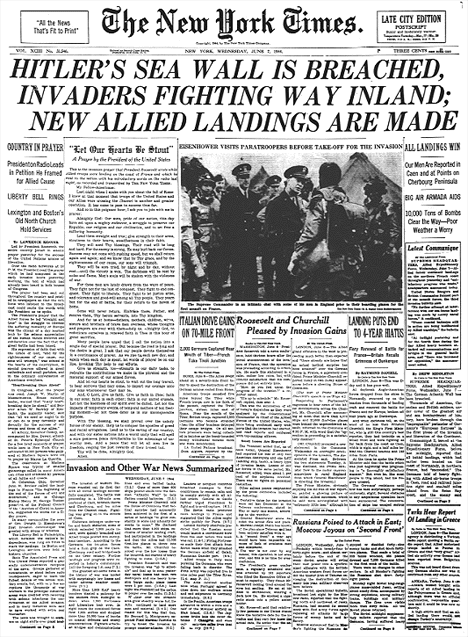
And here is one of the photos from that day. I find this one particularly chilling.
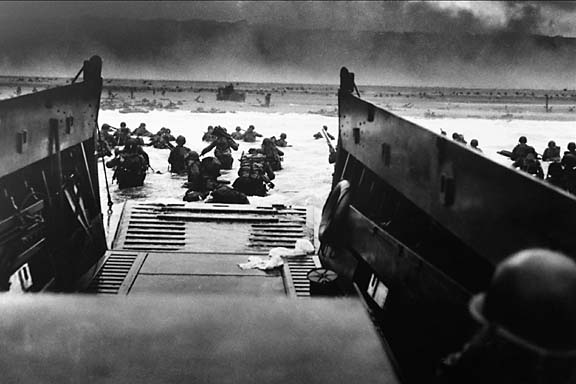
God bless them all.
The Books: "Dot.Con: How America Lost Its Mind and Money in the Internet Era" ( John Cassidy)
Next book in my Daily Book Excerpt:
 Next book in my culture bookshelf is:
Dot.con: How America Lost Its Mind and Money in the Internet Era
The title pretty much says it all. This is the story of the speculative bubble of the 1990s, the insanity of the Internet IPOs (anyone member Web Van? I mean ... what??), the craziness of the prices these stocks sold for, the feeding frenzy on Wall Street, the "irrational exuberance", the complicity of the media (or the gullibility - who knows what to call it - maybe it's just plain old-fashioned greed - they jumped on the bandwagon too) and then the eventual crash. It also details the history of the Internet itself, which I found unbelievably fascinating. Like ... how the hell this whole thing BEGAN. I lived through the Internet-IPO-Craziness first hand, and this book captures the unreal atmosphere perfectly.
The following excerpt describes the IPO of Priceline.com.
EXCERPT FROM Dot.con: How America Lost Its Mind and Money in the Internet Era
Already, it is hard to fathom that just a couple of years ago many intelligent Americans believed that the marriage of computers and communications networks had ushered in permanent peace and prosperity. Depending on which Wall Street or Silicon Valley guru you listened to, the Internet was the most revolutionary development since the electric dynamo, the printing press, or the wheel. The most striking manifestation of this thinking was the extraordinary prices that people were willing to pay to invest in Internet companies. In nearly every sector of the economy, entrepreneurs, many barely out of college, were rushing to establish online firms and issue stock on the Nasdaq, which was heading upward at a vertiginous rate. Names like Marc Andreessen, Jerry Yang, and Jeff Bezos were being uttered with awe.
In March 1999, Priceline.com, an Internet company that operated a site on the World Wide Web where people could name their price for airline tickets, was preparing to do an initial public offering (IPO). In order to introduce Priceline's executives to Wall Street analysts and fund managers, Morgan Stanley, the investment bank that was managing the IPO, rented a ballroom at the Metropolitan Club, at 1 East Sixtieth Street, a fitting location. The Metropolitan, which John Pierpont Morgan founded and Stanford White designed, is a lavish remnant of a previous gilded age. Four stories high, its white marble exterior is fronted by six Roman columns and an ornate cornice. After the guests had picked at their lunch, Richard S. Braddock, Priceline.com's chairman and chief executive, told them that his firm had the potential to revolutionize not just the travel business, but automobile sales and financial services, too. This was a grand claim from a start-up that had been in business for less than a year and employed fewer than two hundred people, but nobody in the room queried Braddock's presentation.
By the standards of the time, Priceline.com had impressive credentials. Jay S. Walker, the company's founder, was a Connecticut entrepreneur who had already made one fortune by peddling magazine subscriptions in credit card bills. Braddock was a former president of Citicorp, and Priceline.com's board of directions included Paul Allaire, a former chairman of Xerox Corporation, N.J. Nicholas Jr., a former president of Time Inc., and Marshall Loeb, a former managing editor of Fortune magazine. William Shatner, the actor who played Captain Kirk in Star Trek, had appeared in a series of popular radio ads for the firm. Morgan Stanley's star analyst, Mary Meeker, recently dubbed "Queen of the 'Net" by Barron's, the weekly investment newspaper, had helped coach the Priceline.com team for their presentation, and she was sitting in the back of the room as they spoke.
The word on Wall Street was that Priceline.com would follow the path of American Online, Yahoo!, and eBay to become an "Internet blue chip." The only question people in the investment community were asking was how much stock they would be able to lay their hands on. Underwriters reserved Internet IPOs for their most favored clients. Other investors had to wait until trading started on the open market before they could buy any stock. On the morning of March 30, 10 million shares of Priceline.com opened on the Nasdaq National Market under the symbol PCLN. They were issued at $16 each, but the price immediately jumped to $85. At the close of trading, the stock stood at $68; it had risen 425 percent on the day. Priceline.com was valued at almost $10 billion -- more than United Airlines, Continental Airlines, and Northwest Airlines combined. Walker's stake in the company was worth $4.3 billion.
Airlines like United and Continental own valuable terminals, landing slots, and well-known brand names -- not to mention their planes. Priceline.com owned some software, a couple of powerful computers, and an untested brand name. Despite this disparity, few on Wall Street were surprised by Priceline.com's IPO. Such events had become an everyday occurrence. The New York Times didn't think the story mentioned a merit on the first page of the next day's edition and instead relegated it to the business section. "It doesn't matter what these companies do or how they are priced," David Simons, an analyst at Digital Video Investments, told the paper. "Each new Internet IPO is nothing more than red meat to mad dogs." Penny Keo, a stock analyst at Renaissance Capital, saw things differently. "We like Priceline's business model," she said.
This was an interesting statement. Priceline.com started operating on April 5, 1998. By the end of the year it had sold slightly more than $35 million worth of airline tickets, which cost it $36.5 million. That sentence bears rereading. Here was a firm looking for investors that was selling goods for less than it had paid for them -- and as a result had made a trading loss of more than a million dollars. This loss did not include any of the money Priceline.com had spent developing its Web site and marketing itself to consumers. When these expenditures were accounted for, it had lost more than $54 million. Even that figure wasn't what accountaints consider the bottom line. In order to persuade the airlines to supply it with tickets., Priceline.com had given them stock options worth almost $60 million. Putting all these costs together, the company had lost more than $114 million in 1998.
How could a start-up retailer that was losing three dollars for every dollar it earned come to be valued, on its first day as a public company, at more than United Airlines, Continental Airlines, and Northwest Airlines put together? To answer that question we must investigate what the nineteenth-century British historian Charles Mackay called "the madness of crowds". Few investors, acting in isolation, would buy stock in a company like Priceline.com. To be willing to take such a risk, people needed to see others doing the same thing -- and see them making money doing it. This is exactly what happened. Investors who bought stock in early Internet companies like Netscape, Yahoo!, and Amazon.com made a lot of money -- at least for a while. None of these firms could boast much in the way of revenues when they went public, let alone profits, but that didn't seem to matter. Seeing what was happening, other people started to buy Internet stocks, and other types of stocks too, not because the underlying companies were good businesses with solid earnings prospects, but simply because stock prices were going up. As history has repeatedly demonstrated, this is the point when a rising market turns into a speculative bubble.
June 5, 2005
Music that makes me specifically nostalgic
Thompson Twins. "If I were king for just one day ..." It reminds me of that surging feeling of HOPE I used to get, on occasion, in high school. I was a creature of deep yearnings, and stifled ambition. I knew what I wanted but I was afraid to go for it. I loved boys with an intensity that burned up my heart, and at that time they never loved me back. I loved hard, got hurt hard ... and still held up this strange strong hope that someday I would meet "him", whoever he was. Thompson Twins, and that song in particular, make me think of that of that feeling.
Billy Idol. I hear his stuff and all I can see is my group of friends going absolutely MAD on some high school dance floor.
John Denver. Summer days when I was a little kid. Windows open, screen door slamming, lips stained from Kool Aid, sand between my toes, sitting on the hot metal of the bulkhead having popsicles. To me, that's what John Denver's music calls to mind.
Lover Boy. "You wanna piecea my he-eart ..." To me, that song IS roller-skating at Ocean Skate every Friday night in high school. We would get dropped off, we would be wearing cute little tops and jeans, we would have on fruit-flavored lip gloss ... and we would have all of these teen-romance adventures, completely defined by the roller rink. That Lover Boy song was THE song to skate to (with "You Should Hear How He Talks About You" a close second).
Jackson Browne. "Hold On, Hold Out". That song in particular. I was 17 years old, it was autumn. My life was exploding on all fronts: I was having an acting triumph that changed my life, and I had fallen in love with someone so hard that it felt like I was staring directly at the sun, but in the meantime I was also being pursued for the first time in my life by a guy - by a DIFFERENT guy ... 2 guys? And both of them were in their early 20s, too. I had it GOIN' ON, even though I was a blushing freckled girl who had never been so much as kissed. But because I'm me, falling in love is always a painful experience; I would never characterize love as pleasant. And that Jackson Browne song arrived at the perfect time in my life ... when I SO needed to hear its message. I listened to it constantly. When I hear it now, I immediately see before my eyes: the face of the guy I was madly in love with, the coldness of the autumn air, the explosion of stars in the sky - he and I stood on my front lawn staring up at them, after seeing 2010 - I couldn't stand it I loved him so much, and there was always that painful feeling of hope and loss that accompanied love in high school. Time slipping away ... you cannot capture the moment ... the moment cannot last ... just eat it up while it is happening ... because every second means the sands are slipping away ...
ELO. Please. Let's not even TALK about ELO. I listened to their Time album for the first time over at Mere's house, and could not believe what I was hearing. I had grown up listening to musicals, John Denver, Ian & Sylvia (the real-life Mitch and Mickey), and Joan Baez. This?? I had never heard anything like it. I can still remember exactly what the cover looked like, the blueness of it, the sci-fi magic of it. I listened to it over and over and over. When I think of ELO, I think of Mere and I, and her living room, with the piano bench, and the couches, and hanging out at her house endlessly.
Devo. On all fronts, Devo was a life-changer. Guys in my high school suddenly felt proud of being geeks, of wearing glasses, and of being in the AV Club. Devo made geek-boys cool and subversive. Devo is another band where - when I hear one of their songs - especially "Whip It" - what I immediately see is the gyrating orgasmic thrashing crowd at my high school dance. The cavernous gym, the DJ under one of the empty basektball hoops, the lights turned down low, high school romance-dramas going on in the bleechers, and people LOSING it on the dance floor. Sometimes the dance floor would empty out, because a song didn't have a good beat. But when Devo played? People flocked in from every which way to pack it in on the dance floor. Devo IS high school to me.
Cliff Eberhardt. I actually was unable to listen to Cliff Eberhardt for many years because of the powerful associations. Cliff Eberhard for me IS Tonio, my first boyfriend. Tonio and I were going to see Christine Lavin in Philadelphia, and Cliff Eberhardt opened for her. We had never heard of him. He blew us away. "My Father's Shoes". It kills me. He and I loved Eberhardt so much that we played him CONSTANTLY. Once the relationship crashed and burned, I found I could no longer listen to Eberhardt. Years passed, though ... and finally I am able to be a fan again. But still. The associations remain, it's just that they no longer cause me pain. Cliff Eberhardt to me is: the black and white tile in our kitchen, the green trees crowding in around our porch, the taste of scotch and soda, the rainy nights when we would go to the little art cinema in Philly ... the cobblestoned streets of Mt. Airy ...
J. Geils. Freeze Frame is a time-travel capsule. It's another high school favorite. We would wait for it feverishly, every high school dance, repeatedly asking the beleaguered DJ to play it ... and when he did? We all would lose our minds. Beth and I would dance so hard that our faces would become beet red, and afterwards, we would run over to the side of the gym and press our sweaty flushed faces against the cool tile. Uhm ... girls? You wanna chill? You want boys to like you and notice you and think you're pretty? Then stop jamming your red Irish faces against the tile walls of the high school gym, mkay?
Huey Lewis. It's the song "Do You Believe in Love" that really sets the pinwheels of associations going. It's such a free song, such a happy open song. When I hear it I think of summer vacations during high school: EARLY in the vacation, say ... the month of June. When there's so much free time spread out in front of you ... and everything seems possible. You go to the beach with your friends. You sit around watching soap operas, vegging out, the day unfurling before you with nothing on the books ... You go to movies with your friends, and you don't have to get up early the next day ...Definitely not the August part of vacation, which is stressful because school approaches, and you're supposed to have read Moby Dick, Tale of Two Cities and Red Badge of Courage by September and you haven't even STARTED. No, "Do You Believe in Love" reminds me of the June month during summer vacations in high school.
Stevie Ray Vaughan. Especially his song with his brother: "Tick Tock People" of all things. A very specific memory is attached to that one song, and although I don't hear the song often - when I do, here is what I see/smell/taste: Southport Lanes (a really cool bar/bowling alley in Chicago), I was wearing a black derby, he and I ate hot chicken wings, and occasionally attacked each other. It was our third date, I think. Nothing had happened yet. We were insane for each other. "Tick Tock People" came on and he told me the story of how he had been at Stevie Ray Vaughan's last concert, and unfortunately he had been with his anorexic girlfriend who made him go get her some food and while he was in the endless line the damn concert started. I don't think he ever forgave anorexia-girl for making him miss the first couple of songs "because she HADN'T EATEN ANYTHING ALL DAY" he shouted. It was a vivid night. Perhaps I remember it because it was the beginning of something that would last for years. A 2nd or 3rd date. Stevie Ray Vaughan always makes me think of him, and "Tick Tock People" makes me think of that crystal-clear night of flirtation, his mouth on my neck, laughter, and hot chicken wings.
XTC. It is "1,000 Umbrellas" that is attached to a very specific time and place. It was on a mix tape given to me the guy I had been in love with. I knew of the song, always loved XTC, but it was like I had heard it for the first time when it came up on my walkman, that sickly summer, when my heart was so fucking broken I couldn't even eat. "1000 Umbrellas" makes me see the echoey lobby of the office building in the Loop where I worked as a temp, the careening escalators filled with droid-like humans at rush hour, the Chicago Opera House across the sluggish green opaque river, sitting on the L train in the morning, listening to 1,000 Umbrellas over and over and over and over ... It fed something in me that was starving. Not just because it had been on a mix he had given me. It was something else. I was starving and heartsick. I stood in the muffled heat of the day, staring across at the Opera House, wondering when I would ever feel normal again. I could only listen to 1,000 Umbrellas, I couldn't get past it. "Just when I thought that my vista was golden in hue, One thousand umbrellas opened to spoil the view ..." But the music itself wasn't wallowy dark PMS-drippy music. It was weird, complex, with violins, and orchestral oddness ... I remember walking around and around outside that office building, in the heat wave, unable to eat, squinting at the sun off the concrete, listening to the song repeatedly. "Now I'm crawling the wallpaper that's looking more like a roadmap to misery ..." I listen to that song now and I remember how unbelievably hot it was that summer, and how there was no escape. From the heat, but also from my heartsick-ness. No way out but through. I emerged forever changed.
Cher. We would blast "Dark Lady" at our college parties (down in the beach house at Sand Hill Cove) and Mitchell would take over the entire scene. So when I hear that song: I see Mitchell, surrounded by his group of friends - all of us laughing so hard that occasionally we have to leave the party to go take a walk and calm down. The smell of the salt air, the sound of the surf at the end of the street, the boozy college party of drama geeks ... and stomach-aching howls of laughter. "Dark Lady laughed and danced and lit the candles one by one ..." It was the mid-80s, but it didn't matter to us. "Dark Lady" might as well have been a Top 40 hit at that point, as far as we were concerned. We would watch Mitchell transform, and then promptly - the second he "became" Cher - we would all start to stagger about, slapping each other, wiping tears away, falling on the ground ... We never ever got tired of it. Then we would take a walk in the briny breeze, gasping for breath, trying to recover from the hilarity.
Hair Too many associations to list. That album has always existed, I grew up alongside of it, it's always been a part of my life. "Frank Mills" always always always makes me think of my friend Betsy, who loved that song, and who sang it for one of our projects in drama class in high school. I have the album, and I know what that woman's voice sounds like ... but whenever I listen to it, I hear Betsy's sweet soprano. Beautiful. And "Aquarius" never ever EVER fails to make me think of Pat =, and my friends who were all "Pat heads". Kenny, Phil, Ann, Mitchell, Alex ... sometimes Pat would BLAST "Aquarius" at the end of his shows, and on one evening in particular - I do not know what happened, but Kenny, Phil, Ann, me, and Mitchell lost our minds. We WENT somewhere. We danced like maniacs, but it was more than that. We transcended. You know when you lose self-consciousness? When you flat out don't care? We all achieved that energy together - with no drugs - at the same moment. It was a spontaneous group event. There was even spontaneous choreography that we generated - it was like we all became ONE BEING during that song. Goofy? Definitely. Fun? More fun than one person should be allowed in a 3 minute time span. When the song ended, we felt like we had to come back to earth, and it was very difficult. Kenny exclaimed, "I have to do that EVERY SINGLE DAY." And I remember Phil saying, with complete seriousness, "I honestly feel like I was just performing in the original production of Hair." hahahaha You'd have to know what Phil looked like, to fully appreciate the humor of this. Big goofy handsome cleancut straight boy. All of this rushes through my mind when I hear that whole "LEEEEET THE SUN SHINE ..." magnificence.
More:.
Tori Amos The "Little Earthquakes" album. That is, without a doubt, the summer of 1992. My first summer in Chicago. I had my own apartment on Melrose. Right by the lake. There was a sickly sweet odor of roach-motels throughout the hallways, and a crazy old-fashioned metal elevator, with grate-like metal doors you had to wrench open and closed. I ran every day along the lake, I ran miles and miles a day. And listened to "Little Earthquakes" as I ran, along the sweep of Lake Michigan, looking at the skyline - the Sears Tower, the Drake Hotel ... and Tori's unbelievable music pushed me on. More than anything else, that album was the music of my freedom. I've rarely felt so free as I felt that summer. Also, randomly: I was very much into eating Cracklin' Oat Bran that summer. I had a bowl every morning. So now whenever I hear the first strains of the first song on "Little Earthquakes", I remember the taste of Cracklin' Oat Bran. Weird, how memory works. It's always summer when I listen to that album. And it's always sunset.
I listened to "Little Earthquakes" one too many times. I can't imagine a time when I would ever choose that album to listen to now ... it had served its purpose. Like a fever burning out.
The Books: "Vamps and Tramps" (Camille Paglia)
Next book in my Daily Excerpt:
 Next book on my culture bookshelf is:
Vamps & Tramps: New Essays
I think this might be my favorite of her books - even beating out Sexual Personae: Art and Decadence from Nefertiti to Emily Dickinson
We've also got book reviews in Vamps and Tramps, and the books reviewed range from a biography of Judy Garland to Edward Said's Culture and Imperialism
But anyway. I highly recommend the book. The first "essay" is actually a short book, and it is called: "No Law in the Arena: A Pagan Theory of Sexuality", and I think it's masterful. In it, she takes on a couple of the different issues of our day, all having to do with sex: the increasingly fascistic atmosphere on college campuses in terms of how it handles rape, sexual harassment laws, prostitution, laws about pornography, gay rights ... It's sweeping, and angry - she thinks the entire world has gone mad, and prudistic ... letting prissy fascists like Catherine MacKinnon dictate to us what we should and should not like. Camille Paglia is on a crusade against sexual fascists like that beeyotch. Having gone to college during the 80s, and having experienced first-hand what I would call the "date-rape hysteria" on college campuses, I found Paglia's words about it SO empowering. SO invigorating. Nobody writes about this stuff like Paglia. Nobody. She's also such a nut. The cover of the book is her, in what looks like some kind of military uniform, with a knife attached to her belt. Like, she's literally taking on the world.
The excerpt I'm going to post today is from her essay "The Nursery-School Campus: The Corrupting of the Humanities in the US", which originally appeared in the Times Literary Supplemtn, in London, on May 22, 1992.
No shit, Camille. Interesting, too: everyone is now talking about the politically correct hiring practices of universities, and the lack of diversity on college campuses, in terms of politics. It's hip to talk about that. Well, Camille has been yammering on about this from way back when, when it was, quite frankly, NOT hip to talk about this stuff ... She is the lesbian kindred spirit of David Horowitz. She was saying the un-sayable, she was revealing the nasty little secret ... and she has, to this date, not been forgiven for it. Which is fine with her.
Also, only a deranged politically-correct mob who conduct all of their conversations in a stifled atmosphere of complete rhetorical agreement could classify Camille - a radical lesbian, a pop culture obsessive, a woman who considers "prostitutes" to be modern-day heroines and warriors - as a member of the far right. Nuts.
Her most recent book on analyzing poetry, Break, Blow, Burn: Camille Paglia Reads Forty-three of the World's Best Poems
EXCERPT FROM Vamps & Tramps: New Essays
The effect upon American universities of the student rebellions was fleeting. Genuine radicals did not go on to graduate school. If they did, they soon dropped out, or were later defeated by the faculty recruitment and promotion process, which rewards conformism and sycophancy. The universities were abandoned to the time-servers and mercenaries who now hold many of the senior positions there. Ideas had been relegated to the universities, but the universities belonged to the drudges.
There is a widespread notion that these people are dangerout leftists, "tenured radicals" in Roger Kimball's phrase, who have invaded the American establishment with subversive ideas. In fact, they are not radicals at all. Authentic leftism is nowhere to be seen in our major universities. The "multiculturalists" and the "politically correct" on the subjects of race, class, and gender actually represent a continuation of the genteel tradition of respectability and conformity. They have institutionalized American niceness, which seeks, above all, not to offend and must therefore pretend not to notice any differences or distinctions among people or cultures.
The politically correct professors, with their hostility to the "canon" of great European writesr and artists, have done serious damage to the quality of undergraduate education at the best American colleges and universities. Yet they are people without deep beliefs. Real radicals stand for something and risk something; these academics are very pampered fat cats who have never stood on principle at any point in their careers. Nothing has happened to them in their lives. They never went to war; they were never out of work or broke. They have no experience or knowledge of anything outside the university, least of all working-class life. Their politics are a trendy tissue of sentimental fantasy and unsupported verbal categories. Guilt over their own privilege has frozen their political discourse into a simplistic world melodrama of privilege versus deprivation.
Intellecutal debate in the humanities has also suffered because of the narrowness of training of those who emerged from the overdepartmentalized and overspecialized universities of the postwar period. The New Criticism, casting off the old historicism of German philolopgy, produced a generation of academics trained to think of literature as largely detached from historical context. This was ideal breeding ground for French theory, a Saussurean paradigm dating from the 1940s and 50s that was already long passe when American academics got hold of it in the early 1970s. French theory, far from being a symbol of the 1960s, was on the contrary a useful defensive strategy for well-positioned, pedantic professors actively resisting the ethnic and cultural revolution of that subversive decade. Foucault, a glib game-player who took very little research a very long way, was especially attractive to literary academics in search of a short cut to understanding world history, anthropology and political economy.
The 1960s failed, I believe, partly because of unclear thinking about institutions, which it portrayed in dark, conspiratorial Kafkaesque terms. The positive role of institutions in economically complex societies was neglected. The vast capitalist distribution network is so efficient in America that it is invisible to our affluent, middle-class humanists. Capitalism's contribution to the emergence of modern individualism, and therefore feminism, has been blindly suppressed. This snide ahistoricism is the norm these days in women's studies programs and chi-chi, Foucault-afflicted literature departments. Leftists have damaged their own cause, with whose basic principles I as a 1960s libertarian generally agree, by their indifference to fact, their carelessness and sloth, their unforgivable lack of professionalism as scholars. The Sixties world-view, which integrated both nature and culture, has degenerated into clamorous, competitive special-interest groups.
The universities led the way by creating a ghetto of black studies, which begat women's studies, which in turn begat gay studies. Not one of these makeshift, would-be disciplines has shown itself capable of re-creating the broad humane picture of Sixties thought. Each has simply made up its own rules and fostered its own selfish clientele, who have created a closed system in which scholarship is inseparable from politics. It is, indeed, questionable whether or not the best interests of blacks, women, and gays have been served by these political fiefdoms. The evidence about women's studies suggest the opposite: that these programs have hatched the new thought-police on political correctness. No conservative presently in or out of government has the power of intimidation wielded by these ruthless forces. The silencing of minority opinoin has been systematic in faculty recruitment and promotion. The winners of that rat-race seem genuinely baffled by such charges, since, of course, their conventional, fashionable opinions have never been stifled.
While lecturing at major American universities this year, I have come into direct conflict with the politically correct establishment. At Harvard and elsewhere I was boycotted by the feminist faculty, and at several colleges leaflets were distributed, inaccurately denouncing me as a voice of the far right. Following my lecture at Brown, I was screamed at by soft, inexperienced, but seethingly neurotic middle-class white girls, whose feminist party-line views on rape I have rejected in my writings. Rational discourse is not possible in an atmosphere of such mob derangement.
June 4, 2005
My favorite ex: Let me brag about him....
... because I'm proud of him and excited for him.
Michael, a guy I dated many moons ago (he is, as Jess would call it, my "favorite ex"), is an actor and independent film-maker. He scored a pretty big indie hit with his first film (that he directed, acted in, and wrote - boy is amazing!!) Kwik Stop. Roger Ebert took notice of it, reviewed it extremely favorably, and has been a huge supporter of Michael ever since. Ebert chose it for his Overlooked Film Festival, in 2002. Scroll through to see pictures of Gilio in action.
On June 14, the DVD of Kwik Stop will be released - and I'm so excited. For any Chicago-ans, Roger Ebert is hosting a screening of it, and here are the deets:
June 29, at the Gene Siskel Film Center You can purchase tickets there.
Michael is a man who has a permanent place of affection in my heart. He is a true gentleman, so sharp - (don't EVER lie to this guy), he's a pain in the ass, a kick-ass disco dancer, and just plain old awesome. He's also a babe. We met when we were both in a play in Ithaca - an insane out-of-town experience which we still laugh about to this day. One of our shared passions was the films of John Cassavetes. When we discovered that about one another, we felt like we were ancient-day Christians, members of a sacred and bizarre little sect that nobody else understood. We talked about Cassavetes and his muse, Gena Rowlands, for hours. We didn't date for long, only a couple of months, but that was it. We were friends for life. For example, we lost touch for a couple of years. I was in grad school, he was busy ... we lived in different cities ... but when September 11th happened, he called Mitchell to get my new phone number, and left me multiple messages on that first day of trauma ... which, of course I did not get. When I finally picked up all of my messages when my phone worked again, and I heard the 70+ messages I received on that one day (I'm not kidding ... it was a voice mail system I paid for, so there was unlimited space) ... I felt like my heart would burst. And there was Michael's voice, a couple of different calls over that day and the next. "I have no idea why you would be down in the financial center, because you're an actor ... but ... just call me ... okay? I'm sure you're fine, but just call me." Major phone problems for a couple of days, I could not get through to anyone, but he kept trying until I was able to call him back a couple days later. Friends for life, man.

One of the main things I recall, is my last night in Chicago, before taking off to New York to start my new life here. And he showed up at my house at midnight, to say good-bye. It was a soft quiet end-of-summer night. I lived a couple blocks from Wrigley Field with Mitchell. Although Wrigley Field is, of course, a hubbub of madness, we lived on a quiet side street, right behind the old Music Box Theatre on Southport. A beautiful tree-lined peaceful street. I visited it during my last trip to Chicago, and just walked up and down it, soaking up all my memories. I remember that tree ... Look at my old little stone porch where we used to sit and have coffee ... There's my old bedroom window in the alley where M. used to come and basically break into my room, because he was a lunatic, and he didn't know about doorbells. There was that lush garden I remember from next door. God, that street ... so much life lived on that street.
My last night before I left, before I ripped up my Chicago roots and moved back east, was full, and sad, and rich. I went out to dinner with my core group of friends. Michael had been invited but he couldn't show. He had been vague in his refusal: "Maybe I'll be able to make it ... I might be done in time ..." I knew that this probably meant I wouldn't see him before I left. But there was too much else to be glad about, to be thankful for, to have regrets. We all sat around outside, and had pizza, and beer, and talked. Everyone at the table told their favorite Sheila story from Chicago. (And there were many.) We laughed until we cried. Sometimes we just cried. A beautiful acknowledgment, and a perfect way to close. Close it up. It was achingly difficult for me to leave Chicago, but I had to. Saying goodbye to my community of friends was painful. But we did it the right way. We didn't rush it, or pretend it wasn't happening, or try to smooth over the moment with trite, "Oh, we'll all still be friends". Of COURSE we'll all still be friends, but it cannot be denied that the dynamic will change.
Our night ended, and we all parted ways. Mitchell and I came home to our quiet leafy-shaded side street. I think Ann Marie was with us, too. It was so quiet. There was a melancholy in the darkness, a piercing bittersweetness ... but there was also joy. The kind of joy that is unbearable. I sat on the front porch, drinking grape ginger ale ... why do I remember that? I don't know. I never drink grape ginger ale but for some reason that night I was ... and every time I see a big ol' bottle of it at Pathmark I think of my last night in Chicago. Ann and I sat on the front steps in the dark. We were quiet. We were going to see each other early early the next morning, since she was helping me pick up my rent-a-car at, oh, 5 oclock in the morning. There was just the darkness, and the quiet. I wanted to soak everything in, imprint every single physical sensation onto my brain. Forever. My wind chimes. God, those wind chimes. The thick grass of the front yard. The plaintive Meows of my insistent codependent cat Samuel who had legs like a supermodel's. He could not BELIEVE that I was sitting outside, RIGHT IN HIS PLAIN VIEW THROUGH THE WINDOW ... and he couldn't come out and join. He was out of his mind with jealousy and impotent rage. The night was cool. And you know what? I think I did a good job with "soaking everything in", because I remember every sensory detail. I can close my eyes and conjure up that street, that night, the feel of the soft night air on my skin, the taste of the grape ginger ale ...
The street was empty, but at some point, I became aware of a lone figure approaching. He was in shadow, dark, but I knew ... I knew it was Michael. He had come to see me off. At midnight. I was barefoot, I jumped up and ran down to meet him, my heart in my throat, my soul on the OUTSIDE of me ... We hugged and hugged and hugged, and Ann Marie quietly slipped away to leave us alone. We had stopped dating about a year prior to this point, but that was no matter. There was a powerful thing to say good-bye to here. We both knew it. I was so glad he showed. So glad. It just made everything perfect, complete, a closed circle. No ragged edges for my departure. And we sat on my front porch, and we drank ginger ale, and we talked about ... I can't even really remember. Not too many words were said, actually. What was said was brief and tender and poignant. He kissed me for what felt like an eternity. Lost in each other. I won't ever forget that last night. I felt looked after, cared for, like ... things were okay. It was okay I was leaving. It was hard, but it was okay. And seeing him strolling towards me in the darkness, showing up after the crowd had dispersed ... showing up for his own private good-bye ... It was good and right. Maybe Michael knew that a group event, a group dinner, wouldn't have been appropriate for the two of us. We could never have said what we needed to say in that environment, we could never have completed our own little special circle.

I haven't seen him in a couple of years, and when I received the promotional email from him today, I felt a burst of gladness. I am always glad to hear from him, and no matter how long it has been ... how many years has gone by ... when I hear from him, I get that same sensation of when I caught a glimpse of his shadowed figure coming towards me on that last night, and I leapt up and ran to him in my bare feet. Unafraid to show him my joy, unafraid to let him know how happy it made me that he had come ... I didn't have to hide my intensity with him, I never did. He was all about that intensity, he loved it.
Oh, and did I mention what an incredible disco dancer he is?
Anyway, I'm going on like this because I'm happy for him, and I want to spread the good word about his good film.
Here are what some of the reviewers had to say about Kwik Stop:
"Kwik Stop is one of the unsung treasures of recent independent filmmaking. On a weekend when $400 million in slick mainstream productions are opening, this is the movie to seek out."
Roger Ebert
Chicago Sun-Times
"Michael Gilio's marvelous Kwik Stop is a funny, evocative and constantly suprising low budget anti-road movie. One of the year's best American Indies; you won't forget it soon."
Michael Wilmington
Chicago Tribune
"Michael Gilio's Kwik Stop might not only be the best road movie in years, but also one of the best movies of the year, period."
St.Louis Post Dispatch
"A very funny black comedy."
New York Post
"A gently humorous tale. Kwik Stop is a showcase for talented writer-director and lead actor Michael Gilio."
Hollywood Reporter
"Frequently endearing picture's handful of indelible scenes, generally strong performances and uniquely arrhythmic pacing suggest some audiences may take to it as a cult event."
Variety
"There are so many curves and anomalies in this unpredictable and at times cryptic independent feature that I'm tempted to call it an experimental film masquerading as something more conventional. There's no way I can shake off the experience."
Jonathan Rosenbaum
Chicago Reader
"Kwik Stop is a highly entertaining and refreshing variant on the US indie."
Senses of Cinema
"By turns infuriating, charming, wistful and annoying. Kwik Stop winds up a touching, if frustrating film."
FilmThreat
"Kwik Stop differentiates itself from any acknowledged formats and brings forward many mysteries and more questions than answers."
Diario La Nacion
"Kwik Stop is one of those rare American films that allows itself to ask questions, argue with a reality assumed to be known and aim at a poetics where the false is indistinguishable from the true, thus collapsing the myth of identity on which the American cinema has been built."
El Alamante Cine
"Kwik Stop is shot with assurance, quirky without ever becoming whimsical, and engagingly acted. A confident, quietly stylish feature."
New City

June 14: the DVDs make their debut. Definitely check this flick out. Michael Gilio is the real deal. He always was.
UPDATE: My review of Kwik Stop here.

16 years ago today
Read the entire article that appeared in the New York Times on June 4, 1989:
June 4, 1989, NY Times:
BY NICHOLAS D. KRISTOF
Beijing, Sunday, June 4 -- Tens of thousands of Chinese troops retook the center of the capital early this morning from pro-democracy protesters, killing scores of students and workers and wounding hundreds more as they fired submachine guns at crowds of people who tried to resist.
Troops marched along the main roads surrounding central Tiananmen Square, sometimes firing in the air and sometimes firing directly at crowds of men and women who refused to move out of the way.
Early this morning, the troops finally cleared the square after first sweeping the area around it. Several thousand students who had remained on the square throughout the shooting left peacefully, still waving the banners of their universities. Several armed personnel carriers ran over their tents and destroyed the encampment.
Reports on the number of dead were sketchy. Three Beijing hospitals reported receiving at least 68 corpses of civilians and said many others had not been picked up from the scene. Four other hospitals said they had received bodies of civilians but declined to disclose how many. Students said, however, that at least 500 people may have been killed in the crackdown.
Most of the dead had been shot, but some had been run over by armored personnel carriers that forced their way through barricades erected by local residents.
The official news programs this morning reported that the People's Liberation Army had crushed a "counterrevolutionary rebellion" in the capital. They said that more than 1,000 police and troops had been injured and some killed, and that civilians had been killed, but did not give details.
Changan Avenue, or the Avenue of Eternal Peace, Beijing's main east-west thoroughfare, echoed with screams this morning as young people carried the bodies of their friends away from the frtonf lines. The dead or seriously wounded were heaped on the backs of bicycles or tricycle rickshaws and supported by friends who rushed through the crowds, sometimes sobbing as they ran.
The avenue was lit by the glow of several trucks and two armed personnel carriers that students and workers set afire, and bullets swooshed overhead or glanced off buildings. The air crackled almost constantly with gunfire and tear gas grenades.
"General strike!" people roared, in bitterness and outrage, as they ran from Tiananmen Square, which pro-democracy demonstrators had occupied for three weeks. "General strike!"
While hundreds of thousands of people had turned out to the streets Saturday and early today to show support for the democracy movement, it was not clear if the call for a general strike would be successful. The Government had been fearful that a crackdown on the movement would lead to strikes, but its willingness to shoot students suggested that it was also capable of putting considerable pressure on workers to stay on the job.
The morning radio news program reported that it would be "very difficult" to hold a meeting of the National People's Congress standing committee as scheduled. The committee, which had been scheduled to meet June 20, has the power to revoke martial law and oversee the Government, and many members of the panel are known to be deeply upset by the crackdown.
The announcement by the Beijing news program suggested that Prime Minister Li Peng, who is backed by hard-liners in the Communist Party, was still on top in his power struggle for control of the Chinese leadership. The violent suppression of the student movement that those who favor conciliation, like party leaders Zhao Ziyang, at least temporarily have little influence on policy.
It was too early to tell if the crackdown would be followed by arrests of student leaders, intellectuals who have been critical of the Party, or members of Mr. Zhao's faction. Blacklists have been widely rumored, and many people have been worried about the possibility of arrest.
Students and workers tried to resist the crackdown, and destroyed at least sixteen trucks and two armored personnel carriers. Scores of students and workers ran alongside the personnel carriers, hurling concrete blocks and wooden staves into the treads until they ground to a halt. They then threw firebombs at one until it caught fire, and set the other alight after first covering it with blankets soaked in gasoline.
The drivers escaped, but were beaten by students. A young American man, who could not be immediately identified, was also beaten by the crowd after he tried to intervene and protect one of the drivers.
Clutching iron pipes and stones, groups of students periodically advanced toward the soldiers. Some threw bricks and firebombs at the lines of soldiers, apparently wounding many of them.
Many of those killed were throwing bricks at the soldiers, but others were simply watching passively or standing at barricades when soldiers fired directly at them.
Two groups of young people commandeered city buses to attack the troops. About 10 people were in each bus, and they held firebombs or sticks in their hands as they drove toward lines of armored personnel carriers and troops. Teenage boys, with scarves wrapped around their mouths to protect themselves from tear gas, were behind the steering wheels and gunned the engines as they weaved around the debris to approach the troops.
The first bus was soon stopped by machine-gun fire, and only one person -- a young man who jumped out of a back window and ran away -- was seen getting out. Gunfire also stopped the second bus, and it quickly caught fire, perhaps ignited by the firebomb of someone inside. No one appeared to escape.
It was also impossible to determine how many civilians had been killed or injured. Beijing Fuxing Hospital, 3.3 miles to the west of Tiananmen Square, reported more than 38 deaths and more than 100 wounded, and said that many more bodies had yet to be taken to its morgue. A doctor at the Beijing Union Medical College Hospital, two miles northeast of the square, reported 17 deaths. Beijing Tongren Hospital, one mile southeast of the square, reported 13 deaths and more than 100 criticially wounded.
"As doctors, we often see deaths," said a doctor at the Tongren Hospital. "But we've never seen such a tragedy like this. Every room in the hospital is covered with blood. We are terribly short of blood, but citizens are lining up outside to give blood.
Four other hospital also reported receiving bodies, but refused to say how many.
In addition, this reporter saw five people killed by gunfire and many more wounded on the east side of the square. Witnesses described at least six more people who had been run over by armored personnel carriers, and about 25 more who had been shot to death in the area. It was not known how many bodies remained on the square or how many people had been killed in other parts of the capital.
It was unclear whether the violence would mark the extinction of the seven-week-old democracy movement, or would prompt a new phase in the uprising, like a general strike. The violence in the capital ended a period of remarkable restraint by both sides, and seemed certain to arouse new bitterness and antagonism among both ordinary people and Communist Party officials for the Government of Prime Minister Li Peng.
"Our Government is already done with," said a young worker who held a rock in his hand, as he gazed at the army forces across Tiananmen Square. "Nothing can show more clearly that it does not represent the people."
Another young man, an art student, was nearly incoherent with grief and anger as he watched the body of a student being carted away, his head blown away by bullets.
"Maybe we'll fail today," he said. "Maybe we'll fail tomorrow. But someday we'll succeed. It's a historical inevitability."
On Saturday the police had used tear gas and beat dozens of demonstrators near the Communist Party headquarters in Zhongnanhai, while soldiers and workers hurled bricks at each other behind the Great Hall of the People. Dozens of people were wounded, but exact numbers could not be confirmed.
It appeared to be the first use of tear gas ever in the Chinese capital, and the violence seemed to radicalize the crowds that filled Tiananmen Square and Changan Avenue in the center of the city. The clashes also appeared to contribute to the public bitterness against the Government of Prime Minister Li.
The violence on both sides seemed to mark a milestone in the democracy movement, and the streets in the center of the city were a kaleidescope of scenes rarely if ever seen in the Chinese capital: furious crowds smashed and overturned army vehicles in front of Zhongnanhai, and then stoned the Great Hall of the People; grim-faced young soldiers clutching submachine guns tried to push their way through thick crowds of demonstrators near the Beijing train station; and the police charged a crowd near Zhongnanhai and used truncheons to beat men and women disabled by tear gas.
"In 1949, we welcomed the army into Beijing," said an old man on the Jianguomenwai bridge, referring to the crowds who hailed the arrival of Communist troops at the end of the Communist revolution. Then he waved toward a line of 50 army trucks that were blocked in a sea of more than 10,000 angry men and women, and added, "Now we're fighting to keep them out."
Most Chinese seem convinced that the tanks and troops had been ordered into the city to crush the pro-democracy demonstrations once and for all. The immediate result of the first clashes was to revitalize the pro-democracy movement, which had been losing momentum over the last 10 days, and to erase the sense that life in the capital was returning to normal. But the use of tanks and guns came later, and it was not clear if they would succeed in ending the movement or would lead to such measures as a general strike.
The tension was exacerbated by an extraordinary announcement on television Saturday night, ordering citizens to "stay at home to protect your lives". In particular, the announcement ordered people to stay off the streets and away from Tiananmen Square.
"The situation in Beijing at present is very serious," the Government warned in another urgent notice read on television. "A handful of ruffians are wantonly making rumors to instigate the masses to openly insult, denounce, beat and kidnap soldiers in the People's Liberation Army, to seize arms, surround and block Zhongnanhai, attack the Great Hall of the People, and attempt to gather together various forces. More serious riots can occur at any time."
There were some reports that the Communist Party's ruling Politburo had met Friday and given the Beijing municipality the authority to clear the square and end the protests. The People's Daily and the television news on Saturday took a hard line against the unrest, and the evening news warned that "armed police and troops have the right to use all means to dispose of troublemakers who act willfully to defy the law."
The clashes and enormous outpouring of support for the students were an unexpected turnaround for the democracy movement. Just a few days ago, the number of students occupying Tiananmen Square had dropped to a few thousand, and students seemed to be having difficulty mobilizing large numbers of citizens to take to the streets. The Government's strategy, of waiting for the students to become bored and go home, seemed to be leading to the possibility of a resolution to the difficulty.
Then a police van crashed into four bicyclists late Friday night, generating new outrage against the Government. One cyclist was killed instantly, and two died in the hospital Saturday, while the fourth seemed less seriously hurt.
Rumors were less meticulous about detail, and word spread early Saturday morning through the capital that four people had been killed by the police. Tens of thousands of people took to the streets to protest, and immediately found themselves confronting more than 2,000 unarmed troops who were marching toward Tiananmen Square.
The troops retreated, but that confrontation seemed to set the tone for the massive demonstrations later Saturday and early today.

Judy, Judy, Judy
Alex has an incredible tribute up to Judy Garland.
My favorite? The quote from Aretha Franklin:
"If you asked me to describe the best blues singer in the business, I would have to say Judy Garland. No one sang the blues like Judy. No one."
The Books: "Sex, Art, and American Culture" (Camille Paglia)
Next book in my Daily Book Excerpt. Onward into my 'cultural commentary' section.
 Next book is Sex, Art, and American Culture: Essays
God, I love Camille.
This is a collection of her essays. The topics range from: Madonna, to date rape, to academia, to Elizabeth Taylor, to drag queens, to multiculturalism, to Cleopatra...You know. Typical Camille. Pop culture, ancient culture, and politics all mixed up into one pot. Sometimes it works, sometimes it doesn't .... but even when it doesn't work, I love Camille. I'm reading her new book on poetry now, and it's terrific.
The following excerpt is from her essay "The Strange Case of Clarence Thomas and Anita Hill", which appeared in the Philadelphia Inquirer, on Oct. 21, 1991.
Amen, Camille. At the time, I remember hearing Bonnie Raitt at some concert, give a shout-out to Anita Hill ... and blah blah blah ... Like: what exactly did this woman do that I should clap and cheer for? Be a "victim"? First of all: I will NEVER cheer because someone is an honest to God victim. I'll sympathize, but I will not fucking cheer. But I'm not so sure she even WAS a victim. Listen Anita, sweetheart: there are plenty of us women out there who flat out don't tolerate shite that makes us uncomfortable, and we address it AT THE TIME. (Ahem.) If you were uncomfortable at his joking (and I'm with Camille: if you can't handle joking like that, then that's YOUR problem) ... then it's your responsibility to say: "That makes me uncomfortable." And 9 times out of 10, someone will stop if you say that.
Ah, whatever. I just didn't get the "YAY FOR ANITA HILL" bandwagon, even way back then ... and kept thinking: "Wait a sec ... please ... someone tell me ... what exactly did she do? Besides put up with something in silence and NOT lose her job - hell, she got promoted - and then emerge 10 years later to complain about it? And I'm supposed to idolize her ... why??"
Nope. Didn't buy it. Give me a chick who is actually willing to lose her job, and stand up for herself, over that noise any day.
Take. Responsibility. For. Yourself.
Thank you.
This has been a public service announcement, brought to you by Red.
Here's the excerpt.
EXCERPT FROM Sex, Art, and American Culture: Essays
The sexual revolution of my Sixties generation broke the ancient codes of decorum that protected respectable ladies from profanation by foul language. We demanded an end to the double standard. What troubles me about the "hostile workplace" category of sexual harassment policy is that women are being returned to their old status of delicate flowers who must be protected from assault by male lechers. It is anti-feminist to ask for special treatment for women.
America is still burdened by its Puritan past, which erupts again and again in public scenarios of sexual inquisition, as in Hawthorne's The Scarlet Letter. If Anita Hill was thrown for a loop by sexual banter, that's her problem. If by the age of twenty-six, as a graduate of the Yale Law School, she could find no convincing way to signal her displeasure and disinterest, that's her deficiency. We cannot rely on rigid rules and regulations to structure everything in our lives. There is a blurry line between our professional and private selves. We are sexual beings, and as Freud demonstrated, eroticism pervades every aspect of our consciousness.
Hill woodenly related the content of conversations without any reference to their context or tone. The senators never asked about joking, smiles, facial expressions, hers as well as his. Every social encounter is a game being played by two parties. I suspect Hill's behavior was complioant and, to use her own word about a recent exchange with a Thomas friend, "passive". Judging by her subsequent cordial behavior toward Thomas, Hill chose to put her career interests above feminist principle. She went along to get along. Hence it is hypocritical of her, ten years later, to invoke feminist principle when she did not have the courage to stand on it before. For feminists to make a heroine out of Hill is to insult all those other women who have taken a bolder, more confrontational course and forfeited career advantage.
June 3, 2005
On June 20, 1975 ...

... the movie Jaws was released in the United States, and this year, the Great White movie celebrates its 30th birthday.
The story of the filming of this movie is legendary - the broken shark, the running over-budget, the nuttiness ... The first time the mechanical shark appeared, it burst out of the water tail first before sinking to the bottom of the ocean. He was not a cooperative shark. He was a "Method" shark, perhaps.
Steven Spielberg named the shark Bruce, after his lawyer.
He'd say to the mechanics: "So how's Bruce? Is he almost fixed?"
Spielberg, when he came to my school, described the first preview. He stood in the back of some movie theatre in, oh, Texas, or Iowa ... somewhere far far from "the business'. He couldn't relax. He couldn't sit. He needed to stand, and feel the vibe of the audience ... see how it was going from that perspective. At one point, a gentleman got up and started walking for the door. Spielberg's thought-process was, immediately: "That's it. The film's too violent. Nobody's gonna like it. This is bad. I shouldn't have done this... Serves me right ..." And then ... the man began running up the aisle. Spielberg then thought: "Oh my God, he's not just walking out, he's running out - this is a disaster!" And then - just before he made it to the door, the gentleman got down on one knee, and vomited all over the carpet. Spielberg saw his life flash before his eyes. He thought his career was over before it had even begun. But then: THE MAN WENT BACK TO HIS SEAT. hahaha Spielberg knew, when that poor vomiting man went back to his seat for MORE, that this was going to be an enormous hit, and his life would change.
And lastly - and this is kind of a famous piece of trivia - but still I enjoy it: Spielberg was, what, 25 years old? Okay? He had done a couple of good things, things that had got him noticed ... but getting offered this direction job was a break. However, he said, when they offered it to him: "I will only do this movie if I don't show the shark for over an hour into the film." The producers and studio heads fought back on this. What good is a movie about a big shark if you never see the shark??? Spielberg, of course, knew what the feckin' Greeks knew, what Shakespeare knew: off-stage violence is far more terrifying. It balloons in the audience's imaginations ... If you never see that shark, then you will never EVER be able to relax. Spielberg (already kind of a genius at negotiation - he never EVER threatens to walk out on a deal unless he is ready to actually walk out on the deal) was ready to walk. The producers said, "Are you serious? No shark until an hour in??" He said, "Yes. I won't do it unless you agree to let me film it that way." Needless to say, the producers caved ... Spielberg did what he wanted ... and scared the bejesus out of everybody. You don't have to see that damn shark. It's also so perfect for the material - because the shark emerges from the deep - If you're swimming in the ocean, you couldn't see the shark coming either. Spielberg, using that device, put the audience in the ocean with the people in the movie. Terrifying.
Anyway: happy 30th birthday, Bruce!!
To my father
... who played catch with me in the backyard, for years, during my childhood ... as dinner was being prepared. We threw the ball back and forth in the cool summer night, with the fireflies blinking ... until it got too dark to see the ball.
... who, if you ask him a random question about pretty much anything, will stand up, walk over to a random bookcase, pull out a book (without having to look for it for longer than 10.2 seconds), and read to you a relevant quote that will answer your question
... who made multiplication-table flashcards for me when I was in 4th or 5th grade and really struggling with math. He sat down and just drilled them with me, over and over and over ... I still use some of his little mental tricks when I multiply stuff
... who would tell us stories, when we were kids, about his Boy Scout trips. With the flash flood. And there was a story involving swallowing a goldfish too. We would request to hear these stories over and over ...
... who loves to body-surf. When we all were little, we used to run after his body, as he careened by us in the middle of some wave, and try to catch a ride on his back.
... who was my tutor/guide when I first read Ulysses a couple summers ago. He was RIGHT there. I would call him with questions. I would read him one sentence, with an unfamiliar name in it, and he would reply without a thought: "That's from the Eolus episode. So-and-so was the editor of the Irish Times at the time." Astonishing. Also, I was reading one section, and just WAS NOT GETTING IT. What the HELL is going on? My father walked by, and I said, "Dad - I am baffled. I just started up a new section, but I have NO IDEA what is going on." I gave him the book, my dad scanned the page - he didn't even READ the page - just glanced at it, and said, "This is from the Cyclops episode." He hadn't looked long enough to take in the text itself, so I said, "Uh ... how do you know?" He held out the book to me: "It's in first person. Look at how many times the word 'I' appears on the page." All he did was look at the text on the page, and he saw all the: "says I" "I said" "so I said" "says I" "says I" ... and it's true. If you just glance at a page of that section, in a cursory way, all you can see is I I I I I I I I I. A ton of "eyes". But I never could have seen that without my father. He helped me crack the code of that book. He helped me see in a new way. You couldn't have a better Joycean guide than my dad.
... who is a wonderful grandfather. He looks at Cashel, and beams.
... who loves all of my friends. Mainly because they love me and treat me well. He is fiercely protective of his kids. You're good to his kid? He will let you in. You're bad to his kid? You are TOAST. He is all about family. He would prefer to sit around surrounded by his kids than do pretty much anything else.
... who pulled his 4 kids out of school when we were kids, and took us over to Ireland. I grumbled about all "the stupid monasteries" at the time, but it was a growing experience, a time that changed me forever. We drove, and went to graveyards, and abbeys, and monasteries ... He made us pay attention.
... who always made us pay attention to our heritage. We grew up having an allowance ritual. We had to memorize certain things in order to get ... oh ... 50 feckin' cents, or whatever it is. We had to memorize books by certain Irish authors (we each were assigned a different author - I had Yeats). We also had to memorize the US Presidents. Kind of says it all. It's wonderful to have BOTH. Appreciation of where you came from, and appreciation for where you are now.
... who is an amazing gardener. You should see our side yard. He's an artist.
... who has come to see pretty nearly every damn show I have ever done. That's dedication.
... who is the quintessential Stand-up Guy.
... who is an absolute Red Sox fanatic. I mean, we all are - but my father especially. He knows everything. Not just about the Red Sox, but about baseball in general. Again, random statistics are there for him, at a moment's notice. He's great to talk to about baseball.
... who has helped me to understand James Joyce. I decided a couple years ago (believe it or not, I came to Joyce late) that I needed to just dig in and do it. Read every word. Read the biographies. Just ... see how I felt about it. James Joyce changed my life. But it was my dad's guidance that helped me to "get" James Joyce.
... who loves art. He and my mother are always taking random afternoon drives into the west of Massachusetts, or the northeastern corner of Connecticut, to go to some random museum that has 3 Edward Hoppers, or 1 Winslow Homer sketch ... They're incredible. All of us children laugh about it. "Where are Mum and Dad?" "Oh ... at some museum in Portsmouth or something." But it's a great thing.
... who reads my blog every day. Sometimes he comments. I love it when he does.
... who supports me in whatever I decide to take on. He's there. He's just plain there.
... who every year, at Thanksgiving, when we go around the table and say what we're thankful for, he says: "I say it every year, and I'll say it again this year. I'm thankful for Sheila Mary." (My mother.) Every year. Every year he says it. (Lump in throat right now)
It's his birthday today. My father. Every day I thank God for him.
Here's an EXTREMELY funny (to me, anyway) Diary Friday entry about playing Trivial Pursuit with my dad, my mother, and Jean. hahahaha
Happy birthday, Dad!!
Weekend survey
Another weekend survey from RTG:
1. Would you rather be chased by a wild boar or make out with Kirsty Alley for five minutes?
I'm going with Kirstie Alley, despite the Scientology and the fact that she's a woman. Mainly because -- SHE'S HUMAN, mkay?
2. Who is your favorite US President?
I'm going with Abraham Lincoln, although it's a tough choice. I also like George Washington and I give Jefferson the props for doubling the size of our country with a flick of the pen. Nice job. But still. I'm gonna say Lincoln.
3. Describe a memory from your childhood.
Huge thunderstorm up at Sunapee Lake. I must have been 7, 8 ... all of the cousins (there were tons of us in the house) were awoken by this shattering storm, and huddled together in a pigpile on one of the beds. Then we all snuck downstairs - I remember my barefeet on the cold tile kitchen floor - and we had bowls of Cap'n Crunch, sitting at the table, our feet dangling, in the middle of the night, as the storm RAGED across the mountains and the lake. No grownups. Just kids. And I remember the Cap'n Crunch in particular.
4. What is more important: the experience or the memory of the experience? Which do you treasure more?
As someone who can get pretty wrapped up in "memories of the experience" - I have to say that it is the experience itself that I really treasure. Memories can blur the edges, and your mind can play tricks on you. Also, it is a way to keep yourself trapped in the past. But to treasure the experience itself? Beautiful.
5. Fill in the blank: Republicans do it _______.
... with wild boars.
6. Fill in the blank: Democrats do it ________.
... with Kirstie Alley.
7. Have you ever been arrested?
No. Had a near-miss, though, in the summer of 1994, during Milwaukee Summer Fest. Long FUNNY story. Thought we would have to have Pat McCurdy bail us out of jail, in order for us to make our shows on time. But it all ended up being fine.
8. Describe your looks the way somebody who was madly in love with you would describe them.
"I'm obsessed with her skin. It's the smoothest skin ever. I love the little freckles on her face, and when she blushes, I want to squeeze the living daylights out of her."
Man, that felt vain. Sorry. But that's what he said.
9. What have you done for entertainment this week?
Trivia night at Willie McBride's. Drinks with two friends last night. Caught up on The West Wing, now that I have TV. Watched Britney & Kevin.
10. What are you doing this weekend?
Laundry. Long walks. A lot of writing. My class starts next week. Need to clear a big space (emotionally and physically) for it. Getting into work-mode. I can feel it.
11. What interests you? (In other words: what are your hobbies and obsessions?)
Cary Grant
Old movies, in general. Actually, any movies.
American history
Books about:
1. genocide
2. totalitarian regimes
3. military coups in 3rd world countries
4. living under a fundamentalist theocracy
5. war
6. the horrors of communism
Madeleine L'Engle books
Theatre history
Ireland.
12. Describe an incident in which you demonstrated leadership.
I remember doing a bit of tough-love leadership with a good friend of mine who was floundering in a ridiculous relationship and obsessing about things. I watched her sense of herself disappear, I watched her lose her bearings ... and, to put it mildly, this guy was not worth it. She asked me what I thought, and I gave it to her point-blank. I could almost see the veil lifting from her eyes. I said all of it with love, too, so that's probably why she could actually HEAR me. She made me talk for a couple of hours. "So what else? What else do you see?" At the end of all of that, my friend was back. But I was very firm with her. She would say to me, "See, but the way I see it is ..." and then out would come this excuse of a reason. A justifying his stupid behavior ... and I would cut her off. "Nope. That's not it at all." Instead of fighting me on it, she would say, "It's not?? Then what is it???" And I would tell her. I was pretty kick-ass during the marathon conversation. Nobody else was giving her the truth. Everyone else in her life was saying "all the right things", which meant making excuses for him, pumping up her own confidence, etc. Being an echo chamber. I couldn't. She still references that conversation today, as a moment when her life changed. She had me write down all my thoughts, because she knew she might forget them in the clear light of day.
I'm not sure if that's what you meant by demonstrating leadership ... But that was the first thing that came to mind.
13. Tell me a fantasy event, something you would love to see happen. It must be political in nature, and can be completely ridiculous.
I'd like to see a world with no war.
14. Free Associate:
a. Paulie Shore: Encino Man, dude!! Brendan Fraser rocks! Paulie Shore sucks, but I love that movie.
b. Overdraft protection. A lifesaver
c. Rent control. Jealous.
15. Tell me at least one thing you'd like to see me write about.
One of your other commenters, RTG, mentioned a "book club". I think that would be great, too.
This Strange Effect: A Kink-Sized Obsession - Track 2 (Liam)
This Strange Effect: A Kink-Sized Obsession - Track 2 (Liam)
- and I like it - This Strange Effect, that is. Thanks to all for the comments, which have really excited me because now I can bounce off those ideas instead of trying to figure out what ridiculous level of minutiae to concentrate on next.
So, randomly - "Father Christmas"! Ah, the Christmas song. And its poor, poor, poor bastard son the rock Christmas song. There are really not very many good rock Christmas songs (that is of course if you leave out the entire Ventures Christmas Album - which has the advantage of having no dopey lyrics AND arrangements based on the top hits of '65 - but that is an entirely other matter). "Jingle Bell Rock" is idiotic - but has those great guitar licks, so it gets a pass. Jeez, I cannot really think of anything in the category that is even decent! Excepting our boys - "Father Christmas" - the perfect mix of old style rocking Kinks with a kick in the ass from punk rock. The lyrics are hilarious and touching. There is the great break, again with the descending chords- "and give my daddy a job cause he needs one" - for some reason Ray never sounds sappy. No Christmas song would be complete without the obligatory sleigh bells, used to nice effect in the accappella breakdown. But of course my favorite part is Dave's wailing leads, that pealing riff as Ray pounds out the power chords like its '66. My favorite rock Christmas song, no doubt. I will go on the record as the best rock Christmas song - for what its worth. In the early nineties I was working at a magazine in Boston, we had our office Christmas party. Afterwards, we convinced a good portion of the staff and their "significant others" to go to a dive down the street called 'Peking Tom's that was well known for its high octane Scorpion bowls. After a few of those, everyone was in the Christmas spirit, and I bumbled over to the jukebox. Well you guessed it. Yes, 5 dollars worth of quarters on #131 - "Father Christmas" by the Kinks. They unplugged the juke box eventually. It was fun while it lasted!
And let's see - the Rhino compilation - an excellent Greatest Hits package and certainly one of the best ways to start your own obsession. The discography situation is in much, much better shape now. There are reissues, packed with bonus tracks of mono or stereo versions, demos, alternate takes, etc. My cd of "Village Green" that has the complete mono and complete stereo versions. If you like "Sunny Afternoon," "Well Respected Man" and "Dead End Street"-era Kinks, you have to get the reissues of "Face to Face" and "Something Else" - they are outstanding. For all of your discography needs, go to The Kinks Web Site - I won't go into details, the site has everything a Kinks fan needs. Go. You will love the treasure trove of Kinks info and the wonderful circa-1995 web design. God bless the Kinks fans who maintain this.
"The Great Lost Kinks Album" really is going to have to wait for a more detailed look, but suffice to say that "Misty Water" is one of their best songs ever. Its got the descending bass line - and the stuttering power chords! Its got funny lyrics about a Maria and her daughters, who "believe in misty ways" and drink "misty water." My buddy Paul and I jammed last night and had a blast working this one out. As far as I know, this song has not been "officially" released - but it can be found. I remember buying an LP called "Dead End Street" in Boston in the late 80s - it was the usual odd compilation of greatest hits - but it had a 10 inch that had all these songs I had never heard of, "Misty Water" included. If you can find it, get it!
I brought the "Dead End Street" album to the counter and was rewarded with the Kinks' fan greeting! It is an unwritten, but generally well acknowledged and followed rule that if you work at a record store (of course I am not referring to "chains") - you are ipso facto a Kinks fan. Most likely an obsessive like me. So when you bring a Kinks album up to the counter, instead of just paying your money and going home to listen to your record, you have a 10 minute conversation. "Dude, have you heard this one?" "I love that one, do you have this?" "I wonder if they are going to tour again." "That last one kinda sucked, but there was that one good song!" "Yeah, that saved it." "So my band is playing on Saturday at Bunratty's, you should come." "Dude, I'm there! Do you know any bass players?" And you have a new friend. The Kinks fan knows that the Law of Attraction is no joke. We will find each other! Buy a Kinks record today!
Good Lord, lots of exclamations! What else from the comments - ah "Picture Book." Great, great, great number. What a riff! Ingenious! So good everyone rips it off. I think Green Day does the best rip-off/homage with "Warning" - which by the way is an excellent rock album with many Kinksy touches. But "Picture Book" - just the line "A picture of you, in your birthday suit"- kills me everytime. And the "fat old Uncle Charlie, out boozing with their friends." You don't hear those lines in the commercial. Like you didn't hear the "engines stop running" line from "London Calling" in that stupid Jaguar commercial. And you don't hear Gerry Roslie screaming about taking a bus or train in the Sonics' "Have Love, Will Travel" - in that incessant SUV commercial. But to the matter at hand, what the hell, it is great that so many people are hearing "Picture Book" and getting turned on to that era of the Kinks.
God Save 'Em.
Cinderella Man
Despite the terrible title, and the presence of my least-favorite actress who has ever walked the Planet Earth, I do want to see this movie. I'm a huge Russell Crowe fan. I had a ton of problems with Beautiful Mind, despite the goodness of the acting. Normally, I don't care when biographies of real people are semi-fictionalized, or humanized ... but with Beautiful Mind I did mind. Oh, so ... the power of love cures SCHIZOPHRENIA? No. That's not how it happened with John Nash. Also, to just leave out his homosexuality seemed supremely dishonest. And also: less interesting. This was a man who had schizophrenia, who could barely get through the day, who had multiple homosexual love affairs - he loved young boys - not TOO young, not Michael Jackson young - but his pleasure in youth was aesthetic, and he had many love affairs with gorgeous college-age Adonises. And despite all of that - his wife stuck by him. To me, that's a far more interesting story. How can you leave that out?? Also, his speech at the Nobel ceremony was nothing like the one in the speech, which was basically a tribute to the love of his wife. It was too schmaltzy, too contrived. After he decided to try to lick the schizophrenia without drugs, things got so bad between his wife that they separated for many MANY years. Finally, she felt bad enough that she took him back in - but only as a boarder. She decided that she could be the safe haven for this man who had once been her husband. She cooked for him, gave him a place to stay, she did his laundry ... and in so doing, kept the wolf of madness at bay. He didn't have to worry about a roof over his head. He walked every day to Princeton, and hung out in the library. This was a marriage in name only. But I still find it extraordinary. What this woman DID for him. It was out of love, of course. But not the romantic love portrayed in the movie. It was out of a sense of wifely duty and compassion. But in the movie, it was romantic, passionate ... and much more simplistic. I was annoyed. I couldn't get past all they were leaving OUT, because it seemed that what they left out was FAR more interesting.
But anyway, I'll shut up now.
Cinderella Man looks cheesy in the same way, but here is a review by David Edelstein (I absolutely love his reviews).
He opens with a paragraph of such honesty:
One of the dangers of being a movie critic is losing touch with the part of you that is not too jaded to cry buckets at a tear-jerker—your inner sap. Or maybe that's one of the benefits—it depends. In any event, my inner sap was rising as I watched Cinderella Man (Universal). It's schmaltzy—but it's schmaltz veined with foie gras. It's directed by Ron Howard, produced by Brian Grazer, and co-written by Akiva Goldsman (with Cliff Hollingsworth), the team that brought you A Beautiful Mind. In that blockbuster Oscar-grabber, Howard and Goldsman shamelessly distorted the facts of their subject's life and charted a schizophrenia that exists only in movies, with tidy borders between fantasy and reality and a recurring cast of Imaginary Friends. But the film was structured so ingeniously, and Russell Crowe and Jennifer Connelly were so vivid, that it would have taken a stronger man than me to keep the sap down. My disgust was retroactive.
Heh heh. Mine was, too. I watched the movie, I loved it, I got sucked in to the power of the two main performances ... and afterwards, I started to think: "Wait a second. That was BULL shit."
But listen to his words on Russell Crowe. It's marvelous.
But, as in A Beautiful Mind, there is Russell Crowe, and what a mesmerizing dude he has become. In every performance his physique, posture, and rhythms change. His Braddock is tender, with a lopsided grin, appraising eyes, and a head with a slight bobble—from dodging punches, maybe, but also suggestive of a Haymaker's Jig. There's something of the archetypal happy-go-lucky (cinematic) Irishman about him—and that's fine: The way he stylizes the performance lightens the bathos.
He's awesome.
Miss Z. doesn't come off so well, and I chuckled in a snarky mean way when I read the following:
Renée Zellweger's Mae is less inventive. She has a twittery-trembly voice, a primly set mouth, and eyes so squinched they almost vanish into her dumpling cheeks.
Hoo-yah. Let's please start calling her on her PHONINESS.
But I also am SO PLEASED to see that Bruce McGill - one of my favorite character actors EVER - his performance in The Insider almost steals the entire movie - is getting some props.
Edelstein writes:
And there's an eerier antagonist: boxing kingpin Jimmy Johnston (Bruce McGill), a chill, immaculately tailored capitalist pig who casts Braddock out of boxing and only lets him back in when Gould convinces him it's good for the bottom line. Does McGill play more loathsome parts than any man alive? I'd love to see him in a few more sympathetic roles, like the one he played in The Legend of Bagger Vance.
Bruce McGill is an absolutely marvelous actor. A giant talent.
So yup. I'm gonna have to see it. Despite the terrible title, and the apple-doll-faced actress I despise.
Diary Friday
Well, the following entry is from my junior year in high school, when I fell in "love" for the first time. I mean, nothing ever happened with the guy, of course ... but I loved him world without end. Not only did I love him, but he was the symbol of all that was GOOD and RIGHT with the world. My junior year diaries are pretty much unreadable to me because of my undying LOVE for this guy. If he was in school? The day was full of stories to tell: little glances, little looks, comments ... If he was absent? I might as well have just stayed at home in bed myself. Life only mattered if he was nearby. This all ended in a raging tragedy/disappointment ... but I maintained this idealistic love-affair-of-the-brain for the entire school year before he crashed off the pedestal.
I can't BELIEVE how much I wrote about this person. The amount of ink ...
Anyway.
Here's a funny entry. From February of my junior year. This will give you some idea of what was up with me ... and also give you an idea of why I can barely read a word of the "junior year diaries" any more. Every entry reads like this one. Makes me glad that I didn't have a boyfriend until I was 21 years old, and that was better for me. I had had 4 years of college, and had grown up quite a bit. None of this "Oooh, look how clumsy and silly I am ... could you help me with this, O Big Man on Campus?"
I want to smack my younger self for doing that.
FEBRUARY
Wednesday -- day before Dave's birthday!!!!! [Ed: Dave was his name. See? Even the damn day of the week is significant because it is the "day before his birthday". ]
Diary -- Guess who was my bowling partner today.
Yes. Yes. Diary -- YES! I can't believe this.
My life is beginning to move -- maybe gradually, but compared to the pace of the rest of my existence, this is breakneck speed. [Bowling with Dave is breakneck speed?]
We were partners! See, Jeff wasn't here today, so April and I were in line and Dave asked us, "Could I bowl with you guys?" Of course we both said yes, quite boisterously. No, actually, I just nodded, grinned at him, and said, "Sure!" The elation I felt was too much - TOO MUCH! I just stood there thinking, "Thank you, God." [God concerns himself with your bowling partner, and ignores the famines in Africa?]
As we stood a threesome in line, Dave was saying, "I can give you all my bowling techniques." [Why do you assume I can't bowl? ]
April glanced at me and we both roared. I swear, each time April goes up there, she throws the ball right into the gutter. When he asked us, I said breezily, "Sure! But I'll be really nervous." He smiled at me. "No, you won't." "Oh yes, I will!" "No, you won't. I'll pass on all my techniques." "Well, I'll need it."
I wonder if he felt as I did. Diary -- I was ecstatic.
Just imagine: WE'RE GONNAL BOWL TOGETHER!!!!
[I honestly don't know what to say here. I just need to interject myself into this dialogue ... Uhm. Okay.]
I got my shoes. Dave was right behind me. The guy handed me the score sheet, and he glanced up at Dave, who nodded at April and I: "I'm with them!" I can't even begin to explain the flip-flops my heart did. I acted so casual. How did I do it? I'm sure my face was all flushed. We all got our shoes. As we walked down the stairs I was mouthing crazily to J. and Kate: "HE'S BOWLING WITH US!" Their wide-eyed expressions sent shivers down my back.
Needless to say, bowling was positively heaven. HEAVEN. Not a stain blemished my soul! [Oh good grief.] I mean it.
First: the putting on of the shoes.
I sat down first. He had stopped to talk to someone, then he sat beside me. What is it about sitting next to him that is overwhelming? I swear. I could hardly tie my shoes. But there he was: with his grey wool socks. We were laughing about bowling shoes. He was saying, "I would like to wear these to school one day -- especially the multi-colored ones!"
I sat in the chair and wrote our 3 names. It felt so weird. Diary, I know I won't be able to explain this, but -- writing down his name below mine - Sheila, Dave ... I liked the feeling. But it was alien. I liked it!!!
Well, I went first. Dave took my place, taking up the pencil.
Okay, I'll just say this even though it'll sound odd. I felt so strange having him see my name there - looking at me - knowing who I am - he's able to pick me out in a crowd - he knows me - I - I don't know what he sees. Throughout the whole game, he was the one who did my score. Oh wow. I just think it's neat.
Let me go into detail.
I went up first. I faltered on my first try. I started, then stopped. I heard Dave say, "Relax, Sheila." [Uhm. Very good advice, Sheila, coming from that 17 year old boy. RELAX.]
So I did! We're friends! Over all I did okay bowling. (For me, I mean - 75) Dave was too adorable for words. I'd come back and sit down and he'd say to me, "You've got a good curve on the ball, Sheila. Some people work years to get that. But what you've got to do is - aim for the right because your ball curves for the left --"
Oh, he was so cute.
And April. She is such a funny bowler. He's so nice - very encouraging, like: "Come on, April - throw it straight - start back a little bit - point your thumb - straight ... straight ..." But all in a nice way. Of course nice. He was helping her bowl, and me, too.
One time I knocked over 8 pins and had 2 left. One on one side, one on the other. I stood there saying, "Okay, now what do I do?" He gestured to me to come over closer to him [heaven on earth to me, a 16 year old, HIGHLY sensitive to the nuances of body language ... I still am.], so I did. I went down to him, and he said, "Okay, what you have to do is aim for the extreme left of the left pin, so it'll bounce over and hit the other one." He smiled up at me. I gave him this sarcastic thumbs-up sign and said, "Gotcha, Dave. I'll get right on that." Of course I missed both of them by a mile.
I did the scoring for him. I'm terrible at Math [thanks, Miss Rogers! My feckin' awful 5th grade teacher. Thanks a bunch for SHAMING ME, and making math a stumbling block for me forever, you BITCH.] - I just blundder around. I can't do simple addition in my mind, I have to count it out. "What's 9 + 8??!!!" Then when he'd get a spare, I'd say, "Now. How do you do this?" And he'd come over and point at the paper telling me how to do it.
I remember staring down at the paper and there were his hands and fingers right in front of me. [I've always been very big on hands.]
I admit it: I felt privileged to be bowling with Dave. [BWAHAHAHAHAHA]. The tingly feeling never left me. I can't tell you it all, because it was all great.
Since we were a threesome, we were the last ones done. Everyone had already gone back up, so we walked back to school together.
Oh, Diary. OH, DAVE!!! [Breathe, Sheila. Breathe.]
We talked about SK Pades. [This was a show that every year, the junior class put on.] We talked about clicques, and how awful they are.
He said, "So, how is SK Pades going?" [He was a senior. I was a junior.]
He asked, "Are people like -- KB breezing in and just dominating?"
He doesn't like KB. She is ... I feel like a servant when I'm around her. She's like - so overwhelmingly beautiful.
I nodded. "Yeah, it feels like I'm not part of my class sometimes. I swear. This school is such a hierarchy."
He cried, "Yeah" in agreement, which surprised me.
I went on, "Therefore, I must be a serf."
Dave laughed a little, and said, "Well, you don't want to be a part of that whole scene anyway, do you?"
I shook my head, while my soul soared. He understand me!!!
We also talked about bowling. [I'm sorry, but this whole thing is striking me as absolutely hysterical. "My soul soared!! Then we talked about bowling." I mean, it's just KILLING me!]
He was laughing and saying, "Point your thumb - keep it straight - if you ever go bowling with me again, that's about all you hear." If I ever go with him again!!!!!!
It was almost like the whole thing was a dream. It wasn't really happening. I hate this. I get so positive at times. I mean - I get absolutely sure. I feel as though some sort of countdown is ticking away. What's going to happen?
Jayne is coming home this weekend. We're also going to do Part II of our movie.
Also, Mrs. McNeil has been supplying me with mounds of pamphlets and info on theatrical opportunities. NYC, RIC, Theatre by the Sea, Northwestern, and Warner Brothers is conducting a talent search, and what you do is send them, a videotape of you doing a scene. Mrs. McNeil recommended a scene for me to do from The Member of the Wedding, so this weekend I'm going to do it. I'm going to film myself doing one of the monologues. I think it's going to be the toughest one I've had to do so far. It's really hard. I love Frankie though. I really really relate to her.
Oh -- today, Kate and I asked David if he would do Whiteside. [This was the lead in "Man who came to dinner". This "Dave" person would have been PERFECT for it. Even with so many years of retrospect, I can see that!] It was so awkward. Right before English, we saw him and practically pounced on him. He was confused at first to why we were so eager, so I just plunged in saying, "Dave - Walter isn't showing up at all --" He immediately knew what we were after and almost backed off, saying, "I can't act - I can't act - Don't ask me - I can't act..." We started to plead with him, but he kept backing off saying, "It's too alte now ... I'm doing too much ..."
We started back into English feeling like total jerks (at least I did). My last glance of him was him smiling at me saying, "Thanks for asking, anyway."
Oh Diary, I felt so idiotic. I blushed all the way through English. [Yes, but did you blush in Georg's arms?] I felt doomed. Oh, what if he hates me? No, I know he doesn't. But still I felt so dumb. Oh so dumb.
When we told Mr. Crothers what he said, Crud said, "What does he mean he can't actr? He wouldn't even have to!"
[A brief note: Mr. Crothers was one of my favorite teachers. EVER. And ... every student in his class called him "Crud" or "The Crud" - in this endearing way. So weird. "Hey, did you hear about the Crud?" He even knew that we did it ... so strange! We STILL refer to him as The Crud. "Hey, guess who I saw at so-and-so's wedding? The Crud!"]
So Mr. Crothers said he would work on him a little more -- bug him -- cause I said I sure couldn't do it again.
I'm so worried. Why am I so awkward? Why am I positive one minute and so stumbling in another?
I love him, Diary - I know that!!
The Books: "All the Trouble in the World: The Lighter Side of Overpopulation, Famine, Ecological Disaster, Ethnic Hatred, Plague, and Poverty" (P.J. O'Rourke)
Next book in my Daily Book Excerpt. Onward into my 'cultural commentary' section.
 Next book is All the Trouble in the World: The Lighter Side of Overpopulation, Famine, Ecological Disaster, Ethnic Hatred, Plague, and Poverty
I love P.J. O'Rourke. This book was written in 1994, and while it is very enjoyable to read - it's a bit odd to read, in light of September 11. O'Rourke's whole point of the book is: Let's stop it with all the doom and gloom. Let's get some perspective on how bad things REALLY are, and you know what? Right now? They're not so bad. The first couple sentences are: "This is a moment of hope in history. Why doesn't anybody say so?" He writes it from the affluence "peaceful" perspective, and he is right on a lot of things. His book is a diatribe against the professional worrier types. You know the ones. The ones who can afford to worry about certain things only because they live such affluent privileged lives. It's a FUNNY book. I love his prose, in general. At one point, he sees a sloth while he's traveling through the Amazon. He stares at the sloth. He describes it thus: "Sloths move at the speed of congressional debate but with greater deliberation and less noise." So while O'Rourke's insistence that everything is going GREAT, so why worry? comes off as a bit naive, I don't mind so much. A lot of thinkers and writers and world-watchers didn't see it coming ... (but a hell of a lot did!) - so if you read the book in the right spirit, it won't matter. He's right, he's right on a LOT of things.
Besides of all of that, he's one of my "freebies".
The following excerpt is from his chapter on famine. He was in Mogadishu in 1992, and he describes it.
EXCERPT FROM All the Trouble in the World: The Lighter Side of Overpopulation, Famine, Ecological Disaster, Ethnic Hatred, Plague, and Poverty
Some thirty of us -- journalists, camera crews, editors, producers, money men, and technicians -- were housed in this compound, bedded down in shifts on the floor of the old audience hall while our mercenaries camped in the courtyard.
It was impossible to go outside our walls without "security" ("security" being what the Somali gunmen -- gunboys, really -- liked to be called.) Even with the gunment along, there were always people mobbing up to importune or gape. Hands tugging at wallet pockets. Fingers nipping at wristwatch bands. No foreigner could make a move without setting off a bee's nest of attention -- demanding, grasping, pushing crowds of cursing, whining, sneering people with more and worse Somalis skulking on the fringes of the pack.
One of the first things I saw, besides guns, when I arrived in Mogadishu was a pack of thieves creeping through the wreckage of the airport sizing up our charter cargo. And the last thing I saw as I left was the self-appointed Somali "ground crew" running beside our taxiing plane, jamming their hands through the window hatch, trying to grab money from the pilot.
A trip from our compound to Mogadishu's main market required two kids with AK-47s plus a driver and a translator who were usually armed as well. The market was walking distance but you wanted a car or truck to show your status. That there was a market at all in Mogadishu was testimony to something in the human spirit, though not necessarily something nice, since what was for sale was mostly food that had been donated to Somalia's famine victims. CONTRIBUE PAR LES ENFANTS DE FRANCE said the stenciled letters on all the rice sacks. (Every French school child had been urged to bring to class a kilo of rice for Somalia.)
Meat was also available, though not immediately recognizable as such. A side of beef looked like fifty pounds of flies on a hook. And milk, being carried around in wooden jugs in the hundred-degree heat, had a smell that was the worse than the look of the meat. But all of life's stapes, in some more or less awful form, were there in the market. If you had the money to get them. That is, if you had a gun to get the money. And a whole section of the market was devoted to retailing guns.
I wanted to buy a basket or something, just to see how the ordinary aspects of life worked in Somalia in the midst of total anarchy and also, frankly, to see if having my own gunmen was any help in price haggling. I was thinking I could get used to a pair of guys with AKs, one clearing a path for me and one covering my back. I'd be less worried about crime in the States, not to mention asking for a raise. And, if I happened to decide to go to a shrink, I'll bet it would be remarkable how fast my emotions would mature, how quickly my insights would grow, how soon I'd be declared absolutely cured with two glowering Somali teens and their automatic weapons beside me on the couch.
They were, however, useless at bargaining for baskets. Nobody gets the best of a Somali market woman. Not only did the basket weaver soak me, but fifteen minutes after the deal had been concluded she chased me halfway across the marketplace screaming that she'd changed her mind. My bodyguards cringed and I gave up another three dollars -- a sort of Third World adjustable basket mortgage.
She was a frightening lady. Ugly, too, although this was an exception. Somali women are mainly beautiful: tall, fine-featured, and thin even in fatter times than these. They are not overbothered with Muslim prudery. Their bright-colored scarves are used only for shade and not to cover elaborate cornrows and amazing smiles. Loud cotton print sarongs are worn with one shoulder bare and wrapped with purposeful imperfection of concealment. There is an Iman doppelganger carrying every milk jug. You could do terrific business with modeling agencies hiring these girls by the pound in Somalia and renting them by the yard in New York.
The men, perhaps because I am one, are another matter. They're cleaver-faced and jumpy and given to mirthless grins decorated with the dribble from endless chewing of qat leaves. Some wear the traditional tobe kilt. Other dress in Mork and Mindy-era American leisure wear. The old clothes that you give to charity are sold in bulk to dealers and wind up mostly in Africa. If you want to do something for the dignity of the people in sub-Saharan countries, you can quit donating bell-bottom pants to Goodwill.
When we emerged from the market our driver was standing next to the car with a look on his face like you or I might have if we'd gotten a parking ticket just seconds before we made it to the meter wtih the dime. Shards of glass were all over the front seat. The driver had been sitting behind the wheel when a spent bullet had come out of somewhere and shattered the window beside his head.
Mogadishu is almost on the equator. The sun sets at six, prompt. After that, unless we wanted to mount a reconnaissance in force, we were stuck inside our walls. We ate well. We had our canned goods from Kenya, and the Somalis baked us fresh bread (made from famine-relief flour, no doubt) and served us a hot meal every night -- fresh vegetables, stuffed peppers, pasta, lobsters caught in the Mogadishu harbor and local beef. I tried not to think about the beef. Only a few of us got sick. We had a little bit of whiskey, lots of cigarettes, and the pain pills from the medical kits. We sat out on the flat tile roof of the big stucco house and listened to the intermittent artillery and small-arms fire.
Down in the courtyard our gunmen and drivers were chewing qat. The plant looks like watercress and tastes like a handful of something pulled at random from the flower garden. You have to chew a lot of it, a bundle the size of a whisk broom, and you have to chew it for a long time. It made my mouth numb and gave me a little bit of a stomachache, that's all. Maybe qat is very subtle. I remember thinking cocaine was subtle, too, until I noticed I'd been awake for three weeks and didn't know any of the naked people passed out around me. The Somalis seemed to get off. They start chewing before lunch but the high didn't kick in until about three in the afternoon. Suddenly our drivers would start to drive straight into potholes at full speed. Straight into pedestrians and livestock, too. We called it "the qat hour". The gunmen would all begin talking at once, and the chatter would increase in speed, volume, and intensity until, by dusk, frantic arguments and violent gesticulations had broken out all over the compound. That was when one of the combat accountants would have to go outside and give everybody his daily pay in big stacks of dirty Somali shilling notes worth four thousand to the dollar. Then the yelling really started.
Qat is grown in Kenya. "The Somalis can chew twenty planes a day!" said a woman who worked in the Nairobi airport. According to the Kenyan charter pilots some twenty loads of qat are indeed flown into Mogadishu each morning. Payloads are normally about a ton per flight. Qat is sold by the bunch, called a maduf, which retails for $3.75 and weighs about half a pound. Thus $300,000 worth of qat arrives in Somalia every day. But it takes U.S. Marines to deliver a sack of wheat.
June 2, 2005
Introducing ...
... Liam (see post below). Our resident Kinks obsessive!
I read the entire post with this huge smile on my face. I've been trying to get Liam to talk to me about the Kinks for a couple months now - I love hearing people who are NUTS about something describe WHY.
So anyway. Please make him feel welcome. More Kinks stuff to come!! Can't wait.
This Strange Effect: A Kink-Sized Obession (Liam)
Sheila, you are the best - thanks for giving me the forum to get some ideas about the Kinks out of my head and out into the world! And so, here is the first entry of:
This Strange Effect: A Kink-Sized Obsession
Ray and Dave Davies, Pete Quaife, and Mick Avory, you've got this strange effect on me. There's too much on my mind to know where to begin really. What aspect of this nearly life-long obsession to begin with? Heck, I will start at the beginning and try to not get too sidetracked.
The first conversation I recall about the Kinks was at my grandparents' house sometime in the early 70s. My aunt Regina, my uncle Tom and his buddies were going to see the Kinks in concert that night. My brother Mike and I didn't know who the Kinks were - we were completely obsessed with the Beatles due to Tom's record collection. Tom insisted that we did know the Kinks and did a bit of air guitar singing 'You Really Got Me.' To my still present embarrassment, I did not recognize the song. Mike, however, did - from one of the ubiquitous 'British Invasion!' record set commercials that were running at the time -which of course consisted of all the one-hit-wonders and also-rans (no Beatles, Stones, or Who) - and "You Really Got Me" probably was the best number. So Regina and Tom got to see the Kinks live in their alcohol fueled, ramshackle 'Lola' days and I completely forgot about them as I went back to 'Revolver' and 'Abbey Road.'
Years later I have become a huge Queen fan. I am still into the Beatles, a little Stones, but I'm in Junior High and trying to get with the new music that the cool guys like. I like Zeppelin's first album and some of Pink Floyd's 'The Wall', but the guitars, melodies and harmonies of Queen really catch my attention. Exit cool guys. So here I am again at my grandparents house and I'm trying to tell Regina how great Queen is, and I play her a few tracks from 'A Night at the Opera.' She hates 'Death on Two Legs,' the opener, but does take a shine to 'Lazing on a Sunday Afternoon' - she says "This is good, it reminds me of the Kinks." In hindsight, of course it does, the title, the lyrics, the whole performance is a Kinks homage.
Well, now that I know that the Kinks could have possibly influenced my heroes Queen, I go to the record store to buy a Kinks album. Here's where the obsession proper begins, and it begins in appropriately odd Kinks fashion. As anyone who was introduced to them in the days of vinyl knows, the Kinks have possibly the most incomprehensible discography of any major band in history. They are most certainly outdone in the "shoddy compilations" category only by the Who. Finding their early, or even mid 60s, records was impossible. I think that 'Low Budget' was on the charts at this time, but I was interested in the 60s Kinks. So I got the compilation with the most songs, there were like 20: 'Golden Hour of the Kinks.' This was one of those crappy thin records that you could fold like an omelette - which is how they fit 20 songs on it.
The track listing, again in retrospect, is completely ridiculous - it is not chronological, there is no theme, three songs from the early days are sandwiched between much later more developed songs - it just makes no sense. But the songs - it truly is a Golden Hour! A great introduction to the Kinks that I played over and over again. "You Really Got Me", "All Day and All of the Night", and "Tired of Waiting" are all justifiably on this and five thousand other comps. But this one also had the magnificent "Where Have All the Good Times Gone" - later massacred by Van Halen in similar fashion to their You Really Got Me atrocity. And there was "Till the End of the Day"- one of the better "You Really Got Me" rip-offs with a fantastic guitar solo. But the songs that really got me were "Shangri-la", "Animal Farm", and "Autumn Almanac". These sent me over the edge into full blown Kinks mania. They are perfect songs - the playing, the writing, the sounds, all just perfect.
I played that album over and over. And over. I found that songs like "Victoria" and "Shangri-la" had everything I wanted from rock - great lyrics, harmonies, and most importantly, a rocking beat. "Victoria" is simply one of the greatest rock songs ever written, and the performance is absolutely outstanding. You can feel the excitement in the room - it just builds and builds. The mix of acoustic and electric guitar is genius. The guitar riffs twist in and out around the melody in the verse and crash and bash in chorus. By the time the band reaches the guitar solo, they are on fire - and then they slam it home with the "Canada to India" part with the power chords. Ray's voice sounds weird, in a different register than usual, but great. But the best part is definitely Dave yelling with excitement after solo and as they take it home: "Aah hah!" "Oh yeah!". What a song. Oh yeah, and the horn riffs in the middle break. Good lord. I went out and bought "Arthur" - which has "Victoria" and "Shangri-la," and the brilliant "Yes Sir, No Sir" (some of Dave's coolest riffs) "Brainwashed," "Driving," and the tearjerker "Young and Innocent Days". I pinched other records from Tom - the most essential being the 2 record set "Kink Kronikles," which is an awesome collection with a lot of b-sides and such that were impossible to find elsewhere.
And I started a band. Being a guitar player, I was very excited to learn that even with my limited abilities, I could bash out a decent version of "Where Have All the Good Times Gone" - whereas a convincing version of "And Your Bird Can Sing" or "She Said, She Said" was out of my league - and 20 years later, remains so.
And so: "This Strange Effect." This song I was just introduced to a couple of months ago, when I bought the fairly recent "Live at the BBC" compilation. A genius composition that Ray gave to some fella named Dave Barry, who had an international hit with it. Great moody minor chords and beautiful guitar lines from Dave. And the title is so appropriate for what the Davies brothers have done to me.
The la la las, the ba ba bas. The descending bass lines, used over and over in so many songs, but oh so nicely. The "You Really Got Me" chord stutter, used over and over and over in maybe even more songs, but to such great effect every time. The beautiful backing oohs and aahs from Ray's wife Rasa. Dave's solos - some manic, over the top, completely insane, others perfectly mapped out to the note. The lyrics, which remain so touching, humorous and surprising. The way the vocals of both Ray and Dave have this unbearable sadness to them sometimes, at other times such glee. And the rhythm section of Pete Quaife and Mick Avory that made sure the Kinks were still a rock and roll band. you know, with a damn rock beat. The Kinks. What a band.
The latest objects of my obsession are the BBC comp, a bootleg called "The Great Lost Kinks Album" (which is mostly the "Great Lost Dave Davies Solo Album as Backed by the Kinks), and the two insanely great mid sixties albums "Face to Face" and "Something Else." Of course 2 weeks cannot go by without a complete listen to "Village Green" - but that's another story. So that's how I got into the Kinks and can't get out. Obsessive details about aforementioned descending bass lines, guitar riffs, song similarities, lyrical subject matter and Dave's interest in UFOS to follow.
Thank you Sheila, I had to get that off my chest!
I admit it.
I have a problem. I am WAY too interested in Tom Cruise right now, and his cult-crazy behavior. Again: My fascination is ghoulish and inappropriate, and I cannot justify it. But I watch, agog, as the crackup continues.
Tom wants to set up "Scientology tents" in the parking lot of the set for his new movie. A Scientology "tent", Tom, on the movie set? Dude. You are obnoxious. Stop proselytizing. Stop WORRYING about the rest of us. We're pretty much fine without your crazy cult. Why can't you just believe what you believe and shut the hell up about it? What is this need to convert? Why do zealots worry so much about everybody else? Look in the damn mirror. Is it that you work on commission, Tom?
What is fascinating about that Times piece is that it confirmed for me my own suspicions that all is not well in Cruise's La-La Land. The people working for him, as well as the studios, and the producers, are not "okay" with this new Cruise. He's been forgiven and pampered for years, and now suddenly we all have this "No comment" stuff? This is a terrible sign. (I mean, I'm not comparing this to an actual world-tragedy, please don't misunderstand me. I'm just talking about in the context of show biz shakedowns - this is pretty huge.) Like I said, I am WAY too interested in this. But I think Tom is, as we speak, going overboard with the Scientology thing, and people are not happy about it. The quotes from the guys at Paramount were particularly telling. They didn't like that Tom was going all bat-shit Scientology when he SHOULD be promoting his new film. Cruise seems to think that just showing up means promotion. But damn - his leaping about on Oprah's couch like a gibbering Dianetics-stoned chimp has taken away, definitely taken away, from the building excitement for his new film ... and so now, Paramount feels compelled to cut back on Tom Cruise's appearances. Like ... Tom Cruise is legendary for being unbelievable and tireless about promoting his own films. It's one of the things he's known for. So many actors get burnt out on that stuff really fast, but Tom Cruise has always seen it as part of an actor's job, part of being a collaborator. This has been one of his highly likable and professional qualities. And now? His presence at the junkets is now seen as a liability to the success of the film. People, this is HUGE news.
I can only imagine that the Scientologists themselves (the ones in the upper echelons - the really cynical con-artist ones) wish he would just shut up as well. And I can only imagine his agent, his manager - watching this new open "sharing" and wincing about it. Unless they're Scientologists, too. His sharing about this organization has definitely morphed into a different animal, his protests notwithstanding. He has not "always talked about Scientology". No, he has not. Not to this degree. Not to this insane degree.
And now - this is incredible - the studios are having none of this. They are saying "No" to Tom Cruise. They are actually allowing him to have all this bad publicity. Tom Cruise almost NEVER has bad publicity. But now, there are a lot of people making comments anonymously because they fear retribution. Amazing. Tom Cruise is in trouble.
The studio (and Spielberg - the anecdote about him in the article is ikky - poor man) is in an awkward position because of Cruise's star-power.
But the Scientology obsession has become larger, is taking up more room, and Cruise is making more and more demands that this cult of his be included in his career.
The fact that this story is even OUT, that it has even appeared at ALL, means that there's trouble in Cruise-land. The guy is nothing if not publicity-savvy. He's been one of the biggest movie stars on the planet for 20 years now. He is a fanatic about his own publicity. He's got great people working for him. Professional publicists are incredible. They control everything, the flow of information, the image presented ... everything. Tom Cruise is a master at that stuff.
But now? Where are they? Are they racing around doing damage control? Can they no longer protect him?
Let's play Tug of Peace.
Whatever happened to "tug of war"? Oh no, no. We can't play that, because "war" is too stressful for kids. We now must play "tug of peace", apparently. God forbid that children should be put in a competitive atmosphere, God forbid that they actually would LOVE to compete. No no no. Competition is bad. Cooperation is good. Therefore: Tug of Peace.
Lunacy. I have no desire to play Tug of Peace, thank you very much. But I loves me some Tug of War. Bring it on!!
My daily book excerpt today is from In Defense of Elitism.
And just now I came across this great Op-Ed column called Enough already with kid gloves, which proves William Henry's point five thousand fold.
One excerpt to whet your whistle:
In May 2002, for example, the principal of Franklin Elementary School in Santa Monica, Calif., sent a newsletter to parents informing them that children could no longer play tag during the lunch recess. As she explained, "In this game, there is a 'victim' or 'It,' which creates a self-esteem issue."Is anything OK?
Which games are deemed safe and self-affirming? The National PTA recommends a cooperative alternative to the fiercely competitive "tug of war" called "tug of peace." Some professionals in physical education advocate activities in which children compete only with themselves, such as juggling, unicycling, pogo sticking, and even "learning to ... manipulate wheelchairs with ease."
But juggling, too, poses risks.
A former member of The President's Council on Physical Fitness and Sports suggests using silken scarves rather than, say, uncooperative tennis balls that lead to frustration and anxiety. "Scarves," he points out, "are soft, non-threatening, and float down slowly."
"Scarves are soft, non-threatening ..."
WHAT? This is INSANE. If a kid is so fragile that his entire ego and self-esteem shatters because he drops a couple of tennis balls when juggling - then I suggest that there are deeper issues at work and maybe the little bugger needs some counseling.
I remember playing dodge-ball, and as far as I know I came out of the experience unscathed. I remember being "It" when we played tag. Did that make me feel anxious? Uhm ... sure it did. Being "It" is a big responsibility, and the whole point of being "It" is to WIN as soon as possible, so that you can stop being "It". Was I victimized by that experience without knowing it? Am I deeply scarred? Uhm. Let me think about that ... hmmm .... Short answer: No.
I took a juggling class in college. (You know. The ridiculous requirements one has to go through to get an Acting degree.) I dropped many tennis balls. Of course. You don't become a good juggler in one try. You have to ... uhm ... FAIL a bunch of times, so that you can LEARN, and then GET BETTER. But oh, boy, when I saw those tennis balls drop, when I fumbled them, when I lost track of them, when I lost control ... I thought I would have a nervous breakdown because of the stress. I felt so helpless and threatened, and I wished I had scarves to juggle instead so that I wouldn't have such a self-esteem-shattering experience. What??? Gimme a break. This is LUNACY.
Children are not delicate little flowers. They can handle being "It", they can handle losing at kickball, they can handle failing ... so that they can then become BETTER at whatever it is they are trying to achieve.
I was horrible at double-dutch jump rope. It terrified me. I never could tell when was the right time to just leap in, and I was so amazed at the girls on the playground who were really good at it. I would stand on the sidelines and watch them, leaping around, jumping out, jumping back in ... never tripping up ... and I thought: Man. I cannot do that. The second I jump in, my legs get tangled up in the ropes ...
Uhm, was my "self-esteem" destroyed by this? Short answer again: NO. You know why? Because I was really good at other things, I was "the best" at other things that other kids couldn't do. And so it evened out. I didn't need to be told I was the best at EVERYTHING, because it was obvious to me that I wasn't. But give me a creative writing essay? I was always one of the best in the class. Everyone knew it. Andrew knew it. You put me on a stage, and give me a role, and give me songs to sing and lines to say? I SHONE. I was one of the best. I always had the lead, I always was involved, and other kids couldn't do what I did. The double-dutch jump-rope champs couldn't do what I did up on stage. I watched double-jump-rope girls and wished I could do it. And I'm not saying I consciously stood there, thinking: "Okay, I really have to practice at jump rope to get that good" ... but I knew that that was the case. It is common sense. We are not all created equal. We all should have equal RIGHTS, and we all have dignity and beauty as members of the human race ... but that's a different issue. Not everybody is created with the same agility, flexibility, hand-eye coordination, singing voice, writing ability ... You know those kids in grade school who are just natural born athletes? Or, even earlier than that: the kids who, even when they are very little, just know how to throw the ball, they can run really fast ... Not everybody is born with exactly the same stuff to work with.
Kids know this instinctively. And for the most part, they are unbothered by it.
Why protect them from the savagery of dodge ball? What? That's insanity. Judging from that article, playground games are now geared to what you can do BY YOURSELF, because then you are spared the HORRORS of competition.
Huh? Kids LOVE to compete. Or ... not all kids love it ... but many kids do. I LOVED kickball. I loved trying my best. I loved to climb trees, I loved to try to go higher and higher. I loved baseball. I knew I wasn't the best in the outfield (right, Dad?) but I was a BADASS when it came to being at bat. I have great hand-eye coordination, or something. I ALWAYS got a hit when I was up there. But I wasn't the best at throwing. I couldn't throw very far. Now ... I didn't need to be shielded from that knowledge. Because ... I KNEW IT ALREADY. You look around a Little League baseball field, and you're 10 years old, and you know who can throw, who can run fast, who can hit it out of the park. It's obvious. It's right in front of you. Oh, and by the way - I was in Little League before they even had a girl's league. Which amazes me, in retrospect. I loved baseball and there was no Girls League. grrrr. Glad THAT nonsense has changed. But because there was nowhere for me to go (gender-wise) to play a sport that I absolutely loved - I joined the boys Little League. I was the only girl on my team. Even now, I look back on that, and think: GO SHEILA. Good for you!! No discrimination or exclusionary rules could stand in between baseball and me. No girls? Who the hell says so? I'm playin'!! And I was good, too. Except for that whole throwing thing. I always threw the ball to 2nd base. Always. Because ... not sure why. Maybe that was where I could most easily reach, with my weak throw? I think, too, my dad had said, "When in doubt ... throw to second base." I somehow interpreted that to mean: 'ALWAYS throw to second base." Basically, as a center fielder? I sucked.
I couldn't throw. So what then happened? My dad and I would play catch in the backyard before dinner. (Yes. I had that Field of Dreams thing going on with my father.) And I would practice throwing farther. My dad would back up. And I would try to make the ball reach him.
And so ... duh ... I got better. I didn't become "the best". No. But my throwing ability improved.
Kids are not delicate. Kids do not need to be protected from disappointment. This only creates fragile cranky little kids who then, years later in college, FREAK OUT on their professor when they get a well-deserved C. This coddling serves no one.
I remember the Lord-of-the-Flies nature of the playground, of recess. Sometimes recess could be really stressful. Dodge ball stressed me out. But ... I enjoyed the stress. Recess was fierce, fun, and competitive. It helped prepare me for other things in life. Not only that - but it was RELAXING. I got to let off steam. I wasn't protected from competition. I wasn't forced to juggle COLORED SCARVES, for God's sake, because tennis balls bouncing away from me would be just TOO UPSETTING.
I wasn't treated like a fragile easily-crushed person, who needed, above all else, to have her self-esteem raised at every conceivable moment. There's such ANXIETY in all of this. Let kids be kids, please. They'll be fine. They're stronger and more resilient than you think.
Topics covered last night...
at Willie McBride's ... in no particular order:
-- The evils of Scientology.
-- And on a related note: we talked about: what is up with Tom Cruise? He seems like he is completely LOSING it. My point was (and thank you, Alex, for pushing me further and further along in my conviction): Cults operate successfully only when they are stealthy and keep a low-profile. Their entire operation depends on not too many people knowing exactly what they're doing. Scientology is a classic example. If you walk into a Scientology building, you can't get a pamphlet of their beliefs and practices like you can do with most any other organization. No. You have to sign up to find out what it's about. They keep their actual beliefs SECRET. It is essential to the survival of the cult. But now comes chatty-Tommy, yammering on Access Hollywood about the "fraud" of psychiatry, and chastising Brooke Shields publicly for taking antidepressants ... He is upping the profile of Scientology right now, and this is NEVER good for a cult. I bet a lot of Scientologists, who have used Tom Cruise's celebrity as proof of their own legitimacy, are kind of wishing he would shut up now. Their own cynical use of people is now turning around and biting them on the ass. They pushed him to the front, to show that they obviously CAN'T be a cult if Tom Cruise is involved!! And now he's a loose Scientology-spouting cannon ... CW, in another comment thread about Scientology, said that he wondered if celebrities would end up being huge liabilities to the organization. I think we're seeing that happen RIGHT NOW.
-- we talked about Deep Throat.
-- we talked about Scott Peck.
-- we talked a lot about how we, as human beings, can only see a little bit far ahead of us - the headlights on a car at night revealing the road ...
-- we talked a lot about Anne Lamott. We both share a love of her writing.
-- we talked about Edgar Renteria. And how he's turning out to be not only good, but actually kind of feckin' awesome. We talked about Tim Wakefield, and we talked about Curt Schilling.
-- we talked a little bit about the United States consitution
-- we played Trivia. Our team name was called, appropriately: TOM CRUISE IS PSYCHOTIC. We have played competitive Trivia at Willie McBride's maybe 4 times now? Our first time we sucked BIG TIME. Our second time we sucked LITTLE TIME. Our third time we came close to not sucking. And this last time? We came in second, and we got a 10 dollar gift certificate to Willie McBride's as a prize. So we are getting better, stronger, faster ... The people who play Trivia there are HARD CORE, so we have to stay sharp. We can't lose our edge.
-- in between rounds, we talked about "love is merely a madness"
-- some of our triumphs in Trivia (see if you can guess them):
Who lit the Olympic torch at the opening ceremony of the Atlanta Olympics in 1996?
Which Nobel prize winning author died this year?
Which US President had the middle name "Wilson"?
What 3 countries make up Scandinavia?
-- some of our failures in Trivia:
What is the length between the pitcher's mound and home plate? Unbelievably, we did not get this one. Our guess was, actually, the length between home plate and first base. Bummer.
Where were Prince Charles and Lady Di married? I made us say Westminster Abbey. This is incorrect.
There was one question which I can't remember ... but the answer was "Kareem Abdul Jabar" and we guessed "Wilt Chamberlain"
What is the meal most commonly ordered in American restaurants? (The multiple choice possibilities were: 1. roast beef, 2. spaghetti, 3. fried chicken, 4. fried shrimp.) We guessed roast beef. That's incorrect.
The Books: "In Defense of Elitism" (William A. Henry III)
Next book in my Daily Book Excerpt:
Okay, done with true crime section. Now we move into what I vaguely call my "culture" section. Any of my books that have anything to with cultural commentary go here. We've got Camille Paglia, and Malcolm Gladwell, PJ O'Rourke, and others.
 The first book in this section of my bookcase is In Defense of Elitism
What the book really is is a shout-out against political correctness. The original aims of political correctness were good and right. But now? We are living in La-La land where we have to pretend that Native American tribal chants are on the same level of achievement as Moby-Dick
William Henry (I think he died shortly after the book came out, in 1994) was a lifelong Democrat. I mention that only to show that being annoyed about political correctness does not belong to one side or the other of the political fence - and there are many folks out there on the Republican side who seem to think they own common sense and clear thinking. I find that annoying and also blatantly untrue. Get over yourselves. I say that as a person who occasionally votes Republican (although I don't belong to either party) - but I will never ever align myself with the Republicans who feel they own goodness, and feel they own words like "family" and "God" and "morals" and "marriage" and "American". Those Republicans can suck it. They're just as bad as the political correct-ness armies. They are just as rigid, and just as exclusionary.
This is an important book. A breath of fresh air.
EXCERPT FROM In Defense of Elitism
Egalitarians -- or at least the sort who rile me -- believe that all humans are equal ("men" being no longer a politically correct synonym for mankind) and, worse, that they should be, on a more or less permanent basis, whatever the real-world differences in their performance and contribution. However much Karl Marx may have been rejected by the nations that once enshrined him and ostensibly followed his dicta, American egalitarians continue to believe Marxian romantic twaddle about the invariable blamelessness of the unaccomplished. They argue that talent is distributed evently along class and educational lines, in defiance of everything we know about eugenics. Consequently, they insist that differences in attainment are explained entirely by social injustice. Egalitarians fear and detest the competitive impulse. They regard exploration, conquest, and colonization as having been unrelievedly barbaric and destructive, thereby mulishly overlooking the impact those movements had in dispersing administratively and technologically superior cultures and compelling inferior ones to adapt. Egalitarians are the sort who are trying to end ability tracking in elementary and sometimes secondary education, on the theory that bright children ought to be helping slow ones rather than maximizing their own achievements and pulling ahead. (I'm not making this up. This is actually a popular, if not prevailing, educational theory.) Not far below the surface, this attitude embodies a Marxian belief that the smart pupils' intelligence is not theirs alone to allocate and command but is instead a communal asset to be deployed for the whole class' good.
The same impulse is spreading into athletics, which used to be a safe haven for striving. The New York Times reported in a May 1993 front-page article that if games are to be played, increasingly an elementary school class is apt to be divided into so many teams that no one is the last chosen. Children are thus supposedly shielded from noticing who is better or worse. For the most part, games and scores are avoided altogether in favor of self-development. Running is not necessarily timed; basketball hoops are adjusted in height and distance to fit each pupil's capacity. The point is not to measure oneself against absolute standards but to feel good about exercise and taking part. That is about as concise and benign an embodiment of egalitarianism as I can imagine. And I still think it is pernicious.
Elitists of equal misguidedness, and some of equal outright menace, permeate American society. I hold no brief for those who consider themselves superior by virtue of birth or theology -- those who believe in the natural dominance of men or white people or Christians or heterosexuals (or of women or blacks or Muslims or homosexuals). To belong proudly to a selected or favored group is morally repellent when soemthing other than learning and achievement serves as the basis for that selection or favoritism. (In my mind, this applies to exclusive country and city clubs, however private they claim to be, and I consider it a valid claim to raise against appointees to public office.) Belief in rule by an elite is no better than bigotry when ability is not the sole basis for admission to the circle of the elect.
The kind of elitists I admire are those who ruthlessly seek out and encourage intelligence and who believe that competition -- and, inevitably, some measure of failure -- will do more for character than coddling ever can. My kind of elitist does not grade on a curve and is willing to flunk the whole class. My kind of elitist detests the policy of social promotion that has rendered a high school diploma meaningless and a college degree nearly so. (All right, a Harvard degree means something. But what is the value of "honors" when up to two thirds of Harvard undergraduates have been getting them?) My kind of elitist hates tenure, seniority, and the whole union ethos that contends that workers are interchangeable and their performances essentially equivalent. My kind of elitist believed that maybe the worst thing about Japanes business was the de facto lifetime job guarantee it offered, and saluted the recent erosion of that pledge.
Egalitarianism has done great good for American society. Who can dispute the rightness of ensuring legal counsel for indigent defendants in criminal cases or of compelling employers to fork over the pensions they promised to faithful and productive workers? Without the egalitarian impulse to ensure the funding of public schools in poor areas as well as rich ones, we could have no meaningful elitist impulse in judging those schools' graduates.
Wait a minute, I can hear ideological oppoents expostulating, it can never be as easy to learn in a poverty neighborhood's school as in a plush one's. Fairness does not compel giving way to egalitarianism to that extreme. Opportunity does not need to be exactly equal. It needs only to exist. For the talented and motivated, that will be enough. The rest may have a harder time. So be it. The vital thing is not to maximize everyone's performance, but to ensure maximal performance from the most talented, the ones who can make a difference. Society typically makes the opposite and erroneous call; it underemphasizes winners and overassists mediocrities. That egalitarian style makes society more manageable politically, but at the price of productivity, and it ought to change.
June 1, 2005
Random quote
I said to him, "If he and I hadn't broken up 3 years ago, we would have been going out for 5 years today."
Long pause.
He said, "I think you need to find something else to focus on."
Pause.
HUGE bursts of laughter.
Focus on ... The Kinks
Okay, so my post on "the perfect album" led Anne to respond on her own blog, with a post about the Kinks ... which made me think of my cousin Liam, who is a Kinks FANATIC.
He and I have had quite a few discussions about the Kinks recently, and he had mentioned a couple of essays he wanted to write about them (he's an amazing writer) - and so I've invited him to come here and guest-blog about the Kinks whenever he feels the urge. I just feel that it is important to give Liam a platform to talk about the Kinks, at any time of the day or night. Liam's incredible, and I'm very excited to hear what he eventually will post.
I don't know WHEN his posts will appear and that's part of the fun. Randomly, he will show up and bombard us with his Kinks obsession. Can't wait.
Indiana Jones returns ...
Oh my gosh. Excitement? Dread? Fear? Looks like there's finally an agreed-upon draft of a script for Indiana Jones 4. There's been rumbling of this for years. Harrison Ford spoke of it when he came to my school, and he sounded very eager to do another one (Harrison Ford being excited about something is a sight to see. No wonder he's a damn movie star. All he does is uncross his legs and lean forward in his seat ... and you suddenly feel this electric current sizzling through the room. Powerful. Some people are just amazing communicators - verbal, non-verbal ... whatever. When he got intent, or excited, or serious - you could FEEL it in a molecular way in that auditorium.) But anyway, that was 5 years ago, and at that time he said, "We haven't come up with a script yet that we're all happy with ... but I know I'm very excited to do another one, and so are George and Steven."
The thought of another Indiana Jones is almost too much!!
In rambling praise of Dave Grohl
Now sadly, I am not as articulate about Dave Grohl as my siblings are. We all make up a passionate Dave Grohl fan club, but they can talk about the intricacies of this man's drumming in a way that amazes me, in a way I cannot do. Brendan was into Nirvana before anybody else (you know, he was into Bleach and Incesticide) - his story of hearing "Smells like teen spirit" blasting through an enormous Virgin Records store in Paris is one of my favorites of all of his tales.
I can't really put it into words like they can, but I've always had this weird overly emotional response to Dave Grohl, and when Jean, or Brendan or Siobhan start to talk about him ... I latch onto certain phrases, and think: "YES. That's what I sense in him. That's it perfectly!"
Love his face.
All I know is - I watch him thrashing about at the drums, and occasionally I get this weird lump in my throat. Why? Many reasons.

First of all, because I find him exciting. I find his drumming exciting. Also, because of his history with Nirvana. And also, because of HOW he drums. There's such HEART behind it. He's so POSITIVE. Like: if you listen to the Foo Fighters, that's one of the overwhelming impressions I get of the music: JOY. Joy in making music, sure, but also music that makes you want to get up and dance, and thrash about ... "The Color and the Shape" is the kind of record that you must play in the car, in the summer, with the windows cranked down, cups of ice coffee in the holders, your hair whipping in your eyes, as you drive to the beach for a long day in the sun and surf. The Foo Fighters are not "heavy", or "deep". You might expect Dave Grohl to be harder than that, more reserved because of all the chaos of Nirvana and Cobain's death. On the contrary. The Foo Fighters burst onto the scene with such exuberance, such exciting melodies ... good old LOUD rock and roll, with such a sense of teenage joy and release. At least that's what I get out of their music.
Dave Grohl said, about "Up in Arms" on Color and the Shape (and I paraphrase): "I wrote that song to be a teenage makeout song. I just love the image of two teenagers making out on the beach listening to that song."
No pretensions! No "oooh, I am deep and tormented" ... a flat-out expression of what music can be, and what, essentially, it is. Especially to teenagers.
Dave Grohl was in a different place in his life when he was in Nirvana. You know: stoner slacker hippie boy suddenly become enormous rock star. He doesn't speak of it much, but when he does - the main impression you get is of a whirlwind. White-hot light, insanity, frenzy, suddenly everything moving so fast ...
It was nuts. They didn't just hit it huge, they exploded. Never mind mania, mayhem, release, catharsis ... God, don't you all remember? It was CRAZY. I love this story:
Tori Amos, unknown at the time, but starting to play small clubs with her own brand of weird non-radio-friendly music (at the time) ... tells the story of being on tour. No band, nothing. Just Tori, her manager, and her grand piano. She had recorded Little Earthquakes but it hadn't come out yet. This is pre-Alanis, pre-Fiona Apple ... There wasn't really a place for Tori Amos in the scene yet. She knew that, but she had decided to go for it anyway. She had never fit in anywhere, her entire life. So anyway, she's on this po-dunk little tour, and she's in Iceland. Mkay? And she's listening to the radio, and suddenly - she hears the most extraordinary song. Nirvana didn't re-invent the wheel, there were a ton of bands starting up this new sound, going back to basics up in the Pacific Northwest ... but ... er. I know I'm biased. I know a lot of those bands - Soundgarden, Mudhoneys, Pearl Jam ... I like them all. But ... here's my bias: NONE of them wrote a song that sounds like "Smells like Teen Spirit". And I LOVE Soundgarden. They were a damn fine band. But something about "Smells like Teen Spirit" just LANDED in the populace, in the way that other songs, as good as they were, flat out did not. It's an interesting phenomenon, and again - I'm not sure I can explain why this is the case. It might be partly marketing, but I hesitate to put the entire chaos that erupted at the sound of that particular song onto genius marketing and a kick-ass video. It was the song ITSELF that landed. Anyway, Tori Amos said she was listening to the radio - and she heard "Smells like Teen Spirit" for the first time ... and she suddenly knew. She was far away from America, she was far away from "the biz" but she knew ... with the sound of that song ... that her time had come. It was the kind of song that swept away the 10 years of radio music that had come before. New rules popped up, old rules swept away ... it breathed a life and a freedom into the radio ... (for a time) ... and she knew that that new breath of life would open up a space for her as well. (Remember that she ended up recording a slow version of "Smells like teen spirit" ... her way of a tribute to the revelation she experienced in that moment.) Nirvana was THAT kind of band. There can only be ONE of that kind of band, at one moment in time. They made it seem possible for others.
Of course, Nirvana culminated with Kurt Cobain blowing his brains out.
After that, nothing was heard of any of them for a while. It was "The day ... the muuuusic died ..." No, but seriously - after that event, Grohl and Novoselic dropped off the face of the earth. Courtney Love took center stage, in her grief-struck in-need-of-anger-management ways. (I'm hard on her, but I actually like her. And Celebrity Skin is a very good album.)
And then an amazing thing happened. Grohl emerged a couple of years later, with this new band called The Foo Fighters. But here was the really incredible thing (in lieu of the fact that Nirvana was all about the songs of Kurt Cobain - songs which are undeniably great): Dave Grohl was the songwriter for FF. AND - he played the guitar, not the drums. Like: WHAT? I know for us Nirvana fans out there, it was a thrilling and exciting thing ... I know I felt like: holy crap, I never knew Dave Grohl could play the guitar, write songs, and most of all: SING LIKE THAT!!!
My favorite thing about Dave Grohl is how he screams ON KEY. Nobody screams like Dave Grohl. Okay, maybe Paul McCartney can. I have probably listened to "Monkey Wrench" well over 1000 times. And I still never get over the thrill of hearing Dave Grohl scream the way he does at the end ... He's screaming, sure, but you don't miss one. single. word (and he does the following phrase all in one breath):
"One last thing before I quit
I never wanted any more than I could fit
Into my head I still remember every single word
You said and all the shit that somehow came along with it
Still there’s one thing that comforts me since I was
Always caged and now I’m freeeeeee....."
It's some of the most exciting music made in the last 15 years.
I don't know how Dave Grohl looks at his years in Nirvana now. I don't know what his feelings are about the whole thing. I'm sure they're very mixed. But in a way: what is extraordinary about that band breaking up - is that it gave Dave Grohl the chance to step into the light.

I hate it that Kurt Cobain killed himself. I love Nirvana, and still am kind of bummed that there won't be any more new Nirvana songs. Those albums are what we have now. There's an end-date. That's it.
But as long as Grohl was in Nirvana, there would be no way he could compete. Kurt Cobain was too strong a presence. Nirvana was a band, sure, but it was really all about Cobain. The Foo Fighters let us get to know Dave Grohl.
I love their first album, actually - the one that they recorded in 3 days. It's actually pretty much all Dave Grohl - he plays a ton of instruments, and he recorded the thing like a bat out of hell. It's rough, it's raw, and it has these moments of such excitement that you feel like jumping out of your skin. It took me a couple of weeks to even really be able to HEAR the songs, because I couldn't get over the fact that Dave feckin' Grohl had written this stuff, and that he was playing the guitar ... It made me SO HAPPY.
Additionally, I have listened to Nirvana songs, and Foo Fighter songs (and most recently - Queens of the Stone Age songs) - and honed in ONLY on what is going on with Dave Grohl's drumming. I suppose a drummer would do this naturally when he listens to other people's music. His ears are trained that way, to hear the percussion specifically - but I'm not a drummer - so it's a bit more of a challenge. But it's SO much fun to do. I do it with The Beatles sometimes, too. Listen to a well-known song, and force myself to onlylisten for Ringo. It's amazing what you hear, especially if they're a really good drummer.
Dave Grohl is one of those drummers I love to listen for. There's nothing expected about how he drums. There are times, on certain songs, when you become aware of him, and suddenly - you can't hear anything else. A perfect and well-known example is Smells like Teen Spirit. It's hard (at least for me) to focus on anything BUT Kurt Cobain in that song ... but when you block out Cobain, and hear what's going on with Grohl in the background ... See, I can't describe it. My brother could for sure. It's just the kind of thing that gives you goosebumps. He's that good.
I remember at the 2002 Winter Olympics in Salt Lake City - when they had those nightly outdoor performances (so much fun. Everyone bundled up, even the musicians, jamming out in the mountain air) ... and there was Dave Grohl, playing the song that was on the Orange County soundtrack of all things. It was "The One", and it was one of those songs that you could not escape from for a good 2 or 3 months. It was on the radio all the time. Another great example of Dave Grohl screaming. It's contagious. So there he is, in Salt Lake ... he had a little cap jammed down on his head, and a parka on ... and there's just something ABOUT him when he sings. He holds nothing back. You want to kiss him. You feel like everything's going to be okay. You feel strong. His energy is so outward, so SUNNY. You love him for bucking the odds like that.
When has a world-famous musician switched bands AND instruments so successfully? I am sure there are examples, but nobody expected it of Dave Grohl. While Kurt Cobain was front-man, there was no way Grohl could show his multitudinous talents.
Then - after three wildly successful Foo Fighters albums ... Dave Grohl suddenly decided: Okay. Now I need to join up with Queens of the Stone Age, and be their drummer for a while, and go on tour with them.
Again ... what?
He said of his work with Queens of the Stone Age: "This is, by far, the most challenging drumming I have ever done."
Listen to him in the background on the Songs for the Deaf album. Tune out everybody else, if you can, and you won't believe what you hear. Grohl is back there, absolutely going nuts. It's intricate, unexpected, and so damn fast ... The music itself is really really dense, and hard hard metal music. I don't even know what to call it. I love Queens of the Stone Age, but it's a whole different vibe than Nirvana or Foo Fighters. One of the reveiws on Amazon made me laugh:
Homme-powered tracks dominate--the lurching, weirdly springy "No One Knows" is a kind of "Monster Mash" for grownups
haha!! That is so right on.
Oh, and just for my own lustful reasons, here are a couple of photos of Josh Homme, front-man for Queens of the Stone Age.

Holy crap. Uhm. Not. Fair. So. Gorgeous. He's like a beefcake tough-guy Craig Kilborne. I kind of can't stand it. Also: great voice. It's really smooth and strong, in a very psychotic way. He sounds like he could conceivably murder you, but he would do it in a soothing and gentle manner. You'd never see what was coming.
The music is thick, churlish, loud, violent, specific ... It doesn't have the raging joy of Foo Fighters, and so I find it not as universal. But I love it anyway. And really, I'm serious: listen to the album, and focus only in on Grohl. You'll start laughing out loud at how NUTS he is going in the background.
I look forward to many years ahead ... I'll follow this guy anywhere. You want to do a polka album? I will so buy it. You want to do an album of children's lullabies? Dude, sign me up. Whatever you want to do ... I'll buy it.
Marlowe: "a burning glass to set on fire all his readers"
There's a new biography of Christopher Marlowe out - by David Riggs - and here's a review of it by Daniel Swift (thanks, E-verse newsletter!).
The review opens with:
Christopher Marlowe's life was short, sharp and irresistible. His fame rests not only on six violently glittering plays written in his 20s but also on the tantalizing story that may be considered his masterpiece, for Marlowe inhabited his time like a player strutting upon an invisible stage. His life was his most remarkable piece of theater.Everyone imitated Marlowe. His first play, Tamburlaine, was staged when he was 23, and its success can most readily be gauged by its imitators. As David Riggs notes in his new biography, The World of Christopher Marlowe, within the next couple of years three new plays were staged that were more or less direct copies of Marlowe's original, while Shakespeare wrote his early Henry VI plays under the influence of Marlowe's style. A decade later, as the church authorities burned copies of Marlowe's semipornographic love poems in the streets, Shakespeare again returned to imitating his predecessor in As You Like It. Marlowe's contemporaries regarded him with a mixture of awe and fear; as his friend Thomas Nashe wrote, "No leaf he wrote on but was like a burning glass to set on fire all his readers."
I'm a big fan of Marlowe, so I think I'm gonna have to read this one eventually.

(I don't think that that portrait has been confirmed, beyond a reasonable doubt, to be of Marlowe ... but it seems that scholars agree that it PROBABLY is Marlowe.)
Deep Throat...
I guess I'm a romantic. I liked the speculation of who it MIGHT have been. Alexander Haig? Diane Sawyer? The implications ... I loved reading All the President's Men
I guess I'm not really a mature person. I like the NOT knowing better sometimes, because it's far more interesting.
I think it's RICH that Charles Colson is quoted in that article as saying "He had the trust of America's leaders and to think that he betrayed that trust is hard for me to fathom." Wow. Where on earth do YOU get the BALLS to feel betrayed?
And so. Check the Deep Throat mystery off the list.
Next mystery: Anyone know what is REALLY going on in Area 51???
Antoine de Saint Exupery's Letter
Thanks to Photon Courier, I came across this page about WWII pilots, which led me to Antoine de Saint Exupéry's "Letter to an American".
You don't want to miss this one.
"Letter to an American", by Antoine de Saint Exupery
I left the United States in 1943 in order to rejoin my fellow flyers of "Flight to Arras". I traveled on board an American convoy. This convoy of thirty ships was carrying fifty thousand of your soldiers from the United States to North Africa. When, on waking, I went up on deck, I found myself surrounded by this city on the move. The thirty ships carved their way powerfully through the water. But I felt something else besides a sense of power. This convoy conveyed to me the joy of a crusade.
Friends in America, I would like to do you complete justice. Perhaps, someday, more or less serious disputes will arise between us. Every nation is selfish and every nation considers its selfishness sacred. Perhaps your feeling of power may, someday, lead you to seize advantages for yourselves that we consider unjust to us. Perhaps, sometime in the future, more or less violent disputes may occur between us. If it is true that wars are won by believers, it is also true that peace treaties are sometimes signed by businessmen. If therefore, at some future date, I were to inwardly reproach those American businessmen, I could never forget the high-minded war aims of your country. I shall always bear witness in the same way to your fundamental qualities. American mothers did not give their sons for the pursuit of material aims. Nor did these boys accept the idea of risking their lives for such material aims. I know - and will later tell my countrymen - that it was a spiritual crusade that led you into the war.
I have two specific proofs of this among others. Here is the first.
During this crossing in convoy, mingling as I did with your soldiers, I was inevitably a witness to the war propaganda they were fed. Any propaganda is by definition amoral, and in other to achieve its aim it makes use of any sentiment, whether noble, vulgar, or base. If the American soldiers had been sent to war merely in order to protect American interests, their propaganda would have insisted heavily on your oil wells, your rubber plantations, your threatened commercial markets. But such subjects were hardly mentioned. If war propaganda stressed other things, it was because your soldiers wanted to hear about other things. And what were they told to justify the sacrifice of their lives in their own eyes? They were told of the hostages hanged in Poland, the hostages shot in France. They were told of a new form of slavery that threatened to stifle part of humanity. Propaganda spoke to them not about themselves, but about others. They were made to feel solidarity with all humanity. The fifty thousand soldiers of this convoy were going to war, not for the citizens of the United States, but for man, for human respect, for man's freedom and greatness. The nobility of your countrymen dictated the same nobility where propaganda was concerned. If someday your peace-treaty technicians should, for material and political reasons, injure something of France, they would be betraying your true face. How could I forget the great cause for which the American people fought?
This faith in your country was strengthened in Tunis, where I flew war missions with one of your units in July 1943. One evening, a twenty-year-old American pilot invited me and my friends to dinner. He was tormented by a moral problem that seemed very important to him. But he was shy and couldn't make up his mind to confide his secret torment to us. We had to ply him with drink before he finally explained, blushing: "This morning I completed my twenty-fifth war mission. It was over Trieste. For an instant I was engaged with several Messerschmitt 109s. I'll do it again tomorrow and I may be shot down. You know why you are fighting. You have to save your country. But I have nothing to do with your problems in Europe. Our interests lie in the Pacific. And so if I accept the risk of being buried here, it is, I believe, in order to help you get back your country. Every man has a right to be free in his own country. But if and my compatriots help you to regain your country, will you help us in turn in the Pacific?"
We felt like hugging our young comrade! In the hour of danger, he needed reassurance for his faith in the solidarity of all humanity. I know that war is indivisible, and that a mission over Trieste indirectly serves American interests in the Pacific, but our comrade was unaware of these complications. And the next day he would accept the risks of war in order to restore our country to us. How could I forget such a testimony? How could I not be touched, even now, by the memory of this?
Friends in America, you see it seems that something new is emerging on our planet. It is true that technical progress in modern times has linked men together like a complex nervous system. The means of travel are numerous and communication is instantaneous - We are joined together materially like the cells of a single body, but this body has as yet no soul. This organism is not yet aware of its unity as a whole. The hand does not yet know that it is one with the eye . And yet it is this awareness of future unity which vaguely tormented this twenty-year-old pilot and which was already at work in him.
For the first time in the history of the world, your young men are dying in a war that - despite all its horrors - is for them an experience of love. Do not betray them. Let them dictate their peace when the time comes! Let that peace reassemble them! This war is honorable; may their spiritual faith make peace as honorable.
I am happy among my french and american comrades. After my first missions in the P-38s Lightnings, they discovered my age. 43 years! What a scandal! Your American rules are inhuman. At 43 years of age one does not fly a fast plane like the Lightnings. The long white beards might get entangled with the controls and cause accidents. I was therefore unemployed for a few months.
But how can one think about France unless one takes some of the risks? There they are suffering, fighting for survival-dying. How can one judge those - even the worst among them - who suffer bodily there, while one is oneself sitting comfortably in some propaganda office here? And how can one love the best among them? To love is to participate, to share. In the end, by virtue of a miraculous and generous decision by General Eaker. My white beard fell off and I was allowed back into my Lightning.
I rejoin Gavoille (French pilot), of "Flight to Arras", who is in charge of our Squadron in your reconnaissance Group. I also met up again with Hochedé, also of "Flight to Arras", whom I had earlier called a Saint of WAR and who was then killed in war, in a Lightning. I rejoin all those of whom I had said that under the jackboot of the invader they were not defeated, but were merely seed buried in a silent earth. After the long winter of the Armistice, the seed sprouted. My squadron once again blossomed in the daylight like a tree. I once again experience the joy of those high-altitude missions that are like deep-sea diving. One plunges into forbidden territory equipped with barbaric instruments, surrounded by a multitude of dials. Above one's own country, one breathes oxygen produced in America. New York Air in a French sky. Isn't that amazing? One flies in that light monster of a Lightning, in which one has the impression not of moving in space but of being present simultaneously everywhere on a whole continent. One brings back photographs that are analyzed by stereoscope like growing organism under a microscope. Those analyzing your photographic material do the work of a bacteriologist. They seek on the surface of the body (France) the traces of the virus that is destroying it. The enemy forts, depots, convoys show up under the lens like minuscule bacilli. One can die of them.
And the poignant meditation while flying over France, so near and yet so far away! One is separated from her by centuries. All tenderness, all memories, all reasons for living are spread out 35,000 feet below, illuminated by sunlight, and nevertheless more inaccessible than any Egyptian treasures locked away in the glass cases of a museum.
Antoine de Saint Exupéry.
The Books: "My Dark Places: An LA Crime Memoir" (James Ellroy)
Next book in my Daily Book Excerpt:
 The following book in my true crime section is My Dark Places
Now I am a MASSIVE fan of Ellroy's fiction, but this book is not fiction, and I have to say: it's one of my favorites. James Ellroy's mother was murdered when he was 10 years old. The crime has, to this date, never been solved. James Ellroy was a troubled youth, angry, perpetually horny, in a rage, obsessed with unsolved crimes (for obvious reasons) like the Black Dahlia. His first sexual fantasies were about the murdered girl known as the "Black Dahlia". And, of course, Ellroy fans will be familiar with the fact that his first hit book (many years later) was called The Black Dahlia
My Dark Places, though, is not a novel. After becoming a huge success (writing novels which were all about the underbelly of Los Angeles, the crime world, gorgeous dames, tough-talkin' assholes) he finally decided to turn his focus towards his murdered red-headed gorgeous mother. He decided to investigate her death. (If you haven't read this book, I honestly can't recommend it highly enough. It's so SO good. Ellroy teaches other writers how to be brutally honest. If you can't be brutally honest about yourself, then how can you be brutally honest about any character you create? You almost cringe at times, reading the book ... like: woah. Did he just reveal that?? His sexual feelings towards his mother, his rage at the fact that she was obviously sexually active after the divorce ... and how he sublimated all of that into a veritable OBSESSION with the Black Dahlia girl. It's astonishingly honest. James Ellroy is FEARLESS.)
Anyway, he contacts a soon-to-be-retired homicide detective named Bill Stoner, and asks if he would team up with him to re-open the case, and try to piece it all together.
This book is the story not only of James Ellroy's bleak very difficult childhood - but also of Ellroy and Stoner's tracks through the past, trying to figure out what might have happened to James Ellroy's mother. It's written in that classic James Ellroy style - unmistakable - but now, instead of turning that scalpel-eye on his own fictional creations - he turns it on himself and his family. And it's also a classic true-crime book. Piecing together random fragments, new discoveries, revelations ... a picture becoming clear, slowly ... imperfectly.
It's a stupendous book, and ... I am going to post a couple of GINORMOUS excerpts because I just can't help myself.
Bill Stoner, the detective Ellroy teams up with to try to solve this murder from 1958, is almost like a character out of an Ellroy book. That's why Ellroy is so good. He KNOWS that world. If you have ever known a homicide detective ... you'll know that they are a certain breed of people. They just ARE. Maybe from experience, sure ... but I think there might be something else there. Some sixth sense. They understand people. They can SMELL a lie. They also - even though they're usually big tough guys - they're usually HUGE empaths. Bill Stoner, a man who dedicated his life to chasing down men who had killed women (he is a real life Bud White), is the epitome of that stereotype.
I know I'm biased, but I just think his prose is so GOOD. The following couple of excerpts are how Ellroy introduces his partner, Bill Stoner. I won't explain why I think it's good - I'm not that good at expressing it. Let's just say that I find him unbelievably readable - but not facile or shallow. He's deep, man, but he just says it like it is.
And so it goes ... and goes ... It's a grim and ugly book, filled with horrible crime scene details. But it's Ellroy's most personal work.
Read. The. Book. if you haven't.
EXCERPT FROM My Dark Places
His name was Bill Stoner. He was 53 years old and a homicide detective with the Los Angeles County Sherriff's Department. He was married and had twenty-eight-year-old twin sons.
It was late March '94. He was leaving the job in mid-April. He'd served 32 years and worked Homicide for the past 14. He was retiring as a sergeant with 25 years in grade. His pension would sustain him nicely.
He was leaving the job intact. He wasn't a drunk and he wasn't obese from liquor and junk food. He stayed with the same woman for 30-plus years and rode out the rough times with her. He didn't go the bifurcated route so many cops did. He wasn't juggling a family and a series of girlfriends in the new gender-integrated law-enforcement community.
He didn't hide behind the job or revel in a dark world-view. He knew that isolation spawned resentment and self-pity. Police work was inherently ambiguous. Cops developed simple codes to insure their moral grounding. The codes reduced complex issues to kick-ass epigrams. Every epigram boiled to this: Cops know things that other people don't. Every epigram obfuscated as much as it enlightened.
Homicide taught him that. He learned it gradually. He saw slam-dunk cases through to successful adjudication and did not understand why the murders occurred. He came to distrust simple answers and solutions and exulted in the few viable ones that he found. He learned to reserve judgment, shut his ego down and make people come to him. It was an inquisitor's stance. It gave him some distance on himself. It helped him tone down his general temperament and rein in some shitty off-the-job behavior.
The first 17 years of his marriage were a brush war. He fought Ann. She fought him. It stayed verbal out of luck and a collective sense of boundary. They were equally voluble and profane and thus evenly matched. Their demands were equally selfish. They brought equal reserves of love to the war.
He grew up as a homicide detective. Ann grew up as a registered nurse. She entered her career late. Their marriage survived because they both grew up in the death business.
Ann retired early. She had high blood pressure and bad allergies. Their bad years put some bad mileage on her.
And him.
He was exhausted. Hundreds of murders and the rough stretch with Ann made for one big load. He wanted to drop the whole thing.
He knew how to let things go. The death business taught him that. He wanted to be a full-time husband and father. He wanted to see Ann and the boys up-close and permanent.
Bob was running an Ikea store. He was married to a solid woman and had a baby daughter. Bob toed the line. Bill Junior was more problematic. He was lifting weights, going to college and working as a bouncer. He had a son with his Japanese ex-girlfriend. Bill Junior was a brilliant kid and an inveterate fuckhead.
He loved his grandchildren to death. Life was a kick in the head.
He had a nice house in Orange County. He had his health and money socked away. He had a good marriage and a separate dialogue with dead women. It was his own take on the Laura syndrome.
Homicide detectives loved the movie Laura. A cop gets obsessed with a murder victim and finds out she's still alive. She's beautiful and mysterious. She falls in love with the cop.
Most homicide cops were romantics. They blasted through lives devastated by murder and dispensed comfort and counsel. They nursed entire families. They met the sisters and female friends of their victims and succumbed to sexual tension hotwired to bereavement. They blew their marriages off behind situational drama.
He wasn't that crazy or hooked on theatrics. The flip side of Laura was Double Indemnity: A man meets a woman and flushes his life down the toilet. Both scenarios were equally fatuous.
Dead women fired up his imagination. He honored them with tender thoughts. He didn't let them run his life.
He was set to retire soon. Things were running through his head fast and bright.
He had to drive out to the Bureau. A man was meeting him at 9:00. His mother was murdered 30-some years back. The man wanted to see her file.