May 31, 2005
"Those are not just words. It's a promise."
Woah. Judging from this video, the situation is far more dire than I thought.
It's terrifying. Truly TERRIFYING. Like ... he's feckin' NUTS. Like ... OPENLY.
uhm ... Wow. He has no idea how INSANE he seems. And that's the scariest part. I've watched it 3 or 4 times through. Trying to find a SMIDGEON of irony, or self-awareness. But alas. There is none.
Dude's nuts.
The almost-perfect album: a letter to Marshall Mathers
Oh, Eminem. My dear Eminem. I have been listening to The Eminem Show which is, possibly, one of my favorite albums ever made. Second only to the Annie soundtrack and Elton John's Goodbye Yellow Brick Road. You're in good company.
I would even venture to say that The Eminem Show is almost - ALMOST - a "perfect album". This is a rare thing as we all know. And you came very very close.
It would have been perfect. It would have been ...
Except for Track 9.
I yearn to listen to the album all the way through, because each song just adds on the one that came before. I never feel like skipping around from track to track (which is one of the marks of a perfect album ... where each song flows naturally into the next) - but Eminem - I am a huge fan of yours, so you should listen: I ALWAYS skip Track 9. The first day I got the album, I sat down in my room, popped it on ... and listened to the entire thing. Exhilarated beyond belief. I was out of my mind. White America?? Please!! And you OPEN the album with that song?? Dude. You've got some major balls, and I love that. Who else would ever do that? And each song followed the one before with inevitability ... never disappointing, full of surprises, humor ... each one with a different beat, a different story to tell ... but still ... somehow all adding up.
Until Track 9.
I listened to it once. The first time. And I haven't listened to it since. What's the problem with Track 9? It just doesn't "go". Not only that, but it has no beat. At least not one that I feel like listening to. I also am not wacky about Obie Trice in general, although I know you love him. Don't like his voice. He sounds slowwwwww as molasses compared to you. It's not because of the content of the song - which actually I get what you're going for there. It's basically a "HAVE SAFE SEX" message. Excellent message. But who cares if there's no beat, and Obie Trice is at the wheel? It just plain ol' don't add up.
Bummer, man. You almost had it. You really did. Stupid Track 9.
Track 9 is sort of like the grapefruit in a fruit salad. You know. It ruins the whole flavor. So I just skip it. I pretend it doesn't exist. To my mind, the album goes from Say Goodbye to Hollywood to Without Me.
I'm not the only one who feels this way, Eminem. I am not just a random lone voice. I know a lot of people who think The Eminem Show is pretty much a high-water-mark in terms of music - but NONE of them dig Track 9.
Just a small word of love/critique ... from "your biggest fan, Stan". No, just kidding, Em. You mind if I call you Em??
Letter to Eminem Complete. Now comes for the audience participation moment
I know in my mind what I think a perfect album is. You know. "Perfect". All elements go together, nothing is missing, lacking - everything is equally good: vocals, songs, lyrics, music, production ... song ORDER ... all flow together. It's not an album of disconnected songs - the album itself is a whole. It tells a story.
The first "Perfect Album" that comes to my mind is Fleetwood Mac's Rumors. I kind of think you can't get any more perfect than that album.
I'm also considering Rubber Soul to be pretty much perfect. It's another album that I listen straight through, never skipping around.
What say you all? Perfect albums??
The Books: "Fatal Vision" (Joe McGuinness)
Next book in my Daily Book excerpt:
 The following book in my true crime section is:
Fatal Vision
Here is an excerpt from the book, where MacDonald is first interviewed (interrogated) by the CID investigators. MacDonald had not been named as a suspect yet, and so he came into the room - did not ask for a lawyer to be present - and told his whole story of what happened that night. The details he revealed that day stuck to him for YEARS, and tangled him up in the circumstantial evidence that he could not explain away. MacDonald claimed that "hippies" broke into his house, high on acid, and went on a killing frenzy. Now remember this: MacDonald is a Green Beret. That means a couple things to me, but one of the most important things is that the dude is tough and BIG, physically. I don't know. I am convinced of his guilt. The Green Beret's pregnant wife and two tiny daughters are literally slaughtered - these were not clean bullets to the head deaths - and the GREEN BERET - who is the husband and the father - is unscathed? How is that possible? MacDonald could not explain it away.
Anyway. Franz Grebner, provost marshall, who had spent 19 years with CID, had walked into the crime scene, the night that it happened, and immediately knew that something wasn't right. Having known a couple of homicide detectives myself, I know that this is true about the really good ones: they just KNOW when someone is lying, when something is staged, when something isn't adding up. It's a gut instinct, and usually ends up turning out to be correct. It's like they have another layer of seeing, an X-ray layer.
Grebner had that. He walked into the MacDonald house, took one look around the living room, and thought, "This isn't right ... I think MacDonald is lying ..."
The excerpt is the part of the CID interrogation when Grebner takes the gloves off.
EXCERPT FROM Fatal Vision
"I have been sitting here most of the morning," Grebner said, "not saying very much, just listening to your story, and I have been an investigator for a long time, and if you were a Pfc -- a young, uneducated person -- I might try to bring you in here and bluff you. But you are a very well-educated man -- doctor, captain -- and I'm going to be fair with you.
"Your story doesn't ring true. There's too many discrepancies. For instance, take a look at that picture over there." Grebner gestured toward a photograph of the living room of 544 Castle Drive.
"Do you see anything odd about that scene?"
"No."
"It is the first thing I saw when I came into the house that morning. Notice the flowerpot?"
"It's standing up."
"Yes. Notice the magazines?"
"Yeah."
"Notice the edge of the table right there?"
"I don't understand the significance of it."
"Okay. The lab technician, myself, Mr. Ivory, and Mr. Shaw, and any number of other people have tipped that table over. It never lands like that. It is top-heavy and it goes over all the way, even pushes the chair next to it out of the way. The magazines don't land under the leading edge of that table, either. They land out on the floor."
"Couldn't this table have been pushed around during the struggle?"
"It could have been, but it would have been upside down when it stopped. And the plant and the pot always go straight out and they stay together in all instances."
"Well, what -- what are you trying to say?"
"That this is a staged scene."
"You mean that I staged the scene?"
"That's what I think."
"Do you think that I would stand the pot up if I staged the scene?"
"Somebody stood it up like that."
"Well, I don't see the reasoning behind that. You just told me I was college-educated and very intelligent."
"I believe you are."
"Well, why do you think I would -- I don't understand why you think I would stage it that way if I was going to stage it."
"And your glasses, which are over there underneath the drapery. They could have gotten there, but you weren't wearing your glasses when you went into the bedrooms. And they are lying with the outer edge of the lens down on the floor, yet on the face of that lens there's blood."
"Maybe someone knocked them over."
"But how did they get the blood on them?"
"I assume from the person who knocked them over."
"Another feature here. There's an Esquire magazine laying there. There's a box laying on top of it. And on this edge, right underneath the box, there's blood on the edges of the pages. This whole thing here was staged."
"That's a pretty powerful statement. Changes thing around, doesn't it?"
"Yes, it does."
"Well, I can't help you," MacDonald said. "What do you want me to say? You are telling me that -- that I staged the scene and that's it. It is a little ludicrous."
"You must understand," Grebner said, "that I am looking at this from the point of an investigator, past experience."
"I understand that."
Grebner gestured toward another photograph. "Notice the rug right there?"
"Right."
"It slips and slides and rolls up very easily. In the position it is in, that's where you would have been having this struggle, pushing against three men."
"Well, at the edge of the bed [sic] and on the end of the hallway." (This was the third time MacDonald had said "bed" when he had apparently intended to say "couch".)
"This rug was undisturbed," Grebner said.
"Well, what do you want me to say? I don't -- I'm not an investigator. You are telling me that -- that I staged and scene and I -- I'm telling you that things happened the way I told you."
"You know," Grebner continued, "you as a doctor and I as an investigator have seen many people come into emergency rooms and they are pretty badly hurt."
"Right."
"I've seen people who were shot directly in the heart with a .38 run over a hundred yards. You had one icepick wound -- apparently from an ice pice -- punctured your lung to the point that it collapsed 20 percent. You had one small bump on your head."
"No, correction, I had two."
"Two? Okay, two. Not apparently wounds or bumps that would have been caused by this type of club that we have in this instance if anyone was swinging with any force."
"Well, I can't agree with you there, medically. I have treated patients who have died and there's nothing but a little abrasion on their forehead."
"That's probably true, but here you are. You've been hit twice by now. This didn't knock you out. This is according to your story. You're at a point here where the old adrenaline is pumping into your system -- you are fighting for yourself and your children -- and yet you pass out here, according to your story, at the end of the hallway."
"It wasn't exactly passing out, Mr. Grebner. I was hit on the head a couple of times."
"But that didn't knock you out. You were still pushing and fighting against these people and --"
"Well, apparently, it did knock me out, though."
" -- for an unexplained reason you passed out."
"No, no, I didn't pass out. Apparently I was knocked unconscious."
"By a third blow?"
"I don't -- I don't know how many blows."
"But this weapon was used on Colette and Kim. It is a brutal weapon. We have three people here that are overkilled, almost. And yet they leave you alive. While you were laying there in the hallway, why not give you a good lick or two from behind the head with that club and finish you off?"
"Well, maybe I was --"
"You saw them eye to eye. They don't know that you wouldn't be able to identify them at a later date. Why leave you there alive?"
"I don't know. Maybe they assumed that -- that I was dead, and the frenzy got worse and worse. I -- I don't know. I've thought about this. I've spent many sleepless nights in the last six weeks, you know."
"Then we have the fibers from your pajama top directly under your wife's body."
"Sir, I told you I can't -- I can't explain some of those fibers. That's -- that's beyond my capabilities. I just told you the only thing I know and obviously the implication is real bad for me, but I can't -- how can I explain that? I don't know."
"And as we enter the bedroom we have Kimberly's blood on that rug. To the right of the door we have the top sheet and the spread from your bed, and on the sheet are both Colette's blood and Kimberly's. And on the bedspread it's Colette's blood -- large quantities. Now, hippies don't -- they let bodies fall where they may."
"Right, I agree with you."
"So it is another staged scene, probably. Kimberly was returned to her bed -- it's a possibility -- carried in that sheet. And there was absolutely no evidence that could be found -- even though we had technicians in there for five days -- of an alien being in that house. You get that many people in a house that small, you're going to have evidence of it."
"I don't know what you expect me to say here."
"That club," Grebner continued. "You said you had never seen that before? Do you know there is paint on it that is the same as paint on the sidewalk in back of the house?"
"Look, ah --"
"It is the same as the paint on scraps of wood which you have in your locked storage room. It is the same as the paint on a pair of surgical gloves that were in the locked storage room. That piece of wood came from the house."
"It might have," MacDonald said. "I haven't seent he piece of wood. I didn't recognize it from the picture. Jesus Christ, this is getting -- what's this called? Circumstantial evidence? Yeah, well, go ahead," MacDonald said sarcastically, "what else do you have?"
"I was just throwing out things for you to consider."
"What you are doing is you are sitting here telling me that I killed my wife and kids! That's un -- that's unbelievable. Christ's sakes, what's my motive? What'd I do that for?"
"We can conjecture a lot of reasons perhaps."
"You think I wasn't happily married?"
"I'm happily married, too. Sometimes I get pretty mad at my wife. Particularly when I was younger and more easily angered."
"You think I could get mad enough at someone to do that?"
"I have known it to happen before."
"Holy Christ! I'll tell you what it looks like to me. It looks like you've run out of ideas, and -- and you are picking out someone -- the easiest one. You've got to solve it by the end of the fiscal year so when the report goes in there's a one hundred percent solved rate."
"No," Grebner said. "I've been at this for twenty years and I'm going to stick one more. So I'm not in any hurry. It is just that we have all this business here that would tend to indicate that you were involved in this rather than people who came in from the outside and picked 544 Castle Drive and went up there and were lucky enough to find your door open. I've spent many a night out on this post and I know one thing: with the number of dogs we have around, you don't go rattling doors here to find one that's open so you can come in and for no apparent reason knock off three people. At that hour of the morning, the patrols we have around, there wouldn't have been four or five people -- a group like that -- wandering through the housing area --"
"Oh, that's a lot of baloney," MacDonald interrupted.
"-- or driving through."
"I've never seen a patrol here at night and I've been here since August."
"Well, I can assure you, they are there. You probably weren't looking for them."
There was a pause.
"Well, where do we go from here?"
"It's up to you."
May 30, 2005
It's weird
I don't know Jimbo - never met him. Although he is one of my daily reads. And I certainly don't know his grandfather who just passed away. But Jimbo's post about him has reduced me to tears. And so I thought I would link to it. Just as a way to say, in a stupid blogger way: Thank you for sharing that with us, Jimbo, thank you for writing out your feelings like that. Thank you for that portrait of your grandfather.
Words have a way of being trite. Jimbo's post says it all. And I thought maybe some of you out there would like to read it, too. It's the kind of thing that makes you sad, but you feel grateful that you've read it.
Happy birthday to ...
Manny Ramirez!

I think my favorite thing about Manny is his demeanor at the plate. He looks as casual as if he were lounging in his Lazy-boy watching TV. Like ... he just stands there. Whatever. No big deal. I'm a major-league ballplayer, I'm a hitting powerhouse ... and whatever. No big deal, man, it's just what I do. It looks like his thought process is: "Wow. Blue sky. I like the smell of hotdogs. I'm hungry. I've got an itch on my ass. Oh wait a sec ... here comes the pitch ..."
hahaha
Happy birthday, Manny!
Today in history
May 30, 2002. The cleanup of Ground Zero was completed.
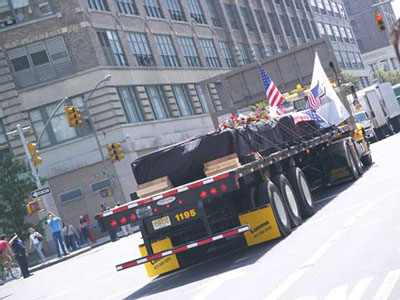
Original estimates of the clean-up time were way off, which is not surprising, due to the level of devastation. Cleanup finished way way ahead of schedule.
I was there that day, for the ceremony, which began at 10:29 a.m., which was when the second tower collapsed. Words can't describe the energy present down there at Ground Zero on that morning. To be in a massive crowd, with not one person speaking, no bustling, no murmurs, nothing to break the quiet. Quiet in New York City? Is that possible? It was deadly quiet that morning during the cermony. There were no speeches, nothing. No words at all. Just a deep sense of solemnity, and a bell ringing to commemorate the moment.
I stood in the crowd, around what had been - only months before - a smoking hole in the ground - with unbelievable destruction. You could smell it in the air from across the river - the burning smell of death. The cleanup had happened with amazing dispatch, bucking all of the estimates. Like: damn, dudes, they just got the job DONE.
In terms of Google searches -
This post, on Katharine Hepburn and Howard Hughes, is - by FAR - the most popular post I have ever written. So many people out there searching for information on these two people - in terms of their relationship. It's obvious why - The Aviator - but still: to see just how many people are out there, Googling the two of them (and it's the two of them in relation to each other that brings these folks to me) - It's wild. The Internet is amazing.
So, here's a wee pictorial tribute:
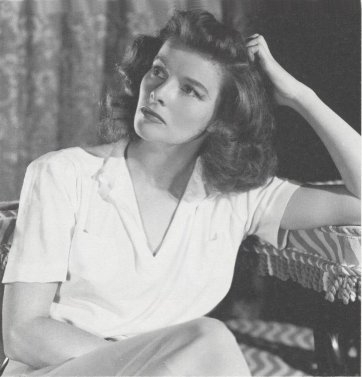

Gorgeous - huh? The both of them.
The Hepburn/Hughes post is, by far, the most-trafficked post here on my little blog - it even beats out this infamous post - which was getting so many clicks from so many CRAZIES, leaving me absolutely insane comments - that I ended up deleting it from my site altogether - although it must still exist in Google's memory banks somehow - because still: day after day after feckin' day, I get 50, 60, 70, 80 clicks a day to that now-nonexistent post. Who knew that the daughter of a dead rock star would be such a hot commodity?
For Memorial Day ... "we happy few"
This day is called the feast of Crispian:
He that outlives this day, and comes safe home,
Will stand a tip-toe when the day is named,
And rouse him at the name of Crispian.
He that shall live this day, and see old age,
Will yearly on the vigil feast his neighbours,
And say 'To-morrow is Saint Crispian:'
Then will he strip his sleeve and show his scars.
And say 'These wounds I had on Crispin's day.'
Old men forget: yet all shall be forgot,
But he'll remember with advantages
What feats he did that day: then shall our names.
Familiar in his mouth as household words
Harry the king, Bedford and Exeter,
Warwick and Talbot, Salisbury and Gloucester,
Be in their flowing cups freshly remember'd.
This story shall the good man teach his son;
And Crispin Crispian shall ne'er go by,
From this day to the ending of the world,
But we in it shall be remember'd;
We few, we happy few, we band of brothers;
For he to-day that sheds his blood with me
Shall be my brother; be he ne'er so vile,
This day shall gentle his condition:
And gentlemen in England now a-bed
Shall think themselves accursed they were not here,
And hold their manhoods cheap whiles any speaks
That fought with us upon Saint Crispin's day.
-- Henry V, Act IV, sc. iii, by William Shakespeare
A couple more Memorial Day posts:
A thank you.
103 year old WWI Vet celebrating Memorial Day
And here is a beautiful post on learning to remember better.
The Books: "In Cold Blood" (Truman Capote)
More from my Daily Book Excerpt:
 The next book in my true crime section is:
In Cold Blood
The following excerpt is from the unbelievable section where Perry finally confesses to Alvin Dewey (the cop who had been working the case) and another detective - as they drive the prisoner back to Kansas from Las Vegas:
EXCERPT FROM In Cold Blood
Duntz says, "Perry, I've been keeping track of the lights. The way I calculate it, when you turned off the upstairs light, that left the house completely dark."
"Did. And we never used the lights again. Except the flashlight. Dick carried the flashlight when we went to tape Mr. Clutter and the boy. Just before I taped him, Mr. Clutter asked me -- and these were his last words -- wanted to know how his wife was, if she was all right, and I said she was fine, she was ready to go to sleep, and I told him it wasn't long till morning, and how in the morning somebody would find them, and then all of it, me and Dick and all, would seem like something they dreamed. I wasn't kidding him. I didn't want to harm the man. I thought he was a very nice gentleman. Soft-spoken. I thought so right up to the moment I cut his throat.
Wait. I'm not telling it the way it was." Perry scowls. He rubs his legs; the handcuffs rattle. "After, see, after we'd taped them, Dick and I went off in a corner. To talk it over. Remember, now, there were hard feelings between us. Just then it made my stomach turn to think I'd ever admired him, lapped up all that brag. I said, 'Well, Dick. Any qualms?' He didn't answer me. I said, 'Leave them alive, and this won't be any small rap. Ten years the very least.' He still didn't say anything. He was holding the knife. I asked him for it, and he gave it to me, and I said, 'All right, Dick. Here goes.' But I didn't mean it. I meant to call his bluff, make him argue me out of it, make him admit he was a phony and a coward. See, it was something between me and Dick. I knelt down beside Mr. Clutter, and the pain of kneeling -- I thought of that goddam dollar. Silver dollar. The shame. Disgust. And they'd told me never to come back to Kansas. But I didn't realize what I'd done till I heard the sound. Like somebody drowning. Screaming under water. I handed th eknife to Dick. I said, 'Finish him. You'll feel better.' Dick tried -- or pretended to. But the man had the strength of ten men -- he was half out of his ropes, his hands were free. Dick panicked. Dick wanted to get the hell out of there. But I wouldn't let him go. The man would have died anyway, I know that, but I couldn't leave him like he was. I told Dick to hold the flashlight, focus it. Then I aimed the gun. The room just exploded. Went blue. Just blazed up. Jesus, I'll never understand why they didn't hear the noise twenty miles around."
Dewey's ears ring with it -- a ringing that almost deafens him to the whispery rush of Smith's soft voice. But the voice plunges on, ejecting a fusillade of sounds and images: Hickock hunting th edischarged shell; hurrying, hurrying, and Kenyon's head in a circle of light, the murmur of muffled pleadings, then Hickock again scrambling after a used cartridge; Nancy's room, Nancy listening to boots on hardwood stairs, the creak of the steps as they climb toward her, Nancy's eyes, Nancy watching the flashlight's shine seek the target ("She said, 'Oh, no! Oh, please. No! No! No! No! Don't! Oh, please don't! Please!' I gave the gun to Dick. I told him I'd done all I could do. He took aim, and she turned her face to the wall"); the dark hall, the assassins hastening toward the final door. Perhaps, having heard all she had, Bonnie welcomed their swift approach.
"That last shell was a bitch to locate. Dick wiggled under the bed to get it. Then we closed Mrs. Clutter's door and went downstairs to the office. We waited there, like we had when we first came. Looked through the blinds to see if the hired man was poking around, or anybody else who might have heard the gunfire. But it was just the same -- not a sound. Just the wind -- and Dick panting like wolves were after him. Right there, in those few seconds before we ran out to the car and drove away, that's when I decided I'd better shoot Dick. He'd said over and over, he'd drummed into me: No witnesses. And I thought, He's a witness. I don't know what stopped me. God knows I should've done it. Shot him dead. Got in the car and kept on going till I lost myself in Mexico."
A hush. For ten miles more, the three men ride without speaking.
Sorrow and profound fatigue are at the heart of Dewey's silence. It had been his ambition to learn "exactly what happened in that house that night." Twice now he'd been told, and the two versions were very much alike, the only serious discrepancy being that Hickock attributed all four deaths to Smith, while Smith contended that Hickock had killed the two women. But the confessions, though they answered questions of how and why, failed to satisfy his sense of meaningful design. The crime was a psychological accident, virtually an impersonal act; the victims might as well have been killed by lightning. Except for one thing: they had experienced prolonged terror, they had suffered. And Dewey could not forget their sufferings. Nonetheless, he found it possible to look at the man beside him without anger -- with, rather, a measure of sympathy -- for Perry Smith's life had been no bed of roses but pitiful, an ugly and lonely progress toward one mirage and then another. Dewey's sympathy, however, was not deep enough to accommodate either forgiveness or mercy. He hoped to see Perry and his partner hanged -- hanged back to back.
Duntz asks Smith, "Added up, how much money did you get from the Clutters?"
"Between forty and fifty dollars."
May 29, 2005
"Love is merely a madness"
So says Rosalind in As You Like It, and I have to say that I agree.
Here follows what is (now) a rather amusing story about me and love. And how, at times, it is like a MADNESS. A feckin' FEVER on the BRAIN. It's wonderful when you can acquire a sense of humor about your wee love affairs ... especially when it doesn't take YEARS to do so.
This was quite a recent event - and yet I look back on my own behavior with a bit of wonder, and bafflement, like: "Good GOD, how quickly I descended into MADNESS. Where the hell did that come from??"
During my last trip to Ireland, I met someone. (And no, it wasn't Rory, the bruiser/accountant/air traffic controller wannabe. Just want to make that clear.) I met him at a little local pub in Glendalough, on a windy pagan night. The conversation flew, the sparks flew ... in the way that it can in Irish pubs. He struck up a conversation, and from that point on, we were inseparable for the night. Except when we had a fight about American foreign policy and I stalked out of the pub in protest. hahaha It was that kind of night. He followed me out onto the street, with wind whipping through the mountains, the roar of the leaves in the trees, and apologized. We actually had a great and vigorous argument about everything - he was really smart, really well-read - and he knew how to argue. In a fun way. I love to argue, too. But then he suddenly got mean and told me to "get a map". I became extremely still, and calm, and cold. Anyone who reads this blog knows that I KNOW MY GEOGRAPHY. If you scroll down in this post, you will see how that exchange went. It was a RINGING triumph for me!!
He and I talked for ... 4 hours? Five? It made no difference. It was EASY. The dude made me laugh. He was the epitome of the Irish Alpha. I need to write an essay about that phenomenon.
He said to me at one point, with deadly seriousness, "I am dangerously bright."
hahahaha I have to agree with that. But he liked me because I was "dangerously bright", too. He kept reiterating that. "Your MIND! Your feckin' MIND!" he shouted over the wind.
I mean, the drama, mkay? It was hilariously fun. We exchanged email information - I was leaving the next day to drive around the country - he said good night - and then I wandered through the 4th century ruins by myself, communing with the black, and the spirit of St. Kevin. A night to remember.
The trip rambled on. A blast. When we hit Kinsale, I found an internet cafe, signed on, and he had emailed. His email sounded just like he talked. I could hear the brogue in the printed words. "Oh, but you're a pretty lass ... with such a brain! And you walk into my local pub? Chance in a mil, Sheil, chance in a mil." hahaha He called me "Sheil"!!
I emailed him back and told him I would be back in Dublin in about 5 days time - for 2 nights only. It was my birthday. Maybe we could hook up on my birthday?
I was ragingly on the road for the next 3 or 4 days, so it was a toss-up whether this date would happen or not. My phone didn't work, and I was tramping through the Cliffs of Moher, driving through the Burren, wandering through Galway, and following the signs of the murals in Belfast to get to Carrie's ... I had other priorities. I took the position: if it's meant to be, it's meant to be. Whatever. Not going to obsess. And I didn't.
Meanwhile, while I was out of touch, the dude was emailing me almost twice a day. Keeping me up to date on his life. Because, you know, we were now best friends. hahaha
I finally arranged the date, nailed it down, from Belfast. (In between sniffling into my Kleenex as we all watched Extreme Makeover: Home Edition). We would meet up in Ranelagh on the night of my birthday. Irish dude's daughter went to UCD, I think ... so he had some suggestions for pubs in Ranelagh.
Cool! I had a date! On my birthday! In Ireland! Life was awesome.
We met up in Ranelagh and had a hilarious marathon of a date. We blabbed at each other like maniacs, we started out at one pub, we moved to another pub, then we went to the LAMEST DISCO in the world. We stood on the side, and watched the lame disco crowd ... nobody dancing ... and just laughed. We danced. Like banshees on the empty dance floor, laughing hysterically at how stupid we must have looked.
A magic date. Magic for so many reasons. Surely because of the company ... he was an intensely fascinating and amusing individual ... we "clicked". You know? I don't click with too many people, and he and I clicked. He got me. He was highly complimentary, of course ... so that didn't hurt either. He walked me back to my B&B, which was on this block of Georgian-era houses, black wrought-iron fences ... He said, "God, look at this gorgeous-ness." I said, "It's like The Dead, isn't it?" He stopped dead in his tracks and exclaimed, very moved, "Oh, see? See? You know, you know." hahaha The openness of this man ... so rare. This goes back to the specificity of Irish Alpha males. Not to belabor the point. They are unashamed of their manliness, their gender ... but then there's this openness too. All adds up to: Alpha. With an Irish twist.
While we stood outside my B&B talking, saying goodbye (and it was surprisingly hard - for both of us) - we talked about him coming to visit me. Maybe on St. Patrick's Day. He loved the idea. He was encyclopedic on the history of the Irish people in New York City, especially politically. We talked about it for hours. He'd put Gangs of New York to shame.
Beautiful. "Good night, new friend. So nice to meet you. I can't even tell you how much."
Full bright moon beaming down on the Georgian scene. Life was SWEET.
So. Now we come into the new phase. The "madness" phase of love. I returned home to New York, and had a HELLUVA time with jetlag. It took me about 5 days to get over it. Weird.
In the meantime: I emailed my new friend, saying: "My God, it was so nice to meet you. Thank you so much for taking me out on my birthday. It was so cool. Best to you ... red."
And ... 4 days went by with NO RESPONSE. And ... I promptly LOST. MY. MIND.
Now I realize that this is "madness", but just because it's "madness" doesn't mean that it felt any less real to me.
I couldn't believe he wasn't emailing me back. I couldn't believe it. And I started just eating my poor heart out ... I lay in bed, sobbing. Yes. Literally. Like a 16 year old girl. Sobbing up into the empty night.
Why was I sobbing?
Uhm ... because I was insane?
Honestly, it was so recently ... but I still look back on it as though it was eons ago, and I was a whole different person ... I still can't believe how quickly I tipped off the deep end into utter existential despair. It had nothing to do with him, of course ... even though I was CONVINCED that the ONLY thing I was REALLY upset about was that he hadn't emailed me back.
Now again, I realize the lunacy: 4 days is (uhm) SO not a long time. hahaha But ... my trip to Ireland had been such an escape, such a glorious escape ... and I had come alive in ways that had been long dormant in my life back here. That's what travel can do, if you're open to it. It can jolt you out of your routine. Well, this trip to Ireland sure was a jolt.
I suddenly was inconsolable. INCONSOLABLE about my life. My loneliness. It was like I was a snake - outgrowing my old skin - and I needed to shed.
That's how I see those 4 days of inconsolable sobbing: as shedding an old skin. It's not an easy thing. "Shedding" sounds like an almost passive activity, something that can happen while you are focusing on other things. Uhm - no. It don't quite work like that. This "shedding" was agony.
I had to take a day off of work!!! I couldn't get out of bed. I was, without a doubt, Diane Keaton in Something's Gotta Give. I would fall asleep, with my eyes puffed out of my head ... would crash into oblivion ... Then ... I would open my eyes 6 hours later ... lie there for half a second ... and then start weeping again.
hahaha I mean, I look back on it with wonder. LIke: woah. I must have just needed to cry or something. I didn't even KNOW this guy, and I truly believed - while I was in it - that I was weeping about him. Once the 4-day crying jag passed, it became so obvious that he was just a catalyst ... but while I was in it, it was real.
Everything became very GLOBAL. (This is always a bad sign with me). I was using words like "never" and "always". (Also a bad sign.) He became a symbol of all my disappointments, all my heartache ... I could. not. stop. crying. for. 4. days.
I realize - in the clear-headed light of day - that 4 days is SO not a long time between emails. But you could not have told that to me during the crying-jag. I was inconsolable. It was an ETERNITY.
Finally, I wrote him what has to be the CRAZIEST email. It makes me laugh to think of. And his immediate response also makes me laugh. My email said something like: "Holy crap. Are you never going to email me again????"
Now before you judge me for this ... and before you lump me in with some stereotype ... let me say that this is so out of character for me that I was frightened by it. I am the epitome of letting-go. I am the epitome (to a fault) of never making demands. I'm a big believer in space - giving it, and having some myself. But at this particular time in my life ... what really happened was ... (and again, it had nothing to do with him, really) I suddenly became aware, in an acute way, of my loneliness. And how NICE it was to meet someone I liked. To kiss someone. To laugh, and argue, and dance on a dance floor. It was so GREAT! And ... my old life, the one here ... didn't fit me anymore. Suddenly. This realization bit me on the ass.
I am pretty much always the last one to know stuff about my own personality.
So ... I decided: "Okay. I am losing my mind. I need to just email him and get this out of my system."
So I did.
He emailed me back almost immediately. The subject line made me laugh OUT LOUD. "Hello. Dear Miss Insecure."
hahahaha Even now, when I receive emails from him, he will occasionally call me, "Miss Insecure". "So, what are your plans for this weekend, Miss Insecure?"
It was such a humorous and NICE way to deal with someone who obviously was having some kind of chemical reaction. He knew it wasn't about him. Somehow. How?? He just knew. And so he didn't judge me for it. It was the biggest gift. I was expecting judgment, I was expecting: "Jeez, chill out." I was ready for the heart-killing moment that that would entail ... but still ... I had to speak my truth anyway. But I got none of that. I got calm humor. (Another quality of the Irish Alpha. Or maybe Alphas in general. They're calm, rational, and expect women to go a little crazy every once in a while - but they don't judge. You feel safe with them. They never EVER try to make you feel small. They're too confident for that. They love women too much for that. And this, my friends, is the difference between the alpha and the bad boy.)
He said something like, "I am notoriously erratic with emails. No need to be insecure."
I was - of course - MORTIFIED. Because I never lose control. Ever. I've let men walk out of my life without them knowing how much it hurt me. You know? I'm not the type to cling, or beg, or say, "Please!! Stay!" I submit, I accept the inevitable. And then write one-woman shows about the experience.
This was the first time I let the cat out of the bag. And let myself freak out - and not just in my journal, or to my friends - but directly to the object of my affection.
The beauty of it was: he didn't judge. He treated it with humor - but he also didn't get defensive or wrapped up in my little psychodrama. He joked me out of it.
It was highly strange, though: to go from a person weeping in public on the subway and having to take a day off of work, to being FINE.
Like: Sheila. WHAT IS GOING ON??? Also: you only saw this guy TWICE. What is UP in the state of Denmark?
Rosalind was spot-on, man. "Love is merely a madness." Don't obsess about it, don't over-intellectulaize the situation, don't think you're over-reacting. Just know that you are INSANE.
He didn't end up visiting for St. Patrick's Day and the whole thing devolved into a nice pen-pal thing. Which is FINE. But it SO WAS NOT FINE for me during the 4-day jag. So so weird.
It was a huge catharsis for me. Huge. I am glad it happened. I haven't "lost it" in years. Not since the doppelganger. I haven't allowed myself to get hurt, to lose it. And ... the price you pay when you protect yourself ... is kind of not worth it. Even though I humiliated myself by writing him a panicky email AFTER ONLY 4 DAYS OF NOT HEARING FROM HIM ... I don't regret it. Another gift that I got from this experience was that ... my own state of mind was revealed to me. I'm bright about some things, but dumb as a box of rocks about other things. After those awful 4 days, I realized: "Huh. Okay. I guess I'm not as impervious as I had hoped. I am still capable of being hurt and disappointed. Good to know."
Good to know, too, that the potential for being hurt has not been killed.
The whole thing told me, actually, that I was, finally, coming out to play. Not with him, in particular ... but in general. I was stepping out. I was coming out to play. Greeting life again, with all its mess, disappointments.
Like the beautiful end of Desiderata:
I am a child of the universe
I have a right to be here
With all its sham, drudgery and broken dreams
It is still a beautiful world.
"Give me liberty ..."
What are your votes for the greatest speech ever given by an American?
I said in the post below that I thought it was a toss-up between Patrick Henry's "give me liberty" speech and Lincoln's Gettysburg Address.
Thoughts?
Patrick Henry: "that overwhelming torrent"
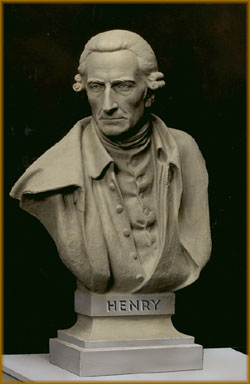
Today is the birthday of Patrick Henry. The old firebrand! The old Virginian firebrand! What a hothead, what a motivator, what a fascinating man. A die-hard patriot, who made perhaps the most famous speech in American history (second only to the Gettysburg Address, perhaps) - the "Give me liberty or give me death" speech - made at St. John’s Church in Richmond, Virginia on March 23, 1775.
I love how his glasses are on top of his head here.

Here is a brief biographical sketch of the man - truly one of the great people in our nation's history. He was one of those people who could FRAME a debate. Like Tom Paine. A radical. There was nothing halfway about this guy. He was an extremist, he was a black-and-white kind of guy - and that was necessary, in those early days of the Revolution. It was not a time for moderation. Thank goodness we had some moderates, but without those like Patrick Henry - nothing would have ever gotten done at all. Whether or not you agreed with him, he was fearless in standing up, and being counted, and shouting (always, shouting) his opinion. And everyone says that he had a way with words. An oratorical gift. He could make a speech and move people to action.
The 'give me liberty' speech changed people's lives. We have many eyewitness accounts of it - Thomas Jefferson was there, and it changed his life. Henry's speech and Tom Paine's book Common Sense were pretty much the two sparks which ignited the populace. People were forever changed after these events. Here is a description (how I wish I could have been there) of the lead-up to that speech, and Henry's taking a starring role - but also a vivid description of Patrick Henry's oratory on March 23, 1775 - this is from Paul Johnson's great book History of the American People:
Next to religion, the concept of the rule of law was the biggest single force in creating the political civilization of the colonies. This was something they shared with all Englishmen. The law was not just necessary - essential to any civil society - it was noble. What happened in courts and assemblies on weekdays was the secular equivalent of what happened in church on Sundays. The rule of law in England, as Americans were taught in their schools, went back even beyond Magna Carta, to Anglo-Saxon times, to the laws of King Alfred and the Witanmagots, the ancient precursor of Massachusetts' Assembly and Virginia's House of Burgesses.William the Conqueror had attempted to impose what Lord Chief Justice Coke, the great early 17th century authority of the law, had called 'The Norman Yoke'. But he had been frustrated. So, in time, had Charles I been frustrated, when he tried to re-impose it, by the Long Parliament. Now, in its arrogance and complacency, the English parliament, forgetting the lessons of the past, was trying to impose the Norman Yoke on free-born Americans, to take away their cherished rule of law and undermine the rights they enjoyed under it with as much justice as any Englishman! Lord North would have been astonished to learn he was doing any such thing, but no matter: that is what many, most, Americans believed. So America now had to do what parliamentarians had to do in 1640. 'What we did,' said Jefferson later, 'was with the help of Rushworth, whom we rummaged over for revolutionary precedents of those days.' So, in a sense, the United States was the posthumous child of the Long Parliament.
But Americans' fears that their liberties were being taken away, and the rule of law subverted, had to be dramatized - just as those old parliamentarians had dramatized their struggle by the Grand Remonstrance against Charles I and the famous 'Flight of the Five Members'. Who would play John Hampden, who said he would rather die than pay Ship Money to King Charles?
Up sprang Jefferson's friend and idol, Patrick Henry.
As a preliminary move towards setting up a united resistance of the mainland colonies to British parliamentary pretensions, a congress of colonial leaders met in Philadelphia, at Carpenters Hall, between September 5 and October 26, 1774. Only Georgia, dissuaded from participating by its popular governor, did not send delegates. Some fifty representatives from twelve colonies passed a series of resolutions, calling for defiance of the Coercive Acts, the arming of a militia, tax-resistance. The key vote came on October 14 when delegates passed the Declaration and Resolves, which roundly condemned British interference in America's internal affairs and asserted the rights of colonial assemblies to enact legislation and impose taxes as they pleased.
A common American political consciousness was taking shape, and delegates began to speak with a distinctive national voice. At the end of it, Patrick Henry marked this change in his customary dramatic manner: 'The distinctions between Virginians and New Englanders are no more. I am not a Virginian but an American.' Not everyone agreed with him, as yet, and the Continental Congress, as it called itself, voted by colonies rather than as individual Americans. But this body, essentially based on Franklin's earlier proposals, perpetuated its existence by agreeing to meet again in May 1775. Before that could happen, on February 5, 1775, parliament in London declared Massachusetts, identified as the most unruly and contumacious of the colonies, to be in a state of rebellion, thus authorizing the lawful authorities to use what force they thought fit. The fighting had begun. Hence when the Virginia burgesses met in convention to instruct their delegates to the Second Continental Congress, Henry saw his chance to bring home to all the revolutionary drama of the moment.
Henry was a born ham actor, in a great age of acting - the Age of Garrick. The British parliament was full of actors, notably [William] Pitt himself ('He acted even when he was dying') and the young [Edmund] Burke, who was not above drawing a dagger, and hurling it on the ground to make a point. But Henry excelled them all. He proposed to the burgesses that Virginia should raise a militia and be ready to do battle. What was Virginia waiting for? Massachusetts was fighting. 'Our brethren are already in the field. Why stand we her idle? What is it that gentlemen wish? What would they have?'
Then Henry got to his knees, in the posture of a manacled slave, intoning in a low but rising voice: 'Is life so dear, our peace so sweet, as to be purchased at the price of chains and slavery? Forbid it, Almighty God!' He then bent to the earth with his hands still crossed, for a few seconds, and suddenly sprang to his feet, shouting, 'Give me liberty!' and flung wide his arms, paused, lowered his arms, clenched his right hand as if holding a dagger at his breast, and said in sepulchral tones: 'Or give me death!' He then beat his breast, with his hand holding the imaginary dagger.
There was silence, broken by a man listening at the open window, who shouted: "Let me be buried on this spot!'
Henry had made his point.
Here's a painting of Henry making his point:
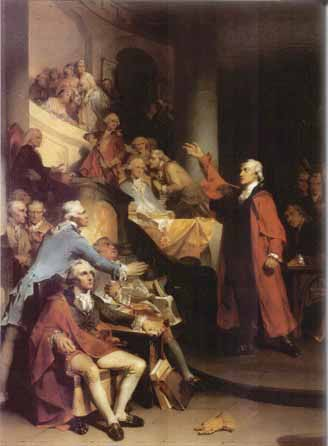
Here, in full, is Patrick Henry's speech that he made on that day:
No man, Mr. President, thinks more highly than I do of the patriotism, as well as abilities, of the very worthy gentlemen who have just addressed the House. But different men often see the same subject in different lights; and, therefore, I hope it will not be thought disrespectful to those gentlemen if, entertaining as I do opinions of a character very opposite to theirs, I shall speak forth my sentiments freely and without reserve. This is no time for ceremony. The question before the House is one of awful moment to this country. For my own part, I consider it as nothing less than a question of freedom or slavery; and in proportion to the magnitude of the subject ought to be the freedom of the debate. It is only in this way that we can hope to arrive at truth, and fulfill the great responsibility which we hold to God and our country. Should I keep back my opinions at such a time, through fear of giving offense, I should consider myself as guilty of treason towards my country, and of an act of disloyalty toward the Majesty of Heaven, which I revere above all earthly kings.Mr. President, it is natural to man to indulge in the illusions of hope. We are apt to shut our eyes against a painful truth, and listen to the song of that siren till she transforms us into beasts. Is this the part of wise men, engaged in a great and arduous struggle for liberty? Are we disposed to be of the number of those who, having eyes, see not, and, having ears, hear not, the things which so nearly concern their temporal salvation? For my part, whatever anguish of spirit it may cost, I am willing to know the whole truth; to know the worst, and to provide for it.
I have but one lamp by which my feet are guided, and that is the lamp of experience. I know of no way of judging of the future but by the past. And judging by the past, I wish to know what there has been in the conduct of the British ministry for the last ten years to justify those hopes with which gentlemen have been pleased to solace themselves and the House. Is it that insidious smile with which our petition has been lately received? Trust it not, sir; it will prove a snare to your feet. Suffer not yourselves to be betrayed with a kiss. Ask yourselves how this gracious reception of our petition comports with those warlike preparations which cover our waters and darken our land. Are fleets and armies necessary to a work of love and reconciliation? Have we shown ourselves so unwilling to be reconciled that force must be called in to win back our love? Let us not deceive ourselves, sir. These are the implements of war and subjugation; the last arguments to which kings resort. I ask gentlemen, sir, what means this martial array, if its purpose be not to force us to submission? Can gentlemen assign any other possible motive for it? Has Great Britain any enemy, in this quarter of the world, to call for all this accumulation of navies and armies? No, sir, she has none. They are meant for us: they can be meant for no other. They are sent over to bind and rivet upon us those chains which the British ministry have been so long forging. And what have we to oppose to them? Shall we try argument? Sir, we have been trying that for the last ten years. Have we anything new to offer upon the subject? Nothing. We have held the subject up in every light of which it is capable; but it has been all in vain. Shall we resort to entreaty and humble supplication? What terms shall we find which have not been already exhausted? Let us not, I beseech you, sir, deceive ourselves. Sir, we have done everything that could be done to avert the storm which is now coming on. We have petitioned; we have remonstrated; we have supplicated; we have prostrated ourselves before the throne, and have implored its interposition to arrest the tyrannical hands of the ministry and Parliament. Our petitions have been slighted; our remonstrances have produced additional violence and insult; our supplications have been disregarded; and we have been spurned, with contempt, from the foot of the throne! In vain, after these things, may we indulge the fond hope of peace and reconciliation. There is no longer any room for hope. If we wish to be free-- if we mean to preserve inviolate those inestimable privileges for which we have been so long contending--if we mean not basely to abandon the noble struggle in which we have been so long engaged, and which we have pledged ourselves never to abandon until the glorious object of our contest shall be obtained--we must fight! I repeat it, sir, we must fight! An appeal to arms and to the God of hosts is all that is left us!
They tell us, sir, that we are weak; unable to cope with so formidable an adversary. But when shall we be stronger? Will it be the next week, or the next year? Will it be when we are totally disarmed, and when a British guard shall be stationed in every house? Shall we gather strength by irresolution and inaction? Shall we acquire the means of effectual resistance by lying supinely on our backs and hugging the delusive phantom of hope, until our enemies shall have bound us hand and foot? Sir, we are not weak if we make a proper use of those means which the God of nature hath placed in our power. The millions of people, armed in the holy cause of liberty, and in such a country as that which we possess, are invincible by any force which our enemy can send against us. Besides, sir, we shall not fight our battles alone. There is a just God who presides over the destinies of nations, and who will raise up friends to fight our battles for us. The battle, sir, is not to the strong alone; it is to the vigilant, the active, the brave. Besides, sir, we have no election. If we were base enough to desire it, it is now too late to retire from the contest. There is no retreat but in submission and slavery! Our chains are forged! Their clanking may be heard on the plains of Boston! The war is inevitable--and let it come! I repeat it, sir, let it come.
It is in vain, sir, to extenuate the matter. Gentlemen may cry, Peace, Peace-- but there is no peace. The war is actually begun! The next gale that sweeps from the north will bring to our ears the clash of resounding arms! Our brethren are already in the field! Why stand we here idle? What is it that gentlemen wish? What would they have? Is life so dear, or peace so sweet, as to be purchased at the price of chains and slavery? Forbid it, Almighty God! I know not what course others may take; but as for me, give me liberty or give me death!
Here are Jefferson's brief thoughts on Henry's speech.
I am not sure that even Patrick Henry would have thought that his predictions would so soon come true. Within less than a month, on April 19, the tension exploded in Boston, leading to the Lexington and Concord battles. Boston was now under siege. The Continental Congress met on May 10, and in just one month - had authorized the formation of an army, and elected George Washington as Commander in Chief.
Regardless of the huge role Henry played in the lead-up to the American Revolution, he didn't really take a part in the aftermath. He was elected governor of Virginia, true ... but when it came time to the Constitutional Congress, and the forging of a brand-new government ... he did not play a leading role at all.
It's interesting - there's a great description of acting: "Acting is like a sculpture carved in snow." Obviously, this was from the time of stage acting. Movies now can capture the "sculpture" before it melts. But that quote always makes me think of Patrick Henry. Nobody alive today can ever see his oratorical skills. There are no video tapes, tape recordings. We just have to take the word of those who were THERE. So while no "record" exists, and his speeches were, indeed, "carved in snow" ... a whiff of the power of them comes down to us regardless. It's like the acting of Edmund Kean, or David Garrick, or Mrs. Siddons - these great great actors of the past. We can never see their work, their performances were "sculptures carved in snow" ... but they must have been extraordinary. Too many people left records - in diaries, letters, newspaper columns ... for it to be discounted.
Henry refused to be a delegate to the Constitutional Congress in 1787. He was a big states-rights man, for all his revolutionary fervor. Catherine Drinker-Bowen, in Miracle at Philadelphia explains why:
Patrick Henry was conspicuous by his absence. Named to the Convention, he refused, saying he "smelt a rat." Fifty-one years old, a member of his local legislature, Henry was still a powerful factor in state politics. For all his celebrated rhetoric ("I am not a Virginian but an American"), he was the most Virginian of them all. At the moment, state politics to him were paramount. Madison said outright that Henry had stayed home to look after Virginia's interests along the Mississippi -- a matter of life and death to the back settlements, with Spain in control of New Orleans. Samuel Admas too remained in Boston. He had not been named to the Convention; he was suspicious, he said, "of a general revision of the Confederation." Though he came round in the end, Sam Adams was to oppose the new Constitution vigorously. "I stumble at the threshold," he wrote. "I meet with a National Government instead of a Federal Union of sovereign States."Patrick Henry, Sam Adams -- the old firebrands of '76 were missing. The Violent Men, as they had been called, skillful and dedicated in revolution and the intrigues of revolution, but lacking the qualities to erect a government. Better hands at pulling down than building, as John Adams had said.
When it came time for ratification, Henry again took center stage. Drinker-Bowen describes the Virginia ratification convention as "a gathering studded with stars, with names and faces known throughout the state and beyond -- well-speaking gentlemen on both sides, well-dressed, well born."
Chief among anti-Federalists was Patrick Henry, tall, thin, stooped, and at fifty-two looking on himself as aged and broken in health. He wore spectacles, concealed his reddish-brown hair by a brown wig, not too well-fitting. His blue eye was still keen, his long face alive with feeling; the old magic waited to be called up at will. "I fear that overwhelming torrent, Patrick Henry," wrote General Knox to Rufus King when the convention was well under way.From the first day, Henry was the nerve center of the room. "The Henryites," they called his followers. Every Federalist was girded against them. And the Federalist ranks were impressive. One of them, Judge Edmund Pendleton, served as presiding officer. White-haired, painfully crippled, he struggled to his feet on crutches; his hip had been dislocated by a fall from a horse. Pendleton's dress was elegant; his infirmity only added somehow to the dignity of his bearing. "The Confederation did not carry us through the war," he said. "Common danger and the spirit of America did that."
What I would have given to be in that room. What a scene.
With such dramatis personae, the Virginia convention could not lack color. Always, one is conscious of the fourteen Kentuckians, sitting watchful, biding their time. Always, too, one remembers that out of one hundred and seventy members, the barest majority will carry the Constitution. It is a scene romantic, passionate, the very best "theater". Yet all of it is true, factual, and seldom has American history shown a political scene more seriously enacted. Patrick Henry rose and hurled his bolts: "Whither is the spirit of America gone? Whither is the genius of America fled? ... We drew the spirit of liberty from our British ancestors. But now, Sir, the American spirit, assisted by the ropes and chains of consolidation, is about to convert this country into a powerful and mighty empire ... There will be no checks, no real balances, in this government. What can avail your specious imaginary balances, your rope-dancing, chain-rattling, ridiculous ideal checks and contrivances?"
Hm, Patrick. Tell us how you really feel.
Now listen, though, to the response of one of the people in that room. This is what I mean by the power of this man's rhetoric - whether or not you agree with his sentiment. Henry must have been positively amazing to watch.
It was here, or hereabouts, that Mr. Best of Nansemound County, "an intelligent gentleman," says Grigby, "involuntarily felt his wrists to assure himself that the fetters were not already pressing his flesh. The gallery on which he was sitting seemed to become dark as a dungeon."The true orator's power possessed Patrick Henry. Even Madison confessed himself nonplussed, and said that when Mr. Henry stood up to reply to him, a pause, a shake of the head or a striking gesture would undo an hour's work before a word was uttered.
Incredible. The power! Here's more description of Henry in action, from Drinker-Bowen:
At impassioned moments Henry would raise a hand and twirl his wig two or three times round his head. The galleries were always packed when Henry spoke; once he was on his feet for seven hours: "Who authorizes gentlemen to speak the language of We, the people, instead of We, the states? ... The people gave them no power to use their name ... Even from that illustrious man who saved us by his valor, I would have a reason for this conduct!" Advocates of the Constitution, said Henry, brought forward fears, awful prognostications of evils to come, should the Constitution fail of ratification. Yet had there been a single tumult in Virginia? Where was any disposition in this country to revolt against the dominion of laws?
The battle of ratification continued. At one point, Madison became so annoyed with Henry that he interrupted him a couple of times in a row ... and following that, had to go to bed for three days. Tempers ran high. People who took notes at the Convention spent a lot of time underlining certain words, to show how emphatic the speakers were.
The turning point came when governor Edmund Randolph, a staunch anti-Federalist, switched sides.
On June fourth, the first day of full debate, the Governor rose and made his declaration. It took him some time to reach his point. Plainly on the defensive, Randolph said he had not come hither to apologize ... He was not a candidate for popularity ... If the Constitution were put before him as in Philadelphia -- wholly to adopt or wholly to reject -- he would again refuse his signature. But Massachusetts had urged amendments to be enacted by Congress after full ratification. For himself, he had originally been for previous amendments, to be approved by the several states before they ratified. But the postponement of this convention to so late a date made this impossible, "without inevitable ruin to the Union". Eight states had adopted the Constitution; they could not recede. He stood then, to express his earnest endeavors for a firm, energetic government, and to concur in any practical scheme of amendments. Randolph, in short, was for the Constitution.
Almost brings tears to my eyes. The compromises these strong-willed men had to make (and for the most part, they all did). In the end, they believed in something greater than themselves. It was the "idea" of America, although their loyalties to their individual states remained rock-solid. It is those who had to COMPROMISE that I feel truly in debt to. It can't have been easy.
Henry, naturally, did not go down without a fight.
The gentleman's [Randolph's] alteration of opinion, Henry said, "was very strange and unaccountable ... Did he not tell us that he withheld his signature? He was not then led by the illumined, the illustrious few ... What alterations have a few months brought about! ... Something extraordinary must have operated so great a change in his opinions."Randolph and the convention understood Henry's hints very well, with their implication that Washington's persuasion -- or worse, Washington's promise of future favors under the new government -- had brought about this change. Much later, when Washington named Randolph as United States Attorney Gedneral, Randolph would be at pains to defend himself from th is same charge. Furiously, Randolph answered Patrick Henry. He disdained the honorable gentleman's aspersions and insinuations. "If our friendship must fall," said Randolph, "let it fall like Lucifer, never to rise again! ... He has accused me of inconsistency ... Sir, if I do not stand on the bottom of integrity and pure love for Virginia, as much as those who can be most clamorous, I wish to resign my existence."
Henry was staunch against amendments being made after the fact. He thought it was ridiculous to agree to something that was not yet finished.
Subsequent amendments, Henry said, were a novelty and an absurdity. To enter into a compact of government, and then afterward to settle the terms of this compact was an idea dreadful, abhorrent to his mind ... If this plan were accepted by the convention, said Henry, he would conceive it his duty to have nothing more to do with the Constitution and to quit this assembly and go home.
Henry had come up with his own list of amendments, called "Henry's Declaration of Rights", which was read aloud to the Convention. Interestingly enough, they were almost exactly the same as the amendments that would eventually be added. But Randolph, also a big fighter, stood up and said that Henry's words about "quit this assembly and go home" amounted to a threat of secession. Henry denied this vehemently. The thought of the states breaking up, of the Union dissolving, was a thought not to be contemplated for Henry. It was just that the Constitution, as it stood, terrified him.
The day ended with Patrick Henry prophesying the "awful immensity of the dangers with which [the new system] was pregnant" and envisioning "the angels on high, looking down and reviewing America's future." It was at this opportune moment that a thunderstorm arose, the hall grew dark, lightning glared, rain dashed against the windows. Doors slammed, says Grigsby, like a peal of muskitry. Men rushed from their seats to the center of the room, and the meeting adjourned.
It is that one detail that makes me in love with American history. It certainly did seem to be that massive universal forces were at work here, and they all knew it.
A couple of days later, after more debate, and more hashing out of the amendments, that it came time to vote. And here is what I think was Patrick Henry's greatest hour - out of all of his great hours.
On Wednesday, June 25th, Edmund Pendleton, from the chair, ordered Wythe's original motion be put to the question. Shortly before the vote was taken, Patrick Henry spoke his last word. If he should find himself in the minority, he would have, he said, those painful sensations which arise from a conviction of being overpowered in a good cause. But he would be a peaceful citizen. "I wish not to go to violence, but will wait with hopes that the spirit which predominated in the Revolution is not yet gone, nor the cause of those who are attached to the Revolution not yet lost. I shall therefore wait in expectation of seeing that government changed, so as to be compatible with the safety, liberty, and happiness of the people."It was generous, it had a touch of magnificence. Randolph spoke next, very briefly, and his last word did not equal Henry's. Randolph spoke solely in self-justification. His part in the Federal Convention, he said, had been inspired by strongest affection for the Union. The objections which he then had to the Constitution still stood. Yet the accession of eight states reduced deliberation to the single question of Union or no Union. Should some future annalist desire to vilify his name, let him state those truths.
And then came time for the vote.
By 89 to 79 the Constitution won. It had been close, very close indeed. That night angry Antifederalists, determined to create measures for resisting the new system, held a mass meeting in Richmond, with Patrick Henry presiding. But Henry told his wrathful colleagues that he had done his best against the Constitution "in the proper place [the Convention]." The question, said Henry, was now settled; "as true and faithful republicans you had all better go home."
Amazing. The debate had occurred "in the proper place", and once the vote went down ... it was time to be a "peaceful citizen" again, and a "true and faithful republican". I can think of a few folks out there right now who would do well to follow Patrick Henry's great example.
And here, again from Drinker-Bowen, is a reiteration of a point I made a day or so ago. It was those who OPPOSED the Constitution who were so instrumental in bringing it about, and hammering it into a form that people could agree to. Complete agreement would have been a disaster, and people like Randolph, people like Henry, were those who could provide a frame for the debate. Their objections were good ones, in the context of the times, but the path of history did not go in their direction. And so they chose the greater good, but making damn sure that their objections were in the record.
Henry's admirers claim that he was probably more responsible than any or all others for the adoption of the first ten amendments to the Constitution -- the Bill of Rights. And there is no doubt that Henry's part in this went beyond mere rhetorical challenges and thunderbolts. In final form the Constitution was the product of both sides, pro and anti. The opposition's part is difficult to assess, though none can question its value. Even Washington conceded it. "Upon the whole," he wrote, "I doubt whether the opposition to the Constitution will not ultimately be productive of more good than evil; it has called forth, in its defence, abilities which would not perhaps have been otherwise exerted that have thrown new light upon the science of Government, they have given the rights of man a full and fair discussion, and explained them in so clear and forcible a manner, as cannot fail to make a lasting impression."
It's a good reminder, too, to those people in our country who can't stand dissenting opinions to the majority, and basically think anyone who disagrees is stupid, unpatriotic, and an asshole. You show me monolithic agreement and I will show you a totalitarian society.
His one speech where he shouted "Give me liberty or give me death" makes me think of the idea that America was supposed to be a "city on a hill" for others to see. Whether or not we always live up to that is kind of irrelevant. No "idea" is perfect. But when I saw Chinese kids holding up banners with those very words on it in Tieneman Square, I thought of Patrick Henry. I thought of the "city on the hill". What the Founding Fathers dreamt of had indeed, with all its inherent problems and fits and starts and failures, come to pass.
So here's to Patrick Henry!
The Books: "Outrage : The Five Reasons Why O.J. Simpson Got Away With Murder" (Vincent Bugliosi)
Next in my Daily Book Excerpt:
 The following book in my true crime section is:
Outrage: The Five Reasons Why O. J. Simpson Got Away with Murder
EXCERPT FROM Outrage: The Five Reasons Why O. J. Simpson Got Away with Murder
From the moment O.J. Simpson became a suspect in this double murder case, it was "in the air", perhaps as in no other case within memory, that he might get off despite the conclusive evidence of his guilt. In fact, even before the murders, it was in the air, Nicole presciently telling her close female friends that "O.J. is going to kill me someday and he's going to get by with it."
It was in the air from the day (June 17, 1994) when mental midgets stood atop the freeway overpasses holding "Go O.J., Go" signs during the slow-speed chase prior to his arrest. Everywhere one looked, it was in the air. People saying confidently, "This jury will never convict Simpson -- they wouldn't convict him even if they were shown a film of him committing the murders." People carrying signs outside the courtroom during the trail declaring "Free O.J.", "Save the Juice", and even "Whether you did it or not, we still love you, O.J." The incessant jokes and tasteless comedy routines on TV and radio about the case, which could only serve to subliminally trivialize the murders of the victimes. U.S. Senate Chaplin Richard Halverson beginning the Senate's day on June 23, 1994 with a "prayer for O.J. Simpson". The first juror called for questioning in the case happening to be juror number 32, the number Simpson wore throughout most of his football career, prompting Judge Ito to say, "I don't know if this is an omen," and Simpson to smile and nod his head in agreement. Marcia Clark, during jury selection, making one of the most ill-advised statements ever made to a jury by a prosecutor: "You may not like me for bringing this case. I'm not winning any popularity contests for doing so." Chris Darden's almost equally incredible and ill-advised statement to the jury in his summation at the end of the case: "Nobody wants to do anything to this man. We don't. There is nothing personal about this, but the law is the law." (Can you imagine being almost apologetic to a jury when you believe the person you're prosecuting committed a brutal double murder?)
To this day, virtually everyone refers to Simpson only as "O.J.", a friendly nickname that implies the speaker still likes Simpson or at most views him as one would an errant friend or relative, certailyl not a brutal murderer. "How's O.J. doing?" Larry King would solicitously ask any guest of his who was a Simpson intimate and who had visited Simpson recently in jail. These and many other small signs of respect, or awe, or affection, indicated that Simpson, even if guilty, might be given some break tantamount to a papal dispensation. In the absence of a powerful prosecution, it became almost a self-fulfilling prophecy that he would be found not guilty.
This feeling, this sense, which permeated every segment of our society, was obviously known to the jurors before they were selected, even manifesting itself during the trail. Because when something is in the air, it reaches everyone, by osmosis, by accident, or, if by no other means, by the weekly conjugal visits to the sequestered rooms. Surely, no one can doubt that the jurors were speaking to those loved ones who visited them in the privacy of their quarters. Everyone knew this. You don't have to take my word for it. What conceivable reason would Marcia Clark have had to beg Judge Ito not to let Simpson make a statement near the end of the case, when Simpson wanted to do so outside the presence of the jury, if she didn't virtually know that what Simpson said would get back to the jury?
This "in the air" phenomenon couldn't help but contribute, in some way, to the eventual not-guilty verdict. It made it so much easier, either consciously or subconsciously, for the jury to give Simpson every benefit he was legally entitled to, and then some. In such an atmosphere a not-guilty verdict would no longer seem to the jury like the very worst thing that any jury could do -- let a brutal murderer walk out the door a free man. They were just doing what everyone had already predicted they were going to do, and apparently what most people wanted them to do. Wasn't that really what prosecutor Darden himself was suggesting when he said, "Nobody wants to do anything to this man"?
I've been asked to explain more than once why, right from the beginning, I was saying publicly that there was no question Simpson was guilty. I take no proide in having been the first public personality to come out publiclyl against Simpson. It just happened that way. I was asked by the media how I felt about the case way back in the early summer of 1994, and I decided to be candid. Before I tell you why I did, I should point out that some people objected to my having done so. One reason was the presumptiopn of innocence in our society. Also, they felt as a member of the bar, I should, therefore, not have spoken of Simpson's guilt before the verdict.
Contrary to common belief, the presumption of innocence applies only inside a courtroom. It has no applicability elsewhere, although the media do not seem to be aware of this. Even the editorial sections of major American newspapers frequently express the view, in references to a pending case, that "we" -- meaning the editors and their readers -- have to presume that so-and-so is innocent. To illustrate that the presumption does not apply outside the courtroom, let's say an employer has evidence that an employee has committed theft. If the employer had to presume the person were innocent, he obviously couldn't fire the employee or do anything at all. But of course he not only can fire or demote the employee, he can report him to the authorities...
I spoke out in the Simpson case for two reasons. The main reason should be self-evident to the reader by now. The "in the air" phenomenon attending the Simpson case was, at least to my recollection, unprecedented for any criminal case. Because this was a highly unusual situation, I departed from my customary policy. There was no doubt in my mind that the "in the air" phenomenon had the potential of having a prejudicial impact on the prosecution's case, since the jury couldn't help but be aware of it and probably be adversely influenced in the process, and I was trying to counter what was happening. I obviously was unsuccessful.
There was another related reason I spoke out early on, months before the trial. I was disgusted by the tremendous groundswell of support for Simpson, even though two human beings had been brutally murdered, and all the evidence pointed to Simpson as the perpetrator. He had received 350,000 letters of support at the time, and although each revelation of his guilt the media learned of was clinically and dispassionately reported in the news, nearly all of the commentators on television nonetheless treated Simpson as if he were a very special human being, and not one of them dared to say one negative word about him. He was being given special treatment at the Los Angeles County Jail; thousands of people were calling in on radio talk shows asserting his innocence; some, unbelievably, stating or strongly implying that even if he was guilty, he's O.J., let him go, he has suffered enough. As I've indicated, even today, everyone still calls him O.J. You know, O.J. this and O.J. that. Well, he's no longer O.J. to me. He's Simpson. Someone who carves up two human beings like sides of beef forfeits his right to any endearing nicknames, at least in my view. Again, why there was this enormous support for someone who had obviously committed two of the worst murders imaginable, I don't know, but I personally found it repulsive and repugnant.
May 28, 2005
Speculations ...
... on the kind of actor James Dean might have become. Very interesting. He died so young. And in many respects, his acting is quite quite limited. He does ONE thing: twitchy neurotic vulnerability. He does it very well, but Kazan (who directed him in East of Eden) suggests that that is because that is who Dean really was: "a sick kid". A lot of actors are limited. Limited is not necessarily a bad thing. If you do one thing, and you do it well - you can make a career out of doing that one thing. Actors who think they can do everything, and who think they are not limited (ahem - Renee Z - ahem) are deluded. I mean - good for them for trying to stretch, trying to expand. It's very very good practice for an actor. But to pull it off? Very tricky. By the way: Meryl Streep is a genius. There's only one of her. I truly believe that that woman is, indeed, without limits, and that she can do anything. But she's a genius, and she skews the sample. I'd put Joan Allen and Jeff Bridges in that category as well. Those people seem to very easily abdicate their own personalities - and take on other people's souls. Not just characteristics - but an entire INNER transformation. This is a gift that cannot be taught.
Anyway. I don't hold it against Dean for only doing one thing. He was a 24 year old kid, for God's sake. His work might have developed, he might have given up some old mannerisms, and found other ways to express himself. Hard to say.
But it is interesting to contemplate. Dean is frozen in time. That's it. That's all we have to evaluate him on.
More on Hitchens
A great analysis on Hitchens here in Prospect
It's a review of his new book Love, Poverty, and War : Journeys and Essays
In Love, Poverty and War, an essay on Trotsky comes between essays on Kipling and Huxley. That duality, the leftist immersed in mid-20th century Englishness, brings us closer to the centre of Hitchens's work. In Brideshead, where others see only snobbery and an elegiacal hymn to lost privilege, Hitchens sees mourning for the dead of the first world war. In every essay on Kipling, including the new one here, he tries to unravel the poet of empire and jingoism, "the beery sentimentality," from the dark sense of personal and national loss. In all these writers, Hitchens sees complexity, contradiction and "the idea of a double life." Orwell/Blair, of course, is a classic case of this English doubleness, but the richest account is found in his essay of the early 1990s on Larkin. When Tom Paulin, Terry Eagleton and others rushed to bury Larkin under accusations of racism, sexism and worse, Hitchens dug deeper and found, both in the life and the poetry, more complexity and interest.
Yeah, his political writing is blistering, and independent - and fun to read. I love his suspicion of alliances in general. I love how he will not submit to the generalizations of "we" or "us". I feel the same way.
This is from Letters to a young contrarian:
Distrust any speaker who talks confidently about "we", or speaks in the name of "us". Distrust yourself if you hear those tones creeping into your own style. The search for security and majority is not always the same as solidarity; it can be another name for consensus and tyranny and tribalism. Never forget that, even if there are "masses" to be invoked, or "the people" to be praised, they and it must by definitioni be composed of individuals. Stay on good terms with your inner Yossarian.
Is there better advice than "stay on good terms with your inner Yossarian"?? Damn, dude! I always wondered why blanket generalizations went so up my ass ... People who use the terms "we" or "us" in too facile a way have always struck me as intensely dishonest, and whether or not I agree with them - in the face of it, I feel I MUST assert my independence. This is why politics drives me crazy. This is why fundamentalists of any stripe drive me crazy. This is why blogging sometimes drive me crazy. Not that I don't have opinions. I most certainly do. But they are MINE, and I come to them on my own ... not because I feel I must include myself in some "we" or "us". It's an experiment: go to a blog where there's an orthodoxy of belief, a big ol "us against them" vibe, and try to make a comment that is somewhat independent. I'm not talking about disagreement. You can agree with someone - yet do it in an independent way. Or add your own thoughts to the mix, maybe say something that makes it clear that you resist (slightly) the orthodoxy. Do it in a polite tone - always be respectful - but then watch how you will be OVER-attacked. You may even be AGREEING with the core thoughts behind the post - but you will be OVER-attacked. It's like there's even an orthodoxy of TONE going on. People smell a different tone on you, and they will attack - regardless of what you say. You come at them with a fly-swatter, they come back with Uzis. I've experienced it on blogs I actually like - the attacks come with a ferocity unwarranted by my own comment, and the attacks immediately get personal. Count me out of that bullshit. This is how they treat people who are, essentially, on "their side"? Mmmm, no thanks. I'll leave the "masses" to themselves.
It's the problem I also have with most women's magazine writing.
"Women today feel that ..."
"We women are all so wrapped up in everyday concerns ..."
"We need to know that such-and-such is universal..."
STOP including me in that 'we" without my consent. I always thought my problem with all of this had to do with bad writing. Bad writers are general, and they make a lot of assumptions. A lazy writer is one who uses "we" all the time. (This is Writing 101, people. Make it personal. Speak from your own truth. Don't just parrot the party-line. Or fine - parrot the party-line, but don't think that's good writing.)
So that's part of it - but Hitchens nails my true issue with it in that one paragraph.
I've always really preferred his book reviews (that mostly appear in Atlantic). They're phenomenal. Scholarly, so well-written, unlike book reviews you read anywhere else. Because of the TONE, and what he brings to it.
He also wrote an incredible piece a while back for Vanity Fair on Route 66. Gorgeous. I like his more off-beat things - but still. I'd read his DOODLES on the damn MARGINS. Fascinating.
He's been around forever, but - is it me - or is he finally getting (to quote Eminem) "the props he deserves" right now? It seems so to me.
The Tom Cruise on Oprah debacle
Sadly, I did not see it. I am extremely bummed, because it sounds like it was HILARIOUS.
Here is a fantastic compilation of "the public's reaction" to it. You have to read all those posts. They are SUPREMELY funny.
I found this compilation via Big Stupid Tommy, who has this to say about Cruise on Oprah:
He's a little too touchy-feely. Trying a little too hard to be the Tom Cruise Who Just Loves People. And when he got asked about one (or maybe more than one) of his kids being bi-racial, he gave an answer that had all the right words, politically speaking. But they came out in a tone of voice that was...well...not in line with the words that were coming out of his mouth.I felt like it would have been appropriate for Oprah to have ended the interview right then.
"Right words, wrong tone of voice," she would say. Then she'd snap her fingers. And then Steadman would emerge from offstage and kill Tom Cruise.
Some of my favorite snippets from those compiled:
Sit your rear on the couch and conduct the interview already. Quit jumping up every five seconds and striking your "touchdown" pose. He reminds me very much of all the things I didn't like about someone else I once knew.I'm so irritated now that I can't remember what else I was going to say.
From An Open Letter to Tom Cruise:
Real people don’t care about Scientology. Why? Because #1. It’s Ridiculous. #2. We don’t have millions of dollars to give to it- so it doesn’t really care for us, either. Also, stop starting relationships right when you have big make-or-break movies coming out. We can see it a mile away. You can walk down that red carpet alone- we all know you’re going home with a Vietnamese waiter named Steve. Don’t worry Tom- no one cares.
The title of this post alone is enough: Tom Cruise "I'm Not Gay" Tour '05.
we've been worried about tom because of this. apparently, he was driven over the edge and attacked a helpless oprah winfrey. it's sad when celebrities attack. nobody wins. nobody.
From woofactor: - This made me laugh out loud:
What was with the bent-knee-praise-the-Lord-Jesus-fist-pump?? He did that like 5 times. And for the love of Apollo, could those pants get any tighter? I'm sorry, but if boyfriend is looking to reassert his heteroness, he needs to loosen up those trousers. But even more disturbing in my mind were the losers sitting in the audience eating up his mindless drivel. Really, people...have we fallen this far??? Spontaneous applause...standing ovations even...for the most trivial of comments. Tom says, 'we are all part of the human race,' and all of a sudden women are like passing out in the aisles, amazed by the earthshattering brilliance of the Gay Midget's mind. Hello???
hahahaha Gay Midget ... holy shit.
You guys, I don't know what is going on. Tom Cruise has lost it. He acted like the biggest bag of nuts I've ever seen. I mean, for reelz, I've never EVER seen anyone profess their undying love for someone like that. I mean, I LOVE my boyfriend... but this was... well, it was creepy. It was so creepy and unreal and disgusting that I found myself watching with a look of disgust I usually reserve for anything Mary Kay/Villi related. I'd like to highlight a few choice moments from the show.Point of disgust #1:
"I'm IN LOVE!!" Tom screams like a schoolgirl as HE JUMPS UP on Oprah's yellow couch. He then procedes to kneel down 5-6, count them... FIVE TO SIX times to give a hell yes arm thrust. Time. After. Time. It never got old to him. This was the most awesome way he could show this AWESOME love he has for the AWESOME Katie Holmes.
I am so bummed I missed the moment.
More:
I AM SO HOT FOR WOMEN, I MIGHT JUST LEAP UPON YOU AND PUT MY PENIS IN YOUR VAGINA, OPRAH! HA HA HA HA HA
I need to just say this, before I continue. I actually like Tom Cruise. His movies, I mean. I don't know about him as a person, because I don't know him. And I am so there for War of the Worlds - but he really seems like he's losing it.
To Tom Cruise: I saw you on Oprah yesterday, and you looked fabulous....for a 42 year old man high on E. Seriously what's your problem. You were a complete jackass, and you freaked me-and most of the nation-out...Psst..Katie...put down the midget and slowly back away.
And then there's this:
At the risk of sounding like a spoilsport, I would like to say that I'm a big romance fool like any other Juliet. I thought the first sofa jump was cute. The grins were goosebumpy. But he kept on grinning. Like freaky. And he kept on bouncing. Like an energizer bunny. And this was for at least half an hour.
This blogger compares Tom Cruise's behavior to that of "a freaking caged babboon with his ass on fire."
And here is a letter to Katie Holmes.
I am saying, look at him again. It doesn‘t look to me like it‘s:“Wow. I am really happy. I’ve found someone I love, and I am really finally happy.”
Looks more like:
“I’M HAPPY! SEE????! SEE HOW HAPPY I AM???!!! DO YOU SEE??!! I’M REALLY DAMN HAPPY!!!! Can I shake you now?”
I’m not saying he’s over compensating for anything, but…..anyone who blows their perspective horn that loudly, is trying to tell us something. Or trying to tell himself something. Or trying to get us to buy land somewhere. Either way, what’s with the crazy dance on the couch? Everyone stand back, he’s gonna blooooooowwwww!!!!!!!!
Woah. Sounds like I missed a doozy.
100 Funniest performances ...
Such good stuff. We've got Charlie Chaplin in The Great Dictator, and Olympia Dukakis in Moonstruck. And Alex's commentary!
A couple snippets, but you really have to go read the whole thing:
On Groucho:
Groucho Mark usually gets the short end of the stick when speaking about The Marx Brothers. All of them were comic geniuses, but Groucho is the only one who had lasting celebraty. In “Duck Soup”. Freedonia is in trouble, and guess who comes to save the day????? Groucho at his sarcastic, impudent best.
Alex on Jim Carrey in Pet Detective. (Full disclosure: I am an enormous Jim Carrey fan, and have been since his Fire Marshall days. I think he's spectacularly talented, and can pretty much do anything - IF they will let him.)
Okay, so I’m a 13 year old moron, I don’t care. I happen to think Carrey is a wonderful actor, and within the next couple of years, he’s going to do some stuff that’ll amaze Hollywood. In the mean time, I LOVE wacky, rubber faced, wacked-out Jim. I think he’s the physical comedienne of this century. As a Detective whose love for pets has driven him to protect them under the law at any cost, Carrey is bouncing off the walls, spouting out minute-by-minute sayings: “LLLooser!”, “Alllllrighty then!”, and is as funny as any physical comedienne of this generation. Not the greatest film, but a hilarious performance, and the one that made him a star.
And lastly - here are Alex's words on John Gielgud in Arthur:
I’ve put this man, and this particular performance, on numerous lists of mine, and for good reason. It’s unmatched. Gielgud is sardonic and bitter, but there’s moments of glorious rebirth in this role. I also have to say, he dies with true dignity. An Oscar for him here, and deservedly so.Trivia: Sir John was not a Liza fan when the shoot began. He was very worried about her reputation. After the first week of shooting, he sent her a box of violets (her favorite) with a card that read: “I’m so terribly sorry for what I was thinking. Love, John.”
Amazing! Go read her whole list.
(Here's Part 1, by the way)
The Books: "Helter Skelter: The True Story of the Manson Murders" (Vincent Bugliosi)
Next book in my Daily Book Excerpt:
 The following book is in my true crime section :
Helter Skelter: The True Story of the Manson Murders
Here's the opening of this classic true-crime book - one I've read, uhm, 4 times now?
EXCERPT FROM Helter Skelter: The True Story of the Manson Murders
Saturday, August 9, 1969
It was so quiet, one of the killers would later say, you could almost hear the sound of ice rattling in cocktail shakers in the homes way down the canyon.
The canyons above Hollywood and Beverly Hills play tricks with sounds. A noise clearly audible a mile away may be indistinguishable at a few hundred feet.
It was hot that night, but not as hot as the night before, when the temperature hadn't dropped below 92 degrees. The three-day heat wave had begun to break a couple of hours before, about 10 p.m. on Friday -- to the psychological as well as the physical relief of those Angelenos who recalled that on such a night, just four years ago, Watts had exploded in violence. Though the coastal fog was now rolling in from the Pacific Ocean, Los Angeles itself remained hot and muggy, sweltering in its own emissions, but here, high above most of the city, and unusually even above the smog, it was at least 10 degrees cooler. Still, it remained warm enough so that many residents of the area slept with their windows open, in hopes of catching a vagrant breeze.
All things considered, it's surprising that more people didn't hear something.
But then it was late, just after midnight, and 10050 Cielo Drive was secluded.
Being secluded, it was also vulnerable.
May 27, 2005
Guilty pleasure ...
I absolutely adore Mandy Moore. I think she is so CUTE, sweet ... I love any movie she is in. I adore Walk to Remember. Why???? I've seen it 10 times ... and I know I'm being manipulated ... and it's sappy, and cliche ... but still ... I just LOVE her. And based on that movie, I will see anything that she does. (Uhm ... Chasing Liberty is on right now.)
This is highly embarrassing. It's Friday night.
Guilty pleasure. Totally. It's like being into Freddie Prinze Jr. or something.
Yes, yes, I know
Courtney Love looks atrocious. But I have to say ... I can't even focus on Ms. Love in this photo. Because look at the daughter. (I can't say her name. It brings out every Google-freak in the world). But dammit, look at that cutie-pie daughter. It is like the ghost of her father stares out of that face. Spittin' image. She's adorable. This close-up photo (you have to scroll way way down to see it) of the two of them is even freakier - in terms of her resemblance to her father. I can't see any of Courtney in that child ... To me, she is a TWIN of her dead rock-star father.
Why should you care, you might ask? Why should I?
How the hell should I know. Figure it out.
I loved her dad. I worry about the daughter. Not to the degree that I writhe about at night, crumpling up my sheets, praying in agony for that little girl ... but still. Whatever. I got this jolt of: "Holy crap, there's Kurt" when I saw her face this morning.
Science and the Founding Fathers: "an Epocha when the rights of mankind were better understood"
I am now reading a very interesting book called Science and the Founding Fathers: Science in the Political Thought of Jefferson, Franklin, Adams, and Madison
Mr. Cohen is a professor of the history of science at Harvard - and I am very much liking the dovetailed-nature of this book: the way scientific discoveries in the 17th and 18th centuries informed political thought.
The description of the book reads:
For Thomas Jefferson, Benjamin Franklin, John Adams, and James Madison, science was an integral part of life -- including political life. This is the story of their scientific education and of how they employed that knowledge in shaping the political issues of the day, incorporating scientific reasoning even into the Constitution.
I took a "History of Science" class in college - taught by the wonderful Mort Briggs - and it was one of my favorite classes I ever took. I took it just for the hell of it, I needed the credit, and I knew Mort quite well. He was a professor, but he also acted in the university shows ... so I knew him that way. It's fascinating to learn about the developments of different theories - how scientists build on those who came before (the whole "shoulders of giants" thing) ...
So this new book is not only a look at the scientific interests of those Founding fathers guys, but also a really interesting history of science in general.
A couple of excerpts from Science and the Founding Fathers below:
From Science and the Founding Fathers: Science in the Political Thought of Jefferson, Franklin, Adams, and Madison
James Harrington, the seventeenth-century political theorist whose Oceana has been called a "constitutional blueprint," described his method as a "political anatomy". He was a great admirer of William Harvey, discoverer of the circulation of the blood, and made use of a number of analogies based on Harvey's work. Thus, he argued for a bicameral legislation on the analogy with Harvey's discovery of the functions of the two ventricles of the human heart, even making use in his argument of the difference in size and strength between the ventricles. This political analogy included Harvey's discussion of the difference between the blood pumped out by each ventricle, concluding that the two houses of the legislature would similarly have different functions. Only a historian of science or someone really familiar with the nature of Harvey's discoveries would fully appreciate this analogy. Furthermore, only a historian of science who knew Harvey's work on animal generation would recognize the Harveyan origins of other political analogies used by Harrington, including one introduced by the bold statement, Everything comes from the egg, taken directly from the motto "Ex ovo omnia" in the frontispiece to Harvey's Latin treatise De Generatione Animalium. Similarly, only a historian of science or someone familiar with the text of Newton's Pincipia would recognize the Newtonian source of Jefferson's paraphrase in his Notes on the State of Virginia...In the days of the Founding Fathers, only one political leader, Benjamin Franklin, had a real scientific reputation; he was recognized the world over as one of the foremost scientists of his day. Many of our historians, however, have not had sufficient knowledge and understanding of science to evaluate his scientific achievement at its true worth. As a result, historians have generally either belittled his contributions to basic science and his scientific stature or confused the advance of knowledge with its applications, treating his scientific research as if it were on the same level as the invention of gadgets such as a rocking chair, bifocal glasses, or his "armonica".
Having read a number of biographies of Benjamin Franklin, I have to say that this observation is pretty much spot-on.
One more excerpt:
American political thought in the age of the Declaration of Independence and the Constitution exhibits two seemingly different qualities. One is deductive, the other inductive. The deductive feature emulates mathematics and logic as the expression of human reason, finding a model in the geometry of Euclid and in Newton's Principia. An example would be some of the Federalist papers, in which certain general principles are held to be the axioms of political thought from which some features of the Constitution are derived or defended. So extreme did this procedure seem to critics that one of them pilloried Madison for the form of arguments in the Federalist. He would, the correspondent wrote, "next have recourse to CONIC SECTIONS, by which he will be enabled with greater facility, to discover the many windings of his favorite system." This deductive quality is a feature of the Declaration of Independence, where certain general principles are set forth in the preamble, followed by particular grievances seen in consequence.The inductive feature is more closely related to experience than to logic or mathematics. A reliance on the lessons of experience rather than on the simple powers of reason characterizes this approach. John Adams was expressing the viewpoint of many of his fellow Americans when he wrote that "the two sources of true government are reason and experience". This notion of a test by experience was a feature of Lincoln's famed Gettysburg Address, when he spoke of a test whether a "nation, conceived in Liberty, and dedicated to the proposition that all men are created equal" can "long endure".
In the days of the Declaration and the Constitution, the two chief prophets of the deductive and the inductive points of view were Isaac Newton and Francis Bacon, respectively. Jefferson's great trio of immortals, the highest incarnation of the human mind, were Bacon and Newton plus John Locke. He commissioned their portraits and hung them in a place of prominence in his office in the State Department, where they were duly admired by Alexander Hamilton, and he later displayed them prominently in his house at Monticello.
The inductive approach, with its grounding on experience, had certain features which made it seem particularly attractive to Americans. The constant regard for the lessons of experience had to be significant to citizens of the New World in a way that was not the case for Europeans, simply because in the New World there was a consciousness of a frontier, even for those who lived in urban centers or on farms and plantations far removed from the boundaries of the wilderness and the domains of the Indians. Woe to anyone who was so wedded to theory or abstractions as to neglect the hard facts of brute experience. "Experience," as Franklin had Poor Richard say, "keeps a dear school"...
The role of experience was a principal factor of the philosophy of the third of Jefferson's trio of immortals, John Locke. Locke, it will be recalled, held that infants are born with an empty mind, a "tabula rasa", with no "innate" ideas. Ideas come to be formed, he argued, on the basis of the impinging of the sense-data or impressions of experience. In this context it must not be forgotten that Newton's two masterpieces of physical science, the Principia and the Opticks, were both based ultimately on experience and on induction. Newton's third and fourth "Rules for Natural Philosophy" in the Principia are concerned with the method of induction. In the final "Query" of the Opticks Newton gave the reader a guide to the way of "arguing from Experiments and Observations by Induction," the method of proceeding "from Effects to their Causes, and from particular Causes to more general ones, till the Argument end in the most general." Newton even expressed the hope that "if natural Philosophy in all its Parts, by pursuing this Method, shall at length be perfected, the Bounds of Moral Philosophy will be also enlarged."
In the age of the Constitution the veneration of Newton did not preclude placing a high value on the new and post-Newtonian sciences based on direct interrogation of nature by experiment and observation. The most famous American at the Convention was Benjamin Franklin, a scientist renowned for his experiments and for a theory devised to explain the features of experiential knowledge. His celebrated treatise was, in fact, called Experiments and Observations on Electricity. One of the scientific heroes of the Enlightenment was Linnaeus, founder of the great system of classification of plants that bore his name. Linnaeus had proceeded by observation and not by mathematics or deduction.
Political creeds are always ultimately based on religious beliefs or political or social philosophies, a set of general beliefs or axioms from which particular conclusions are derived. In considering the political thought of the men who signed the Declaration of Independence and who framed the Constitution, therefore, we cannot neglect the impress on their mind-set of the intellectual background of the Enlightenment, the Age of Reason. Even George Washington, not usually noted for a deep reading of the philosophers, was aware of the importance of Enlightenment thinkers in making possible the political new world of America being created after independence. In a circular letter to the states, announcing his retirement as commander-in-chief of the army and declaring his return to private life, George Washington took note that the establishment of the new nation did not occur "in the gloomy age of Ignorance and Superstition" but rather "at an Epocha when the rights of mankind were better understood and more clearly defined, than at any former period." Washington attributed this change to the successful "researches of the human mind, after social happiness," to the "collected wisdom" acquired by the "labours of Philosophers," and of "Sages and Legislatures".
Weekend survey
Ah yes. Yet another RTG survey.
1. Legend has it that you made out with a (female) Brazillian supermodel at SkyBar and then checked into the Chateau Marmont for a four day bender that included strippers, a senator from a Midwest state, some kind of fight with Paris Hilton, a tub of jellybeans and Crisco, a dozen spatulas and at least one midget. Is this true? If not, please set the record straight.
There was no Crisco.
2. Make up at least three Dr. Phil sayings.
1. Sweetheart, you're fat because you eat so darn much, that's all.
2. Marriage ain't for sissies.
3. I love Oprah more than I love the sound of my own voice.
3. Fill in the blank: _____ makes it hot.
Ewan McGregor
4. Should Z suck my toes? Defend your answer.
I say don't knock it til you tried it.
5. Tell me a rumor (true or false, doesn't matter) about any person or persons who posts here. (While I want this to be funny, please do not insult anyone or use this as an opportunity to be cruel. We're aiming for gentle mocking here, at the very worst.)
RTG is actually Heather Locklear.
6. Fill in the blank: _____ is my anti-drug.
Comedy
7. Free associate these phrases:
a. Celebrity Clothing Lines.
b. Prison library.
c. Clean underwear.
a. J. Lo from the block
b. Shawshank Redemption
c. Essential
8. What is the worst job you ever had?
I worked as an assistant to a lawyer for about 3 days when I was 17. He assumed I knew more than I did, I couldn't do anything right, and I thought I was losing my mind. I'm not sure, in retrospect, why I loathed it so much, but I still think back on that time in the law office with something akin to dread.
9. Which clique did you most closely identify with in high school?
Drama geeks
10. Z is to toe-sucking as RTG is to _______.
Persistence.
11. Offer up an RTG slogan.
RTG, where everybody knows your name ...
12. Tell me something you will not do.
Eat coconut. Not only will I not "try" it, but I also will not eat anything that has even been NEAR a coconut.
13. What is your best beauty/health tip?
Drink a ton of water every day. Sorry about the graphic nature of the following comment but your pee should always be pale. If it's not? You are behind in your daily intake of water, and so you must HYDRATE EVEN MORE. Also: moisturize. Be religious about it.
14. Make a prediction about what a regular poster on RTG is doing this weekend (remember: no meanness!)
Oh boy, I have no idea - but I am imagining lots and lots of pushups.
15. Fill in the blanks: Parker Grace's first words will be _____ and _____.
"fast cars"
Diary Friday
A long-ass entry from my sophomore year of high school. Funny: in it, I describe a sleep-over I had with Mere. You know ... the same woman who came down to my apartment last weekend "to have a sleep-over". I love it.
The pop-culture references throughout this journal entry are true time-travel moments. The movies we were into, the music we listened to, the TV shows ... ah, being a teenager in the 80s!
FEBRUARY
Do you know how hard I studied all last week? I am not exaggerating. I was up so late every night. But still: a lot has happened that I want to tell about. The retreat at Dominic Savio, which turned out okay. And now A WEEK LONG VACATION IS UPON US and I feel great. Now, at this moment - 11:45 p.m. -- Mere is sleeping over because my entire family went up to Massachusetts for 2 days and I want to stay home because Dolores is having a party tomorrow and she's renting Fame. [I mean, really. Wouldn't you beg out of a family trip based on that kind of party??] But I was nervous to stay alone so Mere came over. We have had a BLAST. [Yes, I am sure you did, Sheila. But did she pick a match off your cankle?] My parents had been gone for about 2 hours already, and I was sprawled out watching the daytime soaps I never get to see, and then Mere ding-donged on the bell. [Sheila. Couldn't you just say: "She rang the bell"? Did Mere "ding-dong"?] She had brought SO MANY RECORDS. [Ah. Sigh of nostalgia. Not CDs. Not even "albums". But RECORDS.] B-52s, Pat Benatar, Go Gos, Stray Cats, Devo, Blondie.
It was so neat having her over. At first I was afraid [... I was petrified...] that I would run out of things to do but we had such a blast. Just listening to music was so fun! We talked - I can't even remember what we said. We just talked and taught each other tap routines. [Oh. My. God. Mere. I am so sorry I just revealed that.] We watched General Hospital and we laughed at the unsubtle scenes: people are all getting sick after drinking this coffee, and we looked at each other and said, "You don't suppose that someone could have put something in the coffee, do you?"
Then we went out to do my paper route - and we had so much fun! I mean, I couldn't even tell you our conversation [This seems to obsess me. I seem to have had an obsession with needing to delineate, word for word, our conversations.] - but one of the things that we like to do is pretend to hate each other. [HAHAHA] We smile at each other pleasantly as we say, "Eat shit and die!" "You're a bitch."
When we got home, we listened to records more, and I taped some [Please realize that this means holding up my tape recorder to the speakers.] and we looked at the album covers and put in our TV dinners. MMM! We both got dark chicken meat. YERMY!! [I think that is a bastardization of "Yummy".] We set the oven for 30 minutes, and I unloaded the dishwasher, and it was so nice. [Yeah, it sounds thrilling, Sheila.] It was fun having the whole house to ourselves, and we could make as much noise as we wanted.
Mrs. W called, afraid that we were in the middle of a drunken brawl, so Mere played along and said, "Oh, we are drunk, and Sheila's all bloody, and the neighbors called to complain of the noise!"
Then we played the piano. Mere played this 5 minute long Mozart piece that she had memorized. It was so great! I was sitting on the floor, pretending I was conducting a huge orchestra, while Mere tried to keep a straight face. It didn't work! It never works!! I played some of those old 20s, 30s, and 40s songs - from Mama's songbook. "Charleston", "Carolina in the Morning", "Bye Bye Blackbird", "In the Good Old Summertime", etc. I love those songs!!!
We ate dinner while listening to The Sting. OH! That's right!! Mere invited me over on Saturday to see three movies she had rented: Xanadu, Modern Problems, and The Sting. Do you know how hard it was to decide WHO I loved more: Robert Redford or Paul Newman? [It is, indeed, a tough decision ... and I am still, to this day, tormented by it.] Has there even been two men who have ever been more exquisite looking? I honestly can't say I've ever seen two more gorgeous men. SIGH. I can't handle it. Harrison is still #1 [Yup. First name basis.], but he can't hold a candle to PAUL!!!! I think I love Paul more. [Of course you do, Sheila. You love the rakes, the unselfconsciously male men ... even at 15. Redford was a bit too innocent-looking, too much of a newbie. I liked Paul ... who had been around the block.] But anyway, I just LOVE THAT MOVIE. Fedoras, pinstriped suits, gangsters ... HELP ME.
Xanadu is great. Mostly because of the music and the dancing. We listened to The Sting - I especially love "The Entertainer" and "The Easy Winners" and "Solace". [Good taste. I still love "Solace" and always put it on whenever I need ... er ... solace. The song absolutely does what the title promises.] I LOVE THAT MOVIE!!!! And PAUL!!!!! [Oh for God's sake.] Joanne doesn't know how lucky she is. [Uhm ... how do you know?] She actually gets to make love with him! OHHHHHHHHH [heh heh. This is out of control embarrassing.]
I can't remember what we did between 6 and 8 but it was so nice. [Yes. That is word for word what I wrote.]
At 8:30 we watched Square Pegs. [Let's all have a moment of silence for one of the greatest television shows EVER PRODUCED.] We laughed, and screeched when someone said, "Oh, I have tickets to Cats." I love Johnny Slash. He's so adorable. [Certainly not as gorgeous as "Paul" though.] Oh GOD, why can't I have a REAL MAN in my life? [Uhm - cause you're only 15 years old?] What the fuck is wrong with me? I don't love any one of these actors as much as I love John. [Who the hell is John?] I don't know what to do.
After that, we watched Rage of Angels. We didn't even really watch it - but talked. Mere asked me, really honestly, "How did your grandfather die?" [My grandfather had just died.] So I told her, and you know, we just started talking about death, and I didn't need to cry - You don't HAVE to cry when you talk about death. [Hm. Wonder why I thought that. Interesting.] I mean, Grandpa just quietly slipped away in his sleep - no pain, no hospital - he was just tired. His life was full. I mean, there's so many GOOD things about his life that it's hard to cry too much about his death. At first, anyone mentioned it - I'd be off bawling, which I HATE, but now - I'm glad. Grandpa's in peace. I am glad of that. And he is with Angus and Mike. It was really nice talking to Mere about it.
And then - I went upstairs to get my nightgown, and there on the landing, was an enormous spider. I screamed SO LOUD and I pounded down the stairs and hovered in a corner, moaning. Ok. I have a phobia. I don't think I'm more scared of any other creature. Spiders roam in my dreams, and I am always terrified of them being at the bottom of my bed or on my back. [Some things never change.] OH GOD. Anyway, poor Mere. She was downstairs, and suddenly this hysterical scream comes from upstairs. I told her what happened, and she took a peek at it and then came pounding back down the stairs, hollering at the top of her lungs. [I am laughing out loud.] My legs were shaking. Snakes I can handle. In fact, I like them. But spiders make me cry.
Mere told me that we would need two books to kill him. At first all I did was close the door to the stairs, but then I thought he could crawl under and get me. So, I got two books, and me and Mere crept slowly up the stairs, Mere holding the books like weapons. To our horror, the first book missed!! We gaped at each other, like: "IT MISSED?" We threw it from a foot away, and it missed? Luckily, the next book squashed him. Then we both sidled by, going, "I'm not gonna pick up that book!"
I got my stuff and we went back down in the living room loaded down with 17s. I started exercising, and then we both tried to do one pushup. Neither of us could. We both were stuck trying to drag ourselves up, but laughing hysterically. [Mere ... wow - that's so weird in light of your current pursuits! You go, girl!]
We pulled out the bed in the den and got ready. We read 17 some more and talked and then we slept.
We got up at 11:00, and blundered around for a while sleepily. Even though Mere hates being called "cute", she does look cute in the morning, in her rumpled pjs and tousled hair. We had some donuts in complete silence. [I think that is the funniest sentence in this entire entry.]
After a while, we took showers and got dressed, and then - drumroll - we picked up the book to see the squashed spider. Somehow, in the light of day, we forgot the horrors of the previous night.
Then at about 1:30, we got all bundled up and ready to go catch the bus to go to Dolores'. I was also gonna get my haircut -- all short and punk. [Oh good grief. Here we go with the "punk" thing again.] So we slung our bags over our shoulder and started for the front door. Mere laughed and said it felt like we were sneaking away in the first light of dawn.
We went out to the highway [Uhm ... since when is route 108 a highway?] and I turned on my tape and we waited ... and waited ... and waited ... for the bus. Finally, after about 25 minutes, it came. What a relief because this broken branch kept attacking Mere.
We went to her house - unwound - and then I set off to get my hair cut. I was noivus! Mere came with me, and sat to wait. She sat there in her heavy coat, watching. And when Jana finished -- OH I LOVE IT -- it's really short, and really fluffily layered, and it's cut so it goes behind my ears. [Yeah, sounds really "punk", Sheil.] It's short on top, and long in back, and NO, it doesn't look like Mrs. Brady. We walked back to Mere's. Mere put on her purple punk glasses and I tried to act like I was perfectly used to strolling along with such a weirdo.
Then me, Mere, and Jayne headed over to Dolores'. Dolores' house is so cozy, and the rugs are so thick. The four of us linked arms (like Trixie, Honey, and Di) and walked off to Ricky's for supper. Mere, Dolor, and I would walk along, single-file on the sidewalk, and Jayne would plunge along through the drifts. Hilarious. We ate at Ricky's - I burned the roof of my mouth - then we all slid back down the muddy hill and Mrs. T picked us up. We went home, hung around, listened to records, and then watched movies.
Fame. I LOVE RALPH GARCIE!! [Again, with my burgeoning love for the rebel, the tortured guy who has to make others laugh ... it is a theme.] The movie makes me feel really good.
Then we watched The Pink Panther Strikes Again. I think that might be the funniest one. Peter Sellers at his best. Oh, Lordy. Jayne and I were laughing so hard that we were pretty much GONE, for about 5 minutes. What a man!
Went to bed, woke up, got dressed, went home. Kathleen was there - we all listened to Family Bow Ties (a tape that Ken, Bren, Kathleen and Jean did. It is absolutely hilarious) - we played Operation, listened to Stray Cats ...
It took me a week to write all of this. Today is now Sunday, the last day of vacation. WAH. I watched Ryan's Hope a lot. Joe and Siobhan are BACK TOGETHER!!
And yesterday, our Sunday School class was supposed to see Gandhi - as it turned out, only four people showed up: me, Kate, Inigo, and Liz - a fellow Billy Joel freak. The stupidest thing of all is: Gandhi just came to the Pier Cinema, and STILL we drove all the way up to Massachusetts to see it. Our teacher is a real loser. He said we were getting a discount up in Massachusetts, but the cost of the gas would cover that up! Oh well.
The movie. At first I thought it would be boring. It's three hours long with an intermission, and it's about Mahatma Gandhi. But Diary: Ben Kingsley was positively incredible. I know I'm really bad at writing down my feelings, but the movie was so brilliant. I had never even heard of Ben Kingsley before - and man - he was GREAT. The movie really evokes feelings. I mean, when that fuckin' general yelled "FIRE!" - for all the soldiers to shoot at all those trapped people. Kate's arm grabbed for mine - and my heart - it was pounding so hard. Also, the part when Gandhi is starving and he tells the guy that it will only work if he raises the orphan he found as a Muslim ... and the guy gets on his knees by Gandhi's bed. Wow. It was SUCH A GREAT MOVIE. And I had wanted to sneak over to the theatre next door and see The Verdict with my baby Paul. [Good Lord. Knock it off.] There were about 10 nuns in the movie theatre with us - all in their habits - and then us - a Sunday School class. That was it. I feel like Gandhi was maybe sent here by You Know Who. Ohhhhh. The movie has stayed with me.
And today: Sunday. I just remembered that I had to write this letter to the Bishop and it was due today. PANIC. I write it in the car before class. Class was unusually great. Andrew [of the spitball Valentine ] asked me for a piece of paper, and he knelt beside me - writing out his letter to the Bishop. In no time, I had bullshitted my way through three paragraphs - and Andrew's letter started with: "Dear Bish." We kept laughing about that - Andrew kept peeking over my shoulder to see what I had written. And all he could get down on paper was "Dear Bish". We went into class, and spent the whole time writing the letters. Everyone kept going, "What am I supposed to write?" and Andy went, "Hey, let's let Sheila write a master letter, and we'll all sign it." I went, "Why me??" And he said, "Well, you know. You always write stories and stuff ..." Help me! I love him!
I sat down at the table with Erin McCool on one side, Bill Moclair (a new kid at school - he is a really good kid) on the other, and Andy next to Erin. They all kept looking at my paper, and we all were making jokes - and I guess I felt like I belonged there. You know? I was just being myself, and still I belonged there.
[My experience at Sunday School is worth an entire post. I loved Sunday school. Not so much for religious reasons, but for social reasons. ]
I am now watching "60 Minutes", and relaxing before the grindstone starts up again. Tomorrow, I'm seeing the guidance counselor to make out my junior year schedule. It sounds really good: English, Algebra II, French III, Chemistry, US History, Drama III. So I'll have three study-periods a week. Then, during my senior year, I'll take AP English, French IV (shivers), Physiology (NO PHYSICS. NO. NO. NO.), Drama IV. So I have two periods free. Maybe I'll take another history class - like Chinese, or African - or maybe typing or Art - or maybe I'll just have two free periods where I can go out with my friends and go to Baskin Robbins. Seniors have open campus and I CAN'T WAIT!! I can't believe that in only two years I'LL BE OFF TO COLLEGE.
I'm sick of writing. See ya.
The Books: "Marilyn: The Last Take" (Peter Harry Brown and Patte B. Barham)
Next book in my Daily Book Excerpt:
 The following book in my true crime section is Marilyn: The Last Take
The following excerpt describes the disaster that was Cleopatra (I love the story about Marlon Brando below ... true story.). I also love how this excerpt shows off how canny and smart Monroe obviously was.
EXCERPT FROM Marilyn: The Last Take
The inefficiency, waste and eventual scandal that swirled around the Cleopatra set in Rome would soon result in parsimonious controls on the set of Something's Got to Give. For instance, an enchanting desert island scene between Monroe and Tom Tryon was canceled, and a fanciful dream sequence that was to have involved fog and considerable pyrotechnics was nixed at the last minute. "They sliced away at the Something's Got to Give budget bit by bit," recalled William Travilla. "The cash for Marilyn's seaside idyll went to pay for more elephants or something."
But it wasn't only the money itself that angered Monroe. She was furious and deeply resentful that Fox had ignored her own passionate desire to play Cleopatra, a desire which stretched back to the origins of the project. It was early 1959 when Monroe first learned, via the gossip mill, that Spyros Skouras was planning to remake Cleopatra, which Fox's parent company, William Fox Films, had made with screen vamp Theda Bara in 1917. Monroe launched a vigorous campaign to obtain the part, which included a telephone plea to Skouras in New York.
"Darling," he said. "This will be a very low-budget affair -- using old costumes and even older sets. We're even castin g a starlet -- Joan Collins. Believe me, you don't want this one."
When informed that the budget was to be $210,000, even less than the budget of the Theda Bara version, Monroe lost interest. But always wary of executive promises, she told her agent, George Chasin of the powerful MCA Agency, then the largest talent pool in the world, to keep an eye on the project "just in case". Chasin recalled that Marilyn had fought for, and lost, the leading female role in The Egyptian, the 1954 film that would have placed her opposite Marlon Brando. She had even offered to test in a black wig and period dress. But Gene Tierney got the part. Ultimately, Fox was the loser. When Zanuck refused to cast Monroe, Brando walked off the project, leaving the part to Edmund Purdom. The Egyptian bombed at the box office.
Filming of Cleopatra began in late 1958 on a plaster and papier-mache set with a cast that included Collins, Peter Finch as Julius Caesar and Stephen Boyd as Mark Antony.
Then MGM's Ben-Hur went into production in Hollywood and abroad. When Skouras was allowed to preview the chariot race with its ten thousand extras, its monumental religious overtones, and its obvious star power, he instantly canceled his makeshift epic, but politely told Collins she would be "strongly considered" for the lead in the new, big-budget version.
Skouras secretly hired producer Walter Wanger, a man whose credits stretched back to the silents, and charged him with fashioning a glitzy, monumental Cleopatra.
True to his word, Monroe's agent, George Chasin, intercepted a Fox interoffice memo that indicated that the studio was actively courting "major stars" to play the Queen of Egypt.
In May 1959, when Fox forced her to sign for Let's Make Love, Monroe appealed to Buddy Adler, who had succeeded Zanuck as production chief. She flew into town from the Connecticut farm she shared with husband Arthur Miller and wooed Adler in person. She had chosen a form-fitting black dress, added five strands of faux pearls, and pleaded her case for half an hour. "You've got my vote," said Adler. "But this is a Skouras deal from start to finish; he doesn't even consult me about it."
Monroe turned her attentions to Skouras, her former lover. She sent him a color portrait of herself costumed as Theda Bara, whose version the mogul had recently shown to the Fox board of directors. The photograph captured Monroe decked out in a black wig, ropes and ropes of pearls, kohl-ringed eyes, and filmy harem clothes. [Ed: Wanna see the photo? Here it is! Scroll down ...] Taken by celebrity photographer Richard Avedon, it was one of a series of photographs that appeared in the December 22, 1958 issue of Life magazine. ..
"She desperately wanted to play that role," said Monroe's stand-in, Evelyn Moriarty. "And she could use the portrayal to successfully escape from the typecasting prison Hollywood had built around her."
Documents in the Skouras collection show that the Fox president held a series of "casting dinners" with Susan Hayward (a last-minute suggestion), Taylor, and Lollobrigida. "Marilyn was never considered for that role," said William Travilla. "Everyone involved was afraid that she would be laughed off the screen. But, truthfully, she was the only star on Fox's contract list who could do it." ...
The resounding choice was Taylor. Skouras dispatched Wanger to sign Taylor -- no matter the cost.
Super-agent Kurt Frings drafted a history-making contract for Taylor: she was to get $125,000 for the first sixteen weeks, $50,000 a week after that and 10 percent of the gross (meaning she would get her money off the top -- whether or not the film ever turned a profit). She was also to receive $3,000 per week living expenses, and would have a secretary, a hairdresser and a physician. (Thanks to the number of weeks it took to shoot Cleopatra, Taylor's weekly payroll added up to the famous "two-million dollar salary".)
When the Taylor contract was signed, Monroe was toiling in the broiling Nevada desert shooting The Misfits. She was angry and bitter. "They put me in a disaster, Let's Make Love, but turn to Elizabeth for the biggest film they have ever made," she lamented to Rupert Allan.
To Slatzer she said, "I'm the one who's under contract, and they treat me like hell. Liz isn't the only star who can act."
Taylor's victory -- the talk of show-business circles -- reawakened the antagonism Monroe had felt for her since the mid-fifties, when Taylor walked off with a series of roles that Monroe had coveted. Most notably, she regretted losing the leads in two Tennessee Williams films, Cat on a Hot Tin Roof and Suddenly Last Summer, both adapted from Broadway plays. After Monroe met Williams at Rupert Allan's Bel Air home, he agreed that she would be the perfect Maggie in Cat on a Hot Tin Roof. Both projects, however, were purchased for Taylor.
"There was definitely a feud between the two most famous actresses in the world," said Randall Riese, author of The Unabridged Marilyn.
Taylor had equally strong feelings. When author Max Lerner wrote in The New Yorker that "Elizabeth Taylor is a legend, but Marilyn Monroe is a myth," Taylor raged at Lerner: "You have a nerve saying Marilyn is 'a myth' and I'm just a lousy 'legend'. I'm much more beautiful than Marilyn Monroe ever was, and I'm certainly a much better actress."
Looking back on Taylor's career and scandalous private life, one can hardly imagine that they ever considered anyone else for Cleopatra. By 1959, she was the world's most notorious femme fatale. She had already married and divorced hotel scion Nicky Hilton, had married and divorced British actor Michael Wilding, and had then been tragically widowed by the death of the flamboyant producer Michael Todd. Just the year before, she had snatched away the husband of her best and dearest friend, America's sweetheart, Debbie Reynolds.
Reynolds had dispatched husband Eddie Fisher on a mission of mercy to console "poor Elizabeth" on the death of her husband. A week later, Fisher was in Taylor's bed. Reynolds appealed to the world press. She even held a front-yard conference, a baby over one shoulder and a diaper over the other. Newspapers and tabloids branded Taylor "an international homewrecker". The same press that had deemed her a madonna on the death of Michael Todd now conferred upon her the scarlet "A".
Hedda Hopper predicted ruination. MGM checked its morals clauses. But quickly and quietly, Taylor's millions of fans tropped back. When she played vixens, as in Cat on a Hot Tin Roof and Butterfield 8, she sold even more tickets. She was the Queen of Hollywood when Walter Wanger offered her Cleopatra. In a bubble bath, a pink telephone cuddled in one hand, she cooed, "Well, Walter, I'd love to do it -- for one million dollars."
The leadership of Fox gulped. Skouras took another poll, asking, "Is she worth it?" The distributors replied, "Affirmative." The Fox president soon grew expansive. "This is going to be the biggest hit ever," he told journalists.
Buddy Adler, production chief at the time, didn't necessarily agree. The cool, battle-weary producer of From Here to Eternity and other major hits had a luncheon meeting with Taylor and was alarmed by her grandiose ideas for the film. "Watch out," he warned Skouras. "Elizabeth's demands may soon become unrealistic. If the studio cannot produce this film without Taylor's interference, there is absolutely no guarantee that it can be made at a profit."
It was an ominous warning. But no one listened.
May 26, 2005
Why I love Sheila (David)
We all come to this blog because we love this woman. I've known her for 20 years now and I was reading this book on writing by an author I adore, Anne LaMott, and this paragraph leapt off the page and screamed "SHEILA!!" I had to put it down here. This will be my little; Blue's Bookshelf: Excerpt from: "Bird By Bird"
"I started writing a lot in high school: journals, impassioned antiwar pieces, parodies of the writers I loved. And I began to notice something very important. The other kids always wanted me to tell them stories of what had happened, even-or especially-when they had been there. Parties that got away from us, blowups in the classroom or in the schoolyard, scenes involving their parents that we had witnessed-I could make the story happen. I could make it vivid and funny, and even exaggerate some of it so that the event became almost mythical, and the people involved seemed larger, and there was a sense of larger signigicance, of meaning"
Thank you for making my life seem larger!
Random Sith thoughts:
None of these quibbles took away from my enjoyment of the movie. It's just random stuff to contemplate:
-- I truly hope that I never go to that lava planet. Because it looked extremely unpleasant.
-- The childbirthing scene was unintentionally hysterical. That operating room was so clean that one would be embarrassed to fart there, let alone give birth. Also: the robot-midwife with gleaming glass eyes was hilarious. (I don't think she was supposed to be ...) She's a midwife - but ... she's a robot. And I just assumed she was a "she". I loved how they carefully placed that space-age metal thing across Padme's body - to somehow shield and hide her lower body from ... the all-seeing eyes of a robot-midwife? So it appears that shame about the female body is alive and well in a galaxy far far away. I thought it was hysterical. When I give birth, I'd like it to go as easily as it did for Padme (well, except for the dying part), and only shed a couple of tears, and have a couple of artfully placed beads of sweat. Natalie Portman's makeup stayed put during the entire childbirth scene. Very funny. And I don't know, maybe I'm nuts - but I'd feel a bit self-conscious giving birth in front of Yoda and Obi-Wan Kenobi. I think I'd want them to sit out in the waiting room.
-- I LOVE IT when R2 screams. Not that I enjoy his pain and terror ... but it is SUCH a funny sound. I remember thinking it was funny when I was a little kid, and it's still funny. This supersonic: "wheeeeeeee" - growing in intensity as his emotions get stronger ... and it's a sound from a COMPUTER and yet it still has all this feeling in it.
-- I felt bad for poor R2 sliding down that vertical drop, when he should have been back helping out with the elevator. But he couldn't help it. You can't fight gravity. Also, I loved it when he hid behind the barrels, trying to muffle the sound of Kenobi's voice coming out of his ... er ... cell phone.
-- Padme and Anakin's apartment is pristine in a highly frightening way. Again, I would not feel comfortable farting there, or even lounging about on the couch. I would have a nervous breakdown if I spilled something. Don't people in a galaxy far far away have regular apartments with bookshelves, and sippie-cups lying about? A couple unwashed coffee mugs in the sink? Or ... no ...? I guess C3PO as the butler would take care of any mess - but the cleanliness of that apartment was on a pathological level.
-- The opening battle scene was amazing. Just spectacular - the camera moves - you really felt like you were watching something real. Hard to believe NONE of it is real.
-- Did I mention that I love it when R2 screams?
-- It made me so happy to see all those Wookies charging into the water, like some sort of Braveheart-moment of suicidal courage. I wouldn't want to mess with a Wookie. They need better weapons, though. They're pretty far behind everybody else, and are still sort of on a bow-and-arrow level of self-defense.
-- The sequence of the assassination of the Jedis was incredible, and really really sad. It reminded me of Goodfellas (similar sequence in that film - when all the bodies are being discovered ... here, there ... in the dump, in the freezer-truck ...) I thought it was very very well done.
-- What is Jimmy Smits doing in this movie?
-- Yoda is SO COOL. I love it when squints his eyes in the middle of a battle ... You know he's about to become a total bad-ass then. And I love it when he flies through the air. Best moment, though: when he strolls into that one room, two droids approach him, and with a mere gesture with both hands - (he doesn't even touch them) - they crumple to the ground. It was like the gun-sword moment in Raiders - because Yoda does it with a kind of tired, "Oh ... you guys again?" energy. It got a huge laugh. I love Yoda.
-- The destruction of the Senate was my favorite scene, I think. That's when the implications of what was really going down hit me. I thought it was awful. The shattering of a Republic.
-- If Padme is so concerned that her marriage to Anakin be kept a secret ... then why was she waiting for him to return in that first scene? Like: babe. Go back to your pristine apartment, sit pristinely on the couch (but don't drink anything because GOD FORBID YOU SPILL ANYTHING) and he'll be back. But ... there you are ... creeping about in the shadows ... Uhm ... you don't think you look just a leeeeeetle bit suspicious? Loved her Leia hairdo in that scene, though. We are back to ginormous-Cinnamon-Buns-on-side-of-head and I couldn't be happier.
-- The sound the lightsabers make has to be one of the all-time genius effects ever created in a sound design lab. I mean ... that SOUND. Jesus.
Anyway, these are my stupid thoughts. Many of them are quite girlie in nature. (Makeup, hairdos, childbirth, and apartment decoration). So be it. I'm a girl. And Star Wars belongs to all of us.
The Books: "Are You There Alone? The Unspeakable Crime of Andrea Yates" (Suzanne O'Malley)
Next book in my Daily Book Excerpt:
I've been in the Madeleine L'Engle non-fiction section of my bookshelf ... and now ... jarringly - that's over, and we move into my "true crime" area.
 First book is Are You There Alone?: The Unspeakable Crime of Andrea Yates
EXCERPT FROM Are You There Alone?: The Unspeakable Crime of Andrea Yates
At 9:48 am on Wednesday, June 20, 2001, eight minutes before she called her husband, Andrea Yates had dialed 911. "I need a police officer," she said, her breath heaving unsteadily into the phone.
"What's the problem?" police telecommunicator Dorene Stubblefield asked with a whiff of attitude.
"I just need him to come," Yates said.
"I need to know why they are coming," Stubblefield persisted. "Is your husband there?"
"No."
"What's the problem?"
"I need him to come."
"I need to know why they are coming," Stubblefield repeated.
No answer. Nothing but Andrea Yates breathing irregularly, as if an intruder might be holding a gun to her head.
"Is he standing next to you?"
Yates fumbled the phone.
"Are you have a disturbance?" Stubblefield asked, thinking this might be a domestic problem. No answer. She had to determine whether she was sending officers into a dangerous situation. "Are you ill, or what?"
"Yes, I'm ill."
"What kind of medical problems?"
Valuable seconds ticked by. Who could explain this to a stranger on the phone?
"You need an ambulance?" Stubblefield suggested.
"No, I need a police officer," Yates said.
"Do you need an ambulance?" Stubblefield repeated.
"No ... Yes, send an ambulance ..." Yates's breath became even more labored. Then nothing but static.
"Hello?" Stubblefield asked, urgency finally mounting in her voice.
Still no answer. "Is someone burglarizing your house?" she asked.
"No."
"What is it?" asked Stubblefield, frustrated.
Silence.
"What kind of medical problems are you having?"
More time slipped away. At length, Yates once more asked Stubblefield for a police officer.
"Are you at 942 Beachcomber?"
"Yes."
"Are you there alone?"
"Yes," Yates said. Suddenly there was more static, then another long silence. Stubblefield wondered if she'd lost her. The sound of panicked breathing returned.
"Andrea Yates?"
"Yes."
"Is your husband there?"
"No. I'm sick."
"How are you sick?" Stubblefield asked. Yates's answer was unintelligible.
"Andrea Yates, is your husband there?"
"No."
"Why do you need a policeman, ma'am?"
"I just need him to be here."
"For what?"
"I just need him to come."
A long silence ensued, followed by static.
"You're sure you're alone?" By now Stubblefield knew something was wrong, but was Yates refusing to answer her questions or was someone stopping her from answering? After eight years on the job, Stubblefield thought she knew how to recognize a battered wife when she heard one.
"No," Yates said finally, she was not alone. "My kids are here." But here rasping breaths continued.
"How old are the children?"
"Seven, 5, 3, 2, and 6 months."
"You have five children?"
"Yes."
She might not know exactly what was wrong, but five children were enough to satisfy Stubblefield. "Okay. We'll send an officer."
"Thank you," Yates said politely and hung up.
May 25, 2005
Revenge of the Sith
Just came home from seeing it. I'm not ready to parse it apart yet, or look for flaws, or search for inconsistencies. Not ready. I'm sure they are there, but I just am not ready right now. I have to say I thought the movie was spectacular. And strangely moving. It's certainly the most unremittingly dark of the movies. I wonder how much of my emotional response has to do with the fact that I have had a relationship with this movie-series for the majority of life. I was 10 years old in 1977. Star Wars is one of the first movies I remember seeing in the movie theatre. You know? The whole thing is like an evocation of my childhood - so I'm not sure what's what. And you know what? It just DOESN'T MATTER.
Minor spoiler below
For example: the last shot of the film. Obi-Wan Kenobi arrives on Tatooine with the baby Luke to give to his aunt and uncle. (18 years later, Luke's whining about "power converters" in the same dern sand igloo!) But anyway - it's sunset, it's the desert. Kenobi gets off this camel-type creature, and the aunt comes out of the igloo, with her arms open. Blah blah. She takes Luke, she joins her husband, they stare at the sunset, with smiles of hope.
The end.
It's how it had to end. You know ... it sets you up for the next film, the "new hope".
BUT. My main response to that scene was a RUSH of familiarity. I know that place! I know that stupid sand-igloo as though I had spent a summer vacation there myself! I know those weird metal things coming up out of the sand - randomly. I know that ridge over to the side of the house. It's not even a real place, but it's as known to me as some of my old childhood haunts - places I haven't seen in 25 years.
I felt really glad to see Tatooine. (Okay, I sound like a goofball. Either you forgive or you don't. Whatever. I am not ashamed.) I did. I saw that damn sand planet, and felt: Oh my God. Tatooine ...
This is all tied up with ... being a KID. With remembering summer vacations, and popsicles, and long car trips, and lying in the "wayback" of the station wagon, and chasing fireflies at dusk ... Star Wars is all tied up, for me, in those memories. It's a part of me - and I had this emotional sense-memory thing happen when I saw that sand planet.
And then ... as Luke's aunt goes to join the uncle on the ridge, holding the baby ... you hear the hopeful phrasing of the Star Wars theme (not the dark Darth Vader theme, but the triumphant theme - you know the one I mean). But it wasn't played with a blaze of trumpets, or anything like that - because, after all, the Republic has been momentarily crushed, the Jedis have gone into hiding, and Darth Vader is now Lord of the Empire. Things are pretty bleak. Why blast your hopeful trumpets about that? But there comes the theme anyway, a softer version, a bit melancholy ... (John Williams is a genius. God.) We hadn't heard that theme ONCE in the entirety of this black-pit of a movie, where everything pretty much just goes from bad to worse.
But suddenly ... there it was.
And I felt this odd lump in my throat - and it had to do with 5 million different things ... but mostly, it was just this strange almost physical response to that particular piece of music. It's like ... the anthem of my entire feckin' childhood. Of an entire generation. Multiple generations.
I guess (strangely enough) I didn't really realize that until the last moment of Revenge of the Sith, when I heard that theme start to play - only a bit chastened now, a bit soft ... The time for triumph hasn't come yet, now is the time for hibernation, for strength to grow in silence and darkness ... waiting for the right time ... A perfect way to lead in to "a new hope".
Anyway. I really liked it.
The dialogue is cringingly painful ("Hold me like you did at Naboo") - but whatever. I didn't give a crap. I couldn't take my eyes off the thing. I was riveted, every step of the way. And not just because of the effects - but because I was watching the transformation of that world, I was watching it turn into the frightened totalitarian desert that we saw at the beginning of Star Wars, Episode IV. So. Lucas pulled it off, man.
I do have some funny quibbling observations but I'll save them for another time. Not in the mood right now. Just want to revel in what I just experirenced.
Also, on a side note: Uhm - is it almost June? Because it's FREEZING here. I walked home, struggling against the sleet on my face, shivering in my down wintter coat. Weird.
I need to take a second ...
and acknowledge the sad news that Ismail Merchant has died. Isn't it strange. I don't even know the man, and I feel a huge sense of personal loss right now.
I need to come up with something more eloquent to say, but that'll have to come later. The Ivory-Merchant movies of Forster's novels are, of course, famous (and rightly so, in my opinion) - but for me, the most devastating and brilliant movie of theirs (Ivory directing, Merchant producing) was Mr. and Mrs. Bridge, starring Paul Newman and Joanne Woodward. The film was so subtly painful that it almost registered with me on a level like a dog-whistle. Invisible to the conscious mind, but cutting through like a knife. You want to see great acting? Acting that is so good it makes me throw up my hands in despair and admiration? Watch Joanne Woodward in that movie. But it's weird. The movie is so painful (and I can't even say why) - its observations are so specific, so acute ... that it left an imprint behind in my mind, like a bruise on my heart or brain. It's that good. But that awful. There's one body-language moment in a crowded auditorium, between Joanne Woodward and her son that is so exquisitely awful - the moments of missed connections, of thwarted gestures - it's so simple, so damn simple. Devastating. It can't be described. It's not a violent scene, or a gory scene - but still - the effect on me was so huge that I felt like covering my eyes. Like, you don't want to look in on someone else's pain. You want to give them privacy in their terrible moment of psychological revelation. This all occurs in the movie without one word of dialogue.
I remember the first time I saw this painting by Goya. I was in a Humanities class in high school, and the second I saw it I had this surge of fear: I wished I could UN-see it. I wanted to erase it from my head. But I couldn't. That night I lay awake in bed, wide-eyed, staring up at the ceiling, thinking and thinking and thinking about the horror of that scene, the sheer awfulness of man's inhumanity to man. I don't know - it left a deep mark - something I can't ever UN-do.
There's some association here, for me ... The second I started writing right now about Mr. and Mrs. Bridge, I started thinking about that painting. Even though one doesn't really have anything to do with the other. But: The scene in the auditorium was such that I wished IMMEDIATELY that I could block it out. Nothing flashy, nothing self-indulgent: It's a quiet moment of psychological agony, noticed ONLY by the camera - even though it's a space crowded with people. A woman's psychic scream of loneliness ... going completely unnoticed.
Weird to say that my favorite film of that famous team would be one I found so devastating that I honestly don't think I can ever watch it again, and pretty much blocked it out as I was seeing it.
A great career. A great artist. He will be so missed. And God: Howards End!! Such a wonderful movie (and it takes quite a bit for me to say that - it's one of my favorite books ever written).
God. I'm sad.
Rest in peace, sir.
Today in History: "how thirteen independent states could share a government of tripartite powers"
May 25, 1787 ... the Constitutional Convention (although that would only be its name later ... at the time it was called the "Federal Convention") got underway. Most of the delegates had arrived, by that time, from their far-flung states, and May 25th was the first day that they convened in Independence Hall.
At the time, nobody (except perhaps James Madison, Alexander Hamilton, and George Washington) was thinking about creating a constitution, or even considering "consolidating". The thought of "consolidation" was horrifying to most, and the thought of an "energetic national government" was even worse. No. No energetic government. The colonies had had quite enough of being bossed around and wanted to be left alone. However, the original Articles of Confederation were seen by most as inadequate for the present circumstances, so the Convention was called to revise the Articles of Confederation. But Washington, Madison, Hamilton - and a couple of other far-seeing gentlemen - saw the need for an even greater revolution, an even more daring task.
One thing to add into this pot, one important piece of context is Shays Rebellion. The Convention began in May, 1787, and Shays Rebellion had raged from the fall of 1786 into the early spring of 1787. So it was still fresh in the memories of all present. Shays Rebellion had left Washington deeply angered, and shaken. He knew that civilization was a fragile construct, easily destroyed. That was the spectre before Washington's eyes, in terms of Shays Rebellion, and any other future uprising. He was convinced that the Articles of Confederation would not be sufficient to cope. There needed to be a federal government.
Man, it's so hard to get just how controversial and outrageous those words were seen in the context of the time. But Washington was not alone. Hamilton, Madison ... also were in favor of strengthening the central government. The violence of Shays Rebellion was the spark which caused the first rift between Thomas Jefferson and Abigail Adams - good friends up until then. Abigail, in London at the time, was enraged at the Rebellion and she wanted it to be crushed, mercilessly. How dare these people threaten all they had fought for? How DARE they? She wrote a passionate letter to Jefferson about it, expressing her rage, and his response to her contained the now-famous line: "I like a little rebellion now and then. It is like a storm in the atmosphere." She quickly withdrew from his friendship, fearful that his view of government would lead the newly free colonies into complete and utter anarchy.
Anyway - the memory of Shays Rebellion was fresh, and vivid to the men who gathered in the Pennsylvania State House, on May 25th, 1787. Most of them knew they were part of a grand experiment, but many of them didn't know just how much grander and bolder it was about to get. Die-hard patriots, men who had signed the Declaration of Independence, balked at the new idea of this "Constitution", and a consolidated government - with one man at the head of it. One man?? Hadn't they all seen what one man could do?
Regardless: today is the day that the Convention began.
I'll let the marvelous Catherine Drinker-Bowen set the scene (this is from Miracle At Philadelphia
MAY 25TH, 1787
On the twenty-fifth of May, when a quorum was obtained, Washington was unanimously elected president of the Convention and escorted to the chair. From his desk on the raised dais he made a little speech of acceptance, depreciating his ability to give satisfaction in a scene so novel. "When seated," wrote a member, "he declared that as he never had been in such a situation he felt himself embarrassed, that he hoped his errors, as they would be unintended, would be excused. He lamented his want of qualifications."...In the front row near the desk, James Madison sat bowed over his tablet, writing steadily. His eyes were blue, his face ruddy; he did not have the scholar's pallor. His figure was well-knit and muscular and he carried his clothes with style. Though he usually wore black, he has also been described as handsomely dressed in blue and buff, with ruffles at breast and wrist. Already he was growing bald and brushed his hair down to hide it; he wore a queue and powder. He walked with the quick bouncing step that sometimes characterizes men of remarkable energy.
As a reporter Madison was indefatigable, his notes comprehensive, set down without comment or aside. One marvels that he was able at the same time to take so large a part in the debates. It is true that in old age Madison made some emendations in the record to accord with various disparate notes which later came to light; he has been severely criticized for it. Other members took notes at the Convention: Hamilton, Yates and Lansing of New York, McHenry of Maryland, Paterson of New Jersey, Rufus King of Massachusetts, William Pierce of Georgia, George Mason of Virginia. But most of these memoranda were brief, incomplete; had it not been for Madison we should possess very scanty records of the Convention. His labors, he said later, nearly killed him. "I chose a seat," he afterward wrote, "in front of the presiding member, with the other members on my right and left hand. In this favorable position for hearing all that passed, I noted in terms legible and in abbreviations and marks intelligble to myself what was read from the Chair or spoken by the members; and losing not a moment unnecessarily between the adjournment and reassembling of the Convention I was enabled to write out my daily notes during the session or within a few finishing days after its close in the extent and form preserved in my own hand on my files ... I was not absent a single day, nor more than a casual fraction of an hour in any day, so that I could not have lost a single speech, unless a very short one."
It was, actually, a tour de force, not to be published -- and scarcely seen -- until thirty years after the Convention. "Do you know," wrote Jefferson to John Adams from Monticello in 1815, "that there exists in manuscript the ablest work of this kind ever yet executed, of the debates of the constitutional convention of Philadelphia ...? The whole of everything said and done there was taken down by Mr. Madison, with a labor and exactness beyond comprehension." ...
"The State of Georgia, by the grace of God, free, Sovereign and Independent" ... On Friday morning, May twenty-fifth, as soon as Washington had finished his little speech of acceptance from the chair, Major Jackson rose to read aloud the credentials -- so carefully worked over at home -- of the nine states present. It was noticeable that the smallest states spoke out with the loudest voice. Georgia, referred to as "small and trifling" because of her sparse population, announced herself to the Convention with a proud resounding orchestration which left little doubt of her position ... "Sovereign and Independent."
Certain members of the Convention were already heartily sick of the word sovereign. The monster, sovereignty, Washington had called it. The General knew well from what sanction Georgia derived the word. "Each state," the Articles of Confederation had said, "retains its sovereignty, freedom and independence." Without such a clause the Confederacy never would have been achieved ...
Before the Declaration of Independence, no colony had pretensions to independent sovereignty, nor were the states mentioned by name in the body of that document. Yet from the moment peace had been signed, states flaunted their sovereignty as an excuse to do as they pleased. "Thirteen sovereignties," Washington had written, "pulling against each other, and all tugging at the foederal head, will soon bring ruin on the whole."
A General of the Army is not expected to possess so direct and merciless a political eye. Already on May 25, 1787, it looked as if the Federal Convention were to have its fill of sovereignty. The reading aloud of these state credentials was a matter for strict attention; here were signs portent of which way the states were leaning. Madison and Hamilton thought they already knew. Madison had canvassed exhaustively; both men were personally acquainted with many delegates, some of whom had themselves drafted these documents and no doubt would stand by what they had written. Delaware, for instance, whose credentials forbade her deputies to change Article V of the Confederation, giving to each state one vote in Congress and one vote only. Proportional representation was no part of Delaware's scheme. Should the old rule be altered to voting by population, the small states would be blanketed out. Delaware had come prepared to oppose it.
Small states against large, the planting interests of the South against the mercantile money of the North, the regulation of the Western Territory -- these were immediate problems. Not every delegate brought to Philadelphia a comprehension of how thirteen independent states could share a government of tripartite powers: legislative, judicial, executive. James Wilson of Philadelphia understood it and so did Wythe of Virginia. Wilson and Wythe were scholars like Madison. Not only had they acted a part in government bu tthey had thought, red, pondered on the subject; they knew the theory behind the practice. "I am both a citizen of Pennsylvania and of the United States," Wilson told the Convention.
Time would pass before members realized how far the plans of such men as Madison and Hamilton reached, and what the Constitution promised to be. It would be misleading to name thus early the Constitution's "enemies", or to set down this name or that as "against" the Constitution. Five delegates in the end would refuse to sign -- Elbridge Gerry of Massachusetts, Yates and Lansing of New York, George Mason and Edmund Randolph of Virginia -- all men of decided views and each with a different reason for his action. More vociferous than any of these would be Luther Martin of Maryland, who, though out of town on private business at the moment of signing, later declared that had he been present he would have given the document his "solemn negative," even had he "stood single and alone".
Martin did not arrive at the Convention until nearly a month after it met; for the moment, members were spared his boisterous and interminable harangues. On this first Saturday of a quorum the Convention faced a twofold problem: the theoretic question of what kind of government best suited America -- a democracy, a limited monarchy, a republic? -- and the practical problem of creating such a government with all its untried component parts. It was good to review, by way of the state credentials, the aims of the Convention as declared by twelve legislatures. Major Jackson's voice droned on:
"To take into consideration the state of the union ... as to trade and other important objects ... to render the Foederal Government entirely adeuqate to the actual situation ..." When Jackson ceased there was time only to name a committee to prepare standing rules and orders, and to appoint a doorkeeper and messenger. The meeting adjourned for the weekend.
And so endeth May 25th, 1787.
Four months later:
The Scene at the Signing of the Constitution, oil painting (reproduction) by Howard Chandler Christy, 1940

Field of Dreams ... continued
So obviously Field of Dreams is on my mind today, since I saw some of it last night.
I've said what I need to say (for now) about the role of the wife in that film (although a great conversation continues to go on in the comments section) - but there's so much more about that film that is enjoyable. I'll do a ginormous post about it one of these days (heh heh - feel free to remind me) where I rant and rave about all my favorite parts. There are so many.
In the meantime, I went and found Ebert's review of it and was pleased as punch to find that he pointed out the same thing I pointed out about the wife. You know. It made me feel really smart and stuff like that.
Field of Dreams
BY ROGER EBERT / April 21, 1989
The farmer is standing in the middle of a cornfield when he hears the voice for the first time: "If you build it, he will come." He looks around and doesn't see anybody. The voice speaks again, soft and confidential: "If you build it, he will come." Sometimes you can get too much sun, out there in a hot Iowa cornfield in the middle of the season. But this isn't a case of sunstroke.
Up until the farmer starts hearing voices, "Field of Dreams" is a completely sensible film about a young couple who want to run a family farm in Iowa. Ray and Annie Kinsella (Kevin Costner and Amy Madigan) have tested the fast track and had enough of it, and they enjoy sitting on the porch and listening to the grass grow. When the voice speaks for the first time, the farmer is baffled, and so was I: Could this be one of those religious pictures where a voice tells the humble farmer where to build the cathedral? It's a religious picture, all right, but the religion is baseball. And when he doesn't understand the spoken message, Ray is granted a vision of a baseball diamond, right there in his cornfield.
If he builds it, the voice seems to promise, Joe Jackson will come and play on it - Shoeless Joe, who was a member of the infamous 1919 Black Sox team but protested until the day he died that he played the best he could.
As "Field of Dreams" developed this fantasy, I found myself being willingly drawn into it. Movies are often so timid these days, so afraid to take flights of the imagination, that there is something grand and brave about a movie where a voice tells a farmer to build a baseball diamond so that Shoeless Joe Jackson can materialize out of the cornfield and hit a few fly balls. This is the kind of movie Frank Capra might have directed, and James Stewart might have starred in - a movie about dreams.
It is important not to tell too much about the plot. (I'm grateful I knew nothing about the movie when I went to see it, but the ads give away the Shoeless Joe angle.) Let it be said that Annie supports her husband's vision, and that he finds it necessary to travel east to New Jersey so that he can enlist the support of a famous writer (James Earl Jones) who has disappeared from sight, and north to Minnesota to talk to what remains of a doctor (Burt Lancaster) who never got the chance to play with the pros.
The movie sensibly never tries to make the slightest explanation for the strange events that happen after the diamond is constructed.
There is, of course, the usual business about how the bank thinks the farmer has gone haywire and wants to foreclose on his mortgage (the Capra and Stewart movies always had evil bankers in them). But there is not a corny, stupid payoff at the end. Instead, the movie depends on a poetic vision to make its point.
The director, Phil Alden Robinson, and the writer, W.P. Kinsella, are dealing with stuff that's close to the heart (it can't be a coincidence that the author and the hero have the same last name).
They love baseball, and they think it stands for an earlier, simpler time when professional sports were still games and not industries.
There is a speech in this movie about baseball that is so simple and true that it is heartbreaking. And the whole attitude toward the players reflects that attitude. Why do they come back from the great beyond and play in this cornfield? Not to make any kind of vast, earthshattering statement, but simply to hit a few and field a few, and remind us of a good and innocent time.
It is very tricky to act in a movie like this; there is always the danger of seeming ridiculous. Costner and Madigan create such a grounded, believable married couple that one of the themes of the movie is the way love means sharing your loved one's dreams. Jones and Lancaster create small, sharp character portraits - two older men who have taken the paths life offered them, but never forgotten what baseball represented to them in their youth.
"Field of Dreams" will not appeal to grinches and grouches and realists. It is a delicate movie, a fragile construction of one goofy fantasy after another. But it has the courage to be about exactly what it promises. "If you build it, he will come." And he does. In a baseball movie named "The Natural," the hero seemed almost messianic.
"Field of Dreams" has a more modest aim. The ghost of Shoeless Joe does not come back to save the world. He simply wants to answer that wounded cry that has become a baseball legend: "Say it ain't so, Joe!" And the answer is, it ain't.
The Books: "Two-Part Invention: The Story of a Marriage" (Madeleine L'Engle)
Next in my Daily Book Excerpt:
 Next book in my Madeleine L'Engle nonfiction section is:
Two-Part Invention: The Story of a Marriage
This is the last of the Crosswicks Journal series. It is the story of Madeleine's long marriage to Hugh Franklin. It's the story of her childhood, his childhood, the years of their lives before they met, and finally ... the story of the meeting, the proposal, and the marriage. All of this is told with the backdrop of Franklin's current-day diagnosis of cancer. Madeleine wrote this book - the biography of her marriage - during the long months of his final illness. She's a real writer, man - The writing impulse in her never stops. The book is kind of a wrenching read - so so sad - and yet also joyous, an acknowledgement of their marriage, of the man she married.
Hugh Franklin and Madeleine L'Engle met in the early 1940s, when they were both were in a touring production of The Cherry Orchard. Madeleine was an actress as well as a writer. Success for her, as a writer, came late - although her first novel was sold when she was quite young. But there were a couple decades to go before Wrinkle in Time crashed onto the scene.
In the following excerpt, Madeleine writes about being a single girl, an actress and a writer, living in New York City ... before meeting Hugh Franklin. How did she sustain herself, keep things going? What were her sources of inspiration?
The title of the book is in reference to Bach's Two-Part Inventions, but of course it ends up being a larger metaphor for marriage. Marriage as a "two-part invention".
EXCERPT FROM Two-Part Invention: The Story of a Marriage
Summer came, and New York heat. On particularly hot and humid days I would open the door to my apartment, then prop open the door to the building. New York was a reasonably safe city in those days, but I am not sure it was that safe. I continued to work at St. Vincent's Hospital and to sell war bonds in theatre lobbies. Sometimes on my way home after a show I would be accosted by a drunken soldier or sailor, but I would just move out of the way and I never had any real problem. If someone started to be ugly, there was always somebody else around to say, "Is he bothering you?"
And I would take the subway home to my apartment, make some supper, turn to the piano, and play my way back to perspective. I was working on the Bach C-minor Toccata and Fugue (I'm still working on it), Handel's Harmonious Blacksmith Variations (still a marvelous finger exercise), and the Bach Two-Part Inventions. One is never through with the Two-Part Inventions; they are the essential practice needed for the Well-Tempered Clavier.
On unbearably hot nights I would ride the subway downtown to the bottom of the city with a friend, take the Staten Island ferry and cool off in the breeze from the water, then walk home along the docks, too ignorant to know that this is never a safe place at midnight. Again, it may have been our ignorance that protected us...
Despite a widening circle of friends, my solitude often turned to loneliness. I decided ruefully that what I had hoped for in the kind of love that is the foundation for marriage was nothing but an idealistic figment of my imagination.
Through my secretarial work for Miss Le Gallienne [Ed: Yes. THAT Miss La Gallienne. Eva La Galienne was a good friend and acting mentor to Madeleine.] I met a Hungarian refugee, a cultivated man who took me to the Metropolitan Opera and Carnegie Hall, introduced me to the music of Bruckner, which I found rather heavy, and to Hungarian fruit soups, which I found rather sweet. One evening he invited me to an elegant and expensive restaurant for dinner, and it was evident that this was to be a special evening. As we ate, he told me that he was married and that he and his wife loved each other. She was a winter-sports instructor and some kind of childhood trauma had made her incapable of normal sexual intercourse. In fact, whenever he attempted to consummate their marriage she had responded by throwing up. They had been to the finest therapists. It had nothing to do with him. It was her specific problem, no matter whom she was with. She fully understood his need for sexual fulfillment, but he had not found a suitable mistress since their flight to America. He assured me that he could put me up in a much nicer apartment than my beloved place on Tenth Street. He could get me an apartment on Park Avenue, give me a mink coat ...
I told him gently that I enjoyed his company but I did not think I was mistress material. After dinner he took me home, and I never saw him again.
Had I, once more, been incredibly naive to be totally taken aback by his proposal? I was badly shaken. As was my late-evening habit, I put Touche on her leash and walked over to Fifth Avenue, past Mark Twain's house, past the Marshall Chess Club, where the windows were still lit and I could see the silhouettes of men bent over chessboards. On the corner of Tenth and Fifth is Ascension Episcopal Church. It had been endowed with a fund to keep it open twenty-four hours a day. So I tied Touche in the vestibule and slipped into the back of the church to sit and think. Not so much to pray as to take time to be. It was a while, that evening, before I coudl stop my mind from its chaotic whirling.
Almost every night around midnight (for I kept theatre hours -- bed at 1 a.m., up at 10 a.m.), I slipped into the church. I would not have dreamed of going in during a church service. My parents' church had not done well by me. In my Anglican boarding school I was taught Anglican virtues, all self-protective: do not show emotion; do not grieve; do not ask for help; do it yourself. My father died when I was seventeen and no one told me that it was all right to cry. True to my tradition, I carried on, did all the brave things, and repressed my grief.
It was a long time before I learned that Anglican virtues and Anglican theology are barely compatible. But Ascension Church was a special place for me, part of my deepening, along with the piano, the books, and the typewriter, which had once been my father's.
Journal entries for those days were earnest. I was reading as many letters of the great writers as I could get hold of, and copying out the things that touched me closely. Knowing that I would soon be traveling with the Cherry Orchard company during the upcoming tour, I read deeply from Chekhov and learned much.
"You must once and for all give up being worried about successes and failures. Don't let that concern you. It's your duty to go on working steadily day by day, quite quietly, to be prepared for mistakes, which are inevitable, for failures...
"Something in me protests: reason and justice tell me that in the electricity and heat of love for man there is something greater than chastity and abstinence from meat ...
"The thought that I must, that I ought to write, never leave me for an instant."
And I added: Nor me.
The next day I wrote: "Today I sold 'Vicky' to Mademoisell magazine for $200." That was big money.
And I wrote down these words of Thoreau: "Time is but the stream I go a-fishing in. I drink at it; but while I drink I see the sandy bottom and detect how shallow it is. Its thin current slides away, but eternity remains. I would drink deeper; fish in the sky whose bottom is pebbly with stars."
On a hot summer evening I went with an actress friend from Uncle Harry to spend the night on her tugboat, anchored off the tip of Manhattan. We went into a dock-front bar, were the only ones there, and were treated to a long soliloquy by the owner, who delighted me by saying of one of his patrons, "He was so stingy he wouldn't pay a nickle to see the Statue of Liberty piss -- 'scuse my language."
As I recorded such small events in my journal I was, in effect, writing my own story. What we write down we tend not to forget, and that unique evening is as vivid to me now as it was then.
I quoted again (was it Chekhov?): "If you never commit yourself, you never express yourself, and yourself becomes less and less significant and decisive. Calculating selfishness is the annhilation of self."
And from Plato: "He who having no touch of the Muses' madness in his soul, comes to the door and thinks he will get into the temple with the help of art -- he, I say, and his poetry are not admitted ...
"And there is the madness, too, of love, the greatest of Heaven's blessings."
Slowly I was learning who I was and who I wanted to be with the help of the great ones who had gone before me. Composers, too. After sitting at the piano I wrote: "The thing I love about Bach is the strength and simplicity and shape he gives to beauty. For most of us everything in the world seems to swirl around in an amorphous mass of confusion -- even the lovely parts of it. Bach takes its beauty -- which is somehow blurred in its looseness -- and subdues it to his own great and simple spirit.
"It seems to me that most of us don't know anything about life but its bare facts, and they're all pointless unless they're interpreted. I like the way Bach does it."
After an hour with the C-minor Toccata and Fugue I wrote about "Bach's immense and vital freedom within the tight boundaries of strict form. Perhaps that's why life doesn't drive one mad; it's interesting to see how alive and free one can remain within the limits that are always imposed on one and from which there can be no escape."
Life was not entirely "art". I was very aware of the precariousness of the world. I had lost several friends overseas in the war in Europe. What was even worse was seeing a man I had once known as an insouciant stagehand come home trembling, shaking inwardly and outwardly from the horrors he had witnessed on Okinawa.
I saw more of the unspeakably traumatic results of this war when I was asked to be in a Theatre Wing production of The Warrior's Husband. I played one of a dozen long-legged Amazons. Our theatres were Army and Navy hospitals, and then mental hospitals for men who had been shellshocked. These soulsick patients acted as stagehands for us, and we had been warned that they were apt to walk out if we didn't please them. But they liked The Warrior's Husband with its ebullience and humor -- and probably the almost entirely female and scantily attired cast.
After I had declined to be my Hungariant friend's mistress, I was more than ever convinced that marriage was not going to be part of my pattern. I would write, see friends, write, go to the theatre, write, but ultimately I was going to walk alone.
Nevertheless, I went out with several people. One was a handsome blond man with a great golden mustache, whose wife had abandoned him for a Spaniard, ironically enough named Julio, leaving him with the care of their preschool children. He was nicknamed Cap and he definitely purused me, and it is a human reaction to enjoy being pursued.
Cap was brought up in various capitals of Europe, a delicate, sensitive little boy. In many ways he never grew up, but he had charm and he kept calling me and taking me out. I was pretty forlorn at that time, and Cap was good for my amour-propre. I knew that he liked me; I thought he was handsome; we had a good deal in our backgrounds in common, and he was fun to go out with -- but I was completely taken aback when he asked me to marry him.
It was New Year's Eve. I had flu, and I was in bed, wearing a white flannel nightgown, with a piece of red flannel a doctor friend had ordered me to keep tied about my throat. I was lying in the dark, the lights out, in a cold room which a small fire in the fireplace did little to help. Shortly before midnight Cap arrived with a bottle of champagne and some food and then he told me that he was in love with me and wanted me to marry him.
I was fond of him. I wondered whether my ideal of what being in love was like might not be a mirage, and I finally agreed not to say no at once, but to wait six months before giving my answer. I knew long before the six months were over that I couldn't marry him. For one thing, he talked constantly, and it seemed to me that anyone who could love so vocally, who found it so necessary to reiterate out loud the depth of his passion, might not, in reality, be very deep.
But Cap would not take no for an answer. He refused to admit that I had ever mentioned the word "no". Or he would make scenes. Or send the children to climb in my lap, twine their arms about my neck, and tell me they wanted me for a mother -- and they were darling children. But the answer was no.
I remember Cap with affection and gratitude. He helped me regain my self-confidence at a period when it was at one of its lowest ebbs, and for this I owe him an eternal debt of gratitude.
May 24, 2005
The wife in "Field of Dreams"
I've been wanting to write this post for a long time. I've even had people (ahem- okay, one person) email me saying: "Looking forward to that post whenever you write it." Whenever I have something I really want to write, or something that has been percolating about in my head for some time (like the whole soulmates thing) - I end up putting it off. Procrastinating the task. I suppose it's because I have so many ideas, so many thoughts, that my head ends up feeling clogged with them, and I fear that I won't find the right way to express it all, I will disappoint myself in my own task.
So. This is something I've wanted to write, something I have felt ever since the first time I saw Field of Dreams actually (way back in the movie theatre - I have since seen the film many many times. It is one of my all-time favorites.) To me, it's like Apollo 13, another favorite. The same scenes grip me every time. I KNOW the big moments that are coming, I KNOW the tension is building towards a conclusion ... I know the entire plot. But it doesn't matter. On a primal level, the movie WORKS. It doesn't depend on surprise and novelty. Its success lies on a much deeper plane.
But then ... there's this whole other level to it, for me. And that has to do with the WIFE in Field of Dreams. Played by Amy Madigan.
I think her role - and how distinct it is - is often overlooked. But all you need to do is look at how that role COULD have been played, and how it COULD have been written, and you can see the ubiquitousness of cliches in "wife" parts. But she is not a cliche. She's a real wife, with real problems and struggles, but her behavior does not fit into a nice Hollywood box. It's easier to write cliches, because you don't have to work as hard, you don't actually have to try to create a real person. That's why they're so common. Sometimes the cliches work ... they're a device, a shorthand ... but I am damn sick of the wife-cliche, and have no tolerance for it anymore. I am now actively annoyed by the cliches, in the same way that guys today are actively annoyed by the ubiquitous cliche of "bumbling dufus husband" that we see everywhere.
The cliche of the wife role in such movies is this: There is a man. Who is the star of the film. The man has an idea. Or maybe the man is good at something. He's an inventor, an athlete, a politician, whatever. The man has greatness in him. Maybe he has unconventional ideas. Or maybe he is afraid of taking a risk but then he gets a chance to ... he gets close to his actual dream ... and in movie after movie the wife is there to talk him down, to chastise him for dreaming big, to keep the prosaic concerns of his domestic life at the forefront. She is there to make him SMALL. "But how will we make the rent?" "Sure, it's great that you want to split the plutonium-carbonite-uranium-sulfite and in doing so you will cure cancer ... BUT YOU HAVE A FAMILY TO FEED!!!" It's tiresome. The wife's role in movies like this appears to be: chip away at her husband's dreams, make sure he keeps his feet firmly on the ground, actively not believe in him, and discourage him from breaking loose from the pack - and THEN, at the end ... when her husband has triumphed ... she is there to clap for him, energetically, beaming with pride and wifely love.
Huh? Babe, you think you get to bask in his glow NOW, after you totally weren't there for him in his darkest moments, and you hectored him about paying bills while he slaved over the Bunsen burner? Oh no, bitch ... you don't get to only be there when it's GOOD. No, no, no.
Now I am sure there are wives like that. I call them Fair-weather wives. They want their husbands to be a nice little square peg fitting in a nice little square hole, and if the husband breaks out of that little role, these wives try to rein him in, control him ... If he dares to dream big, she will hector him about his responsibilities to the family, to the grocery bills ... She will not take a risk WITH him. What does she fear? Unconventionality, mostly. Instability. Making waves. Dreaming big. Also, maybe: of letting her man be GREAT. Because what would THAT mean for her? How would she be able to control THAT?
But in my life, in my experience, wives are not, for the most part, like that. Now remember: most people I know are actors. So factor that in. Most of my male friends are actors, and most of their wives are NOT actors. So in marrying my male friends, these women have had to not just marry the man - but also marry his dreams. It is my belief that marrying someone's dreams, and falling in love with your mate's DREAM is part of marriage, maybe the most important part ... regardless of what profession you happen to be in. It's not just actors that have to deal with this - but the dynamic just seems to come out in a clearer fashion within artist marriages, because the dream is, usually, not manifested yet. It's invisible. So far. And so the partner has to buy into the big dream, you have to believe in the intangible. You have to stand by your man, through the darkest times of this hellish career. If you don't? Then you have no fucking business marrying an actor. This is not about blowing smoke up someone's ass, and lying to them, and saying, "Oh my God, you were so great as Hamlet" when they actually sucked. No. But for me - as an artist - it is essential that I believe in my mate's talent. Whatever it is. I fall in love with talent, anyway. That's my whole bag, baby. I fall in love with someone's DREAM, their passion, the interest that FAR pre-dates me. I love that stuff. I like people with big consuming interests. So anyway, just want to be clear that there is, probably, a fine line between supporting someone's dream which hasn't come true yet ... and enabling someone in going on with some sort of self-destructive lie. You have to be HONEST. You have to REALLY believe in someone's dream. And here's the catch: you can't believe only in the final result. Nope. That will not work. You have to believe in the journey itself. If you start dating an actor, and just count the days until that person becomes Sharon Stone, or Russell Crowe ... then you are not really falling in love with the dream. The dream exists REGARDLESS of the result. I think it's telling that Russell Crowe, after making it HUGE, and shtooping everyone in Hollywood, finally went back to New Zealand and married his old girlfriend who knew him when. Makes total sense. It's easy to love someone once the big ol' dream has come true, and all is going great. But it takes real character to believe in that dream when NOTHING on the outside is encouraging, when there is NO sign or affirmation that that dream even exists. Actors are FRINGE DWELLERS. Even when they become celebrities. It is not a respectable business, and it is based on fantasy. Even when you have a great gift. Even Jack Nicholson talks about the fact that at every wrap party for every film he does, he thinks: "Huh. Wonder where my next job will come from?" It never ends. It's just the salary that changes.
So wives who GET that, and who sign up for that journey, truly ... have my deepest admiration.
It's really about letting yourself be okay with uncertainty, first of all - with being okay with not knowing how things will turn out. It has to do with Faith. And Hope. Belief.
This is what Field of Dreams is all about. Maybe that's why it moves me so much. It's about not knowing the end, about not knowing why you have to do a certain thing, but following through anyway - even though the majority of people will tell you that you are crazy. Ray Kinsella doesn't know where that voice in the cornfield comes from, or why he has been chosen. But he obeys. He follows the path, he gets frustrated, he is not believed in, he is scorned. But he's listening to a deeper voice, something ELSE is going on ... he can tell. The same is true for Terrence Mann (played by James Earl Jones). He initially treats Ray Kinsella like a kook. Mann is angry, defensive, contemptuous - he thinks Kinsella is nuts. But eventually, Kinsella's own belief, and own certainty (even though he can't explain why) melts Mann's resistance. He realizes that HE has to follow this dream, too. That's the thing about big dreamers. Usually, they get other people invested in their dream. It's the best thing in the world ... to be believed in like that.
In a more conventional movie, the wife would not be invested in this crazy dream. A baseball field in the cornfield? What? She would give him looks like: Come on, honey. Grow up. She would be oblivious to the implications. She would not get onboard. She wouldn't be a witch - no, nothing that blatant. Wives in movies like this are never actively hostile. No, they are more like passive-aggressive martyrs, with little worried lines in their foreheads, as they stand there in their terricloth robes, looking at their husband burning the midnight oil, saying to him gently (but oh, with such pressure): "Honey, you've worked long enough. Come to bed." Wives in movies like this are always telling their husbands to "come to bed".
Wives in movies like this live SMALL lives and want their husbands to stay small. And manageable.
It's a cliche I despise. Obviously.
But in Field of Dreams? It don't quite go that way. And, to my mind, this is one of the main reasons for this film's enduring and heartfelt success. It's not that she doesn't have real-world concerns. She does. But somehow ... it doesn't take that old cliched form. Ray goes off on his mad road trip across the country, he doesn't know why, he doesn't even know where ... Meanwhile, she stays home, dealing with some serious issues with the bank and the farm. They are going to lose the farm. We see shots of her, talking with Ray on the phone, and then going back into the dining room where a bunch of bank manager types sit grimly, waiting for her. There are serious black clouds hovering over this Field of Dreams of her husband's. She is not a perfect woman. She is not a Pollyanna. When faced with the seriousness of the situation, her response is not a sunny, "Oh, it's okay - My husband has big dreams!! I BELIEVE IN HIM!" No, it's tougher than that. Belief is not easy. Belief does not come cheap. It takes work. You have to work at it. And it's during those black-cloud times that it is most important to maintain the belief in someone else's dream, in someone else's greatness. But oh my. It is the hardest thing in the world to achieve. That's why it's so rare, and that's why actor-marriages, in particular, are so strenuous, and so divorce-prone. Because there are so many black clouds.
I didn't mean to write so much about acting, but I guess it is through the writing of this long-percolating piece that I am really realizing what the film means to me, and what the story has to say to me, personally. The analogy is perfect.
Belief takes work. It takes work to believe in your own dreams, and it takes work to believe in someone else's.
Annie (thanks, Lisa) - the wife in Field of Dreams - is preparing fish sticks, when her husband walks into the house, at the beginning of the movie, looking a bit shell-shocked. He tells her he heard a voice in the cornfield. Her response, and how she handles him, completely bucks the cliche - it is unexpected. And therefore it is real.
The other scene? The one NOT filmed? The cliche one? The husband walks in, stunned from hearing the voice. She is busy with the fishsticks, bustling about. She glances at him doesn't even notice the look on his face. Or if she does, she's too busy to mention it, or ask about it. He tries to talk to her, he confides in her what he heard. She brushes it off. "It was the wind, honey. Could you grab me that potholder?" He tries to tell her again. She listens with growing impatience, trying to be nice and supportive, but her mind is clearly on the fishsticks. "You've had a long day, Ray ... come on, dinner's ready ... I'm sure you heard nothing." Okay, so that's how these scenes normally go in films. And what is the message to our hero in such a scene? The message is: You. Are. Alone. Do not share your dreams with her. She doesn't get it. You. Are. Alone.
But that's not the way it goes at all in Field of Dreams. Granted, Amy Madigan doesn't immediately drop what she's doing and listen with baited breath. No. She kind of jokes with him about it, she listens, she asks more ... But it is not an instant closed door. We know, and Ray knows, that he is not alone. It is so refreshing. It is such a generous portrayal of a wife, I think.
It takes some time for the wife to truly get on board with the weird dream, and it goes through different stages. For example, Ray walks into the house, and tells her he has heard another voice. She bursts out laughing and said, "Oh no. Did they tell you you're supposed to build a football field now?" But it's her journey, as well as his. She has her own stuff to go through, and needs her own brands of proof (like the two of them having identical dreams about Terence Mann in Fenway) before she signs on. But she's there. Through the whole thing.
She meets Shoeless Joe. She stares at him with this open wondrous smile. She "gets it", so to speak. She gets the wondrous thing that is happening. Ray doesn't have to fight with her to make things happen.
This wife is not concerned with the status quo. The townsfolk think her husband is losing his mind, because of the baseball field. But does she care? No. There she sits, in the bleechers, watching Shoeless Joe and all the other dead players playing a game, and she's screaming: "BATTAH BATTAH BATTAH", she's yelling at the Ump, she's clapping ... she's totally into it.
She GETS that her husband is onto something with this field. She doesn't know what it is yet. He doesn't know what it is yet. But it is worth believing in. It is worth succumbing to the uncertainty of it all, the fear, the embarrassment ... because they know that this dream is worth believing in. That something is going ON out in that field, and they do not want to get in the way.
There are countless examples of the worrying-prosaic-wife cliche. Miracle is one of the most recent ones. I liked the film a lot, but I thought: "Damn, Patricia Clarkson is so much BETTER than this tired cliche." How amazing would it have been if the wife had just totally jumped on board with Herb Brooks' dream. I mean, that would be what would make total sense to me. My husband gets a chance to fulfill his lifelong dream of creating a hockey team that could beat the Russians in the Olympics? Uhm: GO! FLY WITH THE WIND. FLY!! Instead, Clarkson (a fan-feckin-tastic actress) is given lines like: 'Honey, please come to bed. You've worked long enough.' Or 'Honey, who is going to pick up Little Susie after school? I can't do everything around here!' I wanted to scream at her. "Babe. Your husband is coaching a team for the OLYMPICS, mkay? THE OLYMPICS. It's a limited engagement, it'll be over in a year, but he needs to give it 100% right now, it's a once in a lifetime opportunity, and I think you're gonna have to pick up some of the slack. I mean, come ON. We're talking about someone's LIFELONG DREAM here!!! GET A GRIP!"
It seems like they don't know what to do with wives in the movies. And so they resort to cliches, handed down. Received interpretations, formed from lazy assumptions. Like any cliche. I can practically hear the script meetings, it's all so obvious: "Okay, so he's a great man, and he's got a great opportunity, but we've got some chances for a couple of good fight scenes with his wife - when she wants him to spend more time with the family ..."
But Field of Dreams doesn't go that path. And it is certainly not a film devoid of conflict, or tension. It's just that she doesn't fit into that customary role. It's not written that way, and she doesn't play it that way.
I've always thought that if I'm ever a wife, I'd like to be kind of like the Amy Madigan wife in Field of Dreams. Not a Pollyanna. I couldn't be a Pollyanna if you locked me in a motel room for 4 days and played "Life is happy and good" tapes directly into my ears without cessation. But someone who is willing to just have a little faith and courage, someone who is able to just say: "Okay, man, have no idea how this will turn out - but GO. Just DO IT." To stand by him, to support him, to let him go ... but most of all: to believe in his dream. It seems to me that that is the most important thing of all.
In this movie - as opposed to the cliche films - she gets to be a believer, too. She looks at her husband, and she gives him a big beaming freckled smile, and she openly accepts that Shoeless Joe is hanging out in her backyard, and ghosts are running across her lawn wearing old-timer baseball uniforms, and she loves it all. It is evidence of her husband's awesome gift, for WHATEVER, for creation - for blind belief ... and when she smiles at her husband like that he knows that he is not alone.
The Norm poll ...
List your favorite "movie stars". I get 10 votes.
1. Cary Grant
2. Katherine Hepburn
3. Marilyn Monroe
4. Humphrey Bogart
5. Ingrid Bergman
6. Jeff Bridges
7. Marlon Brando
8. Gary Cooper
9. Clark Gable
10. John Travolta
Okay, that's a pretty typical list - except for maybe Travolta and Bridges. But what the hey, I'm not re-inventing the wheel here. Now what was my criteria? I think there is a difference between a "movie star" and an "actor" - and sometimes, blessedly, the two overlap. In the case of the 10 people I chose, they did overlap. These people all were (and are) definitive movie stars, but they all had a great gift for acting as well.
But like I've said here before, there is a magic that happens between certain people and the CAMERA ... which cannot be taught, bottled, imitated, or even explained. For example: Marilyn Monroe, who always seemed to carry around her own keylight. How did that happen? What WAS her magic? Now some people are immune to her magic, but they are so much in the minority that I can pretty much comfortably ignore them. Contemplating Marilyn Monroe has been something I've enjoyed for ... damn ... 25 years? Some people speculate that the reason she looked so luminous on screen is that she had a very light layer of blonde fuzz over her skin - I mean, we all have hair like that on our arms, and our cheeks - it's everywhere - but some people thought that maybe Monroe's was a bit longer or thicker than other people's, and that is why she seemed so reflective of light - she actually WAS reflecting light. Who knows if that is true ... but I do think there is a certain relationship between certain actors and the camera - which sometimes has to do with acting, but other times has to do with something else, something indefinable. I would say it has to do with the soul. Someone like Gary Cooper doesn't even have to 'act' - he never appears to do ANYthing - and we see into his soul.
But again - there are plenty of actors who can do that. Who can let us see what is going on in their hearts ... wonderful actors - but I still wouldn't call them "movie stars".
For example: I love Russell Crowe, and I think when he's good?? Nobody can touch him. If you disagree, then I have to believe that you haven't seen Romper Stomper. BUT: he doesn't have that thing with the camera that, say, Gary Cooper does. He's always good, he's always committed to his work, and he is quite often very powerful and very moving. The only time I would say he comes close to that kind of movie-star-magic is in LA Confidential. Now THAT is the performance of a "movie star". It sizzles with charisma, with what is NOT said, it smolders with unexpressed feeling ... I think that might be the most vulnerable Crowe has ever been with us - and interestingly enough, he was playing a big tough-guy. That was the thing with those actors in the 30s and 40s ... they played tough-guys, but not HARD guys. They were tough because life threw you for a loop and there were things in life that needed protecting, but they also fell in love with the dame. They weren't HARD, or immune. It's a hugely attractive mix, and we've almost lost that dynamic completely in movies today. That's why Crowe's performance in LA Confidential made an entire nation of movie-going women turn into puddles on the floor. It was a throwback, yes ... but not in a kitschy way, not even in a nostalgic way. He WAS that guy.
Other examples: Sean Penn is probably, along with Daniel Day Lewis, one of the best actors practicing the craft today. But he doesn't have that thing ... that openness-of-soul that the movie stars I listed have.
I'm probably digging myself into a hole here - because I am coming up with exceptions to every rule. If I contemplate Cary Grant (and believe me - I DO!!) - I would say that one of the things which totally appeals about him is the sense of mystery there. He never gives it all away. He never lets us have all of him. The camera loves him, I don't know of an actor more beloved by the camera ... but still: he never lets us all the way in. The face is so handsome, so photogenic ... but he dodges us, keeps us guessing. Nobody like him, man. Just nobody like him. That's why he's # 1 on my list.
Come to think of it: all of the movie stars on my list have that don't-give-it-all-away thing in common.
You never EVER catch Jeff Bridges pandering to us, or turning himself inside-out in an effort to get us on his side. No. He holds back, he disappears into the character - you cannot take your eyes off him. Jeff Bridges, in my humble opinion, is a MASTER at the art of film-acting. He is probably the best there is. He understands the camera, he uses it, so much of his work is so subtle that it never ever seems like work - but it packs this huge punch. The guy is a genius. Hands down.
Marilyn Monroe is, as always, in a league of her own. I have no idea WHAT was going on with that woman ... if she had fuzz on her skin, or a good makeup artist, or WHAT. But she had "it". She glows. Everyone has magic in them, we all do - but she had "movie magic".
John Travolta is on there because, to me, he has the magnetism of those old-time iconic movie stars. Like nobody else working today. You can't take your eyes off him when he's on the screen. It's almost like Travolta (or his face, or his soul - however you want to say it) is letting us, the audience, in on a secret or something. Or at least he's trying to. It's a secret between HIM and US. We feel honored that he would want to open up to us in that way. He has no barriers between him and the camera. And THAT is the mark of a great movie star.
What songs always sound good?
What songs do you always, always leave playing (whether they're on .mp3, CD, or the radio)? What songs always sound good?
Ah. I love questions like this. On any given mix tape (yes, I am a luddite) I make, at least ONE of these songs is bound to make an appearance. Some of them have been favorites since I was in college, mkay? My response to the song hasn't faded with repetition:
Fields of Joy Lenny Kravitz.
First and foremost. Funny - there's probably going to be some kind of anecdote/memory behind each one of these song choices! I remember the first time I heard Fields of Joy ... and I came to it pretty late. Although I liked a lot of Lenny K., I didn't have any of his albums, and only knew the stuff on the radio. So Fields of Joy somehow escaped my notice. I first heard the song having dinner with two friends in the middle of what I think of as my winter of discontent. (Labeling it is a distancing technique, I guess.) In the middle of the bleakest season of my life, comes this song - this joyful joyful song. I have listened to it at least 3 or 4 times a week since then. I will never get sick of it.
Lithium, Nirvana.
Can't get enough of it. Will never get enough of it. And I will never EVER get used to that song. It does not become less surprising the more I hear it. I never listen to that song in anything even resembling a casual over-it manner. An exhilarating piece of music. Transcendent. Great great rock song.
Til We Reach That Day, from the "Ragtime" soundtrack.
The first time I heard it I thought I was going to lose my mind. Sarah (played by the exquisite Audra McDonald) is shot by cops freaking out at the sight of a black woman running towards their motorcade. Coalhouse Walker begins the song with a scream of agony: "NOOOO" and then slowly - one by one - with voices joining in - building - one of the black female characters begins to sing: "There's a day of hope ... may I live to see ... where our hearts are happy ... and our souls are free ..." Dammit, people, I have goosebumps on my arms just writing the lyrics down. The harmony of the massive chorus pierces your soul, you feel the PAIN in the voices, and yet also that they are looking forward to "that day" ... A tremendous song.
Enter Sandman, Metallica.
The song almost feels dangerous to me. No matter how many times it's on Repeat. It is connected to something primal, something deep deep deep. This song has been actively in my life now, for ... er ... 20 years?? I never ever get over it.
Oh Darling, the Beatles.
I love it when Paul screams. "WHEN YOU TOLD ME YOU DIDN'T NEEEEEED ME ANYMORE ..." Awesome.
Say Yeah, by Pat McCurdy.
Lyrics here. One of his best songs, I think. Doesn't matter how many times I hear it, I still have to dance around like a maniac when I turn it on. It's on every single one of the workout-accompaniment tapes I make for myself. It makes me want to MOVE.
Paint it Black, the Rolling Stones.
My favorite of theirs. It makes me want to leap into a mosh pit and get a black eye. Repeatedly.
I'll probably think of more. But that's it for now.
Please add your own in the comments.
Sheila's Top 100 movies
This is in response to Time's 100 all-time movie thing that many folks appear to be talking about (and making their own awesome lists in retaliation).
So here's mine. As always, feel free to comment on my list - and add your own. I will, however, be annoyed at anyone who says anything along the lines of: "HOW COULD YOU LIKE SUCH AND SUCH?" Uhm ... because I do? Er ... don't know how else to put it. I do. Get over it. And stop screaming at me.
No, but seriously ... what do you think should be on any top 100 movie-list?
I realize my list is really American-centric. I can live with that.
Top 100 movies (oh, and these are not in order of greatness - it's random placement)
1. Citizen Kane
2. Casablanca
3. Star Wars
4. The Empire Strikes Back
5. Bringing up Baby
6. Blade Runner
7. Bonnie and Clyde
8. Brazil
9. City Lights
10. Notorious
11. Double Indemnity
12. Sunset Boulevard
13. ET
14. Close Encounters of the Third Kind
15. The Godfather I
16. The Godfather II
17. On the Waterfront
18. Streetcar Named Desire
19. His Girl Friday
20. It's a Wonderful Life
21. African Queen
22. Lawrence of Arabia
23. Lord of the Rings
24. The Wizard of Oz
25. Psycho
26. Annie Hall
27. Raging Bull
28. Schindler's List
29. Singin' in the Rain
30. Some Like it Hot
31. Taxi Driver
32. Unforgiven
33. White Heat
34. Fargo
35. The Big Sleep
36. The Sting
37. Reds
38. Nashville
39. Philadelphia Story
40. Lion in Winter
41. Titanic
42. To Kill a Mockingbird
43. Apocalypse Now
44. Dog Day Afternoon
45. Apollo 13
46. All About Eve
47. Woman of the Year
48. Young Frankenstein
49. The Muppet Movie
50. Gaslight
51. Dr. Strangelove
52. Chinatown
53. Goodfellas
54. The Last Picture Show
55. What's Up, Doc?
56. The Producers
57. High Noon
58. Alien
59. The Apartment
60. 2001: Space Odyssey
61. Do the Right Thing
62. Easy Rider
63. Gone with the Wind
64. 12 Angry Men
65. Jaws
66. The Maltese Falcon
67. Night of the Hunter
68. Out of the Past
69. Raiders of the Lost Ark
70. Shawshank Redemption
71. Vertigo
72. A Woman Under the Influence
73. Hard Days Night
74. Witness
75. This is Spinal Tap
76. Waiting for Guffman
77. Best in Show
78. Rear Window
79. North by Northwest
80. Swingtime
81. Only Angels Have Wings
82. Groundhog Day
83. The Awful Truth
84. Eternal Sunshine of the Spotless Mind
85. Running on Empty
86. Five Easy Pieces
87. The Conversation
88. Say Anything
89. Fantasia
90. The Graduate
91. Treasure of the Sierra Madre
92. Halloween
93. LA Confidential
94. Monty Python and the Holy Grail
95. Midnight Cowboy
96. Lady and the Tramp
97. Now, Voyager
98. A Place in the Sun
99. The Deer Hunter
100. The Public Enemy
Beautiful freaks and geeks
The Parade of Unfortunate Star Wars costumes. The commentary is almost as funny as the photos.
"The back yard is secure. Repeat. The back yard is secure."
And my personal favorite:
"This woman is dressed as one of the Tonnika Twins, characters who appear on screen in the Cantina scene in the original Star Wars for but a fraction of a second and do not speak. This is the equivalent of going to a Psycho convention dressed as some random person Janet Leigh walks by in the street in the early scenes."
(via Dan at Popped Culture)
The Books: "The Irrational Season" (Madeleine L'Engle)
Next book in my Daily Book Excerpt:
 Next book in my list of Madeleine L'Engle non-fiction:
The Irrational Season (The Crosswicks Journal, Book 3)
This is Part 3 in her Crosswicks Journals series. I love this book, too. (Uhm - can you tell I'm a Madeleine fan? I would literally read ANYTHING that she writes.) The Irrational Season takes, as its theme, Advent. She talks about Advent, what it means to her, etc., but of course - Advent is just the jumping off place for her to discuss so many other things. Mainly: her multiple roles in life: as mother, wife, grandmother, writer. It's a contemplative book, sure, but it's also chock-full of great stories.
The following excerpt details her long marriage to actor Hugh Franklin. What I love so much about it is that - she and Hugh - both artists (and both highly successful in their chosen fields) had to create their OWN type of marriage, what would work for THEM, because they were not 9 to 5 people, they were not going to lead lives like that. So ... what to do? Should they be upset, and try to fit their square pegs into round holes? It took a lot of doing, but their marriage was an organic one, something created. It's an ideal of mine. I particularly enjoy the anecdote below where Madeleine describes the minor battle at the hospital, after giving birth, about "the 6 a.m. feeding".
EXCERPT FROM The Irrational Season (The Crosswicks Journal, Book 3)
I realize how fortunate I was in the terms with which I started my marriage; I had had one novel published; the second was already in galleys; I had made a good start as a professional writer. When Hugh asked me to marry him, and talked about children, I said that I, too, wanted children, but that he had to understand that I couldn ot stop writing, that he was marrying me as a writer, marrying all of me, not just the part of me which would bear his children. And I rather naively told him that writing takes a lot of time, and that I would be glad to do the cooking but he'd have to do the dishes.
The division hasn't been that straight down the line, but we've always shared household chores, and we have also shared the nurture of our babies. Hugh showed a generosity and understanding as rare then as it is now when he accepted me on these terms, and never expected me to be only an appendage, an et ux. I have never had to struggle against my husband to be me. This doesn't mean that we haven't had struggles and conflicts in our marriage -- we have -- but they have been in different areas.
It is the nature of love to create, and Hugh and I did want to make babies together. In my conception of love, something always has to be created during the act of intercourse, but this something may be simply a strengthening of love, a love which is participation, not possession. Daniel Day Williams, in The Spirit and the Forms of Love, was the one to bring to my attention the idea of love which is participatory, and not long after I had read this book I was able to talk with him about it, and was taught even more. Just as our friendship was a'birthing he died, and I look forward to learning more from him in heaven.
Too often, love is seen in terms of possession, and this destroys marriage. Until Hugh and I started our first baby, our love-making was a discovery of each other, was creating this strange new creature, a marriage.
I'm glad that I'm a human mother, and not a sea horse; the sea horse might well be a symbol for the more extreme branches of women's lib, because the female sea horse lays her eggs in the male's pouch, and then he has to carry the eggs to term, go through labor pains, and bear the babies.
I don't understand why some women consider childbearing a humiliation; it's an extraordinary act of creativity, and men suffer a great deprivation in being barred by their very nature form this most creative of all experiences. But there's a price on it, as with all good things, especially for a woman who feels called to do something as well as being wife and mother.
I actively enjoyed the whole magnificent process of having children, the amazing months of pregnancy when suddenly one becomes aware that one is carrying life, that a new human being is being created. While I was carrying Josephine, our first-born, I felt quickening while I was in an eye-and-ear hospital with a recurring eye problem; a young nurse happened to come into my room as I felt the first small flutterings, and i cried, "I think I feel the baby!" She ran to the bed and put her hand on my belly, and her joy in feeling the new life was almost as great as my own. From then on, there was a lovely procession of nurses and doctors coming to feel the baby; the quickening of life is something which doesn't often happen in an eye-and-ear hospital.
I find the birthing of babies even more fantastic. And here I feel profoundly that the husband should be given the privilege of being with his wife during the birth, that he should not be excluded. [Ed: This book was published in 1977] This didn't happen with Hugh and me until our son, Bion, was born in a small New England village, and delivered by an old-fashioned general practitioner. Hugh was with me to rub my back during pains, to hold my hand, suddenly to see the crowning of his son. Our first baby was born in a big New York hospital, delivered by an eminent obstetrician, and I spent hours left alone and in pain and afraid. It's enough to make the whole process seem degrading.
And nursing: I loved nursing my babies, but when Josephine was born, nursing was not yet popular again in New York City; it's more trouble for the nurses, and I had to fight for the right to nurse my baby: "But nobody nurses babies nowadays." "I do."
My husband's theatre hours are definitely not nine to five. I had seen other young wives up at six with the baby, and unable to manage to be awake and ready to listen and talk when their husbands got home from the theatre, and I was determined that this was not going to happen with us. Our baby was a strong, healthy specimen, so while I was still in the hospital, the head nurse told me that they had decided that the baby didn't need the 2 a.m. feeding and they were going to cut it out. "But my husband's an actor and we're up at 2 a.m. Let's cut the 6 a.m. feeding." This wasn't hospital procedure at all, and I had my first hospital fight to be a human being and not a cog in routine. I was told in no uncertain terms that it was the 2 a.m. feeding which would be cut. I replied in equally certain terms that if my baby was brought to me at 6 a.m. I would turn my breasts to the wall. I won.
I had made a choice. Why should a man come home at all if his wife isn't awake and available? I had seen other actors go to the local bar instead of coming home to a dark apartment. This choosing the structure of our day was not being an unliberated woman. I chose it for my own pleasure, too; I enjoyed this time with my husband; it was no sacrifice. And I profoundly disbelieve in the child-centered household. What happens to the parents when it is time for the children to leave the nest if all of life has been focused on the fledglings?
May 23, 2005
The book challenge
I got this from Dan - who tagged me "it".
1. Total Number of Books I've Owned:
Okay, so the "I've Owned" tells me they want to know all in all, as opposed to how many books I currently own. So - I have no idea. I have owned thousands and thousands of books in my lifetime. Thousands. Stacked high to the moon. I have no idea how many books I own now.
2. Last Book I Bought:
Break, Blow, Burn, by Camille Paglia
3. Last Book I Read:
Miracle at Philadelphia, by Catherine Drinker Bowen
4. Five Books That Mean A Lot To Me:
Charlotte's Web, by EB White. I can barely type the title of that book without getting verklempt.
Harriet the Spy, by Louise Fitzhugh. I've never done a post on what that book means to me ... but all I can say is: it had an enormous impact. Maybe the biggest impact ANY book ever had on me. Harriet is basically why I picked up a pen and started scribbling stuff down in a notebook when I was 10 years old.
Wrinkle in Time, by Madeleine L'Engle. The vision in this book - of the redeeming power of love (even in the face of great danger, and terror, and separation from those that you love) has gotten me through many a dark hour. I cherish this book.
Mating, by Norman Rush. I wrote about the book here. I haven't met another person who loved this book as much as I did, but that doesn't matter. This book shook me to my very core. Still does.
Hopeful Monsters, by Nicholas Mosley. I've read this novel so many times my copy is literally falling apart.
5. Tag five people and have them do this on their blog:
(Oh and by the way: FEEL NO PRESSURE to comply, people. Only answer the call if you feel like it. It made me feel like one of those emails that end with: "Forward this to 10 people or your hair will spontaneously combust in 10 minutes." I hate that.)
Bill.
Anne.
Jess.
Curly.
Emily
Wookie Kwanzaa?
Okay, folks. For those of you beeyotching about the downfall of the Star Wars movies (and please. Do not think I do not include myself in that category.) ... all I really need to do is to present you with this. I had forgotten about this - but one quick glance-over brought the memories come RUSHING back. If Star Wars could survive its own holiday special in 1978 (anyone remember it????) - it can survive a little Jar Jar. I mean, look - nobody even remembers the damn special! The series moved on past that debacle ... Empire Strikes Back was still to come ...
Seriously, though. Go read the post. Here is a brief plot synopsis of this NADIR in American pop culture:
You will soon learn to hate Lumpy [Note: "Lumpy" is Chewbacca's son. Yes. Chewbacca is, apparently, a family man.]. You'll hate him when he smiles, you'll hate him when he looks sad, you'll hate him when he growls, and you'll hate him when he watches his holographic Cirque de Soleil gymnasts.On an annoyance scale, think of Jar Jar Binks and every single Ewok rolled into one, then multiply that nightmare by 3,720 ...
Alright, I guess I should give some backstory, as there is, believe it or not, a plot to this pile of intergalactic garbage. The "holiday" in the special's title isn't Christmas or New Year's or Kwanzaa or Hanukkah or any silly old earth holiday. No, it's Life Day, which is a day when Wookies celebrate, yep, you guessed it, LIFE.
Han is trying to get Chewy home for the blessed day (via what appears to be a five dollar reconstruction of the Millenium Falcon set), but the two continually run into Imperial Forces (actually just snippets from the original film). As the Wookie family awaits their husband/son/father, they wail and moan for fifteen minutes straight.
Now let me ensure you that I am not exaggerating.
In a strange nauseating way, the whole thing makes me incredibly nostalgic for my goofy 1970s-era childhood, when you could actually see cheesy stuff like this on TV, when we weren't so self-aware or self-conscious or ... I'm not sure the term I'm looking for. We weren't so cynical. You know, the kind of childhood where you only had three television channels to choose from, and not everyone was an armchair movie-critic but actually able to be flat-out FANS, and so we were still able to think that something as HEINOUS as the Star Wars Holiday Special was actually good.
I'll leave you with a final quote from that post on the SW Holiday Special:
Screw Greedo shooting first, this makes Han look like the biggest puss in the galaxy. Seriously, after that line, Han makes Alf look like a sci fi bad ass.
hahahahaha
Definitely check out the entire thing. If you've never heard of this special and never seen it, you will NOT. BELIEVE. IT. But believe me, it happened. I was there.
James Earl Jones ...

The review of On Golden Pond (currently on Broadway, starring James Earl Jones and Leslie Uggams) gives me chills.
What power. What grace. And again: I would like to put this review in my ever-growing file of Why Ben Brantley Is a Great Theatre Critic.
A couple of quotes to give you a glimpse:
NO one can just say no like James Earl Jones. No, of course, is universally recognized as a small word of immense potential power. But you will not fully appreciate how affirmative a simple no can be until you hear Mr. Jones speak it -- which he does again and again -- in Leonard Foglia's surprisingly fresh revival of Ernest Thompson's ''On Golden Pond,'' which opened last night at the Cort Theater, also starring Leslie Uggams.The question may be as innocuous as ''You want a glass of milk, Norman?'' or ''You're a baseball fan, huh?'' The answer is always the same intimidating ''N-O-O-O-O!!!'' Well, typography can hardly be expected to capture a drawn-out, deep-purple note that would fit right into the first movement of Beethoven's Fifth.
I absolutely LOVE the entire concept of this production, and also love that they got such powerhouses to play it. It's a bit strange casting, if you think about it: James Earl Jones as the cantankerous on-the-edge-of-doddering Norman ... but that's the beauty of it. James Earl Jones can do ANYthing - it's just that he is rarely given the opportunity to try.
More:
Even Hepburn and Fonda, being quiveringly and importantly sincere, didn't make me a fan of ''On Golden Pond,'' which revels in the nudging joys of grumpy old codgers saying mildly risqué things and the misty truisms of family therapy guides. Placing a powerhouse like Mr. Jones in the quaint Maine summer retreat where the Thayer family spends a season of healing seemed the equivalent of putting a German shepherd into a Chihuahua-size doghouse.Yet rather than make his surroundings feel small and artificial, Mr. Jones's natural grandeur forces the play to find room for his sweeping emotional breadth. And it is telling that while I initially regarded Ray Klausen's set as a blown-up 50-cent scenic postcard, by the show's end it felt like a real home, with all the ambivalence that implies.
Now that tells me it is a damn fine production. A theatre set ends up feeling like home? Like a 'real home'? What? When does THAT happen?
More:
Most important, as he fences with the shadow of death, joking robustly about his imminent demise, Mr. Jones's Norman makes you acknowledge how often comedy is rooted in fear.
That brings tears to my eyes.
And lastly:
But it is Mr. Jones's Norman who is the primal force by which all the other characters must define themselves. Norman has constructed an elaborate defense system, which exaggerates natural anger and exasperation to operatic proportions as a way of dealing with the death he knows is just around the corner.What's so especially moving is how Mr. Jones insists you glimpse existential terror beneath the bluff bravado. Even as Norman is saying something savagely cutting or clever, a sudden slackening of the jaw, drawing back of the shoulders or glazing of the eyes betrays his inescapable sense of a waiting darkness.
There is a moment toward the end when Norman lies prone on the floor, unmoving and to all appearances unbreathing. Yet somehow Mr. Jones positively vibrates with all the levels of the character he has drawn before. That's something only a bona fide star of the stage can do. Such creatures are few these days. ''On Golden Pond'' provides a rare and welcome opportunity to catch one in peak form.
Wow. How fantastic. Might have to try to see this one, if I can. You don't have to convince me that James Earl Jones is able to "positively vibrate with all the levels of the character he has drawn before" - This is what I feel in ALL his work. But to see him do it live? Now that would be a thrill.
(Full review here)
Funniest performances ever
Alex is on a roll again. This time with a new series: 100 Funniest Performances Ever. She's only done Part 1 so far, but it's typical Alex awesome-ness.
I particularly love each "tidbit" that she provides for each performance. The woman is a Trivia Encyclopedia.
I can certainly say that most of these would also be on my personal list (like Barbra in What's Up Doc, and Madeline Kahn in What's Up Doc, and Grant in Bringing Up Baby ... among many many others) - but as always, there are a couple of surprises on Alex's list. Which is the beauty of such lists. Makes you see new performances in a different light. Like - Ruth Gordon in Rosemary's Baby, for example - which makes it to Alex's list. I certainly do remember it as a delightfully funny performance (in the middle of a terrifying movie), but it just wouldn't have occurred to me to put it on any Funniest Performances list.
Alex has great taste, and pretty much has watched every movie ever made. I look forward to Part 2 of her series.
Actually, let me add to this - Off the top of my head, I would say that the Funniest Performances Ever are:
-- Cary Grant in Bringing up Baby
-- Kenneth Mars in What's Up Doc
-- Madeline Kahn in ANYTHING
-- Catherine O'Hara in Waiting for Guffman
-- Meryl Streep in Postcards from the Edge
-- Zero Mostel and Gene Wilder in The Producers
-- Rosalind Russell and Cary Grant in His Girl Friday
-- Diane Keaton in Something's Gotta Give
-- Anjelica Huston in Manhattan Murder Mystery
-- Jeremy Irons in Reversal of Fortune - an odd choice, sure ... but I think that performance is comic genius
-- Alan Alda and Richard Jenkins in Flirting with Disaster
-- Gene Wilder in Young Frankenstein
A lot of these are not starring roles ... but that doesn't matter. Sometimes it's the tiny cameos that are the funniest, and you kind of can't get any funnier than Alan Alda and Richard Jenkins in Flirting with Disaster (Jenkins: "I'm feeling really depressed right now, and I'd like to talk about it.")
I'll think of more ...
Of course, add your own in the comments.
Book Notes
I finished Miracle at Philadelphia. For anyone who is interested in the United States Constitution - and how it came to be - the arguments that helped give birth to it - this book is essential reading. One of the most beautiful things about this book is that you see that those who were AGAINST "consolidation", those who opposed the new Constitution, were almost more essential to the convention than those who were FOR. It was the opposing arguments that helped clarify what needed to be included in the Constitution and what needed to be left out. With unanimous approval, we would have been in pretty big trouble.
I'm now reading two new books:
Letters to a Young Contrarian, by Christopher Hitchens, and Break, Blow, Burn, Camille Paglia's new book on poetry.
Great fun, both of them. Great fun.
The Books: "The Summer of the Great-Grandmother" (Madeleine L'Engle)
Next book in my Daily Book Excerpt:
 We're in the Madeleine L'Engle memoir section. Next book is:
The Summer of the Great-Grandmother
Madeleine L'Engle has four books out in a series that she calls The Crosswicks Journal, and The Summer of the Great-Grandmother is Part 2 of that series. Crosswicks is her house in Connecticut. This book is about the summer that Madeleine took care of her mother, who was suffering from Alzheimer's. It's a very sad book - but also redemptive and inspirational, too.
Here is the opening of this book:
EXCERPT FROM The Summer of the Great-Grandmother
This is the summer of the great-grandmother, more her summer than any other summer. This is the summer after her ninetieth birthday, the summer of the swift descent.
Once, when I was around twelve, we took a twenty-mile toboggan ride down a Swiss mountainside. The men guiding the toboggan were experienced mountaineers; the accelerating speed was wildly exciting. Mother and I both clutched the sides of the toboggan as we careened around sharply banked curves. The guides could keep it on the hard-packed snow of the path, but they could not stop it in its descent. My mother's plunge into senility reminds me of that toboggan ride.
When I look at the long green and gold days of this summer, the beautiful days are probably more beautiful, and the horrible days more horrible, than in actuality. But there's no denying that it's a summer of extremes.
It might be said with some justification that all our summers are summers of extremes, because when the larger family gathers together we are a group of opinionated, noisily articulate, varied and variable beings. It is fortunate for us all that Crosswicks is a largish two-hundred-and-some-year-old farmhouse; even so, when four generations worth of strong-willed people assemble under one roof, the joints of the house seem to creak in an effort to expand. If we all strive toward moderation, it is beccause we, like the ancient Greeks, are natively immoderate.
This is our fourth four-generation summer. Four Junes ago Mother's namesake and first great-grandchild, Madeleine, was born. We call her Lena, to avoid confusion in this house of Madeleines. Charlotte, the second great-granddaughter, was born fourteen months later. My mother is very proud of being the Great-grandmother.
But she is hardly the gentle little old lady who sits by the fireside and knits. My knowledge of her is limited by my own chronology; I was not around for nearly forty years of her life, and her pre-motherhood existetnce was exotic and adventurous; in the days before planes she traveled by camel and donkey; she strode casually through a world which is gone and which I will never see except through her eyes. The woman I have experienced only as loving and gentle mother has, for the past several years, been revealing new and demanding facets. When she wants something she makes her desires known in no uncertain terms, and she's not above using her cane as a weapon. She gathers puppies and kittens into her lap; she likes her bourbon before dinner; she's a witty raconteur; and the extraordinary thing about her descent into senility is that there are occasionaly wild, brilliant flashes which reveal more of my mother-Madeleine than I ever knew when she was simply my mother.
But she is my mother; there is this indisputable, biological fact which blocks my attempt at objectivity. I love her, and the change in her changes me, too.
May 22, 2005
Light. Synthesis. Grace. Gratitude.
I spent the weekend with my 3 bestest oldest friends - Betsy, Beth, Mere. Words cannot express how dear these women are to me. Beth and Mere have been friends since they were 5. Betsy and I have been friends since we were 10. The four of us have been friends since we were 13. And here we all still are. Thick as thieves. Close. We rarely get so out of touch that we have to spend a lot of time "catching up". I fully realize how lucky we are, how rare it is. It's a joy. It's also so fantastic to have friends who truly KNEW YOU WHEN. It helps you keep perspective, it helps keep you down to earth. I can't really put much past these women. A great gift.
So they left their busy lives, their kids, their husbands ... packed up the air mattresses in a car, and trekked down to my hood.
They arrived at 11 on Friday night, after taking a detour through Queens. They called me from the road asking me how to get to the Lincoln Tunnel from "71st Avenue". Uhm ... Avenue? I said, "It should be Street. I don't know of any 71st Avenue." Then came another street-name from their end- only it wasn't of the numerical sort. "How about Continental Drive? How 'bout that?" "I have no idea what you are talking about. 71st Avenue and Continental Drive? There is no such thing." (At least on the island of Manhattan ... but at that point I didn't know they were in Queens. Neither did they.) Needless to say, we finally figured it out. Sadly, I could not tell them how to get into Manhattan ... but basically all they did was keep the Empire State Building in their view, and drove towards it. It ended up working out ... and suddenly there they all were, at my door. Betsy had brought five bottles of wine. hahaha I already had three bottles ... so we were all set. (We ended up only drinking two of the bottles, believe it or not.)
Yesterday was just a fanTAStic day. We woke up early, we had a vat of coffee, we hung out in my apartment for a bit ... the day was glorious. Sunny, warm, mild. We decided to go to Central Park. We spent hours, wandering through the Park. People-watching (we saw multiple weddings going on ... brides wandering about randomly, laughing for the cameras), nature-watching ... Sadly, I was wearing my new fancy-schmancy flip-flops. They look amazing but dammit. They caused me MUCH problems later ... problems that I still endure today.
We emerged from the Park, hours later. We took the train downtown to the Village to do some shopping. We browsed about, we went to a flea market - which was awesome. Lots of browsing. I met a kindred spirit - a lovely man who had an entire display of perfectly preserved old Interview magazines. He is hoping to get MOMA to do a retrospective of the artwork in Andy Warhol's old mag ... Now, I was a huge Interview fan. Not so much now. But the old ones? He's right. They are works of art. Nobody was really visiting his area, but I hung out there, blabbing with him for a while. I am so excited about his project. I think he was excited to meet someone who was excited about it! I told him I actually wrote an angry letter to Interview a couple years ago, berating them for how their magazine (in particular - their artwork and their photography) has gone down the tubes. It was a very articulate letter, filled with compliments about what the magazine used to be ... and they did print the letter. Only a part of it though. They printed a paragraph that, out of context, made me sound like a shrill lunatic. haha I think he enjoyed the story, and in that moment - he realized I was a kindred spirit. In terms of how much we revered the OLD Interview. I hope MOMA puts up a show. I really do. I'll keep my eye open for this lovely gentleman - I think he's got some really great ideas.
By this point, my feet were pretty much in agony. I bore up well, but ... it took a lot of stiff-upper-lip grinning-and-bearing-it. We passed by a store called Native Crafts or something like that. The kind of place that sells incense, crystals, and has lots of books about angels. In other words: HEAVEN. We spent a glorious time in there, buying a lot of "smelly" stuff. Holding up incense sticks and lavendar smudge-sticks in each other's faces, commanding: "Smell this." We felt the rocks, we admired the crystals, we discussed the properties of hematite. Mere and I are the incense-queens (as I have discussed here) so we went a little nuts. She left me some of her India Moon and I gave her some of my white-sage leaves. All's right with the world. Beth showed me a book that was called something like: SAY YES TO LOVE. FIND YOUR SOULMATE! But the kicker was - the most offensive thing about it was - below the title. It said something like: "By God. As told to so-and-so and so-and-so." Uhm - you claim God speaks to you? You are arrogant enough to tell me that your book on SOULMATES is really "by God ... as told to YOU"???? Right there, in a nutshell, is my entire scorn for the soulmate industry. Beth was so excited to show it to me, because she knew I would fly off the handle. And I did. Standing there in the delicate New Age shop. (My ranting on soulmates here (check out the second to last comment in that post - he pretty much proved my point), here, and here. This will be a continuing series, so strong are my feelings about it.)
Finally, the Sheila foot situation was too much. I needed to SIT DOWN. So we headed back to Hoboken. It was about 5 in the afternoon, a lovely afternoon, with long low rays of sun. A perfect day, really. We got off the PATH and decided to have a drink at the bar across the street, just relax a bit, before going off and having dinner somewhere. The bar is beautiful, cavernous - with high ceilings, a long copper bar. Also, they have these big open windows everywhere - so even though it's dark in the bar, you still get natural light coming in, and a great cross-breeze. A perfect place to decompress AND TAKE MY SHOES OFF. We drank margaritas. (Actually, Beth had gin and tonics.) We watched the Preakness. We watched the same shot over and over and over again of the horse almost falling. We blabbed to each other. The way we have been blabbing to one another since we were pre-pubescent. About our lives, our jobs, our men, what we've been thinking about lately, or struggling with ... And can I just say that that margarita tasted so damn good, after our long day of walking in the sun.
We decided to go uptown for dinner, and due to my FOOT SITUATION we took a cab. (Turns out that was the perfect choice, due to the monsoon which was quickly heading our way ... although we didn't know it at the time.)
We had pretty much the best cab ride ever, along the Hudson. I climbed in the front seat, the other three climbed in the back, and we were off. Our driver - a taciturn gentleman with a mustache - was listening to Neil Diamond, quietly. Within the first two seconds of the ride, we heard the beginning sounds of "Forever in Blue Jeans". You could feel the excitement hit all of us. I could hear Mere start to sing along softly, in the back seat. In the next second, Beth and Betsy joined in. Our lovely driver, taciturn though he may have been, immediately picked up on the vibe in the car. And what did he do? He reached over to the radio, and turned the volume up. WAY UP. We careened along beside the river, New York gleaming across the water, a strange black cloud descending over the blue sky from the north ... giving a strange schizophrenic look to the evening ... with "Forever in Blue Jeans" BLARING. And we all sang along at the TOPS of our lungs. It was so JOYOUS. At one point, I turned around to glance in the back seat, and I saw all three heads bobbing back and forth, like little happy bobble-heads. hahaha I am sure we made this driver's night. It was so funny, too ... he didn't say ONE WORD. Just reached over, with this subtle quiet gesture, and cranked that shite UP.
Money talks
but it don't sing and dance and it don't walk.
And long as I can have you here with me
I'd much rather be
forever in blue jeans.
Honey's sweet.
But it ain't nothing next to baby's treat.
And if you pardon me
I'd like to say we'll do okay
forever in blue jeans.
Maybe tonight
maybe tonight
by the fire all alone you and I;
nothing around but the sound of my heart and your sighs.
Money talks.
But it can't sing and dance and it can't walk.
And long as I can have you here with me
I'd much rather be
forever in blue jeans
babe.
And honey's sweet.
But it ain't nothing next to baby's treat.
And if you pardon me
I'd like to say we'll do okay
forever in blue jeans.
Maybe tonight
maybe tonight
by the fire all alone you and I;
nothing around but the sound of my heart and your sighs.
And money talks.
But it don't sing and dance and it don't walk.
And long as I can have you here with me
I'd much rather be
forever in blue jeans.
And long as I can have you here with me
I'd much rather be
forever in blue jeans
babe.
Oh GOD, we all were like: I have not heard that song in years, and here I am - I remember EVERY WORD, and it makes me SO HAPPY. The song ended right as we pulled up at our restaurant, we gave him a huge tip, he still didn't say a word, but I saw this twinkle in his taciturn eyes. We all gushed at him, "THANK YOU, THANK YOU!" He couldn't smile ... he was too taciturn ... but I knew he was smiling in his heart.
We sat down at a table at Liberty. Within 30 seconds, Mere exclaimed, "Is that rain?" We looked outside, and not only was it raining, but it was an apparent sudden hurricane. Rain batting against the windows in sheets, people struggling with umbrellas, trees bending to the side ... damn. We just missed that one. We had spent the entire day outside, gloriously, and here we were, safe at dinner, and all hell breaks loose.
We took a cab back to my place, and were so so excited to get into pajamas and comfy clothes. It was 9 pm. Yeah, baby. Saturday night. My feet were in a deplorable condition. I got out my foot-bath kit (yes. I have a kit), and began the ritual of tending to my poor piggies. I am a bit ashamed to admit this, but my feet were so swollen that I basically had developed cankles. I said, "Guys. LOOK at my feet." They all stared at the swollen balloons that only 20 minutes before had been teetering around in the flip-flop platforms ... and were shocked. Beth couldn't stop staring at them. I was puttering about, doing other things, and every time I glanced at Beth, she was staring at my feet. hahah Like someone entranced. "I'm sorry ... I can't stop staring ... they don't even look like feet."
I soaked my feet. We turned on the Red Sox game, watched it. I lay on my bed, with my poor balloon feet on a pillow. Mere glanced at my feet at one point and burst into hysterics. I exclaimed, "I KNOW, okay? They look AWFUL, I know!!" She said, "No, no ... it's not that ... it's just that ... you have a match stuck to your foot." Somehow, I had a match stuck to my big blow-up-doll cankle ... it really can't get more pathetic than that. And you know you've got a good friend when she picks a match off your cankle.
We all fell asleep simultaneously at 10 pm.
This morning, we went up to my roof. It was raining a bit - a drizzle, and yet across the way, the sky gleamed openly over Manhattan. Spectacular.
Oh, and we did Angel Cards. (We bought them at the New Age shop we went to. For anyone who has no idea what Angel Cards are ... here.)
It was wonderful - we spread them out on my bed, and each picked one. The words we picked, individually, make up the title to this post.
I think they perfectly describe the weekend as a whole.
May 20, 2005
Weekend survey
So much to say ... no time. So I'll do RTG's survey.
1. What is the best way to die?
Surrounded by family, holding your hand, encouraging you, telling you they love you.
2. What's the worst way to die?
Randomly by some psycho off his meds - pushing you in front of a train, or something like that.
Or being buried alive. I have nightmares about being buried alive all the time. It stems from this absolutely horrifying Twilight Zone I saw years ago. Horror.
3. What do you hope to hear God say when you reach Heaven?
Your Mummy Gina and Pop, your Uncle Jimmy, your Grandpa, your Uncle Mike, your Uncle Angus are all waiting for you. Oh, and we saved you a seat in between Marilyn Monroe and Cary Grant. Welcome. I know you did your best, Sheila. I always felt that you were doing your best, even when you sucked.
4. True or False: What goes up must come down.
As far as I understand, yes.
5. What are you wearing? (That's got to be the cheesiest and most asked question on the net.)
Brown velour jacket. Tight black skirt. My fabulous new shoes: brown fancy-schmancy platform flip-flops with turquoise beads.
6. What songs are you into these days?
Rufus Wainright: I Don't Know What It Is
Queen: Good Company
Metallica: Sandman (always)
Green Day: Extraordinary Girl
7. What are you doing this weekend?
My 3 best high school buddies - Beth, Betsy, and Mere - are all driving down for a house party as we speak. They should arrive in a couple hours. We will hang out all weekend. No set plans yet, but I am sure we will do a lot of GABBING while lolling about in our pajamas.
8. Tell RTG readers something about yourself that you want us to know.
My thought-process going on during my first kiss (sitting on a bench on the local college campus, autumn night - I was old, too - 18!!!) was: "Hmmm. I wonder what the big deal about this whole kissing thing is. It's not all that great." Suffice it to say, my views soon changed.
9. Parker Grace is now 15 weeks old.
Yay!!!
10. Can you keep a secret?
No. If you are planning a surprise party, do not tell me until the last minute so I don't blow the whole thing.
11. How often did you work out this week and what did you do?
Three yoga classes.
12. Tell me an irrational fear that you have.
"S"s.
13. What's the most important news story this week?
The opening of the final installation in the Star Wars series. (Kidding.) No. Not really kidding, actually.
14. If you could be another person for a day (not a real person, more like a character), who would you be? What's the name, what does this person do and why do you want to be this person?
I'd like to be one of those people who travel to anarchic crazy countries and bum around, chatting up the people, living in a yurt with a wind-swept family, eating the local food, driving in a jeep across the Kara Kum Desert and stuff like that ... and then write insightful funny books about my experiences. I'd like to see the world, and not from the carefully constructed view of a tour bus. I'd like to be like VS Naipaul or Robert Kaplan or Rebecca West. Not go to these places on a political mission or to confirm what I already know. But to just see WHAT THE HELL IS GOING ON THERE. My name would be Moira Fitzpatrick.
15. Tell me a blatant lie.
I don't want to get married.
May 19, 2005
Message to Katie Holmes:
RESIST THE CULT! RESIST THE CULT!
Star Wars Mania
By the way, I have obviously lost my mind - as you can see by the posts unfurling below.
A quick tip: They're in chronological order, so if you want to read the progression of the making of Star Wars, start at the bottom and scroll up.
Carry on.
Star Wars: "you started feeling this huge thing coming over your shoulder overwhelming you"
From Easy Riders, Raging Bulls: How the Sex-Drugs-and-Rock 'N' Roll Generation Saved Hollywood
Billy Friedkin, big-time director/auteur in the 70s (he did French Connection and The Exorcist) started to lose it around the time Star Wars opened. He had had massive success, which appears to have gone to his head. He thought that the future of Hollywood was going to be films like the ones HE had been making. That all changed when he saw Star Wars, and he realized that that little geek-shit from the Bay Area up north WAS the future. The future was HERE, and it was Star Wars. Friedkin's movie, opening at the same time, was called The Sorcerer.
The Sorcerer trailer Bud Smith cut played in front of Star Wars at the Chinese Theatre. Says Smith, "When our trailer faded to black, the curtains closed and opened again, and they kept opening and opening, and you started feeling this huge thing coming over your shoulder overwhelming you, and heard this noise, and you went right off into space. It made our film look like this little, amateurish piece of shit. I told Billy, 'We're fucking being blown off the screen. You've got to see this.'"
Continued below ...
Friedkin went with his new wife, French actress Jeanne Moreau. Afterward, he fell into conversation with the manager of the theatre. Nodding his head toward the river of humanity cascading through the theater's doors, the man said, "This film's doing amazing business.""Yeah, and my film's going in in a week," replied Billy nervously.
"Well, if it doesn't work, this one'll go back in again."
"Jesus!" Friedkin looked like he had been punched in the stomach. He turned to Moreau, said, "I dunno, little sweet robots and stuff, maybe we're on the wrong horse." A week later, Sorcerer did follow Star Wars into the Chinese. Dark and relentless, especially compared to Lucas's upbeat space opera, it played to an empty house, and was unceremoniously pulled to make room for the return of C3P0 et al.
Star Wars: "Watch the six o'clock news"
From Easy Riders, Raging Bulls: How the Sex-Drugs-and-Rock 'N' Roll Generation Saved Hollywood
George made plans to be out of town, in Hawaii with Marcia and the Huycks for the opening of Star Wars, the way he was when Grafitti premiered. He was still afraid the movie was going to be a huge embarrassment. His attitude was, "I've done everything I can do, it is what it is. I'm not going to read a review, I'm not going to talk to anyone from the studio." They were leaving on a Saturday. The Wednesday before, May 25, 1977, they were both still working at Goldwyn, Marcia on New York, New York, during the day, and George at night, on the monaural track. The only time they ever saw each other was when she was leaving and he was just arriving - for dinner. They were both so exhaustetd they had forgotten Wednesday night was the premiere of Star Wars, and went to the Hamburger Hamlet that happened to be directly across from the Chinese Theater on Hollywood Boulevard. They didn't notice anything going on, and it wasn't until they were seated that they looked out through the windows onto the street and saw a commotion in front of the theater. "There were people all over the place, like a thousand people, two lanes of the street were closed off, there were limos out in front, it was just amazing," recalls Lucas. But they still couldn't see the marquee. When they finally fihnished and emerged from the restaurant, they recognized the distinctive Star Wars logo. As soon as George got to work, Ladd was on the phone, said, "The film's a hit, the first screenings are great." Lucas replied, "Look, Laddie, science fiction movies, they always open big, but it doesn't really count until we get to the second or third week. So let's not get too excited about this." Then he and Marcia went to Maui.
Continued below ...
By the time they got to the hotel, their box was stuffed with messages from Fox. They said, "Watch the six o'clock news." George and Marcia and Willard and Gloria crowded in front of the TV and saw Walter Cronkite report that the lines were around the block. Lucas couldn't believe it. They figured, We're rich, we're rich. The next day they went into town trying to spend some of their future earnings, but they were in Hawaii, the only thing they could buy was suntan lotion and shells. George said, "You know, these yogurt things are really going to take off, maybe I'll buy a yogurt franchise." He wanted to return to California to enjoy his success, but he couldn't, because he had made such a big point of saying, "I don't care what happens, I'm above all this crap." Coppola, who was looking for financing to finish Apocalypse Now, sent him a telegram that said, "Send Money. Francis." After a week or so, the Huycks left, and Spielberg arrived with Amy. George and Steven built sand castles on the beach, talked about an idea that would become Raiders of the Lost Ark. George would produce, and Steven, whom he had once looked down on because he worked inside the system, would direct. Spielberg hadn't changed. Had Lucas?Soon after Star Wars opened, Cocks was at director Jeremy Kagan's house. Harrison Ford arrived, totally disheveled, his shirt half ripped off, looking like William Holden in Picnic. "Jesus, Harrison, what happened?" asked Cocks.
"I went into Tower Records to buy an album, and these people jumped on me."
Star Wars: "I guess it works, ya know?"
From Easy Riders, Raging Bulls: How the Sex-Drugs-and-Rock 'N' Roll Generation Saved Hollywood
This particular excerpt gives me chills. The first public screening of Star Wars
With the effects and sound finally finished, Lucas screened it again at the Northpoint, just like Grafitti. Marcia [Lucas' wife] had taken a week off from New York, New York to help George. "Previews always mean recutting," Lucas said gloomily, obviously thinking about THX and Grafitti, and anticipating the worst. The suits were there, Ladd and his executives. Marcia had always said, "If the audience doesn't cheer when Han Solo comes in at the last second in the Millennium Falcon to help Luke when he's being chased by Darth Vader, the picture doesn't work." From the opening shot of the majestic Imperial Starship drifting over the heads of the audience over the black vastness of space studded with stars blinking like diamonds, the place was electric. "They made the jump to hyperspace, and you could see bodies flying around the room in excitement," recalls Hirsch. "When they get to that shot where the Millennium Falcon appears at the last minute, not only did they cheer, they stood up in their seats and raised their arms like a home run in the ninth inning of the seventh game of the World Series. I looked over at Marcia, and she gave me a look like, I guess it works, ya know? So we came out, I said to George, 'So whaddya think?' He said, 'I guess we won't recut it after all.'"
How exciting.
Star Wars: Dolby Stereo
From Easy Riders, Raging Bulls: How the Sex-Drugs-and-Rock 'N' Roll Generation Saved Hollywood
Like the other Bay Area filmmakers, Lucas had always been interested in sound. Over Fox's objections, he insisted on using Dolby Stereo. Says Walter Murch, "Star Wars was the can opener that made people realize not only the effect of sound, but the effect that good sound had at the box office. Theaters that had never played stereo were forced to do it if they wanted Star Wasrs.
Star Wars: "What's this Farts of Others?"
From Easy Riders, Raging Bulls: How the Sex-Drugs-and-Rock 'N' Roll Generation Saved Hollywood
Lucas felt he was ready to screen Star Wars. The special effects weren't finished, and George had cut in black and white dogfights from old World War II films, but you got the general idea. Alan Ladd flew up to his home in San Anselmo; it was the first time he would be seeing anything. De Palma, Spielberg, Huyck and Katz, Cocks, and Scorsese met at the Burbank airport. It was foggy, and the flight to San Francisco was delayed. When it finally took off, Scorsese wasn't on board. He was as nervous about Star Wars as Lucas was about New York, New York. He hated flying, but Huyck and Katz thought, Well, he's very competitive, he really didn't want to see it, didn't want to know about the film. As Scorsese puts it, "You'd have the anxiety -- if it's better than yours, or even if it isnt' better than yours, you think it is. And your friends will tell you it is. And you believe it. For years."
Continued below ...
The screening ended, there was no applause, just an embarrassed silence. Without the effects, the pictures looked ridiculous. Marcia was upset, said, "It's the At Long Last Love of science fiction. It's awful!" and started to cry. Katz took her aside and warned her, "Shhh! Laddie's watching -- Marcia, just look cheery." Lucas felt like he'd failed, that it wouldn't cross over to adults. He kept repeating, "Only kids -- I've made a Walt Disney movie, a cross between Willy Wonka and the Chocolate Factory and The Computer Wore Tennis Shoes. It's gonna do maybe eight, ten million." Several people just left, and those that remained went to eat at a Chinese restaurant. George was quiet in the car, a little shell-shocked.As he picked over his dumplings, George asked, "All right, whaddya guys really think?" Brian [De Palma] started in on him, was merciless, as George took notes. In the cut they had seen, the Force was called the Force of Others. Brian said, "What's this Farts of Others? And the crawl at the beginning looks like it was written on a driveway. It goes on forever. It's gibberish." De Palma paused, looking at George to gauge the effect of his words, before continuing. "The first act, where are we? Who are these fuzzy guys? Who are these guys dressed up like the Tin Man from Oz? What kind of a movie are you making here? You've left the audience out -- you've vaporized the audience. They don't know what's going on." He attacked Lucas for making an obscure movie that only pretended to be accessible. Recalls Katz, "Brian wouldn't let up, he was out of control. He was like a crazed dog. Marcia was getting angry at Brian, and she never forgot." George needled Brian in return. "You should talk, none of your films have made a dime. At least I've made some profit." They tried to rewrite the crawl so it made sense. "You gotta drop the Jedi Bendu shit, nobody's gonna know what you're talking about," continued De Palma, relentless. Katz thought, This is hopeless. It's never going to make any sense. George was ashen, but he was taking it all in, writing it all down.
Spielberg dissented, "George, it's great. It's gonna make $100 million." In those days, almost nothing made $100 million. Katz thought, Steve is a moron. Lucas said, "I promise you, Close Encounters will make four to five times more than Star Wars." Spielberg replied, "No, no, George, this time I've made the esoteric science fiction movie, you've made the crossover one." They made a bet with each other on the relative box office of Star Wars and Close Encounters, wrote the figures down on matchbook covers and traded them.
That night, Ladd called Spielberg. "What do we have here?" he asked. "Is Star Wars going to be any good, is anybody ever going to come see this movie?"
"It's goinna be a huge hit. You're gonna be the happiest film studio executive in Hollywood."
Star Wars "Who's gonna believe this?"
From Easy Riders, Raging Bulls: How the Sex-Drugs-and-Rock 'N' Roll Generation Saved Hollywood
The problems that affected the script wouldn't go away [during shooting]. When Luke, Han, and Princess Leia were trapped on the Deathstar, George complained, "I got fifty stormtroopers shooting at three people from ten feet away, and nobody ever gets hurt. Who's gonna believe this?"
Continued below ...
Spielberg offered to shoot second unit on Star Wars, figure out a way for the storm troopers to die in a spume of green vapor. "George wouldn't let me," he remembers. "He was always more competitive with me than I was with him. He kept saying, 'I'm sure Star Wars is going to beat Jaws at some point, or if not Star Wars, something else.' I was admiring and jealous of his style, his proximity to audiences. But he did not want my fingerprints anywhere around Star Wars." Spielberg put down Lucas because Lucas never moved his camera, just plunked it down on sticks and shot what happened in front of it.When he returned from London, Lucas was about a sdepressed, upset, and bitter as his friends had ever seen him. He called it a $10 million trailer, kept saying, "I only got 30 percent, 30 percent." Initially, the plan was that Marcia would not edit Star Wars; she would take some time off, get pregnant. But she never did get pregnant, and George, unhappy with his English editor, who was cutting to create a campy effect, asked Marcia to take over. She was working on the climactic battle scenes at the end, when Scorsese called, shortly after Christmas 1976. His editor on New York New York had died. "I'm fucked," he said. "I really need you. Could you come down to LA and help me out?" Says Paul Hirsch, who was cutting Star Wars with her, "Marcia respected Marty above all other directors, and didn't believe in Star Wars terribly much. It was not her thing." So she went. "She abandoned George to work on this serious, artistic film," says Katz. "For George, the whole thing was that Marcia was going off to this den of iniquity," adds Huyck. "Marty was wild and he took a lot of drugs and he stayed up late at night, had lots of girlfriends. George was a family homebody. He couldn't believe the stories that Marcia tol dhim. George would fume because Marcia was running with these people. She loved being with Marty."
One day, Lucas stopped by Scorsese's editing room. In a rerun of the disput over the ending of Alice, he told Marty that he could gross an additional $10 million if De Niro and Minnelli walked off into the sunset a happy couple instead of going their separate ways. "When I heard him say that, I knew I was doomed, that I would not make it in this business, that I cannot make entertainment pictures, I cannot be a director of Hollywood films," recalls Scorsese. " 'Cause I knew I wasn't going to do it. I knew that what the two characters had gone through in that film, I had gone through in my own life, and I knew I wouldn't be able to face myself or them if Bob and Liza were to go off together."
Fascinating. But look. Scorsese's still here.
Star Wars "George, you can type this shit, but you sure can't say it"
From Easy Riders, Raging Bulls: How the Sex-Drugs-and-Rock 'N' Roll Generation Saved Hollywood
Star Wars went into production at Elstree Studios outside London on March 25, 1976. Lucas chose to shoot in London to get away from the studio and to save money, but right away he ran into trouble. His relationship with the cast and crew was prickly, to say the least. He was a proud man who would not beg for what he wanted. "George does not ask people more than once," says Howard Kazanjian, who was producer of More American Grafitti. "If you say no to him, you don't get asked a second time." George never said thank you, and the people who worked for him thought he was cold and remote. Most of the time he had no contact with them at all, didn't know who they were. Recalls Huyck, "When George and Gary Kurtz, who was also not Mr. Warmth, got to England, they offended the English crew because they just don't know how to deal with people." Lucas, in looking back on the production later, observed, "I realized why directors are such horrible people, because you want things to be right, and people will just not listen to you, and there is no time to be nice, to be delicate. I spent all my time yelling and screaming at people."Once again, George was not terribly helpful to the actors. The dialogue was awful. As Harrison Ford famously told him, "George, you can type this shit, but you sure can't say it."
Star Wars ... "There's no jiggling in the Empire"
From Easy Riders, Raging Bulls: How the Sex-Drugs-and-Rock 'N' Roll Generation Saved Hollywood
Despite the fact that Star Wars was about as far as you can get from a realistic drama, Lucas, like his peers, did not want to cast stars, despite Fox's pressure to do so. De Palma was casting Carrie at the same time, and also looking for new faces of similar ages, so the directors held readings for the two films together, working out of the Goldwyn Studios, seeing thirty to forty actors a day in a cattle call. De Palma was relaxed and garrulous. Lucas sat at his side in silence, obviously uncomfortable. George would make the opening speech, and Brian would make the closing speech. If the actor was somebody they were not interested in, Brian would start the closing speech before George had finished the opening speech.
Continued below ...
Fred Roos, who was advising Lucas on casting, persuaded Lucas to use Carrie Fisher instead of Amy Irving or Jodie Foster. Harrison Ford was cast as Han Solo, Mark Hamill as Luke. Lucas wanted young and callow, that is, Hamill and Fisher as opposed to, say, Ford as Luke and Raquel Welch or a Playboy bunny type to play the princess. He said, "You can make this picture for teenagers, late teenagers, early twenties, or you play it for kids, and that's what we're going for, eight and nine year olds. This is a Disney movie." During production, he bound Fisher's breasts with gaffer's tape. "No breasts bouncing in space, there's no jiggling in the Empire," she observed wryly.DePalma ended up using Irving in Carrie.
More Star Wars ..."No one was supportive"
From Easy Riders, Raging Bulls: How the Sex-Drugs-and-Rock 'N' Roll Generation Saved Hollywood
Lucas worked on the Star Wars script for two and one half years, writing at the back of his house in San Anselmo in a room that he shared with a gaudy Wurlitzer juke box. A photograph of Sergei Eisenstein peered down at him from the wall behind his desk. The Emperor, corrupted by power, was based on Richard Nixon, although some of his friends suggested that it was only later, after the picture became a hit, that Lucas claimed this. He plundered Flash Gordon serials and other pulp sci-fi of the 30s for decor and costume. He wrote, revised, and revised some more. He puzzled over how to get the right "wholesome" tone, avoiding sex and violence, yet including "hip new stuff".
Continued below ...
First there were too many characters, then too few. They combined, and then divided again. The plot was too simple, too complex. Princess Leia's role grew bigger, then smaller. Obi-Wan Kenobi and Darth Vader, initially one character, became two. The Force got a good side (Ashla) and a bad side (Bogan). Annikin Starkiller became Luke Skywalker. Kenobi began life as an elderly general, became an addled hermit, and then an elderly general again. A Kiber Crystal appeared, then disappeared.Lucas, meanwhile, was afflicted by headaches, pains in the stomach and chest. He became compulsive about his writing materials, insisting on No. 2 pencils and blue and green lined paper. He took to slicing off bits of his hair with scissors, depositing them, along with crumpled sheets of paper, in the wastebasket. He could never remember how he had spelled the names of his characters, rendering Chewbacca differently every time he wrote it.
When Lucas finished a draft, he would show it to his friends: Coppola, Huyck and Katz, Robbins, and so on. No one was supportive. "They said, 'George, you should be making more of an artistic statement,'" Lucas recalled. "People said I should have made Apocalypse Now after Grafitti, and not Star Wars. They said I should be doing movies like Taxi Driver." He was depressed, convinced he was a failure. Marcia asked De Palma to talk to him. "George thinks he has no talent," she said. "He respects you. Tell him he does."
The third draft was finished on August 1, 1975, by which time Marcia had started work on Taxi Driver. Lucas wrote Coppola into his script as Han Solo, in a self-flattering version of their relationship. Solo outwitted the Empire (read, studios) and enjoyed skating along the edge of the precipice, but he gambled and lost heavily, never accumulating enough money to get any real power, and had a self-destructive streak a mile wide. And most important, he lost the girl to Luke, ie., George. He was still anxious about the script, and begged Huyck and Katz to do a polish, swearing them to secrecy. "They're already nervous," he told them. "If they find out that I've gotten someone else to rewrite the script, they're gonna back out. I'll give you some points." He gave them two.
Meanwhile, Fox still hadn't given Lucas the green light. Finally, the time came when Ladd had to decide whether to shelve Lucas's movie, or let him begin. A few weeks before the Oscars, in March, he had put Lucas's one-paragraph synopsis in front of CEO Dennis Stanfill and the board of directors. He asked them to commit $8.5 million to a project in a despised genre, without names, without a presold book. Miraculously, the board agreed. Lucas had a go.
Star Wars ...
From Easy Riders, Raging Bulls: How the Sex-Drugs-and-Rock 'N' Roll Generation Saved Hollywood
Grafitti convinced Lucas he was on the right track. "When I did Grafitti, I discovered that making a positive film is exhilarating," he said. "I thought, Maybe I should make a film like this for even younger kids. Grafitti was for sixteen year olds; this is for ten-and-twelve year olds, who have lost something even more significant than the teenager. I saw that kids today don't have any fantasy life the way we had -- they don't have Westerns, they don't have pirate movies ... the real Errol Flynn, John Wayne kind of adventures. Disney had abdicated its reign over the children's market, and nothing had replaced it."
Continued below ...
He had always wanted to do sci-fi, "a fantasy in the Buck Rogers, Flash Gordon tradition, a combination of 2001 and James Bond." He admired Kubrick's 2001, but thought it was excessively opaque. Star Wars "was a conscious attempt at creating new myths," he continued. "I wanted to make a kids' film that would ... introduce a kind of basic morality. Everybody's forgetting to tell kids, 'Hey, this is right and this is wrong.'"Lucas started writing the treatment for Star Wars in February 1972, about a month after the Northpoint screening of Grafitti. He was reading extensively through the literature of fairy tale and myth, discovering Joseph Campbell. He pored over Carlos Castaneda, recast Castaneda's hero, a Mexican shaman named Don Juan, as Obi-Wan Kenobi, and his "life force" into the Force. But, as usual, he had trouble writing. More than a year later, by May of 1973, all he had to show was thirteen pages of gobbledygood. The first sentence informed the reader that this was "the story of Mace Wikndu, a revered Jedi-bendu of Opuchi who was related to Usby C.J. Thape, padawaan learner of the famed Jedi."
Neither his lawyer, Tom Pollock, nor his agent, Jeff Berg, could make any sense of Lucas's treatment, but he was their client, and they gamely went out to try to sell it.
The disappearing books
This post on Photon Courier, about university libraries getting rid of books, reminds me of something my dad said once. My dad is a university librarian. We were all talking about Google, and how Google has pretty much changed our lives. My dad said, "I don't know what librarians will call themselves in the future ... and what their job will actually be anymore ... but it sure won't be what it was in the past." There was a pause, and then my dad added: "I feel like I'm a blacksmith in 1910."
The Books: "A Circle of Quiet" (Madeleine L'Engle)
Next book in my Daily Book Excerpt:
 I keep all of L'Engle's books together ... but the next book is no longer strictly a religious book ... It's the beginning of her "memoir" series - The Crosswicks Journals: A Circle of Quiet
Madeleine L'Engle has four books out in a series that she calls The Crosswicks Journal, and Circle of Quiet is Part 1 of that series. Crosswicks is her house in Connecticut. The book is kind of a jumble of her thoughts, reminiscinces, memories ... It's also a bit biographical, of course - but she writes movingly about her journey towards being the writer she is today. I am always moved when I read about the 10 year period of rejection slips. She wrote and wrote and wrote for 10 years - 10 YEARS - with no success. It was not easy. She speaks of wanting to give up many many times. Finally, she had written this old book called Wrinkle in Time - but publisher after publisher rejected it. It was too odd, too unclassifiable ... could this be a children's book? No. No. No. No. Finally - a brave publisher (Farrar, Straus Giroux) accepted it. They took a chance. The book, obviously became a runaway success, winning every medal in sight, and launched Madeleine's career as a well-known and beloved author. She had written and published books before Wrinkle, but they didn't really have an impact. They're good books, I've read them all ... but Wrinkle is extraordinary.
Anyway, enough preamble. The following excerpt talks about her struggles with the copyeditors working on Wrinkle, who kept trying to iron out her punctuation, "correcting" certain things that were very deliberate on Madeleine's part.
(I guess I didn't realize that "grey" was the English spelling. I have always spelled the word that way, and for exactly the same reasons. As a person who loves rainy days, and loves foggy days on the beach ... "grey" calls up those images. "Gray" calls up concrete, cement. So I always use "grey".)
EXCERPT FROM A Circle of Quiet
Copy editors, except the present one at FS&G, who is an artist herself, are apt to monkey around with punctuation. You have to watch them like a hawk.
When A Wrinkle in Time went into galleys, the copy editor -- I'm glad I haven't the faintest idea who it was -- had him/herself a ball. First of all, I do spell the English way; I was in an English boarding school when I was twelve, thirteen, and fourteen, and these are the years when spelling gets set. After I had been made to write h-o-n-o-u-r, for instance, a hundred times on a blackboard several hundred times, it was almost impossible for me to spell it h-o-n-o-r. The English use t-o-w-a-r-d-s and we use t-o-w-a-r-d. I like to use them both, depending on the rhythm of the sentence and the letter which begins the following word; sometimes the s is needed; sometimes not: this is, I realize, rather erratic, and I can't blame the copy editor who tries to talk me out of it. Then there's grey, which is English, and one very definite, bird-wing, ocean-wave color to me; and gray, which is American, and a flatter, more metallic color. Then there are the c and s words, such as practice or practise. Abour words like these I'm simply in a state of confusion, rather than aesthetic persuasion, as with grey or towards, and the copy editor can have his way. On the whole I tell the copy editor to go ahead and make the spelling American, but don't muck around with the punctuation.
The worst thing the copy editor did with A Wrinkle in Time was with the three strange Mrs Ws. Now, Mr and Mrs are usually spelled Mr and Mrs in England, and Mr. and Mrs. in America. Usually I spell them the American way, or try to remember to. But the Mrs W were extra-special as well as extra-terrestrial, and I very deliberately did not put the period after their Mrs's. With Mr. and Mrs. Murry, who, scientists or no, were solid earth folk, I did put in the period. It was important to me. It was, I should have thought, obvious that it was done with forethought, but the copy editor went through the manuscript and put a period after every Mrs Whatsit, Mrs Who, and Mrs Which.
When I got the galleys I was appalled. I called my editor and told him what had happened. He was sorry, though certainly it was not a matter of vital import to him, as it was to me. He said, "If you insist, we'll take the periods out, but it will cost a fortune." If I insisted I would be acting like an impossible and temperamental author (I am convinced that I am the most gentle, pliable, easily managed author-wife-mother who ever walked the earth), and my editors would not be pleased. And they were taking a risk on a book that almost every other publisher in the business had turned down, and I was more than grateful. So I didn't insist. But it bothered me (and it still does).
When the book was done in England, at last I was able to get the punctuation the way I wanted it: joy! though (temperamental author again?) I wasn't wholly satisfied on two counts: the publishers thought the book was too long for English children, and a few cuts were made; they weren't disastrous, but I think they shouldn't have been made; everything that could be cut had already been cut out before the original publication. Then, I was asked if I would mind if the setting of the story were identified as being in America. I replied that I didn't think it was very important, but if they felt it to be essential, go ahead.
The first sentence of the book is very carefully and deliberately that old war-horse:
It was a dark and stormy night.
Period. End of sentence. End of paragraph.
The English edition begins, "It was a dark and stormy night in a small village in the United States."
I was naturally delighted when Penguin Publications decided to make a Puffin book out of it. But lo, the Puffin copy editor took the periods out after Mr. and Mrs. Murry, too.
Ah, well.
May 18, 2005
Missed Meetings
A fantastic interview with Christopher Hitchens, who I admit to having a little crush on. I realize he is a drunkard, and I know he can be nuts and writes VICIOUS obituaries for people he hates, but dammit, I still love him.
There are some great stories in the interview (how some poor editor tried to get Hitchens to remove the word "Promethean" from one of his pieces with predictable results) - but I was especially touched by the story he told about Solzhenitsyn. Actually, there are a couple of stories. I had heard the Kissinger one, but not the Nabokov one.
Hitchens tells of a "missed meeting" between Solzhenitsyn and Nabokov, confessing that he has a fascination for "missed meetings":
I collect meetings that never occurred, but should have.
Wow. For some reason, that has opened up a whole vista of associations in my mind. What a marvelous concept, what a cool fascination to have. It's so mysterious, so evocative. Stuff like that is why I love Hitchens.
Great little interview.
I'm excited ... VERY excited ...
to see the new Star Wars. I've read a couple of reviews which make my wee heart go pitter-pat with excitement - where I actually remember what it felt like to see Star Wars for the first time. Oh my God ... could it be ... could it be that it will actually ... be good? The bitterness of the last couple years will die slowly ...
However: I'm with Michele. I'm a FAN, mkay? I'm a huge FAN, which means that I am also a GEEK and I don't care. Because I'm a huge fan, I am ENORMOUSLY forgiving. I don't hold a grudge. I just don't. In the same way that I don't hold a grudge against Tori Amos even though her last 10 albums have been ATROCIOUS and BORING and SELF-INVOLVED and SO ANNOYING I CAN BARELY GET THROUGH THE FIRST TRACK. I loved her first two albums so much that I will suffer through her feckin' years of self-expression, waiting for her to come home to roost and make the kind of music that causes the hairs on my arms to rise up. Now I won't do this for everyone. But if I love you once? With a passion? I love you always. And that's final. (The same is true for personal relationships in my life. I'm not a hot-cold "I love you, OOPS NOW I HATE YOU" kind of person.) I thought Phantom Menace and Attack of the Clones sucked ... but still. STILL. I. Don't. Care. Such was the impact that original film had on me, first seen in 1977. That's IT, man. Put a fork in me, I'm done, I'm hooked, I'm on for the entire ride, come hell or high water. Let's mix some more metaphors, shall we ...
I'm on a Level 2 status of fan-dom. I know people who are Level 3 (ahem, not naming names) ... and I completely enjoy their insanity. Even if I do not share it. I am Level 3 in plenty of other obsessions - like: don't even try to pretend you know more about Lucy Maud Montgomery than I do. I won't believe you. Sorry. You lose ALREADY. That is Level 3. Star Wars, for me, is a highly emotional thing - I am very attached to it for many reasons, I have great affection for those movies - they were so formative, so much a part of my growing up. Nothing can ever change that. But for whatever reason, that affection has not translated into me camping out on the sidewalk for 2 months, waiting to get tickets, dressed up as a stormtrooper.
I haven't gotten tickets yet to see the movie, but I will probably go next week some time.
And here's the thing: I cannot WAIT. I will go with an open heart, and I will go prepared to love it. That's the only way. Maybe it will break my heart, shatter my expectations. Being an enthusiastic over-the-top fan requires commitment, freedom, and a willingness to look foolish. I have all of those things. If Lucas breaks my heart again, he breaks my heart. But I won't walk into that movie snarking about it. I will walk into it with anticipation, I will wait with baited breath ... I will forgive the film its faults. I will probably discuss the faults of the film afterwards, when my head has cleared, but I will not sit there with a checklist in my mind. Ain't my style.
I'm excited to see it. Critics be damned. YOU try to do what George Lucas has done!! And I say this - fully aware that Lucas has really pissed me off with the last two films. In a huge way. (You lost me at Midichlorians, George. Uhm .. the Force is somehow GENETIC? Are you out of your mind, George? No, really. I'm asking seriously. Are you out of your mind??) Not to mention the debacle of Greedo shooting first. I still have strong feelings about that decision of Lucas' - and it's on par with Spielberg going back and airbrushing out the cops' guns in ET. Like: come on, man. PLEASE DON'T MESS WITH A MOVIE I LOVE.
As I screamed a year or so back, when I inadvertently launched a Socialist revolution on Bill McCabe's blog: "Star Wars belongs to all of us, George." THAT'S what it means to be a Level 2 fan. You feel proprietary about the thing, you feel a sense of ownership ... the damn movie is IMPORTANT TO YOU, okay?? It has personal meaning. It has had an impact. Star Wars had as great an impact on me, personally, as - say - reading Wrinkle in Time, or Harriet the Spy. I went into those books one way, as a kid, and came out slightly changed, with a different perspective, a broader view. Star Wars did the same thing. It blew my mind.
Oh, and to the people out there bitching about Lucas' politics, and declaring they won't see the movie because of its perceived message? You're pathetic. Also boring and predictable. Fine, don't see the movie. Suit yourself. Be a whiny beeyotch and only see films which COMPLETELY align with your own narrow beliefs. Knock yourself out. Again: see Michele.
I can't WAIT to see this film. I'm ready to be dazzled, George. I really am. I'll go where you want me to go. I know the dialogue won't be great ... but it's not about the dialogue really, anyway. It's about the storytelling power. So I'm here. I'm ready. I'm willing!
Take me to the galaxy far far away!
"The little boy who could not be damaged"
A wonderful review of a new biography of Buster Keaton. Sounds very inspiring.
Dennis Drabelle, the reviewer, writes:
Unlike so many other silent-era comedians, Keaton relied less on slapstick than on ingenuity, crack stunt work (almost always by the star himself) and surprise.The apotheosis of the Keaton approach is the fluidity of "Sherlock, Jr.," in which a projectionist dreams his way into the film he is showing. It all looks effortless, but the trickery required meticulous preparation. Keaton's entry into the movie is followed by a series of vignettes in which the background undergoes wild changes while he remains immobile. To effect this, the crew had to measure him "from multiple angles using surveying instruments." As McPherson sums it up, Keaton had "filmed the impossible." "Sherlock, Jr." and the longer, more textured "The General" are the summits of his career, perhaps of silent comedy itself.
Film festival
Last night, Lydia and I drove up into Westchester County to see my cousin Emma's film, which was in a film festival. My cousin Emma is 17 (I raved about her here), and she takes a film class in high school, so this festival showed off the work of all the students over the year.
First of all, and this sounds kind of lame: it's always exciting to leave the city. Lydia and I, when we got in her car, felt like we were going on a massive road trip. The drive was 30 minutes long, mkay? But still: WE WERE LEAVING THE ISLAND. Big deal. We drove by the massive wall-collapse on 9A ... woah. To actually see it ... you can't even believe it. A landslide of tremendous proportions, an entire wall collapse - and the wall is HIGH, man ... so there's a hell of a lot of "wall" to collapse. At that point in the wall, it has become a huge rampart, like a medieval castle. I cannot believe, having actually seen it with my own eyes, that nobody was killed. Unbelievable.
The festival was at Emma's high school, in the cavernous school theatre. (Damn. I didn't have a theatre like that in MY high school. We had a piddly little rickety space called "The Music Room". Emma's theatre was like an old Broadway house.) It was so fun - the place was packed, with students, parents ... You could feel the excitement, it was so cool.
Emma is a big star, and it was neat to see her in her element. Her brother Ian was there, too, and it was great to see him. We all just laughed when we saw each other ... because everything felt so random, and so funny. Like: what? Where are we right now? We're seeing each other where???
I think the students had to each do a music video, and a short film. So we saw all of that work. Some of it was hilarious. Some of it was touching. You could see all of the concerns as themes in the work - the main thing was grades, getting into college, stressing over tests ... A really funny short film called "The Valedictorian" was about a girl who decided to knock off her main competition for valedictorian. It was hysterical. There were kung fu matches involved. And some slo-mo action, as she chased down each student she felt threatened by.
Emma's film was a mockumentary about high school called "Welcome to the Jungle". heh heh heh Emma directed it, wrote it, and played a part in it as well. There were multiple characters, all who had interviews with the camera - in true mockumentary style. FUNNY. Emma played a girl who was so obsessed with Harry Potter that she actually bordered on insane. She sat crouched in the library, hunched over herself, murmuring up to the camera about Harry Potter and quidditch ... She said, in one of the faux interviews in the movie, that her #1 choice for college was Hogwarts. This character was 19 years old, but she was still in high school. She was obviously a WEIRDO. Her boyfriend, in her mind, was "Harry", a great man, and FAR superior to the stupid high school boys around her. She mentioned that she had to speak to her Chemistry teacher about getting some chemicals for her sorcery potions. And the last shot of the movie is of this character, already in line outside of Borders, saving her spot for when the next book comes out ... uhm ... months from now??? It was so damn funny. People were cheering, laughing ... I was so proud of her.
Her music video was for "The World You Love", by Jimmy Eat World. I thought it was fantastic. It had minimal plot: a girl is getting ready to leave her parents house to go to college, and she starts flashing back on all the good times she had in high school. The memory parts were in black and white, the present-day was in color. The memory scenes were beautifully filmed: really good camera work. We see a group of friends at a party, and we get images, flashes: of girls laughing together, people dancing, random shots of laughing faces, we see them jumping on a trampoline in the back yard ... it was a collage. Brief flashes of people talking, laughing ... they acknowledged the camera, so the whole thing ended up having a very documentary feel to it. Like: this was a real group of friends. And now high school is over. The music video ends back in the present day, with the girl getting into her car, obviously leaving for school (we see a Tulane sticker on the back window) ... and as she drives away, you can tell that she's thinking over all her memories, saying good-bye to them ... It was just terrific. Terrific. One of the high school girls sitting behind us said, when it was over, "Oh my God ... that was so sad." Then, a second later, to her group of friends around her, "You guys ... you guys ... it's almost over!" Meaning: her time in high school, their experience as high school friends ...
So the video worked its magic, Emma! Great job.
Lydia and I were really glad we made the trek (the long long long long 30 minute trek) up to Westchester to see Emma's movies. It was awesome.
Emma has her prom this Saturday, and her group of friends were looking to rent a limo. Emma said, "They wanted to get one of those Humvee limos, but I nixed that." Good job, Emma. I hate those things.
The Books: "Sold into Egypt: Joseph's Journey Into Human Being" (Madeleine L'Engle)
Next in my Daily Book Excerpt:
 Next book in my religious books section:
Sold into Egypt: Joseph's Journey Into Human Being
This is the last book in L'Engle's "Genesis Trilogy
EXCERPT FROM Sold into Egypt: Joseph's Journey Into Human Being
It is not a pretty story, but we are so over-familiar with it that repetition has blunted the ugliness of what the brothers did. Joseph was a spoiled adolescent; they had cause to be jealous, but not cause to do what they did. And had it not been for Reuben and Judah, they would certainly have had Joseph's blood on their hands. Had they forgotten Cain?
What a rude awakening for young Joseph. Had he suspected the depths of his older brothers' resentment? What a shock to the pampered adolescent, first to be flung into a pit, then to be sold into the hand of strangers. Who kept the money?
Sometimes terrible things are redeemed in unexpected ways. This sudden and violent separation from everything known and loved and familiar was the beginning of Joseph's growing-up. This beginning of the breaking of the pampered pet was essential to his development into a mature human being. Likely the Ishmaelites were rough with him. He was, after all, a purchase, a commercial property, and that made him a slave. At least his life was spared.
But to Jacob, to the women, Joseph was dead. Now a new and terrible grief was added to Jacob's grief over Rachel. In my journal I wrote, "Grief is different from unhappiness. In unhappiness one is stuck in time. In grief time is totally askew. Christmas at Crosswicks was only three days ago and it was years ago. Coming to Maplewood to Maria and John and the babies is a parenthesis in time ... It is time I started saying 'this winter' and stopped saying 'this summer'. 'This summer' was so fiercely intense it's hard to get out of its grip. Especially since out of its grip means out of my life with Hugh and into a new life where I'm still groping my way."
So Jacob, too, because of Joseph's death, moved into a new way of loss. How could his other sons comfort him? Did he turn to little Benjamin?
The older brothers carried the burden of what they had done, but how painfully it weighted their consciences we do not know. Reuben, it would seem, was filled with pain and regret for having failed to rescue Joseph and return him to his father. The others may have felt that they were fine fellows for having spared the braggart's life, for having sold him into Egypt rather than murdering him. In any case, life had to go on, there was work to do, flocks to tend.
And where was God, the Maker of the Universe who took Abraham out to ask him if he could count the stars, who sent the ram in the bush to spare Isaac, who wrestled with Jacob, during all this? Thoughts of God seem to be singularly absent in Jacob's sons, and if there is any sense of God at all it is the tribal god, the one god among many gods, the masculine deity who is around to help his tribe. To the casual reader this rather chauvinist figure appears to be the God of the Old Testament. Our visions of God are partial and incomplete at best. But the God who shines through the Old Testament is the mighty Creator who made the brilliance of all those stars he showed Abraham, the God of the universe.
There have been many times in history when people must have wondered what kind of God we Christians have -- for instance, when crusaders slaughtered Orthodox Christians in Constantinople; when the Spanish Inquisitors burned people at the stake for tiny differences in interpretation of faith; in Salen where a woman could be hanged as a witch if an angry neighbor accused her out of spite. Perhaps God needs less of our fierce protectiveness for his cause, and more of our love to El, to each other.
Did Simeon and Levi think they were doing God's will when they slaughtered
Shechem? Did the brothers even consider what God would think of their selling Joseph into Egypt? Did Reuben turn over his anguish to God when he was unable to save his brother? Perhaps he wanted to unburden himself to Bilhah, but whenever he even turned in the direction of Bilhah's tent his father's suspicious eyes were fixed on him. Bilhah's consolations were denied him forever.
May 17, 2005
Tonight's the night
The night we all (ahem) have been waiting for.
Sadly, I will be unable to attend the Blind Cave Fish's white trash potluck dinner in honor of the event ... I've got a family thing tonight. Which will be awesome ... but I will most definitely need a full report of all things Britney and Federline tomorrow.
It's going to be such delicious entertainment!!
"Can you handle my truth?" comes Britney's serious voice-over in the commercials.
hahahahaha Uhm ... yes. We can handle it, Britney.
Here is Britney screaming.
Here is Britney screaming again.
I actually have a fondness for this one as well. I never get tired of it.
And lastly: here is Mr. Federline's quote about his relationship:
"I'm just happy with who I'm with. I love her and everything else is whatever."
Words to live by, friends, words to live by.
A perfect day
Anne's post on her "nearly perfect day" is just lovely. It's sparked off a bunch of associations in my mind (we seem to do that to one another on occasion - pretty cool).
I know that I have had nearly perfect days myself. They're rare. Two examples just popped into my mind ... I'll write more on them later. Intense memories reside primarily in the senses. It's not the outward events of the day that come to mind - at least not immediately. What comes to mind first - the first flash - is the sunshine gleaming on the Washington Arch, the cold Ginger Ale we drank, the sound of the ocean waves on the rocks, running barefoot across a field to catch a Frisbee ... The events themselves come later. Past events are intellectual, we have turned them into story-lines, and so they live in the chronological mind. But the memories themselves? They live in the sensitivity of fingertips, of smell, of sight, of colors, a snippet of music ...
It's a cool thing to contemplate, even though it comes a long with a bit of wistfulness.
Stalking
A chilling story about a cyberstalker. I found it via Broom of Anger - who also has some experience in this arena. She's got interesting things to say about the people out there, reading your blog, who get obsessed with you or fixated, or ... I don't know what. Like: they can't get enough. They sit around waiting for you to post next. They build you up in a fantasy in their mind. They feel close to you. They never leave your blog. They are compulsively attached to reading your blog. Shivers!! So creepy.
I had someone get a bit of a fixation on me (definitely not as drastic as the story I just linked to. Thank GOD.) I had been blogging for a year - but I had just upgraded to Movable Type, and so that meant I suddenly had comments on the blog, whereas before there were none. I was in a vacuum. That was when this person's fixation blossomed, because now he could talk to me, and feel like he was having a real relationship with me. I also made the mistake of responding to one of his emails - but it was early on, and the message was of the "Go, Sox!!" variety. That (responding to his email) turned out to be the WRONG thing to do. I didn't think it would be opening up a can of worms to shoot back a "Yay, Red Sox!!" email back to this stranger. But I was Way wrong. I had acknowledged him, I had emailed him back, this was enormously important to freak-boy. He must be special to me.
I carry on off-line correspondence with a couple of you guys out there - and frankly, that's because you have earned my trust, through how you behave in the comments. And how you behave on other blogs that I read. It matters. Civility matters, humor matters ... but also, there's something a bit more difficult to quantify. The alarm bells went off for me, in the situation I describe here, with the familiar tone he used, first and foremost. And then came the sexual references he started throwing into emails, the way he sort of blithely assumed that he knew me ... and WELL ... all of that added up to a distinctly strange ikky impression.
New bloggers - if you want my advice: try to know the lay of the land as much as you can, if you start up any email correspondence with someone you don't know.
People are freaks. People are nuts. Especially if you write in a serious way about what's in your heart, or about your dreams, your hopes, your passions ... your old love affairs ... as I do. KNOW that people will feel familiar with you. And KNOW that 9 times out of 10, it will be okay that they feel familiar with you, because THOSE PEOPLE ARE NOT FREAKS. But be on your guard for the freaks. Just know that they're out there, and proceed with caution. Like, sorry - I know I write personally here, but you have to earn that familiar tone with me. This guy, in his fantasy world, leap-frogged over the actual "getting to know you" part, and felt like I was his best friend, and also: (this was the scariest part) He felt like he knew me better than I knew myself. Ew.
Very soon after the "Go Sox" exchange, the red flags started flying. (Thanks to McCabe and Moran, my two guides and protectors through this whole process!) I stopped responding to the emails. I hoped he would just get tired of me, and go away. Back off, dude. Back off. But freaks, in general, need neon signs. They are dense. Not only do they not get that their behavior is making you uncomfortable, THEY DON'T CARE.
I emailed creep-boy: "Do not email me again, and do not comment on my blog again. This is your last warning." He obeyed - but I knew he was still just hanging around on my blog, at all hours of the day and night. Not commenting ... but ... what? Scrolling through? Obsessing. Reading every word I ever wrote.
I decided, after much deliberation, to try to embarrass him, shame him publicly. Hence: this post.
A couple months went by - no comments, no emails, but I could see, through referral logs, that he was spending literally HOURS on my site. Dude: what are you looking for? As long as he didn't comment or email me, I didn't feel like I needed to do anything about it, even though it was ANNOYING. Then - he got careless. He made a comment. A creepy comment. I immediately told McCabe and Moran that he had re-appeared, and promptly reported him to his ISP. I mean, whatever. The guy spent hours on my blog, so what, right? That means my blog is a success, right? But I'm telling you: it didn't. feel. RIGHT. He was not RIGHT. I knew it. I just knew it. Call it intuition. His ISP sent him a warning letter. He emailed me one last time - and his email was such a MEAN email - written in such an overly intimate tone - as though he really knew me, and he had a deep personal relationship with me, and I was his dear friend who had let him down, who was going down the wrong path and he couldn't save her, how he felt like I should "get back into therapy, because clearly you're not out of the woods yet" - I mean, it was almost comical. He didn't even know me. His last email to me was an affirmation: that I had been right from the beginning that there was something weird about this guy. He had been hiding it in sweetness and sycophancy - writing emails where he called me "dear lady" or "I am at your service" - you know. Obnoxious. Ikky. Sycophancy like that is a huge sign that someone is NOT QUITE RIGHT. I just could feel that something weird was underneath that, but I couldn't put my finger on it - and the second I made good on my threats, out came the raging angry freak. My gut had been right for telling me all along: This guy is weird, Sheila. He's weird.
There are so many ways to have misunderstandings in Internet communication. Things meant to be jokes don't read right, sarcasm is missed, you need to put smiley faces to show you are benign and unthreatening ... You know. All of that. A ton of times I have misinterpreted comments left on my blog ... like: either I don't get the joke, or I mis-hear the tone, whatever. All very common, and just part of communicating in typeface rather than face to face.
Another lesson I learned from the experience.
-- Be a hard-ass with weirdos and FAST. Don't wait. Don't assume they will go away naturally. Trust the creepy-weird feeling in your gut - if it comes up. Don't second guess it. You're probably right. Address it immediately. Be mean. Be firm, in a scary way. And make good on threats. Report them, leave a paper trail, tell someone about it. I forwarded all correspondence from freak-boy to Bill and Jim ... it got that weird. But I figure you can't be too careful.
JD Salinger
A great thread over at I Love Books, discussing the works of JD Salinger. There's no agreement there ... which is one of the reasons why I think Salinger is a great writer. Nobody can agree. It's not a done deal. The mystery remains, and people still need to discuss his work: is it relevant outside of adolescence, what was up with his other work, etc.
I'm an unabashed Salinger fan - and it seems, judging from that thread - that I might be the only person who actually really dug Seymour: An Introduction. Actually, no, I know that's not true: My friends David and Mitchell also rave like lunatics about Seymour. Seymour is all about the parentheticals. Every thought (even the ones you are most certain of, even the ones which seem beyond argument to you - in your own certainty) can be interrupted (or maybe that's not the right word, maybe "enhanced" or "deepened" or "illuminated" is more accurate) by long parentheticals (because if we're honest with ourselves, then it is apparent that CERTAINTY is a big fat feckin' lie - and anyone who can make any statement with any amount of certainty, and with no need for a long parenthetical explaining oneself, or softening the black-and-white nature of the certainty - is a liar). I found the parenthetical nature of Seymour not only hypnotic but also tragic. You can feel JD Salinger losing his feeling of ownership over language. He can no longer make a sentence with any sense of "I am allowed to do this." Everything (and I mean, everything) must be interrupted (but again, maybe "enhanced" is a better word ) by a parenthetical. For someone looking for a straight narrative, Seymour would drive you nuts. I didn't go into Seymour looking for narrative. I went in because I love Salinger, and I'll go wherever he wants to go. But as I read it (and this might be romanticism - because, after all, I do not know JD Salinger) - I feel this overwhelming sadness. Emanating off the page. The torment of the writer.
But hell, I think all his stuff is great. I love the nine stories (especially "Uncle Wiggly in Connecticut"), and "Franny and Zooey" is one of my favorite books ever.
In that thread over on I Love Books, someone left the following quote from Faulkner, which moved me greatly:
"I have not read all the work of this present generation of writing; I have not had time yet. So I must speak only of the ones I do know. I am thinking now of what I rate the best one: Salinger's Catcher in the Rye, perhaps because this one expresses so completely what I have tried to say: a youth, father to what will, must someday be a man, more intelligent than some and more sensitive than most, who (he would not even have called it by instinct because he did not know he possessed it) because God perhaps had put it there, loved man and wished to be a part of mankind, humanity, who tried to join the human race and failed. To me, his tragedy was not that he was, as he perhaps thought, not tough enough or brave enough or deserving enough to be accepted into humanity. His tragedy was that when he attempted to enter the human race, there was no human race there." - William Faulkner, 1958
The Books: "A Stone for a Pillow: Journeys with Jacob" (Madeleine L'Engle)
Next book in my Daily Book Excerpt:
 Next book in my religious books section:
A Stone for a Pillow: Journeys with Jacob
This is the second in L'Engle's "Genesis Trilogy
Reading these books made me totally want to go back and read Genesis again.
EXCERPT FROM A Stone for a Pillow: Journeys with Jacob
In the beginning of Genesis, God affirms that the Creation is good -- very good. The Incarnation is a reaffirmation of the innate goodness of all that God has made.
Teilhard de Chardin says that "for a soul to have a body is enkosmismene."
Enkosmismene. To have our roots in the cosmos. We are like trees, drawing spiritual water through our rootedness in Creation. This is the affirmation of incarnation.
Even in time of tornado, earthquake, ice storm, our very roots are part of the entire cosmos. Surely Jacob, picking up the stone he had used for a pillow, and pouring oil on it as it became an altar, was making this same affirmation in his cry that here was the house of God. Jacob was indeed rooted in cosmos. At that moment he knew at-one-ment.
What actually happened to Jacob? Did God really speak to him in his dream of angels? Later, it was a physical angel who grappled wtih him? Is the word physical combined with angel a contradiction? Is any of this important?
As we are rooted in cosmos these images are part of the myth which the Creator gave us so that we may begin to understand something which is beyond literal interpretation by the finite human being.
On a TV interview I was asked by a clergyman if I believe that fantasy is an essential part of our understanding of the universe and our place in it, and I replied that yes, I do believe this, adding truthfully that Scripture itself is full of glorious fantasy. Yes indeed, I take the Bible too seriously to take it all literally.
The story of Job is a wrestling with deep spiritual questions rather than dry factualism. And I love it when, in the beginning of this drama, the sons of God are gathered around, speaking to God, Satan was among them. Fallen angel or no, Satan was still God's son, and at that point was still speaking with his Creator. I wonder if he is still waiting to do that, or if he has so separated himself from at-one-ment that he and his cohorts can no longer bear to be in the Presence?
And what about Ezekiel and those glorious wheels which some people think may have been UFOs? There we have our first glimpse of the four horsemen of the Apocalypse. There we see the resurrection of those dry bones with living flesh, as we read the language of poetry which expands our understanding beyond its normal limitations.
The mythic interpretation is not a facile, shallow one, but an attempt to move into the deep and dazzling darkness of that truth which the fragile human mind cannot exhaustively comprehend, but can only glimpse with occasional flashes of glory.
To live with an understanding that myth is a vehicle of truth is a far more difficult way to live than literally. The mythic world makes enormous demands of us, and that may be why it is so often shunned. The greater the good we are seeking, the greater the possibilities for perversion. But that does not make God's original good any less good; it simply heightens the challenge.
I am sometimes shocked by what I read in the Bible. There is much that I am still struggling to understand, such as the horrible story in Judges of the man who divided his raped and murdered wife into twelve piece, sending one piece to each of the tribes of Israel. I still struggle with the story of the blighted fig tree. Does it mean that when Jesus asks us to do anything, he will give us the power to do it, whether we ourselves are able to do it or not? Some of the violence in both Testaments frightens me, caught up in this age of violence. But my response of shock may be a good thing, because it pushes open doors which I might otherwise be fearful of entering.
That limited literalism which demands that the Bible's poetry and story and drama and parable be taken as factual history is one of Satan's cleverest devices. If we allow ourselves to be limited to the known and the explainable, we have thereby closed ourselves off from God and mystery and revelation.
Once I remarked that I read the Bible in much the same way that I read fairy tales, and received a shocked response. But fairy tales are not superficial stories. They spring from the depths of the human being. The world of the fairy tale is to some degree the world of the psyche. Like the heroes and heroines of fairy tales, we all start on our journey, our quest, sent out on it at our baptisms. We are, all of us, male and female, the younger brother, who succeeds in the quest because, unlike the elder brother, he knows he needs help; he cannot do it because he is strong and powerful. We are all, like it or not, the elder brother, arrogant and proud. We are all, male and female, the true princess who feels the pea of injustice under all those mattresses of indifference. And we all have to come to terms with the happy ending, and this may be the most difficult part of all. Never confuse fairy tale with untruth...
I am not sure how much of the great story of Abraham, Isaac and Jacob is literally true, how much is history, how much is the overlapping of several stories. Did both Abraham and Isaac pretend to Abimelech that their wives were their sisters, or have the two stories mingled over the ages? Does it really matter? The mythic truths we receive from these stories enlarge our perception of the human being, and that unique being's encounters with God. When the angel of God comes to wrestle with us we must pray to be able to grapple wtih the unexpected truth that may be revealed to us. Because Jacob, later in the story, had the courage to ask for God's blessing, we may too.
If we take the Bible over-literally we may miss the truth of the poetry, the stories, the myths. Literalism can all too easily become judgmentalism, and Jesus warned us not to judge, that we might not be judged.
How difficult it is! When I worry about those who castigate me for not agreeing with them, am I in my turn falling into judgmentalism? It's hard not to. But not all the way, I hope. I don't want to wipe out those who disagree with me, consigning them to hell for all eternity. We are still God's children, together At One. Even if I am angry, upset, confused, I must still see Christ and Christ's love in those whose opinions are very different from mine, or I won't find it in those whose view fits more comfortably with mine.
Dear God. What am I looking for? Help me to look for Christ.
God can use unworthy material to accomplish magnificent purposes. Worthiness is not a criterion. One can be worthy and closed, like the Pharisees in all generations and all races, all religions, failing to understand that openness to God's revelation is first and foremost. One can be worthy and so wrapped in one's worthiness that one fails to recognize the three angels who came to Abraham, or the angel Isaac knew would pick the right wife for Jacob, or those angels ascending and descending the great ladder as Jacob lay with his head on the stone. Those three great patriarchs were unworthy, but they were open to change, change in themselves, change in their understanding of their Maker. All of them saw angels. Through them we, too, can learn to be open, not closed. We, too, can have eyes and ears open to the great challenges God offers us. This does not mean fluctuation with the winds of chance or whim, but recognizing the wind of the Holy Spirit, whose sign is always the sign of Love.
Jacob at last was at one with the angel. So may we be, too.
Jacob wrestled all his life -- with his brother Esau; with his father-in-law, Laban. But it was God with whom he really had to struggle.
May 16, 2005
Reunion snapshots - so Alex won't be mad at me.
-- Jackie's hair is blonde, short and sexy. She looks fantastic. It appeared to me that she may have been wearing Revlon "Coffee Bean" lipstick, but I can't be sure. Sooo good to see her.
-- It was so heartwarming to see Stuart, Jackie's husband. The guy is incredible, and ... have to say it ... kind of makes my heart fill up with emotion. He's so warm, so kind and ... so funny. I love him for loving Jackie, and I am glad he is in my life.
-- Their kids are AMAZING. I had never met the littlest one. And I can't believe how big and grown-up the oldest one is now.
-- Children. Everywhere. Driving mini-cars, swinging, sudden bursts of screaming and crying, tears flowing, 5 minutes later: all is happy again in kids-land. They all watched Monsters, Inc. They drew with chalk in the driveway.
-- "Dumb Donald" made an appearance. Dumb Donald has been a character in all of our lives for twenty years. My friend Brett (he of "Mexico: the Flower of Europe" fame) started becoming "Dumb Donald" way back in college. Dumb Donald wears a fur hat, and just stands around dumbly, arms hanging limply, trying to be friends with us. Dumb Donald is supremely annoying, and he can show up at ANY TIME. Brett will be sitting around with us, normal as ever, talking, laughing ... then he'll disappear without notice for a couple of seconds. Conversation continues, life goes on, and suddenly Brett reappears, only now he is wearing the fur hat, and now he is obviously Dumb Donald. We immediately begin to abuse Dumb Donald. At first we TRY to be nice ... but it's a pose. "Hey, Don ... uhm ... how did you get here? Were you invited, or ..." and then, as Dumb walks around, limply, with big dumb bug eyes gleaming, trying to bond with us ... our meanness escalates. We turn Dumb Donald into our servant, because we know he won't complain. We boss him around. We send him out of the room. We make Dumb get us drinks. We make Dumb Donald throw out our paper plates. We call him, "Dummy". The game escalates until, of course, someone says something WAAAAAYYYY beyond the pale, and we all erupt into laughter and the game ends. So yesterday, barbecue is happening. Life is wonderful. And then suddenly ... Brett emerges from the house, wearing THE fur hat, Dumb Donald in all his glory. Dumb Donald acts primarily as the recipient of all of our latent aggression. It's really kind of a sick game, actually, but we have not yet tired of it, and it's been going on for twenty years. The fact that Brett BROUGHT THE DUMB DONALD HAT to the barbecue is all you need to know about why I love this man, and why we have been friends for so long.
-- We all watched David's commercials (the Reebok ads series) - David as this hyped-up guy named Larry, trying to bond with the professional athletes who live in his neighborhood. Dion Branch. Mike Vrable. Tim Wakefield. We all laughed and clapped - it's a great series of spots, really funny. Mike Vrable inadvertently knocks David into the grill, David crashes to the ground. Mike tries to help him up, and David - mortified - says something like, "It's just football, man." David got to play catcher to Tim Wakefield's pitches. So fun. David made us watch the spots twice ... so we could revel in the subtlety of his acting. "Okay, now watch the little moment I have when Dion says ..." I love how David's character in the commercial breezily calls Tim Wakefield "Wake". hahahaha So cool! New Englanders, keep your eyes open for the commercials. They play multiple times during all Red Sox games.
-- David was master grill man. Ribs. Chicken. Dee-lish.
-- The weather cooperated. Beautiful cool afternoon and night. The chalk marks gleaming on the black driveway.
-- After the throngs left, David, Maria (his wife), Mitchell and I sat around the patio table, and watched Emma (David and Maria's daughter) do cartwheels and roundoffs for us, as the twilight fell. Emma, her face glowing, dirt stains on her lavendar corduroys, leaping and flipping through the long green grass.
-- Peace.
What??
The superb David McCullough has a new book out ... and it is called 1776 and nobody told me???? I feel so betrayed!!
Now excuse me as I gush like a little girl:
McCullough's biography of John Adams was one of the best books I've ever read. And now he has written a book that takes the year 1776, and breaks it down day by day, step by step. We're talking about a microscopic look at that momentous year.
Oh GOD, he is totally the man to write such a book.
I could barely get through the review in The New Yorker ... I was too excited to settle down and read. I wish I could have the book air-lifted to my house immediately.
What I find most exciting is that Washington, by necessity, if you think about that year, is really the star of the book. The guys in Philadelphia, hashing out the Declaration, are (and were) peripheral. The writing of the Declaration (now seen as such a tremendous moment) was little more than a formality at the time. They needed to declare their intentions to King George, but it was more of something to check off a list, something that needed to be done ... rather than a moment when the gods on high descended and flowed out of Jefferson's pen. One of the reasons why the Declaration so amazes me is that it was NOT borne out of a holy-halo glow of sanctity, it was NOT the most important moment ... it was a bit of housekeeping, it was a memo. The fact that Jefferson managed to infuse that document with such hope for humanity, such a STAND for the dignity of mankind, is quite incredible.
BUT. 1776, if you pull back, and get perspective, is much more about Washington, and the actual war being fought.
So I am so thrilled that McCullough - such a marvelous biographer - is turning his focus onto George Washington. I've read a couple different biographies of Washington, and I have to say: the guy remains a bit of an enigma. Not like John Adams, who was an open emotional volatile book. Washington fascinates, because of what he DOESn't say. I can't wait to hear McCullough's take on the guy.
McCullough is one of my writing idols and I am so excited right now that I actually feel like crying. Read that New Yorker article ... you'll see why. Especially when you get to the last paragraph.
GEEK ALERT!! Sheila's a wicked huge geek!!!
Re-union
The Chicago contingency reunion yesterday was wonderful. We all talked about it later, and mentioned how high our expectations were for it ... it could so easily have crashed and burned ... but the whole day, spent outside, barbecuing, talking, watching the kids race around ... was the best it could possibly have been. It was like old times, except now there are kids in the picture! It was so fun to meet and hang out with Jackie's kids ... I hadn't met the youngest one at all, and the last time I saw the oldest he was barely out of babyhood. Great to talk with them, listen to them, get to know them a little bit. Also cool was seeing Jackie's kids playing with David's kids ... riding around in a little car, barreling over anything in its way, swinging on the swingset, watching Monsters, Inc. Awesome. They are the kids of my dearest friends. Kind of mind-boggling!
Meanwhile, the grown-ups pretty much just sat around the umbrella table in the backyard, eating the food from the grill (Ribs!! Mmmm, good work, David), and chowing down on the food we all brought separately ... drinking, talking, laughing, doing imitations, reminiscing ...
Oh, wonderful, wonderful.
The Books: "And It Was Good : Reflections on Beginnings" (Madeleine L'Engle)
Next book in my Daily Book Excerpt:
 Next book in my religious books section:
And It Was Good: Reflections on Beginnings
This is the first in L'Engle's "Genesis Trilogy
Beautiful books, all three of them. I love them.
And It Was Good is the first of the trilogy.
EXCERPT FROM And It Was Good: Reflections on Beginnings
The story of God's terrible demand of Abraham is unique and has unique things to tell us. How could a loving Lord, a Lord who cares about el's creatures, for whom the tiniest atom is of the utmost importance, the hair on a head, the fate of a sparrow, how could the Master of the Universe ask such an unnatural, impossible thing of Abraham?
How indeed? The question has haunted us for several thousand years. In the Middle Ages, God's demand of Abraham was often the subject of miracle and morality plays. In the beginning of Fear and Trembling Kierkegaard retells the story of Abraham and Isaac three different ways and still he reaches no conclusion; even today we cannot understand it unless God reveals its meaning to us. Our only proper response is silence, a silence that is echoed following the words from the cross, "My God, my God, why hast thou forsaken me?"
In Jerusalem, inside the old city, i went to the great gold mosque which the devout Jew cannot enter because the mosque is built over the place where the temple stood and no one knows exactly where the Holy of Holies was placed. The Holy of Holies is so sacred that the place where it stood so long ago may not be stepped on, even inadvertently. I went in, with my shoes off, feeling deep awe (Moses took his shoes off before the burning bush, and so must we when we approach God's holy places), and I stood in front of a great spreading rock, the rock where Abraham laid Isaac and raised his knife to kill his son, and my skin prickled. In my bare feet I stood there, lost in wonder at the magnificent incomprehensibility of the Creator, who loves us so much that he came to live with us and be part of us and die for us and rise again for us and send the Holy Spirit to comfort us. And I was, somehow, comforted by the very incomprehensibility of all that makes life creative and worth living.
The story continues:
Early the next morning Abraham cut some wood for the sacrifice, loaded his donkey, and took Isaac and two servants with him.
How must Sarah have felt? What kind of laughter was there in this? Did Abraham tell her what God had asked of him, tell her perhaps at the last moment in order to avoid her tears and protestations? Or did he just take the boy and go? Scripture says nothing, but Sarah was a mother. She had known Abraham for a long time, and there was no way he could have hidden from her the heaviness of his heart.
So perhaps she got it out of him. "Abraham, soemthing's wrong. What is it? Tell me." And then perhaps he unburdened himself. It is not good for the human creature to be alone. And what a burden that was for Abraham to carry, much heavier than for the boy. He must have told Sarah, his helpmeet.
In my ears across the centuries I can hear the echo of Sarah's cry. "God! You know nothing about being a mother!"
Our perception of God has grown and changed through the centuries, but we still have learned little about the mother in the godhead, we have focused so consistently on the father. I understand Sarah's cry, and the medieval mystics' radiant affirmation of Christ as sister, lover, All in all. We need that intuitive and casual knowing that as God is in all things, el is also in both sexes; the brittle insistence on God's femaleness is as limited as the old paternalism...
Did Isaac realize what was happening? Did he scream with terror? Did he beg to be released? Did he try to resist, to escape, to run away? Abraham
took the knife to kill his son; but the angel of the Lord called to him from heaven, "Abraham! Abraham!"He answered, "Here I am."
The angel of the Lord said, "Do not raise your hand against the boy. Do not touch him. Now I know that you have obedient reverence for God, because you have not withheld from me your son, your only son.
You have not withheld from me. The angel is speaking in the voice of the Lord, elself.
Abraham looked up, and there he saw a ram caught by its horns in a thicket. So he went and took the ram and offered it as a sacrifice instead of his son. Abraham named the place Jehovah-jireh; and to this day the saying is: "In the moutain of the Lord it was provided."Then the angel of the Lord called from heaven a second time to Abraham, "This is the word of the Lord: by my own self I swear: because you have done this, and have not withheld your son, your only son, I will bless you abundantly and greatly multiply your descendants until they are as numerous as the stars in the sky and the grains of sand on the sea shore.
Perhaps this story tells us more about the nature of man's understanding of God than it does about God itself. The story is staggering in its simplicity. It never falters. Its very straightforwardness, its lack of explanation is one of the most difficult things about it.
But the Bible is for me -- I repeat -- the living Word of God, although I do not need to believe that it was divinely dictated by God in a long beard and white gown (a picture of Moses, again) and written down in a moment of time by an angel scribe. It is a great story book written over a great many centures by many people. And when I call it a great story I am emphasizing that it is a great book of Truth. It is the truth by which I live. I do not understand it all, but that does not make it any less the truth.
May 15, 2005
Very interesting
A fascinating essay by David Greenberg, about his experience guest-blogging for Dan Drezner. The essay illuminated for me why I have no interest in blogging about politics anymore. I like to share my opinion, but frankly, it's the COMMENTS I don't want to hear. heh heh I can't remember where I read it ... I think someone actually made this comment on my site once: that it's not those who disagree with you that are annoying, it's those that agree!! Anyway, it's a very interesting topic for me, because I started out as a political blog, mainly, and got a lot of readers that way. But I read what happens on other political blogs - and I do not want to be the host to a party like THAT. I'm not saying that what works for me should work for everyone. I watch other bloggers flourish in that hostile invective environment, they love the dogfight. I don't. But Greenberg expresses it all so WELL, I think. I especially liked his anxiety about how his posts weren't generating that many comments at first ... his realization that this blogging thing wasn't as easy as he had supposed.
Greenberg writes:
I did have sympathy for the audience. They expected their usual diet of conservative commentary. Instead, they got a liberal foreign policy expert (Suzanne) and a liberal historian linking to Arts & Letters Daily (aldaily.com) and the History News Network (hnn.us).One Dreznerite vilified me for linking to a piece by the liberal journalist Joe Conason ("Why on earth would you think that gutter-dwelling hack would have any credibility on this blog?").
Wow. See, my problem is is that I kind of have a hard time taking blogging that seriously. To me, this statement: "any credibility on this blog" is a FUNNY thing to say. What? "any credibility on this blog" ... hahahaha I mean, come on, peeps, it's a BLOG. Also, I get so sick of the name-calling. It's just my sensibility, that's all. When all you do is cut and paste paragraphs from the mainstream media, and then say: "You piece of shit liberals" as your comment ... Well. That's just not interesting to me to read. Do you have something to SAY, or are you just flailing about, shouting "YOU DUMB JERK" at random people you don't agree with?
Greenberg says:
It's not that the readers were dim. Some forced me to refine or clarify my arguments. But the responses certainly got reductive, very quickly. And for all the individuality that blogs are supposed to offer, there was an amazing amount of groupthink - since some of them were getting their talking points from ... other blogs.
I'm sure we've all seen that occur, even on our favorite blogs. Anyway, it's a very interesting read, about a man's first encounter with blogging. Interesting how, by the end of the piece, he has realized that blogging is a skill, a craft ... (at least for some people) and that you actually have to have something to SAY in order to succeed in any way that can be quantified.
(via Volokh)
The Books: "Walking on Water : Reflections on Faith and Art" (Madeleine L'Engle)
Next book in my Daily Book Excerpt:
 Next book in my religious books section is:
Walking on Water: Reflections on Faith and Art
My least favorite of her religious books. Mainly because I disagree with her concerns. Or - not just that I disagree with them, that's not it. It's that I find her concerns annoying. She is very concerned with being a Christian AND being a writer. She sees "good art" as something from God, her God ... and so she has to do all of these mental calesthenics in order to see art made by atheists, or Muslims, or whatever in the same light. Uhm, Madeleine? Chill out. That's my view. I don't care if you have no religion, I don't care if you dance to the beat of the Wiccan drummer ... if your art is good, that's enough for me. She, because she is so involved in the Christian community, and runs workshops, does lectures, etc., - she is often confronted with hostility from fellow Christians towards art, artists, etc. I mean, her book A Wrinkle in Time
However: she's Madeleine L'Engle. My favorite. No matter what her premise, she's still got some good points to make. One of the things I actually like about this book is it is chock-full of cool anecdotes about artists through the ages.
Anyway, I've picked out a nice excerpt - one that doesn't make me want to throw the book across the room.
Here, she describes writing her young adult novels - and how so often it is almost like the book writes itself, the book ends up teaching her lessons ... she's not in charge of it, even though she wrote the damn thing! So many good writers say the same thing, and I find it very interesting to hear these stories.
EXCERPT FROM Walking on Water: Reflections on Faith and Art
It is a joy to be allowed to be the servant of the work. And it is a humbling and exciting thing to know that my work knows more than I do. Throughout the years there have been proofs of this, but I think I began to understand it more fully as I worked on A Wrinkle in Time, my seventh book to be published, eleventh to be written. As I tried to serve it I began to comprehend something about listening to the work, about going where it shoved me. And so the long two years of rejection slips which followed were especially difficult; it wasn't just that my work was being rejected; or, if it was, it meant that I had not even begun to serve the work.
While I was writing I'd given myself a crash course in physics, having managed in my schooling to avoid anything even remotely mathematical. I didn't get interested because I was working on a story based on the theories of contemporary, post-Newtonian physics, but because post-Newtonian physics caused me to write a story. Abot a year before I started work on Wrinkle, I discovered that higher math is easier to understand than lower math, and in reading the works of the great mathematicians and physicists I was discovering theological insights I had not found in my deteremined efforts to read theology. The discovery of physics preceded the work on the book.
So it has been a surprise and a delight to me to discover that my friends who are scientists, my son-in-law Peter, who is a theoretical chemist, my godson, John, who is an immunologist, find the science in my fantasies to be "real," and have passed them around to their friends. This is marvellous proof that my books know more than I know.
The fact that Wrinkle is deeply embedded in both theology and physics had little to do with me, and this puts me in my proper place as a servant struggling (never completely succeeding) to be faithful to the work, the work which slowly and gently tries to teach me some of what it knows. Sometimes it is years after a book is published that I discover what some of it meant. For instance, when I made the villain in Wrinkle a disembodied brain, It, that was just how the villain happened to look; I wasn't consciously realizing that brain, when it is disengaged from the heart, turns vicious. (Conversely, the heart, when it is disengaged from the brain, can become sentimental and untruthful.)
It is nothing short of miraculous that I am so often given, during the composition of a story, just what I need at the very moment that I need it. Why did I blunder into the discovery of physics just as I was ready to write Wrinkle? Why did the names of Mrs Whatsit, Mrs Who, and Mrs Which come as we were driving along in the station wagon with our children?
When I was roughing out A Wind in the Door, trying to listen, I knew that something wasn't working. I had the characters, Meg and Charles Wallace and Calvin and their families; I had the cherubim, Progo; the three Mr. Jenkinses; and the snake. I couldn't hear where it wanted me to go. And at that moment my physician friend, Pat, to whom the book is dedicated, gave me two articles from the New England Medical Journal, by Lewis Thomas, on mitochondria, those strange microcosmic creatures living their own liveds within our cells, using us as their host planet, but living independently of us, with their own DNA and RNA. And there was where the story wanted me to go, away from the macrocosm and into the microcosm. What made Pat, at that specific time, give me exactly what I needed -- or what the book needed? Of course it didn't come free; it never does. With the help of my elder daughter I gave myself a crash course in cellular biology, which science didn't even exist when I was in school -- and if it had existed, I'd probably have avoided it. Hard work, that crash course, but lots of fun.
May 14, 2005
Pauline Kael: 5001 Movies: "Bringing up Baby"
The mere title makes me smile. Bringing up Baby. Too many favorite scenes and moments to count. (I love Richard Schickel's analysis of what it was, specifically, about David Huxley - and Cary Grant's portrayal - that was so funny. I do agree with the thought that: on its own a nerdy goofball can be funny. Sure. But the comedy can only go so far. It is when you add that layer of crankiness and trying to be polite even though he is SO ANNOYED that is so so so funny. Even though Professor Huxley is the biggest nerd to ever walk the earth, he is not a passive idiot. He has WORK to do, and this silly heiress is distracting him, and that makes him CRANKY. It's just a very very funny mix, that's all.)
Anyway, as any Cary Grant fan will know, Pauline Kael was one of the biggest Cary Grant fans ever.
Bringing Up Baby 1938
Lunatic comedies of the 30s generally started with an heiress. This one starts with an heiress (Katherine Hepburn) who has a dog, George, and a leopard, Baby. Cary Grant is a paleontologist who has just acquired the bone he needs to complete his dinosaur skeleton. George steals the bone, Grant and Baby chase each other around, the dinosaur collapses -- but Grant winds up with Hepburn, and no paleontologist ever got hold of a more beautiful set of bones. The director, Howard Hawks, keeps all this trifling nonsense in such artful balance that it never impinges on the real world; it may be the American movies' closest equivalent to Restoration comedy.
It's a small moment, but I think my favorite in the movie is during the insane dinner scene when Cary Grant keeps exclaiming, "Excuse me" (see, he remembers his manners) and gets up to leave the table and chase George around. Cary Grant returns from one of these jaunts, stares blankly at his spot at the table, and says, with a hint of dismay and crankiness, "My soup's gone."
Hard to describe. Makes me howl every time I see it.
Like: Professor Huxley, you have been behaving like an insane person getting up and sitting down and getting up and sitting down. Of COURSE your soup is gone, don't get uppity with me!
Pauline Kael: 5001 Movies: "The Bride of Frankenstein"
OH yeah - bring on The Bride of Frankenstein!!
This caricature by some very knowing people is a macabre comedy classic. The monster (Boris Karloff) is the only sympathetic character. James Whale, who had a good gothic sense of humor, directed, with Elsa Lanchester as Mary Shelley in the prologue, and then as the Bride. A character in Elizabeth Macklin's story "Circle of Friends" describes the Bride's birth, how she is "zapped into life by the lightning coming down the kite wires into the laboratory." And then "she's standing there, the bandages are just off, the bells are ringing, and her hair is flying all around her face and she's actually scintillating, moving her head around in quick jerks, like some kind of electrified bird!" For many of us this scene -- and the way she said "Eeeek" in revulsion when she saw her intended -- was so satisfyingly silly that whenever we saw Elsa Lanchester in other roles we were likely to break out in a grin of childish pleasure. She won our hearts forever, as Margaret Hamilton did as the wicked witch in The Wizard of Oz. (Who cared about the icky sweet Glinda?) This Bride drives the poor monster to despair.
"Satisfyingly silly" is the PERFECT way to describe that movie. I love her affection for Elsa Lanchester and her performance.
Pauline Kael: 5001 Movies: "Breathless"
Next up?
Breathless 1959
Jean-Luc Godard's first feature -- a witty, romantic, innovative chase picture with the 26 year old Jean-Paul Belmondo as a Parisian hood, and Jean Seberg as the American girl who casually lives with him and just as casually turns him into the police when he becomes an inconvenience. Godard, who dedicated this film (made for $90,000) to Monogram Pictures, saw something in the cheap American gangster movies of his youth that French movies lacked; he poeticized it and made it so modern (via fast jump cutting) that he, in turn, became the key influence on American movies of the 60s. Here, he brought together disharmonious elements -- irony and slapstick and defeat -- and brought the psychological effects of moviegoing into the movie itself. (His hero was probably the first to imitate Bogart.) The film is light and playfull and off-the-cuff, even a little silly. Yet the giddy, gauche characters who don't give a damn -- the hood who steals a car, kills a highway patrolman, and chases after some money that is owed him for past thefts so he and his impervious, passively butch girl can get to Italy -- are not only familiar in an exciting, revealing way, they are terribly attractive.
Hugely influential film. People still imitate it all the time, but they probably have no idea what they're imitating.
Pauline Kael: 5001 Movies: "Bonnie and Clyde"
Pauline Kael's mini-review of Bonnie and Clyde:
A landmark movie, this account of the lines of the 30s outlaws Bonnie Parker (Faye Dunaway) and Clyde Barrow (Warren Beatty) keeps the audience in a state of eager, nervous imbalance; it holds our attention by throwing our disbelief back in our faces. In a sense it's the absence of sadism -- it is the violence without sadism -- that throws the audience off balance. The brutality that comes out of the innocent "just-folks" Barrow-family gang is far more shocking than the calculated brutalities of mean killers. And there is a kind of American poetry in a stickup gang seen chasing across the bedraggled backdrop of the Depression -- as if crime were the only activiity in a country stupefied by poverty.
The first film to use slo-mo during a violent scene. Now we are so used to seeing the action slowed down during violent scenes that we forget that that device came from somewhere. It came from this movie - and is one of the reasons why the film was so controversial when it first opened. The slo-mo seemed to dwell on the violence, linger over it lovingly, stretch it out, elongate the scene ... People were freaked out by it.
The Books: "Bright Evening Star: Mystery of the Incarnation" (Madeleine L'Engle)
Next book in my Daily Book Excerpt:
 Next book in my religious books section is:
Bright Evening Star: Mystery of the Incarnation
EXCERPT FROM Bright Evening Star: Mystery of the Incarnation
He was special even to those who failed to understand him and were frightened by him. We know from his words and actions that he was not weakling. He shocked his own family with his unconventional behavior. His sense of mission was passionate and he tried to elucidate it by telling stories, and even when he explained the stories to his friends and disciples they still didn't understand, and he wanted and expected them to understand. Sometimes it seems that th emore he explained the less he understood.
He had a robust sense of humor. Many of his parables are jokes, told to put over a point. How many times can we hear a joke and still think it's funny? What's black and white and red all over? An embarrassed zebra. A newspaper. The responses are stale with repetition. They no longer amuse or shock. We've heard Jesus' jokes too often. When he first told that story of the man with the plank of wood in his eye, wasn't it supposed to be hilarious as well as pointed? The more openly we read the Gospels, trying to listen to them freshly, the more we understand Jesus, and the more we understand how easily he was misunderstood. And the more we understand why he was feared.
What did Jesus fear? His very fearlessness antagonized the authorities. If you can make someone afraid, you have power over that person. Jesus' references to power were to the power of the Father, the Creator, something very different from human power which seeks to grasp, dominate, humiliate.
Is Jesus still feared today? Are we still trying to tame him? It doesn't work, then, or now.
Even when his immediate family criticized and misunderstood him, his disciples wanted to follow him wherever he went because they were utterly drawn to the brilliance of his love. But whenever they were tested they drew back in fear; it was too much. They were amazed at the unconventional people who were his dinner companions -- lepers, and Romans, the occupying enemy, and tax collectors, who were even worse than enemies because they collected taxes for the enemy, keeping some for themselves. He even chose one of them as a disciple, one of the Twelve.
He chose the wrong friends, people who failed to understand him and who would abandon him in the end. He did his best to reach out to the people he grew up with; were they so familiar with him that they were unable to hear him? Scripture has given us hints that some of his friends and relatives thought he was crazy and so did not believe in his miracles, or in him. But Jesus continued his loving healing, his strange way of regarding people as though everybody matters. He enjoyed his friends, but they were strange friends, not the ones his family would have chosen for him.
Luke in his Gospel was very clear about what Jesus expected (and expects):
What you want people to do to you, do also to them. If you love those who love you, what credit is that to you? Even sinners love those who love them ... Love your enemies, do good and lend, hoping for nothing in return, and your reward will be great, and you will be children of God. For he is kind to the unthankful and evil. (from The New Zealand Prayer Book)
What did his listeners think of that? Did they like it? Do we?
Luke continues,
Therefore be merciful just as your Father also is merciful. Judge not and you shall not be judged. Condemn not, and you shall not be condemned. Forgive and you will be forgiven.
I need to hear and heed that over and over again.
May 13, 2005
The pursuit of happiness
One of the most interesting (and moving) things to me about those 18th century philosopher politician types is the continuous use of the word "happiness". It has multiple levels of meaning ... and doesn't at all have the sort of shallow connotation that it has today (where "happiness" is some sort of psychological achievement that you can reach by doing daily meditation, forgiving your parents, watching Oprah every day, or following the Food Pyramid step by step). No. It's not that kind of emotion they are talking about. Happiness isn't easy, or inevitable. It had to be planned for, it had to be nurtured, it had to be fought for. Happiness was that important, happiness was that essential. It wasn't a byproduct of the new government, it wasn't an accident or a coincidence, or something to hope for ... it was one of the primary and conscious GOALS of the new government. Happiness. Imagine that. It's stunning to contemplate. Happiness is a worthwhile goal. Happiness is essential to the health of a nation. What exactly did they mean by it? Well, you can go back and read all the primary sources, all their letters, and pamphlets, and papers and figure it out. It's all there. They talk about it - to themselves, to each other, to the public, all. The. Time. Happiness, happiness ... How could the new government be constructed as to protect "happiness" ... Tough and thorny questions, obviously. This concern with "the pursuit of happiness" was nothing less than a revolution in thought, a leap forward in man's expectations for himself.
The Chicago contingency
Here's the timeline. It'll probably be very boring for those of you who don't know me. But the Chicago Contingency will get a kick out of it.
-- David's a great friend of mine. David and I graduate college in the same year.
-- In the summer after our graduation, David and his girlfriend (now wife) moved to Chicago. Chicago's one of the best places for actors in this country. So off they went.
-- I, on the other hand, flailed about for a while. I was dating someone at the time (whose name is EVERYWHERE today, coincidentally, because he's a lawyer, and he was hugely involved in the Michael Ross case. I woke up this morning to the sound of my radio-alarm blasting my first boyfriend's voice through my dark room. Uhm. Weird.) ANYWAY. Boyfriend was in law school.
-- My friend Jackie and I spent the fall after graduation working in a factory on an assembly line. That's a whole post in and of itself. We WERE those girls in Officer and a Gentleman. Meanwhile: we heard stories from David - doing well in Chicago - doing shows, flourishing.
-- Despite this, I ended up moving to Philadelphia to be with boyfriend.
-- I missed Mitchell and Jackie, my best friends ... they were both still up in Rhode Island. I missed David. I never saw him anymore. He was in Chicago. Doing well. I was in Philadelaphia. And not doing well.
-- Boyfriend got a job in San Francisco. We began to plan a cross-country trip.
-- The summer before we took off for San Fran, we went home to RI to attend the going-away barbecue for Jackie - who had decided to move to Chicago. Chicago's a good place for actors. Jackie decided to take the risk and go. David happened to be home for the going-away party, so he was there. I ended up DRILLING David about his life in Chicago, how much he liked it, would I like it there ... I was in the process of moving to California ... but it just didn't feel right to me. I knew that I should be in Chicago. Weird, how clear a sensation it was at the time.
-- On our way across country, we stopped off in Chicago to visit David and Maria and now Jackie - who had been there for 3 months and was loving it. I had never been to Chicago before. I fell in LOVE with the place. We walked along the lake, we had pizza, we talked ... We slept over at Jackie's apartment on Melrose (strangely enough: THREE MONTHS LATER, I would be living in the same apartment building. I had no way of knowing that at the time. I thought I was moving to California to be with my boyfriend, and I was ... but damn, things fell apart fast. And through sheer coincidence: when I ended up moving to Chicago, I got an apartment EXACTLY above the one where Jackie was living at the time. Strange ... if you had whispered in my ear during my visit there: "Uhm, 3 months from now, you and your boyfriend will be history, and you will be living on this same street" I would have scorned the thought as impossible.)
-- Boyfriend and I proceeded to have the cross-country-trip-from-hell.
-- He moved to San Fran. I moved to LA. Then my camper van broke down. On my hysterical walk home from the repair shop, I called my friend Jackie collect, in tears, sobbing: "I am coming to live there ... I have got to get out of there ... can I stay with you in Chicago for a while until I get back on my feet?" She immediately shouted, "YES! YES! COME HERE! STAY WITH ME! COME HERE!"
-- A month later, I arrived in Chicago. With one suitcase. And fifty bucks. I am not exaggerating. I left everything behind in a random garage in California and had to send for it later.
-- I immediately knew I did the right thing. Chicago suited me. It was a great town.
-- I am heartbroken over the end of my relationship. I cried on Jackie's couch. But at the same time, I immediately got cast in a show, I immediately started having fun and dating other people, and immediately started living the life of my dreams.
-- I got my own apartment. I had never had my own apartment. I was in utter heaven.
-- Jackie, David, David's girlfriend and I had this amazing relationship out in Chicago. We had all been good college friends ... but we become even better friends in that more adult context.
-- We were all doing shows. Chicago is great for actors.
-- 9 months after I got there, Mitchell arrived. The Rhode Island contingent hit Chicago in staggered waves. Mitchell, who had been back in RI doing shows, finally decided to get the hell out. When he arrived in Chicago, he stayed with me. I did for him what Jackie did for me.
-- Mitchell and I lived for something like 6 months in a one-room apartment. There was a single bed. I must reiterate: it was one room. I took a panorama shot of the place once ... just to capture the moment in time. Mitchell and I proceeded to absolutely tear UP Chicago. Oh, the stories. Jackie joined in on the exploits. There was one memorable evening at a Mexican restaurant ... but that's for another post.
-- Mitchell and I moved. We found another apartment. We lived there for a year.
-- Meanwhile, David and his girlfriend got married. We all flew back to RI for the wedding. We've all known one another since we were 18 years old, 17 years old ... but here we are. Growing up together.
-- David auditioned for graduate school. He got in. He and his wife left, which was a wrenching change for all of us. Our little home-away-from-home, our community ... breaking up. David and his wife, the marrieds, provided the three of us, the nutso singles, with a lovely atmosphere whenever we went over: coffee brewing, something good cooked ... it was a respite, a place we could relax. When the two of them departed for the east coast, it was sad. It definitely left a hole.
-- 1994 was one of the craziest saddest most exhilarating years of my life. Fun. Awful. UnforGETTABLE. Chicago. Wow.
-- 1995. I decided I needed to move. Go to grad school. Get my ass to New York. I got into grad school. I moved back East. I never got over missing Chicago ... even though I slowly accepted that now I lived HERE and not back THERE. But Chicago will always be the city of my heart.
-- Years pass. I visited Chicago as much as I could, flying back during spring breaks, winter breaks. To see my old friends Mitchell and Jackie, still living and flourishing in Chicago.
-- Right before I left for grad school, Jackie became involved with a man she had known for a long time (who we both had known for a long time) ... They started dating, tentatively ... but we all had this sense about it. A sense that turned out to be prescient. He is now her husband. Even back then, as it was beginning, we all had the sense: "Hmmm. This is probably it. Jackie will probably marry him." We were all so happy for her and for him. I felt like it was time to move on ... that those years in Chicago - of being free, wild, impetuous (we all lived our lives that way) were coming to an end. We were all moving on, in separate ways ... committing to the things that mattered to us, grounded us.
-- Funnily enough, when I moved back East, I moved to Hoboken - and David and his wife were ALSO living in Hoboken. It seemed to be our destiny to always somehow be in each other's lives in an everyday way. When I moved back, David's wife was pregnant. A happy time. Again: change, growth, moving on ... never forgetting our years in Chicago, when we nurtured our friendships, and lived according to our own rules, and pleased ourselves ... but we didn't just live in the past. We didn't just cling to the old days. We accepted that things change, and alter ... You can't ever go back. But still. Those memories are sweet.
-- Mitchell flourishes in Chicago still.
-- Jackie, her husband, and two children, recently moved back East - and live in Connecticut.
-- David and his wife now have two amazing little girls.
-- And this Sunday, for the first time in YEARS - I mean, literally, I can't remember the last time this happened - we are all getting together to have a barbecue out at David's. We will all be there. Mitchell is flying in. I will be there. Jackie, her husband, her two kids. David, Maria, their two kids. This close contingency of friends ... we have all been through SO MUCH together ... Stuff you never forget. I have held Jackie when she cried, I have crawled into bed with Mitchell when I couldn't sleep and thought I couldn't make it through the night, I showed up on David and his wife's doorstep one night - because I had a story to share from my own life that COULD NOT WAIT ... I sang in Jackie's wedding... The bond is forever. In Chicago, we had rituals. We had breakfast at Max's deli. We splurged and went to Rose Angelis on occasion. We had Pictionary nights over at David's. Or we would play Trivial Pursuit. The five of us went to see James Taylor together - outside - right before David left. We have helped each other through life's tragedies. Death of a parent, serious illness, heartbreaks, addictions ... It's all come up. Now some of them have children, and that's beautiful to see. My dear old old friends, being parents. Hanging out with their children. Seeing these little creatures - created by my old college friends ... what? It's so awesome!
We spent our years in Chicago just BEING there for each other, and forming ourselves into the adults that we are today.
Sunday. It should be good.
Another weekend survey
Weekend Survey 11
1. Name three people you consider heroes.
John and Abigail Adams - they count as one being to me.
Cary Grant
James Joyce
Oops - must put down one more - very important: The people on Flight 93
2. What qualities attract you to others?
Humor. Honesty. People who listen.
3. What qualities do you think other people are attracted to in you?
Humor. Honesty. That I listen to them.
4. Where do you want to go today?
I WANT to go to Croatia. But I WILL go out into the wilds of New Jersey to meet up with five of my best girlfriends, and eat yummy food, drink wine, and talk about our lives. Not too shabby.
5. What's your favorite curse word?
Fuckin' bullshit.
6. What lights you up and blisses you out?
My nephew Cashel. My whole family in general. Also good old movies. Also great literature. Also the period of time between 1774 and 1787.
7. What qualities do you dislike in others?
An obsession with being cool. Pettiness. Close-mindedness. People who judge before investigating (knee-jerk judgment I guess is what I'm trying to say). People who are uninterested in admitting that they have blind spots. People who can't commit to a conversation and are always looking around for what's next, where ELSE can they go, who ELSE is in the room. People who are tone-deaf comedically.
8. Do you speak any foriegn languages?
I speak French passably. Enough to be able to book a hotel room, order dinner, and buy a movie ticket.
9. Recommend a book you think RTG readers should check out.
The Amazing Adventures of Kavalier and Clay, by Michael Chabon. An absolutely incredible novel about two comic-book creators in the 1930s. It takes place in New York City. Words can't express how much I loved this book. I dreaded finishing it.
10. Angels are to cargo nets as _____ is to swimsuit mishaps.
Heidi Klum
11. Name at least one person you'd have a fling with (besides your significant other - I'm looking for celebs here.)
Ewan McGregor
12. What happens when we die?
We go to heaven. But what heaven is I have no idea and choose not to speculate or treat it too literally. The feeling I have in my gut is that it has something to do with love. But again - I don't like talking about this stuff in a literal way.
13. Do you believe in anything supernatural?
Does ESP count? How 'bout deja vu? There have been times (cough - Pat - cough) when things have just gotten TOO WEIRD that I found myself believing in multiple lifetimes. I also believe in ghosts. And that there is life on other planets. I am POSITIVE that there is life on other planets.
14. How would you rate George Bush's job performance?
NO POLITICS ON MY BLOG.
15. Why is the sky blue?
Because I said so.
The Books: "The Rock that is Higher: Story as Truth" (Madeleine L'Engle)
Next book in my Daily Book Excerpt:
 Next book in my religious books section is:
The Rock That Is Higher: Story as Truth

She's my favorite writer.
EXCERPT FROM The Rock That Is Higher: Story as Truth
Marilyn and I talked about Certain Women, because not only had she read this long manuscript in various versions, she had come up with the title for me. I had started out calling the book The Company of Women, from the Coverdale translation of the Psalms, and discovered that this title had already been used. When Marilyn looked through her Bible she found, in Luke's Gospel, Certain women made us astonished, and I added, from Nik's play, King David sayig to his beloved wife, Abigail, "You sound so certain." To which Abigail replies, "I am." So Certain Women is a title with a double meaning.
We talked about David, only a youngster when his story begins, out in the hills with his sheep and his harp. All through Scripture sheep are important, and when we are referred to as sheep it is not a compliment. Sheep are among the most stupid of animals! Indeed, all we, like sheep, have gone astray.
And the Good Shepherd goes out into the rain to find us and bring us home.
It is no coincidence that David comes into his story as a shepherd. It is difficult for us today to understand all the connections that the word shepherd had for people in David's world -- and in Jesus' world. We don't have a contemporary equivalent. One friend suggested the school traffic-crossing guard, the man or woman carefuly making sure that the children get across the street safely. It's a good metaphor, but not really adequate.
There's a true story I love about a house party in one of the big English country houses. Often after dinner at these parties people give recitations, sing, and use whatever talent they have to entertain the company. One year a famous actor was among the guests. I've been told he might have been Charles Laughton. When it came his turn to perform, he recited the Twenty-third Psalm, perhaps the most beloved Psalm in the Psalter. The Lord is my shepherd. I shall not want. His rendition was magnificent, and there was much applause. At the end of the evening someone noticed a little old great aunt dozing in the corner. She was deaf as a psot and had missed most of what was going on, but she was urged to get up and recite something. In those days people used to memorize a lot of poetry! So she stood up, and in her quavery old voice she started, "The Lord is my shepherd," and went on to the end of the psalm. When she had finished there were tears in many eyes. Later one of the guests approached the famous actor. "You recited that psalm absolutely superbly. It was incomparable. So why were we so moved by that funny, little old lady?"
He replied, "I know the psalm. She knows the shepherd."
May 12, 2005
Miracle.
I'm still reading Miracle at Philadelphia. It's like CANDY to me and I don't want it to end.
Catherine Drinker Bowen writes with an unabashed sense of import and admiration - and yet she also gets us down into the muck and everyday-ness of the Convention. These men are not gods, or statues. They were real men, separated from their families, burdened by financial problems, tormented by the heat ... and yet there they were, day after day, hashing out this new Constitution. Drinker Bowen takes us into Independence Hall, and certainly takes us through the arguments pro and con step by step. We get to know who is for, who is against ... we hear about this person's speech on that day, and so-and-so's rebuttal speech the next day - it's that specific (and we get to hear about Hamilton's now-famous 6 hour long speech) ... but she also tells us the more mundane stuff. And it's THAT stuff that really makes the book special: where they ate for dinner, the heat wave Philadelphia had that summer, what the 4th of July celebrations were like ... You really feel like you were THERE.
I am well acquainted with the main characters. Ahem. Of COURSE. But there are a host of other characters I am not as close to, shall we say, and so it's really fun getting to know them too. Charles Pinckney. Luther Martin. What a blowhard he was. Too funny ... a couple of other gentlemen at the convention mentioned his way-too-long speeches in their notes from the time. There seemed to be a unanimous agreement about it: Luther Martin talked too much. So he's kind of new to me. George Mason. James Wilson.
In all the other books I've read, these guys of course are mentioned - but they're peripheral. In a book about Thomas Jefferson, who's gonna dwell on Luther Martin? But this book is the biography of an EVENT, not just one individual. So all the characters are important. Everyone who attended the Convention was important. We owe them ALL an enormous debt. Even chatty-Kathy Luther Martin.
Catherine Drinker Bowen has a novelist's eye. She tells us the physical characteristics of each man (put together from first-hand reports), she gives us a few sensory details about each one (this one wore velvet suits, this one had one leg, this one didn't wear a wig) ... and they become characters - like in a book. But not in a folksy unreal kind of way. It's just that she makes you feel like you are THERE in Independence Hall. I've said it before, but that would be the #1 place/time I would go if I had a time machine. I am loving the book.
Pauline Kael: 5001 Movies: "Body Heat"
Man. This mini-review reminds me of what a PLAYER Mickey Rourke used to be, how IMPORTANT he seemed (at least to those of us who take acting and actors seriously. He was a big big deal). That guy can ACT. His contempt for his own talent, and the profession he has chosen, has made him into the wreck we see today. However: if you have seen The Pledge then you will know that no matter what Rourke does to his face, he cannot kill his gift. He has one scene in that movie, and it's so painful to watch and so fanTAStic, that you almost want to cover your eyes. I think he's a genius, when it comes to film acting ... and I guess I've never stopped missing him on the scene. It all began for me with Diner ... His performance in that still stuns me. It's inarticulate, it all has to do with what he is able to convey without words ... He lets the camera see his soul. That's the mark of a great movie actor.
Anyway. Enough. He's ruined his face, and it makes me very very sad.
Member him in Body Heat? He was great.
Lastly: Kathleen Turner made her film debut in Body Heat. Uhm ... we should all have such a debut. Good LORD.
Body Heat 1981
Lawrence Kasdan wrote and directed this 40s pastiche that verges on camp but takes itself straight. He has devised a style that is a catalogue of noir cliches -- Deco titles, flames and a heat wave, ceiling fans, tinkling wind chimes, old tunes, chicanery in muted voices, a weak man (William Hurt), and a femme fatale in white (Kathleen Turner), and insinuating, hotted-up dialogue that it would be fun to hoot at if only the hushed, sleepwalking manner of the film didn't make you cringe or yawn. Kasdan has modern characters talking jive talk as if they'd been boning up on Chandler novels, and he doesn't seem to know if he wants laughs or not. It's like listening to Mae West deliver her bawdy innuendoes in a sincere tone. He poses Turner as a hot number, and she proceeds to lure Hurt, who's a chump, to murder her rich husband (Richard Crenna) as if she were following the marks on the floor made by the actresses who preceded her. As Teddy, the professional arsonist, Mickey Rourke almost makes you feel that you're at a real movie.
Pauline Kael: 5001 Movies: "The Blue Lagoon"
Man, I remember when this movie came out. I don't think I've actually seen it though. Kael's review is hysterical. "Disney nature porn"??? hahaha
The Blue Lagoon 1980
The Blue Lagoon 1980
The central and virtually the only characters are two little cousins; shipwrecked, they grow up alone together on a South Seas island, and turn into Brooke Shields and Christopher Atkins. The film has an inevitable, built-in prurience. All we have to look forward to is: When are these two going to discover fornication? The director, Randal Kleiser, and his scenarist, Douglas Day Stewart, have made the two clean and innocent by emptying them of any dramatic interest. Watching them is about as exciting as looking into a fishbowl waiting for guppies to mate. It's Disney nature porn. The cinematography, by Nestor Almendros, is so inexpressive that we seem to be looking at the scenic wonders of a vacation spa in a travelogue.
heh heh heh
Pauline Kael: 5001 Movies: "The Blue Angel"
I saw this film at the Music Box Theatre in Chicago, on a rainy night. I was on a date. It's not really a date movie. It upset me enormously, and put me into a melancholy funk for about two days.
The Blue Angel 1929
The Blue Angel 1929
The director, Josef von Sternberg, had been working in Hollywood for more than 15 years when he went to Germany, at Emil Jannings' request, to direct this film; he had directed Jannings in The Last Command, one of the two American silent films that had won Jannings the Academy Award in 1927-28, and Jannings wanted him to guide his first sound film. They set in motion the Marlene Dietrich myth that was eventually to surpass their fame. Adapted from Heinrich Mann's novel Professor Unrath, this film deals with the breakdown of an authoritarian personality. Jannings plays the in hibited, tyrannical high-school instructure who is prudishly indignant about his students' visiting Lola Lola (Dietrich), the singer at the Blue Angel; he goes to the cafe to put a stop to it and instead succumbs to her callous, impassive sexuality. Dietrich's Lola Lola is a rather coarse, plump young beauty; as she sings "Falling in Love Again," her smoldering voice and sadistic indifference suggest sex without romance, love, or sentiment. The pedant becomes her husband, her slave, her stooge; he travels with the cafe troupe, hawking dirty pictures of his wife. Dietrich is extraordinary, and The Blue Angel is a movie you can admire sequence by sequence, because it's made in an imaginative, atmospheric style, yet you may feel that you don't really like it on an emotional level; the sexual humiliation gets very heavy in the scenes in which the teacher, now a clown, returns to his home town and to his old classroom.
It's a bleak film, embarrassing and very very painful. (Again: I wouldn't recommend seeing this on a date.) But it's worth it to see Dietrich in action.
Pauline Kael: 5001 Movies: "Blow Out"
GREAT FLICK. I love this movie. You want to see why Travolta is considered a great movie actor? Watch this movie. Brian De Palma directed this haunting very frightening film. Can't recommend it highly enough. SEE IT.
Blow Out 1981
Blow Out 1981
It's hallucinatory, and it has a dreamlike clarity and inevitability, but you'll never make the mistake of thinking it's only a dream. John Travolta is Jack, a sound-effects man who happens to record the noise of a car speeding across a bridge, a shot, a blowout, and the crash of the car to the water below. The driver -- the governor who is the most popular candidate for the Presidency -- is dead, but Jack is able to rescue the governor's passenger, a cuddly blonde (Nancy Allen). On paper this movie, written and directed by Brian De Palma, might seem to be just a political thriller, but it has a rapt intensity that makes it unlike any other political thriller. Playing an adult (his first), and an intelligent one, Travolta has a vibrating physical sensitivity like that of the very young Brando, and Nancy Allen, who gives her role a flirty iridescence, is equally vivid. It's as if De Palma had finally understood what technique is for; this is the first film he has made about the things that really matter to him. It's a great movie (and probably the best of all American conspiracy movies).
I'll say it again: great flick. See it, if you haven't.
Pauline Kael: 5001 Movies: "Bloodbrothers"
I haven't seen this movie, and judging from this review I don't think I will (even though I like Richard Gere, and I love Tony LoBianco) - but listen to Kael's writing. It's so funny, so marvelous.
Bloodbrothers 1978
Bloodbrothers 1978
The director, Robert Mulligan, is trying to something crude, powerful, volatile -- but it goes terribly wrong. The story is of a brawling Italian Catholic family living in Co-op City, in the Bronx, and the actors -- Richard Gere as the sensitive imaginative 19 year old, and Tony LoBianco as his father, and Paul Sorvino as his uncle -- pour on the Mediterranean sensuality and act at their highest pitch. The father and uncle, who are electricians on construction jobs, are frustrated, boozing, skirt-chasing, braggart hardhats; the boy is trying to save himself. This is an ethnic variant of all those the-summer-the-adolescent-became-a-man pictures, done in a messagey, exploitation manner. People laugh with hysterical heartiness, or they've learned their lessons and say things like "Life can hurt. It's made me feel close to all those doin' the hurtin' dance." Gere's performance is all mannerisms -- defenseless, sunshiny grins and juvenile torment; LoBianco is reaching so frenziedly for large-scale emotions that he seems three feet off the ground; and Sorvino appears to equate hardhat with wide-eyed simpleton. The only actor who gets inside his role is Kenneth McMillan in the minor part of Banion, the crippled barkeeper.
"laugh with hysterical heartiness"
"appears to equate hardhat with wide-eyed simpleton"
hahahaha
The Books: "Penguins and Golden Calves: Icons and Idols in Antarctica and Other Unexpected Places" (Madeleine L'Engle)
Next book in my Daily Book Excerpt:
 Next book in my religious books section is Penguins and Golden Calves: Icons and Idols in Antarctica and Other Unexpected Places (Wheaton Literary Series)
Madeleine L'Engle, obviously, is a highly successful novelist - one of the most successful novelists for young adults in the history of the genre. She's spectacular. But she also has a series of other kinds of books out, and I love those too. She has 4 volumes of her "journals" out - but each one has a different theme: one is about living a creative life, one is about taking care of her mother with Alzheimer's, one is about incorporating the Bible and its teachings into your life, and the last one (my favorite) is about her marriage. But alongside of these books (called "The Crosswicks Journals Series"), she also has written a ton of religious-themed books (the best known is the Genesis Series). She must be 90 years old now, and she's still writing - but for the most part, she has only published contemplative religious books in the last ten years. I think her last novel was Troubling a Star, an addition to her Vicky Austin series - but that was quite some time ago.
Anyway, enough background. Penguins and Golden Calves is a book where she ruminates on the difference between idols and icons. The excerpt below is from that book. It's awesome. When I heard her speak, in 1996, she told this story.
EXCERPT FROM Penguins and Golden Calves: Icons and Idols in Antarctica and Other Unexpected Places (Wheaton Literary Series)
Children are often better believers than we are. A young friend of mine who works in a day-care center one day overheard a little boy say, "I want to die," and he meant it. She swept him into her lap to try and find out what was wrong that he should feel and say such a thing ... Everything was wrong. His parents were drinking, fighting, screaming, throwing furniture. His anguish at the violence at home had focused into a terror that someone was going to come take him away in the night. My young friend said to him, "I'm going to fix that for you. I'm going to send four guardian angels, one to stand at each corner of your bed. They will spread their wings around you, and you will be enclosed in their love, and no one will be able to take you away."
The next morning when he came to the day-care center she hurried to him, asking, "How did it go last night?"
He responded very seriously, "I think we can cut down on the angel guard. One will be enough. The flapping of their wings kept me awake."
Speaking of science and stuff
This photograph blows my mind.

In this photo released by NASA/JPL/Space Science Institute on Tuesday, May 10, 2005, a new moon, provisionally named S/2005 S1, within the Keeler gap in Saturn's rings, is shown in an image obtained with the Cassini spacecraft narrow-angle camera on May 2, 2005, at a distance of about 594,000 kilometers (369,000 miles) from Saturn. The moon measures four miles across and is about 85,000 miles from the center of Saturn. (AP Photo/NASA/JPL/Space Science Institute)
May 11, 2005
Snapshots
-- The Empire State Building is lit up a deep purple tonight. Beautiful.
-- Had my writing group tonight. Working hard to get my manuscripts ready for my class, beginning on June 8. Funny, now that the class fasteth approacheth, I look at my writing and think: "God, this is CRAP." It's good to face these demons, to be with this uncertainty. It's not just about thinking your stuff is good, and thinking that what you do is worthwhile. It's also about sticking with it even when you feel doubt. Even when you know you have a lot of work to do. A good process.
-- There's a very interesting show on right now, on Court TV, about the Lindbergh kidnapping. It's all about the investigation into Hauptmann - in particular, to that weird ladder found - and the importance of what became known as Rail 16. Hauptmann was convicted pretty much because of that ladder. There were other things involved, and there is quite a bit of evidence pointing towards Hauptmann's innocence ... but he was convicted because of Rail 16. I love this stuff, it's so interesting. Forensic details - people whose ENTIRE JOB it is to analyze wood. There are people on the earth who are WOOD experts. Fascinating. And there are modern-day forensic scientists talking about this case as though it is present-day.
-- VH1 had a great special on last night about Metallica. If I wasn't careful, my passion for Metallica could take over my life. I love those guys. They're all so nuts, but they're also so likable - in this crazy honest rock-star way. Also, there's just the mere fact of their MUSIC and how it all happened for them. They've been around forever. And the Black Album was one of those albums that just never stopped. It was a phenomenon. They toured with that one album for three years. Every song on that album got radio play. They toured for a year, came home, and then some OTHER song from the album hit # 1 in, say, Tokyo - and they had to go on tour again. Albums rarely get that huge. It was self-perpetuating, it continued to grow and grow and grow ... All the guys in the band, talking in interviews, still talk about being blown away by the response to that album. See? The obsession could take over my life. I can't even listen to them that much because if I did, I would soon find that I would be unable to listen to anything else.
-- Cashel was in church this past Sunday. And there was some ceremony at the end of the service, where people got to get up and state what they wished for, what they prayed for. I have only heard this story third-hand, so the details are a bit fuzzy. Anyway, Cashel's mom asked Cashel if he had anything he wanted to wish for. Cashel said something material - like a toy, or a book. She said, "Actually, it's not really that kind of wish. What else do you hope for in life?" Cashel thought a bit, and then came up with a good one. I'm not gonna say what it is, but let's just say this: it is a deeply held true wish. "The substance of things hoped for." His little heart filled with this sensitive hope. So Cashel got up and went up to the front of the church when it was his turn ... and how did he begin? What did he start off with? He started off with the following words: "Dare I hope??" Oh God, what I would have given to be there. Cashel standing up there, a small 7 year old boy, proclaiming to the congregation: "Dare I hope???"
Pauline Kael: 5001 Movies: "Blackboard Jungle"
Last one for today.
Blackboard Jungle 1955
Blackboard Jungle 1955
It was a shocking movie at the time and was said to provoke violence, and when Clare Boothe Luce, then American ambassador to Italy, protested its showing at the Venice Film Festival, its international fame was assured. The subject -- contempt for authority (in a metropolitan trade school) -- is treated as a problem with a definite solution. Surrounded by hostile and delinquent boys, the hero, an idealistic teacher, played by Glenn Ford, tries to reach the salvageable one among them -- Sidney Poitier, who gives an angry, exciting performance. (He makes you feel his tensions and heat.) The director, Richard Brooks, wrote the script, adapted from Evan Hunter's novel, and it's sane and well worked out, though it's hard fo raudiences to believe in the hero's courage, and not hard at all for them to believe in the apathetic cowardice of the other teachers. If you excavate Evan Hunter's short story on which the rather shoddy novel was based, it's no big surprise to find that in the original account, "To Break the Wall", the teacher did not break through. Once again, a "daring" Hollywood movie exposes social tensions - touches a nerve - and then pours on sweet nothings. But along the melodramatic way, there are some startling episodes (and one first-rate bit of racial interchange), and recordings by Bix Beiderbecke, Stan Kenton, Bill Holman, and others set quite a pace. (The music behind the opening titles -- Bill Haley and the Comets on "Rock Around the Clock" -- really made people sit up.) Glenn Ford seethes all the time, but he's fairly competent. With Louis Calhern, who's always fun to watch; Margaret Hayes, as the teacher who's a candidate for rape; Anne Francis in the tiresome role of Ford's pregnant wife; Richard Kiley, as the embarrassingly weak-kneed teacher whose jazz records get smashed. Also with Vic Morrow as the Brando-style hoodlum.
Pauline Kael: 5001 Movies: "A Bill of Divorcement"
A fascinating analysis of Katherine Hepburn's big-screen debut.
A Bill of Divorcement 1932
The dialogue has the creaky sound of classy, overcivilized theatre; the film is just barely adapted from Clemence Dane's play about a father and daughter doomed by hereditary insanity -- the kind of play in which the daughter is named Sydney Fairchild, her father Hilary Fairchild, and the daughter's boyfriend Kit. But as Sydney, Katherine Hepburn, in her film debut, was like nothing that had ever been seen on the screen. It wasn't that she was good, exactly (in fact, her acting was mostly awful), but she was so angular and mannered, with her mouth a scar of suffering, that she was riveting. And John Barrymore, who plays the father, was a fairly riveting performer himself -- though his role here is drearily subservient. Young George Cukor directed, in the insulated style all too appropriate to the material.
Interesting. It was, indeed, a new kind of woman - a woman never before seen on screen (and actually, never seen since).
Pauline Kael: 5001 Movies: "The Big Sleep"
Ahhh. One of my favorite movies ever made. Obviously. I posted about it enough!
The Big Sleep 1946
Humphrey Bogart is Raymond Chandler's private eye in this witty, incredibly complicated thriller. You may not be able to figure out the plot even after the denouement (Chandler reported that while the film was in production, William Faulkner and the other screenwriters had to appeal to him for guidance, and apparently Chandelr couldn't exactly figure it out either), but it's the dialogue and the entertaining qualities of the individual sequences that make this movie. It takes place in the big city of displaced persons -- the night city, where sensation is all. The action is tense and fast, and the film catches the lurid Chandler atmosphere. The characters are a collection of sophisticated monsters -- blackmailers, pornographers, apathetic society girls (Lauren Bacall and Martha Vickers are a baffling pair of spoiled sisters; the latter sucks her thumb), drug addicts, nymphomaniacs (a brunette Dorothy Malone seduces the hero in what must surely be record time), murderers. All of them talk in innuendoes, as if that were a new stylization of the American language, but how reassuring it is to know what the second layer of meaning refers to. Howard Hawks directed -- and so well that you may even enjoy the fact that, as he says, "Neither the author, the writer, nor myself knew who had killed whom."
I never ever get tired of watching this movie. The script has to be one of the best scripts ever written. I love love this movie. And yes ... nobody knew who had done what. Not even Chandler, who wrote the thing. Classic.
One of my favorite scenes ever filmed is in The Big Sleep, and anyone who has seen it will know what I'm talking about when I say: "in the bookstore." I've watched this movie and gotten totally stuck on that bookstore scene, rewinding it over and over and over. It never gets old, and it never ceases to surprise.
God. Great movie.
Pauline Kael: 5001 Movies: "The Bicycle Thief"
Great film, man. Just a great great film.
The Bicycle Thief 1949
The Bicycle Thief 1949
This story of a poor man's search for his stolen bicycle is deceptively simple. At first, there is ironic tenderness: humanity observed with compassion but without illusion. Then the search becomes an odyssey of poverty, encompassing much more than the realistic method leads you to expect. And the richnesses and the enigmas sneak up on you. What is the meaning of the seeress's words? How is it that the hero who is searching for the bicycle thief becomes the bicycle thief> This neo-realist classic, directed by Vittorio De Sica, and written by Cesare Zavattini, is on just about everybody's list of the greatest films. It isn't a movie that warms you, though; it doesn't have the flawed poetry that De Sica's Shoeshine and Miracle in Milan have. It's a more impersonal great film.
Pauline Kael: 5001 Movies: "Beyond the Forest"
Alex? Stevie? Mitchell? Bette Davis fans? Here you go:
Beyond the Forest 1949
Beyond the Forest 1949
Consistently (though inadvertently) hilarious; there's not a sane dull scene in this peerless piece of camp. This is the melodrama in which Bette Davis tosses her black wig and snarls the line "What a dump!" -- which Edward Albee took for the opening of Who's Afraid of Virginia Woolf? An evil Emma Bovary, she's a sloven married to a Midwestern doctor (Joseph Cotton); she treats him abominably, and every time she has a chance, she surrenders herself with hysterical enthusiasm to the hot-eyed embraces of a Chicago magnate (David Brian). Her obsession is to blow town, join her lover, and be a fancy kept woman; she nearly obsesses the soundtrack with variations of "Chicago, Chicago". The director, King Vidor, seems to be inventing his own brand of hog-wild Expressionism; covered with droplets of erotic sweat, Davis shakes her ample hips, kills an old man (Minor Watson), plunges down a mountainside to end an unwanted pregnancy, and dies within sight of a choo-choo pulling out for Chicago, Chicago. Max Steiner's music cues her every stormy mood.
Sounds delicious!!
Pauline Kael: 5001 Movies: "The Beggar's Opera"
Next up? The Beggar's Opera Another movie I haven't seen. It sounds great. Peter Brook is a wonder.
The Beggar's Opera 1953
Pure pleasure -- the ballad-opera about the highwayman Captain Macheath and his escapes from the law and the ladies, with Laurence Olivier doing his own singing (he has a pleasant light baritone) as the dashing Macheath. This is one of his most playful, sophisticated, and least-known roles. It was Swift who suggested that a "Newgate pastoral might make an odd pretty sort of thing," and John Gay worked out the idea in a new form -- a musical play with the lyrics fitted to existing music. To Londoners weary of the bombast of Italian opera, Gay's corrupt gang of thieves, highwaymen, whores, and informers was the fresh, sweet breath of England. Gay satirized the politics of the day as well as the heroics of Italian opera; many of his targets are now a matter for historians, but the large butt of the joke -- the corruption and hypocrisy of mankind -- still sits around. And by the time Peter Brook directed this film (his first, and the only comedy he has ever made), a new set of conventions, as tired and inflated as Italian opera, was ready for potshots -- the conventions of the movies: the chaste heroines, the intrepid Robin Hood heroes, the phony realism. Dennis Cannan and Christopher Fry adapted the text freely, retaining the mocking, raffish spirit, and Arthur Bliss arranged the score so that we come out humming the pretty airs. And the actors are having such a good time playing scoundrels that their zest for villainy is infectiously satiric. Stanley Holloway is a magnificent Lockit, and shows off his fine, deep voice. Most of the others are dubbed, but they perform in such an offhand manner that the dubbing is inoffensive. It even comes in for a bit of parody when Dorothy Tutin, as dear Polly Peachum, sings while rowing a boat. She obviously isn't singing the way someone rowing would sing; she smiles like a cat who has swallowed a canary, as indeed she has. Commercially, the film was a disaster, and it has rarely been revived.
Pauline Kael: 5001 Movies: "Bedknobs and Broomsticks"
God, I loved this movie when I was a kid!!! Haven't seen it in years, but I found it completely magical as a wee thing.
Bedknobs and Broomsticks 1971
Angela Lansbury as an apprentice witch in a fantasy from the Disney studios set in Second World War England. It's a big, mongrel production, combining live action and animation and with an elaborate ballet in a mockup of Portobello Road, and a sequence, perhaps influenced by Russian and Central European movie fantasies, that is magical animation in a tradition different from the usual Disney work. Lansbury, on a broomstick, commands a ghostly army of knights on steeds against the Nazis. There's no logic in the style of the movie, and the story dribbles on for so long that it exhausts the viewere before that final magical battle begins. The story is suffused with patriotic sentimentality circa Mrs. Miniver. Lansbury gives up witchcraft when she gets a man, David TRomlinson, who twinkles like a sexless pixie, and, of course, the movie includes the Disney inevitable -- this time in the shape of three lovable Cockney orphans. The director, Robert Stevenson, found an appallingly simple solution to the problem of enabling Americans to understand the children's Cockney intonations: every time one of them speaks we get a closeup, so that our full attention is focused on the piping little speaker and we can practically read the lips. It's as if a TV show had been cut into the movie every few seconds. This whole production is a mixture of wizardry and ineptitude; the picture has enjoyable moments but it's as uncertain of itself as the title indicates.
hahaha with the random closeups. I actually remember that!!
I have to say, too, that I would "give up witchcraft" if I got a man, sure I would, it makes total sense. I don't think I would "give up witchcraft" for a man who was a "sexless pixie", though.
Some day I need to do a post about my childhood fascination with Cockney orphans. I think it began with Oliver Twist, which I read when I was 11, but it may go back further than that, and would actually be interesting to investigate. Any movie that starred cute little Cockney orphans was o-kay by me! They set my imagination free, un-loosed powers of creativity in me ... it was an endless fascination.
Pauline Kael: 5001 Movies: "Beauty and the Beast"
I absolutely love this mini-review. Haven't seen the film, but her review makes me feel that I must.
Beauty and the Beast 1946
Jean Cocteau's first full-length movie (he wrote and directed it) is perhaps the most sensuously elegant of all filmed fairy tales. As a child escapes from everyday family life to the magic of a storybook, so, in the film, Beauty's farm, with its Vermeer simplicity, fades in intensity as we are caught up in the Gustave Dore extravagance of the Beast's enchanted landscape. In Christian Berard's makeup, Jean Marais is a magnificent Beast; Beauty's self-sacrifice to him holds no more horror than a satisfying romantic fantasy should have. The transformation of the Beast into Prince Charming is ambiguous -- what we have gained cannot quite take the place of what we have lost. (When shown the film, Greta Garbo is reported to have said at the end, "Give me back my Beast.") The delicate Josette Day is, quite properly, Beauty.
Love that Garbo anecdote.
The Books: "The Screwtape Letters". (C.S. Lewis)
Next book in my Daily Book Excerpt:
 Next book in my religious books section is The Screwtape Letters
If you don't know, here is the premise of this book: it is a correspondence between an old devil (literally) and his nephew Wormwood. Wormwood is new at this whole "being a devil" thing, and his uncle trains him. We only get one side of the correspondence - the uncle's side. The Screwtape Letters is a tale of temptation, and evil, and sin - Wormwood is in charge of one young huamn being's damnation. It is essential that Wormwood bring it about. His uncle sends him tip after tip: try this, try that ... It's tough, though, because of that whole "free will" thing, put onto the earth by God (referred to in this book as The Enemy). Because "free will" exists, you have to coax people to evil, you have to trick them, you have to help them turn away from the light ... But "free will" is strong and hugely problematic, if you're a devil intent on corrupting a human being's soul.
EXCERPT FROM The Screwtape Letters
The humans live in time but our Enemy destines them to eternity. He therefore, I believe, wants them to attend chiefly to two things, to eternity itself, and to that point of time which they call the Present. For the Present is the point at which time touches eternity. Of the present moment, and of it only, humans have an experience analogous to the experience which our Enemy has of reality as a whole; in it alone freedom and actuality are offered them. He would therefore have them continually concerned either with eternity (which means being concerned with Him) or with the Present -- either meditating on their eternal union with, or separation from, Himself, or else obeying the present voice of conscience, bearing the present cross, receiving the present grace, giving thanks for the present pleasure.
Our business is to get them away from the eternal, and from the Present. With this in view, we sometimes tempt a human (say a widow or a scholar) to live in the Past. But this is of limited value, for they have some real knowledge of the past and it has a determinate nature and, to that extent, resembles eternity. It is far better to make them live in the Future. Biological necessity makes all their passions point in that direction already, so that thought about the Future inflames hope and fear. Also, it is unknown to them, so that in making them think about it we make them think of unrealities. In a word, the Future is, of all things, the thing least like eternity. It is the most completely temporal part of time -- for the Past is frozen and no longer flows, and the Present is all lit up with eternal rays. Hence the encouragement we have given to all those schemes of thought such as Creative Evolution, Scientific Humanism, or Communism, which fix men's affections on the Future, on the very core of temporality. Hence nearly all vices are rooted in the future. Gratitude looks to the past and love to the present; fear, avarice, lust, and ambition look ahead. Do not think lust an exception. When the present pleasure arrives, the sin (which alone interests us) is already over. The pleasure is just the part of the process which we regret and would exclude if we could do so without losing the sin; it is the part contributed by the Enemy, and therefore experienced in a Present. The sin, which is our contribution, looked forward.
To be sure, the Enemy wants men to think of the Future too -- just so much as is necessary for now planning the acts of justice or charity which will probably be their duty tomorrow. The duty of planning the morrow's word is today's duty; though its material is borrowed from the future, the duty, like all duties, is in the Present. This is now straw splitting. He does not want men to give the Future their hearts, to place their treasure in it. We do. His ideal is a man who, having worked all day for the good of posterity (if that is his vocation), washes his mind of the whole subject, commits the issue to Heaven, and returns at once to the patience or gratitude demanded by the moment that is passing over him. But we want a man hag-ridden by the Future -- haunted by visions of an imminent heaven or hell upon earth -- ready to break the Enemy's commands in the present if by so doing we make him think he can attain the one or avert the other -- dependent for his faith on the success or failure of schemes whose end he will not live to see. We want a whole race perpetually in pursuit of the rainbow's end, never honest, nor kind, nor happy now, but always using as mere fuel wherewith to heap the altar of the future every real gift which is offered them in the Present.
May 10, 2005
American Idol
Okay, so I have succumbed. Happily.
Thoughts so far:
-- I think Carrie has a kick-ass voice. What we would call in the biz a "great instrument". Her voice is just MADE for those kinds of songs.
-- Uhm. Paula? Wanna try to make a comment? What was THAT? "Randy said it all!" Is that why you get the big bucks, Paula? For that? Simon then commented: "Well said, Paula." hahaha
-- I liked Simon's comment: "That is like you singing in the shower." By that he meant: effortless, free, unselfconscious. I agree.
-- I think Bo's song was kind of nothing. He didn't make an impression. I like the guy a lot - but I wasn't wacky about the song. Maybe he's overconfident now, he doesn't think he has to put out?
-- I agree with Simon's comment about Bo. I usually agree with Simon, though. He cuts to the chase.
-- Vonzell has pitch problems. Has anyone said that to her? She's consistently flat.
-- Oh my God, that was very touching. The father in the audience. I am very moved.
-- Okay, I'm gonna say the truth. Anthony can't sing. No, he can't. Not really. He has one area in his voice that works - and when he gets there - he's okay - but the rest of the voice is NOT GOOD. It's flat, no vibrado ... no. It's not pleasing to listen to.
-- Also, I hate his hair.
-- But I love his Ukrainian parents.
-- Randy: what??? "It was good, dog, it was good." Oh, shut up. No, it WASN'T. And don't call him "dog", that's dumb.
-- Gamble and Huff in the audience!! Holy crap. I love the statistic that a Gamble & Huff song is played, somewhere in the world, every 14 minutes. What???
-- Carrie isn't rockin' the house with this song. But she so kicked ass with the country song it doesn't really matter to me. She knows her style ... this is not her style.
-- Interesting. Simon blamed the band for its "arrangement". That says to me he was disappointed that she didn't shine ... as opposed to a more objective view. I think she's the best singer up there.
-- Bo nailed that one. Just nailed it. I like him a lot. A heartfelt response from the audience. Too funny, though - on one panning shot, while he was singing, I saw Paula standing, gyrating about like the lunatic that she is.
-- Okay, so Vonzell redeemed herself. I thought that was great. That is her milieu.
-- Anthony sucks. I cannot stand his voice. He cannot sing. HE. CANNOT. SING.
-- Please, Anthony. Stop your wailing. You completely suck.
-- Ouch. My ears.
-- Randy: "Dude, that was good, man. You worked it out." Paula: "You came out here with conviction. You nailed it." WHAT???? Did they watch the same performance? Simon: "I think you need to actually have soul to sing that song." THANK you. You suck, Anthony. I love your immigrant parents, and I am happy you have had a happy immigrant experience, but your voice is terrible.
A total haiku fit - Part II
I have a ton of posts I keep meaning to write, blah blah - or two parters that I start, and then forget. So let me rectify that. Some of you may recall my description of the Haiku Fit my crowd of friends experienced during the Winter Olympics of 1994. (Uhm ... have those particular words ever been put together in that particular order? Haiku Fit? Winter Olympics? I think not.)
Anyway, I have another story from that same time involving haikus. But it's even crazier.
Alex - Mitchell - Ann Marie: You all know this story.
I let my own Haiku Fit impair my judgment. I let my own Haiku Fit spill forth and affect others. But you know what? It's a good story.
The collective "haiku fit" was heating up in the winter of 1993. The fact that I remember these dates is mortifying, but I can't help it. The fall of 1993 was labeled as "the Magic Time", and therefore I remember almost every second of it. During the Magic Time, haikus were the theme. Or one of the themes.
I was seeing a guy at the time, a guy I was pretty much nuts about. We had a terrific thing going, something that defies description. So I won't try to describe it. We're still friends - in a kind of invisible "I know you're out there, and I wish you well" kind of way. He is one of the triumvirate (not to be totally obnoxious. He doesn't even know there is a "triumvirate", and he would have NO IDEA what I was talking about. But that's neither here nor there. I love the guy. We've had a lot of very very funny adventures together.)
And one frosty freezing night in December of 1993 I was hanging out with him, his roommate, and my dear friend Ann Marie. The night was so damn COLD that as we all raced for the car, roomate started shouting about how he was now "Osteo-Density Man" because it was so cold it felt like his bones had thickened. hahahahahahaha SO MUCH laughter that night. "Oh my GOD, I am in agony!" shouted roommate, running in a stiff-legged freezing-night kind of way. "I feel like I am OSTEO-DENSITY MAN!!" Anyway. Through various dramas and plot-devices (which I will not get into), my guy and I had a fight. A ridiculous fight. I ended up walking back to my house from his house through the frigid Chicago night, a furious Osteo-Density Woman myself. But there was something about this guy - something relaxing, and kind - and there was something in our bond, very specific - something which we never lost. We had fights, we had disagreements, but somehow: there was always a comedic feel to the whole thing. We cut each other an ENORMOUS amount of slack. Grudges were not part of our dynamic at all, even though we never specifically said to each other: "Hey, let's not hold grudges." We just never did. It was the least bitchy least manipulative relationship I've ever had. (Well, except for when I would blatantly ignore him at Lounge Ax, but that's another story.)
Once I was home, and warmed up - I realized I had left my umbrella in his car. Now I have no idea why I latched onto the umbrella as important. Granted, it was a great umbrella. It had a wooden handle, it was large, it was pretty cool. I still have longing yearning dreams about that lost umbrella. So I wanted it back. I called and left a message the next day: "Hi. I think I left my umbrella in your car. Could you let me know if you have it, and I'll come by and pick it up?"
I was cool, I was chilled - I had no ulterior motives. I just wanted my cool umbrella.
NO RESPONSE. Oh. My. God. HE'S NOT RESPONDING!!! Like I said before, he and I were not a game-playing duo. Not at all. If he wanted to see me, and it was 10 at night, he'd give me a call and see if I was around. No big deal. If I was already in my pajamas, I'd say: "Hey man, I'm in my pajamas. Not tonight." He'd say, "Okay. Talk to you soon." So him not responding to my phone call seemed WEIRD. Especially because I had left a benign non-gamey message about my umbrella. I didn't call him up and bitch him out about our fight, nothing like that.
So it was him not responding that set loose the lunacy. That set loose the Haiku Fit.
I began to leave a daily haiku on his message machine. Yes, I said: a DAILY HAIKU. I wrote them myself. They all had as their topic: umbrellas. Or rain. And as the days went by, and he still didn't respond - a weird thing happened. I started totally enjoying my Haiku Fit. I succumbed to it, I embraced it. He wasn't calling me back, and there was OBVIOUSLY a reason - this was completely out of character for him - so I didn't worry about it too much, and just started getting a kick out of writing haikus every day and leaving them on his answering machine.
He must have thought I was absolutely batshit. I laugh to think of him dealing wtih that. He was such a laidback weird guy, so so funny.
When I told my friend Alex this story, she asked casually, "So how long did this go on?"
I answered calmly, "For 40 days." and she spit out her mouthful of tea in a spray of guffawing laughter.
40 haikus in 40 days. Let me repeat that. I left him 40 HAIKUS IN 40 DAYS.
Rain rain go away
Where's my damn umbrella, dude?
Rain rain go away
I mean, that is the level of haiku-writing we are talking about. I couldn't stop. I maintained this game with myself for 40 days. I truly think I could have gone on forever, and could still be leaving him a haiku a day in 2005. Sure. No problem. I was NOT GETTING tired of the Haiku Fit. I treated it like just another thing I had to get done on a daily basis:
-- Brush teeth
-- Pay electric bill
-- Wash hair
-- Leave haiku on his answering machine
-- Feed the cat
So. After 40 days of this (which is actually fitting, when you think of it in Biblical terms ... you know. Rain and all that.), I came to my senses and left him my last message, something along the lines of: "Look. I have no idea why you are not calling me back and so I am going to stop the Haiku Onslaught. I know you have my umbrella, and I still want it back, but this is it. You know where to find me if you want to contact me."
Maybe a week later, he sought me out to tell me what was going on with him. It was serious, it had started on Osteo-Density Night, it had nothing to do with me, but he had to back off from me for a bit and hadn't known how to tell me. I think he finally realized, by the 38th damn haiku, that I was not wearying of my silly game, and I would not take a hint!! I mean, this wasn't a guy I had only gone out with a couple of times or anything. We were in each other's lives! He couldn't just disappear without me giving him a fight. Or ... a Haiku fit.
Later, when his life cleared up again, he did indeed know where to find me, and he sought me out. Shyly. Hoping I would still be around, and not scorn him, or hold a grudge. And there I was, coming towards him, laughing, welcoming, happy to see him. We all need to do what we have to do ... Sometimes you have to back off of someone you really like ... and sometimes you have to write 40 haikus and leave them on an answering machine. It's different for everyone.
I remember sitting with him at the bar at the Everleigh Club, after the whole thing blew over, and I said, "So ... uhm ... what did you think of the haikus?"
The expression on his face made me laugh OUT LOUD. It was this weary bludgeoned look, a beaten-down-by-an-anvil look. He said, with grim humor, "I honestly thought that they would never end." But then the funniest thing was he started critiquing some of them. He had listened to each and every one.
"I really liked the one where you brought Noah's Ark into it ... that was cool."
I nodded seriously. "Yeah, I was pretty proud of that one, too."
Uhm - what??
Oh, and he insists TO THIS DAY that he never had my umbrella. Liar.
I am in hell today
Sheer. Utter. Hell.
Why?
Because a skinny/fat chick with a smirking apple-doll face just got married.
SHE'S EVERYWHERE.
SHE'S EVERYWHERE.
Happy birthday to ...
... one of my favorite performers of all time. As a matter of fact, along with Ralph Macchio (in his Eight is Enough incarnation), this man was the first performer I really LOVED, the first performer to engender a Sheila OBSESSION when I was - oh - 11 years old.
He was truly one of a kind.
This was the man who did his first screen test in Hollywood, and some executive wrote the following about him: "Can't act, can't sing, slightly bald. Can dance a little".
Can dance a little?
I'll say.
Happy birthday, Fred!!
Flight: The Rise and Fall of Charles Lindbergh
So I saw a beautiful production last night of Flight, a new play by Garth Wingfield. It's in previews now, but it's opening next week at the Lucille Lortel Theatre, on Christopher Street. New Yorkers: I highly recommend that you check it out. It's fascinating, very well done, with a terrific cast. One of the things I really liked about it was that, along with telling the story of Charles Lindbergh's life, its main theme seemed to be fame, and what fame can do to people. There's a reporter, played by the gorgeous Brian d'Arcy James (yum. I saw him do The Good Thief about 5 years ago, and thought: "Holy God. Who is that gorgeous man??") - who acts as the narrator, almost, the exposition-teller. We see how reporters, from the beginning, tried to turn Lindbergh into a "story" - They wanted to make HIM the story, as opposed to making the story about his incredible cross-Atlantic flight. Lindbergh kept trying to talk about the airplane, and the reporter kept trying to get cute stories from him. This reporter shows up in different forms throughout the play - trying to get pictures of Lindbergh weeping when his baby was kidnapped, hounding him down in the grocery store ... an onslaught that never stopped, until WWII, when Lindbergh became enemy # 1, and the reporter walks away from Lindbergh, not wanting to hear any more. The play tells the story of that arc.
Because fame is such a large part of this story, a lot of it is seen through that prism. For example, when the baby is kidnapped - Anne and Charles (and their Irish maid) tell the story directly to the audience, but they're all talking into old-fashioned radio-broadcast microphones, as though it's a press conference. I thought that was extremely effective, and made the point very very well. This was a couple's private horror, and yet the entire world was watching.
On the back wall we often saw old footage, old photographs ... home movies of the Lindberghs, newsreel footage, collages of newspaper headlines ... You could not get away from the fact that these people were the most famous people of their day.
Kerry (my cousin) played Anne, with a luminous intelligent grace. It's a painful part, and must be exhausting. Gregg Edelman played Lindbergh (originally Eric Stoltz was going to do it) - and I thought Edelman was great. It's a difficult role - Lindbergh was not always likable.
The rest of the cast was marvelous as well.
After the show, David and I went out for a couple beers at a nice low-lit cozy bar in Jersey City. And what did we do? We sat there and talked about Charles Lindbergh. We discussed the issues that came up in the play, we hashed it all out. This then led into a huge conversation about The World We Live in Today. It was great. I love it when plays spark conversations like that afterwards.
It's a lovely piece of theatre, very very sad - when all is said and done - but very well done. I might have to break out my Anne Lindbergh journals again. I have read them a thousand times, but it's been a while. Last night made me feel like I should dip into them again. They're extraordinary, all 5 volumes.

Coda: Oh, and my sage-green eyeshadow works really well. I am excited. I contoured my eyelids with a darker green, and there was a smattering of gold mixed into it ... It was a thrilling change.
The Books: "Traveling Mercies: Some Thoughts on Faith" (Anne Lamott)
Next book in my Daily Excerpt:
 We're in my religious books section now.
Next book is: Traveling Mercies: Some Thoughts on Faith
This is Lamott's book about how she "got religion", basically - but it's so much more than that. What I like so much about her writing, in this book in particular, is that she admits that she is such a MESS. She's not afraid to tell the truth about herself. It's so courageous.
In the excerpt below, she describes a particularly turbulent Ash Wednesday she had with her 7 year old son, Sam.
EXCERPT FROM Traveling Mercies: Some Thoughts on Faith
Let me start over. You see, I tried at breakfast to get Sam interested in Ash Wednesday. I made him cocoa and gave a rousing talk on what it all means. We daub our foreheads with ashes, I explained, because they remind us of how much we miss and celebrate those who have already died. The ashes remind us of the finality of death. Like the theologian said, death is God's no to all human presumption. We are sometimes like the characters in Waiting for Godot, where the only visible redemption is the eventual appearance in Act Two of four or five new leaves on the pitiful tree. On such a stage, how can we cooperate with grace? How can we open ourselves up to it? How can we make room for anything new? How can we till the field? And so people also mark themselves with ashes to show that they trust in the alchemy God can work with those ashes -- jogging us awake, moving us toward greater attention and openness and love.
Sam listened very politely to my little talk. Then when he thought I wasn't looking, he turned on the TV. I made him turn it off. I explained that in honor of Ash Wednesday we were not watching cartoons that morning. I told him he could draw if he wanted, or play with Legos. I got myself a cup of coffee and started looking at a book of photographs that someone had sent. One in particular caught my eye immediately. It was of a large Mennonite family, shot in black and white -- a husband and wife and their fifteen children gathered around a highly polished oval table, their faces clearly, eerily reflected by the burnished wood. They looked surreal and serious; you saw in those long grave faces the echoes of the Last Supper. I wanted to show the photograph to Sam. But abruptly, hideously, Alvin and the Chipmunks were singing "Achy Breaky Heart" in their nasal demon-field way -- on the TV that Sam had turned on again.
And I just lost my mind. I thought I might begin smashing things. Including Sam. I shouted at the top of my lungs, and I used the word fucking, as in "goddamn fucking TV that we're getting rid of," and I grabbed him by his pipecleaner arm and jerked him in the direction of his room, where he spent the next ten minutes crying bitter tears.
It's so awful, attacking your child. It is the worst thing I know, to shout loudly at this fifty-pound being with his huge trusting brown eyes. It's like bitch-slapping E.T.
I did what all good parents do: calmed down enough to go apologize, and beg for his forgiveness while simultaneously expressing a deep concern about his disappointing character. He said I was the meanest person on earth next to Darth Vader. I chastised myself silently while washing breakfast dishes, but then it was time for school, and I couldn't find him anywhere. I looked everywhere in the house, in closets, under beds, and finally I heard him shouting from the branches of our tree.
I coaxed him down, dropped him off at school and felt terrible all day. Everywhere i went I'd see businessmen and women marching purposefully by with holy ashes on their foreheads. I couldn't go to church until that night to get my own little ash tilak, the reminder that I was forgiven. I thought about taking Sam out of school so that I could apologize some more. But I knew just enough to keep my mitts off him. Now, at seven, he is separating from me like mad and has made it clear that I need to give him a little bit more room. I'm not even allowed to tell him I love him these days. He is quite firm on this. "You tell me you love me all the time," he explained recently, "and I don't want you to anymore."
"At all?" I said.
"I just want you to tell me that you like me."
I said I would really try. That night, when I was tucking him in, I said, "Good night, honey, I really like you a lot."
There was silence in the dark. Then he said, "I like you too, Mom."
So I didn't take him out of school. I went for several walks, and I thought about ashes. I was sad that I am an awful person, that I am the world's meanest mother. I got sadder. And I got to thinking about the ashes of the dead.
Twice I have held the ashes of people I adored -- my dad's, my friend Pammy's. Nearly twenty years ago I poured my father's into the water near Angel Island, late at night, but I was twenty-five years old and very drunk at the time and so my grief was anesthetized. When I opened the box of his ashes, I thought they would be nice and soft and, well, ashy, like the ones with which they anoint your forehead on Ash Wednesday. But they're the grittiest of elements, like not very good landscaping pebbles. As if they're made of bones or something.
I tossed a handful of Pammy's into the water way out past Golden Gate Bridge during the day, with her husband and family, when I had been sober several years. And this time I was able to see, because it was daytime and I was sober, the deeply contradictory nature of ashes -- that they are both so heavy and so light ... We tried to strew them off the side of the boat romantically, with seals barking from the rocks on shore, under a true-blue sky, but they would not cooperate. They rarely will. It's frustrating if you are hoping to have a happy ending, or at least a little closure, a movie moment when you toss them into the air and they flutter and disperse. They don't. They cling, they haunt. They get in your hair, in your eyes, in your clothes.
By the time I reached into the box of Pammy's ashes, I had had Sam, so I was able to tolerate a bit more mystery and lack of order. That's one of the gifts kids give you, because after you have a child, things come out much less orderly and rational than they did before. It's so utterly bizarre to stare into the face of one of these tiny perfect beings and to understand that you (or someone a lot like you) grew them after a sweaty little bout of sex. And then, weighing in at the approximate poundage of a medium honeydew melon, they proceed to wedge open your heart. (Also, they help you see that you are as mad as a hatter, capable of violence just because Alvin and the Chipmunks are singing when you are trying to have a nice spiritual moment thinking about ashes.)...
Sam went home after school with a friend, so I only saw him for a few minutes later, before he went off to dinner with his Big Brother Brian, as he does every Wednesday. I went to my church. The best part of the service was that we sang old hymns a capella. There were only eight of us, mostly women, some black, some white, mostly well over fifty, scarves in their hair, lipstick, faces like pansies and cats. One of the older women was in a bad mood. I found this very scary, as if I were a flight attendant with one distressed passenger who wouldn't let me help. I tried to noodge her into a better mood with flattery and a barrage of questions about her job, garden, and dog, but she was having none of it.
This was discouraging at first, until I remembered another woman at our church, very old, from the South, tiny and black, who dressed in ersatz Coco Chanel outfits, polyester sweater sets, Dacron pillbox hats. They must have come from Mervyn's and Montgomery Ward because she didn't have any money. She was always cheerful -- until she turned eighty and started going blind. She had a great deal of religious faith, and everyone assumed that she would adjust and find meaning in her loss -- meaning and then acceptance and then joy -- and we all wanted this because, let's face it, it's so inspiring and such a relief when people find a way to bear the unbearable, when you can organize things in such a way that a tiny miracle appears to have taken place and that love has once again turned out to be bigger than fear and death and blindness. But this woman would have none of it. She went into a deep depression and eventually left the church. The elders took communion to her in the afternoon on the first Sunday of the month -- homemade bread and grape juice for the sacrament, and some bread to toast later -- but she wouldn't be part of our community anymore. It must have been too annoying for everyone to be trying to manipulate her into being a better sport than she was capable of being. I always thought that was heroic of her, that it spoke of such integrity to refuse to pretend that you're doing well just to help other people deal with the fact that sometimes we face an impossible loss.
Still, on Ash Wednesday I sang, of faith and love, and repentance. We tore cloth rags in half to symbolize our repentance, our willingness to tear up the old pattern and await the new; we dipped our own fingers in ash and daubed it on our foreheads. I prayed for the stamina to bear mystery and stillness. I prayed for Sam to be able to trust me and for me to be able to trust me again, too.
When I got home, Sam was already asleep. Brian had put him to bed. I wanted to wake him up and tell him that it was OK that he wouldn't be who I tried to get him to be, that it was OK that he didn't cooperate with me all the time -- that ashes don't, old people don't, why should little boys? But I let him alone. He was in my bed when I woke up the next morning, way over on the far left, flat and still as a shaft of light. I watched him sleep. His mouth was open. Just the last few weeks, he had grown two huge front teeth, big and white as Chiclets. He was snoring loudly for such a small boy.
I thought again about that photo of the Mennonites. In the faces of those fifteen children, reflected on their dining room table, you could see the fragile ferocity of their bond: it looked like a big wind could come and blow away this field of people on the shiny polished table. And the light shining around them where they stood was so evanescent that you felt if the reflections were to go, the children would be gone, too.
More than anything else on earth, I do not want Sam ever to blow away, but you know what? He will. His ashes will stick to the fingers of someone who loves him. Maybe his ashes will blow that person into a place where things do not come out right, where things cannot be boxed up or spackled back together but where somehow he or she can see, with whatever joy can be mustered, the four or five leaves on the formerly barren tree.
"Mom?" he called out suddenly in his sleep.
"Yes," I whispered, "here I am," and he slung his arm toward the sound of my voice, out across my shoulders.
May 9, 2005
Flight
Tonight I'm going to see my cousin Kerry in a new play that's opening - called Flight. I blithered my excitement about it here. It's about Charles and Anne Lindbergh. Kerry plays Anne, and Eric Stoltz plays Charles. The Lindberghs are high on my list of "everlasting passions", so I am thrilled to see it, and to see what the playwright's take on the whole thing is. The play doesn't officially open until next week, but they're in previews this week. My aunt Regina will be there, I'm taking my friend David ... and I can't WAIT. I am obnoxiously interested in the Lindberghs. Obnoxious.
Also: even more exciting: I am going to try a new shadow of eyeshadow tonight. Thrilling! I am moving away from the lavendar school towards the sage-green school. I think it will work quite well, but I'm still all a-twitter about it.
A quick note
The show Entourage is SO BAD. It sounds bad, if that makes sense. You don't even need to SEE it, to realize the bad-ness. I had the TV on last night - I was washing dishes in the other room. Entourage came on. I dried the dishes. And could HEAR the badness of the show emanating through my apartment. The voices don't sound real (especially that fat guy in the entourage who wears the backwards baseball cap. He is particularly bad - and unable to make even the line: "Hey, what's up?" sound normal and like real life.) Jeremy Piven (as the arrogant agent) is funny, and over-the-top. I like him. He's so awful that you know it's based on real life. He's actually ACTING. The other guys, to me, seem to have the following subtext for all of their performances: "Hey, man, look how cool I am! I'm in an HBO series!! Just like The Sopranos!" Like: guys, I don't give a crap if you're on HBO. You actually have to ACT and do some WORK in order for me to care about the show and its plot. I bet the actors on Six Feet Under were thrilled to have landed such an awesome gig. But - duh - they get down to work and concentrate on THE ACTING, because otherwise: who cares?? Barely any of the guys on Entourage actually, uhm - you know - CREATE A CHARACTER. Guys: If your character's emotional through-line is: "Hey, Mom, look! I'm on HBO!" = then you're all doing really really good jobs, and congratulations. Other than that? Most of you get Fs. Besides Piven, I'm also impressed by Kevin Connolly who somehow survives the horrible script with his talent intact. He somehow makes his lines sound real - he always makes sure that he's not just playing the line, and has other stuff going on (like we do in real life. We say stuff like: "I'm having a great day" and people can tell that we actually are NOT having a great day. We're distracted, or pissed, or stressed. Things are never exactly what they seem - at least not with intelligent acting) Kevin Connolly's character actually seems like he has a PULSE. Fat-kid-with-baseball-cap only "plays the line", and by that I mean: If the line is: "I'm really pissed" then that actor wears his "i'm really pissed" face. If the line is: "Yo, I'm psyched!" - then whaddya know, his face wears his "Yo, I'm psyched" expression. Terrible unimaginative acting. Fire him.) I don't blame the actors totally - it's not totally their fault. There's only so much you can do with a lifeless script. But Connolly - even though the script has NO DEPTH (like I must reiterate: I can hear and feel the lack of depth from another room in my apartment) - he seems to come out of it seeming like a real person, with real problems. He's also a viable romantic lead because of this. Unlike the actual lead of the show, who is supposed to be a heart-throb, but comes off as ... just a nothing. With a kind of a dumb blank smile. Who wants to watch a romance with a "nothing" as the lead? Connolly seems enough like a real guy, that I (as a chick) want to see him in a romantic situation. That is the perfect way to describe "a romantic lead". People in the audience WANT to see him (or her) kiss and hug and be lovey-dovey. Not everybody has it, and a lot of times it's counter-intuitive who "has" this thing. Anyway, whatever. Connolly has that thing.
I've only seen the show once or twice, but damn. It's a piece of crap. Kevin Dillon sucks. All the extraneous characters suck. The female characters are a JOKE.
Sometimes it's only after watching a show for 10 minutes or so that the light dawns: "Wow. This is bad." But: I was in the kitchen, and the show was on in the other room ... and I could tell. It wasn't just the voices, or the stilted quality of the script. It was the feeling of the entire enterprise. The bad-ness of Entourage is at a molecular level.
Trot Nixon's catch ...
in the second game yesterday was un-feckin'-believable. It happened so quickly - it looked like a miracle - did he actually just catch that ball? But no - it was no miracle. Just an amazing play by Trot. Amazing. Thank God they replayed it about a million times.
The Books: "Abraham : A Journey to the Heart of Three Faiths" (Bruce Feiler)
Moving right along with my Daily Book Excerpt:
 We're moving now into my religious books - an eclectic mix - more intellectual than fanatical or partisan. The next book is Abraham: A Journey to the Heart of Three Faiths (P.S.)
Abraham: the patriarch from the Old Testament, an ancestor shared by Islam, Judaism and Christianity. Feiler, born and raised a Jew, knows the Abrahams of his religion, but he travels through the Middle East, talking to rabbis, imams, priests, and also regular people just off the street - about their Abraham. He treats the story of Abraham and the meaning of Abraham as a whodunit, almost - he is trying to put together the pieces of thousands of years of tradition. Abraham could, possibly, unite the three religions, and yet as of now - obviously - he divides. This book is an exploration of the contradictory and possibly hopeful role Abraham could play in today's world. Part travelogue, part memoir, part history, part reporting, part Biblical analysis ... it's a thought-provoking book, one that I highly recommend.
EXCERPT FROM Abraham: A Journey to the Heart of Three Faiths (P.S.)
I had been coming to Jerusalem often in recent years. My visits were part of a larger experience of trying to understand the roots of my identity by reentering the landscape of the Bible. I did most of my traveling during a rare bubble of peace, when going from one place to another was relatively easy. Now that bubble had burst, and the world that seemed joined together by the navel was suddenly unraveling around the very same hub: East and West, Arabs and Israelis; Jews, Christians, and Muslims. Words like apocalypse, clash of civilizations, crusade, jihad resounded in the headlines. "We are in w world war," Abdul, the Arab shopkeeper had said, "a religious war, and it's based just outside my front door."
My experience in the region persuaded me that it's possible -- maybe even necessary -- to gain insight into a contemporary situation by turning away from the present and looking back to its historical source. Especially in matters of faith, even the most modern act is informed by centuries of intermingled belief, blood, and misunderstanding.
And in that conflagration, as it has for four millennia, one name echoes behind every conversation. One figure stands at the dawn of every subsequent endeavor. One individual holds the breadth of the past -- and perhaps the dimensions of the future -- in his his life story.
Abraham.
The great patriarch of the Hebrew Bible is also the spiritual forefather of the New Testatment and the grand holy architect of the Koran. Abraham is the shared ancestor of Judaism, Christianity, and Islam. He is the linchpin of the Arab-Israeli conflict. He is the centerpiece of the battle between the West and Islamic extremists. He is the father -- in many cases, the purported biological father -- of 12 million Jews, 2 billion Christians, and 1 billion Muslims around the world. He is history's first monotheist.
And he is largely unknown.
I wanted to know him. I wanted to understand his legacy -- and his appeal. I wanted to discover how he managed to serve as the common origin for his myriad of descendants, even as they were busy shoving one another aside and claimin ghim as their own. I wanted to figure out whether he was a hopeless fount of war or a possible vessel for reconciliation.
But where could I find him? Abraham, if he existed at all, left no evidence -- no buildings or rugs or love letters to his wife. Interviewing people who knew him was out of the question, obviously; yet half the people alive claim to be descended from him. The Hebrew Bible discusses his life, but so do the New Testament and the Koran -- and they often disagree, even on basic matters. Going to places he visited, as fruitful as that has been for me and for others, also has its limitations, because Abraham's itinerary changed from generation to generation, and from religion to religion.
I would have to design an unconventional journey. If my previous experience in the region involved a journey through place -- three continents, five countries, four war zones -- this would be a journey through place and time -- three religions, four millennia, one never-ending war. I would read, travel, seek out scholars, talk to religious leaders, visit his natural domain, even go home to mine, because I quickly realized that to understand Abraham I had to understand his heirs.
And there are billions of those. Despite countless revolutions in the history of ideas, Abraham remains a defining figure for half the world's believers. Muslims invoke him daily in their prayers, as do Jews. He appears repeatedly in the Christian liturgy. The most mesmerizing story of Abraham's life -- his offering a son to God -- plays a pivotal role in the holiest week of the Christian year, at Easter. The story is recited at the start of the holiest fortnight in Judaism, on Rosh Hashanah. The episode inspires the holiest day in Islam, 'Id al-Adha, the Feast of the Sacrifice, at the climax of the Pilgrimage.
And yet the religions can't even agree on which son he tried to kill.
What they do concur in is that Abraham occupies such sacred space because he is the first person to understand that there is only one God. This is his greatest contribution to civilization and the shared endowment of the Abrahamic faiths. It gives him power but is also a flash point, as everyone wants dominion over that moment. Muhammad may be more important for Muslims, Jesus for Christians, and Moses for Jews; yet all three traditions go out of their way to link themselves to their common patriarch. It's as if Abraham were the Rock, tugging everyone to a common hearth, the highest place, the earliest place. The place closest to God. Control the Rock and you control Abraham. Control Abraham and you control the threshold to the divine.
And so I returned to Jerusalem. I came alone -- as everyone does, in a sense -- to an uncertain destination. I came because this is the best place to understand Abraham, and to understand what he revealed about God.
May 8, 2005
Pauline Kael: 5001 movies: "Beat the Devil"
Hahaha This movie is such a hoot. The story behind the movie is almost as entertaining as the movie itself. Beat the Devil - directed by John Huston. Starring Bogart, Peter Lorre, Gina Lollobrigida, Jennifer Jones. Truman Capote, after the start of filming, was called in to script-doctor ... and through his help, turned this standardized fare into a magical bizarre nonsensical comedy (you can completely feel his influence in the role Jennifer Jones played - a kind of Holly Golightly). This was not the movie that everybody signed up to play ... Capote hijacked the whole thing - but it's probably best that he did. The movie is humorous, really entertaining, and makes absolutely no sense if you think about it for more than 5 minutes. See it, if you haven't. It's a lot of fun!
Beat the Devil 1954
"The formula of Beat the Devil," its director, John Huston, once remarked, "is that everyone is slightly absurd." The plot of the picture was unknown to the cast, but presumably known to Huston and his co-writer Truman Capote; however, Capote later remarked that he had "a suspicion that John wasn't clear about it." Commercially speaking, the movie courted -- and achieved -- disaster. According to most accounts, Capote wrote the script as they went along (reading it aloud to the cast each morning, Robert Morley says), and Huston didn't show any signs of anxiety. This improvisation was not necessarily an actor's delight, and Humphrey Bogart, who looks rather bewildered through much of it, as if he hadn't been let in on the joke, said, "Only the phonies think it's funny. It's a mess." Yes, but it may be the funniest mess of all time. It kidded itself, yet it succeeded in some original (and perhaps dangerously marginal) way by finding a style of its own. Bogart and his wife, Gina Lollobrigida, are on a ship bound for British East Africa; their travel companions are a gang of uranium swindlers -- Morley, Peter Lorre, Marco Tulli, and Ivor Barnard. The funniest performer is Jennifer Jones (in a blond wig) as a creative liar; she's married to a bogus British lord (Edward Underdown). Then there's a shipwreck. This straight-faced parody of the international thriller killed off the whole genre. (It also ended the Huston-Bogart working relationship. Bogart had had his own money in the picture.)
Pauline Kael: 5001 movies: "La Baie des Anges"
I haven't seen the following film, but Kael makes me feel that I should. Listen to how she talks about it!
La Baie des anges 1962
What would this film be like without Jeanne Moreau? Even if the dialogue and direction were the same, the meanings wouldn't be. The picture is almost an emanation of Moreau, is inconceivable without her. Written and directed by Jacques Demy, it's rather like a French attempt to purify, to get to the essence of, a Warners movie of the 30s. Demy not only gets to it, he goes beyond it. His virtuoso sense of film rhythm turns this flimsy, capricious story about a gambling lady into a lyrical study in compulsion and luck. The concept of gambling as almost total spontanaiety and irresponsibility -- as giving in to chance (as if that were the most complete acceptance of life) -- is oddly suggestive, and we begin, in this film, to feel its appeal, to feel that gambling is a bum's existentialism. And Jeanne Moreau, in a very Bette Davis sort of way, dramatizes herself superbly. (There are times when she's as white and unreal as Constance Bennett in her satins and you think how marvellous she'd be singing "The Boulevard of Broken Dreams.") This is a magical, whirling little film, a triumph of style, even though it runs down to nothing in the last, too quic, too ambiguous shot. With Claude Mann. Photographed, in dazzling sunlight, by Jean Rabier, and with one of Michel Legrand's best scores.
I think I need to see this one.
Pauline Kael: 5001 movies: "Battling Butler"
Kael reviews Buster Keaton - whom she loved. Uhm - who doesn't??
Battling Butler 1926
Rarely seen Buster Keaton film that he sometimes said was his favorite but that is probably no one else's favorite; the story is slight enough to hang gags on (including a famous duck shoot), but there's some discomfort -- almost masochism -- built into it. Keaton plays puny, defenseless Alfy Butler, a rich, soft simpleton whose father sends him into the woods to make a man of him; through love (for broad-faced Sally O'Neil) and mistaken identity, he becomes embroiled in prizefighting and is pitted against the sadistic world champion. He wins, of course, but not until after he's taken a cruel beating. Keaton directed, and there are cleverly worked out compositional techniques, including the sort of deep focus that was later to be associated with Orson Welles and Gregg Toland.Yup. The guy was a genius. A complete visionary.
Pauline Kael: 5001 movies: "The Band Wagon"
I love Kael's comment on Cyd Charisse in the following mini-review.
The Band Wagon 1953
The Comden-Green script isn't as consistently fresh as the one they did for Singin' in the Rain, but there have been few screen musicals as good as this one, starring those two great song-and-dance men Fred Astaire and Jack Buchanan. Actually, Buchanan's dancing and his risy-ripe way with his lines (satirical cant about the theatuh) have such style and flourish that he steals the picture. (His role is a spoof of Orson Welles.) The plot, about a movie star (Astaire) trying for a comeback on Broadway and falling in love with a ballerina (Cyd Charisse), is a relaxed excuse for a series of urbane revue numbers, which includes "I Guess I'll Have to Change my Plan," "That's Entertainment," "Triplets" (featuring Astaire, Buchanan, and Nanette Fabray), and culminates in the "Girl Hunt" dance sequence -- a parody of Mickey Spillane's bloody boudoir fiction, with Astaire as the detective and Charisse as the good-bad woman in his life. When the bespangled Charisse wraps her phenomenal legs around Astaire, she can be forgiven everything, even her three minutes of "classical" ballet and the fact that she reads her lines as if she learned them phonetically.
A compliment and a critique in the same sentence. But "phenomenal" is, indeed, the word for Cyd Charisse's legs. I don't think I've ever seen legs more beautiful, more striking. Love her. She's a classic.
Pauline Kael: 5001 movies: "Bambi"
Oh boy. Kael reviews Bambi.
Bambi 1942
The animals in this animated Disney feature have Walter Keane eyes and fluttering long eyelashes. None has a gooier gaze than the little fawn, Bambi, who is still dependent on his mother. The mother-child relationship is so tender and close that when the mother is killed by hunters, small children in the audience frequently scream and cry. It all ends happily when Bambi, grown to staghood, marries the virginally sweet doe Faline. The picture is a classic of sorts, if only for the uncannily awful sound of the young woodland creatures in conversation; when puberty sets in and these voices suddenly change, Walt Disney begins to seem as berserk as Busby Berkeley. Still there's no denying that for many people some of the sequences (such as Bambi's birth) have an enduring primal power.
Pauline Kael: 5001 movies: "Ball of Fire"
Next up? Ball of Fire, directed by Howard Hawks - starring Gary Cooper and Barbara Stanwyck. Kael obviously doesn't like it - but I love love love this movie. It's one of my favorites - and I would like to step into the world of that movie and live there for a while. I especially want to go to that nightclub.
But Kael was unimpressed.
Ball of Fire 1942
The romantic collision of Sugarpuss O'Shea, a burlesque dancer (Barbara Stanwyck), and Bertram Potts, a fuddy-duddy professor (Gary Cooper), is played as if it were terribly bright, but it's rather shrill and tiresome. Howard Hawks directed, but Brackett and Wilder did the script, and Wilder's influence seems strong. The professor's colleagues have corny cute names and carry on like people left over from a stock-company Viennese orchestra.
It's so ridiculous but one of my favorite lines is so obviously from Billy Wilder. It makes me laugh every time I see it - and one of the reasons is because it is played so STRAIGHT. Henry Travers (who everyone will remember as Clarence in It's a Wonderful Life) plays one of the 7 professors working on the encyclopedia. (There's obviously a Snow White and the 7 Dwarves theme here - I think it might have even been originally called that.) But anyway, all the professors are awake way past their bedtime, listening to Gary Cooper tell the shocking tales of his time out in the streets, gathering slang. Suddenly - even though it's one o'clock in the morning - the doorbell rings. All the professors look at one another, and mutter shocked phrases: "Who on earth could that be?" "At this hour of the night?" Suddenly, Henry Travers states, "Oh, that must be the statistics on San Salvador saltpeter. I asked them to be airmailed."
It doesn't sound as funny as it is in the film. "the statistics on San Salvador saltpeter". Of all the things he could have been waiting for, of all the "statistics" he needed to complete his section on the encyclopedia ... that??? It's perverse, it's hilarious, it's so Billy Wilder.
I love this movie.
Pauline Kael: 5001 movies: "Bad Day at Black Rock"
Next up:
Bad Day at Black Rock 1954
The title may suggest a banal Western, but this was the first film to bring up the wartime outrages against Japanese-Americans (treated also in 1960 in Phil Karlson's Hell to Eternity). The story is set in the mythical Southwestern town of Black Rock where the inhabitants are bound together by the guilty secret of their mistreatment of a Japanese farmer; on this bad day a one-armed stranger (Spencer Tracy) arrives and begins to ask questions. Though Bad Day at Black Rock is crudely melodramatic, it is a very superior example of motion p[icture craftsmanship. The director, John Sturges, is at his best -- each movement and line is exact and economical, the cinematographer, William C. Mellor, uses CinemaScope and color with intelligent care -- the compositions seem realistic, yet they have a stylized simplicity. In part because of this, when the violence erupts, it's truly shocking.
Pauline Kael: 5001 movies: "The Bad and the Beautiful"
More from Pauline Kael ... moving on alphabetically.
The Bad and the Beautiful 1952
Early in the year the great Hollywood Dunciad, Singin' in the Rain, came out, and then came this spangled, overwright piece of Hollywoodian self-analysis. The first was a satire, the second a satire in spite of itsel -- which recalls the fabled little old lady who said in the middle of Quo Vadis, "Look, there's a sweet little lion who hasn't got a Christian." The Bad and the Beautiful, a glossy melodrama about a "bad" megalomaniac Hollywood producer (Kirk Douglas) and a 'beautiful" alcoholic star (Lana Turner), is one of those movies that set out to explain what Hollywood is really like. It's a piquant example of what it purports to expose -- luxurious exhibitionism -- and the course of what is described as a "rat race" to success is the softest turf ever. The structure is all too reminiscent of Citizen Kane, and there is the "Rosebud" of Douglas's ill-defined Oedipal confusion, but there are also flashy, entertaining scenes and incidents derived from a number of famous careers. And the director, Vincente Minnelli, has given the material an hysterical stylishness; the black-and-white cinematography (by Robert Surtrees) is more than dramatic, it has temperament.
Now. Whether or not you agree with her assessment is irrelevant. Or - it's probably relevant to you (or to me) but that's not why I post these things. I post these things because the woman could WRITE about the damn movies, man - in a way that so so few reviewers write today. She LOVES movies, and she knows how to critique. Her knowledge of the history of the cinema was encyclopedic, her taste was unexpected. But it's the writing - she makes me see things in a different way. The direction has "hysterical stylishness" and the cinematography has "temperament". Amazing. I know what she means - but I never could put it into words.
The Books: "The Right Words at the Right Time" (Marlo Thomas)
Next book in my Daily Book Excerpt:
 We're in my "therapeutic section" and the next book is The Right Words at the Right Time
Margo Thomas would have always had a place in my heart just because of Free to Be You and Me - an enormous part of my childhood. ("There's a land that I see ... where the children are free ..." "Brothers and sisters, sisters and brothers, ain't we everyoooooonne ..." "Bald? You're bald as a pingpong ball, are you bald!!") - but her book Right Words at the Right Time is yet another gem from this extraordinary woman. In her foreward to this book she describes a moment in her life when her father, Danny Thomas, said something to her that changed the course of her life. It was one of those bright "a-ha" moments that sometimes happen, and in thinking about it - Marlo Thomas wondered about other people's stories - when someone says to you "the right words at the right time". Here is an excerpt from her foreward, just so you can see what she's getting at here:
I played the lead in Gigi in a summer stock production at the Laguna Playhouse south of Los Angeles. The excitement of finally being a real actress was painfully short-lived. All the interviews and all the reviews focused on my father. Would I be as good as my father? Was I as gifted, as funny? Would I be as popular? I was devastated.I loved my father; my problem was Danny Thomas.
"Daddy," I began, "please don't be hurt when I tell you this. I want to change my name. I love you but I don't want to be a Thomas anymore."
I tried not to cry during the long silence. And then he said, "I raised you to be a thoroughbred. When thoroughbreds run they wear blinders to keep their eyes focused straight ahead with no distractions, no other horses. They hear the crowd but they don't listen. They just run their own race. That's what you have to do. Don't listen to anyone comparing you to me or to anyone else. You just run your own race."
The next night as the crowd filed into the theatre, the stage manager knocked on my dressing room door and handed me a white box wtih a red ribbon. I opened it up and inside was a pair of old horse blinders with a little note that read, "Run your own race, Baby."
Run your own race, Baby. He could have said it a dozen other ways: "Be independent"; "Don't be influenced by others." But it wouldn't have been the same. He chose the right words at the right time. The old horse blinders were the right gift. And all through my life, I've been able to cut to the chase by asking myself, "Am I running my race or somebody else's?"
The impact those words had on me made me wonder if others had such words too. What follows on these pages are the stories that changed the lives of more than one hundred remarkable people who responded to my invitation to reach back into their own lives in search of that moment when words made all the difference.
An abbreviated list of the people who answered Margo Thomas' call (in the same way as those who responded to her call to be on the Free to be you and me album):
Muhammad Ali
Billy Crystal
Steven Spielberg
Frank Gehry
Mary Matalin
John Leguizamo
Quincy Jones
Shaquille O'Neal
Al Pacino
Sally Ride
Tom Wolfe ...
They come from all walks of life: they are architects, athletes, politicians, writers, actors, musicians ...
And they all share a story from their lives, where someone (or sometimes it's a book, or a quote they read) comes in and says "the right words at the right time", propelling them to the next level, helping them see the forest for the trees.
Each story is a gem. Shaquille O'Neal's KILLS ME. But there are so many good stories here. It's hard to get through the book without crying. I treasure it, and I pick it up often, just leafing through it - for inspiration.
All royalties from this book go to St. Jude Children's Research Hospital, founded by her father, Danny Thomas, in 1962.
Below, is one of the stories in the book. It is the entry written by journalist Vladimir Pozner. I read it, and it feels like my heart is going to burst out of my chest.
EXCERPT FROM The Right Words at the Right Time
Vladimir Pozner: In 1977, living in the Soviet Union, I found myself at a point where I could no longer endure the psychological pressure of living under confinement, both physical and mental. If the KGB had come to me and made another offer to coax me into their ranks, I don't know how I would have reacted. I am glad to say that final offer never came.
Allow me to set the stage. In 1952, my father moved our family from the United States, via Germany to Moscow. He decided on this path because first of all,m he had been born in Russia and spent the first fourteen years of his life in Petrograd and, second, even though he emigrated with his parents, he grew up a staunch Communist and a Soviet supporter. From the age of eighteen, I grew up in the Soviet system. I received a biology degree from Moscow State University. I worked as a managing editor of Soviet Life, a monthly propaganda magazine circulated in the United States in exchange from Amerika being circulated in the USSR. After nine long years at the magazine, I moved to the Soviet version of Voice of America. Looking back on that time, I can now say that what I really wanted was to be accepted, fully accepted as "nash", a word that can loosely be translated as "one of ours". After having been moved from place to place in my youth, never setting down roots and being accepted as one of the boys, I wanted to merge with the crowd. Despite my loyal service to the Soviet media, I knew I had never officially been admitted.
The clear signal of my outsider status was that I was never allowed to leave the country. In the Soviet Union, every person who traveled abroad had to be vetted by thye KGB, and that agency apparently regarded me in the same category as refuseniks and dissidents -- people I certainly did not admire. I wanted to travel! How I yearned to go to America and look up my school buddies, walk my New York paper route again. How I wanted to enjoy travel -- that supreme expression of my new country's faith and trust in me, a freedom I profoundly believed I deserved, being as I was, one of the most visible and effective proponents of the Soviet Union.
I never saw my KGB file, but I strongly suspect the primary reason I never got a visa was that I refused to cooperate with the KGB. For several years, they hotly courted me. The last time I met with a ghebeshnik, as those agents were called, I flatly told him to go to hell. "You will rue this day," he said to me. "I promise, you will never forget us." And he was right, I haven't.
My desire to travel went unanswered for many years. Imprisoned in my own country, I began to care less about things that had been most important to me, including my family. I began to drink. Strangely enough, by the time I was informed that I was being sent to Hungary as part of a Soviet delegation -- clearly a test run for further travel -- I felt neither joy nor relief. I no longer cared. I had given up, mostly on myself.
So there I was, walking down a street in Budapest, completely disinterested, when something caught my eye. On a movie theatre marquee were the English words: ONE FLEW OVER THE CUCKOO'S NEST. JACK NICHOLSON. IN ENGLISH.
I had never heard of Jack Nicholson, let alone the movie. But the idea of watching a film in my native tongue appealed to me, so I bought a ticket.
I came out a changed man.
For those who have never seen the movie, Nicholson plays a somewhat violent man named McMurphy, who is committed to a mental institution. What he enters is in fact a small-scale model of totalitarian society. Some members of this society are indeed insane. Others have problems (who doesn't?) and have been committed either by relatives only too happy to get rid of them, or fearing society and lacking self-confidence, have committed themselves. The institution is expensive, to the administrators try to keep them there. The less the patients believe in themselves, the greater they fear the outside and become dependent on the institution. If they give up, they'll stay until they die.
But McMurphy challenges the patients to rebel. One of his favorite tricks is to m ake bets that they are sure to win, thereby building their confidence. At one point, he bets that he can pick up a massive stone sink bolted to the bathroom floor. Watching the scene, I thought, The guy's nuts. There is no way he's going to pick up that sink. The bets are made. McMurphy bends down, grasps the washstand with both hands and pulls. And pulls. And pulls. The veins in his neck stand out like ropes. As he strains up and back, you feel he is going to bust a gut. You can almost see the blood beating in his temples. You stop breathing. The effort has you on the edge of your seat. You feel you are going to explode -- and then with a whistling, hoarse sigh, he lets go. And the patients start laughing at him and pocketing the cigarettes (money is not allowed) he put up. And at that almost mystical moment in my life, Nicholson looks at them with the most haunted expression I'll ever see and says, "At least I tried."
And I wept.
All the way through the movie, the tears kept coursing down my face, up until the very end, when one of the patients, a huge Indian, rips that sink from the floor, bolts and all, hurls it through the barred windows of the institution and lopes off like some great graceful moose into the freedom of the velvety black night.
Only later, much later, did I realize that those were tears of joy, of recognition that, by the most unexplainable confluence of circumstances, I had been saved. That I would never again be tempted to give up, sell out, betray myself.
That no matter what, I would be able to say I tried.
May 7, 2005
O'Malley shindig
Last night was another big O'Malley gathering in New York, this time for my Uncle Tom's birthday. My parents drove down, other uncles and aunts drove down, cousins drove in ... We all convened at Kennedy's, a fun (huge) Irish pub up by Columbus Circle. It was beautiful. I think Tom was surprised - at least I hope he was. We ate, drank, made merry, caught up with one another ... Some of Tom's childhood and teenage freinds were there - people I remembered from when I was 7 years old. And now here we all are - adults. So weird, and so fun.
My cousin Rachel drove down from Southie - arriving at around 10, just as everyone was leaving. A lot of people drove down for the party, and then drove back in the same night. But the cousins (Liam, his wife Lydia, me) remained, my sister came up after her bartending gig - Rachel was there, and we had a beautiful time, just hanging out, laughing, talking, catching up.
In other news: My cousin Emma , who was there, took her SATs today, starting at 8 am sharp. I woke up late (I had gotten home at 3 am - good Lord!) and it was 10 am when I emerged from sleep, and my first thought was of Emma, slogging it out with her number 2 pencil. Good luck, girl!!
Family is everything to me. Just everything.
And dammit, my cousin Rachel makes me laugh. I mean, the O'Malleys in general are a funny group, but Rachel in particular ... So good to see her. She lived here for a bit, and I miss seeing her more often.
May 6, 2005
Diary Friday
Despite how embarrassing this is, I am going to post the following entry from my journal from the summer in between sophomore and junior year of high school. It makes me laugh - because it's proof that I have always been an obsessive type (which I mentioned here) - and at that point in my life, I was MADLY in love with Matthew Broderick. War Games had just come out, and I literally thought I had died and gone to heaven.
So here is a ridiculous diary entry. I will WINCE with mortification as I type it out. A day in the life of a 15 year old girl.
Favorite line of the piece? "I was deaf at Job Lot."
JULY
This is turning out to be a nice summer after all. At first I thought I would be bored stiff, and occasionally I am, but it's just nice to have little unimportant activities to do with my friends then thinking about huge trips away from home. Yesterday, Mere, J. and I spent the day up at the malls. Very teen-agery. J.and I met to take the bus. It was a gorgeous warm day. It really has been perfect summerish weather. For a while, we hung around at Mere's house, looking at my camp pictures. I told them some Julie stories. [Oh boy. What a sad sad tale it was, too. It took me a second to remember who Julie was ... sad.] Then we started off together blabbing about stuff. We stopped off to visit Mrs. W. at the bank. She is always so kind to me. She goes out of her way to make me feel welcome. Whenever I come over, she always is well stocked with ham and Grey Poupon [HAHAHAHA]. Before Mere and I go ANYWHERE, Mrs. W., without fail, says, "Mind how you go!"So the three of us headed off in the sun and walked up to the malls. First, we ate at Burger King. Really fun. It's just SO nice to be so independent. [That is one of the funniest things I have ever read in my life. To me, at that moment, eating at Burger King = independence.] I am, I just realized, a very independent person. About that trip to NYC, I'd go by myself! [I wanted to take the train down to NYC and see Matthew Broderick appear in "Brighton Beach Memoirs" on Broadway. I eventually did do just that ... but it took some planning. And he was JUST as good as everyone said he was. An unforgettable performance. Amazing: he had a hit movie in the theatres at the same time as he was performing in a hit show on Broadway. And so young!] I'm good at thinking things out on my own and getting myself out of jams. While I'm running around trying to pull myself out, however, I'm going crazy and having heart attacks left and right. Oh well. Burger King isn't as good as McDonalds but it was neat anyway. [I sound like Forrest Gump. Finding the meaning of life in Burger King.]
Then, in a fit of nonconformity and fearlessness, J. and I ran out to the Burger King playground and promptly began to make fools of ourselves. Sophisticated Mere stood off to the side and laughed at us, and pointed at us. [Mere: hahahahaha!!! Not only were you sophisticated, but you were also quite breezy.] We climbed the ladder to slide down the spiral slide and just as I was sitting there, waiting to go down, I felt this flash of fear. "I am so scared. I can't do this." "Go, Sheila!" So I closed my eyes, and slid. I went really slow, because it was so sticky and my bare legs stuck to the slide. J. was laughing hysterically at how slow I slid down. I looked crazy. As J. came whirling down, we all just laughed - everything seemed hysterically. Actually, it was. Juniors in high school, trembling at the sight of a kiddie slide.
Then we headed up to the malls and went to Waldens. I bought an Anne book (another out of the "Anne anthology" as my mom says), and I stopped very low and bought the magazine Superteen. How could I do this to myself? Look. It had a picture of Matthew Broderick, okay? I haven't bought one of those teen magazines since 8th grade because I think they are silly and stupid and positively flaky and almost every star in it has no talent, just a nice face. They do Walt Disney specials and suddenly have fan clubs. Come on! The magazines suddenly leap on any newcomer. [Yeah, Sheila, that's called "commerce".] I also don't like it when someone I really like get sucked into the teen-magazine trap. Like John Stamos. He is a great actor. [Uhm, I'll give you "good", Sheila ... but "great"?] I think he's the best one on that show - but he is also breathtakingly gorgeous so he has fallen into their trap. [Trying to understand the logic here. I believe what I am saying is: If someone is truly GOOD or talented, it hurt me to see them in those teen magazines. Because the teen mags obviously didn't GET IT - they only put people in there who are cute. So even though Stamos is cute - hell, he's still feckin' HOT, in my opinion - he is ALSO talented, and those teen mags didn't care about talent. I think that's what I'm babbling about here.] So now they've leapt on Matthew Broderick, because of War Games. He's new in town, he's really attractive, and so they nab him. The magazine is mindless, though, trying to make young girls think they have a chance with Bruce Penhall. Who the hell is Bruce Penhall? Oh well. I felt midly ridiculous as I placed that thing on the counter. J. went over to Mere and murmured, "She's buying a magazine right now called Super Teen." And all three of us just burst into laughter. So I was impulsive for a second. [To me, THAT was impulsive. Not going skinny-dipping, or "borrowing" my parents car. No. Buying the magazine SUPER TEEN was impulsive. I was such a geek.] It was all because of Matthew. [Yup. Matthew. We're on a first name basis now.]
Then we went to Weathervane for a million hours and discovered this three-way mirror that lets you able to see yourself from a side view and look at people in the eye when you're back to back with them. I swear, we went crazy laughing over that thing.
Somewhere between Fayva (I want penny loafers with every fiber of my being) and Cherry and Webb, J. and I decided to talk with English accents for the rest of the day. Mere just laughed at us. J. and I became chatty English girls (Sylvie and Jacqueline to be precise) - and the looks we got! It was so funny. We were walking along towards the records and J. made eye contact with this kid, and since her entire personality had transformed, she chirped, "Well, hello there!" The kid was really confused - he replied, "....Hi ..." J.'s usually shy with anyone she doesn't know. Especially boys. We got carried away, I admit. Just blabbering on about our boarding schools and our nannies.
We fiddled with the Atari and typed our names on it - Sylvie and Jacqueline. Then we sat on a bench and dealt out M&Ms. Then we decided to go get a drink at McDonalds and for a change of scene. [A change of scene. That's hilarious. From Burger King to McDonalds.] Somewhere in between the mall and McDonalds, I started to pretend to be deaf. [Oh for God's sake.] It was weird - it started out like a game, but I did learn something - what it would feel like to be deaf. I never realized the reactions it got - not even sympathy - but very negative feelings - almost like fear. We went to order and the lady asked, "Can I help you?" I sort of stared at her and then frantically motioned to J. to help me. J. came over and spelled out C-O-K-E? [Oh God, this is so stupid!! So much fun, though.]
J. then did fake sign language at me - but somehow I knew the signing meant: "Do you have the money?" Which is so funny. It was fake, but we were communicating. The clerk, though, during this time, got all flustered - it was like she was scared.
Then, we sat in a booth, and J. was talking and signing at the same time. I could barely keep it together to not laugh in her face. She was sipping her Coke, and flitting her hands around, looking at me seriously. It was so ridiculous. At one point, I let out this huge peal of laughter, and Mere and J. pounced on me: "You're deaf!" they hissed. [As though you could be arrested for pretending to be deaf.]
We jokingly went to Job Lot after that (a place where they sell pants for a dollar. But not nice pants. Bad pants. Like bell bottoms.)[Wow, Sheila - wait 10 years and you will not be able to turn around without seeing 10 people in bell bottoms. Also: I was way off in my low estimation of the place. Job Lot ROCKS.]
I was deaf at Job Lot.
Then we went home, and lay around, then waited for the bus in front of Critter Hut (the hot spot of the town), and then we rode home. [Uhm ... Critter Hut was the hot spot of our town? When?]
We couldn't be English on the bus, though, because someone we knew was on it.
Today I did my soap operas [It's a grueling job, but someone's gotta do it!] and at 6:00 pm was invited over to Kate's for a while with J. because they were gonna rent a movie. They rented "Garp". It was fabulous. It was probably the strangest movie I have ever seen, but Glenn Close was superb as the mother, and Robin Williams was just great. Not Mork-ish at all. [How funny. That was the only context I had for him at that point. Mork.] I didn't really understand the movie. It was really violent. A lot of deaths. It was fun, though, curled up in a wicker chair out on the porch which always seems - I don't know if it's tropical - or African - like Flame Trees or Isak Dinesen - it has straw mats and comfy pillows to sprawl on and lots of plants. I love it.
I'm home now. The night is nice and cool. I can hear the soft whisper of leaves through my window. A feathery breeze. The weather is exquisite. Something's gotta happen soon. Probably a hail storm or a tornado or a tidal wave.
Did you know that one of my greatest fears is a tidal wave? I mean - enormous walls of water 90 and 100 feet high - I just get shivers thinking of it. I even have horrendous nightmares.
I had a nice dream last night - with Matt M. - I guess because of the show we did together. When I'm acting with him, I'm conscious of every time he touches me. [Matt M. was gorgeous. A babe. A hottie. In looking back on it, it seems like he was a grown man. Even though he was just in high school.] My dream was filled with the sense of touch. It was just like that scene in Gatsby when Robert Redford and Mia Farrow are waltzing around the candle - but in my dream, there was no candle. I jsut remember feeling arms around me - but everything was dark. That's really all I remember. But I woke up feeling happy about it. It was realistic enough to send shivers down my spine!! [At least the dream was about a guy I actually knew, and not Matthew Broderick - because that might have been even MORE pathetic!]
You know what I was just thinking of? What, Sheila? The Fantasticks! [I had been in that show a month or so before. Because we didn't have enough guys - the two fathers were turned into two mothers. And I played what I think is the best part in the show: the old Shakespearean actor who climbs out of the chest, to stage the "rape". Jerry Orbach originated the role - it's supposed to be a guy. But whatever. They changed it to a female part.] I was just thinking of how cool it was to make people laugh the way I did. I remember the sound, the sound of the audience roaring with laughter. After the show, I got so many compliments. I wasn't used to it. I wasn't even the star of the play. I have a small part, but everybody complimented me. I was good. And no matter how conceited that sounds, I don't mean it in a conceited way. I was good, and I knew I was good.
Ever since Fantasticks I feel a minute itsy bitsy glimmer of hope. Like - maybe my dreams will come true. Won't it be strange for me when I'm 25 looking back and reading this? Maybe by that point I will be happily living my life as a brick layer. Who knows? Isn't it weird? What will I be like then? Will I have a boyfriend? Will I still be a virgin? Will I be married? No. Never. Forget that one. That one is a very flimsy "maybe[I had no idea I was so cynical then about my marriage prospects. ]
But it is strange to think about. I wonder who I will be then.
Survey
Another survey from RTG. Fun.
1. If you were a writer, what kinds of books would you write?
I have written a novel. It hasn't been sold yet, but it does exist. No more on that, I'm superstitious about talking about it too much. I guess the books I'd like to write would be - well, they'd probably be love stories - but they'd be love stories in the context of large actual events. Large events (like wars, or national crises, or even just - the first man on the moon)have a way of clarifying who we are as human beings, who we are to one another. I like to mix that stuff up. For example: the way I fell in love with that guy at that party during the endless election recount of 2000. That would make a good story.
2. Do you expect to ever be famous in your lifetime? If yes, what do you expect to be famous for?
I'm superstitious about this question.
[I changed my answers to # 3 and 4. For joking purposes.]
3. Say something liberal.
I think that limping one-eyed Inuits need their civil rights protected by enormous government legislation.
4. Say something conservative.
Ah, stop your whining. Get over it. Life's rough. Stop feeling sorry for yourself. I yearn for the good old days when I was growing up - when people were DECENT and MORAL.
5. What did you dream about last night?
I think it was about John Patrick Shanley. Sigh.
6. What have you read this week? Include everything: magazines, emails, blogs, books, etc.
I finished Great Expectations. I also read Garson Kanin's marvelous book Tracy and Hepburn. I'm also reading Miracle at Philadelphia, and still working on Carnage and Culture.
7. Tell me about your worst date ever.
I went on a date with a guy who could not speak above a whisper. Literally. I spent the whole date leaning across the table saying, "Huh?" "What?" He also was already so far along the path of being in love with me - like, he was already married to me in his mind - and we had never met. It was an online dating thing, and ... Frankly, it felt like I was the stereotypical guy in the situation and he was the stereotypical girl. I was trying to be noncommital, and he was already talking about a wedding he wanted to take me to in November. NOVEMBER?? Our date was in August, for God's sake!! It was our first date and you're givin' me November????? At one point, he realized his own behavior and spoke to himself, AS I was sitting there. He whispered, "Joe, calm down. This doesn't have to be settled tonight." Uhm - no shit, Sherlock, it's our first date!! CHILL. And then there was the whisper thing. He was the quietest talker I have ever heard in my life. An hour into the date, I had had it. I said, "Listen. I am no longer going to ask you to speak up." It was that quiet! When I said that, I saw a flicker of anguish pass through his eyes and I then got a brief flash of him later that night, weeping like a wildebeast into his pillow. He was fragile. He had just gotten out of a mental institution. So - in a way - I give him credit, for trying to put himself out there, and all that ... but not on my watch!! I actually haven't had that many bad dates, but this one was dreadful. I couldn't wait for it to end. At the end of the evening, he whispered, "Can I kiss you?" I said, firmly, "No. I'm really shy." hahaha
8. Name three of your bad habits and three of your good habits.
Bad:
I procrastinate.
I bite my nails.
I dwell on regrets.
Good:
I write every day.
I write Thank You notes.
The last "good habit" is ... I don't know how to describe it, but here goes. Other people might call it a bad habit, but I would vehemently disagree. It has to do with my "obsessions": My Cary Grant passion, my Bogart mania ... I treat these obsessions like a job. I work at them. I commit to them. This is one of my ways of taking care of myself. I know people (dear friends) who do not leave room in their lives for a passionate escape. They don't leave room for self-pleasing entertainment, and their psychologies suffer as a result. They never do anything just cause it's FUN, or just for the hell of it. And so they don't know how to enjoy their leisure time... If they have an afternoon free, they don't know what to do with themselves. I am able to take care of myself. In a fun and exciting way. I LOVE this about me. I'm lonely, I'm the first to admit it. I'm a lonely person - BUT. I am able to manage it, and able to fill up my life with enjoyable pastimes. I enjoy my own company. I make SURE that I enjoy my own company (and the company of my obsessions). This probably sounds insane. I should write more about it. I think it's kind of interesting. I hope I never lose this childlike quality that I have - of getting crazy passionate about something and tossing myself into it, heart and soul.
9. Tell me something you're very proud of.
The one-woman show I wrote.
10. Give me a piece of wisdom that I should pass on to Parker Grace (who is now twelve weeks old).
Don't ever give up. Life is worth living. You sometimes have to WAIT for things to make sense. Don't give up.
May 5, 2005
Snapshots
-- I went to the New York Public Library last night, to hear a panel of authors (4 playwrights, and one graphic-novelist) talk about literature today - what is it? What is happening in literature? What is our relationship to it? Is it different now than it used to be? The panel was led by Erik Bogosian, and two of my favorite playwrights: John Guare and John Patrick Shanley were on the panel. Another one of the playwrights, Stephen Adly Guirgis, is a guy I've met - he works with Philip Seymour Hoffman's theatre company, Labyrinth. I've auditioned for them a couple of times. Guirgis' plays have had enormous successes at Labyrinth. He's very New York-ish, very down to earth. Showed up last night in jeans, he's got the tough-guy accent - so so likable ... I saw his Our Lady of 121st Street and it's funny: I get used to not hearing good new writing on the stage anymore. So when you hear an original voice, a funny voice, it's such a treat. But what I really want to say is: I am absoLUTEly in love with John Patrick Shanley. Oh my GOD. I mean, first of all - there's his writing. I mean, come on. I've been in love with his plays for years now. But him in person!! Oh, bestill the heart. It was awesome to be in the presence of John Guare, too - I saw his House of Blue Leaves on Broadway when I was in high school (Ben Stiller in a spectacular Broadway debut) - great stuff. But it was Shanley I had the crush on. What I loved most was his positivity. I mean, that's obvious from his plays. That he takes an optimistic outlook on life (think about Moonstruck) - He's not a Pollyanna, but he believes in the goodness of people, and decency, and the possibility of love and human connection. So during the question and answer period, pretty much everyone standing up was complaining about the state of affairs. A lot of people used the phrase "these days" ... which is always an alarm bell going off for me. It screams: 'generality' and it screams 'sentimentality'. "These days no one cares about good writing anymore..." Uhm ... really? Do you have any statistics to back that up? Cause pretty much everyone I know gives a shit about good writing. And Shanley wouldn't let people get away with generalities, or that kind of fatalistic: NOBODY CARES ABOUT LITERATURE THESE DAYS attitude. Also, the price of theatre tickets came up at one point, how outrageous they are. Yes, this is true. But Shanley said, "There are a ton of ways to get cheap tickets. You just have to give a shit to figure it out. You can usher. You can get 25 dollar seats for the balcony. You can stand in line that day, there are all kinds of ways. And if a movie is 10 bucks now, and you go to movies all the time, then I think you can find the 25 bucks to see a play. Or you can just sit and complain about it. It's up to you." But he said all of this with such a nice humor - I loved his positivity, his outlook. Sure, some things are unfair. Sure theatre tickets are outrageously expensive. So ... what now? You want to see plays, right? Then you find a way. I just - dammit. I was in love with him. He was funny, smart, stuck to his guns - It's hard to stay positive when you're surrounded by whiners. It's really hard. But hey, he just won the Pulitzer - so he's got nothing to lose! Also, I just love his face. I love what he looks like. Sigh. Ha!! It was a great night. Really inspiring.
-- Such beautiful weather today it makes your heart ache. Oh. A perfect day. A nice wind, but warm sun ... the vista of the Hudson ... the city gleaming across the way. I was at Hamilton Park - in Weehawken, on Boulevard East. Spectacular. A cliff, a walkway, a pagoda ... you can see the entire island of Manhattan right there. Right there. The vista is amazing. I looked at all the war memorials in the park. All the men in Weehawken who had died in WWI and WWII and the Korean War. Also, you know ... it was cool ... to be in the park named after my boyfriend.
-- I finished Great Expectations. The book is such a fantastic ride, moody and dramatic and funny ... and then all the loose ends are tied up in 3 paragraphs. "And then there she was. And then I took her hand. And we lived happily ever after." That's pretty much it. But still. An awesome read. I loved how funny it was.
-- Getting ready for my class which starts June 8. I'm in a big ol' editing mode. I actually enjoy editing my own writing. I know a lot of writers find it agonizing. I LOVE it. I love cutting shit out. I love putting away my writing for a bit, not looking at it, and then taking it out again and immediately seeing what I can lose. What I don't need. It's so CLEAR. Sometimes it's a tough choice, because - I like the writing - but it's obvious that it doesn't belong. Strunk and White's command: Omit needless words - is always in my mind.
-- Red Sox fans: my great friend David is in a commercial with Tim Wakefield ... Haven't seen it yet, but apparently it's been getting much play - my sister just saw it last night. So look out for it! David is such a huge Red Sox fan ... what a rush to be in a commercial with Wake!!!
The Books: "We've Had a Hundred Years of Psychotherapy--And the World's Getting Worse"
Next book in my Daily Book Excerpt:
 We're moving on now to what I think of as my "therapeutic" section. The next book is We've Had a Hundred Years of Psychotherapy--And the World's Getting Worse
I love this book, and I was grateful to my friend David for giving it to me. It's the kind of book I would never have bought myself ... but he had been talking about it to me for quite some time, really revved up about it ... and once I started it, I couldn't put it down.
The following is an excerpt from one of Hillman's letters to Ventura. One of the problems that Hillman has with the therapy culture is that it strives to make us all the same, to smooth things out, to get rid of the "mess". His point in the following excerpt is that "normalcy" is highly over-rated. Most people of genius are weirdos. The cult of therapy assumes that if someone is "different", then there are deep-seated issues that need to be worked on, delved into. Hillman can't stand that attitude. He loves people of genius, people who push the boundaries, people who achieve greatness. None of these people could have achieved what they did if the things in them that were different and unconventional had been snuffed out by therapy.
(When Hillman talks about "acorn" - he means possibility. The acorn of adulthood that resides in an infant child. The oak tree is the possibility (the entellechy - love that word) of the acorn.)
EXCERPT FROM We've Had a Hundred Years of Psychotherapy--And the World's Getting Worse
Do you know how many extraordinary people were runaways, school dropouts, hated school, could not fit in? My source for this data [is] (Goertzel and Goertzel, Cradle of Eminence) ... Cezanne was rejected from the Beaux Arts academy. Grieg at age thirteen was completing his opus one ("Variations on a German Melody") in a school classroom; his teacher shook him to put a stop to it. Proust's teachers thought his compositions disorganized. Zola got a zero in literature at his high school and also failed rhetoric. Eugene O'Neill, Faulkner, and F. Scott Fitzgerald all had failures in college. Edison says, "I was always at the foot of the class." And Einstein was considered dull by his teachers. As for Picasso, my data says he was taken out of school at age ten because "he stubbornly refused to do anything but paint."
I'm saying, among twenty other things, that we have to take a new look not only at childhood, but at psychopathology too. Did you know that when Lindbergh was a boy he had tremendous nightmares about falling from a high place, and he even tried to meet this fear by jumping from a tree? Did his interior imagination already know that he had to fly over the Atlantic? The Mexican social revolutionary painter Diego Rivera, at the age of six, mounted the pulpit in his local church and gave such a violent anticlerical speech that the priest fled and the congregation was frightened. Salvador Dali was a real weirdo child: he stomped a classmate's violin, kicked his sister's head as if it were a football, and -- get this -- bit into a rotting bat. By adolescence he was considered so strange that he was pelted with stones going to the movies. (All this good stuff from the Goertzels.) Isn't Dali's behavior "surrealism" in acorn? For another sort of kinkiness, take Baden-Powell, the founder of the Boy Scouts. At his school he was overeager, "ready to assume a father-role, to keep his fellow students amused, to be useful to his teachers," though his classmates thought him odd. He was in all the committees, too. Wasn't he already a Boy Scout before there were Boy Scouts?
These exceptional people reveal the thesis of looking at life backwards because exceptional people can't keep from letting it all show. I've picked peculiar behaviors rather than the usual examples of early talent -- Mozart, Yehudi Menuhin, Marie Curie. Since the peculiar genius can appear in the guise of dysfunctional behavior, we have to pay attention and revise our thinking about children and their pathology in terms of the nascent possibilities exemplified in these biographies of eminence.
You see, we need biographies of the Great to understand the rest of us. Psychology starts the wrong way around. It plots statistical norms, and what deviates are deviants. I follow Corbin. I want to start from the top down, because to start the regular way, to extrapolate from the usual to the unusual, doesn't account for the remarkable determining force of the acorn. We cannot grasp Leonardo da Vinci by examining his distorted relationship with his mother, as Freud tried. Thousands of us, millions and millions of us, have had every sort of mother trouble, but there is only one Leonardo. And Leonardo's exceptionality may prove better images, a better, more interesting approach to my mother troubles than understanding mother troubles will help grasp Leonardo.
May 4, 2005
"He ripped my brown wool leg-wraps"
Every college student needs to take relatively silly classes in order to fulfill the requirements for a major, but few majors require you to take classes as silly as a Theatre Major. Especially if you're an actor.
Because let's face it: if you're an actor, you want to ACT. If you want to be an actor, then most probably acting is your only real skill. Because who would choose to be an actor if you could do anything else? So. Because it is an undergraduate program, and it needs to appear that you are getting a well-rounded education, acting majors have to take classes in all the OTHER areas of the stage craft. Set design, carpentry, costume design, costume history, history of theatre ... and then the performing side of it. Juggling. Mime. Ballroom dancing. Fencing. Stage craft. Oh yeah, and then a ton of acting classes.
The students in my class and the class above mine were all amazing actors, and we suffered through the majors-requirements because we had to. But my view, as an uppity 18 year old actress was: Why do I need to learn how to build a platform, or use a T-square so I can design a spiral staircase? Why do I care about the roller-coaster history of the hoop skirt? Why do I need to deeply delve into the un-workable theories of Artaud, when there's a BIG EMPTY STAGE RIGHT THERE AND I WANT TO GO ACT ON IT!! But you know, it's an education ... and educated actors are a good thing. Actors who are educated in all areas of the theatre are usually better collaborators. This is all true.
And in looking back on it, I am not sorry that I had to build a model of a set for Hamlet and then do a presentation to the class on my model. I droned on, like an asshole: "And this mirror here signifies his own self-reflection..." I could barely stand my own bullshit. I had made it all up half an hour before, commiserating about it with Mitchell at Del Mors, over our 12th cup of coffee. "This chandelier can be raised and lowered for all of the court scenes ..." I informed the bored hungover class, many of whom were my dearest friends, and we had all been up until 3 a.m. the night before, lip synching to "Dark Lady" and the Dream Girls soundtrack, laughing so hard we cried, gossiping like lunatics, and blatantly not doing any of our homework. I kept on with my presentation - unable to look any one of my friends in the eye - because then I would start to laugh uncontrollably, and surely fail the class. "And this dark curtain here signifies Hamlet's unknowingness at the beginning of the play ..." I got a D in Design class. The teacher hated me because I was an acting major, not a design major. I think he would have been happy if he could have just built sets and put them on display by themselves, without any pesky bratty little actors ruining his grand vision.
But the most ridiculous class we all had to take by far ... by FAR ... was Costume 210. Its status as "most ridiculous class ever" is legendary to generations of students who went through that school in the 70s and 80s. Stories were passed down from class to class. Sophomores commiserated with freshmen about it. "I know, I know, it's awful ... but just get a good grade and get it over with ..." From what I can tell, nobody liked that class. Nobody. Costume 210 was the lowest level of costume class. You could move on and up through the ranks, if sewing and design was your thing - and probably at a higher level, costume design could be fascinating. But Costume 210 was the equivalent of a Psych 103 class or something: You had to take it to fulfill your major, so EVERYONE in the department (techies, actors, stage managers, directors) was in the class. Whether you could sew or not. It was a requirement. In the class we learned about sewing machines, we learned how to read patterns, we studied different costume designs ...
I had never known boredom like I knew in that class.
Thank God I was in there with my best friends - Mitchell and Jackie. We clung to one another through the sewing drills, the fabric lectures, the "let's rifle through this chest of swatches and talk about each one" afternoons ...
Being in a class with those two could be a bit problematic however, because the danger of bursting into laughter at any moment was ever-present. Not only was the class really boring ... but underneath the boredom, for whatever reason, hovered this ongoing sense of how funny the whole thing was, the absurdity of it ... Mitchell, Jackie, Sheila ... grimly huddled over our sewing machines like we were in a sweatshop on the Lower East Side, circa 1911... We would get VERY involved in our project, whatever it was, and pour ourselves into it heart and soul, forgetting the humor, the boredom, but then we would glance at one another, accidentally, and start laughing so hard we would have to get up and leave the room and stagger about in the hallway, weeping and wheezing and hooting.
So even though we were best friends, it really didn't do us much good in there, because it put an enormous restraint on our natural camaraderie. We knew that if we even so much looked in one another's eyes FOR A SPLIT SECOND - all would be lost.
Part of the humor was because of the teacher. Now, she was a lovely woman, and a hell of a costume designer. She's written books on the topic, she is highly respected in the field. And I have to say: in looking back on it, it must have been so ANNOYING to have the three of us in her class, because ... we just couldn't get it together. We could not get it together, we were always on the edge of raving hysteria, and the actual CLASS and the information she was trying to impart came way way second to our own hilarity. We were extremely obnoxious. It was like that feeling you get during a very solemn church service, where you know you're going to start laughing, and it's gonna be big, and it's gonna be loud, and the more you try to hold it in, the worse it gets ...
The Costume shop was our prison. We sat on stools, around the big design tables, and watched the teacher show us how to measure someone's "girth" (I still have nightmares about that image), we were told to feel up certain swatches and talk about it: "This feels a little bit rougher than that other swatch..." I am not kidding. Watching Mitchell feel a piece of silk, and then try to think of some deep perceptive thing to say about it, and then launching into some random monologue about its texture, was enough to make me feel like I would need to be locked away forever.
It was agony to get through that class without laughing. AGONY.
There were a couple of requirements for this class. You had to work on the costume crew for one of the shows (which - grrrr - meant that you had to forego BEING IN THE DAMN THING ... You had to sacrifice a chance to ACT ... and instead, run around backstage bearing woolen stockings and tricorn hats, and doing laundry after the show - while the rest of the CAST was down the street at Tony's Pizza, having pitchers of beer. It was grim.)
Jackie and I were the "costume crew" for one show that had been written by a Rhode Island author, and it was about Rhode Island's role in the Revolutionary War. It had been written for the bicentennial, and the year Jackie and I were in college, they put it up again. Needless to say, most of the roles were for men anyway, so I figured: All right, I'll sit this one out. Jackie and I were costume mistresses extraordinaire. Because we were costume crew, it meant we could walk into the men's dressing room while all the boys were in there, and we liked that part of our job very much. We stood around backstage, waiting to help actors with quick changes.
Mitchell was in the show, and he had a quick change. We had to very quickly get him out of his "brown wool leg-wraps" (yes, that was their official name. We never shortened it either, for some reason. We always said it full-out. "Hey, do you have Mitchell's brown wool leg-wraps?" "Oops, gotta go back for his brown wool leg-wraps ... hang on.") Mitchell, in a small tricorn hat, came racing back stage, where we were waiting to change him. We got it down to a science. Untie the brown wool leg-wraps, step out of pants, step into new pants, change small tricorn for huge tricorn, put on blue jacket ... race back out onstage in 30 seconds flat.
One night something went horribly wrong. The brown wool leg-wraps would not un-wrap. I heard Jackie, fiddling with them, mutter: "Shit." Not a good sign. The second Mitchell heard her say "Shit" he knew he was in trouble, there was something wrong with his brown wool leg-wraps, and he was going to be late for his next entrance. In a frenzy, he reached down and tore at his brown wool leg-wraps, ripping them in the process. I helped him get into his pants, hat changed, jacket put on ... and off he fled onto the stage, where we heard him immediately say his next line. He had been just in time.
Jackie, devastated, held the now-ripped brown wool leg-wraps, staring down at them. They looked forlorn. She had made them - also as part of the requirement to pass this dreadful class. She made them, and she had been very very proud of her brown wool leg-wraps.
I didn't know what to say. I figured she should have time to grieve. I stood there, impotently, not knowing if I should hug her, or say something comforting ... We could hear Mitchell carousing it up with his Revolutionary War buddies out on stage, shouting about taxation without representation. But backstage, we were silent. We didn't speak, and then Jackie said to me sadly, in UTTER seriousness: "He ripped my brown wool leg-wraps."
Costume class makes you lose your bearings. Costume class makes you say things like: "He ripped my brown wool leg-wraps" in a sincerely sad tone, without batting an eye.
Pauline Kael: 5001 movies: "Bachelor Mother"
Next up? Another classic old film. Anyone see it? I love it - it's directed by Garson Kanin, and it stars Ginger Rogers.
Bachelor Mother 1939
Ginger Rogers was an astonishingly straightforward, good-natured comedienne. She played dozens of variations on Cinderella, and looked surprised each time she caught the prince. This time he's David Niven, the heir to the department store founded by his old-codger father (Charles Coburn). Ginger, who works at the toy counter, happens to find an infant who has been deserted; her employers, taking her for an unmarried mother, are indignant at her assertions that the baby isn't hers, and to keep her job she has to keep the baby. Contrived by Norman Krasna, and directed by Garson Kanin, this is a rollicking, warm, obvious comedy; it's heavy-handed yet ingenious and enjoyable, partly because of good punch lines and realistic gags, such as Ginger and her boyfriend, Frank Albertson, being disgusted when they win the first-prize loving cup in a dance contest, because the second prize is cash.
hahaha
People forget sometimes (I include myself) how FUNNY Ginger Rogers was. She was a massive talent, that one. Think of her dancing. But she did so much else ... and all very well. Astonishing.
Pauline Kael: 5001 movies: "The Bachelor and the Bobby-Soxer"
Pauline Kael, one of the biggest Cary Grant fans there is, was disappointed in this one. Has anyone else seen it? I actually enjoy a lot of it, especially Cary Grant in the three-legged race - but still: it's SO inappropriate!! Having the court system agree that this lady-killer in his 40s should agree to be the "boyfriend" of a teenager ... in the hopes that her crush will eventually burn out ... I mean ... what??? To give Grant credit, he plays it quite well, but still ... the premise is so bizarre. This movie was Shirley Temple's attempt to shuck off the child-star label, and be a young starlet. It doesn't quite work ... her appeal was enormous as a wee thing, and it just kind of dissipates as a teenager. HOWEVER: I watch the movie all the time, and find much enjoyment in it ... because of the Grant-ster. Pauline Kael - blown away by Notorious (the film he did right before this one) - is bummed out about the whole thing. She has a very interesting thing to say about Grant being mis-cast (one of the rare occasions that this occurred).
The Bachelor and the Bobby-Soxer 1947
Right after doing himself proud in Notorious, Cary Grant made th emistake of appearing in this meant-to-be-bubbling farce by Sidney Sheldon. He's cast as a roue painter, and there's no core of plausibility in the role; Grant doesn't have the eyes of a masher, or the temperament. When he's accused of chasing skirts it seems like some kind of mistake. Shirley Temple is the bobby-soxer who develops a c rush on him, and Myrna Loy (prissy and dull here) is her older sister, a judge. The painter is coerced into dating the bobby-soxer until she gets over her infatuation; wearing his shirt open and acting like an adolescent, he escorts her to various teen functions and competes with high-school athletes in an obstacle race at a school picnic. It's degradingly unfunny, and Grant doesn't even get a chance to show his romantic style when he finally pairs off with the older sister.
Kael loved Grant so much that it made her angry to see him appear in bad movies. To her mind, if he was in a bad movie, it was clearly someone else's fault, and there should be hell to pay. He's just that damn good.
Pauline Kael: 5001 movies: Baby Doll
Yeah!! The movie Baby Doll, directed by Kazan, is WACKED, but I love it. It's a hoot. Condemned by the Catholic Church, hugely controversial at the time ... there was a massive billboard in Times Square, of Carroll Baker lying in her crib, in a sundress, sucking her thumb. It's PERVERSE ... and yet the film is a light-hearted comedy. Strange movie. I have such a fondness for it. Eli Wallach is great in it. Based on Tennessee Williams' FAR more upsetting short play: 27 Wagons Full of Cotton - that play is a great piece of work, but unbearably tragic. As you read the damn thing, you feel like covering your eyes. The movie Baby Doll pumps up the eroticism, plays down the rape ... somehow it all works.
Baby Doll 1956
Tennessee Williams' droll and engrossing carnal comedy, set low-down in Mississippi. The infantile flirtatious heroine (Carroll Baker) sucks her thumb and sleeps in a crib. Her balding middle-aged husband (Karl Malden) has agreed not to consummate the marriage until she is 20; meanwhile her husband's enemy, a sharp Sicilian (Eli Wallach), lays expert hands on her. (His performance is also expert). Carroll Baker as the lazy girl who couldn't get through long division and Malden as a grotesque simp (lust makes him helpless) are all-out funny -- it's unlikely that either of them ever gave another performance this good or had such wonderful material again, either. And when the mustachioed Wallach -- his beady eyes shining with lechery -- makes his move on Baby Doll, pushing her in a swing until she's sweetly dizzy, he seems a master of barnyard seduction. (This must be the only movie ever made in which the heroine invites a man into her crib.) With Mildred Dunnock as Baby Doll's half-crazed old aunt, the young Rip Torn as the dentist, and Madeleine Sherwood, Lonny Chapman, and a number of residents of Benoit, Mississippi, whom the director, Elia Kazan, employed as extras. There are some wobbly moments toward the end, and although the film doesn't have a musical score (the music of Williams' dialogue is all you have needed), there's a scene inside the house that plays too slow and a little music is brought in to cover the dead spot, and music is brought in again when Malden is running around with a gun. Williams doesn't seem sure how to resolve the movie, but it's wonderfully entertaining. When nit came out, it was condemned by the Catholic Legion of Decency, and Time said that it was "just possibly the dirtiest American-made motion picture that has ever been legally exhibited," with "Priapean detail that might well have embarrassed Boccaccio." It's not quite all that, but it is a delight. The look of the film is amazing -- the black and white cinematography by Boris Kaufman is unusually sunny and bright; the images seem free and natural yet stylized, like a cartoon. Kazan does some of his finest work here -- not just with the principal actors, but also with the hired hands, and the townspeople who laugh at Malden, and the happy gawkers at a fire. At one point -- almost out of nowhere -- we hear a black woman singing "I shall not be moved" in a harsh, plain, strong voice. Kazan's choices seem miraculously right.
I completely agree. This movie transcends classification. It's a romance ... kind of. But it's sick, because she's this child-woman sleeping in a crib. It's a comedy ... kind of. There are very funny moments, almost slapstick. Whatever the classification, it's a joy-ride, a weird movie ... definitely imperfect, but enjoyable from beginning to end. And the "scene on the swing" is a pas de deux between two actors at the top of their game. So good.
One quick coda: I have been interested in Carroll Baker since I was about 14 years old. I became aware of her because of her involvement with most of my idols at the time: James Dean (she was in Giant), the triumvirate of Kazan-Wallach-Malden ... Baby Doll is probably what she will be remembered for, although she did make some other very successful films. In the 60s and 70s, she kind of retreated, did a lot of stage work, etc. etc. ... and when she came back to the movies? She had a DEVASTATING cameo in Ironweed as Jack Nicholson's ex-wife. She was nominated for an Oscar for her 10 minutes on screen. Anyone remember her in that? She was absolutely marvelous. It's funny - I was proud for her, happy for her. The peak of her career was long over by the time I became aware of Carroll Baker ... but still. I somehow felt invested in her success, and was thrilled that she was being acknowledged for her work in Ironweed. Good for her! Shakin' off the chains of Baby Doll wasn't easy!
Deconstructing Ziggy
This is one of the funniest things I have read in a long long looooong time.
It starts like this:
A while back, Tom Wilson, drawer of the "Ziggy" comic strip, was coming to a local bookstore to sign autographs. I was itching to know what made this guy tick. If you've read much "Ziggy" at all, you've probably come to the conclusion that its creator is at least a little senile. I drove over to the bookstore and stood in line, not to get a comic strip signed by him, but just to stand there and, just for one second, look him in the eye.
The essay made me laugh out loud.
I love the Internet. People devote entire posts to deconstructing Ziggy. This guy is ANGRY about Ziggy. It's so damn funny. Read the whole thing.
The Books: "Alice in Wonderland" (Lewis Carroll)
Next book in my Daily Book Excerpt:
 We're still in my oversized picture book area and the next book is Alice's Adventures in Wonderland and Through the Looking-Glass
An all-time favorite of mine. I never get tired of it.
One of the things I truly love about it is how nasty Alice can be. How she is willful, has a mind of her own, a terrible temper, does not like being victimized - and fights back. She's not at ALL a little 19th century girl. She feels real. Not idealized. Love her.
Here's a terrific page outlining the background and history of this classic book. I especially like seeing the work of all the different illustrators, from all the different versions of this book. Tenniel, to me, seems to have captured the book definitively - however, that may be just because I know his stuff by heart, and they just seem to "go" with the book. But seeing all the different examples is really interesting. They're beautiful. Getting a chance to illustrate this book has been compared to getting a chance to playing Hamlet to an actor: it's the Holy Grail, the thing most wished for, but also a daunting task - How does one compete with Tenniel? How can you put your OWN stamp onto it? Check out that link - it's very very cool.
And finally, for all you Carroll and Alice nuts out there, here is a long excerpt from Morton Cohen's extensive biography of Charles Lutwidge Dodson (Lewis Carroll). 
Neither Alice book has ever gone out of print; both are, in fact, firm bulwarks of society, both in the English-speaking world and everywhere else. Next to the Bible and Shakespeare, they are the books most widely and most frequently translated and quoted. Over 75 editions and versions of the Alice books were available in 1993, including play texts, parodies, read-along cassettes, teachers, guides, audio-language studies, coloring books, New Method readers, abridgements, learn-to-read story books, single-syllable texts, coloring books, pop-up books, musical renderings, casebooks, and a deluxe edition selling for 175 pounds. They have been translated into over 70 languages, including Swahili and Yiddish; and they exist in Braille.Critics have pondered the books' magic and tried to explain it. What are they all about, they ask, and why so universally successful? What is the key to their enchantment, why are they so entertaining and yet so enigmatic? What charm enables them to transcend languages as well as national and temporal differences and win their way into the hearts of young and old everywhere and always?
Commenting on Alice, Charles himself wrote: "The 'Why' of this book cannot, and need not, be put into words. Those for whom a child's mind is a sealed book, and who see no divinity in a child's smile, would read such words in vain No deed, I suppose, is really unselfish. Yet if one can put forth all one's powers in a task where nothing of reward is hoped for but a little child's whispered thanks and the airy touch of a little child's pure lips, one seems to come somewhere near to this."
Charming as that comment is, it does not help us grasp the meaning of the books. We must go beyond Charles' reflections. The critiques, commentaries, exegeses, and analyses that have appeared during the past hundred years and more - some profound and interesting, some absurd - offer many bewildering theories. Recalling a few simple facts, however, helps.
To begin with, Charles wrote both books with Alice Liddell and, to a lesser degree, her sisters and Robinson Duckworth in mind. All the occupants of the boat who first heard the tale of Alice are characters in the first book. The Dodo is Charles, the Duck is Duckworth, the Lory is Lorina, the Eaglet Edith. But they play hardly more than walk-on parts. The book is about Alice, the middle sister; it is she, and she alone, who stands at center stage throughout.
The actors in both Alice books are transplants from real life, as are the episodes, and those who sat in the gliding boat recognized them as Charles related them, just as they would later experience flashes of memory reading Looking Glass. The landmarks, the language, the puns, the puffery - it was all rooted in the circumscribed enclave of their Victorian lives. Oxford provided the landscape, its architecture, its history, its select society, its conventions. In Under Ground and in the additions that Charles later made to the tale and in the sequel, his listeners (and readers) would have instantly picked up on the references, to the Sheep Shop on St. Aldate's, the treacle well at Binsey, the lilies of the Botanic Gardens, the deer in Magdalen Grove, the lion and the unicorn from the royal crests, the leopards from Cardinal Wolsey's coat of arms that graces the fabric of Christ Church and are known as "Ch Ch Cats". Charles parodied familiar verse and songs, some of which they sang together as they rowed up or down the river: "Twinkle, twinkle, little bat"; "Salmon come up" in "The Lobster Quadrille"; "Turtle Soup"; "How doth the little crocodile" and more. They would readily penetrate the thin disguises of John Ruskin as the conger eel, Bartholomew Price as the Bat, Humpty Dumpty as some egghead don pontificating, the Caterpillar as another conducting a viva. The Mad Tea-Party as a parody of Alice's birthday party would have elicited howls of laughter. A good many of the references are lost to us, so localized they were.
Underlying the characters, however distorted and exaggerated, is the cast-iron foundation of Victorian society, its shibboleths, class hierarchy, manners, conventions, proprieties, taboos, and, perhaps most of all, its foibles and follies. The Victorian idea, or, in Charles' terms, the misconception of the child is at the heart of both stories, as are the child's observations of the adult world and the adult world's insensitive, abusive treatment of the child. We also have a running commentary on the human condition and especially a catalog of human weaknesses - sliding away from rectitude, succumbing to frailties, escaping responsibilities, imagining infirmities.
Although the heroine is still young and learning, she is old enough both to reflect her training and to criticize it. She mirrors her society by showing that her sensitivity has already been blunted and that she has learned to mimic the haughty stance, the rude rebuke common in her social milieu. Her indelicate treatment of the Mouse and the birds in the early chapters of Wonderland are a mere prelude to the insolence and arrogance she herself encounters and criticizes. Almost everyone she meets mistreats her: the rabbit mistakes her for his housemaid and shouts orders at her, the caterpillar cross-examines her, the Duchess berates her, the Hatter criticizes the length of her locks, the March Hare lectures her on her use of language, the Gryphon chides her and tells her to hold her tongue, the Queen of Hearts shouts, "Off with her head!"
Bad behavior is one thing, but violence is something else, and it too occurs in these books, some of it initiated by our heroine. Alice's fall dwon the rabbit hole is in itself not violent, but it certainly carries with it the fear of a violent crash. When Alice is jammed into the Rabbit's house, she kicks Bill the Lizard up the chimney like a skyrocket. In Looking-Glass, there's the Jabberwock with jaws that bite and claws that catch, the oysters are all eaten, the Lion and the Unicorn engage in battle, and the red chess pieces are threatening.
The books reflect England's rigid social scale more than they criticize it. Charles has a good ear and captures the speech and manners of several social grades.
The characters behave according to their stations, but a good many Victorian bromides transcend class, and Charles deals them out mercilessly. "I'm older than you, and must know better," says the Lory to Alice. When Alice asks exactly how old the Lory is, she vainly refuses to tell. Group games are the target in the Caucus-race, with its solemn prize-giving ceremony. When the Mouse goes off in a huff after reciting its tale, the old Crab admonishes her daughter: "Ah, my dear! Let this be a lesson to you to never lose your temper!" Then the Caterpillar orders Alice to "keep your temper". Similar rebuffs and platitudes occur throughout.
What, then, does it all add up to besides art? The answer surely is a double-layered metaphor. The more obvious one, not much disguised, is the child's plight in Victorian upper-class society, which the Liddell sisters would easily recognize. But that same metaphor goes far beyond Charles' original purpose: it reaches beyond Victorian Oxford into the wide world. For Charles, intentionally or not, got at the universal essence of childhood and captured the disappointments, fears, and bewilderment that all children encounter in the course of daily living. He wove fear, condescension, rejection, and violence into the tales, and the children who read them feel their hearts beat faster and their skin tingle, not so much with excitement as with an uncanny recognition of themselves, of the hurdles they have confronted and had to overcome. Repelled by Alice's encounters, they are also drawn to them because they recognize them as their own. These painful and damaging experiences are the price children pay in all societies in all times when passing through the dark corridors of their young lives, and Charles miraculously captures their truth.
The second metaphor lives in Charles' own life. He could not have written about Alice's adventures had he not himself experienced the indignities that Alice suffers and the fears she feels. The Alice books become, in this metaphor, a record of Charles' childhood, the shocks dealt him by parents, teachers, all his elders. Bad manners and violence were commonplace in Victorian days, but their emphasis and frequency in these books, while capturing the ethos of the age, also tell us that Charlese must have stored up an amount of hostility as he grew up, at home, at school, and at Oxford. At home and at school, he very likely smarted under innumerable commands from above, unreasoning and unreasonable, and as a sensitive observer, he saw and deplored society's artificial and meaningless minuets. The spare-the-rod philosophy was still dominant; whippings and beatings at school were customary. The bullying he witnessed, the knockabout games on the sporting fields, surely weighed on him. Accumulated resentment seeks outlets, and Charles took this opportunity to get even with the past.
In the end, however, the books are not mainly about fear and bewilderment. Once readers have associated with Alice and wandered with her through Wonderland, they are together on a survival course. They are thrown back upon their own inner resources, determining whether their resources are strong enough to get them through. Does Alice have the wit necessary to master the maze of childhood and emerge a tried and tested teenager? Charles' answer is affirmative. He endows his heroine, and by extension all children, with the means of dealing with a hostile, unpredictable environment. At the close of both books, we have a catharsis, an affirmation of life after Wonderland and life on this side of the looking-glass. Although unconventional, the endings are happy, as fairy-tale endings should be. In both cases, Alice should meet a strong male rescuer, a Prince Charming, and they should fall in love and live happily ever after. But she does not. She succeeds, but not through the formula of grand romance. Instead of honeyed happiness, she gains confidence, a way of dealing with the world; instead of love, she finds advancement, recognition, acceptance. It is a reasonably happy ending for Charles himself, for he is at the heart of the tales.
The Alice books affect all children of all places at all times in a similar way. They tell the child that someone does understand; they offer encouragement, a feeling that the author is sharing their miseries and is holding out a hand, a hope for their survival as they pass from childhood into adulthood.
But this discussion sounds too serious, really, because Charles' most successful device is laughter. Anyone who abhors a pun does not appreciate its usefulness as a tool to exercise the mind, to urge the growing child to wed sense to sound. When, in reading the Alice books, the child sees and gets the pun or some other joke all on his or her own, the child suddenly senses an awakened pride in his or her ability and, at least for a moment, laughter replaces a troubled emotion.
Many of the critiques of the Alice books seem to have been written by people who seldom laugh.
Children's books had existed for centuries before Charles came along. He did not invent the genre. But he did something significant. He broke with tradition. Many of the earlier children's books written for the upper classes had lofty purposes: they had to teach and preach. Primers taught children religious principles alongside multiplication tables. Children recited rhymed couplets as aids to memorizing the alphabet " A: In Adam's fall we sinned all, F: The idle Fool is whipped at school." Children learned their catechism, learned to fear sin - and their books were means to aid and abet the process. They were often frightened by warnings and threats, their waking hours burdened with homilies. Much of the literature of Charles' day, the books he himself read as a boy, were purposeful and dour. They instilled discipline and compliance.
The Alice books fly in the face of that tradition, destroy it, and give the Victorian child something lighter and brighter. Above all, these books have no moral. About a year after Wonderland appeared, when Charles sent a more conventional book to a young friend, he wrote (January 1867): "The book is intended for you to look at the outside, and then put it away in the bookcase: the inside is not meant to be read. The book has got a moral - so I need hardly say it is not by Lewis Carroll."
Perhaps the most important difference between the Alice books and more conventional children's stories of mid-Victorian Britain is a difference in the author's attitude towards his audience. For a middle and upper class child, growing up in Victorian times may have been something less than a happy experience. It was an age of the nanny and the governess; children were shunted off to the nursery, brought out to spend an hour with their mothers in the late afternoon, and then whisked off again. When they reached school age, they were packed off to preparatory and then public schools, where they learned to fear schoolmasters and mistresses, and even more, one another. School was too often the arena of the bully: violence was rampant. To survive at the English boarding school, one had to be strong and resourceful enough to outwit one's classmates.
By a magical combination of memory and intuition, Charles keenly appreciated what it was like to be a child in a grown-up society, what it means to be scolded, rejected, ordered about. The Alice books are antidotes to the child's degradation. Like Dickens, Charles knew that when harsh reality becomes unbearable, the child seeks escape through fantasy. Charles also knew how to make the adult reader sympathize with the child Alice, the victim of the unpredictable, undependable world of adults into which she has accidentally fallen. Charles champions the child in the child's confrontation with the adult world, and in that, too, his book differs from most others. He treats children, both in his book and in real life, as equals. He has a way of seeing into their minds and hearts, and he knows how to train their minds painlessly and move their hearts constructively.
The theme of survival echoes all through Charles' work, just as it is a major concern in his life. If the Alice books are symbols of his own struggle to survive, they are also formulae for every child's survival: they offer encouragement to push on, messages of hope in the wilderness of adult society. Time and again, Charles articulates that message, through his works and in his personal relationships. Ethel Rowell, a child friend, recorded her debt to him for teaching her logic and compelling her "to that arduous business of thinking." And she added: "He gave me a sense of my own personal dignity. He was so punctilious, so courteous, so considerate, so scrupulous not to embarrass or offend, that he made me feel I counted."
The element of respect and the absence of condescension are crucial, and Charles' acceptance of the child as an equal makes all the difference, for it is these components that render the books timeless. Despite the Victorian furniture built into the tales, they do today for young people what they did for Ethel Rowell and other Victorian children. A 17 year old student of mine confirmed this notion, writing in a paper on 19th century fantasy: "Lewis Carroll gives equal time to the child's point of view. He makes fun of the adult world and understands all the hurt feelings that most children suffer while they are caught in the condition of growing up but are still small. I find myself constantly identifying with Alice as I move through this bewildering world of ours. The Alice books help the child develop self-awareness and assure her that she is not the only one feeling what she feels. Maybe they even show adults how to be more aware of the child and the needs of children. They really made it easier for me to grow up."
Charles does not play jokes on children - he shares jokes with them and, in doing so, gives them the self-confidence they need, the extra boost to make them take another step forward in the often precarious process of leaving childhood and entering adulthood. Along the road he makes them laugh without requiring them to pay for their laughter.
Even today the formula works: Charles helps children see themselves anew and to like what they see. That is why the Alice books have been translated into practically every language that children speak and why Charles commands an audience in every new generation.
"Charles does not play jokes on children - he shares jokes with them and, in doing so, gives them the self-confidence they need ..."
It's so true. That's why adults can enjoy these books as much as children. Lewis Carroll didn't write one condescending line.
Here's an excerpt:
EXCERPT FROM Alice's Adventures in Wonderland and Through the Looking-Glass
So she set the little creature down, and felt quite relieved to see it trot away quietly into the wood. "If it had grown up," she said to herself, "it would have made a dreadfully ugly child: but it makes a rather handsome pig, I think." And she began thinking over other children she knew, who might do very well as pigs, and was just saying to herself "if one only knew the right way to change them ---" when she was a little startled by seeing the Cheshire-Cat sitting on a bough of a tree a few yards off.
The Cat only grinned when it saw Alice. It looked good-natured, she thought: still it had very long claws and a great many teeth, so she felt that it ought to be treated with respect.
"Cheshire-Puss," she began, rather timidly, as she did not at all know whether it would like the name: however, it only grinned a little wider. "Come, it's pleased so far," thought Alice, and she went on. "Would you tell me, please, which way I ought to go from here?"
"That depends a good deal on where you want to get to," said the Cat.
"I don't much care where---" said Alice.
"Then it doesn't matter which way you go," said the Cat.
"---so long as I get somewhere," Alice added as an explanation.
"Oh, you're sure to do that," said the Cat, "if you only walk long enough."
Alice felt that this could not be denied, so she tried another question. "What sort of people live around here?"
"In that direction," the Cat said, waving its paw round, "lives a Hatter: and in that direction," waving the other paw, "lives a March Hare. Visit either you like: they're both mad."
"But I don't want to go among mad people," Alice remarked.
"Oh, you can't help that," said the Cat: "we're all mad here. I'm mad. You're mad."
"How do you know I'm mad?" said Alice.
"You must be," said the Cat, "or you wouldn't have come here."
Alice didn't think that proved it at all: however, she went on: "And how do you know that you're mad?"
"To begin with," said the Cat, "a dog's not mad. You grant that?"
"I suppose so," said Alice.
"Well, then," the Cat went on, "you see a dog growls when it's angry, and wags its tail when it's pleased. Now I growl when I'm pleased, and wag my tail when I'm angry. Therefore I'm mad."
"I call it purring, not growling," said Alice.
"Call it what you like," said the Cat. "Do you play croquet with the Queen today?"
"I should like it very much," said Alice, "but I haven't been invited yet."
"You'll see me there," said the Cat, and vanished.
Alice was not much surprised at this, she was getting so well used to queer things happening. While she was still looking at the place where it had been, it suddenly appeared again.
"By-the-by, what became of the baby?" said the Cat. "I'd nearly forgotten to ask."
"It turned into a pig," Alice answered very quietly, just as if the Cat had come back in a natural way.
"I thought it would," said the Cat, and vanished again.
Alice waited a little, half expecting to see it again, but it did not appear, and after a minute or two she walked on in the direction in which the March Hare was said to live. "I've seen hatters before," she said to herself: "the March Hare will be much the most interesting, and perhaps, as this is May, it wo'n't be raving mad -- at least not so mad as it was in March." As she said this, she looked up, and there was the Cat again, sitting on a branch of a tree.
"Did you say 'pig' or 'fig'?" said the Cat.
"I said 'pig'," replied Alice; "and I wish you wouldn't keep appearing and vanishing so suddenly: you make one quite giddy!"
"All right," said the Cat; and this time it vanished quite slowly, beginning with the end of the tail, and ending with the grin, which remained some time after the rest of it had gone.
"Well! I've often seen a cat without a grin," thought Alice; "but a grin without a cat! It's the most curious thing I ever saw in all my life!"
May 3, 2005
Picnic Memories
William Inge, playwright ... his story (and mine - and what he means to me) is posted here. It's his birthday today, so he's been very much on my mind (obviously). I played Millie in a phenomenal production of Picnic. I'm in a nostalgic mood, so here, beneath you, are some of the photos from that show long long ago. (Mitchell: Photo by you-know-who! I still see the stamped name on the back! HAHAHA!!)
I'm still kind of stunned by the beauty of the set. This was a college show, but the production values were professional.
Anyway. Here's to Mr. Inge. Sometimes you run across a writer who, for whatever reason, pushes you to the next level. Being in Bill Inge's Picnic forced me to a new level in my life, and for that I will always have a soft spot in my heart for him. Even though his plays are rarely done anymore.
And if you're in the mood: go back and rent Come back Little Sheba or Splendor in the Grass - or even Picnic. They all stand up very well, and his writing continues to startle and open up cracks, letting out sadness, madness, fear, anger. But all that stuff only comes out through the cracks. It's too scary to let it all out at once!! You might never get put back together again.
So anyway: unfurling below you, like a flip book, is the story of Act II in Picnic (well, at least Millie's side of things anyway) - told in pictures.
Act II - the Picnic
Cakes are being baked, people are fluttering about getting ready. Millie waits on the porch, painfully self-conscious in her ridiculous dress, waiting for her "date" to appear. Finally, he does. He says all the right things. Tells her how pretty she is. It's an awesome feeling.
Look at that damn SET. Gorgeous set. Those houses are made of CORK. Mkay? Genius set designer. Total asshole, but a genius when it came to set design.

Act II: The picnic
Music starts to play. Everyone is happy, gay ... it is the night of the picnic. Hal holds out his hand to Millie, gesturing he'd like to dance with her. She, a tomboy, informs him as she steps into his arms: "I always lead. Make sure I don't lead." She dances woodenly, concentrating reaaaaallly hard on not leading. Millie is a born leader, so it's difficult for her. But still. She feels a flutter in her heart, a love-flutter, for the first time in her life. She has no idea that Hal is a rootless drifter, a user ... He's nice to her, and that's all that matters. He represents the outside world - he's been around the block, he's seen some of the country - he's not STUCK. At least in Millie's naive eyes.

Act II: The Picnic
But then, as the dancing goes on, Millie relaxes and stops trying to lead. She relaxes in his arms, and lets go, a little bit. It's romantic. She truly believes that maybe he likes her, maybe he's into her. Even though she is only 16 years old and he is a grown man.
My dress makes me look absolutely ridiculous.

Act II: The Picnic
And then ... as darkness descends, Hal stops dancing with Millie, and instead starts dancing with Madge, the older sister. In an instant, you can feel the heat between them, the need. Millie - and the fact that SHE had been on the date with Hal - is forgotten. She's just a little girl, after all. Hal was taking her to the picnic just to be a nice guy. Madge and Hal circle around in the sunset, as Millie watches from the background. Millie sees someone's coat hanging over a chair, and in a pocket of the coat is a flask of whiskey. She starts to swig it down, steadfastly, in the background. This will not end well ... for Millie or for anybody else ...
Notice how the sunset deepens in the background throughout the act. In each picture, the sky looks different. Again - genius lighting design. All of Act II was a lonnnnnng sloooowww cue ... sunset glowing, night falling ...
Millie looks pretty bummed out in the background, I've got to say.

Act II: The Picnic
And this is how Millie spends her time the rest of the picnic.

heh heh heh
I mean, it's not funny ... Millie was very upset about her sister stealing her thunder and taking her man ... but still. It's a funny scene. What's even funnier is the perpetually pie-baking happy-smile next door neighbor sitting right beside her is totally oblivious to the fact that Millie is secretly getting trashed for the first time. Poor Millie, wearing a pink pouff-ball dress that doesn't suit her at all.
Picnic: Millie's transformation
Millie, the part I played, was a 16 year old girl, shy, awkward, but covering it up with tomboy brashness and rebellion. She smoked in secret. She screamed obscenities at the newspaper boy. And yet deep inside, she kept alive her dreams: to go to New York and be a writer. She was only a child, but she knew that her life, her spirit, depended on getting out of that small dusty town. Millie is William Inge, she is the mouthpiece of the playwright.
Each act begins with Millie alone on stage (which is not an accident. That's the key that she is actually William Inge.)
Act I: The last day of summer. That night will be the picnic. Millie sneaks out of the house before all the guests arrive, to have a smoke beneath the porch. This is just before she bodily attacks the newspaper boy, whom she despises. She is a wildcat, a tomboy, like a savage.
Act II: The picnic. The act opens with Millie emerging from the house - no longer in her jeans and sneakers, but now in a pouffy pink dress, ready for her "date" to the picnic. Trying to be grown-up. She looks ridiculous, but it's somehow touching, too. The touching hope of adolescence.
Act III: The next morning. First day of school. Millie, now in her school clothes, and pissed off as all hell - and also hungover because she drank an entire bottle of whiskey the night before - sits beneath the porch, glowering, and smoking. So MAD that she is still just a teenager, and that everyone around her is obviously insane.
It is a full transformation of character through the three acts.
Millie at the start of Act I.

Millie at the start of Act 2.

Millie at the start of Act 3.

Chick flicks/Guy flicks
Michele has a really fun series of lists up right now:
List #1: "Guy" movies that I, a woman, love
List #2: "Chick flicks" that I, a chick, do not like
List #3: Movies that I, as a hardened, cynical, unfeeling, soulless person tend to break down in tears while watching
Fun! I'll add to my lists below, as I think of more. Please add your own in the comments - of course, reversing the genders for yourself if you are a man.
Here are mine.
"Guy" movies that I, a woman, love
Gunga Din
Reservoir Dogs
Rocky
Unforgiven
High Noon
Raging Bull
Braveheart
The Caine Mutiny
The Terminator and Terminator II
"Chick flicks" that I, a chick, do not like
Beaches
How to Make an American Quilt
Divine Secrets of the Ya Ya Sisterhood
Dying Young
Stepmom
Boys on the Side
One Fine Day
Movies that I, as a hardened, cynical, unfeeling, soulless person tend to break down in tears while watching
Apollo 13. (Every. Friggin'. Time.)
Sophie's Choice.
Field of Dreams
Shawshank Redemption
The Rookie (oh. my. God.)
Schindler's List.
The Miracle Worker
Sounder. (I am in tears just TYPING THAT DAMN WORD.)
The Books: "Gift from the sea" (Anne Morrow Lindberg)
Next book on the shelf for my Daily Book Excerpt:
 We're still in Bookshelf # 3 - where I keep my oversized books, hardcovers, picture books ... The following book is a classic in women's literature. Practically required reading! It's one of my beloved books, and I found a beautiful hardcover copy at The Strand - and it's illustrated with watercolors. The book is Gift from the Sea
This strikes me as rather extraordinary, and a very cool solution. How many couples do you see in life who don't enjoy their vacations, because it's only one partner having a good time? The Lindberghs broke from that silly tradition, and did their own thing.
Gift from the Sea is the story of one of her solitary vacations - in a house on the beach, by herself.
EXCERPT FROM Gift from the Sea
The beach is not the place work; to read, write or think. I should have remembered that from other years. Too warm, too damp, too soft for any real mental discipline or sharp flights of spirit. One never learns. Hopefully, one carries down the faded straw bag, lumpy with books, clean paper, long over-due unanswered letters, freshly sharpened pencils, lists, and good intentions. The books remain unread, the pencils break their points, and the pads rest smooth and unblemished as the cloudless sky. No reading, no writing, no thoughts even -- at least not at first.
At first, the tired body takes over completely. As on shipboard, one descends into a deck-chair apathy. One is forced against one's mind, against all tidy resolutions, back into the primeval rhythms of the sea-shore. Rollers on the beach, wind in the pines, the slow flapping of herons across sand dunes, drown out the hectic rhythms of city and suburb, time tables and schedules. One falls under their spell, relaxes, stretches out prone. One becomes, in fact, like the element on which one lies, flattened by the sea; bare, open, empty as the beach, erased by today's tides of all yesterday's scribblings.
And then, some morning in the second week, the mind wakes, comes to life again. Not in a city sense -- no -- but beach-wise. It begins to drift, to play, to turn over in gentle careless rolls like those lazy waves on the beach. One never knows what chance treasures these easy unconscious rollers may toss up, on the smooth white sand of the conscious mind; what perfectly rounded stone, what rare shell from the ocean floor. Perhaps a channeled whelk, a moon shell, or even an argonaut.
But it must not be sought for or -- heaven forbid! -- dug for. No, no dredging of the seabottom here. That would defeat one's purpose. The sea does not reward those who are too anxious, too greedy, or too impatient. To dig for treasures shows not only impatience and greed, but lack of faith. Patience, patience, patience, is what the sea teaches. Patience and faith. One should lie empty, open, choiceless as a beach -- waiting for a gift from the sea.
May 2, 2005
Happy birthday ... to William Inge
Today is the birthday of American playwright William Inge (list of his plays here).
William Inge wrote, among other things, the play Picnic, and my experience playing the part of Millie in Picnic, when I was 17, changed my life. I was in high school, and I auditioned for a college production (they had advertised the auditions in the newspaper - and I had read a plot synopsis of the play - and realized that there was a 16 year old girl in it. So I decided to audition.) And long story short, I got the part. It was during my experience rehearsing that show that acting became serious for me. I had always been good at acting, it was something that came easy to me. I loved being on stage, etc., but during Picnic I got serious about it. It became what I did, who I was.
The director, a man named Kimber Wheelock, had studied at the Neighborhood Playhouse, and really knew his stuff, when it came to directing. He also became my first mentor. He believed in me and I cannot explain what an impact his belief had on my life. I was insecure, shy, self-conscious. He cast me in what was, essentially, one of the leads of the play. Millie is the conscience of the play. Millie is the the stand-in for William Inge himself - the one who has ambition, who will 'get out' of that stifling small town and make something of herself. She wants to be a famous writer. She is a tomboy, she is not pretty, her sister Madge is beautiful, and Millie suffers by comparison. But she covers up her pain about not being beautiful with sarcasm, toughness, she smokes cigarettes on the sly, she gets in fist fights with the obnoxious paper boy ... she hasn't blossomed yet. She's still a little girl, even though she's 16. I was the same way. I was a very young teenager, I never pushed my way into adulthood, I didn't try to act older than I was ... I was still a kid. Sex and boys and all that don't interest Millie - although over the course of the play that changes a little bit. It's a massive part, very important. Kim Stanley - the great Kim Stanley - whose name I already knew in high school because of my Actors Studio fascination - had played the part on Broadway in the 1950s. Kimber believed in me enough to trust me with that part ... I don't know how else to say it: having someone believe in me like Kimber did changed my life. I had done a ton of plays before, of course ... but Picnic was a turning point.
In Picnic I learned how to research a role, I learned how to do emotional preparation for a difficult scene, I learned how to concentrate, I learned script analysis. I had done none of this stuff before - it had all been instinct. Kimber helped me form professional habits that have lasted. Kimber taught it all to me. I have been in tons of plays since then, and I still use a lot of his methods in my work. I still do a "fact sheet" - that was a Kimber thing. You created a "fact sheet" for your character: three columns on the page, one for Far Past, one for Near Past, and one for Present. And you go through the script and you only put facts down on the page. No interpretations allowed!!! Only facts: "I work at the local diner." "I was born in England." "My father left when I was 6 years old." Over the years since Picnic, I added to the "fact sheet" one more column: What Other Characters Say About Me. This, to me, was very helpful in discovering what the character's social persona was. To me, the "what other characters say about me" column is the Omniscent column. The Uber-column. Because, of course, the LEAST reliable witness about a character is the character herself. People lie to themselves all the time. People put on a happy face, or they defend themselves, or they cover up what's really going on. So I found it helpful to have a column where I could put all the "gossip" from other characters. It's the other characters who can tell you the truth about who your character is. This is just one of the things I took from Kimber, but there is so much more. He gave me a confidence in my talent which has never left me. That's something else. Kimber believed in me. He loved me. I still remember some of the things he said to me, word for word. Having a mentor like that is really important, because the business is brutal. But if you have talent, it is important to not just use it, but it is also important to protect it. Because it can die. It can be taken away. It can be killed. PROTECT your talent.
Kimber told me that my audition was one of the funniest things he had ever seen - because of this overWHELMing nervousness I carried into the room with me. I was also completely unknown to him. Everyone else auditioning were people in the program at the university, or local people (but all adults). He also told me that I was obviously so nervous that I could barely speak, I could barely look at him, or the others in the room who were watching. But then - when I started to read the scene, one of Millie's scenes from Picnic - the nervousness disappeared completely.
I don't usually talk about my own acting here, because it's hard to talk about, and it seems self-important, but what the hell. I'll be self-important. Kimber said to me once, "Do you know the moment I decided to cast you as Millie?" I said, "No!! What was it!" Curious as to what he had seen in me that day. He said, "It was when you read through the first scene up there - and you had to say: "Madge ... how do you talk to boys?" That's from the first scene in the second act. Millie has a crush on someone for the first time in her life. Her older sister, Madge, is "the pretty one" - and she and Millie don't get along ... but Millie decides to ask Madge for some tips. It is not easy for Millie. Anyway, the exchange goes:
Madge: You can have the dress if you want it.
Millie: Thanks. [Pause.] Madge, how do you talk to boys?
The "pause" is written in there. So anyway, Kimber told me that I was up there, doing the scene with an actress reading for Madge ... and I did "the pause". And Kimber said he watched my face during the pause ... I didn't speak for a second - and in that second, my entire face turned beet red. A blush just covered my entire damn head, so when I said the next line: "Madge, how do you talk to boys?" - Kimber said he knew that I the actress didn't know! I the actual actress had no idea how to talk to boys, and that it was SO EMBARRASSING to admit it!! Kimber cast me because I didn't have to "act" the part at all. It was already so real to me that I blushed on certain lines. I left the room after my audition, and everybody said to one another: "Did you see that blush? Did you see how red she got?"
A director's main job is to cast well. 90% of a good show is casting well. I WAS Millie already. The girls in college would all have had to ACT like they were blushing when they asked "How do you talk to boys?" I didn't have to act it at all. I was mortified, I didn't know how to talk to boys, and I hated having to admit that there were things I didn't know. Hence: the hot blush. Incidentally: I went on to say that line probably 50 times, what with rehearsals, and shows, and I blushed every time I said it. heh heh I blushed on cue!
I made lifelong friends in that production. I'll post some pictures from it later.
I have done other Bill Inge plays - including a terrible production of Dark at the Top of the Stairs (Mitchell - member? Member this: "Clown lady's gettin' down!") - but Picnic, to me, is - if I can really nail it down - one of the most important experiences of my life. You know how you have your birthday, where you came into the world? Well, there are other events in life - that also count as birthdays - conscious birthdays. Moments when a new person is born, or a new outlook on life - Maybe some of this is only clear in retrospect. But I knew that Picnic was changing my life AS it was happening. It was vividly clear that I would never be the same again.
So when I read that today is Bill Inge's birthday - that's the first thing I thought of. The birth of Sheila through the character of Millie. That long-ago shy awkward teenager with red cheeks, scared of making a mistake, and yet ... fearless when I was acting. A strange conundrum and I don't understand it, but there you have it. That was who I was then. A twisted-up pretzel of awkwardness in real life, and fearless when I was playing make believe. I guess on some level that's still true. Funnily enough. But it was through Picnic that I first really felt this personality dynamic in me. And exploited it.
I was fuckin' great in the show. I'm not afraid to say it. It's one of my favorite roles ever. I love Millie.
So in honor of Bill Inge, in honor of this wonderful and oh so American playwright - I have compiled a ton of awesome quotes about him, and from him. Elia Kazan, who directed Dark at the Top of the Stairs on Broadway - and also directed the film Splendor in the Grass (screenplay by Bill Inge) - has a ton of fascinating things to say about him.
Bill Inge, a Midwesterner (all his plays take part in the Midwest), had a great talent. His plays are well-made plays. The characters he created are, to some degree, archetypal. American archetypes: the handsome drifter, the nosy next-door neighbor, the prom queen, the tomboy ... but the plays come to life. They are part of our mythology. And he didn't write that many. He died young.
Elia Kazan on Splendor in the Grass:
Inge's story is about a simple struggle of right, wrong, and social disgrace, of what is practical in life and what is best for property and family. It is not my favorite of my films, but the last reel is my favorite last reel, at once the saddest and the happiest. Natalie, just released from an institution and declared sound again, visits her old love -- Warren -- in the hope that their relationship might be revived. She discovers that he is married, leading a life that's far reduced from the station his father had envisioned for him, with a rather plain wife who is beginning to raise a family.What I like about this ending is its bittersweet ambivalence, full of what Bill had learned from his own life: that you have to accept limited happiness, because all happiness is limited, and that to expect perfection is the most neurotic thing of all; you must live with the sadness as well as with the joy. Perhaps this theme rings so true because Bill himself had come to a point where he had settled for less, a place not in the first rank of playwrights along with O'Neill, Williams, and Miller but on an honorable sub-platform where -- damn the praise, damn their prizes -- the work would be its own reward; he realized that he'd find peace only if he sought goals within the reach of what talent he had and didn't hope for miracles.
That was Inge's gift, I would say. If I could boil it down to one thing, Inge's thing would be: the bittersweet realization that the dreams of youth are gone, or at least diminished somewhat. The feeling of loss when summer is over, when things change. That's what he writes about.
More quotes and excerpts below:
More from Elia Kazan on Bill Inge, and Splendor in the Grass:
I think the scene where her mother unpacks with her when she comes back from the hospital and explains herself is wonderful. I'm going to defend the picture now. I don't think there are any characters in our time like that mother. She is absolutely wrong and still she's able to say what she does at that moment and you pity her. Bill Inge had a very shaking quality, or virtue. He wrote what seemed like Ladies Home Journal literature. Then all of a sudden he'd do something, usually toward the end, that took you just a little deeper than you expected, and it's disturbing. You think that the mother is the cliche of cliches, and all of a sudden she says something which is terrific. All of Bill's plays were written like that. Bill was like that. He was the Midwest. He was Kansas. He set in motion the cliches, but then plunged further. I love the end of the film.
I so agree with that assessment. "He set in motion the cliches, but then plunged further."
I looked through my old falling-apart script of Picnic just now, and was surprised and delighted at how much I remembered. I could even hear my own voice saying some of the lines, and also the voices of the other wonderful actors.
This one made me laugh out loud, a whole memory coming to the foreground in my mind. It was a line I could NOT GET RIGHT:
Madge: Whenever I hear that train coming to town, I always get a little feeling of excitement -- in here.
Millie: Whenever I hear it, I tell myself I'm going to get on it some day and go to New York.
Flo: That train just goes as far as Tulsa.
Millie: In Tulsa I could catch another train.
For whatever reason, I could not, for the LIFE of me, say "In Tulsa I could catch another train" and convey the meaning. I still don't remember what the problem was ... there was something I wasn't getting in the subtext of that moment ... and so the line came out false. And I remember a hilarious (and kind of agonizing) half an hour when Kimber honed in on me, and made me say that line again and again and again until all sense was lost. I resorted to putting the emphasis randomly on different words, to see if that would work.
In Tulsa I could catch another train.
In Tulsa I could catch another train.
In Tulsa I could catch another train.
Ad nauseum. I eventually got it ... I eventually knew what I was saying, and hence knew HOW to say it ... but I laughed, remembering my floundering about (probably beet red) - trying to get it right.
This got the biggest laugh in the show:
Rosemary (to her long-time boyfriend Howard): Can't you dance that way?
Howard: Golly, honey, I'm a businessman.
The following excerpt from Picnic is where we see that Bill Inge has placed himself in the play - in the character of 16 year old Millie. She is his voice, his mouthpiece.
Millie: Madge is in love with that crazy guy. She's in there crying her eyes out.
Flo: Mind your business and go to school.
Millie: I'm never gonna fall in love. Not me.
Mrs. Potts: Wait till you're a little older before you say that, Millie-girl.
Millie: I'm old enough already. Madge can stay in this jerkwater town and marry some ornery guy and raise a lot of dirty kids. When I graduate from college I'm going to New York, and write novels that'll shock people right out of their senses.
Mrs. Potts: You're a talented girl, Millie.
Millie: I'll be so great and famous -- I'll never have to fall in love.
Bill Inge, before he became a hugely successful playwright, was a drama critic for the St. Louis Star-Times, living in (duh) St. Louis, Missouri. In the fall of 1944, he got an assignment: he was to interview a playwright, from New York, who was home in St. Louis at the time, visiting his parents before his new play opened in Chicago. That playwright turned out to be Tennessee (Tom) Williams, and the play about to open in Chicago was Glass Menagerie. So there was no inkling yet, of what was to come in this young man's life. The two became friends, in a casual way. Inge was a huge drinker - as was Tennessee - so for two weeks, during Tennessee's visit home - they sat around in bars all day long, talking like maniacs. Drinking like maniacs, too, but in that two weeks, an intense friendship formed. Tennessee later said that he never had as good a time at home as he did during that visit. He had met a kindred spirit, in this Midwestern hard-drinking yet sensitive newspaperman. Inge later said that all Tennessee could talk about was his new play, and he listened, he listened to Tennessee talk about his childhood in St. Louis, all the background of the play ... but Inge just didn't get the vibe that this guy was a genius. Tennessee didn't carry himself like a serious artiste - he was a craftsman, he worked really hard at his art, but he also was a fun-loving loud-laughing drink-buddy. Bill Inge had no idea what kind of play this Glass Menagerie was, and didn't think much about it.
In December, when it opened, Inge traveled up to Chicago to see it. This particular production is now in the theatrical history books, one of the most famous and most referred-to stage productions of the 20th century. OH HOW I WISH I could have been there. Here is Inge's description of his experience, watching that play:
I sat in a half-filled theatre but I watched the most thrilling performance of the most beautiful American play I felt I had ever seen. I had the feeling at the time that what I was seeing would become an American classic...I was expecting a good play, yes, but I didn't know that I was going to encounter a work of genius ... The play itself was written so beautifully, like carved crystal and so it was a stunning experience for me and it shocked me alittle, too, to suddenly see this great work emerge from a person that I had come to know so casually.
Beautiful, right? But then Inge lets us see the darkness beneath in his next comment:
From then on, I held Tennessee in a reverence that made the casual quality of our friendship almost impossible ... I think from that time on we were always a little self-consscious with each other.
Interesting. Kind of a Mozart - Salieri thing. Although Bill Inge's plays are no small thing! They are, however, very much a part of the 1950s. It's hard to do them now without them seeming dated. You can't lift them out of that decade, like you can do with Shakespeare, and other great timeless plays. Inge's plays are inextricably intertwined with 1950s America, specifically 1950s Midwestern America. The mores are different, the concerns are different ... the writing is gorgeous, but the world is a specific time and place. In the same way that you just can't lift Clifford Odets out of the 1930s and have it work. You have got to see them in the context of that time. Odets' plays belong in that decade, you cannot remove them from the world outside the theatre. Bill Inge's plays are a little bit like that. Flashes of wild poetry, deep piercing sadness and loss, a bit of madness hovering on the edge of everything ... all of it seen through the filter of the squeaky-clean don't-talk-about-scandal sexually-repressed 1950s. Sexual repression is his main theme. Madge sleeps with Hal in Picnic, on the night of the picnic. If you want to see why that play belongs in the 1950s, and why it is, by definition now - a "period piece" - read that play and read the scene between Madge and Hal, directly following the consummation. Oh, what a sad sad frightening scene. Surrounding that scene is the entire world of the 1950s - you can't get away from it. It is a product of its time. No less effective ... but you can see the difference, somehow, when held up against his friend's Tennessee Williams' plays. Williams' plays transcend time and place. They are universal. There are, of course, elements from times gone by mentioned in his plays - gas lamps, street cars ... but those don't seem to cement the plays in a specific time. That's the magic of Williams. Inge has other kinds of magic, and there is a level of universality in his work, but not like Williams achieved. Inge knew this, and it was a bitter pill to swallow. The Salieri pill. Of course Inge is FAR from mediocre. But everyone would feel mediocre if they compared themselves to Tennesee Williams or Mozart. (Interestingly enough, people always refer to Tennessee's "Mozartian giggle". Or that he "laughed like Mozart". His laugh was one of his defining characteristics.)
Before Glass Menagerie moved from Chicago to New York, Tennessee came back to St. Louis again, to regroup, to rest before the Manhattan onslaught. Inge, after seeing Glass Menagerie had had a revelation about his own life. (So many feckin' people who saw that production had the same response. So many people who were not famous, who were adrift, who had random dreams they didn't know how to clutch at ... saw that show, and decided then and there, this is for me. And these are people who later went on to be giants in the field. I mean, really. It boggles the mind. What a production it must have been!) So Inge was one of the many whose lives were totally changed by the first production of Glass Menagerie. He knew he had things to say, he knew he had stories to tell - from his own life, in Kansas, in Missouri - he had deep things to say about Midwestern American life. This was his destiny. During Tennessee's brief visit home, the two hooked up again, and caroused the nights away. Inge was hyped up, excited, frightened - confided in Tennessee "that being a successful playwright was what I most wanted in the world."
And that's just what Inge did. And he had a damn good run. He had a series of huge successes - massive - throughout the 50s - many of them which were then turned into successful and Oscar-winning films: Come Back, Little Sheba, Picnic (which won him the Pulitzer), Bus Stop, and finally - in 1957 - The Dark at the Top of the Stairs. Another smash hit. Sadly, it would be his final hit. He continued to write, but one failure followed another ... and he went into a spiral downward through the 1960s. His only success during that time was the screenplay for Splendor in the Grass, in 1961. It kind of proves my point: that Inge's success belonged to the 1950s. Once a new decade came, with new concerns, new language, a new sensibility, Inge couldn't adapt. He kept trying, though - but his failures ended up eating him alive - he thought he couldn't write anymore. William Inge killed himself on June 10, 1973.
Here is what Kazan had to say - about the psychological fragility of William Inge:
Arthur Miller has become, as he had to become, a stubborn, unyielding man. There have been times when, despite a fair-minded and democratic front, he has unmasked a truer self. When he has been dissatisfied with the rehearsal performance of one of his plays, for instance, he has stepped over the prone body of his director and lectured his cast. His theme was always: "My reputation is international, and it is at stake here. For the time being, it is in your hands, and you are failing me."A contrasting influence is that of Bill Inge, but his gentleness on occasion amounted to self-betrayal. In a crisis, rather than protest, he'd leave town to avoid unpleasantness. The arrogance of Miller was truer and more effective and easier on the psyche. Inge died young. Miller is still going strong.
Sad. Inge was a gentle soul. He couldn't take it. As long as his outer life supported him, as long as the externals were happy and successful - he could make it. But a decade of bad luck ruined him. He was deeply loved by many. And yet many of his dearest friends were not surprised when he took his life. They were sad, but they were not surprised.
Elia Kazan directed Dark at the Top of the Stairs. I find the following excerpt intensely moving. Kazan is so honest, I love his writing. This is from his autobiography.
I undertook the production of a new play that Molly [Kazan's wife] strongly recommended to me, William Inge's The Dark at the Top of the Stairs. I can't say I was wildly excited about this work...However, I was to learna lesson as I went on with the play, which is that all Bill's work -- his other plays and the film that I would do with him a couple of years later -- seemed on first view to be conventional mid-America stuff, with nothing that hadn't been seen and said before. But all of it suddenly, to the audience's surprise as well as my own, would produce scenes of exceptional poignancy -- not thunder and lightning, but insight and tenderness, Inge's own gifts. And always a quiet terror -- which is what Bill had lived through and survived. His work, furthermore, provided actors with exceptional opportunities for good performances, climaxing in moments that revealed their best gifts. This was not because of what they'd been given to say by the author but because of the underlying emotions, the ones Bill had felt when he wrote the scenes. Someone like Barbara [Kazan's mistress - later his second wife] would call the play "tame", but a wiser woman, Molly, saw that what started as conventional and unchallenging would, as the play progressed, produce moments that were surprisingly affecting. Molly predicted this about Dark at the Top of the Stairs. Theatre pieces are not for reading, she said, but for performing.Dark at the Top of the Stairs was Bill's fourth smash hit in a row. We opened for a tryout in Philadelphia, and the reaction was "mixed" -- that is, disappointing. Next morning Bill had disappeared, was nowhere to be found. I needed him to do some work, even though most of what had to be done was my job and the actors'. A couple of days later Bill reappeared, looking just the least bit shamefaced. I said nothing; no one said anything; we didn't have to. Bill had years of forgiving himself and going on. We set to work together, and when the play opened in New York, it deserved the acclaim it received.
William Inge had a lot of demons. But while he was still able to work, for those 10 productive years, he was able to sublimate all of those demons, and put it all into his plays. Once his writing skill left him, the demons took over.
And finally, I will end this huge post with a sketch of William Inge - again from Kazan, who truly loved the man:
I developed a great fondness for Bill and, I believe, he for me. In New York, I began to see him and enjoy his temperate goodness, so different from the overheated emotional lives of other authors I'd worked with. His telephone calls to me were quiet but, in fact, ardent reaches for companionship -- a meal, a stroll, a talk. It took some time before I began to detect what was desperate there. I sensed some mystery in his past, began to believe he might have been damaged psychically at some time. I found out that he'd been a patient at the Austen Riggs institute in Stockbridge, Massachusetts. I noticed that his apartment in New York was on the second floor, just one floor above the concrete backyard of the apartment building, and had no other view. One day I asked why he didn't change it for another apartment, one with an attractive view, high above the dirt and noise. We were good friends by then, and he told me that it was because where he was now, no matter how depressed he became, he would not ever be tempted to suicide. Years later I'd remember that conversation.I noticed things that were childlike about him. Sometimes he spoke like a mother's darling boy. He'd use phrases that had to be hangover from the table talk of his youth. "I think I'll have my supper now," he'd say; not "supper", but "my supper," just as his mother, standing at the foot of the stairs, might have called up to where he waited above in the dark: "William, your supper is ready." Bill became very fond of Molly, particularly for that side of her which had appealed to Montgomery Clift, another sexual borderline case. They both valued Molly's motherliness. Bill, later in life, was to live with his sister. He never made an enduring intimate connection, and the years after his youth's big vigor were sad ones. Not surprisingly, his best subjects were small events within the confines of a family fold and rarely broke loose outside. Nor did he.
He is the most American of playwrights. I can't imagine his plays doing well in other countries, in other cultures. Arthur Miller scored a massive success when Death of a Salesman was done in China in the 1980s. Massive. 1980s China responded to that play in exactly the same way that America had responded to that play in the 1940s. The universality of the themes. Completely different culture? It didn't matter. Miller had tapped into something about the human race.
Inge's plays depend on the prairies of Kansas, the corn fields of middle America, the small-town concerns of average Americans. It's rooted in a time and place. He GOT America, he GOT America in a way that few other playwrights have.
He should be cherished and remembered.
Pauline Kael: 5001 movies: The Awful Truth
Last one for today ... one of my personal favorites: The Awful Truth. I wrote about that wonderful movie here. It makes me smile just to even think of that film! The scene where he bursts into her recital and then, trying to be desperately quiet, ends up falling over in his chair ... you can see it coming, you know it's coming, and yet it is hysterical anyway. The fall just keeps going and going and going ... getting worse and worse ... as he tries to stop the catastrophe. It's laugh-out-loud funny but then - at the end of the film, with that CLASSIC last scene - you realize that you really want these two people to work things out. You get that there is love between them. It's just that we're in a screwball comedy, so nobody sits and dwells over their emotions. They all just race around trying to mess things up for one another, and protect their own asses. heh heh heh Very funny movie.
The Awful Truth 1937
A classic screwball comedy, about one of old Hollywood's favorite subjects: the divorced couple who almost bed down with new mates but get back together. Irene Dunne and Cary Grant are the sparring partners, and Ralph Bellamy plays just about the same role he later played in His Girl Friday. Irene Dunne's way with a quip is to smile brightly and wring it dry, but she's at her best here. Joyce Compton plays the nightclub performer whom Dunne parodies, and the cast includes Esther Dale, Cecil Cunningham, and Alex D'Arcy. Leo McCarey's direction is first rate; in a memorable sequence toward the end, Grant tries to persuade a door to open without visible assistance.
hahaha In his nightshirt. Trying to coax the damn door open without ever touching it. It's feckin' hysterical.
Pauline Kael: 5001 movies: Atlantic City
And now ... for Atlantic City. People always talk about the "lemon scene" - and I guess rightly so, whatever - but on a deeper level, and on the whole, this is a very good movie, with a spectacular performance by Burt Lancaster.
Atlantic City 1981
This spa that became a racketeers' paradise during Prohibition and in 1981 was on its chaotic way to becoming Vegas with a beach is an improbable place, and in this lyric farce, directed by Louis Malle, from John Guare's script, it gives a hallucinatory texture to the lives of the characters. The story is a prankish wish-fulfillment fantasy about prosperity -- what it does to cities, what it can do for people. It takes Malle a little while to set up the crisscrossing of the ten or twelve major characters, but once he does, the film operates by its own laws in its own world, and it has a lovely fizziness. Everything goes wrong and comes out right. The casting is superb. As an old numbers runner who dreams of the days when he was a flunky and bodyguard for big-time racketeers, Burt lancaster gives what is probably his funniest (and finest) performance. Susan Sarandon plays an uneducated girl studying to become a croupier, and for once her googly-eyed, slightly stupefied look seems perfect. With Kate Reid as the widow of a mobster, Hollis McLaren as a dippy flower child born into the wrong era, Robert Joy, Michel Piccoli, and many fine character actors, and an appearance by Robert Goulet as himself.
A terrific film - see it if you haven't already. And sure, the lemon scene, yadda yadda, ooh, it's so daring, so bold ... but there's way more to this film than just that one scene. It evokes an entire atmosphere, it creates an entire world - with what feels like authenticity. So few films are able to do that.
Pauline Kael: 5001 movies: Arthur
Next up?
Arthur 1981
John Gielgud can steal a scene by simply wearing a hat; it's so crisply angled that you can't take your eyes off him -- you want to applaud that perfect hat. As Hobson, the valet to a drunken millionaire playboy, he may be the most poised and confident funnyman you'll ever see. And as the top-hatted lush Arthur, Dudley Moore has a mad sparkle in his eyes. There's always something bubbling inside Arthur -- the booze just adds to his natural fizz. This is the first movie directed by Steve Gordon (who also wrote the script); he's a long way from being able to do with images what he can do with words, but there are some inspired bits and his work has a friendly spirit, and with Moore and Gielgud bouncing off each other like Bertie Wooster and Jeeves, the first part is fairly lively. But Gordon's attempt to reactivate the romantic mechanisms of the screwball comedies of the 30s doesn't work with the women characters -- particularly with Liza Minnelli and Geraldine Fitzgerald. As the poor-girl heroine, Minnelli doesn't have her share of the good lines and she's electrifying when she only needs to be charming; as the playboy's grandmother, Fitzgerald has the worst scenes and the zest she gives them goes peculiarly wrong. Cinematography by Fred Schuler; he makes the New York locations look elegant even when the staging suggests a waxwork museum.
I remember when Arthur came out, even though I was in junior high and didn't see it until later. It kind of took over the world for a while there, didn't it? It was everywhere.
Pauline Kael: 5001 movies: Arsenic and Old Lace
More Pauline Kael. Whatever, I enjoy her sound bites.
With this sound bite, we come into territory near and dear to me: Arsenic and Old Lace. To be honest, I'm not as wacky about Cary Grant in this as in his other performances ... it's too much, he overdoes it - and he was forced into it by Capra. Grant was very honest about that (much later in his life, when no feelings would be hurt.) He said that Capra knew what he wanted, and that Grant's own sense of what was comedic (which - AHEM - was pretty damn perfect-pitch, if you ask me) was over-ruled and he was made to play it in that mugging frantic way. Cary Grant was already one of the funniest physical comedians EVER ... why wouldn't Capra let Grant do it his own way? I know this is heresy to many people who count this movie as one of their favorites ... and I won't deny that there are many parts of the movie that are comedic, and work very very well. It's just that - taken as a whole with the rest of Cary Grant's work, I'm not as wild about him in this one. Pauline Kael was one of the biggest Cary Grant fans there ever was (until I came along, that is) ... Her analysis of his work is superb.
Arsenic and Old Lace 1944
Adapted from Joseph Kesserling's black comedy, this laborious farce was actually made in 1941, but by contract it couldn't be released until the Broadway production -- which ran and ran -- finally closed. Maybe the success of the play magically rubbed off on the movie, because it has always been inexplicably popular. The sane theatre-critic hero, Cary Grant, tries to convince his sweetly lethal little aunts that it isn't nice to put arsenic in the elderberry wine that they serve their guests, but they just don't understand why he gets so upset. You may not, either; the director, Frank Capra, has Grant performing in such a frenzied, dithering manner that during much of the action he seems crazier than anybody else. His role was shaped as if for Fred MacMurray, and Grant was pushed into overreacting -- prolonging his stupefied double-takes, stretching out his whinny. Capra's hick-hollity turns Grant into a manic eunuch. The hero's aggressive fiancee, here rewritten into a cuddly innocuous little dear, is played by Priscilla Lane. The villains -- murderers who are less couth in their methods than the innocently made aunts -- are Peter Lorre, as himself, and Raymond Massey, impersonating Boris Karloff; some people roar at their antics.
I own this movie, because I own 95% of Cary Grant's films ... but this one is not my favorite. I laugh out loud every single time I see Bringing Up Baby ("Yes, Professor. It is a loon." "You told them my name was Bone and you didn't tell me.") ... but in this one, Grant's natural sense of the absurd was submerged by the director. It happens sometimes, and Grant didn't throw a diva fit, or argue with Capra - he did what he was told, but he was always embarrassed by his performance in this film.
Alex on the red carpet
My good friend Alex describes her first red carpet experience. Pretty incredible. She was scared going into it, because she knew she would probably meet some of her idols, and she doesn't have a really good track record in terms of conversing with her favorite stars. After all, this is the woman who saw Broadway legend Chita Rivera in a grocery store, and after taking some time to get up the guts to approach her, went over to Chita - in the frozen food aisle - opened her mouth to say, "Hello" - a simple beginning, right? Where could you go wrong with Hello? You would have had Chita at Hello! But what came out of Alex's mouth was the word: "Ho." Barked out in a kind of low and alarming voice. Basically, Alex called Chita Rivera a "ho". By accident. So naturally, Alex had some anxiety about what would happen at her gala. And there appears to only have been one glitch, where she KEPT saying Stockard Channing's name - right TO Stockard Channing. "“Well, yes Stockard Channing, yes I do. I agree with you wholeheartedly Stockard Channing. Stockard Channing…..that’s exactly what I think………….Stockard Channing.”
hahahahaha
Great story, Alex - the only thing missing for me is a description of your outfit. Please tell it to me immediately.
The Books: "Polar Express" (Chris van Allsburg)
Next book in my Daily Excerpt:
 We're still in the picture book section3 . The following book is yet another one of the presents my sister Jean has given me. We in the O'Malley family REVERE good children's books. This one is The Polar Express
Here's a small excerpt, proving yet again that just because a book is for kids doesn't mean that the author has to dumb down the language, or have a result anything less than literary.
The illustrations in this book are classic Chris Van Allsburg ... but the vividness of the language could stand on its own. The ending of this lovely book never fails to give me chills. And I love the image of the city being like a 'strange ocean liner'.
EXCERPT FROM The Polar Express
We traveled through cold, dark forests, where lean wolves roamed and white-tailed rabbits hid from our train as it thundered through the quiet wilderness.
We climbed mountains so high it seemed as if we would scrape the moon. But the Polar Express never slowed down. Faster and faster we ran along, rolling over peaks and through valleys like a car on a roller coaster.
The mountains turned into hills, the hills to snow-covered plains. We crossed a barren desert of ice -- the Great Polar Ice Cap. Lights appeared in the distance. They looked like the lights of a strange ocean liner sailing on a frozen sea. "There," said the conductor, "is the North Pole."
The North Pole. It was a huge city standing alone at the top of the world, filled with factories where every Christmas toy was made.
May 1, 2005
I'm 5 minutes in ...
... to Riding the Bus with my Sister and ...
my skin is crawling.
Rosie: what are you doing with your voice???????? You guys, it is SO BAD!!!!!! It's so bad. It's so bad. Holy crap.
I can't get over it. She's just screaming. What??
I am so embarrassed right now.
More: If I were on a bus route that consistently had a shrieking woman wearing some kind of Care Bear outfit sitting in the front seat, I think I would start to walk to work.
More: Andie Macdowell is so beautiful. I love her face.
More: Okay, say you're on a bus, going to work. Shrieking Care Bear woman is in the front seat having some kind of meltdown. You sit in the back, minding your own business, trying to tune out the hysterical yowling. Suddenly, Driver makes an announcement: "Folks, we have a bit of an emergency - we are going to need to take a detour, to drop Beth off at the hospital." It's not that Beth was sick, it was that her FATHER was sick. So ... maybe I'm callous ... but I would ask to be let off the bus, before they take their detour. You know. We all have lives to live. We all have places to go. But the people in this movie all nod understandingly, nobody makes a fuss ... Rick (the most understanding bus driver I have ever seen - he also looks like a pinup model) calls through the rear view mirror to one of the riders: "Gus, looks like you're gonna be a little late to your doctor's appointment!" Gus calls back good-naturedly, "Oh, it's okay - He's a quack anyway." In what universe would this exchange occur? A happy Care Bear universe, obviously. In what universe does NO ONE on a crowded bus have ANYWHERE they need to be?
Just a quick aside: Other people live-blog the State of the Union address. I live-blog Riding on the Bus with my Sister. Such as we are made.
More: Rosie. ROSIE. Stop. Screaming. Please. I beg you.
More: Believe it or not, but Andie Macdowell is doing some pretty okay work in the middle of this train-wreck.
Happy birthday, Joseph Heller ...
Author of my favorite book of all time Catch 22.
Heller wrote: "Everyone in my book accuses everyone else of being crazy. Frankly, I think the whole society is nuts, and the question is: What does a sane man do in an insane society?"
From Catch-22:
There was only one catch, and that was Catch-22, which specified that a concern for one's safety in the face of dangers that were real and immediate was the process of a rational mind. Orr was crazy and could be grounded. All he had to do was ask; and as soon as he did, he would no longer be crazy and he would have to fly more missions. Orr would be crazy to fly more missions and sane if he didn't, but if he was sane he had to fly them. If he flew them he was crazy and didn't have to, but if he didn't want to, he was sane and had to. Yossarian was moved very deeply by the absolute simplicity of this clause of Catch-22 and let out a respectful whistle."That's some catch, that Catch-22," he observed.
"It's the best there is," Doc Daneeka agreed.
The Catch-22, acknowledged right up front as an unspoken rule of the universe, is directly responsible for the black is white and white is black insanity of the book. (Here's an explanation of the rules of Catch 22.) The book is so much fun to read, because literally: almost every sentence contradicts the one that came before it - BUT it does so in a way that SOUNDS LIKE it's in agreement. Hard to describe, but so so funny when you get into the rhythm. Catch-22 rules the world.
Yossarian strode away, cursing Catch-22 vehemently even though he knew there was no such thing. Catch-22 did not exist, he was positive of that, but it made no difference. What did matter was that everyone thought it existed, and that was much worse, for there was no object or text to ridicule or refute, to accuse, criticize, attack, amend, hate, revile, spit at, rip to shreds, trample upon, or burn up.
Here's some nice biographical information about Heller. Heller fans will know that the "catch-22" dilemma of the book was originally a "catch 18". He completed the book, and sent it to his publishers as Catch-18. One problem though: Leon Uris had just scored a huge hit with his book Mila 18, and Heller's publisher didn't want there to be any confusion. So they made him change it. Which ... God, it just goes so perfectly with the random no-cause-no-effect universe Heller describes in his book. Like: He had created this "rule", and it was called, in his mind "catch-18". I mean, that's the title of the damn book, so you know how Heller must have felt about it, the importance he gave it. He was BUMMED that he was forced to change it, and to him - it would always be "catch-18". Of course. It would be like changing a character's name. Yossarian is Yossarian. Captain Ahab is Captain Ahab. jane Eyre is Jane Eyre. I don't care if they're fictional characters. They are real people to the authors who create them - and what they CALL their characters is of the utmost importance. So imagine how Heller must have felt ... He never really reconciled himself to Catch-22 - which, again, is so amusing - because look at what he has wrought. He has actually created a phrase that now exists in our language. It did not exist before he created it. How many feckin' authors do that nowadays? I'll tell you how many. NONE. You say, "Man, I'm in trouble. It's like a total catch-22" and everybody knows what you are talking about. "Catch22" entered the language almost immediately. Again; extraordinary.
But forever in Heller's mind, it should have been a catch-18.
Damn Leon Uris.
Catch 22 is my dad's favorite book. Actually, it's a favorite of most of the O'Malley men. I came to it late, despite the family pressure, and the constant exhortations: "YOU HAVEN'T READ CATCH-22?????????" I started to read it in August of 2001. I only remember that, because I was reading it on the bus the morning of September 11, before we knew what had really happened. Oddly enough, the rest of the country was far more aware of what was happening than those of us who were here. We were eyewitnesses, which is much more confusing. I couldn't pick up Catch-22 again for months. First of all, I wasn't ready for fiction, escape, pleasure, amusement for a long long time. Second of all, every time I looked at the book, I remembered the morning of September 11. When I finally picked up the book again, I was amazed to read the paragraph where I had left off. It was one of those weird cosmic-tumbler clicking moments. The book was telling me what was coming. Here's the essay I wrote about that morning, and about that paragraph from Catch-22.
As far as I am concerned, Joseph Heller is untouchable, in terms of what he created in that book. There is no other book quite like it.
It is LAUGH OUT LOUD funny. I mean, please. Major Major Major Major. The chaplain. Dunbar. (I have a huge crush on Dunbar). Nately's whore chasing him through Europe with a knife, popping out from bushes, from behind buildings. Colonel Cathcart. Even just the names make me laugh out loud. Please: Major Major Major Major? That is SOMEONE'S NAME. And I think my favorite is the bitter Indian named Chief White Halfoat. hahahaha So ridiculous. He's a pissed-off murderous Indian, and everyone is rightly afraid of him.
Genius.
I'll post some of my favorite snippets below.
Happy birthday, Mr. Heller, and thanks for the catch-22(18).
Bits and pieces from Catch 22 - watch for all the reversals and internal contradictions - They appear in pretty much every sentence:
"The Texan turned out to be good-natured, generous and likable. In three days no one could stand him."
And
"Yossarian was sorry to hear they had a mutual friend. It seemed there was a basis to their conversation after all."
And
"I'm dead serious about those other wards,' Yossarian continued grimly. 'MPs won't protect you, because they're craziest of all. I'd go with you myself but I'm scared stiff. Insanity is contagious. Everybody is crazy but us. This is probably the only sane ward in the whole world, for that matter.The chaplain rose quickly and edged away from Yossarian's bed, and then nodded with a conciliating smile and promised to conduct himself with appropriate caution. 'And now I must visit with Lieutenant Dunbar," he said. Still he lingered, remorsefully. 'How is Lieurtenant Dunbar?" he asked at last.
'As good as they go,' Yossarian assured him. 'A true prince. One of the finest, least dedicated men in the whole world."
And
But Yossarian couldn't be happy, even though the Texan didn't want him to be, because outside the hospital there was still nothing funny going on. The only thing going on was a war, and no one seemed to notice but Yossarian and Dunbar. And when Yossarian tried to remind people, they drew away from him and thought he was crazy. Even Clevinger, who should have known better but didn't, had told him he was crazy the last time they had seen each other, which was just before Yossarian had fled into the hospital.Clevinger had stared at him with apoplectic rage and indignation and, clawing the table with both hands, had shouted, "You're crazy!"
"Clevinger, what do you want from people?" Dunbar had replied wearily above the noises of the officers' club.
"I'm not joking," Clevinger persisted.
"They're trying to kill me," Yossarian told him calmly.
"No one's trying to kill you," Clevinger cried.
"Then why are they shooting at me?" Yossarian asked.
"They're shooting at everyone," Clevinger answered. "They're trying to kill everyone."
"And what difference does that make?"
Clevinger was already on the way, half out of his chair with emotion, his eyes moist and his lips quivering and pale. As always occurred when he quarreled over principles in which he believed passionately, he would end up gasping furiously for air and blinking back bitter tears of conviction. There were many principles in which Clevinger believed passionately. He was crazy.
"Who's they?" he wanted to know. "Who, specifically, do you think is trying to murder you?"
"Every one of them," Yossarian told him.
"Every one of whom?"
"Every one of whom do you think?"
"I haven't any idea."
"Then how do you know they aren't?"
"Because ..." Clevinger sputtered, and turned speechless with frustration.
Clevinger really thought he was right, but Yossarian had proof, because strangers he didn't know shot at him with cannons every time he flew up into the air to drop bombs on them, and it wasn't funny at all. And if that wasn't funny, there were lots of things that weren't even funnier.
heh. heh.
General Peckem was a general with whom neatness definitely counted. He was a spry, suave and very precise general who knew the circumference of the equator and always wrote "enhanced" when he meant "increased." He was a prick.
HAHAHAHA
Colonel Cargill thanked him crisply and glowed with self-satisfaction as he strode across the area. It made him proud to observe that twenty-nine months in the service had not blunted his genius for ineptitude.
And:
Colonel Korn's rule was a stroke of genius, Colonel Korn explained in his report to Colonel Cathcart. Under Colonel Korn's rule, the only people permitted to ask questions were those who never did. Soon the only people attending were those who never asked questions, and the sessions were discontinued altogether, since Clevinger, the corporal and Colonel Korn agreed that it was neither possible nor necessary to educate people who never questioned anything.
The book moves so quickly - it never dwells on itself, which is part of its charm. But dammit, he makes his points. The paragraph above is indicative of that. Every other paragraph has some deep insight about insanity, incompetence, war, stupidity ... but they flash by so fast you don't feel bludgeoned. If you get it, you get it, if you don't ... too bad, we're moving on!!
More:
Yossarian was willing to give Orr the benefit of the doubt because Orr was from the wilderness outside New York City and knew so much more about wildlife than Yossarian did, and because Orr, unlike Yossarian's mother, father, sister, brother, aunt, uncle, in-law, teacher, spiritual leader, legislator, neighbor and newspaper, had never lied to him about anything crucial before.
The character descriptions are priceless.
Women killed Hungry Joe. His reponse to them as sexual beings was one of frenzied worship and idolatry. They were lovely, satisfying, maddening manifestations of the miraculous, instruments of pleasure too powerful to be measured, too keen to be endured, and too exquisite to be intended for exployment by base, unworthy man. He could interpret their naked presence in his hands only as a cosmic oversight destined to be rectified speedily, and he was driven always to make what carnal use of them he could in the fleeting moment or two he felt he had before Someone caught wise and whisked them away. He could never decide whether to furgle them or photograph them, for he had found it impossible to do both simultaneously. In face, he was finding it almost impossible to do either, so scrambled were his powers of performance by the compulsive need for haste that invariably possessed him. The pictures never came out, and Hungry Joe never got in.
That's funnier and funnier every time I read it. Hungry Joe's journey to catch a naked girl with his camera is one of the on-going sub-plots of the book. It's absurd.
More:
Kraft was a skinny, harmless kid from Pennsylvania who wanted only to be liked, and was destined to be disappointed in even so humble and degrading an ambition.
Ouch!!!!
Here's the part about Chief White Halfoat that really got to me. The whole book is just slapstick really. Ba-dum-ching jokes, one after the other, with sudden bursts of insight. Like I said, there is no other book like it. The humor is, in general, very juvenile and tricky - but dammit, it WORKS. Consider the following example:
Captain Flume lived in mortal fear of Chief White Halfoat. Captain Flume was obsessed with the idea that Chief White Halfoat would tiptoe up to his cot one night when he was sound asleep and slit his throat open for him from ear to ear. Captain Flume had obtained this idea from Chief White Halfoat himself, who did tiptoe up to his cot one night as he was dozing off, to hiss portentously that one night when he, Captain Flume, was sound asleep he, Chief White Halfoat, was going to slit his throat open for him from ear to ear.
I can't explain why the above paragraph is so funny, it just is. And as a coda to this whole Captain Flume/Chief White Halfoat relationship, Heller ends this section with the following:
Captain Flume had entered his bed that night a buoyant extrovert and left it the next morning a brooding introvert, and Chief White Halfoat proudly regarded the new Captain Flume as his own creation.
More:
She bored Yossarian, but he was in love with her, too. She was a crazy mathematics major from the Wharton School of Business who could not count to twenty-eight each month without getting into trouble.
More:
Major Major's father had a Calvinist's faith in predestination and could perceive distinctly how everyone's misfortunes but his own were expressions of God's will.
More on poor Major Major Major Major:
He was polite to his elders, who disliked him. Whatever his elders told him to do, he did. They told him to look before he leaped, and he always looked before he leaped. They told him never to put off until the next day what he could do the day before, and he never did. He was told to honor his father and mother, and he honored his father and mother. He was told that he should not kill, and he did not kill, until he got into the Army. Then he was told to kill, and he killed. He turned the other cheek on every occasion and always did unto others exactly as he would have had others do unto him. When he gave to charity, his left hand never knew what his right hand was doing. He never once took the name of the Lord his God in vain, committed adultery or coveted his neighbor's ass. In fact, he loved his neighbor and never even bore false witness against him. Major Major's elders disliked him because he was such a flagrant nonconformist.
I love the part about the Loyalty Oath mania that overtakes the small island.
All the enlisted men and officers on combat duty had to sign a loyalty oath to get their map cases from the intelligence tent, a second loyalty oath to receive their flak suits and parachutes from the parachute tent, a third loyalty oath for Lieutenant Balkington, the motor vehicle officer, to be allowed to ride from the squadron to the airfield in one of the trucks. Every time they turned around there was another loyalty oath to be signed. They signed a loyalty oath to get their pay from the finance officer, to obtain their PX supplies, to have their hair cut by the Italian barbers. To Captain Black every officer who supported his Glorious Loyalty Oath Crusade was a competitor, and he planned and plotted twenty-four hours a day to keep one step ahead. He would stand second to none in his devotion to country. When other officers had followed his urging and introduced loyalty oaths of their own, he went them one better by making every son of a bitch who came to his intelligence tent sign two loyalty oaths, then three, then four; then he introduced the pledge of allegiance, and after that "The Star Spangled Banner," one chorus, two choruses, three choruses, four choruses... To anyone who questioned the effectiveness of the loyalty oaths, [Captain Black] replied that people who were loyal would not mind signing all the loyalty oaths they had to. To anyone who questioned the effectiveness of the loyalty oaths, he replied that people who really did owe allegiance to their country would be proud to pledge it as often as he forced them to. And to anyone who questioned the morality, he replied that "The Star Spangled Banner" was the greatest piece of music ever composed. The more loyalty oaths a person signed, the more loyal he was; to Captain Black it was as simple as that..Men were tied up all over the squadron signing, pledging and singing, and the missions took hours longer to get under way. Effective emergency action became impossible.
The loyalty oath insanity gets every crazier. I love the image in the following paragraph. It makes me laugh out loud.
Milo carefully said nothing when Major -----de Coverley stepped into the mess hall with his fierce and austere dignity the day he returned and found his way blocked by a wall of officers waiting in line to sign loyalty oaths. At the far end of the food counter, a group of men who had arrived earlier were pledging allegiance to the flag, with trays of food balanced in one hand, in order to be allowed to take seats at the table. Already at the tables, a group that had arrived still earlier was signing "The Star Spangled Banner" in order that they might use the salt and pepper and ketchup there.
hahahaha
I'll finish with the section on why Yossarian continuously checks himself into the hospital. It's another example of how Heller mounts the humor, ups the ante ... each sentence building on the last one, the whole thing getting funnier and funnier, even if it's juvenile and ridiculous. I read this, and it seemed to go on FOREVER, especially once you get the joke. But Heller keeps going, where other authors would leave off. Heller's sense of the absurd, his ear for repetition ... is impeccable. I love it. And mixed in with the vaudeville-type humor is the horror of war, the undeniable horror of watching your buddies get blown to pieces. It's genius. It's magic. I still have no idea how Joseph Heller pulls this off without ever preaching to us. Ever.
Being in the hospital was better than being over Bologna or flying over Avignon with Huple and Dobbs at the controls and Snowden dying in the back.There were usually not nearly as many sick people inside the hospital as Yossarian saw outside the hospital, and there were generally fewer people inside the hospital who were seriously sick. There was a much lower death rate inside the hospital than outside the hospital, and a much healthier death rate. Few people died unnecessarily. People knew a lot more about dying inside the hospital and made a much neater, more orderly job of it. They couldn't dominate Death inside the hospital, but they certainly made her behave. They had taught her manners. They couldn't keep Death out, but while she was in she had to act like a lady. People gave up the ghost with delicacy and taste inside the hospital. There was none of that crude, ugly ostentation about dying that was so common outside the hospital. They did not blow up in mid-air like Kraft or the dead man in Yossarian's tent, or freeze to death in the blazing summertime the way Snowden had frozen to death after spilling his secret to Yossarian in the back of the plane.
"I'm cold," Snowden had whimpered. "I'm cold."
"There, there," Yossarian had tried to comfort him. "There, there."
They didn't take it on the lam weirdly inside a cloud the way Clevinger had done. They didn't explode into blood and clotted matter. They didn't drown or get struck by lightning, mangled by machinery or crushed in landslides. They didn't get shot to death in hold-ups, strangled to death in rapes, stabbed to death in saloons, bludgeoned to death with axes by parents or children or die summarily by some other act of God. Nobody choked to death. People bled to death like gentlemen in an operating room or expired without comment in an oxygen tent. There was none of that tricky now-you-see-me-now-you-don't business so much in vogue outside the hospital, none of that now-I-am-and-now-I-ain't. There were no famines or floods. Children didn't suffocate in cradles or iceboxes or fall under trucks. No one was beaten to death. People didn't stick their heads into ovens with the gas on, jump in front of subway trains or come plummeting like dead weights out of hotel windows with a whoosh!, accelerating at the rate of sixteen feet per second to land with a hideous plop! on the sidewalk and die disgustingly there in public like an alpaca sack full of hairy strawberry ice cream, pink toes awry.
All things considered, Yossarian often preferred the hospital, even though it had its faults...
Yossarian had so many ailments to be afraid of that he was sometimes tempted to turn himself into the hospital for good and spend the rest of his life stretched out there inside an oxygen tent with a battery of specialists and nurses seated at one side of his bed twenty-four hours a day waiting for something to go wrong and at least one surgeon with a knife poised at the other, ready to jump forward and begin cutting away the moment it became necessary. Aneurisms, for insantce; how else could they ever defend him in time against an aneurism of the aorta? Yossarian felt much safer inside the hospital than outside the hospital, even though he loathed the surgeon and his knife as much as he had ever loathed anyone. He could start screaming inside a hospital and people would at least come running to try to help; outside the hospital they would throw him in prison if he ever started screaming about all the things he felt everyone ought to start screaming about, or they would put him in the hospital..
Catastrophes were lurking everywhere, too numerous to count. When he contemplated the many diseases and potential accidents threatening him, he was positively astounded that he had managed to survive in good health for as long as he had. It was miraculous. Each day he faced was another dangerous mission against mortality. And he had been surviving them for twenty-eight years.
"That's some catch, that Catch-22," he observed.
"It's the best there is," Doc Daneeka agreed.
Damn straight!
The Books: "The Magic Finger" (Roald Dahl)
Next book in my Daily Book Excerpt:
 We're still in the picture book section. The following book was one of my favorites as a kid. My sister Jean gave it to me as a gift a couple Christmases ago, and it was so fun to re-discover it. The book is called The Magic Finger
People are nasty in this book.
So anyway, I loved this book as a kid.
Here's an excerpt:
EXCERPT FROM The Magic Finger
For months I had been telling myself that I would never put the Magic Finger upon anyone again -- not after what happened to my teacher, old Mrs. Winter.
Poor old Mrs. Winter.
One day we were in class, and she was teaching us spelling. "Stand up," she said to me, "and spell kat."
"That's an easy one," I said. "K - a - t."
"You are a stupid little girl!" Mrs. Winter said.
"I am not a stupid little girl!" I cried. "I am a very nice little girl!"
"Go and stand in the corner," Mrs. Winter said.
Then I got cross, and I saw red, and I put the Magic Finger on Mrs. Winter good and strong, and almost at once ...
Guess what?
Whiskers began growing out of her face! They were long black whiskers, just like the ones you see on a kat, only much bigger. And how fast they grew! Before we had time to think, they were out to her ears.
Of course the whole class started screaming with laughter, and then Mrs. Winter said, "Will you be so kind as to tell me what find so madly funny, all of you?"
And when she turned around to write something on the blackboard, we saw that she had grown a tail as well! It was a huge bushy tail!
I cannot begin to tell you what happened after that, but if any of you are wondering whether Mrs. Winter is quite all right again now, the answer is No. And she never will be.
The Magic Finger is something I have been able to do all my life.
I can't tell you just how I do it, because I don't even know myself.
But it always happens when I get cross, when I see red ...
Then I get very, very hot all over ...
Then the tip of the forefinger of my right hand begins to tingle most terribly ...
And suddenly a sort of flash comes out of me, a quick white flash, like something electric.
It jumps out and touches the person who has made me cross ...
And after that the Magic Finger is upon him or her, and things begin to happen ....