December 21, 2004
More Sidney Lumet appreciation
I have included - for the enjoyment of those of you who mentioned these specific things in the last Sidney Lumet go-round:
-- More Prince of the City stuff - (for Jeff, Ken Hall ... and others!)
-- A great anecdote about Quincy Jones (who Sidney Lumet often refers to as his "kindred spirit") - this one I put up for "tonecluster"
-- I put in an anecdote about Ingrid Bergman (for Mitch Berg)
-- Some stuff on The Wiz - this one for Stevie
-- Two GREAT Katherine Hepburn anecdotes (for Alex)
And much much more. I mean, obviously - you can ALL read ALL of these, if you like. But it was comments from those folks that made me want to do another "Sidney Lumet Appreciation Day".
I am a lunatic.
Enjoy.
More Lumet Appreciation: On working with Quincy Jones
I am in love with pretty much every single person in this anecdote.
Sidney Lumet:
The Pawnbroker had as complex a score as I've ever worked on.In the opening sequence, Sol Nazerman, a Jewish refugee from Germany, is sitting in a suburban backyard, soaking up the sun. His sister asks for a loan so she and her family can take a vacation in Europe that summer. To Nazerman, everything about Europe is a cesspool. He says, "Europe! It's rather like a stink, as I remember."
The next sequence shows him driving into New York City, to his pawnshop in Harlem.
Those two scenes set up the conception of the score. Earlier, I had said that The Pawnbroker was about how and why we establish our own prisons. At the beginning of the movie, Nazerman is encased in his own coldness. He has tried desperately to feel no emotion, and he has succeeded. The story of the movie is how his life in Harlem breaks down the wall of ice with which he has surrounded himself.
The concept of the score was "Harlem triumphant!" -- that the life, pain, and energy of his life there forced him to feel again.
I decided I wanted two musical themes: one representing Europe, the other Harlem. The European theme was to be classical in its nature, precise but rather soft, a feeling of something old. The Harlem theme, by contrast, would be percussive, with lots of brass, wild in feeling -- containing the most modern jazz sound that could be created.
I started looking for a composer. I first approached John Cage. He had a record out at the time called Third Stream, classical music handled with jazz instrumentation and rhythms. He wasn't interested in doing a movie score. Then I met with Gil Evans, the great modern jazz composer and arranger, but found it tough to get through. Next, I approached John Lewis of the Modern Jazz Quartet, but I felt he didn't really like the movie when I showed it to him.
Then someone suggested Quincy Jones. I knew some of his jazz work from records he'd made on a big-band tour of Norway. We met. It was love at first sight. His intelligence and enthusiasm were inspiring. I found out that he'd studied with Nadia Boulanger in Paris, which meant that his classical background was firm. He gave me other records of his, many on obscure labels. He'd never done a movie score, but that made him even more interesting to me. Very often, because of the nature of the work, composers develop their own set of musical cliches when they've done too many pictures. I thought his lack of movie experience would be a plus.
I showed him the movie. He loved it. We went to work.
Talking about music is like talking about colors: the same color can mean different things to different people.
But Quincy and I found that we were literally talking the same language in music. We laid out a musical plot that was almost mathematical in its precision ... we moved in steps from the European theme to the final total dominance of the Harlem theme. At midpoint in the picture, they were equally balanced.
It was a magnificent score, and the recording sessions were the most exciting I've ever been to. Because it was Quincy's first movie score, the band that turned out for him rivaled Esquire's All-Star Jazz Band. Dizzy Gillesbie, John Faddis (a mere child at the time) on trumpet, Elvin Jones on drums, Jerome Richardson on lead sax, George Duvivier on bass ... the names kept pouring into the recording studio. Dizzy had just come back from Brazil, and for one music cue he suggested a rhythm that none of us, including Quincy, had ever heard before. He had to sing it with clucks, gurgles, and glottal stops until the rhythm sections could learn it. Quincy looked as happy as any man I'd ever seen.
Usually, when we finish recording a music cue, we stop and play it back against the picture. But the level of inspired playing from this band was so high that I told Quincy not to interrupt it. We'd play it back at the end of the day. Nobody even asked for the obligatory 10-minute break every hour. We played right through.
At the end of five three-hour sessions spread over two days, we played it against the picture. It was immediately apparent: Quincy had made a major contribution to the movie.
More Lumet Appreciation: On the importance of the score
Sidney Lumet:
The only movie score I've heard that can stand on its own as a piece of music is Prokofiev's "Battle on the Ice" from Alexander Nevsky. I'm told that Eisenstein and Prokofiev talked about it well before shooting began and that some of the composing was started before shooting. Supposedly, Eisenstein even edited some of the sequence to accommodate the score. I have no idea whether these stories are true. Even when I hear the music on a record today, I start remembering the sequence visually. The two, music and picture, are indelibly linked: a great sequence, a great score.
More Lumet Appreciation: On Al Pacino in "Dog Day Afternoon"
A great story about a great moment in a great movie. Whatever. Read on, Macduff.
Sidney Lumet:
One of the most difficult acting scenes I've ever encountered was on Dog Day Afternoon.About two-thirds of the way through the movie, Pacino makes two phone calls: one to his "wife" and lover, who's at a barbershop across the street, and the second to his "real" wife, in her home.
I knew Al would build up the fullets head of steam if we could do it in one take. The scene took place at night. The character had been in the bank for 12 hours. He had to seem spent, exhausted. When we're that tired, emotions flow more easily. And that's what I wanted.
There was an immediate problem. The camera only holds a thousand feet of film. That's a bit over eleven minutes. The two phone calls ran almost fifteen minutes. I solved it by putting two cameras next to each other, the lenses as close together as was physically possible. Naturally, both lenses were the same ... When camera 1 had used about 850 feet, we would roll camera 2 while camera 1 was still running. I knew that there would be an intercut of the wife somewhere in the final film, which would allow me to cut to the film in camera 2. But Al would have acted oiut the two phone calls continuously, just as it happened in real life.
I wanted Al's concentration at its peak.
I cleared the set and then, about five feet behind the camera, put up black flats so that even the rest of the physical set was blocked out. The propman had rigged the phones so the off-camera actors could speak into phones across the street and Al would really hear them on his phone.
One more thing occurred to me. One of the best ways of accumulating emotion is to go as rapidly as possible from one take to the next. The actor begins the second take on the emotional level he reached at the end of the first take. Sometimes I don't even cut the camera. I'll say quietly, "Don't cut the camera -- everybody back to their opening positions and we're going again. OK from the top: Action!" By the way, I always call "Action" in the mood of the scene. If it's a gentle moment, I'll say "Action" just loud enough for the actors to hear me. If it's a scene that requires a lot of energy, I'll bark out, "Action!" like a drill sergeant. It's like a conductor giving the upbeat.
I knew a second take would mean a serious interruption for Al. We'd have to reload one of the cameras. Reloading a magazine of film can be quite disruptive ... The whole process, done at top speed, takes two or three minutes, enough time for Al to cool off. So I put up a black tent to block off both cameras and the men operating them. We cut two holes for the lenses. And I had the second assistant cameramen (there are three men on a camera crew: operator, focus puller, and second assistant) hold an extra film magazine in his lap, in case we needed it.
We rolled.
As camera 1 reached 850 feet, we rolled camera 2. The take ended. It was wonderful. But something told me to go again. Camera 2 had used only about 200 feet.
I called out gently, "Al, back to the top, I want to go again."
He looked at me as if I'd gone mad. He'd gone full out and was exhausted. He said, "What?! You're kidding!"
I said, "Al, we have to. Roll camera."
We rolled camera 2. It had about 800 feet left. Meanwhile, behind the camera tent, out of Al's sight, we reloaded camera 1. By the time camera 2 had used 700 feet (close to eight minutes into the take), we started the reloaded camera 1.
By the end of the second take, Al didn't know where he was anymore. He finished his lines, and, in sheer exhaustion, looked around helplessly. Then, by accident, he looked directly at me. Tears were rolling down my face because he'd moved me so. His eyes locked into mine and he burst into tears, then slumped over the desk he'd been sitting at,
I called, "Cut! Print!" and leapt into the air.
That take is some of the best film acting I've ever seen.
More Lumet Appreciation: On costume
Love this anecdote. LOVE IT.
Sidney Lumet:
Nothing helps actors more than the clothes they wear. Ann Roth is an amazing costume designer. She can take the most everyday clothes and turn them into some sort of contribution, to both the actor and the picture.On Family Business, Sean Connery came into rehearsal after having been with Ann for a clothes fitting. He looked happy. I asked him how it had gone. "She's bloody marvelous," he said. "She's given me the whole bloody character now."
That's the greatest compliment an actor can give.
It's the equivalent of saying, "We're all making the same picture."
More Lumet Appreciation: On locations/art direction for "The Pawnbroker"
An interesting story about The Pawnbroker. This element worked on me subliminally when I saw the film. I love how conscious all of it is, behind the scenes. No accidents.
Sidney Lumet:
To talk about art direction in black-and-white movies is to talk about something extinct. But it was exciting while it lasted. Dick Sylbert's work on The Pawnbroker was superb. This was a picture about creating our own prisons. Starting with the pawnshop itself, Dick created a series of cages: wire mesh bars, locks, alarms, anything that would reinforce a sense of entrapment.The locations were picked with this in mind. The supposedly wide-open spaces of suburbia at the beginning of the picture were cut up by fences clearly delineating each house's 125-foot frontage.
For the critical scene where Rod Steiger tells Geraldine Fitzgerald of his guilt at being alive, we found an apartment on the West Side of Manhattan that overlooked the New York Central railroad yards. Throughout the scene you can see and hear freight cars being shunted from track to track. That kind of visual and auditory corroboration of a scene's context is invaluable.
If you remember, The Pawnbroker is about a Holocaust survivor. Tormented by guilt at having lived, and having gotten out. The freight cars out the window of that rickety apartment were a perfect and haunting touch. Even here in America, in NYC, the sound of those freight trains followed this character wherever he went.
More Lumet Appreciation: On locations/art direction for "The Wiz"
Any The Wiz fans out there? Really interesting stuff here. I loved that movie when I was a kid - and even hearing about Lumet's struggles wiht it doesn't take away my affection for the movie.
You can almost learn more from what DOESN'T work than what DOES.
Sidney Lumet:
Sometimes a scenic concept gets lost in execution. The idea I had for The Wiz was that reality could be turned into an urban fantasy. We could use real locations but treat them in such a way that the locations would become truly fantastical. But I came to grief on the first location scouting trip. I wanted the Cowardly Lion to be discovered at -- where else? -- the New York Public Library, Forty-Second Street and Fifth Avenue. Tony Walton, Albert Whitlock and I stood across the street, gazing at the building, for four hours. Whitlock is one of the foremost matte-painting and special-effects cameramen in the business. He was a master at combining painted glass backgrounds with live foreground action. "Albert, when a door opens, can we see sky behind it, rather than the interior of the building?" I would ask. The answer was no. Every idea I had to fantasize that building was, Albert told me, impossible. Slowly my heart sank. We finally decided to build the set in the studio. Then more and more studio work was added to what had originally been a heavy location picture. Fantasy took over to such a degree that the urban quality was lost.In the most expensive sequence, to be shot at the World Trade Center, we never figured how brutal the wind could be when it was channeled between those two towers. They formed a natural wind tunnel. The hats of the male and female models were very important in establishing "attitude". And the hats wouldn't stay on because of the wind. Pins didn't work. Bands around the back of the head didn't work. Finally, the bands were placed under the chin. The hats stayed on, but the look was ruined.
From large to small, I felt the concept going out the window.
It was my own fault. I simply didn't know enough technically to master all departments, particularly special effects. Even though I had very good people in charge, there were just too many departments that were going their own way. I could feel the visual approach leaking out of my hands like water through my fingers.
It happens.
More Lumet Appreciation: On art direction
Sidney Lumet:
In The Morning After, we looked for exapnses of high color. No color was excluded, but we wanted one color to dominate each scene. Jane Fonda's room swere various shades of pink... For the title sequence, I found a series of walls, yellow, red, brown, blue, and just had Fonda walking dejectedly past them. Buildings were deep blue, baby pink, any strong color. Los Angeles can provide an endless supply of that kind of color.On other pictures, I've wanted a hodgepodge. For Q & A and Dog Day Afternoon, everything had to feel accidental -- no planning, no color control. On both pictures, I told the art director and the costume designer not to consult with each other. I wanted no relationship between the sets and the costumes. Whatever happened happened.
More Lumet Appreciation: On the camera work in "Dog Day Afternoon"
Sidney Lumet:
Dog Day Afternoon. Victor Kemper, photographer...The first obligation was to let the audience know that this event had really happened. Therefore, the first decision made was that we use no artificial light. The bank was lit by fluorescents in the ceiling. If we had to supplement the light because of focus problems, we simply added more flourescents. Outside, at night, all the light came from the enormous spotlights of the Police Emergency van on the scene. The bounce light reflecting off the white-brick-and-glass exterior of the bank was bright enough to illuminate the faces of the people facing the bank. .. And for the improvised scenes in the street and in the bank, I used two and sometimes three hand-held cameras to reinforce the documentary feel.
More Lumet Appreciation: On the camera work in "Prince of the City"
For all you Prince of the City fans out there - this should be very interesting. Let me know what you think, if you picked up on any of this subliminally.
Sidney Lumet:
Prince of the City. Andrzej Bartkowiak, photographer. Photographically, this was one of the most interesting pictures I've done. Going back to its theme (nothing is what it appears to be), I made a decision: We would not use the midrange lenses (28 mm through 40 mm). Nothing was to look normal, or anything close to what the eye would see. I took the theme literally. All space was elongated or foreshortened, depending on whether I used wide-angle or long lenses. A city block was twice as long or half as long, depending on the choice of lens.In addition, Andrzej and I laid out a very complex lighting plot. At the beginning of the movie, the leading character, Danny Ciello, was completely aware of everything around him. As events became more complex, as he lost more and more control over them, his moral crisis deepened. He knew he was being forced into a corner where he would have to betray his friends. His thoughts and actions became more focused on himself and his four police partners.
In the first third of the movie, we tried to have the light on the background brigher than on the actors in the foreground. For the second third, the foreground light and the background light were more or less balanced. For the last third, we cut the light off the background. Only the foreground, occupied by the actors, was lit. By the end of the movie, only the relationships that were about to be betrayed mattered. People emerged from the background. Where something took place no longer mattered. What mattered was what took place and to whom.
I made another decision that seems important to me. Except for one instance, I never framed a shot so the sky was visible. The sky meant freedom, release, but Danny had no way out. The only shot that had sky in the frame was practically nothing but sky. Danny is walking on the Manhattan Bridge. He clumbs up a catwalk overlooking the rails of the subway that runs between Brooklyn and Manhattan. He is contemplating suicide. By now that's his only possible freedom, his only possible release.
More Lumet Appreciation: On the camerawork in "The Morning After"
I really dig The Morning After. Anyone else? First off - HELLO??? JEFF BRIDGES? I think that guy is, perhaps, the best actor working today. And he is - well, he's a huge star obviously - but he's relatively unsung. In comparison with other giants. But he's just fantastic. His role in The Morning After is one of the reasons why I love him.
Sidney Lumet:
The Morning After. Andrzej Bartkowiak, photographer. Living in Los Angeles was part of the debilitating influence on the character played by Jane Fonda. I wanted all color exaggerated: reds redder, blues bluer. We used filters. Behind the lens are little slots where frames about two and a half inches by three and a half inches can be inserted. These frames and slots can hold pieces of glass or gelatin that are colored to various specifications. When we could see the sky, Andrzej would add a blue filter that covered only the sky. The sky came out bluer. Every color was reinforced in this way. One day, because of smog and clouds at the end of the day, the sky had an orange haze. Andrzej turned the scene into the color of an Orange Julius hot dog stand.These filters have some drawbacks. They limit camera movement, since you don't want the blue sky filter to bleed into the white building or the actor's face. But used judiciously, they can be very helpful.
More Lumet Appreciation: On the camerawork in "Network"
I love these anecdotes about the cinematography because - half of this stuff works on an audience in a subliminal way (at least in Lumet's films). He does not make a splashy use of style. He likes it to be "invisible" - and yet most definitely THERE. It makes me see these movies in a different way, and look for clues.
Sidney Lumet:
Network. Owen Roizman, photographer. The movie was about corruption. So we corrupted the camera.We started with an almost naturalistic look. For the first scene between Peter Finch and Bill Holden, on Sixth Avenue at night, we added only enough light to get exposure. As the picture progressed, camera setups became more rigid, more formal. The lighting became more and more artificial. The next-to-final scene -- where Faye Dunaway, Robert Duvall, and three network gray suits decide to kill Peter Finch -- is lit like a commercial. The camera setups are static and framed like still pictures. The camera had become a victim of television.
More Lumet Appreciation: On Murder on the Orient Express
Funny stuff here. Movie stars vs. theatre stars - very unexpected.
Sidney Lumet:
A charming thing happened at the first reading of Murder on the Orient Express. Five stars of the English theatre were appearing in the West End at the time -- John Gielgud, Wendy Hiller, Vanessa Redgrave, Colin Blakely, and Rachel Roberts. Sitting with them were six movie stars: Sean Connery, Lauren Bacall, Richard Widmark, Tony Perkins, Jacqueline Bisset, and Michael York; Ingrid Bergman and Albert Finney bridged both worlds.They began to read. I couldn't hear anything. Everyone was murmuring their lines so quietly they were inaudible.
I finally figured out what was happening. The movie stars were in awe of the theatre stars; the theatre stars were in awe of the movie stars. A classic case of stage fright.
I stopped the reading and, saying that I couldn't hear a thing, asked them to please talk to one another as if we were at Gielgud's house for dinner. John said he'd never had such illustrious guests to dinner, and off we went.
More Lumet Appreciation: On Ingrid Bergman
Mitch Berg? You out there? Knowing your love for Ingrid Bergman I posted this very cool and short anecdote for you. Bergman rocks.
Sidney Lumet:
In Murder on the Orient Express, I wanted Ingrid Bergman to play the Russian Princess Dragomiroff. She wanted to play the retarded Swedish maid. I wanted Ingrid Bergman. I let her play the maid.She won an Academy Award.
I bring this up because self-knowledge is important in so many ways to an actor.
More Lumet Appreciation: On Kate Hepburn and going to dailies
Here's great story about Katherine Hepburn.
By the way - in case you don't know - "going to dailies", or "going to rushes" means seeing the day's shooting at the end of that day. Some directors won't allow actors to "come to rushes" because the director fears that the actor will get self-conscious, or be too hard on himself, or start to change things, etc. "Going to rushes" is a nerve-wracking experience - and can shake your confidence. On a vain note - seeing yourself projected up onto a screen is very unnerving, no matter how much experience you have. All you see are your own flaws. "Does my nose look like that? Why didn't someone tell me that I am completely obese? I LOOK HORRIBLE." Some actors refuse to go to rushes, others always go to rushes. Harrison Ford, for example, has no problem going to rushes. He is such a craftsman, such a collaborator - He can watch the rushes and KNOW what small adjustments he might need to make, in order to make the character clearer, in order to serve the story. But he's a rare bird.
Okay, so onward. Here's an anecdote about Hepburn:
Sidney Lumet:
At the end of rehearsal [for Long Day's Journey], just before shooting, I gathered the actors to tell them about my shooting system and habits and to find out if there was anything they needed during shooting that we could provide. At this session, I said to them, "And by the way, you're all invited to rushes."As we were leaving, Kate called me aside. "Sidney," she said, "I've gone to rushes of practically every picture I've ever made. But I won't be coming to these rushes. I can see how you work. I know Boris's work [Boris Kaufman was the cameraman]. You're both dead honest. You can't protect me. If I go to rushes, all that I'll see is this" -- and she reached under her chin and pinched the slightly sagging flesh -- "and this" -- she did the same thing under her arms -- "and I need all my strength and concentration just to play this part."
Tears sprang to my eyes.
I'd never seen an actor with such self-knowledge and such dedication, trust, and bravery.
She was breaking habits of thirty years because she knew they would interfere with the job. That's a giant.
More Lumet Appreciation: On Kate Hepburn
Alex - listen up!!! I LOVE this story. Because it shows why, I believe, Kate Hepburn was not only such a massive star but a truly great actress.
Sidney Lumet on working with Katherine Hepburn:
Because they are often the reason that a picture gets financed, actors tend to get spoiled. I hate those large trailers. I've seen trailers that are literally converted buses ... All of this is dangerous in two ways: it costs a lot of money that doesn't wind up on the screen; and even without meaning to, the stars begin to get a sense of power that can hurt their work.Hepburn would never stoop to that level. She had, however, been a dominant factor in her own career. This was during her time at Metro, in the 30s and 40s. Most stars were in abject fear of Louis B. Mayer, but not Kate. She somehow created her own material. I don't know if she commissioned Philip Barry to write The Philadelphia Story for her, but she owned the rights.
When we first met, on Long Day's Journey, she was living in John Barrymore's former house in Los Angeles. I stepped through the doors of what seemed to me a fifty-foot living room. She stood at the opposite end of the room and started toward me. We'd covered about half the distance when she said, "When do you want to start rehearsal?" (No "Hello" or "How do you do?") "September nineteenth," I said. "I can't start till the 26th," she said. "Why?" I asked. "Because then," she said, "you'd know more about the script than I would."
Funny, charming, but she meant it. It was perfectly all right with me if she knew more about the character. After all, she was going to play it, and I had a lot of other things to think about. But the challenge was unmistakable, and I could see trouble down the road.
The solution was to leave her alone. Though she had played great roles, nothing could compare with Mary Tyrone for psychological complexity, physical and emotional demand, and tragic dimension.
During the first three days of rehearsal I said nothing to her about Mary Tyrone's character. I talked at length with Jason [Robards], who'd played his part before, with Ralph [Richardson] and Dean [Stockwell], and of course we talked about the play.
When we finished the run-through reading on the third day, there was a long pause. And then, from Kate's corner of the table, a small voice called out, "Help!"
From then on, the work was thrilling. She asked, she told, she fretted, she tried, she failed, she won. She built that character stone by stone.
Something was still tight about the performance until the end of the second week. There's a moment in the script when her youngest son, trying to cut through her morphine haze, screams at her that he's dying of consumption. I said, "Kate, I'd like you to haul off and smack him as hard as you can." She started to say that she couldn't do that, but the sentence died halfway out of her mouth. She thought about it for 30 seconds, then said, "Let's try it." She hit him. She looked at Dean's horrified face, and her shoulders started to shake. She dissolved into the broken, frightened failure that was so important an aspect of Mary Tyrone. The sight of that giant Hepburn in such a state was the personification of tragic acting.
When the Greeks said tragedy is for royalty, they were only saying that tragedy was for giants.
There was no tightness ever again. Kate was soaring.
I am in tears. I love that story. God bless her. And God bless him for knowing that he had to "let her alone" and find her own way. I probably don't need to tell you how rare that is with directors!
More Lumet Appreciation: On Stars
This reminds me of something Arthur Miller said about "stars". What is a star? What makes up a star? When he worked with Clark Gable on The Misfits, he thought about it a lot - because he had such admiration for Gable's power and skill, but he also couldn't quite describe WHAT it was that made Clark Gable so ... powerful, so necessary. Miller said something about Gable being like a lion at the circus. The lion is there to perform. But the lion is still damn dangerous. Gable gave that mixed vibe that all stars have: the beauty of the lion, the fascination of the wild animal, but also the feeling that this beast is not controllable, and you had better just get the hell out of the way.
Sidney Lumet:
The problem of integrating the very strong personal qualities [of stars] with the character the star is playing is a fascinating one.If you've got a major star, you've got that strong personal quality seeping through in every performance. Even with as fine a character actor as Robert DeNiro, DeNiro himself comes out. Partially it's because he uses himself brilliantly. As I said earlier, the actor's only instrument is himself. But I think it's more than that. There's a mysterious alchemy between star and audience. Sometimes i'ts based on the physical beauty or sex appeal of the star. But I don't believe that it's ever just one thing. Surely there were other women as attractive as Marilyn Monroe or men as handsome as Cary Grant (though not many). Al Pacino tries to suit his looks to the characters -- a beard here, long hair there -- but somehow it's the way his eyes express an enormous rage, even in tender moments, that enthralls me and everyone else. I think that every star evokes a sense of danger, something unmanageable. Perhaps each person in the audience feels that he or she is the one who can manage, tame, satisfy the bigger-than-life quality that a star has. Clint Eastwood isn't really the same as you or me, is he? Or Michelle Pfeiffer, or Sean Connery, or you name them. I don't really know what makes a star. But the persona that jumps out at you is certainly a most important element.
More Lumet Appreciation: On William Holden in "Network"
This story about William Holden kills me. Great stuff.
Sidney Lumet:
The most moving example of how much of themselves actors must pour into a character happened on Network. William Holden was a wonderful actor. He was also very experienced. He'd done 60 or 70 movies by the time we worked together, maybe more. I noticed that during the rehearsal of one particular scene with Faye Dunaway, he looked everywhere but directly into her eyes. He looked at her eyebrows, her hair, her lips, but not her eyes. I didn't say anything. The scene was a confession by his character that he was hopelessly in love with her, that they came from very different worlds, that he was achingly vulnerable to her and therefore needed her help and support.On the day of shooting we did a take. After the take, I said, "Let's go again, and Bill, on this take, would you try something for me? Look into her eyes and never break away from them." He did. Emotion came pouring out of him. It's one of his best scenes in the movie. Whatever he'd been avoiding could no longer be denied. The rehearsal period had helped me recognize this emotional reticence in him.
Of course, I never asked him what he had been avoiding. The actor has a right to his privacy; I never violate his private sources knowingly.
December 17, 2004
Lumet Appreciation Day: on gaining the confidence of actors
Sidney Lumet:
Howard Hawks was once asked to name the most important element in an actor's performance. His answer was "confidence". In a sense, that is really what's been going on during rehearsal: the actors are gaining confidence in revealing their inner selves. They've been learning about me. I hold nothing back. If the actors are going to hold nothing back in front of the camera, I can hold nothing back in front of them. They have to be able to trust me, to know that I "feel" them and what they're doing. This mutual trust is the most important element between the actor and me.I worked with Marlon Brando on The Fugitive Kind. He's a suspicious fellow. I don't know if he bothers anymore, but Brando tests the director on the first or second day of shooting. What he does is to give you two apparently identical takes. Except that on one, he is really working from the inside; and on the other, he's just giving you an indication of what the emotion was like. Then he watches which one you decide to print. If the director prints the wrong one, the "indicated" one, he's had it. Marlon will either walk through the rest of the performance or make the director's life hell, or both. Nobody has the right to test people like that, but I can understand why he does that. He doesn't want to pour out his inner life to someone who can't see what he's doing.
At the same time they're learning about me, I'm finding out things about the actors. What stimulates them, what triggers their emotions? What annoys them? How's their concentraion? Do they have a technique? What method of acting do they use? The "Method" made famous at the Actors' Studio, based on the teaching of Stanislavsky, is not the only one. Ralph Richardson, whom I saw give at least three great performances, in theatre and film, used a completely auditory musical system. During rehearsals of Long Day's Journey Into Night, he asked a simple question. Forty-five minutes later I finished my answer. (I talk a lot). Ralph paused a moment and then sonorously said: "I see what you mean, dear boy: a little more cello, a little less flute."
I was, of course, enchanted. And of course, he was putting me down, telling me not to be so long-winded. But we talked in musical terms from then on: "Ralph, a little more staccato." "A slower tempo, Ralph."
I subsequently found out that when he appeared in the theatre, he played a violin in his dressing room before a performance as a warm-up. He used himself as a musical instrument, literally.
I heard Sidney Lumet tell that Ralph Richardson anecdote in a workshop I took with him ... and I will never forget it. What a lovely story. One of my favorites about the mysterious craft of the actor.
"I see what you mean, dear boy: a little more cello, a little less flute."
Lumet Appreciation Day: On how style dictates casting
Sidney Lumet: - He's talking about Prince of the City here:
I wasn't sure whether we were in drama or tragedy territory. I knew I wanted to wind up somewhere between the two, leaning towards the tragic.Tragedy, when it works, leaves no room for tears. Tears would have been too easy in that movie. The classic definition of tragedy still works: pity and terror or awe, arriving at catharsis. That sense of awe requires a certain distance.
It's hard to be in awe of someone you know well. The first thing affected was casting. If the leading role of Danny Ciello was played by DeNiro or Pacino, all ambivalence would disappear. By their nature, stars invite your faculty of identification. You empathize with them immediately, even if they're playing monsters. A major star would defeat the picture with just the advertising.
I chose a superb but not very well known actor, Treat Williams. This may have defeated the commerciality of the movie, but it was the right choice dramatically.
Then I went further. I cast as many new faces as possible. If the actor had done lots of movies, I didn't use him. In fact, for the first time in one of my pictures, out of 125 speaking parts, I cast 52 of them from "civilians" -- people who had never acted before. This helped enormously in two areas: first, in distancing the audience by not giving them actors with whom they had associations; and second, in giving the picture a disguised "naturalism", which would be slowly eroded as the picture went on.
Speaking of audiences identifying with stars - and sometimes that's a good thing, but sometimes it's not the best thing for the picture: Gary Cooper was offered the role of CK Dexter Haven in Philadelphia Story. He was the biggest star in the world at that time. Cary Grant was huge as well, but Grant used to talk about how, when he was starting in Hollywood, he could practically see Gary Cooper's thumbprints over any script sent to him - because naturally, Cooper was offered everything first. People made entire careers out of playing roles that Cooper turned down.
Anyway: Gary Cooper was offered the role of CK Dexter Haven.
He turned it down. It killed him to turn it down. He knew this script was special, and it was a special project, looking to be a hit. Why did he turn it down? Because he had the self-knowledge to understand that if he, the biggest star and sex-symbol in the world were cast in this play which is basically a love-triangle, it would upset the balance of the thing.
An audience, seeing Gary Cooper, immediately would KNOW that he would get the girl in the end. And Philadelphia Story depends on the audience being not too sure which guy Tracy would end up picking - You have to see the charms of BOTH, you have to see why she would choose Jimmy Stewart - it cannot be a clear choice for her. Both options have to have their possibilities - so you can feel Tracy's struggle.
But you put Gary Cooper in a movie? The choice is made the second he walks on the screen. Merely because of all the associations he brings. He will get the girl.
I love Cooper for knowing himself and his power as a star well enough to turn down a role like CK Dexter Haven. That, to me, is why he was so great.
Lumet Appreciation Day: on power
Sidney Lumet:
The director, because he says "Print", has a lot of power. But the results are best when he doesn't have to use it.
Lumet Appreciation Day: Faye Dunaway in "Network"
This is one of the coolest stories I have ever heard. Alex? Mitchell?? You're gonna love this one.
Sidney Lumet:
When we did Network, Paddy Chayefksy knew what he wanted. [He wrote the script] After all the difficulties in getting the picture OK'd, I knew he was in no mood for any rewrites demanded by stars. I'd heard, too, that Faye Dunaway could be difficult. (This turned out to be totally untrue. She was a selfless, devoted, and wonderful actress.)As always, if there's a potential problem, I like to bring it out in the open before we begin. So I made an appointment to see her. Crossing the floor of her apartment, before I'd even reached her, I said, "I know the first thing you're going to ask me: Where's her vulnerability? Don't ask it. She has none." Faye looked shocked. "Furthermore, if you try to sneak it in, I'll get rid of it in the cutting room, so it'll be wasted effort." She paused just a second, then burst out laughing. Ten minutes later I was begging her to do the part. She said yes.
She never tried to get sentimental in the part, and she took home an Academy Award.
Lumet Appreciation Day: actors and writers
Sidney Lumet:
Sometimes the relationship between actors and writers gets very testy indeed. As the director, I have to be very careful here. I need them both. Most writers hate actors. And yet stars are the keys to getting a picture approved by a studio. Some directors have enormous power, but nobody has the power of one of the top stars. If the star demands it, any studio will drop the writer in less than thirty seconds -- and the director too, for that matter. Most of the time, I've done enough work ahead of time so that this sort of crisis never arises. I'll come to an agreement with the writer before an actor has been approached, and I'll usually have a thorough discussion with the star about the script before we decide to go ahead.These experiences vary. Most actors, despite Hitchcock's pronouncement, are very bright. Some are superb on script. Sean Connery, Dustin Hoffman, Jane Fonda, Paul Newman are wonderfully helpful. One can gain a lot by listening to them.
Pacino isn't terrifically articulate, but he's got a built-in sense of the truth. If a scene or a line bothers him, I pay attention. He's probably right.
Lumet Appreciation Day: working with the writer
Sidney Lumet:
What do I owe the writer? A thorough investigation and then a committed execution of his intentions.What does the writer owe me? The selflessness that Frank Pierson showed on Dog Day Afternoon or that Naomi Foner showed on Running on Empty.
Naomi is a fine, talented, and original writer. Somehow she fell in love with a scene that, to me, was her only bad idea in the whole movie. The young boy, played by River Phoenix, comes into a strange house, sits down at the piano, and begins to play a Beethoven sonata. Eventually he notices that he is being watched by a young girl, about his age. In the script, he segues into boogie-woogie piano music.
I explained to Naomi why I thought it was a bad idea. There was a feeling of pandering to the audience: See, he's not really an egghead – he likes jazz, just like you and me. I've seen the same scene as far back as Jose Iturbi tickling the ivories in some remote Gloria Jean movie or Jeanette MacDonald singing swing in San Francisco. Naomi fought for it, so I decided to leave it in to see how it played in rehearsal.
When I began to stage the scene, River asked if we could cut that bit. He felt false playing it. I saw Naomi pale. We started to talk about it. River told Naomi with great simplicity and earnestness how it compromised his character. (It was enchanting to see this 17 year old arguing with a serious writer twice his age.) Finally I suggested we try it for a few days to see if there was a value to it.
At the end of rehearsal, Naomi came over to me. She said she didn't mind if I had to stretch to accommodate the scene, but she couldn't bear to see River turning himself inside out to make it work.
She loved the scene, but she said, "Let's cut it."
Here's 2 things about this fantastic and revealing anecdote:
-- It makes me wish that River Phoenix could hear me from the Beyond when I scream: YOU ASSHOLE FOR KILLING YOURSELF. YOU ASSHOLE. I miss that boy. Never more so than when I watch Running on Empty.
-- Romulus Linney, major playwright, was the head of the playwriting division at my grad school. I was in the acting school, but many of my friends were in the writing program, so I would hear about their classes, his lectures, etc. And one of the best pieces of advice I have ever heard for writers - and it's so deep, so powerful that I feel like I can NEVER stop learning it - came from Romulus Linney.
My friend Liz (who is an incredible playwright - she could be the next Shanley, and that's no joke - she's great) was in his class. One of her plays was being discsussed in the class. Linney honed in on a small exchange of lines - he thought it should be cut, for whatever reason. He explained why. Liz loved those lines, was very attached to them, thought they needed to be there, and argued her case. Linney listened. He gave back his counter-point. Liz fought for them. Those lines were precious to her. Linney correctly guessed that the lines were perhaps too dear to her.
And here is what he said to her, "As a writer, you must be brave enough to kill your darlings."
Just think about that for a while.
Naomi Foner, in that excerpt above, was courageous enough to kill one of her darlings. The moment didn't work. It was a dear moment to her, but it didn't work. I'm tellin' ya, having worked with many playwrights on brand-new plays - this ability to "kill your darlings" is so rare that I have only seen one writer able to do it. And, whaddya know, it was the most talented writer of the bunch.
"As a writer, you must be brave enough to kill your darlings."
A Sidney Lumet Extravaganza
I was very excited to hear the news that this year Sidney Lumet will receive an honorary Oscar "brilliant services to screenwriters, performers and the art of the motion picture."
To give you an idea of the scope of this guy's accomplishments - the first film he ever directed was 12 Angry Men, mmkay? He had worked for years in television before that, in the hey-day of the 50s, when television was live. When you would work with actors like Paul Newman, Jimmy Dean, Dean Stockwell, and on and on and on ... when television was really exciting, and when they shot these scripts like plays. Everyone had stage backgrounds, everyone came from the theatre. The biggest TV series was Playhouse 90. The great Arthur Penn (or maybe I should say the once-great? I mean, whatever, the guy directed Bonnie and Clyde, so that's enough for me) came from Playhouse 90. The great Paddy Chayefsky (a writer for the theatre) came and worked for Playhouse 90. Exciting times. Sidney Lumet, a wunderkind-kid in his 20s, got his start there.
And then he gets an opportunity to direct 12 Angry Men. With ... oh ... you know ... HENRY FUCKING FONDA and LEE J. FUCKING COBB. Lumet was 33 years old. This launched his career.
But the list goes on and on and on, proving that 12 Angry Men was not a fluke, or beginner's luck.
The Fugitive Kind, starring Brando and the astonishing Anna Magnani.
Long Day's Journey Into Freakin' Night.
The Pawnbroker. (One of the most incredible acting jobs by Rod Steiger you will ever see in your life.)
Murder on the Orient Express. What? COME ON.
Dog Day Afternoon. That's the movie that made me want to be an actor.
I have to scream this next one - forgive me:
NETWORK!!!!
The Verdict. (Some of Newman's best and subtlest work.)
The Morning After.
And one movie - which - (no matter how much the movies on my own personal "Best Movies Ever Seen" list shifts about) - is ALWAYS in my top 5: Running on Empty.
But still. There's more to the list. These are beloved movies. This man is beloved. I've actually met him a couple of times, and he is just as funny and whip-smart as you would imagine. He's manic. He is notorious for bringing in films UNDER budget and AHEAD of schedule. He shoots like a bat out of hell, sometimes doing 3 or 4 locations a day. He believes in filming movies FAST. He has had "final cut" from very very early in his career - something almost unheard of for a young man. But he refuses to do films if he doesn't have final cut. Many of the films he makes are outside the studio system. He pleases himself. Many studios didn't want to touch movies like Dog Day Afternoon, or Network. Lumet would find the financing on his own and go ahead and make the movies anyway.
Actors who work with Lumet rack up the Oscars, you will notice.
He brings out the best in everybody.
He is 80 years old, and is currently filming something new. Of course.
I am very happy that this hard-working man is being honored by the Academy (it's funny, too, because the real "establishment" in Hollywood has never known what to do with him - in the same way they don't know what to do with Scorsese, and other outsiders. Brian DePalma, etc.)
Lumet hates the whole "auteur" thing, too. He is a true collaborator. He is most definitely the "boss" of his pictures, and he gets the final say, but he consistently surrounds himself with people who will bring out the best in him. He loves the collaborative thing, coming from the theatre.
People who work with Lumet typically take enormous pay cuts. They don't care. They work for scale wages. It doesn't matter. Nick Nolte, when he got the role in Q & A pretty much agreed to do it for nothing. He didn't give a crap.
Sidney Lumet has written one of the best books on film-making that I am aware of: Making Movies. It's invaluable. It's invaluable for anyone involved in the film-making process - actors, editors, directors, cameramen ... He covers it all. I particularly love the book because of the anecdotes. The stories told (like the first time he met Katherine Hepburn before they started shooting Long Day's Journey) give me the chills and make me proud to be part of that profession.
I am going to post some of my favorite excerpts from his book throughout the day. I hope there will be a lot for everyone to enjoy. It's interesting to hear someone talk about HOW they got to a final result. And also how NOTHING is accidental in movie-making. You may not even NOTICE half of the things the director does (lighting choices, camera moves) - but it's all there to add (hopefully) to the story.
Hope you enjoy the excerpts below. There will be more to come.
November 16, 2004
Beautiful. Just beautiful.
This movie-review of the second Bridget Jones goes along with a continuing theme on this blog.
Favorite sentences:
Renee Zellweger returns to the title role, fresh from stealing that Best Supporting Actress Oscar away from the Iranian chick from "House of Sand and Fog."
Also:
Zellweger's performance is now full-on caricature, as though everything she learned about the British she picked up from old episodes of "Are You Being Served?"
bwahahaha (I love that show!)
And the coup de grace:
It's another chick-flick that's demeaning and condescending to the same audience that will probably end up singing its praises. (Man, I hope not!) Bottom line: This movie is so lame, I'm surprised Garry Marshall had nothing to do with it.
Additional note: The abysmal soundtrack has been mentioned in every single review. Woah. It makes me kind of curious to see the movie ... just to see what the hell they are talking about.
(via Truly Bad Films)
Somehow ...
I find this to be hopeful news. Polar Express was supposed to kick some serious box-office butt, and it hasn't yet. The Incredibles has completely dominated the scene.
But the article itself is very interesting - especially in light of the fact that, except for the Lord of the Rings movies ... (and maybe I'm missing some other examples) - big honking "blockbuster" movies have pretty much tanked over the past year.
Troy? Please. So much money poured into that thing ... Yuck. The spectacles might have been cool ... but ...
It didn't seem to matter. They built it. People did not come. At least not to the degree that was expected.
What did people flock to? Lost in Translation. Napoleon Dynamite. Eternal Sunshine. I mean - these were movies made for probably very little money (or at least way less than the huge epic blockbusters) ... and they were able to make some pretty enormous profits, score some Oscar nominations, yadda yadda.
The article I linked to above is filled with studio-wonks worrying about Polar Express. The risks inherent in making such an expensive movie is that it MUST be a hit. When it is not, there is a lot of "soul"-searching. (Had to put that word in scare-quotes there!!)
I think this is hopeful.
Lord of the Rings kicked some major arse - not because katrillions of dollars were spent on it - although that sure helped. It kicked arse because of the story, the dedication of the actors, the general good quality of the acting ... and also, in my opinion, those movies came out at the right time. Post-Sept. 11 anxiety ... found its perfect expression in that extended metaphor. At least that's how I saw it. People found comfort in those movies, solace. They found ways to articulate themselves. It illuminated certain truths.
This is NOT because the budgets of those films were so gargantuan.
I was psyched when Troy was a flop.
I'll probably go see Alexander - only because I'm an Alexander the Great freak, and also a Colin Farrell freak.
But I am always thrilled when some tiny movie with a tiny budget is suddenly a giant player in that competitive box-office world. I like that. It seems just.
The audiences are smarter than those "soul"-searching studio-wonks might think.
November 14, 2004
Stalag 17
So yes. I rented Ball of Fire last night. An addict must have her fix.
But I also rented another old-time favorite of mine: Stalag 17, directed by Billy Wilder, starring Bill Holden.
What a strange movie. A comedy set in a German prison camp? Well, yes. That's what it is. But, like with all of Wilder's movies, he doesn't sacrifice HEART in order to get the comedy.
All those guys in the barracks are real people, distinct, troublesome, funny, sad ... There are moments of sentiment, moments of joy, of reflection, of violence ... How on EARTH did Billy Wilder achieve the correct tone throughout the movie? I don't know how he did it, but he did.
Holden won an Oscar for his portrayal of Sgt. Sefton - the loner of the POW camp, the cynic, the black marketeer. Everyone in the barracks thinks he must be the "stoolie", must be telling the "Krauts" their escape plans, etc ... He does little to dispel their doubts. He thinks they're idiots to suspect him, and he thinks it would be beneath him to protest his innocence to such a bunch of boneheads. He's in this war to the end, and he's in it for himself. He uses the system, he barters for privileges, he doesn't care.
And yet ... as the movie goes on, as the stakes get higher, and suspicion about Sefton's spying grows, and he is more and more ostracized ... something changes. It's very subtle - and this is a tribute to the great script, and also to Holden's wonderful acting. Sefton doesn't suddenly alter his spots. He doesn't suddenly do some good and altruistic deed that redeems him. No. At the end of the movie, he is just as much of an opportunist as he is at the beginning. I mean, think of his last line, peeking his head back up through the hole in the floor of his barracks: "If we ever see each other again on the street ... let's just pretend we don't know each other." It's kind of cold, and gruff - not one drop of sentiment ... he disappears, but then - he re-appears, to throw everyone a crazy devil-may-care grin. Which makes the hardness of the other line disappear in a flash ... and then he is gone.
If you've seen the movie, you'll know how strangely moving that last moment is.
Holden is fantastic. Look at his face here.
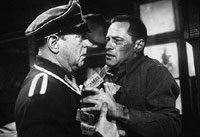
(Sorry about the sucky quality of the photos)
William Holden has a moment (anyone remember it?) where he suddenly, and spontaneously, slaps someone across the face three times in a row. Whap, whap, whap. Because the character of Sefton is so seemingly careless, he sits back, he smokes his cigars, he remains above it all, he doesn't get involved in the barracks' constant escape-plans, he waits it out ... But then, when push comes to shove, when the suspicion against him comes to a head, when he is attacked in the night by his barracks-mates, and they beat him to a pulp - he has had it. The one-two-three slap is terrifying, because it comes out of nowhere, and it looks REAL. Those are no stage slaps. They are real. The violence in the slaps is still a bit held-back - Sefton doesn't punch the guy in the nose. No, he has more contempt for his enemy than that. He won't punch the guy in the stomach. He will slap his enemy across the face, treating him like the sissy-girl that he is. It's contemptuous.
Sefton is who he is. He's a black marketeer. But at the end of the movie, you realize: damn, this guy is actually a freakin' hero.
As probably everyone who has seen this movie knows, it was the inspiration for Hogan's Heroes.
This was Billy Wilder's favorite of all his movies. He said once that Sgt. Sefton was the closest "alter ego" of himself that he ever put on screen. He said years later, before his death, that Sgt. Sefton, of all the characters he ever created, was the one he "loved" the most. Part of it had to do with his deep love for William Holden. He thought Holden was the best actor he had ever worked with (well, maybe not - I think maybe Charles Laughton in Witness for the Prosecution was Wilder's favorite performance ... He thought that guy was a genius) ... but of all of the actors Wilder worked with, he was closest to Bill Holden. He loved him. They were dear friends.
And Sgt. Sefton, with his standpoint of: This war is about the survival-of-the-fittest-and-the-wiliest was Billy Wilder's "alter ego". After all, Wilder lost most of his family in Auschwitz. Wilder knew that survival was not about being altruistic. The one with the most virtue would never win.
It was about being clever. Smarter than everyone else. Having contempt for your enemies. Not fear. No. If your enemies are stupid, have contempt for them. Use the system. Shamelessly. Have no shame. Sit back. Let people say what they want. It doesn't matter, because in the end, you know you are smarter.
William Holden, as Sgt. Sefton, is the perfect embodiment of that attitude.
And yet - let's not forget - the heart. Sgt. Sefton, it turns out, has a bigger heart than all of the others. It's just that he keeps it hidden. Because you can't have a big open heart in the middle of a war. Look at what happens to people who stay open like that ... "Joey" - the guy in the barracks who has obviously lost his mind, and can no longer speak, and can only play his piccolo. You can't keep your damn heart on your sleeve.
HAVE your heart. But PROTECT it. Protect it as though your life depends on it. HOVER over your own heart as though it is the most precious diamond in the world. Don't let just ANYBODY in there!!
Because the world will not protect your heart. The world is set up to kill you. To destroy you. To shatter your heart. It is YOUR job to protect that precious rare thing inside of you - your soul, your warmth, compassion, your "self" ... whatever you want to call it. You have GOT to protect yourself. Have your walls up, have your guard up, at all times ... but do not let your heart calcify inside.
To me, this is the Billy Wilder persona.
And according to Wilder, William Holden was the only actor who really "got" all of that, who could "do" it, like nobody's business, who could do it without thinking. Because that was kind of who Holden was.
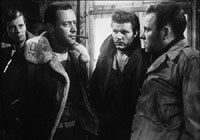
If you haven't seen it - I highly recommend it.
I love it that of all the movies Wilder directed, all the classics, Sunset Boulevard, Double Indemnity, Some Like it Hot ... and on and on and on ... this one was his favorite.
It's obvious why.
(More of my thoughts on Bill Holden here, if you're interested.)
"Success is my only motherf***in' option - Failure's not"
Huge article about Eminem in the latest Vanity Fair (which I was unaware is now online ... since when did Vanity Fair put their stuff online?)
His CD release date was moved up to November 12 (and I still haven't gotten the damn thing) to stem piracy.
It's a very revealing article.
"I had made an [independent] album called Infinite, and on that you can hear the pain and the woes of just growing up and being poor and having a baby on the way. Obviously, I was young and influenced by other artists, and I got feedback that I was influenced by Nas and AZ, another rapper who was down with Nas at the time, and I got the feedback that I sounded like them. And to me, this is my life, everything that I stand for, and it was crushing. It was the same as losing a battle. If people don't like your music and this is what you plan-or want to do with your life-you gotta make a change. So, I started taking all the feedback and started throwing it back in my music: "Yeah, I am white trash, I am whatever you're gonna say about me." Somehow, started taking the disadvantages and used them to my advantage. I reached a point where I stopped caring what people thought about me. And the second I stopped caring, people started caring about me. So, I figured out how to flip it. As soon as I did that, it became ... "He's selling so many records because he's white." And I remember there was a time when I couldn't get a record deal, or get looked at, because I was white."
And the second I stopped caring, people started caring about me.
Damn. That's such a true thing - you can see it in pretty much any star that hits it huge. There's a part of them that just doesn't care. They do their thing, they express themselves the way they see fit ... because it is THAT that made them a star.
I like this, too - something he says over and over again, in his music and in interviews:
This is adult music, and, yeah, it has that appeal where kids are going to like it, but that's where parents should step in and be a parent. Watch what your kids are listening to, because I do the same thing with my kids.
The lyrics in one of his songs, dedicated to his daughter Hailie: "I wouldn't let Hailie listen to me neither..."
I also think it's very interesting that no matter what happens, no matter how much success he has, he still will always be "the underdog". There are many who want him to fail, but there are many many more who stand back, in awe, waiting to see what this dude will do next. But because of his skin color, he will always be the underdog.
What also sets him apart from his other hip-hop compatriots is his absolute disinterest in what ya might call "the bling-bling lifestyle". He could not care less. He's richer than God, but he doesn't live his life that way. He lives in Detroit, a couple blocks from where he grew up, in a house he bought just as he started making a bit of money. It's not lavish. It's a basic house. He "volunteers" in his neighborhood, he's on committees to keep the streets safe and clean, he helps out in his daughter's class, he's known as "Mr. Mathers". I think that's hilarious. But it seems that - what this guy is addicted to is WORK. And maybe working OUT. (See the photo below. Ahem.)
But that's it. You never see pictures of him out and about town, you never see him out in public, he never goes anywhere. He hangs out at his house, raises his daughter, makes his music.
Must run out now and buy "Encore". What the hell am I waiting for...

November 13, 2004
Confession
I could watch Ball of Fire, starring Gary Cooper and Barbara Stanwyck every day and not get tired of it. I think I might rent it tonight. I am embarrassed. I am afraid the video-clerk will judge me. Again? Didn't she just rent this one??
This is similar to the Notorious frenzy I went through a while back. I finally just bought a damn copy of Notorious because it was getting too shameful to rent it every other day.
I must succumb, shame or no shame.
I have to see Ball of Fire again.
It ALWAYS is funny to me, no matter how many times I have seen it.
-- "14 watercolors ..." (said by one of the old professors in a tone of slow bewilderment)
-- A knock comes at the door. The professors flutter about. "It's 2 in the morning! Who could that be!" And Henry Travers (better known as "Clarence" in It's a Wonderful Life) - who plays one of the professors - interjects: "Oh, that might be the statistics on San Salvadoran saltpeter."
It is such a RIDICULOUS line, and he says it SO SERIOUSLY - I guffaw every time I see it. I can feel the intelligent wit of Billy Wilder (who wrote the screenplay) sparkling through that. "Okay, so what will this professor be studying ... that will make this moment funny ..." Ah yes, of course, he is waiting for the statistics on Sal Salvadoran saltpeter.
-- Barbara Stanwyck is deliciously good.
-- And a bumbling cerebral Gary Cooper is BEYOND sexy. Like ... he's so sexy that it is almost not fair. The cliche of the big hunky guy playing a repressed geek (Cary Grant trademarked this - but Cooper ain't no slouch at it) When he asks her, almost inaudibly, if she could "yum" him one more time... He's too shy to even say "kiss". I mean, I find him disturbingly sexy.
It's ridiculous.
And so enjoyable.
-- Help.
November 04, 2004
Team America
Random thoughts (and yes, there are many spoilers. Don't read this if you don't want to.)
What was great was the audience was full of obvious South Park fans ... so the warped sense of humor of those two guys was shared by everyone there. Everyone "got" the jokes.
For example:
-- the little French kid (er - puppet) skipping along singing, of course, "Frere Jacques". Such a STUPID joke, and so damn FUNNY.
-- I thought I might have to leave the theatre during Kim Jong-Il's melancholy ballad "I'm So Lonely". I was cackling, snorting, and making a scene. Thankfully, I was not alone. I am still laughing about it. The sort of echo put on his voice, those insane googly glasses, the sight of the PUPPET wandering around his empty palace ... It was insanely funny.
-- I kept just thinking: "The whole IDEA of this film is genius. I mean ... marionettes? What??" Those guys are incredible. And the puppets were extraordinary.
-- I loved that "Intelligence" was an actual computer. "There's intelligence." And that "intelligence" had a kind of "hey, there, dude, wassup" voice was even funnier.
-- Matt Damon only being able to say his own name. hahahahahahahaha And the Matt Damon puppet was so freakin' funny ... the kind of squished face ... heh heh And any time he had to speak, all he could get out was a kind of garbled: "Matt Damon."
-- Oh my God, and the take-off of "Rent"?? The musical called "Lease"? I still can't get past it. It was almost too funny to even laugh at. The bogus pseudo-pop singing voices, the chick in blue shiny pants hanging on the balcony (if anyone has seen "Rent", you'll know of what I speak) ... SICK TWISTED HUMOR AND I LOVED IT.
-- I found the entire movie very cathartic, actually. Not just because it was funny, but because of everything it made fun of ... The criticisms and ridicule were spot-on, I thought. Across the board. Alec Baldwin's ponderous self-importance, and Sean Penn saying over and over again in a squeaky voice, "I went to Eye-raq, I went to Eye-raq!" It was so SATISFYING. Cathartic. Like the Greeks used to talk about. (I'm quite serious.) The laughter I heard around me was coming out of a sense of release, relief, almost - like: OH my God, YES, I've been feeling just this way!! Also, that this ridicule would come from "the inside" (as in: fellow actors, performers, whatever) is even better. Come on - take these people down a peg. Everyone here knows how I feel about most of these people as ACTORS (I love Susan Sarandon, I love Sean Penn, I have thought Tim Robbins was great) ... but as elder statesmen? What? I didn't "elect" those people to represent me in politics. Sean Penn whining about his treatment in this movie shows how much of a bubble this guy lives in. You can dish it out, but you can't take it. You live in a pampered world where no one says "no" to you. Like: come on, man, you set yourself up as a HUGE target ... so take the shit that you get. Take it like a man. Stop yer whining.
-- The puppet-sex-scene was positively disturbing and outrageously funny.
-- The soundtrack is hysterical.
-- The melancholy love song that had "'Pearl Harbor' sucked" as its chorus was howlingly funny. Like ... the entire song degenerated into this diatribe against Ben Affleck's bad acting and how the movie "missed the point", and how Cuba Gooding is a much better actor ... but all with this sort of pop-ballad melody. It was RIDICULOUS. And so funny.
-- Also, I can't help but go back to this: the puppets themselves. They were so COOL, so biZARRE ... the strings going up into nowhere-land ... During the sex-scene montage ("we need a montage ... if you fade out during a montage, it shows you time has passed ... we need a montage ...") - one of the things that flashed into my mind was that the puppeteers must have been howling with laughter, out of sight, as they put these naked puppets through the Kama Sutra. It was so RIDICULOUS.
-- The South Park guys are pretty much agnostic when it comes to their vicious sense of humor. Everybody gets whacked. They make fun of things that a lot of people hold dear, however they don't pick and choose. Anything that anyone might hold "sacred" is up for grabs. I love that attitude. They attack those who wish to live in a black-and-white world. Also - because it's done with humor, I appreciate it. It's such a RELIEF, to make fun of EVERYTHING, and not take everything so damn seriously.
-- I still can't get over Kim Jong-Il's lonely ballad. That alone was worth the price of admission. His sad face, his googly eyes behind the glasses, his small fat belly, the echoey palace ... sitting longingly at the piano ... I mean, it was genius. Sheer comedic genius.
October 26, 2004
Thoughts on William Holden
William Holden, over his long career, racked up an astounding body of work. He is one of our greatest actors. Sunset Boulevard, Stalag 17 (later to be made into a TV series called Hogan's Heroes, baby), Picnic, he played Joe Bonaparte in the film version of Golden Boy, Country Girl .... Jeez, what else? Bridge on the River Kwai. The Wild Bunch. I mean - very very few actors build up such a resume, and turn in such consistently fine performances over a long lifetime. Also, all of these films, in their own way, are still considered to be classics.
Then there's his genius turn in Network. I don't use that term lightly. He acts everybody else (including the great Robert Duvall - whom I love, but who I think turns in kind of a wooden one-note performance in that movie) off the screen. Who can forget Holden's sex scene with Faye Dunaway? The sadness of it, the comedy of it? She's getting undressed, casually, jabbering on and on about "market shares" and her upcoming show "the Mao Tse Tung Hour" ... They begin to have sex, and she never ever shuts up. Holden lies beneath her, staring up at her, with ... something I can't even describe on his face. Humor? Partly. There's desire there, too. But mixed in with that desire is the sadness of the middle-aged man, the guy cheating on his wife, the guy who knows that this won't last ... His great great scene with his wife at the end (Beatrice Straight - she got an Oscar for her less than 10 minutes on screen) - and then, my favorite: when he breaks up with Faye. His monologue there could not be better. She doesn't say a word, and he is as gentle as he can be, but also firm, and sad, and ... a bit pathetic. A bit of that speech is:
I feel lousy about the pain that I've caused my wife and kids. I feel guilty and conscience-stricken, and all of those things you think sentimental, but which my generation calls simple human decency. And I miss my home, because I'm beginning to get scared shitless, because all of a sudden it's closer to the end than the beginning, and death is suddenly a perceptible thing to me, with definable features.
Watch that movie again ... and watch how he says those lines.
A truly courageous actor. In that role, he faced the fact head-on that no, he was not the "leading man" anymore. Think of other male movie stars growing old ... and you can see how rare it is for them to face that fact. They hold on. They hold on desperately. But Holden came out onto the other side ... he was once a leading man, and he kind of became a character actor later.
Holden, as a young actor, was known as "the Golden Boy". That was one of his nicknames. Because he had played the "Golden Boy" himself, but also because of his regular every-day American good looks, the quarterback good looks, the breezy certainty of his handsomeness. - William Holden's handsomeness is immediately apparent, in an empirical way. You look at him and think: "There's a handsome guy." But it's not glamorous, or knock-you-off-your-feet gorgeousness, or off-putting, like some brands of good looks are. Holden looks like you could meet him in real life. There are good-looking guys like that in real life. He didn't have the glitter or the sexual mystery of Cary Grant. It was hard to figure out what exactly, at times, was going on with Cary Grant - which is part of his enduring appeal. The voice? The walk? He's gorgeous - but he's a goof - is he British - is he American? But William Holden was immediately place-able: An open-faced American guy, with a mop of hair, and a huge sunny smile. He was an American golden boy. I heard somewhere that he was descended from George Washington, which sort of makes sense.
He won an Oscar for Stalag (directed by Billy Wilder). I can't remember if Holden won more Oscars, but he was certainly nominated multiple times.
Billy Wilder loved William Holden, loved him dearly, as a man and as an actor, couldn't say enough loving things about him. Wilder's two favorite actors were Holden and Cary Grant. Wilder ended up working with Holden multiple times - and with Cary Grant none. (Wilder was bummed about it til the end of his life!) But still - Wilder had great affection for the skill, humor, and dedication of Holden. Also the fearlessness. He'd do anything.
Wilder has talked about the scene in Sunset Boulevard where Norma shoots Holden's character, and he topples into the pool. Holden was an athlete, graceful, physically fit ... Holden pulls off a difficult stunt there. Not every actor could throw himself into the pool in the way he does in that scene - it's an amazing bit of physical acting. If you get a chance, watch it again. See how easy he is with his body, and how REAL that moment looks.
Holden's end is haunting to me. The man was a drunk. He had been a pretty serious drunk for years. I do not know what demons he had to combat, but his drinking was notorious. One night, he was alone in one of his apartments (he had apartments everywhere - Hong Kong, LA, he had a house in Africa ... he was a peripatetic type) - and he was drunk, and he fell and cracked his head open on a coffee table. The fall alone did not kill him. He lay there and bled to death. He didn't phone for help, he lay there - probably half in and out of consciousness - or maybe just too wasted to realize the danger he was in - probably unaware that he was going to die if he didn't get help.
I look at his craggy lined face in Network, and wonder.
That character (Max) is a sad man. A workaholic, kind of skating along in his marriage. Being pushed aside at work, no longer needed. A man who also has a bit of trouble with drinking. Just a bit, though. It's hard for actors to play things so close to them. Or, at least, it often is. But Holden wasn't afraid. He didn't protect himself, in that part. He let us see the reality of who he was NOW - in all of his middle-aged loneliness, his sexual insecurity, his fear of death ... A lot of actors as they get older do not want you, as the audience, to see all that stuff. They still want to be the tough-guy, the hero, whatever. This is why Cary Grant retired. He didn't want to suddenly be the old guy with 4 lines in a movie. He was done. William Holden, the golden boy, the handsome guy, one of the biggest stars of his day, a heart-throb, voted "one of the sexiest stars of the 20th century" in 1995 ... did not hang on to his old persona. His segue into power-house middle-aged parts is very rare. Not a lot of people can pull it off - especially those whose careers were based mainly on their looks, and on the fact that female fans went ga-ga. But Holden was a talent. Always was.
Maybe his private drinking was where he put all his grief, his sadness about what he had lost ... but up on screen, he didn't hang onto it. He didn't seem to be saying to us: "MEMBER ME? MEMBER WHEN I WAS THE BIG SEXY STAR IN THE 1950S? WELL, I STILL GOT IT. I STILL GOT IT."
It's hard for actors to grow old. It's harder for women - there's a black-out period in between the ages of 35 and 60 when it's nearly impossible for women to get good parts. Especially with the tendency of male movie stars in their 60s to have 25 year old actresses cast as their wives. This is vanity, make no mistake about it. "I can't be married to a 60 year old! Not if I'm still trying to prove I'm a virile stud!" However, male actors growing old have their own set of challenges. Particularly for those who were once sex-symbols, or heart-throbs, or leading men. (This problem does not exist for "character actors" - those who were never good-looking enough to be sex symbols. The character actors, male and female, NEVER stop working. EVER. They will get parts until they're 80.) But former heart-throbs, like William Holden was, had BETTER have more going on with them than just their good looks, or the ease that comes with being young.
You had BETTER have some gift for this mysterious thing called acting.
Otherwise ... you'll have a short career.
Recently I saw a movie Holden made with Jennifer Jones called Love is a Many-Splendored Thing, which I thought was a snooze-fest. A manipulative boring tear-jerker. Blech. Holden plays a journalist, I think, stationed in Hong Kong. He falls in love with a "Eurasian" doctor, played by Jennifer Jones. They have a sweeping love affair, where they have to deal with prejudice, also with the Communist revolution in China, and there are multiple scenes with swelling violins, etc. It's not very effective. There's next to no chemistry between Holden and Jones.
But I thought to myself, as I watched it: Okay. What is missing here? What, exactly, is wrong?
Here's what I think it is:
And this may just be me projecting William Holden's performance of dark sadness in Network back over his earlier career ... but I don't think so. I think that Holden is best in darker material. Edgier material. Yeah, he's got all-American good looks. But he wasn't quite believable saying to Jennifer Jones, "I am so in love with you ... I love you, darling ..." etc. He's more believable when he's not so forthright, when he has ulterior motives, or when he's trapped. Trapped into living a lie. Think of his character in Sunset Boulevard. How attracted he is to his co-writer, how much he loves being with her, the intellectual stimulus, the companionship ... it could be a true romance. And yet, then ... there's Norma Desmond's web he is caught in ... and finally, at the end of the film, he reveals: that he LIKES being caught in that web. He LIKES being a "kept" man. Many actors turned down Sunset Boulevard for that reason. They found it too embarrassing - to play a character who would willingly become the "house-boy/love-slave" of an aging movie star - merely because she buys him expensive suits and cigarette cases. He's a sort of prostitute in that movie. He's trapped in that house - she uses him for sex, and he uses her back. Holden had no problem with any of this. He's great in that movie. He's sexy, too, in a sort of dark and unexpressed way. It's not your basic leading-man part ... not at all ... He is in quite an emasculated position for the entirety of the film - he's a sex-slave to Norma ... He plays the role typically played by women - the money-hungry woman who puts up with anything as long as her tormentor keeps her in furs and nice clothes ... but perhaps THAT is part of his complex appeal.
It's certainly part of his complex appeal in Network.
In Love is a Many-Splendored Zzzzzzzzzzzz, Holden pretty much plays your straight-up romantic leading man, and it falls flat. It doesn't work. It doesn't seem true. I kept wondering what he was hiding, what he was lying about.
Holden's good looks concealed a secret: this was a man tormented by insecurity, by sadness, by addiction. He drank himself to death, basically. He wasn't an old man when he died. Not at all.
It was when directors saw beneath his good looks - and got a glimpse of the darkness beneath - that Holden's true genius could be exploited.
Thinking about William Holden makes me sad, for some reason.
A great actor. Is he really remembered now? Does he really get the props he deserves?
Those of you out there who have seen and loved any of his performances, anything you would like to comment on? Let's have a little collective tribute to this guy.
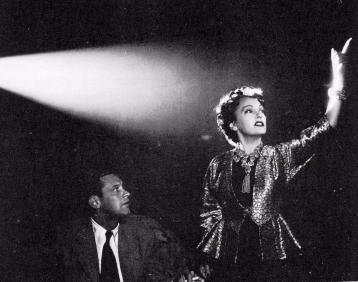
October 08, 2004
Three similar stories
One story stars Clark Gable. One stars Robert Duvall. And one stars Gary Cooper (the latest celeb-crush ... I will never abandon Cary ... how could I? We had a good time together, he and I. We really did. But I felt it was time to move on, and Gary Cooper was available. Such is life.)
I find these stories, put together, very illuminating. And we could probably add to this list indefinitely. But here are three to start off with:
1. Clark Gable
I was looking through Arthur Miller's autobiography Timebends this morning. Long stretches of that book are so deadly dull you want to commit hari-kari (Harry Carey? Whatever, you know what I mean) ... but then there are brief excerpts of such insight that it wipes out the rest of the sanctimonious ya-ya-yawn. It's his descriptions of actors I find most interesting (duh) - and also his insights into Marilyn Monroe. Anyway - he devotes many many pages to the famously difficult shoot of The Misfits - which he wrote, for Marilyn (he had a serious savior complex with her ... I suppose every man wanted to save her). Marilyn was a wreck, their marriage was falling apart, she suffered from chronic insomnia, there were many many issues with this shoot. Shooting was shut down for a month, while Marilyn was hospitalized. Etc. Clark Gable, John Huston, Montgomery Clift, Eli Wallach - an all-star cast - just sat around in the Nevada desert, on FULL SALARY, waiting for Marilyn to return.
There's the background.
Arthur Miller had written the part of the aging cowboy who falls in love with the girl for Clark Gable - he never could imagine anyone else in the part. It took some convincing to get Gable to agree to sign on. Gable didn't understand the script. He didn't get it. (If you see the movie, you'll see that Gable had a point!!) So Gable invited Miller to come over, and explain the script to him. Miller acknowledges that he was always really bad at that - he never could "pitch" his stuff to anyone. But he decided to give it a shot.
The first thing Gable said to him was, "This is a Western ... right? It's supposed to be a Western? But ... it's not like any Western I've ever heard of."
Miller thought about this and then replied, "It's kind of an Eastern Western."
Gable took this in, and then howled with laughter. That was all he needed to hear. He signed on immediately.
I could talk about The Misfits all day. But I won't. The REAL story I wanted to tell is about the last shot of the film - which was also the last shot they actually did during the film-shoot.
It speaks volumes about the genius of certain actors (all the greats - hands down - they've all got this) ... It also, to me, says that actors, experienced film actors I mean, know their shit. They know that camera as well as the camera-man, as well as the guy who BUILT the camera. They know the lighting equipment as well as the lighting designer. They KNOW how to do their job.
I'll let Arthur Miller tell the story. He admitted that he was very naive about film-making - He knew how to write PLAYS, but the literal-ness of movies, and the craft of movie actors as opposed to stage actors was new to him.
The final shot was also the closing scene of the picture. Langland [Gable] stops his truck so Roslyn [Monroe] can untie his dog, which was left behind while the mustangs were being rounded up. It was a studio process shot done in Los Angeles; a filmed track in the desert rolled away through the truck's back window, coming to a stop when Marilyn jumped out to go to the dog. Gable was supposed to watch her with a mounting look of love in his eyes, but I noticed only a very slight change in his expression from where I stood beside the camera, hardly ten feet away."Cut! Fine! Thanks, Clark; thanks, Marilyn." [John] Huston was brisk and businesslike now, in effect refusing any sentimental backward look; hardly lingering, he said he had to be off to work with the film editor.
I asked Gable if he thought he had shown sufficient expression in the final shot. He was surprised. "You have to watch the eyes. Movie acting is all up here" -- he drew a rectangle around his eyes with his finger. "You can't overdo because it's being magnified hundreds of times on the theatre screen."
He turned out to be right, as I was relieved to see in the rushes of the scene; he had simply intensified an affectionate look that was undetectable a few feet away in the studio.
2. Robert Duvall
Dennis Hopper came and did a seminar at my school. He was hilarious, irreverent, funny, WACKO, and very very articulate. He talked about directing Robert Duvall in Colors, I think it was called - the LA gang movie with Sean Penn. Hopper thinks that Duvall is the best American actor working today, and I can't say I disagree.
So Hopper was surprised to see how different it was to DIRECT him, as opposed to sitting in a movie theatre, watching him magnified up on the screen. Robert Duvall's acting is so alive, so powerful, so DEEP - Hopper was expecting THAT guy to show up. But there was Duvall, soft-spoken, quiet, humble ... and Hopper couldn't SEE that anything was happening. He didn't trust that Duvall knew that camera better than HE did ... he wanted to SEE the acting.
Hopper said that he was directing one important scene - where Duvall had to be flipping through a wad of money. Apparently, Duvall was supposed to be pissed as he did this (was it pay-off money? Dirty cop money? Something like that). In the next scene, Duvall's character had to storm into the cop's locker room and shove Sean Penn up against the locker - and give him HELL. So you needed to see the set-up of Duvall's anger in the flipping-through-money scene.
But Hopper, standing by the camera, watching Duvall - from three feet away - couldn't see it. Duvall didn't seem to be DOING anything. He was just flipping through the money. There was no sense of growing anger, of violence, of rage ... Why the hell wasn't Duvall acting? Hopper shot the scene a couple of times - he was almost intimidated by Duvall, didn't want to go up to the guy and give him acting notes, but he still didn't understand why Duvall's anger wasn't showing.
But then - later that night - when Hopper watched the rushes from the day's shoot - Duvall's skill and brilliance became clear. Hopper felt like an idiot. (After all, he's an actor too). He watched Duvall flipping through the money - and whatever it was he saw in Duvall's face it was a small thing, a tightening of the lips, the way Duvall held his hands around the money ... a tiny look in his eyes - which would have been completely invisible from 2 feet away ...
When Hopper looked at the rushes, what had seemed dull and uninteresting suddenly pulsed with violence and potential. The next scene (Duvall shoving Penn up against the lockers) made TOTAL sense. Hopper could see that Duvall was ready to bust.
Now an actor on stage obviously could not get away with that. You have to SHOW that stuff - you can't just tighten your lips, and change the expression in your eyes - Nobody will SEE it.
But these guys - Gable, Duvall - understood the medium better than their own directors.
3. Gary Cooper
There isn't just one story illustrating this point for Gary Cooper. Director after director after director told the same story:
"His performances seemed dull - when you were standing in the same room with him. He seemed passive. Very very boring. And then you would watch the rushes later that night, and it was the most powerful acting you'd ever seen."
By the end of his career, directors were no longer shocked or worried on the first days of shooting. They no longer thought: "Jesus, this guy is dead in the water, a drippy noodle ... where the hell is the ACTING?" The directors understood by then that Gary Cooper knew his job better than they did - and all they needed to do was wait for the daily rushes. They knew that Gary Cooper was turning in a great performance, even though they couldn't see it yet.
October 05, 2004
"That kid is the greatest goddamn actor..."
I like this story a lot. It's one of those stories which may be a legend, may be an exaggeration ... whatever, I don't care. I like it anyway. I ran across it again this morning in the Goldwyn biography, and remembered how much I liked it.
Gary Cooper (I think his name was actually Frank) had grown up in Montana, on a ranch ... but had also spent 10 years as a child in England ... his formative years. Somehow, as a young man, he ended up in California. Perhaps looking for work? Not sure. If he had ambitions to be a great actor, he wasn't behaving in that way. He met up with two good friends who were strolling down the street in full Western garb. They told him that you could make good money as an extra in cowboy movies. If you could ride a horse, looked good in chaps ... you might make some cash, and you might get a shot at the big time!
This was in the early 1920s.
So I guess Cooper started being an extra on Westerns. A faceless nobody. Just the same as the tons of other young hopeful cowboy-types in Hollywood at the time. However, what made him different (in a way ) was that women fell over for him like ninepins. And very early on - a couple of different actresses noticed this tall lean very very shy cowboy-extra - and tried to help him out, tried to push his career along. They became patronesses, almost. All women. The dude had major sex appeal, and yet was often so shy he could barely get the words out, and he blushed like a schoolboy. (Of course, this made the women go even more nuts over him ... and a couple of them became DETERMINED that even if they couldn't get this guy into bed, they would try to advance his career.) One woman, in particular - who was an actress, very successful, had a huge crush on him - and basically forced directors to look at him, forced the publicity department of the studios to consider him ... etc.
But still - he wasn't an actor. He was a fill-in, a guy who looked good in chaps and a cowboy hat and could ride a horse.
In 1926, he was on location (as an extra) with The Winning of Barbara Worth - directed by Henry King. Again, he was an extra. He had no lines. He was one of the faceless ranch hands.
Meanwhile: some OTHER actor, a "real" actor, had been cast in a very small but very important part. He only had one scene. However, this actor (whoever he was) kept asking for more and more money, or something like that - maybe it was scheduling problems, not sure, but he was negotiating with the studio ...
Henry King (the director), on location, finally decided he couldn't wait any longer for this over-paid actor to show up, and offered the role to the untried Gary Cooper.
All Gary Cooper had to do was knock on the door of the cabin. The woman inside would open the door, and he would collapse inside, from exhaustion. That was the part.
Long afterwards, when he was asked about Cooper, Henry King would describe the first day of shooting with this unknown kid who had never acted before. It also just so happens that Sam Goldwyn himself had come out on location that day, to check up on how things were going.
Henry King said that, while the crew was setting up the lights, etc., he pulled Gary Cooper aside and kept saying to him: "Look, just remember that your character is tired ... you are so tired ... You have been riding for days ... Tired, tired, tired ... When that door opens, I need to see a man who is licked ... who can barely stand ... tired, tired, tired..."
King said that he OVER explained it to Gary Cooper (I mean, obviously, Gary Cooper knows what the word "tired" means), but King didn't think Gary Cooper was an actor. Maybe Gary Cooper didn't yet think that Gary Cooper was an actor. Who knows.
King said that whenever he had a 5 minute break, a 10 minute break, he'd come back over to Gary Cooper's side, and whisper "Tired, tired, tired ..."
Sam Goldwyn saw how much attention the director was giving this glorified EXTRA, and grumbled about it - "Am I paying you so that you can give an extra acting lessons?"
King protested, "The kid isn't an actor ... I've got to explain to him what he has to do ..."
Anyway - finally the time came to shoot the scene. It was an interior shot - You would hear Gary Cooper's knock on the door ... the woman would open the door... and he would fall inside. A simple scene.
Action!
The scene began - a bit of dialogue - blah blah blah -
Then came, at the door, the TIREDEST most weary knock anyone had ever heard. King said that you could barely hear the knock. It was as though the person knocking did not even have the strength to lift his hand up high enough to knock properly. (Obviously ... this "extra" knew how to act - he went for it, he went for tiredness 110%.)
Anyway. After this weary timid knock, the door was opened ... and there was this kid - who right up to the moment before shooting the scene was a tall young lean handsome cowboy. But the door opened on an absolute wreck of a man. King said, "He had become, in the 30 seconds hidden behind that door, a completely different man. A sad sack." Gary Cooper took one step forward, and then collapsed onto the floor ... completely gracefully, completely naturally ... It looked as though his legs just could not hold him up anymore. The cameraman, realizing that some DAMN FINE ACTING was going on, had the presence of mind to zoom in on Cooper's face for a close-up.
King said that 2 seconds after he called "Cut", Sam Goldwyn called him over. Sam Goldwyn could be quite terrifying. Especially when he was really really calm. Which he was in this moment.
Goldwyn murmured, "You say that kid's not an actor?"
King said, "He was an extra until this morning."
Goldwyn replied, "Henry, that kid is the greatest goddamn actor I have ever seen in my life."
October 04, 2004
Janet Leigh, RIP
She scared the bejeebus out of us ... during the [corrected for emotional clarity] DEADLY - TERRIFYING shower scene ... I can't even think about it directly, without shivering in sympathetic horror ...
Of course, that was not all she did. Her career was long, and she appeared in some true classics. Touch of Evil, The Manchurian Candidate, etc.
I came across the following quote this morning, in one of the obits I read. Leigh described her experience filming Touch of Evil, directed by Orson Welles. I like the quote because it shows her generosity, her intelligence. The filming of the movie was a "great experience" for her, and yet she was disappointed with what ended up on the screen. She said:
"Universal just couldn't understand it, so they recut it. Gone was the undisciplined but brilliant film Orson had made."
She was 77 years old when she died. Her daughters, Kelly and Jamie Lee Curtis, were both at her side when she died.
Rest in peace, Ms. Leigh. You will not be forgotten.
September 30, 2004
Today in 1955...
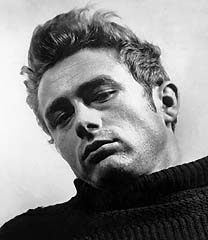
Today in 1955... James Dean died at the age of 24. He had made 7 movies, but only 3 where he was "credited".
East of Eden (which basically changed my damn life when I first saw it) was the only one of his 3 major films (East of Eden, Rebel without a Cause and Giant) to be released while he was alive. Strange. No wonder a cult flourishes. Obviously, the man (I should probably say "boy") was very gifted as an actor - but then there was the dying a young and violent death, and to add to that - movies starring him continued to come out a couple of years after he died. It must have been especially impact-ful (in terms of a burgeoning cult) to see something like Rebel Without a Cause, knowing that he had died so young.
When I was a teenager, I saw all those movies. I saw them on late-night television, usually when I was babysitting, and then I would beg, and plead my parents to rent a VCR (member those days??) so I could see them again.
His performance in East of Eden tormented me. It was typical young-school-girl crush stuff, but there was something else. It got me asking questions about acting, about actors ...And even though I was 13, 14 years old - I was the same person then as I am now, so I read the great biography of James Dean, called Mutant King - and read all of the biographies of anyone who had come into contact with him. Natalie Wood, Carroll Baker, Elia Kazan ...
James Dean's twisted-up overly-open nearly-inarticulate brand of acting captured my imagination.
If I had had a blog when I was 14, it would have been all-James-Dean all-the-time.
Now I'm not so sure about him. I used to consider him a "great actor" - but I think there's a huge difference between a "great actor" (say, a Jeff Bridges, or a Marlon Brando, etc. etc.) and a "movie star". Not that he was "just" a movie star. Something else was going on with James Dean.
What I mean by all this is: James Dean was young, neurotic, extremely self-conscious, very shy, bisexual, filled with guilt, a loner, an outsider, may possibly have been a virgin when he died, he was reckless, had kind of a death wish ... Elia Kazan, who directed him in East of Eden called him, years later, a "sick kid". This is not to say that there wasn't magic there, because there OBVIOUSLY was. I can only think of one other person the camera loves as much as James Dean, and that's Marilyn Monroe. It may not be the magic of honing your craft, of being a Meryl Streep type virtuoso - but it is that very special brand of movie magic.
James Dean is riveting. To this day. No wonder his movies last. You can't not watch him. He is so compelling. You want to untwist that pretzel body, and help him relax. (Well, that's a very female response ... most women want to help him relax. He seems so self-conscious.)
His face is unendingly interesting. Yes, it's very handsome too ... but we're talking about what the CAMERA picks up. Plenty of people are handsome, but they wouldn't be magnetic on screen. It's magic, hard to describe. I think it might have to do with vulnerability, a willingness to let the camera read your soul. All the great movie stars have that.
I am not sure now of how aware James Dean was of what, exactly, he was doing. A lot of it was sheer instinct, bravado, and fearlessness. There's a genius there. But I'm not sure anymore that it is a genius for acting. The way Marlon Brando had a genius for acting. The way Bogart had a genius for it. Those guys were ACTORS. In the tradition of Olivier, Spencer Tracy all the greats.
I see James Dean now more in the realm of ... a "behaver". I just made that up.
What he did was, and why he is so INTERESTING (and why other actors, incidentally, were often completely frustrated when working wiht him) ... he was able to behave and let us know that something deep and psychological was going on with him - all without saying a word. He mumbles his lines, he's embarrassed, he scuffs his feet, his hands are jammed in his pockets ... We can't look away. We know that SOMETHING is going on with this poor boy. We can't wait to find out what it is.
Other actors often felt: Jesus, this guy is in his own world ... He's not really here in the scene with me ... he's off thinking about his own demons.
I am not saying this is good or bad. It is just an observation.
But being aware of one's own demons, and being able to show the audience the struggle is different from .... say, a Brando in Streetcar.
Brando, with all of his pooh-poohing the craft of acting, was, in fact, a genius craftsman. He was not just twitching around, showing us his inner torment. Each scene is perfectly modulated, he is in total control of what he is doing, he is able to burst out with a catharsis when Tennessee Williams has written one, he shows us the tenderness, the sexiness, the loutishness, the insanity ... and Brando would never say that he was consciously doing anything (hence: genius) - but to me, Brando at his best was like a great musician.
The craft, the long years of training, have become so internalized - that you see no work at all. All you see is life, on screen.
To my eye, as a huge James Dean fan, that was not what James Dean was about.
He was more un-evolved, more at the amoeba stage of human development.
Elia Kazan (and others) confirm this. James Dean was lucky enough to find acting, and lucky enough to find the roles - the twitchy rebellious youths - that could just LET him stand up there on screen, and not DO all that much, but show us how hard it was to be James Dean. (The last scene in Giant is a notable exception, when he reappears as a broken old man. He's 24 years old filming that scene. It's astonishing. To my mind, his work in that scene gives a glimmer of the truly great actor James Dean could have become.)
But now, since the untimeliness of his death, he remains before us as he was then. Young, boyish, almost pre-sexual, twisted-up, neurotic, sometimes cocky, sometimes shy, always with an inner core of kindness. Think of his kindness towards the Sal Mineo character in Rebel. Or his kindness towards Julie Harris in East of Eden.
And when he let out the torment, the inner anguish that was ALWAYS there underneath, it is so powerful, so raw, that you almost want to look away. It's horrible what is inside this kid. And when it comes out - it's embarrassing. You're embarrassed for him. And yet you weep for him, too. The father in East of Eden, when he refuses the money Cal made for him, and James Dean collapses, slowly sliding down his father's body - letting the bills slip from his hands - anyone remember that scene?? Jesus. The feelings of betrayal, of abandonment, of grief. That underbelly is ALWAYS there, which is why his acting is so interesting to watch. I can't think of him screaming "YOU'RE TEARING ME APART" without feeling tears come up in my eyes - It is so RAW. And he theatrically and courageously draws out the last word, so it sounds like, "APPAAAAAAART" - Only a truly brave person would do that. The guy had no fear. He had plenty of neuroses, but when it came to stuff like that, and it was truthful, he had no fear.
But my lasting image of James Dean, how I always think of him, is in some of the scenes with his whore-mother in East of Eden ... and how you can barely understand what he is saying, and his lean little body is all twisted up, and he's looking down, he's looking up, he can barely sit still ... in direct contrast to her frightening stillness behind the desk. It's not about the WORDS James Dean says - it never is. It's about the BEHAVIOR.
In his shy scuffing-feet awkwardness - we can tell that he is afraid to speak, afraid to articulate, perhaps because of what he might reveal about himself. And yet - and here's his fascination - even though he spends most of his time trying not to reveal himself, using body-language as a smoke-screen, an obscurer - all we can see, as an audience, is a man before us, completely revealed.
He tried to hide. But he could not hide it from the camera.
And so he gave us that gift. A complex tormented gift, to be sure, but a great gift.
September 27, 2004
Just seeing the name "John Cassavetes"
... gives me chills. There's something about it, for me. "Cassavetes". What John Cassavetes, the film director, represents to me ... what kinds of doors he opened up in my mind ... his collaboration with Peter Falk, Ben Gazzara, many others ... Those movies, those movies he directed ... I freakin' LOVE them. Not everybody in 'my' field wants to become a Lindsey Lohan, or even wildly outrageously famous and HOT. Some people look to those like Gena Rowlands (Cassavetes' genius wife) as their idols. I'm one of those people.
This article is a gold-mine. John Cassavetes, renegade film director (and also actor - of course - Dirty Dozen, Rosemary's Baby, etc.), and his wife Gena Rowlands (otherwise known as "Sheila's Favorite Actress") are discussed here, in great depth - because of the release of Cassavetes' films in DVD.
There's a guy out in California - an ex-boyfriend - who was my partner-in-crime in terms of the Cassavetes obsession. We had a brief and intense relationship, and I always think of him when Cassavetes' name comes up. I loved that guy. Anyway, I read the article and immediately wanted to pick up the phone. But I've lost track of him ... sadly.
However - I am sure he has seen this article. I am sure of it. And I am sure that when he saw it, he thought of me, too.
So in a funny way, we are connected.
If you don't know Cassavetes' directing work, take a look at this article. It gives some great background.
It was his fierce idealism and relentless optimism that helped make him a legend. He was also difficult, unyielding, chaotic - He drank like he was on a mission of obliteration - He aged almost as though it were on speeded-up film, he lived such a wacked-out life. But those MOVIES. Especially Opening Night. That one is my favorite. One of my favorite movies ever, actually.
The last paragraph of the article made a lump rise in my throat.
The hostility Cassavetes inspired has always puzzled me. Like Orson Welles, he didn't always play well with others and he didn't make all that much money for the movie industry. The other reason for the discomfort, I think, is that he called himself an artist. Many critics prefer their art with subtitles or not at all. Cassavetes dared to believe that art and movies were not mutually exclusive, and he never gave up on the movies' capacity to move us, to make us feel, to connect us to the world and to other people. It says something about our age that it actually comes as a shock to hear him talk with such frank sincerity about his films as art, which he does in a French television interview included in the Criterion box set. For him, art was never a dirty word; it was a reason for living, the animating pulse.
God. I need to pull out some of his old films again. I have them all on VHS.
September 16, 2004
What?
You have GOT to be kidding me.
There's so much that is wrong and disgusting here, I don't even know where to begin. But the following phrase "a proposed movie remake of the 1925 F. Scott Fitzgerald novel The Great Gatsby, to be produced by 'N Sync veteran Lance Bass" certainly leapt out at me in its sheer wrong-ness. [Emphasis mine]
However ... there is much much more ...
It kind of makes me want to cry out to the powers that be, "Okay, okay, you win!! YOU. WIN."
But I will not.
I have not yet begun to fight.
September 14, 2004
I love my readers
Somebody just put the following words into the Search box of this blog:
"I heard I could find naked pictures of David O'Hara here".
I just ... Damn. LOVE that kind of humor. Laughed out loud!!
Speaking of which, here he is in The Matchmaker. He's not naked, but what the heck. If someone looks for this actor again on my site, they will not go away empty-handed.
David O'Hara David O'Hara David O'Hara David O'Hara David O'Hara David O'Hara
Normally I don't do this, but here goes:
Somebody (the same person, apparently) KEEPS searching my site for references to "David O'Hara", that great burly (dare I say - blurpy??) Scottish actor who was in Braveheart - and a ton of other movies.
I've noticed the prevalence of "David O'Hara" in my Search terms for a while now ... and finally this morning ... my curiosity was truly aroused by this. (Obligatory What's Up Doc reference: "My natural curiosity was AROUSED! And I did a little research on Mr. Bankister and Miss Burns ...")
I do not know why this person seems convinced and determined to KEEP checking my blog for posts about this guy. It seems like this person's thought-process might be: "Maybe this week will be the week that she writes about David O'Hara?"
I even had a strange and pathetic fantasy that it was David O'Hara himself. Did he trip over my blog ... does he like what he sees ... does he want to make contact with me? Heh heh heh.
I did a search, just to see what came up - and here is the only entry which references that actor.
So. Here goes.
For the person who keeps looking for David O'Hara, whoever you are, even if you ARE David O'Hara, this post is for you:
I have a crush on David O'Hara. Kind of a big crush, truth be told.
Not because of Braveheart, although he was GREAT in that film, but because of The Matchmaker, with Janeane Garofalo, Dennis Leary, and Milo O'Shea. That movie is definitely on a "guilty pleasure" list. There's a lot wrong with it, the plot isn't all that great - but the plot doesn't matter. The plot is just an excuse to tell the love story. And a sweet and interesting love story it is.
David O'Hara is great in the part. Amusing, cocky, intelligent, sexy ...
My favorite scene is when he and Garofalo are stuck out on the Aran Islands, and end up in a pub where a singing contest is going on. The movie has a comedic tone to it, yes, kind of madcap, with people racing around, breaking their legs randomly, bumping their heads ... but suddenly in that Aran Islands scene, something else happens. I've been to the Aran Islands myself, not during tourist season, but on a freezing windy November day ... and that scene captures the vibe out there perfectly. The cold outside, the crashing Atlantic all around, the pints of Guinness in dark little pubs with roaring fires ... David O'Hara and Janeane Garofalo play 2 characters who resist falling in love. They are wise-crackers, they are cynical, they've been burnt ... so when they DO start to fall in love (during the singing contest) - there's a melancholy to it.
The 2 of them play that scene perfectly.
David O'Hara is also in Some Mother's Son with Helen Mirren, and others. He plays one of the hunger strikers, whose mother lets him die - lets him die for Ireland. The martyrdom of her son is more important to her than his life. Helen Mirren plays a mother in a similar situation, facing a similar dilemma, but she can't let her son die. O'Hara's great in that movie too.
I believe he's actually Scottish, but he plays Irishmen all the time.
And there's my post.
I hope that satisfies the curiosity of ... whoever that person is ... who seems to NEED to know my thoughts on this actor.
And David O'Hara - just in case it's YOU looking for YOURSELF:
I love you deeply. I think you are hot. If I were to sculpt a man who was "my type", he would look exactly like you. So don't be afraid. Contact me. If you dare.
September 08, 2004
Top 5 Mania
Top 5 moments in the original Star Wars trilogy:
1. The entire opening of Star Wars: the scrolling text and the unbelievably massive ship passing by overhead. My entire life changed when I saw that in 1977. I don't even know HOW, but I know it did.
2. The asteroid belt sequence in Empire. I like it cause of the kiss, of course. I had some of my first sensations of "Hmmm, maybe boys aren't so gross after all" as a result of watching that kiss. But also - the suspense is fantastic in that sequence.
3. Han's first appearance in Star Wars. Where HE SHOOTS FIRST, DAMMIT. As a matter of fact, that entire scene in the bar ... I still can never get over it.
4. Luke's time with Yoda during Empire. I loved those scenes. The blue palate, the mossy landscape ... I loved Yoda, frankly.
5. Hmmm, nothing from Return of the Jedi is coming up. Am I insane? Missing something? The Ewoks have blotted out the rest at the moment ... Please help me fill in the blanks.
Top 5 Mania
Top 5 Moments in John Hughes Films
1. The party scene in 16 Candles. The girl getting a chunk of her hair cut off. The drunken girls wearing fur coats. The Mad Magazine mania of the scene. Long Duk Dong on the exercise bike. HAHAHAHAHA Best. Party Scene. Ever.
2. Ferris Bueller - it may be an odd choice, but I love the scene between pre-nose-job Jennifer Grey and the hot-as-hell Charlie Sheen - when they randomly connect. Love that scene.
3. The Breakfast Club - Lord, how to choose. I love when they are all settled in their chairs at the beginning of the morning ... before they have connected. The different shots of all of them, the behavior ... it's just classic.
4. Ferris Bueller - I must add the big parade. Where all the little frauleins in Danke Shen turn into raving go-go dancers in Twist and Shout. HILARIOUS.
5. The Breakfast Club - when they all get stoned.
September 04, 2004
The riveting psychodrama of Vincent Gallo - at 10 bucks a pop
So last night I went with Jess and Curly to see Brown Bunny, the film which was literally Boo-ed out of the Cannes festival this year, the film which, we are informed by the very first credit, was:
WRITTEN, DIRECTED, PRODUCED, AND EDITED BY VINCENT GALLO
I wonder if he was also the "best boy", the "key grip", and also in charge of craft services? If you're gonna wear a lot of hats, you may as well wear them all.
Brown Bunny has already become notorious because of the bad reception it got at Cannes, and also because Chloe Sevigny performs an actual sex act ... in the film. (Of course, the recipient of the sex act is Vincent Gallo. Who else???)
WE HAD TO SHOW OUR IDS to get into the movie theatre.
I haven't been carded to get into a movie since going to see The Breakfast Club in high school.
The 3 of us went for myriad reasons. We went to see how bad it really was. We went to see if the Cannes brou-haha was warranted. We went out of curiosity. We also went for openly prurient reasons. We wanted to see the penis. Bring Me the Penis of Vincent Gallo!
Here is Jess' summary of this god-awful film. heh heh heh Go read it.
And here is curly's response. heh heh heh
Vincent Gallo has slipped off the rails. He has lost the plot. His spool has unwound.
But his penis is huge.
So he's got that going for him.
I have a couple of things to say:
-- What the hell was up, dude, with the 15 minute motorcycle race, around and around and around, that opened the film? WHAT made you look at the editing of that sequence (and, as you so freely told us, you also EDITED this movie, so it's your responsibility) and think: "Okay. The way I have cut the scene is perfect. I won't change a thing."
-- Basically, I think that you have a depression problem, Vince.
--Okay, so I get that you like girls who have flower-names ... but ... they have to also be wearing necklaces with the flower-names on little lockets in order for you to ... what ... try to pick them up? Or ... not pick them up? Drive them around? Or ... not drive them around? What exactly was going on there?
-- Your crying in that last scene was embarrassing.
-- About the crying - I couldn't even concentrate on what was going on, because I was still reeling from staring at your enormous penis. Have you ever heard, Vince, of this very very important concept called "willing suspension of disbelief"? Very important theatrical concept, you really should read up on it.
-- I now intimately know the contours of your ear lobe, Vince (not to mention the size of your dick) because 75% of the movie was shot in profile, as you drove along ... directly into your ear. Scene after scene after scene after scene after scene ... It was riDICulous! (Stella Adler, great acting teacher, used to always say that "Talent is in the choice." Someone's talent is revealed in the choices they make. So .... Vince's choice of camera placement here ... is ... er ... well, frankly, it stinks.)
-- Dude. What was up with bunny? What is the significance of it? No, never mind. Please don't answer that.
-- I just want to know WHAT made you think this was good? What made you think the final cut was ... final? "Yes. There is no more that I can do with this movie. It is finis."
I also have a message for Chloe:
-- Do your parents care?????? I know you have a good relationship with them (because I'm Sheila, and I'm nuts, and I actually know stuff like that. I actually know that Chloe Sevigny has a good relationship with her parents) ... but I know that my parents would - well - Jesus, they just would not go for me getting all rated-X like that!
-- I really want to know your decision-making process as well. I know that you were actually dating Vincent Gallo ... but I've dated lots of guys and haven't agreed to perform X-rated sex acts that will then be on display in the Sunshine Cinema on Houston Street. So ... please tell me. How did you decide that ... this was what you needed to do?
One last note: I have a lot of thoughts about what has happened to Vincent Gallo, because I've actually very much liked his acting work before, and I thought Buffalo 66, his other directing foray, was great. But I'll save my in-depth analysis of Vincent Gallo (which I think pretty much comes down to clinical depression - He directs like a depressed man - he points the camera like a depressed man - he acts like a depressed man) for another day.
September 01, 2004
Just a thought - out of nowhere
I so look forward to the day when Tom Hanks no longer picks roles where he is a symbol, a myth, a metaphor, a representation of something else, a stand-in for an idea or a concept, a comment-on-the-American-personality, a comment-on-humanity, an expansion on the theme of man-vs.-himself, a role-model, or an archetype.
I look forward to the day when he plays a regular old guy again. Just your regular Joe who has some shit happen to him. Who reacts like a regular guy. Who has bad days, but without it meaning some big thing for the human race. Who gets cranky, who has sex, who plays with his kids, who has a normal life. Who is not burdened with having to be an archetype or a symbol of the effervescent human spirit.
Tom Hanks is way too far into the stratosphere of his own celebrity status right now. This is not a criticism - it happens to people. Actors who become that huge have to fight against it. Cary Grant went through it. Marlon Brando consciously rejected being archetypal. He eventually rejected having a career! But Tom Hanks' career now seems to be commenting solely on the fact that he is a massive star. Which is a bit inevitable. You see it happen all the time with people (talented people, I mean) who reach that level of stardom.
But I am now tired of Hanks playing archetypes and symbols and Steven Spielberg's alter ego. Don't get me wrong. He's always good.
I just miss seeing him play an actual human being.
August 31, 2004
At long last: light from the caves of Detroit
November 16 is the (tentative) date. The date I have been waiting for for 2 long years.
A couple other obsessive things I wanted to add - because I enjoy getting all serious and analytical about things like Eminem's career:
-- I love that it's called "Encore". I love the self-referential nature of his stuff. It's self-important, egotistical to some degree, but it's also very very goofy. Playground bravado, and the philosophy: "If I say it first, nobody else will beat me to the punch." That also goes for how he makes fun of himself. Encore is a great title for his long-awaited new album - because in 2002 you literally could not get away from Eminem. He was everywhere. 8 Mile, the neverending success of The Eminem Show, the Oscar-winning "Lose Yourself" etc. So of course - what do we all (at least his fans) need now? An encore. He's AWARE of us. He gives a shit about US. If you don't believe that's true, then you need to listen to the lyrics of "Sing for the Moment". It's my favorite Eminem song. He sings right to his fans in it, his hugely broad base ... It's fantastic. He knows what he means to us. Especially to "the kids". "Sing for the Moment" is directly to all those kids. There's something very performance-art-ish about Eminem's career. He crafts a persona, yes, he's a genius at it - but he pokes fun at it, too.
-- I also think his disappearing act over the last year and a half (except for a couple of producing jobs, and his work with D12) was very smart. Member our talk about over-exposed celebs, and how they seem to have forgotten the value of keeping a low profile at times? Some seem to instinctively get that, and some ... clearly ... do not. Eminem, since he hit the scene, has been pretty much doing a nonstop onslaught on us. Me me me, everywhere you looked, there he was. With every album he topped himself, seemingly - there were no heights he could not reach - his appeal just kept getting broader and broader, and nobody seemed to get sick of him. I'm sure the folks who can't stand Eminem were like: "Enough. Enough with that scrawny white boy, please." But I'm talking about it on another level - a kind of zeitgeist level. A career-management level. Eminem knew when he reached the saturation point with his audience. Sensing when you have hit the saturation point with such a massive worldwide audience must be extremely difficult, since so few people are able to do it. (Madonna, who was masterful at creating a career, and manipulating her persona endlessly, finally failed when she came out with that Sex Book. It was such a disaster for her, that - I was a huge Madonna fan, and I could feel her entire audience re-coil from her. I don't think she ever really recovered. The audience would only go so far with her, and she didn't know when to stop, ultimately. When to disappear, recede. She let the conversation about her go sour.) Eminem was at the peak: Grammys, hit movie, Oscar-winning song, an album that just would not stop selling ...
And then - boom. Where did he go? Home to Detroit to raise his daughter, and disappear for a year and a half.
I think the man's a genius, obviously - musically - but I also think he's a genius about that career-management stuff.
Now I am literally chomping at the bit to get his album. I feel like it has been 10 years since I heard from him. I listened to The Eminem Show so much in 2002 and 2003 that I had to buy a new copy, I wore out the first one.
But now ... I'm ready for more.
And so ... here he comes. And not a moment too soon.
Film Noir

An extensive essay on the qualities of film noir, along with reviews of 10 noir classics:
The Big Heat
The Big Sleep
The Big Combo
Double Indemnity
Force of Evil
Gun Crazy
Lady from Shanghai
Pickup on South Street
Shadow of a Doubt
Sweet Smell of Success
I particularly liked this quote from the wack-job genius Paul Schrader, in an essay he wrote about noir: "No character can speak authoritatively from a space which is continually being cut into ribbons of light."
I also completely agree with Martin Scorsese's assessment of John Garfield in Force of Evil - that NOBODY portrayed guilt on the American screen better than Garfield. Great observation. Garfield palpitates with guilt (actually, that's something he brought to a lot of his work - like in Postman Always Rings Twice - the dude is tormented).
Noir fans, these are some great reviews. Check them out.
There's also shorter reviews on additional noirs. Very good to see Humphrey Bogart get props for his performance in In a Lonely Place which I personally think was his best work.
August 25, 2004
Great and memorable fight scenes
Yesterday, I referenced the John Wayne film The Quiet Man which has, to my taste, one of the funniest and most memorable fight scenes I have ever seen in a movie.
It involves an entire group of townspeople, all fighting with one another, and the fight moves, the group moves as one - over the green hills of Ireland - They fight up and over a hill, they fight over the stone wall, they fight through the farmlands, they fight through fences, through fields of sheep, they dump each other into cisterns as they all fight by ... The first time I saw the film, I had the impression that the fight scene was literally half an hour long. It's probably much shorter - but it feels like it goes on forever (and that's a good thing - it's highly comedic - especially because it is a fight between 10 people. They all move as one, fighting with one another, together - a squabbling crowd fisticuffing their way through the pastures).
Anyway, it got me to thinking about great fight scenes in movies - ones that stand out from the pack as superior (either because of the stunts involved, or the context of the fight scene itself).
It's obviously quite easy to film a boring cookie-cutter fight scene, because we see them in every other movie.
What are your thoughts on this? Great fight scenes, anyone? Bring it on.
August 24, 2004
Happy Trails
As anyone who reads me regularly knows, I'm not all that "up" on Westerns. As in Western movies. As in John Wayne, Gary Cooper etc. My favorite John Wayne movie is The Quiet Man, co-starring Maureen O'Hara, so that should give you some idea. It takes place in Ireland, okay?
I'm not proud of this gap in my film knowledge - but it exists, and I will have to do a lot of catch-up in order to rectify this lack.
Came across this way-cool list called "30 Great Westerns" on my new favorite site which I thought I would share with you all, since I know I have a lot of Western fans out there, people who are as much into Westerns as I am into screwball comedies.
Here's a note from the editors about the list:
These are the Westerns that any fan of the genre should know. These are some of the most influential and important Westerns ever made. We don't necessarily claim these are the 30 "best" Westerns. The Covered Wagon (1923), for example, hasn't aged very well, but it helped change attitudes toward Westerns and allowed for serious, feature-length Westerns to follow in its wake.
Unfortunately, I can't figure out how to do a permalink with this one ... Duh. You can scroll around in that site until you find it (it's under "In Focus") - there are a bunch of articles about Westerns as well.
But in the meantime, here's the list.
The Covered Wagon (1923)
The Iron Horse (1924)
Tumbleweeds (1925)
Stagecoach (1939)
Ox-Bow Incident (1942)
My Darling Clementine (1946)
Pursued (1947)
Red River (1948)
The Gunfighter (1950)
High Noon (1952)
Rancho Notorious (1952)
Hondo (1953)
Shane (1953)
Johnny Guitar (1954)
Vera Cruz (1954)
The Man From Laramie (1955)
The Searchers (1956)
Forty Guns (1957)
The Tall T (1957)
Man of the West (1958)
Rio Bravo (1959)
Ride Lonesome (1959)
The Magnificent Seven (1960)
Ride the High Country (1962)
The Man Who Shot Liberty Valance (1962)
The Good, the Bad, and the Ugly (1966)
Once Upon a Time in the West (1968)
The Wild Bunch (1968)
High Plains Drifter (1972)
Unforgiven (1992)
Here are some of the articles about the Western, on this site, for those of you who are interested in film analysis.
August 20, 2004
A yawning abyss of shamelessness
So yesterday we had a great discussion about celebs who have out-stayed their welcome. Or - celebs who have no understanding of how FATIGUED we get seeing them. Celebs who do not understand MYSTERY, and holding stuff back.
Lileks' Bleat today kind of covers the same territory - and he focuses on this week's cover of People magazine. Which I am sure you have all seen.
Britney as a step-mom.
Lileks pretty much says what I need to say. I loved the Cary Grant reference (naturally):
Plus, look at that guy. These are our celebs. Not exactly a Hurrell portrait of Cary Grant, eh? He knocked up one women, produced the little girl you see here, and now he’s sauntering off to bed another doxy. Men like this make me ill.
Me too.
Also, I would say to Brit's new hubby: Dude. You are now in a massive (and relatively hostile) spotlight - whether you are aware of the hostility or not. People are saying crappy things about you. Your girlfriend just had your second child - and you are now married to someone else. You aren't coming off so hot, lemme tell ya. So here is my advice, dude: When you're gonna do a photo shoot for one of the biggest magazines in the country: SHAVE. What is your problem, you boy-band wannabe punk-ass? Put your hat on straight. Have a little freakin' shame, for God's sake.
SHAVE. SHAVE. SHAVE.
Why Roger Ebert is so damn great ...
- is because of reviews like this one. I would never have thought to go see a documentary about surfers called "Riding Giants" - never. Not that I'm not interested, mind you. I'm pretty much interested in everything. But you gotta make me interested, if the topic isn't already on my radar . See what I'm saying? I don't need to be convinced to be interested in Central Asia, the American Revolution, or Humphrey Bogart. But if I don't know nothin' 'bout the topic already, then I need a translator. I need you to be able to tell me WHY this is interesting.
It was like when I read Into Thin Air. Mountain climbing and Everest are not one of my built-in passions. But damn - Krakauer made me give a crap about it. He was an excellent translator.
So now I must see "Riding Giants" - the story of those lone-wolf surfers who get towed by jet-skis onto the backs of monster waves, 60, 70 feet high ... Who are these people? What are they like?
Roger Ebert writes:
"Riding Giants" is about altogether another reality. The overarching fact about these surfers is the degree of their obsession. They live to ride, and grow depressed when there are no waves. They haunt the edge of the sea like the mariners Melville describes on the first pages of Moby Dick. They seek the rush of those moments when they balance on top of a wave's fury and feel themselves in precarious harmony with the ungovernable force of the ocean. They are cold and tired, battered by waves, thrown against rocks, visited by sharks, held under so long they believe they are drowning -- and over and over, year after year, they go back into the sea to do it again.
Gotta see it. Any surfers out there?
August 18, 2004
A companion post -
to the one below (about celebrity fatigue...)
The famous people I admire are, yes, talented - but they are also the ones that I know next to nothing about. All I can really talk about is their work.
Gene Hackman
Dustin Hoffman
Meryl Streep
Gena Rowlands
Jeff Bridges
Lily Taylor
There are a million more examples. These people would never wear out their welcome with me. Basically because I don't know enough about them - and I also don't really care to know all their little details. I don't need to.
Humphrey Bogart and Lauren Bacall were married in a swirl of publicity which would probably even seem daunting to such people as Madonna or Demi Moore. It was a white-hot glare - she was the hottest new thing, he was a huge movie star - To Have and Have Not had just come out - and the two of them lived in the glow of that spotlight.
Bacall was only 20 years old. She kind of got off on it a little bit, reveling in her new-found celebrity, as the following photo will attest:
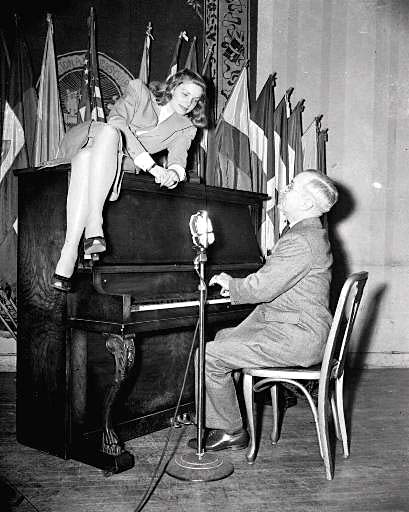
Bogart was less enthralled. Bogart said to one pushy photographer who kept asking for an invite to the wedding: "Why don't you just take some pictures of us fucking? That's what you want, right?"
Later - when the heat died down - Bogart apparently said to Lauren Bacall (she told us this story when she came and did a seminar at my school):
"Listen, baby - these tabloid newspapers - these photographers - the press - these people do not care about us. They could care less what actually happens to us. So you and I have to take very good care of our life. On our own. We can't expect them to do it for us. We know our values - and we know who we are."
They didn't believe their own press. They cultivated their private life. They had outside interests. They went sailing. They stayed at home. They read out loud to each other. They were celebrities, but they weren't a "celebrity couple".
Oh yes. This is SUCH an important topic. SO IMPORTANT THAT I HAVE TO DO TWO POSTS ABOUT IT.
People I never ever want to hear about again
Paris Hilton
Jennifer Lopez
Mischa Barton
Ben Affleck
Ashlee Simpson
Hillary Duff
Jessica Cutler
I am sure there are more. I have hit a level of fatigue with these people. I walked by Macy's today, and there was a sign as large as a house: JENNIFER LOPEZ LINGERIE and I groaned out loud at the very sight of her name.
She has completely bungled (in my opinion) her career. She has squandered what she had going for her in the beginning, by letting her personal life take the front page - and by getting sucked into her own celebrity. I would be very surprised if her career bounced back from this nadir.
I just read a biography of Cary Grant. (Big shocker, right?)
Cary Grant retired in 1966, without any fanfare. He basically just withdrew from acting. He felt he would no longer "be believable" as a leading man (even though directors and other actors begged to differ), and he didn't want to embarrass himself. Better to withdraw voluntarily. People in the business, until the very end of his life (and he lived for 20 more years) pestered him constantly. Wrote parts for him, scripts were still sent to him - he was offered millions and millions of dollars to do movies where he would have had only one scene. The answer was always No.
He was done.
There's a lot to be said for that.
The author of the biography, in the epilogue, discusses this self-imposed retirement, in conjunction with his entire successful career, and said, "He never wore out his welcome."
That's quite a lot to say for a man who made almost 80 movies and had a career that spanned decades. He knew when to withdraw, he would do 3 movies one year, and then take a year off - to let interest in him grow again, to keep himself from getting bored, he always kept a low profile, he never (or rarely) did interviews, he was purposefully vague about his personal life in interviews ... After his death, people who tried to piece together the truth about his life had a hell of a time of it. Because he would lie. Or he would tell half-truths. He would set people off on the wrong track. He thought that his personal life was nobody's damn business but his own.
But his reticence had more to it than just a natural reserve about sharing such things with strangers. It had to do with his own gut-level understanding of what the job of a performer actually is.
He understood that MYSTERY is one of the primary factors that makes a great movie star. If the audience knows too much about you, then they might not find you believable in different kinds of parts. If you reveal too much, if you give too much away ... then the audience gets bored.
My point of all of this is:
The people in the list above are, supposedly, at either the very PINNACLE of their fame, or just beginning the skyrocket up - and they have ALREADY "worn out their welcome".
Oh and of course - feel free to add your own names.
August 16, 2004
Adaptation
Big Stupid Tommy has a cool discussion going on:
Movies that are adaptations of books have a rough time. Fans of the books will resist the adaptation. (That's why I didn't see "Wonder Boys" the first time around ... and what an IDIOT I was!! But I had loved the book so much I resisted.)
But, Tommy asks, are there instances where you like the movie better than the book?
In the case of Wonder Boys, I can't say either. Reading the book was a joy from beginning to end. And the film was fantastic. I won't choose.
I read the book Ordinary People, by Judith Guest. It's quite good. But - it can't hold a candle to the movie. Robert Redford invented scenes that far surpass anything that goes on in the book (the scene where Mary Tyler Moore doesn't want to get her picture taken with her son ... the scene where Tim Hutton randomly barks like a dog at his mother) - these are extraordinary scenes. And they're mostly behavioral, not about the WORDS. Pure cinema.
I'll have to think of more movies I liked better than the book ...
Just thought of another one.
I read Bridges of Madison County and could barely get through the sentimental clap-trap prose. I wasn't surprised when I heard that the author and his "soulmate" split up a couple of years after he became so famous. Serves ya right, bub, for falling for all that soulmate crap in the first place. Also - he is a terrible writer.
But I LOVED that movie. It was like an actor's paradise - watching the 2 of them spar back and forth, talking, behaving, laughing, arguing ... I watch it, I re-wind scenes, I lean in, I study the 2 of them ... they make that very conventional sob-story into something funny, complex, believable.
Loved the movie. Hated the book.
Anything to add?
August 15, 2004
Alien vs. Predator
I won't be seeing the film - but I have been scoping out all the reviews, bad reviews being one of my passions.
The incomparable James Berardinelli ends his review with this chilling indictment:
The film is critic-proof and it will find an audience, but it's hard to imagine even the film's target demographic (teenage boys) being overly enthusiastic about the product. It's disposable entertainment of the worst kind, and its first-weekend popularity will be a testimony to how low our standards of suitable movie-making have fallen. Alien Vs. Predator has no characters and no story. But it has name recognition, and, in today's market, that's often more important. Plus, it's rated PG-13 (although one can quibble with that - there's quite a bit of blood and gore to be found, making one wonder exactly where the dividing line between PG-13 and R is). Time will tell whether this is the last time the Aliens and Predators grace the screen, but, based on what's in evidence here, if they return again to tussle, I'll find something better to do with my time.
A movie with an Alien with a Capital A in it that is PG-13? Did the director even SEE the original series?? I still have nightmares about those creatures. It's made to be rated R.
And David Edelstein, of Slate, known for his laugh-out-loud-funny bad reviews says:
Twentieth Century Fox didn't dare screen Alien vs. Predator for us critics, so I dragged my alienated, predatory carcass to the one-minute-after-midnight Friday show at Union Square in Manhattan and found a rare seat in house full of muscled-up young men and a few surprisingly unembarrassed girlfriends.
Heh heh heh
Also:
"Go, Predator!" yelled someone when the Fox logo appeared. "Alien sucks!" cried another. This was a surprise: I didn't know that it was possible to pick sides.
And then there's this:
he's the only franchise director who fails to generate even a drop of empathy for screaming people who have aliens erupting from their chests.
Yeah, I'll definitely pass on this movie. But I will read all the reviews.
August 13, 2004
Sports Movies by the Sports Guy
Bill Simmons (aka "Sports Guy") is doing a "Top Sports Movies" series. Here's the first installment, where he sings the praises of Varsity Blues, of all things. Bill Simmons is one of my favorite columnists writing today - mainly because I laugh out loud at least once during reading any one of his columns.
Like:
You have Dawson himself (the immortal James Van Der Beek) actually headlining a big-budget movie, which won't happen again unless he commits a double murder and someone makes a documentary about it.
Also:
Just to complicate things, Mox is dating Lance's sister, Jules (played by Smart), who's cute in an "I'm dating the backup QB" kinda way. In other words, she has small breasts.
Anyway - here is the latest installment: "Remember the Titans".
Notable quotables:
...Once forced integration passes, Coach Yoast gets demoted to assistant coach, for two reasons:1. The school board wants a black football coach.
2. Denzel Washington is the star of the movie, not Will Patton.
Also:
I'm telling you, if I have to sit through another movie where a mismatched group of characters sing "Ain't No Mountain High Enough" together, I'm bludgeoning an usher with my 128-ounce Mountain Dew on the way out of the theater.
HAHAHAHAHA
I actually really liked "Remember the Titans" - and I agree with Sports Guy that the sub-plot involving the white player and the black player was the best part of the movie, and I also agree that the kid playing the white player did, indeed, act Denzel Washington off the screen.
Do you all have any favorite sports movies?
Bill Simmons doesn't count "Bull Durham" - he says it's a chick flick. Well, I'm a chick, and I am unembarrassed about my love for that movie. I call it a sports movie, most definitely.
Other sports movies I adore?
-- Hoosiers
-- All the Right Moves (LOVE THAT MOVIE)
-- Breaking Away
-- Miracle (you knew that one was coming)
-- Bend it like Beckham
-- 61* - great flick
Er ... let me think of some more.
August 11, 2004
"She's a strip of celluloid, a beam of light..."
An interesting obituary for Fay Wray.
I especially like the exchange re-told here, of a meeting between Hugh Hefner and Ms. Wray. He said to her, "I loved your movie." She replied, "Which one?"
August 09, 2004
RIP, Fay Wray
Fay Wray , of everlasting "King Kong" fame, just died, at the age of 96.
"I would stand on the floor and they would bring this arm down and cinch it around my waist, then pull me up in the air. Every time I moved, one of the fingers would loosen, so it would look like I was trying to get away. Actually, I was trying not to slip through his hand."

Rest in peace, Ms. Wray.
Quotes from a movie Jen and I saw last night
... for the umpteenth time.
"And stop calling me Shirley."
"I picked the wrong week to stop sniffing glue."
"Stewardess? I speak jive."
Oh, and there are so so so much more.
Jen and I commented on the fact that we couldn't even LAUGH during the "jive-translation" scene, because it is too funny. We could only laugh once it was over.
Things I had forgotten:
-- Leslie Nielsen giving a random Pap smear in the middle of the airplane
-- How funny Lloyd Bridges' disintegration of personality is
-- the RIDICULOUS disco dancing scene in the bar "during the war" - Er - what war would that be? Jen and I were laughing so hard we were crying. I said at one point, "Look at the extras. It's a mixture of pirates and disco dancers."
-- the automatic pilot never fails to reduce me into a puddle of laughter
-- Leslie Nielsen is brilliant. How in the world did he not laugh. How????
-- the stewardess who knocks out the IV with her guitar. What struck me as so freakin' funny during THIS viewing was how HARD she sings that song. She is BELTING out those notes. Jen and I were howling.
-- the arguing announcers at the airport. Heh heh heh
-- the man in the turban who douses himself with gasoline rather than listen to his seatmate's long long LONG stories about the "war". What struck me was this: There he is, pouring gasoline over his body - Then: he lights a match. At that moment, the stewardess comes over, and a long conversation ensues, where she tries to convince him he has to take over as pilot. During that entire conversation, the turbaned-man sits, watching, holding up this lit match ... as it burns down to the end. He never turns to look at the match, or blow it out - He is frozen. Hilarious.
So much more.
This movie is sheer liquid joy.
August 02, 2004
Top 50 Movies - Revised. At Last.
What does one do when one lives in a state of Code Orange? One escapes into fantasy-land.
For me, that means - re-doing my Top 50 Movie List - which I created very quickly a while back, and which I find exTREMELY unsatisfactory. I'll leave the first and imperfect version intact (for archival purposes) - but I want to take out a bunch of the films I originally included in the list, in order to make room for some real classics.
This is nothing against some of those films. For example: I'm taking The Conversation off the list. However - I still love that movie, in particular I love Gene Hackman's performance. You really have got to see it. Gene Hackman really gets to show what he can DO in that film, and it's a great performance. But I think it's the PERFORMANCE that is great, not the entire film, if that makes sense. I'm taking it off.
Only a frenzied and unclear mind could create a Top 50 Movie List and not include Casablanca.
So here it is. Revised.
Oh, and these are not in order of greatness. The order is completely random.
Top 50 Movies - Revised
1. Another Woman - my favorite Woody Allen film. It's one of his "serious" ones, which normally I find annoying. But this one haunts my dreams. It haunts my life. It stars Gena Rowlands. The woman is my idol. Too many great scenes to count. A brilliant story - like a poem, like a dream. Great acting by Sandy Dennis, Ian Holm, Gene Hackman - John Gielgud shows up for a couple of scenes and you think your heart might crack. Betty Buckley has one scene which is so painful I find it, frankly, unwatchable. And through it all, strolls Gena Rowlands - goddess of the independent film movement, one of the greatest American actresses ever. Thank God Woody Allen wrote this for her.
2. Running on Empty - This movie will always be in my Top 5 Films I Love. The scene between Christine Lahti and Steven Hill (now of Law & Order fame) is perhaps the best acting I have ever seen. Beautiful movie. Stays with you long long after it is over.
3. Fearless - I love Jeff Bridges. This film is one of the reasons why. A plane crashes into a corn field. There are only a couple of survivors. He is one of them. Because he escapes death - he begins to think he is immortal. If you haven't seen it - you really must.
4. Opening Night - A John Cassavetes film. Cassavetes created independent film-making, and did it before it was hip. Opening Night, while not his most famous (Woman under the Influence is his most famous - was nominated for Oscars) is his best. It stars his wife Gena Rowlands. It stars Ben Gazzara. I cannot tell you why this movie is so fantastic. I cannot defend my choice. All I know is - it grips my throat. Not a pleasant experience watching it. But DAMN. A film that is burned into my brain. It's about the fear of growing old, and it's also about choosing a life in the theatre.
5. Witness - Harrison Ford's best performance. I love this movie. It works on multiple levels. Also, if you see it now: look for a young Viggo Mortenson, as an Amish farmer (he has no lines in the film, but he is in the
barn-raising scene, and many others.) Witness is evidence that you do not need to have one single sex scene to make an erotic movie.
6. Empire Strikes Back -My favorite of the Star Wars extravaganza. I saw it for the first time at age 11 or something like that, in a drive-in. I thought I had died and gone to heaven. A magical film.
7. Schindler's List - Not a movie I want to watch a million times, too painful - but I believe it is a work of art. The scenes between Ben Kingsley and Liam Neeson take my breath away. Ben Kingsley, with one single tear rolling down his face, but his features not moving: "I think I'd better have that drink now."
8. What's Up Doc? - One of the funniest movies ever made. Do not argue. Peter Bogdonavich, screenplay by Buck Henry - Ryan O'Neal and Barbra Streisand - and Madeline Kahn, in her screen debut ... It is a modern-day Bringing Up Baby. I can recite the film. "So how much is it without the Bufferin?"
9. Sense & Sensibility - This movie kills me. Great acting, great story - great realization of a project. The Jane Austen book is great. The film is better.
10. On the Waterfront - Even just saying the name of this movie gives me the chills. I watch it now, and am still amazed at its relevance and at the power and timelessness of the acting.
11. Apollo 13 - This is what I call a "satisfying" movie. Every scene has its little arc, every scene accomplishes EXACTLY what Ron Howard wants it to ... and yet there is still a huge arc - the arc of the entire piece - and every scene fits into that arc. I have seen it, probably, 20 times. And it still gets me.
12. Some Like it Hot - the Billy Wilder classic. Another one of the funniest movies ever made. Jack Lemmon tangoing with the rose in his teeth, Marilyn Monroe's delicious-ness - I'll never get over being surprised by this film.
13. Fargo - In my opinion, this is one of the best movies ever made. Bravo. Bravo.
14. Bringing Up Baby - Again, probably one of the funniest movies ever made. A classic of the screwball genre.
15. Casablanca - One of the things that I think makes a movie great, and not only great but LAST, is that there is a mystery about it. It cannot be too easily explained, labeled, pinned down. The discussion about it, the debate it, will continue on. I guess you could say this about the great movie stars, too. They don't give it all away. They hold their cards close to their chest, in some way, and keep us guessing about them. Humphrey Bogart and Ingrid Bergman are perfect examples of this. We can never have all of them. In the same way, that we can never have all of ANYbody (at least anybody who is interesting.) There's an essential mystery about their screen presences. I will never get tired of this film.
16. To Have and Have Not - Sigh. This movie gets me hot. Makes me squirm about in my undies, if you know what I mean. But besides THAT, it has an absolutely electric pairing between Bogart and Bacall. You can make the mistake of taking them for granted, since the two of them as a couple are so engrained in our culture now (Bogie and Bacall, Bogie and Bacall, BogieandBacall...) - but when you're confronted with what they actually DID, and what that chemistry was actually LIKE - you'll never get over the freshness. I wish their scenes would go on forever.
17. Arizona Dream - You've probably never even heard of this film. It got no distribution here, and is out on video - but in a highly truncated version. I saw the director's cut (which is so much better than the edited version) at a little art film-house in Chicago with my friend Ted and we could not BELIEVE it. We still talk about this movie. Faye Dunaway, Lily Taylor, Johnny Depp ... it is an insane film. With flying machines, and wandering turtles, and a big house in the middle of the desert, and a crazy dinner party, and Lily Taylor plays an enraged depressed accordion-player (it is SUCH a funny performance. She strolls through the Arizona desert, playing her accordion like the Angel of Death)The title is a perfect description of how this movie worked on me - it's like a dream. One of those dreams that lingers, that persists in your subconscious, trying to tell you something.
18. The Sting - Words fail me. Great movie. Like a big box of candy corn or something.
19. Moulin Rouge - I don't know why this film GOT to me so much but it did. I bought it, hook line and sinker. I didn't find it too self-indulgent, or too garish, or too flashy - I thought that was the point. What kept it all going for me was the depth and power of Ewan McGregor's performance - In the midst of this operatic flourish, he played it all totally real. I also have fallen in love like that. To me, love has felt like what it looks like in Moulin Rouge. Tortured, passionate, hilarious, operatic ... To me, that movie felt real.
20. The Double Life of Veronique - another movie which I can't get out of my mind. A girl strolls through the streets of Prague. Suddenly, a bus drives by, and through the windows of the bus, she sees a girl who looks EXACTLY like her. Is it a doppelganger? Who is it? This movie broke my heart. Great acting. Irene Jacob stars. A painful film. Makes you think. And the mystery is never really solved.
21. The Big Sleep - Er. I believe I have covered this one before. This is my favorite, actually, of the Bogart and Bacall pairings. Even more so than To Have and Have Not.
22. Postcards from the Edge - Dammit, this movie is FUNNY. Meryl Streep's best work. She is a comedic genius. This is another movie which is like a big box of candy. I cannot count how many times I have seen this one. I own it. I can recite it from beginning to end. Don't get me started.
23. The Producers - Uh. Do I need to say anything else? I didn't think so.
24. This is Spinal Tap - This has got to be one of the funniest movies ever made. I can't even STAND it. I love, too, the 2 second cameo by Anjelica Houston, who plays the person who designed the "Stone Henge" for their concert ... to tragic results.
25. East of Eden - I'm not sure I can even talk about why this movie is on the list. I loved James Dean so much in high school - he is one of the reasons why I decided that acting was an honorable profession, a craft. This movie is why.
26. Dogfight - I hate River Phoenix for being a drug addict and checking out of this planet, thus depriving us of his amazing gift for years to come. This film stars River and Lily Taylor. River Phoenix plays a cocky asshole Marine, just about to ship out to Vietnam, in the early 60s, before anyone really knew what they were getting themselves into. He tells Lily's character where he is off to, and she asks, "Where's that?" He and his cocky buddies are on leave for 4 days in San Francisco and they host something called a "Dogfight" - The contest is: who can invite the UGLIEST girl to a party they host? So they scour the streets for "dogs" - none of the women are in on the joke, of course - They are all excited to have been approached by hot young soldiers. Anyway, River Phoenix's character asks Lily Taylor's character to come - she has a big bouffant, she's plump, she's a goof-ball who wants to be a folk singer, a la Joan Baez. Needless to say - they spend an epic night together. Where he learns some important lessons about himself - and she learns some important lessons about herself. They are SO GOOD together. I never want this movie to end.
27. Raiders of the Lost Ark - I still have not fully recovered from the first time I saw this movie when I was in high school.
28. Contact - Science vs. God. Pure research vs. Applied science. Faith vs. Knowledge. All of this wrapped up in a gripping story - with Jodie Foster's best acting job yet. Even better than Silence of the Lambs. Let me tell you something, as an actress, having done some films: Silence of the Lambs was filmed almost entirely in close-up, with Jodie Foster looking directly into the camera. You don't have to do ANYTHING when the camera is that close to you. The camera picks up every thought you have, however fleeting. It sees things that you could never plan - it sees inside your brain. It does all the work for you. So everybody thought she was so great in that movie, and yeah, she was, but I thought to myself: Silence of the Lambs was probably the easiest job she ever had. Contact requires more subtlety, more pain, more feeling, more work. And she is awesome. I love the IDEAS in this movie, too.
29. Reds - This movie is still unmatched, in terms of storytelling. Nobody is brave enough anymore to do what Warren Beatty did, in this movie. Scenes start in the middle, and cut off abruptly. You are suddenly thrust into an argument, and have to catch up, figuring out what they are talking about. Nothing is spelled out. It feels like a documentary (not to mention the brilliant touch of interviewing all of the real people from that time). The scene between Diane Keaton (as Louise Bryant) and Jack Nicholson (as Eugene O'Neill) in the beach house is one of the sexiest love scenes I have EVER seen, and they never touch each other. Beatty knows what to keep in, what to leave out. He obviously loves actors. They trust him implicitly. Movies are not made like this one anymore. It is gritty. It is raw. Things look like they are really happening, nothing seems simulated. I love that. I love that reality.
30. Magnolia - A movie which takes enormous risks. (Tom Cruise as a misogynistic motivational speaker?) Some of the movie doesn't work, some of it does and brilliantly (John C. Reilly has never been better) - but I love every second of this flawed and moving movie, because it takes RISKS. It takes risks with its script, it asks the actors to take risks - and it expects much from its audience. I love that. A film that demands something of its audience.
31. Taxi Driver - still one of the scariest films I have ever seen. Watch the scene again where he talks to himself in the mirror. It has been parodied so many times, that it is easy to forget how terrifying the original rendition is. It is not a joke. It is fucking scary.
32. The Full Monty - Yeah, I know, ha ha ha, a bunch of steel-workers take off their clothes for money, ha ha ... But I think there is something deeper going on in this film, and that is why it works. It has something to say about men today, it has something to say about the "plight" of men. It has something to say about the emasculation of men and how we cannot allow that to occur. Men can't let that happen, but women need to be invested in that struggle too. We should not want our men to be emasculated and domesticated. That, to me, is what that movie is about, and why it brings me to tears every time.
33. Breaking Away - I LOVE THIS MOVIE. I need to see it again, actually, it's been years. I still can hear Paul Dooley's horrified voice, "REE-FUND?? REFUND? REFUND!!! REFUND!!" A coming-of-age story with a great twist. I fell in love with every single one of the characters. Dennis Quaid in his break-out part.
34. Philadelphia Story - Oh, for so many reasons. So many. Cary Grant putting his entire hand over Katherine Hepburn's face and pushing her down onto the ground. Jimmy Stewart's drunk hiccuping scene (one of the best drunk scenes ever). The theme of Hepburn's character: she must come down off the pedestal, and forgive other people's weaknesses. I find that very moving. And I love to see the 3 of them together. The repartee, the dialogue ... it's brilliant.
35. Notorious - I don't just think this is a great movie. I am actually personally addicted to this movie, and have a PROBLEM. Hitchcock was the only one who saw the dark underbelly to Cary Grant's charm and handsomeness (well, perhaps Grant saw it himself). And Hitchcock put him in this vehicle and showed us a Cary Grant we had never seen before. It's unsettling. He's a bit sadistic, he's cruel, he's also vulnerable, suspicious, tender ... it's a tour de force. And speaking of tour de forces: Ingrid Bergman gives one of the most tortured portrayals of her career (well, Gaslight might be the MOST tortured) - a drunken neurotic nymphomaniac ... who wishes Grant could trust her, but he doesn't trust women. And another tour de force is Claude Rain's performance. The whole movie is a masterpiece of tone, mood, writing, and suspense. But ultimately - it's the love story that grounds the thing - the tortured dark bitter love story. One of my favorite movies of all time.
36. Citizen Kane - All the special effects in the world cannot hold a candle to what Orson Welles was able to achieve manually. This film is a huge visual accomplishment, yes - but like with all the movies on my list - why it's a success in MY book is because you care about the characters. Or - perhaps that's too simple. Tommy Lee Jones said, when he did a seminar at my school, "I don't think I, as an actor, need to like the characters I play. But I do think that you should want to watch the character." The characters in Citizen Kane are all flawed, all interesting, all highly watch-able. And I can recite the monologue about the woman in white seen through the fog on the ferry from memory.
37. The Misfits - Clark Gable's last film. Directed by John Huston. Screenplay by Arthur Miller. He wrote it for his wife at the time, Marilyn Monroe. Montgomery Clift is in it. Eli Wallach. The stories about the nightmares of this shooting (Clark Gable died of a heart attack soon after wrap) are legendary. A book has been written about it. Regardless: this is the kind of movie I love. With complex characters, all in highly stressful situations ... We, as audience members, can see them better than they can see themselves. All of the acting is top-notch, particularly Clift.
38. The Fisher King - Jeff Bridges is one of my all-time faves. For whatever reason, I absolutely adore this operatic mess (at times) of a movie. In it, Bridges plays a shock-jock who makes a terrible mistake: one of his casual comments on the air ends up having tragic consequences. He loses everything. Directed by Terry Gilliam - this movie is more allegory, more myth and legend than reality. And Mercedes Ruehl as Jeff Bridges's girlfriend (she won the Oscar, I think, or at least was nominated, and rightly so) is fantastic. I loved their relationship, the two of them together. The kind of relationship that can only exist between ADULTS. Where you are scarred, you are damaged by life, you have lost much - but you don't particularly want to talk about your past ... you just want a warm body beside you in the night. I love this movie.
39. Three Kings - Woah, what a breakout film for David Russell. Highly prophetic, too, in the world we now live in. The world of the legacy of leaving Saddam Hussein in power. Great acting, but more than that: awesome film-making. There are scenes in this as powerful and as arresting as those in Apocalypse Now. The random insanity of war, the incongruities, flashing images you won't ever forget.
40. It Happened One Night - Clark Gable. Claudette Colbert. If you want to see what my friend Mitchell would call 'sheer liquid joy' - rent this movie. I laugh out loud every time I see it.
41. Lion in Winter - "Well, what family doesn't have its problems..." muses Katherine Hepburn, as Eleanor of Aquitaine. Classic.
42. Children of Heaven - absolute gem of a film from Iran. A lower-class family in Tehran, with 2 small children. The little boy inadvertently loses his little sister's shoes, her school shoes. They are afraid to tell their parents. So they set up an elaborate scheme - he goes to school in the mornings, then races home, gives her his shoes, and she galumphs to school wearing his sneakers (underneath her chador). She, of course, as any little 8 year old girl would be, is MORTIFIED at wearing her brother's sneakers. She is MAD. He sees that a running race is going to be held - and second prize is a pair of nice little shoes. So he decides: I am going to run in this race, and although I am a very good runner, the best runner in my school, I have to somehow come in second so that I can win the shoes. Oh shit, just rent it. It's absolutely exhilarating.
43. Titanic I will not apologize. This is not a guilty pleasure for me. I think that this is the most expensive art-house film ever made. Don't berate me. Make your own list. I loved this movie. Every stinking minute.
44. In a Lonely Place -One of Humphrey Bogart's lesser known films, but it might be my favorite Bogart performance. He plays a bitter screenwriter in Hollywood - I think it is some of his deepest and best acting. I can't count how many times I've seen it. I have some favorite moments. It's one of those movies that works on multiple levels, and which only gets better with repeated viewings. See it.
45. Nixon - Again, with the top-notched-ness of the acting. James Woods, JT Walsh, Joan Allen (God!), the guy from Frasier, not to mention Anthony Hopkins. It was not about doing an imitation of Nixon. It wasn't about that for Oliver Stone, and it wasn't about that for Anthony Hopkins. It was about getting at who this man might have been when he was alone. It is a guess at the answer to that. I love the cinematography of this movie, and the way the story is constructed. The first shot is a direct steal from the first shot of Citizen Kane - a rainy night, peering through the bars of the gate at the big gloomy-looking house ... a sense of grandiosity, but also a sense of imprisonment. Nixon is full of visual and plot references to Citizen Kane, and I think that is a very smart move. After all, Citizen Kane ends with a mystery. The mystery of Rosebud. At the end of the movie, you know who Rosebud is ... but it just leaves you with more questions. The answer answers NOTHING. Nixon is the same way. Oliver Stone uses the same documentary-newsreel setup for the film that Orson Welles used in Citizen Kane: people are trying to figure out who is this Nixon, what is the missing piece - what is Nixon's "Rosebud"? And - rightly so - by the end of the film, you have no answers. Just more questions. I don't take this movie as factual. I take it as a damn fine film, with some of Anthony Hopkins' best work.
46. Roman Holiday - I almost forgot to put this one on the list. Audrey Hepburn - Gregory Peck - an escaped princess, a journalist - in Rome - somehow they hook up - and ... of course ... magic happens. It is a love story but in the greatest sense. This movie is the forerunner to so many other great love stories, only it does it better, with more grace. I love Gregory Peck. And speaking of Gregory Peck...
47. To Kill a Mockingbird - No, it is not as good as the book. But dammit, it comes pretty close. Atticus Finch. A character who lives on in my imagination in the same way that Holden Caulfield does. Atticus Finch. God. What an amazing character - and Gregory Peck found exactly the right way to play him. Perhaps he just played himself, I do not know. But the second I saw the movie, I thought: Yes. He IS Atticus. He is exactly what I pictured.
48. Dead Man Walking - Tremendously courageous film, with astonishing performances by Susan Sarandon and Sean Penn.
49. His Girl Friday - It's a perfect movie in every way. You never stop to catch your breath, Rosalind Russell is a force of nature (it's one of my favorite performances by an actress, ever) - and Cary Grant is brilliantly comedic - never makes a false move, never looks false... A non-stop pleasure-ride, this one. And it's executed with such skill, such knowing certainty. Great movie. And funny as all hell.
50. Pulp Fiction - This movie is so enjoyable that I almost had an anxiety attack the first time I saw it. It was in the movie theatres and it was so GOOD, and the writing was so DELICIOUS - that I immediately wanted to start rewinding scenes to watch them again, study them ... and I couldn't!! I was in the movie theatre!! Great movie. Every actor, every scene ... but it's really the writing that is the star of this film. It doesn't get any better than that.
(I have a feeling I'm going to revise this every couple of months. Why isn't North by Northwest on there? Where is The Magnificent Ambersons??)
July 29, 2004
"Man Having Sex"
Heh. A very good friend of mine got a small role in Garden State - which, of course NOW is getting wide distribution, because of its inexplicable success at Cannes, etc. - but when my friend filmed his scene, it was just another low-paying local indie-film job, no big deal, he didn't think anything would ever come of it. For every Garden State, there are 100 plus films which never are seen by anybody. Joey assumed that Garden State would be one of THOSE, because most films are ... but now ... it's become a small success, and Joey is a bit mortified because of his "role".
I guess in the movie, some of the characters peek through a hole in a motel-room wall and sees a man and a prostitue having sex.
My dear friend, a married man with 2 teenage daughters, plays the "man".
He is listed in the credits as "Man Having Sex".
"Cool, Joey, you're in Garden State?? Who do you play?"
"Uh ... Man Having Sex."
"Oh."
Needless to say, he is relatively mortified that this film, of all independent films, would suddenly be a success, and now he has to add "Man Having Sex" to his resume. Also, he HOPES that his two daughters won't get it into their heads to go see Garden State - (which, they probably won't ... they're teenagers, after all, more into blockbusters and action movies).
I cannot WAIT to see it. I think it's going to be hilarious. We're trying to get a group together to go. I don't care about Natalie Portman, or the other stars in the film. I am waiting for one scene, and one scene only. I am primarily interested in "Man Having Sex".
July 26, 2004
Reverberating bad-ness
Cat Woman is a bomb. Halle Berry may find it difficult to recover from this bomb, which is pretty much being characterized as a vanity project. I know the piece has been bouncing around Hollywood for years - but in the reviews, it makes it sound like they started with "costume sketches" - thinking that just putting Halle Berry in those sex-bomb outfits would be enough. Nothing further needed to be done.
Speaking of "bombs it might be difficult to recover from" - I saw a preview for the upcoming Jennifer Lopez movie, something about tango-ing, and Richard Gere's in it ... and perhaps I'm making it up, but I could feel the lack of interest in the theatre. No, that's not the right term. It wasn't lack of interest. It was a snickering interest, a hostile ghoulish interest ... a "ha ha - there's J-Lo - what a train wreck SHE is" kind of interest - which I am sure is not the vibe she is going for!!
You're not going to hit a home run every time you're at the plate, in terms of choosing movies - and there are some huge bombs which gain cult stature as time passes (like Ishtar) - and don't seem to really damage the reputations of the actors who acted in the bombs.
As bad as Battlefield Earth was, what's-his-name Pepper has been unharmed. In fact, his career has soared. Saving Private Ryan, 61*, etc. Mr. Pepper was not BLAMED for the failure of that movie.
But - and I have no proof to back this up - I think Jennifer Lopez's behavior in the last couple of years is crashing down around her. This probably wouldn't be the case if she had made some interesting movies during that time. But to be in the middle of that Bennifer NAUSEA and then to make the worst movie of all time??? Something is wrong with this girl's judgment. Even if there ISN'T, and she just happened to make a mistake in reading that script, or trusting the wrong person, or whatever ... I believe she has done lasting damage to her career.
I mean, here she is - coming out with this new sexy movie - where she plays a tango instructor - and the audience is snickering. Her manager, her agent must be scared. And if they aren't then they should be.
July 22, 2004
July 21, 2004
2 more things about that Metallica movie
-- I know, intellectually, that these guys must be LOADED. (Oops - I mean "FINANCIALLY loaded") But only with this movie did I get a full sense of the scope of their massive wealth. Hilarious, too - they had pictures of Hetfield and Ulrich - as teenagers, basically - a black and white picture of the two of them, sitting by a stereo, and grinning like Satanic maniacs at the camera. They look like Wayne's World. And yet ... they are Wayne's World who became millionaires many times over. Astonishing.
-- In that vein - I was very moved by a concert they did at San Quentin. I didn't really get the story straight. I think they wanted to film one of their videos in the prison, and then ended up doing a concert in the prison yard for the ... prisoners. (I hate it when I word things awkwardly. Forgive.) Anyway, there's Metallica - up on a makeshift stage. Out in the yard, separated from the band by a fence with barbed wire, are all these CRIMINALS. These men make the members of Metallica look like pussy-boys. And yet - when Metallica started to play, you could see all of these convicts just start jamming, as though they were at a regular concert. There was one shot of this massive beefy guy, no shirt on, sunglasses - covered in raging tattooes. This guy was terrifying looking. Yet there he was - banging his head back and forth.
Hetfield made a little speech about anger - about how anger was so much a part of Metallica's music. Their latest CD was called St. Anger, after all. And Hetfield said, "I don't know, man - if I hadn't had music in my life, I might have been in here with you guys."
And that was all he said (at least in the film - they might have edited more out). He didn't go on and on, he didn't preach - that was all he said - and then they started to rock.
It was pretty cool, I have to say.
Metallica
So last night was the big night - I went with the Blind Cave Fish and a group of her friends to go see what I have been calling "the Metallica movie". Here is what she had to say ... we were both so excited that we could barely sit still through the previews.
Here are my random thoughts:
-- The guys who did this documentary also did the brilliant documentary My Brother's Keeper - one of the most upsetting and personal and well-done documentaries I have ever seen in my life. They did a great job with this one as well. I mean - Metallica lets these guys into their most intimate moments - moments when they don't come off looking all that great - so there had to be a lot of trust, at least initially. I was impressed.
-- I don't care what anyone says. I am a bit in love/lust with Lars Ulrich. I completely related to his frustration throughout the movie. I also think he is a roly-poly little-messy-boy Danish cutie. I know his teeth are messed up, and he's chubby. I don't care. He's sexy.
-- This is not to say that I also wasn't completely compelled by the other two members - Hetfield and Hammet. It's just that Ulrich captured my heart. (I am such a jackass.)
-- I was shocked to find that Dave Mustaine of Megadeth is actually a tragic figure of Shakespearean proportions. (Okay, perhaps that's over-stating the case a bit). There's an extremely personal scene between Mustaine, who was kicked out of Metallica - he sees it as the defining tragedy of his life, even though Megadeth was not exactly a raging failure. But still ... to see where Metallica ended up, and to know that he could have been a part of that ... was a bitter pill to swallow. But besides all of that - I just felt his pain. I appreciated his honesty.
-- I am totally with Blind Cave Fish on the amusing sight of Robert Trujillo (their new bassist) sitting at the band's round-table discussion. Ha ha. It's kind of a visual joke, but here's the set up:
Metallica finally admitted they needed to get a permanent bass player. They hold auditions. (All of this is filmed.) Robert Trujillo, of Suicidal Tendencies, comes in and plays. Like crazy. Do you know what he looks like? He looks like he could be an extra in Dances with Wolves. He has long black hair that he wears in braids like a squaw. He is short, squat - and can play bass like a DEMON. So then he is offered a spot in Metallica. Can you imagine?? Trujillo says at one point, during the job-offer conversation, "I can't even speak right now."
Then - their new album is finally finished (it had been recorded before they hired Trujillo), and they all sit around the table, having a post-mortem. Hetfield gets emotional (but I love it - these guys are all so macho, they don't cry easily - they are tough, man - tough) - So Hetfield is holding back, but you can see him about to cry, he says something like, "I just don't want this to end. I don't want to let any of you go home right now."
The discussion continues. The band is eating salmon. They talk about their "feelings", Hetfield says the words "abandonment issues" - etc etc. Then there is a brief shot of Trujillo, listening. And the entire audience BURST into laughter at the shot.
Basically - what it looked like was: Trujillo is now in METALLICA, man!! The baddest metal band ever. These dudes are BAD, they all have TERRIBLE reputations, they're BAD-ASSES!!! WHOO-HOO! And then at Trujillo's first band-meeting, Metallica all sit around with tears in their eyes, eating salmon and talking about "abandonment issues".
Heh heh
-- Lars Ulrich's father has to be seen to be believed.
-- The therapist, hired to come in and help the band get along, was ... I know he is a charlatan to some degree, a racketeer ... but a part of me felt so SORRY for him. His shirts were atrocious. There was one TOE-CURLINGLY AWFUL MOMENT when the band is in the studio, and they are hashing out some lyrics. The producer is there, Hetfield, Ulrich, Hammet - and Mr. Therapist. All 3 members of Metallica are scribbling stuff down on loose-leaf, trying to come up with a bad-ass rhyme to complete a verse. Then - there is a shot (oh my God, it was awful) of the therapist writing down HIS suggestion on a post-it and handing it to Hetfield. Oh my GOD YOU. DID. NOT. JUST. DO. THAT. These guys have sold millions and millions of albums, sir. They can figure out their own rhyme-schemes.
Later, and this got one of the biggest laughs - the 3 band members are discussing privately when to cut Phil (the therapist) loose. And Hetfield says, "I think Phil is under the impression that he is actually in the band."
Really good movie, everyone. I highly recommend it. Very very interesting. Highly watchable. And dammit, I LOVE the concert shots - the masses of people all moving together, all jamming their heads back and forth - like members of some giant cult - a hypnotic scene.
Oh, and one last thing: -- I have often thought to myself, when listening to their stuff: Someone taught Hetfield how to save his voice. Even though he is screaming - he is also screaming on tune - and he never seems to strain. It doesn't hurt me to listen to him. In a weird way, it's a trained voice.
I was very gratified to see him working with a vocal tape, made for him by a vocal coach, after Hetfield blew his voice out in the middle of recording the black album. The vocal coach told him how to warm up his voice before singing so he wouldn't hurt himself.
I thought to myself: I knew it! I knew it!
There's only one thing to say...
after reading a story like this - and it may be a cliche - but it was the first thing that came to my mind: "You GO, girl!!"
July 20, 2004
A Cagney reminder
I'm off to lose myself in Metallica. I feel like Al Pacino in Dog Day Afternoon - only instead of "Attica" I will be screaming "Metallica"!
But just a reminder to myself - I want to talk about this moment from Public Enemy tomorrow - I probably don't have anything to add, but I want to talk about it anyway:
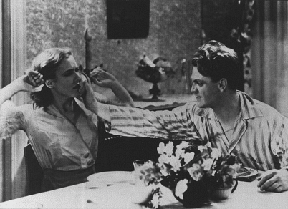
Oh - forgot to mention...
The premiere of Entourage (the new HBO show, on after 6 Feet Under) sucked. It sucked in a visceral way ... Badness like that has a scent, like ozone. Or maybe it's just a quality of the air - like the air on a flat windless sunny day. No life.
Did anyone else see it?
Now it is interesting sometimes to see the first episodes of what later become HIT shows. Because there is a palpable difference - perhaps not in quality, but in energy.
Like the first episode of Friends or 6 Feet Under, for example - two shows I love.
But the energy in those first episodes is still very different from what the shows eventually evolved into - because at that early point, the actors, the director, the crew, the producers, everyone is still HOPING that we will love them. Success is not a done deal. This gives the desperate-to-please energy that is so common of first episodes. The actors are still just crossing their fingers at night: Please let this get picked up, please let this get picked up ...
It wasn't until the second season in 6 Feet Under that the actors really could RELAX and truly show us what they could DO.
Because by that point, they knew they were in a hit. Nothing breeds success like success.
Still, though: all the elements were there in the premiere. You could feel the originality, you could feel the quality ... it was a palpable presence, even with the overly desperate acting jobs.
But I don't know. Entourage seemed pretty sucky, in general.
Dead air on a windless sunny day.
The only guy I liked was the kind of short reddish-haired guy - who had the confrontation with the jackass agent. I really liked him - he seemed actually trying to make SCENES happen, in the middle of all the other stuff going on (all the other stuff which, to me, felt like the deer-in-the-headlights "DO YOU LIKE THE SHOW??" school of acting). This reddish-haired guy is obviously a good actor - but he needs a hit to really show his talent. Or - for his talent to be appreciated.
The guy who played the ASSHOLE agent, by the way, is one of those hilarious high school losers in "Say Anything" who sit in the parking lot at the 7 11, acting all superior ... the ones that John Cusack goes to for advice.
Cusack finally says, "Let me ask you something. If you guys have all the answers, then why are you sitting in the parking lot of the 7 11 on a Saturday night?"
There's a brief embarrassed pause.
Then comes the reply, "By choice, dude. By choice."
Anyway. Entourage was a big ol' thumbs down. If I want to see celebs with their "entourages" - then I'll just watch The Newlyweds or something and see REAL celeb behind-the-scenes stuff - not fake.
Torn between two loves
I really want to talk about James Cagney. I am dying to discuss this man. Watched Public Enemy last night. And I have so many thoughts.
And yet ... unfortunately, and inevitably, today is ALL ABOUT METALLICA - because I'm going to see this tonight. Finally.
I'm listening to their double album S&M right now. It's the recording of a concert Metallica did in combination with the San Francisco Symphony Orchestra. So it's Metallica - but with this major symphonic background, a massive orchestra jamming out behind them - and you can hear the crowd LOSING its collective mind. It is an exhilarating sound, an exhilarating album.
Also, I love, too, these symphony musicians being confronted, for literally the first time in their musical careers, with a ROARING crowd. A crowd on its feet for the entire concert, screaming, clapping along, roaring back at them ... Metallica of course is used to that, but the orchestra was blown away by that SOUND.
Quotes from the liner notes, written by Michael Kamen, conductor:
Combining one of America's most powerful orchestras, the San Francisco Symphony with the world's most powerful rock band, Metallica, was really about imagining music on top and alongside of their songs. Conducting a conversation between two different worlds that share the language of music. Creating a dialogue between two worlds that celebrate the power of music ...I began by listening to and absorbing Metallica tunes ... listening to the orchestra in my head and writing down what I heard ...
Rock bands invent their own parts to play. Orchestras rely on a composer and a conductor to tell them exactly when and how and what to play. They will read 'fly specks' on paper if necessary, and add their own expressive skill to each note ... making it come alive.
When the busses loaded with the symphony members arrived the first day of the show, they were met with cheering hordes of Metallica fans that had been camped out in the park across from the hall -- not the usual greeting for a Symphony Orchestra. Something different was going on.
The first contact with the audience was a frightening roar which terrified the orchestra, more accustomed as they usually are to polite applause. The crowd's reaction was like adrenaline on stage, and we all thrived on it. That kind of approval is inspiring!
The event was in a 'formalized' setting with orchestra members in ties and tails, ushers in uniforms, and band members and audience in stage and street wear.
To feel the audience give a standing ovation to me and the orchestra even before one note had been played was both reassuring and friendly, but I also got the feeling that the audience was applauding its own daring in being there. They were ready for anything!
The beauty of nearly 100 musicians -- each of whom has dedicated their entire life to perfecting their ability to speak and express themselves through the music and their instrument and playing together -- reacting to each other and the music is why the orchestra was originally formed...
As the evening unfolded there was a breaking down of barriers -- not only between audience and players, but players and players. The band wandered around the stage and into the sections of the orchestra; orchestra players leapt to their feet, excited to be making music on the edge of their seats. We were not simply supporting; and certainly not 'sweetening' ... instead the symphony actually became the 'fifth Beatle' -- a member of Metallica.
Example: 'Call of Ktulu' is a symphonic piece even without the orchestra. A story in music. Metallica's music is always a story. Adding an orchestra was like writing a film score to that story. Dancing around the sections of the tune. Every player in the orchestra working as hard as Metallica does, committed to the music.
After two evenings of sturm and drang -- I suppose the thing that sticks most in my mind was the sheer balance in power between electric and natural instruments. The massiveness of it all was fantastic! I keep returning to Metallica's 'Rolling Stone' quote: 'We don't expect easy listening ... the band will match the 100-piece ensemble with full-on amplification ...'
...It was a full-on musical experience with all players playing hard and soaking through their tuxes and black formals from the exercise. A bit like experiencing all nine of Beethoven's symphonies and 'The Rite of Spring' in one evening! I remember during the intermission hearing string players saying how they should have brought a dry change of clothes, and 'It's Mitchum deodorant time' from a perspiring horn player. I think the physicality of conducting and playing was the Symphony's answer to Metallica's 'full-on amplification' challenge...
Imagine taking a very stark black and white picture, tough and relentless, unpredictable yet hypnotic -- as black and white as a piece of music on paper ... as driving and powerfully honest as pumping guitars, bass, drums and voice can be ... and adding orchestral light and shade, bursts of color, and surprising blocks of sound from all the incredible expressive musical instruments that have been created over hundreds of years to speak and sing our passion, our lives.
Wish I had been there. S & M is, perhaps, my favorite of their albums.
Anyway. You can see what I'm dealing with here.
James Cagney is also pulling at my attention right now. But I have a hard time splitting focus. Always have. One passion at a time, please.
Metallica has taken over. For the moment.
July 08, 2004
Reviews like this one --
are why I absolutely love David Edelstein. He wrote one of my favorite terrible reviews for Battlefield Earth (compilation of quotes seen here) - where he wrote: "He zaps Jonnie with a knowledge ray and then, for some reason, lets him read the Declaration of Independence. I'm not sure what happens next because I went out for malted milk balls and then remembered I owed my mom a phone call."
When a movie is bad, I get excited to read Edelstein. Bad movie reviews (well written ones) are some of my greatest pleasures.
Anyway, the reviews for King Arthur are coming in - and they're not all that bad. Not raves, to be sure, but not bad.
Everyone is commenting, however, on the lack of magic (making Merlin just your basic old man), the lack of Holy Grail-ness, the lack of round table ... basically, the lack of anything even resembling the story of King Arthur.
Some of my favorite quotes from Edelstein's review are:
As a nonhistorian who hasn't kept up with the latest archeological finds but who still likes to go around singing, "I wonder what the king/ is doing tonight/ What merriment is the king/ pursuing tonight," I could hardly wait to meet the authentic once and future king. I wondered what the king was doing that night.
In the review, Arthur is described as "verisimilitudinous"
I would also describe him as "pulchritudinous" - but that's just me.
Now, I'm sorry to offend Bill, but Edelstein finds the perfect way (in my opinion) to describe Keira Knightley:
a hotcha Woad who looks like Winona Ryder stretched out
Edelstein goes on:
"He tortured me," she says. "With machines." Then she adds, "I'm Guinevere." That's some revision! At first too weak to talk, Guinevere is soon lecturing Arthur nonstop in perfect Oxbridge know-it-all diction about his habit of killing his own people, whereupon I thought about torturing her with machines myself. But it's hard to hate her too much when she wriggles into a fetching halter, paints herself green, and picks up a bow and arrow, determinedly setting that long fish jaw. You go, you saucy Woaden wench!
"long fish jaw"??
A typical Edelstein-ian sentence:
I did not know much about Saxons until now. Apparently, they were heavy-metal Road Warrior types with exceptional hearing.
Edelstein actually enjoyed the movie, even though he calls it "stupid", and also says (echoing a couple of the other reviews I have read) that the battle scenes are very confusingly staged. Not well done.
But I do like how he ends his review:
And then there's Clive Owen, rising above it all. Aloof yet watchful, the actor cultivates an inner stillness that is perfect for faintly ironic brooders. He neither distances himself from this risible material nor pulls out the stops and opens himself to ridicule. His King Arthur tells us little about Arthur, but much about protecting one's flank. The mark of a box-office king?
Quite a compliment. Clive Owen's been around for a long time, doing consistently good work. It's nice to see it acknowledged.
July 07, 2004
In Praise of Comedy
These lists of great movie moments here and here mostly comprise movies of a serious tone. Which is fine. Many of the scenes which have touched me the most (like Meryl Streep's face when she makes "Sophie's Choice", Bogie's expression on his face when he says goodbye to Bergman at the airport, Samantha Morton's near-miscarriage scene in In America - which stands alone, in my opinion - etc.) are serious, or tragic.
But comedy should not be discounted as one of the most important things on the entire PLANET.
So let's make up our own list here.
Let's make a list of the Top Comedy Films EVER. How 'bout that?
I nominate - (and these are just the first things that come to my head - I'm sure I'll think of more):
Bringing Up Baby
What's Up, Doc?
The Producers
Let us celebrate that which makes us howl with laughter.
I'm thinking Office Space needs to be on there, too.
July 06, 2004
Standing the Test of Time
In the comments section to this post (listing AFI's "100 most famous, unforgettable or memorable images, scenes, sequences or performances in films of the 20th century") - a couple of people (myself included) wondered why the 90s etc. are so underrepresented. My guess is is that AFI is looking for moments that will stand the test of time, and will be worthy of inclusion on such a list 50 years from now.
AFI's list stops with Schindler's List which is 1993.
So my question to everyone is this:
What, since then - 1993 - 2004, do you think would be worthy to be on such a list? Something iconic. Or ground-breaking. Or universally memorable, or perfectly well-done. Something that 50 years from now still would seem impressive.
My first guess would be the harrowing opening sequence of Saving Private Ryan.
How about you all?
I will now list my source
for the Brando/Clift anecdote below which so bothered one reader that he wrote me an email about it, and I quote:
I read the lead Brando/Clift story yesterday on your blog and, at first, was quite moved. Then I reread it and (no offense intended) it seems like absolute bull shit. Just curious, where did you come up with such a strange, unlikely tale? And the 'supposed' dialogue from Brando's mouth, did you come across that in some book? Which book? By whom? Were *you* a fly on the wall overhearing those silly emasculated words?! The tone and nature of Brando's language and intent appear thoroughly unlike him in every way! Plus your idea that he was "selfish" -- somehow needing Montgomery Clift as "competition"... No, that doesn't ring true either, Sheila.
I could be sarcastic and reply:
"Where did I get that anecdote? Well, it's time for me to come clean. I am actually 78 years old and I WAS Monty Clift's assistant!! I was there in the house at the time!"
Also, interesting - that an anecdote showing generosity towards another actor would be characterized as "emasculated".
Anyway - for you, Mr. I-Know-What-Brando-Spoke-Like, here is where I got it.
Feel free to read the book so you can double-check my work, if that's what floats your boat:
Montgomery Clift: A Biography - by Patricia Bosworth. Bosworth is a member of the Actors Studio, and a terrific writer. She did in-person interviews with all of the main characters in Clift's life - at least those who were still alive. Clift's assistant related the tale to Bosworth.
Maybe you want to write to Bosworth and see if she's lying or exaggerating or something.
It constantly amazes me that some people would be annoyed that I would put my own interpretation on certain things ... ON MY OWN BLOG. How dare I.
Carry on.
Update: The reader in question has apologized. Apology accepted.
July 03, 2004
My favorite Brando story
Here's how it goes:
Throughout their careers as actors, Montgomery Clift and Marlon Brando were neck and neck. Montgomery Clift hit his stride a couple of years before Brando did - and Brando looked up to him. He wanted to act like Montgomery Clift, he wanted his acting to seem as real as Clift's did. Clift, of course, was a completely different personality than Brando - so the roles that came to them were almost polar opposites.
Montgomery Clift - with his almost unearthly beauty (at least before his car accident) ... The roles he got reflected the response he got for that beauty. People were deeply attracted to it and deeply alienated by it. It was like a Death in Venice kind of beauty. His part in Place in the Sun - the kind of very very secretly unscrupulous person, who fools everyone because of his beauty ... He made a career out of playing parts like that.
Brando was all brash masculinity. He was good-looking, but it was more about hot erotic sex appeal, than beauty.
But the two of them were linked together in the public's minds - as examples of this new kind of acting.
Montgomery Clift was very competitive. So was Brando. They didn't feel competitive with many other actors, but they felt competitive with one another. Clift came out in Place in the Sun - and Brando came out in Streetcar - and they sized up one another's performances warily, checking out the competition - but also - they never lost their admiration for what the other could do.
They were worthy foes, let's put it that way.
They weren't friends. They ran in completely different circles, but there was a mutual admiration/competition society between them.
All of that changed when Montgomery Clift got into his terrible car accident which smashed his face, changing his career forever. He was never the same again. His face lost the easy beauty, half of it was paralyzed, reconstructive surgery had done all it could do. After all of the surgery, etc., Montgomery Clift went into a deep depression. He could not climb out of it. He stayed locked up in his house, drew black curtains across the windows, and wouldn't let anyone come to see him. He was devastated by the change in his looks. Something in his heart and his soul had been crushed as well. He drank heavily. By himself. He became addicted to pain pills. He had his food delivered. He lived with an assistant, who took care of him, and answered the phone for him, and answered his mail, and kept everyone away. This went on for well over a year. He could not climb out of it. He could not go back to work. He did not how to be an actor without having a beautiful face. He didn't want to learn, either. Something precious had been taken from him.
One day - a car pulled up in front of the house. And Marlon Brando got out.
He was shooting a film, and he had an hour's break, so he drove over.
He walked up to the front door, and the assistant answered it - told him Clift didn't want to see him, or anybody.
But Clift called out from an inner room, "No, it's okay. Show him in."
Brando walked into that inner room, and shut the door. The two of them were in there alone for about 20 minutes. And then Brando walked out, left the house, got into his car, and drove away.
Montgomery Clift's assistant walked in to see if Clift was okay. What was going on? Brando wasn't a regular visitor, he wasn't Clift's friend, what had he said?
Clift was sitting on the couch, in tears. He said that Brando had put it to him straight. Brando stalked straight into the room and said something along the lines of this:
"Look. I am only where I am today because I have had you to compete with. If I'm good, it's because you've always been better. When I saw Places in the Sun, I thought - Damn. He'll get an Oscar for that. I need to be better. I need to work harder. Because if I'm good, you will always be better. And I need you. I need you. I need to know you're out there, beating me at my own game. So I want you to cut all this shit out. You have to stop drinking and taking pills, you have to get back to work again. Because I don't know what the hell I'm doing if you're not out there doing it, too. You get what I mean?"
Clift barely said a word in the exchange. Marlon talked on like that for about 15, 20 minutes. Basically opened up a can of whup-ass. And then, without another word, turned, walked out, and drove away.
Clift said to his assistant, "I had no idea. I had no idea he felt that way. I always felt the same way about him."
And although Clift (with the shining exception of The Misfits) never again found the ease in acting that he did before his accident - it was that conversation with Brando that was the catalyst. For that moment, anyway.
Clift went back to work again.
I love Marlon Brando for that. He wasn't generous to many other actors. He had a tendency to bulldoze right over them. But he needed competition. Without it, he got bored and apathetic. His motives for going to Clift's house that day were selfish, yes, indeed. He needed Clift to keep working so that his acting would continue to flourish. But isn't that true of any competitive sport? Playing against someone who is AS good as you are is a true test of your talent, your gift. It's no fun to play with amateurs. So his words that day also came from a spirit of generosity and acknowledgement of Clift's gift, with or without that damn pretty face, which catapulted Clift back into action.
Montgomery Clift never forgot Brando's surprising kindness on that day. And the two of them NEVER spoke of it again, even when they met in person. It was like it had never happened.
Marlon - 1924 - 2004
I've always wanted to be an actor. Since I was a little kid. Many members of my family are in this profession - and have been - so it always seemed like a valid way to make a living, as opposed to some wacked-out Bohemian dream. In a certain respect, the people who have the "normal" jobs in my family are the black sheep.
When I was little, I was the same way that I am now- the same person who throws herself into her passions with such abandon that all else fades away. My passions become PROJECTS. "Oh. Humphrey Bogart it is now? Fine, then. Let's go." I check things off the list, I must see this, this, and this. I must learn about him. I must envelop myself in him.
When I was 11 years old, maybe 12, I was babysitting. And I saw Dog Day Afternoon - clearly a movie which I should NOT have seen at that age. But that's irrelevant. Because sometimes it is the things that happen to us TOO SOON that have the greatest impact. For when are we ever truly ready for it? That movie, and Al Pacino's performance in general, changed my life.
He seemed different than anybody else I had ever seen before. He seemed to not be playing a character. He seemed to be on the EDGE of reality, as opposed to just mirroring reality. His performance moved me, a little girl, to such a degree that I remember wondering, idly, as the father of the child I babysat for drove my home later that evening, "I wonder if Sonny is still alive in prison somewhere ... I'd like to write to him." "Sonny" - the gay bankrobber Al Pacino portrayed - had made such an impression, and had filled my heart with such compassion - that I wanted to write to the real guy, and tell him how I felt about him. The whole sex-change operation plot of the film had gone right over my head - but that was all right. What I really got was a new and vibrant view of not only acting, but of human potential. Al Pacino seemed to me a miracle.
I saw that movie again recently, feeling like my little 11 year old self was sitting there right next to me, and I was in awe all over again.
And so the passion took over. In a very Sheila way, which will now be very familiar to all of you who read me. I was 12. I had never seen anything like Al Pacino's acting. It burned itself into my psyche as something new, something fabulous, something so exciting that I couldn't even BEAR it. All I wanted to do was know HOW he had learned how to DO that.
My research began. This is pre-Internet days. I don't remember the steps I took, perhaps micro-film was involved (my dad, after all, is a librarian) - but I do know that during this research-period was the first time I heard the words "Actors Studio". Al Pacino had come out of something called "The Actors Studio" - and so then I knew what my next steps would be. I needed to learn about the Actors Studio. What is it? What was it??
This discovery led me to Marlon Brando. His name was everywhere. He seemed synonymous with something. He and James Dean. They were it. They were "the ones".
This was also pre-VCR days (at least in my family) - and so began a weekly scanning of TV Guide, to see if any of "their" movies were on. I was relentless, and focused. For a couple of years.
And so that's how I saw Rebel without a Cause, East of Eden, Streetcar Named Desire and On the Waterfront. I watched these two men, I watched them hungrily, and also - with a bit of despair. Their acting made me feel lonely. Far away. How would I ever get to be like them? Would it be possible?
I started to read biographies of the people involved in the Actors Studio. No one was too peripheral. I read the autobiography of Carroll Baker, for example. I took every tangent. I discovered Marilyn Monroe, I discovered Natalie Wood, I discovered Nicholas Ray, Sal Mineo ...
Streetcar Named Desire seemed to me, at the time, to be something so exciting, so barely comprehensible, that I couldn't even get close to it. It contained a mystery. There was something in it that could not be pinned down. It held a secret, perhaps the secret. Marlon Brando's acting was not acting, frankly. It was life, yes. It looked like life. But it was BIGGER than real life. Which was the genius of the 3-way collaboration of Elia Kazan, Tennessee Williams, and Marlon Brando.
Here's how I see it.
Tennessee Williams: a fragile openly-gay man, a raucous party-hound, and on the run from his memories. He would have been institutionalized if he hadn't been a writer. His sister was lobotomized. He never got over it, and ran away, and never looked back. (The last moment of Glass Menagerie - with Tom's monologue about Laura - is Tennessee's expression of grief about it.) His plays are delicate, they are "memory plays" - he wrote them with the sensibility of one who needs to hang gauze over the lamps, of one who needs to fill his apartment with pretty delicate things ... He writes plays of facades, covering up the animal side.
But here's what I think: without the robust and theatrical and animal direction of Elia Kazan - his plays may have remained little frilly fey things. Now the words were on the page, the plays were fantastic - as is. But I have seen many of them ruined by too-precious direction, by directors who go for the gauze over the lamp effect - as opposed to delving into the churning lava below. Kazan took Tennessee's memory plays and cut straight to the jugular. He understood Tennessee - he understood the man's conflicts - and he set about to make them visible.
And without Marlon - in that groundbreaking role of Stanley - none of it would have happened at all. Marlon took the role of Stanley and so completely owned it that nobody knew what happened to them. Kazan just sat back and let it happen, and Tennessee (who, by all accounts sounds like a lovely man) would sit in the audience, just giggling with glee, watching Marlon tear up the room. Tennessee realized that his play was revealing something, and that only through the instrument of Marlon Brando could it fully come out.
It would be like a bad pianist playing a brilliant concerto.
Only a brilliant and gifted musician can truly "interpret" the great composers. The music itself is not enough.
Marlon Brando and Elia Kazan were the greatest interpreters to date of Tennessee Williams' very specific personality.
Brando, however, would never have spoken about it in that way. He was inarticulate, he was all instinct. He immersed himself in that part. He boxed. He slept in the theatre. He stopped bathing. He was completely emotionally exhausted by the part.
The funny thing is is that Brando was nothing like Stanley Kowalski, although there were some similarities.
Kowalski is a pig. He proclaims his pig-ness loudly. He eats with his mouth open. He drools. He guzzles stuff down his throat. He could fuck all night long. He has no shame. He is a man of voracious appetites, and a complete slob.
Brando was actually a rather delicate person (at least in his youth). Sensitive, and always trying to hide it. His girlfriends were either ballerinas, or ugly ducklings who hadn't yet blossomed. He was always seen with gawky little women wearing thick glasses and flat shoes. He loved girls like that. He loved to dance. He loved to play bongo drums. He loved art. He had done terribly in school, but he was obviously highly intelligent. Once he got to New York, he realized how goofing off in school had left him at a disadvantage, so he set about to educate himself. He read non-fiction, primarily - history books. He was playing catch-up. He went to museums every week.
All of this is just to point out that what Brando did with Stanley Kowalski is nothing less than miraculous.
People who saw the performance had a tendency to scoff it off, thinking he was just "playing himself". (Also, the fact that they would say that shows their ignorance. One of the hardest things to do is play yourself.) But he created a character. He saw things in the role that Tennessee Williams himself did not see. He was a revelation to all.
To me as well.
I learned all of this in my intense research-period in my early teens. I would read about crazy moments in Streetcar rehearsals - and then the next time I saw the movie - I would look for that moment like a detective.
I never lost my surprise in his ability.
One of the moments in that film that stands out for me (and I'm not the only one - people reference it often as an indication of how CREATIVELY Marlon Brando saw that part):
-- A lesser actor would make all kinds of intellectual decisions about Kowalski. What Stanely would or would not do. "Oh, Stanley wouldn't do that ..." "Stanley would never do that ..." Marlon never put restrictions on his impulses in that way, he never made any decisions about what Kowalski would or wouldn't do. Which is why that performance startles me even today.
He allows Stanley Kowalski to have moments of deep tenderness ... of vulnerability ... of humor ... The way he presses his face into Kim Hunter's abdomen after she finally comes down the stairs, answering his "STELLA" call. It's completely erotic, how he does that. It's also ... there's something infantile about it too. The little boy pressing against the womb. It's sexy, it's tragic, it's desperate ... and it is completely unexpected. NOW we can't see that moment played any other way, but it's only because he realized that moment so perfectly.
The other moment which I remember being so struck by when I was a kid ... He's talking with either Stella or Blanche, and he's all brash and manly and tough ... I can't remember the scene ... but he's slouching around the room, he's touching things randomly ... it might be the "Napoleonic Code" scene. And then there's a moment where he faces off with the other character - whichever one it is ... they have some back and forth lines ... In the middle of it, Kowalski/Brando notices that she has a little piece of fluff on her sweater. He reaches out, with the most delicacy in the world, like he's a pastry chef or something, and plucks it off her sweater.
It's one of those moments which could never be planned. It's also one of those moments which a more conventional actor would never allow himself to do while playing Stanley. "Stanley would never do that! He's a pig! He's a slob!"
Marlon Brando never concerned himself with those judgments. They seemed completely uninteresting to him.
The piece-of-fluff moment, to me, as a kid - was another "a-ha" moment. Akin to the Dog Day Afternoon moment. It brought tears to my eyes when I saw it for the first time. It seemed to me, then, that acting was one of the special-est and most important things that one can do. Because if it's good, it helps the audience ... It helps people see things about themselves.
He made acting seem like a grand and chaotic adventure. Filled with surprise, and revelation. He never did what was expected of him. I still can't see that "STELLA" scene without feeling my throat clench up. I still see that scene and think: "Okay. That's as far as he's gonna go. The scene will end now..." and yet - it doesn't. It keeps going. He keeps going further with it.
He shows to me, time and time again, my own failure of imagination.
He has helped me to ask the right questions, in my own work. To not concern myself with certain things that are unimportant, to try to find my OWN way into the part ... because, after all, I was the one who was cast. And so it needs to be MINE.
He never seems to play things right on the nose. He goes at things sideways. Perhaps that is because he was kind of a passive-aggressive personality in real life. Who knows why. But that very ambivalence and oblique-ness is what makes his acting still so exciting today.
I always think of the scene in the beginning of The Godfather, where he sits in the office, stroking that teeny kitten. The juxtoposition of that ... the huge shadowy Don, the obsequiousness of the people visiting him (letting the audience know how powerful and feared he is), his gruff weird voice, the way he is lit so that his eyes are always in shadow ... and yet ... almost as though the gesture is this man's subconscious-made-visible ... he strokes that teeny kitten with the utmost gentleness.
Stella Adler, the great acting teacher who had Marlon Brando in her class, and who was one of the first ones to stop trying to put reins on this wild talent, said, in regards to "talent" and what is talent: "Talent is in the choice."
I have thought about this quite a bit.
The talent is in the choice.
Untalented actors make uninteresting or obvious choices. You can probably think of a million examples. But if an actor has talent, it will be obvious - because of his choices.
To me - the fluff on the sweater moment, and the kitten moment - are just two examples of how Marlon Brando's talent was in his choice. These may not have even been conscious choices. That's irrelevant.
His talent guided him to make these choices and no other ... and those images were burned on my brain forever.
Years later - 15, 16 years later - I applied to grad school. I applied to the Actors Studio grad school at the New School. I got in.
Our first day of orientation was held in a circular room beneath Tisch Auditorium. This was the room where, years and years ago, Stella Adler had held her acting classes, which Marlon Brando attended. I sat in that circular room, now a grown woman, and literally felt the hairs rise up on my arms. The room was full of ghosts. Ghosts of people I had met years ago, in my research mania following Dog Day Afternoon. Maureen Stapleton, Walter Matthau, Eli Wallach, Ben Gazzara, Elaine Stritch ... all of them had been in Stella Adler's class, in this very room.
I had, quite consciously, throughout my life, followed in the footsteps of those who had held up the brightest torches. Elia Kazan - Eli Wallach - Montgomery Clift - Marilyn Monroe - Lee Strasberg - Stella Adler - John Garfield ... and Marlon Brando. These were the "Method" giants. The ones who turned a style of acting into something so mainstream that you can't even really talk about "Method actors" anymore.
I was there. I was joining them. There, in that circular room.
The dream of the 11 year old had been realized.
Marlon Brando: thank you for holding up that torch. Thank you for your mystery. You hated acting, to some degree. You never ever wanted to be caught taking it seriously. Which I love. Taking acting too seriously is one of the most boring things an actor can ever do.
I learned that from Marlon Brando - and a lot of other things besides.
And if and when you see Streetcar again - do me a favor. Look for the little plucking-the-fluff-off-the-sweater moment, won't you? It will make you smile.
July 02, 2004
Reprint from below - in case anyone misses it
I feel a bit weird about this, because I don't like to be all controlling over what goes on in the comments section: but please: if there are Marlon Brando haters out there: Keep it to yourself (on this blog anyway), or go find another blog to post about it. Or if you hated him, but can still see how others loved him, and you want to talk about THAT - then that's fine, you can post about that. But I don't need to give a platform to "the other side". Not right now. I loved that man, he's an idol - and I want to keep the comments in line with that.
Please cooperate. I would greatly appreciate it.
Marlon Brando
I can't post anything articulate yet - Emails have been coming in, from all my actor-friends. "Have you heard, have you heard?"
I figured I would re-quote something I've posted here before: his realization that he had become famous after the opening of Streetcar on Broadway.
When "Streetcar Named Desire" opened on Broadway - the world did not know yet what had hit it. Marlon Brando had arrived. Marlon Brando had been living in cold-water walk-up flats, shacking up with ballerinas, and bongo players, and living a completely bohemian life ... and it took him a while to realize what had happened as well. What "Streetcar" was going to mean. I love how he describes his moment of realization.
"You can't always be a failure. Not and survive. Van Gogh! There's an example of what can happen when a person never receives any recognition. You stop relating: it puts you outside. But I guess success does that, too. You know, it took me a long time before I was aware that that's what I was - a big success. I was so absorbed in myself, my own problems, I never looked around, took account. I used to walk in New York, miles and miles, walk in the streets late at night, and never see anything. I was never sure about acting, whether that was what I really wanted to do; I'm still not. Then, when I was in "Streetcar", and it had been running a couple of months, one night -- dimly, dimly -- I began to hear this roar."
Another list of great moments
Perhaps a bit more reputable than the list put together by The Guardian, since it came from the American Film Institute. They describe their list as "the 100 most famous, unforgettable or memorable images, scenes, sequences or performances in films of the 20th century". I've taken the time to boil it all down because they write extensive essays about each moment which are sometimes interesting, but sometimes not.
This list is chronological.
1. Birth of a Nation, producer/director D. W. Griffith, 1915
Little Colonel's return to his ruined home after the Civil War
One of those landmark films, really THE landmark film. The fact that it ends with a triumphant Ku Klux Klan ride is intensely disturbing.
2. Way Down East (1920).
Lillian Gish escaping from the ice floe
I haven't seen this movie, but there is an extended "excerpt" of it in the great documentary about cinematography called Visions of Light. It is horrifying, and completely real. There is a freezing river plummeting over a waterfall - and there are huge chunks of moving ice, and Lillian Gish is jumping from ice floe to ice floe - trying to escape before she goes over the waterfall. I have NO IDEA how they did it. It's extraordinary.
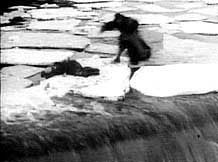
3. Safety Last (1923)
I haven't seen this film - but all I need to do is post a picture from the moment in question, and I'm sure you will recognize it:
4. Greed, Erich von Stroheim (1924)
The tragic ending in the salt flats, the desert wastes of Death Valley
5. Battleship Potemkin (1925), Sergei Eisenstein
The baby carriage tumbling down the steps of the Odessa train station
Our first repeat from The Guardian list.
6. The Big Parade (1925)
The scene of the parting of the American troops from a French village
Er - just from the description of the scene given it sounds extraordinary:
American doughboy Jim (John Gilbert) calls out for French peasant girl Melisande (Renee Adoree) but cannot locate her. She too hears the bugle call and sees the dust of the trucks, the horse-drawn caissons, and the running men assembling for the pull-out. Her distress and desperation rises with the suddenness of their leaving. Suddenly, she decides that she is desperately in love with Jim. She pushes her way through the massed ranks of soldiers - looking and calling out for him in the ensuing chaos and rising dust. Her frenzied search becomes more frantic and emotional as she searches for a glimpse of him to bid him a lasting farewell. Two other passing soldiers grab at her - one touches her breast, the other tries to steal a kiss. Jim climbs into the back of a transport truck, one in a long line of battle trucks. When he finally catches sight of her, he jumps off the truck and races back - they wildly embrace and pepper each other with kisses - framed in close-up. Earnestly, he vows to return to her in the touching scene: "I'm coming back! - Remember - - - I'm coming back!" An officer pulls on Jim, and then rips them apart. The agonized, feisty French village girl hits back at anyone who would tear them from each other. As Jim is dragged into the tail end of a truck, Melisande holds on firmly to his left leg - refusing to let go. She runs along for a moment as the truck pulls away - she desperately hangs onto a chain dangling off the vehicle, trying to halt the inevitable and defy both time and fate. When she won't let go, she is dragged alongside the procession until she can't hold on any longer. He tosses her mementos to remember him by: his wristwatch, his dogtags, and one shoe, and then sprays her with two-handed kisses. She stands and watches the truck disappear - holding his shoe to her bosom. The passing vehicles and clouds of dust envelope her - and then subside. In the middle of the road, she sinks to her knees with her head bowed.
Jesus. Sounds pretty damn good, huh??
7. The Gold Rush (1925)
The Thanksgiving day celebration
Ha ha ha ha. Charlie Chaplin cooking is BOOT in a big pot.
8. The Phantom of the Opera (1925).
The unmasking of "the phantom of the opera". She rips off his mask and sees this:
I could recommend a wonderful orthodontist.
9. The General (1927), Buster Keaton
Buster Keaton sitting on the connecting driving bar between two railway cars - he is dejected, rejected by his girlfriend, he sits on the bar. The train starts to move - the driving bar starts to rise up and down - and there he is, dejected, going up and down and up and down and up and down ...
10. The Jazz Singer (1927).
Al Jolson's first speaking lines in films.
He's performing - the audience goes wild - he stops them and calls out: "Wait a minute! Wait a minute! You ain't heard nothin' yet. Wait a minute, I tell ya, you ain't heard nothin'! Do you wanna hear Toot, Toot, Tootsie!? All right, hold on, hold on. Lou, Listen. Play Toot, Toot, Tootsie! Three choruses, you understand. In the third chorus I whistle. Now give it to 'em hard and heavy. Go right ahead!"
11. Metropolis (1927), Fritz Lang
The entire creation of that future world - a precursor to 20th and 21st century sci-fi films.
12. Sunrise (1927), FW Marnau.
The erotic seduction scene between married farmer (George O'Brien) and the wicked city-girl (Margaret Livingston)
13. King Vidor's The Crowd (1928)
A. Tracking shot going up the skyscraper (described by AFI as "One of the most majestic, fluid shots in this silent film masterpiece - one of the greatest impressionistic tracking shots in all of cinematic history")
B. From that tracking shot, the camera somehow does a dissolve through one of the identical windows in the skyscraper into a large room filled with identical desks, identical people at the desks - panning over the room - everyone anonymous, the same - until it finally zeroes in on the hero (James Murray).
14. All Quiet On The Western Front (1930)
The final moments - just before the armistice
The German soldier, daydreaming, reaches out to grasp a butterfly - a French sniper zeroes in on the hand, and fires.
15. City Lights (1931), Charlie Chaplin
The ending of the film
This movie is genius. At the end, the blind flower girl who now has regained her sight recognizes that the Tramp is actually her benefactor.
Teary, sentimental, filled with pathos ... but a beautiful beautiful moment.
16. James Whale's Frankenstein (1931)
The "creation sequence" - during a storm
I'm only familiar with this movie because I have seen Gods and Monsters about 8 times, because of my lust for Brendan Fraser. Very good movie, though, if you haven't seen it. About James Whales' last days. A poetic rendition, indeed, but very compelling.
17. The Public Enemy (1931)
James Cagney smushes a grapefruit into the side of his girlfriend's face. What a fanTAStic moment. So MEAN, so UNPREDICTABLE - and yet what every single person in the audience is kind of hoping that he would do.
18. Footlight Parade (1933), Busby Berkeley
The elaborate geometric production numbers - where chorus girls basically act as bits and pieces in a kaleidoscope
19. 42nd Street (1933)
When the director pulls the understudy out of her dressing room - and gives her a speech, just before she has to go onstage to take the place of the star. She is terrified, frozen in terror. His speech goes thus:
Now Sawyer, you listen to me and you listen hard. Two hundred people, 200 jobs, $200,000, five weeks of grind and blood and sweat depend upon you. It's the lives of all these people who have worked with you. You've got to go on, and you have to give and give and give. They've got to like you, they've got to. Do you understand? You can't fall down. You can't, because your future's in it, my future and everything all of us have is staked on you. All right now, I'm through. But you keep your feet on the ground and your head on those shoulders of yours and go out - and Sawyer, you're going out a youngster, but you've got to come back a star.
20. King Kong (1933)
The final moments.
King Kong on top of the Empire State Building. Hard to think of a more universally known image!
21. Queen Christina (1933)
Queen Christina (Greta Garbo) renounces her throne - and then goes into exile, by ship. Famous famous sequence. Even if you haven't seen the whole film, you've probably seen snippets of that scene here and there. Greta Garbo basically stands at the head of the ship, like a figurehead, staring out. It's a bleak ending, with a huge close-up of that unforgettable face.

Michael Caine, in his fantastic book Acting in Film includes this piece of essential advice to film actors: "DO NOT BLINK. When you blink, you are weakened. You lose all your power. Whatever you do, DO NOT BLINK."
You never ever catch Greta Garbo blinking.
Other actors who you will never see blink (and I notice this stuff because I'm insane and I need to get a life NOW): Tom Cruise never blinks, Humphrey Bogart never blinks, Katherine Hepburn NEVER blinks, Jodie Foster is another non-blinker ... These people know how to do close-ups like NOBODY'S business. Watch the entirety of Silence of the Lambs - which is actually mostly done in close-up. Anthony Hopkins never blinks his eyes, and Jodie Foster never blinks hers. Which helps give the film that subterranean vibe of wide-eyed horror.
22. It Happened One Night (1934)
Clark Gable and Claudette Colbert hitchhike
How MUCH do I love this movie? If you want a treat - really, you should see it. A screwball comedy? Yes. Clark Gable at his saucy rakish best. But the real revelation is Claudette Colbert. I have no idea how the hell Gable could have kept a straight face doing scenes with this woman. Hilarious.
Anyway, the two of them are having no luck hitchhiking. He shows her all the different techniques with the thumb - getting really into it - he's an expert. "There's THIS way to hold out your thumb ... then there's THIS way to do it ..." All male bravado. She is lying across the top of a fence, completely unconvinced.
He then starts to hold out his thumb, and car after car after car pass him by. His ego begins to deflate. It is humiliating.
Then, ever so calmly, she uncurls herself from off the top of the fence, with this flat unimpressed face, walks over to the side of the road, hikes up her skirt over her knees and sticks her gartered leg out into the road. Of course a car pulls over immediately.
23. George Stevens' Alice Adams (1935)
The dinner party scene
I've actually never seen this film. Alex?? You Kate Hepburn afficianado - I'm sure you have. What's the dinner party scene like? George Stevens is a hell of a director.
24. A Night at the Opera (1935), The Marx Brothers'
The slapstick crowded stateroom scene
My high school boyfriend made me watch this movie on one of our first dates. Sweet. He needed a girl who would be into the Marx Brothers. This particular scene is absolutely ridiculous and gets funnier and funnier and funnier as it goes on, as more and more people crowd into the stateroom.
25. Top Hat (1935)
"Cheek to Cheek" - the dance number
Gives me chills just to think about it. I went through a huge Astaire/Rogers phase in high school, saw them all. This was their fourth film together.
26. Modern Times (1936), Charlie Chaplin
When Charlie Chaplin is swallowed up by, or becomes part of, the huge machine in the factory. Kind of a terrifying sequence, if you think about it. A man loses his mind.
27. Camille (1936).
The funeral death scene - called by many the greatest tragic death scene ever filmed
Greta Garbo succumbing to consumption.
28. Gone With the Wind, 1939 (two moments chosen)
A. The first meeting between Rhett Butler and Scarlett O'Hara. Rhett standing at the foot of that staircase, and the two of them exchange long glances. Scarlett comments on him: "He looks as if - as if he knows what I look like without my shimmy."
B. That unbelievable long wide shot of all the Civil War dead lying in the street, as Scarlett O'Hara steps through them, the torn Confederate flag in the foreground. Spectacular scene.
29 Gunga Din (1939), George Stevens (again)
The ending - with Gunga Din struggling to the top of the tower, to blow his bugle - and then is shot - and falls.
30. Mr. Smith Goes to Washington (1939), Frank Capra
The filibuster scene
Jimmy Stewart, after 24 hours of filibuster, his voice going, exhaustion ... He's a damn fine actor. A damn fine actor.
31. Stagecoach (1939), John Ford
John Wayne's first appearance (which was also his first appearance in a John Ford film, and the appearance basically made him a star.)
I haven't seen this movie. I am shamefully behind in my John Ford appreciation moments. Give me a break, people. I had a hard time getting into Westerns as a kid, because I'm a girl, and there are no women in those movies. Sue me. I have grown up now, and I can appreciate things even if my gender is not represented. John Ford is on the list.
32. The Wizard of Oz (1939)
AFI chooses, as the greatest scene from this film chock-full of great scenes, the one where Dorothy, the Tinman, the Scarecrow, and the Lion in the poppy fields, running, running, while the Wicked Witch weaves a spell over them.
That scene always upset me DEEPLY when I was, oh, 7 or 8 years old. I thought it was so scary that the witch could see them but they couldn't see her.
33. The Great Dictator (1940), Charlie Chaplin
Charlie Chaplin's dance/pantomime with the giant balloon-globe that he is planning to rule over. He has a Hitler moustache, and is wearing a Nazi-esque uniform. The balloon-globe is basically like one of those huge balloons that everyone bats around at baseball games, trying to keep it in the air. That is "the Great Dictator's" goal in this scene: to keep that globe in the air.
34. Citizen Kane (1941)
The "Rosebud revelation" at the end.
It explains everything, it explains absolutely nothing.
35. The Lady Eve (1941), Preston Sturges
The seduction of Henry Fonda scene
36. The Maltese Falcon (1941), John Huston
The final moment: The policeman picks up the "black bird" and says, "It's heavy. What is it?" Bogart touches it, says, "The, uh, stuff that dreams are made of." (Apparently, the line was his idea). The policeman says, "Huh?" Spade takes the Maltese Falcon and walks down the hall, and you can see Mary Astor's tearful face as she goes down in the cage-like elevator. The end.
37. Casablanca (1942), Michael Curtiz (two moments chosen)
A. The goodbye moment at the airport, his speech about "I'm no good at being noble ... doesn't amount to a hill of beans in this crazy world ... Here's lookin' at you, kid."
B. The final moment, the two men walking away in the fog. Bogart saying the line (which had to be dubbed in later): "Louis, I think this is the beginning of a beautiful friendship." And then begins the final strains of The Marseilleise. The. End.
38. Now, Voyager (1942)
Again with the "cigarette trick". This showed up in The Guardian list, too. Paul Henreid lights two cigarettes in his mouth and gives one to Bette Davis. I haven't seen it, so please forgive me - do not get what the big deal is. But I will subside.
39. Saboteur (1942), Alfred Hitchcock
The harrowing death-sequence.
Harrowing, indeed. That guy hangs off the side of a skyscraper, literally by his fingertips.
40. Yankee Doodle Dandy (1942)
The "title number"
Can't you just hear Jimmy Cagney's voice singing, "I'm a Yankee Doodle Dandy ... Yankee Doodle, do or die..." in that gruff cut-off-at-the-consanants kind of voice? Also, I love how he dances up the walls - like Donald O'Connor did in Singin in the Rain.
41. The More the Merrier (1943), George Stevens yet again
The famous courtship scene on the front steps.
I haven't seen this movie, but the scene sounds DELICIOUS.
42. To Have and Have Not (1944).
The kissing scene ("It's even better when you help", which ends in the "You know how to whistle" moment - which then leads to Bogart, alone in the room, bemused, kind of shocked, kind of turned on - a million things going on on his face at once - and then, slowly, he "puts his lips together" - and does a kind of catcall whistle. Beautiful. Hot.
43. The Best Years of Our Lives (1946)
The home-coming scene
A serviceman (the wonderful and later blacklisted Fredric March) returns home to his wife and kids after the war. I have not seen this film but the mere description of the scene brings tears to my eyes.
The touching, wordless homecoming scene commences when he rings his apartment's doorbell, and quickly cups his hand over the mouths of his two grown children to silence them. Son Rob and daughter Peggy stand in amazement - overjoyed to see him. From the distant kitchen, his wife's voice asks about the unexpected visitor: "Who's that at the door, Peggy? Peggy? Rob? Who is...?" Al's apron-clad wife suddenly stops placing dishes on the table and intuitively guesses her husband has finally come home. In a long-held shot with Al's back to the camera, she spatially appears at the end of the hallway corridor with arms half-outstretched. Both stand frozen to the ground - and then silently, slowly, move into each other's arms across the vast void. His children watch from afar as their parents share a long embrace.
44. Duel in the Sun (1946), David O. Selznick
The ending of the film
I have not seen this movie. But the ending - which is a shootout as well as a love/lust scene - gave the movie the nickname "Lust in the Dust". Love scene between the delicious Jennifer Jones and the delicious Gregory Peck.
45. Gilda (1946)
Rita Hayworth's torchy rendition of "Put the Blame on Mame, Boys."
It's torchy, use, but it's also tragic. She's desperate, she's embarrassing - and the dance is used to humiliate Johnny. Great.
46. It's A Wonderful Life (1946), Frank Capra
In my opinion, so many great moments to choose from in this movie. AFI chose one of my favorites:
That PHONE conversation. You have to know the one I mean. It has everything. The acting, the sensuality, the tears, the love, the closeness of their two faces ... unREAL.
47.Notorious (1946), Hitchcock
The "longest kiss in screen history"
Perhaps it is noteworthy that that was the "longest kiss" at the time - but I think the endless descent of the staircase that closes the film is a superior scene. The whole movie is great, though.
48. The Lady From Shanghai (1948).
The Hall of Mirrors scene
Don't know this one.
49. The Treasure of the Sierra Madre (1948), John Huston
When Walter Huston makes fun of the other two for wanting to turn back.
"My, my, my, what great prospectors, two shoe clerks readin' in a magazine about prospectin' for gold in the land of the midnight sun, south of the border, or west of the Rockies, ha, ha, ha...Go ahead, go ahead, throw it. If you did, you'd never leave this wilderness alive. Without me, you two would die here more miserable than rats..."
50. The Heiress (1949), William Wyler
The climactic scene
Montgomery Clift, the manipulative sneak, is finally crushed by the rejection of the once naive Olivia de Havilland (who won an Oscar for the role). He bangs on the door maniacally. She has closed all the blinds. She does embroidery, as we hear him go more and more crazy outside. Her face (which at the beginning of the film is soft and open and naive) gets harder and harder and harder. She takes a lamp, and walks up the stairs - still listening to his maniacal pounding on the door. She is proud, she is proud of rejecting him - but the rejection is obviously twisting her soul into something hard and unsympathetic. She says to her aunt, "He came back with the same lies, the same silly phrases...he has grown greedier with the years. The first time, he only wanted my money. Now, he wants my love too. Well, he came to the wrong house and he came twice - I shall see that he never comes a third time...Yes, I can be very cruel. I have been taught by masters."
It's a great performance. I highly recommend it.
51. The Third Man (1949) - two moments chosen
A. The entrance of Orson Welles
B. The final closing sequence
52. White Heat (1949)
The last scene. Of course. One of the great scenes of all time.
"Made it Ma! Top of the world!"
53. All About Eve (1950)
The "Fasten your seat belts, it's going to be a bumpy night."
Delivered by Bette Davis, after something like her third martini, in this black satin dress, as she stops at the bottom of the staircase ... It's such an imitated line, that I was shocked when I saw the film for the first time how NATURAL it comes out. It's not campy at all. It's quite real.
54. Sunset Boulevard (1950), Billy Wilder
The ending. Of course. Gloria Swanson is lured from her mansion, and descends the staircase. She is utterly mad. She thinks she's playing Salome, her great part earlier in her life. She doesn't know what is real. She is speaking - a long monologue which ends with the famous famous lines: "All right, Mr. De Mille, I'm ready for my close-up."
55. George Stevens' A Place in the Sun (1951)
The dance - when Elizabeth Taylor and Montgomery Clift fall in love
One of the greatest extended love scenes, ever, in my humble opinion. What's so great about it is - both of them are misinterpreting the other. Because of hormones, I suppose. And yet the electricity between them is also intense. But ... there's something OFF. It's a powerful scene - with a ton of intense closeups - which really get inside the heads of the two characters. Very very intimate scene.
56. Elia Kazan's A Streetcar Named Desire (1951)
"STELLLAAAAAAAAAAAAA"
57. High Noon (1952)
Gary Cooper alone in the streets at high noon. A classic scene.
58. Singin' In the Rain (1952)
The "Singin' in the Rain" dance sequence.
Did you know that the rain in that scene was made up of water AND milk - because the milk was what made it all shiny under the lights? Just plain water was soaking into his suit immediately and didn't give the desired effect.
59. Fritz Lang's The Big Heat (1953)
The scene you actually DON'T see in the film - when he (Lee Marvin) throws scalding hot coffee on her (Gloria Grahame's) face.
I haven't seen this film. The scene sounds brutal - it happens off-camera but you hear her screaming, "My face! My face!"
60. From Here to Eternity (1953)
The couple making out as the waves rush in. A classic scene.
61. Shane (1953).
The echoing finale.
"Come back, Shane!"
Come back, Shane....
62. Elia Kazan's On the Waterfront (1954)
"You was my brother, Charley. You should've looked out for me a little bit. You should've taken care of me - just a little bit - so I wouldn't have to take them dives for the short-end money...You don't understand! I could've had class. I could've been a contender. I could've been somebody, instead of a bum, which is what I am. Let's face it (pause) ...... It was you, Charley."
63. The Night of the Hunter (1955) - two moments chosen
Often called one of the greatest American movies ever made. I agree. Charles Laughton, the famous actor, chose this as his only directorial project. Which may be why the film is so hard to classify, so ... of its own kind. Is it a thriller? A horror film? A myth? Well, it's certainly terrifying, I know that.
A. Robert Mitchum's insane prayer at the beginning about HATE and LOVE which he has tattooed across his knuckles.
B. The insane duet of "Lean on Jesus" between Lillian Gish, sitting in her rocking chair with a rifle - as a sort of Whistler's Mother - with the psycho killer Mitchum in the garden. She standing guard against him. He is biding his time, waiting. But they sing together. If there is a scarier moment in films, I don't know what it is. I have goosebumps going up my arm right now.
64. Billy Wilder's The Seven Year Itch (1955).
Do the words "Marilyn Monroe with a skirt blowing up over a subway grate" bring up any images?
65. John Ford's The Searchers (1956)
Spd rdr, et al: I promise to see this film eventually. Okay???
AFI chose the beginning and the end of this film: the framed door looking out onto the wilderness
66. The Ten Commandments (1956), Cecil B. DeMille
The parting of the Red Sea moment
67. David Lean's The Bridge on the River Kwai (1957)
AFI acknowledges all the great scenes in this great movie - but chose as the best scene the one where Alec Guinness keeps his men standing all day long when they arrive at the POW camp, in the hot sun - and Guinness is then beaten and dragged into that stove-box thing, for him to be basically cooked in the sun. Heat torture. This power struggle lasts for days. An excruciating sequence.
68. Stanley Kramer's The Defiant Ones (1958).
The final sequence where the 2 shackled-together prisoners (one white - Tony Curtis, and one black - Sidney Poitier) run together to try to jump together onto the moving train. The whole film is about race relations - these two have to put aside their animosities and work together because they are handcuffed together. And this last death-defying moment - is the true symbol of race relations in America at that time.
69. Orson Welles' Touch of Evil (1958).
The opening sequence. Which is absolutely beyond belief. It's called by the AFI: "the most dazzling opening sequence in any film" - and if you've seen it you'll know that's no exaggeration.
70. Vertigo (1958), Hitchcock
AFI chose as the greatest scene the one where she finally transforms herself into his dream of the dead girl. Hitchcock was such a wack-job, wasn't he, but he certainly knew how to tap into our fears. Creepy creepy scene. Jimmy Stewart is so wonderful, too - trying to re-mould this new girl into the one he lost. It's a scene where you don't know if it's real or a fantasy, the camera going round and round and round ...
71. Ben-Hur (1959)
The chariot race. Beat me about the head and neck, everyone, once again, for I haven't seen this film. But dammit, there are only so many hours in the day.
72. Alfred Hitchcock's North by Northwest (1959)
The crop-dusting scene. (Sorry, Emily, and Emily's dad.) I am actually a bit more partial to the scene with all the characters climbing around the face of Mount Rushmore.
73. Some Like It Hot (1959), Billy Wilder
"Nobody's perfect."
Of course.
74. Hitchcock's Psycho (1960)
The shower-scene.
75. David Lean's Lawrence of Arabia (1962) - two moments chosen.
A. For whoever it was yesterday who thought THIS was a better choice than the mirage scene: AFI chose the moment of the lit match becoming the desert.
B. The mirage moment, discussed yesterday.
76. Stanley Kubrick's Lolita (1962)
The first image we get of Lolita.
77. Tom Jones (1963), Tony Richardson
Albert Finney as Tom Jones has a multi-course meal with a Mrs. Waters - but really what it is - is the whole meal is a metaphor for foreplay. It's all about sex - I mean ... er ... just look at Albert Finney's face.
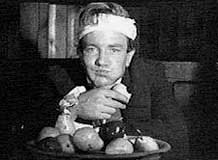
78. The Sound of Music (1965)
The opening.
79. Bonnie and Clyde (1967), Arthur Penn
The two of them being shot, riddled with bullets
An iconic scene, one of the most controversial ever made - at the time. One of the first times slo-mo had been used when depicting violence.
80. The Graduate (1967), Mike Nichols
The ending: the wedding, the rescue scene, him at the back of the church, the two of them fleeing to a bus, and then bursting into laughter. They look out the back window ... and they suddenly look so small and worried and alone. It is most definitively NOT a happy ending. Very interesting.
81. Stanley Kubrick's 2001: A Space Odyssey (1968)
Bone into space-ship.
Emily, please inform "the fags" that I did not choose these moments. Also - please do more drunk-blogging. I so wanted to join whatever party it was you were having!
82. Butch Cassidy and the Sundance Kid (1969)
The ending. You kind of can't get any better than that ending.
83. Easy Rider (1969)
I LOVE that this moment was chosen: Jack Nicholson saying to the 2 bikers, "Have I got a helmet? Oh, I've got a helmet!!"
Cut to the next shot: which is the 2 motorcycles screaming down the road, the 2 cool biker-dudes, and Nicholson - the dissipated lawyer, wearing a gold football helmet, with an enormous happy smile on his face.
84. Sam Peckinpah's The Wild Bunch (1969)
AFI chose as the greatest moment in this film the entire opening sequence, with its freeze-frame credits, etc.
85. Patton (1970)
George C. Scott's 6 minute monologue at the beginning - standing in front of that enormous American flag.
Why did George C. Scott decline the Oscar he received for this role?
86. A Clockwork Orange (1971), Kubrick
The rape scene. Which makes me sick just to think of.
87. The French Connection (1971)
The car chase.
Probably one of the greatest chase scenes ever filmed.
88. Deliverance (1972)
I saw this movie in a Jon Voight MANIA I had some years ago (before I had a blog - so I didn't inflict that obsession on you). It got so bad that I was seeing films where he only had one or two lines.
However: Deliverance is a classic film. Terrifying. Burt Reynolds is amazing, Ned Beatty is pathetic ... it's haunting.
AFI chose from this film that first scene with banjo-playing hillbilly person. The whole scene sets up the entire movie - the world that these guys are, unknowingly, entering.
89. Francis Ford Coppola's The Godfather (1972)
The long opening scene. (The marriage, the private meetings going on in Brando's office, Brando petting the kitten during the meetings ...) It is masterful.
90. The Exorcist (1973)
The crucifix scene which makes me wince just to think about. Ouch. Ouch.
91. Chinatown (1974)
When Jack Nicholson's nose is cut after he comes out of the storm drain.
An AWFUL scene.
I would have picked the "mother sister mother sister" scene.
92. One Flew Over the Cuckoo's Nest (1975)
The scene where Nicholson wants to watch the World Series. Nurse Bitch-ed wants to stop him.
Jesus, Mary, and Joseph, that's a good scene.
93. Rocky (1976)
Rocky's triumphal run up the steps of Philadelphia Museum of Art. With swelling music, pumping his fists in the air, the skyline of Philadelphia ...
94. Martin Scorsese's Taxi Driver (1976)
"You talkin' to me?"
95. Saturday Night Fever (1977)
The disco era is so made fun of now, and we're all embarrassed by that cultural phenomena - that it's hard to remember what a good movie this is. My favorite moment is when he pushes the doors of the club open right at the moment in Beethoven's 9th symphony when the music blasts ...
AFI chooses his solo. In that damn white suit and black shirt. Easy to make fun of now - but in the context of that movie, a very very good scene.
96. Francis Ford Coppola's Apocalypse Now (1979)
So many unbelievable scenes to choose from. AFI also chooses the morning helicopter raid, with Robert Duvall's insanity, the swarm of helicopters over the water, and Wagner blasting.
97. Stanley Kubrick's The Shining (1980).
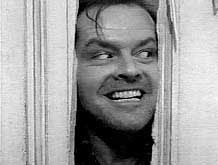
98. Raiders of the Lost Ark (1981)
The opening sequence.
What I SO LOVE about that opening sequence is that it has NOTHING to do with the rest of the plot - it is there to set up Indy's character, to show us who this man is, to tell us that basically "Raiders of the Lost Ark" is just ONE in a NUMBER of adventures had by this man ... and it also is hilarious how after THAT beginning, with the fedora and the bull whip, we next see him as a stuffy professor with glasses. I mean - perfect.
99. When Harry Met Sally... (1989)
Orgasm. Deli. "I'll have what she's having."
100. Stephen Spielberg's Schindler's List (1993)
AFI actually chose my favorite sequence in the film, which is NOT "the red coat" one - It is the composing of the list. The joint composing between Schindler and Stern ... Kingley at the typewriter, Neeson pacing and smoking, the list growing and growing and growing. It's my favorite scene in the movie.
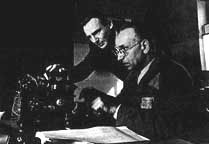
Farewell. Farewell.
I'll be posting more on him later when I get my thoughts together. Can't really write about it yet.
Moments like this one made me yearn to be an actor when I was a kid, and yearn to be a good one - He set the bar for me, for so many of us:
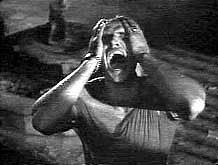
His influence is beyond description. I am deeply mournful right now. His work has meant so much to me. To so many.
Rest in peace, Marlon.
Read the note below, please, before commenting:
Small note: I feel a bit weird about this, because I don't like to be all controlling over what goes on in the comments section: but please: if there are Marlon Brando haters out there: Keep it to yourself (on this blog anyway), or go find another blog to post about it. Or if you hated him, but can still see how others loved him, and you want to talk about THAT - then that's fine, you can post about that. But I don't need to give a platform to "the other side". Not right now. I loved that man, he's an idol - and I want to keep the comments in line with that.
July 01, 2004
Lists, lists, lists
Came across this list of the "100 Greatest Moments in Film History" - and really enjoyed reading them, remembering some of these moments, wondering why others weren't included, etc. It was compiled by the Guardian - which explains why many of the choices are COMPLETELY boneheaded. I cannot remember where I found the link, though - I printed it out a while back so forgive my shorthand.
Also: "You know how to whistle, don't you Steve?" is not on the list, which pretty much negates the whole thing right there.
But still. Feel free to bluster your annoyance or crow your approval about all of these in the comments.
I list them here and comment on them when I feel like it.
1: The Usual Suspects (Bryan Singer, US, 1995)
Kujan realises that he has been conned. The "revelation" scene.
2: Psycho (Alfred Hitchcock, US, 1960)
The shower scene.
Er - enough said?
The scene is 45 seconds long, it took 7 days to shoot, and they used 70 separate camera set-ups. Janet Leigh was in that shower for 7 days.
3: The Third Man (Carol Reed, UK, 1949)
The appearance of Harry Lime (Orson Welles, with star billing, didn't appear until over an hour into the film). Haven't seen this one though.
4: 2001: A Space Odyssey (Stanley Kubrick, UK, 1968)
Flying bone turns into space ship
5: Apocalypse Now (Francis Ford Coppola, US, 1979)
The dawn helicopter attack. Just thinking about that scene gives me chills. Robert Duvall, the swarm of helicopters appearing, the speakers blasting out Wagner's 'Ride Of The Valkyries' as they zoom over villages ... an insane scene. An onslaught.
6: Blade Runner (Ridley Scott, US, 1982)
Batty's dying speech in the rain
Poor Rutger Hauer. He can only play inhuman characters or evil soulless men. This might be one of his greatest moments - his final soliloquy in the rain. Apparently, when he finished it - the entire crew burst into applause. Everyone was crying. Pretty cool.
7: The Great Escape (John Sturges, US, 1963)
The Cooler King escapes on his motorbike
Do not kill me. I have not seen this movie.
8: Casablanca (Michael Curtiz, US, 1942)
The airport scene at the end.
9: Planet of the Apes (Franklin J Schaffner, US, 1967)
Taylor finds the Statue of Liberty
Anecdote about that unbelievable moment:
Charlton Heston screams, when he comes across the Statue in the sand: "You did it, didn't you...You maniacs! You blew it up! Damn you! God damn you all to hell!" The original script just had him say "My God" because at that point "God damn" was still not allowed. Charlton Heston re-wrote the speech, and argued that he wasn't using "God damn" as a curse, he was using it quite literally: he was calling on God to damn those who did this. The powers that be, thankfully, let him change the line.
10: Some Like It Hot (Billy Wilder, US, 1959)
The very last moment: "Nobody's perfect".
Perhaps the best ending of a film EVER. IAL Diamond, responsible for that great line, said he was always pestered by people forever after: "What happens to them after that??" He always responded, "I have absolutely no idea. You cannot top that. 'Nobody's perfect.' It says it all."
Great.
11: Singin' In The Rain (Gene Kelly and Stanley Donen, US, 1952)
Gene Kelly singing in the rain
Kelly had a fever of 103 while they filmed this scene.
12: The Deer Hunter (Michael Cimino, US, 1978)
The Russian roulette scene
That's one of those scenes which, in my opinion, you only need to see once.
13: Ben Hur (William Wyler, US, 1959)
The chariot race.
I know. I know. I haven't seen it yet. It's on the list, guys!!!
14: Don't Look Now (Nicolas Roeg, UK/It, 1973)
The hooded figure
Never seen it. Donald Sutherland? Julie Christie? Think I have to check this one out. LOVE those two!
15: Saving Private Ryan (Steven Spielberg, US, 1998)
The Normandy landings
Another scene I only think I can endure once, so horrific and so well done was it.
16: The Birds (Alfred Hitchcock, US, 1963)
The crows gather on the climbing frame
My blood runs cold just thinking about it.
17: Platoon (Oliver Stone, US, 1986)
Sergeant Elias staggers out of the jungle
That is, most definitely, an iconic scene. Willem Dafoe came to my school (you all must be sick of hearing me say "so and so came to my school) but he talked a lot about filming that scene.
18: Close Encounters Of The Third Kind (Steven Spielberg, US, 1977)
The mothership appears
19: Lawrence Of Arabia (David Lean, UK, 1962)
The entrance of Sherif Ali
Amazing. The mirage. Apparently, David Lean said to his cinematographer, "I want to do a mirage shot. I have no idea how the hell to pull it off. Give it some thought."
Unforgettable moment.
20: Taxi Driver (Martin Scorsese, US, 1975)
'You talkin' to me?'
I recently saw this movie again and forgot how scary this private moment is. I forgot because "You talkin' to me" has now entered our culture to such a degree that everyone imitates it, everywhere - it's hard to remember the original.
21: The Good, The Bad And The Ugly (Sergio Leone, It, 1966)
The cemetery gunfight
22: The Shawshank Redemption (Frank Darabont, US, 1994)
The escape hole is discovered
Yeah. I dig that scene. All those faces peering into that hole with dawning understanding and shock.
23: Alien (Ridley Scott, UK/US, 1970)
The birth of the alien
Disgusting.
24: Dirty Harry (Don Siegel, US, 1971)
'Do you feel lucky punk?'
Forgive me. I haven't seen it. (Ducking.)
25: One Flew Over The Cuckoo's Nest (Milos Forman, US, 1975)
Chief Bromden escapes
I remember watching that movie in high school and literally feeling like I was having a heart attack from too much emotionw hen Chief escaped. My heart literally HURT.
26: Raiders Of The Lost Ark (Steven Spielberg, US, 1981)
Indiana shoots the swordsman
Spielberg tells a funny story about how that scene came to be: The scene was written to be an extended duel - Indy with his whip, swordsman with his sword - and would take a day or 2 of shooting. Harrison Ford came up to Spielberg on that morning and said, "I ate something bad last night - I'm sick - and I only have about an hour of work in me. Can't I just shoot the guy?"
Spielberg said that when Harrison Ford said that, a couple of crew members overheard it - and a couple of them started laughing.
Speilberg knew, then, when he heard the crew guys laughing: "Okay. That's gonna be a good moment. Let's just have him shoot the guy."
27: The Full Monty (Peter Cattaneo, UK, 1997)
The dole queue dance
That is a hilarious scene. Donna Summer, all of them queueing up for the dole ... and slowly ... imperceptibly at first ... the lads start to move.
28: Butch Cassidy And The Sundance Kid (George Roy Hill, US, 1969)
The final, doomed shootout
Perfect. Perfect filmmaking.
29: North By Northwest (Alfred Hitchcock, US, 1959)
The crop-dusting plane scene.
Can't get enough of that scene. Love it.
30: Seven (David Fincher, US, 1995)
What's in the box?
The final scene. Pshaw. I hated that movie.
31: Brief Encounter (David Lean, UK, 1945)
Laura says goodbye to Alec
I don't know this movie.
32: Gone With The Wind (Victor Fleming, US, 1939)
'Frankly, my dear, I don't give a damn'
Yeah. It's a pretty great ending. I think when he carries her up the staircase, though, is almost better.
33: Kes (Ken Loach, UK, 1969)
Brian Glover's football lesson
I don't know this movie. Just read a description of it, though, and it sounds terrific.
34: On The Waterfront (Elia Kazan, US, 1954)
'I coulda been a contender'
Nothing else needs to be said. One of the greatest scenes of all time.
35: Pulp Fiction (Quentin Tarantino, US, 1994)
"Oh man, I shot Marvin in the face!"
Yes. An outrageously funny moment. But one of the greatest film moments of all time? No.
36: The Shining (Stanley Kubrick, UK, 1980)
'Heeeeeeeeeere's Johnny!'
37: True Romance (Tony Scott, US, 1994)
'You're Sicilian, ha?'
I was SO happy to see this stupendous scene included and acknowledged. It is a phenomenal piece of writing, and I think it's some of the best work that either Dennis Hopper or Christopher Walken ever did. Brilliant. Juicy.
38: E.T. The Extraterrestrial (Steven Spielberg, US, 1982)
E.T. and Elliot ride a bike against the moon
(as cops with ... er ... walkie-talkies chase them...)
39: Goodfellas (Martin Scorsese, US, 1990)
'What do you mean funny?'
I have seen this movie SO many times and this scene never ever fails to make me so uncomfortable I want to wet my pants or run screaming from the room. Joe Pesci's moments here make me feel TRAPPED. Very very good.
40: Spartacus (Stanley Kubrick, US, 1960)
'I'm Spartacus!'
I need to start keeping track of how many times certain directors works show up on this list. Kubrick's been here a number of times already.
41: The Italian Job (Peter Collinson, UK, 1969)
The final cliffhanger
I do not know this one.
42: The Wizard Of Oz (Victor Fleming, US, 1939)
The journey to Oz
The magic of that moment when she opens the door never palls for me.
43: Jaws (Steven Spielberg, US, 1975)
The opening
I found this film, while amazing, almost unwatchably scary at times. The opening is the WORST.
44: Now Voyager (Irving Rapper, US, 1942)
Two cigarettes, one light
Good old virtuous leading man Paul Henreid lights two cigarettes and passes one to the leading lady. Simple, yes, but it apparently was a gesture which took the nation by storm.
Doesn't seem like a worthy entry on this list. But who asked me ...
45: Star Wars (George Lucas, US, 1977)
Destruction of the Death Star
I think the opening of that film is far more impressive.
46: The Crying Game (Neil Jordan, UK, 1992)
Fergus discovers Dil's true gender
Yawn. (Sorry.)
47: The Producers (Mel Brooks, US, 1968)
The chorus sing 'Springtime For Hitler'
I truly cannot think of a funnier moment.
"Don't be stupid - be a smarty -
Come and join the Nazi Party"
48: When Harry Met Sally (Rob Reiner, US, 1989)
The fake orgasm
49: A Few Good Men (Rob Reiner, US, 1992)
'You can't handle the truth'
What?? Yes - it is one of those acting moments which literally leap off the screen and grab you by the throat ... but I don't think it should be on the list.
50: A Matter Of Life And Death (Michael Powell, UK, 1946)
'There's a catch...''
David Niven - who I love. Only I haven't seen this movie. That man makes me LAUGH.
51: Battleship Potemkin (Sergei Eisenstein, USSR, 1925)
A stroller bounces down the Odessa steps
Famously imitated by Brian DePalma in "The Untouchables". But the moment in Battleship Potemkin is better.
52: Bullitt (Peter Yates, US, 1968)
Car chase through San Francisco
53: Carrie (Brian DePalma, US, 1976)
The horror ending
Anyone remember that moment? The hand coming up through the earth? Freakin' TERRIFYING.
54: It's A Wonderful Life (Frank Capra, US, 1946)
George discovers he's still alive
Tears of joy just thinking about that beautiful scene.
55: LA Confidential (Curtis Hanson, US, 1997)
Dudley Smith shoots Jack Vincennes
God, so many other great scenes in that movie, though!! How to choose! I'd pick Ed Exley's interrogation scene when Bud White breaks the chair. I'd venture to say that it was that moment alone that made Russell Crowe a star and made women melt in their seats.
However, Vincennes' last moment is so fantastic as well, isn't it???
"Rollo ... Tomassi..."
56: Reservoir Dogs (Quentin Tarantino, US, 1991)
The ear amputation
I feel like I can never listen to the song "Stuck in the middle with you" and enjoy it - because of that scene.
57: Shane (George Stevens, US, 1953)
'Shane! Come back!'
Echoing ... "come back Shane, come back Shane!"
Yeah, it's a classic moment.
58: The Empire Strikes Back (Irvin Kershner, US, 1980)
'I am your father'
I particularly enjoyed the sequence in the asteroid belt, but that's okay - "I am your father" was a stunning revelation, if I can remember my own response way back when.
59: The Godfather (Francis Ford Coppola, US, 1971)
The horse's head
It's the LEAD UP to the horse's head that I find so scary. You watch how it occurs. You watch when the decision is made - only no words are said. You know what's coming, but that poor guy doesn't ... and the coldness and callousness of these people ... It's awful.
60: The Railway Children (Lionel Jeffries, UK, 1970)
Bobbie's father walks through the steam
I do not know this one.
61: Thelma And Louise (Ridley Scott, US, 1991)
Drive over the cliff edge
I love that ending. It's the only way it could go. HowEVER - I was disappointed that they then immediately faded the screen to white, and as the credits rolled showed up images of the women in happier times. It completely missed the point, I thought. Or maybe that WAS their point ... but I thought it could have been so much more. If they had just had a black-out. Dead-end. That's it. Let the audience decide how to feel. Don't enforce nostalgia on the audience, please. It's obnoxious.
62: Trainspotting (Danny Boyle, UK, 1996)
Renton quits heroin cold turkey - his parents lock him in his room
One of the scariest real-est most frightening depictions of drug withdrawal I have ever seen. The baby on the ceiling.
63: Witness (Peter Weir, US, 1985)
Dance in the barn
Oh Lord help me. How I love that scene.
64: Manhattan (Woody Allen, US, 1979)
The opening sequence
The New York montage and Woody Allen's voiceover. Pretty funny.
65: Manon Des Sources (Claude Berri, France, 1986)
César discovers he has a child
I do not know this one.
66: Once Upon A Time In The West (Sergio Leone, Italy, 1968)
The mystery man's flashback
I do not know this one.
67: Paris, Texas (Wim Wenders, WGer/Fr/UK, 1984)
The peepshow booth encounter
Jeez. Anyone remember this scene?? What a movie.
68: Play It Again Sam (Herbert Ross, US, 1972)
Woody and the Oscar Peterson album
Howlingly funny movie. And moment.
69: The Graduate (Mike Nichols, US, 1967)
Sitting at the back of the bus
Yeah, that was a good moment. I think the moment when all you see is Mrs. Robinson's leg (the "Are you trying to seduce me, Mrs. Robinson?") is much better.
70: The Princess Bride (Rob Reiner, US, 1987)
The clifftop duel
Perfection
71: The Searchers (John Ford, US 1956)
Ethan Edwards' final cut
I don't know this movie. More's the pity.
72: There's Something About Mary (Bobby and Peter Farrelly, US, 1998)
The unusual hair-gel
73: Titanic (James Cameron, US, 1997)
Lovers at the ship's bow
Quiet in the gallery, please.
74: Zulu (Cy Endfield, UK, 1964)
The final battle
Okay, I haven't seen this movie - but people reference it ALL THE TIME. I hear it all the time. So obviously it's great, and I'm just an idiot. I will put it on the list.
75: Delicatessen (Jean-Pierre Jeunet and Marc Caro, Fr, 1990)
The bedsprings scene
What an absolutely bizarre movie and moment.
76: William Shakespeare's Romeo And Juliet (Baz Luhrmann, US, 1996)
The young lovers gaze through an aquarium
Uh. No.
77: Scarface (Brian DePalma, US, 1983)
'Say hello to my leetle friend'
Another line like "You talkin' to me?" It's entered into the culture.
78: Dr Strangelove (Stanley Kubrick, UK, 1963)
Bomb descends to 'We'll Meet Again'
Brilliant. Kubrick again.
79: The Piano (Jane Campion, Aus, 1993)
Piano playing on the beach
One of the most gorgeously filmed sequences I've ever seen. Breathtaking - strange - unexplainable. Like something out of a dream.
80: Cinema Paradiso (Giuseppe Tornatore, It/Fr 1988)
Compilation of love scenes
I smiled just to think about this scene.
81: Edward Scissorhands (Tim Burton, US, 1991)
Ice sculptures
No. I don't accept that. With so many other great scenes out there.
82: Babette's Feast (Gabriel Axel, Denmark, 1987)
The old general tastes the food
I do love that scene.
83: The Jungle Book (Wolfgang Reitherman, US, 1967)
Mowgli meets Baloo
Mowgli Schmowgli.
84: Henry V (Kenneth Branagh, UK, 1989)
Henry carries away his dead page
Shit, man, wasn't that great? Kenneth Branagh on those fields of slaughter - carrying his page on his back?
85: La Dolce Vita (Federico Fellini, It/Fr 1960)
The frolic in the fountain
Glorious.
86: Cabaret (Bob Fosse, US, 1972)
Tomorrow belongs to them
This is one of my favorite movies of all time. And that scene ... of singing fervent Germans - joining the song and standing up one by one ... is one of the most terrifying things I've ever seen.
87: Un Chien Andalou (Luis Buñuel and Salvador Dali, Sp, 1928)
Eye-slicing
I have not seen this film and judging from the eye-slicing reference I don't think I could take it. I have a phobia about my eyes.
88: Four Weddings And A Funeral (Mike Newell, UK, 1994)
The W. H. Auden recital at the funeral
That was a lovely little scene, wasn't it? Not sure it deserves to be on the list - but I do remember liking that scene.
89: Great Expectations (David Lean, UK, 1946)
Pip meets Magwitch in the graveyard
Never seen it. Great book. Never seen the movie.
90: Happiness (Todd Solondz, US, 1998)
The masturbation moment at the dinner table
Just thinking about this movie makes me uncomfortable.
91: Braveheart (Mel Gibson, US, 1995)
The battle of Stirling Bridge
92: High Noon (Fred Zinnemann, US, 1952)
Will Kane realises he is alone
Wow. Forgot about that moment. Yes. It is truly something. Gary Cooper walking out into the empty street - it is high noon - glaring light - and he looks around him.
93: Ice Cold In Alex (J. Lee Thompson, UK, 1958)
'Four ice-cold lagers'
Never heard of it. Freakin' Guardian.
94: Les Diaboliques (Henri-Georges Clouzot, Fr, 1955)
He rises from the dead: 'Don't be devils. Don't ruin the interest your friends could take in this film. Don't tell them what you saw.'
95: Schindler's List (Steven Spielberg, US, 1993)
The girl's red coat
Yes. Yes. Yes.
96: Cool Hand Luke (Stuart Rosenberg, US, 1967)
The egg-eating contest
97: The Thomas Crown Affair (Norman Jewison, US, 1967)
The chess scene
I love that scene.
98: Bambi (David D. Hand, US, 1942)
The death of Bambi's mother
And children everywhere were traumatized for all time.
99: The Sound Of Music (Robert Wise, US, 1965)
'The hills are alive'
Okay. I'll give them that. Even though it's so well-known now that it's a cliche. But that first sweeping shot is pretty spectacular.
100: Heat (Michael Mann, US, 1995)
Neil McCauley and Vincent Hanna first meet
Oh, please. I hated that scene, actually. I was disappointed. It was two CLOSE-UPS acting with one another - you rarely saw the 2 of them on screen at the same moment - they might as well have filmed Al's close-up one day and Robert's close-up the other. It left me flat.
June 30, 2004
A continuation of the "chick flick" discussion below:
Forgot that I had written this post a long time ago: I eavesdropped on 2 couples trying to agree on what movie to rent.
It's an extremely judgmental post. Some people don't like it when I get like that, they think no one should ever "judge" another person, but I judge those people for judging me.
Sometimes it's nice to not be so damn ... nice.
The whole "chick flick" thing
I watched An Affair to Remember last night. Now I, being a chick, have seen that movie countless times, and I own it. But it really shouldn't be relegated to the deadly "chick flick" category just because it deals with a love affair.
It's a better movie than that - and I have problems with the "chick flick" definition anyway. Er ... what ... it's a movie that deals with ... human relationships - and so only women are interested in that stuff?
Or ... is it the style that makes something a chick flick? A sentimental soundtrack, a gushy sensibility, a shallow-ness of character ...?
Like: plenty of films deal with human relationships, love, romance ... films like ... oh ... Casablanca??
So what is it that makes something a "chick flick"? I don't like the connotation that ... anything women might be into is somehow "less" than what men are into. "Oh, that's a chick flick" - said in a totally dismissive way.
That being said: My theory is that "chick flicks" are a relatively recent phenomenon - as a genre, or (maybe more accurately) a marketing tool.
You don't watch a movie like Philadelphia Story - which is all about romance - and think: "Chick flick." No. There was a commitment to story, to character, to comedy ... and the genres were blurred a bit. It's a romantic comedy, but it has deep and serious moments. There are dramatic moments. Everyone is complex. The men are complex, the women are complex.
You see that in a lot of movies back then.
Like Holiday. Or any of the Tracy/Hepburn films.
You can't label them. They're comedic. They're dramatic. They're star vehicles. They're interesting stories. There's romance. But there's usually some other element as well. The films support multiple focuses. There was definitely an assumption that both men AND women would be seeing these movies. They don't seem geared towards either sex.
A lot of the crap out today doesn't have that ambiguity, or that blending of genres.
Obviously, there are a ton of exceptions.
But, to my taste - I would say that something like Mona Lisa Smile is, most self-consciously, a "chick flick". But on another level, I wouldn't just label it as a chick flick, I would just say that it is a "bad" movie. Period.
Being a film geared towards women doesn't automatically make it bad or lesser. I don't like contempt towards human emotion, or contempt towards what are stereotyped as female concerns.
I love the movie When Harry Met Sally. It deals with romance, human relationships, women, men, etc. Typical chick flick territory. But ... that's a good movie.
What exactly is meant by "chick flick"? It's obviously not a compliment.
I'm convinced it has something to do with style, rather than content. But I could be wrong. Like StepMom - which, again, has OBVIOUS "chick flick" content, but again: I would say that it is NOT really a chick flick, it is actually just a BAD movie.
Pretty much any movie which gets the dismissive moniker of "chick flick" I either haven't seen because it looks like a load of malarkey, or I have seen and thought, "Damn. That's a pretty bad movie." I hate being pandered to. And I don't like shallow-ness. I like to be challenged when I go to a film - and something like Mona Lisa Smile isn't challenging. It's condescending.
I'm a woman but I also have a BRAIN and surging violin strings are only gonna work if there's other stuff going on - like PLOT, and CHARACTER, and SURPRISE. Know what I'm saying? The assumption that women are a lump of emotions just waiting to be played on is insulting.
So - does "chick flick" equal bad?
Or ... are there "good" chick flicks? But they get that label because they are about romance?
I'm sure there's not one right answer to these questions - it's all just conflicting opinions - but it should be an interesting discussion.
June 25, 2004
Nitpickers - you are not alone
I tripped across this site today - and immediately thought of Scott and his self-proclaimed state of being a "detail Nazi" - It is a "Nitpickers Guide to the Movies".
Now there is so much there, and it is so autistic that I have barely scratched the surface. But it looks hilariously fun as well.
For example: Check out this list: Top Ten Nitpicked Movies
What I really want you to note, though, is the level of obsession in the list. Like:
Titanic: 352 nitpicks (98 refuted)
It's the "98 refuted" that really gets to me.
So someone writes in with a nitpick (and usually it's continuity issues - like: hey, his shirt was buttoned up to his neck in one shot, and in the next moment you can see his chest hair!) But others are far more insane.
Like this one:
When Dawson tries to get onto the floating piece of wood the first time, it flips over. This is supposedly meant to imply that only one person can get onto the floating piece of wood without it capsizing. Therefore, the woman gets on it instead, forcing Dawson to freeze to death. However, if you notice, the first attempt to get onto the piece of wood was width-wise, not length-wise, which would be more likely to flip over if anyone got onto it in the first place. Had Dawson tried again to get onto the piece of wood length-wise, he would have most likely succeeded because the center of gravity would have been more to his favor, possibly saving his life. Why the lack of motivation to save his own life mysteriously vanishes after the first attempt (and why Kate Winslet does not attempt to help him up) is an error both in human nature and in the script.
And then other nitpickers write in and comment on this nitpick - and they all get very into it - and it's all very scientific - Another nitpick has to do with an argument that when she pays for the painting, she pays him with a dime that has FDR on it. FDR in 1912? The discussion for that nitpick is QUITE lively.
Everyone who posts on the site is obviously legitimately insane, and for that very reason, I dearly love them all.
June 24, 2004
Rewind, play, rewind, play
Last night I watched Contact - which is up there with one of my favorite movies. I own it, and I've seen it probably 10 times. Not sure what it is that I find so deeply satisfying and exciting about it - and this is a consistent response. The 10th time seeing it is as vivid as the 2nd time (not as vivid as the 1st time - you can't recreate THAT). There are very few movies which stand up to such repetition.
Here are a few with some windbag comments from yours truly. What are yours?
Apollo 13, for whatever reason, is another one for me. Every time I see it I have the same intense response. Repetition doesn't seem to dilute the intensity. The same powerful moments still resonate with the 6th or 7th time.
Another thing I watch repeatedly which never dulls is the HBO documentary called "Do You Believe in Miracles" - about the 1980 Olympic team. For those of you new to me, and who only know me as some kind of Bogart or Rebecca West fanatic, you missed THAT obsession. (Example of the mania here, here, and here.) Anyway - the HBO documentary is pretty much always at the forefront of my tapes, ready access. I don't know what it is exactly that gets me about it, and we're talking every single time - but I am grateful for it, and I don't question it.
The Big Sleep is a neverending source of fascination. I've seen it ... 6 times now? Once I saw it twice in a 2 day period. The same moments thrilled, surprised, etc. I leaned forward at the same moments, I enjoyed the same moments (I love how Bogart seems to have chosen, for Philip Marlowe, that when he is deep in thought, he tugs gently on his ear lobe. That gesture doesn't show up in any of his other movies - at least not with as much regularity as he shows in The Big Sleep. I love how he does it.)
Please SCORN ME NOT but the film Nixon also never .... I'm trying to find the right word. It remains just as juicy now as when I first saw it. I don't care about Oliver Stone's politics - I mean, I care - but not when it comes to that movie. I am talking about the juiciness of the acting in that film which really is top-notch, and no matter how many times I see it, I never get tired of watching. JT Walsh and James Wood - YUM. Madeline Kahn in her brief cameo - the last role she did. The guy from "Frasier" who I normally don't care for - but I LOVE him as Dean. I love Ed Harris, I love to watch Anthony Hopkins - but most of all, for some reason, I am MOST fascinated by the duo performances of JT Walsh and James Wood as Haldeman and Ehrlichman. It tastes GOOD. Perpetually.
Here's an embarrassing one. Bring It On. I will see that movie 5,000 times in my lifetime, I can feel it.
Same with Sense and Sensibility. I own it, I watch it probably once a month - the same moments get me, even though I am now totally familiar with them. Alan Rickman (god!!) leaning outside the sick room, saying to Emma Thompson, "Give me something to do ... or I shall go mad." And Emma's breakdown at the end. I'm such a sap. But when her veneer cracks, I crack. Regardless if it's the 20th time I've seen it.
Casablanca. Each time I see it it's like it's the first time.
Oh, and one more: Liar Liar. That movie absolutely KILLS me each and every time I saw it.
So tell me. What movies do you NEVER get tired of?
June 23, 2004
Day After the Younger-Dryas Event
I read this post when CW first wrote it and found it very interesting, mostly because I know nothing. I don' know nuthin' 'bout birthin' babies, Miz Scarlett ... and I also don' know nuthin' about The Younger-Dryas Event.
Read it!
The Day After Tomorrow - an absolute stream-of-conscious response
So I saw it last night. It's a load of malarkey. There were many many cringe-worthy moments, which I will list later. So cringe-worthy that I literally squirmed about in my seat, and a couple beside me burst into laughter at it. Needless to say, it was supposed to be a poignant moment.
I'll start with broad impressions, and then list specifics later:
Some of the effects were very cool - although some were not so cool and not so well-done. Shocking, in a film which really is all about the special effects. I thought a lot of it was pretty shoddy, actually.
It continuously amazes me how actors can still come up with shreds of their dignity intact when dealing with such heinous material as that god-awful script. Roland Emmerich should be barred from writing his own stuff. He CANNOT WRITE. But still - working with that really bad script - some of the actors managed to turn in some nice performances. Not GREAT, but nice.
And here's my broad thought about the film (I am all over the place right now):
It actually has nothing to do with global warming. Or science. It has no social message whatsoever. Roland Emmerich might THINK that that was what he was doing, but I can tell, through my psychic powers, that this is not the case at all.
What he was ACTUALLY doing in that film was working out the nagging anxieties we all feel about our prospects on this planet following September 11. It may have been subconscious on his part - maybe it was - and like I said: I'm just giving you my psychic reading on the whole thing.
We all deal with anxiety in different ways. The post-September-11 world has affected everybody - but not in a monolithic way. Everyone has to cope. Life must go on. So we cope in different ways.
Some began to drink heavily. Some became workaholics. Some sold all their belongings and proceeded to live on houseboats. Some began to have indiscriminate sex. Some threw themselves into arts and crafts.
And some ... decided to make movies about global disasters - featuring the ultimate destruction of New York City.
It's an acting-out. A fantasy. Or a nightmare. A true fear being expressed - however spectacularly, and however coldly (I find all the digital film-making really cold and alienating at times, I have to say.)
There's the whole theory about how the film noir style came into existence. Please - any film buffs - correct me if I'm wrong - but the style came out of the post-World War II shut-down, the cold war starting up - the deep global uncertainty - what have we unleashed? - the world now knew, because of Hiroshima and Nagasaki, that we have in our own hands the very thing that could destroy us - Russia looming as a huge dark mystery - threatening - fearful ... Film noir, with its feeling of menace, its elongated shadows, its overwhelming feeling of alienation - the lonely hard-bitten detective - alone at his desk - fighting the forces of evil - but he, too, the detective, is also, in his essence, an anti-social man. All of these stylistic elements came out of a specific time and place. And it's not like it was conscious - that a bunch of film-makers or studios had a round-table discussion: "Okay, we need to come up with a style now to express our anxiety". It was a natural progression - a trend - coming out of the tenor of the times.
I think that all of the epics and myths and legends that we now are seeing come to the screen - Troy and King Arthur - and Alexander (saw the preview for that last night) - are all subconscious expressions of the fear of what happened on September 11, 2001. There is a straining in the mind to go back - to look backwards - way way back - to the ancient times, to ancient apocalyptic moments when civilization hung in the balance.
That's how I interpret this trend, anyway.
Film-makers, writers, and also the audiences who flock to these epics - are all asking themselves - subconsciously: "How did we - the human race - get through THAT? We did ... we did get through it ... civilization survived ... and whatever lessons there are to be learned from the story of Troy, the story of Alexander the Great ... whatever lessons there are back then - perhaps we could use some of that wisdom NOW."
Again, this isn't a conscious thing. It's something going on in the subterranean level.
Myths - or old stories handed down - act as repositories for a community's hopes, desires, fears. It's like Grimm's Fairy Tales, for example. Life isn't pretty. Beneath the surface, there are things that always threaten, life is potentially very very dangerous. But we can't walk about KNOWING this at all times - and so we create stories, to let out some of that fear, to express some of it. These stories are like containers. We can pour into them our own fears, our own desires, our own questions ...
I didn't mean to write all of this - but that is exactly what I was thinking last night, as I watched the tidal wave destroy New York City in the film.
I mean, the effects were all right, I thought the best moment was the wave rising, rising, rising, around the Statue of Liberty ...
But what I was really thinking was: Wow. This film is really about September 11, and the horror of watching those towers fall - on television if you were far away - I also made a guess that Emmerich was probably nowhere NEAR New York City on that day. This isn't a criticism. I'm saying that: I know, at least from my friends who don't live here, that their fears and anxieties are very different from mine, because their experience of that day was watching it on television and desperately, desperately, desperately trying to get in touch with their loved ones (me) who lived here.
Very very different experience than watching it happen.
And so - this film was expressing some of that terror of that day.
And by making it all much WORSE - New York City completely BURIED, DESTROYED - it becomes like a myth. A story, a legend. It becomes the repository for that free-floating anxiety about our prospects, about the fragility of our world, of our civilization ... a giant wave could wipe us all out at any moment. Let's imagine what that would be like if that happened!!!
None of this is a criticism - I'm just telling you what I thought and felt as I watched the movie.
I felt a deep alienation, in myself - something in me stood way way back from it. I was almost angry, actually. Like: our fair city, our fair city. Also, because the film was made post-September 11 - the skyline is our new and truncated one. And - I'm JUST NOT FUCKING USED TO IT, okay?? I can't just look at the skyline calmly and think, "Huh. There's the skyline." No. There is always something missing, and something aches within me - It is NOT normal, I can NOT forget, I am NOT used to it (although, of course - life goes on) - but I am NOT accustomed to it. Long swooping shots of lower Manhattan, and ... I'm sorry, but it just looks weird to me. It looks like an amputated leg. It doesn't look RIGHT.
And so I guess I had some anger (really?? heh heh) - because the film glided over that - treated the skyline of New York as though it had always been that way - and then the film went ahead and destroyed the REST of it.
However: back to my original thesis: This whole film was like a little kid in the backyard playing a game in which he pretends to kill his father - the father who, in real life, has beaten him his whole life. The child is enacting a ritual, the child is playing a game where he can pretend to be powerful, where he can pretend that he is in charge, where he can lash out. He stamps on his father, he whips him with a stick, he jumps up and down, he feels no remorse. The child is letting out his rage, his fear, his sadness in his GAME. The GAME gets to be the container - the child gets to fill up this container with all of his conflicting emotions.
That's what "Day After Tomorrow" felt like to me.
Good thing I didn't go see the film on a date, huh?
Now for the cringe-worthy moments:
-- I love Dennis Quaid, but his performance stinks up the joint. It's overblown, it's obvious, it's badly executed. I felt bad for him.
-- This was the worst: when the young girlfriend says to her soaking freezing boyfriend, "I'll warm you with my body heat" - and then they embrace. The entire audience was snickering.
-- Why on EARTH were they burning books, when there was all that wooden FURNITURE around? Not logical. Rip up the tables, rip up the chairs - use the WOOD. Dumb. It was just an excuse to have a conversation about burning books. And while - I liked elements of it (the black geek kid calling to the others, "Hey, here's a whole shelf of Tax Law - let's burn this!") - it was dumb. Not logical.
-- I thought the Empire State Building freezing like a popsicle was very poorly done. It didn't look real, somehow, and (forgive the pun) left me cold.
-- The music was over-the-top. Corny. Sentimental.
-- The preachy statement at the end made by the Vice President was so dumb - and some man 2 rows in front of me actually groaned.
-- The two lovers making out by the roaring fire was stupid. They are waiting out an Ice Age, she has blood poisoning, it is freezing, there is no escape, the snow has covered the ENTIRE building. Now, I completely believe that if I were in that situation - I would find a way to snog with someone. Disaster sex is quite common - end-of-the-world sex - no problem with that. It was just the scenario - it was too romantic. A roaring fire, of all things. If I had been directing the film, I would have had them huddled up in the darkness between book stacks, freezing, dirty, desperate, clawing at each other's faces, trying to eat the life out of one another. True disaster sex. Nothing romantic about it. There's not enough time.
-- I thought at the very beginning when the ice cap crumbled and Dennis Quaid was dangling above the abyss ... Has anyone else seen it? I thought it was so badly done. It didn't look real. It looked like a B-movie effect. You could tell it was a blue screen with an abyss projected onto it.
-- The beginning - with the slow pan over the ice bergs - was quite beautiful - but there was something missing in it for me - because it was so obviously all fake, and all digitally recreated. Now a REAL helicopter ride over some REAL icebergs - that might have given me an actual sense of danger and death. But the camera "moves" were too smooth, too sure, too fake. Left me cold. Again.
-- At the very end - when Dennis Quaid and his partner - walk across the frozen Hudson to get into Manhattan. Member that part? They walk by the frozen Statue of Liberty - they see the frozen city - the emptiness, the snow drifts that go up 30 stories. Now, here's the problem, though: If they come in from that side, then they are walking EAST. Their first steps into Manhattan are on what is known as the "West Side". The West Side looks out over the Hudson to Jersey. Anyway. Here's how the scene goes. They trudge to the side of the city - which, by my calculation, means that they are right on the West Side Highway, the western edge of the city. Dennis Quaid says to his partner, "My son is hiding in the library - where is the library?" His partner looks at his little gyroscope thing-y (whatever) and looks at his friend, with dawning horror (so cheesy): "It's right here." Now, I'm sorry, but that's not right. The son is holed up in the New York Public Library - the massive one - with the lions in front - which is in midtown - it is smack-dab in the center of the city - on 42nd Street. It is not on the EDGE of the city. It is on 42nd and 5th - which means you have a good 6 or 7 block walk to get there from the West Side Highway. So I didn't like that. If you're gonna destroy New York City in your movie, then at least deal with the geography correctly.
Things I liked
-- Sela Ward as the ex-wife of Dennis Quaid. She's always good. There's just something so substantial about her acting. Good, good, good.
-- Ian Holm, as the scientist in Scotland, was also very good. He seemed to be the voice of true doom in the film (unlike Dennis Quaid's more frenetic posturing). He looked at incomprehensible charts, as the snow piled around his building, and you could see on his face that it was bad.
-- I did think it was funny to see Americans migrating into Mexico illegally.
-- The ravenous wolves who escaped from the zoo were, to my taste, the only truly scary thing in the movie. I thought that was actually a cool detail to include: animals. The animals in the zoo knowing that something is coming before the humans do. And then - wild wolves escaping. They were scary.
-- All of the birds filling the skies over Manhattan. Very nice effect.
And that's about all I have to say. Phew!!
June 21, 2004
Blockbusters
Okay, so I picked this up here - and I saw it over at Dean's.
There are two lists below. The first is The Top 100 Grossing Movies. The second is The Top 100 Grossing Movies adjusted for inflation.
I will bold the ones I've seen. In both lists. Just for the hell of it.
The Top 100 Grossing Movies (which - I mean, come on - you HAVE to adjust these lists for inflation. "Big Daddy"??? Don't get me wrong - I saw the movie, because ... basically I see almost everything ... but still - come on!)
1. Titanic
2. Star Wars
3. E.T. the Extra-Terrestrial
4. Star Wars: Episode I - The Phantom Menace
5. Spider-Man
6. Lord of the Rings: The Return of the King
7. Passion of the Christ
8. Jurassic Park
9. Shrek 2
10. Lord of the Rings: The Two Towers
11. Finding Nemo
12. Forrest Gump
13. Lion King, The
14. Harry Potter and the Sorcerer's Stone
15. Lord of the Rings: The Fellowship of the Ring
16. Star Wars: Episode II - Attack of the Clones
17. Star Wars: Episode VI - Return of the Jedi
18. Independence Day
19. Pirates of the Caribbean
20. Sixth Sense, The (1999)
21. Star Wars: Episode V - The Empire Strikes Back
22. Home Alone
23. Matrix Reloaded, The
24. Shrek
25. Harry Potter and the Chamber of Secrets
26. How the Grinch Stole Christmas
27. Jaws
28. Monsters, Inc.
29. Batman
30. Men in Black
31. Toy Story 2
32. Bruce Almighty
33. Raiders of the Lost Ark
34. Twister
35. My Big Fat Greek Wedding
36. Ghost Busters
37. Beverly Hills Cop
38. Cast Away
39. Lost World: Jurassic Park, The
40. Signs
41. Rush Hour 2
42. Mrs. Doubtfire
43. Ghost (1990)
44. Aladdin
45. Saving Private Ryan
46. Mission: Impossible II
47. X2
48. Austin Powers in Goldmember
49. Back to the Future
50. Austin Powers: The Spy Who Shagged Me
51. Terminator 2: Judgment Day
52. Exorcist, The
53. Mummy Returns, The
54. Armageddon
55. Gone with the Wind
56. Pearl Harbor
57. Indiana Jones and the Last Crusade
58. Toy Story (1995)
59. Men in Black II
60. Gladiator
61. Snow White and the Seven Dwarfs
62. Dances with Wolves
63. Batman Forever
64. Fugitive, The
65. Ocean's Eleven
66. What Women Want
67. Perfect Storm, The
68. Liar Liar
69. Grease
70. Jurassic Park III
71. Mission: Impossible
72. Planet of the Apes
73. Indiana Jones and the Temple of Doom
74. Pretty Woman
75. Tootsie
76. Top Gun
77. There's Something About Mary
78. Ice Age
79. Crocodile Dundee
80. Home Alone 2: Lost in New York
81. Elf
82. Air Force One
83. Rain Man
84. Apollo 13
85. Matrix, The
86. Beauty and the Beast
87. Tarzan (1999)
88. Beautiful Mind, A
89. Chicago
90. Three Men and a Baby
91. Meet the Parents
92. Robin Hood: Prince of Thieves
93. Hannibal
94. Catch Me If You Can
95. Big Daddy
96. Sound of Music, The
97. Batman Returns
98. Bug's Life, A
99. Harry Potter and the Prisoner of Azkaban
100. Waterboy, The
Top 100 Grossing Movies adjusted for inflation.
1 Gone With the Wind
2 Star Wars
3 The Sound of Music
4 E.T. the Extra-Terrestrial
5 The Ten Commandments
6 Titanic
7 Jaws
8 Doctor Zhivago
9 The Exorcist
10 Snow White and the Seven Dwarfs
11 101 Dalmatians
12 The Empire Strikes Back
13 Ben-Hur
14 Return of the Jedi
15 The Sting
16 Raiders of the Lost Ark
17 Jurassic Park
18 The Graduate
19 The Phantom Menace
20 Fantasia
21 The Godfather
22 Forrest Gump
23 Mary Poppins
24 The Lion King
25 Grease
26 Thunderball
27 The Jungle Book
28 Sleeping Beauty
29 Ghostbusters
30 Butch Cassidy & the Sundance Kid
31 Bambi
32 Independence Day
33 Love Story
34 Beverly Hills Cop
35 Spider-Man
36 Home Alone
37 Pinocchio
38 Cleopatra
39 Goldfinger
40 Airport
41 American Graffiti
42 The Robe
43 Around the World in 80 Days
44 Blazing Saddles
45 Batman
46 The Bells of St. Mary's
47 The Return of the King
48 The Towering Inferno
49 National Lampoon's Animal House
50 The Passion of the Christ
51 The Greatest Show on Earth
52 My Fair Lady
53 Let's Make Love
54 Back to the Future
55 The Two Towers
56 Superman
57 Smokey and the Bandit
58 The Sixth Sense
59 Finding Nemo
60 Tootsie
61 Harry Potter / Sorcerer's Stone
62 West Side Story
63 Lady and the Tramp
64 Close Encounters of the Third Kind
65 Twister
66 Rocky
67 The Best Years of Our Lives
68 The Fellowship of the Ring
69 The Poseidon Adventure
70 Men in Black
71 The Bridge on the River Kwai
72 Its' a Mad, Mad, Mad, Mad World
73 Swiss Family Robinson
74 One Flew Over the Cuckoo's Nest
75 M*A*S*H
76 Indiana Jones & the Temple of Doom
77 Attack of the Clones
78 Mrs. Doubtfire
79 Aladdin
80 Ghost
81 Duel in the Sun
82 Pirates of the Caribbean
83 House of Wax
84 Rear Window
85 The Lost World: Jurassic Park
86 Indiana Jones & the Last Crusade
87 Terminator 2: Judgment Day
88 How the Grinch Stole Christmas
89 Sergeant York
90 Toy Story 2
91 Top Gun
92 Shrek
93 Crocodile Dundee
94 The Matrix Reloaded
95 Saving Private Ryan
96 The Four Horsemen of the Apocalypse
97 Young Frankenstein
98 Peter Pan
99 Gremlins
100 Monsters, Inc.
June 17, 2004
So. Back to movies and stuff like that
I watched White Heat a couple nights ago. Never seen it before. But strange: it's one of those movies which somehow ... how can I put this. James Cagney's performance was already familiar to me, it was like I had already seen it - or it is one of those performances that is already in my psyche - because there are so many famous moments, stuff I've seen, stuff everybody references ...
"I'M ON TOP OF THE WORLD" ... God. Just AS good as everyone says it was.
An odd and fun FUN thing. It was like meeting an old friend.
The movie starts with no fanfare. A car shrieking along a curvy road. And there's James Cagney - close-up. What a FACE. Damn!
I liked it because ... you know how in movies now, they make suuuuuuch a big deal out of the star's entrance? Like - you see a foot getting out of a car ... and then the camera pulls up ... and woah, there's Ben Affleck. Like: these actors (or the directors, or whatever) can't handle a no-big-deal entrance. Where somebody just walks through a damn door and the movie starts. The stars have to sloooowly appear, to make their very appearance the hugest deal in the world. Like we should be grateful they showed up in the movie at all.
Do you know what I'm saying?
I like a movie that tosses us into the action, I like a movie that is centered on story, not stars.
There's definitely an artful way to show us the star of the film for the first time.
Think of our first glimpse of Bogie in Casablanca - which is one of my favorite "first time we see the star" moments in all cinematic history.
You see his hand. Writing "O.K. Rick" on the bill. Then you just see the side of his arm - gently, he taps the top of the chess piece - (brilliant - you can tell that the disembodied man is thinking about something, just in how he taps that chess piece) - then he picks up the burning cigarette in the ashtray - and brings it up to his lips for a drag. And then we see his face - the face we have been WAITING to see since the movie began.
It's so well done.
And it's a great example of putting off the appearance of the star of the film. To keep the audience hungry for him, and curious. Like: the first 20 minutes of the fillm, we hear about Rick, everyone talks about him, we know Bogie is in this film, we want to see Bogie - but they make us wait.
Great.
But then there's the trend NOW of loooong drawn-out star appearances - they emerge from a car, looking fabulous, the camera dwelling on their freakish beauty, maybe it's in slow-mo, sunglasses on ... I don't know. I'll have to think more about it, what it all means, what the trend actually is. It is HIGHLY objectifying film-making, if you know what I mean. In those moments, they aren't human beings in the middle of a story ... they are objectified celebrities, and the way the entrances are filmed tells us: Oooooh, here they are, they're here! Which has nothing to do with the story.
Anyway. Tangent over.
So boom - there's Jimmy Cagney - with no big star entrance - I loved it. It seemed so humble, so uninterested in all of the trappings.
It is such a good performance. He is such a good actor. He makes me want to cry. He's just so damn real. But it's not just about being real, and making good moments, and creating great characters - which of course, Cagney does.
In my opinion, Cagney has that thing. Everyone defines it in different ways, and we could talk about it til the cows come home. But it's that THING that happens between the camera and certain actors.
Not all actors. But certain actors.
He doesn't need to do one damn thing. And we are inside his brain, we feel his feelings, we see him thinking - he draws us in ... he doesn't speak all that much ... but he doesn't appear to be DOING anything.
There's one moment he has with his gun moll wife, late into the picture, where he goes to hug her goodnight, and she winces - afraid for a second that he's going to belt her.
Watch Cagney's response. Watch what he does in response to her flinch.
I rewound it a couple times. It's so real - you can't fake something like that.
You see him look ... a tiny bit baffled, and hurt ... like a little boy. It's so subtle. Then he says, "Hey ... hey ... I ain't gonna hurt you ..." But he's not defending himself in the way he says it. He's not angry. He is truly confused as to why she would be afraid of him.
This is why the character is psychotic.
Cagney gets inside of that brilliantly.
And then there's his freak-out in the prison, when he gets words that his mother is dead. Does anyone remember that scene? GOD.
To describe his reaction (Cagney plays a character who is ... to say the least ... completely connected to his mother ... there's one creepy great scene where he, a grown man, in his late 40s at that time, I think, sits on her lap ...) Anyway - to describe his reaction would be difficult. It is a complete and mentally deranged response to grief - the sounds he makes - the sounds he makes, people ... Spontaneous tears came to my eyes, listening to those SOUNDS.
It's beyond good. It's one of those moments that raises the bar for everybody else, for actors everywhere. You know? It just doesn't get any better than that.
And there's nothing planned about it.
His breakdown in the prison cafeteria doesn't look like a moment that he, the conscious actor, planned and worked on. It looks like the moment is actually HAPPENING to him. Huge difference.
Bravo!
June 10, 2004
June 06, 2004
Shameless
Just shameless. Jesus.
Couple of comments:
OJ is referred to, in the article, as a "one-time football and movie star".
"Movie star"???? Please. "Movie star." He WISHES.
I bet his lawyers (does he still have lawyers??) wish that they could legally tape his stupid mouth shut.
Listen:
"There are times I am angry at her. There are things that she could be doing with the kids better than I, you know? When, it's emotional stuff, especially with my daughter, I am angry with her."
Uh ... you're angry with her? How angry, OJ? You might want to keep that shit to yourself.
Full disclosure: I believe that this man is guilty as sin. I believe it the way I KNOW that my middle name is Kathleen. And so comments like the above one make me see red. He has no soul. He has sold it. He must lie in bed at night, and hear the whipping fiery winds of hell.
Are there any psychologists out there- who also believe that OJ is guilty?
To you psychologists: Does OJ actually believe his lies at this point? Is there a point where ... you have told the lie so often, and the lie is so ESSENTIAL to your freedom ... that you will defend that lie to your death?
He seems so indignant, so freakin' RIGHTEOUS.
And that, to me, is the clue - the final clue - that the man is guilty as sin. If you were TRULY innocent, you wouldn't need to act so obnoxiously self-righteous.
And lastly:
He'll be on The Today Show tomorrow morning - Here's a quote from the article, a highly revealing quote if you ask me (and I know you didn't):
Couric also asks Simpson how he is treated by the public after all these years. "They seem to embrace me," Simpson replies, "[because they feel] I defeated our system in some way, shape or form...Sometimes it's almost at a hero's level."
You "defeated our system".
What?? Yeah, that's about the size of it, OJ. You, and your shameless race-card lawyers, "defeated our system", all right - but I sure as hell wouldn't brag about it.
The man's brain is the size of a lentil bean. His ego is much bigger.
I don't know why OJ Simpson pisses me off SO MUCH. It's the ... hypocrisy, I suppose. The BLATANT lying. And the disgusting memory of that trial.
Anyone read Vincent Bugliosi's insanely rage-ful book Outrage? Bugliosi, prosecutor of the Manson murders, wrote a book analyzing the incompetence of the prosecution of the OJ case and ... as you read it ... or, at least as I read it, I felt like smashing some windows.
It's an outrage, indeed.
I just have to say...
-- in a fit of utter triviality on this serious day:
that this woman has a SERIOUS problem.
STOP. GETTING MARRIED.
What, sweetheart - you can't f*** someone without getting married to that person? Is that it?
Then either stop f***ing people or STOP. GETTING. MARRIED.
Serious psychological problems.
And her "unidentified friend" has a serious issue with double negatives.
Somehow I have managed to get as far as I am in life without getting married and divorced 5,000 times. How is that possible??? I don't know.
I repeat: there is something SERIOUSLY wrong with this woman. And when you add Gigli on top of it, you just want to weep.
June 04, 2004
Question for fun Part 2
Okay, so here's part 1.
The second part is the same question, but in a different genre:
What actor or actress was absolutely MAGNIFICENT in perhaps one role only? They never found that promise again, or they never found the right role again, or they were killed, or whatever ...
I have one thought:
I thought that Kelly McGillis in Witness gave a performance which is imprinted on my brain in indelible ink.
And ... after that?
I'm sure I'll think of more.
Sal Mineo in Rebel without a Cause.
"I'm no climatologist, but..."
Very funny review of The Day After Tomorrow by Michael Totten.
He quotes Matt Welch as saying that the movie is "utter horseshit but damned entertaining."
Ha!! I LOVE movies like that.
But Totten's review is quite amusing.
So then everyone in the library gets a bright idea. Hey! We can walk out of here now that the ocean is frozen. The hotshot kid of a bad-ass climatologist says “Wait!” (This is only an approximate quote.) “We’ll freeze to death if we go out there.”A bespectacled man looks at the kid and asks, “Where did you get that information?”
And I’m thinking, dude. The ocean just froze solid in 20 minutes. It’s freakin’ cold outside.
Ha!
June 03, 2004
Bit of Trivia
-- that perhaps everybody else already know.
You know the scene in Treasure of the Sierra Madre where the little Hispanic kid runs up to Bogart, trying to sell him a lottery ticket? And he bugs him and bugs him until finally Bogart throws a glass of water in his face?
The little kid shows up a couple of scenes later, to tell Dobbs his ticket won - just in time to save the day, and give them the necessary cash to go prospecting...
Anyway - you know that kid?
That was Robert Blake. Mr. I-went-back-to-the-restaurant-to-get-my-gun-and-when-I-returned-to-the-car-my-crazy/skank wife-was-dead Blake.
I know he's in a lot of trouble right now, and sounds like he's guilty as sin, but he was some actor, when the part was right. In Cold Blood comes to mind, with that great shot of him looking out the window, as the rain falls, and the reflection of the raindrops makes it LOOK as though he's crying. Classic.
Yesterday I stayed home and read this biography of Bogart I have (help? Obsession?) - and there were many quotes from the young and intimidated "Bobby" Blake, who was 11 or 12 at the time, about what Bogart was like.
The main impression Blake had - or the main thing he remembered - which shocked him, as a little kid - was how Bogart would look at the script, and immediately start cutting his lines down. Crossing stuff out, mercilessly.
Smart man.
If you can convey something without words, all the better.
But Blake watched this process, thinking, "Wow! He doesn't want to talk!"
June 01, 2004
May 25, 2004
Trailers
I'm in a movie-mode these days - OBVIOUSLY. I was telling my Dad the other day that since I have just completed a big project (having to do with putting pen to paper, and huddling over my desk every morning) - I feel much relief with having it DONE (at least for now) - and so I feel entitled to some leisure time. I'm kind of a Puritan about that stuff. I need to "earn" the time to just kick back and chill. As long as I had the deadline hovering over my head, I felt guilty about ... not focusing on it, I felt guilty about not sitting down to work.
Came across this very interesting article about the art of making a trailer for a film. It is considered an "art" to such a degree that they have awards for it: "Golden Trailer Awards".
I feel rather vindicated because the preview for "Eternal Sunshine of the Spotless Mind" is up for "best" trailer ... and I called that one. I didn't say it should be given an award, but I did say it should be studied in film school. In a class called: "How to Make a Good Trailer". It is one of the best previews I've ever seen.
It created an expectation for the film. It also got you moving in your seat, with the music. It gave you snippets of imagery, it did not really tell you the plot, it told you very very little about the movie.
To my taste, once I saw the movie - the preview made even more sense.
We all know those previews that give everything away. You see the entire plot. "Well, no need to see that now!"
So obnoxious.
"Eternal Sunshine" went another way. It was like a music video, or a collage - with inexplicable images bombarding you ... It made me think: I MUST see it.
And I did.
Again and again and again and again ....
My version of Casablanca has the original trailer for the film attached to it. It is SO melodramatic, and SO enjoyable to watch. Rick is described as "THE MOST DANGEROUS MAN ON THE PLANET" ... Er - he is?? But still, it creates a mood - an expectation of intrigue, romance, mystery.
Examples of good and bad movie-trailers, people? Anyone? Anyone? Bueller?
Or: how about:
Great trailers which hid a terrible movie?
Or misleading trailers? I can recall the trailer to Wonder Boys which was a turn-off. I had read the book, loved it, and the trailer didn't seem to have anything to do with that great book. Then, when I SAW the film, I realized: the studio (or whoever) did not trust their material. It is a relatively unclassifiable film, and so they tried to "position" it ...The movie is GREAT. The trailer was confusing, tried to make it seem like a madcap comedy.
Trailer-talk. Let's go.
One thing that comes to mind: The trailer for Troy was SPECTACULAR. At least, the earliest ones. Where all it was was the slow slow camera pull back showing the thousand ships in the blue sea. Stunning.
Apparently, the movie sucks, and I haven't gone to see it. But that image was amazing.
May 24, 2004
Name that movie
"You know how to whistle, don't you, Steve? You just put your lips together - and blow."
Name that movie
"Now all you have to do is hold the chicken, bring me the toast, give me a check for the chicken salad sandwich, and you haven't broken any rules."
"You want me to hold the chicken, huh?"
"I want you to hold it between your knees."
Name that movie
"Dave, stop. Stop, will you? Stop, Dave. Will you stop, Dave? Stop, Dave. I'm afraid. I'm afraid, Dave. Dave, my mind is going. I can feel it. I can feel it. My mind is going. There is no question about it."
Name that movie
"You shouldn't ask me for advice...When it comes to relationships with women, I'm the winner of the August Strindberg award."
(God. That just makes me LAUGH.)
Name that movie
"But I'm funny how? I mean, funny like I'm a clown? I amuse you? I make you laugh? I'm here to f**kin' amuse you? What do you mean, funny? Funny how? How'm I funny??...How the f**k am I funny? What the f**k is so funny about me? Tell me? Tell me what's funny!..."
Name that movie
"You're tearing me apart!"
(I look at those words, so simple, so un-evocative - but all I can do is HEAR the way it was said in the film ... unbelievable.)
Name that movie
"I'm afraid Mr. De Witt would find me boring before too long."
"You won't bore him, honey. You won't even get a chance to talk."
Name that movie
"You don't understand! I could've had class. I could've been a contender. I could've been somebody, instead of a bum, which is what I am. Let's face it......It was you, Charley."
Name that movie
"Hello, everybody. This is Mrs. Norman Maine."
(Goodness, I just get choked up typing those words!!)
May 21, 2004
McCabe wants to know
What is your favorite "movie death"?
The first thing that came to my mind was Bonnie and Clyde. I will think more upon it.
Update:
-- Al Pacino's death in Scarface, too, is pretty classic - although he was such an unpleasant (albeit riveting) character that I pretty much thought he got what he deserved.
Strangely enough, I was sad when Bonnie and Clyde died. Which, I think, is the whole point of the movie. You are implicated, somehow, in how these people were revered and lionized.
Anyway - I was CRUSHED the first time I saw that film, years ago - and the moviemaking of their dying is superb. Truly.
Bonnie and Clyde was the first time slo-mo had been used in a violent scene (which now, of course, you see in every single action movie ever freakin' made) - but Arthur Penn was the first one to do it - and it was highly controversial. I suppose slow-mo violent scenes are STILL controversial - but Bonnie and Clyde started it.
Little known trivia fact for ya.
May 14, 2004
Leave Helen of Troy alone, please
Great conversation going on over at Emily's - prompted by her question:
Is it acceptable for screenwriters and directors to take liberties with original works of fiction when translating them to film or is this too objectionable? Why?
May 11, 2004
Message to "anti-smoking Nazis"
Puritans.
Who would Kirk Douglas be in Out of the Past if he couldn't smoke?
Who would Bogart be without a wreath of smoke?
And so I say again: Puritans.
I'm an ADULT and I like movies that, occasionally, are geared towards ADULTS. Because I am an ADULT and I get to CHOOSE. I am so SICK of this entire culture fretting, day and night, day and night, about the children the children the children the children the children the children. Jesus. They're ruining the ADULT fun for everyone.
May 10, 2004
For the Baltimore Boy...
who emailed me that he hadn't commented recently because of the "lack of boobie references" on my blog, which made me laugh. Like there was ever a time when I wrote about "boobies" with regularity. However, there was one Sharon Stone picture I posted which, I think, generated some breast-related convo.
Anyway, this is for you, Baltimore Boy, and for anyone else who wants to leap in:
Who has the best breasts in Hollywood, and why?
I will say that we can go with "past or present" - because I would go with Rita Hayworth, or Marilyn Monroe - but those breasts are of another time. Tastes change.
Take it away, everyone.
May 07, 2004
An observation
Some people take this very superior tone when they say, "I've never watched Friends". It's all "yay for me, you suck".
Fine, you've never watched Friends ... but where did you get the idea that not watching Friends somehow MEANS something ESSENTIAL about your character, and who you are?
It's not just Friends - although the "I've never watched the show, so hardee har har" brigade is loud and superior these days, for way-obvious reasons.
It's with anything that has mass cultural appeal.
You know those people who act all morally superior because they have never seen Star Wars or something? They get this tight look on their face, and they are BEGGING you to be shocked, to be outraged, they feel superior to you. For some bizarre reason.
Maybe it's because Friends is so popular, and Star Wars is so popular - so these people have this battered pride at resisting the trend or something.
It's like music Nazis, too. Example: Jack Black in "High Fidelity".
Being so proud and superior because they have never heard a Go-Go's song. I mean, fine, whatever, you've never heard a Go-Go's song, but what kind of immature bizarre mentality is it that makes you think you're better than other people because of something so stupid?
Since my tastes are wide-ranging, eclectic, emotional, and I don't have all that many "rules" about what I will or will not see - (I blatantly went to go see "Blue Crush" when it first came out, I didn't think it was "beneath" me, etc. - I think that Britney Spears' first hit was awesome, and I own the tape) I find that attitude kind of immature, actually. It's like those kids in high school (at least in my high school) who not only loved The Replacements but thought you were an asshole if you liked Huey Lewis. (I loved both of these bands - but I am sure you all know the type.)
By the way, I didn't see the Friends finale last night. I went out for dinner with a girlfriend. I haven't watched the show in the last couple of years, and I actually don't have a TV at the moment, so I am out of the television loop - but I loved the show those first seasons, I think Jennifer Aniston is a comedic actress the likes of which we don't really nurture in this country anymore, and I pretty much think she hits a comedic home run with every one of her jokes.
I'm not interested in debating this analysis of Jennifer Aniston, because something like that is completely subjective. I think she's hilarious, others find her annoying. Or others just think she's hot, and has great hair, and miss the comedy. You can't tell someone, "THIS IS FUNNY, DAMMIT". Humor is so personal. I just thought I would let you know where I stand on the whole Friends thing, and state how stupid I think that superior attitude is, in regards to certain pop culture things.
Get off your high horse.
Another bad movie review - one of my favorite pleasures!
From Roger Ebert's movie review of New York Minute:
Nothing that happens to them has any relationship to anything else that happens to them, except for the unifying principle that it all happens to them. That explains how they happen to be: (1) chased by a recreational vehicle through heavy traffic; (2) wading through the sewers of New York; (3) getting a beauty makeover in a Harlem salon; (4) in possession of a kidnapped dog; (5) pursued by music pirates; (6) in danger in Chinatown, and (7) ... oh, never mind.
And here's my favorite quote from the review:
Ashley Olsen plays Jane Ryan, a goody two-shoes who will win a four-year scholarship to Oxford University if she gives the winning speech in a competition at Columbia. Perhaps in England she will discover that the university is in the town of Oxford, and so can correct friends who plan to visit her in London. (I am sure the screenwriters knew the university was in Oxford, but were concerned that audience members might confuse "going to" Oxford and "being in" Oxford, and played it safe, since London is the only city in England many members of the audience will have heard of, if indeed they have.)
"Willing suspension of disbelief" only works if the story engages you on multiple levels, intellectual, emotional, imaginative. If you're not engaged on multiple levels, "willing suspension of disbelief" goes out the damn window.
More on the Olsen Twins
(Oh, and by the way, I don't really care about the Olsen twins ... I don't get all up in arms about them ... it's just that they're freakin' EVERYWHERE right now and I cannot avoid them.)
May 06, 2004
The joy of bad movie reviews
James Berardinelli is one of my "go-to" guys for movie reviews. I don't always agree with him, but his writing is always superb, and he KNOWS movies. What I also like about him, is that when it's a very good movie, and I agree with his assessment, he can usually tell me WHY. I'm not all that analytical when I go to films. (For myriad reasons. heh heh)
Maybe because I identify so strongly with actors. That's part of it. If one actor has one relatively real moment in the middle of a shit film, I will forgive them much. I love actors. I suppose you could say it's like loving myself. Whatever. I stick up for my profession, and those who manage to practice the craft with dignity, and manage to succeed, in small moments. You could call me a sucker, I suppose. But I prefer to just see it as solidarity.
Also - I find it much easier to talk about why I hate something, than why I love something. Berardinelli has a way with words. I'll read his reviews AFTER I see a film that moves me deeply, films that I love, and he, invariably will explain why. I need that.
Anyway - I don't think Van Helsing has even opened yet - but Berardinelli's review is up. It made me cringe. In ghoulish delight.
It is not a good sign when the second paragraph contains the words:
Van Helsing is the worst would-be summer blockbuster since Battlefield Earth.
Ouch. "Battlefield Earth" has become shorthand. Shorthand for "sucking beyond belief".
More notable quotables:
Those who delight in bad movies and enjoy producing their own unfilmed versions of Mystery Science Theater 3000 may gain a measure of semi-masochistic enjoyment out of Van Helsing.
Wow. Praise indeed.
More:
The overall experience was too intensely painful for me to be able to advocate it as being "so bad, it's good."
Intensely painful. Here's more deliciousness:
In fact, the only reason [Hugh] Jackman doesn't come across as inept is because he's surrounded by actors who are doing worse jobs.
I think I need to see this movie.
This is classic:
Curiously, Universal distributed a notice to critics requesting that we keep the final 30 minutes of the movie under wraps so as not to spoil the "surprises" for potential viewers. I would be more than happy to oblige, but I can't figure out what those secrets are.
May 04, 2004
The Kabbalah
You've got to read this. An exhaustive and fascinating and infuriating look at the Kabbalah craze sweeping Hollywood.
If you're interested in cults, brainwashing, etc. (as I am) you won't be able to put it down. (In a cyber sense, I mean.)
Madonna has become one of the world's most annoying women. A big fat PHONY. For those of you who always found her annoying, this will not be a surprise, but I have been a Madonna fan since I was in high school, and continue to buy all her albums. I can't stop. I stuck with her during her "Sex Book" debacle, and all of her TERRIBLE movies. "Ray of Light" is one of my favorite CDs in my entire collection - but her public persona, of late, is one of the most annoying things I have ever seen. It ENRAGES me. I am ENRAGED by phonies. Phonies have a scent, you know. I don't even need to be in her phony presence to smell her phoniness. Who does she think she's fooling? The phony British accent (sweetheart, you're from Detroit), the fake humility ... I say fake because I saw her in an interview once, and she said, "I have been enlightened. I want to share that." A truly humble person would never say such an assholically egotistical thing. Can you imagine Gandhi saying something like that?
She's a phony. She thinks she's better than the rest of us poor slobs - she has been given the secret elixir of life - through Kabbalah - of COURSE! That's what all cults have in common. Only through submission to THEM, can you figure out the secret of life.
She's bought it, hook line and sinker.
I kind of want to go to a Kabbalah meeting, just to see for myself what it's like. Talk to the cult members, ask them questions.
This article is a great investigative piece of journalism, looking at the rituals of the Kabbalah Centre in Hollywood (which is, necessarily, extremely secret - like all cults) - and comparing it to the actual study of Kabbalah (not sure if that's the correct way to say it - if it should be the Kabbalah) It appears to be a bit of a travesty. Opportunistic. And promising healing and wealth and ever-heightening moments of self-awareness - but only if you drink their sacred water, and wear the red thread around your wrist, etc. etc. etc. All cults have these secret-entranceways.
I got the piece from Allison. Here's a link to it again, if you're interested.
Rick Ross, who is one of the world's leading experts on cults, has compiled an enormous "cult database" on his website. Be warned: If you have any fascination at all for this stuff, hours of your life could be lost surfing through his website.
And Ross' biography, if you're interested:
Rick Ross is the founder and Executive Director of the Ross A. Institute. He is an internationally known expert regarding destructive cults, controversial groups and movements. Since 1982 he has been studying, researching and responding to the problems often posed by such groups or movements.He has personally assisted thousands of families in an effort to help the victims of destructive cults, groups and movements.
Ross has been qualified and accepted as an expert witness and testified in court cases across the United States. He has also frequently assisted local and national law enforcement and government agencies.
Rick Ross is one of the most readily recognized experts offering analysis about destructive cults, controversial groups and movements in the world today.
He has been a paid consultant for the television networks CBS, CBC and Nippon of Japan. And also was retained as a technical consultant by Miramax/Disney.
Ross' commentary has been quoted within publications such as Time, Newsweek, The Chicago Tribune, The Boston Globe and The Washington Post.
His appearances on national television have included a wide range of venues from news programs such as the "Today" show, "CNN World News," "Dateline," "Nightline" and "48 Hours" to popular interview shows such as "Oprah," "Donahue," "Extra" and "Inside Edition."
Ross has lectured at such prestigious institutions as Dickinson College, the University of Chicago, Carnegie Mellon University, Baylor University, and the University of Pennsylvania in Philadelphia.
Ross' analysis has been sought on virtually every major cult story for more than a decade.
April 30, 2004
Touch of Evil
Dan lists the three scariest movies he has ever seen. (Please go over there and read what he has to say, because he certainly has a way with words:
Sinister little girls are now on the list of Wrong Things Best Avoided right alongside clowns and mimes.
Wow. I LOVE sinister little girls, Dan! I think they're awesome, wish I could spend all my spare time with some sinister little girls. What is your problem, Dan??
And please read Dan's terrifying description of watching the COMMERCIAL for The Changeling, as a 10 year old. He has never even seen the damn film, people, but the COMMERCIAL left such an imprint of terror that he has included it on his list of "scariest movies ever". Now that's one frightening-ass commercial!
I remember that I was absolutely haunted by a commercial for "Magic" when I was a kid - the marionette's eyes gleaming through the dark. I still, to this day, have never seen that film.
Okay, so my 3 scariest movies ever? We got into a bit of a discussion about this over at Bill's blog the other day.
1. Rosemary's Baby. Believe it or not, I have put myself through the torturous experience of that film a COUPLE of times. Because it's so damn good, and because it's like needing to touch a hot stove or something. You WANT to be scared. This is # 1 on my list because - I have to say that I do not ENJOY this film. This film is unpleasantly frightening. It is agony. There are so many levels to the scariness. Ruth Gordon - has a sweet little old lady ever been so freakin' scary?? The whole "devil" thing, which I find terrifying ANYway. And then - even the CAMERA angles are designed to keep you on your edge, keep you shook up. It's unbearable. Unpleasantly scary. Kudos to Mr. Polanski. You did your job, and transformed me into a quivery shrieking mess.
2. The Exorcist Again with the scary devil theme. But I've seen The Omen as well - and that's just kind of cheesy and bad. The Exorcist really seems to BELIEVE in the devil. The devil exists. Again, there is nothing pleasant about this film. It is like being locked in a tiny cobwebby basement, with no light, knowing that there's some beast in the darkness. You cannot get away, you are trapped, you cease being a human being, and just become a racing heart-beat. This movie is an assault. One of the scariest movies ever made. (I'm sure it can't hold a candle to The Changeling, Dan.)
3. The Ring I know, I know, you could drive Mack trucks through the plot holes. Who WAS that woman on the phone?? It makes no sense. But this is the first "horror movie" I have seen in a long time which seemed to dedicate itself to the "art" of the horror movie - like Polanski did in "Rosemary's Baby". Not relying on special effects alone to get your screams - but to create terrifying camera angles, to use music sparingly, to go completely for atmosphere - which wraps your audience in a horrified blanket. I made the mistake of renting it by myself, and watching it alone. I had heard people say, "That is one damn scary movie" - but it made me curious to see it, rather than terrified. HUGE mistake. I had to turn the damn thing off, and take breaks, where I would breathe deeply, turn on all the lights, reassure myself: "It's just a movie ... it's just a movie ..." Even now, I am not sure what exactly I found so scary. I've already blocked the whole thing out.
April 29, 2004
Five Easy Pieces
Saw it a couple nights ago. (The binge continues).
The famous "chicken salad" scene is just as funny as the first time I saw it. Especially the last moment - the sort of flat obnoxious expression on Nicholson's face. I laughed out loud, immediately rewound it, and watched it again.
Dupea [Jack Nicholson's character]: I'd like a plain omelette, no potatoes, tomatoes instead, a cup of coffee and wheat toast.
Waitress (points to the menu): No substitutions.
Dupea: What do you mean? You don't have any tomatoes?
Waitress: Only what's on the menu. You can have a No. 2--a plain omelette. It comes with cottage fries and rolls.
Dupea: Yeah, I know what it comes with. But it's not what I want.
Waitress: Well, I'll come back when you make up your mind.
Dupea: Wait a minute. I have made up my mind. I'd like a plain omelette, no potatoes on the plate, a cup of coffee and a side order of wheat toast.
Waitress: I'm sorry, we don't have any side orders of toast...an English muffin or a coffee roll.
Dupea: What do you mean you don't make side orders of toast? You make sandwiches, don't you?
Waitress: Would you like to talk to the manager?
Dupea: You've got bread and a toaster of some kind?
Waitress: I don't make the rules.
Dupea: OK, I'll make it as easy for you as I can. I'd like an omelette, plain, and a chicken salad sandwich on wheat toast, no mayonnaise, no butter, no lettuce. And a cup of coffee.
Waitress: A No. 2, chicken sal san, hold the butter, the lettuce and the mayonnaise. And a cup of coffee. Anything else?
Dupea: Yeah. Now all you have to do is hold the chicken, bring me the toast, give me a check for the chicken salad sandwich, and you haven't broken any rules.
Waitress (angry): You want me to hold the chicken, huh?
Dupea: I want you to hold it between your knees.
April 26, 2004
Another Miss Jones poll
Last week it was movies you loved, (but were perhaps ashamed that you loved). Obvious choices for me are "Blue Crush" and Bring It On", but I can't believe I forgot to mention "The Cutting Edge" - one of the biggest shameful pleasures of all time!!
Emily's got another post up, where she wants you to share your shameful secrets - This week it's music.
McCabe asks...
"What movies did you like when you saw them but have no particular desire to ever watch again? Did they pack too much of a punch? Or would they just not be entertaining a second time?"
Good question!
The first thing that came to my mind was The Ring. Extremely well done film, but, quite frankly, so terrifying that I found the entire thing almost unpleasant, and literally could not sleep after I had seen it. No need to see that again.
I'll probably come up with more. Go on over there and join the convo.
McCabe asks...
"What movies did you like when you saw them but have no particular desire to ever watch again? Did they pack too much of a punch? Or would they just not be entertaining a second time?"
Good question!
The first thing that came to my mind was The Ring. Extremely well done film, but, quite frankly, so terrifying that I found the entire thing almost unpleasant, and literally could not sleep after I had seen it. No need to see that again.
I'll probably come up with more. Go on over there and join the convo.
April 24, 2004
The 1970s movie binge
... has begun. Now mind you, I've already seen half of these films. Because I love acting, and I love movies, and the 1970s were a high-water mark. Many of my favorite films were made then. They're what got me into acting in the first place.
But after reading Easy Riders, Raging Bulls, I'm going back to re-visit them all. I kept a list on the back pages of the book.
This morning I watched "Shampoo". I've always loved that movie. Watching it again was like running into an old friend. I mean, even the names on the credits give me a bit of a thrill. Hal Ashby, Robert Towne ...
And freakin' Julie Christie is just so damn wonderful. I love her. Getting trashed in her backless gown, at the uppity party celebrating Nixon's win, throwing olives at the back of her lover's head, getting completely out of control, in this totally glammed-out way.
So much has changed since then. I'm not just talking about in the world, I'm talking about movies.
There's barely a soundtrack in this film. I watch movies from the 70s, and realize: Wow. The soundtrack has completely taken over now. Soundtracks often come out before the movie opens. Sometimes it adds to the film (like in Pulp Fiction) and sometimes it's just a big ol' crutch. Directors now rely on the SOUNDTRACK to tell the audience how to feel, as opposed to figuring out a way to let the story do it. It's lame.
If you see the movies in the 50s, and 60s - there is always a very histrionic soundtrack. Like "Rebel without a Cause", which is, for all intents and purposes, a relatively realistic film - but there are these blaring moments of operatic music which tells you: Oh, okay, this film is not contemporary. That was the style back then.
The 70s took away all the crutches. Either you had a good story, or you did not. Most of the films were driven by characters, not plots. And barely any of those films have overdone soundtracks. Either the story is on the screen, or it is not.
I loved the lack of a soundtrack in "Shampoo". When they all end up at the wacked-out party with the strobe lights, and suddenly "Sgt. Pepper" is blaring, I realized: Damn, there's been no incidental music up until now. Nothing. Not even on the in-between scenes, where you see Warren Beatty racing from lover to lover to lover on his motorcycle. It's just real. You basically just see a man on a bike. There is no music cluing you in on what your emotions should be. "Oooh, he's nervous now." "Now he's mad." "Now he's horny."
No. You fill it all in yourself, because the story works on its own.
Goldie Hawn is wonderful. I loved the truth-telling scene between the two of them at the end. He's really a wonderful actor. I forget that sometimes. Because of the whole persona, and because he doesn't really act all that much anymore. But I've loved him since I saw "Splendor in the Grass" when I was ... 15 or something like that. He's got a natural-ness, every film he's in he somehow manages to make it look like a documentary.
And the political undertones of the film - it's 1968 ... It adds a level of gravitas to the whole thing. You can sense, even if many of the characters do not, that an era is ending.
And Julie Christie. I don't know if it's her acting that I love so much, or just her personality that shines through. It's like - you see her up there, you see this absolutely glamorous British woman - but her beauty seems casual, she doesn't really seem interested in it at all - You can't help but think of her as a real person.
The ending of the film is perfect. Because, of course, despite the fact that Beatty is running from woman to woman to woman, you are completely on his side - and YOU can see, even if he can't, that he has met his match in Julie Christie. (They were a real-life couple at the time as well).
The ending of the film is perfect because you are left sad for this man. You see his silhouette on the top of the hill, and suddenly - even though the rest of the movie occurs at a frenetic pace, and he seems like a madman, running from this to that, completely impulse-driven - but suddenly, seeing him up there - you feel his loneliness. You feel his sadness. Warren Beatty always managed to convey the sadness behind the womanizing maniac. He never seemed too pleased with himself - he always was able to convey the price such men pay. Without ever being self-pitying. I admire him for that.
I admire him for a lot of reasons, but I definitely admire him for his ability to put that rather negative aspect of his own personality up on screen. It's a rare quality. A lot of actors (most actors) protect their image, and always want to be right. They always want the audience to side with them. They are afraid of coming off as weak, or as flawed. That kind of acting does nothing for me, although it certainly has its place.
I prefer the flaws. I relate.
April 23, 2004
"Fasten your seat belts. It's going to be a bumpy night"
I want to thank the reader who just randomly sent me one of the books on my Wish List ... That is SO sweet, I can't tell you how much I appreciate it. I appreciate that you all come here, and read what I write - and take the time to email me, or comment - and I love the surprise I get when a gift arrives.
It means much. Truly.
What book did he buy for me?
He bought me a book entitled All About "All About Eve". The tagline is: "The Complete Behind-the-Scenes Story of the Bitchiest Film Ever Made!" (The title of this post is the most famous line from the film - Bette Davis at the foot of the stairs, surveying the room with those cold bizarre eyes, and snarling out the words...)
Oh GOD. I LOVE books like this.
I read an excerpt from this book in a "Vanity Fair" a while back. All About Eve is notorious for many reasons, not just because the stars were all either fighting or fucking their way through the whole shoot - it's not just notorious because Mankeiwicz (the director) gave a young Marilyn Monroe her first speaking role in the film - it's not just notorious because of the on-set romances, the career fluctuations, the entire lifeforce that is Bette Davis -
It's notorious for all of these reasons, yes, but it's also "notorious" because despite all of that venom, and all the extraneous real-life drama, they ended up making an absolutely classic film.
Watching it, you literally cannot imagine it any other way. It has the indelible mark of truth. It is impossible to imagine that film without Bette Davis, without the script, with anything being changed. It's also a kind of art-imitating-life scenario - because Davis plays an aging actress, Margo Channing, filled with jealousy towards an up-and-coming sycophantic young actress rival. Davis' anxiety about growing older, about losing her edge - and yet her rock-solid practicality (she would rather keep making pictures into her 80s, rather than base her career on youthful looks) makes Margo one of the most riveting characters I have ever seen.
Can't WAIT to read this book.
Thank you, dear reader. Your kind gesture has made my day!
Roger Ebert has put All About Eve on his "Greatest Movies Ever Made" List. Here is his review, if you're interested:
Growing older was a smart career move for Bette Davis, whose personality was adult, hard-edged and knowing. Never entirely comfortable as an ingenue, she was glorious as a professional woman, a survivor, or a bitchy predator. Her veteran actress Margo Channing in "All About Eve" (1950) was her greatest role; it seems to show her defeated by the wiles of a younger actress, but in fact marks a victory: the triumph of personality and will over the superficial power of beauty. She never played a more autobiographical role.Davis' performance as a star growing older is always paired with another famous 1950 performance--Gloria Swanson's aging silent star in "Sunset Boulevard." Both were nominated for best actress, but neither won; the Oscar went to Judy Holiday for "Born Yesterday," although Davis' fans claimed she would have won if her vote hadn't been split, ironically, by Anne Baxter, who plays her rival and was also nominated for best actress.
When you compare the performances by Davis and Swanson, you see different approaches to similar material. Both play great stars, now aging. Davis plays Margo Channing realistically, while Swanson plays Norma Desmond as a gothic waxwork. "Sunset Boulevard" seems like the better film today, maybe because it fits our age of irony, maybe because Billy Wilder was a better director than Joseph Mankiewicz. But Davis' performance is stronger than Swanson's, because it's less mad and more touching. Davis was a character, an icon with a grand style, so even her excesses are realistic.
The movie, written by Mankiewicz, begins like "Sunset Boulevard" with a narration by a writer--the theater critic Addison DeWitt (George Sanders), bemused, cynical, manipulative. He surveys the room at a theatrical awards dinner, notes the trophy reserved for Eve Harrington (Baxter), and describes the survivors of Eve's savage climb to the top: her director Bill Sampson (Gary Merrill), her writer Lloyd Richards (Hugh Marlowe), Lloyd's wife Karen (Celeste Holm), who was her greatest supporter. And the idol she cannibalized, Margo. As the fatuous old emcee praises Eve's greatness, the faces of these people reflect a different story.
The movie creates Margo Channing as a particular person, and Eve Harrington as a type. Eve is a breathless fan, eyes brimming with phony sincerity. She worms her way into Margo's inner circle, becoming her secretary, then her understudy, then her rival. Faking humility and pathos is her greatest role, and at first only one person sees through it: crusty old Birdie (Thelma Ritter), Margo's wardrobe woman. "What a story!" she snaps. "Everything but the bloodhounds snappin' at her rear end."
Margo believes Eve's story of hard luck and adoration; no actor has much trouble believing others would want to devote their lives to them. Good, sweet Karen also sympathizes with the girl, and arranges to strand Margo in the country one weekend so that Eve can go on as her understudy. Karen is repaid when Eve tries to steal her playwright husband, after an earlier, unsuccessful attempt to steal Margo's fiance, Bill. He is played by Merrill (Davis' real-life husband), who turns her away with a merciless put-down: "What I go after, I want to go after. I don't want it to come after me."
Eve is a universal type. Margo plays at having an ego but is in love with her work--a professional, not an exhibitionist. She's the real thing. But the sardonic tone of the film is set by Sanders, as DeWitt. He's the principal narrator, and with his cigarette holder, his slicked-down hair and his flawless evening dress, he sees everything with deep cynicism. He has his own agenda; while Eve naively tries to steal the men who belong to the women who helped her, Addison calmly schemes to keep Eve as his own possession. Sanders, who won the Oscar for best supporting actor, lashes her in one of the movie's most savage speeches: "Is it possible, even conceivable, that you've confused me with that gang of backward children you play tricks on? That you have the same contempt for me as you have for them?" And: "I am nobody's fool. Least of all, yours."
Glittering in the center of "All About Eve" is a brief supporting appearance by Marilyn Monroe. This film, and John Huston's "The Asphalt Jungle" earlier the same year, put her on the map; she was already "Marilyn Monroe," in every detail. She appears at Margo's party as DeWitt's date, and he steers her toward the ugly but powerful producer Max Fabian (Gregory Ratoff), advising her, "Now go and do yourself some good." Monroe sighs, "Why do they always look like unhappy rabbits?"
It has been observed that no matter how a scene was lighted, Monroe had the quality of drawing all the light to herself. In her brief scenes here, surrounded by actors much more experienced, she is all we can look at. Do we see her through the prism of her legend? Perhaps not; those who saw the movie in 1950, when she was unknown, also singled her out. Mankiewicz helped create her screen persona when he wrote this exchange after the Monroe character sees Margo's fur coat.
"Now there's something a girl could make sacrifices for," Monroe says.
"And probably has," says the director.
"Sable," Monroe explains.
"Sable?" asks the producer. "Did she say sable or Gable?"
Monroe replies: "Either one."
If Monroe steals her own scenes, the party sequence contains Davis' best work in the movie, beginning with her famous line, "Fasten your seat belts. It's going to be a bumpy night." Drinking too much, disillusioned by Eve's betrayal, depressed by her 40th birthday, she says admitting her age makes her "feel as if I've taken all my clothes off." She looks at Bill and bitterly says: "Bill's 32. He looks 32. He looked it five years ago. He'll look it 20 years from now. I hate men."
It was believed at the time that Davis' performance as Margo was inspired by Tallulah Bankhead. "Tallulah, understandably enough, did little to dispel the assumption," Mankiewicz tells Gary Carey in the book More About All About Eve. "On the contrary, she exploited it to the hilt with great skill and gusto." Press agents manufactured a feud between Davis and Bankhead, but Mankiewicz says neither he nor Davis was thinking of Bankhead when the movie was made. Davis could have found all the necessary inspiration from her own life.
Davis smokes all through the movie. In an age when stars used cigarettes as props, she doesn't smoke as behavior, or to express her moods, but because she wants to. The smoking is invaluable in setting her apart from others, separate from their support and needs; she is often seen within a cloud of smoke, which seems like her charisma made visible.
The movie's strength and weakness is Anne Baxter, whose Eve lacks the presence to be a plausible rival to Margo, but is convincing as the scheming fan. When Eve understudies for Margo and gets great reviews, Mankiewicz wisely never shows us her performance; better to imagine it, and focus on the girl whose look is a little too intense, whose eyes a little too focused, whose modesty is somehow suspect.
Mankiewicz (1909-1993) came from a family of writers; his brother Herman wrote "Citizen Kane." He won back-to-back Oscars for writing and directing "A Letter to Three Wives" in 1949 and "All About Eve" in 1950, and is also remembered for "The Ghost and Mrs. Muir" (1947), "The Barefoot Contessa" (1954) and "Guys and Dolls" (1955). He remained sharp-tongued all of his days. When "All About Eve" was recycled into the Broadway musical "Applause," Mankiewicz observed that the studio had received "infinitely more" in royalties than it paid him for writing and directing the film. He said he had no complaints. The reason they have the "no refunds" sign in the theater ticket window, he said, is to keep the rubes from calling the cops.
April 22, 2004
Scorn me not
But once upon a time I loved Michael Jackson.
I owned Thriller. I owned Off the Wall. I thought his videos were the coolest things I had ever seen. I grew up in the 80s.
However, I have not loved Michael Jackson for a long long time now.
I think the tide began to turn for me around the time when that video came out which was like a fascist's-in-training fantasy. Anyone remember that? The one with Michael in bright red military garb and mirrored Qaddafi-esque sunglasses, heading up the identical-looking robotic troops, the unveiling of the 30-story high statue of Michael, with helicopters flying between the statue's legs.
When I saw that (whenever that was) I remember thinking: "Huh. That's ... how you say ... a bit loony."
Huge egos are to be expected in that industry, but ... a fascistic fantasy of taking over the world?
It's a bit much, dude. Tone it down.
And the face-shifting maneuvers, and the FIRST scandal with kids sleeping in his bed, and the huge settlement paid out, and then his utterly bizarre stunt against Tommy Mottola a couple years ago, parading through New York holding up signs of Mottola as a devil, and the baby-dangling nightmare, and the unbelievably revealing documentary that came out last year ...
I mean, the man is a lunatic.
And to top it all off ... his music sucks, too. And it has for a long while. It's over.
On MULTIPLE levels.
Michael Jackson has been indicted by a grand jury. I say it's about time.
I look at the almost-inhuman sculpted planes of that strange face, and I remember the jolly kid with the Afro, wearing a tux, and think: Huh? What the hell....?
For those of you who always thought he was a freak, or for those of you who hate his music - you will not get this post at all.
But I have extremely fond and personal memories tied up with some of his songs. He was a huge part of my life in high school, and my first couple of years of college - so watching him self-destruct has been vaguely upsetting. And enraging, as well.
Spoke with my friend Mitchell today who told me about Chris Rock's comments on the issue - something along the lines of: "Dude, we gave you a pass on that first kid. You got a pass. And now you are GOIN' DOWN."
Looks that way.
But Mitchell and I did have a brief moment of nostalgia - for one of our favorite memories in our friendship. Having to do with a Michael Jackson song. For about one semester in college, Mitchell and I were not speaking to one another, for various ridiculous reasons- we now refer to it as "the Bad Time". We were BEST friends, and yet we did not speak for 4 months.
There was this frozen rage between us. (It's so funny to think of now, but at the time it was deadly serious.)
We were doing a show, and once - before rehearsal - he and I found ourselves alone in the men's dressing room - which is a long concrete room, with showers, lockers, and a long line of makeup mirrors down the middle. Nobody else was around, everyone left us alone (the tension so huge you could smell it in the air, like ozone) - and we sat there, tensely, quietly, not knowing what to say. Mitchell, to break the mood, turned on the boom box. We were all very into Michael Jackson's album "Bad" at the time. It was all we listened to.
"Man in the Mirror" came on.
And without discussing it, without a word between us, without a noticeable thawing in the air or anything - Mitchell and I started dancing to that song, dancing until we were completely lost in it. It was one of those times when you become completely unself-conscious. You completely lose awareness of yourself as a body taking up space - it is like you become your spirit. That was what that 3 minutes was like for us, in the dressing room. We danced separately from one another - he on one side of the line of makeup mirrors, me on the other side - We were both in these transcendent Private Idahos - I'll never forget it.
We were so separated. And yet so together.
When the song ended, we turned the tape deck off, realizing that we both had kind of "been" somewhere.
The frozen silence between us had broken. There would be no more "bad time". Somehow, through these weird separate dances, Mitchell and I forgave each other. Without saying a word. We found joy again. Joy in being together. Through the course of the song, all bitterness dissolved. Disappeared into thin air.
Anyway. It is about time that justice is done, as far as this out-of-control celebrity is concerned. Like Chris Rock said - he got a free pass before. And that ain't right.
But still:
I am grateful to him for that song. Always will be.
I cherish that memory with my friend Mitchell, dancing like whirling dervishes, looking at our reflections in the line of mirrors, forgiving each other. Silently. Joyously. Every time I hear that song, I think of that room, the grey walls, the reflections, the makeup lights, and Mitchell.
April 20, 2004
On The Last Picture Show
A couple of excerpts from Easy Riders, Raging Bulls about the film "The Last Picture Show", directed by Peter Bogdanovich (this is for you, MikeR):
Now that "The Last Picture Show" was happening, Bogdanovich finally got around to reading the book. He realized, to his chagrin, that it had less to do with the last picture show, or the end of movies, than with the coming of age in the early '50s - in a godforsaken, desolate Texas town, yet. The story revolved around the friendship between two young men, Duane, a charming roughneck from the wrong side of the tracks, and Sonny, the good boy trying to find his place in the world, and the damage inflicted on both of them by the rich, bored, Anarene femme fatale, Jacy Farrow. Thrown into this mix is Sam the Lion, the elderly proprietor of the pool hall and run-down movie theater. Sam, rolling cigarettes and telling stories, is the sole repository of decency in the town, and when he dies, suddenly, of a stroke, it all goes to hell. As Sonny puts it, "Nothing's really been right since Sam the Lion died."Peter was in a funk. He was a New York boy; what did he know from small towns in Texas? Polly [Peter's wife and business partner and artistic alter ego] liked the book because it could have been her, had she grown up in the Midwest instead of Europe ...
Just as Beatty and [Arthur] Penn, Benton and Newman saw "Bonnie and Clyde" as a French treatment of American themes, Peter and Polly saw that by 1969, in Polly's words, at last it might be possible to "make the book in America the way the French would have made it, where these weird American sexual mores could be investigated." [The French New Wave cinema set off a firestorm of imitation and envy in this country - Truffaut, Godard - these were the real innovators - they were the inspiration for Dennis Hopper, Peter Fonda, Scorsese, DeNiro - all the new generation.]
Bogdanovich wanted to shoot in black and white, thought it would convey period better than color, but it was unheard of.
I can't imagine that film in color. It would just be wrong.
And then the film opened.
It is easy to see why people were impressed. In an era of gaudy color, it was shot in a restrained black and white, had a spare, dusty look, Dorothea Lange or Walker Evans set in motion, or better, from Peter's point of view, Ford in his "Grapes of Wrath" period. And yet, as Platt [Bogdanovich's wife - whom he dumped during filming, dumped her for Cybill Shepherd] intended, it delivered a European frankness that was new to the American screen and even more unusual in this Dustbowl setting: Sonny and his girlfriend listlessly making out in the front seat of a truck, her bra hanging from the rearview mirror, a casual shot of her bare breasts, just there, a fact of life, like the dry tumbleweed visible through the windshield...But Picture Show has a lot more to offer than mere titillation. Everything works, looks, and sounds just right. Tim Bottoms is splendid as Sonny, tentative and goofy-looking, fumbling through the last years of adolescence toward adulthood, eyes sorrowful beneath a mop of tangled hair and blinking as if he's just been hatched, trying to navigate the strange world of adults. Ditto [Cybill] Shepherd, as Bogdanovich instantly understood, perfect at tearing the wings off the boys, self-absorbed, thoughtless, and tempting, a blond lollipop. And the others, Burstyn as her bored mother, trapped in an unfulfilling marriage having once traded wealth for happiness, overwhelmed by melancholy, the feeling of life passing her by ...
The last shot is the one that remains in memory: the desolate main street of Anarene, emptied of people, the wind howling, leaves and bits of debris whipped through the air. It's as powerful an image of alienation and loss as anything in Antonioni...
"The Last Picture Show" was about the end of an era of motion pictures...It was a hit, and a critics' darling as well. As Peter sensed when he approached the project, coming of age in a small town in Texas was not something he knew much about. Not only had he grown up in New York, he had never even come of age, being one of those children who struck people as premature adults. But he had succeeded in making the material his own, if only by throwing himself headlong into an adolescent affair with Cybill that provoked the jealousy of Bottoms and [Jeff] Bridges, mimicking the mechanics of the plot. As [Bert] Schneider and [Bob] Rafaelson [the producers] had recognized, Bogdanovich was aesthetically, at least, quite conservative.
Scorsese put it this way: "The last person to make classical American cinema was Peter. To really utilize the wide frame and the use of the deep focal length. He really understood it."
In contrast to authority-bashing, adult-baiting pictures like "Bonnie and Clyde", "Easy Rider", and MASH, "The Last Picture Show" is reverential toward its patriarchy, Ben Johnson's Sam the Lion, who is the film's teacher, law-giver, fount of values.
When he dies, an era ends, just as surely as it does in Ford's elegiac "Liberty Valance".
To Movie-Lovers:
I am in the process of reading Easy Riders, Raging Bulls, by Peter Biskind. My friend Allison has been talking about it to me for a couple of weeks now - and leaving me messages about it, messages of increasing feverishness, until I finally thought that she was going to go out and buy the damn book for me - so we could discuss it. I started to read it a couple of days ago, and I am tearing through it.
The book is the story of Hollywood and the American film-making revolution that happened in the 1970s. (Well, Hollywood isn't quite accurate, because there was a huge coastal swing towards filming in New York in the 70s: Woody Allen, Scorsese - Coppola insisting on filming "The Godfather" in New York, stuff like that, Sidney Lumet's films...)
Something major happened to the movies we made in this country during that decade - and this book looks at all of the factors (and the personalities) which allowed this to happen. It is exhaustively researched, and filled with quotes from such luminaries as Spielberg, Robert Altman, George Lucas, Francis Ford Coppola (Biskind is the former executive editor of "Premiere" so he obviously has access to these high-level people, willing to talk about that crazy decade). Even more interesting, are these massive producers and directors who never really made it out of that decade, for various self-destructive reasons.
Biskind gives you an insider's look at the whole "Easy Rider" phenomenon, which was one of the first films to launch this "New Hollywood", although "Bonnie and Clyde" certainly hinted at what was to come.
Reading this book, I can't help but think: "It is absolutely astonishing that Dennis Hopper is still alive."
That man sounded like such a LUNATIC. I met him about 6 years ago, and he was completely clean and sober - very articulate - and basically just a big love-ball. He loves acting, he makes fun of himself, he has seen every movie ever made ...
I cannot reconcile the man I met with the RAGING LUNATIC in the book. Of course, he was on major major drugs for about 15 years - raging out of control - until finally nobody would hire him, and he sank into total obscurity for many many years.
David Lynch helped revive his career with "Blue Velvet". [Update: This is incorrect. I forgot about the movie which gave him the jump-start: "River's Edge". Which I remember seeing in the movie theatre, way back when. There's a final scene in a hospital, when Hopper gives an interview, and he is clearly mad - I mean, insane - and I remember the press Hopper started getting again, like: Woah. Dennis Hopper was GREAT once, wasn't he? "Blue Velvet" came after that] "Hoosiers" came along at the same time. All 3 films came out in 1986. It was a very big year for Dennis Hopper. And then there was that great GREAT scene with Christopher Walken in Quentin Tarantino and Tony Scott's "True Romance" (one of my favorite scenes of all time)
Anyway. He survived! He survived what he did to himself!
He's one of the lucky ones. Many of the characters in this book (men who once ran Hollywood - Robert Evans, Bert Schneider, and others) were ruined. By drug addiction, financial irresponsibility, insane scandals - and yet at the same time, these men (like Evans, who brought us the Godfather movies, who brought us Chinatown - and like Schneider who was responsible for Easy Rider and others) - were breaking new ground in film, these men were taking the power out of the studios, and handing it to talented new young directors.
Like the 25 year old Spielberg, directing "Jaws". "Jaws" which is generally seen as the first "summer blockbuster". "Jaws" changed how movies are marketed, "Jaws" created the landscape we live in now.
It's a very VERY interesting book.
I am keeping a list on the back pages of movies I either need to see for the first time or ones I need to re-watch.
This book makes you HUNGRY to see movies.
"Last Picture Show". Need to see it again. I will never forget the first time I saw this film. It kind of is without a peer. Peter Bogdonavich never came close to that accomplishment again, although he will ALWAYS have my undying love for directing one of the goofiest and funniest movies ever made: "What's Up, Doc".
"Five Easy Pieces" - only seen parts of it - that famous scene of Jack Nicholson giving the waitress a hard time, when he's ordering a sandwich. It makes me laugh every time I see it. Need to see the whole movie.
"Chinatown" - Time to rent that baby again. Amazing movie.
"Carnal Knowledge" - I am ashamed to admit I have only seen parts of it, even though I love everyone involved. Nicholson, Mike Nichols ... Ann Margaret, for God's sake!
"Days of Heaven" - Never seen it. Although parts of it are featured in that great documentary about cinematographers called "Visions of Light". The images created in this film are absolutely unbelievable. A work of art, really.
I need to see "Bonnie and Clyde" again.
I saw "Dog Day Afternoon" when I was 12 years old, babysitting. I was WAYYYY too young to see it. But I can honestly say that that film was a life-changing experience. One day I was one way, the next day everything seemed different, because of that movie. I realized I wanted to be an actress. I wanted to be like Al Pacino. It was a moment of enormous impact. I should see it again. I'm almost afraid to re-watch it, afraid it won't measure up to my memory. Al Pacino screaming, "ATTICA" to the crowds - and - the way Lumet filmed it, it looks like a documentary. It looks like it was really happening, in real-time - as though you turned on the television and saw this footage. Great film. Great acting.
I am going to busy seeing all the films this book mentions for a long long time!
April 18, 2004
Young Adam II
I can't say what Young Adam was about. It has no meaning. It is rather aimless, but I think that that is the point. The main character is a drifter. A man with a fluid identity. He moves from here to there, things happen, things don't happen ... I am not even sure why it is called Young Adam, although it is possible that I am highly stupid.
All of the acting is, of course, fantastic.
Tilda Swinton, Ewan McGregor, Emily Mortimer ...
The story of a mysterious man (McGregor) working on a barge in Edinburgh, sharing the barge with an unhappy married couple and their small son.
The film unfolds slowly, everything in shades of blue, grey, or black, with nothing explanatory, almost no exposition. You have to figure it out as you go, nothing handed to you on a plate - and at the end of the movie I was still vaguely confused by one scene. I could not figure out the chronology at points. But I do believe that that was part of the point.
Ewan McGregor's character is a man who seems to live outside of time. He lies. Constantly. But not because of any malignant reason. But just because he can. It's maybe a kind of laziness. Or a self-protective thing. At the end of the movie, we still know very little about him.
3/4 of the way through the movie, it is revealed that the McGregor character was once working on a book. It was difficult to reconcile that image with the almost wordless nature of the character up until that point. He seemed like your basic Scottish working-class. Coal-blackened fingertips, ratty sweaters, working on the river, not saying much, playing darts, having some whiskey. So to find out he was a writer ...
Like: who the hell IS this guy?
He's a kind of benign sexual predator. Like Ted Bundy without the murders, if you can imagine it. There was something creepy about it. Women were prey. Easily conquered. They also didn't seem all that real to him. They were symbols, or just body parts - something. Hard to define. McGregor played this very subtly, but you could just see him zooming in on this woman, or that woman. You always saw his eyes moving around, when he was in a crowd, looking, looking, looking - for that new girl, the next conquest. There was no joy in it for him, though. It was like a shark hunting.
It was unexplained why he was that way. He was not a cruel man. There was a kindness in him, a humor. A gentlenss. Women obviously like that about the character, which explains why their panties would come off within 5 minutes of meeting him. But then, of course, they would fall in love with him, or have expectations of him, domestic expectations ... and it was funny: one of them said something like, "Well, when we get married..." and you could hear the ripples of laughter through the audience. Like: it was so completely obvious that this man could never get married. Ever.
But he was never clear about his intentions. Or even who he was.
You know nothing about him.
At one point, you see him throw his typewriter into the river. We don't know why. He tells one girl that he's moving to China. Of course, this is a lie. He meets up with one girl on the docks, a couple nights a week, and they have sex beneath one of the trucks, on the wet cobblestones. He doesn't say much to her. She talks too much.
The movie begins with him pulling a nearly naked dead girl out of the river, up onto the dock. He calls the police. He seems upset. He has been shoveling coal. His face is black, his hands are black.
An obsession grows, with the dead woman. He wonders if the newspaper will mention his name, as the man who pulled her out. He tries to put together what happened to her, in his mind. He imagines her standing on a bridge, taking off the items of her clothing, one by one, before jumping. It's almost like he is fantasizing about her suicide.
Meanwhile, he starts up a sex-thing with his friend's wife played by Tilda Swinton (the one who lives with him on this weird cramped barge.)
The sex is passionate. But not in a Hollywood way. (The film got an NC-17 rating, which is outrageous. It's just real sex, shown between real people. That's what's so shocking about it. It's REAL. That ratings system has got to go.) These are damaged mysterious people with a lot of pain. And imperfect bodies. She has a big white scar across her stomach. They are not lit in a soft-focused Hollywood way. They are on a scratchy bed, in a teeny room, on a floating barge, with barrels of fish around. They are not lit like movie stars. He is like a drowning man, when he makes love to her. You just don't see sex like that, in general, in Hollywood movies. There's one astonishing scene where she begins weeping. It's so real, so honest. He doesn't stop what he's doing - and eventually her weeping becomes sexual response. It's intense.
But he doesn't love her. Obviously.
He is nothing without conquering random women. They mean nothing to him.
This broody smoking coal-blackened man seems incapable of love. Except for maybe that typewriter on the bottom of the river.
And then there's the dead girl he pulled out of the river ... a relationship grows with her in his mind ...
The film actually, in its slow strange way, is a thriller.
Odd intense movie. A light-hearted comedy. Perfect for a relaxing Saturday evening.
April 13, 2004
Bestill my heart
I am absolutely in love with him.
And I am not exaggerating. Or being hyperbolic. Or self-dramatic. Or delusional. This is love. This is the real thing.
I swear.
April 10, 2004
I'm free
My taxes are done. I feel like weeping with relief.
The computer doesn't allow the apostraphe in my name, though, which pissed me off. Kept getting "error" messages. Er - my name has an apostraphe. Okay? It's a valid way to spell a name. There is no error.
But that's a quibbling point. I am so glad they are done.
Additionally: I finally watched House of Sand and Fog this morning and - found it to be one of the most devastating movies I have seen of late. I did not know the plot but I had seen the preview, and - quite frankly - it looked bad and melodramatic, Jennifer Connelly screaming from her car: "THIS IS A STOLEN HOUSE!" I thought: Jeez, why am I supposed to care about this woman's house? I was quite quite wrong. The film is wrenching. Events step forward with the inevitability of a great tragedy - and yet - when something absolutely dreadful finally occurs - I was left completely unprepared. Somehow, I had blocked out the possibility. (This is one of the things all great tragedies have in common, come to think of it. You hope against hope that things will work out, that the web will be untangled ... and yet, you as an audience member, are forced to watch the characters muddle about in the dark, making fateful mistakes, doing their BEST ... That's where the tragedy comes in. Because "there by the grace of God go I.")
I really can't think of a finer actor than Ben Kingsley. His work transcends language - I can't even talk about it.
A terrible story. Filled with hope, dreams, love ... every character three-dimensional, every character with a valid point to make. There is no right side, no wrong side ... both characters (Jennifer Connelly's and Ben Kingsley's) are coming from sincere heartfelt places - we can understand the motivatoins of both. We cannot choose.
Which is why it is so terrible. You just have to watch ... helpless.
Afterwards: I took a 3 mile walk in the sun. Emotionally wiped out. And then I did my taxes. And it's only 2 pm.
Tonight's movie? Year of Living Dangerously. A favorite of mine, although I haven't seen it in years.
Update: Strange: just looked up Roger Ebert's review of House of Sand and Fog, and the first sentence is:
It's so rare to find a movie that doesn't take sides.
Exactly. Which is why it is so painful. You're kind of rooting for everybody. Nobody is a villain here.
Conflict is said to be the basis of popular fiction, and yet here is a film that seizes us with its first scene and never lets go, and we feel sympathy all the way through for everyone in it. To be sure, they sometimes do bad things, but the movie understands them and their flaws. Like great fiction, "House of Sand and Fog" sees into the hearts of its characters, and loves and pities them. It is based on a novel by Andre Dubus II, and there must have been pressure to cheapen and simplify it into a formula of good and evil. But no. It stands with integrity and breaks our hearts.
Indeed.
April 09, 2004
More bad movie reviews
Last week was the fun of "Walking Tall".
This week is the fun of "The Whole Ten Yards". I have now seen the preview for this movie about 8 times - You can literally feel the badness wafting off of it like a scene. It exudes badness.
Leave it to Roger Ebert to sum it up:
The movie has the hollow, aimless aura of a beach resort in winter.
And here is this shocking indictment, where Ebert singles out one of the performances:
Lazlo Gogolak is played by Kevin Pollak (again) in one of the most singularly bad performances I have ever seen in a movie. It doesn't fail by omission, it fails by calling attention to its awfulness. His accent, his voice, his clothes, his clownish makeup, all conspire to create a character who brings the movie to a halt every time he appears on the screen. We stare in amazement, and I repeat: What did they think they were doing?
(I read that, and it kind of makes me want to see it.)
April 07, 2004
Master Class with "Liza with a Z"
During my second year in grad school, it was announced to us by the head of our voice department, with great aplomb and pomposity, that we would be having a "master class with Liza Minelli". The department-head was her personal voice coach, and basically had an "in" with Liza.
I just want to get one thing straight before I launch into my tale of woe and cruelty (because I am probably going to say some cruel things about Liza):
In her day, in her prime, Liza Minelli was a genius. If you don't believe me, then watch Cabaret again. If you don't believe me, watch New York, New York. Also, the woman won (help me out here, Mitchell) - a Tony, a Grammy, an Emmy, and an Oscar. Maybe even multiple awards in these categories. I'm not sure - let's just say she's been medalled, left and right. You don't win awards in all of these different fields if you are a total JOKE. But along with her obvious gift, came a host of evils. Narcissism, alcoholism, self-destructive tendencies - all of which have basically resulted in Liza losing her voice. She can't sing anymore.
I know it's very easy to make fun of her now - she is kind of ridiculous now - yes. And her pop album (Liza with a Z) was ALWAYS mockery-worthy. If you ever need a good laugh, and if you get off on someone else doing something really reaaaaallly embarrasing, I highly suggest you find it, and listen to it with a raucous group of friends. My friend Mitchell and I used to BLAST it, during college, listening, singing along, and making fun of it riotously, all at the same time. What I am trying to say is is that it's not like she's on the level of, say, Siegfried and Roy, or something. The woman truly had a gift. If you don't agree, that's fine, but I don't really feel like debating it, because it's completely subjective - what I am saying is is that you can't argue with her accomplishments, and that she once had great acclaim.
Mitchell said about her once, "She commits - and FULLY - to the craziest things onstage. Like - someone with a normal ego would say - 'Uh. No. I'm not going to do that.' But Liza DOES."
Sometimes she succeeded, sometimes she flopped. That's what happens when you take risks.
HOWEVER. My encounter with her, on the day of the Master Class, is worthy of a Tennessee Williams one-act.
How far the great have to fall.
It was only funny AFTERWARDS. While it was happening, I was a writhing mess of embarrassment and agony. My friend Jen, who was also in the Master Class, actually started to weep at one point. It was a truly traumatic experience. Which is hysterical. In retrospect.
So. Big fanfare. "Liza's coming! Liza's coming! Liza's coming!"
Normally, we had class in little classroom with a piano, but for Liza, we moved into Tishman, at the New School - a huge echoey auditorium, with a grand piano. A bit more welcoming and appropriate for LIZA. A couple of students were chosen to be guinea pigs. Ahem. A couple of students were going to sing, and Liza was going to work with them on their songs.
The class gathered in Tishman. There was a bit of ghoulish curiosity in all of us. To see Liza, in the flesh. What would she be like? What did the next hour hold for us?
I sat with one of my best friends in school, Wade, a crazy cynical Texan. Wade is one of the greatest and funniest men I have ever known. Sitting next to him was a mistake because there were a couple of times when I almost started guffawing like a lunatic during the Master Class, because of some caustic thing Wade whispered to me. Or, he didn't even need to whisper to me. He and I would just glance at each other, and I would be DONE.
Class was supposed to begin at 4 pm, so we all gathered in the auditorium at five of 4.
4 p.m. came and went. There were no "authority figures" around. None of our teachers had showed up. There was no Liza. It was just us. We were waiting.
Waiting for Liza.
Finally, at about 4:25 - (and yes, we did wait that long. All of our anticipation and ghoulish curiosity completely disappeared in the wait. It was like we were in grade school, and the teacher stepped out for a minute. Complete mayhem ensued. We leapt up onto the cavernous stage and did imitations of our teachers, we did imitations of each other, we did hostile imitations of the dean of the school, we shouted, we hooted, we hollered, we were completely out of control - and we were all ADULTS.) Anyway -
4:25 arrives, and all discipline has disappeared, and this is when Liza and the head of the voice department decided to show up.
The door at the back of the aisle opened suddenly. A couple of my classmates were engaged in some hostile improvisational skit up on the stage, involving imitations of a couple of our teachers - and so we were so busted. We bustled back into our seats, staring up the aisle in ghoulish curiosity at Liza. Our teacher for the day.
Liza was surrounded by the entire voice department. All 4 teachers were huddled around her.
She needed the support of 4 people to walk down the looooong aisle to the stage.
At times, she seemed about ready to collapse into a quivery mess, her knees kept buckling under her, and she would wildly stagger about, her legs going this-a-way, that-a-way ... and our whole voice department would stagger about after her, waiting to catch her if she fell.
Our mood of slap-happy ghoulishness disappeared at the sight of Liza. Who was obviously a wreck.
We sat quietly. Staring back at her, as she staggeringly approached us.
Now, for her outfit:
She was wearing a big triangular-shaped BRIGHT RED woolen coat - literally, it came out from her neck into a triangle, and it stopped just above her knees. Then, coming out from beneath the triangle, were two absolute stick-figure legs, encased in black spandex. Stick legs emerging from the massive red triangle.
Later, when I was describing the debacle to Mitchell, I said, choosing my words carefully, "In her outfit, Liza looked like ... she looked like ... I guess she looked like a bloated tick."
We expected Liza Minelli to come teach our Master Class, and instead we were faced with a bloated tick.
Years later, I had completely blocked out the whole Master Class, because it was way too disturbing. Yet for Mitchell (who wasn't even there) it remained a vivid memory. He said to me once, "Oh, member when Liza Minelli showed up and she was a bloated tick..."
I BURST out laughing and said, "Bloated tick??? That is so HOSTILE! And hilarious!!"
There was a pause, and then Mitchell said flatly, "Sheila, I'm quoting you."
Liza's hair was short (of course) - and she had a terrible case of bed head. Her hair was all squashed off to one side, and then the back was COMPLETELY flat. As though someone had held a plate onto the back of her head.
And the woman could not walk.
Unfortunately, none of you are with me in person right now - because I do a hell of an imitation of Liza Minelli's stagger-walk down the aisle.
Imagine this: you set your right foot out to take a step, but instead of putting it down directly in front of you, you scoop it waaaaaaaay out to the side, and - without putting your foot down, you then scoop it waaaaaay back in, across your other leg - and then you finally put your foot down on the ground. A wild perverse dance-step. If you try to walk like that, you will lose your balance. You will look very wobbly.
And when I saw her bedhead, coupled with the fact that she was half an hour late, coupled with the crazy woman walk comin' at me, I realized that she probably had slept the entire day away, and the entire voice department, alarmed, had raced to her apartment, woken her up out of her drugged-out sleep, slapped some clothes on her which happened to make her look like a bloated tick, didn't even run a comb through her hair, carried her into a cab, took her downtown, and then presented her to us, like: TA-DA, as though everything was normal.
It was SICK. It would be like taking a tour of some famine-struck country, and you're in a limo, and your tour guide keeps babbling about how happy the people are, and how great everything is, and yet - out the window you see stark misery.
Like: this woman needs to be in a HOSPITAL. Not teaching a Master Class!
The head of our voice department had a placid (and panicked) beam of pride on his face, as he held onto the staggering bloated tick.
He announced, "Class! I give to you: Miss ... Liza Minelli!"
Her eyelids were drooping down over her eyeballs compulsively, and her knees kept bobbling, and she swooped her head around to the class, smiling at us in a profoundly intimate and intensely disturbing way.
She had no idea where she was.
Just the FACT that I was sitting next to Wade meant that I was in trouble. In terms of laughing inappropriately.
Liza was helped into a seat in the front row. She said nothing to us. I don't think she COULD speak at that point. She was obviously on some kind of drugs. From my vantage point, now that I was sitting behind her, all I could see was the flat-back of her bed-head, and the red triangle of her coat ballooning out into the seats next to her.
She did not lead the Master Class. The head of our voice department said, "Matt ... let's start with you."
I cannot begin to describe to you the vibe in that auditorium. Nobody could even BREATHE. Liza was this bobble-headed bloated tick in the front row. It was so disturbing.
Matt goes up onto the stage, Les D. (our accompanist) took his place at the grand. Matt, politely addressing Liza (who could not have cared less), said, "I'll be singing blah blah blah today."
Then he sang.
When he finished, silence descended on all of us, as we waited for Liza to take over. Nobody said a word. Nobody moved. Wade reached out and gripped my hand. I couldn't look at him. Someone needed to take the reins, and quickly ... I looked at Liza, in the front row, and - during Matt's song - her head had literally fallen back onto the back of her chair - nose up to the air - and she was FAST asleep. Her mouth was open, people. She was conked out, the entire time of Matt's song. And not just dozing in boredom, trying to hide it. This woman was openly FAST ASLEEP.
At this point, I started to get angry.
Not at Liza. But at the powers-that-be. They should have just canceled the damn class. This was ridiculous. This was so embarrassing. I thought I would die of embarrassment.
Matt, standing up onstage, glanced down at Liza. He obviously saw that she had just entered a deep REM cycle, so he just stood there like an orphan ... wondering what he should do, wondering who would save him ... should he bark out: "Hey! SLEEPY! You with me??" He just stood up there, arms hanging awkwardly, with this odd look of polite embarrassment on his face.
I was gripping Wade's hand. "This is awful," I whispered.
Wade was starting to get hysterical. I could feel it.
Department-head nudged Liza awake.
I am not exaggerating when I say she snorted as she woke up.
She had missed the entire song.
In this completely dazed drugged-out voice (and yet so completely recognizable as Liza's), she said up to him, "I'm sorry, darling. Darling, I'm so sorry. Could you run that by me one more time?"
It was at this point that Wade silently and unobtrusively got up and left the auditorium. He couldn't take it anymore.
So Matt politely ran through his song one more time.
During the song, the entire class nervously kept our eyes on the black head in the front row. Nobody paid attention to Matt. I saw Liza fall in and out of sleep about 10 times. It was like that guy on the bus you sometimes see, head flopping to one side, jerking himself awake, head flopping off to one side again, then jerking himself awake - over and over and over and over again. Sometimes she jerked herself awake with more violence than other times, jumping up in her chair, other times was more subtle. But this woman was obviously slipping into a perpetual coma all through Matt's song.
Matt knew it, too, as he sang. He said to me later, "I kept thinking - I don't know what to do. Should I stop? Should I just stop the whole class?"
Matt finished "running it by Liza one more time", and then waited. We all waited.
Liza then decided to teach. Which was even more awful than the narcolepsy. She stood up, and promptly fell right back down. 3 voice teachers leapt out of their chairs immediately to help her up. Liza decided she wanted to be up on the stage with Matt. So that she could teach.
I was terrified. I thought I was going to witness something awful. Like - the disintegration of a human being's personality. I thought she might start to ... tell us stories of her life, or start to try to sing for us, or suddenly start to weep like a gibbering chimpanzee ... It felt like anything could happen.
Frighteningly, she refused help in getting up the stairs.
It took her 10 minutes to climb the 6 stairs up to the stage. At every moment, she looked like she would collapse. Her teeny black-spandex stick legs were bucking about wildly, emerging from under the enormous red triangle.
Then there she was up onstage, untethered, no stair railing, nothing. Just Liza and Matt.
Matt was staring at her with a look of barely concealed terror.
(Later, as you can imagine, the entire class laughed about our Master Class with such abandon that the humor STILL has not died - and when we run into each other, we still reference it.)
Matt was alone. With the swaying bloated tick coming at him, saying absolutely incomprehensible things in a slurred incomprehensible voice.
It went like this:
"Well, darling, I think you're just wonderful...I really do, darling ... wonderful ... just wonderful, darling ... who ever taught you how to be so wonderful, darling? ... I think you need to flow with it more ... you know, darling? ... and what I like to do is to put my hand on the piano and just feel the flow, darling, feel the flow ... come over here with me .. come to the piano, darling ..."
Matt obeyed. I mean, what are you gonna do when Liza tells you to "come to the piano, darling"...
"Let's feel the music together now, darling..."
Les, our hilarious cynical pianist who always looked annoyed about life in general, began to play some random song, with this look of wounded pissed-off dignity on his face. I loved Les.
Matt was trapped, with his hand beneath Liza's. Matt was trying to feel the music, in front of the whole class, with Liza 10 inches away from his face, her eyes rolling back in her head.
"I'd like to hear you do it again, darling ..." (or, with all the slurring, it sounded like this:
"mmmmIdliket'hearyoudoooitagainnn,darlingallrightdarlingallright
....")
Then, of course, it took her 10 minutes to stagger her way off the stage before Matt could try it again. And, of course, with such unclear suggestions, he sang the song pretty much the same way as before. And Liza sat in the front row again, dozing off, jerking herself awake, dozing off, jerking herself awake, dozing off...
At one point, Jen, my dear friend and roommate, sitting a couple rows ahead of me, turned around to look at me, and she had tears running down her face.
It truly was abominable. It was shatteringly embarrassing to be in her presence. Which is why Wade left the room. I longed to be with him. I longed to be anywhere but there.
We went through the ENTIRE charade with 2 more students. Nobody intervened. We had to go on with the pretense that we were having a normal Master Class. I wanted to stand up and scream: "This is RIDICULOUS AND A WASTE OF TIME."
Our routine:
-- Student goes up onstage.
-- Sings. Liza sleeps through the whole thing.
-- Liza is then nudged awake. Murmurs in a slurred voice, "Could you run that by me one more time, darling?"
-- Song sang a second time. Liza sleeps through the whole thing, and is nudged awake periodically by head of voice department.
-- Then comes a litany of incomprehensible comments.
"darlingyou'resowonderful...truly.... yoursingingiswonderful..."
At one point, she mentioned "mama" - and I do admit I felt a shiver of a thrill. "Mama used to say..."
The last student goes up onstage, now KNOWING what is in store, now DREADING the ordeal before him, cursing the day of his birth, wishing he had never been born, knowing he has to deal with a staggering drugged-out bedheaded Liza as his teacher, and somehow be polite and get through it without falling apart. Same routine.
3rd student sings as Liza takes a nice long SNORING nap.
The whole thing was tragic. And PAINFUL to witness.
I felt completely abused afterwards. Like: I had been subjecting to something I did not want to see. I felt trapped. I felt PISSED.
The class FINALLY ended and I got the hell out of there, and met up with Wade, where we promptly began to find the humor in it, and we ended up laughing so hard that we could no longer speak, and our stomachs hurt the next day. We stood in a subway station, and I did an imitation of her terrifying stagger across the stage at Matt, and I thought Wade was going to jump in front of a train he was laughing so hysterically.
The next week, Liza left a message for our class:
"I am so sorry I let you all down. I had just had back surgery and was out of it from the pain killers. Please let me make it up to you, darlings. I would like to do another class with you all next week."
The 2nd Master Session with Liza was set up for the following week, but I cut class and went out carousing with Wade instead.
I will be haunted by the image of the bloated tick for the rest of my days. I love hyperbole.
April 06, 2004
My Humiliation at the hands of The Rock
A couple years ago, The Rock hosted Saturday Night Live. If I recall correctly, AC/DC was the musical guest.
I know a couple of the people in the cast of SNL in a rather peripheral way from Chicago. We all share very good friends, from the old days of improv comedy. I used to watch Tina Fey (now the head writer, and the fabulous chick who does the Weekend Update) perform improv, years ago, in a teeny raucous club in Wrigleyville, with all of my friends.
Mitchell (a dear friend of mine) is very close to one of the cast members - and she got us tickets to the show.
Mitchell and I did not sit in the regular audience. We were in the plush VIP room at the back of the theatre. This room has a glass window, tons of TV screens, and a table of drinks for all. It's like being in the important-people boxes in baseball stadiums. So Mitchell and I were crammed in back there, having some cocktails, hanging out with the other VIPs, having a great time.
The show was fun - and The Rock was actually quite good. Willing to laugh at himself, poke fun at his image, all that.
Afterwards, we met up with our friend in the cavernous backstage hallway, and she took us down the street to the cast party.
The SNL cast party is a rotating affair, held in a different venue every week. Fans somehow get wind of where the party will be, and line the block, waiting for the cast to arrive. It's invitation-only, obviously. I got my first kind of red-carpet experience, as Mitchell and I walked with our friend, through the throngs, as she signed autographs, people yelled out to her, and frantically scanned OUR faces to see if we were important.
As you can imagine, it was a riot. We had a blast.
There was a huge dinner served. I can't help it, but I have to name-drop. It's not my fault. It's just that they all were there.
I talked with Molly Shannon for a bit. I LOVED her. She was very sweet, very neurotic, concerned that I was having a good time and felt welcome, and we also had a couple of friends in common.
Colin Quinn's manners were repulsive. Can't stand that guy.
I fell so in love with Will Ferrell that even though we also have friends in common I couldn't say one word to him. I feared I would blurt out, "I LOVE YOU!" and make some huge embarrassing scene at the Saturday Night Live cast party.
Lorne Michaels and all the big-wigs sat over at the important table, wining and dining their guest of the evening The Rock.
I could have cared LESS about The Rock.
I was too busy quivering in my stilettos about Will Ferrell. And taking Colin Quinn's sleazy arm off my shoulders.
Mitchell and I were two peas in a pod. We star-watched, but we also just had a blast with each other. It was great.
Finally - Mitchell told me that he works with two 17-year-old kids, both of whom LOOOOOOOOOVE The Rock, and he had promised them that he would try to get The Rock's autograph. However - in the scenario in which we now found ourselves - it was quite a daunting proposal. The Rock was sitting next to Lorne Freakin' Michaels, eating shrimp, sipping a glass of wine ... and it was clearly a crowd where everybody there (except for Mitchell and I) were famous. Asking for autographs was kind of not cool.
So Mitchell somehow roped me into going over to the VIP table and asking for The Rock's autograph.
It took 20 minutes of convincing for me to agree to do this.
Mitchell said, "It won't work if I do it! It'll be weird - cause I'm a guy - and he'll feel weird about it ... Just go over there and be all girlie, and flirty and he'll LOVE it - he won't mind giving you an autograph at all!"
My natural temperament is the opposite of girlie and flirty. I am also (all evidence to the contrary) very shy. I resisted this with all my might.
"No! I don't want to! I'm too embarrassed!"
(If it had been Ewan McGregor, I would have had no problem. But - to debase myself for The Rock???)
Finally.... what the hell ... Mitchell's pleading got through. How could I disappoint those two 17 year old kids? How excited would they be??
So. I basically decided to just not act like myself at ALL, in order to get through the experience unscathed. I put on a completely different personality, in order to deflect my embarrassment. (The beginning of a psychotic "Sybil" split, I realize). I could not go over there, and just be Sheila, because then I would ONLY be aware of my embarrassment, and my shyness, and my not wanting to intrude on his privacy. The man was having a nice dinner after a hard night's work! And he was sitting next to Lorne Michaels! The only way I could survive would be to put on another personality, the kind of personality that doesn't care about intruding on someone's privacy, the kind of personality who is OBLIVIOUS to embarrassment.
My personality-transformation occurred on my stroll over to The Rock's table.
All intellect and cerebral worrying disappeared during that walk. All shyness and capability of embarrassment was somehow stuffed into the background. My walk changed. It became a sultry un-worried stalk through the tables. I even adjusted my blouse so that the cleavage would be more apparent. And perhaps he might notice THAT as opposed to be annoyed that I was interrupting him at a VIP party.
I told you. It's embarrassing.
I cannot defend myself. My behavior is indefensible. I know. But I'm just telling it to you like it happened.
I whored myself for an autograph from The Rock.
It's terrible.
Stridently ignoring my own inner shriekingly shy personality, I sultrily leaned down next to him, giving him a flirty oblivious smile. He glanced at me blankly, like: "What the hell do you want?"
I said, in a whispery giggly voice completely not my own: "Oh God, I'm so excited to meet you ... I'm friends with some one in the cast..." (I hoped that that would convince him that the cleavage leaning in on him actually BELONGED at this party. I went on, needing to get it over with as quickly as possible) "You were SO GREAT tonight." (I blush to report that I actually GUSHED. I GUSHED about The Rock's performance.)
He nodded, calmly. Like a dignified Scorpion king. "Thank you very much."
"My two young cousins promised me I would ask for your autograph. Would you mind???" (Yes, I spoke those exclamation marks.)
He kind of didn't want to give me the autograph - it made him uncomfortable in that setting - Lorne Michaels glanced up at me, like: "Who is this woman? Is she supposed to be in here?"
But I remained oblivious (on the outside) to how much I was disturbing him - and it was that very oblivion which made him give in. If I had actually been acting like myself - well, first of all, I never would have gone over there at all. New Yorkers, in general, let celebrities have their privacy, because we see them all the time. And second of all, if I had been acting like myself, and had seen the look of discomfort on his face, I would have immediately said, "Oh, I'm sorry to disturb you - Never mind!!" But because I put on this "I am oblivious" act, he had no choice but to sign an autograph for me, just to get rid of me.
Once he was done with me, I raced back to the table, gave the autograph to Mitchell (who had been watching the entire thing, just LAUGHING) - and writhed in embarrassment at the entire affair.
We talked about it obsessively.
"Oh God, Lorne Michaels had NO idea who I was ... The guy SO did not want to give me the autograph!! ... I re-arranged my CLEAVAGE to get an autograph from THE ROCK - HOW AWFUL!!"
Stay tuned...
for the mortifying tale of my personal moment with The Rock a couple of years ago.
I come out of this story appearing supremely ridiculous but it is NOT MY FAULT.
April 05, 2004
Kurt Cobain - you bastard - I miss you
Warning: The following post is extremely rambling, but I figure the title of my blog should pre-empt any complaints. One other thing, if the only thing you have to say is: "U suck for liking that whiny a**hole!!!" - take that shit somewhere else.
Today is the 10th anniversary of the suicide of Kurt Cobain. I hesitate to even write his name on my damn blog, because he (and his daughter) are Googled beyond belief - anytime I have written about them (and there was one brief post about his daughter - I will not put her name here) - I am overwhelmed by random people getting to me through Google searches, and writing incomprehensible ignorant comments.
If you ever want a boost in traffic, just write the words "F****** B*** C*****" - and watch the SiteMeter fly.
I was a bit late to the Nirvana party, as I usually am - but once they got their hooks into me, I was lost. Lost in a world of admiration, awe, and love. "Lithium" is, hands down, one of their greatest songs. Perhaps my favorite. I never "get over" it. I never hear it, and have a complacent response - the response of someone who has heard a song 5,643 times. "Lithium" never fails to shock, or to generate some response. It is rare you can say that about songs. At least it is for me. There are only 2 other bands which continuously have the power to 'GET' me - to make me rise up out of myself - the music lifts me up out of the mundane - U2 and the Beatles are the only other two bands which have that honor.
"Smells Like Teen Spirit", to me, is along the lines of those great and controversial books - books which end up being lightning rods for different groups with axes to grind. Catcher in the Rye, for example. Huck Finn. I recently re-read Catcher in the Rye for the first time in ages - and still was bombarded with its newness, its danger, its absolute insistence on playing by its own rules.
A good friend of mine said once, "There's a reason why people who go up into clock-towers to blow away their neighbors often have Catcher in the Rye in their back pocket." There was a long pause, as I contemplated these bizarre words. My friend added, lighting up a cigarette, "I try not to think about that book too much."
"Smells Like Teen Spirit" has the same effect on me.
I try not to think about that song too much.
Ezra Pound commanded other poets to "Make it new". "Make it new!" was his battlecry for modernist poets. Let poets shatter the old forms, let poets turn to non-traditional sources of inspiration ... etc. Ezra Pound was, in my opinion, a bit of a blow-hard, and a bit of a wacko (just a bit!!) - but the "Make it new" command, while certainly a bit overblown, is a perfect battle-cry for any artist - who perhaps is overwhelmed by feelings that what he creates will not be accepted by the public - or that what he creates is ahead of its time, or that he is way too behind the times, etc.
Nirvana "made it new". Of course what they really were doing were recycling old forms in a new and startling way - You can hear the Beatles in Nirvana's music. You can definitely hear Metallica. They had a punk-rock sensibility - but also ushered in the whole loser grunge look.
Many imitators followed. Pale reflections. This does not diminish the startling originality and exciting sound of Nirvana. Just because those who came after (and who are STILL imitating them) are boring, and sound recycled - does not mean the original sound isn't unbelievable.
Nirvana turned radio stations on their ears.
Nobody knew that Nirvana was coming. The late 80s music scene, as you all will recall, was dominated by Huey Lewis (nothing against Huey) and Madonna and insipid pop groups. It wasn't a real acoustic sound, it certainly wasn't a heavy sound - and radio-programming was extremely rigid. It had been a long time since there had been a revolution in how music actually sounded. (At least a long time in terms of pop culture trends.)
Nirvana shattered expectations. The publicity departments of the record company was completely unprepared for the mass hysteria which erupted, like a brush fire. They were not being pampered, they were not expected to bump Michael Jackson off the top 10 (which they did - only weeks after "Smells Like Teen Spirit" was released).
This is akin to Julia Roberts becoming a massive movie star after the release of "Pretty Woman".
The PUBLIC decided that Julia Roberts was going to be the next big movie star. The PUBLIC chose her, anointed her, whatever. Her agent, the studio, etc - nobody was prepared for the insanity which exploded after that film was released. It didn't even have a massive marketing budget. Julia Roberts was not on the covers of movie magazines, she was not being pointed to as "she's the next It girl - look out - here she comes - Introducing: Julia Roberts!!"
You can see how the film industry starts to churn into spin-mode on occasion. They decide that Gretchen Mol is the next "It girl". Or now it's Sandra Bullock - or Charlize Theron ... It wasn't until Charlize Theron trashed her image as the "perpetual It girl" that she actually got the recognition she deserved.
Julia Roberts was on location in South Carolina, filming "Sleeping with the Enemy" when "Pretty Woman" opened. The opening weekend was astounding - numerically. It took everyone by surprise. And it built and built and built - the movie never stopped - the crowds got bigger and bigger and bigger - and suddenly Julia Roberts, an unknown 2 days before, was the biggest star in the world. She was on location, unaware of what was happening - not being in the center of the movie universe - and finally her agent called her and said, "Have you read the trades?" "No ... what's up?" "Uh ... you're a huge star. You can't believe what is going on out here..."
Even her agent was surprised.
I love the story of the ascent of Julia Roberts for that reason. The movie-machine can decide FOR the public: Here is the next biggest star!!
Often, they are wrong. (Look at Heath Ledger. Matthew McConaghey. And the eternal example of Gretchen Mol.) Not that these people are not talented - not at all.
When the movie industry decided "Heath Ledger is going to be the next biggest star" - the press he started getting was WAY overblown compared to relatively thin body of work he had behind him. Which is fine - that's the job of the spin doctors - They hope that some of their spin will stick.
But when the movie-going PUBLIC decides that they love someone - it is a whole different animal. You can FEEL the difference. (If you pay attention to this kind of stuff, I mean, and don't just treat the entire enterprise with cynicism and scorn.) Public adulation becomes a runaway train. It is an outpouring of love. Not just admiration for someone's talent - but love.
Nirvana was anointed by the PUBLIC. And yes - the timing was right. There had been a music scene developing for years in Seattle - kind of a local scene - but very powerful, with devoted fans. There was a larger and larger movement of people sick of what they were hearing on the radio - sick of pre-packaged acts - and pre-packaged looks - and related to the grungy look of these boys from Seattle.
His death pisses me off on multiple levels. And is one of the reasons why I am such a huge Dave Grohl (and Foo Fighters) fan.
Dave Grohl has bucked the odds. How does one top being in Nirvana? How does one top being in the band that changed everything? That spread throughout the world like a brush fire?
He has. I love to still see his smiling face, I love seeing him - (and he's everywhere) ... because he was a part of that original Phenom.
It's like seeing Ringo Starr show up in an interview. I mean, it still kind of blows me away. "He was a Beatle. What was that like?"
I still regret that I never got to see Nirvana play. That would have been something else.
After the Beatles played in Giants stadium (I think it was Giants) - really, the first time a rock band played in a stadium - everyone thought they were insane and egotistical - and, of course, the concert sold out in 6 minutes ... but anyway, people said that the screaming during the concert was so loud and so incessant, that no one could hear the music. But it didn't matter. The screaming WAS the music.
Paul McCartney, when asked about that concert, said something along the lines of: "We couldn't hear ourselves play. It was madness. And - you know - we were the only 4 people in that stadium who had never seen a Beatles concert ... and we could hear everybody screaming and I thought - Wow. The Beatles must be pretty damn good, eh?"
I'm pissed that you killed yourself, Mr. Cobain, because I would have loved to see what you ended up doing, what collaborations you would have made, how your music would have evolved. Like your friend Dave Grohl.
Kurt Cobain and Miss Love named their daughter after Frances Farmer - the doomed 1940s movie actress (immortalized by Jessica Lange in the film "Frances") who had basically been chased out of Seattle on a rail after writing an essay at age 14 entitled "There is no God". Frances then went on to become involved in Russian theatre, she hooked up with The Group Theatre in New York - and then went to Hollywood - where her wildness, her impetuosity, her alcoholism, and her refusal to play by the rules made her multiple enemies, including her own mother - and she finally ended up in a mental institution - imprisoned there by her mother - where a lobotomy was performed. She was never the same again. The wildness and freedom of her spirit had been cut out. It is a brutal story - with no redemption.
Kurt Cobain, not surprisingly, was haunted by Frances Farmer - and she was the inspiration for the first song on their second album "In Utero". It's a great song. Filled with rage. It's called "Frances Farmer will Have Her Revenge on Seattle".
It's so relieving to know that you're leaving as soon as you get paid
It's so relaxing to hear that you're asking wherever you get your way
It's so soothing to know that you'll sue me, this is starting to sound the same
I miss the comfort in being sad
I miss the comfort in being sad
I miss the comfort in being sad
In her false withness, we hope you're still with us, to see if they float or drown
Our favorite paitent, a display of patience, disease-covered Puget Sound
She'll come back as fire, to burn all the liars, and leave a blanket of ash on the ground
I miss the comfort in being sad
I miss the comfort in being sad
I miss the comfort in being sad
It's so relieving to know that you're leaving as soon as you get paid
It's so relaxing to know that you're asking wherever you get your way
It's so soothing to know that you'll sue me, this is starting to sound the same
I miss the comfort in being sad
I miss the comfort in being sad
I miss the comfort in being sad
RIP, Kurt Cobain. I hope you have found your comfort.
And Francis Bean: may you find your comfort as well. (Thanks for the reminder, Em.)
April 04, 2004
Night of the Hunter
Watched Night of the Hunter this morning, this dark rainy morning.
I honestly cannot remember if I have ever seen the thing in its entirety. But certain scenes and images are so famous that I feel like I have seen the whole thing - I know the backstage stories - I know the characters, Robert Mitchum's crazy Love/Hate tattooes - it's such a famous film. Really, one of the high-water marks, in terms of collaborative achievement.
So I sat down to watch the whole thing this morning.
Is there a film more packed full of arrestingly beautiful and terrifying shots? The black silhouette of the farmhouse - against the white white sky ... with the two children walking up the hill ... and someone singing a hymn inside ... and you don't know WHY the scene fills you with dread, WHY you feel so much horror and fear ... but it is THERE.
This film is terrifying.
There is such violence beneath the surface - but, in reality, the most violent moment you see, on screen that is, is a jar of pickles crashing onto Robert Mitchum's head. That's it.
And yet ... I can't think of another film which quite captures the creepy-crawly eerie feeling of impending doom so well.
Charles Laughton, the great actor, directed this film. It's the only film he ever directed - which is incredible. The cinematography is a work of art.
There is one scene when Robert Mitchum (the traveling preacher, who has the letters L-O-V-E and H-A-T-E tattooed across the knuckles of each hand) is sitting out in the garden of a house, and two children who he has been chasing are inside the house.
Lillian Gish (one of America's first movie stars) is in this film - and oh God, she is so wonderful you want to reach into the screen and hug her. Now a woman in her 50s, she plays a farm-woman who, late in life, finds that she has a gift for picking up wayward children or runaways. Her house is filled with them.
Mitchum arrives to take away the two children he has been terrorizing and chasing, but Gish knows there is something not right about him. She can feel it, and she pays attention to the terrified responses of the little boy. "What's the matter, John? Aren't you happy to see your Pa?" But Gish is smarter than Mitchum realizes and she finally snaps: "You're not a preacher and you are NOT these childrens' daddy."
He rides off slowly on his white horse, declaring, "I'll be back. At dark."
And there he sits, in full view, in the dark garden, under a streetlamp, singing a hymn - long and slow. It is terrifying. You fear him. You fear him. And all he is doing is just sitting there. Waiting. Biding his time.

Lillian Gish, in stark black silhouette, sits calmly on her screened-in porch, holding an enormous shotgun, staring out at Mitchum, rocking in a rocking chair. She is waiting, too. It is night. The night of the hunter. She is protecting her flock from the monster in the garden. She will sit up all night, with the gun. He stands under the streetlamp, staring in at her, singing a hymn.
And oddly - frighteningly - she starts to sing with him.
It is a duet. Gish sitting on the porch, Mitchum waiting in the garden like a patient hunter ...
They are enemies. She is prepared to shoot him if he comes close. And so the duet becomes this odd battle of wills ... or something. I don't know. It is a tremendous scene - like a nightmare. It makes the ULTIMATE sense, and yet it is still a complete mystery.
This movie is one of the scariest movies I've ever seen. It makes modern-day "scary movies" with the thing that leaps out of the closet, or the knife that comes through the wall, like pallid stupid cardboard cut-outs.
Night of the Hunter is psychologically terrifying. Robert Mitchum never runs, never moves quickly, never races after people like the bogey-man. He strolls. He leans against trees. He is seen slowwwwwwwly riding his horse along the horizon.

And the scene of Shelley Winters' body submerged in the river is stunning, and I do not know how they did it. The whole thing is completely surreal, filled with images from out of a nightmare.

Roger Ebert has chosen Night of the Hunter as one of his "Great Movies of All Time", for obvious reasons. It was kind of ignored when it first came out ... People didn't "get it". They didn't know how to label it, or classify it - which file folder to put it in. They didn't realize that many times it is those unclassifiable films that deserve the term "genius". Genius doesn't fit in a file folder.
This movie is terrifying and brilliant. If you haven't seen it - do yourself a favor. It's in the "canon" of great American films now, for a reason.
Here's Ebert's review, if you're interested. Ebert can articulate what makes a movie great.
Roger Ebert's review of Night of the Hunter
Charles Laughton's ``The Night of the Hunter'' (1955) is one of the greatest of all American films, but has never received the attention it deserves because of its lack of the proper trappings. Many ``great movies'' are by great directors, but Laughton directed only this one film, which was a critical and commercial failure long overshadowed by his acting career. Many great movies use actors who come draped in respectability and prestige, but Robert Mitchum has always been a raffish outsider. And many great movies are realistic, but ``Night of the Hunter'' is an expressionistic oddity, telling its chilling story through visual fantasy. People don't know how to categorize it, so they leave it off their lists.
Yet what a compelling, frightening and beautiful film it is! And how well it has survived its period. Many films from the mid-1950s, even the good ones, seem somewhat dated now, but by setting his story in an invented movie world outside conventional realism, Laughton gave it a timelessness. Yes, the movie takes place in a small town on the banks of a river. But the town looks as artificial as a Christmas card scene, the family's house with its strange angles inside and out looks too small to live in, and the river becomes a set so obviously artificial it could have been built for a completely stylized studio film like ``Kwaidan'' (1964).
Everybody knows the Mitchum character, the sinister ``Reverend'' Harry Powell. Even those who haven't seen the movie have heard about the knuckles of his two hands, and how one has the letters H-A-T-E tattooed on them, and the other the letters L-O-V-E. Bruce Springsteen drew on those images in his song ``Cautious Man'':
``On his right hand Billy'd tattooed the word ``love''
and on his left hand was the word ``fear''
And in which hand he held his fate was never clear''
Many movie lovers know by heart the Reverend's famous explanation to the wide-eyed boy (``Ah, little lad, you're staring at my fingers. Would you like me to tell you the little story of right-hand/left-hand?'') And the scene where the Reverend stands at the top of the stairs and calls down to the boy and his sister has become the model for a hundred other horror scenes.
But does this familiarity give ``The Night of the Hunter'' the recognition it deserves? I don't think so because those famous trademarks distract from its real accomplishment. It is one of the most frightening of movies, with one of the most unforgettable of villains, and on both of those scores it holds up as well after four decades as I expect ``The Silence of the Lambs'' to do many years from now.
The story, somewhat rearranged: In a prison cell, Harry Powell discovers the secret of a condemned man (Peter Graves), who has hidden $10,000 somewhere around his house. After being released from prison, Powell seeks out the man's widow, Willa Harper (Shelley Winters), and two children, John (Billy Chapin) and the owl-faced Pearl (Sally Jane Bruce). They know where the money is, but don't trust the ``preacher.'' But their mother buys his con game and marries him, leading to a tortured wedding night inside a high-gabled bedroom that looks a cross between a chapel and a crypt.
Soon Willa Harper is dead, seen in an incredible shot at the wheel of a car at the bottom of the river, her hair drifting with the seaweed. And soon the children are fleeing down the dream-river in a small boat, while the Preacher follows them implacably on the shore; this beautifully stylized sequence uses the logic of nightmares, in which no matter how fast one runs, the slow step of the pursuer keeps the pace. The children are finally taken in by a Bible-fearing old lady (Lillian Gish), who would seem to be helpless to defend them against the single-minded murderer, but is as unyielding as her faith.
The shot of Winters at the bottom of the river is one of several remarkable images in the movie, which was photographed in black and white by Stanley Cortez, who shot Welles' ``The Magnificent Ambersons,'' and once observed he was ``always chosen to shoot weird things.'' He shot few weirder than here, where one frightening composition shows a street lamp casting Mitchum's terrifying shadow on the walls of the children's bedroom. The basement sequence combines terror and humor, as when the Preacher tries to chase the children up the stairs, only to trip, fall, recover, lunge and catch his fingers in the door. And the masterful nighttime river sequence uses giant foregrounds of natural details, like frogs and spider webs, to underline a kind of biblical progression as the children drift to eventual safety.
The screenplay, based on a novel by Davis Grubb, is credited to James Agee, one of the icons of American film writing and criticism, then in the final throes of alcoholism. Laughton's widow, Elsa Lanchester, is adamant in her autobiography: ``Charles finally had very little respect for Agee. And he hated the script, but he was inspired by his hatred.'' She quotes the film's producer, Paul Gregory: ``. . . the script that was produced on the screen is no more James Agee's . . . than I'm Marlene Dietrich.''
Who wrote the final draft? Perhaps Laughton had a hand. Lanchester and Laughton both remembered that Mitchum was invaluable as a help in working with the two children, whom Laughton could not stand. But the final film is all Laughton's, especially the dreamy, Bible-evoking final sequence, with Lillian Gish presiding over events like an avenging elderly angel.
Robert Mitchum is one of the great icons of the second half-century of cinema. Despite his sometimes scandalous off-screen reputation, despite his genial willingness to sign on to half-baked projects, he made a group of films that led David Thomson, in his Biographical Dictionary of Film, to ask, ``How can I offer this hunk as one of the best actors in the movies?'' And answer: ``Since the war, no American actor has made more first-class films, in so many different moods.'' ``The Night of the Hunter,'' he observes, represents ``the only time in his career that Mitchum acted outside himself,'' by which he means there is little of the Mitchum persona in the Preacher.
Mitchum is uncannily right for the role, with his long face, his gravel voice, and the silky tones of a snake-oil salesman. And Shelly Winters, all jitters and repressed sexual hysteria, is somehow convincing as she falls so prematurely into, and out of, his arms. The supporting actors are like a chattering gallery of Norman Rockwell archetypes, their lives centered on bake sales, soda fountains and gossip. The children, especially the little girl, look more odd than lovable, which helps the film move away from realism and into stylized nightmare. And Lillian Gish and Stanley Cortez quite deliberately, I think, composed that great shot of her which looks like nothing so much as Whistler's mother holding a shotgun.
Charles Laughton showed here that he had an original eye, and a taste for material that stretched the conventions of the movies. It is risky to combine horror and humor, and foolhardy to approach them through expressionism. For his first film, Laughton made a film like no other before or since, and with such confidence it seemed to draw on a lifetime of work. Critics were baffled by it, the public rejected it, and the studio had a much more expensive Mitchum picture (``Not as a Stranger'') it wanted to promote instead. But nobody who has seen ``The Night of the Hunter'' has forgotten it, or Mitchum's voice coiling down those basement stairs: ``Chillll . . . dren?''
April 02, 2004
Walking Not so Tall
Quote from Roger Ebert's review of Walking Tall - the new movie opening with The Rock:
We know Jay is the villain because he has that close-cropped curly peroxided hair that works like a name tag that says "Hi! I'm the Villain!"
Bill McCabe has compiled some other riotous quotes from reviewer's on this, The Rock's attempt to become a serious actor.
My favorite:
Watching "Walking Tall" is an experience akin to watching that guy who tied weather balloons to his lawn chair and ended up floating over LAX. You can't help but wonder how anybody ever thought it was a good idea.
April 01, 2004
Oh. By the way. Forgot to mention.
I saw Jersey Girl 2 nights ago.
Before you laugh in my face - remember the former brilliance and vulgarity and truth of Kevin Smith ... I love Clerks. I loved Chasing Amy. I love the whole Kevin Smith thing. I love that he won't move to LA, and still lives in the same town in Jersey where he grew up. Every time I see him in interviews, I perk up.
However:
In light of recent disastrous events (ie: Gigli) - he really should have considered cutting out the prologue altogether, and just putting in a voiceover or something. (Basically, cutting out all the screen time of J. Lo.) It is distracting. The audience was whooping and hollering, myself included. The two of them kissed, and everyone around me just lost it, as though we were in junior high.
There is not enough distance between Gigli and now.
There will possibly NEVER be enough distance between Gigli and now.
I remember when Gigli first came out (and yes, I did go to see it, in a fit of ghoulish curiosity) - Ben Affleck made some damage-control remark about Jersey Girl - which wouldn't be coming out for a long while, but which also had J. Lo and Affleck in it. Affleck assured us, "I want to assure you that we are onscreen together very little in Gigli." I winced when I heard that. WOAH. Imagine saying that about the woman you're supposedly in love with!! Eek!
Anyway. It's not even that the two are horrendous onscreen together in Jersey Girl - I can't even tell if the two of them are good together or not because - quite frankly - I am still wearing Gigli Goggles.
Sidenote: Liv Tyler is absolutely adorable in this movie. You want to hug her.
One other observation:
Whenever there is a school play in a movie - the set designers (for the movie) can NEVER make it look like an ACTUAL school play. The costumes are too nice, too perfect, the props are too good - the sets are always WAY overdone ... Doesn't look like any of the school plays I was involved in! Jersey Girl makes the same mistake. The set for the school play literally looks like it was lifted from the national tour of Sweeney Todd. I can't think of any example of a school play portrayed in a film that actually gets it right.
Parenthood - there's a school play. The set is too nice. Too perfect.
The Sixth Sense - school play at the end. NO WAY are those costumes and that set from a school play
I'm the last to figure it out...
I realize this. But I saw Spellbound last night - and realized why everyone who saw this movie FREAKED OUT with love for it.
What an absolutely amazing movie.
None of the multiple themes were hit on the head (which, I think, is one of the qualities of a really good documentary). Let the story tell itself. Let the events unfold. Let the camera do all your work.
It was about hard work, it was about childhood, it was about class distinctions in America, it's about the American dream, about immigrants, about success, about education - education being the key to getting OUT, but also about the nature of spelling-bees. Is knowing how to spell actually knowledge?
For some of the kids, it is. Some of the kids just love language. Love learning words, reading the dictionary for fun. Other kids are like little drones. They don't care about language, they want to win.
These kids - these spelling-bee kids - will break your heart. They will make you think. It is such a deep film. The film-makers followed all of these kids through their regional "bees" - narrowing their story down to 8 kids, who make it to the "nationals".
The kids run the gamut. The privileged girl from Connecticut, who is a brainiac, with supportive parents - mother American, father British who makes comments about how "competitiveness" is part of being American. HA! This from a man who comes from a country who took over the whole damn world, once upon a time. The Connecticut girl is competitive - and almost eager for the whole thing to be over with. I loved watching her compete. A word would come to her. She would think. Then would ask: "What is the language of origin?" The answer would come back. You would watch her brain click through her file-folders of knowledge. And then, out would come the correct spelling.
But there are 7 more kids.
Angela was the daughter of Mexican immigrants. Her father worked on a ranch in Texas - and had illegally crossed into the US 20 years before. He wanted his family to have a better life. He has lived in America for 20 years and still speaks not a word of English. His son explains to the camera, with a grin, "He spends his whole day with cows. Why does he need to learn English?" But these parents - these Mexican parents - following their amazing daughter to the national "bee" in Washington DC - watching her propel herself forward, watching her with amazement from the back of the room. The father still in his cowboy boots. My God. It was so damn MOVING. It's so ... American.
That was one of the underlying themes of the film.
One of the fathers of the kids - an immigrant from India - obviously a very successful man - completely believes in the "American dream". Said to the camera: "That is the point of the American dream. If you work hard enough - and you have to work hard - but if you work hard enough - you will succeed. It is there for everyone."
Nupur, one of the competitors, said, "In America, you get second chances. I only placed 3rd last year - but I'm going back this year. In India, you don't get second chances."
But it was the young black girl who ... absolutely captured my heart. My God. She is from the ghetto in DC. Her mother was drunk throughout the interviews, saying ignorant things, completely ... Well, I think she was intimidated by her daughter's spelling ability - but she made sure that she basked in the glow.
She focused on how because her daughter was black, the papers weren't publicizing her successes. (Only she said "publisicizing") Meanwhile, the filmmakers show a montage of all the newspaper articles about her daughter. This mother ... ooooh, I was so PISSED. She was ignorant of what knowledge really means. It was all about the cash prize for her. She said, laughing, cigarette in hand, "Hell, I would spell every word in the dictionary if you gave me 10,000 dollars!" And there is her daughter, studying, studying, studying with her amazing teacher, using Scrabble letters to put the words together. It takes hard WORK. Her child's not doing it for the MONEY, woman!! Money doesn't make it easy! Her daughter struggled, sacrificed, committed herself to this goal - This little girl ... God. I rooted for her so much, because she, of all of them, has the hardest road ahead of her.
But she assured us, (and I couldn't even believe she actually said this - it sounded like something from a script - but it just came right out of her mouth): "My life is like a movie. It's all about overcoming obstacles. I have to just keep overcoming. But ... I don't know why, but I pray all the time. I'm like a prayer warrior."
A prayer warrior.
I hope that girl gets out. I will be a prayer warrior for her!!
The tension was AMAZING. You wouldn't think the filming of a damn spelling-bee would be riveting. I burst out applauding, in my apartment, at one point, when one kid spelled a word I had never even HEARD of. Jeesus. I thought the child would falter, but they prevailed, and there I was, crying out, "YEAH! YEAH!"
It is a GREAT film.
If you haven't seen it, do yourself a favor. Rent it. It's beyond great. It will stay with me for a while.
March 31, 2004
A favorite anecdote
An impatient producer (is there any other kind) visited the set of legendary film director John Ford.
The producer said to Ford: "You are two weeks behind schedule!! This is an outrage!"
John Ford then picked up the script, ripped out 20 pages, and barked back, "Now we're two weeks ahead of schedule."
March 30, 2004
Farewell, Mr. Cooke
This man was an integral part of my childhood. Masterpiece Theatre, while not always geared to children, sometimes had mini-series which were, indeed, masterpieces for kids. I remember them vividly. They were RICHly done, beautifully realized. How sad I am that there isn't such a thing now.
The Prince and the Pauper. Heidi. Ballet Shoes (which was one of my favorite books as a kid, too ... To see it acted out was a pleasure beyond belief).
The Flame Trees of Thika, with my girl Hayley Mills ... I was older when that came out ... but damn, it was awesome.
I remember the beginning credits. The long slow pan over a desk, showing objects: a globe, a magnifying glass, the gold-lettered leather-bound piles of books (always the classics) - with the mountingly exciting music. The camera pan ending with Alistair Cooke, sitting there in his leather wing-chair, explaining to us what we were about to see.
His explanations were easy to grasp, he provided context. I ate up his every word. Loved his voice, too. I can hear it in my ears now!
Cooke said, when he retired last month: "I have had much enjoyment in doing these talks and hope that some of it has passed over to the listeners, to all of whom I now say thank you for your loyalty and goodbye."
Tony Blair said: "He was really one of the greatest broadcasters of all time, and we shall feel his loss very, very keenly indeed."
Indeed.
March 24, 2004
Correct me if I'm wrong ...
but did I just bitch-slap Olivier Martinez in my post below about "Taking Lives"?
Did I actually take out a can of wup-ass on Olivier Martinez??
What is my PROBLEM?
This is on the level of "DON'T EVEN TRY, CHIPS", and I realize it. A bit too late, but I do realize the ridiculousness of - in these terrifying violent days - actually taking the time to yell at Olivier Martinez about his word pronunciation ...
I can be such a jag-off. I take everything so personally and I get all worked up over CHiPs even trying...
Montreal - Quebec - what's the difference??
I saw "Taking Lives" last night. I actually really liked it although there were many implausible elements. I'm not enough of an analytical forensic thinker to tell you WHAT exactly was implausible, but my "bullshit, red flag" buzzer went off with regularity. However, you don't go see a thriller like that for complete plausibility. I went because I love the acting of Angelina Jolie - I think she would be interesting reading a telephone book. Also, I love the acting of Ethan Hawke. Both were wonderful - their work was subtle, and most of it had to do with the camera watching them THINKING. The best part of movie acting. Just put the camera on someone and watch them think.
Also, my favorite actress - Gena Rowlands - has a small part in it. It makes me happy whenever I see her working. That deep tough-dame voice, smoked with cigarettes and scotch ... Damn. She's amazing.
But here's the deal:
They make this HUGE thing about it being set in Montreal. The title cards tell us, blatantly: "MONTREAL".
Then, there is a sweeping shot of the city which CLEARLY is not Montreal. It is CLEARLY Quebec. A huge helicopter shot of the fortress on the cliff... which, I don't know, maybe I'm insane - but I see that building and I immediately know where I am. It's recognizable. It would be like having a lingering shot of the Empire State Building, as the title cards read: "ST. LOUIS".
There were some scenes obviously shot in Old Montreal, and there was a big chase scene through a jazz festival in this huge open-campus area - where I cavorted myself when a film I was in played in the Montreal Film Festival. That was easily recognizable as Montreal.
I mean, I think that Quebec is way more cinematically spectacular than Montreal - the cliffs, the hill, the buildings ... but ... er ... then set the damn thing in Quebec. We don't care!!
Also, it's pretty funny, but the film makes the cops in Montreal look like absolute boneheads. They need the American FBI agent to come in and help.
And one last thing: OLIVIER MARTINEZ CANNOT SPEAK ENGLISH SO THAT I CAN UNDERSTAND HIM. He is cute and all, but his English is incomprehensible. It's like Penelope Cruz. Can't understand a word that girl says.
Work on your damn speech, people. Half of Martinez's important dialogue was lost. It took me 5 minutes to figure out that he had been talking about "DNA samples". I heard the words and thought: "What the hell is he saying?"
One last thing: The audience was made up of entire rowdy families, with small children, on outings. Small children? Not infants, but 4 year olds, 5 year olds. This is a very violent movie.
People are idiots.
March 17, 2004
Three Kings Revisited
Last night, I watched Three Kings, one of my favorite movies. Hadn't seen it in a long time. Definitely hadn't seen it since this latest war in Iraq.
I loved it when I first saw it, years ago, with David and Mitchell. We all were a bit blown away by it. (Not to mention getting to see Marky Mark in his long johns running across the desert. Ouch.) But now I see that the film is prophetic. Prescient. It understood the situation in southern Iraq (well, in all of Iraq, but mostly the situation with the Shia rebellion in the south, and the brutal crushing of that rebellion, and the impact that that has had on international affairs) - this film predicted the world we are living in right now.
And yet it is a complex film. There aren't any easy answers. Every single person in it is a 3-D human being.
I love the Iraqi rebel at the end who refuses to come with them to Iran. Says to George Clooney, "No, I will stay here. I will fight Saddam."
They shake hands. Solemnly. Solemn eye contact. They are two men who understand each other. Who like each other, across the cultural divide. Clooney respects his choice to stay and fight Saddam. The man drives off.
I had this sense of doom, of dying hope ... what will happen to that man? (I realize he's a fictional character.) But for those like him - and there were many like him - the entire country was held prisoner by its own leader - A tyrant is never loved. He is feared, but he is never loved.
I also love the Iraqi prisoner, who joins forces with the Americans to help them get the gold, and also to take them all to Iran. That actor looked so familiar, and then it came to me: He also played the Maori father in Whale Rider. What a wonderful actor!! Cliff Curtis. Damn!
When they all are hiding from the tear gas in the caves, Curtis' character says to the 3 Americans, knowing that they have assumed all kinds of things about him, because, after all, they do not understand the complexity of Iraq, and what is really going on in that country: anyway, he tells them he went to college in the United States, and then came back to open up some hotels in Karbala, and he was mostly pissed because the Americans had "bombed all my cafes".
This is a practical entrepreneurial view of life, it is not just a country of desert peasants, it is a country trying to get ahead, filled with people trying to live their lives, support their families, enjoy their work, get paid. People are not political pamphlets. No matter what your background, your ethnicity, your religion: you can understand a man who wants to have a good job so he can support his family. A universal truth.
He says to George Clooney later, "We just want to live life. Have a good business."
The film is strangely moving. It's very deep. The transformation of the American soldiers from greedy thieves to men who have an understanding of the complexity of the situation they have found themselves in - amazing. Their sudden realization, when looking at the poverty-struck people in Karbala, scooping up the spilled milk out of the dusty streets, desperate for food, fearing for their lives - the Americans watching this, realizing that maybe there is a chance to use their military power to do some good. Even if it is just a drop in the bucket. A drop in the bucket in this case being helping some Iraqi refugees get into Iran, completely disobeying American policy towards Iran.
The 3 Kings give up their egos, the ego of the victor (remember the opening scenes, with all the soldiers dancing and drinking and waving American flags) - to something more graceful, and with more depth. More human understanding. Nobody really won in that situation. Kuwait was "liberated", yes, but the Shiites in the south were lambs for the slaughter. It happened under the eyes of the world. Saving the Shiites was not what we were there for.
I loved when they all were crowded into the back of the Humvee, on their way to the Iranian border - Iraqi refugees, 2 of the 3 American Kings - and then a couple of other American soldiers who had come out to meet them, secretly, with medical supplies and the news reporter. And Mark Wahlberg's character (he'll always be Marky Mark to me) says to the new Americans in the group - "Have you guys met everyone? This is Kayid ... this is Abdul ..."
Shaking hands all around, as the Humvee pulls out, now a getaway car.
The humanity of that moment.
Fantastic film. Groundbreaking, I think. It was kind of ignored when it first came out - we saw it in a nearly empty theatre - yet I believe that it will be looked back upon as a pretty important moment, in terms of movie-making.
March 10, 2004
Ah, for a spotless mind
Eternal Sunshine of the Spotless Mind opens on March 19.
I am looking forward to seeing this film with even more impatience and anticipation than I felt for Miracle. I CAN'T WAIT.
I was thrilled to read the extended piece in the Sunday Times about it, and about Gondry, the director - who has teamed up with Charlie Kaufman (screenwriter for Adaptation).
"Eternal Sunshine of the Spotless Mind" is exceptionally good, a strange and touching romance about Joel and Clementine, a mismatched couple played by Jim Carrey and Kate Winslet, who choose to have their memories of each other erased after they break up. Most of the action takes place on the night the technicians — including Mark Ruffalo and Elijah Wood — are eliminating Joel's memories as he sleeps, and he recalls the relationship even while he's forgetting it.With his poignant, toned-down performance, this may be the best work Jim Carrey has ever done. The intricate Charlie Kaufman script offers the mind-games of "Being John Malkovich" and "Adaptation," and then some. Yet this is distinctly a Michel Gondry film, and not simply because he collaborated on the story. The emotional warmth and tenderness — qualities not usually found in a brash Carrey blockbuster or a cerebral Kaufman screenplay — are typical of Mr. Gondry's work, drawn heavily from his own dreams and memories. "Eternal Sunshine" is filled with wit and magical images: Ms. Winslet's hair is bright blue one day, orange the next; Ms. Winslet and Mr. Carrey awake in a bed on a snowy beach. But it is also something of a love song to memory itself, arguing that even our painful memories should be treasured — as a hedge against the future, if not as tokens of love.
So exciting.
Sometimes when you see a preview 287 times you get to the point where either
A. You feel you have already seen the entire film because the preview gives it all away, and so you feel no burning need to go see it when it actually opens
B. You are already SICK of the film by the time it opens. It has jumped the shark before anyone has even seen the damn thing.
C. You wonder to yourself: "Wow. Seems like the studio is over-promoting this, or pushing it on us way too early. There must be something wrong with that film." (The Life of David Gale was a case in point. I saw that preview so many times that I experienced A, B, and then C in succession. And when the film came out, and got laughably horrible reviews, and promptly disappeared, I felt vindicated in my hatred of the film based on the damn preview.)
Anyway. I have seen the preview of Eternal Sunshine of the Spotless Mind probably 10 or 11 times by now.
In my opinion - that preview should be studied in film school. Or marketing school. Or in a class with a title like: "How to construct a really great film preview" - I'm sure that class exists somewhere.
And there is definitely an art in constructing a good preview. Some previews are so exciting and create such a burning need in the audience to see them that crowds burst into applause. Others provoke laughter, when obviously you are supposed to be serious.
I remember seeing the preview for Swimfan, and somehow - the preview BOMBED. It is supposed to be a serious thriller, a kind of Fatal Attraction, and the audience burst out laughing throughout the whole thing. It would be interesting to analyze it, frame by frame: What went wrong, why isn't this conveying what we want it to convey ... blah blah blah...
But for whatever reason, as many times as I have seen the preview for Eternal Sunshine, I have not gotten sick of it. I am STILL eager to see the film.
I suppose if Jim Carrey makes you gag and you hate him, you might not have my response. I love the guy, and I'll go see him do anything.
But it's not at all about who's in the thing. The preview succeeds for other reasons.
The music, for one. The choice of music could not be more perfect, more exciting.
But there's more: There are strange images in the preview - unexplained - poetic - like something in a dream. I want to go see the film, to see how these strange images fit together.
A double bed standing alone on a windswept snowy beach. Jim Carrey and Kate Winslet curled up under the covers.
The two of them running through what looks like a library, darkened book shelves, with a flashlight beam pursuing them.
A door opening, and there is Elijah Wood standing there, wearing glasses with slinky-like coils popping down, a goofy grin on his face.
An elephant strolling down Broadway, through a packed Times Square.
Kate Winslet's hair changes color and style in every scene you see her in. Her hair is bright pink, her hair is Little Orphan Annie orange, her hair is blue. (Love her. Love her.)
All while the music pounds. It's the magic of advertising, I suppose. The first time I saw the preview, the audience all started clapping at the end of it - and I could feel the buzz around me. (As opposed to feeling the scorn, derision, and humorous contempt - like you can feel with bombs like Swimfan).
I said to my friend Allison, "That is a classic example of a GREAT preview. It should be studied."
Which made me nervous. Could it be a great preview for a terrible movie? The preview for Life of David Gale was powerful. Riveting. (At least the first couple of times I saw it.) However, once the thing opened, the good preview was revealed as the rickety facade it was. A facade hiding emptiness.
You can't fool an audience forever.
Anyway. This is a long and rambling and trivial post. The preview for Eternal Sunshine continued to excite me, despite my nagging worries: "Is this another Life of David Gale?" So the big ol' piece in the New York Times is even more thrilling.
I wonder if this will be one of those movies. Those special gem-like movies. Like Being John Malkovich or something. A movie that can't, honestly, be compared to anything else - because it is so much the personal vision of one person.
Can't wait!
Once were warriors
Rented Once Were Warriors last night, and saw it (again) last night. I saw it when it first came out, and remember sitting, kind of silent and stunned, as the credits rolled. With the hard-hard almost violent rock music playing over the end titles, rock mixed with Maori sounds, stamping feet, heavy heavy drums and wailing voices. So friggin' powerful. You just sit there and stare at the screen. At least that was my response.
I knew it was wrenching. Forgot how much.
There's a reason why most reviewers put this film in their "Top 100 Films of All Time" lists.
Roger Ebert said, in regards to the two main actors, Temuera Morrison and Rena Owen, "You don't often see acting like this in the movies. They bring the Academy Awards into perspective."
So true.
Acting that raw, that good, that unforgiving, that relentless is rare. It raises the bar for other actors, definitely. Stop being so damn safe.
Had nightmares last night.
Rena Owen's final speech, standing in the wind by her car, talking to Jake ... My God. It's so powerful you just sit there, stunned.
"Our people once were warriors..."
Powerful unforgiving relentless film.
Tonight I should watch something like Blue Crush or Bring it On or Blast from the Past to balance things out.
March 09, 2004
Rented last night -
School of Rock. I loved Every. Stinking. Second. Could not get enough.
Of COURSE the parents had to be present for the Battle of the Bands at the end ... but even though it was predictable, it was not predictably executed. Huge difference.
All the kids seemed like real kids, not cutesy little Hollywood ideas of kids, precocious, annoying, mini-adults. The kids killed me. All their little problems, worries, dreams.
Jack Black was totally that guy, that rock and roll guy we all know ... who knows every drum solo, every guitar solo, every back-up singer - on every album from 1968 to 1982. And who not only has this information in his head, but has theories about it. My brother is kind of like that.
I had to watch the big finale twice. Realizing, as the credits kept rolling: "Okay. That was so satisfying that I actually need to see that again. Right now."
Paul Winfield, RIP
Oh, I am sad right now ... Paul Winfield, a fine fine actor, is dead.
My parents let me stay up late to see Sounder when I was about 9 or 10 - that movie had an enormous impact on me. So enormous that even though I did not see that film again until a couple months ago, I remembered certain scenes almost frame for frame. I sat in my apartment, watching it recently, my eyes filled with tears almost the whole time.
Cicely Tyson is, without a doubt, one of our national treasures. What she does doesn't even look like acting half the time. It seems that she really just becomes these different people.
And Paul Winfield in this film - my God. He plays the vibrant hard-working husband of Cicely Tyson, the father of this farming family - trying to keep it all together. He goes out hunting every day with his young son, and his hunting dog, Sounder.
It never occurred to me until much much later to ask the question: Why is the movie called Sounder? It's not about the hunting dog. At least not exactly.
And yet - the movie could not be called anything else.
I remember sitting in the living room at Paul Avenue, watching this kind of horrible and unfair story unfold. The father sent away to prison (unfairly - oooh, my young blood burned with the unfairness) - and the awful moment of Sounder disappearing ... I thought I couldn't take it. I thought I might have to go up into my room, and not watch the end.
The second to last shot of the film is emblazoned in my brain. It is so movingly done, so SIMPLY done, that it could not possibly be improved upon.
The green fields out the kitchen window, the sunlight beating down, the long winding dirt road up the hill ... Cicely Tyson, face bathed in sweat, washing dishes at the window. She glances out, casually, not looking for anything in particular ... and suddenly - at the top of a hill - you can see a figure. A small figure.
Too far away to see his features.
But she knows who he is. She knows her husband has returned.
And my God, she just drops everything and races out of the house and starts running, running, running, as fast as she can up that hill ... and the kids start running after her .... and she is in an absolute abandonment of joy. It is astonishing. She's not even laughing. She is in that emotional place where joy is so intense it actually feels like pain. God. It's tremendous.
And Paul Winfield, now with a limp, and a walking stick, starts coming down the hill towards her, slowly, awkwardly ... and then faster and faster ... his body struggling to move as quickly as he wants it to.
The embrace. The family embrace.
I remember watching all of this as a little kid, feeling literally as though I were the Grinch, and my heart was pushing up out of my chest. I glanced over at my mother, who is not a "crier", not really ... and she was in tears. I knew then that what I had seen was unbelievable, I could trust my eyes, I could trust my Grinch-heart. This movie was IMPORTANT.
Winfield had a long and distinguished career.
But to me, he will always always be "the father in Sounder".
Thanks for sharing your gift with all of us, Mr. Winfield. You were one of the best.
Introducing Alexandra Billings
She takes a bit of introduction, I suppose.
But first: her comments on the Oscars. Too many gems to count, but one I love is:
Peter Jackson. You've got two Oscars, you can now afford a comb.
And this:
To The President of The Academy. We love you. Thank you for the show. For the Love of everything that's Holy: Stay Home.
I first saw Alexandra Billings when I was living in Chicago and she appeared in a musical spoof of the play "Hamlet". The show was a massive hit. So massive that it kind of wouldn't go away ... It kept just running and running and running ... I saw it about 5 times. My friend Mitchell was in one of the versions, he played Polonius, (spoofed in the show as a completely bombastic blow-hard).
In the original version of the show, Alex played Gertrude. The campiest most hilarious most inappropriate Gertrude you have ever seen. One of her numbers was entitled, "Mamma is a Boy's Best Friend", as I recall, which gives you some idea of the sensibility of the show. Gertrude slithering all over her son Hamlet, whispering "Mamma is a Boy's Best Friend" in his ear.
Also, every time Hamlet started his "To be or not to be" soliloquy, he would be interrupted.
He would take his position, center stage, hold up his hand in a Master Thespus manner, clear his throat, and say, "To be or not to b----"
Knock on the door.
This would happen 3 or 4 times. Camp-humor. Hilarious.
I remember going to see it a couple of times, because one of my favorite old flames of ALL TIME (you got that?? I must shout it: OF ALL TIME) played Claudius to her Gertrude. His Claudius was a simpering conniving soulless moron without a brain in his head, completely dominated by his sexed-up wife.
(Ann Marie: Member the evening we went to see Hamlet and I sent a gourd backstage to the old flame? Why couldn't I just have bought him a bouquet like a normal person? Why a gourd? I suppose it's better than a photograph of the back of my eyeball - but STILL!)
The show was only an hour long, and I remember literally laughing, out loud, from beginning to end.
Alex was a wonder. She was ferocious about getting laughs. Not in a desperate way ... although perhaps there was some desperation. Having known a couple of wonderful comedians, they have a NEED to make you laugh. And sometimes you don't laugh, and sometimes you do, but their need to make you laugh exists, regardless. Desperation for laughs without a comedic GIFT is terrible, and makes an audience squirm. But Alex was like a comedy carpet, unfurling out endlessly. You could not believe how consistently hilarious she was. She decided WHERE she would get a laugh, and without seeming to break a sweat, she would succeed.
I don't really know Alex that well, although she and my dear friend Mitchell are very very good friends.
I have met Alex a couple of times ... and she seems so cool and so fabulous that I admit, I feel like a stuttering junior high school kid looking up at one of the cool seniors. I would shake her hand, grinning like Forrest Gump, grinning just as wide as Forrest and just as vacantly.
Will Alex think I'm cool? What if I'm not funny when I talk to Alex?
She has gone on to create a highly successful cabaret career for herself - although I probably shouldn't even label it in such a limited way. She's written a one-woman show, she's toured with it - she's worked at Steppenwolf, she's won a Joseph Jefferson Award (a very big deal in Chicago) - Her resume goes on for days.
I had met Alex maybe once or twice, the couple of times I had gone to see MY FAVORITE OLD FLAME EVER in Hamlet - The Musical. I had heard a lot about her, because of Mitchell's growing friendship with her. I knew she was tough as nails, I knew she was a happily married transgendered female, and I knew that she was talented as all hell. Everyone wanted to work with Alex.
But basically, our contact was, "Sheila, this is Alex" "Alex, this is Sheila."
A month or so after September 11, I had a dream - my first dream in ages. Certainly my first dream since September 11. I only remember it because I never have dreams anymore, and also - I associate the dream with the terror, panic, and chaos of the months following that horrible day.
In the dream, there was a nuclear holocaust, which pretty much only affected New Jersey and Manhattan. It was like that movie The Day After. You just knew: It's over. I am going to die. But the bomb had already been dropped - and the sky was a heavy crayon-black. You knew you could not escape, but everyone was trying to anyway.
Everyone was trying to get to the ocean, everyone in Manhattan and in Jersey were trying to get onto the New Jersey turnpike, towards the Atlantic. But there were too many cars. It was like the roads were backed up from Cape May to lower Manhattan. You could not get out. Literally.
There was panic. People were running, and screaming, with their hair on fire, their clothes falling off. The bomb had already been dropped, that blackness in the sky was the fallout, and we were trapped - we could not get out.
I was alone in the dream. I was climbing down the cliffs from Jersey Heights down into Hoboken, looking at the blackened smoking skyline of Manhattan and seeing the roads below me, filled with cars, stalled cars as far as the eye could see.
And suddenly - climbing down the cliff with me - was Alex, who was hugely pregnant in my dream. Maybe 8 or 9 months along.
She was not panicked. Not at all. She knew what to do, she took me in hand, she knew a way out. She was on some other plane of thought, entirely.
"We're gonna get to the ocean," she said, as she climbed down the cliff, huge belly in front of her, moving gracefully and certainly. "I know the way."
I do not know why Alex showed up in my dream during that crazy time, I do not know why I would dream about her when I have had so little contact with her ... but for some reason, in my mind, and perhaps it is because of how caring and wonderful she has been to my friend Mitchell, she would be that person. That person who would know the way out of the nuclear fallout. Carrying new life with her.
I have recently discovered that Alexandra Billings loves my little blog over here, and reads me all the time. When I found that out, again I felt like the goof-ball junior high school student grinning gawkily up at the glamorous (transgendered) senior.
In her online journal, she has a very pointed entry on one aspect of gay marriage, an aspect I had not considered before, because, although I am for gay marriage, I am not gay - and so there are subtleties of the issue I miss.
Alex addresses the people racing to San Francisco to get married:
...we began talking about a few same sex couples who are flying to San Fran and marrying legally after being only friends. Their marriage is a sham. They're not in love, they never were in love and they have no plans to settle down. They're doing it for "The Cause."...How in the world are we to get anywhere if people begin making a mockery of marriage NOW?! I just have this vision of bubble headed gay people running willy nilly down the street waving marriage certificates in straight people's faces and cackling like Joan Crawford at a cocktail party. Although however amusing that may be, I have to say, this isn't a game. What those people are doing is irresponsible and stereotypical. Don't feed the public's idea of what Gay Marriage would be, ADD to it.
"Bubble headed gay people running willy nilly down the street waving marriage certificates in straight people's faces and cackling like Joan Crawford at a cocktail party."
Welcome to the blogroll, Alex.
March 08, 2004
Damn
Spalding Gray's body found in the East River.
Somewhere I guess I was holding out hope. That the man was holed up in a Nantucket cabin or something. Working on something new, maybe having a nervous breakdown, but not dead.
I can say, even though this is sad, and I didn't know the man ... at least his body was found. Now his family can have the closure of a burial, memorials can happen - the man can be acknowledged. An important part of grief.
But still. It's sad.
Spalding Gray. Your writing and your one-man pieces were an inspiration not only to me, but to many others.
You will be very missed.
(via McCabe)
March 01, 2004
Au revoir
I'm off for the night.
Let us all, who have seen the Pink Panther movies, have a moment of appreciation for the brilliance and weirdness and savagery of Cato.
Cato. I mean, just THINK about Cato for a second.
The Oscars - My Take on the Proceedings on a Specific Level
Okay, so I got the uber-take out of the way - Now let's talk about my stream-of-conscious impression of other stuff:
Like:
-- Uma Thurman's dress was ridiculous.
-- Nicole Kidman must stop injecting botox into her forehead. She is too young to be doing that, and she is starting to look like Elizabeth I.
-- Susan Sarandon looked gorgeous. I loved the tears in her eyes when Tim gave his speech.
-- The Blake Edwards tribute was one of my favorite parts of the night. We all were just HOWLING watching those old Pink Panther clips. The entire bar erupting into laughter ... Peter Sellars - GOD, I LOVE THAT MAN.
"Ah yes....it's all coming back to me now..." (crash bang boom)
"That was a priceless Steinway!"
"Not anymore."
And Blake Edwards on the wheelchair ramming through the fake wall was hysterical. I loved that Jim Carrey gave the award. Perfect.
I have got to go and watch all those Pink Panthers again.
-- I always get all choked up when the technical guys and special effects guys and sound guys come up to get their awards. These are the invisible geniuses - the tech geeks - the computer geeks - and yet they are so proud to be a part of these great collaborations. They kill me. Love them all.
-- Charlize Theron was too tan.
-- However, one of the tie-breaking questions being bandied about at the Oscar party - was: "What color dress will Charlize wear?" The guesses were mainly gold, or blue. I went with white. I won.
-- I thought Billy Crystal did a great job. Just looking at his face makes me laugh.
-- I hate Renee Zellwegger. I can't wait until her star sets. She's too pleased with herself. Her career is the result of great managers, not something like true raw talent. The response to her speech was pretty tepid, so I think I'm not alone in feeling this way.
-- I loved all the Hobbit boys sitting together. And I loved Peter Jackson sitting with - was that his wife? With the flowers in her black hair? You just could tell that the whole cast and crew just went NUTS in New Zealand for the last 3 years. Must be a strange adjustment, coming back.
-- Oh, and I LOVED during the red carpet, the 4 Hobbit boys being waylaid by Joan Rivers. She was talking to all of them, and Sean Astin's phone rang during this, and he took the call. Go, Sean.
-- Allison Krauss is gorgeous, incredible - her voice goes right through me.
I love both of those songs.
-- Eugene Levy and Catherine O'Hara are two of my own personal idols. How psyched were they, two improv comedians of all things, performing at the Oscars a duet? Catherine O'Hara playing her damn autoharp with that sanctimonious look on her face was freakin' hysterical.
-- I love Scarlett Johannson. Love her.
The Oscars - My Take on the Proceedings on an Uber Level
I was at an Oscars party. There were ballots drawn, door prizes, everyone sat around checking off nominees on their scorecards, everyone was TOTALLY into it. Not one griper to spoil our fun.
I know it's fun and all to bitch and moan about the Oscars - but my experience watching them is always a bit different.
I love the human spectacle ... I love the high-pitched emotions, I love the tears, I love the acknowledgement of parents, dead and alive, I love seeing them in the audience, reacting, laughing ... Everyone describes it as "egotist central", blah blah, but I just do not see it that way. I'm an actor. What I see are a bunch of people coming together who feel so fortunate that they are actually able to be paid, and not only just paid, but honored for doing what they do. Everyone makes fun of movie stars when they talk about being "artists", and being "thrilled to be nominated", but I am telling you: Coming from a place of struggle, and ambition and hopes and dreams, I take those people at their word for it.
Only if you have toiled in obscurity for however long, doing shitty plays on the lower east side, maintaining your hope that someday you will MAKE something of yourself, telling YOURSELF over and over and over again: "You have a right to be here, you have a right to call yourself an actor..." - because you must tell it to yourself, because nobody ELSE is going to say it to you - to feel like you have given up all hope, to feel like you will never "make it" ... and then ... to find yourself in that crowd, being honored for your work - whether you win or not ...
I don't look at those statements in a cynical light. It IS an honor to be nominated.
Not only that - but the awards themselves, and the judgment of talent is completely subjective.
Well, not completely.
I will say that there is obviously, to any discerning person, a world of difference between Tim Robbins' performance in Mystic River, and what it demands of the actor - and, say, Will Ferrell's performance in Elf.
I'm not saying I think one is "better" - I am talking about the level of commitment and courage required to pull off a role.
How can one say that Sean Penn's performance is BETTER than Bill Murray's? It is merely a matter of opinion. They both achieved greatness in their roles. Bill McCabe thinks Ken Watanabe should have won Best Supporting Actor. I think Bill is insane for thinking that, even though Watanabe is great, but I think that nobody could have topped Tim Robbins in Mystic River.
It is just opinion. It's a matter of taste.
I am babbling on like this because I was very sad that Bill Murray "lost", although I thought Sean Penn's performance in Mystic River was astounding. At that level, I really can see why Dustin Hoffman made that famous speech years ago, when accepting his Oscar for Kramer vs. Kramer:
"I refuse to say that I BEAT Jack Lemmon..."
Yes. Yes.
In a way, I wish that there were no winners. That the 5 nominees would be the ones chosen as winners.
It's apples and oranges.
I don't want to be killed for saying this - but In America was my favorite movie I saw last year. I don't think it was BETTER than Lord of the Rings, because I don't look at it that way. I see it as a matter of taste. Samantha Morton's acting in that film puts everybody else in that category to shame. She is RAW, man. Her acting is bold, it is not a show-off, it is courageous. Watch the scene where she thinks she is going to lose her baby ... It is the kind of acting that does not impress with its showiness, it has nothing to do with an accent, a new look, a good publicist ... It is REAL.
Bravo, woman. Bravo.
Is her performance less impressive because she didn't "win"?
Absolutely not!
Some of the greatest actors in the world haven't won Oscars.
Bill Murray gave the performance of his life in Lost in Translation. It was full of heart, it was full of pathos ... He took his own persona and mellowed it, saddened it ... It was truly brave.
I hope he continues to get roles that challenge him, and challenge our assumptions of him. He is a national treasure.
And so I cannot think that Sean Penn BEAT Bill Murray.
Why else do actors always get up there and praise their fellow nominees? I remember Gwyneth Paltrow bawling, "I don't feel worthy to be up here..."
People may look at her statement in a cynical light, that all actors are attention-whores, and power-grubbing megalomaniacs.
People who think that do not know that many actors.
Actors are some of the most generous humble loving people on the face of this earth. They have chosen one of the most difficult professions to make it in. They must accept that the chances of even making a living are very very slim. Every single person in that auditorium knows that.
That's why actors talk about their craft in a tone of high calling. That's why we call it art.
We must believe that what we do really could matter, that we could possibly make a difference in someone's life through our performance ... because the cards are stacked against us.
And so I applaud ALL the nominees. It was an amazing year, I think. For actors.
Benicio del Torro - his performance in 21 Grams is one of the most complex and unbelievable pieces of acting I have seen in a long time. Great work, dude.
Bill Murray - I cherish his performance in Lost in Translation. I cherish that whole movie.
Sofia Coppola - Unbelievable that she was the first American woman to be nominated in that category. Unbelievable. Don't tell me it's not a big ol' boy's club out there. Good for her. Nobody GAVE her that movie. She used her father, yes, but nobody outside of her family has ever wanted to give her a goddamn thing. Remember how the very same people who applauded her accomplishment last night were BRUTAL when she had the "audacity" to try to act in her father's movie. Stay strong, Sofia. Keep writing. Keep doing what you do best.
Sean Penn - The man is a genius. He gave two incredible performances this year. It seems that there is nothing he can't do. And yet he approaches his work with such humility. He couldn't transform himself that much if he didn't have humility. His acting consistently reveals stuff to me about MYSELF - and this has been true with his work for years. He's astonishing.
Tim Robbins - His acting in Mystic River is not only the best performance I have seen in the last 5 years - but it was a complete surprise coming from Robbins. I do not think Robbins is without talent, but I have found his work in the last 10 years to be kind of smirky. What we in the biz call "commenting on his own work". He always seems to be winking at the audience. In Mystic River he threw all that away and completely transformed.
Peter Jackson - A stupendous accomplishment. He deserved all the awards he got. But because I am me, I will say this: The Lord of the Rings trilogy would not have been possible without the gorgeous and terrifying Heavenly Creatures, made by Jackson years ago, a film I am haunted by to this day. If you want to see an artist at work, without the special effects, go check out that film. In my opinion, the Ring Trilogy, even with all its spectacular effects, was, in essence, an "art film", a "mood piece" and that is why it so touched people. Jackson didn't just go for the effects, for the surface - If he had, we would not have responded to that film in such an intense way. Jackson went for the relationships, for the characters, for the creation of an entire WORLD. That's why those films work on such a deep level. I don't believe that Jackson would have been able to accomplish that if he hadn't already proved how amazing he was with actors and with creating imaginary fantastical realms in the terrifying Heavenly Creatures. See that flick. Really.
Jackson deserves everything he got. The commitment it took, the imagination, the courage, the vision ... People will be watching those films long after Jackson dies. He has left a legacy that will continue. Amazing.
I talk so much about all of this because I feel protective towards actors. I know people love them, but I know people make fun of them too.
I love actors. I love everything about them. I love how they believe in what they do, I love how they love other actors, I love them in their neuroses, I love them in their generosity - I love them when they get insecure, I love them when they need help, I love them when they shine ... I love watching moments like - was it Sean Penn? I wish I could remember who it was. But some big actor, before the show started, came across the aisle to shake the hand of the Whale Rider actress ... and her kind of overwhelmed look - and his serious sweet face, shaking her hand, obviously saying something like, "You are so amazing ... thank you so much for that movie..." I believe them when they say "It was an honor to be nominated", and when I saw Bill Murray's face when he lost - I suddenly remembered Dustin Hoffman's speech those many years ago - and I thought:
No. Bill Murray has not LOST. Bill Murray has not lost ANYTHING. Bill Murray has enriched my life with his performance in that film. I hope that other directors will give him chances like that again.
February 27, 2004
Even more
Other bloggers respond to the film with varying viewpoints:
Steve Silver (sometimes I read his stuff and think: Shit, wish I could write like him. Very clear-headed discussion of the film, unlike my own ruminations which basically added up to: "It was really violent. Pontius was cute.")
And here's Bill McCabe's eloquent response.
Passion
I'm not gonna write some huge polemic about this film, culling in references to back up my points. All I can do, or all I feel like doing - is talking about it in terms of it being a MOVIE - not a theological event.
This is not a coherent review. I barely know what I think about the whole thing yet. I am all over the place. I just wanted to respond, on a gut-level, to what I saw.
One thing: I saw the film with about 8 other people, many of them Jews. We stood around in the lobby, after the film, discussing it intensely. It was fantastic. I could not have gone to see the film with a better group of people.
Spoilers below. Be warned.
For me - the violence is way over the top. I could barely watch half of the movie. I know that Christ suffered. But knowing that Christ suffered is a million miles away from slo-mo close-ups of pieces of flesh being ripped off of his back. Violence in movies is very tricky. It is hard to do it well. I would say that the first scene in Saving Private Ryan is some of the most effective violence I have ever before seen, on film. There wasn't too much slo-motion. That's the real problem I have with most war movies and violent movies in general: the over-used device of slow motion to depict the action. I don't like it. When people talk about the problem of "glorifying violence" in movies, I think most of that has to do with the tendency of violent scenes to be done in slow motion. Violence that happens in real time, like in Saving Private Ryan, or like the last scene in Taxi Driver, is terrifying. Nothing glorious about it at ALL.
Roger Ebert said that Passion was the most violent movie he had ever seen. I agree.
It was unwatchable at times.
And yet - there were moments of beauty. I am talking in terms of film-making here.
The first scene, in Getshemene, was gorgeous. Everything bathed in blue, the moon, the fog, the sleeping disciples, Jesus praying and weeping, in Aramaic. There were no colors in the scene, except blue and black. I thought it was a beautiful way to begin.
There is this androgynous Devil who haunts the entire film, showing up at random moments, staring up at Jesus on the cross from the crowd. This devil is obviously a woman, but more in an Annie Lennox way. Her face is angular, severe, her eyes huge and knowing. A black cloak is over her head ... so you see no hair, nothing to indicate it is male or female. Steve didn't like the "androgynous devil" as we came to call it - but I did.
I liked how it was done, first of all. The devil moves through the crowd, as though he/she is just another bystander ... and yet obviously Gibson had put the actor on some kind of rolling dolly ... so the actor glides smoothly through. Hard to explain, but it's a very good effect.
I don't know. I'm afraid of the Devil. Is that the Catholic upbringing? Maybe. The devil in Gibson's film is how I have imagined him. Cold, knowing, amused.
But the violence...
I cannot reiterate enough how violent this movie is. It is relentless. Watching the film is almost completely an unpleasant experience.
I am sure that that is Gibson's point.
Gibson: This man died for our sins. You think his passion was a picnic?
Me: I GET that, Mel, I GET that ... but I'm talking about a MOVIE, and how an audience responds to a movie ... and I wanted Jesus to be put out of his misery about half an hour into the flick.
You cannot believe what this man goes through. And the crucifixion is the LEAST painful part of it.
By the way, I came home, and got out my Bible, and read all 4 versions of the passion in Matthew, Mark, Luke and John.
A very interesting exercise.
In some versions, the temple is rent in two when Jesus dies. In other versions, that is not mentioned. Mel Gibson has the temple split in half following Jesus "giving up the ghost".
But in NO versions does it say: "And they beat his back with metal spikes until his skin literally came off his back."
In John it says, "They smote him with their hands."
Obviously, "They smote him with their hands" is hugely different from "They smote him with metal spikes".
In Matthew, I think, it says "And then they scourged him."
So I'm assuming THAT was the version Mel went to for the scene of Jesus being beaten by the Roman soldiers. It was one hell of a "scourging". I find it hard to believe that someone could even survive what was depicted up on the screen.
What did I like?
Me being me, I liked the small moments. Not the apocalyptic crowd scenes. But the little human moments, the more casual moments ... the character-revealing moments.
I liked the flashback of Jesus and Mary, long before he left home. He was building something in the back yard, and she came out to bring him water. I loved how the relationship was imagined. She was concerned about him, she was motherly - and he was trying to tease her out of it. He splashed water in her face, and they both laughed.
I loved that.
My favorite part was when Simon, in the crowd, was compelled by the Roman soldiers to help Jesus with his cross.
The actor playing Simon was just marvelous ... although it's hard to even talk about the "acting" in a movie such as this. Let's just say, this guy was perfectly cast. He was swarthy, and manly ... and the scenes of he and Jesus struggling through the streets, and Simon's dawning horror at what was happening - I was very very moved by that. Very. I loved Simon.
It's the small human moments that make a film great, and not just a damn pamphlet.
I don't know how to talk about the film anymore because the violence was so overwhelming and so unrelenting. What ends up happening with violence like that, at least for me, is that my brain shuts off. I distance myself from it. I don't feel anything. I was not overwhelmed with compassion for what Jesus suffered. Or if I did have compassion, it was extremely intellectual. Half the time, I had to keep my eyes closed. I don't want to see blood spraying out of Jesus' back and up onto the faces of the laughing Roman soldiers. I cut off.
One thing I DID get from that scene, though ... and I've heard it mentioned by other reviewers ... was this deep-down gut-level horror at what man is capable of. The horrors that man can do. The horror of man's inhumanity to man.
This is not a new concept, obviously, and is not the first time I have realized this, but ... the violence of the scene, as I said, was so ... I don't even have the words ... relentless, that my heart shut down, completely, and my head was left to respond. And what I kept thinking was, "My God. Look at what man is capable of. Look at how cruel Man is."
I don't know how to address the anti-semitism, because I'm not a Biblical scholar. I definitely found Mel Gibson's portrayal of Caiaphas very problematic. Especially in conjunction with Pontius Pilate. Caiaphas, in the Bible, though is very much like the Caiaphas in the film. Pilate is presented in the film as a pretty reasonable guy, pretty compassionate. Which ... I don't know. That's not exactly what I "get" from Pontius in the Bible, although he does seem like a relatively reasonable man. After all, he's the "I wash my hands of you" guy. Gibson made it seem like Caiaphas pushed a reluctant and basically nice Pontius to crucify Christ.
Again, when I went back and read the 4 Gospels last night ... all of their lines in the film were pretty much word for word. (Gibson obviously went back and forth from one Gospel to another, which is also problematic.)
Pontius' lines in the film were taken directly from the Bible.
But let me say this, about the anti-semitic charges:
Yes, Caiaphas was a high priest. He supposedly represents the "Jews". And he was a pretty unsympathetic character.
However - EVERYONE in the film was a Jew. And their characters ran the gamut. Simon was a Jew - he showed tremendous compassion for a fellow human being. Regardless of the fact that Jesus was being executed as a criminal. The women crying along the route, the woman who came out and wiped his face ...
But - I can understand why Gibson is taking a lot of heat. Caiaphas is pretty much un-redeemable. Irredeemable. Whatever.
Especially in comparison with Gibson's version of Pontius Pilate, a kind of mild-mannered gentleman.
Oh, and on a completely trivial note: the actor playing Pontius is freakin' SEXY. Sorry to be such a jackass, but this is a rambling discourse on my impressions of the film, not a review ... and my thoughts obviously are not clear yet on this movie. And Pontius Pilate is a babe. And that's all I'm sayin'.
I'll never forget the film. There are certain images emblazoned in my mind. Mary Magdalene's dirty face, with pale streaks of tears on her cheeks ... Judas' painfully chapped and bloody lips as he stares at the torment of his former friend in the temple ... the blueness of the garden, the fog, the full moon ... the one centurion who had compassion for the man on the cross, and handed him up the sponge doused in vinegar for Jesus to drink - I liked that actor, too ... the performance of the actor playing Simon - wonderful job, dude, whoever you are ... and all of the actors speaking Latin, Aramaic and other languages ... as fluidly as if it were their native tongue ... pretty amazing.
But the violence, people. It's raw. It's definitely raw.
February 26, 2004
This evening
I'm off. I'm going to the gym. And then I'm going to see Passion. I feel a bit apprehensive, truth be told.
As a child, I was told in Sunday school about what crucifixion is like. You do not die from the nails in your hands. You die from suffocation. You cannot hold your head up.
I was very impressionable (or, I prefer to think I was just imaginative, and already an actress-type, trying to imagine my way into other people's shoes) - but that image of Jesus suffocating haunted me. Even more so than imagining your head being cut into with a crown of thorns, or the nails in your hands and feet. It was the suffocation that terrified me. I lay in bed agonizing over it. I kept trying to imagine what it was like to have your body dragging your head down ... your little spindly neck trying to hold your head up ... It horrified me. As it was meant to, obviously.
And so I do not feel that I suffer from a "lack of reality" in terms of my (albeit cursory) understanding of what Jesus went through.
I would sit in church, and stare up at the placid statue of Jesus, imagining his head being dragged down.
This was before they replaced the statue with a post-modern rendition of the crucifixion - so post-modern that Jesus doesn't appear in it at all! It's now a shiny wooden sleek cross, and way up at the top, wrapped around it ... is a thin silver crown ... but I'm sorry, it looks like a basketball hoop.
Anyway, as a kid - there were actual statues on the altar. Jesus on the cross, his body bent to one side, but his face was placid, serene. It was not one of your blood-and-guts Catholic churches. We were a University campus congregation and so a bit more progressive. We had youth masses. Daisies were handed out. There was a little hippie-ish band, who played guitars, and the drums. And sang: "A---a--amen...A---a---men....A-men, A-men, A-men..." Not exactly from the Catholic hymn book.
But I would stare at Jesus' placid face, and literally feel, in sympathy, as though my head were being weighed down.
I don't know why that image or vision took such a grip on my imagination, but it did.
I do feel I need to see this film, because it's an important event. It's an important event, and I want to see it for myself so I can decide for myself.
February 25, 2004
Passion
So tomorrow's the day. Tomorrow's the day I see Mel Gibson's film. I'm going with Steve, and Bill, and a couple others. Of course I have to withhold judgment until I see it.
I've always thought Cazaviel was a wonderful actor, and a bit under-rated, so I'm excited to see what he can do.
I'll be sure to report back on the brou-haha.
February 23, 2004
Pride
I have been informed by two of my worthy comrades, that I am # 4 in the Google Search for the words "stop george lucas now".
My work is nearly done.
February 20, 2004
I am responsible
for launching an accidental Socialist revolution last week, directing my ire not at the kulaks or the Czar's family - but at George Lucas' revisionist policies in regards to the Star Wars trilogy.
I didn't quite mean to call forth my comrades to revolt, but it has occurred, and Emily has taken up the Cause and discusses, in depth, what uniform we should wear - those of us who are in accord on this very important matter. Any Socialist worth his or her salt must wear some kind of uniform.
I am particularly thrilled and repulsed at Bill's idea of the Youth Brigades of the Cause wearing red T-shirts with a simple picture of Yours Truly.
Comrades! Our Beloved Trilogy is at Risk! Join the Millions and Millions who are already Marching towards the Glorious Light and Truth of the Force as we originally understood the Term! The Force is not in the Blood, the Force cannot be counted like Corpuscles or Homunculits.
The Force is in the Hearts and Minds and Spirits of all Righteous Men and Women!
February 13, 2004
Another message to George Lucas
The biggest Star Wars fan I know (besides my nephew Cashel) is my friend Tom. I went to grad school with Tom. On our first day of orientation (a nerve-wracking experience) - we all sat in a circular room - 100 of us - and had to stand up and tell the entire group (all complete strangers from all over the world) who we were, and why we wanted to be at this school. Not any other school, but this one. The adrenaline in that room!
Tom was one of the first guys to stand up. He made an impression. He was (and is) completely bald. He has a red goatee. And his arms are covered in unbelievable Star Wars tattoos - fabulously rendered. They're art.
He had to acknowledge the tattoos, because they were so noticeable, and he said something about, "I would love to, somehow, be part of that myth, that story - I have such respect for those stories."
I asked him for his opinion on the Greedo-shooting-first debacle - I really needed his input - and he responded in full. (He reads this blog, too, so, in keeping with my earlier post, and with Michele's "poem-contest" he wrote his own poem about the prequel debacles).
Ladies and gentlemen, I give to you: TOM:
Luke trusted his feelings and not the computer
and that's the thing that made him a straight shooter
But somewhere between the old and the new
George Lucas turned the technological screw
One giant step on the road to has-been
was not giving these scripts over to Lawrence Kasdan.
And now we Star Wars fans are stuck like the rest
watching our beloved franchise become a CGI suckfest.
George, if you're listening (I doubt you are anyway),
you're screwing the pooch in a galaxy far, far away
You are not to be trusted with your own creation,
so give the stories to ME to bring to the nation!
Bravo.
And here is Tom's analysis of George's "improvements":
Greedo shooting first is awful looking even if you divorce that bit from it's ruinous effect on Han's character. After roundly acknowledging that technical fact, we can move on to how it waters down the ambiguous essence of Solo. SOLO for Christ's sake. It's depressing in these times that film makers would hack their own films in some revisionist PC meltdown. Greedo shoots first, the Feds brandish walkie-talkies. Bad things from the makers of my favorite movies. I will of course see SWIII because I have to. I will see it more than once. I will buy the DVD. Why? Because I am an addict and the intermittent reward scenario is enough to have me crawling on my knees, weeding through the dirty shag carpet of shitty dialog for the dropped rock-cocaine of lightsaber duels and asteroid-field spaceship chases.
See why Tom and I are friends?
February 11, 2004
Message to George Lucas:
STOP WITH THE "IMPROVEMENTS". STOP.
Do you know WHY those movies were so successful?? Do you even care? The ORIGINAL versions, the ones we all saw in the movie theatres, are FINE. They ARE the successful films.
WE LOVE THEM. WE LOVE THAT HAN SOLO WAS DANGEROUS AND KIND OF SKETCHY. WE LOVE THAT HAN SOLO IS IN BETWEEN GOOD AND EVIL.
stop with the improvements, George. just. stop. now.
And please: Han shoots first. With no warning. That is what you filmed. That sets up the character. Sorry. LIVE WITH IT.
So does Michele. Make sure you read the comments - she has a "poem contest" going - where people get to rail at George Lucas, but only in verse.
My favorite, so far, is this one - sent in by one of her commenters:
There once was a bastard named Lucas
Whose head was rammed firm up his tuckus.
But what's really worse -
That Greedo shoots first,
Or that George doesn't CARE if it suckus?
Here's another gem in the comments, but all of them are funny:
Gather round my children, and I'll spin a tale,
Of Star Wars, and Lucas and the prequels that fail.
Star Wars gave us Chewie, and Han and Artoo
And a gay robot, Threepio, which was something quite new.It was a grand great adventure, that first trilogy,
And it made Lucas money, a large chunk from me.Then Lucas got greedy, as is often the case,
He remade the damn movies, and did so with straight face.The new "extra" scenes, they all competed for worst,
Then there was Greedo, shooting at Han fucking first.You'd think it impossible, to outdumb the Ewoks,
But then Lucas made Jar Jar, and I hurt when he talks.One film remains, and I kind of hope that it tanks,
But that won't stop Lucus, from doing fucking remakes.
Dan responds to the "sanitization" of Han Solo.
I don't want my Han Solo sanitized. I don't want his actions to reflect clearly good intentions. Why Han Solo was so amazing, why we all loved him so much - was that he was the most human of the bunch. He was tough, he wasn't all lit up with ideology - he was a hired hand. He didn't give a crap.
Uhm - George - have you noticed how enormous a star Harrison Ford has been for the last 28 years?? Uh - that's because of the original UN-IMPROVED version of Han Solo. Okay?
George Lucas is an idiot.
February 10, 2004
"Do you believe in Miracles?"
I finally went and saw "Miracle" - a movie I could hardly wait to see. (Evidence to that here and here) I am highly attached to the HBO documentary, telling the story of the 1980 Olympic hockey team - and I hoped they would not mess it up.
They did not.
For people who have never heard of the 1980 Olympic "miracle on ice" - the film might not work as well, because it is not clear, exactly, what the big deal is. I walked into it, knowing the implications of that hockey-game, understanding the hugeness of it - and judging from the majority of the audience (all men, many of them wearing hockey jerseys) they understood the theme, too. But if you don't know the actual story, it might feel like kind of a slow weird film.
The film-maker does weave in excerpts from the news at that time, the invasion of Afghanistan, the "crisis of confidence" speech - but it runs over the opening credits, and if you're not aware that the story they REALLY are telling is: "The Cold War was at its height. And in the middle of one of the tensest moments - 2 hockey teams faced off..." it might be a bit baffling.
But since I know the story, and since I know all of the players' names, as though they are my personal friends, I ate up every second of it.
They cast extremely well. The guys look very much like their real counterparts. Aruzione, O'Callahan, Craig - they all looked quite a bit like the real guys, but they also had some of the essence, the essence captured so well in the HBO doc.
Aruzione's open-faced enthusiasm, O'Callahan's attitude - the fighting Irish, the sensitivity of Jim Craig ... The casting did half the work for them, it was perfect.
The filming of the miracle on ice is stupendous. You are out on the ice, the entire time, in the middle of the game. It is confusing, loud, thrilling - You are rarely up in the stands, seeing all of the action. And yet - in the crucial moments - like Aruzione's goal that put them in the lead - (that basically won the game for them) the action slows down a bit, so you can see exactly what is happening, you can get a sense of the import of it.
And Kurt RUSSELL.
God, I just want to shake his hand. He transforms. His appearance transforms, yes, but - there's also an interior shift. He is not recognizable as the Kurt Russell persona (and I'm not just talking about that goofy hair and the plaid pants). He has become Herb Brooks. His voice is different, his manner is different - Russell has obviously studied footage of Brooks like a maniac, his performance is incredibly detailed, and spot-on.
There's a moment in the HBO documentary, during an interview with the real Brooks, when you get a glimpse of the power of this man as a coach. It's very subtle, the hairs rise up on my arms at the same moment, every time I see it.
It's the kind of influence any great teacher has. Not only is what they are saying meaningful, and important - but it is HOW they say it.
Brooks was describing the US team;s nervewracking arrival at Lake Placid. Brooks had felt for years that the Russian team was too cocky, they were OVER-confident. The US team was terrified and intimidated by the Soviet team, especially since they had just been crushed by them at Madison Square Garden 3 days before. Brooks started to chip away at the mystique with his team - making fun of the looks of the players, giving them all silly nicknames ...
Anyway, Brooks is describing this - and he says, "I kept saying to the team - whetting their appetite - 'Someone's gonna beat those guys. I don't like how they're playing. They think they're better than they are.' I made fun of the Russian players - to relax my team, to help them build up their confidence - but also - to remind them ... Someone's gonna beat those guys."
I suppose you have to hear how he says it, to get the power of it.But it is clear, in that moment, in how he keeps repeating, like a mantra, "Someone's gonna beat those guys" - that Herb Brooks is a motivational and inspirational man.
One of the sportscasters interviewed for the documentary said, "For a few hours - a magical coach convinced a magical group of kids - that they could do something ... that they really, actually, couldn't do."
This is the power of Herb Brooks - and Kurt Russell GETS that. He's not a nice guy, he's tough on them, there are no warm and cuddly moments - nothing like that. But he makes them a team, dammit, and he recognizes what is great in all of them. Not as individuals, but as a unit.
His performance is marvelous.
The best part of the film is the ending. Not the US team winning - but what happens immediately following.
Everyone flips out, of course. The team is rolling around, crying, screaming, hugging - the entire rink is losing its mind - Al Michaels is screaming like a lunatic (they use most of his original voice over, which is so fun, because he completely LOSES it) -
Anyway, during the hullaballoo, Herb Brooks rushes away from the rink, back up towards the locker room.
(Geek alert: The same thing occurs in the documentary. Herb Brooks did not rush out onto the ice to hug his guys, to congratulate them - He completely backed away from the moment - and there is a shot of him hurrying up the ramp away from the ice)
I always wondered:
Was he overcome with emotion and he wanted to hide it? Where was he going?
I always just imagined that Herb Brooks, the tough hockey coach, who screamed "I'll bury your goddamn stick down your throat!" at a player from Czechoslovakia during the early rounds of the Olympics when the Czech knocked Mark Johnson to the ice in a cheap shot - Brooks screamed this on national television - love it - Anyway, I always imagined that this rough gruff man, who loved it when all the players were bonded together in their collective hatred of him - was completely overcome with emotion and had to get away to express it in private.
Anyway. The film sort of comes to that conclusion, too - but it's not an in-your-face moment, where we get a close-up of Russell's tear-streaked face, and we understand that all of his dreams have come true (cue: violins).
No. It's subtler than that. The camera still keeps its distance from the moment - which is a great choice - because then it lets the audience feel it, fully.
This is a lot of talk - but I saw the film - and it excited me tremendously.
I was not let down at all.
Go, Kurt Russell. Excellent job.
February 06, 2004
Finally...
Miracle has opened. It's playing in Times Square. This is definitely one of the movies I must go to see alone - because it already means too much to me - and if it's a disappointment, I need to skulk away, on my own, to heal.
But if it's a wonderful experience, then I need to be by myself to revel in it, and not ruin it all by talking with someone who may not feel the same way.
Now I just have to figure out when the hell I can go. I'm going to an Irish music festival tonight - tomorrow I'm going to spend the afternoon at the Turkish baths (a hilarious experience - you sit in steam-rooms in your bathing suit for 5 bucks a pop, surrounded by old Eastern Europeans - it's so much fun) with a couple of girlfriends, then going out for wine and cheese ... Perhaps a matinee on Sunday.
Roger Ebert liked Miracle - and has good things to say about Kurt Russell's performance ... I liked this bit especially from the review:
This is a Kurt Russell you might not recognize. He's beefed up into a jowly, steady middle-age man who still wears his square high-school haircut. Patricia Clarkson, who plays Brooks' wife, has the thankless role of playing yet another movie spouse whose only function in life is to complain that his job is taking too much time away from his family. This role, complete with the obligatory shots of the wife appearing in his study door as the husband burns the midnight oil, is so standard, so ritualistic, so boring, that I propose all future movies about workaholics just make them bachelors, to spare us the dead air. At the very least, she could occasionally ask her husband if he thinks he looks good in those plaid sport coats and slacks.
And this particular paragraph gives me a clue that this film attempted to get the story right, as opposed to Hollywood-izing it:
We know all the cliches of the modern sports movie, but "Miracle" sidesteps a lot of them. Eric Guggenheim's screenplay, directed by Gavin O'Connor, is not about how some of the players have little quirks that they cure, or about their girl, or about villains that have to be overcome. It's about practicing hard and winning games. It doesn't even bother to demonize the opponents. When the team finally faces the Soviets, they're depicted as -- well, simply as the other team. Their coach has a dark, forbidding manner and doesn't smile much, but he's not a Machiavellian schemer, and the Soviets don't play any dirtier than most teams do in hockey.
So the drama is big enough already. It does not need to be pumped up. We do not need to delve into Jim Craig's psychological issues and torment over losing his mother. We need to see how he stepped up to the plate (to mix a metaphor) and played like a genius. It's about the GAME, not the personalities.
This was my hope for this film.
And I'm thrilled to see Kurt Russell get a chance to do some character-acting. He has always been capable of it.
Ebert says:
Although playing a hockey coach might seem like a slap shot for an actor, Russell does real acting here. He has thought about Brooks and internalized him.
Beautiful. Can't wait to see it.
February 03, 2004
Yet another Super Bowl response
The Mighty Jimbo, as always, has a very different take on the whole "Boob at the Super Bowl" thing. I have to say - I do see his point.
Here's a small preview:
...what I'm more concerned about is the negative image Justin Timberlake is giving to rock stars and wannabe rock stars the world over. It’s the Super Bowl (I mean "Big Game"), a billion viewers, he’s on stage with a cultural icon like Janet, and he shows up wearing a pair of Dockers and a t-shirt? Christ, Justin. Put at least a LITTLE effort into it...
January 29, 2004
I am as sick of J.Lo and Ben Affleck as the next person...
Evidence to that here. And here.
But something occurred to me during my freezing commute today. (I'm a bit insane - musing about JLO and Ben when I have some free time...)
This may be an extremely controversial point to make, but I am going to make it, and it involves me telling a wee story for you all:
The time is the late 1980s. I am in college. I land the lead in the major musical that is done every year in the theatre department. It is a part beyond my wildest dreams. I am very excited.
My co-star - the person who my character falls in love with over the course of the show - was a new kid in school. Suffice it to say, he was absolutely gorgeous, compelling, talented ... blah blah. By this point, we all, in the department, knew each other so well ... and there were no more prospects for those of us who were still single - so someone NEW was very exciting. Especially this new guy.
Rehearsals begin. He and I rehearse together all the time, because we have so many duets, and so many scenes together.
A romance blossoms.
It is unbeLIEVably exciting for me. And for him.
Every day was a new adventure, every day was thrilling. Not only did I have this great new romance, but I also was starring in this huge show. So my life was completely full, with a great balance between work and love. Something I have never achieved since, by the way. Since then, work has always won out.
And then - boom - he backs off. He starts to do the "aloof and distant" thing.
(He was young. Then again, so was I.)
One night, after rehearsal, I chase him outside onto the sidewalk and confront him wildly. "What's going on? Why are you being so distant??"
It was the typical story - "I'm not ready for a relationship - You are so amazing but I'm just not ready..."
And I did not accept this. (I had such balls in those days.) I said, "Come on! We were having so much fun! Let's have some more fun! We don't have to be all serious!!"
This conversation went on for literally an hour. There was a huge wind in the air, it was night, everything was VERY dramatic. Funnier still was the entire cast, one by one, driving by to go out for beers somewhere, driving by us fighting, and I just KNEW that every car was FILLED with gossip-hounds (namely: my friends). I KNEW that as they drove to Tony's Pizza, everyone was saying, "Omigod, did you see that? What's going on there? What's happening??" They all would wave at us,the fighting co-stars, as they drove by.
So by the end of this conversation - I had worked my magic. He ended up laughing - laughing at himself - laughing at his fears - and he agreed to not give up on us.
Later, I referred to this as "360 #1."
Throughout the course of that winter and spring, there were about 4 more 360s. Things got incredibly wacked. A
Him suddenly saying, "I can't!!" And then 2 weeks later coming back and saying, "No wait, yes I can!!"
The musical we were in was a massive success and ended up being chosen to compete in the ACTF (American College Theatre Festival). So once our run in Rhode Island was over - we had to keep rehearsing, and re-blocking, etc., so that the show would fit on the new stage. We were takin' our show on the road.
The ACTF was in February.
This time was a time of HIGH drama.
There were moments when I, the star, would literally be SOBBING backstage. SOBBING about the latest 360. And then, I would have to run onstage, sing a song, dance a dance, say some lines, all pretending that I wasn't having a nervous breakdown. It was like a Judy Garland/Mickey Rooney movie.
We had huge blow-up fights at parties. There was one infamous evening when I threw a pretzel at his head. (We laughed about this later, once he did 360 #3 and all of our dramas became funny once again...)
We traveled, by bus, to the ACTF competition which was, to this day, one of the most exciting nights of my entire life.
I got a standing ovation. Well, we all did - as a cast - but they leapt to their feet when I came out to bow. I cried. It was such a rush. This girl somehow got backstage, an audience member, and she was sobbing, and she saw me, raced at me, and hugged me, weeping. I mean, this is ridiculous stuff, but it actually happened.
At the time of the ACTF, this boy and I were in the "aloof and distant" part of our cycle.
We were not speaking to one another. At all.
And yet, of course, we were only aware of each other. The irony was that we had this very hostile angry vibe between us - and then we would go onstage and sing these lovey-dovey lyrics.
It was absurd.
We came back from the ACTF and a bunch of us went out the next week for beers at a local pizza joint. My former co-star was there, too, and he spent the night, drinking quietly, and watching me from afar - watching me talk, watching me laugh. I knew he was watching me, but we still weren't talking to each other ... and I was THRILLED to know that he had regrets, etc.
At the end of the night he came over to me and whispered, in front of all my friends, "Can we get together for breakfast tomorrow? I really need to talk to you."
I groaned audibly.
"Is this 360 #72?"
And, of course, it was. We met at 7 am for breakfast, he told me he was in love with me, I said, "You're an idiot, I knew that all along" - we laughed -
And then we were in love.
For about 2 weeks.
When he then did another 360. Which ended up being the final 360. For me. I wrote him off after that one.
A girlfriend of mine said to me, "Does that boy ever get dizzy?"
So I broke up with him, finally, and very publicly - (I forgot to mention that, of COURSE, the entire time this dance of love and hate was going on - we were completely in the "public eye", in a small way - Every person was aware of what was going on. Gossip raged. I remember after one of the 360s, we were all starting up rehearsals for the ACTF - and I was very upset. Having a hard time getting through rehearsals and stuff, not really enjoying this great opportunity. One of the older women in the cast said to my friend Mitchell, the two of them gossiping in a good-natured way about my drama, the 360s, "Doesn't he realize she has a show to do???")
I love that.
She wasn't concerned about my heart getting broken - she was concerned that my concentration wasn't on the SHOW. I love the theatre. Who cares about the breakups, the drama ... As long as your work remains untouched!
Okay, so NOW FINALLY - here is my point:
My point about J. Lo and Ben Affleck - and their 360s, and how sick and tired everyone is of their drama, their back and forth -
Romances are not neat things, with nice little linear steps forward. Romances can be messy, ugly, irrational. People behave in ways that are incomprehensible. I threw a pretzel at someone's head.
Imagine if I had thrown the pretzel at his head during a Golden Globes party ... or at a film opening ...
If he and I had been world-famous at the time of our 360 Dance of Misery and Love - we would have been absolutely scorned by the press, and also by the public, who finally would get completely sick of our shenanigans.
"Oh, for God's SAKE, just BREAK UP ALREADY!" people would moan in line at the supermarket, looking at the tabloids.
I, thankfully, was not famous when I was having my chaotic (and, ultimately, TOTALLY FUN) romance. I could make all my mistakes in private. The "public" would not remember, would not hold it against me.
I thought about this this morning - randomly - because I had seen some other stupid headline about J. Lo crying somewhere - and my first response was, "Oh for God's sake, I am so sick of having to hear about your emotions and your stupid relationship ... "
And out of nowhere, I thought of that boy in my junior year in college - I thought of what we put each other through - I thought of how badly he behaved - I thought of how badly I behaved - but then I thought, too, of how much fun it was, how exciting it was ... how, by the end, even "the 360s" were hilarious ...
Time is very forgiving.
I look back on that entire experience with fondness.
Thank God I didn't have to do it in front of the eyes of the world - the world that is, to say the least, NOT forgiving.
January 22, 2004
Spalding Gray
John Perry Barlow writes a sort-of eulogy for Spalding Gray - even though Gray has still not turned up. Barlow and Gray were friends.
I'm in New York, where it was zero degrees last night with a wind that seemed to be hauling some large chunk of the Hudson River with it as it clawed its way down Grand Street. Somewhere out there in that grim dark is whatever remains of my old pal Spalding Gray.Both seriously and humorously, more often both, he's been threatening for years to do himself in. Indeed, his jokes about suicide preserved him and certainly entertained me. But now that it's starting to look like he's actually gone and done it, suicide is not so amusing.
I try to imagine him actually attempting a swim to Cambodia. I see him swan-diving from the rail of the Staten Island Ferry late Saturday night when he disappeared, rounding Sandy Hook by dawn, and turning south for Cape Horn. He'd be well past the mouth of the Delaware by now, strong swimmer that he is. What a great monologue this is going to make. Or not. Spalding inhabits a magical reality where such feats might actually be possible, but there is something about the current state of New York Harbor that seems adamantly unfit for human survival. In my less magical reality, it's easier to see him beneath all that black water.
Barlow's discussion about Gray's wrenching last couple of years are horrifying. Barlow asks unanswerable questions:
Still, it seems premature to write one of those eulogies that I all too often compose for my closest friends. Part of me thinks I should be out there looking for him rather than writing this. Perhaps, I think, he just went out on one of his famous walks, walks that I shared for many droll miles. Perhaps he was hit by a cab and is lying comatose and unidentified in one of this perilous island's anonymous hospitals. He left his wallet and ID at his loft and would thus have been taken for another homeless drifter, as he frequently was. He could be holed up somewhere, waiting for his mood to pass. But he hates (or hated) to be alone. Neither seems likely, but where there's no proof, there remains hope, however unrealistic. What is grief without finality? A terrible confusion and an opportunity to celebrate what one might still have.
What is grief without finality?
I think of the people still waiting to bury their loved ones who died in the World Trade Center. Or the lobster fishermen's wives in my home state, whose husbands disappear at sea. No body to bury. Grief prolonged, confusion intensified. No closure.
Additionally, Barlow has written a "coda" - Apparently Spalding Gray called his son on Saturday, Jan. 17, 2004:
Spalding placed a call at 9:00 pm on Saturday evening to his little boy, Theo, to tell him he loved him. The originating number, I now learn, turns out to have been a pay phone at the Battery terminal of the Staten Island Ferry. Also, two people have come forward and say they saw him on the ferry after that. That's all I know but, hell, that's all I need to know.He's gone. What remains will likely turn up in the spring when the water warms.
Barlow's writing brings tears to my eyes. I cannot imagine Spalding Gray's psychic agony, which must have been acute. I cannot imagine Barlow's sorrow, his pain. I try to imagine one of my closest friends choosing to disappear like that ... Horror. I cannot imagine it, so I thank Barlow for attempting to express it.
(via Jeff Jarvis)
January 18, 2004
Waking the Dead
Just wanted to mention a movie I saw a couple years ago - and loved. I saw it again yesterday afternoon ... It's called "Waking the Dead", and it stars Billy Crudup and Jennifer Connelly. Crudup may have just behaved like a jackass, leaving his girlfriend Mary Louise Parker, while she was 7 months pregnant with his child ... (but who knows ... you never know what goes on between people ... She may be a complete psycho ...she may have said to him, "Get the hell out. I am a Mother-Goddess and will raise this child alone ... BUH-BYE") But regardless: Crudup can ACT, okay?
It's the story of a guy named Fielding, a working-class guy, from a family of Democrats. Nobody in the family really amounted to much, and Fielding is their shining hope. The dreams of the entire family, of making a difference, of contributing to the world, is put onto his head. He accepts this willingly. He knows from a very young age what he wants to do - he wants to go into politics. And not just politics. He wants to be President of the United States. He keeps his eye on the ball. It is the time of the Vietnam War, and he knows what he must do if he ever wants to be elected President. He joins the military.
He is a likable character, a smart man, who loves his family, and loves his country. He loves politics, he loves "issues", he lives and breathes the working of the political system.
He meets a young secretary at his brother's office, played by Jennifer Connelly. He is immediately attracted to her.
She is passionately against the Vietnam War. Yet there is something very strong between them. They go out on a date, where they talk about politics, the war. She is one of those people on the Left who cannot understand why anyone would ever ever want to join the "system". He thinks that if he is INSIDE the system, then maybe he can do some good. She wants to work against the system, because the system itself is the problem.
I'm making this sound dryer than it actually is. Their conversations buzz with sexual attraction and frustration. He wants her, he thinks she is the most beautiful woman he has ever seen ...
They begin a romance.
She starts to work for a local Catholic church, and through a priest there, becomes involved with the dangerous events in Chile. She travels to Chile, even though it is very dangerous and Fielding doesn't want her to go.
These two characters - both with passionate beliefs - opposed to one another ideologically - and yet in love with the other's conviction - have, as is obvious, a rather difficult time. Fielding begins to climb higher and higher within the ranks of the Democratic Party in Illinois. She supports him, because she loves him, but she - a hippie Catholic girl - who doesn't shave her underarms, completely does not fit in at the political parties.
There are some GREAT scenes between them.
She starts to move further and further over to the Left. Fielding, a Democrat, thinks she has lost her mind, and thinks the people she hangs out with are self-righteous superior assholes.
What the movie really is about is their love. But there's so much more in there. It's about America - it's about politics - it's about, to some degree, what happened to the best and brightest of the Left, during the Vietnam War. How so many of them became so disenchanted that they had to check out entirely. They stopped being a part of the conversation in this country.
The movie doesn't really take sides - we see both viewpoints. Fielding is the true narrator of the piece, so I suppose there is some bias there.
She never comes off as being insane. She just wants to do good. She believes in God, she believes in a just universe. She also, because she loves him, believes that if anyone could do any good in politics, Fielding would be the one.
Yet, on some level, she holds him in contempt.
And on some level, he holds her in contempt.
And then (and this is not a spoiler - it's in the first scene) - during one of her trips to Chile with the radical Catholic priest who is her friend (and he does come off as a self-righteous asshole) - she is killed. In a car with two Chilean nationalists. Fielding hears about it on the news, the first scene.
The movie then switches back and forth in time - Fielding's life after Sarah dies - and then flashbacks of their romance, the steps she took leading up to her death.
Fielding is being groomed to be a Congressman. Powerful people start to support him. But, increasingly, as he becomes more and more successful - he is haunted by Sarah. Literally. He sees her everywhere.
There is a terrible scene where he is walking through a hallway in an airport, and he sees someone approach, wearing a big woollen poncho, with long dark hair, and he thinks it is her. Then he sees it is not her. Then he sees another poncho-clad girl coming at him ... and then another ... and then another ... until the entire hallway is filled with various versions of the girl he once loved, the girl he still loves. (I would venture to say that this may be a bit of a metaphor - although it is not presented so in the movie, because the movie is subtle. But here is this Democrat Congressman-to-be, haunted by his radical Left girlfriend, killed by her political beliefs. The Democrats, haunted by that side of their party, by that fringe element - the Democrats haunted by the ghost of the Vietnam War. But that's just an interpretation. It's handled very delicately - it doesn't hit you over the head)
He becomes convinced that she actually did not die in that car. He became convinced that her death was faked, that it was a political move engineered by the far-Left. That she actually is still alive somewhere, in the underground (like Running on Empty.)
It is never clear in the movie whether he is actually losing his mind, or whether there might be some truth to these fantasies. We are totally in his point of view throughout.
Billy Crudup is phenomenal. Hal Holbrook plays the big-wig in the Democratic Party who manages his campaign. Crudup starts to lose it, slowly ... talking about Sarah more and more ... trying to convince people that she is still alive, that he is NOT going crazy, that he has SEEN her on the streets.
It is heart-wrenching. His grief is heart-wrenching. He is literally unable to get over her.
It's a very interesting film - not surprising that not too many people saw it. It's one of those romantic films which use, as a backdrop, politics, and bigger issues. Like The Way We Were, sort of.
I highly recommend it.
January 15, 2004
Best of 2003
I just came across this in Slate now, and thought I would post it for all you movie lovers out there.
It's David Edelstein's Best of 2003. He picks 34 films. Not 35, not 30, but 34. Edelstein is one of my favorite film critics writing today. He wrote the laugh-out-loud funny review of Battlefield Earth which I quote from in this compilation of reviews from that train-wreck. Some of Edelstein's contributions to this compilation were:
Visually, "Battlefield Earth" is a bewildering procession of non sequiturs, held together by the most assaultive soundtrack in cinema history. That is not an overstatement. A horse hitting the ground sounds like a bomb going off. A bomb going off sounds like a planet exploding. A planet exploding sounds like—I'm out of hyperbole. People in the audience dig their fingers into their ears and howl in agony—it's a wonder the roof doesn't come down.
Also:
Only alien DNA could account for instincts so paranormally terrible.
And the piece de resistance:
He zaps Jonnie with a knowledge ray and then, for some reason, lets him read the Declaration of Independence. I'm not sure what happens next because I went out for malted milk balls and then remembered I owed my mom a phone call.
Anyway, Edelstein's "34 best movies of 2003" is quite an enjoyable read, even if you haven't seen many of the films.
ROTK is, of course, on the list - I liked his description of the day-long screening he went to of all of the films:
My movie event of the year was watching all three Rings films (the first two in extended cuts) back to back to back at the Loews 42nd Street E-walk on Dec. 16. I was lucky to be there, beside people who'd stood in line for as long as 16 hours to buy tickets and then again for six hours to get good seats. The atmosphere was electric, and the movies looked better this way, flowing easily into one another. Before the third movie started, three hobbits and Gollum showed up to pay tribute to these fans: Frodo kept saying "F---in' A!" and was very sweet in his enthusiasm, and Gollum sang a verse of "My Way" ("And now, the end is near …"). Somewhere in the last hour of our 14-hour marathon (including intermissions), two outsiders wandered into the theater, looked for seats, and sat down on the stairs next to me. They weren't being obnoxious, but I wanted to kill them anyway: They hadn't been on this odyssey with us and were violating a sacred space. When it was all over, many people were crying, and even though it was 1:30 a.m., a lot of my fellow geeks lingered in the theater and on the sidewalk outside.I was writing a story on all this for the New York Times and was lucky enough to talk to a young woman named Miriam Kriss, who put down her Tolkien book long enough to explain that she was here in tribute to Jackson, "a fan who understood." Then she delivered a rather stunning testament to the fan aesthetic. "The problem with the last George Lucas Star Wars movies is that he's not a fan of his own work," she told me. "You can't be if it's your work. He doesn't understand anymore why we loved Star Wars; he just sits and stares at special effects on his computers. I'd rather see Star Wars movies by people who grew up with Star Wars. A fan would get it."
I'm not sure I buy as a general rule the idea that fans have more insight than artists who create the work in the first place. But in the case of Star Wars, who can contradict her?
I love that. The "fan" aesthetic. Many times, the "fan" aesthetic leads people down sorry alleyways, where they find themselves discussing Rick Springfield's earlier ouevre in an important manner. But sometimes - with films like Star Wars, or LOTR - which become so much more than just a film - which tap into some ... zeitgeist, shall we say ... the "fan aesthetic" is as wise as the hills, and as deep as the ocean.
Other quotes from this piece:
Altman was a gun-for-hire on The Company (it's Neve Campbell's project, and she's exciting to watch), but my colleague Charles Taylor of Salon has pointed out that the movie is held together by the director's connection to these dancers through his sense of his own mortality. Their bodies are powerful yet fragile: Every time they land, something could snap—and end their careers. We should cherish Altman, my favorite living director, while we have him.
Absolutely agreed.
On ROTK:
From little worms to colossal battlefields, you never lose the human scale, the human pulse. Even with 50 special effects in a shot, the movie feels as alive as any hand-held documentary.
And finally - proving my point - that a good writer can really show his genius when reviewing the bad movies:
The movies I loathed most: The Cat in the Hat, whose makers should be paraded nude down the street and spat on, and 21 Grams, with its pretentious pretzeled syntax and use of the death of children like an art-house striptease. Charlie's Angels: Full Throttle was not just horrendous, it made me ashamed for having praised the campy charm of the first and encouraging those idiots.
Anyway - I highly recommend Edelstein's list. He's a terrific writer.
January 14, 2004
I'm sad
...about the disappearance of Spalding Gray. It sounds to me like he has had a devastating time the last couple of years, and it seems now that he has chosen to check out, without letting anyone know of his intentions.
I always liked him. It always made me happy when he would show up in a movie. I liked his vaguely snarky world-weary vibe.
I am sorry to hear he was in such agony over the last couple of years.
Not like we were friends or anything, and not like there is anything I think I could have done to help him out ... It just saddens me to learn he was so unhappy, sounds like he was desperately unhappy.
A great talent.
January 04, 2004
Quote
"I came here for my health. I came here for the waters."
"Waters? But we're in the middle of the desert!"
"I was misinformed."
What movie does this exchange come from? Mr. Lion? Anyone?
January 02, 2004
I'm off...
...to the movies again.
I think I will go see Monster, starring the lovely Charlize Theron. It got an incredible write-up in the New York Times. I've always thought that Theron was very talented - but that she had a bad manager or something. Bad "handlers", as they say in "the biz". She is not picky enough in her choices of roles - she has been in a string of bad movies - Her face, a couple of years ago, was on every magazine cover. Now? She's nowhere.
Renee Zellweger obviously has very good handlers. You cannot take 2 steps without seeing her smirking apple-doll face on every magazine rack. Her handlers have obviously pushed her to the top of the list for every Hollywood project - stardom such as Zellweger's does not happen on talent alone.
So maybe Theron is starting to pick more carefully. She is better than the "girlfriend of the lead male" roles she's been getting.
I can't wait to see her work in this new film.
I shall report back.
(One of my favorite things in the world to do is to go to movies by myself. Even when I have been married for 30 years, I will probably still go to films by myself.)
January 01, 2004
Big Fish
Just came back from seeing "Big Fish", an absolutely wonderful movie. Tim Burton sometimes can be all style, no substance (but oh, what a style!!) - but this film, although it is completely magical and whimsical - with "fantasy sequences", and whole weird alternate realities created - is so personal, so moving. It's really about a son learning to accept and love his father. And not just love his father (who is a whimsical man addicted to telling tall tales about his past) - but to love the whimsical side of himself.
I loved it.
It is so BIZARRE - there are giants, and gorgeous Chinese Siamese twins (is that a contradiction? Or should I say "conjoined twins"? Is "Siamese twins" a racial slur? Please advise) There's a forest of jumping spiders, and a magical town in a glade in the middle of the woods with a grassy street and everybody goes barefoot - Ewan McGregor lying in an endless field of daffodils - a couple of underwater sequences - (I especially liked the one with the car submerged in the deep, Ewan sitting in the car looking around, and there are massive fish swimming slowly by - huge fish - with long whiskers - and suddenly - out of nowhere - this luscious nude woman swims by - She stares in the windows at Ewan - you can't see her face - He gapes up at her - and she swims away.) Danny De Vito plays a Master of Ceremonies at a small-town traveling circus ... Steve Buscemi plays a poet, trapped in the woods, working on the same 3-lined poem for 12 years, before he finally escapes and becomes a broker on Wall Street ...
It is a very WEIRD journey, but if you just go with it, the ending packs an enormous punch.
I was in tears.
What can I say. I laughed, I cried. Go see it.
December 30, 2003
Before I take off...
One short comment: The news has been annoying me lately. The commentary about the news has been annoying me lately. I can barely read any of it. I scan the headlines briefly, so I can at least know, on the surfact, what is happening - but I feel a bit ... what is the word ... fed up??
Hence, my posts about Match.com, The Ring Trilogy, and movies.
Please stick with me, my readers! I know many of you come to me for different reasons. That's wonderful. I love that.
I am sure I will get outraged, again, in an articulate way (that's the key) ... and give everybody much fodder for discussion.
And before I head off into the Manhattan night, I will leave you with a category which I will entitle "Sheila's Beloved Movies."
How did this category come to be? I have a long list of films which I love, but which are not strictly guilty pleasures. And they also, for various reasons, do not warrant a spot on the Top 50 Movies.
But they hold special places in my heart.
SHEILA'S BELOVED MOVIES
-- Blast From the Past
-- Pleasantville
-- When Harry Met Sally
-- Office Space (this movie is HILARIOUS - so insightful, so funny)
-- Swingers
-- Love & Basketball (terrible title, but very good movie.)
-- Happy Texas (God, this movie makes me laugh)
-- Foul Play
-- Gods and Monsters
-- Murder by Numbers (I cannot tell you why. I just really like this movie. Except for the bogus ending.)
-- The Legend of Bagger Vance
-- Air Force One
-- Manhattan Murder Mystery (I love it when Woody Allen gets FUNNY - this movie is so wonderful - great stuff)
-- The Thin Blue Line
-- The Gift (If you did not know that Cate Blanchett was an Aussie, you would completely believe she came from the Louisiana south - a fantastic performance)
-- Mystic Pizza (That was filmed when I was in college, very close to Mystic, CT, and a friend of mine got a nice part in it. Also - this was the first time I ever saw Lily Taylor, one of my all-time faves)
-- Barbershop (if you have not seen this movie, put it on the list. Love this movie.)
I wouldn't call any of these great films - I wouldn't call any of these guilty pleasures - but I love them all just the same.
December 29, 2003
A ghoulish question
Did anyone see the Michael Jackson interview? I don't have TV so I didn't see it ... Anybody care to report?
Stop Complaining...
A great observation about the year in film, made by A.O. Scott, film critic at the New York Times - which I will print here in full (or mostly in full).
...It's true, 2003 gave us a lot to gripe about — overblown action pictures, witless sequels, pointless remakes, misbegotten literary adaptations, mopey little art films shot in headache-inducing digital video — but these failures reveal less about the state of cinema than about the fate of most creative endeavors, which is to land in the fat, mediocre middle of the artistic bell curve.To look at the three top 10 film lists displayed in this section — and at the dozens more that sprout from nearly every printed publication and Web site in the land — is to be struck by the sheer variety and vitality of the movies, which, according to some historians, marked their centenary as a narrative art form this year. The number of good motion pictures released this year is less impressive — and harder to agree on — than their diversity. This makes any kind of authoritative summary — always a dubious exercise, if also, for some of us, an obligatory one — especially treacherous. Any generalization seems immediately to generate its opposite, making 2003 the year of "Yes, but."
Couldn't you say that about any year? Yes, but consider the following. It was a year of dreadful, dispiriting sequels, from the unraveling of "The Matrix" trilogy to the uninspired rehashes of "Charlie's Angels" and "Legally Blonde." Yes, but it was also the year in which "X-Men 2" surpassed its clumsy first chapter, and in which "The Lord of the Rings: The Return of the King" triumphantly surpassed every other recent attempt at franchise filmmaking. Speaking of which, it seems that large-scale, big-budget filmmaking — the kind Hollywood likes to call "epic" — reclaimed some of its traditional vigor and ambition, as well as its claim on the attention of critics and mass audiences alike. Some of the best movies of the year — "Return of the King," "Pirates of the Caribbean," "Master and Commander," "Finding Nemo" — were also among the most expensive and the most popular. Others that did not make the Times critics' lists — "Cold Mountain" and "The Last Samurai," for example — were nonetheless part of an industry-wide attempt to revive old-fashioned Hollywood pomp, sweep and grandeur (and also, in some cases, to take back the Oscars from the art house upstarts in the specialty divisions of the major studios).
Yes, but it was also a year full of wonderful small movies — defined less by their low budgets than by the exquisite intimacy of their storytelling. If Sofia Coppola's "Lost in Translation" was, in essence, a short story with two characters in a single setting, then it was a story told with the sophistication and dexterity of a pop culture-savvy Henry James. There was also the quiet, compassionate precision of Tom McCarthy's "Station Agent" and the meticulous psychological drama of Billy Ray's "Shattered Glass," movies with a cast of several whose modesty brought them close to perfection. And audiences, more than in past years, seemed to respond as much to their whispers as to the big noises of the blockbusters.
More than in past years, movies big and small — from "Mystic River" to "House of Sand and Fog," from "Capturing the Friedmans" to "The Human Stain" — seemed to assume an audience with a high tolerance for misery, as Hollywood overcame its historic allergy to the downbeat. A month into its theatrical release, Danny's Boyle's apocalyptic "28 Days Later" was given an alternative ending, for viewers who found the sort-of-happy original conclusion too uplifting for their tastes. It was, in short, a very good year for death, disease and family tragedy, perhaps because the grief and shock of 9/11 have at last begun to find widespread cultural expression.
But then again (to vary the formula a little), many of the year's best performances were in comic roles: Jamie Lee Curtis in "Freaky Friday" (a notable exception, like "The Italian Job," to the bad remake rule); Bill Murray in "Lost in Translation"; Ellen DeGeneres in "Nemo"; Johnny Depp in "Pirates"; Billy Bob Thornton in "Bad Santa" and everyone with a line of dialogue or a second of screen time in "A Mighty Wind."
And yes, we should not forget the staggering array of documentaries, which could easily have filled a list of their own, as they offered their share of tragedy ("Friedmans," "Bus 174"), excitement ("Spellbound," "Winged Migration") and wrenching ambiguity ("The Fog of War," "My Architect.") Though if it was a great year for documentaries, it was also a very good year for cartoons ("Nemo," "The Triplets of Belleville") and even for movies that appeared to be both documentaries and cartoons, a category that might include "American Splendor" and Satoshi Kon's sublime, little-seen "Millennium Actress."
In the faces of such paradoxical riches, the only proper response is gratitude, and perhaps also a determination to be less ungrateful in the future. That would be a fine basis for a new year's resolution: let's all try to be more optimistic, more supportive, less grumpy in the coming year. Yes, by all means, yes — but we all know how long such resolutions last. And we can be sure that by the time the first summer blockbusters invade the multiplexes — which should be around the middle of March — we'll all have plenty to grouse about. Yes, of course. But when we are tempted to inflate our local discomforts into epic complaints, we should remember 2003, the great year of feeling bad.
In the faces of such paradoxical riches, the only proper response is gratitude...
I couldn't agree more.
I am unreasonably annoyed...
that the leads in Cold Mountain, a film about the Civil War, are Australian and British.
I'm not saying I am reasonably annoyed.
I'm saying I am unreasonably annoyed.
It would be like ... having an entirely American cast in a film about the storming of the Bastille ... I mean, isn't that a bit bizarre?
The other thing that annoyed me was the recent huge headline in The New York Times promoting the film:
Lovers Striving for a Reunion, with a War in the Way
Oh - the Civil War was just one of those annoying things "in the way", was it? Like an ottoman you trip over, or a crack in the sidewalk...
The really important thing is that the lovers achieve their reunion.
It's the same issue I have with movies that use the Holocaust as some kind of plot-point. The Holocaust is there to provide context, or - it's just another event among many. Swing Kids is the most egregious example. Sure, 6 million Jews were being murdered, but what REALLY matters is that a group of German kids managed to have a good time and - against all odds - kept up their swing-dance clubs! Good for them!!
Damn that Civil War. It's always in the way.
Top Guilty Pleasures
These movies would not make it onto my Top 50 Movies list because, frankly, they are guilty pleasures and I am relatively embarrassed that I love them SO MUCH. But we all have those guilty pleasures ... and so I figured I would bring mine out into the open.
I would love to hear what y'all have to say, what yours are.
Guilty Pleasures (Movies)
1. Bring It On - this has got to be # 1. A cheerleading competition. Kirsten Dunst. "Brr...it's COLD in here ... there must be some Toros in the atmosphere ... I said Brr...it's COLD in here..." Also, I went on ONE date with one of the members of the cast. But I'm not sayin' who.
2. Center Stage - ballerinas studying at the American Ballet. One of them feels stifled, unappreciated. She breaks out and takes a jazz class, and realizes, again, how much she loves dancing. Terribly rendered love story. But I own this movie. Love the dancing.
3. Blue Crush - Girl surfers in Hawaii. I went to this movie on its opening day - mainly because it was a heat wave in NYC and I wanted to be in air-conditioning. But I ended up LOVING this movie. It's embarrassing.
4. GI Jane - You think I'm made fun of for my love of Titanic?? Well, my love for THIS movie is even more embarrassing. I know it's stupid and unrealistic, but I BUY it. Every single time I see it, I succumb. I own it. How mortifying.
5. Kate & Leopold - A time machine brings a 19th century Duke into modern-day Manhattan. Hi-jinks ensue. Very romantic, very silly. LOVE IT.
6. Basic Instinct - a ridiculous film. Ridiculous. But here is what I maintain: Sharon Stone gives one of the greatest film-noir performances of all time. However - an unbeLIEVably silly film. With the stupidest view of homosexuality I have ever seen.
December 28, 2003
Top 50 Movies
Creating this list took 10 years off my life - but I figured I would give it a shot. My top 50 movies. Of all time. Seen by me. Ever. It was torture - and I am sure I have forgotten many worthy candidates.
I had one rule: None of the movies could be from the last year. Because time is fleeting, and many things can change.
Once upon a time I thought The Karate Kid was the best movie ever made - and that opinion changed as the years passed. (Nothing against that movie - I still love it - and still love that fancy crane move on the beach ... but it's not on my Top 50.)
Also - except for the top 10 - these movies are in no particular order. I just couldn't organize myself that much, as in: Do I like Deer Hunter BETTER than Annie Hall? Such questions are far too difficult.
The only choices which do not change (more or less) are the movies in the Top 10. Those are pretty much ever fixed. The same ones keep showing up, and have been doing so for years and years and years.
God bless the movies. What the hell would we do without them?
Top 50 Movies
1. Another Woman - my favorite Woody Allen film. It's one of his "serious" ones, which normally I find annoying. But this one haunts my dreams. It haunts my life. It stars Gena Rowlands. The woman is my idol. Too many great scenes to count. A brilliant story - like a poem, like a dream. Great acting by Sandy Dennis, Ian Holm, Gene Hackman - John Gielgud shows up for a couple of scenes and you think your heart might crack. Betty Buckley has one scene which is so painful I find it, frankly, unwatchable. And through it all, strolls Gena Rowlands - goddess of the independent film movement, one of the greatest American actresses ever. Thank God Woody Allen wrote this for her.
2. Running on Empty - God. This movie. I cry every time I see it. The actors do power-house jobs. The scene between Christine Lahti and Steven Hill (now of Law & Order fame) is perhaps the best acting I have ever seen. Beautiful movie.
3. Fearless - I love Jeff Bridges. This film is one of the reasons why. A plane crashes into a corn field. There are only a couple of survivors. He is one of them. Because he escapes death - he begins to think he is immortal. If you haven't seen it - you really must.
4. Opening Night - A John Cassavetes film. If you don't know who Cassavetes is, then shame on you. Without Cassavetes, there would be no Martin Scorsese. There would be no Independent Film Channel. Cassavetes created independent film-making, and did it before it was hip. Opening Night, while not his most famous (Woman under the Influence is his most famous - was nominated for Oscars) is his best. It stars his wife Gena Rowlands. It stars Ben Gazzara. I cannot tell you why this movie is so fantastic. I cannot defend my choice. All I know is - it grips my throat. Not a pleasant experience watching it. But DAMN. A film that is burned into my brain.
5. Witness - Harrison Ford's best performance. I love this movie. It works on multiple levels. Also, if you see it now: look for a young Viggo Mortenson, as an Amish farmer (he has no lines in the film, but he is in the
barn-raising scene, and many others.) Witness is evidence that you do not need to have one single sex scene to make an erotic movie.
6. Empire Strikes Back -My favorite of the Star Wars extravaganza. I saw it for the first time at age 11 or something like that, in a drive-in. I thought I had died and gone to heaven. A magical film.
7. Schindler's List - Not a movie I want to watch a million times, too painful - but I believe it is a work of art. The scenes between Ben Kingsley and Liam Neeson take my breath away. Ben Kingsley, with one single tear rolling down his face, but his features not moving: "I think I'd better have that drink now."
8. What's Up Doc? - One of the funniest movies ever made. Do not argue. I do not want to hear it. Peter Bogdonavich, screenplay by Buck Henry - Ryan O'Neal and Barbra Streisand - and Madeline Kahn, in her screen debut ... It is a modern-day Bringing Up Baby. I can recite the film. "So how much is it without the Bufferin?"
9. Sense & Sensibility - This movie kills me. Great acting, great story - great realization of a project. The Jane Austen book is great. The film is better.
10. On the Waterfront - Even just saying the name of this movie gives me the chills. I watch it now, and am still amazed at its relevance and at the power and timelessness of the acting.
11. Apollo 13 - This is what I call a "satisfying" movie. Every scene has its little arc, every scene accomplishes EXACTLY what Ron Howard wants it to ... and yet there is still a huge arc - the arc of the entire piece - and every scene fits into that arc. I have seen it, probably, 20 times. And it still gets me.
12. Some Like it Hot - the Billy Wilder classic. Another one of the funniest movies ever made. Jack Lemmon tangoing with the rose in his teeth, Marilyn Monroe's delicious-ness - I'll never get over being surprised by this film.
13. Fargo - In my opinion, this is one of the best movies ever made. Bravo. Bravo.
14. Diner - The movie that launched about 25 careers. Basically, it's just a bunch of guys, sitting around a table in a diner, talking about food, and cars, and sex ... and yet it is so much more. The scenes are rich, the acting is startlingly good - oh, and did I mention how funny it is?
15. The Conversation - the Gene Hackman classic. He plays a surveillance guy, who ... well, let me just say one thing about my choices, and about my taste. I like movies which are light on plot, and heavy on character. I can tell you what the movies are ABOUT but it's really about WHO these people are. Gene Hackman's character is a surveillance guy who ends up overhearing a conversation with his equipment ... an ominous conversation ... He is a man who cannot connect with other people, who has no feelings for other people - His whole life is his equipment. It is a phenomenal acting job. I love Gene Hackman. Do yourself a favor and rent this one.
16. Blow Out - Brian De Palma. The first big role for John Travolta (besides Welcome Back Kotter) It's another film like The Conversation ... same theme. Travolta plays a sound-guy for movies - and he is out one night, trying to get sounds of frogs or something for a film - and he hears what he thinks is a tire blowing out. But it ends up being much more ominous. And he's just a little sound-guy for a film, but he becomes very very important, because he has the whole thing on tape. Hard to explain why this movie is so good. It's raw. It's Brian Da Palma. It is terrifying.
17. Arizona Dream - You've probably never even heard of this film. It got no distribution here, and is out on video - but in a highly truncated version. I saw it at a little art film-house in Chicago with my friend Ted and we could not BELIEVE it. We still talk about this movie. Faye Dunaway, Lily Taylor, Johnny Depp ... it is an insane film. With flying machines, and wandering turtles, and a big house in the middle of the desert, and a crazy dinner party, and Lily Taylor plays an enraged depressed accordian-player ... it's a wacked movie ... and SO GOOD.
18. The Sting - Words fail me. Great movie. Like a big box of candy corn or something.
19. Moulin Rouge - I don't know why this film GOT to me so much but it did. I bought it, hook line and sinker. I didn't find it too much, or too garish, or too flashy - I thought that was the point. What kept it all going for me was the depth and power of Ewan McGregor's performance - In the midst of this operatic flourish, he played it all totally real. I also have fallen in love like that. To me, love has felt like what it looks like in Moulin Rouge. Tortured, passionate, hilarious, operatic ... To me, that movie felt real.
20. The Double Life of Veronique - another movie which I can't get out of my mind. A girl strolls through the streets of Prague. Suddenly, a bus drives by, and through the windows of the bus, she sees a girl who looks EXACTLY like her. She sees her twin. Her doppelganger. This movie broke my heart. Great acting. Very heartfelt. Not all the attitude you normally get in French films - where everybody stands around looking existential and tragic - This film is real. Irene Jacob stars. A painful film. Makes you think. And the mystery is never really solved.
21. The Winslow Boy - directed by David Mamet. I rented this movie, and watched it. I finished it. And then - I immediately rewound it, and watched the entire thing again.
22. Postcards from the Edge - Dammit, this movie is FUNNY. Meryl Streep's best work. She is a comedic genius. This is another movie which is like a big box of candy. I cannot count how many times I have seen this one. I own it.
23. The Producers - Uh. Do I need to say anything else? I didn't think so.
24. This is Spinal Tap - This has got to be one of the funniest movies ever made. I can't even STAND it. I love, too, the 2 second cameo by Anjelica Houston, who plays the person who designed the "Stone Henge" for their concert ... to tragic results.
25. East of Eden - I'm not sure I can even talk about why this movie is on the list. I loved James Dean so much in high school - he is one of the reasons why I decided that acting was an honorable profession, a craft. This movie is why.
26. Dogfight - I hate River Phoenix for being a drug addict and checking out of this planet, thus depriving us of his amazing gift for years to come. This film stars River and Lily Taylor. River Phoenix plays a cocky asshole Marine, just about to ship out to Vietnam, in the early 60s, before anyone really knew what they were getting themselves into. He tells Lily's character where he is off to, and she asks, "Where's that?" He and his cocky buddies are on leave for 4 days in San Francisco and they host something called a "Dogfight" - The contest is: who can invite the UGLIEST girl to a party they host? So they scour the streets for "dogs" - none of the women are in on the joke, of course - They are all excited to have been approached by hot young soldiers. Anyway, River Phoenix's character asks Lily Taylor's character to come - she has a big bouffant, she's plump, she's a goof-ball who wants to be a folk singer, a la Joan Baez. Needless to say - they spend an epic night together. Where he learns some important lessons about himself - and she learns some important lessons about herself. They are SO GOOD together. I never want this movie to end.
27. Raiders of the Lost Ark - I still have not fully recovered from the first time I saw this movie when I was in high school.
28. Contact - Science vs. God. Pure research vs. Applied science. Faith vs. Knowledge. All of this wrapped up in a gripping story - with Jodie Foster's best acting job yet. Even better than Silence of the Lambs. Let me tell you something, as an actress, having done some films: Silence of the Lambs was filmed almost entirely in close-up, with Jodie Foster looking directly into the camera. You don't have to do ANYTHING when the camera is that close to you. The camera picks up every thought you have, however fleeting. It sees things that you could never plan - it sees inside your brain. It does all the work for you. So everybody thought she was so great in that movie, and yeah, she was, but I thought to myself: Silence of the Lambs was probably the easiest job she ever had. Contacft requires more subtlety, more pain, more feeling, more work. And she is awesome. I love the IDEAS in this movie, too.
29. Reds - This movie is still unmatched, in terms of storytelling. Nobody is brave enough anymore to do what Warren Beatty did, in this movie. Scenes start in the middle, and cut off abruptly. You are suddenly thrust into an argument, and have to catch up, figuring out what they are talking about. Nothing is spelled out. It feels like a documentary (not to mention the brilliant touch of interviewing all of the real people from that time). The scene between Diane Keaton (as Louise Bryant) and Jack Nicholson (as Eugene O'Neill) in the beach house is one of the sexiest scenes I have EVER seen, and they never touch each other. Beatty knows what to keep in, what to leave out. He obviously loves actors. And dearly. They trust him implicitly. Movies are not made like this one anymore. It is gritty. It is raw. Things look like they are really happening, nothing seems simulated. I love that. I love that reality.
30. Magnolia - A movie which takes enormous risks. (Tom Cruise as a misogynistic motivational speaker?) Some of the movie doesn't work, some of it does and brilliantly (John C. Reilly has never been better) - but I love every second of this flawed and moving movie, because it takes RISKS. It takes risks with its script, it asks the actors to take risks - and it expects much from its audience. I love that. A film that demands something of its audience.
31. Taxi Driver - still one of the scariest films I have ever seen. Watch the scene again where he talks to himself in the mirror. It has been parodied so many times, that it is easy to forget how terrifying the original rendition is. It is not a joke. It is fucking scary.
32. The Full Monty - Yeah, I know, ha ha ha, a bunch of steel-workers take off their clothes for money, ha ha ... But I think there is something deeper going on in this film, and that is why it works. It has something to say about men today, it has something to say about the "plight" of men (oh, Jesus, I seem to remember a very pertinent essay by Kim DuToit on this very topic...) - It has something to say about the emasculation of men and how we cannot allow that to occur. Men can't let that happen, but women need to be invested in that struggle too. We should not want our men to be emasculated and domesticated. That, to me, is what that movie is about, and why it brings me to tears every time.
33. Breaking Away - I LOVE THIS MOVIE. I need to see it again, actually, it's been years. I still can hear Paul Dooley's horrified voice, "REE-FUND?? REFUND? REFUND!!! REFUND!!" A coming-of-age story with a great twist. I fell in love with every single one of the characters. Dennis Quaid in his break-out part.
34. The Deer Hunter - That Russian roulette scene. The absolute greatness of the acting. Reminds me of the quote from Isaac Newton about the "shoulders of giants". We must never forget (whatever our profession) that we are standing on the shoulders of giants. Robert DeNiro, Chris Walken, John Cazale, Jon Savage, Michael Cimino ... these men are giants. We owe them a huge debt.
35. The Big Easy - This may not be a great movie - it may not be on anybody else's list, but I love it. I love Dennis Quaid as the charming rakish semi-dirty cop in New Orleans, I love Ellen Barkin as the stick-up-her-ass assistant district attorney, sent to investigate police corruption. The love story is so hot that I lie in bed at night running it over in my mind. Steamy, I tell ya. But it's not like Basic Instinct steamy, or anything cheap ... Quaid and Barkin don't do sexual gymnastics. What makes the love scenes so great, and so unusual, is that the characters take their insecurities, their fears, their senses of humor into bed with them. Like most people do on the face of this earth, except for characters in films who suddenly become contortionists, with no insecurities, and no feelings about being naked for the first time with somebody else. THAT'S why this movie is so sexy, so moving.
36. Citizen Kane - All the special effects in the world cannot hold a candle to what Orson Welles was able to achieve manually. This film is a huge visual accomplishment, yes - but like with all the movies on my list - why it's a success in MY book is because you care about the characters. Or - perhaps that's too simple. Tommy Lee Jones said, when he did a seminar at my school, "I don't think I, as an actor, need to like the characters I play. But I do think that you should want to watch the character." The characters in Citizen Kane are all flawed, all interesting, all highly watch-able. And I can recite the monologue about the woman in white seen through the fog on the ferry from memory.
37. The Misfits - Clark Gable's last film. Directed by John Huston. Screenplay by Arthur Miller. He wrote it for his wife at the time, Marilyn Monroe. Montgomery Clift is in it. Eli Wallach. The stories about the nightmares of this shooting (Clark Gable died of a heart attack soon after wrap) are legendary. A book has been written about it. Regardless: this is the kind of movie I love. With complex characters, all in highly stressful situations ... We, as audience members, can see them better than they can see themselves. All of the acting is top-notch, particularly Clift.
38. The Fisher King - Jeff Bridges is one of my all-time faves. In this he plays a shock-jock who makes a terrible mistake - or, one of his casual comments on the air ends up having tragic consequences. He loses everything. Directed by Terry Gilliam - this movie is more allegory, more myth and legend than reality. And Mercedes Ruehl as Jeff Bridge's girlfriend (she won the Oscar, I think ... or at least was nominated, and rightly so) is fantastic. I loved their relationship, the two of them together. The kind of relationship that can only exist between ADULTS. Where you are scarred, you are damaged by life, you have lost much - but you don't particularly want to talk about your past ... you just want a warm body beside you in the night.
39. Three Kings - Woah, what a breakout film for David Russell. Highly prophetic, too, in the world we now live in. The world of the legacy of leaving Saddam Hussein in power. Great acting, but more than that: awesome film-making. There are scenes in this as powerful and as arresting as those in Apocalypse Now. The random insanity of war, the incongruities, flashing images you won't ever forget.
40. Traffic - I'm an actress. My interest is acting, primarily. Does a performance startle? Do they inhabit their parts? Do I completely believe that these actors ARE these people? Well, every single last person in this film, even down to the very small roles, completely inhabit their parts. Benicio Del Torro WAS that Mexican cop. Catherine Zeta Jones WAS that wife of a drug lord. Don Cheadle and Luis (what is his last name?? He is awesome..) WERE those DEA agents. There was absolutely no barrier between the characters, the story, the film-maker, and the actors. This is so rare that when it does occur it is startling.
41. Lion in Winter - This probably should be higher on the list. GodDAMN is this a great movie. "Well, what family doesn't have its problems..." muses Katherine Hepburn, as Eleanor of Aquitaine. Classic.
42. Children of Heaven - absolute gem of a film from Iran. I know I can't persuade you to see it ... but if you are ever at a loss, and see it on a shelf, please rent it. A lower-class family in Tehran, with 2 small children. The little boy inadvertently loses his little sister's shoes, her school shoes. They are afraid to tell their parents. So they set up an elaborate scheme - he goes to school in the mornings, then races home, gives her his shoes, and she galumphs to school wearing his sneakers (underneath her chador). She, of course, as any little 8 year old girl would be, is MORTIFIED at wearing her brother's sneakers. She is MAD. He sees that a running race is going to be held - and second prize is a pair of nice little shoes. So he decides: I am going to run in this race, and although I am a very good runner, the best runner in my school, I have to somehow come in second so that I can win the shoes. Oh shit, just rent it. It's absolutely exhilarating.
43. Titanic I will not apologize. This is not a guilty pleasure for me. I think that this is the most expensive art-house film ever made. Don't berate me. Make your own list. I loved this movie. Every stinking minute.
44. The Godfather - So classic it's hard to remember that it was once original and fresh and new. I see it now, and it still surprises me. I never get over being surprised by it. By that first long extended wedding scene, interspersed with the meetings with Marlon Brando, who is stroking the little kitten ... It's so brilliant. Robert Duvall?? Fuggedaboutit...
45. Nixon - Again, with the top-notched-ness of the acting. James Woods, JT Walsh, Joan Allen (God!), the guy from Frasier, not to mention Anthony Hopkins. It was not about doing an imitation of Nixon. It wasn't about that for Oliver Stone, and it wasn't about that for Anthony Hopkins. It was about getting at who this man might have been when he was alone. It is a guess at the answer to that. I love the cinematography of this movie too. And the way the story is constructed. The first shot is a direct steal from the first shot of Citizen Kane - a rainy night, peering through the bars of the gate at the big gloomy-looking house ... a sense of grandiosity, but also a sense of imprisonment ... Anyway, there are many references to Citizen Kane throughout and I think that is a very smart move. After all, Citizen Kane ends with a mystery. The mystery of Rosebud. If you haven't seen the movie, then you will just have to go and rent it, because I will not reveal the identity of Rosebud - and PLEASE - don't anybody else!! But Citizen Kane while - by the end of the movie, you know who Rosebud is ... it just leaves you with more questions. The answer answers NOTHING. Nixon is the same way. Oliver Stone uses the same documentary-newsreel setup for the film - people are trying to figure out who is this Nixon, what is the missing piece - what is Nixon's "Rosebud"? And - rightly so - by the end of the film, you have no answers. Just more questions.
46. Roman Holiday - I almost forgot to put this one on the list. Audrey Hepburn - Gregory Peck - an escaped princess, a journalist - in Rome - somehow they hook up - and ... of course ... magic happens. It is a love story but in the greatest sense. This movie is the forerunner to so many other great love stories, only it does it better, with more grace. I love Gregory Peck. And speaking of Gregory Peck...
47. To Kill a Mockingbird - No, it is not as good as the book. But dammit, it comes pretty close. Atticus Finch. A character who lives on in my imagination in the same way that Holden Caulfield does. Atticus Finch. God. What an amazing character - and Gregory Peck found exactly the right way to play him. Perhaps he just played himself, I do not know. But the second I saw the movie, I thought: Yes. He IS Atticus. He is exactly what I pictured.
48. Dead Man Walking - Never in the history of films has a movie star allowed herself to be filmed so unflatteringly (and by her "husband", no less)! She wears no makeup. The side views of her face show the lines, the slight sagging of the chin. She wears unflattering clothes. I don't mean to just talk about the superficials - but to me, her lack of adornment, and her willingness to forego vanity, was exactly the spirit of the entire project. Everybody worked for next to no money. The shooting schedule was incredibly tight. There was no room for vanity or egos. And wow - the acting in this film. I appreciated too that the last scene - where he is executed - did not take the easy way out. Yes, throughout the film, you come to see that this man has had a shit life himself, he has been abused, he is a mess, you have some feeling for him. But Tim Robbins didn't sidestep the real issue - and throughout the entire execution scene - which is pretty awful - with Sarandon praying - trying to keep it together - Robbins keeps cutting back to the night of the rape and murder. He shows Sean Penn doing exactly what it is he is now being punished for. Robbins doesn't go for the cheap way out. As in: Oooh, the murderer was abused, poor man, now look at how the prison system punishes him ... isn't life awful ... isn't man's inhumanity to man awful??? Robbins lets you the audience decide. You can cry for the criminal if you want to - but Robbins will not let you forget the horrible things that he did. I think it was a tremendously courageous film.
49. Annie Hall - Enough said. This movie is so funny I don't even know what to DO with myself. I like to watch it with my friend Mitchell who has probably seen it 579 times.
50. Pulp Fiction - This movie is so enjoyable that I almost had an anxiety attack the first time I saw it. It was in the movie theatres and it was so GOOD, and the writing was so DELICIOUS - that I immediately wanted to start rewinding scenes to watch them again, study them ... and I couldn't!! I was in the movie theatre!! Great movie. Every actor, every scene ... but it's really the writing that is the star of this film. It doesn't get any better than that.
Okay - I am going to post this now before I have second thoughts.
Please add your own thoughts.
Best Movies of 2003
Here are the 5 best movies I saw this year, in order of their greatness.
1. Mystic River - Acting rarely gets that good. I continue to be haunted by those characters. Fantastic film, all around. The movie almost affected me physically. When Tim Robbins starts talking about vampires and werewolves to his wife, in the middle of the night ... and it is as though the mask is taken off ... and you see the horror in his soul ... The first time I saw that scene I thought I was going to stop breathing altogether.
2. American Splendor - SUCH a wonderful movie. About Harvey Pekar, star of a comic book drawn by Robert Crumb, called "American Splendor". He's just a shlump, a file clerk, a hypochondriac, a pessimist ... American Splendor tells his story. It is hilarious, touching ... and I loved seeing Paul Giamatti, this great character actor who has been in 1000 movies, be given a lead. And a romantic lead no less! See it, if you haven't already.
3. In America - Jim Sheridan's semi-autobiographical story about an Irish family, coming to live in NYC in the 1990s. The story of immigrants, told in a modern setting. There is a mother and father and 2 young daughters, played by real-life sisters. You can't even call these girls "child actors" because you never ever catch them acting. The entire movie has a documentary feel. The family lost a son, and each member deals with it in their own way. The family is haunted. Damaged. They try to go on. The movie is funny, touching, interesting ... a great film. I loved every second of it.
4. 21 Grams - Sean Penn's 1-2 punch, with Mystic River. The character he plays in this film is completely different from the guy he plays in Mystic River. If there is a more gifted actor working on the planet right now, you would have to work hard to convince me of it. Additionally: Naomi Watts has this power as an actress - it's the kind of acting which clutches you at your throat. It doesn't look like acting. It looks REAL. Great story, told non-chronologically - The story unfolds mysteriously. You have to have patience. I love acting because of the kind of stuff you see in this movie. Total transformation.
5. Return of the King - A magnificent accomplishment. An entire world created. You believe that what you are looking at is real, and 3-D ... even though your brain knows it is mostly digital. But the special effects do not take away from the performances. Wonderful and real characters created. I cared about them all.
December 19, 2003
Miscasting
Bill McCabe has some comments on the casting of Charlton Heston as a Mexican detective in "Touch of Evil" - and we are having a field day in the comments listing other examples of terrible miscasting. Go join the free-for-all.
December 12, 2003
For My Historian Readers
A more in-depth look at "The Last Samurai":
But samurai culture was connected at the hip with feudalism -- a reactionary form of social organization that imposed heavy and unjust burdens on the vast majority of Japanese while allowing a power-hungry elite to indulge itself in warring and intrigue.
It did occur to me as I saw the movie (and again: I liked it on the basis of: gripping story told, excellent acting, beautiful cinematography - not because it was accurate) - but I did think:
Much of the brutality shown towards our prisoners of war during World War II came from the samurai culture being revered and romanticized up on the screen.
December 11, 2003
The Shortest Movie Reviews Ever
These are hilarious. Please send on any additions you may think of.
I have a small collection of the shortest movie reviews ever. There are, I am sure, many many more out there, but these are the ones I have compiled. Needless to say, they are all bad reviews.
Short Funny Movie Reviews:
1. James Agee (one of the best film critics of all time) wrote as his review for the film You Were Meant for Me: "That's what you think".
2. I Am a Camera: there was a review attributed to various people (Kenneth Tynan was one of them) which said, bluntly: "Me no Leica".
3. Ernest Scared Stupid: an unknown reviewer wrote: "Ernest doesn't need to be scared to be stupid."
4. Isn't it Romantic, Leonard Maltin's entire review said: "No."
5. Rabbit, Run, Gene Siskel purposefully left a blank space where the review should have been.
6. From a review for Gladiator: "Ben hur, done that."
7. Jon Stewart's review for Battlefield Earth: "The movie is a cross between Star Wars and the smell of ass."
December 08, 2003
The Last Samurai
Went to go see it yesterday with Bill. Here's his review ... I completely agree about Ken Watanabe who plays samurai warrior Katsumoto - it is an amazing performance. I would even venture to say that it is "his" movie, although Tom Cruise is the major star.
The battle scenes are unbelievable. Tom Cruise is obviously doing most of his own stunts - and that adds such an authenticity to the action. It is him, galloping on that horse, sword held high.
One of the strengths of the film, I think, is that it creates characters - characters you can care about. Maybe that's a girlie response - but action movies without well-developed characters leave me cold.
It's why "Braveheart" is so effective, for example. They seem like real people, albeit a bit widely-drawn.
The samurai fights are breathtaking. The first shot of them appearing through the mist in the forest - on horseback - wearing horned masks - I mean, you could totally understand why the regular Japanese army all turned around and fled. It was terrifying.
Three things I could have done without:
1. All of the Japanese soldiers (not the samurai, but the Western-trained soldiers) bowing down to Tom Cruise in the second to last shot of the film. I cringed at the sight of the Western man being deified so openly - especially when Katsumoto was the brains behind the operation, the teacher ... The rest of the movie doesn't fall into that trap. Tom Cruise's character has just as much to learn from the samurai culture as they have to learn from him. It's not an imbalance - but that moment of everyone bowing at him was ... a bit ikky.
2. The "love story" should have ended up on the cutting room floor entirely. But it was good, in a way, because the woman in the movie had a couple of kids - little boys - who were so dear - so cute - and good little 5 year old samurais too - that (again with the wanting to eat up small children phenomenon we discussed earlier) I just wanted to eat them up. These kids were GREAT. But the love story was a big fat YAWN.
3. Tom Cruise has a very affecting scene with the emperor at the end of the film. Throughout the scene, tears are slowly rolling down Cruise's face. This reiterates what I said in my post about Emotion in Performance. I somehow DIDN'T have a catharsis - because Tom Cruise was too busy having HIS. I felt left out. If he had been tearless, and yet, obviously, very deeply moved - it might have been more effective.
But the battle scenes - the sword fighting - the conversations between the samurai and the American - amazing stuff. Amazing.
December 04, 2003
Live Out Loud
I rented the film "Living Out Loud" last night - with Holly Hunter, Danny Devito, and Queen Latifah.
I can't recommend it highly enough - but I'm not sure why.
Nothing really happens. It's almost completely an interior drama. It's almost completely character-driven, as opposed to plot-driven. I love character-driven stuff. This film somehow resisted the impulse to "go to the plot". They probably just figured: This movie's not gonna be a blockbuster anyway - Let's not try to make it one. Let's stay with the characters - see where they go.
By the end of the film, each of these three people are a little bit changed by their encounters with one another.
To me, the film feels like real life.
I have never seen Danny Devito in such a deeply connected part. It's hard to describe what he actually does, and why he is so moving. We all know he can be hilarious - but there are moments, brief flashes in this film, when an expression will flicker in and out of his eyes - that is so painful, so filled with loss, that I almost wanted to turn away. But he doesn't make a big deal out of it, like a lot of actors do (when they're behaving like ACTORS and not like PEOPLE). Danny Devito does not want us to be impressed with how much pain his character is in. He spends most of the movie trying to AVOID that pain, trying to de-focus, trying to fill up the hole - like we all do in life.
It is a wonderful wonderful performance. I felt like writing him a letter.
And Holly Hunter is stunning. She plays this perfectly coiffed Upper East Side divorce - a kind of role I have never seen her in. Totally repressed, hair in a perfect upsweep at all times ... yet underneath the surface ... there is all this - I don't even want to call it just pain, because there's more going on.
The title of the movie is the giveaway.
She does not lead a life where she lives out loud.
Whatever she might feel - ecstasy, grief, rage, sexual desire - everything is submerged under the cool exterior. Nothing is lived out loud.
The movie is her journey towards living a life - not a perfect life, not a happily ever after life - but a life where she is able to live out loud.
And Queen Latifah rocks.
November 13, 2003
November 06, 2003
The verdicts ...
on the new Matrix are coming in ...
Haven't seen the film yet, so I can't really comment.
All I know is, when Bill describes the two leads as having "all the personal chemistry of Hayden Christensen and Natalie Portman", I think: Damn ... That ain't a good sign.
November 05, 2003
Elliott Smith
I don't really know how to write about this, but I'm just gonna start and see what comes out.
It's some thoughts about Elliott Smith, who, I'm sure many of you know by now, stabbed himself in the heart a couple weeks ago, and died.
I've always loved Elliott Smith's music - since I first heard him on the "Good Will Hunting" soundtrack.
Something in the sound called to me, in that rare way some musicians have. It's completely subjective, such a response. Certain chord changes, certain lyrics ... It's hard to put my finger on what exactly it might be that speaks to me in a certain person's music.
It's not just the melancholic stuff that appeals to me.
It seems to be a matter of affinity. The chords, chosen by whatever musician, and my own personality.
For whatever reason: certain sounds call me up out of myself.
Metallica can do that.
Foo Fighters can do that.
Lenny Kravitz can do that (sometimes)
Nirvana can do that
Certain Indigo Girls songs can do that (not all of them)
Certain James Taylor songs can do that.
Obviously - putting Metallica and James Taylor on the same list is an odd thing - but that is the beauty of music. It's completely personal.
But back to Elliott.
I have the "Good Will Hunting" soundtrack because of him, and I also have the "Royal Tenenbaums" soundtrack because of the one song of his on it. (The entire soundtrack is fabulous though ... just so you know!)
I read an interview with him when "Good Will Hunting" just came out, and he was suddenly catapulted onto a larger arena. Here was this guy - this very independent folk-rock musician - used to playing small clubs, tiny venues - on a world-wide stage. I liked him very much in the interview, although, in looking back on it, there were certain clues that all might not be right with him. (But then again: who can say "all is right with me at all times"?)
He was living in Queens, at the time, I believe, and would go to a bar every night, and sit there, by himself, all night, and write his songs there.
He offered up this picture of himself unapologetically.
It was actually a bit refreshing - although obviously the story reveals the dark undertones, the loneliness which clearly haunted him.
I don't know why I'm rambling on like this. I guess that I am just so very sad that he is gone - that he took his life in such a horrendous way - I completely feel for him. I cannot imagine what agony such as that must have been like, but it must have been tremendous. Tremendous.
The heart ... it is an organ, yes. But it is such a symbol too.
Our life. Our feelings. Who we actually ARE seems to be in our hearts. So ... to go straight to the source of the pain ... To get rid of the actual organ which holds so much -
God.
I came home last night, made a little dinner, poured some wine - and popped in Elliott Smith. For no real reason. One of his songs was on the Siobhan mix we all listened to on our drive north to Cashel - and that turned my thoughts to him again: Dammit, he is great - I need to listen to him again.
He said that he loved "upbeat" music. He loved the Beatles.
To me, the Beatles influence is obvious in his music.
I love that he loves the Beatles. There is an illusionary innocence in Smith's chord progressions - in the same way of the Beatles. Especially in "Rubber Soul", my favorite Beatles album. Every song on that album has almost an upbeat tune, a zippy little mood, but if you listen to the lyrics - it's all dark, and mournful, filled with loss. It's chilling, actually. A bit frightening.
Smith's songs are like that for me.
There is a profound melancholy suffusing it all. It is hard to put your finger on where that melancholy is. Is it in the tune? Not really ... The lyrics are admittedly bleak - But he sings them in an extroverted way ... not self-absorbed ... However, if you add them up, the songs are a treatise on depression
These lines in particular:
"I got a long way to go
I'm getting further away..." sung over and over and over.
If that doesn't describe the sensation of depression, then nothing does.
But still: the melancholy is not easily identified. It just is THERE. In everything he does. His lyrics are creepily sad and nostalgic - (that kind of "All good stuff is in the past" nostalgia. Not a happy or pleasant nostalgia.)
The chords sometimes are light, and happy-sounding - but still. There is something a little off.
You know that this man battles darkness. You just KNOW it.
I was listening to the "Figure 8" album, which is a terrific album. I want to make it clear that this album is not a downer. There are some tunes which make you tap your feet, each song has a great beat ...
It's a very deep album. There is a lot going on.
I felt myself getting more and more ... upset. As I listened. Thinking about him. Trying to fathom how he died. What he did to himself.
He didn't shoot himself. Or OD.
He stabbed himself in the heart.
There was that recent study (thanks, Danny) - that a broken heart actually DOES HURT.
Well, Jesus, you didn't need to run a study to figure that out! You could have just called me up and asked me! Ask anybody!
That's why people say, "My heart is breaking." That's why it's called "heartache".
What - some bozo thought that the "ache" was just a figure of someone's imagination?
I remember many times in my own life - lying in bed at night after getting my heart broken or whatever - and pressing my hand down on my aching heart. I am not talking metaphorically. My heart LITERALLY hurt.
I was trying to picture what was going on with Elliott Smith.
Obviously, he must have struggled with mental illness, along with addiction. I don't know much about him, though. But he must have been in complete psychic agony.
Agony so deep that he just wanted to make the pain STOP.
I remember going to hear Nuala Ni Dhomhnaill read a couple years ago. She's an Irish poetess. Who writes completely in Irish.
She has had her own struggles with depression and mental illness.
She said a couple of amazing things about it, stuff which has stayed with me.
One was that she was put on Prozac, and she didn't like what it did to her poetry. Normally, her poem lines had lengths of jagged edges - but once she went on Prozac "all my poems were like little neat boxes on the page." She said, "Prozac puts wallpaper over the abyss."
The other thing she said was, "Y'know, there is this feeling or this thought that suffering is ennobling." There was a long pause, and then she said, in this way I have never forgotten, "Not always."
All I can say is: That woman knows of what she speaks.
There is such a thing as too much suffering.
And Elliott Smith's face - he is (or was) a young man. But that is a face of a man who has had enough. He has had enough psychic agony.
I know a lot of this is hindsight. Projecting backwards.
In a way, I am glad his pain is over now. Pain like that is beyond my understanding. I may have felt like cutting my own heart on occasion, just to stop the ache, but to actually do such a thing?
Elliott Smith. Rest in Peace.
I will miss your music very much. But I am not sorry that your pain is now over.
October 31, 2003
Scary Movies
Readers: what are your favorite scary movie scenes? Or ... scariest movies you ever saw?
For me - First on the list: "The Exorcist".
I would say that that movie is pretty much un-watchably scary.
And "Rosemary's Baby" too. Roman Polanski's placement of the damn camera is terrifying! It puts you on edge.
I don't find watching that movie to be pleasant. I find it to be one long shriek-fest of nail-biting anxiety.
Great acting, though.
And recently I rented "The Ring" - thinking I was in for your basic scary movie - not realizing that I was about to watch an absolute NIGHTMARE. I was literally leaping out of my skin.
There was one point which was so terrifying that I leapt out of my seat, turned the TV off, and paced around my room, just to get myself together.
Just found this over on Number 2 Pencil - 100 Scariest Movie Scenes of All Time. (Warning: I got about 10 pop-ups when I clicked on the link...) Jesus, even just seeing a movie still of the #1 "scariest scene of all time" gives me goose bumps.
October 24, 2003
Beyonce backpedaling...
Okay, so this is trivial, but it is indicative of something that pisses me off.
Beyonce apparently said, about Madonna kissing Britney and Christia Aguilera at the 2003 MTV Video Music Awards, something to the effect of, "I would never do something like that."
"I have standards. There are things I will not do," the devoutly Christian singer was quoted as saying.
She is quoted as saying she was "shocked" when she saw it.
So now, of course, the jackbooted army of political correctness is in an uproar (that may be a slight exaggeration - I mean, after all, who the hell cares) - and Beyonce was forced to explain herself, a la poor Easterbrook.
She said she was misquoted. She said, "I have never judged anyone based on his or her sexual orientation and have no intention of starting now. I have a lot of gay and lesbian fans and I love them no differently than my straight fans."
Why is it so threatening that Beyonce MIGHT have said, "I would never do something like that."??
It's her personal choice! We don't all have to throw a happy little block party just because Madonna kissed Britney and Madonna kissed Christina. I mean - who ever said that that was a huge victory for gay rights anyway? Last time I checked (which was ... oh ... NEVER) those three women are STRAIGHT. Straight girls dressed up in slut outfits, pretending to be lesbians. To turn on the millions of men watching. I have lesbian friends. When they make out with their girlfriends, you can bet they're not thinking, "Wow ... if men were watching us, they would be so turned ON right now!" Madonna and Britney and Christina were embodying the classic male fantasy of women-on-women love.
And whatever - that's fine.
But why judge Beyonce if, personally, she wants nothing to do with anything like that?
Why is it such a CRIME?
It's not like Beyonce said something REALLY inflammatory, like, "I hate f***, and I wish they all would die." (I hate the "f" word and I won't put it on my site. It's a hateful word - I'm just using it as an example. Like when stupid Jewel said that Bob Dylan must be the f-word, because he didn't find HER attractive. I can think of a word for Jewel, but that's another word I won't put on my site.)
What - Beyonce is close-minded and filled with prejudice because she wouldn't do something like that?
Gimme a break.
Why is the idea that some people would NEVER do something like that - through their own personal choice, their religious feelings, whatever - so threatening??
Get over yourself. You're gay. Yay for you. You have embraced who you are. Great. So ... you don't need to convert the whole damn world. You can get laws changed to up your equality, all of that stuff I support. But you can't change how people THINK.
That's my main problem with hate-crime legislation.
But that's a rant for another day.
October 23, 2003
Exploded House on the Prairie
The following post was written by a "guest-editor" - my dear friend Betsy. Here's a bit of background, before I give her the stage.
We have been friends since the tender age of 10. We both loved "Little House on the Prairie" as kids, were obsessed with it, totally into it ... I remember a brief period in 5th grade where I actually wore a BONNET TO SCHOOL. (What a loser. But anyway, I digress.)
Later, during our adolescence, there is one night that will live in infamy in the minds of Betsy and myself: we were 16 or whatever, and we watched an episode of "Little House on the Prairie" and we saw it in a whole new light and we COULD NOT STOP making fun of it. It was the episode where Carrie fell down the well - I am sure those of you who watched the show religiously will remember it very clearly. One of the things that made us laugh the hardest was Michael Landon TRYING to cry. He was desperate to get some tears on his face, so his face was all scrunched up. I describe me and Betsy's response to this during the following Diary Friday.
Betsy, now a mother of three gorgeous kids, a guidance counselor, a great woman, recently got sucked into an episode of "Little House" - She was surfing around, came upon it, and settled in to watch. As she watched, observations began to fly through her brain, and she started to sketch them down.
She promptly sent her observations to me - and as I read it, I felt everything freeze up in me. Why did I freeze? Here is why: I felt, as I read it, that: This is too funny for me to even DEAL WITH RIGHT NOW.
I asked her if I could post her writing on my blog, and she said Yes.
"Little House" fans and enemies (Ann Marie - I think you are gonna love this), I present to you - the words of BETSY:
-- This is only the second time I have seen this episode where they blow up the entire town to end the series. Every other episode I have seen many times over.
-- Although Charles and Caroline had left they show, they returned for this finale, and we did get the regular Charles crying scene (more on Charles later).
-- Caroline had a new hat.
-- I think the costume budget was the lowest on the set, because the clothes everyone wore to blow up the town were:
1. everyone's finest
and
2. the same finest clothes as seen from the beginning. Laura never got a new dress beyond her wedding (the red-flowered very fitted piece), and Mr. Edwards never wore anything beyond the red and black flannel shirt
-- I had to laugh at my recollection of a man on the show "I love the 70s", calling Nellie "the original prairie bitch". Although she was not present with Percival and the twins for the town destruction, her replacement, the new bitch, was there.
-- While Willy Olsen was always a pain-in-the-ass kid, he grew up to be quite hot
-- And staying with that subject, Almonzo, while originally thought of as a hot babe, can't hold a candle to Willy, and also can't cry nearly as well as Charles, even when blowing up his own house
-- Favorite episodes:
1. Albert falling in love with the girl who gets raped and becomes pregnant (Olivia), and then who dies in a fall trying to escape her rapist and whose dying words are words of love to Albert
AND
2. Laura and Almonzo breaking up and how they get back together in the bed filled with ice to soothe Manly's fever
-- Featured characters who got to blow up pivotal buildings:
Doc Baker (gay?)
Nels Olsen (had a fat sister in the circus)
Mr. Edwards ( ... get out of the way for Old Dan Tucker)
Manly (with Laura, baby Rose and Shannon Dougherty (Jenny) looking on)
-- Reverend Alden also returned to blow up the town, but he just stood about crying and praying
-- The show and series ends with people leaving the blown-out remains of the town, singing "Onward Christian soldiers" - and then riding out to their new homes (Sleepy Eye, perhaps?), past the original Little House on the Prairie - I find this odd as that place was always as far out of the way as one could get, and finally it becomes the main thoroughfare out of town? And the last shot closes in from the house to a group of rabbits that had been released from the barn before the final destruction ... Perhaps I have never really understood the show ...
-- And finally - with the passing of John Ritter, I couldn't get through the show without thinking about the impact Michael Landon had upon my life and his early passing. I wept along with him.
October 21, 2003
Mystic River
I saw the movie a couple of days ago and it still has not completely released me from its grip.
I had two dreams last night - both of which I know came from this Mystic River fog.
1. I had a dream about Deirdre Peck - a girl I went to grade school with, a tough girl, a nice girl - I went to some of her birthday parties. She was a tomboy. An old soul. Kind of like Jodie Foster when she was a kid. And Dee Dee Peck died, maybe ... 10 years ago or something like that. In wierd circumstances, I believe, although I don't know any details. I am not haunted by Dee Dee Peck - we were friends for about 5 minutes when we were 9 years old. But there she was. In my dream. Clear as day. Sitting at the bottom of a flight of steps which were coated in ice, looking over her shoulder back up at me. She was a kid in the dream. Not a grown woman. A kid, just looking up at me.
2. I had a dream about an old flame of mine. A long-standing flame. We're actually still friends, in a kind of invisible "I know you're out there" kind of way. I see him when he visits New York. Anyway, this guy is a big MANIAC - a tall guy, with crazy black hair - who, as a human being, obviously has insecurities, and flaws, and fears, but he never shows them. Or, if he does show them, it's never in a neurotic worried way, he does it in a brash masculine way, like: "DAMN! I am feeling REALLY INSECURE right now!" He proclaims his humanity in a loud voice, and everybody bursts into laughter. I like being with him because he never cares what people think. And he also made it his GOAL IN LIFE to make me laugh. Even now, when we get together for drinks on his once-a-year trip to NYC, he makes it his #1 priority to make me laugh.
Anyway, I had a dream about him last night. I rarely dream about him. He didn't look like himself, but it wasn't his features that were different. It looked like something had collapsed - inside of him. Which was the worst tragedy in the world to me. I never ever ever want that wild free soul to collapse, become small, become scared. I stared at his eyes, I stared at the diminished soul in his eyes - and thought: where is that brash confidence? Where is that loud arrogant I-could-own-the-world-if-I-chose-to stance? Where is my old friend? Where did he go?
It is only now, looking back on these two dreams, put together, that I can see where they came from.
Mystic River.
I'm working on writing about it, in more depth. Maybe that will help me loosen its grip on me.
September 24, 2003
Bring Crystal back
So today, "the Academy" is going to announce their choice (or, rather, the person with whom they have just negotiated for 98 hours straight) for host of next year's Academy Awards. Word is, that it may be Billy Crystal again.
I realize some of you don't give a rat's ass about any of this, but I DO.
Billy Crystal was a great host, a reason to watch the show. He always made it fun. He commented on the ridiculous-ness of it all, and yet he didn't hold the entire thing in contempt. I love Billy Crystal.
He came and did a seminar at my school - well, it was part of the Bravo "Inside the Actors Studio" series, and that's where I went to graduate school - and Crystal was lovely. One of my favorites. A real guy. Funny as HELL, yes, but his humor was all about generosity. He was so generous with us. Looked us in the eye when he talked to us. He made us LAUGH. He also had his wife there, his kids, and his uncle from Queens who he acknowledged as "the funniest man who has ever walked the earth."
Crystal talked a lot about the Oscar-hosting experience. How much he loved it, how much he loved live performance -- how doing stuff in front of real people turned him on in a way that performing in movies never could. After all, he started in stand-up. But he also spoke of the stress of that particular job, the months of his life spent in preparation - and so, one year, after a long conversation with his wife about it, he decided to give up on the hosting for a while.
But now ... perhaps the tide has changed!
I hope so. He's a national treasure.
Also, if you haven't, see the film he directed - 61*. About the battle between Roger Maris and Mickey Mantle to break the Babe's home run record ... but it's about so much more than that. Love that movie. Love it love it love it.
Update: It's Crystal.
Anecdote:
Crystal said he has one tradition whenever he appears at the Oscars: He carries a toothbrush in his jacket pocket.As a child growing up on Long Island, the 55-year-old said he'd rehearse Oscar speeches in the bathroom mirror while holding his toothbrush like an award.
"I always carry it" while hosting, Crystal said. "It's not the one I grew up with as a kid — I'm doing better than that — but it's a great remembrance to not forget where your love of performing started."
As a poor artist-type myself ... I take stories like that to heart. Beautiful!
September 19, 2003
Take the "should" out of that sentence
Please forgive the rambling ... I haven't quite articulated what I wanted to here. This will be an issue I will revisit. (Okay, I have already touched up this post a number of times...)
I just read this review of Secondhand Lions (the upcoming film with Robert Duvall and Michael Caine) in National Review. Now, I do not, primarily, go to National Review for my film reviews. Of course not. That would be ridiculous. But I was there to read Victor Davis Hanson's most-recent piece, I also just saw the preview for Secondhand Lions, so I read it.
It's a good review, and an interesting take on the film. But the final paragraph ends with the sentence, "This is the kind of story that Hollywood should be telling." and that got me going.
Now please don't write to me and say, "But it was National Review!! What did you expect?" I know all that.
I feel like making a point here. A personal point.
This is the problem I have with social-issues conservatism.
A sentence like "This is the kind of story that Hollywood should be telling" is too broad. To say something like that, you have to be consciously ignoring aspects of reality. Hollywood DOES tell stories like that! They already DO.
But making films that the whole family can go see, that can promote a version of family values, is not ALL that Hollywood should be doing. I don't want every movie out there to be rated G. I don't want every movie to have some social agenda, some uplifting purpose. I don't want a movie to be a pamphlet. If that were the criteria, then genius films such as Midnight Cowboy would never be made. Sophie's Choice would be out because the woman was immoral, living in sin, drinking her life away, sleeping with 2 men at the same time. Taxi Driver would be out. Too violent. No real uplifting lesson at the end.
Yes, children should have plenty of good old high-quality G-rated films to see. Yes. Films that teach lessons, films that are well-done.
Like Bug's Life. Wonderful movie. I loved The Rookie. I actually own The Rookie. You don't need to have an R-rating to make a high-quality thought-provoking movie.
But I, as an adult, do not want to have every single issue forced into a G-rated frame.
Hollywood should be making all KINDS of stories, because America is a huge nation, filled with people who have all different kinds of interests. And so Hollywood DOES make all kinds of stories, because America is a huge nation, filled with people who have all different kinds of interests. They make action movies. They make chick flicks. They make challenging issue films. They make comedies. They make teen-romance movies. They make war movies. And they make family films. Some fall flat on their faces because they suck, quite frankly. It is just as easy to make a terrible "family film", no matter what uplifting social message is in it.
Not everybody WANTS to go see something like Secondhand Lions, and so Hollywood should not spend all of its time trying to pander to the people who do. It's a big country out there. Lots of room for lots of different kinds of movies.
I love The Rookie, as I've said. But I also thought Requiem for a Dream was great, albeit WILDLY upsetting. Hollywood doesn't have any MORE of a responsibility to make a movie like Secondhand Lions than it does a Requiem for a Dream. Sometimes I'm not in the mood to be uplifted, thank you very much. Sometimes I like a little bleakness, a little "there is no hope", a little "that's the way life is, kid, deal with it." That is an aspect of the human condition, too.
I don't think Hollywood has the responsibility to uplift us. Some people love uplifting films, comedies, and so that's the movies they go see. Good for them! I'm glad Hollywood doesn't feel that it is its duty to constantly crank out bleak nihilistic "Requiem for a Dream" re-runs. I'm glad that there are myriad choices for me to make. I can go see "Blue Crush." I can go see "Pirates of the Caribbean". I can go see "Adaptation." I can go see "Bring it On".
There are lots of stupid action movies, yeah, a lot of cardboard-cut-out plots, but there are also many other choices. I saw American Splendor. I'm going to see Lost in Translation tonight.
Hollywood has the responsibility to try to make good films. And that's IT. They win some, they lose some.
September 15, 2003
Is it too soon?
Is it actually true that Ben and J-Lo have split?
Do I dare get my hopes up that I never ever ever ever ever have to hear about that couple again?
Is it too soon to rejoice, to breathe a thankful sigh of relief?
September 12, 2003
The Two Johns
I'm sad about the passing of John Ritter and Johnny Cash. Both of them held special places in my heart.
John Ritter in "Slingblade" is one of the more miraculous performances I have ever seen. And his stuff in "Three's Company" remains a guilty pleasure.
And Johnny Cash ... I have a hard time believing he is gone. He was a force of nature, a constant.
Sad.
Update: Mike, over at Cold Fury, has a great tribute up to the man in black.
September 04, 2003
Lost in Translation
Great profile of Sofia Coppola in The New York Times.
I'm not sure the release date of her new film "Lost in Translation", but I've seen the preview twice already, and I can't wait.
Bill Murray. He has always been one of my favorites. Since Saturday Night Live days.
I don't know why I get this feeling - I saw the preview, and thought to myself: "Wow. Okay. That was a special project."
Loved the profile of Coppola as well.
Fascinating quote from her: "I'm used to people not expecting much from me. ''But then as soon as I start working, that drops away. I don't yell. I'm petite. I don't turn into a tyrant. Being underestimated is, in a way, a kind of advantage, because people are usually pleasantly surprised by the result."
I loved the combination of shy almost-awkwardness - with the will to get what she wants. Exemplified by her relentless pursuit of Bill Murray. She wouldn't even consider an alternative (and he turned it down for months - he is famous for stuff like that). Sofia wrote the script FOR him. For him, and nobody else.
Coppola says: "''People said, 'You need to have a backup plan,' and I said, 'I'm not going to make the movie if Bill doesn't do it...Bill has an 800-number, and I left messages. This went on for five months. Stalking Bill became my life's work.''
Counting the days till it opens...
August 26, 2003
A quick note
I saw the film "Capturing the Friedmans" on Sunday, and have had a hard time shaking the effects of it.
It's extraordinary, no doubt. But I watched it with horror, cold, sinking - like an anvil dropping to the floor. Terrible. On multiple levels.
There is no catharsis, no hopeful redemption. Whatever pain I experienced while watching it came from glimpses into profound and unexpressed despair. A fleeting glance on the father's face - a look into a moment so private that it feels like you are spying, that you should not be witnessing it at all.
There is something deeply sick about the movie. About the whole concept of the film. You want to take a bath. You want to forget what you have seen.
But somehow ... it won't let you go.
August 08, 2003
Giggly
So I saw "Gigli" last night. I am leaving for the Cape in 2 minutes, so I have no time to get into the horrid-ness. The soul-yawning abyss I stared into, while watching that film.
Ben Kepple has an absolutely hilarious review which pretty much sums it all up.
August 06, 2003
Well...
I actually found a friend who is willing to go sit through Gigli with me.
I want to see for myself the debacle that is this film.
I don't know why, exactly, I feel I have to see it, but reviews like "After seeing this film, I wanted to punch somebody" have peaked my curiosity.
We are going tomorrow night (clearly there won't be a line!), so I will post some kind of riotous review come Friday morning.
August 04, 2003
Ouch...
I sit here, cackling over the universally terrible reviews of Gigli. (Thanks to Michele, for keeping on this topic. There is something so ... comedically ... RIGHT about this situation ... the Ben and Jen disaster ... the panning of this film ...)
Terrible reviews of justly-criticized films are one of life's simplest pleasures. At least my life.
Here's a sentence from one of the reviews which made my jaw drop: (People don't just dislike this film, this film is making people MAD):
"Lopez's overly careful enunciation, which suggests a deeply stupid person trying to sound smart..."
WOAH.
July 28, 2003
Seabiscuit
I saw "Seabiscuit" last Friday. I participated in the opening-night frenzy. It was well worth it.
First off: there is a scene at the beginning, depicting Red Pollard's childhood (before everything went to shit) - and the family is sitting around a table, playing a guessing-game with quotes from poetry. The whole family is engaged, laughing, the little kids thinking as hard as they can, trying to finish the Wordsworth quotes, or the Emerson quotes, or the Shakespeare quotes. For anyone who knows me, and who knows the story of my family's "allowance ritual", you will know what that scene would have called up for me. I saw my own family in the faces of the Pollards. It was beautifully done.
Secondly, let me just echo Roger Ebert, he says it better:
The character I liked the best was Tom Smith, and once again Chris Cooper shows himself as one of the most uncannily effective actors in the movies. Here he seems old, pale and a little worn out.In "Adaptation," only a year ago, he was a sunburned swamp rat. In John Sayles' "Lone Star" he was a ruggedly handsome Texas sheriff. How does he make these transformations? Here, with a few sure movements and a couple of quiet words, he convinces us that what he doesn't know about horses isn't worth knowing.
Like I said: I cannot improve upon that description.
And more:
"Seabiscuit" will satisfy those who have read the book, and I imagine it will satisfy those like myself, who have not. I have recently edged into the genre of racing journalism, via My Turf, by William A. Nack, the great writer for Sports Illustrated.I was at a reading where he made audience members cry with his description of the death of Secretariat, and I saw people crying after "Seabiscuit," too. It's yet more evidence for my theory that people more readily cry at movies not because of sadness, but because of goodness and courage.
All I can say to that is: true, true, true.
I need help
I am addicted to Project Greenlight.
Not only am I addicted to it, but I find the show HIGHLY stressful and highly psychologically draining ... so I am addicted to something which wears me out.
And yet ...
And yet ...
I cannot get enough.
July 22, 2003
Battlefield Earth bad reviews re-run
Okay, so many of my readers are relatively new to my blog.
For those of you who have already experienced my compilation of "Battlefield Earth" reviews (some of the worst reviews for a film I have ever seen in my life - and when read all together, create a panoply of comedy ... these reviews are comedy GOLD), please feel free to skip. Or who knows, you may need a REALLY good laugh, and re-reading these always gives ME a good laugh! This random compilation was really the first time I got tons of traffic, due to a couple of highly-placed links (I've got friends in high places)...
Anyway, I thought it was a shame that these gems were pining away over in "Blog-spot" purgatory, so I will re-post them here, for your reading enjoyment. I got letters from people like: "I was laughing so hard that my daughter came into the room, thinking I was dying."
Here we go:
Movie reviews of bad films are one of life's greatest pleasures. I don't even have to have seen the film to get a kick out of a one-star review, if the review is wittily written.
I remember a couple of years ago reading the reviews of "Battlefield Earth", and there wasn't one good review to be found, and it was like CANDY. Especially when the reviewer is a good writer and can scathingly pick apart why the film didn't work, why the whole thing was a disaster. So I went and tracked down some of these heinous reviews. Read in cumulative fashion is unexpectedly hilarious.
From Roger Ebert's review:
-- "Battlefield Earth" is like taking a bus trip with someone who has needed a bath for a long time. It's not merely bad; it's unpleasant in a hostile way. -- THAT IS THE FIRST SENTENCE OF THE REVIEW....
-- This movie is awful in so many different ways. Even the opening titles are cheesy. Sci-fi epics usually begin with a stab at impressive titles, but this one just displays green letters on the screen in a type font that came with my Macintosh.
-- Hiring Travolta and Whitaker was a waste of money, since we can't recognize them behind pounds of matted hair and gnarly makeup. Their costumes look like they were purchased from the Goodwill store on the planet Tatooine. Travolta can be charming, funny, touching and brave in his best roles; why disguise him as a smelly alien creep?
-- The director, Roger Christian, has learned from better films that directors sometimes tilt their cameras, but he has not learned why.
-- Some movies run off the rails. This one is like the train crash in "The Fugitive." I watched it in mounting gloom, realizing I was witnessing something historic, a film that for decades to come will be the punch line of jokes about bad movies.
Review by James Berardinelli
-- 30 minutes into this wreck of a motion picture, with thunder crashing in the sky above, the power went out, mercifully relieving me of my immediate responsibility to endure the rest of the movie.
-- Battlefield Earth makes movies like "Supernova" and "Sphere" seem like models of coherence.
-- [The director] probably has no better idea than I do of why he occasionally tilts the camera or uses slow motion. Maybe he thinks it looks cool.
-- There is no evidence that anyone involved with this project can act.
-- Looking back on this film, I can't find anything nice to say about it. I despised the experience of sitting in the theater while the movie was unspooling. It is an instant front-runner for worst feature of the year, having separated itself from its nearest contender by a wide margin.
Review by David Edelstein:
-- Only alien DNA could account for instincts so paranormally terrible. (HAHA)
-- Here is a picture that will be hailed without controversy as the worst of its kind ever made.
-- This is the kind of bad guy who strokes his beard with long (Lee Press-On?) talons, gloats over the imminent extermination of the human race, then adds, "Hah-hah-hah-hah-hah!" Fu Manchu would roll his eyes. Ming the Merciless would politely excuse himself.
-- He zaps Jonnie with a knowledge ray and then, for some reason, lets him read the Declaration of Independence. I'm not sure what happens next because I went out for malted milk balls and then remembered I owed my mom a phone call. When I got back, Jonnie was leading some cavemen on a tour of Fort Knox, various decadent Psychlos were arguing among themselves, and Travolta was going, "Hah-hah-hah-hah!"
-- Visually, "Battlefield Earth" is a bewildering procession of non sequiturs, held together by the most assaultive soundtrack in cinema history. That is not an overstatement. A horse hitting the ground sounds like a bomb going off. A bomb going off sounds like a planet exploding. A planet exploding sounds like—I'm out of hyperbole. People in the audience dig their fingers into their ears and howl in agony—it's a wonder the roof doesn't come down. Is this a Scientology strategy to drive the aliens out of their bodies?
Review from The New York Times:
From the bottom of the review - (this made me laugh out loud, especially considering the last comment above, from Edelstein): -- "Battlefield Earth" includes astonishingly loud violence and intimations of alien sexuality.
-- "Man is an endangered species," announces one of the titles at the beginning of the sci-fi lump "Battlefield Earth." And after about 20 minutes of this amateurish picture, extinction doesn't seem like such a bad idea. Sitting through it is like watching the most expensively mounted high school play of all time.
-- It may be a bit early to make such judgments, but "Battlefield Earth" may well turn out to be the worst movie of this century.
-- Mr. Travolta throws back his head and delivers a stage laugh that would embarrass the villain from the shoddiest Republic Pictures serial or an episode of "Xena: Warrior Princess."
-- The only professional thing about the movie is the sound: it's so loud you feel as if you're sitting on a runway with jets taking off over your head.
Review from Jam Showbiz:
-- There's a scene in "Battlefield Earth" in which a visiting alien commander scopes a prison facility and says..."This is one of the biggest crap houses I have ever seen". How right he is.
-- At about the one hour mark, a portion of the audience split the scene and I don't blame them. They were fed-up with being taken for complete and utter morons.
-- Battlefield is so stupid it defies explanation.
Review from San Francisco Examiner:
-- A rebellion ensues, as does a relentless supporting performance by flying debris, which, after so many explosions, gave me a headache and invaded the camera frame enough to prevent me from keeping track of which character with hair extensions was running through the underlit production design.
-- A Scientology recruiting film would be more fun, and they're shorter.
-- If filmmaking has ever been less thrilling and more disengaging, I'd like to see it. Subliminal messages would have made it more endurable. The only real amusement the film can hope to stir will be if a rash of American moviegoers actually exits the theater and heads to their local Scientology headquarters. "Yes, I've seen the film, now I'd very much like to achieve the State of Clear, please."
From Ruthless Reviews:
-- We learn that aliens have taken over earth and other planets in order to strip them of precious metals which they teleport back to planet Phsyclo. Seeing the problem with that requires a high school education. See, simply hording metals, jewels or what have you does not really add much to an economy. That's why the Spanish empire fell from prominence. Maybe I'm nitpicking, but given the infinite number of reasons one planet might conquer another, why not pick one that makes sense? Just give the gold some practical use for crying out loud.
-- Travolta behaved like a second year drama student doing Richard III. Over the top to the point that you wanted to slap him. Barry Pepper meanwhile, was so horribly earnest and "Goodboy", that you really wanted to beat his ass, too.
From the Apollo Guide:
-- Never has the future of humanity seemed so dull, as John Travolta confronts Barry Pepper in a sci-fi confrontation that inspires nothing but boredom. The script is dull, acting forgettable, story predictable and derivative. It's also implausible, but at least noticing that breaks the monotony.
Review from Flipside Movie Emporium (I must excerpt from this one extensively ... it's too funny to chop it up):
--After a week of listening to the universal drubbing of "Battlefield Earth", there's a temptation to go against the grain. Everyone has had a chance to tee off on the film, and the unflinchingly bad reviews have said just about all there is to say. Why not make a stand, then, and present the other point of view? Why not defend a friendless production when all the world is intent on pillorying it? Why not be an iconoclast -- just for the sake of debate -- and say, "No, this film really isn't as bad as all that?"
Because then I would be lying.
Battlefield Earth is the most horrendous, dreadful, corrosive, rank, foul, rotten, noxious, wretched, irredeemably BAD movie to come along in decades. This isn't a movie: it's a crime against celluloid. You don't so much watch it as stare at it in gape-jawed disbelief. Somebody made this. Somebody raised money to put this on screen. Somebody sat there and watched this happen without once screaming, "You fools! You mad, mad fools!" For that, and for so many other reasons, it deserves every bit of scorn that we can possibly heap upon it.
One look at John Travolta as the evil Psychlo security chief Terl and you know there's big problems. Sporting dreadlocks as worn by the Amish and brandishing weapons that the cast of Star Trek abandoned as too cheesy, Terl looks less like a conquering alien than Rob Zombie on a bender. When not chewing on the scenery or shooting the legs off cows, he inexplicably provides the human slaves beneath him with everything they need to foil his evil schemes. Mankind is an endangered species, you see, subjugated centuries ago and now worked to death in Psychlo mines or living a tribal existence in the irradiated outlands. Not to worry though: once Terl captures primitive leading man Jonnie Goodboy Tyler (Barry Pepper), he promptly hooks the savage up to a learning machine in order to assist in a preposterous scheme to steal gold. Apparently there's no off switch, because Jonnie learns everything from the machine, including history, mathematics and how to organize a grassroots guerrilla war. But Terl isn't concerned. Jonnie can't possibly find anyone to help him, right? And even if he could, he doesn't know where any weapons are, right? And even if he did, they'd all be a thousand years old and inoperable, right? And even if they weren't, the Psychlo technology was advanced enough to crush them before, and they've had a thousand years to improve upon it, right? Right?!
Glaring plot holes like these are easy to point out and "Battlefield Earth" is rife with them. The trouble, however, is that a plot hole implies a solvable problem: to wit, "if only they'd address this nagging inconsistency, the film would be better." NOTHING you could do to this train wreck could possibly make it better. Every single element, every single frame, reeks of abject incompetence. The acting is terrible, the special effects are embarrassing, and the sets look like a fourth-grade production of "Logan's Run". The camerawork is shoddy, the costumes beyond ridiculous, and the directing could give Ed Wood a run for his money. No script tightening or casting change could dent this abomination, no talented individual could find a silver lining. It's like a perfectly woven asbestos blanket, smothering all hope beneath it. The only thing to do is destroy it and try to build something beautiful in the ashes.
I suppose "Battlefield Earth" can be useful as a cautionary example or as a strange testament to Travolta's progress as a star. Ten years ago, he made films like this because he had to; now he makes them because he can. The film was based on a novel by L. Ron Hubbard, and you would assume that scientologists like Travolta would have a vested interest in turning out a good adaptation. Guess not. It's tough vilifying "Battlefield Earth" because, as I said, everybody and their grandmother is doing it. But no film in recent years deserves it more and few films fail so exquisitely as it does. The louder we condemn it, the better the chance that it will never happen again.
July 10, 2003
Creed losing cred
So Creed is being sued by some of their own fans because they felt a recent concert wasn't up to par:
The suit contends that "during the Creed concert, Stapp left the stage on several occasions during several songs for long periods of time, rolled around on the floor of the stage in apparent pain or distress and appeared to pass out onstage during the performance."
Now I am not a Creed fan. I am not a big fan of earnest uplifting music, in general. Just my taste. I like loud pounding heavy music, filled with angst, anger, and head-thumping joy. So I cannot comment on what Creed normally is like in concert, and what happened in Chicago (I typed in Florida originally - that's a mistake - it happened in Chicago). Scott Stapp is having marital problems. (I'll say! "His estranged wife Hillaree" just beat him about the head and neck with a cell phone.) Problems indeed.

It is a lot of money to pay for a lack-luster concert. Yes.
But: THAT IS THE RISK YOU TAKE WITH LIVE-PERFORMANCE.
This kind of customer-running-the-show mentality is what is killing Broadway. Nothing has a chance to live. Things must be allowed to have off-nights, people must be allowed to fail ... Not ad nauseum, of course, but when you go to see a PLAY, as opposed to a MOVIE, you have to factor in the fact that these are human beings, live, in front of you. That is part of the thrill.
I saw Rickie Lee Jones years ago. Lyle Lovett opened for her. Lyle Lovett was incredible. Absolutely riveting, his entire band in grey suits, like the guys in the Matrix. Rickie Lee Jones seemed to have slipped off into an alternate reality. Rickie Lee Jones also slipped off her stool at one point. Rickie Lee Jones berated her own guitar player in front of the entire crowd. My boyfriend and I held hands in terror, watching the woman disintegrate. We both got the giggles, finally, because the atmosphere was so strained. As Rickie Lee Jones swayed and staggered her way about the stage, bursting randomly into song, making snarky comments at her band, and then, at one point, turning and YELLING at the audience, telling us to "SHUT UP", my boyfriend and I sat there, snorting with laughter, crying, making a scene. Rickie Lee Jones kept acting insane. And we KEPT trying to stop laughing, and get it together, but she just KEPT acting insane.
Anyway. I didn't freakin' SUE Rickie Lee Jones. Her wacko behavior was actually kind of the fun of it.
Nobody wants to take a risk anymore. And the prices are so damn high that I can't say I blame them. I'm not gonna go see stuff on Broadway unless I absolutely know I will have an amazing time, because I don't have 100 bucks to burn.
Alexis Petridis comments on all of this in The Guardian. There are a couple of (of course) huge generalizations about Americans in the piece (WHATEVER, dude) - but his points are well taken, I think.
On the other hand, however, it sets a frankly terrifying precedent. If the lawsuit is successful, where will it lead? Every band has their off nights - will any dissatisfied fan then go rushing to court? Who will decide what constitutes a substandard show? How? And will the Vines spend the rest of their lives being hauled before a succession of judges?
And I LOVE this sentiment:
The whole notion of audiences suing bands is predicated on the old cliche that the customer is always right. But in rock and pop music, that is simply not true: the customer is frequently cloth-eared and obdurate. The evidence is all around us. Cowed by tumbling sales figures and declining profits, the music industry has become so reactive to public opinion that it is having a detrimental effect upon the music it produces. In 2003, no self-respecting big label would think of launching a pop act without recourse to market research. And artists get only one shot at success. If a band's debut album fails to sell enough copies, they are almost guaranteed to lose their record deal.If the same logic had been applied in the early 1980s, U2 would have been dropped after their disappointing second album. Rock history is filled with bands that failed to please the public during their own lifetimes, yet proved to be vastly influential.
Make sure you read to the bottom of Petridis' piece, where he lists "6 crowd-displeasers" - concerts through the 20th century where fans revolted, or where rock stars lost their minds, on stage, in front of thousands of people.
Rickie Lee Jones, alas, is not on the list.
It's a funny memory, though. Rickie Lee swaying alarmingly as she goes to get a sip of water. (My boyfriend barks out a loud laugh.) Rickie snaps at the crowd: "You guys all just need to shut up!" (I guffaw. Inappropriately.)
Added editorial note: I suppose some of Creed's music could be termed "heavy", with the throbbing guitars during the break in "Higher", that one weird chord change (which, I do admit, is pretty cool - that's the only part of that song I like - that one weird chord change in the middle of the guitar break), a wall of sound, but, for me, there's something lacking. It falls flat to my ears. There's something general about it. Or recycled. I listen to "Monkey Wrench" by The Foo Fighters, or "Lithium" by Nirvana, and I have to hold myself back from wrecking my own house in utter delirium. The music is transportive.
I'm just writing this to acknowledge that yes, some of Creed's stuff could be qualified as "heavy", if we wanted to battle about definitions, but it doesn't generate the same "Oh my God, I am going to FREAK OUT" response in me as other heavy stuff does.
I realize that this is completely subjective.
Well. Maybe not completely.
Creed losing cred
So Creed is being sued by some of their own fans because they felt a recent concert wasn't up to par:
The suit contends that "during the Creed concert, Stapp left the stage on several occasions during several songs for long periods of time, rolled around on the floor of the stage in apparent pain or distress and appeared to pass out onstage during the performance."
Now I am not a Creed fan. I am not a big fan of earnest uplifting music, in general. Just my taste. I like loud pounding heavy music, filled with angst, anger, and head-thumping joy. So I cannot comment on what Creed normally is like in concert, and what happened in Chicago (I typed in Florida originally - that's a mistake - it happened in Chicago). Scott Stapp is having marital problems. (I'll say! "His estranged wife Hillaree" just beat him about the head and neck with a cell phone.) Problems indeed.
It is a lot of money to pay for a lack-luster concert. Yes.
But: THAT IS THE RISK YOU TAKE WITH LIVE-PERFORMANCE.
This kind of customer-running-the-show mentality is what is killing Broadway. Nothing has a chance to live. Things must be allowed to have off-nights, people must be allowed to fail ... Not ad nauseum, of course, but when you go to see a PLAY, as opposed to a MOVIE, you have to factor in the fact that these are human beings, live, in front of you. That is part of the thrill.
I saw Rickie Lee Jones years ago. Lyle Lovett opened for her. Lyle Lovett was incredible. Absolutely riveting, his entire band in grey suits, like the guys in the Matrix. Rickie Lee Jones seemed to have slipped off into an alternate reality. Rickie Lee Jones also slipped off her stool at one point. Rickie Lee Jones berated her own guitar player in front of the entire crowd. My boyfriend and I held hands in terror, watching the woman disintegrate. We both got the giggles, finally, because the atmosphere was so strained. As Rickie Lee Jones swayed and staggered her way about the stage, bursting randomly into song, making snarky comments at her band, and then, at one point, turning and YELLING at the audience, telling us to "SHUT UP", my boyfriend and I sat there, snorting with laughter, crying, making a scene. Rickie Lee Jones kept acting insane. And we KEPT trying to stop laughing, and get it together, but she just KEPT acting insane.
Anyway. I didn't freakin' SUE Rickie Lee Jones. Her wacko behavior was actually kind of the fun of it.
Nobody wants to take a risk anymore. And the prices are so damn high that I can't say I blame them. I'm not gonna go see stuff on Broadway unless I absolutely know I will have an amazing time, because I don't have 100 bucks to burn.
Alexis Petridis comments on all of this in The Guardian. There are a couple of (of course) huge generalizations about Americans in the piece (WHATEVER, dude) - but his points are well taken, I think.
On the other hand, however, it sets a frankly terrifying precedent. If the lawsuit is successful, where will it lead? Every band has their off nights - will any dissatisfied fan then go rushing to court? Who will decide what constitutes a substandard show? How? And will the Vines spend the rest of their lives being hauled before a succession of judges?
And I LOVE this sentiment:
The whole notion of audiences suing bands is predicated on the old cliche that the customer is always right. But in rock and pop music, that is simply not true: the customer is frequently cloth-eared and obdurate. The evidence is all around us. Cowed by tumbling sales figures and declining profits, the music industry has become so reactive to public opinion that it is having a detrimental effect upon the music it produces. In 2003, no self-respecting big label would think of launching a pop act without recourse to market research. And artists get only one shot at success. If a band's debut album fails to sell enough copies, they are almost guaranteed to lose their record deal.If the same logic had been applied in the early 1980s, U2 would have been dropped after their disappointing second album. Rock history is filled with bands that failed to please the public during their own lifetimes, yet proved to be vastly influential.
Make sure you read to the bottom of Petridis' piece, where he lists "6 crowd-displeasers" - concerts through the 20th century where fans revolted, or where rock stars lost their minds, on stage, in front of thousands of people.
Rickie Lee Jones, alas, is not on the list.
It's a funny memory, though. Rickie Lee swaying alarmingly as she goes to get a sip of water. (My boyfriend barks out a loud laugh.) Rickie snaps at the crowd: "You guys all just need to shut up!" (I guffaw. Inappropriately.)
Added editorial note: I suppose some of Creed's music could be termed "heavy", with the throbbing guitars during the break in "Higher", that one weird chord change (which, I do admit, is pretty cool - that's the only part of that song I like - that one weird chord change in the middle of the guitar break), a wall of sound, but, for me, there's something lacking. It falls flat to my ears. There's something general about it. Or recycled. I listen to "Monkey Wrench" by The Foo Fighters, or "Lithium" by Nirvana, and I have to hold myself back from wrecking my own house in utter delirium. The music is transportive.
I'm just writing this to acknowledge that yes, some of Creed's stuff could be qualified as "heavy", if we wanted to battle about definitions, but it doesn't generate the same "Oh my God, I am going to FREAK OUT" response in me as other heavy stuff does.
I realize that this is completely subjective.
Well. Maybe not completely.
July 05, 2003
Barry White
What in the world will the lovers of the world do now? Now that Barry White has passed on?
What a treasure he was.
Women will have to find another velvet-toned singer to bring on ovulation.
Barry White, thank you for your music. Your generosity. Your soulful sound. Your romance, your soul. You have added so much to all of our lives!
(It's been a big couple of weeks for celeb deaths. I can't keep up. Poor Buddy Hackett came and went with nary a peep, lost in the shuffle of Gregory Peck and the divine Miss Kate passing ... I loved Buddy Hackett in "Music Man". Shapoopi is a classic. I still know all the words. He had such an insane face. The kind of face which makes you laugh. The man didn't even have to do anything, he just had to show up, and people started to laugh.)
But anyway. A lot of greats have passed on. May they rest in peace!
July 02, 2003
Hey Eminem, I'm single
While this was going on in Scotland (yes, it may be bad taste, but DAMN, it's funny), this was was going on in Michigan.
Drama drama drama.
Where is Hailie in all of this? Should the lyrics of the duet she sings with her dad on "The Eminem Show" now be: "I think my MOM's gone crazy"??? Or "Both my parents have gone craaaazy..."
I de-focus into celebrity gossip any time I am facing a huge transition. Please forgive.
June 26, 2003
More from Robert Evans
Here's how his relationship began with Ali MacGraw, whom he ended up marrying (not to mention making her a star).
But needless to say, from the following excerpt, things did not begin well. He had to wine and dine her to get her to agree to do Love Story, and she wasn't a star yet, it was Love Story which catapulted her into mega-mega stardom. At the time of the casting of the film, she was a hippie model, living in New York City. Yet her ego was enormous, and she told Robert Evans she wanted to approve her co-stars, and was also furious about the director Evans had chosen.
Here's the story of their lunch:
I set up a lunch date with Love Story's mentor and star, MacGraw, at La Grenouille. By the time dessert was served, I would have made the phone book with her. Would you say she got to me? I sure in hell knew I didn't get to her. With all my props, my position, my "boy wonder" rep, she was as turned off to me as I was turned on to her. My competition was a model/actor she had been living with for three years, sharing the bills in a 3 1/2 room apartment on West 77th Street. Almost purposefully, she kept on interjecting how in love she was. Leaving the restaurant, I hailed a cab. As it pulled up she gave me her last zinger."Hope we shoot in the summer. Robin and I are getting married in the fall. We plan to spend October in Venice. Ever been there?"
"Nope."
"Then wait. Only go there when you're madly in love."
That's it. I grabbed her arm, whispering, "Never plan, kid. Planning's for the poor."
She tried to snap back. "No way--"
"Let me finish, Miss Charm. An hour ago, Love Story was even money to end up in the shredder. You win, I lose. Got it? Stop being Miss Inverse Snob, will ya? It doesn't wear well. Don't turn your nose down to success. If anything goes wrong with you and Blondie between now and post time, I'm seven digits away."
Uh ...
What?
I love it: "Never plan, kid. Planning's for the poor."
He is an insane personality, and catapulted American films into the stratosphere.
Robert Evans
The Kid Stays in the Picture, written by maverick film-producer Robert Evans, the man responsible for Harold and Maude, Love Story, The Godfather, Rosemary's Baby, is absolute sheer liquid pleasure. I am tearing through it.
The writing style of the book is hysterical.
Here's an excerpt:
Let's get down to facts -- like agents, managers, lawyers, money. Writing about where it's at is easy pocket money; about how it feels, that's different. Not only does it take talent, which most of these penholders don't have, but writing about feelings takes a helluva lot more time. We're in the business of deals, not excellence. The ten percenters know their clients can write three concept scripts a year. To write texture takes time; time is money and money is what pays their light bills.
See what I mean? I love it. He's such a tough guy. He also knows everybody, has had lunch with everybody, has slept with everybody, and has lived to tell the tale. It's the kind of book where he was supposed to be hanging out with Sharon Tate at the Polanski house the night everyone was butchered by a bunch of wild lunatics. Sharon had called Evans and invited him over, and he said something along the lines of, "Listen, baby, I gotta work."
It's all: "Lemme tell ya somethin', baby..."
I love it.
And the stories are priceless. Let me dig some up and share them here. There's a lot to learn from his tale.