June 13, 2010
20 most surprising female performances (Part 2)
Here is Part 1 of the series, great conversation going on in the comments. Join in!

HEDY LAMARR, Comrade X
Hedy Lamarr, is, without a doubt, one of the most beautiful women in the history of cinema. Cameramen fell all over themselves to do closeups of that perfect face. Her beauty can be almost otherworldly. She made a big splash, in the nude, no less, in Ecstasy (some of my thoughts here), a film that was edited within an inch of its life, due to the nudity and the orgasm and everything else, but it brought her to Louis B. Mayer's attention and he made her change her name and brought her to the United States. Cast mostly as mysterious and seductive (no wonder, look at that face), her role as the devout Communist Golubka in King Vidor's Comrade X is a total delight, and shows what a gifted comedienne she was, a talent that was never utilized fully. Her film career was relatively short, unfortunately. I suppose if you are the most beautiful woman in the world, you have a naturally short shelf-life, but to see her in Comrade X makes you realize all the roads not taken by this gorgeous FUNNY young woman. Clark Gable plays "Mac", an American journalist, stationed in Communist Moscow, and he is blackmailed by a local Russian into smuggling his daughter (Golubka) out of the country. Naturally, Gable falls for her. Comrade X comes at an interesting time in Soviet/American relations. Russia was still an ally in the fight against Hitler. Communists were treated in film with humor and mockery as opposed to the paranoia that would come during the Cold War and after. Hedy Lamarr is a True Believer in Comrade X. The character doesn't understand humor, irony, sarcasm, or jokes of any kind. She is 100% literal-minded. Gable, who plays the part he always played, tries to get her to loosen up. She recites one of Marx's books to him, verbatim, during a long night of walking. We hear her declare through the darkness, "CHAPTER THREE" and then start to rattle off the prose. It's hilarious. She has a couple of moments that are laugh-out-loud funny, putting her in a realm with Carole Lombard, or Irene Dunne in The Awful Truth, women who knew, instinctively, where the jokes were. On their wedding night, she emerges from the bathroom in a nightgown that is a giant HUGE triangle-shaped garment. She stands there, unaware that perhaps she should have put on something more sexy for such an occasion. She is blunt-eyed and serious. Lamarr the actress knows how funny she looks in that get-up, but the character is not in on the joke whatsoever (a very hard line to walk, which she does brilliantly throughout.) Gable orders her out of the room to put on something more comfortable, and she immediately exits, stating loudly, "Comrade, I am obeying you blindly." I don't think she smiles once in the entire film, and yet the end result is hilarious. She spouts her Communist propaganda with unthinking seriousness, leaving Gable to ponder the absurdity of her very presence, how lovable she is, how strange. Lamarr is so at home in this type of broad material I am shocked it wasn't more successful for her. At the end of the film, she ends up driving a tank, with Gable huddled beside her (another hilarious sequence), and she is explaining to him the chain of command in the Soviet system, again in her rat-a-tat monotone that she uses throughout the film. "First, there is co-pilot. Then there is co-co-pilot. Then there is co-co-co-pilot." Gable interrupts, "Stop stuttering." His line is the CHING of the ba-dum-ching joke, but without her insistent humorless monotone, used from beginning to end of the film, none of the other jokes would work. I was accustomed to seeing Hedy Lamarr in beautiful gowns, in exquisite closeup, and as marvelous as she was, I only saw Comrade X recently, and was blown away by her funniness. This isn't the sort of humor that brings about mere chuckles and gives you time to ponder to yourself, "Oh, isn't that funny." Hedy Lamarr here brings upon belly laughs that make you miss the next 2 lines of dialogue.

PATRICIA CLARKSON, High Art
I suppose now nothing this actress does is surprising. But back then, she was relatively unknown, and certainly hadn't reached a critical mass of fame yet. She was Kevin Costner's wife in The Untouchables, a nothing part, and then came years of bit parts in movies and recurring roles on television. Law and Order and others. She was at a certain level. I know that High Art was the big risk for her, it was her moment of saying, "Is the career I have right now acceptable to me? And if not, then what the hell do I do about it?" But none of that backstory was known to me at the time. I went to High Art (in case others are confused, that's her in a state of undress beneath Ally Sheedy) basically to see what the fuss was about in terms of Ally Sheedy acting again, and instead found myself so drawn to the actress playing Greta that I lost my bearings completely. Greta is German, she is addicted to heroin, she is a lesbian, and she seems to live in a drugged-out dreamworld where she is the reincarnation of Lola Lola in The Blue Angel. Always in an incapacitated state, she can barely button up her blouse when she is in public, and drawls her lines in a tired German cadence, so completely real that I would never have guessed that this actress wasn't exactly what she seemed: a drugged-out performance artist on the Lower East Side. My friend Mitchell had the same response. Again, Clarkson did not have much fame then, or recognizability, so as her name became more known over the years, High Art would come up again and again between us, and as she continued to show her range, her portrayal of Greta becomes even more unbelievable to behold. The only way I can say it is: Clarkson is not herself. It is such a convincing performance that Mitchell and I both thought that the director had found this eccentric dead-eyed German woman in a nightclub somewhere, or maybe a midnight burlesque show, and got her to be in the movie somehow. It's not acting going on here. Clarkson appears to be participating in a documentary.

CATHERINE DENEUVE, Repulsion
One of the most harrowing portrayals of psychosis in all of cinema. And yet, like all great portrayals of psychosis, it has such truth in it, such sanity, that it starts to seem like she is the only sane person in a totally insane and insensitive world. Too many actors love to "play crazy" because it's a good career opportunity, and they get to "lose it", and oh, isn't that fun for an actor? It's condescending to anyone who suffers from depression or madness, and shows a lack of understanding of what it is REALLY like. Deneuve's is a terrifying performance, because it is told completely from her point of view, so whatever outside-influence, a friend who might be able to say to her, "Now, listen, dear, the hands coming out of the apartment walls are not real", is rendered mute and useless. However, as anyone who has been through it knows, psychosis like that is the ultimate in reality, and Deneuve is fearless in going on the journey that this young woman goes on. Not once does she tip her hand. Not once does she let us know that she knows that none of this is real. Fantasies are powerful things, and do not always make "sense". The character she plays here is meek, submissive, and underfed. Her revulsion towards food points towards anorexia, although that is way too easy a diagnosis. Underneath that meek blonde surface is a world of rage (watch the scary moment when she knocks her sister's boyfriend's toothbrush into the wastebasket). As she is left alone for a weekend in her sister's apartment, things start to unravel, and Deneuve starts to shatter, psychically. How easy it is for some of us to slip off the rails. I would even say that the contours of her beautiful face even change, over the course of the film, as she descends deeper and deeper into her world of fantasy. Deneuve was completely in charge of that transformation. One of the most beautiful women in the world, clearly, her roles often utilize that beauty in interesting ways. She knew who she was. She didn't seem to feel that she had to "ugly" herself up to get respect from the acting community. She is on another plane entirely, and in Repulsion, early in her career, she shows the cracks that open up in a person when left to her own devices, when deprived of sleep, of sex, of food. Her fantasies are violent and involve being raped on a nightly basis by a leering intruder. To someone who is always in control, such a moment would of course be the ultimate in freedom. Whatever work Deneuve has done (and the commentary track is fascinating, because it shows how meticulous she is in her process as an actress) is entirely invisible. This is one of her greatest performances, certainly, and one of my favorites given by a female in the history of cinema.

MAGGIE CHEUNG, Centre Stage
This one is a bit of a cheat, and I am admitting it up front. Now that I know who Maggie Cheung is, I am not in the least "surprised" by anything she does. But I saw this film - which also is known as Actress and also known as Yuen Ling-yuk - at the Music Box in Chicago years ago, when it first came out (I have always known the film as Actress), with my friend Ted, and I had no idea who Maggie Cheung was, and it was such a melancholy beautiful intelligent masterpiece that we went out for Chinese food afterwards and were pretty much speechless. It was my introduction to Maggie Cheung, and for that, I can say that I was, indeed, "surprised". I know it's obnoxious to discover someone late and then act as though you are the first person to discover that actress, so please forgive me, those of you who knew for years what a revelation Cheung is. I just had to include her, and this performance specifically, which rocked me to the core. It tells the story of Ruan Lingyu, the big silent film star in China, known as "the Chinese Garbo". She had a short crazy life, and she committed suicide at the age of 24. Stanley Kwan directed, and it's an amazing film, mixing real footage of the silent films of Ruan Lingyu, with current-day production meetings (Stanley Kwan including himself in the film, giving it a documentary aspect, along the lines of French Lieutenant's Woman), and then amazing scenes of Maggie Cheung re-creating Ruan Lingyu's scenes, so that they are spliced together: we see Ruan Lingyu, the actual footage, and then we segue to Maggie Cheung doing the same scene, and to say that this actress is "channeling" something may be a turnoff to those not into New Age views (and I'm not into New Age views, either) but channeling seems to me to be the only appropriate word for what is happening here. Going into it I did not know Ruan Lingyu's horrible end, I was not surprised when it came, due to the passion and intensity Cheung brought to the part. A suicide like that, awful as it is, begins to seem inevitable. While something like Centre Stage could easily have turned into a typical biopic, it doesn't, it most definitely doesn't. It is an examination of art, and what art is, and how an actress melds with her roles, and the toll that places on sensitive people. It takes balls to go toe to toe with a national icon. Cate Blanchett did her best in The Aviator, with mixed results, but remember: Blanchett wasn't asked, in that part, to re-create the ACTING of Hepburn - just her personality and mannerisms. Imagine if Blanchett had had to re-create a scene from Bringing Up Baby, side by side with the real footage. That's what Cheung is asked to do in Centre Stage, and she is extraordinary. Imagine the courage of Cheung, having to face that task.

FAYE DUNAWAY, Arizona Dream
Oh, how I adore this nutty movie, and oh how sad I am that if you rent it (at least in the US), you will be seeing an edited version. I saw it in its original US release, at its full length, and it is a stunner of a picture. It is wacky and insane, and by that I mean it includes Jerry Lewis as well as Paulina Porizkova in the cast. Johnny Depp and Lily Taylor star, and Vincent Gallo is brilliant (especially the scene where he re-creates the crop-duster sequence from North by Northwest at a local open-mike night) and I've seen the edited version and believe me, it suffers. I live in hope that one day it will get a proper DVD release, because this film is a gem. Faye Dunaway plays Lily Taylor's mother, living in an isolated crazy house in the middle of an Arizona desert, obsessed with flying machines (and flying, in general), and she is a complete and utter LUNATIC. She did a workshop at my grad school and I asked her about the script, and if any of their group scenes (particularly a manic dinner scene, with turtles crawling around the table, and Lily Taylor threatening to hang herself from the balcony) were improvised. I was so happy when Dunaway replied to my question (and she got sort of lit-up and excited, like a little girl - how many people ask her about Arizona Dream, of all things?), and she said, "Every word of that scene as we played it onscreen was in the script." So that makes it an even more glorious accomplishment. Wow. Dunaway has always been "over the top" in many of her best roles, she has a theatricality to her that is melodramatic and intense, and here, where she gets to play openly NUTS, she is hysterical and awesome. It's got the same Dunaway trademarks: she's gorgeous, and intense, and she is a woman who keeps her eye on the ball, even if it means ignoring her suicidal daughter, Lily Taylor, who strolls around the house playing her accordion in a lugubrious manner. There are scenes of piercing beauty (one, where she flies through the air, and her face, upon being airborne, is enough to make you want to cry), and then scenes of total madness, with Dunaway pushing wandering turtles away from her food, and babbling on about Papua New Guinea, which she is obsessed with. Her daughter begs her to stop talking about Papua New Guinea, because it is driving her mad, and Dunaway, a woman determined to live her life the way she sees fit, wearing aviator goggles at the dinner table, continues to push on, saying the words "Papua New Guinea" with increased ferocity, until Lily Taylor can bear it no longer and screams, "YOU ARE SO EVIL, MOTHER." My description here perhaps does not do the movie (or the performance) justice, but that is only because Arizona Dream, in its original release, is exactly what I look for from cinema. An individual viewpoint, a philosophy, the courage of its convictions, and a visual look and feel that is unmistakably its own. Dunaway is manic, obsessed, sexy and lost to reason for the entirety of the film. While Faye Dunaway plays a monstrous character in Arizona Dream, no doubt about it, I dare you to watch the expression on her face as she slowly floats through the air, and not be moved. Brave. To my mind, this is one of her bravest performances. She really took risks here.

MERYL STREEP, Death Becomes Her
It is a beautiful coincidence that I would choose Death Becomes Her for my "surprise" performance from Streep in the same week that Nathaniel R. profiled the film in his Streep at 60 series. I love his perception here:
One of the most endearing things about Death Becomes Her from a retrospective vantage is the way it follows so closely on the heels of Postcards From the Edge, forming a prismatic, self-mocking double feature. The subject is an aging actress in career crisis, one who just happens to have an absurdly amazing singing voice; Postcards ends with a big gorgeous musical performance as career redemption and Death begins with its inversion, a big gawdy one as career killer. So this early 90s double offered audiences two potential futures for fictional "Meryl Streep." Or the same future, if you could predict the coming of Mamma Mia! -- it would look exactly like a huge gawdy career killer but be a mammoth hit in actuality!
Yes! I've always felt that Streep is more of a gifted comedienne than a great tragedienne, and that her talent, when it is allowed to come out in its most organic form, runs towards the comedic. I saw her play The Seagull in Central Park, and I know it is hard to believe but the woman got a laugh on almost every line. This was not "tricks", or an actress trying to "fall back on" what is "easy" for her, or any other such situation. This was Streep sensing the comedy inherent in the sheer terribleness of that character, her unbelievable insensitivity (speaking outloud during her son's awful play, murmuring things to herself in a completely audible voice, totally clueless that her son might feel bad), and Streep made it all seem completely natural, showing up people like Philip Seymour Hoffman who was so busy "doing Chekhov" that he forgot to create a living breathing human being onstage. And he's a good actor. But look out. Streep is a powerhouse. Death Becomes Her has what I think is Streep's funniest performance (although there is so much there to choose from), and it is over-the-top, self-referential, and positively RIDICULOUS. She has a way of slanting her eyes almost shut and then moving her pupils off to the side which is one of the most comedic and eloquent pantomimes of "I am so annoyed I barely know what to say" I have ever seen, and she used it in Postcards (her "eye work" is so good in Postcards, I don't even know what else to call it), but here it becomes a psychological gesture, a tip-off that this woman is a snotty terrible piece of work. And again, Streep gets a laugh on every line, every gesture, every word. Not to mention the huge overblown musical number that starts the entire picture. I love it when Streep is silly. Her boobs lift up due to a magical potion, and she stares at herself, enraptured, and states, "I'm a girl!" (Clip below the jump) She has never ever been sillier than here, and it's a performance that still makes me clap my hands in delight when I see it.

JUDY DAVIS, Husbands and Wives
This is a performance worthy of Bette Davis. It's that dramatic, that specific, that loud, and, ultimately, that heartbreaking. It's hard for me to talk about Judy Davis in Husbands and Wives because it is a performance that is so dear to me, and all I can do is just recite her lines and then say, "God, she is so great." Judy Davis plays Sally, and she is married to Sydney Pollack (in one of his best performances, although I find it hard to choose - "So she can't quote Sartre. I love her!"), and in the first scene Sally and Jack announce to Judy (Mia Farrow) and Gabe (Woody Allen) that they are getting separated, and it's all very adult and civilized, and they want everyone to be happy for them, and they're so "evolved" about it, so calm, that it throws Gabe and Judy's marriage into a tailspin. But of course, things are not calm with Sally and Jack, and Sally, single for the first time in her life, suddenly has to deal with things like dating and sex, and she is so uptight and so cerebral that she has a very hard time with it. She goes on a date with this poor guy who tells her he got tickets to Don Juan, and she replies, with an arched eyebrow, "Don Juan?" Pause. Then: "Fucking Don Juans." He protests a bit, and she shouts in his face, 'DON'T DEFEND YOUR SEX." I had been aware of Judy Davis for a long time, and loved her in her breakout part My Brilliant Career, she of the wild frizzy hair and freckled beautiful face. But nothing she had ever done could prepare me for the sheer bravado she brings to the prickly Sally. This is a pretty bleak movie (I love it), and she is so funny right in the midst of her tragic loneliness. Liam Neeson, a lovely man she starts to date, is going down on her in one particular scene, and the camera remains on her face, as she ponders in voiceover, that all people in the world can be broken down into hedgehogs and foxes, and she starts to list all the people she knows: "Judy? Fox. Gabe? Hedgehog." And on and on, a truly perverse scene, as Neeson is trying to pleasure her, and that is what is going on in her head. She stalks through rooms, holding a wine glass, shivering with electric energy, her jaw juts and chomps, and sometimes her eyes go tiny and calculating. You would never know that Davis was from Australia. This is a character who has barely left the state of New York in her entire life. My favorite detail of this character? How obsessed she has become with the "series of breakins" that have gone on in her neighborhood in Westchester. She mentions it to everyone. And then when people are appropriately frightened for her, she murmurs, "It's really really scary." She is a powerhouse woman, who has dominated and frightened everyone in her path, and yet she has this strange investment in insisting that she is "really really scared" about the breakins, and she needs everyone, everyone, to agree that she is vulnerable. I watch the movie and I'm like, "But you're really not scared, Sally. You're just lonely and you miss having a man around!" Yet she continues to insist, in every single scene, "Have you heard about the series of breakins?" Every moment is chiseled to a fine edge, every look, every glance, every slight smile, is part of the masterpiece of acting that is going on here. It's hilarious, it's heartwrenching, it's angry, it's intelligent - one of my favorite performances of the 90s.

MARILYN MONROE, Don't Bother to Knock
Relieve your mind now of the images you have of this person. When I met her, she was a simple, eager young woman who rode a bike to the classes she was taking, a decent-hearted kid whom Hollywood brought down, legs parted. She had a thin skin and a soul that hungered for acceptance by people she might look up to ... The girl had little education and no knowledge except the knowledge of her own experience; of that she had a great deal, and for an actor, that is the important kind of knowledge. For her, I found, everything was either completely meaningless or completely personal. She had no interest in abstract, formal, or impersonal concepts but was passionately devoted to her own life's experiences.
So wrote Elia Kazan of Marilyn Monroe in his gigantic autobiography Elia Kazan: A Life

BIBI ANDERSSON, Persona
T.S. Eliot, after reading James Joyce's Ulysses, said, "I wish for my own sake that I hadn't read it." William Carlos Williams, after reading Ulysses, said, "Joyce is too near for me to want to do less than he did in Ulysses, in looseness of spirit, and honesty of heart -- at least." I have only pulled out the examples having to do with Ulysses because they are at my fingertips, but the question of artistic intimidation is an interesting one, and writers know the situation well. (I wrote about it here.) If you are trying to write something, there are certain writers who inspire you to push on, and then there are others who manage to silence you completely. William Carlos Williams felt threatened by Ulysses, it threatened to silence him. When I went out to Block Island to write, I thought carefully about what I wanted to read out there. There are writers who make me itch to take up my pen, and there are writers who make me feel like putting my pen down forever in despair. I hold my hands up helplessly in the face of them, like William Carlos Williams and T.S. Eliot (no slouches themselves) did with Joyce. It's not about "classic" literature, either, it's probably different for everyone. The writer who silences ME might not silence YOU. For example, Annie Proulx silences me. I couldn't bring her latest collection with me to Block Island.
All of this is to say: Bibi Andersson's performance in Persona is such that after I saw it in college (when I was studying acting), I knew I couldn't see it again, at least not any time soon, because it threatened to silence me, and weaken my will. I didn't know if I would have the courage to go on in my own pursuit in the face of work like THAT. I refused to see it again, until I felt I could "handle" it. I didn't see the film for almost 20 years after that first viewing. Andersson's monologue, blurted out at night to Liv Ullmann lying in bed, is one of the best pieces of acting ever captured on screen, but why is that? Who can say? It cannot be described. It grips you at the throat, and by the end, when it lets you go, you are changed. It's as simple as that. I knew it when I saw it at age 18. I finished the film and thought, "Well. Nothing will be the same for me ever again, my very molecules have been rearranged, and I certainly can't watch THAT again." I'll let David Thomson finish up this entry for me, because, once again, I feel Bibi Andersson silencing me. You think I'm kidding? I'm not. There are some performances so essential to... see, I don't even have the word for it ... that it's best to just not think about them too much. Enough to know that they exist, that they have been captured, once and for all time. In a way, what happens to Bibi Andersson in the film is the opposite of the effect her performance had on me. In the face of the silent (and silencing) presence of Elizabeth Vogler (Liv Ullmann), Bibi Andersson suddenly, desperately, cannot stop talking.
Here's Thomson:
Persona is about vampirism and the power of one personality over another; it is about acting and being; it is about performance and silence. And it is what we had for films once upon a time. It is beside the point to say that Ullmann and Andersson are good in the picture. Rather, they are an event of primary importance: No one should be allowed to act professionally without seeing Persona. Of course, in life one cannot impose those rules. All I know is that with students - not just of film, but of every subject - I have shown Persona and had the conversation that followed go on and on until natural darkness overtook us. It could not be more complicated, or less lucid. It is as if Elizabeth Vogler fell silent in Electra because of her own memory of the film. We are in performance: It is a religious condition.

REESE WITHERSPOON, Election
You know you've tapped into some zeitgeist moment when the name of a character you play becomes a reference point, meaningful in and of itself. Recently, I mentioned on Facebook that I was reading a biography of Michael Ovitz, and he "reminded me of Tracy Flick" and everyone knew what I was talking about. Tracy Flick. She stalks the nation. She is everything we should fear. The subversive nature of Election is its strongest asset: that Tracy Flick does not get the comeuppance she so deserves is how life works, especially in politics, where things like ambition + mediocrity rises. And fast. I had seen Man in the Moon with Sam Waterston, Tess Harper, and a pre-teen Reese Witherspoon in an extraordinary film debut. She plays a tomboy, not yet an adolescent yet, and this young actress has a heavy load to carry in that film, and she more than showed her capability. I knew we would be seeing more of her. Time passed. She was terrific, again, in Freeway, and Pleasantville, as a slutty girl who finds redemption through .... reading, a fact that made me love that script forever.
But she bursts into terrible full-form as Tracy Flick in 1999's Election, the girl determined to be President of her class, and nothing will stop her. Tracy Flick is a girl who brings out the worst in others, most notably her civics teacher, played by Matthew Broderick, who sees the evil that she represents, even though she is just a teenage girl, and becomes hellbent on bringing her down.
There are two scenes which elevate her performance into something iconic, something that has something to say, about ambition and politics. One night she is alone in the school, finishing up some work for the upcoming election, and she comes across a hallway lined with posters of her rival. She stares up the hallway, she stares down. She looks dimunitive and fragile. And then, in a burst of hideous energy, she tears down all the posters. She rips them apart. Her legs flail about in her efforts, her face turns into an Edvard Munch scream, her arms wildly gyrate, she is awkward, she is ferocious, it is the underbelly of every single politician in existence, no matter how smiling and slick. Tracy Flick, as seen through the eyes of her civics teacher, is a prissy know-it-all, barreling down the hallways handing out campaign buttons. But here, we see her alone. We do not see her through Broderick's eyes anymore. We get a glimpse of what it is really like for her. It is rage so unbridled that it's almost thrilling, because the movie is a satire, and satire is out-of-sync in these oh-so-literal times, and so I feared that the movie wouldn't be willing to go there. In that scene, the movie says to me, "O ye of little faith. How do ya like THEM apples?" The second scene, which I think is the best work Witherspoon has ever done is when she has lost the election, and there is a quick cut from the victory-triumph at school to her sobbing in bed at home. Again, this is one of a handful of scenes when we don't see her character through Broderick's eyes. In her sobbing is not just sadness that she lost, but outrage that she was cheated out of the win. And you know what? Here's the most subversive thing: she's right. This isn't quiet pretty crying. This is a howl of pain and rage worthy of Oedipus. It's mortifying to watch. It's ugly. It is the ugliest part of us as humans, mixed with the best of us (because doesn't Tracy, after all, have a point?), and it is a scene that stands alone in Witherspoon's career. She has yet to top it.
June 12, 2010
20 most surprising female performances (Part 1)
Alex had a series going on of 20 Most Surprising Female Performances (Here is Part 1 and Part 2). Please please go check out her choices, and also her brief descriptions of why she chose each one. Great stuff, thought-provoking. Alex writes:
These are performances that, for me, were either the first time I saw a side of these actors that truly surprised me, or the first time something connected with me on a very visceral level. Some of these are leading performances, and some are mere minutes of footage. Screen time’s never been a big deal to me. When a performance jumps out at me, there’s never a time limit. I’m always amazed when I remember that Anthony Hopkins time on screen in “Silence of the Lambs” runs about 11 minutes total. He’s that much of a force.Certainly all these women are versatile in their skill and their many, many gifts, but these particular performances still haunt me, and to this day, are ones I still reference when I speak about limitations.
They also brought me great joy and reminded me of the true definition of Fearlessness.
One note: It's so annoying when you put up a list like this and someone inevitably says, "Don't forget to include So and So." I didn't "forget". I already know I didn't "forget". If I wrote such a list tomorrow, I might pick 20 different performances. To those of you who want to play along. Perhaps we overlap. Let's talk about that. Perhaps you disagree with some of my choices. I'd love to hear more. But please don't tell me I "forgot" to include something, okay?
These are performances that surprised me. That surprised me on first viewing, and surprise me still.
So. Here we go.
20 MOST SURPRISING FEMALE PERFORMANCES (Part 1)

ROSIE PEREZ, Fearless
Nothing the hot gyrating dancer from Soul Train and In Living Color had done could prepare us for what she revealed in Peter Weir's 1993 film Fearless, for which she was nominated for an Academy Award. Spike Lee had picked her out of the crowd (not hard to do), and put her in Do the Right Thing, but here, in Fearless, she got to show what she can really do. This is a heavy-hitting dramatic actress. Her character is damaged beyond repair, weak with grief, and Perez holds nothing back in portraying any of it. She is not always likable. She has flaws. When she is pulled from the wreckage of the plane, her screams and writhing body are not "acted", they are experienced - this is an actress in the ZONE - and it makes all other such scenes pale in comparison. It is a harrowing performance. But the levels she shows: the shyness, the grief, the anger, the dim sparks of humor - This isn't just an emotional attitude (Grieving Mother), this is a fully developed woman, with a life, and a personality, and Perez is totally in charge here, of her talent and instrument, handling the demands of the script. Perez has done a lot of interesting stage work but nowhere on film has she been allowed to be this three-dimensional. There is a scene in the car where Perez feverishly prays the Hail Mary, over and over and over, lost to the world, perhaps forever, as Bridges looks on, horrified, and I sometimes imagine that what I see on his face is he, the actor, thinking, "Holy shitballs, is she good."

BETTY BUCKLEY, Another Woman
In less than 5 minutes of screen time, Betty Buckley almost walks away with Woody Allen's fantastic film Another Woman. She plays the wronged ex-wife of Ian Holm, and she shows up at the engagement party of her ex-husband and his new wife (played by Gena Rowlands) uninvited, and it is a scene so painful, so embarrassing, that I find it nearly unwatchable. She literally vibrates with rage and pain. That's how you do a cameo, folks. She starts off with an embarrassed fumbling, she's there to pick up some of her stuff (oh, really? On that day?), and then picks Rowlands out of the crowd. Ian Holm intervenes, and then all hell breaks loose. When she says the word "ovaries" (she has had a hysterectomy), the event shatters into something else. It is a trainwreck. The wreck of a marriage, the wreck of a life. No one recovers from such an event. Buckley disappears from the film, but she haunts the rest of it. Rowlands can no longer be complacent about her new marriage. She must remember Buckley, and her spitting rage and humiliation, and think to herself: "There. I helped do that. This is the cost of me getting what I want." Betty Buckley is a celebrated actress, of stage mostly, her singing voice bringing her fame and fortune, but here she shows what she is truly capable of. Look out.

HOLLY HUNTER, Living Out Loud
Piano Shmiano, this is Holly Hunter's best performance. She plays Judith Moore, a divorcee who obviously got a great settlement package from her wealthy doctor ex-husband, because she lives in luxury on Park Avenue, but her life seems to have no ... substance. Who is this woman? She gets dressed up at night and goes to a nightclub to watch a singer she loves (played by Queen Latifah), and one night, late night, she befriends (sort of) her elevator man (played by Danny Devito - again, one of his best performances). This is a film that takes place primarily at night, the early hours of the day, when the tide rushes back, and shows you the wreckage of what you have hoped for. Friendships do form, but is it too late? Holly Hunter, who usually plays women of great will and determination (whether they speak or not, a la The Piano), and here, she plays Loneliness with a capital L. To me, this is one of the most acute portraits of loneliness in American cinema. She aches with it. Her skin aches. But this is not a woman accustomed to introspection. She lives totally in a fantasy in her own mind. She sits at the table at the nightclub, ordering martinis (she drinks to dull the pain, Hunter is a great drunk, who knew?), and there are closeups of her face where you can tell that she is not actually there. Or, she IS there, but she's also in her fantasy land, where she sits with a fabulous date at that very same table, a man who will take her home later and make love to her, the wonderful life of connection and relationship that we all dream of. Hunter does this only with her face. She does not live in reality, she lives in that dreamspace. The "substance of things hoped for". There are scenes where she sits alone in her gigantic gleaming kitchen, still dressed up from her night out by herself, wasted from the three or four martinis she had drunk, and she eats a sandwich, and talks to herself. But this is not "movie" talking-to-yourself. All we hear are fragments, brief statements, she is fully in the dreamworld where she is in the midst of a conversation with someone ... we don't know who ... who should be there. These talking-to-yourself scenes are some of the best work she has ever done. They are shockingly vulnerable. Most of us talk to ourselves from time to time. But I've rarely seen a film get it right, what it's like to be that lonely, to have had a "date" with yourself, to sit alone at 3 in the morning, and chat about the day with someone who is not there.

KATHARINE HEPBURN, Bringing Up Baby
Hepburn made her name in films as a dramatic actress. She hit the ground running with A Bill of Divorcement, and then won an Oscar one year later for her tragic portrayal of a haughty pretentious (and yet talented) aspiring actress in Morning Glory. Then came Little Women, where she tore up the screen as Jo March, a literary feisty tomboy. She was a huge star in a very short amount of time. In 1936 came the wonderful Alice Adams, where she was again nominated for an Oscar. After that began her fall from grace, now seen in a completely different light because of her giant life-long success, but in the late 30s that was not at all a done deal for Hepburn. Sylvia Scarlett, her first pairing with Cary Grant, was a flop, and she actually is not all that good in the picture (something she admitted freely). She seemed to stop knowing who she was around this time, at least as an actress. Her stock-in-trade was a heightened sense of drama and emotion, her characters were usually a bit stuck-up. Perhaps the audience tired of seeing her be RIGHT all the time. Then came Bringing Up Baby. A box-office flop at the time, it is now regarded as one of the funniest movies ever made, and an American classic. If you watch Hepburn's films in chronological order, from A Bill of Divorcement to Bringing Up Baby, which I have done, it is nothing less than breathtaking the risks she is taking here, the complete departure her goofy headstrong heiress Susan Vance is. Where did she get the guts? She is hilarious, lovable, clumsy, fearless, and overwhelmingly in love with Cary Grant from the first moment she lays eyes on him. She must have him. In my 5 for the day: Katharine Hepburn piece over at House Next Door, I related the stories of how difficult it was for Hepburn to "get" that part. This makes her success in the role even more amazing, because you can't see the effort at ALL. You would think that this was an actress BORN to play screwball comedy. Unfortunately, it flopped, which was the nail in the coffin for Hepburn's career (so much for current-day assessments of what will and will not last), and she went back to Broadway to do Philadelphia Story, which resurrected her career for all time. But Bringing Up Baby was the real break. She knew, because she was smart, "Okay, the audience is tiring of seeing me play stuck-up prissy characters ... That time is done ... I need to try something else now." A fearless performance, seen in light of her career - and Hepburn was nothing if not a staunch careerist. But she was always more interested in the WORK than the fame. Susan Vance will live on in history, and watching Hepburn run through the dark fields and vales, carrying an enormous butterfly net, calling out in a crazy sing-song voice, "BABY! OH, BABY! COME HERE, BABY! BABY!!!!" is a thing of beauty and a joy forever.

MADELINE KAHN, What's Up, Doc?
This has to go down, along with Lauren Bacall in To Have and Have Not, as the most amazing female debut of all time. I can recite this movie by heart ("Can you fix a hifi?" "No, sir." "Then SHADDUP.") and Kahn's portrayal of Eunice Burns is one of the funniest performances I have ever seen in my life. She is put-upon, bossy, humorless, the butt of all the jokes, and yet she has a moment where she sits in her hotel room, devastated, crushed, and the door slams on her, and we hear her say, through the closed door, in a bitter crazy voice, "What more can they do to me." as though she's in a high melodrama. To be introduced to Madeline Kahn through this role and not some other more realistic part, means we, as the audience say, "Well. Clearly this woman can do anything." And she can. Eunice Burns experiences every emotion under the sun: fear ("snakes, as you know, have a mortal fear of .... tile"), annoyance ("Pull the door open"), jealousy ("DON'T YOU KNOW THE MEANING OF PROPRIETY?"), sexual terror ("They tried to molest me." "That's .... unbelievable."), outraged pride ("I am not A Eunice Burns, I am THE Eunice Burns"), confusion ("What on earth are you doing with Howard Bannister's rocks??"), devastation (the one shot of her tossing and turning in her sleep, mumbling in horror and outrage), and uncertainty (knocking on the door of 459 Dirella Street: "Hello? Uhm ... hel-lo? Hello?? hello, hello ... uhm ..."). Madeline Kahn IS comedy in this film, from the tip of her crazy red wig to the points of her ridiculous blue shoes.

LEOPOLDINE KONSTANTIN, Notorious
She is first seen in long shot, at the top of the stairway that will prove so crucial to the gripping finale of Hitchcock's Notorious. There is something eerie about how she appears. She halts at the top of the stairs. We cannot see her face, but across that long echoey space, her figure is creepily eloquent, somehow ominous. This is an actress who clearly has stage training, understanding that acting should be a full-body expression, that you mustn't just wait for your close-up to do the heavy work. Slowly, she walks down the stairs, all in one take. We are seeing her from Ingrid Bergman's point of view and obviously Bergman cannot look away. There is something dreadful about her approach. She never takes her eyes off Bergman and then ... she walks right into her closeup. She is an elderly woman, with silver hair in braids on the top of her head. And there is a look in her eyes that could make your blood run cold. I saw Notorious on the big screen at the Film Forum here in New York, and Konstantin's character was a crowd-pleaser. It surprised me, because I had only seen Notorious in the privacy of my own home, and she always seemed quite scary. While that scariness remained, her moments of relish, of sheer ice-eyed evil ("We are protected by the enormity of your stupidity, for a time."), were even more effective on the big screen. She sits up in bed, greeted by her son Claude Rains, who says that he has something horrible to share, something about his wife Alicia. Konstantin sits up, her eyes on fire with glee, righteousness, and relish, and, in one movement, reaches out to the bedside table and swipes out a cigarette from a gleaming box, saying, as she does so, "I have expected this." Actually, she doesn't just say that line. She hisses it. I have seen that scene a million times, but seeing it in a packed movie house, the audience erupted into laughter. Not making fun of it, but because it is so damn good, it is a moment that is perfectly realized. Let's not forget: The line is: "I have expected this." A simple line, which could have been said in a number of cliched ways, but Konstantin, with her gestures and use of props and fluidity of movement, like some sort of coiled serpent, makes it into a symphony of rage and contempt. Konstantin was an Austrian actress, with a long stage career, who got her start in silent movies. This was her moment, her biggest role and opportunity. She has created an indelible character that lives on in the mind long after the film is over.

NICOLE KIDMAN, The Others
I didn't take Nicole Kidman all that seriously as an actress until I saw To Die For, a brilliant portrayal of a sociopath, one for the books, really. Her marriage to Tom Cruise led her to career choices that fell a bit flat, for me. She had been good before (Dead Calm in particular), but the stardom she received, merely as his wife, seemed a bit top-heavy, and seemed to value the wrong things. But then, the marriage ended, and things started to get very very interesting. The Others is an effective film, in and of itself, but without her chilling tightly-controlled masterpiece of a performance, it wouldn't work at all. It is a thriller, but it needs psychological horror behind the actual horror, and that job rests in her capable hands. She is creating a character here, not just trading on her beauty (which I don't blame her for doing, by the way - she's a star, she's beautiful, of course she will "use" her assets), and her work manages to be both meticulous and raw at the very same time. No easy feat. This is a woman with secrets. The biggest being the one she keeps from herself. Kidman walks briskly, fearsomely, tightly, leaving out all of the warmth that she was able to bring to Moulin Rouge. Not an ingratiating character, Kidman is beyond the concerns of being loved here. The terror of not being known to oneself flickers through her eyes from time to time, and over the course of the film, although I disliked her and was glad I didn't know that woman in real life, I was also afraid for her. Such rigidity cannot last. When she walks through a dark room, jerking the huge heavy curtains closed, as closed as they can possibly be, she manages to turn a moment of casual housewifery business into a deep psychological revelation. Her face is stern, chilly, and so the grief she shows at the end, the terror as the memories come piling back in upon her, is truly heartbreaking.

BARBARA STANWYCK, Ball of Fire
David Thomson observed that her specialty was playing "creatively two-faced characters", and while her deadly femme fatale in Double Indemnity is a classic, I find her portrayal of Sugarpuss O'Shea in Ball of Fire to be a real surprise, evidence of her enormous flexibility. It's a comedic spin on her gun-moll dames, softened up a bit, and humorized. She's a tough gal, a nightclub singer who pals around with a gangster named Joe Lilac (played by Dana Andrews in a very funny performance), and hooks up with stuffy professor Gary Cooper, who is working on an encyclopedia and has come to the section on "slang" and he needs her help translating American slang into something comprehensible to this academician in his ivory tower. Naturally, sparks fly. But she's a woman of the world with shady connections. In Double Indemnity she plays a woman with no moral center. She is like an animal, going after what she wants, regardless of who will get hurt. Here, in Ball of Fire, there is a moment when her treachery is revealed, and the sadness on Stanwyck's face, when she says to herself, "I know what I am... a tramp" is devastating, a moment of self-awareness that cuts to the core. She has never been better. The scene where we first see Sugarpuss O'Shea, performing in a nightclub with Gene Krupa and his Orchestra, is enough to show what Stanwyck is bringing to this part: ease, humor, toughness, an ability to take charge, and a sort of delicious lovability that would make any man go weak in the knees. (Clip below the jump.) At the end of the film, after a disastrous and hysterical aborted wedding ceremony with Joe Lilac, she is asked to defend herself, and she says, of Gary Cooper's Professor:
"I love him because he's the kind of guy who gets drunk on a glass of buttermilk, and I love the way he blushes right up over his ears. I love him because he doesn't know how to kiss, the jerk!"
All you have to do is watch how she says that line to see why she is one of the greatest of American actresses, and why her portrayal of Sugarpuss O'Shea is so moving. His very innocence shames her. Yet she loves him. She loves his innocence. However, there's that epithet at the end, "the jerk"! She's got an edge. She's feeling as mushy as she's ever gonna feel, and that pisses her off. He doesn't know how to kiss, the jerk! That's as open as she's gonna get. She never gives it all up. Holds her cards close to her chest, that dame.

KELLY MCGILLIS, Witness
Kelly McGillis never quite found her way in Hollywood, although she got some good leading-lady parts, and her talent doesn't really show up well in projects like Top Gun and The Accused. She seems uncomfortable in her own skin. Not so in Witness, where she plays Rachel Lapp, an Amish woman embroiled in a crime her son witnessed in the restroom of 30th Street Station in Philadelphia. Here, she lands. By that I mean, she has never seemed so comfortable, so present, so essential, so real. Never before and never since. I am interested in the fact that McGillis said she felt totally at sea during filming. She felt outside of the process, and Harrison Ford barely spoke to her, leaving her a bit disoriented. I think Ford was keeping his distance in order to keep their relationship formal and professional, so that the sparks could fly on camera in a way that was startling and new. Some of that chemistry might have been diluted if they had palled around on the set. Regardless of the reasons, McGillis has said she felt totally awkward and out-of-it during the filming of Witness, which makes her accomplishment here even more amazing. It's evidence that being "in control" is not always the best thing for actors. Sometimes a feeling of disorientation can yield astonishing results. The character of Rachel Lapp could have been a cliche, but McGillis is full of surprises here (a good script). But aside from any scenework she does, any of the subtleties she manages to get into the character, what amazes me here is her presence. Ford has great presence, too: watch how Lapp watches him as he gulps down the lemonade. But her presence here is something to be studied and marveled at, mainly because McGillis has pretty much disappeared from the screen by now, and it shows what a good part can do for an actress a bit lost in the career shuffle. Even the way she walks, a sort of plain hearty walk, arms swinging, gives you a sense of the blood pumping through this woman's veins, her heart beating, the beads of sweat on the back of her neck. I find her life here to be palpable, it achieves a certain tangibility rare in movies, and hard to pinpoint or define. Liv Ullmann has that kind of presence. All I can say is, when she is in that kitchen, I smell the coffee brewing, I feel the grains of flour on the tips of her fingers, I can smell the glaze on her cinnamon-rolls bubbling in the oven. I can smell the clean crisp cotton of the sheets, and when she places her hands over Harrison Ford's hot and infected gunshot wound in the middle of the night, the heat emanates from him, and you can feel the cool healing properties of her roughened hands. It's a sexy performance, highly erotic, and that's not because we see her nude at one point. It's because of her presence, her eyes and how they look, the sense that sometimes her breath is coming from high in her throat, the way she gulps, and smiles, and becomes suddenly haughty and forbidding. She vibrates with life, you can almost feel her pulse, keening and thrumming through every scene. So perhaps it's no loss that Kelly McGillis did not go on to become an A-list actress. She seems like a happy person, content with doing stage productions, and also managing a second active career as a drug-abuse counselor. Not everyone has one great performance in them. Some actresses slog along, doing the best they can, without ever landing, without ever capturing life, in its essence, the way McGillis does as Rachel Lapp.

JUDY GARLAND, The Clock
Garland was obviously a phenom in many ways, but The Clock, directed by future husband Vincent Minnelli, was her first adult part, and also the first time where she was the lead in a movie where she didn't sing. It was jarring to many, and she was eventually swayed towards her more traditional successes, but The Clock, and her work in it specifically, is amazing, and really shows just how talented this "phenom" really was. She plays a young working girl in New York City who meets a young soldier on leave (played by Robert Walker), and over the course of a long night, they fall in love. He is only in town for 24 hours, before shipping off to Europe and WWII. They meet-cute, they wander the Park, they go to a museum, they lose track of one another on the subway, they befriend a milkman and go with him on his rounds ... the movie is a delight, full of unforgettable characters (I love Keenan Wynn's railing drunk in the diner who accidentally punches Garland in the face with a wild gesture, in a laugh-out-loud funny moment), and Garland is so good here. She is charming, natural (watch her behavior with the bottle-opener in her apartment, she makes "business" look so easy), sexy, funny, and you totally believe that Robert Walker would fall in love with her instantly. She puts a lot of specificity into her characterization, she's not a gaga-eyed young romantic, there's a bit of weariness to her. Not that she's been around the block, but she's navigating life by herself, and she knows that a girl has to look out for her OWN interests. So she tries to keep Walker at bay, from time to time, reminding him to slow down, boy, slow. When they lose one another on the subway, Garland is desperate. She doesn't even know his last name. On a crazy gamble, she goes to a nearby USO office and tries to explain the situation, that she is looking for someone ... but she doesn't know his last name ... and he looks like this ... and I don't know where I can find him ... and please ... could you help me? The USO worker is appropriately confused, can't help her without a last name, and as Garland slowly backs out of the office, the realization that she has lost this man ... she has lost him ... no way to find him ... sinks in, all of a sudden, and she says, in a spontaneous moment of panic, "What am I going to do?" In the next second, she realizes that she is falling apart in public, in front of a stranger, and she does her best to halt the flood that is coming, but it is already too late, so she hastens to the door to flee, to be alone with her sadness. It is a brilliant moment, of unforced feeling that appears to be happening TO her, the character, rather than orchestrated BY her, the actress. Garland is marvelous in musicals. I don't discount that part of her talent. If your only conception of Garland is her as a musical actress, see The Clock and get ready for the surprise of your life.
June 10, 2010
"He tried to get into the Brat Pack, but he wanted to change it to The Smile Bunch."
So says Molly Ringwald about Ralph Macchio. His "niceness" was what held him back, apparently.
Not anymore. No more Mr. Nice Guy.
A gripping new documentary about his struggle back to superstardom: Wax On, F*** Off.
(Note from me: I have written before about how one episode of Eight is Enough changed my life. Nothing has made me happier than the fact that someone put this video together. I am literally smiling from ear to ear right now.)
"This time give us a little awe."
Excerpt from Bradford Dillman's book Are you Somebody? An Actor's Life:
In The Greatest Story Ever Told [John] Wayne was cast as a Roman captain who visits the scene of the Crucifixion and says, standing at the feet of Christ, "Truly this was the son of God."Director George Stevens was riding a crane when the actor stepped in for a take.
Wayne said, "TrulythiswasthesonaGod."
"Cut. Duke, let's remember you're talking about Jesus here. You might want to take the speech a bit slower."
"You got it, George."
Take Two. The Centurion says, "Truly. ThiswasthesonaGod."
"Cut. Duke, not reverent enough. Let's try it again, and this time give us a little awe."
"You got it, George."
Take Three. The superstar says, "Aw, truly. ThiswasthesonaGod."
June 8, 2010

June 6, 2010
Quotes on acting 12: Minnie Maddern Fiske

"Genius is the great unknown quantity. Technique supplies a constant for the problem. Fluency, flexibility, technique, precision, virtuosity, science - call it what you will. Why call it anything? Watch Pavlova dance, and there you have it. She knows her business. She has carried this mastery to such perfection that there is really no need of watching her at all. You know it will be all right. One glance at her and you are sure. On most of our players one keeps an apprehensive eye, filled with dark suspicions and forebodings - forebodings based on sad experience. But I told Gabrielle Rejane once that a performance of hers would no sooner begin than I would feel perfectly free to go out of the theatre and take a walk. I knew she could be trusted. It would be all right. There was no need to stay and watch."
-- Minnie Maddern Fiske, famous American actress of the late 19th and early 20th centuries
Quotes on acting 11: Pauline Kael on Marlon Brando

"We all know that movie actors often merge with their roles in a way that stage actors don't, quite, but Brando did it even on the stage. I was in New York when he played his famous small role in Truckline Cafe in 1946; arriving late at a performance, and seated in the center of the second row, I looked up and saw what I thought was an actor having a seizure onstage. Embarrassed for him, I lowered my eyes, and it wasn't until the young man who'd brought me grabbed my arm and said, 'Watch this guy!' that I realized he was acting."
-- Pauline Kael
Quotes on acting 10: Sidney Lumet on Ingrid Bergman

"In Murder on the Orient Express, I wanted Ingrid Bergman to play the Russian Princess Dragomiroff. She wanted to play the retarded Swedish maid. I wanted Ingrid Bergman. I let her play the maid. She won an Academy Award. I bring this up because self-knowledge is so important in so many ways to an actor."
-- Sidney Lmet
Making Movies

Quotes on acting 9: George Bernard Shaw on Sir Herbert Beerbohm Tree

I love this because it shows Beerbohm's inability to be in anything BUT the moment. Rather amusing. I love descriptions of performances that we, in the modern age, actually cannot see. They only existed on the stage, in the performance at that moment. I have tons of these anecdotes, and I adore them.
Now if I were to say that [Sir Herbert Beerbohm] Tree foresaw nothing and considered nobody, I should suggest that he was a much less amiable man than he was...Of the foresight which foresees and faces entirely uninteresting facts, and the consideration which considers entirely uninteresting persons, he had as little as a man can have without being run over in the street. When his feelings were engaged, he was human and even shrewd and tenacious. But you really could not lodge an indifferent fact in his mind. This disability of his was carried to such a degree that he could not remember the passages in a play which did not belong or bear directly upon his own conception of his own part: even the longest run did not mitigate his surprise when they recurred. Thus he never fell into the commonest fault of the actor: the betrayal to the audience that he knows what his interlocutor is going to say, and is waiting for his cue instead of conversing with him. Tree always seemed to have heard the lines of the other performers for the first time, and even to be a little taken aback by them.
Let me give an extreme instance of this.
In Pygmalion the heroine, in a rage, throws the hero's slippers in his face. When we rehearsed this for the first time, I had taken care to have a very soft pair of velvet slippers provided; for I knew that Mrs. Patrick Campbell was very dexterous, very strong, and a dead shot. And sure enough, when we reached this passage, Tree got the slippers well and truly delivered with unerring aim bang in his face. The effect was appalling. He had totally forgotten that there was any such incident in the play, and it seemed to him that Mrs. Campbell, suddenly giving way to an impulse of diabolical wrath and hatred, had committed and unprovoked and brutal assault on him. The physical impact was nothing; but the wound to his feelings was terrible. He collapsed on the nearest chair, and left me staring in amazement, whilst the entire personnel of the theatre crowded solicitously round him, explaining that the incident was part of the play, and even exhibiting the prompt-book to prove their words. But his morale was so shattered that it took quite a long time, and a good deal of skillful rallying and coaxing from Mrs. Campbell, before he was in a condition to resume the rehearsal.
The worst of it was that as it was quite evident that he would be just as surprised and wounded next time, Mrs. Campbell took care that the slippers should never hit him again, and the incident was consequently one of the least convincing in the performance.
George Bernard Shaw
Herbert Beerbohm Tree: Some Memories Of Him And Of His Art (1920)

Hahahaha
Quotes on acting 8: Stella Adler on playing Ibsen

You have to learn the size of Ibsen. The size of the conflict. The size of the land and how it stuck out into the sea. The size of the darkness. The snowfalls and the sparkling glaciers. The mountains. Surrounded by water, oceans, the largest ice floes in the world. The sea is so deep you could take the tallest building and sink it without leaving a ripple on the surface. The rocks, the sea, the crags, the waterfalls. Do not play it small. You play too local, too little. Stretch it, because that is what is in the mind of the playwright... In most of Norway, there are only two real months of daylight. People live without the sun - seventeen hours of night. This affects their temperaments, how their houses are lit. How do you light your house when it's dark outside all day? That is up to you to find out. Ibsen says the lines should sound different depending on whether they are said in the morning or evening. You must know whether your scene is taking place in day or night. Otherwise you will just walk in, out of - and into - nowhere. An actor who gets up to act without knowing when and where he is is insane. Everybody is somewhere. Except an actor, often. He's the only one who can be somewhere and not know where.Navigation in Norway is very dangerous. It is continuously stormy. The nervousness of the weather affects the personality of the people, dating back to the Vikings. They are dominated by darkness and blackness. There are very few musical comedies that come out of Norway. What does "twenty miles south of Oslo" mean? I could say, get fifteen books on Oslo, on the Vikings, on the history of the royalty there. I'll give you this free of charge. But for Christ's sake, learn where you are going to do your acting. Be interested in the fact that Norway has the largest ice fields in the world and that it's very difficult to travel except by sleigh. I like that. I like knowing that Nora comes home by sleigh. People pass each other on the narrow road. I know that a sleigh has bells and that sleigh bells have a kind of gaiety in them. If it is dark eight months of the year, they must give themselves something to make them happy. They recognize each other's sleigh bells. Twilight is at noon. That affects you, if night lasts seenteen hours. If you know this, it will affect your acting. It will make you understand certain things you need to understand. They have hailstones of a size we can't imagine. These hailstones will be used in the last act of Enemy of the People. People throw them at Dr. Stockmann's house. You have to know such things. You must not be so much with you. Whatever is left of my me, you can have. I do not give a goddamn about my me, only what I can give you. That is what is important. That is why my life has been important. I am interested in acting, not 'being a professional'.
When you look out your stage window, you must see water - fjords and water running along the streets. It's 1880, but it's not an 1880 street. It's a 1780 street with planks. The water runs along these planked streets. You can only cross them a certain way. It is not easy going. You can go by horse or maybe by stagecoach. You come home late because you had to catch the coach. If you're late just because the words say so, you are in trouble. But not if you know that it's because there was too much baggage to put on the coach. Don't act from the words. Act from knowing whether you arrive by coach or whether you have money enough to hire a sleigh.
The fjords are very threatening. They are black and contain bodies that have been disintegrating slowly for years because the water is so cold. It is a country with a great many psychological problems. Everybody is in trouble. The churches date from the twelfth century. The twelfth century in this crazy Scandinavia produced a very special kind of architecture. It's a big thing about the churches there. Look them up. They have great gargoyles. Do not think of your own pretty little church in East Hampton. You have to see that church people go to with the gargoyles and the frightening things inside it.
Their unique landscape is unduplicated anywhere on earth. What made Ibsen so great is that he used this unusual place to give him such great truths. So when you think of this space, think of it not as your space. Think of the mountains, the water. It must inspire awe in you, so when you get to a difficult scene you will have the help of the landscape. So that if you get to a scene where someone has to flee, you will see the waterfalls, the difficulties.
All of a sudden, now, I want to cry ... Why should I tell you everything? When you are a teacher, you have to give everything away. When you are not a teacher, keep it all secret. Give nothing away. Keep it for yourself. It is not your job to share it; it is to keep it. I have a right to tell you because I am a teacher. You have a right to tell nobody because you are not a teacher: The landscape has to inspire you with awe!
The fingers of water reach seventy miles into the land from the sea. That makes quite an obstacle if you are thinking of leaving Norway. To cross the sea from the north and come south means that you have risked death to get there, and when you arrive you must arrive with death in you. In Mrs. Linde's entrance, when she says, 'I have just arrived from the North,' and somebody says, 'How did you do it?' - it does not mean by what conveyance. It means, 'How did you survive?'
-- Transcription of one of the many lectures actress and acting teacher Stella Adler gave to her class on the plays of Ibsen
Stella Adler on Ibsen, Strindberg, and Chekhov

Quotes on acting 7: Bette Davis

"I was thought to be 'stuck up'. I wasn't. I was just sure of myself. This is and always has been an unforgivable quality to the unsure."
-- Bette Davis
Quotes on acting 6: Sidney Lumet

"[During the rehearsal period] I'm finding out things about the actors. What stimulates them, what triggers their emotions? What annoys them? How's their concentration? Do they have a technique? What method of acting do they use? The 'Method' made famous at the Actors Studio, based on the teachings of Stanislavsky, is not the only one. Ralph Richardson, whom I saw give at least three great performances, in theatre and film, used a completely auditory, musical system. During rehearsals of Long Day's Journey Into Night, he asked a simple question. Forty-five minutes later I finished my answer. Ralph paused a moment and then sonorously said, 'I see what you mean, dear boy: a little more cello, a little less flute.'"
-- Sidney Lumet
Making Movies
Quotes on acting 5: Barbra Streisand

I had Barbra Streisand audition a couple of times for shows and the reaction was: 'She sings great, but what can we do with a girl who looks like that?' Along came I Can Get It For You Wholesale. I thought the role of Miss Marmelstein might just fit Miss Streisand.I scheduled her last on the day of auditions. She arrived late, rushed onstage in her raccoon coat, explaining she was late because she'd seen the most marvelous shoes in a thrift shop window and just had to go in to get them. Only one of each pair fit, but she loved them anyhow and didn't we think they were wonderful? She was wearing two unmatched shoes. She started to sing and then stopped after two notes, chewing gum all through this rapid-fire monologue, saying she must have a stool, could anyone find a stool for her, please? By this time the auditors were muttering to me, 'Where did you find this nut?' She sang the first two notes of her song, then stopped again. This time to take the gum from her mouth and squash it on the underside of the stool. THEN she sang. She mesmerized 'em. They asked her to sing two more. After that, they converged on the stage to explore their new discovery up close.
David Merrick, who was the producer, took me to the back of the house alone.
'I thought I told you,' he said, 'that I don't want ugly girls in my shows!"
'I know, David, but she's so talented.'
'Talented, shmalented. I don't want ugly girls in my shows.'
'But --'
'There's no buts! Look at them, swarming all over her. They love her! What am I going to do now? I'll never get rid of her!'
Then - when Miss Streisand and all the others had gone, Mr. Laurents called me back. He was alone, sitting onstage on the stool Miss Streisand had commandeered.
'Look at this.' Arthur Laurents said to me. 'Run your hand over the bottom of this stool.'
I did. There was no gum. She hadn't recovered her gum. Arthur had been watching to see if she would. There had never been any gum.
'My God,' said Arthur. 'What have we got on our hands here?'
It was the first inkling of what an incredible actress this young singer was: an adventuress who at 18 had her shit together so strong, she took the risk of putting on an act about a raccoon coat, shoes that didn't match, a stool, and a piece of imaginary gum.
It wasn't long after that, Mr. Merrick was paying her $5,000 a week to do Funny Girl and she was the biggest star on Broadway.
-- Michael Shurleff
Audition: Everything an Actor Needs to Know to Get the Part

Quotes on acting 4: Laurette Taylor

"The student of acting sits before her performance [as Amanda Wingfield in Glass Menagerie] and marvels at the series of constant surprises with which she rewards him. Her phrasing and accent of a line is so often unexpected, her movement so unanticipated. But each surprise is confirmed and justified by its inevitability. To traffic in the unexpected for its own sake is dangerous; when Miss Taylor offers the unexpected, you say, 'Of course. That is the only way it should have been done.' There is not a single cliche in her performance from beginning to end. That is why you sit so breathless to see what this woman will do next."
-- Norris Houghton on Laurette Taylor
Quotes on acting 3: Eleonora Duse

"I feel that I have never known nor shall I ever know how to act! Those poor women in my plays have entered so totally into my heart and head, that while I am striving as best I can to make the audience understand them, I almost feel like comforting them ... but it is they who, little by little, end up by comforting me! How - and why, and at what point - this affectionate, inexplicable, and undeniable "exchange" takes place between those women and me ... it would take too long and be too difficult to relate precisely. The fact remains that, while everybody else is suspicious of the women, I get along beautifully with them! I pay no attention if they have lied, if they have betrayed, if they have sinned, if they were born crooked, as long as I feel that they have wept, that they have suffered as a result of lying or betraying or loving."
-- Legendary Italian actress Eleonora Duse
Quotes on acting 2: Michael Caine

"As I get older, I'm also a lot more interested in the circumstances under which a film will be shot. Will it be a little shoestring picture that will have us sitting in mud huts in Tanzania? Or are we going to be put up in the George V in Paris? I never used to look at that side of making a film. I once spent 26 weeks in a Philippine jungle which, looking back, could just as well have been the tropical garden at Kew, for all the difference it made to the picture. We lived for 26 weeks in an unfinished brothel. The rooms were expected to be used for twenty minutes at a time and were furnished accordingly. 26 weeks in rooms like that. And there wasn't a girl in any of them. After that experience, I did The Magus without ever reading the script because the weather in England is lousy in January and I'd get a few weeks in the South of France out of it. That choice was a bit of a mistake on some ground, but in terms of climate, I had a winner. I close a script quickly if it starts: 'Alaska: our hero is stumbling through a blizzard...' "
-- Michael Caine
Acting in Film: An Actor's Take on Movie Making
Quotes on acting 1: Anton Chekhov

"Describe at least one rehearsal of Three Sisters for me. Isn't there anything which needs adding or subtracting? Are you acting well, my darling? But watch out now! Don't pull a sad face in the first act. Serious, yes, but not sad. People who had long carried a grief within themselves and have become accustomed to it only whistle and frequently withdraw into themselves. So you can often be thoughtfully withdrawn on stage during conversations. Do you see?"
-- Anton Chekhov, letter to Olga Knipper
January 2, 1901
May 29, 2010
May 26, 2010
John Ford to John Wayne
As told by John Wayne to Peter Bogdanovich:
There's one thing [Ford] always told me. He said, "A lot of scenes are corny, Duke. Play 'em. Play 'em to the hilt. If it's East Lynne, play it! Don't avoid 'em, don't be self-conscious about 'em. Play 'em."
Happy birthday, John Wayne!

From Who the Hell's in It: Conversations with Hollywood's Legendary Actors
His performances in these pictures [Rio Grande, The Quiet Man, The Searchers, The Wings of Eagles, Man Who Shot Liberty Valance] rate with the finest examples of movie acting, and his value to each film is immeasurable; yet none of them was recognized at the time as anything much more than "and John Wayne does his usual solid job," if that -- more often he was panned. The Academy nominated him only twice; first for Allan Dwan's excellent Sands of Iwo Jima, an effective and archetypal John Wayne Marine picture of non-Ford/Hawks dimension. Yet I remember that Wayne's sudden death from a sniper at the end of Sands was the first real shock -- and one of the most lastingly potent -- I ever had at the movies. The reason why this worked so powerfully for me at age ten, as well as for millions of all ages, was because of Wayne's even then accepted indestrucability. In fact, Sands of Iwo Jima was the second of only five films in which Wayne dies. Still, it wasn't until twenty years later, when he put on an eye patch, played drunk, and essentially parodied himself in True Grit, that anyone thought he was acting, and so with this over-the-top performance Duke Wayne got his second nomination and finally won his Oscar.The particular quality in a star that makes audiences instantly suspend their disbelief -- something men like Wayne or Jimmy Stewart or Henry Fonda naturally bring with them when they enter a scene -- is an achievement which normally goes so unnoticed that most people don't even think of it as acting at all. To a lot of people, acting means fake accents and false noses, and a lot of emoting ... John Wayne was at his best precisely when he was simply being what came to be called "John Wayne".
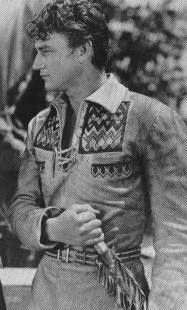
David Thomson, from his lengthy entry on Wayne in his The New Biographical Dictionary of Film: Expanded and Updated
As a child he moved West and, after a football scholarship at the University of Southern California, Tom Mix got him a job at Fox. There he met John Ford and worked as a set decorator on Mother Machree (28). Gradually he edged into acting, by the storybook means of being a bystander. His first big part was in The Big Trail (30, Raoul Walsh). Walsh had seen him carrying a big armchair above his head - carrying it witih flair and flourish.
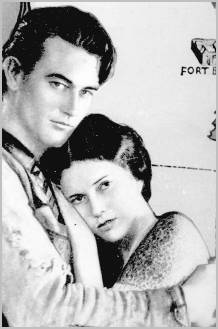
Stanley Crouch on The Searchers:
When Wayne, as Ethan, comes upon the black smoke and the orange flame of the burning house left by the Comanches, his face is one of absolute terror, panic, and rage. At the top of a hill, Wayne flings out his right arm to free his rifle from the long, colorful buckskin sleeve in which it has been sheathed. The force of that flung arm is one of the most explosive gestures in all of cinema, and also among the most impotent: No one down there is alive, and Ethan knows it. He is, at that moment, like the man in Bruegel's The Triumph of Death who so impressed Hemingway because his choice was to draw a sword when faced with the irreversible horror of encroaching doom.
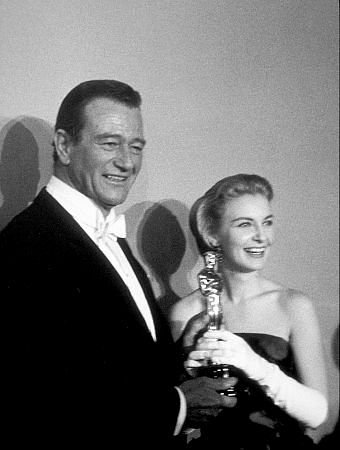
Natalie Wood on that moment in The Searchers when he picks her up - a moment that still, to me, this day, having seen it 20 or so times, takes my breath away.
John Wayne was a giant to me, and when he picked me up in that scene near the end of the picture, he was able to lift me as though I were a doll. It was pretty frightening because he had this look of hatred and I thought that he could easily crush me. But then there would be an almost indefinable gentleness that would come over him as he cradled me and said, 'Let's go home.' Everyone had always told me, 'John Wayne's no actor. He always plays the same part.' I can tell you, Mr. Wayne was a very fine actor. He said to me, 'When I pick you up, I may seem a little rough, but I'll be as gentle as I can be.' I said, 'You must pick me up without worrying about that or you might not give the performance you need to portray.' He smiled and said, 'Well, little lady, you're a real professional, that's for sure.'

David Thomson:
Throughout the 1930s Wayne was a star of matinee Westerns, sometimes a singing cowboy, working his way round most of the smaller studios and making something like a hundred films. By 1939 he was with Republic when John Ford asked him to be the Ringo Kid in Stagecoach. The success of that film lifted Wayne from regular work to stardom. Republic pulled themselves together for a major vehicle for him - Dark Command (40, Walsh) - and Ford called on him again to play a seaman in The Long Voyage Home (40).
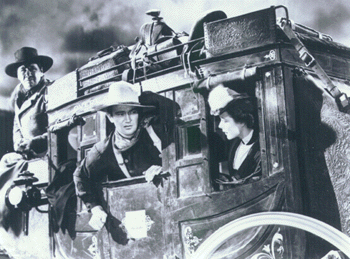
John Wayne started out as a prop guy. He was a college student, and he picked up extra cash doing props for movies and occasional extra work. This was how he met John Ford. He almost got fired from a couple of Ford's films for various snafus. It took Ford a while to start "using" Wayne. It wasn't immediately apparent that this gangly raw kid had movie-star potential.
From Who the Hell's In it, by Peter Bogdonavich:
There's a moment in Rio Bravo -- which features, I think, Wayne's most genuinely endearing performance -- when he walks down the street of the jail/sheriff's office toward some men riding up to meet him. Hawks frames the shot from behind -- Wayne striding slowly, casually away from camera in his slightly rocking, graceful way -- and the image lingers a while to let us enjoy this classic, familiar figure, unmistakable from any angle, Americ'as twentieth-century Hercules moving across a world of illusion he had more than conquered.
 Mark Rydell, director of "The Cowboys", and his star, John Wayne
Mark Rydell was about 30 years old when he directed (and produced) The Cowboys. It was 1972. John Wayne had been making pictures since the 20s. He had been a star for decades. Not just a star, but an icon. Rydell was a Jewish kid from the Bronx who had directed a couple of episodes of Gunsmoke and, I think, 2 feature films. What would the experience be like? Would John Wayne run all over him? How on earth would he direct John Wayne? There are a couple of great stories about the filming of this marvelous movie (and I also love Rydell's image of John Wayne sitting, on break, trying to eat his lunch, while all the kids who were in the movie climbed over him "as though he was a monkeybar ..." They loved and trusted him that much.)
Here's one of Mark Rydell's many moving memories of what it was like to direct John Wayne in The Cowboys. This is an anecdote about the filming of the beginning of the cattle drive - obviously a complicated shot, with horses and herds of cattle and camera equipment, and extras and cowboys and stunt doubles ... not to mention John Wayne.

Here's Mark Rydell on what happened on that day.
And we had 1500 head of cattle. And there's an interesting story of the first angry moment that I had with John Wayne. I was sitting up on the head of a crane. We had 9 cameras, and we were shooting this scene which had to do with starting the cattle drive. And in the background of this 1500 head of cattle, we had all the families of the kids, and all the kids are in position getting ready to start this cattle drive, and being said goodbye to by their parents. And John Wayne was seated on his horse about 50 feet in front of me and I was facing all these cattle on the top of the crane, and the scene begins with him riding over to Roscoe Lee Browne who was sitting on the top of this six-up that he had to drive, and the dialogue, if I remember correctly, is he says, "Are you ready, Mr. Nightlinger?" and he says, "Ready when you are", or something like that. And you know, you don't start 1500 head of cattle by saying, "Go". What happens is, you have to push the cattle in the rear and they move and they push the cattle in front and sometimes it takes 5 minutes for them to be going. So I didn't roll the cameras because I didn't want to waste film until the cattle were moving. There was an enormous amount of cattle. This was really a remarkable production achievement, with Wayne riding past hundreds and hundreds of heads of cattle, all which had to be handled. It was quite a complicated procedure that required a lot of attention. So Wayne decided it was time to go - so he rode up - I hadn't even started rolling the cameras yet - so he rode up to Roscoe and said, "Are you ready, Mr. Nightlinger?" Well, of course, I hadn't even rolled the cameras yet. So I lost my temper. I stood up on the crane and said, "Don't you ever do that. Go back to your spot. I'll tell you when we're going to roll our cameras, I'll tell you when 'Action' is!" and as I was talking to him, I was thinking: what a stupid thing for me to do, to yell at John Wayne, in front of all these kids and all these people, it was humiliating. And I was really sorry, but I had stuck my neck out - and I was right, by the way. And he knew I was right. He went back to his place, did the scene, got in his car - it was the end of the day - and drove into town. All of the crew came over to me one by one to shake my hand, as if to say goodbye, because they thought I would be fired for having contested John Wayne in any way whatsoever. And the Ravetch's were there, and they were horrified, and I got in the car with them to drive back to our production office in Santa Fe, and I was just mortified with guilt for having done this! And they kept saying, "Why did you do that?" And I kept saying, 'I just lost my temper!" And we got back to the production office and there were four calls from John Wayne. And I thought, this is it. I'm fired. I'll be on my way back to Los Angeles in a moment and one of John Wayne's former directors will be down here to take over the picture. So I finally got up my courage and I called him. And he said, "Mark, let's have dinner." And I thought, 'Okay, there's the kiss of death." So we met, and, by the way, there was nothing more remarkable than the experience of going to dinner in Santa Fe with John Wayne, who was 6'5" and an icon. He walked into the restaurant and the place gasped! We sat down for dinner and I am waiting for the axe to fall, for him to say, 'Son, you're a nice guy, but I think we're going to be better off with a better director." You know, I was waiting for that horrifying moment! Which never came, by the way. And he proceeded to tell me that I treated him the way John Ford treated him. I had yelled at him, and he was very impressed that I had the courage to tell him off. He knew that I was right, and he was wrong. Even though it was something I certainly never should have done, he was impressed that I had the courage to do it. And he called me "Sir" from that day forward, and for the rest of the 102 days we shot this picture. And that's the kind of guy he was.

Maureen O'Hara in her autobiography 'Tis Herself: A Memoir
There is only one fitting way to end our discussion of The Quiet Man, and that's with a whisper. No matter what part of the world I'm in, the question I am always asked is: "What did you whisper into John Wayne's ear at the end of The Quiet Man?" It was John Ford's idea: it was the ending he wanted. I was told by Mr. Ford exactly what I was to say. At first I refused. I said, "No. I can't. I can't say that to Duke." But Mr. Ford wanted a very shocked reaction from Duke, and he said, "I'm telling you, you are to say it." I had no choice, and so I agreed, but with a catch: "I'll say it on one condition - that it is never ever repeated or revealed to anyone." So we made a deal. After the scene was over, we told Duke about our agreement and three of us made a pact. There are those who claim that they were told and know what I said. They don't and are lying. John Ford took it to his grave - so did Duke - and the answer will die with me. Curiosity about the whisper has become a great part of the Quiet Man legend. I have no doubt that as long as the film endures, so will the speculation. The Quiet Man meant so much to John Ford, John Wayne, and myself. I know it was their favorite picture too. It bonded us as artists and friends in a way that happens but once in a career. That little piece of The Quiet Man belongs to just us, and so I hope you'll understand as I answer:I'll never tell.

One of my favorite reaction shots from him is Wayne's body language when O'Hara whispers whatever it is she whispers to him. You can feel him go from 0 to 1000 in one second, and it is all he can do to wait until they get back to their house and into their bed. It's subtle evocative and totally clear physical acting. Last moment of the movie, I'm sure fans will remember it.
David Thomson:
Even at that stage [the late 30s, early 40s], Wayne had this virtue denied to Ford's "stock company": he did not ham. Universal put him opposite Dietrich in Seven Sinners (40, Tay Garnett) and Republic lowered its sights to more Westerns. For the next few years he made fodder at his home studio and more adventurous work outside, much of which only exposed his monotonous fierceness: Reap the Wild Wind (42, Cecil B. De Mille); The Spoilers (42, Ray Enright); Flying Tigers (42, David Miller); with Joan Crawford in Jules Dassin's crazy Reunion in France (42); and The Fighting Seabees (44, Edward Ludwig). In 1945, he was in Back to Bataan (Edward Dmytryk), Flame of the Barbary Coast (Joseph Kane), and was overshadowed by Robert Montgomery in They Were Expendable (Ford). He was bizarrely paired with Claudette Colbert in a comedy, Without Reservations (46, Mervyn Le Roy), but Rebublic still pushed straight Westerns at him.
More from the transcript of the interview John Wayne gave with Peter Bogdonavich - I wish all action stars looked at their jobs in this way. We'd get some better movies.
Any time there was a chance for a reaction -- which is the most important thing in a motion picture -- he [John Ford] always took reactions of me, so I'd be a part of every scene. Because I had a great deal of time in the picture when other people were talking, and all my stuff was just reactions. They become very important throughout a picture, they build your part. They always say I'm in action movies, but it's in reaction pictures that they remember me -- pictures that are full of reactions, but have a background of action.
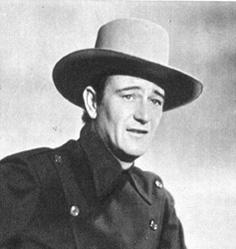
Katharine Hepburn on John Wayne in her autobiography Me : Stories of My Life
From head to toe he is all of a piece. Big head. Wide blue eyes. Sandy hair. Rugged skin - lined by living and fun and character. Not by just rotting away. A nose not too big, not too small. Good teeth. A face alive with humor. Good humor I should say, and a sharp wit. Dangerous when roused. His shoulders are broad - very. His chest massive - very. When I leaned against him (which I did as often as possible, I must confess - I am reduced to such innocent pleasures), thrilling. It was like leaning against a great tree. His hands are big. Mine, which are big too, seemed to disappear. Good legs. No seat. A real man's body.And the base of this incredible creation. A pair of small sensitive feet. Carrying his huge frame as though it were a feather. Light of tread. Springy. Dancing. Pretty feet.
Very observing. Very aware. Listens. Concentrates. Witty slant. Ready to laugh. To be laughed at. To answer. To stick his neck out. Funny. Outrageous. Spoiled. Self-indulgent. Tough. Full of charm. Knows it. Uses it. Disregards it. With an alarming accuracy. Not much gets past him.
He was always on time. Always knew the scene. Always full of notions about what should be done. Tough on a director who had not done his homework. Considerate to his fellow actors. Very impatient with anyone who was inefficient. And did not bother to cover it up.

David Thomson:
Then came two films that radically enlarged his image: Fort Apache (48, Ford), in which he played a cavalry captain, and Red River (48, Howard Hawks). Not least of his achievements as a guide to players is the way Hawks was the first to see the slit-eyed obdurate side to Wayne's character. Tom Dunson is a fine character study: a man made hard by an early mistake and by the emphasis on achievement with which he tried to conceal that mistake. With Ford again, Wayne was one of Three Godfathers (48), a truly awful movie. But in 1949, he was Captain Nathan Brittles at the point of retirement in She Wore a Yellow Ribbon (Ford), and in 1950 the trilogy was completed withthe leisurely Rio Grande (Ford). Asked to be older, a husband and a father, Wayne became human and touching.
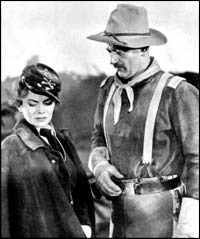
More from Katharine Hepburn:
Life has dealt Wayne some severe blows. He can take them. He has shown it. He doesn't lack self-discipline. He dares to walk by himself. Run. Dance. Skip. Walk. Crawl through life. He has done it all. Don't pity me, please.And with all this he has a most gentle and respectful gratitude toward people who he feels have contributed very firmly to his success. His admirers. He is meticulous in answering fan mail. Realistic in allowing the press to come to the set. Uncomplicated in his reaction to praise and admiration. Delighted to be the recipient of this or that award - reward. A simple man. None of that complicated Self-Self-Self which seems to torment myself and others who shall be nameless when they are confronted with the Prize for good performance. I often wonder whether we behave so ungraciously because we really think that we should have been given a prize for every performance. And are therefore sort of sore to begin with. Well, as I began - he is a simple and decent man. Considerate to the people who rush him in a sort of wild enthusiasm. Simple in his enjoyment of his own success. Like Bogie. He really appreciates the praise heaped upon him. A wonderful childlike, naive open spirit.

From Who The Hell's In It, by Peter Bogdonavich:
In a lifetime of almost thirty years as a top-ten box-office attraction (plus twenty before that as a not unpopular star actor), Wayne's accumulated persona had even before his death attained such mythic proportions that by then the most myopic of viewers and reviewers had finally noted it. He brought to each new movie (good or bad) a powerful resonance from the past -- his own and ours -- which filled the world with reverberations above and beyond its own perhaps undistinguished qualities. That was the true measure of a great movie star of the golden age.
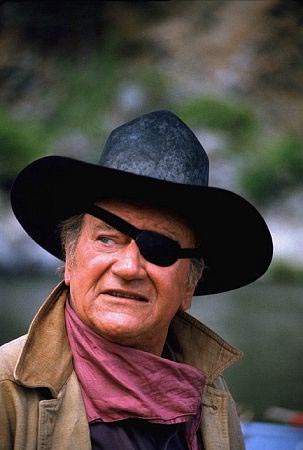
David Thomson:
Next, however, came The Searchers (56, Ford), one of his finest films - once more a study of an unapproachable stubborn man, finally excluded from the family reunion as a romantic but lonely figure facing the landscape. He coasted with The Wings of Eagles (57, Ford), Legend of the Lost (57, Hathaway), and The Barbarian and the Geisha (58, John Huston), before making Rio Bravo (59, Hawks). Once more, Hawks enlarged Wayne by concentrating on an alcoholic Dean Martin and having Wayne watch him "like a friend". It worked - as did the application of Angie Dickinson's talkative emotional crises to Wayne's solidity - so that Rio Bravo is not just Wayne's most humane picture but the one that makes him most comic.
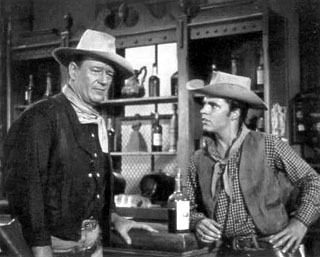
David Thomson:
His death moved nearly everyone, as had his brave walk down the Academy staircase, two months before death, to give the best picture Oscar to ... The Deer Hunter (that'll be the day, indeed.)He made too many pictures, of course; but only because for so long he was a guarantee of profit.

Wayne and Bogdanovich again:
One of the most memorable moments of any picture I've seen you in is a silent moment in The Searchers. After you see what's been done to the white women, there's a close-up of you, camera moves in --I turn back. Terrific shot. Helluva shot. And everybody can put their own thoughts to it. You're not forced to think one way or the other.
Your gestures in pictures are often daring -- large -- and show the kind of freedom and lack of inhibition you have. Did you get that from Ford, or did you always have that?
No, I think that's the first lesson you learn in a high school play -- that if you're going to make a gesture, make it.
To be honest: that has to be some of the best acting advice I've ever heard.
"If you're going to make a gesture, make it."
So much of bad phony acting is when people make gestures half-heartedly, or they PRETEND to make gestures .... hoping the audience won't pick up on the fact that they're not REALLY making the gesture ...
but audiences always know the difference between phony and real. They just do.

David Thomson:
But what a star, what a presence, and what a wealth of reserve he brought to that bold presence. (So you wonder if he couldn't have played comedy.)Nor has he dated. All one can say is that he filled the screen role of a necessarily difficult man as naturally as most actors wore clothes. There was an age when people could be stars without undue grandeur or self-mockery. Whether Wayne is looking at the land that may make a great ranch, or turning in a doorway to survey his true home, the desert, every gesture was authentic and a prized disclosure. He moved the way singers sing, with huge confidence and daring. You have to imagine how it all began in the way Raoul Walsh saw him carrying that armchair - as if it was a young girl in a red robe being lifted up in mercy and wonder.
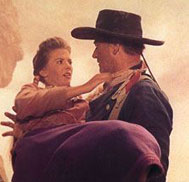
John Wayne told Peter Bogdanovich:
A funny thing happened with Ford after The Big Trail. He was a strange character, you know. After I did that picture, I came back, and he was making Up the River. I went over and said, "Hi, coach." Nothing. I thought he didn't hear me. So I figured, Oh, well, he didn't even see me. The next time I saw him I went, "Hi, coach, hi." And again I didn't get anything. So the next time I just went right up in front of him and went, "Hi, coach." And he turned and talked to somebody else. I thought, That's that -- he won't speak to me. I don't know how the hell I can communicate.About two years later, I was in Catalina with Ward, having a belt, and Barbara [Ford], his daughter -- she was a little girl then -- she ran in and said, 'Daddy wants to see you." I said, "Whoa, wait a minute, Barbara, you got the wrong boy -- must be Ward." She said, "No, it's you, Duke." So I said, "Yeah, honey, run along, you know this is a bar." So his wife, Mary Ford, came to the door and she said, "Duke, come here. Jack is expecting you out there." I said, "All right." So I went out to the Araner, his boat, and I go aboard -- I remember Jim Tully was there and four or five guys -- and Jack was in the middle of a goddamn story, and he looked up at me and said, "Hi, Duke, sit down." And to this goddamn day I don't know why he didn't speak to me for two years.

Excerpt from Michael Caine's awesome book Acting in Film: An Actor's Take on Movie Making
I noticed that American actors always try to cut down their dialogue. They say, "I'm not going to say all this. You say that line." At first I couldn't figure out why; I came from theatre, where you covetously count your lines. But it's a smart approach for an actor to give up lines in the movies because while you wind up talking about them, they wind up listening and reacting. It's no accident that Rambo hardly speaks. Sylvester Stallone is not a fool.I remember when I first went to America, right after I made Alfie. I met John Wayne in the lobby of the Beverly Hills Hotel. He'd just got out of a helicopter, he was dressed as Hondo and he came over and introduced himself to me.
I said: "I do know who you are, Mr. Wayne."
He said, "You just come over?"
"Yeah."
He said, "Let me give you a piece of advice: talk low, talk slow, and don't say much."

Katharine Hepburn again:
As an actor, he has an extraordinary gift. A unique naturalness. Developed by movie actors who just happen to become actors. Gary Cooper had it. An unselfconsciousness. An ability to think and feel. Seeming to woo the camera. A very subtle capacity to think and express and caress the camera - the audience. With no apparent effort. A secret between them ... Wayne has a wonderful gift of natural speed. Of arrested motion. Of going suddenly off on a new tack. Try something totally unrehearsed with him. He takes the ball and runs and throws with a freedom and wit and gaiety which is great fun. As powerful as is his personality, so too is his acting capacity powerful. He is a very very good actor in the most highbrow sense of the word. You don't catch him at it.

From Who The Hell's In it, by Peter Bogdonavich:
To me, Duke had always seemed slightly out of breath, as though he hadn't yet caught up on the last twenty years, not to mention the last twenty minutes. Both [John] Ford and [Howard] Hawks truly loved him, of course, and even knowing him a little, as I did, it was pretty difficult not to like him. All this, and a lot more, obviously communicated itself to the public -- still the top American star more than seventy years since his beginning. His visual legacy has defined him as the archetypal man of the American West -- bold, innocent, profane, idealistic, wrongheaded, good-hearted, single-minded, quick to action, not given to pretension, essentially alone, ready for any adventure -- no matter how grand or daring; larger, finally, than life or death.
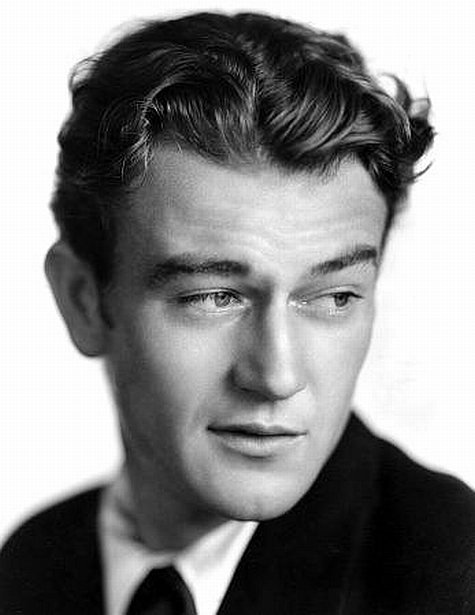
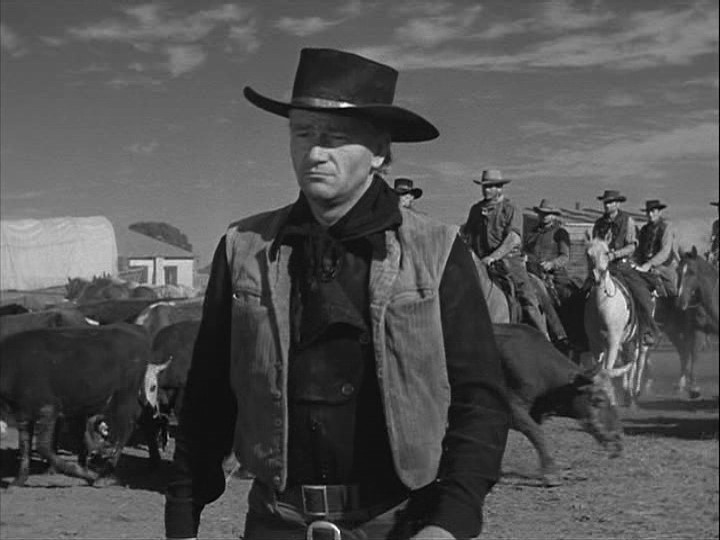
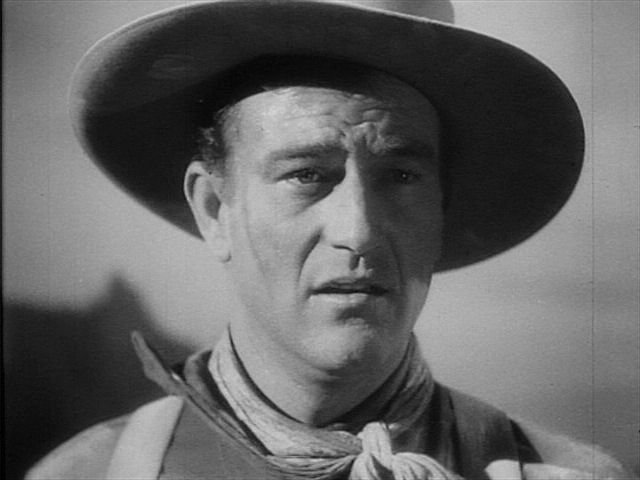
Such a handsome man.
I love how, in that first famous entrance in Stagecoach, Ford moves in quickly to his face, and there's a slight moment where Wayne is out of focus. I love how Ford kept that. It gives it an immediacy, a sense of reality ... that moment of blurriness.
A powerful actor, one I never get tired of studying: his walk, his line readings, his eyes, his reactions ... He's subtle, he's physical, he's funny, he's smart in his choices. And then, of course, there's the magic.
Movie magic.
You know it when you see it.
Wayne had it in spades.
May 22, 2010
It's so funny when William Powell lies

In Libeled Lady, William Powell plays Bill Chandler, a guy hired (or, actually, RE-hired) by newspaper editor Warren Haggerty (played by Spencer Tracy) to basically set up heiress Connie Allenbury (played by Myrna Loy) for a big fall, so that they can derail her libel suit against the newspaper. It is Chandler's job, during a cross-Atlantic cruise, to ingratiate himself with the Allenbury's, make Connie trust him, and hopefully fall in love with him so that he can then ... but the plot is far too Byzantine and ridiculous to describe, and if you haven't seen it, you really must, and Jean Harlow is involved, and she's awesome, and what are you waiting for, but the point is:
Chandler (Powell) knows that in order to get to Connie he has to butter up her father first (played by the reliably awesome Walter Connolly). So he does a bit of research and finds out that Mr. Allenbury is a passionate trout-angler. Angling is his main love in life. Chandler crash-studies angling in his stateroom on the ship, and then pulls out all of the trivia and lingo when he meets Allenbury, and keeps trying to draw the conversation to fish. Powell blurts out, randomly, a propos of nothing: "MY favorite sport is fishing."
Uhm, nobody asked you, bub. The confused glances given to him by Loy and Connolly make the situation even funnier.
It is so much fun to watch William Powell lie. And make things up. I could watch it all day. It borders on the absurd (borders?), and as he gets deeper into his lies (his character knows NOTHING about fishing), the more he continues to insist that he knows what he is talking about.
Naturally, this gets him into all sorts of trouble, the kind of "actor's nightmare" well-known to creative people everywhere: the nightmare of suddenly being onstage, in the middle of a production, and you are the lead, and you have never had a rehearsal, do not know the lines, the blocking, you know NOTHING.
In Libeled Lady, this is what happens to William Powell.
Because once you tell an ardent fisherman, "I live to angle. As a matter of fact, I have fished for trout at Lake Taupo" (and you say this because you KNOW it will impress, even though you are not sure why, but the book you read seemed to think it was important, and you know that that will mean your angling listener will take you seriously) - you can't go back. You can't then soft-pedal it and say, "Oops, my bad, I don't really love fishing", or ... "You must have misunderstood me. I actually have never held a fishing pole in my life."
And that is where William Powell is so funny: when he is in a situation where there is finally no return (I just watched Love Crazy - my review here - and that movie is all about the point-of-no-return, poor guy). Powell is so funny when the screws are tightening and when he, a dignified gentleman, or someone who wants to be thought of that way, is put in the position of looking like a fool.
For example, the clip below. Mr. Allenbury, thrilled to finally meet someone who is as passionate a fisherman as he is, invites Mr. Chandler to come on a fishing outing. The book Powell is reading? "Trout Fishing For Beginners."
May 20, 2010
"Where's his damn box set?" - Kim Morgan on John Garfield

A recap of the Arthur Lyons Film Noir festival in Palm Springs by Kim Morgan, with a special focus on John Garfield. He's long been a favorite of mine. Due to my obsession with all things Actors Studio starting from when I was 13 years old, he came on my radar long before he might have otherwise, because of his association with the Group Theatre in the 30s, started by Lee Strasberg, Cheryl Crawford and Harold Clurman, and his sort of shadow-box-dance with Marlon Brando for roles in Streetcar and On the Waterfront (which was actually written for Garfield). He was known as Julie Garfinkel back then. The internalized anti-Semitism of the day brought about the name change, but to his good friends - and he had many (despite the horrible way he ended) he was always known as "Julie" or "Jules-y".
John Garfield's daughter Julie was at the Film Noir fest, and Kim Morgan got to interview her about her father:
The picture I presented was one of his greatest films, and his last movie before he passed away -- He Ran All the Way (1951). A movie made by many victims of the blacklist, including director John Berry and co-writers Hugo Butler and Dalton Trumbo (who was jailed as one of the "Hollywood Ten"), the story of a criminal on the lam, a desperate man, a man in a panic who takes a family hostage only to be tortured by his conscious and the cold hands of fate, held extra resonance. There was the power of the film itself, the history and real life tragedy of its star, and then Julie sitting next to me. She had never seen her father's final film on the big screen, and experiencing her taking in daddy so beautifully shot by James Wong Howe, and his tough, vulnerable, wounded, complicated performance was especially moving.
I did not know that John Garfield, at one point in his life, sold diaphragms door to door. Can you imagine? That guy in the picture above selling birth control at your door?
A giant star in his day, who died way too young, his death hurried upon him by the stress and harassment he was receiving from the HUAC, his funeral in 1952 was a mob scene of fans. But now? What has happened?
Go read Kim's piece. It's an emotional tribute to an actor rather forgotten nowadays.
I wrote about John Garfield's screen debut in Michael Curtiz's Four Daughters (1938) here.
A great American movie star.
May 18, 2010
"Jesus Christ! That's Henry Fonda!"
A great post from one of my new favorite blogs (I spent a good two hours the other day scrolling through the damn thing - it's RICH) about Henry Fonda, typecasting, and Sergio Leone's casting of Fonda as the heavy in Once Upon a Time in the West. There are two clips included: one of Fonda's entrance in that film (a great entrance, with a flashy "look at me, Ma" camera move) and the second a clip of Fonda talking about that entrance on a 1975 talk show. I suggest watching the second clip first, of Fonda describing the entrance, and then go back to watch the entrance itself. Notice Fonda's technical memory of each shot, each POV in that opening sequence. That's a pro.
And of course. Leone was right. You'll see what I mean after you watch the clip of Fonda on the talk show.
Great stuff.
Go read the whole thing. And scroll through that incredible site. He's got a great eye.
"He's the man standing up there beside Errol Flynn." - Amanda McBroom

Amanda McBroom
I said recently on Twitter (I know, so ridiculous, like that has any validity whatsoever - however, apparently it's all going into the Library of Congress, so at least my name will live on forever in some capacity) that the best byproduct so far of Ridley Scott's self-serious and "historically accurate" Robin Hood is that Errol Flynn is all over the place right now, and I'm in heaven about it. He's always had the props, obviously, but it's nice to see him get the props once again, in almost every single review, from folks who miss the jaunty careless air he brought to a role that is, honestly, just an excuse for some swashbuckling and some fun. Shouldn't it all be a bit more fun? (Thanks, Mr. Ebert. I agree.)
I grew up on Errol Flynn movies, and when the Dean Stockwell obsession took over my life in 2007, I loved going back to re-watch Kim, a movie I had seen on a fuzzy black-and-white television in our family den when I was about 10 years old. Stockwell tells stories of how Flynn treated him and what that experience was like, and it's pretty cool.
All of this is to say:
Cabaret singer Amanda McBroom is the daughter of David Bruce, an actor who worked with Errol Flynn multiple times, a man with a long career (there's a wonderful tribute to him here). McBroom is also a songwriter (she wrote, you know, that little-known song called "The Rose", made famous by another performer), and she wrote a song about her father called "Errol Flynn" that came up on my iPod shuffle today and, as always, I had to skip right over it, because it's far too emotional for me to listen to when I'm out and about doing errands. I cannot listen to it with any distance. It dissolves me. Repeatedly.
I won't even speak any further about it. Some things are beyond words, and it's better to just point to the source, and say: "There. Look at that." It is a song that has even more poignancy to me now than it did when I first heard it.
It's a tribute to her father, yes, but it's also a tribute to artists. To the loneliness of the pursuit, and to the inherent dignity in a job well done, even in B-movies, even with your name far far below the star's name. David Bruce was just such an actor.
Below the jump is a clip of Amanda McBroom performing "Errol Flynn". It's controlled, elegant, with abysses of emotion below the surface. And listen to those lyrics.
May 3, 2010
Psychopaths and morality: Jeremy Renner and Sissy Spacek
Fascinating article called Psychopaths and Rational Morality: The Frontal Cortex, with an even better conversation going on in the comments. Go read the whole thing, it's very interesting.


It is one of my obsessions: psychopaths, antisocial personalities, whatever name you want to call them, and has been obsessing me for years. I suppose it dovetails with my obsession with cults, brainwashing, and any kind of pressurized groupthink. The function of the brain, perhaps, and what it means when something appears to be "missing" or "altered".
I've been working on something (in my head so far) about Jeremy Renner, based not just on his performance in The Hurt Locker, but also in Dahmer (my review here), Neo Ned (my review here), and North Country - a terrible movie, but he's wonderful in it.
The character Renner plays in 28 Weeks Later has some similarities to these, although it takes on a heroic feel here - but the underlying emotional apparatus is very similar to the rest of his roles. It has to do with his facility at playing what I would call "antisocial" men. But his take on it is quite subtle, quite intuitive, and I would be interested to hear him speak of it more - but perhaps it's something you don't really want to talk about. If it ain't broke, don't try to fix it. The Hurt Locker is the culminating moment of his examination (in some pretty poor films) of these types of men, and it's interesting because in that film it shows that there is a place in the world for such individuals, where their talents - and their lack of empathy - are actually essential to their jobs. Most psychopaths are in prison, but there are "successful" psychopaths (I knew one once, and I am pretty sure I recently met another one - dodged a bullet there!) - people who are able to operate without turning into criminals. The character of Sgt. James in Hurt Locker is the classic example of a man who cannot "fit in" to the normal world, and he seems, frankly, baffled by his personal relationships, when he thinks about them at all. His wife, his son ... He does not lack feeling, far from it, it's just that his feelings don't get in the way of him being who he needs to be. It's not that he WON'T negotiate, it is that he is unable to. The now-famous moment in the grocery store at the end of the film is a perfect representation of that.

But I will save all of that for the post I want to write about Renner, and the characters he plays - because I feel he occupies a very individual position, not just now, but for all time. I am hard pressed to come up with a comparison - although I have found one. Again, I'll save that for the post proper, whenever I write it.
That article I linked to above, an examination of morality, emotion, logic, and psychopaths, is exactly the type of thing I have been thinking about, when I have been thinking about Jeremy Renner. However: even without neuroscientists adding to our knowledge of brain function, these individuals are known and recognized, and have been since the beginning of time.
I recently read Without Conscience: The Disturbing World of the Psychopaths Among Us
It's a really good book, with many fascinating case studies (of "successful" psychopaths - meaning those who have never broken the law, a rare breed - because they fly under the radar, and yet they still destroy lives - and then the more garden-variety "unsuccessful" versions, filling up the prison population) - and Hare resists "diagnosing" people that he doesn't know. People come to him all the time with "is so and so a psychopath", and he can't say, without having studied the individual himself. Hannibal Lecter comes up a lot, as the modern-day version of what people think a "psychopath" is. He cautions against that limited interpretation, because you may miss what is going on right in front of you, because the person doesn't SEEM like a "psycho". One of the defining characteristics of a psychopath is "charm". It may be glib or superficial, but it can certainly work upon you, if you do not pick up on the other signals. Many of them are highly skilled in diffusing suspicion. Their emotions are shallow, they do not understand things such as love or empathy. Hare quotes psychologists J.H. Johns and H.C. Quay, who wrote famously that psychopaths "know the words but not the music".
Truman Capote in In Cold Blood
Many people who routinely work with people who score high on Hare's psychopath checklist report feeling a strange skin-crawling sensation when in the presence of these people. I have no statistics to back this up, but I would warrant a guess that that skin-crawling feeling (reported by multiple people, remember) has some evolutionary purpose. Something deep and survival-based. The feeling Rikki-Tikki-Tavi got when he made eye contact with the cobra, perhaps. Get away from this creature. Either kill it, or RUN.
Gavin de Becker talks about the "gift of fear". Fear like that tells us when something is wrong. Listen. It is a gift from millions of years of evolution. Take that, Kirk Cameron.
One of the best fictional portraits of a psychopath in the history of literature is Steinbeck's Cathy (even just the name gives me the creeps) in East of Eden. I was surprised that Hare did not reference it in his book, since he does use multiple examples from literature and film. Steinbeck, in his Biblical allegory, is certainly making a connection between psychopaths and the Devil. Cathy has the Devil in her. She is cool, calculated, gorgeous (the perfect smokescreen), and a liar. She lies indiscriminately (one of the defining characteristics of a psychopath). They lie so often that those listening to them, operating from their own assumptions of sanity, and how normal people behave, sometimes get caught up in it. We are not used to dealing with such creatures (thank God). They have a tendency to fool everyone: parole officers, prison officials, social workers ... They are masters of deception. And yet, often, people cannot put their finger on what is "off", what is wrong. Steinbeck in East of Eden writes:
Cathy was chewing a piece of meat, chewing with her front teeth. Samuel had never seen anyone chew that way before. And when she swallowed, her little tongue flicked around her lips. Samuel's mind repeated, "Something - something - can't find what it is. Something's wrong," and the silence hung on the table.
This is a textbook response to people like this, according to Hare: Something's "off". But what? What exactly is "wrong"? You can't point right at it, but you know it's there. A skin-crawling sensation the only indication that perhaps you are in the presence of something quite different from your garden-variety human being.
Steinbeck doesn't mince words. Here is how he introduces Cathy:
I believe there are monsters born in the world to human parents. Some you can see, misshapen and horrible, with huge heads or tiny bodies; some are born with no arms, no legs, some with three arms, some with tails or mouths in odd places. They are accidents and no one's fault, as used to be thought. Once they were considered the visible punishment for concealed sins.And just as there are physical monsters, can there not be mental or psychic monsters born? The face and body may be perfect, but if a twisted gene or a malformed egg can produce physical monsters, may not the same process produce a malformed soul?
Monsters are variations from the accepted normal to a greater or a less degree. As a child may be born without an arm, so one may be born without kindness or the potential of conscience. A man who loses his arms in an accident has a great struggle to adjust himself to the lack, but one born without arms suffers only from people who find him strange. Having never had arms, he cannot miss them. Sometimes when we are little we imagine how it would be to have wings, but there is no reason to suppose it is the same feeling birds have. No, to a monster the norm must seem monstrous, since everyone is normal to himself. To the inner monster it must be even more obscure, since he has no visible thing to compare with others. To a man born without conscience, a soul-stricken man must seem ridiculous. To a criminal, honesty is foolish. You must not forget that a monster is only a variation, and that to a monster the norm is monstrous.
It is my belief that Cathy Ames was born with the tendencies, or lack of them, which drove and forced her all of her life. Some balance wheel was misweighed, some gear out of ratio. She was not like other people, never was from birth. And just as a cripple may learn to utilize his lack so that he becomes more effective in a limited field than the uncrippled, so did Cathy, using her difference, make a painful and bewildering stir in her world.
There was a time when a girl like Cathy would have been called possessed by the devil. She would have been exorcised to cast out the evil spirit, and if after many trials that did not work, she would have been burned as a witch for the good of the community. The one thing that may not be forgiven a witch is her ability to distress people, to make them restless and uneasy and even envious.
As though nature concealed a trap, Cathy had from the first a face of innocence. Her hair was gold and lovely; wide-set hazel eyes with upper lids that drooped made her look mysteriously sleepy. Her nose was delicate and thin, and her cheekbones high and wide, sweeping down to a small chin so that her face was heart-shaped. Her mouth was well shaped and well lipped but abnormally small -- what used to be called a rosebud. Her ears were very little, without lobes, and they pressed so close to her head that even with her hair combed up they made no silhouette. They were thin flaps sealed against her head.
Cathy always had a child's figure even after she was grown, slender, delicate arms and hands -- tiny hands. Her breasts never developed much. Before her puberty the nipples turned inward. Her mother had to manipulate them out when they became painful in Cathy's tenth year. Her body was a boy's body, narrow-hipped, straight-legged, but her ankles were thin and straight without being slender. Her feet were small and round and stubby, with fat insteps almost like little hoofs. She was a pretty child and she became a pretty woman. Her voice was huskily soft, and it could be so sweet as to be irresistible. But there must have been some steel cord in her throat, for Cathy's voice could cut like a file when she wished.
Even as a child she had some quality that made people look at her, then look away, then look back at her, troubled at something foreign. Something looked out of her eyes, and was never there when one looked again. She moved quietly and talked little, but she could enter no room without causing everyone to turn toward her.
She made people uneasy but not so that they wanted to go away from her. Men and women wanted to inspect her, to be close to her, to try and find what caused the disturbance she distributed so subtly. And since this had always been so, Cathy did not find it strange.
Cathy was different from other children in many ways, but one thing in particular set her apart. Most children abhor difference. They want to look, talk, dress, and act exactly like all of the others. If the style of dress is an absurdity, it is pain and sorrow to a child not to wear that absurdity. If necklaces of pork chops were accepted, it would be a sad child who could not wear pork chops. And this slavishness to the group normally extends into every game, every practice, social or otherwise. It is a protective coloration children utilize for their safety.
Cathy had none of this. She never conformed in dress or conduct. She wore whatever she wanted to. The result was that quite often other children imitated her.
As she grew older the group, the herd, which is any collection of children, began to sense what adults felt, that there was something foreign about Cathy. After a while only one person at a time associated with her. Groups of boys and girls avoided her as though she carried a nameless danger.
Cathy was a liar, but she did not lie the way most children do. Hers was no daydream lying, when the thing imagined is told and, to make it seem more real, told as real. That is just ordinary deviation from external reality. I think the difference between a lie and a story is that a story utilizes the trappings and appearance of truth for the interest of the listener as well as of the teller. A story has in it neither gain nor loss. But a lie is a device for profit or escape. I suppose if that definition is strictly held to, then a writer of stories is a liar -- if he is financially fortunate.
Cathy's lies were never innocent. Their purpose was to escape punishment, or work, or responsibility, and they were used for profit. Most liars are tripped up either because they forget what they have told or because the lie is suddenly faced with an incontrovertible truth. But Cathy did not forget her lies, and she developed the most effective method of lying. She stayed close enough to the truth so that one could never be sure. She knew two other methods also -- either to interlard her lies with truth or to tell a truth as though it were a lie. If one is accused of a lie and it turns out to be the truth, there is a backlog that will last a long time and protect a number of untruths.
Since Cathy was an only child her mother had no close contrast in the family. She thought all children were like her own. And since all parents are worriers she was convinced that all her friends had the same problems.
Cathy's father was not so sure. He operated a small tannery in a town in Massachusetts, which made a comfortable, careful living if he worked very hard. Mr. Ames came in contact with other children away from his home and he felt that Cathy was not like other children. It was a matter more felt than known. He was uneasy about his daughter but he could not have said why.
Nearly everyone in the world has appetites and impulses, trigger emotions, islands of selfishness, lusts just beneath the surface. And most people either hold such things in check or indulge them secretly. Cathy knew not only these impulses in others but how to use them for her own gain.
It is quite possible that she did not believe in any other tendencies in humans, for while she was preternaturally alert in some directions she was completely blind in others.
Now we come to something else, that I have written about before, but which is appropriate enough here to reference again:

Roger Ebert writes in his review of Terrence Malick's great film Badlands:
She claimed she was kidnapped and forced to go along with Starkweather. When they first were captured, he asked the deputies to leave her alone: "She didn't do nothing." Later, at his trial, he claimed she was the most trigger-happy person he ever knew, and was responsible for some of the killings. It is a case that is still not closed, although "Badlands" sees her as a child of vast simplicity who went along at first because she was flattered that he liked her: "I wasn't popular at school on account of having no personality and not being pretty."
Badlands is narrated by Holly, but we don't get much information from her voiceover. Her voice is flat. Tired-out. There is no introspection in her. She appears to be passively reacting to events. The accepted "narrative" of these two spree-killers is that Kit (played by Martin Sheen) was the loose cannon, and she was just along for the ride because she loved him. She had more sympathy, maybe because she was a woman, and maybe because it seemed she was victimized, she got roped into something she wanted no part of. This is how that pairing is often portrayed. Are they in the grand tradition of criminal pairings (like I talked about here)? Or are they something totally different? Kit is painted as the truly bad guy (albeit damaged and blunted by life), but what about her? What is it like to be her? How does she react to things? What is HER damage?
Sissy Spacek (and Malick) work subversively here, leaving most of the script uneloquent on her reasoning, which makes her a pretty frightening character. I WANT to see her as "kidnapped", almost, but that's not the case. She participates, even in her ultimate passivity. Doing nothing is also participation, when you are on a killing spree. But her motives remain mysterious. You don't see evidence of a grand passion (the way you do in Arthur Penn's Bonnie and Clyde, or even Oliver Stone's Natural Born Killers - where it is obviously the alchemy of the two personalities that jumpstarts them) - you don't see her operating under any kind of NORMAL or recognizable motivation: love, yearning for a home, a partner - even flat-out boredom - none of those things seem to occur to this freckled flat-eyed teenager. In a way, it is Sissy Spacek's most creepy performance.
In the middle of Without Conscience, which is basically a self-help book (How to Know If You are Dealing with a Psychopath, and How to Get the Hell Away From Them), Hare analyses the character of Holly in Badlands, from his perspective as a psychologist who has worked mainly in prisons. As he mentioned, he is not in the business of long-distance psychoanalyzing, but here, he shares a theory he has about the murderous duo portrayed in Badlands, and I found it startling and unusual. Something that isn't really in the preferred "narrative" of that particular film, which, as I mentioned, usually sees Kit as the leader, and Holly as the passive follower. Normally, I don't like film analysis such as this - which is trying to prove a specific point (that has nothing to do with the art of film-making). For example, a cultural conservative saying, "Such and such is a good movie because it presents core values that I agree with, and here's why ..." It's shallow and uninteresting, and more like an undergraduate thesis paper than actual film analysis. It is interested in things other than movies. But here, at least in Hare's thoughts on Badlands, I make an exception, because he takes the film at its word, first of all - and appears to be judging it as a work of art, not a case study. He sees its effectiveness, and also perceives an opportunity to illuminate the character of the elusive "psychopath", by talking about the film. He does it in such a manner that it really got my attention.
It's a way of looking at the characters of Kit and Holly (but especially Holly) that I have not seen spoken of before, in reviews of Badlands.
Check it out:
Terrence Malick's movie Badlands, loosely based on the killing career of Charles Starkweather and his girlfriend, Caril Ann Fugate, is a chilling film fantasy with a coldly realistic core. The fantasy resides in the character of Kit Carruthers, whose irresistible charm and slick patter is absolutely consistent with the psychopathic profile but whose attachment to his girlfriend Holly runs too deep and strong to ring true. One might be tempted to dismiss this movie as the typical Hollywood romance of the psychopath with a heart of gold, but look again. Behind Kit sits Holly, strictly along for the ride. It takes a second viewing for the real case history to pop into the foreground: If Kit is the moviemaker's conception of a psychopath, Holly is the real thing, a true "other" brilliantly portrayed by Sissy Spacek as a talking mask.Two aspects of Holly's character exemplify and dramatize important aspects of the psychopathic personality. One is her emotional impoverishment and the clear sense she conveys of simply going through the motions of feeling deeply. One clue is the sometimes outrageous inappropriateness of her behavior. After Kit guns down her father before her eyes for objecting to his presence in Holly'w life, the fifteen-year-old youngster slaps Kit's face. Later she flops into a chair and complains of a headache; later still she flees with Kit on a cross-country killing spree after he sets fire to her house to conceal her father's body.
In another example, with several more murders to his name now, Kit lazily separates a terrified couple from their car at gunpoint and directs them out into an empty field. Casually, Holly falls into step with the frightened woman. "Hi," she says, in her flat, childish voice. "What will happen?" asks the woman, desperate for some understanding of what's going on. "Oh," answers Holly, "Kit says he feels like he just might explode. I feel like that myself sometimes. Don't you?" The scene ends with Kit locking the two in a root cellar in the middle of the field. Just about to walk away, he suddenly shoots into the cellar door. "Think I got 'em?" he asks, as if swatting at flies in the dark.
Perhaps the film's most subtle evidence of psychopathy comes through in Holly's narration of the film, delivered in a monotone and embellished with phrases drawn straight from the glossies telling young girls what they should feel. Holly speaks of the love she and Kit share, but the actress manages somehow to convey the notion that Holly has no experiential knowledge of the feelings she reports. If there was ever an example of "knowing the words but not the music," Spacek's character is it, giving viewers a firsthand experience of the odd sensation, the unnamable distrust and skin-crawling feeling, that many - lay people and professionals alike - report after their interactions with psychopaths.
There is a great great compliment to Spacek there, in the simple phrase: "the actress manages somehow to convey ..."
It is the "somehow" that contains the compliment. The great mystery of great acting. "Somehow". Who knows HOW she does it. It doesn't even matter how.
I think that is a fine analysis of the creepiness (and also deeply insightful nature) of Spacek's work in that film.
Back to the original reason for writing this post: Great article (and comments discussion) about psychopaths and morality.
May 2, 2010
Master class with Liv Ullmann

I've got Liv Ullmann on the brain after watching the HBO "Master Class" show, where she coached 5 young actors in the Mitch-Blanche date scene in Streetcar Named Desire (which she was, at that time, directing, with Cate Blanchett - I couldn't get tickets to the damn thing at BAM, and believe me, I tried - I hate to miss EVENTS like that). The Master Class was so moving on so many levels. It made me think about being young, hopeful, ambitious, full of desire to do well ... and also the people who offered helping hands along the way. Ullmann has thought deeply about Streetcar, and there were snippets of the rehearsal process with Blanchett, including an incredibly moving moment where she is speaking to Blanchett about the "waltz" (from Streetcar), and Ullmann said, "The waltz is here." She reached out and touched Blanchett's heart. "The waltz is here." It is not something heard, or something from the outside - it is here.
Some of the young actors "got" it, others didn't (one in particular - a girl whose interpretation of the Mitch-Blanche scene is that Blanche wants to "get with" Mitch. What play did SHE read?) Alex and I had to pause it a bunch of times to discuss it. Alex said, "I do not understand why so many actresses, when playing Tennessee Williams, equate fragility and damage with weakness." The resistance in the young actress to being "weak" kept her from even being able to read the play correctly. However, after a couple of notes from Ullmann, the young actress really did give it her best shot - but it was a struggle for her. She was a hot young girl, probably unused to having to play anything other than "winners". But still: watching the work process, the rehearsals, all of the different actors playing the same scene ... and Ullmann's notes, and script analysis - fantastic stuff, look for it if you haven't seen it yet.
I will never be reconciled to the fact that I couldn't get in to see the Ullmann/Blanchett Streetcar, but it sure was a treat to watch her hold that master class with these eager sweet young actors. I loved watching them work. Take chances. Go out shopping for rehearsal clothes that they thought said "Mitch", "Blanche". Beautiful. And then, in a couple of moments, as a couple of them did that scene, you could feel ... trembling on the edge of the sparse rehearsal room, the raw unvarnished setting ... you could feel ... the play. IT was in the room. A couple of them actually approached to getting the play, and there were some cut-aways to Ullmann's face watching these scenes, and the smile - the smile on her face - My God, she has a light-switch inside of her. Is there anyone more luminous?
David Thomson writes of Ingmar Bergman's Persona in his book "Have You Seen . . . ?"
It could not be simpler. A great actress, Elisabeth Vogler (Liv Ullmann), was playing in the last performance of Electra. In the second act, she stopped. She would not take a prompt or a cue. It lasted a minute. Then she went on again, as if nothing had happened. She laughed afterward - she said she had this terrible fit of laughter in her. She had supper as usual with her husband. But next morning she was speechless. "This state has now lasted for three months." Tests reveal nothing in the way of a health problem or a hysterical reaction. These are the notes given to Nurse Alma (Bibi Andersson) as she prepares to meet Elisabeth Vogler. This is the start of Ingmar Bergman's Persona.The nurse is amiable, decent, professional - I daresay she takes some pride in having common sense, a practical nature, a basic belief in people being healed. I mean, a nurse has got to believe that, just as an actress has got to hope that there are people out there who will be reached by the messages she believes she is sending. Anyway, the nurse cannot stand the silence. So she begins to talk and the film settles into a rhythm we know - from being at the movies: one person talks and the other listens - and the listener becomes more powerful, for the more the talking person talks, the more surely plea and desperation creep in. And Alma the sensible is a mess - why do you think nurses wear starched white clothes, with a watch clipped to their lapel, if they aren't in terror of disorder?
But Alma has become an actress, too. It may be that in her jumbled life she has never talked so much to anyone, never performed, and never had the chance to find that level of self-expression. And thus Alma comes to the discovery that actresses know, and which sometimes tempts them into silence: that they are being used by the listeners, that they have become fantasy creatures, imaginary figures, personalities to play with. It could not be simpler: It is black-and-white, a little over 80 minutes, a film that might have been made over a long holiday weekend for next to nothing. And it is about vampirism and the power of one personality over another; it is about acting and being; it is about performance and silence. And it is what we had for films once upon a time. It is beside the point to say that Ullmann and Andersson are good in the picture. Rather, they are an event of primary importance: No one should be allowed to act professionally without seeing Persona. Of course, in life one cannot impose those rules. All I know is that with students - not just of film, but of every subject - I have shown Persona and had the conversation that followed go on and on until natural darkness overtook us. It could not be more complicated, or less lucid. It is as if Elisabeth Vogler fell silent in Electra because of her own memory of the film. We are in performance: It is a religious condition.
The waltz is here.
April 21, 2010
Not like you need another reason to love Myrna Loy ...
But here you go, just in case.

Thanks, Siren. I have been re-watching all of the William Powell/Myrna Loy movies recently (my review of Love Crazy here), and I never fail to just fall in love with both of them, repeatedly, watching them act together. Myrna Loy, with her cool humorous approach to the insanity of her partner, in film after film, is a delight. I look forward to reading her autobiography, thanks for the recommendation and terrific excerpt.
In praise of Bruce McGill

Bruce McGill is one of my favorite actors of all time and he's one of those guys who would have fit in perfectly with the old studio system, embodying as he does a first-rate support player, a guy with major chops who can do anything: drama, comedy, farce - he can come from any region of the country, he can be sentimental, he can be sincere, funny, broad - there's nothing the guy can't do. He would have played all the parts that Thomas Mitchell played (another one of my favorites). He is, like most character actors, a far better actor than most established movie stars - at least in terms of scope and versatility - and any project he is in is better, automatically, because of his presence.
You never EVER catch this guy acting.
I have a special fondness for his performances in two episodes of Quantum Leap - the first episode as well as the emotional final episode. How wonderful that he was chosen to bookend that series.

If you remember the final episode of Quantum Leap, McGill plays the bartender who, in his own mysterious knowing way, shows that he is the key to the entire experiment. He has been there all along. But the way he plays his scenes with Scott Bakula is with just the right amount of kindness, opacity (he tells him nothing new), and a sort of individualistic tough love, smiling at Bakula's bafflement, but not cruelly. He gives him the space to figure it out for himself. It's really a wonderful piece of acting.
He makes other actors better. Just by standing next to them.
Al Pacino, in The Insider, does some terrific work - not as self-involved and egomaniacal as some of his more recent parts have been. His movie-star persona fits nicely with Lowell Bergman, the part he is playing. He can play to his strengths. He is a speech-maker, a bombastic guy (on occasion), he does his schtick where he talks quietly and deliberately and then suddenly explodes on one or two words ... and while I have been tired of that Pacino schtick for a decade or so now, here it is effective. It is in service to the story. It is not just Pacino trying to "make something happen in the scene".
But let me tell you: Nothing Pacino does in The Insider, nothing Russell Crowe does in The Insider, can come close to the power and electricity from Bruce McGill's one big moment in that courtroom: "Wipe that smirk off your face!"
Now Pacino and Crowe have other concerns. I don't mean to make an unfair comparison. They are carrying the picture, they have to modulate and gradate their performances, showing the slow transformations of these two guys. They do stellar jobs. But in a movie such as this one, with so many elements, so many different sections, you need these power-hitters in the smaller parts. In giant ensemble pictures, with a couple of mega-watt movie stars in lead roles, it is essential (and yet so many films do not realize this, and cast giant movie stars in EVERY part - whether it's appropriate casting or not) to fill in the second-and-third-tiers with talented and sometimes-anonymous character actors. The old studio system knew this well. The new Hollywood doesn't always realize this. They have forgotten. Character actors are there to add reality, depth, and power, to ground the movie stars in a world that we, the audience, can recognize. Character actors look like us. Their teeth aren't fixed, their hair isn't perfect, they're just regular people.
In a film such as The Insider, with so many terrific moments from the lead actors, it is heartening to see how much time and weight is given to these secondary characters. Not only is it heartening - it is really WHY the film works. Again, not to take away from what the three leads, Plummer, Pacino and Crowe - bring to the project - their contributions are substantial. But without Debi Mazar, Lindsay Crouse, Philip Baker Hall, Colm Feore, and the spectacular Bruce McGill, our beautiful movie stars would be acting in a vacuum.
Bruce McGill's contributions to a film like The Insider are not, in general, discussed or pointed out. They're appreciated, but in an invisible way. It's taken for granted. The blessing and the curse of the character actor. McGill wouldn't be nominated for an Oscar for The Insider. The part is too small. But if you want to see an actor tap into what my acting teacher in college called "the pulse of the playwright" - if you want to see an actor absolutely embody every single thematic element of the project without being didactic or boring, if you want to see an actor enter a film and - with one or two moments - dig deep and hard into the real guts of the script and almost stroll away with the entire picture - watch Bruce McGill in The Insider.
"Wipe that smirk off your face!"
Frankly, acting doesn't get any better than that.
Russell Crowe and Al Pacino should feel lucky that someone like Bruce McGill is in "their" movie.
April 17, 2010
Some actors you admire
Some actors you viscerally dislike
Some actors you can take or leave
Some actors you scorn, due to their lack of: talent/sensitivity/imagination
And some you just love.
Whatever they do, whereever they go, you love their mistakes, their embarrassments, their successes. You're in it for the long haul. I could give seminars on how to be a proper fan, how to keep the love alive even when their star has fallen a bit, and their movies become ridiculous, tedious, terrible.
This feeling goes beyond admiration. It is not intellectual. It's from the heart.
It can't be explained rationally.
All of this is to say, I saw some photos from an upcoming film, and felt a burst of excitement.
And also love. Like: Yay, look at him go. I love you, dude! No matter what you do, where you go, I'll be there. He always - ALWAYS - gives me SOMEthing good - (well, maybe not always - there are a couple of films there ... but MOST of the time - and you can't say that about a lot of actors.)
But like I said: the feelings I have for this actor transcend other concerns, which come into play when I "admire" other actors, as opposed to flat-out love them (i.e. Is the movie about something that interests me? Have I seen this actor do this type of role before? Who is the director?)
With this particular actor, I don't give a crap.
I love the guy. Whatever he does, I'll be there. He's led me down some pretty awful pathways, it's true, but that's the thing about being a fan. That's the thing about love. When you're in, you're in.

April 16, 2010
"And never mind his crimes. I forgive him."
Johnny Depp reads a letter written to him by Hunter S. Thompson. Amazing. Make sure you click through to watch Parts 2 and 3. I especially liked their exchanges about Fear and Loathing in Las Vegas (the movie), and Depp sending him the Polaroids of the wardrobe and hair choices, and Thompson's response to that.
April 6, 2010
"Contrary to what we'd all come to believe, Dennis Hopper is not immortal. Let's appreciate him now."
So writes Matt Zoller Seitz in the introduction to his stunning video collage on Dennis Hopper.
It's not short. So take the time. Do not miss this one.

March 26, 2010

March 19, 2010
Sheriff Jeremy Renner
Pink rides into a dusty ole frontier town, ready to stir up some "Trouble", High Noon style (the shot of her coming through the town gates a direct steal of that famous shot in High Noon). The town trembles at her approach. She sneers at them. A sheriff (Jeremy Renner) all in black stands on a rooftop, watching her ride by. He is now an Oscar-nominated actor for The Hurt Locker, but certainly someone I've been aware of for quite some time (since I saw Dahmer and my basic response was: who the hell is THAT?). The video for "Trouble" is pure fluff, but a lot of fun: one of my favorite Pink songs, and in retrospect, now knowing who this guy is, and what a brilliant actor he is, it's hysterical watching Renner, all in black, with a silver sheriff's star on his chest, haul Pink around, stalk her through music halls and saloons - naturally not just because she's dangerous - although she is that - but because he wants her. Bad.
In the end Pink prevails. Naturally.
High Noon meets Coyote Ugly, starring Pink and Jeremy Renner.
March 16, 2010
Johnny Depp: The Mad Hatter's context

I have always felt that context was decisive, when it came to acting styles. I have heard it said that an actor should approach King Lear in the same way he approaches a French farce, and while I understand the point, I think it goes too far (as most generalizations do). The point of approach is important, and if there is a sense that you are condescending to the material, that you feel it is somehow beneath you, then that is obviously not good. I used an example from Katharine Hepburn's life to illustrate this point in the post I wrote about her at HND. She was known for melodramas and weepies, up until that point. She had won an Oscar. She literally did not know how to "do" screwball comedy, and kept telegraphing to the audience, "I'm being funny!" It took a lot of work for her to get into the right context. And by context I mean: the stakes are just as high in Bringing Up Baby as they are in Macbeth - that is one of the reasons why it is so funny, and why comedy in general, when it does work, works. Stakes. Everything one does when one is acting must have stakes behind it. The stakes must be incredibly high. It may seem ridiculous that Cary Grant is wearing jodhpurs digging up the yard looking for a lost dinosaur bone, but why it is so funny is because it is so serious to HIM. If you condescend to the material ("David Huxley's problems are just silly compared to Hamlet's problems"), then the entire project suffers. You have not created the proper context for your work. The context of King Lear is different than the context of Noises Off, and the actor who can go from one to the other, seamlessly, adjusting his or her approach and talent to the material, is a rare gem indeed.
Another example I can think of is Gena Rowland's acting. If you saw her only in her husband John Cassavetes' pictures, you would be forgiven if you thought that she only had one context, and that was Cassavetes' context. She so inhabits his world, of manic madness and alcohol addiction and neurosis, that she has melded completely with her director. But then you see her in Woody Allen's Another Woman, and suddenly there is a revelation about this woman's talent. I remember Mitchell saying this to me, years ago, in college, when we were talking about Rowlands - and I just looked up Roger Ebert's review of Another Woman and find, gratifyingly, that he says the same thing:
There is a temptation to say that Rowlands has never been better than in this movie, but that would not be true. She is an extraordinary actor who is usually this good, and has been this good before, especially in some of the films of her husband, John Cassavetes. What is new here is the whole emotional tone of her character. Great actors and great directors sometimes find a common emotional ground, so that the actor becomes an instrument playing the director's song.Cassavetes is a wild, passionate spirit, emotionally disorganized, insecure and tumultuous, and Rowlands has reflected that personality in her characters for him - white-eyed women on the edge of stampede or breakdown.
Allen is introspective, considerate, apologetic, formidably intelligent, and controls people through thought and words rather than through physicality and temper. Rowlands now mirrors that personality, revealing in the process how the Cassavetes performances were indeed "acting" and not some kind of ersatz documentary reality. To see "Another Woman" is to get an insight into how good an actress Rowlands has been all along.
I couldn't have said it better myself. Rowlands is able to so completely adjust her context, depending on the project she is in, that when you see her in this or that part, you think, "THAT is her at her most natural state." But it's all different states. She does not bring the Cassavetes energy to the Woody Allen picture. It's not just that her energy is different, she seems to have actually switched souls. This is not a gift that all actors have. Some are eager to show "range", yet they have no idea how to operate in a context other than the one they are already familiar with.
Johnny Depp has always been an actor who is able to switch contexts with breathless agility. I guess you would call him "versatile", but I am not wacky about that word, because it sounds too practical, too much like a trick. Depp has never had a signature part, although I suppose the word "quirky" comes up a lot with him (He picks "quirky" parts, he's "quirky"!) another word I am not wacky about, because it's too easy, too pat, it doesn't come close to explaining what is going on with this actor. I don't have enough distance yet from his body of work to see what it will look like after he is gone, but I have a feeling it will be one of those things that just continues to magnify in stature as the years pass. But who can say. For now, we are just left with the movies he makes, and also the pretty much inarticulate interviews he gives, where he is cagey about talking about acting, and doesn't seem to have a language to describe what he does. (I experienced this in person, as well, when he came to my school.) Acting, for him, seems to happen in a realm that has nothing to do with words. It's like a painter, perhaps. If it's not on the canvas, then all the explaining in the world won't matter. "What I was GOING for was ..." Nope. What matters is whether or not you succeeded. So I'm not sure, I cannot speak for Johnny Depp, and I won't even try. I can just give my response to this guy.
He is sensitive, that's obvious. When he is involved in a project, he takes on the concerns/mood/theme of the whole. That's a movie star. He melds himself to the needs of the director, the story. Harrison Ford talks a lot about this as well, although he doesn't have the same range. I have always felt, though, that Ford's personality would go very well in screwball comedies, that there would be something very interesting about seeing that big handsome guy bumbling around (a la Cary Grant), and his virtually supporting role in Working Girl showed how deft his talent really is. He's got a great sense of humor. He is interested in story, not himself, which is one of the reasons why the last Indiana Jones movie was so much fun. Look at the flexibility with which he leapt back into that part after so many years. To nail the point home, he knew the context. He knew what movie he was in. So many actors at his level of fame lose their ability to do that, out of caution, fear, whatever, and so they keep repeating themselves, sometimes to almost grotesque levels (phone call for Al Pacino ...) As far as I'm concerned, Al Pacino has one context. And when he's in a project that aligns with his limited context, nobody is better. He has a signature. Or ... he did. Now, I'm not so sure.
Johnny Depp's context in Public Enemies is completely different from the context in Alice in Wonderland. But I never feel like it's a trick with him, or anything facile. It seems to be a natural extension of his talent. Something he has fun with. Total immersion. He's a complicated guy, I have a hard time getting a line on him, but I do know this: I always want to watch him. And it is my opinion that he keeps getting more and more interesting. I feel like he's just getting started. Finding his sea-legs. But what a body of work already.

As John Dillinger (and I wrote about this extensively here), Depp had a thin-lipped almost blank quality to him. This is more brilliant under examination, and goes along with Michael Mann's themes of celebrity and adulation: Dillinger was a blank slate for the Depression-era audience who watched his exploits. Things were projected onto Dillinger. He was glamorous, he represented THEM, he was the glorious little-guy standing up to the banks, and etc. Even the cops got in the act. This is one of the facts of Dillinger. He was a cultural phenomenon. But let's also be honest: Dude robbed banks. He was a hardened criminal, almost totally institutionalized. Both are true. It is a very American story. The script of Public Enemies served Depp's creation of context here, because we are not told anything about Dillinger, his early life, his Freudian issues - nothing like that. His dad beat him. That's all we know. But other than that: all we are left with is the dead-eyed smiling-face of Johnny Depp, a boyish lock of hair coming down on his forehead, just like Dillinger's, and a strange blankness behind all of it. Depp is embodying not just the character he is playing, but the legend itself of Dillinger. This is no small task. If you think that's easy, or a done deal, or so obvious, then you obviously haven't seen a lot of biopics, which explain too much, and feature actors who have been unable to create a context for themselves in which to operate. Depp, along with Michael Mann, created a blank canvas, pretty much. That's what I found so strange and singular about the film (again, see my post about it), is that it really had no interest in explanations. Here's what happened. Dillinger said this about himself. So we'll show that.

Depp's disinterest in audience sympathy has always been a rather extraordinary thing for an actor who was once a teen idol, featured on the pages of Tiger Beat (just take a look at Corey Haim to see where his path COULD have gone, and where it most usually goes). Depp just flat out did not have an interest in that kind of fame, although he HAD that kind of fame, and unlike other actors who spit on the same audience who made them famous (Zac Efron's recent comments about High School Musical come to mind), Depp never seemed to get caught up in it to the extent that it defined him. It had to be difficult, and I know he has struggled with the tabloids, and his love life, and drugs, and all of that, but his work remained strange, whimsical, fun, moving. He did not repeat himself. But at the same time, you didn't sense an effort there to not repeat himself, as you do with some actors. He was as at home in Edward Scissorhands as he was in Benny and Joon, as at home in Pirates of the Caribbean as he was in What's Eating Gilbert Grape?. He switched contexts with such ease. Also, it seemed fun for him. He seems to have fun in his career, as seriously as he obviously takes it. I am not making a value judgment here, by the way, about actors who have more struggles in the areas where he has ease. Acting is a tough career, and those who are really talented often have the toughest time, even if they have a lot of opportunities. I love Daniel Day-Lewis, and think he's a genius, plain and simple, but I get the sense that acting really bothers him on some level, and he has to leave the career, from time to time, to get his bearings, to regroup. That's the nature of his talent. So I'm not being positional here. I am just talking about Johnny Depp, and what I sense in him specifically, which I think is quite rare.

One of his strengths is that he has avoided the big action blockbuster route, something that I think has really impacted Russell Crowe's career (and not in a good way). Crowe seems to struggle more openly with the demands of Hollywood and what it wants from him - and some of his huge hits have been so defining that they have ended up limiting him. I'd love to see him do a quiet little movie directed by, oh, Wes Anderson, or Sofia Coppola. I'd love to see him be allowed to switch contexts again, which he was so damn good at in the beginning of his career. As an example: watch Proof, Romper Stomper, The Sum of Us, LA Confidential and The Insider back to back, and you will see an actor who is seemingly comfortable in whatever context is thrown at him. He's like Rowlands: his very soul seems to change, in these projects. Now, not so much. Fame is not easy. And fame like Crowe's is a blinding light. It's hard to go back to being fearless and NOT worrying about your Gladiator fan base and what they will think of you.
Depp was a heartthrob. But somewhere, he must have known who he was, what he was capable of. His homage to Buster Keaton in Benny and Joon is a real clue, and I thought a lot of his performance in that movie when I watched him as The Mad Hatter in Alice in Wonderland. Buster Keaton wore a poker-face, even as buildings collapsed around his body. It was a mask. There was great sadness in his face, and yet you laugh hysterically watching his films. The face is a big part of it. His spectacular athletic ability is breathtaking, but without that poker-face, he wouldn't be Buster Keaton. He'd just be a stunt man. Depp has that quality. Much of his work seems to involve "masks" (shut up, Mitchell), but the thing about "masks" is that in days of yore, when an actor put on a mask, he embodied the mask - the mask told him what to do. The mask led the way, not the other way around. Buster Keaton's poker-face was a mask, a brilliant construct that makes his films the heart-rending and hilarious films that they are - and I think Depp uses masks in a similar way. It is not something to hide behind, as other actors seem to hide behind changes in their appearance (prosthetics, bad teeth, or even an accent - all of these things are masks, in a sense). Depp seems to use masks in the way the ancient Greek actors did, or the commedia dell arte troupes did (sorry, Mitchell, I know - I hate them too - just making a point) - the masks telegraph to the audience: This is the character. You know this person already. He is a lover. A thief. A king. Keith Richards. Whatever. It plays on the audience's sense of familiarity. But then the brilliance of the actor that can inhabit a mask elevates it from a trick or an effect. Meryl Streep does this, obviously, in a way that is extraordinary. But I don't see Depp as similar to Streep. His work is more mannered, and that is what is so fascinating about him to me. He does not lack reality - on the contrary, whatever he is in seems totally real to him. He adjusts his context completely, depending on the project. I have often wondered if that is why he came off as so shy, and almost boring, when I met him. Of course that was an artificial situation, so let's put THAT into context as well ... but his inventiveness and sheer virtuosity seems to be in evidence only in his acting. He came off as soft-spoken and sweet, almost embarrassed, and like he couldn't wait to get out of there. It was endearing.

It's like meeting a writer you admire and love and seeing that they are just a regular old person. I met Sharon Olds, she came to see a show I did, and I spoke with her a bit afterwards. I am absolutely in LOVE with Sharon Olds, her work has a burning intensity of feeling and personal anguish that I found it hard to reconcile with the nice lady with glasses and a low-maintenance haircut that I was talking with. I love that. She was the opposite of eccentric. She obviously, from her work, lives life in a deeply personal way. She resonates, she vibrates, she turns her life into her poetry. But there she was, chatting with me, and there was nothing extraordinary about her at all. That was the best part of it. Johnny Depp was a little bit like that in person.
Frankly, it made his work seem even MORE important. It made him seem even more like a freak, outside the normal constraints of career-planning and fame-management. The personae cannot be reconciled. They are not meant to be. He is all of his roles. Every time you see in something, you think: THIS is the best context for him. And that feeling lasts until you see the next project.
As The Mad Hatter, Johnny Depp takes on almost a "scarecrow"-like role, to Alice's Dorothy. He has been sitting at his long banquet table for years, waiting for that little Alice girl to come back. Perhaps it is the wait that pushed him even more over the edge. Depp seems to suggest this, with the Keaton-esque grief and loss that always flickers on the periphery of this performance. What I got mostly from his performance was loneliness. And what loneliness can do to a sensitive soul. Depp is not "playing" mad here. He IS mad. There are times when his eyes get suddenly serious and grim, based on no external stimuli, he is responding to some inner cue, and it is truly delusional. The Mad Hatter has an inner monologue of paranoia and denial that is going on at all times, and all Depp needs to do is look off to the left, or look inward, for a split second, for us to get all that. He resists camp, despite the makeup, the colored contact lenses, the wig, the crazy Artful Dodger costume. Depp uses camp very specifically, and Pirates of the Caribbean is the most campy performance since Tim Curry in Rocky Horror Picture Show. (By the way, I love the stories of the producers seeing the first batch of dailies for Pirates - and saying to Depp, "Are you going to do the whole performance that way?") Depp has a campy drag queen in him. Obviously.

We have seen it time and time again (and that is Depp in Ed Wood, one of my favorites of his performances), but, like a conductor, he can adjust it, he can modulate it. IT serves HIM, not the other way around. This is a very delicate dance, hard to describe. You just know it when you see it.

The Mad Hatter is a tragic character, an artisan in exile, sitting at his trashed banquet table in the woods, telling the same jokes with no punchline over and over and over again. The boredom of it has gone to his brain. Who is he without his work? Which was passed onto him from his ancestors? Who is he without a rollicking companion? He has gone mad. Maybe he was always a little bit mad, but here we see him at the breaking point. It is a very very funny performance, in its specificity. He has moments where his head bucks up, his eyes widen, and he repeats the same line over and over again, with different inflections, like he is trying to make sense not of events, but of the chaos in his own mind. It is strangely moving. He has captured the cruelty and anarchy in Lewis Carroll's classic, which is, in its essence, a nasty piece of work, full of nasty characters who treat Alice with abominable callousness.
In Tim Burton's Alice, the Mad Hatter shares center stage with Alice and the Red Queen (a brilliant turn by Helena Bonham Carter). Contrasted with those three, I felt that Anne Hathaway as the White Queen did not find a proper context for herself. She didn't inhabit that context with nearly the amount of freedom and reality that the other actors did. She was play-acting, she was pretending, she was aware that she was in a Tim Burton movie. She hadn't worked it out for herself. Burton's Mad Hatter becomes Alice's primary compatriot. This is not quite what Carroll wrote, but this movie is not exactly the book - it's a re-visiting of a place that Alice went to as a little girl (the story of the actual book). Now, as a young woman, she revisits that place, not remembering that she had been there before. Here, the Mad Hatter takes on iconic proportions. He is "the one". Not the white rabbit. But he. In Alice in Wonderland, it is the pursuit of the white rabbit that pushes Alice on. The white rabbit is the key. But here, the Mad Hatter is the key. He is the one who recites the Jabberwocky poem, preparing Alice for her Frodo-like confrontation with the feared beast. As he recites that poem, a Scottish lilt comes into his voice, something he had perhaps crushed down in the various royal courts he worked in, and you can feel him going back in time. He is reciting something that was recited to him. His eyes are full of horror and remembrance. He could say these words in his sleep. Depp's relishing of Lewis Carroll's nonsensical words take the exact right tone. It is how I have imagined these words being said. It is the fearfulness behind all of the "nonsense" penned by Lewis Carroll. The nonsense is used not as sheer fantasy, but as a way to express the absurdity of reality. It is close enough to reality to be frightening. We cannot laugh at the Jabberwocky, because the nonsensical words strike at the heart of what we most fear, the monsters that come to us in dreams. Watch how Depp recites that poem. He knows exactly what he is doing. He is lost in it. There is a technique here - I believe that - I believe he has a reason for doing every single thing that he does, as an actor. I can picture him working on a role with mirrors alone at home, surrounding himself with reflections so he can see himself, and adjust. Play with different effects, a full-bodied performance, as all of his performances are. There is a rock-hard technique at work in Alice - watch the specificity of it, the choices made. Yet never do I feel Depp's work to be labored. That is his magic.
He's on a big playground. He gets to play. The context may change. He is in Roman Polanski's context in The Ninth Gate, and so his acting adjusts itself accordingly. In Tim Burton's context, he operates with the same level of commitment and specificity - but he seems to be a different actor entirely.
Mike Nichols has said that one of the defining characteristics of working with Meryl Streep is that she seems to have the attitude of, "Oh, goody - I get to do this again today!" I get that feeling from Depp as well, which is why I think his work has such breadth and joy and feeling in it.
His conception of The Mad Hatter is what matters to me here. He and Tim Burton obviously have a great and close working relationship. There is probably a lot of shorthand there. Johnny Depp doesn't need to be directed. He always knows what movie he is in. It is the keen of sadness in his Mad Hatter that strikes me now. It is a poignant performance. And - beautifully - totally - MAD. This isn't movie madness. He is actually mad. Lewis Carroll's Alice in Wonderland is populated by frightening random wackos, who batter Alice about between them. These are not cuddly eccentrics. You feel that they could fly off the handle. You feel that events could spin out of control. And they do. Alice grows, shrinks, grows, shrinks - she is a completely passive participant in this crazy-making world, a terrible metaphor for what can be done to children by the cruel adults surrounding them. Johnny Depp's Mad Hatter is unwound, totally. He loses track. He can't concentrate. He goes off into his own flights of fancy, and then comes back to the present moment, with a little tick of loss on his face, like: "what is wrong with me?" The final exchange between he and Alice is a perfect button to this. There is no ulterior motives here, no "sense" - he cannot be explained, or talked down. He is who he is. He is a hatter by trade, and he is stark staring mad. He also loves Alice and has missed her human presence. Instead of coming off as cuddly, however, Depp comes off as, again, a very Buster Keaton-like presence, with a mask of madness, his eyes clicking and thinking and reflecting and deflecting - with an almost total avoidance of sentimentality, and yet with great heart, great potential for feeling.

The contexts in which Johnny Depp can operate are wide and seemingly endless. He doesn't have many failures under his belt. I know he doesn't like What's Eating Gilbert Grape, because he was on drugs throughout the shooting - and so Depp has said when he re-watches that film, all he is aware of is how "polluted" he is. This may be the case, but I think his simple belief in that story, that very specific family dynamic, is one of the reasons why it works so well. If he did that cloudy with drugs, then just look at what he is able to do clean and sober.
There is not a lot of explaining that happens with Depp. He has a mystery to him. To me, what is so extraordinary about him is his willingness to submit to as many different contexts as he possibly can.
And so, like a painter, he can point at the canvas of work and say, "There. I put all of it there. There's nothing more to say about it."

March 10, 2010
R.I.P. Corey Haim

I suppose this won't be much of a surprise to those of us who have followed Haim's tailspin - and to those of us who fondly remembered his heyday in the 80s - but Corey Haim has died of an accidental overdose. I'm sad about this one. Perhaps he is mainly remembered for his performance in The Lost Boys, which he starred in with that OTHER troubled Corey - but I will always hold Haim in my heart for his beautiful strange performance in the under-rated Lucas. I have been wanting to write Lucas up for a while in my Under-Rated Movies Series (you can check out the other titles I reviewed here - scroll to the bottom), and I am sorry I didn't do it before now, when the movie will take on an elegiac mood. If you haven't seen Lucas, and I told you the plot, and I mentioned that Charlie Sheen is in it as the "cool kid" in school, you might write it off as regular old teenage fare. You would be wrong to do so. The script of Lucas is sensitive and observant, and like the best of the movies made for this demographic, it takes note of the stereotypes, because we all know that high school is one of the most hierarchically-based times of our lives, but it also doesn't accept that stereotypes are actually who we are. In high school, we play roles. Or, more accurately, we are ASSIGNED roles. You're the geek. You're the hot chick. You're the brain. You're the jock. John Hughes was right. We all experienced that. Lucas has some tricks up its sleeve, but not because it is interested in being tricky - but because it knows that if you dig a little bit deeper, you will find humanity literally EVERYWHERE. Even in high school. Corey Haim plays a little isolated weirdo, who is obsessed with bugs. He rides around on his bicycle with a butterfly net stuck to the back. He is smarter than everyone else, and he knows it - he has that arrogance that can come from being REJECTED because you acutally, you know, use your brain. But Haim is wonderful in how he suggests the pain that is beneath that, the pain of rejection and alienation, not to mention the unspeakable awfulness of his home life, which is not even revealed until later in the movie. Lucas, on one of his summer bug-outings, meets a pretty redheaded girl, and they bond, in that time-out-of-time way that can happen during summer vacation, when more things are possible. Would they ever have become friends during the school year, in between classes? Probably not.
I'll write a better review of Lucas in a bit, when I've had a chance to watch it again.
But for right now I will say this: Corey Haim, as Lucas, creates an unforgettable character, flawed and annoying at times, but also heartbreaking and funny. He is that weird kid you might have overlooked at school, because of his weirdo hat and big weird glasses - he would have that label of WEIRD - but he embodies that character like he was born to play it. You ache for him. You LOVE him. You want to protect him, because he is so scrawny and little, but as the film goes on, and you watch him navigate, you realize that Lucas is no victim. He may be a pipsqueak, but he is doing the best he can, and his survival skills are strong indeed. He is nobody to feel sorry for. Lucas will go on to flourish out in the real world, where his brains will be praised and admired. For now, in high school, he tries to deflect rejection by having contempt for the social structures of the world in which he lives. He hates everyone. But that is a stance that cannot be sustained, for someone like Lucas. He's not an anti-social poseur. He's not a phony. He doesn't wear black as a protest, he doesn't rebel. He falls in love for the first time. And, wonder of wonders, this redheaded girl in a white skirt, actually seems WORTHY of his love. She is not portrayed as "out of his league", or as a hottie from a mansion, or any other unimaginative trope from movies such as these. She is new in town, kind of lonely, nervous about school starting, and she's a nice girl. She likes Lucas. He's funny. He's fun to hang out with.
Corey Haim has been gone from the scene for a long long time. He burned out pretty quick. And I have mourned that loss. Because I will always ALWAYS think of him not as a hot young teen star, with slicked-up hair and sunglasses - but as the scrawny kid, on the cusp of being a real teenager, wearing a floppy hat and wielding a butterfly net. It's rare that you see a young man at that age who can suggest such vulnerability, yet also such strength and smarts.
Roger Ebert said of Haim in his review for Lucas:
Lucas is played by Corey Haim, who was Sally Field's son in "Murphy's Romance," and he does not give one of those cute little boy performances that get on your nerves. He creates one of the most three-dimensional, complicated, interesting characters of any age in any recent movie. If he can continue to act this well, he will never become a half-forgotten child star, but will continue to grow into an important actor. He is that good.
Yes. He was.
Rest in peace.
More love for Lucas here.
February 26, 2010
"My goodness, these are very deep questions you’re asking me. Why don’t you ask me what my favorite color is, or my favorite pop group?"
Wonderful thoughtful interview with John Banville about his new book The Infinities
I love his writing (the Banville books, as well as the Benjamin Black books), and I love the connections I have with him and my father - he was probably my father's favorite living author - and I love that Banville seems to see his art as something that is, well, fun. Even though if you read something like his Booker-award winning novel The Sea
I also feel that his pseudonym Benjamin Black, the writer who writes Dublin noir-style crime stories, has set him free, although I don't think he sees his Banville books as drudgery. It's almost like a great tragic actor deciding to do Importance of Being Earnest in summer stock, before going back to play Macbeth in Stratford the following fall. It's all the same actor, same commitment, but there is a certain feeling of release that seems to come when you don't feel the need to rip your guts out. It's a BREAK, a necessary palate cleanser. Banville talks about this quite openly. A new Benjamin Black is coming out and Banville says about it:
I have a new novel coming out shortly under Benjamin Black’s name. It’s a completely different discipline. I like doing it, it’s an inglorious craftwork that I enjoy immensely. And yes, I’ll keep doing it. It’s an adventure I’ve embarked on, and whether I’m making a mistake or otherwise, I don’t know.
If you go back and read all of the MOUNTAINS of press that Christine Falls
You can feel how much FUN he has with this crazy gift he has been given, this writing gift.
For example:
What kills art is solemnity. Art is always serious but never, never solemn. Good art recognizes, as I say, our peculiar predicament in the world, that we’re suspended in this extraordinary place, we don’t know what it’s for or why we’re here. We know vaguely, but there is no answer to it. It’s simply that by just some chance of evolution we evolved beyond the animals, we got consciousness of death, which goes back to the beginning of our conversation, gives all life its flavor. This is peculiar to us, so far as we know. Who knows, the animals may know that they’re dying but it doesn’t shape their lives in the way that consciousness of death shapes ours. But art, as I say, has to be light, it has to be frivolous, and it has to be superficial in the best sense of these words. Nietzsche says upon the surface, that’s where the real depth is, and I think that’s true. I never speculate, I never psychologize, I just present, so far as I can, the evidence—this is what one sees, this is how the world looks, this is how it tastes and smells. In other words, I don’t know how to answer your question.
hahahaha
I do love that: Art is serious but never solemn.
You get that from his books.
Banville has been very eloquent on Joyce. He is an Irish writer, after all. You're gonna be asked about Joyce. Banville is probably the most successful and renowned Irish writer today (although it is, as usual, a crowded field), and yet his philosophy (although he does not call it that) is similar to that of Joyce's. Joyce famously said about Ulysses, "on my honour as a gentleman, there is not one serious word in it." I believe him, as I have said before. A book can be serious without taking itself seriously and without being serious in and of itself. I enjoy things that are not top-heavy, tipping over with their meaning. It's one of the reasons why I loved Then We Came to the End
So there is something fun about Banville's approach to his work that I find very liberating, and fun to read about.
There’s no message. I constantly say one of my absolute mottos is from Kafka, where he says the artist is the man who has nothing to say. I have nothing to say. I have no opinions about anything. I don’t care about physical, moral, social issues of the day. I just want to recreate the sense of what life feels like, what it tastes like, what it smells like. That’s what art should do. I feel it should be absolutely gloriously useless.
Obviously, when you read something like The Sea, or his earlier books - the one on Kepler
Portrait of the Artist is one of the angriest books in the English language, but it is Joyce's stance as an artist that seems to change the way I perceive it. His desire was not to stick it to the British through literature. Many people did that, and while they may have made a splash in their day, their books would not stand the test of time. Joyce's desire was to capture, in language, what life feels like. He could only write about what he knows (he is the classic example of that - I don't think you always have to "write what you know" - that's balderdash - but Joyce ONLY wrote from personal experience - he didn't create characters, or create plots, nothing writerly whatsoever). Joyce wrote what life feels like. And that included things like listening to sermons and thinking about hell and masturbating and overhearing conversations about Parnell, and all of these highly explosive topics. But if you've read the book, then you know that it is not a polemic, a pamphlet, and the meaning is hidden, if there is one.
Once I got that Joyce didn't care about meaning, I was able to click into his stuff with the greatest of ease.
I love Banville's thoughts on that. Love it to death, as I work hard on my own writing, sitting and staring at the blank page.
I also love the section in the interview about naming characters and how important it is to find the right name. For him, once he gets the names, all else follows.
Ah, what can I say, love this man so much, and the interview is a good one. The interviewer had done her homework, and gave him some very thought-provoking questions (which Banville commented on a couple of times). She got some really great responses.
Groucho Marx to Peter Lorre
(speaking of James Joyce...):
October 5, 1961Dear Peter:
It was very thoughtful of you to send me a book explaining James Joyce's "Ulysses". All I need now is another book explaining this study by Stuart Gilbert who, if memory serves, painted the celebrated picture of George Washington which hangs in the Metropolitan Museum. I realize that there is some two hundred years' difference in their ages, but any man who can explain Joyce must be very old and very wise.
You disappeared rather mysteriously the other night, but I attribute this to your life of crime in the movies.
Best to you both.
Regards,
Groucho
February 23, 2010
My interview with actress Zoë Daelman Chlanda

Recently, I sat down with acclaimed indie horror actress Zoë Daelman Chlanda and we talked about acting, her process, her place in the independent horror genre, and her latest film - the horror short Contact directed by Jeremiah Kipp.
Check out my interview with Chlanda at House Next Door.

Chlanda as Koreen in "Contact"
February 20, 2010
Virginia Woolf on Ellen Terry
When Ellen Terry was onstage, observed Virginia Woolf, "all the other actors were put out, as electric lights are put out."
This is a blessing and a curse. Star power. Charisma. You either have it or you don't.
In 1907, great English actress Ellen Terry (who was approaching her 50th year onstage) appeared in George Bernard Shaw's satirical Captain Brassbound's Conversion. Shaw wrote the part of Lady Cicely Waynflete for her, and he styled the male character, Captain Brassbound, against beloved English actor Henry Irving, who had just died the past year (and who had worked with Ellen for decades). Ellen Terry, in her 50s now, struggling with her eyesight, and the fact that there were basically no parts written for women of her age in the theatre, was moving into a new phase of her life. It was not easy. For decades, she had worked in Henry Irving's Lyceum Theatre, a place that gave her steady work and (for the most part) good roles, not to mention the fact that Henry Irving was her dear friend. Now she felt a bit adrift. Shaw thought she was the best thing since sliced bread - and had been kind of insinuating to her through their correspondence that limiting herself just to Lyceum productions was not good. Henry Irving resisted the modern drama. He stayed away from Wilde, Ibsen, Shaw - and there are parts in all of those playwrights' plays that Ellen could have soared in. Now with Irving gone, Shaw saw his chance.
The play ran for 12 weeks in 1906. Ellen knew she was too old for the part. She knew something was "off". She also had a hard time remembering her lines, and would sometimes go blank.
Regardless, the show went on. Now this is interesting. Terry stumbled badly in the beginning of the run. Virginia Woolf saw the show one night. She was a giant fan of Terry. Woolf recorded her observations:
[When Ellen Terry spoke] it was as if someone drew a bow over a ripe, richly seasoned 'cello; it grated, it glowed, it grumbled. Then she stoped speaking. She put on her glasses. She gazed intently at the back of the settee. She had forgotten her part. But did it matter?
To a fan like Woolf, it might not have mattered, but Terry was crushed. Had she lost her touch? It was an odd sensation for her, to not know how to BE onstage anymore. She dashed off apologetic letters to Shaw about it, frantic that she had ruined his play. Shaw wrote her back and says something rather extraordinary (and rare) for a playwright:
Behave as if you were more precious than many plays, which is the truth.
He's telling her that the play is NOT the thing - it is what YOU bring to it that is so special. He had a way of relaxing her and also stimulating her that was quite unique in her long career. His words relaxed her. Apparently, she stopped worrying about the lines so much, and didn't "blank" out if she forgot them. She just improvised along as the character, because she knew the character (there's that confidence thing again - she remembered what she DID know) - she knew how to keep the play alive, with the lines or no. Bernard Shaw approved and wrote in a letter to a friend:
[She is] magnificent ... She simply lives through Lady Cicely's adventures and says whatever comes into her head, which by the way is now much better than what I wrote.
I love this anecdote because it shows, yet again, that Ellen Terry had a process that, like every process, needed to grow and change as she grew and changed. One size does not fit all. This is true of different people and how one thing will work for one, and not work for another, but it is also true of the same person at different points in her life. "Why did this work for me without me even thinking about it when I was 22??" Well, maybe because you were 22, and you are 52 now. But instead of staying stuck in that stuck place (or just resting on her laurels and retiring) - Terry kept at it. In front of an audience. She figured out her way during the run of the play. Obviously she could do that because she was a giant star, but it is still so heartening to me to see her still working, still willing to fail.
I will let Virginia Woolf have the final word (all of these excerpts come from Michael Holroy'd's book on Ellen Terry and Henry Irving, A Strange Eventful History: The Dramatic Lives of Ellen Terry, Henry Irving, and Their Remarkable Families
Virginia Woolf on Ellen Terry:
Shakespeare could not fit her, not Ibsen; nor Shaw. But there is, after all, a greater dramatist than Shakespeare, Ibsen, or Shaw. There is Nature ... now and again Nature creates a new part, an original part. The actors who act that part always defy our attempts to name them ... And thus while other actors are remembered because they were Hamlet, Phedre, or Cleopatra, Ellen Terry is remembered because she was Ellen Terry.


February 17, 2010
Interpreting Lady M: Sarah Siddons/Ellen Terry

Ellen Terry, 16 years old
I am finally reading Michael Holroyd's A Strange Eventful History: The Dramatic Lives of Ellen Terry, Henry Irving, and Their Remarkable Families
I never felt so strongly as now that language was given to me to conceal rather than to reveal - I have no words at all to say what is in my heart.
When Terry's memoir came out, Virginia Woolf, a big fan, wrote in her diary about it:
... a bundle of loose leaves upon each of which she has dashed off a sketch ... Some very important features are left out. There was a self she did not know.
But the strength of her memoir, why it is so fantastic, is her memories of rehearsal processes, for all of her plays, and how she created this or that role, and why Irving's Hamlet was so good, what it was he DID as an actor that was so amazing. She has a great eye. But the more shocking elements of her life (her failed marriage as a teenager to the painter GF Watts, who made her famous, her living in sin with Edward Godwin which put her beyond the pale of respectable society - but frankly she had had enough of marriage with that Watts fellow, the two children she had with Godwin - one of whom grew up to be the famous Gordon Craig - and etc.) are left out of her memoir, or she hints at them, but does not reveal. That is her prerogative, but it sure is interesting to get a fuller picture of this famous woman, not only as an artist but as a human being. Michael Holroyd wrote a giant (three-volume, I believe) biography of George Bernard Shaw, which took up most of his life. Shaw was friends with Terry and they had a voluminous fascinating correspondence. A Strange Eventful History is that interesting and rare thing: a group biography.

Henry Irving, as Shylock
Henry Irving, dedicated somewhat gloomy actor (or "actor-manager" as was the term back then, because that was really the way to make your mark - you had to have your own theatre), is someone I knew nothing about, besides what Terry said about him, and besides what all of the people (people like Oscar Wilde, Henry James, Shaw, many others) who saw him act thought of his performances. There is a tragedy to his personality. He had nothing but theatre. It probably saved his life, but there is a lot of wreckage there because of it: a failed marriage, a contentious relationship with his two sons (who despised him and yet who also needed him desperately), and who knows what was going on in his relationship with Terry.
Holroyd makes the leap that they were lovers, and while there was certainly speculation at the time that that was true (they traveled together, he would visit her house and "sleep over", all those things) - the evidence is pretty slim. The fact that Ellen Terry, in letters and her memoir, rhapsodizes over his beauty does not necessarily mean that she was in love with him. There is such a thing as artistic appreciation. I could write a paragraph about my dear friend David, and how much I love him, his face, his eyes, the way he smiles, that may make you think I am in love with him, but we are dear friends, and to me his personality is one of the best I know, and I have no problem appreciating him aesthetically. The fact that people were suspicious that Terry and Irving were having an affair is not necessarily proof. Gossip happens. You can't give too much credence to it. I am not saying I DON'T believe they had an affair (although it wouldn't really be an affair - she, by that point, was a widow, and he was separated from his wife) - but I don't think Holroyd proves his case as much as HE seems to think he does.
Additionally, please, biographers: an actor is separate from his work, that is part of the appeal of acting. The fact that Irving wanted to play "Mephistopheles" in Goethe's Faust may have had NOTHING to do with any biographical element of his life - purging a demon, or trying to deal with the loss of his sons, whatever. Irving knew good theatre, and knew a good part for him when he saw one. Much of acting is about ESCAPING, and I see this kind of thing in theatrical biographies time and time again, and I just don't think it's appropriate to speculate like that. It makes you look like the outsider that you are. ACTORS understand how it works. You should take them at their word. If you look at the scope of someone's work, and see certain themes, well, that certainly is interesting ... but it doesn't necessarily follow that the themes are in place because the actor's mother didn't love him enough. This sort of analysis seems to diminish the actor's talent. I can certainly look at some of Montgomery Clift's roles, for example, and see there the SPLIT that I believe was in Clift's personality - the abyss between one side of himself and the other. He was gay at a time when you really couldn't be gay. He didn't want to be gay. He was truly tortured by it (unlike Tennessee Williams or Truman Capote, his contemporaries, who lived "out" lives and yes, paid prices for it, but they lived "out" anyway). Clift couldn't. His sex life was tormented and anonymous and he hated himself afterwards. All of these things are certainly present in his work, because he's an actor - he uses EVERYTHING - you can see that split in A Place in the Sun, in The Misfits, in The Heiress, From Here to Eternity. But to say that this was all just a biographical PURGING, as opposed to an organic outgrowth of his natural tendencies and talent ... is a misunderstanding of how acting itself works. Much of it is on an unconscious level. You don't say, "I'd like to work out my feelings about my mother in this particular role." That may be a byproduct, you may be surprised at the things you discover in the process, but it just doesn't work like that.
Holroyd makes that mistake quite a bit, it's one of my pet peeves, but his research more than makes up for it. He gets, as much as possible, first-person accounts of the performances, people who were THERE, so that THEY can tell us how Irving affected them, or Terry. One of the things I really liked to learn was Terry's growth as an actress. She was a star, remember. She was seen as emblematic of their particular age. This was a good and bad thing. It could limit her. She realized her own limits when she played Lady Macbeth, a totally different part for her. Terry was known for her grace and charm, which apparently came naturally to her, flowing out of her in undulating waves that captivated her audiences.
Bram Stoker (friend and assistant to Henry Irving at the time) said that Terry "moved through the world of the theatre, like embodied sunshine." She was not a great tragedienne, like Mrs. Sarah Siddons, star of Drury Lane Theatre in the 18th century, whose Lady Macbeth was apparently off-the-charts, and still being talked about in Terry's time, even though no one alive at that time could have seen it. It was one of THOSE performances, and Siddons haunted Terry. Here is Sarah Siddons as Lady Macbeth:

Interesting to compare and contrast that with Terry as Lady Macbeth:

If I could play interpreter for a second, although one is a painting and one is a posed still photograph, what I see as the differences here are: Siddons's Lady Macbeth is an iconic vision of tragedy and doom. It is horrifying, in its own way. Terry's Lady Macbeth adds a level of femininity and grace to it, which is horrifying in ITS own way, considering Lady Macbeth's actions. It's perverse.
There are contemporary reports from Siddons's production of Macbeth that audience members literally fainted at Sarah Siddons' show of intensity. There is a great anecdote, one I treasure, of how Sarah Siddons, to get into the mood for the sleepwalking scene (because, remember, Lady Macbeth is barely onstage in that whole play - you have a LOT of downtime with Lady M!) she would go out into the alley behind the theatre, in costume, and chop wood. It got her into the proper frenzy so that she could go on and say "out damn'd spot" and have it be believable. Isn't that marvelous? You do what you have to do.
But Terry was not known for her tragic roles. She was known for her warmth and loving quality, something far more appropriate to comedies. I loved this comment from Terry. It came from her after her triumphant performance as Beatrice in Much Ado About Nothing (which pre-dates her Lady M):
It is only in comedy that people seem to know what I am driving at!
God, I love that. She really did understand her own gifts. She was not universally beloved - Henry James had a problem with her acting (but then, that may have been envy speaking, since he was dying to write plays himself, and felt left out of that world). But still, his cranky comments on her still give a really nice glimpse of what exactly it was that she was about. He wrote:
[Terry] is greatly the fashion at present, and she belongs to a period which takes a strong interest in aesthetic furniture, archaeological attire, and blue china.
Ouch. Henry James' assessment, which is a criticism, is actually the very thing that Oscar Wilde found so enchanting (remember the comment that made him notorious at Oxford, before he was famous for his writing: "I am finding it harder and harder to live up to my blue china.") I am sure Henry James was digging at both Terry and Wilde in his comment.
Elizabeth Robins, an American actress at the time, said that Ellen Terry had "the proportions of a goddess and the airy lightness of a child."
Now perhaps you can see why Terry playing Lady Macbeth might have been a challenge for her. Lady M having the "airy lightness of a child"? Really? Terry herself saying that it is "only in comedy" that people seemed to know what she was "driving at"? How will that type of talent handle the demands of Lady Macbeth's voracious ambition and eventual madness?
Holroyd's book (and why it is so good) does not short-change the artistic journey of these people, which, for me, is the real interest in it. Lady Macbeth was going to be a new thing for Terry. Holroyd doesn't pontificate on his own about why - he goes into Terry's process, how she worked on it, etc., and it is really interesting stuff. Her Lady Macbeth ended up being one of her greatest triumphs. Not beloved by all - because Terry seemed to take a different "spin" on it than what was expected. I love all of this information because it seems to show the flexibility of Shakespeare's work, first of all, purists be damned, and also it shows Ellen Terry's self-knowledge. Her understanding of her own strengths as an actress. She could not out-Siddons Siddons, and she knew it. So what would be her "way in"? Fascinating questions.
Terry, in her memoir, writes of Irving as Macbeth:
When I think of his "Macbeth", I remember him most distinctly in the last act after the battle when he looked like a great famished wolf, weak with the weakness of a giant exhausted, spent as one whose exertions have been ten times as great as those of commoner men of rougher fiber and coarser strength."Of all men else I have avoided thee."Once more he suggested, as only he could suggest, the power of Fate. Destiny seemed to hang over him, and he knew that there was no hope, no mercy.
As they began rehearsals for Macbeth, Henry Irving wrote Terry an extraordinary note, which really illuminates their special artistic relationship and symbiosis:
To-night, if possible, the last act. I want to get these great multitudinous scenes over and then we can attack our scenes ... Your sensitiveness is so acute that you must suffer sometimes. You are not like anybody else - see things with such lightning quickness and unerring instinct that dull fools like myself grow irritable and impatient sometimes. I feel confused when I'm thinking of one thing, and disturbed by another. That's all. But I do feel very sorry afterwards when I don't seem to heed what I so much value ... I think things are going well, considering the time we've been at it, but I see so much that is wanting that it seems almost impossible to get through properly. 'To-night commence, Mattias. If you sleep, you are lost!'
After the play opened, Terry wrote in her diary:
It ('Macbeth') is a most tremendous success, and the last three days' advance booking has been greater than ever was known, even at the Lyceum. Yes, it is a success, and I am a success, which amazes me, for never did I think I should be let down so easily. Some people hate me in it; some, Henry among them, think it my best part, and the critics differ, and discuss it hotlly, which in itself is my best success of all! Those who don't like me in it are those who don't want, and don't like to read it fresh from Shakespeare, and who hold by the 'fiend' reading of the character ... One of the best things ever written on the subject, I think, is the essay of J. Comyns Carr. That is as hotly discussed as the new 'Lady Mac' - all the best people agreeing with it. Oh, dear! It is an exciting time!
A "new 'Lady Mac', huh? Intriguing. It takes courage to "re-interpret" such a well-known character. It doesn't always succeed. There have been a couple of instances recently where a performance has made an indelible impression, something that helps people to re-think, in general, the WAY a certain part should be played. There was the Doll's House a couple years back, with Janet McTeer's Nora, a performance people are still talking about. I don't want to say it was a re-thinking, which implies that other interpretations are wrong. It went at it from a different angle, let's say - it went deeper as well. Scholars can opine and theorize but very often it is the ACTOR (or the director) who can break new ground with such well-known plays.
All of this talk about Macbeth reminds me of the second season of Slings & Arrows, the Canadian TV show I have raved about before. Each season shows the New Burbage Theatre Festival rehearsing a different Shakespeare play, and season 2 is Macbeth. They have hired an actor who has played the part three times before, a big stage star, who is cocky and assured that he knows more about Macbeth than anyone, and he becomes, very quickly, un-direct-able. He will not stray from his own interpretation, which worked so well for him in the past. The director wants him to go another way, and the clashes they have in rehearsal are fascinating - a great lesson in script analysis, first of all - and secondly, a great lesson in the importance of interpretation. The thing about Shakespeare's work that is so exceptional, I would say, is how adaptable it is. How flexible it is. Change the focus of your lens, and hierarchies of new meaning come into focus. Change the focus again, and you still get clarity, brilliant clarity, but you have new hierarchies. It is not "relative", it won't take ANYTHING (as I've said before, productions that try to turn Taming of the Shew into a feminist manifesto and Merchant of Venice into a play about ANTI-Semitism always have a rough time - you have to muck with the text too much. You have to basically de-nature Shylock. You can't get away from the Shylock-ness of Shylock. Good luck trying - many a brilliant theatre director has tried - but I haven't seen it done successfully yet.) So it isn't that there are no limits to the interpretations, it is that it shifts, subtly, depending on the lens through which you look. Do you want your "version" of the play to be about forgivness and mercy? Or do you want it to be about the ravages of war? The dissolution of personality that comes along with power? It's all there. Focus in on any one of those things and the play will play along, so to speak.
In the 2nd season of Slings & Arrows, Geoffrey (the director) wants to focus on the fallibility of Macbeth, the humanity of him. They key to much of this is in the scenes with his wife, Macbeth's private relationship, where we can see what is going on behind closed doors. The text supports that interpretation. The scenes between them pulse with sexual feeling and anxiety. Talk of nipples and sucking and sex and all of that. It is not an out-of-left-field interpretation. So Geoffrey wants his Macbeth to be a man, driven to heights of murder and carnage, through an anxiety about his sexual potency with his wife. Again, this is supportable in the text. Much of their scenes together is Lady Macbeth pushing him to go further, go further. It is SHE who is the engine. She builds him up, with one hand (so to speak), telling him how much he deserves because he is great and powerful, etc. etc. - and emasculates him with the other, basically saying to him, "Are you a man or what??" A potent combination, lethal in this case. Geoffrey's actor playing Macbeth has always been in productions where Macbeth basically is a psychopath, a criminal personality, whose bloodlust and ambition knows no bounds. There IS no moral compass. This is also supportable in the text (I think Macbeth, along with Crime and Punishment is one of the great descriptions in the canon of what it actually feels like to have no moral compass. You get INSIDE it, rather than stay outside of it - which then implicates you, the reader/audience member. Raskolnikov is not without sympathetic qualities. Neither is Macbeth. Admitting that is one of the truly unbalancing things about that play). You could make a great case for either interpretation, but the actor's job is to fulfill the director's interpretation - so there is a huge ongoing clash between actor and director in Season2 of Slings & Arrows. The actor (Henry Breedlove) insists that Macbeth is a criminal psychopath, with no morality whatsoever, (and the actor manages to suggest that there is some fear there, some resistance based on a reluctance to reveal certai sides of himself) - so to "slow things down", so to speak, in the first scene between them, as Geoffrey wants, and to have Lady Macbeth undress her husband and wash the blood of battle off of his body - was unthinkable to Mr. Breedlove. He basically refuses to do it. It's too human. HIS Macbeth would never allow it.
Interestingly enough, that is just how the scene was played in Patrick Stewart's Macbeth that I saw at BAM a couple years back.

Lady M did not undress her husband, but she did fawn all over him, kissing him, caressing him, putting her hand between his legs - not only to relax him, but to also dominate him. It was made even more disturbing because of the age difference between the two actors (Stewart is, in all honesty, too old for Macbeth) - but they made it work: it looked a bit like an older guy with his libido not what it used to be, trying to keep up with his hot young wife. And it made a lot of sense. That one of the reasons he follows through on her commands, is not just for his own lust for power, but his own anxiety about losing her and not seeming like a man to her. He is very very worried about that.
Lady Macbeth says it right out, in her soliloquy after reading his letter to her:
Yet do I fear thy nature,
It is too full o' th' milk of human kindness
To catch the nearest way.
She understands her power over him, calling out to him in her mind:
Hie thee hither,
That I may pour my spirits in thine ear,
And chastise with the valor of my tongue
All that impedes thee from the golden round,
Which fate and metaphysical aid doth seem
To have thee crown'd withal.
She sees his weakness. To her, "milk of human kindness" is weak. She's a tough customer. After making their plans to kill Duncan (she pushing him on), comes the psychologically devastating Act I, scene vii, where you can see what she "does" to this guy, her husband. Not that he is a victim, he falls prey to his ambition as well - but it goes back to the PAIR theory of criminal psychology. Would Macbeth have done this on his own? I think if Shakespeare had wanted to make that point, he would have made Lady Macbeth more of a worried nonentity, like the other wives of his other tragic heroes. The wives who cajole, plead, try to hold their husband back, keep him safe. Shakespeare is up to something different here. Also, knowing his obsession with twins (it shows up in almost every play), I have to believe it is deliberate: the "twinning" of Macbeth and Lady M. The sense that only together would they be able to accomplish murder. Alone, they are helpless, together they are deadly. Anyway, back to Act I, sc. vii, which is upsetting reading - on multiple levels. (I touched on this in my review of Don't Deliver Us From Evil, referencing the Macbeths in the opening.) Directly before this, Macbeth has his waffling "if it were done, when tis done, then twere well it were done quickly" soliloquy, where you can feel him basically getting up the guts. A remnant of conscience. Lady M. bursts in on his reverie, interrupting him. The end of the soliloquy ends with a dash, which tells you the kind of symbiosis and interconnection Shakespeare wanted to create here. Lady M won't even let her husband finish his damn soliloquy properly.
Lady M. He has almost supp'd. Why have you
left the chamber?
Macbeth: Hath he ask'd for me?
Lady M: Know you not he has?
Macbeth: We will proceed no further in this business:
He hath honor'd me of late, and I have bought
Golden opinions from all sorts of people,
Which would be worn now in their newest gloss,
Not cast aside so soon.
[Uh-oh. Lady M is not gonna like this.]
Lady M: Was the hope drunk
Wherein you dress'd yourself Hath it slept since?
And wakes it now to look so green and pale
At what it did so freely? From this time
Such I account thy love. Art thou afeard
To be the same in thine own act and valor
As thou art in desire? Wouldst thou have that
Which thou esteem'st the ornament of life
And live a coward in thine own esteem.
Letting "I dare not" wait upon "I would,"
Like the poor cat i' th' adage?
[Ouch. She certainly knows how to push his buttons. "You coward." Potent stuff, which is certainly supported by Macbeth's next line:]
Macbeth: Prithee peace!
I dare do all that may become a man
Who dares do more is none.
[His humanity is hanging by a thread here. He could definitely hold onto it if she would just stop badgering him! Prithee, peace! This is blood to a vampire. Now comes one of Lady Macbeth's most revealing and awful speeches - look at its power. It still amazes me.]
Lady M: What beast was't then
That made you break this enterprise to me?
When you durst do it, then you were a man;
And to be more than what you were, you would
Be so much more the man. Nor time, nor place,
Did then adhere, and yet you would make both:
They have made themselves, and that their fitness now
Does unmake you. I have given suck, and know
How tender 'tis to love the babe that milks me;
I would, while it was smiling in my face,
Have pluck'd my nipple from his boneless gums,
And dash'd the brains out, had I so sworn as you
Have done to this.
[Holy shit. There are many levels here. She is making the analogy of nursing a baby to nursing her husband - which is disturbing, on a sexual level. She is revealing that she once had a child, she gave birth, she has "given suck", but the babe obviously is no longer with them. Equating her husband with the now-dead baby is manipulation of the highest order. It also goes along with her famous cry early in the play: "Unsex me here." She begs the "spirits that tend on mortal thoughts" to "unsex me here, And fill me from the crown to the toe topful of direst cruelty." Now, now, this is interesting. Lady Macbeth needs spiritual HELP to be "unsexed", ie: lose her humanity - even she can't do it alone, and she also knows that she must be "unsexed" in order to then be filled with "direst cruelty". All of this, though, is a private moment with herself. Her husband is not let in on that struggle. To him, she shows a passionate commitment, unwavering, inhuman to the extreme. Heady stuff.]
Macbeth: If we should fail?
Lady M: We fail?
But screw your courage to the sticking place,
And we'll not fail.
After her big pumping-up speech about how the murder of Duncan is going to go ("don't worry, dear, I've thought of everything, leave it all to me"), Macbeth explains, in a line that makes me wince for him:
Macbeth: Bring forth men-children only!
For thy undaunted mettle should compose
Nothing but males.
I don't know if Lady Macbeth can no longer have children, or what the deal is, but that's an intense line, especially following her loving and then awful image of nursing a baby and then plucking her "nipple from his boneless gums" ... This is an intense relationship here, suffocting, a bell jar of mirroring images and symbols. They are intertwining, they are becoming one. It is awful - no wonder why people have such a bad response to this play. Psychodrama, man.
I guess if Macbeth were "just" a psychopath, a kind of Scottish Ted Bundy or Scottish Idi Amin (the "last King of Scotland" indeed), it might be easier to deal with him, explain him away. This is the struggle that goes down in Slings & Arrows, a struggle that encapsulates the centuries of struggle that usually go into doing this particular play "effectively". It's tough. It's one of Shakespeare's bloodiest. There is no moral. Or, what's the moral: Don't let a psychopath ruin your country? It is nihilistic in a way that the other tragedies are not, with their piercing moments of mercy, revelation, and awareness of all that is lost (Lear's "never, never, never, never", and Hamlet's "the rest is silence" being primary examples of their tragic understanding of how THEY AND THEY ALONE are responsible.) But with Macbeth, he chops his way to the top, he is haunted by the leering Ghost of Banquo, he loses his marbles, and finally loses his own head, and nobody feels bad about it, because he's already murdered anyone who would give a shite, and they have a new King now, "long live the King of Scotland".
It is effed up, and I love it dearly.
Ellen Terry was fearful about approaching Lady Macbeth, in the same way that actors today are probably fearful about approaching Stanley Kowalski, due to the inevitable comparison. As I mentioned, Sarah Siddons made such a deep impact with her Lady Macbeth, and the "press" about it (William Hazlitt, I adore him, called her "tragedy personified") was so extensive that Terry knew she had to find her own way, her own interpretation. Even though that performance was a century in the past, the cultural impact of it was remembered. It became "the way" to play Lady Macbeth. So where did Ellen Terry start? She went back and researched Sarah Siddons, to try to see where that actress was coming from. Not to imitate, but to get an inkling of the approach. Smart, smart. Ellen Terry was a childlike soul (the word comes up again and again), and stagehands tell of seeing her, a woman in her 40s, climb up a rope backstage into the wings, and then slide down, laughing hysterically. This was who she was. How could she translate THAT (that which came naturally to her) into Lady M? She couldn't do it any other way.
Holyroyd describes her approach in his book:
'Lady Macbeth interests me beyond expression,' Ellen told Stephen Coleridge, '-- how much I fear will she will be beyond my expression!' Of what use would her celebrated charm, her gift for pathos, her natural vivacity, be in depicting the 'fiendlike queen'?...But what persuaded Irving to put on Macbeth, and gave Ellen guidance as to how she might find a new interpretation of her character, was an article, published on 12 August 1843, in the Westminster Review, which revealed Mrs. Siddons's private thoughts about the play.
That essay, by Sarah Siddons, entitled "Remarks on the Character of Lady Macbeth", is a fascinating detailed analysis of the play and Lady M's part in it. I have a copy of it in the indispensable book Actors on Acting: The Theories, Techniques, and Practices of the World's Great Actors, Told in Thir Own Words
Siddons starts with:
In this astonishing creature one sees a woman in whose bosom the passion of ambition has almost obliterated all the characteristics of human nature; in whose composition are associated all the subjugating powers of intellect and all the charms and graces of personal beauty. You will probably not agree with me as to the character of that beauty; yet, perhaps, this difference of opinion will be entirely attributable to the difficulty of your imagination disengaging itself from that idea of the person of her representative which you have been so long accustomed to contemplate.
I can almost feel Ellen Terry's jolt of "a-ha, now THIS is something I understand" in reading that. Ellen Terry was rather vain. Or, let's say it another way: as an actress, she understood that one of the weapons in her arsenal was her beauty. It was an undeniable fact, and it served her well, and she was grateful for it. She knew it was important. To accept that Lady Macbeth was "beautiful", and not just a scheming murderer - that both could be true - must have given Terry a sense of the possibilities, and given her confidence, that yes, I can do this. I can use what I already HAVE.
Siddons goes on:
According to my notion, it is of that character which I believe is generally allowed to be most captivating to the other sex, - fair, feminine, nay, perhaps, even fragile -Fair as the forms that, wove in Fancy's loom,
Float in light visions round the poet's head.Such a combination only, respectable in energy and strength of mind, and captivating in feminine loveliness, could have composed a charm of such potency as to fascinate the mind of a hero so dauntless, a character so amiable, so honorable as Macbeth, to seduce him to brave all the dangers of the present and all the terrors of a future world ...
THIS is why I don't even need to have seen Siddons's Lady M to know that she was probably a hell of an actress. That is specific, and not only specific but PLAY-able. You cannot play an abstract, or an ideal. What is the character DO-ing?
Here is Siddons on the terrifying sleepwalking scene:
Behold her now, with wasted form, with wan and haggard countenance, her starry eyes glazed with the ever-burning fever of remorse, and on their lids the shadows of death. Her ever-restless spirit wanders in troubled dreams about her dismal apartment; and whether waking or asleep, the smell of innocent blood incessantly haunts her imagination...During this appalling scene, which, to my sense, is the most so of them all, the wretched creature, in imagination, acts over again the accumulated horrors of her whole conduct. These dreadful images, accompanied with the agitations they have induced, have obviously accelerated her untimely end; for in a few moments the tidings of her death are brought to her unhappy husband. It is conjectured that she died by her own hand. Too certain it is, that she dies, and makes no sign. I have now to account you for the weakness which I have, a few lines back, ascribed to Macbeth; and I am not quite without hope that the following observations will bear me out in this opinion. Please to observe, that he (I think pusillanimously, when I compare his conduct to her forebearance) has been continually pouring out his miseries to his wife. His heart has therefore been eased, from time to time, by unloading its weight of woe; while she, on the contrary, has perseveringly endured in silence the uttermost anguish of a wounded spirit.
Wow. Yes. Yes. The text supports this. "Unsex me here" is a private moment, her husband never ever gets wind of that struggle.
Siddons goes on:
Her feminine nature, her delicate structure, it is too evident, are soon overwhelmed by the enormous pressure of her crimes. yet it will be granted, that she gives proofs of a naturally higher toned mind than that of Macbeth. The different physical powers of the two sexes are finely delineated, in the different effects which their mutual crimes produce. Her frailer frame, and keener feelings, have now sunk under the struggle - his robust and less sensitive constitution has not only resisted it, but bears him on to deeper wickedness, and to experience the fatal fecundity of crime.
That twin thing again. The two parts made whole, in a terrifying way. A mirror image. One could not exist without the other.
Ellen Terry read Sarah Siddons's word and got fired up. She found her own backbone. She knew what to DO now. Here is Holroyd's description of that process:
What surprised Ellen as she read this essay was the revelation that Sarah Siddons had apparently seen Lady Macbeth as a 'fair, feminine, nay, perhaps, even fraile' woman ... This was very different from the virago she had portrayed onstage where Lady Macbeth's motivations appeared to spring from a hive of evil seething within her that destroyed her initially virtuous husband. In the theatre, Mrs. Siddons's Macbeth had been the tragedy of power used as a substitute for love - she overwhelmed Macbeth's intermittent sense of the emptiness behind his ambitions. But on the page Mrs. Siddons had written of Macbeth as a tragedy that evolved from a flaw in human nature.Why, then, Ellen asked herself, did Mrs Siddons 'write down one set of ideas upon the subject and carry out a totally different plan'? The answer must have been that she was a prisoner of her own solemn talent, an actress who, in Leigh Hunt's words, could 'overpower, astonish, afflict, but ... [whose] majestic presence and commanding features seemed to disregard love, as a trifle to which they cannot descend'. Ellen Terry possessed little of the stately genius of Sarah Siddons that had made her Joshua Reynolds's 'the Tragic Muse', but she had in a unique degree that 'trifle' of love and the potent web of charm that Sarah Siddons identified as being Lady Macbeth's essential qualities. Who would not murder for her husband? Ellen could understand such a question and perhaps achieve something that had eluded the legendary Sarah Siddons. Her Lady Macbeth 'pricks the sides' of her husband so that he will better attain his wonderful aspiration. She feels a joy in his presence and subdues everything to his dreams. Irving's acting version, which replaced the original twenty-nine scenes with nineteen, omitted Lady Macduff, leaving Lady Macbeth a more isolated figure like Macbeth himself. The two of them stand alone - and eventually stand apart from each other. Irving's Macbeth was 'a poet with his brain and a villain with his heart' who clothes his crimes in romantic glamour. His wife is deluded by this glamour until she sits 'wondering and frightened' as Ellen recorded, realising that Macbeth has 'no need of his wife now'.
Again, wow. That is a deeply thoughtful analysis. To ask "why" they do what they do is not excuse-making. It is essential for theatrical truth. This is not akin to "I ate Twinkies as a kid, and that's why I shot up my school". This is looking at something that has daunted scholars for centuries (why? why do they do what they do?) and making a stab at understanding. These are not superhuman beings sprung from the evil warlord Xenu's secret galaxy. They are human beings. Human beings do terrible things. Human beings sometimes do terrible things and have no remorse. Remorse in Macbeth is even more terrifying because it seems to work on a completely subliminal level. Lady Macbeth experiences remorse only when she is sleepwalking, and sees blood on her hands. And Macbeth sees the ghost of Banquo at the dinner, and flips out, not knowing what is real and what is imagined. He is too far beyond the pale now to ask questions. There is indeed a point of no return.
Now Holroyd gets into the nuts and bolts of Ellen's process (and this is why the book is so good - it doesn't skimp on the MAGIC of the actor's process. That's what I want to know, and he does not disappoint). How does Ellen then take the revelation from Sarah Siddons's words and make it her own?
Never before had Ellen prepared for a role so comprehensively... Ellen filled two of the copies [of the play] with her copious notes, trawling through the text for illustrations of Lady Macbeth's feminine nature and its effect on her husband. 'I must try to do this: 2 years ago I could not even have tried,' she scribbled next to one of her speeches. In a letter to the playwright Alfred Calmour she wrote: 'I have been absorbed by Lady Mac... she is most feminine ... I mean to try at a true likeness, as it is within my means.' On the flyleaves of one copy of the play, she described Lady Macbeth as being 'full of womanliness' and 'capable of affection, adding: 'she loves her husband... and is half the time afraid whilst urging Macbeth not to be afraid as she loves a man. Women love men.'
There's that possibly emasculating idea that is certainly in the play and Lady M's speeches, how she preys on Macbeth's nervousness that he is not enough of a man. Not just to be a king, but enough of a man for HER. Classic. Good stuff Ellen.
[Irving] had cut the text by approximately 20 per cent. 'The murder of Baquo, I have cut out as the scene is superfluous,' he informed the designer Keeley Halswelle. But one important cut from the 1875 production he restored: the speech of the wounded sergeant in Act I, scene ii, which tells of Macbeth's extraordinary valour in vattle - a valour which forms a juxtaposition to his moral cowardice. As Elen observed in one of her annotations to the play, he was 'a man of great physical courage frightened at a mouse.' What this helped to define was the nature of Lady Macbeth's love for him not simply an admiration for his exploits in the field, but a sense of what he lacked and she could make good.
Fascinating. Ellen Terry here was not a young actress. She was in her 40s. She had been acting since she was 5, 6 years old. She knew who she was, she knew HOW to work, and here she was, faced with a challenge. Instead of trying to be what she was not (a scheming malicious evil woman), she instead saw Lady Macbeth as an aspect of her personality, the one she could understand: the loving wife of a husband who was not quite good enough for her, and if she just pushes him, he will be as glorious as he deserves to be, and she will reflect in that glow. Ellen Terry knew, in her bones, how to play that.
I love the following anecdote about Henry Irving trying to tell the composer of the score what he wanted. Thank you to whomever took note of that moment, because it is a perfect example of what collaboration means, and also how artists, when they are in a groove with one another, tend to understand the unspoken. Good artists, anyway. Kazan talks about how he never had to "tell" Brando anything. He'd start to say something, Brando would nod curtly, having filled in the rest, and would sometimes walk away, to let it percolate, to then just DO it. Irving telling the composer what he wanted, and the composer "getting" it is a beautiful example of this.
Macbeth opened at the end of 1888. The sonorous and supernatural music had been composed by Arthur Sullivan, who took his cue from Irving's various hummings and gestures. 'A drum, a drum, Macbeth will come,' Irving had suggested, adding that a trumpet too might be useful - anything of a stirring sort. Sullivan got the orchestra to play him what he had written. 'Will that do?' he asked. Irving insisted that it was 'very fine' - but absolutely useless. Sullivan then asked for further hints, and Irving began swaying his body sideways, beating the air and making inchoate vowel sounds. 'I think I understand,' Sullivan said and turned back to his score. Presently the orchestra struck up some passages again and Irving cried out: 'Splendid! Splendid! That's all I could have wished for.' Sullivan completed his score in three days, working through the last night.
Tears!!
Henry Irving and his Lyceum Theatre was known for its overwhelming scenery, its realism (when they did Faust, for example, Ellen and Henry had traveled to Germany to research the area and get ideas for the scenery - same thing here, Ellen and Henry had gone to Scotland to get ideas) went all out here for Macbeth.
The sumptuous scenery, lit by flashes of moonlight that appeared to penetrate the thickest of castle walls, represented the awful depths in which Macbeth was shrouded: wide, desolate Scottish heaths, gloomy court interiors, a mysterious withches' cavern lit by uncanny radiance, and then the vast battlefield over which, to roars off thunder, Irving manoeuvered his army of actors.He was fond of magnifying the sense of apprehension by 'leaving the stage in utter darkness,' the American actor Arnold Daly observed. Sometimes he would light a set with 'a solitary lamp or dull fire which may be in a room; while he has directed from the prompt place or the flies, a closely focussed calcium ... so that you can only see a lot of spectral figures without expression moving about the scene - and one ghostly face shining out of the darkness.'
Dear Arnold Daly, thank you for writing down your impressions. I truly feel like I can SEE it now.
Macbeth was his most somber production - the sets so extensively gloomy that hen an outdoor scene was played in bright daylight there was a shout of relief from the audience.
Where is my time machine. I resent its absence.
Holroyd describes the sense of anticipation growing in the audience to see this particular production. Ellen Terry was a star, let's not forget. So was Henry Irving. They had toured America. They had brought their productions around England, Ireland. Macbeth was THE ticket of the season.
Speculation and excitement had been rising in the weeks before the opening night and queues outside the theatre began forming at seven o'clock in the morning.
I think of myself, sleeping in the dirt, LITERALLY, in Central Park, to get a ticket to The Segull, directed by Mike Nichols, starring Meryl Streep and Kevin Klin (and Philip Seymour Hoffman, Natalie Portman, Christopher Walken, Marcia Gay Harden, you get the picture?) Tickets were free. You had to get in line. No other way. I had no strings to pull. So I got in line, slept in Central Park for the night, curled up in the dirt (staring around me at the tent-city that had cropped up with other ticket-buyers, people with Hibachis and camp chairs ... amazing). I HAD to see the show. Londoners in 1888 felt the same way about the Lyceum's Macbeth.
The reviews were actually mixed, but it had an impact on audiences that seemed to just grow over time (in a similar way to Sarah Siddons's Lady Macbeth). It's also similar to the fact that the original review of Streetcar Named Desire on Broadway did not call out Marlon Brando for special recognition. He was listed in with the rest of the cast as all being very good, and Jessica Tandy was really the one who was written about most extensively. Over time, the impact of that performance just grew, exponentially, but it was not immediately apparent - not even to Brando - what had happened and what it "meant" to the culture at large.
Holroyd writes:
Irving's ironic, semi-humourous speeches were peculiarly strong and, in recollection, Ellen Terry's interpretation of her role more memorable than it promised to be - the audience, as if hypnotised by her disordered figure, the haggard face, the straggling hair, had collectively seemed to hold its breath during the sleepwalking scene. It was not tragic acting but a masterpiece of pathos. 'There is more of pity than of terror in her end,' Ellen wrote. '... She dies of remorse.'
Perhaps this is debatable, but that's the best thing about it. It's HERS. However, there were those who did not like the new interpretation. Where was the evil? Where was the schemer they had all come to expect?
It occurs to me that all of this is reminiscent of my feeling when I saw Natasha Richardson (may she rest in peace) play Sally Bowles at the Roundabout production of Cabaret. I described that in full here, in my memorial piece for Richardson. Are certain roles NOT up for interpretation? Or is it just that the person who originally played it made such an impression that we cannot even imagine it done another way? Richardson literally wiped out the indelible impression made by Liza Minelli in Fosse's film. This isn't to say it was better. It was not. It was completely new, and fresh. She re-interpreted it. That took balls. That's the kind of thing I am talking about here. Richardson did not convince everyone, but she sure convinced me. She EARNED that. Best live performance I have ever seen.
Holroyd talks about some of the skepticism at the time about the new spin on Macbeth:
But was Macbeth really 'an Empire builder led astray by listening to bad advice from a parcel of witches who had lured him from his regimental duty'? Henry Labouchere could not resist poking fun at Ellen's soft-natured damsel who 'roars as gently as any sucking dove'. Nevertheless, he acknowledged that 'such a magnificent show as the new Macbeth has never been seen before.'
Ellen wrote a letter to her daughter about some of the controversy surrounding her "interpretation" and concluded:
Meanwhile, I shall not budge an inch in the reading of it, for that I know is right. Oh, it's fun, but it's precious hard work for I by no means make her a 'gentle lovable woman' as some of 'em say ... She was nothing of the sort, although she was not a fiend, and did love her husband.
I believe her.
Holroyd writes:
This love [that Lady M had for her husband] was the ingredient Irving had been seeking to give his production its originality. 'The great fact about Miss Terry's Lady Macbeth is its sex,' wrote a critic in the Star. 'It is redolent, pungent with the odeur de femme. Look how she rushes into her husband's arms, clinging, kissing, coaxing, and even her taunts, when his resolution begins to wane, are sugared with a loving smile.'
It's even more sinister, if you think about it in that way. Kind of brilliant, actually, and daring. At the time, no other actress could have pulled it off but Ellen Terry. She inspired the next generation of actresses to be bold and yet thoughtful in their approaches to these classic roles. A couple of people who saw the performance when they were young credit it, and it alone, with making them want to go into the theatre. One young woman decided, almost on the spot, that she wanted to be an actress after watching Terry's Lady M, and did go on to some success with it in America. It had that kind of power.
Since this was, after all, 1888, we have no record of the performance, no film, no recording. We have the responses of audience members who wrote things down. We do have a lot of information, we just can't see it, or feel it, for ourselves.
John Singer Sargent wanted to paint her as Lady Macbeth, in the costume she wore. Terry was very very into her costumes. She knew what she wanted, and felt, often, that without a good costume, that flattered her, or if the colors were wrong, she couldn't play the part. The dress she wore for Lady Macbeth was designed by Alice Comyns- Carr, a bold almost pagan design, beautifully executed. Sargent wanted to paint her in that dress. Ellen Terry hesitated. This was before she knew that the play was a smash hit (it ran for 150 performances to sold-out houses the entire time). Sargent had seen her (maybe on opening night or a preview) and immediately knew he had to paint her in that dress. She was cautious, however, about having some glorious painting done of her in a role that might end up being a FLOP for her. However, once she realized it was a success, she said to Sargent, Go for it, and yes, you can paint me in my Lady M. dress.
The dress is described thus, by Alice Comyns Carr in her memoir:
[Mrs. Nettleship] bought the fine yarn for me in Bohemia - a twist of soft green silk and blue tinsel ... When the straight thirteenth-century dress with sweeping-sleeves was finished it hung beautifully, but we did not think that it was brilliant enough, so it was sewn all over with the real green beetle-wings, and a narrowborder in Celtic designs, worked out in rubies and diamonds, hemmed all the edges. To this was added a cloak of shot velvet in heather tones, upon which great griffons were embroidered with flame-colored tinsel ... [and] two long plaits twisted with gold hung to her knees.
To get her portrait painted by Sargent, Ellen would get dressed in this get-up at her house and travel by carriage, in that get-up, to Sargent's house. Oscar Wilde, who adored her as an actress, wrote two sonnets for her, saw her go by once in her Lady M dress on her way to Sargent's and wrote:
The street that on a wet and dreary morning has vouchsafed the vision of Lady Macbeth in full regalia magnificently seated in a four-wheeler can never again be as other streets: it must always be full of wonderful possibilities.
Sargent went back and forth about how he wanted to portray her, and finally decided to isolate her - have her body cut out the background entirely.
His portrait is the 19th century equivalent of being photographed by Herb Ritts or Annie Liebowitz. This is a star-making portrait, and caused a huge controversy by Victorian art critics who found it distasteful. The Saturday Review called it 'the best hated picture of the year'.
To my eye, looking at it over the span of a century-plus - I think it captures some of what Ellen Terry was going for in her interpretation of that part, and how vibrantly she succeeded. Yes, the pose is exquisite, and the colors just play up the disturbing quality of it all ... but for me, it's the look that Sargent was able to capture in her eyes.
Puts an ice-cube right down my spine, I can tell you that.

January 12, 2010
The way she looks at him
Near the end of Tender Mercies, Mac Sledge (played by Robert Duvall) plays with a new band of youngsters at a local dance, and it is his comeback, albeit a small one, but things have already started moving in the direction of him playing music again. It has been a long hard road for him, alcoholism, divorce, not being able to see his daughter for 20 years or so. He has married Rosa Lee, a young widow who runs a windy motel on a deserted highway. She has a young son. Her husband had been killed in Vietnam. Tess Harper plays Rosa. Watching the film yet again recently made me think deeply about Tess Harper (it was so nice to see her again, even in such a small part, in No Country For Old Men) - and how that film, as effective as Duvall is, wouldn't work without her. It is the opposite of a "star" performance. She IS that woman. She is a good Christian woman, struggling along on her own, trying to make the best of it, and Mac Sledge was not something she was looking for. But she takes him on, tormented past and all. It is a beautiful performance, one very dear to my heart. I just learned that this was one of my grandmother's favorite movies (my mom's mother), and that makes me just love it even more. I watched it, and I felt closer to my grandmother in my heart.
And at this country dance, with Robert Duvall on stage, singing and performing - Tess Harper sits at a table, with her son, watching. This is her first time seeing him perform. She looks up at him, and the camera keeps going to her through the scene. The scene is good because of all that has gone before, and how much we have come to care about Mac Sledge. Duvall lets him be complex, quiet, alone with his thoughts, suddenly frustrated, flawed ... this is a man who has to take ownership of the fact that the wreckage of his life is pretty much his own fault. No passing the buck. His devotion to Christ, and his new-found love for Rosa and her son, has certainly helped him do that. There may be no second acts in American life, but there can be redemption. Personal redemption.
Tess Harper's face, as she looks up at her husband singing, is (for me, in this latest viewing) the most moving part of the entire movie. She's not just beaming with pride, although there is that there as well. The expression on her face changes, subtly, each time we see her. Sometimes she seems to have gone quiet, still, with a pool of calmness in her - the very calmness that he was first drawn to. She can "take" him. She accepts him. He is who he is. She does not grasp him too hard. She welcomes his estranged daughter into her life. She doesn't want him getting too close to his ex-wife - she's human enough for that - but she takes the man as he stands.
And yet there he is, onstage, doing what he was born to do, and it is as though he has become MORE in her eyes. She sees his talent, his gift, and also the possibility that he may be about to accept it into his heart again. She doesn't cry, but Tess Harper's face is filled with ... well, I can't even label it.
Love. Pride. Strength. Acceptance. Excitement. And maybe even a little understandable vanity ... as in: That guy up there? That's my husband.
It knocked my socks off.
The dream in life for me, so often, is to have someone look at me like that. Love me like that. Wouldn't that be something.
But in this last viewing, it changed. It became even more powerful. What I felt was how much I want to look at someone like that. It isn't just about love. It is about admiring the work that they do, separately from you. This is why I have 100% of the time fallen in love with artists. It has caused me a lot of heartache, but also given me so much joy. There has got to be a balance there somewhere, although balance is not my strong suit.
Tess Harper's face captures it all in that last scene - and normally my focus has been on HIM when I watch that last scene. I had somehow missed the strength and power and beauty of what SHE is doing.
I love that my grandmother loved this movie.
December 21, 2009
Jeff Bridges: My manifesto

To say "at last" or "finally" in regards to his tour de force performance as washed-up country/western star Bad Blake in Crazy Heart would be to completely disregard how uniformly superb he has been from the very start of his career. There is no "at last" here, at least not to those of us who have been paying attention. He has been turning in detailed, powerful, diverse performances for DECADES. The fact that he is so amazing in Crazy Heart is not a surprise. He is ALWAYS amazing. See my thoughts on this phenomenal actor, the best American actor working today (and on ANY day) here. Hyperbole is too good for this man. To quote Bruce Reid, a commenter at HSD:
You're right about the inability to avoid hyperbole when it comes to Bridges; given his uniform excellence I thought it'd be easier to pick five bad performances and think about why they didn't work. Till I scanned his filmography and found, maybe, three.

Indeed. Like Meryl Streep, he has been consistently astonishing for his entire career. He also has rarely repeated himself. And it's not about tricks, with him. He's not trying to prove anything to anyone. He doesn't need to prove he's a great actor by putting on a limp, or a British accent. If the character limps, he limps so well that you can almost see the X-rays of the disjointed hip bones, it's that convincing. If he has to have an accent, or a mannerism to go with the character, it becomes so endemic to the performance that it is unthinkable without it. His range is breathtaking. I do not sense much of an ego, with Jeff Bridges, and that's probably why he's shamefully flown under the radar for so long (while his reviews are always excellent, he's more often than not ignored by the Academy). No nomination for Door in the Floor? Sorry, but that's ridiculous. It was the best performance that year. Some of his best work as well, which means it's better than anyone else's good work, because he's Jeff Bridges. I have a lot of thoughts about Bridges (again, go read my piece about him to see some of them), and also a lot of thoughts about ego and actors, but I'll save that for another post I'm working on. I'll touch on it briefly here.

The lack of ego in Jeff Bridges is, in part, why I think he is such an incredible chameleon. But I don't want to overstate this, because it's not 100% true that actors who are NOT chameleons are somehow lesser actors. Katharine Hepburn wasn't a chameleon. Angelina Jolie isn't a chameleon. John Wayne wasn't a chameleon. Also, having an EGO is not a bad thing for an actor (but again, I'll save that for the other post - argh, it keeps creeping in). Ego helps actors do extraordinary things at times, if utilized correctly. It makes movie stars. But Jeff Bridges is that rare thing: a chameleon AND a movie star. A movie star AND a man with no obvious ego. If you put some of his performances up side by side (and I'm just cherry-picking here, you could just go through his career and do this yourself) - it is hard to find the similarities between ANY of them, except for the fact that the same man played them all. The Dude in The Big Lebowski and Starman. Played by the same guy? The racist sweet lonely Turner Kendall in The Morning After and the befuddled macho vaguely dumb Vernon Hightower in the awesomely funny Nadine? Same guy? Jack Kelson in American Heart and Preston Tucker in Tucker? Obadaiah Stane in Iron Man and Jack Lucas in The Fisher King? Throw in there Richard Bone in Cutter's Way, the leather-pants-clad Lightfoot in the deeply bizarre and (as Mitchell has said) "offensive on so many levels" Thunderbolt and Lightfoot, his sea captain in White Squall, his creep-tastic serial killer in The Vanishing ... on and on and on and on. Mix and match as you like, the results will be the same. He is off the charts versatile. But even "versatile" doesn't quite cover it, because that seems to connote a "skill" (he can cry, he can laugh, he can play the guitar, he's versatile!) but it goes deeper than that.

I keep quoting myself in that other piece, and it's so obnoxious, but I can't help it. Shirley Maclaine spoke of working with Meryl Streep in Postcards from the Edge and her observation was that Streep "completely abdicates her own personality for that of the character's". This goes beyond SKILL as an actor. This is channeling. It is truly magic. Meryl Streep came and spoke at my school and she was quite inarticulate about acting, the greatest evidence (besides her work) that she is a genius. She got skittish about talking about the actual "hows" of it. Maybe talking about it would make it go away. Jeff Bridges obviously is a man out in the world who is things other than an actor. He is a husband, a father, a brother, an uncle ... he's a real guy with a real life, and he obviously has friends and family members who can say, "Oh, I know Jeff. Jeff is the type of guy who ...." But for us, out here in the movie darkness, we do not know who that is. He doesn't let us see that. He's in acting for another reason altogether. Maybe it's a personal catharsis for him, to inhabit other people. Maybe it's a way to satiate some curiosity, or some enduring questions about "what would it be like to ..." I suppose he is revealed, as good acting always reveals something - but the channeling mechanism, the strength of the character he is playing - is always the filter through which we SEE him. If you only saw him as The Dude, you'd probably think he was always like that, it seemed so natural, so real. But then if you only saw The Door in the Floor, or Bad Company, or The Fisher King - if those were your only "meetings" with Bridges, then you'd think he was like THAT. It's when you put them all together that you can see how truly extraordinary this man's talent is.

We all have many sides, many selves. Bridges knows how to "conduct" himself, as in - pointing to the oboe when he needs it, gesturing to the string section when that is what is called for - and he knows how to let all else subside. The humor that was in The Dude is totally submerged when he plays Bad Blake in Crazy Heart. Or Jack Baker in The Fabulous Baker Boys, one of the sour-est crankiest leading men in film history (second only to Cary Grant's Geoff Carter in Only Angels Have Wings). And so, with this give and take with his own innate qualities, Bridges is a maestro of his own talent. So many actors - very fine actors - can't even come close to doing that. He's on another level. I love how mysterious it is, and also how uninterested he appears to be in it. He does what he does. But again, he has nothing to prove.

I think one of the greatest performances ever given by an American actor is by Jeff Bridges in American Heart, and while it was a critical success, it obviously wasn't a commercial success. But there he was, giving his best work, blowing away every other actor on the playing field, in this tiny movie that played in art-houses, mainly. That's what I mean by lack of ego. However, the man does not lack ambition. He has been working by stealth. This again touches on my thoughts about ego, which I want to save, but here's a taste of it.

He has not "campaigned" for Oscars, not openly, he doesn't appear in movies where it's a done deal that he will be nominated. And when he does work that is so spectacular, like he does in The Door in the Floor, and it's not even nominated - he doesn't seem to crawl back to the trenches and start to scheme and plot that "next year will be the year". You can sense that kind of ambition in certain actors, and I don't fault them for it. Who doesn't want to be in good projects and try to get some respect from your peers? But when you can sense an "Oscar grab" in a performance, it's a turnoff for me. Bridges is always better than anyone else - like I said, hyperbole is too gentle for his talent - but he seems to do his thing, awesomely, every time, and then go back to Malibu, to have a Scotch on his deck, and hang out with his wife, and play guitar, and then, the next project comes along - whatever it is - and he goes back to work. There's not a visible campaign ANYWHERE. It is so rare as to be almost unthinkable. I am trying to think of an equivalent and am coming up empty. At least in terms of true movie stars of his particular wattage. He is not an indie favorite, he is not a best-kept secret, nothing like that. He is a giant motherfucking movie star. I can think of many actors on other tiers of the industry who are also consistently fantastic - Samantha Morton immediately comes to mind - but while she is certainly wildly successful, you can't really call her a "movie star". She's an actress, a successful and in-demand film actress, who, I think, puts many other movie stars to shame. She is amazing. But Jeff Bridges is a movie star with a capital M and a capital S. To be at his level, at his age, after the length of his career, and to not sense a "campaign" there ("I gotta have a comeback now", "THIS role I'll get my Oscar") is truly amazing. Unheard of. It takes an enormous lack of ego to be at his level and to not plan.

I don't want to simplify this, because he obviously picks his roles very very carefully. As Bruce Reid mentioned above, there are very few missteps in his career - and I don't believe that's an accident or coincidence. He PICKS. He CHOOSES. He is extremely smart. But his concerns in the choosing appear to be with the project itself, not what it can do for him, or how it can position himself. He appears (again, I have no idea) to be beyond those careerist concerns.

Maybe he's a bigger genius than I ever realized, than any of us realized, and this whole THING has been a plan. Maybe after Last Picture Show, when he was a pudgy-faced teenager, he thought to himself, "Let me just be good ... in every single thing I do ... and maybe when I'm in my late 50s ... it will suddenly be my time." It's strange to say that for me because I think that it's basically ALWAYS Jeff Bridges' time. He's my favorite living actor. I do not consider an Oscar statue to be the measure of an actor's worth. Cary Grant didn't win an Oscar. At least not for a particular role he played. Marisa Tomei has an Oscar for a role she could have played in her sleep. So that goes to show you how much MEANING it really has. Of course it has meaning, in terms of career, and opportunity, and being "in the history books forever", but besides that: who gives a shit? Those actors who appear NOT to give a shit are the ones who often are the last men standing. Jeff Bridges will be the last man standing. In many ways, he IS the last man standing. He is of the same generation as DeNiro, Pacino who dominated in the 70s and 80s, while Bridges? Not so much. Although, please, if I could NOT dominate in the 70s and 80s and have the level of success Bridges had? I would die a happy woman. But look at what has happened. The best work of DeNiro and Pacino is long in the past (so far. I live in hope). I will get into that in my ego/actor post. Bridges gives the sense, he always gives the sense, that his best work very well may be ahead of him.

He's a star. Yes. But before that, he is an actor. He approaches his career the way my friends do who are actors on a regional-theatre level, awesome actors all of them, none of them famous on a wide scale, although very well-known in their own communities. They get cast as Puck, or Nora in A Doll's House, or the Red Queen, or Eliza Doolittle - and they work their asses off, in a very specific and focused way, to do that particular play in that particular time. If the play calls for singing, they work like hell on the songs. If the play calls for an accent, they get a coach and work on the accent. These are the actors, true passionate and committed, that make up the industry. To find that same level of workmanship and selflessness in a movie star is amazing. People who are giant stars tend to get cautious. It makes sense. They have way more to lose than when they were young and hungry and eager to make their name. That much attention can make people clamp down, and try to just hold on to what they already have. Jeff Bridges, who never reached a kind of critical mass, never had an "iconic" part, that tapped into the zeitgeist, or was culturally explosive, avoided those issues. So he is hugely successful, yet he STILL doesn't have that much to lose. You can feel it in his work. He is not protective. He is not clamped-down. He is fearless. Even more so now. What happened to other actors is in reverse with him. The more successful and visible he has become, the more risks he has taken.

Bad Blake in Crazy Heart, as far as I'm concerned, is just in the continuum of his excellence. It is certainly one of his most memorable parts. Jeff Bridges is, it need not be said really, a stunningly handsome man. He is a born leading man. So to see him here, overweight, perpetually sweaty, with a strange gait that suggests serious health problems NOT being handled, is thrilling. There's one point when he leans in to kiss Maggie Gylennhall, and although she is drawn to him emotionally, she instinctively backs up, because, you know, of his breath. Cigarettes and booze. The man REEKS. Jeff Bridges creates this. I can smell his breath through the screen. He is sexy, but that's just because he still has the faded glow around him of success. Bad Blake was once a big country/western star. He drives around the Southwest in a beat-up truck, being holed up in ratty motels, playing one-night-only gigs at bowling alleys and ratty piano bars. It is a fall from grace. But America, this land of "no second acts", remembers its heroes, and Bad Blake is remembered. He will not be allowed a second act, but his first act will be extended, ad nauseum, until the man passes out anonymously in some alley in Durango. Bad Blake stands up on the tiny stages, hemmed in by his rent-a-bands, singing songs that are 30 years old, but you can see, by the beaming faces of the lovely people in attendance, that they remember. Hm, sound familiar? But Bad Blake is so far gone in his alcoholism that the love of the people that remains cannot touch him.
Bridges has an innate strain of cruelty in him that is in all of his parts (except, notably, Starman, where I imagine he, in his talent, "conducted" that strong strain in him to be silent), and if I could say that there was something he always does, in all parts, it would be that cruel streak. He expects a lot from people. He punishes them, emotionally, when they let him down. Think of Max in Fearless and how coldly he treats his wife because she didn't have the great gift of being in the plane crash with him. This is not affectation. This is true. This is vintage Bridges. Sorry, I know it's bad form to continually reference MYSELF, but I cover that in detail in the piece on HSD. Jeff Bridges never plays joiners. He plays solitary men. Sometimes the solitary nature of their character means they are visionaries: Seabiscuit, Tucker - and, to some degree, The Door in the Floor, although that has more of a tormented subtext to it. But more often than not, the solitary quality of his characters, leaves them in isolation - even when they find themselves in a romance. The Fisher King, The Fabulous Baker Boys. It's rare to find Jeff Bridges in a community-driven character. He's not a political organizer (funny, to think of his portrayal of The President in The Contender - think about how isolated that guy is, basically spending his time as President calling down bizarre food requests to the White House kitchen to see how they come up with it - he doesn't play the President as a passionate involved politician. He plays him as a weirdo loner.) He often plays weirdo loners. To be so convincing as a weirdo loner, and to look like he does, is again, almost historical in its rarity. Many people with the kind of beauty Bridges has often want to play against their beauty, in order to prove their acting chops. I get it. I do. Even though I'm not beautiful like that, I can understand the impulse. But Bridges, a magician of acting, a true channeler, is beyond all of that. He couldn't care less about any of that.

His performance in Crazy Heart is one of the most palpable portrayals I can think of what addiction is. I thought of Nicolas Cage in Leaving Las Vegas as I watched Bridges handle the need, the NEED, for a drink, and I also thought of Gena Rowlands in Opening Night, and how, at all moments when she is not drinking, she vibrates with need for a fix. It is never discussed or lingered over, but it is the OTHER character in that film. Unnamed, yet present. Bridges has moments that are breathtakingly sad, where you can feel his body kick in ... He may be having a lovely day, taking his new girlfriend and her son for a hot-air balloon ride, a beautiful day, right? But he can't be present. He can't. Because all he is present to is how much he can't wait to be alone and pour a drink. It's terrible. It makes you sick to watch. It takes great compassion and empathy to portray such a need. He does it without condescension or self-importance. It is a physical sensation, outside of any actor-ish needs, such as "Look at me having DTs." I myself felt sick watching Bridges maneuver through his life in Crazy Heart. In the middle of scenes, I would think, "Jesus, he's about due for a drink now, isn't he?" The addiction is so palpable, so present, that I couldn't forget about it, not for a second. Late in Crazy Heart, the alcoholism takes center stage, but the film isn't about that, not really. It's not a "clean up and watch how wonderful life is" kind of story. Bad Blake is too far gone for that. As he says to another character at one point, "I been drunk most of my life." There's a lot of wreckage. It can't be fixed. His life cannot be repaired.

Compared to last year's The Wrestler, Crazy Heart is not as bleak. There is more hope for humanity, and for the lost souls among us, in Crazy Heart. The Wrestler is ruthless, in typical Darron Aronofsky style. If there is hope anywhere, it will be crushed by Aronofsky! In some ways, my sensibility is more like Aronofsky's. I don't like easy endings. I don't relate at all to NEATness, which is why I love John Cassavetes' movies so much (speaking of Opening Night). I find neatness alienating, and I find a desire for neatness in plot and story to be even more alienating. So I relate to the bleakness of The Wreslter, because that seems pretty true to life to me. You don't always get what you want, and that's final. Crazy Heart's path is not the path of The Wrestler, and I haven't decided yet if the movie is stronger or weaker for that. I'm still pondering it. I can't tell what is MY need ("I wish the movie went like THIS") and what might be an actual flaw in the film.
Regardless. There is a giant bear of a performance going on by Bridges in Crazy Heart, and he is as good as he has ever been.
With him, that's saying a hell of a lot, but it's also just stating the obvious. As far as I'm concerned, Jeff Bridges has ALWAYS been as good as he's ever been. Which is the best.

My House Next Door piece on Bridges here.
December 19, 2009
Sissy Spacek in "Badlands": an analysis
Roger Ebert writes in his review of Terrence Malick's great film Badlands:
She claimed she was kidnapped and forced to go along with Starkweather. When they first were captured, he asked the deputies to leave her alone: "She didn't do nothing." Later, at his trial, he claimed she was the most trigger-happy person he ever knew, and was responsible for some of the killings. It is a case that is still not closed, although "Badlands" sees her as a child of vast simplicity who went along at first because she was flattered that he liked her: "I wasn't popular at school on account of having no personality and not being pretty."
Badlands is narrated by Holly, but we don't get much information from her. It's flat. Tired-out. There is no introspection in her. She appears to just be passively reacting to events. The accepted "narrative" of these two spree-killers is that Kit (played by Martin Sheen) was the real loose cannon, and she was just along for the ride because she loved him. Are they in the grand tradition of criminal pairings (like I talked about here)? Or are they something totally different? Kit is painted as the truly bad guy (albeit damaged and blunted by life), but what about her? What is it like to be her? How does she react to things? What is HER damage? Sissy Spacek (and Malick) work subversively here, leaving most of the script uneloquent on her reasoning, which makes her a pretty frightening character. I WANT to see her as "kidnapped", almost, but that's not the case. She participates, even in her ultimate passivity. Doing nothing is also participation, when you are on a killing spree. But her motives remain mysterious. You don't see evidence of a grand passion (the way you do in Arthur Penn's Bonnie and Clyde, or even Oliver Stone's Natural Born Killers - where it is obviously the alchemy of the two personalities that jumpstarts them) - you don't see her operating under any kind of NORMAL or recognizable motivation: love, yearning for a home, a partner - even flat-out boredom - none of those things seem to occur to this freckled flat-eyed teenager. In a way, it is Sissy Spacek's most creepy performance.
I just finished reading Without Conscience: The Disturbing World of the Psychopaths Among Us
It's a really good book, with many fascinating case studies (of "successful" psychopaths - meaning those who have never broken the law, a rare breed - because they fly under the radar, and yet they still destroy lives - and then the more garden-variety "unsuccessful" versions, filling up the prison population) - and Hare resists "diagnosing" people that he doesn't know. People come to him all the time with "is so and so a psychopath", and he can't say, without having studied the individual himself. Hannibal Lecter comes up a lot, as the modern-day version of what people think a "psychopath" is. He cautions against that limited interpretation, because you may miss what is going on right in front of you, because the person doesn't SEEM like a "psycho". One of the defining characteristics of a psychopath is "charm". It may be glib or superficial, but it can certainly work upon you, if you do not pick up on the other signals. Many of them are highly skilled in diffusing suspicion. Their emotions are shallow, they do not understand things such as love or empathy. Hare quotes psychologists J.H. Johns and H.C. Quay, who wrote famously that psychopaths "know the words but not the music".
Truman Capote in In Cold Blood
Many people who routinely work with people who score high on Hare's psychopath checklist report feeling a strange skin-crawling sensation when in the presence of these people. I have no statistics to back this up, but I would warrant a guess that that skin-crawling feeling (reported by multiple people, remember) has some evolutionary purpose. Something deep and survival-based. The feeling Rikki-Tikki-Tavi got when he made eye contact with the cobra, perhaps. Get away from this creature. Either kill it, or RUN.
Gavin de Becker talks about the "gift of fear". Fear like that tells us when something is wrong. Listen. It is a gift from millions of years of evolution. Take that, Kirk Cameron.
One of the best fictional portraits of a psychopath in the history of literature is Steinbeck's Cathy (even just the name gives me the creeps) in East of Eden. I was surprised that Hare did not reference it in his book, since he does use multiple examples from literature and film. Steinbeck, in his Biblical allegory, is certainly making a connection between psychopaths and the Devil. Cathy has the Devil in her. She is cool, calculated, gorgeous (the perfect smokescreen), and lies. Not just to get out of things. But she lies because she can. She lies indiscriminately (one of the defining characteristics of a psychopath). They lie so often that those listening to them, operating from their own assumptions of sanity, and how normal people behave, sometimes get caught up in it. We are not used to dealing with such creatures (thank God). They have a tendency to fool everyone: parole officers, prison officials, social workers ... They are masters of deception. And yet, often, people cannot put their finger on what is "off", what is wrong. Steinbeck in East of Eden writes:
Cathy was chewing a piece of meat, chewing with her front teeth. Samuel had never seen anyone chew that way before. And when she swallowed, her little tongue flicked around her lips. Samuel's mind repeated, "Something - something - can't find what it is. Something's wrong," and the silence hung on the table.
This is a textbook response to people like this, according to Hare: Something's "off". But what? What exactly is "wrong"? You can't point right at it, but you know it's there. A skin-crawling sensation the only indication that perhaps you are in the presence of something quite different from your garden-variety human being.
I wrote about Cathy here.
Steinbeck doesn't mince words. Here is how he introduces Cathy:
I believe there are monsters born in the world to human parents. Some you can see, misshapen and horrible, with huge heads or tiny bodies; some are born with no arms, no legs, some with three arms, some with tails or mouths in odd places. They are accidents and no one's fault, as used to be thought. Once they were considered the visible punishment for concealed sins.And just as there are physical monsters, can there not be mental or psychic monsters born? The face and body may be perfect, but if a twisted gene or a malformed egg can produce physical monsters, may not the same process produce a malformed soul?
Monsters are variations from the accepted normal to a greater or a less degree. As a child may be born without an arm, so one may be born without kindness or the potential of conscience. A man who loses his arms in an accident has a great struggle to adjust himself to the lack, but one born without arms suffers only from people who find him strange. Having never had arms, he cannot miss them. Sometimes when we are little we imagine how it would be to have wings, but there is no reason to suppose it is the same feeling birds have. No, to a monster the norm must seem monstrous, since everyone is normal to himself. To the inner monster it must be even more obscure, since he has no visible thing to compare with others. To a man born without conscience, a soul-stricken man must seem ridiculous. To a criminal, honesty is foolish. You must not forget that a monster is only a variation, and that to a monster the norm is monstrous.
It is my belief that Cathy Ames was born with the tendencies, or lack of them, which drove and forced her all of her life. Some balance wheel was misweighed, some gear out of ratio. She was not like other people, never was from birth. And just as a cripple may learn to utilize his lack so that he becomes more effective in a limited field than the uncrippled, so did Cathy, using her difference, make a painful and bewildering stir in her world.
There was a time when a girl like Cathy would have been called possessed by the devil. She would have been exorcised to cast out the evil spirit, and if after many trials that did not work, she would have been burned as a witch for the good of the community. The one thing that may not be forgiven a witch is her ability to distress people, to make them restless and uneasy and even envious.
As though nature concealed a trap, Cathy had from the first a face of innocence. Her hair was gold and lovely; wide-set hazel eyes with upper lids that drooped made her look mysteriously sleepy. Her nose was delicate and thin, and her cheekbones high and wide, sweeping down to a small chin so that her face was heart-shaped. Her mouth was well shaped and well lipped but abnormally small -- what used to be called a rosebud. Her ears were very little, without lobes, and they pressed so close to her head that even with her hair combed up they made no silhouette. They were thin flaps sealed against her head.
Cathy always had a child's figure even after she was grown, slender, delicate arms and hands -- tiny hands. Her breasts never developed much. Before her puberty the nipples turned inward. Her mother had to manipulate them out when they became painful in Cathy's tenth year. Her body was a boy's body, narrow-hipped, straight-legged, but her ankles were thin and straight without being slender. Her feet were small and round and stubby, with fat insteps almost like little hoofs. She was a pretty child and she became a pretty woman. Her voice was huskily soft, and it could be so sweet as to be irresistible. But there must have been some steel cord in her throat, for Cathy's voice could cut like a file when she wished.
Even as a child she had some quality that made people look at her, then look away, then look back at her, troubled at something foreign. Something looked out of her eyes, and was never there when one looked again. She moved quietly and talked little, but she could enter no room without causing everyone to turn toward her.
She made people uneasy but not so that they wanted to go away from her. Men and women wanted to inspect her, to be close to her, to try and find what caused the disturbance she distributed so subtly. And since this had always been so, Cathy did not find it strange.
Cathy was different from other children in many ways, but one thing in particular set her apart. Most children abhor difference. They want to look, talk, dress, and act exactly like all of the others. If the style of dress is an absurdity, it is pain and sorrow to a child not to wear that absurdity. If necklaces of pork chops were accepted, it would be a sad child who could not wear pork chops. And this slavishness to the group normally extends into every game, every practice, social or otherwise. It is a protective coloration children utilize for their safety.
Cathy had none of this. She never conformed in dress or conduct. She wore whatever she wanted to. The result was that quite often other children imitated her.
As she grew older the group, the herd, which is any collection of children, began to sense what adults felt, that there was something foreign about Cathy. After a while only one person at a time associated with her. Groups of boys and girls avoided her as though she carried a nameless danger.
Cathy was a liar, but she did not lie the way most children do. Hers was no daydream lying, when the thing imagined is told and, to make it seem more real, told as real. That is just ordinary deviation from external reality. I think the difference between a lie and a story is that a story utilizes the trappings and appearance of truth for the interest of the listener as well as of the teller. A story has in it neither gain nor loss. But a lie is a device for profit or escape. I suppose if that definition is strictly held to, then a writer of stories is a liar -- if he is financially fortunate.
Cathy's lies were never innocent. Their purpose was to escape punishment, or work, or responsibility, and they were used for profit. Most liars are tripped up either because they forget what they have told or because the lie is suddenly faced with an incontrovertible truth. But Cathy did not forget her lies, and she developed the most effective method of lying. She stayed close enough to the truth so that one could never be sure. She knew two other methods also -- either to interlard her lies with truth or to tell a truth as though it were a lie. If one is accused of a lie and it turns out to be the truth, there is a backlog that will last a long time and protect a number of untruths.
Since Cathy was an only child her mother had no close contrast in the family. She thought all children were like her own. And since all parents are worriers she was convinced that all her friends had the same problems.
Cathy's father was not so sure. He operated a small tannery in a town in Massachusetts, which made a comfortable, careful living if he worked very hard. Mr. Ames came in contact with other children away from his home and he felt that Cathy was not like other children. It was a matter more felt than known. He was uneasy about his daughter but he could not have said why.
Nearly everyone in the world has appetites and impulses, trigger emotions, islands of selfishness, lusts just beneath the surface. And most people either hold such things in check or indulge them secretly. Cathy knew not only these impulses in others but how to use them for her own gain.
It is quite possible that she did not believe in any other tendencies in humans, for while she was preternaturally alert in some directions she was completely blind in others.
Back to Sissy Spacek in Badlands. In the middle of Without Conscience, which is basically a self-help book (How to Know If You are Dealing with a Psychopath, and How to Get the Hell Away From Them), Hare analyses the character of Holly in Badlands, from his perspective as a psychologist who has worked mainly in prisons. As he mentioned, he is not in the business of long-distance psychoanalyzing, but here, he shares a theory he has about the murderous duo portrayed in Badlands, and I found it startling and unusual. Something that isn't really in the preferred "narrative" of that particular film, which, as I mentioned, usually sees Kit as the leader, and Holly as the passive follower. Normally, I don't like film analysis such as this - which is trying to prove a specific point (that has nothing to do with the art of film-making). For example, a cultural conservative saying, "Such and such is a good movie because it presents core values that I agree with, and here's why ..." It's shallow and uninteresting, and more like an undergraduate thesis paper than actual film analysis. It is interested in things other than movies. But here, at least in Hare's thoughts on Badlands, I make an exception, because he takes the film at its word, first of all - and appears to be judging it as a work of art, not a case study. He sees its effectiveness, and also perceives an opportunity to illuminate the character of the elusive "psychopath", by talking about the film. He does it in such a manner that it really got my attention.
It's a way of looking at the characters of Kit and Holly (but especially Holly) that I have not seen spoken of before, in reviews of Badlands.
Check it out:
Terrence Malick's movie Badlands, loosely based on the killing career of Charles Starkweather and his girlfriend, Caril Ann Fugate, is a chilling film fantasy with a coldly realistic core. The fantasy resides in the character of Kit Carruthers, whose irresistible charm and slick patter is absolutely consistent with the psychopathic profile but whose attachment to his girlfriend Holly runs too deep and strong to ring true. One might be tempted to dismiss this movie as the typical Hollywood romance of the psychopath with a heart of gold, but look again. Behind Kit sits Holly, strictly along for the ride. It takes a second viewing for the real case history to pop into the foreground: If Kit is the moviemaker's conception of a psychopath, Holly is the real thing, a true "other" brilliantly portrayed by Sissy Spacek as a talking mask.Two aspects of Holly's character exemplify and dramatize important aspects of the psychopathic personality. One is her emotional impoverishment and the clear sense she conveys of simply going through the motions of feeling deeply. One clue is the sometimes outrageous inappropriateness of her behavior. After Kit guns down her father before her eyes for objecting to his presence in Holly'w life, the fifteen-year-old youngster slaps Kit's face. Later she flops into a chair and complains of a headache; later still she flees with Kit on a cross-country killing spree after he sets fire to her house to conceal her father's body.
In another example, with several more murders to his name now, Kit lazily separates a terrified couple from their car at gunpoint and directs them out into an empty field. Casually, Holly falls into step with the frightened woman. "Hi," she says, in her flat, childish voice. "What will happen?" asks the woman, desperate for some understanding of what's going on. "Oh," answers Holly, "Kit says he feels like he just might explode. I feel like that myself sometimes. Don't you?" The scene ends with Kit locking the two in a root cellar in the middle of the field. Just about to walk away, he suddenly shoots into the cellar door. "Think I got 'em?" he asks, as if swatting at flies in the dark.
Perhaps the film's most subtle evidence of psychopathy comes through in Holly's narration of the film, delivered in a monotone and embellished with phrases drawn straight from the glossies telling young girls what they should feel. Holly speaks of the love she and Kit share, but the actress manages somehow to convey the notion that Holly has no experiential knowledge of the feelings she reports. If there was ever an example of "knowing the words but not the music," Spacek's character is it, giving viewers a firsthand experience of the odd sensation, the unnamable distrust and skin-crawling feeling, that many - lay people and professionals alike - report after their interactions with psychopaths.
There is a great great compliment to Spacek there, in the simple phrase: "the actress manages somehow to convey ..."
It is the "somehow" that contains the compliment. The great mystery of great acting. "Somehow". Who knows HOW she does it. It doesn't even matter how.
I think that is a fine analysis of the creepiness (and also deeply insightful nature) of Spacek's work in that film.
November 30, 2009
Boris Karloff: "shocked by unkindness and never less than polite"

This is my late addition to the spectacular Boris Karloff Blog-a-Thon going on at Frankensteinia. I have been losing myself in all of the links. Great stuff - make sure you head on over there and read. Keep scrolling!
Peter Bogdonavich wrote a gorgeous essay about working with Karloff in Targets (Karloff's last film) - and it's such a touching look at a man who took great pride in his work, had tremendous humility towards his vocation, and never once dissed the monster who made him famous. He felt lucky to have played that monster - even though it typecast him forever. He felt lucky to have the chance to work - whenever a job came along.
A couple of years ago, there was a "Boris Karloff Week" here in New York, celebrating the 75th anniversary of Frankenstein. I had a ball going to all the films at the Film Forum, and it was so wonderful to sit in the dark, staring up at the silver flickering screen, surrounded by movie buffs young and old, celebrating this wonderful beloved actor.
Here's an excerpt from the piece in the NY TImes about the retrospective:
But roles like that didn't come frequently for Boris Karloff, and he managed somehow to avoid being consumed by bitterness himself. In one of his last pictures, Peter Bogdanovich's "Targets," he plays an old horror star named Byron Orlok, who is finally, after years of increasingly terrible movies, preparing to hang up his monster suit. That's something Karloff never did: he worked to the end - which came in 1969, when he was 81 - and remained, to the end, a dutiful and uncomplaining ambassador of horror. A strange fate, perhaps, for an ordinary human being, but Karloff was an actor, with an actor's peculiar wisdom. You can feel, in the scrupulous craftsmanship and moving correctness he brought to even his most thankless parts, a kind of humble gratitude, a knowledge that he had, at least, managed to dodge the worst horror of his profession.

A couple months ago, I wrote a post about the "Boris Karloff bowling scene" in Scarface, directed by Howard Hawks. I submit it again, here, for the Boris Karloff Blog-a-Thon.
It's a wonderful sequence, spare and violent, ominous and yet elegant - not one shot too many, a perfect mix of mess (the sound of the bowling alley mixed with the crowd with the strange eerie whistling going on over it - the whistle that we now know means some bad shit is going to go down) and clarity. You don't need to say too much or do too much to create an entire event. Story, story, story. Those old-time movie directors, secret auteurs though they all may have been (and I believe they were), never spoke in terms of art, although they obviously made art. They all talk in terms of STORY. Even down to the philosophy of the closeup, which Howard Hawks was quite eloquent about. There aren't many closeups in his films. A closeup really meant something back then. Yes, it is the most efficient way to shoot a scene sometimes, but it's not always the best, in terms of emotion. If you hold your closeups back, and use them sparingly, then they really have some impact. The first closeup of Katharine Hepburn in Bringing Up Baby comes almost 20 minutes into the picture. It's the first closeup of anyone in the picture. Unheard of today, especially for a star of Hepburn's magnitude. But when it first comes, that shot is meant to be subjective, or, editorial - it almost reads as an aside to the audience, like in the days of Shakespeare. You rarely see that kind of spareness with closeups nowadays, because a lot of film directors come from the television world, which is the world of closeups (and it makes sense there, with the small screen, and the limited format) - but it's really wonderful to get into the groove of the old pictures, and realize how much they tell, without either banging you over the head with it, or leaving too much to the imagination so that the event becomes murky. In Scarface, Hawks gets it all just right.
Yes, the film is violent in an almost documentary fashion. But Hawks had a lot of fun here, with themes and motifs and symbols. The film is so full of X-es that I eventually stopped looking for them. They are in shadow on the wall, an X on Ann Dvorak's back made by her dress straps, and more. It's a motif that works on mutliple levels. It could be a cross (the shadows from the windows), which adds a troubling layer of potential martyrdom and noble suffering to the picture, and to the depiction of Tony. But here's Hawks to Peter Bogdanovich on all of those X'es:
In the papers, in those days, they'd print pictures of where murders occurred and they always wrote "X marks the spot where the corpse was." So we used Xs all through the film. When anyone connected with the picture thought up some way of using an X, I'd give him a bonus.
The theme is visible in the props, costumes, lighting design and motif of the film, but not in the dialogue at all. It works on you, as opposed to insisting itself on you.
And here, in the bowling scene, Hawks manages to get an "X" in the middle of the action, hidden, totally in context, so it works on multiple levels. He just bowled a strike. X means strike. But we also know what else it means, and so we know his days (even seconds) are numbered. X is about to mark his corpose. It reminds us of what is really going on. Brilliant.
The Boris-Karloff-bowling scene in Scarface is a masterpiece of storytelling, just in terms of the shots chosen for this short scene. There are about 15 shots all told. That's all you need. You don't need to do too much else as a director - at least not if you are confident of the EVENT you are trying to portray.
A director needs a collaborator in the actor to pull a scene like that off.
You couldn't ask for a better collaborator than Mr. Boris Karloff.
Bogdanovich writes:
Through four decades during his lifetime, and now more than thirty years later, the name Boris Karloff has not only identified a star actor, but conjured up a certain sort of character as well, a very particular representative image. The identification certainly began with the sensation of Frankenstein, but this was deepened through the years by equally intense, brilliant performances in horror movies that most often were less than inspired. Yet he brought the same concentration and sense of responsibility to things like The Haunted Strangler (1958) as he did to more complicated roles in films like John Ford's The Lost Patrol (1934); or, on the Broadway stage, with wickedly funny self-parody in Arsenic and Old Lace in the forties, or in the fifties with children's story-book menace as Captain Hook in Peter Pan and with poetic realism as the Dauphin to Julie Harris' Joan of Arc in Jean Giraudoux's The Lark -- a beautiful performance I was fortunate to see - and for which he received a Tony nomination. In 1966, his superb narration for the brilliant Chuck Jones feature cartoon of Dr. Seuss' How the Grinch Stole Christmas helped to make that work an abiding classic.Considering the majority of the movies in which he was cast (about 140 in all, including 40 silents, starting as an extra in 1916), it is not so remarkable that he almost always transcended his vehicles; but that audiences the world over still treasured him after so much screen junk is unique. They knew that Karloff's star presence in even the worst of these gave them a measure of his consdiderable talent, grace and wit. Therein, of course, was the great irony of his horror image: it was absolutely nothing like the man, any more than the sinister-sounding stage name which William Henry Pratt chose for himself, the surname Karloff by itself sending chills up the collective spine throughout the thirties, forties, fifties and sixties. It still does.
Yet the audience also knew in some way that this consummate beyond-evil heavy was actually a tasteful, knowledgeable British gentleman -- shocked by unkindness and never less than polite -- with a sense of humor about himself and his roles, and only genuine gratitude to the public for their long-lasting affection. It was one of the reasons he kept working right through his eighty-first year. He was just an actor, he would say, who had been lucky enough to find a particular place on the screen and, as long as people wanted him, what right did he have to retire?


October 18, 2009
Happy belated birthday, Monty

Kim Morgan reminds me that yesterday was the birthday of Montgomery Clift. Her essay is not to be missed. But I could say that about every one of her posts.
Kim writes:
Clift’s eyes held secrets, and not merely the secrets we know about after discovering his real life. There’s more to Clift than hiding homosexuality, there’s pain and romance and passion and hopelessness mixed with bursts of happiness that will never grow towards contentment. For a man so beautiful, his inherent existential angst almost seems perverse. But it also draws us to him -- we want to help Monty Clift, and I have a feeling, no matter what that man did, I would forgive him anything, even if he’d surely become one of the most unreliable presences in your life. In movies, he’s the man who’d promise to do anything for sad-eyed sister Marilyn in The Misfits, but, in the end, he probably wouldn’t stay. Though I love their chemistry in that picture, and their bond feels real and strong (and apparently, off screen, they understood one another), you know his cowboy was too damaged, too self destructive to take care of anybody but himself.
I am haunted by him, as most of us who love him are. He is unsettling. His beauty is disturbing, and it makes me wish he had done more Tennessee Williams, because there is something corrupt behind that beauty, something that brings with it a whiff of death. Because beauty like that is something people want to cling to, be close to, but when it goes, what then? So many of Williams' male characters have that stud-on-his-way-out decay, and he just got more and more clear about that the longer he wrote. Chance Wayne in Sweet Bird of Youth is this type of man (excerpt here), an early version of it. Later, Williams became more explicit in his feelings about such a person; for example, in the wonderful The Milk Train Doesn't Stop Here Anymore (excerpt here.) Young Clift would have been incredible in the role of Christopher Flanders (even the name gives a chill, with its evocation of "Flanders Fields", and the famous poem written with the same title. Death. Poppies blooming over the death fields.) Christopher Flanders shows up on that Mediterranean mountaintop, and he is the harbinger of death. He has made a career out of showing up at such moments, and comforting rich lonely women, as they make the transition towards death. It is a bad bad sign if Flanders knocks on your door. The original NY Times review described the character as:
a handsome, pallid young [man] with a dead heart
Clift was born to play such parts. His beauty was an uneasy thing. Perhaps it was uneasy because he had so much to hide. He did not inhabit his own skin comfortably. He twitched, he gleamed, he thought deeply ... we don't expect men with such spectacular beauty to behave the way he did. His most unselfconscious performance was in his debut, Howard Hawks' Red River, with John Wayne. To go back and watch him there is to witness someone who is BORN to be an actor. It's unlike any other part he played, although the damaged wild mama's boy cowboy he played in The Misfits is sort of an inversion of it. It's amazing to think that at the time of Red River, he wasn't an equestrian, he had no experience with ranch life, or riding ... but you would never know that. Clift understood his job there, immersed himself in preparation, so by the time he stalked onto the screen, facing off with John Wayne, boy was ready.
That part was not ABOUT his beauty. It was something casual, he just happened to look like that. But then in something like A Place in the Sun, and his luscious unsettling pairing with Elizabeth Taylor, his beauty takes center stage. Shelley Winters, his whining put-upon girlfriend, could never climb the ladder with him, because she didn't look right. He is a conniving ruthless person in that film, and his beauty is the smokescreen that hides his true nature. An ugly man would never have gotten away with any of that. This is a disturbing truth, and many don't want to face it. It seems unfair. It IS unfair. Clift WORKS with his beauty in that film, without preening or mugging. The reason it works so well on those who meet him in Place in the Sun is that none of it SEEMS deliberate. His beauty is a web, entangling anyone who meets him.
This is why I say Clift would have been so good in Williams' plays. He did play the psychiatrist in Suddenly Last Summer, but he was very ill at that point, he needed the work. Clift's essence is so right for Williams' more decadent works, with beautiful young men strolling through the play, leaving wreckage and death behind them. Very uneasy stuff.
Beauty like that goes hand in hand with mortality. Very few authors have been able to capture that sort of dichotomy, especially when it comes to male beauty. Thomas Mann did with Death in Venice. Oscar Wilde did, with Dorian Gray. Patricia Highsmith, perhaps, captured it best in The Talented Mr. Ripley, with the character of Dickey. Dickey is so attractive, so appealing, that he must die, and Ripley wants to step into his identity. Clift, even as a young man, had that torment beneath him, the knowledge that beauty is not all there is, but if the beauty left him, what would he do without it? It did not sit well with him. The fact that he did, indeed, "lose" his beauty (although I think that's not entirely the case) had to have felt, to him, like his worst nightmare, coming to fruition. Not to mention the fact that an actor's face is his most precious commodity, and Clift always had a malleable sensitive face. To lose the muscle-movement in one side of your face? To lose the ability to show what is going on in your heart in your eye? What would he do without his face?
The thought of Clift has always made me sad, as thankful as I am for his wonderful performances in Red River, Place in the Sun, The Misfits, Judgment at Nuremberg and others. It was, all in all, a short career, and he died a relatively young man. He raced to the bottom.
Here is my essay on Patricia Bosworth's marvelous biography of him, a must-read for movie fans.
In honor of Montgomery Clift's birthday, I am re-posting below the big compilation of quotes I put together for the Clift Blog-a-Thon a couple of years ago.
He really was one of a kind.
John Huston:
He was mysterious. He always held something back.
Montgomery Clift:
One must know a bad performance to know a good one. You can't be middle-of-the-road about it, just as you can't be middle-of-the-road about life. I mean, you can't say about Hitler, I can take him or leave him. Well, I can't be middle-of-the-road about a performance, especially my own. I feel that if I can vomit at seeing a bad performance, I'm ahead of the game.
Excerpt from Peter Bogdonavich's Who the Hell's In it:
Clift had been a kind of unacknowledged leader. His performances in Howard Hawks' Red River (his first movie, though Fred Zinneman's The Search was released earlier), in William Wyler's The Heiress, in George Stevens' A Place in the Sun, heralded a new acting style. It came to be known, inaccurately, as the Method. After Clift came Brando, and after Brando, James Dean. Clift was the purest, the least mannered of these actors, perhaps the most sensitive, certainly the most poetic. He was also remarkably beautiful. Over eight years he acted in eight films, became a teenage heartthrob as well as a popular star with older audiences. He was nominated for Best Actor Oscars three times in six years and should have won each time. He gave at least four performances - in Red River, in A Place in the Sun, in I Confess and in Zinnemann's From Here to Eternity - that remain among the finest anyone has given in the movies.
Howard Hawks:
He worked -- he really worked hard.
Excerpt from Peter Bogdonavich's Who the Hell's In it:
Here it was about eight years after Clift had acted in it, and I Confess was on the screen; I was standing in the back of the theater watching. About halfway through, I saw Clift come up the aisle, slumped over, weaving a little. At the back, he lit a cigarette and turned to look at the screen again. I came up and said I worked there. He was polite. I said I liked the picture and asked if he did.The huge image on the screen at that moment of his pre-accident beauty must have seemed to mock him. He turned away and looked at me sadly. "It's ... hard, you know." He said it slowly, hesitantly, a little slurred. "It's very ... hard," he said. I nodded. He looked back at the screen.
A few steps away was a "request book" [Dan] Talbot had set up for his patrons. It was a large lined ledger in which audiences were encouraged (by sign and trailer) to write down what movies they would like to see. I told Clift about the book and said I wanted to show him something. He followed me over, puffing his cigarette absently. I leafed through the book quickly and found the page on which I had noticed a couple days before that someone had scrawled in large red letters: "ANYTHING WITH MONTGOMERY CLIFT!"
The actor stared down at the page for several moments. 'That's very ... nice," he said, and continued to look down. "That's ... very nice," he said again, and I realized he was crying. He put his arm around me unsteadily and thanked me for showing it to him. Then he turned and walked back down the aisle to his seat.
When the picture was over, he and Mrs. [Walter] Huston came out of the theater. I was standing outside. He waved to me gently and they got back into the Rolls-Royce and it was driven away. He made only two films more before he died five years later at the age of forty-six - a lost poet from Omaha, Nebraska, the most romantic and touching actor of his generation.

Excerpt from Kazan: The Master Director Discusses His Films, by Jeff Young
Why did you cast Montgomery Clift [in "Wild River"]?He wasn't my choice. I wish I had been able to cast someone more masculine, someone stronger would have been better. It's hard to cast an intellectual. I would have preferred Brando, but then I always prefer Brando. He was unavailable, so I kept postponing the picture and postponing it, tryiing to find somebody I liked. I liked Montgomery Clift personally, but he was in very bad shape. He had had an auto accidnet going down the hill from Liz Taylor's house. He was banged up. His face was almost a different face. He was also very shaky and on liquor and drugs, just quivering with doubt. It was a tough, tough thing to deal with. He was also unmasculine, which hurt the love story. I think I could have done better, but I didn't know with whom. I still don't know.
Brooks Clift [Monty's brother]:
Psychologically we couldn't seem to take the memories [of our childhood] so we forgot. But at the same time we were obsessed with our childhood. We'd refer to it among ourselves, but only among ourselves. Part of each of us desperately wanted to remember our past and when we couldn't it was frustrating. It caused us to weep, when we were drunk enough, when some minor detail from our past was released. Monty once said the smell of boot polish reminded him of winter when he was a boy. He would get hysterical over the smell of boot polish.
Patricia Collinge, actress, starring in Dame Nature on Broadway with Clift in 1938:
He'd invent bits of business or character details that were sometimes offbeat or strange. I'm still reminded of Camus's phrase 'create dangerously' when I think of Monty's acting, because he was starting to make unorthodox acting choices even then.There is one long speech in the play when Monty as Andre tries to explain to his father how his loneliness and unhappiness had forced him to seek affection from an equally lonely girl.
Monty's performance was heart-rending. It was so quiet and sincere that it seemed almost untheatrical, except underneath the controlled tone was an absolutely compelling sense of torment.
Friend Bill Le Massena:
Monty had this glorious instinctive talent bursting out of him and Mr. Lunt recognized it and helped him focus and cultivate it. He kept asking Monty questions about his part - specific questions - he helped him develop an inner life for the character by using elements of himself. Like Lunt, Monty was a natural actor, a born mimic. He never needed or wanted to hide bhind a fake mustache or accent. He used his inner self.

Nancy Walker, on Monty's love of music and singing:
He could never carry a tune, but, my God, did he believe in the lyrics!
Montgomery Clift on Alfred Lunt, his mentor and acting inspiration:
Alfred taught me how to select. Acting is an accumulation of subtle details. And the details of Alfred Lunt's performances were like the observations of a great novelist - like Samuel Butler or Marcel Proust.
Ned Smith on seeing Clift in a revival of Our Town in 1944:
It was the first time I realized Monty was such a special actor. He had a moment at the end of the play where he jumps over a series of imaginary rain puddles - it was quite extraordinary the way he did it.
Herman Shumlin, directed Monty in Lillian Hellmann's The Searching Wind:
Monty belonged on the stage. There are certain actors who walk out in front of an audience and they belong there. You believed him the instant he spoke a line.
Tennessee Williams [who saw Monty onstage in Mexican Mural and said it was one of the most remarkable performances he had ever seen:
Monty loved being in awe of people. He seemed to look on all the arts - dance, music, and theater - as if they were great mysteries. I never knew him well because I wasn't sexually attracted to him but I know one thing - his major impulse was to be an artist. Monty disliked me because I was so open about being gay and he wasn't.

Montgomery Clift:
I watched myself in Red River and I knew I was going to be famous, so I decided I would get drunk anonymously one last time.
Excerpt from Patricia Bosworth's Montgomery Clift:
The essential Clift character tended to be a loner, outside the mainstream, isolated - intense but always struggling against conformity, and within that framework Monty's range was extraordinary; his characters were by turn extroverted, withdrawn, articulate, or monosyllabic, assertive, passive.He was a great believer in the psychological gesture, the physical manifestation of an emotion. It could be expressed in a look - how he stares into Shelley Winters' face before he kills her in A Place in the Sun, the sidelong glance of astonishment and desire when he sees Elizabeth Taylor for the first time in Place, the way he phones his mother in The Misfits, as if he's just been slugged; in his greatest performances Monty personified, rather than impersonated, character.

Photographer Richard Avedon on seeing him in The Search:
The minute Monty came on the screen I cried because he was so realistic and honest and I was deeply touched. He seems to be creating a new kind of acting - almost documentary in approach. It has the style of reportage.
Excerpt from Patricia Bosworth's Montgomery Clift:
When Kevin [McCarthy] was rehearsing Romeo for CBS' "Omnibus" and he was having trouble with the death scene, "I asked Monty to help me and we worked one entire night in our living room with Gussie playing the dead Juliet, Monty playing Romeo. He was agonizingly brilliant," Kevin says. "He seemed totally assured in his conception of the character. His Romeo was impetuous, romantic, fumbling with words as he expressed his love for Juliet. He also brought a physicality, an athleticism to the role. His entire body seemed part of the work. And then there was this power - this originality behind the concept. He played young love so intensely, so truthfully."They rehearsed till five in the morning: after Gussie staggered off to bed Monty went over the scene for the last time using a pillow as Juliet. "I remember he covered it with passionate kisses, then rocked it back and forth in his arms like a baby."
Note given to Monty by a handwriting analyst who had taken a look at a page in one of Monty's notebook and seen his writing:
"You're the most disturbed man I've ever seen - you'll die young."
Hollywood press agent who knew Clift in the late 40s:
Right off he was labeled an outsider. The minute you refuse to play the game in Hollywood exactly as they want it, and that means totally giving up your body and your soul and your guts to becoming a STAR, you become an outsider. The minute you have integrity - which is what Monty had - you are an outsider. The minute you refuse to sell yourself as a commodity, a product, the agent and producers and directors who literally feed off talent call you an outsider, and it is much harder to survive. Hollywood couldn't have cared less that Monty preferred to live in New York and disapproved of the pap about himself in fan magazines. To survive being a star in Hollywood like Humphrey Bogart or Gary Cooper, you have to be sensitive and ruthless, humble and arrogant. Monty was sensitive. Period.
Monty to Elizabeth Taylor after finishing a scene in Place in the Sun - he had gotten so into it that he was drenched in sweat:
That's the worst part about acting. Your body doesn't know you're acting. It sweats and makes adrenalin just as though your emotions were real.
Richard Burton:
Monty, like Garbo and Brando, had the extraordinary facility of giving you a sense of danger. You were never quite sure whether he would blow his lines or explode.

Monty's friend Ned Smith:
He talked about meeting Laurence Olivier, whom he was very impressed with - he thought he was absolutely wonderful. He talked about Marlene Dietrich, and he was very specific about her comeback in Las Begas, which he'd gone to, and the dress she had on - all the spangles which seemed stuck to her body - and he did an imitation, he mimed the dress. He talked about how Dietrich and Ernest Hemingway had come over to the brownstone and how Hemingway was a transcendent bore, he seemed so self-important. He talked about Vivien Leigh and how hard she was on Laurence Olivier: 'She is very neurotic and very nervous, and she holds her teacup like this,' and he imitated Vivien Leigh and the gesture was totally effeminate and it distressed me greatly. He talked no more about doing many things in his life - broadening his life - he talked only about 'I have my work to do and this and that.' He took singing lessons; he went to the gym; he had to go to the dentist's. He talked about the movie African Queen and he said, 'I can't stand the way Katharine Hepburn plays the part.' He said, 'When she pours gin overboard she doesn't do it right.' I said, 'What do you mean? I thought that was a terrific scene, one of the greatest scenes I've ever seen in a movie,' and he answered, 'Terrible job.' He spoke a lot about From Here to Eternity and Frank Sinatra, who he thought would be great for the part of Maggio ... I wanted to tell him about my experiences - I had been to Spain and lived there and learned the language and had been turned upside down by the experience. But, well, there were things about Monty now that I'd been sensing about him that made me uneasy ... Still it was so pleasant knowing him, and I felt I could help him ... That's not the right way to put it. I felt I was still very much part of his life ...
Francois Truffaut:
Monty was truly remarkable. Throughout the picture [I Confess], his attitude as well as his expression is consistent. He has an air of dignity at all times. It's only through his eyes that we see his bewilderment at all the things that are happening to him.

Clift on Prewitt, the character he played in From Here to Eternity:
Prew is a limited guy with an unlimited spirit, an inarticulate man, never a 'word' man ... Good dialogue simply isn't enough to explain all the infinite gradations of a character. It's behavior - it's what's going on behind the lines.

Fred Zinnemann, director of From Here to Eternity:
Monty was so intense about being Prewitt he raised the level of the other actors. He cared so much they started caring.
Burt Lancaster:
He approached the script like a scientist. I've never seen anyone so meticulous.
Jack Larson on how Clift would cut his lines, slashing his script up - so that he would have less and less to say in each scene (all the greats did that - Bogart, Wayne, Grant ... They didn't hoard their lines, they CUT them, knowing that it was better, in films, to say less - to let your face and your behavior tell the scene):
He worked out all sorts of broken speeches for himself. In that long scene with Donna Reed [in From Here to Eternity], where he explains why he can no longer box, he must have worked over a single speech for at least twenty-four hours straight Finally he came up with the sentence, 'And then I hit him - and he couldn't see any more.' He said that he couldn't use the word blind because it didn't mean anything to him, but the word 'see' did.
James Jones, author of From Here to Eternity and drinking buddy of Clift:
I told him [Clift] I felt cut off from a lot of experience being a writer, working by myself so much,a nd he said actors were cut off too. 'Except you writers don't need to hear the sond of applause,' he said. I said, 'What the hell are you talking?' and he stares at me with those funny blazing eyes of his and then he starts laughing that crazy-sounding laugh.Monty had a special kind of pain, a pain he could not release. He had a tragedy hanging over his head like a big black comic-strip cloud. It was so distinct you could almost see it. I never heard him talk about himself personally.
Fred Zinnemann:
His drinking was more deadly than Spencer Tracy's. Drunk or sober, Spencer knew who he was, but when Monty drank he seemed to lose his identity and melt before your eyes.
Excerpt from Patricia Bosworth's Montgomery Clift:
The day Monty played that death scene [in From Here to Eternity] a lot of people on the set cried. He played it as if he knew the murder of Fatso had been to no avail - that he had to die. It was inevitable. "How he evoked that feeling I don't know," said James Jones, who watched the scene being shot, "but he ran into his death like someone running into a gigantic tidal wave. His face was gaunt - tense, chalk white - he looked as if he'd had the guts pulled out of him, then he rolls over on the grass and Zinnemann calls cut! And someone says, "Prew's dead," in a hushed voice.
Karl Malden on why Monty's performances were often undervalued:
Because he always becomes part of the warp and woof of a script. So much so that his artistry wasn't always appreciated. If you watch him in From Here to Eternity, he completely immerses himself in the character and situation of Prewitt, so much so that he actually sinnks into the flesh of the story.
Andrew Sarris, film critic:
You could place Yul Brynner but you couldn't place Clift. On screen Montgomery Clift was a chameleon - furtive. In every movie he seemed to be looking for himself.
Friend Jack Larson:
It didn't matter what sex you were. If Monty really liked you - man or woman you ultimately went to bed with him. If he liked you, he couldn't keep his hands off you - touching - caressing - hugging - he was very physical and very, very affectionate. And of course he was always passing out with you and then you were undressing him and putting him to bed and finally you were ending up in bed with him too.
Bill Gunn:
I've never known anyone who liked being in front of a camera as much as Monty. He was the same way in front of a mirror - never ashamed; he enjoyed looking at his reflection. He was like a woman in this regard. He could stare for minutes on end at his image unselfconscious - totally relaxed.
Montgomery Clift:
James Dean's death had a profound effect on me. The instant I heard about it, I vomited. I don't know why.

Montgomery Clift called Elizabeth Taylor (his best friend, his soulmate) "Bessie Mae":
You know how it is when you love somebody terribly but you can't describe why? That's how I love Bessie Mae.
Excerpt from Patricia Bosworth's Montgomery Clift:
Monty was so concerned with the weaknesses in the Raintree script he harried [director Edward] Dmytryk with suggestions and changes he'd stayed up half the night thinking up. A burly man with cold eyes and an abrupt manner, Dmytryk had his own problems. He had made forty-seven movies, among them Crossfire and Caine Mutiny, but he was a former member of the Hollywood Ten who had gone to jail, then recanted to save his career."Monty and I met as often as possible for drinks or lunch. I agreed to listen to his suggestions. He was obviously a great actor - very inventive. But I sometimes felt he worried things to death, little things."
He recalled his preparation for a "flash" scene - a scene lasting no more than a second or two on the screen - the scene called for Monty to enter the room and see his baby for the first time. Monty practiced opening and closing the door countless times; he tried it abruptly, tentatively, fearfully, joyfully, excitedly, all to find the one entrance which would convey exactly the emotion he wanted.
Adele Morales Mailer:
At parties, most of the time he was drunk. Most of us were too. He was a good kisser--I can tell you that. Certainly, he was interested in women. He may have been bi. God, he was tortured. He was driven. You felt an underlying sadness. Even without knowing anything about him. Some people you know without knowing anything about them.
Donna Reed:
"I had never worked with any actor like him; to watch him was incredible and memorable. He had a talent and a side to our profession I had never seen before, just superb."

Excerpt from Patricia Bosworth's Montgomery Clift. Kevin McCarthy on the tragic car accident that ruined Clift's face and almost killed him. They had all been at a party at Liz Taylor's, up on a hill. Then it was time to go. Kevin got in his car, Monty got in his car - behind Kevin's - and they took off down the drive.
Suddenly I looked in my rearview mirror and I saw that Monty's car was coming much too close to my car. I got the idea he was going to play one of his practical jokes - he was going to give my car a little nudge. He never did bump my car, but I had the feeling he might, so I put my foot on the gas and went a little faster. Monty's car seemed to be almost on top of me. I wondered if he was having a blackout. I got frightened and spurted ahead so he wouldn't bump me. We both made the first turn but the next one was treacherous. We were careening now, swerving, and screeching through the darkness. Behind me I saw Monty's carlights weave from one side of the road to the other and then I heard a terrible crash.A cloud of dust appeared in my rearview mirror. I stopped and ran back. Monty's car was crumpled like an accordion against a telephone pole. The motor was running like hell. I could smell gas. I managed to reach in the window and turn off the ignition, but it was so dark I couldn't see inside the car. I didn't know where Monty was. He seemed to have disappeared.
I ran and drove my car back and shone the headlights into Monty's car. Then I saw him curled under the dahsboard. He'd been pushed there by the force of the crash. His face was torn away - a bloody pulp. I thought he was dead.
I drove back to Elizabeth's shaking like a leaf and pounded on the door. "There's been a terrible accident!" I yelled, "I don't know whether Monty's dead or alive - get an ambulance quick!" Mike Wilding and I both tried to keep Elizabeth from coming down to the car with us but she fought us off like a tiger. "No! No! I'm going to Monty!" she screamed, and she raced down the hill.
She was like Mother Courage. Monty's car was so crushed you couldn't open the front door, so Liz got through the back door and crawled over the seat. Then she crouched down and cradled Monty's head in her lap. He gave a little moan. Then he started to choke. He pantomimed weakly to his neck. Some of his teeth had been knocked out and his two front teeth were lodged in his throat. I'll never forget what Liz did. She stuck her fingers down his throat and she pulled those teeth. Otherwise he would have choked to death.
Jack Larson:
When I first saw him [after the accident], I almost went into shock but I think I hid it because he said, "I don't look too different, do I, mon vieux?" I think he was teasing me. He wanted the truth him and I assured him no, no you don't. Of course, he looked completely different. His mouth was twisted. A nerve had been severed in his left cheek so that the left side of his face was practically immobile - frozen. His nose, that perfect nose!, was bent - crooked - out of shape. He looked stuffed, that's the only way I can put it - the only feature that remained the same were his eyes - they were still brilliant and glittering and they stared right through you, but they were now brim full of pain.

Excerpt from Patricia Bosworth's Montgomery Clift - from 1956 - Clift has had his accident, and now barely leaves the house. Black drapes over the windows. He has gone into hiding for months.
Just before he left Hollywood to go back to New York in late November, a man drove up to the house and informed Monty that "Marlon Brando want to talk to you seriously and in private about something. Are you agreeable?" Monty said sure, tell him to come on over, and the man drove off.No more than ten minutes later another car drove up and out stepped Marlon Brando. Dressed in work clothes, he was scowling as he approached the house. He'd had his eyebrows shaved off for the role he was then filming: Sakini in Teahouse of the August Moon.
Monty came out to meet him; then the two men went into the house and conferred in the living room for about an hour.
[Jack] Larson, since he was going to drive Monty into the doctor's later that afternoon, waited by the pool. From his vantage point he could see the actors pacing about the living room, then sitting down opposite each other at a table in the foyer. An hour later Brando strode out, got into his car, and disappeared down the hill.
Larson didn't ask questions, but later, on the way to the doctor's, Monty told him what had been said. Apparently Brando had been hearing all sorts of stories about Monty destroying himself with pills and booze. Brando wanted to communicate something: Monty must stop this shit. He must take care of himself not only for himself but for Marlon Brando.
"Then he got into this rap about competition - the healthy competition that should exist between actorrs - that existed, say, between a Laurence Olivier and a John Gielgud, between a Richard Burton, then, and a Paul Scofield. These men challenge each other, he said. Now, didn't Monty know the only actor in America who interested Brando was Monty? Didn't he realize they had always challenged each other, maddened each other, intrigued each other, ever since they started their careers? Brando said the year he'd been nominated for Streetcar Monty had been nominated for Place in the Sun. 'I went to Place in the Sun hoping you wouldn't be as good as you were supposed to be, but you were even better, and I thought, hell, Monty should get that award.' And Monty answered, 'I thought the same thing! I saw you in Streetcar praying you'd be lousy - and at the end I thought Marlon deserves the Oscar.' Brando said, 'In a way, I hate you. I've always hated you because I want to be better than you, but you're better than me - you're my touchstone, my challenge, and I want you and I to go on challenging each other ... and I thought you would until you started this foolishness ...'"
Monty seemed surprised Brando would take the trouble to come over and talk. He seemed quite moved. 'I don't think either Marlon or I are imitators, which is why I guess we respect each other. Maybe because we both have delusions of grandeur."
Monty, on his role in The Young Lions:
With all the accoutrements and mannerisms I'm trying for the essence of something. Acting is an accumulation of subtleties - like shaking the ash from a cigarette when a character is supposed to be completely absorbed in a conversation.
Excerpt from Patricia Bosworth's Montgomery Clift
During filming [of The Young Lions], Monty became friendly with Dean Martin and did everything he could to help the singer in his first dramatic role, just as he had with Sinatra in Eternity. They would run lines together; when he saw Martin was nervous he would break him up. During a party sequence he hid under a pianno on the set and tickled Martin's leg until he had a laughing fit. Inn the evenings, they would go off and have drinking contests. Martin nicknamed him "Spider" because of the extravagant gestures he used when he talked.
Nancy Walker (one of his dearest and staunchest friends):
Monty and I never played roles with each other, or let's say, hardly ever - and we didnt' wear masks. Speaking of masks, I used to tell Monty if you hadn't been in the car crash you'd just be another aging pretty face. I liked his face better after the accident: his strength shone through ...People wouldn't let him be strong. He'd been raised to believe he was weak. I used to get so mad at his secretary. We'd be going out to dinner, and she'd say, 'Now you be sure Monty eats,' and I'd snap, 'Isn't that what you're supposed to do when you go out to dinner?' and she'd cluck, 'But poor Monty is so frail - cha-cha-cha,' and I'd say, 'You are crazy. Monty is as strong as an ox.' He had arms like iron - hands like a musician ... whenever I got bugged, I'd phone him and I'd say, 'I need you. I don't care whether you need me, I need you,' and he'd cry, 'Nanny, what is it? Tell me!; He needed to be needed.
Monty on Noah, the part he played in The Young Lions:
Noah was the best performance of my life. I couldn't have given more of myself. I'll never be able to do it again. Never.
Bill Kellin, actor:
But as anguished as Monty was, and I sometimes felt there was an actual physical presence hovering in the room that he was terrified of - when he acted a scene it was sculpted forever. There was a solidness about the work - a rocklike quality. There was nothing casual about his acting. If he had genius it was that he revealed himself so totally as an actor - he stripped himself naked. He hid his real life - nobody was as mysterious or remote as Monty except I guess to a few friends. But in his acting he revealed himself as powerfully as a scream.

Excerpt from Method Actors by Steve Vineberg:
The love scenes in A Place in the Sun are justly famous. When Angela wanders into the pool room and discovers George, retreating from a party where he knows no one and feels out of place, he relaxes his face and accepts the stronger force of her extraordinary beuaty like a happily defeated warrior. She's affected too - by his inability to keep his feelings concealed. (George makes immediate erotic contact with both the women characters in the film: the factory drudge, Alice, played by Shelley Winters, whom he has an affair with and gets pregnant, and the socialite, Angela, who enters his life after he's already become involved with Alice.) Love shatters George. He confesses hisl ove to Angela as if he were confessing murder, running on fast, feverishly, in a desperate, choked voice, his smile pulled in one direction by rapture and in another by agony ... For Clft, sexual conflict is always bound up with spiritual conflict. The realm of the spirit was the arena where the actors of Clift's generation fought their most feverish battles; following in John Garfield's footsteps but moving beyond him, they also deined themselves by a brooding, unresolvable sexuality. Clift inhabits both these areas simulatneously, heralding the arrival of a new breed of actor.

Excerpt from Patricia Bosworth's Montgomery Clift - on his small wrenching part in Judgment at Nuremberg:
He got two weeks at the Bel Air Hotel plus two first-class plane tickets for himself and Giles. Before leaving for the Coast that April he packed his little photograph of Kafka and he told Nancy Walker he was going to get a "very bad haircut". "Monty believed the poor slob he was playing would get a special haircut before testifying against war criminals."He spent the first day rehearsing with Spencer Tracy at Revue Studios in Hollywood. They rehearsed on a complete replica of the Nuremberg courtroom, built on rollers so the cameras could move in at any angle. Monty's scene, which ran seven minutes, was to be done mostly in close-up. He was worried about remembering his lines.
When time came to shoot the sequence he panicked - and he fluffed in take after take. Finally Tracy ambled over and said, "Fuck the lines - just play to me." Kramer recalled, "Spencer was the greatest reactor in the business. Monty did play to him, and the words poured out of his mouth - the results were shattering."
He spoke in a whisper, full of terror and unhealed suffering; his eyes were like those of a ten-year-old child. He recited his entire story to Tracy very simply, only rising to hysteria when he held out a photograph of his mother who'd been murdered in a concentration camp.
As soon as the highly charged scene was over, Tracy ran from the judges' bench, threw his arms around him, and praised him in glowing terms for his powerful, sensitive playing; he was nominated for an Academy Award for best supporting actor for his performance.

Alfred Hitchcock:
Montgomery Clift always looked as though he had the angel of death walking along beside him.

Frank Taylor:
Monty and Marilyn [Monroe] were psychic twins. They were on the same wavelength. They recognized disaster in each other's faces and giggled about it.

And after all of this, I think I will end with a quote from Mr. Clift himself.
Here is a snippet from an interview Montgomery Clift gave during the filming of The Misfits (more here) - this is an excerpt from The Making of the misfits by James Goode, a journalist who was there as they filmed the movie:
"I wish I were more thin-skinned. The problem is to remain sensitive to all kinds of things wihtout letting them pull you down. Now, take this - the fact that someone drops a book of matches at a time when he most wants not to seem ill at ease. To a normal person that is not a terribly moving talent, but to an actor in films, such a thing maybe perhaps changes the whole relationship to the girl that dropped the matches. The only line I know of that's wrong in Shakespeare is 'Holding a mirror up to nature.' You hold the magnifying glass up to nature. As an actor you just enlarge it enough so that your audience can identify with a situation. If it were a mirror we would have no art. Essence is a wonderful word. Miller has written the essence of Roslyn. You'd be bored to death if it were a mirror. Take the line in the script, 'Who did this to me? The ambulance did it.' Magnifying the essential things that liberate the imagination and enable one to identify - when one has those qualities, they are fabulous gifts. Take a pause, for example. That I call a magnification. I wouldn't call it a mirror. The magnifying glass has been misused totally, but in this picture it has been put to the use of capturing what possibly is flitting in and out of someone's mind and one person's relationship to another and another, and that's what's fascinating."
October 9, 2009
Acting Notebook
A transcription of the notes I kept during one of my semesters in grad school. There were multi-pronged projects going on - and I kept myself organized by labeling them in the notebook. I had the dreaded "PD Unit", which met for HOURS every Friday - it was the Playwriting/Directors unit, where projects were developed. And of course the actors had to be present as well. Collaboration. My PD Unit was run by my mentor, Sam Schacht, one of the dearest men to ever walk the face of the earth. He was vulgar, blunt, and brilliant. And occasionally transcendent. I was also taking a Shakespeare class, labeled as "Classics", taught by a wonderful man (rest his soul) named Doug Moston. I have written about him before. I was also in rehearsal for multiple projects - one of them was called Gertrude Down, a new play which had come out of the PD Unit. I was also in rehearsal for another new play called German Lullaby. The last project I was in was Arthur Miller's After the Fall, which ended up being my thesis project. I was also attending the twice-weekly sessions at the Actors Studio, crouched in my chair in the dark balcony, watching and learning and soaking it in. So days were spent racing around, talking in different accents, proclaiming things out in verse, and then sitting for HOURS in the PD Unit as some piece struggled to come to life. Much of this is chicken-scratch, and much may be incomprehensible, but I am so glad I kept these notebooks. I can feel the creativity at work here. Being in the zone. Also, some of the comments make me laugh out loud to this day. Nothing like being in a room full of actors, directors, and playwrights to up the comedy factor tenfold. These people were FUNNY. Things often tend to get funny when the stakes are very high, as they were for all of us. Work is work, it is important, but the process itself can often descend into absurdity. These notebooks show that mix. The deep questions being asked, the demands being made, and then the complete LUNACY of spending 100% of your time with creative people who are all working their asses off.
Follow along if you can.
PD Unit
Hello Out There - Sam: "2 damaged people find a moment of magic."
11/6 Classics
Rent: Rob Roy - study Tim Roth. His manners. Negotiating status.
11/11 Classics
"hidden direction" in Shakespeare's verse
Hamlet's speech to the players: Live by it.
What is your intention?
To get onto the stage, dear boy. - Sir John Gielgud
"instinctive apprehension of situations" - on Elizabethan actors
1st scene in Merchant - "Ham it up a bit"
"Theatre is nature highly organized." - Ben Kingsley
11/11 PD Unit
"The PD ... boring or otherwise ..." - Sam
"While she's making all this $ on a soap opera, she can do her creepy parts off-Broadway." - Sam
"Don't try to pull yourself together. Fall apart." - Sam to K.
"I feel like a two-bit whore. Next!" - Sam
11/13 Classics
My monologue: don't lie! Keep it simple. Let it go. Plow right through the list - don't linger. Get it out.
Beware of parallel choices, in terms of preparation.
Doug on Ernie Martin: "He ran Actors Studio West with so much love" -
Stimulus - response
Method: create the stimulus - not the response. Pavlov's Dogs, etc.
Doug on inner thought processes of actors: "I'm not a good actor ... I can't create ... my mom and dad will withhold love ..."
Create a situation where you do what the character does.
Doug: "I don't think Polonius ever speaks in prose. He was born speaking in verse. He probably cried in verse."
Doug, on engraving of William Shakespeare: "I mean, this guy looks like a dork."
"We made out inappropriately ... and then he had a moment ..." - Leslie, on Ophelia's speech about Hamlet attacking her
11/13 German Lullaby rehearsal
How long has Polly been gone?
How overdue is she?
It's 3 a.m.
Something's wrong and I know it.
Anxiety.
Smoking?
11/18 Classics
We speak in sound bytes and subtext.
Doug: "Get into a state where you release all of who you are so that control is not an issue."
Doug: "That's the risk. That's the job."
Doug: "Do everything you're scared to do. Go crazy!"
Over-acting is doing more than you feel.
Doug, on failed love: "You may be able to deal with it better, but you don't get over it. You have a hole in your heart forever."
11/18 PD Unit
After the Fall - just relax. Speak. Don't do more than you feel. Be open.
11/20 Classics
"Shakespeare scares you? Why should you teach yourself to run from these things?" - Doug
Incorporate rhetoric into truthful behavior.
If you get the thoughts right, you'll start doing what the character does.
Balanchine's favorite dancers were the ones who spun into walls. Not so careful, not so aware of where they were.
Robin Williams/Jim Carrey - fearless. Moment to moment. Literally second to second expressing what is in their heads.
"Gentle! God! You can call me anything but don't call me gentle!" - John describing a fellow spear-carrier's improvisation during a production of Julius Caesar - they all called him the "Gentle God guy"
11/25 Classics
Doug: "So how was that for you?"
Eileen: "I had fun ... for a change."
!! Always make the choice that the character is as smart as you or smarter. You may be playing an idiot - but he is negotiating life to the best of his facilities.
Every character has a hidden agenda or secret. Meryl Street in Bridges of Madison County - her secret was she never loved her husband. Make the secret as a conscious choice - and then let it do its work. Use this in As You Like It. I love him. I'm a woman.
"I just gotta get thru the scene." - Al Pacino
"What's it about?" - Doug to Amanda, on her book called Trusting God
"It's about herb gardens." - Amanda
11/25 Macbeth
Try the speech like a telegram - look for only the operative words
What are the most important words to get across the message
11/25 PD Unit
"I don't think it's self-indulgent unless it's self-indulgent." - Sam on crying in stage
Loss. Immediate sensory responses?
WTC bombing.
"Tom?"
"Never mind."
K. says that everything is a "double-edged sword". Let's count how many times he says "double-edged sword" in the next 3 hours.
"If she's peeing loudly, that's a beer-drinkin' woman." - Tom
Eileen: "I know that women are bad lays, too."
"Are you a spy from Juilliard?" - Sam to Brenda
Sam: "The 'chink in the armor' is not a racial slur ..."
Lesley began throwing paper airplanes at Christine. Everyone is falling apart.
Acting in film:
Think loud.
Talk low.
Sam: "Every scene is Fight or Fuck. Make a choice. Do you want to fight the person you're in the scene with? Or do you want to fuck them? Fight or fuck. Choose."
"You were doing some oddly inappropriate emotional work ..." - Sam to Tom
"in the hallowed halls of ivy ..." - Sam
12/2 PD Unit
"I'm totally confused from an organizational point of view." - Sam
"Totally uninhibited. No apologies. Go." - Sam
Liz: "Every woman in this room has gotten their period --"
Sam: "I don't want that kind of talk here."
12/4 Classics
Tell the truth.
If you're awkward, give it to the audience with no more or no less than what you feel.
Parenthetical: think of it as an aside
Doug: "Sometimes physicalizing it dissipates the impulse to express it in complex long sentences."
John: "Should I talk about all of my fears before I start?"
Heaven stands in for God (somtimes) - check the edited editions to see what the consensus was
Let the verse direct you
Words at end of lines (with no punctuation): to be punched, accented, but keep going. The operative words at end of line
Mary had a little lamb whose
fleece was white as snow ...
12/4 PD Unit
"Do you want to speak, Richard, or are you just breathing?" - Sam
Brenda told Sam that she is a soprano. Sam said, "I don't care what you call yourself, your high notes stink."
"Life is short. Keep moving." - Sam
Brenda: "Should I use my body?"
Sam: "If you don't use it, I will."
Sam on Method acting: "I'm flopping around honestly in my moments."
Sam: "The punchline is 'The cocksuckers are throwing paper clips' - so you can work your way backwards from there."
I am so sick at heart today for some reason. I hurt all over. My heart hurts. I want to get out of here
12/9 Classics
"It came and went ... but it kept going." - Leslie
Cover yourself with the choices you made.
Everything is useful.
Leslie and Amanda - Juliet and the Nurse
obstacles in the scene. "Peter, stay at gate."
"Where is your mother?"
"saying goodbye" - Leslie
Tom "To be or not to be"
musical notes.
1st line: The actor knows his action from the 1st line, 11 beats
Question (capitalized): That is the Quest-ion. Search.
Whether 'tis - contractions are rhetorical figures of speech
Tom: "I'm like racin' ahead on this shit."
Tom: "So should I take it back to the same tired part of the thing?"
Doug: Sublimate means to take your pain, and to make it sublime.
"The demon is smiling because it's being exposed." - Doug to G.
12/9 PD Unit
If you really go after your objective, that takes care of the pacing.
"If you 2 ever decide to start a theatre company ... count me in." - Sam
"Go out, say the line, and get the hell off." - Sam
"They need you to go Ping when it comes up." - Sam on playing the triangle in a huge orchestra
Have you read about Jack Nicholson on the Terms of Endearment set?
"If Alaska is germane to your piece ..." - Leslie
12/9 Macbeth
Gene: "Don't take anything for granted when you're fucking with witches."
12/11 Classics
Taming of the Shrew - Doug told me after I stole his heart. Hugged me after class. "And you ... you stole my heart."
12/11 PD Unit
"I hate it when I don't get jokes." - Elena
There's something weird going on today.
Cosmology. Meryl Streep in House of Spirits
Sam: "Trust yourself. Don't be conservative. Go out on a limb."
Kara: "There's something almost superior to people who are spiritually intact."
Sam: "It's always a mistake for an actor to fight his own instrument. It is like a violin saying, 'I wish I was a piano.'"
"Get Strasberg out of your ass and think about somebody else for a second!" - Sam
"You can't be like - 'I'm not ready for the moment to end' ..." - Sam on being in Les Miz
12/12 Gertrude Down rehearsal
warehouse
outskirts of huge metropolis
Blade Runner
Morning After
Glengarry Glen Ross
Reservoir Dogs
Gertrude: knowledge.
How do you get to Gertrude? The little piece of paper from Gertrude means you're set
Vix: like Michael Madsen. Cool She is the only character who speaks correctly, with proper grammar.
The allegiance of thieves
Territory. Struggle for power
Aggression - get what you want
Lenny's a loose cannon
Chain of command:
Gertrude
|
Her crew
______________________
|
Vix
|
Beadie
|
Huff
|
Lenny
|
Dimples
Vix: am I gay?
"I took an oath" ??
Huff deliverws the plans
Margharitte: who is she?
12/16 PD Unit
"Is that that long-lost play by Chekhov?" - Sam
"I'm a little afraid of my boss." - Barbara
Hamlet to the players: Do not saw the air.
12/16 Gertrude Down
Margheritte: did she used to be one of us? Are we missing someone?
I want to break the patterns of my life.
The library: do we normally meet in the library? Leaving messages in books, periodicals? Is Gertrude a librarian?
Whatever my relationship is with Margheritte (lovers?) - it determines how I see Beadie
After the Fall: Notes
Center of attention
Light seems to come from her
She glows
She laughs in the center of her circle of light and love
She looks like an ordinary girl - became American dream girl - she had to dream herself up
Champagne, silver coloring
She feels the image - lives it. I become my own fantasy
Restless and alive
The Misfits: across breakfast table from Clark Gable. She looks at him and says, "You really like me, don't you?"
Walks like a cat in a new house
She is possessable - men sense it
a wild spirit -
like meringue - alabaster -
Innocent. "Here was a girl you'd think would be super aware of guys coming onto her - and she went right past that into another space - far more childlike and interesting."
Modest
I'd rather be a symbol for SEX than some of the other things people are symbols for
Orphan.
Sex is not a dirty word to her - it is others who make it dirty. By itself, it is the purest thing in the world.
She was able to walk into a crowded room and spot anyone who had spent time in orphanages. "Do you like me?" in the eyes - an appeal out of bottomless loneliness
PD Unit
I love how Sam interrupts scenes.
Sam: "So I saw that you had such ecstatic oneness with the part that you were barely in the room with us."
Sam: "The scene lays a royal egg. And I'm thinking: This is not what Stanislavski had in mind."
After the Fall: Notes
Her footprints on a beach are a straight line - this throws pelvis in motion.
Only understands literal truth. Nuance and irony are lost on her.
Raped
Sense of humor collapses when painful images come up
Ludicrously provocative in how she dresses.
ee cummings poem: laughs in thoroughly unaffected way at "it's spring!" - lame balloon man - naive wonder
Surrounded by darkness
She senses she is doomed
She never had the right to her own sadness
No faith
Sees all men as boys with needs for her to fulfill - she just stands aside observing herself
Frigid sexually. No orgasms.
Men = their need
She is incapable of condemning other people
Has no common sense
She knows that men only want happy girls.
She likes old men. Aged men evoke in her an intense awareness of her own power - it turns to pity, love - this is security
Yawning terror
unrelenting uncertainty
can't rest or sleep - addicted to pills, bourbon
adores children and old people - everybody else is dangerous and have to be disarmed by her sexuality
Given power over others by mysterious common consent - no one knows why
quick to laugh
she demands a hero
crazy nobility
uncanny instinct for threat - no reserves to withstand it
Botticelli's Venus
doesn't believe in her own innocence
cursed by her mother
Remember how she listens in Bus Stop
After the Fall: Notes
Quentin's quest for connection to his own life
Tenuousness of human connection
Suddenly - after being loved - you can be thrown into the street - abolished
Play is in the form of a confession
Maggie: seeming truth-bearer
Quentin: constricted, mind-bound - looks to her for the revival of his life
Miller searching for a form that would unearth the dynamics of denial
Unstated question in Camus' book: not how to live with a bad conscience - but how to find out why one went to another's rescue - only to help in his defeat by collaborating in obscuring reality
Camus' The Fall:
about trouble with women - but this is overshadowed by the male narrator's concentration on ethics
How can one ever judge another person once one has committed the act of indifference to a stranger's call for help?
The play: stream of consciousness, abrupt disappearances, verges on montage
Survivor Guilt
After the Fall: Fact Sheet
I work at the switchboard of a law firm in NY
They don't allow dogs where I live. Is it a hotel? SRO?
I don't have a refrigerator
Just bought a phonograph - paying in installments - I only have one record (what record is it?)
"They laugh. I'm a joke to them." They/Them: Men
"I had about 10 or 20 records in Washington but my friend got sick and I had to leave." What does that mean? Washington? What's that about?
Judge Cruise - dying - I tried to say goodbye - Family offered me $1000 - Alexander the chauffeur drove me out to his grave
I left Judge a couple times, but he didn't want me to leave
Used to demonstrate hair preparations in department stores
Sent to conventions - supposed to entertain businessmen - (call girl)
I sleep in the park when it's hot in my room
Quentin: "She's quite stupid, silly kid. She said some ridiculous things. But she wasn't defending anything, or accusing - she was just there, like a tree or a cat."
Quentin: "It would have been easy to make love to her."
Never graduated high school
I like poetry
In the top 3 as a singer
Being courted by a prince - met him at El Morocco
"went up" to see my father - where's up?
My father left when I was 18 months - said I wasn't his
Christening a submarine in Groton shipyard - public appearances
I go to an analyst
Mother used to get dressed in the closet (modest() and smoke in there. She was very moral. She tried to kill me once with a pillow on my face cause I would turn out bad because of her
Masseurs say I have a good back
I disguise myself when I go out
My fake name: Miss None. Like nothing. "I can never remember a fake name, so I just have to think of nothing and that's me."
Sex: "I was with a lot of men, but I never got anything for it. It was like charity, see. My analyst said I gave to those in need. Whereas, I'm not an institution ..."
"She was chewed and spat out by a long line of grinning men."
"You seem to think you owe people whatever they demand."
The worst thing I ever did: I slept with 2 men on the same day. I am haunted by this.
Cream puffs, birthday dress, apples
Tried to die long before I met Quentin
"I been killed by a lot of people. Some couldn't hardly spell."
Who is Frank?
Transition Idea:
2nd scene: Bathrobe lying on mattress
Flowers
Drink/glasses - one drink already poured
I walk out of first scene
"Little Girl Blue" plays
I am in the new set - lights dim - I want to be a sort of silhouette
Take off shoes - unbutton dress - take off dress - take off bra - put on robe - tie robe - drink from drink already poured - sit on bed - Quentin enters
White terricloth robe with hotel insignia - too big - it's important that my pajamas be too big - obviously belonging to a man
Need: 50s bra. Half-slip. Or maybe full slip? Like Maggie in Cat on a Hot Tin Roof?
Notes from Mitchell:
Trust Sheila's innocence. Don't try to show her innocence. Trust that it is already there. She is you already. She's you without your edge.
1/7/98 After the Fall
Is Quentin different? What about him is different? What is Quentin? Not who?
Why did mom get dressed in the closet? Shame, rigid, repressed - or ashamed of smoking?
Where is my mother now?
Refrigerator references: I have no refrigerator in the first scene, and 2 freezers in the second scene
What is the relationship with my agent? I'm obviously sleeping with him. Or blowjobs in return for professional protection and career management.
Focus on Quentin. Full focus. Do not get distracted by my own stuff. Eyes always on him. Soak him up
Her line of logic - like a child.
Dog - refrigerator.
It makes perfect sense to me
Page 5: "Why, they going to fire me now?"
Open book. "How could I keep a dog?" (Come on, you know my life!)
Who is Judge Cruze?
"NOW" - in the moment impulsive
Conscious afterwards (Scuse me about my hair ...)
2nd scene: What is frightening me?
I call Quentin - not expecting him to answer - it is midnight. I ask him Can you come over? Why?
The mother story: what is the logic of it? She is "absorbed in her own connections" - what is that about?
Does Maggie know she is smart?
"You're like a god" - what do I mean by this?
My entire life has happened because of him - why?
"You're very moral" he says to me. No one has ever said that to me before.
What do I want from him in this scene?
"They laughed" - it is a stab in the chest (Betty the Loon) - where is my self-esteem?
She is not philosophical about herself.
"I hate the taste" - what do I love about the effect of alcohol? Be specific. Why do I bring it up? How much have I had before this? Is it a martini?
What would other men in this situation do to me? How would they behave as opposed to Q?
Am I testing him at all?
I respect him for not making a pass at me - but do I feel rejected too?
What role dow sex play in my life? What do I get out of it?
1/9/98 After the Fall
1st scene: What usually happens in this sort of situation - talking to strange men? It's not happening her. This surprises me. Who is this man?
--Dirt from Judge's grave - why?
--What is the relationship with Alexander? Give him a blowjob so that he will take me to the grave
-- Why did I leave the judge a couple of times?
2nd scene: Try to use sex to make my panic go away
Panic attack
Need for physical contact - it makes the bad stuff go away - sex is the only remedy
Drunkenness - don't forget she's drunk
p. 9: "What did you mean - it gave you a satisfaction?"
-- where does that come from?
-- It's a clear shift in thought - a gear shift
p. 11 "I don't know anybody like that" - cover up disappointment - he won't be staying with me. I did call someone, asshole! I called you!
Would you open the closet door? Everything stripped away.
Do I normally spend my time with men ignoring my fears so I can alleviate theirs?
It's okay for you to be a man with me, Quentin
2nd scene: If this scene didn't happen, what would I be doing?
My agent is in Jamaica - am I in his house? Who usually deals with my loneliness and depression and where are they now? Why don't I call my analyst? Is he in California? Or is Quentin the last person I called? What would have happened if he didn't answer?
1st scene: What am I doing in the park? Does it have to do with Judge Cruze's family?
Dirt: Have I been carrying it around with me for a while? Did I just come back from the grave?
1/12/98 Gertrude Down
Don't look for approval from anyone
Bank heist
-- Beadie is in the middle of telling the story
You have to have arrogance to survive in this world
Down the rope - close to Gertrude - Knowledge - Power
Vix: Narcissist. Self-involved. It's all about me.
I'm late to the meeting. Why am I late?
We are all operating on different levels of knowlege - Secrets - Everything has meaning
Don't get distracted. Be like a lion staring at an unaware zebra.
1/13/98 Actors Studio Session
Estelle Parsons moderating
1st scene: director Pete Masterson
Tom and Kelly
Okay, what is happening in this scene? Is this an improv? What is the objective?
Acting on your impuluses only is not acting. Remember John Strasberg. I'm just seeing impulse going on.
Relationship?
Her gum?
Pete: letting the actors explore the scene. This is beginning work.
God, you really just have to be so honest up there. Don't pull your punches - don't defend - talk about your choices
How do you effectively say what you worked on.
Arthur Penn's here too.
How to talk about your work without just talking about the plot, or explaining the script.
Estelle: "You talk about him, you talk about the play ... what about you?"
*What did you work on today?*
Just answer the ?
I feel like she judges the character. I feel like she thinks the character is stupid.
Estelle: "A lot of the work was very general."
Harvey Keitel is moderating on Jan. 27
2nd scene - improv
He belches. "What the fuck is that supposed to mean?" Belch. "You motherfucker."
"You're a fuckin' fruitcake, you know that?"
"Whatsa matter, guru?"
"You don't know, Mr. Skirt Man, what I'm gonna do to you."
"Let's see what it does to me. Don't impose. And I really succeeded in that."
"I did not trust my own quiet. I didn't trust that I didn't want to speak."
Arthur Penn: "That was so intensely joyful to watch. I could have stayed here for days. I could have had sandwiches brought in."
I am in love with him!!
Now that is an actor.
"My character has a problem."
"Well, I've been known to make weak chocies."
"Well, when you put it that way ......" Laughter. "Always nice talking wtih you, Arthur."
If you try to avoid cliches ... you go into Cliche-Land.
1/14/98 After the Fall: Notes
I've always wanted people to see me, the real person
You know why I make fun of myself? So I'll do it before they do. That way it's not so bad, doesn't hurt so much. It's either commit suicide or laugh.
Gemini
hold nothing back.
"She personalized the whole world."
Monroe freaked out once about eating a chicken - started weeping: "It had a mother." Intense identification with animals.
No shame
She could be so subverient and helpless and yet she wound up dominating everyone
Her life was like a war zone.
She was parasitic. Take take take take. Demand. Live off the juice of others.
She's a good liar.
Life is balck and white - all or nothing - life is intense. She never forgets, and never forgives.
Obsessed with finding Freudian theories for everything.
countless abortions
rapes
no self-consciousness about her body
not a material girl
* What would happen if she allowed herself to be strong? Could anyone tolerate it?
2nd scene: "I have to initiate relationships. With men it's hands off. They don't know what the hell to do with me. After they get me, they don't know what to do either."
She has the psychology of a loving woman who has been treated like a whore her whole life
Help Help Help
I feel life coming closer
When all I want is to die
I saw a star slide down the sky,
blinding the North as it went by,
too burning and too quick to hold,
too lovely to be bought or sold,
good only to make wishes on
and then forever to be gone.
1/18/98 Gertrude Down
Gautier wardrobe, maybe?
Men's suits tailored for women
Elastica
1/20/98 Classics
"Rules are designed to minimize thinking." - Doug
Concentration is a barometer. It's God's way of telling you you didn't make a strong enough choice.
Don't apply yourself to the task if it's not working. Change the task.
After the Fall: Mitchell's notes
"See what happens if you do one rehearsal just as Sheila."
"This is a woman who hasn't learned not to play the subtext."
-- dresses too sexy for office
-- lays it too much on the line
"You open yourself up for attack if you play the subtext."
Think about me, and my role at Lounge Ax with P.: that line I was afraid to cross of being perceived as a joke, a bimbo, a whore. Paranoid about how I was perceived. Am I a joke? What are people saying about P. and me? I have to be in control of that - of how I am perceived - so make a joke out of myself before others can. The point is is that I am in on the joke.
"Men are at the mercy of her sexuality - and so is she."
1/20/98 PD Unit
"And if you're a talented prick, who needs you?" - Sam
You aren't only emotionally connected in naturalism
Lee Strasberg: "Your trump card is always the disaster that's befalling you in the moment."
September 29, 2009
“For this stunt, hire a woman dressed entirely in black mourning, complete with veil, and have her visit the local newspapers. . .
... and ask permission to go through their files for stories and pictures of [Rudolph] Valentino. Instruct her to be as mysterious as possible."
-- Quote from Paramount Picture's press booklet to theatre owners, encouraging them to hire their own "Ladies in Black"
And so they did, although this was kept hush-hush for years. It was part of the legend. Who was this "Lady in Black" who showed up every year on the anniversary of Valentino's death?? A brilliant publicity ploy, if you think about it.

If you are not familiar with the Lady in Black, here's a good summing-up by Suzidoll over at Movie Morlocks, although when you're talking about Rudolph Valentino, there is always more to discover. The myths, the fantasies, the legends ... It feels like ancient history.
Valentino's sexuality was "questioned" from the start. There were probably some issues there, but perhaps it was also unsettling to see a man be so openly emotional, and in touch with his sexual side, and that those qualities are seen as distinctly feminine (a pox on all their houses). There was also the bit about his "foreignness" - his "exotic" face and all of that. He was classically "The Other" and was cast as such. Regardless, there is an anecdote about Valentino that I find quite moving. It's listed on the IMDB page of his trivia, as well as in the couple of books I have about Valentino. It is a spit in the eye to those who think masculinity should only take one form, and who mistakenly believe that those who are not physically rugged are "weak", or not tough.
A few months before Valentino's death, a Chicago newspaper columnist attacked his masculinity in print, referring to him as a "pink powder puff." A lawsuit was pending when Valentino was fatally stricken. One of his last questions to his doctor was, "Well, doctor, and do I now act like a 'pink powder puff'?" His doctor reportedly replied, "No, sir. You have been very brave. Braver than most."
His untimely death caused a worldwide uproar, but you can read all about that in that post.
And if you can, try to track down some of Valentino's movies. There are people who are film buffs who have never seen one of his movies. It was very difficult for years to even get your hands on one of them, but now with Netflix, that is taken care of (at least to some degree). I have yet to see any of them on the big screen. He is exaggerated, yes, and it takes some getting used to. But why I love it is that it is a glimpse of "how things used to be", in terms of acting and film acting. Women swooned in the aisles. Women were in a frantic state of sexual ecstasy just watching this guy. Rather than snicker and make fun, it's a fascinating glimpse at how things change, but also how things stay the same. He is a part of the fabric of Hollywood, and the development of early 20th culture (not to mention the culture of FAME - which was unheard of at that time, at least at that level. Motion pictures changed everything, in terms of instant recognizability).

Suzidoll writes:
Valentino’s films are the most obvious of romantic melodramas, and the acting style is broad and expressive, even for silent films, which is definitely out of vogue for contemporary audiences. Despite the time-bound nature of the genre and acting style, Valentino is magnetic onscreen, making him a timeless icon of sexuality. There’s an energy and verve to his performances that make his costars forgettable. His charisma transcends the corny exaggerated eye gestures and nostril flaring associated with his star image. And, his magnetism is apparent without benefit of his voice. Valentino died a year before The Jazz Singer issued in talkies, forever relegating silent films to a distant past. It occurred to me that I have never heard his voice.
September 21, 2009
Wonderboy, what is the secret of your power?

Because I can't get enough of Tenacious D, and of this song in particular (clip below). It is on eternal repeat. "Wonderboy". My neighbors must be like, "Wow, so glad that chick moved in. So glad I get to hear Tenacious D 24/7 ever since she moved in." Is there anything more ridiculous, more self-parodying, more This is Spinal Tap, than this song? And yet they COMMIT like CRAZY to it - knowing that it is parody, knowing that it is ridiculous ... they fill it with heart and humor ... that may be too subtle for some sensibilities ... but I tell you, it hits me right in the sweet spot.
"He can kill a YAK from 200 yards away ... WITH MIND BULLETS ..."
And yet Jack Black's performance, in and of itself, is magnificent. Magnificent. There's not one part of himself that is removed from it, or detached. It's not snarky. It's a TRIBUTE. A tribute to the grandiose rock bands like Led Zeppelin that inspire him.
I maintain my wild-card position, that Jack Black is a future Oscar winner. At the very LEAST a nominee. All it would take is the right PART. Someone utilize this man. He has already been utilized quite well. High Fidelity - it seems like that part was written for him, and I get the feeling that Jack Black is a master at "making something his own". When he's not used well, he can get general, but that is true of a lot of highly talented actors. He's specific. School of Rock tapped into that specificity as well. As far as I'm concerned, he can do it all.
If "they" just let him.
Or if Jack Black lets himself.
That's the danger with a talent like his. He reminds me of Jack Nicholson. This is a good thing. His own survival instinct is his best ally. He won't BE manipulated. He has the same mischievous spirit, the humor that cannot be tamped down ... he refuses sentiment. He just can't do it. It's not that he WON'T cheapen himself that way. It's that he CAN'T. Neither can Nicholson. His talent helps him wriggle out of tight spots that conventional directors place him in.
I'll tell you why I think he is a future Oscar winner, and it has to do with one moment he had in the movie Shallow Hal. Scorn if you must, but realize, in the midst of your scorn, that you may be wrong. In fact you probably are. If there's anything I know about myself, it's that I have a damn good eye. I recognize truth. I can see phoniness of behavior from 5 miles away. In a social situation and in a film. Now "phoniness" in acting is not always malevolent (as it is in real life). Sometimes "phoniness" in acting comes from a variety of factors: the actor is over his/her head, the direction is terrible, the script is bad ... an actor does not act alone. It is, in its very nature, a collaborative act. Regardless of the reason (and I am all about the reasons), I can clock it immediately. "Phony." "Not real." "Not coming from a truthful place." Many major movie stars cheapen their gift - they can't help it, or they just feel that that is what is required of them to be a star, or (worse) they can't see that that is even what they are doing. They cheapen it by being pressured into being sentimental, cliched, by acting like someone other than who they are. If there is one selling point of the old studio system (and there were many) it's that actors rarely were forced into roles that were against who they actually were. The trend now in acting is "versatility". I find it to be a trend that rewards facile talent, rather than deep talent. If you can do an accent, and have a putty bulbous nose, and limp, and are able to embody a Siberian ice princess circa 4 a.d., then you have "talent". I don't scorn skill like that if it's true skill, and not just a gimmick. But if you look at the Bogarts, the Cagneys, the Stanwycks, the Grants ... they were not rewarded for their "versatility". Cagney didn't play things that went completely AGAINST who he was, thinking that THAT would prove he really had talent. Being able to do accents, and walks, and gestures is skill - and there are some who are highly skilled mimics, so skilled that it actually approaches channeling (phone call for Meryl Streep ... ) ... but "essence" acting (as I call it) is out of style now. An actor who understands his own ESSENCE and can bring it to the screen. Mickey Rourke is an essence actor. So is Jack Black. It's old-school, what they do.
Back to the moment that convinced me that not only is Jack Black talented (obviously) but he has what it takes to sucker-punch an audience in the way that is required to be an Oscar contender. Not to take away from the work he has already done. An Oscar is not the measure of an actor's worth. Cary Grant hasn't won an Oscar. Neither has Gena Rowlands. Or Mickey Rourke. It's meaningless. These people are untouchable.
When I say "Oscar-contender" here with someone like Jack Black, I am really talking about his potential to move an audience (uhm, like Wonderboy does), and to take a specific experience and make it wholly universal. And to do that, alongside his manic comic sensibility, is so rare as to be almost unheard of. So many comedic actors slide into schmaltz when they attempt drama. Comedy requires us to LIKE the comic, but acting has different requirements. Many comics fail in that transfer, because they still need to be liked. Even with Black's abrasiveness, his ability to capture truly unenlightened and yet self-righteous individuals, it's kind of impossible NOT to like him. He's already got that in the bag.
In Shallow Hal he plays a dude named Hal who is, well, shallow. Naturally. The guy looks like Jack Black, yet he seems to feel that he is entitled to a supermodel as a girlfriend. He has a warped sense of himself, which goes hand in hand with a disgust for women who are less than perfect. If he's with a "dog" then what would that say about him? He's rather an awful person. Through various magical moments (one involving an encounter with Tony Robbins), Hal becomes literally unable to NOT see inner beauty. He sees what he believes to be a beautiful babe walking down the street, he hits on her, and is amazed that she responds. His friends are horrified, because we see what THEY see ... the girl has a snaggle tooth, or she's chubby, she has straggly hair ... but he can't see that. He looks around and sees beauty everywhere, beauty that is responsive to HIM. He starts to date the most fabulous girl he has ever met - played (wonderfully, actually, and I'm not a fan) by Gwyneth Paltrow. We know that she is obese, we see her reflections in the windows and mirrors, but HE sees a lithe gorgeous Gwyneth. I was turned off by the ad campaign for the film ("hahaha look at the fat girl ..." etc.) but when I finally saw the film I realized how subversive and pointed its commentary actually was. The best part of Paltrow's performance is that she doesn't play, in any way shape or form, a victim. A sad fat girl. No, she is an extrovert. A fabulous girl, who has a lot of interests, and dreams (outside of finding a mate), who knows who she is, knows her limitations, but really enjoys life. She has opinions about things, she's passionate and funny, and Jack Black (thinking she looks like Gwyneth Paltrow) cannot believe his luck. She likes him? And she looks like THAT? You can see the setup here. I mean, remember the title. What happens to us when we judge people on their looks? When we stay "shallow"? How much do we miss by judging a book by its cover?
The moment in this movie that gave me my "a-ha" moment in terms of Black's ability as a dramatic actor is as good a moment as any heavy-hitting dramatic actor has ever had in any Oscar-contending film. Paltrow's character volunteers in what we later learn is the burn unit of a children's hospital. But we don't know what these kids are in there for at first, because we see them through Jack Black's characters eyes. They are precious perfect little unflawed beings. Paltrow, unlike most fat characters in film, has a LIFE. She has good parents, and a lot of dreams. She's not immediately love-struck by Jack Black in a desperate way. She knows that she has to "vet" him, like any woman has to do with any potential mate in her life. How does he feel about family? How does he feel about kids? Who is he? What does he want? These are important questions any woman has to ask when considering a man as her mate ... and Paltrow, by taking him to the burn unit, is doing that. How will he handle this? Will he cringe from the kids? (But again, the audience, seeing the film through his eyes, are in the dark. We don't know why these kids are in the hospital. They may be sick, but they don't LOOK sick). Jack Black's character, still in the magical dreamspace, doesn't know that what he is seeing is INNER beauty, freely plays with these kids, picking them up, and kissing them, naturally being a beautiful companion with them. Would he have cringed if he had been able to perceive their deformities, their scars, their burns?
Later in the film, the "veil" is ripped from his eyes. The magic is gone. He now knows that his girlfriend is obese, that she DOESN'T look like Gwyneth Paltrow. He does not behave honorably. He blows her off in the worst most cowardly way possible. But he feels terribly about it. He starts to pursue Paltrow again, to apologize, he has broken her heart, she won't answer the phone. He's desperate. He goes to the hospital, to see if he can catch her during one of her shifts. As he wanders around, a little girl calls out to him. She recognizes him from when he visited with Paltrow. Black looks at her. Confused.
We see what he sees.
A tiny 8 or 9 year old girl whose entire face has been burned off. She has a few strands of hair on her head. But we know who it is. He doesn't know yet, but we do.
She says to him, "My name is Sally [whatever her name is] - don't you remember me?"
It is in this moment that the light dawns over Jack Black's face. He realizes what has happened to him. Not only does he realize what he has done to the Paltrow character, but he realizes what he has done to every single person he has ever met. Even precious little beings like this burned little girl.
He can't hide what is happening with him. Everything goes soft and tender. He squats down onto her level, and she comes to him, and they hug. His heart is breaking. His tenderness is beautiful. His voice is loving and soft - "Hi, Sally ... hi, beautiful ..." but he's playing so much more there. Grief is there for him, grief at all of the time he has wasted not seeing people. In his "former life", he might have missed out on this beautiful little human being, because of her burned face. He would have only seen that. And what a tragedy.
Not just for "shallow Hal", but for all of us.
It's my favorite moment of Jack Black's acting. Ever. There's a primal gentleness in him there that seems to me to be wholly natural, nothing forced, and he is brave enough to give us a good close look at his essence. No hiding. He can't do it.
You show me an actor who could have played that moment better, without sliding into sugary sentimentality. Nicholson could do it. Bridges could do it. Cagney could do it. That's the realm we're in with Black.
Whatever he does, you can be damn sure it won't be FACILE.
Or PHONY.
He is incapable of it.
In that vein, let's just enjoy Tenacious D, helping us to rise above the "mucky-muck."
Also: boy can SING.
September 16, 2009
Happy birthday to Lauren Bacall

"He's the ugliest handsome man I've ever seen."-- Lauren Bacall on Humphrey Bogart
When Lauren Bacall was 17, she modeled for a season for the designers on 7th Avenue. By her own admission, she was not very good at it. Here is what she said, when she came to do a seminar at my school:
"I was flat-chested and very skinny. The clothes of that time just didn't look good on me."
If you think of how female body-types go in and out of fashion, you can see that she is quite right, as gorgeous as she is. Her body-type is actually "in" now. But the clothes didn't hang right on her shoulders, she had slim hips, etc. Not at all right for the time.
However - she happened to meet a man during this time who arranged an introduction with Diana Vreeland, legendary fashion editor of Harper's Bazaar at the time.
Diana Vreeland, who was a bit of a visionary, actually - saw something in the teenage "Betty". Now it is obvious that Vreeland saw what it was in her that would captivate an audience. She saw the "star" - the star that was already there.
So Vreeland put Betty Bacall on the cover of Harper's Bazaar.
Bacall stands in front of a huge Red Cross sign. She has a flat blank face, she stares straight at the camera - there is nothing coy about her. Her skin is pale, her lips are bright red. She doesn't look like what models looked like in that time period. She looks like what models look like now. There is a very clear identity on her face - you can see her personality - which models didn't quite have at that time. Think of the runway models now - how they stalk right at you - with this flat blank "Yeah, this is who I am" stare. That was what Bacall looked like on that cover.
The Harper's Bazaar cover was, as Bacall described it, "the twist of fate that changed my life forever".
Slim Hawks, Howard Hawks' wife, saw the cover and showed it to her husband, saying: "What about this girl?" Howard Hawks had been looking for a project. He was a Svengali, he wanted to create a certain type of woman for movies. He (according to Bacall) had a fantasy about women, and a fantasy about how they should be on screen. He had never seen it before (the quality he was looking for was "insolence" - not "toughness" but "insolence"), and he wanted to find his muse for this particular rare female dynamic. As a result of Lauren Bacall's Harper's Bazaar cover, Howard Hawks called this skinny teenager out to Hollywood to put her under his own personal contract, to develop projects for her - the first being To Have and Have Not - starring (of course) Humphrey Bogart. Her performance in that film has got to go down in history as one of the greatest and most startling film debuts of all time.

Also, you know, there was the little thing of that romance that began on that film.
But before all that came along - Hawks was very careful about her. He wanted her to maintain a sense of mystery and power. She was not just another starlet. He wanted to orchestrate her career- which he ended up doing - brilliantly.

Bacall came and talked at my school, and told a very funny story about those early days, when Hawks was "holding her back", trying to find the right project (and co-star) for her. Bacall said:
"Hawks said to me, 'I have a feeling that you would be great in a movie with either Cary Grant ... or Humphrey Bogart.' And I thought to myself, 'Ooooooh, Cary Grant! That sounds like a good idea!!"
She told us that she had spent the majority of her life "quaking in fear". Hard to imagine, but true. At every step along the way, she had huge obstacles to overcome - of fear, shyness, self-confidence problems ... She was terrified to meet Diana Vreeland. She was terrified of modeling. She was terrified to meet Howard Hawks. She was terrified of what would happen to her after Bogie died. She was terrified to star in "Applause" on Broadway - the musical version of All About Eve (she ended up winning the first of two Tonys by the way). She is ruled by fear.
Her stage fright is debilitating (always has been) and she trembles uncontrollably. Her head shakes (she mentions becoming aware of it on her first day of shooting To Have and Have Not) ... her hand trembles ... it is beyond her control. The "tricks" she performs on herself, to just allow herself to be up there in front of people (head down, chin down, arm down ... ) - are extraordinary, I admire the smart-ness of her coping skills very much ... but lots of people have coping skills and don't become PHENOMS at the age of 19. Her "coping skills" (head down, chin down, look up while head is down so head doesn't shake, arm down, cross one arm over the other) - all of that stuff became her "look", her persona, what she was famous for.


Amazing! What began as a way to stop her head from shaking - became her "trademark".
Bacall is smart. She's not just smart as an actress, but she has the other kind of smarts: smarts about herself. And the choices she made only made her seem stronger, more specific, more herself. None of those invented gestures come off as studied, or stiff. It looks like Lauren Bacall is just one cool dame, who doesn't NEED a lot of extraneous movement. When really it all began as a way to deal with nervousness. I love that!
"I am always associated with [Bogart] in people's minds - 'the greatest love story ever told.' You can't get away from that. He'd never believe it, of course... It's great that he's still appreciated by so many, because he's worth it. He was a very special human being, Bogart."
The famous cover, the "twist of fate" below the fold.
Happy birthday, Betty Bacall.

August 29, 2009
Speaking of favorite actors: Let's misbehave!
Christopher Walken in his show-stopping number in Pennies From Heaven.
I love how the cinematography here is old-school dance cinematography, from the days of Astaire and Rogers and Cyd Charisse and all of those awesome old dance scenes. Full body. No tricks here. (Richard Gere in Chicago, I'm lookin' at you!) No cutting to different body parts, a la Flash Dance, to make it seem like the dancer is actually doing the dancing, when in actuality it's a double. I know Gere did the dancing in Chicago - it's the cinematography I have a problem with. It protected him and his lack of skill. Whereas here: This is all Walken. You can't fake this. Full body shots.
Walken got his start on Broadway, as a child, in musicals. His background was musical comedy (which is fascinating to me, considering his reputation as a heavy-hitter actor in 1970s and 80s tough dramas). Walken came and spoke at my school and he talked a lot about his affinity for musical comedies, and how he tries to incorporate an "homage" to that legacy in any role he plays, regardless of whether it is appropriate or not. For example, in his searing performance in At Close Range (one of my favorites of his) - he has a moment where he walks away from the camera and he does a small dance-step, which has nothing to do with anything that the character would ACTUALLY do - Walken was laughing as he told the story. Why would that guy do a mini jig as he walked away? No reason, except that Walken was playing him. So funny, so brilliant. I love people who do what they want to do. The audience will not think, "Oh, there's Walken paying INAPPROPRIATE tribute to his roots as a song and a dance man," because is it even common knowledge that Walken WAS a song and dance man?? No, they will think, "Okay, I am terrified of that man doing a jig ... because he seems unpredictable and not of this world."
Walken spoke eloquently of how "outside" of things he felt. That normal life is not for him, was never for him, because he grew up as a child of the theatre, from a very young age. It sets you apart. He didn't play on the playground. He spent his days in tap class. It makes you a weirdo. And that sense of "otherness" is what contributed to his giant talent in films like The Dead Zone, Deer Hunter, True Romance - the list goes on and on. If you didn't know his background, you might think that it was just his looks - the strange kind of heavy-lidded eyes, and blankness behind them - that was the source of his eerieness. But no. It is because he grew up as a child actor.
So much fun to see him here in 1981, 3 years after Deer Hunter, for God's sake, let it all hang out, let us see who he REALLY is.
August 28, 2009
20 favorite actors
Joining the fun that's been going on, and to quote Nathaniel who started this whole thing: "In no particular order and extremely subject to change." For example: where the hell is Robert Mitchum? And William H. Macy? And Sean Penn and Dennis Quaid? And Brad Davis? Not to mention Claude Rains and Dustin Hoffman. Argh. But whatever, I will let this list stand for today. (This is a companion piece to 20 Favorite Actresses).
Here we go.
The 20 favorite men.


1. Mickey Rourke
2. Cary Grant
3. Richard Widmark
4. John Wayne
5. Jeff Bridges
6. Jack Nicholson
7. Thomas Mitchell
8. Gene Hackman
9. Dean Stockwell
10. Russell Crowe
11. Humphrey Bogart
12. Kurt Russell
13. George Sanders
14. Robert Duvall
15. Marlon Brando
16. Paul Newman
17. Johnny Depp
18. Gary Cooper
19. James Cagney
20. Ewan McGregor
August 13, 2009
Upcoming doc about John Cazale
Well, well, this is thrilling news. There's a new documentary called I Knew It Was You: Rediscovering John Cazale, which had its debut at Sundance and should premiere on HBO. How thrilling. Interviews with all the people who knew this great actor from the 1970s who died way too young: John Savage, Meryl Streep (his girlfriend at the time), Robert DeNiro, Francis Ford Coppola, Al Pacino ... It's going to be incredible. How often does THIS happen? A great and beloved actor - who created parts that live on in the memory - but who passed away even before he hit his prime ... gets such a tribute? I am just so glad this is happening, and I can't wait to see it.
August 8, 2009
Opacity is a virtue: Johnny Depp as John Dillinger

Or ... There Is No Rosebud.
We know a lot about John Dillinger. He was such a hunted man that his whereabouts are clocked on almost a minute-by-minute basis, and the police files are enormous. We know the kind of coat he wore, the cars he stole, we know what he ate, who he hung out with, his girl. We know that he could be graceful. People tell stories of how he would leap over the counters in banks with a slowness and beauty more like a dancer than a criminal. We know he let the regular civilians who happened to be in the banks when he robbed them keep their money - "that's yours" he would say. We know about his spectacular jail breaks, so ballsy that you can't believe it really happened that way. We know he loved movies. What else do we know. We know about how he was killed in the alley outside the Biograph Theatre in Chicago. We know about the cray-cray shootout at the Little Bohemia Lodge, and how the crimes of John Dillinger was part of the impetus to create a Federal Bureau of Investigation. There are pictures of Dillinger posing in a buddy-buddy manner with cops, and his jailers. He was a celebrity. Feared, yes, but glamorized as well. The movies of the time reflected the consciousness that Dillinger was "out there" somewhere, and it's hard to say which came first: John Dillinger or the love affair American movies have always had with gangsters. His influence on popular culture was gigantic and, to some degree, invisible. Criminals are bad, right? They should be apprehended. But they also can have a wild lawless charm that the public finds captivating. Why else do we watch movies about criminals and even though we know they SHOULD be caught, we find ourselves rooting for them, and whispering in our heads, "Get out of there! The cops are after you!" Dillinger walked that line. People projected things onto him. It was the Great Depression. Crime was out of control. He robbed the rich (banks), and left the middle-class alone. He was conscious of his image, in a strange way. He didn't get involved in kidnapping or ransom, because he knew public opinion was against such crimes. But robbing banks? At a time in our country's history when banks had failed, plunging the nation into a Depression? There was a strange romance to it all. There's more we know. We know about the "lady in red", and we know that she actually didn't wear red. We know what movie he was going to see the night he was killed. We know the bare bones of his hard-scrabble childhood, a mother who died early, and a father who beat him. He was married, briefly, but he became a criminal early. Maybe it just seemed easier to him.

So there's a lot we know. But what does it explain? Does it reveal anything? What makes a John Dillinger? I'm reading a book right now about Stalin's earliest years in Georgia and Baku and Tiflis, and it's fascinating because even with all we know, a "Stalin(TM)" cannot be explained. There is not a smoking gun when it comes to the creation of a personality. Citizen Kane may have had a Rosebud but most of us do not. We are a mixed bag. We have inherent qualities and then our environment does the rest for us. Many people had hard-scrabble upbringings and a father who beat them and still they did not become John Dillinger. Maybe, even with his organizational skills and efficiency, he was essentially a lazy man. It was too hard to go straight. He had no sense of the future. How could he? It was all about the Now. But again, many people are lazy, and many people only have a sense of the present moment, and don't become one of the most wanted men in America.
If you know me, you know I am basically in love with the study of criminals - whether it be tyrannical despots, manipulative cult leaders or cunning serial killers. I, too, look for the Rosebud with these people. It is an irresistible quest. What IS it that makes someone an Idi Amin? Or a Ted Bundy? People who have too-easy answers for these questions, or people who are uninterested in the question itself, bore me. Is evil something that comes from the outside? Or is it inside? There were many brutal criminals surrounding Stalin in his early days. Borderline psychopaths. Most of them ended up rising to the top of Stalin's regime, because his sensibility required psychopathic individuals to follow him. But what was it in Stalin that made him who he was? I have shelves of books that attempt to answer that question. Some say it was his first wife's death that was the real Rosebud. Others say it was his inferiority complex, from his pockmarked face, short left arm, and the fact that he wasn't Russian. Who knows. It could be a mix of all of these things that created a perfect storm that left us with Stalin. Regardless, it is the study that is interesting to me, and I don't need to nail it down. Kind of like the raging argument that cropped up after the Sopranos finale, and the theories of what it meant, and what happened after, and did Tony die? It's not that I didn't find the conversation interesting. I did! It was fascinating! But my sensibility is such that I was comfortable hovering in between theories. I didn't need to nail it down in order to fully enjoy it. Tony died, Tony didn't die ... I like to swing the pendulum. The question is not meant to be answered beyond a reasonable doubt. Or, you can go that way if you like, but I think much is lost in the transfer.
Let's come back to Dillinger, and, specifically, Michael Mann's film Public Enemies, starring Johnny Depp as Dillinger.
The best thing about it (and the thing that may frustrate other viewers) is that it does not attempt to explain John Dillinger, and it also seems perfectly willing to hover between multiple theories, letting all of them be true, in one way or another, so that you still are left with the essential mystery of what it is that creates such a hardened canny criminal. The film sticks to the facts, which means there is a certain lack of tension in the film, since we all know how it ends. Public Enemies is effective despite this. It doesn't purport to show "the softer side" of Dillinger (yuk), and it doesn't go for a Freudian analysis. "My daddy beat me, and that's why I'm so bad!" Michael Mann stays far far away from such simplistic thinking and the film is so much stronger for it. It could have been insufferable. John Dillinger, just the facts of him, is fascinating enough. You don't need to make anything up, you don't need to have a "take" on the man - which would, necessarily, end up being rather cliched: He was a celebrity, that's our take! He was a damaged little boy, that's our take! He yearned for a mother figure, that's our take. No. Michael Mann is right to stay away from such A to B storytelling. There is no "take". At least I didn't get one from the film. This doesn't appear to be "Michael Mann's Dillinger", although, of course it is. But Mann stays in the background. Just the facts, ma'am. He does not presume to up-end the man's psychology, he does not presume to say, 'You know what? HERE'S what I think was going on with him." He is smart to know that our guesses would be the LEAST interesting thing about the actual phenomenon of John Dillinger.
Johnny Depp, never the most open of actors, is perfect for this role, showcasing his natural charm (which always holds a little bit back - you never really see Johnny Depp gush or "work" people, he's subtler than that) and also his mystery. Depp isn't an open book, that's never been his thing as an actor. He came and spoke at my school and he was so boring I nearly fell asleep. Sweet, but a total snoozefest. He spoke in a shy monotone, was not particularly articulate, and while he was sweet and open with us, he didn't seem to know what to do with himself. He doesn't talk about acting in a self-important way, he is not only not eager to tell us how he created certain roles, but that kind of talk doesn't seem to be in his vocabulary at all. It doesn't need to be. His work is on the screen. Look THERE to get a clue as to who he might be. So here, he resists all of the pitfalls that are inherent in the regular biopics. He has found a great partner in this with his director, who, yes, can be a highly psychological storyteller - The Insider is a great intellectual thriller, but at the heart of it it is about the psychology of the whistleblower, and the psychology of the newsman. That's the real story. Michael Mann does not dilute the psychological aspect of his stories by trying to explain, and that's why his films are so good.

John Dillinger has a moment where he is picking up the coat-check girl Billie Frechette (played by Marion Cotillard) - he's seen what he wanted in her and he goes out to get it - with the same ruthless manner with which he targeted banks, yet softened with a gentleness he reserved for women. She is baffled by this man who is coming on so strong, and she says, "Who are you?", laughing a bit. He says, tight-lipped yet also easy, almost a throw away, "My mother died when I was young. My dad beat me. I like fast cars, movies, whiskey, baseball and you. What else do you need to know?" There it is. All of the exposition in his mouth, a throwaway line that tells all but explains nothing. (Also, I would be hard-pressed to resist a line like that. Just sayin'. You want an explanation of why women swooned over this murderer? There are clues everywhere, but Mann is right to put it in a thrown away moment, rather than anything more pointed or deliberate.) There are no flashbacks to his hard childhood, we do not see a sepia-toned little boy Dillinger weeping, "Don't hit me, Daddy! Don't hit me!" The movie does not attempt to play on our sentiments, does not try to open up our hearts to how hard it was for poor little Johnny. Nope. We start in medias res, with the crazy jailbreak, and from then on the film plays like a bat out of hell, not stopping for one second to cue the violins. The script gives the exposition to John in that come-on moment with Billie, and that's all we get. Looks like that's all she got too. John Dillinger sometimes introduced himself with, "I'm John Dillinger. I rob banks." That's about it. That's who the guy was. Depp does not play his line of exposition with one tiny remnant of self-pity. He tells it straight because he likes this girl and he wants to be straight with her. All in all, despite his criminal activity, Mann's Dillinger does not come off as a manipulative liar or conman. He is not Ray Liotta in Goodfellas, done in by his own voracious appetites and penchant for intrigue. Dillinger here is quiet, brutal, calm, and opaque.
Depp nails it.
There is an element to the film which is important (although not lingered on) and that is the fascination the public had with Dillinger. A mystique surrounded him, and there is an astonishing scene (apparently true) when Dillinger walks directly into the room in the police station labeled "DILLINGER SQUAD" and wanders around, looking at all the Wanted posters and clippings, and even walks up to a group of cops and detectives, huddled around a radio listening to a baseball game. He stares at them. Nobody notices. Then he says, "What's the score?" A couple of the guys turn, glance at him, give the score and turn back to the game. Dillinger has created his own miasma of invisibility, similar to how Marilyn Monroe used to be able to walk down the streets in New York without anyone knowing who she was. She could turn it on and off. This is a deliberate ability that only stars would have, because only stars know the value of invisibility. Most everyone else wants to be SEEN, at all costs. But there a group of cops, spending every waking hour hunting down Dillinger, look directly at him, casually, talk about the baseball game, and never realize that there in front of them is the man they have been looking for. Depp plays that scene with a fascinating mix of daring, arrogance, and calm. He KNOWS he is invisible, he can feel it. That, to me, was the clearest evidence in the film of his "celebrity" status, that he could consciously choose to be invisible in front of the very men who were looking for him. Just like Marilyn Monroe putting a head scarf over her blonde hair and having a cup of coffee in a mid-town diner at the height of her fame, with no one ever noticing her, and her name blinking in lights on a marquee right behind her.
Biopics can be tricky and controversial. The geeks of the subject matter covered by the biopic will never be satisfied ("it didn't happen like that"), and I can certainly go there myself. Just wait until someone decides to do a film about Alexander Hamilton! I am already angry and possessive just thinking about it! But a film is different than a history lesson (thank God), and some dramatic license is usually called for. There are times when a film crosses the line, and I suppose that line is different for different people. A Beautiful Mind crossed that line for me (multiple times)when it
1. suggested that love can cure severe mental illness
2. completely left out John Nash's open homosexuality
Obviously the story Ron Howard wanted to tell was that of love conquering this man's disability, and to some degree that IS in John Nash's story. His wife, by taking him back in and caring for him, allowed him the freedom of movement and mental space for him to continue his work. That was a great act of love. But in actuality, it was more out of pity and duty than what was portrayed in the film. She couldn't bear her husband to be homeless. She was more of a nursemaid than a soulmate. Again, not that that is not interesting - it IS interesting - but obviously not the story Howard wanted to tell. But I thought the choices made in that particular film were unconscionable, because the man was gay. Or at the very least ragingly bisexual. Everyone knew it. And Alicia knew it too. But still, she took him in. She cared for him. She helped make his work possible. Now THAT is a great love story, albeit way more complicated, but I just couldn't get past the huge THING that was being left out of the story being told. It seemed wrong. Not like rearranging events or converging characters for the purpose of keeping the story simple - these are compromises that are always made with biopics, those are fine - but I felt that there was something corrupt at the heart of the choices Howard made with A Beautiful Mind and it ruined it for me. I felt like the REAL story was far more interesting.
Here, with Public Enemies, Michael Mann avoids those traps by not worrying whatsoever that this is supposed to be a defense of John Dillinger. It's not supposed to be a defense. Mann doesn't think it is, and so he doesn't film it in a defensive manner. A Beautiful Mind, with some lovely acting mind you, felt defensive because it had something to hide. It was pulling a fast one on us. It overplayed its hand ("this is the greatest love story ever told!") because the filmmakers knew that there was a huge element not being shared. But Mann doesn't have a theory. He has a story to tell. It is two stories actually. The story of John Dillinger, and the story of Melvin Purvis (played beautifully by Christian Bale), the lawman in charge of bringing him to justice. And with taut spareness, and an almost elegiac sense of "what it was like", it doesn't deviate from those two stories. The two men are not defined by who they are and where they come from, they are defined solely by what they do. Another similarity to The Insider, as well as Michael Mann's other films. Dillinger robs banks. Purvis tries to catch Dillinger. Plenty there to keep us busy without getting all Freudian.
The love story between Dillinger and Frechette is told with refreshing simplicity but also (and herein lies its strength) with not a lot of detail. It's a sketch. I really liked that. It adds to the sense that these are people on the fringe of civilized society, with not a lot of time for niceties and backstory-sharing and courtship. They get right to the point. She hesitates. But there's something about how he hones in on her that takes her in. She's a lost soul, too. Again, this is not dwelled on or played up too much, but Billie Frechette was part Indian, grew up on a reservation, and had a lot of bitterness about the prejudice she had been shown in her life. Cotillard suggests this with one bitter line, when she comes clean about her Indian blood, in their first exchange. "Some men don't like that," she throws at him, like a gauntlet, daring him to flinch, or be grossed out by her tainted blood. He couldn't give less of a shit. He says, "I'm not most men." And that's that. Never mentioned again. But it's enough, it's sketched in enough, that we understand that she too comes from nothing, that she too has had a rough time of it, and whatever this man offers her - a fur coat, kindness, loyalty, tender sex - is enough for her to throw her regular life away. Makes total sense. And all we need is one line to do the entire job of their relationship. That's good filmmaking. Good acting, too.
There's one sex scene but it's handled just right. It was riveting. Mann did it as a montage, almost, just glimpses, fragments, not dwelling on his naked buttocks, or her naked breasts, he doesn't film it lovingly or romantically, he doesn't "walk us through it", which can be so deadly with sex scenes, since by now we've seen it all. Sex is not just sex. It's expressing the specific relationship between the two people - even if it's a one-night stand. Sex itself is always the same (with, naturally, variations), but the relationship is what is important, in terms of story. I guess I'm old fashioned that way, but I'm not talking about love, I'm talking about what sex itself expresses, and how that differs from couple to couple, depending on the context. Too often sex scenes become generic, thrown into the mix, and the actors involved suddenly cease being characters, with issues and human-ness and perhaps feelings about getting naked with another person ... they instantly become blue-lit gorgeous Olympic athletes, having the best sex known to man, making us all feel bad about ourselves. These sex scenes can be hot, I like looking at naked bodies as much as any person does, but in terms of story they can leave me cold. I think it's much hotter to still allow the characters to live, breathe, exist, in the context of sex. Don't Look Now, with one of the most graphic sex scenes I can think of, is a perfect example. For me, the reason it is so hot is not just because you see two naked bodies writhing around. It's hot because it comes out of the context of what that couple is going through at that time, which is a total HORROR, and they are trying to renew their marriage, and remember what the hell it is that they are doing with each other. THAT is why it is so hot. Betty Blue, which basically opens with a slamming-hot sex scene, is also in this category, because from the get-go we know everything we need to know about both people involved. It's HOW it's done, and that is no easy task, because naked bodies are distracting, in and of themselves. The Big Easy, which actually has no nakedness, has what I believe to be the hottest sex scene ever put on film (although I'm open to persuasion) - and they aren't even having sex. What is hot about it is that Ellen Barkin plays an uptight repressed woman who manages to suggest that she is in total DESPAIR about how repressed she is. And instead of suddenly letting loose when she finds herself in the arms of this hot dude she's really into (Dennis Quaid), and becoming a sex goddess and Olympic athlete of erotica, she is still that repressed bundle-of-nerves-and-sadness that we have come to know. She brings her SELF to the scene. She stops him, she freaks out, she wriggles away from him, she basically cannot deal with the unleashing of her sexual energy, it's too much for her, it brings her to tears. Marvelous stuff. I love it when a movie allows for that. It resists betraying the characters. Thank you.
And Public Enemies does not (unlike Beautiful Mind) overplay its hand, in terms of the relationship in the film, because it has nothing to hide. It doesn't try to make Billie Frechette the "rosebud", she is not a great lost love, she was not his last chance at civilization and normalcy - Mann resists simplistic interpretations altogether. John Dillinger was not a faithful kind of guy, and he consorted with prostitutes (one of whom ended up betraying him) and gun molls. He mainly lived in a male world. He dipped into the female world from time to time, obviously, but that was more often than not out of physical need than a burning desire to experience true love. But the relationship with Billie Frechette does stand out, in his life story, she is definitely important in the Dillinger lexicon, based on the mere fact that she went to jail for two years for him, and so the film is right to pluck her out of the sordid crowd, and make her "the girl" in the movie.
There's a jump cut to their sex scene. He invites her in to his apartment (obviously rented for him as a safe haven - "I've been staying here a while. About one day now," he says to her as he takes off his coat - he comes right out on their first "date" and tells her who he is and what he does, he is already a wanted man at that point, famous, but he doesn't play her, or try to fly under the radar), there are floozy women peeking out of other bedrooms, and the atmosphere between Dillinger and Frechette is tight, tense, and something's got to break. We don't get the seduction scene. We get the jumpcut. Mann does not satisfy our need for neatness, for linear storytelling. However they get into bed it doesn't matter. They get there. There is not a swelling soundtrack to cue the highly-trained audience, "Oh, look, they're falling in love." Love shmove. It's rougher than that. Not everyone is destined to have a "great love story". Sometimes one or two intimate moments of connection is all we get. And that's not just okay, it's just the way it is. Mann doesn't softpedal this fact. The scene is rather graphic, but not because we see body parts, we actually don't. It's graphic because it feels real. It's filmed in fragments, but unlike most other sex scenes the fragments we see is not thrusting butts, and glimpses of naked boobs or almost-glimpses of mon veneris ... the fragments we get are their faces, kissing, his hand near her mouth, her mouth on his fingers, tears on her face, her unshaved armpits (halleluia - a glimpse of reality, of the TIME in which this film took place), how nothing feels objectified, her body parts are not dwelled on, neither are his, things are happening too fast for that, his focus on her face as he, well, moves down offscreen (hm, where is he going?), then these are all interspersed with calm exhausted moments where they lie in each other's arms, still awake, but spent, brief moments of talk, and then back to the fragments of sex again. Through this, you get the sense of their primal connection. Those magical times when everything seems to stop - and yet at the same time, when you look back on it, all you can perceive are glimpses, sensory moments - his mouth on your wet cheek, his hands on your neck - and then, a breather, where you talk quietly as the sun rises out the window. It's a highly effective scene, not just because it's so different from so many other sex scenes, but because it, in maybe 20 seconds, tells us their bond, without ever having to resort to language. He doesn't just flip her over and fuck her (like Heath Ledger did to his wife in Brokeback Mountain, another wonderful sex scene - not because it's erotic - but because, again, it shows us the relationship, what goes on behind closed doors with this particular couple). He's into her. He connects. John Dillinger didn't connect with many. And perhaps his connection here is momentary, we guess that it is, because that's the kind of guy he is. But that doesn't stop the film from taking the time to just ... breathe for a second ... and show us these two people at this particular time.
Later, when Billie is suddenly arrested, right under Dillinger's nose, and he watches her being dragged away by the cops, he drives off, not sure where to go, what to do, and Depp, as he drives, suddenly breaks into tears. It's an amazing moment. We've seen almost zero recognizable emotion from this guy, and that is part of what makes this such a damn fine performance. He allows nothing human to get in the way of the story he and Mann are telling which is: Here is what John Dillinger did. But there are stories that he "cried like a baby" when Billie was arrested (she told it herself, he must have told it to her, and she eventually relayed it) - and so Mann and Depp show that, like they show everything else he did. He cries like a little kid, a bursting of sobs, wiping the snot off his nose, you feel his panic more than anything else. It's a storm breaking, a momentary lapse in Dillinger's cold world. I suppose it's unfair to keep imagining how this or that moment would have played with another director (say, Oliver Stone) or another actor. The moment of Dillinger bursting into sobs because his gun-moll part-Indian chickadee was arrested would have been lingered over with as much purpose as the sled Rosebud burning up in the fire at the end of Citizen Kane. The shot would have been highly subjective. But Mann remains objective. If I had to tally it up, I would say that the sex scene was, perhaps, the only really subjective scene in the film, because you feel you are in that bed with them. You lose your distance. But in the rest of Public Enemies, even with Dillinger bawling and wiping his nose, we remain distant. Objective. It's not an unfeeling film, far from it, and I actually liked Dillinger a lot. But my feelings about him were irrelevant to the film actually working. By that I mean, the film didn't NEED me to "see his side of things", or to "feel sorry" for what he had gone through as a boy. If Public Enemies had had a theory, or a thesis, that it needed me to buy into in order for the whole thing to work, I might have been annoyed. But it did not do that. No, it assumed that I came to the table with my own thoughts, feelings, and I'm a grown woman, I can make up my own mind about the guy.
Praise Jesus, a filmmaker that trusts me, that leaves space for me.
None of this would have been possible without the strange compelling opacity of Johnny Depp, in his portrayal of John Dillinger.

It takes not only a brave actor, but a very smart actor, to let some things remain a mystery. John Dillinger is not to be explained. He is to be examined and remembered. It is a time in American history that was important. He was important. What made him the way he is is certainly the least important and interesting part of the story and Johnny Depp understands that. And so what does he do in this movie? A great acting teacher of mine used to say to his students when we were lost in the middle of the scene, or trying to figure out "what to do" - he would say, "Just do what the character does." That's a start. A leap of faith. Nora dances a frantic tarantella to keep her husband Torvald from going to the mailbox. I played that part. I agonized over that scene. I turned myself inside out trying to "do" it. And then I remembered my acting teacher's words. Sheila, just do what the character does. Ibsen has written that Nora does a tarantella with ever-increasing abandon and panic. That is in the script. It cannot be denied, gotten away from, underplayed, or ignored. Don't worry so much about "how". Let go, and just do what the character does. It helps tremendously in those moments when you are stuck.
Johnny Depp does not worry about "how". He does not worry what we think of Dillinger, or how we judge him, what we "take away" from the film, what "message" it has. Those are for other more intellectual types to blather on about. Johnny Depp, here, just "does what the character does".
Easier said than done.
It's one of my favorite performances of the year. Because it leaves so much unexplored, and so much of it is played between the lines. It resists interpretation. It is a fact. Like Dillinger was a FACT. Depp doesn't play an idea here. So many actors when they play gangsters are playing ideas, and many of those ideas actually originate in John Dillinger. Even back to the movies in the early 1930s, Public Enemy, The Roaring Twenties, and all the other gangster flicks that continue on to the present day. Actors base their performances on either the memory of Dillinger, or the memory of James Cagney playing a Dillinger kind of guy. What is real anymore? Did the movies create John Dillinger? Did Dillinger create the modern-day iconic gangster? Chicken or egg?
Depp sidesteps this entirely. He does this by remaining opaque, and yet never less than compelling. A man of action. A man of appetite. He had no apparent grand theories about why he did what he did. Let other people assign the "Robin Hood" title to him (as they did). He didn't care. "I'm John Dillinger. I rob banks," he said.
He liked fast cars, whiskey, baseball, movies and nice clothes.
That's what the man said about himself. Why don't we just take him at his word and see where that leads us? It's more than enough to chew our teeth into. Why not just play THAT?
Depp does.
By playing it simply and opaquely, he leaves vast swathes of ground bare and open for me to contemplate, ponder. He lets the question remain a question. And so I will be thinking about his scene where he's wearing an invisibility-cloak in the Dillinger Squad Room for a long time to come.
It will stay with me.

August 3, 2009
Ease: Douglas Fairbanks, Jr. in "Morning Glory"

Some actors seem to believe that unless they SHOW all the work they have done, their job is meaningless. And if you don't congratulate them on all the work up there on the screen, they will most definitely remind you. "I worked with a Latvian lute-player for 8 months, and I also chopped off my pinkie toe, which really helped me get into the character."
This isn't a new phenomenon.
An interesting and frustrating aspect of this (if you let these things get to you) is that the actor who shows his work is more often appreciated and applauded than the dude who strolls around making it look easy. Cary Grant has no Academy Award. EASE is not congratulated. Or, that's an overstatement, because obviously Cary Grant was the biggest movie star in the world and didn't exactly suffer in obscurity. Measuring WORTH by Academy Awards is a ridiculous thing to do, although it is an interesting discussion - just in terms of the industry, how it works, and how it likes to see itself. But, you know, my favorites don't have Oscars. Jeff Bridges doesn't. (Not yet.)
But ease is something that has always been under-rated, because it doesn't make a show of itself, and it doesn't look to be congratulated or noticed. The more splashy parts, where people limp and wear buck-teeth and apprentice with Latvian pig-farmers to get into character, get the most attention, because they DEMAND the attention. And that's fine as well. Not placing a judgment on it. Many great performances are of the "splashy" variety. Daniel Day-Lewis in My Left Foot. Meryl Streep in Sophie's Choice.
I really love, however, the actors who stroll through their parts, making it look as natural as breathing.
Morning Glory, which gave Katharine Hepburn the first of her four Academy Awards, is really a vehicle for her. I've seen the performance criticized, and I can understand the criticisms, although I think Hepburn is actually doing more subtle work than she is given credit for here. This character is a broken woman. Although the film ends in triumph, it's mitigated by the fact that her monologue about how she is not afraid of "being a morning glory" is said to a washed-up actress, who is now a wardrobe mistress - a woman who had once been an up-and-coming star. Fame is fleeting. I don't believe that Eva Lovelace's fame is built to last - she is too fragile - she is not destined to be the next Ellen Terry or the next Sarah Bernhardt - Those women had thicker skins. Eva does not. I think she will end up as a wardrobe mistress, a forgotten "morning glory", and to me the ending is more ominous than happy, despite the swelling music. Hepburn, in my opinion, is NOT playing the triumph. She is playing the defiant belief in ONLY the moment - which is lovely, sure, but on deeper examination it is what will be her downfall. Anyway, the part is a showy part, with a naive open-faced beginning, a cautious and sad middle, interspersed with a big drunk scene at a party where she does not one but TWO Shakespearean monologues, and then a sudden rise-to-the-top ending. It is a full journey. It capitalizes on Hepburn's strengths - her somewhat mannered way of speaking (much more marked early in her career), her blinkered ambition, her intelligence (she could never play dumb, and when she tried she was terrible), her theatricality - and the vague sense of unreal-ness that Hepburn had back then, perfect for the playing an actress wannabe who lives primarily in a fantasy world. Hepburn was born to play such a part.
But why I do think it is a good performance is that she is playing the fantasy world, yes, but she gives us glimpses of her despair, her lost-ness, even in the moment of her greatest triumph. This woman is not going to be okay and Hepburn gives us that uneasy sense, without telegraphing it too strongly. First of all, she has fallen, and hard, for her manager - played by Adolphe Menjou, a kindly father figure who unfortunately takes advantage of her when she is in a vulnerable moment (and it's pretty blatant - she has obviously stayed the night), and from then on her heart is his. This is another way that Hepburn suggests her brokenness. Her essential brokenness. It is my feeling that Eva Lovelace STARTS the picture broken. She is not okay, although she talks a better game at the start, because she hasn't been wrecked by life yet. Delusions are a healthy thing, it helps you through the black nights, the aloneness. Eva still has all of that. But it is a shaky foundation, and with a couple of uneasy glances here, a couple of subtle hand gestures there, Hepburn shows us that scarcity from which Eva operates. Hepburn is over-doing it on all counts, Eva is a theatrical emotional showoff, and so it is a highly mannered performance (why it is criticized), but again, I think there's more going on there than is generally acknowledged.
Douglas Fairbanks, Jr. plays a New York playwright named Joe Sheridan who takes a shine to Eva Lovelace. He senses talent in her, but he's not sure if it can be used. He keeps bringing her up to his friend, the manager. "She's got something, don't you think?" Nobody agrees with him, really. Everyone thinks she's a bit cracked (as she is. I mean, when a young actress tells you in your first meeting that her goal in life is to eventually take her own life - onstage - you can be forgiven for thinking she's batty.) But Fairbanks isn't sure that there isn't something else there, a difference, a beauty that could be transformed into genius on the stage. He keeps her in mind. He does not forget her after their first meeting. Fairbanks, with ease and grace, plays multiple levels, though. He's not just an earnest "artist", looking for a muse for his next play. Not at all. He plays a nice guy, a sweet intelligent man, who has his own uphill battles to fight in his artistic journey. He's a success, but he actually does remember what it was like to be a total beginner, like Eva, and her hope and belief and enthusiasm touch him, touch him in a very deep place, that place where he remembers who he really is. He knows, or he can sense, that life is going to be tough for someone like Eva. He senses it from the first moment. That is why, months later, when they run into each other at a party, he says, "You know ... I worry about you sometimes." Even though they have virtually no contact. She comes into his mind from time to time, and he is concerned. He senses (unlike anyone else in the film, who either take advantage of her, or snicker at her theatrics) her fragility. He thinks it should be protected. Now that is a rare thing indeed. Fairbanks plays that type of man. A man who doesn't sneer at weakness, but worries about it. Wonders what he can do to help.
This is a deceptively simple part. Parts like these are a dime a dozen. The "nice" guy who loves the girl, but she's not interested in him, except as a friend. You want to shake Eva and say, "PLEASE consider Joe Sheridan and put that horrible Menjou out of your mind!" But you know, life isn't like that. The heart wants what it wants, sad to say. Fairbanks could have played the part as a milksop, a weak guy, a lapdog. He doesn't. He plays a truly nice man, and niceness is one of the hardest things to capture for an actor in the entire history of acting. Insanity? Piece of cake. Tragic sadness? Walk in the park compared to niceness. Fairbanks manages to show the essential character of this man - his sense of honor and niceness - without seeming weak or ineffectual, no easy task. He emerges as a friend, really the only friend that Eva's got in the shark-fest that is the theatre. He really does have her best interests at heart.
Naturally, though, there is more. He is also in love with her.
To play a man in love, who is also interested in the quality of life of his beloved, and to be concerned over her welfare and how she is treated ... this is not easy. Again, he could have mooned and sighed and pouted. He does none of these things. He seems like a good and serious playwright, who keeps his eye on the ball, in terms of his career, but he sees in her a freshness, a humor and fragility, a charming unselfawareness, that touches him. He loves her. It's that simple.

Let's get down to specifics.
How does Douglas Fairbanks, Jr. DO all of this?
Surprise, surprise, it's all about listening. What a shock. If you want to see what real listening looks like - take a look at his performance in Morning Glory. In his one-on-one scenes with Hepburn (the one at the party, in particular) - he listens to her with a sensitivity and subtlety that seems quite modern, from another movie, another acting style all together. Nobody else in the film is listening quite like he is. And that's right for the picture - he really is the only person with integrity, who really does SEE Eva. He stands out in that world already.
If you watch a lot of old movies you get used to the different acting style, the pre-"Method" style. You get used to the vaudeville voices and some of the schtick - and you not only get used to it, but you LOVE IT. Things changed in the late 40s and 50s, a true revolution in the craft of acting, and that old style has faded away. But thank goodness we still have a record of it in all of these old movies.
However, there are these strange out-of-time performers, people whose work never dates - never seems like another style - They are timeless. They not only would "fit in" now, but they would dominate now as they did then. Cary Grant. Bogart. Wayne. Cooper. Judy Garland. Barbara Stanwyck. They're strange birds. Outside of time. They came out of the same tradition as the great vaudevillian players of the time, they had the same training, the same context. But it doesn't matter. They are not nailed down, their "style" does not place them. Many great and wonderful actors (Ronald Coleman comes to mind, although there are so many more) are placed firmly within a specific acting tradition - the old-school style, the modulations of voice and gesture that dominated acting training for centuries until, well, Marlon Brando came along. There is nothing 'lesser' about their work. I love it too. But when you see someone like Gary Cooper or John Wayne in their early days - you know you're looking at something new, something different.
Douglas Fairbanks Jr. has that in Morning Glory. When he smokes a cigarette, he doesn't have a theatrical attitude about it. He's just smoking a cigarette AS he's listening to Hepburn, conscientiously blowing the smoke away from her face. Totally normal naturalistic behavior. No schtick. When he listens, he listens. You can watch the responses and thoughts flicker over his face, even if he has no lines. This is the modern approach to acting. Fairbanks Jr. was already doing it back then. He's wonderful to watch because of this.
There's one moment he has in a scene with Menjou where he starts to laugh and he actually snorts while laughing. It's so real, so normal - not a studied "ha ha" (again, not to 'dis the acting greats of the past. But it is startling to see someone who actually seems INCAPABLE of "creating" anything on purpose. It all just looks like life, with this guy). Most of us snort from time to time when we really laugh. But actors back then didn't. He did. I love him for it! And I love that he seemed to slip into this really nothing part with a sensitive purpose, an understanding of where he might fit in, what his real role was in the STORY.
If we don't feel like Eva Lovelace is missing the boat by not choosing Joe Sheridan, then the picture will not work. We are aided in this by the casting of the manager - the rotund fatherly Menjou. If the manager was, say, Clark Gable, we'd have a very different picture. Fairbanks is so handsome here, so at ease in his own skin. It's fascinating (and part of the tension of the picture) that Eva is blind to him. Again, life is often like that.
But what I am really left with is Fairbanks' ability at creating a man who truly understands kindness. (Think of how, during her potentially embarrassing meltdown at the party when she decides to perform Juliet's balcony monologue for the entire party - and he, from his spot in the room, throws one of Romeo's lines up to her ... so she won't have to sit up there, pausing, waiting for a cue that will never come. See That's the kind of man Joe Sheridan is).
The best part of all of this is how easy he makes it all look.
He could have been insufferable. He is not. At the end, I ached for him. I ached for her, too, sensing the tough road ahead of her - triumph or no - but I really ached for him. Because she will always be the one that got away. And he must let her go. That's the gentlemanly thing to do, first of all, but it's also the right thing to do. He does not pout, or bemoan his fate. He just kisses her hand, lingering there, and walks out of the room. No self-pity, no martyr-ish walk.
He's a nice man. And he just lost.
And Fairbanks Jr. does it all with such a grace that we may not even notice how effective his performance really is.
Watching Morning Glory, I am reminded of one of my favorite passages from the first of Fairbanks' autobiographies, The Salad Days (review and excerpt here)
I did not aim to supplant or rival my father nor to outdo my grandfather as a business tycoon. I did believe, quite as a matter of fact, that I would be better at whatever I put my hand and heart to than most people and that any shortfall would be due as much to my own lack of interest as to anyone else's superiority. I wanted very much to be my own self, well clear of anyone's shadow, but I had no very specific goals in mind.I have never lacked awareness of the diversity and potential of my talents. By the same token, I have never been burdened with the conceit that I was another Noel Coward or Chaplin or even a carbon copy of my father. I have, since maturity, known full well the limits of my capabilities (which I've never quite reached), the perversities of my personality, and precisely how much self-discipline I should, could, and would apply to get whatever I had to do done well. I may have exaggerated myself to other people, but I have rarely deceived myself. That is probably my only real virtue.
Reading that passage, it doesn't surprise me at all that such a man could so convincingly and with such great ease create true niceness onscreen.
Because it's the genuine article.


July 30, 2009
Bruce Davison: How to make a scene happen

Mitchell said to me once, "Bruce Davison is so good at making a scene happen. He is one of those actors who just knows what needs to take place in order for the scene itself to happen."
The best acting is all about listening. And the best actors know, above all else, how to listen. They also may know how to change their appearance, their walk, their accent ... but if an actor doesn't know how to listen, the rest of it won't mean jackshit. The greatest actors all have that in common: they listen. I believe that Humphrey Bogart made other actors seem more interesting because of how he listened to them. Cary Grant is always listening, even in the fastest most rat-a-tat scripts he did. He is not just listening politely as someone else speaks - of course not, because that's not like real life - he listens on a subterranean level, picking up on the slightest inflections and mood-changes of his scene partner. Watch him "listen" to Ingrid Bergman in the famous first scene of Notorious. It's a good example because the character, Devlin, is not, in general, a sensitive guy. He has an opinion about Alicia, she's a tramp and an alcoholic, but it is his job to get her to go to work, so he is sniffing her out. Meanwhile, he is playing up his drunkenness, so that she will feel more comfortable letting loose. But on that other level, that deeper level, watch Cary Grant's subtle shifts of expression during that scene, taking her in, taking in her behavior, her words, her mannerisms ... he is reading her. Now obviously because he is Cary Grant he is already riveting, but there is nothing like watching another actor listen. Not enough scripts and films allow for that. The best actors are no dummies and know that it is not the LINES that make the impression, it is what you DON'T say. That's why people like Grant, Gary Cooper, Clark Gable, would sit down with a script before shooting and cut out as many lines as they possibly could. If you can say something with behavior and not words, that is best.
Much of "making a scene happen" has nothing to do with what you say, although that is part of it, and knowing your objective and all of that. But the hardest thing to do, one of the hardest things of all, is to listen. Especially if you have to sit and listen to someone else do a long monologue. It may feel like a soliloquy, as though it is the OTHER person's big moment, and that may be partly true - but if you, the actor, are not truly listening, then the monologue will fall flat. I wrote about that a bit in my piece about Dean Stockwell in Long Day's Journey Into Night. Edmund is a tough part. He's underwritten. He's important, of course, but most of the time - except for one or two big moments, he doesn't have much to do. His main job is to be the recipient of everyone else's five or six page monologues. This is one of the toughest jobs on earth. I have seen many a fine actor sunk by trying to play Edmund. The other parts, even with their wrenching journeys, are actually easier - because they are active. They are written that way. Edmund (written to be O'Neill's alter ego, of course) is passive. He doesn't have much to do. It is a great testament to Dean Stockwell's gift that he sensed what he needed in that part, he sensed the very thing that would save him from the pitfalls.
There is a show-stopping scene in the middle of Robert Altman's masterpiece Short Cuts, where Jack Lemmon, a ruin of a man who has not seen his son (played by Bruce Davison) in 30 years, shows up at the hospital, where Bruce Davison and his wife (played by Andie McDowall) stand vigil over their son who is in a coma. There has been no mention of a missing father up until this point. We really only get to know all of these characters in fragments, slices of life. We know that Davison is a successful news editor and television personality. We know he is married to a kind of nervous woman who calls him all the time at work (a situation which he treats with a mix of mild exasperation and humor). You get the sense that she is not really well, his wife. She can't make any decisions without her husband. She is a little bit lost. This is all subtle. Nothing is spoken outright. And we know he has a young son named Casey, who has a lot of allergies, and is completely pampered by his smothering mother. That's it.
When his father shows up, randomly, at the hospital, there is no context whatsoever for Bruce Davison to place him in. This man has not been in Davison's life for the majority of it, and he shows up now? When he and his wife are panicked about their son? Now he wants to be involved? Too late. But Davison is too much of a good person, a polite restrained man, to let his ruined father have it. He does have a terrific moment of panic, when his wife first informs him that his "father is here". He freaks, kind of crumpling over - not in anguish, but panic - the wires fizzling out, this is too much for him to handle. "What is he doing here??'
Again, we have no back story about the father. We are learning it in the moment.
Jack Lemmon and Bruce Davison go and sit in the hospital cafeteria, and here Lemmon has the long monologue where he describes what happened during one "unlucky day" during Davison's childhood, when Lemmon effed up, and his wife told him to leave. It's a sordid tale, and it's so wrong that it is told at this particular point in time. The time to come clean would have been 20 years ago, when your son was old enough to handle the story - not at this moment when Davison is hovering over his dying son, worried to pieces. The way Lemmon tells the tale makes it even worse. He "acts" it. With a relish. It's ghoulish, it's inappropriate. Lemmon (like he was so able to do in his later roles) plays a man rigidly and willfully unself-aware, behaving from a place of panic, self-preservation and a highly decayed sense of the charm he once had. The time to divulge this story is long past due, and nothing will change the damage he did so many years ago. That's true, yes, but added on top of that is the pressure-cooker situation that Davison is in, panicked about his son, trying to keep it together, trying to help his nervous incapable wife manage, trying to get the doctors to come clean ... trying to keep hoping ... and to have to sit there, and listen to a monologue from his long-absent father about what his father did on the crucial day of his own childhood when he was in the hospital, and to hear the actual events - and to have them not told with open contrition, or even acknowledging that "this is a bad bad time, but I have GOT to get this off my chest" ... it's almost more than anyone should have to bear. It's an intense scene. I remember watching it the first time and feeling the need to look away from Jack Lemmon as he went on and on and on. It was excruciating.
Jack Lemmon got most of the press, in regards to that scene, which really does stand out in the entire collage of the picture. In a tragic way, he really is the ONLY character who truly comes to terms with how much he has wasted his life. Everyone else still thinks that there is something to fight for, they still defend their positions, they think there is something more, and if they fight hard enough they will get over there. Lemmon's character is past that. His fight here is, yes, cruel (you should not bother the son you abandoned 30 years ago with your confession at this moment in time) and selfish, but it is actually a fight for redemption,however misguided, unlike everyone else in the room (with the exception of Lyle Lovett's baker, who does, by the end, attempt to do the right thing. Not to make himself feel better, but he actually remembers that there is such a thing as a moral code, and he must live by it if he is to have any chance at all). Everyone else in the film - the washed-up jazz singer ignoring her daughter's suicidal tendencies, the cackling disappointed-before-their-time awful sisters (played by Julianne Moore and Madeleine Stowe), the three guys fishing who decide to keep fishing even after they find a dead body in the water - everyone - is basically missing the entire point of why we are here on this planet. (These are based on Raymond Carver stories, after all. This is his stock-in-trade). These people are on autopilot and they only realize how precious it all is, everything they have been risking, when it is too late. Well, Jack Lemmon's character is on the other side of all of that. He has already paid that price. And here he is, awfully, a spectre from the past at the worst possible time, looking for absolution.
It is that terrible mixture of horror and pity that Jack Lemmon's monologue brings up.
I have heard it criticized. That it was "over-the-top". I'm not sure, sometimes, what people mean when they say something like "over-the-top" and I often wonder if it just means that it brought up something in them, the audience, that they found unbearably uncomfortable. It was "too much". I would not call his behavior here "over-the-top" although it is theatrical, as it is meant to be. This guy is so out of it, so clueless as to what is appropriate, that he thinks it will somehow HELP his grieving devastated adult son to act out the sordid tale from his past. He thinks that maybe, just maybe, they will be able to commiserate as men, over what it is like to see a woman's body naked for the first time. He is so without ANY clue whatsoever that it is excruciating to watch, but some people in life are like that. They are excruciatingly unaware, and if you have any sensitivity whatsoever it becomes painful to be with people like that. Because all you can see is their own blindness. It becomes a torment.
So.
We have Jack Lemmon's side of things. In many ways, it stands out because it is a tour de force, and this is not a movie of blatant tour de forces. It tips the balance of the film, as I believe it is meant to. For a moment, everything stops. There is actual talking and actual listening going on, and the irony is it is so terrible that you wish it would stop immediately.
There's a reason everyone talks about that scene. Only Lemmon would have played it that way. Imagine Gene Hackman in that part or Jack Nicholson or Robert Duvall, and they all would have been stunning as well - but they wouldn't have played it that way. That was all Jack Lemmon. The toe-curling embarrassment of watching an old broken man relive a moment of sexual passion from 30 years before. A moment that made a wreck of his entire life. He acts it out, he relives it, he lets himself go google-eyed with lust again, he defends his position, he pleads, he loses himself in the moment all over again ... Classic Lemmon.
There is no other scene like it in the film.
But I want to talk about Bruce Davison and HIS role in this show-stopper of a scene, because I haven't seen much said about it, and it is, again, as I have written so often about other actors, the SUPPORT player who really MAKES such a scene possible. It is hard to describe this dynamic to those who don't understand, and it is also rather disingenuous to just say, "Take my word for it." That's not good enough. All I can say is: nobody acts in a vacuum, even if the entire scene the actor plays is done mostly in closeup. It is how one is listened to that makes the difference, that can turn a moment of superb acting into something that is actually transcendent. Roger Ebert said, in regards to Ingrid Bergman's acting in Casablanca, that she "paints" Humphrey Bogart with her eyes, running her eyes up and down and sideways, all over his face, in a way that makes us believe he is the sexiest man on earth, the most deserving of love, the best man she has ever known, the only man she will ever really love. Bogart cannot create that on his own. Yes, he shows up as Bogart, and for us, with our memories of him and our expectations of him, we believe that she would love him, because, duh, he's Humphrey Bogart. But look at what she is doing in her moments with him, and she helped create him. He was not a true leading man before that. He skated near that territory in The Maltese Falcon, but suddenly, with Casablanca (and, by suddenly, I mean after over a decade of playing second-banana gangsters) he arrived. He was a leading man. He would never be anything else. She is a huge part of why that happened. She "paints" him with her eyes, using them as brushes, cutting wide swathes up and down over his features, and so ... we see him as she sees him. Essential. And it is often an ignored part of acting and what I would call star-power. Stars do not act in a vacuum. I mentioned James D'Arcy's small thrilling moment in the beginning of Master and Commander. Russell Crowe was doing a marvelous job on his side of the fence, but without the rest of the cast giving him, Aubrey, that power, and that reverence, the film wouldn't have worked. In that one moment of James D'Arcy's, his response to "Put us in that fog, Tom", half of Russell Crowe's job was done for him.
And THAT is what I am talking about.
Bruce Davison is not "just" listening to Jack Lemmon. Go back and watch that scene again. He has only a couple of lines of interruption: "It was a long time ago", "You can't smoke in here, Pop", "I don't remember much from that day ..." and they aren't substantive. He doesn't argue. He never says what he is feeling: "You come to me with this TODAY? You decide to reappear after 30 years TODAY?" His lines are casual. Surface-y. But, watching the scene closer, he has almost as much screen time as Jack Lemmon does. Altman did not just decide to place the camera on Jack Lemmon and let him just go, with the understanding that Davison was on the other side, listening. No, Altman - with his uncanny sense for things - knew that that would not work. It would have been gratuitous, a "star turn". It wouldn't have been right. The scene would have fallen flat. We need the reaction shots. We need to see Davison's reactions, we need to see his responses. We may ache for him to shut up Jack Lemmon, we may ache for him to reach across the table and throttle his father if only to shut his mouth - but we will be unsatisfied. Life is like that sometimes. We don't get what we need.
But here, in this moment with his father, Davison doesn't need anything from him. He has buried his past a long time ago. If he feels anything towards his dad, it is annoyance and embarrassment. He doesn't yearn to pay him back, or tell him what he thought of him. Because of his own circumstances (his young son in a coma), he just doesn't care. This most crucial moment of Jack Lemmon's character's life - the moment of long-deferred absolution - is, ultimately, meaningless. It's too late.
Davison does not, however, play apathy. He starts off the scene with a sort of tight-lipped endurance. The situation is unbearable ANYway, with his son, and he doesn't have the emotional energy to say to his father, "Look, you're not welcome here. Go away." So they sit at a cafeteria table. Lemmon is jabbering a mile a minute. He keeps forgetting Davison's son's name. Davison, with a subtle closing of his eyes, showing his exhaustion, corrects his father, "Casey. My son's name is Casey." He can't go off on his dad, he can't rip into him ... he at least knows that this is not the time and the place. Davison has a bowl of cereal in front of him, and as the scene commences, he starts to cut up a banana into the bowl, occasionally (but only occasionally) looking up at his father, who keeps yammering on. Notice how often Davison DOESN'T look at Lemmon. How he waits until the last second before actually laying eyes on him. He tries to cut up the banana, he tries to focus on the task at hand, but - as though it's a horrible magnet across the table - his eyes start to drag up to look. Davison is meticulous in his listening. It never looks studied or practiced, don't get me wrong, but he is meticulous in understanding the exact and precise vibe that Altman needs in this scene (harking back to Mitchell's comment that opens this post), and so he brings it to life, with no fanfare, expecting (most probably) that his work would be mostly ignored. Or, kinder term, taken for granted. Because it's Jack Lemmon's scene, right? Because he has all the lines, right?
But like the great actors I mentioned earlier in the post, Davison knows, in his DNA, that it is not what you say that necessarily is important. It is how you respond, react, listen.
Yes, Jack Lemmon's monologue is a tour de force.
Would not be possible without Davison's equal tour de force of listening.
Davison's veneer slowly begins to crack, as he starts to realize where his father's story is going. It's almost unbelievable to him. You can feel his growing incomprehension as the story unfolds. But it's a multi-leveled incomprehension and that is why it is so good - masterful, I would say. A lesser actor would have just played the incomprehension of how his father could have betrayed the family way back then. He would have decided to play, "I cannot believe that on a day when I was in the hospital as a kid, you decided to screw around with my aunt - your wife's sister - I can't believe you would do that!" But no, Davison is too damn good for such an on-the-nose uninteresting approach. Yes, there is that, but that is the least of his incomprehension. What is even more incomprehensible to this sensitive man is that his father would be choosing to bombard him with this sordid sorry-ass story NOW. This is much tougher to play, much more difficult to nail, and Davison does so in spades. HE is 50% of the reason why that scene is so excruciating to watch, and it was just my bad the first time around for thinking it was all Jack Lemmon. No. Without Davison's growing horror and bafflement, he is truly speechless as the scene goes on, Jack Lemmon's monologue would not have the impact that it does.
Altman knew that which is why Davison gets so much screen time, his reaction shots taking up most of the scene. John Ford knew that John Wayne was one of the best "reactors" in the business, and so when he used Wayne, yes, he involved him in all of the things Wayne is typically known for: action, blunt morality, gruff humor, horse-riding, fighting the bad guys, etc. But I believe that without Ford's understanding that it was Wayne's reactions to things that elevated him into greatness - John Wayne would not be the icon that he is. One of the greatest moments ever played by an American actor in the history of American film is the famous close-up in The Searchers, when Wayne looks at the weeping women in the police station. (As Wayne said to Peter Bogdanovich once, with a typical mixture of humilty and pride, "That was a helluva shot.") Not a word is said. No lines are given to explain that character's response to what he is looking at. And it is not made clear, in the end, which is the best thing about it. I have had deep conversations with friends about what exactly John Wayne was thinking and feeling in that moment. Interpretations differ. That is the power of acting without words. Language makes things literal, but the cinema is not a literal medium. Davison's silent reaction shots to Lemmon's monologue are as powerful, as wrenching, as the disgusting tale we get with Lemmon's language.
Davison's sensation of feeling trapped begins to escalate. Early on, he stops cutting up the banana. He's lost his appetite.
The camera, with each reaction shot, moves in closer. We start with a series of two-shots. Lemmon in the foreground, Davison looking at him, and the reverse. Then, slowly, Altman starts to move in, on both sides. It is a highly symmetrical scene, in how it is filmed. It's not all closeups on Lemmon, with medium shots on Davison, which would be a clue as to how Altman wants us to think about it. No, it's equal. The camera moves closer to Lemmon, so then it must move closer to Davison. By the end, we are in deep alternating closeups with the two actors, and the sense of claustrophobia has become undeniable. Both for Lemmon, who just wants to be forgiven, dammit, he just wants his son to see how it was for him, and to let him off the hook please! And also for Davison, who already feels like he should be back by his son's side, who is already in a state of bewildered annoyance and confusion at his father's mere presence at this late date ... not to mention the fact that his father has chosen NOW to come clean about cheating on his mother while he lay in a hospital bed. Neither character can escape: Altman's camera makes sure of that.
Davison works this meticulously.
He doesn't give too much away too soon. He plays the scene like a violin. He knows exactly what to do. I do not know his process, it's not for me to know. I don't know if he's like Holly Hunter - who says that she has created emotional graphs for scenes she plays - charting it out beforehand, the peaks and valleys. Or if he decides nothing. Just sits down across from another actor and, like James Cagney said, "tells the truth". I don't know. All I know is is that it appears completely natural, a natural progression from tightly-coiled politeness to a jittery bottled-up agony of repression. He saves it, saves it for the closeup. When it comes, you want to hide your eyes. Up until then, in the medium shots, we get a series of fantastic reaction shots from Davison, never hitting a false note, never histrionic, never ever revealing that what he is ACTUALLY doing is playing a scene with another actor. You never catch Davison acting. He's seamless. It is all he can do to keep it together here. He starts to lose control of his impulses. He takes his glasses off, rubs his eyes. He looks off around the room at one point, quickly, almost as though he is looking for someone to save him. All interspersed with terrible slow moments when, the magnet drags him forward, and he cannot help but drag his eyes up, slowly, avoiding it, avoiding it ... to look directly at his father.
This is a master at work.
I first became aware of Bruce Davison when I saw Long-Time Companion with Mitchell, and honestly, I've never quite recovered fully from that film, and I'm glad I haven't. He is the keystone to that film, the calm quiet center. You just wish you could have a friend like him. You wish that you would be so lucky to have him as a mate, to take care of you when you are old and sick. He is so good, and there's a scene near the end (anyone who has seen the film will know what I am talking about, and Mitchell, I know that you are crying right now just thinking about it) where he changes the diaper of the man who has been his long-time companion, a man who has been his partner in life for decades, now ravaged by AIDS. Davison has already won our good-will by this point in the film, his work is done. He doesn't need to do anything in that scene except do exactly what that character would do, and the audience will need to be mopped up off the floor. He plays it with no fanfare, he does not want to be congratulated, he is not self-conscious in any way. Because when you find yourself in that situation, you do what needs to be done. Even a year before, you would have found it unimaginable that you could have ever have borne it, that it would be too awful. But human beings are amazing creatures when they love. We are capable of great miracles. That's what that scene is about. Love made manifest in a context of death and tragedy. His behavior here, quiet and still and gentle and completely unselfimportant, burns with transcendent fire.
How does he do it.
Jack Lemmon, a great actor himself, was lucky - lucky - that Bruce Davison was the actor sitting across the table from him in the scene in Short Cuts. He couldn't have created that alone. He needed an equal partner in order to "make the scene happen".
Go back and watch it again. In my mind, acting doesn't get any better than what Bruce Davison does in that scene.


July 28, 2009
"Lock the doors. Judith's lost her equilibrium."
I love to hear Rita Hayworth get her well-deserved props as a capable and wonderful actress.

She was a newbie (pretty much) when she appeared as Judith, the wife of the hated flier MacPherson, in Only Angels Have Wings, but she's terrific in the part. The part is deceptively simple, but once you analyze it in terms of the script and how it is written, you can see that there are pitfalls everywhere, none of which Hayworth falls into. You totally believe that she would be "the one" who came closest to winning Geoff's heart (played by Cary Grant at his cranky best) - not because she's gorgeous and bodacious - or not only because of that - but because she treats him with an egalitarian calmness that I imagine he would find relaxing and suitable for his particular temperament. No girlie histrionics for him.
And then, in the scene when she does lose it - and she's staggering around behind the bar looking for the corkscrew - and he finally lets her have it, about how selfish she is being with her husband - finally dunking her head in the water to sober her up
- she finally realizes: Yes, he's right - I AM only thinking of myself ...
She plays a good woman in that film, a woman who would be a good mate, a perfect wife and partner, and she is also capable of critical thinking - even when it involves her own faults - and in that scene she is able to take a step back and realize: "Wait a second. The problem here is ME." How often do movie goddesses ever get to have a moment of realization like that?
Imagine how that role could have been played, the cliche it could have been. Hayworth, new to dramatic parts at that time in her career, is more than up for the task.
Apparently, she had a hard time bringing herself to tears in her final scene, so Hawks, ever the practical man, made her come in from the rain for that final confrontation, so her face would be all wet - which basically gives the impression of tears, and lets Hayworth off the hook of having to bring tears to her eyes. Producing tears is obviously something actors may worry about, and she certainly did - but if you have the Impression of tears, then what does it matter if they come organically or not? Hawks got that, and he helped Hayworth to get that too - and it's a very effective scene, and I couldn't care less if she the actress was actually crying or not.
Highly under-rated actress. Yes, beloved as a sex bomb and babe - but under-rated indeed as an actress with some CHOPS.
Clip from Only Angels Have Wings below - when Cary Grant gives her a dousing of water and a harsh talking-to. The scene comes at the 8 minute mark.
July 21, 2009
François Truffaut on Sgt. J.J. Sefton in Stalag 17

This is, perhaps, the best analysis of that character, played by William Holden, that I have ever read.
Sefton is intelligent; that's why he acts as he does. For the first time in films the philosophy of the solitary man is elaborated; this film is an apologia for individualism. (Certainly, the solitary man has been a theme in films, as with Charlie Chaplin and many other comedians. But he has usually been an inept person whose only desire was to fit into society.) Sefton is alone because he wants to be alone. He has the qualities of leadership, and everything would tend to establish him as the barracks' trusted leader. After the deception has been uncovered by Sefton himself, and the leader the man trusted has been unmasked and convicted, we may wonder if Sefton escapes in order to avoid being named to take his place, knowing his fellow prisoners would do exactly that, both to exonerate themselves and because they finally recognize him as their only possible leader.What's sure is that Sefton escapes to get away from the companions whom he despises rather than from a regime he has come to terms with and guards he's been able to bend to his needs.
Sefton needs those whom he despises to despise him in turn. If he remains, he will be a hero - a role he rejects no matter what the cost. Having lost his moral solitude, he hastens to regain it by becoming an escapee, with all the risk that entails.
The rest of Truffaut's essay on Stalag 17, especially his thoughts on the danger of majorities, is well worth looking at. But Sefton is one of my favorite fictional characters ever, borne out of a sincere and unshakable cynicism. It is this cynicism I think makes him great, and something that I think many people miss in him. They assign hidden altruism and heroism to him, because that is what they need from him - but remember his last line of the film, remember it - and I would suggest that you don't look at that line as Sefton being your typical tough-guy making a joke in order to hide the fact that he is deeply moved at the goodbye moment. No. I would suggest that you take him at his word. He never wants to see any of those men again. He means what he says. He would cross the street if he saw them. But he doesn't say the line with viciousness, he says it with a little grin, and a cocky look on his face.
Terrific moment because of all of those contradictory (and confronting) levels.
"Sefton is alone because he wants to be alone."
Sefton is akin to Rick in Casablanca saying "I stick my neck out for nobody", only Rick has a long (albeit secret and somewhat shady) past of running guns for people on the "right" side of the ongoing worldwide conflict. You get the sense, through a comment here, a comment there, that once upon a time he really was involved in the fight, he was committed enough to the fight of the little guy against tyranny that he risked his own neck, time and time again. He doesn't make a big deal about it, but it's there in his character, and we know that it is there. He can tell us "I stick my neck out for nobody" as much as he wants, but he obviously has convictions. Sefton has none, except that he might as well participate in the flourishing wartime black market, because why not - and also that he is innocent of what the bastards in his barracks accuse him of. Take away Rick's secret political convictions, and you will find a deeply cynical man. But Sefton really doesn't stick his neck out for no one. You'd never catch him running guns for freedom fighters or the political underground in France, no way, not unless he could make a buck off of it.
Great great character, and fascinating analysis by Truffaut.
-- From The Films In My Life
July 15, 2009
François Truffaut on Michel Simon:

Watching Michel Simon, moviegoers have always felt that they were not just watching an actor play a role, but watching the actor himself. His best roles were double roles: Boudu [in Boudu sauvé des eaux] is both a vagrant and a child discovering life; Pére Jules in Vigo's L'Atalante is a frustrated barge captain and a refined collector; Irwin Molyneux, the businessman of Drôle de Drame, secretly writes bloody novels; and to come back to [Jean] Renoir, Maurice Legrand in La Chienne is an insignificant and docile cashier but also, without knowing it, a great painter. I am persuaded that filmmakers entrusted Simon with these difficult double roles - which he always played magnificently even when the films were weak - because they felt that this great actor incarnated life and the secret of life. Jean Renoir was the first to make this truth evident. When Michel Simon acts for us, we penetrate to the core of the human heart.
-- From The Films In My Life
June 26, 2009

May 29, 2009
"She got the idea all right."

Martha Vickers, a young pretty actress, was damn unforgettable and creepy as the sociopathic thumb-sucking nymphomaniac in The Big Sleep. How on earth did THAT get by the censors??
There's a really cute story about her and the filming of The Big Sleep - I came across it first, I think, Howard Hawks: The Grey Fox of Hollywood. But the anecdote also shows up in a couple of Bogart biographies - the story was told by multiple people - all of whom witnessed it, so I guess we can assume that something along these lines occurred. I just love everyone involved in the following anecdote. I love it for the kindness shown to her, but also that it really does reveal the mystery of what is called "acting". You don't just need to draw from your own experiences. That is a misunderstanding of what acting is - and you can definitely see it when certain actors attempt Shakespeare, and what they do is try to drag, oh, King Lear down to THEIR level, where it can be understood by them. How can I "relate" to Macbeth? How about I try to just imagine what it was like for HIM? This is obviously way easier said than done, but this anecdote about Martha Vickers is a small slice of life showing that you don't need to just draw on what you yourself have experienced. If you have an imagination, you can play anything.
Good for her for just going with it. She could have been mortified, humiliated, and damaged. But first of all - these big macho guys all treated her quite nicely, despite the obvious, uhm, fact of her inexperience ... they did not shame her ... and second of all ... she obviously just listened, took it in, "took the coaching", and went forth and played that part to the best of her ability. She's terrific.
So here it is:
Howard Hawks had an idea for one of the scenes - where Marlowe (Bogart) comes into the house, and finds Vickers sitting, all dressed up in the empty house - drugged out, sexed up, in the aftermath of some sexual event. Marlowe can immediately tell that obviously some kind of porno photo shoot had been going on. And Marlowe comes upon her, she is high on drugs, and completely out of it. Anyway, Hawks had an idea for this scene (which ended up not making it into the movie - no wonder, with the censorship of the day!): He wanted Vickers to simulate an orgasm, as she sat there, looking up at Bogart. He wanted her to be in that quivery zone where you basically don't even need physical contact to "get there" - he wanted her to be the kind of woman who lives in that state.
So Hawks asked her to do so. He gave her this piece of direction in front of Bogart, Regis Toomey (who plays the DA - wonderful stolid character actor), and a couple of other people, members of the crew, etc. You know, moviemaking has a mystique about it but there is also a no-nonsense quality to it that I find refreshing.
Hawks said, "Sweetheart, what we want here is for you to simulate that you're having an orgasm."
Martha Vickers asked, "What's an orgasm?"
Nobody spoke. Nobody knew what to do. They all just stood there, awkward as hell, stunned to silence. Hawks, Bogart, and Toomey - grown men - standing there with a teenage actress - who was asking them (in all innocence) what an orgasm was. Dead silence. Hawks called a 10-minute break. (hahahaha) I mean - what else could you do? Hawks then pulled Toomey aside and asked Toomey to please go and "explain to Miss Vickers what an orgasm is". I love that Howard Hawks, supposedly the most macho guy in the universe, couldn't bring himself to go explain it to her - he had to have someone else go do it.
Toomey, who apparently was a good-natured fellow, married with a bunch of kids, the product of a strict Irish Catholic upbringing, gamely went over to Martha and explained to her what an orgasm was. (Wish I could have been a fly on the wall for that one.)
Toomey said later to Bogart, "The girl didn't know anything. I asked, 'Are you a virgin?' 'Uh yes.' 'Do you know what an orgasm is? Mr. Hawks wants you to be having an orgasm here.' 'No, I don't know what it is.' 'You don't know what an orgasm is?' 'No.' And so, dammit, I explained to her what an orgasm was. And she got the idea all right. Howard liked the scene very much."
"She got the idea all right."
Bless you, Martha Vickers! And bless you, Regis Toomey!
After that, it became a huge joke amongst the three men.
Hawks would say to Toomey, "If I ever have to explain an orgasm to anyone again, I am calling on you." And Bogie would laugh and laugh like a madman.

Clip from The Big Sleep below, of the scene in question. Seriously: this young actress who led a protected innocent life - gives a HELL of a performance.
Brave.
May 8, 2009
Essence
Kay Francis as a platinum blonde!
Some of my faves there. Sylvia Sidney, too. They're all so individual, aren't they? You would never mistake Clara Bow for Barbara Stanwyck. It would be impossible.
There can be a sameness to the up-and-coming starlets today - because creating a specific persona is not what is in vogue now. What is in vogue now is versatility: I'm a gorgeous young starlet, yet watch me play a limping Inuit from the 15th century! Now watch me play a rumpled itinerant fruit-picker from 1935! Now watch me play a jacked-up crack addict in Seattle!
Awesome! Great! But WHO exactly ARE you?
No reason to be angry at the trend of today (more on this theme here) ... it's just a trend. Like any other trend, it will pass. I find it more interesting that that is what is in vogue now, as annoying as I sometimes find it. The thought seems to be: If you are an actress, then you should be able to play everything. A silly-putty nose and CGI can fill in the gaps in your work. But you can see in the results of this kind of work (phone call for Cate Blanchett) - not everyone can play everything, nor SHOULD everyone. There is something to be said for knowing what your essence is - and playing THAT. Those actors still exist. Mickey Rourke. Gene Hackman. Ewan McGregor (when he's used well). Gena Rowlands. Susan Sarandon. Jeff Bridges. Actually, I'd put Angelina Jolie on that list. Kurt Russell. I wrote a bit about this "essence" thing in my review of Ben Marley in The Cold Reader. Anyone can learn a dialect. There are tutors for that. But there are no tutors to help you understand and bring out your own essence. You either have it or you don't.
So looking at compilation of pretty faces from the past, what I am most struck by is each woman's individual essence. You would never mistake one for the other. It's like a fingerprint. Wholly itself, a snowflake unlike any of its sisters. A mark made by one particular hand in indelible ink.
May 7, 2009
Wonderful performance
I've been looking for a quote from the actor in question - where he talks about the breakthrough he experienced in playing this part - but I have yet to find it. It's in a book I have - one of thousands, which I can't locate.
When I find it, I will post.
In the meantime: wonderful performance. Seen in the context of the rest of his career, it is nothing short of remarkable.

April 24, 2009
Uhm ... Tallulah?
How you doing?
You need to ... talk about anything? Or ... are you all set?
Because frankly I'm a little concerned.

April 9, 2009


April 6, 2009
That first entrance in "Stagecoach"

Girish's fascinating post about "narrative synthesis" includes a discussion of John Wayne's first appearance in John Ford's Stagecoach, one of my favorite "first appearances" of all time.
Make sure to read the whole thing, but Girish writes:
John Wayne's first appearance in the film, unusual because it takes us by surprise, forsaking Ford's customary style for a second by dollying in for a close-up, the camera not even able to maintain perfect focus as it lunges forward.
It is that slight flaw - the camera blurring out for a bit because it moves in too fast - that truly makes this one of the most memorable moments in American cinema.
Not to mention the fact that John Wayne was not yet a movie star when he made Stagecoach, although he had been working in films for quite some time by that point. Stagecoach was his breakout, and seriously - with his first appearance in the film, it is not hard to understand why.
If I tried to break down what he was doing in these 2.5 seconds, I could probably write 20 pages about what I see. But ultimately, what he is doing is simple, open, unbelabored, and free. It doesn't look like work, it doesn't look planned. It looks real.
What he had as an older man in his later roles, he has here, before he was even known, before his "persona" was set.
His essence could not be killed, manipulated, or cheapened. And (most interesting to me) it was there from the beginning. It didn't NEED stardom to bring it out. He had it already. He happened to become a star, but here he is - in his first appearance in Stagecoach, not a star yet ... and it is all there already. Everything that would carry him through his long career. His personality, his machismo, his handsomeness, his unselfconsciousness with gesture (nobody beats John Wayne in that department- nobody), and then - with that last little spontaneous change of expression as the camera pulls right into his face - the vulnerability. It still has the power to take my breath away, what he does in that last second. Like - what?
He had a gift for this stuff. He knew (on some level beyond words, I'm sure) in that moment: "Okay, the camera is at point-blank range now - so don't keep the face closed, don't act, but also don't hold back, open open open it up ... "
Whoosh - open, sesame.
It's a gut-level understanding of what a closeup is. Watch how he does it.
And it is the vulnerability that makes John Wayne the slam-dunk that he is. Without it, those moments we love so much (the closeup in the trading post in The Searchers, the last moment in The Searchers with his arm crossed over his chest - uhm, the whole effing performance in The Searchers) would not be possible. The toughness, the stoicism, the man-of-action, the bold gestures ... all of those things are essential to explaining his appeal. But that small glitch of vulnerability, humanity - that comes at the very end of that first closeup in The Stagecoach - still surprises me, and still makes me think: Who the hell is this guy? I want to see more.
With that particular blend of qualities, he was (or "is" - because doesn't he still seem so alive? Look at that little breath he takes there at the end) as rare as they come.
The closeup in Stagecoach always reminds me of this beautiful paragraph from Peter Bogdonavich's book Who the Hell's in It: Conversations with Hollywood's Legendary Actors
To me, Duke had always seemed slightly out of breath, as though he hadn't yet caught up on the last twenty years, not to mention the last twenty minutes. Both [John] Ford and [Howard] Hawks truly loved him, of course, and even knowing him a little, as I did, it was pretty difficult not to like him. All this, and a lot more, obviously communicated itself to the public -- still the top American star more than seventy years since his beginning. His visual legacy has defined him as the archetypal man of the American West -- bold, innocent, profane, idealistic, wrongheaded, good-hearted, single-minded, quick to action, not given to pretension, essentially alone, ready for any adventure -- no matter how grand or daring; larger, finally, than life or death.
First appearance in Stagecoach below. It's subtitled - but I chose it because it hones in on the closeup itself - the moment I'm talking about. One of my favorite moments in American cinema and it lasts maybe 2 seconds long. That's all it takes.
March 31, 2009
John Garfield
You ask why?
Boy rocks the house, that's why.

His debut in Four Daughters is one of those moments in American cinema - a sea-change - a new kind of acting coming to the forefront ... the full fruition of it being Marlon Brando in Streetcar in 1951 - but Four Daughters was in 1938. He is shockingly modern. He would fit in to any movie today, about the crumply rugged unshaven anti-hero. John Garfield strolls into that movie, unselfconscious, without any of that old-school gesture-y vaudeville style (not to knock it - it's just different) - and he is an emissary from the future. He is what will come. He's not even the lead, and the movie doesn't quite recover from his absence. (My review of this terribly under-rated and very difficult to find film here.)
UPDATE: Found the clip of his entrance to Four Daughters on Youtube. Exciting! Added the clip below. Tell me this guy isn't a movie star. He's an unknown when he enters, an unknown actor, but he sure as hell doesn't act like one. He's a star.
If you ever see that it's on anywhere, I highly recommend it, if for Garfield's debut alone. I go into his career in that link as well, something I'm very familiar with, due to my long-standing passion about the Group Theatre (an ensemble company in the 30s, which produced, oh, you know, lightweights like Elia Kazan, Clifford Odets, Stella Adler, Morris Carnovsky, Franchot Tone, to name a few).
Garfield, hounded by the HUAC, was harassed into an early grave, something that I mourn, even though - you know - it has nothing to do with me - because I don't believe he had "the" role yet. The one we all would remember, the thing that would make him immortal. He had been good in things - he's usually good - he was the only good thing in Gentleman's Agreement (well, besides Dean Stockwell, of course, who strolls away with every scene ... acting poor stiff Gregory Peck off the screen), he was smoldering and terrific in Postman Always Rings Twice. The role would come. I totally believe it would have come.
Let's not forget that he was first choice to play Stanley Kowalski on Broadway (he turned the part down). Clifford Odets wrote many roles just for "Julie", and it's just one of those terribly sad what-ifs in Hollywood.
He was so good. A palpably masculine and strong leading man, unselfconsciously sexy - no preening - and - very important, I think - a certain ethnic stamp on him which gives him a different kind of authenticity in the world of golden boy leading men in which he operated. He seems like New York. You can tell he is local. So many stars seem to come from nowhere. They have indeterminate accents - they have worked hard to get rid of their local ones, Southern, New York, Midwest, whatever - to flatten it out into that mid-Atlantic cadence favored by news anchors everywhere. John Garfield could never be from anywhere other than New York. He still has the stink of the street on him. You can feel the rattle of the subway, the taste of the corned beef sandwich, the glitz, the gleam, the filth ... and to have all of that in 1938 is no small thing. It came naturally to him.
Four Daughters is most interesting to watch because it is the new acting style up against the old. Two totally different worlds. Now I am not a Method acting snot. I couldn't care less about how you get there, and there is much in the old-school style that is wonderful and precious. There is nothing like a scene played immaculately and perfectly by Ronald Coleman. Just sit back and enjoy the ride, basically. He's exquisite. But John Garfield has a mess about him. He smokes, and even his cigarettes look hand-rolled. He lets long pauses happen between lines, he smirks and sneers ... and everyone is off-balance just by being in his presence. That "style" of acting is so in vogue now that it is hard to remember what a revolution it really was, and in Four Daughters you can see the whole thing - side by side with the old-school. The daughters are all wonderful, the other characters ... nobody's a stinker, it's not like Garfield is the only "good" thing in it.
But he is definitely something new, make no mistake.
Some photos below.
I love him, and I am basically bummed at what won't be and what will never be. He was terrific.


March 19, 2009
I have officially lost it

I was talking with Joe about Oliver (of course), and we were laughing at how we're partners-in-crime in this obsession. It's so enjoyable to talk to another obsessive.
And so, in line with that, Ron Moody has suddenly been on my mind (because yeah, that's normal.)
I have been thinking about Ron Moody. Ron Moody was huge in my childhood. Not as huge as John Denver or Lance Kerwin, it is true, but it was close. Of course he has a credit list from here to Woonsocket, but to me, he's always just Fagin, that's it. I can't see him as anything else.
Since I have been thinking about Ron Moody, I remembered yet another highwater-mark in my obviously deprived childhood (where I spent most of my time hovering over the TV Guide looking for re-runs of Orphan Train and Skyward). It was a Christmas movie starring Benji.
You know. Benji.

Maybe you have to be a certain age to remember Benji. Benji was huge. He was no Rin Tin Tin, it is true, he was no Lassie, but he was close.
And in 1978, Benji - with some of the cast members of the original hugely successful Benji movie (which my parents had taken us to) - had his very own Christmas movie. As a matter of fact, what are the odds, the movie is called Benji's Very Own Christmas Story. All I remember about it is this:
Benji and his sidekicks travel to a magical icy land where Kris Kringle is real. And ...
That's where my brain stops.
I do remember there was a cast of thousands, as well as musical numbers, and Ron freakin' Moody played Kris Kringle. I was only a tomboy pipsqueak when the Christmas movie came out, but I was already deep into Oliver obsession at that point, and could recite to you Ron Moody's resume, if asked. Sadly, no one ever asked. I'm still waiting.
But it was so much fun for me as a kid to see this actor, whom I only knew from one part, live it up in this other part, and I remember there was one giant production number, with Kris Kringle skipping through his ... village? workshop? torture chamber of death? "It puts the Benji in the basket?" I have no idea ... with crowds of people thronging behind him and they are all singing about ... Christmas? Wrapping paper? Scandinavian coke-whores? ... no idea ... but I LOVED the number as a child, and, true to form, huddled up against the television screen with a tape recorder, so I could capture it.
I clearly should have been in an institution.
I suppose I could look at it in a positive way. VCRs were far in our family's future. I was way ahead of the curve.
And so, yes, what of it, I used to turn on my tape recording of this number from BENJI'S VERY OWNCHRISTMAS STORY (for God's SAKE), and act it out in my room, pretending I was in the movie, or in the world of the movie at LEAST, or maybe that a role was added - for a small freckled tomboy of a SIDEKICK for Ron Moody ... and I would be so engrossed in all of this that I wouldn't hear my mother calling me to dinner.
Anyway, I hadn't thought about Ron Moody and Benji in years, until the last couple of days, and so a quick click on Amazon made me see that yes, unbelievably, Benji's Very Own Christmas Story is available on DVD (excuse me. And Skyward is not? That's bullshit, people. I'm dead serious), and you can purchase it for $5.99.
Naturally I bought it immediately.
I need to watch that big-ass musical number again and try to imagine my way back into my child-self and remember what the fuss was about.
It seems vitally important for some reason.
March 4, 2009


February 23, 2009
Ledger

I didn't like Dark Knight. I thought it was a mess. I didn't like individual elements and I didn't like the whole either. It's not that I didn't "get it", or that I was "afraid" of its implications. The fanboys have been rabid dogs about criticism of their baby, so I know all their arguments. No, it's not that I quivered in my seat afraid of what I was actually seeing, and its power, and therefore have to "attack" it. And I'm not attacking it, anyway. I just didn't like the movie, boys, chillax. More than anything, I felt it was incompetent. That was the weirdest thing about it, for me. A day after I saw it I could barely remember it. I've loved all the Batman films, so this was strange to me. But whatever, it's a movie, you can't win 'em all.
However, Heath Ledger's performance as The Joker is one of those rare rare things ... what I would call a "performance for the ages". I knew the second I saw the first scene with him in it that he was as good as everyone had been saying, and even better. The second you saw him, you couldn't imagine anyone else in the part (even though we have seen many many actors play that part). He took it to another level. A vision of apocalyptic chaos, with something truly great underneath it: a philosophy. This was a man devoted to chaos, yes, but what made him truly frightening was the thought behind it. He knew what he was doing. He wasn't a giggling lunatic rubbing his hands in glee (although he did that, too). He was a calculating thinker. That was where the fear came from, for me. It is difficult to suggest such a thing when you have that crazy makeup on your face, and you are required to say these "ba-dum-ching" pun-filled lines, which could add up to the impression that you think everything is a big "joke". What was extraordinary about the performance, and it has stayed with me, was that yes, he thought it all was a big joke, and no, he found none of it funny. There wasn't a shred of compassion in him, he was of a Ted Bundy-like nature - a cold-blooded killer, who not only enjoyed death and destruction, but enjoyed making people squirm beforehand.
I have been watching Heath Ledger for a long time. He had an interesting trajectory. With Knight's Tale, the marketing component for that movie took over the entire experience. It was one of the most promoted movies I can remember. I was sick of it before it hit the screens. And who was that blonde hottie and why am I supposed to care? It was overkill. But then I saw the movie, and it was a lot of fun, and he was adorable in it. A real hunk, you know?

The bossy insistence of the marketing campaign did not seem to affect his career. He seemed to choose carefully what he would do next. The next film he appeared in was the low-key three-person Monster's Ball. I couldn't believe it was the same guy, first of all. He was wonderful in that movie. Heartbreaking and taciturn - a throwback to male movie actors of old. There was something stoic about him, but he managed to suggest the deep wells of loneliness in this guy. It was a very touching performance. That was when I got excited about Heath Ledger. I felt I was looking at a true talent, as opposed to what the Knight's Tale marketing team wanted me to see: the Next Best Hot Thing. He was more than that.

Now he was somebody to really watch.
Lords of Dogtown was the next film I clicked into with Ledger - I hadn't seen Four Feathers, or Brothers Grimm, and in Lords of Dogtown, he is nearly unrecognizable to what I had seen before. There's almost a Dude-esque quality to his look here, all California beard and sunglasses, and the comparison to Jeff Bridges is deliberate. Jeff Bridges is my favorite living actor, and one of the things that Bridges, handsome, masculine, and without a doubt a movie star, can do is disappear. Like nobody else. This is not the current fetish of accents, weird walks, and "chameleon" tricks, which I find facile and ultimately shallow. Today I play a German-Latvian witch doctor, tomorrow I play a steel magnolia from Alabama with a cleft palate, and the next day I play the imperious Queen of Siberia in 300 A.D. Look at my skill!! It is what is being congratulated now, in acting, and acting - as a craft - goes through phases and developments just like any other craft. The days of big star PERSONAE are gone, where people like Katharine Hepburn, Spencer Tracy, John Wayne, et al, brought their star power to whatever role they did, always recognizably themselves, but marvelous to watch. No tricks. Nowadays, it is something else that is recognized as "good acting", and I have feelings and opinions about that, but whatever, it's the trend.
But Jeff Bridges disappears. These are not tricks, these are not skills. Whatever work he does (unlike most of the people being celebrated for this kind of stuff today) is completely invisible. His transformation is total. He submerges his personality entirely and something else emerges. Who knows how he does it. How is irrelevant. I mention Bridges because it is rare that a man that handsome has a career like the one he has. His sex appeal is undeniable, and obviously in his prime he played roles that capitalized on that - Against All Odds, Jagged Edge, Fabulous Baker Boys. But what he was actually doing in those parts was always way more subtle than your basic beefcake hottie fucking the gorgeous movie actress. I go into that in the piece I linked to above (especially in my comments on Fabulous Baker Boys).
When I saw Heath Ledger in Lords of Dogtown I was completely delighted by him. An old-fashioned word, but a propos. I just enjoyed him so much. Who was that guy? Not just the character, but HIM. He seemed to really get a kick out of acting, and not only that, but he had great skill. Skill that was (as I mentioned above) relatively invisible. He submerged himself, in all his young golden-boy handsomeness, into whatever part he was playing. There seemed to be very little ego in him. The JOB was the thing for him, not the celebrity or the sex symbol thing. That's rare. The pressure had been on him from the beginning to fit into a certain pigeonhole - hot new young actor - and the choices he made continuously bucked against that. Good for him. Knight's Tale, as cute as it was, could have ruined him. But he (and I am imagining he got a lot of advice telling him what to do, what to choose, what to play) did what he wanted. He took it down a notch. He got everyone's attention, with the billboards on every bus for Knight's Tale, and then immediately following, he took his career in a quieter more independent path. I thought that was really cool. Brave.

Then came the juggernaut that was Brokeback Mountain. I had a lot of feelings about that one going in, due to my love of the short story (I wrote about that here). I don't think its an exaggeration to say that that was one of the greatest short stories I have read in the last twenty years. It knocked my socks off. I read it when it first came out, in The New Yorker, and it almost made me nervous, as things usually do when I realize I am in the presence of not just greatness, but something mythic, something truly important. I felt that way when I read Mary Gaitskill for the first time. It's a rare sensation. That story came out in 1997, but my admiration for it was still vibrating through me when the movie came out. And although Ang Lee was at the helm (I thought that was a good, if not obvious choice), and I liked both Jake Gyllenhall and Heath Ledger - I got nervous. What would they do to it? I feel a sense of ownership towards that story, in the same way I do towards all works of literature that pierce me to my core. It took me years to see John Huston's "The Dead", because I felt I just couldn't bear to see it outside of my own head. (I loved the movie, by the way). I refused to see The Shipping News, because the second I heard they cast Kevin Spacey as Quoyle I realized which way the wind was blowing, what interpretation they were going to put on it, and I thought: Not on my fucking watch. I won't see that movie on principle. If they had cast John C. Reilly, I would have gone to see it, even though I would still have been nervous about what they had done to that precious book I love so much.
So I had all of that going in. Parts of Brokeback Mountain, the story, were with me word for word. I reread it before seeing the movie, trying to strengthen myself. Even if the movie was bad, it still wouldn't touch the story!
Watching that film was an odd and incredibly emotional experience for me. First of all, the story is 30 pages long. How do you make a two-hour movie of that? Well. They took entire parts of it word for word, first of all. They didn't change a damn thing, in terms of what those two men said to each other. And what they did add (details of Jack's marriage to the Texas rodeo queen, fleshing out what is suggested in the story) was just right. I felt they honored the original work, especially in how those two actors played the scenes. What the story manages to convey in 30 pages is nothing less than breathtaking. You feel like you have been sucker-punched by the last line. What Ledger and Gyllenhall played here was twofold: the stoic unreflective nature of both of these men. They are like the animals they watch over. They bear it (in Ledger's best line - "we just got to stand it.") But they also play that this, out of nowhere, is love. It's awful. It's truly awful. There is nowhere to put such love, it fits in with no kind of life, and there are no options out of it. "We just got to stand it." Both of them NAIL that very difficult balance throughout the film. It is that that gives the story its power (well, and Proulx's off-the-charts writing), and without it, you'd just have a prurient fuck-fest. The context surrounding these men is as important as their love. Ang Lee directed that with delicacy, I thought, and sensitivity, not being too on the nose. There is the scene at Thanksgiving where Gyllenhall has to keep getting up to turn off the television, and his wife's father keeps getting up to turn it back on. It's a wonderful scene, truly tense and awful, evocative of the entire life of humiliation and emasculation this guy has experienced. It's enraging. (This is one of the scenes that is NOT in the book, but it just goes to show you the adaptation was spectacular).
For me, it was Ledger's movie, through and through.

As I wrote in my piece about him when he passed away:
It is one of the more visceral performances of recent memory. You could smell the nicotine on the edges of his fingers, you could smell his sweat. This was not a man who spoke much, felt comfortable speaking ... and any time he did open his mouth to speak, it was as though the vocal cords took a while to realize: "Oh ... we're doing this now? We're talking?"
Jim Emerson wrote about Ledger's portrayal of Ennis:
Rare is the performance that can honestly be called a "revelation," but that's what it felt like to watch Heath Ledger in "Brokeback Mountain." Not only did he bring iconic life and nuance to the existential loneliness of Ennis Del Mar, a taciturn but complex (and conflicted) character, but for such mature work to spring from the teen-idol star of "10 Things I Hate About You" and "A Knight's Tale" was... well, revelatory itself -- the astonishing revelation of a suddenly, fully developed actor who, in the superficial juvenile parts he'd played previously, had given little indication he was capable of such moving depth and clarity. Ledger emerged as if from a cocoon, gleaming with promise and flexing his wings.
The performance was revelatory in a lot of ways. It was revelatory in what he was able to suggest, with very few lines, it was revelatory in its raw passion and silent suffering, and it was revelatory about manhood, in general. I mentioned it being a "throwback", and these are some of the things I have said before when I've written about Rourke, or Jeff Bridges, or Russell Crowe.
Brokeback Mountain relies on the cinematography of the gorgeous haunting landscape, as well as the sound of the wind whistling through almost every scene. You can feel the coldness of the mugs of coffee in their hands, and the scratch of the cold logs they sit on. The script is spare, and that is right. But none of it would have worked without Ledger's quiet suffering stoic presence. It was not a put-on, it was not contrived. I did not feel that he lived now, for example. Heath Ledger was obviously an early 21st century man, that's his time and place ... but in Brokeback Mountain, no way on EARTH was that guy "now". He does this with no tricks, no disguise.
The strangest thing about this is that when you saw him in interviews, and in person, he's really just a gangly skinny little guy. I was always amazed by how slight he seemed in person. That picture of him skateboarding at the top of this post makes him look like a teenager, not fully grown up yet.
But he seemed much bigger in Brokeback Mountain. Not because of weight gain or anything artificial (he might have had a bit of padding there at the end, to suggest middle age). His size came from his presence, and that is really what I mean when I talk about him being a "throwback". The old-time movie stars, creating personae that they would play in every movie, were huge because of their presence. Humphrey Bogart was a pipsqueak who had to stand on a damn BOX in his love scenes with Ingrid Bergman so that he seemed taller. But who had a bigger presence than that guy? And he didn't have to manufacture it, or pump it up. All he had to do was show up. He plays chess in the first time we see him in Casablanca, the camera moves up from the board, and there he is.

Pow. Gets you right in the gut.
Heath Ledger, with every squinting suffering quiet moment in Brokeback Mountain, has the power of the old movie stars. Jake Gyllenhall, although wonderful as well, does not. He has a bit more of a stretch to seem middle-aged (although he does a nice job - you can see the work, but it's okay, it's an okay job) - and he also has to play a character who is more chatty, restless, and emotional. He does all of that.
But it's Ledger's movie. The misery he endures, without a complaint, quiet, gritting his teeth, turning his wife over when he fucks her so he can't see her face, leaning against the trailer wall, head down ... not saying much, not revealing much ... but God, revealing everything. Marvelous. If our hearts don't break for him, then none of it will work. Jack is more of a wild-card. We don't worry as much about him, for some reason, even though he is the one more willing to flirt with danger. Ledger shows the heart of his character, a heart cracked open by love, something he almost resents and wishes would go the hell back where it came from.
It is an iconic performance, referencing us back to the giants of movie stars back then ... when the power of your presence was what made you a star. It is also an amazingly generous performance. He did not protect himself. He turned it all inside out, so we could see.
I had been watching him for a while. I was strangely proud of him for that performance. I felt to myself, watching it, "Wow. Holy fuck. Good for you, dude. Good for you."
Taken in context with the rest of his roles, it was obvious that we were looking at a giant talent.
The kind of talent I find lacking in today's current trend - of more showy actor-y parts (and nothing against many of those performances - I do love a lot of them ... it's just that I have a fondness for the other kind of acting). Ledger has presence. Which again, was so funny, because he almost had NO presence in person. But that's just the mark of his talent. His weirdness and passion and suffering went into his work. He didn't wear it on his sleeve as a regular man.
Before The Dark Knight came out, some stills had been released, and some photographs taken while filming.

The images were startling, terrifying. What the hell was going on with Heath Ledger? It was amazing to see, and I know for me it got my hopes up to see the movie. Jack Nicholson as The Joker made an indelible impression, what a wacky performance, but suddenly, with one backstage view of Ledger filming the movie, all that was swept away. He looked demonic. Not just because of the makeup, but because of the dead cobra-light in his eyes. It was powerful. This character had obviously infiltrated him. You could see it in those stills.
I know he had problems during filming. He was insomniac, and he made a couple of mentions about how playing The Joker had disturbed him, made him manic (small wonder). His exhaustion shows in the role. Not that he seems tired, on the contrary, but that he seems on edge, at the end of his rope, with the manic clarity that sometimes comes when you can't go to sleep, and it's suddenly 3 in the morning, and you have to get up at 6:30 a.m., and all kinds of horrible thoughts start catapulting through your mind, about the world, your life, your disappointments, your lost dreams. I've had those moments. He doesn't just nail such an energy, he plays it from the inside out.
It is a deeply unsettling performance. For me, it tipped the balance of the whole movie. Again, the fanboys have an answer for everything, and shriek, "BUT THAT'S THE WHOLE POINT." I don't think so.
Regardless, he is not just riveting - but inevitable, awful, relentless, with not a shred of conscience. We are so used to seeing "villains" onscreen, who are supposed to embody these anti-social things, but really just come off as cliched. The closest comparison to what Ledger did in Dark Knight is Javier Bardem in No Country For Old Men, although, thinking about it more, I would say that Robert Mitchum in Night of the Hunter is also close to what Ledger was getting at here. You do not reason with these men. You do not reason with a cobra. You kill the cobra. That's your only option. There are forces of anarchy on the planet, and it is best to recognize them for what they are, not rationalize them away, or try to "understand". The thing is: if you truly understand, then you know what you must do: obliterate that force as quickly as possible. Understanding does not always mean empathy. Sometimes it means resolve.
Heath Ledger is out of this world in that movie. He, as an actor, obviously tapped into something so primal and real that it made it down into his cellular structure. You cannot see an actor there - and with a part like The Joker, that is so difficult! It's all artifice and jokey lines. But he is truly frightening, especially when he gets quiet and "thoughtful".
The thing that is so great about his performance, so above-and-beyond anything else that is in that movie, is that it has a chilly inner logic to it, and that's the worst part of all. If The Joker just thrived on chaos, then we could perhaps condescend to him, like he's a silly (albeit dangerous) child, who needs a Time Out, and desperately. But Ledger is playing a man with a philosophy of life, far far stronger than those on the "right" side, who spout vague platitudes about justice and order, but who can't even come close to the level of belief that The Joker has in chaos.
He trumps everything.
Ledger, in a slamdunk, is not just acting here, he is embodying an idea - and boy, the pitfalls to be didactic and obvious are everywhere. He avoids all of them. His moments of grief, when tears stream down his face, are grotesque, commedia dell arte gone deeply satanic. The mask is so complete that he has internalized it. There is no differentiation between the face and the man.
How he accomplished all of this I will never know, but I chalk it up to his giant talent, which was already on display, and his power of imagination. What an imagination. He could dream his way into that? What else could this man do?
And so I sit here today, and I just find it odd and sad that he is gone.
A young man.
But he's left an impressive (albeit too short) body of work. I mourn now what I won't get to see. I mourn what won't be.
He was the real deal.
A young slim man in a hoodie skateboarding through Brooklyn.

February 12, 2009
Katharine Hepburn: Her work ethic, her courage.
This is an old piece that I wrote for House Next Door, but I have a lot of new readers, and I can't seem to write much these days ... so perhaps you all would enjoy it.
Katharine Hepburn: 5 for the day.
December 16, 2008
The magnificent Agnes Moorehead
An in-depth appreciation of Agnes Moorhead (shame on me for forgetting to put her on my list) - and a great interview with Charles Tranberg, the author of I Love the Illusion: The Life and Career of Agnes Moorehead . Not to be missed. Here is a juicy excerpt.
[Moorehead] had actually recalled years later meeting a very precocious Orson Welles as a boy at the Waldorf-Astoria in New York. When she began working with Orson something kept nagging at her–where have I seen him before. Welles was very young still–only in his early twenties and then when thumbing through LIFE magazine she saw a picture of Orson as a child and knew then that was the boy she had once met years before at the Waldorf-Astoria. Himan Brown told me how Aggie and Orson had met later on. Aggie was doing “The Gumps” in New York and the program which was on just before “The Gumps” was this young man with a wonderful voice reciting poetry–it was Orson Welles! Orson would watch “The Gumps” and was fascinated by Aggie. He later said many times that he considered her the best actor he had ever worked with. But he knew that when he launched the mercury theater that he wanted her to be part of it–and she was–the most prominent female member of the Mercury players. It only made sense that when Welles went to Hollywood and made “Citizen Kane” that he would find a part for Aggie. He did as Kane’s mother. It was a small part of only five minutes in length but it was one of the most memorable sequences in the picture and anguished performance as a mother giving up her son because she realized that she and his father couldn’t give him the kind of life he deserved is one of the best in the film.
(The full scene can be seen here)

I also very much liked this comment from Moira, the interviewer:
In reading some of the comments by Aggie’s colleagues about her working methods in building a character, they seem to indicate that she was quite meticulous and specific about her detailed characterizations though she was, as Welles pointed out in an interview once, very willing to accept direction. I’ve noticed that in films such as The Stratton Story, Our Vines Have Tender Grapes and Johnny Belinda, when she plays sympathetic farm women, she is constantly working to do something very specific in a scene, tightening the jars on some fruit that have just been canned, knitting, baking bread, or fingering the scarf that Belinda has come home with after her visit with the doctor. She often does this in such a way that she is also making a non-verbal commentary on the action, and telling more about her character than the words of the script indicates about her concerns, attitudes and the action.
Yes, yes, and YES. Easier said than done.
Definitely go read the whole thing.
December 13, 2008
20 Favorite Actresses: part 2
If I had to choose, here are my favorite performances of my 20 choices - the performance may not be what they are most famous for, but that's no matter.
Gena Rowlands: Opening Night
Barbara Stanwyck: Ball of Fire
Sissy Spacek: Badlands
Isabelle Adjani: Camille Claudel
Catherine O'Hara: Waiting for Guffman
Rosalind Russell: His Girl Friday
Hedye Tehrani: Half Moon
Marilyn Monroe: Don't Bother To Knock
Madeline Kahn: What's Up, Doc?
Ingrid Bergman: Notorious
Diane Keaton: Something's Gotta Give
Rachel McAdams: Slings and Arrows, season 1
Carole Lombard: My Man Godfrey
Sanaa Lathan: Love and Basketball
Joanne Woodward: Sybil
Julie Christie: Shampoo
Charlotte Rampling: Night Porter
Kate Winslet: Eternal Sunshine of the Spotless Mind
Meryl Streep: Postcards From the Edge
Maggie Cheung: Actress
and the 21st:
Jean Arthur: Only Angels Have Wings
December 10, 2008
The "Byron from Brooklyn"

There is a new biography out about Marlon Brando, the "Byron from Brooklyn") (even though he was from Nebraska): Somebody: The Reckless Life and Remarkable Career of Marlon Brando
I've been dying to read the book and have already flipped through most of it, while standing up, various times at Barnes & Noble. Hopefully, it will counteract the petty bullshit that was Peter Manso's biography (my rant about that here)
20 Favorite Actresses
Where does my heart lie? The meme going around now is 20 favorite actresses. Please go here to see the compilation of links as well as Nathaniel's choices.
I had a hard time with the "all time" part of things because I am obviously not an "all-time" kind of girl ... However, it was fun (and difficult) to narrow the list down. Surprisingly difficult. I didn't worry about the count, just went about choosing my girls and finding photos and when I went to tally up I had over 30.
Regardless. Here is where it stands, at this moment in time.
20 of my favorite actresses in no particular order:
Love these women:




Gena Rowlands, Barbara Stanwyck, Sissy Spacek, Isabelle Adjani, Catherine O'Hara, Rosalind Russell, Hedye Tehrani, Marilyn Monroe, Madeline Kahn, Ingrid Bergman, Diane Keaton, Rachel McAdams, Carole Lombard, Sanaa Lathan, Joanne Woodward, Julie Christie, Charlotte Rampling, Kate Winslet, Meryl Streep and Maggie Cheung.
And can't I please add just one more??

Jean Arthur.
But what about Bette and Joan and Agnes Moorehead and Christine Lahti? What about Patricia Arquette and Lili Taylor? What about Katharine Hepburn? What about Judy Davis?
Let it be, Sheila, let it be.
Other lists:
My New Plaid Pants Emma Thompson - argh - how could I forget her??
El Gringo Argh - Holly Hunter!!
Nick's Picks some of my favorites there too
Peter Lovin' the love for Maggie.
Flickhead's most awesome list leading off with Adjani
Jeremy's list - great images
Ivan's list - I am in love with his. Let's hear it for Jean Arthur
Ed's list makes me wish I could add to mine, although we do have a lot of overlap
Ted's list - some of my favorites there too! That picture of Maggie Smith and Emma Thompson made my day.
Cullen's list He has included Jennifer Coolidge which is enough to make me love him forever
Here is Alex's awesome list
I love Tommy's list - lots of funny ladies, who I think sometimes get short shrift, totally unfairly!
Here is Jonathan's list - he focuses on character actors. Great stuff.
December 2, 2008
Brad Davis: Raw

Brad Davis gives one of the greatest-of-all-time leading man performances in Sybil, as Richard Loomis, the single dad living across the apartment alley from Sybil. Iconic.
In 1959 The Bolshoi Ballet came to New York for the first time. John Martin, the NY Times dance critic had this to say about their performances:
The impact of the Bolshoi has been overwhelming. And it will be something of a calamity if we ever allow ourselves to recover.
Well, Brad Davis' impact on me as Richard Loomis was (and still is) overwhelming and it, too, would be a calamity if I ever recovered. I remember sitting once with Mitchell in some public place, of course, and I casually threw the name "Richard Loomis" into whatever point I was making, and Mitchell spontaneously burst into tears. "You can't just spring Richard Loomis on me like that," Mitchell sobbed. "I need time to prepare."
I am hard pressed to think of a more gentle charming and effective performance than Brad Davis in Sybil. It could have been terrible, schmaltzy. A single dad who puts on mime makeup at night and does street performance? Horrible. But my God, is he good. Without him, the film would not be as effective (although Joanne Woodward and Sally Field and of course the magnificent Charles Lane can't be discounted). I cannot imagine any other actor in that part. Nope. Cannot be done. Marvelous work.
His performance as Billy Hayes in Midnight Express shows his versatility, although there is always, in Davis, an underlying sweetness and vulnerability. He is not hard, although his body is the lean pit-bull body of a compulsive athlete. His soul is soft, his emotions accessible ... He's like James Dean but without the neuroticism. He is a man, a good-looking man, he could never play ugly (his face reminds me of Michael's, my Michael's) - but he is able to suggest 100s of subtle emotions with no words, rage, helplessness, love, shame, fear ... He is one of the most fearless of actors. I miss him to this day. His involvement in gay projects was frowned upon back then, it was thought he was wrecking his career. And in a way, his advisers were right - because his career never really bounced back from Querelle (love that movie) and all of his stage work with gay playwrights. The gay vibe was against him, despite his spectacular acting. Retarded. It's a shame - so much about Brad Davis is a fucking shame.
I saw Midnight Express when I was in high school and it seared me to the bone. I also saw Sybil in high school and fell madly in love with Richard Loomis. As in: the man haunted my dreams, even more than Jake Ryan did. I wanted a Richard Loomis. If I could meet a Richard Loomis, I felt that my life might turn out okay.
His work in Midnight Express is intense from the first moment and never lets up. The opening sequence in the airport in Istanbul is nervewracking. He is so panicked and freaked out that we, the audience, are. We want to tell him to wipe the sweat off his face, take off the creepy sunglasses ... but Billy Hayes was reckless, stupid, and couldn't hide his emotions if you paid him. At least that's how Brad Davis plays it. In the film he is called upon to show humor, grief, rage, physical pain, softness, vulnerability, and it is one of the most physical of parts. He has to leap and fight and writhe on the floor. Brad Davis' body, and his athleticism, is one of his finest assets. He was not a careful actor. He was not a buff dude who spent hours in the gym. (Or who knows, maybe he was - I'm talking about his film persona now). He is a man with a natural grace and beauty, and his strength is used carefully. He is a slight man, wiry and thin, but when he is crossed or angry he can unleash a cyclone. He throws himself into the physical scenes in the same way that William Holden did in his best roles - another great athlete/actor (I wrote about that aspect of Holden here). It is not about showing strength, or throwing a punch that will land and crush your opponent. It is not about displaying your perfection, your muscles, your alpha male personality. It is about being able to throw your body into the fray, with no fear, with trust that it will come out the way you want it to come out ... and also with a dancer's knowledge of how and when to let go. When to keep your control and when to lose it. Brad Davis knew all of that in his bones.
When he beats up the horrible Rifki in the prison - I have moments thinking, "Jesus, Brad, don't hurt yourself." The physical reality is so unpredictable there that you have no idea what will happen next. Fights aren't, in general, neat, with two guys basically SPARRING. This is a messy chaotic scene, and Davis loses himself in it, doing whatever he needs to do to torture Rifki. He's knocking sinks over, slamming his hands on pipes - Davis does not protect himself physically. He throws himself into the requirements of the scene. It ends, of course, with him biting out Rifki's tongue and spitting it out into the air, then writhing around, covered in blood, laughing and screaming and talking to himself, still whirled up in the chaos of his moment. It is one of the truly great mad-man moments in all of cinema. Not once do I feel him "acting". Not once do I feel him aware of the camera and yet - even in the midst of all that is going on in that last blood-soaked moment - Brad Davis the actor is aware that the camera is moving in closer and - just when the camera hits its final resting point - Davis' thrashing stops and he stays still, chest heaving, staring off into the distance, as if trying to remember who he used to be. That's an actor in control of what he is doing, even in the midst of being out of control. He knows when to let it go so the camera can catch the final revelation. It is all done in one take. That is up to Brad Davis to make that flow and work. He has to go from thrashing and laughing and licking up the blood on his lips - to quiet and stern and horrified. He does so without once calling attention to a big actor moment.
He is fantastic.
One of the raw-est performances in American cinema. The movie has its cheesy elements (I do not like the music, and I wish the gay relationship had been handled with a little more grit and reality and not so much soft-focus ... it's a lovely moment but the movie kind of cops out with it, treating it in almost a music-video fashion) ... but Brad Davis is riveting.
A great performance.

It is Richard Loomis I will always love Brad Davis for, but he is unforgettable here as well. Raw.


November 22, 2008
Carole Lombard Double feature
last night at the Film Forum.
8 p.m.:

9:45 p.m.:

It did my heart good to see that both shows were sold out. The line was down the block, and last night was a pretty bitter windy night, so to see the throngs huddled up in front of the Film Forum for a Carole Lombard double feature gave me hope for humanity! The old things do not have to die, or suffer in obscurity. They can LIVE forever! I had gotten to the box office as early as I could and scored two tickets, for me and Jen. We met up at a wine bar around the corner, and had some bruschetta and some wine, crammed in in the tiny joint, a buffer of warmth against the cold. Then, tickets clutched in gloved hands, we walked over to the theatre to start our double feature. I've seen both films (although never on the big screen) and Jen had seen neither so I was SO EXCITED for her to experience them. I was lucky enough to score ourselves spots in line close to the front, and just in time, too because people were POURING into that line from every direction. There was an altercation in line. A rowdy group of 22 (or so) year-old boys were behind us, and one dropped his soda and it splashed all over my calves. They all burst out laughing. No apology, nothing. Jen said to them, "An apology is in order." The guy looked at me and said, "I did apologize." Okay, sociopath, how can you say that with a straight face? I said, "Morons." and turned away. Graceful, Sheila, good work!! So basically we were in a fight with people in line. I hate it when that happens. Sorry, boys, it ain't my fault you weren't raised right and don't know how to say, "Oh my gosh, miss, I'm sorry!" It's called good manners. You should try it some time. But we all moved on, and it didn't ruin our night. Jen was getting hot about it, angry, and I was like, "Jen, these people will NOT ruin this night for me!" She stopped, and said, "Okay. Got it. You're right." And then we all were fine.
The place was packed. Sold out. Again: so exciting! Carole Lombard is not forgotten! Or who knows, maybe some of those people had never heard of her before, and this was their first taste of it. That's exciting, too!
The movies just HIT. They WORK. People were HOWLING with laughter at John Barrymore ("I close the iron door on you!" LIke - what??) ... but the real star of the night was My Man Godfrey, which started, after a 10 minute break, at 9:45. What a movie!!
It starts out strong and never lets up.
William Powell is a movie star of the highest order. From the first second you see him in that city dump, with his 5 o'clock shadow, and the intensity of his eyes, you can't look away from him. He does his close-ups the way actors of today do close-ups. He is timeless. He does not have a "style" of acting, he does not come across as old-school ... he comes across as nothing short of real. Not to mention sexy, and powerful and deep. Of course we are supposed to be seeing him through Carole Lombard's wacky eyes from the beginning and she falls in love with him instantly - and so we do, too. Powell plays that perfectly. This is a man with secrets, with regrets ... but we don't know what they are until long into the picture. But he's playing it from the start. God, isn't he something else? MARVELOUS actor. He's got sex appeal, too. It's those eyes.
Carole Lombard basically falls apart over the course of the movie. She is just so into him and she doesn't know how to behave because of it. But there she is, her eyes following him across the room, just DYING because she loves him so much. It's so touching but also so funny. Even in the scenes where she is not the focus, you can see her in the background, trembling with repressed feeling, staring longingly at William Powell. She just plays it so right. She does not sacrifice reality for the comedy - and yet she is never less than 100% HYSTERICAL. In their one-on-one scenes, she can barely concentrate on what he is saying because she is too taken up with drinking him in with her eyes. You want to slap her out of it. FOCUS, Irene ... FOCUS. But she can't! She's in love!
My Man Godfrey perfectly captures the sort of manic-family genre that was so popular in the 1930s, with scripts like The Man Who Came to Dinner and Philadelphia Story and You Can't Take It With You. EVERYONE is insane in these scripts. The family is made up of a bunch of lunatics and eccentrics, and they all wheel through their large houses, following through on every impulse, pursuing their myriad obsessions ... creating a cacaphony of lunacy and hilarity. You can't get a moment to think in such a household. There isn't time. People run in and out of rooms, they suddenly stop and make inappropriately sincere and insane comments, they ruminate on the meaning of life and then immediately skip off to lunch ... and this is all happening with multiple people at the same time. My Man Godfrey is a runaway train of NOISE and dialogue that never lets up. It is relentless.
The audience at the Film Forum last night (yes, obnoxious 22 year olds and all) were HOWLING with laughter from start to finish.
Jen and I at one point were pretty much writhing in our seats (and the seats are really really thin at the Film Forum, none of this super-size seating ... so once you're there, you're kind of trapped, like it's an airline seat) ... tears streaming down our face ... particularly because of Carlo, the "protege", played by the "mad Russian" Mischa Auer, who lives in the house with the family. He was nominated for an Academy Award for his performance. A melancholic and yet manic Italian, who does an ape impression that goes on for what feels like 10 minutes - it gets to the point where everyone in the room is screaming and talking at once, and in the background, you can see Carlo, STILL GOING, being an ape all over the parlor, leaping up and grabbing onto two doors and hanging there in the middle ... as the rest of the scene goes on around him. It's one of the funniest things I've ever seen in my life and I found it difficult to recover. I was still laughing about him three scenes later, it kept coming back to me, and I would find myself in tears all over again. We LOVED Carlo. I mean, come on, who doesn't love Carlo?
A brilliant movie, with not one weak note ... featuring strong performances from everyone. Everyone is at the top of their game.
But in the center of it circle William Powell, with his strong serious face, and Carole Lombard, with her undone-by-love stare ... and it's one of the greatest romances on the screen.

Beautiful night. One of those nights when the city itself - meaning New York - seems to have a sense of camaraderie. We were all in it together, there at the Film Forum, for our double feature ... and we, for that brief couple of hours in time, became one. I love nights like that.
The whole movie is on Youtube - and the Carlo scene can be seen in the clip below - at around the 2:30 mark.
I am still laughing.
October 7, 2008
A 50-year marriage: "Laughter and lust"
3 photos (below the jump) from the extensive Vanity Fair slideshow made up of photos from Patricia Bosworth's personal collection. Patricia Bosworth is a playwright and author, longtime member of the Actors Studio, and biographer of Montgomery Clift - excerpt of her magnificent here). There are two images in particular that really struck me: the one of Newman and Woodward putting their handprints in the cement outside of Grauman's ... You can see how the faces around them are vaguely serious, maybe even bureaucratic ... but the two of them are howling with laughter. It almost seems to be a private moment. Speaking of private moments: the second image in the slideshow I love with the passion of a burning supernova - is the two of them dancing together at home. Goofballs. But look at the fun they're having!
Bosworth's article about Newman in Vanity Fair can be read here. Small excerpt:
The first time I saw Paul Newman he was dancing with Marilyn Monroe. It was the summer of 1959 at a noisy Actors Studio party in New York’s Greenwich Village. I had just passed my audition and was being introduced to everyone as a new member by the Broadway producer Cheryl Crawford, one of the Studio’s heads.Nobody was paying me much attention—understandably, since they were all watching a barefoot Marilyn, in a skintight black dress, undulate around the living room with Newman, lithe and sinewy in chinos and T-shirt.
They seemed to be dancing with such rapture; they both kept changing rhythms and sometimes they walk-stepped to the beat. They didn’t dance for very long—maybe three minutes—but what a hot, pulsing three minutes it was! They broke apart, Marilyn gave a giggle and a curtsy, and Newman bowed and moved directly past me through the crowd to get a beer.
Speaking of the Actors Studio, there is also a link in the slideshow to one of my favorite pictures of Newman ever (it's one that shows up in many of the books I have at home) - the one of him in class at the Actors Studio, 1955.


October 1, 2008
Advice:
"If you're playing a poker game and you look around the table and can't tell who the sucker is, it's you."
-- Paul Newman

"It's their rink, it's their ice, and it's their fuckin' town. But tonight we got our fans with us!"
Kim Morgan, in her typically great way, remembers Slap Shot.
A pure sports film, Slap Shot encompasses all aspects of the game: It’s about the team, it's about the coaches, it's about the towns, it's about the politics and, with almost transcendent gusto, it's about the dirt. Hilariously vicious dirt that boasts some of cinema’s most toxic lines -- lines I can’t repeat here. And it boasts the greatest use of that Maxine Nightingale song -- a tune that shouldn't be allowed in any other motion picture ever again. I can only picture cold busses, booze, rust brown flairs, Newman's fur trimmed leather jackets and Strother Martin while hearing this song -- and that's how it should be.

David Edelstein shows ...
... yet again ... why he is one of my favorite writers out there.
Newman didn't use those eyes promiscuously, as jeepers-creepers peepers. He hooded them, slit them, closed them tightly in pain. When open, they were sky blue with a milky haze. You could get lost in them; you could also see that he was sometimes lost behind them. Trim, smooth, chiseled, pretty, Newman was physically our most wide-open movie star, yet on one level he was also our most unfathomable.

Paul Newman as "Hud"
Read Edelstein's whole piece.
September 30, 2008

September 29, 2008
Life's a hustle
It's been a long day. To tell you the truth, I feel a little bit drained, and beaten up. Exhausted, yet kind of nervy and alert. My worst possible combination.
So I'm going to watch:

Tribute not up yet. We're working on it ...
I have immersed myself in Newman tributes today (including this one - with which I have a personal connection ... not to mention the fact that Newman's hot salsa is the only kind of salsa I buy). It makes me crazy to see so many of these movies again. I haven't seen Cool Hand Luke (according to the barflies in Cheers "the sweatiest movie ever made") in years ... or Butch Cassidy or Mr. and Mrs. Bridge (a personal favorite, as excruciating as it is). So I pulled out The Hustler tonight. Not only is Newman in it, but Jackie Gleason is one of my favorite people to ever walk the planet. Humphrey Bogart said that acting (good acting) should be "six feet back in the eyes". No matter what Gleason did - comedy, drama, farce, or variety shows - it was "six feet back in the eyes". He just makes me happy, that's all. To know he existed. He seems rather impossible, doesn't he? But there he is, a force of nature. I walk by his semi-silly statue every day outside of Port Authority in Times Square, and while I look upon it as kind of like the Rocky statue (like: let's not pretend it's Michelangelo's David, mkay?) - it still makes me happy to see it. Because it's a daily reminder that such impossible creatures as himself did actually walk the damn planet.
The Verdict - "Maybe, maybe …"

Marvelous appreciation of one small moment in The Verdict by Stephen Metcalf.
But the scene I kept coming back to sets up the whole film. It's hardly noticeable. Newman is intent on bedding a fellow barfly played by Charlotte Rampling. He buys her dinner the night before voir dire, and for the first time in the film, we come up close to Newman's face. The deep-set mask of middle-aged failure softens. Watch Newman here, ye who would be actors; study him. Where does this come from? "See, the jury believes. The jury wants to believe." The lines are almost inconsequential. But Newman is giving us evidence that Galvin is still alive. "It is something to see. I have to go down there tomorrow and pick out 12 of them. All of them—all their lives—say, 'It's a sham, it's rigged, you can't fight city hall. But when they step into that jury box … you just barely see it in their eyes. Maybe, maybe …" Rampling leans imperceptibly forward. "Maybe what?" And Newman exhales—just a little—putting a lifetime of defeat into that exhale, and suddenly Frank Galvin is talking about himself. "Maybe I could do something right."
September 28, 2008


East of Eden screentest
James Dean: "Kiss me."
Paul Newman: "Can't here."
Paul Newman screentested for the role of Aron, James Dean's goody-two-shoes older brother in East of Eden. Dean was already cast. Newman was up-and-coming, trying to find his spot in the increasingly huge shadow cast by Marlon Brando (and in certain photos he looks uncannily like Brando). Needless to say, Newman was not cast in East of Eden - but here's the screentest.
I find the dynamic fascinating to watch. And Newman's laugh - that sort of devilish masculine laugh - was something he wasn't asked to use in his acting for, oh, the first 15 years of his career. He was in the 1950s tradition: the angst-y Method-y emoting school of acting - which is all well and good, but it wasn't his thing. I mean, it was - in that his work always has a disciplined and focused sense of character and motivation - and his creation of physical stimuli (drunkenness, his broken foot in Cat on a Hot Tin Roof, or heat - Long Hot Summer, Cat) is 100% in the Method tradition. But that laugh ... that laugh of a bad boy up to no good, but he's so charming about it you forgive him everything ... that is HIM ... and it wasn't until the 60s and 70s that he got a chance to really let loose. No more angst. Just cool (sometimes icy) guys, with rakish rebellious personalities sans angst. These guys weren't rebellious in the 1950s tradition, of Rebel Without a Cause or The Wild Ones ... the lone angry individual against an establishment interested in convention above all else. These guys were rebellious in a more free-wheeling cocky way, guys who fucked, drank, drove fast, swore, ate voraciously, burped, connived, charmed, manipulated ... He played men who were true to their own natures. It took him a while to find that dynamic, and to find the roles that would let him express it ... believe me, it was there in his earliest roles - but the style of acting was different, and the expectations put on him were different.
He would never be "another Brando". He didn't need to be.
Just being Paul Newman ended up being more than enough.
September 27, 2008
Newlyweds
20 some-odd years ago, I ripped a page out of some magazine which had a photo of Paul Newman and Joanne Woodward on it. It's a photo of them when they were newlyweds. I think I was sitting in a dentist's waiting office when I saw the photo and I grabbed it then and there. I still have it. It is STILL taped to the inside of my closet door - and has been, in whatever apartment I live in, wherever I have hung my hat over the years ... It's just an image I adore, there is something indefinable about it ... calming, logical, comfortable ... I just like the two of them so much, too ... so this obviously staged yet still somehow natural and breezy morning-at-home shot has a feel of reality to it, of a caught moment.
I am shocked I was able to find it online - it took some digging, but there it was.
I'm working on a larger tribute piece for Paul Newman right now - for this actor who will be sorely missed - not just by me, but - judging from the 50 pages of comments at the BBC site - from fans around the world. He was truly loved.
Rest in peace. And my thoughts go to his wife, his kids, his friends, his colleagues ... everyone who knew him.
And so let's look back at them then ... just married ... two young actors starting out together.
I have looked at this photo so often and so deeply that I feel I can smell the eggs he is cooking. I want her pants. I love that kitchen. The photo still speaks to me. It's not static. It's a world. It's alive. I can hear the clatter of the pan of the stove. I can feel the affection between them, yet look at how they are separated - doing different things. It's an atypical kind of shot ... rather remarkable. Not just because it's him who is cooking ... but just the attitudes of both of them ... their connection and yet their separate-ness.
It's one of those photos that cajoles you to join it ... and then makes you envious that you are not there ...
And, for me, it keeps telling a story. Maybe that's why I like to have it around.
Recently, Paul Newman was asked the secret to his long marriage. He gave what I consider to be the best answer I have ever heard on that particular topic: "Laughter and lust."
Interesting that the word "love" didn't show up at all. Laughter and lust. My kind of guy.
Rest in peace.

September 4, 2008
The Books: "A Lotus Grows In the Mud" (Goldie Hawn)
 Next book on my "entertainment biography" shelf:
A Lotus Grows in the Mud
I have Annika to thank for making me pick up this lovely book. I want to give it to all my friends - mainly my women friends, because so much of what she has to say is her perspective on being a woman, and negotiating career/family/kids/romance ... but there is much to satisfy anyone here, anyone who is a fan of her work. But for me, the real gold of this book (and you can tell by the unconventional title that she chose) - is her more philosophical sections, where things in her career dovetailed with things in her "real" life ... or where her romances went sour, and she tried to figure it all out ... or issues with her father, or being a child ... It's a deeply honest and beautiful book. Not all that well-written, I suppose, but it is so genuine that that just does not matter. It feels to me like she wrote every word, and that she thought about every word. She has something to share. It's not just about what she has learned, but what she feels she has to pass on, as a woman with experience and some mileage in the highest echelons of Hollywood. This book put me into a trance, almost. It made me go inward. I felt reflected in it, I felt "seen", and I also felt an acute sadness and loneliness that I am where I am right now. But her book made that all seem okay. She's all about the mess, she's all about the journey itself ... nothing is too neat, and she always (to me, anyway) seems to be fully alive - whether she's giving an award at an awards show, or chatting on the red carpet ... She just seems like a person. Now what is it about her - the go-go dancing flower child of the 60s - that could survive, and so well, in such a cutthroat atmosphere as Hollywood? That is the surprise of her story. That is what makes her unique. So many other little go-go dancing flower children made 1 or 2 movies that fit into the mood of the time ... and that was it. Not her. Look at the longevity. It's remarkable. I loved the book.
I am not often in a gentle mood ... and by gentle I mean: being kind and loving to myself, forgiving, open ... I am a much harsher person, and I cut myself on my own sharp edges. Annika reported that this book had made her cry - and she had also done a big Goldie Hawn Festival on her site ... so on a whim one day I picked it up. I have always adored Goldie Hawn - I have a long history with her ... which I'll get to in a minute. Hawn doesn't seem concerned with "how" she should be writing her book. It's not quite chronological. She has tiny chapters in between the bigger chapters with anecdotes pulled out of her life - people she's met, things her father said to her that really made an impact - little stories and life lessons. She doesn't start with "I was born a cold dark day", she barely writes it in a linear fashion ... she does tell a story, it's not just "Here's how awesome I am, look at all my wisdom, let me talk in milk-drenched platitudes AT you ..." Maybe a more cynical reader would see the book that way, but I didn't at all. It really struck a nerve with me. It's one of those books I am actually grateful to have read. It didn't just provide me with insight into Goldie Hawn's journey (which is interesting in and of itself - I've always been a fan) ... it helped me see deeper into my own life. She's so gentle. And like I said, being gentle with myself is almost uncharacteristic for me. My friend David said to me once, "You are a lethal companion to yourself," and he is right. I am a harsh taskmaster, and I cut myself ZERO slack. Even when I should be more kind. I am kind to others, and I do my best to have compassion, but for the most part - I reserve NONE of that for myself. I'm with Annika: parts of her book made me cry. I would put it down after certain sections and find myself crying, my head in my hands, letting the tears come, trying not to judge them (what I do is I immediately search myself for "self-pity" when I cry ... which can be good, because nobody likes someone who is self-pitying ... but sometimes you just need to have a good cry.) Sometimes you need to 'allow' yourself to feel sad about things that are unfair, things you ahve lost ... sometimes you need to let yourself off the hook and not be so ROUGH on yourself. I've talked before about the people who are obsessed with others who "whine". It doesn't matter what your complaint is. If you DARE to shed a tear about your own plight, you're "whining". You're gang-banged, and you shed a couple of tears about it - and people say you are "whining". This is a toxic attitude for me - perhaps because I have a little bit of that myself, I hate whiners ... but when it is taken to the next level, it can be truly dangerous for me. It means I cut myself off from feeling things. This is the kind of voice that is in my own head, and while, yes, it has also helped me to be an upstanding citizen, and aware of my responsibility to work well with others and not be an energy vampire. Being on the watch for "whining" can be good - but all the time? That means you live in a harsh unforgiving world where you can never mess up, you can never give yourself a moment - just a moment - to feel bad, to bemoan your fate, to honestly say, "You know what? This SUCKS." I prefer to have friends who have a bit more give in them .. they help me balance out my own starkness. They help me be loving to myself. They help me to stop and smell the roses.
I just re-read what I wrote, and it occurs to me that my response - the fact that I am writing about myself and not Goldie Hawn - is perhaps a great compliment to the book. And I think that that was Hawn's goal. She writes a lot about her relationships with men, and men in general. She has some unconventional attitudes, ones that reflect my own ... and she writes about it in such a loving thoughtful way ... it never comes off as proselytizing. Much in her relationship with Kurt Russell has to do with constantly letting him go. Freedom is a big deal to her. The two of them have each other, they are a true team ... but he's a wild boy, and she's a bit wild herself ... and neither of them feel the need to stay joined at the hip. They take vacations separately (something I will definitely do when I am in a couple - I'm so independent and I need a ton of solitude just to stay balanced. Charles and Anne Lindbergh always took one vacation a year separately. They did things together as a family - but then there was one vacation where she went her way, he went his ... They did not enjoy the same things for leisure time, and it took a while of struggling - of her mainly being unhappy and not doing what she wanted to do - before the couple worked it out - and so Anne would go sit in a shack on the beach for a week and write in her journal and take long walks, things her husband found unbelievably boring, and he would go climb around lava pools in Hawaii ... and then they would come back together. Monogamy can be stifling (to some people). Hawn feels that way, too. She doesn't believe that human beings are naturally monogamous - and that her relationship requires a lot of breathing space to continue to work. I love her attitude. It's very comforting to me ... because I've said things like "monogamy can be stifling" before and it is as though I have said, "I enjoy boiling little puppies." Goldie Hawn has made her own way, and it seems to me that she has come to a point in her life where her choices make sense to her. I mean, you see pictures of the two of them, or you see them together at awards shows - and there's a glow there.

In the book she writes that one of the things she and Russell like to do is to get on their bikes, no plan, no map, nothing, and just go ... for hours ... letting themselves get totally lost ... maybe stopping for a swim, getting back on, sometimes being lost for hours ... letting it go. To me, it's a nice metaphor for life itself - that it is the journey that is the most important.
Goldie Hawn describes her earliest years in New York, when she got jobs as a go-go dancer. She would show up at random bars, there would be basically a box in a corner of the bar - she would stand on the box, and go-go dance for the customers. This led to some pretty sketchy situations, and she was a true innocent. At least in terms of experience. But she also had a good head on her shoulders, and two parents who had raised her right ... so she wasn't one of those little waifs who get lost in the Big City with no home to go to ... She lay in her apartment, with cockroaches racing across the wall (she could hear them clicking all through the night - so gross), tears streaming down her face, but she also could call her mother and tell her how frustrated she was, or scared ... and her mother would give her advice. Hawn is a family kind of person.

I have always been a huge fan of her acting. I first became aware of her in her heyday - with movies like Foul Play (God, I LOVE that movie), and Seems Like Old Times (adore it!) and Private Benjamin - which was, in a career of many turning points, a huge turning point. Hawn was Executive Producer. She is a pioneer. The clout that she had after Private Benjamin (not just because the movie was a smash hit and she got nominated for Best Actress - but because of her producer experience) was massive. Now the woman already had an Oscar, she won one early on in her career for Cactus Flower:

She had had a diverse resume - television and movies and TV specials ... she was a beloved American star, but "Executive Producers" were mainly men. This was an unprecedented deal. It was so exciting, at the time. There is a glass ceiling, make no mistake - but much less so now, and part of it is because of Hawn's breakthrough in that arena ... it was a big cultural moment; women in Hollywood, blah blah blah ... and the fact that the film was so successful in every possible way - really opened the doors for other women.
Because of her blonde cutesy attitude, she was often underestimated (also, because of her dance background) - but very early on there were a couple of key people who saw something in her - perhaps a kookiness, a true comedienne was in there ... and so she got a leg-up over the others. And things began to happen. It was (and still is, I guess) a rather messy career. That's one of the reasons I like it. I still feel her in there. She doesn't seem overly managed - she never has. And a film like Seems Like Old Times - put her where she needed to be - it's kind of a throwback to the screwballs of the 1930s, and if there's anyone who I think would "fit" back then, it would be Hawn. She is so. so. funny. But she also can be touching, vulnerable, angry, embarrassingly dizzy (her saying to Eileen Brennan in Private Benjamin: "See, I did join the army, but I joined a different army. I joined the one with the condos and the private rooms." She says that ridiculous line without breaking a smile, without winking to us the humor ... It's just so damn funny.)

She's a lovely actress, someone I truly admire, and my only regret is that we don't see more of her. She's due for a Diane Keaton-esque role, a la Something's Got to Give. I would love to see her come back out into the forefront, where I think she belongs. I'm also pleased for her that her book was so successful.
Like I mentioned earlier: when I read it, I was in a gentle mood ... or perhaps it helped put me into a gentle mood. It made me think about my own life, the angels I have met - those who helped me, believed in me ... and how such people are always with me. It made me think about my boyfriends, and what I want from a man, my dreams, basically ... and it made me really think about my own role in all of this ... how important perspective is. Crucial. It is not often just what happens to us in life - but how we choose to interpret it - that makes the difference. Hawn is a person who needs a lot of quiet alone time, sitting and writing in her journal. It helps her equilibrium. I related to that as well. I love her, what can I say.

The following excerpt doesn't have anything to do with her career, but it does show the feel of the book, its point of view and attitude ... and it's really why I cherish the book.
I'm so glad I read it. I've given it to a couple of girlfriends as gifts ... I pick it up and leaf through the pages and feel, again, a gentleness of mood come over me. Don't be so hard on yourself, Sheila. Try to be a little more kind to yourself. Look at your motives, take the time to ask the questions ... be rigorous with yourself, but don't be unkind.
Here is the excerpt. Goldie Hawn is maybe 18, 19 years old ... she is living in New York City, working as a go-go dancer, and kind of scared all the time. She's still just a teenager ... her parents trust her, and have faith in her ... but she is not sure if she will be okay. Her go-go dancing has brought her to some pretty sketchy venues. What will it all be for? I just love the story she tells here, and how she tells it.
EXCERPT FROM A Lotus Grows in the Mud
Talking to my mother on the telephone later that night, I am in my kitchen making a piece of toast. "I dunno, Mom," I say, pulling a plate from the cupboard as I rest the telephone in the crook of my neck, "maybe I should just come home. I mean, New York is great and everything and I love my new apartment, but I think maybe it's time to come home."
Watching the toaster to make sure it doesn't burn the bread, all of a sudden the lights go out and the line goes dead. The toaster glows red but then fades. "Mom? Mom? Mom? Are you there? What happened?"
It is pitch-black. Putting down the telephone, I peer out the window and gasp when i see not a single light in any of the windows across the street. Only the car headlights illuminate the street. Feeling my way to the cupboard under the sink, I retrieve a flashlight and wander through my apartment and into the hallway. All my neighbors are standing around.
"What happened? Why did all the lights go out?"
"We dunno. Do you have lights?"
"No. Is there a fire? Did something happen?"
"Looks like the whole block's out. I can't see a light on anywhere."
"Oh my God, the elevator! Is someone stuck in there? I can hear shouting."
I run downstairs to the lobby and find Ernie the doorman lighting a candle.
"Ernie, what happened?"
"Looks like a blackout. The whole of New York is out. It's inky out there."
"I think someone's stuck in the elevator," I told him.
"I know. I just called the fire department."
I walk out into the street and look around in wonder. I have never been in a blackout before. Looking up, I realize that the Empire State Building is in darkness, something I have never seen before.
Wandering back into the lobby, I see Ernie has been joined by others from our building. They are listening to a transistor radio. "What's going on?" I ask.
"It's a massive blackout, honey," a woman tells me. "It's affected the whole northeast coast, right up into Canada. They reckon there are thirty million people in the dark."
"Oh no! Do you mean there are people trapped in buildings?"
"Yes, honey, right up in the Empire State Building."
"Oh my God!" I cry, my hand to my mouth. "I told two strangers to go up there tonight."
"And on the subway," Ernie pipes in, his ear to the radio.
"None of the stoplights are working, so the traffic's at a standstill," a man I don't know tells me.
I go out into the street again, craning my neck to look up at all the buildings shrouded in darkness. Everyone seems so calm. The people who live in my building are all talking to each other for the first time. Jilly's is crammed with strangers sitting around candles, talking and sharing and connecting. Nobody can get home, so they have just stopped where they are. It feels like we are on the safest island in the world, and all of man's foibles, all our anxieties, aggressions and fears, have melted away for one night.
"Isn't this awesome?" I tell Eddie, the dry cleaner.
"Sure is, Goldie. I've lived here all my life and I ain't seen nothing like this."
"Isn't that old Mrs. Krokovitch?" I say with surprise, pointing to a grey-haired woman standing talking to someone else across the street.
"Oh my God, you're right!" he says. "She hasn't unlocked that front door of her apartment in ten years. Wow, this night is really something!"
I run back up to my apartment to find my roommates drifting in from their auditions or from Phil Black's dance class. They are half giddy and half hysterical.
"Did you see the moon?" asks Anita.
"I know," says Susan. "I've never seen it so big."
"And how about the stars?" says Roberta. "It feels like I've never seen them before."
We run around and light the candles as more and more friends arrive on our doorstep. "Okay, I guess the party's at our house!" I laugh as I bring some glasses in from the kitchen.
"Well, you're the only people we know who live in a three-story walk-up!" Eddie cries, holding up a bottle of scotch as he waltzes in.
We finish lighting the candles, relishing their flickering light. Someone strums on a guitar and another rolls a joint. My front door is wide open, and, suddenly, standing there are the two guys I met in the dry cleaner's earlier this morning.
"Hi, Goldie! Sorry to crash this party," they say in unison.
"Hi! Oh, thank God you're okay! Come on in, this is great. I thought you might be stuck at the Empire State."
"We didn't get there yet," one says. "And 888 Eighth Avenue was the only address we knew in the whole city!"
"Welcome!" I say, and happily fix them a drink.
Other friends and strangers arrive with bottles of liquor or tins of food. People empty their refrigerators, and they bring transistor radios so we can listen to some music. We create our very own nightclub - partying together by the golden glow of candlelight.
I stay up all night, chatting and laughing with my two new friends. Sitting cross-legged on the floor, we share joy and friendship, touching and laughing and telling our secrets. We have no judgment, no history. We are just three people, united in the moment and enjoying the freedom of it. They don't push themselves on me, or try to take advantage. We have a closeness and an honesty that completely restores my faith in humanity.
At dawn, I eventually crash. I wake to find these two guys I have only just met sleeping on my pillow. My apartment is littered with people still making love or staring out the window, marveling at the tentative first light of morning. Reaching out, I switch off the table lamp, which tells me the power is back on. The blackout is over; the moment has passed. But this beautiful, magical experience, this perfect night, will forever mark my heart.
September 2, 2008
The Books: "My Name Escapes Me: The Diary of a Retiring Actor" (Alec Guinness)
 Next book on my "entertainment biography" shelf:
My Name Escapes Me: The Diary of a Retiring Actor
I know some people were disappointed by this book because there doesn't seem to be much in it. It's just a year in the life of Alec Guinness, his diary entries from his 82nd year. So not much is going on. He has lunches with old friends, he goes to mass and writes about the sermons (he was a devout Catholic), he and his wife enjoy their pets ... sometimes he goes in to London for public appearances ... he comments on the news a little bit ... So I think some people felt the book to be a little thin.
I loved it. I love to read people's diaries, though - it's one of my favorite kinds of books ... and when you read someone's diary, you have to let go of looking for a narrative. You have to succumb to the everyday ups and downs we all experience, that may seem random, or chaotic. It's interesting to me that Guinness chose to publish a book this way ... with such an incredible career, I would love to hear more about it (from his perspective) - his working life, how he worked on a part, his experiences with different directors, all that - but this is not the book for that. I guess I knew that going in, so I wasn't disappointed.
My Name Escapes Me is also honest, in a really refreshing way. Guinness obviously just handed over his diaries as they were ... and let the not-so-flattering stuff remain. Or - it's not that it's not flattering, it's that it's so honest about himself it sometimes is like a punch in the stomach. "How I regret myself so often," he writes. He writes about his Catholic faith, the masses, his contemplations on Holy Days. He seems to really be hard on himself at times (he's rude to a woman sitting next to him in church for whatever reason and he is so upset about his behavior he has to write about it later in his diary: "I feel like I ruined Palm Sunday for both of us.") I love that kind of honesty. Wow.

So while I would love to read, you know, a real biography of the man - this is a quiet intellectually satisfying read ... and you get glimpses of who Alec Guinness was as an actor. He's not sure if he will ever act again (at the time of this diary) - but there are moments when thoughts about it start percolating up again. It's like he can't help it. Someone mentions to him a possible opportunity - not even concrete yet - and he can't help it: his imagination starts to go. That's the kind of excerpt I chose. I like to see how it's not even a question of the opportunity being real or not ... that's the whole thing when you're an actor. You have to prepare for an audition and you have to want it. It takes time. You can't just throw it together. I just like how automatic it is for him here in this excerpt ... showing that he has lived his entire life in service to this craft, and there are some things that just come, you don't have to work at it. He has been an actor long enough that he knows the questions to ask about the part (to ask to himself, I mean ... investigative questions) ... and his curiosity is alive and well.

Alec Guinness gave what I feel is one of the best performances by a male actor in the history of cinema in Bridge on the River Kwai. I'd put it up there with any of Brando's greatest moments. And I just love in the excerpt below, how ... even despite himself .... his imagination starts going. He has no other choice.
Look at how he imagines himself into that part. Look at how DETAILED it is. Look at how before-sleep mental meanderings can be some of the most essential work that an actor does. John Strasberg (son of Lee Strasberg) told us in his classes, "Always leave room for dreams. Create a dream-space around the character. Inhabit your own dream."
This is the kind of thing Strasberg was talking about.
EXCERPT FROM My Name Escapes Me
Sunday 19 November
Holy Communion was brought to the house this morning for M. There is always a special good feeling about this; a particular domestic blessing. I was scared the dogs would be unwelcoming with loud barks but they were absolutely quiet.
Yesterday evening Keith Baxter for dinner, who bravely risked my attempt at an Irish stew. It was O.K., but hadn't enough white pepper. Always difficult to know what to drink with it. Whiskey, for preference, I think, but I didn't offer that as Keith was to drive home. So we settled for champagne throughout the evening and it worked admirably. Not what you could call Potato Famine fare.
Keith asked me what my reaction would be if offered Friar Laurence in a production of Romeo he is thinking of. I said, which is sadly true, that I'd be fearful of being able to learn so many lines; also that the long speech the Friar has at the end, when he tells the assembled cast and the audience all that they have witntessed in the past two hours, is very tedious. I have seen weary actors trying to look interested and astonished at all the revelations and failing desperately. However, after I had gone to bed I had one of my somewhat insane fancies.
In a half-awake state I saw Fr. L. dressed correctly (for once) as a Franciscan, entering with his cowl pulled over his head. According to the lines it is first light, pre sun-up, and he is alone. He might appear as a rather sinister figure - Death perhaps, with a pruning knife instead of a scythe. He carries, of course, his osier basket of wild flowers and herbs. He starts with the rather pretty speech, in rhyming couplets, about the good and baleful properties of various flowers (and curiously enough, of stones) before he is joined by Romeo. He doesn't see Romeo to begin with but, picking up a flower, says, 'Within the infant rind of this weak flower / Poison hath residence and medicine power.' The speech ends with the words, 'Full soon the canker death eats up that plant,' and Romeo says, 'Good morrow, father!' Laurence acknowledges this with a blessing, 'Benedicte.' That is the moment, I think, when he should throw back his cowl and appear as the ordinary man he is. (I have written to Keith suggesting half a dozen actors who would be revealed satisfactorily, rather than me.) There is more to the part than I had realized.
In today's Observer is a large photograph of a youngish man wearing pyjamas and looking sleepy. No explanation. After some thought I realized it was a still of me in the film of Priestley's Last Holiday.
A few days ago, somewhere, there was an equally large photo from the dismaying A Passage to India. Again it was me, in Hindu garb, and underneath it said it me as Aziz. Not at all. Aziz was played by the admirable, young, handsome Indian actor Victor Banerjee. It seems the only press photographs we can rely on are of the Princess of Wales in gym work-out clothes. Aziz, of course, is a Muslim.
Wednesday 22 November
To London yesterday for a day and a night. Matthew came down to hold the fort here. Bank, a haircut, household shopping. Lunched alone at Wilton's, wolfing an excellent Sole Colbert.
In early evening to a friend's flat where I made my long overdue confession to a holy ad illuminating priest. It was a memorable experience which gently sponged away all my recent irascibility, anxieties and spiritual turmoil. Perhaps kneeling at a dining-room table is more relaxing than the upright coffin of an elaborately carved confessional. It would be good to think that from now on I shall spread only sweetness, light and understanding, but I fear I know myself too well. The bad habits of a lifetime, when tackled head on, seem only to bend, not break.
Dined with Alan B. National Gallery talk and wonderment over the palace drama which has riven the nation - in my opinion into the knowing and observant quarter of the population on one side, and the moist-eyed lovers of popular entertainment on the other. It is a series that is likely to run and run.
Thursday 23 November
A grey day. I have been thinking about Friar Laurence; or, rather, not about Fr. L. in particular but more to do with the prescience Shakespeare shows in some of the plays. Is it deliberate, accidental or wholly unconscious? Probably just the way his mind worked. In Macbeth, of course, it is deliberate. The first encounter with the witches contains an evil prophecy; their appearance brings to the surface his vaulting ambition, which possibly he hasn't fully recognized until then.
In Antony and Cleopatra, at the beginning of the play, the Soothsayer tells Charmian's future by reading her hand. He says, 'You shall outlive the lady whom you serve.' Charmian's comment on that is, 'O excellent! I love long life better than figs.' At the end of the play the Clown brings Cleopatra a basket of figs in which are nestled the asps which will kill her, and a few minutes later will kill Charmian.
I like to think the same actor played the Soothsayer and the Clown. It would make a good double, as well as working on the audience's unconscious memory of figs and death.
August 31, 2008
The Books: "It Would Be So Nice If You Weren't Here" (Charles Grodin)
 Next book on my "entertainment biography" shelf:
It Would Be So Nice If You Weren't Here
I consider this to be required reading for young actors.
It's so good on so many levels, but particularly good for young unknown full-of-hope actors. It's not just an autobiography. It's not even a How-To book, because if anyone has had an unconventional and, at times, very difficult career, it is Charles Grodin. But it is a Must-Read. I think definitely for actors it's a must-read - but anyone interested in the business, and how it works (not how it appears to work, but how it actually works) - should also read it as well. The ups and downs, the callous decisions, the annoying co-stars (I love the chapter entitled "Breakthrough: I don't accept an apology from Anthony Quinn") - the craft itself - working on the SELF, as an actor must do ... at the same time that you are trying to survive in a pretty brutal business. The book addressees all of these issues like no other. I think it should be handed out to actors in scene classes, or put on "suggested reading" lists of freshman-level acting classes. I read it from the cloister of college, where I was highly successful, and the thought of taking that out into the real world was exciting ... but scary, too. Grodin's book, on some level, says back to young actors, "Yeah. You should be scared. Toughen up, toots. Harsh world out there." But it doesn't JUST have a cynical tone to it (which is a huge turn-off) - it also is an honest look at his own journey, finding his way, leaping at opportunity when it knocked - but also missing some key opportunities for such and such reasons. Grodin also is notorious for his temper, and obviously his sense of humor - which often got him into trouble, when someone didn't get the joke. But he wasn't afraid to be disliked ... that's one thing ... and yet at the same time, he NEEDED to be liked, in order to get his projects done. The classic dichotomy.
Grodin doesn't just describe his own experiences - he then turns each one into a little "teaching moment" (sorry, don't really like the Oprah terminology but in this case it can't be helped) ... Moments in your life where you realize, through the mess and chaos, there are actually are lessons to be learned - but God, sometimes isn't it difficult to figure out what the hell lesson it is?? Grodin shows that there is a choice involved. You can choose a lesson that empowers you, or you can choose one that makes you bitter and self-righteous. Sometimes Grodin chooses one, sometimes the other - as we all do ... and he is unafraid to call a spade a spade. There are people who were unkind to him starting out. Not even big-wigs at the time - just your basic casting agents, agents in general ... saying horrible things right to your face with the utmost carelessness: "We're looking for someone sexier ..." Whatever, things that go right for the jugular. How do you keep your confidence up in the face of that?? It takes some serious mental maneuvering ... it really does. You have to decide to make sense of it, rather than be victimized by it.
Grodin doesn't come off like he has an ax to grind, or like "look how mean everyone was to me - yet I STILL made it!!" ... It's an honest look at the brutality of the business - and how people can say the most outrageous things and you have to somehow just survive it. Like the story he tells about the party celebrating the fact that the Broadway smash hit Same Time Next Year - which Grodin starred in with Ellen Burstyn - had been bought up by a producer and was going to be made into a movie - and Grodin asked the playwright's wife why the playwright wasn't there, and she replied blithely, "Oh, he's off meeting with Actor X who we are really hoping will play your part in the movie." !!! Unbelievable. Grodin reports this story, and it was years ago, but he obviously never forgot it ... He forgives the playwright's wife for her callousness (which he did not believe was malicious, just unthinking) ... but says he still, to this day, kind of "ducks" when he sees her, afraid of whatever zinger she might throw his way. Grodin reports these stories honestly, you can still feel the emotion behind it - he's not all Zen about these things and that's one of the refreshing (and most human) things about this book. He also behaves in an unexpected way - and sometimes it pays off, sometimes it backfires ... but there are great lessons in all of that for any young actor. Grodin admits that his humor sometimes doesn't go over well ... but then there are people like Mike Nichols who say of Grodin, "He's the funniest man I've ever met." (Grodin was actually cast as Benjamin in The Graduate, but it ended up not happening - Grodin blowing that opportunity for various reasons. Grodin, forever afterwards, was always nervous whenever he saw Dustin Hoffman, even if Hoffman was just walking on the beach. Grodin always believed that any sighting of Hoffman anywhere meant that Grodin was about to be fired.)
So. Who are you going to believe? Which interpretation do you go with? Or can you be okay with the fact that some people just won't "get" you? Grodin's entire career seems to have been about that. Some people will "get" you, others won't ... you have to keep working anyway.
The title of the book comes from an anecdote during the filming of the disastrous 11 Harrowhouse. Grodin's career had exploded (in a good way) with The Heartbreak Kid, directed by Elaine May.

I don't think Grodin got one bad review for that film. He says that people still come up to him on the street and talk to him about that movie. Anyone who asks him for an autograph, even now, still say, "I loved you in The Heartbreak Kid ..." So awesome, right? He hit the big time! Yay! But this is why this book is so important: the next movie he did was a movie called 11 Harrowhouse and it very nearly killed his career for good. You would have thought he would have the pick of the crop ... but no, things dried up immediately. To quote Heidi Klum, "One day you're in, the next day you're out." But anyway, the title of the book comes from an experience he had during filming 11 Harrowhouse. Just a year before, Grodin had become a big star, a hot new actor, desirable, wanted, praised.
Candy Bergen and I were filming the movie 11 Harrowhouse in a castle outside London. We were sitting in a room off the main hall where the cameras were being set up. After a few minutes an Englishwoman appeared. I don't know who she was, but she acted as though she had a duchess-or-something title. She said, "Did someone ask you to wait in here?" "No," we answered, a bit taken aback. She responded: "Well, it would be so nice if you weren't here."
A master of the anecdote, the ba-dum-ching of any given story ... Grodin turns these mainly unpleasant memories into "teaching moments", as well as a revealing memoir about his own development. We learn sometimes by watching others. There is no such thing as a done deal. Grodin thought he had it in the bag with The Heartbreak Kid and while that film will probably be what he is remembered for (that and Midnight Run) - that's not all there is. There were TV specials (including a highly controversial one with Simon & Garfunkel), late-show appearances (he was notorious), directing, plays ... Grodin figured out early on that he would not be happy just as an actor. The point was to stay in the business, by any means possible.
The book is quite funny, and there were times it made me laugh out loud. Any young actor, too, will recognize himself ... in the descriptions of the early days of Grodin's career in New York, taking classes with Lee Strasberg and Uta Hagen, and trying to get cast in something - the whole obsession with headshots ("Did you get your pictures?" "I'm getting my pictures...." "I like my pictures." "Can I see your pictures?") is just so dead on ... so universal ... and there are also moments where Grodin makes mistakes (many many moments) - like the time he disagreed with a bit of Roman Polanski's direction during the filming of Rosemary's Baby. Or the time he refused to accept Anthony Quinn's bullshit (in my opinion) apology. The time he almost got into a fistfight, defending Marlo Thomas' honor and reputation from a heckler who told her she should be "ashamed" of herself and that her father "would be ashamed".
I liked the VOICE of the book, too. It's cynical, sure, but there is a lot of warmth there, too.

It's an act of generosity, this book ... and I am grateful I read it when I did in my life. It was a dash of cold water, in many respects - but at the same time, Grodin doesn't condescend, he doesn't roll his eyes at someone who wants to "do this" as a career - He's not a know-it-all. He makes fun of himself (his stories of working with Robert DeNiro are HYSTERICAL) - but he's also interested in passing on what he has learned.
I found this book to be invaluable at a time when I really really needed it.
A must-read.
The excerpt below has to do with Grodin's experience directing Lovers and Other Strangers on Broadway in 1968.
EXCERPT FROM It Would Be So Nice If You Weren't Here
As much as I feel for the actors' discomfort in auditioning, the people putting on the project have so much time and effort invested in it that these auditions become necessary to try to avoid making mistakes. The exception to this, of course, is if you're hiring someone to do something that everyone involved has seen him do before. I say "everyone" because in most plays everyone has cast approval - writer, director, producer, and, sometimes, the star. It's not that easy to get everyone to agree on anyone. I believe that casting is everything, and if you don't have the right actors, all the writing and directing in the world won't do it for a play. Fine comedy actors, in my opinion, must be as good at serious acting (reality) as they are at comedy. Because of those demands, this is a relatively small group of people.
Lily Tomlin (who has won a Best Actress award on Broadway) likes to tell the story of her audition for me. When she finished, I asked her if she'd ever acted before. She was crushed, she said, and ran to a phone booth to tell a friend how terrible she must have been. I always remind her that the reason I asked her that was because she had been recommended to me by the director of a musical review (Sandy Devlin, the musical stager from Hooray) she was in, and I thought she was a musical performer, even though I thought she gave a good acting audition. But, whatever my rationale, I inadvertently was as insensitive to Lily as others had been to me.
In any event, we ended up with a magnificent cast.
Eventually, the first day of rehearsal finally came for the play, which was called Lovers and Other Strangers. There were a lot of people gathered on the stage that day: ten members of the cast, many of whom had distinguished themselves in other Broadway shows; four or five understudies covering all the parts - also excellent people, any of whom could play the parts they understudied unusually well; of course, the writers, Renee and Joe; Renee's mother, Mrs. Frieda Wechsler; the producer, Stephanie Sills; top scenic costume and lighting designers; highly experienced stage managers; a number of assistants - a lot of people. I started to welcome everyone, and suddenly was acutely aware that all eyes were on me. I wanted to tell them how excited we were to have them all, and how I saw the play and all that, but I realized I was very, very nervous. I had learned how to deal with rejection but now I had to learn to deal with having authority - which also, unexpectedly, was nerve-racking. I had auditioned and approved every single member of the cast, but now, sitting there in front of all of them, I realized that many in the company were older and more experienced than I was. My directing experience consisted of one show that had run three weeks. (I couldn't go around telling that costumes-were-stolen story to everyone I met.) As soon as I realized my voice was shaking, I shifted gears and switched my speech to a short introduction of Renee's mother, Mrs. Frieda Wechsler, a short, extraordinarily warm woman with a lisp and a lot of guts, who always enjoyed making a statement. Mrs. Wechsler basically said how happy we were to have everyone there and how we all felt that, with hard work, we could have a success - pretty much what I would have said if I could have spoken.
Lovers and Other Strangers dealt with love, romance, and marriage. I don't know if it was life imitating art, or what, but as soon as this company got together, all kinds of romances broke out. I gave notes after each rehearsal. Sometimes one of the performers would be able to leave early because I had said all I had to say to him. His lover would sit there fidgeting, looking furiously at me to give her notes and let her get the hell out of there and into the arms of love. All the romances were topped by Renee and Joe calling me to a private meeting one day to tell me they were expecting.
We opened in the fifteen-hundred-seat Fisher Theater in Detroit to rave reviews and sellout business. It was a complete triumph. The papers were raving about Renee and Joe, and even me. Renee's mother told some of the movie people from Hollywood who had descended on us in Detroit that we wanted five hundred thousand dollars for the movie rights. When they looked faint, she whipped out a rave review from Variety and read the entire thing to them as they stood and nodded and looked increasingly nervous.
The road to Broadway was not entirely smooth. It was concluded at some point prior to the Broadway opening that one of the young women in the cast should be replaced. I was the only one against it, yet it was considered my job, as director, to tell the young woman. It seems unfair now; I should have said to the others: "You want to fire her? You tell her." I didn't want the job. But some kind of tradition was being followed, I guess. When I did walk over to the actress, it took me so long to get to the point that she thought we were just having an idle chat. As I got closer to saying what I had to say, I started to develop chest pains, which turned out to be tension. I had to lie down. She got me a glass of water, and as she was trying to calm me, I told her she was fired. It was doubly difficult for me because I couldn't tell her how much I disagreed with the decision and how good I thought she was. I thought that would be disloyal to the others. I know she felt like lying down herself, but she kept applying cold compresses. Two days later, the whole section that the young, talented actress had been in was cut from the show, and two additional actors had to be let go. But it was certainly easier to be dropped from the show because the scenes you were in were cut. Personally, I don't believe in firings unless it significantly affects the show. And I'd venture to say that more than the overwhelming majority of the time it doesn't. This time it didn't.
We finished our highly successful run in Detroit and prepared to move to Broadway. The stage of the Brooks Atkinson Theater in New York was considerably smaller than the stage of the Fisher Theater in Detroit. When we moved the scenery to the Brooks Atkinson, it seemed that our four large sets would come rolling in and out on tracks that were awfully close together. I went to the head stagehand and said, "Are you sure there's no chance at all that these sets could sway a bit, and one coming in quickly could hit one going out quickly?" He stared at me as though that was the dumbest question he'd ever heard. When I persisted, saying, "Forgive me, it's my first Broadway show, and I just don't know about this," he said, "Kid, I've been in this business thirty-five years. Trust me." Always being an optimist, I did. When we started to preview, the sets regularly crashed into each other. Starting right there, until the present, I became kind of an optimistic skeptic.
When we opened on Broadway we got the biggest laughs I'd ever heard in the theater; they were like thunderclaps. In spite of that, the play received mixed notices. The New York Times loved it, which is supposed to be enough; but there was a certain amount of vitriol on the other side. The phrase "Neanderthal theater" sticks in my mind. The play was bold and maybe a little ahead of its time in the sexual-humor department. So, alongside the people screaming with laughter, there was a certain group heading up the aisles in the middle of the evening. The questionable sexual dialogue - and that's all it was: dialogue - represented far less than 1 percent of the play. The biggest laugh of the evening came when a woman turned to her husband in bed and asked demandingly: "Are you gonna make love to me or not?!" The man thinks a second and says, "I owe you one." It was the biggest laugh, and also a line that offended a lot of people. It neither made me laugh nor offended me. I was a much bigger fan of Renee and Joe's nonsexual humor, which was 99 percent of the play.
Business was in trouble from the start. We'd had the theater on what's called an interim booking, meaning another play was booked into the theater six weeks after us (my old friend Dustin Hoffman in a play called Jimmy Shine);and since we had the money to move it (it would have cost twenty-five thousand dollars), we felt we should. The movie rights had been sold for two hundred and fifty thousand dollars. Today, that would be equal to a million dollars. The writers got 60 percent of that, and the production 40 percent, which meant that the production had a hundred thousand dollars from the movie sale. Business increased from the first week to the sixth week by 150 percent. We had tried everything to keep going. The actors went around to the various ticket brokers and asked them to do what they could to steer people to the show since the brokers had liked it. I spoke to other producers who had loved the show in an effort to get them to take it over. Joe Bologna and I would stand in front of the theater where our Times review was blown up and comment, as though we were passersby: "I hear it's very good." A few people overheard us and bought tickets. Renee and Joe rounded up about fifty relatives and gave them money to buy tickets. They formed a line. We said to our general manager: "Look, we've got a line!" But Renee and Joe ran out of relatives before that plan could work. None of our plans worked. Heartbreakingly to all of us, the play was allowed to close when our six-week booking was up.
I felt very strongly that the producers should have spent the twenty-five thousand dollars and moved Lovers and Other Strangers to another theater. We had more than doubled our business from the first to the sixth week, we had a rave review from The New York Times, and, most significantly, the show, overall, was loved by the audience and had great word of mouth. A lot of people felt that if it had moved it could have run for two years. Its longevity possibilities, I believe, were proved in that it still is being performed regularly, some twenty years later, all over the country in amateur and stock companies.
Those people responsible for the money always feel they have total control and owe no explanation to anyone, even though in this case most of the money was raised, of course, by a series of backers' auditions performed by Renee, Joe and me. I've always resented this autocratic attitude of "money people". I think that when people work very hard for the better part of a year for little money, they are owed every chance and consideration. While, conceivably, by trying to go on running, money may be lost, work and effort going down the drain to me is worth more than money. The producers had actually wanted to close the play sooner, but I did some figuring, and got Renee and Joe to join with me (against the advice of their business manager) to indemnify the producers against any losses they might incur to finish out the six weeks. We would be responsible for any losses, and also share any profits. We ended up making eleven thousand dollars in profits for the remaining weeks. Recently, I was at a gathering, and one of the producers (a nonvisible one at the time of the play who had raised less than half the money and been influential in persuading Stephanie Sills to close the show) came up to me, introduced himself, and said: "I put up the money for Lovers and Other Strangers." I controlled myself for a moment, and the politest response I could come up with was, "Well, not all of it." He seemed taken aback. I wonder what he would have felt if I'd told him what I really thought of him.
I've always been proud of the successful movie that was made out of the play and of how the play continues to be done regularly all over the country to this day, and probably will for the rest of our lives.
August 29, 2008
In praise of Sanaa Lathan

Wonderful actress. Fluid, emotional, easy on the eye, funny, deep, unconventional in some of her responses, she creates characters - and very specifically - she does not repeat herself - and you also don't catch her working. It looks easy. I've been a fan for some time (my writeup of Love and Basketball is here). I saw Something New last night and fell in love with it, and with her specifically. She's the kind of actress your heart goes out to. You want her to succeed. You want her to be happy. This is the kind of thing all great romantic female leads have - from Irene Dunne to Marilyn Monroe to Kate Winslet. You worry about these people a little bit - they don't seem self-sufficient, not completely anyway ... and so your heart goes out to them, you hope for them, you invest. It's a rare kind of contract between an audience and an actress ... and not all romantic female leads can pull it off. I think it's somewhat intuitive ... it's a thing that cannot be taught. Whether or not you agree with my choices of female romantic leads is not really the point. The point is that when you are an actress in a romantic film, and you are the lead, it is crucial that the audience want what you want, that they leap into the action (in their hearts) and root for you ... as though it were a sports film. Sanaa Lathan has always had that, and I will look forward to seeing her work for years to come. I'd like to see her hit the big-time, although her last couple of years have been pretty damn spectacular, what with movies and a Broadway hit ... She's a damn fine actress. The character in Love and Basketball, the fiery-tempered tomboy, is nothing like the uptight vaguely sad and yet driven career woman she creates in Something New. Not the same person. I love to watch her work. Her face, even with that scar on her right cheek, maybe even because of the scar, is made for the movies. It's a very beautiful face, but human, open, itself. Emotions are not strived for, or sought after ... they are experienced organically. You don't catch her pushing. Ever. She goes through the gamut of emotions in Something New, and although the movie itself has some issues (mainly with the direction) - the acting, across the board, is a delight. But it's Lathan's movie, and I'm happy for her.
I'm a fan.
What can I say, I'm invested.


August 21, 2008
Romance
In keeping with the book excerpt today.
I love this photo so much.
One of my "happy place" posts was about Carole Lombard. Love that lady. So did he. Gable did eventually marry again (twice, actually!), but he had it put in his will that he would be buried beside Lombard. Thankfully, his last wife, Kay Williams, was apparently a sensitive (and sensible) lady who totally "got it", knew that Lombard had been the love of his life, and whatevs. Clark would be buried where he wanted to be buried. And that was beside Lombard.
Their faces here. Yum!!

The Books: "Clark Gable: A Biography" (Warren Harris)
 Next book on my "entertainment biography" shelf:
Clark Gable: A Biography
Warren Harris also wrote a book about the romance of Carole Lombard and Clark Gable (she famously said once, "Lord knows I love Clark, but he's the worst lay in town ..." Ha!) ... and so now Harris has taken all of that former research and honed in on Gable. Within 1 or 2 pages, I felt a familiar pang of disappointment, realizing that despite the nice matte-cover, the well-done production of the book - it wasn't written well. It's amateur hour. I am not aware of a big serious biography out there about Clark Gable, and I had hopes for this one. But nope. He uses the word "umpteenth", for example. Time and place, Harris. Time and place. This isn't supposed to be the rantings of a fanboy. Put your "umpteenth" away. He describes conversations as though he were there. At one point he says, "Gable blanched" at some bad news. That's a description. You can't do that. You weren't there. Unless it's a quote from someone else, you can't say "Gable blanched". Or, you CAN, but then you certainly lose MY trust as a reader. You're making shit up, sir. He also reports rumors. "Rumor has it that ..." No, no, no. Joan Crawford very well may have had an abortion due to getting pregnant by Gable, or a few abortions, who knows, but don't set it up with "rumor has it ..." Do your legwork, Mr. Harris. That's your job. Get quotes from people to confirm or deny. Don't just repeat the rumor. Bad form. It's kind of a bummer, because I really wanted to like the book. I liked the information, but I didn't appreciate the writing at all. It didn't make me MAD like Peter Manso's axe-to-grind style, it's relatively harmless, and hell, I can enjoy a good fangirl ranting with the best of them (Cooper's Women, anyone?) - but this book was packaged to look like something else. Unlike Cooper's Women, it has pretensions. It doesn't hold up.

Gable's origins are a little bit unknown - many of the details lost - even his birth certificate is wrong. I think he was even listed as a girl. And the date and time were wrong. It's indicative of the difficulties in putting together a picture of Clark Gable's childhood. He had a lot of sadness as a boy - his mother died, there was some wrangling over religion - the two sides of the family fighting over baptisms and the like, and Clark Gable (which probably wasn't his real name at the time) got a little bit lost in the shuffle. He seems to have been a mixed bag. He was great with cars and machines, loved working on them. He had ears that stuck out to here. He was shy.
Gable actually got his start in stock companies - he had no experience, he was a teenager, and needed to make some money. He learned his craft on his feet. He didn't even know it was a craft, until he encountered some pretty damn fine actors in stock ... who showed him the way. Or he learned by observing. As he filled in, and started to grow into his tallness (although his ears always stuck out) - women started to take notice. There are a couple of quotes in the book from colleagues and directors - basically saying that his sex appeal couldn't be denied - he walked onstage and you could FEEL the reaction in the audience. (Which makes Carole Lombard's quote about him not being a good lay even more interesting. He had grown up basically sleeping with prostitutes, that was his experience ... and Lombard understood that, she had had plenty of sex, she knew he was no good, but that he was a good man and that he loved her.) He was never quite the same after her untimely death.

But back to his sex appeal: It was electric, and visceral - what went on between Gable and an audience (particularly a female audience) - and it was only a matter of time before Hollywood beckoned.
The stories about Gone With the Wind are well-known, the stuff of legend, so I thought I'd pick an excerpt having to do with something a little bit earlier in Gable's career - either Red Dust with Jean Harlow (her husband of, what, one day? killed himself while filming Red Dust, or maybe just after wrap) or It Happened One Night with Claudette Colbert, one of my favorite movies of all time. Ironically, the Best Picture From the Outside In series is going on now - (that's where two film critics and writers "screen and compare two best pictures from either end of Oscar's 80 year timeline until eventually we meet in the middle in the 1960s several months from now") - great idea, right? I've been really loving it. So the latest installment is It Happened One Night, Oscar- winner in 1934 and A Beautiful Mind, Oscar-winner in 2001. Quite a jarring contrast, no? I'm glad to see I'm not the only one who was annoyed by Beautiful Mind but that's another post entirely. I LOVED reading the thoughts about It Happened One Night, and so I pulled out the book today and knew I had to choose an excerpt dealing with the filming of that classic.

Here's an excerpt.
EXCERPT FROM Clark Gable: A Biography
A Hollywood legend claims that Louis B. Mayer loaned Clark Gable to minor-league Columbia Pictures as punishment for the problems he caused during Dancing Lady, but that's not true. Between his illnesses and his suspended salary, Gable had been "punished" enough. It was simply a business deal that benefited both studios. MGM had no project of its own ready for Gable, and it also earned $500 per week by charging Columbia $2,500 instead of the $2,000 he received at home.
Undercapitalized Columbia couldn't afford a large contract roster like MGM, so president Harry Cohn was always borrowing stars for the "A" releases that he produced to upgrade the studio's image as a factory for cheap programmers and short subjects. While borrowing Gable for Night Bus, Cohn also took MGM's Barrymore for Twentieth Century. From Paramount he obtained Claudette Colbert for Gable's costar and Carole Lombard for Barrymore's.
To Gable personally, going to work at Columbia probably seemed like punishment after the posh comforts of MGM. He remembered the small sstudio in drab central Hollywood from his struggling actor days. He used to frequent the nearby intersection of Gower Street and Sunset Boulevard, known as "Gower Gulch" because shoestring producers came there daily to hire extras and bit players for westerns.
According to Frank Capra, who would be his director for the four weeks of the Columbia loan-out, Gable had to fortify himself with booze before he could face reporting to the studio. When Gable arrived for a script conference, he called him "Mishter" Capra and said, "I've always wanted to visit Siberia, but why does it smell so bad? And why ain't you wearing a parka?"
Infuriated, Capra said, "Mr. Gable, you and I are supposed to make a picture together. Shall I tell you the story, or would you rather read the script yourself?"
"Buddy, I don't give a shit what you do with it," Gable replied.
Capra saw that Gable was too intoxicated to reason with, so he simply handed him the script and escorted him to the door. As he left, Gable started singing the old saloon favorite "My Gal Sal".
Once he'd sobered up and read Night Bus, Gable decided that it wasn't any worse than some of his MGM scripts. Ironically, the original short story by Samuel Hopkins Adams had once been optioned by MGM after it was first published in Hearst's Cosmopolitan magazine, but when the studio decided to pass, Harry Cohn purchased it for five thousand dollars for Capra and scriptwriter-partner Robert Riskin.
Due to a recent flurry of bus movies, including MGM's Fugitive Lovers and Universal's Cross Country Cruise, Cohn ordered Capra and Riskin to find a more provocative title. The It in It Happened One Night could really stand for almost anything, although the neuter pronoun had been widely used as a euphemism for sex since the Middle Ages.
Retaining only the shell of the original short story, Robert Riskin wrote a script that started or at least perfected the genre known as screwball comedy. A hot-tempered newspaper reporter, just fired for impertinence while on assignment in Miami, heads back to New York by bus to find a new job. Sitting next to him and traveling incognito is the runaway, spoiled-bitch daughter of a millionaire. Daddy has posted a ten-thousand-dollar reward for her return, so it's not long before the reporter recognizes her and realizes his good luck. Besides collecting the reward money, he can also write a juicy story about her and sell it to the highest bidder. To make sure that others don't recognize her, he persuades her to leave the bus and to travel the rest of the way to New York by hitchhiking on the back roads.
Much of the script was left open to suit the improvisational style of Frank Capra, who had learned the ropes by creating visual gags for Hal Roach and Mack Sennett slapstick two-reelers and who had done his first feature directing the silent comedy star Harry Langdon. Since joining Columbia in 1928, Capra had directed nineteen comedies and/or dramas. From his first collaboration with writer Riskin on The Miracle Woman in 1931, his films had become increasingly laced with social comment that championed the ordinary citizen and moral goodness.
Gable had met Claudette Colbert during his Broadway period; she was an established stage star by the time of his debut in Machinal. He also knew that she was a lesbian in a sham marriage with gay actor-director Norman Foster, so he never tried to make a pass or to entice her into the temporary dressing suite that Columbia gave him.
"Clark had a ball making the film," Frank Capra remembered. "He was playing himself, and maybe for the only time in his career. That clowing, boyish, roguish he-man was Gable. He was shy, but a lot of fun with people he knew. He was very sensitive about those goddamned ears, but he made jokes about them. After a shot, he'd ask, 'What'd they get - an ear?' He didn't look like anyone else. It was not only physical. He had mannerisms that were all his own: ways of standing, smoking, and a great flair for clothes. Whatever came natural to him, I let him do it."
"Gable, I believe, idolized Capra," said the director's longtime sound mixer, Edward Bernds. "Gable's initial hostility was gone by the time we started, which was with a night scene at the Greyhound bus depot in downtown Los Angeles. Gable very quickly became friendly with the crew. I think he found that with Capra, picture making could be fun."
The story builds to a scene where Gable and Colbert must share overnight accommodation in a one-room tourist cabin. Colbert's actual reluctance to undress in front of the cameras gave Capra the idea for the "Walls of Jericho", a blanket hung from the ceiling to divide her bed from Gable's. While undressing behind the blanket, she drapes some of her clothes and undies on it, which turned out sexier than if she'd actually revealed herself.
As Gable stripes down in the same scene, he removes his shirt and has nothing on underneath. In real life he never wore undershirts, so he didn't want to be bothered with one for the film. Capra went along with i.
During the filming of the "Jericho" scene, Gable and Capra pulled a prank on Colbert. The director called her over to Gable's side of the curtain with "We've got a slight problem here. Clark wants to know what can be done about it." When she came around, Colbert found Gable under the bedcovers, smirking, with a large bulge rising from his crotch line. He'd taken a prop kitchen utensil and positioned it under the blanket.
"Awww!" Colbert laughed. "You guys!"
In his handling of Gable, Capra erased the dividing line between hero and comic. He gave Gable routines that were usually reserved for slapstick comedians. Gable teaches Colbert how to dunk a doughnut and also how to thumb a ride. She does him one better by sticking out a shapely gam and getting a passing car to stop immediately. The audience could laugh at the hero as well as admire him.
The thirty-six-day filming ended just before Christmas and cost $325,000. "Clark and I left wondering how the movie would be received," Claudette Colbert recalled. "It was right in the middle of the Depression. People needed fantasy, they needed splendor and glamour, and Hollywood gave it to them. And here we were, looking a little seedy and riding on our bus."
August 20, 2008
The Books: "The Salad Days" (Douglas Fairbanks, Jr.)
 Next book on my "entertainment biography" shelf:
The Salad Days
The first of his two autobiographies, The Salad Days takes us up to 1941. His second book has to do with his extraordinary experiences during WWII, and I have not read it, but I very much want to. The Salad Days is a self-portrait of a charming, intelligent, honest man ... not all that ambitious, but born to Hollywood royalty, and learning his craft as he went. Douglas Fairbanks, Jr. was not the swashbuckling giant that his father, Douglas Fairbanks, Sr. was, but he was tremendously handsome, and had a nice career. (A long one, too.) He played small roles, starting out in the silent era, and then graduated to supporting parts. Meanwhile, he was married to Joan Crawford (or "Billie", as he called her) and focusing mainly on his personal life, and negotiating the sometimes difficult relationship with his famous father and his young stepmother, cinema giant Mary Pickford. Douglas Fairbanks, Sr. and Mary Pickford were really our first major movie stars - and in a way, just because of the time and the place, they were more famous than anyone had been on earth, ever. At least in terms of being instantly recognizable, due to this new-fangled medium called the "motion picture". Stardom was able to jump a notch in power, a couple of notches ... so that these people, who lived in that time, has worldwide cache of a level that the stars in past generations couldn't have even dreamed of. I mean, Ellen Terry was a huge stage actress - does anyone outside of theatre buffs know her name now? (Here's a quote from her, and some photos, for those who are interested.) We know John Wilkes Booth's name, but not because of his acting! Could you pick Eleanora Duse out of a lineup? These people were huge stars of the stage. But with motion pictures, actors joined the realm of the pharaohs, and they lived accordingly. Much of the money they made was not taxed (at that time), so the lifestyles were even more extraordinary than they are now. It was the Wild West of filmmaking. Pioneer spirit. Excess. Only one or two huge stars. They were a different breed.

Douglas Fairbanks, Jr. grew up with his mother (who had gotten sole custody when she and Fairbanks, Sr. divorced), and his father had gone on to the greatest success possible in Hollywood, marrying America's sweetheart Mary Pickford. Fairbanks, Jr. was famous as a child, merely because of who his father was. Fairbanks and Pickford lived in a giant mansion and I suppose the name of the mansion reveals that the whole socalled currentday trend of calling famous couples as a blend of their two names (Brangelina, etc.) is nothing new. They lived in a mansion called Pickfair.

Based on nothing but his last name, Fairbanks was given a contract, and he started making pictures. It had to have been difficult, to have a father who was the most famous actor in the world - well, him and Charlie Chaplin (who was also his business partner). Fairbanks (Sr.), Mary Pickford, Charlie Chaplin and DW Griffith formed United Artists in 1919, an extraordinary act of business acumen - and that studio flourished until it was brought down by the debacle of Heaven's Gate in 1980. The history of that particular studio, and its collapse, is one of the saddest in Hollywood (a book was written about it: Final Cut : Art, Money, and Ego in the Making of Heaven's Gate, the Film That Sank United Artists
But, sadly, here I am talking about Douglas Fairbanks, Sr. when this post is about JUNIOR'S book! Typical. Douglas Fairbanks, Jr. had to deal with that his whole life. He even shared his father's name! How could he ever compete?
The most charming thing about Douglas Fairbanks, Jr. (and I mean charming in the best most true sense of that word) is that he did NOT try to compete. He liked the good life, yes. But he liked it for the right reasons. He enjoyed nice things. He had a great sense of aesthetics, not just in how he dressed and behaved, but in how one should live his life. The Salad Days describes a world that no longer exists. A world of ocean liners, and white linen suits, and cocktails before dinner, and elegant manners, and a kind of bemused acceptance of the foibles of others. He was a gentleman to his core. He was married to Joan Crawford (the marriage did not last) but years and years later, when Mommie Dearest, the smear book to end all smear books, came out, Douglas Fairbanks Jr. was quick to say how biased it was, and that was not the Joan Crawford HE knew. He was old-school. You are a gentleman. You do not bitch and moan about the ladies in your life. You treat your wife with kindness, and perhaps she exasperates you, and perhaps you do not understand why she has to have an entire room filled with bottles of moisturizer, but you do not make yourself undignified and unmanly by bitching, and you do not speak of her with contempt. You do not speak of anyone with contempt ... that's what good manners means. It is more important to comport yourself with dignity and grace, and try to have a little compassion, even for someone who might have hurt you, betrayed you, whatever. He stood up for her, in the crazy aftermath of that book's release, and I think that's pretty classy.
They were a young couple together. Glowing and beautiful. This is one of my favorite photos of them. It might be one of my favorite photos ever.

Douglas Fairbanks, Jr. was in Gunga Din with Cary Grant, and it was one of his most successful pictures. Grant offered him the part (Grant was another one of those rare actors with an acute business sense) ... Grant had admired Douglas Fairbanks Senior tremendously and had modeled much of his own behavior after him. The casual bon vivant glow, the easy grace, the immaculate wardrobe, the commitment to physical fitness, all of that ... he had seen in Douglas Fairbanks Sr. something he wanted to emulate, something he - a poverty-struck Cockney boy - was not born to. He had to imitate it (which is one of the most extraordinary things about Grant: his entire thing was a persona created out of wholecloth ... but it seems completely natural. He seriously has no peers). But anyway, due to his great regard for Fairbanks Jr.'s father (who died in 1939 - the same year Gunga Din came out) - he thought it would be wonderful to act with the son. The ridiculous results are one for the ages. Fairbanks, Jr. did not have the silent-screen swashbuckling melodrama of the father. But he did have a spectacular body, a rakish energy, and he was pretty much up for anything. Is there anything more fun than watching those three guys race around India and Afghanistan in Gunga Din??

Fairbanks, Jr. had a wonderful time on that picture, was very proud of it - and remained friends with Cary Grant until the day he died.
Check it out. Here are the two old friends with then-president and former acting colleague Ronald Reagan.

Amazing. The sweep of 20th century motion pictures embodied by two white-haired gents.
The Salad Days is an entertaining, gentle read ... He has no illusions about himself, and yet you also realize, as you read it, that you are in the presence of a thoughtful intelligent person, a man who is able to tell his own story without seeming gaga about his own life, an honest gentleman. In white linen and bucks. Ready to put on his swimming trunks and do a perfect dive into the blue swimming pool. A cocktail on the nearby table. A glimpse of an America - pre World War II - that is gone for good. A time-machine this book is.
It's not just wonderful for the show-biz anecdotes, but because it's really nice to hang out with him for a while. He's a lovely companion, a trustworthy guide.

Here's an excerpt involving his wife "Billie" and other matters.
EXCERPT FROM The Salad Days
Neither Billie nor I had much opportunity to settle down in the conventional sense; we both worked too hard and hectically. Never, before or since, have I known any other professional who expended more personal energy on self-improvement courses and on her relations with her fans and the press as did the girl known as Joan Crawford. With one or two really dear friends from Kansas City, she kept up a loyal handwritten correspondence. But if she decided that some particular fan was consistently ardent and devoted enough, or if someone in the studio made a voluntary slave of himself for her (as some certainly did), they were favored by her frequent thoughtfulness and extravagant generosity.
Inclined as she was to exaggerate in so many ways, Billie went about physical fitness in typical fashion. She went to dance classes (when not filming) once or twice a week, took swimming lessons and daily exercises and massage. The cubes of ice she rubbed over her body were always as handy as her face creams and cosmetics. She did not have a notable sense of humor, and was memorably indignant when anyone pulled one of her famous legs about this routine.
She had a chosen few favorites among the members of the press with whom she shared confidences, knowing just how far they would go in printing them. Sometimes her pet fan-magazine writers submitted their articles in advance so that she could amend them if she chose. She paid fake-friendly obeisance to Louella Parsons, the shrewd and vengeful syndicated movie columnist for the then-great Hearst chain of newspapers. But then so did most of Hollywood, including me.
"Lolly" Parsons had been a friend of Marion Davies in Chicago, long before Marion had gone to New York and found her most loyal and magnanimous patron, the press titan William Randolph Hearst himself. Everyone - and no contrary voices were ever raised - loved Marion personally, although her films never quite caught on. She was delicious, irreverent, and generous. There were some who liked Hearst and some who admired him, but almost everyone feared him. His power in those days can hardly be believed in these. I recall my father once asking him, "Tell me, W.R." - as he was called by those who knew him - "now that you've got your own film company for Marion, and your own newsreels are shown everywhere, why don't you concentrate your energies more on motion pictures? That way you can have a worldwide public, instead of just the city-to-city fame that comes from journalism."
Hearst thought a moment and then, in his high, piping voice (so strange coming from that towering giant of a man), answered, "Well, Dough, I have thought about it but I've decided against it. Movies aren't that powerful, really. Why, you know, you can crush a man with journalism but you can't with motion pictures."
When Orson Welles made Citizen Kane, the brilliant, fictional story of Hearst, he was virtually blackballed from the American film world his talent graced so well.
Warner Brothers, once a quickie company and now nouveau-riche because of their successful pioneering investment in sound movies, took over First National (and me with it, of course). My total credits for that work year of 1929 amounted to six pictures. As indifferent as the Crawford pictures had been, mine were several notches lower. MGM at least mounted their trash well. Warner Brothers didn't; most were just mediocre. I did make one picture that, though not very good, may be of some interest to movie buffs. It was called The Forward Pass and it was a football story, with myself as the quarterback hero and Loretta ("Gretch") Young as the heroine. It so happened that I was a fervent fan of the USC Varsity Football team and felt no honor could be greater than to be allowed to watch practice or visit a fraternity house. Many directors and producers who were also fans did what they could to help the USC athletes get summer jobs to help pay their tuition (that should indicate how long ago all this was). And that was how we happened to hire the whole USC football team to be the "school team" in The Forward Pass. Most of them were nice fellows who were unimpressed by movie people. When the cameraman began to shoot, the players thought it great fun to rush through my so-called protective linemen and, instead of letting me run with the ball or pass as rehearsed, to crash into me, set me down hard on my backside, pile up on top of me, and then apologize. The director, Eddie Cline, was in on their joke and thought it fun too. So did everyone, except me. It was summer, it was hot, and I was not prepared for such rough going. But I knew if I so much as cried, "Ouch!" I'd never hear - or feel - the end of it.
Two of the fellows on the team were friends of mine, one a quarterback, Marshall Duffield, and the other a huge guard, named Marion Michael "Duke" Morrison. Three years later, I got Morrison a job in another picture of mine called The Life of Jimmy Dolan in which he was to have one spoken line, perhaps his first. As one of my fight trainers, he came in while my gloves were being tied on, slapped me on the back, and said, "You okay, boss?" I nodded and he exited. Morrison decided to stay in films, but under the name John Wayne.
It is impossible for me to recapture the degree of happiness or compatibility that existed between Billie and me that first year or so. I should say we were both sufficiently imaginative so that, inasmuch as we firmly decided we would "damn well be happy..." we were. This is not to suggest, however, that we were content - which is, of course, a more important state of mind and more impervious to passing influences.
There are accounts that after our marriage the atmosphere at Pickfair reverted to the marked chill Billie had caught the year before. It was said she was tense and unhappy whenever we went up there and that I had been neglectful of her when my father asked me to join him and his friends for a game of "DOUG" or a steaming first, meeting her at the house later.
Dad and Mary had been away again (he was beginning to make occasional trips alone) but had now returned. He was deep into the production of The Iron Mask, a sequel to The Three Muskateers, with another chance to play D'Artagnan.
I admit there was a discernible coolness emanating from "the Big House on the Hill" and invitations were few. Indeed, I myself was rarely relaxed there. I often felt I was "on sufferance" and I do remember Billie being occasionally uncomfortable about it. But as the outside world was not aware of this, she did not seem to take it with any real seriousness. There was certainly no outright unpleasantness between my father and me, but there was no great warmth either. Some said that Dad's fetish of youth made the reality of my marriage to a spectacular young star a disturbing factor. He and I hardly ever discussed personal or family matters. Nor did he seem to know or care much about my professional progress. Usually our conversation was limited to sports and the news.
It may well be that I have up to now been a shade too "understanding" of my father's variable feelings toward me. Perhaps, in balance, I have been too impatient with my mother's overdemonstrative devotion. Probably, because Dad had been my "hero of heroes", I overlooked many slights and rebuffs noted by others just because I didn't want to think they had happened.
Putting myself in Dad's shoes, I could see that, despite Mary's poise as wife and hostess and her shrewd business acumen, he preferred her public image of a little girl. Dad had created a child-bride for himself. He was always a very jealous man, and Mary and her world were the principal targets of that jealousy. He never let her sit next to anyone else but him at any dinner table. Nor could she dance with anyone else. He had built his career on a vision of himself as the ever-young champion. I belonged to him reluctantly - biologically, if not financially or emotionally. But I was by now physically bigger than he and becoming fairly well known to a new generation, so he couldn't exactly shake me off, or hide me.
Dad was never overtly unkind or unfair. Only rarely did he openly show anger or irritation - and then, with cause. He tried hard to be a conventional father but just couldn't quite bring it off.
He could not have enjoyed hearing Billie's frequent talk about having children. In fact, I never quite believed her. She often claimed she had had two miscarriages, but I had done some medical snooping that indicated nothing of the sort had happened. As she frequently voiced her fears that child-bearing might affect her figure, I suspect that was the real reason she never had children or her own. I was still too young to give it much thought. There was plenty of time for fatherhood and I was certainly not averse to it.
Nevertheless, the hint of a grandchild in the offing would not have been warmly welcomed by my father at that time - nor, I suspect, by Mary either. They enjoyed a status in the world's imagination that is totally inconceivable and incomparable by today's standards, and it was their serious business to keep it that way. I may have been uncomfortable in the private role of an unwitting threat to all of that, but I never realized the full extent of my influence on their lives until I heard family talk of it many years later.
In 1929, Billie made four pictures and none quite measured up to the best of the six she had made the year before. Our Modern Maidens (the one I was in too) was the most successful, though Untamed, late in the year, brought a splendid young actor, fresh from New York theater, as her leading man. Robert Montgomery and I became great companions and would share many agreeable adventures over the next dozen years. In order to get better stories and better parts, Billie carried on as hard a battle with the front office as she could without getting into trouble. She was too much in awe of Garbo to be jealous of her, but she made no bones of her jealousy of Norma Shearer, who was unquestionably given most of the plums. Since Norma was the wife of Irving Thalberg, boss of production, there was little Billie could do except grouse and protest, discreetly, to the press.
I have read that Billie tried to work single-mindedly at her career but found it difficult because of my insistence on a more "social life". Though reluctant to dispute the views of a revered person who no longer can rebut my rebuttal, I must say that that is so much rubbish. Billie let nothing stop her admirable though humorless dedication to professional advancement. It was useless to remind her that such other star actresses as Mary, Garbo, Gish, Hayes, Fontaine, or those younger ones who came later, like Hepburn, Leigh, and Davis, hardly ever bothered to curry favor with producers, directors, critics, columnists, or groups of fans. They learned their trade thoroughly, allowed their personalities full professional exposure, exploited their best qualities, and generally stayed away from all the circuising. Billie Cassin lacked some of the natural magic of some of her peers. Yet by dint of bloody-minded determination, intelligence, and guts, she invented Joan Crawford - and in that guise she stood proudly as an accepted equal to the best of all the others.
Although I doubt if she ever heard of Stanislavsky's Moscow Art Theater or "the Method", she was one of a group of motion picture actors who really believed that to play a happy scene once must first get into a truly happy mood. For instance, she could not believe that Lynn Fontaine might feel physically dreadful yet be able to perform high comedy with supreme and subtle wit. Nor could she believe that a great actress like Helen Hayes could consciously reduce audiences to uncontrollable tears while she thought about having a juicy steak sandwich after the performance. Joan relied more than most silent movie actresses on the "mood music" created by a small two- or three-man combo that was, in those days, a regular part of a company's production crew. Her great saucer eyes could spill over with tears at the first chord of "Humoresque" or whatever sad incident she chose to think of at that moment. She was so very canny about the great size of her eyes that not only did her makeup carefully exploit them but in a picture she almost always tried to hold her head down and look up so that they looked even larger.
August 14, 2008
The Books: "Are You Anybody?: An Actor's Life" (Bradford Dillman)
 Next book on my "entertainment biography" shelf:
Are You Anybody?: An Actor's Life
One of the side effects of being obsessed with Dean Stockwell is that you suddenly find yourself needing (yes, needing) to buy the autobiography of Bradford Dillman, who starred with Stockwell in 1959's Compulsion (a movie I wrote about here) - just in case Stockwell was mentioned Dillman and Stockwell were not friends. As a matter of fact, they didn't get along. Stockwell had done the play on Broadway with Roddy McDowall (post about that here) - and McDowall was not asked to do the film (not because he wasn't good, but because the studio had a contractual obligation to Dillman, so they put HIM in the project) - and apparently Stockwell was, how you say, less than gracious to this interloper!! (In a beautiful moment of dovetailing narratives, McDowall, years and years later, would play a part on Quantum Leap in the final season ... when Al is threatened, by a moment in his past, to no longer be in charage of the project in the future ... and suddenly Roddy McDowall shows up to help Sam Beckett - played by Scott Bakula - and Bakula is like, "Where's Al???")
But is a small connection between Stockwell and Dillman any reason to buy an entire book, Sheila?? Well, yes, it is. Obsession follows its own pathways. Just find a used copy on Amazon for 20 cents and grab that sucker up.

I think Compulsion is terrific (not perfect, but a terrific psychological thriller, quite daring in the context of its day) - and while I think Stockwell far outshines Dillman (who does a lot of maniacal laughing - "indicating" that he is crazy) - somehow the pair ends up working. There's a scene where Orson Welles interviews the two boys after they have been arrested. Stockwell is chain-smoking, pacing in the small cell - but it's not "actor" pacing. It's not cliche. He is pacing because he has so much nervous energy that he must move. He's cranky. Welles asks questions that seem to imply that Stockwell's character might, uhm, not be into girls (it's 1959, so it's subtle and coded ..."No girls?") ... and Stockwell is sliced open, psychologically, in that moment. Meanwhile, sitting over on the windowsill, is Dillman, at first cocky and assured, and you can already feel how the boys are separating ... Dillman's character leaving Stockwell's out to dry. "Sure, I've got alibis ..." croons Dillman. So while some of Dillman's work here seems "showy" to me, and unnecessarily so, it ends up working for the character. He's also a "showoff" - that's his whole thing. He's a big phony, a liar, a con artist, and a manipulator. One of those Ivy League boys who had everything handed to them ... and so, because things were so easy, he ends up having contempt for the whole world. Dillman really does play that well. I think Stockwell is riveting, however ... and acts Dillman off the screen.


(If you haven't seen Compulsion, I highly recommend it.)
I bought Dillman's autobiography on this slim-pickins basis. But it's actually a hoot. I loved it.
Dillman has 3 kids, was married to the same woman for 40 years (an actress - who passed away a couple of years ago), and - very much like his character in Compulsion was being bred for upper-class greatness when he horrified his family by deciding he wanted to be an actor. Like so many other people at that time (early to mid 50s) he gravitated towards the Actors Studio. That was the place to be. It was the kind of work that everyone wanted to do now. Everyone wanted to be Brando. It seemed like if you took 1 or 2 classes with Lee Strasberg, perhaps you could BE Brando?? No? Maybe?? But it was also a place to study, to get serious about your craft outside of the public glare, to stretch yourself, etc. etc. Dillman was no dummy. He knew it was the place to be.

He had his big break on Broadway, where he appeared as Eugene Tyrone in O'Neill's Long Day's Journey Into Night (a very famous production, with Jason Robards and Fredric March). Another weird Stockwell connection: when the play was finally filmed, Dean Stockwell played Eugene, the role Bradford Dillman had originated on Broadway. Ouch. But regardless, that was a big big moment for Dillman - in 1956 - being in this huge hit show, that won accolades left and right, prizes, literary and theatrical - the production was a sensation. Fredric March (who played James Tyrone) took Dillman under his wing a bit, mentoring him, teaching him about the business. And Dillman's career was off and running.
He was being groomed for stardom - but as so often happens in this life - he didn't quite make it. His "star" slipped very quickly. He had been in big important projects, and then a couple of years later ... not so much ... However, Dillman kept working, and was involved in some pretty cool films (look him up!) as well as appearing in guest spots on every television show known to man. He had a recurring role on Falcon Crest, for example. Dillman's career was LONG. I love guys like Bradford Dillman. They're the ones who were "disappointed", by perhaps not becoming as famous as their peers ... but who kept at it. I know so many people like that, and it's truly inspiring to me. Stockwell was one of them for many years. He has famous as a child, famous as a young man - and then dropped so completely off the radar as a man in his 30s and 40s that he finally moved to Taos and got his real estate license. Couldn't make a living. He didn't count on David Lynch resurrecting his career, and he didn't count on being more famous at the age of 50 than he ever was as a little kid. Love that! Dillman remained good-looking and dapper, perfect for shows like Murder She Wrote and Love Boat, and despite his good looks there was always something a little bit ... sketch about him ... which worked in his favor. It worked in his favor early in his career (that character in Compulsion is the epitome of "sketch") and it worked in his favor later. He could play the dashing shallow man accused of murdering his wife, and you thought, yeah, that guy probably did it, and he'll probably get away with it. You can have a nice career playing things like that!
Now let's talk about his book. There probably isn't one serious word in it. Sometimes it feels like he's writing a How-To book for young actors. He dispenses advice on how to deal with criticism, or how to concentrate on a busy movie set ... and yet at the same time, it's NOT an advice book, it's also just a long compilation of funny anecdotes about his famous co-stars ... So it's a mixed bag. But some of his anecdotes are so hysterical ... and you still get the sense that Dillman was like, "Can you believe how lucky I was that I got to work with so-and-so???" Not in an obnoxious way, but like a little kid gets excited. I find that kind of non-seriousness very refreshing, and also, as I've mentioned, I'm a sucker for an awesome anecdote.
For example, he recounts this famous anecdote, one of my favorites in Hollywood lore:
In The Greatest Story Ever Told [John] Wayne was cast as a Roman captain who visits the scene of the Crucifixion and says, standing at the feet of Christ, "Truly this was the son of God."Director George Stevens was riding a crane when the actor stepped in for a take. Wayne said, "TrulythiswasthesonaGod."
"Cut. Duke, let's remember you're talking about Jesus here. You might want to take the speech a bit slower."
"You got it, George."
Take Two. The Centurion says, "Truly. ThiswasthesonaGod."
"Cut. Duke, not reverent enough. Let's try it again, and this time give us a little awe."
"You got it, George."
Take Three. The superstar says, "Aw, truly. ThiswasthesonaGod."
Now why Dillman is relating this anecdote that has nothing to do with him is unclear to me. The book is full of stuff like that. It seems to me that he is relaying the story because it pleases him, and I don't know, seems like a good enough reason to me.
So although there is little to no Stockwell in Dillman's book, I had a lot of fun reading it. You'll see why in the CHATTY excerpt below.
First of all, he relates one of my favorite anecdotes ever about Robert Mitchum, and he also relates a story about Orson Welles. Neither Stockwell nor Dillman had good things to say about Welles' behavior (his acting is another story) ... by that point in his life, Welles was a big mess in terms of his personal life, could only work on certain days on the month because he couldn't be in America for longer than that time due to tax problems ... so he would sweep in, be a total nightmare, sweep out, leaving everyone to ... clean up, basically. Stockwell, who had been in the business forever by that point, although he was a young man, always felt that kind of bullying was unnecessary. There was always a trickster element to Welles ... and you can see it operate here, in a less than benign manner.
If you like a gossipy book (well written), full of anecdotes about all the greats - with little to no segue between anecdotes - they serve no POINT, they are just amusing stories... I would recommend Are You Anybody? It's a lot of fun.
Oh, the places you've led me, Dean Stockwell.
EXCERPT FROM Are You Anybody?: An Actor's Life
For the past fifty years Robert Mitchum has been captivating filmgoers with his sleepy demeanor. He was the first actor to be jailed for marijuana, and it's no state secret he's enjoyed a cocktail or two in his time. But his toughness is no pose.
Before beginning a film with him, Henry Hathaway, a director acknowledged as a card-carrying sadist, felt impelled to explain himself.
"Listen, Mitch," he said. "I got this thing. Sometimes I get a little excited, call actors names and cuss them, but I want you to know it's nothing personal. It's just me."
"I hear you, Henry," Mitchum replied. "I know how it is. I've got this thing, too. See, whenever somebody calls me names or cusses me out, I haul off and bust him in the mouth. Nothing personal. It's just me."
Yet few know what an intelligent, articulate man Mitchum is, how charming he can be. He's also a prankster. When I worked with him on location in Hong Kong, our director was hearing-impaired. In the briefcase used for transporting his script he carried several hearing aid battery replacements. We'd rehearsed a scene in an office, we were doing Take One, I'd fed Mitch his cue, when he mouthed his response. No sound.
"Cut." The director was pounding his ear. "Damn," he said, removing the device, opening his briefcase to install a fresh battery. "Okay, let's go again."
Take Two. I give the cue, Mitch mouths his line.
"Cut." The director pounding his ear anew. "Who makes these things, anyway?"
It took four takes for him to realize he'd been victimized by an imp.
The imp struck again during a scene in the lobby of the Hotel Peninsula, he and I seated at a table. Normally spectators keep a respectful distance as they observe the moviemaking process, but a blonde plumper spilling out of her pink pants suit couldn't restrain herself. Between takes she rushed over and did a five-minute number on how Robert Mitchum ruled her life, how jealous he made her husband, how her friends teased her about her crush. It went on and on, the actor grunting occasionally before pretending to nod off.
The lady's moving lips were right in his ear when Mitch jolted awake. Feigning shock, he thundered, "Suck what?"
**
Orson Welles was a genius. In my judgment Citizen Kane is the greatest motion picture ever made, and I told him so. Its innovations will be copied by filmmakers to the end of time. He transformed the medium forever.
Welles' experience in radio taught him to "hear" a scene. When he directed he was as much conductor as filmmaker, asking his actors to overlap one another in such a way that only pertinent dialogue emerged. Out of seeming confusion he created clarity.
Orson was also a creative bully. I worked with him twice, in Compulsion and in a movie where he, Juliette Greco and I each played two roles. It's called Crack in the Mirror.
During our weeks doing Compulsion, Orson was cordial and helpful, but evidently he neither anticipated nor appreciated that Dean Stockwell and I would earn critical acclaim to equal his.
When we began shooting Crack In the Mirror in Paris he was laying for me. The plot involves a love triangle at two levels. The first is a wealthy older barrister whose wife is having an affair with an ambitious young lawyer. The second is an older laborer whose wife is having an affair with a young punk. After the latter two conspire and kill the laborer, they are prosecuted and defended by the upper-crust attorneys.
The dual roles required special makeup. As the lawyer my hair was sprayed blond. As the punk I inserted plugs to expand my nostrils and my hair was ironed into tight dark curls. Orson noted the difference daily; depending on the schedule, he either called me "Blondie" or "Curley". More than once he ruffled the carefully sprayed hair or ironed curls in what was purportedly a good-natured gesture. But it required time to repair.
Orson did his own makeup, working from a makeup box that must have dated back to his days at the Mercury Theater. Inside he had all his paints and putty noses, an unsanitary mixture that caused my fastidious makeup artist to sniff and whisper, "C'est une boucherie." A butcher shop.
One early morning, seated side by side in makeup, Orson remarked, "You seem damn cheerful this morning."
"Well, yes, as a matter of fact, I'm pumped up. My wife's arriving from California today."
Orson put down his powder brush to study me. "You're kidding. You're married?"
"Sure."
He snorted.
"What about it?"
"Well," he said. "No offense. I always thought you were a fag."
I looked to see if he was joking.
He wasn't.
I gave some sort of light-hearted response but I was badly upset. My stomach churning, I went downstairs to the soundstage. As I walked on the set it hit me: I was about to play my most important scene in the movie.
And he knew it.
More than a courtesy, it's important when doing coverage on a scene that an actor give off-camera dialogue to the person performing his close-up. The eye contact is essential. On opening day Welles demonstrated his despite by waving me away. "Stand over there," he directed. "Get me a gobo." A lighting stanchion was set in my place. Unseen, I fed him his cues.
But bullies are usually cowards, and Orson was no exception. I cherish Darryl Zanuck's story about sitting with Welles in a restaurant, listening to an ongoing diatribe about the injustices done the director by some studio executive, how much he hated the man, what he'd do to the swine if he ever saw him again. A waiter interrupted to present a card. It was from this selfsame executive, inviting Zanuck to join his table for a drink. A feisty, combative man, Darryl showed Welles the card, then went over to the table, listed a bottle of champagne from its bucket and doused the villain with its contents. Triumphant, he turned to Orson for applause.
Welles had vacated the premises.
**
Frequently, live TV shows were rehearsed in a ballroom on the lower East side, a few doors away from Ratner's, an outstanding Jewish restaurant. When I was rehearsing There Shall Be No Night I ate there almost every noon.
I was impersonating the son of Charles Boyer, one of the most charming men I ever knew. Tempted as he was, Charles would never agree to join e for lunch because he was fearful of being recognized. As Gallic sex symbol he'd had some unfortunate brushes with overheated ladies.
One day I had an idea. "Charles, if you'll forgive a rude suggestion, I think you'd be perfectly safe to join me if you'd, ah, leave your hairpiece behind."
He must have been hungry because he wasn't offended. Instead he put the toupee aside and we marched arm in arm over to Ratner's, where we were seated at a table in the middle of the room. Delighted with the menu, Charles ordered a sequence of specialties, beginning with the chicken soup. He was delighted, too, that his disguise was so successful no one had given him a second look. I was congratulating myself when I glanced over his shoulder to see a large, beaming woman rush across the room, homing in on him from behind. Charles was about to bring matzohs to his mouth when she crushed him in a linebacker's embrace, causing the spoon to fly, inundating him with soup.
Hugging him, she cooed, "Cholly, Cholly. Take me to the Kezbah!"
**
Before he became an actor Burt Reynolds was a stuntman. In his early TV series he liked to be seen participating in a lot of action because it was what he did best. In those days, he wasn't much of an actor. But as one series led to the next he became more confident, more magnetic.
I was a guest on what he thought would be his swan song, present the day his show Dan August was canceled by the network. "That's it," said Burt. "I'm dead. This is the third horse I've had shot out from under me. I'm history."
The problem was, he'd never been given the chance to flaunt his sense of humor. But after he posed for a male centerfold and appeared on all the talk shows to jest about it, he built a whole new career as a lovable, laughable guy.
August 13, 2008
In praise of Len Cariou
One of the reasons I love bloggers who write mainly about film is that (unlike in the print-world, you don't have a word count, and you don't have to focus on only the "new" or the "fresh") we can pretty much write about what we want to write about. If I want to devote 4 months out of my life to ONLY writing about Dean Stockwell, I can do that. And you know what? If you build it, people will come. Sure, you lose people along the way, but who needs those people anyway? You write about what you love - people will show up. The right kind of people. True passion has triumphed! Long live Dean Stockwell!
To my point:
Jonathan at Cinema Styles has a generous and in-depth post about Len Cariou. You may not recognize that name, but you definitely know the guy. And theatre-goers definitely know him.
I loved The Four Seasons when I was a teenager - it's been years since I've seen it but many of the scenes remain almost word for word in my head. ("Shalimarrrrrr? Thank you!" "Danny ... are you telling me that you are afraid of your underwear?" "MY WIFE'S ITALIAN!!") I think I first saw it at Mere and Jayne's house. Those were the days when you had to RENT a VCR in order to see a movie! So we would choose verrry carefully what we wanted to see. What's Up Doc was a favorite. I remember watching Fame on one of those fun sleepover-movie nights. And The Four Seasons - a great ensemble piece, with some first-rate acting.
Anyway: go read Jonathan's post. It's a great tribute to an under-rated really solid actor.
The Books: "James Dean: The Mutant King" (David Dalton)
 Next book on my "entertainment biography" shelf:
James Dean: The Mutant King
I described my obsessive-compulsive response to seeing East of Eden here in this post about Carroll Baker. James Dean was the first. He was the first time I went off the edge into obsession - at least in a way that I now recognize. I had been obsessed with things before ... but with James Dean, I went to work learning about him. That was a first. I could not believe my eyes. I had to know more. I had to know everything! The Mutant King was in the library where I worked, and I devoured it. Much of it went over my head, but not a hell of a lot. It's quite a good book, and THE book I would recommend for anyone who wants to know more about James Dean. It does not take a cynical eye towards his talent, it is not trying to turn him into a gay icon, it does not have an axe to grind - it does not fall into any of those traps of biographies ... But it does attempt to explain the "myth" of Dean, and where that all came from (besides his dying at the age of 24, I mean). David Dalton is not afraid to speak about that myth in a serious way, and there are sections of the book that almost feel like literary criticism, or film theory, or an art-critic's in-depth analysis of one particular image. Dalton "goes there". There's a whole chapter about James Dean's face and how he, as a young unknown actor in New York, learned how to be photographed. It was a process with him - and you can see the stilted good-boy smile results of his early photos, as compared to the iconic images of him in the ripped sweater (taken before he was famous):

Dalton analyses the transformation, taking an objective eye - trying to see what exactly it was that had changed in James Dean, in terms of him allowing his soul, his interior, to be showed by the camera. This is not a surface "he was born on a cold dark day" type of book. This is analytical.
Dalton also delves into each one of James Dean's films, and puts together as full a picture as is possible of each experience. First of all, he interviews everyone. You get to know people who were in Rebel Without a Cause who barely had lines - but they were in crowd scenes and have good stories to tell. So you learn about the shooting of each film, on an almost day-to-day basis. But Dalton also analyzes the films themselves. He calls out certain moments, and speaks of their symbolism - but also speaks of how such a moment (Dean with the milk bottle in Rebel, for example) added, later on, to the Dean myth. Dalton looks for the small gesture that reveals psychology, and points it out. It was QUITE an education for me, as a 13 year old kid ... to look at movies in this way. I had seen East of Eden and it blew me away. From Dean's first entrance on the railroad tracks, I could not look away. I didn't know what I was seeing, I couldn't analyze it - I just knew that every moment just killed me. I wrote about it extensively in my diary. (Here, here, here ... that's just the tip of the iceberg!) I remember tears streaming down my face the first time I saw the scene when James Dean tries to give his father all the money - it is such an unexpected moment ... The father (played by Raymond Massey) rejects the gift. He doesn't just reject the gift, he rejects the son. (You know. The ol' Cain and Abel story). And Dean's response ... It could have been conventional, a regular old scene of betrayal that we have seen a thousand times ... but Dean, always a master, even at a young age, at gesture ... takes it to the next level. He picks up all the money and tries to give it to his father, his father rejects, Dean starts to fall apart, he's moaning and whimpering ... his father is even more embarrassed ... and Dean sort of gently falls into his father's chest, pushing the bills at him, as they fall to the floor ... It is a deep swoon of grief, truly mortifying to watch ... and apparently Massey was horrified by the scene. It works. His embarrassment is real, Dean's Greek-tragedy level of betrayal is real ... I just couldn't believe it when I first saw it.

David Dalton picks apart each film methodically. He backs up his theories with quotes from the actual players. For example: the red jacket in Rebel, and what it meant ... and how deliberate that was on Nicholas Ray's part. Here's how Dalton writes, it's a good example of the feel of the book:
Color plays an important thematic role in Rebel, as it does in all of Ray's films: the purple and gold in Party Girl, the red and green in Johnny Guitar and the red and blue in Rebel - the blazing red of rage, passion and fire, and the cool blue of space and isolation. The tones are raw and the combination as abrasive as adolescence itself.Ray's use of color has been described as apocalyptic, "une palette en feu" as a French critic called it. The colors in Rebel change like banners, symbolizing the evolution of the characters.
"I started Jimmy in this neutral brown and he graduated to the blue jeans and red jacket," said Ray. "And Natalie graduated from the gauche red in the beginning to a soft, pink sweater. When you first see Jimmy in his red jacket against his black Merc, it's not just a pose. It's a warning. It's a sign."

Often, biographers focus on the details of the life. That is all well and good. But they neglect to look at the work, and how it adds up, and how it explains why we need yet another biography of, say, Cary Grant. It's interesting, Cary Grant's business acumen, his seriousness about money, his ability to negotiate for himself ... but without understanding what it was that made him such a giant movie star ... or without attempting to understand, the book can feel tepid. (There are a couple of Cary Grant biographies that short-shrift the acting. I know it's difficult to talk about acting. It's difficult to describe why something is good, or why a performance lasts. But it seems to me an essential job of anyone taking on a subject such as Grant, or Bogart, or Dean.) David Dalton works on multiple levels. He digs into the details of Dean's short life, he analyzes what it was that was striking in him as an actor, he looks at what it was in the performances that added to the myth that came up later on ... and then, he just flat out analyzes the films themselves. The Rebel Without a Cause chapter is as good as any "director's commentary" track on a DVD. It is its own "special feature". Any fan of the film (or anyone who's interested in film analysis) should check it out. It's one of those things where you think, "Yeah, yeah, I did notice that in the film ... but I wasn't aware how much THOUGHT went into it ..."
Dalton doesn't just keep his focus on the details of Dean's life. He analyzes, and you only realize how rare that is when you read a lot of other actor biographies, which tend to focus on the off-screen shenanigans. I've never been interested in that stuff ... only in how all of that impacts the work. The Mutant King stands alone, in my opinion. It could be taught in any film appreciation class. It makes you see things. It was a revelation to me as a teenager. It changed how I looked at films. It helped make me serious about them.

My thoughts about James Dean have changed over the years. The impact he had on me did not last past adolescence, although I still love those movies. Elia Kazan, who directed Dean in East of Eden, said that he always felt that Dean was a "sick kid". There was something wrong with him. Self-destructive, yes, but also manic, depressive, wild highs, crushing lows ... His friends sensed this in him too. He was not developed as a person. He was competitive as an actor, much of what he did was attention-getting (and that's not a bad quality in an actor, it's actually a job requirement!) - and because of a mixture of lucky breaks, chemistry with a camera (which cannot be taught), and innate ability - Dean surged ahead of the pack. He wasn't well-liked. Lots of people found him annoying, childish, and nearly impossible to have a conversation with. Who knows who he would have developed into, had he lived. I would have been VERY interested to see. I think he had something innate, a true gift ... but was he in control of it? In the way that Marlon Brando (his arch rival) was in control of his? I'm not sure. We'll never know, I guess.
One of Dean's big breaks was in the Broadway play See the Jaguar in 1952, with Arthur Kennedy:

Dean played a boy who had been locked in an icehouse for the majority of his life, and finally emerged ... a neophyte Mowgli-type, uncivilized, feral, unbearably sensitive ... He apparently was magnificent, and I would have loved to have seen it.
Instead of choosing an excerpt about one of Dean's three movies, I decided to choose an excerpt having to do with See the Jaguar.
EXCERPT FROM James Dean: The Mutant King
See the Jaguar begins as a young boy about sixteen, who has been kept locked in an ice house all his life by his mother, wanders out for the first time and stumbles into town. His only connection with the outside world is a note his mother gave him before she died, addressed to the town's good-hearted teacher: "Dear Davie Ricks: This is my son Walter that I hid from all the meanness of the world ... Maybe I was wrong to hidden him this way - maybe I was right. But I loved him dear and didn't want for hurt to come his way."
Dave takes a look at this boy and says, "I've always wondered, if I could see it new what would it look like?" And Wally, says, stretching out one hand to the bigness, "You can't touch nothin'."
Director Michael Gordon said, "He can't understand why everything is not within his grasp. To be someone who's discovering that for the first time was what Jimmy could do. He was able to use that magical quality, that as if I were, and make it happen to himself."
Jimmy had no trouble learning the part of Wally Wilkins. But since he was tone deaf, he found it practically impossible to sing the little song which Alec Wilder had composed for the show. "Rehearsals helped him with his acting, but nothing could help him with the singing," Bill Bast said. Bill and Dizzy spent long torturous hours going over it with Jimmy and would often hear him in the middle of the night moaning it over and over again, trying to get it right:
I won't cry in the daytime.
I won't think of Ma.
I'll think of her at night time
And cry then.
Other than this, Jimmy seemed delighted with his role. He fit the part perfectly, and the producer and director were behind him. But during out-of-town tryouts a story circulated that Jimmy pulled a knife on someone during a rehearsal.
"In Hartford, the ruckus began during the rehearsal of the third act," said Michael Gordon. "The tension during that scene was pretty high and Jimmy took out after a prop man. I was sitting down in the audience. I jumped up on stage because there was a commotion, but by the time I got there it was all over. I think Jimmy actually pulled a switchblade on the guy, but I never did find out."
Arthur Kennedy, who played the benevolent Dave Ricks, later told writer Ed Corley that Jimmy had pulled a knife, the same switchblade Jimmy had bought with the money Nash had given him for glasses. "Kennedy supposedly took the knife out of Jimmy's hand," said Corley, "and broke the blade, with stern instructions 'not to pull any of that crap in my show!' Jimmy, who was impulsive rather than violent, may have been relieved the matter was taken out of his hands and his 'number' had a quick resolution."
When See the Jaguar opened in New York, Jimmy felt as if it were the first Broadway opening night in history.
"His feet never touched the floor," said Dizzy Sheridan, who went with Jimmy to Sardi's for the opening-night party. "He just flew from table to table, talking, laughing. I watched people's eyes pouring adulation all over him; they loved him.
"But it was a very crushing night for me. We left together, we wanted to be together, but he was staying at the Royalton that night and after we got upstairs they called and told him he couldn't have a woman in his room. So we ordered something to drink and then he walked me downstairs and put me in a cab. I had the feeling that things were starting to move for Jimmy and I would never be able to catch up. I saw him two or three times after that and then I left for Trinidad."
Reviewers found the play obscure and silly, "a contrivance of jejune symbolism." The critic for the Daily Mirror said, "The advance notices spoke of this play as an allegorical western without a horse. Come to think of it, maybe that's what was missing." The reviewers pretty much agreed that the plot was torn between forthright story and lofty parable that it was completely unsuccessful in both.
But James Dean was recognized for his wraithlike portrayal of Wally Wilkins: "overwhelming as the boy from the ice house" ... "played the part with sweetness and naivete that made his tortures singularly poignant" ... "makes childish young fugitive believable" ... "adds an extraordinary performance in an almost impossible role ..."
It's revealing to look at the photographs of him as Wally Wilkins. Although the character so closely matched the conditions of his own life, he has created an inner character who has his own face. It's not just the way his hair is combed down, but his expression, the aperture of his eyes, his loose jaw and open mouth. Jimmy has regressed here some five years, just as he later aged himself over twenty years for the part of Jett Rink in Giant.
Jimmy's growing restlessness, his taking things to the edge and his inherent sense of fatalism are expressed in an interview he did with Jack Shafer for a New York radio station the Sunday night before See the Jaguar opened.
Jimmy showed up at the interview with his glossy Golden Mentor paperback on the Aztecs and startled Shafer by talking about Aztec sacrificial dramas, a people who sang under torture, a culture where suicides were sacred beings and had their own heaven and patroness, Ixtab, goddess of the rope:
"Well," he [Jimmy] somewhat reluctantly explained. "I've always been fascinated by the Aztec Indians. They were a very fatalistic people, and I sometimes share that feeling. They had such a weird sense of doom that when the warlike Spaniards arrived in Mexico, a lot of the Aztecs just gave up, fatalistically, to an event they believed couldn't be avoided."Like the Arab philosophy of Kismet?" I [Shafer] asked, "what is written, is written?"
"And for them, the arrival of the Spaniards was written!" Dean went on, his enthusiasm bubbling to the surface. "They had a legend that their god Quetzalcoatl had predicted they would be conquered by strange visitors from another land."
"Well, no wonder they were fatalistic about it then," I [Shafer] said. "But what's this about your being fatalistic, too?"
"In a certain sense I am," Dean admitted. "I don't exactly know how to explain it, but I have a hunch there are some things in life we just can't avoid. They'll happen to us, probably because we're built that way - we simply attract our own fate ... make our own destiny."
"I think I'm like the Aztecs in that respect, too. With their sense of doom, they tried to get the most out of life while life was good; and I go along with them on that philosophy. I don't mean the 'eat, drink, and be merry for tomorrow we die' idea, but something a lot deeper and more valuable. I want to live as intensely as I can. Be as useful and helpful to others as possible, for one thing. But live for myself as well. I want to feel things and experiences right down to their roots ... enjoy the good in life while it is good."
In the Journal American, the reviewer ended his story with the advice that "if you want to 'See the Jaguar' - you had better hurry." The play closed after five performances.
August 12, 2008
The delectable Jean Arthur
A montage. I love that site so much. What awesome photos she finds.
I'll always love Jean Arthur for Talk of the Town and Only Angels Have Wings - and I love her even more knowing that she had terrible stage fright and a lot of insecurities. Wonderful comedienne, I think.
And she and Cary Grant SIZZLE in that late-night bar scene in Only Angels!!

Hot!
The Books: "Cooper's Women" (Jane Ellen Wayne)
 Next book on my "entertainment biography" shelf:
Cooper's women
Okay, so this is not an "important" biography. It's not a biography at all, really. It is a list of Gary Cooper's many conquests, written in a chatty movie-magazine style, and I'm not gonna lie: I ATE IT UP. Jane Ellen Wayne has made a career out of writing books such as this one, and they all have titles like: Gable's Women, Crawford's Men, etc. etc. What cracks me up about Cooper's Women is that Wayne blithely reports word for word conversations, as though this is a novel, and even though the conversation happened in 1925, and it probably didn't happen exactly the way she reports it, at least not word for word, she doesn't care. She is going for a chatty as-though-you-are-there feeling. This is the kind of book that the stars themselves probably hate. BUT, at the same time: Wayne is the ultimate fan. She LOVES these people. Yes, she wants the dirt on them, but it is only because she loves them so much. It is vaguely psychotic, as most fangirl ravings are (I should know), but it is essentially kind. Also, frankly, I'm desperate for information about Gary Cooper and as far as I'm concerned, he has not been given his due - in terms of having a giant serious biography written about him. There are a couple of folks out there who haven't had that "treatment" yet, and I live in hope. Joan Crawford, anyone? I know there's a new one out about her, which I haven't read, but from what I've heard it is also not "serious". Come on. Let's slay that Mommie Dearest ghost. She's a great American actress. Her work deserves to be looked at seriously.
Same with Gary Cooper who was the biggest star of his day, and, actually, any day. He was the top box office star for YEARS. Cary Grant, no small shakes himself in the stardom department, had a funny theory about Hollywood and stardom being like a crowded streetcar. Peter Bogdonavich asked Cary Grant to elaborate. Grant said:
Becoming a movie star is something like getting on a streetcar. Actors and actresses are packed in like sardines.When I arrived in Hollywood, Carole Lombard, Gary Cooper, Marlene Dietrich, Warner Baxter, Greta Garbo, Fred Astaire, and others were crammed onto the car. A few stood, holding tightly to leather straps to avoid being pushed aside. Others were firmly seated in the center of the car. They were the big stars. At the front, new actors and actresses pushed and shoved to get aboard. Some made it and slowly moved toward the center.
When a new "star" came aboard, an old one had to be edged out the rear exit. The crowd was so big you were pushed right off. There was room for only so many and no more.
One well-known star, Adolphe Menjou, was constantly being pushed off the rear. He would pick himself up, brush himself off, and run to the front to fight his way aboard again. In a short time he was back in the center only to be pushed off once more. This went on for years. He never did get to sit down.
It took me quite a while to reach the center. When I did make it, I remained standing. I held on to that leather strap for dear life. Then Warner Baxter fell out the back, and I got to sit down.
When Gregory Peck got on, it was Ronald Colman who fell off.
The only man who refused to budge was Gary Cooper. Gary was firmly seated in the center of the car. He just leaned back, stuck those long legs of his out in the aisle, and tripped everyone who came along.
When Joan Fontaine got on, she stood right in front of me and held on to one of those leather straps. I naturally got to my feet, giving her my seat. Joan sat down and got an Academy Award!
hahahaha Isn't it funny and interesting the perception of Gary Cooper, as the most settled-in star at all? He really was.
His career spans decades. He got his start in silent films, playing extras in cowboy movies. There was no indication that he had any gift for acting. But he knew how to ride a horse. Then came a "big break" - in a scene that ended up getting cut - in The Winning of Barbara Worth, starring Ronald Colman. Now: I'm interested in the story because it seems to me to be the birth of the actor here. Who knows what was going on in Gary Cooper. Who knows what his dreams were (hello. That's why we need a big biography, thanks.) He had already lived quite an interesting life at this point, and he was still a young man. He had been taken under the wing by some countess, basically, who showed him the fine life, and the taste of good things, she taught him how to dress, and perhaps even how to fuck. Cooper always had women who wanted to help him. And if you see photos of him, even hanging out at his house, he always looks immaculate. Not in a dandyish way, just elegant, masculine, beautiful. He had been taught. But what else did he want out of life? Did he dream of being a star? It's not clear. He had wandered quite a bit before landing in Hollywood. So this story - of everyone on the set of Barbara Worth suddenly realizing that that EXTRA was actually an actor - and a better actor than any of them put together - gives me goosebumps. Oh, and that anecdote came out of Scott Berg's biography of Samuel Goldwyn, so I think it's a leeeeetle bit more reliable than Miss Wayne's book. I'm just sayin'.
Jane Ellen Wayne's book deals indirectly with Cooper's career. She's more interested in his girlfriends. Cooper slept with everyone. He was married, and never got divorced - and she ("Rocky") sounds like an amazing woman in her own right ... She gave Cooper the stability he yearned for, a beautiful home, a safe haven ... but he was not faithful. Somehow, the marriage worked. No judgment. When you read Patricial Neal's autobiography - you ache for Neal, who considered Gary Cooper to be the great lost love of her life. I mean, you ache for Neal in so many ways ... God. It's like God sent down wrath upon her life or something ... Like: ENOUGH. This woman has had ENOUGH. But you can tell how haunted she is by Gary, and the entire book ends with her and Gary Cooper's wife going to lunch ... finally, after so many years, after his death. Kind of extraordinary. Some of the women Cooper messed around with were basically party girls like Clara Bow (they were a notorious couple), and others were more serious - but the serious ones were the ones that got burnt.

This is so not like me to discuss an actor's personal life like this - forgive me. It's because I'm talking about a book called COOPER'S WOMEN, for God's sake. I read it in desperation because Cooper is one of my favorites, and there's not all that much out there.
So here I am babbling about his Little Black Book of fuck buddies. (shaking my head in shame). It is indicative that none of these women - not even Patricia Neal - has anything bad to say about him. Clara Bow, in her nursing home, near the end of her life, said something like, "He was the nicest man I ever met." I mean, people have long long memories ... and Gary Cooper had one of the best reputations in Hollywood, just as a working man - and also as a Lothario. Women didn't "turn" on him. They remained loyal, remembering him as kind and sweet. Also, let's face it. Dude was hot.

One of Gary Cooper's big breaks was in William Wellman's Wings, in 1927, starring Clara Bow. Gary Cooper is not the lead, but he makes an impression.

I chose an excerpt today from Cooper's Freakin' Women that deals with Wings. I very much like Cooper's generosity, in retrospect, towards his two male co-stars. Now that's class.
EXCERPT FROM Cooper's women
But Cooper's riding and roping were once again interrupted because Clara Bow could not live without him for very long. He was the only man who could satisfy her in bed. Their reconciliation presented only one problem for Clara, and that was Gary's desire to marry her. She tried to discourage him by admitting she couldn't have children, " 'cause I don't have all my parts down there." Clara pouted. It wouldn't be fair to him, after all. He was the kind of fellow who deserved a family. Cooper didn't change his mind about Clara, but they were no longer inseparable.
At this time, 1927, Paramount was going all out with a $2-million budget for Wings, a World War I aviation spectacular with Buddy Rogers and Richard Arlen, both beginners with only three movie credits. The cast was all-male until Lasky decided it was crucial that he feature one woman. For box-office insurance he chose Clara Bow. Her contract allowed her the right to refuse any script she didn't like, and Wings was one of them.
"It's a small part," she told Lasky. "Who needs it?"
"Wings is a man's picture, granted, but you'll be outstanding as the only woman, and we'll give you top billing."
Clara snapped her gum and smiled coyly. "You trying to boost Rogers?"
"Frankly, yes."
"Arlen, too?"
"Maybe. We hope so, of course."
"Gary's had more exposure."
Lasky felt a headache coming on. "What are you trying to say, Clara?"
"I might consider doing the picture if Gary's in it."
"He's not finished with The Last Outlaw and I have another Western lined up for him."
"Gary and me or nothin'!"
"Swell ... "
Cooper wasn't unhappy to be out of the saddle. He wanted to travel to San Antonio and see the Alamo, anyway. Besides, he'd have the chance to work with Arlen. Another incentive was having Clara all to himself far away from her Chinese Den. The more he thought about it, the more he looked forward to the idea. As for Miss Bow, she couldn't get enough of Gary and hoped to change his mind about marriage. Her addiction to him was enough without bringing in the white picket fence, two-car garage, and baby carriage.
Twenty-nine-year-old rookie director William Wellman was assigned to the airplane epic. A former pilot, actor, and Foreign Legionairre, Wellman later became famous for his direction of A Star Is Born, Call of the Wild, The Story of G.I. Joe, and Battleground, to name a few. Wings was Wellman's first major accomplishment. Years later he recalled: "Clara was in her glory. She was the center of attention and the only woman on location. She and Cooper took off when they weren't working, but when Clara was filming she divided her time between Arlen and Rogers and Cooper, who was jealous as hell. There were others 'in her tent', too. Her timing was unique. Clara was concerned, however, when she found out her boyfriend, Victor Fleming, was directing a Western nearby. She managed to keep him happy, too, but didn't like seeing Coop and Vic becoming good friends on the set. Fleming was a man's man and I'm sure they were discussing hunting and fishing. Clara seemed more at ease when Vic returned to Hollywood."
In Wings Cooper had only one major scene. "I played the veteran flyer," he explained. "Dick and Buddy were cadets. The camera picked me up munching on a chocolate bar in their tent. I kinda salute, throw the half-eaten candy aside, and take off for some test flying. I'm killed, but all you see is the shadow of my plane. Then the camera focuses on the unfinished chocolate. I always give credit to Arlen and Rogers for their swell reaction to my death. They made me a hero."
Wellman shot the scene and was satisfied. Cooper was stunned when Wellman yelled, "Cut and print!" the first time around. Richard Arlen recalled, "Coop's mouth actually dropped open. I think he ran through it with such ease expecting to do it again." Wellman was surprised when Cooper came to his tent later that day to plead for a retake. "I didn't know the camera was rollin' and want to do it again," he asked.
"It was perfect," Wellman said. "What's the problem?"
"Well, ya see ... I mean ... well, I was pickin' my nose ..."
"You rubbed your nose two or three times with your thumb."
"No, sir. I was ... uh ... pickin' my nose."
Wellman laughed. "You go right on picking your nose and you'll make yourself a fortune."
Years later, Wellman tried to describe the effect Cooper had on the scene. "I think one is born with it," he said. "Gable with his ears had it. Bogart lisped, but he had it. Tracy wasn't handsome, but he had it. They all played themselves, mind you. If Cooper was clumsy or mumbled or picked his nose, it didn't matter. Like the others he had what I call motion-picture personality. I wish someone could describe this chemistry. These guys became top stars and made millions."
Wings won an Oscar for best picture the first year of the Academy Awards, 1927. Warner Brothers received a special one for The Jazz Singer, the first talking picture, which revolutionized the industry.
Charles "Buddy" Rogers became popular for a short time, but was not the leading man Paramount expected. Richard Arlen was established and Gary Cooper received some fan mail. Clara Bow as an ambulance driver was adorable in uniform, but none of the major players were acclaimed. The Literary Digest said it was a fine picture largely by virtue of its success in reproducing scenes of actual combat in airplanes.
August 11, 2008
The Books: "Montgomery Clift: A Biography" (Patricia Bosworth)
 Next book on my "entertainment biography" shelf:
Montgomery Clift: A Biography
I consider this book to be a high watermark in entertainment biography. I find myself comparing all other biographies to this one. In a similar way that Ron Chernow did with Alexander Hamilton, and David McCullough did with John Adams ... Patricia Bosworth does with Montgomery Clift. The book came out in 1978 and there hasn't been a big thorough biography of Clift since, because ... why bother? Bosworth dominates. This is not a smear book. It is not revisionist. It is not only focused on one thing (Clift's homosexuality - you know how so many books have one point to drive home and every story has to somehow dovetail into that point?? Bosworth avoids that) ... It is the story of a life. Told elegantly, with great compassion, but without avoidance. Clift's life was a tormented one. At the end, he was almost a recluse, drinking himself into oblivion, and cruising the docks of New York City for "trade". Rough trade. Alongside of this was Clift's brilliant early career, when his virtuosity stunned pretty much everyone who knew him. Bosworth is a member of the Actors Studio, a place Clift worked. At the time this book was written, many of Clift's contemporaries were still alive, and Bosworth had great access to them. Many of them are her friends, so they obviously trusted her to do the right thing by Clift, and therefore felt free enough with her to not gloss things over. Clift was deeply loved. He had lifelong friends, people who stood by and watched helplessly as he drank himself to a premature death. His acting speaks for itself. One need only to see what he was able to do in The Misfits, when he was already a wreck of a man, to know that this man's talent was transcendent.

The book is not an easy read. I have to admit that as we approached his final years, I began to be glad that it (meaning the book, meaning his life) was near the end. Enough pain for Montgomery Clift. Let him rest now. Let him just rest. Enough pain. It was like animal suffering, a deep chord of agony that ran through him ... and finally became unbearable.
He didn't make a lot of movies. Maybe 17 movies? But his debut was in Red River with John Wayne, and he played the lead of that film - so Clift hit the ground running, in his career. No one who knew him was surprised. He had done plays in New York where people still remembered, years and years later, little moments he had, great gestures ... and were able to recall, to Bosworth, with detail, performances long forgotten, from plays he had done in the 1940s. Amazing.
The details of Montgomery Clift's accident in 1956 are well-known. He left a party at Elizabeth Taylor's house, and, on the curvy drive, crashed his car into a tree. His entire face was basically ripped off, he had lost many teeth, all the bones crushed in his face - he nearly died. The recovery process was agony, and Clift probably never went a day in his life since that accident without some level of pain. His face had to be reconstructed. The before and after look of Montgomery Clift is so jarring as to take your breath away.
He had permanent paralysis in some areas, the side of his mouth, his eye was different ... and, more than all of that, he had lost the ease of his face, the flexibility, not to mention the extraordinary beauty. Even as a young boy, people would stop Montgomery Clift's mother on the street to exclaim over his beauty. This was no small part of his acting career, let's remember. To see him as a young man in Red River or Place in the Sun is to see something exquisite - not just his looks, but his looks add to the whole package. He's a wonderful actor. Brando always considered Montgomery Clift to be his only real rival.
Clift never really "bounced back" from what happened to his face. He couldn't recover. Now there had already been "issues" - there had been issues from the day he was born, just with the type of family he was born into, and the kind of expectations placed on him by his mother. Who knows what was going on inside Montgomery Clift half the time (and one of the best parts about Bosworth's book is that she doesn't speculate) - but it is known that Clift's mother raised her children (3 of them, if I'm recalling correctly) as though they were to the manor born. They were raised preciously, like small tsaritsas and tsarinas ... even though that was not their lifestyle at all. But their mother, boy, that was one strong-willed woman. And from an early age, the earliest, Clift got the message that whoever he really was would not be okay with this woman.
And so he split himself off. It's quite tragic. There was the Mamma's Boy, and then there was the guy cruising for rough trade. His homosexuality was not something he accepted. He was not like, say, Tennessee Williams, who never really hid who he was (and paid a price for it, often, in bashing incidents everywhere he went). Montgomery Clift (according to Williams) didn't really like Tennessee Williams, because Williams was "out" and Clift wasn't, and it made Clift uncomfortable. The two sides of Clift would NEVER be reconciled. He could not integrate. It was far too threatening.
I happen to think that it is that very split within him that makes him so riveting as an actor. It is not our health that always makes us good actors or writers or painters. It is the fucked up-ness that needs to be treasured, or at least not feared and rejected. (More shades of Ellen Burstyn's "shadow side" workshop). In Place In the Sun he plays George, a social climber (more ruthless than most), who is able to insinuate himself into the upper echelons on the strength of his beauty - rich people always want beautiful people around - and also through lying, deception, and cool calculated manipulation. It's weird, because his beauty was of a soft pin-up boy variety. He wasn't like, say, Marlon Brando - who was sexy ... Clift was beautiful to the degree that his face became a mask.

And Clift was a smart enough actor to either use the mask if it was right for the character, or completely ignore it - as though his beauty were just a freak of nature, don't pay any attention to it. Not all beautiful actors can do that. Many of them trade on their beauty - they don't know how to live any other way. They are congratulated for what they look like, and so they continue to perpetuate the situation. And hell, I don't feel bad for them, people can make a lot of money that way! But Clift was a psychologist, he could adjust his persona. In Red River it's not at all about how gorgeous he is. He's rough, cocky, arrogant, and most of the film is action scenes, or fight scenes, his beauty is not dwelled upon. It's just an accident that the guy looks like that, so we get over it and forget about it. But Place in the Sun makes a FETISH of his beauty - because HE does, as a character - and so do all of the other characters, who are duped by this horrible sociopath. He gets a pass - he gets in the door - because of his face, and Clift understood that power, and was able to use it in that role.
Bosworth, unlike Peter Manso, does not have a contempt for the actor's craft. She just gets the anecdotes, and let them speak for themselves. She does not add snarky comments. People were relating stories about, oh, the day Clift played his death scene in From Here to Eternity and how even crew members cried watching it. He was so so good.
The man had demons. He was dogged by tragedy and internal agony. When he was allowed to let it out (like in Judgment at Nuremberg), the results are shattering. But Clift's behavior in his final years was such that it's almost like you can feel him thinking, "You know what? I've had enough of life. I'm outta here."
A Hollywood press agent who knew Clift in the late 40s had this to say:
To survive being a star in Hollywood like Humphrey Bogart or Gary Cooper, you have to be sensitive and ruthless, humble and arrogant. Monty was sensitive. Period.
Bosworth's book looms on the landscape of entertainment biographies. It's the best of its kind.
Place in the Sun is a movie that Mike Nichols says he always watches, ritualistically, before going to work on a new picture. He watches it because he considers it to be that rare thing: a perfect movie. Perfect in construction, themes, execution, acting, set design, mood ... It reminds Nichols, every time he sees it, just how specific he needs to be.

Here's an excerpt about the filming of that movie. Bosworth refers to Clift throughout as "Monty", and somehow it doesn't bother me at all here, in the way it did in Manso's book about Brando, with Manso referring to Brando as "Marlon".
But Bosworth is a far superior writer. She weaves in quotes from people who knew Clift, who were there, with her own narrative - and it feels seamless. It's a great book. Any book that ever comes out about Clift from now on must reference this one.
EXCERPT FROM Montgomery Clift: A Biography
Monty worked with such highly charged concentration and intensity as George that he would often finish a take drenched with sweat. "That's the worst part about acting," he told Elizabeth Taylor. "Your body doesn't know you're acting. It sweats and makes adrenalin just as though your emotions were real."
Throughout much of the filming he was tense and preoccupied. Believing Dreiser's tragic killer was essentially sympathetic, he played him with his head cocked to one side and drawn back like a turtle. "He's the kind of a guy who has some charm, but basically he conceals and dissembles about everything," he said. "He's tacky and not that bright," Monty told Robert Ryan, "but he's overwhelmingly ambitious." Motivated by the passion to make money and make it big in society, George, Monty felt, was also a quintessential mama's boy. "He has no style, no sophistication." In the film, Monty demonstrates that when he makes his entrance into the big party where he meets Angela (Elizabeth Taylor), his ideal woman - the rich, spoiled, pampered woman he's dreamed about. Somebody asks him, "Are you having a good time?" and he answers with a perfect blend of shyness of hostility - "How should I know? I just got here."
With Mira Rostova at his side, Monty worked out every beat in every scene in restrained and poignant detail.
In almost all his movies, "Monty, like Garbo and Brando, had the extraordinary faculty for giving you a sense of danger," recalled Richard Burton. "You were never quite sure whether he would blow his lines or explode."
Before completing the interior scenes at Paramount Studios in Hollywood, A Place in the Sun shot for two weeks on location at Cascade Lake, Nevada, as well as Lake Tahoe. It was near the end of October; the Sierras were so cold that snow had to be hosed off the trees and melted from the ground before Monty and Elizabeth Taylor could shoot their scenes lakeside.
Most of Monty's free time was spent conferring with Mira Rostova or arguing over interpretation with George Stevens. Stepherd Strudwick, who played Taylor's father in the film, recalled, "Monty came over to me after a disagreement with Stevens, shaking his head wearily and saying, 'I'm right, I know I'm right, but it doesn't make any difference to them. I'm right and I'll keep saying I'm right."
He was referring to Shelley Winters' approach to her role. "She played it all wrong," he told Judy Balaban later. "She played her tragedy from the minute you see her on screen. She is downbeat, blubbery, irritating." (Earlier, Monty had fought to get Betsy Blair the part, believing her wistful, sweet quality was better than Winters's pathos.)
He pleaded with Stevens to at least redirect Winters in the remaining scenes so that she would appear more sympathetic. If she was made more appealing it might also make the romance between himself and Taylor more bittersweet. Now, he said, the picture was very much off kilter.
Stevens told Monty he was being too sentimental. Alice Tripp, Winters' character, was supposed to be drab and pitiful, and Shelley Winters was being just that, and giving a marvelous performance (some say the best in her career).
Later, Stevens told the American Film Institute, "The thing that interested me most about Place was the relationship of opposing images ... Shelley Winters busting at the seams with sloppy melted ice cream ... as against Elizabeth Taylor in a white gown with blue ribbons floating down from the sky ... Automatically there's an imbalance of image which creates drama."
Because he wanted such imbalance visually as well as emotionally, Stevens was hardest of all on Elizabeth Taylor, who'd never really acted before. He demanded constant retakes of her scenes with Monty, and when he couldn't get the results he wanted he would argue or bait her until Taylor, unused to criticism, flared up angrily.
She had just completed The Big Hangover with Van Johnson and was being costumed for Father of the Bride on weekends, so she felt under particular strain. Also, her mother, Sara Taylor, was chaperoning her so relentlessly she could rarely be alone with Monty for whom she felt a growing attraction. Occasionally she would sneak into his dressing room, presumably to run lines with him while Mira Rostova held the script. But often she would lounge in a chair chewing gum loudly and complaining about her mother whom she called "a large pain in the ass".
Monty sympathized but he invariably changed the subject to A Place in the Sun. What did she think of George Stevens as a director? Why had she decided to play Angela Vickers and, more important, how did she see her as a character? Was she sweet, quiet, voluptuous, innocent?
"It was my first real chance to probe myself," Elizabeth Taylor wrote later, "and Monty helped me ... It was tricky because the girl is so rich and so spoiled it would have been easy to play her as absolutely vacuous, but I think she is a girl who cares a great deal."
Together they went over their roles, with Monty guiding her into the nuances, the objectives of the part. Angela wants George Eastman more than anything, he would say, but she is perfectly confident she will possess him - she is always confident. Just let the character unfold within you - keep thinking of this girl, and then she will suddenly grow and bloom in front of the camera.
Sometimes Monty would demonstrate by acting the part of Angela Vickers himself. He always had authority when he performed, and when he mimed a woman, he could almost conjure up a smoldering female essence. (Michael Billings, in his book The Modern Actor, says, "There is an androgynous bisexuality that underpins great acting." During most of his career Monty made the most positive and creative use possible of his femininity.)
His commitment to his work "affected Elizabeth almost physically - like electric shocks," wrote her biographer Richard Shepherd. "[Monty] gave of himself in a scene to such a degree that soon she began to respond in kind and the chemistry they produced eventually illuminated the screen like heat lightning."
Their memorable first love scene (shot entirely in close-up with a six-inch lens) is a record of how they responded to each other on film. Taylor is achingly tender and maternal; Monty presents a tantalizing paradox of a cool facade hiding great inner passions.
Stevens rewrote the dialogue for that particular scene at two in the morning. "I wanted the words to be rushed - staccato," he said. "Monty had to let loose - he was so enormously moved by her. Elizabeth must be compelled to tell him how wonderful and exciting and interesting he is all in the space of a few seconds ... Anyway, it had to be like nothing they had ever said to anyone before."
When Stevens handed her the new dialogue, Elizabeth looked at it and said, "Forgive me but what the hell is this?" Stevens told both of them to memorize it, then they'd rehearse and shoot, but when filming he wanted them to hurl the words at each other as fast and compulsively as possible.
"Elizabeth dissolved when she had to say 'tell Mama,' " Stevens recalled. "She thought it was outrageous she had to say that - she was jumping into a sophistication beyond her time." But Stevens insisted on that phrase. He wanted to create a mood that was at once primitive and basic, "a kind of preordained meeting."
When he edited the scene he did not use a movieola. Instead he set up two projectors and viewed the reels of Monty's close-ups and Taylor's close-ups simultaneously on a projector screen which covered an entire wall, then spliced the film in such a way that the camera seemed to roll from Monty's face to Taylor's face "thus creating a tempo - with the thing in which as fast as it could be said it was said. Monty had that kind of emotion - he got all steamed up," Stevens said. Taylor dissolved when she looked at him and spoke. "I wanted to get the feeling of them both being totally lost in each other."
What one finally sees on film is the almost jittery sensuality of the young lovers as they circle each other verbally, then swoon into a passionate embrace.
August 9, 2008
The Books: "Lessons In Becoming Myself" (Ellen Burstyn)
 Next book on my "entertainment biography" shelf:
Lessons in Becoming Myself
In less than a decade, Ellen Burstyn was nominated 5 times for an Oscar (for The Last Picture Show, The Exorcist (speaking of The Exorcist ...), Alice Doesn't Live Here Anymore, Same Time Next Year and Resurrection) and won one Oscar (for Alice Doesn't Live Here Anymore). That's a helluva good run. One of the best in the business. Then, of course, in 2001, she was nominated for an Oscar again for Requiem For a Dream. Her work in the 70s and 80s helped define the new cinema, the independent spirit, the breaking down of the boundaries of the old studio system. She WAS 1970s film, in many ways.

She's nominated almost any time she acts - including the controversial nomination for her 14 seconds of screen time in HBO's Mrs. Harris in 2006. Remember that? People were upset - like: how on earth could only 14 seconds be worthy of a nomination?? It was the talk of the town for a good 2 weeks. Burstyn made no statements about it for a while. After all, it wasn't her fight. If they wanted to nominate her, how is that HER fault? Finally, she did make a statement, and it's glorious:
I thought it was fabulous. My next ambition is to get nominated for seven seconds, and ultimately I want to be nominated for a picture in which I don't even appear.
hahahahahahaha
She's also co-President of the Actors Studio, an organization which she has always been highly involved in - Lee Strasberg adored her, and pretty much clocked what he saw to be her issues as an actress immediately. But I'll talk about that in a minute.
I took a 4-day acting workshop with Ellen Burstyn about 10 years ago. There were about 30 people in the class - a huge class - but the way she set it up and organized it (it was impeccable) we all had a chance to work, and get feedback from her. Nobody was stiffed. We all got our shot. She had obviously thought long and hard about what she wanted to do in such an intensely condensed time period, and it WASN'T scene-work. It was an extremely unconventional acting class, like no other I have ever taken before or since. She was magnificent as a teacher. It was not "Oooh, here I am The Guru" ... she had things to impart to us, and then - when it came time for each one of us to get up and work - she honed in on each student specifically, with eyes like laser beams ... seeing right into who we were. It was not generalized (as a lot of acting classes can become, with the same comments given to different people - one-size-fits-all). She did not say to me what she said to the guy across the room. Because she saw in us different things. Basically, she's a person of deep and also relaxed focus (that's one of the things that really struck me about her - her level of relaxation - without EVER seeming "mellow" or indifferent) - and when one person was up in front of the group working, her entire consciousness was focused on that person. It was amazing - to be in that spotlight for 2 minutes, or however long it was I was up in front of the group. It was almost embarrassing. You would finish working, and there would be a long long silence, as she would look up at you, thinking, thinking, thinking ... It wasn't a dead silence, it was FILLED with anticipation and thought ... The whole room was riveted. Because this was an intensive and there were so many people in the class, she couldn't spend 25 minutes on every person, analyzing them - it had to be about 10 minutes per person ... That's hard to do. Hard to be specific enough in that small amount of time, and also difficult to make the comments something the students will take with them, things that will elevate the students' understanding not only of their own process, but of who they are, for God's sake. THAT'S a good class. And person after person, Burstyn was able to do that. It was extraordinary. We were all on the edge of our seats. We would watch another classmate work (and these weren't monologues or scenes - it was a different kind of thing she was having us explore) - and then we'd all sit there, quiet, aware of her, sitting in her chair, always wearing bright deep colors - reds and purples and deep greens - thinking, pondering, staring up at our classmate ... choosing her words very carefully. She said a couple of things to me, after I worked, that I have never forgotten.
She was an incredible teacher. And why she is incredible is because she has such good eyes for it. She also loves other actors and has very little envy. Her energy during our class was that of shining JOY at seeing actors do well, grow, be brave, face fears. It's a strange thing - to feel safe and yet courageous at the same time - but that's what she created as a teacher. The class was not, as I mentioned, an acting class, where people got up and did monologues. It was an exploration of each actor's "shadow side" - the part of us we do not want to admit, or we avoid, or we say to ourselves, "OTHER people are like that - NOT ME!" Burstyn said, "When you catch yourself saying things like that, pay close attention. You're coming close to your own shadow side." In order to be fully expressed as an actor, then the "shadow side" must not be avoided. Nothing can be avoided. You can't judge certain attributes as unworthy of you. You have to be willing to experience the full spectrum. I had never quite thought of it in that way before, but Burstyn's class represented a slight shift in how I thought, not just about acting, but also about my own ambivalence and sometimes hatred of a certain individual - who, during the course of the class, I realized represented my "shadow side". I mean, she was also a full individual in her own right - but she was symbolic to me. Exploring that side of me that was her was excruciating, at times. But such worthwhile work.
Ellen Burstyn has four rules of acting. 4 things that you MUST do:
1. Show up.
2. Pay attention.
3. Tell the truth.
4. Don't be attached to the outcome.
I fluctuate on which one is the most difficult - but often I think that it's flat out #1 that is the hardest. But "showing up" is what you MUST do - and that doesn't just mean getting to rehearsal on time, but showing up, with all your talent, openness, creativity, fearlessness, self, fears, whatever - at your disposal. There are those who WANT to "show up" but honestly can't. That's what separates the talented from the not-talented.
But certainly #4 is one of the most challenging things of all - not just in acting, but in life in general. I have not mastered #4 at all, and it is a lifelong journey, I suppose. I am terribly bad at it. Most of my broken hearts have come from not having a grasp on #4. And I can feel it in me: it will happen again.
But not being attached to the outcome - in acting - is especially essential. It is that which creates fearlessness, it is that which sets an actor free. Having an idea about how to play something is great. But do not ever be attached to the outcome. Life is more mysterious than that. You can't expect anything. The DOING must be enough. (My college acting teacher used to talk about "the reality of the doing" - which helped actors ground themselves. What are you actually DOING? It helped you get specific).
Anyway, those 4 days of workshop left me with a lifetime of lessons, which is why I'm talking about it so much.
Her autobiography, which came out last year, is a real actor's book. She obviously has had much success at the highest echelons of Hollywood. I mean, 5 nominations in less than 10 years. You know. She's one of the anointed. BUT alongside of that, has been her rigorous training - she STILL is in training, she still does workshops of plays, and teaches, and moderates at the Studio (another once-in-a-lifetime experience - watching her handle that room ... You just hold your breath, waiting to hear what she will say).
Her relationship with Lee Strasberg, famous acting teacher and creator of/head of the Actors Studio is well-known. Burstyn had been a model in her early 20s, with some success in television, commercials and variety hours and the like. She was beautiful. Burstyn is quite honest about how vain she was (and still can be) - which is one of the reasons why I think her performance in Requiem For a Dream was so shattering to watch. Talk about shadow sides.

The vanity of that character became so acute that it was indistinguishable from self-loathing (something that I think is quite common). And her vanity about her looks - and dropping some weight for her big television moment - is something that Burstyn, as a model, and a beautiful young woman, understood intimately. It may seem easy to play something so close to yourself, but it is not. That's why Burstyn has her students work on "shadow sides", because we all have blind spots - and it is usually in our blind spot about ourselves that we find the gold mine. You don't act from anywhere else but there. It is the most truthful part of us, because it is the part we are ashamed of, that we hide, deny. Bring it out into the light. Let's let that sucker breathe. Easier said than done. Anyway, Lee Strasberg, within one or two sessions of working with Burstyn, could sense her shallowness as a human being, and could sense her vanity. Burstyn said to us, during the workshop, "Let's not forget. I was a pretty silly girl. I got by on my looks, and that's the truth." Strasberg recognized that in her - that defense mechanism - and went after it. Many actors resent such intrusions. Who the hell does he think he is?? But careful: when you hear a voice like that, make sure it's a REAL voice, that is on the side of growth and health ... as opposed to the shadow side protecting itself, not wanting to be revealed. Burstyn took to Strasberg's teachings like blood to a vampire. He saved her from what could have been a rather conventional career. Burstyn was a pretty girl, a flirt, who was used to having things come to her. (That is not to say she was a happy person. Her childhood was a sad one, it's just that once she hit puberty, her looks blossomed - and things started to just come easily to her, because of her beauty). Strasberg threw a wrench in that particular journey and Burstyn is forever grateful - because he gave to her a sense of her own power, first of all - but ALSO: a sense that she was more than her face, AND that certain emotions which did not really fit with being a pretty girl (rage, grief, need, envy) - needed to be explored and released. Just because she was pretty didn't mean she wasn't deep. Believe it or not, this was a revelation to Burstyn at the time. She flourished under his teaching.

So that's the excerpt I wanted to choose today from her lovely autobiography. A real actor's kind of excerpt. Nothing to do with fame, or her famous co-stars, or her most popular roles, or shooting The Last Picture Show ... but beginning her work with Lee Strasberg, and discovering, basically, who she was.
Also, as an aside: she told the story about the actress playing Joan of Arc in our workshop, and it's one of my favorite anecdotes ever. Having sat through years of classes in sense memory (and not really "getting it", let's be honest) ... I read that anecdote and think: Yup. If you're GOING to use that technique, then you had BETTER use it in that particular way. Otherwise, it's just an exercise and who the hell cares about that.
This is not the time or the place to go into sense memory. Or who knows, maybe it is, but I'm going to the beach today and I don't have time to go into it.
Any actor who has taken beginning sense-memory classes will recognize those early exercises described by Burstyn. Creating the cup, the glass of juice ... using only your sensoral apparatus. Training your concentration.
More to say about Burstyn. All I can say is: I was nervous to read this book, because I have such high regard for her ... and I also wasn't wacky about the title, which seemed rather generic - BUT: it's a lovely and honest book, and it really is about her lifelong journey in becoming herself. It's not been a neat life, and her trajectory has been full of fits and starts ... and her honesty about herself is not only refreshing, but totally inspiring.
(I also have Ellen Burstyn to thank for bringing the word "entelechy" into my consciousness - a concept she brought up continuously in the workshop).

Here's the excerpt. Ellen and her husband Neil Burstyn signed up for a class with Lee Strasberg.
No pressure, Ted (haha), but I would love to hear your thoughts. I know you have them!!
EXCERPT FROM Lessons in Becoming Myself
At that time, 1964, Lee was holding his classes in a studio behind Carnegie Hall. You signed up for two classes a week - one exercise and scene class with lee and one scene study class with his wife, Paula. Lee asked for a commitment of at least six weeks because he felt it took that long to understand what the classes were about so that one could make an informed decision on whether or not to continue. He was right. The first weeks I didn't understand the classes at all. Several actors would work at the same time. There was one guy who was obviously being a chicken picking at food (turned out it was a pigeon). Another girl was looking close up into a mirror, singing to herself in a sultry way and crying. Another older woman seemed to be taking an imaginary shower and rubbing soap between her legs. One guy was on his hands and knees doing something I couldn't understand, but it was obviously very moving to him because he was crying like a baby. The whole lot of them looked crazy to me. I wanted to laugh out loud. I looked around the room to see if anyone else was suppressing a giggle as I was. Everyone was dead serious. I couldn't imagine what any of this had to do with acting. Then Lee brought the exercise to an end and criticized each one as though what they were doing made any sense at all. I was baffled. I would have left the class right then, but I had made that promise to stay for six weeks. I attended the scene study class taught by Paula. She was a short, heavy, fair-skinned, red-headed woman in a black muumuu. The scenes didn't seem all that good to me and I didn't quite understand her comments afterward. She praised things I didn't see and seemed to criticize the very things that I thought looked pretty good. I just didn't get it. But I thought before I left I ought to give it a go, so I signed up to do an exercise for Lee and a scene for Paula. The fist exercise everyone was asked to do was to create whatever you had for breakfast, a cup of coffee, a glass of juice, whatever you normally drank every morning. I was a coffee drinker at the time, so I went to work at home creating my imaginary mug. When I felt I had it, I got to be one of the five crazy people up there. I sat in my chair and held out my left hand and imagined a cup sitting on it. With my right hand I traced the rim of the cup. I let my finger move down the handle until I could define its shape. Then slowly I wrapped my fingers around the handle and tried to lift the cup off my left hand into my right hand. But when I did, I lost the whole thing. The cup had no weight. Damn! I had to start all over, holding the cup with my left, bouncing it gently up and down. yes, there's the weight, I can feel it. Now I can feel the rim again. During all of this, the other four people were going through various intensities of sobbing, sighing, laughing, and grunting. I never took my eyes off the cup. After about twenty minutes, in my peripheral vision I saw Lee sitting in the front row, lifting up the five-by-seven white cards with an actor's name on each and going through them until he came to the name he was looking for. Then he said, "Ellen, keep on doing what you are doing, but just answer my questions."
There was a pause and I felt the focus of the room shift to me. I tried to continue concentrating on my cup, but I began to get a little nervous. What was he going to ask me?
"Do you ride horses?"
Oh man, this was from left field. Where was he going with this one?
"I used to," I answered, still trying to feel my cup, which no longer had coffee in it. I tried to get it back.
"When you rode, did you ride well?" he asked, seemingly innocently.
"Pretty well," I said. "I used to own my own horse."
"Well," said Lee with the precision of a surgeon. "You don't have to ride that cup."
I paused. My hands remained poised, but they trembled. What had he just said? I looked at him. My exercise was over, but I found I couldn't drop my hands. The cup had become too real. I had to set it down on an imaginary table. My heart was pounding. I looked at him. He said to me gently, "What would happen if you made a mistake?"
Tears rose. What was happening to me? I was losing it. The room got deathly quiet. He said in the kindest way, "Go on, make a mistake!"
I shattered, broke, chunks of my mask, my persona fell to the floor. My bare skin, or what was under it, was exposed to the air for the first time like the pink skin under a peeled scab. He pierced me with his gaze. He saw me. He knew me. He gave me permission to make a mistake. And I would not be punished or beaten. I could risk something. Anything. I might even risk not pleasing him. He said it was okay. I could be whatever I am. I could ... I could ... He said that I could even ... be ... myself. I cried for two weeks.
I didn't know what to do. I had learned survival techniques - how to please, how to be charming and cute, to split from what was painful, to dissociate from what I didn't want to feel, to hide behind a persona that worked for me. Now Lee was telling me I didn't have to do any of that anymore. Lee's genius, and he was a genius, was that he could say what his X-ray vision perceived, in words that had deep meaning only to the person he was addressing. I don't know if what he said to me had meaning to anyone else in the world, but those words were like a sword of truth that pierced my heart and opened me to a new world. I just didn't know what do instead. I tried explaining this to Neil.
"Well," Neil said softly, "maybe you can just consider that personality you built to be a temporary thing, like a crutch, and now you can put it down because you don't need it anymore."
I stopped crying. That's it, I thought. I don't need it anymore. Now I'll find out who I am without all of that.
And that began my new life. Lee told me that the first step was the willingness to make a mistake, to suffer the humiliation of daring to risk, to grow. I just had no idea how terrified I was not to be perfect. "Addiction to perfection," Marion Woodman, the famous Jungian analyst and writer, would teach us later. I had it. And it wasn't that I thought I was ever perfect or anywhere near it; it was that I thought I should be perfect, but was so far from it that I needed to hide the fact. I felt that I was just plain wrong. Essentially wrong, bad, unacceptable, shameful. That was really it. I was ashamed of myself. And that's what had to be hidden. That's what was behind the mask. And somehow by telling me that I did not have to ride that cup, he freed me. By telling me that I could make a mistake, he communicated to me that there was not some mark that I was required to hit and it was unacceptable to miss. He was telling me that I didn't have to pretend anymore. People say, "But isn't the point of acting to pretend to be someone else - to submerge yourself and just become the character?" The answer is a paradox. You cannot move your persona from yourself to the character's without first locating yourself, and from that site you make the move. If you are hiding not only your self, but from your self, you don't have a chance for a true creative impulse.
Lee discerned something in me. Something that I formed many years before. A way of coping with my situation at home, a way of dealing with my sexuality and my talent. It was a way that was not truthful. When my mother said, "Pick up the rug, Edna, and do your tap dance," dutifully I did. I did my tap dance for my mother's friends. And I was still doing it. This was what the voice meant when it said, "I don't want it." It didn't want me to go on tap dancing anymore. In Jeff Corey's class, I had begun to ascertain another way. This is what I came to Lee to learn. I thought it was another way to act. He quickly let me know it was another way to be.
This was when I finally had the answer to the question I asked in my art class when Don Brackett tacked up my drawing on the bulletin board. It had come from a true creative impulse, not from a desire to please or to get a good grade.
For our first scene in Lee's class, we were to choose one that was "close to us," "not a stretch," "a simple scene". So without a trace of irony, I chose Joan of Arc. I don't remember the scene at all, just that I felt I understood Joan hearing voices. She heard two. I had heard one. I'd heard it twice. So that was why I felt the role was "not a stretch". After the scene, Lee chastised me for my selection and at some point asked, "Can you hear something we can't hear?" I was leaning forward, my elbow on my knee, chin cupped in my hand. I nodded my head, thinking of the voice that had spoken to me. Lee said in a surprised tone, his voice rising a bit, "You can?" Suddenly, his question put me in doubt. I mean, I could hear something when it spoke to me, but he meant now, right now. I listened. The class was still.I could hear only the sound of the air conditioner. I listened further. I detected a sound just behind the air conditioner, another sound, almost like white sound or the sound behind sound. I had just got there, just heard it for the space of a second, when I was interrupted by Lee saying, "Ahhh, but that's different." That's all I remember of this incident, but it etched itself into my actor/artist's knowing. I did hear something different. I hadn't moved. My chin was still cupped in my hand. Nothing had changed but the quality of my listening and he saw it! He could see me hear! Now, that not only taught me something about him and how precise were his powers of observation, it taught me something about the level of reality that an actor must create onstage. "The voice" that had spoken to me was a memory that helped me to understand Joan, but that was in the past. I had to hear something now, in the present, onstage. It didn't have to be St. Michael or St. Catherine or even my "voice". It just had to be something real, active in the moment, and then that would be seen, communicated, and experienced by the audience. There is an engagement - I would later feel it as a communion between the actor and the audience - that requires an active doing in the present moment of time. Yesterday's memories are not active. They must be brought into the senses and enlivened in the present. That way, the witness can "see me hear". It was a great lesson.
Another lesson comes to mind concerning Joan of Arc. In the early seventies at the Actors Studio in California, a visiting actress from England who was not a member had somehow gotten working privileges and was playing Joan in a scene from The Lark. She was not an accomplished actress and she played Joan like a cheeky bird. It was painful to watch. After the scene was over, she and the other actor pulled up chairs and waited expectantly for the praise of the master. There was a moment of quiet, then Lee addressed the girl. "Have you had any training in sense memory?"
"Yes." She nodded her head, her pretty blond curls bobbing up and down.
"Could you create a candle for me?"
"Right now?" she asked innocently, even happily.
"Yes, right now," said Lee, also seemingly innocently.
She used her hands to define the shape of the imaginary candle. When she thought she had it, she looked at Lee sweetly and smiled.
"Is it lit?" he asked.
"No." She pouted.
"Light it," Lee instructed.
She went through the motions of lighting a candle, put down the matches and looked at Lee, pleased.
"Hold one finger over it," he said.
She did.
"Can you feel the heat?" he asked.
She nodded vigorously.
"Now lower your finger into the flame and hold it there."
Her smile dropped.
"That's right," Lee snapped. "She put her whole body into the flame. Now you think about that before you ever play Joan again."
We never saw her again.
Neil did a scene for Lee and it was brutal. At one point he dropped his keys accidentally on purpose. He made a point of looking surprised before he picked them up. I don't remember now what that was supposed to signify, but it was something Neil liked and he must have thought it was something Brando would do. After the scene, Lee lit into Neil. At one point he said in a very stern voice, "What are you doing? You drop your keys on a particular line. You bend to pick them up on another line. That kind of acting went out forty years ago." Afterward Neil said, "I was thinking, Gee, is this as bad as I think it is? I'd almost talked myself out of it being that bad until after, when people started coming up to me and saying things to make me feel better. Then I knew it really was that bad."
I never thought of Lee as being cruel, as others did. He was very truthful. When your ego prevented you from hearing the truth, Lee was willing to cut through your ego. Years later when I was teaching, I said to Lee one day, "Sometimes when I'm teaching, something will occur to me to say, but I know it will hurt the person's feelings and I hesitate to say it."
Lee answered, "You must be like a surgeon. When a surgeon has to cut, he doesn't say, 'Oh, this is going to hurt.' No, he just cuts." And he made a chop with his hand. That's what I saw him do. Cut through the defenses of a person. Did he succeed? Not always. Many times he did. But only if the person, the actor, was willing to move beyond his ego-defended ignorance and really learn. I have discovered that the only position from which one can learn is the position of not knowing. From there you say, "Teach me." Then the teacher can teach. I was blessed to be able to stand in that place. Whatever are the ingredients of that blessing, I don't know.
August 8, 2008
In keeping with the Brando theme of the day:
Clip below of the famous taxicab scene in On the Waterfront.
A couple things to keep in mind:
1. In the closeups of Steiger, he wasn't even talking to Brando - Brando had left to go to his shrink. Steiger had done his closeups looking at Kazan. You would never know.
2. Please notice Brando's stress in the famous line; "I coulda been a contender ... I coulda been somebody". It is usually imitated incorrectly, people thinking they remember the line right - but they do not. They're actually imitating DeNiro DOING Brando, in the terrible (wonderfully terrible) scene at the end of Raging Bull. But Jake LaMotta gets the stress wrong - and people imitate THAT instead of the original. It is similar to "Play it again, Sam" - a line that never occurred in Casablanca, yet people somehow feel that it did. The On the Waterfront line is imitated with the stress put on the wrong syllable. The way Brando's line in On the Waterfront is imitated is: "I coulda been a contender ... I coulda BEEN somebody ..." but that's not how it is said by Brando in the film. Not at all. Watch where he puts the stress. And tell me, I dare you, how it could have been improved upon. It is so much more poignant, and unexpected and, ultimately, tragic - where he chooses (and yes yes yes Brando CHOSE - he was no dummy) to put the stress. (And what do you want to bet that DeNiro CHOSE to put the stress on the wrong syllable, to underline the point that Jake LaMotta just doesn't "get it".)
3. When his brother pulls the gun on him - the way it was written was to have Brando react - in a fearful manner. To be shocked and frightened, and say the following lines from that urgent and panicked emotional state. Brando just knew it was wrong. He couldn't say why. He tried to express himself to Kazan. "If my brother pulled a gun on me ... I wouldn't be all ... " He just knew it wasn't real. Kazan said, 'Okay - so show me how you would do it?" They played the scene. Steiger pulled the gun. And Brando's response - now an indelible moment in American cinema - came flowing out naturally. The sorrowful look, the almost "shame on you" glance he gives his brother - the regret, the loss, shaking his head, gently putting his hand on the gun, gentle, gentle, like, "No, no, you're my brother ... no ..." Brando always chose relationship over abstraction and that stunning moment is the best example I can think of. Kazan said later, about that most celebrated scene, "What other actor, when his brother draws a pistol to force him to do something shameful, would put his hand on the gun and push it away with the gentleness of a caress? Who else could read, 'Oh, Charley,' in a tone of reproach that is so loving and so melancholy, and suggests that terrific depth of pain? I didn't direct that; Marlon showed me, as he often did, how the scene should be performed. I never could have told him how to do that scene as well as he did it."
And lastly, please notice:
4. Brando, as we discussed earlier, taped his lines to the top of the cab roof, so he could glance up at them, for reference if he ever got lost during the scene. You can even catch him doing it. But it couldn't matter less. All of it flows, everything is part of the same objective, the same emotional action.
To this day, he has no peers.
Manso would have us look at the clip below and snicker - as though the mystique is somehow lost because we know Brando was reading the lines off the walls and ceiling.
What a shame.
The Books: "Brando: The Biography" (Peter Manso)
 Next book on my "entertainment biography" shelf:
Brando: The Biography
Peter Manso has an opinion about Marlon Brando, and it colors this entire book - which is 10,000 pages long - so that's a long time to stick with a writer who has a low-level (sometimes high-level) strain of contempt for his subject. I do not share Manso's contempt - even for Brando's quirks of personality, his selfish side, his womanizing, his bad parenting, his naive politics, the list goes on and on ... Brando led a long life, checkered with questionable behavior, and some outright tragedy (that business with his daughter) ... but I seriously don't care about any of that. Or - I care, because it's interesting, and he's an interesting topic - but knowing about his flawed personality does not take away from his work as an actor, or his giant reputation. And I don't like a book that takes that tone. The problem here is a matter of tone. You may not feel that Brando is that good as an actor. But you had better make a damn good case for it - and it had better not be "Well, he was a womanizing asshole". If that is your reasoning, then you certainly won't mind if I don't take you seriously.
It is difficult to talk about genius, and it is difficult to analyze from whence it sprung. But Manso doesn't seem to be interested in that. He does get all the good anecdotes - things I have read before in other people's biographies and memoirs ... but they are sidelines to the freak show that was Marlon Brando's actual life (in Manso's opinion). There's a fine line to walk here, and many biographies are unable to do it. But then you look at the great ones - Richard Ellmann's book on James Joyce, Scott Berg's book on Lindbergh, David McCullough's book on John Adams ... and you can see the difference between those books and Manso's. I prefer a more even hand. I prefer a book that doesn't have an axe to grind. I am also not interested in fanboy rantings, which is bigotry of its own kind with its own blinders - but I certainly think that Brando deserves better treatment. Don't misunderstand me: I am not talking about judging him, or weighing in with ponderous opinions about his behavior, his politics, his trainwreck of a personal life. I don't care what some biographer JUDGES. There is quite a lot to "judge" (if you go for that sort of thing, and I don't) in the life of James Joyce, Charles Lindbergh, John Adams. They have personality foibles, flaws, they were men of great ego and sometimes vanity ... but nevertheless, it is the WORK that made them who they are ... and the biographies I mentioned above always seem to keep that in mind. They are not "neat" subjects - a human life never is ... but the biographers put them in their context, and do their best to surround them with the world they were living in ... so that their behavior is more easily understood. And then there are things that are just bad ideas, we all have had bad ideas in our own lives ... and those need to be treated with the same even hand. I'm not saying we can't judge John Adams for the Alien & Sedition Act but, as always, there is a deeper level of conversation surrounding that event - and if you don't "go there" as a biographer, if you sit on your lofty soapbox and condemn ... well, I, as a reader, lose interest. Because you know what? You're just some stupid guy writing a biography. Your SUBJECT will outlast you, no matter WHAT you write about him ... your impulse may be to tear him down, and sometimes a book succeeds in that goal (look at Mommie Dearest) - but I still believe that the subject, no matter her awful behavior or bad ideas, will outlast the smear-books. And THAT is something that some biographers cannot abide. I do not like those kinds of biographies. I like it when a subject is given its due. Peter Manso's book, which is enormous, came out with much fanfare - although Marlon Brando published his own autobiography in anticipation of what he felt Manso's book would do to his reputation ... and it did sort of steal the thunder of Manso's giant epic. The books were always mentioned together, they were always referenced in tandem ... Brando beat Manso to the punch by a couple of months, which is smart ... and while his thrown-together book is not all that good, it did manage to adjust the conversation that Manso was trying to start. It provided context. From the real guy. Good for Brando.
I read every word of Manso's book but there was a pettiness to it that is truly odd - I think of petty as being something small, so it's weird to read a book this long that ends up just feeling petty. For example, there's an anecdote about a scene in The Godfather where Brando had cue cards placed all over the set, out of camera range, so if he forgot his lines he could glance up and see it. He had done the same thing in the famous taxicab scene in On the Waterfront, which is one of the greatest pieces of acting ever done by an American actor. It was his process. Did having cue cards mean he was lazy? Or that he was somehow a faker? That he had "put one over" on the American public by not memorizing his lines in the taxicab scene? But look at the result! If NOT memorizing your lines looks like THAT, then please. Let's not memorize lines anymore. Manso does not understand that, and is interested in tearing down the myth of Brando. "You liked that taxicab scene? Did you know he was reading his lines off of cue cards on the ceiling??" My response is: "Yeah. So?" Everyone works differently. Creativity is not NEAT. Brando didn't sit down and memorize lines. Especially not in films - where it was so easy to just have lines taped out of camera view. He explained to Coppola that he had been doing this cue-card thing for a long time and that it helped him feel more spontaneous. Manso then makes a bitchy comment - something like, "How cue cards would make him feel more spontaneous, Marlon never explained ..." Like; Manso: are you an actor? Are you Marlon Brando? The man just explained his process. You may puff-puff on the sidelines how silly and unprofessional it is - but excuse me for saying: what the fuck do you know? I think your subject deserves more respect than that. Marlon Brando felt that having the lines taped around him, out of camera view, helped him relax - he wouldn't have to worry about memorizing, and he could glance up and see the words, which would put him right back where he needed to be. His process was always a flowing kind of thing. It was not rigorous (although it could be) ... it was intuitive. Lines were the LEAST of Brando's magic. Anyway, it's not that it's not an interesting conversation: Brando using cue cards ... it was Manso's bitchy little rejoinder afterwards that pissed me off (and the book is full of stuff like that).
The end result is that I start to feel defensive towards Brando. I start to talk to Peter Manso, as I read, like: "Dude, he was just working on his PART .. that's how he worked ... " But no. Everything was a weapon to Peter Manso to be used against Brando. I don't like that. Who cares if he taped his lines to the ceiling of the cab in On the Waterfront? He's Marlon fucking Brando. If that helps him, who are you to be a little bitch about it? If you don't understand that everyone has a different process, then I certainly can't explain it to you ... but that element of the book was VERY annoying.
Oh, and another annoying thing which I think tips Manso's hand: He always refers to Marlon as "Marlon". Most biographers maintain a sense of professionalism towards their subjects and refer to them throughout the book by their last name. McCullough refers to John Adams as "Adams". Ellmann speaks of "Joyce". Manso doesn't seem to believe that Marlon Brando deserves that respect. It gives the book a too-intimate feel, even spread out over 5,000 pages. Just call him "Brando", Manso. Come on. It won't kill you.
I sort of suffered through the long passages about his personal life - which Manso was very interested in, because Marlon was, you know, a terrible boyfriend, a womanizer, a compulsive sex freak, kind of amoral in his dealings with others, and a general MESS. Manso, again, was looking at all of that with a jaundiced eye, and while I can certainly understand that (I remember when Michael was reading the book when we were first dating, and he said something to me, like, "God, Marlon is such an awful person - it's making me feel really bad!") - I am more interested in what it was in all of that that contributed to who he was as an artist, OR - I am more interested in all of that just as the facts of the case. These are the facts. Just present them, please. Your prudey moralizing does not at all add to the book. It took away, in my opinion. So Marlon was an asshole as a boyfriend. Yeah, but have you seen On the Waterfront?? Who the hell cares? Marlon Brando was a giant actor who changed the way we judge acting. He was ALSO a terrible boyfriend and a mess, personally. BOTH are true. One does not cancel out the other. (This is a fight I've had on my site countless times. For example, in my Lana Turner tribute, someone said he didn't care for Lana Turner because she was "slutty". Yes. She was slutty. Have you seen The Bad and the Beautiful? Have you seen how good she could be, given the right material? Slutty/Good actress. Can't both be true? There is an interesting conversation to be had about Turner's reputation as an actress - what she is remembered for, and what she is NOT remembered for - and there is also such a thing as personal taste, and maybe Lana Turner is not everyone's cup of tea - there's an interesting conversation to be had about THAT as well, but to lead off with the comment that she was "slutty" ... I don't know. It's just a very boring conversation to me.)
Marlon Brando is a GIANT figure, and of course - giant figures just BEG to be torn down.
I began to realize, maybe 200, 300 pages in, that this was a smear book, and to not read it as anything else. Don't look for balance. There is none.
As always, I am in it for the ANECDOTES - and in a book of this length, no stone is left unturned. Manso appears to have interviewed everybody. Despite the fact that the focus of the book was on Brando's asshole personality (who cares??) - there are some great stories told. One involved Brando, pre-fame, in an acting class run by Stella Adler. She gave the students an improvisation: you are all animals in a barnyard, and suddenly you look up - and see a nuclear bomb is coming down to hit you. Adler's point was to free the actors up, physically ... to make them embody animals (always a great exercise for any actor - and many great performances have been based on animals - DeNiro said he thought of "crabs" when he was creating Travis Bickle, the sideways way they move, how they never ever appraoch anything head on ... Interesting - but that's just one example. Animals are great fodder for actors!) - and Adler wanted them to not just sit around Oinking like a pig but to be the animal ... and then, once that was established, to be the animal in a panicked situation. Total change of situation. Well, the improvisation began, and the students began to race around the room - clucking and mooing and baahing - and basically freaking out because they were about to be incinerated by a nuclear blast. And Adler looked over and Marlon, who was playing a "hen", sat on his egg, legs haunched up beside him, clucking, and preening his feathers, completely oblivious to the chaos around him. He would check on his egg, settle himself down again, cluck a couple of times, stretch his "wings", cluck some more ... Adler asked him later what was going on, and why he didn't react to the impending apocalypse. Brando said something like, "A hen doesn't understand nuclear warfare. A hen doesn't know what a bomb is. She has no consciousness of what all of that would mean." Brando would never be a jester. He would never do anything on command. His sense of truth was rock-solid, and he wasn't being willful or difficult with Adler ... it's just that he could not be forced to play a game when he had a deep problem with the truth therein. Adler LOVED that about him.
She said, in regards to Marlon Brando, "Sending Marlon Brando to acting class was like sending a tiger to jungle school."
She watched him cluck like a hen, oblivious to the nuclear bomb coming at him, and saw his genius. He was only 19 years old at the time, maybe 18. But she saw it then.
I am not calling for a fanatical DEFENSE of Brando, either. I am asking for an evenhanded examination - in the same way that Berg took on his controversial topic with Lindbergh. For many people, Lindbergh's pro-German anti-war attitudes are enough to cancel out the good will he had generated during his flight in 1927 and his baby's kidnapping. I happen to not agree with that. The guy is an interesting man, sometimes infuriating, but always interesting - and every single bit of it deserves to go into a biography, to get the fullest portrait possible of this 20th century figure. But without the moralizing shaking-of-the-finger of the biographer, sitting at his comfortable 21st century laptop, separate from the events that try men's souls.
Manso had an axe to grind with Brando.
I think Brando deserves better.
Here's an excerpt about Brando playing Mark Antony in Julius Caesar. I love the stories surrounding this film because it just messes with anyone's pre-conceived IDEAS about Brando. He worked on that part. He had John Gielgud read out the part of Mark Antony into a tape recorder so that he could imitate Gielgud's immaculate scansion. He spoke in iambic pentameter, learning how natural that rhythm is - and how IT shows YOU where to put the stress. And he obeyed. He obeyed the larger commands - of "how" to do Shakespeare, and how to breathe, and speak, and pause - the thought is IN the line Brando, a master at subtext, was able to submit to the demands of this kind of work - and I happen to think he's great as Antony. So did Gielgud.


Here's the excerpt.
EXCERPT FROM Brando: The Biography
While his personal life seemed chaotic, in front of the camera he continued to give the impression of being "very relaxed," even though he was coming up on his real test as a classical actor: the forum scene. His weekend preparation had been so extensive that he even took the unusual step of reading the scene with Houseman, explaining his discoveries in a state of excitement. Recalled the producer, "Suddenly he had discovered that with a dramatist of Shakespeare's genius and in a speech as brilliantly and elaborately written as Antony's oration, it was not necessary nor even possible to play between the lines, and that having in his own mind created the character and personality of Antony, he must let Shakespeare's words carry the full flood of his own emotion from the beginning to the end of the scene."
It was a denial of Method "subtext", which might well be equated with Mankiewicz's joyous insistence that he was simply doing the job at hand. "I realize now that you've got to play the text," Brando had said. "You can't play under it, or above it, or around it, as we do in contemporary theater. The text is everything.
As the scene began, the crowd listened to Mason's Brutus, showing every evidence of being swayed. When Marlon entered from the wings carrying Louis Calhern, six feet five and heavy, he placed the boy of Caesar at Brutus's feet. "Friends, Romans, countrymen ..." he began. The crowd, made up of 250 extras, spontaneously interrupted, not allowing him to go on. He started again, only to be interrupted, and Mankiewicz, who had primed the extras to interfere, now shouted at him, "Get mad!" In his saffron-colored toga, Brando began again.
"Friends, Romans, countrymen, lend me your ears," he leaned into it, as the extras fell silent. The speech went on unbroken for its thirty-four lines, Brando's voice rising like a torrent until reaching its climax. With the director's "Cut!" nobody moved. Then from every corner of MGM's stage 24, the crew burst into applause.
"I felt a fucking chill go up my spine," Mankiewicz recalls. "It was the greatest moment I have ever felt as a director ... It's what made [my] whole career worthwhile."
By shooting "tight", with alternating close-ups of Marc Antony and individual faces in the mob, Mankiewicz gradually accelerated the rhythm of the suspense. For Gielgud, the strategy seemed senseless, especially when Marlon's voice started to go.
"They would photograph [Marlon] for a couple of days in the taxing speeches of the forum scene," said Gielgud," and then he would lose his voice and be unable to work. They would fill in time by filming the extras, taking a lot of shots of faces in the crowd responding, then Brando would recover and come down to the studio to do another speech. I imagine that the director hoped he could put it all together in the cutting room, but Shakespeare is too big for that."
Mankiewicz was already off his tight shooting schedule, but even Houseman, who as producer was ultimately responsible for production delays, continued to marvel at Brando's forbearance. "During that long week of shooting," he explained, "he went through his speech over and over, without once losing his energy or his concentration. When he faltered or flubbed a line, he would stop, apologize, compose himself, and start afresh."
August 6, 2008
The Books: "Bogart" (A. M. Sperber and Eric Lax)
 Next book on my "entertainment biography" shelf:
Bogart
Now this is what I call a biography! I am not sure why it took so long for Bogart to get his due, but I suppose that's the way. After all, I'm still waiting for a good biography of Gary Cooper, Clark Gable, Joan Crawford, just to name a few. Sometimes it takes a generation or so to re-discover someone, the narrative about that person changes. Perhaps during their lifetime they were well regarded but their star faded ... and there's then a re-discovery process. Or perhaps during their lifetime they were NOT all that well regarded and it is only with time that we, the public, can see just what a giant impact they had. Bogart was a huge star during his lifetime, but in the 60s his star faded a bit - with the advent of the "new Hollywood" ... he was seen as part of the old guard, perhaps ... not "cool". To cinephiles and movie buffs, of course, he was always important and beloved. In the late 50s, the famous Brattle Theatre, a movie house in Cambridge Massachusetts, started a tradition of showing Bogart films during final exams - a tradition that, I believe, continues today. Students, eager to escape the stress of finals, would show up for double-features, dressed as Bogart, they would chant the lines of Casablanca or Maltese Falcon in unison, keeping the flame alive, even after he had passed away. There was always a certain cult-ish feeling about loving Bogart. He did not have the movie star glitter of, say, Cary Grant - whose status could never be denied, not when he was alive, not when he was dead. It's not that Bogart was an acquired taste. It's just that his films, even years after they came out, somehow avoided quaintness, or kitschiness. And Bogart embodied a type of man who was growing unpopular at that time, in the full height of the Beat movement, the bohemians, the start of the folk music coffee house culture, and Flower Power. Bogart, in his tie, trench coat and fedora, would have sneered at such silliness, perhaps, but would never have shown "the kids today" any contempt (unlike some of his contemporaries). There was a staunch individuality at work in Bogart that tapped into something at the time ... it was a throwback, sure ... a look at simpler days (not better, just simpler) ... and it was refreshing. Every young man hopes that, in the moment when it counts, he will be able to behave as selflessly as Rick did in Casablanca. In that moment on the runway in Casablanca, he embodies what we most hope for ourselves, he shows us how we would so like to behave, if given the chance. Things like honor and self-sacrifice are never out of fashion.
Roger Ebert writes, in his review of Casablanca:
From a modern perspective, the film reveals interesting assumptions. Ilsa Lund's role is basically that of a lover and helpmate to a great man; the movie's real question is, which great man should she be sleeping with? There is actually no reason why Laszlo cannot get on the plane alone, leaving Ilsa in Casablanca with Rick, and indeed that is one of the endings that was briefly considered. But that would be all wrong; the ``happy'' ending would be tarnished by self-interest, while the ending we have allows Rick to be larger, to approach nobility (``it doesn't take much to see that the problems of three little people don't amount to a hill of beans in this crazy world''). And it allows us, vicariously experiencing all of these things in the theater, to warm in the glow of his heroism.
It totally makes sense that if you want to let off some steam during finals week, you would be hard pressed to find a better activity than going to watch Maltese Falcon with your stressed-out classmates. Because Bogart can show you how to be strong, how to suck it up, how to do the right thing, even if it hurts like hell.
I'm talking about him as an actor now - the parts he played - not the man himself. The line is often blurred. Bogart the man was hardly a self-sacrificial uninvolved wry-grin type of guy. Those were PARTS that he played, and brilliantly - but they were PARTS. The fact that we all are so convinced that that is who he was (a man we do not know) is just a testament to his talent. In reality, there were deep wounds in Bogart, deep insecurities - about his relationships with women, about his looks, about his standing at the studio (his contract was never up to par with his peers - he was very much taken for granted and taken advantage of on that score) ... and the fact that he could so step into these cool guys, the guys who don't lose it - but the guys who, you know, deep down, feel deeply and feel things forever (he plays characters with long LONG memories ... "The Germans wore grey, you wore blue ...") just shows how good he was, as an actor. He shows that you can feel things that deeply without sacrificing manliness - that is one of Bogart's greatest assets. That you can be sexy and smouldering - even when you have a lisp and you are a good FOOT shorter than your leading lady ... gives us all hope. If you want to see a completely rare side of Bogart - and one that I feel is closest to his actual character - I cannot recommend Nicholas Ray's In a Lonely Place enough. I reviewed it here. It is Bogart's best performance, in my opinion, and he revealed things in that movie that he had never revealed before and was never asked to reveal again. It is ugly. An excruciating performance. Full of insecurity, rage, envy ... and quiet smouldering bitterness. I believe that that performance is not as well-known because it messes with our idea of the "Bogart persona (tm)" - and it mucks up his mythical status as the tough guy willing to do good in a world that will not congratulate him. In In a Lonely Place, he also plays an outsider - like all of his great parts - but as we watch the film, we slowly realize that there is a REASON this guy is an outsider, and it's not just because the world doesn't appreciate him, and he's awesome and everyone else sucks ... It's because the guy is a douchebag, a coil so tightly sprung that he is the kind of guy you slowly back away from at a party, because you don't want to be trapped by him. He's the kind of guy that you, as a woman, hope you don't date ... because he will never ever let you go, and he will become creepy at the first sign of trouble. It's a brilliant performance, completely under-praised, I think - nearly forgotten. What a shame. See it!
He was a complex bag, Bogart. An actor I truly love.
Sperber and Lax have pulled out all the stops in this massive book. It is an exhaustively researched TOME ... and in it is everything about Bogart you would want to know. There will be more books written, of course, but they will have to reference this one. No stone is left unturned. It's not all that elegantly written, and it relies heavily on cliches in the language - but I'm in it for the information. It is a giant important biography, and a book I recommend for any film-lover's library.
The excerpt below has to do with the filming of Casablanca. And so, to prepare us ... here is the first shot (besides his hand signing the bill "OK - Rick", I mean) we get of Bogart in the film.

Iconic.
EXCERPT FROM Bogart
The lines of dialogue now so familiar trickled in during the weeks of rewrites: "I told you not to play that song!" ... "Here's looking at you, kid" ... "If you do, you'll regret it, maybe not tomorrow" ... "Of all the gin joints in all the towns all over the world, she walks into mine." To the members of the company, it became a daily ritual of learning, discarding and relearning pages, and tempers - Bogart's included - frayed to the breaking point.
His part was the longest, his load of constantly changing dialogue the heaviest, and the cool demeanor of the early weeks gave way to testiness. Bergman recalled him returning from lunch hour breaks spent arguing with Wallis. There were also arguments with Curtiz, although disagreements with the talented but temperamental Hungarian were unavoidable on even the smoothest-running films. Curtiz stomped about in riding boots and ran his set like an autocrat, his demeanor seesawing between marzipan charm and outbursts of temper in obscenity-laced broken English. This was their fourth picture together - the last had been Virginia City in 1940 - but the first in which Bogart played the lead. He was more assertive now than when his name had been below the title. "Bogie was certainly short of patience with Mike," Lee Katz said. There were, however, "no pyrotechnics". Bogart just quietly bristled, at times turning and walking off to make his point. Before Leonid Kinsky's first scene as Sascha the bartender, played one-on-one with Bogart, Curtize was overwhelming the Russian actor with minute instructions when "Bogie just looked at him and said, 'Please, shut up. You can't tell Leonid what to do.' And that was that."
Katz was a Curtiz assistant going back to 1938's The Adventures of Robin Hood, starring Errol Flynn. "Mike drove most of his actors crazy. He was from the European school - full of dolly shots and twisting cameras and what have you, very complex on camera moves. So he had a habit, usually, of watching the camera more than the actor. And the actor would realize it." Five years earlier, during Kid Galahad, Bette Davis had stopped in mid-scene and snapped at Curtiz: "Mike! Watch me! Stop watching the camera!"
But Curtiz was a master craftsman whose broad range can be seen in two of the films he made in 1942: the brilliant musical biography Yankee Doodle Dandy and the melodramatic Casablanca. He was particularly strong as an action director, and his simple lesson to a younger colleague of how to stage a mob scene with only twenty extras is a classic. Put ten on each side, he said, and then have them run across - "They'll make such a mess!" From his days as a silent-film director he also knew when words were superfluous and how to convey character with a look, a lift of an eyebrow, a nod.
A nod made, according to the screenplay directions, "almost imperceptibly" by Rick is a turning point in Casablanca. It signals the orchestra to play "La Marseillaise" and the start of an ensemble scene in which Rick's singing refugee patrons, their backs straight in reclaimed dignity, drown out the German soldiers singing "The Watch On the Rhine." Although it is Henreid, as Victor Lazslo, who commands the cafe orchestra to play the anthem, it is Rick's silent assent they wait for.
The stirring sequence is unmarked by a single line of dialogue, and it marks the hero's return to the battle. "Do it with a full scoring orchestra," Wallis told music director Leo Forbstein, "and get some body to it." The scene was an emotional moment for the company, many of whom had relatives in the concentration camps or dead in the gas chambers. Madeleine LeBeau, who played the layabout Yvonne, had fled France with Marcel Dalio, whose mother was still in Paris, hiding in a basement as Jews were rounded up. Dan Seymour stood at the back, watching the crowd. "I could see their faces. They were crying" A close-up fixed on LeBeau, her voice heard above the rest of the singing. The displaced citizens of 1942 were singing the hymn of the citizens of 1792 and another German invasion. The original script directed the German officers in Rick's to sing "The Horst Wessel Song", the anthem of the Nazi party, but "Horst Wessel" was under copyright, and copyright infringement - wars and Nazis notwithstanding - was still a violation of international agreement. Such an infringement, Warner lawyers said, might possibly endanger export of the film in such neutral countries as Argentina, where pro-German sympathies ran high.
In mid-July, seven weeks into the shooting and with only two scheduled weeks remaining, the basic problems in the script were still unresolved. At one point the latest scenario sent out the night before was recalled the next morning by J.L. himself, amid sharp differences about the story's outcome. Every writer favored keeping the ending of play, in which case Rick would lose Ilsa; but the studio wanted the conclusion dictated by Hollywood convention. "Conferences were taking place all over," Howard Kock said, "arguing about it, with the studio pretty heavily on the side of, We've got Bergman, we've got Bogart, why aren't they going to be together?" The only principal who didn't much care one way or the other, Julius Epstein said, was Bogart, who was only "worried that he wouldn't get to the boat on weekends."
There were only problems: Even if Ilsa did leave with Laszlo, how did they get her to go? Have her turn and run? Not convincing. Lois Meredith had been virtually dragged away. Casey Robinson's brainchild was a quick clip to the jaw, immobilizing the heroine, and then moving her out. But what happened to Rick? Was he arrested?
"Toward the end," Epstein said, "there was chaos - no ending, no knowing what was happening." Bergman appealed to Koch, "How can I play the love scene when I don't know which one I'm going off with?" Curtiz, Koch added, wore a hangdog look and was openly worried. "He kept wanting to talk about it. You could see it in his expression." He took his frustrations out on the actors. After one outbreak too many, the gentle Kinsky started to walk off the set, swearing never to come back. Curtiz, for once, was immediately apologetic. "We have no ending for the picture," he said, by way of explanation. "Everyone is nervous."
On July 17, with production almost a week behind schedule, the cast assembled for the airport scene. Stage 1 was enveloped in a fog created by what Warner Publicity would describe as "more than half a million cubic feet of vaporized oil." (Because wartime security precluded outdoor location shots at night, it took innumerable requests, meetings, and red tape to be able to film the one inserted shot of plane motors revving up.) In the background on the soundstage, a painted cardboard cutout, creatively lit, served as the plane to Lisbon. "The outline of the Transport plane is barely visible. Near its open door stands a small group of people." Actually, it was a group of small people; midgets from Central Casting gathered on the runway to provide the proper scale.
Everyone's nerves were in tatters. "Rick is not just solving a love triangle," Robinson argued to Wallis in a memo. "He is forcing the girl to live up to the idealism of her nature, forcing her to carry on with the work that in these days is far more important than the love of two [but the problems of three] little people." Rick became the deus ex machina, setting all things right: "You're getting on that plane with Victor."
The whole scene depended on Bogart's delivery. It was a four-page monologue with brief interruptions, rewritten for the third time in three weeks and shoved at him the night before to memorize. For Bogart, who learned his lines mornings on the set because he couldn't concentrate at home, it was a double burden, and the last traces of his patience gave way.
The disagreements surfaced over lunch, the specifics vague after half a century. Bogart had one idea of how to play the scene, Curtiz another. Warner publicist Bob William watched as "they wound up shouting at each other - but Curtiz was the kind of guy you would shout at anyway." Unit manager Al Alleborn reported "arguments with Curtiz the director and Bogart the actor." After two hours Alleborn, in desperation, roused Hal Wallis from his bungalow and brought him back to be the peacemaker. An hour later, the disputes broke out again. Only then, Alleborn recorded, did the parties "finally decid[e] on how to do the scene." The lost time was entered on the production report as "Story conference between Mr. Curtiz and Mr. Bogart."
When the cameras did roll, the magic was back:
"You're saying this only to make me go." "I'm saying it because it's true ... You belong with Victor ... If that plane leaves the ground and you're not on it, you'll regret it. Maybe not today, maybe not tomorrow, but soon, and for the rest of your life ... I'm not good at being noble, but it doesn't take much to see that the problems of three little people don't amount to a hill of beans in this crazy world ... Here's looking at you, kid."
It was time for the suspension of reality, no questions asked, including the one of how Bogart had managed to put on a belted trench coat while presumably keeping his gun on Rains. Wallis and Koch had solved the problem of getting Bergman away by having Henreid step into the picture - "Are you ready, Ilsa?" But it was the lovers' scene, and it remains the benchmark for renunciation.
Bogart, Huston once said of him, wasn't especially impressive face-to-face; but when the camera rolled, something happened, an almost noble quality took over. The takes of Rick and Ilsa's farewell required several days. Bogart concentrated on Bergman's shining face, his dark eyes made darker still by the black-and-white photography. Arthur Edeson's lighting emphasized the still-boyish profile, and what emerged on the screen was intensity, energy, and magnetism - the requisites of a great movie actor.
_______
Bogart finished August 1, the others two days later. There had been a few remaining scenes to shoot and some retakes. Wallis asked Bogart for "a little more guts ... more of the curt hard way of speaking we have associated with Rick. Now that the girl is gone, I would like to see [him] revert." Rick's fate following Strasser's death was resolved with Renault's laconic, "Round up the usual suspects." According to the Epsteins, the line had just come to them in a car one night as they rolled along Sunset Boulevard.
Still, it was hard to let go, and it took outside forces to wrap the film. On August 3, two days past the new projected closing date, Bergman, called to the telephone, let out a shriek. For Whom the Bell Tolls was definitely hers and Paramount wanted her on location immediately - that night if possible. Warners was already well over the limit of her commitment. Wallis pleaded for another two days, but Al Alleborn had a better idea. Stop the picture. Tonight. Look at the assembled footage and find out if retakes were really necessary. Wallis agreed, and Casablanca was closed out.
The final fade-out, however, remained in question. Rick's closing rejoinder to Renault would be recorded in a sound studio as a wild line and later inserted into the soundtrack as the two men walk off into the fog. Long after the close of production, Wallis, dissatisfied with every suggestion, dithered over various versions, one of them being, "Louis, I might have known you'd mix your patriotism with a little larceny." He was intent on just the right punch line and on August 21, he finally had it: "Louis, I think this is the beginning of a beautiful friendship."
With all the talented writers working on the script, it was the producer who came up with the line. "That's Hal Wallis," Casey Robinson said years later. "He wrote that line, and it was marvelous. It was inspired."
It was Wallis, too, who decided on the documentary-style opening - the spinning globe and the black track of the refugee trail dissolving into a montage of masses on the move; the narration was modeled on the popular news series The March of Time and spoken by a radio announcer from the Warner Station KFWB. The overall effect of tying the film romance to the larger sweep of world events had a payoff that no one could foresee.
August 5, 2008
The Books: "Humphrey Bogart" (Nathaniel Benchley)
 Next book on my "entertainment biography" shelf:
Humphrey Bogart
Benchley and Bogart were friends, so this 1975 biography is not a critical study, not an objective look at Humphrey Bogart, but a loving portrait, at times too loving to hold my interest. I bought this book for the pictures it includes. It's out-of-print now, but I found a copy of it on a table outside a second-hand bookshop for 2 dollars, and bought it immediately. The photos are not your basic family snapshots, and stills from famous movies. The photos are woven throughout the book, some of them taking up entire pages, and many of them you probably have never seen before. They are marvelous photos, so this book could almost be considered a coffee-table book. Christmas cards sent by Humphrey Bogart and Mayo Methot - his notorious third wife (their relationship was so volatile they were known as "the battling Bogarts"), drunken blurry shots of the two of them making out and wrestling on the couch, early photos of Bogart in tennis whites - these are personal photographs, not "public domain" pictures compiled by a biographer. Benchley knew Bogart. He probably put his own photos throughout the book. Benchley is already a well-known writer, so the book is not bad - and it has that gift of knowing the right anecdote to choose to prove your point. It's chock-full of anecdotes. Many of them have now passed into myth/legend, whatever you want to call the Bogart mystique (his lisp and how he got it, the whole Gerber Baby rumor, and more) ... and it is not clear how much is true, how much is embellishment, or how much is just memory playing its tricks. It doesn't really matter, in the end, I suppose. There's something vaguely unsavory in a book like this - a friend trading on his relationship with a famous person - but since it's not a smear book (I'm looking at you, Christina Crawford), it doesn't quite fit into that category. It's a loving "here's what I remember" portrait, as well as a pretty damn thorough examination of Bogart's journey to the top: the roles he got, the reviews, the setbacks, the battles with the studio, and - most startlingly - how Bogart's persona changed. That's one of the most interesting things about him as an actor.
He became famous playing Duke Mantee, the villain in Petrified Forest - first on Broadway and then in the film. Leslie Howard, who had played his part on Broadway and was already a big star, said he would not do the film if Humphrey Bogart didn't reprise his role as well. Pretty damn generous, I would say (although his behavior as producer of the play was not quite as generous).

Humphrey Bogart as Duke Mantee
It is hard to overstate the sensation Bogart made on Broadway with this role - but that's the excerpt from Benchley's book I chose - so I'll let it speak for itself. It was not Bogart's debut. He had played small parts on Broadway before - but his reputation was as the youth sashaying into the parlor saying things like, "Tennis, anyone?" He played pampered prep-school boys. Fascinating. So he was not unknown to Broadway audiences, but nothing could prepare New York for what he did in Petrified Forest. Seems like a theme in Bogart's life - the shifting personality, the experimentation with what he was good at, what would "hit" an audience, the public's perception changing as he took on deeper and better parts ... Bogart saying, "Tennis, anyone?" ? Hard to imagine now.
But that's what I want to talk about: the development of Bogart's persona and how it changed. Petrified Forest launched him into the realm of serious Hollywood players. Duke Mantee was truly bad, a scowling hovering psychopath. He's riveting in the film. He seems like an emissary from the future - if you look at the way other "villains" were played at that time. Bogart is unredeemable, in the film, but you can't take your eyes off of him. He has a five o'clock shadow, another oddity - in a day when people appeared more cleancut in films, even poor people, bums ... Bogart worked hard on that part, creating him from the ground up - how he walked, how he talked, how he DIDN'T talk, body language, gesture, the costume ... Bogart owned that role. After Petrified Forest, he began to play villains. Let's count the times he was killed by Edward G. Robinson, shall we? He played sidekicks - like in The Roaring Twenties, with Cagney as the lead (I adore that film - the whole phrase "Don't bogart the joint" - while obviously referring to Bogart's ubiquitous hanging cigarette - also always seemed to me to have as its reference the scene in Roaring Twenties in the foxhole, when Bogart hogs the shared cigarette ... But let's move on) ... Bogart did not move on to play leads after Petrified Forest. He was second lead. He was a bad guy. He always died in the end. He was in movies with names like San Quentin, King of the Underworld, You Can't Get Away With Murder, Racket Busters, Crime School - typical Warner Brothers "ripped straight from the headlines" fare. He was shot in glorious 1920s style rooms, and would stagger to the couch, or fall down the stairs. He was a bootlegger, a conman, a thief. He was expendable. We might cry when Cagney died (as I always do, when I see his spectacular death scene in The Roaring Twenties - perhaps my favorite death scene of all time), but we didn't really care when Bogart died, because he seemed so immoral, so ... well, like he was asking for it. It's interesting to see all of those "in between" movies in the decade of the 30s, like Bullets or Ballots and others, when Bogart is playing second-banana. It makes me realize that his stardom, his giant mythic stardom, was NOT a done deal. It was not in the cards from the beginning. I mean, look at the guy. He was short, balding, with bad teeth, and a LISP, for God's sake. Is that a leading man?? Well, no, it wasn't. Not at first. He was not being groomed for that, and it was not what the public accepted him as. His Duke Mantee made such a huge impression that Bogart could have had a whole career, playing villains, and hypnotic bad guys ... but look at what happened. Look at how the career shifted! Amazing! It was subtle, but a couple of parts paved the way for Casablanca, which launched him as a leading man. In High Sierra, he plays Roy Earle, another villain - yet this time with the soft underbelly that is (and can be) so compelling to audiences. You rooted for him (in a way that you did NOT root for Duke Mantee). John Huston wrote the screenplay for that film - and - the same year was given a directing opportunity, his first, with The Maltese Falcon. Bogart, having already gotten to know Huston on High Sierra, decided to take a chance with the untried director (something Huston always appreciated) - and the result is historic. I think it's one of Bogart's best roles, and in it - we can see the other persona really start to be developed: the wry-faced cynical guy, with a deep mother-lode of strong moral character within (but it's never anything he'd want to be congratulated for - as a matter of fact, he'd rather you not notice it at all) - who ends up doing the right thing, even though it means he'll lose the girl. What a departure from Duke Mantee!! So exciting: I love to look at a career and see the fortuitous turns it takes - turns it didn't HAVE to take. It just as easily might NOT have happened. There are no guarantees. Bogart was not guaranteed to be a star and his journey is full of accidents, coincidences, and giant leaps of faith. I love it.
His Sam Spade in The Maltese Falcon solidified his position as a valid leading man - despite the lisp and the balding nature of his head - and the roles he got after that in the next year - in Across the Pacific and Casablanca just dug him in deeper as one of the most interesting and compelling movie stars working at that time.
Later in his career, he could "experiment" again - in films like The Caine Mutiny and Treasure of the Sierra Madre, and create characters on the verge of going mad, men so full of conviction, greed, paranoia, that they become unhinged from reality. He's terrific in those kinds of parts as well.
Nathaniel Benchley's book is just the tip of the iceberg, and as the years have passed, Bogart's reputation has just grown, so there are more books, more biographies, more critical studies.
But they sure don't have the awesome photos that THIS book has!
The excerpt below is about Bogart's playing of Duke Mantee on Broadway, and how - for one season - it became THE play to see. Kind of like Christine Ebersole in Grey Gardens last year. That performance was an EVENT. It wasn't the play that was being hailed as the greatest thing since sliced bread - it was her work in particular. That's what happened in 1935, when Bogart first stepped onto the stage as Duke Mantee in Petrified Forest.
Here's the excerpt.
EXCERPT FROM Humphrey Bogart
When Humphrey Bogart walked onstage as Duke Mantee there was a stir in the audience, an audible intake of breath. He was a criminal; he walked with a convict's shuffling gait, and his hands dangled in front of him as though held there by the memory of manacles. His voice was flat and his eyes were as cold as a snake's; he bore an eerie resemblance to John Dillinger, to whom killing a person meant no more than breaking a matchstick. Sherwood's summary of Mantee in the stage directions described Bogart perfectly: "He is well-built but stoop-sholudered, with a vaguely thoughtful, saturnine face. He is about thirty-five, and, if he hadn't elected to take up banditry, he might have been a fine leftfielder. There is, about him, one quality of resemblance to Alan Squier [the hero]: he too is unmistakably doomed."
The play opened at the Broadhurts Theatre on January 7, 1935, with Leslie Howard starring as Alan Squier and Peggy Conklin as Gabrielle Maple, the heroine. (For those interested in trivia, the part of Boze Hertzlinger, which had almost been Humphrey's, was played by a youth named Frank Milan.) The story, briefly, tells how Squier, a wandering intellectual, meets and befriends Gabrielle in an Arizona roadhouse, and sees in her some of the dreams he had once had as a youth. Mantee, fleeing the police, comes on the scene as the incarnation of ruthless violence, and makes hostages of everyone in the roadhouse. Squier signs over his life insurance to Gabrielle and then gets Mantee to shoot him, so that Gabrielle can have the money to go back to her mother's homeland in France. That is overcompression of the most radical sort, but any explanation short of printing the entire script would be of little help.
The critics threw their hats in the air. Brooks Atkinson wrote that "Robert Sherwood's new play is a peach ... a roaring Western melodrama ... Humphrey Bogart does the best work of his career as the motorized guerrilla," and Robert Garland said that "Humphrey Bogart is gangster Mantee to the tip of his sawed-off shotgun." The play, clearly, was in for a long run.
Humphrey had had one bad period in September, before rehearsals started, when his father died. Things had been getting progressively worse; Dr. and Mrs. Bogart had moved to Tudor City, and with the almost complete disappearance of his practice, he had taken up the periodic job of ship's doctor on cruise ships or small passenger liners. He died in the Hospital for the Ruptured and Crippled in New York, leaving approximately ten thousand dollars in debts, which Humphrey paid off out of his eventual earnings from The Petrified Forest. Humphrey had a deep affection for his father, and his death at this time, and in these circumstances, was a particularly jarring blow.
But once rehearsals were under way, he put everything else behind him and concentrated on becoming as convincing a gangster as possible. He walked, talked, and lived Duke Mantee; he wore a felt hat with the brim turned down, he talked out of the side of his mouth, and he built a set of mannerisms to go with the character. There are very few shows that don't have some sort of trouble or conflict prior to (and sometimes after) opening night, but Hopkins had chosen his cast well. A short, round, brown, slightly bowlegged little man, he quietly mesmerized the actors into doing what he wanted, and since in many instances he had intuitively cast them against type (as in Bogart's case) the results were often electric. He told them that he collected casts the way other people collect books, and that this was the perfect cast; there was not one person in it he'd think of changing.
Another case of the intuitive casting was that of Ester Leeming, who played a small part as Paula, the Mexican maid. When Hopkins picked her (a simple nod was his usual method of selection) Sherwood said to her, "It's lucky you can speak Spanish. The only Spanish I know is 'patio', and I learned that in Hollywood." As it turned out she couldn't speak Spanish, so she went to Berlitz and took a cram course untnil she could swear convincingly in the language - which she still can do to this day.
Their first night in front of an audience was in mid-December at the Parsons Theatre in Hartford, and there were two things that astonished the company. One was the amount of humor in the script - lines took on a new meaning, which they'd missed in rehearsal - and the other was the literal gasp that went up when Humphrey made his entrance. Dillinger was very much in the news at the time, having recently escaped from prison, and to some people it seemed that he had just walked onstage. The prison pallor, the two-day's beard, the gait, the mannerisms - everything about him was menacing, evil, and real. The company was to hear that gasp every night throughout the run, but the first one was the one they still remember. They went on to Boston, where they opened Christmas Eve, and then to New York in January. They played until June 29 of that year.
For two reasons, Humphrey disdained the use of makeup. The first was that the desired effect of prison pallor made makeup unnecessary, and the second was that to fake a two-days' beard would be obvious. His was his real beard, and he kept it trimmed during the week with electric clippers, thereby becoming one of the earlier electric shavers. After the Saturday night performance he would shave, singing and lathering himself and having a grand old time, and he would come into Miss Leeming's dressing room, which adjoined his, and spread his good cheer around with a lavish hand. She remembers him as being generally quiet and gentle, and scrupulous in his behavior to the female members of the cast - a trait that was by no means shared by the star.
The play could have run for a much longer time, but Howard grew weary of playing it. He had enough muscle with the producers (he was a coproducer with Gilbert Miller, in association with Hopkins) so that he could forbid anyone else to take his part, and also to prevent its going on the road. Warners had by this time bought it, and Howard announced that a road tour might hurt the box office for the picture. So they closed the end of June, while still doing booming business; Howard went home to England, and the others went looking for jobs. One of those who felt the disappointment most keenly was Howard's understudy, Kenneth MacKenna.
One of the good things Howard did, however, was to say that he would do the picture only if Bogart played Mantee, and he was as good as his word. Warners had Edward G. Robinson under contract, and saw no sense in using someone they'd already had a few unspectacular dealings with, so they blithely announced they were making the picture with Howard and Robinson, and with Bette Davis playing Gabrielle. Humphrey, understandably upset, cabled the news to Howard, and Howard cabled Warners that without Bogart he wouldn't play. They gave in, and Humphrey was signed to another Warner Brothers contract. His farewell to the stage was a summer of stock in Skowhegan, Maine, where he did such plays as Rain and Ceiling Zero while waiting for the shooting to begin on The Petrified Forest. He was a quick study and a perfectionist and he had each part letter-perfect, playing one while rehearing another.
The film version of Sherwood's play was remarkably similar to the original, with only a few obligatory outdoor shots and some tinkering with the dialogue to make the difference. (In the play, Gabrielle tells Squier: "My name is Gabrielle, but these ignorant bastards call me Gabby," a line which until recently would never be allowed on screen.) The screenplay was by Charles Kenyon and Delmer Davis and the director was Archie Mayo; of the original company, only Bogart and Howard and one minor player remained.
In Hollywood it is a truism that a person is as good as his last screen credit, and having scored as a gangster Humphrey was immediatley cast as another. The picture was Bullets or Ballots and Humphrey played a character named Nick "Bugs" Fenner, who in the last reel kills and is killed by a hard-boiled sleuth, played by Edward G. Robinson. In his first two years at Warners he made twelve pictures, in eight of which he was either a gangster or a criminal of some sort, and in four of which he was killed. In one he was sent to prison for life, and in one other he and Robinson repeated their double-killing routine. Exactly two, Marked Woman (with Bette Davis) and Dead End, were what might be called superior pictures, and one, Isle of Fury, was so bad that he pretended not to remember ever having made it.
August 4, 2008
The Books: "Wired: The Short Life and Fast Times of John Belushi" (Bob Woodward)
 Welcome House Next Door readers! This is my archive of entertainment biography (I've just started, as we can see from where we are in the alphabet). I plan on doing a post a day from each book on my shelf, which should keep me busy to, oh, about 2011. If you keep scrolling down this page, you'll see the other excerpts - one from Carroll Baker's autobiography, and three (one, two, three) from Lauren Bacall's three autobiographies.
Next book on my "entertainment biography" shelf:
Wired: The Short Life and Fast Times of John Belushi
Probably one of the best drug-ridden entertainment biographies ever written. At least it's one of my favorites. Bob Woodward is out of his element here, but it suits him, I think. What I like about it is that he takes his investigative journalism chops and uses them on the entertainment world (and its hangers-on). It's quite a compelling portrait. It's thorough, it's tough - and he was given carte blanche from Judy Belushi, John's wife, to tell the whole story, as he found it. He encountered no roadblocks from her, or those Belushi loved. A couple people refused to talk to Woodward (DeNiro being one of them), but for the most part, the floodgates opened. Woodward was able to delve deep, and his investigative methods led him to some pretty unsavory places. At the end, Belushi had alienated many of his friends, and was hanging out with bottom-feeders, some truly frightening people. After reading Woodward's description of Belushi's chaotic last night, you just want to take a shower and detox YOURSELF. How did this topic come to Bob Woodward, a writer who focuses on Washington and politics? He opens the book with:
In the summer of 1982 I received a call at The Washington Post, where I work, from Pamela Jacklin, a sister-in-law of John Belushi, who had died of a drug overdose three months earlier. She said there were still many unanswered questions surrounding John's death, and she suggested I look into it. John Belushi was not a natural subject for my reporting; I had concentrated on Washington stories and knew very little about his show business world - television, rock and roll, and Hollywood. But I was curious.
Curiousity (and his reputation, of course, as a writer) was all he needed. People were willing to talk to him because he was so, well, "legit". Whatever he would write, it wouldn't be a smear, and it also wouldn't be a smarmy tell-all. It would be an examination of someone who, in a very short time, had become positively beloved by the American public - someone who was, at times, infuriating to his friends and loved ones, but always beloved. That's one of the main things you get when you hear the stories, and when people still talk about him now. How much he was loved. He was also admired, he had a genius for improvisational comedy which still sets the bar for others. People still talk about his old skits at Second City, and how unbelievable it was to see him at that raw time in his life, when he was fearless, disgusting, and hilarious. Like many comics (and I speak from experience, having dated a few - in fact, a good 10 years of my life was taken up with dating ONLY improvisational comedians from Chicago, Second City and Improv Olympic boys. That was my romantic genre. Insane. But anyways) - like many comics, he also had the desire to be taken seriously. Belushi's idol was Brando. He felt that if he were given the proper material he could do something like that, too. I think that's one of the reasons why he was such a crazily effective mimic (uhm, Joe Cocker?) He LOVED those people. His imitations came from love on a fanatical level. He didn't just want to imitate them, he wanted to BE them. There's the great story about when Belushi sang WITH Joe Cocker AS Joe Cocker, and how freaked out Belushi was by it. He was scared. Would Joe Cocker be insulted? Didn't he know how much he LOVED him? Belushi had no fear as a performer. He had plenty of resentments and opinions, however (he hated the "fucking bees", for example) ... thought they were stupid.

And his pairing with Dan Ackroyd unleashed something in him that had not been seen yet. Belushi, in sketch comedy - at Second City, and in groups in New York - had a way of strolling into a scene going on, saying one line, bringing down the house entirely, and walking away with the show. 10 people could have been onstage, but the audience went home babbling about Belushi. He was a star. Many of his fellow performers resented it - but at the same time, what're you gonna do - say to someone, "Stop being so good, please"? But with Ackroyd, he found a soulmate, a "straight man", a perfect foil. They became a duo, very quickly, understanding and anticipating each other, each as quick-minded as the other. In a way, his skits with Ackroyd REALLY set Belushi free.
Del Close (an important mentor to John Belushi and, well, pretty much anyone who came through Chicago improv at that time) taught at Improv Olympic when I was living in Chicago - but he had started out at Second City. He was famous.

Just the track marks on his arms were famous. He'd show them to you and growl about the glory of shoving a needle in your arm. He was an old-school off-the-charts reprobate, and an improv genius. He took my flame at the time under his wing (see what I mean? They were all improv boys) - recognizing his genius, wanting to pass on the torch. To Close, improv was a religion, a way of life, a way of looking at the world. I remember sitting in the audience at Improv Olympic show - watching said flame perform with his group (they were called "The Family" and were famous to us Chicagoans ... I still remember lines from those shows ... It was 6 guys, most of whom are now famous on a pretty giant level ... And these guys were so quick, so smart, so in tune with each other's rhythms, that you would forget at times that this thing was improvised. You didn't have that situation, with other improv groups, where maybe one person is the stand-out, one person is the funniest, and the others take on supporting roles, or try to be AS funny as the funniest and it falls flat. The Family did, to this day, some of the best improv shows I have ever seen in my life -shows that were not just hilarious (although they were that) - but thought-provoking, moving, mind-bogglingly brilliant ... Here's an interview with Miles Stroth, one of the members of "The Family" - about his years at Improv Olympic, and Del Close.
I'm mentioning Del Close so much because the excerpt below involves his relationship to Belushi.
Belushi was tough. He could be unmanageable. He had a giant ego, but it also seemed to cover up his flaws, his fragility and vulnerability. The early years of SNL are now the stuff of legend - with Belushi basically LIVING on the office floor at 30 Rock ... doing drugs nd sleeping off benders on couches ... and then going out to do the show. It was the wild west of television, very difficult to remember now - because it has become so "establishment". Old-fashioned word, but come on, those folks were anti-establishment ... the drug jokes, sex jokes, the crap they got away with ... They were renegades. The first season is what is most interesting to me, because it was before people were REALLY paying attention. I remember that season, I was a kid, and it was past my bedtime, but I was allowed to stay up once and watch it. Steve Martin was hosting. It was insane. I remember it feeling dangerous. Just the fact that it was LIVE. There was an edge to what was going on there.

Belushi catapulted to stardom, and had his ups and downs ... movies that missed the mark, and movies that hit a zeitgeist moment and still stand as anthems of the age. On July 28th of this year, Animal House turned 30 (which means I am a withered crone, basically) - Dennis over at Sergio Leone has a huge post about it (not to be missed) - actually, he had been doing a whole series of posts - that's just the tip of the iceberg - if you're an Animal House fan (and if you're not, I have to say, what the hell is wrong with you) - go over to Dennis' and start to click around. So fun!! Anyway - movies like Animal House and Blues Brothers are ones for the ages. Generations who never saw Belushi and Ackroyd do their bit live on Saturday Night love that movie. It works. It "hit".

Belushi was frustrated with not being offered Brando-like roles, he was best friends with Robert DeNiro and truly thought he should be in projects like that. But it was not meant to be. He was the funny guy, the samurai, the blues brother, the fearless improviser. In a way, it's probably a blessing that he wasn't on the show NOW - because his "bits" might have been "franchised" out of existence. Stuff was given a chance to breathe then (at least that's how it seems - I know the experience of WORKING there was absolute mayhem) ... but if you think about the Lisa Lubner character (played by Gilda Radner) and her boyfriend Todd (played by Bill Murray) ... those sketches were not at all ba-dum-ching experiences. There was no catchphrase (although Bill Murray screaming "NOOGIE" comes pretty close). It was character driven. Scenes were allowed to have many elements, sentiment, sadness, anger ... and yet they were also hilarious. The Lisa Lubner/Todd skits are my favorite in the entire SNL canon.
As the excerpt below shows, Bob Woodward, despite the fact that Hollywood is not his scene, and the business of actors is not his gig, was able to ask the right questions in order to get the answers he needed to tell his story. What was it about Belushi that was so striking? What exactly? WHY was he so funny? WHY did he stand above his peers? Woodward, in interviewing Del Close, obviously had an ear for the good anecdotes, the revealing "secret" (the moment Belushi tells the truth to Del, and the look he gives Del in the aftermath) ... that makes Belushi, as a person, come alive.
He emerges as more than his addictions, more than just the cliched too-much too-fast story - he emerges as a true talent. Someone who was conscious of what he was doing, although it might have LOOKED off-the-cuff, had perfect pitch when it came to audiences and what would make them laugh, and also had that underlying sadness and loneliness which is so much a part of 99.9999999 of every comedian I have ever met. It's a hypnotic mix. (And one I, personally, find almost impossible to resist.)

The book could have been completely overshadowed by the ending, because we all know how John Belushi died. But Woodward also manages to capture the wild freedom and joy of those early days, in Chicago and New York, and just what it was Belushi was really like, in those tiny theatres of 40 or so seats, with thunderclaps of laughter greeting his every move.
One of my favorite anecdotes in the entire book, one that has stayed with me, is the story of Betty Buckley, then a young singer performing in the Broadway show Pippin, coming to see an improv sketch show called Lemmings, which John Belushi was in. She was absolutely stunned by his brilliance on stage. She had never seen anything like it. She didn't know John, she didn't go up and speak to him afterwards, nothing ... she just walked off, amazed by what she had experienced watching him. A week later, she got a group of friends together, and brought them all to see Lemmings. She hadn't been able to stop talking about "this guy John Belushi" and what a revelation he was. And that night that her friends were there, Belushi was coked out of his mind, phoning in his performance, basically blowing it off. He was already, then, a self-destructive person who didn't have that "No" valve in him. People around him were doing drugs, he did drugs, whatever, it wasn't a huge deal. But to Buckley it was. Especially if it affected your work. Her friends were saying to her, "How can you think this was funny?" or "That guy? You brought us here to see that guy?" Disbelieving. Here is what happened next, according to Woodward:
Buckley got up and went backstage. She had never met Belushi.As John walked by, Buckley grabbed him by the shirt with both her hands and threw him against the wall. She introduced herself and said she was in the musical Pippin, which had been a sensation on Broadway for more than a year.
"I'm in a long run, too, and I know it's difficult to give night after night. People come to see you and you blew the show off ... There are those of us who appreciate it. Do it for us."
John's face lit up. He said he understood. They talked for a bit. Buckley was amazed that he didn't tell her to get lost, that he was big enough to take the criticism.
"I'll be back and bring my friends again," she said.
Several months later Buckley met John at a party. He threw his hands in the air as if he were afraid she might grab him again.
"You remember?" she said.
"How could I forget?"
Yes, Belushi was a drug addict, irresponsible, self-destructive. But to me, that lovely anecdote, and not just his willingness to take the criticism - but his eagerness for it, because it sounded like truth to him - and then his joking reference to her grabbing him later ... to me, that is all I need to really know about John Belushi's character.
The excerpt below is from Belushi's early years as an improviser in Chicago.
EXCERPT FROM Wired: The Short Life and Fast Times of John Belushi
Del Close, a thirty-six-year-old former Second City actor who had directed some of the revues in recent years, came back in 1972 to put together the forty-third revue, the 43rd Parallel. Close didn't care too much for Sahlins's highbrow instincts, and he was attracted to John immediately. John was in italics and the other cast members were in regular print. They were comedians, John was the one human being; they were playing parts and characters, Belushi played real people. Belushi's presence revived Close's feeling of the old days - the Beat Generation, drugs and the vital Lenny Bruce era - nastiness, fuck-you, sick-comic daring.
"How is it that you look so totally relaxed on stage and so in command?" Close asked him.
"Because that's the only place I know what I'm doing," John replied. The communication was so truthful. John worked his eyebrows and gave Close a lecherous look, not sinister, but boyish and honest, as if he'd confessed. Close, a thin, fierce, former stand-up comic, had a small mattress-on-the-floor apartment across the street from Second City. He had been a heroin addict and had had dependencies on speed and Valium at various times. His current problem was alcohol, but he relished his narcotic past, and he wore his track marks from the needles like a badge of honor. The marks confirmed his status as an outsider, the precise quality that he wanted to impress on the show. Actors comprised an alien subculture; they were supposed to spokesmen for outrage. Second City was supposed to be picking at society's scabs.
Close saw an instrument in Belushi - a trainable, ticking, bad-boy time bomb.
Close had known Lenny Bruce, who had died of a heroin overdose in 1966. Close had once gone with Second City's founding director, Paul Sills, to see Bruce perform, and afterward Sills had told him, "If you can ever find out what Lenny is taking, by all means do it." Drugs were central to the outlandish performances Close wanted. Belushi didn't need to be convinced.
"Lenny Bruce," Close told John one night, "took his work seriously. You have no idea how seriously he took it, pinned his entire life on it. And he had courage, not just through the drugs, but in his art." How long do you think Lenny could go without a laugh? Once he went nearly twenty minutes and then pulled nine trains of thought together. The audience laughed at the same moment like a snap of a sheet, not only a laugh for the jokes but for the brilliance and for the release of tension.
Close found John a most unusual student; he didn't need to be taught to relax or to be spontaneous. His timing was exact. John approached his skills as if they were simply a personality quirk, so Close undertook to teach John structure. That meant more complex material.
Close believed that the most complex subject for a comedian to handle on stage was death. First he guided John in parts calling for him to deal with the death of someone else. In one skit. John plays a taxidermist who brings his fiancee home to meet his parents. The parents are stuffed. John is meant to appear quite natural, to wear an expression of "What did you expect?" The fiancee is, of course, horrified. When she realizes she is next, she calls the police. John leaves the stage and returns with a stuffed policeman.
Close instructed him that the object was to end the sketch with a scream rather than a laugh. And he wanted the scream to be so loud it was a laugh. John carried it off.
For the 43rd Parallel, subtitled "Macabre and Mrs. Miller," John developed an angry, hip comic character of the early sixties modeled on Close. On stage, he predicts his death. ("And by then the needle will be in my arm and I'll be six feet underground, and there'll be nothing you can do to stop it.") Often he died on stage. Close taught John that the dying had to come unexpectedly; it had to be a surprise.
Marlon Brando, whom John had mimicked when he was still a schoolboy, became increasingly a role model. He'd seen On the Waterfront (1954) a dozen times, and he loved everything Brando played. Flaherty could see that John was thinking of himself heading in that direction, the next Marlon Brando. Judith Flaherty felt that John was right to see in Brando a style that fit him - encompassing both courage and range, the young, unjaded Terry Malloy to the burnt-out, wise Don Corleone of The Godfather.
John explained to a reporter for Tempo at Chicago State college how one imitation led to another: "Well, what I did, I happened to see Brando in a picture called Reflections in a Golden Eye in which he played a homosexual. Not long afterwards, I saw Capote being interviewed on TV and I suddenly realized, 'Hey, Brando was doing Capote!' Now if Brando can do Capote and I can do Brando - well then, I can do Capote."
* *
In the spring of 1972, after John had been at Second City for fourteen months, Chicago Daily News writer Marshall Rosenthal interviewed him. "Obsessed with Marlon Brando, John Belushi polishes off a slice of pizza, stuffs the greasy napkin into his cheeks and becomes The Godfather," Rosenthal wrote.
"The Brando character, in fact, runs through much of Belushi's hilarious impersonations at Second City, but it never overtakes him because beneath the macho-Mafioso pose always beats the vulnerable heart of a hippy-dippy chump ... Belush has only to step on stage to get laughs."
Rosenthal quoted John: "But a funny thing happens at Second City. A year after you're there, you start to get this fear that you'll die there, and you start wondering when you'll leave."
Rosenthal concluded:
"The pizza had turned into specks of sausage and cheese scattered in the deep-dish baking pan. We step across Wells Street at 3 a.m. to have the last beer at the Earl of Old Town. Folksinger Ed Holstein is on stage, and he calls to John, 'Hey, Valachi, c'mon up and do your Brando!' Not too reluctantly, Belushi ambles on stage, takes a long swig of draft beer, and says, 'I could'a been a contendah ....' "
August 3, 2008
The Books: "Baby Doll" (Carroll Baker)
 Next book on my "entertainment biography" shelf:
Baby Doll
When I was about 12 years old, I first saw East of Eden, around the same time that I saw Dog Day Afternoon, a movie I didn't really understand (why was he robbing the bank again? Who was that guy he would talk to on the phone? What operation was he going to have?? I don't understand!! Isn't he married too? WHAT THE HELL IS HAPPENING?) but which rocked me to my core. I had never thought much about acting as a craft. I knew what I liked, I loved movies, I loved playing make-believe, but it was the one-two punch of East of Eden and Dog Day Afternoon that made me think to myself: I want to know more about acting. How did James Dean DO what he did in that movie? How did Al Pacino DO that?? There had to be a secret, a trick, a magic elixir. Those two performances raised the bar for me, in terms of performances, but they also said to me: There's a big world out there, outside of ABC afterschool specials and Disney ... Go out there and learn about it. I worked as a page in a local library, and so I went to their entertainment biography section, in the back, up against the outer wall. When it was slow in the library, I browsed in that section. (I also peeked at the pictures of Joy of Sex, but that's another post entirely.) Al Pacino was more difficult to research (in lo, those long-ago pre-Internet days), but James Dean was everywhere. I had a method to my madness. I took out each book on the shelf, and checked the index for references to James Dean. (I'm a librarian's daughter, I know my way around).
I was not the Movie Trivia Goddess persona that I am now ... so I was probably looking for references to James Dean in the back of Mary Astor's autobiography or a biography about Theda Bara. NO MATTER. It was methodical, and I actually did come up with a lot of great information that way. I would flip open said book to the page, and read whatever anecdote was there about James Dean. That's how I learned about him, piece by piece. I learned about his motorcycle, his bongos, his probable bisexuality, I learned about Pier Angeli, and his insecurity around Marlon Brando, I learned that he wore glasses, I learned that he was roommates with someone named Martin Landau who took some phenomenal pictures of him, I learned about Elia Kazan for the first time (and I called him "Gadge" in my head, because everybody else seemed to), I learned about the Actors Studio ... and then somehow (the details are lost) I learned that Al Pacino was part of this Actors Studio as well ... so I needed to know more about THAT. What was this "studio"? Where was it? I always think of those feverish research moments in the library when I consider that later, many many years later, I would go to sessions at the Actors Studio, in a church on 44th Street, same place it's always been, and sit in the balcony, and watch people work, watch Harvey Keitel moderate, or Lee Grant, or Estelle Parsons ... I auditioned three times to get in, and kept telling myself, "Harvey Keitel auditioned ELEVEN TIMES ... don't give up hope!" The place oozes with atmosphere and ghosts. Marilyn Monroe worked on that "stage", doing a scene from O'Neill's Anna Christie, as onlookers (only members of the Studio are allowed in to watch) hung off the balconies. Ellen Burstyn has worked there. Everyone I admire has worked there. And I would have moments, walking up the stairs to the balcony of the "church", to find a seat, and think of my 12 year old self, huddled in the back of the library, learning about this place in my desire to know everything there was to know about James Dean and Al Pacino. Amazing.
I met Kazan once - at an Actors Studio function no less ... and he was very much far-gone by that point, almost completely deaf, but I stared at his face as I shook his hand, and I found myself trembling with what that man has meant to me, what he provided me (and continues to provide me) and how I set myself the task as a kid to learn about this man. What was it? It's rather an adult concern, isn't it ... I wasn't doing my best to learn about my Fisher Price toys, or about Lance Kerwin ... although I loved those things, too. But Kazan was someone I knew I needed to study. Why? I was speechless when I met him, and I could sense that anything I would say would probably be lost. He was too old, too deaf. But God. What a fucking honor.
My frenzied 12-year-old "James Dean Index Search" led me to Carroll Baker's Baby Doll. James Dean was in the Index quite a bit, so I took the book home with me and read it in a night. I was 12 years old. It's rather a salacious book, at times ... lots of sex, and infidelity, and smooching with someone named Ben Gazzarra ... and then there's a section of sexual frigidity, and unhappiness, a nervous breakdown, I guess ... I can't have understood much of it. Or, I might have understood it, but I know that I also understood that this was a book for grownups. No matter: I was in it for the acting anecdotes and the stories about James Dean. Carroll Baker did not disappoint. I didn't even know who she was then, and I had not yet seen Giant, although now I knew I HAD to, but her autobiography is a big juicy tell-all, not just of her sexual escapades (and actually, to be fair, she didn't have that many - it just FELT that way to a 12 year old reading it) - but of her colleagues. I ate that shit UP. She was in Giant, of course, but I had never heard of her most notorious role - in Baby Doll, a strictly Actors Studio production if ever there was one. Karl Malden, Eli Wallach, Carroll Baker, and Elia Kazan directing. It would be a long time before I actually got to SEE Baby Doll. I was very familiar with 27 Wagons Full of Cotton (excerpt here), the short Tennessee Williams play that the film is based on. The tour de force scene between Flora (turned to "Baby Doll" in the film) and the vengeful Vicarro is well-trod ground in scene classes across the nation. It's a perfectly constructed scene: two strong eccentric characters with battling objectives, a power struggle, and an eventual rape. Great stuff. I've played "Flora" in pretty much every acting class I've ever taken. It's just one of THOSE scenes.
I think I finally saw Baby Doll in college. But by that point, I had memorized most of the scenes, having heard so much about them - not just from her book but from Elia Kazan's masterpiece of an autobiography, which I read as soon as I could get my hands on it ("Oh, this is the scene on the swing ..." "Oh, this is the scene in the crib ...") that I felt like it was already a known movie to me. And there she was: Carroll Baker, the woman who had written the autobiography that gave me such good information back when I was an OCD kid!
In a funny and sometimes peripheral way, Carroll Baker's book was really my "way in" to that world I wanted so much to be a part of. She described the Studio to me, the rehearsals for Hat Full of Rain (a big hit which started as an Actors Studio project), the way the movie studio worked, what it was like in the commissary, what it meant to try to play a part ... what did you need to draw on? If you had a personal arsenal, how would you know which weapon to pick? People like Kazan helped actors with that. Kazan would want you to draw on yourself, he was that kind of director, but he also was unafraid to get personal: If he knew you, and knew your issues (with your mother, father, with sex, your ex-husband, whatever) - he would pull you aside, and whisper something to you that would trigger a response that was perfect for the scene. Many people hated that kind of intimacy in working, it seemed manipulative and too personal - but of course Kazan got the results. Carroll Baker was a young actress at the time of Baby Doll, and had only done two movies before that one (one of which was Giant).

Baker had devoted her time to studying at the Actors Studio, it was THE place to be at the time (mid-1950s) - not just for the opportunity to work on scenes and get involved in projects, but for the networking possibilities (a word I despise, but whatever, let it go). Baker didn't want to just be famous. She wanted to be good. She worked hard. She was a pretty serious person, actually. Dare I say humorless? And some of the stories (at least one in the excerpt below) show that being too serious, or too eager to be "good" can lead to a kind of paralysis when the time comes to actually get up and do it. Carroll Baker knew that. Without the part of "Baby Doll Meighan" the rest of her career wouldn't be possible. It is what she will go down "in the books" for. Baby Doll was a notorious movie. It's really quite bizarre, and I highly recommend it, if you haven't seen it. Kazan loved it. Tennessee Williams' play is quite tragic (although the actual title is: 27 Wagons Full of Cotton - A Mississippi Delta Comedy). Shades of Chekhov - who called all of his great plays "comedies" and would splutter with rage at the interpretation director Stanislavsky would put onto them at the Moscow Art Theatre. Why is everyone so dreary? Why is the mood so sad? Doesn't he know this is a COMEDY? It's an interesting view of comedy, more complex than what we are accustomed to. How can a play about a big rough boob of a man married to a woman who is obviously mentally disabled, who sleeps in a crib - grown woman! - and who has one desire in life: a neverending supply of Coca Cola ... and the big rough boob of a man burns down his neighbor's cotton gin, in order to boost his own business, and then - in the climax scene - allows said evil neighbor to rape his wife, so that they will be "even" ... how can such a play be a "comedy"? Is Tennessee Williams insane? But I do think it's important to remember that "comedy" is in the title, when playing those characters - don't lose sight of that! And Kazan didn't either. Baby Doll, the movie, is a delightful weird little romp, whimsical, amusing, with slapstick elements, people running around the house, slamming doors, etc. The rape is soft-pedaled - and becomes more of a mutual seduction (and there are elements of that in the play as well ... Flora likes being raped, she enjoys being hurt). Kazan saw the whole thing as funny. "Baby Doll" is not a tragic nitwit. She's an adorable little creature, who is unfortunately manhandled by her ridiculous husband (played by Karl Malden in the movie) - and finds a playmate, a fun and silly playmate, in the vaguely sinister yet sexy neighbor Vicarro (played by Eli Wallach). Vicarro does not come across as strictly a predator in the film. He is hot for her, yes, and he looks at her and thinks, along the lines of Rhett Butler, "This woman needs to be kissed ... and often ..." But it doesn't become violent, you don't weep for "Baby Doll". You're actually happy for her that she found someone who "gets" her, who doesn't make fun of her or make her feel stupid.

Baby Doll caused a shitstorm upon release. The Catholic Church condemned it. Morality groups across the nation began screaming at the tops of their lungs. The billboard in Times Square, stretching an entire city block, was Carroll Baker, in a "baby doll" dress, lying on her side in her crib, sucking her thumb. It was perverse! I love it!

It put Carroll Baker on the map, forever and always. And in a funny way, her career never recovered. She was NOT a sexpot ... her sensuality was a more subtle and pained thing, perfect for Tennessee Williams ... I'd have loved to see her play Blanche Dubois (excerpt here), or Princess from Sweet Bird of Youth (excerpt here). If she had been born a decade later, she would have flourished in the burgeoning independent film movement in the late 60s and 70s.

As it was, in the 50s, she became un-place-able. Because of that billboard, because of the controversy surrounding the film, she was labeled as "sexy", and she had a very hard time in more conventional sexy roles. It wasn't her "thing". It didn't come naturally to her. But that didn't matter. She had become pigeonholed very early, and she could not get the parts she wanted to get, she could not escape the shadow of that billboard to save her life.
The movies she was in became less and less worthy of her, although there is much to recommend some of them. The Carpetbaggers is very good (with a couple of famous scenes - the chandelier, the nude scene at the mirror) ...

She also got a key part in How the West Was Won, which she says was her favorite movie ever, and her best working experience. She and Debbie Reynolds became best friends, and remain so to this day.
Then came Harlow in 1965. Baker was cast as Jean Harlow.

It was an unhappy shooting, nobody knew what they were doing, it was thrown together at the last minute, and very sloppy. Baker, the "good" actress who had been trained well, did her research, took it seriously, tried to embody Harlow (although, frankly, she is terribly miscast) - and the results are not bad (I've always liked watching Baker act, it's a pleasure) - but certainly not good. The playful sexiness of Jean Harlow had nothing to do with who Carroll Baker is, was, or could even embody. She looks uncomfortable. It's just not "right". Not every actress can play everything. It made matters worse that only a month before the release of Baker's Harlow, another movie called Harlow was also released, starring Carol Linley. Terrible timing. Despite that fact, Baker's Harlow did better at the box office than Linley's Harlow, but it wasn't enough to save the film from disaster, or to save Carroll Baker from taking the fall for its failure. She eventually was let out of her contract at Paramount, after a messy ugly battle.
If you look at Baker's IMDB page, you can see a two-year gap after Harlow. Work dried up. Carroll Baker ended up moving to Europe, and working there, primarily - she could get jobs, probably way more interesting than what she was struggling for at the studio ... and she could regroup. She worked in France, Spain, Italy. Over two decades passed. Her American career was over. She did stage work. She got married (for the third and last time - they stayed married until his death last year).
And I remember this well: Suddenly, in 1987, a movie called Ironweed came out. I was in college at the time, deeply engrossed in my own acting training, and we were all insane to see this movie - with two of our collective acting idols playing off of each other - Streep and Nicholson. Mitchell and I went to see it together. There is one scene where Nicholson's character goes home to visit his long-suffering wife, who has "let her husband go", because he has become a bum and a drunk. It is a haunting scene, full of silences, and broken dreams ... it's one of the best scenes in the film. When I think of Ironweed now, I think of Streep singing in the bar, and also the scene between Nicholson and his gentle plump wife, who still loves him, you can tell, but how do you love someone who has decided to leap off the grid? Her tragedy emanates off of the screen, and she never says a word. The dead baby is IN that scene, never referred to, but hovering between them. Great stuff. When the credits rolled at the end, I felt a jolt when I saw "Carroll Baker" go rolling by. I don't know - I have this connection to her ... I associate her with being young and eager and discovering who I really am. That was what was going on in those library shelves ... I was discovering and embracing who I really am, who I am NOW. There is much in my childhood that does not feel connected at all to who I am now ... but that? My research, self-directed and self-perpetuating? It doesn't matter that I was only 12 years old. That girl is ME. So ... ohmygod ... Carroll Baker? Was that THE Carroll Baker? The photos in her autobiography came to my mind, her delicate pretty face, the small mouth, the tall forehead ... That was her! That wife in Ironweed was her! I hadn't thought about Carroll Baker's career in a long time. Her book came out in 1983, before Ironweed, and it ended with her being satisfied with her European acting career and her stage work. But there she was ... I was so, weirdly, HAPPY for her. Not just happy that she was back in a high-profile picture again - but that she was so damn GOOD. I thought she should have been nominated for Best Supporting Actress. Yes, her screen time is not very extensive - but Beatrice Straight won the Academy Award for Network and she had much less screen time than Baker did!
Beautiful scene, and I felt somehow invested in it. Yay for Carroll Baker, I thought to myself, like some sort of lunatic.
Ironweed did not resurrect her career into something more steady. She wrote novels, she appeared in lots of television, and you know what? She's still out there. I don't know what she's doing, but, as always, I hope it is interesting, and I hope she is okay with it. Her book "pointed the way" - it showed me the kind of life I wanted to have - one that was about work, and collaboration, and theatre.
There are many better autobiographies out there. But Baby Doll is the one I most cherish.
Here's an excerpt - from the shooting of Baby Doll. Kazan liked to shoot on location as much as possible - so for Baby Doll the entire cast and crew went down to Mississippi, and holed up there for a couple of months, shooting everything in and around that particular town.
Carroll Baker had had a nice small part in Giant and she did a good job.
But Baby Doll was a lead. And this was no ordinary picture. This required acting chops. Bravery. A sense of safety mixed with courage. It's a weird movie, I don't want to paint a picture of it that is not accurate, but it's fun. It stands alone in Kazan's canon, that's for sure. It is mostly unclassifiable - Wallach is awesome in it, Malden is hysterical and awful - and you cannot take your eyes off of Carroll Baker. I like, too, in the anecdotes below, how open she is about how "green" she was an actor. You get more ease with more experience ... but she wasn't there yet. This was her chance, her big break, she knew it ... and so she tossed herself into it with an earnestness that is touching to me, even as it shows her inexperience.
EXCERPT FROM Baby Doll
Gadge was earthy and completely approachable. He made everyone involved in the project feel like a full participant. His crew would have walked through fire for him, because no other director had ever made them sense that enormous satisfaction of being an equal contributor to the whole. On his sets, everyone was encouraged to come forward with an idea. When Gadge had a problem he discussed it openly. For example, the opening shot of the film was of the old Southern mansion. Gadge was concerned that the audience might get the impression of a period piece. It was a gaffer who stepped forward and said, "Hey, Gadge, why not wait until a jet plane flies overhead?" It was a brilliant idea which Gadge jumped at, one by the way which has been imitated many times since. Imagine the feeling of pride that will forever be with that gaffer!
I had a scene in which I was waiting in the open car for Archie Lee. The script indicated that all of the local men standing outside the store made fun of Archie Lee as he exited the store and walked to the car. Because the whole town knew that the marriage had not been consummated and that Baby Doll was still a virgin, the local men were always jeering. Gadge also wanted something visual to hinge the laughter on. He asked Karl and me, "Can either of you think of something that you might be doing? Something that might motivate the jeering?" I said, "My daddy was a traveling salesman, and whenever I used to wait for him in the car, he would always bring me an ice cream cone." Gadge threw his cap down in the dusty street and stamped and hollered for joy. "That's perfect, perfect," he howled. "It will make Archie Lee feel silly and doubly humiliated having to cross in front of the guys with a dripping ice cream cone. It is a perfect childish prop for you. I'll shoot Archie Lee's reactions and those of the crowd as you lick the cone, and we'll have our sexual connotations there, too." Even now, whenever I remember this, the pride I felt at having my idea accepted rushes back to me.
An "activity" suggestion of mine which Gadge went for in a big way was used during the "bathroom scene". Archie Lee stands outside the bathroom talking to Baby Doll through the closed door while she takes her bath. We had naturally thought of the toy boats and rubber ducks for Baby Doll, but I suggested that, during the dialogue, Baby Doll be washing her laundry in the tub along with herself. It was wonderfully tacky. And Gadge also let me wear a funny, unflattering shower cap halfway down my forehead, with my ears sticking out. What joy it was to work with him on the comedy.
The end of that scene, by the way, is when Archie Lee can't contain his lasciviousness any longer, and we see him rush into the bathroom. Off-camera we hear the sound of his splashing into the tub over Baby Doll's howls of protest.
Before leaving for the location I had seen my first pair of Baby Doll pajamas in a New York store window. I couldn't resist the tie-in with my character's name, so I bought them on the spot and took them with me to Benoit. Both Anna Hill Johnstone, the costume designer, and Gadge thought that those rompers were perfect for my initial crib scene. Too bad I had no marketing sense then, because I never requested a cent for having made those Baby Doll pajamas so famous.
Other than the pajamas, Anna Hill and I shopped locally for my clothes. They had to be inexpensive and a couple of sizes too small, as if I had grown out of them. We came across a silly little white-satin pancake hat. The moment I saw that ridiculous hat I went mad for it. Anna Hill agreed that Baby Doll would be pretentious enough to wear a hat, along with her best suit, when going for a drive in Archie Lee's rattling, decrepit, mud-caed car. That satin pancake was the most chic and expensive hat in all Benoit. It cost $12.95, and Anna Hill even went so far as to give Baby Doll a pair of short, white gloves to complete her ensemble during her simple outings. What laughs we had while coming up with one outrageous idea after another! I believe Gadge wet his pants when Karl suggested that Baby Doll would be snotty enough to insist upon riding in the back seat of the old Chevy, making Archie Lee chauffeur her to town.
My most difficult acting scene was the one I call the "pig-sty scene". Although I can't remember any longer why Baby Doll was so upset, the scene called for hysterical crying and then laughter and tears together. I knew that if I was to continue fierce crying and add simultaneous laughter, I would have to enter the scene fully sobbing my heart out. I went behind the barn to do my preparation - hours and hours of preparation! I thought of every terrible memory I possibly could, and although I felt like hell, no tears would come. Finally our cameraman, Boris Kaufman, told Gadge, "I'm afraid we will have to shoot it right now or else postpone it until tomorrow because the light is going."
Gadge came to me and said, "We can't wait for you any longer, Carroll. Never mind. We'll do the scene without tears."
I was so humiliated to have kept Gadge and Eli and all the crew waiting all afternoon, and so frustrated over my lack of ability that while running to my position in front of the pig sty I burst into the most gorgeous, sloppy tears. My feelings swelled and overflowed convulsively into laughter, making it my most effective scene. But alas, the audience will never share that opinion. Flushed as I was with my histrionic triumph, I failed to notice that in the background those squealing, snorting, grunting, groveling, farting little piggies were completely stealing the scene away from me.
Gadge never wanted his cast to be aware of the camera. No technician was to worry the actors about a difficulty with the sound or the lights. Our concentration was given the highest priority. During the camera rehearsals, Gadge went so far as to whisper his instructions to the crew, to protect us from any concern about the technical aspects.
No scene was rigidly plotted, so during a take the camera operator was trained to follow the actors whatever they might do, to be alert for any unexpected movement or gesture, and to guide the camera accordingly. If we begin to edge out of frame and there was a split-second decision to be made, the operator knew that Gadge relied on him not to halt, but to make that decision. At one moment in the "swing scene", my head drifted sideways and hung over the swing nearly to the ground. It was lovely the way the operator caught that spontaneous dip.
Under no circumstances did any of us, in front of or behind the camera, stop or cut a take. Even if we said the wrong line or there was a technical hitch, we continued until Gadge called out, "Cut." He sometimes loved the effect created by a mistake. He often allowed the film to roll after the completion of the dialogue in order to capture some lingering expression or an added thought.
We had a scene on an outdoor double-seated swing where Vicarro seduces Baby Doll. I doubt that Eli and I could have done that provocative, sultry "swing scene" without the thoroughly professional, no-silly-jokes attitude on a Kazan set. I certainly would never had the concentration and courage to allow myself to become so totally passionate, or the security and willingness to reveal the depth of what was happening to me.
Given that ideal working atmosphere, the youthful enthusiasm with which I threw myself into the character, the story, and the relationship, I underwent the emotional confusion often felt by actors. The way I treated sweet, darling Karl Malden must have been intolerable for him. I thought so long and hard about my resentment and physical abhorrence of Archie Lee that I couldn't just turn it off. I'm sure Karl felt some of that attitude unintentionally directed at him. Mildred Dunnock resigned herself to my petulance toward her at one moment and protectiveness the next. I think she understood that for the duration of the film, I was going to relate to her as Aunt Rose Comfort. And gentle, refined Eli Wallach loomed in my imagination as that frightening, callous brute Silvo Vicarro, to whom I was also irresistably drawn. I soon found myself besotted by Eli/Vicarro.
Eli, however, could never quite take me seriously. He forever had a twinkle of understanding in his sparkling, dancing eyes. Whether I was showing an exaggerated fear of him or a scorching fervor, he regarded me quite rightly as an overimaginative, overheated pubescent. But that didn't dampen my ardor or keep me from making a complete fool of myself. I might as well describe how wrapped up I was in the Stanislavski method and how I behaved offscreen during the "unsatisfactory supper scene," because it is no secret any more - thanks to Eli.
In this scene, Aunt Rose Comfort is in the kitchen preparing her unsatisfactory supper, and Archie Lee is at the daft old lady's side, harassing her. Vicarro and I are kissing in the hallway just outside the kitchen. Vicarro and I then enter the kitchen with telltale smears of lipstick on our faces and our clothes askew.
Although they had finished filming Eli and me kissing, and had moved the camera away from us and into the kitchen set, I didn't release Eli. Since we were supposed to re-enter dishevelled and breathless and flushed, I just wouldn't stop kissing him. All through the lengthy dialogue between Milly and Karl, as well as several takes of that scene, I had Eli pinned against the outside wall of the set in an endless, inescapable kiss. Now another method actress might possibly kiss once again, so as to enter in the called-for emotional state, but no halfway preparation for this method actress. I wasn't willing to let one puff of steam evaporate. It was only the cue to enter the scene that saved Eli from being utterly suffocated by my determined and feverish assault.
Eli must have been surprised at first, then curious to see how far I intended to go, possibly a bit flattered, no doubt somewhat excited himself, and certainly amused. The last must be true, because I have never been able to shut him up about this indiscretion. That devil has told that story around the world, and it has been repeated to me by journalists from Calcutta to Chicago, and from Tallahassee to Bangkok. There is no way I can ever hope to live it down.
August 2, 2008
The Books: "By Myself and Then Some" (Lauren Bacall)
 Next book on my "entertainment biography" shelf:
By Myself and Then Some
This is an expanded and updated version of Lauren Bacall's first autobiography By Myself (excerpt here). We've got more photos (some really great ones), more anecdotes, more detail ... I suppose as one gets older, one sometimes remembers more about the past. Whether or not it is all true and accurate and fact-checkable is not really relevant. Bacall goes deep into the past, remembering her childhood in New York in the 30s, the shoes, the cigarettes, the smells she remembers, conversations she had ... We have the same stories about meeting Bogart, only more detail. She incorporates material from her second autobiography Now (excerpt here) and then moves on to the present - with her comeback, starting with her Oscar nomination for her touching wonderful performance in the abysmal The Mirror Has Two Faces. She hadn't had a part like that in a long time. And to see her in that film, no makeup, unglamorous ... for a woman of that age, and that reputation ... it was something else. I thought she was terrific. She had always worked, although more in the theatre in the 70s and 80s than on screen - but suddenly, she was in hot properties again, things that got notice: Dogville, Birth ... She was seen on red carpets, she's BFF with Nicole Kidman. Good for Betty Bacall. Her "sunset" years have not been a descent into obscurity. She has just gotten more and more parts, which is rare indeed. By Myself and Then Some covers all of that.
I also love the pissed-off title. I relate to it. She's alone, she's lonely. She wishes for a mate. She divorced Jason Robards in 1969 and since then? She's quite open about her loneliness in all of her books, how she longs for that man beside her, someone to be her companion, helpmate, whatever. At the end of Now, she wonders if it will ever happen for her again, if she will ever find another man. 10 years later, she publishes a book called By Myself and Then Some. It makes me laugh. I know how you feel, Lauren. I really do.
While By Myself and Then Some is full of so many showbiz anecdotes that Hollywood-lore crack addicts like myself will be kept happy and satiated for years to come, I wanted to pick an excerpt from her early years, before she was famous. (I mean, she became an international sensation at age 19, so there's not much time to look at the non-famous years!) One of the reasons I love memoirs and biographies of famous actors is because of those "early years" sections. I love watching how they formulated their dreams for themselves. I love reading about any "A ha!" moments they might have had. I love watching the dawning of the passion that will rule their whole lives. It's also exciting to read about those moments when people realize: You know what? I'm GOOD at this!
Lauren Bacall was a skinny flat-chested teenager, living with her mother in New York. She went to dancing classes and singing classes, and did some modeling, although she never felt she was any good. It was acting that turned her on. She pounded the pavement. She worked as an usher in a Broadway theatre (and actually was so striking that she got a mention in a review of a play ... THAT'S star quality!), she sat around at lunch counters with other actors, hearing about auditions, running around town, reading for this part, that part. Again, Lauren Bacall didn't struggle for long. It was a magazine cover she nailed that got the attention of Hollywood and Howard Hawks in particular, and she never had to play a bit part in a movie (unlike Ms. Marilyn Monroe, and so many others) - she never had to suffer on the sidelines ... Hawks pushed right to center stage. Bacall's story is unique. So many people were put under personal contract and we never hear anything about them. So many of "Howard Hughes' girls" kept on retainer were just foolish teenagers who were a 1940s version of Coco from Fame (that awful scene). Lauren Bacall was picked by the right director at the right time. He did not squander her. He did not take advantage of her. He was very very careful in the first thing he put her in, and who he put her against (Bogart). And when his little creation began behaving in a way he did not approve (falling in love with Bogart), emotionally Howard Hawks cut off from her. He was DONE with her, very pissed off. An interesting Pygmalion relationship there. He felt he created her, and he felt that falling in love was a useless waste of her energy - she should be focusing on creating her mystique, remaining separate, working on her craft ... But to quote the end of What's Up, Doc: "Listen, kiddo, ya can't fight a tidal wave."
But I wanted to choose an excerpt today that was from Bacall's early years in New York, taking classes, modeling, hoping ... for something to happen to her.
Oh, and I also find it interesting (and she has spoken a lot about this) that she has terrible debilitating stage fright. She trembles uncontrollably. Her head shakes (she mentions becoming aware of it on her first day of shooting To Have and Have Not) ... her hand trembles ... it is beyond her control. The "tricks" she performs on herself, to just allow herself to be up there in front of people (head down, chin down, arm down ... ) - are extraordinary, I admire the smart-ness of her coping skills very much ... but lots of people have coping skills and don't become PHENOMS at the age of 19. Her "coping skills" (head down, chin down, look up while head is down so head doesn't shake, arm down, cross one arm over the other) - all of that stuff became her "look", her persona, what she was famous for.
Amazing! What began as a way to stop her head from shaking - became her "trademark". Bacall is smart. She's not just smart as an actress, but she has the other kind of smarts: smarts about herself. And the choices she made only made her seem stronger, more specific, more herself. None of those invented gestures come off as studied, or stiff. It looks like Lauren Bacall is just one cool dame, who doesn't NEED a lot of extraneous movement. When really it all began as a way to deal with nervousness. I love that!
Onward to the excerpt:
EXCERPT FROM By Myself and Then Some
I continued venting my energy on acting. At the end of the year, students of the New York School of the Theatre performed for parents. I had learned the portion scene from Romeo and Juliet. For weeks I studied it - during class, in school, on the street (why I wasn't hit by a truck I'll never know), at home. The day came and my moment with it. And the shaking started. I got through it, with Mother, Grandma, Charlie and Rosalie, Vera and Jack in attendance. It must have been awful - but what mattered was that I had done it, and that meant I would continue. No stopping me now.
My restlessness with regular school was due to the fact that I wanted to get on with real life - or away from real and on to pretend. I cut classes three times one week - once to go to the zoo, the other times for Bette Davis - and wrote a note saying I'd been ill and signed my mother's name. I always got to the morning mail first, but one morning I didn't. There was a letter from the principal's office saying I'd been out and they'd like to speak with Mother. What a scene! My tears - 'Oh, Mother, forgive me, I'll never do it again.' Mother asking how I'd got away with it. My confession to signing her name to a note. She: 'Don't you know that's against the law? That you can go to jail for that?' What was it in me - why and how was I able to do such things? For a girl who was dedicated to truth, it was most strange. Was it just mischief? Or was it a streak of my father - perish the thought! It reminded me of a time when I was about eleven. My friends and I used to walk through the five-and-ten-cent store. That's what it really was then, you could buy almost everything for five or ten cents. As I had no money, I used to look at all the appetizing items on the counters and imagine which I would buy. On one counter were pencil cases - cheap little pencil cases, but I'd never had one and I wanted one so badly. So badly that I took it. I suppose most kids have done something like that once in their lives - there's so much to see, to buy. And when you don't have the money, so much that is beyond your reach - even a silly pencil case. I went home as usual and Mother noticed the case. She took me by both arms, looked at me, and said, 'When did you get this pencil case?'
'I found it.' Eyes slightly off center.
'Where did you find it?'
'On the street, Mother.'
'You're lying, Betty. It's brand new. Now tell me where you got it.'
My chin trembled - I couldn't help it - I was caught, and frightened of what I had done. 'I took it from the five-and-ten,' in the smallest voice - a voice only birds could hear.
'Well, you are going right back there and return it. And when you return it you are to give it to the woman behind the counter, tell her that you took it, and apologize.'
'How can I ever do that? I'll be punished! Can't I just put it back on the counter and leave?'
'No - you do as I say. Let this be a lesson to you. Taking what isn't yours is stealing - it's against the law. If you return it now, they will do nothing to you.'
She walked with me to the store, went in with me, and quietly stood to one side while I made my confession. The woman took it back, and it was an experience I never forgot - nor was it ever followed by another like it. Facing a situation head on was the only way to deal with anything. I learned the lesson early. My mother gave me a solid foundation. Any little quirks along the way were my own. It was hard growing up. (It's still hard.)
I studied journalism at Julia Richman to fulfill a momentary dream of becoming a reporter. It must have been the result of a comic strip - that and seeing His Girl Friday. Years before when I saw a rerun of Loretta Young in The White Parade, saw how beautiful she was, how brave, how dedicated, I knew I would be a nurse. That is until my first sight of blood and the wave of nausea that accompanied it. The nursing dream became a thing of the past.
All this came from wanting so desperately to be someone - something; to have my own identity, my own place in life. The best thing about dreams is that youth holds on to them. I was always sure mine would come true - one of them, anyway. Clearly my fantasies resulted from my identification with movies and certain stars. Like the time I had seen Margaret Sullavan in a movie. She was a wonderful actress and I loved her looks. I wanted to look like that. My hair was long - it had been for years. Time for a change. But my mother and grandmother would be furious, so I pondered for days. Finally I decided I'd pondered enough. Time for action. I was to have my hair trimmed. Mother gave me the money. I took off for the shop. I was so excited - I'd leave 86th Street looking like me, I'd return looking like Margaret Sullavan. Thrilling. I sat in the barber chair and told the man what I wanted - I had a small photograph of Margaret Sullavan with me. He looked at me and said, 'Are you sure that's what you want?' 'I'm sure. Cut it all off.' He picked up his scissors and began. One side went and I looked cockeyed. It was awful, but it would be lovely when both sides were done. They finally were. I looked in the mirror. The hair was Margaret Sullavan, all right - very short, just below the ears, bangs - but the fact was still mine. The two definitely did not go together. But it was too late now, there was nothing for it but to go home and face the music. I walked in the door and when my grandmother saw me she gave a horrified scream, as did my mother. 'Are you crazy - cutting that beautiful hair? Whatever got into you?' 'All I wanted to do was look like Margaret Sullavan. I love it - I've had my long hair long enough. I'm not a baby anymore.' But it was awful - I looked hideous and I hated it. But it would grow back - I hoped. Fortunately, it did before I had finished high school. I was an awkward mess anyway, the hair just added to the picture.
Movies were accessible to me, of course - they were the cheapest entertainment form that I knew - twenty-five cents for entry. My exposure to the theatre was almost non-existent, as I could simply not afford it. I was given a very special treat in 1939 - seeing John Gielgud as Hamlet. The combination of John Gielgud, Shakespeare, and a Broadway theatre was almost too much for me. The feeling of walking into a legitimate theatre - the shape of it, the boxes, balconies, upholstered seats, and the curtain with the magical stage behind it. What seemed like thousands of people crowded inside. So this was what a real theatre was like! It lived up to every vision I had ever conjured up in my mind. I reached my seat, program clutched in hand. The house lights dimmed - the chatter ceased - the entire audience was focused on the stage - the hush - the feeling of awe - and the power actors have to affect people's lives while they sit in a theatre. At the rise of the curtain one could feel the expectation, the concentration of everyone in that house. What followed depended on what was given by the actors - they could do almost anything, they could lead an audience anywhere, make them feel anything. The power of it - it was unforgettable. That day I was transported for two and a half hours from my perch high in the balcony. Even the wave of applause that came at the end of each ac did not shake me back to reality. Would I ever come close? Was there any way for me to be anywhere near that good? Gielgud's performance was so affecting that, despite my youth and my inability to understand Shakespeare's language totally, I left the theatre in a complete daze, bumping into people, being stepped on, unaware of where I was. Since then, of course, I have realized that Gielgud's Hamlet was one of the great performances of all time. And I can still see the beauty of that head and his total immersion in his role. It took some time for me to return to my reality.
July 22, 2008
The youthful curly-haired beauty of William Holden
... as boxer/violinist Joe Bonaparte in Clifford Odets' Golden Boy (1939):


July 18, 2008
Staring you down.
Just look at that screenshot. Gena Rowlands stops me in my tracks. Time and time again.
There's something jagged in her. Something ultimately unresolved.
Catharsis - in its classic sense - does not exist for her (or for us, in watching her). Because catharsis implies release, ending, or at the very LEAST a breather. Gena Rowlands, in her best and most enduring roles, has no such breathers built into her work. It is not messy or self-indulgent - but she is an actress on the edge (or, should I say, under the influence ...)Her emotions do not line up in easily classifiable buckets: sadness, joy, rage. Everything is mixed up. She cries but you don't feel grief being released. She laughs and you hear only the wince of pain behind it, no joy whatsoever. She expresses anger and all you want to do is burst into laughter at how absurd she is. Things get a little scary. And yet she is nothing less than 100% specific. Ragged edges and all.

And yet again: in her personal life, she would retreat to Connecticut to the home she shared with husband John Cassavetes and live the quietest of suburban lives - raising her kids, disappearing for sometimes years on end, gardening, driving kids to soccer practice, whatever. There was nothing tabloid-worthy, nothing dramatic even, no divorces or car crashes ... Her husband was an alcoholic, but that's certainly not just a famous person's disease - lots of people are alcoholics. The two of them fought like cats and dogs (from day one), but they loved each other, too, and respected each other. She did not yearn for the spotlight, she did not keep her name in the papers. She retreated, making sandwiches and playing in the pool with her kids. Before emerging again to put all of that other stuff she had going on, all of that crazy she had going on ... into her next role. I love that about her. Her pillbox hat and neat upswept hair, her 1960s fur hat, her white gloves and her kids and her dog ... the whole image - compared to what she was able to portray in, say, Opening Night. Holy shit. I LOVE the dichotomy. It is classic Rowlands.


Nobody like her. What is also truly astonishing is that she doesn't only play crazy. Just watch her as the repressed elegant homewrecker in Woody Allen's Another Woman to get the sense of how GOOD she really is. The material dictated her acting. She knew how to dial down the crazy, eliminate it all together, and play that part (to perfection, I might add - it's one of my favorites of all of her roles). I'll let Roger Ebert say what I'm trying to say:
There is a temptation to say that Rowlands has never been better than in this movie, but that would not be true. She is an extraordinary actor who is usually this good, and has been this good before, especially in some of the films of her husband, John Cassavetes. What is new here is the whole emotional tone of her character. Great actors and great directors sometimes find a common emotional ground, so that the actor becomes an instrument playing the director's song.Cassavetes is a wild, passionate spirit, emotionally disorganized, insecure and tumultuous, and Rowlands has reflected that personality in her characters for him - white-eyed women on the edge of stampede or breakdown.
Allen is introspective, considerate, apologetic, formidably intelligent, and controls people through thought and words rather than through physicality and temper. Rowlands now mirrors that personality, revealing in the process how the Cassavetes performances were indeed "acting" and not some kind of ersatz documentary reality. To see "Another Woman" is to get an insight into how good an actress Rowlands has been all along.
Absolutely.
She's my favorite actress.


July 16, 2008
Okay, this is getting ridiculous
Over our family vacation - we were all joking about how Jeff Donovan and promotions of Burn Notice were everywhere. Commercials on television, ads in magazines ... Jeff Jeff Jeff Jeff Jeff. You could not (and cannot) escape. People would open up the NY Times to do the crossword and see Jeff's huge mug staring back at them. Or you'd have the paper opened up, and across the back - a double spread - JEFF!! It became a joke. "Uhm, not sure if you're noticed, but Jeff Donovan is freakin' everywhere right now."
Jeff is my brother's friend - kind of an honorary O'Malley - I've known him for years. He's fun, funny, and loyal. He's beloved by his huge rowdy group of buddies, all of whom have been tight-knit and close for years. And he is really nice to Cashel (who even got to go to one of the screenings of Jeff's films - AND got to ask a question at the QA after the screening!) . So you know what? Being nice to Cashel is all I need to know about a person, as far as I'm concerned. I met Jeff right after Blair Witch 2 came out - which, naturally, did NOT go over as well as he had hoped - although he had a pretty humorous attitude about it - so now, to see him hit it huge with Burn Notice is damn cool.
Last year, you could kind of feel it coming ... I'd be walking down the street and see something like this go by and I'd think: Uhm ...okay ... that was Jeff going by, for God's sake ... I think this is gonna be huge ...
Burn Notice was picked up again for Season 2. Posters have started appearing everywhere - even more intensely since it's now a returning hit - so the subway stations are filled with Jeff, and I see Jeff float by on the sides of busses on a daily basis. One morning I got into an elevator at 30 Rock and nearly had a heart attack because Jeff's enormous face was all over the interior elevator walls - larger than life - a promotion for the show in every single elevator at 30 Rock.
And today I go to my traffic Sitemeter for my blog.
This is what I see.

Jeff. You are now omnipresent.
Congrats.
July 2, 2008
At long last: William Holden
That project I have kept alluding to over the past 2 or 3 weeks:
My William Holden tribute is up at House Next Door!
Go check it out!

June 28, 2008
Judy Holliday:
She's so damn brilliant it's almost daunting. I need to write more about her. David Thomson wrote:
The story goes that Adam's Rib was a conspiracy between Cukor, Katharine Hepburn, and Garson Kanin to convince Harry Cohn, the boss of Columbia, that Judy Holliday should play the dumb blonde in the film of Born Yesterday. It is a pleasant memoir from one of the most talented cliques within the movie world. And it is probably based on truth, even if we would be naive to put much trust in benign conspiracies.The film itself looks set up, especially in that early scene when attorney Hepburn interviews client Holliday. The scene is long, elaborately written, but filmed in one blatantly convenient setup - convenient, that is, for the virtuoso playing from Holliday. She does not simply steal the scene, but plays with it like a cat with a mouse. The effect is the more startling and contradictory in that such technical mastery is emanating from a character ostensibly stupid, impetuous, and imperceptive. Even granted Hepburn's complicity, the upstaging is lurid. There are moments at which Hepburn seems to say to herself, "My, my, what a clever girl you are." Holliday seldom looks at Hepburn. Like a child, she stares away into emptiness, the better to concentrate on herself. Yet, without looking, she dominates, so that Hepburn ends up as edgy and hesitant as the client should be.
Apparently, the "trick" worked and Cohn put Holliday in Born Yesterday (she had originated the role on Broadway). Holliday ended up winning the Best Actress Oscar for her portrayal of Billie Dawn in Born Yesterday.
Naturally, I recently re-watched Born Yesterday because of, uhm, that project I've been working on.
The famous gin scene below:
One of my favorite moments is when Holden shows up at the door after the gin game, and hands her a pile of books for her to read. She turns to go put them on the table, saying, "I'll tryyyy ..." in that crazy voice ... Please look at the expression on her face as she takes the books. Please notice how Judy Holliday somehow suggests the heaviness of the books - like: I'm supposed to read these??? A book??? What're you crazy?? But it's all done in just a look in her eye - a devastated look - and a slight gesture showing the weight of the books.
And a great spontaneous kiss between them, with no preamble. Don't miss the last moment with the light-switch.
Slam DUNK.
And ... scene!
June 27, 2008
Holden's death scene in Sunset Boulevard:
An edited re-post of something. Part of an ongoing project I'm working on, the topic of which - if you've been paying attention - should be clear.
Now.
The death scene in Sunset Boulevard: Holden has to be shot three times - stagger forward - turn back - turn the other way - be shot one last time and fall face first into the pool. One take. That takes not only acting chops - and make-believe chops but also athletic chops.
One long take of an actor being shot multiple times, twirling this way, that, before plunging himself into the pool is old-fashioned film-making. Great great stuff.
Billy Wilder said to Cameron Crowe, about Holden: "Holden was very good. Physically, he was first-class."
Holden comes out onto the lawn - followed by Norma with her gun - he is shot in the back the first time. It stops him in his tracks - his back kind of arches, his head goes back ...
Then he plunges forward - wounded - dropping his suitcase ...
She shoots him again - from the side - he takes the hit ...
Out of control now, staggering away from her - turning back to see his attacker -
Disoriented, wounded - he flails about - flailing for the dropped suitcase ...
Which is when she shoots him for the final time. The death blow. His swoon is practically balletic. Fearless. Throwing himself off to the side and over the edge.
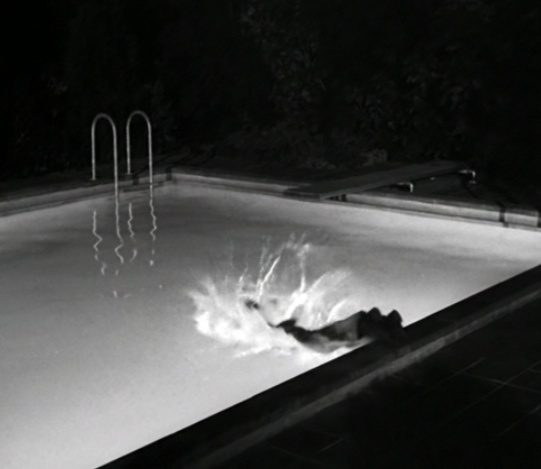
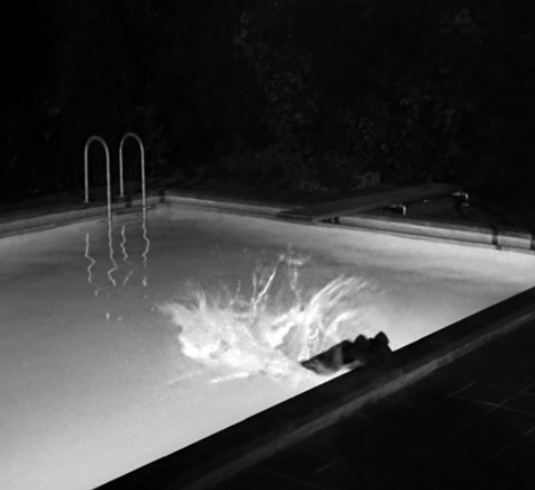

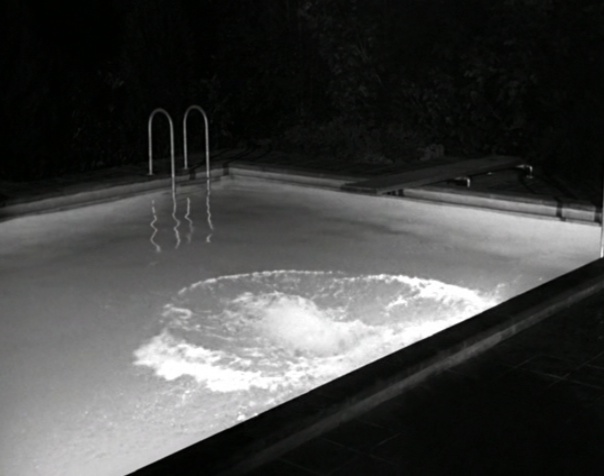

Here's the clip. Bravo.
June 23, 2008
Burn After Reading:
The new Coen brothers film, coming out this September.
After seeing the release of the poster and the trailer (domestic and international - two totally different trailers) I can now say I am officially excited. The poster calls up all of Saul Bass' iconic images - what a brilliant idea - no posters look like that anymore, and so it is completely eye-catching. And I love Brad Pitt when he's allowed to be a goofball. I guess my first impression of him - in first Thelma and Louise, and then True Romance - is the one that has really stuck - good-looking, sure, but doesn't take himself all that seriously. It's very endearing (when he's allowed to do it). I'm not gaga over his looks, he never really did it for me in that capacity - and I don't think he has all that much range - but range is over-rated. If you have too much range, you run the risk of being thought of as facile. Ooh, look at me with my different accents and haircuts and walks and gestures, aren't I clever? Pitt is just getting more interesting as he gets older. The parts he's getting are more interesting, too. I love it when he is allowed to be goofy and silly. It makes me so happy. I mean, his cameo as the pot-smoking loser roommate in True Romance is comedy gold as far as I'm concerned ("And get some .... cleaning products ... " "Dont' condissnd meeee .....". So funny!!) In the trailer, Brad Pitt gets punched in the face by John Malkovich and I've seen it 4 times now and it makes me laugh every time. And look at this still from the film:

I mean, I have no idea what's going on there, but it's hilarious.
So yeah. Sheila is STOKED. I actually am so excited I feel vaguely uncomfortable about it.
Poster, Saul Bass comparison - just for fun, and both trailers below. Can't WAIT!

Doesn't it remind you of ...


International teaser trailer:
Domestic trailer:
June 22, 2008
"There are two people in this barracks who know I didn't do it. Me and the guy that did do it."
It's a hot night. I've had a long day.
So it's time for more work on my 8th ongoing project. Here's just a taste. I love this movie. And God, do I love his face.

And. What might be my favorite slap in all of movie history. Or, I should say, three slaps - in quick succession. Watch the clip (if you haven't seen the movie, there is a spoiler therein). The slaps are vicious, real, sudden - It's thrilling acting.
June 13, 2008
The shallow part of "shallow elitism"
So after two elitist posts (if by "elitist" you mean "talking about books" and making declarations that some things are better than others. If that is your criteria, I am one HELL of an elitist and proud of it!) - I figured I'd throw a bone to the shallow crowd, of which I am also a proud member.
(New readers, a word of explanation: A couple years ago, in one week alone, I got two bitchy emails - one from some jagoff ranting about how "elitist" I was because - well, basically because I wrote about things that HE didn't care about ... and the second email was from some snot ranting about how "shallow" I was because I was obsessed with Project Runway. There was something so FREEING in that one week of emails because I realized, head on, that I cannot please everyone. How on earth can one be a shallow elitist?? I don't know - but I know that I am!! The Sheila Variations: Bringing you Shallow Elitist content since 2002).
Here are some observations I have made of late:
--  Sometimes I listen to songs by "My Chemical Romance" (and I like a lot of them), and my overriding feeling is: "Boys. Please. Calm the hell down. Take a deep breath, and CHILLAX."
-- I have a huge crush on Padma Lakshmi. Oh, and come to think of it, I have a crush on Tom Colicchio too. But Padma actually makes me nervous.
-- I am pretty bummed that Pacifica French Lilac Body Butter is so hard to find. My Whole Foods has their whole line of products - but not that one particular lotion. I am resisting buying it online because they charge 15 dollars shipping and handling or something like that.
-- I love Angelina Jolie and I wonder if we could be friends. I really hope so. I'm psyched to see Wanted. I love her as an actress but I am particularly in love with her in action films. Mr. and Mrs. Smith was a BLAST. She's one of the only actresses out there where I can pretty much believe that it is her doing all that crap - not a stunt woman. She's a lot of fun.

-- I want Kathy Griffin's Life on the D-List show to go on forever. If she ever becomes an A-list actress, I will be devastated because there goes that series, and I love every second of it.
-- I beg of you: follow the link and click through. What???
-- I will always, and I mean always, look back fondly on the first season of Rock of Love. Television just doesn't get any better than that. I mean, seriously. What I love best about the image below is that there is no irony in it. It is earnest. And deeply crazy. And I wish more people on the planet were deeply openly crazy, so I wouldn't feel so left out.

Gorgeous.
-- Recently re-watched Eyes of Laura Mars and reveled in the sight of Tommy Lee Jones in bell bottom jeans, a black turtleneck and long hair.

-- The Real Housewives of New York City cannot hold a candle to the GLORY of Real Housewives of Orange County. It just doesn't have the botox and fake boobs that made the Orange County version so awesome.
-- Speaking of Real Housewives of Orange County, I wonder how Lauri and George are doing. I actually have moments where the couple pops into my mind, and I think, "I hope they're happy together."

-- You know what movie I saw recently and loved? Dan In Real Life. I think that might have to go on my Under-rated Movies List because (along with the incorrect marketing theme today) it was marketed wrong - it was marketed like a wacky 40 Year Old Virgin sequel - which made me not want to see it (as much as I loved 40 Year Old Virgin) - but what a pleasant surprise: it's a sweet well-written funny and poignant family drama - and I LOVED it. I'll do a review of it when I get out from underneath the pile of the project I am working on. Dane Cook was great, too - he belongs in an ensemble piece at this point in his career - he's not confident enough (as an actor, I mean) to carry a movie (yet), but he was terrific here. Everyone was.

June 5, 2008
"That's what I mean by the moment."
Jimmy Stewart to a British Film Institute interviewer in 1972:
I'm beginning to believe that, in films, what everyone is striving for is to produce moments--not a performance, not a characterization, not something where you get into the part--you produce moments that create a feeling of believability to what you're doing....I was making a Western in British Columbia and we were on the Columbia Icefields. It was raining and there was heavy mist around, so we couldn't shoot, so we were all huddled around a fire. Suddenly, out of the mist, came a man, and he was not a young man. He had a beard--it wasn't exactly a beard, he just hadn't shaved for a while--and he was a miner type, he was dressed like a miner. He came closer to us and he said, "Which one of you is Stewart?"
"I am."
He came over and looked at me and said, "Oh, yeah. Yeah. I recognize ya. Well, I heard you was here, and I thought I'd come up and say hello. I've seen a lot of your picture shows, but I think the one I liked best--you were in this room and your girlfriend was in the next room and there were fireflies outside, and you recited a piece of poetry to her. I thought that was a nice thing for you to do."
And I remembered exactly the moment, exactly the film, who was in it, who directed it, and I also realized that that picture had been released twenty years before. That man made a tremendous impression on me. To think that I had been part of creating a moment that this man had liked and had remembered for twenty years. I'll never forget it. That's what I mean by the moment.
June 1, 2008
Happy birthday, Marilyn Monroe
On June 1, 1926 Norma Jean Mortensen was born.
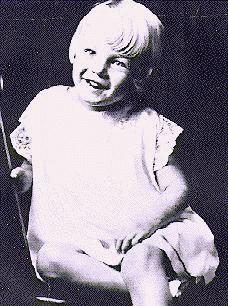
Objectified and misunderstood while alive, Marilyn Monroe has become the ultimate object in death. The image has become reality, canceling out the memory of the living-breathing woman ... leaving just the Object in its wake - the multitudinous images and icons and posters, her face and body standing in for the whole thing, standing in for the life force. It was what she fought against in her career, wanting to be seen as more than a joke, or tits and ass (although she had no problem with shimmying around a little bit either! She knew her assets, she didn't discount them). But her desire to be a good actress, to not just play bimbos or sex objects, is what still complicates our response to her, long after her death. Many people who are unaware of her gifts as an actress are frankly shocked by how natural she is, when they encounter her in films. It's like the Object has won the war, but Marilyn Monroe the person, the actress, continues to win battles. To see her in Some Like It Hot is to encounter true giggly effervescent movie MAGIC, and then to see her in Don't Bother to Knock(my review here) is to understand that this woman had talent as a dramatic actress as well. Not just talent, but a gift. I don't quite buy into the whole Marilyn Monroe as Ultimate Victim thing, although I do know that her demons were huge and loud, and caused her much grief in her life. She was a chronic insomniac. She was a loner. If you trust the reports of some of her confidantes and the private notes of her psychiatrist, she was frigid sexually. But nobody wanted to hear about any of that stuff from Marilyn ... that was not what we loved her for. She was famous and adored, but ultimately alone. She could not be saved. Arthur Miller tried. Many tried. She brought out a protective impulse in people. And, in my opinion, that is part of her movie magic. She was not a sassy sex symbol who "owned" her sexuality, and flaunted it (at least not overtly). There was always the wide-eyed innocence there, in spite of the body made for lovin' - and that somehow engendered a protective response in audiences ... male AND female - so she was one of those very rare movie creatures: a sex symbol whom men loved and desired, whom women respected and looked up to ... and I think it had something to do with that fragmented innocence peering out of her radiant face. She seemed unaware of the responses she brought up in men, and she never seemed out for sex - the Marilyn Monroe persona was all about finding love. Her gifts as an actress and comedienne are obvious - but her appeal is still rather complicated, which, I suppose, is why people still obsess over her, and talk about her, and pick her apart.
So while I can ache for Marilyn Monroe and what it had to be like, at times, to be her, with an abyss of sadness inside her that nobody - nobody - wanted to see ... what I am ultimately left with, in her case, is admiration for the act of WILL it took for her to put that persona together on a daily basis, and BE that fantasy. It had to have given her great joy. There's that great quote (included below) where someone asked her what it was like for her doing a photo shoot - and she said, "It's like being screwed by a thousand guys and you can't get pregnant." Marilyn Monroe was 100% aware of what she was doing when she was in front of the camera. That, I believe, is the greatest misperception about her - and also the problem when you become an Object - especially posthumously. Everything hardens, solidifies, and certain aspects of the narrative win out over others. So Marilyn the poor victimized starlet (or Marilyn the drugged-out diva) won the battle in the narrative wars for a couple of decades. That was the filter through which most people (not cinephiles anyway) saw Monroe. Thankfully, there's a bit more nuance out there now, in regards to how we talk about Monroe - and regular old popcorn-buying audiences, anyway, always knew the truth: Marilyn Monroe was magic, they loved her. They maybe felt protective of her, because of the wide-eyed innocence of her parts ... but there is obviously something about her that made her "stand out". When the nude calendar photos came out, and Marilyn Monroe was forced to apologize by the studio - as we all know now, her apology wasn't really an apology. Just a flat out, "I was behind in my rent, I needed the money." The studio was furious - but then they were bombarded by supportive fan mail, thousands and thousands of letters - from men, women, everyone, saying how much they loved her for her honesty. Not every young starlet has that kind of massive cross-gendered support. It is extraordinary and rare, to this day.
Marilyn Monroe did not have an accidental kind of career, where her beauty and maybe a couple of breaks made her. She was a starlet, like any other. Except that this starlet had ambition, and not just that: she had nowhere else to go, no other goals, no other dreams. There was no family, no one to either put the pressure on, to judge her harshly, or, conversely, to cheer her on. There was never any place for Marilyn to go home to. The ultimate orphan. Having to survive by her wits. Befriending powerful men who could help her, protect her. She thanked God for her beauty, even if it didn't make any difference to her, in terms of battling with her demons and all that. But her beauty was eye-catching, even in her early brunette days, and she submitted to the humiliations of the starlet-life, always keeping her eye on the ball, so that when the time came, and an actual part came her way, she'd be ready. I love her performance in All About Eve. She was cast to be the impossibly gorgeous young actress, and all she needed to do was stand next to Bette Davis, and you got the message. I mean, you might as well throw in the towel if you're a 40-something actress and THAT chick in the white dress is coming down the pike. But Marilyn has a couple of lines in the film, comedic lines, showing her gift at comedy - her absolutely perfect pitch (Watch how she delivers the line: "Well, I can't yell 'Oh butler!', can I? Maybe somebody's name is Butler." To which Addison DeWitt replies; "You have a point. An idiotic one, but a point." But it's HER delivery of that line that is funny. Here's the clip.) and again, I am struck by the act of WILL it had to have taken, to just keep going, through the sneers and catcalls, to make something of herself. She also was smart, and worked on her acting - with a series of coaches through her life ... wanting to go deeper into her craft, and improve herself. Watch her slam-dunk performance in Don't Bother to Knock to encounter a Marilyn Monroe you might never have seen before. She's fantastic.
One of my favorite off-screen stories involving Monroe is told by Billy Wilder, who, famously, had a very tempestuous relationship with her, because of her behavior on the set. Not coming out of her dressing room, showing up hours late, and bumbling her lines so badly that entire days of shooting were spent on Monroe trying to get the line, "Where's the bourbon?" right. But, as Billy Wilder joked: "As I've said before, I've got an old aunt in Vienna who would say every line perfectly. But who would see such a picture." Anyway, here's a bit from the book-length interview between Cameron Crowe and Billy Wilder
CC: One of the reasons you've said that Marilyn enjoyed the Hotel del Coronado sequences in Some Like It Hot is that she had an audience there on the beach watching her. Is that true? Were there, again, a lot of people lined up, watching the filming?BW: She had an audience. She always had thousands in New York, but at the beach there, hundreds. Yeah, she's a show-off.
CC: So they would be cheering and screaming and yelling?
BW: Screaming and yelling. But then when I wanted it quiet I had her say "Shhhh." They listened to her.
That's a movie star.
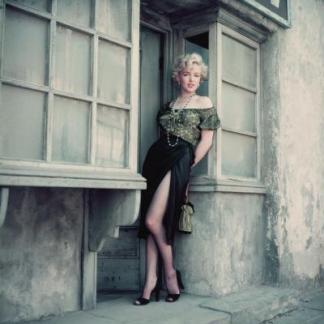
Kim Morgan has a great piece up about Monroe right now and I loved her comments on Monroe as a singer:
And though people love to discuss Marilyn Monroe the underrated actress (which is true -- she was a great comedienne), rarely do they argue about MM the underrated singer. As proven in Some Like it Hot, Gentlemen Prefer Blondes, River of No Return, Bus Stop (oh lord...her sexy, warbled, scared, ripped fishnet version of "That Old Black Magic"...so brilliant) and the less classic Let's Make Love (where her rendition of "My Heart Belongs to Daddy" is one of the best versions of that song ever recorded), the woman had distinct pipes.
My favorite musical number of hers is one that isn't often mentioned in the list of great Monroe songs, but I adore it. It's "File My Claim" from River of No Return - delicious clip below (along with a million quotes about Monroe and from Monroe).
Perfection!
Now, in honor of our lovely Norma Jean, let's get to the quotes:
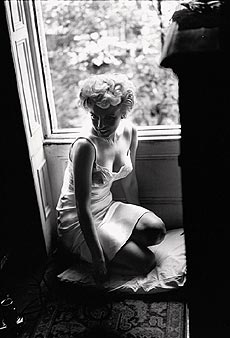
(That's a photo by Sam Shaw - his photos of her are my favorites. Natural light, an innocence to them ... candid-feeling ... just beautiful.)
Marilyn Monroe:
People had a habit of looking at me as if I were some kind of mirror instead of a person. They didn't see me, they saw their own lewd thoughts, then they white-masked themselves by calling me the lewd one.
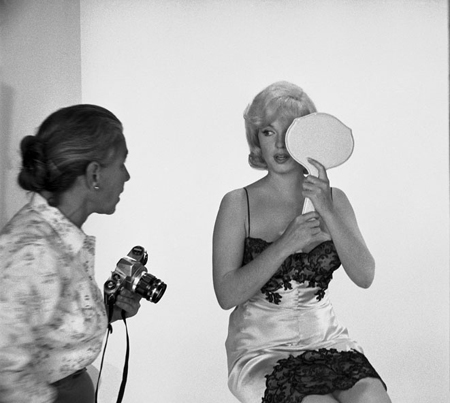
That's Monroe and photographer Eve Arnold
Billy Wilder:
She had a kind of elegant vulgarity about her. That, I think, was very important. And she automatically knew where the joke was. She did not discuss it. She came up for the first rehearsal, and she was absolutely perfect, when she remembered the line. She could do a 3-page dialogue scene perfectly, and then get stuck on a line like, "It's me, Sugar"... But if she showed up, she delivered, and if it took 80 takes, I lived with 80 takes, because the 81st was very good ...She had a feeling for and a fear of the camera. Fright. She was afraid of the camera, and that's why, I think, she muffed some lines. God knows how often. She also loved the camera. Whatever she did, wherever she stood, there was always that thing that comes through. She was not even aware of it.
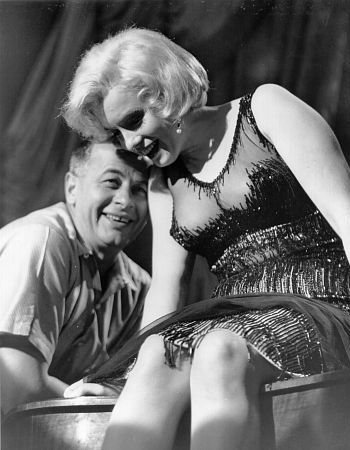
Eve Arnold:
If an editor wanted her, he had to agree to her terms. She knew how she wanted to be seen, and if her cooperation was sought, she reserved the right of veto.She knew she was superlative at creating still pictures and she loved doing it.
She had learned the trick of moving infinitesimally to stay in range, so that the photographer need not refocus but could easily follow movements that were endlessly changing.
At first I thought it was surface technique, but it went beyond technique. It didn't always work, and sometimes she would tire and it was as though her radar had failed; but when it did work, it was magic. With her it was never a formula; it was her will, her improvisation.
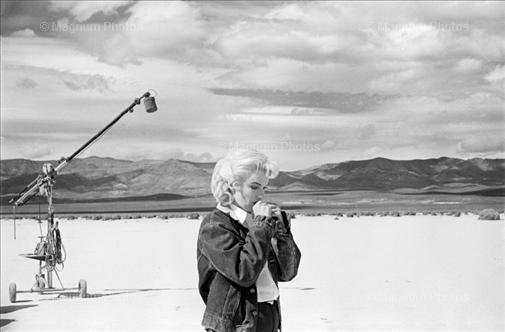
Peter Bogdonavich:
The fact is that Marilyn was in bad trouble from the day she was born as Norma Jean Mortenson on June 1, 1926, in the city of angels and movies, a poor bastard angel child who rose to be queen of a town and a way of life that nevertheless held her in contempt. That she died a martyr to pictures at the same time as the original studio star system -- through which she had risen -- finally collapsed and went also to its death seems too obviously symbolic not to note. Indeed, the coincidence of the two passing together is why I chose to end this long book about movie stars with Marilyn Monroe.What I saw so briefly in my glimpse of Marilyn at the very peak of her stardom (and the start of my career) -- that fervent, still remarkably naive look of all-consuming passion for learning about her craft and art -- haunts me still. She is the most touching, strangely innocent -- despite all the emphasis on sex -- sacrifice to the twentieth-century art of cinematic mythology, with real people as gods and goddesses. While Lillian Gish had been film's first hearth goddess, Marilyn was the last love goddess of the screen, the final Venus or Aphrodite. The minute she was gone, we started to miss her and that sense of loss has grown, never to be replaced. In death, of course, she triumphed at last, her spirit being imperishable, and keenly to be felt in the images she left behind to mark her brief visit among us.
Elia Kazan:
Relieve your mind now of the images you have of this person. When I met her, she was a simple, eager young woman who rode a bike to the classes she was taking, a decent-hearted kid whom Hollywood brought down, legs parted. She had a thin skin and a soul that hungered for acceptance by people she might look up to ...The girl had little education and no knowledge except the knowledge of her own experience; of that she had a great deal, and for an actor, that is the important kind of knowledge. For her, I found, everything was either completely meaningless or completely personal. She had no interest in abstract, formal, or impersonal concepts but was passionately devoted to her own life's experiences. What she needed above all was to have her sense of worth confirmed. Born out of wedlock, abandoned by her parents, kicked around, scorned by the men she'd been with until Johnny, she wanted more than anything else approval from men she could respect. Comparing her with many of the wives I got to know in that community, I thought her the honest one, them the "chumps". But there was a fatal contradiction in Marilyn. She deeply wanted reassurance of her worth, yet she respected the men who scorned her, because their estimate of her was her own.
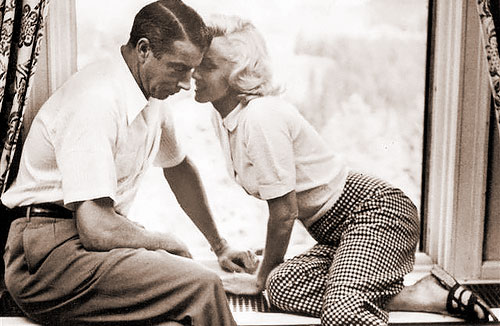
Marilyn Monroe:
Well-behaved women rarely make history.
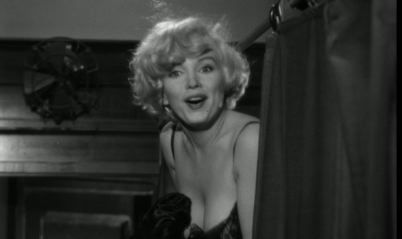
John Strasberg (son of Lee Strasberg, Marilyn's acting teacher):
I think I was talking about cars to Mother and Father. You know how I loved cars. I'd just come home and it was going to be my eighteenth birthday. I'd wanted to come for that.Mother and Father hadn't wanted me to come. "Why don't you wait till the end of the year?" Well, i'd already been kicked out of college. They didn't know yet.
When I'd gone off at the airport, I'd turned to Mother and said, "For two cents, I won't go." Nobody gave me the two cents, but I'd meant it. What I'd wanted to do was work. I'd wanted to work from the time I was fifteen, and they were always against any effort on my part to be strong or independent. I remember how much I resented it. "You don't have to work, we'll take care of everything," undermining me.
So I was talking about cars, no one was listening, and Marilyn was there and out of the blue said, "Why don't you take my car, Johnny?"
I thought I hadn't heard her right, and I said, "What?" She had remembered the summer before, in California, I'd had that Chevy I'd rented. God, I loved that car, a '57 Bel Air silver Chevy, and she had the Thunderbird.
She continued, "I've got the Ford Mustang the corporation gave me, and Arthur and I have a car. That one's just sitting in the garage, we don't use it."
I was stunned. I couldn't believe she meant it.
Mother and Father were horrified; they didn't like it at all. I don't know if it felt like too much to give me or if they were worried about my driving in my state of mind, but they objected strenuously. "He's too young. Maybe later, Marilyn. You don't have to. It's impossible, he can't afford it, it could be dangerous."
Marilyn just said, "Well, don't worry about any of that, it's in the corporation's name, so I'll take care of the insurance."
I'll never forget that ... There were so few, so very few people who were generous like that. Especially to me, who couldn't do anything for her.
I think that car saved my life.
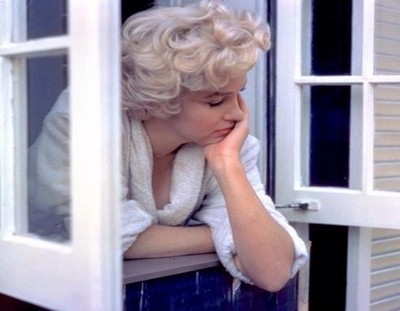
Billy Wilder:
I never knew what Marilyn was going to do, how she was going to play a scene. I had to talk her out of it, or I had to underline it and say, "That's very good" or "Do it this way." But I never knew anybody who ... except for a dress that blows up and she's standing there ... I don't know why she became so popular. I never knew. She was really kind of ... She was a star. Every time you saw her, she was something. Even when she was angry, it was just a remarkable person. A remarkable person, and in spades when she was on the screen. She was much better on the screen than not on the screen.
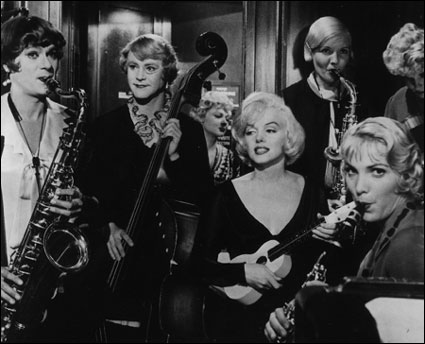
Marilyn Monroe:
Some people have been unkind. If I say I want to grow as an actress, they look at my figure. If I say I want to develop, to learn my craft, they laugh. Somehow they don't expect me to be serious about my work.
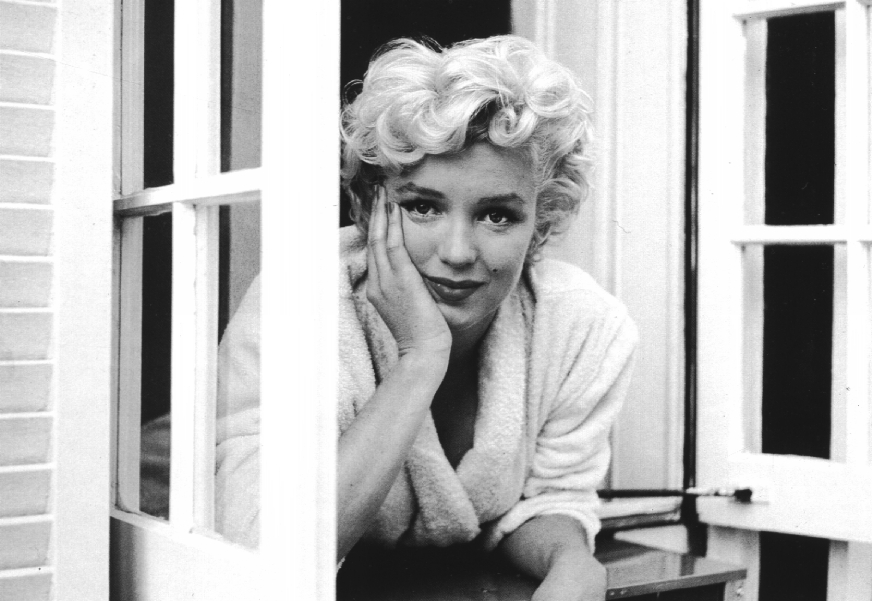
Billy Wilder:
It's very difficult to talk seriously about Monroe, because she was so glitzy, you know. She escaped the seriousness somehow; she changed the subject. Except that she was very tough to work with. But what you had, by hook or crook, once you saw it on the screen, it was just amazing. Amazing, the radiation that came out. And she was, believe it or not, an excellent dialogue actress. She knew where the laugh was. She knew.
Marilyn Monroe:
"For breakfast, I have two raw beaten eggs in a glass of hot milk. I never eat dessert. My nail polish is transparent. I never wear stockings or underclothes because I think it is important to breathe freely. I wash my hair everyday and I am always brushing it. Every morning I walk across my apartment rolling an empty soda bottle between my ankles, in order to preserve my balance."
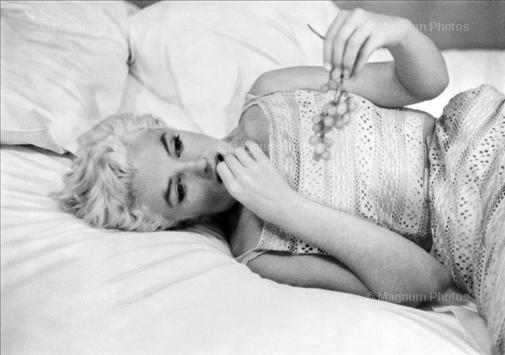
Eve Arnold:
I never knew anyone who even came close to Marilyn in natural ability to use both photographer and still camera. She was special in this, and for me there has been no one like her before or after. She has remained the measuring rod by which I have -- unconsciously -- judged other subjects.
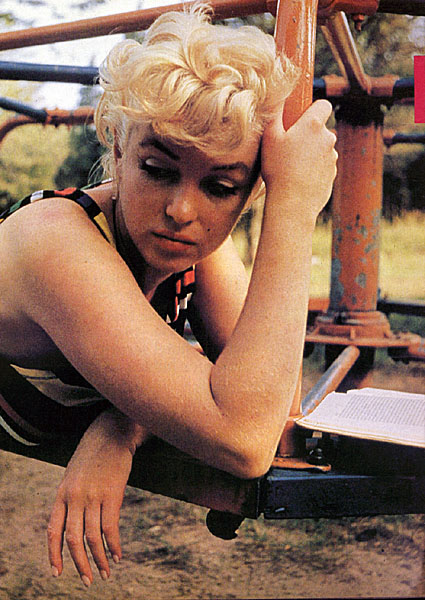
Marilyn Monroe:
It's not true that I had nothing on. I had the radio on.

Ernest Cunningham (photographer):
I worked with Marilyn Monroe. A rather dull person. But when I said "Now!" she lit up. Suddenly, something unbelievable came across. The minute she heard the click of the camera, she was down again. It was over. I said, "What is it between you and the camera that doesn't show at any other time?" She said, "It's like being screwed by a thousand guys and you can't get pregnant."
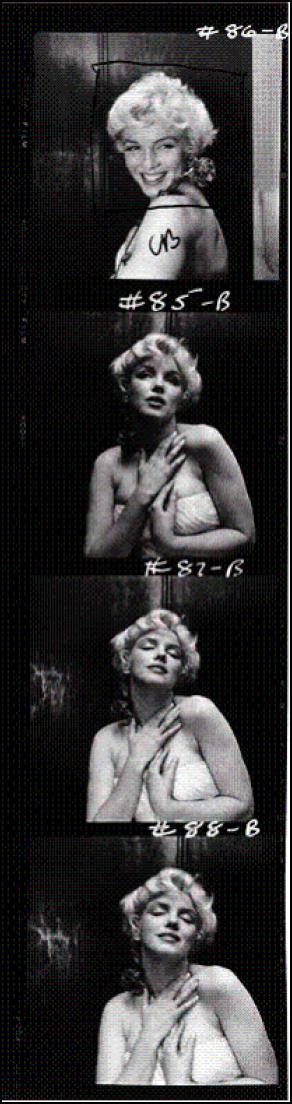
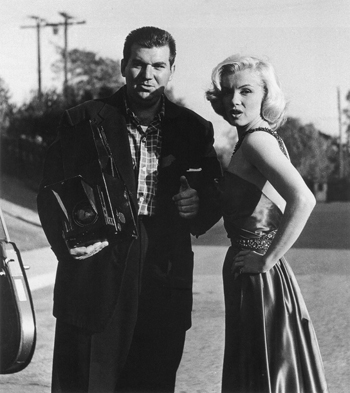
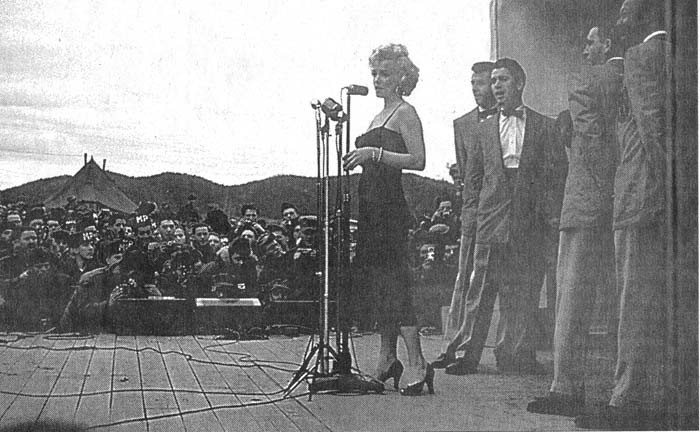
Peter Bogdonavich:
More than forty years have passed since Marilyn's mysterious death, but her legend and persona have survived. This is all the more remarkable because she actually made very few films, and even fewer that were any good. But there was a reality to her artifice -- she believed in the characters she played, even if they were inherently unbelievable. "Everything she did," [Arthur] Miller said to me, "she played realistically. I don't think she knew any other way to play anything -- only to tell you the truth. She was always psychologically committed to that person as a person, no matter what the hell it was, rather than a stock figure. Because the parts she got could easily have been stock figures, which had no other dimension. But she wouldn't have known how to do that. In other words, she did not have the usual technique for doing something as a stock figure ... She was even that way when [director] John Huston used her the first time [in a memorable walk-on bit] in The Asphalt Jungle [1950]."This went for every picture she did in her surprisingly, painfully short career as a star, barely a decade, little more than a dozen pictures. Though she managed to work with quite a number of major directors, it was not necessarily always in their best efforts; but still they were Fritz Lang, Howard Hawks (twice), Otto Preminger, Billy Wilder (twice), George Cukor (twice, if you count her last unfinished one), John Huston (twice), Laurence Olivier, Joshua Logan, and Joseph L. Mankiewicz (bit part in 1950's classic All About Eve). In my conversation with Miller, he said, "I thought she had the potential for being a great performer if she were given the right stuff to do. And if you look at the stuff she did do, it's amazing that she created any impression at all because most of it was very primitive. And the fact that people remember these parts from these films is amazing ... She was comitted to these parts as though they were real people, not cardboard cutouts. Even though the director and author and the rest might have thought they were cutouts and would deal with them that way. The way the two men [Tony Curtis, Jack Lemmon] in Some Like It Hot felt with their parts, or George Raft with his part. She was real. And therefore she had the potential of being a great comedienne." (Norman Mailer, in his book on Monroe -- he never met her -- wrote that starting with 1953's Gentlemen Prefer Blondes, she was a great comedienne.)
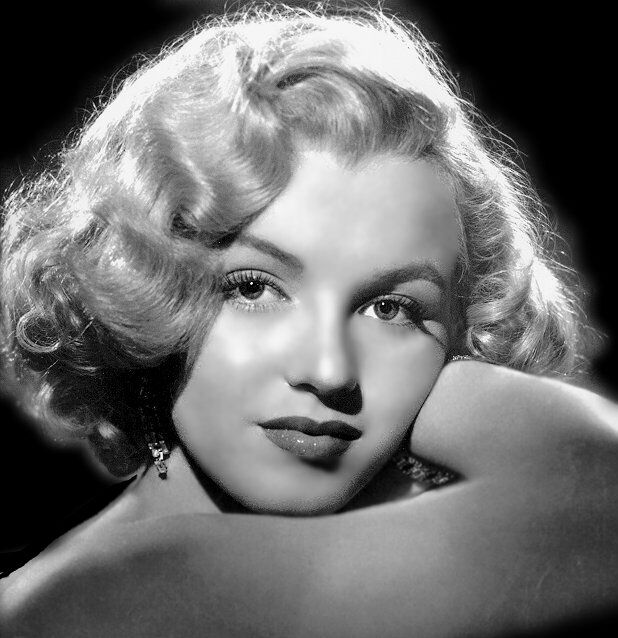
Marilyn Monroe:
I'd prefer not to analyze it [acting] ... it's subjective; rather, I want to remain subjective while I'm doing it. Rather than do much talking I'd rather act. When it's on the screen, that's when you'll know who Roslyn [her character in The Misfits] is. I don't want to water down my own feeling ... Goethe says a career is developed in public but talent is developed in private, or silence. It's true for the actor. To really say what's in my heart, I'd rather show than to say. Even though I want people to understand, I'd much rather they understand on the screen. If I don't do that, I'm on the wrong track, or in the wrong profession.... Nobody would have heard of me if it hadn't been for John Huston. When we started Asphalt Jungle, my first picture, I was very nervous, but John said, 'Look at Calhern [the late Louis Calhern, a veteran actor], see how he's shaking. If you're not nervous, you might as well give up.' John has meant a great deal in my life. It's sort of a coincidence to be with him ten years later.
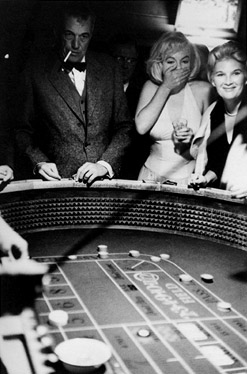
John Strasberg:
The first time I met her I remember she came out of the living room and Pop said, "This is my son," and my first impression of her was that she was different from most of the people who came to the house. I'd watch all these people trading their most human qualities, betraying themselves for success at all costs, to become rich and famous, and afterward, when it was too late, they'd realize they had lost the best part of themselves along the way, but she, she was like me. When I looked into her eyes, it was like looking into my own, they were like a child's eyes. I was still a child. You know how children just look at you. My feeling was she had less ego or was less narcissistic than most of the actors who never really bothered with me. She was just another person to me, another one from that world I felt cut off, excluded, from. She was nicer, real simple, no makeup, and she really looked at me as if she saw me. It wasn't that I wanted people to look at me, but I knew the difference when she did. I knew everyone said she was the sexiest, most sensual woman in the world. Not to me. I thought there was something wrong with me for not feeling that from her. I'd felt it from other women who came to the house. I was pretty sexually frustrated then. She was so open, so loose, and her sensuality as such was so totally innocent, nothing dirty in it at all, and the first time it was just like talking to an ordinary person, only realer than most who came into the house in those days. She was quiet, too, I remember, like an animal is quiet, and I was like that too, survival tactics. She seemed smart, but not in an educated way, instinctively smart, nobody's fool.
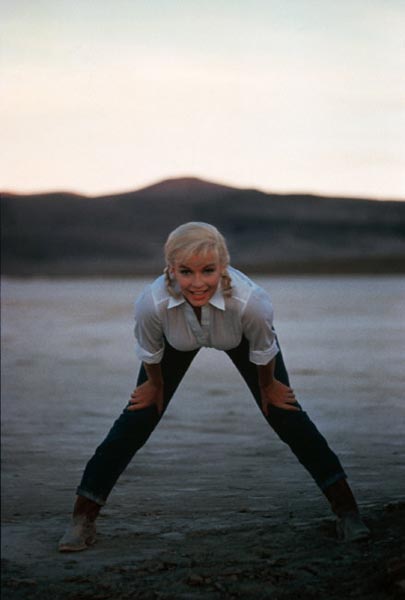
Couldn't resist:
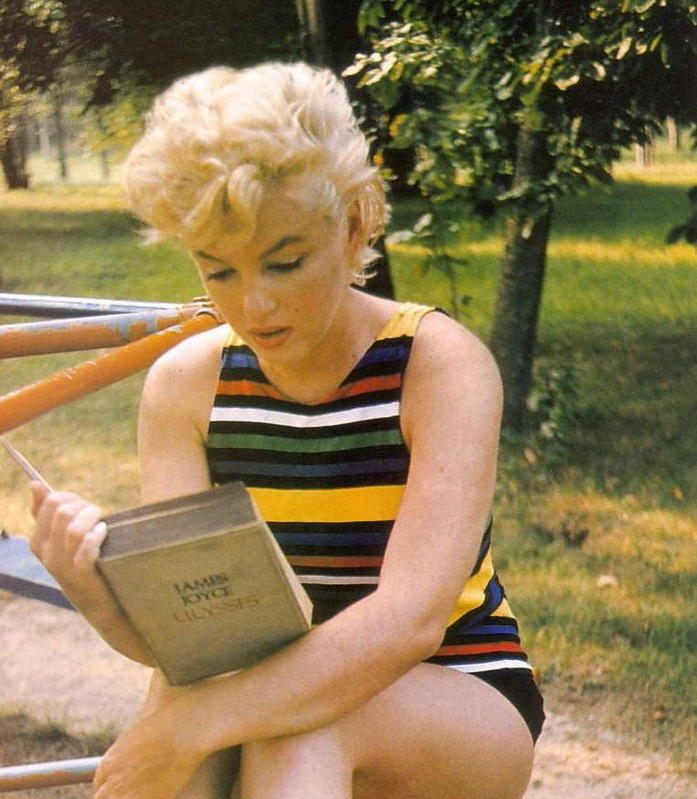
Marilyn Monroe:
"I am a failure as a woman. My men expect so much of me because of the image they have made of me and that I have made of myself, as a sex symbol. Men expect so much and I can't live up to it. They expect bells to ring and whistles to whistle, but my anatomy's the same as any other woman's. I can't live up to it."
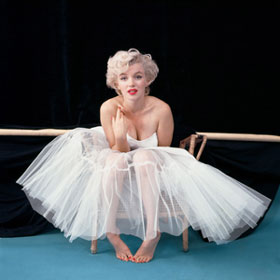
Marilyn Monroe:
My illusions didn't have anything to do with being a fine actress. I knew how third rate I was. I could actually feel my lack of talent, as if it were cheap clothes I was wearing inside. But, my God, how I wanted to learn, to change, to improve!
Arthur Miller:
She was a whirling light to me then, all paradox and enticing mystery, street-tough one moment, then lifted by a lyrical and poetic sensitivity that few retain past early adolescence. Sometimes she seemed to see all men as boys, children with immeidate needs that it was her place in nature to fulfill; meanwhile her adult self stood aside observingt he game. Men were their need, imperious and somehow sacred. She might tell about being held down at a party by two of the guests in a rape attempt from which she said she had escaped, but the truth of the account was far less important than its strange remoteness from her personally. And ultimately something nearly godlike would emerge from this depersonalization. She was at this point incapable of condemning or even of judging people who had damaged her, and to be with her was to be accepted, like moving out into a kind of sanctifying light from a life where suspicions was common sense. She had no common sense, but what she did have was something holier, a long-reaching vision of which she herself was only fitfully aware: humans were all need, all wound. What she wanted most was not to be judged but to win recognition from a sentimentally cruel profession, and from men blinded to her humanity by her perfect beauty. She was part queen, part waif, sometimes on her knees before her own body and sometimes despairing because of it -- "Oh, there's lots of beautiful girls," she would say to some expression of awed amazement, as though her beauty betrayed her quest for a more enduring acceptance.
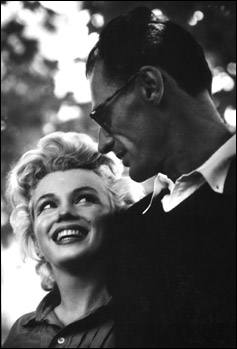
Peter Bogdonavich:
The year before her much-speculated-over death at thirty-six (rumors of presidential involvement, etc.), playwright Clifford Odets told me that she used to come over to his house and talk, but that the only times she seemed to him really comfortable were when she was with his two young children and their large poodle. She relaxed with them, felt no threat. With everyone else, Odets said, she seemed nervous, intimidated, frightened. When I repeated to Miller this remark about her with children and animals, he said, "Well, they didn't sneer at her."
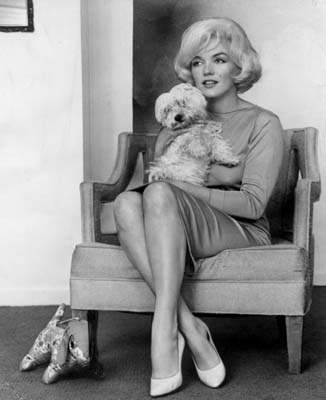
Burt Glinn (photographer):
She had no bone structure -- the face was a Polish flat plate. Not photogenic in the accepted sense, the features were not memorable or special; what she had was the ability to project.
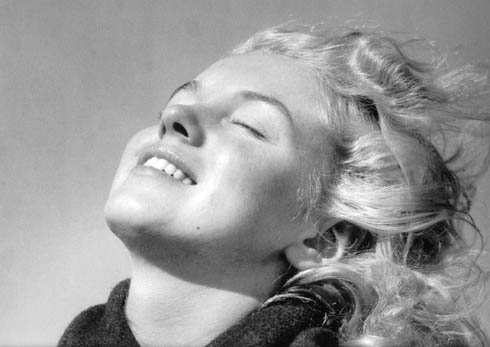
Billy Wilder:
Marilyn was not interested in costumes. She was not a clotheshose. You could put anything on her you wanted. If it showed something, then she accepted it. As long as it showed a little something.
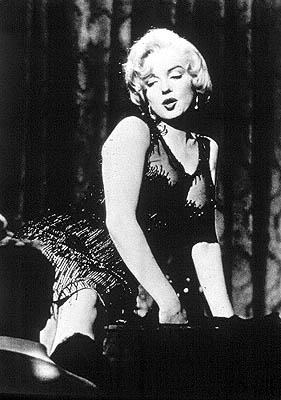
Henri Cartier Bresson (photographer):
She's American and it's very clear that she is - she's very good that way - one has to be very local to be universal.
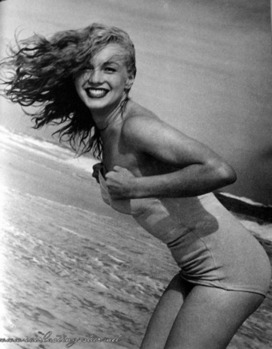
Here's the mega-post I wrote about the making of The Misfits
Marilyn Monroe:
Hollywood is a place where they'll pay you a thousand dollars for a kiss and fifty cents for your soul.
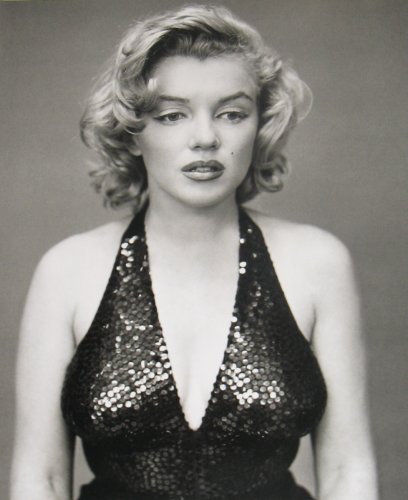
Marilyn Monroe:
Being a sex symbol is a heavy load to carry, especially when one is tired, hurt and bewildered.
Marilyn Monroe:
Acting isn't something you do. Instead of doing it, it occurs. If you're going to start with logic, you might as well give up. You can have conscious preparation, but you have unconscious results.
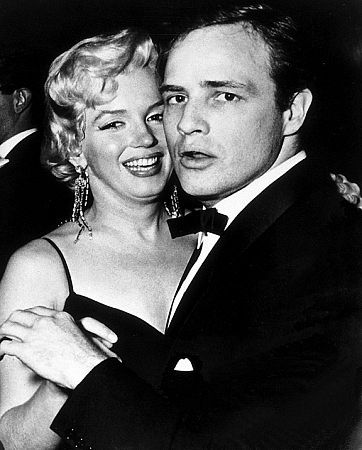
Arthur Miller:
To have survived, she would have had to be either more cynical or even further from reality than she was. Instead, she was a poet on a street corner trying to recite to a crowd pulling at her clothes.

Marilyn Monroe:
I'm not interested in money. I just want to be wonderful.
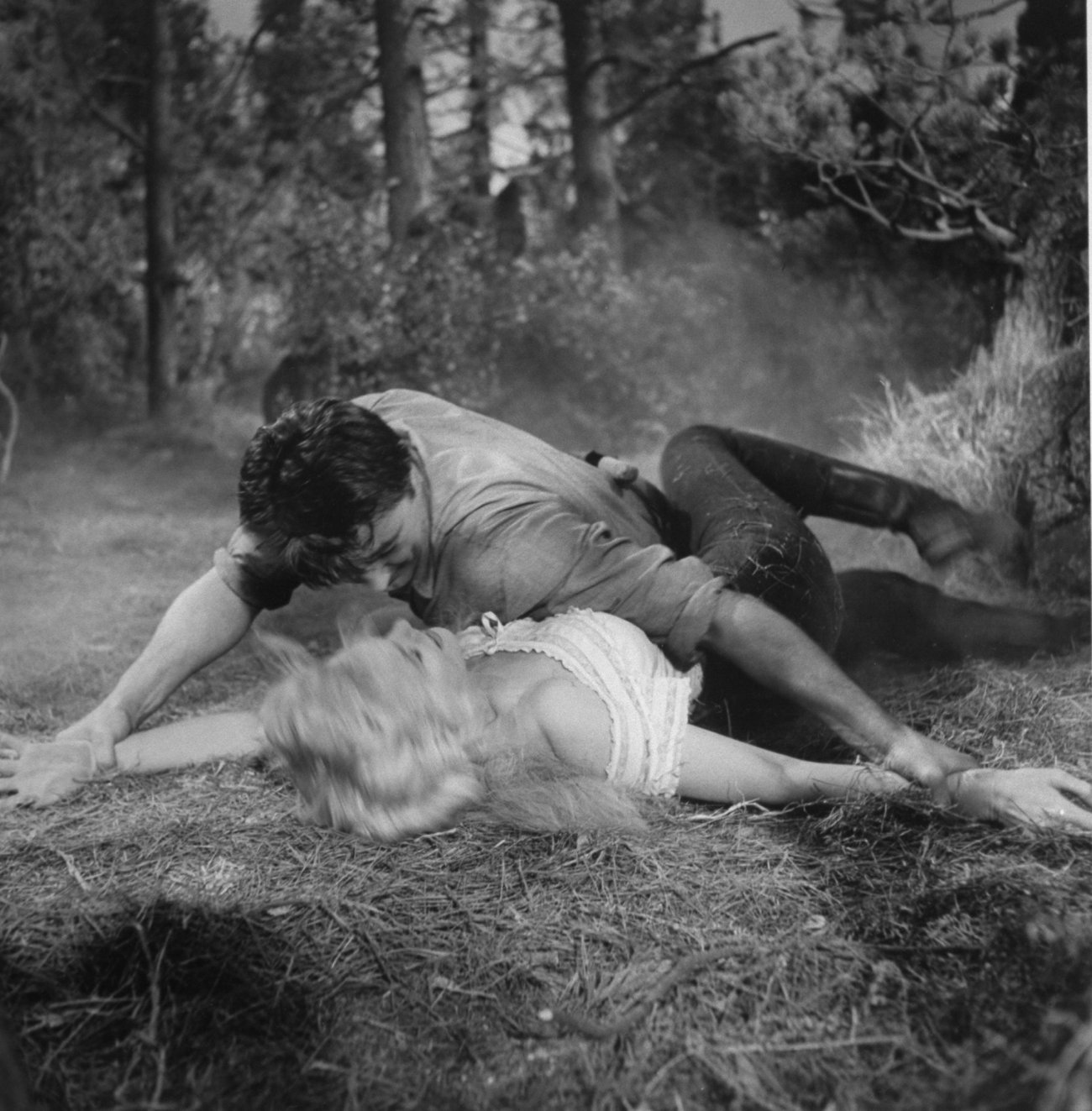
Marilyn Monroe (this is what she pleaded at the end of the last interview she gave):
What I really want to say: That what the world really needs is a real feeling of kinship. Everybody: stars, laborers, Negroes, Jews, Arabs. We are all brothers.Please don't make me a joke. End the interview with what I believe.
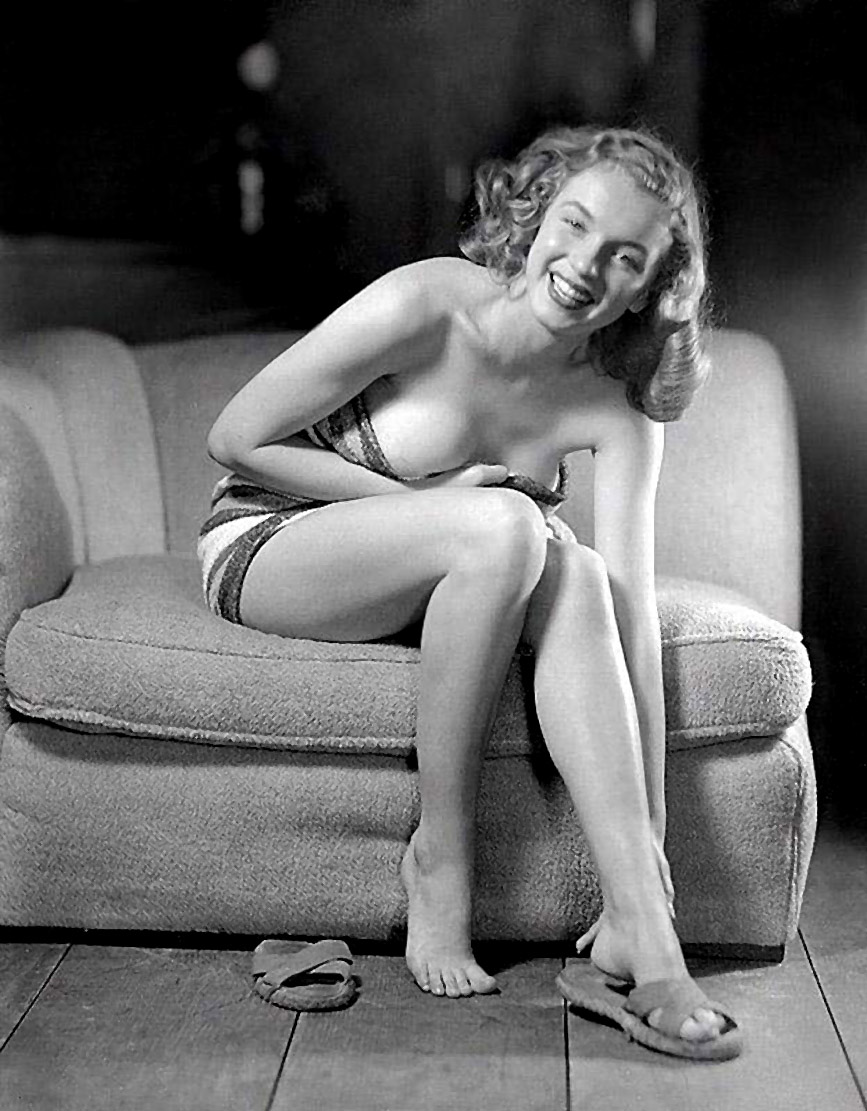
May 26, 2008
Must-read: Joan Crawford in Strait Jacket
Kim Morgan on Joan Crawford in Strait Jacket - which, if you haven't seen, all I can say is: do yourself a favor ... But Kim covers the weirdness and brilliance of it perfectly. I adored this part of Kim's piece:
We also get a nice little glimpse into the talented, vizard charisma that is Joan in the disc's other special feature, with her costume and makeup tests. She's in full character, smoking sexily, and she believes she's the hottest thing in high heels, jangling her charm bracelet around all come-hither-boys. Crawford the star and Crawford the woman never wandered far from each other, making her alternately brilliant and terrifying. Stare at these tests and you'll think she just may be one of the most fascinating self-inventions ever to grace, or rather, claw her way across the silver screen. If you watch it more than three times, you just can't help but adore how wonderfully insane she seems. Whatever happened to actresses like Joan? They died away -- torn down like the old hat resting atop the Brown Derby restaurant.
Wow.
The screenshot Kim chose to start her piece with - Joan with the Bettie Page bangs and the lit match - is a moment that has to be seen to be believed. She, in a fit of insouciant rebellion, lights her match off of a record turning on the turntable. It's such a weird moment and she plays it with 100% conviction - and the first time I saw it (with Alex) - we laughed so loudly that we got in trouble. We watched it REPEATEDLY. Over and over and over .... I cannot describe why it struck us as so funny. The sound the match makes against the record, the record screeching to a halt - that was part of it ... we KEPT making that screeching sound, and poor Chrisanne had to get up in like 3 hours to go to work, and her house-guest and her wife were HOWLING with laughter for, God, what was it, 40 minutes?
Kim really "gets" Crawford, in a way that I totally appreciate - and I'm glad to see that weirdo ax-murderer movie highlighted.
Also, please notice: Joan Crawford was at the height of her Pepsi endorsement career at that point - so there's one scene in a kitchen, a completely undecorated kitchen - and sitting on the counter, in between the two characters, for no apparent reason, is a huge box of Pepsi, label carefully turned toward the camera.
Crawford was no dummy.
May 20, 2008
A Woman's Face; dir. George Cukor

Combining the impeccable aesthetic of MGM, the meticulous lighting and atmosphere George Cukor is known for, and some kick-ass performances by all the leads (Joan Crawford, Melvyn Douglas, Conrad Veidt, Osa Massen), A Woman's Face is a psychological melodrama with aspects of a crime thriller, a noir, and a five-hankie weepie. It tells the story of Anna Holm (played brilliantly by Joan Crawford), a woman who was horribly disfigured in her youth, leaving her scarred on one side of her face. Being ugly is not just skin-deep. Anna Holm has been repeatedly rejected by the human race, who stare at her scar in horror and fascination, recoiling from her, and so she rejects the world in turn, succumbing to a life of crime. It's not that she's bad all the way through - Joan Crawford manages to suggest the pain at the heart of being that rejected, and what it means to the development of a personality. Joan Crawford naturally was a babe from the moment she was born, and seriously: this woman was a babe to end all babes. If you've seen photographs of her in her late teens and early twenties you know what a stunner she was. I mean, she was always beautiful - but in her youth she was spectacular. To see how she inhabits the neurotic cringing personality of Anna Holm, how compassionately she suggests what it is like to be ugly (and she does so with no condescension or self-importance, like: "Look at me! Joan Crawford! Bein' all ugly!"), and how she shows this woman's dawning realization of her own softness, her own desires ... is a revelation.
I am determined that I will see a Joan Crawford Renaissance in my lifetime. I am determined that her reputation be rehabilitated! It's insane that a vicious autobiography with a giant CHIP on its shoulder should so destroy an actress' entire reputation ... that book was a watershed, not just in Hollywood memoirs, but in the publishing industry itself. But that's neither here nor there. And frankly, I am SICK of having to talk about Christina Crawford every time I talk about her mother Joan. I am SICK of having Christina Crawford set the tone of the conversation, and insinuate herself into the action. We've heard what you had to say, Christina, now get out of my life. Whatever did or did not happen in that household is, as far as I am concerned, immaterial. I don't care if Joan Crawford made her children scrub the china with toothbrushes, I don't care if she made them dance a jig in the moonlight until they collapsed from exhaustion, I don't care if she made them drain the pool with teaspoons. I'm over it. Can we talk about her WORK, please? Honest to God. If she abused her kids, that's awful. Whatevs. I'm not interested in Joan Crawford because she's an upstanding citizen (although I think Christina's damning book leaves much to be desired in the way of, oh, TRUTH). I'm interested in Joan Crawford because she is a fine actress. So. NO MORE, CHRISTINA. You've dominated the Crawford landscape long enough.
Ah, that felt good.
A Woman's Face is told in flashbacks. We start in a Swedish court of law, where Anna Holm is on trial for murder. We never see Joan Crawford's face. She wears a black hat tilted over one eye, and her head is bowed. There is a group of people who are the 'witnesses' and they are all held in a small room with express instructions to not discuss the case amongst themselves. Wonderful character actors, all of them. One by one, they are led out into the courtroom to tell their version of the story, and we flash back to the past.

Conrad Veidt (who was just about to play Major Strasser in Casablanca) plays Torsten Barring, a slick conniving conman, who meets Anna Holm in the back of a tavern (leave it to MGM to make that tavern like something out of a fairy tale. The group of revelers sit outside on the patio, surrounded by a Hansel and Gretl forest, absolutely gorgeous) when he is trying to get out of paying his check, and when he sees her scar he does not recoil in disgust. He takes it in, certainly, but his manner is that of a gentleman, kind and considerate. He sees in her something that he can use (because he's that kind of guy) and eventually they go into "business" together. Their business is blackmailing the rich.
One of Conrad Veidt's party is the sleazy luscious Vera Segert, played beautifully by Osa Massen.

She is married to a prominent plastic surgeon in Stockholm, but she is obviously having an affair. Probably multiple affairs. She's a slut. Conrad Veidt steals a packet of her love letters out of the jacket of her lover, in order to blackmail her later.
Anna Holm goes to visit Mrs. Segert, and there is a thrilling vicious scene of confrontation between the two women. Mrs. Segert begs for mercy, she loves her husband, please let me have my letters! At one point, Joan Crawford has her on the couch, and she slaps her on the face 3, 4 times. Watch Joan Crawford in that violent moment. It's melodramatic, sure, but Joan Crawford was at home in melodrama. She could fill it, she could justify it, she could make it look real. I'm convinced she could make anything look real. She's that good. Her slapping of Mrs. Segert is not movie-violence, it's real violence, and you clench up, watching it, because it's the real world inserting itself into what is, of course, just a movie. Anna Holm loses control in that moment. And Anna Holm, twisted inside, bitter, hard, never loses control. So to see her slapping Mrs. Segert, Mrs. Segert crying out and sobbing, trying to get away, is thrilling movie-making. Crawford's eyes. Just take a look at Crawford's eyes in that scene. Scary. It's real.

Mr. Segert (played by the marvelous, God I love him, dear God help me, Melvyn Douglas) comes home unexpectedly and interrupts Anna Holm in the act of trying to escape out the window. Mrs. Segert, slut that she is, is terrified that Anna Holm will reveal the REAL reason that she is in their house. Mrs. Segert continuously insists that she "lufs" her husband, she "lufs" Gustav so much ... but you know she's only in it for the money and the prestige. She has a vested interest in being "Mrs. Gustav Segert" and if Anna Holm breaks out the packet of love letters, all will be lost. However: Gustav Segert just happens to be ("just happens"! Ha - that's one hell of a coincidence) the number one plastic surgeon in Stockholm, and he gets a look at the scar on Anna Holm's face, and tells her he can help her. He pulls out a book of before and after photographs, people who have been terribly burned or scarred - and what he has been able to do for them, the reconstructions he is known for.
Anna Holm is a tough case. She's not just a softie waiting to emerge with the right circumstances ... she is tough. She's had to be. But Joan Crawford flips through the before and after photographs with a dawning sense of hope on her face, hope and amazement ... and it's even more startling because hope, for Anna Holm, is necessarily combined with sadness. Hope cannot stand on its own, because she has been disappointed and hurt so many times. And that does something to a human being. It warps what was once straight. (I'm thinking about Tess of the D'Urbervilles right now, as I seem to do whenever such a question of the warping of personality by life comes up ... Can such things be undone? Is there such a thing as "too late"? Hardy thinks yes, but then he was a great pessimist. Tess was made, MADE, for a happy and fulfilled life. She was made to be a vibrant loving and loved woman. But life had something different in store for her, and by the time she actually emerges from the nightmare, and finds love again - it is too late. The damage has been done.) Joan Crawford is able to modulate that kind of delicate imbalance with meticulous accuracy. A million things are going on on her face (and for half of the film, she only has half of her face at her disposal as an actress!), she cannot believe that he is able to work such miracles, and she also cannot believe that he could ever "fix" her. "You couldn't fix this!" she says. But there's something deeper going on in the scene, and you just need to keep your eyes fixed on Crawford's face to discern it. The thought that someday she might NOT have a scar has never occurred to Anna Holm. But now, suddenly ... it does. Instead of leaping for joy, she is almost devastated by it. Because what will it mean? Her whole life is about having that scar. Who will she be without a scar? There's a certain sense of loss there as well ... it is as though she feels her whole identity is her scar.
Anna Holm submits to 12 grueling operations, and Gustav Segert (I love Melvyn Douglas ... have I mentioned that?) reminds her that all of this may come to naught. He makes no promises. But he's a genius, and after the 12th operation, Anna Holm is revealed as, well, the Joan Crawford we all know and love.
But life isn't as simple or as clear as it seems. We see that immediately in a scene where the newly un-scarred Joan Crawford strolls through a park. She still has the cringing posture and odd mannerisms of someone trying to hide herself from the world. A little boy chasing after a ball bumps into her, and glances up. Anna, so used to the cringing response from people to her scar, recoils, hiding the right side of her face, waiting for the inevitable "Ewwww" look to appear. But the little boy grins up at her, openly, and makes some cheese-ball 1941 comment like, "Gee, lady, you're awful pretty!" One must accept a bit of cheese with your pointed psychological melodrama. And I was moved to tears watching Joan Crawford's face in response to that comment. She realized how she had anticipated rejection, and then to NOT have it come ... it was like you could actually SEE her start to open her heart up to the world. You can actually SEE her become a little bit softer.
But the path will not be that easy for Anna Holm, due to her sordid past and her association with Conrad Veidt. Not to mention the fact that living for so many years in a state of bitterness, removing herself from the human race (as it were, and as she says in the last line of the film), accepting the world's worst opinion of her, and living up to it ... it won't be that easy for her to 'change her spots'. Thank God the film didn't go in that direction, ie: If you're ugly you're bad! But all you need to do is be changed into something beautiful, and all will be well! A Woman's Face is more complex than that. People internalize the world. It happens all the time. Our outer appearances are judged a million times a day, and people make decisions about us based on our appearances. This is just a part of life. For the majority of her time on this earth, Anna Holm got the message: You are ugly and it makes us frightened to look at you. And so she internalized that until it became her entire identity.
Joan Crawford is marvelous at this. Watch how she always, even after the operation, protects the right side of her face. She still seems to feel that the scar is there. And Crawford plays it so well that there were times when I could still see the scar, even though her skin was smooth and clear. The scar was inside. She still felt it, and therefore, so did I.
A Woman's Face is a terrific film with some minor silly elements, one being a "Swedish" folk dance scene - which The Siren, in her brilliant way, breaks down:
By far the worst is the dance at the castle, when Crawford shows up in the aforementioned dirndl. The guests are doing a traditional Swedish dance (or so we're told, possibly MGM made the whole thing up) and the old man who owns the castle says to Crawford, "come and try it! it isn't hard!" No, not hard at all. You just have to jump in the air, swing your partner, join hands and galop down a row of similarly attired partygoers, twirl in a foursome, join hands again and do a "London Bridge" formation and then start all over again with Conrad Veidt as your partner. For the duration of the dance poor Joan's performance goes stone-dead. Anyone who's ever seen her Charlestoning up a storm in one of her Jazz Baby roles realizes right away that Joan is really, really hating this "Lonely Goatherd" shit.
HA!!! Totally.
And I'm sorry to bring up Christina again but I cannot help it:
To watch Joan Crawford's intelligent heartfelt nuanced performance in A Woman's Face is to realize, for the 100th time, what a grave disservice has been done to this American icon. And I admit, I'm pissed about it. Joan Crawford is a fantastic actress, and there are many folks out there who might just know her from late-night viewings of Baby Jane, OR (worse yet) only know her from Faye Dunaway's chew-the-scenery performance in Mommie Dearest. I have nothing against Dunaway's performance, and I actually think it was scary brilliant ... but to have Joan Crawford, her huge and long body of work, to be remembered in the minds of millions as that? It's enough to make me want to cry. Joan Crawford was a huge movie star. There are plenty of huge movie stars. But watch her acting, watch how smart it is - and also, gotta say it - watch how she creates a character here. Joan Crawford obviously had a persona, she came up in the time of great personae ... but in her best roles, she submerges that into the experience of the character. Like in Daisy Kenyon (my review here) - a simple and compassionate portrayal of a magazine illustrator, living a simple yet independent life, torn between two loves and also her desire to have her own life. Then there's Mildred Pierce, her tour de force, and seriously: please watch her in the scenes where she's waiting tables on a busy night in the restaurant, barking to the cooks, "Hold slaw ..." before swooping off with a tray of food over her head. Her work is detailed. I think a lot of times that is forgotten about Crawford, in the sometimes over-the-top portrayals in her later career, not to mention the shrieking-eel afterimage left by Faye Dunaway. There's also Sudden Fear (my review here) which has quickly become not only my favorite Crawford performance, but one of my favorite performances of an actress ever. Marvelous. Marvelous. To put all of that up against her performance as the bitter pissed-off cynical Anna Holm in A Woman's Face is to see a giant talent at work, an actress who knew what she was good at, knew what she was capable of, and had the ambition and guts to mess with her own persona when called upon to do so. Here she is in A Woman's Face, denied, for the most part, of what was probably seen as her main asset: her beauty. And watch how Crawford doesn't just show off the makeup job of the scar, it's not at all a superficial performance. That scar goes to her core, and Joan Crawford plays it that way.
She was an actress. Check out this terrific interview with Crawford about how she worked on parts, and you can really get a sense of her dedication and her understanding of what her actual job is. I love her comment: "It's wonderful to be a perfectionist." I think many actors are in it to be famous. And I don't scorn that. Fame is a great motivator. But if fame distracts you to such a degree that you are then unable to do your work (I'm looking at YOU, Lindsay Lohan ... I love you, girl! But remember what you got into this thing for ... get back to THAT, mkay? I got your back!) ... you are no longer an actress. You are an "object". You are in a two-way conversation with the tabloids. It is no longer about your work, it is about your personal life, your persona, your vajayjay, and your offscreen shenanigans. Now if you're Paris Hilton, that's fine. I mean, what else is she going to do? She had BETTER be in the tabloids at all times, because other than her fortune she hasn't got much else going for her. But Lohan's got talent. I love her. She's actually an actress, so I hope that her derailment does not ... well, derail her completely. Because her job, her actual job, is to be an actress. And she's good! Joan Crawford had both elements in her life. She was a massive star. A "personality". But she also knew what her actual job was ... and that was NOT to be a star, but to be a good actress. To get in projects she was right for (and she had to lobby HARD for some of her most indelible parts), and then to commit totally to the demands of the script.
See A Woman's Face. Crawford is wonderful, and have I mentioned how much I love Melvyn Douglas? Also, it's a total hoot to watch Crawford in a dirndl skirt doing some bullshit MGM version of a folk dance. Seriously.
Other things to watch out for in the film:
-- The thrilling sleigh chase. It was filmed in Idaho, apparently - and however they did it - I have no idea, and I don't care ... it's a thrilling piece of filmmaking. Two sleighs gallop at top speed through the icy woods, dodging sudden avalanches, skidding perilously around corners ... Fantastic. Terrifying.
-- Conrad Veidt is great. I will always think of him as Major Strasser but he's great here, and he has much more to do. The character is despicable, and yet you can see totally why Crawford's character would find herself under his spell. When he saw her scar, he did not recoil! He accepted her!
-- Every character actor filling out the picture gives a slam-dunk performance. God, I love that old studio system mainly for its stable of brilliant reliable character actors.
-- Melvyn Douglas has a relatively thankless role, but what a wonderful performance he gives. I am particularly attached to the first moment he sees Anna's scar, and the soft kind look that comes into his eyes - mixed with professional interest. I also love the "chase" scene with the cable cars over the freezing white-water river.
-- But mainly it is the nuances of Crawford's performance that makes this picture a must-see. Her bitterness in the early flashbacks is not a put-on, or an actress self-consciously "behaving" like the character would behave. It feels like I am looking at who this woman actually is. It doesn't feel "acted" at all.
Brava.

May 16, 2008
Jeff Bridges ...
I mentioned recently that I had been thinking a lot about Jeff Bridges.
And here is the result of all that thinking: 5 for the day: Jeff Bridges.
"Let it all go"
Excerpt from Lessons in Becoming Myself
About Requiem For A Dream:
The most difficult scene was one in which my son realizes I'm on speed. It was a nine-page scene, but the last three pages were my soliloquy. I told Darren [Aronofsky] I wanted to do all the coverage of the entire scene, except three pages that would be shot in close-up. I wanted that close-up to be last. That was not the economical way to shoot the scene. Normally, the director shoots everything in one direction and then turns the camera around and shoots everything in the other direction. I was asking for walls to be put up, taken down, and then put up again. That takes time, and in movies, time costs money. But this was a pivotal scene that was beautifully written, and I knew what I needed to do it right. I had never before asked for my creative needs to take precedence over economic considerations. But I had learned to stand up for what I truly needed in order to do my best. I had been testing myself for the last couple of years; testing both my talent and my technique. I knew what I was working with and what I could deliver. Darren and I trusted each other. He told the producer, his friend and partner, Eric Watson, that he wanted to do it my way. They scheduled a whole day for those three pages. I could feel what was there waiting to be expressed. It was my own feeling about aging that I hadn't been aware of, but which surprised me one day in rehearsal. As soon as I felt that little rise in emotion when I said, "I'm old," I knew where the reality of the scene was for me. I had to bank that fire, then wait for the right moment. I had to ask for the right conditions to let that slender shoot of truth expose itself at just the precise moment. All my training and effort I'd put in over the years blossomed in that moment of truth. We got it on the first take. We were finished with our day's work by lunchtime. It ended up costing less time and less money by doing it right creatively. There's a big lesson here.On May 5, 1999, Darren showed me some footage. When I told him how much I liked the film, he returned the compliment and repeated something the producer said as he watched my dailies: that I was one of the greatest living actors. I could feel the inflation rise in me and knew I was getting all puffed up, so I went and sat in my trailer and meditated on the image of polishing the mirror and then leaving so that God's face can shine through. That's the charge in all of this: to remember that when it comes through, it is God who is shining through, not one's personal ego.
It's such a paradox. We must put in all the effort to shine the mirror and then walk away. But isn't that the same as one's work in life - to learn how to die consciously? To build the entire structure of one's life, then breathe - let go - breathe - let go - breathe and then finally, let it all go.
It takes practice.
I shot for two weeks in my fat suits. One added fifty pounds and then, after Sara began her addiction to diet pills, the second fat suit added only twenty-five pounds. Then I was off for two weeks. While Darren shot other stuff, I went on the cabbage soup diet and managed to lose ten more pounds.
When we finished shooting, I wrote Darren a letter and thanked him for the opportunity "to mobilize my entire army, and for wanting what I got and letting me give it."
March 27, 2008
Richard Widmark: tributes
A terrific in-depth obituary in The Washington Post.

David Thomson had this to say about Widmark in his awesome The New Biographical Dictionary of Film:
Widmark came into movies a little later than most male stars, already in his early thirties. But that debut is still haunting, no matter that Widmark was later turned into an authentic hero, suntanned, laconic, and grudgingly aligning himself with proper causes.Educated at Lake Forest College, he worked there as a teacher, and as a stage and radio actor, befor being cast as Tommy Udo in Kiss of Death (47, Henry Hathaway). The sadism of that character, the fearful laugh, the skull showing through drawn skin, and the surely conscious evocation of a concentration camp degenerate established Widmark as the most frightening person on the screen. The glee in the performance may even have shocked Widmark himself. It made Kiss of Death untypical of Fox or Hathaway. The studio kept him on a leash, and mixed more conventional heavies with nerve-strained heroes, as if to imply that Tommy Udo was the result of overwork: as the spoiled-child owner of Road House (48, Jean Negulesco); the gangster in The Street With No Name (48, William Keighley); menacing Gregory Peck in Yellow Sky (48, William Wellman); a boy's best friend in Down To The Sea in Ships (49, Hathaway); Slattery's Hurricane (49, Andre de Toth); as a whining coward hounded by the London underworld in Night and the City (40, Jules Dassin); as the doctor racing against time and bubonic plague in Panic In the Streets (50, Elia Kazan); as a hardnosed, bigoted cop in No Way Out (50, Joseph L. Mankiewicz).
But even as a hero, Widmark barely suppressed malice, anxiety and violence; the straight voice readily broke into a sneer or a giggle; and the eyes once had an insolent way of staring a woman out. That was how he lifted microfilm from Jean Peters's handbag at the beginning of Pickup On South Street (53, Samuel Fuller). He was excellent as Fuller's sentimental hoodlum and brought a special relish to the brutal love scenes and to the situation of a guttersnipe able to crow to the police.

Elia Kazan said in regards to Widmark and Panic In the Streets:
I had a great cast. It was a treat in itself just to have Zero Mostel around. I had Jack Palance, making his first picture. And I had Richard Widmark, who was a jewel, as nice a guy as there was in the world. Barbara Bel Geddes played his wife. I cast like a man should. I handpicked everybody just because I liked them ...Panic in the Streets is the first picture I made that I liked. I don't think you're aware those people are actors, even Widmark had played nothing but heavies before that. He became famous in Kiss of Death, in which he pushed an old lady in a wheelchair down the stairs, and he had that wonderfully phony, lunatic laugh. We'd worked in the theater together about four or five years earlier, and I returned him to playing a leading man. He had sort of a minor-league charm. But it was a genuine charm. Almost everything he said was amusing and self-deprecatory, and to me, that self-deprecatory attitude is an essential American quality.

I love his face.
March 26, 2008
Rest in peace, Richard Widmark
Hoods are good parts because they're always flashy and attract attention. If you've got any ability, you can use that as a stepping stone.
-- Richard Widmark

Here's the NY Times obit.
"I've got so much more to write about one of my absolute all-time favorite actors, but to put it simply -- he was a rare one."
I know a couple of people who count him as one of their favorite actors ever. He hasn't worked in a long time, the man was in his 90s ... but what a career. I bumped up Kiss of Death on the Netflix queue - a movie I have seen countless times, on big screens and small ... but need to see again, as soon as possible.
Review of Widmark's debut performance in Kiss of Death on Noir of the Week, one of my favorite new sites:
If I had to choose one reason to recommend watching this film it’s definitely the screen debut of Richard Widmark as Tommy Udo. His performance is outstanding, as he doesn’t so much give you the creeps as he force-feeds them to you. Udo is a perfect storm of menace, sadist and sociopath. Widmark commands every scene he’s in with such a forceful presence and performance that as the film continues, you find yourself just waiting for him to appear. He also gets some classic lines such as telling a cop fishing for info that he wouldn’t give him “the skin off a grape.” Without Victor Mature’s understated performance Widmark’s Udo may have lost some of his effectiveness by seeming too over the top or out of place contrasted by a less convincing Nick Bianco. The two portrayals, however, balance each other perfectly and create a solid foundation of tension and excitement for this otherwise moderate noir.
Rest in peace.
People love Richard Widmark, you know what I mean?
Sarah Bernhardt ...
Holy shit - listen to this story Ms. Baroque relates about Sarah Bernhardt - who died on this day in 1923. Incredible.
One of my favorite possessions is a black and white portrait of Sarah Bernhardt - in profile - that my father gave me. I had it framed in a nice burnished silver frame, old-fashioned looking. I adore it. I didn't know that story, though. I'm so glad I do now.
March 25, 2008
In praise of Joan Crawford
The Siren has an awesome tribute post up - chock-full of her observations, thoughts, and a ton of links. I totally agree that it is time for a real revival, time to take another look at this American icon. ((Oh, and in case you miss them - the comments to The Siren's post on Crawford are fantastic. Her comments section is always an incredible place to hang out.)
I'm late to the Joan Crawford party - but that is due entirely to my own shortcomings. Alex made sure I got over it. Thank God.
Here are my thoughts on Sudden Fear, which I think is one of Crawford's best performances. Anyone who has a preconceived notion of Crawford's talent, only from Baby Jane and Mommie Dearest seriously needs to see Sudden Fear to see an actress at the top of her (and anyone else's) game. Wow.
And here's the review I wrote for Daisy Kenyon, starring Henry Fonda and Joan Crawford - another fantastic performance from Crawford. My thoughts on what happened to Crawford's reputation, and how unfair it has been, ultimately, are in that review.
March 20, 2008
Robert Walker: "Strangers On a Train"

"Criss-cross..." whispers Robert Walker, in Alfred Hitchcock's "Strangers On A Train"
WARNING TO THOSE WHO HAVE NOT SEEN THE MOVIE: Spoilers abound - in the post as well as comments. Know this before you proceed.
It's been a Robert Walker theme over the past couple of weeks. Coincidentally, after seeing The Clock last week (post about it here) - the next film on the queue was Strangers On A Train, one of Hitchcock's best films. I'd seen it before, but it was years ago, so it was great - to leapfrog from The Clock, where Walker is sweet, funny, gentle ... to Strangers On a Train, where Walker is also sweet, funny, gentle ... only in this context, quite different, all of those qualities begin to seem quite sinister. Almost mad. Walker, famously, had had a nervous breakdown in real life - and was institutionalized for a couple of months - a year or so before the filming of Strangers On A Train. Walker has never been better (why is this actor so forgotten?) - and if you want an object lesson in how good he is as an actor - watch The Clock and Strangers On a Train back to back. It's almost unrecognizable, so hard to believe that it's the same guy - and he hasn't put on a funny nose, or glasses, or made himself appear different. He's put on weight, this is true ... but the real difference is what's happening inside. Not to get too deep, but it seems that Walker has even a different soul in this picture, as compared to The Clock. How do you switch souls?? Well, Walker did. Walker is tapping into something inside of him in Bruno Anthony - a quality, a feeling, an experience that he obviously had not been asked to tap into in roles before - and that is his madness. Walker has an element of madness in him. But his career was mainly as a young leading man, one of Hollywood's hot up-and-coming leads.
Here, though, Hitchcock - perhaps sensing the darkness behind the eyes, the damaged little boy looking out from the adult male face - uses Walker in a very interesting and unexpected way. Bruno is one of Hitchcock's best villains. Any villain worth his salt is so compelling that you find yourself siding with him, regardless of his depravity. James Cagney made his entire career out of playing such "bad" guys - and Walker's character in Strangers On a Train reminds me of Cody Jarrett, Cagney's baby-faced villain from White Heat who also has this strange psychosexual relationship with his mother - that has somehow stunted and blunted his personality. Bruno is obviously insane, there's something wrong with the guy - he's dominated by his mother, he despises his father - who emasculates him and talks about him as though he is not there ... I would say, from my early 21st century perspective, that Bruno is obviously gay. The first scene between Farley Granger and Walker, on the train, is - to quote Roger Ebert - more like a "pickup" than anything else - that is how it is played. Walker doesn't queen it up, I don't find his performance offensive (like the horrible gay character in Adam's Rib who almost makes that film unwatchable to me. It's like watching hate propaganda or something!!) - it's subtle. It's creepy. Bruno has a line later in the film when he returns to the carnival. He's sitting, waiting, biding his time - and a carnival worker comes over and starts shooting the shit with him. "Business dropped since the murder ... nobody wants to go on the boats ... and nobody goes over to that field to smooch no more..." and Bruno kind of laughs and says, "I don't know anything about smooching." Movies of that time had to speak in code about certain "unspeakable" things. You can see it all over movies like Compulsion (my post about it here) which is about a gay relationship - but you couldn't say that. The same is going on here. Bruno saying he doesn't know anything about smooching is a code. Walker doesn't need the code, though - his brilliance as an actor has led to him playing, all along, his seduction of Farley Granger. He is overly intimate, inappropriately so. He croons, he sidles up close, he stands too close, it's ... too much. Bruno is "too much". And yet - somehow we only want to watch him. Farley Granger is in a helluva predicament, it is true - and I do feel bad for him ... but I would rather watch Robert Walker. That's the mark of a great screen villain!
David Thomson in his The New Biographical Dictionary of Film has this to say about Robert Walker in Strangers On a Train:
The unease lurking behind faded boyishness was recognized by Alfred Hitchcock in Strangers On A Train (51). His Bruno Anthony in that film was not only his best performance but a landmark among villains - a man of piercing ideas transformed by crossing lines into a smiling psychopath. Walker manages to be very disturbing and yet never loses our sympathy. See how much he suggests in the first meeting: the inactive man who dominates the athlete Granger, the subtle notes of homosexuality, and that beautiful moment when he leans back, sighs, and tells how he "puts himself to sleep" scheming up plans. Bruno is one of Hitchcock's greatest creations and a sign of how seriously Walker was cramped by wholesomeness. He so monopolizes the film that he may even have led Hitchcock to appreciate its underground meanings. This demonic vitality is the key to the film and one of Hitchcock's cleverest confusions of our involvement. Touched and intrigued by his gestures - the boyish pleasure at the fairground, the mischievous bursting of the little boy's balloon, the evident superiority of his mind to that of Guy's brassy wife - we become accomplices to the murder he commits. Thus he hands the dead body down to us, distorted by the spectacles that have fallen from the victim's goggling head.

Robert Walker was Hitchcock's only choice for the role of Bruno Anthony.

Strangers On A Train came out in 1951, the same year of Robert Walker's death - from what appears to be an accidental overdose (prescribed by a doctor - so let's add "incompetence" to the list of factors here). He had been on a self-destructive path for many years, a bitter sad man, whose divorce from Jennifer Jones was pretty much something he never recovered from. But, selfishly, how lucky we are that Walker was given a part, in Bruno Anthony in Strangers On a Train that let him tap into at least some of that stuff ... because it lives forever now.
Great performance.
UPDATE: Found an article online by David Thomson about Robert Walker, from 1999. I re-print it here in full. It appeared in The Independent on August 15, 1999:
"Robert Walker, A Great Lost Star" By David Thomson - Film Studies - The Independent - (London) Sunday August 15, 1999
That moment has arrived when Alfred Hitchcock's birthday - it would have been his 100th this year - can be celebrated. And since just about everything, from his lugubrious wisdom to his teddy bear collection, has been noted, there remains nothing but a film to honour. The birthday, 13 August, has been marked with the re-release of Strangers on a Train. Which brings me to Robert Walker, and his uncanny character, Bruno Anthony.
Walker died in 1951, aged 32, only a few months after the film opened. The death was untidy; for several years the actor had been unstable and a drinker. He was given drugs to reduce one more emotional outburst, and he never regained consciousness. Was the dose wrong, or had Walker brought it all on himself in some suicidal mood? No one really knows. But it was said that he had never recovered from the divorce from his wife, Phyllis.
They had married, when young actors, in 1939. They had two sons. But then, as Walker began to make his way as a naïve romantic lead, Phyllis was discovered by producer David O. Selznick. He changed her name to Jennifer Jones, made a star of her, and let his first marriage collapse so that he could marry her.
There was nothing Walker could do to stop it; no matter that he was close to a star himself - with Judy Garland in the film, The Clock. He broke down. He married again, and that union failed. He was in an institution for several months. And he came back "better" and laughing, but in ways that alarmed his friends.
That's when Hitchcock noticed him. Now, it's easy for us to conclude that Hitch was always a success. Not so. In 1950, he had four flops in a row - The Paradine Case, Rope, Under Capricorn, and Stage Fright - and he was anxious to put an end to that run. He had a novel by Patricia Highsmith that contained this superb idea; two men, strangers Bruno and Guy, meet on a train and are drawn together discussing their vexing kin. A plot is hatched, and Walker's eyes come alive with the sheer intellectual excitement of the idea - they have the kind of shine that the eyes of physicists on the Manhattan Project gave off when the beauty of certain mathematical equations was realized.
Guy laughs this passionate idea away; he thinks Bruno is weird. But Bruno's so much more than that. He's inspired by craziness, and he believes that a contract has been entered into. And then, in one of Hitch's finest sustained sequences, with the sinister married to the comedy - since we long for the disagreeable wife of Guy to be dispatched - he has Bruno track the female victim to a fairground, pursue her, half charm her, and then strangle her. Gently he lowers the corpse into our lap, as the prize we have earned.
This sequence was vital in Hitchcock's progress. Never before had he so grasped the way action on screen could be the expression of the audience's voyeuristic desires. Never again would he lose that barbed innuendo - it is the vital mechanism in Rear Window, To Catch a Thief, Vertigo, North by Northwest and Psycho, and depends upon the unconventional insight that we may like a villainous character sufficiently for the achievement of a stealthy ambivalence. And it was Walker who helped Hitchcock to learn this lesson. For his killer is so much more beguiling and compelling that Guy, the stooge, who is played by Farley Granger.
I wonder how much of this the actor and director understood, or discussed, at the time. Walker had always been the soul of kindness, sweetness even. He had a high hushed voice which Hitch turned into eloquence. The seed lay in Highsmith's searching novel. And Walker was well aware of how much Hitch had done for him.
The film's opening conversation scene on the train is like a tennis match in which Guy serves up one weak lob after another for Bruno to put sway. I suspect the things we might see so plainly now - the homosexual longing in Bruno, the wicked contrast of the man of action and the man of ideas, the superficiality of Guy and the hungry depth in Bruno - were never mentioned.
For Bruno was so far ahead of his time. No censor jumped up and said the guy's a fruit - as equally, in 1960, on the release of Psycho, no one saw how subversive a figure was its central character, Norman Bates. Everyone settled for Bates being a killer, as if that got anywhere near the real intelligence, the terrible charm of him, or Bruno.
So it is a landmark performance. You see it now, and feel the vibrancy of the modernity. But back in 1951, Bruno was politely ignored.
What might have happened to Walker had he not died then? It's not that movies were well-stocked with parts like Bruno. And Walker was putting on weight. He might have taken up the silky load of master villain Sydney Greenstreet, who died in 1954. Yet he was likely headed for some bad ending. Even so, he had had that one chance - so that, decades later, we just can't get him out of our heads.

March 19, 2008
Screen grab
.... from a movie I watched last night, with one of my favorite performances ever from a certain actor whom I consider to be the best actor working today. No contest. The fact that he is rarely nominated only proves my point. Cary Grant was only nominated twice. Show me a better actor. He is not nominated because he makes it look so easy. But as far as I'm concerned, nobody is at this guy's level. And I love love love him here. (He also looks, at certain angles, so much like my old flame M. that it freaks me out.) Great actor. The best.
Guesses? It should be easy, but whatever.

March 18, 2008
"Mark, let's have dinner."
Mark Rydell, director of "The Cowboys", and his star, John Wayne
Mark Rydell was about 30 years old when he directed (and produced) The Cowboys. It was 1972. John Wayne had been making pictures since the 20s. He had been a star for decades. Not just a star, but an icon. A legend. Rydell was a Jewish kid from the Bronx who had directed a couple of episodes of Gunsmoke and, I think, 2 feature films. What would the experience be like?? Would John Wayne run all over him? How on earth would he direct John Wayne? There are a couple of great stories about the filming of this marvelous movie (and I also love Rydell's image of John Wayne sitting, on break, trying to eat his lunch, while all the kids who were in the movie climbed over him "as though he was a monkeybar ..." They loved and trusted him that much.) - but here's one of my favorite stories. It reveals John Wayne as the honest and true artist that he is. Humility is at the heart of it. And self-knowledge. Like I said to Alex once, when we were watching some clip he did - a commercial for the Red Cross - and I was totally struck (yet again) by him, and I demanded of Alex, almost angry about it, "Does the man ever lie?" Alex replied immediately, in a flat no-nonsense voice, "No." Nope. Didn't think so.
Here's one of Mark Rydell's many moving memories of what it was like to direct John Wayne in The Cowboys. (Oh, and I have Dan and DBW to thank for basically forcing me to see this movie. Kinda like when it became generally known on the blog, back in 2004 or whatever, that I had never seen Ball of Fire. Readers showed up and INSISTED I check it out - and it's now one of my favorite all-time movies! So thanks, guys!) This is an anecdote about the filming of the beginning of the cattle drive - obviously a complicated shot, with horses and herds of cattle and camera equipment, and extras and cowboys and stunt doubles ... not to mention John Wayne.
Chaos.
I'll just let the anecdote speak for itself. It brings a lump to my throat, and the last bit leaves me barely able to speak or even type. That's what John Wayne does to me.
So. Here's Mark Rydell on what happened on that day.
And we had 1500 head of cattle. And there's an interesting story of the first angry moment that I had with John Wayne. I was sitting up on the head of a crane. We had 9 cameras, and we were shooting this scene which had to do with starting the cattle drive. And in the background of this 1500 head of cattle, we had all the families of the kids, and all the kids are in position getting ready to start this cattle drive, and being said goodbye to by their parents. And John Wayne was seated on his horse about 50 feet in front of me and I was facing all these cattle on the top of the crane, and the scene begins with him riding over to Roscoe Lee Browne who was sitting on the top of this six-up that he had to drive, and the dialogue, if I remember correctly, is he says, "Are you ready, Mr. Nightlinger?" and he says, "Ready when you are", or something like that. And you know, you don't start 1500 head of cattle by saying, "Go". What happens is, you have to push the cattle in the rear and they move and they push the cattle in front and sometimes it takes 5 minutes for them to be going. So I didn't roll the cameras because I didn't want to waste film until the cattle were moving. There was an enormous amount of cattle. This was really a remarkable production achievement, with Wayne riding past hundreds and hundreds of heads of cattle, all which had to be handled. It was quite a complicated procedure that required a lot of attention. So Wayne decided it was time to go - so he rode up - I hadn't even started rolling the cameras yet - so he rode up to Roscoe and said, "Are you ready, Mr. Nightlinger?" Well, of course, I hadn't even rolled the cameras yet. So I lost my temper. I stood up on the crane and said, "Don't you ever do that. Go back to your spot. I'll tell you when we're going to roll our cameras, I'll tell you when 'Action' is!" and as I was talking to him, I was thinking: what a stupid thing for me to do, to yell at John Wayne, in front of all these kids and all these people, it was humiliating. And I was really sorry, but I had stuck my neck out - and I was right, by the way. And he knew I was right. He went back to his place, did the scene, got in his car - it was the end of the day - and drove into town. All of the crew came over to me one by one to shake my hand, as if to say goodbye, because they thought I would be fired for having contested John Wayne in any way whatsoever. And the Ravetch's were there, and they were horrified, and I got in the car with them to drive back to our production office in Santa Fe, and I was just mortified with guilt for having done this! And they kept saying, "Why did you do that?" And I kept saying, 'I just lost my temper!" And we got back to the production office and there were four calls from John Wayne. And I thought, this is it. I'm fired. I'll be on my way back to Los Angeles in a moment and one of John Wayne's former directors will be down here to take over the picture. So I finally got up my courage and I called him. And he said, "Mark, let's have dinner." And I thought, 'Okay, there's the kiss of death." So we met, and, by the way, there was nothing more remarkable than the experience of going to dinner in Santa Fe with John Wayne, who was 6'5" and an icon. He walked into the restaurant and the place gasped! We sat down for dinner and I am waiting for the axe to fall, for him to say, 'Son, you're a nice guy, but I think we're going to be better off with a better director." You know, I was waiting for that horrifying moment! Which never came, by the way. And he proceeded to tell me that I treated him the way John Ford treated him. I had yelled at him, and he was very impressed that I had the courage to tell him off. He knew that I was right, and he was wrong. Even though it was something I certainly never should have done, he was impressed that I had the courage to do it. And he called me "Sir" from that day forward, and for the rest of the 102 days we shot this picture. And that's the kind of guy he was.
March 12, 2008
Speaking of Casablanca:
(as we were):
I want to thank the person (whoever you are) who sent me the huge biography of Peter Lorre off my wish list. I have no email for you, and am not sure of the name either - but I SO appreciate the thoughtful gift! The book looks like a treasure trove, and I'm excited to eventually read it.

It's funny: The marvelous SZ Sakall, also in Casablanca (and a million other movies), has MORE screen time than any of the other actors playing smaller parts in the film - including Sydney Greenstreet and Peter Lorre - Peter Lorre is in the film for less than 5 minutes all together - but doesn't he leave the impression that he is all over that movie?? It HAS to be way more than 5 minutes!! But it's not. Kinda like that famous bit of trivia that Anthony Hopkins' performance in Silence of the Lambs adds up to less than 17 minutes of screen time altogether. I think it's about 16 minutes. Hard to believe. He is so omnipresent. It's the shortest performance ever to win a Best Actor Oscar. I still find it hard to believe that he's not in the movie for at LEAST 45 minutes! But he's not. 16 minutes.
A similar situation with Lorre's part in Casablanca, although he isn't the lead. He disappears early on in the film - but his part is crucial.
I love Lorre's oily slightly damaged persona - he's fascinating. Amoral. Blunted, somehow.
Anyway, nameless person out there who sent me the book: so nice of you. Much appreciated!
February 27, 2008
Richard Pryor: "Live on the Sunset Strip"

It's rare that someone is so brilliant that you start to cry, in response. Spontaneously. You just dissolve into tears, even though what the person is doing is comedic.
Richard Pryor's live concert in 1982 is one of those rare moments.
It's when you realize that what you are looking at is the damn truth, man. It's almost like the hairs on the back of your neck rise up. This is comedy, yes. So funny that even years after seeing it for the first time "Who you gonna believe? Me or your lyin' eyes?" still makes me lose it. I'm never READY for it, even though I KNOW it's coming ... and it is just as funny the 20th time as it is the first.
But, for me, what is amazing about this particular show, and my response to it .. is that I find myself getting frightened. Not because of what he is revealing to me about himself, although that is honest and beautifully so ... but because of how he forces me to be truthful about myself. There's no bullshitting here. There's no deflection here. TRY it. Just try it. Just try "relishing your rightness" in the presence of this man. See how far you get.
Do you want to be RIGHT? Or do you want to join the rest of us fuck-ups, and be honest?
It's a goosebump-making performance.
It's when you realize that you are in the presence of someone who is willing to go there. To look within. To take that which is weak and ugly within him ... and bring it out into the light ... so that we all can look at it, and recognize ourselves in it, and not be afraid or ashamed anymore ...
THAT is what Richard Pryor is doing in this concert.
He's untouchable.
Like the clip below - where he describes his last moment in Africa. It's funny, sure, but it also grips you at your throat. This is as good as it gets, my God. This is a man unmasked. He has unmasked himself, and in so doing, says to us, "It's okay. Just be honest. Stop protecting, stop defending ... you know you're human ... you're like this, too."
It is the greatest gift a performer can give to his audience.
February 12, 2008
Burt Young: the smashing-up-of-apartment scene in Rocky
If you don't remember the scene, here is what happens, in recap, let's break it down:

Paulie has invited the press to come and watch Rocky train at the meat locker ... without Rocky's permission. Rocky and Paulie have a small argument, and Rocky - in order to keep the peace with the brother of the girl he is now falling in love with - gives in. He allows himself to be filmed by the local news punching the meat.
Later, we see poor Paulie stumbling home, wasted. He's holding a Christmas wreath. He staggers along the street. He picks up a trash can and meanders into the house. He is a lost soul. He is lonely. Sad. He has basically set his sister up with Rocky so that maybe Rocky can do something for him. You know, tit for tat. But he didn't expect it to go so well. He can't see his sister as a person. A woman. He is abusive to her. Calls her names. He didn't ever think that this romance would blossom. So Paulie, this man, this pained man, living a life of quiet (and sometimes not so quiet) desperation - feels that he will be left alone. And Paulie is not a man who analyzes himself, or expresses his feelings. He just EATS it. You can see it in the hunched way he holds his shoulders, the jerky gestures of his arms ... this guy is holding onto a lot. Just getting through the damn day requires this man to swallow worlds of humiliation. How many people live like that.
Then we cut to the interior.

Rocky and Adrian sit in the living room watching television. Rocky sits in the chair, Adrian on the floor, his arms resting on her shoulders. Their body language says it all. They are now one. They are a unit. Rocky has obviously been telling her about Paulie's annoying qualities - inviting the press to come, how it threw off his workout, etc. And Adrian pleads for pity and patience for Paulie - that he is only trying to help. Meanwhile, Paulie has entered the back of the room, unnoticed. He doesn't overhear the whole conversation, but he hears enough.
He comes in. Clutching his cigar and the wreath. He is in a rage.

The best thing about the scene (and the most painful) is that it is not just the rage of that moment. It is his rage, ultimately, at his lot in life. Now is it Adrian's or Rocky's fault that Paulie is miserable? Of course not. But Paulie can't see past his own wounded ego, his own pain. It's somebody else's fault. Rocky is going somewhere else now, he is moving out of the same sad narrow circle that Paulie moves in ... Rocky is moving on. And what will happen to Paulie? What will become of Paulie now?
It gets ugly. Paulie takes out a baseball bat and demands that Rocky and Adrian leave. "Get outta my house!"

He smashes a lamp. All hell breaks loose.

Burt Young is magnificent. Because it's not just anger he is expressing. Anger is easy. He's expressing grief, too. And fear. And the only way this particular character could express it would be to wreck his own house.

Paulie gets nasty - shouting, "I GAVE YOU MY SISTER." Adrian is now her own woman. She can feel the ground beneath her feet. She has Rocky. She is an individual. She is no longer cowed and submissive. She shouts back, "Only a pig would say that!"

Paulie flips out. "I'm a pig?" He goes over to the nearby dresser - wielding the bat - shouts, "I don't get married because of you!" He smashes the silver tea set on the dresser. Shouts something else - smashes down again.


Then he goes too far - and shouts something about Adrian being "busted" (meaning, obviously, no longer a virgin).

Like she is supposed to somehow be married to him forever. A spinster. That was what was expected of her. And she has that moment that gives me goosebumps every freakin' time I see it. She kneels by his chair and shouts, "You made me feel like I was a loser." And then she takes this huge breath, a breath that starts at her TOES and fills up every space within her, and she screams, "I AM NOT A LOSER!" Adrian races off to her room, crying.

Paulie yells something about how Adrian "let him take your pants off" and that is when Rocky moves - grabs Paulie and shoves him down into a chair. He doesn't punch him - but man, Paulie is lucky that nothing worse happens to him in retaliation.

They stay there, counterbalanced, for a long tense moment - Paulie is now crying - it's unbelievable - the thing is a masterpiece of acting, the journey he goes on in that scene ... and then Rocky lets Paulie go and goes off to talk to Adrian in her room.
That's the scene. We all remember it.
Here are some quotes about Burt Young and the filming of that scene. I love, in particular, John Avildsen's bit of direction to Young about how to swing the bat at the dresser, and Young's initial resistance ... hard to control a scene like that, you just want to GO ... and Avildsen was asking Burt to choreograph a bit. Burt didn't "get it" at first. But when you see that scene ... it is SO much more powerful because of those pauses Avildsen asked him to put in, it is SO much more powerful because it is not just a generalized going-apeshit scene that we've seen so many actors do. It has depth. It has import. It has theatricality. But I love Young's not getting it at first. Saying, "John ... no ..." and then trying it. It is in the DOING of it that things become clear. And we, as actors, are inside it ... so we sometimes cannot see what is best. Our job is to lose ourselves in the moment. The director is there to guide us, as we dredge up the unconscious. It's just a beautiful example of that whole thing.
Sylvester Stallone: "Burt Young is as tough as they get. A man who has great compassion and great violence. He is a man who can cry easily and explode with volcanic rage. So he has that angst that so many men in the world have - that are not being realized, that don't have that ability to ever shine. They're always being kept in the background because of economic status, or they didn't get the right breaks, or perhaps they don't look a certain way. So they live quiet lives of desperation. And he embodies that desperation."
Robert Chartoff, producer: "We never considered anyone else for the part of Paulie but Burt Young. When we read the script, we thought he was a natural for it and never offered it to anyone but Burt."
Burt Young on the smashing-up-apartment scene: "The narcotic of being a fighter is once in a while, for me ... you got to find things to make you breathe under duress. And that's what you need as an actor. At least you don't get punched in the face as an actor. But you could get punched in the heart when you leave a set, or a stage - and not do honest work."
Sylvester Stallone: "This explosive scene when he pulls the baseball bat out and destroys everything in the house that has value because he has realized he is going to be left alone..."
Talia Shire on Burt Young smashing up the apartment: "It was ridiculous, it was outrageous, it was amazing, it was beautiful. Burt looks for the contradiction - in the language, in the moment, and in the physical application with his own body and how he is going to handle a prop. The bat ... So Burt looks for that, and then he looks for discovery. So that in the moment of doing one of these things, he's not even sure why he's doing it. Then you have a moment when he makes the discovery, and it's usually a vulnerable moment." --
Burt Young: I was gonna wreak havoc. And John [Avildsen] said, "No, no, Burt ... one swing ... and then ... another swing ..." I said, "John! I'm cookin'! I can't do that! It's like you're giving me a line reading!" He said, "Burt. Try it." It was so painful to me. First of all, it was embarrassing. To show that kind of violence in front of everybody. But it worked. That's where John became my director. And friend.
Sylvester Stallone: You see this man come from a drunken state to towering rage to a broken child on the couch. I mean, how much better can it get? It can't get much better.
Robert Chertoff: I feel like I was honored to be present when they did that scene. It was so bloody real, and they did it many times. It was real, and it was scary. Burt Young was just so incredible. The intensity that he brought to it ... well. I think it was clearly captured in the scene.
February 8, 2008
Culture snapshots
 -- I am not at all in love with the new season of Rock of Love. It cannot come close to the brilliance of the first season - and I can't believe I am saying this, but I miss Lacey! As heinous as that bitch was, she MADE that show. All the girls on the show now seem to be strippers with enormous collagen lips. Nobody seems normal. They all seem like ragged whores on the edge of oblivion. Not that there's anything wrong with that, if they're happy ... but the first season was so good because there were a handful of relatively normal girls (albeit clinically insane) - who were vying for Bret Michaels' attention. But now it doesn't seem to have that OOMPH. Because yes. I do want Bret Michaels to find someone to "continue to rock his world". I yearn for his happiness. I lose sleep over it. But to see those girls whip around the roller rink with baby carriages ... in some sort of maternal roller-derby situation ... My God. Television has never been so awesome. But where is Lacey? And Heather? I love those girls!
 -- I am reading a biography of James Monroe right now (making my way through Schlesinger's awesome American Presidents series). I didn't know much about James Monroe - except that he was part of that Virginia dynasty of men ... but other than that, I didn't know much about him. It's fascinating. Gary Hart wrote the book - he has done a great job. I'm loving it. I love the whole series, in general. They haven't published all of them yet - but I have all of the ones in the series so far. They aren't going in order, either - so the George H.W. Bush volume is published - but the one on Abraham Lincoln hasn't come out yet (and freakin' EL Doctorow has written that one - I am dying to read it!) Great series. Having a lot of fun with it.
 -- Watched Fort Apache last night, and was struck, for the 5000th time, with John Wayne's effectiveness as an actor and movie star. He has one moment where he shouts, "HOLD YOUR FIRE, MEN" and then says to himself, "Hold your fire." A possibly cheesy moment. But John Wayne doesn't have a cheesy bone in his body. You cannot force that man to ham. To overplay. The movie is interesting because it places Henry Fonda in the position of being the true alpha-dog ... and usually it's John Wayne who's the alpha, in his films. To see Fonda be above him, and watching Wayne have to deal with that - is fascinating. They both have their points - and in Wayne's moving monologue at the end, we can see that he has conceded to Fonda's position ... that Fonda's hard-ness had made the regiment better. He was willing to be "the bad guy" to his men - in order to make them better. And Shirley Temple is adorable in the movie. Surprise surprise. I love John Ford's movies because it's like an old-time regional theatre, where the same people keep showing up, in project after project. Like: Ward Bond (GOD WHO IS BETTER THAN HIM??) and Victor Maclagen (LOVE HIM) ... John Ford standbys. Always good. His movies would not work without that rock-solid ensemble of players. Love the movie.
February 7, 2008
"Thank you for flying Church of England, cake or death?"
February 13th. We're going to see Izzard!!!!! 3rd row! I can't WAIT!

We are beside ourselves.
"I AM your wife."
"What is it, Sebastien? I'm arranging matches."
"Did I leave the gas on? Of course not! I'm a fucking squirrel!"
Izzard as Hitler the painter: "I can't get the trees right ... I must kill everyone in the world!"
"We claim India!"
"You can't do that! A billion people live here, you bastards!"
"Yes, but ... do you have a flag?"
"England isn't going to the moon! We couldn't put a guy in a track suit up a ladder!"
"I am more of an executive transvestite."
"Je suis le Presidente de Burundi."
"She was doing splashy-splashy."
"She was China in the United Nations Security Council of my virginity."
"All of Europe - you must do this! Well, we're not gonna ...."
"And if you don't speak French, well all of that was fucking funny."
I CAN'T WAIT.
February 6, 2008
"Put us in that fog, Tom."
One of my favorite moments in Master and Commander is probably 2 seconds long. And it involves James D'Arcy who gives one of my favorite performances in the film, as 1st Lieutenant Tom Pullings. It's my favorite kind of acting: understated, powerful, specific - NOT the lead - and absolutely the success of the film depends on guys like James D'Arcy (even more so than Russell Crowe) playing his part and playing it well. The old Hollywood studio system was buoyed up by character actors - who made the stars (who were already awesome) look even better. D'Arcy, as Pullings, puts Crowe's power as an actor into sharp relief. Nobody acts alone. You need your cast members to step up to the plate as well. Master and Commander is not a soliloquy. Everyone in the film is magnificent - but James D'Arcy, with his not so flashy part, is my favorite. And it's not just because the dude is smokin' hot.
In the first battle scene of the film, when they encounter The Acheron - and Aubrey realizes they will have to outrun the ship in order to have a fighting chance - the two men stand on the deck, looking out at the man o' war bearing down on them. Pullings waits for his orders. Will they stay and fight? What is next?
Aubrey turns, with a mischievous grin, and says, "Put us in that fog, Tom" and stalks away.
Pullings stares out at the Acheron for a second, turns - and watches Aubrey walk off, the realization dawning on him of the brilliance of the plan. And his face transforms. From a sort of harassed type of war-moment focus, to a relaxed excited grin.
I remember when I first saw the film. I remember how the moment landed with me. Yes, the film was exciting up to that point. I love Peter Weir, in particular ... but it was that one moment - the "Put us in that fog, Tom" command - and James D'Arcy's subtle transformation of expression - when the movie really GOT me. It still does. Power in acting does not have to be grandiose, loud, or full of gestures. It can be as simple as a face changing from anxiety to excitement.
Kudos to Mr. D'Arcy.


February 1, 2008
“I almost never say no to anything."
A wonderful article about actress Kate Burton - who also (coincidentally) was a "regular" at the Williamstown Theatre Festival during the reign of Nikos Psacharapoulos (the dude I mentioned so much yesterday - and her husband was also the director of the festival. Wonderful actress (you might know her as the mother with Alzheimer's on Grey's Anatomy) - but it's her stage work that I really admire. Her Hedda Gabler is one of those performances I will always be sorry I missed. An actress dreams of getting such reviews. I just like her practicality, her love of what she is doing, and her fearlessness. Great article.
January 28, 2008
"I have supp'd full with horrors; Direness, familiar to my slaughterous thoughts Cannot once start me."

A wonderful article about Patrick Stewart, who is coming to New York in February and March - in a production of Macbeth which ran to sold-out houses last year on the West End (Kate - was this the production where you, in your ancien regime costume, and white curly powdered wig, tried to peek in on the rehearsal, only to be busted totally by the stage manager: "Uhm, yeah. You totally aren't allowed in here." I love that story) - Stewart's "Macbeth" got him some of the best reviews of his career.
But the article is an overview of his whole career. Terrific. The bit about him lecturing the cast of
Lots of wonderful things in the essay though - the anecdote at the end - of him walking through the night, saying "the role" of Macbeth out loud to himself, making realizations, connections ... Goosebumps.
Patrick Stewart says, in regards to working on Shakespeare:
"And that is part of the greatness of this dramatist, that he taps into something which is entirely human. You feel him reaching out his hand and saying to you as an actor, ‘Come on, it’s easier than you think.’ ”
I have tickets to the production at the end of February - and I'm psyched to see it.
A montage of lovelies - and some words on Martha Vickers
God, the outfits and hair ... not to mention the cars and radiators and pianos of days gone by. I just love all that stuff.
I was very much taken by the beautiful shot of Martha Vickers (who was so damn unforgettable and creepy as the sociopathic thumb-sucking nymphomaniac - how on earth did THAT get by the censors?? - in The Big Sleep).
Speaking of Martha Vickers - there's a really cute story about her and the filming of The Big Sleep - I came across it first, I think, Howard Hawks: The Grey Fox of Hollywood. (I think I also came across it in a couple of Bogart biographies - the story was told by multiple people - all of whom witnessed it, so I guess we can assume that something along these lines occurred). I just love everyone involved in the following anecdote:
Hawks had an idea for one of the scenes - where Marlowe (Bogart) comes into the house, and finds her sitting, all dressed up in the empty house - drugged out, sexed up - He can immediately tell that obviously some kind of porno photo shoot had been going on. And Marlowe comes upon her, she is high on drugs, and completely out of it. Anyway, Hawks had an idea for this scene (which ended up not making it into the movie - no wonder, with the censorship of the day!): He wanted Vickers to simulate an orgasm, as she sat there, looking up at Bogart.
He asked her to do so. He gave her this piece of direction in front of Bogart, Regis Toomey (who plays the DA - wonderful stolid character actor), and a couple of other people, members of the crew, etc.
Hawks said, "Sweetheart, what we want here is for you to simulate that you're having an orgasm."
Martha Vickers asked, "What's an orgasm?"
Nobody spoke. Nobody knew what to do. They all just stood there, awkward as hell, stunned to silence. These three men, Hawks, Bogart, and Toomey - standing there with a teenage actress - who was asking them (in all innocence) what an orgasm was. Dead silence. Hawks called a 10-minute break, I mean - what else could you do - and pulled Toomey aside. He asked Toomey to please go and explain to "Miss Vickers" what an orgasm was.
Toomey, who apparently was a good-natured fellow, and also the product of a strict Irish Catholic upbringing, gamely went over to Martha and calmly explained to her what an orgasm was. (Wish I could have been a fly on the wall for that one.)
Toomey said later to Bogart, "The girl didn't know anything. I asked, 'Are you a virgin?' 'Uh yes.' 'Do you know what an orgasm is? Mr. Hawks wants you to be having an orgasm here.' 'No, I don't know what it is.' 'You don't know what an orgasm is?' 'No.' And so, dammit, I explained to her what an orgasm was. And she got the idea all right. Howard liked the scene very much."
After that, it became a huge joke. Hawks would say to Toomey, "If I ever have to explain an orgasm again to anyone, I am calling on you." And Bogie would laugh and laugh like a madman.
Clip from The Big Sleep below. Seriously: this young actress who led a protected innocent life - gives a HELL of a performance.
January 25, 2008
Go, S. Epatha Merkerson!!!
"I'm 53 years old ... and this is the first time I have ever been offered a lead role." -- from S. Epatha Merkerson's Golden Globe speech for Lackawanna Blues.
I am thrilled to see that she has come back to Broadway in William Inge's haunting play Come Back, Little Sheba ... and I was almost nervous for her. I get weird like that. I get invested in someone's career, as though I am their personal agent or manager. I just think she's so good, and I love her. And imagining her in that part!!! How fascinating! The childlike sad little woman, living in her fantasy world ... what a tragic piece of work. I read the play when I was a teenager, and almost resisted it. I resisted the hopelessness, the unbelievable sadness of that world, that woman. So to picture S. Epatha Merkerson - such a strong woman, an intelligent woman - in that role gave me goosebumps. I was filled with hope ... that she would be fantastic.
The review of Little Sheba just came out and I have cried all the way thru reading it. I must see it. And thankfully, it's in New York City - not Kathmandu, so I can actually see it!

The review opens with:
Sometimes, when she stops the restless chatter with which she fills her days and lets the silence take over, Lola Delaney seems to be staring at nothing in the deeply felt revival of “Come Back, Little Sheba,” which opened Thursday night at the Biltmore Theater. Yet as S. Epatha Merkerson portrays this housebound wife of an alcoholic, in a performance that stops the heart, her gaze is anything but empty.In those moments Ms. Merkerson’s face is devoid of expression, except for her eyes. In them you read, with a clarity that scalds, thoughts that Lola would never admit she is thinking. Because if she did, there would really be no reason for her to keep on living.
The marvel of Ms. Merkerson’s performance in this revitalizing production of a play often dismissed as a soggy period piece is how completely and starkly she allows us to see what Lola sees. Conveying everything while seeming to do nothing is no mean feat — a rare accomplishment expected, perhaps, from seasoned stage stars like Vanessa Redgrave (in “The Year of Magical Thinking”) or Lois Smith (in the recent revival of “The Trip to Bountiful”).
This is so so exciting.
I just mentioned over on Marisa's post about community theatre that Broadway sometimes lags behind community and local theatre - in its resistance to inter-racial casting. In college departments or small towns, it is normal to see blacks playing siblings of whites, etc. - because it's a small pool of actors and everyone must be cast. It gives a nice egalitarian feel to it. Professional opera has gone that route - so if you have the voice, you get the part - regardless of race. But you still don't see that much on Broadway. You get all-black casts of classic white scripts ... but you rarely see that kind of creative casting. Recently, I saw 110 In the Shade, with the marvelous Audra McDonald in the lead role. It's written for a white woman, but again, that doesn't matter. And the character has 2 brothers, and a father. One brother was black, one was white, and the father was played by the fantastic John Cullum (who is white). And it wasn't mentioned, or lingered over - it wasn't a "gimmick" - it was just accepted. I found that SO refreshing. It's about time!! Come Back Little Sheba has gone that route as well, and I'm very pleased to hear it. There is no reason why Romeo couldn't be played by a black man, or Stanley Kowalski being black to a white Blanche or vice versa ... The fact that the marriage in Little Sheba is an inter-racial marriage (and Doc is played by Kevin Anderson - a fine actor) definitely adds some oomph to the script - some layers that might not otherwise be there, although if you know the story - it would TOTALLY make sense. Again, it just makes me happy to see that kind of imaginative production, not limiting itself in terms of its casting. Good for them.
And listen to this excerpt from the review:
[Kevin Anderson's] scalpel-edged viciousness in that scene means that Doc wounds Lola with surgical exactness. And Ms. Merkerson responds with an abjectness that makes you want to rush the stage and intervene. All through the play, Lola has had the air of someone expecting to be rebuffed, put down, hit or sent packing, whether cozying up to Doc or making nice with her supremely competent neighbor (Brenda Wehle, excellent).Her compulsive chattiness on all subjects — including Little Sheba, the dog that disappeared from her life as completely and inexplicably as her youth — is obviously for keeping at bay the fears that steal up on her when it’s quiet. Ms. Merkerson and this production make sure that even when Lola is talking a blue streak, we also always hear the unspeakable gray silence that lies beneath.
Wow.
And Ms. Merkerson responds with an abjectness that makes you want to rush the stage and intervene.
God. If only all plays could make us respond in such visceral ways. I love it when I want to leap into the middle of the action, and try to save/divert/help ... That's the mark of a damn good play, and some awesome performances.
Go, S. Epatha Merkerson. Here's the review again. I'm so there.
January 24, 2008
Charlotte Rampling

I think I first saw Charlotte Rampling in Angel Heart, her one hauntingly weird scene, with the piano keys, her quiet intense voice, the clinking of her spoon against the side of the cup. Her eyes, man. Her eyes. They can be creepy, or sad, but always intense.
She's my kind of actress. Fearless. Un-pin-down-able. A survivor. Doesn't seem to give a fuck.
Still resisting classification and limitations.
But it was 1974's The Night Porter (with Dirk Bogarde opposite) that cemented my belief that she - along with Gena Rowlands - was the scariest, the most unpredictable, most courageous actress of her generation. You don't cuddle up to Charlotte Rampling. You don't warm to Gena Rowlands. Actresses like those two are scary. Raw meat, on display. Flayed, whipped, beaten by life. Clinging with ripped fingernails to some ledge, laughing hysterically and wildly as they hang over the abyss. Their cover-ups are jagged, incomplete, their pain long-lasting, inseparable from the look behind their eyes.
All can do as an audience member is sit back, shut the hell up, stop judging, stop wondering why they are so DIFFERENT from other actresses (where is the clean-up, where is the resolution, where is the "moral"??), and let yourself be overwhelmed by them. Frightened by them. "Holeeee shit."
Still from The Night Porter, below - and a clip of its most famous (and, actually, least controversial) scene:
"a magnificent, soulful talent"

Heath Ledger in "Lords of Dogtown"
Kim Morgan has a tribute post up - she's such a good writer. Excerpt:
After his boss [in Lords of Dogtown] orders him to finish a surfboard for some kid, the past lord dutifully, but bitterly, complies. Glumly sitting down, Skip [Ledger] slowly perks up to the lovely opening of Rod Stewart's "Maggie May." Pounding to that infectious double drum beat preceding Stewart's passionate "Wake up, Maggie, I think I got something to say to you," Skip, in a flash of understated joy and release, turns up the radio and sings along. Ledger is so in the moment and so naturally bittersweet that in mere seconds, he makes one remember just how much those little things in life can affect you -- those times or sensations that either make you crash hard or for one wonderful, ephemeral moment, lift you higher.
I'm having a hard time wrapping my mind around this one, I really am.
January 22, 2008
Heath Ledger, 1979 - 2008

I thought his performance in Brokeback Mountain was an iconic performance - strong, silent, a real throwback to another kind of male character (Josh Brolin in No Country For Old Men is a more recent example). The silent stoic Marlboro Man, with hidden depths. When he let it out, it was raw, jagged, ugly. Not because the emotions themselves were ugly, but because he was so unused to expressing that side of him that it came out like an explosion, messy and heart-cracking. The way he kissed Gyllenhaal against the wall during their reunion is an example. It was so violent and ferocious, you couldn't tell if it was a punch and a kiss.
It is one of the more visceral performances of recent memory. You could smell the nicotine on the edges of his fingers, you could smell his sweat. This was not a man who spoke much, felt comfortable speaking ... and any time he did open his mouth to speak, it was as though the vocal cords took a while to realize: "Oh ... we're doing this now? We're talking?"
Gyllenhaal was good - but there were times when I remembered he was an actor, and it pulled me out of it a bit.
I never ever had that thought with Ledger. And I remember, too, his couple of scenes in Monster's Ball, another deeply portrayed kind of awkward guy, not used to speaking much - and given the right circumstances that character would probably be an awesome husband, partner ... But as it was, he was relegated to isolation, stoic silence.
A quiet (maybe shy) tough silent guy, a throwback perhaps, bulked up against feeling or vulnerability, meeting life with a clenched fist ... but oh, if you could just pry that hand open, what a generous soul you would find. That, to me, is who Ledger was onscreen. But then you would see him in interviews, and he seemed so slight physically - there were times I wouldn't even know that that was the same guy - he had such a presence when he was acting, he always looked totally different on the red carpet, or in interviews. His physicality in real life looked delicate, slim, slender, almost Orlando Bloom-ish. He was a sensitive guy, with lovely manners.
It made me realize that, yeah, he was acting in Brokeback. He did a helluva job.
Watch him sit and think in Brokeback. It's my favorite kind of film performance - spare, clear, emotional, visual, it's all in the eyes.
I'm really shocked and sad.

Rest in peace.
Share your thoughts about him at House Next Door.
And here at Edward's.
Jim Emerson has a very moving tribute up. It begins:
Rare is the performance that can honestly be called a "revelation," but that's what it felt like to watch Heath Ledger in "Brokeback Mountain." Not only did he bring iconic life and nuance to the existential loneliness of Ennis Del Mar, a taciturn but complex (and conflicted) character, but for such mature work to spring from the teen-idol star of "10 Things I Hate About You" and "A Knight's Tale" was... well, revelatory itself -- the astonishing revelation of a suddenly, fully developed actor who, in the superficial juvenile parts he'd played previously, had given little indication he was capable of such moving depth and clarity. Ledger emerged as if from a cocoon, gleaming with promise and flexing his wings.
Brendon at My Five Year Plan has a post which brought tears to my eyes.
Marisa shares her thoughts. That's one of my favorite moments in the film, too Marisa. Ouch.
Robbie at Reverseblog has a post up about Brokeback, and why that performance was so crucial.
If Brokeback’s pain proved exquisite for some and unbearably raw for others, odds are it was all because of Ennis’s internalized anguish, his disparity between how he felt and how he was told to act opening up a chasm within him too great to bridge.
I just re-watched Brokeback Mountain. I'm really sad about this one.
January 19, 2008
Meeting of the minds
A still (below the fold) from the filmed interview of Kurt Russell and Herb Brooks, in preparation for the film Miracle - the story of the 1980 Olympic hockey team, which of course - as all my regulars (I sound like an old whore) all know - is a story of which I never tire. I mean, good Lord, obviously!! Russell (along with Gavin O'Connor, the director, and others) were in a hotel conference room in Los Angeles, asking Herb Brooks a bazillion questions. The interview can be seen in the DVD extras, and is a must-see, as far as I'm concerned. Not just the film - but all of the extras as well.
But I'm also of the mindset that Kurt Russell's portrayal of Herb Brooks was one of the most under-sung under-praised over-looked unfairly ignored all-time GREAT performances of the last 20, 30 years. I don't use the term "great" lightly. What Russell did in that film qualifies, 100 times over.
BraVO.


February 22, 1980

Re-creation of February 22, 1980
Unbelievable performance. Impeccably meticulous, and yet emotional in a primal way. A combination like that (meticulous and primal) is as rare as they come (think Brando, think Streep, think Wayne) ... that's the level Kurt Russell was at in his portrayal of Herb Brooks. (More of my thoughts on his performance here.)


January 15, 2008
Ethel Merman
 A not-to-be-missed post: "They Say She Was Wonderful: Ethel Merman at 100". N.P. Thompson analyzes two recent biographies of Merman, and discusses (and he's right on, as far as I'm concerned) Merman's particular appeal (and her challenges). Seriously, it's a must-read.
Here's just one excerpt:
[Brian] Kellow is nicely attuned to the soft/tough dichotomy in Merman. Here was a woman capable of sympathizing with her friend Judy Garland’s illness, yet blind to her own daughter’s needs. “Sensitivity and anguish she didn’t understand and therefore she gave it nothing,” states granddaughter Barbara Geary, by way of explaining how Merman could foot the psychiatric bills for Ethel, Jr., while not quite seeing the 25-year-old’s instability as a danger signal. On August 23, in the Summer of Love, Ethel Levitt Geary, having relocated from the nervous clime of LA to the bucolic-sounding Green Mountain Falls, Colorado, invited her two, young, non-custodial children to spend a holiday with her, and as they slept, she slipped away in a fatal mix of tranquilizers and vodka, much in the manner of her late father. Three weeks after Geary’s “unintentional suicide,” Merman had courage enough to appear on The Ed Sullivan Show, singing Gordon Jenkins’s “This is All I Ask.” It was, Kellow writes, “one of the most tender, emotionally connected performances she had ever given…a study in heartbreak.” Kellow doesn’t quote from the lyrics, relying on us to know them. Her choice of this song, at the death of a child, seems not just an exploration of despair, it’s an admission of failure on some level.Children everywhere, when you shoot at bad men,
Shoot at me
Take me to that strange, enchanted land
Grown-ups seldom understand
Great stuff: Read the whole post.
January 14, 2008
DeNiro in the 1980s
A not-to-be-missed post by Jeremy at Moon in the Gutter.
Great work! I was especially interested by your observation that something "broke" in DeNiro after his work in the Once Upon a Time in America - and that he was never quite the same again. Very interesting thoughts. (Here's my post on that butchered masterpiece.) And I'm glad to see King of Comedy getting some love. Taxi Driver Shmaxi Driver, I think Rupert Pupkin is DeNiro's most chilling and brilliant creation. Recently, I was raving to my friend Ted about it - he hasn't seen it and I was basically begging him to - and just thinking about the scene with Rupert in the basement surrounded by lifesize cardboard cutouts - is enough to make me want to commit myself into a mental institution for the weekend.

BRILLIANT acting. And absolutely different from anything else he had ever done (or has done since).
Thanks so much for your post.
January 5, 2008
Snapshots from "I Am Legend"
 This isn't a real review, just some bullet-point responses - with some vague spoilers.
-- I could not believe how real New York looked in its overgrown falling-apart empty state. Astonishing. Almost none of the shots rang false - they looked completely real - and without the phony gleam of CGI. The shadows were right, the signage, the decay ... amazing. And he hangs out in my neck of the woods - Times Square, Washington Square Park - so I know those streets and avenues intimately. It was very very real - I have no idea how they did it, and I don't want to know.
-- I think of all the actors working today Will Smith comes the closest to capturing whatever it was about Cary Grant that made him so special. I've thought that for a while. Smith doesn't quite have the mystery at the heart of Grant - like, even Grant's wives didn't know who the guy was ... but in terms of star power, a sense of reality in the moment, an ability to do ridiculous comedy, a certain sense of self-deprecation which is completely charming, he's sexy, he's masculine, and when you look at him - you believe him. Also he looks smashing in a tux. And women and men respond to him EQUALLY. That's totally rare. Clooney has a bit of this, too - but I think Smith does, even more so. I could totally see him kicking some serious ass in a 1930s screwball comedy, playing the "Cary Grant role". Isn't a stretch to imagine that at all. And I think, instead of making goofiness and nerdiness like that into an actory exercise, all tics and behavior - he would be totally believable. On some deep deep level, Will Smith is a gigantic NERD. I mean, the guy is obsessed with correct grammar to an almost OCD level. He brings it up in nearly every interview he does. "Why cannot people speak correctly??" he agonizes to some bimbo from Access Hollywood interviewing him on the red carpet. To combine that nerdiness with macho sex appeal is a rare rare thing indeed, and almost no actors have it. He does. The role he plays in I Am Legend takes both those innate qualities of Smith: macho loner-dude, and nerd (he's a scientist) - and uses both of them quite well.
-- Okay. Onward.
-- In the flashbacks, when we see the crazed evacuation of New York City (oh, and I could see the end of my street in NUMEROUS shots. Not to give away where I live, but whateveer - in those shots, I was picturing myself at the end of my drive watching the mayhem just across the river, and wondering what I should do. Cause yeah, it's all about me.) Anyway, when we see Smith's character in his role as military man, father, husband ... he just NAILS it ... and it is such a huge contrast to the solitary roaming creature he has become in the present-day. Let me just mention one moment that I thought was superb (and I think the director must have thought so too because he included the shot twice. Like: bro. Don't ruin a good thing. We saw it once. Let it go. Including it twice is like re-playing the last shot of Queen Christina as the credits roll. Just to make sure we get how awesome Garbo was. No. Once is enough.) But back to the moment. His wife and daughter are being hustled onto a helicopter. He is staying behind, to try to fight the virus. HE IS THE ONLY MAN WHO CAN SAVE THE WORLD, etc. The dog stays with him. The family has said a hasty prayer together, holding hands, before being separated (I have to admit, that part got me) ... and then Smith stands back to let the helicopter leave, watching. He is holding the dog in his arms. His daughter and wife are both crying, but they are waving at him. Smith stands there, with tears streaming down his face - but a huge smile on - and the dog reaches up and quick-quick licks the tears off - and Smith kind of grins at his family, a moment of embarrassment at his tears, and also humor at the dog ... 5,000 things are going on at once in Will Smith at that moment, but he plays it all with ease and grace. It feels HUMAN, not like a big actor moment, where he gets to show off his tears. There is no swelling music (not that I remember anyway) - just the sound of pandemonium around. And Smith is crying like a real man would cry ... I mean that he seems human and like a real guy - not an actor. Actors tears can be cheap. Normal human beings who are not actors often have conflicting feelings about shedding tears, they get embarrassed, or angry - they try to hold it back ... etc. They don't REVEL in the fact that there are TEARS on their faces. And so Smith isn't crying like an actor cries in that moment. He is crying like a real guy - who might be a bit embarrassed by the tears, and also is still trying to telegraph to his family that everything is going to be okay - which is why he's smiling ... and then he just has to laugh at the dog licking him ... Okay, so now I just realized that I described the moment fully TWICE ... just like the director used it twice in the film! hahahaha Anyway, it's only 2 seconds long ... but it's my favorite bit of acting in the film. Such real moments GROUND the thing - because a lot of it is quite quite silly. But what he does in that moment affects how we feel about him for the rest of the film. We love him.
-- Wasn't wacky about the zombies. I just didn't find them all that scary. New York all empty and overgrown was terrifying. The zombie living dead death-eater darkness-lovers seemed like small potatoes after having to deal with THAT. And the last standoff with the zombies was ridiculous and disappointing. It was suddenly like any other movie - and it had felt like it might be going in another direction. Like: "they followed us home ..." I don't know. Didn't make sense. Aren't they always out there at night? Isn't that why you barricade yourself in? And I just didn't believe that those shrieking writhing rabies-people were sentient enough to be like: "Hey, guys, I have an idea ... let's follow those guys home!" It just seemed too ... typical. At least that was my response to it. I also just wasn't afraid of them, even though I know I should have been. Like I said before, when the huge lion with the mane strolled out onto 45th and Broadway, under the raggedy TKTS sign and stared at Will Smith ... THAT was scary. Because I identified. I couldn't help but put myself in Smith's shoes, and problem-solve in those moments. What would I do? How would I fare? Disaster movies are great for bringing up such questions. But zombies "following us home" just didn't do it for me.
-- I loved the dog. One of the best movie dogs I have ever seen. The dog kept checking in with Will Smith, throughout - looking up - searching his face for clues, information ... "how do we feel about this???" the dog asks with its eyes. Great dog. Great relationship formed. The film flat out would not have worked if that relationship had been of the cheeseball variety. And it didn't feel like a "device" like the god-awful Wilson volleyball malarkey, which had device (not to mention "product placement") written all over it (as Emily and I discussed here). The dog was not only a companion - but a necessary partner in what Smith was trying to do. They were not only buds, but they helped each other - stay strong, stay in the game, try to stay alive. Two is always better than one in some apocalyptic situation!!
-- Will Smith has a monologue where he talks to a mannequin in a video store. A female mannequin. The running gag (between him and the dog) is that one day he will get up the guts to "say hi" to her. (Oh, and I love how Smith goes to the video store to take out movies - but he also returns the ones he "rented" the last week. Now that's integrity! Everyone's dead - you could take home the whole damn store. But nope. Smith likes the ritual of renting a movie ... chatting with the clerk, browsing, etc. Nice detail). Anyway, there's a sexy female mannequin ... and at one particularly low low moment, Smith finally walks up to her and talks to her. As he speaks, I can't even do justice to the transformation that takes place on his face. It is like a wellspring of grief and loss just gushes up - and his eyes fill up with tears - but more than that - you can see the whites go bloodshot. You know how when you have a certain KIND of cry - your eyes get all red? We watch that happen before our eyes, as Smith tries to talk to the mannequin. Well played, bro.
-- He has an incredibly cornball monologue about Bob Marley - but again, he underplays ... totally underplays it ... his talent is such that it leads him away from the big cheesy gestures ... and it actually really works (the monologue). I, the cynic in the audience, was quite moved. Not because I love Marley (I don't) ... but because I totally got what Marley meant to Will Smth's character. Another very well-played moment.
-- The scenes of him screaming up and down the empty grassy avenues of New York in his car (loved the detail about gas being almost 7 bucks a gallon) ... chasing down rampaging antelope and gazelle - were positively fantastic. I have no idea how they did it. And like I said, don't really want to know. It felt completely real.
-- Smith has a moment of confrontation with a group of rabies-ridden people. He comes back to his fortress in Washington Square Park - and makes a video on his laptop about what he saw. He's a scientist - he keeps having to report on all of this. He is disheartened, but he does not let his emotions get the better of him. He is analytical. A scientist. Yet his face tells a deeper story. He is reporting on their "symptoms" - because, after all, these people were once human beings. But he keeps his tone dry, distant ... until he says the line, "Recognizable human behavior is now .... totally absent." Just watch how he says that line. How he underplays it, but how he manages to convey the deep deep sadness he feels. That's a movie star.
January 1, 2008
Kevin Kline

King Lear and Cyrano: a comparative study of the performances. It's also an appreciation of his long and singular career. It's the observations about what it is that makes certain performances work - while others do not quite work. A lovely essay. I saw Kline opposite Meryl Streep in The Seagull and he was fantastic. The two of them literally rolling around on the floor together, shouting out Chekhov's language, beating each other up - in lust and frustration ... great to see them together again, but not in a movie - on stage!!
December 30, 2007
All That Jazz: a couple words in praise of Erzsebet Foldi
First of all: A great post about the opening sequence. He really breaks it down, why it's so damn good.
I love All That Jazz. I saw it when I was a kid, at Edwards Hall up on campus - I have no idea why I was allowed to go - my parents must not have known what it was about, or how dark and sexual it was, and I am not sure what on earth I could have gotten out of it at the time - I was quite an innocent - most of it went over my head. I remember being scared of the strippers tormenting the young kid, I remember not understanding at ALL the complicated relationships he had with the women in his life ... It all seemed a bit ikky, frankly, like: why doesn't he get married?? What is he DOING? I was 12 years old. But I became obSESSED with the film. The dancing, yes - and the look at backstage on Broadway - what auditions are like, etc. - the movie has a gritty you-are-there feel to it that I found totally intoxicating. Also, there's a young girl in it - his daughter. She is also a dancer, she loves her daddy, she has a couple of funny numbers, she's the only innocent thing in the movie. And she was my "way in" that first time I saw it. Not him, not Ann Reinking, none of the grown-ups. It was the little girl in the leotard. As far as I was concerned, she was the lead of the film. I became obsessed with her. I even remember her name: Erzsebet Foldi ... that name was so magical to me. Of COURSE she was in a movie. Her name was Erzsebet Foldi!! What ELSE was she gonna do? I wanted to know how she got in the movie, who was she, did she go to school, what was her life like ... I wanted to dance around in that apartment in the movie, carrying a battered top hat. It's funny: I see the movie now, and it's a pretty bleak freakin' picture. The sheer joy of movement remains the same - but the overwhelming feeling of the film is desperation, darkness, and despair. (Like the stand-up keeps joking about in his routine we keep seeing through the film.) I see a lot more there ... now that I'm an adult, and know a bit more about the world. The compromises we make, and the compromises we refuse to make. How messy love can be. How great it can be. What sex is like. How we hurt each other. How we hurt ourselve. All of that stuff that really MAKES the movie ... went completely over my head when I first saw it. But that girl dancing around in her black leotard ... that sweet-faced girl scolding her father, watching him work, lying on the floor doing her homework ... Man. I understood HER. I even wrote a couple of short stories starring Erzsebet Foldi, just to deal with my obsession. I imagined myself into her life - and to be honest, it wasn't Erzsebet Foldi's life - not really - it was the life of the character in the MOVIE I was really interested in. So I tried to fill out the details. I think I still have some of those stories somewhere. Dingy rehearsal halls, the brash and grime of New York, dance bags, battered upright pianos ... that's the world I wanted to live in. Thanks, Erzsebet Foldi. All That Jazz was your only movie. I loved you! In a small way, watching her performance in that film opened up my eyes a bit. Because we were the same age. Her life was nothing like mine. Yet she seemed happy and normal and like we could be friends. She didn't think her life was weird. There are many different ways to live, not just one. The glimpse of her life in that film was one that attracted me enormously. It scared me, too - because none of it was familiar. Why wasn't anyone married?? (etc.) But it called to me. And since I was focused on Erzsebet Foldi, and not the adults ... it seemed like an okay world to me. It was subversive, yes ... these were not normal citizens, they were artists, freaks. And I wanted to be one of them. And that was going to be okay.

Below is the clip that launched the 1000 ships of my imagination. Love it!!!
December 29, 2007
Tallulah
Some amazing ones there. I like the one of her opening at The Sands with the star-studded audience - and I like her toasting what looks like the paparazzi in a cavernous hotel room - but I think my favorite is her, in a quiet moment during a recording session, sitting at the piano.
December 28, 2007
Phoebe Cates
A really lovely tribute to her. Surprisingly moving. Amazing how sometimes people become important to us ... maybe not the major stars of the day, or the Oscar winners ... but someone who, when we look back, we can see our whole lives. Someone we associate with simpler times, innocence, simple enjoyment. Or maybe an actor/performance that came along at the right time, giving you a message of hope, whatever. Something that comes to you before you get cynical. I have those loves, too. Ralph Macchio is one, but there are so many more.
December 11, 2007
A post in praise of one of my all-time faves:
Luis Guzman. Go read!
I agree: Like the character actors of yore, Luis Guzman makes a movie better just by being in it. I am particularly in love with his turn in Punch Drunk Love (one of the un-mentioned moments in the script, a bit of behavior, is when Luis Guzman suddenly shows up for his job wearing a suit. It speaks VOLUMES. A book could be written about that simple gesture - seen below. Wonderful performance.)

Luis Guzman in "Punch-Drunk Love"
But he's always good. Always always always.
December 10, 2007
Cagney
He's one of my favorites. A couple years ago, I did a James Cagney appreciation day, because i'm a huge geek. Here are the posts.
My 2 all-time favorite Cagney moments:
-- his death scene in The Roaring Twenties - he makes it into a tragic ballet - all in one long take. The way that guy moved!
-- the scene where he freaks out in prison about his mother dying in White Heat. (Here's the trailer for 'White Heat')
Michael told me a cool story about the filming of that scene. "Just follow me."
December 4, 2007
Love this quote:
"If you want the girl next door, go next door." -- Joan Crawford
You tell 'em, Joan!

I finally saw Sudden Fear this past year, after Alex bitching at me for 2 years straight about what a loser I was for not having seen it. Here's my post on it. If you haven't seen it: seriously, do yourself a favor and rent it. It's Crawford's master class in the old-school style of acting. She is unbeLIEVable.
December 1, 2007
"I was aware that Joan Crawford was a white lady..."
A wonderful post in praise of James Baldwin. I had not read that passage about his love for and identification with Bette Davis ... I find it very moving: "perhaps I could find a way to use my strangeness..." Did he ever.
November 20, 2007
Wild and crazy guy
Words cannot express how much I can't wait to read this book.
Excerpt from article:
Eventually he would ditch the turquoise and adopt a white three-piece suit for his stage act. He had the same kinds of lucid reasons for this as he did for other pivotal decisions. He wanted to be visible from a distance. He wanted a vest to keep his shirt from coming loose. He wanted to escape the politics of the period, finding it funnier to look “like a visitor from the straight world who had gone seriously awry.” And he wanted to honor a piece of advice about audiences that he had heard early on: “Always look better than they do.”
I am DYING to read the book. He's one of my happy places ... THAT era of his career. It just brings up so many memories - and I can't wait to read his perspective on all of it.
And God. King Tut. Come on now. "Maybe we can all learn something from this ..." SNL video clip below the jump.
November 14, 2007
Glam glam glam
An awesome montage. Just keep scrolling! The one of Crawford lying on her towel is goooooooorgeous. Is she perfect or what?
And I can't get over Jean Arthur as a red-lipsticked saucy brunette. I didn't even recognize her!
The still below from Only Angels Have Wings is the wallpaper on my computer. I know Arthur was not pleased with her performance in that movie - she felt she didn't 'get' it, and she couldn't do what Hawks wanted, and Howard Hawks wasn't really happy either ... he was eloquent about it much later in his life - it's very interesting to read about the shooting of that film, and the struggles they had ... and that's cool, fine, if they felt she didn't match up to the "Hawks Woman" fantasy ... but I hope it's cool with them, too, if I disagree. I thought she was wonderful!! Funny and awkward and completely unDONE by being in the presence of cranky macho Cary Grant.
Love the looks on both their faces here:

November 6, 2007
Speaking of actors
I like all kinds of acting. I'm not a purist in terms of style. If it's good, if it makes me laugh/cry/shout "Oooh"/think - then I'm all for it. I don't care how you get there. I love Errol Flynn and I love Meryl Streep. Anyone who can come to life under imaginary circumsances - and who shares that imaginative side of themselves freely with us in the audience - has my undying love.
There are those who must do gads of research in order to feel they have the right to play a part. I love them.
There are those who believe in going moment to moment and that's enough. I love them too.
There are those who are comedically minded, and whose sensibility always steers them towards the funny potential in any scene. I love them.
There are those who have a more sentimental mindset, and who are more at home in weepy melodramas. I adore those people.
I'm talking about good actors now.
And I also love an actor who freely, openly, with no shame (that's key: NO SHAME) goes for the camp. Cary Grant in Bringing Up Baby is the best example I can think of. He has no self-protection as an actor. It is riotous. Like my acting teacher Sam once said, "When you get to be my age, you have no shame left, and you feel lucky to just be standing up there." I love the actor who knows a ba-dum-ching when he sees one and plays it with no selfconsciousness. Someone who, even in closeup, even in deep deep closeup - allows themselves to be seen as ridiculous.
Ahem.


And let's just take a look at that first one again, shall we? It's a perfect example of what I am talking about. Uhm ....
November 5, 2007
"It's the pictures that got small"
Smoky-eyed photo of Gloria Swanson.
I'm reading a book of Bogdonavich's interviews with directors - and it starts off with Allan Dwan, one of the true creators of the whole business. He's the type of guy who was like, in 1911, "Uhm - I really want the camera to move backwards as the actor walks ... let's make that happen!" - so then there are carts, and railroad tracks, and buffers put on the wheels so the camera didn't jiggle - You know, he created a dolly. But he wasn't an inventor, tinkering away in his garage by himself. He was trying to solve problems on the set, and get the look he wanted. With a camera as large as a telephone booth that normally had to be bolted to the floor. "Okay ... is there any way we can raise the camera up??" So they had an elevator on a flatbed - and up it went - with the camera inside it. A 1913 version of a crane-shot.
Anyway, Bogdonavich interviewed him in the early 60s, I believe - and there's lots of GREAT anecdotes, many of which involved Gloria Swanson. How much fun she was, how TINY she was (having seen her miniature-size feet in the pavement outside Grauman's I can attest to the fact that the woman was practically a midget), and also, though, what a dedicated actress she was. (Which doesn't surprise me at all.) Dwan was directing her in something (these are all silent movies, of course) and she had to play a harassed young shopgirl, who worked at a place like Macy's - and much of the film had comical moments of her being pushed around on the subway, squashed, trampled, missing her stop, getting her hat crunched - etc. - as the poor little shop girl just tried to get to her job. Anyway, Swanson - a giant movie star at that point who lived in a freakin' castle basically - had never ridden the subway - and wanted to do so so she could get into character. There was a shuttle (still is, actually) across town from Grand Central to the other side - and Dwan basically shoved her onto one during rush hour - and made her ride it back and forth endlessly, for over an hour. They chose the height of the crowds and mayhem. She finally emerged, wild-eyed, nearly a ruined woman - hahahaha - her clothes ripped, feather on her hat stolen - people had stepped on her toes, shoved her aside - she was unable to get off the train because she was so small and kept twirling around trying to get to the door, etc. And apparently - when the movie premiered - and she played that subway scene,the audience was rolling in the aisles with laughter at her comedic portrayal of that experience.
There are a ton of Swanson stories like that (Like - one character she played was supposed to have spent a sleepless night and looked like shit. So Swanson showed up the day of shooting, looking like shit - because she had actually stayed up all night. Or also - she got a job at a fabric counter in a department store - so that she could know what it was like to work in such a place. You know - a commonsense approach to her craft. Pretty cool - she's not really "remembered" for that TYPE of approach to acting, so it's cool to realize how smart she was about acting, and what the job was) It's nice to remember she is NOT Norma Desmond, (although man she could tap into that "being forgotten and tossed aside" thing) - it's nice to remember that when she played Norma, she was acting. She wasn't an insane woman just being herself as Wilder took advantage of her. Swanson was in charge of that damn performance - and I love her for it.
Fearless. Good for her.

October 30, 2007
Hepburn, stage actress
A collection of letters and journals and scrapbooks from the estate of Katharine Hepburn has been donated to the NY Public Library. Awesome stuff - it all appears to deal with her career as a stage actress. And check out the slideshow of wonderful images.
October 22, 2007
The Pawnbroker
Evocative frightening stills from a TERRIFIC movie. Wrenching. Makes me remember Rod Steiger's closeup at the end of the film and think I should have written about that for Matt's Close-up Blog-a-Thon. If you've seen the movie, you'll immediately know the closeup I mean. It's unmistakable. I almost had to look away. His face turned into a Greek mask of tragedy, an oblong "O" mouth, an Edvard Munch scream face ... brutal, a relentless shot, but one you feel glad to have seen nonetheless. The pain it brings up in the audience creates an unfurling bridge of connection to Sol Nazerman (Steiger) ... we cannot help but identify, even though our every impulse is screaming at us to turn away from such psychic agony. See it, if you haven't.
October 17, 2007
In praise of Montgomery Clift!!
Here is my entry in the Montgomery Clift blog-a-thon. Naturally, I have gone overboard. Oh well. When I love, I love hard, what can I say. I am also vaguely OCD. So I've got that going for me as well.

A compilation of quotes from and about this extraordinary and complex and tormented actor. My favorite performance of his is in Red River.
I went a little insane with the quotes. I had to basically stop because ... you know ... I have a life to live and crap like that. This is one of the benefits of having a huge library.
I have attributed all sources below. The majority of the quotes come from Patricia Bosworth's indispensable (and bleak) biography of Clift. But there are other sources - you'll see below. Hope you enjoy. He was a complex man, multi-faceted - and even his friends said they didn't know who he was. He compartmentalized his life to an almost pathological level - so that whole GROUPS of people who were friends with him did not know about each other. This is a byproduct of being gay at a time when it was not accepted - and Clift had internalized homophobia to the point that he sneered at "fags" and begged film directors [Edward Dmytryk tells the story] to not hire "too many fags" for crowd scenes, etc. So there are no easy answers when it comes to Clift, and frankly: I don't care about easy answers, or trying to psychologize him. I care about his life in as much as it informs his work.
I love his work. I love watching him think, mainly. Nobody thinks like Montgomery Clift. I love him most in his youth - the Red River heyday - when he has that cocky independent spirit - matched up against John Wayne - another cocky independent spirit of a very different brand of masculinity ... but how interesting it is to see them play off of one another. Marvelous movie.
Montgomery Clift EXTRAVAGANZA below.

John Huston:
He was mysterious. He always held something back.
Montgomery Clift:
One must know a bad performance to know a good one. You can't be middle-of-the-road about it, just as you can't be middle-of-the-road about life. I mean, you can't say about Hitler, I can take him or leave him. Well, I can't be middle-of-the-road about a performance, especially my own. I feel that if I can vomit at seeing a bad performance, I'm ahead of the game.
Excerpt from Peter Bogdonavich's Who the Hell's In it:
Clift had been a kind of unacknowledged leader. His performances in Howard Hawks' Red River (his first movie, though Fred Zinneman's The Search was released earlier), in William Wyler's The Heiress, in George Stevens' A Place in the Sun, heralded a new acting style. It came to be known, inaccurately, as the Method. After Clift came Brando, and after Brando, James Dean. Clift was the purest, the least mannered of these actors, perhaps the most sensitive, certainly the most poetic. He was also remarkably beautiful. Over eight years he acted in eight films, became a teenage heartthrob as well as a popular star with older audiences. He was nominated for Best Actor Oscars three times in six years and should have won each time. He gave at least four performances - in Red River, in A Place in the Sun, in I Confess and in Zinnemann's From Here to Eternity - that remain among the finest anyone has given in the movies.
Howard Hawks:
He worked -- he really worked hard.
Excerpt from Peter Bogdonavich's Who the Hell's In it:
Here it was about eight years after Clift had acted in it, and I Confess was on the screen; I was standing in the back of the theater watching. About halfway through, I saw Clift come up the aisle, slumped over, weaving a little. At the back, he lit a cigarette and turned to look at the screen again. I came up and said I worked there. He was polite. I said I liked the picture and asked if he did.The huge image on the screen at that moment of his pre-accident beauty must have seemed to mock him. He turned away and looked at me sadly. "It's ... hard, you know." He said it slowly, hesitantly, a little slurred. "It's very ... hard," he said. I nodded. He looked back at the screen.
A few steps away was a "request book" [Dan] Talbot had set up for his patrons. It was a large lined ledger in which audiences were encouraged (by sign and trailer) to write down what movies they would like to see. I told Clift about the book and said I wanted to show him something. He followed me over, puffing his cigarette absently. I leafed through the book quickly and found the page on which I had noticed a couple days before that someone had scrawled in large red letters: "ANYTHING WITH MONTGOMERY CLIFT!"
The actor stared down at the page for several moments. 'That's very ... nice," he said, and continued to look down. "That's ... very nice," he said again, and I realized he was crying. He put his arm around me unsteadily and thanked me for showing it to him. Then he turned and walked back down the aisle to his seat.
When the picture was over, he and Mrs. [Walter] Huston came out of the theater. I was standing outside. He waved to me gently and they got back into the Rolls-Royce and it was driven away. He made only two films more before he died five years later at the age of forty-six - a lost poet from Omaha, Nebraska, the most romantic and touching actor of his generation.
Excerpt from Kazan: The Master Director Discusses His Films, by Jeff Young
Why did you cast Montgomery Clift [in "Wild River"]?He wasn't my choice. I wish I had been able to cast someone more masculine, someone stronger would have been better. It's hard to cast an intellectual. I would have preferred Brando, but then I always prefer Brando. He was unavailable, so I kept postponing the picture and postponing it, tryiing to find somebody I liked. I liked Montgomery Clift personally, but he was in very bad shape. He had had an auto accidnet going down the hill from Liz Taylor's house. He was banged up. His face was almost a different face. He was also very shaky and on liquor and drugs, just quivering with doubt. It was a tough, tough thing to deal with. He was also unmasculine, which hurt the love story. I think I could have done better, but I didn't know with whom. I still don't know.
Brooks Clift [Monty's brother]:
Psychologically we couldn't seem to take the memories [of our childhood] so we forgot. But at the same time we were obsessed with our childhood. We'd refer to it among ourselves, but only among ourselves. Part of each of us desperately wanted to remember our past and when we couldn't it was frustrating. It caused us to weep, when we were drunk enough, when some minor detail from our past was released. Monty once said the smell of boot polish reminded him of winter when he was a boy. He would get hysterical over the smell of boot polish.
Patricia Collinge, actress, starring in Dame Nature on Broadway with Clift in 1938:
He'd invent bits of business or character details that were sometimes offbeat or strange. I'm still reminded of Camus's phrase 'create dangerously' when I think of Monty's acting, because he was starting to make unorthodox acting choices even then.There is one long speech in the play when Monty as Andre tries to explain to his father how his loneliness and unhappiness had forced him to seek affection from an equally lonely girl.
Monty's performance was heart-rending. It was so quiet and sincere that it seemed almost untheatrical, except underneath the controlled tone was an absolutely compelling sense of torment.
Friend Bill Le Massena:
Monty had this glorious instinctive talent bursting out of him and Mr. Lunt recognized it and helped him focus and cultivate it. He kept asking Monty questions about his part - specific questions - he helped him develop an inner life for the character by using elements of himself. Like Lunt, Monty was a natural actor, a born mimic. He never needed or wanted to hide bhind a fake mustache or accent. He used his inner self.
Nancy Walker, on Monty's love of music and singing:
He could never carry a tune, but, my God, did he believe in the lyrics!
Montgomery Clift on Alfred Lunt, his mentor and acting inspiration:
Alfred taught me how to select. Acting is an accumulation of subtle details. And the details of Alfred Lunt's performances were like the observations of a great novelist - like Samuel Butler or Marcel Proust.
Ned Smith on seeing Clift in a revival of Our Town in 1944:
It was the first time I realized Monty was such a special actor. He had a moment at the end of the play where he jumps over a series of imaginary rain puddles - it was quite extraordinary the way he did it.
Herman Shumlin, directed Monty in Lillian Hellmann's The Searching Wind:
Monty belonged on the stage. There are certain actors who walk out in front of an audience and they belong there. You believed him the instant he spoke a line.
Tennessee Williams [who saw Monty onstage in Mexican Mural and said it was one of the most remarkable performances he had ever seen:
Monty loved being in awe of people. He seemed to look on all the arts - dance, music, and theater - as if they were great mysteries. I never knew him well because I wasn't sexually attracted to him but I know one thing - his major impulse was to be an artist. Monty disliked me because I was so open about being gay and he wasn't.
Montgomery Clift:
I watched myself in Red River and I knew I was going to be famous, so I decided I would get drunk anonymously one last time.
Excerpt from Patricia Bosworth's Montgomery Clift:
The essential Clift character tended to be a loner, outside the mainstream, isolated - intense but always struggling against conformity, and within that framework Monty's range was extraordinary; his characters were by turn extroverted, withdrawn, articulate, or monosyllabic, assertive, passive.He was a great believer in the psychological gesture, the physical manifestation of an emotion. It could be expressed in a look - how he stares into Shelley Winters' face before he kills her in A Place in the Sun, the sidelong glance of astonishment and desire when he sees Elizabeth Taylor for the first time in Place, the way he phones his mother in The Misfits, as if he's just been slugged; in his greatest performances Monty personified, rather than impersonated, character.
Photographer Richard Avedon on seeing him in The Search:
The minute Monty came on the screen I cried because he was so realistic and honest and I was deeply touched. He seems to be creating a new kind of acting - almost documentary in approach. It has the style of reportage.
Excerpt from Patricia Bosworth's Montgomery Clift:
When Kevin [McCarthy] was rehearsing Romeo for CBS' "Omnibus" and he was having trouble with the death scene, "I asked Monty to help me and we worked one entire night in our living room with Gussie playing the dead Juliet, Monty playing Romeo. He was agonizingly brilliant," Kevin says. "He seemed totally assured in his conception of the character. His Romeo was impetuous, romantic, fumbling with words as he expressed his love for Juliet. He also brought a physicality, an athleticism to the role. His entire body seemed part of the work. And then there was this power - this originality behind the concept. He played young love so intensely, so truthfully."They rehearsed till five in the morning: after Gussie staggered off to bed Monty went over the scene for the last time using a pillow as Juliet. "I remember he covered it with passionate kisses, then rocked it back and forth in his arms like a baby."
Note given to Monty by a handwriting analyst who had taken a look at a page in one of Monty's notebook and seen his writing:
"You're the most disturbed man I've ever seen - you'll die young."
Hollywood press agent who knew Clift in the late 40s:
Right off he was labeled an outsider. The minute you refuse to play the game in Hollywood exactly as they want it, and that means totally giving up your body and your soul and your guts to becoming a STAR, you become an outsider. The minute you have integrity - which is what Monty had - you are an outsider. The minute you refuse to sell yourself as a commodity, a product, the agent and producers and directors who literally feed off talent call you an outsider, and it is much harder to survive. Hollywood couldn't have cared less that Monty preferred to live in New York and disapproved of the pap about himself in fan magazines. To survive being a star in Hollywood like Humphrey Bogart or Gary Cooper, you have to be sensitive and ruthless, humble and arrogant. Monty was sensitive. Period.
Monty to Elizabeth Taylor after finishing a scene in Place in the Sun - he had gotten so into it that he was drenched in sweat:
That's the worst part about acting. Your body doesn't know you're acting. It sweats and makes adrenalin just as though your emotions were real.
Richard Burton:
Monty, like Garbo and Brando, had the extraordinary facility of giving you a sense of danger. You were never quite sure whether he would blow his lines or explode.
Monty's friend Ned Smith:
He talked about meeting Laurence Olivier, whom he was very impressed with - he thought he was absolutely wonderful. He talked about Marlene Dietrich, and he was very specific about her comeback in Las Begas, which he'd gone to, and the dress she had on - all the spangles which seemed stuck to her body - and he did an imitation, he mimed the dress. He talked about how Dietrich and Ernest Hemingway had come over to the brownstone and how Hemingway was a transcendent bore, he seemed so self-important. He talked about Vivien Leigh and how hard she was on Laurence Olivier: 'She is very neurotic and very nervous, and she holds her teacup like this,' and he imitated Vivien Leigh and the gesture was totally effeminate and it distressed me greatly. He talked no more about doing many things in his life - broadening his life - he talked only about 'I have my work to do and this and that.' He took singing lessons; he went to the gym; he had to go to the dentist's. He talked about the movie African Queen and he said, 'I can't stand the way Katharine Hepburn plays the part.' He said, 'When she pours gin overboard she doesn't do it right.' I said, 'What do you mean? I thought that was a terrific scene, one of the greatest scenes I've ever seen in a movie,' and he answered, 'Terrible job.' He spoke a lot about From Here to Eternity and Frank Sinatra, who he thought would be great for the part of Maggio ... I wanted to tell him about my experiences - I had been to Spain and lived there and learned the language and had been turned upside down by the experience. But, well, there were things about Monty now that I'd been sensing about him that made me uneasy ... Still it was so pleasant knowing him, and I felt I could help him ... That's not the right way to put it. I felt I was still very much part of his life ...
Francois Truffaut:
Monty was truly remarkable. Throughout the picture [I Confess], his attitude as well as his expression is consistent. He has an air of dignity at all times. It's only through his eyes that we see his bewilderment at all the things that are happening to him.
Clift on Prewitt, the character he played in From Here to Eternity:
Prew is a limited guy with an unlimited spirit, an inarticulate man, never a 'word' man ... Good dialogue simply isn't enough to explain all the infinite gradations of a character. It's behavior - it's what's going on behind the lines.
Fred Zinnemann, director of From Here to Eternity:
Monty was so intense about being Prewitt he raised the level of the other actors. He cared so much they started caring.
Burt Lancaster:
He approached the script like a scientist. I've never seen anyone so meticulous.
Jack Larson on how Clift would cut his lines, slashing his script up - so that he would have less and less to say in each scene (all the greats did that - Bogart, Wayne, Grant ... They didn't hoard their lines, they CUT them, knowing that it was better, in films, to say less - to let your face and your behavior tell the scene):
He worked out all sorts of broken speeches for himself. In that long scene with Donna Reed [in From Here to Eternity], where he explains why he can no longer box, he must have worked over a single speech for at least twenty-four hours straight Finally he came up with the sentence, 'And then I hit him - and he couldn't see any more.' He said that he couldn't use the word blind because it didn't mean anything to him, but the word 'see' did.
James Jones, author of From Here to Eternity and drinking buddy of Clift:
I told him [Clift] I felt cut off from a lot of experience being a writer, working by myself so much,a nd he said actors were cut off too. 'Except you writers don't need to hear the sond of applause,' he said. I said, 'What the hell are you talking?' and he stares at me with those funny blazing eyes of his and then he starts laughing that crazy-sounding laugh.Monty had a special kind of pain, a pain he could not release. He had a tragedy hanging over his head like a big black comic-strip cloud. It was so distinct you could almost see it. I never heard him talk about himself personally.
Fred Zinnemann:
His drinking was more deadly than Spencer Tracy's. Drunk or sober, Spencer knew who he was, but when Monty drank he seemed to lose his identity and melt before your eyes.
Excerpt from Patricia Bosworth's Montgomery Clift:
The day Monty played that death scene [in From Here to Eternity] a lot of people on the set cried. He played it as if he knew the murder of Fatso had been to no avail - that he had to die. It was inevitable. "How he evoked that feeling I don't know," said James Jones, who watched the scene being shot, "but he ran into his death like someone running into a gigantic tidal wave. His face was gaunt - tense, chalk white - he looked as if he'd had the guts pulled out of him, then he rolls over on the grass and Zinnemann calls cut! And someone says, "Prew's dead," in a hushed voice.
Karl Malden on why Monty's performances were often undervalued:
Because he always becomes part of the warp and woof of a script. So much so that his artistry wasn't always appreciated. If you watch him in From Here to Eternity, he completely immerses himself in the character and situation of Prewitt, so much so that he actually sinnks into the flesh of the story.
Andrew Sarris, film critic:
You could place Yul Brynner but you couldn't place Clift. On screen Montgomery Clift was a chameleon - furtive. In every movie he seemed to be looking for himself.
Friend Jack Larson:
It didn't matter what sex you were. If Monty really liked you - man or woman you ultimately went to bed with him. If he liked you, he couldn't keep his hands off you - touching - caressing - hugging - he was very physical and very, very affectionate. And of course he was always passing out with you and then you were undressing him and putting him to bed and finally you were ending up in bed with him too.
Bill Gunn:
I've never known anyone who liked being in front of a camera as much as Monty. He was the same way in front of a mirror - never ashamed; he enjoyed looking at his reflection. He was like a woman in this regard. He could stare for minutes on end at his image unselfconscious - totally relaxed.
Montgomery Clift:
James Dean's death had a profound effect on me. The instant I heard about it, I vomited. I don't know why.
Montgomery Clift called Elizabeth Taylor (his best friend, his soulmate) "Bessie Mae":
You know how it is when you love somebody terribly but you can't describe why? That's how I love Bessie Mae.
Excerpt from Patricia Bosworth's Montgomery Clift:
Monty was so concerned with the weaknesses in the Raintree script he harried [director Edward] Dmytryk with suggestions and changes he'd stayed up half the night thinking up. A burly man with cold eyes and an abrupt manner, Dmytryk had his own problems. He had made forty-seven movies, among them Crossfire and Caine Mutiny, but he was a former member of the Hollywood Ten who had gone to jail, then recanted to save his career."Monty and I met as often as possible for drinks or lunch. I agreed to listen to his suggestions. He was obviously a great actor - very inventive. But I sometimes felt he worried things to death, little things."
He recalled his preparation for a "flash" scene - a scene lasting no more than a second or two on the screen - the scene called for Monty to enter the room and see his baby for the first time. Monty practiced opening and closing the door countless times; he tried it abruptly, tentatively, fearfully, joyfully, excitedly, all to find the one entrance which would convey exactly the emotion he wanted.
Adele Morales Mailer:
At parties, most of the time he was drunk. Most of us were too. He was a good kisser--I can tell you that. Certainly, he was interested in women. He may have been bi. God, he was tortured. He was driven. You felt an underlying sadness. Even without knowing anything about him. Some people you know without knowing anything about them.
Donna Reed:
"I had never worked with any actor like him; to watch him was incredible and memorable. He had a talent and a side to our profession I had never seen before, just superb."
Excerpt from Patricia Bosworth's Montgomery Clift. Kevin McCarthy on the tragic car accident that ruined Clift's face and almost killed him. They had all been at a party at Liz Taylor's, up on a hill. Then it was time to go. Kevin got in his car, Monty got in his car - behind Kevin's - and they took off down the drive.
Suddenly I looked in my rearview mirror and I saw that Monty's car was coming much too close to my car. I got the idea he was going to play one of his practical jokes - he was going to give my car a little nudge. He never did bump my car, but I had the feeling he might, so I put my foot on the gas and went a little faster. Monty's car seemed to be almost on top of me. I wondered if he was having a blackout. I got frightened and spurted ahead so he wouldn't bump me. We both made the first turn but the next one was treacherous. We were careening now, swerving, and screeching through the darkness. Behind me I saw Monty's carlights weave from one side of the road to the other and then I heard a terrible crash.A cloud of dust appeared in my rearview mirror. I stopped and ran back. Monty's car was crumpled like an accordion against a telephone pole. The motor was running like hell. I could smell gas. I managed to reach in the window and turn off the ignition, but it was so dark I couldn't see inside the car. I didn't know where Monty was. He seemed to have disappeared.
I ran and drove my car back and shone the headlights into Monty's car. Then I saw him curled under the dahsboard. He'd been pushed there by the force of the crash. His face was torn away - a bloody pulp. I thought he was dead.
I drove back to Elizabeth's shaking like a leaf and pounded on the door. "There's been a terrible accident!" I yelled, "I don't know whether Monty's dead or alive - get an ambulance quick!" Mike Wilding and I both tried to keep Elizabeth from coming down to the car with us but she fought us off like a tiger. "No! No! I'm going to Monty!" she screamed, and she raced down the hill.
She was like Mother Courage. Monty's car was so crushed you couldn't open the front door, so Liz got through the back door and crawled over the seat. Then she crouched down and cradled Monty's head in her lap. He gave a little moan. Then he started to choke. He pantomimed weakly to his neck. Some of his teeth had been knocked out and his two front teeth were lodged in his throat. I'll never forget what Liz did. She stuck her fingers down his throat and she pulled those teeth. Otherwise he would have choked to death.
Jack Larson:
When I first saw him [after the accident], I almost went into shock but I think I hid it because he said, "I don't look too different, do I, mon vieux?" I think he was teasing me. He wanted the truth him and I assured him no, no you don't. Of course, he looked completely different. His mouth was twisted. A nerve had been severed in his left cheek so that the left side of his face was practically immobile - frozen. His nose, that perfect nose!, was bent - crooked - out of shape. He looked stuffed, that's the only way I can put it - the only feature that remained the same were his eyes - they were still brilliant and glittering and they stared right through you, but they were now brim full of pain.
Excerpt from Patricia Bosworth's Montgomery Clift - from 1956 - Clift has had his accident, and now barely leaves the house. Black drapes over the windows. He has gone into hiding for months.
Just before he left Hollywood to go back to New York in late November, a man drove up to the house and informed Monty that "Marlon Brando want to talk to you seriously and in private about something. Are you agreeable?" Monty said sure, tell him to come on over, and the man drove off.No more than ten minutes later another car drove up and out stepped Marlon Brando. Dressed in work clothes, he was scowling as he approached the house. He'd had his eyebrows shaved off for the role he was then filming: Sakini in Teahouse of the August Moon.
Monty came out to meet him; then the two men went into the house and conferred in the living room for about an hour.
[Jack] Larson, since he was going to drive Monty into the doctor's later that afternoon, waited by the pool. From his vantage point he could see the actors pacing about the living room, then sitting down opposite each other at a table in the foyer. An hour later Brando strode out, got into his car, and disappeared down the hill.
Larson didn't ask questions, but later, on the way to the doctor's, Monty told him what had been said. Apparently Brando had been hearing all sorts of stories about Monty destroying himself with pills and booze. Brando wanted to communicate something: Monty must stop this shit. He must take care of himself not only for himself but for Marlon Brando.
"Then he got into this rap about competition - the healthy competition that should exist between actorrs - that existed, say, between a Laurence Olivier and a John Gielgud, between a Richard Burton, then, and a Paul Scofield. These men challenge each other, he said. Now, didn't Monty know the only actor in America who interested Brando was Monty? Didn't he realize they had always challenged each other, maddened each other, intrigued each other, ever since they started their careers? Brando said the year he'd been nominated for Streetcar Monty had been nominated for Place in the Sun. 'I went to Place in the Sun hoping you wouldn't be as good as you were supposed to be, but you were even better, and I thought, hell, Monty should get that award.' And Monty answered, 'I thought the same thing! I saw you in Streetcar praying you'd be lousy - and at the end I thought Marlon deserves the Oscar.' Brando said, 'In a way, I hate you. I've always hated you because I want to be better than you, but you're better than me - you're my touchstone, my challenge, and I want you and I to go on challenging each other ... and I thought you would until you started this foolishness ...'"
Monty seemed surprised Brando would take the trouble to come over and talk. He seemed quite moved. 'I don't think either Marlon or I are imitators, which is why I guess we respect each other. Maybe because we both have delusions of grandeur."
Monty, on his role in The Young Lions:
With all the accoutrements and mannerisms I'm trying for the essence of something. Acting is an accumulation of subtleties - like shaking the ash from a cigarette when a character is supposed to be completely absorbed in a conversation.
Excerpt from Patricia Bosworth's Montgomery Clift
During filming [of The Young Lions], Monty became friendly with Dean Martin and did everything he could to help the singer in his first dramatic role, just as he had with Sinatra in Eternity. They would run lines together; when he saw Martin was nervous he would break him up. During a party sequence he hid under a pianno on the set and tickled Martin's leg until he had a laughing fit. Inn the evenings, they would go off and have drinking contests. Martin nicknamed him "Spider" because of the extravagant gestures he used when he talked.
Nancy Walker (one of his dearest and staunchest friends):
Monty and I never played roles with each other, or let's say, hardly ever - and we didnt' wear masks. Speaking of masks, I used to tell Monty if you hadn't been in the car crash you'd just be another aging pretty face. I liked his face better after the accident: his strength shone through ...People wouldn't let him be strong. He'd been raised to believe he was weak. I used to get so mad at his secretary. We'd be going out to dinner, and she'd say, 'Now you be sure Monty eats,' and I'd snap, 'Isn't that what you're supposed to do when you go out to dinner?' and she'd cluck, 'But poor Monty is so frail - cha-cha-cha,' and I'd say, 'You are crazy. Monty is as strong as an ox.' He had arms like iron - hands like a musician ... whenever I got bugged, I'd phone him and I'd say, 'I need you. I don't care whether you need me, I need you,' and he'd cry, 'Nanny, what is it? Tell me!; He needed to be needed.
Monty on Noah, the part he played in The Young Lions:
Noah was the best performance of my life. I couldn't have given more of myself. I'll never be able to do it again. Never.
Bill Kellin, actor:
But as anguished as Monty was, and I sometimes felt there was an actual physical presence hovering in the room that he was terrified of - when he acted a scene it was sculpted forever. There was a solidness about the work - a rocklike quality. There was nothing casual about his acting. If he had genius it was that he revealed himself so totally as an actor - he stripped himself naked. He hid his real life - nobody was as mysterious or remote as Monty except I guess to a few friends. But in his acting he revealed himself as powerfully as a scream.
Excerpt from Method Actors by Steve Vineberg:
The love scenes in A Place in the Sun are justly famous. When Angela wanders into the pool room and discovers George, retreating from a party where he knows no one and feels out of place, he relaxes his face and accepts the stronger force of her extraordinary beuaty like a happily defeated warrior. She's affected too - by his inability to keep his feelings concealed. (George makes immediate erotic contact with both the women characters in the film: the factory drudge, Alice, played by Shelley Winters, whom he has an affair with and gets pregnant, and the socialite, Angela, who enters his life after he's already become involved with Alice.) Love shatters George. He confesses hisl ove to Angela as if he were confessing murder, running on fast, feverishly, in a desperate, choked voice, his smile pulled in one direction by rapture and in another by agony ... For Clft, sexual conflict is always bound up with spiritual conflict. The realm of the spirit was the arena where the actors of Clift's generation fought their most feverish battles; following in John Garfield's footsteps but moving beyond him, they also deined themselves by a brooding, unresolvable sexuality. Clift inhabits both these areas simulatneously, heralding the arrival of a new breed of actor.
Excerpt from Patricia Bosworth's Montgomery Clift - on his small wrenching part in Judgment at Nuremberg:
He got two weeks at the Bel Air Hotel plus two first-class plane tickets for himself and Giles. Before leaving for the Coast that April he packed his little photograph of Kafka and he told Nancy Walker he was going to get a "very bad haircut". "Monty believed the poor slob he was playing would get a special haircut before testifying against war criminals."He spent the first day rehearsing with Spencer Tracy at Revue Studios in Hollywood. They rehearsed on a complete replica of the Nuremberg courtroom, built on rollers so the cameras could move in at any angle. Monty's scene, which ran seven minutes, was to be done mostly in close-up. He was worried about remembering his lines.
When time came to shoot the sequence he panicked - and he fluffed in take after take. Finally Tracy ambled over and said, "Fuck the lines - just play to me." Kramer recalled, "Spencer was the greatest reactor in the business. Monty did play to him, and the words poured out of his mouth - the results were shattering."
He spoke in a whisper, full of terror and unhealed suffering; his eyes were like those of a ten-year-old child. He recited his entire story to Tracy very simply, only rising to hysteria when he held out a photograph of his mother who'd been murdered in a concentration camp.
As soon as the highly charged scene was over, Tracy ran from the judges' bench, threw his arms around him, and praised him in glowing terms for his powerful, sensitive playing; he was nominated for an Academy Award for best supporting actor for his performance.
Alfred Hitchcock:
Montgomery Clift always looked as though he had the angel of death walking along beside him.
Frank Taylor:
Monty and Marilyn [Monroe] were psychic twins. They were on the same wavelength. They recognized disaster in each other's faces and giggled about it.
And after all of this, I think I will end with a quote from Mr. Clift himself.
Here is a snippet from an interview Montgomery Clift gave during the filming of The Misfits (more here) - this is an excerpt from The Making of the misfits by James Goode, a journalist who was there as they filmed the movie:
"I wish I were more thin-skinned. The problem is to remain sensitive to all kinds of things wihtout letting them pull you down. Now, take this - the fact that someone drops a book of matches at a time when he most wants not to seem ill at ease. To a normal person that is not a terribly moving talent, but to an actor in films, such a thing maybe perhaps changes the whole relationship to the girl that dropped the matches. The only line I know of that's wrong in Shakespeare is 'Holding a mirror up to nature.' You hold the magnifying glass up to nature. As an actor you just enlarge it enough so that your audience can identify with a situation. If it were a mirror we would have no art. Essence is a wonderful word. Miller has written the essence of Roslyn. You'd be bored to death if it were a mirror. Take the line in the script, 'Who did this to me? The ambulance did it.' Magnifying the essential things that liberate the imagination and enable one to identify - when one has those qualities, they are fabulous gifts. Take a pause, for example. That I call a magnification. I wouldn't call it a mirror. The magnifying glass has been misused totally, but in this picture it has been put to the use of capturing what possibly is flitting in and out of someone's mind and one person's relationship to another and another, and that's what's fascinating."
October 13, 2007
Close-up: Bud White in "LA Confidential"
[This is my entry in The House Next Door's Close-Up Blog-a-Thon. It's an edited version of something I wrote a while ago. I thought of it immediately when Matt announced the blog-a-thon - it's one of my favorite closeups. Some closeups illuminate the emotions of a scene. Some closeups make sure we are on one characters side over the other. Some closeups are abstract, meant to make us think of things in a non-literal way. Some are meant to objectify. And sometimes ... there is the "star closeup". The loving look at a star's face. What is interesting about the closeup below is that Russell Crowe wasn't a star yet. And one of my favorite categories of closeup is "star closeups of those who are not stars yet". See, again, The Shamus' great piece about John Wayne in Stagecoach.]

Russell Crowe has become such an enormous star in such a relatively short amount of time that it's hard to remember sometimes what an impact he made - with his performance of Bud White in LA Confidential. Romper Stomper and Proof had gotten him some international buzz, it is true, but nothing like the worldwide recognition factor that came to him with his portrayal of Bud White.
One of my favorite things about this performance is how non-verbal it is. The way he walks. The way he crushes the chair in his hands. How he pushes his head down in front, leading with it. How his shoulders are squared and blunt. But then the eloquence of his hand on Lynn Brackett's bare back, through the window. How he touches her like she is precious Like he relishes the softness of her, the GIVE of her. He doesn't touch her like a man accustomed to touching women. He's in awe. How can something be so soft?
Bud White is not a happy guy. He's not happy just being the muscle. Watch how excited he gets when he's lying in bed with Kim Basinger, talking about what he really wants to do is work homicide. His whole body language changes. He props himself up on one elbow on the pillow, and suddenly he's as enthusiastic and open as a little boy. But none of his colleagues will ever see that side of him. No male will ever see that side of him. Women are the only ones who will ever be allowed to see his vulnerability. This is a throw-back to old movie stars. Humphrey Bogart, for example. His characters are loners. He may have sidekicks, or worthy foes (like in Casablanca) - but you never really see the guy as having a close male friend. He's too much of an individual, a loner for that. His heart, his soul, is reserved for the female sex. She has to work for it, sure, and she better be worth his trust ... but she's the one who gets to see that side of him. But just like Humphrey Bogart: for Bud White it has to be the right woman. Not all women, no ... but the right woman? Fuggedaboutit. That's why when he realizes she has slept with Exley he is so devastated. Intimacy is not casual for Bud White. He is the opposite of a ladies man. He is a one-woman kinda guy. I would bet that Bud White has actually never had a relationship before Lynn Bracken. Maybe he slept with hookers from time to time, just to have the release, but I think being a "boyfriend" is a completely new sensation, not altogether pleasant.
In every other situation in life, Bud White is all brawn. I love him in the very first scene when he's doing the stakeout outside the house where the guy is beating up the woman. Bud White walks up onto the lawn - watch how he walks - the impulse, the objective is IN the way he walks. It's not Russell Crowe's walk. It's Bud White's walk. The bulldog, moving forward, on instinct - he WILL stop the beating. He has no idea how, but he WILL stop it. He sees the cord leading up to the Santa on the roof, and it's just a glance - a quick glance - he sees the cord leading up, he quickly assesses the situation - he reaches out, and gives the cord a huge YANK. The Santa comes crashing off the roof. Now: I just love that quick glance he gives before he pulls it down. This is the first scene of the film. This is when Bud White is established.
There's a lot going on in that first scene, a lot of information comes at us: we see that obviously something about domestic violence drives this guy nuts. He's FIXATED on it. Okay, so we've got that. That's important to know - that is Bud White's entire raison d'etre - it isn't just what he does, it is who he is. We also see that his partner kind of treats him with bemused tolerance. We see how Bud White beats the CRAP out of the violent husband. This is more information. Bud White will not play by the rules when it comes to people beating up on innocents. Nope. The jag-off deserves what he gets. And THEN - when the wife comes out onto the porch, trembling ... we see how gently Bud White treats her, with deference, and respect. He calls her "Ma'am." He lifts up the fallen cord so that she can pass beneath it - and his action in THAT moment, is full of grace. It's like a dance move - totally different from the violence he displayed 2 seconds earlier. I love that moment: how he gently lifts up the cord for her to pass underneath. He does it unconsciously. He does it instinctively. This is who Bud White is with women.
Member Chris Rock's jokes during the Oscars about Crowe? "If you want to see how someone walked and talked three weeks ago, you get Russell Crowe!"
Russell Crowe, as Bud White, seems to actually inhabit that time. It's a period piece. But it's not kitschy. Or - it shouldn't be. Bud White is a product of his time. And Russell Crowe - in those little moments - how he lifts up the cord for the beaten lady - isn't ACTING LIKE he is back 50 years in time. He actually seems to just live there. This is so much harder than maybe it would seem. You can do all the research in the world, and look at old fashion magazines, and immerse yourself in the newspapers of that day, whatever ... but then ... after all the research ... there's got to be that moment of magic. The magic of transformation. Some people can pull it off. Others can't. Russell Crowe obviously did a ton of research - the mores of the time, being a cop at that time, also - the American accent - but at the end of the day, he just had to get up and DO it. I never for one second lose trust in him. I suspend my disbelief. He is not an actor in the late 20th century. He's a bulldog cop with a buzzcut in the 1940s. And that's final.
It's a star-making performance. Strange. I remember the buzz in my little world of actors about this new guy - Russell Crowe - and how incredible he was in LA Confidential. People talked about him differently than they did about other new actors. It was almost like the second he arrived (at least in America, he had been doing great work in New Zealand for a while) we couldn't imagine what it was like before he got there.
He seemed INEVITABLE.
And the inevitability was the result of Russell Crowe's enormous talent, sure but also because of the ROLE of Bud White. It was Bud White that made him a star.
I would even say that it is the first moment we see him in that film, in close-up, that made him a star. All it took was one moment.
The movie has the prologue - narrated by Danny Devito - where we hear about the tabloids, and how it all works, and the dirtiness beneath the surface of LA ... The prologue is light, it's funny, it's flashy, the music swings, we go from person to person, we see the grainy photographs in the tabloids ... Then, that kind of fades away ... and the screen goes to black.
The next thing we see is an intense close-up of Bud White. It's not a slow fade-in to the close-up. The scene doesn't come up slowly out of the black - no. The screen goes to black, and then BOOM, we're in the close-up. This is rare, in the world of close-ups. To start a film with one. To start it with no context surrounding it. To just toss us in to the landscape of one particular face, with no warning.
We see a man. Staring at something. We don't know what yet.
But it doesn't matter.
How courageous to start the movie with that. Curtis Hanson is blunt, fearless, in this regard. We don't know what is going on, we don't know who this man is (and remember: Russell Crowe was unknown then - he didn't have "brand" recognition yet - he was a stranger to us, and I spent my first moment watching the film getting to know his remarkable face. A closeup of Clint Eastwood or Harrison Ford automatically carries a bunch of weight, past assocations, past roles, we know their faces - it's what they DO with the face that is interesting. But in this particular case, with LA Confidential, we were learning him, his contours, his look. Who was this man?)
He is totally still. He doesn't blink. He just stares. He seems like a snake, or some kind of predator. He's looking out the window, but there is a coiled violence in him, a potential for action that vibrates in his expression. He is waiting for his moment.
But the main reason why the close-up is so arresting, so startling ... is that beneath all of that ... somehow ... is sadness.
What this man is looking at makes him sad. It's subtle - the sadness is not overdone, in fact it's barely played - and you might even miss it. But it's there. Beneath the held-back brutality, beneath the still focus of his gaze, is a soft keen of sadness. The gaze does not have just one thing in it. It has an entire world in it, this man's entire life is in his eyes.
Now that is some great film acting.
October 9, 2007
jack Lemmon
Billy Wilder on Jack Lemmon, one of his favorite actors - the perfect "everyman". While I was in New Mexico, Stevie showed me the delectable It Should Happen To You - with Judy Holliday and Jack Lemmon in his film debut. WONDERFUL movie - never seen it before! Here is Billy Wilder's anecdote:
His first day on a sound stage, with George Cukor directing, he's all revved up. He rattles down half a page of dialogue, rararaaumphrara, and then there's "Cut" and he looks at Cukor. Cukor comes up to him and says, "It was just wonderful, you're going to be a big big star. However ... when it comes to that big speech, please, please, a little less, a little bit less. You know, in the theater, we're back in a long shot, and you have to pour it on. But in film, you cut to a close-up and you cannot be that strong." So he does it again, less. And again Cukor says, "Wonderful! Absolutely marvelous, now let's do it again, a little bit less." Now after ten or eleven times, Mr. Cukor admonishing him "a little less", Mr. Lemmon says, "Mr. Cukor, for God's sake, you know pretty soon I won't be acting at all." Cukor says, "Now you're getting the idea."
Excerpted from Conversations with Wilder, by Cameron Crowe
September 21, 2007
Norma Shearer
An incredible gallery of photos of Norma Shearer on one of my favorite sites: It'll take the snap out of your garters. I love that site because it's so generous ... Look at the number of unbelievable photos she has dug up - many of which I have never ever seen.
LOVE it.
Academy Award winner Norma Shearer had a very interesting life (more here) - actually, that whole Shearer family is interesting. Athole Shearer - Norma's sister - married Howard Hawks - which is how I came to know so much about her, from all of my reading about him. She was bipolar - and many of the stories surrounding Athole are heart-wrenching. Because of the era - such things as bipolar disorder were barely understood, let alone discussed - and Athole had a torment of a time.
But Norma married Irving Thalberg (talk about interesting people!) - there's something about her face that is quite distinct for me. It's pretty - but it's also not perfect. It is flawed - like most of us are flawed. She looks real, even with all the pancake makeup on. She always looks like herself (in the way that modern-day actresses usually look like themselves.) Unlike many other actresses at that time, who can seem generically glamorous - Shearer doesn't. The studios owned you, then - they controlled your look, your persona, and armies of makeup artists worked to make you look like an MGM star, as opposed to a Warner Brothers star - etc - each studio had its own THING ...
But Norma Shearer, with her drooping eyes, and interesting smart face, is definitely somehow set apart. And she was before she married Thalberg, too - lest anyone cry favoritism!!
Anyway, go check out the amazing gallery.
September 18, 2007
Congrats!
To the wonderfully talented and ambitious Scott Beehner for this great review of Bert - not just a good review of the film, but a review of what it took to get it made (which was all Scott's doing!) - well-deserved. I saw a screening of Bert a while back - a bunch of friends are in the movie, and I know Scott - and I am VERY happy to say that dear friend David is pulled out of the review, and given special attention: "A friend from New York and 'Law & Order' regular David Raymond Wagner plays Ike and gives the most attention-grabbing performance in the movie."
Damn straight, friend!!
Congratulations to everyone involved!
September 10, 2007
Jodie Foster
I found this exploration of her life, her career and her identity as an actress/star really interesting. Much to chew on there.
I've always liked Jodie Foster - while, at the same time, I've never warmed to her. I warm to Drew Barrymore. I warm to Susan Sarandon. But Jodie Foster doesn't have that kind of relationship with her audience - (she never has - and THAT is an odd thing, because most little kid actors engender that sort of protective feeling in an audience, naturally - she never did, even as a small child - very odd) it's a different thing she has - it sets her apart. Also it's not the kind of thing that seems to interest her. She is pretty much one of a kind, in terms of the career she has, and the trajectory it has taken. I've enjoyed watching her over the years.
There's an odd relationship that happens when you feel you have "known' a certain actress your entire life. Like: she's been there as long as I can remember. She was in those movies I saw when I was first becoming a movie fan. I wouldn't call her my favorite actress or anything like that, but there's something about her that I have always liked. I can see her flaws as an actress (or, what I consider to be flaws) and yet I admire her work ethic, her willingness to 'go there' (some of those close-ups in Contact are among the best work she has ever done - naked.) - and also her staying power. I like her no-nonsense attitude, and I also like that you never hear anything bad about her. That is quite a feat. I liked her as a kid, too - she's one of the few actresses I latched onto as a young one - mainly because she was starring in movies geared towards me - and so I saw them all.
One cool thing: the first movie that I remember seeing in the movie theatre as a kid was Candleshoe. I seriously need to see that movie again - I remember all of them sliding across the floor in that house - and i also remember Jodie Foster's cat-eyed sharp-mouthed face ... the mousy hair ... the expression, the mature expression on the little girl's face - and there it was, as big as a house up on the movie screen - and I was just blown away by the whole experience.

I was afraid of her as a kid, too. We aren't the same age - she's older than I am - but we're close enough, dammit - and when I was a kid, I would see her in movies and she seemed KIND of like a peer - and I would think: That girl is from another planet. I am jumping rope in the dust, eating popsicles and wearing Keds. She is smoking cigarettes, wearing spit-curls and singing jazz-baby songs in that movie I adored and WANTED TO BE IN SO BAD that it nearly ruined my summer. I just thought it was UNFAIR that I wasn't in that movie!  Who WAS that girl who was so like me in her tomboyish nonchalance, her intellectual clarity ... and yet so UNLIKE me in that she seemed like she was 45 years old, world-weary, been around the block, baby, tell me about it.
I liked this paragraph in the article:
At its most generic, the word auteur has come to mean any filmmaker (almost always male) whose vision triumphs or at least survives the insults and script notes of the industrial moviemaking process. Actors aren’t auteurs; certainly not in the original French. But certain stars have always been auteurs of a kind, who with luck, talent, looks, timing, hard work, representation and any number of other factors, tangible and otherwise, manage to become more than just another pretty face, another desirable and disposable body. They are auteurs of self-representation — not, you know, what’s-her-name, you know, her, the girl.Jodie Foster was never that girl ...
A quick word on this:
If you think about the 'personality' actors - like John Wayne, Humphrey Bogart, Greta Garbo, etc etc ... that is a great way to describe them: "auteurs of self-representation..." Way harder to do than it looks. And it is why folks who say stuff like, "He was just playing himself" (and that always seems to be an insult to such folks - it seems that they think "playing himself" is EASY) - are wrong.
Cary Grant said it best (and I actually don't consider him to be a "personality" actor - he eludes classification, as far as I'm concerned) - but anyway, here's what Grant had to say about "playing yourself":
To play yourself -- your true self -- is the hardest thing in the world. Watch people at a party. They're playing themselves ... but nine out of ten times the image they adopt for themselves is the wrong one.
... nine out of ten times the image they adopt for themselves is the wrong one.
How true is that, huh? Someone like John Wayne was unselfconscious in presenting his personality to the world. He was unselfconscious in using those parts of himself (not just the good parts - but ALL the parts) ... in role after role after role, finding the subtleties, the nuance - but always knowing: that John Wayne (TM) was the product.
MOST actors cannot survive such a thing.
They begin to repeat themselves, or they begin to hate themselves. Or they begin to hate their career because it feels so "same ol' same ol'". They begin to hate the fact that they are selling parts of themselves. These are all normal reactions.
But the stars who manage it ... who are "auteurs of self-representation" ... fascinating. I could watch Bogart be Bogart all day long. It is NEVER monotonous to me.
Anyway, I really liked that piece about Jodie Foster - it's how I enjoy contemplating actors and careers as well.
For example:
This combination of emotional connectivity and composure, a sense of ease and well-being with her own body, is an important part of her on-screen presence. Like any number of SoCal kids, she played tennis, rode a skateboard and studied martial arts. Then as now, she was slender, compact and athletic-looking without being overly muscled or sinewy. She rarely appeared out of place or sorts; even as a child, she projected a sense of calm and absolute control. She looked as if she could take care of herself.
And check out this psychedelic drug-trip of a clip. Jodie Foster, on a swing, wearing a white tuxedo, singing in French. I just ... you have to experience it to believe it. Is everyone on drugs??
She is all child there - undeniably a young girl ... and yet ... also NOT. Hard to describe. She's not precocious - at least not in an obnoxious way ... she's not a "mini-adult" like lots of little kid actors (actually, my main man Mr. Stockwell talks a lot about that - and how he had his adolescence in his 20s and 30s because he was never allowed to be a little kid WHEN he was kid) ... but with Jodie Foster, especially there, it's like she's BOTH: little girl and world-weary woman. Sophisticated, yet giggly.
Fascinating to watch.
Another excerpt from the Times article:
Whatever the case, like Warhol, she has become a genius escape artist, capable of being at once visible and somehow apart. Her entire life has been shaped by such dualisms: she is simultaneously brainy and beautiful, Disney and edgy, child and woman, girl and boy, the meticulous technician who cried on command but was bored by Mr. De Niro’s Method rehearsals.
And I freakin' LOVE the poster for her latest movie. I don't know why - it's pretty cliche, I think ... but I'm not against cliche if it works. And this works. To me, it REALLY works.

August 28, 2007
A must-read:
A thoughtful and really moving piece of writing. Thank you, Matt. I've been staying away from most commentary about Owen Wilson (and all the simplistic and ignorant attitudes about fame, comedians, and depression - in particular - that are ususally par for the course with such commentary) - because I knew it would grate on my nerves. Your piece is affirming and sensitive - not just about Wilson, and what you picked up on in his personality - but also about depression. For me, he's always been a bright spot in any movie he shows up in. Unlike the folks who somehow find this ODD, in lieu of his suicide attempt - it makes perfect sense to me. Despair doesn't look just one way. And one is not incompatible with the other. Let's hope he recovers, and can continue to be productive.
August 27, 2007
Showbiz anecdote

Director Henry Hathaway was doing a movie - starring Robert Mitchum. First day of shooting he comes up to Mitchum and says, "Hi, Bob! I just wanted to give you a heads up: sometimes, when I'm doing a movie, I get frustrated and I'll cuss an actor out, call him names. I just want you to know that it happens sometimes, I don't want you to take it personally."
Mitchum replied, "Thanks for letting me know, Henry. I should give you a heads up that when someone cusses me out or calls me names, I like to punch that person in the nose. It happens sometimes, and I don't want you to take it personally."
July 18, 2007
"He used to be a big shot."
Great still from a great scene.
I think it's one of the best death scenes ever filmed, at least in the top 5 - and if you've seen it - you'll know why. It's a long drawn-out run - all one take - almost balletic - Cagney running and tripping and swooning up and down the steps - it's incredible. Not just the shot itself - but his athleticism, his control of how his body moves, his ability to fling himself into the reality of the moment. It never fails to stun me.
Peter Bogdonavich interviewed James Cagney, hung out with him a couple of times and had this to say about Cagney and death scenes:
One of the guests asked how he had developed his habit of physically drawn-out death scenes, probably the best coming at the conclusion of The Roaring Twenties, where he runs (in one long continuous shot) along an entire city block, and halfway up, then halfway down, the stairs in front of a church before finally sprawling dead onto them. In answer, Cagney described a Frank Buck documentary he'd once seen, in which the hunter was forced to kill a giant gorilla. The animal died in a slow, "amazed way," Cagney said, which gave him the inspiration, and which he played out for us in a few riveting moments of mime.
The animal died in a slow amazed way.
Wow.
July 16, 2007
Barbara Stanwyck's 100th birthday
Barbara Stanwyck is the greatest of American actresses.
She is complex, layered, powerful, funny, trampy, heartfelt, and ultimately mysterious. You never get to the bottom of her. She never gives it all away. She holds something back. She holds THE thing back, whatever it is. And it is that one held-back thing, never defined, never spoken, never pinned down, that makes a truly great enduring actress.
Watch (and listen) to how she says the following line in Ball of Fire:
"I love him because he's the kind of guy who gets drunk on a glass of buttermilk, and I love the way he blushes right up over his ears. I love him because he doesn't know how to kiss, the jerk!"
You have to see it to get how good it really is. There's a sadness in her eyes, a sadness that does not come from self-pity - but from self-awareness. He "gets drunk on a glass of buttermilk". His very innocence shames her. Yet she loves him. She loves his innocence. And yet there's that epithet at the end, "the jerk"! She's got an edge. She's feeling as mushy as she's ever gonna feel, and that pisses her off. He doesn't know how to kiss, the jerk! And yet there's something soft about her expression there, she's realizing - to herself - that she loves the Professor. She is declaring herself. And it's not generalized, or movie love ... it's based on him "getting drunk on a glass of buttermilk". I know Stanwyck has done more dramatic scenes, more tear-drenched scenes, but to me - that small monologue near the end of Ball of Fire is my favorite.
It's got so much in it, and yet I still can't say exactly what. It looks like life. Life lived at a high pitch.
She never gives it all up. Holds her cards to her chest, that dame. Marvelous.
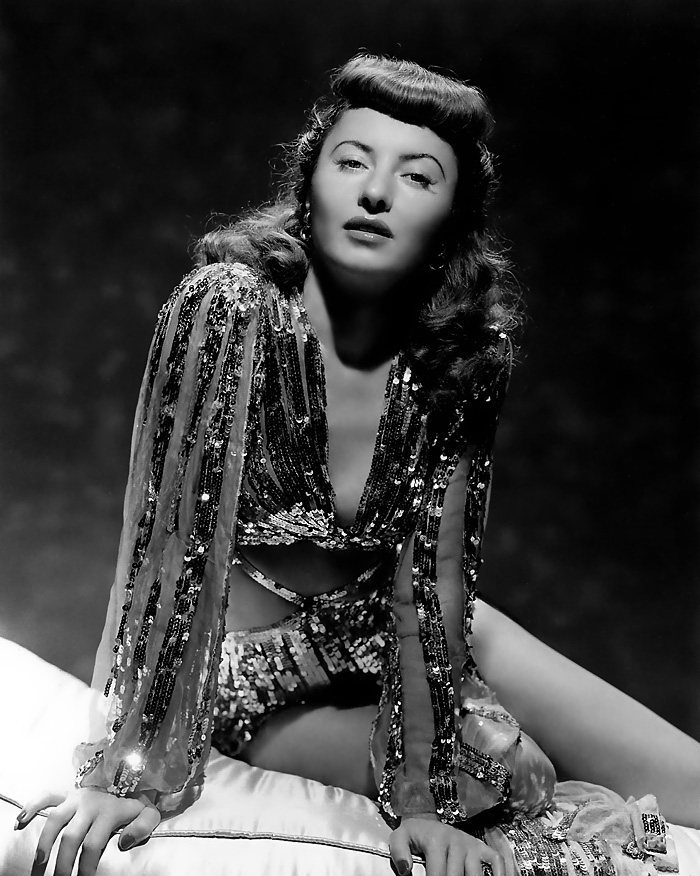
As far as I'm concerned, she has no equal. To this day.
Happy 100th birthday.
More Barbara Stanwyck centennial posts:
Centennial Tribute: Barbara Stanwyck
GreenCine Daily: Barbara Stanwyck at 100
5 for the day: Barbara Stanwyck
Barbara Stanwyck: The professional's professional
The Shamus: And starring Miss Stanwyck (I love how he writes "she was a marvel at moxie". Totally!)
Oh, and of course - this not-to-be-missed extravaganza by Anthony Lane in The New Yorker (they've embedded a clip from Ball of Fire, too!! Not the "buttermilk" one, but still!)
June 25, 2007
Dean Stockwell listening
Part 2. Last post for today. Ah, but tomorrow ... who knows what tomorrow will bring??
The wrenching last 2 scenes of Long Day's Journey - between Jamie and Edmund ... and then the scene that ends the play, involving the whole tragic family. It's his face as he takes it all in. And this is nasty stuff, relentless stuff - cruel things are said that can never be unsaid. Edmund, with all of his dissipation - his drinking, his whoring, and also his consumption, is the rock of the family. The steady one. And yet he is completely unstable on some level - all he does is absorb, absorb everybody else's pain. Not to mention the fact that on some deep and utterly true level, everybody blames him for what happened to Mary Tyrone. Which basically means, that they blame him for being born. He knows it, everybody knows it ... yet can such a thing be said? There are stories of Eugene O'Neill locking himself into his study for 10 hours a day, when he was writing Long Day's Journey. His wife said he would emerge, at the end of the day, eyes puffed out of his head from crying all day long. He would write and cry. That was his process the entire time of writing the play. He was wrenching something out of his soul, and pouring it onto the paper, with his heart, pain, grief, loss ... Edmund is the Eugene O'Neill persona in the play. The watcher, the absorber ... the one who might, just might, if he survives, be able to make art out of all that tragedy. At a huge cost, of course, but what else are you gonna do.
Anyway. Back to the beautiful intense listening face of Dean Stockwell.
LISTENING


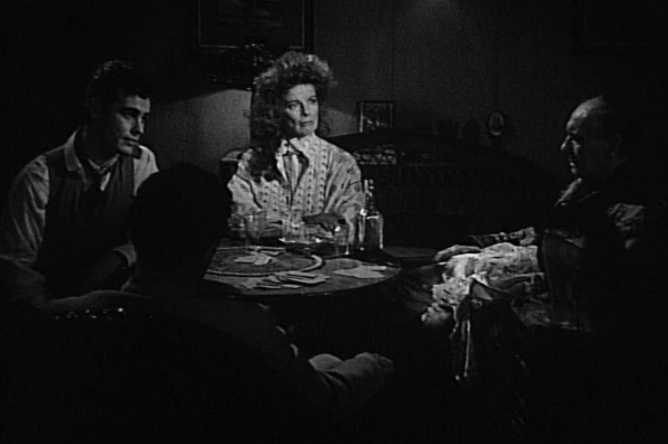
Dean Stockwell: because I can't leave well enough alone
All indented excerpts from David Thomson's film encyclopedia:
With the TV series Quantum Leap and with his regular work as a supporting actor in movies, Dean Stockwell may never have been better known. Yet he has experienced so many stages and changes already - the piercing child; the beautiful yet not quite penetrating young lead; the wanderer, hippie, and biker; the realtor in New Mexico; and now, for a decade at least, the versatile, reliable, yet never quite predictable character actor who seems blessed to play men brushed by the wing of uncommon experience - as if they might once have had green hair.
The child who was once the center of films has become a man content to be an outcast or an eccentric.

He is the son of actor Harry Stockwell, and the older brother of Guy Stockwell, and he was a steady movie child at Metro by the age of nine.
He was away from the screen for several years and came back as a twenty-year-old: Gun for a Coward (56, Abner Biberman); The Careless Years (57, Arthur Hiller); with Bradford Dillman as Leopold and Loeb in Compulsion (59, Richard Fleischer); as the young DH Lawrence in Sons and Lovers (60, Jack Cardiff); and worthy of the exceptional cast as Eugene O'Neill's alter ego in Long Day's Journey Into Night (62, Sidney Lumet).
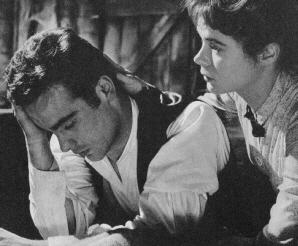
Again, he stopped, and within a few years he was an available actor for a strange assortment of sixties dreams and delusions.
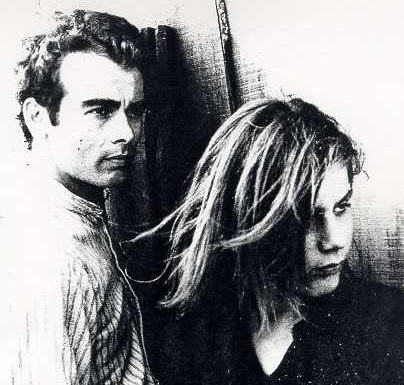
Then in 1984, he had a real part in the forlorn Dune (David Lynch) and unexpected attention as the decent, steady brother in Paris, Texas (84, Wim Wenders). That picture did well enough in America to begin to ease away his freaky reputation. He was back to the mainstream.
He was in The Legend of Billie Jean (85, Matthew Robbins); To Live and Die in LA (85, William Friedkin); uncanny, terrifying, and wonderful in the best scenes from Blue Velvet (86, David Lynch); Gardens of Stone (87, Francis Ford Coppola); Beverly Hills Cop 2 (87, Tony Scott); Buying Time (88, Mitchell Gabourie); delicious as Howard Hughes in Tucker (88, Coppola); broad and funny as a camp don in Married to the Mob (88, Jonathan Demme) - he was nominated for the supporting actor Oscar.
Note from Sheila: I guess it's one of those moments where I realized that I have seen most of his movies - and loved him in all of them ... but I'm just appreciating him on a deeper level. His talent, to be sure, but also the trajectory of his career, and how he has handled it.
Dean Stockwell listening
I've always been a fan of Dean Stockwell. Think the first time I really encountered him was in Married to the Mob. Let's face it, I have a bit of a crush. He reminds me a bit of someone. But recently I saw Long Day's Journey into Night again - and had forgotten how good he was. I mean, then you see him when he's a little kid - in something like Gentleman's Agreement and as far as I'm concerned he steals that movie. And he's, what, 8?? He's got a gift. Long Day's Journey is a four-way tour de force, exhausting to watch (which is appropriate - no other way to do that play) ... but he ... as Edmund - the consumptive alcoholic son ... What really struck me this last time watching it was Dean Stockwell's LISTENING. My God - he sits there, and sometimes it seems like he doesn't have a lot to do - but that's totally wrong. Acting isn't about the number of lines you have. It never is. So his work in this movie is a master class for actors. Watch him - watch him react. He is so ALIVE. At all times. Acting is all about listening. But it's a rare gift (in acting, and in life - how many truly good listeners do you know? Not many, I'll bet). John Wayne always said that he didn't consider his job to be an "actor" - he said the better job description was "REactor". And here is Dean Stockwell, surrounded by towering giants ... but all I could look at was him. Watching him listening, thinking. I mean, he is also just so damn photogenic. His face is made for the camera. But the thing about it is: some faces are just beautiful, beautiful to look at. His certainly is. But there's more to it than that. It's that the camera picks up his every thought, we see inside. This, as we all know, rarely happens - even with very good actors. If he thinks it, we get it. It's riveting. I mean, all the actors are riveting in the movie - but this last time was all about him.
LISTENING
June 4, 2007
Rosalind Russell Tribute
Everything you need to know right here. Great post - go read it!!! And then come back here for some book excerpts.
Some quotes from Rosalind Russell's wonderful autobiography (I highly recommend it - it's a great read, she was quite funny in real life as well). Example:
I was born in a house on Chestnut Avenue, and when I was four years old I ran away from home. Or at least I walked away, and found myself clear down on the Green, in the center of Waterbury's business section. A neighbor who saw me there, swinging on a hitching post, stopped short and cried, "Rosalind, what are you doing here?""My name is not Rosalind," I said. "I'm from out of town."
Four-year-old traveling fibbers don't get too far (the neighbor went straight to my mother and told her where I was), but the episode hints at my future theatrical bent.
And here are some quotes on His Girl Friday:

Hawks was a terrific director; he encouraged us and let us go. Once he told Cary, "Next time give her a bigger shove onto the couch," and Cary said, "Well, I don't want to kill the woman," and Hawks thought about that for a second. Then he said, "Try killin' 'er."And once Cary looked straight out of a scene and said to Hawks (about something I was trying), "Is she going to do that?" and Hawks left the moment in the picture -- Cary's right there on film, asking an unseen director about my plans.
Ha - I love that moment. Cary turning to Hawks and saying, "Is she going to do that?"
Another excerpt:
A good director also knows when not to direct. Nobody ever tried to direct Gable. They let Gable be Gable. I don't mean that he wouldn't take direction, but when he walked in with the gun and the uniform, and he'd just been over the top, what more could anybody do about that? Gable was the same sitting on the sidelines as he was when he got up and played the scene, and nobody wanted him to be anything else. People like Gable, Wayne, they're personalities, and a personality is an asset, you don't destroy it or mess with it.Cary Grant was different; he wasn't just a personality, he could immediately go off into a spin and become any character that was called for. He was terrific to work with because he's a true comic, in the sense that comedy is in the mind, the brain, the cortex ...
Grant loved to ad lib. He'd be standing there, leaning over, practically parallel to the ground, eyes flashing, extemporizing as he went, but he was in with another ad-libber. I enjoyed working that way too. So in His Girl Friday we went wild, overlapped our dialogue, waited for no man. And Hawks got a big kick out of it.
Then I started worrying that all this noisiness and newsroom high spirits might seem too chaotic to a watcher, and one night after we were finished I again went to Hawks. "I'm afraid," I said, "that audiences won't follow us."
"You're forgetting the scene you're gonna play with the criminal," Hawks said. "It's gonna be so quiet, so silent. You'll just whisper to him, you'll whisper, 'Did you kill that guy?' and your whispering will change the rhythm. But when we're with Grant, we don't change it. You just rivet in on him all the time."
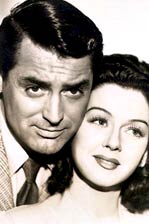
I love stuff like that.

Here's Russell on William Powell - this made me laugh:
He was not only dear, he was cool. If an actor thought he could get any place by having tantrums, watching Bill Powell would have altered his opinion. I remember a story conference during which he objected to a scene that he felt wasn't right for him. He was at once imperious and lucid. "It's beyond my histrionic ability to do this," he said. I thought that was delicious.
Here's a great excerpt, showing her smarts as an actress, her intellect:
Talent is wonderful, but I've played with actors who have more talent than I, and you can't hear them in the fourth row, they just don't have the energy, nothing in the belly, nothing in the guts that brings it all out and sells it across the orchestra pit and into the twenty-third row.In Boston with Clivey's troupe -- I couldn't do it at Saranac, I didn't have the time -- I used to sit on the stage apron and watch every rehearsal I wasn't involved in. I'd be thinking, Why can't he get a laugh on that? It's a funny line -- and taking the thing apart in my head to see why it wasn't working. Half the pleasure of doing comedy in the theatre is that even before you hear a laugh, you sense where the laugh should be. Something happens in the audience, you feel it, you go to work on it. Until one day, all of a sudden, you're rewarded with a titter. You keep working on the line and finally you get a real belly laugh. After that you generally push too hard and lose it, and you have to pull away and inch your way back.
Here's an excerpt from the introduction to her book written by her husband. Rosalind Russell was responsible for launching the career of James Galanos, designer. Here is an unbelievably moving story, told by Freddie Brisson (Russell's husband) about the special relationship between Russell and Galanos:
In 1960, after she had the first mastectomy, Rosalind went to Galanos. He says it was the only time he ever saw her break down. She had come to his office, very crisp, very businesslike. "I'm going to tell you something nobody in the world knows except Freddie and my doctor. I've had my breast removed, and I want to keep it quiet. So long as I can be active, I don't want to be thought a freak, I don't want people looking at me in person or on the screen and wondering about my sex life." (You have to consider the era. Women had not yet begun to go public about their mastectomies.)"I want you to start thinking in terms of how I can now be dressed," Rosalind said to Jimmy, and then she began to take her clothes off. She started to cry, and he saw that she could hardly lift her left arm, it was so swollen, and he broke down too. From that day forward, he specially designed every piece of her clothing, and neither he nor his fitter ever told a soul.
Another excerpt from the introduction, by her husband:
After she died I found a petition she had tucked away in her prayer book. It said in part, "Keep my mind free from the recital of endless details; give me wings to get to the point. Seal my lips on aches and pains. They are increasing, and love of rehearsing them is becoming sweeter as the years go by."
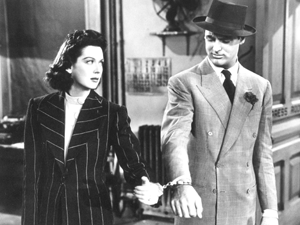
And again, here's the link to the tribute. GREAT stuff.
May 26, 2007
Happy birthday, John Wayne!
Or should I say ... happy birthday Marion Robert Morrison?
Uhm, no, let's stick with John Wayne. Smart move changing your name there, bub.
First of all: go here. Keep scrolling. Terrific photos - I was riveted.
David Thomson - in his massive film encyclopedia - devotes almost three pages to John Wayne. Here are some excerpts. The excerpts go in order (I don't quote the entire entry - just pulled out things I really liked) ... but I placed them in order so you can get a sense of the scope of this amazing guy's journey as an actor.
David Thomson:
As a child he moved West and, after a football scholarship at the University of Southern California, Tom Mix got him a job at Fox. There he met John Ford and worked as a set decorator on Mother Machree (28). Gradually he edged into acting, by the storybook means of being a bystander. His first big part was in The Big Trail (30, Raoul Walsh). Walsh had seen him carrying a big armchair above his head - carrying it witih flair and flourish.
David Thomson:
Throughout the 1930s Wayne was a star of matinee Westerns, sometimes a singing cowboy, working his way round most of the smaller studios and making something like a hundred films. By 1939 he was with Republic when John Ford asked him to be the Ringo Kid in Stagecoach. The success of that film lifted Wayne from regular work to stardom. Republic pulled themselves together for a major vehicle for him - Dark Command (40, Walsh) - and Ford called on him again to play a seaman in The Long Voyage Home (40).
David Thomson:
Even at that stage [the late 30s, early 40s], Wayne had this virtue denied to Ford's "stock company": he did not ham. Universal put him opposite Dietrich in Seven Sinners (40, Tay Garnett) and Republic lowered its sights to more Westerns. For the next few years he made fodder at his home studio and more adventurous work outside, much of which only exposed his monotonous fierceness: Reap the Wild Wind (42, Cecil B. De Mille); The Spoilers (42, Ray Enright); Flying Tigers (42, David Miller); with Joan Crawford in Jules Dassin's crazy Reunion in France (42); and The Fighting Seabees (44, Edward Ludwig). In 1945, he was in Back to Bataan (Edward Dmytryk), Flame of the Barbary Coast (Joseph Kane), and was overshadowed by Robert Montgomery in They Were Expendable (Ford). He was bizarrely paired with Claudette Colbert in a comedy, Without Reservations (46, Mervyn Le Roy), but Rebublic still pushed straight Westerns at him.
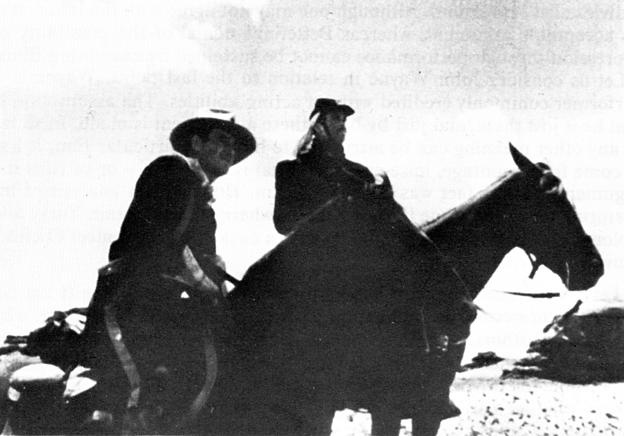
David Thomson:
Then came two films that radically enlarged his image: Fort Apache (48, Ford), in which he played a cavalry captain, and Red River (48, Howard Hawks). Not least of his achievements as a guide to players is the way Hawks was the first to see the slit-eyed obdurate side to Wayne's character. Tom Dunson is a fine character study: a man made hard by an early mistake and by the emphasis on achievement with which he tried to conceal that mistake. With Ford again, Wayne was one of Three Godfathers (48), a truly awful movie. But in 1949, he was Captain Nathan Brittles at the point of retirement in She Wore a Yellow Ribbon (Ford), and in 1950 the trilogy was completed withthe leisurely Rio Grande (Ford). Asked to be older, a husband and a father, Wayne became human and touching.
David Thomson:
Next, however, came The Searchers (56, Ford), one of his finest films - once more a study of an unapproachable stubborn man, finally excluded from the family reunion as a romantic but lonely figure facing the landscape. He coasted with The Wings of Eagles (57, Ford), Legend of the Lost (57, Hathaway), and The Barbarian and the Geisha (58, John Huston), before making Rio Bravo (59, Hawks). Once more, Hawks enlarged Wayne by concentrating on an alcoholic Dean Martin and having Wayne watch him "like a friend". It worked - as did the application of Angie Dickinson's talkative emotional crises to Wayne's solidity - so that Rio Bravo is not just Wayne's most humane picture but the one that makes him most comic.
David Thomson:
His death moved nearly everyone, as had his brave walk down the Academy staircase, two months before death, to give the best picture Oscar to ... The Deer Hunter (that'll be the day, indeed.)He made too many pictures, of course; but only because for so long he was a guarantee of profit.
David Thomson:
But what a star, what a presence, and what a wealth of reserve he brought to that bold presence. (So you wonder if he couldn't have played comedy.)Nor has he dated. All one can say is that he filled the screen role of a necessarily difficult man as naturally as most actors wore clothes. There was an age when people could be stars without undue grandeur or self-mockery. Whether Wayne is looking at the land that may make a great ranch, or turning in a doorway to survey his true home, the desert, every gesture was authentic and a prized disclosure. He moved the way singers sing, with huge confidence and daring. You have to imagine how it all began in the way Raoul Walsh saw him carrying that armchair - as if it was a young girl in a red robe being lifted up in mercy and wonder.
Happy birthday, Duke. And thanks!
Great tribute to him here. (Really illuminating quote from Henry Hathaway starts it all off.)
And if you haven't been reading The Shamus' posts on the Duke then I don't know what to say for you.
Two last pictures. Just cause, you know ... YUM!
May 25, 2007
Bang Bang You're Dead
Holden's death scene in "Sunset Boulevard"
All in one take. I love it because it's the best kind of make-believe acting. The kind of acting that little kids do so brilliantly when they're playing and making up games. The kind of belief in the imaginary circumstances that so many adult actors have to WORK to remember how to do. It's the "Bang bang you're dead" school of acting. Because it's in one take - Holden has to be shot three times - stagger forward - turn back - turn the other way - be shot one last time and fall face first into the pool. One take. That takes not only acting chops - and make-believe chops (you know, not to be embarrassed or self-conscious about the "bang bang you're dead" energy of the thing) ... but also athletic chops.
Watch that scene again when you have the chance. Watch Holden's swan dive into that pool. Watch the lead-up to that last moment. And notice the unbroken take. It's just gorgeous - really FUN movie-making. I mean, yes, a man is being murdered, so it's not fun for HIM ... but that kind of take is almost unheard of nowadays - what with the love affair with closeups, and cutaways, and CGI effects ... One long take of an actor being shot multiple times, twirling this way, that, before plunging himself into the pool is old-fashioned film-making. Great great stuff.
Billy Wilder said to Cameron Crowe, about Holden: "Holden was very good. Physically, he was first-class."
Holden comes out onto the lawn - followed by Norma with her gun - he is shot in the back the first time. It stops him in his tracks - his back kind of arches, his head goes back ...
Then he plunges forward - wounded - dropping his suitcase ...
She shoots him again - from the side - he takes the hit ...
Out of control now, staggering away from her - turning back to see his attacker -
Disoriented, wounded - he flails about - flailing for the dropped suitcase ...
Which is when she shoots him for the final time. The death blow. His swoon is practically balletic. Fearless. Throwing himself off to the side and over the edge.
Bang Bang You're Dead of the highest order.
May 21, 2007
In honor of the Duke:
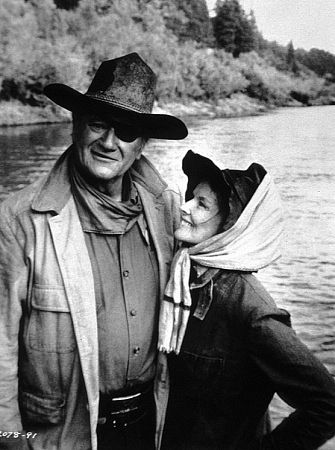
Some excerpts from Kate Hepburn's autobiography Me:
He is so tall a tree that the sun must shine on him whatever the tangle in the jungle below.From head to toe he is all of a piece. Big head. Wide blue eyes. Sandy hair. Rugged skin - lined by living and fun and character. Not by just rotting away. A nose not too big, not too small. Good teeth. A face alive with humor. Good humor I should say, and a sharp wit. Dangerous when roused. His shoulders are broad - very. His chest massive - very. When I leaned against him (which I did as often as possible, I must confess - I am reduced to such innoncent pleasures), thrilling. It was like leaning against a great tree. His hands so big. Mine, which are big too, seemed to disappear. Good legs. No seat. A real man's body.
And the base of this incredible creation. A pair of small sensitive feet. Carrying his huge frame as though it were a feather. Light of tread. Springy. Dancing. Pretty feet.
Very observing. Very aware. Listens. Concentrates. Witty slant. Ready to laugh. To be laughed at. To answer. To stick his neck out. Funny. Outrageous. Spoiled. Self-indulgent. Tough. Full of charm. Knows it. Uses it. Disregards it. With an alarming accuracy. Not much gets past him.
He was always on time. Always knew the scene. Always full of notions about what should be done. Tough on a director who had not done his homework. Considerate to his fellow actors. Very impatient with anyone who was inefficient. And did not bother to cover it up.
More:
Life has dealt Wayne some severe blows. He can take them. He has shown it. He doesn't lack self-discipline. He dares to walk by himself. Run. Dance. Skip. Walk. Crawl through life. He has done it all. Don't pity me, please.And with all this he has a most gentle and respectful gratitude toward people who he feels have contributed very firmly to his success. His admirers. He is meticulous in answering fan mail. Realistic in allowing the press to come on the set. Uncomplicated in his reaction to praise and admiration. Delighted to be the recipient of this or that award - reward. A simple man. None of that complicated Self-Self-Self which seems to torment myself and others who shall be nameless when they are confronted with the Prize for good performance. I often wonder whether we behave so ungraciously because we really think that we should have been given a prize for every performance. And are therefore sort of sore to begin wtih. Well, as I began - he is a simple and decent man. Considerate to the people who rush him in a sort of wild enthusiasm. Simple in his enjoyment of his own success. Like Bogie. He really appreciates the praise heaped upon him. A wonderful childlike, naive open spirit.
And lastly:
As an actor, he has an extraordinary gift. A unique naturalness. Developed by movie actors who just happen to become actors. Gary Cooper had it. An unselfconsciousness. An ability to think and feel. Seeming to woo the camera. A very subtle capacity to think and express and caress the camera - the audience. With no apparent effort. A secret between them. Through the years these real movie actors seem to develop a technique similar to that of a well-trained actor from the theatre. They seem to arrive at the same point from an entirely different beginning. One must unlearn - the other learns. A total reality of performance. So that the audience does not feel that they are watching. But feel a real part of what is going on. The acting does not appear acting. Wayne has a wonderful gift of natural speed. Of arrested motion. Of going suddenly off on a new tack. Try something totally unrehearsed with him. He takes the ball and runs and throws with a freedom and wit and gaiety which is great fun. As powerful as is his personality, so too is his acting capacity powerful. He is a very very good actor in the most highbrow sense of the word. You don't catch him at it.When you buy a cotton shirt - you want to get a cotton shirt. Not nylon. It stays clean, but it makes you sweat. Not drip-dry, which you don't have to press but you should. Just cotton. Good simple long-lasting cotton. No synthetics. That's what you get when you get John Wayne.
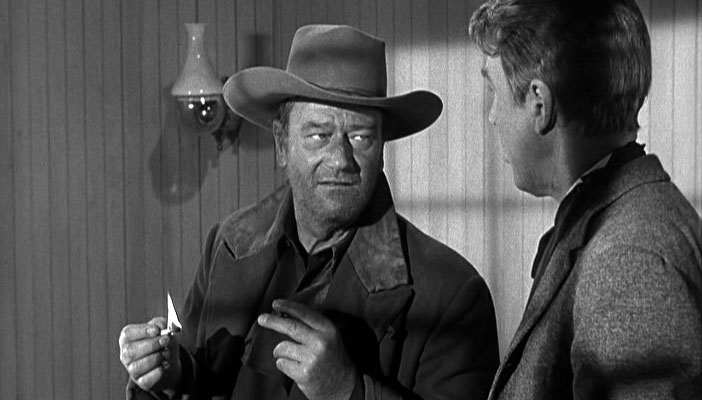
May 14, 2007
Celluloid and the Actor
Micheál MacLíammóir co-founder of The Gate Theatre in Dublin, has recently become of great interest to me - through my reading of Simon Callow's marvelous (yes - MARVELOUS) multi-part biography of Orson Welles. I haven't written much about it yet because I am devouring it at the speed of light (alongside of Arabian Nights, yes, I'm nuts). But in the meantime - MacLíammóir also sparked my fancy - what a character, what an artist - just amazing. Here's some background on MacLíammóir (naturally, my dad is a wealth of information about this gentleman - who gave Welles his start in the theatre). And look at this absolutely incredible photo I found - of Eartha Kitt, MacLíammóir and Orson Welles from 1950:
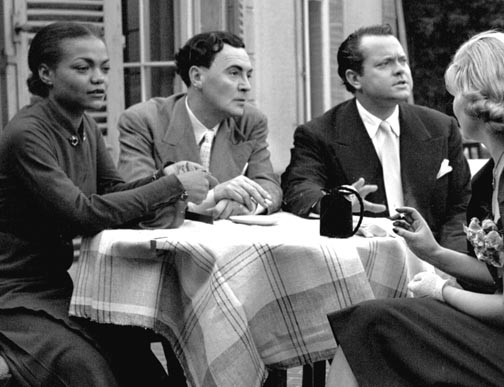
God, just so beautiful!! MacLíammóir seems to me to be an example of true integrity as an artist. I need to know more.
Anyway - my dad has just received in the mail a bunch of issues of a short-lived Irish literature magazine called "Envoy" - all from 1950 - and MacLíammóir has a long essay in one of them called "Celluloid and the Actor". This is a comparative study - of the art of the stage actor and the art of the movie actor. WONDERFUL observations - I particularly liked the bit about how audiences in the theatre expect strict probability from the plots - this dates back to Aristotle and verisimilitude and all that - but are more prone to forgive the larger-than-life quality of acting, due to the medium of live theatre. Whereas the total opposite is true of cinematic audiences. They are willing to swallow the most improbable plots imaginable - but any whiff of over-acting is enough to sink the entire operation.
Lots of great observations here ... and this is just the tip of the iceberg, in terms of my research into MacLíammóir. He wrote a couple of autobiographies - my dad has a copy of one, and I have ordered the other.
Anyway - taking a risk with the copyright gods - I have copied out his essay "Celluloid and the Actor" below ... figuring that it is better to make it available to an Internet audience - however briefly - than let it suffer in the obscurity of an old literature mag.
Wonderful stuff - Alex, Mitchell, David, Kate - all my actor friends - you guys will love this!
Micheál MacLíammóir
Celluloid and the Actor, a Note on a First Experiement
Envoy,
Jan. 1950
1.
The art of the film belongs primarily to the director, and to those learned and secretive shadows who surround him: the cameraman, the cutter, and a hundred and one technicians whose activities, though constantly referred to under varying titles, remain to the neophyte anonymous and remote.
That curious phenomenon, part magic, part simian exuberance that we may as well agree to call the art of acting emerges in the presence of the camera and its attendants as a quality only half understood. He whose life work it is, had realised always perhaps that it was composed of divers subtle elements, this queer, yet commonplace talent he possessed of making other people laugh or cry to the tune of a poet's words or of his own often vulgar fancy. He had realised that it was a power at once liquid and inexorable, malleable and merciless, that could gush forth, could flow and laugh and trickle and thunder and whisper, could soothe, seduce, overwhelm, submerge, destroy; that it could reflect an image, deceive an army, or occupy a thousand shapes; that it could cleanse or breed or quence or spawn or rot: that it was, in short, a fluid. Yet not until he faces the lens can he have understood that this fluid is also an essence so potent that to use it in more than the smallest distillations, the most minutely measured drops, would be to shatter the design of the master mind, which is embodied in the director, and to set the most uncritical of audiences on a roar at the wrong moment.
The actor, in short, should understand that he relinquishes, as he signs his contract and steps upont he floor, his never too-firmly established claim to be an artist in the sense of a master of a creative work, of an entire and complete composition. That task, however important he may become as a star, is left in other hands, who begin their work by skilfully stripping from him, stitch by stitch, the raiments of the craft he had laboriously pieced together in the living theatre, leaving him naked (and it may be exceedingly ashamed) to face his personality in the raw, which alone, he is informed with perfect friendliness and courtesy, is of the slightest use to him or to anyone else.
This is a lesson of grat value, if the poor devil can stand the drafts that blow so briskly around his shivering ego, as unaccustomed to exposure on the public gaze as the body of a monk; for on the stage he had learned, not to strip naked, but to assume at will what was in the main a series of disguises, to acquire a trunk frull of ingenious and sometimes beautiful costumes: a trick of expression, a movement with the shoulders or the hands, an ability to lift a scene with the rhythm of his voice, to colour a whole consecutive hour with a parade of beauty, or strength or grotesqueness donned at will; to take, in short, the action of the play at the moment of performance into his own hands, if his skill and the part he portrays allow it, and himself to work out his destiny.
All this he must forget when he passes into the studio; it is less than useless to him or to the astounding conglomeration of intellectyual simplicity and technical complication that goes to make up the work in hand; it is a hindrance. He will indeed do well to recall the statement, now so accepted as a truth that it has become a platitiude, that babies and dogs make the best film-actors, and become for the time being something that hovers between baby and dog, while retaining, if he can, qualities of a passionate belief in the moment, a singleness of thought, and a concentration of emotion not necessarily shared by these unspoilt children of nature.
Acting, as he had understood the word, ceases to exist for him or takes upon itself a new meaning. I am not sure that the art of the screen-player - and those who have seen, let us say, Raimu, or Garbo, or Laughton, or Chaplin, will agree that it can be an art - should not find for itself a separate name, as the arts of sculpture and painting which are akin and yet essentially different have separate names. Film-acting has not, and I feel it can never have, that essential content of the art of the stage actor, which in common with all the arts that have down to us from the past, is of the nature of architecture: the individual working-out of a design on a given theme, the selection of material and treatment for its realisation, the slow or rapid building of its consecutive structure. Here is where what we have hittherto understood as the artist shows himself also essentially as the master: at the moment of performance he guides, however previously moulded by his director, his own destiny to success or to failure. The screen-actor has no such responsibility, being a tool in the hands primarily of those unseen powers that have made his features, his limbs, and the life that flows through them, and secondarily in the masterful imagination and will of the artist, the true artist, who, even through the split-up moments of his ultimate appearance on the screen, moulds and directs those features, those limbs, and that life.
2.
He has no such responsibliities as the stage-actor and yet, in spite of the ubiquitous models of the baby and the dog, he must be possessed, if not of more intelligence, at least of a more vivid and visible power of thought.
"You are acting it, not thinking it," is the most contsant correction in the ears of those more skilled in the art of the stage than of the screen, and as he is not in fact either baby or dog, however much he may despairingly wish he were, neither milk-bottle nor mutton-bone may be dangled before his eyes to m ake them brighter withi desire; neither turnip-headed bogey-man nor hissing, bristling cat can be provided (out of the range of the camera) to contract his face with fear or fury; he must imagine these things as the stage-actor must, often without even the visible presence of the cause of his reaction, for frequently a scene that appears on the screen as consecutive action between any two characters will be made in sections that demand the presence of only one actor at a time, the other being free to smoke his cigarette and enjoy his weekend where he chooses (which is, as a rule, as far from the scene of action as possible). The player is compelled in such cases to imagine even the face of friend or enemy as well as the emotions it calls forth. So the victim of the celluloid must imagine it all - imagine with a deeper, less formal, and far more minute understanding than is demanded from the glamorous distance lent by stall or gallery, for the black unwinking eye of the camera reads all his thoughts and reproduces them, not, as is often supposed, with complete truth, but with all the merciless insistence on his poorer qualities that would do credit to a disapproving member of his own family. And, having imagined, he must do little more. Above all he must not project his imaginings: to do so is to offend the highly developed trades-union instinct of the camera, whose work it is to project everything itself. Nor must the old-fashioned advice simply of being natural, either at long distance or in close-up, be listened to by any but those who have never been within a hundred miles of the living theatre. The natural manner of the stage actor (I refer to him outside his working hours) appears to the layman almost invariably well over life-size: his daily training makes him express rather than repress his passions, emotions, and prejudcies; his ideas, as will be readily understood, are generally limited though none the less vigorously proclaimed; his features are mobile, his voice booms, his eyes flash a hundred communications, many of them trifling but all most vital, his eyebrows are seldom at rest, and the slight modification of these characteristics in the modern player is due almost entirely to his traffic with the world of celluloid or, in English speaking countries, to his morbid desire to pass himself off as a gentleman in good society. All this is fatal when he works for, or rather under, the camera which demands not the natural but the sub-natural; a repose that lies somewhere between that of the Sphinx and of the ideal English butler will suffice with the aid of that black, unwinking eye and the merest shadow of a thought, to appear on the screen as the embodiment of desire, hope, lechery, faith, agony, trust, ambition, despair, resignation, duplicity, revenge or what you will. A contraction of the nostrils, a twitch of the eybrows, and all is ruined, as all may be ruined by an extra ounch of superfluous flesh or one additional tone to the voice. Much of his time will therefore be spent in a casting aside of all his most treasured histrionic possessions, a process that must be careful rather than ruthless, for if he goes too far in this direction he becomes one of those myriad, mechanical shadows for the creation of which Hollywood and other centres have become so justly infamous, and passes rapidly into the ranks of well-favoured nondescripts that form the background to the average popular film. If, when he is thus physically stripped to the bone, purified, groomed and decarbonised almost beyond recognition, there is still enough individual interest left in him to work with, he will in all likelihood make a success.
3.
His is the problem of the tightrope, the agonising nicety of balance between the obedient puppet necessary to the director's will, and the scientifically poised and intuitive intelligence that can interpret the process of thought and emotion to an enormous and international public which, perhaps by very reason of its lack of aesthetic education, is all the more shrewd at distinguishing between an authentic and a synthetic form of behaviour. The audiences of the theatre and of the cinema, it seems to me, differ most profoundly on this point: that whereas the former will be critically fastidious about the probability of a dramatic situation, rejecting as absurd some machine-made twist in plot or narrative or dialogue, they will readily accept as a traditional inevitability these very qualities in the mannerisms of an actor, whom they allow to boom or gush, to overplay or underplay to his heart's content, so long as he is possessed of the skill to disguise these weaknesses beneath the trappings of verve and personality, the opposite is true of the film audience. These, it is well known, crowd nightly to the cinemas of Europe and America in order to devour with eyes and ears stories that would barely deceive a centenarian, let alone a sensible child of seven, yet they in their turn will reject as unconvincing the faintest divergence from normal behaviour (usually behaviour of the phlegmatic Anglo-Saxon school, too, so famous for understatement) in the portrayal of some personal reaction. One false movement, one slight exaggeration, one slip of the tongue, one relapse into heroics, and a buzz of antipathy goes round the audience, an uneasy stir, a titter of frozen laughter. And that actor is dead for the night, and, it may well be, for many nights to come.
I do not mean by this that more is demanded of the film than of the stage actor. Less is demanded in the matter of style and of those qualities that separate a work of art from the life it seeks to express: more is demanded in power to imitate exactly the surface of that life, and never for a moment to step beyond the bounds of its most commonplace manifestation. Less is demanded in the matter of the cration by the actor of a mood to be sustained by him and his fellows for a considerable length of time; more is demanded of his ability to leap with superhuman suddenness and an apparently complete sincerity into the heart of a scene, the beginnings of which were probably completed some weeks or months previously and since dropped, and, with a single line, led up to by nothing but hours of waiting in an overheated studio or wind-swept exterior, persuad himself and the world that he loves a woman, hates a man, is hungry, cold, furious, or weary unto death; the latter sentiment being, it is unnecessary to state, by far the easiest to express with any conviction. This need for instantaneous potency is unlike that expected from the prize-fighter, whose eyes and muscles are trained in the primeval art of expecting the unexpected, the first instinct of human survival, developed in the ring to a technical formula. No such fundamental impulse of nature lurks in the brain-cells of him who is invited to say (for no reason in the world that he can gauge or anyone else tell him but that it is part of that scene where he, Jack, threatens Don Juan, before setting fire to the hacienda, surely he remembers?), "And now, my Dago friend, get out of here before I ..."; just that and no more.
The following excerpt, like the dialogue, is imaginary, but the situation is literal and accurate. The tim eis 10.45 a.m., the actors, honest Jack and Conchita the Spitfire, ahving breakfasted on orange-juice at six, have been on the set (dressed and made-up) since seven, and now, with a promptitude quite unusual under the circumstances, all is ready. The take - for that one pithy and athletic line comprises the take - has been rehearsed to a smoothly running accompaniment of encouragement and invective from the director about a dozen times, the technicians, crew, continuity girls, and the rest form an attentive and critical semi-circle, the make-up man dabs the sweat gently from the noses of Jack and Conchita, already eyeing each other with mingled pity and animostiy, the hairdresser gives a last nerve-racking tweak or so to their locks; Don Juan (for he is not in the shot) lolls in a distant chair and regards himself in a mirror, the crew takes on itself the intense yet slightly incredulous air of an Irish football crowd, Conchita slips at an angle of several degrees and numbing discomfort into Jack's arms, Jack toes the chalk-marks previously marked out for him, both artists screw their faces about like paper bags, blink several times, moisten their lips, avoid each other's gaze,a nd lower their quivering eyelids, as a weary and wiry little man like a retired fly-weight darts forward and thrusts between their features and the camera a black-board furnished with some numbers, a handle and a clapper. The numbers are yelled out, the clappter provides a nerve-shattering demonstration, the director's voice intones the word of doom. "Action," he says, and the scene is shot. This involves, as well as Jack's advice to Don Juan, a neat piece of business with a gun, a shifting from one of the hero's arms to the other of the heroine, some complicated footwork on the part of both of them, and also a retreating movement of the camera until the joyful word "Cut" is heard, and the thing is done, though not yet finished. In the first shot the gun goes wrong, in the second Jack fails to hit his marks, in the third Conchita's right shoulder is hitched too high and masks the hero's well-known features at the beginning of his speech, in the fourth a reflector gets loose and causes the light to quiver, in the fifth Conchita glances down at the floor to find her marks, "what a naughty girl I am, and I'd no idea I was doing it."
The morning went on. The director's voice, so full of bright, hard, matinal decision at rehearsal slowly takes on the moribund and caressing tones of him who begins to understand the terror of eternity; it grows fat, flat and soothing like the voice of an experienced nurse with a peevish and incurable patient who hasn't the remotest chance of dying for years.
"Much better that time, much the best so far for the artist; it was spoilt by the dolly wobbling like bloody hell." And with relief and rapture, for he knows that to bully either Jack or Conchita at this crucial moment will reduce them to even lower depths of incompetency than they have hitherto plumbed, he vents his real feelings on the crew. They, of course, are used to this and take it like men, with silence if not with strength. The fifteenth shot is ruined by a flyl settling on Conchita's nose; the twenty-fifth is good all round, "but let's try one more for luck," so its excellence is soon forgotten in a series of unprecedented disasters that follow one another with nightmare agility. The thirty-fifth shot is mechanically perfect but marred, it seems, by Jack's performance having, quite inexplicably, become a trifle unreal.
"Dear old boy you're going to be so impatient with me but it didn't mean a damn thing. I mean it wasn't true, it wasn't alive, I just didn't believe it: that's all."
Jack listens to this little speech (delivered without the flicker of an eyelid by the director) with an expression so genuinely exhausted as to allow one to expect the obvious retort, and says, in a bright voice, what about trying it again? This suggestion is accepted more in sorrow than in anger, both make-ups, now at the clogged stage, are attended to, and the scene goes on ... and it goes on and it goes on.
When at length a shot is made that is worthy of preservation, camera angles and lighting are readjusted, a matter sometimes of hours, and the scene favouring Conchita instead of Jack is retaken, necessitating much the same process; then for a third time the thing is repeated in order to reveal to a world-wide public the reactions to Jack's unflinching eloquence on the sinister features of Don Juan.
4.
It will be seen by this scarcely exaggerated description of a simple moment in a simple scene (probably, when all is done, to be expurgated by the cutter, to say nothing of its fate in the hands of censors of varying local and moral scruples) that the screen-player's path is no easy one, and that the obstacles with which it is strewn are not all connected with the art of acting. There are indeed moments when the actor feels that in playing for the films he undergoes a combination of experiences that combine: a severe Training for the Commandos, a Lesson in Gymnastic Precision, a Turkish Bath, an Ocular Test, an Essay in the Virtue of Patience and Obedience, and an interminable Session at the Photographers. Few shots in a film have longer endurance in their completed condition than a minute, hardly any, I think, longer than four and a half, which is less than the time that the average stage artist requires to get to grips with his scene; the most convincing moments are often achieved by a lucky chance, such as a stumble on a slippery groundl or by a deep-laid plot on the part of the director, such as an unexpected blow on the face which not unnaturally produces a surprise so genuine that the highest art could hardly improve upon; and these accidents, shifts and stratagems are a commonplace in the studios. Yet there are lessons for the actor to learn when he faces the lens as well as those of fortitude and tricky technicalities, and, strangely enough, in this atmosphere of synthetic aids and augmentations, the greatest of these I think is the study of the inner life, of the depths of the mind, of the birth of thought and passion, of the ego's function; not merely of formalised representation of its results, wherein lies the actor's great danger. For what is that false quality we all "staginess" but a forgetfulness of the roots of the tree of human life, and a reducing of the flowers and fruits to a conventional design that grows with ease into mere mannerism? What in the theatre we call a "ham" is in reality no more than one who has learned the outside of his craft merely, which is the exposition of the passions, and who has discarded, or maybe never understood, the fountain of passion itself, so that his portrayals of men and women grow into caricatures which even when they have style and skill are so lacking in understanding, in life, in truth, that they become ludicrous. To save the theatre from this degeneration is a work no ingenuity of the writer, or designer, no magnificience in light, colour or pageantry can achieve: it is a work for the actor who is the medium, and the director who controls him, and nowhere can this work be more rapidly learned than under the camera's eye. That this should be so, that the emotions of the human system should be more accessible to the student, in a setting of mechnical chicanery than in the living theatre, seems a paradox. That it is so I am persuaded, as I am persuaded that the Muses, always at war with the times, are searching for a way back to simplicity through the mastery and the ultimate rejection of that elaborate technique which took five hundred years to perfect and is now for a spell in decay, partly beack to the recapture of the primitive world, and when I say this I am thinking of painting, and of Picasso, of Rouault, and of Miro. The Muses search with whatever means come their way, and science, in this century it has made its own, has thrust its most complicated ingenuities across their path. That the drama should have been so swift a Muse to flirt for a while with these perilous mechanisms is a link, it may be, with those mysteries that bind all the energies of aesthetic intellect and emotion to life and to the fates; for I believe that machinery may be seeking to destroy the world as it is already destroying what we have hitherto understood as the arts; and that, perhaps, is why the arts, in seeking to preserve themselves, are endeavouring to discover a means by which some armistice may be made with the enemy, that humanity may live in sheer simplicity side by side with its armed forces and yet not all be lost. And what is so in tune with the destruction of the ancient arts as the discovery of the movie? And what art is so instinctive, so childish, so unchangeably inconsequent as that of the actor; what more ingenuously human flower has ever grown on the bough of an ancient and impressive family tree?
April 18, 2007
In praise of Kurt Russell
Absolutely gorgeous post of acknowledgement of one of my favorite actors, Kurt Russell.
Jeremiah really "gets it", as far as I'm concerned ... Kurt Russell is, indeed, "dependable" - a word that has positive connotations, but can often mean you are truly under-rated as an actor.
Jeremiah writes about his performance in Escape from New York:
The reason Kurt Russell is so good at playing this kind of comic book hero is that he makes you recognize that he’s a real human being, with feelings and thoughts. That rouses one to cheer for him as he dives into the action; that’s what defines a true movie star
Yes, yes, yes.
And I LOVED his comments on Miracle - I wrote about Kurt Russell in Miracle here. You want to see a true movie star - an old-school movie star - at the top of his freakin' game? Being so dependable and making it look so easy that people barely notice ... people take him for granted? Watch Kurt Russell in Miracle. I would say watch Kurt Russell in anything.
Read the whole thing. That post made my morning (great comments to the post, too - for example one person writes: "I don't know if it marks me as some kind of lamentable douchebag, but I absolutely love Big Trouble in Little China." hahahahaha I'm a lamentable douchebag too, then.). I could talk about Kurt Russell all day.
March 30, 2007
Orson Welles
A montage of enormous photos. Awesome photos. I left them as huge as I found them because they just look so damn cool.
Orson montage 21
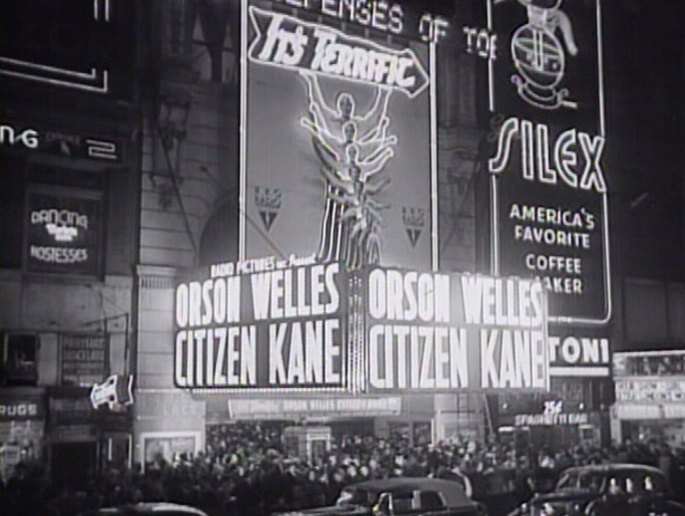
The opening of Citizen Kane (the delayed opening) at the Palace in NYC, owned by RKO - the studio who had produced the picture. It opened in the middle of the shitstorming blacklist from all sides - Hearst, the FBI, Louis Mayer, the theatre chains who feared being punished by Hearst, etc. The only reason it could play here was because RKO had bought it. It was theirs. But it never got wide distribution. Ever.
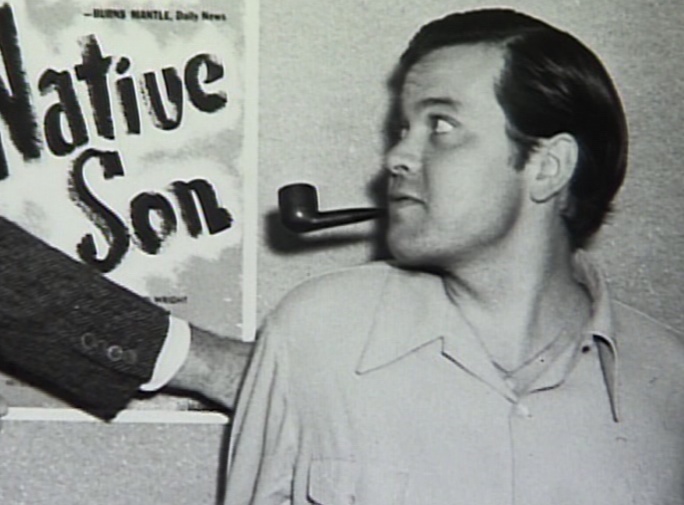
Orson montage 18
He's 24 years old here, getting into makeup for Citizen Kane. Extraordinary.
Orson montage 17
Orson broke his ankle while filming a scene in Citizen Kane - the one where he runs down the stairs after "Boss" Jim Gettys.

Orson montage 5
This is from his Mercury Theatre production of Julius Caesar - which is still generally considered to be the greatest Shakespeare production ever on an American stage. Where the FUCK is my time machine.
March 23, 2007
Orson in action
(I love the memory from when I was in high school - and Brett and I listened to War of the Worlds at a party at his house and pretending to be a couple in the 1920s who didn't know it was fake. It's QUITE a fun game, if you haven't played it already. Just pop that sucker in, and give over to it.)
March 13, 2007
Streep in "that scene" in Ironweed
I remember when that movie first came out - I hadn't seen it yet, but Mitchell had - and he said to me, "There is a reason why everybody is talking about that scene ... It was annoying to me, how much people were talking about how great it was ... until I saw it."
He's talking about the singing scene, of course.
And so - wow - I loved reading this post over on Lance's excellent blog that tells the story of that scene, told by William Kennedy himself.
March 9, 2007
On the waterfront
Last night, I was waiting for a cab in Hoboken. Freezing my BUTT off. Frigid wind whipping down 13th Street. I happened to be near the Hoboken Historical Museum - which has its entrance in a covered-over walkway between two buildings. There are arched entranceways - and when you stand on 13th Street and look through, you can see the glitter of the Empire State Building - hovering on the other side of the Hudson. The walkway provided a good break from the wind as I waited for my cab. Shivering. There are glassed-in cases in the walkway - with pictures of Hoboken in earlier days, the brownstones, the development, etc. I took some photos of ONE of the displays, as I shivered and stamped and blew on my quickly numbing digits. Not hard to imagine why I was drawn to THAT glass case as opposed to the others.

March 6, 2007
Frances Farmer
An absolutely brilliant 2-part post about Frances Farmer, one of Hollywood's sadder tales.
Part 1 is here. In this post the Siren addresses the myths about Frances Farmer - set in stone by the 1982 film Frances - while still applauding Jessica Lange's genius (in my opinion - her only genius) performance. I'm in general not crazy about Jessica Lange - I think she's rather self-conscious, self-pleased - and pretty much over-praised as an actress. But in Frances? Forgetaboutit. She blows the lid off. Lange was channeling something in that part, rather than acting. It's wrenching to watch. You yearn for her to die to end the pain. Much of it never happened, however - and the Siren goes into all of that.
Then she takes on the assignment to take a look at Frances Farmer's actual acting, which leads us to part 2.
Part 2 is a fantastic analysis of Come and Get It - really the only film that Frances Farmer is known for. The story behind the filming of this movie is quite well known (at least to any fans of Howard Hawks, William Wyler, or Samuel Goldwyn. It's a terrific story). I won't re-cap it - because Siren does an awesome job of it. What is also REALLY interesting (and yes, I've seen Come and Get it - is the Siren's analysis of the first part of the film (directed by Hawks before he was booted) as compared to the second half (directed by William Wyler). And also: her comments about the whole logging section are spot on. Fantastic footage - and yes, terrifying to this day, even in our era of CGI terrors. This is even more terrifying because there's no trick to it. It is REAL.
I also love her analysis of Farmer's acting, and her ease with the "Hawks woman" type part.
Anyway - AWESOME posts.
March 1, 2007
"Today he'd probably be arrested."
Groucho Marx to Roger Ebert, in 1972:
"I knew [W.C.] Fields well. He used to sit in the bushes in front of his house with a BB gun and shoot at people. Today he'd probably be arrested. He invited me over to his house. He had a girlfriend there. I think her name was Carlotta Monti. Car-lot-ta MON-ti! That's the kind of a name a girl of Fields would have. He had a ladder leading up to his attic. Without exaggeration, there was $50,000 in liquor up there. Crated up like a wharf. I'm standing there and Fields is standing there, and nobody says anything. The silence is oppressive. Finally he speaks: This will carry me 25 years."
I am strangely charmed by every single detail in that story.
February 25, 2007
In honor of the first Sunday of Lent
... here is my impression of Heaven.
Michael - I am dying to talk with you about Paradise Alley. Holy crap! His writing is what really struck me. It's almost pure Odets. Amazing. I realize that I am communicating with you through my blog which is strange and dysfunctional ... but whatevs. Paradise Alley!!!
January 29, 2007
Brando
Stanley Crouch analyzes him - I honestly don't know if I've ever read anything more insightful and thought-provoking about Brando, and what he really is doing. It's a very nuanced take. Here's part of the piece ... but most certainly read the whole thing.
Reflections in a Golden Eye (1967), like any superior film, benefits greatly from the DVD format and the revisions it makes possible. The inclusion of the experimental gold and sepia tone, which was removed from the print shortly after the film was released, allows the audience of our moment to see a film that most did not when it was available in theaters. We now have director John Huston's vision intact. We also have Brando in one of the boldest performances ever given by an actor on screen. What validates that last claim is the exemplary courage of Brando's egoless deep sea dive into his character, Maj. Penderton, whose desperate and arrogantly veiled pathos tellingly overflows twice. The character's central problem is his feeling of inadequacy, of being less that he should, and his terrible loneliness because of the difficulty of handling his attraction to men.Brando reaches a nearly matchless desolation in the first instance of overflowing when his attempt to secretly equal his wife's control of her stallion is thwarted by the horse's power, which he cannot meet with the necessary combination of confident ease and equally confident force. When the stallion smells his fear, it is spooked into running through blueberry bushes that tear the animal's flesh and cut the face of the rider. The humiliation felt by a man facing the terrible pain of his limitations is far more intimate than cutting embarrassment?Brando evokes a moment of horrifying pathos. One thinks of Olivier's well-remembered theater cry after Oedipus has plucked his eyes out, for which the actor used the image of a seal shrieking when its tongue is stuck to the ice until it's clubbed to death by hunters. In the case of Brando's Maj. Penderton, the feeling is banked neither by having a tantrum nor by brutalizing the stallion with a tree branch; the violent action only deepens his sorrow to such a degree that the failed horseman slowly descends into apologetic sobs that cannot be held down. If a more shattering moment is available on film, I would like to know what it is.
This is brilliant analysis. Detailed, incisive ... One of the problems with most commentary about acting is that there is absolutely no understanding of the degree of difficulty ... or the rarity of certain things.
I've said it before - but it would be like a sportswriter who has no idea why a triple play is important and doesn't give it its due, for degree of difficulty - or the sheer fact of how rare one is.
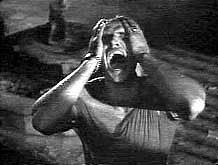
January 20, 2007
Rocky
I watched it again last night. My video store had it, thank GOD, because when I want something ... I really really want it. It suddenly got bitter cold last night, with whirling biting snow filling the night air - so I came home, made dinner, got in the ol PJs, the big furry slippers, curled up in bed under this fur blanket I have (that I adore) - and popped in Rocky. I was soooo excited. It's been years since I've seen it, I think! Years!
It was great, too, because the version I got was the 25th anniversary edition of it - with all these great special features, and a really nice interview with Stallone (current-day Stallone) - where he told these wonderful stories about how Rocky came about, what his life was like at that time, stories of the shooting of the film, a great story about Talia Shire's audition ... how poor he was at the time he wrote the Rocky script (and he wrote the bare bones of it in a 3 day period - it of course changed dramatically by the time it got to filming ... but the main script was done in a writing frenzy lasting a long weekend).
I'll write more about all of this because ... well ... I'm feeling an obsession coming on. It's been a while, hasn't it.
When I first saw Rocky - as a kid - I was ... I can't even find the words. The words would sound dumb. I was so young but I was absolutely gobsmacked. I didn't just watch the movie - I lived it - I wanted to BE Adrian - my heart just LOVED Rocky - the way he walked - that black silhouette against the gritty grimy streets - the way he tossed the ball up in the air as he walked - also his fingerless gloves - I loved those - I could feel the cold of that city, I could feel the cold of the dawn where he's running - when he punches the meat it felt like my hands hurt too - he made it so so real. I know I'm not alone in my response to that movie ... and the franchise has obviously made some mistakes - none of the sequels live up to that first one - but ... my response to that first movie was so strong, so ... elemental ... that I would never give up on it. A new Rocky's comin' out? I'm going. It's like a done deal. I'm not distanced from it. I don't maintain any objectivity. I LOVE those characters. And I fell in love with each and every one of them the first time I saw it - and I had to be ... 10 years old? 11? I mean, that's insanely young. But that was the beginning.
The Stallone interview is well worth seeing - if you haven't watched the film recently. He's so ... Okay, goofy word coming up but here goes: he's so sweet. There's something so sweet about him - if you've seen any candid interviews with him, where he's relaxed, you'll know what I'm talking about. He's big, with the deep voice, and he's huge, and his neck is a tree trunk - but there's also this sweetness there, a kind of self-deprecating self-awareness - that is just so appealing. There was something sweet about Rocky, even with the bluster and the rage and the tough-guy. That was part of the appeal. Part of the appeal?? That was the MAIN appeal. It's an archetype. A movie archetype. The tough guy with the tender underbelly that he can't show to anybody but the woman he is in love with. Bogart had that. Brando had that in On the Waterfront. Cagney had it. The movie "tough guys". Rocky (Stallone) is in that pantheon. I watched part of the movie last night with the commentary track on - Stallone doesn't participate in that - but the producers do (Irwin Winkler and Robert Chartoff) - and Chartoff said a cool thing. It was during the scene where Rocky pulls the 12 year old girl out of the bad group of kids on the corner and walks her home, lecturing her about not being a bad girl, because even though she's 12 - she could get a rep for bein a whore ("Guys'll think you're ... okay, I'm gonna use a bad word now, okay? Whore.") - this was a scene that the studio wanted to cut out, they didn't get what the point of it was (leave it to studio execs to just not have a goddamn clue!) - and of course the scene may not propel the PLOT along - but Rocky isn't only its plot. It's about this GUY. This character. If you looked at him and didn't know him - you might be afraid of him. He walks with a swagger. He seems huge and strong. He's all in black. He's got that scowly bull-doggy face. He's intimidating. But of course Stallone shows us the inner man ... and that scene is crucial to getting who Rocky is. And of course the scene ends perfectly. She doesn't say to him, "Thanks for the tip, Rocky - you're a good guy." She yells at him, "SCREW YOU, CREEPO." Rejected, Rocky walks off into the night. So Chartoff watching that moment - of Rocky walking away - this solitary figure - says, "There's something so ... interesting ... about seeing a big tough-guy ... who's scared, or alone. Movies don't often show that."
As a person who has dated some tough guys - I know the appeal of that sort of personality - with the discrepancy between who they are publicly (big tough guy) and who they are privately, with me (sweet gentle boyfriend). With certain guys, you just know that neither one of those aspects are poses. As in: He really IS a tough guy, and he really IS a sweet gentle boyfriend. Both things are true. They can exist at the same time. There are some tough guys who are just assholes, frankly, and can't ever let the tough-guy strong-man thing go. Some tough guys have such a contempt for weakness (or maybe it's a fear of it) that that contempt rubs off on all womankind. They hate women. But the ones who DON'T ... who don't see women as weak, but see women as the ones they can let down their guard with, and it'll be okay ... I know guys like that. Window-Boy was a guy like that. He didn't have to protect himself with me. But he also knew that when he was with all his buddies, and he was being a big tough guy (which was also a sincere part of his personality) - I wouldn't betray him. I wouldn't try to make him be the PRIVATE guy out in public. I know that there are two selves - public and private. And the ones who have different rules for who they are with their girls - than who they are with their buddies ... I feel safe with those types of guys. I feel looked out for. It's a weird thing - but it's all there in Rocky. He can be gentle with Adrian, he can be soft and kind. He doesn't ever try to bully her, or intimidate her. He knows he's dealing with a delicate person. He can make that adjustment in his behavior. It's a fascinating character study.
Okay, so a couple other things then I'll stop (for now).
Stallone was describing the apartment he lived in when he was broke (he had 106 bucks in the bank or something like that) - and where he wrote Rocky. He said the apartment was so small that there was no distractions. He said in the interview, "The apartment was so small that I was able to close the door - and open the window - while sitting on my bed." Ha. The image of that. So he lay in his little single bed, and scribbled out the script in 3 days.
One other thing that I just LOVED about the interview was his talking about how he constructed that last fight scene - and a couple of the different ways he had written it. Originally he had written it that - the fight ends - and Rocky is surrounded by people - and Adrian doesn't come running to him, she stands off at the edge of the stadium, watching, waiting. People start to disperse. The fight is over. The brou-haha is dying down. Rocky then, without a crowd around him, meets up with Adrian ... and the last shot of the film was the two of them, walking down a dingy hallway together, holding hands, towards the locker room. Stallone always said that he knew that the real heart to this story, the real key, was in that relationship. So that was the original ending - and as they went through filming, and as they got to the time to film that last scene (which took 3 days - Oh - the entire film was shot in 28 days. Think about that.) Okay - so anyway, as they got to that last fight scene - John Avildsen the director and Stallone both realized that that ending was not going to work. It was too quiet. It needed to end on the peak. On the peak of Rocky's experience. So they designed that ending sequence thinking of that. Rocky has lost. His eye is closed shut. He looks like hell. Mayhem around him. And all he can do is scream for Adrian to come to him. Cut to Adrian coming through the crowd - screaming HIS name. Of course they cannot hear each other - the noise is too loud. Stallone kind of laughed in the interview and said that they rigged Adrian's red fuzzy hat with a wire - so that it would be pulled off her head as she barged through the crowd.
And what is the first thing that Rocky says to her when she gets to him? Does he say, "I went the distance!" or "15 rounds!" or "I love you!"??
No. Rocky says, "Where's your hat?"
hahahahahaha Stallone, in the interview, started laughing too - this line was quite deliberate. It says EVERYthing about this beautiful character Rocky Balboa. Even with everything he has just been through, and his swollen eye ... the first thing he notices is that the fuzzy red hat is gone.
Stallone, in the interview, laughing, said, "He's just so into her ... and he just loves how she looks ... and it's all about where is your hat?"
A brilliant moment, I think. Brilliant because it seems so real. We say the weirdest things when we are having a peak experience. We notice weird things - your vision zooms in on certain details ... and Rocky just is in love with this weird little person, and loves it when she dresses up and puts on her little hats ... and so he stands there, staring at her out of his one good eye, and he wonders where her red hat went.
Perfect.
January 9, 2007
Close encounters

Last night I read, in one sitting, Spielberg, Truffaut & Me: An Actor's Diary - by Bob Balaban. Balaban, of course, was in Close Encounters - which was one of the largest films he had ever been in - they were filming it BEFORE Star Wars came out - so Balaban, without knowing it at the time, was part of the wave of the future. He was participating in it. So this was his backstage diary that he kept during the long LONG filming of this movie. There were times when I just threw back my head and howled with laughter. We all know how funny Bob Balaban is. I love him so much. It's one of the best making-of-a-movie book I've ever read (and believe me, I've read them all!) I'll post some excerpts. Some of the insights into Francois Truffaut were just wonderful - Balaban, of course, played Truffaut's partner so he spent most of his time hanging out with the great French director, who was really concerned about his English pronunciation, and worked on it really hard. Balaban speaks French so he would speak French with Truffaut - and in general, Truffaut sounds like a lovely lovely guy.
Any time there were kids around, Truffaut would gravitate towards them. He loved children, he loved them for their spontanaeity and how in the moment they always were. There's that one scene where Balaban and Truffaut talk to the army major - a cigar-chomping military man - and they hadn't had times to really learn their lines for the scene, and Truffaut was terrified of forgetting - so he taped his lines TO THE MAJOR'S CHEST. You can see Army Major kind of from the back, and he's talking to them - and they're talking back (anyone remember the scene?) And I just love the image of this big strapping dude having Francois Truffaut's lines TAPED TO HIS CHEST.
Many other great stories - especially about the little 6 year old girls who were hired to play all the extraterrestrials. They had all of these dance classes and training days - where they were taught to move like that - to glide around like that (with these huge heads put on them) - but, you know, they were still 6 year old girls - so there was much fooling around. At one point, during the shooting of that scene - one of the little girls, obviously annoyed with one of her fellow ETs, whipped off her rubber hand and started beating the ET next to her over the head with it. Spielberg, exhausted, calls: "CUT." hahaha Back to the beginning. Also, they had some issues because the 6 year old girls were apparently really into disco dancing (hahahaha) - remember it was 1976 during filming, 1977 - and so there were many times when the girls, getting slap-happy from the long hours, of having to stand around and wait, of having to wear these huge rubber heads and hands - would start to do the hustle. Sometimes when the cameras were rolling. Please imagine that scene - the glowing Mothership - the door opening - the gliding ETs appearing - and then suddenly ... it's like Saturday Night Fever and they start to do the hustle down the loading ramp. Again, Spielberg calls out, exhausted, "CUT! LET'S DO IT AGAIN."
Amazing insights into Spielberg as a director, too. I just fell in love with him.
December 13, 2006
Lew Ayres
I love this image. (I love that whole series he does over there ... the "collect 'em all" series.)
Lew Ayres. Except for film buffs and Dr. Kildare buffs and people who love old movies - Lew Ayres is pretty much forgotten by the culture at large (but look at the career. Look how long it is. Extraordinary). But he gave some marvelous performances - had a terrific career - I LOVE his performance as the dissipated brother in Holiday. He is always a tiny bit wasted in that movie, but ... there's a kindness there, a nonjudgmental quality - that makes him so lovable. He is a disappointment to his family, he is on the sauce at all times ... but still, he has an elegance that the others do not have. Also, it's just a very funny performance. I've seen that movie a bazillioin times, and there have been times when I will rewind one of the big group scenes so just so I can watch what Ayres is doing in the background, or when the focus is NOT on him. He's always alive, always funny ... It's great stuff.
November 20, 2006
Ingrid Bergman ...
... is the focus of this week's Monday Glamour Series.
I liked this part:
The 125,000 he got for her services in Casablanca translated to 35,000 for Bergman, plus a show she had little interest in making. The one she wanted was For Whom The Bell Tolls, itself the very definition of prestige filmmaking in literary-conscious Hollywood. Her campaign for that lead was relentless, as was Selznick’s, but Paramount was stubbornly committed to its own Vera Zorina. As an actress, she was a great ballet dancer, as star Gary Cooper and director Sam Wood discovered after a few unproductive weeks on location. Now Paramount was ready to do business with Selznick for Bergman (well, after all, Vera, for every winner, there’s got to be a loser). When Ingrid got the call on a Casablanca soundstage, she let out a whoop. Had she but known history’s ultimate verdict on these two. For Whom The Bell Tolls would sink beneath the weight of its tedium and over-length, while Casablanca would follow Bergman like grim death as the (perhaps only) one everybody asked about. Her love/hate relationship with Casablanca points up the irony of lives spent on celluloid. You do fifty, or even a hundred, and in the end, they all remember you for a single one. For Janet Leigh, it was Psycho. For Ingrid Bergman, Casablanca. Both must have grown sick of those broken records.
Bergman thought Casablanca was ridiculous - and Bogey did, too - and for the first week or so of shooting, the two of them would sit and commiserate about how miserable they were, and how chaotic it was (no script ending, etc.) - they thought they were in a dud. Bergman also said that nobody in their right mind would ever believe that she was supposed to be the most beautiful woman in the world. "I'm a milkmaid. I'm a big girl. I'm not what they say I am."
And then it's funny to see her in For Whom the Bell Tolls - which is a ridiculous film, especially if you've read the book - like: if you only watched the movie, you would think the entire Spanish Civil War was about blowing up one bridge. You also would have no idea WHY the bridge had to be blown up. Or what the hell was going on. They took all the politics out of it - and basically had Greek and Italian and, uhm, Swedish actors - playing Spanish peasants who ... for some reason .... wanted to blow up a bridge. Heh heh. Ridiculous. But still: EXTREMELY enjoyable because of the love story. The performances are all excellent - and I think Cooper and Bergman do have great chemistry.
Another funny story: Bergman and Cooper had an affair during the shooting of that film. Bergman has since said that it impacted her performance - that she was WAY too happy to be believable - her happiness offscreen bled into her acting - and she's playing a peasant girl who had been raped repeatedly and lost her entire family - and there she is mooning about Gary Cooper, literally GLOWING at him with happiness. (She sure does glow, doesn't she??) But anyway - Bergman and Cooper were both notorious for having affairs with their leading men/ladies ... and Bergman fell WILDLY in love with Cooper. But it only lasted for the duration of the shoot. Cooper said later, "Nobody has ever been as much in love with me as Ingrid Bergman was. But a week after we wrapped the movie, I couldn't even get her on the phone." hahaha
Bergman did NOT have an affair with Bogey, though - who, although he was a womanizer - was always monogamous with whatever wife he was with. The two of them were just partners in crime, trying to survive this horrible movie they were in together.
And it turned out to be Casablanca. I love that. You just never ever know. And you're not MEANT to know. Just do your work, show up, do the best you can ... and time will be the one that will decide, history will tell, the audience will choose ... it's not for you to know.
And I agree that she was denounced from the floor of the Senate not for her immorality - after all: where was the outrage about, oh, Mary Astor? Or Jean Harlow? Or Clara Bow? Or any of the other shenanigan-ridden stars? It was that they felt BETRAYED. Betrayed by her PERSONALLY. Ingrid Bergman was supposed to be wholesome. They believed in the fantasy. They counted on the fantasy and then felt totally betrayed by what they saw as her treacherous immorality. Well, that's THEIR problem for having believed in the fantasy created by her ACTING PARTS. Ridiculous.
Cary Grant was the only friend who stuck by her in those many years when she was exiled. He called her on occasion, just to see how she was doing ... and spoke out about her when asked. "She's a lovely woman, and I consider her a good friend." Full stop. End of story.
Good man. A class act.
And Bergman got her revenge. She's one of the immortals now. Nobody remembers the mental midgets who ran her out of town on a rail ... but everybody remembers Ingrid Bergman.
So go read the post. It's only Part 1 ... so check back for Part 2!
November 10, 2006
RIP, Jack Palance
Jack Palance has died. I'm sure others can be more eloquent about this well-loved and LONG successful actor (look at his IMDB page - especially look at the dates .. there isn't really a significant GAP like there are with many old actors, gaps that show that they couldn't get work for, oh, 10, 20 years ... No gap. Palance has always worked.) ... so I will just note his passing with sadness. I always liked having him around. Crotchety, old-school, talented, didn't make a big deal about it, but obviously gave a crap about his work.
Oh ... and a little bit crazy.
You know:
I love nuts like him.
He will be missed.
Update:
I knew I could count on Alex. She has written a beautiful and detailed tribute to the guy. Palance fans - you don't want to miss it.
A preliminary obit in The Times which kind of captures why I liked the guy.
November 6, 2006
Mary Astor
I love the "Monday Glamour" series on Greenbriar Pictures Show.
Today is Part 1 of a piece on Mary Astor, an actress I have always loved.
I loved this bit:
Mary Astor always conveyed a sense of having lived in the real world, as opposed to those who were just play-acting. When she came through the sound-stage door, she brought an aura of reality with her. A lot of that may have been the luck of a face that bespoke experience, or a manner that suggested past hopes ended in disappointment.
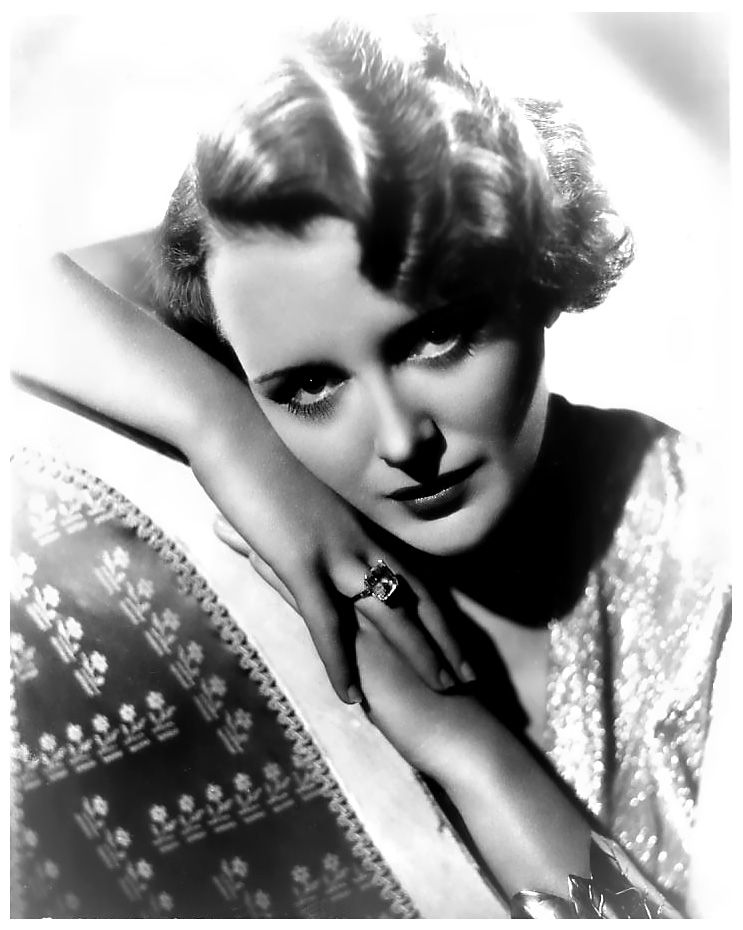
Yes. Yes.
Also (and this is not covered in the essay - although maybe it will be in Part 2) ... it's rather remarkable that the enormous scandal about her sex journal (chronicling her affair with George S. Kaufman) being found and published in the tabloids left her relatively unscathed. I mean - it was HUGE at the time, of course ... absolute shocker, if you go back and look at the headlines, it's obvious that that was all that the tabloids were discussing. It was a feeding frenzy. But she went on ... and it's so wonderful (and funny) to see her marvelous (yes, marvelous) performance in Meet Me in St. Louis and to know that she had once upon a time been held up as the Hester Prynne sex maniac of Hollywood, marriages ruined, words like "fuck" being printed in the newspaper - and it was in HER journal, not HIS - shocking!! A lady using words like that?? In her own private diary? How DARE she?? But after all that ... there she was in Meet Me in St. Louis, glorious hair up in a pompadour, voice mellifluous, part of a great ensemble, her acting is superb. She just IS that Victorian-era woman.
Survival. She's a great example of it.
She's the one who said this marvelous quote - which has been attributed to so many people that who the hell knows who actually said it - I've heard that Kim Stanley said it as well - but she may have been quoting Astor, who certainly had a long enough career to go through every phase:
Mary Astor said:
"There are five stages in the life of an actor: Who's Mary Astor? Get me Mary Astor. Get me a Mary Astor Type. Get me a young Mary Astor. Who's Mary Astor?"
Smart cookie, that one. Didn't have a smooth road ... but she survived.
October 31, 2006
Okay. This is genius.
Kate Winslet (one of my faves) and Hugh Jackman (I love him for Kate & Leopold and I don't care who knows) are in a new movie together called Flushed Away - and apparently - they arrived at the premiere in New York by sliding down this huge blown-up slide. The pictures are absolute genius - and I have been laughing out loud just looking at them. Here's my favorite one, below the jump. Look at how hard she is laughing. And him! They are HOWLING. It makes me laugh just to look at it!!

More in this series of photos here - they're all hysterical, as far as I'm concerned. (Open up the 4th one in the top row - and just get a load of both of their faces. HAHAHA) It made my morning to look at those pictures. The movie sounds kinda dumb - but I love those two - and I love their energy here.
October 7, 2006
Being okay with being a cliche
I have the hots for Dane Cook. This is so cliched of me - and I'm okay with that - because usually I am so far OFF from the cliche that I feel like a freak from the outer limits of the galaxy Zorax. Not only do I have the hots for Dane Cook (like: I can barely DEAL WITH HIM) - but I think he is absolutely hysterical. I want to EAT HIM UP. I love his looks - maybe it's the whole Boston sports fan guy thing - which is, basically, my whole family - there's something very familiar and comforting about that type for me - I GET it, it's humor I recognize and can click right into - and also - that he's such a goofball - and also (hi, I'm 12. "and also ... and also ...") he makes me LAUGH, man. I think his success is WELL deserved and I'm rooting for him. People seem to be all polarized about Dane Cook which I think is so funny - or interesting or ... baffling as well. People seem MAD about him. Weird. I think it's because of WHO he is, although that may just me reading stuff into it. Would they snark so much if he were a one-legged Inuit? Would they seem so RESENTFUL of him if he were half-Thai half-Samoan and half-albino? (Uhm, 3 halfs, Sheila?) Like - in a lot of the press I have read about him, I hear the resentful whining of people who were treated badly in high school by guys who LOOKED LIKE Dane Cook. "Guys like this have everything so easy ... " Like - they're still mad at the gorgeous high school quarterback from 20 years ago. And, uhm, that's not Dane Cook's fault. (Ha. I'm getting all defensive about Dane Cook. HAHAHAHA) It's not like success has come easily to him. It's not like this has been GIVEN to him. He has made this happen HIMSELF. And NOW, of course, he's getting a ton of help - but his original success? Was homegrown. HE did that. His ambition knows no bounds. He is type A in that regard.
But anyway. Really what I want to say is is that I think Dane Cook is also just freakin' SMOKIN'. I was telling David about it (we were having this huge hilarious conversation about Dane Cook and how funny we think he is) and David interrupted and said, "Is he on your bench?"
"Oh God. Totally on my bench."
Cliche. I'm fine with that.
October 3, 2006
Ellen von Unwerth
Why I love Ellen von Unwerth. Part 6.
Naomi Watts. I love that there's always a whiff of "backstage" in her photos. They're almost vaudevillian - as though they're pictures of Mae West back in her prime.
You can only have so many glamour shots. Or sexy shots. Naomi Watts is beautiful already - of course she is - but these photos set her up to not just seem beautiful but ... interesting. Whether or not she actually is interesting is completely irrelevant.
Ellen von Unwerth
Why I love Ellen von Unwerth. Part 5.
John Leguizamo. The entire series in this shoot is hilarious - I have it in one of her books. But here's just a taste.
As you can see - these are all highly staged. But for some reason - instead of seeming artificial, they seem to illuminate someone's inner self, on an almost archetypal level.
Ellen von Unwerth
Why I love Ellen von Unwerth. Part 4.
Catherine Deneuve. This, I would say, is a classic von Unwerth.
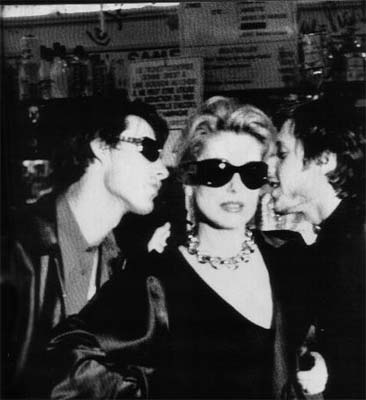
Ellen von Unwerth
Why I love Ellen von Unwerth. Part 3.
Drew Barrymore again. This one's kind of famous - it was a huge layout in Interview mag.
Now I do not know Drew Barrymore - except for my random encounter with her at 8 a.m. on the cobblestone streets of Soho - when we both ended up laughing hysterically at the same random thing ... but to me (and I love Drew): that photo captures her essence. To a tee.
Ellen von Unwerth
Why I love Ellen von Unwerth. Part 2
Drew Barrymore again. I just really like this one - just as a photo - it feels to just capture a moment, and yet there is her obvious teased glamorous wig, the blurry guy in the background ... It's also heightened - Ellen von Unwerth is DEFINITELY into the glamour. She's not into seeing celebrities "as they really are". She's a photographer of fantasies..
September 29, 2006
In praise of Jake Ryan
Speaking of crushes!
I give to you, first of all, a wee Jake Ryan montage (it's tough to leave out the hottie pictures of Schoeffling in Vision Quest - but this is about JAKE RYAN AND JAKE RYAN ONLY) - and then I give to you (to quote my dear friend Allison) a "veritable dissertation" on what Jake Ryan means to women of a certain age.


Jake Ryan. The hot high school guy who dumped his girlfriend (you know, the girlfriend who had sex with him, the girlfriend who had a perfect body, the girlfriend who was really sweet as well) - dumped her - to go out with the goofy unpopular nearly invisible high school sophomore. Yeah. Like that would ever happen.
But the fact that it did in 16 Candles was important. To a generation of women.
Please read this glorious essay. I laughed out loud reading it - but I also got strangely choked up at parts. Memories of hopeful days. For example:
The second way of talking through Jake-related issues is harder. It's about an ache, a loss. It's about the imperfection of life. In the movie, Ringwald's character muses on what a 16th birthday is supposed to be like: "A big Trans-Am in the driveway with a ribbon on it and some incredibly gorgeous guy you meet in France and you do it on a cloud without getting pregnant or herpes." In this way she is asking for a miracle and Jake is Christ, redeeming the evil sins of high school. Jake as the ideal. Jake as the eternal belief in something better. (Jake on the phone, leaving a message Samantha is temporarily fated not to receive: "Would it be possible for you to tell me if there is a Samantha Baker there, and if so, may I converse with her briefly?")
hahaha I love that moment.
The essay really is a wonderful deconstruction of that entire ... cultural moment. Too funny.
I loved this part too:
But Jake stands the test of time, even in his good looks. His wardrobe -- cargo pants, plaid shirt -- portends an Abercrombie vibe years before it came. His haircut requires only minor tweaking in a mental update of the fantasy. "He's timeless. He doesn't have a Flock of Seagulls hairstyle or anything," says Rick Sayre, 30, a bookstore employee in Miami who started a Web page devoted not only to the Jake Ryan ideal but to locating Schoeffling.
hahahaha Yes. He's kinda timeless.
I have to say - I did love Jake Ryan, and I loved what he represented. (Also, how perfect is it that Michael Schoeffling, the actor, chose to retire. He is now a furniture maker somewhere in Pennsylvania, with a couple kids. There are websites devoted to him: What happened to Michael Schoeffling? and The Search for Michael Schoeffling. It's perfect because we - the audience - didn't have to suffer through watching him fail, become diminished, grow old. He was our youth. He disappeared while his memory was still fresh - and he is caught that way, in my mind, forever. Jake Ryan - forever young.)
I also loved Michael Schoeffling - his general kind of wry and intelligent vibe. I totally believed that he was the kind of popular hot guy who was also nice and not cocky. It seemed real. But, to be honest, he wasn't really my type. Han Solo was my fantasy type, still is - even though Han probably NEVER would have dumped his hot girlfriend for goofy freckled me. Han would have given me an apologetic grin, growled, "Sorry, sweetheart", and he would have stuck with the hottie.
But ... but ...
the sexiness ...
the sexiness of Han Solo ...
It was a mere precursor to Bud White, 20 years later ... but it was all in the same vein. That devastating is-he-bad-or-is-he-good vein. Jake Ryan was awesome - but he wasn't THAT. Or who knows ... maybe he was. Maybe his ambivalence about his nice hot girlfriend, his ambivalence about his own wealth .... was also in the same vein. We all like people who are independent thinkers, who go their own route. Or hell. I can only speak for myself. I respond to independent thinkers, who make up their own mind about things. Jake was certainly that - and independence like that was devastatingly attractive when you are trapped in the conformist suffocation of high school.
Please, ladies - or please anyone - any of you who loved that movie, and who loved Jake Ryan in paritcular - who remembers what it feels like to latch on to a fictional character, as hope that things might work out someday, that sometimes the good people DO win ... you gotta read this. Beautiful.
September 25, 2006
The dullest man
Ava Gardner was asked, "So - who is the dullest man in Hollywood? Clark Gable or Gary Cooper?"
Ava thought a bit and then said, "Well, if you ask Clark 'How are you doing?' he's stuck for an answer."
hahahahaha
July 15, 2006
The weirdness of the actor's life
I woke up at 5 a.m. It was dark out. I got up. I showered. I dressed - it didn't matter what I wore, I just needed to be comfortable since I could be standing all day - so I just wore a tank top, my hippie embroidered pants that I love, and flip flops. It also didn't matter what I looked like (hard to imagine in this looks-based business) so I just put on a bit of mascara. It's always weird to put on makeup before the sun rises. It feels illicit. Like, frankly, you are up to NO GOOD.
I left the house, carrying my bookbag. That was all I needed. My notebook, my wallet, my Burts Bees lip stuff, my sunglasses, my iPod, my Rasputin book (for the ride home), and my scripts which had been emailed to me at 11 pm the night before. The dawn was just happening ... the hot of the day was still a couple hours in the future - the dawn was cool, dewy, infused with pink and lavendar. The Hudson glowed a dull silver to my right. The city looked quiet, slumbering.
The streets are empty that time of day, except for dog-walkers. I love the dawn.
I got onto a nearly empty bus and went into the city. I made my way to Penn Station. With 10 minutes to spare. Penn Station was packed with travelers, all of whom had also been up since 5 a.m.
Got on the 7 a.m. train to Philly. I had a huge Dunkin Donuts coffee, and my scripts to be studied on the train. I had a seat to myself so I spread out. I rehearsed, to myself - the lines I had just received the night before. It was 15 pages of text - so that gives you some idea of the weirdness of this life. I familiarized myself with each script. I made split-second decisions about how to read them. I had to be a formal narrator, I had to be a snooty English lady, I had to be my colloquial casual self, I had to be a storyteller. Okay. No problem. I can do all of that.
8:27. Disembarked at 30th Street Station in Philly. Brushed my teeth in the restroom there - thinking of poor little Lukas Haas hiding in the stall from Danny Glover. Had a moment with the massive angel as well. I love that train station.
Took a cab to the studio. Met the sound guys. Uhm - I love sound guys. In general. Haven't met a sound guy I don't like. They are always kind of scruffy, sweet, with black senses of humor. They are the low man on the totem pole, in this here biz - and yet nobody is more important than them. Every job I've ever done, I've bonded with the dude who holds the boom. Seriously. They are always cool people.
Then we got to work. We had a lot to do. I got to sit, so that was cool. There was the mike, and we were in this tiny enclosed quiet room on the 12th floor. We went script by script. So basically I spoke all day. Also, there's a ton of repetition. Sometimes you mess up a word or two, or you flub your lines. You have to go back and repeat. Or sometimes it's an equipment issue - and your take was perfect - but a plane flew by overhead, or the mike didn't work, or whatever. So it's all about repetition and being perfect every time. This is no big deal to me. I get into Concentration Mode, where - literally - a bomb could go off next door, and I would keep going with my script. One of the sound dudes said to me, admiringly, "You do it the same way every time. You don't get bored? I would be so bored. It takes practice to do what you do, huh?" So sweet. A lot of times the fact that concentration takes actual practice isn't - acknowledged. I don't need it to be acknowledged. I feel it's just a part of the job. Actors should be able to concentrate under all conditions. I prefer a quiet calm space to concentrate - but, if necessary, I can concentrate on a busy sidewalk surrounded by jackhammers. And yeah, that takes practice. So that was sweet that he said that.
Hours went by. I was snooty English lady. I did that one in one take. That was fun. I did all the scripts - we checked them off - one by one. NEXT.
It was a good day's work. I get lost in the work. I forget to think: "Uhm. I am in Philadelphia. On Walnut Street. In a random makeshift studio. With a mike and sound equipment. Reading these scripts. And uhm ... wait ... where am I right now??" It's all about the task at hand. I love that.
We were done at 2 p.m. Shook hands all around. They got what they needed. Which is all I care about. I came down, did what they needed, and now they can move on with their work. It's cool. It's cool to be able to do that, be part of a collaboration - even if it's just a small part of it. Oh, and let's not forget. It's nice to get a paycheck for all of this as well. That's the nicest part.
Then - grabbed a cab - back to 30th Street Station - walked in - got on the next train out, which was boarding at that very moment. I arrived in New York at 5 p.m. Having read a couple chapters of my awesome book about Rasputin on the ride home, my iPod blasting in my ears. (Liz Phair, if you're interested.)
Took a bus back across the river to my town. The sun was juuuuuust starting to go down. I came back into my apartment - and - naturally - it felt like I had been gone for way longer than a day. Felt like I had to check all of my plants for sign of impending DEATH. But no. I had been gone for 10 hours.
Sat down in my comfy chair, turned on my fan, put my feet up, had an icy cold beer, and read about Rasputin until it was time for bed.
Life is good. And weird!
June 29, 2006
Lana Turner Day
There are so many terrific posts to lose yourself in! (OH. Today is the Lana Turner Blog-a-thon - if you didn't know already.)
Definitely go check out all of these well-written insightful essays - I've been having a lot of fun reading them.
Here is Flickhead's post. I liked this part:
If the Postman delivered anything, it was Lana inconceivably cast as a roadhouse hash slinger (!), radiant in open-toed shoes, white blouse and shorts, her beautiful bare legs held in awe by the lens, and those vacant, faraway eyes framed by a turban. Indeed, her introductory shot in that picture stands among the supreme and least plausible of all Hollywood glamour images. The great riddle — what madman cast the warm and fuzzy Cecil Kellaway as the husband? — went unanswered, but no one really cared. Lana had, as they say, ‘arrived.’
Here is Greenbriar Picture Shows post (that site is my new addiction, by the way - thank you SO much Hank for the link!) Read the whole post, and make sure to check out the picture of the absolute MOB scene beneath the marquee with her name. It's a really interesting take on Lana, on how in her heyday - there was nobody bigger. And yet it's hard to see, now, what all the fuss was about. But it would be a huge mistake to just blow off that Lana Mania as "Well, they just didn't know what was good". No, no. Let's look at her in the context of her time.
One excerpt:
The ones who could tell us all about Lana Turner and what she meant to her once wildly enthusiastic fan base are a dwindling lot of world war veterans --- the men who served and worshipped Lana, and the women who crowded her movies stateside and lived vicariously through her romances, both onscreen and off. It’s easy for our generation to regard her as a studio manufactured joke, for we never experienced the anxieties that a star like Lana was there to alleviate. She was comfort food with a brief shelf life, but like strawberries fresh from the market, she had an intoxicating flavor that just can’t be experienced so many years after the initial purchase, and a movie like Marriage Is A Private Affair can give but the barest hint of what it must have been like to taste Lana in her prime. She would certainly make better pictures (The Postman Always Rings Twice, The Bad and The Beautiful, Imitation Of Life), but none that summon up her essential appeal like this one.
And I so agree with John (who wrote that) that her films are "fascinating time capsules" for those of us who love the movies. Go read his whole post, though - and definitely scroll around his unbelievable site. I am DROOLING over some of the images.
A beautiful articulate post by one of my favorite bloggers - the Self-Styled Siren. REALLY cool insights there about Lana's beauty - and how she used it, and knew she had to use it.
In The Postman Always Rings Twice, probably the peak of Lana's looks if not her talent, the power turns to desperation. See her clinging to John Garfield, throwing every bit of her allure at him like a spear. Can't he see, for God's sake? Lana knows, she knows she's never going to get more beautiful and she sure as hell isn't going to get any smarter. She has to get away from Cecil Kellaway (Flickhead is right, that casting was bizarre), and Garfield's feckless character is unfortunately the only way out. When what she wants is murder, even Lana has to put some muscle into it. The result is that Lana's scenes of persuasion with Garfield are not subtle, but they are entirely true to a woman actually having to work on a man for the first time, after years of having them roll over and play dead.
Wow. SO true. Go read the whole post.
Here is a post by The Evening Class. It makes me NEED to see Imitation of Life again, in order to watch that one moment.
Coffee, coffee, and more coffee does a post about The Sea Chase - a film I have not seen with John Wayne and Lana. Excerpt:
It may have been part of her contract, but Turner first appears wearing a fur coat. Later she is seen wearing some form fitting sweaters, a reminder of what made her a star in the first place. While the ship's crew gets grubbier as the film progresses, Turner remains her glamorous self no matter how primitive the conditions around her.
Heh heh. Those were the days.
Here's John Garfield and Lana in Postman. I have a postcard of this image on my fridge. There's just something about it.

Lana Turner died on this day, in 1995.
Her star has faded a bit - she is now seen as a symbol of other things - but I've got to believe that someone whose career lasted that long - (she may not have done a gazillion movies a year - but she worked steadily) had a hell of a lot of moxie, ambition, and ... maybe not smarts (uhm ... 7 husbands, Lana? Johnny Stomponato? Uhm ... Lana?) ... but survival skills. She started out as the "It Girl" because of how she looked in a sweater. "It Girls" are a dime a dozen. If you want to last beyond your big season of being the "It Girl", you need to have more going on than just looks, or luck. Will we ever have a Sienna Miller Blog-a-Thon day? Time will tell.
I am not saying I think Lana Turner is under-rated. I don't. I'm not saying she's an unsung Great Actress. But she has her damn fine moments - when she is used well - when a director "gets" her - and I celebrate that part of her. I really like watching her act. It's a bunch of hoo-hah, really - breathy sleepy-eyed hoo-hah - and a relic from another time - but that's part of why I like it.
June 26, 2006
Lana Turner ...
So this Thursday there's going to be a Lana Turner blog-a-thon (I love my new film-site friends) ... and That Little Round-Headed Boy has posted his piece early.
I love it - a great review of Somewhere I'll Find You a movie I have not seen, starring Clark Gable and Lana Turner.
I remember reading Detour when I was 14 years old. I had an after-school job in the local library and I read all KINDS of inappropriate stuff while working there. I didn't JUST read the Betsy-Tacy-Tib stories. I was also delving deep into salacious Hollywood biographies. I read Carroll Baker's detailed descriptions of quivering extra-marital sex with Ben Gazzara. I read stories of James Dean's bisexuality, and (on the flipside) his openness about his virginity. I read Shelley Winters' 2-volume autobiography which pretty much chats openly about every guy she screwed. (I love those books to this day.) I read the book about Edie Sedgwick - which - please. I had no business reading that. Drugs, sex, burning hotels, madness ... But I loved it all. Anyway, I had heard of Lana Turner by that point - just by osmosis - I had heard about how she was "discovered" and all that ... I had also read Lana Turner's autobiography - which you truly cannot do any better, if you are looking for salacious fascinating reading. She had a LOT to apologize for - I mean, good Lord, her daughter killed her gangster boyfriend! With a KNIFE!!!! Horrors. But anyway, her autobiography led me to Cheryl Crane's side of the story - which is actually a terrific book. I've read it since. It is a tell-all, it's horrible, it's a true crime book, whatever - but if you're interested in this stuff, and in what was going on psychologically in that house that led up to the 14 year old taking a knife and stabbing the slick gangster who was beating up her mother ... that's the book to read. It's horrible. But great!
I need to think up a post about Lana. Postman Always Rings Twice is, of course, a classic - that everyone's seen - but still. I think it's worth revisiting. And she's really good in it - the chemistry with Garfield is nearly unbearable - How they got all that past the censors is a mystery. It's almost uncomfortable to watch - and he is great.
There's also a campy side to the film which makes it even more enjoyable and also completely RIDICULOUS. Like: her first entrance is ludicrous - and yet when you see it, even though you want to laugh - you are also stunned dumb - just like John Garfield is. She's the wife of a country-diner owner? A small-town girl? A simple housewife?
And she's wearing a white turban and white short shorts?
Uhm ... Lana? What's goin' on?
It is so ridiculous and so AWESOME.
I look forward to reading everybody's posts.
But go read TLRHB's post. I need to check that film out.
I think I'll end with the poem by Frank O'Hara:
Poem
by Frank O'Hara
Lana Turner has collapsed!
I was trotting along and suddenly
it started raining and snowing
and you said it was hailing
but hailing hits you on the head
hard so it was really snowing and
raining and I was in such a hurry
to meet you but the traffic
was acting exactly like the sky
and suddenly I see a headline
LANA TURNER HAS COLLAPSED!
there is no snow in Hollywood
there is no rain in California
I have been to lots of parties
and acted perfectly disgraceful
but I never actually collapsed
oh Lana Turner we love you get up
June 3, 2006
I'm mad
Why am I mad? Because of Captain Jack? No, I've moved on now that I've gotten that off my chest.
I'm mad because I finally saw Batman Begins last night and I think it is truly a fanTASTIC film - on every level it needs to be fantastic - and I'm mad because Couchy McShortyCult and his Zombie Girlfriend completely hijacked the entire thing with their red carpet shenanigans and the movie missed the mark because of it. It got amazing reviews - and now I can see why - but I think because of Douschebag O'Xenu Christian Bale was ROBBED of his moment in the sun.
Because believe me: I think Christian Bale deserves a HUGE moment in the sun. I've thought that for a while - he's been working up to that for a long time - he's always been good - but this? He's maaaaaaarvelous. He carries the film. He is a true movie star. He's deep, he's complex, he's mysterious - I buy every single moment he has ... and because of the selfishness of Midget-Despot MacGlibby nobody talked about Christian Bale. There was no room for Christian Bale on that red carpet.
Even without seeing the film I sensed the unfairness of what was going on. But now that I have seen it, I can perceive with even more clarity that a great injustice has occurred.
I'm mad about that.
I'm mad because of the destructive cult and its evil glazed-eyed minions. Yes.
But now I'm REALLY mad because that was a really good movie ... and it kind of came and went because the brou-haha over the romance + turkey baster took over the airwaves.
Also - how interesting was it that the Zombie Girlfriend's character in the film had a whole disaster involving a "psychotropic" drug. It's bizarre, isn't it? Makes me wonder if TightJeans McProzac-Hater somehow knew about that plot point and honed in on her, in particular, to introduce to his turkey baster.
I'm mad.
It's a great film. And Christian Bale is amazing in it.
Boy got ROBBED.
May 19, 2006
Under-rated movies # 7
7. In a Lonely Place

Bogart's deepest and most pained performance. It's completely overlooked - or - not completely - People who are film-buffs know this movie, or Nicholas Ray buffs - Bogdonovich's essay about Bogart is why I sought this film out - Bogdonovich is unequivocally a fan of this performance. He references it as often as he can - it's so funny - I think he is really determined to get this film back into regular circulation.
You know how Bogart, even though he gets burnt by dames from time to time, seems to skate through situations with a slight grin - as though the disappointments of the world are not for him? No, no, not him - he'll never be hurt too bad - he's too much of a realist. Or if he DOES get hurt - he will handle it in a way that does not break him. He will still stand tall. He may have a secret hurt (oh, Ilse!!) - but he will go on. This is the romance of Bogart. This is why we don't just love Bogart, we admire him.
The Bogart we see in film after film would never have an existential crisis, a crisis of faith, a dark dark night of the soul. There are exceptions to this, of course - but the exceptions just prove the rule. Or he has SCENES within a film that show his capacity for emotion - to give depth to the character - but those moments where the character lets it all out are (heh heh) out-of-character. Like the scene in Casablanca comes to mind: where he sits with his bottle and goes back into the flashback ... Good moment - it's a lesson in how to act a close-up. I swear! But that's an out of character moment for Rick - it's a low moment, a drunken moment ... The overall impression of Rick is not that he's a broken man. Bogart doesn't do broken. The "strawberries" interrogation scene in Caine Mutiny is another exception - but that also just proves the rule - because that character is truly mad.
But something different is going on in In a Lonely Place - a film that has been largely ignored by the general public, as well as by Bogart fans - who seem to prefer his snarky detached stance. Maybe that Bogart stance makes them feel better about themselves. The hoards of guys out there who want to BE Bogart ... might feel rather uneasy watching him in In a Lonely Place - and mistake their own unease for Bogart giving a bad performance, if that makes sense. (By this I mean, they cannot adjust their own ideas of the actor in question - and so they write the performance off, out of hand ... because it's not what they "need" from the actor. I can think of many examples of this.) Now sometimes an actor's performance just sucks - but that is NOT the case with Bogart here - and this performance should take its place at the top of the list, when people reference great Bogart parts. But there's a fan-faction who need Bogart to be a certain way, because it validates certain things in them - the best things: honor, character, etc. - To see him as a bitter repressed sour-puss screenwriter, who cannot control himself - who is deeply unhappy, and also deeply repressed - who CAN'T do the right thing ... perhaps to the point of murder - where he's not just detached, but on the fringes of a breakdown ... well, that would make those guys in the audience maybe look at themSELVES in a different way. So they brush off the performance. "Ah, that's not REALLY Bogart." I don't blame these guys, by the way, for having this serious identification thing going on with Bogart ... it makes perfect sense. I only mind it if it means they will not accept him in this, his greatest part.
It's close to home. This is a film about Hollywood (Bogart didn't make many of those). And not only is it a film about Hollywood but it's about the lowest man on the totem pole: the writer. It's a biting and VERY angry look at the world of show business, very much ahead of its time. Hollywood has always been a navel-gazing place - there are tons of films about making films ... It's hard to do it well. In a Lonely Place is one of the best films made about "the business". (Others on the list would be: All About Eve, Sunset Boulevard - and I would also say King of Comedy. Scary movie about the underbelly of celebrity.)
Bogart's character ends up falling in love with Gloria ("I'm just a girl who cain't say no") Grahame - a woman with a wonderful mushy face, sharp alert eyes - and the two of them have some GREAT scenes together. This is a movie about and for grown-ups. These are two grown-ups drawn to each other. She's a smart woman, maybe a bit worn down by life. She gets by. But she has character. Bogart never did well with floozies - the pairings were never satisfying. Bogart did well with sassy smart ladies.
But watch how it goes downhill. As Bogart's life unravels in the film - he begins to cling to her tighter and tighter. She is no longer a woman with a wonderful mushy face and smart eyes. She is his salvation. His life preserver. He's desperate. She must not abandon him. She must not be allowed to abandon him. Things start to get ugly and a little bit creepy. She starts to get scared of him.
It's truly disorienting to watch this film the first time. You are so used to the Bogart persona, so you assume you know where it's all gonna go ... and then you realize ... slowly ... that things are NOT going that way ... that this guy is NOT a "winner" - he's scrabbling for a foothold, and he is slowly losing it. He's in agony. He begins to take it out on the people around him, the people he loves. You see him cutting himself loose from the actual salvation he needs.
To compare: Imagine a Rick in Casablanca who - instead of saying to Sam that dark night in the cafe - "If she can stand it, I can! Play the song!" - instead he jumps on Sam, slaps his face, holds him down, and strangles him until Sam agrees to play the song. Imagine a Rick who punches Ilse in the face.
This is the territory we are in in In a Lonely Place. And instead of it looking like a "character role", or like Bogart "acting" - I always get the sense that I am watching the part that is the closest to Bogart's actual self. It feels like the most personal work I've ever seen of his. It is a truly painful movie to watch. (And yet - I recommend it so so highly!)
To watch a movie star of his caliber mess with his own image so deliberately and so WELL is truly breathtaking. There's a moment in a restaurant when Bogart, in an impulsive moment of rage, reaches out and knocks his agent's glasses off his head. The first time I saw the film I had to rewind this moment 10 times. It's so violent - even though it's just a person's glasses. And it's not movie violence - which can have a tendency to seem rather planned out or stagy. It feels like real violence. You know how sometimes public outings can go suddenly very wrong? From out of nowhere? Like - you're doing fine, and suddenly you're having a fight with your spouse that is so intense that you can't back out of it ... That's what this moment is like. Something is revealed - such an intense betrayal - that Bogart's character cannot deal with it in a social way - and quick as a whip, reaches out and bangs his agents' glasses off his face.
This is a spontaneous moment. You really feel Bogart letting his own rage out. Rage at his own career. At not being taken seriously. At being trapped at a studio that did not respect him as it should. At working for NOTHING. He knew the salaries of Grant and Gable and Cooper. He knew he was being screwed. He was a big star ... but on some deep level, he was truly not liked, and he knew it. But this is all really personal stuff ... stuff of resentment, and shame, and buried humiliation. Stuff that Bogart never put into his roles. Why should he? His thing was detachment, backed up by strong moral character - a guy who would come through when you need him.
The reality was much MUCH darker - and it is in In a Lonely Place that Bogart explores it. So often when a great actor with an established style "explores" another angle - it's a disaster. This is a triumph. It's FASCINATING to watch Bogart - you literally do not know what he will do next.
I think fanatical Bogart fans didn't want their image of Bogart messed with - and so they ignored this film.
Their loss, man. It's their loss.
May 18, 2006
Under-rated movies: #6
6. Four Daughters
Here is another nearly-forgotten film (even though at the time it was nominated for Oscars left and right). It was directed by Hungarian-born Michael Curtiz, the man responsible, naturally, for such little-known art-house films as The Sea Wolf, Casablanca, Yankee Doodle Dandy, Mildred Pierce and The Adventures of Robin Hood. Four Daughters was done the same year as Robin Hood (1938), and was basically a vehicle for a new leading man named Jeffrey Lynn.
Unfortunately for Lynn, the smaller part of the outsider who barges into the family's neat little existence, was given to John Garfield from New York, in his film debut. Garfield is in the film for, maybe, half an hour, but he's all you can look at when he is on screen. When he's not in a scene, you keep wondering when he will show up again. He brings with him a sense of the unpredictable. He's dangerous. He's sexy. Jeffrey Lynn didn't stand a chance, even though he might have been a fine actor.
John Garfield is Marlon Brando 10 years before Marlon Brando. (He was actually the producer's first choice to play Stanley in Streetcar on Broadway.) He is the introduction of a new kind of acting, he is the introduction of the sexiness of the anti-hero .
I've got a real soft spot for John Garfield (Jules Garfinkle was his real name, his good friends all still called him "Jules-y".) It is so worth it to keep your eye open for this hard-to-find film, which isn't even on DVD. Keep your eye open for listings on TCM. The picture has a good story, and the 4 daughters of the title are wonderful and natural and funny, but Garfield is the reason to see it. He is a message from the future.
His style - his naturalistic style - even the way he smokes a cigarette - foreshadows Brando, Pacino, Duvall.
Steven Vineberg wrote a book about Method actors (Method Actors: Three Generations of an American Acting Style
Listen to Vineberg's description of Garfield:
But the particularly independent nature of the role (Mickey is an outsider, never truly integrated into the family) liberated Garfield. Unshaven, his eyes half-closed, his hair mussed, his hat battered and his tie loose, he makes such a striking first entrance that it's probably not an exaggeration to say he was a star by the end of the reel
His first entrance is all it would take to make the entire audience lean forward and go: "Who the hell is that?"
Vineberg goes on:
It's a theatrical entrance: He thrusts himself into the Lemps' living room, bums a cigarette from Felix, and starts right in on the wisecracks, disdaining everything in the Lemp household as "normal" and "domestic". What Garfield does is bring Odets's street-wise rebel, with his dark Semitic looks, into a small-town middle-class house full of Gentiles. Borden isn't written as Jewish, of course: Because of Hollywood's Jewish studio heads' obsession with assimilation (their terror of anti-Semitism), Garfield wans't allowed to play specifically Jewish characters until after the war. But in a sense he never played anything else, because he was always drawing so closely on himself. In this early performance, you can spot a slight staginess, a trace of theatrical self-consciosness, but he's got more dynamic presence and genuine banked energy than anyone else on screen, and his acting carries infinitely more wit and authority than that of his dimpled costafs. Four Daughters is a carefully cultivated Norman Rockwell fantasy, but Garfield is an emissary from the real world. It's only when he's on screen that we believe there's a Depression going on outside the Lemp household.
It's one of those completely forgotten moments of genius. I have heard people proclaim that Ed Norton's debut in Primal Fear was one of the most powerful debuts in cinema history. People who say that must have very short memories. Lauren Bacall in To Have and Have Not? Or Garfield in Four Daughters?
It is a star-making moment.
Vineberg says he "broods through the film like a ghetto Heathcliff." This type of acting has become not only so common now, but cliched to some degree, and it can be hard to realize how truly revolutionary Garfield was at the time.
The best thing about Four Daughters is that you can see the two acting styles up side by side. Nothing wrong with any of the daughters in the film; as a matter of fact, they are uniformly adorable, and they don't push, or over-act. But they're recognizable types. Garfield, by resisting labels entirely, takes all the focus, just by entering the room. He actually seems HUMAN.
More:
Garfield carries this stuff off by displaying a bright-eyed tough-hide sincerity (and he's most successful when he throws his lines away). In his scenes with Priscilla Lane he's a boy from the wrong side of the tracks, eager to make a good impression but not sure how to go about it. Ann tries to straighten Mickey out, to infect him with her wholesome optimism, but he stays resolutely bent. Even his manner of sitting on a couch -- his hip thrown sideways, his leg twisted -- has a renegade quality to it ...Garfield plays outsiders like Mickey Borden brilliantly - injured men with restless, brooding minds and a feeling of entrapment that amounts almost to paranoia. In fact, he rarely plays anything else. Mickey touches us most when he's standing apart from the other characters, watching the Lemp family hijinks around the Christmas tree; though they've tried to include him, he feels naturally left out.
Garfield's debut still seems fresh and dangerous to contemporary eyes.
More Under-rated Movies
1. Ball of Fire
3. Dogfight
4. Zero Effect
8. Searching for Bobby Fischer
12. Mr. Lucky
13. Eye of God
15. Kwik Stop
May 14, 2006
David Thomson: Madonna
As requested, here is Thomson's vicious essay on Madonna. Now I'm not as angry with Madonna - except for her whole Kabbalah nonsense - and I've always loved her music. I find her fake-British persona EXTREMELY ANNOYING. Nothin' worse than a phony. I liked her better when she was an ambitious tramp from Detroit. Also, her latest photo shoot in W magazine is amaaaaaaazing.
But you want vitriol? Here is Thomson on Madonna. Speaking of vitriol, this essay is NICE compared to what he wrote on Michael Eisner.
I think Thomson's point about Madonna's disappointment ... is really really intuitive. I don't think anyone has ever used that word to describe her before: "disappointed" - I mean, who would? She's a millionaire. But I really think he's onto something there.
Essay on Madonna:
Imagine that you are watching something that especially moves you - your two-year-old child eating profiteroles; Joe Montana moving down the field; dawn at the Canyonn de Chelly; or the close of Ugetsu Monogatari, whatever. Your communion with this spectacvle is suddenly ruptured by what we will call a commercial break. This is all the more disturbing in that you did not know that what you were watching (the medium) was subject to such intrusions. You did not know the technology was yet available to come between you and the entire air and sky at Canyon de Chelly. But "they" have managed it, and the ad zips up every horizon. In that disaster, the ad -- I suggeset -- should be the insolent, in-your-face "attitude" of Ms. Ciccone. There is no need for a product. There is nothing in Madonna to be advertise, except for her ironic, deflecting contempt. She is an ad for advertising; she is the famousness of celebrity; and a fit vehicle for an unusual kind of serial-killing movie - one in which photography poisons the world.
You know the argument: guns, for example, are helpless things that only serve those who use them - guns may dispose of would-be rapists and murderers; guns permit the animals that provide meat to be killed swiftly; guns allow the exercise and pleasure of hunting; and armaments manufacturers build schools and hospitals.
Similarly, moving images have been a field for the dreams of Ozu, Hawks, Ophuls, etc. Photography has brought into being Lartigue, Ansel Adams, etc. But in addition, movie and photography are advertising, fashion spreads, and Madonn and Truth or Dare.
There is no going back, and no way of not wondering whether somewhere along the way wrong paths have been taken. I am reminded of the image of Warren Beatty in Truth or Dare, in dark glasses, trying to edge away, trying to defy the camera with nothingness, and eventually marveling that anyone could suppose this Madonna has any life "off" camera. It is one of the great tragic images in modern film, not least because Mr. Beatty has evidently recognized the horrendous question, what is he doing there? And what are we doing watching?
Perhaps a case can be made for Madonna as singer and dancer. But as an actress, she is the person who got out of the empty car -- I speak as someone who saw her on stage in David Mamet's Speed-the-Plow (where it was possible to lose sight and thought of her even as she walked across stage). But she hardly needs talent, so great is her "artistic integrity," and there are those ready to call her satire and her indifference the most audacious strokes of Dada. She has her defenders, and I suspect she loathes them even more than she scorns her enemies. She is disappointed about something, and hugely driven by resentment.
She appeared in A Certain Sacrifice, Desperately Seeking Susan and Vision Quest. She did a song for At Close Range, and she appeared in Shanghai Surprise -- both of which involved Sean Penn, to whom, briefly, she was married. She appeared in Who's That Girl, Bloodhounds of Broadway, Dick Tracy, Shadows and Fog and -- seemingly furious that Sharon Stone has so effortlessly mocked and surpassed her in Basic Instinct - in Body of Evidence, as an actress in Dangerous Game.
The burden did not lighten: she made appearances in Blue in the Face, Four Rooms, Girl 6 - and then all the ads said she was Evita - no matter that she managed hardly any emotional involvement, and again seemed incapable of understanding the nature of acting. Still, nothing before had been as fatuous as The Next Best Thing. Since then - as you may have heard - she has had a child with her new husband, the English director Guy Ritchie. Cross your fingers for the babe and ignore her siblings - The Hire: Star. She and her husband did a remake of Swept Away - and it was, wherever it played.
May 13, 2006
David Thomson: Fred Astaire

Fred Astaire, Cyd Charisse "Silk Stockings"
"I have suggested that he could have been Jekyll to Cagney's Hyde. Astaire was also very near to Jay Gatsby, an insignificant man, bent on easing public occasions.
I was struck by this when taking some students through an extract from Silk Stockings (57, Rouben Mamoulian). The excerpt we were approaching was the sequence in which Astaire and Cyd Charisse dance across several deserted film sets. It is one of the greatest of movie-dance sequences: a compendium of moving camera, wide screen, counterpointed rhythms, and the intriguing contrast of masterful Astaire and frigid Charisse. But before the dancing begins, there is a prelude. Charisse arrives by car at the studio gates and Astaire, muttering, 'Hallo, hallo ...' hobbles over to meet her. That movement kept us from the dance, because it was exquisite, original, and Astaire. The emotion of the moment - of lovers reunited - hardly seems to strike him. But ask him to move from A to B, and he is aroused.
This touches on a vital principle: that it is often preferable to have a movie actor who moves well than one who "understands" the part. A director ought to be able to explain a part, but very few men or women can move well in front of a camera. In The Big Sleep, there are numerous shots of Bogart simply walking across rooms: they draw us to the resilient alertness of his screen personality as surely as the acid dialogue. Bogart's lounging freedom captures our hopes. With Astaire this effect is far more concentrated, because it is his single asset."
From David Thomson's The New Biographical Dictionary of Film : Expanded and Updated
Essay on Fred Astaire
David Thomson: George Arliss
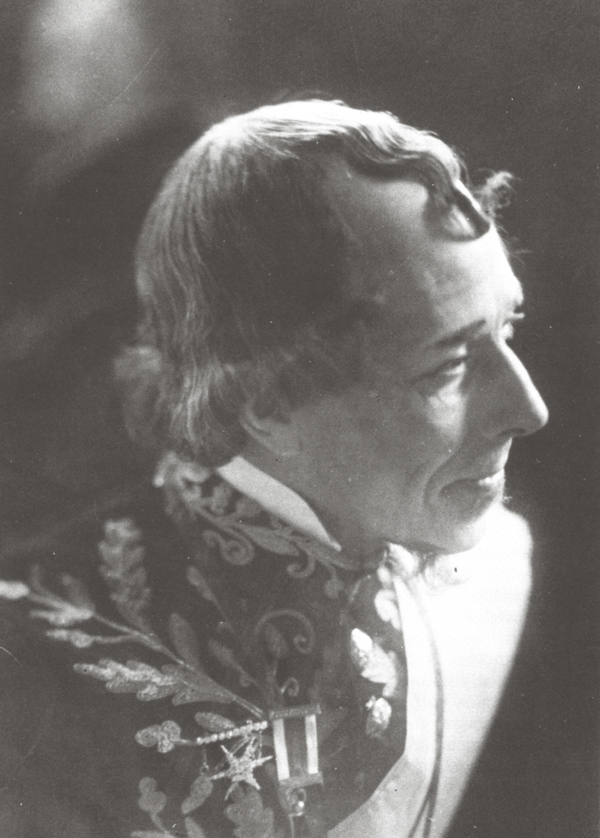
"You can tell his Disraeli from his Voltaire because the former has a spit curl on his forehead and the latter wears a mobcap, and it's in the scrupulous deployment of makeup and costume that Arliss shines. Not that he stints as an actor - he gives it all he's got, and though that's often far too much, it's honest work; he believes in these creations, and he has great charm if you don't mind its calculated quality. Actually, what you're seeing here is the last traces of English stage acting from the turn of the century."
From David Thomson's The New Biographical Dictionary of Film : Expanded and Updated
Essay on George Arliss
David Thomson: Bibi Andersson
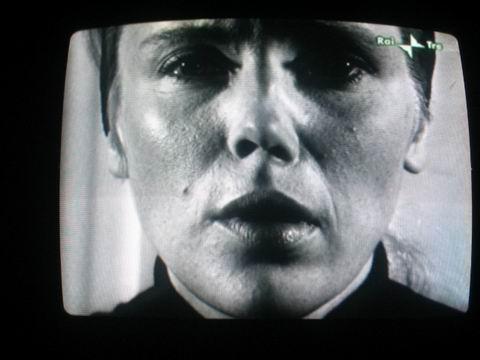
"She needed such a holiday to prepare for one of the most harrowing female roles the screen has presented: Nurse Alma in Persona (66, Bergman). That this masterpiece owed so much to Bibi Andersson was acknowledgement of her greater emotional experience. She was thirty now, and in that astonishing scene where Liv Ullmann and she look into the camera as if it were a mirror, and Ullmann arranges Andersson's hair, it is as if Bergman were saying, 'Look what time has done. Look what a creature this is.' Alma talks throughout Persona but is never answered, so that her own insecurity and instability grow. Technically the part calls for domination of timing, speech, and movement that exposes the chasms in the soul. And it was in showing that breakdown, in reliving Alma's experience of the orgy on the beach years before, in deliberately leaving glass on the gravel, and in realizing with awe and panic that she is only another character for the supposedly sick actress, that Andersson herself seemed one of the most tormented women in cinema."
From David Thomson's The New Biographical Dictionary of Film : Expanded and Updated
Essay on Bibi Andersson
David Thomson: Paul Thomas Anderson
"It is also the case that anyone as good and smart as Anderson should be more perceptibly self-critical. In fact, Magnolia is his most youthful and indulgent film -- and Hard Eight, his best and most austere. But there are poetic mysteries in the first film that come closer to pretension in Magnolia. In other words, Anderson is not handling himself well. He is drawing fire upon his own vulnerabilities. But is there any other way?
No other American director working today has such sad, tender, and smart ways of looking into the depths of society, or for feeling out their poignant juxtapositions. He writes great, ragged speeches, and he is like a fond parent with his family of actors. All his three films so far have used John Reilly, Philip Seymour Hoffman, and Philip Baker Hall. In addition, he has done remarkable things with such diverse figures as Tom Cruise, Julianne Moore, and Burt Reynolds. His way of blessing actors is so very close to his wish to rescue people from their drabness. Sooner or later, it will be perceived how desperately concerned he is about the society called America.
Of course, Magnolia is like Short Cuts in that both films are symphonies attempting to take in everything. They have the ambition of an Ives, say, who could hardly get his work played, let alone make it popular. Altman has learned cunning ways of making that ambition into a career. But he's older and far less kind. Anderson's energy and aspirations are destined to collide with Hollywood thinking, and he may be too young and too good to learn subterfuge. If he is as good as he thinks he is (and I think he is), there are bloody battles to come. But no one has a better chance of offering us new narrative forms for our movies."
From David Thomson's The New Biographical Dictionary of Film : Expanded and Updated
Essay on Paul Thomas Anderson
David Thomson: Anouk Aimee
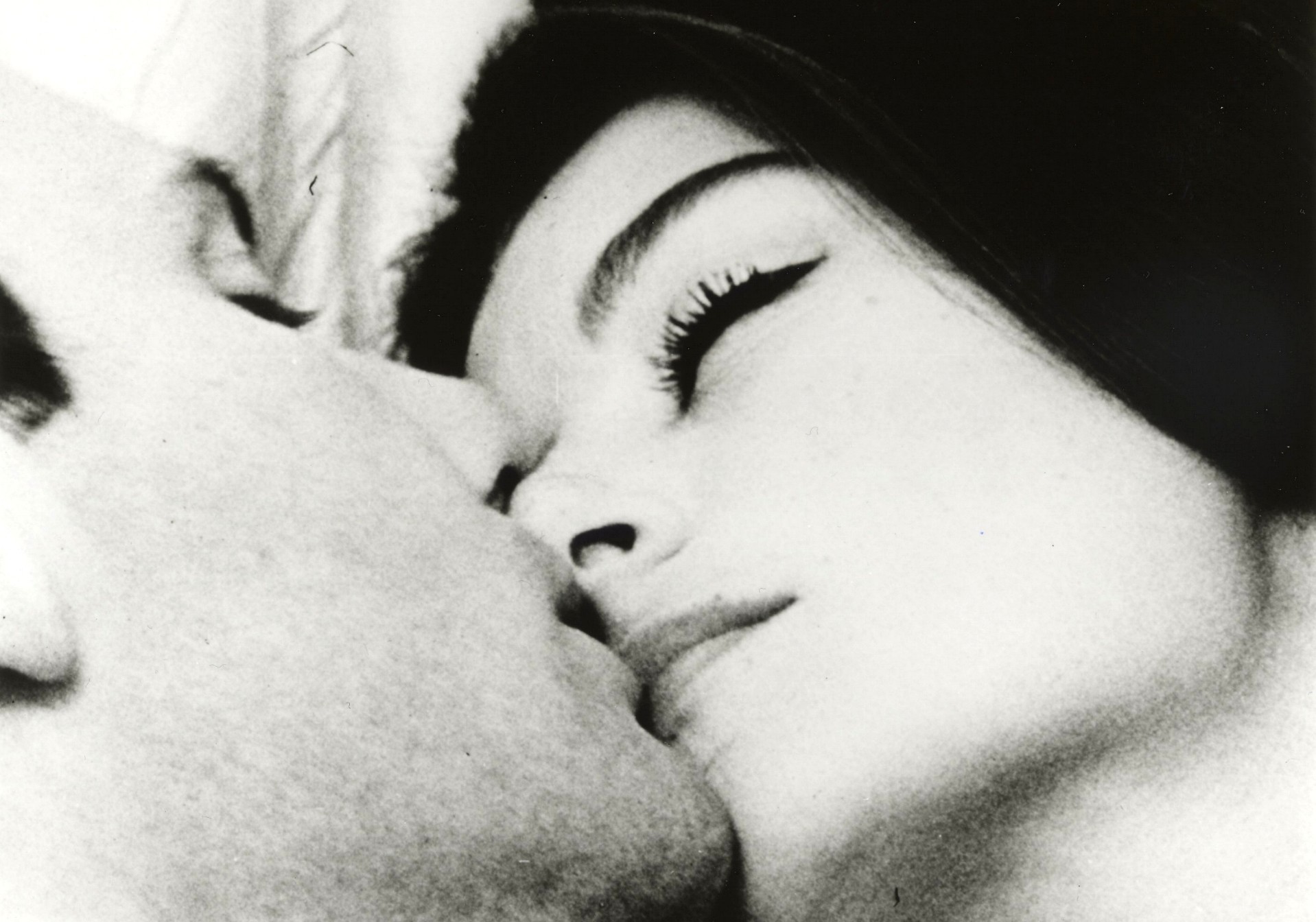
"Lola (60, Jacques Demy) came as a surprise and a relief: at last she was allowed to giggle, flutter, to be animated, and to breathe a cryptic song into the camera -- "C'est moi. C'est Lola." The most magical of the New Wave films, Lola freed Princess Anouk and allowed her the flighty, romantic self-absorption of a chambermaid. However, Anouk's newfound freedom did not result in an organized career, although she may not have cared too much, then or now. It must be said that serious roles have sometimes found her wanting. Perhaps so handsome and commanding a woman is really frivolous: certainly Lola has that effortless beauty that comes from relaxation."
From David Thomson's The New Biographical Dictionary of Film : Expanded and Updated
Essay on Anouk Aim�e
David Thomson: Isabelle Adjani

"There is something so frank, so modern in her feelings, yet so classical in her aura, so passionate and so wounded, that Isabelle Adjani seems made to play Sarah Bernhardt one day. Why not? She is a natural wearer of costume capable of making us believe that the "period" world we are watching is happening now. She is bold, a mistress of her career, and has been a fiercely equal partner in her romantic relationships with Bruno Nuytten, Warrn Beatty, and Daniel Day-Lewis."
From David Thomson's The New Biographical Dictionary of Film : Expanded and Updated
Essay on Isabelle Adjani
May 12, 2006
Happy birthday to ...
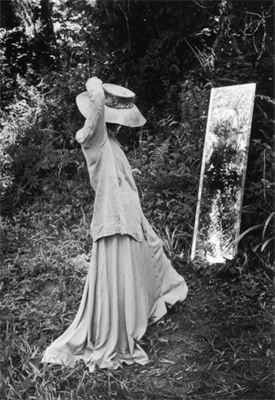
That's Katharine Hepburn in her "dressing room" on the "set" of African Queen. One of my favorite pictures of her ever. And today is her birthday.
HEPBURN QUOTABLES:
"I just don't like to be half-good. It drives me insane. And I'm willing to do anything to try to be really good. I'm very aware when I'm very good -- and I like to be very, very good. Oh, I think perfection is the only standard for people who are stars."
"Marriage is not a natural institution -- otherwise why sign a contract for it?"
"I can't stand Mary of Scotland. I think she was an absolute ass. I thought Elizabeth was absolutely right to have her condemned to death."
"Being an actor is a humiliating experience. Because you are selling yourself to the public, your face, your personality, and that is humiliating. As you get older, it becomes more humiliating, because you've got less to sell."
HEPBURN ANECDOTES:
1. Barbara Walters interviewed Hepburn, and asked the penetrating question: "Kate, you always wear pants. Do you even own a skirt?"
Hepburn replied: "I have one, Miss Walters. I'll wear it to your funeral."
2. There was an enormous hemlock tree in the front yard of the Hepburn home in Hartford. Kate loved to climb high up into the branches, and hang out up there. Apparently, a neighbor in the next yard saw Kate perched up high, and called over to Kate's mother: "Kate is up way too high!"
Kate Hepburn's mother replied, "Sh. Don't scare Kate. She doesn't know it's dangerous."
3. I love this story of her initial struggle with the comedy of Bringing Up Baby. Look at how willing she was to just say: I DON'T KNOW WHAT I'M DOING. HELP ME. Very rare.
So much more to say. I still miss her.
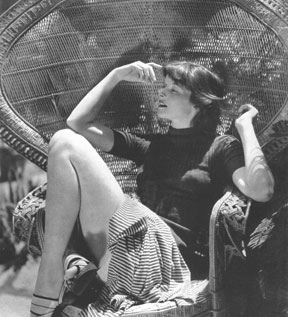
April 27, 2006
Hoagy carmichael in "To Have and Have Not"
As I mentioned, I've been making my way through David Thomson's massive The New Biographical Dictionary of Film. I read a couple of entries a day. I've been making my way through alphabetically. Naturally, I take notes on the films he's mentioned that I have not seen. I have my work cut out for me.
His entry on Hoagy Carmichael brought tears to my eyes.
His presence in To Have and Have Not somehow MAKES that movie. Bacall and Bogie are GREAT, the whole situation sizzles with chemistry ... and in the middle of it all ... is Hoagy Carmichael. It wouldn't be the same movie without him.
But listen to how David Thomson talks about it. David Thomson chose the photo below to be on the cover of his book. This entry explains why.

Hoagy Carmichael
(1899-1981) b. Bloomington, Indiana
He sits at a piano that manages to be set aslant everything else in the world. He has white pants (they might be cream or ivory) with a dark stripe in them, and it could be crimson or dark blue against the cream (this is Martinique light). And in the shirt there is the same pattern of vertical dark striping on a pale ground, except that the stripes are twice as regular. He has a tie too, a rather floppy, silly thing, with big diamond patterns on it. And I'll be damned if he hasn't got a decorated band above his right elbow, of the kind card players or saloon pianists sometimes wear to keep their hands free.
He is called Cricket, and he has the sharpest face in the whole sharp film. And more or less we are at the heart of the whole matter, in a place where perfection and the absurd slide together in a way that is unbearably cool. This is 1944, at Warner Bros., To Have and Have Not -- even the title knows what is happening, and appreciates that this is the mystery of cinema, the dream itself.
I don't know, but I suspect that Hoagland Carmichael dressed himself for the occasion, checking every now and then with the Howard Hawks he revered as both friend and style master. For Hawks was a dandy, and I suspect that both men could wax lyrical together as connoisseurs on what a hip piano player reckoned to look like in the 1920s if he had done Indiana U. (law) first and was knocking around with Bix and Trumbauer, and Eddie Condon was due in tonight.
That was how Carmichael had put his life in order, dropping the law for "Star Dust", which he wrote in 1927. And he had had songs in movies aplenty in the thirties, like Crosby doing "Moonburn" in Anything Goes (1936, Lewis Milestone). And somehow Hoagland had got to be acquainted with Slim and Howard Hawks and Howard had asked him to hang around the To Have and Have Not set and be atmospheric.
And it worked out that the new girl, Bacall, had this little song to sing, so why shouldn't it be something Cricket was working up? It won't be hard work, said Howard, you can do the whole thing sitting down. And if maybe Hoagland said, "Howard, I haven't been on camera before," Hawks could have said, "It doesn't show. You can do this stuff yourself, if you try."
So Carmichael and Bacall play around with "How Little We Know", and the whole film is this strange new tango Bogart and Bacall do, with three guys -- Marcel Dalio, Walter Brennan, and Carmichael -- riding point. And you realize the weird luck that could fall on an Ernest Hemingway having such magic fall on his not-the-worst-book-in-the-world novel.
The story goes that whenever Carmichael was working, William Faulkner came to the set to watch. To be so lucky.
Sure, Hoagy Carmichael is there again and very good in The Best Years of Our Lives (46, William Wyler), in Night Song (47, John Cromwell), and in Young Man With a Horn (50, Michael Curtiz). And he has his songs in and out of pictures -- he shared an Oscar for "In the Cool, Cool, Cool of the Evening" in Here Comes the Groom (51, Frank Capra). But the rest was relatively normal, and sensible, and what you might expect. Whereas Cricket was out of nowhere. Nowhere except the best and kindest mind that ever made an American picture. If you could get the clothes halfway decent.
April 25, 2006
Abbott and Costello
I have been reading one or two entries a day in David Thomson's incomparable The New Biographical Dictionary of Film : Expanded and Updated - It's referenced all the time (that book) and I only recently acquired it and now I honestly don't know how I got along without it. It's enormous. It's a treasure-trove. He's an inCREDIBLE writer - he makes me see things in a new way. Many times I don't agree with his assessments - but his assessments are so well-written and so well thought out that it's a JOY to read his differing opinion. He goes his own way. In his opinion, the three greatest film actors to ever practice the trade were Cary Grant, James Stewart and Robert Mitchum. They are the Mount Olympus of film actors in his mind. Therefore, his words on Humphrey Bogart and Marlon Brando and some other of my favorites are fascinating. Because in his opinion - they LACK something that the top three had. Whether or not you agree with his assessment is irrelevant. There are some people who write critics off who disagree with one of their precious opinions - I don't get that. If the critic is a good writer, his job is not to agree with me. His job is to explain why he thinks something is good or bad. Good critics are hard to come by, man! It's not just about "I liked this" "I didn't like that" - it requires a great deal of CONTEXT to be a good critic - a sense of the past, of who has done what before ... Thomson has that. All the great ones have that. I particularly adore his entry on Jeff Bridges - he thinks he's one of the greatest actors working today, and the most under-rated. He thinks he could rise to the level of a Mitchum if he were given the right part. Interesting that he would see Bridges in the MITCHUM continuum and not the Grant or Stewart continuum - but it really made me think, when I read that. I think he's onto something. There's a certain sense of menace in Bridges, a sense of isolation - which, with the right film and the right performance, can be devastating. He's not a "family guy". It just doesn't ... that's not his sensibility. I hadn't really picked up on that, though, til I read Thomson's piece on him.
Anyway, the whole book is really interesting.
It's alphabetically organized - the first entry in the book is for Abbott and Costello and I thought I'd post it here - I just love his LOVE for all this stuff. He is certainly not uncritical - he has a great eye - but when you just LOVE something, you might as well SAY it. So many critics forget that. If you love something, you give up your DISTANCE on it - and many critics are so unable to give up their distance that they seem to not have a LOVE bone left in their body. Everything is there to be criticized. I love the critic who can just say, "You know what? I loved this." Ebert does it a lot and he gets a lot of flak for it - but that's one of the reasons why I love him. Because I feel that way about certain movies and certain actors too. I just flat out love them and that's that!!
David Thomson, who appears to be an absolute BRAINIAC, hasn't forgotten his love of cinema.
Now - onto Abbott and Costello:
The marital chemistry (or the weird mix of blunt instrument and black hole) in coupling is one of the most persistent themes in tragedy and comedy. At their best, you can't have one without the other. More than fifty years after they first tried it, Abbott and Costello's "Who's On First?" sketch is about the best remedy I know for raising laughter in a mixed bag of nuts -- or for making the collection of forlorn individuals into a merry mob.Many people know the routine (written, like most of their stuff, by John Grant) by heart. Amateurs can get a good laugh out of it. But Bud and Lou achieve something lyrical, hysterical, and mythic. Watch them do the sketch and you feel the energy and hope of not just every comedian there ever was. You feel Beckett, Freud, and Wittgenstein (try it!) You see every marriage there ever was. You rejoice and despair at the impossibility of language. You wonder whether God believed in harmony, or in meetings that eternally proved our loneliness.
Lou is the one who has blood pressure, and Bud hasn't. So they are together in the world, yet together alone, doomed to explain things to each other. They are companions, halves of a whole, chums, lovers if you like. But they are a raw display of hatred, opposition, and implacable difference. They are also far better than all the amateurs. And if Lou is the performer, the valiant seeker of order, while Bud is the dumb square peg, the one who seems oblivious of audience, still, nobody did it better. If I were asked to assemble a collection of things to manifest America for the strager, "Who's On First?" would be there -- and it might be the first piece of film I'd use.
At the same time, they are not very good, rather silly, not really that far above the ocean of comedians. It isn't even that one can separate their good work from the poor. Nor is it that "Who's On First?" is simply and mysteriously superior to all the rest of their stuff. No, it's only that that routine feels an inner circle of dismay within all the others, the suffocating mantle next to Lou's heart. It isn't good, or superior; it's divine. Which is why no amount of repetition dulls it at all. I think I could watch it every day and feel the thrills and the dread as if for the first time.
It's lines like: "It isn't good, or superior; it's divine" that makes this book an awesome read. I read it and I get voracious. I want to see every film ever made.
April 24, 2006
I have been smoking crack for 20 years
That is the only explanation: For some unknown reason ... I have pooh-poohed Patrick Dempsey for all of my adult life.
I do not understand it. And not just pooh-poohed him but actively despised him. I tried to sway others to my side. I was PASSIONATE about it. He made me MAD. Not too many actors make me mad, but he made me MAD. The only explanation for this is that I have suffered, unknowingly (because I don't do drugs) from a prolonged crack-smoking delusion.
I recently caught the last hour of Can't Buy Me Love on TV and ... I saw it in the movie theatre when it first came out - and for whatever reason he rubbed me the wrong way. Maybe it was too close to home? I don't know. I decided then and there that I did not like him. But a month or so ago, I saw it again, and suddenly I realized he was fantastic. There's a REASON this guy still has a career so many years later. And he's just getting better with age. I watched that movie wondering: What on earth made me so ANGRY about it way back then? I mean, it's not like it was an episode of CHiPs, or something! Lay off the Dempsey, Sheil-babe.
For 20 years I have rolled my eyes when his name came up. I have actually gone off into impassioned angry monologues about how much I hate that guy, monologues that my friends endured. When I heard he was playing Raskolnikov ... I blew a gasket. I think Mitchell was there for that one. I started shouting about how mad that made me.
What?
I am now a die-hard Grey's Anatomy fan and not only do I think the guy is devastatingly handsome and sexy (like: it's UNFAIR) ... he's also a wonderful actor. Deep, true, funny, doesn't seem to take himself too seriously, he seems very REAL to me, like a real man, and in every moment he has multiple things going on ... he makes scenes SPARK. People who act with him obviously shine - because of the great stuff he is giving them.
I am a total convert.
I apologize, Mr. Dempsey, for the years of bad-mouthing you. I must have been absolutely out of my mind. I watched Grey's Anatomy last night and felt an actual obsession bloom in my heart for you and your work.
This would be like discovering, 20 years from now, that I actually love Renee Zellweger, and that I think she's a great actress, and I need to go back and reevaluate all her work. This would be like me suddenly thinking that that Renee is a GENIUS in Down with Love. 20 years from now, I would sit down, watch that movie, and think: "What a great performance!"
Like ... inconceivable.
But with the Dempsey Revelation, all bets are off now.
April 17, 2006
Gloria Swanson: One of Hollywood's first superstars
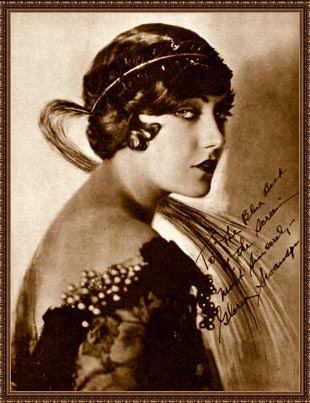
Another great post on my new favorite site:
An essay of appreciation for Gloria Swanson's power in the silents, and a review of 1928's Sadie Thompson starring Gloria Swanson:
Watching Swanson in silence though really emphasizes the power she had in the silent era. You can see some of the flamboyant gestures she let Norma use 22 years later, but she has true power, spark and humor playing the good time girl who becomes the object of a preaching moralist out to save her soul and protect society from the likes of her. (Are we sure who the Beatles wrote "Sexy Sadie" about?)
Bettie Page on Easter? Hell, yes.
One of my dearest friends in the world was in town this past weekend with her husband, and I got to spend a bunch of time with them. The weather was heart-achingly spectacular. The skyline of New York - its glitter, its texture ... and ... I don't know ... I always see it as hopeful. It is no longer complete. But it shimmers with its own beauty, it still exists.
I met up with them yesterday afternoon after I went to church, and then spent the morning writing.
The sun was beautiful. There was a coolness to the air, a spring coolness. The entire city looked like it was putting on its best face ... showing its most charming side. Its friendliness, the ranks of brownhouses, black shiny shutters, massive windows ... the trees now in bloom. Bursting pink flowers, fluttering petals ... I look around and feel like I've stepped into a movie. But this is reality. This is what New York can be like sometimes.
We walked through Washington Square Park. No street performers?? I was shocked. But the park was filled with people having a leisurely day. Families picnicking, NYU students reading on benches ... and the beautiful arch, spectacular - now renovated. For years it was behind a fence of barbed wire ... you couldn't walk under it, or get close to it. But now it's out!!
Walking downtown. Three-way conversation. Just glorying in being together. Heading for Soho. Chanel, sadly, was closed. We did stare through the windows, though. Longingly. Like Little Orphan Anne, or something.
Great conversations. Just on and on and on ... I haven't seen her in a year or so ... it was so good to see her!! And her husband is just awesome.
We ended up going to Puck Fair for a late lunch, and a pint or two. Our good friend Wade used to work there ... if I ever wanted to see Wade, I just had to head to Puck Fair to get a fix ... Sadly, he has moved on. And now he has disappeared into the mist. Wade!!! Where are you??? One of my best friends in grad school. Our paths will cross again. They always do.
Once we emerged from Puck Fair - it was time to head up to Chelsea to see the film The Notorious Bettie Page - which I had been SO excited about. For many reasons. First of all, I loves me some Bettie. (Obviously.) But I've also wondered when Gretchen Mol would emerge again as a playah. The New York Times review of the film nails the Mol-thing perfectly:
Until now, Ms. Mol has been best known for her premature designation several years ago as Hollywood's newest It Girl. The label seemed to plague her, and she all but faded from view despite promising turns in little-seen films.
Exactly. "Premature designation". Vanity Fair put her on their cover in a rather titillating pose ... before anybody knew her name. This was 10 years ago. It was ... too much too soon. There was backlash - in the industry - because: it felt too much like an anointment from within. People wrote in to say they hated the photograph on the cover. "Who is this Gretchen Mol and why should we care about her?" In a way, I am very very glad that she did NOT go on to become an "It Girl" - at least not in that manufactured way ... because the reality is is that she is a lovely lovely actress, absolutely open ... and it seems that her "destiny" is to just be one of those hard-working actresses - not a big star - which will give her a bit more anonymity, and therefore a bit more freedom. I'm happy for her.
She is so wonderful in this movie - and realize, I'm talking as a person who loves Bettie Page the original. But Mol "gets it". She "gets" it. It's a hard thing to get. It would have been so easy to make a prurient dirty-minded film. Which, obviously, would completely miss the point.
From the Times review:
Ms. Mol takes to this tricky role with the carefree expressivity you tend to see only in young children who have learned the joys of nudity, usually when their parents are throwing a dinner party. When she strips, Bettie soars.
Photographers who worked with Page said that she didn't seem naked even when she was. There was something so natural about it for her. Bunny Yeager (an amazing woman in her own right) worked with Bettie quite a bit (if you've seen the picture of Bettie in the leopard-skin bikini hanging out with the leopards - that's Bunny Yeager) and she said that she felt that Bettie was a "born nudist". If you think nudity is dirty, or that there is something shameful about the human body, then you wouldn't "get" that - and it was Bettie's good fortune to work with photographers who didn't shame her for that freedom, that childlike "whoo-hoo, I love being naked" thing she had - and just let her BE.
Bettie Page said once: "I was never one who was squeamish about nudity. I don't believe in being promiscuous about it, but several times I thought of going to a nudist colony."
Gretchen Mol is amazing in this film. It's a performance I will remember.
The film hints at what was going on inside of Bettie Page ... but it doesn't psychoanalyze her. But it doesn't give a simplistic theory, like: "And because THIS happened ... she became THIS ..." It doesn't take that stance, and for that I was grateful. Bettie said she is still not ashamed of her work - and when God told her it was time to stop, she stopped.
Bettie Page comes across as a simple sweet girl, who didn't have a prurient bone in her body. She calls her bondage gear "costumes". She doesn't get what the big deal is. If it makes people happy to see those photos ... then why should she be ashamed of them?
Bettie Page had some horrible times ahead of her - but the film stops before that. The film is not a typical biopic. Again, the Times nails it:
Ms. Harron moves fluidly through Bettie's early years, which included brutal abuse that might have had something to do with why she entered a profession that allowed her to create and control a sexualized image of herself. Even so, while Ms. Harron and Ms. Turner don't shy away from these dark episodes — and, notably, end Bettie's story before age and the really bad times intrude — they are too smart to draw a direct line between the traumas and the person who survived them. A self-made woman, Bettie Page created an enduringly resonant persona out of an arsenal of smiles and sneers, and her impressively pliant figure. Depending on the costume, the photographer (two of the finest were women, Paula Klaw and Bunny Yeager) and her own ingenuity, she was a dark angel, a harem girl, a naturist or a very naughty miss, but she was also always her own woman.If the inner Bettie remains somewhat out of focus here, even to the beatific finale, it's largely because what made her a sensation — both in the 1950's and the 1980's revival that made her into a modern cult figure — wasn't her acting aspirations or the religious convictions that might have pushed her to leave modeling, but that she was a genius of the body.
Beautiful. The film really "gets" that. Here's a great piece about Bettie Page now.
Bettie Page emerges as even more of an enigma. And I love that. It doesn't try to explain her. Because most human beings cannot be explained so easily. A doesn't lead to B. There are mysteries in all of us. I loved that the film decided to keep some of her mystery intact.

Welcome back, Gretchen Mol. You deserve the accolades you are getting now. Marvelous performance.
April 10, 2006
More 10 minute Oscars
... from Alex.
I love that you included William Holden's moment of being shot from Sunset Boulevard. You're so right - there's so much in that moment. Billy Wilder praised Holden for what an athlete he was - that he was able to do that moment, physically, in one take - He had grace, yes, he was able to throw his body into that moment - but he also was a marvelous actor, so he was able to act what being shot by her in that moment meant. Think of all the shoot-em-up scenes we see now, and how horribly actors do them. By "horrible" I mean "empty". They're just playing bang-bang you're-dead games. Empty. But watch Holden's body language in that scene. It's astonishing, first of all from an athletic physical point of view - it's all done in one take, there are no cutaways - it is clearly Holden doing all of this - so you think: "Wait ... did I just see him make his body do that??" Wilder was blown away by Holden, blown away by what he could command his body to do. But it's not just physically amazing that moment - it's also amazing from an acting point of view. It's devastating. I mean, we know from the beginning of the film that it's coming. Because the first shot is the dude face-down in the swimming pool. He is narrating. The film is narrated by a dead man. So it's not a surprise that it's coming. But the execution of the death scene? Actors EVERYWHERE should study that scene, to see how it should be done. Marvelous stuff.
March 19, 2006
In praise of Charles Lane
I watched Sybil last night. I've seen it a gazillion times. So what the hell. I sat down to watch that wrenching thing AGAIN. I've got a lot to say about it - about the acting, in particular - but I just wanted to write a small post of praise for Charles Lane, who plays the small-town doctor from Sybil's home town. He has one scene, and I've gotta say: he knocks that shit OUT OF THE PARK.
THIS is the kind of acting I love. I mean, I love my stars, too, you know I love my big ol' movie stars ... but the acting that really turns me on are these random people, these character actors, who show up - do their job SO WELL - and never get the glory. Mitchell and Alex and I talk a lot about people who we think win "10 minute Oscars". By that we mean - the people who do not star in the films, but without whom the entire film would not work. People who just kick some serious ASS in their parts. My favorite "10 minute Oscar" is Brooke Smith's acting in Silence of the Lambs. She's the girl in the bottom of the well. Man, oh man. That is some good acting there. I mean - think about it. Jodie Foster and Anthony Hopkins star - and they both give unforgettable performances. (Interesting that Hopkins is only on screen in that film for 15 minutes himself. Isn't that wild??? It seems like he is in it for MUCH longer - but he is not. Phenomenal. So I guess he DID win an Oscar for a performance not much longer than 10 minutes!) But back to these more unknown actors who show up and do their jobs like nobody's business: without the scenes of Brooke Smith in the well - the film would not have the same impact. And she just GOES THERE. What I love about her performance is that, obviously, she is a victim of circumstance. I mean, good Lord. She's AT THE BOTTOM OF A WELL. That sucks. But she is not a docile creature - she doesn't JUST weep and wail - We also see her strategizing. We see her kidnap the dog. Smart!!! I love when she's coaxing the dog down - she's using the normal voice you use when you're talking to a dog - but she's so pissed, so DETERMINED that she will survive this ordeal - that she also says stuff like, "Come on, you little fucker ... get in the fucking basket ..." I love that. It's so real. And yet so unexpected. A lesser actor would just play the victim. She would play to the hilt the "oh my God, I am so TRAPPED" - Brooke Smith plays that as well, but she also expresses the rage one would feel when one is so trapped. It's a fantastic choice. She seems like a real girl. I also love when Jodie Foster bursts into the room - and then says down into the well, "Okay ... I'll be right back." And we hear Brooke Smith start shouting, "Don't leave me - you fucking bitch!!!" hahahahaha I just love that. She's not just falling over herself in gratitude ... she has HAD it ... she wants OUT. Do not leave me down here!! Anyway - for me, that's a perfect example of a 10-minute Oscar. She knocks it out of the park. The movie wouldn't be the same without her performance. Even though the two big stars show up and do THEIR jobs really really well too. I've met Brooke Smith a couple of times - at stage readings, and stuff like that, and I have no idea how to say, "Uhm ... you won a 10 minute Oscar in my mind!!!"
So back to Charles Lane. Here he is - this is about the age he was when he played this part.

Joanne Woodward plays the psychiatrist Dr. Wilbur. I have so much more to say about Joanne Woodward ... I need to do a big Woodward post - she's one of my favorite actresses - but I will keep my focus. I will try, anyway. So anyway, Dr. Wilbur ends up taking a trip to Sybil's old hometown to see if she can kind of piece together Sybil's childhood for her - since Sybil can't remember any of it. She goes and looks up the old doctor who used to treat Sybil for the "normal childhood aches and pains" - to see if he could maybe illuminate anything for her. Charles Lane plays that doctor, Dr. Quinoness. He doesn't have any huge emotional outbursts, he doesn't have any showy explosion of rage ... His part is simple. He is a country doctor. He works out of his house. He has been a doctor for seventy years. He has wonderful manners, he is welcoming and kind. The kind of man you would love to have as your doctor. You just GET that from the second he appears on screen. He ushers Dr. Wilbur into his office, and he's carrying a tea tray with a teapot, and a couple of mugs on it, a little creamer. Just the way he offers her the tea tells you everything you need to know about his character. He's old-fashioned, he's kind, and he is welcoming to this outsider - she may be an outsider, and she may be a woman wearing a white pant suit with a big Peter Pan collar (I love Woodward's clothes in this movie - they're SO mid-1970s!!) - but she is also a doctor, and he treats her with respect. As a colleague. I don't know - it's really subtle - but without that colleague-to-colleague honesty and respect, the scene wouldn't work.
Joanne Woodward's acting in this entire film is literally masterful. But I'll write about her later. Argh. Getting sidetracked!! Even though Dr. Wilbur is angry at what has happened to Sybil, even though she is in a rage at what happened to this little girl, she doesn't bring that anger to this scene. She is on a fact-finding mission ... and this man was not one of the evil-doers. She's appropriate with him. He is a fellow doctor. She starts asking questions about Sybil's health when she was a child. He is kindly, and tells about when Sybil had her tonsils out, and how frightened she was. Dr. Wilbur says, "Did you ever treat her for anything else?" This is when he says, "Oh, the normal childhood aches and pains." Woodward then asks if he still has the file - "I would consider it a great professional courtesy if I could have a look at it." There's no animosity here. Charles Lane gets up from his desk, "Let me see if I still have her file ..." He goes to a file cabinet and shuffles through the folders. He is forthcoming, direct ... he's not CONSCIOUSLY hiding anything. But at the end of the scene, we realize that ... he knew. He knew what was happening to Sybil. I just got goosebumps all over again remembering the last moment of the scene ... But I'm getting ahead of myself.
He finds the file. He sits back down and starts reading out loud: "Fractured elbow. Hand burned from the stove. Fractured larynx. Broken ankle." Etc. The list goes on. As he reads, you can feel his energy change. It's like - seeing it all in one place, hearing the litany of horrible injuries ... makes him realize the reality - makes him SEE, yet again, after so many years, what was so obvious at the time.
Charles Lane trails his voice away ... there's a long silence between the two of them. Nobody speaks.
Woodward says, "Normal childhood aches and pains, huh?" But she doesn't say it with hostility, or as an attack on him. She's just pointing out what she sees. I love how she says that line. Then she says, curiously, "Did you ever speculate?"
This is where Lane's beautiful acting really comes to the fore. And I have to say this: he does the rest of the scene, except for the final moment, looking out of the window. We do not see his face. He stands with his back to her, talking ... An actor needs his face. The actor's face is one of the most important ways he can tell his story. BUT - oh how powerful it is to have an actor turn his back to us ... How much it can tell you about the emotions he is experiencing, it can be extremely powerful - if used effectively. This is what Charles Lane does here.
He gets up. Goes to the window. His BACK is eloquent. Do you get that? His very BACK is eloquent. You just FEEL for this man, this WITNESS. This kindly gentle man ... who had had evidence of horrible child abuse in his town ... and had done nothing.
After a while, he starts speaking. He leads off with: "I've never told anyone this before ..."
It's a moment that makes me catch my breath every time I see it. Again, he doesn't do it in an overdramatic way, he's not being an ACTOR in this moment. He's being a PERSON. A man, an old man, who has kept a secret for thirty years. He knew. He knew.
But he doesn't show his hand too early, as an actor - and this is why the moment is so powerful. He doesn't greet Dr. Wilbur with a guilty conscience. He doesn't SHOW us the things that the character himself doesn't even know yet. He's not being protective of himself. But once he reads all of her injuries out loud ... he knows that his moment of reckoning has come. He remembers. And it's a painful moment for him. This is why he stands and looks out the window. He is filled with grief at his inaction back then. Again, though: none of this is overplayed. You don't think: "Oooh, look at this actor having a great moment." You think: "This man is tormented. This poor man."
Now this next will be a paraphrase - I wish I had the script in front of me, but this is the general idea:
He says, staring out the window ... all we get of him is his back - his slightly stooped over back, "I treated her for a bladder infection when she was five years old ... very unusual for a child of her age ... I would imagine if you did a gynecological exam on her now, you would see what I did. Scarring of the inner walls, hardened destroyed tissue. Now - we know that the Lord sometimes creates mistakes in nature - but the Almighty had nothing to do with what I saw inside that little girl."
It is an absolutely devastating moment.
Woodward just sits there, listening. She doesn't speak. She doesn't need to.
Then - Chrales Lane - the beautiful character actor Charles Lane - turns around and looks at Woodward.
He says, "I imagine in your line of work, you hear a lot of confessions."
Again: it is a devastating moment. Beautifully and simply played. He doesn't say "will you hear my confession?" It is implied. He wants forgiveness. It is out in the open now. Not just what happened to Sybil - but his complicity in it. He does not START the scene with this self-knowledge. Dr. Quinoness has not been walking around with a load of guilt for 30 years. He has suppressed what he saw way back then. But now he remembers. And it is a terrible terrible moment for him. This kindly old man, wearing glasses, and a black suit. A terrible moment for him.
Dr. Wilbur says to him, kindly, "Dr. Quinoness, it was a long long time ago."
Cut back to Charles Lane, looking at her. His face is simple, open, and pained. He says, and he is truly asking, "How do I find absolution?"
Cut back to Woodward, looking up at him. She has no answer for him.
The scene ends there.
There are many other amazing scenes in the film with some of the best acting I honestly have ever seen ... but that small scene between Charles Lane and Joanne Woodward is my favorite in the entire film.
It's because of what he brings to it.
In less than 5 minutes, he creates a completely three-dimensional character. It's a very important scene - because of the information it imparts. Charles Lane's part is simple: he is there to provide some exposition. That's it. That's the point of the scene. Dr. Wilbur gets confirmation of Sybil's abuse. Now she knows. It's confirmed. But - and this is partly because of the writing - which is quite good - in this scene in particular: Charles Lane takes it to another level in those last two moments - looking out the window, not being able to face her as he confesses that he knew ... and then turning back to look at her - asking for absolution.
It's just a perfectly played scene, on every level it needs to be. Not EVERY actor who has a small part in a big film shows up and makes such an impression. Not EVERY actor knocks a 5 minute scene out of the park. It's very difficult. It's almost easier to STAR in something - because you can develop your character over time, you have many scenes to do it in, you can show THIS side of the person you're playing in THIS scene, you can show THAT side of the person you're playing in ANOTHER scene - You have TIME. I mean, you have more pressure on you, of course ... but at least you have a lot of screen time to do your job. Not so with our 10-minute Oscar crowd. They have ONE scene, sometimes ... and they MUST nail it - in less than 10 minutes. It's tough, man.
So I just want to take a moment to sing the praise of Charles Lane's unsung work in Sybil. It's perfection.
I looked him up last night, just to see his story. He was already an old man when he filmed Sybil - and whaddya know - he is still alive. He just celebrated his 100th birthday. He was actually honored at last year's Emmys - he was one of the founders of the television academy - and he is now its oldest surviving member. I loved this bit of trivia:
Was honored on March 16, 2005 at the TVLand Awards for his long career and his 100th birthday. When he received his award, he said in his still-booming voice, "In case anyone's interested, I'm still available!"
God bless him!!
But his career ... I mean, LOOK at this career.
THAT is the career of a character actor. Stars' resumes are always much shorter. Character actors, successful ones, do 10 movies to a star's one. They show up, do their job for 3 days, and move on to the next one. Charles Lane worked constantly in television - appearing multiple times on I Love Lucy and many other classics.
He has been working since the early 30s. He was in Twentieth Century, he was in It's a Wonderful Life - he was in Arsenic and Old Lace - he was in Mr. Smith Goes to Washington - Also, as I scrolled down his resume, I noticed how many times he was "uncredited". He was a workman. Showed up, said his 5 lines, moved on to his next job. Bless those people.
Charles Lane said, "Having had so many small parts, there was a character I played that showed up all the time and people did get to know him, like an old friend."
Old friend indeed. He brings his history with him to every part. You may think of him as "that guy". Oh, wait - that's that guy!!
His work in Sybil is what I, personally, love about acting. It's the kind of thing where I look at it and think: "That. That is what I admire. That is what I want to do." There's no vanity in it. There's an understanding of script analysis - there's an understanding of how your part fits in to the whole - there's also a fearlessness in just doing what the part demands.
Watch how he turns back to her from looking out the window. Watch how he says, "How do I find absolution?"
It don't get any better than that.
March 6, 2006
Oscar fashion
Off the top of my head here are some of my responses to the sartorial choices of the actors and actresses last night:
-- Charlize Theron looked dyed orange - and what the hell was that THING sprouting out of her shoulder?? Terrible dress.
-- Sandra Bullock's dress was my favorite. She looked beautiful and simple, I thought.
-- Uma literally looked like a statue off of some ancient Grecian urn. GORGEOUS.
-- Meryl Streep's dress had a nice classical line to it, I love the brownish sheen of it, and I felt that her boobs looked amazing. Also, I liked her dangly earrings. She's got such a nice face.
-- Lily Tomlin looked like she was dressed as an extra in Memoirs of a Geisha
-- Philip Seymour Hoffman's gangster choice of black shirt, white tie, was very funny. I love him. People like him typically win Best Supporting actor parts. He's a character actor and he just won Best Actor. You can count on one hand how many people have done that. YAY for him.
-- I thought Michelle Williams looked amazing - in that BRIGHT YELLOW with the dark red lips. It was a Veronica Lake look and very different from every other actress there, and I thought she looked stunning.
-- Jennifer Aniston looked great. Hmmmmm, Brad and Angelina nowhere in sight. Hmmmmmm.
-- I thought Keira Knightley was kind of overwhelmed by her own dress. She's so skinny and tiny - she seemed to be weighted down by the material. Something a bit more wispish would have been appropriate for her.
-- Salma Hayek is gorgeous - but something about the cut of the front of her dress made her breasts seem misshapen. It looked off. As though her left breast was being squished down.
-- Not wacky about Reese's dress although I have to say it is very HER. Very simple, and elegant.
-- Naomi Watts did NOT look good. The cut of her dress made it seem like she had a flabby belly, and - uhm - the woman weighs 100 pounds - it just was NOT a good choice. Also the color made her look like she was literally in need of artificial respiration.
-- Wasn't wacky about Felicity Huffman's dress either. Also, it's obvious she is still rather new at the whole red carpet thing - because she was literally doing runway poses - in a kind of awkward way. Now you have to pose on the carpet - everyone wants to see all angles of the dress - but red carpet afficianadoes are much more graceful at it. Huffman looked horrible, I thought. Hand on hip, sort of aggressive -It looked phony. I did love the moment, though, when her cast members from Desperate Housewives sent their good wishes via video and she got all choked up. In that moment I saw the real actress - I saw what she was trying NOT to show. She was like, "I can't believe you just showed that to me ... I'm going to start crying ..." That to me was a real moment - but all of the aggressive posey stuff was annoying me.
-- Jada Pinkett Smith looked gorgeous - and again - like Michelle Williams - she chose a BRIGHT color - bright bright blue, which I thought was spectacular. Everyone else either looked funereal or as though they were at death's door.
-- I thought Ludakris looked terrific. The little glasses, the tux with the huge collar - he looked classy, and yet funky. Very much HIM. I'm telling you - he was the best presenter of the night. He made it thru with no flubs, he didn't try to be cute or clever - he just got the job done. He also just looked great, I thought.
-- Helena Bonham Carter looked like a raving lunatic.
-- J. Lo looked hoooooot. She looked a bit severe and Eva Peron-ish, but I LOVED her dress, I LOVED the color on her - and I thought she was glamour personified.
-- Hilary Swank looked boooooooooooring. Better than her feckin' dress last year, though, which I despised.
February 19, 2006
One last thing about Bill Pullman, and then I have to leave my house and go have a life:
I forgot for a second about Lost Highway - the not completely successful David Lynch film - in which he is the star. It's a messed up film noir - terrifying, self-indulgent, annoying, whatever ... I always liked it - mainly because of Patricia Arquette and how fascinating I have always found her. But Pullman is the star. The deep-down tormented deadpan husband of the temptress ... he plays the kind of role that Fred McMurray played in the best noir of all time Double Indemnity. There's a level of humiliation in men in film noirs ... the women have all the cards, and they play them ruthlessly, trading on their sexuality, and emasculating men in the process. It's all messed up. Lost Highway is a 1990s film noir.
In my post below about While you were sleeping I mentioned how appropriate I think it would be for Pullman to star in screwball comedies like they made in the 1930s. He has the requisite goofiness, sweetness, and clumsiness to pull it off.
But based on the evidence of Lost Highway (an imperfect film - I realize - just talking about his work, and the appropriateness of the casting) he is a fantastic noir anti-hero as well.
Need to see that film again.
Also, it's always nice to see Patricia Arquette's bodacious set of ta-tas.
Pullman: a man of tremendous range, actually - if you think about it. If you watched Lost Highway back to back with Sleepless in Seattle or While you were sleeping - it'd be a bit hard to believe he's the same actor.
And now - off into the cold, off to the glimmering city across the Hudson!!
More on Bill Pullman and Sandra Bullock:
to go along with this post. Or should I say epic??
Roger Ebert says in his review for While You Were Sleeping (a movie he really enjoyed in spite of himself):
There aren't many movie actors we simply like. Marilyn Monroe was one, and that quality, not sex appeal, is why she has remained such a durable memory. On the basis of "Speed" and "While You Were Sleeping," Sandra Bullock may be another. She plays Lucy in a low key, as a shy, unassertive young woman, and so of course late in the film when she has to stand up for herself, we're proud of her. She makes us feel protective. And Bill Pullman has real charisma, too: He's got the right chemistry for this love story in which sweetness is more important than passion.
Yes. I believe his words about Sandra Bullock are completely spot on. You like her. A very VERY rare quality - and also one that is highly under-rated. Actors are praised for being "intense", or "deep", or "courageous" - all things which are, of course, very important. Nothing worse than a shallow cautious actor afraid to 'go there'. But likable? How is that quantified? What is it?? It's rare is what it is. It also can't be "created" in a conscious way by the actor. You're either likable or you're not.
February 18, 2006
While you were sleeping ... or: why, in 10,000 words or more, I love Bill Pullman

I wanted to write a post about my love for Bill Pullman. I chose as a focus the film While You Were Sleeping. And ... er.... things got a little out of control. This is basically a moment-to-moment analysis of the film. I do a shot-by-shot breakdown of While You Were Feckin' Sleeping, for God's sake. Argh. I couldn't stop myself. Only true obsessives should read on. I realize it's long. I also had a blast writing it over the last 2 weeks. Reveling in Bill Pullman!! To the most obsessive degree possible! Whoo-hoo!!
Onward!
To the JOY that is the film While You Were Sleeping - one of my eternal favorites!!
-- For some reason, the soundtrack to this film strikes me as PERFECT. So often in romantic comedies, you get total over-kill with the soundtrack - they bash you over the head with their message (Hugh Grant strolling sadly thru the streets after breaking up with Julia Roberts in Notting Hill and what begins to play? "Ain't no sunshine when she's gone". Bad. BAD.) While You Were Sleeping is a romantic comedy, sure - but it has that ever-elusive quality that so few filsm have: it has WIT. The soundtrack is witty. Clever. Subtle. There's music playing beneath almost every single scene, and instead of being annoying, or too obvious, or ... too much - it just adds to the MOOD. The mood of the film is sincere, and also WITTY. You care about these people. The music doesn't insist that you care ... it just supports the general mood. Well done.
-- The opening, narrated wonderfully and very ... HUMANly ... by Sandra Bullock is sepia-toned, and yet it maintains that witty energy. Listen to how she says the word "Milwaukee". It sets it up ... her voiceover does not tell the end of the story ... and we can hear her insecurity in her voice, and also her ... well, frankly, her delusional nature. She goes off the deep end when talking about her "Prince" (played by Peter Gallagher) - a man she has never met. She works for the CTA in Chicago in a token booth - and every morning she watches him get on the train. Bullock's voiceover here is very funny. It's not a SILLY movie ... made for MORONS, like so many romantic comedies are. We can see that Bullock is living in a fantasy world ... because of all she has lost in her life. She's alone in the world. She has a fantasy that she will someday meet this "Prince". And here's a nice detail: Peter Gallagher is so bizarrely good-looking, kind of overblown, in the Billy Zane vein ... that you immediately don't like him. Handsomeness like that seems ... suspicious. This is perfect for the part. BUT ... there's a tiny detail in the first footage we see of him, running to get the train ... Bullock stares at him longingly from behind the toll booth window ... he runs to get the train, the doors are closing, and he jams his way in ... and then holds them open for a little old woman who is right behind him - he lets her go in first. Now - the moment is not a huge deal, it's not filmed like he's the reincarnation of Christ, but Bullock does mention it later ... as something she notices that he does, habitually: let old people go first. It's a character thing. She is looking for love - and so of course she is tuned in to the DETAILS of this guy. She notices EVERYTHING. And instead of the voiceover just telling us: "I love this guy ... he's perfect ..." we get to see a little subtle moment of his kindness which tells us WHY she thinks he's perfect. It's SPECIFIC. Good movies are ALWAYS specific. And romantic comedies have to work even HARDER to be good because there are such old cliches everywhere ... you can't just rely on the cliches ... you have to still be SPECIFIC.
-- The first real scene in the film we see Bullock hoisting a Christmas tree up to her apartment through the window. First of all - this is SUCH a Chicago movie, and that is SUCH a Chicago apartment. It just ... makes me homesick. The whole thing.
-- Joe Jr. is a big-talkin' buffoon who is the son of Lucy's landlord. He wears tight T-shirts, his ass-crack hangs out, and he is hot on Lucy's trail. He's actually a sweet guy, but Lucy is so not interested in him. I think he plays it as a caricature. Everyone else in the film is eccentric as well, quirky - but he seems like a caricature. Also, he doesn't really seem like a Chicago caricature ... although there is the whole "Da Bears" thing that he could fit into ... but it seems more like a New York City caricature. A Bronx caricature. Also, he doesn';t have the same accent as his father. Why does Joe Jr. talk like Tony Soprano while his father sounds like a Chicagoan? Don't get me wrong: there is sweetness in the Joe Jr. character - and I actually do like some of his scenes with Lucy - but to my mind, this is one of the few times that the film goes wrong. He's too over-the-top - it seems cartoonish.
-- Lucy's CTA boss Jerry (played by Jason Bernard - wonderful actor - died in 1996) is a great character. He has some very funny moments - all perfectly played. I'm telling you: everyone in this film has perfect pitch, when it comes to their characters, and the moments, and what needs to be happening in order to make this film work. It's quite impressive. Just think about how many "romantic comedies" absolutely SUCK. It's HARD to do well. This one is one of the best. So the first time we see Jerry is in the beginning of the film - Lucy and Jerry go and get hotdogs at a hotdog stand down in the freezing Loop - Jerry is obviously a nice guy, and they obviously are friends - this is established within 2 seconds of the scene - but he, as her boss, has to ask her to work on Christmas Day. She is the only one "without family". It's a lovely little scene that establishes Lucy not just as a sad sack who has "no family" but as a sweet woman who has good friends in her life, people who care about her.
-- Another detail that is great in this film: throughout the movie, Sandra Bullock, a big movie star, wears a billowing ugly black overcoat. She doesn't ever look chic. She barely looks presentable, actually. Later in the film it comes out that the jacket was her dad's. They don't make a big deal about it beforehand - it's just the coat that she wears - but I admit that the first time I saw her in it, I thought: "Damn ... her coat SUCKS ... " and then, later, when a "reason" was given for it - I suddenly filled up with tears. It was a CHARACTER thing. They don't make a fetish of the coat, they just let her walk around looking like crap for the first half of the film. I can't even explain how out of the ordinary this is for normal big-star Hollywood actresses. Sandra Bullock is not like that.
-- It's so contrived how the family ends up thinking she is Peter's fiance - but somehow it works - and that is all I ask of a good romantic comedy. That it WORKS. Think of Bringing Up Baby. It is completely contrived that the ONLY OUTFITS available in that house out in Connecticut is 1. a negligee 2. a goofy jodhpur ensemble. It is contrived. It is set up that way to up the comedy and to make Cary Grant look as RIDICULOUS as possible. It's delicious. The same is true in this film. Through that first scene when the family rushes into the hospital, and through a series of accidents, they all believe that she is his fiance - and they never let Lucy finish the sentence that would EXPLAIN IT ALL ... you are thinking to yourself: "Let her finish! Let her tell the truth!" But they are a chatty group ... and they are overwhelmed by the fact that she has saved his life ... and so they WANT to believe that she is "the fiance" and ... she no longer has the heart to disappoint them. For me, it works.
-- It also works because the family is immediately lovable. They are chaotic, annoyed with each other, they all talk at the same time, and they obviously love each other like crazy. Yet they never say the words "I love you" or anything like that. It is all just understood - because we all know families like that - and some of us (ahem) came from families like that. Families where you have to SHOUT to get a word in edgewise ... families where it is understood that if you are INSULTED it means we LIKE you ... I love them all. I especially love them because the wonderful Glynis Johns plays the grandmother with the heart murmur. She's wonderful - a brilliant little comedic portrait. She hits a home run with every one of her jokes. And Peter Boyle plays the father. And Jack Warden plays Saul, the next-door neighbor and dear family friend. Micole Mercurio plays the mother - and I have no idea who this actress is, or what her deal is - she has had a long career - but she is just comedic GENIUS in this role. If you just watch HER in the background of the group scenes ... just watch her. She is ALWAYS alive. She is the OPPOSITE of "waiting for her closeup". She is always present and something funny is ALWAYS going on. I love her performance. A young and gangly teenage Monica Keena plays Mary, the younger sister in the family - she plays the perfect baby sister. You just love her. The family immediately embraces her. "But you haven't met Jack yet!" they say. Hmmmm ... who's Jack??
-- I love the little moment where Lucy sits at home with her frozen dinner and she put the cat's food on the table - pours a bit of milk for the cat - calls out to the cat ... and then suddenly there she sits, deciding whether or not to go join the family's Christmas dinner ... It's all on her face. You can tell that she SO wants to go and spend time with them again ... and as she thinks, she takes an Oreo out of the package, dips it into the cat's milk and eats it. A beautiful (and sad) little character moment.
-- Jack Warden is terrific. Did you know he fought in the Battle of the Bulge??
-- Watch the details in the scene where Lucy goes to spend Christmas night with the family. There's too much to even list - you feel like you are looking at a slice of life. The jokes about Grandma's awful eggnog, but how everyone drinks it so as not to hurt her feelings ... the reaction shots when everyone opens their presents - and we see Lucy staring at them - and then we go back to a slow pan across the family - and we see them as SHE sees them. They, in all their argumentative chaotic loudness, are the epitome of beauty to her. Of love. Then a slow pan up behind Lucy's head to show that they have already hung a stocking on the mantel for her. It says it all. They are a family with elastic walls. Lucy lives in a stingy world, with few friends, a quiet life, and a rigid routine. She is "fixed". This family opened up to accept her. I don't know ... Believe it or not, this scene is NOT sentimental. It is SPECIFIC. I don't like sentimental, I don't like it - it's too easy a choice. It's not human enough. But this scene with the family, and with Lucy looking on works. And many of the lines themselves are so amusing - but everyone's talking at once so you can't catch them sometimes ... You hear them in snippets, overheard snippets - "Uncle Al ... you remember Uncle Al ..." "Who the hell is Uncle Al?" "Seven bowties!" "Oh ... the GOLD WATCH ... I love it!!"
-- Then we come to the big entrance of Bill Pullman - who plays Jack, the other son in the family. He, so far, is the big mystery - the guy everyone keeps talking about ... but hasn't been seen yet. The first glimpse we get of him in this film is a beat-up truck pulling up outside the family house - the door opening - and we see his feet, getting out of the truck. Big workboots. This sets him up perfectly: he's a MAN. He's certainly not like his brother who would never wear boots like that. It's a slightly ominous shot ... it's like we know that this brother is going to smell bullshit from a mile away. Which is kind of scary but also a bit sexy.
-- Now a couple of words on Bill Pullman:
Bill Pullman has gotten some cheesy jobs in his day ... he is not a HUGE star ... so he really does need to work for a living, he takes what he can gets - and for the most part it's not too bad. But in my opinion, what he does in While You Were Sleeping kind of stands alone, in terms of his career. He is a romantic leading man in this film. And ... despite his WASPy good looks, he's got an edge. A romantic leading man without some kind of edge is feckin' boring. He's got an EDGE. There's something about him where you feel like he COULD be unlikable, or he could lose his temper ... if you pushed him too hard. He's not a wuss. Pullman hasn't played that many romantic leads - he plays the boring clumsy boyfriend of the lead girl before she dumps his ass and goes and gets her REAL true love. He plays "nice guys". He plays guys who mean well, who sneeze at unfortunate times, who trip over their own feet ... and yet who you just don't feel romantic towards (Sleepless in Seattle being the prime example). He is very good at this stuff - this kind of comedic wry-faced stuff - the sort of guy who you might not THINK is sexy ... but then he takes off his glasses, and women swoon. This is why I say he would make a great "hero" in a screwball comedy - like Dr. Huxley in Bringing Up Baby. There's a part of him that couldn't smoulder with passion if he tried - he's too serious, and distracted - and yet - there's something there ... something that makes you feel like if he just took off his glasses, and - er - took off his clothes - he'd be an animal in the sack. If he could just FOCUS, if he could just let his "serious work" in the lab or in the classroom go for one second - he would be fully present, and it would be very very sexy. This kind of thing is what made Cary Grant so popular. The dichotomy: the bumbling professor with the dashing good looks ... It's a cliche now, but only because Cary Grant made it so. I think Bill Pullman could do a role like that. I think he could play the Howard Bannister-esque roles (which rarely come along - we don't make good screwball comedies anymore) to perfection. Has he been in a Woody Allen film? He'd be a fantastic Woody Allen hero as well. (Not in one of Allen's serious films - but like Manhattan Murder Mystery, one of my favorite movies of all time.) He has an air of kind of cranky distraction that is very very attractive, because it shows that he is a man who has a brain. He thinks. Most romantic leading men seem brainless or ... like they have no lives outside of the romance going on in the film. This is common of most leads in romantic comedies. Do these people read books? Have goals? Friends? Family? No. They are just there to have this love affair unfold. I love romantic comedies which let in the outside world, where the leads are rather complicated - with other stuff going on (Say Anything is a prime example - at least in my mind - We get to see what is going on in both their lives - which makes their sweet little romance that much more poignant - We can see that the love affair is a RESPITE, it is a BREAK from the sometimes harsh realities of their lives. This is something I can relate to. I like romantic comedies for adults. I'm an adult. I have romances, sometimes. But my other life goes on. I have issues from past relationships that I bring to the present one. I falter. I get insecure. I have competing interests. I have a romance AND I go home and read books. Or go to the gym. Or talk with my parents. This is all very real - and I love romantic comedies that ADMIT that.)
So Bill Pullman's Jack in While You Were Sleeping is a true leading man - in the true tradition of it. He's sexy, kind of cranky, he also has a strange strain of shyness with women - which makes the whole combination totally attractive. Pullman has never before had the opportunity to show that many sides. He's really GOOD at it, actually - and it's a bummer he doesn't get more parts like this.
-- When Jack enters the family house, the party is over and everyone is asleep. Well, everyone except the younger sister. Lucy is asleep on the couch. Jack peeks in at her. He is told that this is "Peter's fiance". He says, so simply, and with almost no inflection, "That's not Peter's fiance." He just knows. He's that kind of guy - he's got a nose for bullshit. He just knows the type of women his brother goes for - and the sleeping brunette on the couch is not that type. But look at how he looks in at her. There's so much going on in his face. It's not just suspicion. It's ... he's intrigued, too. Who is this girl? He's weirdly drawn to her. Pullman does all of this with NO LINES.
-- Oh and one of my favorite moments in the movie which goes a lot to describing its charm happens next: It's early the next morning. We see the snowy streets outside the family house. A paper boy on his bike pedals towards the camera, throwing newspapers at each house. We see him throw one paper, pedal pedal, another paper, pedal pedal ... then he goes to throw the next paper and suddenly he completely loses control of his bike on the ice and has a devastating crash. It's so RANDOM ... it means NOTHING ... but it's just a great little detail that is hilariously funny and makes the movie special, and more than just a stupid little romance. I laugh every time I see that kid crash.
-- Lucy is up early, trying to sneak out of the family house before everyone wakes up - specifically before Jack wakes up, because she was actually awake the night before, and heard him say, "That's not Peter's fiance ..." She is afraid of Jack. She tiptoes out into the foyer - and of course, Jack is sitting there, on the stairway, with his coffee, waiting for her.

They have an incredibly awkward meeting - well, SHE'S awkward, and he's cool as a cuke. He's got this kind of bemused smile as he watches her fumble around - he's picking up on all of her cues ... "I guess ... I don't remember meeting you ..." She goes to leave, and he stops her ... "Lucy ..." She thinks she's about to be busted, so she decides to come clean: "Look ... " and you know she's about to tell the truth, but of course - he cuts her off. And says, "Welcome to the family." There's a shyness on his face, a reticence - but beneath all of it is - warmth. You like this guy. He seems nice. Much nicer than his more slick brother. Lucy then hurries out of the house and we go back to Pullman's face for just a second. It's hard to describe what I see, but he's left alone there - thinking about her - it's a close-up. He still has that same bemused little smile, and then - it's a tiny moment - but it speaks volumes - a seriousness comes over his face. It's all in his eyes. It's a beautiful moment. You wonder what he's thinking. Now that's a good movie star. You can always see them thinking, but it's not always clear what they are thinking about. There's a certain amount of mystery maintained - and this is what keeps us hooked in to them. Does he like Lucy? Does he think she's pretty? Is he jealous of his brother? Or just worried that she's a scam artist? Not sure ... but you know that the guy is thinking some thing. And you want to know what it is.
-- Watch Peter Boyle during the next scene when the family is at mass. Jack keeps trying to talk to his father, in between "Lord hear our prayer"s - about Lucy, and Peter Boyle answers - never ever missing an 'Amen". It's hysTERical. He doesn't take a moment to say "Amen" in a prayerful way, it's completely rote - and it seems as though he's not even listening to the mass being said, yet he chimes in with his "Amen"s right on cue. Jack whispers, "If Peter were engaged, he would have announced it in the Sun Times." Peter Boyle murmurs back, "We read the Tribune Amen." hahahahaha
-- Then of course comes another misunderstanding. Jack goes to Lucy's apartment building and runs into Joe Jr. Joe Jr. repeats his delusion - that he and Lucy are "dating". So now Jack thinks that Lucy is double-timing his brother.
-- Lucy goes to Peter's palatial apartment to feed the cat. The hospital had given her his "personal effects" - which kind of doesn't make sense - but whatever - it works. She walks around, tiptoeing really, saying, "Here, kitty kitty ..." Meanwhile we see that Jack, who is obviously on some kind of warpath, is also coming to Peter's apartment ... He lets himself in ... and for a while the two of them are wandering around Peter's apartment without knowing the other is there. Lucy then pushes open a swinging door and smashes Bill Pullman in the face. A stupid gag - but whatever, I'm simple and easily pleased and it makes me laugh every time I see it. He totally gets SMASHED in the face - and you hear his big "OW" - and then Lucy, horrified, starts racing around the kitchen trying to get ice on his nose ... she hands him a couple ice cubes ... he fumbles with them for a second, and then you can see him say to himself, "Oh fuck it" and he tosses the ice cubes in the sink. It's a funny moment. He is on her trail. "Peter doesn't have a cat." The entire scene is a riot because they are both just LYING to each other and trying to COVER their asses throughout. They're both kind of bad liars - but they circle each other warily, trying to be "nice", but ... wondering what the hell is up with the other one. He doesn't want to let her out of his sight. Hmmmm.

-- The two of them go to the hospital together to give blood. Jack is still questioning Lucy ... "When did you start seeing Peter?" He won't let it die. He just knows something isn't right with this girl and now he "knows" that she is dating Joe Jr. But what's wonderful about Pullman is that ... even though HE might not be aware of it yet ... it's obvious that he has some other motives here ... HE'S not thinking: "Hm. This girl is kind of great. I'd like to have her for myself." But ... somehow ... Pullman lets us know that there is an element of that going on. For example - he says to her, as they give blood: "We'll need to get a picture of you and Peter for the mantel." She hems and haws and says, "I'm really not that photogenic." And he says, sort of to himself, "I doubt that." He kind of loses his cool for a second - it's a very funny moment - he's not in control for a minute, and he lets his attraction for her come out. I love that moment: "I doubt that."
-- Jack shows up at Lucy's apartment to give her an "engagement present". It's a couch from one of the estates that the family manages as their business. Lucy says, visibly uncomfortable for a variety of reasons - the first being that SHE IS NOT ENGAGED ... suggests that they bring the couch, together, to Peter's apartment.
-- So now follows the long scene where - they basically fall in love. It's so well done, I never get tired of watching it. It's humorous, there's more NOT said than stuff that IS said ... and the moments of affection and curiosity that bloom are handled really sensitively. It feels like a real night that two people would have. The kind of night when you suddenly look at someone and you realize: "Wow. I like you." This is all done with BEHAVIOR, too. Not WORDS. In the movies, you really should say less and do more. There's a reason why smart movie stars (Cary Grant, Bogart, Cooper - but they all did it) sit down with scripts and cut out half of their lines. Say LESS and you will be more effective. It's a visual medium. If you can do it with a look on your face, then do it with a look on your face - and don't describe WHY you have that look on your face. On stage, you need lines to do a lot of the work for you. Not so with films. It's the opposite.
-- The two of them open the back of the truck - and there is a love seat (garish) and a gorgeous Shaker-esque rocking chair. She oohs and ahhs over the rocking chair which, of course, he made. He has a dream of breaking away from the family business and being a furniture maker - but it's complicated - "rejecting" his father's business, etc. But I would ask you to watch Bill Pullman's face as Lucy goes ga-ga over the chair. The thing that makes him a good leading man is that he doesn't really seem to think that he is that big a deal. He doesn't have a puffed-up ego. He is unaware of how charming he is. He's diffident, and kind of humble. George Cukor said about Cary Grant, "One of the reasons he was so successful as an actor was that he truly just behaved like he was a normal guy and like he didn't look like that." Bill Pullman, obviously, doesn't have the glitter of Cary Grant, and his good looks are much more normal - like you could imagine knowing a guy like that in real life, whereas it's hard to imagine ever meeting someone who looks like Cary Grant ... Cary Grant HAD to be in the movies. But the essential quality: of a lack of ego, of a sort of shyness, of a "Oh, forget it, I'm not that great" energy - is the same. It's so attractive.
-- He ends up having to walk her home because his truck is blocked in. So then we get a shot of the two of them walking, at night, along the Chicago River (gorgeous - although it makes very little sense geographically ... she lives north, and I am imagining WAY north ... so ... why are they walking THAT way? And ... er ... why don't they take the L? Oh, never mind with these pesky questions. It's a lovely scene - my favorite in the movie - because of their conversation, and how they talk to each other.) Sigh. This scene is beautiful because it reminds me of those moments, those magical moments, BEFORE something happens with someone you are really interested in. And you KNOW they are interested in you. And somehow the conversation flows ... and there's that beautiful feeling, that shivery feeling ... that something's gonna happen here ... When you KNOW that a person is interested in you, and they are honing in on you ... it gives you such a confidence, it's like you can do no wrong. Insecurity dissolves, you don't second-guess yourself, or re-think your words ... You feel confident. Glowing. You start to see yourself as THEY see you. Sigh.
That's what this long walk home is about. He's not asking her questions anymore to interrogate her, or to try to find out who this suspicious fiance is ... He's asking her questions because he is interested in her.
Also, another great thing about this film: many romantic comedies actually are populated by people who have no senses of humor. I mean, what a bunch of humorless sad sacks!! Do these people laugh? One of the best things about falling in love is finding someone who shares your wacky sense of humor. Who can be goofy in the same way that you are. Who makes you laugh. So many films miss this important component - but the GOOD ones never do. I submit that Notting Hill is a great example of one of the GOOD ones, and for this very reason. These two characters have great chemistry and tenderness between them - but they also laugh at the same things. There are SCENES where the two of them are just being funny FOR each other. And, for me, more so than any other part of falling in love - that's the best part. Being funny FOR someone. I call it "pro-actively funny". I always fall in love with guys, first of all, who already are pro-actively funny - it's just my preference - humor is #1 in my book - but when someone goes out of their way to make you laugh ... when the two of you can people-watch together and giggle about the same things ... now THAT is a relationship that could have legs. This long scene of the two of them walking home through Chicago is that kind of scene. It has tenderness, too - quiet moments - they're getting to know each other, they're alone for really the first time ... but what gives the scene its charm, its goosebump-factor - is that the two of them actually crack each other up.
I LOVE THAT. It's so hard to get that across, it's so hard to write and perform witty dialogue - without being arch, or too clever ... This is about people who genuinely enjoy one another, and who are discovering that AS they talk. It's beautiful.
He's asking her questions like, "So ... if you could go to one place in the world ... where would you go?" She says immediately, "Florence." It's THAT kind of conversation. She, even though she's supposed to be in love with her "Prince", even though she's got this dream of a "perfect guy", starts responding, giggling ... they have a chemistry.
He asks her what her father was like. She says, making a joke (and also - maybe - saying it before he has a chance to say it or even THINK IT): "He was a lot like me ... dark hair ... flat chest ..." He bursts into laughter, surprised at her - enjoying her - but there's SO MUCH GOING ON IN THAT MOMENT. I admit it: I have rewound many times, so I can watch his reaction shot to her saying that. It's just so ... real. He laughs - just from the surprise ... but there's also a shyness there, like: "Uhm ... okay, now I am totally thinking about your breasts right now ..." He gets them off the topic as quickly as possible ... but it's beautiful - because you can see him getting ... er ... kinda hot for her. It's so subtle ... but you can see it.
Another nice subtle moment during this scene is ... they're strolling along the river, and they pass by a canoodling couple. (I love any chance I get to use the word "canoodling".) Lucy is chatting on about something, Jack is asking her questions - and as they pass by, he glances at the canoodlers, looks away, and then ... looks back for a closer look. Very subtle - but it sort of ups the possibility for romance. Like being in the presence of a make-out session makes him think: "Hm. I would like to kiss this woman beside me. This woman who is the fiance of my brother. I HATE MY BROTHER. I want to kiss her." Pullman doesn't telegraph any of this - like I said, it's a subtle moment - just two quick looks - but they say WORLDS about his state of mind.
-- Sweet intimate moment when Lucy takes her passport out of her bag to show him. She has never been anywhere, but she dreams of going to Florence ... and she keeps her passport up to date just in case. I love that character detail. Beautiful. Jack looks at her passport, makes a snarky remark about her photograph ("Wow. You were right. You're not photogenic.") but you can tell that he ... in that moment ... sees her. Maybe better than she sees herself. She has dreams. She wants to get out. Go. It's pretty amazing to carry your passport around with you. And in that moment - it's like he thinks to himself: "I want to give this woman her dreams. I want her to travel." Again - this is done with no dialogue. It's all in the subtlety of Pullman's acting. It's how he looks at the passport, how he feels he has to make a joke about it ... basically to fight this overwhelming urge to make a pass at his brother's fiance.
-- They make it back to Lucy's apartment (which, judging from the look of her neighborhood) is probably a 2 hour walk from the Loop - but again, who I am to judge their location choices ... and as they come into view, they are still talking. Oh man. Member having nights like that? Sigh ... They come up to the front of her building and there is a huge patch of ice there. Jack, ever the gentleman, says - "I'll walk you to your door ..." (Ahem. He doesn't want the evening to end.) So carefully they start across the ice ... (listen to how the soundtrack changes here, too ... Like I said in the beginning, I love the soundtrack ... it's very sensitive to the tiny changes going on in the film - the music here changes from a kind of melancholy nostalgic romantic tune - to the more witty tune, which punches up the absurd nature of the moment: the two of them tiptoeing across this blank sheet of ice). And of course, she goes DOWN - he grabs onto her - she struggles -
they both start to laugh - things are getting out of control - Bullock is great here. Her perfect kind of moment, as an actress. Not too many actresses are good at playing women who have senses of humor. Especially senses of humor about themselves. She's AWESOME at it and always has been. So she starts to laugh - he is heaving her up by her armpits - and she suddenly can't stop laughing - and then that starts him laughing - and then of course, they both wipe OUT on the ice.

Contrived? Yes. Does it work? Yes. The two of them play it to perfection. It seems like a real moment. They struggle to their feet ... he's still holding onto her, and suddenly, when they're both on their feet, holding onto each other, there's a moment of ... silence, where they're looking at each other. It's like the moment in Bringing Up Baby when she trips over the log and falls on her face. Cary Grant rushes to her side, to help her, she's crying, hysterical ... and for one brief second, Cary Grant leans in to kiss her. You can watch him go for it. Then he stops himself. Pulls himself together. But there's that moment ... it's the first moment you really see him want to make a move, because the rest of the movie he is running away from her at top speed, shouting, "LEAVE ME ALONE." But something about that moment, the proximity, the fact that she has fallen, that he is now "taking care of her" - you watch him move in to kiss her. And then abruptly pull back. Lucy and Jack have a moment like that. His face kind of gets serious, tender - but tentative still ... This woman is off-limits. She's taken.

Lucy then starts for her door, he follows - she is laughing, she says, "No really ... you don't have to follow me ..." He replies, "No, you block the wind ..." which is, actually, a really funny line. And Bullock - you can see her just double over in laughter. She CACKLES at his humor, his funny line. I LOVE that. I relate to it. If there's one thing my boyfriends have all had in common - it is that they are FUNNY. On PURPOSE. I also love, too, how it seems like a truly spontaneous moment ... when it's NOT. Those are LINES from a SCRIPT. But it seems like his "you block the wind" takes her by surprise. Lovely little acting moment there. They have a meaningful moment where they say goodbye ... Something has shifted during their walk, and they both feel it.
-- The next scene is between Lucy and her boss. She confesses, in a panic, "I'm having an affair. I like Jack!!" Her boss finally has had it, and says one of the funniest lines in the film, "Lucy, you are BORN into a family. You do not JOIN them like you do the Marines!"
-- Next scene: Bill Pullman sits with his brother, who is still in a coma - and plays cards with him. Of course playing both hands. And he talks. Talks to his brother. Something about the lighting in this scene makes Pullman look not just handsome ... but unbelievably handsome. I am sure that this is deliberate. Because now he is not just the suspicious brother - but the romantic lead. We are invested in HIS journey now. We care about whether or not HE gets what he wants. Another essential thing for a romantic comedy. We've been on board with what Lucy wants the whole time ... but now we need to give a shit about BOTH. And we do. Pullman plays cards - talking to his unresponsible brother: "He is staying in with a pair! Impressive!" etc. And then he has what could be a very contrived moment, but in Pullman's hands - it's effective, and moving. There's a long continuous shot of him - as he tells about one of his memories from childhood involving his brother - he's opening up - we are finally seeing what this man is THINKING - again, it's contrived: but it's perfect.

Jack is an enigma to everyone. It would make sense that he would share his deepest feelings only to a person who is IN A COMA. It's played so well - kudos to Bill Pullman. Ben Affleck has a similar moment over his baby's crib in Jersey Girl which was so embarrassing to watch that the audience started laughing the night I saw it. It's HARD to have a "private moment" on film - like these - and not have them come off as trite, obvious, or phony. Nothing against Affleck - who I actually like - but the lines he was given were so sappy, so bat-you-about-the-head-and-neck with the message - that it would be very difficult to make that real at ALL. It should have been re-written. Pullman has a similar challenge here ... during this one long take, he starts to talk: "Do you remember in 5th grade ..." which - you know - it's hard to make that real. It's hard to make that sound like normal conversation and not "Here Is the Beginning Of My Deep Monologue Where You Learn About My Tormented Issues". Pullman plays it casually, humorously, until the very end - when you see something ELSE go on on his face. Meanwhile, the camera is slowly, slowly, moving in for a close-up ... When it's right up against him, when Pullman's face fills the screen - a realization comes, we can see it all happen - he goes deep, he gets serious - 5 million things happen on his face at once - he is letting us INTO HIS BRAIN. He speaks:
"You are unlucky at cards ... but ... lucky in love. Member in, like, 5th or 6th grade - I was starting to get really good at poker and going home with lots of lunch money - I got to know the principal's office really well. He always used to say to me, 'How come you can't be more like your brother Peter?' And you know what? I was all right with that. I had no problems with that. Because I was proud of you. And I was never envious of anything that you had." Long pause. Now we're in the close-up. It's stunning - you can see those words reverberate in his head, you can see him make the realization - he doesn't overplay it. He is just THINKING. Then he says, admitting it - not just to his brother, but to himself, "Until now."
What he does in that long pan into the close-up is a phenomenal example of good film acting. That moment would never work like that on stage. It's completley interior. We are inside this guy's head. But for film? It's what needs to happen - and Pullman doesn't push, doesn't go overboard ... This guy Jack is not a guy who's comfortable with touchy-feely stuff, he's more liable to crack a joke, make some snarky remark ... This is like his own private journal entry to himself. So so well done.
-- Next comes my favorite scene in the film. It's a family dinner. The whole Callahan family and Lucy sit around at the dinner table. The whole family banters at once - about a million different things - and eventually, Lucy and Jack meet eyes across the table - and there's this shared moment of humorous eye contact - they both start to LOSE it across the table from one another. Everyone's talking in the background about Cesar Romero, the mashes potatoes, whether or not actors have to be tall - all at once - it's a cacophany - and Jack and Lucy, trying to keep up, both just start giggling to themselves, a beautiful moment of connection. Also, Jack's mother at one point asks Jack, "What's your type, Jack?" Meaning in women. Jack looks visibly uncomfortable and says bluntly, "Blondes. Chubby ones." The conversation goes on around the table, topics brought up, thrown away, argued ... suddenly the younger sister turns to Jack and says, "But you like brunettes!" HUGE silence. Jack is busted. He glances up briefly at Lucy, who is grinning at him ... It's that awkward goofy shyness that makes him so good as a male lead. He doesn't tell ALL. Because most people in life do not TELL ALL, especially not when they're falling in love. When you're falling in love, you tend to get nuts. You get over-protective of yourself, you diffuse moments when you want them to linger, you lie about your true intentions so you won't get hurt ... etc. It's a nice moment - the sister busting him in a lie - showing that dynamic. Here's a slight transcript of some of this dinner table conversation - it's funny dialogue already, it READS funny on the page ... but the way the actors play it makes it just come to life.
Mother: Have you and Peter decided where you want to go on your honeymoon?
Saul: I went to Cuba on my honeymoon.
Grandma: Ricky Ricardo was Cuban.
Mother: Didn't Peter look great today?
Saul: Oh, that kid. He should have been an actor.
Grandma: He's tall.
Father: All the great ones were tall.
Mother: Lucy, you think you could find me a nice girl for Jack?
Jack: Oh, Mom. Come on.
Lucy: Well, I really don't know Jack's type.
Jack: I like blondes. Chubby ones.
Long uncomfortable pause
Saul: Alan Ladd wasn't tall.
Father: Marshall Dillon was six foot five.
Mother: Well, we all know who Lucy's type is! These mashes potatoes are so creamy.
Sister: You like brunettes.
Long uncomfortable pause
Grandma: I could never make a good pot roast.
Saul: You need good beef. Argentina has great beef. Beef and Nazis.
Father: John Wayne was tall.
Saul: Dustin Hoffman was 5'6".
Father: Would you want to see Dustin Hoffman save the Alamo?
Mother: These mashed potatoes are so creamy.
Saul: Spain has good beef.
Mother: Mary mashed them.
Saul: Cesar Romero was tall.
Grandma: Cesar Romero was not Spanish!
Saul: I didn't say Cesar Romero was Spanish.
Grandma: Well, what did you say?
Saul: I said, Cesar Romero was tall.
Grandma: We all know he's tall.
Saul: Well, that's what I said. Cesar Romero was tall. That's all I said.
Genius. That's a greatly written scene.
-- When Lucy leaves the house that night after the party, Jack stands at the door and watches her go. You are starting to feel that things are really heating up for him. He's kind of in trouble, as far as Lucy goes. He's thinking about her too much. He's ... in trouble. Again: no lines needed. It's all on Pullman's face.
-- Through a silly contrived misunderstanding - the little sister believes that Lucy is pregnant and she blurts it out to the whole family. "Lucy's pregnant!!" The family starts to freak - "What? How do you know??" There's a brief shot of Jack that I really like - hard to describe - it's very short - uhm, here's the moment:

He takes the information in - and suddenly, turns and leaves the house abruptly.
-- Of course he comes to find Lucy and talk to her. He's had it. He's in trouble. He knows it. Meanwhile, Lucy is getting ready to go to her friend Celeste's New Year's Eve party. She carries a bottle of champagne, comes out of her house and starts off down the sidewalk - only to find that Jack is standing there, by his truck, kind of walking back and forth, and talking to himself. Obviously rehearsing what he wants to say to her. hahahaha It's such a Bill PUllman moment. The GOOFBALL coming out. He ends up following her to the party, trying to get her to talk about her pregnancy. Of course she - who is NOT pregnant - has no idea what is up with him and why he is acting so strangely. They arrive at the party - Pullman is mistaken for her "fiance" - he keeps trying to explain himself - and then he sees Lucy chugging spiked punch at the refreshment table. hahahaha He rushes over to her, a man on a mission, and informs her, urgently: "That's spiked." Lucy chugs down another gulp, and says, her mouth full, "Thank God." Jack, concerned, says explicitly, "You shouldn't have any!" Lucy says, "Why not?" Of course, at this very moment, the loud music dies out, so Jack shouts into the silence, "Because it's not good for the baby!!" You can see all of Lucy's co-works kind of freeze, and stare over at the "couple", like ... what???? For some reason, as silly as this little exchange is, it is completely satisfying to me because both of them are playing their moments so seriously. He TRULY believes she is pregnant. She should NOT be downing alcohol at such an alarming rate. She has NO idea why he is suddenly all over her, and acting all paternal and annoying ... she needs a DRINK, dammit - get off my back! It's very funny.

-- Then we see the two of them walking back to her place after the party. He has now realized it is a misunderstanding - he tries to apologize, explain - she is charging along the sidewalk like a maniac - he begs her to slow down ... He is literally running to keep up with her. They stand outside her apartment and have a conversation - that gets startlingly romantic for about 2 seconds - and then it turns into a fight. Ah yes. I know those kinds of nights, too.

The scene has so many ups and downs to it that - again, it feels real. This happens in life. Normal conversations turn on a dime. A small thing happens that cuts her to the core - and suddenly she has to walk away. Which puts him in the position of chasing after her. Now he's lost his cool completely. He's vulnerable. They have it OUT. Great scene. One of my favorite moments during their fight is when suddenly he is confronted, for the first time, with her insecurity about herself. She says to him, "Why did you think I was pregnant?" He says, "Well, Mary heard something ... I don't know ... I had no reason to not believe her ..." Her face gets kind of hard, bitter, and she says, "You mean, the only reason Peter would marry someone like me is if I were pregnant." You can see him be totally taken aback by this - he doesn't even know what she's TALKING about - "No!" There's a lot going on here: First, he hurt her without meaning to. Second, he thinks she's basically the catch of the century - he's fucking in love with her ... so he is baffled by her own self-destructive comment. "What? No!!" He can't even understand why she would say that - because he thinks she's so awesome, and he's jealous of his brother for scoring her. Those moments happen all the time in love - we see our beloved in the best light possible - and so to hear that they might not regard themselves so highly is just ... strange. Window-Boy and I had moments like that all the time. I always considered him to be literally THE SEXIEST MAN IN CHICAGO ... and there were times when I would be like: "Uhm ... why is he with me??" Did not get it. Eventually I got it - and stopped being insecure - but at the beginning, I was kind of a lunatic about all of it. So I would make some derogatory remark about myself, or about how my ass was fatter than that girl's over there ... I'd nudge him gleefully, and say, "See that girl's ass over there? Isn't it great??" hahaha Trying to say what he was thinking before he could even think it. He would look at the other girl's ass, look at mine, and just give me this silent look of either exhaustion, scorn, or confusion. hahahaha He didn't judge me for being insecure - he had enough experience with women to know that insecurity about one's ass size is pretty much a universal ... but at first I just couldn't see myself the way he saw me. (And that's probably a good thing - because if I saw myself the way he saw me then that would mean I had a GIANT EGO) But he would get confused when I would be insecure. That was his main response to my insecurity. Confusion. How can she think she's ugly when I think she's pretty? How does THAT work?? So Bill Pullman has that whole taken aback thing down pat. How can she think that she would be unworthy of marriage? Or unworthy of some guy choosing her? How can she think that??
-- Meanwhile - in the hospital - we see the staff celebrating Happy New Year ... then there is a long slow pan into Peter's room. We see him in a coma. Then ... suddenly ... his eyes open. So. Now we know things are about to get really nuts.
-- The entire family huddles around the bed. Peter stares around at each of them, smiling at the fact that he is alive ... happy to see his family again ... his eyes rest on Lucy. His face goes blank. He asks, "Who are you?" It is immediately decided that he has amnesia - of a very LOCALIZED variety. Saul pulls Lucy aside - who is, of course, freaking out. Saul tells her not to worry - that he will tell the family her story - he'll "take care of it". "I'm too old of a friend and too old of a person for them to kill." Peter, meanwhile, is freaking out because he apparently has amnesia. A nurse comes in to give him jello. Peter looks up at his mother in a panic: "Do I like jello?"
hahahahahaha I love this script.
-- Okay. So onward. Uhm ... I'M having fun doing this. I don't know about YOU all. I need to do this more often!!! Of course it's taken me two damn weeks to do this. I watch a scene a day and then write up my thoughts. Honestly. This is my life. But I guess if I'm happy, who should give a crap??
-- Next scene. Well. This scene brings a lump to my throat. I admit it. This is what I mean when I say I think this film WORKS on the level it needs to work. It sneaks up on you. Suddenly, I find myself giving a crap about these two people. I just want them to be together. Selfishly, I want to see them kiss each other. I want them to hook up. And ... in this scene - now that Peter has woken up ... they are sort of gently saying goodbye to each other, without really saying what they mean. And you get the sense of the real loneliness of these two ... that they are both odd people, essentially. They are not easy matches, they are not "for" everybody. She's not a girlie-girl, she's awkward, she's got a great sense of humor, and she's got an underlying sadness which could potentially frighten anyone off. He takes no bullshit, tolerates no dishonesty, and could actually be kind of a prick if you try to pull any gamey kind of shit with him. They're ODD. And yet - when they are with each other - they seem comfortable, they seem relaxed. He "gets" her. She finds him funny, and jokes him out of his seriousness. Jack drives Lucy back from the hospital and they sit outside for a while, in his truck, talking. Lucy says - knowing that eventually, in the next couple of days, she is going to have to come clean - and the entire family will soon realize that she has been LYING to them - and infiltrating their lives - all based on a LIE ... she knows that this will probably be unfogivable to Jack. He jumped all over her when she assumed to know something about his family - his family is everything to him - and she has just been, basically, scamming them ... He will not forgive that. So she knows this. She says to him, seriously - "Jack ... things are ... probably gonna be a little bit different from now on ..." She means that the truth will come out, but Jack of course thinks she means: Now that my FIANCE is awake, I'll have to spend all my time with HIM rather than with YOU ... He's practically wincing thru the whole scene. He can't stand this. But he's also too much of a proud man to wear his heart on his sleeve. He puts up a good front. He lets her go. He doesn't become a sniveling wimp, he doesn't declare his love ... He just eats it. He eats the pain of watching her walk away. Like I said - there's something about this scene that makes me want to cry. It's the softness and openness in her face when she tells him honestly what a good friend he has become to her. You know it's true. You know it's true because you know the loneliness of her life before she met him. There is so much emotion under her simple words. She holds it together though, too. She has too much pride to fall apart, or to blurt out the truth, or to say, "But I want you!!!" She goes to get out of the car - and he stops her and says the killer line: "Lucy ... I didn't mean what I said earlier. About you and Peter ... I think you're going to make a terrific couple ... and ... I'm really happy ... that you won't be alone anymore." Argh - putting it into cold type like that makes it sound really sappy, and maybe it is sappy, but Pullman doesnt' PLAY it sappy. He plays it like a real MAN. Despite the fact that he's in love with her, he - in that moment - lets her know that he wishes the best for her. And it's also proof that ... unlike everyone else in her life, who kind of accepts in a blase way, "Oh, yeah, whatever, Lucy doesn't have a family ... so of course she can work on Christmas Day ... of course she'll always be available to me ... whatever ..." Jack actually feels sad for her, and wishes to end her loneliness. He wants her to be happy. Now I know from my own experience in life and in love ... that when someone you are in love with who you can't be with wishes you well, and MEANS IT??? - it is one of the most important and wrenching and life-affirming moments that one can have. It's awful. But it's amazing. And it's also very very rare. This is what he does in that moment. And as much as it kills him, he MEANS it. It brings a lump to my throat every time. It's so sincere. And it's not easy for him. But he does it anyway. He's a true MAN. He's a grown-up. It's killer. It's so powerful. Good work there, dude. Good work.
-- The next scene is a quiet little scene in Jack's world - where the subplot of his own desire to leave the family business is resolved. The movie is smart. This subplot is not ANNOYING like so many subplots are in movies like this ... This goes towards establishing his character, and establishing as a man that we ROOT for. He's not just a "lover". He's not just the "love interest". He's a person with other goals, aspirations, dreams ... Yes, he wants Lucy ... but he also wants to start his own business. And he's kind of tormented about hurting his father by 'rejecting' the family business. Family is so important to this man. It's everything. But in terms of what he had gone through in the last week - meeting Lucy, having all of his neat little chess pieces overturned by her - this unexpected and kind of unwelcome and inconvenient love - has changed him. He, in his heart, wants her to USE HER PASSPORT. He is invested in HER dreams. Again - none of this is really done in dialogue - but you get it. He can't stand the thought of Lucy, this fabulous funny pretty sad woman, walking around with an unused passport in her bag. He can't stand the thought of her not being happy. And so maybe all of that has made him look at his OWN life ... and made him look at his OWN unrealized dreams ... and finally forces him to come to his father and say, "Look, dad ... I need to go out on my own now." There's a synergistic thing happening there. Jack comes to the family house early in the morning with a box of Dunkin Donuts. His father, Peter Boyle, sits at the table - they shoot the shit ... Jack obviously has something he wants to say and he finally comes out and says it. Pullman plays this all so WELL. He, in the scene with Lucy, is a MAN, a grown-up ... but of course it's different with your family. You're still a kid, sometimes, when you go home. It takes his father a while to realize what is actually happening, and finally Boyle says, "Wait a minute ... You don't want my business?" Now, perhaps the answer that would be EXPECTED ... would be something like: "It's not that I don't WANT your business, Dad ... it's not that I don't appreciate everything you have created ... It's that I need to do my own thing now!" Which would be a perfectly good answer. But for Jack ... that answer is not true. It's not the full truth. And now - he really has to make the break. And he has to tell his father the whole truth. And watch Bill Pullman's face during the pause after his father's question - watch what he goes through - the transitions - the hesitancy ... It's not that Pullman is telegraphing anything. He never panders to the audience, he never says: "HERE. This is what I'm thinking! See it??? Ya see it??" No. He is a movie actor. A good one. He just THINKS something ... and we see it. I LOVE this long moment where Pullman decides whether or not to tell his father the whole truth ... and finally he says, "No, Dad. I don't." He says it with kindness, but he says it truthfully. "No Dad. I don't want your business. I really don't." And in THAT moment - he truly becomes a fully grown-up person. He doesn't sugar coat it. He says, "No, Dad. I don't want it." He's not saying, "It's a worthless business, I want no part of it ..." He's saying, "It's not for me." Boyle does a great job in this scene, too. Yes, it's a subplot but for me it is not a distraction at all. Because by this point in the film, it's not just Lucy I care about. It's Jack as well. It makes a huge difference in the film - to give a shit about BOTH of them getting what they want. Lovely scene. Good work - both of them.
-- Next we're in the hospital again. The family (sans Jack, and sans Lucy) hover around Peter, trying to make him remember Lucy. His mother, handing him a cup with a straw in it: "You love her." I LOVE that actress. I wish I could write her a letter and let her know. There are so many unsung GOOD people working out there ... and she's one of them. Whoever you are, woman - you're a comedic master and a wonderfully warm actress, and I wish I saw you in every goldurn movie that was made ... I wish there was still a studio system, in a way, that kept these character actors working ALL THE TIME. If you watch the movies from the 30s and 40s - the SAME ACTORS are in all the bit parts. Great feckin' character actors - who worked and worked and worked and worked ... Audiences got to know them, expect their presence, recognize them - they felt a familiarity with these actors - Perhaps this actor only did one thing (crotchety old men parts, or uptight spinster parts, whatever) but they CORNERED the market in these types of parts, and ... that just doesn't exist anymore. Character actors have an easier time, sometimes, than stars - they work more often, they get better parts ... but actresses like this mother in While You Were Sleeping - a blowsy overweight WARM woman in her 50s ... there just aren't that many parts for people like her. And it's a shame. This actress is terrific. I applaud her from the sidelines.
-- Saul gets a moment alone with Peter. He's the Jewish godfather. He gives him a talking-to. "Peter, you're a putz." Poor Peter. He doesn't know what is going on. He has been told he has amnesia (but he DOESN'T) ... he has been told that he is engaged to this strange woman that he KNOWS he hasn't seen before ... he's out of it. Saul is supposed to tell Peter the truth - that Lucy has MADE UP the engagement ... but at the last minute Saul chickens out (this is a running gag. He tells Lucy, calmly, "Don't worry ... I'll take care of it ..." and then literally SNEAKS away during an opportune moment ... he's a chicken ...) Anyway - instead of telling Peter the truth, he goes another route and says, "Listen, here's the deal ... you're my godson and I love you ... but you're a putz, and I need to tell you something ... Lucy. Lucy. She's coming to see you today and I want you to look in her eyes - and I want you to realize that you are a man who is being given a second chance ...and when she comes here today - I want you to really look deeply in her eyes - and if after 2 minutes you are not as in love with her as the rest of us are ... then you're a putz. But if after 2 minutes you see what we all see - then you will propose to her a second time immediately. Don't let her get away."
Saul kind of caved in the pressure of the moment. He didn't say what he NEEDED to say and he also had no idea that JACK AND LUCY ARE IN LOVE. He was trying to save his godson!! He sees that Lucy is special, and that Peter is a putz, and the woman he's engaged to at the moment (a bitch named Ashley who keeps leaving perturbed messages on his answering machine, saying, "Well ... I've thought it over and ... yes. I will marry you." 2 days later, a message: "Uhm ... I'm kind of surprised you didn't call me back ..." 2 days later: "Wow. You are so not calling me back. I'm coming back into town and I want. to see. my cat." She sounds like a bitch, frankly, and the rest of the family talk about her like she's a bitch. Only they don't say "bitch", they say "high and mighty". Of COURSE Peter would be with a "high and mighty" woman because he's all about social STATUS. And of COURSE Peter would propose to a "high and mighty" woman because he's a putz!! So Saul gives Peter his advice: look closely at Lucy. Really look at her. Propose to her. Trust me. You won't be sorry. Saul says, as he leaves the room, "You know ... if I were 40 years younger, I'd marry her myself."
-- Next scene - we see Lucy entering Peter's hospital room. Lucy is completely unaware of what Saul has said. As a matter of fact, Lucy has been counting on Saul to "take care" of things and tell the truth. So she shows up ... and Peter takes Saul advice. Instead of treating Lucy like some freaky woman in a billowing black trenchcoat that he has NEVER SEEN ... he actually asks her questions, listens to her answers, tries to engage her. Of course, it's a relatively shallow conversation - because Peter is a self-centered putz ... but he is definitely TRYING. He asks her to sit down. She does. They talk. She's so damn sweet. It's a smart scene - because Sandra Bullock plays it just like her normal likable self, but we suddenly see her ... we see her beauty, her humor, her ... warmth ... her humanity ... because Peter the Putz is DECIDING to see all of that. At one point, she comes clean - "You give up your seat every day on the train." This MEANS something to her. Behavior like that means something about someone's character. The scene ends unresolved.
-- Now we see the high-and-mighty Ashley bitch (played by the actress who played the female lead in Happy Texas as well as the lead in the short-lived television series The Profiler) arrive at Peter's apartment and demand entry from the doorman. The poor confused doorman insists that someone ELSE is Peter's fiance ... Ashley is OUTRAGED.
-- Peter and Jack are in the hospital, and Jack is wheeling Peter around in a wheelchair. Pullman is visibly irritated. Not by anything in particular but by life in general, and by the fact that his brother is now awake and is going to be marrying Lucy. He has ZERO tolerance for any of his brother's waffling at the moment. Peter blurts out to his brother, "I have never been faithful to a woman." You can see Pullman holding himself back, not SAYING what he wants to say ... but you can see it just EATS at him. Everyone in the family loves Peter - of course - but they all know he's a putz. Jack does too. And this putz has won Lucy's heart and that just fucking SUCKS. It takes all of Pullman's energy to not say any of this. Peter is trying to see the good in Lucy ... and he starts to rhapsodize: "I don't know what it is about her ... but ... but ... but ... she's really special ... I don't know what it is ..." (Yeah. That's cause you're shallow, putz.) Jack then sort of loses his cool, yet again, and says, "Yeah. She gets under your skin, right? So much so that you don't know whether to hug her or arm-wrestle her." If that doesn't describe the charm and likability of Sandra Bullock herself - I don't know what does. And I love how Pullman just loses himself in that ... he doesn't know what he's going to say before he says it, he's lost in it ... suddenly he tries to describe Lucy ... and that's what comes out. The guy is in a serious sad-sack situation here!! He's losin' it!
-- Ashley has found out that Peter is now engaged and she shows up at the hospital in a Medean fury. She bursts in on him. "You're engaged???" Peter smiles a goopy putz-y smile. "Yes." She spits fire at him. "Might I remind you that you were engaged to me??" He says helplessly, "You said no!" She spits fire at him again: "I was confused! We took a step back!" He says, "You moved to Portugal!!!" (Again, with the wit of the script.)
-- Ashley storms out and moments later Lucy arrives. We're uppin' the slapstick potential here. Peter has now made up his mind. He must have Lucy since his family thinks so highly of her. He must have her. (The dude is a putz, what can you say.) "I have a lucrative stock portfolio ... but I have no one to trust, and ... well ... my family loves you ... so I might as well love you! ... Will you marry me?"
-- Cut to Lucy in her apartment trying on her wedding dress. Omigod, she's gonna do it!!! Knock on the door. She opens it ... and there's Jack. She invites him in. He comes in ... and you see his eyes glance around, taking in her place. Another good example of a good actor moment. It's details like that that so many actors miss. They forget the actual CIRCUMSTANCE of the scene - and only play the emotions of it. No, no, no, that's bad acting!! The circumstance of the scene is that Jack has never been in her apartment ...and that, of course, when you're in love with someone, it is FASCINATING to see where they live ... how they decorate, it says a lot about who people are ... Pullman just does a quick look around, but it's enough. It does the job. It doesn't just tell us who, and what, and why ... it tells us WHERE. He's not been here before. Details, details. Jack hands her a gift - "I wanted to give you this before all the craziness ...:" She hesitates - she takes it ... she opens it ... it's a snow-globe with the city of Florence in it. It's an incredible moment. Silent. I mean ... Jeez, if you were her, what would you do? This guy ... this guy ... this guy GIVES A SHIT. He LISTENS. She stares at the snow falling on Florence, and she says, "Thanks." Afterwards - hemming, hawing, not saying what they mean ... Jack finally says, "Peter is a very lucky guy." Lucy - knowing, in her heart, that the whole thing is kind of false - and doesn't hold a candle to what she felt for Jack, kind of laughs, and says, "Thank you." A potent moment of nothingness between them. Then Jack turns abruptly, saying, "I better go." And he basically FLEES THE SCENE before he jumps like an animal on the future wife of his brother - while she is in her wedding dress!!! She chases him out into the hallway, calling, "Jack??"
-- Closeup on Pullman, turning around. In this moment - he again loses his cool, loses his grown-up "hey, good luck to you" stance ... and suddenly - for a split second - there's this urgent hopefulness on his face. Gives you goosebumps to see it. I have had that look on my face before. A jolt of adrenaline, of hope, of lust ... He thinks she might be about to say ... something ... that might just change his life ... Beautiful moment. Really open and vulnerable. Bullock stands there in the stairwell, and says, "Can you give me any reason why I shouldn't marry your brother?" He is very taken aback by the question. And - even though every cell of body is screaming: "YES! YOU SHOULDN'T MARRY HIM BECAUSE ..." ... he restrains himself ... and says, "I can't." But it hurts. Another great moment played by Pullman. You like this Jack person. Even though for the plot's purpose - he has to be self-sacrificial, it works in the context of the character. He loves his family, he loves his brother, and he loves Lucy. He lets her go. It's all very Casablanca-ish - only without Nazis and tormented refugees.
-- Wedding day. The wedding is in the chapel at the hospital. Peter stands at the altar, in his pajamas, with a suit coat over it ... and a friggin' IV stand next to him. It's ludicrous. Everyone is tense because Lucy has not shown up yet. Jack is the best man - and he is now not just irritated with his brother, but in a rag at him. "What's the matter with you, Jack?" says Peter. Pullman looks at his brother, takes him in, and states flatly, "You suck." Finally, Lucy shows up. In her wedding dress with the trench coat on over it. The ceremony begins immediately. Uhm - surreal?? Glynis Johns beaming in the seats, Lucy's miserable face as she walks down the aisle, Peter's terrified expression watching the bride HE DOESN'T KNOW come towards him, Jack's glowering face, the mother's tremulous beaming expression from the front row ... the IV stand ... It's ludicrous. Lucy makes it all the way to the front ... and then - of course - at the last moment - she comes clean. In front of everybody. Makes a big speech telling all. Much shock. Grandma takes photos of everyone's shocked faces. hahahaha I love Glynis Johns. Bill Pullman has a couple of key reaction shots here - There's one of him kinda just stunned, staring at Lucy talking ... one where he's running his hands through his hair like a maniac ...
-- And one or two words about Sandra Bullock. I have always liked her. She kicks some serious ASS in this monologue. Watch her. If you think I'm kidding, rent this movie - watch it - and watch her do this monologue again. It's the kind of thing like this: when she gets tears in her eyes, I get tears in my eyes. When she gets choked up, I get choked up. With some other actresses, this doesn't happen, you know - because tears come cheap, and tears mean different things. Actresses can have some pretty self-serving tears. (And actors too, I suppose - only actors don't have to cry quite so much as actresses). But you know how you sometimes see a scene and some actress is crying - and it's real - for her, anyway - and tears are streaming down her face, and snot is running out of her nose ... and it's all very REAL - but you, the audience member, remain unmoved? Sandra Bullock NEVER has that. She's kind of a simple actress- and I mean that in absolutely the best way. She has very little ego, she has good technique, and she understands what the scene needs. She's not trying to show us: "oooh, look what a great actress I am - look at the tears on my face!" If I see tears like that, my response is that of a cold stone. Not with Ms. Bullock! Because it's real. When she takes a shivery breath in her throat, trying to hold back the tears - I feel it.
-- Great work, Sandra. So then Ashley busts in to object to the wedding. And all hell breaks loose. The whole family starts arguing, everyone's talking at once, shouting, accusing ... Lucy sneaks out quietly, grabbing her dad's coat from the seat in the back ... One thing that I just have to point out: Glynis Johns, as the grandmother, has a camera with one of those tall teetery flash columns attached to it - member that? You would have the camera, and then buy the flash thing and attach it to the top? She has one of those. So we get a long shot of the entire family gathering around Peter and Ashley up by the altar, and everyone is shouting and carrying on - and you see Grandma walk up, in her pink wool suit, and pink hat - and take out her camera and take a photo of the pandemonium. I laugh out loud every time I see that moment. Look for it next time you see it!! It just makes me laugh - everyone is so careful around Grandma, they're afraid that any emotional turmoil will make her have an instant heart attack - and there she is taking PICTURES of family brawls. Hysterical. I LOVE GLYNIS JOHNS.
-- A sad Lucy sits in her token booth. We learn it's her last day. Hmmm ... where is she going? What? Will she go to Florence finally?? Then ... suddenly ... instead of a token coming under the window, a small diamond ring comes. She sees it - and looks up - startled.
And there is the entire Callahan family staring at her.

-- I need you to take a close look at every one of those faces. How on earth could you resist them? LOOK at Glynis Johns!!! And look at the mother - in the middle of the glass. Look at her. Every single face in that shot is a great example of not waiting for your damn close-up to ACT. Everyone is so ALIVE. You get every character just by looking at them. Look at that mother. hahahaha Hell, I'd marry a total fuckin' jagoff if he was a member of THAT family!!
They love Lucy so much!
So of course ... Jack - who is now smouldering with passion - in ... that Cary Grant bumbling-professor way - comes into the token booth - and proposes marriage. Naturally, and simply, she says yes. FINALLY!!
It's one of those rare romances where the people getting together actually MEANS something to me. Like Say Anything MEANS something to me. Those two people. They're real to me, and I'm happy they're together. Philadelphia Story. Tracy and CK Dexter Haven. It makes me HAPPY to think of the two of those people together. They MATTER to me.
It's a romantic comedy that EARNS its happy ending - as opposed to assuming it is a foregone conclusion. It's like life. It's like real life.
Bill Pullman - one of the most appealing -and least used - leading men I have ever seen.
January 20, 2006
Happy birthday to George Burns!!

"The most important thing in acting is honesty. If you can fake that, you've got it made."
-- George Burns
I feel so fortunate that I am old enough to remember George Burns as still being a public figure and entertainer. He died in 1996 at the age of 100 years old, and he pretty much worked right up to the end. An old vaudeville warhorse ... the changes he saw in his own profession ... and how he adjusted ... and yet how he still kept his own style ... It's sad to think that all those who remember vaudeville, who were THERE ... are gone.
Happy birthday, George!
January 6, 2006
Expert Essay: Lucille Ball
All I can say is:
Here is the next expert essay I received. It's on Lucille Ball. It's by one of my best friends - Alex. I swear: no one on earth knows more about Lucille Ball. She writes in her essay:
It�s been deduced, that I Love Lucy, which has never been off the air since its original incarnation, is being watched somewhere in the world every 6 seconds.
You are in good hands. I am so excited for all of you - who are about to read this piece. Who are about to encounter Alex's passion for the first time.
SAVOR EVERY WORD. DON'T SKIM IT.
The Ball of Lucy
Lucille Ball was not an amusing woman. By that I mean that she wasn�t witty, she wasn�t a conversationalist, and didn�t make quick quips or bon mons. In fact, one of the funniest and most revered comics of our time was rather serious. She was serious about her life, her comedy, her producing skills, and her children. When the Arnaz�s gave parties and had people over, it was Desi who was the clown. Desi entertained, thought up charades, cooked the meals, and baba-looed his way across many a kitchen floor. It wasn�t that Lucy was a sad or a mean person, she wasn�t. She was simply the polar opposite of Lucy Ricardo. A clown on screen, not in life.
Lucille met Desi while he was performing a new Broadway show called �Too Many Girls�. They fell in love instantly. At first sight. They were married only a year after they met. They had two children, one of them being the most famous birth in Television history, and Desi spent most of their marriage drunk and screwing other women, while Lucille spent most of it absent, working, and throwing vases at Desi. It was not a happy union.
When Lucy and Desi got the idea to do �I Love Lucy� as a TV show, the sponsors balked.
�No one�s going to believe that Lucy is married to a Cuban bandleader.� They said to her in a meeting.
To which Lucille replied angrily:
�But I AM married to a Cuban band leader!�
They had to do a test pilot in order to prove to the money men that America would be fine with this interracial union. The pilot was financed by the Arnaz�s personal money. They actually mortgaged the house in order to pay for the sets. And if you�ve ever seen this episode (which is very rare), you�ll notice a very pregnant Lucy underneath the clown costume in the Tropicana scene. She�s pregnant with Lucie at that time.
The pilot went off without a hitch and was the highest rated and most critically lauded show on the tube at the time. I Love Lucy was off to a brilliant start, and continued to be a number one show for the rest of its 6 year run. In fact, most stores closed on Monday nights, and Marshall Fields in Chicago would famously hang a sign on the front doors that read:
�Sorry. We love Lucy too.�
I Love Lucy was a national phenomenon. Something unheard of now, what with all the reality shows and bug eating and switching parental units that occur, it seems almost comical that an entire country would rush home to watch one TV show. At the time though, there was no such thing as cable, no internet, and only 5 or 6 channels available. So, choices were limited, but, even if the show were to run today, I have a feeling Desperate Housewives would be running for their money. And their wigs.
It�s been deduced, that I Love Lucy, which has never been off the air since its original incarnation, is being watched somewhere in the world every 6 seconds.
The couple started off the show with good intentions. Lucy thought it was a good way for she and Desi to actually spend time together, and Desi�s career was waning, and thought it a good way to get his creative juices flowing. The first year was blissful, aside from the fact that Vivian Vance (Ethel Mertz) and William Frawley (Fred) loathed each other, the scripts were good, the producing element was top notch, and Lucy hired one of the best director�s in Television and one of the best cinematographers in films to help behind the scenes. This is one of the reasons for it�s lasting so long. The long shots, the camera movement, the ability to catch the foursome�s reactions at will all came together to help create one of the best ensemble sitcoms of this or any time.
Interestingly, Cuban born Arnaz was the genius behind the three camera set. This revolutionized American television. When a show is produced now, there are three cameras. The audience sits behind the three which are placed strategically like a triangle in order to film all the actors� reactions from every side. The director then sits atop, like God, in a booth calling which camera is to film when. They usually film for two days and take the best shots from each day. This was developed and dreamed up by Desi Arnaz himself. Before this, every TV show was filmed with one stationary camera in a studio without the laughter of a live group of people.
This literally changed Television forever.
With all this behind her, Lucille Ball began to work the magic that is, and was, completely hers.
When a new script came to the table, Lucy would read it over alone. She then would go to rehearsal with the rest of the cast. Desi was usually wonderful. Whatever he read at the table is how he read it for the entire week. He rarely changed. Frawley was the same way. Vance would go over and over the script, and with Lucy�s help, the two of them dissected what and why and how things worked. Why were they in the scrapes they were in? How, logically, could they get out of it? Where was the means to the end? Lucy was a sleuth. A smart actor. She never did anything without it making sense to her, and thus even the shows that border on the ridiculous, made sense to us. We could SEE how they would actually work. We understood why Lucy got into the trouble she got into.
Lucy also demanded that the Lucy Ricardo character would win. She would make bets with her husband about either being in show business, getting into the act, or buying the new washing machine, and in the end, Lucy always, always won. She never lost the bet. She always made it to the finish line. And the washing machine, although ending up in a ditch below Ethel�s apartment, was Lucy�s for a brief moment.
In rehearsal she was ruthless. A taskmaster of immoveable venture. She had been making movies for almost 20 years by the time the show happened so she was no novice to camera work and what it could and couldn�t do. She wanted to know where every light was, what it was doing, where the boom mike was located, how the sets helped the comedy. She needed to know everything in order for her props to work; her physical comedy could be carefully and meticulously choreographed. She and Vance would spend hours going over and over their physicality. This is evident by how precise she was, and thus how effortless it looked.
�Whoever said Comedy was easy was never very funny.� Lucy once remarked.
Lucy was funny.
She just wasn�t amusing.
Lucy was brave. The episode with Harpo Marks is brilliant. The last 15 minutes of the show is done in complete silence. Think of the last time anyone has seen a show where no one said a word.
Lucy was a clown. Her ability to throw on a mustache and simply become a different person by mere facial expressions is classic clowning. This simply isn�t done anymore. TV shows aren�t brave enough or smart enough to allow an actor to make such a simple choice. Most of the time, the characters on TV shows nowadays aren�t believable enough anyway.
Lucy was ridiculous. Her Vitametavegamin commercial is classic insanity. The fact that she gets drunk and is selling cough medicine is so utterly over the top and so beautifully and succinctly played, its fall down funny. Interestingly, this is one of the few episodes where Lucy makes several script mistakes yet they�re all left in because the scene was going so well, the director didn�t dare interrupt her. Watch it again; see if you can catch her flubs.
I love Lucy because she stood for no crap. She was tough. Everyone said so. Many hated her. As she got older she got tougher. And meaner. Yet, she was a woman in business at a time when women wouldn�t dare go near business. She had to be tough. She knew what worked, she knew how to do what she did, and she did it better than anyone else. She demanded professionalism, and when she didn�t get it she could turn into a monster. She was a woman making up the rules as she went along, and she did the best she could. She was the first female head of a major studio ever in entertainment history. She owned Desilu productions, which used to be RKO studios. She ran the entertainment world for a few years. She didn�t have time for incompetence.
But, I liked her because she made me laugh.
She made me happy.
I�ve watched Lucy every night before I�ve gone to bed since the invention of the VCR.
She is the comedienne to which all other would be comedienne�s aspire to be. She was a walking, falling, bumbling, tripping contradiction. She embodied what was funny and embraced what was tragic. She was the epitome of the American housewife, and the poster girl for the female business women. She was Lucy. And I love her.
December 27, 2005
Happy birthday, Marlene Dietrich

Marlene Dietrich was born on Dec. 27, 1901.
Peter Bogdonavich on Dietrich:
What a remarkably dedicated Old World artist she was! The only German superstar, the one European with the longest international appeal -- and this despite two World Wars that made Germany not exactly the most popular country to be from. In a brand-new medium for which no one really knew the rules of the game, Dietrich -- which means "passkey" in German -- had to make them up for herself. There was no way to predict the price she woudl have to pay: her last ten-plus years in seclusion so as not to destroy the legend she had created, the myth that was a part of her art, both of which -- though pretending otherwise -- she took very seriously. Her unique qualities and upbringing, and fate, gave her the remarkable ability and opportunity to express -- through the first six decades of women's official emancipation (the right to vote) -- the many faces of Woman: sacred to profane, victim and killer combined, nurse, bohemian artist, siren, vamp or love goddess to Great Earth Mother.Marlene's German-born mother -- "the good General," she called her -- had told Dietrich repeatedly: "Do something." And to her European sensibility, implicit in that injunction was: "Do something well." Marlene did everything extremely well, made it all look so easy that many people eventually took her for granted. Many still do: separating her always from the 'serious' actors of the time, as opposed to 'personalities'. But personality-actors were those star-players whose actual personae were uniquely appropriate to the closely analytic eye of a camera: the character and actor merge into one -- a seminal difference about this new performing art-form.

From the extensive obit in the Times (well worth reading - lots of good background for those of you who don't know anything about Marlene Dietrich), I found this:
Perhaps the best description of her face was provided by Erich Maria Remarque, her longtime friend, in his novel "Arch of Triumph":"The cool, bright face that didn't ask for anything, that simply existed, waiting -- it was an empty face, he thought; a face that could change with any wind of expression. One could dream into it anything. It was like a beautiful empty house waiting for carpets and pictures. It had all possibilities -- it could become a palace or a brothel."
The face of an icon. "One could dream into it anything." People continue to project fantasies and dreams onto the face of Marlene Dietrich - her face existed in the realm of fantasy. She knew it - which was why she lived as a recluse for the last years of her life. Sure, she was probably very vain - didn't want people to see her as an old woman - but on another level - she didn't want to ruin the fantasy for others. The fantasy of Marlene Dietrich. Best to just disappear quietly - and leave the face intact in the mind of the world - so that they can continue dreaming, speculating, projecting ...
They don't make 'em like Marlene Dietrich any more.

Peter Bogdonavich, in his book Who the Hell's In it, describes meeting Marlene Dietrich in his chapter about her. It's a wonderful story. Here are some excerpts:
"Marlene Dietrich's taken your seats." The assistant director was a little out of breath. "You don't care, do you? She likes to sit in the first two on the right. They moved you guys behind her." It was September 1972, and Ryan O'Neal and I were at Los Angeles International Airport with a few others of the cast and crew of Paper Moon, which we were flying to Kansas to shoot. I said we didn't mind.Ryan was incredulous. "Marlene Dietrich is on our plane going to Kansas?"
No, it turned out she was flying to Denver (we had to switch planes there) to give six concert performances at the Denver Auditorium. Hard to believe, but sure enough, there she was, sitting across from us at the gate, all in white -- wide-brimmed hat, pants, shirt, jacket -- looking great and also bored and a little suspicious of the noisy good spirits around our group.
We went over to say hello. I introduced myself. Ryan said, "Hello, Miss Dietrich. I'm Ryan O'Neal. Love Story?" He grinned.
"Yes," she said. "I didn't see it -- I liked the book too much. I won't see The Godfather for the same reason -- Brando is too slow for it anyway -- why didn't they use Eddie Robinson?" She had that deep voice and distinct German accent.
There were several people I knew who had worked with and loved her, and I mentioned a few of them, trying to get a conversation going, but she was a little frosty, so we slipped away after a few moments. Ryan said, "I think we did great," but I didn't.
She was right behind us as we waited to have our hand baggage searched, not a common event then, and I can't recall why it was done. We tried again; she was nicer this time. "I saw The Last Picture Show," she said to me; the film had opened a year before. "I thought if one more person stripped slowly, I would go crazy."
"Did you see What's Up, Doc?" Ryan said. "We did that together." The picture was still in theatres at the time.
"Yes, I saw it," she said and nothing more.
Not an auspicious beginning, huh? But during the flight she warmed up. Not only did she warm up, but she basically joined their entourage and they all had a riotous flight together - with Bogdonavich pumping her for information about her career. She was more than forthcoming.
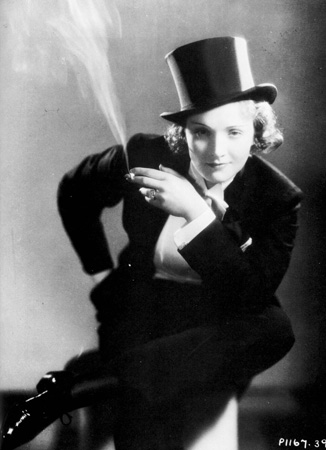
The next excerpt from Bogdonavich:
On the plane she sat in front of us, with her blond girl Friday, and by now, she had obviously decided we weren't so bad; she spent almost the whole flight turned backward and leaning over the top of her seat, on her knees, talking to us. She was animated, girlish, candid, funny, sexy, with her baby-talk "r" (that becomes "w") and everything.I told her I was trying to stop smoking again. "Oh, don't," she said. "I stopped ten years ago and I've been miserable ever since. I never drank before -- and now I drink. I never had a cough when I was smoking -- now I cough. Don't stop -- you'll get fat and you don't want to do that."
We talked about movies she had been in and directors she had worked for. After a while, it became apparent to her that I had seen an awful lot of her pictures. "Why do you know so much about my films?"
"Because I think you're wonderful, and you've worked for a lot of great directors."
"No," she said dubiously. "No, I only worked for two great directors -- Sternberg and Billy Wilder."
"And what about Orson?"
"Oh, well, yes. Orson -- of course."
I guess she wasn't so impressed with Lubitsch or Alfred Hitchcock or Fritz Lang, Raoul Walsh or Tay Garnett or Rene Clair or Franz Borzage.
Here's a picture of her from Orson Welles' Touch of Evil.
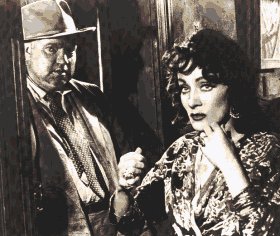
Bogdonavich talked with her about her performance in Touch of Evil:
I had read somewhere that her own favorite performance was in Welles' Touch of Evil (1958)."Do you still feel that way?" I said.
"Yes. I was terrific in that. I think I never said a line as well as the last line in that movie -- 'What does it matter what you say about people ...?' Wasn't I good there? I don't know why I said it so well. And I looked so good in that dark wig. It was Elizabeth Taylor's. My part wasn't in the script, you know, but Orson called and said he wanted me to play a kind of gypsy madam in a border town, so I went over to MGM and found that wig. It was very funny, you know, because I had been crazy about Orson -- in the forties when he was married to Rita Hayworth and when we toured doing his magic act [The Mercury Wonder Show, benefits exclusively done for servicemen] -- I was just crazy about him -- we were great friends, you know, but nothing ... Because Orson doesn't like blond women. He only likes dark women. And suddenly when he saw me in this dark wig, he looked at me with new eyes. Was this Marlene ...?"
"Well, he certainly photographed you lovingly."
"Yes. I never looked so good."
I just love that. Her pride in her work.
More from Bogdonavich - watch her total honesty with herself in this excerpt - she is one of the greats:
I asked her if she'd been upset about Sternberg's acerbic autobiography Fun in a Chinese Laundry, first published in 1965, in which he'd said that he had created her, and implied that she would have been nothing without him. (He once said to me, "I am Marlene Dietrich -- Miss Dietrich is me.")She pursed her lips, lifted her eyebrows slightly. "No -- because it was true. I didn't know what I was doing -- I just tried to do what he told me. I remember in Morocco, I had a scene with [Gary] Cooper -- and I was supposed to go to the door, turn and say a line like, 'Wait for me' and then leave. And Sternberg said, 'Walk to the door, turn, count to ten, say your line and leave.' So I did and he got very angry. 'If you're so stupid that you can't count slowly, then count to twenty-five.' And we did it again. I think we did it forty times, until finally I was counting probably to fifty. And I didn't know why. I was annoyed. But at the premiere of Morocco -- at Grauman's Chinese Theatre" -- she said the original name of the LA movie palace with just the lightest of mockery -- "when this moment came and I paused and then said, 'Wait for me' ... the audience burst into applause. Sternberg knew they were waiting for this -- and he made them wait and they loved it."
I love the photo below.
Bogdonavich again, watching her concert in Denver (she invited the entire cast of Paper Moon to come see her):
Of course she saw World War II at close range, entertaining the troops for three years with "benefits" -- more than any other star performer did, for which she was awarded America's highest civilian honor, the Medal of Freedom, as well as France's most valued order of distinction, the Legion d'honneur. And the experience was all brought back through her touching introduction to "Lili Marlene" - an old German song, forbidden by Hitler in her own country -- which was comprised mainly of a recitation of all the countries in which she had sung "Lili Marlene" during the war. It called to mind what Hemingway had written in his World War I novel, A Farewell to Arms:... There were many words that you could not stand to hear and finally only the names of places had dignity. Certain numbers were the same way and certain dates and these with the names of the places were all you could say and have them mean anything. Abstract words such as glory, honor, courage, or hallow were obscene beside the concrete names of villages, the numbers of roads, the names of rivers, the numbers of regiments and the dates ...And that was what Marlene conveyed; as she said, "Africa, Sicily, Italy, Greenland, Iceland, France, Belgium and Holland" -- here she paused -- "Germany, and Czechoslovakia", her voice carried with each a different untold story of what she had seen, what the 500,000 soldiers she sang for had seen.
The picture below is from her iconic (and wonderful) performance in The Blue Angel - a bleak bleak movie that I remember I saw for the first time on a feckin' date. Not a good date movie. Word to the wise.
Here's a snippet from Pauline Kael's review of Blue Angel:
Dietrich's Lola Lola is a rather coarse, plump young beauty; as she sings "Falling in Love Again," her smoldering voice and sadistic indifference suggest sex without romance, love, or sentiment. The pedant becomes her husband, her slave, her stooge; he travels with the cafe troupe, hawking dirty pictures of his wife. Dietrich is extraordinary.
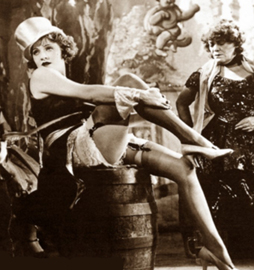
That's a picture of Dietrich asLola-Lola in Blue Angel. Bogdonavich writes about that film:
The Blue Angel instantly set Dietrich among the immortals. Her chair-straddling portrayal of cabaret singer Lola-Lola defined her essential image in certain irrevocable ways. She would forever sing the song she is doing (in German) the first time we see her: "Falling in love again ... never wanted to -- What am I to do? Can't help it ..." She too, then, was a fool for love, like all the men who fell for her. Talking with Sternberg one time, I said that among the pictures he made with Dietrich, Blue Angel was actually the only time she really destroyed a man, to which he replied: "She did not destroy him -- he destroyed himself. It was his mistake -- he should never have taken up with her. That's what the story is." Was he speaking of himself a bit or only of the prudish boys'-school teacher [Emil] Jannings played, who fell madly in love with a loose, bawdy, compulsively unfaithful performer? The strain breaks him down to ultimate degradation. Like that line in Jacques Brel's masochistic love chant, "Ne me quitte pas," Jannings becomes content to be to Dietrich "the shadow of your dog ..." The moment when Marlene humiliates Jannings by making him crow for her like a rooster is one of the most chilling in picture history.
I've certainly got to agree with that one. It was so awful that I found myself compelled to turn away from it. I couldn't even watch it.
Ernest Hemingway wrote a piece about Marlene Dietrich for Life magazine. I think a quote from that piece would be a nice way to close this birthday tribute:
If she has nothing more than her voice she could break your heart with it. But she has that beautiful body and that timeless loveliness of her face. It makes no difference how she breaks your heart if she is there to mend it.
Happy birthday, Lili Marlene.
December 20, 2005
Speaking of The Grinch:
Ahem:
Peter Bogdonavich, in his wonderful book, Who the hell's in it, devotes a chapter to Boris Karloff.
Here's an excerpt:
Through four decades during his lifetime, and now more than thirty years later, the name Boris Karloff has not only identified a star actor, but conjured up a certain sort of character as well, a very particular representative image. The identification certainly began with the sensation of Frankenstein, but this was deepened through the years by equally intense, brilliant performances in horror movies that most often were less than inspired. Yet he brought the same concentration and sense of responsibility to things like The Haunted Strangler (1958) as he did to more complicated roles in films like John Ford's The Lost Patrol (1934); or, on the Broadway stage, with wickedly funny self-parody in Arsenic and Old Lace in the forties, or in the fifties with children's story-book menace as Captain Hook in Peter Pan and with poetic realism as the Dauphin to Julie Harris' Joan of Arc in Jean Giraudoux's The Lark -- a beuatiful performance I was fortunate to see - and for whic h he received a Tony nomination. In 1966, his superb narration for the brilliant Chuck Jones feature cartoon of Dr. Seuss' How the Grinch Stole Christmas helped to make that work an abiding classic.Considering the majority of the movies in which he was cast (about 140 in all, including 40 silents, starting as an extra in 1916), it is not so remarkable that he almost always transcended his vehicles; but that audiences the world over still treasured him after so much screen junk is unique. They knew that Karloff's star presence in even the worst of these gave them a measure of his consdiderable talent, grace and wit. Therein, of course, was the great irony of his horror image: it was absolutely nothing like the man, any more than the sinister-sounding stage name which William Henry Pratt chose for himself, the surname Karloff by itself sending chills up the collective spine throughout the thirties, forties, fifties and sixties. It still does.
Yet the audience also knew in some way that this consummate beyond-evil heavy was actually a tasteful, knowledgeable British gentleman -- shocked by unkindness and never less than polite -- with a sense of humor about himself and his roles, and only genuine gratitude to the public for their long-lasting affection. It was one of the reasons he kept working right through his eighty-first year. He was just an actor, he would say, who had been lucky enough to find a particular place on the screen and, as long as people wanted him, what right did he have to retire?
December 4, 2005
I can admit when I am wrong
It's hard for me, and it chips away at my dignity - but I am able to admit when I am in error.
I have proclaimed to the rooftops my utter disdain and contempt for Patrick Dempsey and his stupid hair. I have hated him since I saw him in Can't Buy Me Love 500 years ago. I nearly blew a gasket when I heard he was doing Raskolnikov in some version of Crime and Punishment. It made me ANGRY that he was successful. I thought he was completely unworthy. It's not like I sat around fuming about Patrick Dempsey, but when I DID think about him, I got feckin' PISSED.
So. I just finished watching my first episode of Grey's Anatomy.
And I have to say.
I have been entirely mistaken.
Not only does he have amazing presence on the screen, but he is a smokin' hottie of the first order.
Just consider this post as my apology to all die-hard Patrick Dempsey fans - those of you who hung in there, through thick and thin.
I was wrong. I admit it, okay??
Happy birthday, Jeff Bridges!
Jeff Bridges is my favorite living actor and today is his birthday! Son of Lloyd Bridges - Jeff had a pretty tough act to follow. Lloyd Bridges was, to put it mildly, no slouch in the actor department. He was in High Noon, for God's sake!
But Jeff didn't do so bad. His first movie was, uhm, THE LAST FECKIN' PICTURE SHOW.
Words cannot begin to express how much this man's acting impresses me. He is a chameleon on the level of Meryl Streep. Like - what is the similarity between Turner Kendall in The Morning After and The Dude in Big Leobowski? They were played by the same person? Are you KIDDING me? How about Starman and Jack Baker in Baker Boys? Same guy? What? Who IS this man??? I don't even think the word "range" applies here, in the same way that I don't think "range" even comes close to expressing what is going on with Meryl Streep. I have to get New Age-y. It's a type of channeling, what Jeff Bridges does. Shirley MAclaine said about Meryl Streep: "She is able to completely abdicate her own personality in favor of that of the character's." This is so rare as to be a complete anomaly. There is no EGO in work like that. Work like that has complete integrity. Again: so rare as to be a complete anomaly. Bridges doesn't get the kudos that Streep does. Why? No idea. The only other guy out there who I believe is as much of an uncanny chameleon is Daniel Day Lewis. There's nothing ever GIMMICKY about their characterizations. The accents do not call attention to themselves, they never ever seem like actors dressing up in costumes ... they just ARE these people. There is great great compassion in their work. Actors like this have enormous hearts. Because they can so completely step into someone else's shoes that their own identity is no longer apparent. What? Also, what I love about actors like this is: they are pretty much unable to talk about what they do. I met Meryl Streep. I listened to her talk about acting. She had NO IDEA how to talk about it. It's a mystery to her, how she does what she does - and if she does, deep down, know how she does it - she's not about to share it. Not because she's jealously guarding her secrets but because - in her words: "Acting to me is like going to church. I can't tell you why I go to church and what happens when I pray - but that's what it's like. It would feel like a betrayal of something to talk about it." Actors like this (Bridges, Streep, Daniel Day Lewis) are inarticulate about their craft. Marlon Brando was the same way. Actors who are less gifted can completely tell you what they were doing, why they were doing it: "Yes, I used an Appalachian accent, and I tried to use my grandmother's way of walking mixed in with the gestures of my third grade teacher ..." Yadda yadda. Geniuses are more inarticulate. They don't tell you anything. They just DO.
Jeff Bridges is like that.

That's him in his characterization from American Heart - an amazing film if you haven't seen it, and one of his subtlest and best pieces of acting. Jeff Bridges himself said it was his best work. Why he wasn't nominated for an Oscar for that film is completely baffling and unfair. Show me a better performance by a male that year, or any year. I dare you.
And - just for my own pathetic purposes - here's my favorite picture of Jeff. It looks pretty much exactly like Window Boy. I looooooove it. Hotness personified.
Oh, and before I forget - Jeff Bridges has his own website, which is NOT a typical vanity website of a celebrity. Of course it's not. He's Jeff Bridges. He's not interested in all of that. Check it out - his photographs are amazing.
Then - of course - there is the comedic highpoint (which has already entered into cult status) of his jelly-wearing White-Russian-drinking bowling-lover Julianne-Moore-impregnating character of The Dude. Damn. What a FINE piece of acting. I never get tired of that movie. Ever. My favorite moment, which is just a snippet - is during one of the fantasy sequences when he's dancing like CRAZY on the Busby Berkely staircase. He's dancing - he's got the long stringy hair - everything is completely surreal - and it's just deeeeeee-lish!! Jeff Bridges! Being completely AWESOME!
Here's The Dude:
Here's the Dude again:
And to be honest - his acting is Door in the Floor is pretty much as good as acting gets. And ... no real kudos. No "recognition". I guess he might be in the Cary Grant realm of actors. They are so reliably good that they are taken for granted. Jeff Bridges will have to play a limping one-armed retarded Native American drag queen in order to win an Oscar. And that's just stupid.
Acting doesn't get any better than what he did in Door in the Floor and that's pretty much final.
I shouldn't care about Oscar nominations because I know how political it is. I know, I know. But still. He is on my eternal list ... if he doesn't win, then future generations will look back and think: "What were they thinking??" Cary Grant never won an Oscar (except for the Lifetime Achievement Oscar he got in 1970 which is basically the Academy's way of saying, "We totally fucked up. Here you go."). That just shows you how meaningless the entire thing is. (However: I am counting the days til the next Oscar ceremony and am incredibly invested in who gets nominated. Such as we are made.)
There's so much more to say about this amazing talent, but I'll just end it now.
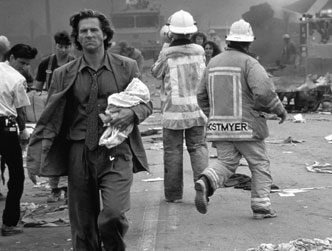
December 1, 2005
Stunning
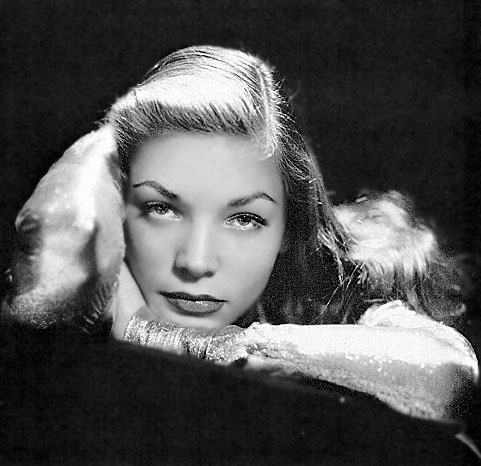
I'm a huge Bacall fan but I've never seen that particular photo before. Look at those eyes.
I love how she is still working. I love how she is crotchety and doesn't care what people think. Or at least she doesn't seem to. She just comes right out and speaks her mind. That whole comment she made, right at a press conference - "I adore Nicole Kidman, but to call her a legend? That is absurd." hahaha One of the perks of being 80, I suppose. You just don't give a shite anymore. I love that about her.
Dan - lucky dog - just went and saw To Have and Have Not in a movie theatre. I'm with Dan - To Have and Have Not may be my favorite Bogart movie. It's a toss-up between that and The Big Sleep.
I have written a couple of long posts about Bacall - and here's one about how she got her start.
Anyway. Let's just revel in Bacall's startling and original beauty, shall we?
November 22, 2005
Bud White
Russell Crowe has become such an enormous star in such a relatively short amount of time that it's hard to remember what an impact he made - with his performance of Bud White in LA Confidential.
This was not just about women going crazy with lust (although that was a part of it - a HUGE part of his success, not to be discounted. It had been a while since a guy showed up on the scene who made women go that nuts). This was about something else. Men went nuts too. At least in my crowd - the actor crowd. His performance as Bud White made the actors I know PUMPED. They wanted to BE him ... he also validated something within them ... the man of action, the man of simple right and wrong morality - and yet, of course, he had the complexity within him that made him an interesting character. I remember my friend Wade saying to me (an incredible actor himself): "When he breaks that chair, man ... holy SHIT ..."
Bud White is not a happy guy. He's not happy just being the muscle. Watch how excited he gets when he's lying in bed with Kim Basinger, talking about what he really wants to do is work homicide. His whole body language changes. He props himself up on one elbow on the pillow, and suddenly he's as enthusiastic and open as a little boy. But none of his colleagues will ever see that side of him. No male will ever see that side of him. Women are the only ones who will ever be allowed to see his vulnerability. This is a throw-back to old movie stars. Humphrey Bogart, for example. His characters are loners. He may have sidekicks, or worthy foes (like in Casablanca) - but you never really see the guy as having a close male friend. He's too much of an individual, a loner for that. His heart, his soul, is reserved for the female sex. She has to work for it, sure, and she better be worth his trust ... but she's the one who gets to see that side of him. But just like Humphrey Bogart: for Bud White it has to be the right woman. Not all women, no ... but the right woman? Fuggedaboutit. That's why when he realizes she has slept with Exley he is so devastated. Intimacy is not casual for Bud White. He is the opposite of a ladies man. He is a one-woman kinda guy. I would bet that Bud White has actually never had a relationship before Lynn Bracken. Maybe he slept with hookers from time to time, just to have the release, but I think this whole being-in-love thing is new to him. .
But in every other situation, Bud White is all brawn. I love him in the very first scene when he's doing the stakeout outside the house where the guy is beating up the woman. Bud White walks up onto the lawn - watch how he walks - the impulse, the objective is IN the way he walks. It's not Russell Crowe's walk, people. It's Bud White's walk. The bulldog, moving forward, on impulse - he WILL stop the beating. He has no idea how, but he WILL stop it. He sees the cord leading up to the Santa on the roof, and it's just a glance - a quick glance - he sees the cord leading up, he quickly assesses the situation - he reaches out, and gives the cord a huge YANK. The Santa comes crashing off the roof. Now: I just love that quick glance he gives before he pulls it down. This is the first scene of the film. This is when Bud White is established. There's a lot going on in that first scene, a lot of information comes at us: we see that obviously something about domestic violence drives this guy nuts. He's FIXATED on it. Okay, so we've got that. That's important to know - that is Bud White's entire raison d'etre - it isn't just what he does, it is who he is. We also see that his partner kind of treats him with bemused tolerance. We see how Bud White beats the CRAP out of the violent husband. This is more information. Bud White will not play by the rules when it comes to people beating up on innocents. Nope. The jag-off deserves what he gets. And THEN - when the wife comes out onto the porch, trembling ... we see how gently Bud White treats her, with deference, and respect. He calls her "Ma'am." He lifts up the fallen cord so that she can pass beneath it - and his action in THAT moment, is full of grace. It's like a dance move - totally different from the violence he displayed 2 seconds earlier. I love that moment: how he gently lifts up the cord for her to pass underneath. He does it unconsciously. He does it instinctively. This is who Bud White is with women.
Member Chris Rock's jokes during the Oscars about Crowe? "If you want to see how someone walked and talked three weeks ago, you get Russell Crowe!"
Russell Crowe, as Bud White, seems to actually inhabit that time. It's a period piece. But it's not kitschy. Or - it shouldn't be. Bud White is a product of his time. And Russell Crowe - in those little moments - how he lifts up the cord for the beaten lady - isn't ACTING LIKE he is back 50 years in time. He actually seems to just live there. This is so much harder than maybe it would seem. You can do all the research in the world, and look at old fashion magazines, and immerse yourself in the newspapers of that day, whatever ... but then ... after all the research ... there's got to be that moment of magic. The magic of transformation. Some people can pull it off. Others can't. Russell Crowe obviously did a ton of research - the mores of the time, being a cop at that time, also - the American accent - yadda yadda - but at the end of the day, he just had to get up and DO it. I never for one second lose trust in him. I suspend my disbelief. He is not an actor in the late 20th century. He's a bulldog cop with a buzzcut in the 1940s. And that's final.
It's a star-making performance. Strange. I just remember the buzz in my little world of actors about this new guy - Russell Crowe - and how incredible he was in LA Confidential. People talked about him differently than they did about other new actors ... It was almost like the second he arrived (at least in America, he had been doing great work in New Zealand for a while) - but anyway - it was almost like the second he arrived we couldn't imagine what it was like before he got there. Or ... something like that. He seemed INEVITABLE.
And the inevitability was the result of Russell Crowe's enormous talent, sure but also because of the ROLE of Bud White. It was Bud White that made him a star.
I would even say (and I'm going out on a limb here, but whatevs) - that it is the first moment we see him that made him a star. All it took was one moment.
The movie has the prologue - narrated by Danny Devito - where we hear about the tabloids, and how it works, and the dirtiness beneath the surface of LA ... it's light, it's funny, it's flashy, the music swings, we go from person to person, we see the grainy photographs in the tabloids ... Then, that kind of fades away ... and the screen goes to black.
The next thing we see is an intense close-up of Bud White. It's not a slow fade-in to the close-up. The scene doesn't come up slowly out of the black - no. The screen goes to black, and then BOOM, we're in the close-up. We see a man. Staring at something. We don't know what yet.
But it doesn't matter.
It is one of the most amazing close-ups I have ever seen. How courageous to start the movie with that. Curtis Hanson tosses you right in. We don't know what is going on, we don't know who this man is (and remember: Russell Crowe was unknown then - he didn't have "brand" recognition yet - he was a stranger to us) ... but we know that ... we cannot look away. He is unbelievably still. He doesn't blink. He just stares. He's a snake, or some kind of predator. He is waiting for his moment. But one of the reasons why the close-up is so arresting, so startling ... is that beneath all of that ... somehow ... is sadness. What this man is looking at makes him sad. It's subtle - it's just a whiff of sadness ... but it's there.
Now that is some great film acting.
November 18, 2005
James Cagney Appreciation Day
I have to agree with Bogdonavich below - that the prison mess hall scene in White Heat when Cagney freaks out - is one of those moments in movie history that you never forget - a high water mark for actors, if you will.
I wrote about it (and the whole movie) here.
Chilling. Amazing acting. He just GOES. Anyone remember that scene? Sheesh. Got goosebumps just thinking about it. I tried to find a long-shot of the moment, but failed - The picture above is when he hears the news of his mother's death - BEFORE the freak out. Amazing acting.
From Who the Hell's In it:
... that psychopathic mama's-boy killer in White Heat, which also features two of my favorite Cagney scenes. In the first, set in a prison mess hall, he is told that his beloved mother has died, and Cagney slowly builds an astonishing reaction from disbelief through sorrow, grief, and finally, complete hysteria -- among the most chilling sequences in movies. At the end of the picture, fatally wounded and trapped by the law on top of a huge globular gas tank, he grins malevolently, laughs, then fires his pistol into the tank itself and, as flames shoot up around him just before the blinding explosions begin, he screams, maniacally happy, "Top of the world, Ma! Top of the world!"

I can say without hyperbole - it kind of doesn't get any better than that.
I know the "top of the world, Ma" is the more remembered scene - one of those immortal movie moments - but to me, the prison mess hall freak-out is one of the most astonishing (I'll steal Bogdonavich's word) sequences I've ever seen in a film.
James Cagney Appreciation Day
That picture, by the way, is from the unbelievable last scene of Roaring Twenties - the "big shot" moment.
I thought it would be appropriate to post the excerpt that mentions how beautifully Cagney always did death scenes. Bogdonavich - who had a chance to hang out with Cagney - relates a story about this:
From Who the Hell's In it:
One of the guests asked how he had developed his habit of physically drawn-out death scenes, probably the best coming at the conclusion of The Roaring Twenties, where he runs (in one long continuous shot) along an entire city block, and halfway up, then halfway down, the stairs in front of a church before finally sprawling dead onto them. In answer, Cagney described a Frank Buck documentary he'd once seen, in which the hunter was forced to kill a giant gorilla. The animal died in a slow, "amazed way," Cagney said, which gave him the inspiration, and which heplayed out for us in a few riveting moments of mime.
I think it's definitely in the top 5 death scenes ever filmed. His physical acting is truly amazing. I'm sure it has something to do with his training as a dancer, and how comfortable he is in his own skin ... but I LOVED to learn that he used the inspiration of a gorilla, dying in a slow "amazed" way ... for the death scenes he did.
Amazing.
James Cagney Appreciation Day
I love the analysis below - I find it to be amazingly perceptive.
From Who the Hell's In it:
He was different from most of the great stars of the golden age in that he often played villains -- even late in his career -- comically in Mister Roberts, with unsentimental pathos in Love Me or Leave Me, with complicated and disturbing psychopathic ambivalence in White Heat. His essential persona was as fixed in the public's consciousness as Bogart's or Cooper's or Gable's but -- being a more resourceful and versatile actor -- he could express ambiguities in a character even if they weren't written into the script or featured by the direction. Because he was innately so sympathetic, his heavies created an intriguing, even alarming, tension in the audience. As a result, White Heat, as an example, contains a decidedly subversive duality: in the glare of Cagney's personality -- though his character is in no way sentimentalized -- the advanced, somewhat inhuman technology of the police and the undercover-informer cop become morally reprehensible. As a result, I remember [Orson] Welles and I hissing the law and rooting for Cagney like schoolboys. That rarest of actors -- who could totally transcend their vehicles -- and in common with a number of other stars in the movies' greatest period, he was indisputably one of a kind.
James Cagney Appreciation Day
From Who the Hell's In it:
Of course, he was like no other dancer: his straight-legged, cocky, constantly surprising way of hoofing -- which is how he started in show business -- was seen only in a couple of other films, not really very good ones. Footlight Parade (1933) is the best of these, yet his manner as an actor and his grace as a performer no doubt owe quite a lot to his dancing days. He just moved eloquently, and therefore could easily have been a great silent star. However, he arrived with the talkies, and gave even the least of them a large measure of his boundless panache.
James Cagney Appreciation Day
From Who the Hell's In it:
One critic wrote of White Heat that only a hard-boiled director like Raoul Walsh could get away with having Cagney -- during a terrible migraine attack -- sit on his mother's lap, a moment of startling intimacy. But I think Cagney could probably have got away with almost anything, because he had as a performer such amazing intensity and conviction. Whether it was shoving a grapefuit in his girlfriend's face -- in William Wellman's highly prized if a bit overrated The Public Enemy, the 1931 gangster film that made him a star overnight -- or doing a little dance step down the stairs of the White House after meeting FDR (in 1942's Yankee Doodle Dandy), Cagney's indisputable authority as a film personality and his flawless sense of honesty as an actor could transform even the most improbably material into something totally believable.
That grapefruit scene (shown above) is so incredible - the photo cannot come CLOSE to capturing what that moment was in the movie: its violence, its contempt, its spontanaeity. You almost wish he had hit her. That would have been cleaner, not so degrading. An incredible acting moment - Cagney at his best.
James Cagney Appreciation Day
Cagney, one of my favorite actors of all time. You know how so many of you have this really personal lump-in-throat response to Wayne? I get that with Cagney. I can't watch him dance in Yankee Doodle Dandy without wanting to weep. I feel like weeping now just thinking about it!!
So - those of you who followed my John Wayne appreciation moments, will know the drill. I'll put up quotes and excerpts from the chapter on Cagney from Peter Bogdonavich's marvelous book, Who the hell's in it.
Cagney fans, get ready!!
From Who the hell's in it:
The year before I had run for Orson Welles a 16mm print of Raoul walsh's devastating gangster film starring Cagney, White Heat (1949); Welles had never seen it and was a very enthusiastic admirer of both Cagney's and Walsh's, so we looked at it one night. Afterwards, Orson got to musing on the absurdity of all those theoretical writings about the supposedly huge difference between movie acting and stage acting. "Look at Cagney!" Orson exclaimed. "Everything he does is big -- and yet it's never for a moment unbelievable -- because it's real, it's true! He's a great movie actor and his performances are in no way modulated for the camera -- he never scaled anything down."
Cagney's another one where you can say: nobody has ever been quite like him. There's only one James Cagney.
November 15, 2005
So now it's your turn, John Wayne fans
Here's what I would love for you to discuss, share, talk about, what have you.
What's your favorite John Wayne film? But more than the title - could you talk about why?
A lot of people have very personal responses to John Wayne - it's like he reminds them of something else - and this, to me, is the mark of those great movie stars of the studio system years. They got INTO us in a way that modern movie stars do not.
And ... any specific favorite John Wayne MOMENT that you have ... what moment of his, in terms of acting, is emblazoned in your brain? A glance, the way he said a line, anything ... Describe it.
Let's discuss his acting. It's so good, and I can tell, from all of these comments (which have greatly moved me, by the way) - how passionately you all feel about him, how much his work means to you.
So.
John Wayne films and moments: GO!!
John Wayne Appreciation Day
John Wayne started out as a prop guy. He was a college student, and he picked up extra cash doing props for movies and occasional extra work. This was how he met John Ford. He almost got fired from a couple of Ford's films (as a prop guy - never as an actor) for various snafus - which are HYSTERICAL to hear about.
Here's my favorite one. I laughed out loud, again, reading it.
Ford was a prop guy working on Ford's Four Sons in 1928:
That was the next time I pretty near left the business. I was just working vacations, wasn't really interested in the business as such, but I really liked Ford. He had this wonderful woman, Margaret Mann, who had never done anything before, and he was talking a performance into her -- taking two, three hours to talk her into the right mood for this scene. It was the fourth son bringing the letter from the third son she's lost in the war. It's fall, and when the door opens, my job as property man was to throw up the maple leaves, and they had a fan there to blow them out -- it was a silent picture, remember. The fan turned on, and down came the breeze into the middle of the set and the door closed and I relaxed. Then I'd go out and sweep the leaves away and get ready to do another take. We kept doing this over and over, and it got to be fairly monotonous for one who wasn't as interested yet in the business as he should have been. So this one time, they opened the door, the son went in, I threw up the leaves, the leaves wafted in, I figured the scene was over, you know. The fellow turned off the fan and I picked up the broom, went in, and started to sweep. And I looked up and I'm looking right into two cameras -- and they're turning! And looking at me are the cameraman, and John Ford, and the wife of the man who was head of the studio then. Shit, there I was. I just threw down my goddamn broom and started to walk off. There was that moment of tension and then, again, Ford broke up laughing, so they all laughed. They said, "Woah now!" They had Archduke Leopold's Serbian heir working on the picture, and a lot of German guys, so they played a martial piece of music and marched me around, and then took me to the Archduke and bent me over in front of him and he pinned the Iron Cross on me. Then they took me back to Ford and he bent me over and kicked me in the ass. And then they sent me off the set, because this actress laughed every time she looked at me -- she couldn't stop laughing. I was never so goddamned embarrassed in my life.
John Wayne Appreciation Day
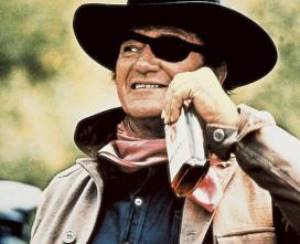
From Who The Hell's In it, by Peter Bogdonavich:
To me, Duke had always seemed slightly out of breath, as though he hadn't yet caught up on the last twenty years, not to mention the last twenty minutes. Both [John] Ford and [Howard] Hawks truly loved him, of course, and even knowing him a little, as I did, it was pretty difficult not to like him. All this, and a lot more, obviously communicated itself to the public -- still the top American star more than seventy years since his beginning. His visual legacy has defined him as the archetypal man of the American West -- bold, innocent, profane, idealistic, wrongheaded, good-hearted, single-minded, quick to action, not given to pretension, essentially alone, ready for any adventure -- no matter how grand or daring; larger, finally, than life or death.
John Wayne Appreciation Day
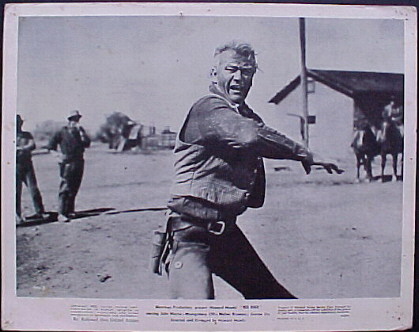
That's one of my favorite images of John Wayne, by the way - from Red River. He's so IN it, isn't he?? I wish I could have found a closer image of his face - He is so in that moment.
Here's a couple of exchanges between Bogdonavich and Wayne that, I think, points out Duke's incredible dedication to his craft. Italicized lines are Bogdonavich's:
One of the most memorable moments of any picture I've seen you in is a silent moment in The Searchers. After you see what's been done to the white women, there's a close-up of you, camera moves in --I turn back. Terrific shot. Helluva shot. And everybody can put their own thoughts to it. You're not forced to think one way or the other.
Your gestures in pictures are often daring -- large -- and show the kind of freedom and lack of inhibition you have. Did you get that from Ford, or did you always have that?
No, I think that's the first lesson you learn in a high school play -- that if you're going to make a gesture, make it.
To be honest: that has to be some of the best acting advice I've ever heard.
"If you're going to make a gesture, make it."
So much of bad phony acting is when people make gestures half-heartedly, or they PRETEND to make gestures .... hoping the audience won't pick up on the fact that they're not REALLY making the gesture ...
but audiences always know the difference between phony and real. They just do.
John Wayne Appreciation Day
More from the transcript of the interview John Wayne gave with Peter Bogdonavich - This is FAScinating. I wish all action stars looked at their jobs in this way - we'd get some better movies.
Any time there was a chance for a reaction -- which is the most important thing in a motion picture -- he [John Ford] always took reactions of me, so I'd be a part of every scene. Because I had a great deal of time in the picture when other people were talking, and all my stuff was just reactions. They become very important throughout a picture, they build your part. They always say I'm in action movies, but it's in reaction pictures that they remember me -- pictures that are full of reactions, but have a background of action.
John Wayne Appreciation Day
John Wayne talks about John Ford - this is from an interview he gave to Peter Bogdonavich. I laughed out loud at the last line of this story. Obviously, John Wayne was a very good story-teller.
A funny thing happened with Ford after The Big Trail. He was a strange character, you know. After I did that picture, I came back, and he was making Up the River. I went over and said, "Hi, coach." Nothing. I thought he didn't hear me. So I figured, Oh, well, he didn't even see me. The next time I saw him I went, "Hi, coach, hi." And again I didn't get anything. So the next time I just went right up in front of him and went, "Hi, coach." And he turned and talked to somebody else. I thought, That's that -- he won't speak to me. I don't know how the hell I can communicate.About two years later, I was in Catalina with Ward, having a belt, and Barbara [Ford], his daughter -- she was a little girl then -- she ran in and said, 'Daddy wants to see you." I said, "Whoa, wait a minute, Barbara, you got the wrong boy -- must be Ward." She said, "No, it's you, Duke." So I said, "Yeah, honey, run along, you know this is a bar." So his wife, Mary Ford, came to the door and she said, "Duke, come here. Jack is expecting you out there." I said, "All right." So I went out to the Araner, his boat, and I go aboard -- I remember Jim Tully was there and four or five guys -- and Jack was in the middle of a goddamn story, and he looked up at me and said, "Hi, Duke, sit down." And to this goddamn day I don't know why he didn't speak to me for two years.
John Wayne Appreciation Day
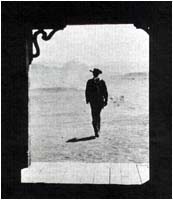
From Who the Hell's In it, by Peter Bogdonavich:
His performances in these pictures [Rio Grande, The Quiet Man, The Searchers, The Wings of Eagles, Man Who Shot Liberty Valance] rate with the finest examples of movie acting, and his value to each film is immeasurable; yet none of them was recognized at the time as anything much more than "and John Wayne does his usual solid job," if that -- more often he was panned. The Academy nominated him only twice; first for Allan Dwan's excellent Sands of Iwo Jima, an effective and archetypal John Wayne Marine picture of non-Ford/Hawks dimension. Yet I remember that Wayne's sudden death from a sniper at the end of Sands was the first real shock -- and one of the most lastingly potent -- I ever had at the movies. The reason why this worked so powerfully for me at age ten, as well as for millions of all ages, was because of Wayne's even then accepted indestrucability. In fact, Sands of Iwo Jima was the second of only five films in which Wayne dies. Still, it wasn't until twenty years later, when he put on an eye patch, played drunk, and essentially parodied himself in True Grit, that anyone thought he was acting, and so with this over-the-top performance Duke Wayne got his second nomination and finally won his Oscar.The particular quality in a star that makes audiences instantly suspend their disbelief -- something men like Wayne or Jimmy Stewart or Henry Fonda naturally bring with them when they enter a scene -- is an achievement which normally goes so unnoticed that most people don't even think of it as acting at all. To a lot of people, acting means fake accents and false noses, and a lot of emoting ... John Wayne was at his best precisely when he was simply being what came to be called "John Wayne".
Amazing.
John Wayne Appreciation Day
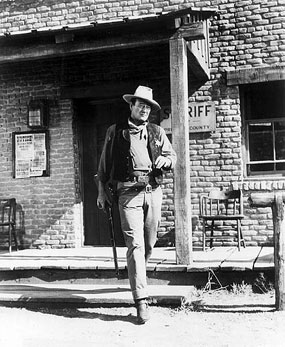
From Who the Hell's In it, by Peter Bogdonavich:
There's a moment in Rio Bravo -- which features, I think, Wayne's most genuinely endearing performance -- when he walks down the street of the jail/sheriff's office toward some men riding up to meet him. Hawks frames the shot from behind -- Wayne striding slowly, casually away from camera in his slightly rocking, graceful way -- and the image lingers a while to let us enjoy this classic, familiar figure, unmistakable from any angle, Americ'as twentieth-century Hercules moving across a world of illusion he had more than conquered.
John Wayne Appreciation Day
From Who the Hell's In it, by Peter Bogdonavich:
And after forty years in films, Duke had more excitement about the job than most people just starting out. He liked working with newcomers, too, and was generous with advice; those who didn't let ego stand in their way could learn quite a few good tricks. And all of this came without a note of pomposity or pretentiousness. In fact, he always seemed genuinely surprised, even slightly embarrassed, by praise. Without ambiguity, [Howard] Hawks said to me that "when you have someone as good as Duke around," it became "awfully easy to do good scenes" because the actor helped and inspired everybody.
John Wayne Appreciation Day
From Who The Hell's In It, by Peter Bogdonavich:
In a lifetime of almost thirty years as a top-ten box-office attraction (plus twenty before that as a not unpopular star actor), Wayne's accumulated persona had even before his death attained such mythic proportions that by then the most myopic of viewers and reviewers had finally noted it. He brought to each new movie (good or bad) a powerful resonance from the past -- his own and ours -- which filled the world with reverberations above and beyond its own perhaps undistinguished qualities. That was the true measure of a great movie star of the golden age.
November 11, 2005
Richard Gere: "his silky walk and fluid gestures"
In this review of The Bee Season (which sounds very interesting)Manohla Dargis has this pointed bit of analysis of Richard Gere's acting:
The casting of Mr. Gere proves a challenge the filmmakers never surmount - not only because of his celebrity, but also because he fails to convince as a man devoted to the life of the mind. An appealing and poised screen presence, Mr. Gere wears designer threads and Navy uniforms with ease. His gifts as a film actor are located in his body, in his silky walk and fluid gestures, but he does not have the open, expressive eyes that so often serve as the way into a character, particularly one meant to have a lot going on behind those same eyes.
Fascinating. I never quite thought of it that way before. I wouldn't call myself a Richard Gere "fan" - but I loved him in Officer and a Gentleman and I loved him in American Gigolo - he's wonderful. But sometimes he annoys me (don't even get me started on Chicago) - or ... it's not that he annoys me, it's just that sometimes there's something OFF in his character portrayals. When he's good he's good - and when he's not good, he seems to ... not even BE there up on the screen. Strange. I always thought that maybe it was because he was too self-centered to submit to another character - but I am not sure that that's true. I actually met the dude, and he was very nice, and interested in other people. Also, he SO gives a shit about acting. He was very friendly with all of us actors-in-training - his stories about his early days were terrific. I was also surprised at how FUNNY he was. I never would have imagined Richard Gere to be funny - not from his screen performances - but he is.
So ... I didn't get an overwhelmingly narcisstic vibe from him - and, come to think of it, it doesn't quite sit well with me ... That's not WHY he can't "get into" certain characters. At least I don't think it is.
Although - (sorry for all the flip flops) - I do think he has a difficult time NOT being the leading man anymore. That, for me, was one of the main issues with Chicago - that movie was about the WOMEN, dude, not you. That was not "a Richard Gere film". He couldn't surrender the screen to the women. I noticed the same issue in Pretty Woman - He tried to OWN the scenes - as though it were a Richard Gere vehicle - but she just walked away with that movie. Easily. And the scene when they go to the opera in San Francisco in his private jet - there's a scene of the two of them getting into a limosine and he doesn't open the door for her. She's in that long red ballgown ... and he gets into the car first. It always struck me as ... a very revealing moment about Richard Gere. And who he is as a movie star.
That movie was all about Julia Roberts. It was about making her a star. I think Gere had a problem with that, on some level. Ah, I don't know. Not sure exactly what my problem was with Chicago - but I know it wasn't JUST the abhorrent presence of Renee Z.
I think mainly - when it seems that he is OFF, it's a matter of casting: He has a limited range. I don't mean that as a criticism. Most actors have a limited range. We can't be EVERYthing. But actors get in trouble when they over-step, when they don't know WHAT their range is. Most actors who become major stars know exaclty what their range is. They know who they are. Actors who don't know who they are don't get very far.
If you're fat and you can't or won't lose weight, then embrace it, and go for the fat-girl parts. Don't bitch about how people judge you on your looks. They judge EVERYONE on their looks. You think Jessica Alba doesn't get JUDGED on her looks?? It might even be WORSE for her because if she gains two pounds, she will definitely hear about it from her manager, her agent, her publicist, etc. Camryn Manheim's fat. She never let ANYONE stop her. And she was so good that directors CHANGED how they viewed a character so they could have HER in whatever show they were producing. Her first big break was in a national car commercial where she played a mechanic. The producers/directors of the spot had only been seeing men, of course - guys who fit the "mechanic" type. Big blurpy blue-collar types. My friend, who is a casting director, had seen Camryn's one-woman show and had thought she was FABLOUS. She called her in for as much stuff as she could. And she snuck Camryn into the audition lineup for the mechanic part. One woman (Camryn) against 50 guys. Guess who got the part? The director changed his entire VIEW on who the mechanic should be - based on Camryn's audition. How amazing is that?? Nobody gave Camryn Manheim anything. She FORCED people to see her TALENT, not her fat. Good for her.
If you're a geeky skinny nerd, then know your range. Know you will be given geeky skinny nerd parts, and embrace it.
If you're a hot leading man, don't be embarrassed about it, and don't get pissy because you won't be cast as the Hunchback of Notre Dame. Embrace your leading man-ness.
LATER, if you reach some success, and you have TALENT - THEN maybe you can "stretch" and pick other parts ... but unless you're really talented in that chameleon way (and sorry, beautiful people - but it's usually the character actors who are talented in that chameleon way) - then you better stick to your type. Actors have made extremely successful careers out of playing one thing.
Gere, when he's cast well - like American Gigolo - is suPERB. He's so good in that film that I cannot imagine anyone else in the part.
But until I read the review of The Bee Season this morning, I hadn't really clarified WHY. It is because his "gifts as a film actor are located in his body ..." That is so so true. Very few actors have what he has. His comfort in his own body. He moves with grace - and when he crosses a room with purpose (watch how he leaps up after Debra Winger when she tries to storm out of the cheap motel) - it is very exciting. His body is coiled, ready to strike - but laidback - filled with potential. Watch some of the scenes in Looking for Mr. Goodbar when he's half-naked and freaking out on coke, and putting a knife to Diane Keaton's throat ... and then bursting into laughter. He's incredible. Fearless with his body. Watch how he walks in American Gigolo. Watch how he kisses Debra Winger in Officer and a Gentleman - and ... just watch how he walks into that factory in the end. The whole scene is set up to make you excited, sure, but watch how he WALKS and the excitement in that scene can mainly be found in how he WALKS.
October 29, 2005
A bold statement
I think that Barbara Stanwyck is the best American actress we have ever had.
Hands down.
Her work is uniformly exquisite. It gets me right in the throat. It's complex, layered, powerful, funny, trampy, heartfelt, and ultimately TOTALLY mysterious ... You never get to the bottom of her. She never gives it all away. She holds something back. She holds THE thing back, whatever it is. And it is that one held-back thing, never defined, never spoken, never pinned down, that makes a truly great enduring actress.
She has no equal.
October 19, 2005
Richard Jenkins - yee-haw!
James Berardinelli (my main movie-review guy - dude is awesome) has given North Country 3 stars. I kind of don't have any desire to see it even though ANYTHING with Sissy Spacek and Frances McDormand in it is allright by me!!
There's just something about the one clip in the commercials of Charlize Theron saying: "I want to sue the mine, all of them" that just ... doesn't "get me". Her voice doesn't sound right. It doesn't have that same clutch-you-at-your-throat urgency that other films with similar themes (I'm thinking of one of my favorites Silkwood) have. I don't know - Charlize's voice in that one clip sounds very ... actress-y. Can't explain it better than that!
I just have to say that reading his review actually brought a big lump to my throat because he calls out for praise the always fantastic Richard Jenkins - he gives him the best review in the film. I just ... I cannot tell you how thrilled this makes me. It's such a vindication, it just pleases me so so much ...
Richard Jenkins - one of the best character actors working in America - he has been doing solid awesome work for ... 25 years now? He was a member of Trinity Rep in Rhode Island, and I grew up seeing him in various stage productions there. I have met him before, at various theatrical moments in Rhode Island, through the years ... and I couldn't have been more happy for him when I saw him give such WONDERFUL performances in movies like Flirting with Disaster (just the thought of it makes me laugh out loud), the movie The Man Who Wasn't There (which - not sure - but I think I might have been the only person who saw that movie. HE is the reason to see it, and he's not even the lead.) - and, of course, his recurring role as the dead father in 6 Feet Under. This guy is a gem. This guy should be celebrated.
And listen to Berardinelli's words:
But the one I want to single out is character actor Richard Jenkins, who is superb. Jenkins' portrayal of Josey's conflicted father is believable and powerful. Jenkins is one of those actors whose face is more familiar than his name. He has appeared in more than 60 movies and TV productions, and is probably best known for a supporting role in Flirting with Disaster and as a member of the ensemble cast for Six Feet Under. He deserves official recognition for his work in North Country.
It just makes me want to cry. It's so so true.
Charlize Shmarlize. I mean, good for her - she's made quite a nice career for herself - but man, I love it when character actors who have been around forever are rightly praised. It's just AWESOME.
And back to Flirting with Disaster - watching Lily Tomlin talk his character through an acid trip (he's a pretty square US Marshall - and his food was spiked - so he has no idea what's happening to him) - is one of the funniest things I've ever seen in my life.
October 16, 2005
How Eight is Enough changed my life
I am a big fan of celebrity crushes, as I have said here before. I've had them since I've been aware of celebrities and I have not given them up in my old age. I have fine-tuned the "celebrity crush" into a work of ART. I should give seminars about how to do them properly.
My first crush is a toss-up between Ralph Macchio and the hot young actor who was in some TV movie starring Bette Davis - no memory of the title, but he haunted me! (UPDATE Feb. 2009: Yeah. I remember him now. That would be Ben Marley.)
The Macchio crush was more transformational, in terms of my development as a human being, so I'll go with that one.
Now I am talking about pre-Karate Kid Ralph Macchio. Very important distinction. I am talking about his Eight is Enough phase. When he hit it huge with Karate Kid, I felt oddly jealous about it. I felt proprietary towards him. I had been with him BACK THEN. Before it was COOL. I somehow liked it better when he was just my little secret.
Some people don't even remember his brilliant one-season stint on Eight is Enough. Ah, but that is probably because they gave up on the show long before he arrived. Macchio was obviously brought on as "young blood" - to draw in an audience like me - horny love-sick pre-teenagers. The ratings were probably down. Bringing in a troubled young cute teenager was an obvious ploy to jumpstart the show again.
To me, at 12 years old, the older siblings (David, Mary, Susan, Joannie, Nancy, Elizabeth and Tommy) were too sophisticated, too slick, and a little bit ikky, frankly. David, the oldest, was a particularly disturbing individual, I thought. With his pearly whites and his feathered hair, and his jobs, and his independence. He had too much of a fake-tan sleazoid veneer. His teeth didn't fool me. The guy was a creep.
The girls all wore shiny lip gloss, shoulder pads, or frightening workout outfits involving spandex and lilac leotard ensembles ... The push-up bra was not in existence in the Bradford house apparently, so the sisters all had droopy sloopy-shouldered silhouettes that just added to the skeezy vibe.
There were cars pulling in and out of the driveway. There were teenage problems of the 17 and 18 year old variety. I could not relate.
And Bowl-Cut Nicholas was not as cute as everyone thought he was, and I found him plain old nauseating.
I needed something else. Someone who hit my demographic. Someone ... a guy ... who was juuuuuust the age I needed him to be ...
And so along came Jeremy Andretti, played by Ralph Macchio. Jeremy was the orphaned nephew of Abby (played by Betty Buckley, of course. She couldn't ever be "alone in the moonlight" in the Bradford house, sadly. No damn privacy). The Bradford family opened their hearts and their home to the troubled teenager, who got into fights, who was sullen, uncommunicative.. . The first time I laid eyes on him, I was GONE. Put a fork in Sheila. She is DONE. He was everything I found attractive - although I didn't know it then, being only 12. It was this weird awakening, watching Jeremy in action. My heart just fluttered open to this character. He was sensitive, but he covered it up with a tough outer shell. It would take a very special person (me???) to crack that shell. His shyness and his toughness were a killer combo.
I wouldn't realize until later that that shy/tough thing he had going on was in a long long continuum of movie stars who have made careers out of mixing those two qualities together. Tough-yet-sensitive hard-boiled-outer-shell guys. Gary Cooper. James Cagney. Cary Grant in some of his movies. Humphrey Bogart. You name it. Jeremy Andretti needed to be tough - not because he was mean, or callous - but because he felt too much. He was too vulnerable.
I very quickly became addicted to Eight is Enough. I was crushed when Jeremy's storyline was not the feature. I suffered through the ikky slick-lipglossed storylines of the older siblings, and the sickeningly sweet Bowl-Cut storylines, waiting, waiting, week after week ... for Jeremy to take the spotlight.
This crush was a secret. It was so powerful that it actually embarrassed me. It was a runaway train - and this is now a familiar sensation to me, years later. I now know the signs, and I no longer judge myself for who I am, and that I do this, on occasion. I still get embarrassed sometimes, when I get swept away like this, but I figure there are worse things in life than this habit of mine.
I have come to believe that these crushes blossom just when I need them most. I ride the wave until it subsides. The crush arrives usually at a low moment when I need fortitude, when I need a light at the end of the tunnel. The crush helps me to hold on, to hold out hope that someday, someday, the closeness I yearn for will manifest in real life, and not just in re-runs of Eight is Fucking Enough, for God's sake. This is why I revere actors so much. This is what they can give us - potentially. This is what certain actors (and certain performances) have given me. Something to hang on to ... when the going gets rough ...
I discovered Ralph Macchio as Jeremy Andretti when I was at the lowest of the lowest of points. I was in junior high. I didn't really take to adolescence, shall we say. I was a fish out of water in the machinations of 8th grade. I was bruised and battered very quickly from rejection from boys - and not just rejection - but outright laughter in my face, when I would ask them to dance, what have you. (I'm not exaggerating. I was "that girl", the pariah of the school, for one awful year). I was pudgy. My clothes were all wrong. My Xena jeans didn't look the same on me as they did on Cris D., the goddess of junior high. Kids crank called my house and shouted insults about my clothes into my ear. I was probably in a very deep depression and didn't even know it. I found it hard to get out of bed in the morning. I would cry on the way to school. Not a good sign.
In the middle of that howling wilderness, there was one particular episode of Eight is Enough that I can say, without too much exaggeration, changed my life. Not outwardly - but inwardly. I could feel the shift take place. I got my eyes above the muck, basically. I saw further. I was in the gutter - but I got a glimpse of the stars. That kind of thing.
I remember that episode almost shot for shot, and I have not seen it since it was on that first time - in 1980 or whatever it was. So that gives you some idea of its lasting impact.
Here's how the episode opened:
In a movie theatre. We can see that the movie being shown is an old Fred Astaire Ginger Rogers classic. There are the two of them, dancing across the marble floor - - floating, actually - her dress graceful, light - he elegant, lithe ... Then we cut to the audience in the movie theatre, and there is Ralph (Jeremy) - with his beautiful face - watching, totally engrossed. He's eating popcorn, and he is totally into the movie.
And two seats away from him sits a teenage girl, also by herself, also engrossed, also chomping on popcorn.
A sort of rated-G True Romance.
After the film, the two of them somehow strike up a conversation in the lobby and they both rave, unselfconsciously, about their love for Fred Astaire and Ginger Rogers and how much they love those old movies and how cool it is that the local movie theatre would run them as matinees.
Our first clue of the HOOK of this episode: the two bond over old movies.
The girl reveals that she has just moved to the town, and is a little nervous about starting at the high school on Monday. He is obviously very excited that she is going to be going to his school, he feels a bond with this girl. There's a sweet connection there. They part, with him telling her that he will keep his eye out for her on Monday. Teenage romance shivers in the air!
But what was so deadly for me watching it, what hooked me in so deeply, was that their connection was not based on lust, which I couldn't relate to yet. I wasn't there, developmentally. No: it was a shared interest in something, a common passion. This was devastating.
The episode moves on. They see each other at school. They have sweet encounters in the hall. They meet up "by coincidence" at the next Saturday matinee of a Fred Astaire movie. Only this time, they sit together, side by side, sharing popcorn, occasionally grinning at each other. Having a passion is so much fun when you can share it with someone who "gets" it.
I died a million little deaths watching all of this. I ached! I yearned! I burned up inside like a pubescent Tennessee Williams character. I had so much to give, so much of myself to share but nowhere to put it yet. Holding all of that stuff back actually hurt. It still does. So I put all of it into Ralph Macchio. He could take it.
Then, inevitably, conflict arises. Turns out that Jeremy's interest in Fred Astaire was something he hid from his friends. With his friends, he played video games, watched sports, played football. He could never admit to liking old movies with DANCE NUMBERS in them to his friends. He needed to save face. As long as his little Saturday-matinee romance was kept secret from his friends - he was cool with it.
But alas, Jeremy, life doesn't work out that way, does it?
Of course, one day she came up to him in the cafeteria, where he was sitting with his group of friends. Oh, the hostility of the high school cafeteria! The caste system! The Darwinian brutality! She says to him, in front of his friends, with a big friendly smile - "Hi! What are you doing Saturday? They're playing 'Swingtime'!"
She has now broken a rule. She didn't even know it was a rule. She was like me. I found myself in the world of junior high, with all these rules, all these boundaries of what was acceptable behavior and I most certainly did not get the memo. She didn't know that he was ashamed of that part of himself, that he needed to keep it secret from his buddies.
Of course, he blows her off. Publicly. He makes believe he doesn't even know what she is talking about. It is a complete and utter rejection. His friends snicker. Ruthlessly. She stands up there, by them, alone, shamed. She walks away, mortified, with the taunting voices of his group of friends imitating her girl voice echoing after her, "Swingtime is playing! Swingtime is playing!"
I knew her pain! I had had my feelings snickered at! I had had my intensity scorned!
And yet, watching. I wanted to crawl through the television and yell at her: NO! He does like you! He's just embarrassed! He can't admit to liking those movies in front of his friends! He does like you - and that's why he rejected you!
And so, I ached for him as well. He was choosing cool indifferent nonchalance (and therefore loneliness) over unafraid involvement. Not just with her. But with who he really was. This was a TRAGEDY.
I saw people making those choices all around me every day in junior high. Clipping off the unacceptable parts of themselves to fit in with the pack. It seemed "the thing" to do but I found it enormously painful. I couldn't manage it.
Because Jeremy was really a senstive person beneath the asshole exterior, he felt horrible about how he had treated her. He tries to talk to her in the hallways. She rejects him. He tries again. She ignores him. She is a stony wall, an ice princess. She was a real hard-ass, that one. I didn't think that I could withstand his heartfelt apologies. I would cave. But I learned from watching her: No one should shame you the way he shamed her. Especially if he had opened up in private. His behavior was unacceptable. A girl has to set her own standards for how she wants to be treated and she shouldn't accept anything less. A man needs to be able to stand up to his friends and say, "This is who I am. Deal." It is not okay any other way. My response to this came from my loneliness. From feeling left out. I was so eager for attention from any boy that I would take the SCRAPS from his table ... rather than wait for someone willing to sit down and have a whole meal with me. I watched the girl on Eight is Enough say "no" to his scraps.
This was a mind-blower. Truly. I am still learning that lesson. She would not allow him to compartmentalize her, and only acknowledge her existence on Saturday afternoons.
Finally comes the climax of the episode. After watching it, I lived it over and over and over in my head, I obsessed on it, I fixated on it, I held onto it with fists, knowing that this is something I need to remember.
She was walking along on the sidewalk in front of the school. The campus was crowded with students. His declaration (when it came) needed to be that public. This is a well-known formula, of course, used in countless movies to great success: the public revelation of true emotion, the declaration of love made in front of a crowd. The final expression of commitment is not just made between two people privately, but involves the whole world. It has to. It's like a wedding ceremony: the bond between two human beings is enough of a big deal that it must be made publicly to have any real weight.
Jeremy runs up to her and tries to talk to her. She staunchly keeps walking on, clutching her books to her chest. He walks along beside her, apologizing, ignoring the rejection. He has lost the indifference. Now it matters more to him to tell her the truth and he doesn't care who sees.
She remains impervious, he hurt her too much, and she finally shouts at him, "Leave me alone!!" She marches off without him, leaving him standing there with a crestfallen look on his face. People are staring. The two of them are making a scene. He doesn't care anymore. And now he is the one who has been publicly rejected and shamed.
And in that moment, the transformation occurs. He leaps into the unknown, he tosses himself off the cliff into the fearless abyss. I'm not sure, I have no empirical evidence of this, no quote to back up my theory, but I would warrant a guess that this next moment alone is responsible for Ralph Macchio's enormous success a couple of years later in major motion pictures. If I had been a casting director, and I had seen that scene, I would have thought: "That kid could carry a romantic film." There was a seismic shift during the scene and by the end of it, he became a viable leading man. You think I'm kidding? I'm not kidding. I'm dead serious. Why else would I remember the scene so clearly 25 years later?
She walks away, with an air of finality. He stands, stunned, silent and then, on impulse, he jumps up on a nearby bench, and blurts out, in tune, at the top of his lungs: "I won't dance! Don't ask me!"
She stops dead in her tracks and slowly looks back at him, shocked. All the watching students start snickering, giggling. He doesn't care. He stays up on the bench, and sings out at top volume: "I won't dance, don't ask me! I won't dance Madame with you! My heart won't let my feet do things that they should do!" He starts to dance around up on the bench, even as the small mocking crowd gathers. She stares up at him, dumbfounded.
He leaps off the bench and dances toward her, still singing: "You know what, you're lovely you know what, you're so lovely! And you know what you do to me!" She's embarrassed, blushing, she doesn't know what to do. She tries to remain impervious, unmoved, and then she gets her nerve back, and turns her back on him, starting to stalk off. (I gasped, watching. The fortitude! The strength of self! To resist!!)
Eventually, of course, his singing and dancing breaks her down. But it's more than that. It's more about his fearlessness in publicly admitting his feelings for her - and even deeper than that: his fearlessness in admitting who he is. Falling in love is not just about declaring yourself to the other person. You also must say, "Here. This is who I am. This is me."
He is now dancing around her, still singing, serenading her, really, in front of the whole school. "When you dance, you're charming and you're gentle -Specially when you do the Continental - But this feeling isn't purely mental -For heaven rest us, I'm not asbestos ... And that's why I won't dance, why should I?" Finally, he takes her in his arms. It is a startling moment. You could feel the gasp in the crowd. He has never touched her before then. And he waltzes her around, awkwardly, goofily, she's laughing now, out loud. and he finishes the song with a flourish, dipping her body over backwards, like an old pro.
The crowd (naturally) bursts into applause.
Oh, the surge of triumph I felt! The beautiful surge of affirmation!
I thought about the episode for days. I actually wrote it out into short story form, so I could elaborate on the feelings of both parties. I wanted to live it.
The message was, obviously, that being yourself, and admitting who you are, not changing yourself for your friends, is far superior to lying in order to save face. This sliced through me like a laser.
Especially, it must be admitted, because it was the boy doing this in that particular story. It was the boy who had to give all that up, and be fearless. In my limited and very painful experience in junior high, boys traveled in packs, were aloof and game-y with me, and acted embarrassed when I asked them to dance. I was always in such a state of uncertainty and pain when it came to the boys I liked. (I know now that boys had their own brand of hard time during those years but that only came with perspective, and getting older. While I was in it, I had none of that. Boys were on another planet. A planet I sooooo wanted to visit. But they didn't want me there.)
The thought that a BOY my age could be interested in me the way Jeremy was interested in her, and that a boy could throw caution to the wind in front of his peers, was so attractive to me, so powerful, that I basically melted into a hot quivering puddle of longing and hope that lasted for MONTHS. It blew my mind.
What it said to me was (outside of the celebrity crush aspect of the whole thing): Don't just look at the surface of things. Don't passively accept the aloofness of the boys you like. They might be afraid, or shy, or don't want to seem goofy to their firends. Differentiate between who they were with their friends and who they were when you got them alone.
But also: it said to me: Do not accept being treated cruelly. Even if he's cute and you like him so much. Do not chip away at yourself. It is forbidden.
It said to me, too, (and here is where it gets global, here is why I still remember it shot for shot):
Hang on.
Just hang on.
There may not be a boy in your life right now who would leap on a park bench for you, but hang on. There will be.
The loneliness you feel right now shall pass. This, too, shall pass.
A tough tough lesson to learn when you are 12 years old.
The girl Jeremy fell for in the episode was not a babe. She had long straight hair and wore long skirts. You didn't have to change who you are to get a boy interested in you (the lesson I learned from Grease). You just had to be yourself, and be true to yourself and continue shining your own particular light with its own particular wattage and someone would see that light eventually and be drawn to it. If you try to change yourself, and fit into what you think is the ideal, if you try to adjust yourself to what you think guys want, then you will not be truthful, and the right kind of guy for you will not be able to find his way to you.
That one episode of Eight is Enough got me through many dark hours in junior high. It burned me up inside, a fire that eventually went out, but a fire I have never forgotten. That one episode helped me not be ashamed of my own individual passions (Fred Astaire and Ginger Roger movies being one of them), to not put pressure on myself to fit into the round hole of the junior high social agenda. Maybe if I stuck to my own path, and kept cultivating my own personality, and expressing my own individual interests, fearlessly, without apology, then a Jeremy type might be in my future.
Keep going, Sheila. You're okay. You're doing okay.
There will be someone out there for you. There will.
I still believe that.
Thanks, Ralph Macchio, for what you gave me in your wonderful performance in that one episode.
And thanks, too, to the creators of Eight is Enough for realizing that eight kids were actually not enough.
Thank you for realizing that you needed one more.
October 4, 2005
Oscars ... the female version
Here are the actresses who I believe will win Oscars someday. Who knows if they will or if they won't - but these women are definitely Oscar caliber.
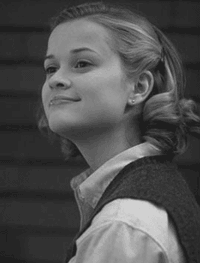
-- Reese Witherspoon. Listen, I've been a huge fan of this girl since her movie debut in Man in the Moon when she was 12 years old. Sam Waterston is in the movie, Tess Harper - and Reese, a little kid, walks away with that film. Or maybe I should say: she "strolls" away with the movie because she makes it look so easy. It probably IS easy for her. She has an innate gift. Her acting is intelligent, unexpected, and very very good. But it is really her role as Tracy Flick in Election (shown in the picture above) which cemented my regard for her. I know she's become a ginormous star since then - so now she's appearing in "romantic comedies", yadda yadda, but her performance of Tracy Flick has got to go down in the books as one of the most spot-on psychological portraits I have seen in the movies in a long LONG time. She's not just good. She's a genius in that movie. Oscar-worthy. Mark my words. She needs the role - that will "land", so to speak ... but she is very very deserving. I'm a huge fan.

-- Julianne Moore. She's one of those actresses who doesn't just do mainstream stuff - so a lot of her best work has been in movies that about 20 people saw. Like Safe. People. This is her best work, in my opinion. SEE IT. Her acting in that film blows me away - and it's one of those parts where you honestly can't believe anyone else but Julianne in the role. But that's the deal. She doesn't "play the game" in the typical way, although she is a big star, and everyone wants to work with her. She isn't a mainstream actress. I am very excited to see her current film - can't remember the title - it's been getting wonderful reviews. She's truly a special actress. One of a kind.
-- Kate Winslet She seems pretty much, like Johnny Depp, to be a shoo-in. She's always good, and whenever she acts she appears to get nominated. What I love about Kate Winslet - and this is a very very rare quality - you can count on one hand the actresses who have it: She's the type of actress where you can actually feel her blood start to race, in emotional scenes. You can actually feel her heart speed up. A flush actually covers her cheeks. She is so alive that it is undeniable. She's always had that quality - her actual physical LIFE FORCE comes off the screen. Amazing. I love her.
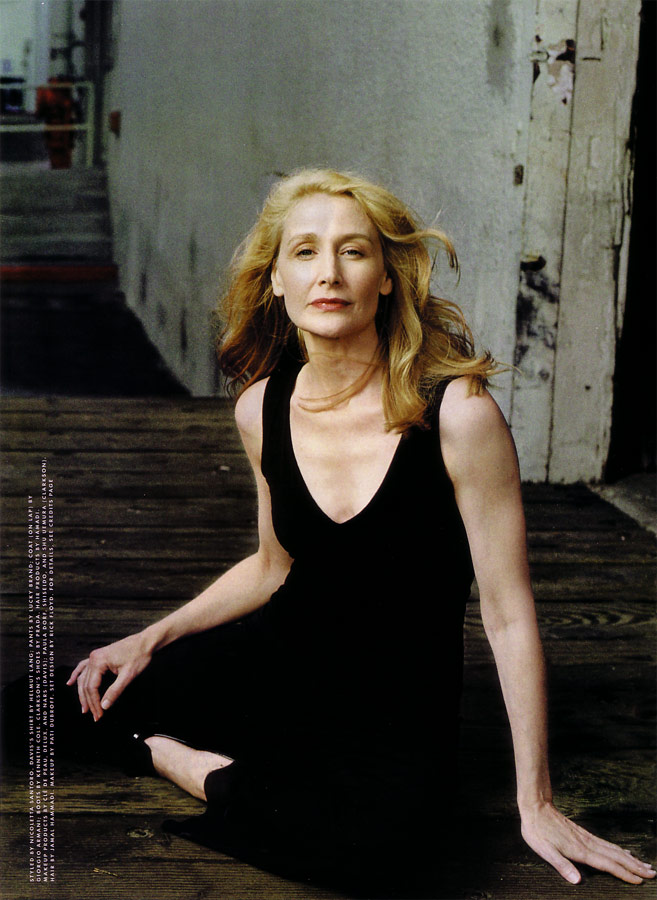
-- Patricia Clarkson Mitchell and I were actually talking about her the other night, about her work in High Art, where she plays a heroin addict Marlene Dietrich wannabe. Mitchell said, "I swear - I had no idea who she was at the time I saw that film - and I truly believed she was German - I thought she WAS that person, and that they found a ... you know ... performance artist to come in and just play herself. I had no idea she was ACTING." The woman is a complete and utter chameleon. Along the lines of Meryl Streep. She doesn't just change her accent, her clothes, her hair ... she actually seems to change her inner essence - from role to role. She's amazing.
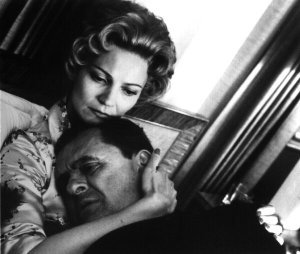
-- Joan Allen I think she's the best actress working today. Mitchell and I had a great discussion about her as well - If she had started doing major films in the 70s and 80s, as opposed to the 90s and 2000s (whatever) - she would probably have 3 or 4 Oscars under her belt by now. Like Meryl Streep does. She's that good. Hollywood doesn't quite know what to do wih Joan Allen (and back in the 70s and 80s - Hollywood DID know what to do with Meryl Streep) ... so Joan Allen doesn't get the projects that she SHOULD. She is literally the A-list, as far as I'm concerned. She's the best. I would love to see her really get "the role" that would cement her position. She's fantastic. Her work actually hurts me. Even in a movie like Pleasantville - she brings such a specific depth of emotion to it - NOBODY plays buried fiery emotion like Joan Allen. NOBODY.
And lastly. I realize this last one is a pipe dream. It will probably never happen. This is a shame. Because the woman is not only a "good actress" - tepid term - but a flat out genius. She doesn't "act". She channels. I'm sorry to sound so hyperbolic and new-agey - but honestly. She's so so so good. And looking at the body of her work, I have to say (and this is a high compliment): I have NO idea who Catherine O'Hara is. Is she like Cookie in Best in Show? Is she like Sheila Albertson in Waiting for Guffman? Who is she? No idea. She appears to have no innate personality that she has to contend with (I'm sure she does - I'm just saying that it is never apparent in her acting). She is a total and utter chameleon. I thought Charlize Theron was good in Monster and all - but whatever. You put crappy makeup on a beautiful woman, make her teeth look bad, give her a scraggly wig - and everyone says "WHAT AN AMAZING ACTRESS!!" Catherine O'Hara does complete transformations - only without all the bells and whistles and fake noses and fake teeth. So I know she'll probably never win one, but I'm putting her on the list as my way of acknowledging her giant gift.
Oscars ... the male version
Here is a list of actors who I believe will win Oscars some day. I'll do the actresses in the next post.
Now - some of these are probably wishful thinking - but it is my way of saying: I think these people are some of the best actors working today - and all they need is the right ROLE. It's the role that wins the Oscar, not the actor. Always remember that!
Anyway. Here's my list:

-- Peter Sarsgaard (he's another guy I need to do a big post about. I think he is absolutely fantastic. I've never seen him repeat himself yet - yet he is always truthful. I think he's amazing. I mean - the difference between the character he plays in Boys Don't Cry - just thinking about that guy gives me a chill - and the guy he plays in Shattered Glass - Huh? Is that the same actor? He's a chameleon. So so good.)
-- Philip Seymour Hoffman (again. I love him in Boogie Nights best, I think ... but he's continuously excellent. There's already Oscar murmurs about his Truman Capote ... but we'll just have to see what happens next year. I can't wait to see it - I'm going Saturday with Allison!)
-- Johnny Depp. (I think he's pretty much a shoo-in. Love the guy. I get sick of his "oh, I'm so over Hollywood so I show up at awards shows with scruffy goatees" poses. Because I believe it is a pose. If you were REALLY 'over Hollywood' you wouldn't show up at all. Right, Johnny? But that's neither here nor there. The guy is wonderful, a truly inventive surprising actor - it's like he can do anything - I think he is bound to win some day)
-- Jack Black. In my opinion, the guy is a mass of talent along the lines of ... Gene Hackman, Dustin Hoffman - he's that good. He's one of my favorite actors working today. Nobody is as fearless as Jack Black. He's awesome, and I think he's Oscar caliber already. If Woody Allen put him in one of his movies - and made him the star - I bet he'd at least get nominated. I thought he should have been nominated for School of Rock, frankly.
-- Jeff feckin' Bridges. I honestly don't know if it will ever happen, but I have just got to put him on the list. He's the best. Literally. He's my favorite actor. He's the type of actor who is so good, and so unassuming about being good - that everyone AROUND him gets nominated ... because HE is the one who makes everything so easy. Only he doesn't get nominated. It's a shame. He's like Cary Grant. Cary Grant wasn't nominated for Philadelphia Story. Kate Hepburn and Jimmy Stewart both were and Jimmy Stewart won. Grant wasn't nominated????? He breezes through that movie, like a demented puckish Cupid - but without his performance - neither of the other two stars would be HALF as effective. Jeff Bridges is like that. He makes it easy for other actors to shine ... and ends up getting ignorred time and time again at awards time. The fact that he was not nominated for Door in the Floor (although I could list probably 10 other roles that I think he should have been nominated for) - is unbelievable. You just honestly don't see acting as good as what he did in Door in the Floor on an everyday basis. It is special. It is heightened. It raises the bar for everyone. And so - naturally - it is ignored. It makes eveyrone else realize: "hmmm, maybe we're not so awesome as we think we are." Anyway: I think Jeff Bridges is the #1 actor in America today - and it is my hope that some day he gets the prize. But even if he doesn't, he'll be in good company. He can hang out with the likes of Cary Grant.
September 27, 2005
Medium
I watched Medium last night. It's actually quite good. I've always been a fan of Patricia Arquette's - I think she's one of those under-rated gems. Her performance in True Romance is just spectacular - what a performance!! The call girl huddled up in the blanket in the cold, crying about how she loves him, telling him that she is "completely .......... monogamous." Great part. Alabama was her name. She's terrific.
Anyway, she's very good in Medium as well, and I'm always happy to see her working. She has a couple of kids in real life, and works her schedule around them - which limits the parts she gets. She seems okay with that - she's never been a big careerist - but I never want to see her drop out completely. I also love her body.
The part I'm playing in this play is a medium. Someone who can hear the dead speak, who is surrounded by voices that she needs to either filter out or listen to. Also someone who occasionally works with the police department (on the hush-hush, of course) to put together crime scenes, get into the mind of the killer, the victim, what have you. One of those. Not a psychic - they don't like that word, apparently. They like "medium", or "clairvoyant".
I watched it just to get an idea of this real-life medium's life, how this "gift" or "curse" works for her, how she experiences it ... as research, if you will ... but then ended up getting sucked into the story.
It's really not all that bad. I rarely watch regular network television anymore - because most of it sucks. I religiously watch Yes, Dear for obvious reasons, and I also watch The West Wing on occasion, which I really enjoy. But for the most part - I never go near network TV. I watched a bit of Las Vegas which was on before Medium and ... sorry if there are any fans out there ... but it is really shockingly bad. Even down to the casting. The acting is generic. The actors cast in the smaller cameo parts are generic - not very good. All the real talent out there appears to be working for HBO. And Lara Flynn Boyle - good GOD, woman, lay off the collagen. How old is she? Is she my age? She must be my age ... but she has now had so much work done that she looks way older. Ironically. Her lips are plumped out unnaturally. Her face is drawn and gaunt. Her collarbone juts out. But not as far as her lips jut out. What happened to that delectable freckled redhead who was so cute on Twin Peaks? What happened to her? She looks absolutely atrocious. And she can't act anymore either. Whatever talent she might have had she has squandered. She got caught up in her own looks - so her acting is now self-conscious, guarded, and ... feckin' BAD.
Compared to the stuff on HBO, this network stuff is really bad. In quality, in direction, in what the show looks like ...
But Medium was a pleasant surprise. I'll watch it again. It was also very helpful for me, just in terms of what I was looking for. I took notes.
September 25, 2005
Sheer liquid pleasure
I am sure many of you have seen this before - it is rather famous - but I must link to it. My good friend Ruben sent it to me and I just can't get past it.
It is Kevin Spacey doing Christopher Walken's audition as Han Solo. I mean ... genius. There are others in there too: Richard Dreyfuss auditioning for C3P0 and Walter Matthau auditioning for Obi Wan Kenobi. All of them are laugh out loud funny.
I've mentioned before that I have problems with Spacey as an actor (sometimes. I liked Glengarry Glen Ross and Usual Suspects.) But I've seen him do his imitations of people on talk shows - and the guy is an uncanny mimic. Like - he's not just imitating - he's channeling these people. I have a clip of him on tape doing Al Pacino and tears of laughter stream down my face every time I see it. But his Christopher Walken is a stroke of genius. And to hear him do Christopher Walken saying "she did the Kessel Run in less than 12 parsecs" ... is really just about as good as life gets.
August 28, 2005
Playing old
Morgan Freeman, when he played Hoke Colburn in Driving Miss Daisy, had to age a great deal over the course of the film. Freeman was 51 when he played that part, but he had to play a man in his mid-70s. We have all seen actors try to "play old" and a lot of times they fail miserably. They are "acting" old, and whatever it is that they do - it seems superficial. They make their voice quavery, they hunch their backs (all so general, so stereotypical) or they just rely on the old-age makeup and hair to do the work for them. But no true illusion is created. You always think, as an audience member: "Oh, there's that young actor with old-age makeup on."
Freeman, while preparing to play that part, remembered something an acting teacher had said to him way back when he first started taking classes. This acting teacher was talking about this very thing - the problem of a young person having to play an elderly person - how does one do it truthfully and convincingly?
And this acting teacher said, "You should just walk as though you have glass Christmas tree ornaments for testicles." He made all the young men in the class walk across the room, imagining they had glass balls, basically - just to see what that would do for their movement. By concentrating on THAT, as opposed to "pretending" to be old, they were able to successfully transform themselves. It's amazing how concentrating on something SIMPLE ("pretend your testicles are made of glass") as opposed to something very complex ("pretend you are 80"), so often does the trick. Because it's specific. And it's also grounded in some kind of sensory reality. It's not intellectual, it's not an idea. I think a lot of the times when actors play old, they're just playing "the idea" of old - they haven't given themselves specific small tasks to concentrate on, to keep them grounded.
So that's what Freeman did, many many years later in Driving Miss Daisy, when he had to play Hoke, a man in his mid 70s. He walked as though he had glass balls.
I love anecdotes like that. So creative, so cool. Actors. Love 'em.
August 11, 2005
Kurt Russell as Herb Brooks
I watched the DVD of Miracle last night. For ... the 4th time?
"Eleven seconds, you got ten seconds, the countdown going on right now...Morrow up to Silk...five seconds left in the game! Do you believe in miracles? Yes!" - Al Michaels, ABC Sportscaster

(Jack O'Callahan or "OC" attacking Mike Ramsey after the "miracle". Love that.)
Anyhoo: I've posted WAY too much about this movie, and the Miracle on Ice in general. It's a bit of a passion o' mine. Other posts: here, here, here, here, and here.)
Watching the film again last night affirmed, yet again, my high opinion of Kurt Russell's performance as Herb Brooks, coach of the 1980 Olympic team.
I think it was the most under-rated performance not only of last year but of recent memory. I watched his moments over and over and over again ... studying him ... marveling. I think partly my awe is because of my addiction to the HBO documentary about Miracle on Ice - I am very familiar with Herb Brooks' mannerisms, and Kurt Russell not only inhabits them - he seems to channel them.

This is a major-ly great performance by a movie star. It is a star turn. And yet ... it is also, ultimately, a very humble piece of acting. It's about Herb Brooks - not Kurt Russell being a big star and showing off his acting.
Superb acting job.
Watch the last moment when he hustles to get off the rink, away from the jubilation, so he can be alone. Watch him. Just watch Kurt Russell in that quiet moment by himself. We can't even see his FACE (which is great film-making, I think ... the director made an excellent choice - no big close-ups, nothing) ... we just see him pacing in that shadowy hallway, you can FEEL the adrenaline, the emotion, surging through him ... (that's great movie acting, man. Kurt Russell ... got all of that across ... in his body, in his spirit, his energy) ... how he suddenly clenches his fists and shakes them in front of him ... such a quiet moment of triumph - it's fierce, primal ...
I'm tellin' ya. Kurt Russell is pretty much better than most people give him credit for. That performance is a masterpiece of subtlety and specificity. Those blue blue eyes, the accent, and the moments he takes ... Everyone who was on that team talks about how intimidating Herb Brooks was, and how scary he could be. But also: how unbelievably smart he was, and how he could motivate people to be better than they thought they were. Herb Brooks always said that he did not "push" people to be great - he "pulled greatness out of them". Goose bumps ...
Kurt Russell captures this perfectly.
Hugely under-rated performance. It gets better with closer viewing, too. It's so layered, so powerful ... Russell is doing WAY more than what it seems like he's doing at first glance. He's marvelous.
(But the movie Miracle, no matter how exciting, cannot compare with the real thing. My copy of the HBO documentary "Do you believe in miracles" is one of the most watched tape in my collection. Even more so than Notorious. If you ever get a chance ... SEE it. It's unbeLIEVable. EVERY time I see Mark Johnson's goal - with 1 second left on the clock - I feel like cheering. EVERY. TIME. I've seen the damn footage 30 times now. Don't matter. The way he swoops through the Russian defensemen- who were not paying attention - they thought the period was over, and Johnson zoomed through, and gently scooped the puck into the goal - right by Tretiak ... it's just so exciting.)
Here are some great links about the "Miracle on Ice".
August 2, 2005
Rosalind Russell 13: "Is she going to do that?"
I love this anecdote - makes me want to see His Girl friday again to pick up on all of these little things:
Hawks was a terrific director; he encouraged us and let us go. Once he told Cary, "Next time give her a bigger shove onto the couch," and Cary said, "Well, I don't want to kill the woman," and Hawks thought about that for a second. Then he said, "Try killin' 'er."And once Cary looked straight out of a scene and said to Hawks (about something I was trying), "Is she going to do that?" and Hawks left the moment in the picture -- Cary's right there on film, asking an unseen director about my plans.
Rosalind Russell 12
Here's Russell on what makes a good director:
A good director also knows when not to direct. Nobody ever tried to direct Gable. They let Gable be Gable. I don't mean that he wouldn't take direction, but when he walked in with the gun and the uniform, and he'd just been over the top, what more could anybody do about that? Gable was the same sitting on the sidelines as he was when he got up and played the scene, and nobody wanted him to be anything else. People like Gable, Wayne, they're personalities, and a personality is an asset, you don't destroy it or mess with it.
Cary Grant was different; he wasn't just a personality, he could immediately go off into a spin and become any character that was called for. He was terrific to work with because he's a true comic, in the sense that comedy is in the mind, the brain, the cortex ...Grant loved to ad lib. He'd be standing there, leaning over, practically parallel to the ground, eyes flashing, extemporizing as he went, but he was in with another ad-libber. I enjoyed working that way too. So in His Girl Friday we went wild, overlapped our dialogue, waited for no man. And Hawks got a big kick out of it.
Then I started worrying that all this noisiness and newsroom high spirits might seem too chaotic to a watcher, and one night after we were finished I again went to Hawks. "I'm afraid," I said, "that audiences won't follow us."
"You're forgetting the scene you're gonna play with the criminal," Hawks said. "It's gonna be so quiet, so silent. You'll just whisper to him, you'll whisper, 'Did you kill that guy?' and your whispering will change the rhythm. But when we're with Grant, we don't change it. You just rivet in on him all the time."
Damn. Howard Hawks. A true conductor. He was in charge of the tempo, the rhythm ... and he knew the movie would not be too fast - because of that one nearly-inaudible scene between Rosalind and the guy in jail. That was the "pause" - and until then? He could afford to have the movie be played like a bat out of hell.
Most directors, 99.99999% of directors actually, have no idea what the feck they are doing.
Or ... they know all about camera lenses, and apertures, and cool techno-gadget stuff - but - er - they have no idea how to DIRECT. How to craft a movie. How to make one scene flow to the next. How to work with actors. Most directors suck. They're on power trips, they have contempt for actors, and yet - when push comes to shove - they want the actors to make them look good - and they take all the credit. This is especially true now - when most directors come out of film school - where they learn NOTHING about the art of acting. All of those old-time awesome directors came out of the THEATRE. They knew what acting was. They understood the craft.
Someone like Howard Hawks ... just knows what the hell he is doing.
It shows in his movies.
Rosalind Russell 11: more on "His Girl Friday"
Russell describes how she was desperate for direction (or maybe validation?) from Howard Hawks ... But the thing is: she obviously just started out doing the part perfectly, and he felt no need to keep saying, "You're perfect, you're perfect ..." But actors are insecure (especially if they have the awareness that they are 15th down on the list for the part) and Russell was worried that Hawks didn't like what she was doing:
We'd been shooting two days when I began to wonder if his instructing me that my suit should be kind of hard-boiled-looking was the only advice I was going to get from Mr. Hawks.He sprawled in a chair, way down on the end of his spine, and his eyes were like two blue cubes of ice, and he just looked at me.
After the second day I went to Cary Grant. "What is it with this guy? Am I doing what he wants?"
"Oh, sure, Ross," Cary said. (All the English call me Ross.) "If he didn't like it, he'd tell you."
"I can't work that way," I said. I went over to where Hawks was sitting. "Mr. Hawks," I said, "I have to know whether this is all right. Do you want it faster? Slower? What would you like?"
Unwinding himself like a snake, he rose from his chair. "You just keep pushin' him around the way you're doin'," he said. I could hardly hear him but I could see those cubes of eyes beginning to twinkle.
heh heh. He knew a good thing when he saw it. He probably didn't want to say too much for fear of the actors becoming self-conscious ... If they're already doing the job perfectly, why mess up a good thing?
I love Howard Hawks.
Rosalind Russell 10: on "His Girl Friday"
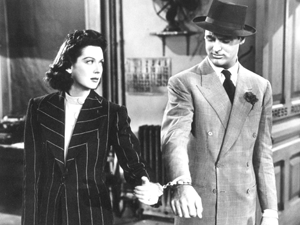
Rosalind Russell went into His Girl Friday (one of my favorite movies ever) knowing that she was about the 15th choice for the role. Howard Hawks had pretty much offered it to every other actress in Hollywood - only to find everyone either uninterested or unavailable. Finally, he "settled" on Russell. Russell knew this because there was a huge article in the New York Times about the whole thing - and reading it, she felt completely humiliated.
Nobody wants to know they are not the first choice.
Russell was pissed off.
She was enough of a success at that point that she felt dissed and pissed.
And here is how she went to her first meeting with Howard Hawks (I love her. She's so ballsy!! Hawks, by the way, ended up falling in love with her too. She was, just by being herself, the quintessential Howard Hawks Woman.)
Russell writes:
I arrived back in California in a bad mood, and California was in the middle of a heat wave. I'd built my first swimming pool, a salt-water pool (you just dumped salt in, but you had to have special pipes), and it was about a hundred and seven degrees outside, and I was supposed to go down and see Hawks, but I kept brooding about being humiliated in the New York Times, and before I went to Columbia, I jumped in the pool, got my dress and hair all wet, and then went and sat in Hawks' outer office.I was always so sassy, it seems to me, so unattractive, now that I think about it.
Hawks came out, did a triple take, and ushered me inside.
"You didn't want me for this, did you?" I said. (Besides being sassy, I was forever assaulting some guy -- Bill Powell, Howard Hawks -- with the news that he really hadn't wanted me.)
"It'll be all right," Hawks said. "You'll be fine. Nonw go to Wardrobe and tell them I'd like you in a suit with stripes, rather flashy-looking."
"Okay, Mr. Hawks, goodbye," I said. "I'll see you later."
For some reason, I just love that story. These two hard-boiled types coming together ... Rosalind stalking into Hawks' office with a WET DRESS and WET HAIR ... and Hawks saying, "It'll be all right ... now here's what you're gonna do ..."
I just love it.
Rosalind Russell 9: on Clark Gable
Why does this not surprise me??
Russell says:
The only man who could make a love scene comfortable was Clark Gable. He was born graceful, he knew what to do with his feet, and when he took hold of you, there was no fooling around.
Rosalind Russell 8: on William Powell
Rosalind on William Powell. One of her first movie roles in Hollywood was in a film with him - they became great friends.
He was not only dear, he was cool. If an actor thought he could get any place by having tantrums, watching Bill Powell would have altered his opinion. I remember a story conference during which he objected to a scene that he felt wasn't right for him. He was at once imperious and lucid. "It's beyond my histrionic ability to do this," he said. I thought that was delicious.
hahahaha So do I.
Rosalind Russell 7: "I'd be thinking, Why can't he get a laugh on that?"
Russell on craft, and how she studied the craft of the actor as a young woman:
Talent is wonderful, but I've played with actors who have more talent than I, and you can't hear them in the fourth row, they just don't have the energy, nothing in the belly, nothing in the guts that brings it all out and sells it across the orchestra pit and into the twenty-third row.In Boston with Clivey's troupe -- I couldn't do it at Saranac, I didn't have the time -- I used to sit on the stage apron and watch every rehearsal I wasn't involved in. I'd be thinking, Why can't he get a laugh on that? It's a funny line -- and taking the thing apart in my head to see why it wasn't working. Half the pleasure of doing comedy in the theatre is that even before you hear a laugh, you sense where the laugh should be. Something happens in the audience, you feel it, you go to work on it. Until one day, all of a sudden, you're rewarded with a titter. You keep working on the line and finally you get a real belly laugh. After that you generally push too hard and lose it, and you have to pull away and inch your way back.
August 1, 2005
Rosalind Russell 6: "Somebody has written the Duchess"
Oh ... this is the beginning of Rosalind Russell Appreciation Day, by the way.
Russell's sister - who died very young - and who is known as "the Duchess" in Russell's book - was an inspiration. I've never met the woman. I will never meet the woman. But Russell introduces me to her. Beautifully.
You could have set the Duchess down anywhere, in the span of this world, and she would have made her audience laugh, and feel better. (When the typewritten manuscript of Auntie Mame was first sent to me by its author, Patrick Dennis -- the book hadn't yet been publihsed -- I sat up till late, reading it, and since I was due on a movie set early the next morning, Freddie fumed. "Put your light out, you'll have such dark circles the cameraman will kill you." But I was bumused. "Somebody has written my sister," I said. "Somebody has written the Duchess." I could have played Mame with one hand tied behind me: I'd been living with her all my life.)
An additional excerpt about "the Duchess" - a woman I have never met, a woman who died in 1940 - and yet who is vibrantly alive for me:
Once before I tried to write about the Duchess. I made some notes, but she's hard to capture. Because she was at once totally sophisticated and absolutely naive. (This is Auntie Mame's character too.)Example: I didn't drink till I was about twenty-four, but two or three times when Clara and i were still living at home, I'd splash whiskey all over me like perfume and come in and put on a drunk act for her. An unspeakably bad, broad drunk act.
"Hullo," I'd say, staggering. "Wha' you doin' there, readin' that apple?"
Every time she'd fall for it. She'd drop her book, grab me. "Oh, come in here, close that door, oh, this is terrible, what if Mother saw you like this?"
She was so sweetly dumb. And so smart. She was an authority on the Irish poets (how many loved her moments of glad grace), she was always reading Macauley, she was funny and she was easy. My darling Duchess, I still miss her.
Is it possible to miss someone you have never met? Well, it has to be. Because I miss the Duchess.
Rosalind Russell 5: the gambling Russell family
I love this story. No wonder men not only fell in love with Rosalind Russell, but they just loved her - in general:
We children would be up on the third floor -- we had a billiard room there; my father played billiards, not pool, and to this day I can shoot so well, people think I must have earned my living at it -- playing games and racketing around over my mother's head, while she sat downstairs doing those name tapes. We had turned an alcove on the third floor into a bowling alley, and we also had a pool table.My poor father, he never made a bet in his life, he didn't approve of betting, and he brought up a bunch of gamblers. After he died those of us who were still in school used to come home at different hours -- sometimes just for weekends -- and there was always a crap game going in my father's library. My mother permitted it, and stayed to supervise. The dice were going all the time, and I remember arriving late one Friday night and having a chum of one of my brothers, a young man who didn't know I was a member of the family, warn me against the Russells. "Do you know those people?" he whispered. "Be careful, they're all sharp shooters."
And in the background my relatives were yelling, "Get your money up, get your money up, it;s all cash here ..."
"Do you know those people?"
hahahahahahah
Rosalind Russell 4: "My name is not Rosalind"

A memory from her childhood:
I was born in a house on Chestnut Avenue, and when I was four years old I ran away from home. Or at least I walked away, and found myself clear down on the Green, in the center of Waterbury's business section. A neighbor who saw me there, swinging on a hitching post, stopped short and cried, "Rosalind, what are you doing here?""My name is not Rosalind," I said. "I'm from out of town."
Four-year-old traveling fibbers don't get too far (the neighbor went straight to my mother and told her where I was), but the episode hints at my future theatrical bent.
"I'm from out of town." hahahahaha
Rosalind Russell 3: "The old men with beautiful manners"
Another excerpt from her book. Here she talks about her father. I found it very moving. Don't you just get this vivid picture of her father??
The age he lived in was right for him; he never should have been in any other. He went to church in the Prince Albert coat, and the tails at Christmas and Easter. He was infinitely patient with children (his library was never safe from invasion; while he sat trying to read the evening paper, we would climb all over him, comb his hair, plaster it down into his eyes, make curls of it -- none of this bothered him) and he was infinitely civil with people of any stripe.His civility used to embarrass me, because he knew everybody in town and he'd stop on his way home to talk to the street cleaner -- "How's the new baby? Well, you've got to see to it that that young man goes on to college" -- and the whole time the street cleaner would be pushing his broom along the gutter, and I, little snob that I was, would be looking nervously up and down the block, thinking, What if the kids from school see my Dad talking to the street cleaner?
My father wasn't old then, but when I read the Ezra Pound lines "They will come no more,/The old men with beautiful manners," I think of him.
Isn't that absolutely gorgeous?
Rosalind Russell 2: on James Galanos
Another excerpt from Life Is a Banquet
Here is an unbelievably moving story, told by Freddie Brisson (Russell's husband) about the special relationship between Russell and Galanos:
In 1960, after she had the first mastectomy, Rosalind went to Galanos. He says it was the only time he ever saw her break down. She had come to his office, very crisp, very businesslike. "I'm going to tell you something nobody in the world knows except Freddie and my doctor. I've had my breast removed, and I want to keep it quiet. So long as I can be active, I don't want to be thought a freak, I don't want people looking at me in person or on the screen and wondering about my sex life." (You have to consider the era. Women had not yet begun to go public about their mastectomies.)"I want you to start thinking in terms of how I can now be dressed," Rosalind said to Jimmy, and then she began to take her clothes off. She started to cry, and he saw that she could hardly lift her left arm, it was so swollen, and he broke down too. From that day forward, he specially designed every piece of her clothing, and neither he nor his fitter ever told a soul.
I don't know what to say. I am just full of emotion.
Rosalind Russell 1: "Give me wings to get to the point"
Her autobiography was published after she had finally succumbed to a devastating bout with cancer. She had lost both of her breasts, she was weakened to the point of needing oxygen, a wheelchair ... and yet still: every day, she would dress up, in a lovely suit, and have lunch (with martinis) with her husband. Her husband of 35 years or something like that - Freddie Brisson. They were set up by Cary Grant, who was the best man at their wedding in 1941.
Freddie wrote a prologue to her book, which clutches at my heart. He writes:
After she died I found a petition she had tucked away in her prayer book. It said in part, "Keep my mind free from the recital of endless details; give me wings to get to the point. Seal my lips on aches and pains. They are increasing, and love of rehearsing them is becoming sweeter as the years go by."
"Love of rehearsing" the "aches and pains". God. And to those who think Hollywood is a festering sore of Godless commies: FUCK. YOU. You got that? Yeah. I'm talking to you. FUCK. YOU.
Freddie writes of their courtship. Rosalind gave him a HELL of a hard time. He would call to ask her out, and her maid would answer the phone, and he would hear Rosalind bellowing in the background: "Tell him I'm out!!"
But he was persistent. The two of them went to the races, they went out dancing until 2 o'clock in the morning ... but still. She held him off. She was Hollywood's "Bachelor Girl", after all. Read into that what you will, but I would advise you not to read anything prurient into it, because it would be highly unimaginative of you. And also very unfair. She had a great career, and a great life. It would have to be prrreeeety damn good offer for her to give that up ... and she knew that. She put Brisson through his paces.
Listen to his story of his proposal:
The first time I proposed, she didn't accept. I persisted. "I'm going to write your mother and ask for your hand." And I did. "There's no way I'm going to get rid of you, is there?" Rosalind finally said, laughing. But when she gave up, she gave up on her own terms. "I don't like any of these proposals after you've had an evening out. I'm not interested in that nonsense. If you want to propose, then come around at seven o'clock in the morning, and put a white handkerchief on the ground and kneel down and ask for my hand."At seven o'clock the next morning Roz at last accepted.
Ah. A woman who knows what she wanted. I've had a couple of "Oh, it's two o'clock in the morning, we just had a great night out together, LET'S GET MARRIED" proposals. Roz was smart to say No ... and to make him do it right.
The two of them were faithfully married from 1941 to 1976, when she passed away.
Rosalind Russell appreciation day
Yup. Get ready for 5,000 excerpts. While in Cape Cod, I found a second-hand (or, more likely, a 5th hand copy) of her autobiography Life Is a Banquet
She's one of my idols.
She wasn't a glamour girl. She was a leading lady. A take no prisoners leading lady. She's an inspiration to any actress who might not have the bombshell looks but who has a GIFT for this thing called acting.
God bless Rosalind Russell. It's a great book. I came away from it feeling like: "damn, she was such a nice person." Such a funny and nice and warm and fearless person.
Like I said: she's one of my idols. If I could achieve 1/15 of what she achieved, I could be happy.
She was a true trailblazer - without making a big deal about it. It just happened that way. She couldn't be anyone but herself (and, obviously, the studios tried to change her - unimaginative people are always trying to change those who are truly original) - and she got a couple lucky breaks (which she fought like tooth and nail for) - and voila. We have this image of strong funny womanhood to guide us ... Actresses who are not beautiful have someone to show us the way. Just be yourself. Don't try to fit into the mold they give you because IT WILL NEVER WORK. Maybe it worked for Jean Harlow, but you know why it did??? Because she was Jean feckin' Harlow and it WORKED - for HER. If you're Rosalind Russell, you must find your own way. She did ... and because she did ... so can the rest of us. I just love the woman, that's all.
Excerpts comin' up ...
July 18, 2005
Observation about the show "Entourage"
The show Entourage continues to suck, in my opinion. All I need to do is watch 5 minutes of it to feel the bad-ness seeping into my apartment. HBO is doing its damndest to promote it - moving it around in the lineup - pumping up interest - commercials galore about it ...
I'm telling you - if I even just HEAR it when it comes on in the other room, I can hear the phoniness in the actors voices.
You can see why HBO thought this show might be a good idea. Ooh, hot young movie star ... his entourage of funny cute guys ... an insider's look at Hollywood ...
Well, it turned out to be a big yawn. Half of the problem is the TERRIBLE cast they have gathered. Yes. That "actor" who wears the backwards baseball cap is abysmal. He needs to get his ass into an elementary stagecraft class. He sucks. He's an amateur and it shows. Kevin Dillon is awful, you can feel how uncomfortable his ... His character is not funny, not likable ... NONE of them are. The only guy who I think has even a SMIDGEON of acting talent on that show is Kevin Connolly. He manages to make the words coming out of his mouth sound like conversation - not just lines. I mean, that's the level of incompetence these young actors have. Blech.
So HBO mis-fired and (in my opinion) under-estimated their audience. It was a rare mis-step for them. They think we're interested in pretty young boys living the high life. Well ... maybe we would be ... if they were interesting characters AND you hired people who could ... you know ... ACT.
Okay, so that being said, here is what I think is wonderful about what has happened wtih Entourage. I was thinking about this this morning.
Jeremy Piven, who plays "the agent", who was a very small part in the first season, has pretty much taken over the show. He has turned that awful show into a MAJOR vehicle for himself - and HBO is now rushing to catch up. Jeremy Piven probably saw the writing on the wall pretty early on: "Okay. This sucks. I have to somehow save myself."
His performance is HIGHLY comedic ... he talks so fast, the jokes come one after the other ... He is a corrupted nasty prick, and you cannot get enough of him!! (There goes the idea from HBO that we would love the pretty young boys - and hate the evil nasty agent ... Nope. The pretty young boys are uninteresting, and we don't care about their lives. When Piven comes on - things start to HAPPEN).
I love it when an actor, or a performer, hijacks a vehicle meant for somebody else - somebody who is less talented. (And sorry - but nobody is less talented than that boy in the baseball cap. Also, the lead guy - the guy who is supposed to be the young Hollywood star - is atrocious. So Piven basically would not allow himself to stay in the background of a bomb ... and he has taken over the show. Completely. It is all about him now. The show should be called "Nasty Agent" as opposed to "Entourage".)
Acting is a collaborative art but in a way - it is NOT a team sport. If you find yourself in a bomb, there are ways to get yourself out of it, and you have to be ruthless. Nope - I am not going down with this ship. Sorry. Jeremy Piven transformed what could have been a terrible experience, something that marked his career forever, into something that is actually making him a star.
I noticed that HBO has re-cut all of their promotional commercials for the show - to now make it look like Jeremy Piven is the star. All the clips and excerpts are HIS. He started on the show as a glorified cameo ... we were supposed to just drool over the exploits of pretty boys cavorting in Hollywood ... and now ... suddenly ... the show is all about the shark-faced awful rude agent ... He is the only one on that show who actually knows how to act.
I love it when that happens. HBO did not engineer this. They mis-fired on this one, and Jeremy Piven surged forth out of the pack - all on his own. You cannot keep true talent down. In this case, the best man really is winning.
HBO is rushing to make it seem like they knew along the comedy gold they had in Piven.
Go, Jeremy!!!
July 17, 2005
Celebrity crushes - my history, additional thoughts, general obsessiveness ...
Sheila-style. I've had intense celebrity crushes all my life. It's fun, it's an escape. Other women read romance novels. I throw myself into sweeping crushes with movie stars. I'm vaguely embarrassed by this tendency. But I do it anyway.
Off the type of my head, the progression of crushes through my life has been this:
-- Han Solo was the first big ol' crush I had. This came about after seeing Empire Strikes Back. Kissing Leia in the asteroid belt. I was 11 or 12 years old when I saw that. I thought it was the most romantic amazing thing I had ever seen. I joined his fan club. I went crazy.
-- Ralph Macchio. This came about because of his stint on Eight is Enough - where he played the ninth child ... because obviously, after a bunch of seasons, eight kids were NOT enough to keep the ratings up. I just fell in love with that skinny dark-haired big-eyed kid. God. I wrote him fan letters. I lost my shit.
-- this cute actor who was in a TV movie back in the early 80s starring Bette Davis - I think it was called Wings? No idea. No memory of any of it except for him. It was about a paraplegic girl who becomes a pilot, and this hottie hottie hottie played the guy in the high school who starts to date her, and the second I saw him, I felt a hormone surge like no other. It ushered me into adolescence.
-- Sting. Not his self-conscious ikky kama sutra solo shite. But when he was in The Police, with the blonde bowl cut, and he was serious, intense, and HOT.
-- John Stamos as Blackie Parrish in General Hospital
-- James Dean. It took me weeks to recover after I saw East of Eden one night when I was babysitting.
-- Chevy Chase. I think seeing Foul Play was the one that brought this one on.
-- Bill Murray from his time on SNL. His scenes with Gilda Radner were so delicious - I wish I had them all on tape. Bill Murray, at that time in his life, was (and is) pretty much my quintessential type. Big, crazy, pale-faced, funny rubbery face. Blurpy. I lerved him. I'm also a sucker for a purposefully funny man.
-- John Taylor from Duran Duran. This was a pretty mild one.
-- Mickey Rourke, pre-surgery. Angel Heart was the catalyst. Suddenly I had to see every movie he ever made. I was in college. His performance in Diner remains a classic, in my mind. It's got everything: he's tough, sexy, wounded, suddenly tender ... I mean, he was MADE to be all crushed over at that time.
-- Matthew Broderick. War feckin' Games. FUGGEDABOUTIT. I saw that movie when I was in high school and my heart just ached in my chest. Ouch!!!
Interjection: I am not fickle, although it may seem like it. I am very loyal to ALL of these people, to this day.
-- Jeff Bridges. This one was particularly intense. I had always liked him ... and Fearless is one of my favorite movies ever made. But it was years after Fearless came out, that I randomly rented The Fisher King one night ... and felt it start to happen. The crush. Holy crap. The Fisher King made a particularly deep and intense impression on me. I'm not kidding: I lay in bed, thinking about Jeff Bridges. I was then in my late 20s ... just so you get the perspective that I am not a moony-eyed teenager. It took a whole summer for that crush to burn itself out.
-- But then along came Russell Crowe in LA Confidential and that one made the Jeff Bridges thing seem like a schoolgirl crush. I'd never seen anybody so hot, so intense ... so perfect. That performance was sheer GOLD in terms of star power and sex appeal. Then began the work part of the crush, which I had, by now, honed down to a science. I rented every movie he had ever made. Most of them, by that point, were New Zealand films. Romper Stomper just blew me away and made me realize that we were looking at a major talent here. But it was The Sum of Us - a SWEET SWEET little NZ movie that clinched the deal for me - and made me a Russell Crowe fan forever. I LOVE that movie. Crowe plays a sweet shy insecure gay kid living with his father. It's just a gem of a film and Crowe is great in it. Then also there was Proof - quite a success for a small independent film from New Zealand. He's amazing in it - simple, with a kind of wordless animal charm. I lost my mind over Russell Crowe.
-- I thought the Russell Crowe thing might be the be-all end-all of celebrity crushes. But that was until I saw Moulin Rouge. Now - I saw Trainspotting when it first came out, and obviously McGregor made an impression. He's great in that film. I love that movie. But no crush developed. It was the mixture of Ewan McGregor and the role he played in Moulin Rouge that tipped me over the edge. I saw it at one of the lowest points in my life, and I latched onto this film as a kind of savior. I watched it every day. My roommate and dear friend was very patient with me. She did not judge. I had to see that movie every day. It (and McGregor) gave me so much pleasure and solace. That movie still remains a favorite - flaws and all. It has a special place in my heart because of the hope it gave me at that time. I'll write more on that in a bit.
-- Then along came Humphrey Bogart. By that point, I had my blog here ... which brought about a huge change in my celebrity crush habit. Because now I got to write about it - and not just in my journal (which always made me feel slightly pathetic. I'm a grown woman ... writing about Ewan McGregor in my journal? Ew.) I could get it OUT. One weekend I watched African Queen and Maltese Falcon and that was IT. I ended up writing 42 entries under the category title Bogart. I saw as much as I could get my itchy little fingers on. I ordered stuff off the Internet. People taped stuff for me off the television and sent them to me. I so enjoyed writing about him, thinking about him, reading about him. I read all the biographies, authorized and unauthorized ... I treat my celebrity crushes like a second job. "Okay. It's Bogart now. I know what I have to do. Get crackin', Sheil-babe!"
-- Then I moved to Cary Grant. It was quite deliberate. I had seen so many Bogart movies, that I got hooked on the pre-1950s films ... and thought: Okay, should see what Grant is about. I had seen Bringing Up Baby and Affair to Remember ... maybe parts of North by Northwest ... but then one weekend I watched, back to back, Holiday and Notorious. Notorious was the one. Notorious was the one. I couldn't get past it. To some degree, I still can't. I saw everything Cary Grant did. I saw Houseboat, for God's sake. I saw Touch of Mink. I can't STAND IT. The guy is literally the. best. there. is. No contest. At least not for me. Here's where I get crazy: I feel like all the other celebrity crushes were just lead-ups to this one. I was honing my craft with the rest of them ... I was figuring out my own process ... so that when I came across Grant, I was good to go. Ready to do what I needed to do. Cary Grant has generated 50 posts out of me. So far. I'm still not done with Grant, and it's been over a year since I "discovered" him.
Cary Grant was my last big celeb crush. My dear friend David said to me at one point (all of my friends know about this tendency of mine, and ask me about it: "So ... who is it this month?"): "Wow. This one isn't stopping, isn't it?" I sat and RAVED about Notorious to any bored sucker who would listen. I still will. Cary Grant is one of my favorite topics (along with Central Asia, and the downfall of Communism.)
I'm talking about this because I have an idea for a project - and I wanted to get my thoughts organized.
I wrote a long piece a while back, when the Humphrey Bogart thing was heating up, about how I saw these periodic flaming crushes as healthy and why ... so I thought I'd post it again. I had forgotten half of what I had written - interesting to go back and see what I said about all of it.
Click below to read it:
I am getting obsessed with Humphrey Bogart. The love is gone, folks. The obsession blossoms. I can feel it growing. Like some beautiful poisonous plant, expanding exponentially.
This is a very familiar sensation to me, as I have had INTENSE celebrity crushes since the first achey twinges of puberty.
And maybe because I have a little bit of a complex about being "too much" for whatever guy I've been involved with (and I'm not delusional, by the way - More than one man has said to me, point-blank, "You're a bit much" ... One actually said to me, in kind of a dry tone, "I guess I feel that dating you is too much for one man, and I feel like I need to call in some help". My point is is that my complex does not exist in a vacuum) ... maybe because of all of that, my celebrity crushes get ALL of my passion. I will never be "too much" for them!
Maybe this should be an embarrassing admission, but it's not. At least I don't feel embarrassed.
Let me go to a deeper level for a moment:
Like most of us, I have gone through some rough seasons. One such rough season was a couple of years ago, directly prior to starting up my blog in 2002. This "season" was different from others I have experienced, because it showed no sign of ending. A grey blanket lay over the world.
Now, multiple things went into me climbing out of the black pit ... one was starting the blog, randomly. I talk about that a bit here.
But another thing was seeing "Moulin Rouge" and succumbing, whole-heartedly, to a "crush" on Ewan McGregor which - it's hard to describe without feeling silly. Maybe people think because I wear leather jackets and have a tattoo that I'm a tough chick, and on many levels I am. You must not mess with me. I do not give too many second chances. But on another level I am really just a mess, and the tough facade is necessary because I'm all shattered-up inside. Like that great Bonnie Raitt line: "She's fragile like a string of pearls. She's nobody's girl." There's nobody tougher than someone who's been messed about, and who has survived a couple of dark seasons.
Okay, so I'm going to stop being embarrassed at what I want to write. Because who knows - maybe somebody out there will relate, maybe somebody out there will read what I write and think: "Wow, I know just what she means!!" - and that's who I'm writing for right now.
In 2002 I lay on my couch for 5 months. That was it. That was all I could do. The reasons why are multi-faceted, one thing folding into another, and I can't really explain it without talking for 2 hours. It wasn't that I was depressed. It was that I felt nothing. Everything went dead and dull and grey. The spinning top of life slowed down to a complete standstill.
I don't remember much of that year.
Then I saw "Moulin Rouge" and it was as though I had been plunged from the sunlight into ice cold water. It was like being born again. That is how intense it was. I watched the film and here, exactly, is how I felt (and it won't be all that articulate, but I'm sure you will get my meaning, coming, as I was, from my dark season of nothingness):
oh my God ... love exists ... love exists ... I can feel it in my heart again ... it is real ... it is real ... maybe not for me ... but it is out there ... and maybe ... maybe ... I will feel that again ... maybe ... it's not IMPOSSIBLE ... it's not IMPOSSIBLE ...
(The second you stop believing things are "impossible" is the second that the dark season ends.)
I will always have a soft space in my heart for that film because of what it provided me. It helped bring me back to life.
Ewan McGregor was the vehicle of that awakening.
I think sometimes that there are certain performances which shift the tectonic plates a little bit, and make me get my eyes up above the muck of my own life. This is one of the beautiful and healing things about theatre/art/movies, what-ever.
I can track certain eras of my life based on whichever "crush" I had going at that time.
"Crush" is appropriate, only if you think of it in terms of what the word 'crush' actually MEANS. Being "crushed" is no picnic - it would hurt to be crushed, in actuality. My teenage celeb crushes (Ralph Macchio, James Dean...) were barely fun. I could barely talk about these people. There was nothing casual about any of it. I NEEDED these people. I NEEDED to know that there was good in the world, and that maybe some of that good would come my way some day. To me, these young actors embodied that. James Dean's performance in "East of Eden" - I can't be too dramatic about this - it changed how I looked at life. It changed how I looked at acting, yes - but more than that: I got my eyes above the emotional-paucity of high school, of feeling alone, of feeling ugly, of feeling on the outside of things, of wanting desperately for love and approval and acceptance ... and I felt: There. THERE. There is a PERFECT expression of EXACTLY what I am going through. He has DONE it. He has SAID it. What a comfort!
Certain books can do this as well. It can usher you through a rough patch, it can let you know: "It's okay, this is well-traveled ground..." Not in a heartless, "Buck up, kid, life sucks, and it sucks for everyone" way. But in a way that lets you know you are not alone. You have not invented heartbreak.
And this, too, shall pass.
With James Dean - with Ralph Macchio - with Han Solo (not Harrison Ford, really, but Han Solo) - there was no more scarcity. There was only abundance. I already had a complex in high school that I would be "too much" - and the sterility of my high-school romantic life seemed proof of that. So whenever I had a crush on a "real" guy, 90% of my energy went to keeping myself in line, with holding back, with not letting him know how much I REALLY felt, for fear of scaring him off ... whatever.
Putting the reins on my own behavior - had the inverse effect of putting the reins on what was going on inside. I was always "in line".
There is no abundance. If I lose control, I do so very very privately.
This is kind of who I am, I guess - and how I've lived my life. I've lost men I love because of this nonsense.
Over the years, like the tide going in or going out, I succumb to random "crushes" on actors. (As will be obvious by now: one of the things I love about these crushes, is I can let myself go without any repercussions.) Usually the crush comes upon me suddenly, catching me unawares. Like: I randomly rented "Fisher King" one night some years back, and suddenly - as though I were riding a wave into shore - I became overWHELMED by Jeff Bridges. OVERWHELMED, and suddenly I needed to see every damn movie the man had ever made in his life.
Usually, with these actors, I have already seen a lot of their films ... but ... for whatever reason ... I was never "struck" by them. Obsession did not bloom.
And suddenly, whaddya know, there I am renting films where Jeff Bridges has 2 lines.
It's like an assignment. I take it seriously.
"Okay. So I'm into Jeff Bridges now. Fine. It is a fact. I must accept it, and not fight it. And now I must set myself a syllabus, in order to handle and focus this out-of-control obsessive energy - give it a POINT."
And then I'm off to the races.
One couple of months it was Russell Crowe. I guess I'm the same as 85% of the other women on this planet ... but there I was, renting the kids movie he made in New Zealand about the silver horse ... and The Quick and the Dead ... all because ... dammit ... seeing the man provided me with something.
Seeing him in "The Sum of Us" (one of my favorite films that he did - before he became a star) got me through many a dark hour. His character in that film - I related to it so much, even though he plays a jocky gay kid from New Zealand, and I (to put it mildly) was none of those things. He's tender, inside - he's kind of shy - he's looking for something - he's got no self-confidence ... It's a beautiful performance. One night I watched "The Sum of Us" back to back with "LA Confidential" and that convinced me: "Okay. This guy is a GIANT talent. GIANT. I have absolutely NO idea who he is now."
Ewan McGregor's almost operatic performance in Moulin Rouge convinced me that life would, indeed, go on ... and not only would I actually "feel" stuff again ... but that I would actually experience things in bright vibrant colors again. The color scheme of the movie.
The movie validated my despair. It said to me, "Life is tremendously unfair sometimes, and love rarely feels good, and you will be changed FOREVER by loving someone fully ..."
The dark season came about because, basically, I no longer felt that I had the energy for such things. I could not put myself through it, ever again. And so the spinning top slowed down - and then stopped.
There is one song in the film - one moment - when the two of them are at a rehearsal - and they are singing a duet, trying to pretend that they're not in love, trying to hide what is going on, but they cannot ...
Now I've seen this movie hundreds of times, obviously - because the second I saw it, during the "dark season" I realized: "Health. This is health. What I feel now is healthy - because I FEEL it" - and so I just kept watching it. And I kept getting better, miraculously.
Ewan McGregor's face - during the scene I describe above - I mean, I've always thought he was a wonderful actor - inventive, funny, courageous, sexy ... but in that scene, all I saw was his openness. This ... vulnerability. But not in a wussy way. Just the openness in his heart. I think the openness in his heart shows so clearly in that scene because the character's main action is to try to HIDE it.
I watched that scene over and over and over, sometimes sitting on the floor in front of the television, basically trying to crawl into the screen - because the elixir of life was in there.
Can I be that open again?
Will I ever feel anything that strongly again?
Can I be that open again?
I did not know the answers to those questions ... but watching the movie gave me the hope that the answer might be "Yes" and so I kept watching it.
When the dark season finally ended ... around November of 2002 ... I looked back on the Moulin Rouge orgy as though it were a particularly psychedelic dream. It didn't seem quite real - almost immediately following. And I don't think I've done a very good job in describing how bewitched I was by that film, and by Ewan McGregor in particular. Calling something like that a "celebrity crush" seems completely ... inadequate.
It was life-affirming. That was what it was.
It told me I was going to be okay. I was going to be okay.
And it's all in a continuum for me ... that was how I felt watching East of Eden, too. That was how I felt watching Han Solo, being snarky and smart-alecky, shooting across the universe. These weren't just crushes like: "oooh, they're cute, I put their pictures on my wall".
They helped me to go on. They helped me to see out of whatever muck I felt mymself to be in.
And so now Bogart.
I just know that, throughout my life, when one of these obsessions sweep me away - it's always for a reason. A reason I usually won't understand until it's all over. "Oh, so that's what was going on then!"
The Moulin Rouge thing got me ready to join the land of the living again.
I couldn't just pick myself up by my boot straps - because, frankly, I have no boot straps and I don't even know what boot straps are.
I was immobile. I felt like my back had been broken, finally, by one too many disappointments. I gave up.
Moulin Rouge eased me back into life. That was its purpose, it was a harbinger. A harbinger of health, love, and living a messy open life again. It prepared me, again, to get the top spinning, to get off the couch, to (in the immortal words of that great Smiths song, written "for" me): Sheila take a Sheila take a bow ... Throw your homework onto the fire ... Come out and find the one that you love...
Sometimes a cigar is just a cigar, and sometimes a celebrity crush is just a celebrity crush.
But sometimes it's a signal (for me, anyway) that something else may, actually, be going on, something else needs to happen, perhaps it is time to move to the next level. Perhaps it is time to open up the heart again, to passion, to other human beings, to surprise, to healing. Perhaps it's time to let go of the pattern that I feel defines me, and see what else might be possible.
July 3, 2005
Happy birthday to George M. Cohan!
"I don't care what you say about me, as long as you say something about me, and as long as you spell my name right." -- George M. Cohan
George M. Cohan - really the first big superstar in America. He was an actor, a writer, a composer, a producer, a song and dance man ... He was IT. I love that he was born on July 3, 1878 (in Providence, RI, of all places!!) and that his most famous song eventually would be "Yankee Doodle Dandy". I mean, the symmetry of that ...
(I found a great tribute to Cohan here).
A kid who grew up in vaudeville, a kid who is a truly American creation ... Although he was not (like Yankee Doodle Dandy proclaimed) "born on the fourth of July", he is symbolic of everything this country can offer. His story is a great one (please: I can barely see the actual George M. Cohan in my mind - all I can see is Cagney - damn, people, wasn't he amazing in that movie??? Cagney, for some reason, brings a big ol' lump to my throat. He's so special)
Here is George Cohan with Ethel Levey in Little Johnny Jones, in 1904.
This was his first big break. George wrote the thing, starred in it, produced it, cast all of his family members in it, you name it - he did it.
"Yankee Doodle Dandy" was one of the songs in Little Johnny Jones (but there were many other which also became classics - "Give My Regards to Broadway", for example). "Yankee Doodle Dandy" became an instant hit.
I'm a Yankee Doodle Dandy,
A Yankee Doodle do or die,
A real live nephew of my Uncle Sam's,
Born on the Fourth of July.
I've got a Yankee Doodle sweetheart.
She's my Yankee Doodle joy.
Yankee doodle came to London
Just to ride the ponies.
I am a Yankee Doodle Boy.
Happy birthday, George Cohan! Born on the third of July!!!
June 28, 2005
More crazy!!
More crazy! More crazy!! This is so much crazy for a 48 hour period, I don't even know what to do!!
Watch the video. I absolutely love the guy interviewing him. Great job, dude.
A couple of things I need you to notice:
-- the absolute aggression of the laugh. If you weren't paying attention, you might really think that it was real. But it is not. Watch. The. Laugh.
-- look at the dimwitted expression on Katie Holmes' face. The girl appears to be on some kind of psychotropic drug although we know that is not possible.
-- he refers to her as his "soulmate". Well. Yippee for them. I, however, have skepticism about the very word "soulmate" (here, here, and here) and think it's often a smokescreen for other emotions. Say: TERROR??? SELF-LOATHING??? INABILITY TO BE CLOSE TO ANOTHER HUMAN BEING??? People like THAT break out the "soulmate" word. Sigh. I need to calm down. I need my Xanax. Don't tell Tom.
-- and now: watch the shift when he starts to talk about Ritalin. Just watch the transformation. I am now getting used to that shift, but I still find it alarming to watch. He goes into Defcon One mode.
June 23, 2005
Big news!!!
Mr. Cruise is going to appear on Letterman in half an hour.
Can. Not. Wait. For. The. Crazy.
Quotes
Letterman: "This Tom Cruise guy is so volatile ... romantically ..."
Letterman announced that they have a Justice of the Peace backstage, ready to marry the two at any moment. They just showed the Justice of the Peace, in his black robes, nodding benevolently backstage.
Cruise's entry music? "Jump" by Van Halen. That's pretty funny.
Cruise thinks the judge backstage is hilarious. "That is so funny."
"I've never felt this way before. I don't know how to describe it. It's just amazing and I can't restrain myself." (Oh, Tom. Stop talking.)
Oops. Tom is laughing too hard.
"She's the most stunning woman. She's the most stunning person."
Dude. Stop.
(I feel bad for Cruise. The man is brainwashed by a dangerous cult. It's not his fault. My heart goes out to him.)
"We had chocolate on our first date and just stared at each other."
Ew. How 'bout just going to a movie? How 'bout makin' out on the beach?
No ... that wasn't the first date. It was after their engagement. My bad.
Letterman: Have you had any moments around the house yet where she's said 'Would you pick up your socks?'
Cruise: I'm the kind of guy who just picks up his socks.
I AM NOT KIDDING. HE JUST SAID THAT.
Cruise is charming. I'll give him that.
Now he's talking about how he wants to climb Mt. Everest. That's pretty cool.
Again: it's not his fault that he got hooked in by that evil cult!!!
He really is a squat little pipsqueak, isn't he?
Wow. He's actually TALKING ABOUT THE MOVIE HE'S GOT COMING OUT. Good for you, Tom. Spielberg must be watching thinking, "Jesus Christ, it's about feckin' time."
The two of them are now bonding about being fathers. Cruise brought it up. See, that's why he's a mega-star. He starts asking Letterman questions. See what I mean? "Did it change you ... how do you feel about stuff now?" Etc. Cruise is disarming that way.
Letterman's awesome.
Now we're gonna see a clip.
Okay, it's over now. That wasn't all that crazy, actually. He was charming, funny, present ...you can see why everyone who works with him feckin' loves him. He got that glazed insincere look in his eyes when he talked about Katie ... They've known each other 10 weeks. It just doesn't look real. His acting seems real, but his personality in that context does not seem real.
But other than that ... he was obviously in the mode of being a huge and powerful star, there to promote his film.
June 18, 2005
Steve McQueen
A really interesting essay by Matt Feeney about Steve McQueen. McQueen fans (and I am one of them): check it out. He is one of the most mysterious of movie stars - his appeal (at least in my opinion) goes under that strange and rare heading of "Magic". Whatever it was about his face, and not just his face - but more importantly how the camera saw his face ... whatever you want to call it, that alchemy was magic.
Feeney describes perfectly, I think, where McQueen's appeal comes from (because although he is, most certainly, an actor people LOVE ... and many people list some of his movies as their favorite movies EVER) ... his is an elusive talent. Even the directors who worked with him said that about him. He was mercurial, touchy, and completely relied upon spontanaiety. McQueen could not rehearse. He was a "first take- only take" kind of actor. After repetition, he lost the magic. This is not a criticism. It's just something that is really interesting. Steve McQueen refused to even do 'walk throughs" of the set before a day's shooting. Some actors like to stroll around, try out the doors, walk through the space ... just to get familiar. Like: if the set is supposed to represent their character's kitchen - then of course the room should be familiar to you, right? You should know automatically that the door to the dining room swings in, not out, right? All that stuff. McQueen didn't care about any of that stuff. He knew, instinctively, that his talent was mercurial, and ... unreliable. So he kept himself, as much as he could, in a state of complete unknowingness - he relied on the spontaneity of the first time. As you can see from his performances, his instincts about himself were pretty much spot on. Directors who forced McQueen to rehearse got bad acting out of the guy. Best to just leave him alone.
Mark Rydell (who directed On Golden Pond) but also directed McQueen in ... The Rievers, I think - spoke at my school and talked extensively about working with the guy. How much McQueen tested directors, what a son of a bitch he could be, how difficult he could be, how broken he was ... McQueen looked for a father figure in every single man he met, and he looked for one in Rydell. When Rydell made him do something he might not have wanted to do, he would throw a temper tantrum - as though he were a toddler, and Rydell were the "bad father". He was really messed up and weirdly fragile, for all his tough-guy stuff, and riding around on a motorcycle. Rydell said something very interesting (and again: this is in no way a criticism): "Steve McQueen was not a great actor. But he was a great movie star. One of the greatest we have ever had."
You can teach someone how to be more a competent actor. But you can never teach anyone to have even a smidgeon of what Steve McQueen had. It's innate. If you don't have it? Learn to live without it and learn to work with what you got ... because it cannot be taught, bought, borrowed or stolen.
Feeney writes:
McQueen cultivated his own mythology through a strenuously aloof style of acting that is not without its critics. David Thomson, for one, observes a certain "dullness" about McQueen. Perhaps, but it was an especially radiant sort of dullness. With McQueen, it's hard to decide whether you hardly notice him, or you hardly notice that you never take your eyes off of him. He had one of the greatest of all movie faces, even though he wasn't perfectly handsome. The broad masculine nose and deep leathery creases around his taut mouth didn't connect to those scary blue eyes. What brought his features alive on-screen were his wide cheekbones and a narrow tapering chin—the kind of triangular bonework more commonly associated with female beauty. Shot from certain high angles, McQueen could resemble an extremely macho elf.
He definitely had a face made to be in the movies!
More on his craft:
As an actor, McQueen seemed to emit no excess, no psychic surplus that might register as hamminess or irony. Yet he was a deeply insecure and conflicted man, and fanatically willful about his craft. Watching the laconic, slow-to-react title characters in The Cincinnati Kid (1965) and Bullitt (1968), it's easy to imagine that the performance is just Steve McQueen showing up and acting like himself. But when Steve McQueen showed up and really acted like himself, it wasn't pretty: He was a hothead and a paranoid, a grimly compulsive womanizer and a prolific druggie far ahead of his time (according to the biographer Christopher Sanford, McQueen was into LSD and peyote by the early '60s and later became a serious cokehead).
McQueen is in the very short list of actors (Cary Grant, Humphrey Bogart, Gary Cooper) who, upon receiving any script, sat down and cut out most of his own lines. He knew that he could do more with a turn of his head than another actor could do with 10 explanatory lines. His power and magnetism lay not in his voice, or even in the PARTS he played ... it lay in that face, and what it could convey, with absolutely no language.
And here, I think, Feeney makes a genius point - genius:
The raw inner core of soulfulness and vulnerability was there all along, and the great McQueen mystique—the "cool" that was somehow so feverish, the poker face that was somehow so animated—came from his half-successful effort to hide it.
YES!!! A true movie star will always have secrets, and will never reveal everything. There is a mystery at the heart of Marilyn Monroe that keeps people coming back. Same with Cary Grant. Clark Gable. They do not wear their hearts on their sleeves. They are hiding things. Their success comes from the "half-successful efforts" to hide it.
Perfect example: Cary Grant in Only Angels Have Wings. I babbled about it ad nauseum here. Geoff Carter has to be the crankiest leading man in all of cinematic history. He is a big CURMUDGEON. And yet ... there are flashes ... moments ... momentary looks in his eyes (that great late-night scene with Jean Arthur) ... when you see his loneliness. The sensitivity at the heart of this cranky macho guy. But he never makes a big deal out of it, and Cary Grant never EVER fetishizes his own emotions. EVER. (So many actors do that these days. They have a self-important aura around every feckin' tear they shed. As though we should give them a goddamn medal for having a heart and a soul.) Cary Grant HID his emotions ... and therefore, we loved him for it. Because we knew they were there anyway.
Very human. REAL human beings don't walk around showing us their emotions all the time. Or if they do? They probably should be institutionalized. Real human beings try to hide their vulnerability. Doesn't mean we can't see it all the same ... but that's not the point.
McQueen had that cool aloof thing going on ... but there's a reason why he has such massive appeal to not only men but also women. There was something cracked underneath the exterior, something sweet, and in need of the female. But he would NEVER broadcast this, or fetishize it. He was too busy trying to HIDE that vulnerability, so we wouldn't guess his weaknesses.
This duality, this inner contradiction, is part of what makes a great movie star. He keeps us guessing. We want to get "in there" with him, but he never satisfies us completely.
It's deeee-lish.
June 17, 2005
I am sure ...
... we are all well aware of a certain celebrity engagement that has just been announced.
His comment? ""Today is a magnificent day for me, I'm engaged to a magnificent woman.... The Eiffel Tower is magnificent, her new movie is magnificent, and the poop I took this morning was beyond magnificent. Magnifcent magnificent day!"
My comment?
FINALLY they're engaged. Damn, I thought he would NEVER pop the question.
Sheesh!
They were so back-and-forth and up-and-down for so long ... I was getting frustrated. It was like J-Lo and Ben Affleck all over again. Like: PLEASE. MAKE UP YOUR MINDS ALREADY. ENOUGH with the WAFFLING.
No but seriously: the whole thing is creepy and ultimately very entertaining to watch. Because it's not happening to me personally.
Also, I love this comment from him:
"We haven't discussed that — one step at a time," he said. "Let's see. We're not sure."
One step at a time??? bwhahahahahahaha There were STEPS involved here?
1st step. Call the publicists of 5 upcoming starlets.
2nd step. Set up meeting with 5 upcoming starlets.
3rd step. Make a choice. FAST. I've got a movie coming out.
4th step. Gross everybody out with red-carpet make-outs.
5th step. Immediately enroll her in Scientology classes so she can clear out her BTs.
6th step. Attack Oprah.
7th step. Go all psycho on Access Hollywood.
8th step. Steal Christian Bale's spotlight.
9th step. Discover the word "magnificent".
So ridiculous to talk about "one step at a time" as though it's a normal romance as opposed to an 8-week crash course in brainwashing, getting "clear", and publicity hogging.
June 13, 2005
I would like to take a moment ...
... to acknowledge one of the unsung and sadly-forgotten heroes of our time. "Our time" meaning "this past week."
Ladies and gentlemen, let us please please please not forget:
CHRISTIAN BALE
He stars in his first big blockbuster, after years of working in smaller films, always garnering good reviews. He is respected in the business. He is known for his dedication and professionalism.
Hollywood finally takes note. Casts him as the next Batman.
What happens 6 weeks before it opens?
His batshit-crazy co-star falls in love with a gibbering chimp-boy bent on saving the world (and all of us) from aliens ... and the two of them, together, take up ALL THE PUBLICITY.
There is NONE left over for Christian. I haven't heard a word about him.
If I were Christian Bale, I would be pissed, and I would go all American Psycho over my selfish inconsiderate goony idiotic co-star.
They're stealing his well-deserved moment.
They are both morons.
Katie Holmes is a moron. Evidence here (thanks, Mere!!). After I read that, I realized how old and hardened and bitter I am from my years in the dating trenches. I am hardened because I cannot imagine a situation where 6 weeks after meeting a guy - SIX WEEKS - I would "convert" to another religion. Katie: Have you no self? No, seriously, I am really asking. And don't talk to me about "getting clear" and "enturbulating the thetans" or whatever it is your freaky cult espouses. I am really asking: Have you no identity? Weren't you a Christian, like, 6 weeks ago?
Oh no.
Do you see what has happened??
This is a post about CHRISTIAN BALE. It was supposed to be acknowledging HIM, and even here those two geeks with the perpetual Humpty-Dumpty grins are taking over! Seriously, it's like there's not enough oxygen.
I banish them.
And I say: Mr. Bale: I look forward to seeing you as Batman. I think it's very good casting, and I hope you are SOMEHOW enjoying this experience ... even though those drooling adolescent love-birds are hogging up all your airtime.
June 7, 2005
I'm sorry.
I know it's cruel.
But who on earth is encouraging Pauly Shore to resurrect his "acting" career?
Like ... I know it's tough, buu-uuddy ... but your heyday is in the past, it is long LONG gone, and your original success was a strange one-time thing anyway, and had to do with the early chaos of MTV and now those days are gone, that entire world is gone ... so ... stop. Stop it with the comedy specials, and the little movies ... please. It's painful.
My advice is: suck it up, face reality, give up the ghost, stop trying to "resurrect" your career, and join the next cast of The Surreal Life like any self-respecting washed-up celebrity would do.
May 31, 2005
"Those are not just words. It's a promise."
Woah. Judging from this video, the situation is far more dire than I thought.
It's terrifying. Truly TERRIFYING. Like ... he's feckin' NUTS. Like ... OPENLY.
uhm ... Wow. He has no idea how INSANE he seems. And that's the scariest part. I've watched it 3 or 4 times through. Trying to find a SMIDGEON of irony, or self-awareness. But alas. There is none.
Dude's nuts.
May 27, 2005
Guilty pleasure ...
I absolutely adore Mandy Moore. I think she is so CUTE, sweet ... I love any movie she is in. I adore Walk to Remember. Why???? I've seen it 10 times ... and I know I'm being manipulated ... and it's sappy, and cliche ... but still ... I just LOVE her. And based on that movie, I will see anything that she does. (Uhm ... Chasing Liberty is on right now.)
This is highly embarrassing. It's Friday night.
Guilty pleasure. Totally. It's like being into Freddie Prinze Jr. or something.
May 24, 2005
The Norm poll ...
List your favorite "movie stars". I get 10 votes.
1. Cary Grant
2. Katherine Hepburn
3. Marilyn Monroe
4. Humphrey Bogart
5. Ingrid Bergman
6. Jeff Bridges
7. Marlon Brando
8. Gary Cooper
9. Clark Gable
10. John Travolta
Okay, that's a pretty typical list - except for maybe Travolta and Bridges. But what the hey, I'm not re-inventing the wheel here. Now what was my criteria? I think there is a difference between a "movie star" and an "actor" - and sometimes, blessedly, the two overlap. In the case of the 10 people I chose, they did overlap. These people all were (and are) definitive movie stars, but they all had a great gift for acting as well.
But like I've said here before, there is a magic that happens between certain people and the CAMERA ... which cannot be taught, bottled, imitated, or even explained. For example: Marilyn Monroe, who always seemed to carry around her own keylight. How did that happen? What WAS her magic? Now some people are immune to her magic, but they are so much in the minority that I can pretty much comfortably ignore them. Contemplating Marilyn Monroe has been something I've enjoyed for ... damn ... 25 years? Some people speculate that the reason she looked so luminous on screen is that she had a very light layer of blonde fuzz over her skin - I mean, we all have hair like that on our arms, and our cheeks - it's everywhere - but some people thought that maybe Monroe's was a bit longer or thicker than other people's, and that is why she seemed so reflective of light - she actually WAS reflecting light. Who knows if that is true ... but I do think there is a certain relationship between certain actors and the camera - which sometimes has to do with acting, but other times has to do with something else, something indefinable. I would say it has to do with the soul. Someone like Gary Cooper doesn't even have to 'act' - he never appears to do ANYthing - and we see into his soul.
But again - there are plenty of actors who can do that. Who can let us see what is going on in their hearts ... wonderful actors - but I still wouldn't call them "movie stars".
For example: I love Russell Crowe, and I think when he's good?? Nobody can touch him. If you disagree, then I have to believe that you haven't seen Romper Stomper. BUT: he doesn't have that thing with the camera that, say, Gary Cooper does. He's always good, he's always committed to his work, and he is quite often very powerful and very moving. The only time I would say he comes close to that kind of movie-star-magic is in LA Confidential. Now THAT is the performance of a "movie star". It sizzles with charisma, with what is NOT said, it smolders with unexpressed feeling ... I think that might be the most vulnerable Crowe has ever been with us - and interestingly enough, he was playing a big tough-guy. That was the thing with those actors in the 30s and 40s ... they played tough-guys, but not HARD guys. They were tough because life threw you for a loop and there were things in life that needed protecting, but they also fell in love with the dame. They weren't HARD, or immune. It's a hugely attractive mix, and we've almost lost that dynamic completely in movies today. That's why Crowe's performance in LA Confidential made an entire nation of movie-going women turn into puddles on the floor. It was a throwback, yes ... but not in a kitschy way, not even in a nostalgic way. He WAS that guy.
Other examples: Sean Penn is probably, along with Daniel Day Lewis, one of the best actors practicing the craft today. But he doesn't have that thing ... that openness-of-soul that the movie stars I listed have.
I'm probably digging myself into a hole here - because I am coming up with exceptions to every rule. If I contemplate Cary Grant (and believe me - I DO!!) - I would say that one of the things which totally appeals about him is the sense of mystery there. He never gives it all away. He never lets us have all of him. The camera loves him, I don't know of an actor more beloved by the camera ... but still: he never lets us all the way in. The face is so handsome, so photogenic ... but he dodges us, keeps us guessing. Nobody like him, man. Just nobody like him. That's why he's # 1 on my list.
Come to think of it: all of the movie stars on my list have that don't-give-it-all-away thing in common.
You never EVER catch Jeff Bridges pandering to us, or turning himself inside-out in an effort to get us on his side. No. He holds back, he disappears into the character - you cannot take your eyes off him. Jeff Bridges, in my humble opinion, is a MASTER at the art of film-acting. He is probably the best there is. He understands the camera, he uses it, so much of his work is so subtle that it never ever seems like work - but it packs this huge punch. The guy is a genius. Hands down.
Marilyn Monroe is, as always, in a league of her own. I have no idea WHAT was going on with that woman ... if she had fuzz on her skin, or a good makeup artist, or WHAT. But she had "it". She glows. Everyone has magic in them, we all do - but she had "movie magic".
John Travolta is on there because, to me, he has the magnetism of those old-time iconic movie stars. Like nobody else working today. You can't take your eyes off him when he's on the screen. It's almost like Travolta (or his face, or his soul - however you want to say it) is letting us, the audience, in on a secret or something. Or at least he's trying to. It's a secret between HIM and US. We feel honored that he would want to open up to us in that way. He has no barriers between him and the camera. And THAT is the mark of a great movie star.
May 10, 2005
Happy birthday to ...
... one of my favorite performers of all time. As a matter of fact, along with Ralph Macchio (in his Eight is Enough incarnation), this man was the first performer I really LOVED, the first performer to engender a Sheila OBSESSION when I was - oh - 11 years old.
He was truly one of a kind.
This was the man who did his first screen test in Hollywood, and some executive wrote the following about him: "Can't act, can't sing, slightly bald. Can dance a little".
Can dance a little?
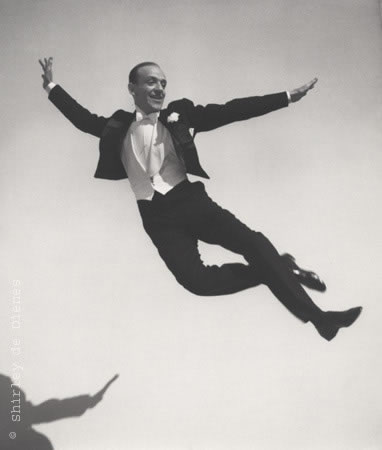
I'll say.
Happy birthday, Fred!!
May 9, 2005
A quick note
The show Entourage is SO BAD. It sounds bad, if that makes sense. You don't even need to SEE it, to realize the bad-ness. I had the TV on last night - I was washing dishes in the other room. Entourage came on. I dried the dishes. And could HEAR the badness of the show emanating through my apartment. The voices don't sound real (especially that fat guy in the entourage who wears the backwards baseball cap. He is particularly bad - and unable to make even the line: "Hey, what's up?" sound normal and like real life.) Jeremy Piven (as the arrogant agent) is funny, and over-the-top. I like him. He's so awful that you know it's based on real life. He's actually ACTING. The other guys, to me, seem to have the following subtext for all of their performances: "Hey, man, look how cool I am! I'm in an HBO series!! Just like The Sopranos!" Like: guys, I don't give a crap if you're on HBO. You actually have to ACT and do some WORK in order for me to care about the show and its plot. I bet the actors on Six Feet Under were thrilled to have landed such an awesome gig. But - duh - they get down to work and concentrate on THE ACTING, because otherwise: who cares?? Barely any of the guys on Entourage actually, uhm - you know - CREATE A CHARACTER. Guys: If your character's emotional through-line is: "Hey, Mom, look! I'm on HBO!" = then you're all doing really really good jobs, and congratulations. Other than that? Most of you get Fs. Besides Piven, I'm also impressed by Kevin Connolly who somehow survives the horrible script with his talent intact. He somehow makes his lines sound real - he always makes sure that he's not just playing the line, and has other stuff going on (like we do in real life. We say stuff like: "I'm having a great day" and people can tell that we actually are NOT having a great day. We're distracted, or pissed, or stressed. Things are never exactly what they seem - at least not with intelligent acting) Kevin Connolly's character actually seems like he has a PULSE. Fat-kid-with-baseball-cap only "plays the line", and by that I mean: If the line is: "I'm really pissed" then that actor wears his "i'm really pissed" face. If the line is: "Yo, I'm psyched!" - then whaddya know, his face wears his "Yo, I'm psyched" expression. Terrible unimaginative acting. Fire him.) I don't blame the actors totally - it's not totally their fault. There's only so much you can do with a lifeless script. But Connolly - even though the script has NO DEPTH (like I must reiterate: I can hear and feel the lack of depth from another room in my apartment) - he seems to come out of it seeming like a real person, with real problems. He's also a viable romantic lead because of this. Unlike the actual lead of the show, who is supposed to be a heart-throb, but comes off as ... just a nothing. With a kind of a dumb blank smile. Who wants to watch a romance with a "nothing" as the lead? Connolly seems enough like a real guy, that I (as a chick) want to see him in a romantic situation. That is the perfect way to describe "a romantic lead". People in the audience WANT to see him (or her) kiss and hug and be lovey-dovey. Not everybody has it, and a lot of times it's counter-intuitive who "has" this thing. Anyway, whatever. Connolly has that thing.
I've only seen the show once or twice, but damn. It's a piece of crap. Kevin Dillon sucks. All the extraneous characters suck. The female characters are a JOKE.
Sometimes it's only after watching a show for 10 minutes or so that the light dawns: "Wow. This is bad." But: I was in the kitchen, and the show was on in the other room ... and I could tell. It wasn't just the voices, or the stilted quality of the script. It was the feeling of the entire enterprise. The bad-ness of Entourage is at a molecular level.
April 24, 2005
RIP Ruth Hussey
You might not know the name, but most of you will suddenly have an "a-ha" moment of recognition when I tell you that Ruth Hussey, who played "Elizabeth Imbrie", the world-weary wise-cracking photographer (Jimmy Stewart's girlfriend) in Philadelphia Story, has just died.
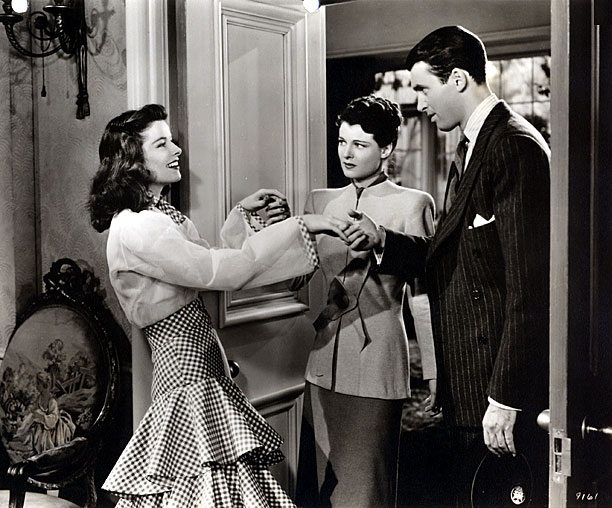
She was nominated for an Oscar for her performance. She makes such an impression in that film, doesn't she? Isn't it just a wonderfully warm (in a kind of cold way ... ha ha) and funny piece of acting? Miss Imbrie understands men, she doesn't try to play them, she also doesn't try to put herself above them (like Tracy does). Miss Imbrie is down in the muck and mess of life with the guys. She maintains no pretenses, she sees right through things, she has no illusions left. Because of her more realistic outlook about male-female relationships, you can tell that this woman has been hurt. She maintains no fairy-tale facade, she's been around the block. But the beauty of this performance (and why I think it was nominated for an Oscar, and also why it holds up under the test of time - it is still funny and touching and real to today's audiences) - is that she is NOT just a wise-cracker. Because that would be boring. There would be no depth there. Ruth Hussey was able to subtly let us know that a living breathing woman with hopes and dreams of her own lay hidden beneath that sarcastic exterior. It's just that Elizabeth Imbrie would never let you in on her secrets, she would never show you her soft underbelly. Life's too rough, man, you gotta protect yourself.
Her boyfriend, Macauley Connor (Jimmy Stewart) is one of those failed artists who has let his own failure make him bitter, and superior. He thinks if you have money you have sold out. One of THOSE obnoxious types. I love their meeting with their boss, Sydney Kidd.
Connor rails at his boss: No hunter of buckshot in the rear is cagey, crafty Connor. Un-quote. Close paragraph.
Imbrie, knowing that they are about to be fired, comments wearily and fatalistically: Close job. Close bank account.
I love her work in that film - as much as I love the work of the three principles. Sure, there are three "leads" in the movie - but I always thought of Ruth Hussey's character as a fourth lead.
Ruth Hussey died on April 19, at the age of 93. My friend Alex (of course) is the one who alerted my attention to this. Here is her beautiful little post about this wonderful actress.
To illustrate what I mean about the character she created in Philadelphia Story (and you know what? I've seen this production on stage a number of times as well, and I have NEVER seen a modern-day actress really nail this character. Either she comes off as just a bitter bitch, OR - the modern actress is blatantly doing an imitation of Ruth Hussey. Hussey put her indelible mark on that character. If I were cast in that role, I know I would have a difficult time making it my own, because to me, she IS that woman.) ...
Anyway. There's the FUNNY scene where Macauley Connor (Jimmy Stewart) is trashed and shows up at CK Dexter Haven's house in the middle of the night.
"Ohhh. CK Dexter HAAAAAAAVEN..."
Cary Grant appears at the door, bemused, in his dressing gown, and lets Stewart in. High comedy follows. (One note: Jimmy Stewart is so convincing as a drunk that you pretty much could use just THAT performance as an example to actors as How to Play Drunkenness. That's it. It doesn't get any better than that.)
Finally, after a long night ... Elizabeth Imbrie shows up at the door, to pick up her wasted boyfriend. Cary Grant opens the door, and you can hear Jimmy Stewart in the background, still inside the house, blabbing on and on and on.
Miss Imbrie, with this face - this flat face that somehow can convey so much - strolls by Cary Grant in the doorway, and calls out, "Where's my wandering parakeet?"
Now listen. I don't want to make too huge a deal about this teeny moment, but you know - that's me. I make huge deals out of teeny moments.
Why we love Miss Imbrie, and why she is the perfect match for Jimmy Stewart (and why Tracy Lord most definitely is NOT) is in that moment. Her boyfriend has fallen off the rails. He is keeping her in a state of indecision. He won't marry her. He's a snob. Etc. But because she's probably had a lot of boyfriends, because she has no illusions about men, there are no Prince Charmings, she wouldn't be interested in a Prince Charming anyway ... because of all of that, she doesn't treat Jimmy Stewart with contempt, or scorn. In her heart, she might be in a rush to get married, but she keeps her heart to herself. His failings and foibles she treats with deadpan humor. She's not going anywhere. She stands by him. She makes sarcastic remarks the entire time, but she stands by him. Another woman might have shown up at CK Dexter Haven's door and bitch-slapped her boyfriend: "Where have you been? Sober up! You're embarrassing me!" Not Miss Imbrie. She strolls into the house, hearing his hysterical ramblings somewhere inside, calling, "Where's my wandering parakeet?" Not THE wandering parakeet. But MY wandering parakeet. She's loyal. And you love her for it. He needs a loyal woman. He just doesn't know it yet. And she is willing to wait.
Think about the scene where CK Dexter Haven asks Ruth Hussey why she doesn't force him to marry her. She's on the stairway going up to bed, member that scene? It's about 6 o'clock in the morning, and CK Dexter Haven has driven her back to the Lord mansion, after she typed out his big story. She's exhausted. Okay, one small actor moment to notice: Miss Imbrie is in a long formal gown, left-over from the party the night before. And just in her body language, actress Ruth Hussey is able to convey so convincingly what exactly it feels like to wear high heels for 10 hours straight. It is not comfortable. You cannot wait to get the damn things off. Your feet ache, pinch. Watch how she takes off her shoes in that scene. Just watch. That's ACTING. After all, the actress Ruth Hussey has not been dancing at a party all night long, and then racing around after her drunk boyfriend. Actress Ruth Hussey, in that taking-off-shoes moment, is just pretending. But it's real. It's that kind of detail that makes a performance great. Good performances abound, but many miss those small moments of reality. Every time I see that scene, my own feet remember the pinch of high heels. I'm not exaggerating.
There's this exhausted camaraderie between CK Dexter Haven and Miss Imbrie in that scene. You understand why Miss Imbrie probably has a ton of male friends. They may all want to sleep with her, but they accept second-best: her friendship. She does not condescend, she does not flirt, she treats men straight-up - in a frank and friendly way. Even though she's hard-bitten in some way, and she's tough - she is NOT unforgiving. THAT'S what is special about this performance. She is actually the essence of the forgiving female. Yet she's not a doormat.
(See why actresses usually can't pull this role off? It's a very tough balancing act. If you don't have BOTH elements, and only nail ONE, then you aren't doing a good job.)
CK Dexter Haven, in that 6 a.m. truthful energy, asks her why she doesn't marry Macauley.
I cannot remember her exact line, but it's something like: "He has a lot of growing up to do. And I don't want to stand in his way."
Beautiful. She is willing to wait.
And her face, the next morning, when she realizes that Macauley and Tracy have had some kind of kissy-kiss thing happen. You see this flash of deep true sadness on her face. Her eyes. The pain in those eyes. But she doesn't flip out, or accuse Tracy or Macauley ... she holds her counsel. She doesn't involve the whole crowd with her sadness, she bears it on her own. (Again, this is all really subtle. That's why it's so good. Nothing is belabored or hammered over our head.)
Later, as things are working themselves out ... Tracy (self-consumed up until this moment) suddenly realizes what she has actually done to Miss Imbrie. Miss Imbrie becomes real to Tracy, in that moment. Tracy runs over to Miss Imbrie, takes her hands, and says, "Oh, Liz, I am so so sorry."
Miss Embrie's reply (to the woman who made out with her boyfriend just hours before) is: "Oh it's all right Tracy. We all go haywire at times and if we don't, maybe we ought to."
This is not bull shit, or false pride, or keeping a stiff upper lip. Miss Imbrie REALLY means this. Isn't that amazing? Don't you just love her? It can't be easy for her, because she can't allow herself any illusions ... but still. The rewards for having that sort of generous and forgiving stance towards the foibles of humanity must be very very great.
I have gone on long enough, but I just wanted to blather on about one of my favorite performances ever, and to take a moment and remember Ruth Hussey at the time of her passing. A beautiful and warm actress, she gave a performance that will live forever.

April 23, 2005
Spencer Tracy's genius
Check this out. I just read this today (found a book at a second-hand bookstore - by the great Garson Kanin - it's called Tracy and Hepburn. He knew them both well). Anyway, looks like it's going to be full of amazing anecdotes. Here's one that gave me chills. I had to read it twice, just to get the full satisfaction. It's about Spencer Tracy:
Spencer had an aversion to makeup. To most actors, beards and mustaches, putty noses and tooth work, wigs and contact lenses are not only tools, but toys. Spencer shuddered at the thought, believing that characters had to be created from within rather than with artifice.Laurence Olivier once said to him, "I admire so much about you, Spence, but nothing more than the fact that you can do it all barefaced."
"I can't act with stuff all over me," said Spence morosely.
"But don't you feel as though they're looking at you? Don't you feel naked?"
"Only when I have to say a lousy line, " said Spence.
This attitude once caused friction between us. When I directed him on Broadway in The Rugged Path, there was a scene in which the character he played reached an island in the Philippines, having survived a torpedoed battleship.
Eddie Senz, a brilliant makeup artist, devised an easily applied piece to simulate a beard growth. When he demonstrated it, Spencer turned and went to his dressing room. I joined him there a few minutes later.
"Has he gone?" asked Spence.
"May I ask you one question?"
"No."
"How could a man drift in the sea for eight days and turn up clean shaven?"
"Guess," he said.
"I know your feeling about all this, kiddo, but you're not going to tell me you can act unshaven!"
"Watch me," he said.
In performance, he did precisely that. I still find it difficult to believe.
I believe it.

April 19, 2005
The Books: Hollywood Babylon (Kenneth Anger)
When I first started blogging (back on blog-spot ... I can hardly believe now I put up with Blogger for so long ... man!) I posted a daily excerpt from any one of my 20,000 books. Sometimes a fiction excerpt, sometimes non-fiction ... As is obvious, I enjoy putting book excerpts up here. It seems to me that they usually generate some pretty cool discussions.
So. I am going to do the "daily excerpt" thing again. Only with this method behind it, because I think it will be interesting:
I am going to post an excerpt from every book I have read, going from bookshelf to bookshelf through my house. One a day. This obviously will take me until 2017 probably, but that's all right. I will start at the top of one bookshelf, and go book by book til I get to the bottom and then move to the next one.
Why will I do this? Because it seems like it would be fun.
So. I will begin at the top of Bookcase # 3 in the kitchen.
This will be the beginning of my books about Hollywood. We'll come back to it.
 First book on the top shelf? Kenneth Anger's underground trash classic: Hollywood Babylon: The Legendary Underground Classic of Hollywood's Darkest and Best Kept Secrets


Here's an excerpt from it. This is from the chapter on the life and death of silent screen film star and heartthrob Rudolph Valentino - he died in 1926.
Ha. The book is a riot. Apparently, a "lady in Black" still visits his mausoleum on the anniversary of his death, to this day. The tradition carries on.
Here's a still from Valentino's biggest hit, The Sheik:
And, for your continued reading pleasure, here is a list of Valentino trivia from IMDB:
Ranked #80 in Empire (UK) magazine's "The Top 100 Movie Stars of All Time" list. [October 1997]
In 1923 he recorded two songs for Brunswick Records, you can actually hear his heavly accented voice 73 years later.
A portion of Irving Boulevard in Hollywood, California, was renamed Rudolph Valentino Street in 1978.
Considered to be the first male sex symbol of the cinema during the silent era.
Published a thin volume of sentimental poetry titled "Day Dreams" in 1923. The book sold hundreds of thousands of copies.
For many years on the anniversary of Valentino's death, a mysterious woman, dressed all in black, was seen laying a wreath of flowers on his grave. Her identity was never established.
Following his untimely death, a bogus, composite photograph of Valentino ascending up to heaven was released for sale, and was snatched up by his legion of fans.
After Valentino's death, his family announced that his body would lie in an open casket in order to be seen by his fans. However, the family was worried that grief-stricken fans might rush the casket and damage the body, so they had a sculptor fashion a lifelike wax dummy of Valentino, and that was the "body" exhibited in the casket. Valentino's real body was kept in a hidden room in the funeral home.
He was half French and half Italian
Pictured on one of ten 29? US commemorative postage stamps celebrating stars of the silent screen, issued 27 April 1994. Designed by caricaturist Al Hirschfeld, this set of stamps also honored Clara Bow, Charles Chaplin, Lon Chaney, John Gilbert, Zasu Pitts, Harold Lloyd, Theda Bara, Buster Keaton, and the Keystone Kops.
Valentino and Jean Acker had one of the shortest celebrity marriages on record - six hours. After courting for just a few days, they impulsively married November 5 1919, but Jean locked him out of their hotel room later that night after a spat. They separated, and their divorce was finalized in 1922. Ironically, after their divorce, they became good friends.
At the time of his death, Valentino was severely in debt, and his heirs could not afford a burial plot for him. June Mathis, screenwriter of Rudy's hit films The Four Horsemen of the Apocalypse (1921) and Blood and Sand (1922), graciously agreed to temporarily loan him a space in her family crypt at Hollywood Park Cemetery so he could be interred upon his body's arrival in Los Angeles following a coast-to-coast funeral train ride from New York. Valentino's body remains in that "borrowed" crypt, interestingly placed between Ms. Mathis and her last husband, to this day.
A few months before Valentino's death, a Chicago newspaper columnist attacked his masculinity in print, referring to him as a "pink powder puff." A lawsuit was pending when Valentino was fatally stricken. One of his last questions to his doctor was, "Well, doctor, and do I now act like a 'pink powder puff'?" His doctor reportedly replied, "No, sir. You have been very brave. Braver than most."
At the height of his popularity, Valentino went on a brief sojurn in his native Italy to visit friends and family and, in general, to get a much-needed rest. When he returned to Hollywood, friends asked him if he'd been mobbed by fans while on vacation. Valentino said no, explaining that, "over there, I look like every other Italian fellow on the street."
He is responsible for bringing the Argentine Tango to America, first performing the famous dance in his film The Four Horsemen of the Apocalypse (1921), and later in a successful American national dance tour with his wife, Natacha Rambova, who, like Valentine himself, was once a professional dancer.
He was voted the 32nd Greatest Movie Star of all time by Entertainment Weekly.
Excerpt below:
EXCERPT FROM Hollywood Babylon: The Legendary Underground Classic of Hollywood's Darkest and Best Kept Secrets
While Rudy may have been maneuvered into matrimony with an assist from Alla, there is no doubt he sought women stronger than himself and was attracted to "butch" ladies. Valentino called Natacha "the Boss" and she lived up to the name so well -- constantly high-handing her husband's career at Paramount -- that Zukor resorted to a contract with a clause barring her from the set. She retaliated by ordering Rudy to leave Paramount. She then wrote a screenplay for Valentino, The Hooded Falcon, which proved "unproducible" after a considerable investment in time and money. One collaboration of Natacha and Rudy saw the light of day, a slim volume of verse entitled Daydreams, whose closing lines are:
Alas
At times
I find
Exquisite bitterness
In
Your Kiss.
Whatever his private accommodations with his virile wives may have been, the public slurs on his manhood caused him such bitterness that even as he lay dying, fighting stoically against terrible pain, he asked the physicians at his bedside: "And now, do I act like a pink powder puff?"
At the news of Valentino's death, two women attempted suicide in front of Polyclinic Hospital; in London a girl took poison before Rudy's inscribed photograph; an elevator boy of the Ritz in Paris was found dead on a bed covered with Valentino's photos.
While Valentino was lying in state at Campbell's Funeral Home, New York streets became the scene of a ghoulish carnival as a mob of over 100,000 fought for a last glimpse of the Great Lover. The body was flanked by phony Fascist Black Shirt guards at attention, with an equally phony wreath labeled "From Benito" nearby -- a press-agent stunt by Campbell's whose cosmeticians really made Rudy's corpse resemble a "pink powder puff".
Among those who won admittance to the candlelit bier were his ex-wife Jean Acker, whose display of grief at the coffin's edge might have been tempered had she known Rudy left her a solitary dollar in his will, and Pola Negri, who upstaged everybody by rushing in from Hollywood decked out in chic-est mourning weeds. She sobbed and fainted before the coffin ... and the photographers. Between sobs, Pola claimed she had promised her hand to Rudy. Another claim was immediately filed in the papers by Ziegfeld Girl Marion Kay Brenda, who stated Valentino had proposed to her in Texas Guinan's night club the evening before he was stricken.
As Rudy's body was shipped west for entombment in the Court of the Apostles of Hollywood Memorial Park Cemetery, a commemorative song was crooned by Rudy Vallee over the nation's radios: "There's a New Star in Heaven Tonight -- R-u-d-y V-a-l-e-n-t-i-n-o."
Valentino's demise at thirty-one left inconsolable paramours of both sexes, to judge by the tear-streaked testimonials. Aside from the "Lady in Black" bearing flowers annually to the mausoleum on the anniversary of his death, the memory of Rudy was cherished by Roman Navarro, who kept a black lead Art Deco dildo embellished with Valentino's silver signature in a bedroom shrine. A present from Rudy.
April 16, 2005
Happy birthday ... to the little tramp
Today is the birthday of Charlie Chaplin!

"Life is a tragedy when seen in close-up, but a comedy in long-shot." - Charlie Chaplin
(An incredible quote, huh?)
March 30, 2005
"Shut up and deal!"
Shirley MacLaine, during the seminar she gave at my school, talked a lot (of course) about The Apartment, a great movie directed by Wilder, and starring Jack Lemmon (and Fred MacMurray, too - in another of his great roles!).
Anyway, a couple of things to note, if you remember that movie:
-- Remember the final scene, where Miss Kubelik shows up at his apartment, and he's packing ... she breaks out the cards but he resists playing with her ... and he finally blurts out: "I love you, Miss Kubelik!" She keeps shuffling. He repeats: "Did you hear what I said, Miss Kubelik? I said I absolutely adore you!" She slowly looks over at him, grins, and holds out the deck of cards to him, saying, "Shut up and deal." There's a moment between them - he smiles - she smiles, takes off her coat - the music swells, and he starts to deal the cards, and the movie is over. It's a long well-written juicy scene (of course - Wilder wrote it with IAL Diamond, his writing partner)-- one of those great movie scenes with a beginning, middle and end, like a mini-play ... where the characters start out ONE way (he's moving, he's leaving, he's getting out) and end up another way (they're going to be together.) Beautiful. If you ever see that movie again (and it's one of my favorites), watch that scene again. First of all: It's all done in one take, which just makes me BEMOAN the current use of dueling close-ups in scenes such as this one. No. Billy Wilder let the audience watch some of his scenes like a play. He lets the audience choose who to look at. It's very exciting. And second of all: what you see in the film was the FIRST take. The two of them did it perfectly on the first take. Billy Wilder watched the whole thing unfold through the camera (usually you're getting rid of excess nerves on the first take, you're tense, etc.) - but Jack Lemmon and Shirley MacLaine hit all the right notes, in perfect succession, with no cut-aways, in one extraordinary take. Wilder called: "CUT! PRINT!" And that was that.
-- Lastly, I loved this. Shirley MacLaine was trying to describe how Wilder directed. She said he was very strict in some ways, very flexible in other ways ... but here's where his genius was. She and Lemmon would run through a scene. Wilder would say when they were done, "Okay, that was very good. Now do it again, only take out 13 and a half seconds."
Heh heh. He was no dummy. The comedy was too slow. But he knew, down to the half-second, how much time needed to be taken out.
I love comic geniuses. They amaze me.
March 24, 2005
"I swear to GOD George, if you even EXISTED I'd divorce you."
I MUST see this: the revival of Albee's Who's Afraid of Virginia Woolf, which just opened here in New York. I had heard about the production long before it arrived, and thought: Of course. Kathleen Turner is perfect for that part. Beyond perfect. She was born to play it. (For your added pleasure, here's a long article about her in the Times, and her preparation to play this part. I love this: She said "I've been getting ready ever since college. Back then I told myself, when I'm 50, this is my role. And guess what, the week I turned 50, last June, they gave it to me." The article gives me a deeper understanding of her, and what the past 10 or 15 years have been like for her.)
But stuff like this, big revivals, have a way of crashing and burning. Not so this one, according to the review.
First paragraph:
Everybody ultimately loses in Edward Albee's great marital wrestling match of a play from 1962. But theatergoers who attend this revealingly acted new production, directed by Anthony Page, are destined to leave the Longacre feeling like winners, shaken but stirred by the satisfaction that comes from witnessing one helluva fight.
That's it, isn't it ... that's how the play SHOULD leave you. I'm thrilled. I need to get my act together and get tickets.
I've always been a Kathleen Turner fan, too. I stick up for her when she is criticized. As though I know her. I have no idea why I feel protective towards her, but I do. Maybe because I think she's feckin' awesome, and over the last 15 years or so has not gotten the movie role to prove it. (That's what reaching a certain age'll get ya, if you're a woman.) I mean, I loved her in Romancing the Stone. Who can forget her in Body Heat? I loved her in War of the Roses too.
I'm so so glad, then, to read the reviews she is currently getting. Good. For. Her.
Here's a bit from the review about her performance:
And as the man-eating Martha, Ms. Turner, a movie star whose previous theater work has been variable, finally secures her berth as a first-rate, depth-probing stage actress.
Yay! I KNEW it, I knew she had it in her. She was in the terrible production of The Graduate on Broadway - I saw it - and her performance was criticized for being "over the top". I disagreed. It WAS over-the-top but I thought that she was doing what the part demanded and I felt like the rest of the cast phoned in their performances from down the street, and should have raised themselves up to HER level. The only reason she seemed "over the top" was because she was the only one who was really DOING the play. I thought she was terrific - although the play was quite terrible.
And once again, a review like this is why I am so grateful that Ben Brantley is reviewing for The New York Times. He even apologizes to the lead actors for thinking ahead of time that they would be bad. (This kind of open-ness is the very thing that makes people scoff and scorn Ben Brantley, but I think those people are pretentious snobs. I've written about the appeal of Brantley's reviews here before. I think he's a very important critic.)
Here's more:
Ms. Turner's Martha is a stunningly spontaneous creature, a wayward life force, while Mr. Irwin's George is a contained, angular study in self-consciousness. It's clear that she acts from instinct, while he never stops strategizing. But as they entertain (read: vivisect) themselves and their young guests, you sense their utter interdependence.Watch how their eyes keep brushing over each other, sometimes with brutal briskness, but sometimes warmly as well. They are always assessing with those gazes, both to anticipate possible attacks and to confirm a bond that is the only real security either knows. They are as deeply comfortable in their mutual discomfort as they are with their book-lined living room (designed with just the right hint of slovenliness by John Lee Beatty).
How beautiful. So many critics can't be bothered to ever discuss the ... er ... ACTING. Uhm ... who's up there actually doing the thing? And if they suck, then WHY do they suck? Bad reviews are often the most revealing, if it can actually take a gander at what ISN'T present. That is when a critic truly serves a purpose to the theatrical community. But when the review is only the critic blathering on about Artaud, and theatrical theory, and how "the definitive production of this play took a post-Orwellian view of modern-day suburbia..." blah blah blah ... and then at the very end of the review each actor is summed up with one adjective only - I get very very annoyed. "Joe Smith is appealing, Reginald Nigel is powerful, and Susie Schmoozy rounds out the cast with her sense of girlish wonder." Blah blah. I cannot stand reviews like that.
These people are theorists, and have no idea what actors do and why (on rare occasions) it can be so miraculous. And if it's not miraculous, then they have no idea why it's not, and can't begin to even think about it.
Brantley gets that. I always read his reviews to see how he talks about the acting itself. I always learn something. In his blistering review of the recent Little Women, he addresses what he saw to be Sutton Foster's problems as an actress (at least in this material). Sutton Foster is a huge Broadway star, a young woman who hit it huge with The Unsinkable Molly Brown. Sutton Foster has lived a charmed life since then, but Brantley discusses what he felt was missing in her work. It's rare to read a reviewer who is actually qualified to talk about acting in any knowledgeable way.
Here Brantley describes Bill Irwin's performance of "George" in the play:
Mr. Irwin boldly conceives George less as an emasculated bull à la Burton than as a man of defensive asexuality and carefully modulated whimsy. He lives beneath a shield of artfully contrived mannerisms. But you are always aware of the toll exacted by this posture, and every so often a crippled smile breaks through, chilling in its pain and hostility.
I have to see this.
And he ends the review with such a punch that in fact I am in tears right now.
Part of the gorgeousness, by the way, of Ms. Turner's performance is its lack of vanity. At 50, this actress can look ravishing and ravaged, by turns. In the second act, she is as predatorily sexy as she was in the movie "Body Heat." But in the third and last act she looks old, bereft, stripped of all erotic flourish.When she sits at the center of the stage quietly reciting a litany of the reasons she loves her dearly despised husband, you feel she has peeled back each layer of her skin to reveal what George describes as the marrow of a person. I was fortunate enough to have seen Uta Hagen, who created Martha, reprise the role in a staged reading in 1999, and I didn't think I would ever be able to see "Virginia Woolf" again without thinking of Ms. Hagen.
But watching Ms. Turner in that last act, fully clothed but more naked than she ever was in "The Graduate," I didn't see the specter of Ms. Hagen. All I saw was Ms. Turner. No, let's be fair. All I saw was Martha.
The ultimate compliment. I MUST see this production.
March 23, 2005
Michael Caine - "sitting in mud huts in Tanzania"
Excerpt from Michael Caine's awesome book "Acting in Film". Here he describes his attitude towards how he chooses projects - an attitude for which he is pretty famous. Hilarious - I love this one.
I choose a script because the part is good for me and because it's different from the last role I did. I look for an acting challenge.But as I get older, I'm also a lot more interested in the circumstances under which a film will be shot. Will it be a little shoestring picture that will have us sitting in mud huts in Tanzania? Or are we going to be put up in the George V in Paris? I never used to look at that side of making a film.
I once spent 26 weeks in a Philippine jungle which, looking back, could just as well have been the tropical garden at Kew, for all the difference it made to the picture. In the jungle, you can't see the sky, you can't see the scenery. All you can see is jungle. We lived for 26 weeks in an unfinished brothel. The rooms were expected to be used for 20 minutes at a time and were furnished accordingly. 26 weeks in rooms like that. And there wasn't a girl in any of them. After that experience, I did The Magus without ever reading the script because the weather in England is lousy in January and I'd get a few weeks in the South of France out of it. That choice was a bit of a mistake on some grounds, but in turns of climate, I had a winner.
I close a script quickly if it starts, "Alaska: our hero is stumbling through a blizzard ..."
hahaha
Michael Caine: John Huston's direction
Excerpt from Michael Caine's awesome book "Acting in Film". Great observation here from John Huston - from when he directed Caine in "The Man Who Would Be King"
John Huston managed to consolidate my character for me in just one sentece. I'd been shooting for about two days and Huston said, "Cut! Michael," he said, "speak faster; he's an honest man." Because I was speaking slowly, it seemed as though I was trying to figure out what effect I was making. Huston's observation was spot on. Honest men speak fast because they don't need time to calculate.
James Cagney's tip to Michael Caine
Excerpt from Michael Caine's awesome book "Acting in Film".
One important piece of technical advice about movement: don't rush it. Give the camera operator a chance. James Cagney gvae me this tip about running: "When the director tells you to run from over there right toward the camera and past it, run like hell when you're far away, and as you get near the camera, slow down. Otherwise you'll go by so fast, they won't know who the hell went by."
Who's bettah than Cagney?
Michael Caine: "We're all deaf in one ear."
Excerpt from Michael Caine's awesome book "Acting in Film".
Richard Widmark once gave me a piece of advice about large noises in film. He said:"Watch the special effects when you're working, especially in Westerns."
I said, "Why is that, Dick?"
"What?" he said. "Can you talk into my other ear?"
So I said, "Why is that, Dick?" into his other ear.
He says, "You know all those scenes in pictures where you see the cowboy and he ducks back, and the explosive goes off in the rocks? You talk to any one of us. We're all deaf in one ear."
Henry Fonda, who was also there, joined in then and asked, "What did he say?"
So I said, "You made a lot of Westerns, too, didn't you, Hank?"
"Yeah, I did," he said.
Another Henry Fonda anecdote from Michael Caine:
Some stars are very particular about what they want from lighting. One day I was doing the off-camera part for Hank Fonda during his close-ups. I was standing there and we're about to do the scene, and Fonda says, "Where's the inky-dink? Where's the tiny light?" The lighting guy says, "Oh, I forgot, Mr. Fonda. Sorry." And he goes and brings it in.You always wondered about the wonderful way Hank looks in close-ups? He had a gleam in his eyes and a slightly watery, sad look. Well, it was thanks to the inky-dink. Instead of looking at my face, he put this tiny light where my face was and stared straight into that light while I talked behind it.
Bring on the inky-dink.
Michael Caine: "a Cockney accent"
Excerpt from Michael Caine's awesome book "Acting in Film".
It has always annoyed me that people think a Cockney accent is the whole performance. I played three entirely different kinds of Cockney in Alfie, The Ipcress File, and Get Carter -- totally different characters -- but everyone said, "Here's his old Cockney performance again." No one says, "Here's Laurence Olivier's old Shakespearean king again."
Michael Caine - "Hot day, hard work."
Excerpt from Michael Caine's awesome book "Acting in Film".
Learn to produce your voice correctly. Breathe from your diaphragm. If you breathe properly, your voice will be comfortable to listen to because you will not have to strain to get your voice out ... Breathe from your diaphragm and your nerves won't have a chance to strangle your performance.On Zulu I was incredibly nervous from the start, as you can imagine -- my first big movie, my first big chance. The memory of the first day on location still makes me shudder. The uniform was uncomfortable in the boiling hot South African sun. I had to speak in this clipped upper-class accent -- an effort, to say the least. Then, to cap it all, my horse threw me into the river three times and I kept having to change my clothes. Finally the damned horse behaved well enough for me to get out my line: "Hot day, hard work." The director, Cy Endfield, shouted:
"CUT! Why is your voice so high?"
I said, "It's the character."
"No!" he said. "I heard you in rehearsal and it was different. It's higher now."
He had the sound technician play my line back. I was so nervous that my throat had tightened, my shoulders became tense, and my voice was about an octave higher than usual. I had to ride that bloody horse across the river again; but this time I forced myself to relax, and I got it right.
John Wayne's advice to Michael Caine
Excerpt from Michael Caine's awesome book "Acting in Film". I LOVE this story.
I noticed that American actors always try to cut down their dialogue. They say, "I'm not going to say all this. You say that line." At first I couldn't figure out why; I came from theatre, where you covetously count your lines. But it's a smart approach for an actor to give up lines in the movies because while you wind up talking about them, they wind up listening and reacting. It's no accident that Rambo hardly speaks. Sylvester Stallone is not a fool.I remember when I first went to America, right after I made Alfie. I met John Wayne in the lobby of the Beverly Hills Hotel. He'd just got out of a helicopter, he was dressed as Hondo and he came over and introduced himself to me.
I said: "I do know who you are, Mr. Wayne."
He said, "You just come over?"
"Yeah."
He said, "Let me give you a piece of advice: talk low, talk slow, and don't say much."
Michael Caine - "I haven't got anything to say."
Excerpt from Michael Caine's awesome book "Acting in Film".
When I was very young and in repertory theatre, I was given some advice by a clever director. He said:"What are you doing in that scene, Michael?"
"Nothing," I said. "I haven't got anything to say."
"That," said the director, "is a very big mistake. Of course, you have something to say. You've got wonderful things to say. But you sit there and listen, thinking of wonderful things to say, and then you decide not to say them. That's what you're doing in that scene."
hahaha Love that one.
Michael Caine: "they're wandering about with Polaroids"
Excerpt from Michael Caine's awesome book "Acting in Film". This is on the all-important job of the "continuity person". This is the person who keeps track of: when the actor unbuttons his coat, when the actor smokes, when the actor puts away the plates, whatever - so that none of those pesky little mistakes - which we all have noticed (HEY - HE WASN'T WEARING HIS JACKET IN THE MOMENT BEFORE THIS ONE?) make it into the film.
If there is a fight sequence and you do it brilliantly but rip your coat, continuity says, "We've got to do the fight again because you don't have a ripped coat in the scene we've already shot." You even worry about cutting your face shaving. For six weeks you can't sit in the sun on your day off because your skin color will change -- no sun for you because they're wandering about with Polaroids, comparing you with the previous scene. So you sit still and try not to change.
hahaha
Michael Caine: "I don't blink."
Excerpt from Michael Caine's awesome book "Acting in Film".
I don't blink. Blinking makes your character seem weak. Try it yourself: say the same line twice, first blinking and then not blinking. I practiced not blinking to excess when I first made this discovery, went around not blinking all the time and probably disconcerted a lot of people. But by not blinking you will appear strong on screen. Remember: on film that eye can be eight feet across.
Michael Caine - "No one's going to kill you"
Excerpt from Michael Caine's awesome book "Acting in Film". This is awesome advice, and in my own experience I have found it to be totally true.
But whether you're supposed to be tense or relaxed in a scene, hang on to the knowledge that everyone is there to get the greatest performance from you that you've ever given. Don't be intimidated by anyone. Everybody's on your side. They all want you to be great. I've produced movies and I can tell you that if I put you in a movie, I want you to be great, even more than you want to be great.The electrician will scramble up on the catwalks to set the light so that there's no glint in your eye; you've got seventy or eighty people concentrating on getting your best face on the screen and helping you say the line right. You may think, "I've got to do something, otherwise I'm not going to be interesting." But if you can attain that basic relaxation, that's all you need. Just block everybody out and relax. No one's going to kill you; no one's going to upset you. Everything is being done to help you do it right, because film acting is bloody difficult work, and everybody knows that.
Michael Caine: "This is your stand-in"
Excerpt from Michael Caine's awesome book "Acting in Film". This excerpt, on "stand-ins" is particularly funny.
Sometimes lighting a scene can take an hour and a half to two hours, and no one expects the actor who's in the scene to stand there that long. My stand-in is usually a big 6'2" blond guy whose face is the same height from the floor as mine to ensure that when I get back on the set my face won't be in the dark. Stand-ins will sometimes get you a cup of coffee; my stand-in is a particular friend of mine. But stand-ins can on occasion send you rushing out to look at yourself in the mirror.I've been in movies now for close to twenty-seven years, and when I first started, they'd say, "This is your stand-in," and there'd be this great-looking young guy standing there. Eventually, one morning you come in and they say, "This is your stand-in," and there's this old fellow standing there with a bald head, wearing a wig.
Michael Caine: " if you insist on being called Mister"
Excerpt from Michael Caine's awesome book "Acting in Film".
Always tell everyone your first name when you're at the studio or location, because if you insist on being called Mister, Miss, or Ms., you might find hammers and lamps falling off the catwalk perilously close to your head. The sooner you establish a friendly relationship with the techinical people, the sooner they'll go out of their way to help you.
Michael Caine: "...so unless you're related to Max Factor..."
Excerpt from Michael Caine's awesome book "Acting in Film".
The first port-of-call is makeup and hairdressing -- a department where everyone is trained to make you as happy and relaxed as possible. Obviously you have already thought about the way your character should look. If your part is large enough, you will have had prior discussion wtih the director and with makeup and hair artists. If your part doesn't measure up to that kind of attention, the director will have already given that department some indication of what he wants. These guys are experts, so unless you're related to Max Factor it's best to let them get on with it...If you're feeling particularly sensitive about the bags under your eyes or the pimple on your chin, go on, point that out. If you're fair and have blond eyelashes, as I have, you ask for mascara (because if you're in a movie and you have blond eyelashes, you might as well be in a radio play).
hahaha
Michael Caine - on being a "one-line actor"
Excerpt from Michael Caine's awesome book "Acting in Film".
It's no wonder I have sympathy for one-line actors. I've been there. The troops come down the hill, the beach explodes, and you say:"Quick! The Germans are crumming!" (One line!)
"Who got this guy?!"
The casting director comes in and says, "What's the matter?"
"This guy can't say one line!"
(You're standing there cursing yourself.)
"All those troops have to come over the hill again!" (Because of my crumming line!) "It'll take two hours to put the explosives back in ..."
Then the great star says his long speech absolutely perfectly, yet again; and you say:
"Quick! The Germans are crumming!"
Michael Caine: "It's terrifying to have to say just one line"
Excerpt from Michael Caine's awesome book "Acting in Film".
Discipline is necessary at any level of film acting, but in some ways, small parts are the hardest. It's terrifying to have to say just one line. I did it in about a hundred pictures. I played a police constable in The Day the Earth Caught Fire, for instance. I had to hold up the traffic, direct cars in one direction, trucks in another, and say my ONE BIG LINE. When finally I thought I knew what I was supposed to be doing, and the director obligingly said, "Action!" inevitably the police helmet came right down over my eyes! I couldn't see where to direct the trucks and I couldn't remember my line. The director said to me: "You will never work again." (By the way, there are some things you never say in the movie business: that's one of them. It usually turns out that the person who says it never works again.)
Heh heh.
I'll post my favorite anecdote from the book next - which is another case of Caine having only ONE BIG LINE.
Michael Caine: "Wait till you see the rushes."
Excerpt from Michael Caine's awesome book "Acting in Film". This one is along the lines of my "Three Similar Stories" post.
Remember, unless you are actually looking through the camera and seeing the shot, you can never know if all the performers are delivering the goods or not. Half the time, movie acting is so subtle that the actors on the set with me will say:"I don't know what you're doing."
And I say, "Wait till you see the rushes." (Sometimes I've even said that to the director.)
Once a director said to me: "I didn't see that, Michael. I didn't see that on the take."
And I said, "Where were you sitting?"
"Over there."
So I said, "How do you expect to have seen anything? The lens is over here by me."
And here's an interesting side anecdote: Alfred Hitchcock apparently never looked through the camera. Rare, rare, rare. So rare that he appears to be the only director to ever behave so. The camera was in his head. Incredible.
Michael Caine: "I stick to the naturalism I believe in"
Excerpt from Michael Caine's awesome book "Acting in Film".
I sometimes encounter actors who think they're going to steal a scene by being big and bombastic. Those actors are using their bodies and voices instead of their brains. They don't realize that in terms of voice and action, less is more. You see the great theatre actor who can't be bothered to come to terms with the movie medium. He probably needs a new Mercedes, so he's condescended to cope with a cinema gig between productions of Titus Andronicus. Now put the camera on him. Watch. Everyone goes into hysterics. The voice is too loud, the movements -- famous for causing whole theatre audiences to gasp -- now seem suddenly exaggerated and false. If I'm playing opposite somebody who goes into orbit like that, I just come in underneath him. I stick to the naturalism I believe in, and he is left up there looking pretty stupid.
Michael Caine: The close-up
Excerpt from Michael Caine's awesome book "Acting in Film". Here he talks about "the close-up":
The close-up camera won't mysteriously transform a drab moment into something spectacular unless the actor has found something spectacular in the moment. In fact it will do just the opposite: the close-up camera will seek out the tiniest uncertainty and magnify it ...If your concentration is total and your performance is truthful, you can lean back and the camera will catch you every time; it will never let you fall. It's watching you. It's your friend. Remember, it loves you. It listens to and records everything you do, no matter how minutely you do it. If theatre acting is an operation with a scalpel, movie acting is an operation with a laser.
Michael Caine: "Once audiences saw acting like Henry Fonda's..."
Excerpt from Michael Caine's awesome book "Acting in Film":
The modern film actor knows that real people in real life struggle not to show their feelings. It is more truthful, and more potent, to fight against the tears, only yielding after all those defense mechanisms are exhausted. If today's actor emulated film, he'd be better off watching a documentary. The same is true of drunkenness. A coarsely acted stage or film drunk reels all over the place to show you he's drunk. It's artificial. And eventually, that kind of acting puts up a barrier between the actor and the audience, so that nothing the character says or does will be believed...Audiences themselves have had a lot to do with the changes in film acting. They catch on very fast to what is truthful and what is not.
Once audiences saw acting like Henry Fonda's in The Grapes of Wrath, they tuned in to the difference between behavior that is based on carefully observed reality and the stagier, less convincing stuff.
Marlon Brando's work in On the Waterfront was so relaxed and underplayed, it became another milestone in the development of film acting. Over the years, the modern cinema audience has been educated to watch for and catch the minute signals that an actor conveys. By wielding the subtlest bit of body language, the actor can produce an enormously powerful gesture on the screen.
In The Caine Mutiny, the novel's author tells us that Captain Queeg plays nervously with two steel balls in his hand. In the film, Humphrey Bogart knew that most of the time, just the click of those balls on the sound track was all the audience would need -- he didn't even have to look neurotic.
What a scene. "But the strawberries ... ahhh, that's where I had them..." (click, click, click.)
March 11, 2005
Please Tara: Don't ever change
Mean Humor. By Red.
Tara Reid's entire existence has struck me as supremely amusing for about ... 3 years now? Maybe 4? Since the Lizzie Grubman debacle? I know that my humor-meter went through the roof when she (and her apartment) was featured in In Style, and the whole apartment was beige and conservative and really subdued-looking, with photos of Tara, in a cashmere sweater and nice conservative slacks, smiling soberly at the camera. The whole thing was HILARIOUS - in contrast to her boozy reputation. And the QUOTES. It's an article about how she decorated her apartment, but all the quotes were like:
"Everyone thinks I'm always wasted. But I really like to stay home and read."
"I have a reputation of being such a party-girl. Sure, I partied a bit, but I really would rather stay home and cook with my Wok."
"I'm really not trashed all the time. I love chai tea."
I mean, every single quote had to do with: "I was once a huge party-whore. Now I'm actually a quiet shy homebody."
I found the entire thing hysterical. It sounded like her publicist, after seeing YET ANOTHER photo of a drunken way-too-fake-tanned Tara dancing on a table in the Hamptons, said, "Look. We need to redecorate your apartment in a conservative way, and have it featured in In Style ... I can't do damage control anymore."
I'm not saying that she's NOT a quiet shy homebody. Maybe she is! But her reputation has taken on a delightful life of its own. And no matter WHAT she does, it will follow her. Even when she wears slacks and cooks with her Wok.
Her latest catastrophe fills me with a deep and almost spiritual joy. Especially the QUOTES from her lawyers and herself. Delicious.
I swear, if this girl ever gets her act together I will be so bummed out.
January 14, 2005
Janet Leigh and Hitchcock and Cary Grant and all that good fun stuff ...
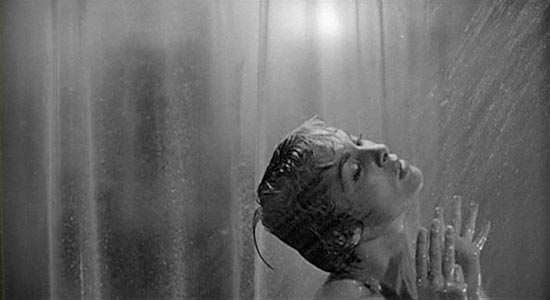
Janet Leigh, on her role in Psycho:
"I saw that she was really a shabby, mousy little woman. She wasn't in any way glamorous or anything. So we chose clothes that she could have afforded. We didn't have a dressmaker do them; we just went out and bought clothes that she could have bought on her salary. And I didn't have the hairdresser do my hair, I did it myself as she would: she couldn't afford a beauty parlour…I knew the background of this girl: it was lonely, poor…she was the older sister who took care of the younger one. And her drab life, in that office with that terrible man trying to take her out…"
And here, for all you film fans, is a beautiful and in-depth look at the work of Janet Leigh in one of my favorite film-obsession sites Images Journal.
Janet Leigh will probably always be remembered for Psycho - but her career lasted decades. And it was with Touch of Evil and Psycho that her talent was actually utilized, for the first time. These directors saw beneath that lovely surface, they saw the guts there, the truth. I mean, read that quote above from her. It makes me want to hug her. If you look like Janet Leigh, directors often don't WANT you to be talented. You are there for the sole reason of your beauty.
But, in the same way that Hitchcock sensed a darkness underneath the surface glitter of Cary Grant, and worked to bring it to the surface (time and time and time again), Hitchcock sensed something ELSE going on with this beautiful all-American blonde.
Perhaps it is not so much that Hitchcock cared what was ACTUALLY going on within Cary Grant, or Janet Leigh - but he knew that audiences would come to these films with a certain set of expectations - or anxieties - and he was going to either shatter the audience's expectations or play on their anxieties.
What the hell am I talking about?
The handsomeness of Cary Grant is undeniable. It's a God-given gift. It's barely REAL. Normal people don't look like that. Hitchcock knew this ... and so (North by Northwest is a perfect example) put this oh-so-handsome gentleman through tormenting situation after tormenting situation. NOBODY is more degraded and crashed off the pedestal than poor Roger Thornhill. In a weird way, you could look at that film as Hitchcock's revenge. "Okay, fine, SOME people are born looking like Cary Grant, while OTHER PEOPLE are born looking like me?? Let's see how Cary Grant deals with THIS." Hitchcock envied people who were beautiful (which was why his films were always filled with such gods and goddesses). He wanted to look like Cary Grant. So maybe subconsciously, it pleased him to some degree to make Cary Grant, the idol of a million women, go through all of these horrible experiences. Like: hahahaha, I may be fat and bald and homely, but I can make THE Cary Grant crouch in a corn field!! Ha!
But ALSO - Hitchcock knew that audiences would come to a Cary Grant movie expecting a certain thing. Hitchcock LOVED to make audiences uneasy. He LOVED to make people gasp with horror. He loved to set them up: Okay, you think this is a Cary Grant movie? You want to see him urbane and suave? TOO BAD, here's what I have in store!! (evil laugh)
(Side note: Hitchcock said that the only actor he ever "loved", of all the actors he worked with, was Cary Grant. Cary Grant was his alter ego, his favorite actor. And Cary Grant believed that he and Hitchcock had some kind of psychic connection/understanding ... one of those rare actor/director relationships that sometimes occurs, like Scorsese and DeNiro. Cary Grant, who trusted almost NO ONE, trusted Hitchcock. He would do ANYTHING in those Hitchcock movies. Because he knew he was in good hands with Hitchcock. Howard Hawks was another one. I mean, good LORD, look at the outfit Howard Hawks was able to get Cary Grant to wear in Only Angels Have Wings. Gouchos? A gun holster? A wide Panama hat? And - ahem - that has to be one of the sexiest performances ever given by an American male. EVER. Flowing goucho pants and all.)
But back to Hitchcock, and his penchant for taking these beautiful people, putting them in his movies, and messing with an audience's expectations:
Think of the raging FIRE beneath the surface of Grace Kelly's heiress in To Catch a Thief. That actress was NOT just a cool blonde, although audiences kind of expected only that from her. Many directors only saw her coolness, her blondeness, her cool blondeness, whatever. Hitchcock saw something else. He made her eat a drumstick WITH HER FINGERS, in that picnic scene, and then had her LICK HER FINGERS. Yum. It's a great scene. Movie star actress-types did NOT do stuff like that on screen in those days. But Hitchcock made this blonde have a chill exterior, sure, but underneath was this earthy hungry woman ... and ... well ... the moment when SHE initiates the kiss with Grant? I read some reviewer who said, "It was a small kiss, but the look on Cary Grant's face afterwards is as though she had unzipped his fly." Yup.
Okay. Sorry. Back to the story at hand. Even though it's all over the place. Follow me if you dare.
I'm now leaping back to Hitchcock's Suspicion:
Hitchcock sets Cary Grant up as ... a sketchy character in Suspicion - you don't know what to make of him, is he evil? Is he bad? But ... the looks!! That CHIN! Hitchcock plays on our experiences of Cary Grant's beauty, and the fallacy that beautiful people are always good and to be admired. That movie turns that expectation on its ear. Suspicion was the first of many Cary Grant/Hitchcock collaborations ... Here are some of my posts on that movie: Here, and here ... There are probably more in that Cary Grant archive.
The studio made Hitchcock change the ending to Suspicion, because they were shocked that Cary Grant would be such a villain. So the movie doesn't QUITE work ... but it's fascinating to watch nonetheless.
It's one of the reasons why I think Cary Grant is one of the best actors to have ever practiced the craft. PERIOD. If all you saw was Bringing Up Baby, you'd STILL have to admit that the guy was special - but put it alongside Suspicion, and Notorious and North by Northwest??
Hitchcock loved messing with the audience.
And in Psycho - with that shower scene ... with the entire set-up to the scene ... and the fact that it was JANET FECKIN' LEIGH - Hitchcock messed with the audience in a way that still reverberates today.
I meet people who haven't seen that movie NOW, and I guard the secrets of the film zealously - like: "OmiGod you have to see it but I can't even talk about it right now because I will give it away ..."
And right now I must shout:
DO NOT read the following excerpt if you haven't seen the film:
It discusses Janet's ACTING in that famous scene, something many overlook - because the scene itself is so notorious. It's about so much more than one woman's performance.
But anyway, here's an excerpt from the article I linked to:
What Janet Leigh does with her body in Psycho is not nearly as interesting as what she does with her face. In a very black sense, Hitchcock acknowledges this by destroying her body and leaving us with that lovely face smeared against the bathroom floor. When Marion and Norman talk in her room, Norman walks over to and past Marion and she turns towards him as he passes her. It is as though they are going to dance. As he passes and she turns, she smiles to herself at his ineptitude--he cannot bring himself to say "bathroom" in front of her--and as she looks up the private grin segues into, not a look, more a regard. It is as if for all his ineptitude, his strangeness, she is actually beginning to like this boy. Her look momentarily opens her tired face to new possibilities.In this brief moment, she renews her habitually positive pact with experience, she bounces back as she has a million times before. Emboldened as much as we are charmed, Norman invites Marion to have something to eat with him. Her look is such that we do not notice the cut to him as he issues the invitation, with its mute intimation of disconnection, alienation, horror. The scene is then swallowed up in Perkins' boyish glee that this dreamboat is actually prepared to break bread with him. It feels as though the modern stray who has dominated the first half of the film now "throws" the initiative, the narrative, his way and he's thrilled. "She is so clearly like the all-American girl you saw on the magazine covers," Harvey writes, "in the cigarette ads, even the movies--like Janet Leigh, to put it plainly--the ideal daughter, the ideal wife." And now she is his.
THAT'S what is so freaky about that movie. (Or one of the main things anyway.)
In her short tenure on screen, Leigh's face runs the gamut from contented to perplexed, sad to sympathetic, worried to agonized. It is the expressive lexicon of a million working girls as they negotiate the troubled terrain of contemporary sex and manners, the life (and death) of the American Girl.
Short tenure on screen, indeed. Brilliant.
January 12, 2005
I think about the Founding Fathers a lot
I think about "those guys". I think about those guys when the going gets rough, when I wonder which way we are headed, when I need strength to carry on. They inspire me.
But do they inspire me as much as this?

Absolutely not.
January 11, 2005
And then.
There are times when the frenzy stops.
When the mania dies down.
When you come across something which leaves a blankness within you ... something for which you cannot find the words ...
And now?
Well. Excuse me. As I go vomit up and down 7th Avenue.
Because I must.

(Is it too much of a broken record if I keep screaming about the lack of irony?? Now imagine Jim Carrey taking this pose ... imagine Robin Williams in this pose ... or Jack Nicholson ... It would be DRIPPING with irony. A sense of irony could save Western civilization. You cannot pose with cute little puppies and NOT do it ironically. At least if you don't want to be completely disgusting.)
All right I need to drop the pose
LOOK AT THIS FECKIN' PICTURE.
I mean, Jesus H. Christ. WHAT THE HECK IS GOING ON WITH THAT???
And again I shout:
WHERE IS THE IRONY? All would be FINE if there were just a smidgeon of irony ... but no. THERE IS NONE.
You know, I love John Wayne and all ...
True Grit. The Quiet Man. Oh sure.
John Wayne's great.
But he's missing that extra special somethin', I think ...
Not sure what to call it, or how to describe it ...
Only an image will do.
Okay, folks, okay
I know it's been crazy around here ... with the whole no irony thing ... and the pirate shirts ... and the tire swings ... and the general awfulness ...
but I would just like to take things down a minute, mmkay?
Just slow things down ...
take a moment ...
slow ...
sh ...
Ouch.
My soul hurts. It literally HURTS.
Because of ...
A pirate shirt. A guitar. And NO SENSE OF IRONY ABOUT ANY OF IT.
I'm sorry to keep hurting everybody
... but when one is in pain, sometimes it feels GOOD to just inflict it on others.
And so I give to you:
Woah. I think I need to kill someone.
I have something else to impart ...
... that is going to hurt even more.
Do not say I didn't warn you.
Once again. Please note the utter lack of irony.
Not to mention the slippers.
All right, people, listen up
I'm going to post something, and I warn you. It might hurt.
I really need you to be ready for it. I need you to do whatever it is you must do to prepare yourselves. I will not be held responsible for what might happen if you do not.
Are you ready?
Okay. Here it is.
David Hasselhoff. On a tire swing.
Uhm ... what????
The thing that I find MOST disturbing and MOST amusing about this image is its utter lack of irony. There is NO IRONY there. NONE.
How can one pose like that with NO IRONY???
January 9, 2005
Ignoring Germaine Greer and Loving Judy Davis
Still working on a couple more posts about this whole soulmate thing ... but in the meantime, Norm has a compilation of great links, and I'm bummed that I can't get in to read the whole article on Germaine Greer (getting a Sign In thing) because woah, nelly, it looks like a doozy. I've ranted about her before, even though I pretty much do my best to IGNORE HER. Ignoring Germaine Greer feels like a full-time job. (Side note: I will always be grateful to Germaine Greer, on one level, because Emily - back when she was "Hawk Girl" - wrote one of the bitchiest funniest rants about Germaine Greer that I have ever read in my life ... and that was the first post I read of our Ms. Jones. Someone else linked to Emily, and I read the piece, laughing out loud ... and now, 2 years later, I consider Emily a friend. So Germaine? THANKS for being the inspiration for an Emily rant. I owe ya one.)
Judy Davis told a very funny story about Germaine Greer. When My Brilliant Career came out, the movie which pretty much introduced Davis to the world, (wonderful flick by the way) - Judy Davis, because of the role she played, suddenly found herself thrust into "feminist-icon" land. Something she wasn't interested in AT ALL.
She describes being at some reception, and suddenly being ATTACKED by this overly enthusiastic woman, who would not let Judy Davis get a word in edgewise, who crowded Judy Davis' personal space, and, in general, behaved like a bonehead. Judy Davis had no idea who she was, but found out later that it was Germaine Greer. Greer pounced on the young actress Davis, took her by the arm, and led her around ... parading her about to meet all her friends ... blabbing in her ear ... talking about feminism, and what the film meant in the feminist canon ... etc.
Later, in some interview, when Davis was explaining what it was like to be in a movie which inadvertently turned you into some kind of SYMBOL, Davis related that tale. Of Germaine Greer pretty much trying to OWN Judy Davis' success. "She's ours, girls, she's OURS."
And Davis said that the entire time this was going on, she was thinking helplessly, "Would someone please save me from this shrieking troll latched onto my arm?"
Yes. Davis called Germaine Greer a "shrieking troll". Reason # 382 why I love Judy Davis.
December 8, 2004
Expert Essay: by Noggie
And here is yet another Expert Essay for my series. If you feel like you are an expert on something, please send me an essay and I'll post it!
This is an essay by Noggie, who writes here. Noggie is, as is obvious, an expert on dogs - she contributed another essay on this topic the last time I asked for essays. (If you love dogs, or have a dog, or are thinking about getting a dog, you should definitely check out her site.)
EXPERT ESSAY: Puppy Bites, by Noggie
I lie to puppies. I have other people tell a similar lie to my puppies. And the lie is this: Each and every time pup touch my skin with his/her puppy teeth, I tell that pup that "that hurts!" I over react purposefully. - "Ouch!!! That really hurt!!!" - I try to overact. I create a scene. I am not happy with pup and scold. Pup has done a bad thing. Pup may be startled the first couple of times this happens, but it quickly learns that teeth on skin causes a severe, unpleasant reaction from this human. And, it seems like it happens with other humans too (if I can find a variety of co-operative people to assist).
The lesson that I want to impress upon pup, as early as I can, has three points:
1. human skin is fragile.
2. dog teeth on skin is a bad, bad thing.
3. pup has to be very careful with its mouth.
I want to teach this lesson as effectively and as often as I can with pup. It may need much bad acting and over reacting on my part (also from friends, from family and other people). The criterion is teeth on skin. It does not have to hurt for me to begin this act. I have set my parameter for this at a very low level - even incidental teeth-to-skin contact is not acceptable. This simply will prevent a myriad of problems as pup grows up.
-- by Noggie
November 8, 2004
My obsession with WHY THE HELL RENEE ZELLWEGER IS A SUCCESS
I find Renee Zellwegger ikky. There is something about her that makes me nuts. Like, she makes my scalp itch. I have moments where I think: If I ever see her puckered-up apple-doll smile again, I feel like my head is going to explode.
I am truly baffled by her success. Her success seems to be an industry-creation, rather than something organic.
By that I mean: The industry anointed her as "she will be the big star for the next couple of years and will get nominated for Oscards left and right" ... as opposed to the PUBLIC deciding: "I love that girl - who is SHE? Let's see more of her!"
To me, it's almost like a scent - the difference in those two kinds of success. The "industry" hopes that we will be fooled. Like: Let's put Gretchen Mol on the cover of "Vanity Fair" ... and see if it takes off! (Does anyone remember Gretchen Mol being on the cover of "Vanity Fair"? It was years ago, 10 years ago or something? The title was: "GRETCHEN MOL. HOLLYWOOD'S NEW 'IT' GIRL". She had done 2 semi-successful indie movies, or something ... and yet - there was the title - she's the new thing!! Gretchen Mol is still working - but in that case, the spin didn't work. Nobody bought the lie.)
This is obviously a matter of personal taste, but I can list a bunch of people that I think have that artificial kind of success. The studios decide to push them to the foreground, or they have excellent publicists, or whatever. Renee Zellweger has always struck me as that kind of success. Not that she is completely talent-less, but ... to get the kinds of roles she's getting? To be pretty much above criticism over the last couple of years? I don't get it. Is there anyone who is an actual Renee Zellweger FAN, who can explain it to me? I've never met one. I've never met someone who said, "My favorite actress is Renee Zellweger" - so I have no idea.
Now somebody like Julia Roberts - whether or not you like her acting - undeniably had the kind of organic success I described originally. Nobody was planning on "Pretty Woman" being a huge hit. She didn't even do publicity for it. She had already moved on to her next job. She wasn't being pampered for stardom, or primed, or pushed into the limelight (the way Gwyneth was with the Miramax boys. Again, I'm not saying that Gwyneth is without talent. But with the power of Miramax behind her, her burst of stardom felt more like an industry coronation rather than a spontaneous brush-fire.)
Julia Roberts' success was a spontaneous brush-fire. People went NUTS over this girl. THEY decided she was a star, and then the studios had to play catch-up. ("Oh yeah, oh yeah, isn't she great? Yeah ... we always knew she'd be a big star ... yeah, we meant to do this ... we knew it all along.") But in the end - the studios had nothing to do with what happened there. She was just a young working actress, and the public went APESHIT, and demanded: MORE OF HER, MORE OF HER.
(Very very rare, that kind of success. Marilyn Monroe had it, a couple others.)
Julia Roberts, busy filming Sleeping with the Enemy, down in North Carolina or somewhere like that, was unaware of how much money Pretty Woman made in its opening weekend, and also was unaware of the kind of manic insanely positive press she was getting. She was just trying to do her next movie, trying to do a good job - unaware that her fortunes had just changed, and the one in a million event had just happened to her: she had become a massive movie star pretty much overnight.
I don't care if you put Renee Zellweger on 20 Vanity Fair covers - I don't care how much the industry tells me how great she is - I don't care how many reviewers seem to unquestioningly believe that she is a great actress - I don't see it. I DON'T GET IT.
I feel like they've just read her press packet and bought the spin.
It's not like I thrash about in bed at night, wondering at this phenomenon ... but it does occur to me sometimes when I walk by a magazine stand and see her smirking apple-doll face on the cover of 5 magazines.
I'm sick of her, frankly.
I have liked her performances before. I love "Jerry Maguire" - but it's really the performances AROUND her that I love (especially the sublime Bonnie Hunt, who plays her sister). I liked "Chicago" (sort of) - but I have to be honest: I truly do not know what the fucking big deal was about that movie. The response to it was as though Rob Marshall had ... made another "Citizen Kane" or something - I thought the "OH MY GOD, HAVE YOU SEEN CHICAGO" response was baffling. "Yeah, man, I saw it ... and ... so?" I thought Catherine Zeta-Jones alone deserved the hoop-la. I didn't think Renee, or Queen Latifah, or Richard Gere did.
I don't talk much about my own experiences with acting here - It's hard to write about my own acting and not feel self-conscious about it - but I'll just say this:
Renee Zellweger reminds me of the chick in EVERY class - who has a bunch of bad acting habits - but who plays the game so well that she fools even the teacher. And so the bad habits become applauded, engrained, and solidified. And you just keep hoping that someday, someday, someone will tell the TRUTH to this person.
There was a chick like that in my graduate program (I'm telling you - there's a chick like that in every acting class. She skates by on some facile ability - but it's all on the surface. She is deeply dishonest on some level, and she can't bear criticism because it will crash the house of cards she has erected for herself) ... it wasn't until the third year when someone FINALLY had the guts to try to crack the edifice with this girl in my class, and try to actually say, "Listen, sweetheart, your acting isn't perfect, okay? You have a lot of work to do ..."
By this point, though, this girl I refer to had been coddled and lied to so much about her talent that she was literally unable to hear criticism. She literally did not understand what was being said to her. The ego had calcified. Nothing could get in there. (And of course, when something hardens like that, it becomes 100 times more fragile. This is what I saw on this girl's face: a hardness and also a fragility. The truth was terrifying to her.) She had been breathing rarified air of no-criticism for 2 years. Meanwhile, the rest of us - in the trenches - having to deal with tough truths about ourselves, willing to do the damn work - had hardened up so much through the graduate program that I feel like someone could say, right to my face, "You completely suck", and I flat out would not believe them. It's a subtle difference, and maybe I'm not describing it well.
You MUST believe in yourself. You MUST believe in yourself in the face of 1000 "No, thank you"s. You MUST believe harder than anyone else that YOU CAN DO THIS.
But that's not what I'm talking about here.
To be blunt: I think reviewers have been blowing smoke up Renee Zellweger's ass for the past 5 years, and over-praising work that is merely adequate.
And I also think that Renee KNOWS THIS HERSELF. She never seems to be really smiling, she never seems to really inhabit her own body, she never seems to be having all that much fun ... I think she's hoping that nobody will eventually guess what she already knows: that her acting is kind of shallow, and that she's scared to death. That's what her smile says to me, the same smile she gives in every photograph. You know the one. No teeth showing, chin lowered, a kind of knowing close-lipped smirk. It's not the smile of a woman who really gets a bang out of what she's doing, or who knows who she is.
I admit, I'm a bit obsessed with her. She comes up for me a lot, but only because ... I have watched her rise to the top and have been utterly baffled by it. Is it the Bridget Jones thing?
I can see the appeal of that movie, but again I would say that for me the real appeal of that movie is the performances of the MEN in it.
Same with Down with Love. I was baffled at the free pass she was given with that film. Her acting was bad, her understanding of the style of the movie was bad and shallow (unlike McGregor, who totally got it) - and yet - the reviewers gave her a free pass. Didn't call her on her shit.
I watched her sashaying around in that movie, basically just a clothes-horse, doing some weird thing with her walk (I think she was imitating Audrey Hepburn - but she was doing so very badly) and I thought: Damn, if I were teaching a class, I would stop her immediately, 2 lines into the scene, and say, "Okay. Breathe. Take a couple minutes. Get your act together. Ask yourself: What do I want in this scene? What is my objective? And THEN start the scene."
I mean, it was basic acting 101 shit in that movie. She sucked.
Oh, and lastly: I don't think gaining and losing weight for a role is indicative of anything. I was so sick of hearing about "Renee eating donuts" and "Renee eating pizza" that I wanted to fly across the Atlantic and punch her in her puckered-up mouth. That whole thing was vanity. Not dedication to the craft, or to her part. "Oooh, look at me, I'm so dedicated that I am going to gain 25 pounds ..."
The second Bridget Jones just came out - and I actually felt a thrill of excitement when I read the great James Berardinelli's review:
The Bridget of Bridget Jones' Diary seemed like a real person; this one is a caricature. The performance is lazy; this may be the least appealing work Zellweger has exhibited in a major role. And, although she gained back the pounds, she lost the knack of the accent. This time around, it would be charitable to call Zellweger's accent "uneven."
I thought when I read this: Jeez, thank God. At last. And not only is it a bad review, but it zeroes in on her acting. "The performance is lazy." I have thought all along that Zellweger was lazy - she doesn't seem to come across the screen at me - she plays it safe, and coy.
Good for Berardinelli. More truthful observations:
The only time the movie gains a pulse is when Hugh Grant is on screen. Grant reprises the part of Daniel with the perfect mix of charm and oiliness. It's a delightful mix, and Grant plays the role to the hilt. Unfortunately, his screen time is no more than 25 minutes, and the running length of the movie is quadruple that. Character actors like Jim Broadbent and Gemma Jones (as Bridget's dad and mum) are short-changed - they have glorified cameos.
I know I probably sound petty and jealous. I suppose I am. But I have also always disliked this actress, and do not understand the appeal. At all.
"This performance is lazy".
I'm allowing myself a moment of schaudenfraude. It's been a long time coming.
October 26, 2004
Thoughts on William Holden
William Holden, over his long career, racked up an astounding body of work. He is one of our greatest actors. Sunset Boulevard, Stalag 17 (later to be made into a TV series called Hogan's Heroes, baby), Picnic, he played Joe Bonaparte in the film version of Golden Boy, Country Girl .... Jeez, what else? Bridge on the River Kwai. The Wild Bunch. I mean - very very few actors build up such a resume, and turn in such consistently fine performances over a long lifetime. Also, all of these films, in their own way, are still considered to be classics.
Then there's his genius turn in Network. I don't use that term lightly. He acts everybody else (including the great Robert Duvall - whom I love, but who I think turns in kind of a wooden one-note performance in that movie) off the screen. Who can forget Holden's sex scene with Faye Dunaway? The sadness of it, the comedy of it? She's getting undressed, casually, jabbering on and on about "market shares" and her upcoming show "the Mao Tse Tung Hour" ... They begin to have sex, and she never ever shuts up. Holden lies beneath her, staring up at her, with ... something I can't even describe on his face. Humor? Partly. There's desire there, too. But mixed in with that desire is the sadness of the middle-aged man, the guy cheating on his wife, the guy who knows that this won't last ... His great great scene with his wife at the end (Beatrice Straight - she got an Oscar for her less than 10 minutes on screen) - and then, my favorite: when he breaks up with Faye. His monologue there could not be better. She doesn't say a word, and he is as gentle as he can be, but also firm, and sad, and ... a bit pathetic. A bit of that speech is:
I feel lousy about the pain that I've caused my wife and kids. I feel guilty and conscience-stricken, and all of those things you think sentimental, but which my generation calls simple human decency. And I miss my home, because I'm beginning to get scared shitless, because all of a sudden it's closer to the end than the beginning, and death is suddenly a perceptible thing to me, with definable features.
Watch that movie again ... and watch how he says those lines.
A truly courageous actor. In that role, he faced the fact head-on that no, he was not the "leading man" anymore. Think of other male movie stars growing old ... and you can see how rare it is for them to face that fact. They hold on. They hold on desperately. But Holden came out onto the other side ... he was once a leading man, and he kind of became a character actor later.
Holden, as a young actor, was known as "the Golden Boy". That was one of his nicknames. Because he had played the "Golden Boy" himself, but also because of his regular every-day American good looks, the quarterback good looks, the breezy certainty of his handsomeness. - William Holden's handsomeness is immediately apparent, in an empirical way. You look at him and think: "There's a handsome guy." But it's not glamorous, or knock-you-off-your-feet gorgeousness, or off-putting, like some brands of good looks are. Holden looks like you could meet him in real life. There are good-looking guys like that in real life. He didn't have the glitter or the sexual mystery of Cary Grant. It was hard to figure out what exactly, at times, was going on with Cary Grant - which is part of his enduring appeal. The voice? The walk? He's gorgeous - but he's a goof - is he British - is he American? But William Holden was immediately place-able: An open-faced American guy, with a mop of hair, and a huge sunny smile. He was an American golden boy. I heard somewhere that he was descended from George Washington, which sort of makes sense.
He won an Oscar for Stalag (directed by Billy Wilder). I can't remember if Holden won more Oscars, but he was certainly nominated multiple times.
Billy Wilder loved William Holden, loved him dearly, as a man and as an actor, couldn't say enough loving things about him. Wilder's two favorite actors were Holden and Cary Grant. Wilder ended up working with Holden multiple times - and with Cary Grant none. (Wilder was bummed about it til the end of his life!) But still - Wilder had great affection for the skill, humor, and dedication of Holden. Also the fearlessness. He'd do anything.
Wilder has talked about the scene in Sunset Boulevard where Norma shoots Holden's character, and he topples into the pool. Holden was an athlete, graceful, physically fit ... Holden pulls off a difficult stunt there. Not every actor could throw himself into the pool in the way he does in that scene - it's an amazing bit of physical acting. If you get a chance, watch it again. See how easy he is with his body, and how REAL that moment looks.
Holden's end is haunting to me. The man was a drunk. He had been a pretty serious drunk for years. I do not know what demons he had to combat, but his drinking was notorious. One night, he was alone in one of his apartments (he had apartments everywhere - Hong Kong, LA, he had a house in Africa ... he was a peripatetic type) - and he was drunk, and he fell and cracked his head open on a coffee table. The fall alone did not kill him. He lay there and bled to death. He didn't phone for help, he lay there - probably half in and out of consciousness - or maybe just too wasted to realize the danger he was in - probably unaware that he was going to die if he didn't get help.
I look at his craggy lined face in Network, and wonder.
That character (Max) is a sad man. A workaholic, kind of skating along in his marriage. Being pushed aside at work, no longer needed. A man who also has a bit of trouble with drinking. Just a bit, though. It's hard for actors to play things so close to them. Or, at least, it often is. But Holden wasn't afraid. He didn't protect himself, in that part. He let us see the reality of who he was NOW - in all of his middle-aged loneliness, his sexual insecurity, his fear of death ... A lot of actors as they get older do not want you, as the audience, to see all that stuff. They still want to be the tough-guy, the hero, whatever. This is why Cary Grant retired. He didn't want to suddenly be the old guy with 4 lines in a movie. He was done. William Holden, the golden boy, the handsome guy, one of the biggest stars of his day, a heart-throb, voted "one of the sexiest stars of the 20th century" in 1995 ... did not hang on to his old persona. His segue into power-house middle-aged parts is very rare. Not a lot of people can pull it off - especially those whose careers were based mainly on their looks, and on the fact that female fans went ga-ga. But Holden was a talent. Always was.
Maybe his private drinking was where he put all his grief, his sadness about what he had lost ... but up on screen, he didn't hang onto it. He didn't seem to be saying to us: "MEMBER ME? MEMBER WHEN I WAS THE BIG SEXY STAR IN THE 1950S? WELL, I STILL GOT IT. I STILL GOT IT."
It's hard for actors to grow old. It's harder for women - there's a black-out period in between the ages of 35 and 60 when it's nearly impossible for women to get good parts. Especially with the tendency of male movie stars in their 60s to have 25 year old actresses cast as their wives. This is vanity, make no mistake about it. "I can't be married to a 60 year old! Not if I'm still trying to prove I'm a virile stud!" However, male actors growing old have their own set of challenges. Particularly for those who were once sex-symbols, or heart-throbs, or leading men. (This problem does not exist for "character actors" - those who were never good-looking enough to be sex symbols. The character actors, male and female, NEVER stop working. EVER. They will get parts until they're 80.) But former heart-throbs, like William Holden was, had BETTER have more going on with them than just their good looks, or the ease that comes with being young.
You had BETTER have some gift for this mysterious thing called acting.
Otherwise ... you'll have a short career.
Recently I saw a movie Holden made with Jennifer Jones called Love is a Many-Splendored Thing, which I thought was a snooze-fest. A manipulative boring tear-jerker. Blech. Holden plays a journalist, I think, stationed in Hong Kong. He falls in love with a "Eurasian" doctor, played by Jennifer Jones. They have a sweeping love affair, where they have to deal with prejudice, also with the Communist revolution in China, and there are multiple scenes with swelling violins, etc. It's not very effective. There's next to no chemistry between Holden and Jones.
But I thought to myself, as I watched it: Okay. What is missing here? What, exactly, is wrong?
Here's what I think it is:
And this may just be me projecting William Holden's performance of dark sadness in Network back over his earlier career ... but I don't think so. I think that Holden is best in darker material. Edgier material. Yeah, he's got all-American good looks. But he wasn't quite believable saying to Jennifer Jones, "I am so in love with you ... I love you, darling ..." etc. He's more believable when he's not so forthright, when he has ulterior motives, or when he's trapped. Trapped into living a lie. Think of his character in Sunset Boulevard. How attracted he is to his co-writer, how much he loves being with her, the intellectual stimulus, the companionship ... it could be a true romance. And yet, then ... there's Norma Desmond's web he is caught in ... and finally, at the end of the film, he reveals: that he LIKES being caught in that web. He LIKES being a "kept" man. Many actors turned down Sunset Boulevard for that reason. They found it too embarrassing - to play a character who would willingly become the "house-boy/love-slave" of an aging movie star - merely because she buys him expensive suits and cigarette cases. He's a sort of prostitute in that movie. He's trapped in that house - she uses him for sex, and he uses her back. Holden had no problem with any of this. He's great in that movie. He's sexy, too, in a sort of dark and unexpressed way. It's not your basic leading-man part ... not at all ... He is in quite an emasculated position for the entirety of the film - he's a sex-slave to Norma ... He plays the role typically played by women - the money-hungry woman who puts up with anything as long as her tormentor keeps her in furs and nice clothes ... but perhaps THAT is part of his complex appeal.
It's certainly part of his complex appeal in Network.
In Love is a Many-Splendored Zzzzzzzzzzzz, Holden pretty much plays your straight-up romantic leading man, and it falls flat. It doesn't work. It doesn't seem true. I kept wondering what he was hiding, what he was lying about.
Holden's good looks concealed a secret: this was a man tormented by insecurity, by sadness, by addiction. He drank himself to death, basically. He wasn't an old man when he died. Not at all.
It was when directors saw beneath his good looks - and got a glimpse of the darkness beneath - that Holden's true genius could be exploited.
Thinking about William Holden makes me sad, for some reason.
A great actor. Is he really remembered now? Does he really get the props he deserves?
Those of you out there who have seen and loved any of his performances, anything you would like to comment on? Let's have a little collective tribute to this guy.
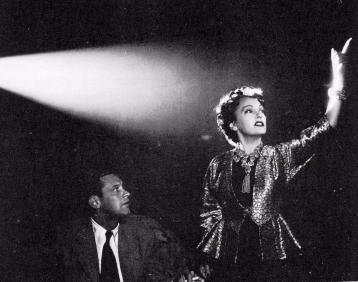
October 8, 2004
Three similar stories
One story stars Clark Gable. One stars Robert Duvall. And one stars Gary Cooper (the latest celeb-crush ... I will never abandon Cary ... how could I? We had a good time together, he and I. We really did. But I felt it was time to move on, and Gary Cooper was available. Such is life.)
I find these stories, put together, very illuminating. And we could probably add to this list indefinitely. But here are three to start off with:
1. Clark Gable
I was looking through Arthur Miller's autobiography Timebends this morning. Long stretches of that book are so deadly dull you want to commit hari-kari (Harry Carey? Whatever, you know what I mean) ... but then there are brief excerpts of such insight that it wipes out the rest of the sanctimonious ya-ya-yawn. It's his descriptions of actors I find most interesting (duh) - and also his insights into Marilyn Monroe. Anyway - he devotes many many pages to the famously difficult shoot of The Misfits - which he wrote, for Marilyn (he had a serious savior complex with her ... I suppose every man wanted to save her). Marilyn was a wreck, their marriage was falling apart, she suffered from chronic insomnia, there were many many issues with this shoot. Shooting was shut down for a month, while Marilyn was hospitalized. Etc. Clark Gable, John Huston, Montgomery Clift, Eli Wallach - an all-star cast - just sat around in the Nevada desert, on FULL SALARY, waiting for Marilyn to return.
There's the background.
Arthur Miller had written the part of the aging cowboy who falls in love with the girl for Clark Gable - he never could imagine anyone else in the part. It took some convincing to get Gable to agree to sign on. Gable didn't understand the script. He didn't get it. (If you see the movie, you'll see that Gable had a point!!) So Gable invited Miller to come over, and explain the script to him. Miller acknowledges that he was always really bad at that - he never could "pitch" his stuff to anyone. But he decided to give it a shot.
The first thing Gable said to him was, "This is a Western ... right? It's supposed to be a Western? But ... it's not like any Western I've ever heard of."
Miller thought about this and then replied, "It's kind of an Eastern Western."
Gable took this in, and then howled with laughter. That was all he needed to hear. He signed on immediately.
I could talk about The Misfits all day. But I won't. The REAL story I wanted to tell is about the last shot of the film - which was also the last shot they actually did during the film-shoot.
It speaks volumes about the genius of certain actors (all the greats - hands down - they've all got this) ... It also, to me, says that actors, experienced film actors I mean, know their shit. They know that camera as well as the camera-man, as well as the guy who BUILT the camera. They know the lighting equipment as well as the lighting designer. They KNOW how to do their job.
I'll let Arthur Miller tell the story. He admitted that he was very naive about film-making - He knew how to write PLAYS, but the literal-ness of movies, and the craft of movie actors as opposed to stage actors was new to him.
The final shot was also the closing scene of the picture. Langland [Gable] stops his truck so Roslyn [Monroe] can untie his dog, which was left behind while the mustangs were being rounded up. It was a studio process shot done in Los Angeles; a filmed track in the desert rolled away through the truck's back window, coming to a stop when Marilyn jumped out to go to the dog. Gable was supposed to watch her with a mounting look of love in his eyes, but I noticed only a very slight change in his expression from where I stood beside the camera, hardly ten feet away."Cut! Fine! Thanks, Clark; thanks, Marilyn." [John] Huston was brisk and businesslike now, in effect refusing any sentimental backward look; hardly lingering, he said he had to be off to work with the film editor.
I asked Gable if he thought he had shown sufficient expression in the final shot. He was surprised. "You have to watch the eyes. Movie acting is all up here" -- he drew a rectangle around his eyes with his finger. "You can't overdo because it's being magnified hundreds of times on the theatre screen."
He turned out to be right, as I was relieved to see in the rushes of the scene; he had simply intensified an affectionate look that was undetectable a few feet away in the studio.
2. Robert Duvall
Dennis Hopper came and did a seminar at my school. He was hilarious, irreverent, funny, WACKO, and very very articulate. He talked about directing Robert Duvall in Colors, I think it was called - the LA gang movie with Sean Penn. Hopper thinks that Duvall is the best American actor working today, and I can't say I disagree.
So Hopper was surprised to see how different it was to DIRECT him, as opposed to sitting in a movie theatre, watching him magnified up on the screen. Robert Duvall's acting is so alive, so powerful, so DEEP - Hopper was expecting THAT guy to show up. But there was Duvall, soft-spoken, quiet, humble ... and Hopper couldn't SEE that anything was happening. He didn't trust that Duvall knew that camera better than HE did ... he wanted to SEE the acting.
Hopper said that he was directing one important scene - where Duvall had to be flipping through a wad of money. Apparently, Duvall was supposed to be pissed as he did this (was it pay-off money? Dirty cop money? Something like that). In the next scene, Duvall's character had to storm into the cop's locker room and shove Sean Penn up against the locker - and give him HELL. So you needed to see the set-up of Duvall's anger in the flipping-through-money scene.
But Hopper, standing by the camera, watching Duvall - from three feet away - couldn't see it. Duvall didn't seem to be DOING anything. He was just flipping through the money. There was no sense of growing anger, of violence, of rage ... Why the hell wasn't Duvall acting? Hopper shot the scene a couple of times - he was almost intimidated by Duvall, didn't want to go up to the guy and give him acting notes, but he still didn't understand why Duvall's anger wasn't showing.
But then - later that night - when Hopper watched the rushes from the day's shoot - Duvall's skill and brilliance became clear. Hopper felt like an idiot. (After all, he's an actor too). He watched Duvall flipping through the money - and whatever it was he saw in Duvall's face it was a small thing, a tightening of the lips, the way Duvall held his hands around the money ... a tiny look in his eyes - which would have been completely invisible from 2 feet away ...
When Hopper looked at the rushes, what had seemed dull and uninteresting suddenly pulsed with violence and potential. The next scene (Duvall shoving Penn up against the lockers) made TOTAL sense. Hopper could see that Duvall was ready to bust.
Now an actor on stage obviously could not get away with that. You have to SHOW that stuff - you can't just tighten your lips, and change the expression in your eyes - Nobody will SEE it.
But these guys - Gable, Duvall - understood the medium better than their own directors.
3. Gary Cooper
There isn't just one story illustrating this point for Gary Cooper. Director after director after director told the same story:
"His performances seemed dull - when you were standing in the same room with him. He seemed passive. Very very boring. And then you would watch the rushes later that night, and it was the most powerful acting you'd ever seen."
By the end of his career, directors were no longer shocked or worried on the first days of shooting. They no longer thought: "Jesus, this guy is dead in the water, a drippy noodle ... where the hell is the ACTING?" The directors understood by then that Gary Cooper knew his job better than they did - and all they needed to do was wait for the daily rushes. They knew that Gary Cooper was turning in a great performance, even though they couldn't see it yet.
October 5, 2004
"That kid is the greatest goddamn actor..."
I like this story a lot. It's one of those stories which may be a legend, may be an exaggeration ... whatever, I don't care. I like it anyway. I ran across it again this morning in the Goldwyn biography, and remembered how much I liked it.
Gary Cooper (I think his name was actually Frank) had grown up in Montana, on a ranch ... but had also spent 10 years as a child in England ... his formative years. Somehow, as a young man, he ended up in California. Perhaps looking for work? Not sure. If he had ambitions to be a great actor, he wasn't behaving in that way. He met up with two good friends who were strolling down the street in full Western garb. They told him that you could make good money as an extra in cowboy movies. If you could ride a horse, looked good in chaps ... you might make some cash, and you might get a shot at the big time!
This was in the early 1920s.
So I guess Cooper started being an extra on Westerns. A faceless nobody. Just the same as the tons of other young hopeful cowboy-types in Hollywood at the time. However, what made him different (in a way ) was that women fell over for him like ninepins. And very early on - a couple of different actresses noticed this tall lean very very shy cowboy-extra - and tried to help him out, tried to push his career along. They became patronesses, almost. All women. The dude had major sex appeal, and yet was often so shy he could barely get the words out, and he blushed like a schoolboy. (Of course, this made the women go even more nuts over him ... and a couple of them became DETERMINED that even if they couldn't get this guy into bed, they would try to advance his career.) One woman, in particular - who was an actress, very successful, had a huge crush on him - and basically forced directors to look at him, forced the publicity department of the studios to consider him ... etc.
But still - he wasn't an actor. He was a fill-in, a guy who looked good in chaps and a cowboy hat and could ride a horse.
In 1926, he was on location (as an extra) with The Winning of Barbara Worth - directed by Henry King. Again, he was an extra. He had no lines. He was one of the faceless ranch hands.
Meanwhile: some OTHER actor, a "real" actor, had been cast in a very small but very important part. He only had one scene. However, this actor (whoever he was) kept asking for more and more money, or something like that - maybe it was scheduling problems, not sure, but he was negotiating with the studio ...
Henry King (the director), on location, finally decided he couldn't wait any longer for this over-paid actor to show up, and offered the role to the untried Gary Cooper.
All Gary Cooper had to do was knock on the door of the cabin. The woman inside would open the door, and he would collapse inside, from exhaustion. That was the part.
Long afterwards, when he was asked about Cooper, Henry King would describe the first day of shooting with this unknown kid who had never acted before. It also just so happens that Sam Goldwyn himself had come out on location that day, to check up on how things were going.
Henry King said that, while the crew was setting up the lights, etc., he pulled Gary Cooper aside and kept saying to him: "Look, just remember that your character is tired ... you are so tired ... You have been riding for days ... Tired, tired, tired ... When that door opens, I need to see a man who is licked ... who can barely stand ... tired, tired, tired..."
King said that he OVER explained it to Gary Cooper (I mean, obviously, Gary Cooper knows what the word "tired" means), but King didn't think Gary Cooper was an actor. Maybe Gary Cooper didn't yet think that Gary Cooper was an actor. Who knows.
King said that whenever he had a 5 minute break, a 10 minute break, he'd come back over to Gary Cooper's side, and whisper "Tired, tired, tired ..."
Sam Goldwyn saw how much attention the director was giving this glorified EXTRA, and grumbled about it - "Am I paying you so that you can give an extra acting lessons?"
King protested, "The kid isn't an actor ... I've got to explain to him what he has to do ..."
Anyway - finally the time came to shoot the scene. It was an interior shot - You would hear Gary Cooper's knock on the door ... the woman would open the door... and he would fall inside. A simple scene.
Action!
The scene began - a bit of dialogue - blah blah blah -
Then came, at the door, the TIREDEST most weary knock anyone had ever heard. King said that you could barely hear the knock. It was as though the person knocking did not even have the strength to lift his hand up high enough to knock properly. (Obviously ... this "extra" knew how to act - he went for it, he went for tiredness 110%.)
Anyway. After this weary timid knock, the door was opened ... and there was this kid - who right up to the moment before shooting the scene was a tall young lean handsome cowboy. But the door opened on an absolute wreck of a man. King said, "He had become, in the 30 seconds hidden behind that door, a completely different man. A sad sack." Gary Cooper took one step forward, and then collapsed onto the floor ... completely gracefully, completely naturally ... It looked as though his legs just could not hold him up anymore. The cameraman, realizing that some DAMN FINE ACTING was going on, had the presence of mind to follow Cooper's swoon down to the floor.
King said that 2 seconds after he called "Cut", Sam Goldwyn called him over. Sam Goldwyn could be quite terrifying. Especially when he was really really calm. Which he was in this moment.
Goldwyn murmured, "You say that kid's not an actor?"
King said, "He was an extra until this morning."
Goldwyn replied, "Henry, that kid is the greatest goddamn actor I have ever seen in my life."
September 30, 2004
Today in 1955...
Today in 1955... James Dean died at the age of 24. He had made 7 movies, but only 3 where he was "credited".
East of Eden (which basically changed my damn life when I first saw it) was the only one of his 3 major films (East of Eden, Rebel without a Cause and Giant) to be released while he was alive. Strange. No wonder a cult flourishes. Obviously, the man (I should probably say "boy") was very gifted as an actor - but then there was the dying a young and violent death, and to add to that - movies starring him continued to come out a couple of years after he died. It must have been especially impact-ful (in terms of a burgeoning cult) to see something like Rebel Without a Cause, knowing that he had died so young.
When I was a teenager, I saw all those movies. I saw them on late-night television, usually when I was babysitting, and then I would beg, and plead my parents to rent a VCR (member those days??) so I could see them again.
His performance in East of Eden tormented me. It was typical young-school-girl crush stuff, but there was something else. It got me asking questions about acting, about actors ...And even though I was 13, 14 years old - I was the same person then as I am now, so I read the great biography of James Dean, called Mutant King - and read all of the biographies of anyone who had come into contact with him. Natalie Wood, Carroll Baker, Elia Kazan ...
James Dean's twisted-up overly-open nearly-inarticulate brand of acting captured my imagination.
If I had had a blog when I was 14, it would have been all-James-Dean all-the-time.
Now I'm not so sure about him. I used to consider him a "great actor" - but I think there's a huge difference between a "great actor" (say, a Jeff Bridges, or a Marlon Brando, etc. etc.) and a "movie star". Not that he was "just" a movie star. Something else was going on with James Dean.
What I mean by all this is: James Dean was young, neurotic, extremely self-conscious, very shy, bisexual, filled with guilt, a loner, an outsider, may possibly have been a virgin when he died, he was reckless, had kind of a death wish ... Elia Kazan, who directed him in East of Eden called him, years later, a "sick kid". This is not to say that there wasn't magic there, because there OBVIOUSLY was. I can only think of one other person the camera loves as much as James Dean, and that's Marilyn Monroe. It may not be the magic of honing your craft, of being a Meryl Streep type virtuoso - but it is that very special brand of movie magic.
James Dean is riveting. To this day. No wonder his movies last. You can't not watch him. He is so compelling. You want to untwist that pretzel body, and help him relax. (Well, that's a very female response ... most women want to help him relax. He seems so self-conscious.)
His face is unendingly interesting. Yes, it's very handsome too ... but we're talking about what the CAMERA picks up. Plenty of people are handsome, but they wouldn't be magnetic on screen. It's magic, hard to describe. I think it might have to do with vulnerability, a willingness to let the camera read your soul. All the great movie stars have that.
I am not sure now of how aware James Dean was of what, exactly, he was doing. A lot of it was sheer instinct, bravado, and fearlessness. There's a genius there. But I'm not sure anymore that it is a genius for acting. The way Marlon Brando had a genius for acting. The way Bogart had a genius for it. Those guys were ACTORS. In the tradition of Olivier, Spencer Tracy all the greats.
I see James Dean now more in the realm of ... a "behaver". I just made that up.
What he did was, and why he is so INTERESTING (and why other actors, incidentally, were often completely frustrated when working wiht him) ... he was able to behave and let us know that something deep and psychological was going on with him - all without saying a word. He mumbles his lines, he's embarrassed, he scuffs his feet, his hands are jammed in his pockets ... We can't look away. We know that SOMETHING is going on with this poor boy. We can't wait to find out what it is.
Other actors often felt: Jesus, this guy is in his own world ... He's not really here in the scene with me ... he's off thinking about his own demons.
I am not saying this is good or bad. It is just an observation.
But being aware of one's own demons, and being able to show the audience the struggle is different from .... say, a Brando in Streetcar.
Brando, with all of his pooh-poohing the craft of acting, was, in fact, a genius craftsman. He was not just twitching around, showing us his inner torment. Each scene is perfectly modulated, he is in total control of what he is doing, he is able to burst out with a catharsis when Tennessee Williams has written one, he shows us the tenderness, the sexiness, the loutishness, the insanity ... and Brando would never say that he was consciously doing anything (hence: genius) - but to me, Brando at his best was like a great musician.
The craft, the long years of training, have become so internalized - that you see no work at all. All you see is life, on screen.
To my eye, as a huge James Dean fan, that was not what James Dean was about.
He was more un-evolved, more at the amoeba stage of human development.
Elia Kazan (and others) confirm this. James Dean was lucky enough to find acting, and lucky enough to find the roles - the twitchy rebellious youths - that could just LET him stand up there on screen, and not DO all that much, but show us how hard it was to be James Dean. (The last scene in Giant is a notable exception, when he reappears as a broken old man. He's 24 years old filming that scene. It's astonishing. To my mind, his work in that scene gives a glimmer of the truly great actor James Dean could have become.)
But now, since the untimeliness of his death, he remains before us as he was then. Young, boyish, almost pre-sexual, twisted-up, neurotic, sometimes cocky, sometimes shy, always with an inner core of kindness. Think of his kindness towards the Sal Mineo character in Rebel. Or his kindness towards Julie Harris in East of Eden.
And when he let out the torment, the inner anguish that was ALWAYS there underneath, it is so powerful, so raw, that you almost want to look away. It's horrible what is inside this kid. And when it comes out - it's embarrassing. You're embarrassed for him. And yet you weep for him, too. The father in East of Eden, when he refuses the money Cal made for him, and James Dean collapses, slowly sliding down his father's body - letting the bills slip from his hands - anyone remember that scene?? Jesus. The feelings of betrayal, of abandonment, of grief. That underbelly is ALWAYS there, which is why his acting is so interesting to watch. I can't think of him screaming "YOU'RE TEARING ME APART" without feeling tears come up in my eyes - It is so RAW. And he theatrically and courageously draws out the last word, so it sounds like, "APPAAAAAAART" - Only a truly brave person would do that. The guy had no fear. He had plenty of neuroses, but when it came to stuff like that, and it was truthful, he had no fear.
But my lasting image of James Dean, how I always think of him, is in some of the scenes with his whore-mother in East of Eden ... and how you can barely understand what he is saying, and his lean little body is all twisted up, and he's looking down, he's looking up, he can barely sit still ... in direct contrast to her frightening stillness behind the desk. It's not about the WORDS James Dean says - it never is. It's about the BEHAVIOR.
In his shy scuffing-feet awkwardness - we can tell that he is afraid to speak, afraid to articulate, perhaps because of what he might reveal about himself. And yet - and here's his fascination - even though he spends most of his time trying not to reveal himself, using body-language as a smoke-screen, an obscurer - all we can see, as an audience, is a man before us, completely revealed.
He tried to hide. But he could not hide it from the camera.
And so he gave us that gift. A complex tormented gift, to be sure, but a great gift.
September 20, 2004
Light
Thank you, all, for your helpful suggestions and your support through my hours of darkness. The power came back on last night at 11:30 pm. I didn't realize how addicted I was to ice water until I had ice-trays filled with lukewarm water in my freezer. When the power came back on, I was sitting in my main power-less room, with tea lights and candles EVERYWHERE, and I had bought a 15 foot extension cord which I stretched from the TV into the kitchen (where there was power) - and was blissfully watching I Was A Male War Bride. I didn't have ice water, no, but I had Cary Grant. Life was good.
And I had pretty much spent the entire day yesterday outside (well, except for when I stopped off in a bar in Hoboken to watch the Sox) ... but other than that, I was OUTSIDE, in the glorious sunny windy autumnal day, with the Hudson gleaming green, the city gleaming silver ... everyone out, on skateboards, with dogs, with bikes, a soccer game. I sat on a bench by the Hudson for an hour or so, drinking ice coffee, and reading Victor Davis Hanson's Carnage and Culture (yes, I am still working on it. It's a VERY good book - it's just that military history is a bit new to me, it takes much concentration for me to GET what he's talking about at times - but still - I love it.) Then I meandered about, bought candles, bought stuff to give myself a facial, had some phone calls, walked, walked, walked, up hills, down vales, through the wastes of Mordor ...
I must have walked 10 miles yesterday. It was great.
September 14, 2004
David O'Hara David O'Hara David O'Hara David O'Hara David O'Hara David O'Hara
Normally I don't do this, but here goes:
Somebody (the same person, apparently) KEEPS searching my site for references to "David O'Hara", that great burly (dare I say - blurpy??) Scottish actor who was in Braveheart - and a ton of other movies.
I've noticed the prevalence of "David O'Hara" in my Search terms for a while now ... and finally this morning ... my curiosity was truly aroused by this. (Obligatory What's Up Doc reference: "My natural curiosity was AROUSED! And I did a little research on Mr. Bankister and Miss Burns ...")
I do not know why this person seems convinced and determined to KEEP checking my blog for posts about this guy. It seems like this person's thought-process might be: "Maybe this week will be the week that she writes about David O'Hara?"
I even had a strange and pathetic fantasy that it was David O'Hara himself. Did he trip over my blog ... does he like what he sees ... does he want to make contact with me? Heh heh heh.
I did a search, just to see what came up - and here is the only entry which references that actor.
So. Here goes.
For the person who keeps looking for David O'Hara, whoever you are, even if you ARE David O'Hara, this post is for you:
I have a crush on David O'Hara. Kind of a big crush, truth be told.
Not because of Braveheart, although he was GREAT in that film, but because of The Matchmaker, with Janeane Garofalo, Dennis Leary, and Milo O'Shea. That movie is definitely on a "guilty pleasure" list. There's a lot wrong with it, the plot isn't all that great - but the plot doesn't matter. The plot is just an excuse to tell the love story. And a sweet and interesting love story it is.
David O'Hara is great in the part. Amusing, cocky, intelligent, sexy ...
My favorite scene is when he and Garofalo are stuck out on the Aran Islands, and end up in a pub where a singing contest is going on. The movie has a comedic tone to it, yes, kind of madcap, with people racing around, breaking their legs randomly, bumping their heads ... but suddenly in that Aran Islands scene, something else happens. I've been to the Aran Islands myself, not during tourist season, but on a freezing windy November day ... and that scene captures the vibe out there perfectly. The cold outside, the crashing Atlantic all around, the pints of Guinness in dark little pubs with roaring fires ... David O'Hara and Janeane Garofalo play 2 characters who resist falling in love. They are wise-crackers, they are cynical, they've been burnt ... so when they DO start to fall in love (during the singing contest) - there's a melancholy to it.
The 2 of them play that scene perfectly.
David O'Hara is also in Some Mother's Son with Helen Mirren, and others. He plays one of the hunger strikers, whose mother lets him die - lets him die for Ireland. The martyrdom of her son is more important to her than his life. Helen Mirren plays a mother in a similar situation, facing a similar dilemma, but she can't let her son die. O'Hara's great in that movie too.
I believe he's actually Scottish, but he plays Irishmen all the time.
And there's my post.
I hope that satisfies the curiosity of ... whoever that person is ... who seems to NEED to know my thoughts on this actor.
And David O'Hara - just in case it's YOU looking for YOURSELF:
I love you deeply. I think you are hot. If I were to sculpt a man who was "my type", he would look exactly like you. So don't be afraid. Contact me. If you dare.
September 4, 2004
The riveting psychodrama of Vincent Gallo - at 10 bucks a pop
So last night I went with Jess and Curly to see Brown Bunny, the film which was literally Boo-ed out of the Cannes festival this year, the film which, we are informed by the very first credit, was:
WRITTEN, DIRECTED, PRODUCED, AND EDITED BY VINCENT GALLO
I wonder if he was also the "best boy", the "key grip", and also in charge of craft services? If you're gonna wear a lot of hats, you may as well wear them all.
Brown Bunny has already become notorious because of the bad reception it got at Cannes, and also because Chloe Sevigny performs an actual sex act ... in the film. (Of course, the recipient of the sex act is Vincent Gallo. Who else???)
WE HAD TO SHOW OUR IDS to get into the movie theatre.
I haven't been carded to get into a movie since going to see The Breakfast Club in high school.
The 3 of us went for myriad reasons. We went to see how bad it really was. We went to see if the Cannes brou-haha was warranted. We went out of curiosity. We also went for openly prurient reasons. We wanted to see the penis. Bring Me the Penis of Vincent Gallo!
Here is Jess' summary of this god-awful film. heh heh heh Go read it.
And here is curly's response. heh heh heh
Vincent Gallo has slipped off the rails. He has lost the plot. His spool has unwound.
But his penis is huge.
So he's got that going for him.
I have a couple of things to say:
-- What the hell was up, dude, with the 15 minute motorcycle race, around and around and around, that opened the film? WHAT made you look at the editing of that sequence (and, as you so freely told us, you also EDITED this movie, so it's your responsibility) and think: "Okay. The way I have cut the scene is perfect. I won't change a thing."
-- Basically, I think that you have a depression problem, Vince.
--Okay, so I get that you like girls who have flower-names ... but ... they have to also be wearing necklaces with the flower-names on little lockets in order for you to ... what ... try to pick them up? Or ... not pick them up? Drive them around? Or ... not drive them around? What exactly was going on there?
-- Your crying in that last scene was embarrassing.
-- About the crying - I couldn't even concentrate on what was going on, because I was still reeling from staring at your enormous penis. Have you ever heard, Vince, of this very very important concept called "willing suspension of disbelief"? Very important theatrical concept, you really should read up on it.
-- I now intimately know the contours of your ear lobe, Vince (not to mention the size of your dick) because 75% of the movie was shot in profile, as you drove along ... directly into your ear. Scene after scene after scene after scene after scene ... It was riDICulous! (Stella Adler, great acting teacher, used to always say that "Talent is in the choice." Someone's talent is revealed in the choices they make. So .... Vince's choice of camera placement here ... is ... er ... well, frankly, it stinks.)
-- Dude. What was up with bunny? What is the significance of it? No, never mind. Please don't answer that.
-- I just want to know WHAT made you think this was good? What made you think the final cut was ... final? "Yes. There is no more that I can do with this movie. It is finis."
I also have a message for Chloe:
-- Do your parents care?????? I know you have a good relationship with them (because I'm Sheila, and I'm nuts, and I actually know stuff like that. I actually know that Chloe Sevigny has a good relationship with her parents) ... but I know that my parents would - well - Jesus, they just would not go for me getting all rated-X like that!
-- I really want to know your decision-making process as well. I know that you were actually dating Vincent Gallo ... but I've dated lots of guys and haven't agreed to perform X-rated sex acts that will then be on display in the Sunshine Cinema on Houston Street. So ... please tell me. How did you decide that ... this was what you needed to do?
One last note: I have a lot of thoughts about what has happened to Vincent Gallo, because I've actually very much liked his acting work before, and I thought Buffalo 66, his other directing foray, was great. But I'll save my in-depth analysis of Vincent Gallo (which I think pretty much comes down to clinical depression - He directs like a depressed man - he points the camera like a depressed man - he acts like a depressed man) for another day.
September 2, 2004
Billy Wilder - on William Holden
On structure in the movies - also on William Holden
I always tell myself that I will do a picture that is interesting character-wise, not just something atmospheric. The atmosphere, that I photograph. But I am careful to find an original set if I can, an original erection of that set, so that I know where I'm going to put the camera already. I write with the camera, but not too much. The picture succeeds because of the story, the characters, and the actors. I'm not looking for an original camera move that doesn't go with the story ...[William] Holden was very good. Physically, he was first-class. He was wonderful, for instance, in a picture like Sabrina. He had that scene where he sees Sabrina downstairs on some steps leading into the garden. By this time he knows it's Sabrina; he'd given her a ride to his own home. Now he sees her down below, in that wonderful white dress that was sort of glowing in the dark. And he says, "Sabrina!" and he jumps over the five steps, over the railing.
Now I, like an idiot, I said, "That's very good, Bill, but could you drop a little slower." And he tried, but he could not do it, because he's got the weight of his own body. But he always had the joke with me: "I know, I know ... you want it exactly like this, but a little slower."
Billy Wilder on Jack Lemmon
Here's a long quote from Billy Wilder on the genius of Jack Lemmon. Genius indeed.
Jack Lemmon was my Everyman. And he could do everything, except carry a love interest to the extreme, to kissing and the precoitus thing. That is very difficult, because people could then laugh. He's very good. It's not a fault. It's his quality. He would surprise me too. He would come to the set in the morning, almost all made up, at 8:30 am, on the stage where I am working. He was figuring out how he would do the scene. He was almost made up and he would say, 'Last night, Felicia [Lemmon's wife] and I were running th elines and a wonderful idea came up.' Then he tells me the idea, and I would go --" [shakes his head] "And he would say, 'I don't like it either.' And he left the stage, finished his makeup, played the scene beautifully, and never brought it up again. He did not force it in his voice, and he did not ask everyone to listen to his great idea which was not all that great. Somebody else would fight me, and I would have to say, 'It's no good, because it leads someplace else.' Not Lemmon. There was a little bit of genius in everything he did.
Billy Wilder on Double Indemnity
[Barbara Stanwyck] was just an extraordinary woman. She took the script, loved it, right from the word go, didn't have the agent come and say, "Look, she's to play a murderess, she must get more money, because she's never going to work again." With Stanwyck, I had absolutely no difficulties at all. And she knew the script, everybody's lines. You could wake her up in the middle of the night and she'd know the scene. Never a fault, never a mistake -- just a wonderful brain she had...And then there was an actor by the name of Fred MacMurray at Paramount, and he played comedies. Small dramatic parts, big parts in comedies. I let him read it, and he said, "I can't do that." And I said, "Why can't you?" He said, "It requires acting!" I said, "Look, you have now arrived in comedy, you're at a certain point where you either have to stop, or you have to jump over the river and start something new." He said, "Will you tell me when I'm no good?" [Wilder nods; a partnership is born.]
And he was wonderful because it's odd casting.
Billy Wilder
Wilder on Jack Lemmon, one of his favorite actors to work with:
His first day on a sound stage, with George Cukor directing, he's all revved up. He rattles down half a page of dialogue, rararaaumphrara, and then there's "Cut" and he looks at Cukor. Cukor comes up to him and says, "It was just wonderful, you're going to be a big big star. However ... when it comes to that big speech, please, please, a little less, a little bit less. You know, in the theater, we're back in a long shot, and you have to pour it on. But in film, you cut to a close-up and you cannot be that strong." So he does it again, less. And again Cukor says, "Wonderful! Absolutely marvelous, now let's do it again, a little bit less." Now after ten or eleven times, Mr. Cukor admonishing him "a little less", Mr. Lemmon says, "Mr. Cukor, for God's sake, you know pretty soon I won't be acting at all." Cukor says, "Now youre' getting the idea."
Billy Wilder
(These are all taken from the book Conversations with Billy Wilder by the way, written by Cameron Crowe.)
Tom Cruise is a thinking actor. He makes it look effortless. For example, Rain Man. It took several years for everyone to realize that the roles could have been switched. That is a movie I would have liked to have seen -- the crazy guy is the good-looking one. The ease in which he handles the hardest roles ... Tom Cruise, he's like Cary Grant. He makes the hard things look simple. On film, Cary Grant could walk into the room and say "Tennis anyone?" like no one else. You don't value the skill until you see a less skilled actor try to same thing. It's pure gold.
(Wilder and Cary Grant were friends for many many years. Wilder, til the end of Grant's life, was trying to get Cary Grant in his films. Grant, for his own private reasons, continuously said no. I'll post more quotes on that later. The Humphrey Bogart role in Sabrina had been turned down by Cary Grant, which was why Bogart was so cranky during the whole shoot. He knew that he was second-choice.)
September 1, 2004
Just a thought - out of nowhere
I so look forward to the day when Tom Hanks no longer picks roles where he is a symbol, a myth, a metaphor, a representation of something else, a stand-in for an idea or a concept, a comment-on-the-American-personality, a comment-on-humanity, an expansion on the theme of man-vs.-himself, a role-model, or an archetype.
I look forward to the day when he plays a regular old guy again. Just your regular Joe who has some shit happen to him. Who reacts like a regular guy. Who has bad days, but without it meaning some big thing for the human race. Who gets cranky, who has sex, who plays with his kids, who has a normal life. Who is not burdened with having to be an archetype or a symbol of the effervescent human spirit.
Tom Hanks is way too far into the stratosphere of his own celebrity status right now. This is not a criticism - it happens to people. Actors who become that huge have to fight against it. Cary Grant went through it. Marlon Brando consciously rejected being archetypal. He eventually rejected having a career! But Tom Hanks' career now seems to be commenting solely on the fact that he is a massive star. Which is a bit inevitable. You see it happen all the time with people (talented people, I mean) who reach that level of stardom.
But I am now tired of Hanks playing archetypes and symbols and Steven Spielberg's alter ego. Don't get me wrong. He's always good.
I just miss seeing him play an actual human being.
August 18, 2004
A companion post -
to the one below (about celebrity fatigue...)
The famous people I admire are, yes, talented - but they are also the ones that I know next to nothing about. All I can really talk about is their work.
Gene Hackman
Dustin Hoffman
Meryl Streep
Gena Rowlands
Jeff Bridges
Lily Taylor
There are a million more examples. These people would never wear out their welcome with me. Basically because I don't know enough about them - and I also don't really care to know all their little details. I don't need to.
Humphrey Bogart and Lauren Bacall were married in a swirl of publicity which would probably even seem daunting to such people as Madonna or Demi Moore. It was a white-hot glare - she was the hottest new thing, he was a huge movie star - To Have and Have Not had just come out - and the two of them lived in the glow of that spotlight.
Bacall was only 20 years old. She kind of got off on it a little bit, reveling in her new-found celebrity, as the following photo will attest:
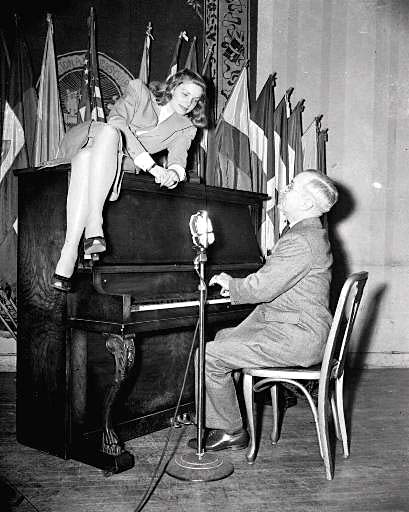
Bogart was less enthralled. Bogart said to one pushy photographer who kept asking for an invite to the wedding: "Why don't you just take some pictures of us fucking? That's what you want, right?"
Later - when the heat died down - Bogart apparently said to Lauren Bacall (she told us this story when she came and did a seminar at my school):
"Listen, baby - these tabloid newspapers - these photographers - the press - these people do not care about us. They could care less what actually happens to us. So you and I have to take very good care of our life. On our own. We can't expect them to do it for us. We know our values - and we know who we are."
They didn't believe their own press. They cultivated their private life. They had outside interests. They went sailing. They stayed at home. They read out loud to each other. They were celebrities, but they weren't a "celebrity couple".
Oh yes. This is SUCH an important topic. SO IMPORTANT THAT I HAVE TO DO TWO POSTS ABOUT IT.
People I never ever want to hear about again
Paris Hilton
Jennifer Lopez
Mischa Barton
Ben Affleck
Ashlee Simpson
Hillary Duff
Jessica Cutler
I am sure there are more. I have hit a level of fatigue with these people. I walked by Macy's today, and there was a sign as large as a house: JENNIFER LOPEZ LINGERIE and I groaned out loud at the very sight of her name.
She has completely bungled (in my opinion) her career. She has squandered what she had going for her in the beginning, by letting her personal life take the front page - and by getting sucked into her own celebrity. I would be very surprised if her career bounced back from this nadir.
I just read a biography of Cary Grant. (Big shocker, right?)
Cary Grant retired in 1966, without any fanfare. He basically just withdrew from acting. He felt he would no longer "be believable" as a leading man (even though directors and other actors begged to differ), and he didn't want to embarrass himself. Better to withdraw voluntarily. People in the business, until the very end of his life (and he lived for 20 more years) pestered him constantly. Wrote parts for him, scripts were still sent to him - he was offered millions and millions of dollars to do movies where he would have had only one scene. The answer was always No.
He was done.
There's a lot to be said for that.
The author of the biography, in the epilogue, discusses this self-imposed retirement, in conjunction with his entire successful career, and said, "He never wore out his welcome."
That's quite a lot to say for a man who made almost 80 movies and had a career that spanned decades. He knew when to withdraw, he would do 3 movies one year, and then take a year off - to let interest in him grow again, to keep himself from getting bored, he always kept a low profile, he never (or rarely) did interviews, he was purposefully vague about his personal life in interviews ... After his death, people who tried to piece together the truth about his life had a hell of a time of it. Because he would lie. Or he would tell half-truths. He would set people off on the wrong track. He thought that his personal life was nobody's damn business but his own.
But his reticence had more to it than just a natural reserve about sharing such things with strangers. It had to do with his own gut-level understanding of what the job of a performer actually is.
He understood that MYSTERY is one of the primary factors that makes a great movie star. If the audience knows too much about you, then they might not find you believable in different kinds of parts. If you reveal too much, if you give too much away ... then the audience gets bored.
My point of all of this is:
The people in the list above are, supposedly, at either the very PINNACLE of their fame, or just beginning the skyrocket up - and they have ALREADY "worn out their welcome".
Oh and of course - feel free to add your own names.
July 26, 2004
Reverberating bad-ness
Cat Woman is a bomb. Halle Berry may find it difficult to recover from this bomb, which is pretty much being characterized as a vanity project. I know the piece has been bouncing around Hollywood for years - but in the reviews, it makes it sound like they started with "costume sketches" - thinking that just putting Halle Berry in those sex-bomb outfits would be enough. Nothing further needed to be done.
Speaking of "bombs it might be difficult to recover from" - I saw a preview for the upcoming Jennifer Lopez movie, something about tango-ing, and Richard Gere's in it ... and perhaps I'm making it up, but I could feel the lack of interest in the theatre. No, that's not the right term. It wasn't lack of interest. It was a snickering interest, a hostile ghoulish interest ... a "ha ha - there's J-Lo - what a train wreck SHE is" kind of interest - which I am sure is not the vibe she is going for!!
You're not going to hit a home run every time you're at the plate, in terms of choosing movies - and there are some huge bombs which gain cult stature as time passes (like Ishtar) - and don't seem to really damage the reputations of the actors who acted in the bombs.
As bad as Battlefield Earth was, what's-his-name Pepper has been unharmed. In fact, his career has soared. Saving Private Ryan, 61*, etc. Mr. Pepper was not BLAMED for the failure of that movie.
But - and I have no proof to back this up - I think Jennifer Lopez's behavior in the last couple of years is crashing down around her. This probably wouldn't be the case if she had made some interesting movies during that time. But to be in the middle of that Bennifer NAUSEA and then to make the worst movie of all time??? Something is wrong with this girl's judgment. Even if there ISN'T, and she just happened to make a mistake in reading that script, or trusting the wrong person, or whatever ... I believe she has done lasting damage to her career.
I mean, here she is - coming out with this new sexy movie - where she plays a tango instructor - and the audience is snickering. Her manager, her agent must be scared. And if they aren't then they should be.
July 20, 2004
A Cagney reminder
I'm off to lose myself in Metallica. I feel like Al Pacino in Dog Day Afternoon - only instead of "Attica" I will be screaming "Metallica"!
But just a reminder to myself - I want to talk about this moment from Public Enemy tomorrow - I probably don't have anything to add, but I want to talk about it anyway:
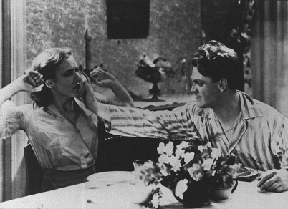
You can't have it both ways
You can't shriek and bitch about celebs when they step forward and mouth off with views you might not like - and then applaud and cheer them on when they say something you DO like.
Or - you can. Of course you can. Just recognize that you're trying to have it both ways.
There's a lot of "SHUT UP SHUT UP" noise going on right now, not in any particular place, but just in general - towards mouthy opinionated celebs - and a lot of times, yes, I do wince when I hear a celeb say something I think is idiotic, or against what I believe. I hate hearing Johnny Depp's opinions - Ick. (But that doesn't mean I don't love his acting. I, unlike many, do not base my love of actors on their political beliefs.)
So even though it enraged me when I heard what Johnny Depp's opinion was of, basically, ME, an American, I would never want to shut ANYONE up. I don't give a shit WHAT they say. I live in America, and I'm proud of it, and I LOVE all the conflicting noise, because it says to me there's health and freedom in our society.
But in my opinion it's hypocritical to think celebs should "shut up" and know their place (which I don't agree with anyway - Last time I checked they were also citizens of this land - what gives me or you or Vodka Pundit, or ANYBODY - the blowhard on the street corner - etc. etc. MORE of a right to mouth off OUR opinions than people who also happen to be famous? Nope. Don't buy it, and I don't like it) - and then applaud loudly and triumphantly when a celeb says something you agree with, and you exclaim something along the lines of: "Not ALL celebs are brainwashed idiots!"
Er ... they're not idiots because they AGREE with you?
Uh ... okay ......
An additional note: I may close comments on this one. I feel passionately about it, obviously - perhaps too passionately to listen to opposing views - and I also realize that I am in the minority. So I recognize the contradiction: I say: "I never want to shut ANYONE up" right before I close comments. Yes. It is hypocritical.
Another note: READING COMPREHENSION IS YOUR FRIEND.
Nowhere in this post do I say that entertainers should not be criticized. Or boycotted. Nowhere in this post do I say that celebrities should be immune from criticism or financial hardship because people decide not to see their movies/buy their albums. That is not the point of my post AT ALL. This post is about the general idea that celebrities should know their place in society and keep their mouths shut.
I HATE that attitude, and this is what I am talking about here.
So please do not comment AS THOUGH I said that, when I did not. Thanks.
June 9, 2004
Obsession Central: Kate Hepburn
Kate Hepburn was a fearless tomboy child. Beloved by her parents.
This is a great story - and I think a wonderful lesson - for parents who may hover. Hover over every scraped knee, every possible risk, trying to shield child from every single danger.
There was an enormous hemlock tree in the front yard of the Hepburn home in Hartford. Kate loved to climb high up into the branches, and hang out up there. Peacefully. She loved it.
Apparently, a neighbor in the next yard saw Kate perched up high, and called over to Kate's mother: "Kate is up way too high!"
Kate Hepburn's mother replied, "Sh. Don't scare Kate. She doesn't know it's dangerous."
June 7, 2004
Obsession Central: Kate Hepburn
Kate Hepburn's parents, before they were married, "dated" - in a kind of Victorian era way - for a long long time. Going on drives, moving at a desultory pace, nothing much happening, no declarations made, etc.
Kate's mother finally had had enough and decided to sting her beau into action. They were on a drive one afternoon, and she said to him happily, "You know what is so great about our relationship? When we finally get married to other people - neither of us will be upset at all!"
Kate's father was baffled, hurt, blustered - said, "But ... I want to marry you!"
And she said, "Then propose to me right now."
And he did.
They were married for something like 60 years.
May 10, 2004
For the Baltimore Boy...
who emailed me that he hadn't commented recently because of the "lack of boobie references" on my blog, which made me laugh. Like there was ever a time when I wrote about "boobies" with regularity. However, there was one Sharon Stone picture I posted which, I think, generated some breast-related convo.
Anyway, this is for you, Baltimore Boy, and for anyone else who wants to leap in:
Who has the best breasts in Hollywood, and why?
I will say that we can go with "past or present" - because I would go with Rita Hayworth, or Marilyn Monroe - but those breasts are of another time. Tastes change.
Take it away, everyone.
July 1, 2003
Hepburn-isms
A couple other choice Hepburn quotes I have tripped over in my wanderings today:
This one is delicious:
Barbara Walters interviewed Hepburn, and asked the penetrating question: "Kate, you always wear pants. Do you even own a skirt?"
Hepburn replied: "I have one, Miss Walters. I'll wear it to your funeral."
(via Viking Pundit)
HA
Something else comes to mind, an anecdote I heard in person:
Christopher Reeve came and spoke at my school (The Actors Studio) in, oh, 1997 or something like that. It was quite a production, with his team of medical professionals, his wife, his oxygen-tank, his rolling bed. And yet, despite all of the problems, despite his head rolling off to the side at one point, and his wife strolling on stage to put it right, despite those bumps in the road, he managed to put US at ease. Talk about a class act! Anyway, one of Chris Reeve's big breaks was on Broadway. He had a small part in a play starring Katherine Hepburn. It was quite a coup for a young unknown.
So Jim Lipton, the interviewer, asked him, "So tell us what it was like to act with Katherine Hepburn?"
There was a long pause, as Chris Reeve took in some air. Then he said dryly, "I don't think I acted with Katherine Hepburn. I acted near Katherine Hepburn."
Oh, Lord. I remember the waves of laughter rolling through the auditorium when he said that.
Vodka Pundit has a gorgeous in-memorium on his blog.
You should go and read the whole thing.
A couple of choice quotes from the Pundit himself:
"The gal had gams."
"Kate, in short, was a knockout. And not a knockout in the lazy way we've grown too used to, with boobs falling out everywhere and microskirts with a slit all the way up to the left ovary."
"She was tough before tough was cool, a feminist before feminism was cool, independent before independence was cool, and cool before even cool was cool."
And then his great description of her voice: "You'll hear whiskey and smoke poured through velvet, with a delivery that could soothe like a gin martini or burn like acid."
June 30, 2003
Hepburn Miscellania
These quotes are scattered through the special edition of the New York Daily News. Hepburn seemed to have spoken in often-publishable words.
I would love to rattle off one-liners in such a way.
"I'm like some weather-beaten old monument. People are beginning to realize they'll miss me when I'm gone."
"I had years of perfect companionship with a man among men. I've never regretted it." (So much for Elena Pearson, a writer from Queens, quoted in one of the pieces about Hepburn: "She didn't need men. She was strong. She was powerful." Uh: Elena? Life sometimes is a bit more complex than that. Mmkay? Not everybody is going to fit into your neat little ideology.) Hepburn would turn down roles so that she could tend to Tracy, she coddled him, she helped him sober up, she thought it was more important that she be available to Tracy, than to advance her career. Yes, she was strong, Yes, she was powerful ... but she didn't need men?? The two (or three) are not mutually exclusive.
At least I hope they're not, for my own sake. Jeez.
To add to the complexity, here is Hepburn's take on her relationship with men:
"In my relationships I know that I have some qualities that are offensive to people -- especially men. I'm loud and talkative and I get onto subjects that irritate. If I feel these things causing a break, I know something has to give. I never think the man is going to give -- or anyone else for that matter -- so I do. I just deliberately change. I just shut up -- when every atom in me wants to speak up."
(Response, Ms. Pearson??)
And along those lines, here is what she said about her relationship with Spencer Tracy. I remember reading it in her autobiography and feeling ... baffled ... confused ... why didn't she stand up to him? Why didn't she say "Take me as I am, you fool!" Well, she did not, and we must take her at her word that she has no regrets. Anyway, here is the quote in question:
"Well, the things he found irritating I removed."
I feel like I could spend the rest of my life thinking about that statement.
More Hepburn quotables:
"The thing about life is that you must survive. Life is going to be difficult, and dreadful things will happen. What you do is to move along, get on with it, and be tough. Not in the sense of being mean to others, but tough with yourself and making a deadly effort not to be defeated."
"I just don't like to be half-good. It drives me insane. And I'm willing to do anything to try to be really good. I'm very aware when I'm very good -- and I like to be very, very good. Oh, I think perfection is the only standard for people who are stars."
"Marriage is not a natural institution -- otherwise why sign a contract for it?"
"I can't stand Mary of Scotland. I think she was an absolute ass. I thought Elizabeth was absolutely right to have her condemned to death."
This one breaks my heart a bit:
"Being an actor is a humiliating experience. Because you are selling yourself to the public, your face, your personality, and that is humiliating. As you get older, it becomes more humiliating, because you've got less to sell."
"Everyone thought I was bold and fearless and even arrogant, but inside I was always quaking ... I don't care how afraid I may be inside -- I do what I htink I should."
Indeed.
More Kate Hepburn
Here's another quote from Miss Hepburn, which has made me tear up all over again:
"With all the opportunities I had, I could have done more. And if I'd done more, I could have been quite remarkable."
A class act, that dame.
(via Volokh)
The Divine Kate
They just don't make movie stars and actresses like Katherine Hepburn anymore.
She was a true original.
More on Miss Hepburn:
Roger Ebert has written a beautiful eulogy to this most treasured American icon.
A couple of my favorite anecdotes, anecdotes which have entered into the realm of myth in my own mind, having studied Katherine Hepburn's life and acting for years:
Dorothy Parker saw Hepburn in a Broadway play, early on in Hepburn's career. Parker, true to form, wrote that Hepburn displays the "gamut of emotions, from A to B." My take on this is: Not every actor is capable of going from A to Z. A to Z is extremely over-rated. The greats, the ones who are burned into the psyche of movie-goers everywhere, pretty much do ONE thing, and do it better than anybody else on the planet. Spencer Tracy. Cary freakin' Grant. Humphrey Bogart. These are not people who transform themselves endlessly, from part to part to part. They are not chameleons. You always recognize Humphrey Bogart. But that does not diminish the accomplishment. More than anyone else in the world, they could bring that one thing, that one essence, to life -- It's like a kind of magic.
Katherine Hepburn said, about herself: "I strike people as peculiar in some way, although I don't quite understand why. Of course, I have an angular face, an angular body and, I suppose, an angular personality, which jabs into people."
KNOW THYSELF. It is perhaps the most important thing to have, to own, if you want to be an actor. Know thyself. Easier said than done.
The following snippet, offered up by Ebert, brought tears to my eyes. Katherine Hepburn obviously developed a pronounced tremor in her face and voice, as she got older. An interviewer (a rude a**hole, if you ask me) asked her about her decision to continue acting, even though her face and voice shook. She replied (and I can just imagine HOW she said it), "What choice do I have?"
Take THAT.
A good friend of hers was being interviewed last night on CNN or something, and of course, questions came up about her relationship with Spencer Tracy, and whether or not Katherine Hepburn had any regrets. The friend answered, "Oh, no no no. Kate never wasted time with regrets."
I should have my own personal Hepburn/Tracy film festival. Is there anything more enjoyable than watching the two of them spar, trying to best each other intellectually? Is there anything sexier? More erotic? Their wars of words...God, to have a relationship like that! They battle, they spit out insults at one another, and yet the overriding feeling is that all they want to do is throw each other down.
Do actors still know how to do that?
Of course, the material now is not half as good as the material was back then. Also, actors back then all came out of the theatre tradition. Almost nobody in Hollywood now comes out of the theatre tradition. There IS no theatre tradition! And it shows in the work of the actors and actresses up on the screen. I can't really explain it, but I look at someone like Katherine Hepburn and I KNOW she has had theatre training.
The same is true for someone like Meryl Streep. Olympia Dukakis. Robert DeNiro. These people are obviously trained for the stage.
A funny story about Katherine Hepburn:
It was the 1930s. A new theatre group was being formed, a group who wanted to bring relevant plays to Broadway, plays which spoke to the angst of the time. In the 1930s, the majority of material on Broadway was fluffy high-brow comedies, the foibles of the upper-class. So, a "group" got together, headed by Harold Clurman, Lee Strasberg, and Cheryl Crawford, and they wanted to change all that.
The theatre which evolved out of that, the Group Theatre, only lasted a decade. But the Group is one of the most influential things to have ever happened in American theatre. Its influence cannot be over-stated. First of all, the Group Theatre gave us Clifford Odets' plays. The Group Theatre was where Elia Kazan, who went on to direct the most influential and loved films of the 20th century, first got his training. Out of the Group Theatre eventually came the most influential acting teachers of the last century: Lee Strasberg, Stella Adler, Bobby Lewis, Morris Carnovsky ...
The Group died because of in-fighting, and financial problems. Out of the ashes of the Group Theatre the Actors Studio was created by Lee Strasberg and Elia Kazan, and obviously: the Actors Studio is directly responsible (in my view) for the elevation of film acting to an actual art form. The technique taught there created the kind of film acting which we all now take for granted. Marlon Brando, Steve McQueen, Paul Newman, Geraldine Page, Ellen Burstyn, James Dean, Montgomery Clift ... all of these people came out of the Actors Studio.
But back to the Group Theatre: they were a bunch of successful people, in the middle of the Depression, who started holding meetings about how to revive the theatre, how to work as an ensemble, how to model themselves after the Moscow Art Theatre, how to be a group in a capitalist society which did not support such endeavors. Harold Clurman invited the big-wigs of the New York theatre scene to come join them, to come sit in on the meetings, to see if they would want to be a part of such an exciting and new project.
Katherine Hepburn, a 20-something Broadway actress at the time, not yet world-famous, "Philadelphia Story" still in her future, was invited to come to some of these meetings. She came. She sat. She listened. In the middle of the meeting, this young unknown actress got up and started to walk out. Harold Clurman stopped her. "Where are you going? What's going on?"
Hepburn replied, "This is all very well for you people. But I'm going to be a star, you see."
The purist Group people were horrified at this. But who has the last laugh now?